BenQ Mobile and OHG SX1 GSM 1900 Mobile Phone with Bluetooth User Manual K1gb
BenQ Mobile GmbH & Co. OHG GSM 1900 Mobile Phone with Bluetooth K1gb
Contents
- 1. Exhibit 8 User Manual
- 2. Exhibit 8 User manual
Exhibit 8 User Manual

Contents 1
See also Index at the end of this User Guide
SX1 K1 am-en, A31008-H6500-A5-1-7619 (29. July 2003, 19:32)
© Siemens AG 2001, I:\Mobil\SX1_(K1)\am\ex_sdl\K1gbIVZ.fm
Safety precautions ..................... 4
Safety Information ..................... 6
Antenna care ........................... 6
Phone operation ...................... 6
Electronic devices ..................... 7
SAR (Cell Phone Designation) .. 10
Overview of the phone ............ 12
Getting started ......................... 14
Insert SIM card/battery ........... 14
Emergency number (SOS) ...... 15
Charge battery ....................... 15
User guide ............................. 16
Navigation ............................. 16
Menu ..................................... 17
Searching ............................... 17
Switch on, off / PIN entry ......... 18
Standby mode ........................ 18
Security .................................... 19
Making a phone call ................. 20
Dialing with number keys ....... 20
Dialing using Contacts ............ 20
Accept call ............................. 20
End call .................................. 20
Dialing options ....................... 20
Decline call ............................ 21
Call waiting ............................ 21
Conference ............................ 21
Volume control ...................... 23
Handsfree .............................. 23
Writing text .............................. 24
Contacts ................................... 27
Open the Contacts ..................27
Insert SIM card entries ............27
Call an entry ...........................29
View an entry .........................29
Groups ...................................30
Voice dialing ...........................31
Add a ring tone .......................32
Business card ..........................33
Log ............................................34
Recent calls ............................34
Log list ...................................34
Call timers ..............................34
Call costs ................................35
GPRS data counter ..................35
Log options ............................35
Messages ..................................36
Message options .....................36
New messages .......................36
Inbox ......................................39
Viewing a message .................40
View options ..........................40
My folders ..............................41
Mailbox ..................................42
Drafts .....................................43
Sent .......................................43
Outbox ...................................44
Reports ...................................44
Settings ..................................44
SIM messages .........................49
Cell broadcast .........................49
Service commands ..................50
Contents
See also
Index at the
end of this
User Guide

Contents
2
See also Index at the end of this User Guide
SX1 K1 am-en, A31008-H6500-A5-1-7619 (29. July 2003, 19:32)
© Siemens AG 2001, I:\Mobil\SX1_(K1)\am\ex_sdl\K1gbIVZ.fm
Internet .................................... 51
Settings ................................. 51
Bookmarks view ..................... 51
WAP connection ..................... 52
WAP browser settings ............. 54
Connection security ............... 54
Camera ..................................... 55
Snapshot ............................... 55
Images ................................... 56
Music ........................................ 60
Radio ..................................... 60
Composer .............................. 61
Organizer ................................. 63
Calendar ................................ 63
Tasks ..................................... 65
Notes ..................................... 66
Voice memo ........................... 66
Calculator .............................. 67
Converter ............................... 67
Extras ....................................... 69
File Manager .......................... 69
Java applications .................... 71
Alarm clock ............................ 73
Favorites ................................ 74
SIM phonebook ...................... 74
SIM fixed dial ......................... 74
Service numbers .................... 74
SIM services ........................... 75
PC connection ........................ 75
Profiles ..................................... 76
Select ................................................. 76
Setup .....................................77
Setup ........................................78
Phone ....................................78
Call .........................................79
Connection .............................80
Date and time settings ............82
Security ..................................83
Call restriction ........................84
System ...................................85
Accessory settings ..................86
Call forwarding .......................87
Bluetooth™ ............................88
IrDA ........................................91
Modem ..................................91
Audio .....................................92
Screen saver ...........................92
Voice mailbox .........................93
Manager .................................95
Shortcut .................................97
Questions & Answers ................98
Customer Care ........................101
Care and maintenance ...........102
Product data ...........................103
Accessories .............................104
U.S. FDA ..................................105
FCC/Industry Canada Notice ...111
Ten Driving Safety Tips ...........112
Intellectual Property ...............114
Battery quality statement ......115
Battery quality statement ......115
Display quality statement ......115
See also
Index at the
end of this
User Guide

Safety precautions
4
SX1 K1 am-en, A31008-H6500-A1-1-7619 (29. July 2003, 19:32)
© Siemens AG 2001, I:\Mobil\SX1_(K1)\am\ex_sdl\k1gb_security.fm
Safety pre-
cautions NOTE:
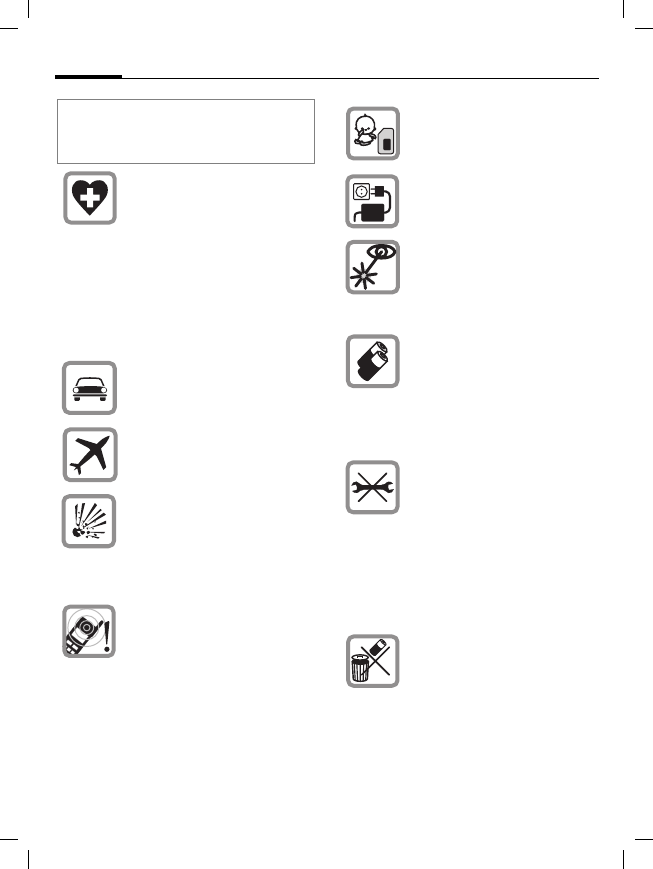
Review these operating instructions and
safety precautions carefully before use.
Do not use mobile phone in hos-
pitals or in the vicinity of medical
devices, such as pacemakers or
hearing aids. Mobile phones
may interfere with the operation
of these devices. Keep a mini-
mum distance of 6–8" between
pacemaker and mobile phone.
When using the mobile phone
hold it to the ear farthest from
the pacemaker.
Always use the handsfree kit to
make calls while driving
(p. 104).
Turn off mobile phone while
aboard any aircraft. To prevent
accidental activation.
Do not use mobile phone near
gas stations, fuel depots, chem-
ical plants or blasting opera-
tions. Mobile phones may cause
interference with the operation
of technical installations.
The ring tone and hands-free
speaker are reproduced through
the earpiece. Never hold the
handset to your ear when the
handset is ringing or when using
the hands-free speaker mode.
Serious and permanent damage
could occur to your hearing!
Caution! SIM card may be
removed. Keep out of reach of
children.
Do not exceed the mains volt-
age (V) specified on the power
supply unit.
Do not use an optical magnifier
to look at the activated infrared
interface [Class 1 LED product
(classification as per
IEC 60825-1)].
Only use original Siemens bat-
teries (100% mercury-free) and
charging devices. Use of non-
Siemens batteries and/or charg-
ing devices may cause explo-
sion resulting in serious injury
and/or property damage.
It is recommended that you
open the phone only to replace
the battery (100% mercury-free)
or SIM card. Do not open the
battery under any circum-
stances. Any other changes to
this device may invalidate the
FCC authorization required for
operation of the device, and are
strictly prohibited.
Dispose of used batteries and
phones in accordance with
applicable laws and safety regu-
lations.
Safety precautions 5
SX1 K1 am-en, A31008-H6500-A1-1-7619 (29. July 2003, 19:32)
© Siemens AG 2001, I:\Mobil\SX1_(K1)\am\ex_sdl\k1gb_security.fm
Mobile phones may interfere
with the operation of nearby
TVs, radios or PCs.
For body worn operation, this
mobile phone has been tested
and meets FCC RF exposure
guidelines when used with a
Siemens accessory designated
for this product or when used
with a carry accessory that con-
tains no metal and that positions
the handset at least 0.001 cm
from the body. Use of other
carry accessories may not
ensure compliance with FCC
RF exposure guidelines.
Use original Siemens accesso-
ries in order to avoid possible
injury and property damage and
to ensure compliance with appli-
cable laws and regulations.
Improper use invalidates the warranty!
Changes or modifications to this device not
expressly approved by Siemens may void
your authority to operate the equipment.

Safety Information
6
SX1 K1 am-en, A31008-H6500-A1-1-7619 (29. July 2003, 19:32)
© Siemens AG 2001, I:\Mobil\SX1_(K1)\am\ex_sdl\k1gb_security.fm
Safety Infor-
mation
Antenna care
Use only the supplied or an approved
replacement antenna. Unauthorized
antennas, modifications, or attach-
ments could damage the phone and
you may violate FCC regulations.
Phone operation
Normal position
Hold the phone as you would any
other telephone with the antenna
pointed up and over your shoulder.
Tips on efficient operation
For your phone to operate most effi-
ciently:
• Extend your antenna fully (if applicable).
• Do not touch the antenna unnecessarily
when the phone is in use. Contact with the
antenna affects call quality and may cause
the phone to operate at a higher power
level than otherwise needed.
Driving
Laws pertaining to the use of mobile
phones while driving vary signifi-
cantly from state-to-state and some-
times even from locality-to-locality
within states. For example, some
areas may allow persons to use their
mobile phones only if they employ a
hands-free device, and some areas
may prohibit the use of mobile
phones entirely. Accordingly,
Siemens recommends that you
check the laws for the areas in which
you drive or will be driving. For areas
where the use of mobile phones
while driving is permitted, Siemens
encourages you to use your phone
responsibly and to employ a hands-
free device. Also, if using your phone
while driving, please:
• Give full attention to driving – driving safely
is your first responsibility;
• Use hands-free operation, if available;
• Pull off the road and park before making or
answering a call, if driving conditions so
require.
• Review the Ten Driving Safety Tips set
forth on p. 112.
Important
Read this information before using
your wireless handheld phone.
As this mobile phone is equipped
with a fixed (non-retractable)
antenna, some paragraphs in the
below text may not be applicable.

Safety Information 7
SX1 K1 am-en, A31008-H6500-A1-1-7619 (29. July 2003, 19:32)
© Siemens AG 2001, I:\Mobil\SX1_(K1)\am\ex_sdl\k1gb_security.fm
For vehicles equipped with
Air Bags
An air bag inflates with great force.
DO NOT place objects, including
either installed or portable wireless
equipment, in the area over the air
bag or in the air bag deployment
area. If in-vehicle wireless equip-
ment is improperly installed and the
air bag inflates, serious injury could
result.
Electronic devices
Most modern electronic equipment
is shielded from radiofrequency (RF)
signals. However, certain electronic
equipment may not be shielded
against the RF signals from your
wireless phone.
Pacemakers
The Health Industry Manufacturer’s
Association recommends that a min-
imum separation of six inches (6”) be
maintained between a handheld
wireless phone and a pacemaker to
avoid potential interference with the
pacemaker. These recommenda-
tions are consistent with the inde-
pendent research by and recommen-
dations of Wireless Technology
Research.
Persons with pacemakers
• should ALWAYS keep the phone more
than six inches from their pacemaker
when the phone is turned ON;
• should not carry the phone in a breast
pocket;
• should use the ear opposite the pace-
maker to minimize the potential for interfer-
ence;
• should turn the phone OFF immediately if
there is any reason to suspect that interfer-
ence is taking place.
Hearing Aids
Some digital wireless phones may
interfere with some hearing aids. In
the event of such interference, you
may want to consult your service
provider or your hearing aid manu-
facturer to discuss alternatives.
Other Medical Devices
If you use any other personal medi-
cal devices, consult the manufactur-
ers of your devices to determine if
they are adequately shielded from
external RF energy. Your physician
may be able to assist you in obtain-
ing this information.
Turn your phone OFF in health care
facilities when any regulations
posted in these areas instruct you to
do so. Hospitals or health care facili-
ties may be using equipment that
could be sensitive to external RF
energy.

Safety Information
8
SX1 K1 am-en, A31008-H6500-A1-1-7619 (29. July 2003, 19:32)
© Siemens AG 2001, I:\Mobil\SX1_(K1)\am\ex_sdl\k1gb_security.fm
Vehicles
RF signals may affect improperly
installed or inadequately shielded
electronic systems in motor vehicles.
Check with the manufacturer or its
representative regarding your vehi-
cle. You should also consult the
manufacturer of any equipment that
has been added to your vehicle.
Posted Facilities
Turn your phone OFF in any facility
where posted notices so require.
Airplanes
FCC and Airline Regulations prohibit
using your phone while in the air.
Turn your phone OFF before board-
ing an airplane.
Check and comply with the policy of
your airline regarding the use of your
phone while the airplane is on the
ground.
Blasting areas
To avoid interfering with blasting
operations, turn your phone OFF
when in a “blasting area” or in areas
posted: “Turn off two-way radio.”
Obey all signs and instructions.
Potentially explosive atmo-
spheres
Turn your phone OFF when in any
area with a potentially explosive
atmosphere and obey all signs and
instructions. Sparks in such areas
could cause an explosion or fire
resulting in bodily injury or even
death.
Areas with a potentially explosive
atmosphere are often but not always
clearly marked. They include: fueling
areas such as gasoline stations;
below deck on boats; fuel or chemi-
cal transfer or storage facilities; vehi-
cles using liquefied petroleum gas
(such as propane or butane); areas
where the air contains chemicals or
particles, such as grain, dust or metal
powders; and any other area where
you would normally be advised to
turn off your vehicle engine.
Emergency calls (SOS)
Your wireless phone can be used to
make emergency calls. You can
make an emergency call from the
main display screen. Enter the local
emergency number such as 911 and
then press the A key.
This phone, like any wireless phone,
operates using radio signals, wire-
less and landline networks, and user-
programmed functions. Because of
this, connections in all conditions
cannot be guaranteed. Therefore,
you should never rely solely on any
wireless phone for essential commu-

Safety Information 9
SX1 K1 am-en, A31008-H6500-A1-1-7619 (29. July 2003, 19:32)
© Siemens AG 2001, I:\Mobil\SX1_(K1)\am\ex_sdl\k1gb_security.fm
nications (for example, medical
emergencies). Remember - to make
or receive any calls, the phone must
be switched on and be used in a ser-
vice area that has adequate signal
strength. Emergency calls might not
be possible on all wireless phone
networks or when certain network
services or phone features are in use.
Check with local service providers
regarding their network features.
Always make certain that your
phone is properly charged before
attempting any emergency calls. If
you allow your battery to discharge,
you will be unable to receive or make
calls, including emergency calls. You
must then wait a few minutes after
the charging begins to place any
emergency calls.
When making an emergency call,
remember to give all of the neces-
sary information as accurately as
possible. Remember that your wire-
less phone might be the only means
of communication at the scene of an
accident, therefore you should not
terminate the call until given permis-
sion to do so.

SAR (Cell Phone Designation)
10
SX1 K1 am-en, A31008-H6500-A5-1-7619 (29. July 2003, 16:26)
© Siemens AG 2001, I:\Mobil\SX1_(K1)\am\ex_sdl\k1gb_sar.fm
SAR (Cell
Phone
Designation)
RF EXPOSURE /SPECIFIC
ABSORPTION RATE (SAR)
INFORMATION
THIS SIEMENS SX1 PHONE MEETS
THE GOVERNMENT'S REQUIRE-
MENTS FOR EXPOSURE TO ELECTRO-
MAGNETIC FIELDS.
Your cell phone is a radio transmitter
and receiver. It is designed and man-
ufactured not to exceed the emission
limits for exposure to radio fre-
quency (RF) energy established by
the Federal Communications Com-
mission (FCC) of the U.S. Govern-
ment and by Health Canada. These
limits are part of comprehensive
guidelines and establish permitted
levels of RF energy for the general
population. The guidelines were
developed and confirmed by inde-
pendent scientific organizations
through periodic and thorough eval-
uation of scientific studies*. The lim-
its include a substantial safety mar-
gin designed to assure the safety of
all persons, regardless of age and
health.
The exposure standard for cell
phones employs a unit of measure-
ment known as the Specific Absorp-
tion Rate, or SAR. The SAR limit
established by the FCC and by Health
Canada is 1.6 W/kg**. Tests for SAR
are conducted using standard oper-
ating positions accepted by the FCC
and by Industry Canada with the
phone transmitting at its highest cer-
tified power level in all tested fre-
quency bands. Although the SAR is
determined at the highest certified
power level, the actual SAR level of
the phone while operating can be
well below the maximum value. This
is because the phone is designed to
operate at multiple power levels so
as to use only the power required to
reach the network. In general, the
closer you are to a wireless base sta-
tion, the lower the power output.
Before a phone model is available for
sale to the public, it must be tested
and the manufacturer must certify to
the FCC and Industry Canada that it
does not exceed the limit estab-
lished by each government for safe
exposure. The tests are performed in
positions and locations (e.g., at the
ear and worn on the body), reported
to the FCC and available for review
by Industry Canada. The highest SAR
value for this model phone when
testest for use at the ear is
0.59 W/kg***
and when worn on the body+ is
0.46 W/kg***
Additional information on Specific
Absorption Rates (SAR) can be found
on the Cellular Telecommunications
Internet Association (CTIA) web-site
at www.phonefacts.net or the Cana-
dian Wireless Telecommunications
Association (CWTA) website
www.cwta.ca.
SAR information on this Siemens
SX1 phone is on file with the FCC
and can be found under the Display
Grant section of
http://www.fcc.gov/oet/fccid
after searching on FCC ID PWX-SX1.

SAR (Cell Phone Designation) 11
SX1 K1 am-en, A31008-H6500-A5-1-7619 (29. July 2003, 16:26)
© Siemens AG 2001, I:\Mobil\SX1_(K1)\am\ex_sdl\k1gb_sar.fm
While there may be differences
between the SAR levels of various
phones and at various positions, all
Siemens products meet the
governmental requirements for safe
RF exposure.
+ For body worn operation, this
mobile phone has been tested
and meets FCC RF exposure
guidelines when used with a
Siemens accesory designated for
this product or when used with a
that contains no metal and that
positions the handset at least
1.5 cm/0.59 in from the body.
Use of other carry accessories
may not ensure compliance with
FCC RF exposure guidelines.
* The World Health Organization
(WHO, CH-1211 Geneva 27,
Switzerland), on the basis of the
actual knowledge, does not see
any necessity for special
precautionary measures when
using cell phones.
Further information:
www.who.int/peh-emf,
www.mmfai.org,
www.my-siemens.com.
** averaged over 1 g of tissue.
***SAR values may vary depending
on national requirements and
network bands. SAR information
for different regions can be
found at www.my-siemens.com
Overview of the phone
12
SX1 K1 am-en, A31008-H6500-A5-1-7619 (29. July 2003, 19:32)
© Siemens AG 2001, I:\Mobil\SX1_(K1)\am\ex_sdl\k1gb_overview.fm
Overview of
the phone
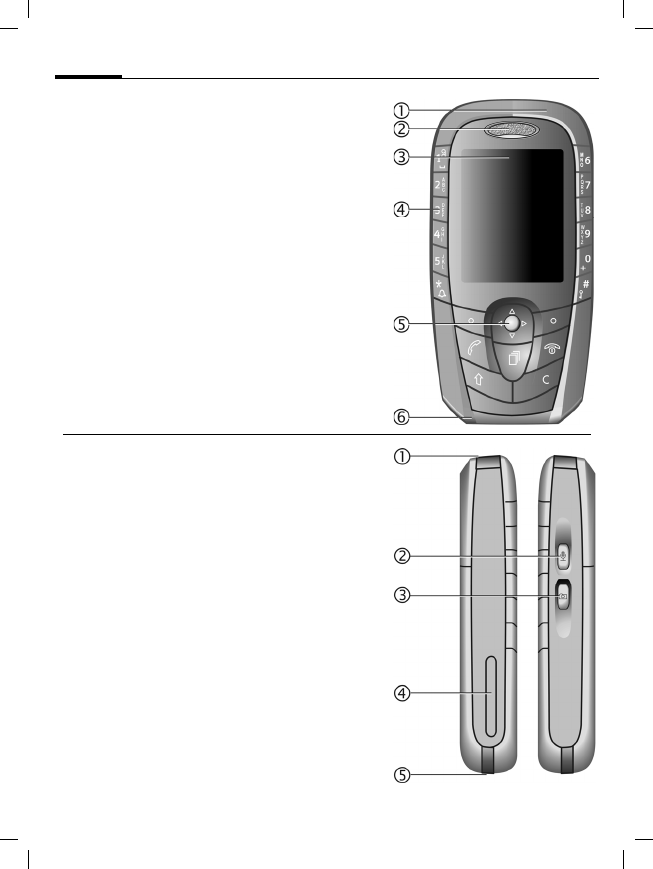
cIntegrated antenna
Do not interfere with the phone above the
battery cover unnecessarily. This reduces
the signal strength.
dLoudspeaker
eDisplays
Signal strength/GPRS available/ battery
level
fNumber keys
Digits, letters.
gJoystick/Other keys
See next page.
hMicrophone
cInfrared interface
(IrDA, e.g. for communication between PC/
PDA and mobile phone)
dPush-to-talk key
• In standby mode: start voice control,
• In voice control mode: start recording,
• In voice record mode: start recording.
eSnapshot key
• In standby mode:
start snapshot application,
• Snapshot mode: take a photo.
fMultiMediaCard insertion
gDevice interface
Connection for charger, headset etc.
Overview of the phone 13
SX1 K1 am-en, A31008-H6500-A5-1-7619 (29. July 2003, 19:32)
© Siemens AG 2001, I:\Mobil\SX1_(K1)\am\ex_sdl\k1gb_overview.fm
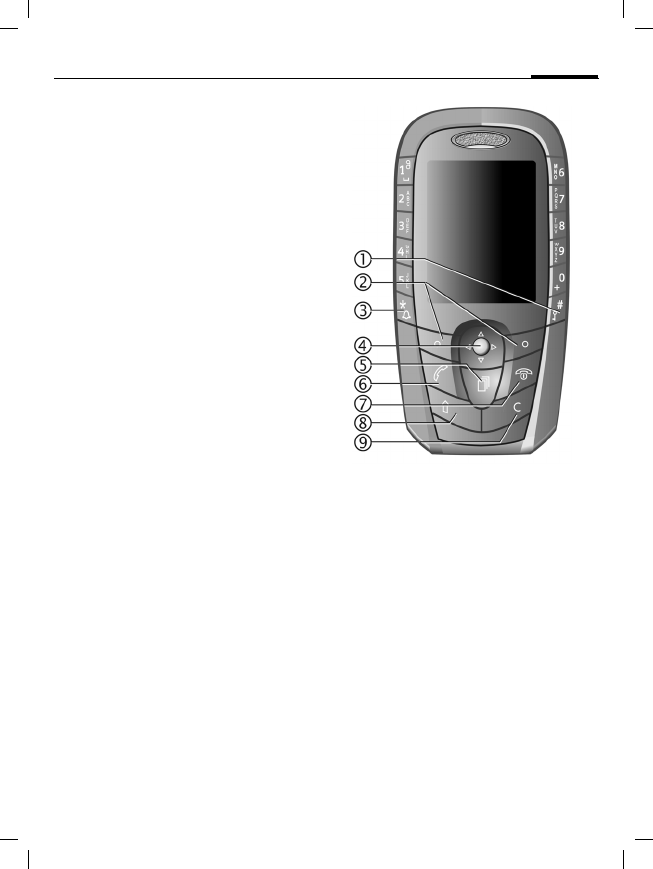
c# key Hold down
In standby mode: switch key lock on/off.
dSoft keys
The current functions of these keys are
displayed in the lowest display line as text or
icons.
e* key Hold down
In standby mode: Switch on/off the profile
"Silent" (p. 76).
fJoystick
Move the joystick left, right, up down for
navigation on the display.
Press the joystick to open folders or start
applications.
gMenu key
Press to display the main menu. Hold down
to switch between applications (p. 17).
hCall key
Dial displayed phone number or name,
accept calls. In standby mode: display the
last calls.
iOn/Off/End key
Press: end call/function and return to
standby mode.
In menus: one menu level back.
Hold down:
Switch phone on/off. From menus: return to
standby mode.
jShift key
Opens the text menu with editing functions.
In lists: while holding, press/move the
joystick to mark/unmark items.
In edit mode: while holding, press/move the
joystick to mark/unmark characters.
kClear key
Deletes selected items in edit mode or user-
created lists.
Getting started
14
SX1 K1 am-en, A31008-H6500-A5-1-7619 (29. July 2003, 19:32)
© Siemens AG 2001, I:\Mobil\SX1_(K1)\am\ex_sdl\k1gb_startup.fm
Getting
started Insert SIM card/battery
The service provider supplies you
with a SIM card on which all the
important data for your line is
stored. If the SIM card has been
delivered in credit card size, snap the
smaller segment out and remove
any rough edges.
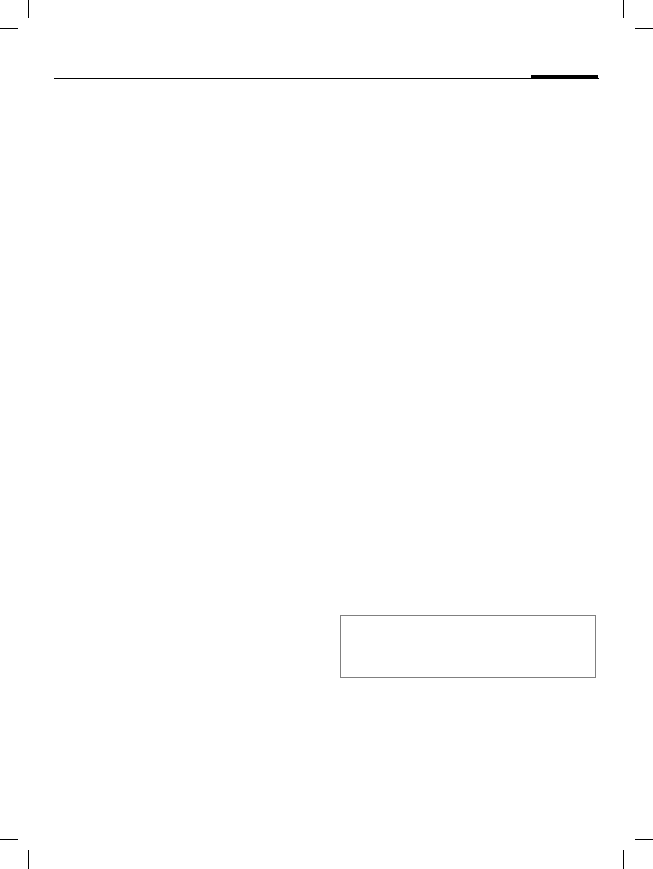
• Press the lock n and remove the
lid in the direction indicated by
the arrow o.
• Remove the battery upwards p.
• Insert SIM card in the opening
with contacts pointing downwards.
First push at the phones edge q,
than push gently until it engages
r (make sure the angled corner is
in the correct position).
• Insert battery into phone s.
• Close the lid by reversing the
method described in o.
n
o
n
p
Note
Always switch off phone before removing
the battery!
Only 3-Volt SIM cards are supported.
Please contact your service provider if you
have an older card.
q
r
p
s
Getting started 15
SX1 K1 am-en, A31008-H6500-A5-1-7619 (29. July 2003, 19:32)
© Siemens AG 2001, I:\Mobil\SX1_(K1)\am\ex_sdl\k1gb_startup.fm
Emergency number
(SOS)
Must only be used in real
emergencies!
Switch the phone on and check for
adequate signal strength.
EPress to go to standby if in
a menu or application.
MKey in the emergency
number (e.g. 112 or other
official emergency
numbers).
DPress to call the number.
You can make an emergency call on
any system without a SIM card and
without entering a PIN (not available
in all countries).
Charge battery
The battery is not fully charged
when delivered. Plug in the charger
cable at the bottom of the phone,
plug in the power supply unit to the
power socket and charge for at least
two hours.
Display when charging is in
progress
hDuring charging.
Charging time
An empty battery is fully charged
after about 3 hours. Charging is only
possible in an ambient temperature
of 41 °F to 104 °F (the charge icon
flashes as a warning when the
temperature is 41 °F above/below
this range). The mains voltage
specified on the power supply unit
must not be exceeded.
Charge icon not visible
If the battery is totally discharged
no charge icon is displayed when
the charger is plugged in. It will
appear after two hours at most. In
this case the battery is fully charged
after 3–4 hours.
Only use the charger provided!
Display while in service
Charge level display during
operation (empty-full):
adg
A beep sounds when the battery is
nearly empty.
Note
The charger heats up when used for long
periods. This is normal and not dangerous.
Getting started
16
SX1 K1 am-en, A31008-H6500-A5-1-7619 (29. July 2003, 19:32)
© Siemens AG 2001, I:\Mobil\SX1_(K1)\am\ex_sdl\k1gb_startup.fm
User guide
The following symbols are used to
explain operation:
Navigation
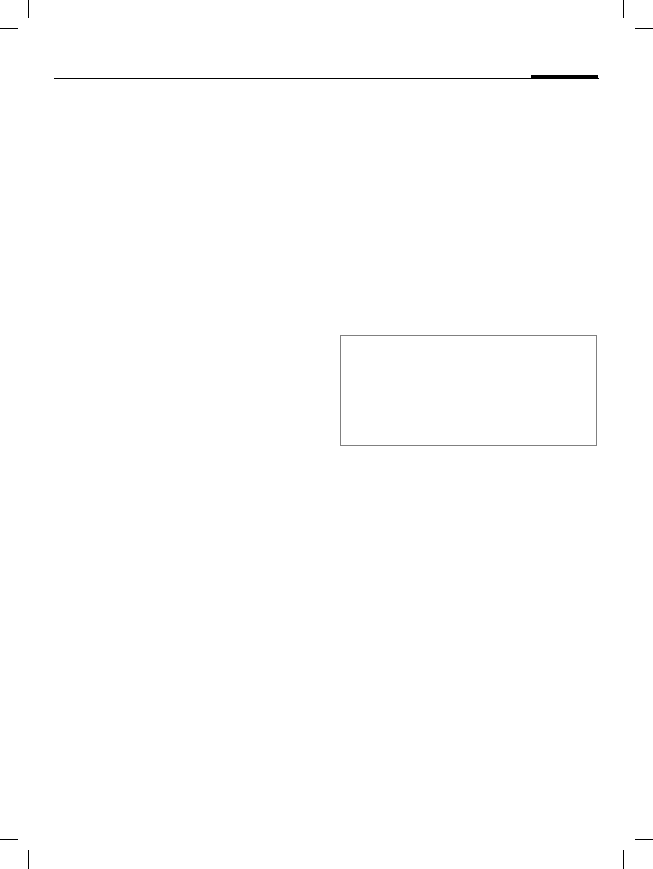
Joystick
Move the cursor in menus, and lists
by moving the joystick to the left,
right, up, and down.
Open selected folders or start
applications by briefly pressing on
the joystick.
MEnter numbers or letters.
EOn/Off/End key.
DCall key.
A BSoft keys.
FShift key.
GClear key.
CMenu key.
KUse joystick for navigation
on display, and for open
folders and applications.
LFunction depends on the
service provider, special
registration may be
necessary.
Getting started 17
SX1 K1 am-en, A31008-H6500-A5-1-7619 (29. July 2003, 19:32)
© Siemens AG 2001, I:\Mobil\SX1_(K1)\am\ex_sdl\k1gb_startup.fm
Menu
In the Menu you can access all main
applications.
CPress the menu key to
display the Menu.
Personalize your Menu
Organize all applications and folders
in any order you like. Select the
required item, then:
OptionsKMove
A check mark is placed beside the
selection. Move with the cursor to
the new position and press OK.
To move items to a folder, select the
required item:
OptionsKMove to folder
A list of available folders is shown as
possible destinations (function is not
shown if there is no folder available).
You can also choose the root level
when moving an item out of a
folder. Select the new location for
the item and press OK.
Menu options
Open, List view, Move, Move to folder,
New folder, Exit.
Switching between
applications
If there is more than one application
running you can switch between
them.
CPress and hold down the
Menu key.
A list with all active applications
appears on the display. Scroll to the
required one and press the joystick
to switch the active one.
Searching
Your phone has one search field for
all purposes. In some applications
this field is visible automatically.
In other cases you may have to
activate it:
OptionsKFind
To search for an item, key in letters
in the search field. The phone starts
searching automatically and shows
the matches for selection. To
optimize the search, key in more
letters. To open the found item,
press the joystick.
Note
If too many applications are open, some
may be closed by the phone to save
memory. Unsaved data will be saved
automatically before an application is
closed.
Switch on, off / PIN entry
18
SX1 K1 am-en, A31008-H6500-A5-1-7619 (29. July 2003, 19:32)
© Siemens AG 2001, I:\Mobil\SX1_(K1)\am\ex_sdl\k1gb_startup.fm
Switch on, off
/
PIN entry Switch on, off
ETo switch on, hold down
On/Off/End key.
To switch off, hold down
On/Off/End key in standby
mode.
Enter PIN
The SIM card can be protected with a
4-8 digit PIN.
MEnter your PIN code using
the number keys (shown
as a series of asterisks.
If you make a mistake
press G.
BPress OK to confirm the
input. Logging on to the
system will take a few
seconds.
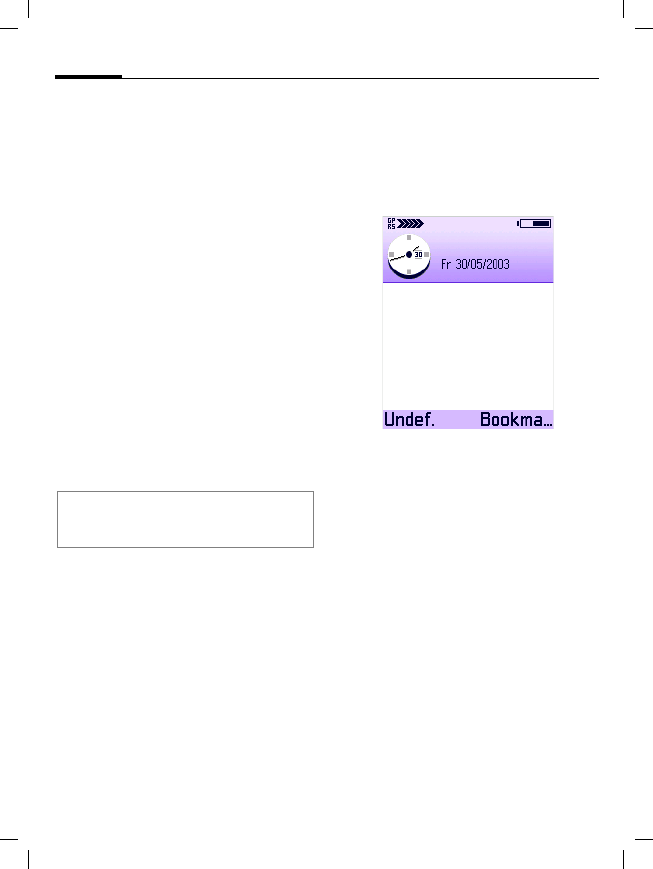
Standby mode
When the name of the service
provider appears at the top of the
display, the phone is in standby mode
and ready for use.
The following indicators are shown
on the display:
Signal strength
_Strong signal.
^A weak signal reduces the call
quality and may lead to loss of
the connection. Change your
location.
Battery charge level
Shows the power of the battery in 7 steps,
e.g.:
dHalf full.
gFull.
Discolored or bright spots may appear on
the display. This is a design-related feature
of the screen.
Security 19
SX1 K1 am-en, A31008-H6500-A5-1-7619 (29. July 2003, 19:32)
© Siemens AG 2001, I:\Mobil\SX1_(K1)\am\ex_sdl\k1gb_startup.fm
Security General
The phone and SIM card are
protected against misuse by several
security codes.
To access code administration:
CKSetupKSettingsKSecurity
KPhone and SIM
KSelect a function:
PIN code request
The PIN is usually requested each
time the phone is switched on. You
can deactivate this feature but you
risk unauthorized use of the phone.
PIN code
You can change the PIN to any
4-8 digit number you may find easier
to remember.
PIN2 code
(displayed only if PIN 2 is available)
Change PIN2 proceed as with PIN
code.
Security code
You can change the security code to
any number (max. 5 digits). The
default code number is 12345.
If it is entered incorrectly three
times, all applications using this
code are barred. In this case, please
contact Siemens Service (p. 101).
Clear SIM card restriction
If the PIN is entered incorrectly three
times, the SIM card is barred. Enter
the PUK (MASTER PIN), provided by
your service provider with the SIM
card, according to instructions. If the
PUK (MASTER PIN) has been lost,
please contact your service provider.
Keep these confidential numbers in a
safe place where you can access them
again if required.
PIN
code Protects your SIM card
(personal identification
number).
PIN2
code This is needed to set the charge
detail display and to access
additional functions on special
SIM cards.
PUK
PUK2 Key code. Used to unlock SIM
cards after the wrong PIN has
been entered.
Security
code Protects your phone. The
default code number is 12345.
You can change the security
code to any number.
Making a phone call
20
SX1 K1 am-en, A31008-H6500-A5-1-7619 (29. July 2003, 19:32)
© Siemens AG 2001, I:\Mobil\SX1_(K1)\am\ex_sdl\k1gb_phonecall.fm
Making a
phone call Dialing with number keys
The phone must be switched on
(standby mode).
MEnter the number (always
with prefix).
0Press to set the
international prefix +.
G A short press clears
the last digit, a long press
clears the entire number.
DPress the Call key. The
displayed phone number
is dialed.
Dialing using Contacts
Press the joystick or move it down to
open Contacts (in standby mode)
or
CKContacts
Select required entry.
DPress the Call key to start
the call.
For further information see p. 29.
Accept call
The phone must be switched on
(standby mode).
DPress.
or
BPress Answer.
If the phone number has been
transmitted by the system, it is
displayed. If it is stored in the
Addresses, the corresponding name/
picture is displayed.
End call
EPress the End key.
Dialing options
Add to Contacts (Create new, Update
existing), Call, Send (Text message/
Multimedia message).
Note
You can assign a phone number to keys
2 to 9 for shortcut (p. 79).
Note
End an active call even if the person on the
other end of the line has hung up first.
Making a phone call 21
SX1 K1 am-en, A31008-H6500-A5-1-7619 (29. July 2003, 19:32)
© Siemens AG 2001, I:\Mobil\SX1_(K1)\am\ex_sdl\k1gb_phonecall.fm
Decline call
EPress the end key. The
caller will hear a "line
busy" tone.
The call may be
forwarded if this has been
set previously (p. 87).
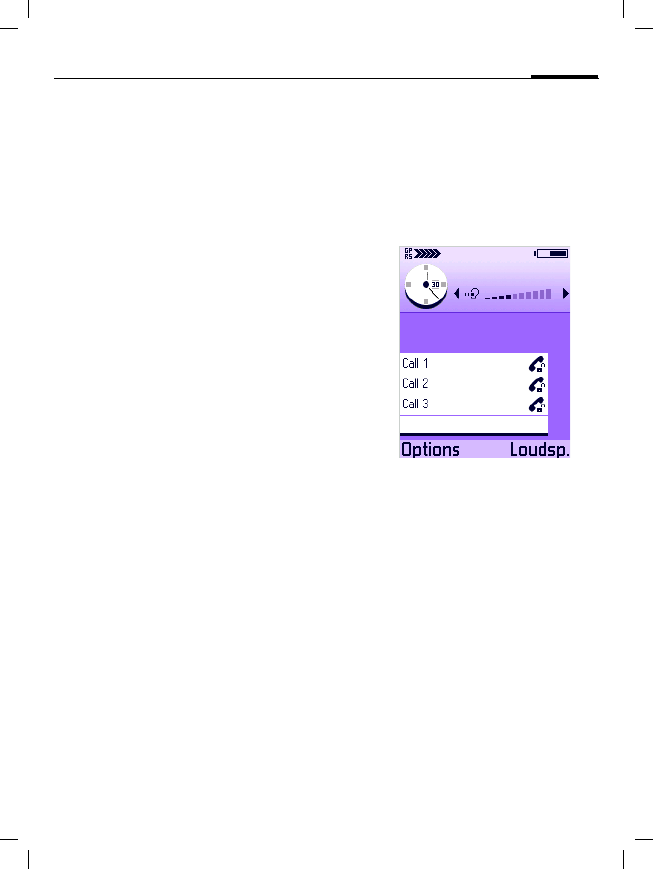
Call waiting
You may need to register for this
service with your service provider
and set your phone accordingly
(p. 79).
During a call, you may be advised
that there is another call waiting.
You will hear a special tone during
the call.
You have the following options:
BPress Call during the call
to answer the waiting call.
The first call is put on
hold.
EPress briefly to end the
active call or hold down to
end both calls. Also:
OptionsKEnd all calls
If a second call is on hold:
BPress Swap to switch
between the calls.
Conference
Call up to 5 parties one by one and
link them together in a phone
conference. Some of the functions
described may not be supported by
your service provider or may have to
be enabled specially.
You have established a connection:
MEnter the new number, or
use Contacts (p. 29).
DPress the Call key.
The first call is
automatically put on
hold. When the new
connection is established,
add the first participant:
OptionsKConference
To add another person to
the conference, repeat
procedure and then
select:
OptionsKAdd to conference

Making a phone call
22
SX1 K1 am-en, A31008-H6500-A5-1-7619 (29. July 2003, 19:32)
© Siemens AG 2001, I:\Mobil\SX1_(K1)\am\ex_sdl\k1gb_phonecall.fm
Private
You can have a private conversation
with one of the conference
participants:
OptionsKConferenceKPrivate
Select participant.
BPress Private.
You can now have a private
discussion, while the rest of the
conference participants continue
talking.
To end the private conversation and
go back to the conference:
OptionsKAdd to conference
Drop
To remove one participant from the
conference:
OptionsKConference
KDrop participant
Select participant.
BPress Drop.
Options during a call
Mute/Unmute, End active call, End all
calls, Hold/Unhold, Swap, Conference,
Add to conference, Private, Drop
participant, Transfer, Answer, Decline,
Send touch tones, Activate loudsp.
Most relevant functions:
Mute/Unmute
Switch microphone on/off. If
switched off, the person on the
other end of the line cannot hear you
(muting)
Transfer
The original call is connected to the
second one. For you, both calls are
now ended
Send touch tones
You can enter control codes (digits)
during a call so that an answering
machine can be controlled remotely.
These digits are directly transmitted
as touch tones (control codes).
*Press to produce a *.
#Press to produce a #.
*Press repeatedly to
produce "p" for a pause of
approx. 2 seconds, and
"w" if you want the
remaining sequence not
to be sent until you press
Send again during the call.
BPress OK to send the tone.
Note
To store touch tones as an Contacts entry,
see p. 29.
Making a phone call 23
SX1 K1 am-en, A31008-H6500-A5-1-7619 (29. July 2003, 19:32)
© Siemens AG 2001, I:\Mobil\SX1_(K1)\am\ex_sdl\k1gb_phonecall.fm
Volume control
Move the joystick left/right to
decrease/increase volume when a
call is active or a sound plays.
Do the same if a headset is
connected.
Handsfree
To activate/deactivate the
loudspeaker during a call:
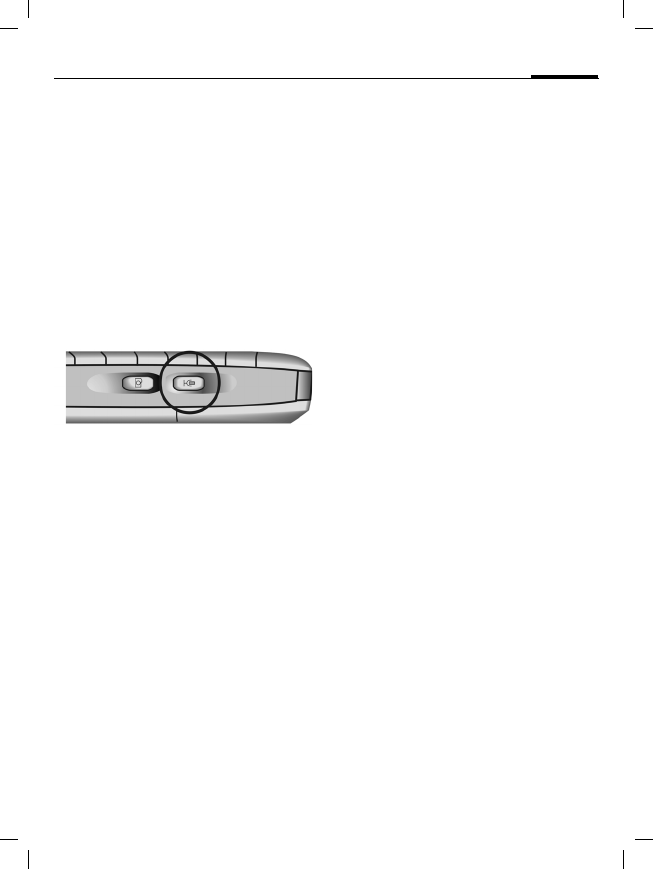
Press side key
or
OptionsKActivate loudsp./
Activate handset
You can hear the caller via the built-
in loudspeaker. Also useful when
using an application during a call,
e.g. calendar or notes.

Writing text
24
SX1 K1 am-en, A31008-H6500-A5-1-7619 (29. July 2003, 19:32)
© Siemens AG 2001, I:\Mobil\SX1_(K1)\am\ex_sdl\k1gb_text.fm
Writing text General
Your phone offers two ways of
writing text:
• The conventional method. You
press a number key repeatedly
until the required character
appears.
• The T9 method. You write a word,
pressing each number key only
once.
Conventional writing
To switch to conventional writing:
FPress.
Alpha mode
Select.
Press a number key repeatedly until
the required character appears.
Make a pause until the cursor
appears to the right of the written
character. Write next character and
so on.
After the characters of a key its
number is written, followed by
similar characters used in foreign
languages.
T9 writing
To switch to T9 writing:
FPress.
Dictionary on
Select.
If T9 text input is switched on this
icon is shown:
T9 deduces the correct word from
the individual key entries by making
comparisons with an extensive
dictionary. Since the display changes
as you proceed ...
... it is best if you finish a word without
looking at the display.
You simply press the keys where the
relevant letter is located once only.
For "hotel", for example, type:
4 6 8 3 5
While you write a word it is
underlined. If it is correct move the
cursor to the right or insert a space.
If the word is incorrect and the
cursor marks the word:
BPress Next T9 repeatedly
to view matching words
stored in the dictionary.
If the last match is
reached, you can add the
word as a new entry to
the dictionary.
APress Spell to write the
new word. Press OK to
save it to the dictionary.

Writing text 25
SX1 K1 am-en, A31008-H6500-A5-1-7619 (29. July 2003, 19:32)
© Siemens AG 2001, I:\Mobil\SX1_(K1)\am\ex_sdl\k1gb_text.fm
General rules
1Writes a blank and ends
the word.
1Short press twice for line
feed.
0Multiple short press
inserts punctuation
marks.
0Writes a dot.
GDeletes the character left
of the cursor.
*Shows a table with special
characters for selection.
#Switch between
(dependent on mode):
abc/T9abc – All lower case.
Abc/T9Abc – First letter
upper case, following
lower case letters.
ABC/T9ABC – All upper
case.
#Long press:
123 – Number mode.
Status indicator at the top
line of the display.
Long press on any
number key writes
numbers.
Dictionary options
Depending on the current situation,
not all functions are visible.
FPress to open dictionary
options.
Matches View a list of matching
words for selection.
Insert word
Add a word to the
dictionary (max.
32 letters). If the
dictionary becomes full, a
new word replaces the
oldest one.
Number mode
Switch to number input
mode.
Insert symbol
Shows a table with special
characters for selection.
Writing language
Change the dictionary
language. If the required
dictionary is not available,
see Writing language, p. 78.
Copy Selected text will be
copied into the clipboard.
To select text:
F Press and hold,
while moving the joystick
left/right to select words
or up/down to select lines.
F Still hold and
press Copy.
Writing text
26
SX1 K1 am-en, A31008-H6500-A5-1-7619 (29. July 2003, 19:32)
© Siemens AG 2001, I:\Mobil\SX1_(K1)\am\ex_sdl\k1gb_text.fm
Cut F Short press to open
the menu, select Cut to
cut and copy the selected
text into the clipboard.
Paste To insert text from the
clipboard:
F Press and hold, then
press Paste.
GPress to remove the selected
text from the document.
Contacts 27
SX1 K1 am-en, A31008-H6500-A5-1-7619 (29. July 2003, 19:32)
© Siemens AG 2001, I:\Mobil\SX1_(K1)\am\ex_sdl\k1gb_contacts.fm
Contacts General
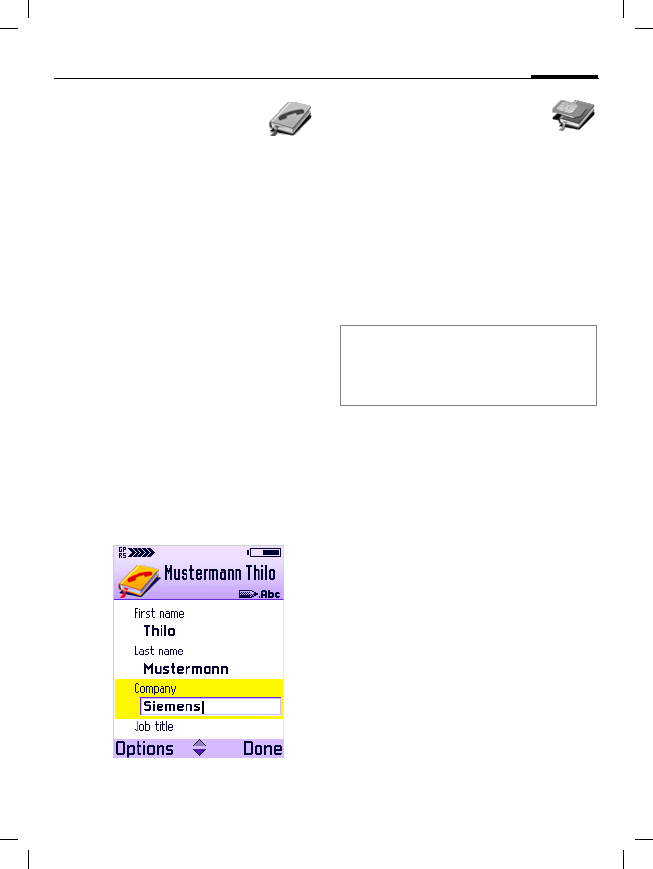
In Contacts you can store and
manage entries with names, phone
numbers and additional address
information. Add voice dialing, a
personal ring tone or a thumbnail
image to an entry.
Open the Contacts
Press joystick (in standby mode)
or
CKContacts
New entry
CKContactsKOptions
KNew contact
MEnter at least a name and
a phone number. To write
text, see, p. 24.
BPress OK to store the new
entry.
Insert SIM card
entries
You can copy entries from the SIM
card to the Contacts on the phone.
Further data can be added to them
subsequently.
CKSIM
Open SIM directory and select the
name(s) you want to copy.
OptionsKCopy to Contacts
Contacts options
Open, Call, Create message (Text
message/Multimedia message/E-mail),
New contact, Edit, Delete, Duplicate, Add
to group, Belongs to groups, Mark/
Unmark, Mark all/Unmark all, Send
business card (Via SMS/Via e-mail/ Via
Bluetooth/ Via infrared), Contacts info,
Memory, Voice tags, Exit.
To copy an entry from Contacts to SIM,
open the entry and select the required
number:
OptionsKCopy to SIM ph.book

Contacts
28
SX1 K1 am-en, A31008-H6500-A5-1-7619 (29. July 2003, 19:32)
© Siemens AG 2001, I:\Mobil\SX1_(K1)\am\ex_sdl\k1gb_contacts.fm
Edit an entry
Select required entry.
OptionsKEdit
MMake the required
changes.
BPress OK, to save the
setting.
Delete an entry
Select required entry.
OptionsKDelete
Delete multiple entries
Select required entries.
OptionsKMark
or
OptionsKMark all
The entries are indicated by a check
mark. Mark further entries if
required. To delete all marked
entries select:
OptionsKDelete
Add and remove fields
There are additional fields available
for an entry. To add/delete an extra
field, open the entry, then:
OptionsKEdit
Then in edit mode:
OptionsKAdd detail/Delete detail
Edit label select to edit a new name
for the field.
Add a picture
There are two different types of
pictures you can add to a contacts
entry. See also Camera, p. 55.
Thumbnail
This image is shown in the display
when the entry calls you. To open
the required entry:
OptionsKEdit
Then in edit mode:
OptionsKAdd thumbnail
Select a thumbnail.
Image
Attach an image to an entry. Open
the required entry, move the joystick
to the right to open the image view,
then:
OptionsKAdd image

Contacts 29
SX1 K1 am-en, A31008-H6500-A5-1-7619 (29. July 2003, 19:32)
© Siemens AG 2001, I:\Mobil\SX1_(K1)\am\ex_sdl\k1gb_contacts.fm
Add Touch tones
In editing mode add the field Touch
tones to the entry:
OptionsKAdd detailKTouch tones
MKey in the touch tone
string.
To use it, make a call. Once the
connection is established, select the
Touch tones field and press OK.
Editing options
Add thumbnail/Remove thumbnail, Add
detail/Delete detail,Edit label, Exit.
Call an entry
CKContacts
Select required entry and press
joystick.
If there is more than one number
available select the required number
from the list.
DPress.
View an entry
The view mode shows all fields with
information contained in the entry.
Move the joystick to the right to
open the image view.
Select the required entry and press
the joystick
or
OptionsKOpen
View mode options
Call, Create message (Text message/
Multimedia message/E-mail), Edit,
Delete, Defaults, Add voice tag/Voice
tags, Assign 1-touch no./Remove 1-touch
no., Ringing tone, Copy to SIM ph.book,
Send business card: (Via SMS/Via e-mail/
Via Bluetooth/Via infrared), Exit.
Assign default numbers and
addresses
If an entry has several phone
numbers or e-mail addresses, to
speed up calling and sending
messages, you can define certain
numbers and addresses to be used
as default.
Open the entry.
OptionsKDefaults

Contacts
30
SX1 K1 am-en, A31008-H6500-A5-1-7619 (29. July 2003, 19:32)
© Siemens AG 2001, I:\Mobil\SX1_(K1)\am\ex_sdl\k1gb_contacts.fm
In a pop-up window the following
options are displayed:
• Phone number
•SMS number
•MMS number/address
• E-mail address
Select an option, then
BPress Assign. All assigned
numbers/addresses are
displayed. Select the one
you want to have as the
default.
Groups
For better handling of large numbers
of Contacts entries you can assign
them to groups. These can also be
used as distribution lists for sending
short messages or e-mails.
New group
Open Contacts:
CKContacts
Move the joystick to the right to
open the Groups list.
OptionsKNew group
MWrite a name for the
group.
BPress OK.
Add members
Open Contacts:
CKContacts
Select required entry.
OptionsKAdd links to group
Select required group (if more than
one available).
BAdd links to group press.
Add multiple members
Open Contacts
CKContacts
Move the joystick to the right to
open the Groups list. Select and
open required group.
OptionsKAdd members
Select an entry and press the joystick
to mark it. Repeat on all entries you
want to add.
BPress OK to add all marked
entries to the group.

Contacts 31
SX1 K1 am-en, A31008-H6500-A5-1-7619 (29. July 2003, 19:32)
© Siemens AG 2001, I:\Mobil\SX1_(K1)\am\ex_sdl\k1gb_contacts.fm
Remove members
Open Contacts:
CKContacts
Move the joystick to the right to
open the Groups list. Select and
open required group. Then select
required entry;
OptionsKRemove from group
BPress Yes.
Groups options
Open, New group, Delete, Rename,
Ringing tone, Contacts info, Memory,
Voice tags, Exit
Most relevant functions:
Contacts info
Memory
No. of contacts/groups
Ringing tone
Assign an individual ring tone to the
selected group.
Voice tags
List of all entries with voice tags.
Press Options to edit.
Voice dialing
30 phone numbers can be
dialed by simply saying a word e.g.
the name of an entry. Voice dialing
entries must be stored in the phone’s
memory (not on the SIM card!).
Some useful hints before using voice
dialing:
• Voice tags depend only on the
speaker’s voice, not on the
language.
• Beware of loud background noise,
voice tags are sensitive to it.
• Use long names for better
recognition and differentiation
between similar names.
• When using voice dialing, the
loudspeaker is in use.
Record
Open Contacts and select the
required entry.
Open the entry and select the
required number.
OptionsKAdd voice tag
BPress Start.
Say the name after the starting tone.
It takes two times of training to enter
a voice tag. Wait until the name is
repeated and automatically saved by
the phone.
Contacts
32
SX1 K1 am-en, A31008-H6500-A5-1-7619 (29. July 2003, 19:32)
© Siemens AG 2001, I:\Mobil\SX1_(K1)\am\ex_sdl\k1gb_contacts.fm
BPress Quit if you don’t
want to save the
recording.
When the voice tag is
saved, a symbol can be
seen next to the number
in the addressbook entry.
Apply
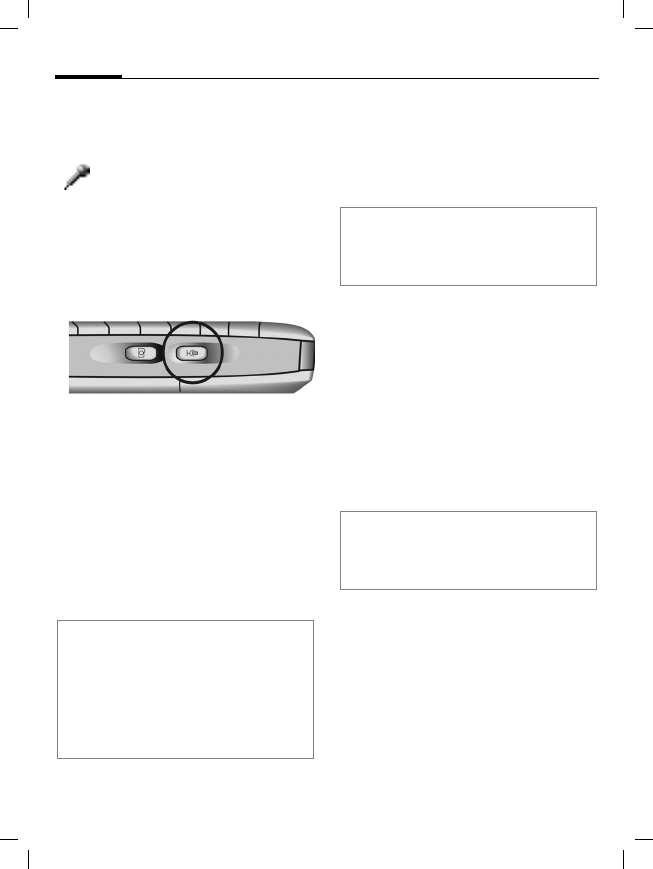
Press Voice dialing key on the side of
the phone.
A short signal sounds. Now say the
name. The phone answers with the
original voice tag and displays the
number and name. The number will
be dialed after 1.5 seconds.
BPress Quit if you don’t
want to make this call.
Editing options
Playback, Delete, Change
Add a ring tone
You can set a specific ring tone for
each entry or group. When that entry
or group member calls you, this ring
tone will be played.
Open Contacts and select the
required entry. Open the entry
or
move the joystick to the right to
open the Groups list.
then
OptionsKRinging tone
Select the required tone.
BPress Select.
Note
To view the list of all defined voice tags:
Open Contacts:
OptionsKContacts infoKVoice tags
To hear a voice tag, select it:
OptionsKPlayback
Note
The phone number of the caller must be
sent with the call to become recognized
(see also Send my caller ID, p. 79).
Note
All entries in a group get the same ring tone
you assign to the group, even if they had
their own one before.

Contacts 33
SX1 K1 am-en, A31008-H6500-A5-1-7619 (29. July 2003, 19:32)
© Siemens AG 2001, I:\Mobil\SX1_(K1)\am\ex_sdl\k1gb_contacts.fm
Business card
You can create an entry as your own
business card and transmit it as a
message in vCard format via SMS
and e-mail or you may transmit it
to another device with IrDA or
Bluetooth capability.
Open Contacts and select your entry.
OptionsKSend business card
Then select the method:
Via SMS, p. 37
Via e-mail, p. 38,
Via Bluetooth, p. 88
Via infrared, p. 91
Log
34
SX1 K1 am-en, A31008-H6500-A5-1-7619 (29. July 2003, 16:48)
© Siemens AG 2001, I:\Mobil\SX1_(K1)\am\ex_sdl\k1gb_records.fm
Log General
Your phone stores numbers
of phone calls for convenient
redialing and registers all traffic such
as short messages, packet data
connections and fax/data calls.
Recent calls
CKLogK Recent calls
Select required list:
Missed calls
Up to 20 phone numbers of calls that
you have received but not answered
are stored for call back purposes.
Requirement: The system supports
the "Caller Identity" feature
Received calls
Up to 20 phone numbers, or names
of the most recently accepted calls
are listed.
Requirement: The system supports
the "Caller Identity" feature
Dialed numbers
Access to the last 20 numbers you
dialed or attempted to call.
Editing options
Call, Use number, Delete, Clear list, Add
to contact, Exit
Log list
CKLog
Move to right to show the total log
list.
Log list options
View details, Clear log, Filter, Add to
contact, Settings, Exit.
Most relevant function:
Use the Filter for a detailed view of
the list.
Call timers
Displays the duration of incoming
and outgoing calls.
Available lists:
Last call, Dialed numbers, Received calls,
All calls
L
L
Icons in the list:
Missed calls.
Incoming calls.
Outgoing calls.
Note
You can see the call duration during an
active call:
OptionsKSettingsKShow call
durationKYes

Log 35
SX1 K1 am-en, A31008-H6500-A5-1-7619 (29. July 2003, 16:48)
© Siemens AG 2001, I:\Mobil\SX1_(K1)\am\ex_sdl\k1gb_records.fm
Call costs
Call costs allows you to check the
cost of the last call or all calls.
Call costs limit set by a service
provider
Special SIM cards allow the service
provider to define a credit or a period
after which the phone is barred for
outgoing calls.
The number of remaining units is
shown during a call and in standby
mode. The display of prepaid cards
may vary depending on the service
provider.
Call costs limit set by yourself
(PIN 2 query)
OptionsKSettings
KCall costs limitedKOnKOK
Enter the limit in units or currency
depending on the setting Show costs
in above.
GPRS data counter
CKLogK GPRS counter
Allows you to check the amount of
data sent and received during packet
data (GPRS) connections.
Log options
The offered functions depend on the
current situation/position:
Open, Clear timers, Clear counters, Clear
recent calls, Settings, Exit
Most relevant functions:
Clear recent calls:
You can clear all recent calls lists.
Settings:
•Log duration: No, 1,10 or 30 days.
•Show call duration during an active
call: Yes/No
•Show costs in (PIN 2 query):
Currency/Units
•Call cost limit (PIN 2 query): Off, On
(see above).
Messages
36
SX1 K1 am-en, A31008-H6500-A5-1-7619 (29. July 2003, 19:32)
© Siemens AG 2001, I:\Mobil\SX1_(K1)\am\ex_sdl\k1gb_messages.fm
Messages General
CKMessages
Transmit and receive messages via:
•SMS,
• Smart message,
•MMS,
• E-mail,
• Bluetooth or infrared.
Additionally you may receive cell
broadcast messages or WAP service
messages.
Message options
The offered functions depend on the
current situation/position.
Open, New message (Text message,
MMS, E-mail), Connect, SIM messages,
Cell broadcast, Service commands,
Settings, Exit
New messages
SMS (Short message)
You may transmit and receive very
long SMS (up to 760 characters) on
your phone, which are automatically
composed from several "normal"
SMS messages (note the accruing
charges).
Depending on the service provider,
e-mails and faxes can also be sent or
e-mails can be received via SMS
(change setting if necessary, p. 44).
Create a short message
MessagesKCreate message
K Text message
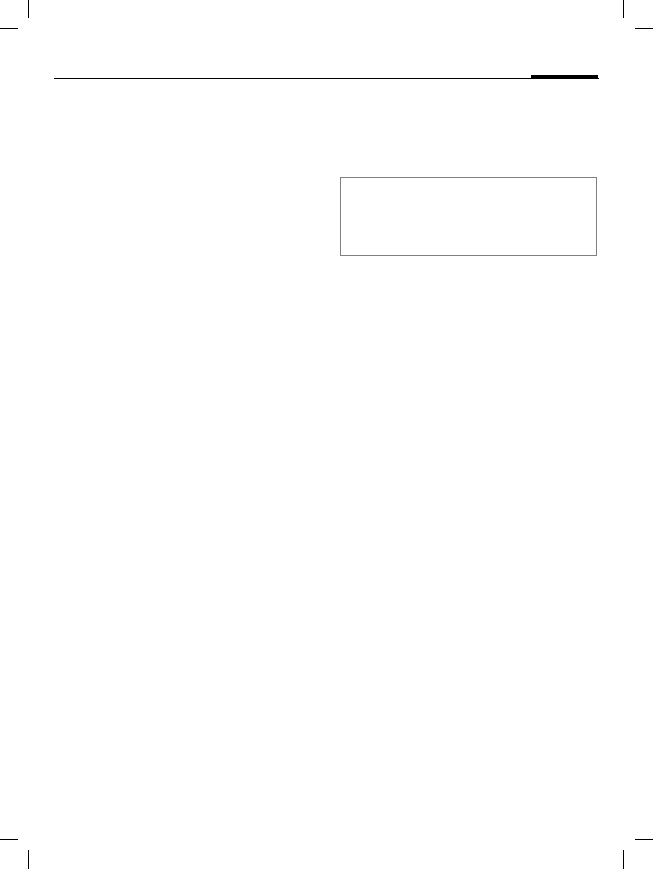
To insert recipient in the field To:
• Press joystick to open contacts,
mark/unmark recipient(s). Press
OK to return to message.
If a recipient offers multiple
phone numbers, select one.
• Write the phone number
• Copy the recipient from another
application (Copy, see p. 25).
Move down to the text field and
write text (p. 24).
In the top of the display the message
length indicator will show you the
number of used characters and SMS.
Messages 37
SX1 K1 am-en, A31008-H6500-A5-1-7619 (29. July 2003, 19:32)
© Siemens AG 2001, I:\Mobil\SX1_(K1)\am\ex_sdl\k1gb_messages.fm
Send the message:
OptionsKSend
Save the message (to send it later):
BPress Close to save
message to Drafts.
SMS Options
Send, Add recipient, Insert (Picture,
Template), Delete, Message details,
Sending options (p. 44), Exit.
Smart message
Smart messages are special short
messages that can contain data. You
can send a business card (vCard,
p. 33) or a calendar note (vCalendar,
p. 65). You may receive e.g. WAP
Service setting information, a
ringing tone or an operator logo.
MMS
The Multimedia Messaging Service
enables you to send texts, pictures,
sounds and video clips in a
combined message to another
mobile phone or to an e-mail
address. Depending on the setting of
your phone, you will automatically
receive the complete message or
you will receive a notification that an
MMS has been saved in the system,
giving its sender and size. You may
then download it to your phone to
read it.
Ask your service provider whether
this service is available. You may
need to register for this service
separately.
A multimedia message can have
several pages with text, music or
pictures included in each page.
Text can be composed using T9
support (p. 24).
An Image that has been produced
with Snapshot or received in a
message can be attached. The
maximum size of 640x480 pixels is
reduced to the size of the display.
A Sound clip is sent and received as a
MIDI or AMR file.
A Video clip can be recorded with the
Camcorder application, located at:
CKSnapshotKVideo
Further informations about
camcorder see:
www.my-siemens.com/sx1
All items in an MMS are combined in
the form of a slide show.
Note
Only devices that offer Multimedia
Messaging Service can receive multimedia
messages.

Messages
38
SX1 K1 am-en, A31008-H6500-A5-1-7619 (29. July 2003, 19:32)
© Siemens AG 2001, I:\Mobil\SX1_(K1)\am\ex_sdl\k1gb_messages.fm
Create a multimedia message
MessagesKCreate messageKMMS
To insert recipient in the field To:
• Press joystick to open contacts,
mark/unmark recipient(s). Press
OK to return to message.
If a recipient offers multiple phone
numbers or e-mail addresses,
select one.
• Write the phone number
• Copy the recipient from another
application (Copy, see p. 25).
Move down to the text field and
write text (p. 24).
To add an image, a sound clip, a
video clip and templates to the
message:
OptionsKInsert (Image, Sound clip,
Video clip, Template)
To add a new image (opens
Snapshot, p. 55) or a new sound
(opens Voice memo, p. 66) to the
message:
OptionsKNew sound clip, New image
To remove the image, the sound clip
or video clip from the message:
OptionsKRemove
(Image, Sound clip, Video clip)
To see the complete multimedia
message before sending:
OptionsKPreview message
To see/hear the single objects of the
message:
OptionsKObjects
(In the Objects view you are offered
other Options to arrange, open and
remove objects).
Save the message (to send it later):
BPress Close to save
message to Drafts.
Send the multimedia message:
OptionsKSend
MMS options
Send, Add recipient, Insert, Preview
message, Objects, Remove, Delete,
Message details, Sending options, Exit.
E-mail
Your phone has its own e-mail client.
You can use it to create and receive
e-mails. A file from the file system
(e.g. ring tone) can be inserted in an
e-mail as an attachment.
Create an e-mail
MessagesKCreate messageKE-mail
To insert recipient in the field To:
• Press joystick to open contacts,
mark/unmark recipient(s). Press
OK to return to message.
If a recipient offers multiple e-mail
addresses, select one,
Messages 39
SX1 K1 am-en, A31008-H6500-A5-1-7619 (29. July 2003, 19:32)
© Siemens AG 2001, I:\Mobil\SX1_(K1)\am\ex_sdl\k1gb_messages.fm
• Write the e-mail address(es).
• To send a copy of the e-mail to
someone, insert the address in the
field Cc:
• In the field Subject, enter the
header of the e-mail.
Move down to the text field and
write text (p. 24).
To add attachments like images,
sound clips, video clips, notes and
templates to the message:
OptionsKInsert (Image, Sound clip,
Video clip, Note, Template)
To see/hear the single objects of the
e-mail:
OptionsKAttachments
(In the Attachments view you are
offered other Options to open, insert
and remove objects)
Send the e-mail:
OptionsKSend
(E-mails are automatically
transmitted to the Outbox before
sending).
Save the message (to send it later):
BPress Close to save
message to Drafts.
E-mail options
Send, Add recipient, Insert, Attachments,
Delete, Message details, Sending
options, Exit.
Inbox
All received messages are stored in
the Inbox (except e-mails, see
Mailbox (p. 42) and cell broadcasts
(p. 49).
MessagesKInbox
Unread messages are written in
bold. The following icons may
appear for
new/read short messages
new/read smart messages
new/read multimedia
messages
new/read WAP service
messages
data received via
Bluetooth
data received via infrared
unknown type
Inbox options
Open, Create message (Text message,
MMS, E-mail), Delete, Move to folder,
Mark/Unmark, Mark all/Unmark all, Exit.
Note
*Press for @.
#Press to separate several
recipients with a semicolon.

Messages
40
SX1 K1 am-en, A31008-H6500-A5-1-7619 (29. July 2003, 19:32)
© Siemens AG 2001, I:\Mobil\SX1_(K1)\am\ex_sdl\k1gb_messages.fm
Viewing a message
Select the required message in the
Inbox and press the joystick to open
it. Use the joystick to scroll through
the message line by line. Move the
joystick left/right to show the
previous/next message.
View options
The functions offered depend on the
opened message type.
SMS and others
Reply
Open the message in the editor with
the sender’s address in the field To:
Forward
Open the message in the editor.
Call
Call the sender (or press D)
Add to Contacts
With the sender’s address, update an
existing address entry or create a
new one.
Find
Search message for phone numbers,
e-mail addresses and Internet
addresses (URL).
Move to folder
Move the message to another folder.
Message details
Check detailed information about
the message.
Smart messages only
Picture message
Save the picture in a smart message
to Images. Other objects to save may
be:
Ringing tone, Operator logo, Calen. entry
Business card
Save the data to Addresses. If a
picture is attached, it will be saved to
Addresses as well.
Save to bookmarks
Save a bookmark to the list:
Bookmark:
E-mail notification
Tells you the number of new e-mails
in your remote mailbox. For how to
read an e-mail, see Mailbox.
Service data
If service data are received, copy
them with the relevant function:
Save to e-mail sett., Save to SMS sett.,
Save to Voice mail, etc.
Messages 41
SX1 K1 am-en, A31008-H6500-A5-1-7619 (29. July 2003, 19:32)
© Siemens AG 2001, I:\Mobil\SX1_(K1)\am\ex_sdl\k1gb_messages.fm
Multimedia messages only
View image
Shows an attached image.
Play sound clip
While playing, move joystick right/
left to increase/decrease volume.
Press Stop to stop the audio
playback.
Play video clip
Plays an attached video clip.
Objects
List all the different multimedia
objects in a multimedia message. In
the Objects view you are offered
more Options to open, save and send
objects.
WAP messages
The message may contain
bookmarks and/or access point
information. To save both, select
Save all. To save them separately,
select View details. Then select Save to
bookmarks or Save to Settings.
WAP service messages
Your provider may offer "push
messages" which are notifications of
news headlines or services. For
availability and subscription details,
ask your service provider.
A WAP service message may contain
text or addresses. To view or
download the service select
Download message. If necessary, the
phone makes a data connection.
My folders
MessagesKMy folders
Organize your messages in folders.
You may create new folders, rename
or delete old ones.
Templates is a special kind of folder
which contains fixed phrases. There
you can add new templates for later
use in your messages.
My folders options
Open, Create message (Text message,
MMS, E-mail), Delete, Message details,
Move to folder, Mark/Unmark, Mark all/
Unmark all, Rename folder, Exit.
Note
Beware of viruses and harmful software.
Do not open attachments from suspicious
senders. See also Certificate management
(p. 83). Note
When you are looking inside a folder, you
can simply change to other folders by
moving the joystick left/right.
Messages
42
SX1 K1 am-en, A31008-H6500-A5-1-7619 (29. July 2003, 19:32)
© Siemens AG 2001, I:\Mobil\SX1_(K1)\am\ex_sdl\k1gb_messages.fm
Mailbox
MessagesKMailbox
Connecting to the mailbox
If you have not setup your e-mail
account, you will be prompted to
do so; see Settings (p. 47).
OptionsKConnect
Yes Connect to your mailbox.
No Read the e-mails stored in
your phone off-line.
Disconnect from the mailbox
After retrieving your e-mail you
should disconnect and read your
messages off-line to save connection
costs.
Mailbox options
The functions offered depend on
your on-line or offline status.
Open, Create message (Text message,
MMS, E-mail), Connect/Disconnect,
Retrieve e-mail (New, Selected, All),
Delete, Message details, Copy to folder,
Mark/Unmark, Mark all/Unmark all, Exit.
Read new e-mail
Before an e-mail can be read, it
should be retrieved from the server.
The service provider is dialed with
the set access profile and all/new
e-mails are transmitted to the
mailbox list in your phone.
OptionsKRetrieve e-mail
New Retrieve only new unread
e-mails.
All Retrieve all e-mails from
your remote mailbox.
Selected Use the Mark/Unmark
function to select the
required e-mails.
To read an e-mail, select the required
message in the list and press the
joystick to open it.
Delete e-mail
You may delete e-mail from the
phone only or from the phone and
the remote mailbox on the server:
OptionsKDeleteKPhone only
or
OptionsKDeleteKPhone and server
View e-mail options
Reply (To sender/To all), Forward, Delete,
Attachments, Message details, Move to
folder, Add to Contacts, Find, Exit.
Note
Before getting the latest e-mail you must
always reconnect to your mailbox.
Messages 43
SX1 K1 am-en, A31008-H6500-A5-1-7619 (29. July 2003, 19:32)
© Siemens AG 2001, I:\Mobil\SX1_(K1)\am\ex_sdl\k1gb_messages.fm
E-mail attachments
If an e-mail has indicated
this attachment sign,
select.
OptionsKAttachments
In the attachment view, you may
retrieve, open or save attachments
separately, if any corresponding
application is available.
Retrieve attachments
Your mailbox may be setup not to
receive attachments automatically.
This is indicated by a dimmed
attachment indicator in the e-mail.
To receive the attachment:
OptionsKRetrieve e-mail
Open attachments
In the attachment view, select the
required attachment and press the
joystick to open it.
On-line
The attachment is retrieved from the
server and opened by the
corresponding application.
Off-line
You can decide whether to connect
to retrieve the attachment.
Save attachments
You can save attachments separately
from the e-mail in the corresponding
application:
OptionsKSave
View attachment options
Open, Retrieve, Save, Send (Via infrared,
Via Bluetooth), Remove, Exit.
Drafts
MessagesKDrafts
This folder contains messages which
have not yet been sent.
Sent
MessagesKSent
This folder contains the last
15 messages which have been sent
(to change no. of stored messages,
see p. 48).
Note
Beware of viruses and harmful software.
Do not open attachments from suspicious
senders. See also Certificate management
(p. 83).
Note
If using the
• IMAP 4 protocol, you may receive e-mail
headers, messages or messages with
attachments separately,
• POP 3 protocol, you may decide to
receive headers only, or messages with
attachments included.

Messages
44
SX1 K1 am-en, A31008-H6500-A5-1-7619 (29. July 2003, 19:32)
© Siemens AG 2001, I:\Mobil\SX1_(K1)\am\ex_sdl\k1gb_messages.fm
Outbox
MessagesKOutbox
Messages are temporarily stored in
this folder until they are sent.
Status of the messages:
Sending
The message is being sent.
Waiting
This message is waiting, if there are
two similar message types in the
Outbox for sending.
Resend at <time>
If transmission has failed, the
procedure will be repeated after a
time-out period.
Deferred
This message is on hold.
Failed
If the maximum number of
unsuccessful transmission attempts
has been reached, transmission has
failed.
Outbox options
Create message, Deferred, Delete, Send,
Move to Drafts, Exit.
Reports
MessagesKReports
All messages required for status
information are collected in this
folder, e.g. a confirmation required
by Receive report (p. 44). Each
recipient has his own report.
Settings
Select required message type and
press the joystick.
Text message
MessagesKOptionsKSettings
KText message
Message centers
Shows a list of all defined message
centers (to add a new entry see
p. 45).
Msg. center in use
Select the message center you will
use for messaging.
Receive report
You are given confirmation of the
successful or unsuccessful delivery
of a sent message in the Log. This
service may be subject to a charge.

Messages 45
SX1 K1 am-en, A31008-H6500-A5-1-7619 (29. July 2003, 19:32)
© Siemens AG 2001, I:\Mobil\SX1_(K1)\am\ex_sdl\k1gb_messages.fm
Message validity
Select the period in which the
service center tries to deliver the
message:
1 hour, 6 hours, 24 hours, 3 days, 1 week,
Maximum time*
(*) Maximum period that the service
provider permits.
Message sent as
Make sure that your service provider
supports the conversion formats (for
information please contact your
service provider).
Text
Normal SMS message.
Fax
Transmission via SMS.
E-mail
Transmission via SMS.
Paging
You may need to obtain
the required code number
from your service
provider.
Preferred connection
You can choose between GSM or
GPRS as default, if supported by the
used system.
Reply via same ctr.
The reply to your message is handled
via your service center (for
information please contact your
service provider).
SMS options
Message center, Edit, Delete, Exit.
Most relevant functions:
Message centersKOptions
KNew msg. center
Press the joystick, write a name
for the new service center, then
press OK.
Move joystick down and press it.
Write the number of the new short
message center, then press v (get
the number from your provider).
To use the new service center go to v
and select it.
MMS
MessagesKOptionsKSettings
K MMS
Preferred connection
Select the access point to be used as
the preferred connection. To define
a new access point, see Settings
p. 80.

Messages
46
SX1 K1 am-en, A31008-H6500-A5-1-7619 (29. July 2003, 19:32)
© Siemens AG 2001, I:\Mobil\SX1_(K1)\am\ex_sdl\k1gb_messages.fm
Secondary conn.
Select the access point to be used as
the secondary connection.
MMS reception
Only in home sys.
You will receive
multimedia messages
only when you are in your
home system.
Always on
You will always receive
multimedia messages.
Off
Select if you never want
to receive multimedia
messages.
On receiving msg.
Retr. immediately
Multimedia messages will
be retrieved instantly,
even those with the
Deferred status.
Defer retrieval
Multimedia messages will
be saved in the service
center for later transfer
(see Retr. immediately).
Decline message
All saved multimedia
messages will be deleted
by the service center.
Allow anon. messages
Select No: Decline all messages from
an anonymous sender.
Receive ads
Receive all multimedia message
advertisements.
Receive report
The status of a sent message is
shown in the Log as Pending, Failed or
Delivered. Otherwise only Delivered is
shown.
Deny report sending
Your phone will not send delivery
reports of received multimedia
messages.
Note
Both connections (preferred and
secondary) refer to the same Internet
settings. Only the data connection is
different, e.g. GSM data call as preferred
and GPRS as secondary. For further
information please contact your service
provider.
Note
Sending and receiving multimedia
messages outside your home system may
incur higher connection costs.
With settings Only in home sys. and
Always on your phone can make calls in
the background without your knowledge!

Messages 47
SX1 K1 am-en, A31008-H6500-A5-1-7619 (29. July 2003, 19:32)
© Siemens AG 2001, I:\Mobil\SX1_(K1)\am\ex_sdl\k1gb_messages.fm
Message validity
Select the period in which the
service center tries to deliver the
multimedia message:
1 hour, 6 hours, 24 hours, 3 days, 1 week,
Maximum time*
(*) Maximum period that the service
provider permits.
Image size
You can define the image size in a
multimedia message:
Large (640 x 480 pixels, VGA)
Small (160 x 120 pixels)
Speaker
Loudspeaker
Sounds are played over
the built-in loudspeaker,
p. 23.
Handset
Sounds are played over
the ear piece.
E-mail
MessagesKOptionsKSettings
KE-mail
To show the list of all mailboxes:
Mailboxes Press.
To define a new mailbox:
OptionsKMailbox
Mailbox name
Write a name for the new mailbox.
Access point in use
Choose an Internet access point
from the list (to create an access
point, see p. 80).
My mail address
Write the e-mail address given to you
by your provider (* Press for @).
Outgoing mail server
Write the host name or the IP
address of the server that sends your
e-mail.
Send message
Immediately
If you select Send message
after writing your e-mail,
a connection will be
established to send the
e-mail instantly.
During next conn.
The e-mail will be sent the
next time you connect to
your remote mailbox.
Send copy to self
You will get a copy of every sent
e-mail on your mail address as
defined above.
Messages
48
SX1 K1 am-en, A31008-H6500-A5-1-7619 (29. July 2003, 19:32)
© Siemens AG 2001, I:\Mobil\SX1_(K1)\am\ex_sdl\k1gb_messages.fm
Include signature
A signature will be attached to your
e-mail. Write the signature after
pressing Yes.
User name
Write the user name given to you by
your provider.
Password
Key in your password. If you don’t do
so, you will be prompted for it every
time you want to connect to your
remote mailbox.
Incoming mail server
Write the host name or the IP
address of the server that receives
your e-mail.
Mailbox type
POP3 or IMAP4.
Security
On or Off. Secure the connection to
your remote mailbox with protocols
POP3, IMAP4 and SMTP.
Retrieve attachment
You can retrieve an e-mail with or
without an attachment (not shown if
e-mail protocol POP3 is set).
Retrieve headers
You can limit the number of headers
you want to retrieve. Select All or
define by yourself (max. 999).
WAP service message
MessagesKOptionsKSettings
KService msg.
Service messages
On or Off. Receive WAP service
messages or not.
Authentic. needed
You will receive WAP service
messages only from authorized
sources (p. 83).
Other
Save sent messages
A copy of a sent short message,
multimedia message or e-mail is
stored in the Sent folder.
No. of saved msgs.
Key in a number defining how many
messages will be stored in the Sent
folder (max. 999). When the limit is
reached, the oldest message is
deleted.
Note
The mailbox type cannot be changed after
the e-mail settings are saved.
Messages 49
SX1 K1 am-en, A31008-H6500-A5-1-7619 (29. July 2003, 19:32)
© Siemens AG 2001, I:\Mobil\SX1_(K1)\am\ex_sdl\k1gb_messages.fm
SIM messages
MessagesKOptionsKSIM messages
To view SIM messages on the phone,
they must be copied from the SIM
card into a folder.
OptionsKMark/UnmarkK(Mark/
Unmark, Mark all/Unmark all)
then
OptionsKCopy
Select the required folder and
press OK.
Afterwards you can view the
messages in this folder p. 40.
OptionsKDelete
Delete message(s) from the
SIM card.
Cell broadcast
MessagesKOptions
KCell broadcast
Some service providers offer
information services (info channels).
If reception is activated, your "Topic
list" will supply you with messages
on the activated topics.
In the main view the following is
displayed:
• Unread, subscribed message.
•Unread, unsubscribed message.
• Topic number
• Topic name
Settings
Reception
On/Off You can activate and
deactivate the CB service.
If the CB service is
activated, the standby
time of the phone will be
reduced.
Note
If GPRS connection is set to When
available, cell broadcast messages cannot
be received. To receive them, change
settings to When needed.

Messages
50
SX1 K1 am-en, A31008-H6500-A5-1-7619 (29. July 2003, 19:32)
© Siemens AG 2001, I:\Mobil\SX1_(K1)\am\ex_sdl\k1gb_messages.fm
Language
All You receive messages in
all possible languages
Selected You can choose in which
languages you want to
receive messages.
Other Choose if the required
language is not in the list.
Topic detection
On/Off Save/do not save topic
numbers automatically to
the topic list.
Cell broadcast options
Open, Subscribe/Unsubscribe, Hotmark/
Unhotmark, Topic, Settings, Exit.
Service commands
You may send service commands
(known as USSD commands), to
your service provider.
To send a request in standby mode
or when you have an active call:
Key in the command number (s) and
press Send
or
to enter letters also select
MessagesKOptions
KService commands
Your service provider will supply you
with further information about this.
Internet 51
SX1 K1 am-en, A31008-H6500-A5-1-7619 (29. July 2003, 19:32)
© Siemens AG 2001, I:\Mobil\SX1_(K1)\am\ex_sdl\k1gb_wapservices.fm
Internet General
CKInternet
Get the latest information from the
Internet that is specifically adapted
to the display options of your phone.
In addition you can download games
and applications to your phone.
Internet access may require
registration with the service
provider.
Settings
Default settings
The settings have already been
made by your service provider. Then
you may begin immediately.
Setup via short message
You may receive settings in a short
message from your provider (p. 39).
Save the short message (smart
message) to prepare the phone for
Internet access.
Manual setup
The access point must be set
manually.
• Define a WAP access point
(see p. 80 for further
information):
SetupKSettingsKAccess points
• Add a bookmark for the website.
Open Internet, then
OptionsKAdd bookmark
Write name and address of the
website and select the access point.
If necessary, check with your service
provider for details.
Bookmarks view
This list contains bookmarks which
allow fast access to the relevant URLs
(Uniform Resource Locator).
Bookmarks may be indicated by the
following icons:
Home page. This is
displayed first after
connection is established.
Depends on the access
point used (p. 80).
Last visited page. The last
page displayed before
disconnection is kept in
memory.
Title or Internet address of
the bookmark.
Adding a bookmark manually
OptionsKAdd bookmark
Fill in the fields:
Name Describing name of URL.
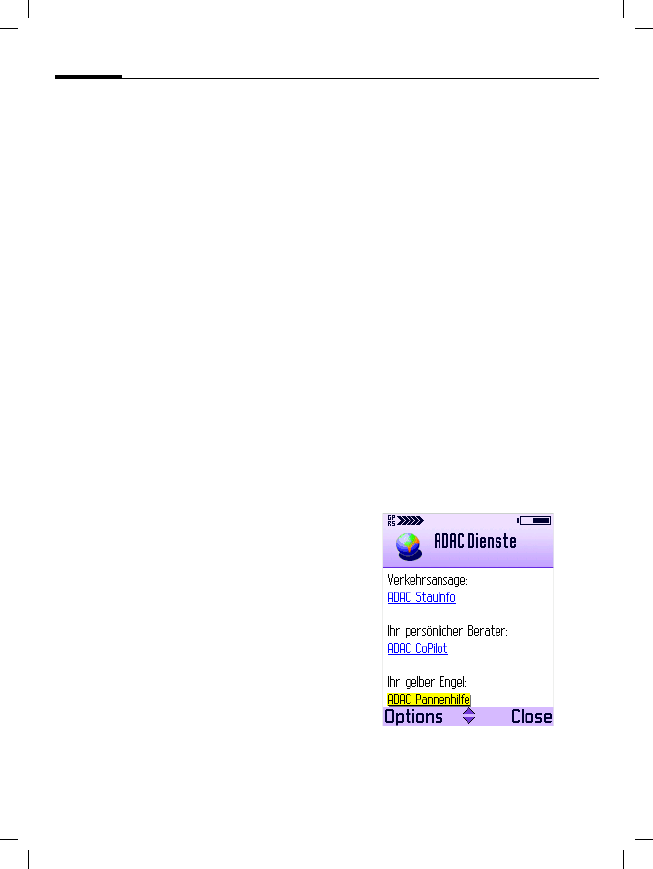
Internet
52
SX1 K1 am-en, A31008-H6500-A5-1-7619 (29. July 2003, 19:32)
© Siemens AG 2001, I:\Mobil\SX1_(K1)\am\ex_sdl\k1gb_wapservices.fm
Address
Internet address. Press *
for special characters.
Access point
Default access point is
assigned if no other one is
selected.
User name Enter your user name
Password Enter your password
OptionsKSave as bookmark
Bookmark view options
Open, Download, Back to page, Send, Go
to URL address, Find bookmark, Add
bookmark, Edit, Delete, New service
msgs:, Disconnect, Move to folder, New
folder, Mark/Unmark, Rename, Clear
cache, Details, Add to pinboard, Settings,
Exit.
Most relevant functions:
Back to page
To open the Bookmarks view while
browsing, press and hold down the
joystick. To return to the browser
view again:
Back to page
Select.
Send
Send a selected bookmark as short
message.
Clear cache
All the information you have
accessed during browsing is stored
in the cache memory. This includes
passwords and other confidential
data. So clear the cache after you
have accessed confidential
information.
WAP connection
CKInternet
Starting
If all required settings are entered,
you can start browsing:
• Select the Homepage of your
provider or a bookmark from the
bookmarks view
or
• enter a WAP address using keys
2to 9. The Go to field is
immediately activated to take
your entries.
Press the joystick to start
downloading the selected/written
WAP page.

Internet 53
SX1 K1 am-en, A31008-H6500-A5-1-7619 (29. July 2003, 19:32)
© Siemens AG 2001, I:\Mobil\SX1_(K1)\am\ex_sdl\k1gb_wapservices.fm
Browser
Keys and commands
• To scroll the view, move the
joystick up and down
• To open a link, press the joystick.
New links appear underlined in
blue, visited links in purple. Links
as an image have a border.
• To enter letters and numbers use
keys 2 to 9. For special characters
use the * key.
• To show the previous page press
Back.
• To show a list of the visited pages
of the current session:
OptionsKHistory
• To check boxes and make
selections, press joystick.
• To open the contents of a cell in a
table, press joystick.
• To retrieve the latest contents
from the server:
OptionsKReload
• To open an additional command
list for the current WAP page:
OptionsKInternet options
•Epress, to disconnect from a
WAP service.
View new WAP service messages
To view new messages while
browsing:
OptionsKNew service msgs:
Scroll to the required message and
press the joystick to download and
open it.
Save bookmarks
To save the current WAP page as a
bookmark:
OptionsKSave as bookmark
Save WAP pages
To view a WAP page off-line, you can
save it to the phone memory.
OptionsKSave page
To open the Saved pages list, move
the joystick right in the Bookmarks
view. To open a saved page, select
the required page and press the
joystick. If you want to retrieve the
page on-line again, e.g. to refresh
the contents:
OptionsKReload
Note
You remain on-line after retrieving a page.
You can arrange saved WAP pages into
folders.
Internet
54
SX1 K1 am-en, A31008-H6500-A5-1-7619 (29. July 2003, 19:32)
© Siemens AG 2001, I:\Mobil\SX1_(K1)\am\ex_sdl\k1gb_wapservices.fm
End
To end a WAP session and
disconnect:
OptionsKDisconnect
or
EPress.
WAP browser settings
CKInternetKOptionsKSettings
Default access point
Press the joystick to get a
list of available access
points. See also Settings,
p. 80
Show images
Show images during
browsing or not. If No is
selected, you can view
images during browsing
by Options KShow images
Font size
Choose between Large,
Normal and Small.
Cookies
Allow or Reject the sending
and receiving of cookies.
Confirm touch tones
Choose between Always
and First sending only.
The WAP browser allows
you to let a call include
sending touch tones
during browsing. Choose
if you want to confirm
before the phone sends
touch tones during a
voice call.
Text wrapping
If On is set, long text will be
continued in the next line, otherwise
it will be truncated at the end.
Save receipt
Digitally signed documents can be
saved to the phone.
Connection security
If the security indicator is
displayed during a WAP
session, data transmission
between phone and WAP
gateway is secure and
encrypted.
Note
This does not mean that communication
between phone and content server (where
the requested resource is stored) is secure.
It’s up to the service provider to secure the
path between gateway and content server.
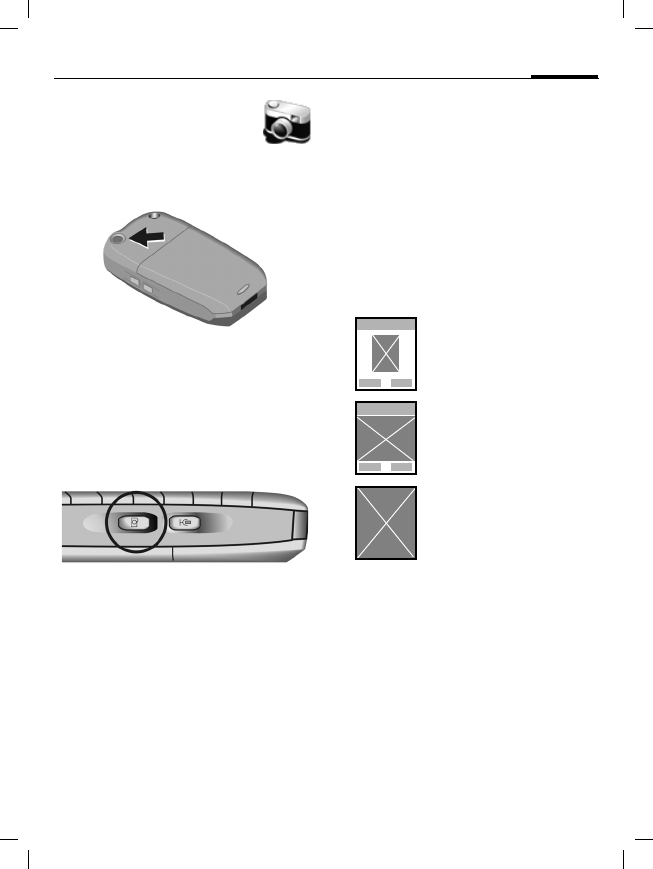
Camera 55
SX1 K1 am-en, A31008-H6500-A5-1-7619 (29. July 2003, 19:32)
© Siemens AG 2001, I:\Mobil\SX1_(K1)\am\ex_sdl\k1gb_camera.fm
Camera Snapshot
CKCameraKSnapshot
You can take photographs with the
integrated digital camera in the
phone.
The camera uses JPEG as the
standardized image format, which
can be viewed with most available
image viewers.
Press the Snapshot key on the side
of the phone to start the Snapshot
application. The display shows the
current view.
Take a snapshot
Press the camera key or the joystick
to take a picture of the current view.
It will be saved automatically in the
Images application, p. 56.
To prepare the next shot, wait until
the last picture is stored. This takes a
few seconds.
BPress Delete if the picture
does not meet your
expectations.
Snapshot modes
The camera supports three modes.
Move the joystick left/right to toggle
between them.
Miniature
Small icon-sized picture, which can
be added to an addressbook entry.
Shown resolution 80 x 96 pixels,
storage format 80 x 96 pixels.
Standard
Normal landscape mode. Shown
resolution 160 x 120 pixels, storage
format 160 x 120 pixels.
Miniature
Standard
Full screen

Camera
56
SX1 K1 am-en, A31008-H6500-A5-1-7619 (29. July 2003, 19:32)
© Siemens AG 2001, I:\Mobil\SX1_(K1)\am\ex_sdl\k1gb_camera.fm
Full screen
Advanced landscape without
borders around the picture.
Shown resolution 160 x 208 pixels,
storage format 480 x 640 pixels.
Snapshot options
The offered functions depend on the
current situation before/after taking
the picture, or after timeout:
Capture, Continue, Go to Images,
Settings, Exit.
Most relevant functions:
Go to Images
Opens the Images application,
where you can view your photos.
Images are scaled to the phone’s
display resolution (max. 208 x
160 pixels in full screen mode).
For further information about
viewing pictures, see p. 56:
Default image name
OptionsKSettings
KDefault image name
You can set a standard name for
taken pictures to which a
consecutive number is added for
each new snapshot. The default
name is "Image".
Rename the images later in the
Images application if you would like
to.
Images
CKCameraKImages
You can view, organize and send
pictures or animations stored in your
phone.
This includes pictures
• made by the Camera application,
• received in your inbox via
multimedia/picture message, as
an e-mail attachment or via
infrared or Bluetooth connection.
In these cases you must save the
picture after receiving it,
• animated pictures in JPG/GIF
format.
View images
Select the required image in the
image list by moving the joystick up
and down.
Open an image by pressing the
joystick.
In the Images main view, you can
see a list of pictures and folders with
• the date and time of shot or
storage,
• a thumbnail picture as preview,
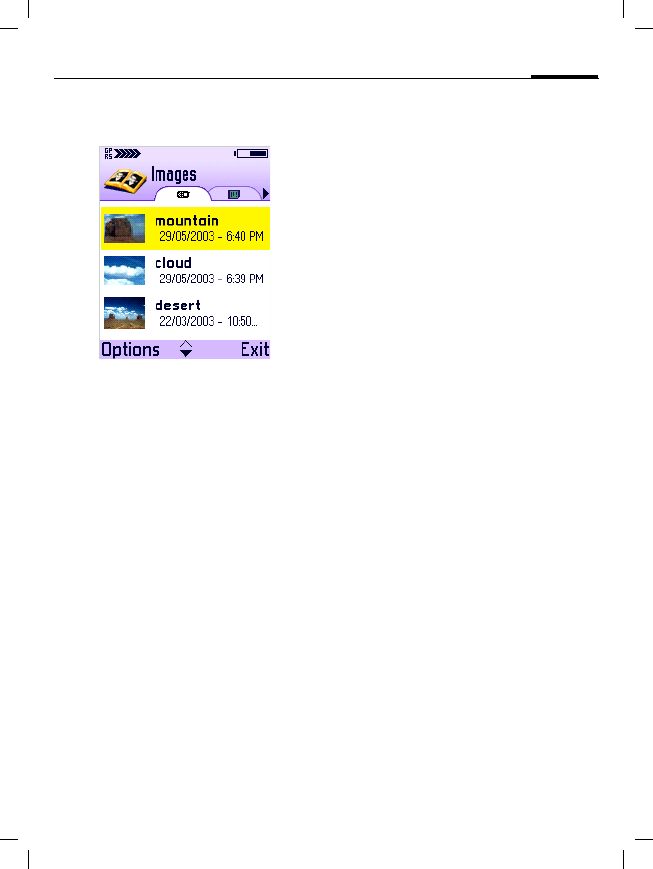
Camera 57
SX1 K1 am-en, A31008-H6500-A5-1-7619 (29. July 2003, 19:32)
© Siemens AG 2001, I:\Mobil\SX1_(K1)\am\ex_sdl\k1gb_camera.fm
• the number of images inside a
folder.
View the other images in the list by
moving the joystick left/right when
an image is open.
Receive images
Images can be received via
multimedia/picture message, as an
e-mail attachment or via infrared or
Bluetooth connection.
When saved, they are stored in the
phone memory and appear in the
Images list.
Send images
OptionsKSend
Send the selected image with one of
the following messaging services:
Via multimedia, p. 37
Via e-mail, p. 38
Via Bluetooth, p. 88
Via infrared, p. 91
Rotate
OptionsKRotateKLeft/Right
Rotates the image 90 degrees to the
left or to the right.
To save last view:
BPress Back and confirm
with Yes.
Zoom
OptionsKZoom in/Zoom out
When an image is displayed, you can
zoom in up to 800 percent.
BPress Back, to return
to normal size.
The zoom factor is not stored
permanently.

Camera
58
SX1 K1 am-en, A31008-H6500-A5-1-7619 (29. July 2003, 19:32)
© Siemens AG 2001, I:\Mobil\SX1_(K1)\am\ex_sdl\k1gb_camera.fm
Full screen
OptionsKFull screen
The whole display is used to show
the image.
Press the joystick to return to normal
view.
Focus
When an image is zoomed or shown
in full screen mode, you can move
the focus with the joystick to left/
right and up/down.
Press the joystick to return to normal
view.
Black & white
OptionsKBlack & white
Displays the opened image only in
black and white to use it for picture
messages (p. 59).
Edit with Image fun
OptionsKImage fun
Opens the Image fun application
with additional functions for editing
the image. For further information
about Image fun see:
www.my-siemens.com/sx1
Delete images
OptionsKDelete
Delete the selected image(s).
Wallpaper
OptionsKWallpaper
Set the current image as background
image for the idle state.
Rename images
OptionsKRename
Give the selected image a new
name.
View details
OptionsKView details
Shows detailed information about
the current image.
Images list options
Open, Send, Delete, Move to folder, New
folder, Mark/Unmark, Rename, Receive
via infrared, View details, Add to
Favorites, Exit.
Most relevant function:
Receive via infrared
Only from a digital camera that
supports the IrTran-P protocol,
otherwise use the infrared
application, p. 91.
Note
To enlarge the phones memory use the
optional MultiMediaCard (p. 70).
Viewing the memory consumption,
see p. 96.

Camera 59
SX1 K1 am-en, A31008-H6500-A5-1-7619 (29. July 2003, 19:32)
© Siemens AG 2001, I:\Mobil\SX1_(K1)\am\ex_sdl\k1gb_camera.fm
Shortcuts
Use these shortcuts for work with
images:
Picture messages
The stored black & white pictures are
displayed in grid form. They are
sorted in the order of time when
received, then alphabetically.
Select the required image in the
image list by moving the joystick up/
down and left/right.
Open an image by pressing the
joystick.
View the other images in the list by
moving the joystick left/right when
an image is open.
Picture message folder
Pictures which are sent to you in a
picture message are stored in the
folder Picture msgs..
To save a received image go to
CKMessages
open the message, then
OptionsKSave
See also Smart messages (p. 40).
Send picture messages
To send a picture message, select
the required image and open it:
DPress and enter the
recipient’s number, or use
the addresses.
DPress again.
27 Rotate left/right 90 degrees
38 Scroll left and right
9 0 Scroll up and down
4 5 Zoom in and out
*Toggle between full screen
and normal view.
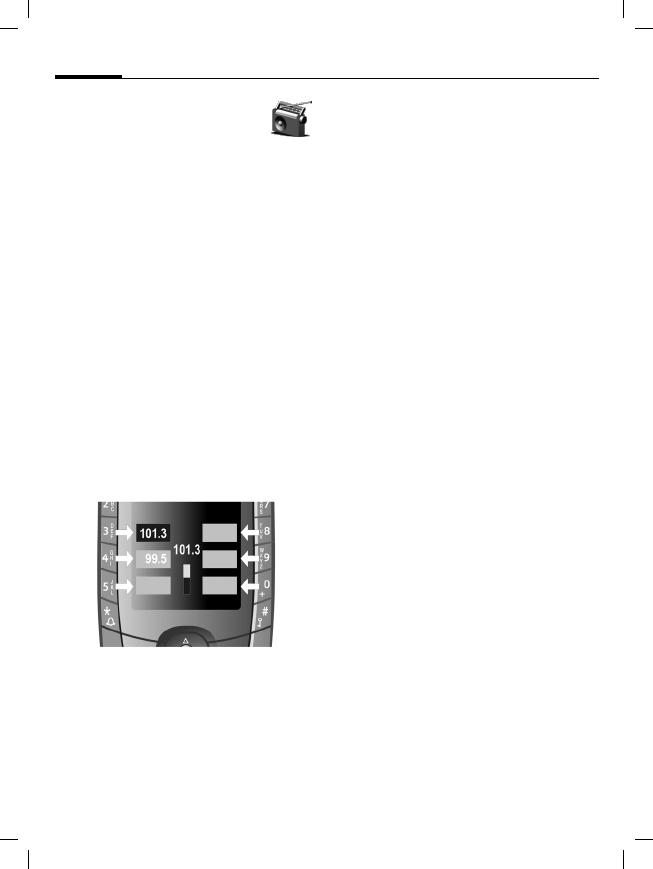
Music
60
SX1 K1 am-en, A31008-H6500-A5-1-7619 (29. July 2003, 17:40)
© Siemens AG 2001, I:\Mobil\SX1_(K1)\am\ex_sdl\k1gb_music.fm
Music Radio
CKMusicKRadio
You can listen to the radio and store
the frequencies of your favorite
stations. For FM radio you will need
the headset which also works as an
antenna. When the radio is first
switched on, you have to search and
store your favorite stations.
Quick start with Auto Scan
OptionsKAuto scan
The entire band will be searched
automatically and the 6 strongest
stations will stored on the shortcut
keys.
APress Back to leave Auto
scan.
How to play a station
Use the number keys 3, 4, 5 and
8, 9, 0 as shortcuts to your favorites.
How to search for a station
Step by step
Press the joystick up/down and the
next station will be found.
Manual tuning
OptionsKManual tuning
Move the joystick up/down to search
the band by steps of 100 kHz
or
Apress Edit to enter a
frequency directly, and
confirm with OK.
How to store a station
When a frequency is shown in the
middle of the display, store it by:
Long press on the required shortcut
key (3, 4, 5, 8, 9, 0).
or
OptionsKStore
Use joystick to select the required
shortcut key then press the joystick.
Settings
Signal threshold: High, Medium, Low
FM mode: Stereo, Mono

Music 61
SX1 K1 am-en, A31008-H6500-A5-1-7619 (29. July 2003, 17:40)
© Siemens AG 2001, I:\Mobil\SX1_(K1)\am\ex_sdl\k1gb_music.fm
FM radio options
Store, Auto scan, Manual tuning, Edit
name, Delete, Settings, Exit.
Most relevant functions:
Edit name
Enter a name instead of
the station’s frequency.
Delete Delete a stored station
from the current active
shortcut key.
Use also G.
Composer
CKMusicKComposer
Create your own individual ring
tones.
Compose a new melody
OptionsKNew tone
Use the keys to add notes as shown
in the table below:
The default duration for a note is 1/4.
Key Note Key Function
1c8Decrease length of
note/rest.
2d9Increase length of
note/rest.
3e0Insert a rest.
4f*Shows a list of notes
and rests
5g#Set selected notes/
rests one octave
higher.
6aGDelete selected
note(s).
7b
0 to 7A long press produces a
lengthened note or rest or
shortens a lengthened note.
Music
62
SX1 K1 am-en, A31008-H6500-A5-1-7619 (29. July 2003, 17:40)
© Siemens AG 2001, I:\Mobil\SX1_(K1)\am\ex_sdl\k1gb_music.fm
Edit a melody
You can edit a composed melody in a
simple way using only the joystick.
Moving left/right with the joystick to
select a note. Every note you pass
will be played.
A selected note can be changed by a
half step by moving the joystick up/
down.
Press the joystick to listen to the
whole melody.
BPress Back to save the
melody.
OptionsKTempo
Adjust the tempo from 50 beats/
minute to 250 beats/minute by
moving the joystick left/right.
OptionsKStyle
Toggle between Natural (short/
sharp) and Legato (smooth).
Edit options
Play, Insert symbol, Style, Tempo,
Volume, Exit.
Composer options
New tone, Open, Delete, Mark/Unmark,
Mark all/Unmark all, Rename, Duplicate,
Exit.
Note
To mark multiple notes/rests, press and
hold ABC and move the joystick left/right.

Organizer 63
SX1 K1 am-en, A31008-H6500-A5-1-7619 (29. July 2003, 19:32)
© Siemens AG 2001, I:\Mobil\SX1_(K1)\am\ex_sdl\k1gb_organiser.fm
Organizer Calendar
CKOrganizerKCalendar
You can enter appointments,
meetings and other tasks in the
Calendar. Additionally you can set an
alarm for every entry.
Calendar offers a
•Month view,
•Week view,
•Day view.
Time and date must be set for the
Calendar to work properly (p. 82).
Creating an entry
OptionsKNew entry
The following types of entry are
offered:
Meeting Appointment with
specific date and time.
Memo General entry for the day.
Anniversary
Reminder of special dates
like birthdays. These
entries are repeated every
year.
Fill in the following fields
(depending on the selected type):
Subject, Subject, Occasion
Description of the event.
Location Meeting place.
Start time, End time and Start
date, End date
Type in time and date,
switch between AM and
PM by pressing any key.
Alarm When switched on, the
fields Alarm time and Alarm
date appear. Key in time/
date if required.
Repeat Select the required period
for repetition:
Not repeated, Daily, Weekly,
Every 2 weeks, Monthly,
Yearly
Repeat until
Limit the repetition period
for the set alarm.
Synchronization
It is possible to
synchronize your
Calendar with your PC.
Private The entry can
only be seen by you.
Public The entry can
seen by others who have
access to your on-line
Calendar, e.g. at your
work computer.
None No
synchronization occurs.
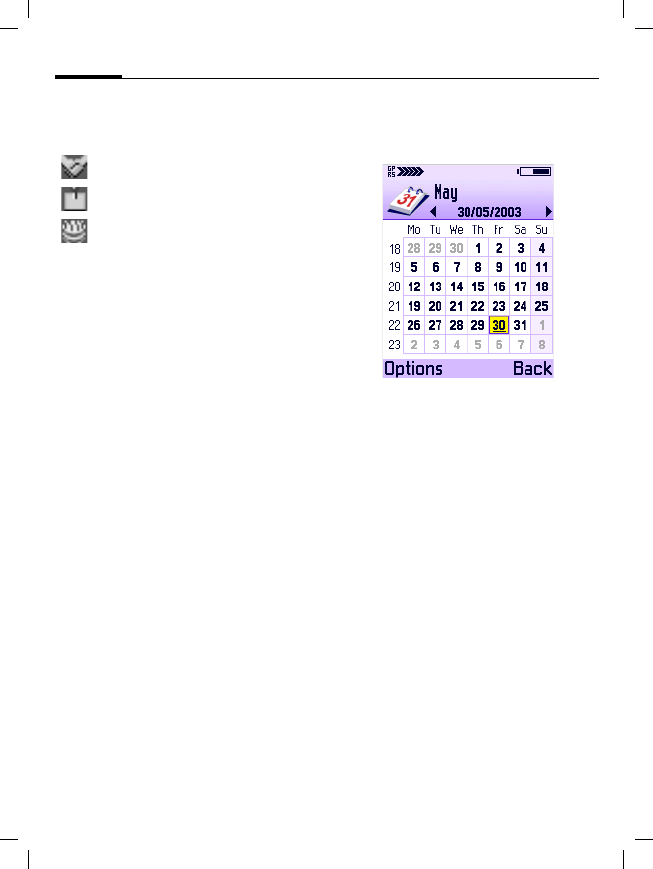
Organizer
64
SX1 K1 am-en, A31008-H6500-A5-1-7619 (29. July 2003, 19:32)
© Siemens AG 2001, I:\Mobil\SX1_(K1)\am\ex_sdl\k1gb_organiser.fm
Calendar views
Icons used in day and week view:
Meeting
Memo
Anniversary
Day view
The entries of the current day are
displayed in chronological order.
Memos and Anniversaries are placed
at the top of the list.
To display/edit an entry, select it and
press the joystick.
To see the next/previous day move
the joystick to the right/left.
Week view
The days of the week are displayed in
seven columns. Today’s date is
underlined. Memos and
Anniversaries are placed before 8
o’clock. Meetings are displayed with
colored bars indicating the duration.
For the day view of an entry, select a
colored cell and press the joystick.
Then open the entry as in day view.
Month view
The weeks of the month are
displayed in a row. Today’s date is
underlined. Dates with entries are
marked with a small triangle. The
currently selected date is marked by
a frame.
For the day view of an entry, select
the date and press the joystick.
Calendar options
Depends on the current situation.
Open, New entry, Week view, Month view,
Delete entry, Go to date, Send, Settings,
Exit.
Most relevant functions:
Go to date
To go to a specific date,
key in the date and
press OK.
Delete entry
Choose between:
Before date, All entries
Organizer 65
SX1 K1 am-en, A31008-H6500-A5-1-7619 (29. July 2003, 19:32)
© Siemens AG 2001, I:\Mobil\SX1_(K1)\am\ex_sdl\k1gb_organiser.fm
Send You can send a selected
entry from day view in
vCalendar format:
Via SMS, p. 36
Via e-mail, p. 38
Via Bluetooth, p. 88
Via infrared, p. 91
Calendar setup
OptionsKSettings
Default view
The view which is shown when the
Calendar is opened. Choose from:
Month view
Week view
Day view
Week starts on
Select starting day of the week view.
Week view title
Choose from:
Week number
Week dates
Tasks
CKOrganizerKTasks
Keep a list of things you have to do.
New note
To write a new note:
OptionsKNew task note
or
press any key 1 to 0. The editor opens
with the letter you have keyed in.
Fill in the following fields:
Subject
Description of the task you want
to do.
Due date
Set the due date for the task.
Priority
Choose from:
Low, Normal, High
BPress Done, to save the
task.
Task options
Open, New task note, Delete, Mark as
done, Exit.
Priority icons Status icons
!
-
(None)
High.
Low.
Normal.
Task done.
Task to do.
Organizer
66
SX1 K1 am-en, A31008-H6500-A5-1-7619 (29. July 2003, 19:32)
© Siemens AG 2001, I:\Mobil\SX1_(K1)\am\ex_sdl\k1gb_organiser.fm
Notes
CKOrganizerKNotes
Use Notes to write short memos and
send them to other devices.
Received text files in TXT format can
be saved to Notes.
Write a note
Press any key to start writing.
BPress Done to save the
note.
Notes options
Open, Send (Text message, MMS, E-mail,
Via multimedia, Via Bluetooth), New note,
Delete, Next note, Add to Favorites, Exit.
Voice memo
• Use your phone as a
dictating machine when on the
move.
• Record a memo as a reminder or
as a reminder for yourself or
others.
• Record a call – useful for
remembering numbers or
addresses (both parties will hear a
beep every 5 seconds).
New recording
OptionsKRecord sound clip
BPress Select to start
recording.
Use the following keys to control
recording:
Record options
Open, Record sound clip, Delete, Move to
phone mem, Move to mem. card, Mark/
Unmark, Mark all/Unmark all, Rename
sound clip, Send (MMS, E-mail, Via
infrared, Via Bluetooth), Add to Favorites,
Settings, Exit.
Note
The use of this feature may be subject to
restrictions under criminal law or other legal
provisions.
Please inform the other party to the
conversation in advance if you want to
record the conversation and please keep
such recordings confidential.
You may only use this feature if the other
party in the conversation agrees.
Record
Pause
Stop
Fast forward
Fast rewind
Play
Organizer 67
SX1 K1 am-en, A31008-H6500-A5-1-7619 (29. July 2003, 19:32)
© Siemens AG 2001, I:\Mobil\SX1_(K1)\am\ex_sdl\k1gb_organiser.fm
Calculator
CKOrganizerKCalculator
MEnter number
(up to 8 digits).
Select a calculator
function: +, -, x, ÷
MEnter a second number
(up to 8 digits).
Select = and press joystick
to display the result
or
Repeat procedure with
other numbers.
Calculator options
Last result, Memory (Save/Recall), Clear
screen, Exit.
Converter
CKOrganizerKConverter
You can convert some units of
measure from one type to another.
The following types are available:
Note
# Set decimal point.
* Scroll through basic functions.
G Short press: Clear wrong number.
Long press: Clear result of previous
calculation.
± Toggle between "+" and "-".
MS Save the number displayed to
memory.
MR Retrieve the number saved.
<> View previous calculations and
move in the sheet.
Type Units
Velocity Knots, Kilometers/h,Meters/
sec, Miles/hour, Feet/second
Energy Calories, Kilocalories,
Joules, Kilojoules, Hp-hours,
Kilowatt-hrs, Electronvolts
Mass Ounces, Pounds, Stones
(UK), Milligrams, Grams,
Kilograms, Metric tons
Pressure Pascals, mm Hg,
Atmospheres, Bars
Time Seconds, Minutes, Hours,
Days, Weeks
Volume Pints (UK), Fluid oz (UK),
Gallons (UK), Gallons (US),
Liq. pt (US), Dry pt (US), Liq.
oz (US), Gallons (US),
Barrels, Milliliters, Liters,
Cubic mm, Cubic cm, Cubic
meters, Cubic inches, Cubic
feet
Area Square in, Square feet,
Square yd, Square miles,
Square mm, Square cm,
Square m, Square km, Acres,
Ares, Hectares
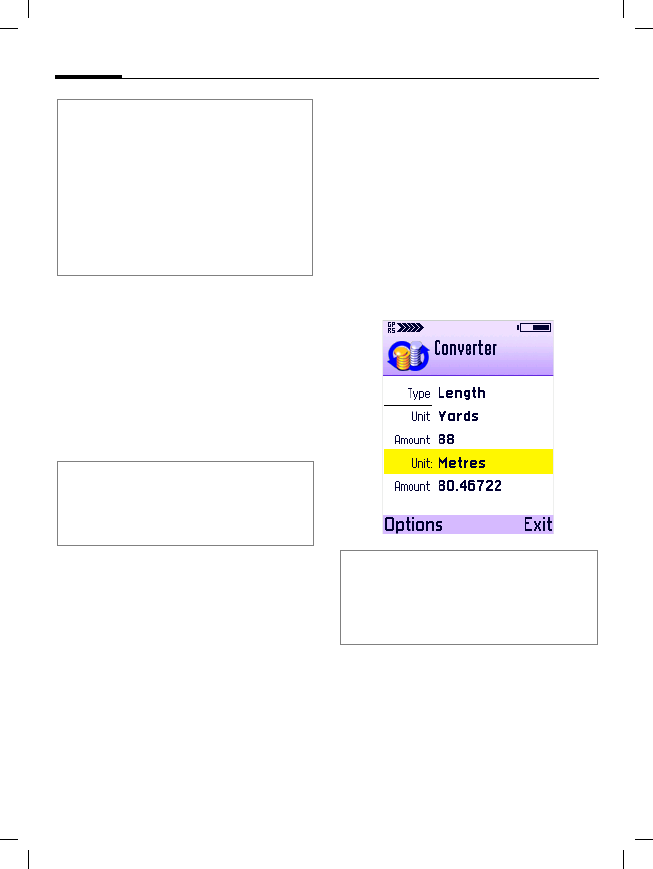
Organizer
68
SX1 K1 am-en, A31008-H6500-A5-1-7619 (29. July 2003, 19:32)
© Siemens AG 2001, I:\Mobil\SX1_(K1)\am\ex_sdl\k1gb_organiser.fm
Currency settings
First you have to choose a base
currency and add exchange rates.
Select the type Currency, then
OptionsKCurrency rates
Select your required base currency
from the list, then
OptionsKSet as base curr.
Once the base rate is set, add all the
exchange rates you need:
Scroll to the currency, key in the
current exchange rate to your base
currency. Proceed until all required
currencies are added.
Convert
Select the required type of measure
in the Type field or press the joystick
to see the available types of
measure.
Select the unit from which you want
to convert in the Unit field or press
the joystick to see the available
units.
In the Amount field, key in the
amount you want to convert. Select
the unit you want to convert to in
the second Unit field or press the
joystick to see the available units.
The other Amount field automatically
shows the result of the conversion.
Converter options
Select unit, Change currency,
Conversion type, Currency rates, Exit.
Length Millimeters, Centimeters,
Meters, Kilometers, Inches,
Feet, Yards, Miles, Naut.
miles
Power Horsepower, Watts,
Kilowatts
Tempera-
ture
Fahrenheit, Kelvin, Celsius
Currency See note below.
Note
When you change the base currency, all
previously set rates will be cleared.
The rate of the base currency is always 1.
Note
# Set decimal point.
* Toggle between + and - and E
(exponent).

Extras 69
SX1 K1 am-en, A31008-H6500-A5-1-7619 (29. July 2003, 19:32)
© Siemens AG 2001, I:\Mobil\SX1_(K1)\am\ex_sdl\k1gb_extras.fm
Extras File Manager
CKExtrasKFile Manager
Use the phone’s file manager like a
PC file manager to organize your
internal (phone memory) and
external (MultiMediaCard, optional)
storage.
On the MultiMediaCard you can
store files such as images, messages,
sounds and Java™ applications.
The file manager main view opens
and folders and files are listed.
File and folder handling
You can Move, Copy, Delete a single or
several marked files.
The following functions are only
available when no file or folder is
marked:
Open a file with the corresponding
application to see its Properties, or to
Rename it.
File and folder options
Open, Move, Copy, Delete, Properties,
Rename, Exit.
Folder navigation
To navigate between the folder
levels, move the joystick left/right.
Search modes
There are three search modes
available.
MEnter one character
(invisible) and the
selection will be
positioned at the first
matching entry.
OptionsKSearchKGoto
Enter a search string and the
matching list will be shown.
OptionsKSearchKFilter
Enter a search string and a list of all
matching entries will be shown.
Sort modes
Set sort criteria:
Ascending, Decending, Sort by name,
Sort by date, Sort by type, Sort by size.
Send
The phone offers several methods of
sending files via different
transmission routes. Only available
when a file is selected. For further
information see the respective
application:
Via multimedia, p. 37
Via e-mail, p. 38
Via Bluetooth, p. 88
Via infrared, p. 91
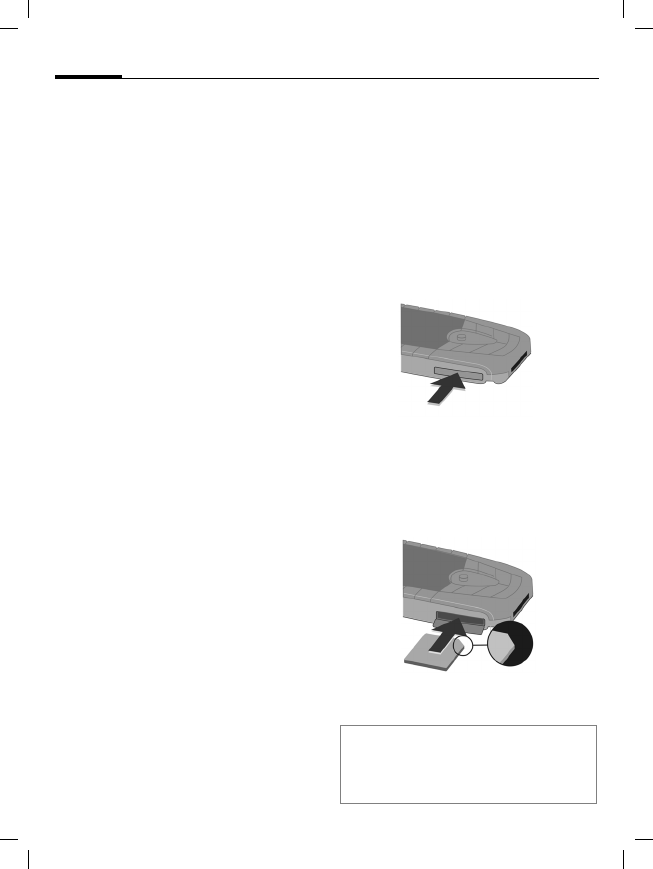
Extras
70
SX1 K1 am-en, A31008-H6500-A5-1-7619 (29. July 2003, 19:32)
© Siemens AG 2001, I:\Mobil\SX1_(K1)\am\ex_sdl\k1gb_extras.fm
Memory functions
Manage your memory card and view
relevant details.
Memory card name
Define a name for the multimedia
card.
Format memory card
It is necessary to format your
multimedia card before first use.
Set password
Use a password to protect access to a
special multimedia card. After the
password is set, the multimedia card
is locked. Not supported by all
multimedia cards.
Remove password
Remove password protection from
multimedia card.
Unlock memory card
You must enter the correct password
to unlock the MultiMediaCard.
Memory state
Display details for the multimedia
card and internal phone memory,
e.g. the name, the total capacity,
free and used memory and whether
it is password protected.
General File manager options
New folder, File, Search, Mark/Unmark,
Send, Sort by/order, Memory functions,
Exit.
Insert MultiMediaCard (optional)
To enlarge the phones memory you
may use an optional
MultiMediaCard. To insert it into
the phone:
• Open the battery lid on the
backside of the phone (p. 14) to
unlock the MultiMediaCard lid.
• Push onto MultiMediaCard lid to
open it n.
• Put MultiMediaCard into the slot.
The contacts on the
MultiMediaCard must show down
and to the slot. Make sure the
angled corner is in the correct
position o.
• Close MultiMediaCard lid until it
engages.
Note
MultiMediaCard must be removed only
when the phone is switched off, because
otherwise the contents can be destroyed.
n
o
Extras 71
SX1 K1 am-en, A31008-H6500-A5-1-7619 (29. July 2003, 19:32)
© Siemens AG 2001, I:\Mobil\SX1_(K1)\am\ex_sdl\k1gb_extras.fm
Java applications
CKExtras
KJava applications
Install
In the Java applications move the
joystick to the right for the
Download view.
You can get installation files via
• Bluetooth, Infrared from a
computer or phone
• multimedia message or as an
e-mail attachment
• download during a WAP session.
Select the required installation file:
OptionsKInstall
Alternatively, look at possible
applications e.g. Inbox for an
installation file, select it and press
the joystick to start installation.
Yes Press to confirm.
A list appears, in which you can
select the root or any existing folder
as destination for the new
application.
During installation, the phone
checks the integrity of the software
package to be installed. Information
about the checks are displayed, with
the option to cancel the installation.
The phone informs you when the
installation is finished. After that the
destination folder will be opened
and the installed application will be
highlighted.
Installation options
Install, View details, Delete, Settings,
Exit.
Note
Do not install software from sources without
adequate protection against viruses and
other harmful software.
The phone only supports J2ME™ Java
applications. Do not download Personal
Java™ applications as they cannot be
installed.
You can download and install an
application immediately during a WAP
session. Note that the WAP connection is
left running in the background during
installation.
You can only install files with the extension
*.JAD or *.JAR.
Glossary
JAR file (Java archive): This file includes
the executable application. When a JAR file
is selected, the application is started.
JAD file (Java descriptor): These files
contain information on the application (JAR
file) and their address for downloading.
When a JAD file is selected, the connection
to the Internet is established and the
executable application is loaded.
Note
To enlarge the phones memory use the
optional MultiMediaCard (p. 70).
View the memory consumption, see p. 96

Extras
72
SX1 K1 am-en, A31008-H6500-A5-1-7619 (29. July 2003, 19:32)
© Siemens AG 2001, I:\Mobil\SX1_(K1)\am\ex_sdl\k1gb_extras.fm
Uninstall
In the Java applications select the
required application:
OptionsKDelete
Open a Java™ application
Select the required application and
press the joystick.
Java™ application options
View details
To get information about an
application, select it:
OptionsKView details
You will see:
Status Installed, Running or
Downloaded (only in
Download view).
Version Application version
number.
Supplier Supplier or manufacturer
of the application.
Size The size in kilobytes.
Type Brief description of the
application.
URL Address of an
information/help page on
the Internet.
Data Size of application data,
e.g. high scores, in
kilobytes.
Settings
Define a default access point for
downloading missing application
components. For how to create an
access point, see p. 80.
Assign an access point to an
application, select the application,
then:
OptionsKSettings
KDefault access point
Select an access point to be used by
the application for downloading
additional data (p. 80).
OptionsKSettings
KNetwork connection
Some Java™ applications may
require a data connection to be
made to a defined access point. You
will be asked for an access point if
none has been selected. The options
are:
Allowed A connection is
established without
notification.
Ask first You will be asked before
the application creates a
connection.
Not allowed
No connection is allowed.
Extras 73
SX1 K1 am-en, A31008-H6500-A5-1-7619 (29. July 2003, 19:32)
© Siemens AG 2001, I:\Mobil\SX1_(K1)\am\ex_sdl\k1gb_extras.fm
Further options
Only available, when the JAD file
contains an URL address.
Go to URL address
A data connection will be
established to get additional
information about the application.
Update
A data connection will be
established to check if there is an
update available.
Alarm clock
CKExtrasKAlarm clock
Clock settings
OptionsKSettings
See Settings/Date and time, p. 82.
Alarm setting
Use this function to set a single time
for the alarm. The alarm sounds
even when the phone is switched
off.
OptionsKSet alarm
Key in the alarm time.
Turn off the alarm
APress Stop to turn off the
alarm.
BPress Snooze or any key
to interrupt the alarm for
10 minutes. You can
repeat this up to 5 times.
Clock options
Set alarm, Reset alarm, Remove alarm,
Settings, Exit.
Download Java™ applications via WAP
WAP can be used to download applications from
the Internet. Downloading or running applications
will not affect or change the software already
installed on your Java™-enabled mobile phone.
Siemens excludes all warranty and liability claims
in respect of or in connection with any
applications subsequently installed by the
customer and any software not included in the
original delivery package. This also applies to
functions enabled subsequently at the customer's
prompting. The purchaser bears sole risk for the
loss of, damage to, and any defects arising in, this
device or the applications or software and for any
direct damage or consequential damage of
whatever nature resulting from the use of these
applications or software. For technical reasons,
such applications or software and subsequent
enabling of certain functions are lost in the event
of the device being replaced/re-supplied and may
be lost if it is repaired. In these cases the
purchaser will need to download the application
again or re-enable it. Siemens does not warranty
or guarantee or accept any liability for the
customer's ability to download or enable
applications again or to do so free of charge.
Note
The phone switches on automatically when
the alarm time is reached. After you have
pressed Stop, you can continue working
with the phone by pressing Yes.
Extras
74
SX1 K1 am-en, A31008-H6500-A5-1-7619 (29. July 2003, 19:32)
© Siemens AG 2001, I:\Mobil\SX1_(K1)\am\ex_sdl\k1gb_extras.fm
Favorites
Use Favorites to store
frequently used functions, photos,
notes, sound files, video clips, WAP
bookmarks or saved WAP pages.
In Favorites there are three default
shortcuts (not changeable):
Notes, Calendar, Inbox
To open Favorites:
CKExtrasKFavorites
Add shortcuts
Specific applications offer this
function.
Select the application and press the
joystick to open it.
OptionsKAdd to Favorites
BPress OK.
Favorites Options
Open, Edit shortcut name, Shortcut icon,
Delete shortcut, Move, List view/Grid
view, Exit
Most relevant functions:
Open
The selected file is opened in the
corresponding application.
Edit shortcut name
Change name of the shortcut.
This does not affect the file it is
referring to.
Shortcut icon
Select an individual icon for a
shortcut (not available for default
shortcuts).
SIM phonebook
See Contacts, p. 27.
SIM fixed dial
Phone numbers can be stored
in protected locations on a special
SIM card. A PIN 2 is needed for
editing.
Service numbers
Phone numbers that you are
offered by your service provider may
be stored in the SIM card/Contacts.
You can call local or nationwide
information services or use services
of the service provider.
Note
A shortcut in Favorites is automatically
updated if you move the item it is pointing
to, e.g. from one folder to another.
Extras 75
SX1 K1 am-en, A31008-H6500-A5-1-7619 (29. July 2003, 19:32)
© Siemens AG 2001, I:\Mobil\SX1_(K1)\am\ex_sdl\k1gb_extras.fm
SIM services
Your service provider may offer
special applications such as mobile
banking, stock market, etc. via the
SIM card.
If you have such a SIM card the SIM
services will appear at the top of the
main menu or directly above the
control key (on the left).
Symbol of the SIM services:
If there is more than one application
they are displayed in the SIM services
menu.
CKExtrasKSIM services
With the SIM services menu, your
phone is ready for the future and will
support additions to your service
provider's user package. For further
information, please contact your
service provider.
PC connection
USB port
The USB port can be used for normal
data transfer.
Indication on the display
when connected.
See also accessory Data Cable USB
DCA-540 (p. 104).
Siemens Data Suite
On the delivered CD ROM you will
find the software package Siemens
Data Suite.
This can be used to transfer data
from your phone to another
compatible device e.g. a phone or a
PC, and synchronize your Organizer
via Data Cable USB, Bluetooth or
infrared.
L
Profiles
76
SX1 K1 am-en, A31008-H6500-A5-1-7619 (29. July 2003, 19:32)
© Siemens AG 2001, I:\Mobil\SX1_(K1)\am\ex_sdl\k1gb_profiles.fm
Profiles General
If a profile is used, several set-
tings are made with one function, in
order to adapt the phone to the
noises of the environment, for
example.
Six standard profiles are provided
with default settings. They can be
changed however:
Normal
Silent
Meeting
Outdoor
Pager
Customize
Select
CKProfiles
Select default or personal profile.
OptionsKSelect
The default mode used is pre-
selected when the phone is switched
on.
Overview
Default settings:
Normal Silent Meeting
Ringing
options
Ringing Silent Beep
once
Ringing
volume
711
Vibrating
alert
Off Off Off
Keypad
tones
2OffOff
Warning
tones
On Off Off
Outdoor Pager
Ringing
options
Ringing Silent
Ringing
volume
10 7
Vibrating
alert
On On
Keypad
tones
32
Warning
tones
On On

Profiles 77
SX1 K1 am-en, A31008-H6500-A5-1-7619 (29. July 2003, 19:32)
© Siemens AG 2001, I:\Mobil\SX1_(K1)\am\ex_sdl\k1gb_profiles.fm
Setup
Edit a default profile or create a new
personal profile:
CKProfiles
Select default profile or personal
profile.
OptionsKChange
Select the item you want to change
and press the joystick to open/
change it:
Ringing tone
Select a tone from the list.
"Ringing tone, line 1"
"Ringing tone, line 2"
Only available if Line in use (p. 79) is
active.
Ringing options
Ringing, Ascending, Ring once,
Beep once, Silent.
Ringing volume
Set the volume level.
Message alert tone
Select a tone from the list.
Vibrating alert
On/Off
Keypad tones
Set the volume level.
Warning tones
On/Off
Alert for
All calls or for specified groups.
Profile name
Give the profile an individual name.
Not available for Normal mode.

Setup
78
SX1 K1 am-en, A31008-H6500-A5-1-7619 (29. July 2003, 19:32)
© Siemens AG 2001, I:\Mobil\SX1_(K1)\am\ex_sdl\k1gb_setup.fm
Setup Phone
CKSetupKSettings
KPhoneKSelect a function:
General
Phone language
Set the language of the display text.
When Automatic is set, the language
of your service provider is used.
Writing language
The selected language affects:
• characters, when writing text
• dictionary used
• special character table (* or 1)
T9 input
Not available for all languages.
See "Writing text", p. 24.
Welcome note or logo
The following is displayed when you
switch the phone on:
Default
Default image/animation.
Text
Write a note (max. 50 letters).
Image
Select an individual photo from the
list.
Orig. phone settings
(Security code protected)
The phone is reset to the default
values (factory setting). This does
not apply to SIM card and system
setup. All private documents and
data remain unaffected.
Standby mode
Wallpaper
Select your individual background
photo for standby mode from
Images.
Left softkey/Right softkey
Change the function for each key.
Select a new one from the list.
Display
Contrast
Make contrast lighter/darker.
Color palette
Choose between Blue Sky, Beach
and City.

Setup 79
SX1 K1 am-en, A31008-H6500-A5-1-7619 (29. July 2003, 19:32)
© Siemens AG 2001, I:\Mobil\SX1_(K1)\am\ex_sdl\k1gb_setup.fm
Call
CKSetupKSettings
KCall KSelect a function:
Send my caller ID
When you make a call, your phone
number can be displayed on the
recipient's display (depending on the
service providers).
Call waiting
During a call, you may be advised
that there is another call waiting.
You will hear a special tone during
the call. If you are registered for this
service, you can check whether it
is set and you can activate/
deactivate it.
Automatic redial
If busy, the number is automatically
dialed up to 10 times. End with:
EEnd key.
Summary after call
Shows duration and costs of last calls
(needs activation of Call cost limit,
p. 35).
Shortcut
Switch function on/off (p. 97).
Anykey answer
You can press any key to accept an
incoming call.
Line in use
This function is only displayed if it is
supported by the service provider.
Two independent phone numbers
must be registered on the phone.
Select the phone line you want for
daily use. Calls can be answered
regardless of the selected line.
0Short press to change left
softkey. Press softkey to
switch between the lines
in standby mode.
L
L
L
Setup
80
SX1 K1 am-en, A31008-H6500-A5-1-7619 (29. July 2003, 19:32)
© Siemens AG 2001, I:\Mobil\SX1_(K1)\am\ex_sdl\k1gb_setup.fm
Connection
You need access points to
access the Internet for example to
• send/receive e-mails (p. 38)
• send/receive multimedia
messages (p. 37)
• use WAP applications (p. 51)
• activate modem operation
To connect to an access point, a data
connection is needed. There may be
access points predefined by your
provider. Otherwise your provider
will provide you with further
information on this.
CKSetupKSettingsKConnection
KSelect a function:
Access points
A list of default or defined access
points may be shown. Select an
access point from the list or define a
new one.
New access point
OptionsKNew access point
Use default settings
If you want to use default entries.
Use existing settings
If you want to change an existing
entry to create a new access point,
select it from the list.
There are three types of connection
available:
GSM data call
Data transmission rate up to 14.4 kbps.
To configure this access point:
•Connection name: your choice
•Data bearer: GSM data
•Access point name: from provider
•User name: from provider if required
•Prompt password: choose Yes if you
want to enter it at every logon
•Password: from provider if required
•Authentication: normal/Secure
•Gateway IP address: from provider
•Homepage: address of WAP service or
multimedia messaging center
•Session mode: e.g. Permanent
•Connection security: from provider
•Data call type: analog, ISDN v.110, ISDN
v. 120
•Maximum data speed: automatic, 9600,
14400,19200,28800
Note
You may receive the settings in a smart
message. If you save them, the received
settings are automatically used as
Preferred connection, see Messages,
p. 45.

Setup 81
SX1 K1 am-en, A31008-H6500-A5-1-7619 (29. July 2003, 19:32)
© Siemens AG 2001, I:\Mobil\SX1_(K1)\am\ex_sdl\k1gb_setup.fm
GPRS connection
(General Packet Radio Service)
With packet data technology which
connects only to send/receive data in
packets.
To configure this access point:
•Connection name: your choice
•Data bearer: GPRS
•Access point name: from provider
•User name: from provider
•Prompt password: choose Yes if you
want to enter it at every logon
•Password: from provider if required
•Authentication: from provider
•Gateway IP address: from provider
Advanced setup
If editing an access point:
OptionsKAdvanced settings
Your provider will provide you with
further information on this if
necessary.
•Phone IP address: from provider
•Primary name server: from provider
•Second. name server: from provider
•Use callback: data phone number
•Callback type: from provider
•Callback number: from provider
•Use PPP compression: from provider
•Use login script: from provider
•Login script: insert login script
•Modem initialization: using AT modem
commands. From provider.
Access point options
Edit, New access point (Use default
settings, Use existing settings), Delete,
Exit.
CKSetupKSettingsKConnection
KSelect a function:
GPRS
The setup data are needed for all
access points using GPRS.
GPRS connection
•When available Always use GPRS for
text/data communication (if the system
supports it)
•When needed Use only GPRS if an
application/action needs it to work
Access point
If you want to use your phone as a
modem to your computer, an access
point name is needed.
Data call
CKSetupKSettingsKConnection
KData call
The setup data are needed for all
access points using a (high speed)
data call.
Online time
The data call is switched off after a
time-out period.
•User defined: Key in a period in minutes
for time-out
•Unlimited: No time-out
Setup
82
SX1 K1 am-en, A31008-H6500-A5-1-7619 (29. July 2003, 19:32)
© Siemens AG 2001, I:\Mobil\SX1_(K1)\am\ex_sdl\k1gb_setup.fm
Date and time
settings
CKSetupKSettings
KDate and time settings
KSelect a function:
The clock must be set correctly once
at start-up.
Time
MEnter the time. Setting of
the time format:
HH Hours (2-digit)
MM Minutes (2-digit)
Date
MEnter the date. Setting of
the date format:
DD Day (2-digit)
MM Month (2-digit)
YYYY Year (4-digit)
Date format
Select from:
mm dd yyyy
dd mm yyyy
yyyy mm dd
Date separator
Select from:
Time format
am/pm or 24-hour.
Time separator
Select from:
Clock type
Analog or Digital.
Auto time update
The phone gets the current time,
date and time zone via the system.
.:/-
.:
L

Setup 83
SX1 K1 am-en, A31008-H6500-A5-1-7619 (29. July 2003, 19:32)
© Siemens AG 2001, I:\Mobil\SX1_(K1)\am\ex_sdl\k1gb_setup.fm
Security
CKSetupKSettings
KSecurity
KSelect a function:
Phone and SIM
The phone and SIM card are
protected against misuse by several
security codes.
PIN code request, PIN code, PIN2 code
and Security code see p. 19.
Autolock period
If set, the phone locks after a time-
out you can define. Key in a number
for minutes. To unlock you must
enter the security code.
Lock if SIM changed
(Security code protected)
Your phone is prevented from being
used with a different SIM card.
SIM fixed dial
(PIN 2 protected)
Dialing is restricted to the numbers
on the SIM card, new entries are not
possible. If only area codes are
entered, the relevant phone
numbers can be added to these
manually before dialing.
Closed user group
If offered by the service provider,
this service enables groups to be
formed. These have access for
example to internal (company)
information or special tariffs apply to
them. Check with your service
provider for details.
Confirm SIM services
The phone can be set to display
confirmations when using a SIM card
service.
Certificate management
There is a list of authorized
certificates stored in your phone.
These are used for verifying the
origin of WAP pages and installed
software.
You need a certificate, for example
• to work with an online bank or
another server to transfer
confidential information,
• to protect against viruses.
Note that a certificate is not a
protection in itself. It needs to be
checked for authenticity and
trustworthiness.
L
L
L

Setup
84
SX1 K1 am-en, A31008-H6500-A5-1-7619 (29. July 2003, 19:32)
© Siemens AG 2001, I:\Mobil\SX1_(K1)\am\ex_sdl\k1gb_setup.fm
Certificate details:
Certificates have a restricted life
span. To be sure that the identity of a
WAP gateway or a server is correct,
check the signature and the
certificate. You will be informed on
the phone’s display if something is
wrong. One of the following
advisors may appear:
Expired certificate, Certificate not valid
yet, Certificate corrupted.
Trust settings
First select a certificate. A list of
applications which can use this
certificate is shown. Before changing
anything make sure that you can
trust the owner of this certificate and
that it belongs to the owner on the
list.
Certification Mgmt. Options
Certificate details:, Delete, Trust settings,
Mark/Unmark, Mark all/Unmark all, Exit.
Call restriction
CKSetupKSettings
KCall restriction
KSelect a function:
Restriction limits the use of your SIM
card (not supported by all service
providers). You need a 4-digit
password which your service
provider will give you. You may need
to be registered separately for each
restriction.
Outgoing calls
All outgoing calls except emergency
numbers 112 and 999 are restricted.
International calls
Only national calls can be made.
International calls except to
home ctry.
International calls are not permitted.
However you can make calls to your
home country when abroad.
Incoming calls
The phone is restricted for all
incoming calls (forwarding all calls
to the mailbox offers a similar
effect).

Setup 85
SX1 K1 am-en, A31008-H6500-A5-1-7619 (29. July 2003, 19:32)
© Siemens AG 2001, I:\Mobil\SX1_(K1)\am\ex_sdl\k1gb_setup.fm
Incoming calls if roaming
You do not receive calls when you
are outside your home system. This
means that no charges are incurred
for incoming calls.
Check status
The following information can be
displayed after a status check:
• Restriction set.
• Restriction not set.
• Status unknown (e.g. new
SIM card).
Cancel all restrict.
All restrictions are cleared. A
password which the service provider
will give you is needed for this
function.
System
CKSetupKSettings
KSystem
System selection
If Automatic is selected, the phone
searches for and selects the next
available system.
If Manual is selected, a system can be
selected manually from the list of
available GSM systems.
Cell info display
When on, the phone indicates that it
is used in a Micro Cellular Network
(MCN) and receives cell information.
Setup
86
SX1 K1 am-en, A31008-H6500-A5-1-7619 (29. July 2003, 19:32)
© Siemens AG 2001, I:\Mobil\SX1_(K1)\am\ex_sdl\k1gb_setup.fm
Accessory settings
CKSetupKSettings
KAccessory settings
KSelect a function:
Headset
Indication on the display
when connected.
Default profile
You can choose one of the standard
profiles.
Automatic answer
Factory default: Off
On/Off Calls are accepted
automatically after a few
seconds (except when the
ringer is switched off or
set to beep). You should
therefore be wearing the
headset. Eavesdropping is
possible!
Automatic settings:
• Accept call with the call key or PTT
key when the key lock is activated.
• Activate voice dialing with the PTT
key.
Car Kit
Indication on the display when
connected:
Car Kit Basic.
Car Kit Portable/Comfort.
Additionally charging indications
will be shown, when connected.
Default profile
You can choose one of the standard
profiles (p. 76).
Automatic answer
Factory default: On
On/Off Calls are accepted
automatically after a few
seconds. Eavesdropping is
possible!
Automatic settings:
• Vibrating is switched off.
• Manual keylock is switched off.
See # key on (p. 13).
• AutoKeylock is switched off. To
unlock you must enter the
security code (p. 83).
• Autophone off. The phone is
switched off after 2 hours without
ignition.

Setup 87
SX1 K1 am-en, A31008-H6500-A5-1-7619 (29. July 2003, 19:32)
© Siemens AG 2001, I:\Mobil\SX1_(K1)\am\ex_sdl\k1gb_setup.fm
Call forwarding
You can set the conditions
for which calls are forwarded to your
mailbox or other numbers. For
details contact your service provider.
You can set forwarding as
follows:
The most common condition for call
forwarding is: If not answered
CKSetupKCall forwarding
If not answered
Select.
Activate Select, then choose:
To voice mailbox
to forward to your voice
mailbox number (p. 93)
or
To other number
Enter another number to
which calls should be
forwarded.
Select the delay time after which a
call should be forwarded.
BPress OK. After a short
pause, the setting is
confirmed by the system.
Forwarding conditions
The following conditions for call
forwarding are available:
If not answered, All voice calls, If busy, If
not answered, All voice calls, If not
available, All fax calls, All data calls.
Check status
OptionsKCheck status
Check whether forwarding is
activated or not.
Cancel forwarding
OptionsKCancel all forwards
All set forwardings are cleared.
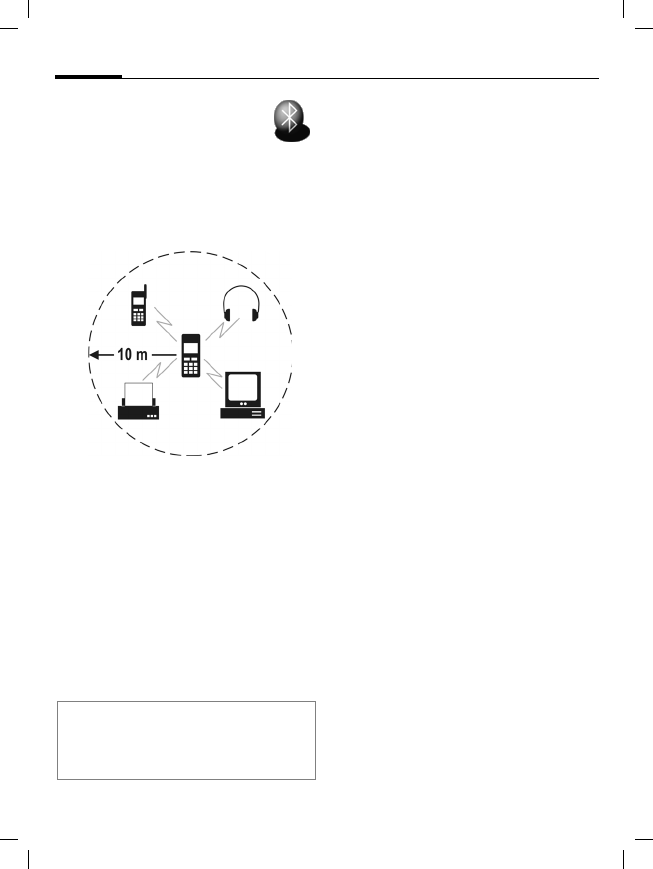
Setup
88
SX1 K1 am-en, A31008-H6500-A5-1-7619 (29. July 2003, 19:32)
© Siemens AG 2001, I:\Mobil\SX1_(K1)\am\ex_sdl\k1gb_setup.fm
Bluetooth™
Bluetooth is a short-range
radio system. It permits wireless
communication between different
terminal devices equipped with
Bluetooth such as phones, phone
accessories, printers and PCs.
Every Bluetooth device has a unique
address and name. This is how it is
guaranteed that the intended
communication partners can
connect. The security concept is
based on a password that both
devices exchange when they
connect for the first time. These
"trustworthy" partners can be
included in a list. The password
prompt is no longer necessary for
future connections.
First Use
When you use this application for
the first time, you may assign a
Bluetooth name to it.
MUse the default name or
write a new one (max.
30 letters.
BPress OK.
Settings
CKSetupKBluetooth
Bluetooth
On/Off You must activate
Bluetooth in order to
establish a Bluetooth
connection between your
mobile phone and other
Bluetooth devices.
My phone's visibility
All If set, the phone can be
located by other
Bluetooth devices
whenever you switch
your phone on.
Hidden If activated, your own
phone cannot be located
by other Bluetooth
devices.
My Bluetooth name
Assign a (Bluetooth) name to your
phone. This name can be seen by
other Bluetooth devices within the
possible range.
Note
The use of Bluetooth devices is forbidden in
some countries. Check with the relevant
authorities.
Setup 89
SX1 K1 am-en, A31008-H6500-A5-1-7619 (29. July 2003, 19:32)
© Siemens AG 2001, I:\Mobil\SX1_(K1)\am\ex_sdl\k1gb_setup.fm
Sending via Bluetooth™
To send an item via Bluetooth, you
must first select it in its application.
Then:
OptionsKSendKVia Bluetooth
Your phone starts to search for other
Bluetooth devices. All found
partners are shown on the display
with a device icon, their Bluetooth
name and the device type. Trusted
partners are indicated by an icon
.
Select the partner you want to
connect with.
BPress Select. The item you
want to send is copied to
the Outbox.
Connecting is shown.
MIf "Pairing" is required by
the other device, you
must enter a password.
Create your own
password for this (1-16
chars, numeric) and give
it to the partner, for its
unique use. Subsequently
this device is trusted.
Now the connection
should be established.
Sending data shown.
After the message has
been sent, the Bluetooth
connection will be ended
automatically.
Note
When searching for other Bluetooth
devices, you may see only their unique
Bluetooth addresses (if no name was
given). To see your unique address, enter
in standby mode: *#2820#
Note
An existing list of devices may appear, if
you have already searched for other
devices. In this case select More devices.
Icons for devices are:
Computer
Phone
Car Kit
headset
Other
Unknown
Stop Press to interrupt search and
work with devices already
found.
Note
If sending fails, the message will be deleted
from the Outbox.
Data received via Bluetooth are stored in
the Inbox, p. 39.
Status icons:
Bluetooth active.
Connection is active.
Setup
90
SX1 K1 am-en, A31008-H6500-A5-1-7619 (29. July 2003, 19:32)
© Siemens AG 2001, I:\Mobil\SX1_(K1)\am\ex_sdl\k1gb_setup.fm
Paired devices view
CKSetupKBluetooth
Communication with paired devices
is more convenient and quicker.
Pairing with a device
Move the joystick to the right to view
the paired device list.
OptionsKNew paired device
Your phone starts to search for other
Bluetooth devices, or a list of devices
appears if you have already searched
for other devices.
Select the partner you want to
connect with.
BPress Select.
MEnter password (see
"Sending via Bluetooth"
above). The device is
added to the paired
device list.
Assign short name
OptionsKAssign short name
Define a short name or alias for
better recognition of certain devices
after searching. These names are
only visible to you and not to other
Bluetooth users.
Set as authorized
OptionsKSet as authorized
Paired devices can be set as
authorized to allow them a
connection to your device without
your knowledge. This status is useful
for your own devices, such as your
computer for example. Authorized
devices are indicated by .
Paired devices options
New paired device, Assign short name,
Delete, Delete all, Set as authorized/Set
as unauthorized, Exit.
Receive via Bluetooth™
Bluetooth must be activated. When
you receive a message via Bluetooth,
you will be asked for acceptance
after a tone.
is shown if accepted and the
item is stored in the Inbox, p. 39.
Unread Bluetooth messages are
indicated by .
After the message has been
received, the Bluetooth connection
is ended automatically.
Setup 91
SX1 K1 am-en, A31008-H6500-A5-1-7619 (29. July 2003, 19:32)
© Siemens AG 2001, I:\Mobil\SX1_(K1)\am\ex_sdl\k1gb_setup.fm
IrDA
CKSetupKVia multimedia
Your phone has an infrared
interface. You can use this to
exchange data (e.g. address entries,
business card, notes) with other
devices that are also equipped with
an infrared interface.
The infrared interface is on the left
side of the phone. The infrared ports
of the sending and receiving devices
must be pointing at each other and
the distance between them must not
exceed 30 cm.
To send an item via Infrared, you
must first select it in its application.
Then:
OptionsKSendKVia multimedia
Items received via infrared are stored
in the Inbox, p. 39.
Modem
CKSetupKModem
To use your phone as a fax modem,
you first have to establish a
connection to an other device via
Infrared or Bluetooth.
Connecting via Infrared
To activate the connection via
Infrared:
OptionsKConnect
To disconnect an established
connection:
BPress Disconn.
Connecting via Bluetooth
The connection must initiated by the
remote device side.
The control of the connection
happens via the Bluetooth
application (p. 88).
Note
Status icons:
Received Items in the Inbox.
Connection is active.
Setup
92
SX1 K1 am-en, A31008-H6500-A5-1-7619 (29. July 2003, 19:32)
© Siemens AG 2001, I:\Mobil\SX1_(K1)\am\ex_sdl\k1gb_setup.fm
Audio
CKSetupKAudio
Edit the current profile (see also
p. 76).
Ringing tone
Select a tone from the list.
Ringing options
Ringing, Ascending, Ring once, Beep
once, Silent.
Ringing volume
Set the volume level.
Message alert tone
Select a tone from the list.
Vibrating alert
On/Off
Keypad tones
Set the volume level.
Warning tones
On/Off
Alert for
All calls or for specified groups.
Screen saver
CKSetupKScreen saver
The screen saver will be activated
after a specific (free adjustable) time
out. Any user action or phone event
will deactivate the screen saver.
Screen saver time-out
Set the time after which the screen
saver should become active. The
range is from one minute to 30
minutes in steps of one minute.
Screen saver
Choose between:
Date and time
The actual date and time is shown.
For adjusting see p. 82.
Note
"Ringing tone, line 1"
"Ringing tone, line 2"
Only available if Line in use (p. 79) is
active.
Setup 93
SX1 K1 am-en, A31008-H6500-A5-1-7619 (29. July 2003, 19:32)
© Siemens AG 2001, I:\Mobil\SX1_(K1)\am\ex_sdl\k1gb_setup.fm
Text
Enter a desired text up to 15
characters.
Animation
• Default animation
Not changeable.
• Own animation
Select the required picture or
animated GIF file from the folder
Images (p. 56).
Screensaver preview
A preview of the current setting is
shown.
Voice mailbox
Most service providers offer
you an external answering service.
In this mailbox, a caller may leave a
voice message for you
• if your phone is switched off or
not ready to receive,
• if you do not want to answer,
• if you are making a phone call
(and if Call waiting is not activated,
p. 79).
If the voice mail service is not part of
your service provider's user package,
you will need to register and the
settings must be made manually.
The following description may vary
slightly depending on the service
provider.
Listen to
A new voice mail can be displayed as
follows:
To call your mailbox (in standby
mode):
1 press, then D
If you asked for the voice mailbox
number:
MKey in the number.
BPress OK.
or
store the mailbox number for future
use, see as follows.
Setup
94
SX1 K1 am-en, A31008-H6500-A5-1-7619 (29. July 2003, 19:32)
© Siemens AG 2001, I:\Mobil\SX1_(K1)\am\ex_sdl\k1gb_setup.fm
Setup
Mailbox number
Call this phone number to listen to
the voice mails left for you. To set it
up:
CKSetupKVoice m.
MEnter the phone number
you will call to listen to
your voice mails.
Forwarding number
Calls are forwarded to this phone
number.
Indication on the display
To set it up:
CKSetupKCall forwarding
Select a forwarding
option, for example: If
busy, to forward calls
when your number is
busy.
OptionsKActivate
Voice mailbox
Select To voice mailbox
BPress OK. Registration at
the system will be
confirmed after a few
seconds.
Other phone number
Select To other number
MKey in the phone number
you want to forward to.
BPress OK. Registration
at the system will be
confirmed after a few
seconds.
Note
Find Press to select the forward
number from the Addresses.
Password
Your voice mail will request a password
every time you call it. In this case you may
want to add it as a touch tone number after
the voice mail number.
For example, +55 11223344p1234#
where 1234 is the password and p inserts
a pause.
Setup 95
SX1 K1 am-en, A31008-H6500-A5-1-7619 (29. July 2003, 19:32)
© Siemens AG 2001, I:\Mobil\SX1_(K1)\am\ex_sdl\k1gb_setup.fm
Manager
CKSetupKManager
Install or remove applications and
software packages. You can only use
Symbian device software installation
files with the extension ".SIS" (to
install Java™ applications, see
p. 71).
When you open Manager, a list is
displayed of:
• installation packages that have
been saved.
• partially installed application.
• installed applications.
To get information like name,
version, type, etc. about an
application, select the
corresponding list entry:
OptionsKView details
To display the security certificate of a
software package:
OptionsKView certificate
Move the joystick to the right to see
the Memory view.
Installing applications
An application you want to install
must be suitable for the Symbian
operating system. Application
packages are normally compressed
files which contain several
component files.
You can get installation packages via
• Bluetooth, Infrared from a
computer or phone.
• multimedia message or as an
e-mail attachment.
• download during a WAP session.
Select the required installation
package:
OptionsKInstall
Alternatively, look at possible
applications e.g. Inbox for an
installation file, select it and press
the joystick to start installation.
Note
Do not install software from sources without
adequate protection against viruses and
other harmful software.
To help you, the software installation
system uses digital signatures and
certificates on software packages.
See also Certificate management, p. 83
Note
Before you install an update for an existing
application, be sure that you have a backup
or the original software package. Otherwise
you cannot restore the original application.
Before restoring the original, remove the
installed application.
Note
The phone warns you when installing
software without digital signature or
certificate. Continue only if you are sure of
the origin and the contents of the software
package.
Setup
96
SX1 K1 am-en, A31008-H6500-A5-1-7619 (29. July 2003, 19:32)
© Siemens AG 2001, I:\Mobil\SX1_(K1)\am\ex_sdl\k1gb_setup.fm
During installation, the phone
checks the integrity of the
application package to be installed.
Information about the checks are
displayed, with the option to cancel
the installation.
Removing applications
Select the application:
OptionsKRemove
Yes Press to confirm.
Installer options
View details, View certificate, Install,
Remove, View log, Send log, Exit.
Most relevant functions:
View log
See what application packages have
been installed or removed and
when.
Viewing memory consumption
In the Installer main view, move the
joystick to the right to see the
memory consumption of:
Calendar, Contacts, Documents,
Messages, Images, Sound files, Java
apps., Mem. in use, Free memory.
If memory is getting low, remove
some files or applications.
Note
Before removing software, make sure that
• no other application is dependent on it,
• no documents need it to work with.
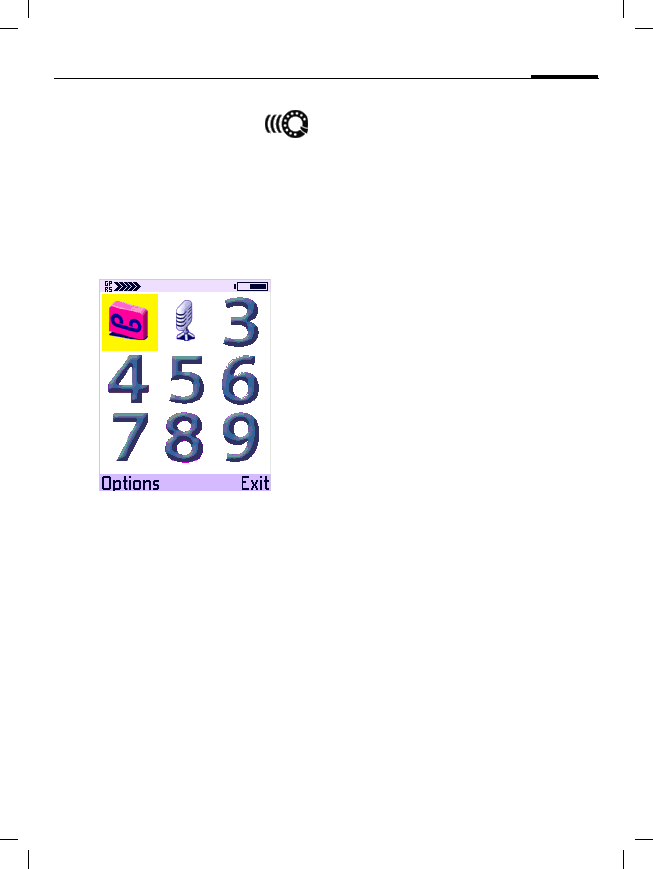
Setup 97
SX1 K1 am-en, A31008-H6500-A5-1-7619 (29. July 2003, 19:32)
© Siemens AG 2001, I:\Mobil\SX1_(K1)\am\ex_sdl\k1gb_setup.fm
Shortcut
CKSetupKShortcut
Digit keys 2 to 9 can be used as
shortcut numbers. If a phone
number is assigned, it will be called,
or an application will be started.
Number 1 is reserved for voice
mailbox access.
Assign
OptionsKAssign shortcut:
A list with available categories is
shown. Choose for the required
entry:
Phone number
Contacts is opened. Select the
required entry. Press the joystick to
open the entry and scroll to a
number.
APress Select.
When the shortcut selection is
saved, a symbol X can be seen next
to the number in the contacts entry.
If an image is assigned to the phone
number, it will be displayed in the
grid.
Application
A list of available applications is
shown. Select the required entry.
APress Select.
Apply
2–9Press and hold shortcut
number (in standby
mode).
or
CKSetupKShortcut
Select a shortcut number
in the grid by moving the
joystick. Start action by
pressing on the joystick.
Clear
Select the entry to be removed from
the shortcut key.
OptionsKClear
Shortcut options
Depends on the current situation.
Assign, Clear, Change, Call, Start, View
details, Exit.
Questions & Answers
98
SX1 K1 am-en, A31008-H6500-A5-1-7619 (29. July 2003, 19:33)
© Siemens AG 2001, I:\Mobil\SX1_(K1)\am\ex_sdl\k1gb_Q@A.fm
Questions &
Answers If you have any questions about using your phone, visit us at
www.my-siemens.com/customercare any time. In addition we have listed some
frequently asked questions and answers below.
Question Possible causes Possible solution
Phone cannot be
switched on.
On/Off key not pressed
long enough.
Press On/Off key for at least two seconds.
Dead battery. Charge battery. Check charging indicator in the display.
Battery contacts dirty. Clean contacts.
See also below under:
"Charging error"
Standby time is too
short.
Frequent use of the
organizer and games.
Restrict use if necessary.
Display illumination on. Switch off display illumination.
Unintentional keystrokes
(illumination!).
Activate key lock.
Charging error
(charge icon not
displayed).
Battery totally discharged. 1) Plug in charger cable.
2) Wait up to 2 hours until the charge icon is displayed.
3) Charge battery as usual.
Temperature out of range:
41 °F to 104 °F.
Make sure the ambient temperature is right, wait a
while, then recharge.
Contact problem. Check power supply and connection to the phone.
Check battery contacts and device interface, clean
them if necessary, then insert battery again.
No mains voltage. Use different mains power socket, check mains voltage.
Wrong charger. Only use original Siemens accessories (p. 14).
Battery faulty. Replace battery (p. 104).
SIM error. SIM card not correctly
inserted.
Make sure that the SIM card is correctly inserted (p. 14).
SIM card contacts dirty. Clean the SIM card with a dry cloth.
SIM card with wrong
voltage.
Use 3 V SIM cards only.
SIM card damaged
(e.g. broken).
Inspect the damage. Return the SIM card to service
provider.
Questions & Answers 99
SX1 K1 am-en, A31008-H6500-A5-1-7619 (29. July 2003, 19:33)
© Siemens AG 2001, I:\Mobil\SX1_(K1)\am\ex_sdl\k1gb_Q@A.fm
Question Possible causes Possible solution
No connection to
system.
Signal weak. Move higher, to a window or open space.
Outside GSM range. Check service provider coverage map.
SIM card not valid. Contact the service provider.
System restriction is set. Check restrictions (p. 84).
System overloaded. Try again later.
Phone loses system. Signal too weak. Reconnection to another service provider is automatic.
Switching the phone off and on may speed this up.
Calls not possible. 2nd line set. Set line 1 (p. 79).
New SIM card inserted. Check for new restrictions.
Charge limit reached. Reset limit with PIN 2 (p. 35).
Credit used up. Load credit (p. 35).
Certain uses of the
phone not possible.
Call restrictions are set. Restrictions may be set by your service provider.
Check restrictions (p. 84).
Voice mail does not
work.
Call forwarding to the
mailbox not set.
Set call forwarding to the mailbox (p. 93).
Memory low. Phone memory full. Delete stored messages, images or applications.
MultiMediaCard
error.
Card inserted in wrong
position.
Insert in right direction (p. 70).
Function cannot
be set.
Not supported by service
provider or registration
required.
Contact your service provider.
Snapshot pictures in
bad quality.
camera lens polluted Clean camera lens with a smooth rag.
Questions & Answers
100
SX1 K1 am-en, A31008-H6500-A5-1-7619 (29. July 2003, 19:33)
© Siemens AG 2001, I:\Mobil\SX1_(K1)\am\ex_sdl\k1gb_Q@A.fm
Question Possible causes Possible solution
Message cannot
be sent.
Some service providers do
not support this service.
Check with your service provider.
Phone number of the
service center is not set or
is wrong.
Set message center (p. 44).
SIM card contract does not
support this service.
Contact your service provider.
Service center overloaded. Repeat message.
No selection from
addresses possible.
Entry has no phone number (p. 28).
Addressee does not have
a compatible phone.
Check, if the receiver has a compatible phone.
Messages cannot be
received
Phone memory full. Delete stored messages or images.
Wrong settings. Check settings for specific message type.
No Internet access
possible.
Wrong WAP profile set
or settings wrong,
incomplete.
Check settings (p. 51), if necessary consult your service
provider.
PIN error/
PIN2 error.
Three wrong entries. Enter the PUK (MASTER PIN) provided with the SIM
card according to the instructions. If the PUK (MASTER
PIN) has been lost, contact your service provider.
Phone code error. Three wrong entries. Contact Siemens Service (p. 101).
Service provider
code error.
No authorization for this
service.
Contact your service provider.
No fax possible. Incorrect settings in
the PC.
Check settings.
No authorization for this
service.
Contact your service provider.
Charge counter does
not work.
Charge pulse not
transmitted.
Contact your service provider.
Damage
Severe shock. Remove battery and SIM and insert them again. Do not dismantle phone!
Phone became wet. Remove battery and SIM card. Dry immediately with cloth, do not heat. Dry
connector contacts thoroughly. Stand unit upright in an air current. Do not dismantle
phone!
Reset settings to the factory default: * # 7780 #. Enter security code, see p. 19.

Customer Care 101
SX1 K1 am-en, A31008-H6500-A5-1-7619 (29. July 2003, 19:33)
© Siemens AG 2001, I:\Mobil\SX1_(K1)\am\ex_sdl\k1gb_hotline.fm
Customer
Care
Abu Dhabi .........................................0 26 42 38 00
Argentina .....................................0 80 08 88 98 78
Australia..........................................13 00 66 53 66
Austria.............................................05 17 07 50 04
Bahrain .....................................................40 42 34
Bangladesh.......................................0 17 52 74 47
Belgium.............................................0 78 15 22 21
Bolivia ...............................................0 21 21 41 14
Bosnia Herzegovina..........................0 33 27 66 49
Brazil............................................0 80 07 07 12 48
Brunei ..................................................02 43 08 01
Bulgaria................................................02 73 94 88
Cambodia ............................................12 80 05 00
Canada ........................................1 88 87 77 02 11
China ...........................................0 21 50 31 81 49
Croatia ..............................................0 16 10 53 81
Czech Republic...............................02 33 03 27 27
Denmark ..............................................35 25 86 00
Dubai ................................................0 43 96 64 33
Egypt.................................................0 23 33 41 11
Estonia.................................................06 30 47 97
Finland............................................09 22 94 37 00
France.............................................01 56 38 42 00
Germany ....................................0 18 05 33 32 26
Greece.........................................0 80 11 11 11 16
Hong Kong...........................................28 61 11 18
Hungary ..........................................06 14 71 24 44
Iceland ...................................................5 11 30 00
India.............................22 24 98 70 00 Extn: 70 40
Indonesia .....................................0 21 46 82 60 81
Ireland.............................................18 50 77 72 77
Italy .................................................02 66 76 44 00
Ivory Coast...........................................05 02 02 59
Jordan...............................................0 64 39 86 42
Kenya.....................................................2 72 37 17
Kuwait....................................................2 45 41 78
Latvia .....................................................7 50 11 18
Lebanon...............................................01 44 30 43
Libya ...............................................02 13 50 28 82
Lithuania ...........................................8 52 74 20 10
Luxembourg........................................ 43 84 33 99
Macedonia ...........................................02 13 14 84
Malaysia....................................+ 6 03 77 12 43 04
Malta.......................................+ 35 32 14 94 06 32
Mauritius ................................................2 11 62 13
Mexico .......................................01 80 07 11 00 03
Morocco...............................................22 66 92 09
Netherlands .................................0 90 03 33 31 00
New Zealand...................................08 00 27 43 63
Nigeria ..............................................0 14 50 05 00
Norway.................................................22 70 84 00
Oman....................................................... 79 10 12
Pakistan..........................................02 15 66 22 00
Paraguay ..........................................8 00 10 20 04
Philippines ........................................0 27 57 11 18
Poland.............................................08 01 30 00 30
Portugal ............................................8 08 20 15 21
Qatar....................................................04 32 20 10
Romania .........................................02 12 04 60 00
Russia..........................................8 80 02 00 10 10
Saudi Arabia .....................................0 22 26 00 43
Serbia .............................................01 13 22 84 85
Singapore ............................................62 27 11 18
Slovak Republic ..............................02 59 68 22 66
Slovenia............................................0 14 74 63 36
South Africa ....................................08 60 10 11 57
Spain.................................................9 02 11 50 61
Sweden.............................................0 87 50 99 11
Switzerland .....................................08 48 21 20 00
Taiwan ............................................02 23 96 10 06
Thailand............................................0 22 68 11 18
Tunisia .................................................71 86 19 02
Turkey..........................................0 21 65 79 71 00
Ukraine ........................................8 80 05 01 00 00
United Arab Emirates........................0 43 31 95 78
United Kingdom ...........................0 87 05 33 44 11
USA .............................................1 88 87 77 02 11
Vietnam................................................45 63 22 44
Zimbabwe ............................................04 36 94 24
Simple, straightforward support for technical and operational queries is available from our
online support service on the Internet: www.my-siemens.com/customercare or in the
chapter "Questions & Answers" (p. 98). When calling customer service, please have ready
your receipt and the phone identity number (IMEI, to display press * # 0 6 #), the software
version (to display, press * # 0 6 #, then info) and if available, your Siemens Service
customer number. In some countries repair and replace services are impossible where the
products are not sold through our authorized dealers.

Care and maintenance
102
SX1 K1 am-en, A31008-H6500-A5-1-7619 (29. July 2003, 16:48)
© Siemens AG 2001, I:\Mobil\SX1_(K1)\am\ex_sdl\K1gb_Maintenance.fm
Care and
maintenance
Your phone has been designed and
crafted with great care and attention
and should also be treated with care.
The suggestions below will help you
to enjoy your phone for many years.
• Protect your phone from moisture
and humidity! Precipitation,
humidity and liquids contain
minerals that will corrode
electronic circuits. Nevertheless,
should your phone become wet,
disconnect it immediately from
the power supply and remove the
battery!
• Do not use or store the phone in
dusty, dirty areas. Its moving parts
may become damaged.
• Do not store your phone in hot
areas. High temperatures can
shorten the life of electronic
devices, damage batteries and
warp or melt certain plastics.
• Do not store your phone in cold
areas. When the phone warms up
again (to its normal ambient
temperature), moisture can form
inside the phone, which may
damage electronic circuit boards.
• Do not drop, knock or shake your
phone. Rough handling can
damage internal circuit boards!
• Do not use abrasive chemicals,
cleaning solvents, or strong
detergents to clean the phone!
The suggestions given above apply
equally to your phone, battery,
charger and all accessories. If any of
these parts are not working properly,
take them to your nearest qualified
service outlet. The personnel there
will assist you and, if necessary,
repair the device.
Product data 103
SX1 K1 am-en, A31008-H6500-A5-1-7619 (29. July 2003, 19:30)
© Siemens AG 2001, I:\Mobil\SX1_(K1)\am\ex_sdl\k1gb_data.fm
Product data Declaration of conformity
Siemens Information and
Communication mobile hereby
declares that the phone described in
this user guide is in compliance with
the essential requirements and other
relevant provisions of European
Directive 1999/5/EC (R&TTE).
The declaration of conformity (DoC)
concerned has been signed. Please
call the company hotline if you
require a copy of the original.
Technical data
GSM class: 4 (33 dBm - 900 MHz),
1 (30 dBm - 1,800 MHz),
1 (30 dBm - 1,900 MHz)
BlueTooth
class:
2 (1 mW)
Frequency
range:
880 - 960 MHz,
1,710 - 1,880 MHz,
1,850 - 1,990 MHz
2,400 - 2,483.5 MHz
Weight: 116g/4.09 oz.
Size: 109x56x19 mm (110 ccm)
Li-Ion battery: 1000 mAh
Operating tem-
perature:
14 °F to 131 °F
SIM card: 3.0 V
Phone ID
You will need the following details if you
lose your phone or SIM card. Please enter
here
the number of the SIM card (on the card):
..............................................................
15-digit serial number of the phone (under
the battery):
..............................................................
Customer Service number of the service
provider:
..............................................................
Lost phone
If you lose your phone or SIM card contact
your service provider immediately to
prevent misuse.
Accessories
104
SX1 K1 am-en, A31008-H6500-A1-1-7619 (29. July 2003, 16:48)
© Siemens AG 2001, I:\Mobil\SX1_(K1)\am\ex_sdl\k1gb_accessory.fm
Accessories Basics
Li-Ion Battery 1000mAh EBA-540
Travel Charger
ETC-520 (US)
Travel charger with an extended input
voltage range of 90-264V.
Headset PTT HHS-510 (Mono)
leave HHS-550 in
Headset PTT HHS-550 (Stereo)
Like Headset (Mono), but also has stereo
functionality for music.
Headset PTT Bluetooth™
HHB-545
Convenient and smart headset without the
trouble of cables. Can be used on any phone
that supports the Bluetooth Headset profile.
Belt Case FCT-510
Stylish protection for your mobile phone.
Data
Data Cable USB DCA-540
To connect the phone to the USB port of
the PC.
Car Solutions
Car Charger ECC-500
Charger for the cigarette lighter socket in the
car. It supports either 12 or 24 volts DC.
Portable Car Kit HKP-500
Handsfree kit with integrated loudspeaker
and microphone and auto answer feature.
Simply plug into the cigarette lighter socket.
Ideal for mobility between vehicles.
Mobile Holder Antenna HMH-530
To be used in combination with a Portable
Car Kit and as an upgrade to the Car Kit
Plus.
Basic Car Pack HKB-500
Allows handsfree talking and simultaneously
charges the mobile phone in the car.
Features a Car Charger, a Headset PTT and
a Y-Adapter.
Car Kit Plus HKC-541
Handsfree kit with first-class digital call
quality and utmost ease of use. Requires the
Mobile Holder Antenna HMH-530:
Original Siemens Accessories
www.siemens.com/
mobilestore

U.S. FDA 105
SX1 K1 am-en, A31008-H6500-A5-1-7619 (29. July 2003, 19:31)
© Siemens AG 2001, I:\Mobil\SX1_(K1)\am\ex_sdl\am_FDA.FM
U.S. FDA
The U.S. Food and Drug Admin-
istration's (FDA) Center for
Devices and Radiological Health
Consumer Update on Mobile
Phones
FDA has been receiving inquiries
about the safety of mobile phones,
including cellular phones and PCS
phones. The following summarizes
what is know – and what remains
unknown – about whether these
products can pose a hazard to
health, and what can be done to
minimize any potential risk. This
information may be used to respond
to questions.
Why the concern?
Mobile phones emit low levels of
radio frequency energy (i.e., radio
frequency radiation) in the micro-
wave range while being used. They
also emit very low levels of radio fre-
quency energy (RF), considered non-
significant, when in the stand-by
mode. It is well known that high lev-
els of RF can produce biological dam-
age through heating effects (this is
how your microwave oven is able to
cook food). However, it is not known
whether, to what extent, or through
what mechanism, lower levels of RF
might cause adverse health effects
as well. Although some research has
been done to address these ques-
tions, no clear picture of the biologi-
cal effects of this type of radiation
has emerged to date. Thus, the avail-
able science does not allow us to
conclude that mobile phones are
absolutely safe, or that they are
unsafe. However, the available sci-
entific evidence does not demon-
strate adverse health effects associ-
ated with the use of mobile phones.
What kinds of phones are in question?
Questions have been raised about
hand-held mobile phones, the kind
that have a built-in antenna that is
positioned close to the user's head
during normal telephone conversa-
tion. These types of mobile phones
are of concern because of the short
distance between the phone's
antenna – the primary source of the
RF – and the person's head. The
exposure to RF from mobile phones
in which the antenna is located at
greater distances from the user (on
the outside of a car, for example) is
drastically lower than that from
hand-held phones, because a per-
son's RF exposure decreases rapidly
with distance from the source. The
safety of so-called "cordless phones",
which have a base unit connected to
the telephone wiring in a house and
which operate at far lower power
levels and frequencies, has not been
questioned.

U.S. FDA
106
SX1 K1 am-en, A31008-H6500-A5-1-7619 (29. July 2003, 19:31)
© Siemens AG 2001, I:\Mobil\SX1_(K1)\am\ex_sdl\am_FDA.FM
How much evidence is there that hand-
held mobile phones might be harmful?
Briefly, there is not enough evidence
to know for sure, either way; how-
ever, research efforts are on-going.
The existing scientific evidence is
conflicting and many of the studies
that have been done to date have
suffered from flaws in their research
methods. Animal experiments inves-
tigating the effects of RF exposures
characteristic of mobile phones have
yielded conflicting results. A few ani-
mal studies, however, have sug-
gested that low levels of RF could
accelerate the development of can-
cer in laboratory animals. In one
study, mice genetically altered to be
predisposed to developing one type
of cancer developed more than
twice as many such cancers when
they were exposed to RF energy
compared to controls. There is much
uncertainty among scientists about
whether results obtained from ani-
mal studies apply to the use of
mobile phones. First, it is uncertain
how to apply the results obtained in
rats and mice to humans. Second,
many of the studies showed
increased tumor development used
animals that had already been
treated with cancer-causing chemi-
cals, and other studies exposed the
animals to the RF virtually continu-
ously – up to 22 hours per day.
For the past five years in the United
States, the mobile phone industry
has supported research into the
safety of mobile phones. This
research has resulted in two findings
in particular that merit additional
study:
1. In a hospital-based, case-control
study, researchers looked for an
association between mobile phone
use and either glioma (a type of
brain cancer) or acoustic neuroma (a
benign tumor of the nerve sheath).
No statistically significant associa-
tion was found between mobile
phone use and acoustic neuroma.
There was also no association
between mobile phone use and glio-
mas when all types of gliomas were
considered together. It should be
noted that the average length of
mobile phone exposure in this study
was less than three years.
When 20 types of glioma were con-
sidered separately, however, an
association was found between
mobile phone use and one rare type
of glioma, neuroepithelliomatous
tumors. It is possible with multiple
comparisons of the same sample
that this association occurred by
chance. Moreover, the risk did not
increase with how often the mobile
phone was used, or the length of the
calls. In fact, the risk actually
decreased with cumulative hours of
mobile phone use. Most cancer caus-
ing agents increase risk with
increased exposure. An ongoing

U.S. FDA 107
SX1 K1 am-en, A31008-H6500-A5-1-7619 (29. July 2003, 19:31)
© Siemens AG 2001, I:\Mobil\SX1_(K1)\am\ex_sdl\am_FDA.FM
study of brain cancers by the
National Cancer Institute is expected
to bear on the accuracy and repeat-
ability of these results.1
2. Researchers conducted a large
battery of laboratory tests to assess
the effects of exposure to mobile
phone RF on genetic material. These
included tests for several kinds of
abnormalities, including mutations,
chromosomal aberrations, DNA
strand breaks, and structural
changes in the genetic material of
blood cells called lymphocytes. None
of the tests showed any effect of the
RF except for the micronucleus
assay, which detects structural
effects on the genetic material. The
cells in this assay showed changes
after exposure to simulated cell
phone radiation, but only after 24
hours of exposure. It is possible that
exposing the test cells to radiation
for this long resulted in heating.
Since this assay is known to be sensi-
tive to heating, heat alone could
have caused the abnormalities to
occur. The data already in the litera-
ture on the response of the micronu-
cleus assay to RF are conflicting.
Thus follow-up research is neces-
sary. 2
FDA is currently working with gov-
ernment, industry, and academic
groups to ensure the proper follow-
up to these industry-funded
research findings. Collaboration with
the Cellular Telecommunications
Industry Association (CTIA) in partic-
ular is expected to lead to FDA pro-
viding research recommendations
and scientific oversight of new CTIA-
funded research based on such rec-
ommendations.
Two other studies of interest have
been reported recently in the litera-
ture:
• Two groups of 18 people were
exposed to simulated mobile
phone signals under laboratory
conditions while they performed
cognitive function tests. There
were no changes in the subjects'
ability to recall words, numbers,
or pictures, or in their spatial
memory, but they were able to
make choices more quickly in one
visual test when they were
exposed to simulated mobile
phone signals. This was the only
change noted among more than
20 variables compared.3
• In a study of 209 brain tumor
cases and 425 matched controls,
there was no increased risk of
brain tumors associated with
mobile phone use. When tumors
did exist in certain locations, how-
ever, they were more likely to be
on the side of the head where the
mobile phone was used. Because
this occurred in only a small num-
ber of cases, the increased likeli-
hood was too small to be
statistically significant.4

U.S. FDA
108
SX1 K1 am-en, A31008-H6500-A5-1-7619 (29. July 2003, 19:31)
© Siemens AG 2001, I:\Mobil\SX1_(K1)\am\ex_sdl\am_FDA.FM
In summary, we do not have enough
information at this point to assure
the public that there are, or are not,
any low incident health problems
associated with use of mobile
phones. FDA continues to work with
all parties, including other federal
agencies and industry, to assure that
research is undertaken to provide
the necessary answers to the out-
standing questions about the safety
of mobile phones.
What is known about cases of human
cancer that have been reported in users
of hand-held mobile phones?
Some people who have used mobile
phones have been diagnosed with
brain cancer. But it is important to
understand that this type of cancer
also occurs among people who have
not used mobile phones. In fact,
brain cancer occurs in the U.S. popu-
lation at a rate of about 6 new cases
per 100,000 people each year. At
that rate, assuming 80 million users
of mobile phones (a number increas-
ing at a rate of about 1 million per
month), about 4800 cases of brain
cancer would be expected each year
among those 80 million people,
whether or not they used their
phones. Thus it is not possible to tell
whether any individual's cancer
arose because of the phone, or
whether it would have happened
anyway. A key question is whether
the risk of getting a particular form
of cancer is greater among people
who use mobile phones than among
the rest of the population. One way
to answer that question is to com-
pare the usage of mobile phones
among people with brain cancer
with the use of mobile phones
among appropriately matched peo-
ple without brain cancer. This is
called a case-control study. The cur-
rent case-control study of brain can-
cers by the National Cancer Institute,
as well as the follow-up research to
be sponsored by industry, will begin
to generate this type of information.
What is FDA's role concerning the safety
of mobile phones?
Under the law, FDA does not review
the safety of radiation emitting con-
sumer products such as mobile
phones before marketing, as it does
with new drugs or medical devices.
However, the agency has authority
to take action if mobile phones are
shown to emit radiation at a level
that is hazardous to the user. In such
a case, FDA could require the manu-
facturers of mobile phones to notify
users of the health hazard and to
repair, replace or recall the phones
so that the hazard no longer exists.
Although the existing scientific data
do not justify FDA regulatory actions
at this time, FDA has urged the
mobile phone industry to take a
number of steps to assure public
safety. The agency has recom-
mended that the industry:

U.S. FDA 109
SX1 K1 am-en, A31008-H6500-A5-1-7619 (29. July 2003, 19:31)
© Siemens AG 2001, I:\Mobil\SX1_(K1)\am\ex_sdl\am_FDA.FM
• Support needed research into pos-
sible biological effects of RF of the
type emitted by mobile phones;
• Design mobile phones in a way
that minimizes any RF exposure to
the user that is not necessary for
device function; and
• Cooperate in providing mobile
phone users with the best possible
information on what is known
about possible effects of mobile
phone use on human health.
At the same time, FDA belongs to an
interagency working group of the
federal agencies that have responsi-
bility for different aspects of mobile
phone safety to ensure a coordi-
nated effort at the federal level.
These agencies are:
• National Institute for Occupa-
tional Safety and Health
• Environmental Protection Agency
• Federal Communications Com-
mission
• Occupational Health and Safety
Administration
• National Telecommunications and
Information Administration
The National Institutes of Health also
participates in this group.
In the absence of conclusive information
about any possible risk, what can con-
cerned individuals do?
If there is a risk from these products
– and at this point we do not know
that there is – it is probably very
small. But if people are concerned
about avoiding even potential risks,
there are simple steps they can take
to do so. For example, time is a key
factor in how much exposure a per-
son receives. Those persons who
spend long periods of time on their
hand-held mobile phones could con-
sider holding lengthy conversations
on conventional phones and reserv-
ing the hand-held models for shorter
conversations or for situations when
other types of phones are not avail-
able.
People who must conduct extended
conversations in their cars every day
could switch to a type of mobile
phone that places more distance
between their bodies and the source
of the RF, since the exposure level
drops off dramatically with distance.
For example, they could switch to:
• a mobile phone in which the
antenna is located outside the
vehicle,
• a hand-held phone with a built-in
antenna connected to a different
antenna mounted on the outside
of the car or built into a separate
package, or
• a headset with a remote antenna
to a mobile phone carried at the
waist.

U.S. FDA
110
SX1 K1 am-en, A31008-H6500-A5-1-7619 (29. July 2003, 19:31)
© Siemens AG 2001, I:\Mobil\SX1_(K1)\am\ex_sdl\am_FDA.FM
Where can I find additional information?
For additional information, see the
following websites:
• Federal Communications Com-
mission (FCC) RF Safety Program
(select "Information on Human
Exposure to RF Fields from Cellular
and PCS Radio Transmitters"):
http://www.fcc.gov/oet/rfsafety.
• World Health Organization (WHO)
International Commission on
Non-Ionizing Radiation Protection
(select Qs & As):
http://www.who.int/emf
• United Kingdom, National Radio-
logical Protection Board:
http://www.nrpb.org.uk
• Cellular Telecommunications
Industry Association (CTIA):
http://www.wow-com.com
• U.S. Food and Drug Administra-
tion (FDA) Center for devices and
Radiological Health:
http://www.fda.gov/cdhr/
consumer/
1 Muscat et al. Epidemiological Study of Cel-
lular Telephone Use and Malignant Brain
Tumors. In: State of the Science Sympo-
sium; 1999 June 20; Long Beach, California.
2 Tice et al. Tests of mobile phone signals for
activity in genotoxicity and other laboratory
assays. In: Annual Meeting of the Environ-
mental Mutagen Society; March 29, 1999,
Washington, DC; and personal communica-
tion, unpublished results.
3 Preece, AW, Iwi, G, Davies-Smith, A,
Wesnes, K, Butler, S, Lim, E, and Varey, A.
Effect of a 915- MHz simulated mobile
phone signal on cognitive function in man.
Int. J. Radiat. Biol., April 8, 1999.
4 Hardell, L, Nasman, A, Pahlson, A,
Hallquist, A and Mild, KH. Use of cellular
telephones and the risk for brain tumors; a
case-control study. Int. J. Oncol, 15: 113-
116, 1999.

FCC/Industry Canada Notice 111
SX1 K1 am-en, A31008-H6500-A5-1-7619 (29. July 2003, 19:31)
© Siemens AG 2001, I:\Mobil\SX1_(K1)\am\ex_sdl\am_FDA.FM
FCC/Indus-
try Canada
Notice
Your phone may cause TV or radio
interference (for example, when
using a telephone in close proximity
to receiving equipment). The FCC or
Industry Canada can require you to
stop using your telephone if such
interference cannot be eliminated. If
you require assistance, please con-
tact your local service facility.
This device complies with part 15 of
the FCC rules. Operation is subject to
the condition that this device does
not cause harmful interference.
Ten Driving Safety Tips
112
SX1 K1 am-en, A31008-H6500-A1-1-7619 (29. July 2003, 16:48)
© Siemens AG 2001, I:\Mobil\SX1_(K1)\am\ex_sdl\am_Driving_Tips.fm
Ten Driving
Safety Tips
Your Siemens wireless phone gives
you the power to communicate by
voice – almost anywhere, anytime.
But an important responsibility
accompanies the benefits of wireless
phones, one that every user must
uphold.
When driving a car, driving is your
first responsibility. When using your
wireless phone behind the wheel of
a car, practice good common sense
and remember the following tips:
Get to know your phone and its features
such as speed dial and redial.
Carefully read your instruction
manual and learn to take advantage
of valuable features most phones
offer including, automatic redial and
memory dial – most phones can
store up to 99 numbers in memory
dial. Also, work to memorize the
phone keypad so you can use the
speed dial function without taking
your attention off the road.
When available, use a hands-free device.
A number of hands-free wireless
phone accessories are readily
available today. Whether you choose
an installed mounted device for your
phone or a speaker phone accessory,
take advantage of these devices if
they are available to you.
Position your phone within easy reach.
Make sure you place your wireless
phone within easy reach and where
you can grab it without removing
your eyes from the road. If you get
an incoming call at an inconvenient
time, let your voicemail answer it for
you.
Suspend conversations during
hazardous driving conditions or
situations.
Let the person you are speaking to
know you are driving; if necessary,
suspend the call in heavy traffic or
hazardous weather conditions. Rain,
sleet, snow and ice can be
hazardous, but so is heavy traffic. As
a driver, your first responsibility is to
pay attention to the road.
Do not take notes or look up phone
numbers while driving.
If you are reading an address book or
business card while driving a car, or
writing a "to do" list, then you are not
watching where you are going. It’s
common sense. Don’t get caught in a
dangerous situation because you are

Ten Driving Safety Tips 113
SX1 K1 am-en, A31008-H6500-A1-1-7619 (29. July 2003, 16:48)
© Siemens AG 2001, I:\Mobil\SX1_(K1)\am\ex_sdl\am_Driving_Tips.fm
reading or writing and not paying
attention to the road or nearby
vehicles.
Dial sensibly and assess the traffic.
If possible, place calls when you are
not moving or before pulling into
traffic. Try to plan your calls before
you begin your trip, or attempt to
coincide your calls with times you
may be stopped at a stop sign, red
light or otherwise stationary. But if
you need to dial while driving, follow
this simple tip – dial only a few
numbers, check the road and your
mirrors, then continue.
Do not engage in stressful or emotional
conversations that may be distracting.
Stressful or emotional conversations
and driving do not mix – they are
distracting and even dangerous
when you are behind the wheel.
Make people you are talking with
aware you are driving and if
necessary, suspend phone
conversations that have the
potential to divert your attention
from the road.
Use your phone to call for help.
Your wireless phone is one of the
greatest tools you can own to
protect yourself and your family in
dangerous situations – with your
phone at your side, help is only three
numbers away. Dial 9-1-1 in the case
of fire, traffic accident, road hazard,
or medical emergency. Remember, it
is a free call on your wireless phone.
Use your phone to help others in
emergencies.
Your wireless phone provides you a
perfect opportunity to be a "good
Samaritan" in your community. If
you see an auto accident, crime in
progress or other serious
emergencies where lives are in
danger, call 9-1-1, as you would
want others to do for you.
Call roadside assistance or a special
wireless non-emergency assistance
number when necessary.
Certain situations you encounter
while driving may require attention,
but are not urgent enough to merit a
call to 9-1-1. But you can still use
your wireless phone to lend a hand.
If you see a broken-down vehicle
posing no serious hazard, a broken
traffic signal, a minor traffic accident
where no one appears injured, or a
vehicle you know to be stolen, call
roadside assistance or other special
non-emergency wireless numbers.
Provided by the Cellular
Telecommunications Industry Association
(CTIA)
"The wireless industry reminds you to
use your phone safely when driving"”
For more information, please call
1 (888) 901-SAFE, or visit our Web site
at: www.wow-com.com

Intellectual Property
114
SX1 K1 am-en, A31008-H6500-A5-1-7619 (29. July 2003, 16:48)
© Siemens AG 2001, I:\Mobil\SX1_(K1)\am\ex_sdl\am_intellectual_property.fm
Intellectual
Property
Intellectual Property Restrictions
All Intellectual Property, as defined
below, which is owned by or
otherwise the property of Siemens
Information and Communications
Mobile, LLC ("Siemens"), its
affiliates, partners or suppliers,
relating to the Phone, including but
not limited to accessories, parts or
software relating thereto (the
"Phone System"), is proprietary
under federal laws, state laws and
International treaty provisions.
Intellectual Property includes, but is
not limited to, inventions
(patentable or unpatentable),
patents, trade secrets, copyrights,
software, computer programs, and
related documentation and other
works of authorship. You may not
infringe or otherwise violate the
rights secured by the Intellectual
Property. Moreover, you agree that
you will not (and will not attempt to)
disassemble, decompile, reverse
engineer, prepare derivative works
from, modify or make any other
effort to create source code from the
software. No title to ownership in
the Intellectual Property is
transferred to you through purchase
or possession of the Phone or its
components. All applicable rights of
the Intellectual Property shall remain
with Siemens, its affiliates, partners
or suppliers.
Siemens will have no liability with
respect to any claim of patent
infringement which is based upon
the combination of the Product or
parts furnished hereunder with
software, apparatus or devices not
furnished by Siemens, nor will
Siemens have any liability for the use
of ancillary equipment or software
not furnished by Siemens which is
attached to or used in connection
with the Product, The foregoing
states the entire liability of Siemens
with respect to infringement of
patents by the Product or any parts
thereof.
Laws in the United States and other
countries preserve for Siemens
certain exclusive rights for
copyrighted Siemens software, such
as the exclusive rights to reproduce
and distribute copies of such
Siemens software. Siemens software
may be used only in the Product in
which the software was originally
embodied when purchased, and
such software in such Product may
not be replaced, copied, distributed.
modified in any way, or used to
produce any derivative thereof. No
other use including, without
limitation, alteration, modification,
reproduction, distribution. or
reverse engineering of such Siemens
software or exercise of rights in such
Siemens software is permitted. No
license is granted by implication,
estoppel or otherwise under
Siemens patent rights or copyrights.

Battery quality statement 115
SX1 K1 am-en, A31008-H6500-A5-1-7619 (29. July 2003, 19:33)
© Siemens AG 2001, I:\Mobil\SX1_(K1)\am\ex_sdl\k1_Akku_Quali.fm
Battery
quality
statement
Battery quality statement
The capacity of your cell phone
battery will reduce each time it is
charged/emptied. Storage at too
high or low temperatures will also
result in a gradual capacity loss. As a
result the operating time of your cell
phone may be considerably reduced,
even after a full recharge of the
battery.
Regardless of this, the battery has
been designed and manufactured so
that it can be recharged and used for
six months after the purchase of
your cell phone. After six months, if
the battery is clearly suffering from
loss of performance, we recommend
that you replace it. Please buy only
Siemens original batteries.
Display quality statement
Discolored white or black dots may
appear on the display. This is a de-
sign-related feature of the screen.
Standard ISO 13406-2:2001 regu-
lates how many defective pixels or
subpixels are acceptable. Siemens
has complied with this standard and
satisfies the following requirements:
– maximum number of defective
white pixels: 2
– maximum number of defective
black pixels: 2
– maximum total number of defec-
tive pixels: 5
In addition, there may be no more
than 4 defective bright pixels in a
diameter of 10 mm.
If the screen on your phone does not
satisfy these requirements, please
contact Siemens Service, p. 101.

Index
116
SX1 K1 am-en, A31008-H6500-A5-1-7619 (29. July 2003, 19:32)
© Siemens AG 2001, I:\Mobil\SX1_(K1)\am\ex_sdl\K1gbSIX.fm
Index A
Access points ................................... 80
Accessories .................................... 104
Accessory settings........................... 86
Address book, see Contacts........... 27
Alarm clock ...................................... 73
Answering service (external)......... 93
Anykey answer ................................ 79
Applications menu .......................... 17
Attachments (e-mail) ..................... 43
Audio (setup)................................... 92
Auto time update............................ 82
Autolock period............................... 83
Automatic redial.............................. 79
B
Battery
charge .......................................... 15
insert ............................................ 14
quality declaration.................... 115
Bluetooth ......................................... 88
Bookmarks ....................................... 51
Business card ................................... 33
C
Calculator......................................... 67
Calendar ........................................... 63
Call
accept/end ................................... 20
costs .............................................35
decline.......................................... 21
duration ....................................... 34
forwarding................................... 87
hold .............................................. 21
menu ............................................ 22
register......................................... 34
restriction..................................... 84
setup............................................. 79
timers ........................................... 34
transfer......................................... 22
waiting................................... 21, 79
Camera............................................. 55
Car accessories.............................. 104
Car Kit settings................................ 86
Care of phone ............................... 102
Cell broadcast.................................. 49
Cell info display............................... 85
Certificate management................ 83
Charge battery ................................ 15
Closed user group........................... 83
Color palette.................................... 78
Color palette (display).................... 78
Composer ........................................ 61
Conference ...................................... 21
Connection (setup) ........................ 80
Connection security (WAP)............ 54
Contacts
add a picture ............................... 28
add a ring tone ........................... 32
add Touch tones......................... 29
business card .............................. 33
Call an entry ................................ 29
groups.......................................... 30
new entry .................................... 27
view an entry .............................. 29
voice dialing................................ 31
Contrast ........................................... 78
Converter......................................... 67
Customer care............................... 101
D
Data call........................................... 81
Date and time (setup).................... 82
Default access point ....................... 54
Delivery reports............................... 44
Dialed calls....................................... 34
Dialing with number keys.............. 20
Display (setup) ................................ 78
Display text language..................... 78
Drafts................................................ 43

Index 117
SX1 K1 am-en, A31008-H6500-A5-1-7619 (29. July 2003, 19:32)
© Siemens AG 2001, I:\Mobil\SX1_(K1)\am\ex_sdl\K1gbSIX.fm
Driving safety ................................ 112
E
Editing text ...................................... 24
E-mail
attachments ..........................39, 43
create ........................................... 38
mailbox ........................................ 42
read .............................................. 42
settings ........................................ 47
Emergency number (SOS) ............. 15
Extras........................................69, 102
F
Favorites........................................... 74
Fax modem...................................... 91
File Manager.................................... 69
Forwarding ...................................... 87
G
Getting started ................................ 14
GPRS
counter.........................................35
setup............................................. 81
Groups.............................................. 30
GSM system ..................................... 85
H
Handsfree talking............................ 23
Headset .......................................... 104
accessory ................................... 104
setup............................................. 86
I
Images.............................................. 56
Inbox (messages)............................ 39
Infrared............................................. 91
Input text language ........................ 78
Installing software .......................... 95
J
JAD/JAR file ...................................... 71
Java™ ............................................... 71
K
Keypad tones............................. 77, 92
L
Language (display text) ................. 78
Line in use ....................................... 79
Log.................................................... 34
Lost phone, SIM card.................... 103
Loudspeaker.................................... 23
M
Mailbox (e-mail).............................. 42
Maintenance of phone................. 102
Manager........................................... 95
Melody ............................................. 62
Messages ......................................... 36
alert tone............................... 77, 92
draft folder .................................. 43
e-mail ........................................... 38
inbox ............................................ 39
mailbox (e-mail) ......................... 42
multimedia messages (MMS) ... 37
My folders ................................... 41
outbox ......................................... 44
reports ......................................... 44
sent folder ................................... 43
settings ........................................ 44
short messages (SMS)................ 36
Missed calls ..................................... 34
MMS
create........................................... 38
read .............................................. 41
reception ..................................... 46
settings ........................................ 45
Modem............................................. 91
Multimedia messages .................... 37
MultiMediaCard .............................. 70
Music................................................ 60
Mute................................................. 22

Index
118
SX1 K1 am-en, A31008-H6500-A5-1-7619 (29. July 2003, 19:32)
© Siemens AG 2001, I:\Mobil\SX1_(K1)\am\ex_sdl\K1gbSIX.fm
My folders (messages) ................... 41
N
Navigation........................................ 16
Notepad ........................................... 66
Notes ................................................ 66
O
Organizer ......................................... 63
Outbox (messages)......................... 44
Overview of the phone .................. 12
Own number sending..................... 79
P
Packet data ...................................... 81
PC connection.................................. 75
Phone language .............................. 78
Phone line in use............................. 79
Phonebook (contacts) .................... 27
Photo album .................................... 56
Picture messages............................. 59
PIN code
change ......................................... 19
enter............................................. 18
error............................................ 100
PIN2 code......................................... 19
Preferred connection...................... 45
Product data ..................................103
Profiles.............................................. 76
PUK, PUK2 ........................................ 19
Q
Questions & Answers...................... 98
R
Radio................................................. 60
Received calls .................................. 34
Recorder ........................................... 66
Reply via same center..................... 45
Restrictions ...................................... 84
Ring tone..............................32, 77, 92
Ringing volume ...................23, 77, 92
S
Safety precautions............................ 4
Screen saver .................................... 92
Searching......................................... 17
Second phone number .................. 79
Security ............................................ 83
Security code................................... 19
Send my caller ID............................ 79
Send touch tone (WAP).................. 54
Sent items........................................ 43
Service centers................................ 44
Service commands ......................... 50
Service numbers (Siemens)......... 101
Setup
accessory ..................................... 86
audio ............................................ 92
Bluetooth..................................... 88
call................................................ 79
call forwarding............................ 87
call restriction ............................. 84
connection .................................. 80
date and time.............................. 82
IrDA .............................................. 91
manager ...................................... 95
modem ........................................ 91
phone........................................... 78
screen saver ................................ 92
security ........................................ 83
shortcut ....................................... 97
system.......................................... 85
voice mailbox.............................. 93
Shortcut ..................................... 79, 97
Siemens Data Suite ........................ 75
Siemens hotline ............................ 101
SIM
fixed dial...................................... 74
insert card ................................... 14
messages..................................... 49
phonebook.................................. 74

Index 119
SX1 K1 am-en, A31008-H6500-A5-1-7619 (29. July 2003, 19:32)
© Siemens AG 2001, I:\Mobil\SX1_(K1)\am\ex_sdl\K1gbSIX.fm
problems...................................... 98
protect.......................................... 19
remove restriction ...................... 19
services ........................................ 75
SMS
create ........................................... 36
read .............................................. 40
settings ........................................ 44
Snapshot .......................................... 55
SOS ...............................................8, 15
Speed dialing keys .......................... 97
Standby mode ...........................18, 78
Summary after call.......................... 79
Switch on/off ................................... 18
Switching between applications ... 17
System (setup) ................................ 85
T
T9 text entry .................................... 24
Tasks ................................................. 65
Technical data ............................... 103
Text input with T9........................... 24
Thumbnails in an contacts entry... 28
Time, settings.................................. 82
To-do (tasks).................................... 65
Touch tones..................................... 22
Troubleshooting.............................. 98
U
Uppercase, lowercase letters......... 25
USB port ........................................... 75
V
Validity period ................................. 45
Vibrating alert............................77, 92
Voice dialing .................................... 31
Voice mailbox .................................. 93
Voice memo..................................... 66
Volume control................................ 23
W
Wallpaper................................... 58, 78
WAP
browser........................................ 53
connection .................................. 52
connection security.................... 54
messages..................................... 41
save pages................................... 53
service messages........................ 41
settings .................................. 51, 54
Warning tones................................. 92
Welcome note or image ................ 78
Writing language ............................ 78
Writing text...................................... 24