Biotronik BA0T Philos DR-T (aka Actros C-T) User Manual
Biotronik, Inc. Philos DR-T (aka Actros C-T)
Contents
- 1. User Manual
- 2. Revised User Manual
User Manual
EXHIBIT O – User Manual
FCC ID# PG6BA0T

Using the BA03 DDDR Pacemaker 1
Using the BA03 DDDR Pacemaker
CAUTION: FEDERAL (USA) LAW RESTRICTS THIS
DEVICE TO SALE BY OR ON THE ORDER OF, A PHY-
SICIAN (OR PROPERLY LICENSED PRACTITIONER).
Software SWM 1000/B-KT0.0
This software must only be used for follow-ups involv-
ing BA03 DDDR pacemakers.
The BA03 DDDR and Actros DR pacemakers are han-
dled almost the same way.
➤Please consult the Actros DR+ or the SWM 1000/B-
K00.0 manual for a description of Actros DR features
In addition to the description in the SWM 1000/B-K00.0
manual, the following special features are included in
the B-KT0.0 software:
• The list of pacemakers contains only the BA03 DDDR
Home Monitoring device.
• The Home Monitoring functions and parameters are
only available with the B-KT0.0 software.
• All statistical functions can be used simultaneously.
No preselection is necessary.
• Both the rate trend and the sensor trend can be dis-
played.
• The trend for the gain monitor is not available.
This software can be ordered by using the following
Catalog No.:
SWM 1000/B-KT0.0.A 332 076
Note: This software can only be used with the BIOTRONIK
programmers EPR 1000Plus and TMS 1000Plus.

Home Monitoring - Introduction 2
Home Monitoring - Introduction
The pacemaker BA03 DDDR is the newest member of
the Actros+ family, that consists of pacemakers for
treatment of bradycardia arrhythmia. The pacemaker
is identical to the Actros DR+ in that it is a rate adaptive,
dual chamber system with separate atrial and ventric-
ular leads and is suited for patients who need AV syn-
chronous pacing. BA03 DDDR has the functionality of a
current DDDR pacemaker and is additionally equipped
with the Home Monitoring function
Home Monitoring This function is part of a complete Home Monitoring
system, in which information about the cardiac condi-
tion of the patient can be transmitted using wireless
technology between implant, patient and physician.
The Home Monitoring function is used to obtain mes-
sages from the implant and to compile these mes-
sages into tables and graphs. Thus, the course of the
therapy can be optimzied by setting up an additional
follow-up between regularly scheduled visits, if neces-
sary.
The implants’ Home Monitoring function can be used
during the entire service time of the implant or in
shorter periods, e.g., a few weeks or months.
Transmission
of message For the transmission of the message, the implant is
equipped with a small transmitter that has a range of
approx. 2 m. The patients’ implant data is transmitted
to the respective patient device in certain, adjustable
periods. The minimum distance between implant and
patient device is 15 cm. The patient can activate the
transmission himself by application and immediate
removal of a magnet over the implant .
Patient device
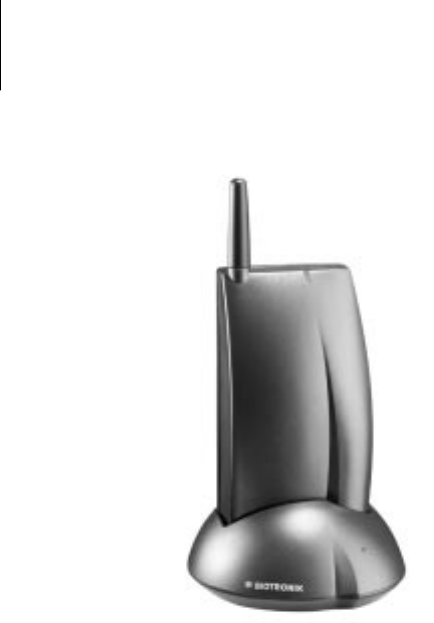
with components The patient device (Fig.1) is developed for home use
and consists of a mobile unit and the respective charg-
ing station. The patient can also carry the mobile unit
with them in their normal daily activities.
The patient device rechargeable batteries that make
an operating time of about 24 h possible. The patient
device receives messages from the implant and for-
3Home Monitoring - Introduction
wards them to a
BIOTRONIK Ser-
vice Center via
mobile communi-
cations.
Fig.1
Patient Device with
Charging Station
RUC 200
Cardio Report The service center compiles the messages into a com-
prehensive report (Cardio Report). This Cardio Report
is tailored to the individual needs of the patient and is
sent to the attending physician via fax.
• For further information about the patient device,
please refer to the respective Users Manual.
• The standard functions are described in the Actros+
family techncial manua .
• The additional Home Monitoring functions of the
BA03 DDDR are found in this manual

Indications and Contraindications 4
Indications and Contraindications
For the general indications and contraindications
please refer to the Actros+ Family technical manual.
Basically, the indications and contraindications of the
BA03 DDDR are identical to that for the rate adaptive
dual chamber pacemaker Actros DR+. The special cri-
teria for the Home Monitoring Function are described
as follows:
Criteria for using Home Monitoring
There are no contraindications for use of the Home
Monitoring function. This function has no influence on
the diagnostic or therapeutic functionality of the pace-
maker. The patient must be capable and willing to
manage certain tasks associated with Home Monitor-
ing. Usage of the Home Monitoring system is inappro-
priate in the following cases:
• The patient can not handle the system as intended,
because of their physical or psychological condition.
• There is no GSM cellular service available in the local
area of the patient’s home.
• The patient often stays (i.e. works) in areas where it is
not permitted to use mobile phones.
Note: Home Monitoring does not replace the regular fol-
low-up examination.
When using the Home Monitoring function, the time
interval between the follow-ups must not be pro-
longed.
Caution: The data transmitted by Home Monitoring are not
suitable for diagnosis, because not all information
available in the implant is being transmitted.

5Transmission of Message
Transmission of Message
The Home Monitoring function can be switched ON or
OFF with the programming device. If the Home Moni-
toring function is active, the transmission of the
implant data can be triggered as follows:
• Periodic message at predefined time intervals
• Message activated by the patient
The attending physician himself decides if the patient
should trigger a transmission by programming this
paramater ON or OFF. The patient activated message
does not effect the programmed periodic message.
Note: Please note that with the BA03 DDDR, the Home Mon-
itoring function is only possible in following pacing
modes: DDD, DDDR, DDI, DDIR.
Periodic Message
The time and interval (Monitoring Interval) of the peri-
odic message are programmable. For the periodic
message, a time between 0:00 and 24:00 can be set.
Generally, it is recommended to select a time between
0:00 and 4:00. For every Monitoring Interval, a data
string is generated in the implant and the transmission
is activated.
Patient Activated Message
Application of a magnet over the implant activates a
transmission. The attending physician should inform
the patient in detail about the handling and the physical
symptoms that suggest a magnet application by the
patient.
Caution: The magnet effect must be programmed "synchro-
nous" if the attending physician enables the patient to
transmit messages.

Diagnostic Memory Functions 6
Diagnostic Memory Functions
BA03 DDDR has the same standard functions as the
Actros DR+, with the exception that the Gain Monitor is
unavailable. Contrary to the Actros DR+, the BA03
DDDR has the ability to use all memory functions
simultanously.
When the Home Monitoring function is activated, the
following diagnostic memory functions are recorded
automatically and transmitted by the Home Monitoring
System:
Event Counter
The function Event Counter can record the following
events:
• As percentage
• Vs percentage
Event sequences:
• As - Vs percentage
•As - Vp percentage
• Ap - Vs percentage
• Ap - Vp percentage
With every periodic message, the counter is reset.

7Diagnostic Memory Functions
Arrhythmia
VES Classifications
The VES events are classified according to their com-
plexity. The following classifications are available:
1. Number of Single-VES
Event sequence A-V-VES-A...
2. Number of VES Couplets:
Event sequence A-V-VES-VES-A.
3. Number of VES Triplets:
Event sequence A-V-VES-VES-VES-A.
4. Number of VES Runs
Sequence of 4...8 consecutive VES.
Event sequence A-V-VES-VES-...-A.
5. Maximum number of VES /h
6. Number of Ventricular Tachycardias:
VT with duration > 8 VES and ≥ 120 bpm
Activity Chart
This function records data, that are characteristic for
the activities of patient and pacemaker system:
• Mean value of actual ventricular heart rate
• Maximum value of actual ventricular heart rate
• Activity duration at maximum sensor rate

Functions of Home Monitoring 8
Functions of Home Monitoring
Programmable Parameters
The functions of Home Monitoring and their
parameters can be set with the programmers EPR
1000plus and TMS 1000plus. Therefore, the correspond-
ing software SWM 1000/B-KT0.0 is necessary
The functions of Home Monitoring are available only in
following pacing modes:
DDD, DDDR, DDI, DDIR.
When using the Home Monitoring system, the trans-
mission interval must be selected. This monitoring
interval can be from one to 30 days. If the standard set-
ting is selected, data will be transmitted daily. For the
periodic message, a time between 0:00 and 24:00 is
programmed. It is recommended that a time between
0:00 and 4:00 is selected, as preset in the standard pro-
gram.
The patient activated message can also be pro-
grammed ON or OFF. This option is deactivated in the
standard program

Technical Data 9
Technical Data
Modes
Valid when Home Monitoring function is activated:
DDD, DDDR, DDI, DDIR
Valid when Home Monitoring function is deactivated:
DDD, DDDR, DDI, DDIR, DVI, DVIR, VDD, VDDR, DOO,
DOOR, VVI, VVIR, AAI, AAIR, VOO, VOOR, AOO, AOOR,
DDI/T, DDI/TR, DDT, DDTR, DVT, DVTR, VDT, VDTR,
VVT, VVTR, AAT, AATR, VDI, OFF
Home Monitoring parameters
Home Monitoring Off, On
Monitoring
interval 1...(1) ...30 days
Time of
transmission 0:00...23:50 h:min
Patient activated
data transmission Off, On

Technical Data 10
Pulse and Timing Data1)
Basic rate2) 30 ... (1) ... 88 ... (2) ... 122 ... (3) ... 140 ... (5) ... 180 ppm
Hysteresis2) Off; -5 ... (5) ... -50 bpm
Repetitive Hyster. Off; 1 ... (1) ... 10
Scan Hysteresis Off; 1 ... (1) ... 10
Upper rate (UTR)2) 100; 110; 120; 130; 140; 160; 185 ppm
Night Rate Off; (and basic rate settings)
Tachycardia mode 2:1; WKB (automatic setting)
Rate limitation2)3) 190 ... 220 ppm
Dynamic AV delay low; medium; high; individual; fixed
AV delay values 15; 50; 75; 100; 120 ... (10) ... 200; 225; 250; 300 ms
(programmable in 5 ranges)
AV safety interval 100 ms
Ventricular
Blanking time 12; 16; 24; 32; 40; 48; 56; 72 ms
Magnet effect Auto; asynchronous; synchronous
Pulse amplitude A
V0,1 ... (0,1) ... 4,8 ... (1,2) ... 8,4 V
0,1 ... (0,1) ... 4,8 ... (1,2) ... 8,4 V
Pulse width A
V0,1; 0,2; 0,3; 0,4; 0,5; 0,75; 1,0; 1,5 ms
0,1; 0,2; 0,3; 0,4; 0,5; 0,75; 1,0; 1,5 ms
Sensitivity A
V0,1 ... (0,1) ... 1,5 ... (0,5) ... 7,5 mV
0,5 ... (0,5) ... 7,5 mV
Refractory period A
V200 ... (25) ... 775 mV
250; 300; 350; 400 ms
1) 37°C, 500 Ω
2) The respective intervals result from the rate f in the formula t = 60.000 / f (t in ms, f in ppm)
3) In the case of an electronic failure

Technical Data 11
ARP extension 0 ... (50) ... 350 ms
Automatic mode
conversion Off; On (in the modes DDD(R) and VDD(R))
Lead polarity
Pace A/V
Sense A/V unipolar; bipolar / unipolar; bipolar
unipolar; bipolar / unipolar; bipolar
Rate Adaption
Sensor gain 1 ... 40 (in 32 steps)
Autom. s. gain Off; On
Sensor threshold very low; low; medium; high; very high
Rate increase 1; 2; 4; 8 ppm/s
Max.
Sensor rate1) 80 ... (5) ... 180 ppm/s
Rate decrease 0,1; 0,2; 0,4; 0,8 ppm/s
1) In the modes DDIR-, DVIR-, VVIR-and VOOR, lower maximum sensor rates result than indi-
cated here (partly depending on the selected AV interval). The respective values are displayed
by the programmer.
Technical Data 12
Parameter at Replacement Indication
Basic rate programmed value decreased by 11%
(in the modes DVI(R), DDI(R), DVT(R), DDI/T(R),
decreases by 4,5–11%, depending on the programmed
AV delay)
Magnet rate Pulse generator behavior after reaching ERI
Pulse amplitudes programmed values
sensitivity programmed values
Home Monitoring
after ERI 0 ...(1)...14 days
Default 14 days
Magnet Mode Cycles 1-10 after
magnet application
After Cycle 11
Automatic Asynch. at 80 ppm Synch. with basic rate reduced by 4.5 -
11%
Asynchronous Asynch. at 80 ppm Asynch. with basic rate reduced by 4.5
- 11%
Synchronous Synch. with basic rate reduced by 4.5
- 11% Synch. with basic rate reduced by 4.5 -
11%

Technical Data 13
Features
• Home Monitoring
Additional functions conform with Actros DR
• Automatic sensor gain
• Extensive VES analysis
• External pulse control up to 800 ppm
• Dual chamber IEGM with event marker
• 24 hour trend with pacing part in %
• Sensor test trend with rate forecast
• Automatic mode conversion
• High definition threshold test in the range of 0,1 up to
4,8 V with 0,1 V resolution
•P/R wave test
• Retrograde conduction test
• Reaction to vasovagal syncopes
•Night program
• Heart rate histogram
• Sensor rate histogram
• Assisted follow-up
• Activity chart
• Event counter
• Patient data memory
• Analog telemetry
• Temporary program activation
• Controlled impulse amplitudes

Technical Data 14
Default Programs
Parameter/Function Factory- Standard- Safe
Settings Program Program
Home Monitoring Off Off Off
Mode DDD DDDR VVI
Autom. m. conversion Off Off —
Basic rate 60 ppm 60 ppm 70 ppm
Hysteresis Off Off Off
Repetitive hysteres. ——Off
Scan hysteresis ——Off
Night program Off Off Off
Upper rate (UTR) 160 ppm 160 ppm —
Dynamic AV delay medium medium —
Ventric. blanking time 24 ms 24 ms —
Magnet effect Auto Auto Auto
Pulse amplitude A
V3,6 V 3,6 V —
3,6 V 3,6 V 4,8 V
Pulse width A
V0,4 ms 0,4 ms —
0,4 ms 0,4 ms 1,0 ms
Sensitivity A
V1,5 mV 1,5 mV —
2,5 mV 2,5 mV 2,5 mV
Refractory time A
V425 ms 425 ms —
250 ms 250 ms 300 ms
ARP 0 ms 0 ms —

Technical Data 15
Parameter/Function Factory Standard- Save
Settings Program Program
Sensor threshold —medium—
Sensor gain —6 —
Auto. Sensor gain. —Off—
Rate increase —2 ppm/s—
Max. sensor rate —120 ppm—
Rate decrease —0,4 ppm/s—
Lead
polarity
Pace A/V unipolar unipolar unipolar
Sense A/V unipolar unipolar unipolar
Statistics standard standard standard

Technical Data 16
Materials in Contact to Human Tissue
Housing Titanium
Grommet Silicone
Connector
Receptacle Epoxy resin
Coating (for unipolar Silicone (if used)
devices)
Programmer
EPR 1000 plus , and TMS 1000 plus
Electrical Data1)
Circuit Hybrid electronics with VLSI-CMOS-Chip
Input impedance A
V270 kΩ
330 kΩ
Pulse form biphasic, asymmetric
Polarity cathodic
Current drain
BOS, inhibited 12 µA
BOS, 100 % stimul. 24 µA
Conducting surface 36 cm2
Conducting shape flattened ellipsoidal
1) 37°C, 500 Ω

Technical Data 17
Battery
Power Source Li/J
Manufacturer Wilson Greatbatch
Type WG 8431
Voltage 2,8 V
Voltage at ERI 2,5 V
Nominal Capacity1) 1,3 Ah
Service Times
Nominal service
time2) 6,7 years
at pulse amplitudes 3,6 V
Expected service
time3) 5,1 years
at pulse amplitudes 3,6 V
Remaining capacity
at ERI in Ah 0,13
Mechanical Data
Lead connection IS-1 (accepts unipolar and bipolar)
Mass 30 g
Volume 13 cm3
Dimensions 6 x 45 x 57 mm
X-Ray
Identification EE
1) Data from battery manufacturer
2) Calculated with formula: T= 2740 x Cbat /(IBOS+ IEOS)
3) Expected service time based on all avialable data as provided from the battery manufacturer

Technical Data 18
Tolerances of Factory Settings1)
Data according to EN 50 061
Basic rate
Interference rate 60 ± 1 min-1
Basic interval 1000 ± 3 ms
Escape interval 1000 ± 5 ms
Magnet rate 90 ± 1 min-1 (for 10 cycles)
Magnet Interval 664 ± 2 ms (for 10 cycles)
AV delay
Basic rate
≤70 ppm
70-90 ppm
91-110 ppm
111-130 ppm
≥130 ppm
180 +3/-1 ms
180 +3/-1 ms
160 +15/-5 ms
140 +15/-5 ms
120 +15/-5 ms
100 +15/-5 ms
Atrium Ventricle
Pulse amplitude
Peak value
EN 50061 mean 3,6 +0,25 V/ -0,45 V 3,6 +0,25 V/ -0,45 V
3,3 +0,25 V / -0,45 V 3,3 +0,25 V / -0,45 V
Pulse width 0,43 ±0,02 ms 0,43 ±0,02 ms
Sensitivity
15 ms sin2
40 ms sin2
EN 50061 Triangle
1,5 ±0,5 mV 2,5 ±0,5 mV
1,8 ±0,5 mV 2,5 ±0,5 mV
Refractory period 425 +5 / -20 ms 250 +5 / -20 ms
Run-away protection 210 ±20 min-1 210 ±20 min-1
1) 37°C, 500 Ω

Technical Data 19
Order Information
Model Lead Connection Order Number
BA03 DDDR
uncoated IS-1 122 126
Federal Communications Commission Disclosure
The BA03 DDDR pacemaker is equipped with an RF transmitter for
wireless communications. This transmitter is authorized by rule under
the Medical Implant Communications Service (47 CFR Part 95) and
must not cause harmful interference to stations operating in the
400.150 - 406.000 MHz band in the Meteorological Aids (i.e., trans-
mitters and receivers used to communicate weather data), the Meteoro-
logical Satellite, or the Earth Exploration Satellite Services and must
accept interference that may be caused by such aids, including interfer-
ence that may cause undesired operation. This transmitter shall be
used only in accordance with the FCC Rules governing the Medical
Implant Communications Service. Analog and digital voice communi-
cations are prohibited. Although this transmitter has been approved by
the Federal Communications Commission, there is no guarantee that it
will not receive interference or that any particular transmission from
this transmitter will be free from interference.
The FCC ID number for this device is: PG6BA0T.