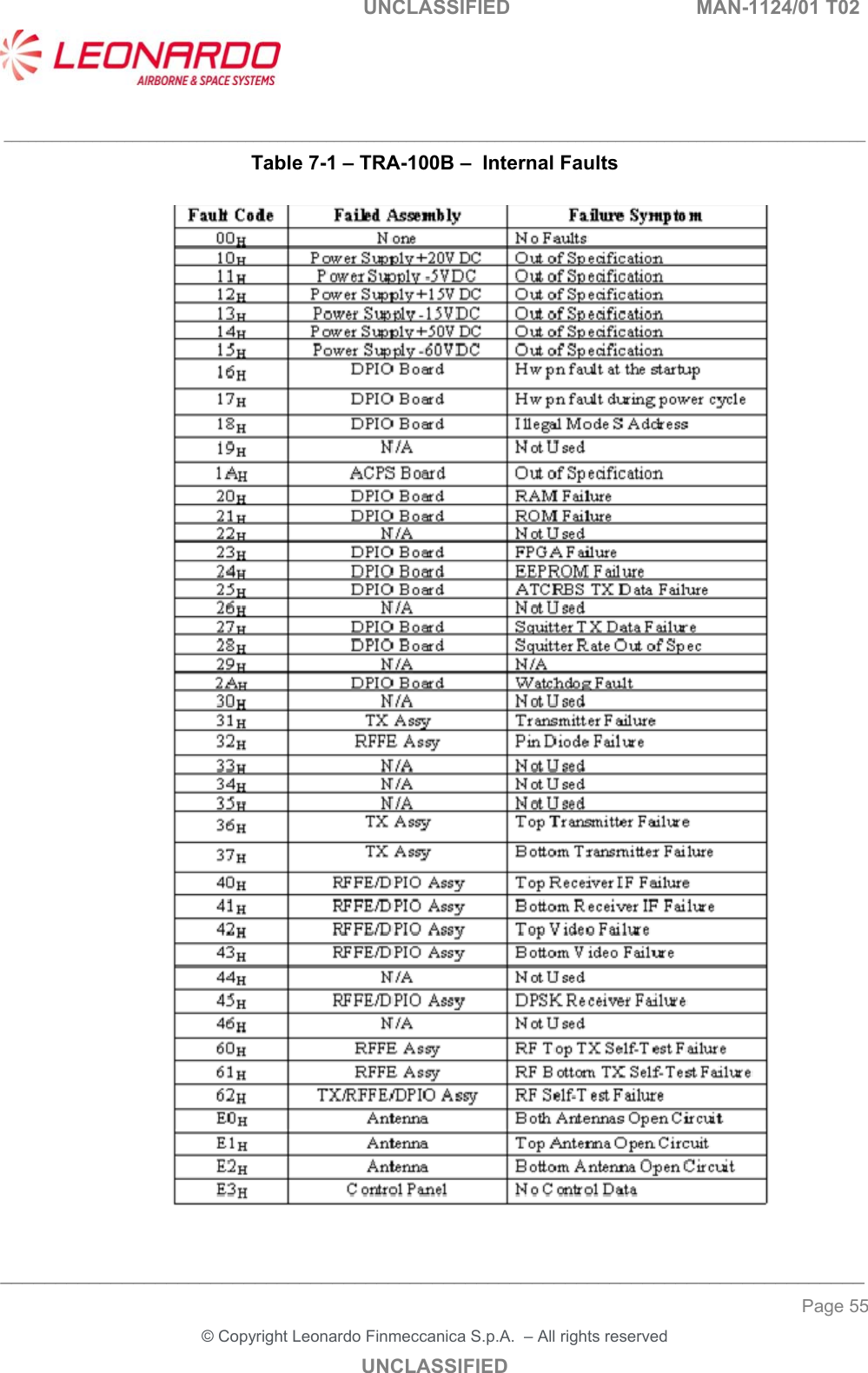
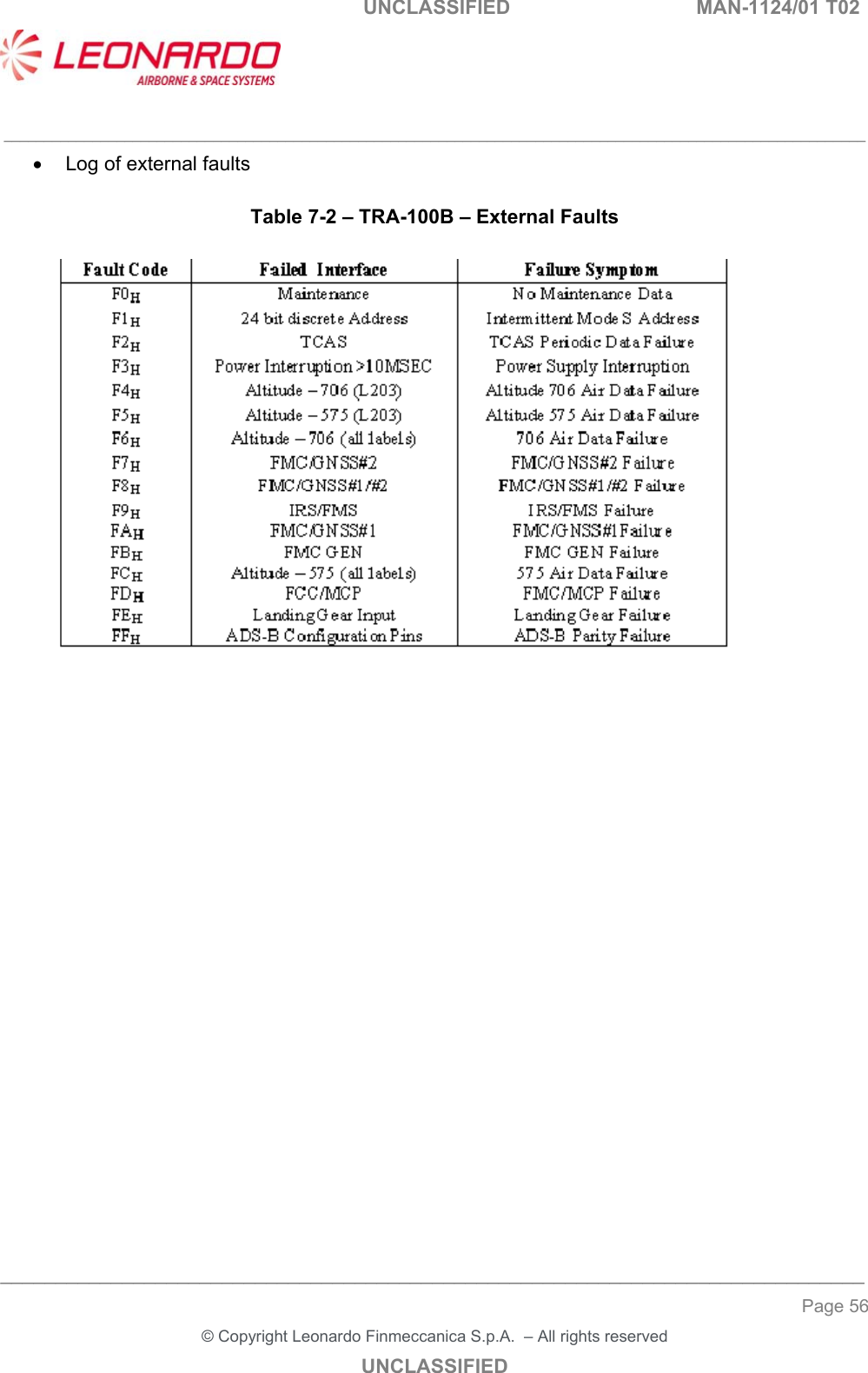
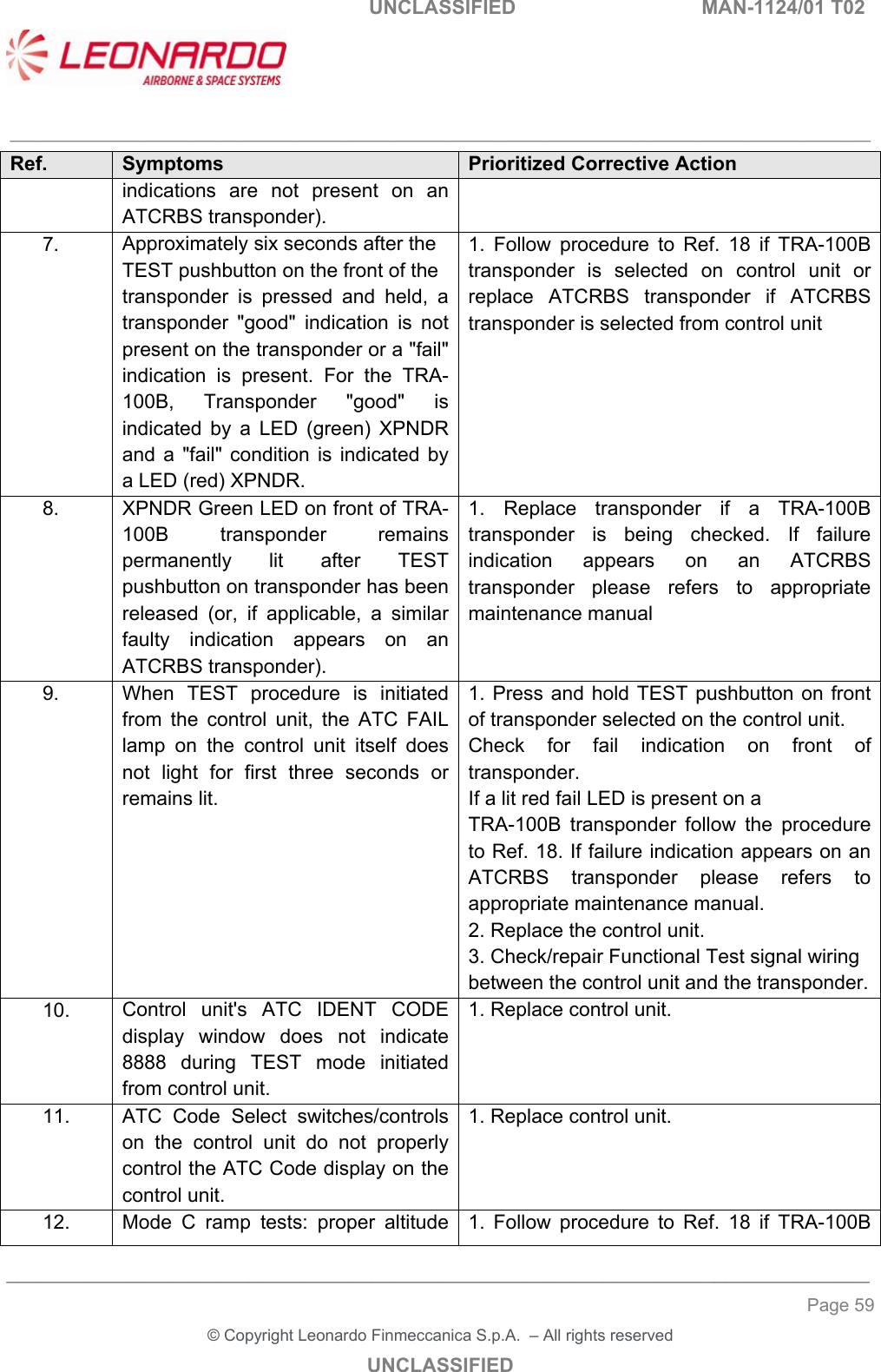
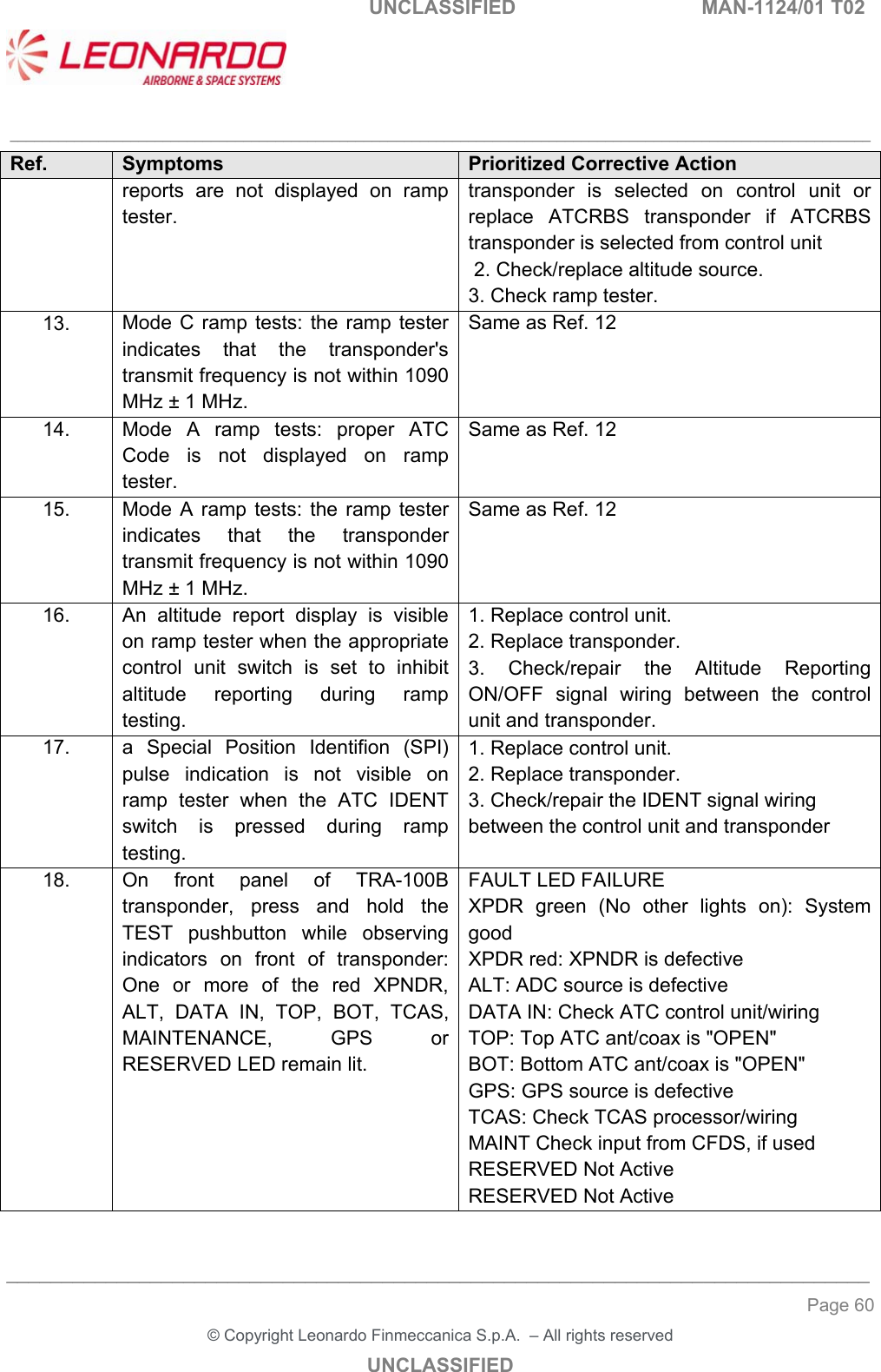
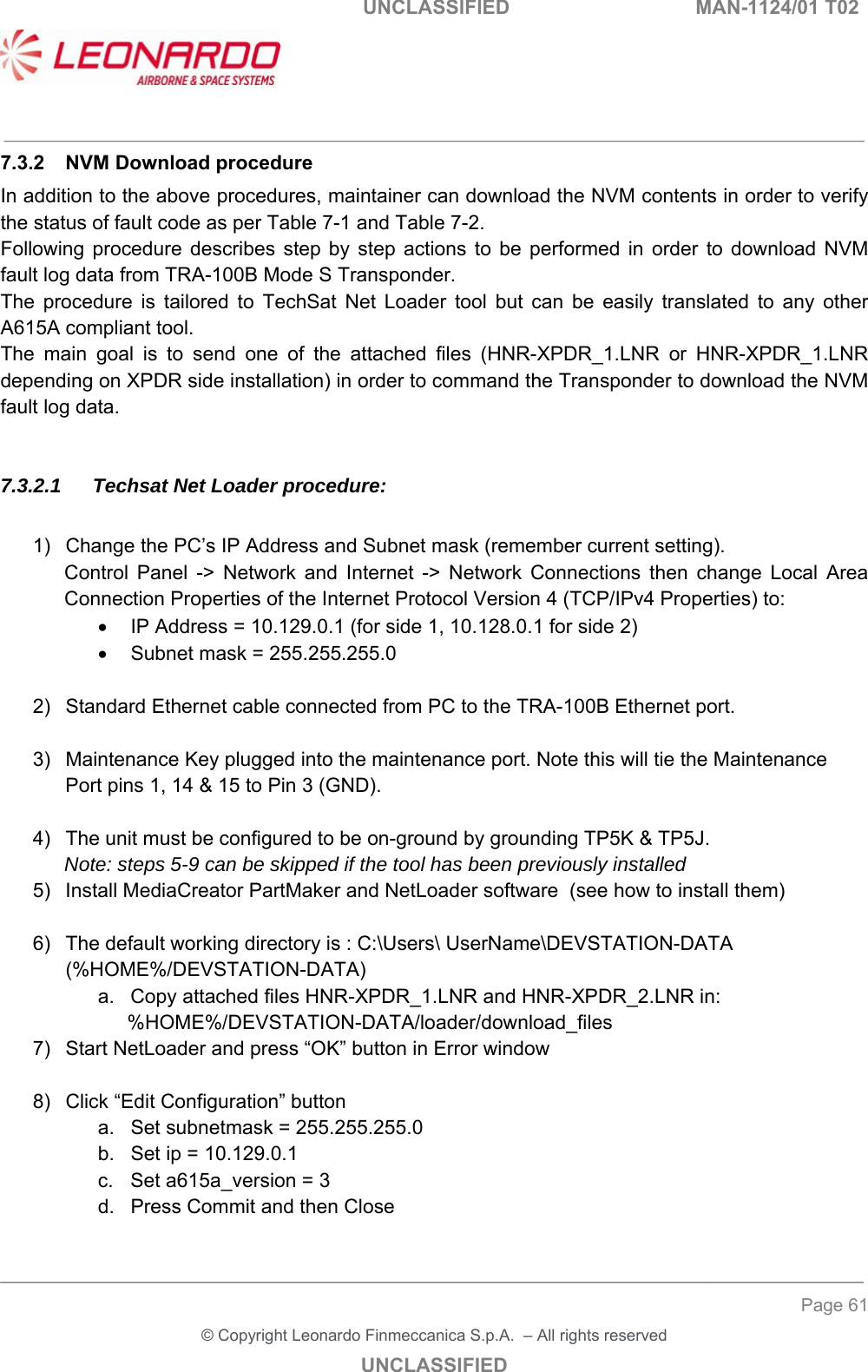
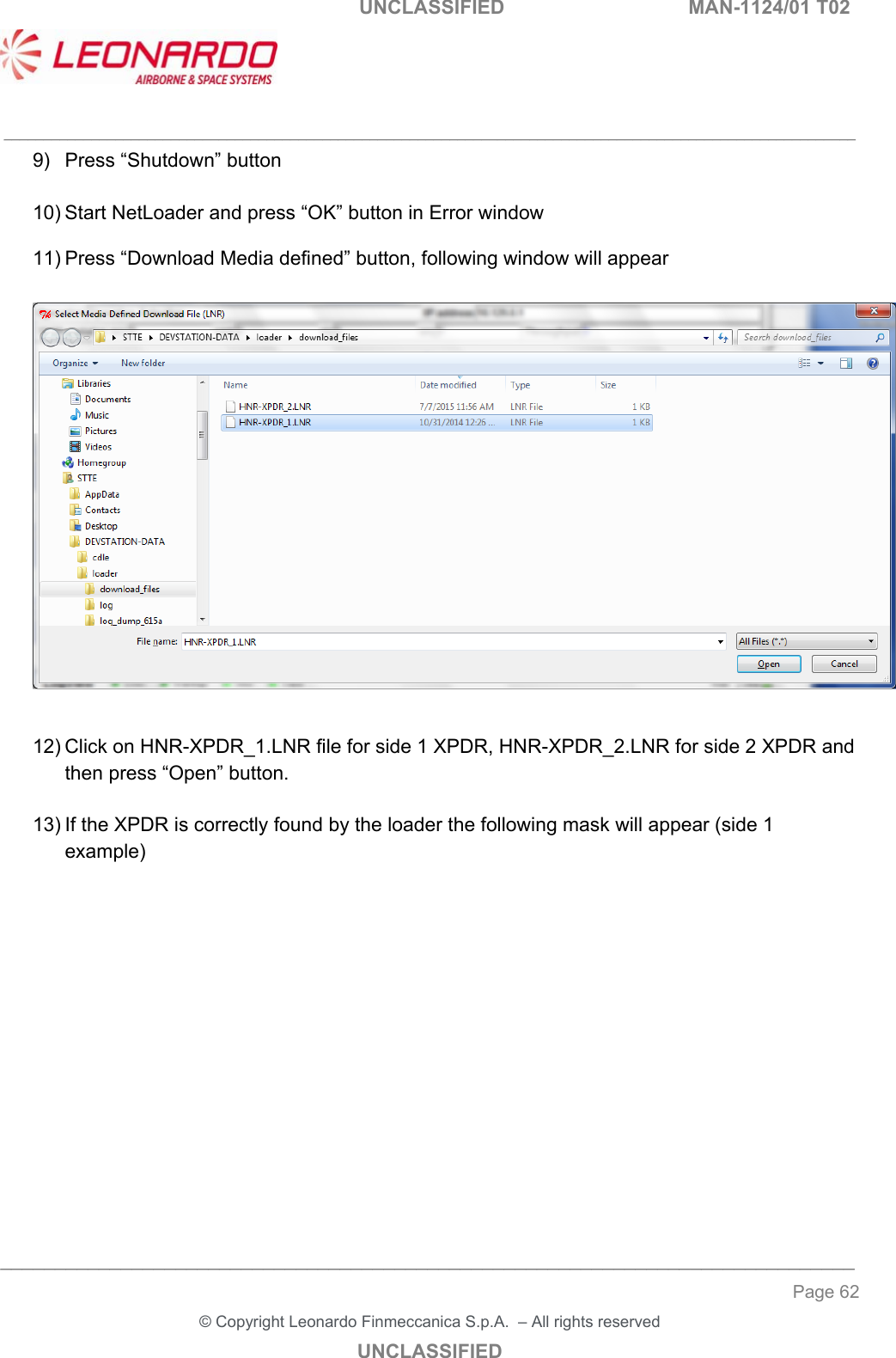
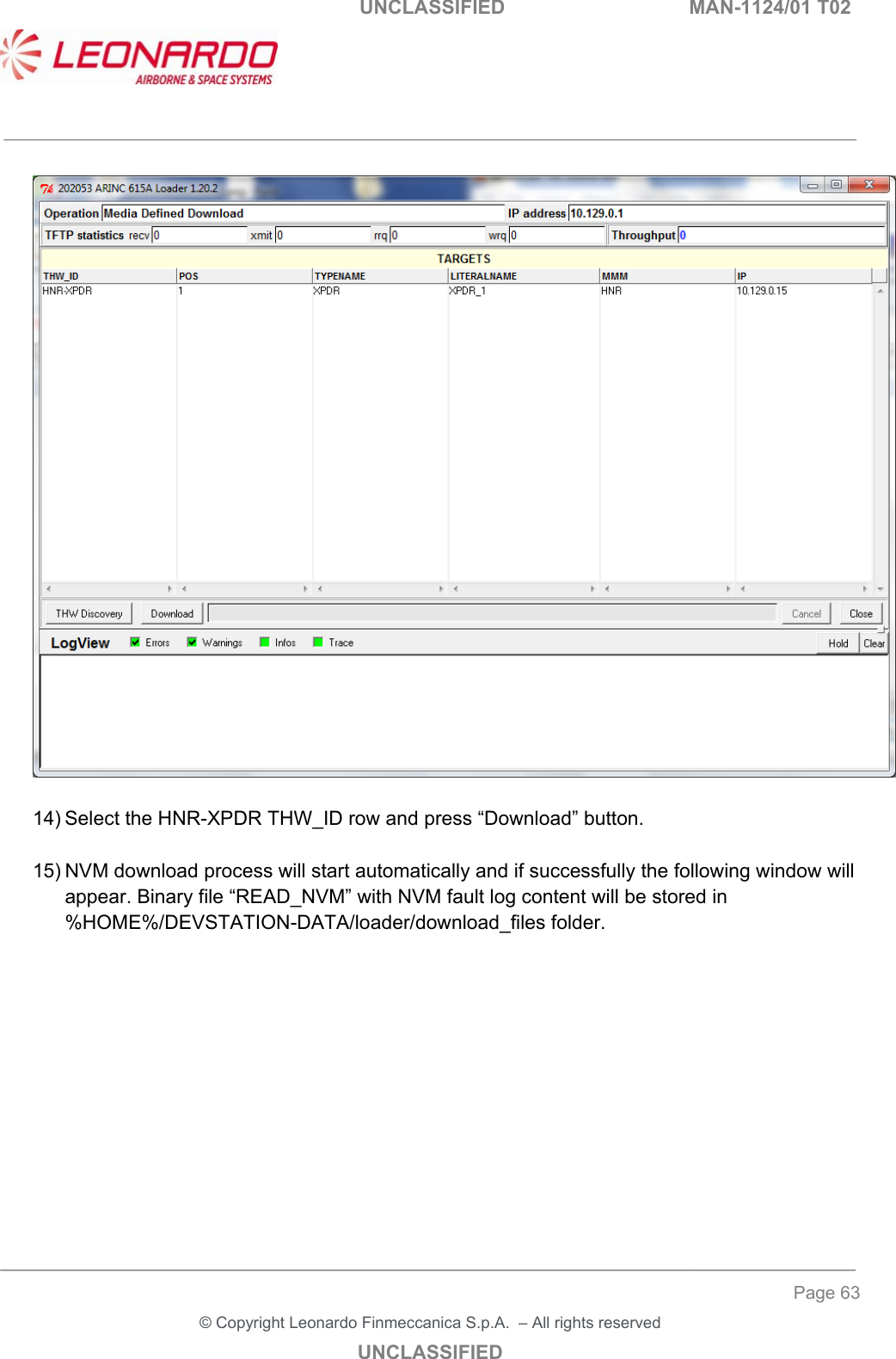
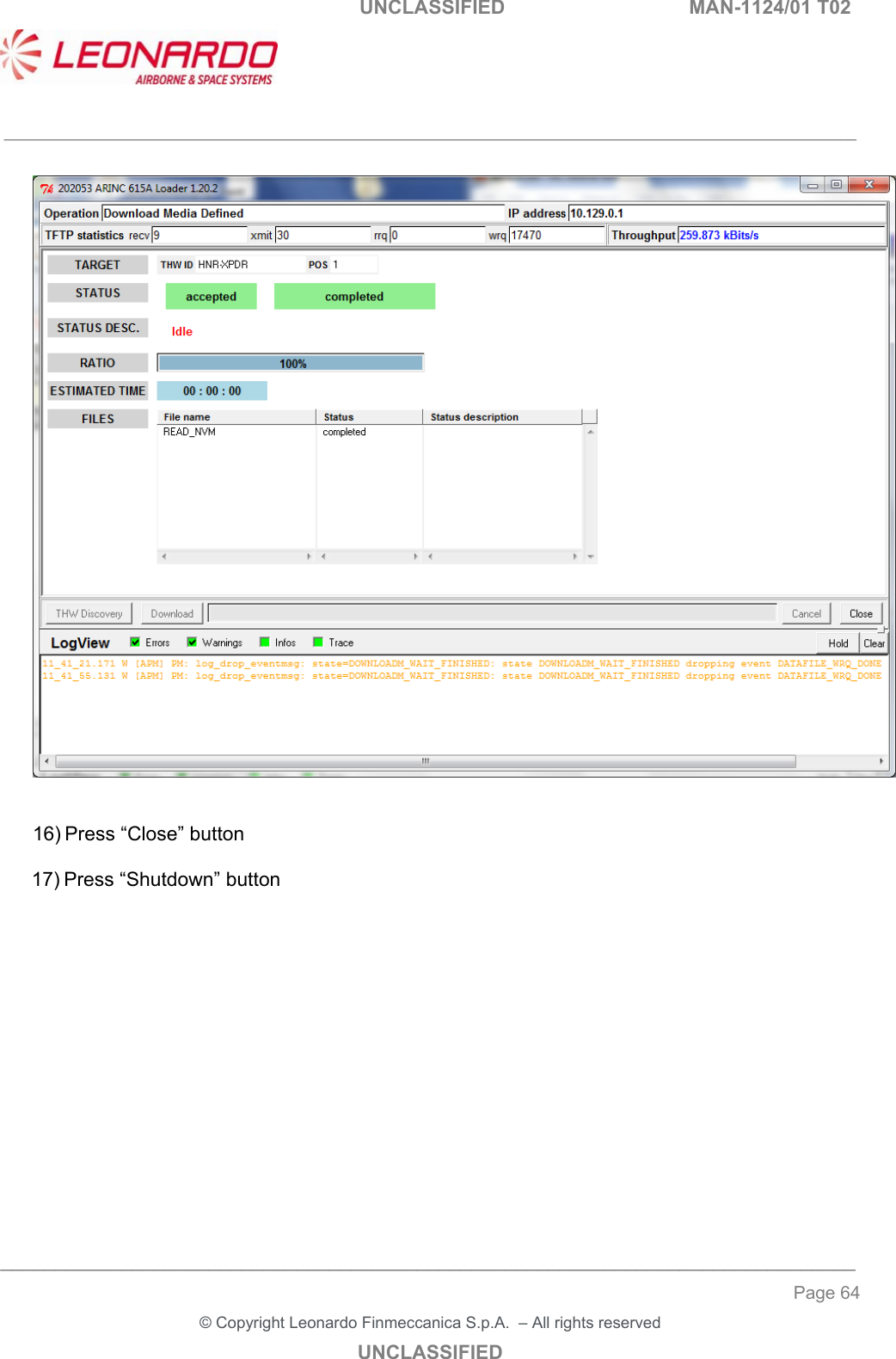
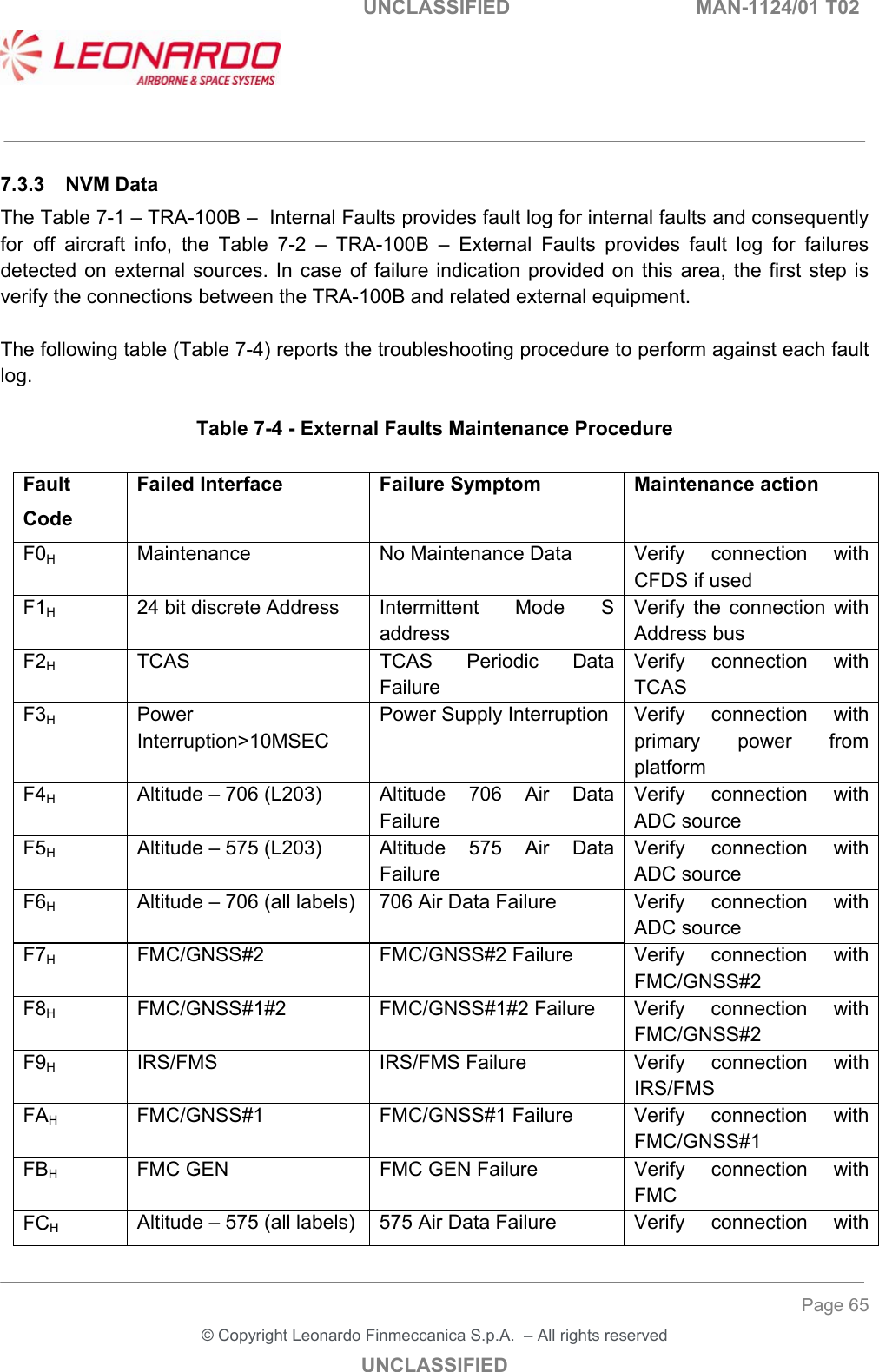
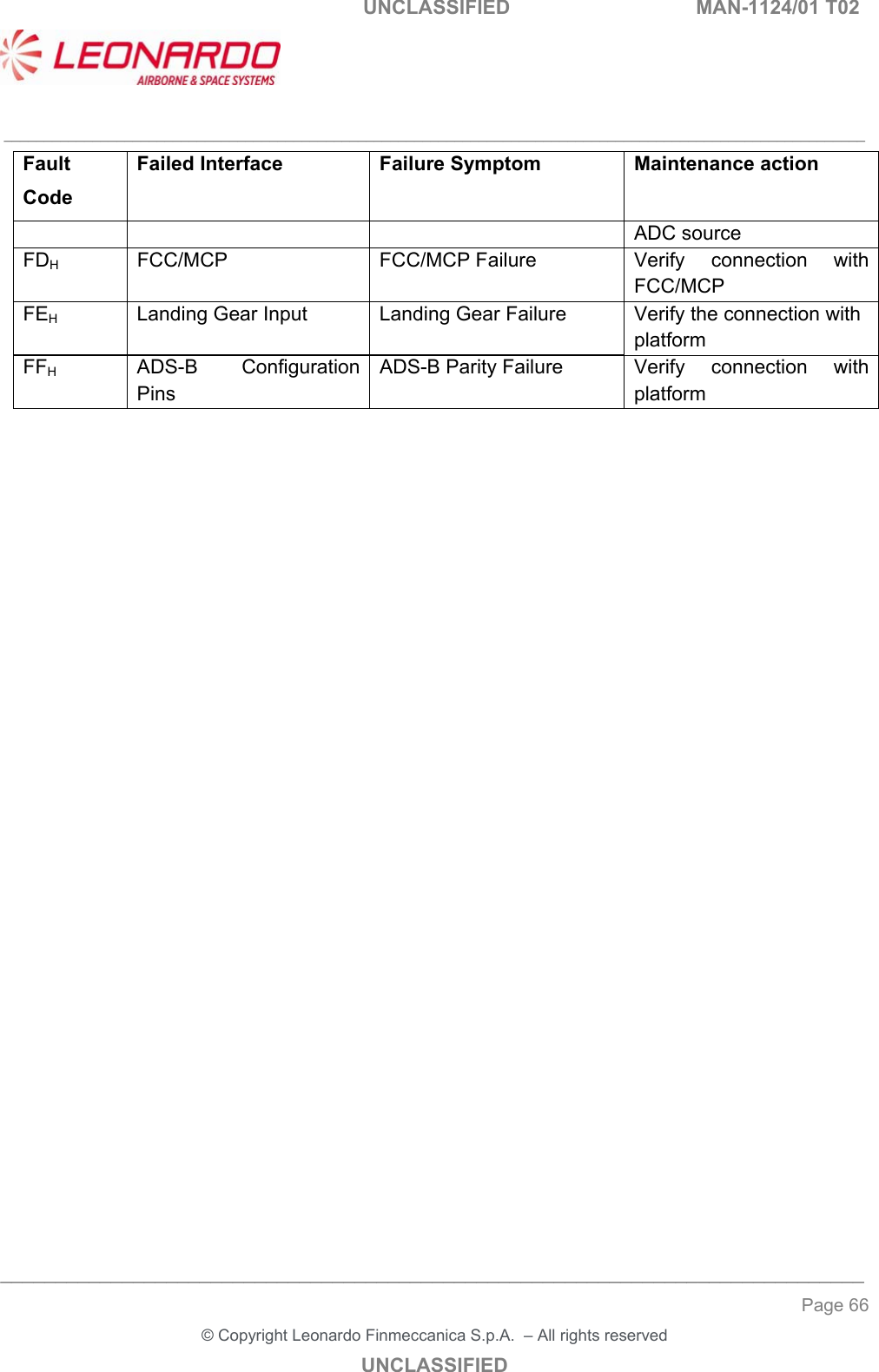
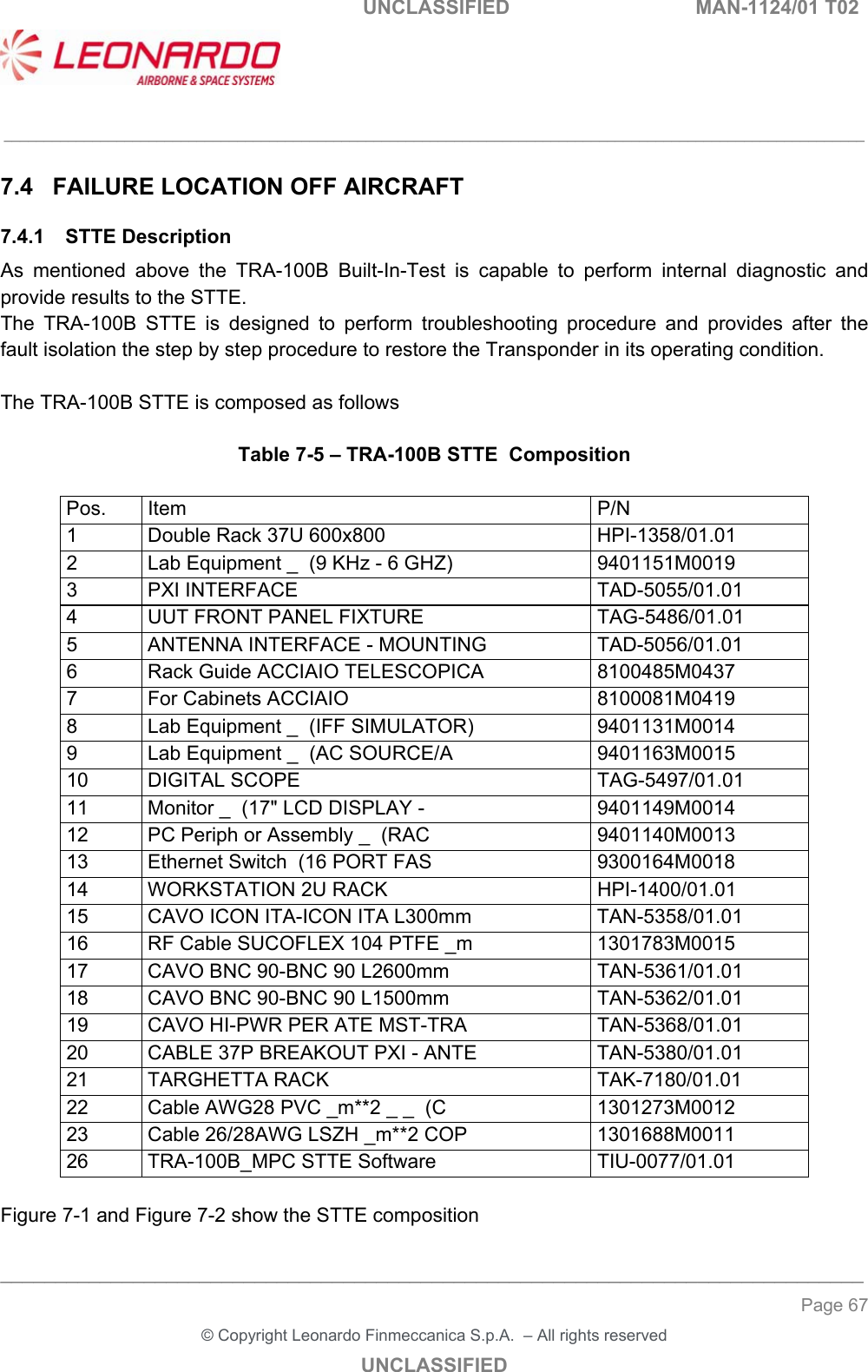
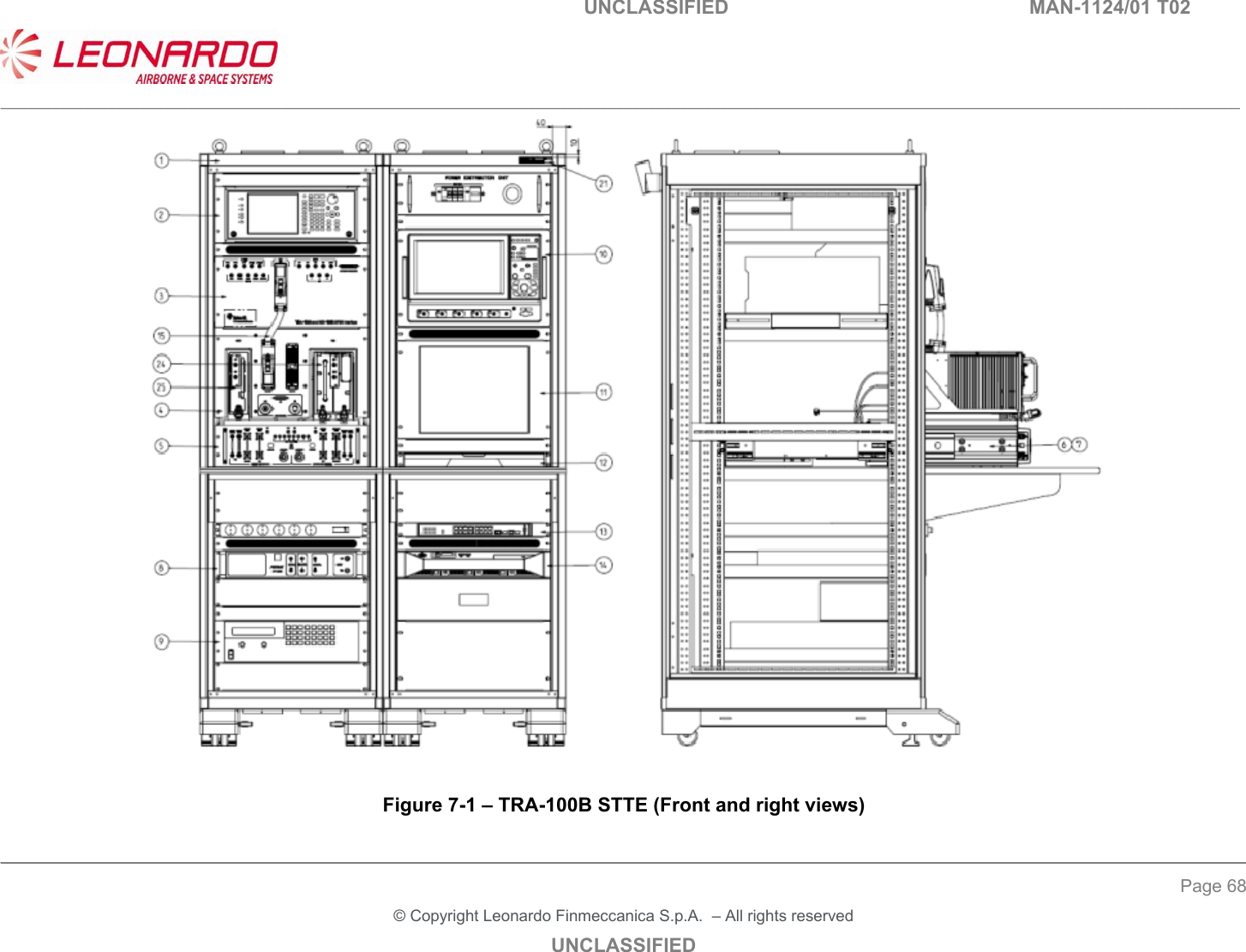
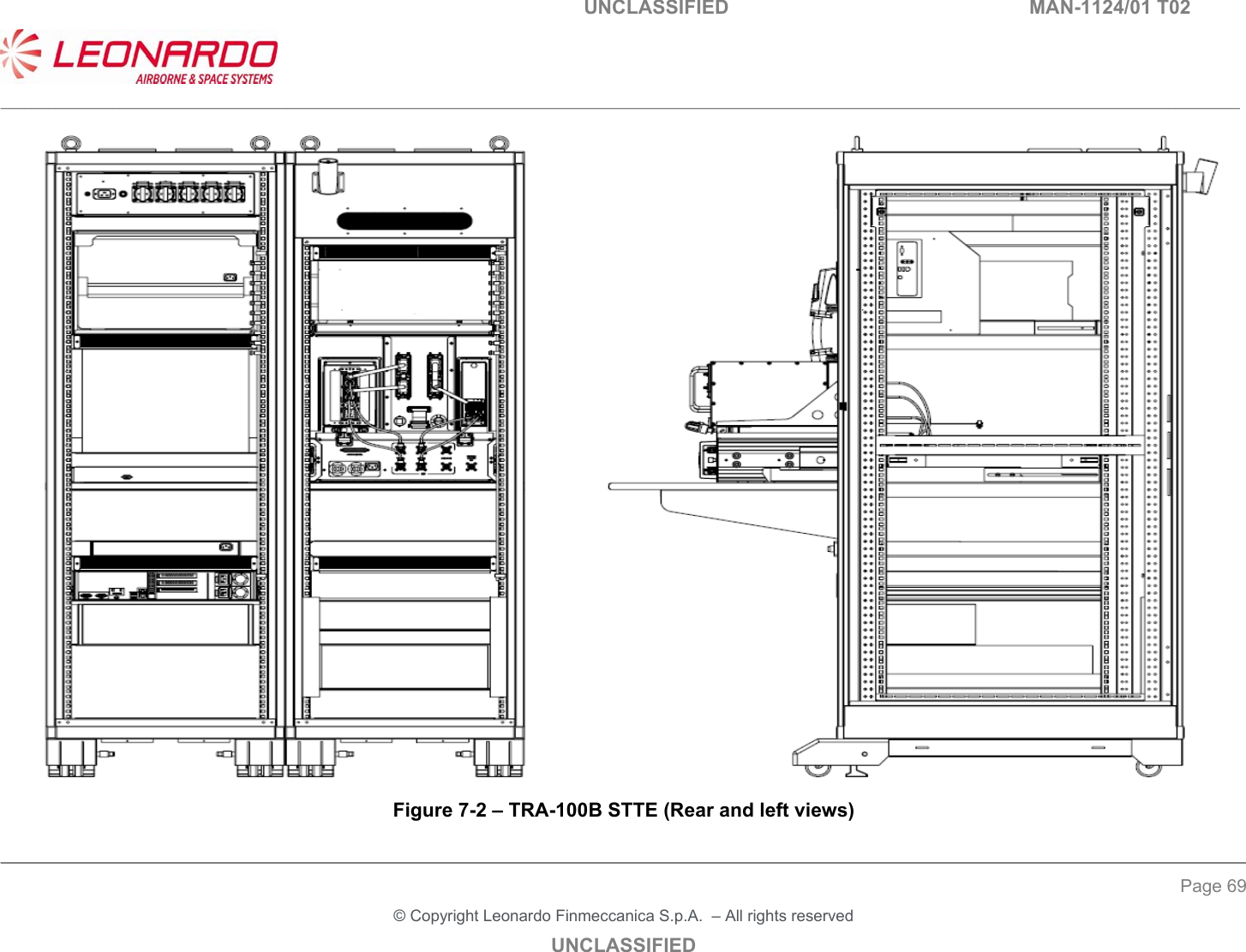
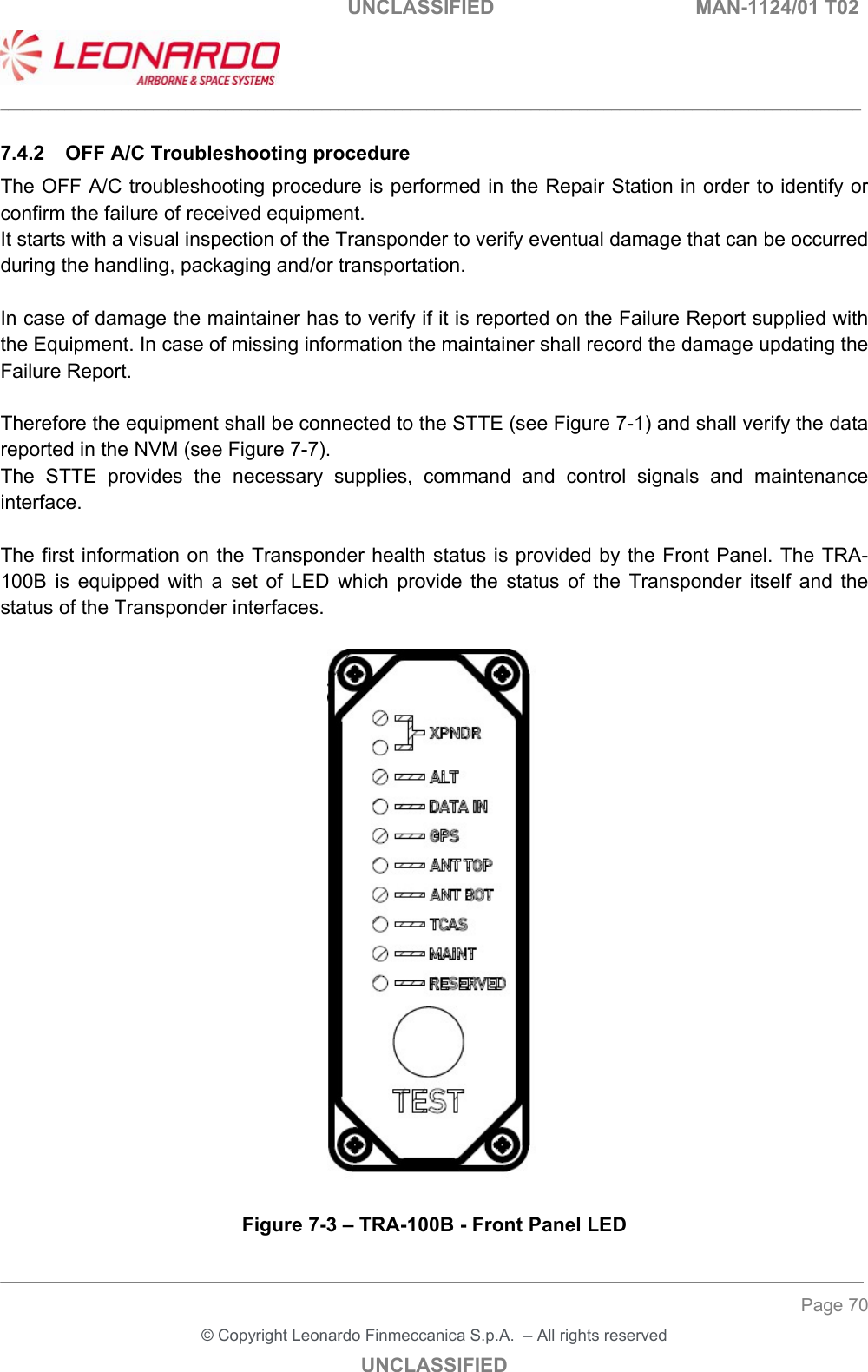
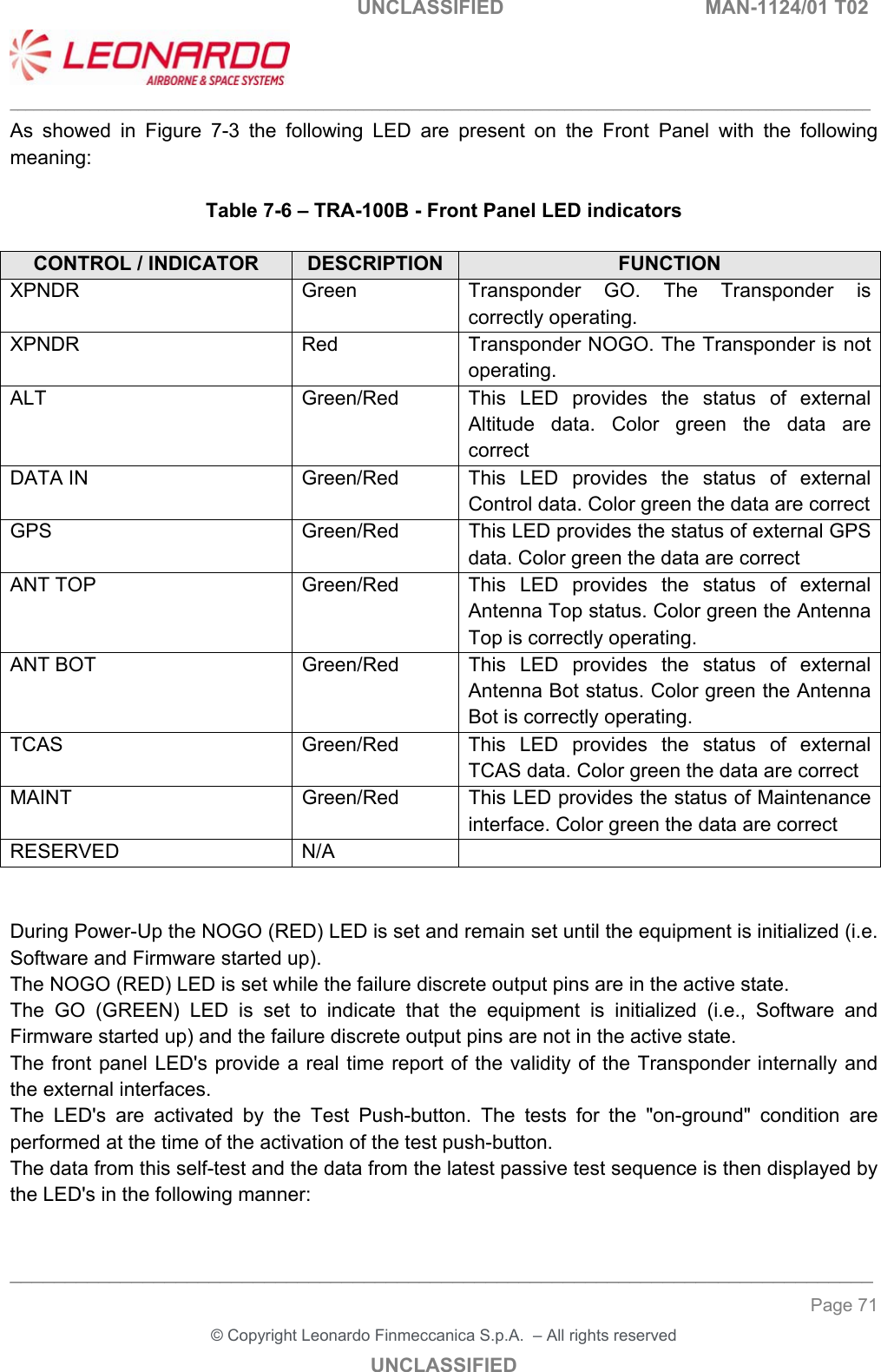
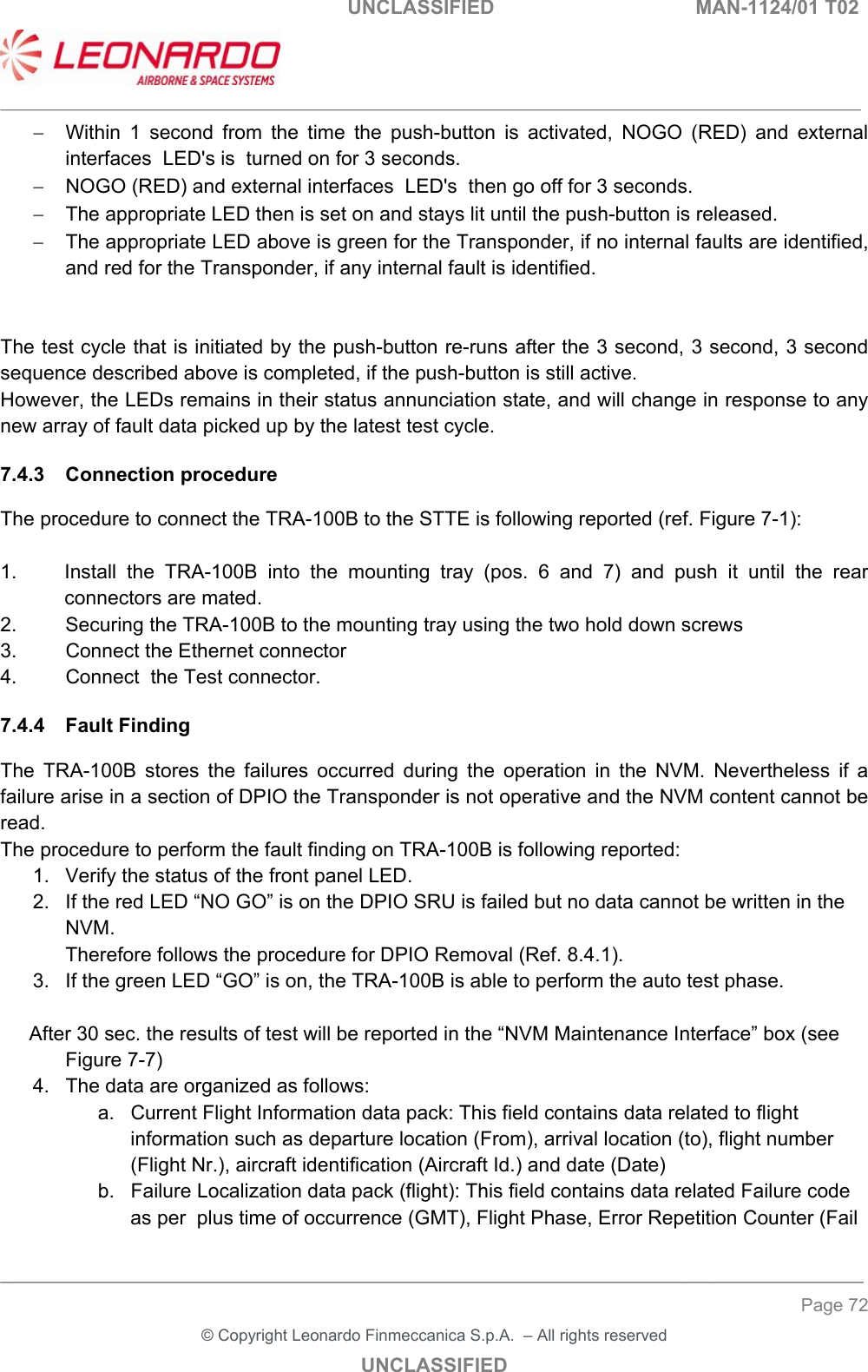
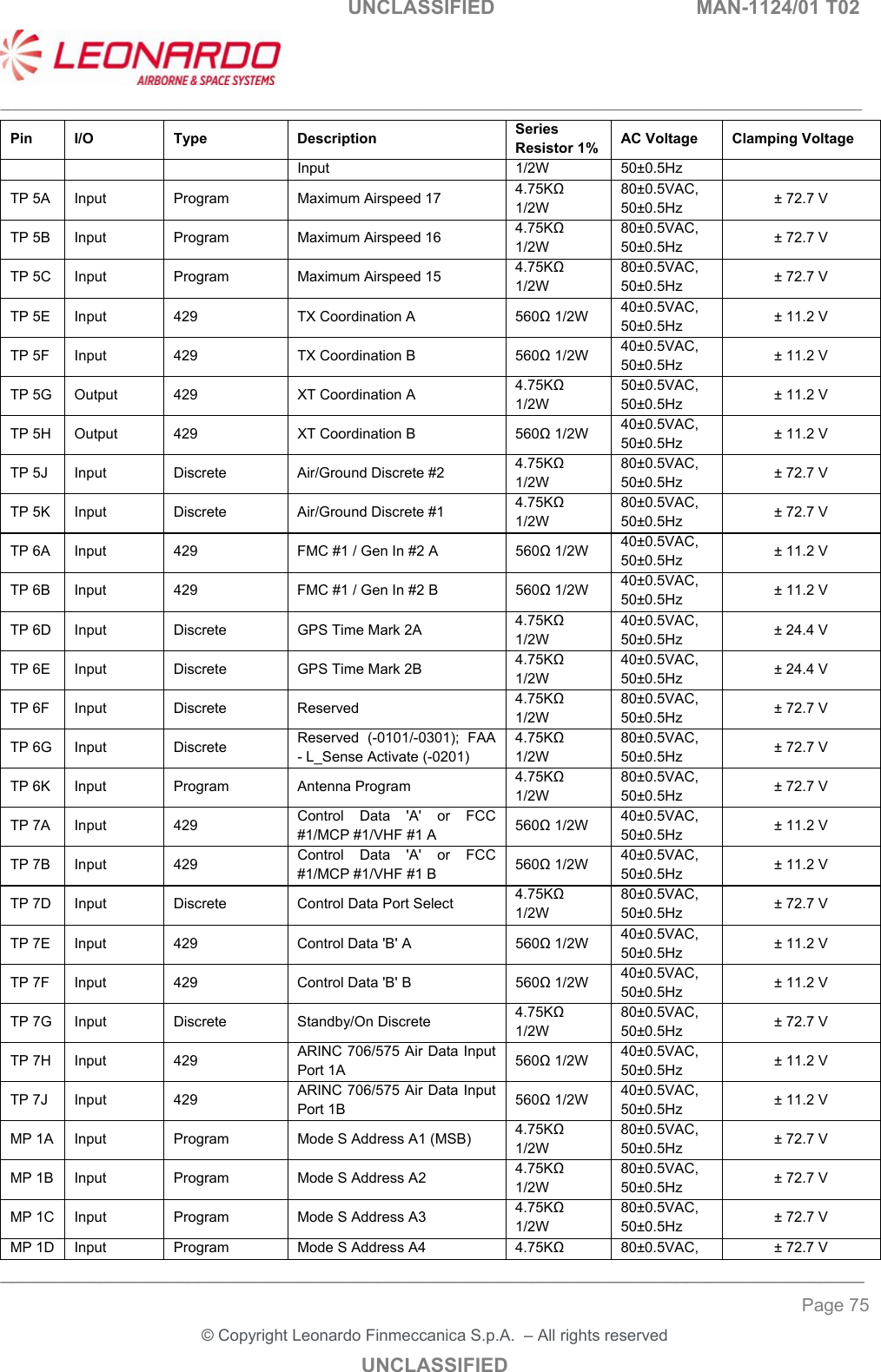
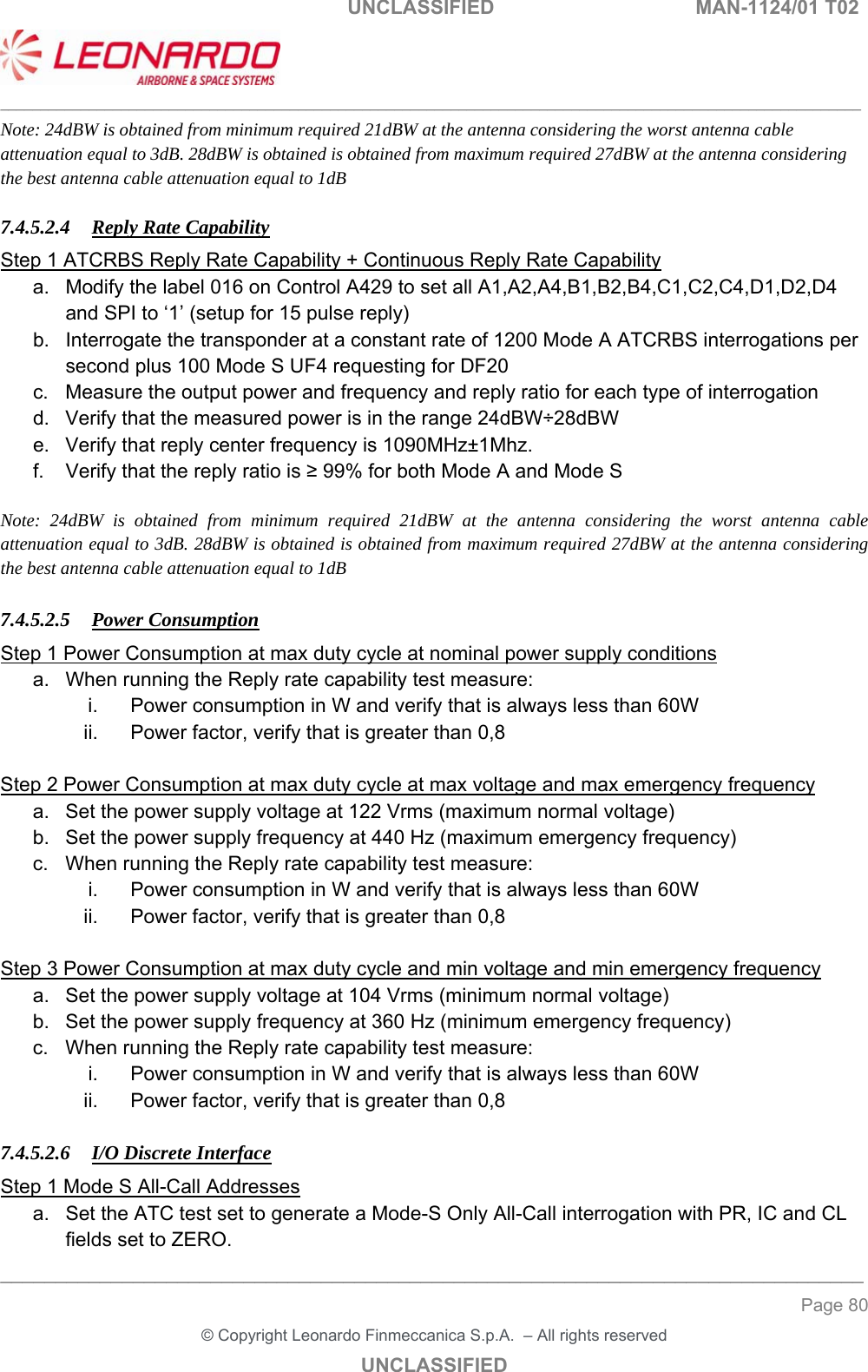
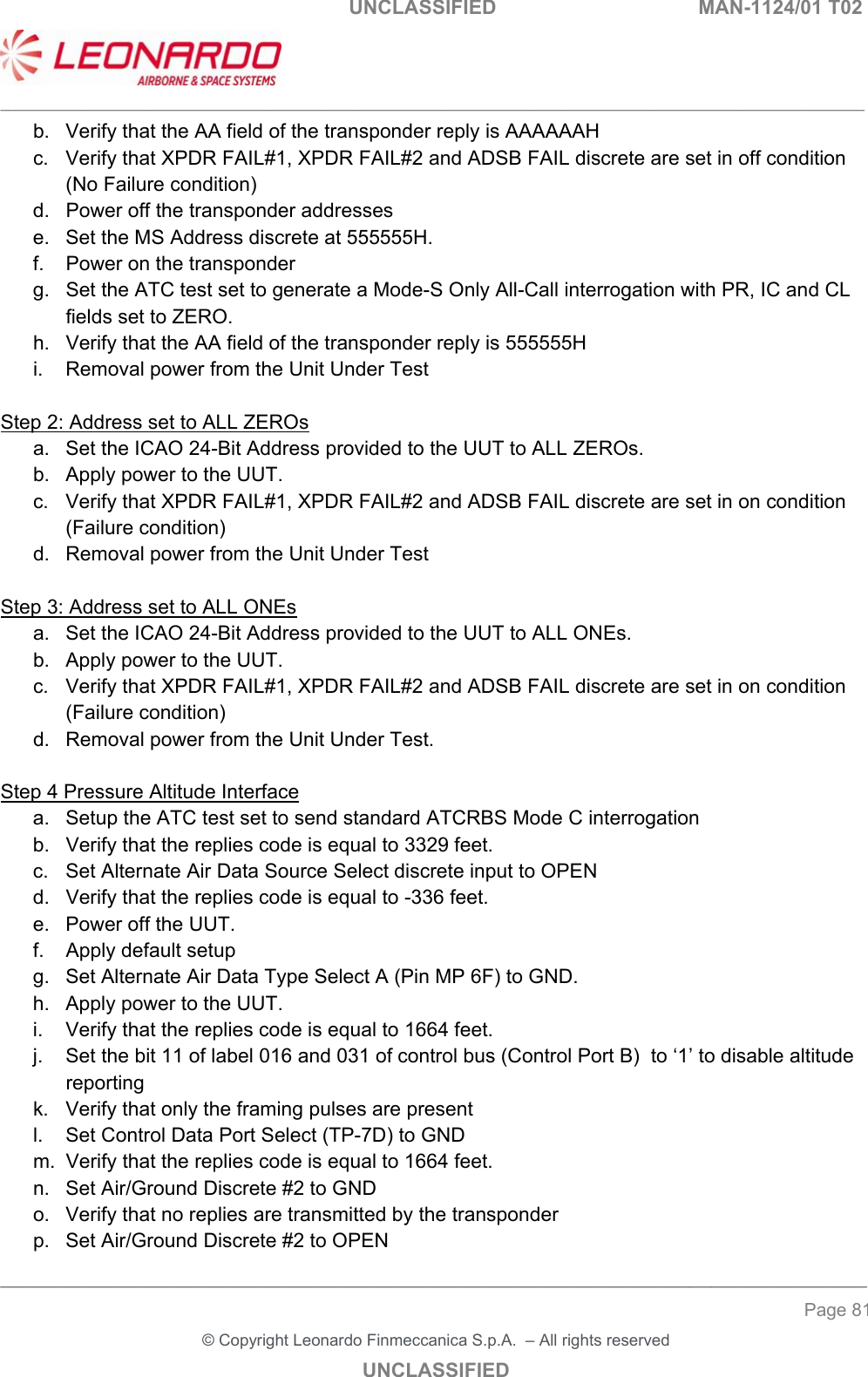
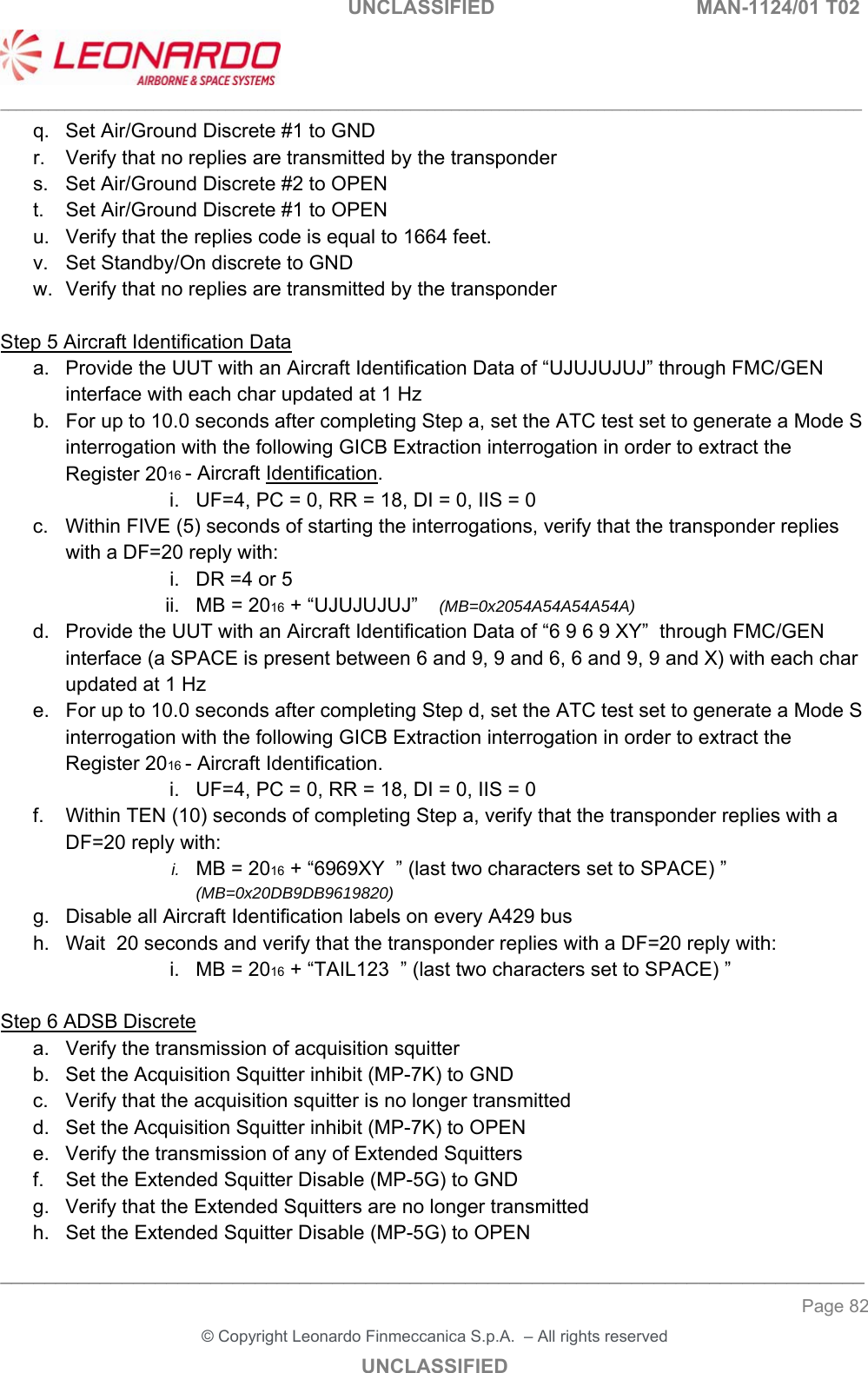
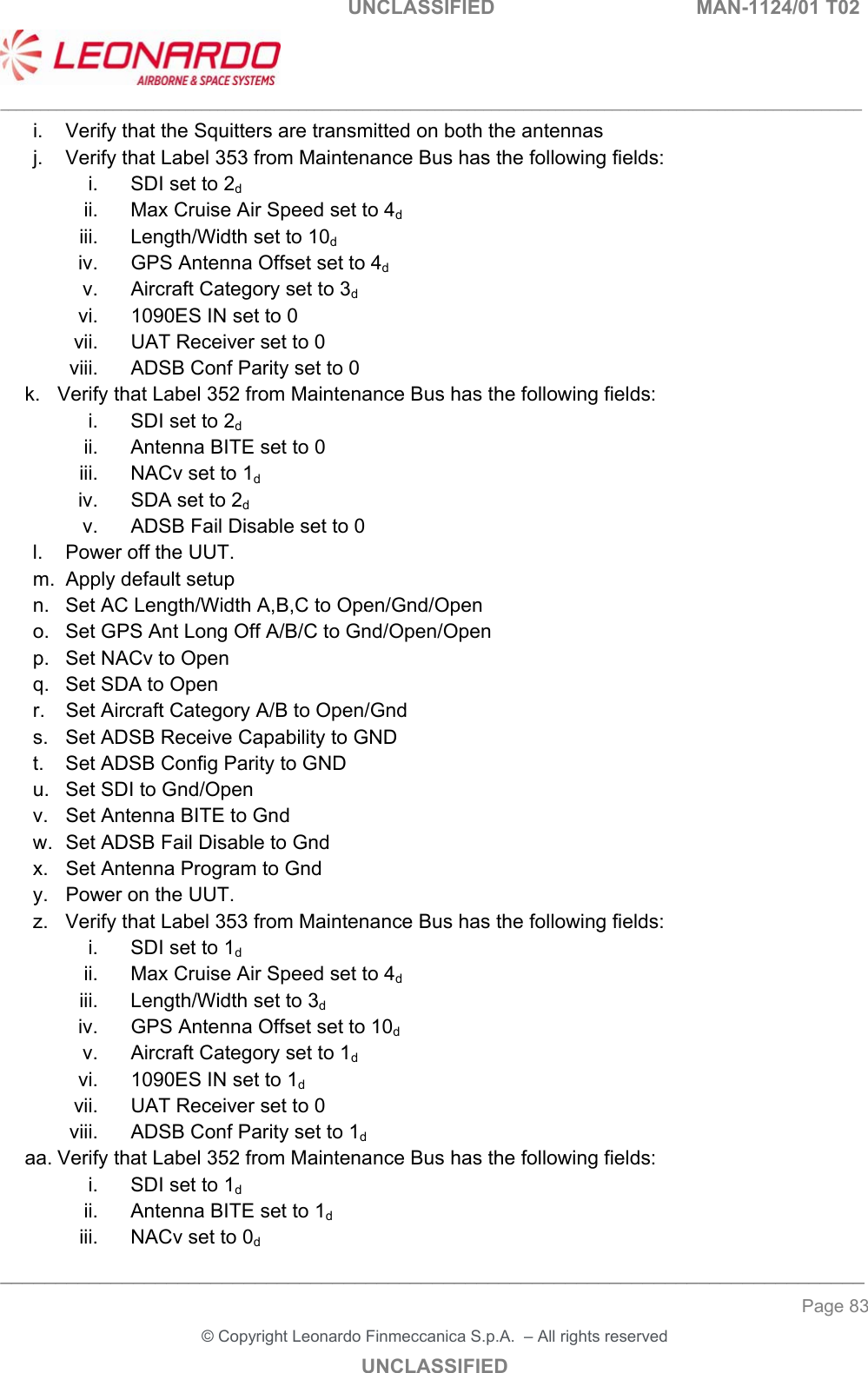
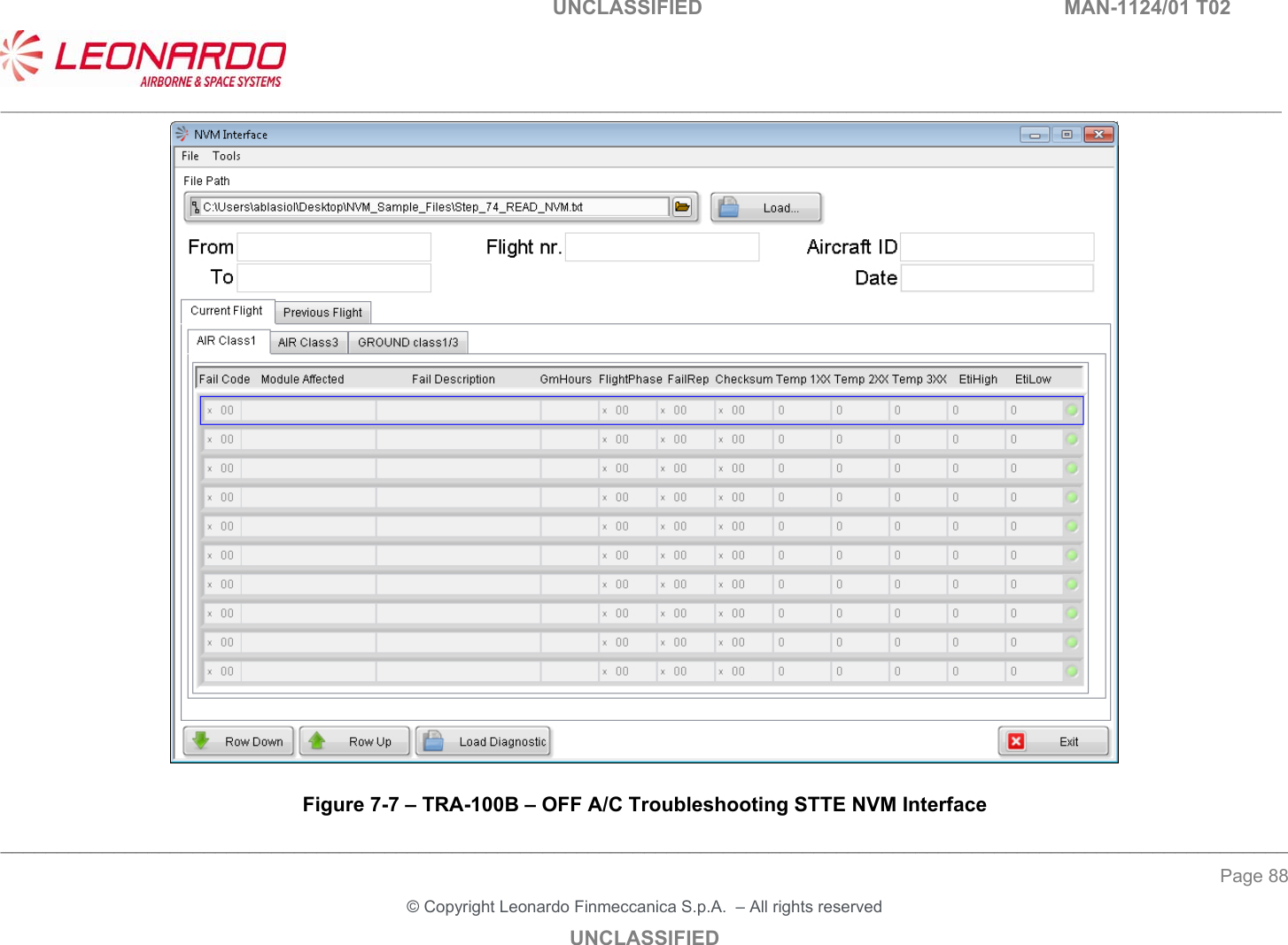
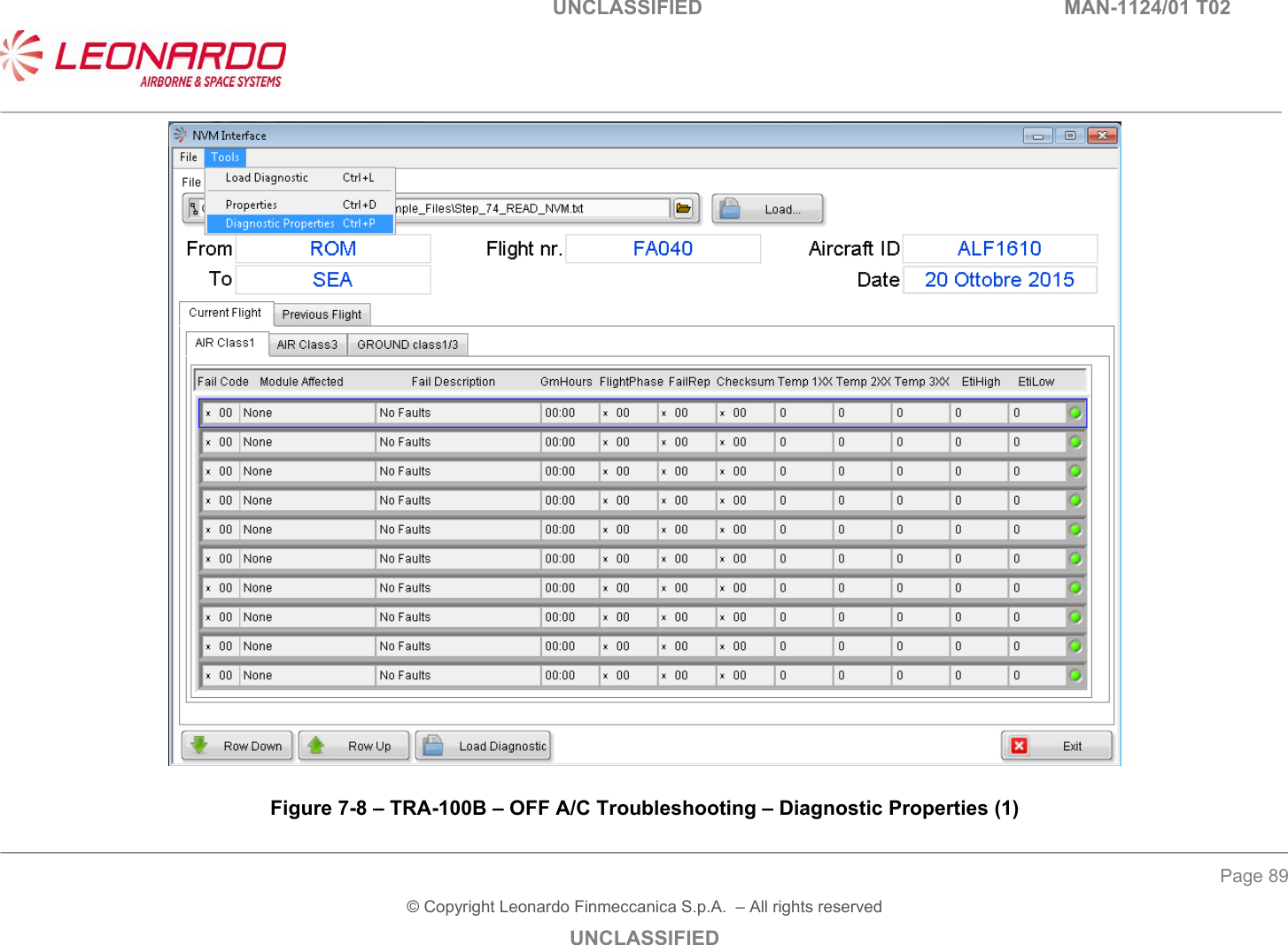
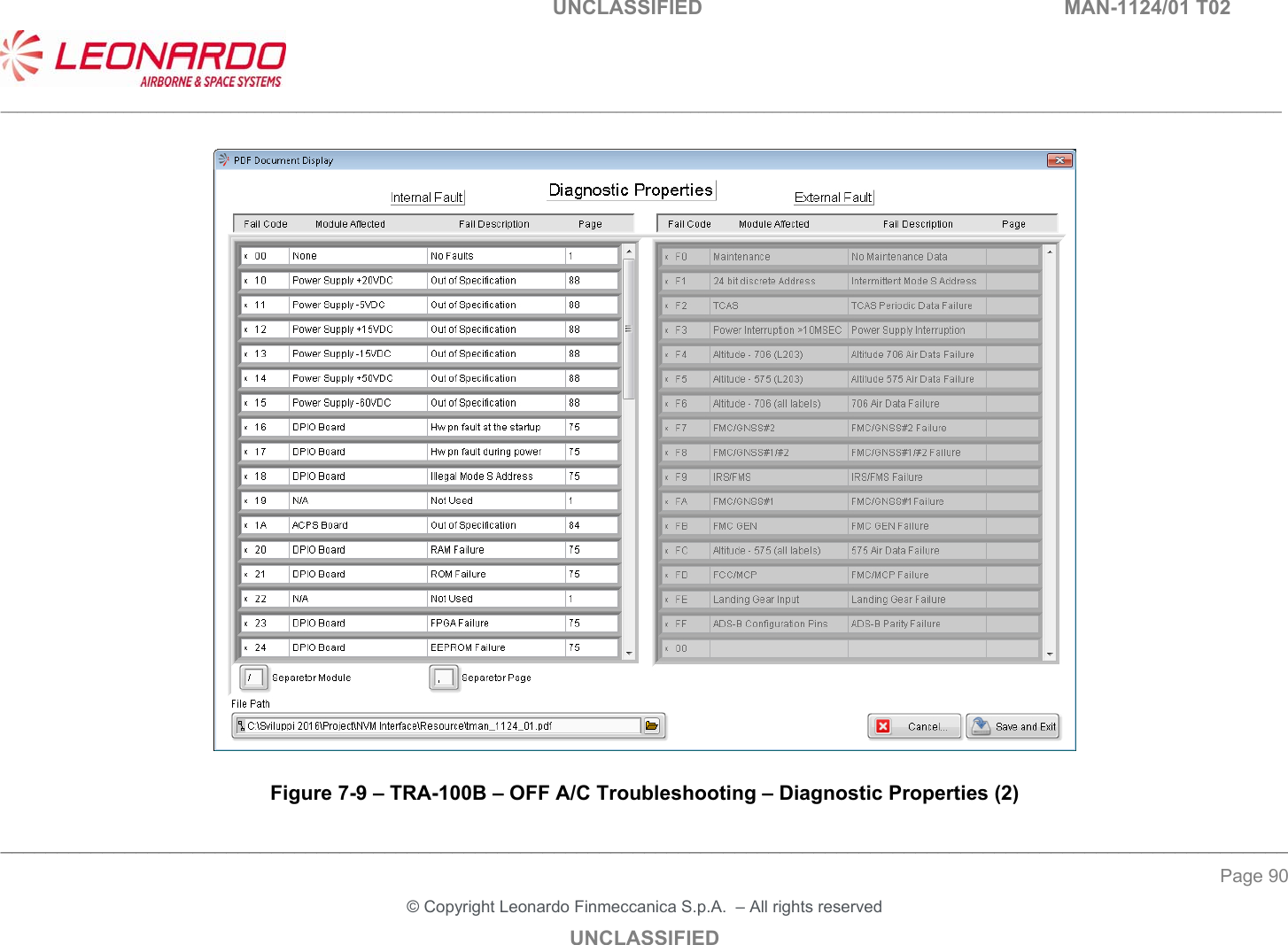
Leonardo S p a TRA100B Part 87 Aircraft Licensed Transmitter operating at 1090MHz User Manual tman 1124 02x

LEONARDO S.p.a. Part 87 Aircraft Licensed Transmitter operating at 1090MHz tman 1124 02x

Contents

Users manual 1
  UNCLASSIFIED  MAN-1124/01 T02    ___________________________________________________________________________________________________________ ______________________________________________________________________________ Page 1 © Copyright Leonardo Finmeccanica S.p.A.  – All rights reserved UNCLASSIFIED    TRA-100B Mode S Transponder (TRA-100B) Honeywell    Component Maintenance Manual (CMM)       MAN-1124/01 T Issue No. 02 Date 02-08-2016         Leonardo Finmeccanica S.p.A. Piazza Montegrappa, 4 00195 - Roma ITALY
  UNCLASSIFIED  MAN-1124/01 T02   ___________________________________________________________________________________________________________ ______________________________________________________________________________ Page 2 © Copyright Leonardo Finmeccanica S.p.A.  – All rights reserved UNCLASSIFIED         Page left intentionally blank
  UNCLASSIFIED  MAN-1124/01 T02   ___________________________________________________________________________________________________________ ______________________________________________________________________________ Page 3 © Copyright Leonardo Finmeccanica S.p.A.  – All rights reserved UNCLASSIFIED  Revision List    Date of Issue  Issue Number  Revision History 18-12-2015  01  First Issue 02-08-2016  02  Updated to include Honeywell comments          This document is composed of 112 pages.
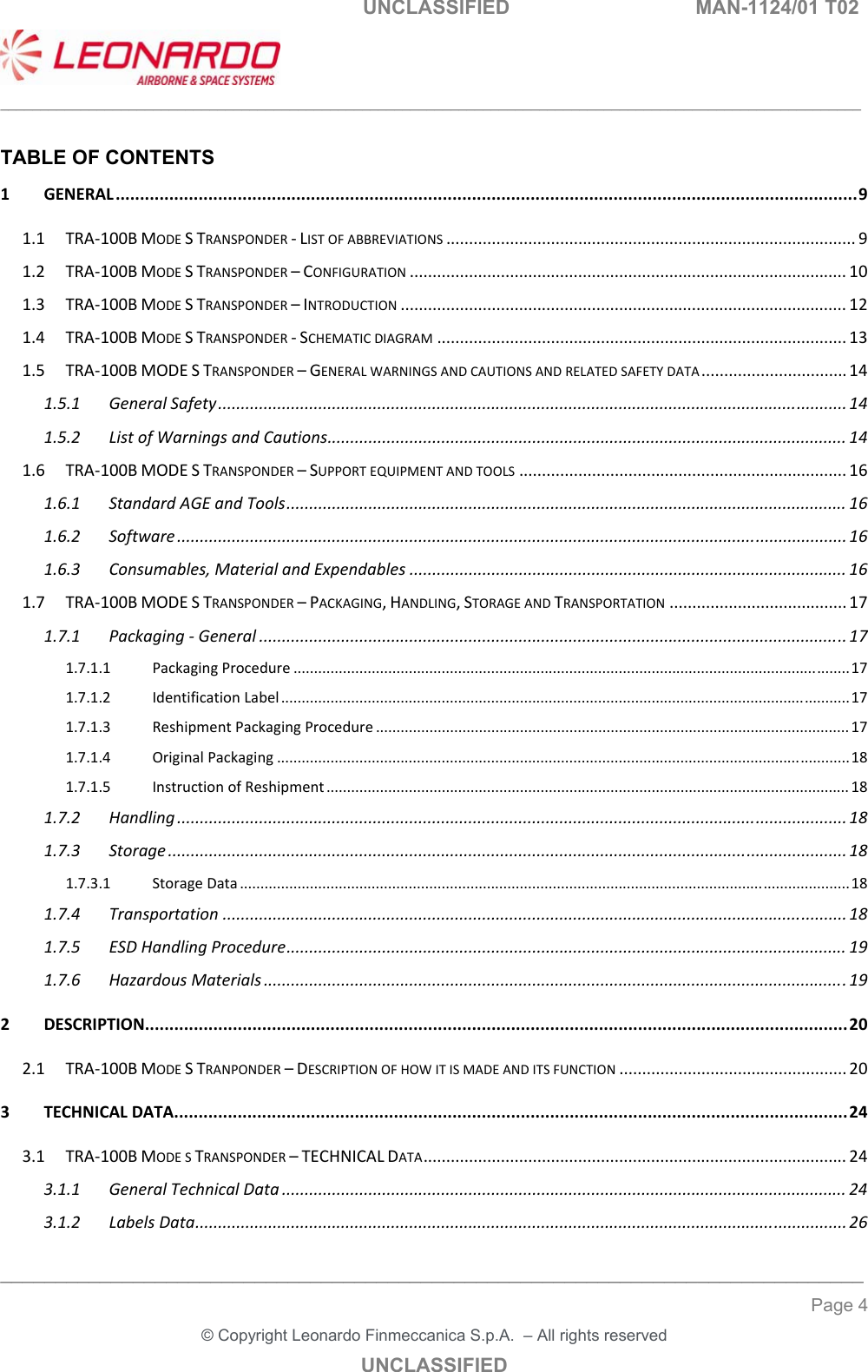
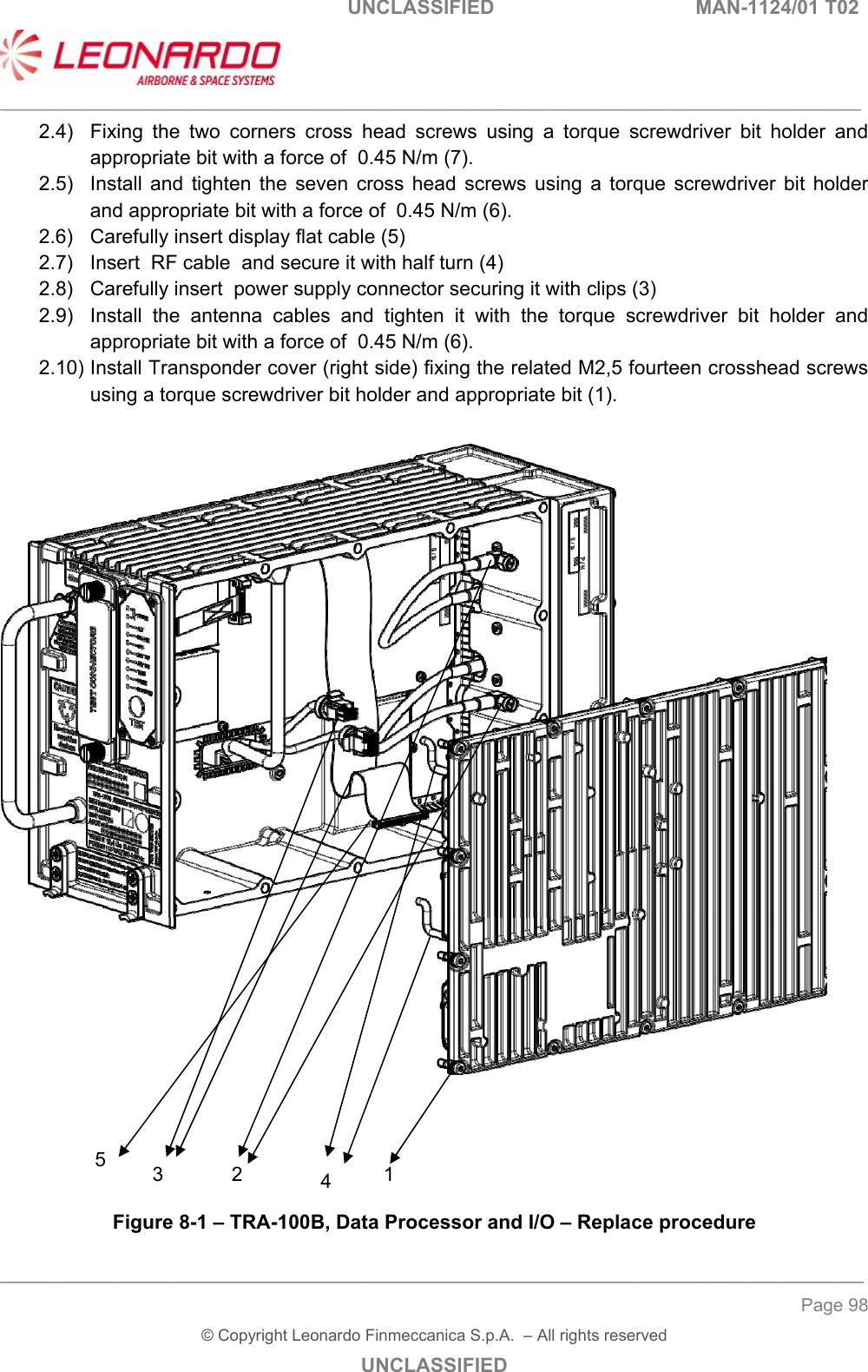
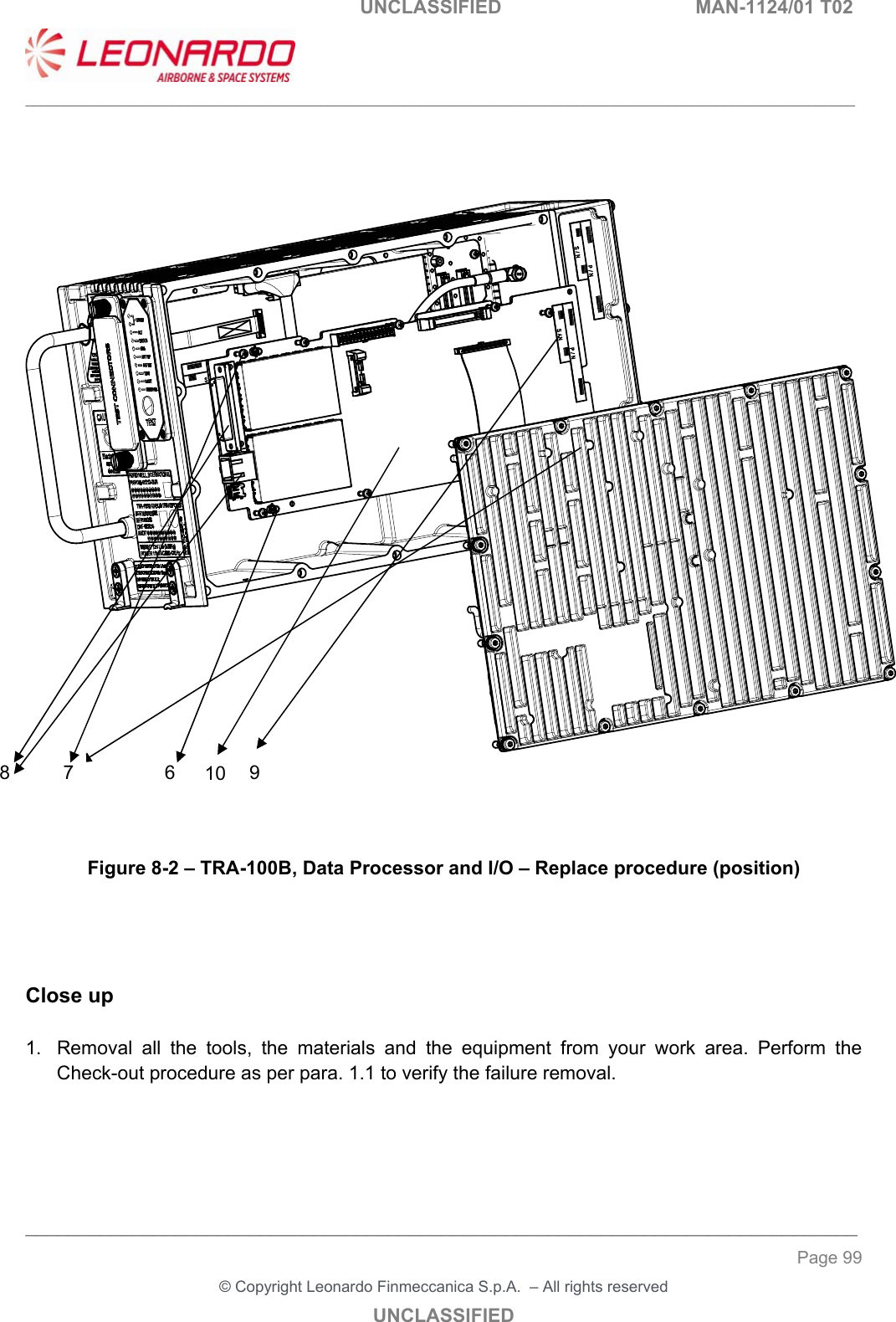
  UNCLASSIFIED  MAN-1124/01 T02   ___________________________________________________________________________________________________________ ______________________________________________________________________________ Page 4 © Copyright Leonardo Finmeccanica S.p.A.  – All rights reserved UNCLASSIFIED  TABLE OF CONTENTS 1GENERAL........................................................................................................................................................91.1TRA‐100BMODESTRANSPONDER‐LISTOFABBREVIATIONS..........................................................................................91.2TRA‐100BMODESTRANSPONDER–CONFIGURATION................................................................................................101.3TRA‐100BMODESTRANSPONDER–INTRODUCTION..................................................................................................121.4TRA‐100BMODESTRANSPONDER‐SCHEMATICDIAGRAM..........................................................................................131.5TRA‐100BMODESTRANSPONDER–GENERALWARNINGSANDCAUTIONSANDRELATEDSAFETYDATA................................141.5.1GeneralSafety..........................................................................................................................................141.5.2ListofWarningsandCautions..................................................................................................................141.6TRA‐100BMODESTRANSPONDER–SUPPORTEQUIPMENTANDTOOLS........................................................................161.6.1StandardAGEandTools...........................................................................................................................161.6.2Software...................................................................................................................................................161.6.3Consumables,MaterialandExpendables................................................................................................161.7TRA‐100BMODESTRANSPONDER–PACKAGING,HANDLING,STORAGEANDTRANSPORTATION.......................................171.7.1Packaging‐General.................................................................................................................................171.7.1.1PackagingProcedure.......................................................................................................................................171.7.1.2IdentificationLabel..........................................................................................................................................171.7.1.3ReshipmentPackagingProcedure...................................................................................................................171.7.1.4OriginalPackaging...........................................................................................................................................181.7.1.5InstructionofReshipment...............................................................................................................................181.7.2Handling...................................................................................................................................................181.7.3Storage.....................................................................................................................................................181.7.3.1StorageData....................................................................................................................................................181.7.4Transportation.........................................................................................................................................181.7.5ESDHandlingProcedure...........................................................................................................................191.7.6HazardousMaterials................................................................................................................................192DESCRIPTION................................................................................................................................................202.1TRA‐100BMODESTRANPONDER–DESCRIPTIONOFHOWITISMADEANDITSFUNCTION..................................................203TECHNICALDATA..........................................................................................................................................243.1TRA‐100BMODESTRANSPONDER–TECHNICALDATA.............................................................................................243.1.1GeneralTechnicalData............................................................................................................................243.1.2LabelsData...............................................................................................................................................26
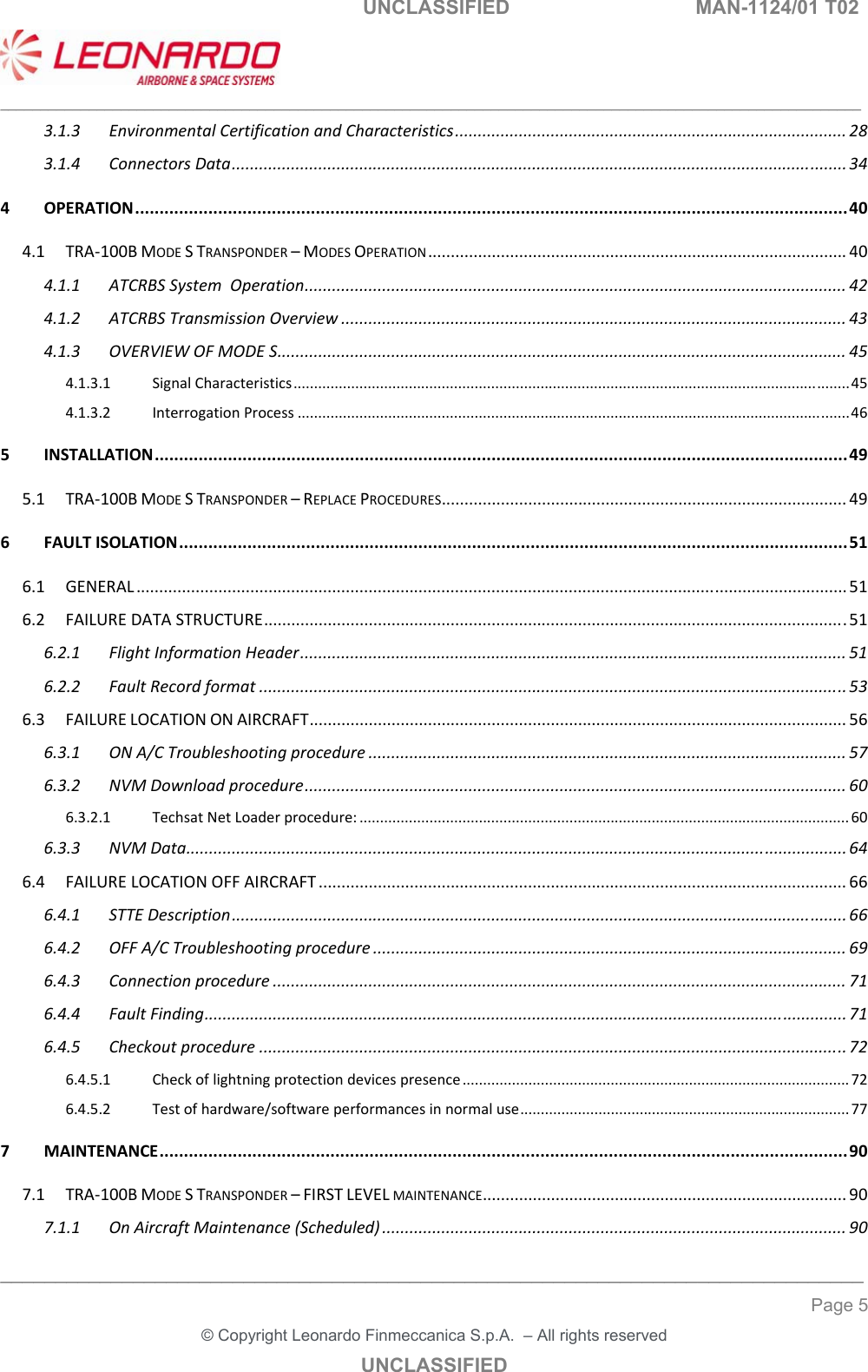
  UNCLASSIFIED  MAN-1124/01 T02   ___________________________________________________________________________________________________________ ______________________________________________________________________________ Page 5 © Copyright Leonardo Finmeccanica S.p.A.  – All rights reserved UNCLASSIFIED 3.1.3EnvironmentalCertificationandCharacteristics......................................................................................283.1.4ConnectorsData.......................................................................................................................................344OPERATION..................................................................................................................................................404.1TRA‐100BMODESTRANSPONDER–MODESOPERATION............................................................................................404.1.1ATCRBSSystemOperation.......................................................................................................................424.1.2ATCRBSTransmissionOverview...............................................................................................................434.1.3OVERVIEWOFMODES.............................................................................................................................454.1.3.1SignalCharacteristics.......................................................................................................................................454.1.3.2InterrogationProcess......................................................................................................................................465INSTALLATION..............................................................................................................................................495.1TRA‐100BMODESTRANSPONDER–REPLACEPROCEDURES.........................................................................................496FAULTISOLATION.........................................................................................................................................516.1GENERAL............................................................................................................................................................516.2FAILUREDATASTRUCTURE................................................................................................................................516.2.1FlightInformationHeader........................................................................................................................516.2.2FaultRecordformat.................................................................................................................................536.3FAILURELOCATIONONAIRCRAFT......................................................................................................................566.3.1ONA/CTroubleshootingprocedure.........................................................................................................576.3.2NVMDownloadprocedure.......................................................................................................................606.3.2.1TechsatNetLoaderprocedure:.......................................................................................................................606.3.3NVMData.................................................................................................................................................646.4FAILURELOCATIONOFFAIRCRAFT....................................................................................................................666.4.1STTEDescription.......................................................................................................................................666.4.2OFFA/CTroubleshootingprocedure........................................................................................................696.4.3Connectionprocedure..............................................................................................................................716.4.4FaultFinding.............................................................................................................................................716.4.5Checkoutprocedure.................................................................................................................................726.4.5.1Checkoflightningprotectiondevicespresence..............................................................................................726.4.5.2Testofhardware/softwareperformancesinnormaluse................................................................................777MAINTENANCE.............................................................................................................................................907.1TRA‐100BMODESTRANSPONDER–FIRSTLEVELMAINTENANCE................................................................................907.1.1OnAircraftMaintenance(Scheduled)......................................................................................................90
  UNCLASSIFIED  MAN-1124/01 T02   ___________________________________________________________________________________________________________ ______________________________________________________________________________ Page 6 © Copyright Leonardo Finmeccanica S.p.A.  – All rights reserved UNCLASSIFIED 7.1.2OnAircraftMaintenance(Unscheduled)..................................................................................................907.1.3Servicing...................................................................................................................................................907.2TRA‐100BMODESTRANSPONDER–CLEANING........................................................................................................917.3TRA‐100BMODESTRANSPONDER–INSPECTION......................................................................................................937.4TRA‐100BMODESTRANSPONDER–SECONDLEVELMAINTENANCE..............................................................................957.4.1TRA‐100B,DataProcessorandI/O–Replaceprocedure.........................................................................957.4.2TRA‐100B,RFSubassembly–Replaceprocedure.....................................................................................997.4.3TRA‐100B,ACPowerSupply(ACPS)–Replaceprocedure......................................................................1027.4.4TRA‐100B,DCPowerSupply(DCPS)–Replaceprocedure.....................................................................1067.4.5TRA‐100B,WiredChassis(WC)–Replaceprocedure..............................................................................1108ILLUSTRATEDPARTSDATA..........................................................................................................................1128.1TRA‐100BMODESTRANSPONDER‐ILLUSTRATEDPARTSDATA....................................................................................112
  UNCLASSIFIED  MAN-1124/01 T02   ___________________________________________________________________________________________________________ ______________________________________________________________________________ Page 7 © Copyright Leonardo Finmeccanica S.p.A.  – All rights reserved UNCLASSIFIED  LIST OF ILLUSTRATIONS  FIGURE 1-1 – TRA-100B MODE S TRANSPONDER - CONFIGURATION .................................................................. 11FIGURE 1-2 – TRA-100B MODE S TRANSPONDER - SCHEMATIC DIAGRAM ........................................................... 13FIGURE 2-1 – TRA-100B MODE S TRANSPONDER - DESCRIPTION OF HOW IT IS MADE .......................................... 20FIGURE 2-2 – TRA-100B MODE S TRANSPONDER – FUNCTIONAL DIAGRAM ........................................................ 23FIGURE 3-1 – TRA-100B MODE S TRANSPONDER  – TECHNICAL DATA ............................................................... 25FIGURE 3-1 – TRA-100B MODE S TRANSPONDER  – LABELS LAYOUT .................................................................. 27FIGURE 3-3 – TRA-100B MODE S TRANSPONDER – CONNECTORS ..................................................................... 34FIGURE 4-1 – ATCRBS SYSTEM ........................................................................................................................ 42FIGURE 4-2 – ATCRBS INTERROGATION WITHOUT SIDE LOBE SUPPRESSION (SLS) ............................................ 44FIGURE 4-3 – ATCRBS INTERROGATION WITH SIDE LOBE SUPPRESSION ............................................................ 44FIGURE 4-4 – INTERMODE (MODE A/C AND S) INTERROGATION ........................................................................... 47FIGURE 4-5 – MODE S INTERROGATION PULSE SEQUENCE ................................................................................. 47FIGURE 4-6 – MODE S REPLY ............................................................................................................................ 48FIGURE 5-1 – TRA-100B MODE S TRANSPONDER - REPLACE PROCEDURES ....................................................... 50FIGURE 6-1 – TRA-100B STTE (FRONT AND RIGHT VIEWS) ................................................................................ 67FIGURE 6-2 – TRA-100B STTE (REAR AND LEFT VIEWS) .................................................................................... 68FIGURE 6-3 – TRA-100B - FRONT PANEL LED ................................................................................................... 69FIGURE 6-4 – TRA-100B – OFF A/C TROUBLESHOOTING STTE NVM INTERFACE .............................................. 84FIGURE 6-5 – TRA-100B – OFF A/C TROUBLESHOOTING – DIAGNOSTIC PROPERTIES (1) ................................... 85FIGURE 6-6 – TRA-100B – OFF A/C TROUBLESHOOTING – DIAGNOSTIC PROPERTIES (2) ................................... 86FIGURE 6-4 – TRA-100B – OFF A/C TROUBLESHOOTING .................................................................................. 87FIGURE 6-5 – TRA-100B – OFF A/C TROUBLESHOOTING – DIAGNOSTIC PROPERTIES (1) ................................... 88FIGURE 6-6 – TRA-100B – OFF A/C TROUBLESHOOTING – DIAGNOSTIC PROPERTIES (2) ................................... 89FIGURE 7-1 – TRA-100B, DATA PROCESSOR AND I/O – REPLACE PROCEDURE ................................................... 97FIGURE 7-2 – TRA-100B, DATA PROCESSOR AND I/O – REPLACE PROCEDURE (POSITION) .................................. 98FIGURE 7-3 –TRA-100B, RF SUBASSEMBLY – REPLACE PROCEDURE ............................................................... 101FIGURE 7-4 – TRA-100B, AC POWER SUPPLY (ACPS) – REPLACE PROCEDURE ............................................... 104FIGURE 7-5 – TRA-100B, ACPS AND DCPS – REPLACE PROCEDURE (POSITION) ............................................. 105FIGURE 7-6 – TRA-100B, DC POWER SUPPLY (DCPS) – REPLACE PROCEDURE .............................................. 108FIGURE 7-7 – TRA-100B, ACPS AND DCPS – REPLACE PROCEDURE (POSITION) ............................................. 109
  UNCLASSIFIED  MAN-1124/01 T02   ___________________________________________________________________________________________________________ ______________________________________________________________________________ Page 8 © Copyright Leonardo Finmeccanica S.p.A.  – All rights reserved UNCLASSIFIED LIST OF TABLES  TABLE 1-1 - LIST OF ABBREVIATIONS .................................................................................................................... 9TABLE 1-2 – TRA-100B -  CONFIGURATION DATA ............................................................................................... 10TABLE 1-3 - TRA-100B – GENERAL WARNINGS, CAUTIONS AND RELATED SAFETY DATA ..................................... 14TABLE 1-4 - TRA-100B – STANDARD AGE AND TOOLS ....................................................................................... 16TABLE 1-5 – TRA-100B - SOFTWARE ................................................................................................................. 16TABLE 1-6 – TRA-100B - CONSUMABLES, MATERIAL AND EXPENDABLES ............................................................ 16TABLE 3-1 – TRA-100B - TECHNICAL DATA – GENERAL ...................................................................................... 24TABLE 3-2 – TRA-100B – DO-160G CERTIFICATION CATEGORIES ..................................................................... 28TABLE 3-3 – TRA-100B – ABD100 1.2 G CERTIFICATION CATEGORIES .............................................................. 29TABLE 3-4 – TRA-100B – ABD100 1.6 D CERTIFICATION CATEGORIES .............................................................. 31 TABLE 3-5 – TRA-100B – ABD100 1.8 E CERTIFICATION CATEGORIES .............................................................. 31TABLE 3-6 – TRA-100B – D6-44800-1 CERTIFICATION CATEGORIES .................................................................. 31TABLE 3-7 – TRA-100B – D6-81926 CERTIFICATION CATEGORIES ..................................................................... 31TABLE 3-8 – TRA-100B – MIL STD 810F CERTIFICATION CATEGORIES .............................................................. 31TABLE 3-9 – TRA-100B – ASTM D1149 CERTIFICATION CATEGORIES ............................................................... 32TABLE 3-10 – TRA-100B – D6/ 16050-4 CERTIFICATION CATEGORIES ............................................................... 32TABLE 3-11 – TRA-100B – D6-44800-1 CERTIFICATION CATEGORIES ................................................................ 33TABLE 3-12 – TRA-100B - TECHNICAL DATA – CONNECTORS ............................................................................. 34TABLE 3-13 – TRA-100B - TECHNICAL DATA – MAIN CONNECTOR PIN MAPPING .................................................. 35TABLE 6-1 – TRA-100B –  INTERNAL FAULTS ..................................................................................................... 54TABLE 6-2 – TRA-100B – EXTERNAL FAULTS ..................................................................................................... 55TABLE 6-3 – TRA-100B – MALFUNCTION SYMPTOMS ......................................................................................... 57TABLE 6-4 - EXTERNAL FAULTS MAINTENANCE PROCEDURE ................................................................................ 64TABLE 6-5 – TRA-100B STTE  COMPOSITION .................................................................................................... 66TABLE 6-6 – TRA-100B - FRONT PANEL LED INDICATORS .................................................................................. 70TABLE 6-7 – TRA-100B - TRANSZORB TEST PARAMETERS ................................................................................. 73
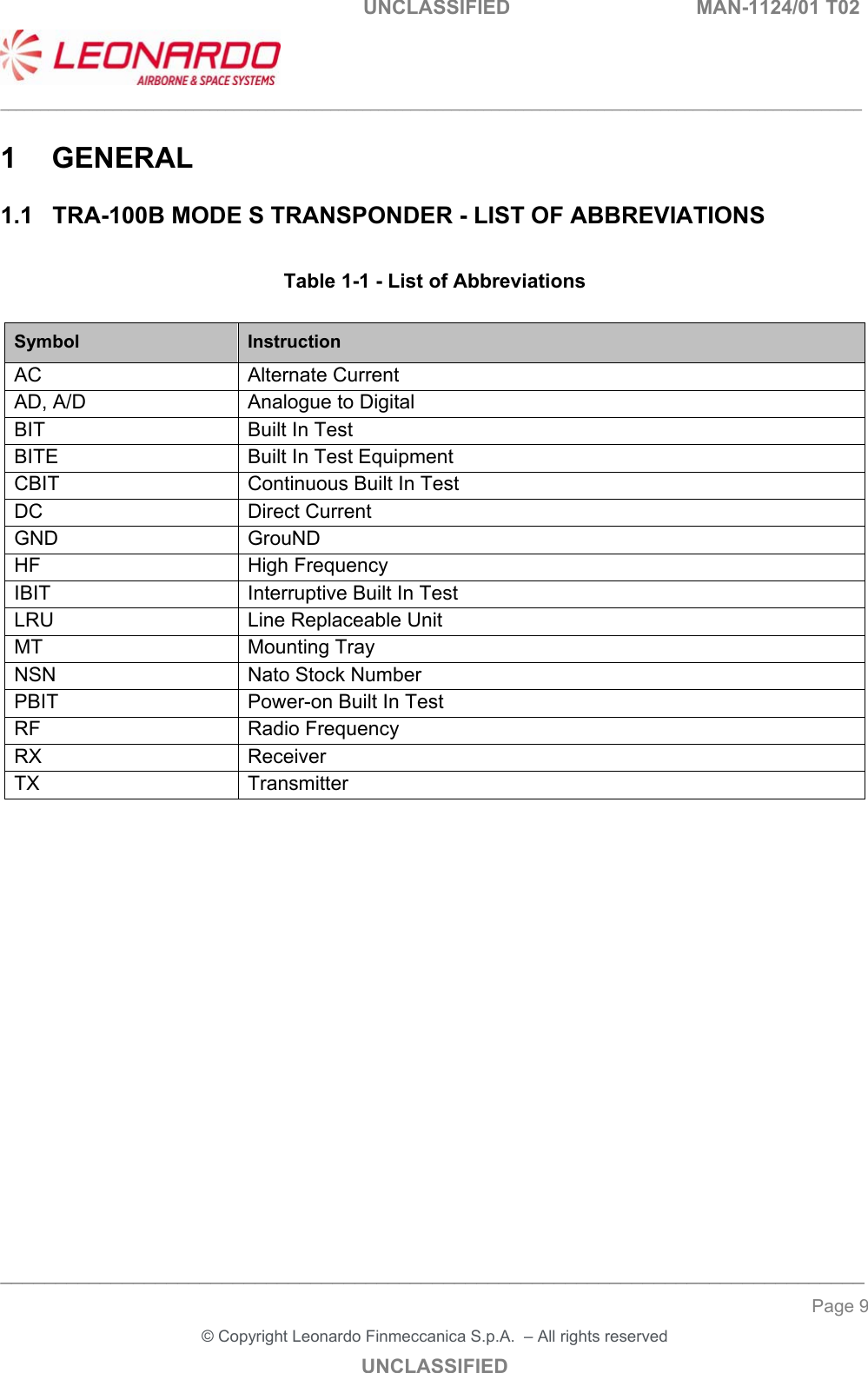
  UNCLASSIFIED  MAN-1124/01 T02   ___________________________________________________________________________________________________________ ______________________________________________________________________________ Page 9 © Copyright Leonardo Finmeccanica S.p.A.  – All rights reserved UNCLASSIFIED 1  GENERAL 1.1  TRA-100B MODE S TRANSPONDER - LIST OF ABBREVIATIONS  Table 1-1 - List of Abbreviations  Symbol  Instruction AC  Alternate Current AD, A/D  Analogue to Digital BIT  Built In Test BITE  Built In Test Equipment CBIT  Continuous Built In Test DC  Direct Current GND  GrouND HF  High Frequency IBIT  Interruptive Built In Test LRU  Line Replaceable Unit MT  Mounting Tray NSN  Nato Stock Number PBIT  Power-on Built In Test RF  Radio Frequency RX  Receiver TX  Transmitter
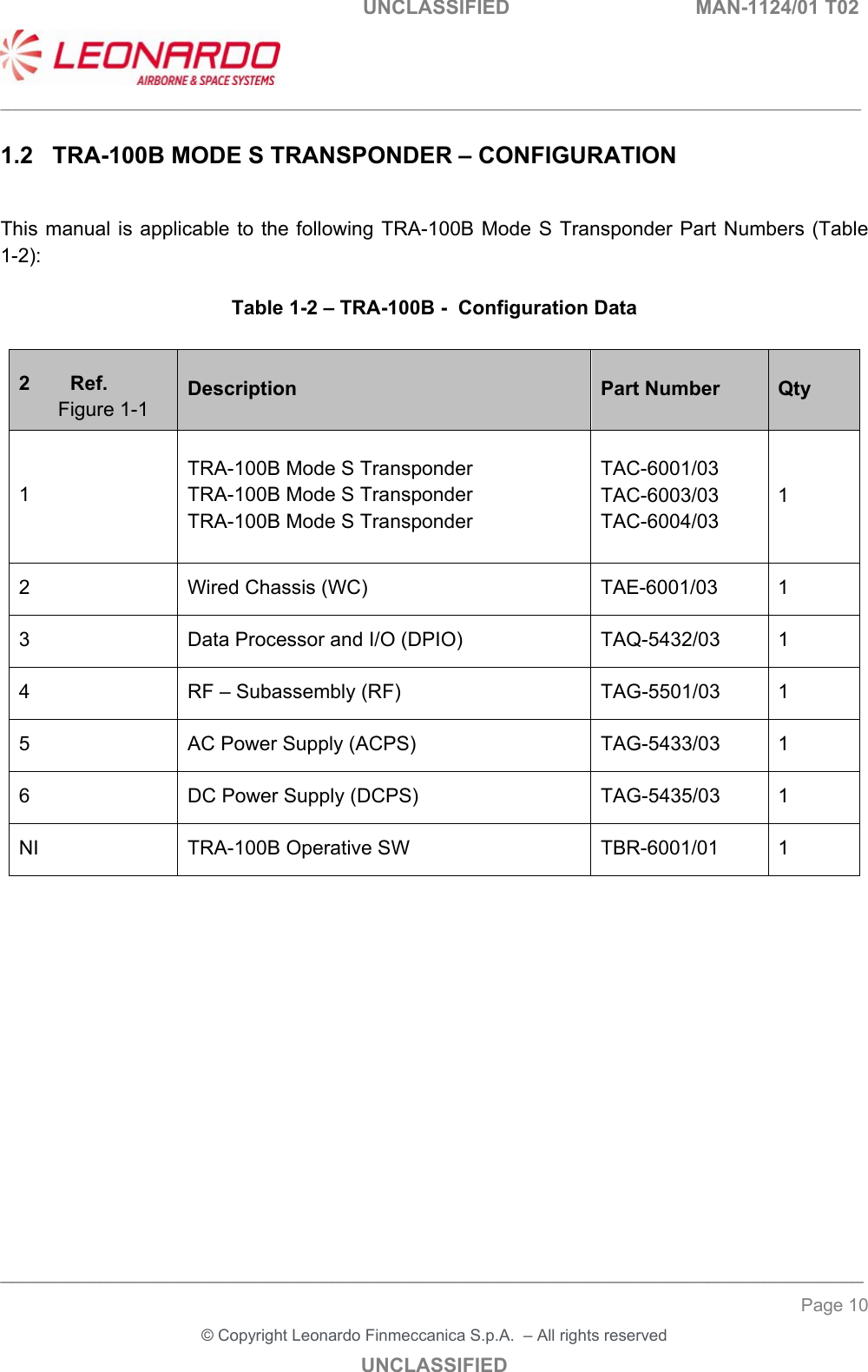
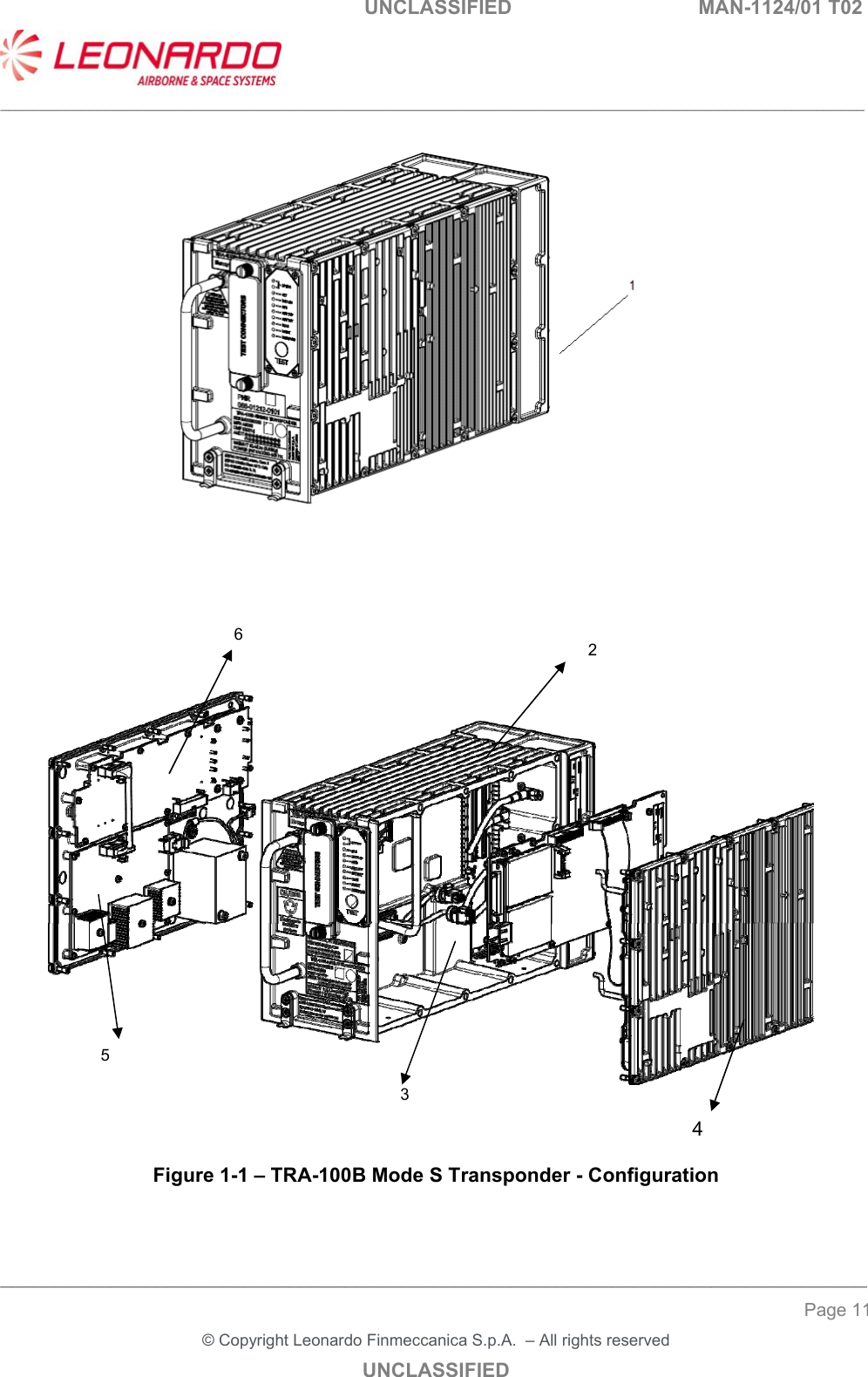
  UNCLASSIFIED  MAN-1124/01 T02   ___________________________________________________________________________________________________________ ______________________________________________________________________________ Page 10 © Copyright Leonardo Finmeccanica S.p.A.  – All rights reserved UNCLASSIFIED 1.2  TRA-100B MODE S TRANSPONDER – CONFIGURATION  This manual  is applicable to the following TRA-100B Mode S Transponder Part Numbers (Table 1-2):  Table 1-2 – TRA-100B -  Configuration Data  2  Ref. Figure 1-1 Description  Part Number  Qty 1  TRA-100B Mode S Transponder  TRA-100B Mode S Transponder  TRA-100B Mode S Transponder   TAC-6001/03 TAC-6003/03 TAC-6004/03 1 2  Wired Chassis (WC)  TAE-6001/03  1 3  Data Processor and I/O (DPIO)  TAQ-5432/03  1 4  RF – Subassembly (RF)  TAG-5501/03  1 5  AC Power Supply (ACPS)  TAG-5433/03  1 6  DC Power Supply (DCPS)  TAG-5435/03  1 NI  TRA-100B Operative SW  TBR-6001/01  1
  UNCLASSIFIED  MAN-1124/01 T02   ___________________________________________________________________________________________________________ ______________________________________________________________________________ Page 11 © Copyright Leonardo Finmeccanica S.p.A.  – All rights reserved UNCLASSIFIED          Figure 1-1 – TRA-100B Mode S Transponder - Configuration  6 5 2 4 3
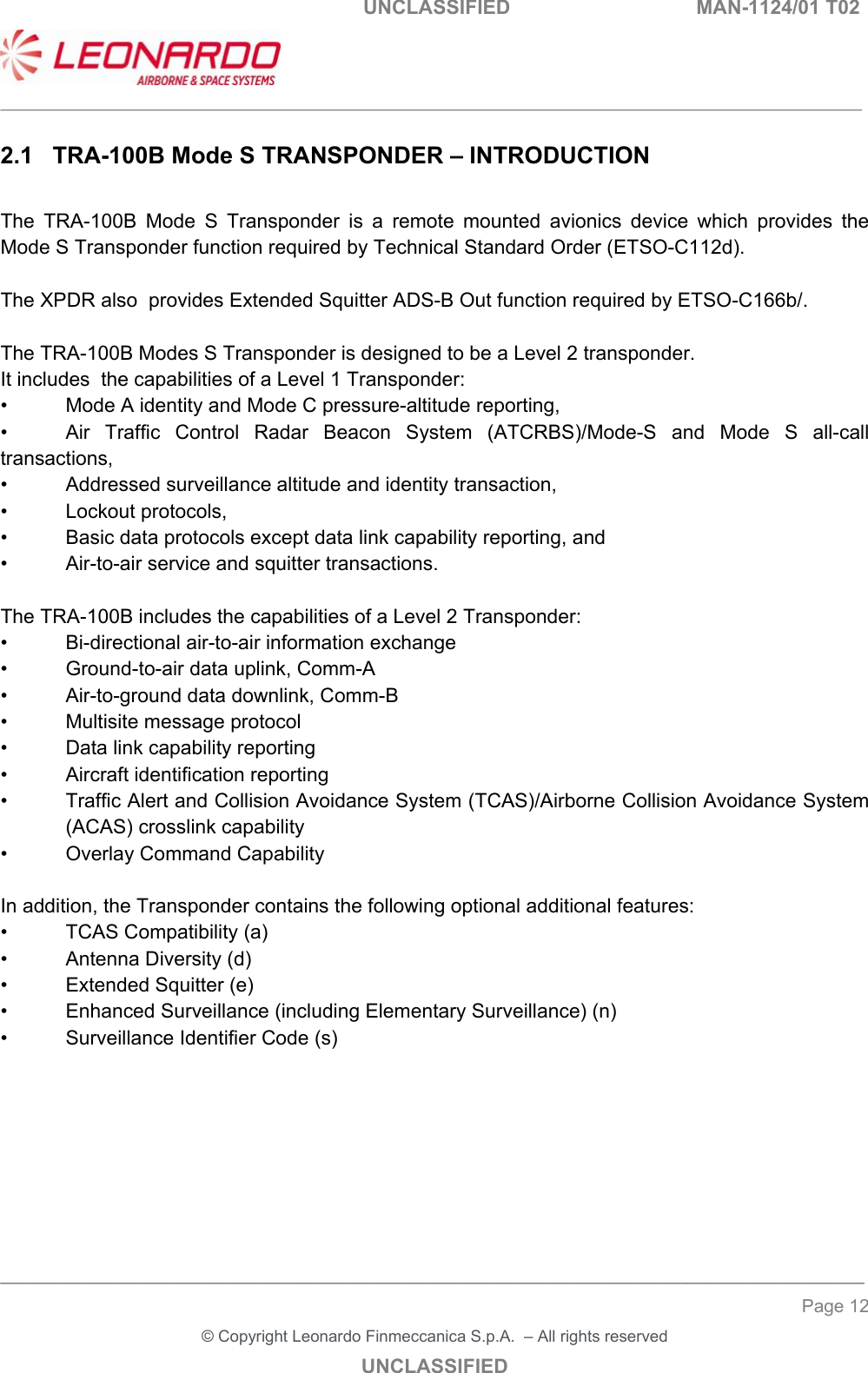
  UNCLASSIFIED  MAN-1124/01 T02   ___________________________________________________________________________________________________________ ______________________________________________________________________________ Page 12 © Copyright Leonardo Finmeccanica S.p.A.  – All rights reserved UNCLASSIFIED 2.1  TRA-100B Mode S TRANSPONDER – INTRODUCTION  The  TRA-100B  Mode  S  Transponder  is  a  remote  mounted  avionics  device  which  provides  the Mode S Transponder function required by Technical Standard Order (ETSO-C112d).   The XPDR also  provides Extended Squitter ADS-B Out function required by ETSO-C166b/.  The TRA-100B Modes S Transponder is designed to be a Level 2 transponder.  It includes  the capabilities of a Level 1 Transponder: •  Mode A identity and Mode C pressure-altitude reporting, •  Air  Traffic  Control  Radar  Beacon  System  (ATCRBS)/Mode-S  and  Mode  S  all-call transactions, •  Addressed surveillance altitude and identity transaction, •  Lockout protocols, •  Basic data protocols except data link capability reporting, and •  Air-to-air service and squitter transactions.  The TRA-100B includes the capabilities of a Level 2 Transponder: •  Bi-directional air-to-air information exchange •  Ground-to-air data uplink, Comm-A •  Air-to-ground data downlink, Comm-B •  Multisite message protocol •  Data link capability reporting •  Aircraft identification reporting •  Traffic Alert and Collision Avoidance System (TCAS)/Airborne Collision Avoidance System (ACAS) crosslink capability •  Overlay Command Capability  In addition, the Transponder contains the following optional additional features: •  TCAS Compatibility (a) •  Antenna Diversity (d) •  Extended Squitter (e) •  Enhanced Surveillance (including Elementary Surveillance) (n) •  Surveillance Identifier Code (s)
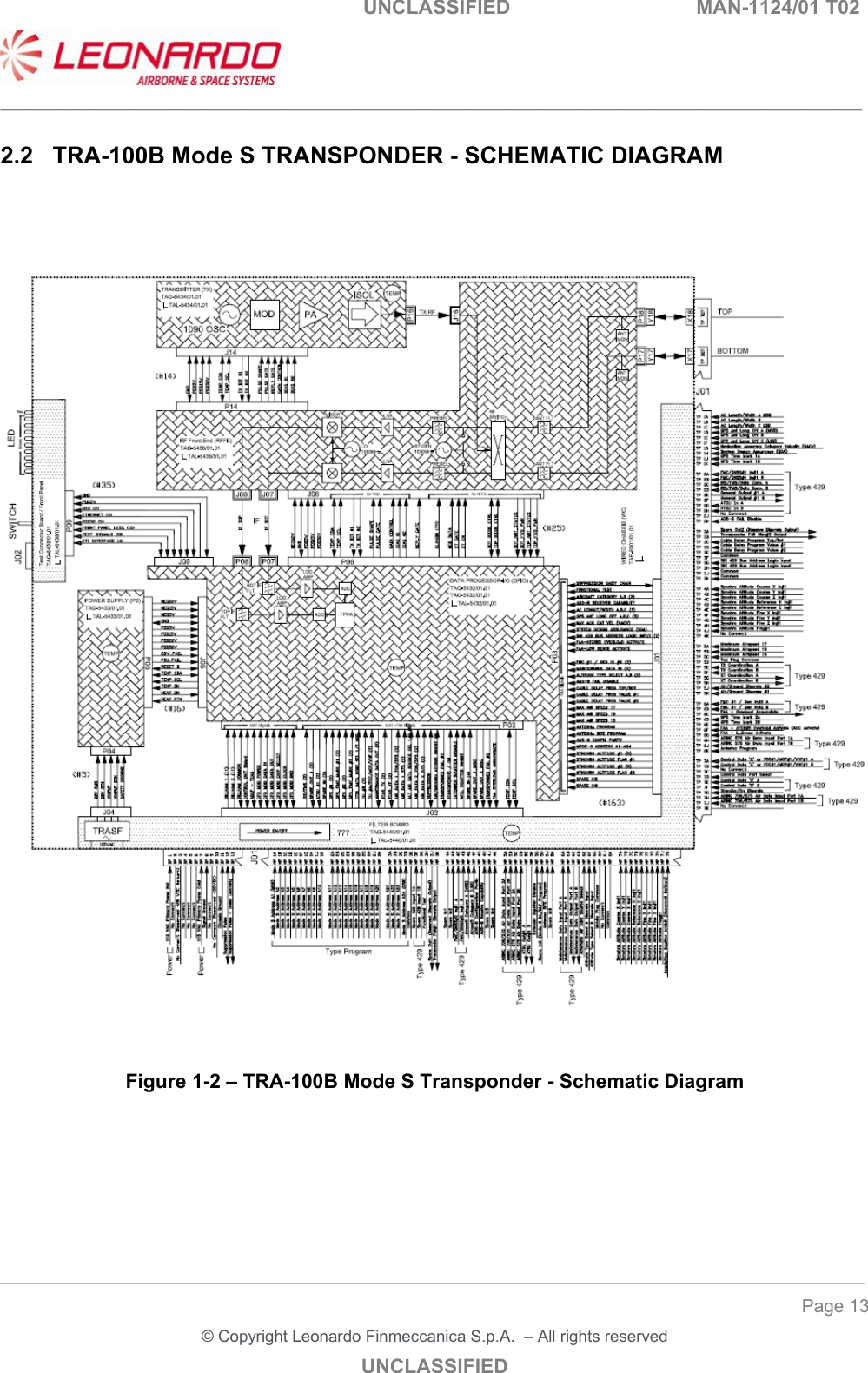
  UNCLASSIFIED  MAN-1124/01 T02   ___________________________________________________________________________________________________________ ______________________________________________________________________________ Page 13 © Copyright Leonardo Finmeccanica S.p.A.  – All rights reserved UNCLASSIFIED 2.2  TRA-100B Mode S TRANSPONDER - SCHEMATIC DIAGRAM       Figure 1-2 – TRA-100B Mode S Transponder - Schematic Diagram
  UNCLASSIFIED  MAN-1124/01 T02   ___________________________________________________________________________________________________________ ______________________________________________________________________________ Page 14 © Copyright Leonardo Finmeccanica S.p.A.  – All rights reserved UNCLASSIFIED 2.3  TRA-100B  MODE  S  TRANSPONDER  –  GENERAL  WARNINGS  AND CAUTIONS AND RELATED SAFETY DATA 2.3.1  General Safety   Before  you  do  maintenance  procedures  on  the  Unit  make  sure  that  you  know  the necessary safety data.   Before you work on the Unit, make sure that the electrical power supply is Removed from the Unit. Energized circuits can cause injury to persons.   Before  you  work  on  the  Unit,  make  sure  that  you  have  the  correct  personal  safety equipment.  You  must  use  or  wear  the  correct  personal  safety  equipment  to  prevent injuries.   Handle all the equipment carefully. This will help to prevent damage to it. 2.3.2  List of Warnings and Cautions  Table 1-3 - TRA-100B – General Warnings, Cautions And Related Safety Data   Symbol  Message  WARNING Make sure that the equipment is disconnected from all electrical power sources before you do any maintenance work.  WARNING The  internal  components  use  high  voltages  that  can  cause  injury or death to personnel.   WARNING Perform task in ventilated area and use protective clothing.   WARNING Denatured  Alcohol,  Electro  Contact  Cleaner  and  Conductive  Anti-seizure Compound are  dangerous  materials. Make sure that you know the safety precautions and the first aid instructions.
  UNCLASSIFIED  MAN-1124/01 T02   ___________________________________________________________________________________________________________ ______________________________________________________________________________ Page 15 © Copyright Leonardo Finmeccanica S.p.A.  – All rights reserved UNCLASSIFIED      CAUTION The internal components of the equipment are Electro-Static Discharge (ESD)  sensitive  devices.  Do  not  touch  the  pins  of  the  electrical connectors.  Electrostatic  discharge  can  cause  damage  to  these components. Install protective caps on all electrical connectors immediately after you disconnect them to prevent the ingress of dirt.    WARNING Always handle the equipment with care to prevent damage.
  UNCLASSIFIED  MAN-1124/01 T02   ___________________________________________________________________________________________________________ ______________________________________________________________________________ Page 16 © Copyright Leonardo Finmeccanica S.p.A.  – All rights reserved UNCLASSIFIED 2.4  TRA-100B  MODE  S  TRANSPONDER  –  SUPPORT  EQUIPMENT  AND TOOLS 2.4.1  Standard AGE and Tools  Table 1-4 - TRA-100B – Standard AGE and Tools Nomenclature  Identification  Qty Soft Brush  Local Supply  1 Torque Screwdriver bit holder  Local Supply  1 Bit cross-point sz. 2  Local Supply  1 Bit hex open end 8 mm.  Local Supply  1    2.4.2  Software Table 1-5 – TRA-100B - Software Nomenclature  Identification TRA-100B_MPC STTE Software    TIU-0077/01.01* *The STTE Software is applicable for the Transponder configurations described in this manual.  2.4.3  Consumables, Material and Expendables Table 1-6 – TRA-100B - Consumables, Material and Expendables Nomenclature  Specification  Commercial designation  Manufacturer Qty  Remarks Denatured Alcohol  AA-M-L.422e  S-738  D9478   A/R  Dangerous material Electro  Contact Cleaner    QD 02130  1   02344  1  Dangerous material Lint free cloth        1  Local supply
  UNCLASSIFIED  MAN-1124/01 T02   ___________________________________________________________________________________________________________ ______________________________________________________________________________ Page 17 © Copyright Leonardo Finmeccanica S.p.A.  – All rights reserved UNCLASSIFIED 2.5  TRA-100B  MODE  S  TRANSPONDER  –  PACKAGING,  HANDLING, STORAGE AND TRANSPORTATION These procedures are applicable to the Transponder and to all its units.  2.5.1  Packaging - General Packaging includes all the activities necessary to prepare the units for transportation.  The  packaging  procedures  are  mandatory  to  avoid  any  damage  to  the  units  during  transport, handling and storage.    Each unit is packed separately in its own container.   The packaging procedures are applicable to all the units of the system.   Packaging is carried out according to “Commercial Standard”.   The packaging procedures are applicable to the initial packaging of the units, the return after repair packaging as well as the reshipment procedure. 2.5.1.1 Packaging Procedure   Insert the unit in a shielding envelope and close it with a warning ESD adhesive label   Wrap the unit in protective ‘bubble wrap’, hold together with adhesive tape.    Put the wrapped item in a commercial cardboard box of suitable dimensions.   Line the box with “Instapak foam” or ‘Pluriball” in a way to prevent the unit from moving inside the box.   Seal the box with adhesive tape.   Place an identification label on the outside of the IP package describing the contents. 2.5.1.2 Identification Label The label on the box must include the following data:   Company Name or Logo (Sender)   Quantity of items per pack   Contract Number   Description of part   Part Number   Gross Weight   NSN (if applicable)   Details of receiver. 2.5.1.3  Reshipment Packaging Procedure Follow the packaging procedures described above.  The  units  do  not  require  any  special  preparation  for  reshipment.  Observe  general  methods  and conditions requested for handling electronic equipment.
  UNCLASSIFIED  MAN-1124/01 T02   ___________________________________________________________________________________________________________ ______________________________________________________________________________ Page 18 © Copyright Leonardo Finmeccanica S.p.A.  – All rights reserved UNCLASSIFIED 2.5.1.4 Original Packaging Commercial Standard packaging is generally considered as not reusable. It is the responsibility of the packing personnel to decide whether packaging material can be safely reused. 2.5.1.5  Instruction of Reshipment No  special  disassembly  is  required  prior  to  shipping  the  entire  units.  Follow  the  instructions described in the Initial packaging procedures to pack the units for reshipment. 2.5.2  Handling The TRA-100B does not require special procedures for unit removal and installation    The gross weight is indicated on the identification label placed on the outside of each box.   The  weight  of  each  LRU  of  the  TRA-100B  Mode  S  Transponder  is  less  7  Kg  excluding packaging.   Special provisions and equipment (forklift etc.) are not required for handling the units.   The containers of the equipment do not have handles or lifting devices.   No lifting requirements are indicated on the containers.   Handle the units with care to avoid damage. 2.5.3  Storage The conditions listed in this document are relative to storage in a closed depot/warehouse and do not take into consideration water exposure, salt spray etc. The equipment must remain in the original shipment containers during storage. If  containers  have  been  opened  for  shipment  acceptance  and  they are stored in a humid environment, put dehumidifying bags inside the containers. The containers must be sealed again by using adhesive tape, this precaution is necessary to avoid damage from dust  and  humidity. Commercially available, desiccant (dehumidifying  bags) can be used. 2.5.3.1 Storage Data The environmental conditions while in storage must respect the following limits:   Maximum Relative Humidity <75%   Storage Temperature: Between -55 °C and +70°C;   Storage Life: 10 years   Store far from magnetic, electrical and electrostatic sources 2.5.4  Transportation The following transport conditions are applicable to the equipment and its components: •  Temperature: Between -55 °C and +70 °C
  UNCLASSIFIED  MAN-1124/01 T02   ___________________________________________________________________________________________________________ ______________________________________________________________________________ Page 19 © Copyright Leonardo Finmeccanica S.p.A.  – All rights reserved UNCLASSIFIED •  Maximum Relative Humidity: <75% •  Thermal shock: 10 °C/min •  Altitude: Max. 15000m (70 000ft)  The equipment must remain within its package during transport. 2.5.5  ESD Handling Procedure The  Unit  contains  static  devices.  Be  careful  when  you  work  on  electrostatic  discharge  sensitive devices:   Use an approved wrist strap that is connected to a ground point only when no electrical power is supplied to the system.   Do not touch the electric pins.   Use conductive blanking caps.   Use always an antistatic transport tray to move the equipment.   Install the protective caps on the electrical pins, after their disconnection, to protect them from electrostatic charge and avoid the entry of dust.   Do not open the Unit except in an approved static-free workshop.   Electrostatic discharge can cause damage to equipment or injury personnel. 2.5.6  Hazardous Materials None.
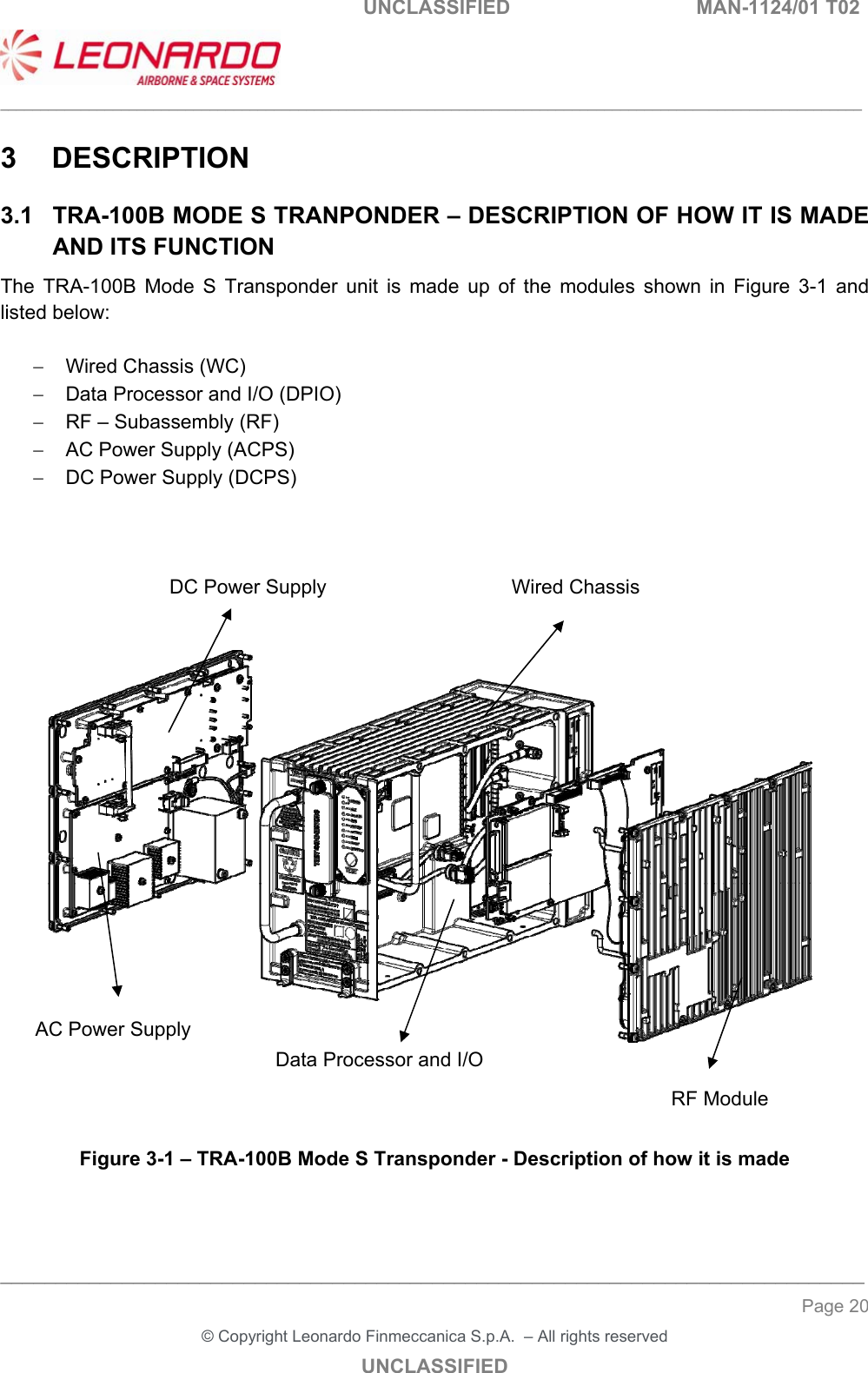
  UNCLASSIFIED  MAN-1124/01 T02   ___________________________________________________________________________________________________________ ______________________________________________________________________________ Page 20 © Copyright Leonardo Finmeccanica S.p.A.  – All rights reserved UNCLASSIFIED 3  DESCRIPTION 3.1  TRA-100B MODE S TRANPONDER – DESCRIPTION OF HOW IT IS MADE AND ITS FUNCTION The  TRA-100B  Mode  S  Transponder  unit  is  made  up  of  the  modules  shown  in  Figure  3-1  and listed below:    Wired Chassis (WC)   Data Processor and I/O (DPIO)   RF – Subassembly (RF)   AC Power Supply (ACPS)   DC Power Supply (DCPS)           Figure 3-1 – TRA-100B Mode S Transponder - Description of how it is made DC Power Supply AC Power Supply Wired Chassis RF Module Data Processor and I/O
  UNCLASSIFIED  MAN-1124/01 T02   ___________________________________________________________________________________________________________ ______________________________________________________________________________ Page 21 © Copyright Leonardo Finmeccanica S.p.A.  – All rights reserved UNCLASSIFIED The RFD, TXA and RXA modules combined are referred to as the RF module, and are responsible for  reception  and  transmission  functions.  The  processing  functions  are  carried  out  by  the  Data Processor as well as the Transponder Software (TS).  The  I/O  Interface  Module  together  with  the  Wired  Chassis  include  all  the  internal  and  external interfaces, while the AC and DC Power Supply are responsible for the supply of power to the unit (see Figure 3-2).  The  Wired  Chassis  (WCH)  implements  all  mechanical  functions  and  electrical  interconnections between modules; it includes:    I/O lines filtering   Power lines filtering   IO lines transient protection    AC input transformer   Front panel LEDs   The ACPS module receives 24 and 48 VAC from WCH transformer and generates internal 28VDC to DCPS. It generates AC INPUT FAIL signal to DCPS for BIT purposes  The DCPS module receives 28 VDC from ACPS and generates internal voltages to all modules:   It manages internal ON/OFF state   It manages power interruptions   It manages Power Supply BIT and protections  The DPIO-RX module includes two main sections: 1.  DPIO for Processing and I/O 2.  RX for RX IF processing  The processing section includes FPGA, Controller and Memories (RAM, FLASH) and manages:   all I/O processing   Interrogation/Reply protocols   TCAS and ADS-B functions   its own board BIT and Equipment BIT by collecting information from all modules    RF modules control (RFFE/TX)   I/O Section includes all I/O circuitry to implement discretes, 429 and other interfaces  The RX Section performs dual channel (TOP/BOT) IF RX processing:   IF Selectivity filtering   Log detection  ADC
  UNCLASSIFIED  MAN-1124/01 T02   ___________________________________________________________________________________________________________ ______________________________________________________________________________ Page 22 © Copyright Leonardo Finmeccanica S.p.A.  – All rights reserved UNCLASSIFIED The  RFFE  Module  performs  dual  (TOP/BOT)  antenna  interface  implementing  the  following functions:   TX/RX selection   TX path antenna switch (TOP/BOT)   TX path harmonic filtering   RX dual channel (TOP/BOT) independent pre-selection and LNA   RX dual channel (TOP/BOT) independent IF down conversion including LO generation   Self test signal generation   Self test Path selection  The TX Module performs all TX functions:   1090 MHz LO generation   Pulse modulation   RF amplification up to required level   It includes Tank capacitor to support fast current delivery to TX devices during reply pulse trains generation   Tank  Capacitor  is  also  used  to  support  hold-up  during  power  interruption  between  10ms and 200ms
  UNCLASSIFIED  MAN-1124/01 T02   ___________________________________________________________________________________________________________ ______________________________________________________________________________ Page 23 © Copyright Leonardo Finmeccanica S.p.A.  – All rights reserved UNCLASSIFIED      Figure 3-2 – TRA-100B Mode S Transponder – Functional Diagram
  UNCLASSIFIED  MAN-1124/01 T02  ___________________________________________________________________________________________________________ ______________________________________________________________________________ Page 24 © Copyright Leonardo Finmeccanica S.p.A.  – All rights reserved UNCLASSIFIED 4  TECHNICAL DATA 4.1  TRA-100B MODE S TRANSPONDER – TECHNICAL DATA 4.1.1  General Technical Data  Table 4-1 – TRA-100B - Technical data – General  Data  Value Manufacturers Part Numbers TAC-6001/03  TAC-6003/03  TAC-6004/03 Weight (Total mass)  < 7 kg Dimensions  194 mm x 124 x 318 (Height x Width x Depth) Output power  400W ± 100 W Operating temperature  -55°C +70°C Storage Conditions  -55°C +70°C
UNCLASSIFIED    MAN-1124/01 T02   ___________________________________________________________________________________________________________ ______________________________________________________________________________ Page 25 © Copyright Leonardo Finmeccanica S.p.A.  – All rights reserved UNCLASSIFIED   Figure 4-1 – TRA-100B Mode S Transponder  – Technical Data
  UNCLASSIFIED  MAN-1124/01 T02   ___________________________________________________________________________________________________________ ______________________________________________________________________________ Page 26 © Copyright Leonardo Finmeccanica S.p.A.  – All rights reserved UNCLASSIFIED 4.1.2  Labels Data The TRA-100B provides three different labels (ref. 3):   Leonardo Finmeccanica Id. Label (1)   Honeywell Id. Label (2)   Certifications Label (3)  The Leonardo Finmeccanica Id. Label contains the following info:  Data  Value Manufacturers Part Numbers TAC-6001/03  TAC-6003/03  TAC-6004/03  Manufacturer  Leonardo Finmeccanica Manufacturing Site  Montevarchi Manufacturing Country  Italy SER.  Serial Number MFR.  Manufacturer SNS (A0610) DMF  Date of Manufacturing (mmyyy) AMDT  Amendement Weight (Total mass)  14.5 Lbs. (6,58 Kg) Power  115 VAC/380-420 Hz.  The Honeywell Id. Label contains the following info: Data  Value Owner  HONEYWELL, International Owner Part Number PNR 066-01212-0101 PNR 066-01212-0301 PNR 066-01212-0301
  UNCLASSIFIED  MAN-1124/01 T02   ___________________________________________________________________________________________________________ ______________________________________________________________________________ Page 27 © Copyright Leonardo Finmeccanica S.p.A.  – All rights reserved UNCLASSIFIED Amendement  -   The Certification Label contains the following info: Data  Value ETSO/TSO Certification  ETSO C112d: L2 adens, Class 1 ETSO C166b: Class A2 Tx only DO/ED 178B/12B B: D 254/80 B 160/14G   PNR  066-01212-0101TSO  C112d: xxx  C166b: xxxDO-178B: B,D    DO-160GAMDT 01  02  03  04  05  06  07  08  09  1011  12  13  14  15  16  17  18  19  20TRA-100B TRANSPONDERSERMFR A0069DMFWEIGHT  14,5 Lbs (6,58 Kg)POWER 115 VAC/380-420 HzMFR PNRTAC-6001/01Selex ES S.p.AQA01M0000000001/2013REMOVE COVER TO ACCESSSUPPORT TEST CONNECTORS    Figure 4-2 – TRA-100B Mode S Transponder  – Labels layout 2 3 1
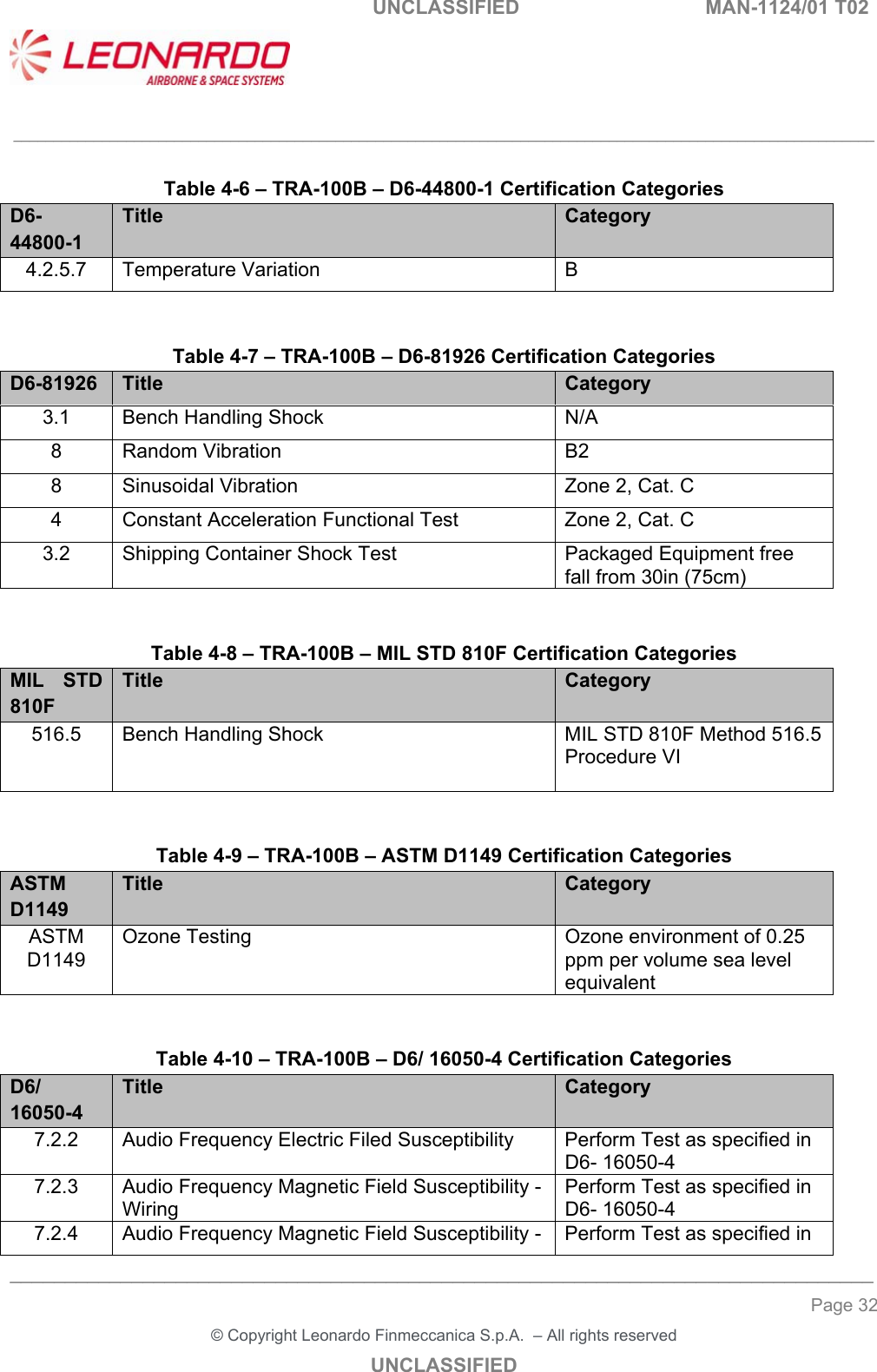
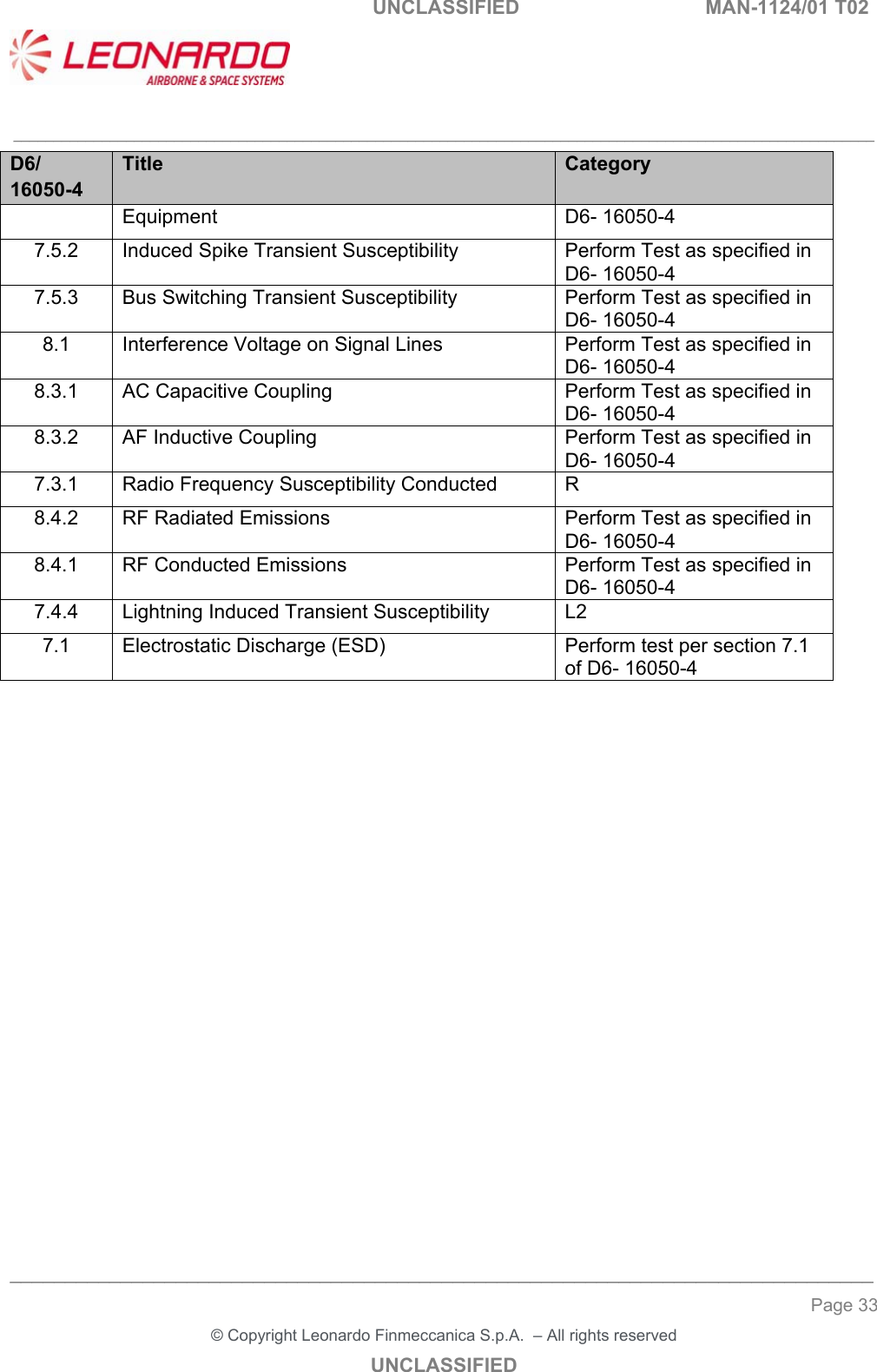
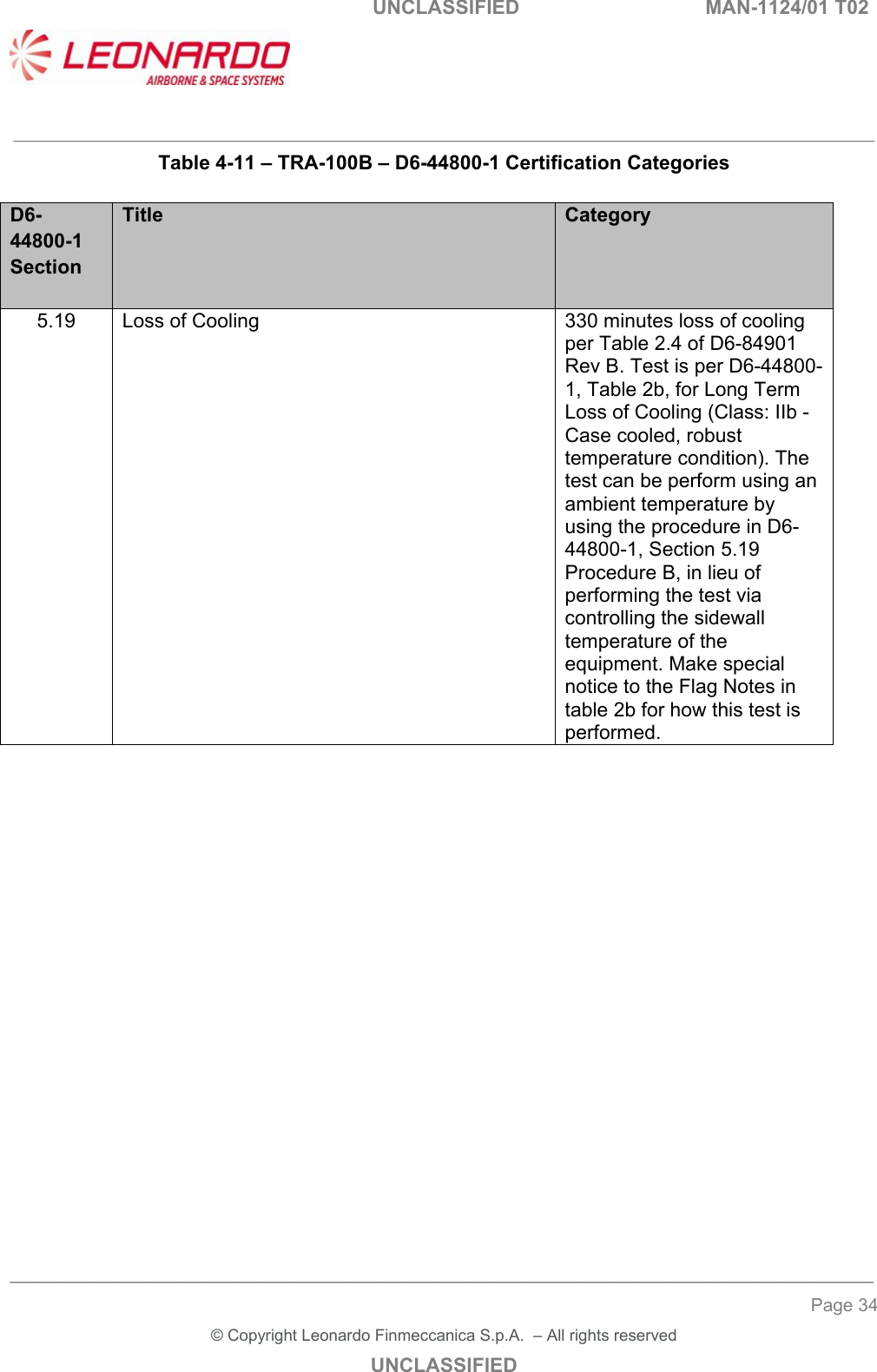
  UNCLASSIFIED  MAN-1124/01 T02   ___________________________________________________________________________________________________________ ______________________________________________________________________________ Page 28 © Copyright Leonardo Finmeccanica S.p.A.  – All rights reserved UNCLASSIFIED 4.1.3  Environmental Certification and Characteristics The TRA-100B meets the environmental conditions of the Radio Technical Commission for the Aeronautics (RTCA) document number DO-160G “Environmental Conditions and Test Procedures for Airline Electronic/Electrical Equipment and Instruments” (Table 4-2).  Additionally to the DO-160G, the following documents have been used to further certification:    ABD100 1.2 G (Table 4-3)   ABD100 1.6 D (Table 4-4)   ABD100 1.8 E (Table 4-5)   D6-44800-1 (Table 4-6)   D6-81926 (Table 4-7)   MIL STD 810F (Table 4-8)   ASTM D1149 (Table 4-9)   D6/ 16050-4 (Table 4-10)   D6-44800-1  (
  UNCLASSIFIED  MAN-1124/01 T02   ___________________________________________________________________________________________________________ ______________________________________________________________________________ Page 29 © Copyright Leonardo Finmeccanica S.p.A.  – All rights reserved UNCLASSIFIED Table 4-11)  Table 4-2 – TRA-100B – DO-160G Certification Categories DO-160G  Title  Category 4.5.1  Ground Survival Low Temperature Test  A2 4.5.1  Ground Survival Low Temperature Test Short-Time Operating Low Temperature F2 4.5.2  Operating Low Temperature Test  A2 4.5.2  Operating Low Temperature Test  F2 4.5.3  Ground Survival High Temperature Test Short-Time High Operating A2F2 4.5.4  Operating High Temperature Test  A2F2 4.6.1  Altitude Test  A2 4.6.1  Altitude Test  F2 4.6.2  Decompression Test  A2 4.6.3  Overpressure Test  A2 5  Temperature Variation  B 6  Humidity  A, B 7  Operational Shocks and Crash Safety  B, D, A 8  Vibrations  S H 9  Explosive Atmosphere  E 10  Waterproofness  W Y 11  Fluids Susceptibility  F 12  Sand and Dust  D 13  Fungus Resistance  F 15  Magnetic Effect  A, Z 16  Power Input  A, A(CF)HZPI  17  Voltage Spike  A 18  Audio Frequency Conducted Susceptibility - Power Inputs R(CF), K 19  Induced Signal Susceptibility  ZCX 20  Radio Frequency Susceptibility Radiated  R 20  Radio Frequency Susceptibility Conducted  R 21  Emission of Radio Frequency Energy  M, L
  UNCLASSIFIED  MAN-1124/01 T02   ___________________________________________________________________________________________________________ ______________________________________________________________________________ Page 30 © Copyright Leonardo Finmeccanica S.p.A.  – All rights reserved UNCLASSIFIED DO-160G  Title  Category 22  Lightning Induced Transient Susceptibility  A3J3L3 24  Icing  A 25  Electrostatic Discharge (ESD)  A 26  Fire Flammability  C    Table 4-3 – TRA-100B – ABD100 1.2 G Certification Categories ABD100 1.2 G  Title  Category 1.2.2  Decompression Test  A2 1.2.3  Overpressure Test  A2 1.6.1  Vibration  Operational Vibrations: random and sinusoidal: a) Curve 1 b) Curve 2 of the note " Environmental directives for new equipment installed on SA program " §3.7.1. Operational Vibrations Vibrations due to Engine Fan Blade Loss/WINDMILLING: See PTS Appendix 1 ( SINE 3-30Hz SINE, 5.5 G max) and PTS Appendix 2 (SINE 3- 15.5 Hz SINE, 2.2 Gmax). The procedures and the levels given in both these appendices shall be used.  1.18  Constant Acceleration Functional Test  B 3.3.3  Radio Frequency Susceptibility Radiated  R 3.3.2  Radio Frequency Susceptibility Conducted  Doc ref 483.0156/95 issue 6 or issue 8.1 cat C The test procedure and set-up i.a.w. DO- 160 Sect. 20 3.2  Lightning Induced Transient Susceptibility  Damage testing ABD0100.1.2 §3.2 Doc ref 483.0156/95 issue 6 or issue 8.1 cat C The Supplier shall use the Pin injection test method. Note: The note 483.0156/95 is applicable for
  UNCLASSIFIED  MAN-1124/01 T02   ___________________________________________________________________________________________________________ ______________________________________________________________________________ Page 31 © Copyright Leonardo Finmeccanica S.p.A.  – All rights reserved UNCLASSIFIED ABD100 1.2 G  Title  Category levels for damage testing and functional upset Functional Upset Testing (Multiple Stroke/Pulse) ABD0100.1.2 §3.2 Doc ref 483.0156/95 issue 6 or issue 8.1 cat C Note 1: For Multiple Strokes and Multiple Burst bundle injection, the shield of any other shielded cable of the bundle (except coaxial cables) shall be disconnected from any ground point. Note 2: Wave form for Multiple Burst shall be the one defined in DO-160F with levels and procedures defined in 483.0156/95  3.5  Electrostatic Discharge (ESD)  B    Table 4-4 – TRA-100B – ABD100 1.6 D Certification Categories ABD0100 1.6 D Title  Category 4.6  Fire/Flammability/Toxicity/Smoke/Gas Emission  Pressurized Area   Table 4-5 – TRA-100B – ABD100 1.8 E Certification Categories ABD100 1.8 E  Title  Category 1.3  Dielectric and Insulation Resistance Testing  ABD0100.1.8 §1.3 2  Power Input  ABD0100.1.8 ADB0100 1.8 §1.2 ABD0100.1.8 §2.0 ABD0100.1.8 Table A 2.4  Voltage Spike  ABD0100.1.2 §3.4.2 ABD0100.1.8, tables 3-A
  UNCLASSIFIED  MAN-1124/01 T02   ___________________________________________________________________________________________________________ ______________________________________________________________________________ Page 32 © Copyright Leonardo Finmeccanica S.p.A.  – All rights reserved UNCLASSIFIED  Table 4-6 – TRA-100B – D6-44800-1 Certification Categories D6-44800-1  Title  Category 4.2.5.7  Temperature Variation  B   Table 4-7 – TRA-100B – D6-81926 Certification Categories D6-81926   Title  Category 3.1  Bench Handling Shock  N/A 8  Random Vibration  B2 8  Sinusoidal Vibration  Zone 2, Cat. C 4  Constant Acceleration Functional Test  Zone 2, Cat. C 3.2  Shipping Container Shock Test  Packaged Equipment free fall from 30in (75cm)   Table 4-8 – TRA-100B – MIL STD 810F Certification Categories MIL  STD 810F Title  Category 516.5  Bench Handling Shock  MIL STD 810F Method 516.5 Procedure VI     Table 4-9 – TRA-100B – ASTM D1149 Certification Categories ASTM D1149 Title  Category ASTM D1149 Ozone Testing  Ozone environment of 0.25 ppm per volume sea level equivalent    Table 4-10 – TRA-100B – D6/ 16050-4 Certification Categories D6/ 16050-4 Title  Category 7.2.2  Audio Frequency Electric Filed Susceptibility  Perform Test as specified in D6- 16050-4  7.2.3  Audio Frequency Magnetic Field Susceptibility - Wiring Perform Test as specified in D6- 16050-4 7.2.4  Audio Frequency Magnetic Field Susceptibility -  Perform Test as specified in
  UNCLASSIFIED  MAN-1124/01 T02   ___________________________________________________________________________________________________________ ______________________________________________________________________________ Page 33 © Copyright Leonardo Finmeccanica S.p.A.  – All rights reserved UNCLASSIFIED D6/ 16050-4 Title  Category Equipment  D6- 16050-4 7.5.2  Induced Spike Transient Susceptibility  Perform Test as specified in D6- 16050-4 7.5.3  Bus Switching Transient Susceptibility  Perform Test as specified in D6- 16050-4 8.1  Interference Voltage on Signal Lines  Perform Test as specified in D6- 16050-4 8.3.1  AC Capacitive Coupling  Perform Test as specified in D6- 16050-4 8.3.2  AF Inductive Coupling  Perform Test as specified in D6- 16050-4 7.3.1  Radio Frequency Susceptibility Conducted  R 8.4.2  RF Radiated Emissions  Perform Test as specified in D6- 16050-4 8.4.1  RF Conducted Emissions  Perform Test as specified in D6- 16050-4 7.4.4  Lightning Induced Transient Susceptibility  L2 7.1  Electrostatic Discharge (ESD)  Perform test per section 7.1 of D6- 16050-4
  UNCLASSIFIED  MAN-1124/01 T02   ___________________________________________________________________________________________________________ ______________________________________________________________________________ Page 34 © Copyright Leonardo Finmeccanica S.p.A.  – All rights reserved UNCLASSIFIED Table 4-11 – TRA-100B – D6-44800-1 Certification Categories  D6-44800-1 Section   Title  Category 5.19  Loss of Cooling   330 minutes loss of cooling per Table 2.4 of D6-84901 Rev B. Test is per D6-44800-1, Table 2b, for Long Term Loss of Cooling (Class: IIb - Case cooled, robust temperature condition). The test can be perform using an ambient temperature by using the procedure in D6-44800-1, Section 5.19 Procedure B, in lieu of performing the test via controlling the sidewall temperature of the equipment. Make special notice to the Flag Notes in table 2b for how this test is performed.
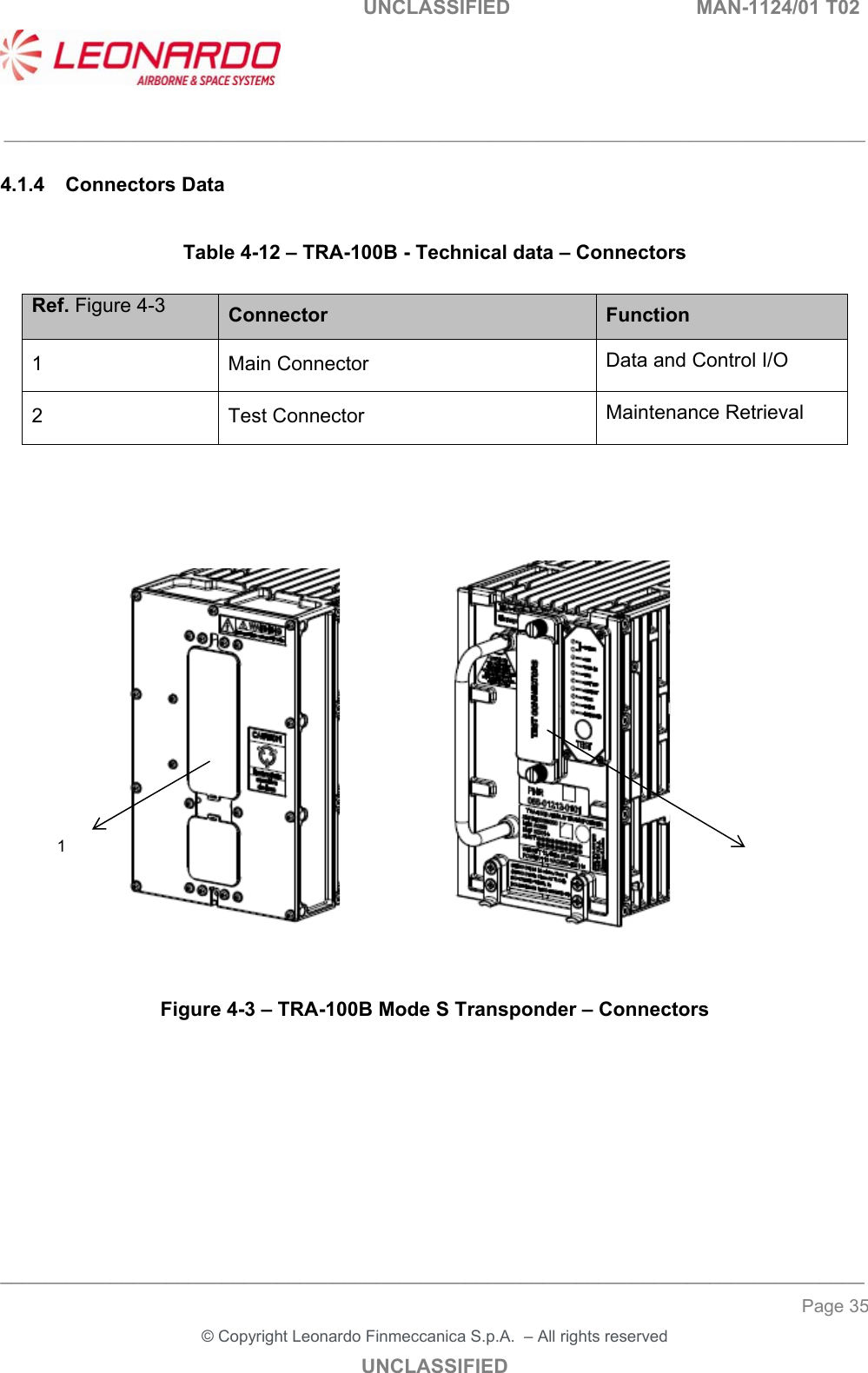
  UNCLASSIFIED  MAN-1124/01 T02   ___________________________________________________________________________________________________________ ______________________________________________________________________________ Page 35 © Copyright Leonardo Finmeccanica S.p.A.  – All rights reserved UNCLASSIFIED 4.1.4  Connectors Data  Table 4-12 – TRA-100B - Technical data – Connectors  Ref. Figure 4-3 Connector  Function 1  Main Connector   Data and Control I/O 2  Test Connector   Maintenance Retrieval                      Figure 4-3 – TRA-100B Mode S Transponder – Connectors        1 2
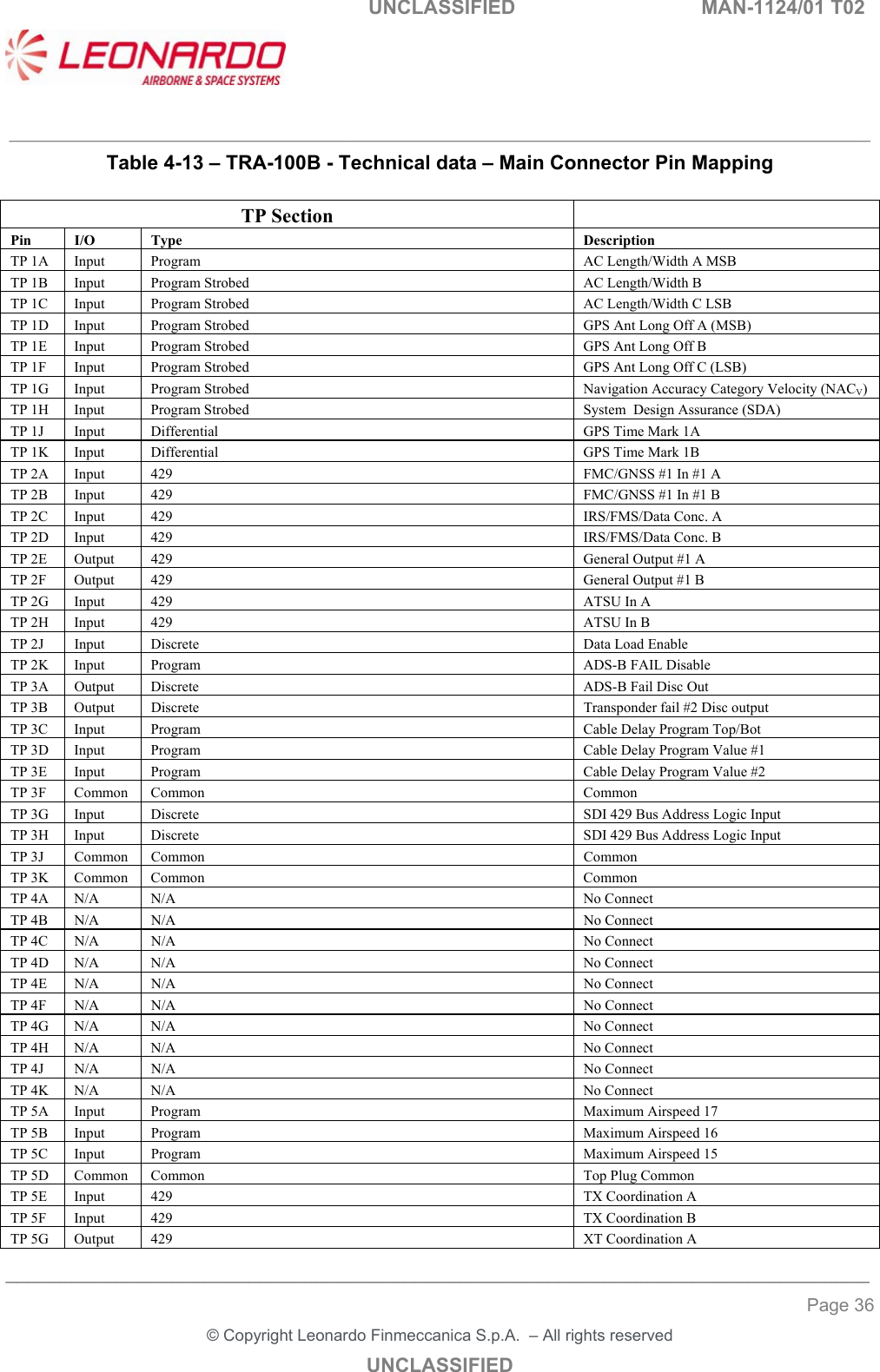
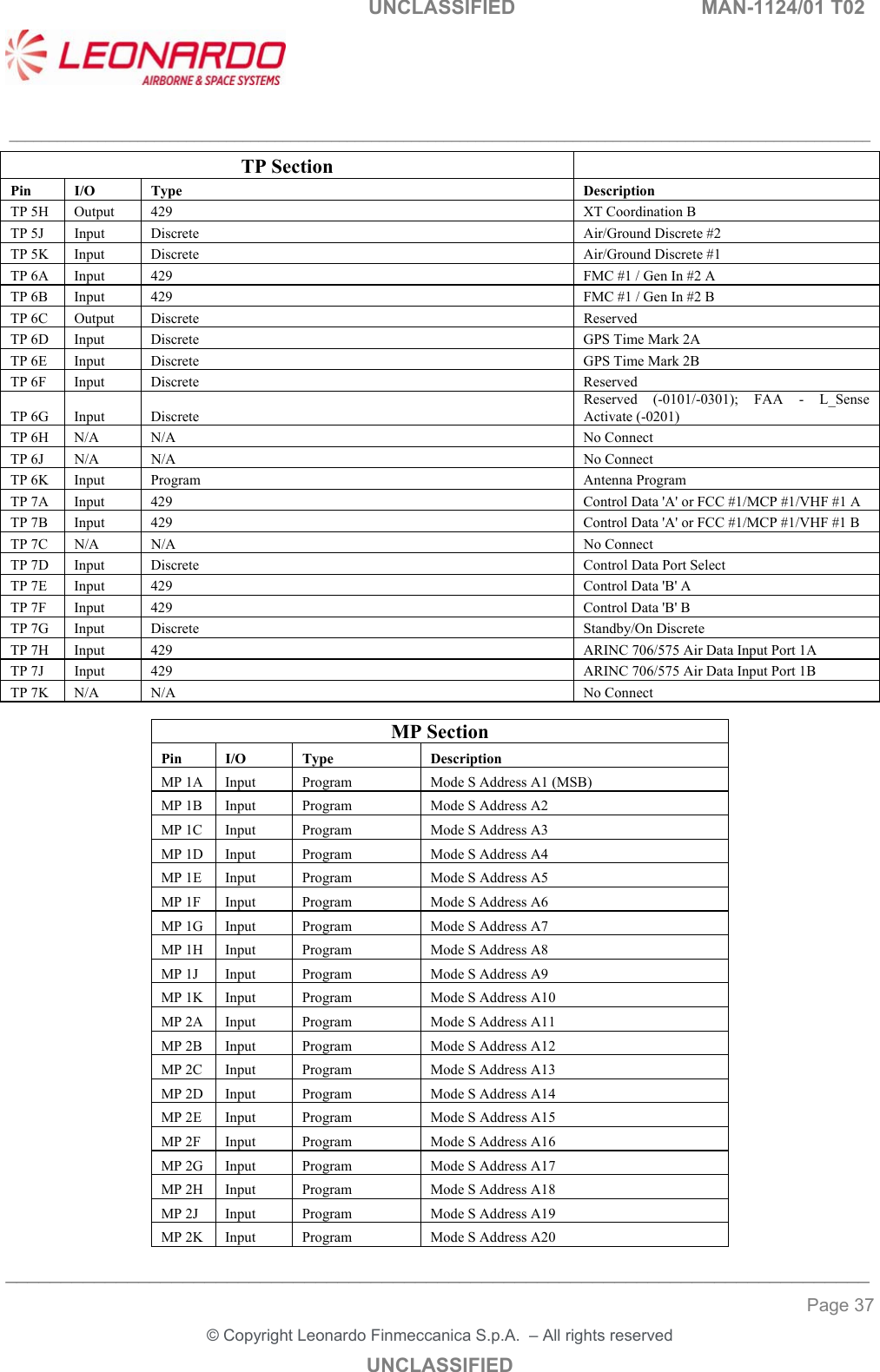
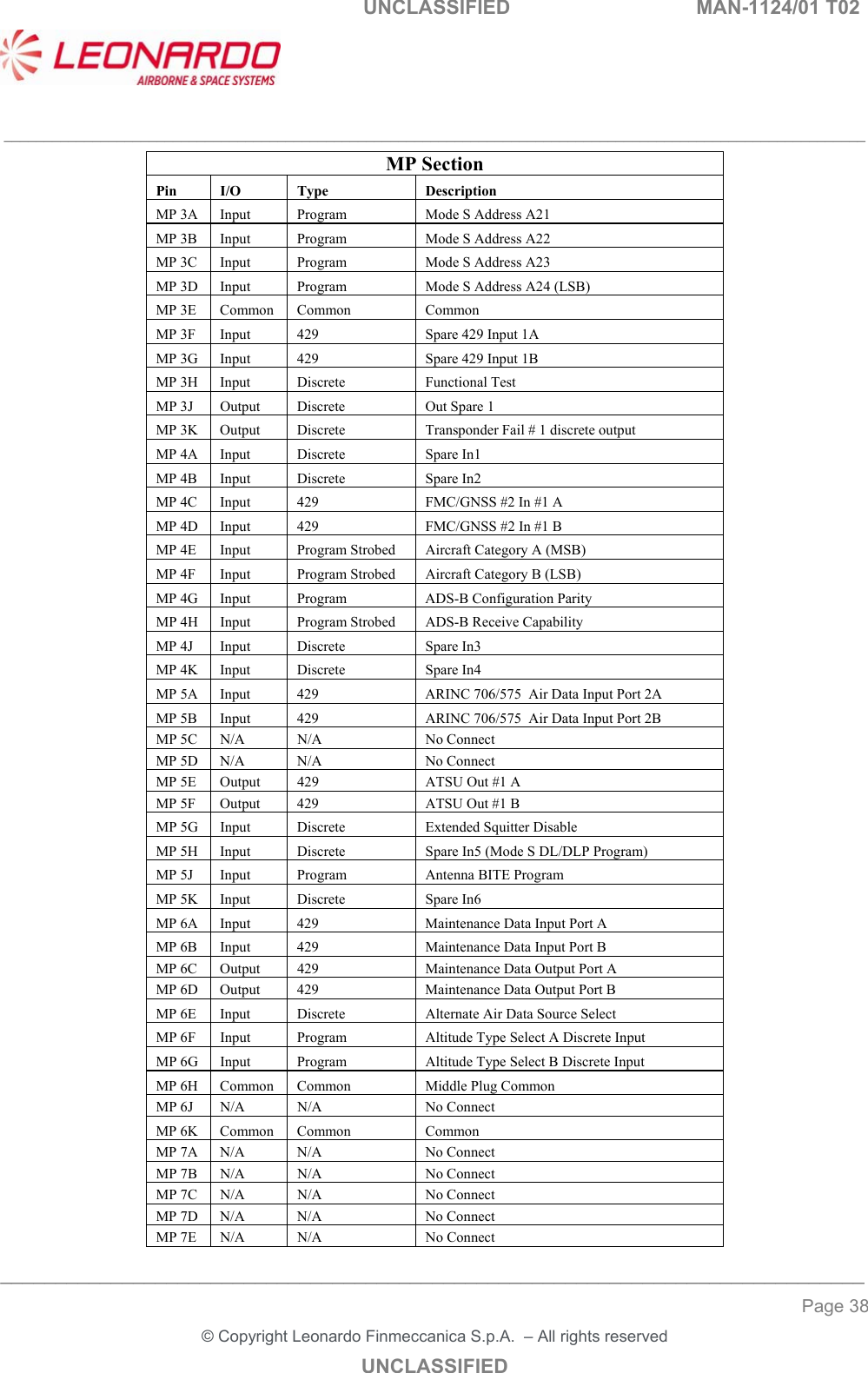
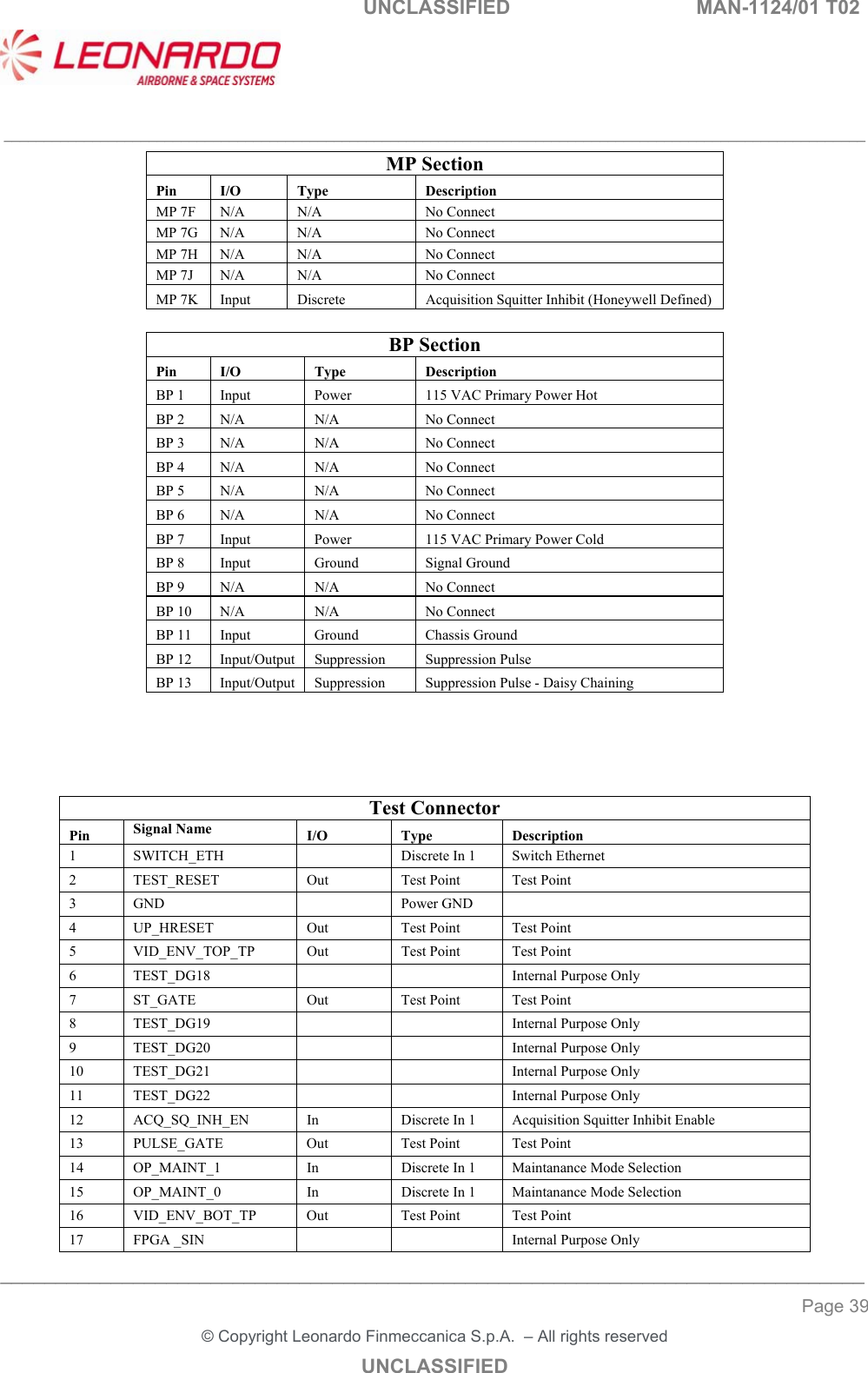
  UNCLASSIFIED  MAN-1124/01 T02   ___________________________________________________________________________________________________________ ______________________________________________________________________________ Page 36 © Copyright Leonardo Finmeccanica S.p.A.  – All rights reserved UNCLASSIFIED Table 4-13 – TRA-100B - Technical data – Main Connector Pin Mapping  TP Section  Pin  I/O  Type  Description TP 1A  Input  Program  AC Length/Width A MSB TP 1B  Input  Program Strobed  AC Length/Width B TP 1C  Input  Program Strobed  AC Length/Width C LSB TP 1D  Input  Program Strobed  GPS Ant Long Off A (MSB) TP 1E  Input  Program Strobed  GPS Ant Long Off B TP 1F  Input  Program Strobed  GPS Ant Long Off C (LSB) TP 1G  Input  Program Strobed  Navigation Accuracy Category Velocity (NACV) TP 1H  Input  Program Strobed  System  Design Assurance (SDA) TP 1J  Input  Differential  GPS Time Mark 1A TP 1K  Input  Differential  GPS Time Mark 1B TP 2A  Input  429  FMC/GNSS #1 In #1 A TP 2B  Input  429  FMC/GNSS #1 In #1 B TP 2C  Input  429  IRS/FMS/Data Conc. A TP 2D  Input  429  IRS/FMS/Data Conc. B TP 2E  Output  429  General Output #1 A TP 2F  Output  429  General Output #1 B TP 2G  Input  429  ATSU In A TP 2H  Input  429  ATSU In B TP 2J  Input  Discrete  Data Load Enable TP 2K  Input  Program  ADS-B FAIL Disable TP 3A  Output  Discrete  ADS-B Fail Disc Out TP 3B  Output  Discrete  Transponder fail #2 Disc output TP 3C  Input  Program  Cable Delay Program Top/Bot TP 3D  Input  Program  Cable Delay Program Value #1 TP 3E  Input  Program  Cable Delay Program Value #2 TP 3F  Common  Common  Common TP 3G  Input  Discrete  SDI 429 Bus Address Logic Input TP 3H  Input  Discrete  SDI 429 Bus Address Logic Input TP 3J  Common  Common  Common TP 3K  Common  Common  Common TP 4A  N/A  N/A  No Connect TP 4B  N/A  N/A  No Connect TP 4C  N/A  N/A  No Connect TP 4D  N/A  N/A  No Connect TP 4E  N/A  N/A  No Connect TP 4F  N/A  N/A  No Connect TP 4G  N/A  N/A  No Connect TP 4H  N/A  N/A  No Connect TP 4J  N/A  N/A  No Connect TP 4K  N/A  N/A  No Connect TP 5A  Input  Program  Maximum Airspeed 17 TP 5B  Input  Program  Maximum Airspeed 16 TP 5C  Input  Program  Maximum Airspeed 15 TP 5D  Common  Common  Top Plug Common TP 5E  Input  429  TX Coordination A TP 5F  Input  429  TX Coordination B TP 5G  Output  429  XT Coordination A
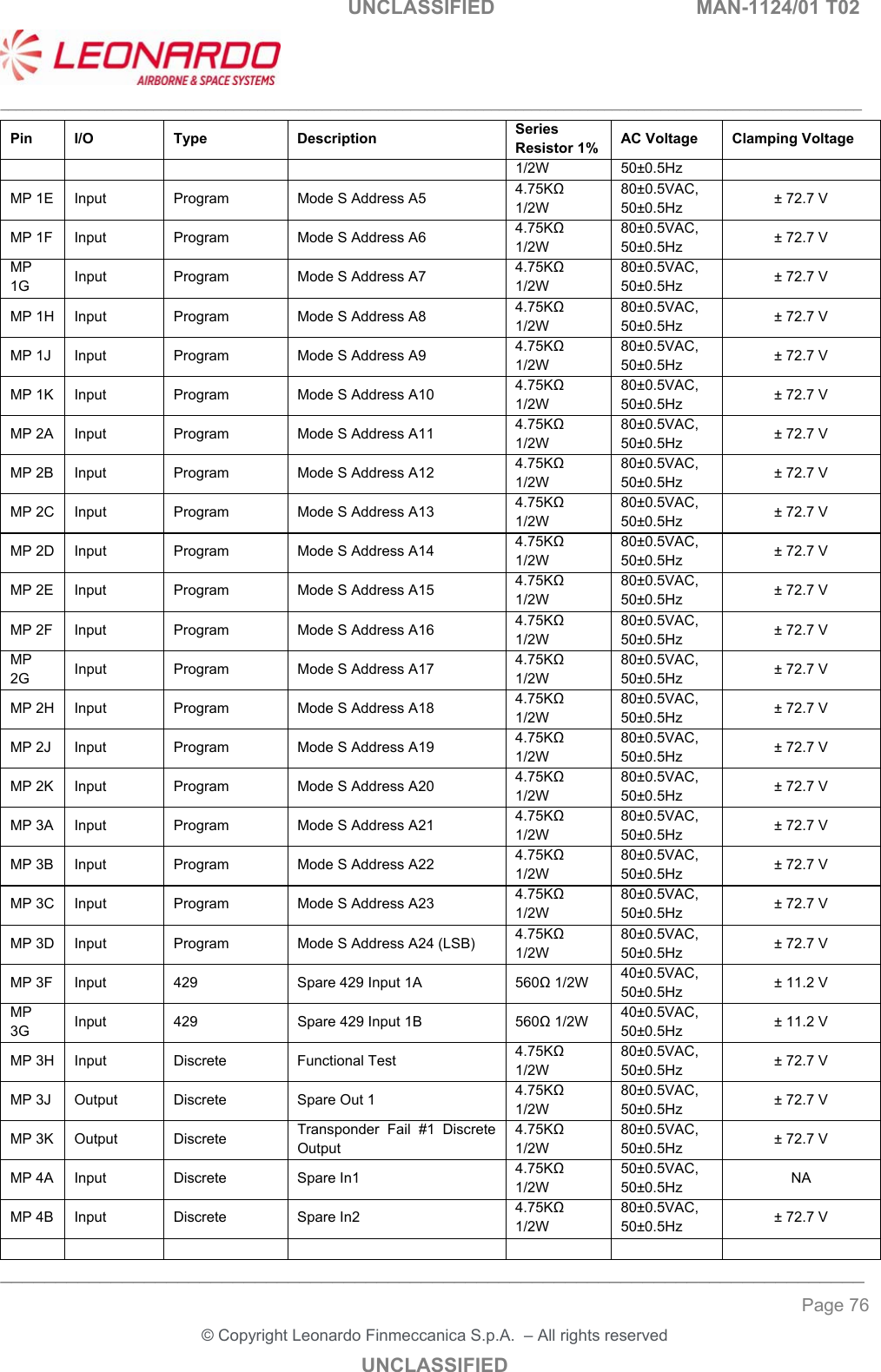
  UNCLASSIFIED  MAN-1124/01 T02   ___________________________________________________________________________________________________________ ______________________________________________________________________________ Page 37 © Copyright Leonardo Finmeccanica S.p.A.  – All rights reserved UNCLASSIFIED TP Section  Pin  I/O  Type  Description TP 5H  Output  429  XT Coordination B TP 5J  Input  Discrete  Air/Ground Discrete #2 TP 5K  Input  Discrete  Air/Ground Discrete #1 TP 6A  Input  429  FMC #1 / Gen In #2 A TP 6B  Input  429  FMC #1 / Gen In #2 B TP 6C  Output  Discrete  Reserved TP 6D  Input  Discrete  GPS Time Mark 2A TP 6E  Input  Discrete  GPS Time Mark 2B TP 6F  Input  Discrete  Reserved  TP 6G  Input  Discrete Reserved  (-0101/-0301);  FAA  -  L_Sense Activate (-0201) TP 6H  N/A  N/A  No Connect TP 6J  N/A  N/A  No Connect TP 6K  Input  Program  Antenna Program TP 7A  Input  429  Control Data 'A' or FCC #1/MCP #1/VHF #1 A TP 7B  Input  429  Control Data 'A' or FCC #1/MCP #1/VHF #1 B TP 7C  N/A  N/A  No Connect TP 7D  Input  Discrete  Control Data Port Select TP 7E  Input  429  Control Data 'B' A TP 7F  Input  429  Control Data 'B' B TP 7G  Input  Discrete  Standby/On Discrete TP 7H  Input  429  ARINC 706/575 Air Data Input Port 1A TP 7J  Input  429  ARINC 706/575 Air Data Input Port 1B TP 7K  N/A  N/A  No Connect  MP Section Pin  I/O  Type  Description MP 1A  Input  Program  Mode S Address A1 (MSB) MP 1B  Input  Program  Mode S Address A2 MP 1C  Input  Program  Mode S Address A3 MP 1D  Input  Program  Mode S Address A4 MP 1E  Input  Program  Mode S Address A5 MP 1F  Input  Program  Mode S Address A6 MP 1G  Input  Program  Mode S Address A7 MP 1H  Input  Program  Mode S Address A8 MP 1J  Input  Program  Mode S Address A9 MP 1K  Input  Program  Mode S Address A10 MP 2A  Input  Program  Mode S Address A11 MP 2B  Input  Program  Mode S Address A12 MP 2C  Input  Program  Mode S Address A13 MP 2D  Input  Program  Mode S Address A14 MP 2E  Input  Program  Mode S Address A15 MP 2F  Input  Program  Mode S Address A16 MP 2G  Input  Program  Mode S Address A17 MP 2H  Input  Program  Mode S Address A18 MP 2J  Input  Program  Mode S Address A19 MP 2K  Input  Program  Mode S Address A20
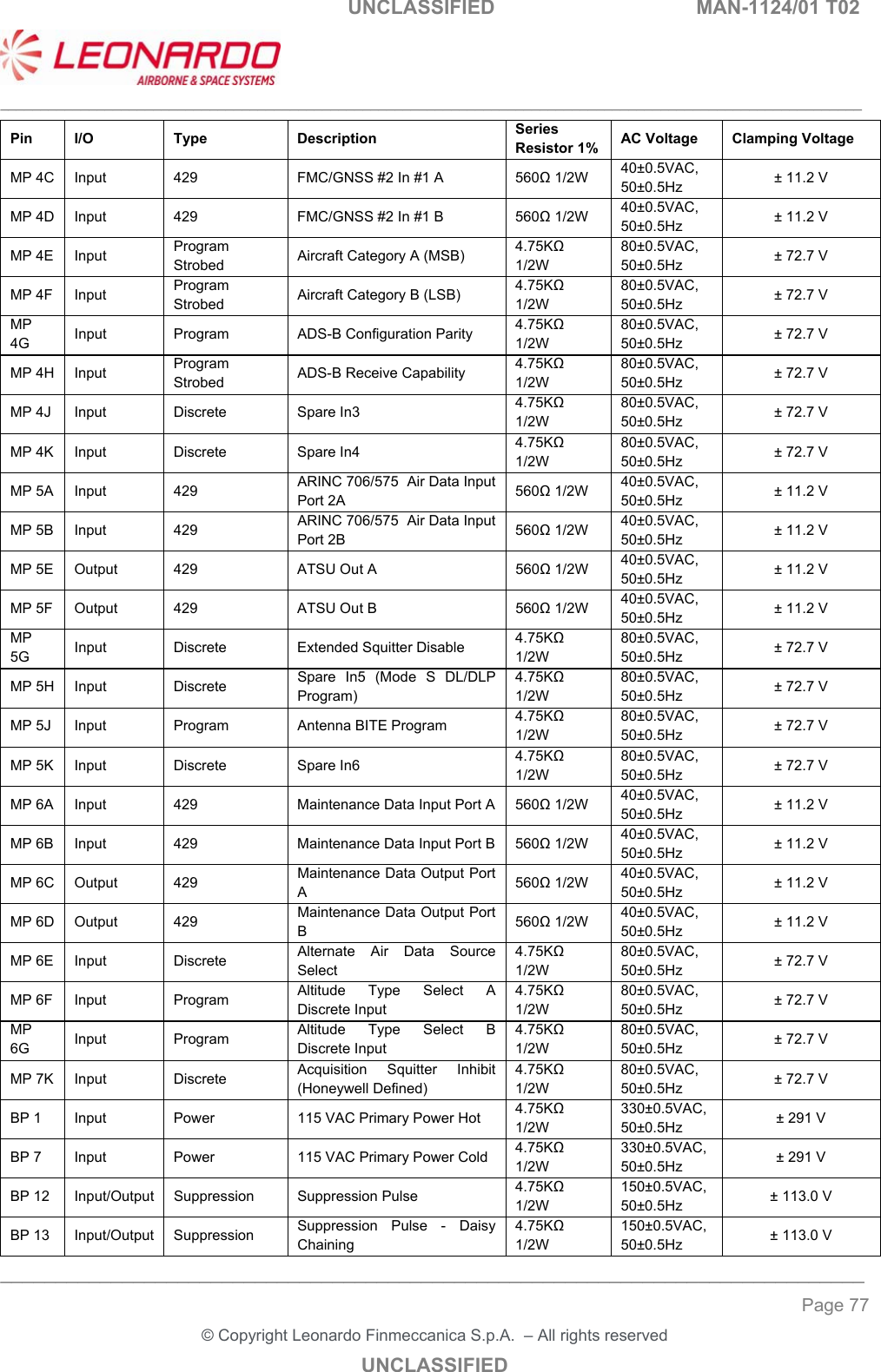
  UNCLASSIFIED  MAN-1124/01 T02   ___________________________________________________________________________________________________________ ______________________________________________________________________________ Page 38 © Copyright Leonardo Finmeccanica S.p.A.  – All rights reserved UNCLASSIFIED MP Section Pin  I/O  Type  Description MP 3A  Input  Program  Mode S Address A21 MP 3B  Input  Program  Mode S Address A22 MP 3C  Input  Program  Mode S Address A23 MP 3D  Input  Program  Mode S Address A24 (LSB) MP 3E  Common  Common  Common MP 3F  Input  429  Spare 429 Input 1A MP 3G  Input  429  Spare 429 Input 1B MP 3H  Input  Discrete  Functional Test MP 3J  Output  Discrete  Out Spare 1 MP 3K  Output  Discrete  Transponder Fail # 1 discrete output MP 4A  Input  Discrete  Spare In1 MP 4B  Input  Discrete  Spare In2 MP 4C  Input  429  FMC/GNSS #2 In #1 A MP 4D  Input  429  FMC/GNSS #2 In #1 B MP 4E  Input  Program Strobed  Aircraft Category A (MSB) MP 4F  Input  Program Strobed  Aircraft Category B (LSB) MP 4G  Input  Program  ADS-B Configuration Parity MP 4H  Input  Program Strobed  ADS-B Receive Capability MP 4J  Input  Discrete  Spare In3 MP 4K  Input  Discrete  Spare In4 MP 5A  Input  429  ARINC 706/575  Air Data Input Port 2A MP 5B  Input  429  ARINC 706/575  Air Data Input Port 2B MP 5C  N/A  N/A  No Connect MP 5D  N/A  N/A  No Connect MP 5E  Output  429  ATSU Out #1 A MP 5F  Output  429  ATSU Out #1 B MP 5G  Input  Discrete  Extended Squitter Disable MP 5H  Input  Discrete  Spare In5 (Mode S DL/DLP Program) MP 5J  Input  Program  Antenna BITE Program MP 5K  Input  Discrete  Spare In6 MP 6A  Input  429  Maintenance Data Input Port A MP 6B  Input  429  Maintenance Data Input Port B MP 6C  Output  429  Maintenance Data Output Port A MP 6D  Output  429  Maintenance Data Output Port B MP 6E  Input  Discrete  Alternate Air Data Source Select MP 6F  Input  Program  Altitude Type Select A Discrete Input MP 6G  Input  Program  Altitude Type Select B Discrete Input MP 6H  Common  Common  Middle Plug Common MP 6J  N/A  N/A  No Connect MP 6K  Common  Common  Common MP 7A  N/A  N/A  No Connect MP 7B  N/A  N/A  No Connect MP 7C  N/A  N/A  No Connect MP 7D  N/A  N/A  No Connect MP 7E  N/A  N/A  No Connect
  UNCLASSIFIED  MAN-1124/01 T02   ___________________________________________________________________________________________________________ ______________________________________________________________________________ Page 39 © Copyright Leonardo Finmeccanica S.p.A.  – All rights reserved UNCLASSIFIED MP Section Pin  I/O  Type  Description MP 7F  N/A  N/A  No Connect MP 7G  N/A  N/A  No Connect MP 7H  N/A  N/A  No Connect MP 7J  N/A  N/A  No Connect MP 7K  Input  Discrete  Acquisition Squitter Inhibit (Honeywell Defined)  BP Section Pin  I/O  Type  Description BP 1  Input  Power  115 VAC Primary Power Hot BP 2  N/A  N/A  No Connect BP 3  N/A  N/A  No Connect BP 4  N/A  N/A  No Connect BP 5  N/A  N/A  No Connect BP 6  N/A  N/A  No Connect BP 7  Input  Power  115 VAC Primary Power Cold BP 8  Input  Ground  Signal Ground BP 9  N/A  N/A  No Connect BP 10  N/A  N/A  No Connect BP 11  Input  Ground  Chassis Ground BP 12  Input/Output  Suppression  Suppression Pulse BP 13  Input/Output  Suppression  Suppression Pulse - Daisy Chaining    Test Connector Pin  Signal Name  I/O  Type  Description 1  SWITCH_ETH     Discrete In 1  Switch Ethernet 2  TEST_RESET  Out  Test Point  Test Point 3  GND     Power GND    4  UP_HRESET  Out  Test Point  Test Point 5  VID_ENV_TOP_TP  Out  Test Point  Test Point 6  TEST_DG18        Internal Purpose Only 7  ST_GATE  Out  Test Point  Test Point 8  TEST_DG19        Internal Purpose Only 9  TEST_DG20        Internal Purpose Only 10  TEST_DG21        Internal Purpose Only 11  TEST_DG22        Internal Purpose Only 12  ACQ_SQ_INH_EN  In  Discrete In 1  Acquisition Squitter Inhibit Enable 13  PULSE_GATE  Out  Test Point  Test Point 14  OP_MAINT_1  In  Discrete In 1   Maintanance Mode Selection 15  OP_MAINT_0  In  Discrete In 1   Maintanance Mode Selection 16  VID_ENV_BOT_TP  Out  Test Point  Test Point 17  FPGA _SIN        Internal Purpose Only
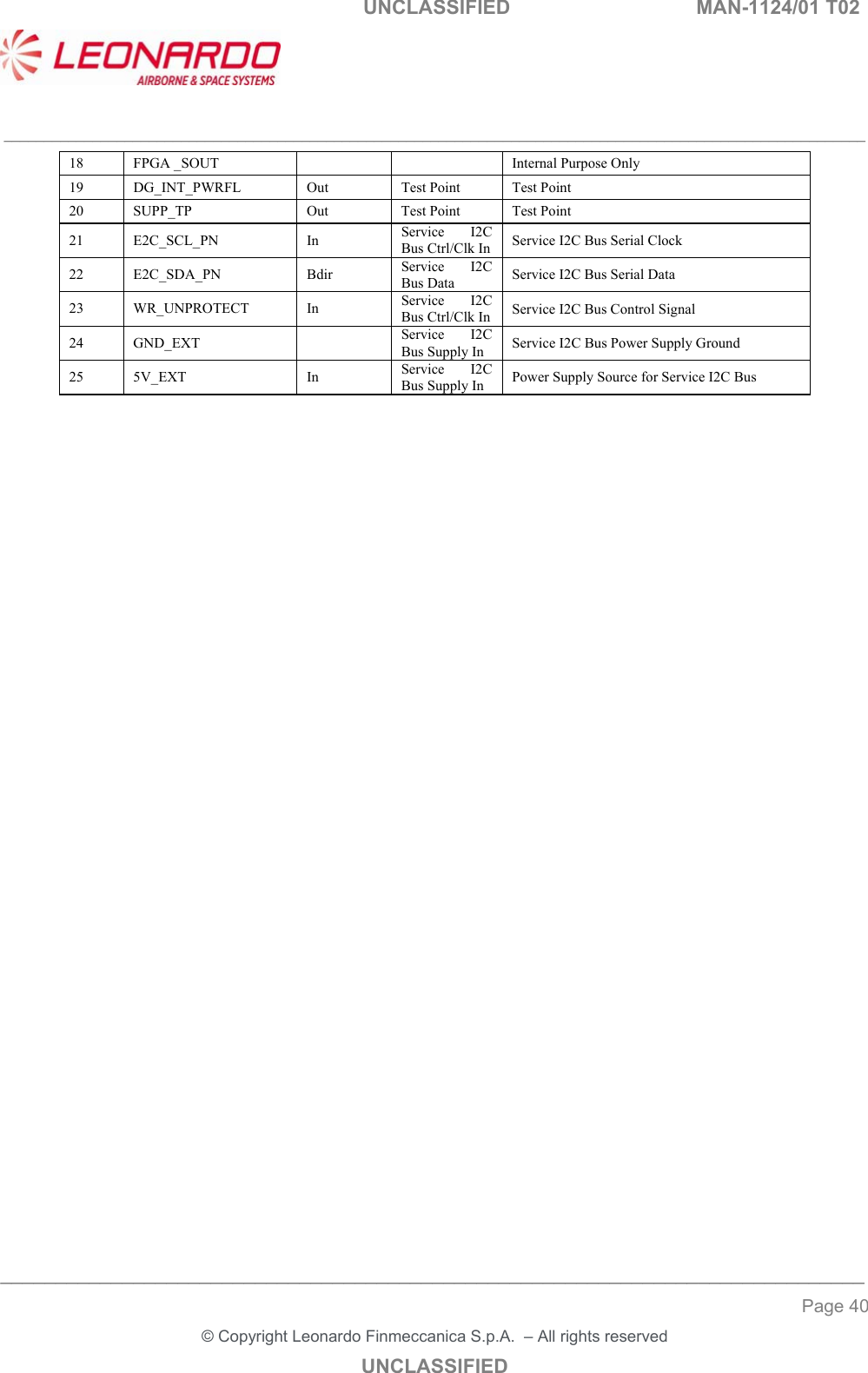
  UNCLASSIFIED  MAN-1124/01 T02   ___________________________________________________________________________________________________________ ______________________________________________________________________________ Page 40 © Copyright Leonardo Finmeccanica S.p.A.  – All rights reserved UNCLASSIFIED 18  FPGA _SOUT        Internal Purpose Only 19  DG_INT_PWRFL  Out  Test Point  Test Point 20  SUPP_TP  Out  Test Point  Test Point 21  E2C_SCL_PN  In  Service  I2C Bus Ctrl/Clk In  Service I2C Bus Serial Clock 22  E2C_SDA_PN  Bdir  Service  I2C Bus Data  Service I2C Bus Serial Data 23  WR_UNPROTECT  In  Service  I2C Bus Ctrl/Clk In  Service I2C Bus Control Signal 24  GND_EXT     Service  I2C Bus Supply In  Service I2C Bus Power Supply Ground 25  5V_EXT  In  Service  I2C Bus Supply In  Power Supply Source for Service I2C Bus
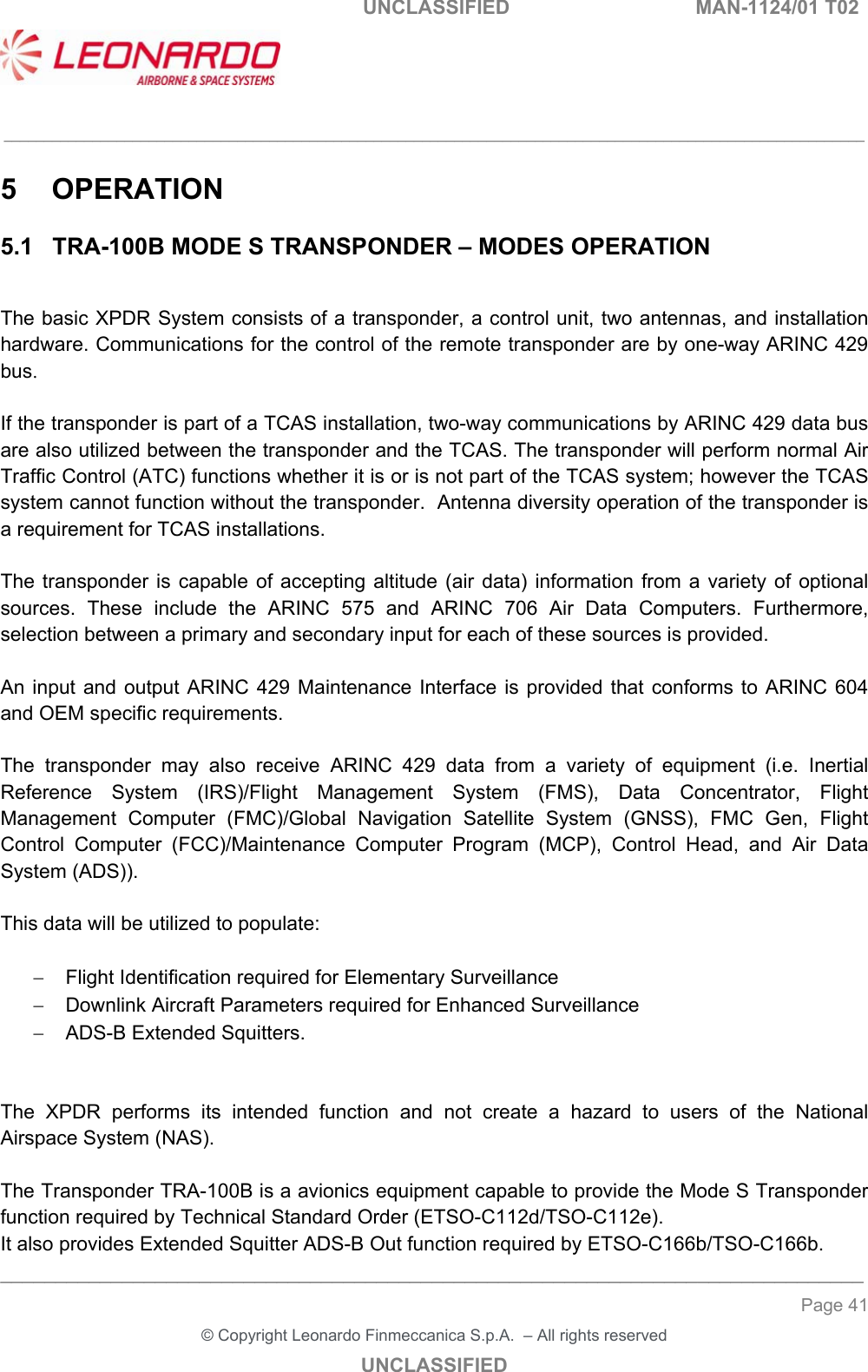
  UNCLASSIFIED  MAN-1124/01 T02   ___________________________________________________________________________________________________________ ______________________________________________________________________________ Page 41 © Copyright Leonardo Finmeccanica S.p.A.  – All rights reserved UNCLASSIFIED 5  OPERATION 5.1  TRA-100B MODE S TRANSPONDER – MODES OPERATION  The basic XPDR System consists of a transponder, a control unit, two antennas, and installation hardware. Communications for the control of the remote transponder are by one-way ARINC 429 bus.  If the transponder is part of a TCAS installation, two-way communications by ARINC 429 data bus are also utilized between the transponder and the TCAS. The transponder will perform normal Air Traffic Control (ATC) functions whether it is or is not part of the TCAS system; however the TCAS system cannot function without the transponder.  Antenna diversity operation of the transponder is a requirement for TCAS installations.  The transponder is capable of accepting altitude (air data) information  from  a  variety  of  optional sources.  These  include  the  ARINC  575  and  ARINC  706  Air  Data  Computers.  Furthermore, selection between a primary and secondary input for each of these sources is provided.  An input and output ARINC  429  Maintenance Interface is  provided that conforms to ARINC 604 and OEM specific requirements.  The  transponder  may  also  receive  ARINC  429  data  from  a  variety  of  equipment  (i.e.  Inertial Reference  System  (IRS)/Flight  Management  System  (FMS),  Data  Concentrator,  Flight Management  Computer  (FMC)/Global  Navigation  Satellite  System  (GNSS),  FMC  Gen,  Flight Control  Computer  (FCC)/Maintenance  Computer  Program  (MCP),  Control  Head,  and  Air  Data System (ADS)).   This data will be utilized to populate:    Flight Identification required for Elementary Surveillance   Downlink Aircraft Parameters required for Enhanced Surveillance   ADS-B Extended Squitters.   The  XPDR  performs  its  intended  function  and  not  create  a  hazard  to  users  of  the  National Airspace System (NAS).  The Transponder TRA-100B is a avionics equipment capable to provide the Mode S Transponder function required by Technical Standard Order (ETSO-C112d/TSO-C112e).  It also provides Extended Squitter ADS-B Out function required by ETSO-C166b/TSO-C166b.
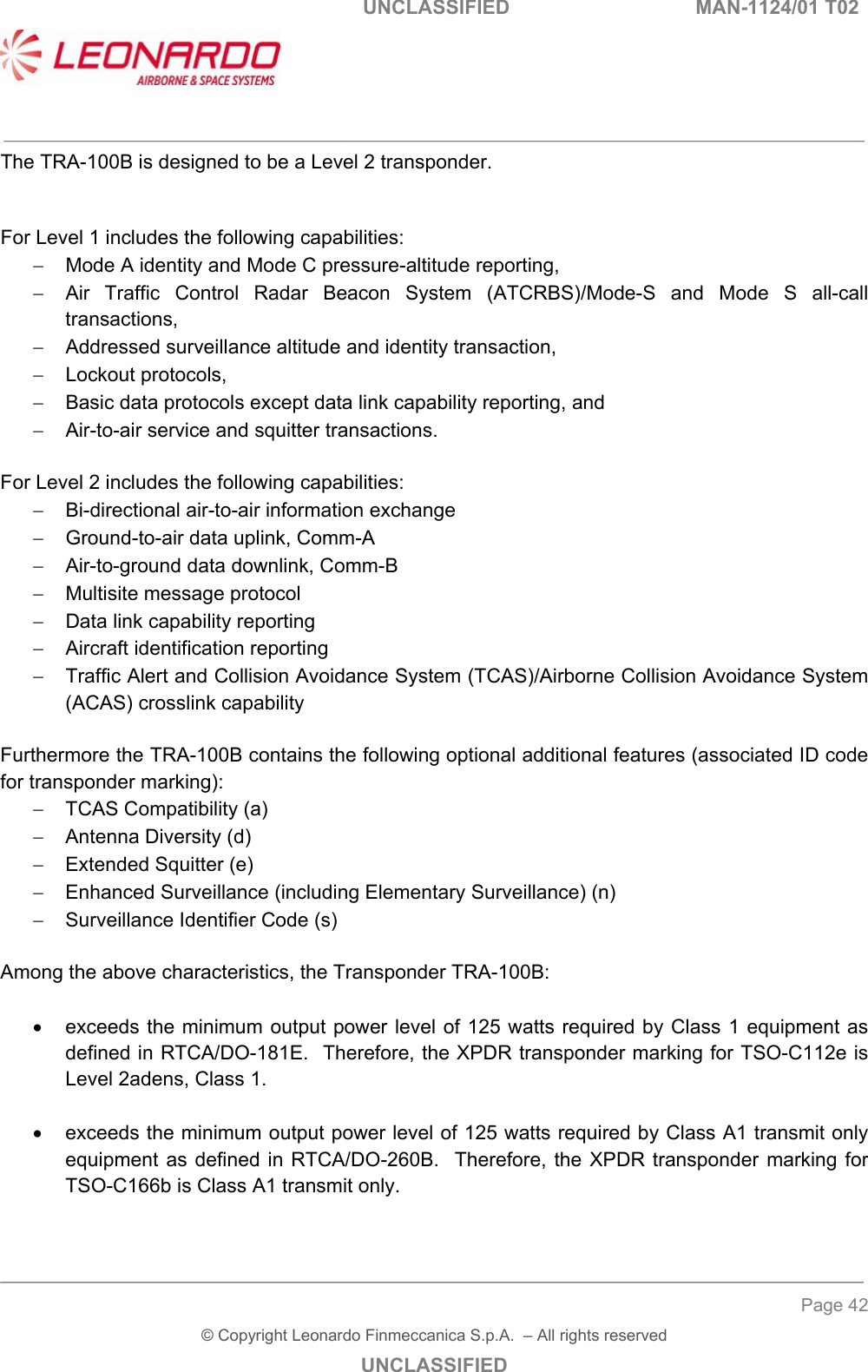
  UNCLASSIFIED  MAN-1124/01 T02   ___________________________________________________________________________________________________________ ______________________________________________________________________________ Page 42 © Copyright Leonardo Finmeccanica S.p.A.  – All rights reserved UNCLASSIFIED The TRA-100B is designed to be a Level 2 transponder.    For Level 1 includes the following capabilities:   Mode A identity and Mode C pressure-altitude reporting,   Air  Traffic  Control  Radar  Beacon  System  (ATCRBS)/Mode-S  and  Mode  S  all-call transactions,   Addressed surveillance altitude and identity transaction,   Lockout protocols,   Basic data protocols except data link capability reporting, and   Air-to-air service and squitter transactions.  For Level 2 includes the following capabilities:   Bi-directional air-to-air information exchange   Ground-to-air data uplink, Comm-A   Air-to-ground data downlink, Comm-B   Multisite message protocol   Data link capability reporting   Aircraft identification reporting   Traffic Alert and Collision Avoidance System (TCAS)/Airborne Collision Avoidance System (ACAS) crosslink capability  Furthermore the TRA-100B contains the following optional additional features (associated ID code for transponder marking):   TCAS Compatibility (a)   Antenna Diversity (d)   Extended Squitter (e)   Enhanced Surveillance (including Elementary Surveillance) (n)   Surveillance Identifier Code (s)  Among the above characteristics, the Transponder TRA-100B:     exceeds the  minimum output power level of 125 watts  required by Class 1 equipment as defined in RTCA/DO-181E.  Therefore, the XPDR transponder marking for TSO-C112e is Level 2adens, Class 1.    exceeds the minimum output power level of 125 watts required by Class A1 transmit only equipment as defined in RTCA/DO-260B.  Therefore, the XPDR transponder marking  for TSO-C166b is Class A1 transmit only.
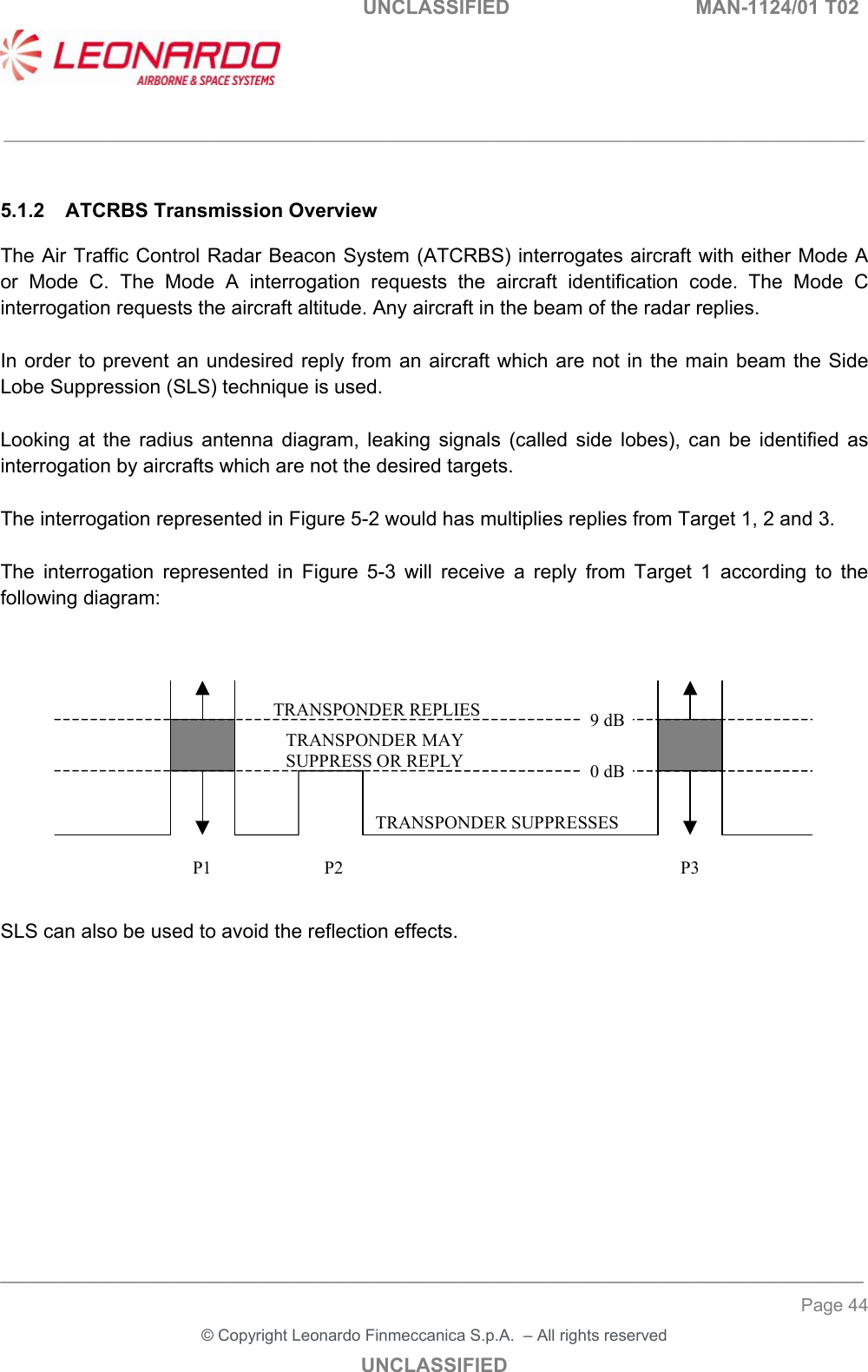
  UNCLASSIFIED  MAN-1124/01 T02   ___________________________________________________________________________________________________________ ______________________________________________________________________________ Page 43 © Copyright Leonardo Finmeccanica S.p.A.  – All rights reserved UNCLASSIFIED 5.1.1  ATCRBS System  Operation The ATCRBS system can be defined as “a secondary surveillance radar system developed for use within the air traffic control system for more precise position reporting of planes. It is used in conjunction with the primary radar, which is used to determine the presence of planes in the airspace. ATCRBS supplements this positional information with positive identification and altitude information allowing controllers to track each plane more precisely and efficiently .”1  In this scenario the ATC ground based interrogator transmits an interrogation by means of sequence of pulses at a frequency of 1030 MHz and call all transponders for a response on the mode being used to reply. The received replies will be displayed on the ATC radar screen.  Analog to the ground based interrogator, an airborne TCAS device may transmits interrogation for airborne traffic. TCAS can detects direction and altitude of an aircraft equipped with a transponder.   Figure 5-1 – ATCRBS System                                                   1"The  Story  of  Mode  S:  An  Air  Traffic  Control  Data-Link  Technology"  (Emily  Chang,  Roger  Hu, Danny Lai, Richard Li, Quincy Scott, Tina Tyan)
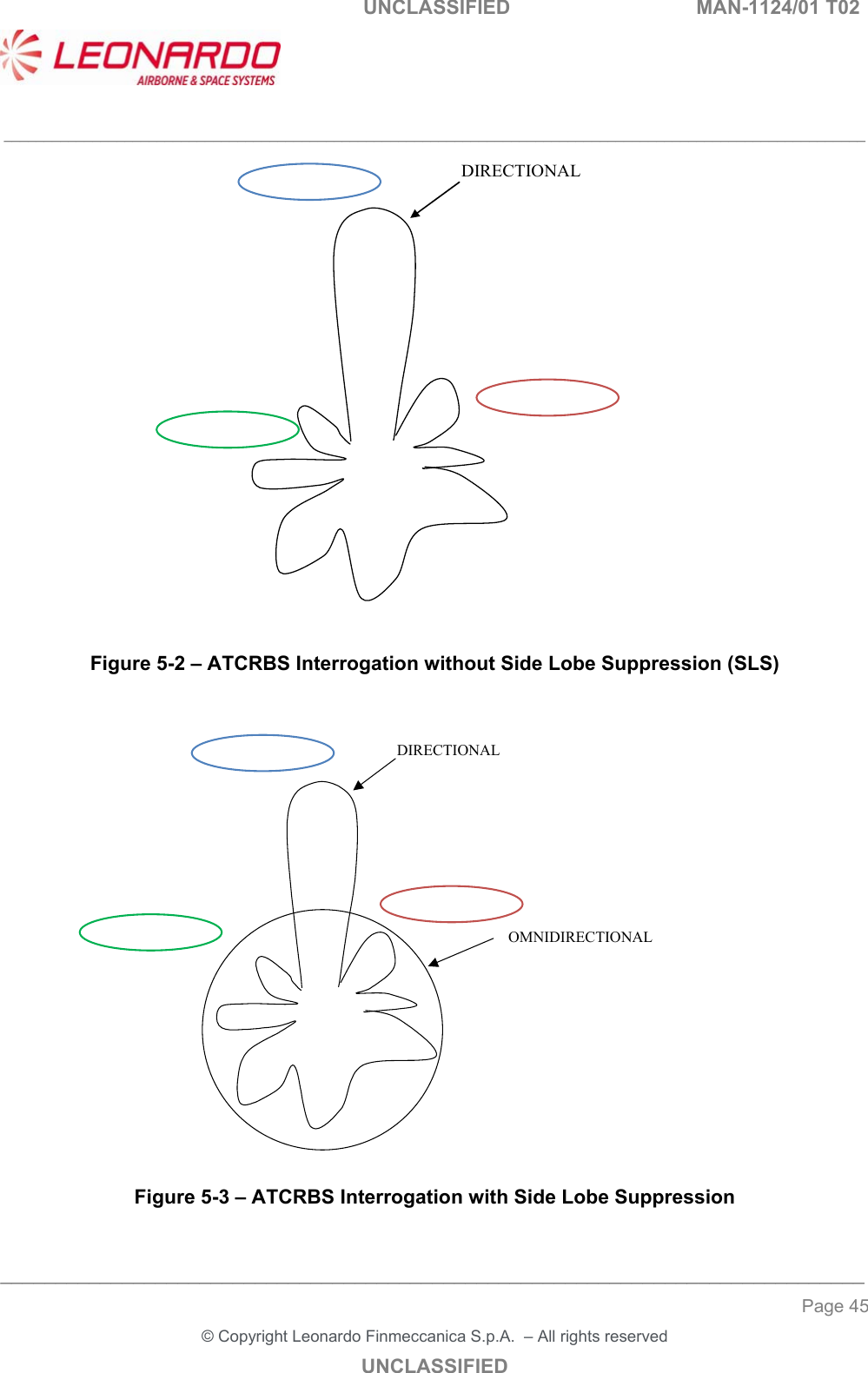
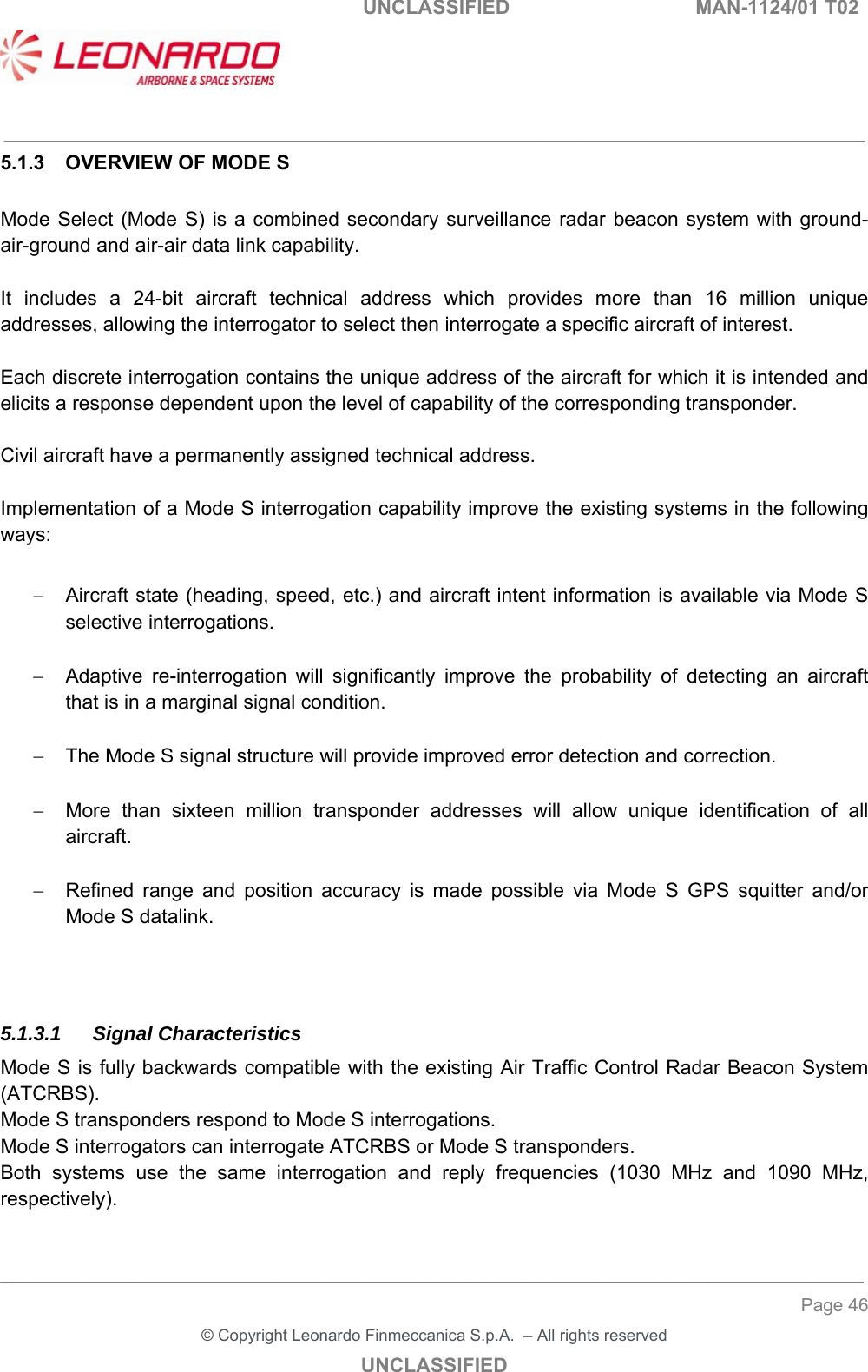
  UNCLASSIFIED  MAN-1124/01 T02   ___________________________________________________________________________________________________________ ______________________________________________________________________________ Page 44 © Copyright Leonardo Finmeccanica S.p.A.  – All rights reserved UNCLASSIFIED  5.1.2  ATCRBS Transmission Overview The Air Traffic Control Radar Beacon System (ATCRBS) interrogates aircraft with either Mode A or  Mode  C.  The  Mode  A  interrogation  requests  the  aircraft  identification  code.  The  Mode  C interrogation requests the aircraft altitude. Any aircraft in the beam of the radar replies.  In order to prevent an undesired  reply from an aircraft which are not in the main  beam the Side Lobe Suppression (SLS) technique is used.  Looking  at  the  radius  antenna  diagram,  leaking  signals  (called  side  lobes),  can  be  identified  as interrogation by aircrafts which are not the desired targets.  The interrogation represented in Figure 5-2 would has multiplies replies from Target 1, 2 and 3.  The  interrogation  represented  in  Figure  5-3  will  receive  a  reply  from  Target  1  according  to  the following diagram:     9 dB  0 dBP1 P2 P3TRANSPONDER REPLIESTRANSPONDER MAYSUPPRESS OR REPLYTRANSPONDER SUPPRESSES  SLS can also be used to avoid the reflection effects.
  UNCLASSIFIED  MAN-1124/01 T02   ___________________________________________________________________________________________________________ ______________________________________________________________________________ Page 45 © Copyright Leonardo Finmeccanica S.p.A.  – All rights reserved UNCLASSIFIED  DIRECTIONAL  Figure 5-2 – ATCRBS Interrogation without Side Lobe Suppression (SLS)   DIRECTIONALOMNIDIRECTIONAL  Figure 5-3 – ATCRBS Interrogation with Side Lobe Suppression   Target 1 Target 2 Target 3 Target 1 Target 2 Target 3
  UNCLASSIFIED  MAN-1124/01 T02   ___________________________________________________________________________________________________________ ______________________________________________________________________________ Page 46 © Copyright Leonardo Finmeccanica S.p.A.  – All rights reserved UNCLASSIFIED 5.1.3  OVERVIEW OF MODE S  Mode Select (Mode S) is  a combined secondary surveillance radar beacon system with ground-air-ground and air-air data link capability.  It  includes  a  24-bit  aircraft  technical  address  which  provides  more  than  16  million  unique addresses, allowing the interrogator to select then interrogate a specific aircraft of interest.  Each discrete interrogation contains the unique address of the aircraft for which it is intended and elicits a response dependent upon the level of capability of the corresponding transponder.  Civil aircraft have a permanently assigned technical address.   Implementation of a Mode S interrogation capability improve the existing systems in the following ways:    Aircraft state (heading, speed, etc.) and aircraft intent information is available via Mode S selective interrogations.    Adaptive  re-interrogation  will  significantly  improve  the  probability  of  detecting  an  aircraft that is in a marginal signal condition.    The Mode S signal structure will provide improved error detection and correction.    More  than  sixteen  million  transponder  addresses  will  allow  unique  identification  of  all aircraft.    Refined  range  and  position  accuracy  is  made  possible  via  Mode  S  GPS  squitter  and/or Mode S datalink.   5.1.3.1 Signal Characteristics Mode S is fully backwards compatible with the existing Air Traffic Control Radar Beacon System (ATCRBS).  Mode S transponders respond to Mode S interrogations. Mode S interrogators can interrogate ATCRBS or Mode S transponders. Both  systems  use  the  same  interrogation  and  reply  frequencies  (1030  MHz  and  1090  MHz, respectively).
  UNCLASSIFIED  MAN-1124/01 T02   ___________________________________________________________________________________________________________ ______________________________________________________________________________ Page 47 © Copyright Leonardo Finmeccanica S.p.A.  – All rights reserved UNCLASSIFIED Mode  S-only  interrogations  use  binary  differential  phase  shift  keying  modulation  (DPSK)  at  4 MB/sec and Mode S replies have binary pulse position modulation (PPM) at 1 MB/sec.  The  Mode  S  coding  structure  provides  enhanced  error  detection  and  correction  (less  than  1 undetected error in 108 messages). Mode S is not secure or jam-resistant and is not intended to replace the encrypted military Mode 4.  Mode S has two basic message lengths: 56 bits and 112 bits.  The 56 bit surveillance formats include a 32 bit command field and a 24 bit address field.  The 112 bits communication formats include a 32 bit command field, a 56 bit data field and a 24 bit address field. The 112 bit extended length message formats include an 8 bit command field, an 80 bit data field and a 24 bit address field.  5.1.3.2 Interrogation Process Fully  operational  Mode  S  interrogators  or  clusters  of  interrogators  are  allocated  on  interrogator identification  (II)  code  which,  in  conjunction  with  the  unique  aircraft  technical  address,  enables linking between the interrogator and the aircraft of interest.  All-call interrogations are sent to all aircraft in a region to obtain the corresponding 24-bit technical addresses.  These  addresses  are  maintained  in  an  internal  database  and,  once  the  address  is obtained, the all-call acquisition doesn’t need to be repeated for that aircraft.  Upon  receiving  the  technical  address,  the  interrogator  sends  a  lockout  message  to  inhibit  the corresponding transponder form replying to further Mode S all-call interrogations from any sensor with  that  interrogator  identification  code.  Lockout  is  refreshed  each  antenna  scan  as  part  of  the normal surveillance protocol and time-out occurs in 18 seconds if no further lockout commands are received. The interrogator also has the provision (lockout override”) to command a transponder to respond regardless of the lockout status effect.  Once it has the unique transponder address, the interrogator can selectively interrogate to obtain altitude and Mode 3/A codes for Mode S to Mark XII correlation or other useful information.
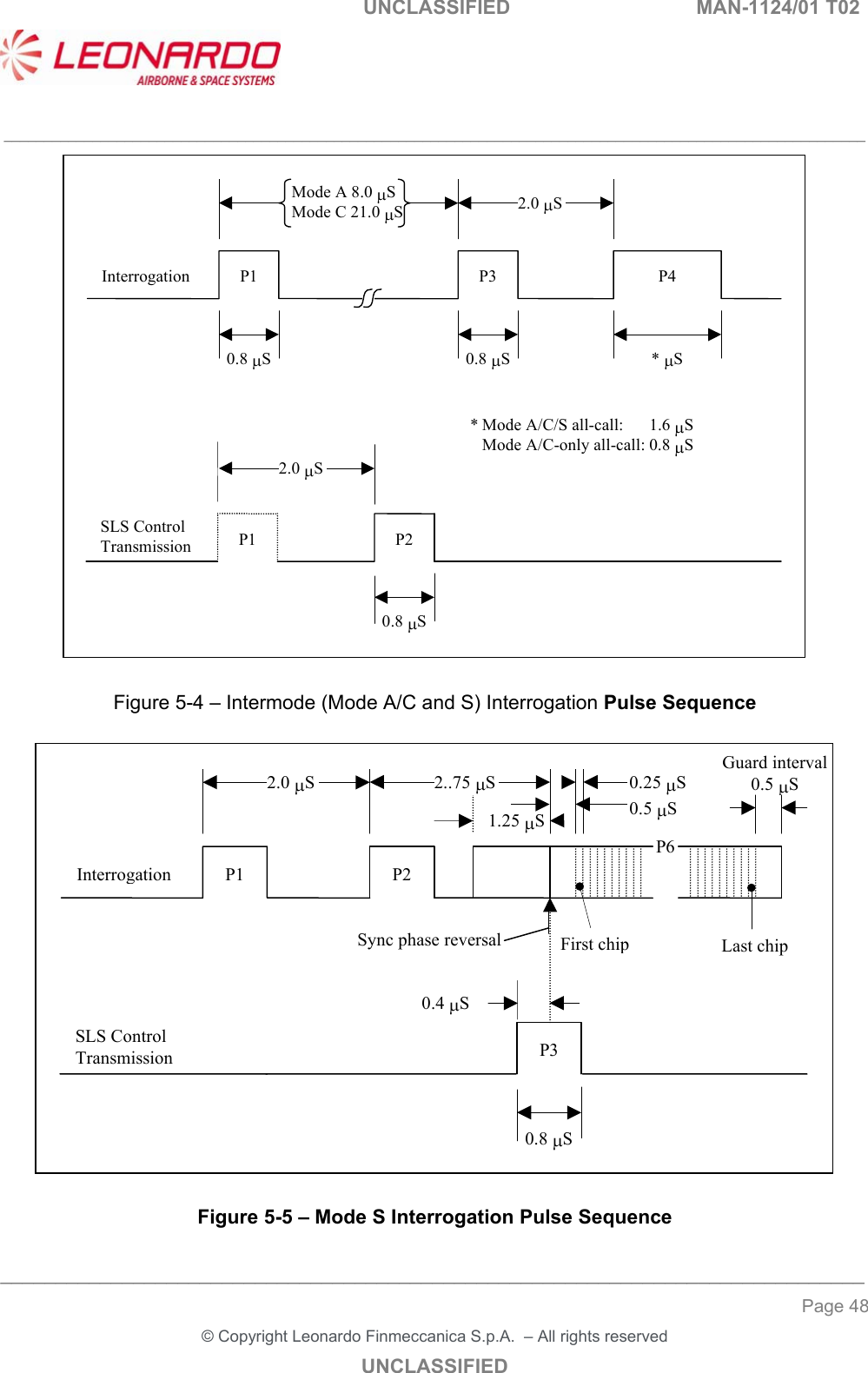
  UNCLASSIFIED  MAN-1124/01 T02   ___________________________________________________________________________________________________________ ______________________________________________________________________________ Page 48 © Copyright Leonardo Finmeccanica S.p.A.  – All rights reserved UNCLASSIFIED P1 P3 P40.8 S0.8 S* SInterrogation   Mode A 8.0 S   Mode C 21.0 S2.0 S* Mode A/C/S all-call: 1.6 S  Mode A/C-only all-call: 0.8 SP1 P20.8 SSLS ControlTransmission2.0 S  Figure 5-4 – Intermode (Mode A/C and S) Interrogation Pulse Sequence  P1 P2Interrogation2.0 SP30.8 SSLS ControlTransmission0.4 S2..75 SFirst chipLast chipP61.25 S0.25 S0.5 SGuard interval0.5 SSync phase reversal  Figure 5-5 – Mode S Interrogation Pulse Sequence
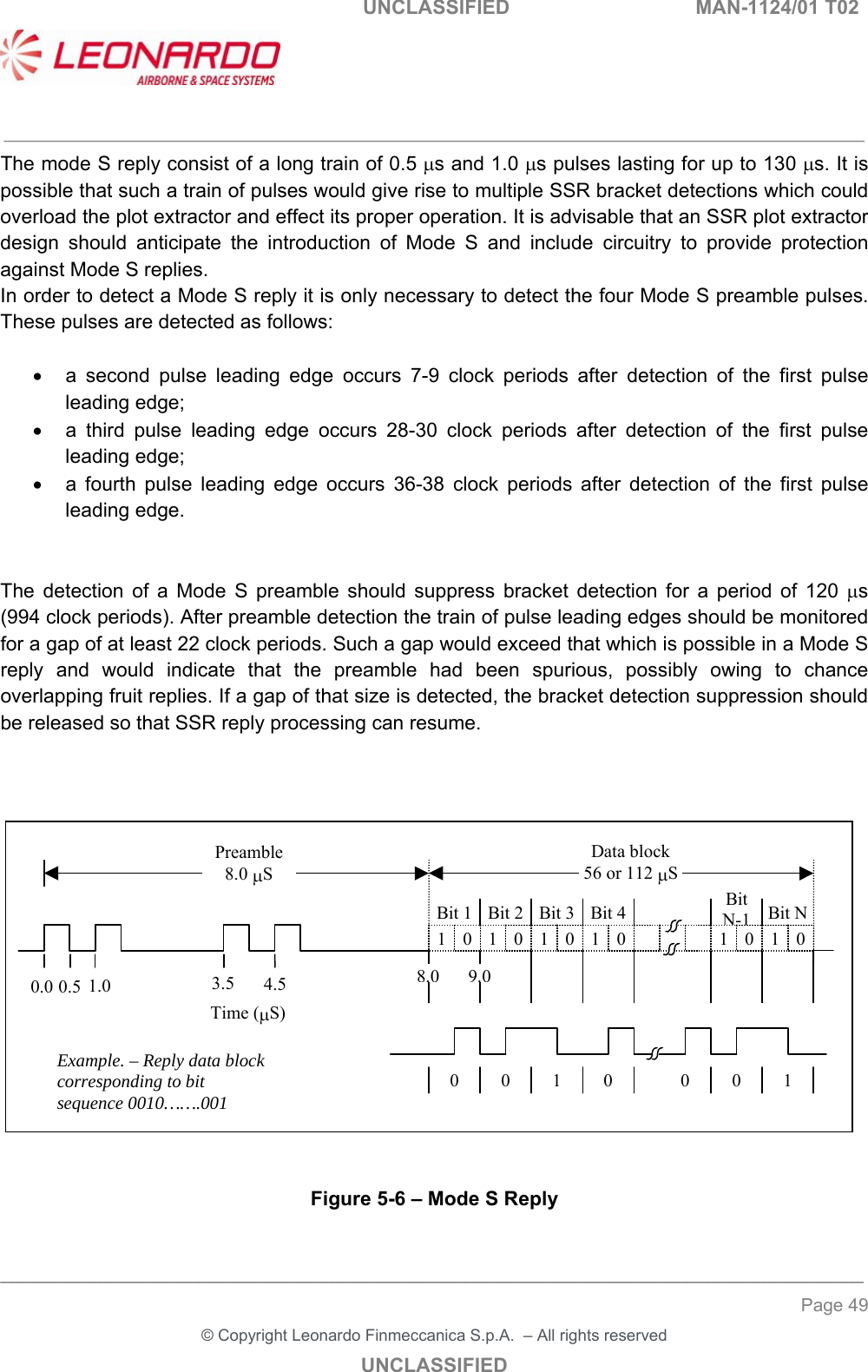
  UNCLASSIFIED  MAN-1124/01 T02   ___________________________________________________________________________________________________________ ______________________________________________________________________________ Page 49 © Copyright Leonardo Finmeccanica S.p.A.  – All rights reserved UNCLASSIFIED The mode S reply consist of a long train of 0.5 s and 1.0 s pulses lasting for up to 130 s. It is possible that such a train of pulses would give rise to multiple SSR bracket detections which could overload the plot extractor and effect its proper operation. It is advisable that an SSR plot extractor design  should  anticipate  the  introduction  of  Mode  S  and  include  circuitry  to  provide  protection against Mode S replies. In order to detect a Mode S reply it is only necessary to detect the four Mode S preamble pulses. These pulses are detected as follows:    a  second  pulse  leading  edge  occurs  7-9  clock  periods  after  detection  of  the  first  pulse leading edge;   a  third  pulse  leading  edge  occurs  28-30  clock  periods  after  detection  of  the  first  pulse leading edge;   a  fourth  pulse  leading  edge  occurs  36-38  clock  periods  after  detection  of  the  first  pulse leading edge.   The  detection  of  a  Mode  S  preamble  should  suppress  bracket  detection  for  a  period  of  120  s (994 clock periods). After preamble detection the train of pulse leading edges should be monitored for a gap of at least 22 clock periods. Such a gap would exceed that which is possible in a Mode S reply  and  would  indicate  that  the  preamble  had  been  spurious,  possibly  owing  to  chance overlapping fruit replies. If a gap of that size is detected, the bracket detection suppression should be released so that SSR reply processing can resume.    Bit 1 Bit 2 Bit 3 Bit 41 0 1 0 1 0 1 08.09.01 0 1 0BitN-1Bit N0.0 0.5 1.0 3.5 4.5Time (S)Preamble8.0 SData block56 or 112 S0000011Example. – Reply data blockcorresponding to bitsequence 0010…….001   Figure 5-6 – Mode S Reply
  UNCLASSIFIED  MAN-1124/01 T02   ___________________________________________________________________________________________________________ ______________________________________________________________________________ Page 50 © Copyright Leonardo Finmeccanica S.p.A.  – All rights reserved UNCLASSIFIED 6  INSTALLATION 6.1  TRA-100B MODE S TRANSPONDER – REPLACE PROCEDURES  Standard Equipment Description Identification Nr. Qty None      Materials Description Identification Nr. Qty None      Spares Description Identification Nr. Qty TRA-100B Mode S Transponder  TAC-6001/03  1   Safety Precautions  WARNING    MAKE SURE THAT THE EQUIPMENT IS DISCONNECTED FROM ALL ELECTRICAL POWER SOURCES BEFORE YOU DO ANY MAINTENANCE WORK.
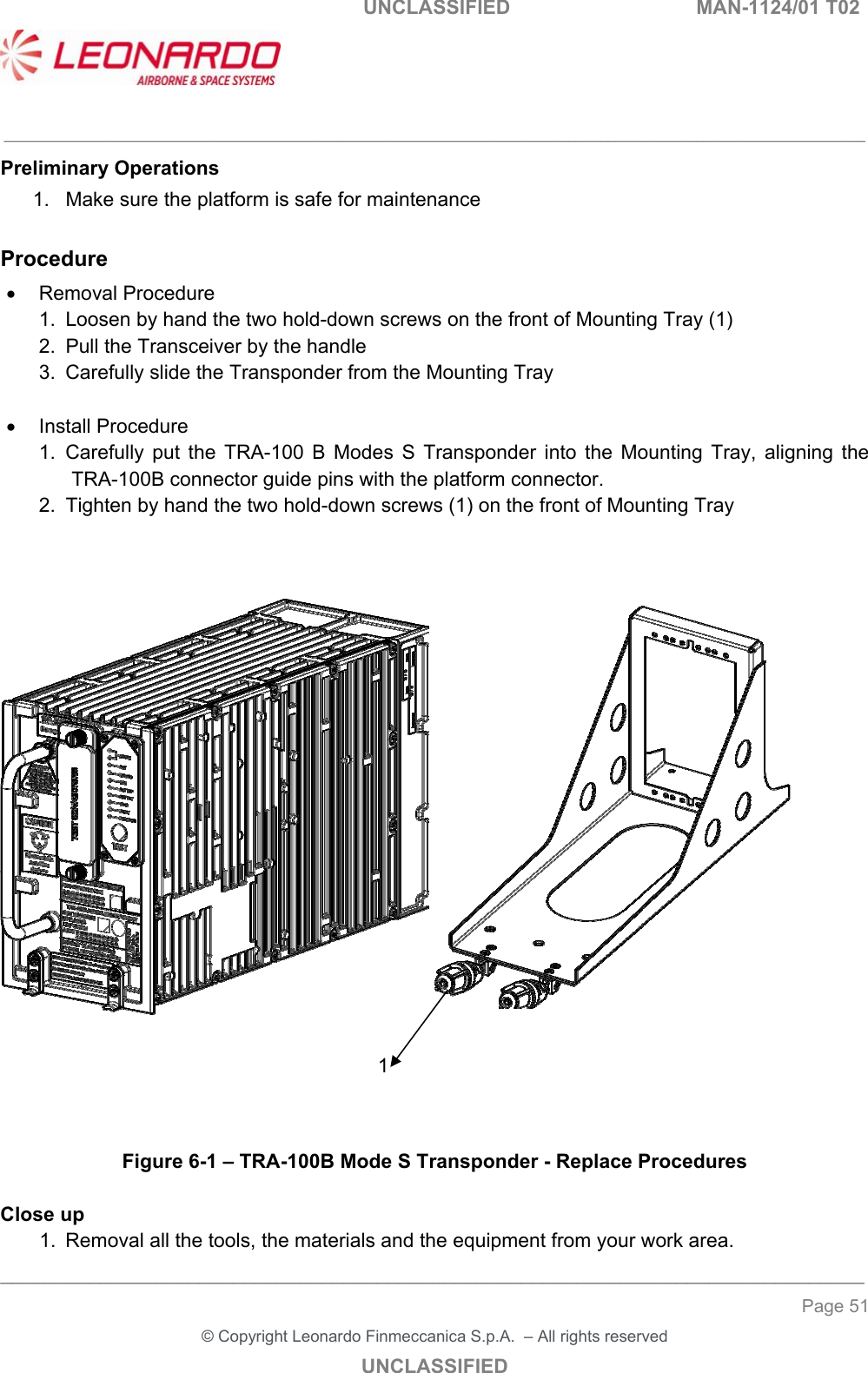
  UNCLASSIFIED  MAN-1124/01 T02   ___________________________________________________________________________________________________________ ______________________________________________________________________________ Page 51 © Copyright Leonardo Finmeccanica S.p.A.  – All rights reserved UNCLASSIFIED Preliminary Operations 1.  Make sure the platform is safe for maintenance  Procedure   Removal Procedure 1.  Loosen by hand the two hold-down screws on the front of Mounting Tray (1) 2.  Pull the Transceiver by the handle  3.  Carefully slide the Transponder from the Mounting Tray    Install Procedure 1.  Carefully  put  the  TRA-100  B  Modes  S  Transponder  into  the  Mounting  Tray,  aligning  the TRA-100B connector guide pins with the platform connector. 2.  Tighten by hand the two hold-down screws (1) on the front of Mounting Tray          Figure 6-1 – TRA-100B Mode S Transponder - Replace Procedures  Close up 1.  Removal all the tools, the materials and the equipment from your work area. 1
  UNCLASSIFIED  MAN-1124/01 T02   ___________________________________________________________________________________________________________ ______________________________________________________________________________ Page 52 © Copyright Leonardo Finmeccanica S.p.A.  – All rights reserved UNCLASSIFIED 7  FAULT ISOLATION 7.1  GENERAL Fault Location procedure allows the maintainer to isolate the failure the source of a failure at the system level or aircraft wiring level. Furthermore the fault location can be performed even on the Transponder itself in order to identify the failed module. The  TRA-100B  Transponder  provides  a  Built-In-Test  function  strictly  for  the  purpose  of annunciation  to  the  crew  of  a  faulty  Transponder  system  and  for  the  purpose  of  providing maintenance information for the repair function. The  TRA-100B  provides  several  Input/Output  interfaces  for  Built-In-Test  capability  necessary  to perform  a  diagnostic  process  to  isolate  the  failure  and  provide  the  information  related  to  its location.  7.2  FAILURE DATA STRUCTURE The diagnostic results are stored in a NVM in accordance with the following data::  a)  One Hundred (100) Flight legs of storage. b)  Ten (10) subassembly and external faults per flight segment. c)  Three (3) subassembly faults for ground tests. d)  Two Hundred Thirty (230) bytes of storage per Current Flight leg and One Hundred Sixty Seven (167) bytes for each other Flight leg segment.  7.2.1  Flight Information Header For each flight leg, currently available flight information is stored in a fixed header. The flight leg is incremented upon reception from the CFDS of a command label with code of 2, which occurs during the aircraft take-off.   From one take-off point to the next, faults is stored for the 'current' flight leg.  The flight information header records all the data received on the maintenance port for each flight leg with the exception of GMT, and flight phase as per the following table:  The flight information header records all the data received on the maintenance port for each flight leg with the exception of GMT, and flight phase as per the following table:
  UNCLASSIFIED  MAN-1124/01 T02   ___________________________________________________________________________________________________________ ______________________________________________________________________________ Page 53 © Copyright Leonardo Finmeccanica S.p.A.  – All rights reserved UNCLASSIFIED     The flight information header records all the data received on the maintenance port for each flight leg with the exception of GMT, and flight phase as per the following table:
  UNCLASSIFIED  MAN-1124/01 T02   ___________________________________________________________________________________________________________ ______________________________________________________________________________ Page 54 © Copyright Leonardo Finmeccanica S.p.A.  – All rights reserved UNCLASSIFIED  7.2.2  Fault Record format Each fault record contains the time, flight phase, failure code, number of occurrences (up to 4) of the failure.   The Ground fault records contains the first three faults recorded.  The failure codes are organized as follows:    Log of internal faults
  UNCLASSIFIED  MAN-1124/01 T02   ___________________________________________________________________________________________________________ ______________________________________________________________________________ Page 55 © Copyright Leonardo Finmeccanica S.p.A.  – All rights reserved UNCLASSIFIED Table 7-1 – TRA-100B –  Internal Faults
  UNCLASSIFIED  MAN-1124/01 T02   ___________________________________________________________________________________________________________ ______________________________________________________________________________ Page 56 © Copyright Leonardo Finmeccanica S.p.A.  – All rights reserved UNCLASSIFIED   Log of external faults  Table 7-2 – TRA-100B – External Faults
  UNCLASSIFIED  MAN-1124/01 T02   ___________________________________________________________________________________________________________ ______________________________________________________________________________ Page 57 © Copyright Leonardo Finmeccanica S.p.A.  – All rights reserved UNCLASSIFIED 7.3  FAILURE LOCATION ON AIRCRAFT The Fault Location procedure permits to find out the origin of a undesired symptoms.   LED on the front panel of the TRA-100B transponder illuminate when  TRA-100B system failures are detected (Figure 7-3). The  TRA-100B  transponder's  Built-In-Test  equipment  (BITE)  continually  monitors  the  equipment (both internal and external  sources) and if a  failure  is  detected will cause the transponder  lamp. System  failure  indications  displayed  on  the  front  of  the  transponder  are  detected  during Functional-Self-Test. The Functional-Self-Test is manually initiated from the TEST pushbutton on the front of the transponder. Some of the transponder faults, are indicated with red LED's on the transponder front panel. The following is a list of the transponder fault LED's.   During Power-Up the XPNDR red LED is set and remain set until the equipment is initialized (i.e. Software and Firmware started up).  The XPNDR red LED is set while the failure discrete output pins are in the active state.   The  XPNDR  green  LED  is  set  to  indicate  that  the  equipment  is  initialized  (i.e.,  Software  and Firmware started up) and the failure discrete output pins are not in the active state.   The front  panel LED's provide a real time report of the validity of the Transponder internally and the external interfaces.   The  LED's  are  activated  by  the  Test  Push-button.  The  tests  for  the  "on-ground"  condition  are performed at the time of the activation of the test push-button.   The data from this self-test and the data from the latest passive test sequence is then displayed by the LED's in the following manner:     Within  1  second  from  the  time  the  push-button  is  activated,  NOGO  (RED)  and  external interfaces  LED's is  turned on for 3 seconds.   NOGO (RED) and external interfaces  LED's  then go off for 3 seconds.   The appropriate LED then is set on and stays lit until the push-button is released.   The appropriate LED above is green for the Transponder, if no internal faults are identified, and red for the Transponder, if any internal fault is identified.   The test cycle that is initiated by the push-button re-runs after the 3 second, 3 second, 3 second sequence described above is completed, if the push-button is still active.
  UNCLASSIFIED  MAN-1124/01 T02   ___________________________________________________________________________________________________________ ______________________________________________________________________________ Page 58 © Copyright Leonardo Finmeccanica S.p.A.  – All rights reserved UNCLASSIFIED However, the LEDs remains in their status annunciation state, and will change in response to any new array of fault data picked up by the latest test cycle.    7.3.1  ON A/C Troubleshooting procedure  TRA-100B failure indication and associated corrective action procedures are described in  Table 7-3   Table 7-3 – TRA-100B – Malfunction Symptoms  Ref.  Symptoms  Prioritized Corrective Action 1.    Primary power is not present on bus input to the transponder. 1. Check/repair aircraft primary power source and associated aircraft wiring. 2.  Check/replace  any  external  relays  that may  be  present  in  the  primary  power  input lines to transponder. 2.    Platform  primary  power  circuit breaker not remain closed. 1.  Check/repair  short  circuit  in  aircraft  wiring or system equipment. 3.    Fail lamp remains  lit on transponder related control unit. 1.  Follow  procedure  to  Ref.  18  if  TRA-100B transponder  is  selected  on  control  unit  or replace  ATCRBS  transponder  if  ATCRBS transponder is selected from control unit. 4.    ATC  1  or  ATC  2  annunciation  does not  appear  on  control  unit  display window  when  transponder  #1  (ATC 1) is selected from control unit. 1. Replace control unit. 5.    Without  having  pressed  the  TEST pushbutton on  the front panel of  the TRA-100B,  XPNDR  red  LED  failure indication  is  lit  on  the  front  of transponder  (i.e.  red  lamp illuminated on TRA-100B). 1.  Replace  transponder  if  a  TRA-100B transponder  is  being  checked.  If  failure indication  appears  on  an  ATCRBS transponder  please  refers  to  appropriate maintenance manual  6.    When  TEST  pushbutton  on  front panel  of  transponder  is  pressed  to initiate  functional  test,  all  the  lamps on  front  of  the  TRA-100B transponder  do  not  light  for approximately  three  seconds  and then  extinguish  (or,  if  applicable, proper  initial  functional  test 1.  Replace  transponder  if  a  TRA-100B transponder  is  being  checked.  If  failure indication  appears  on  an  ATCRBS transponder  please  refers  to  appropriate maintenance manual
  UNCLASSIFIED  MAN-1124/01 T02   ___________________________________________________________________________________________________________ ______________________________________________________________________________ Page 59 © Copyright Leonardo Finmeccanica S.p.A.  – All rights reserved UNCLASSIFIED Ref.  Symptoms  Prioritized Corrective Action indications  are  not  present  on  an ATCRBS transponder). 7.    Approximately six seconds after the TEST pushbutton on the front of the transponder  is  pressed  and  held,  a transponder  "good"  indication  is  not present on the transponder or a "fail" indication  is  present.  For  the  TRA-100B,  Transponder  "good"  is indicated  by  a  LED  (green)  XPNDR and  a  "fail"  condition  is  indicated  by a LED (red) XPNDR. 1.  Follow  procedure  to  Ref.  18  if  TRA-100B transponder  is  selected  on  control  unit  or replace  ATCRBS  transponder  if  ATCRBS transponder is selected from control unit 8.    XPNDR Green LED on front of TRA-100B  transponder  remains permanently  lit  after  TEST pushbutton on transponder has been released  (or,  if  applicable,  a  similar faulty  indication  appears  on  an ATCRBS transponder). 1.  Replace  transponder  if  a  TRA-100B transponder  is  being  checked.  If  failure indication  appears  on  an  ATCRBS transponder  please  refers  to  appropriate maintenance manual 9.    When  TEST  procedure  is  initiated from  the  control  unit,  the  ATC  FAIL lamp  on  the  control  unit  itself  does not  light  for  first  three  seconds  or remains lit. 1. Press and  hold TEST pushbutton on front of transponder selected on the control unit. Check  for  fail  indication  on  front  of transponder. If a lit red fail LED is present on a  TRA-100B  transponder  follow  the  procedure  to Ref. 18. If failure indication appears on an ATCRBS  transponder  please  refers  to appropriate maintenance manual. 2. Replace the control unit. 3. Check/repair Functional Test signal wiring between the control unit and the transponder. 10.   Control  unit's  ATC  IDENT  CODE display  window  does  not  indicate 8888  during  TEST  mode  initiated from control unit. 1. Replace control unit. 11.   ATC  Code  Select  switches/controls on  the  control  unit  do  not  properly control the ATC Code display on the control unit. 1. Replace control unit. 12.   Mode  C  ramp  tests:  proper  altitude  1.  Follow  procedure  to  Ref.  18  if  TRA-100B
  UNCLASSIFIED  MAN-1124/01 T02   ___________________________________________________________________________________________________________ ______________________________________________________________________________ Page 60 © Copyright Leonardo Finmeccanica S.p.A.  – All rights reserved UNCLASSIFIED Ref.  Symptoms  Prioritized Corrective Action reports  are  not  displayed  on  ramp tester. transponder  is  selected  on  control  unit  or replace  ATCRBS  transponder  if  ATCRBS transponder is selected from control unit  2. Check/replace altitude source. 3. Check ramp tester. 13.   Mode  C  ramp tests: the ramp  tester indicates  that  the  transponder's transmit frequency is not within 1090 MHz ± 1 MHz. Same as Ref. 12 14.   Mode  A  ramp  tests:  proper  ATC Code  is  not  displayed  on  ramp tester. Same as Ref. 12 15.   Mode  A  ramp  tests:  the  ramp  tester indicates  that  the  transponder transmit frequency is not within 1090 MHz ± 1 MHz. Same as Ref. 12 16.   An  altitude  report  display  is  visible on ramp tester when the appropriate control  unit  switch  is  set  to  inhibit altitude  reporting  during  ramp testing. 1. Replace control unit. 2. Replace transponder. 3.  Check/repair  the  Altitude  Reporting ON/OFF  signal  wiring  between  the  control unit and transponder. 17.   a  Special  Position  Identifion  (SPI) pulse  indication  is  not  visible  on ramp  tester  when  the  ATC  IDENT switch  is  pressed  during  ramp testing.  1. Replace control unit. 2. Replace transponder. 3. Check/repair the IDENT signal wiring between the control unit and transponder 18.   On  front  panel  of  TRA-100B transponder,  press  and  hold  the TEST  pushbutton  while  observing indicators  on  front  of  transponder: One  or  more  of  the  red  XPNDR, ALT,  DATA  IN,  TOP,  BOT,  TCAS, MAINTENANCE,  GPS  or RESERVED LED remain lit. FAULT LED FAILURE XPDR  green  (No  other  lights  on):  System good XPDR red: XPNDR is defective ALT: ADC source is defective DATA IN: Check ATC control unit/wiring TOP: Top ATC ant/coax is "OPEN" BOT: Bottom ATC ant/coax is "OPEN" GPS: GPS source is defective TCAS: Check TCAS processor/wiring MAINT Check input from CFDS, if used RESERVED Not Active RESERVED Not Active
  UNCLASSIFIED  MAN-1124/01 T02   ___________________________________________________________________________________________________________ ______________________________________________________________________________ Page 61 © Copyright Leonardo Finmeccanica S.p.A.  – All rights reserved UNCLASSIFIED 7.3.2  NVM Download procedure In addition to the above procedures, maintainer can download the NVM contents in order to verify the status of fault code as per Table 7-1 and Table 7-2. Following  procedure  describes  step  by  step  actions  to  be  performed  in  order  to  download  NVM fault log data from TRA-100B Mode S Transponder. The  procedure  is  tailored  to  TechSat  Net  Loader  tool  but  can  be  easily  translated  to  any  other A615A compliant tool.  The  main  goal  is  to  send  one  of  the  attached  files  (HNR-XPDR_1.LNR  or  HNR-XPDR_1.LNR depending on XPDR side installation) in order to command the Transponder to download the NVM fault log data.  7.3.2.1  Techsat Net Loader procedure:  1)  Change the PC’s IP Address and Subnet mask (remember current setting). Control  Panel  ->  Network  and  Internet  ->  Network  Connections  then  change  Local  Area Connection Properties of the Internet Protocol Version 4 (TCP/IPv4 Properties) to:   IP Address = 10.129.0.1 (for side 1, 10.128.0.1 for side 2)   Subnet mask = 255.255.255.0  2)  Standard Ethernet cable connected from PC to the TRA-100B Ethernet port.  3)  Maintenance Key plugged into the maintenance port. Note this will tie the Maintenance Port pins 1, 14 & 15 to Pin 3 (GND).  4)  The unit must be configured to be on-ground by grounding TP5K & TP5J. Note: steps 5-9 can be skipped if the tool has been previously installed  5)  Install MediaCreator PartMaker and NetLoader software  (see how to install them)  6)  The default working directory is : C:\Users\ UserName\DEVSTATION-DATA  (%HOME%/DEVSTATION-DATA) a.  Copy attached files HNR-XPDR_1.LNR and HNR-XPDR_2.LNR in: %HOME%/DEVSTATION-DATA/loader/download_files 7)  Start NetLoader and press “OK” button in Error window  8)  Click “Edit Configuration” button a.  Set subnetmask = 255.255.255.0  b.  Set ip = 10.129.0.1 c.  Set a615a_version = 3 d.  Press Commit and then Close
  UNCLASSIFIED  MAN-1124/01 T02   ___________________________________________________________________________________________________________ ______________________________________________________________________________ Page 62 © Copyright Leonardo Finmeccanica S.p.A.  – All rights reserved UNCLASSIFIED 9)  Press “Shutdown” button   10) Start NetLoader and press “OK” button in Error window  11) Press “Download Media defined” button, following window will appear    12) Click on HNR-XPDR_1.LNR file for side 1 XPDR, HNR-XPDR_2.LNR for side 2 XPDR and then press “Open” button.  13) If the XPDR is correctly found by the loader the following mask will appear (side 1 example)
  UNCLASSIFIED  MAN-1124/01 T02   ___________________________________________________________________________________________________________ ______________________________________________________________________________ Page 63 © Copyright Leonardo Finmeccanica S.p.A.  – All rights reserved UNCLASSIFIED    14) Select the HNR-XPDR THW_ID row and press “Download” button.  15) NVM download process will start automatically and if successfully the following window will appear. Binary file “READ_NVM” with NVM fault log content will be stored in %HOME%/DEVSTATION-DATA/loader/download_files folder.
  UNCLASSIFIED  MAN-1124/01 T02   ___________________________________________________________________________________________________________ ______________________________________________________________________________ Page 64 © Copyright Leonardo Finmeccanica S.p.A.  – All rights reserved UNCLASSIFIED    16) Press “Close” button  17) Press “Shutdown” button
  UNCLASSIFIED  MAN-1124/01 T02   ___________________________________________________________________________________________________________ ______________________________________________________________________________ Page 65 © Copyright Leonardo Finmeccanica S.p.A.  – All rights reserved UNCLASSIFIED 7.3.3  NVM Data  The Table 7-1 – TRA-100B –  Internal Faults provides fault log for internal faults and consequently for  off  aircraft  info,  the  Table  7-2  –  TRA-100B  –  External  Faults  provides  fault  log  for  failures detected on external sources. In  case  of failure indication provided on  this area, the first  step  is verify the connections between the TRA-100B and related external equipment.  The following table (Table 7-4) reports the troubleshooting procedure to perform against each fault log.  Table 7-4 - External Faults Maintenance Procedure  Fault Code Failed Interface Failure Symptom Maintenance action F0H Maintenance  No Maintenance Data  Verify  connection  with CFDS if used F1H 24 bit discrete Address  Intermittent  Mode  S address Verify  the  connection  with Address bus F2H TCAS  TCAS  Periodic  Data Failure Verify  connection  with TCAS F3H Power Interruption>10MSEC Power Supply Interruption  Verify  connection  with primary  power  from platform F4H Altitude – 706 (L203)  Altitude  706  Air  Data Failure Verify  connection  with ADC source F5H Altitude – 575 (L203)  Altitude  575  Air  Data Failure Verify  connection  with ADC source F6H Altitude – 706 (all labels)  706 Air Data Failure  Verify  connection  with ADC source F7H FMC/GNSS#2  FMC/GNSS#2 Failure  Verify  connection  with FMC/GNSS#2 F8H FMC/GNSS#1#2  FMC/GNSS#1#2 Failure  Verify  connection  with FMC/GNSS#2 F9H IRS/FMS  IRS/FMS Failure  Verify  connection  with IRS/FMS FAH FMC/GNSS#1  FMC/GNSS#1 Failure  Verify  connection  with FMC/GNSS#1 FBH FMC GEN  FMC GEN Failure  Verify  connection  with FMC FCH Altitude – 575 (all labels)  575 Air Data Failure  Verify  connection  with
  UNCLASSIFIED  MAN-1124/01 T02   ___________________________________________________________________________________________________________ ______________________________________________________________________________ Page 66 © Copyright Leonardo Finmeccanica S.p.A.  – All rights reserved UNCLASSIFIED Fault Code Failed Interface Failure Symptom Maintenance action ADC source FDH FCC/MCP  FCC/MCP Failure  Verify  connection  with FCC/MCP FEH Landing Gear Input  Landing Gear Failure  Verify the connection with platform  FFH ADS-B  Configuration Pins ADS-B Parity Failure  Verify  connection  with platform
  UNCLASSIFIED  MAN-1124/01 T02   ___________________________________________________________________________________________________________ ______________________________________________________________________________ Page 67 © Copyright Leonardo Finmeccanica S.p.A.  – All rights reserved UNCLASSIFIED 7.4  FAILURE LOCATION OFF AIRCRAFT 7.4.1  STTE Description As  mentioned  above  the  TRA-100B  Built-In-Test  is  capable  to  perform  internal  diagnostic  and provide results to the STTE.  The  TRA-100B  STTE  is  designed  to  perform  troubleshooting  procedure  and  provides  after  the fault isolation the step by step procedure to restore the Transponder in its operating condition.  The TRA-100B STTE is composed as follows  Table 7-5 – TRA-100B STTE  Composition  Pos.  Item  P/N 1  Double Rack 37U 600x800        HPI-1358/01.01       2  Lab Equipment _  (9 KHz - 6 GHZ)  9401151M0019         3  PXI INTERFACE                  TAD-5055/01.01       4  UUT FRONT PANEL FIXTURE        TAG-5486/01.01       5  ANTENNA INTERFACE - MOUNTING   TAD-5056/01.01       6  Rack Guide ACCIAIO TELESCOPICA  8100485M0437         7  For Cabinets ACCIAIO   8100081M0419         8  Lab Equipment _  (IFF SIMULATOR)  9401131M0014         9  Lab Equipment _  (AC SOURCE/A  9401163M0015         10  DIGITAL SCOPE                  TAG-5497/01.01       11  Monitor _  (17" LCD DISPLAY -  9401149M0014         12  PC Periph or Assembly _  (RAC  9401140M0013         13  Ethernet Switch  (16 PORT FAS  9300164M0018         14  WORKSTATION 2U RACK            HPI-1400/01.01       15  CAVO ICON ITA-ICON ITA L300mm  TAN-5358/01.01       16  RF Cable SUCOFLEX 104 PTFE _m  1301783M0015         17  CAVO BNC 90-BNC 90 L2600mm     TAN-5361/01.01       18  CAVO BNC 90-BNC 90 L1500mm     TAN-5362/01.01       19  CAVO HI-PWR PER ATE MST-TRA    TAN-5368/01.01       20  CABLE 37P BREAKOUT PXI - ANTE  TAN-5380/01.01       21  TARGHETTA RACK                 TAK-7180/01.01       22  Cable AWG28 PVC _m**2 _ _  (C  1301273M0012         23  Cable 26/28AWG LSZH _m**2 COP  1301688M0011         26  TRA-100B_MPC STTE Software     TIU-0077/01.01        Figure 7-1 and Figure 7-2 show the STTE composition
                                                                                               UNCLASSIFIED        MAN-1124/01 T02  ____________________________________________________________________________________________________________________________________________________________ __________________________________________________________________________________________________________________ Page 68 © Copyright Leonardo Finmeccanica S.p.A.  – All rights reserved UNCLASSIFIED                           Figure 7-1 – TRA-100B STTE (Front and right views)
                                                                                               UNCLASSIFIED        MAN-1124/01 T02  ____________________________________________________________________________________________________________________________________________________________ __________________________________________________________________________________________________________________ Page 69 © Copyright Leonardo Finmeccanica S.p.A.  – All rights reserved UNCLASSIFIED  Figure 7-2 – TRA-100B STTE (Rear and left views)
                                                   UNCLASSIFIED  MAN-1124/01 T02  ___________________________________________________________________________________________________________ ______________________________________________________________________________ Page 70 © Copyright Leonardo Finmeccanica S.p.A.  – All rights reserved UNCLASSIFIED 7.4.2  OFF A/C Troubleshooting procedure The OFF A/C troubleshooting procedure is performed in the Repair Station in order to identify or confirm the failure of received equipment. It starts with a visual inspection of the Transponder to verify eventual damage that can be occurred during the handling, packaging and/or transportation.  In case of damage the maintainer has to verify if it is reported on the Failure Report supplied with the Equipment. In case of missing information the maintainer shall record the damage updating the Failure Report.  Therefore the equipment shall be connected to the STTE (see Figure 7-1) and shall verify the data reported in the NVM (see Figure 7-7). The  STTE  provides  the  necessary  supplies,  command  and  control  signals  and  maintenance interface.   The first information on the Transponder health status is provided by the Front Panel. The TRA-100B  is  equipped  with  a  set  of  LED  which  provide  the  status  of  the  Transponder  itself  and  the status of the Transponder interfaces.    Figure 7-3 – TRA-100B - Front Panel LED
                                                   UNCLASSIFIED  MAN-1124/01 T02  ___________________________________________________________________________________________________________ ______________________________________________________________________________ Page 71 © Copyright Leonardo Finmeccanica S.p.A.  – All rights reserved UNCLASSIFIED As  showed  in  Figure  7-3  the  following  LED  are  present  on  the  Front  Panel  with  the  following meaning:  Table 7-6 – TRA-100B - Front Panel LED indicators  CONTROL / INDICATOR  DESCRIPTION  FUNCTION XPNDR  Green  Transponder  GO.  The  Transponder  is correctly operating. XPNDR  Red  Transponder NOGO. The Transponder is not operating. ALT  Green/Red  This  LED  provides  the  status  of  external Altitude  data.  Color  green  the  data  are correct  DATA IN  Green/Red  This  LED  provides  the  status  of  external Control data. Color green the data are correctGPS  Green/Red  This LED provides the status of external GPS data. Color green the data are correct ANT TOP  Green/Red  This  LED  provides  the  status  of  external Antenna Top status. Color green the Antenna Top is correctly operating. ANT BOT  Green/Red  This  LED  provides  the  status  of  external Antenna Bot status. Color green the Antenna Bot is correctly operating. TCAS  Green/Red  This  LED  provides  the  status  of  external TCAS data. Color green the data are correct MAINT  Green/Red  This LED provides the status of Maintenance interface. Color green the data are correct RESERVED  N/A     During Power-Up the NOGO (RED) LED is set and remain set until the equipment is initialized (i.e. Software and Firmware started up). The NOGO (RED) LED is set while the failure discrete output pins are in the active state.  The  GO  (GREEN)  LED  is  set  to  indicate  that  the  equipment  is  initialized  (i.e.,  Software  and Firmware started up) and the failure discrete output pins are not in the active state.  The front  panel LED's provide a real time report of the validity of the Transponder internally and the external interfaces.  The  LED's  are  activated  by  the  Test  Push-button.  The  tests  for  the  "on-ground"  condition  are performed at the time of the activation of the test push-button.  The data from this self-test and the data from the latest passive test sequence is then displayed by the LED's in the following manner:
                                                   UNCLASSIFIED  MAN-1124/01 T02  ___________________________________________________________________________________________________________ ______________________________________________________________________________ Page 72 © Copyright Leonardo Finmeccanica S.p.A.  – All rights reserved UNCLASSIFIED   Within  1  second  from  the  time  the  push-button  is  activated,  NOGO  (RED)  and  external interfaces  LED's is  turned on for 3 seconds.   NOGO (RED) and external interfaces  LED's  then go off for 3 seconds.   The appropriate LED then is set on and stays lit until the push-button is released.   The appropriate LED above is green for the Transponder, if no internal faults are identified, and red for the Transponder, if any internal fault is identified.    The test cycle that is initiated by the push-button re-runs after the 3 second, 3 second, 3 second sequence described above is completed, if the push-button is still active.   However, the LEDs remains in their status annunciation state, and will change in response to any new array of fault data picked up by the latest test cycle.   7.4.3  Connection procedure  The procedure to connect the TRA-100B to the STTE is following reported (ref. Figure 7-1):  1.  Install  the  TRA-100B  into  the  mounting  tray  (pos.  6  and  7)  and  push  it  until  the  rear connectors are mated. 2.  Securing the TRA-100B to the mounting tray using the two hold down screws  3.  Connect the Ethernet connector 4.  Connect  the Test connector.  7.4.4  Fault Finding The  TRA-100B  stores  the  failures  occurred  during  the  operation  in the NVM. Nevertheless if a failure arise in a section of DPIO the Transponder is not operative and the NVM content cannot be read. The procedure to perform the fault finding on TRA-100B is following reported: 1.  Verify the status of the front panel LED. 2.  If the red LED “NO GO” is on the DPIO SRU is failed but no data cannot be written in the NVM.  Therefore follows the procedure for DPIO Removal (Ref. 8.4.1). 3.  If the green LED “GO” is on, the TRA-100B is able to perform the auto test phase.  After 30 sec. the results of test will be reported in the “NVM Maintenance Interface” box (see  Figure 7-7) 4.  The data are organized as follows: a.  Current Flight Information data pack: This field contains data related to flight information such as departure location (From), arrival location (to), flight number (Flight Nr.), aircraft identification (Aircraft Id.) and date (Date) b.  Failure Localization data pack (flight): This field contains data related Failure code as per  plus time of occurrence (GMT), Flight Phase, Error Repetition Counter (Fail
                                                   UNCLASSIFIED  MAN-1124/01 T02  ___________________________________________________________________________________________________________ ______________________________________________________________________________ Page 73 © Copyright Leonardo Finmeccanica S.p.A.  – All rights reserved UNCLASSIFIED Rep), Check Sum, Temperatures info (Temp 1XX, Temp 2XX, Temp 3XX), ETI Counter (ETI High, ETI Low). 5.  After the completion of test cycle, the operator shall select “Diagnostic Procedure” from Tool Menu (Figure 7-8) 6.  The Diagnostic Procedure screen (Figure 7-9) shows the Fail Code information together with Module affected and Fail Description. The last column of section “Page” reports the CMM number of page where the maintenance procedure to be performed in order to restore the Transponder is recalled. 7.  Clicking on the number of page reported in this column, the “Maintenance” section of this manual will be opened showing the maintenance task to be performed to replace the failed module. 7.4.5  Checkout procedure In order to verify if the maintenance procedure restored the TRA-100B to its operating conditions, a checkout procedure has to be performed. This checkout consist mainly in running the ATP procedure as described following:  7.4.5.1  Check of lightning protection devices presence The testing in this section consists of applying an AC voltage through a current-limit resistor to the UUT rear connector discrete pins.  The voltage level has been selected to provide enough current to activate the transzorbs. With this AC  voltage  applied,  the  Minimum  and  Maximum  DC  voltage  levels  on  discrete  output  pins  are measured to ensure that the transzorbs perform voltage clamping at the device rated values.  Care is taken to apply the AC voltage for less than 15 seconds in order to prevent damage to the discrete output circuit in case of a transzorb failure.  The following table defines the series resistor value, the external AC voltage to be used for each single pin and the expected clamping voltage to be verified.
                                                   UNCLASSIFIED  MAN-1124/01 T02  ___________________________________________________________________________________________________________ ______________________________________________________________________________ Page 74 © Copyright Leonardo Finmeccanica S.p.A.  – All rights reserved UNCLASSIFIED Table 7-7 – TRA-100B - Transzorb Test Parameters  Pin  I/O  Type  Description  Series Resistor 1%  AC Voltage  Clamping Voltage TP 1A  Input  Program  AC Length/Width A MSB  4.75KΩ 1/2W 80±0.5VAC, 50±0.5Hz  ± 72.7 V TP 1B  Input  Program Strobed  AC Length/Width B  4.75KΩ 1/2W 80±0.5VAC, 50±0.5Hz  ± 72.7 V TP 1C  Input  Program Strobed  AC Length/Width C LSB  4.75KΩ 1/2W 80±0.5VAC, 50±0.5Hz  ± 72.7 V TP 1D  Input  Program Strobed  GPS Ant Long Off A (MSB)  4.75KΩ 1/2W 80±0.5VAC, 50±0.5Hz  ± 72.7 V TP 1E  Input  Program Strobed  GPS Ant Long Off B  4.75KΩ 1/2W 80±0.5VAC, 50±0.5Hz  ± 72.7 V TP 1F  Input  Program Strobed  GPS Ant Long Off C (LSB)  4.75KΩ 1/2W 80±0.5VAC, 50±0.5Hz  ± 72.7 V TP 1G  Input  Program Strobed Navigation  Accuracy  Category Velocity (NACV) 4.75KΩ 1/2W 80±0.5VAC, 50±0.5Hz  ± 72.7 V TP 1H  Input  Program Strobed System    Design  Assurance (SDA) 4.75KΩ 1/2W 80±0.5VAC, 50±0.5Hz  ± 72.7 V TP 1J  Input  Differential  GPS Time Mark 1A  560Ω 1/2W  40±0.5VAC, 50±0.5Hz  ± 24.4 V TP 1K  Input  Differential  GPS Time Mark 1B  560Ω 1/2W  40±0.5VAC, 50±0.5Hz  ± 24.4 V TP 2A  Input  429  FMC/GNSS #1 In #1 A  560Ω 1/2W  40±0.5VAC, 50±0.5Hz  ± 11.2 V TP 2B  Input  429  FMC/GNSS #1 In #1 B  560Ω 1/2W  40±0.5VAC, 50±0.5Hz  ± 11.2 V TP 2C  Input  429  IRS/FMS/Data Conc. A  560Ω 1/2W  40±0.5VAC, 50±0.5Hz  ± 11.2 V TP 2D  Input  429  IRS/FMS/Data Conc. B  560Ω 1/2W  40±0.5VAC, 50±0.5Hz  ± 11.2 V TP 2E  Output  429  Spare Out 1A  560Ω 1/2W  40±0.5VAC, 50±0.5Hz  ± 11.2 V TP 2F  Output  429  Spare Out 1B  560Ω 1/2W  40±0.5VAC, 50±0.5Hz  ± 11.2 V TP 2G  Input  429  ATSU In A  560Ω 1/2W  40±0.5VAC, 50±0.5Hz  ± 11.2 V TP 2H  Input  429  ATSU In B  560Ω 1/2W  40±0.5VAC, 50±0.5Hz  ± 11.2 V TP 2J  Input  Discrete  Data Load Enable  4.75KΩ 1/2W 80±0.5VAC, 50±0.5Hz  ± 72.7 V TP 2K  Input  Program  ADS-B FAIL Disable  4.75KΩ 1/2W 80±0.5VAC, 50±0.5Hz  ± 72.7 V TP 3A  Output  Discrete  ADS-B FAIL Disc Out  4.75KΩ 1/2W 80±0.5VAC, 50±0.5Hz  ± 72.7 V TP 3B  Output  Discrete  Transponder  Fail  Disc  #2 Output 4.75KΩ 1/2W 80±0.5VAC, 50±0.5Hz  ± 72.7 V TP 3C  Input  Program  Cable Delay Program Top/Bot  4.75KΩ 1/2W 80±0.5VAC, 50±0.5Hz  ± 72.7 V TP 3D  Input  Program  Cable  Delay  Program  Value #1 4.75KΩ 1/2W 80±0.5VAC, 50±0.5Hz  ± 72.7 V TP 3E  Input  Program  Cable  Delay  Program  Value #2 4.75KΩ 1/2W 80±0.5VAC, 50±0.5Hz  ± 72.7 V TP 3G  Input  Discrete  SDI  429  Bus  Address  Logic Input 4.75KΩ 1/2W 80±0.5VAC, 50±0.5Hz  ± 72.7 V TP 3H  Input  Discrete  SDI  429  Bus  Address  Logic  4.75KΩ  80±0.5VAC,  ± 72.7 V
                                                   UNCLASSIFIED  MAN-1124/01 T02  ___________________________________________________________________________________________________________ ______________________________________________________________________________ Page 75 © Copyright Leonardo Finmeccanica S.p.A.  – All rights reserved UNCLASSIFIED Pin  I/O  Type  Description  Series Resistor 1%  AC Voltage  Clamping Voltage Input  1/2W  50±0.5Hz TP 5A  Input  Program  Maximum Airspeed 17  4.75KΩ 1/2W 80±0.5VAC, 50±0.5Hz  ± 72.7 V TP 5B  Input  Program  Maximum Airspeed 16  4.75KΩ 1/2W 80±0.5VAC, 50±0.5Hz  ± 72.7 V TP 5C  Input  Program  Maximum Airspeed 15  4.75KΩ 1/2W 80±0.5VAC, 50±0.5Hz  ± 72.7 V TP 5E  Input  429  TX Coordination A  560Ω 1/2W  40±0.5VAC, 50±0.5Hz  ± 11.2 V TP 5F  Input  429  TX Coordination B  560Ω 1/2W  40±0.5VAC, 50±0.5Hz  ± 11.2 V TP 5G  Output  429  XT Coordination A  4.75KΩ 1/2W 50±0.5VAC, 50±0.5Hz  ± 11.2 V TP 5H  Output  429  XT Coordination B  560Ω 1/2W  40±0.5VAC, 50±0.5Hz  ± 11.2 V TP 5J  Input  Discrete  Air/Ground Discrete #2  4.75KΩ 1/2W 80±0.5VAC, 50±0.5Hz  ± 72.7 V TP 5K  Input  Discrete  Air/Ground Discrete #1  4.75KΩ 1/2W 80±0.5VAC, 50±0.5Hz  ± 72.7 V TP 6A  Input  429  FMC #1 / Gen In #2 A  560Ω 1/2W  40±0.5VAC, 50±0.5Hz  ± 11.2 V TP 6B  Input  429  FMC #1 / Gen In #2 B  560Ω 1/2W  40±0.5VAC, 50±0.5Hz  ± 11.2 V TP 6D  Input  Discrete  GPS Time Mark 2A  4.75KΩ 1/2W 40±0.5VAC, 50±0.5Hz  ± 24.4 V TP 6E  Input  Discrete  GPS Time Mark 2B  4.75KΩ 1/2W 40±0.5VAC, 50±0.5Hz  ± 24.4 V TP 6F  Input  Discrete  Reserved   4.75KΩ 1/2W 80±0.5VAC, 50±0.5Hz  ± 72.7 V TP 6G  Input  Discrete  Reserved  (-0101/-0301);  FAA - L_Sense Activate (-0201) 4.75KΩ 1/2W 80±0.5VAC, 50±0.5Hz  ± 72.7 V TP 6K  Input  Program  Antenna Program  4.75KΩ 1/2W 80±0.5VAC, 50±0.5Hz  ± 72.7 V TP 7A  Input  429  Control  Data  'A'  or  FCC #1/MCP #1/VHF #1 A  560Ω 1/2W  40±0.5VAC, 50±0.5Hz  ± 11.2 V TP 7B  Input  429  Control  Data  'A'  or  FCC #1/MCP #1/VHF #1 B  560Ω 1/2W  40±0.5VAC, 50±0.5Hz  ± 11.2 V TP 7D  Input  Discrete  Control Data Port Select  4.75KΩ 1/2W 80±0.5VAC, 50±0.5Hz  ± 72.7 V TP 7E  Input  429  Control Data 'B' A  560Ω 1/2W  40±0.5VAC, 50±0.5Hz  ± 11.2 V TP 7F  Input  429  Control Data 'B' B  560Ω 1/2W  40±0.5VAC, 50±0.5Hz  ± 11.2 V TP 7G  Input  Discrete  Standby/On Discrete  4.75KΩ 1/2W 80±0.5VAC, 50±0.5Hz  ± 72.7 V TP 7H  Input  429  ARINC 706/575 Air Data Input Port 1A  560Ω 1/2W  40±0.5VAC, 50±0.5Hz  ± 11.2 V TP 7J  Input  429  ARINC 706/575 Air Data Input Port 1B  560Ω 1/2W  40±0.5VAC, 50±0.5Hz  ± 11.2 V MP 1A  Input  Program  Mode S Address A1 (MSB)  4.75KΩ 1/2W 80±0.5VAC, 50±0.5Hz  ± 72.7 V MP 1B  Input  Program  Mode S Address A2  4.75KΩ 1/2W 80±0.5VAC, 50±0.5Hz  ± 72.7 V MP 1C  Input  Program  Mode S Address A3  4.75KΩ 1/2W 80±0.5VAC, 50±0.5Hz  ± 72.7 V MP 1D  Input  Program  Mode S Address A4  4.75KΩ  80±0.5VAC,  ± 72.7 V
                                                   UNCLASSIFIED  MAN-1124/01 T02  ___________________________________________________________________________________________________________ ______________________________________________________________________________ Page 76 © Copyright Leonardo Finmeccanica S.p.A.  – All rights reserved UNCLASSIFIED Pin  I/O  Type  Description  Series Resistor 1%  AC Voltage  Clamping Voltage 1/2W  50±0.5Hz MP 1E  Input  Program  Mode S Address A5  4.75KΩ 1/2W 80±0.5VAC, 50±0.5Hz  ± 72.7 V MP 1F  Input  Program  Mode S Address A6  4.75KΩ 1/2W 80±0.5VAC, 50±0.5Hz  ± 72.7 V MP 1G  Input  Program  Mode S Address A7  4.75KΩ 1/2W 80±0.5VAC, 50±0.5Hz  ± 72.7 V MP 1H  Input  Program  Mode S Address A8  4.75KΩ 1/2W 80±0.5VAC, 50±0.5Hz  ± 72.7 V MP 1J  Input  Program  Mode S Address A9  4.75KΩ 1/2W 80±0.5VAC, 50±0.5Hz  ± 72.7 V MP 1K  Input  Program  Mode S Address A10  4.75KΩ 1/2W 80±0.5VAC, 50±0.5Hz  ± 72.7 V MP 2A  Input  Program  Mode S Address A11  4.75KΩ 1/2W 80±0.5VAC, 50±0.5Hz  ± 72.7 V MP 2B  Input  Program  Mode S Address A12  4.75KΩ 1/2W 80±0.5VAC, 50±0.5Hz  ± 72.7 V MP 2C  Input  Program  Mode S Address A13  4.75KΩ 1/2W 80±0.5VAC, 50±0.5Hz  ± 72.7 V MP 2D  Input  Program  Mode S Address A14  4.75KΩ 1/2W 80±0.5VAC, 50±0.5Hz  ± 72.7 V MP 2E  Input  Program  Mode S Address A15  4.75KΩ 1/2W 80±0.5VAC, 50±0.5Hz  ± 72.7 V MP 2F  Input  Program  Mode S Address A16  4.75KΩ 1/2W 80±0.5VAC, 50±0.5Hz  ± 72.7 V MP 2G  Input  Program  Mode S Address A17  4.75KΩ 1/2W 80±0.5VAC, 50±0.5Hz  ± 72.7 V MP 2H  Input  Program  Mode S Address A18  4.75KΩ 1/2W 80±0.5VAC, 50±0.5Hz  ± 72.7 V MP 2J  Input  Program  Mode S Address A19  4.75KΩ 1/2W 80±0.5VAC, 50±0.5Hz  ± 72.7 V MP 2K  Input  Program  Mode S Address A20  4.75KΩ 1/2W 80±0.5VAC, 50±0.5Hz  ± 72.7 V MP 3A  Input  Program  Mode S Address A21  4.75KΩ 1/2W 80±0.5VAC, 50±0.5Hz  ± 72.7 V MP 3B  Input  Program  Mode S Address A22  4.75KΩ 1/2W 80±0.5VAC, 50±0.5Hz  ± 72.7 V MP 3C  Input  Program  Mode S Address A23  4.75KΩ 1/2W 80±0.5VAC, 50±0.5Hz  ± 72.7 V MP 3D  Input  Program  Mode S Address A24 (LSB)  4.75KΩ 1/2W 80±0.5VAC, 50±0.5Hz  ± 72.7 V MP 3F  Input  429  Spare 429 Input 1A  560Ω 1/2W  40±0.5VAC, 50±0.5Hz  ± 11.2 V MP 3G  Input  429  Spare 429 Input 1B  560Ω 1/2W  40±0.5VAC, 50±0.5Hz  ± 11.2 V MP 3H  Input  Discrete  Functional Test  4.75KΩ 1/2W 80±0.5VAC, 50±0.5Hz  ± 72.7 V MP 3J  Output  Discrete  Spare Out 1  4.75KΩ 1/2W 80±0.5VAC, 50±0.5Hz  ± 72.7 V MP 3K  Output  Discrete  Transponder  Fail  #1  Discrete Output 4.75KΩ 1/2W 80±0.5VAC, 50±0.5Hz  ± 72.7 V MP 4A  Input  Discrete  Spare In1  4.75KΩ 1/2W 50±0.5VAC, 50±0.5Hz  NA MP 4B  Input  Discrete  Spare In2  4.75KΩ 1/2W 80±0.5VAC, 50±0.5Hz  ± 72.7 V
                                                   UNCLASSIFIED  MAN-1124/01 T02  ___________________________________________________________________________________________________________ ______________________________________________________________________________ Page 77 © Copyright Leonardo Finmeccanica S.p.A.  – All rights reserved UNCLASSIFIED Pin  I/O  Type  Description  Series Resistor 1%  AC Voltage  Clamping Voltage MP 4C  Input  429  FMC/GNSS #2 In #1 A  560Ω 1/2W  40±0.5VAC, 50±0.5Hz  ± 11.2 V MP 4D  Input  429  FMC/GNSS #2 In #1 B  560Ω 1/2W  40±0.5VAC, 50±0.5Hz  ± 11.2 V MP 4E  Input  Program Strobed  Aircraft Category A (MSB)  4.75KΩ 1/2W 80±0.5VAC, 50±0.5Hz  ± 72.7 V MP 4F  Input  Program Strobed  Aircraft Category B (LSB)  4.75KΩ 1/2W 80±0.5VAC, 50±0.5Hz  ± 72.7 V MP 4G  Input  Program  ADS-B Configuration Parity  4.75KΩ 1/2W 80±0.5VAC, 50±0.5Hz  ± 72.7 V MP 4H  Input  Program Strobed  ADS-B Receive Capability  4.75KΩ 1/2W 80±0.5VAC, 50±0.5Hz  ± 72.7 V MP 4J  Input  Discrete  Spare In3  4.75KΩ 1/2W 80±0.5VAC, 50±0.5Hz  ± 72.7 V MP 4K  Input  Discrete  Spare In4  4.75KΩ 1/2W 80±0.5VAC, 50±0.5Hz  ± 72.7 V MP 5A  Input  429  ARINC 706/575  Air Data Input Port 2A  560Ω 1/2W  40±0.5VAC, 50±0.5Hz  ± 11.2 V MP 5B  Input  429  ARINC 706/575  Air Data Input Port 2B  560Ω 1/2W  40±0.5VAC, 50±0.5Hz  ± 11.2 V MP 5E  Output  429  ATSU Out A  560Ω 1/2W  40±0.5VAC, 50±0.5Hz  ± 11.2 V MP 5F  Output  429  ATSU Out B  560Ω 1/2W  40±0.5VAC, 50±0.5Hz  ± 11.2 V MP 5G  Input  Discrete  Extended Squitter Disable  4.75KΩ 1/2W 80±0.5VAC, 50±0.5Hz  ± 72.7 V MP 5H  Input  Discrete  Spare  In5  (Mode  S  DL/DLP Program) 4.75KΩ 1/2W 80±0.5VAC, 50±0.5Hz  ± 72.7 V MP 5J  Input  Program  Antenna BITE Program  4.75KΩ 1/2W 80±0.5VAC, 50±0.5Hz  ± 72.7 V MP 5K  Input  Discrete  Spare In6  4.75KΩ 1/2W 80±0.5VAC, 50±0.5Hz  ± 72.7 V MP 6A  Input  429  Maintenance Data Input Port A  560Ω 1/2W  40±0.5VAC, 50±0.5Hz  ± 11.2 V MP 6B  Input  429  Maintenance Data Input Port B  560Ω 1/2W  40±0.5VAC, 50±0.5Hz  ± 11.2 V MP 6C  Output  429  Maintenance Data Output Port A  560Ω 1/2W  40±0.5VAC, 50±0.5Hz  ± 11.2 V MP 6D  Output  429  Maintenance Data Output Port B  560Ω 1/2W  40±0.5VAC, 50±0.5Hz  ± 11.2 V MP 6E  Input  Discrete  Alternate  Air  Data  Source Select 4.75KΩ 1/2W 80±0.5VAC, 50±0.5Hz  ± 72.7 V MP 6F  Input  Program  Altitude  Type  Select  A Discrete Input 4.75KΩ 1/2W 80±0.5VAC, 50±0.5Hz  ± 72.7 V MP 6G  Input  Program  Altitude  Type  Select  B Discrete Input 4.75KΩ 1/2W 80±0.5VAC, 50±0.5Hz  ± 72.7 V MP 7K  Input  Discrete  Acquisition  Squitter  Inhibit (Honeywell Defined) 4.75KΩ 1/2W 80±0.5VAC, 50±0.5Hz  ± 72.7 V BP 1  Input  Power  115 VAC Primary Power Hot  4.75KΩ 1/2W 330±0.5VAC, 50±0.5Hz  ± 291 V BP 7  Input  Power  115 VAC Primary Power Cold  4.75KΩ 1/2W 330±0.5VAC, 50±0.5Hz  ± 291 V BP 12  Input/Output  Suppression  Suppression Pulse  4.75KΩ 1/2W 150±0.5VAC, 50±0.5Hz  ± 113.0 V BP 13  Input/Output  Suppression  Suppression  Pulse  -  Daisy Chaining 4.75KΩ 1/2W 150±0.5VAC, 50±0.5Hz  ± 113.0 V
                                                   UNCLASSIFIED  MAN-1124/01 T02  ___________________________________________________________________________________________________________ ______________________________________________________________________________ Page 78 © Copyright Leonardo Finmeccanica S.p.A.  – All rights reserved UNCLASSIFIED  7.4.5.2  Test of hardware/software performances in normal use 7.4.5.2.1 Receiver Characteristics Step 1 Sensitivity a.  Interrogate the transponder with a standard Mode C ATCRBS/Mode S All-Call interrogation on Top antenna. b.  Determine the minimum RF signal level required to produce 90% transponder reply efficiency (MTL). c.  Verify that MTL is in the range -75dBm ± 3dB d.  Repeat steps a,b,c interrogating the transponder on Bottom antenna. Note: the -78dBm is obtained from best sensitivity (-77dBm) + best cable loss (-1dB), -72dBm is obtained from worst sensitivity (-69dBm) + worst cable loss (-3dB)  Step 2 Sensitivity @ Low Sensitivity a.  Interrogate the transponder with a standard Mode C ATCRBS/Mode S All-Call interrogation on Top antenna at MTL+3dB. b.  Verify that the reply ratio is  ≥ 99%. c.  Set Low_Sense Activate discrete to GND d.  Verify that the reply ratio is  0%. e.  Increase the level of the interrogation to MTL+9dB f.  Verify that the reply ratio is  ≥ 99%. g.  Set Low_Sense Activate discrete to OPEN  Step 3 ATCRBS and ATCRBS/Mode S All-Call Dynamic Range a.  Interrogate the transponder with a standard Mode A interrogation at RF levels at the following levels: MTL +3 dB, -60dBm, -50dBm, -40dBm, -30dBm, -22dBm  b.  For each of the above levels determine reply ratio and verify that it is  ≥ 99%.  c.  Interrogate the transponder with a standard Mode C ATCRBS/Mode S All-Call interrogation at RF levels at the following levels: MTL +3 dB, -60dBm, -50dBm, -40dBm, -30dBm, -22dBm  d.  For each of the above levels determine reply ratio and verify that it is ≥ 99%.  Note: -22dBm is obtained from -21dBm considering the best antenna cable attenuation equal to 1dB  Step 4 Mode S Sensitivity a.  Interrogate the transponder with a Mode S Only All-Call interrogation at a standard rate with PR=0.  b.  Determine the minimum RF level to produce 90% proper reply efficiency (MTL). c.  Verify that MTL is in the range -76dBm ± 2dB Note: the -78dBm is obtained from best sensitivity (-77dBm) + best cable loss (-1dB), -74dBm is obtained from worst sensitivity (-71dBm) + worst cable loss (-3dB)  Step 5 Mode S Dynamic Range
                                                   UNCLASSIFIED  MAN-1124/01 T02  ___________________________________________________________________________________________________________ ______________________________________________________________________________ Page 79 © Copyright Leonardo Finmeccanica S.p.A.  – All rights reserved UNCLASSIFIED a.  Interrogate the transponder with a Mode S Only All-Call interrogation at a standard rate with PR=0 with RF levels of MTL+3dBm -50dBm and -22dBm.  b.  For each of the above levels determine reply ratio and verify that it is ≥ 99%.  Note: -22dBm is obtained from -21dBm considering the best antenna cable attenuation equal to 1dB  7.4.5.2.2 Reply Transmission Frequency Step 1 Reply Transmission Frequency a.  Modify the label 016 on Control A429 to set all A1,A2,A4,B1,B2,B4,C1,C2,C4,D1,D2,D4 to ‘1’ (setup for 7777 pulse reply) b.  Interrogate the transponder with a standard Mode A interrogation. c.  Verify that reply center frequency is 1090MHz±1Mhz.  d.  Interrogate the transponder with a standard Mode A ATCRBS/Mode S All-Call.  e.  Verify that reply center frequency is 1090MHz±1Mhz.   7.4.5.2.3 RF Peak Power Output Step 1 ATCRBS Power Output  a.  Modify the label 016 on Control A429 to set all A1,A2,A4,B1,B2,B4,C1,C2,C4,D1,D2,D4 to ‘1’ (setup for 7777 pulse reply) b.  Interrogate the transponder with a standard Mode A interrogation at 1200 interrogations (maximum available) c.  Measure the power of each single pulse  d.  Verify that the lowest value is in the range 24dBW÷28dBW Note: 24dBW is obtained from minimum required 21dBW at the antenna considering the worst antenna cable attenuation equal to 3dB. 28dBW is obtained is obtained from maximum required 27dBW at the antenna considering the best antenna cable attenuation equal to 1dB  Step 2 Short Mode S Power Output (§2.2.3.2) a.  Interrogate the transponder with a standard Mode A ATCRBS/Mode S All-Call interrogation at the standard rate b.  Measure the power of each single pulse  c.  Verify that the lowest value is in the range 24dBW÷28dBW  Note: 24dBW is obtained from minimum required 21dBW at the antenna considering the worst antenna cable attenuation equal to 3dB. 28dBW is obtained is obtained from maximum required 27dBW at the antenna considering the best antenna cable attenuation equal to 1dB  Step 3 Long Mode S Power Output a.  Interrogate the transponder with a standard Mode S UF4 interrogation requesting for DF20 at 100 interrogations per second (this exceeds the 16 requested by MOPS and include equivalent extended squitters) b.  Measure the power of each single pulse  c.  Verify that the lowest value is in the range 24dBW÷28dBW
                                                   UNCLASSIFIED  MAN-1124/01 T02  ___________________________________________________________________________________________________________ ______________________________________________________________________________ Page 80 © Copyright Leonardo Finmeccanica S.p.A.  – All rights reserved UNCLASSIFIED Note: 24dBW is obtained from minimum required 21dBW at the antenna considering the worst antenna cable attenuation equal to 3dB. 28dBW is obtained is obtained from maximum required 27dBW at the antenna considering the best antenna cable attenuation equal to 1dB  7.4.5.2.4 Reply Rate Capability Step 1 ATCRBS Reply Rate Capability + Continuous Reply Rate Capability a.  Modify the label 016 on Control A429 to set all A1,A2,A4,B1,B2,B4,C1,C2,C4,D1,D2,D4 and SPI to ‘1’ (setup for 15 pulse reply) b.  Interrogate the transponder at a constant rate of 1200 Mode A ATCRBS interrogations per second plus 100 Mode S UF4 requesting for DF20 c.  Measure the output power and frequency and reply ratio for each type of interrogation d.  Verify that the measured power is in the range 24dBW÷28dBW e.  Verify that reply center frequency is 1090MHz±1Mhz.  f.  Verify that the reply ratio is ≥ 99% for both Mode A and Mode S  Note: 24dBW is obtained from minimum required 21dBW at the antenna considering the worst antenna cable attenuation equal to 3dB. 28dBW is obtained is obtained from maximum required 27dBW at the antenna considering the best antenna cable attenuation equal to 1dB  7.4.5.2.5 Power Consumption Step 1 Power Consumption at max duty cycle at nominal power supply conditions a.  When running the Reply rate capability test measure: i.  Power consumption in W and verify that is always less than 60W ii.  Power factor, verify that is greater than 0,8  Step 2 Power Consumption at max duty cycle at max voltage and max emergency frequency a.  Set the power supply voltage at 122 Vrms (maximum normal voltage) b.  Set the power supply frequency at 440 Hz (maximum emergency frequency) c.  When running the Reply rate capability test measure: i.  Power consumption in W and verify that is always less than 60W ii.  Power factor, verify that is greater than 0,8  Step 3 Power Consumption at max duty cycle and min voltage and min emergency frequency a.  Set the power supply voltage at 104 Vrms (minimum normal voltage) b.  Set the power supply frequency at 360 Hz (minimum emergency frequency) c.  When running the Reply rate capability test measure: i.  Power consumption in W and verify that is always less than 60W ii.  Power factor, verify that is greater than 0,8  7.4.5.2.6 I/O Discrete Interface Step 1 Mode S All-Call Addresses a.  Set the ATC test set to generate a Mode-S Only All-Call interrogation with PR, IC and CL fields set to ZERO.
                                                   UNCLASSIFIED  MAN-1124/01 T02  ___________________________________________________________________________________________________________ ______________________________________________________________________________ Page 81 © Copyright Leonardo Finmeccanica S.p.A.  – All rights reserved UNCLASSIFIED b.  Verify that the AA field of the transponder reply is AAAAAAH  c.  Verify that XPDR FAIL#1, XPDR FAIL#2 and ADSB FAIL discrete are set in off condition (No Failure condition) d.  Power off the transponder addresses  e.  Set the MS Address discrete at 555555H. f.  Power on the transponder g.  Set the ATC test set to generate a Mode-S Only All-Call interrogation with PR, IC and CL fields set to ZERO. h.  Verify that the AA field of the transponder reply is 555555H i.  Removal power from the Unit Under Test   Step 2: Address set to ALL ZEROs a.  Set the ICAO 24-Bit Address provided to the UUT to ALL ZEROs.  b.  Apply power to the UUT.  c.  Verify that XPDR FAIL#1, XPDR FAIL#2 and ADSB FAIL discrete are set in on condition (Failure condition) d.  Removal power from the Unit Under Test  Step 3: Address set to ALL ONEs a.  Set the ICAO 24-Bit Address provided to the UUT to ALL ONEs.  b.  Apply power to the UUT.  c.  Verify that XPDR FAIL#1, XPDR FAIL#2 and ADSB FAIL discrete are set in on condition (Failure condition) d.  Removal power from the Unit Under Test.   Step 4 Pressure Altitude Interface a.  Setup the ATC test set to send standard ATCRBS Mode C interrogation b.  Verify that the replies code is equal to 3329 feet. c.  Set Alternate Air Data Source Select discrete input to OPEN d.  Verify that the replies code is equal to -336 feet. e.  Power off the UUT. f.  Apply default setup g.  Set Alternate Air Data Type Select A (Pin MP 6F) to GND. h.  Apply power to the UUT.  i.  Verify that the replies code is equal to 1664 feet. j.  Set the bit 11 of label 016 and 031 of control bus (Control Port B)  to ‘1’ to disable altitude reporting k.  Verify that only the framing pulses are present  l.  Set Control Data Port Select (TP-7D) to GND m.  Verify that the replies code is equal to 1664 feet. n.  Set Air/Ground Discrete #2 to GND o.  Verify that no replies are transmitted by the transponder p.  Set Air/Ground Discrete #2 to OPEN
                                                   UNCLASSIFIED  MAN-1124/01 T02  ___________________________________________________________________________________________________________ ______________________________________________________________________________ Page 82 © Copyright Leonardo Finmeccanica S.p.A.  – All rights reserved UNCLASSIFIED q.  Set Air/Ground Discrete #1 to GND r.  Verify that no replies are transmitted by the transponder s.  Set Air/Ground Discrete #2 to OPEN t.  Set Air/Ground Discrete #1 to OPEN u.  Verify that the replies code is equal to 1664 feet. v.  Set Standby/On discrete to GND w.  Verify that no replies are transmitted by the transponder  Step 5 Aircraft Identification Data a.  Provide the UUT with an Aircraft Identification Data of “UJUJUJUJ” through FMC/GEN interface with each char updated at 1 Hz b.  For up to 10.0 seconds after completing Step a, set the ATC test set to generate a Mode S interrogation with the following GICB Extraction interrogation in order to extract the Register 2016 - Aircraft Identification. i.  UF=4, PC = 0, RR = 18, DI = 0, IIS = 0  c.  Within FIVE (5) seconds of starting the interrogations, verify that the transponder replies with a DF=20 reply with: i.  DR =4 or 5 ii.  MB = 2016 + “UJUJUJUJ”    (MB=0x2054A54A54A54A) d.  Provide the UUT with an Aircraft Identification Data of “6 9 6 9 XY”  through FMC/GEN interface (a SPACE is present between 6 and 9, 9 and 6, 6 and 9, 9 and X) with each char updated at 1 Hz e.  For up to 10.0 seconds after completing Step d, set the ATC test set to generate a Mode S interrogation with the following GICB Extraction interrogation in order to extract the Register 2016 - Aircraft Identification. i.  UF=4, PC = 0, RR = 18, DI = 0, IIS = 0  f.  Within TEN (10) seconds of completing Step a, verify that the transponder replies with a DF=20 reply with: i.  MB = 2016 + “6969XY  ” (last two characters set to SPACE) ”    (MB=0x20DB9DB9619820) g.  Disable all Aircraft Identification labels on every A429 bus h.  Wait  20 seconds and verify that the transponder replies with a DF=20 reply with: i.  MB = 2016 + “TAIL123  ” (last two characters set to SPACE) ”     Step 6 ADSB Discrete a.  Verify the transmission of acquisition squitter  b.  Set the Acquisition Squitter inhibit (MP-7K) to GND c.  Verify that the acquisition squitter is no longer transmitted d.  Set the Acquisition Squitter inhibit (MP-7K) to OPEN e.  Verify the transmission of any of Extended Squitters f.  Set the Extended Squitter Disable (MP-5G) to GND g.  Verify that the Extended Squitters are no longer transmitted h.  Set the Extended Squitter Disable (MP-5G) to OPEN
                                                   UNCLASSIFIED  MAN-1124/01 T02  ___________________________________________________________________________________________________________ ______________________________________________________________________________ Page 83 © Copyright Leonardo Finmeccanica S.p.A.  – All rights reserved UNCLASSIFIED i.  Verify that the Squitters are transmitted on both the antennas j.  Verify that Label 353 from Maintenance Bus has the following fields:  i.  SDI set to 2d ii.  Max Cruise Air Speed set to 4d iii.  Length/Width set to 10d iv.  GPS Antenna Offset set to 4d v.  Aircraft Category set to 3d vi.  1090ES IN set to 0 vii.  UAT Receiver set to 0 viii.  ADSB Conf Parity set to 0 k.  Verify that Label 352 from Maintenance Bus has the following fields:  i.  SDI set to 2d ii.  Antenna BITE set to 0 iii.  NACv set to 1d iv.  SDA set to 2d v.  ADSB Fail Disable set to 0 l.  Power off the UUT. m.  Apply default setup n.  Set AC Length/Width A,B,C to Open/Gnd/Open o.  Set GPS Ant Long Off A/B/C to Gnd/Open/Open p.  Set NACv to Open q.  Set SDA to Open r.  Set Aircraft Category A/B to Open/Gnd s.  Set ADSB Receive Capability to GND t.  Set ADSB Config Parity to GND  u.  Set SDI to Gnd/Open v.  Set Antenna BITE to Gnd w.  Set ADSB Fail Disable to Gnd x.  Set Antenna Program to Gnd y.  Power on the UUT. z.  Verify that Label 353 from Maintenance Bus has the following fields:  i.  SDI set to 1d ii.  Max Cruise Air Speed set to 4d iii.  Length/Width set to 3d iv.  GPS Antenna Offset set to 10d v.  Aircraft Category set to 1d vi.  1090ES IN set to 1d vii.  UAT Receiver set to 0 viii.  ADSB Conf Parity set to 1d aa. Verify that Label 352 from Maintenance Bus has the following fields:  i.  SDI set to 1d ii.  Antenna BITE set to 1d iii.  NACv set to 0d
                                                   UNCLASSIFIED  MAN-1124/01 T02  ___________________________________________________________________________________________________________ ______________________________________________________________________________ Page 84 © Copyright Leonardo Finmeccanica S.p.A.  – All rights reserved UNCLASSIFIED iv.  SDA set to 0d v.  ADSB Fail Disable set to 1d bb. Verify that the squitters are transmitted only on Bottom Antenna.  Step 7 Suppression Out Discrete a.  Verify that for each transmitted squitter a suppression pulse is generated on BP12 output with the following characteristics: b.  Distance between rising edge of suppression pulse and leading edge of first rf pulse is less than 10 us c.  Distance between trailing edge of last  rf pulse and falling edge of suppression pulse is less than 10 us d.  Amplitude of suppression pulse is greater than 18V  7.4.5.2.7 A429 Interface Health a.  Verify that Label 351 from Maintenance Bus has the following fields: i.  MCP/FCU Bus set to 0 – Active ii.  ATC Control set to 0 – Active iii.  FMS # 1 Flight ID set to 0 – Active iv.  GNSS #1 Bus set to 0 – Active v.  GNSS #2 Bus set to 0 – Active vi.  IRS #1 Bus set to 0 – Active vii.  IRS #2 Bus set to 0 – Active viii.  FMS Gen. #1 Bus set to 0 – Active ix.  FMS Gen. #2 Bus set to 0 – Active b.  Stop the transmission of all the labels from the MCP, Control, FMS#1, GNSS#1, GNSS#2, IRS#1, IRS#2, FMS Gen#1, FMS Gen#2 busses: c.  Verify that Label 351 from Maintenance Bus has the following fields: i.  MCP/FCU Bus set to  1= Inactive ii.  ATC Control set to 1= Inactive iii.  FMS # 1 Flight ID set to 1= Inactive iv.  GNSS #1 Bus set to 1= Inactive v.  GNSS #2 Bus set to 1= Inactive vi.  IRS #1 Bus set to 1= Inactive vii.  IRS #2 Bus set to 1= Inactive viii.  FMS Gen. #1 Bus set to 1= Inactive ix.  FMS Gen. #2 Bus set to 1= Inactive  7.4.5.2.8 Front Panel LEDS a.  Verify that the GO led is active b.  Press the Test Button (keep the button pressed) c.  Verify that all others LEDs are active d.  Release the Test Button
                                                                                      UNCLASSIFIED        MAN-1124/01 T02  ____________________________________________________________________________________________________________________________________________________________ __________________________________________________________________________________________________________________ Page 85 © Copyright Leonardo Finmeccanica S.p.A.  – All rights reserved UNCLASSIFIED   Figure 7-4 – TRA-100B – OFF A/C Troubleshooting STTE NVM Interface
                                                                                      UNCLASSIFIED        MAN-1124/01 T02  ____________________________________________________________________________________________________________________________________________________________ __________________________________________________________________________________________________________________ Page 86 © Copyright Leonardo Finmeccanica S.p.A.  – All rights reserved UNCLASSIFIED   Figure 7-5 – TRA-100B – OFF A/C Troubleshooting – Diagnostic Properties (1)
                                                                                      UNCLASSIFIED        MAN-1124/01 T02  ____________________________________________________________________________________________________________________________________________________________ __________________________________________________________________________________________________________________ Page 87 © Copyright Leonardo Finmeccanica S.p.A.  – All rights reserved UNCLASSIFIED    Figure 7-6 – TRA-100B – OFF A/C Troubleshooting – Diagnostic Properties (2)
                                                                                      UNCLASSIFIED        MAN-1124/01 T02  ____________________________________________________________________________________________________________________________________________________________ __________________________________________________________________________________________________________________ Page 88 © Copyright Leonardo Finmeccanica S.p.A.  – All rights reserved UNCLASSIFIED   Figure 7-7 – TRA-100B – OFF A/C Troubleshooting STTE NVM Interface
                                                                                      UNCLASSIFIED        MAN-1124/01 T02  ____________________________________________________________________________________________________________________________________________________________ __________________________________________________________________________________________________________________ Page 89 © Copyright Leonardo Finmeccanica S.p.A.  – All rights reserved UNCLASSIFIED   Figure 7-8 – TRA-100B – OFF A/C Troubleshooting – Diagnostic Properties (1)
                                                                                      UNCLASSIFIED        MAN-1124/01 T02  ____________________________________________________________________________________________________________________________________________________________ __________________________________________________________________________________________________________________ Page 90 © Copyright Leonardo Finmeccanica S.p.A.  – All rights reserved UNCLASSIFIED    Figure 7-9 – TRA-100B – OFF A/C Troubleshooting – Diagnostic Properties (2)
                                                   UNCLASSIFIED  MAN-1124/01 T02  ___________________________________________________________________________________________________________ ______________________________________________________________________________ Page 91 © Copyright Leonardo Finmeccanica S.p.A.  – All rights reserved UNCLASSIFIED 8  MAINTENANCE 8.1  TRA-100B MODE S TRANSPONDER – FIRST LEVEL MAINTENANCE 8.1.1  On Aircraft Maintenance (Scheduled) No  scheduled  maintenance  is  required;  the  equipment  does  not  require  alignment,  calibration, lubrication or other non-operator adjustments or preventive maintenance. Nevertheless  FAA  and  EASA  procedure  require  to  remove  the  TRA-100B  from  platform  and perform an extensive test in the shop every two (2) years independently from failure occurrences.  8.1.2  On Aircraft Maintenance (Unscheduled) The  On  Aircraft  maintenance  is  a  repair  task  by  replacement  of  faulty  Line  Replaceable  Unit (LRU).  LRU  Replace Procedure TRA-100B Modes S Transponder  TRA-100B Mode S Transponder – Replace Procedures  This procedure can be performed after the fault isolation procedure as para 7.3.  As preliminary check before starting the fault isolation procedure, perform inspection of the LRU as per 8.3  Post-installation check is granted by Power Up BIT results provided at the end of start-up.  8.1.3  Servicing   Cleaning  If  the  equipment  requires  cleaning,  follow  the  instructions  given  in  the  cleaning  procedure  (ref. TRA-100B Mode S Transponder  – Cleaning).
                                                   UNCLASSIFIED  MAN-1124/01 T02  ___________________________________________________________________________________________________________ ______________________________________________________________________________ Page 92 © Copyright Leonardo Finmeccanica S.p.A.  – All rights reserved UNCLASSIFIED 8.2  TRA-100B MODE S TRANSPONDER  – CLEANING  Standard Equipment Description Identification Nr. Qty. None       Materials Description Identification Nr.   Qty. Soft brush Local supply 1 Denatured Alcohol  S-738  As Required Electro Contact Cleaner  QD02130  1 Lint-free cloth   Local supply  1   Spares Description Identification Nr. Qty. None       Safety Precautions  WARNING  MAKE SURE THAT THE EQUIPMENT IS DISCONNECTED FROM ALL ELECTRICAL POWER SOURCES BEFORE YOU DO ANY MAINTENANCE WORK. WARNING
                                                   UNCLASSIFIED  MAN-1124/01 T02  ___________________________________________________________________________________________________________ ______________________________________________________________________________ Page 93 © Copyright Leonardo Finmeccanica S.p.A.  – All rights reserved UNCLASSIFIED   PERFORM TASK IN VENTILATED AREA AND USE PROTECTIVE CLOTHING.    WARNING   DENATURED ALCOHOL, ELECTRO CONTACT CLEANER ARE DANGEROUS MATERIALS MAKE SURE THAT YOU KNOW THE SAFETY PRECAUTIONS AND THE FIRST AID INSTRUCTIONS.   Preliminary Operations   None   Procedure 1.  Clean the equipment with a soft brush moist with the Denatured Alcohol. 2.  Wipe the equipment with a dry Lint-free cloth. 3.  Inspect all the visible electric components and connections. 4.  Clean electrical connectors with an Electro Contact Cleaner.   Close Up 1.  Removal all the tools, the materials and the equipment from your work area.
                                                   UNCLASSIFIED  MAN-1124/01 T02  ___________________________________________________________________________________________________________ ______________________________________________________________________________ Page 94 © Copyright Leonardo Finmeccanica S.p.A.  – All rights reserved UNCLASSIFIED  8.3  TRA-100B MODE S TRANSPONDER  –  INSPECTION Standard Equipment Description Identification Nr.  Qty None      Materials Description  Identification Nr.  Qty None       Spares Description Identification Nr. Qty None        Safety Precautions  WARNING   MAKE SURE THAT YOU REMOVAL THE ELECTRICAL POWER SUPPLY BEFORE YOU DO THIS PROCEDURE.   Preliminary operations   None
                                                   UNCLASSIFIED  MAN-1124/01 T02  ___________________________________________________________________________________________________________ ______________________________________________________________________________ Page 95 © Copyright Leonardo Finmeccanica S.p.A.  – All rights reserved UNCLASSIFIED  Procedure 1.  Check for visible damage of equipment. 2.  Make sure that connectors are properly installed. 3.  Check that ground connections, where existing, are made properly. 4.  Switch power off, disconnect cables one at time, and inspect connector pins.   Close up 1.  Removal all the tools, the materials and the equipment from your work area.
                                                   UNCLASSIFIED  MAN-1124/01 T02  ___________________________________________________________________________________________________________ ______________________________________________________________________________ Page 96 © Copyright Leonardo Finmeccanica S.p.A.  – All rights reserved UNCLASSIFIED 8.4  TRA-100B MODE S TRANSPONDER – SECOND LEVEL MAINTENANCE 8.4.1  TRA-100B, Data Processor and I/O – Replace procedure  Standard Equipment Description Identification Nr.  Qty Torque Screwdriver bit holder  Local Supply  1 Bit cross-point sz. 2  Local Supply  1 Bit hex open end 8 mm.  Local Supply  1   Materials Description  Identification Nr.  Qty      Spares Description Identification Nr. Qty Data Processor and I/O  TAQ-5432/03  1    Safety Precautions  WARNING    MAKE SURE THAT THE EQUIPMENT IS DISCONNECTED FROM  ALL ELECTRICAL POWER SOURCES BEFORE YOU DO ANYMAINTENANCE WORK.
                                                   UNCLASSIFIED  MAN-1124/01 T02  ___________________________________________________________________________________________________________ ______________________________________________________________________________ Page 97 © Copyright Leonardo Finmeccanica S.p.A.  – All rights reserved UNCLASSIFIED Preliminary operations   None  Procedure  1.  Removal Procedure 1.1)  Removal  Transponder  cover  (right  side)  unscrewing  the  related  M2,5  fourteen crosshead screws using a torque screwdriver bit holder and appropriate bit (1). (Figure 8-1, Figure 8-2) 1.2)  Unscrew two antenna cables using the related tool starting from the upper one and then the lower one (2) 1.3)  Disconnecting supply voltages loosen the clips of connector (3) 1.4)  Removal RF cables making an a half turn to the block of  related connector (4) 1.5)  Extract  RFFE module (10) 1.6)  Disconnect and Removal the display flat cable (5) 1.7)  Unscrew  nine  crosshead  screws  using  a  torque  screwdriver  bit  holder  and  related  bit avoiding  to  loose  screws  and  related  washers  (each  screw  is  supplied  with  a  flat washer, and spring washer) (6) 1.8)  Removal the Data Processor and I/O module  NOTE:  To Removal the module keep the antenna cables near the wired chassis using your thumbs and with the forefingers pull up  the board until the un-mating from wired chassis  2.  Install Procedure  2.1) Install Data Processor and I/O Module. (Figure 8-1, Figure 8-2)   NOTE:  To install the module keep the antenna cables close the wired chassis using your thumbs and with the forefingers. Furthermore verify that Ethernet and Multipin external connectors have been correctly entered in related housing placed in the frontal of Wired Chassis (8).  2.2) In order to connect correctly the Data Processor and I/O module place and tighthen gently the two corners Phillips screws (7).  NOTE:  The spring washer must be installed before the flat washer.   2.3)  Carefully  press  the  Data  Processor  and  I/O  module  on  the  left  side  of  until  the connectors are mated (9)
                                                   UNCLASSIFIED  MAN-1124/01 T02  ___________________________________________________________________________________________________________ ______________________________________________________________________________ Page 98 © Copyright Leonardo Finmeccanica S.p.A.  – All rights reserved UNCLASSIFIED 2.4)  Fixing  the  two  corners  cross  head  screws  using  a  torque  screwdriver  bit  holder  and appropriate bit with a force of  0.45 N/m (7). 2.5)  Install  and  tighten  the  seven  cross  head  screws  using  a  torque  screwdriver  bit  holder and appropriate bit with a force of  0.45 N/m (6). 2.6)  Carefully insert display flat cable (5) 2.7)  Insert  RF cable  and secure it with half turn (4) 2.8)  Carefully insert  power supply connector securing it with clips (3) 2.9)  Install  the  antenna  cables  and  tighten  it  with  the  torque  screwdriver  bit  holder  and appropriate bit with a force of  0.45 N/m (6). 2.10) Install Transponder cover (right side) fixing the related M2,5 fourteen crosshead screws using a torque screwdriver bit holder and appropriate bit (1).        Figure 8-1 – TRA-100B, Data Processor and I/O – Replace procedure 12 3  45
                                                   UNCLASSIFIED  MAN-1124/01 T02  ___________________________________________________________________________________________________________ ______________________________________________________________________________ Page 99 © Copyright Leonardo Finmeccanica S.p.A.  – All rights reserved UNCLASSIFIED         Figure 8-2 – TRA-100B, Data Processor and I/O – Replace procedure (position)     Close up  1.  Removal  all  the  tools,  the  materials  and  the  equipment  from  your  work  area.  Perform  the Check-out procedure as per para. 1.1 to verify the failure removal. 6 7 8  9 10
                                                   UNCLASSIFIED  MAN-1124/01 T02  ___________________________________________________________________________________________________________ ______________________________________________________________________________ Page 100 © Copyright Leonardo Finmeccanica S.p.A.  – All rights reserved UNCLASSIFIED 8.4.2  TRA-100B, RF Subassembly – Replace procedure  Standard Equipment Description Identification Nr.  Qty Torque Screwdriver bit holder  Local Supply  1 Bit cross-point sz. 2  Local Supply  1 Bit hex open end 8 mm.  Local Supply  1   Materials Description  Identification Nr.  Qty      Spares Description Identification Nr. Qty RF - Subassembly  TAG-5501/03  1    Safety Precautions  WARNING   MAKE SURE THAT THE EQUIPMENT IS DISCONNECTED FROM  ALL ELECTRICAL POWER SOURCES BEFORE YOU DO ANYMAINTENANCE WORK.   Preliminary operations
                                                   UNCLASSIFIED  MAN-1124/01 T02  ___________________________________________________________________________________________________________ ______________________________________________________________________________ Page 101 © Copyright Leonardo Finmeccanica S.p.A.  – All rights reserved UNCLASSIFIED   None  Procedure 1.  Removal Procedure 1.1) Follow the procedure to remove the Data Processor and I/O module (Para. 8.4.1). (Figure 8-3, Figure 8-2) 1.2) Unscrew  nine  crosshead  screws  using  a  torque  screwdriver  bit  holder  and  related  bit avoiding to loose screws and related washers (each screw is supplied with a flat washer, and spring washer) (6) 1.3) Removal the RF Subassembly  NOTE:  To remove the module keep the antenna cables near the wired chassis using your thumbs and with the forefingers pull up  the board until it is separated from wired chassis   2.  Install Procedure  2.1) Install the RF Subassembly. (Figure 8-3, Figure 8-2)  NOTE:  To install the module keep the antenna cables close the wired chassis using your thumbs and with the forefingers. Furthermore verify that Ethernet and Multipin external connectors have been correctly entered in related housing placed in the frontal of Wired Chassis (8).  2.2) In order to connect correctly the Data Processor and I/O module place and tighten gently the two corners Phillips screws (7).  NOTE:  The spring washer must be installed before the flat washer.   2.3) Carefully press the Data Processor and I/O module on the left side of until the connectors are mated (9)  2.4) Tighten  the  two  corners  cross  head  screws  using  a  torque  screwdriver  bit  holder  and appropriate bit with a force of  0.45 N/m (7). 2.5) Install and tighten the seven cross head screws using a torque screwdriver bit holder and appropriate bit with a force of  0.45 N/m (6). 2.6) Carefully insert display flat cable (5) 2.7) Insert  RF cable  and secure it with half turn (4) 2.8) Carefully insert  power supply connector securing it with clips (3) 2.9) Install  the  antenna  cables  and  tighten  it  with  the  torque  screwdriver  bit  holder  and appropriate bit with a force of  0.45 N/m (6). 2.10)  Install  Transponder  cover  (right  side)  fixing  the  related  M2,5  fourteen  crosshead screws using a torque screwdriver bit holder and appropriate bit (1).
                                                   UNCLASSIFIED  MAN-1124/01 T02  ___________________________________________________________________________________________________________ ______________________________________________________________________________ Page 102 © Copyright Leonardo Finmeccanica S.p.A.  – All rights reserved UNCLASSIFIED          Figure 8-3 –TRA-100B, RF Subassembly – Replace procedure   Close up  1.  Removal all the tools, the materials and the equipment from your work area.  2.  Perform the Check-out procedure as per para. 1.1 to verify the failure removal. 12 3  45  11
                                                   UNCLASSIFIED  MAN-1124/01 T02  ___________________________________________________________________________________________________________ ______________________________________________________________________________ Page 103 © Copyright Leonardo Finmeccanica S.p.A.  – All rights reserved UNCLASSIFIED 8.4.3  TRA-100B, AC Power Supply (ACPS) – Replace procedure  Standard Equipment Description Identification Nr.  Qty Torque Screwdriver bit holder  Local Supply  1 Bit cross-point sz. 2  Local Supply  1   Materials Description  Identification Nr.  Qty      Spares Description Identification Nr. Qty Power Supply (ACPS)  TAG-5433/03  1   Safety Precautions  WARNING   MAKE SURE THAT THE EQUIPMENT IS DISCONNECTED FROM  ALL ELECTRICAL POWER SOURCES BEFORE YOU DO ANYMAINTENANCE WORK.   Preliminary operations   None
                                                   UNCLASSIFIED  MAN-1124/01 T02  ___________________________________________________________________________________________________________ ______________________________________________________________________________ Page 104 © Copyright Leonardo Finmeccanica S.p.A.  – All rights reserved UNCLASSIFIED Procedure 1.  Removal Procedure 1.1.  Removal  Transponder  cover  (left  side)  unscrewing  the  M2,5  fourteen  crosshead  screws using a torque screwdriver bit holder and related bit (1). (Figure 8-4, Figure 8-5) 1.2.  Removal the two cables connecting Wired Chassis to DC Power Supply (2). 1.3.  Removal the cable connecting AC Power Supply to DC Power Supply (3) 1.4.  Unscrew  the  four  crosshead  screws  placed  on  the  lower  border  of  DC  Power  Supply module using a torque screwdriver bit holder and appropriate bit (4) 1.5.  Unscrew the five crosshead screws using a torque screwdriver bit holder and appropriate bit. (5) 1.6.  Removal the DC Power Supply module from the failed AC Power Supply module.   2.  Install Procedure 2.1. Insert the DC Power Supply module on a serviceable AC Power Supply module. (Figure 8-4, Figure 8-5) 2.2. Tighten  the  related  five  screws  using  a  torque screwdriver bit  holder and appropriate bit with a force of  0.45 N/m (5). 2.3. Tighten the related 4 screws using a torque screwdriver bit holder and appropriate bit with a force of  0.45 N/m (4). 2.4. Connect the cable connecting AC Power Supply to DC Power Supply (3). 2.5. Connect the two cables connecting Wired Chassis to DC Power Supply. (2) 2.6. Install the Transponder cover (left side) and tighten the related fourteen crosshead screws using a torque screwdriver bit holder and related bit (1) with a force of 0.95 N/m.
                                                   UNCLASSIFIED  MAN-1124/01 T02  ___________________________________________________________________________________________________________ ______________________________________________________________________________ Page 105 © Copyright Leonardo Finmeccanica S.p.A.  – All rights reserved UNCLASSIFIED           Figure 8-4 – TRA-100B, AC Power Supply (ACPS) – Replace procedure      1 2
                                                   UNCLASSIFIED  MAN-1124/01 T02  ___________________________________________________________________________________________________________ ______________________________________________________________________________ Page 106 © Copyright Leonardo Finmeccanica S.p.A.  – All rights reserved UNCLASSIFIED      Figure 8-5 – TRA-100B, ACPS and DCPS – Replace procedure (position)   Close up  1.  Removal all the tools, the materials and the equipment from your work area.  2.  Perform the Check-out procedure as per para. 1.1 to verify the failure removal. 3 4 2 5
                                                   UNCLASSIFIED  MAN-1124/01 T02  ___________________________________________________________________________________________________________ ______________________________________________________________________________ Page 107 © Copyright Leonardo Finmeccanica S.p.A.  – All rights reserved UNCLASSIFIED 8.4.4  TRA-100B, DC Power Supply (DCPS) – Replace procedure  Standard Equipment Description Identification Nr.  Qty Torque Screwdriver bit holder  Local Supply  1 Bit cross-point sz. 2  Local Supply  1   Materials Description  Identification Nr.  Qty                   Spares Description Identification Nr. Qty DC Power Supply (DCPS)  TAG-5435/03  1    Safety Precautions  WARNING   MAKE SURE THAT THE EQUIPMENT IS DISCONNECTED FROM  ALL ELECTRICAL POWER SOURCES BEFORE YOU DO ANYMAINTENANCE WORK.  Preliminary operations
                                                   UNCLASSIFIED  MAN-1124/01 T02  ___________________________________________________________________________________________________________ ______________________________________________________________________________ Page 108 © Copyright Leonardo Finmeccanica S.p.A.  – All rights reserved UNCLASSIFIED   None Procedure 1.  Removal Procedure 1.1. Removal Transponder cover (left side) unscrewing the relative M2,5 fourteen crosshead screws using a torque screwdriver bit holder and related bit (1). (Figure 8-6, Figure 8-7) 1.2. Removal the two cables connecting Wired Chassis to DC Power Supply (2). 1.3. Removal the cable connecting AC Power Supply to DC Power Supply (3) 1.4. Unscrew the four crosshead screws placed on the lower border of DC Power Supply module using a torque screwdriver bit holder and appropriate bit (4) 1.5. Unscrew the five crosshead screws using a torque screwdriver bit holder and appropriate bit. (5) 1.6. Removal the DC Power Supply module.  2.  Install Procedure 2.1) Insert the DC Power Supply module. (Figure 8-6, Figure 8-7) 2.2) Fixing it tighten the related five screws using a torque screwdriver bit holder and appropriate bit with a force of  0.45 N/m (5). 2.3) Tighten the related 4 screws using a torque screwdriver bit holder and appropriate bit with a force of  0.45 N/m (4). 2.4) Connect the cable connecting AC Power Supply to DC Power Supply (3). 2.5) Connect the two cables connecting Wired Chassis to DC Power Supply. (2) 2.6) Install the Transponder cover (left side) and fix it tightening the related fourteen crosshead screws using a torque screwdriver bit holder and related bit (1) with a force of 0.95 N/m.
                                                   UNCLASSIFIED  MAN-1124/01 T02  ___________________________________________________________________________________________________________ ______________________________________________________________________________ Page 109 © Copyright Leonardo Finmeccanica S.p.A.  – All rights reserved UNCLASSIFIED       Figure 8-6 – TRA-100B, DC Power Supply (DCPS) – Replace procedure    1 2
                                                   UNCLASSIFIED  MAN-1124/01 T02  ___________________________________________________________________________________________________________ ______________________________________________________________________________ Page 110 © Copyright Leonardo Finmeccanica S.p.A.  – All rights reserved UNCLASSIFIED      Figure 8-7 – TRA-100B, ACPS and DCPS – Replace procedure (position)   Close up 1.  Removal all the tools, the materials and the equipment from your work area.  2.  Perform the Check-out procedure as per para. 1.1 to verify the failure removal. 3 4 2 5
                                                   UNCLASSIFIED  MAN-1124/01 T02  ___________________________________________________________________________________________________________ ______________________________________________________________________________ Page 111 © Copyright Leonardo Finmeccanica S.p.A.  – All rights reserved UNCLASSIFIED 8.4.5  TRA-100B, Wired Chassis (WC)– Replace procedure  Standard Equipment Description Identification Nr.  Qty Torque Screwdriver bit holder  Local Supply  1 Bit cross-point sz. 2  Local Supply  1 Bit hex open end 8 mm.  Local Supply  1   Materials Description  Identification Nr.  Qty      Spares Description Identification Nr. Qty Wired Chassis (WC)  TAE-6001/03  1   Safety Precautions  WARNING   MAKE SURE THAT THE EQUIPMENT IS DISCONNECTED FROM  ALL ELECTRICAL POWER SOURCES BEFORE YOU DO ANYMAINTENANCE WORK.  Preliminary operations   None
                                                   UNCLASSIFIED  MAN-1124/01 T02  ___________________________________________________________________________________________________________ ______________________________________________________________________________ Page 112 © Copyright Leonardo Finmeccanica S.p.A.  – All rights reserved UNCLASSIFIED Procedure 1.  Removal Procedure 1.1.  Removal  Data  Processor  and  I/O  module  and  RF  Sub  Assembly  module  following  the procedures described in Figure 8-1, Figure 8-2 and Figure 8-3. 1.2.  Removal  the  AC  Power  Supply  together  with  DC  Power  Supply  following  the  procedure reported in Figure 8-4 and Figure 8-5 1.3.  Removal the Wired Chassis  2.  Install Procedure  2.1.  Install  Data  Processor  and  I/O  module  and  RF  Sub  Assembly  module  following  the procedures described in Figure 8-1, Figure 8-2 and Figure 8-3. 2.2.  Install  the  AC  Power  Supply  together  with  DC  Power  Supply  following  the  procedure reported in Figure 8-4 and Figure 8-5.  Close up  1.  Removal all the tools, the materials and the equipment from your work area.  2.  Perform the Check-out procedure as per para. 1.1 to verify the failure removal.
                                                   UNCLASSIFIED  MAN-1124/01 T02  ___________________________________________________________________________________________________________ ______________________________________________________________________________ Page 113 © Copyright Leonardo Finmeccanica S.p.A.  – All rights reserved UNCLASSIFIED 9   ILLUSTRATED PARTS DATA 9.1  TRA-100B MODE S TRANSPONDER - ILLUSTRATED PARTS DATA  Pos  Indent  CAGE  Part Number  Description  Qty001    A0069  TAC-6001/03  TRA-100B Mode S Transponder  1 NI    A0069  TAD-6001/03  Hardware Equipment TRA-100B     2  A0069  TAE-6001/03  Wired Chassis (WC)  1   2  A0069  TAQ-5432/03  Data Processor and I/O  1   2  A0069  TAG-5501/03  RF - Subassembly  1   2  A0069  TAG-5433/03  AC Power Supply (ACPS)  1   2  A0069  TAG-5435/03  DC Power Supply (DCPS)  1   3  A0069  TAN-7002/01  DPIO-RFFE SIGNAL CABLE  1   3  A0069  TAN-7006/01  DCPS-ACPS CABLE  1   3  A0069  5106876R0012  TWINAX CABLE  2   3  A0069  61170-06/123  WASHER EL INOX M2.5-5.1mm .6T  9   3  A0069  61530-27/006  SCREW INOX TCC/C M2.5x8mm (V  9   3  A0069  61530-27/013  SCREW INOX TCC/C M2.5x22mm (  4   3  A0069  62380-12/019  Plate ACRYLIC SINGLE 14mm 70m  1   3  A0069  61170-03/127  WASHER PLANE - INOX M2.5-5mm  27   3  A0069  61530-27/005  SCREW INOX TCC/C M2.5x6mm (V  18   3  A0069  61170-01/124  WASHER PLANE INOX M2.5-6.5mm 4

Navigation menu