42 Ft Ls Instructions
42-ft_ls-instructions
User Manual: Pdf
Open the PDF directly: View PDF  .
.
Page Count: 11



Chapter I
Foreword
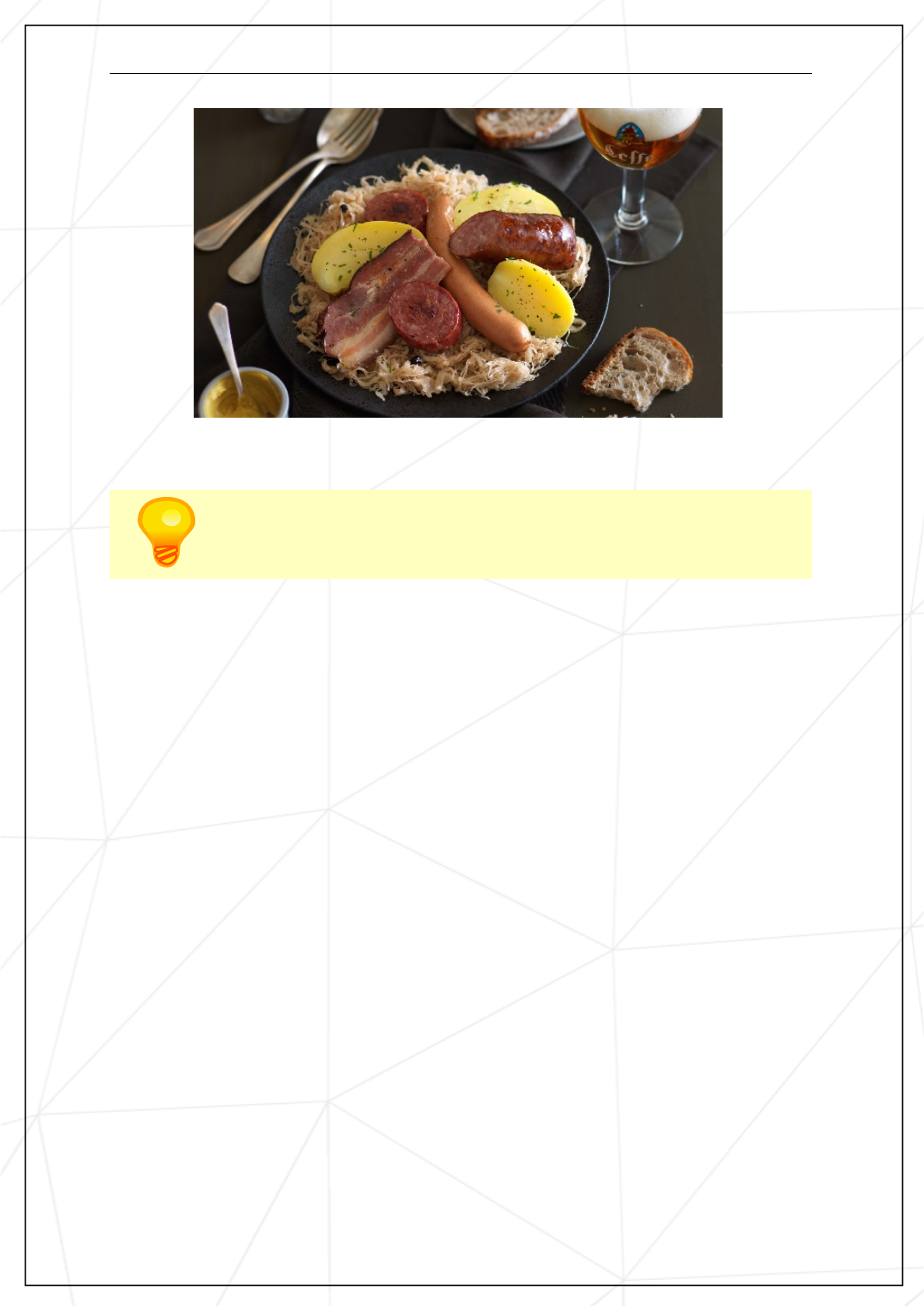
Here is the recipe for “Choucroute” Sauerkraut Alsatian style:
•Ingredient (4 people)
◦1kg of sauerkraut (pickled shredded cabbage)
◦350g of smoked bacon
◦350g of pig back
◦1 tsp of pig fat
◦2 garlic cloves
◦1 bay leaf
◦10 juniper bays
◦1 onion picked with 2 cloves
◦25cl of Alsatian white wine “Riesling”
◦350g of potatoes
◦4 Frankfurters
•Recipe
◦Rinse the sauerkraut under cold water, press it to remove the water and pour
half in a pot.
◦Layer the smoked bacon and the pig back meat, cover them with the rest of
the sauerkraut.
◦Add the pig fat, garlic (*unpeeled!), the juniper, bay leaves and the onion.
◦Pour the white wine on top and let it simmer covered for 1h.
◦Add the potatoes and cook an additional 50 minutes.
◦Add the sausages and let it cook again for 10 minutes.
◦Serve with a reasonable quantity of beer.
2
ft_ls As simple as listing the files in a directory.
Figure I.1: A typical “Choucroute”
This project is easier if you do it after you have already eaten a
“Choucroute” Alsatian style.
3

Chapter II
Introduction
The ls command is one of the first commands you have learned to use with shell. It is
also one you are using the most. Perhaps you have already asked yourself how is this
function coded? Thanks to this project, you will soon find out.
To Recode ls and some of its options will allow you to find out how to interact with
the file system using C. After all, you already know how to open, read, write and close a
file. But, what about the directories? Special files? Rights, dates or sizes of the files?
And while I am on the topic, the quality of your libft will make the difference
between a pleasant project experience and an abominable one. For example, if you add
ft_printf to your libft, your life will be more enjoyable. It is possible to complete the
ft_ls project without the ft_printf function. By the same token, you can easily eat a
yogurt with your fingers. A spoon would still make your experience more pleasant
4

Chapter III
Objectives
The project ft_ls opens the path to the Unix branch of the sphere system. For the first
time, you will have to face the one libc functions that will allow you to do other things
than just read or write on a file descriptor (this is to simplify of course). You will discover
a sub-system of functions of operating system’s API, the associated data structures, as
well as the management of memory allocation and the associated data.
ft_ls is also a great opportunity to think about the structure of your code before you
even start writing your code. ft_ls’ bad reputation is due to students discovering too
late in the game that their (lack of) initial design is preventing them from finishing their
project without refactorizing a great part of their code. I admit that it can be frustrating...
To conclude, ft_ls is another opportunity to add to your libft new practical func-
tions. Browsing a file and identifying directories is quite common in programming. Re-
member that you you will have to do it on many future occasions. Improving your libft
today will save you time tomorrow
5

Chapter IV
General Instructions
•This project will only be evaluated by actual human beings. You are therefore free
to organize and name your files as you wish, although you need to respect some
requirements listed below.
•The executable file must be named ft_ls.
•You must submit a Makefile. That Makefile will have to compile the project and
must contain the usual rules. It can only recompile the program if necessary.
•If you are clever, you will use your library for your ft_ls, submit also your folder
libft including its own Makefile at the root of your repository. Your Makefile
will have to compile the library, and then compile your project.
•Your project must be written in accordance with the Norm.
•You have to handle errors in a sensitive manner. In no way can your program quit
in an unexpected manner (Segmentation fault, bus error, double free, etc). If you
are unsure, handle the errors like ls.
•Your program cannot have memory leaks.
•You’ll have to submit at the root of your folder, a file called author containing your
username followed by a ’\n’
$>cat -e author
xlogin$
6

ft_ls As simple as listing the files in a directory.
•Within your mandatory part you are allowed to use the following functions:
◦write
◦opendir
◦readdir
◦closedir
◦stat
◦lstat
◦getpwuid
◦getgrgid
◦listxattr
◦getxattr
◦time
◦ctime
◦readlink
◦malloc
◦free
◦perror
◦strerror
◦exit
•You are allowed to use other functions to carry out the bonus part as long as their
use is justified during your defence. For example, to use tcgetattr is justified in
certain case, to use printf because you are lazy isn’t. Be smart!
•You can ask your questions on the forum.
7
Chapter V
Mandatory part
•You must recode the system’s command ls.
•Its behavior must be identical to the original ls command with the following vari-
ations:
◦Amongst the numerous options available, we are asking you to create the
following: -l,-R,-a,-r and -t.
◦We strongly recommend that you account for the implications of the
option -R from the very beginning of your code...
◦You do not have to deal with the multiple column format for the exit when
the option -l isn’t in the arguments.
◦You are not required to deal with ACL and extended attributes.
◦The overall display, depending on each option, must stay as identical as pos-
sible to the system command. We will be cordial when grading either the
padding or the pagination, but no information can be missing.
man ls
8

Chapter VI
Bonus part
We will look at your bonuses if and only if your mandatory part is EXCELLENT. This
means that your must complete the mandatory part, beginning to end, and your error
management must be flawless, even in cases of twisted or bad usage. If that’s not the
case, your bonuses will be totally IGNORED.
Find below a few ideas of interesting bonuses you could create. Some could even
be useful. You can, of course, invent your own, which will then be evaluated by your
evaluators according to their own taste.
•Management of ACL and extended attributes.
•Management of the columns without the option -l. (man 4 tty)
•Management of options -u,-f,-g,-d, ...
•Management of views in colors (Similar to option -G)
•Optimization of your code (What is the response time of your ls on a BIG ls -lR
for example?)
9

Chapter VII
Submission and peer evaluation
Submit your work on your GiT repository as usual. Only the work on your repository
will be graded.
10
