Poulan Pro Pb20H42Yt Users Manual OM, PB20H42YT, 2010 11, TRACTORS/RIDE MOWERS, 96042013700
!! Poulan-56 Poulan Lawn Mower Manuals - Lawn Mower Manuals – The Best Lawn Mower Manuals Collection
2015-02-06
: Poulan-Pro Poulan-Pro-Pb20H42Yt-Users-Manual-519936 poulan-pro-pb20h42yt-users-manual-519936 poulan-pro pdf
Open the PDF directly: View PDF  .
.
Page Count: 56
OPERATOR'S MANUAL
MODEL:
PB20H42YT
LAWN TRACTOR
ALWAYS WEAR EYE PROTECTION DURING OPERATION
Visit our website: www.poulan-pro.com
WARNING:
Read this Man u al and follow all Warnings
and Safety Instructions. Fail ure to do so can
re sult in serious in ju ry.
IMPORTANT MANUAL Do Not Throw Away
532 44 04-54 11.16.10 BAD Printed in the U.S.A.
" This machine is approved by the EPA for E10 (10% ethanol) and lower fuel only.
Do not use any fuel >E10 in this machine."
2
SAFETY RULES
Safe Operation Practices for Ride-On Mowers
DANGER: THIS CUTTING MACHINE IS CAPABLE OF AMPUTATING HANDS AND FEET AND THROW ING OBJECTS. FAILURE
TO OBSERVE THE FOLLOWING SAFETY INSTRUCTIONS COULD RESULT IN SERIOUS INJURY OR DEATH.
I. GENERAL OPERATION
• Read, understand, and follow all instructions on the
machine and in the manual before starting.
• Do not put hands or feet near rotating parts or under
the machine. Keep clear of the discharge opening at
all times.
• Only allow responsible adults, who are familiar with
the in struc tions, to operate the machine.
• Clear the area of objects such as rocks, toys, wire, etc.,
which could be picked up and thrown by the blades.
• Be sure the area is clear of bystanders before
operating. Stop machine if anyone enters the area.
• Never carry passengers.
• Do not mow in reverse unless absolutely necessary.
Always look down and behind before and while
back ing.
• Never direct discharged material toward anyone. Avoid
discharging material against a wall or obstruction.
Material may ricochet back toward the operator. Stop
the blades when crossing gravel surfaces.
• Do not operate machine without the entire grass catcher,
discharge chute, or other safety devices in place and
working.
WARNING: In order to prevent ac ci den tal
starting when setting up, trans port ing,
ad just ing or making repairs, al ways
dis con nect spark plug wire and place
wire where it can not contact spark plug.
WARNING: Do not coast down a hill in neu-
tral, you may lose control of the tractor.
WARNING: Tow only the attachments that
are rec om mend ed by and comply with
spec i fi ca tions of the man u fac tur er of your
tractor. Use common sense when towing.
Operate only at the low est possible speed
when on a slope. Too heavy of a load,
while on a slope, is dan ger ous. Tires
can lose trac tion with the ground and
cause you to lose control of your tractor.
WARNING
Engine exhaust, some of its con stit u ents, and cer tain
vehicle com po nents contain or emit chem i cals
known to the State of Cal i for nia to cause can cer
and birth de fects or oth er re pro duc tive harm.
WARNING
Battery posts, terminals and related ac ces so ries
contain lead and lead compounds, chem i cals known
to the State of Cal i for nia to cause can cer and birth
defects or oth er re pro duc tive harm. Wash hands
after handling.
• Slow down before turning.
• Never leave a running machine unattended. Always
turn off blades, set parking brake, stop engine, and
remove keys before dismounting.
• Disengage blades when not mowing. Shut off engine
and wait for all parts to come to a complete stop before
cleaning the machine, removing the grass catcher, or
unclogging the discharge chute.
• Operate machine only in daylight or good artificial
light.
• Do not operate the machine while under the influence
of alcohol or drugs.
• Watch for traffic when operating near or crossing
road ways.
• Use extra care when loading or unloading the machine
into a trailer or truck.
• Always wear eye protection when operating
machine.
• Data indicates that operators, age 60 years and above,
are involved in a large percentage of riding mower-
related injuries. These operators should evaluate their
ability to operate the riding mower safely enough to
protect them selves and others from serious injury.
• Follow the manufacturer's recommendation for wheel
weights or counterweights.
• Keep machine free of grass , leaves or other debris
build-up which can touch hot exhaust / engine parts
and burn. Do not allow the mower deck to plow leaves
or other debris which can cause build-up to occur.
Clean any oil or fuel spillage before operating or storing
the machine. Allow machine to cool before storage.
II. SLOPE OPERATION
Slopes are a major factor related to loss of control and
tip-over accidents, which can result in severe injury or
death. Operation on all slopes requires extra caution. If
you cannot back up the slope or if you feel uneasy on it,
do not mow it.
• Mow up and down slopes, not across.
• Watch for holes, ruts, bumps, rocks, or other hidden
objects. Uneven terrain could overturn the machine.
Tall grass can hide obstacles.
• Choose a low ground speed so that you will not have
to stop or shift while on the slope.
• Do not mow on wet grass. Tires may lose traction.
Always keep the machine in gear when going down
slopes. Do not shift to neutral and coast downhill.
• Avoid starting, stopping, or turning on a slope. If the
tires lose traction, disengage the blades and proceed
slowly straight down the slope.
• Keep all movement on the slopes slow and gradual.
Do not make sudden changes in speed or direction,
which could cause the machine to roll over.
• Use extra care while operating machine with grass
catchers or other at tach ments; they can affect the
stability of the machine. Do no use on steep slopes.
• Do not try to stabilize the machine by putting your foot
on the ground.
• Do not mow near drop-offs, ditches, or embankments.
The machine could suddenly roll over if a wheel is over
the edge or if the edge caves in.
3
SAFETY RULES
Safe Operation Practices for Ride-On Mowers
• Be sure the area is clear of bystanders before operat-
ing. Stop machine if anyone enters the area.
• Never carry passengers.
• Do not mow in reverse unless absolutely necessary.
Al ways look down and behind before and while back-
ing.
• Never carry children, even with the blades shut off. They
may fall off and be seriously injured or interfere with
safe machine operation. Children who have been given
rides in the past may suddenly appear in the mowing
area for another ride and be run over or backed over
by the machine.
• Keep children out of the mowing area and in the watchful
care of a responsible adult other than the operator.
• Be alert and turn machine off if a child enters the
area.
• Before and while backing, look behind and down for
small children.
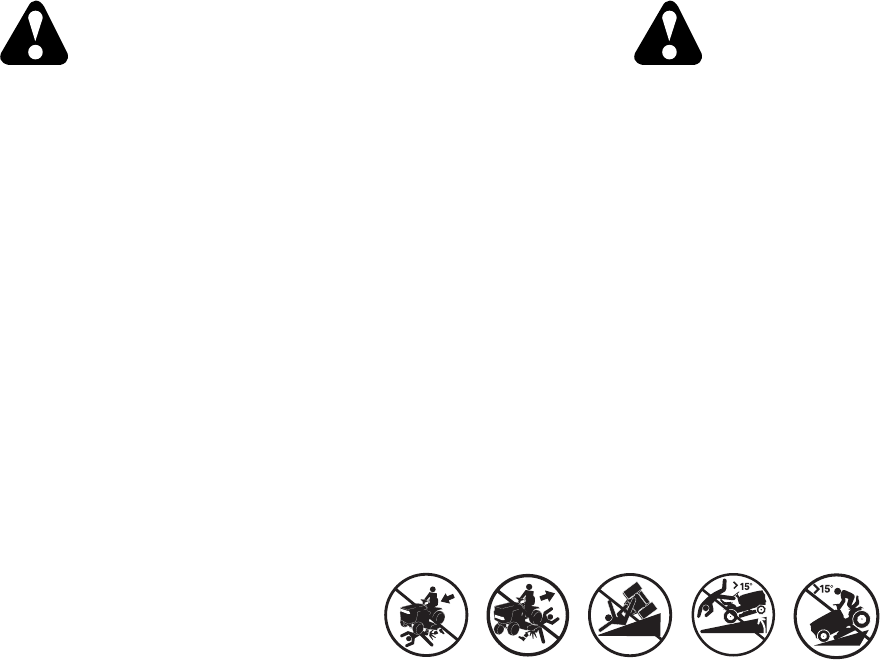
• Mow up and down slopes (15° Max), not across.
• Choose a low ground speed so that you will not have
to stop or shift while on the slope.
• Avoid starting, stopping, or turning on a slope. If the
tires lose traction, disengage the blades and proceed
slowly straight down the slope.
• If machine stops while going uphill, disengage blades,
shift into reverse and back down slowly.
• Do not turn on slopes unless necessary, and then, turn
slowly and gradually downhill, if possible.
III. CHILDREN
Tragic accidents can occur if the operator is not alert to
the presence of children. Children are often attracted to
the ma chine and the mowing activity. Never assume that
children will remain where you last saw them.
• Keep children out of the mowing area and in the watchful
care of a responsible adult other than the operator.
• Be alert and turn machine off if a child enters the
area.
• Before and while backing, look behind and down for
small children.
• Never carry children, even with the blades shut off. They
may fall off and be seriously injured or interfere with
safe machine operation. Children who have been given
rides in the past may suddenly appear in the mowing
area for another ride and be run over or backed over
by the machine.
• Never allow children to operate the machine.
• Use extra care when approaching blind corners, shrubs,
trees, or other objects that may block your view of a
child.
IV. TOWING
• Tow only with a machine that has a hitch designed for
towing. Do not attach towed equipment except at the
hitch point.
• Follow the manufacturer's recommendation for weight
limits for towed equipment and towing on slopes.
• Never allow children or others in or on towed
equipment.
• On slopes, the weight of the towed equipment may
cause loss of traction and loss of control.
• Travel slowly and allow extra distance to stop.
V. SERVICE
SAFE HANDLING OF GASOLINE
To avoid personal injury or property damage, use extreme
care in handling gasoline. Gasoline is extremely flammable
and the vapors are explosive.
• Extinguish all cigarettes, cigars, pipes, and other
sources of ignition.
• Use only approved gasoline container.
• Never remove gas cap or add fuel with the engine
running. Allow engine to cool before refueling.
• Never fuel the machine indoors.
• Never store the machine or fuel container where there
is an open flame, spark, or pilot light such as on a water
heater or other appliances.
• Never fill containers inside a vehicle or on a truck or
trailer bed with plastic liner. Always place containers
on the ground away from your vehicle when filling.
• Remove gas-powered equipment from the truck or
trailer and refuel it on the ground. If this is not possible,
then refuel such equipment with a portable container,
rather than from a gasoline dispenser nozzle.
• Keep the nozzle in contact with the rim of the fuel tank or
container opening at all times until fueling is complete.
Do not use a nozzle lock-open device.
• If fuel is spilled on clothing, change clothing immedi-
ately.
• Never overfill fuel tank. Replace gas cap and tighten
securely.
GENERAL SERVICE
• Never operate machine in a closed area.
• Keep all nuts and bolts tight to be sure the equipment
is in safe working condition.
• Never tamper with safety devices. Check their proper
operation regularly.
• Keep machine free of grass, leaves, or other debris
build-up. Clean oil or fuel spillage and remove any fuel-
soaked debris. Allow machine to cool before storing.
• If you strike a foreign object, stop and inspect the
machine. Repair, if necessary, before restarting.
• Never make any adjustments or repairs with the engine
run ning.
• Check grass catcher components and the discharge
chute frequently and replace with manufacturer's rec-
ommended parts, when necessary.
• Mower blades are sharp. Wrap the blade or wear
gloves, and use extra caution when servicing them.
• Check brake operation frequently. Adjust and service
as required.
• Maintain or replace safety and instruction labels, as
necessary.

4
SAFETY RULES .........................................................2-3
PRODUCT SPECIFICATIONS ....................................... 4
CUSTOMER RESPONSIBILITIES ................................. 4
ASSEMBLY ................................................................. 6-7
OPERATION ............................................................. 8-13
MAINTENANCE SCHEDULE ...................................... 14
MAINTENANCE .....................................................14-17
SERVICE AND AD JUST MENTS ............................18-23
STORAGE .................................................................... 24
TROU BLE SHOOT ING ............................................ 25-26
WARRANTY ................................................................. 28
CONGRATULATIONS on your purchase of a new tractor.
It has been designed, engineered and manu fac tured to give
you the best possible dependability and performance.
Should you experience any problem you cannot easily rem-
edy, please contact your nearest authorized service center/
department. We have com pe tent, well-trained tech ni cians
and the proper tools to ser vice or repair this tractor.
Please read and retain this manual. The instructions will
enable you to assemble and maintain your tractor prop erly.
Always observe the “SAFETY RULES”.
CUSTOMER RESPONSIBILITIES
• Read and observe the safety rules.
• Follow a regular schedule in maintaining, caring for
and using your tractor.
• Follow the instructions under “Maintenance” and “Stor-
age” sec tions of this manual.
WARNING: This tractor is equipped with an internal com-
bus tion engine and should not be used on or near any
un im proved forest-covered, brush-covered or grass-cov ered
land unless the engine’s exhaust system is equipped with
a spark arrester meeting applicable local or state laws (if
any). If a spark arrester is used, it should be maintained
in effective working order by the operator.
A spark arrester for the muffler is available through your
nearest authorized service center/department.
In the state of California the above is required by law
(Section 4442 of the California Public Resources Code).
Other states may have similar laws. Federal laws apply
on federal lands.
Gasoline Capacity 3 Gallons
and Type: Unleaded Regular
Oil Type (API-SG-SL): SAE 30 (above 32°F/0°C)
SAE 5W-30 (below 32°F/0°C)
Oil Capacity: W/Filter: 64 oz.
W/O Filter: 60 oz.
Spark Plug: Champion QC12YC
(Gap: .040")
Ground Speed (MPH): Forward: 0 - 5.2
Reverse: 0 - 2.9
Charging System: 3 Amps Battery
5 Amps Headlights
Battery: AMP/HR: 28
Min. CCA: 230
Case Size: U1R
Blade Torque: 45-55 FT. LBS.
PRODUCT SPECIFICATIONS
TABLE OF CONTENTS
5
UNASSEMBLED PARTS
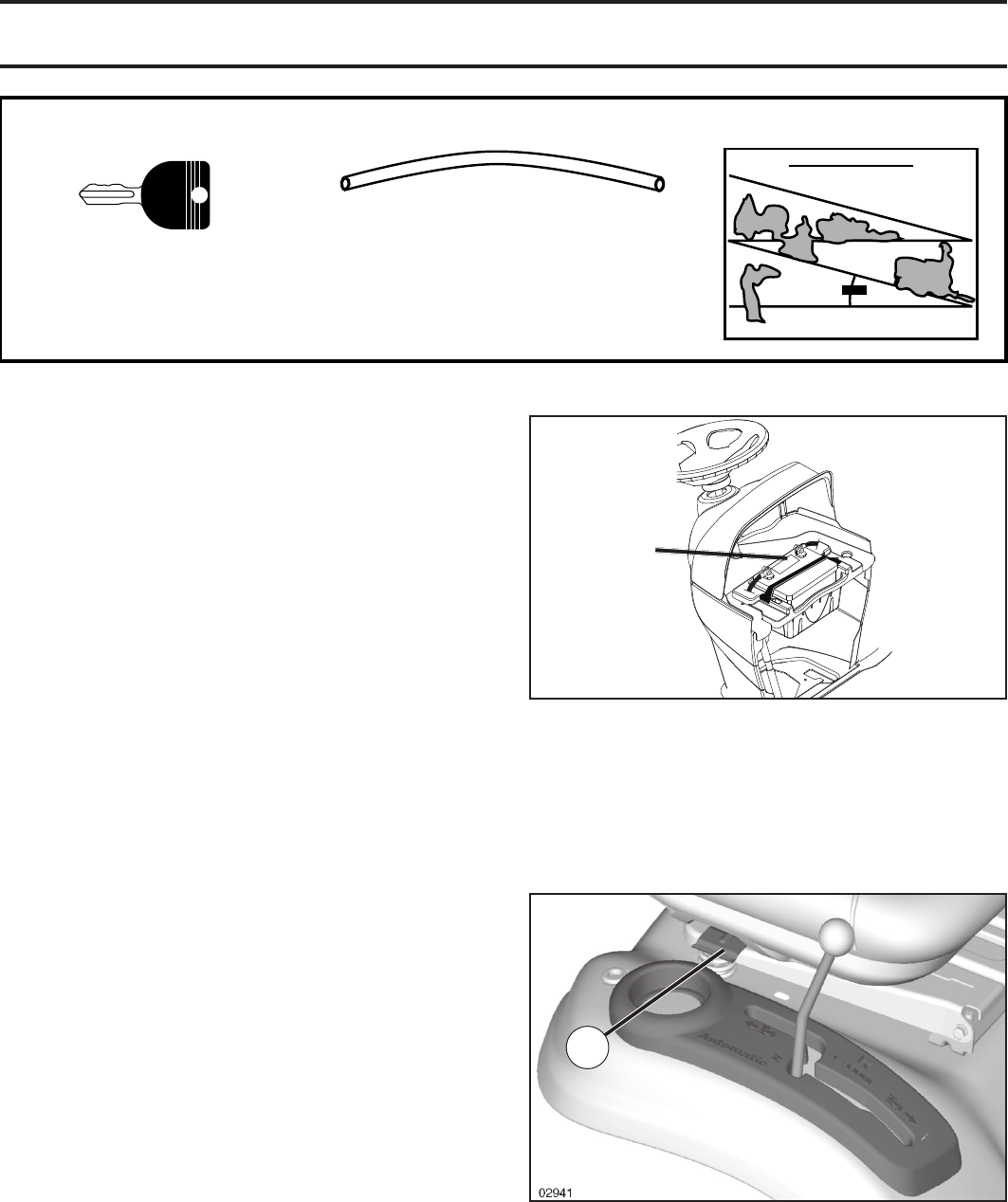
(2) Keys
Slope Sheet
Key
(1) Oil Drain Tube
TO REMOVE TRACTOR FROM CARTON
UNPACK CARTON
• Remove all accessible loose parts and parts cartons
from carton.
• Cut along dotted lines on all four panels of carton.
Remove end panels and lay side panels flat.
• Check for any additional loose parts or cartons and
remove.
BEFORE REMOVING TRACTOR FROM
SKID
ADJUST SEAT (See Fig. 2)
• Sit in seat.
• Lift up adjustment lever (A) and slide seat until a com-
fortable position is reached which allows you to press
clutch/brake pedal all the way down.
• Release lever to lock seat in position.
Fig. 2
Your new tractor has been assembled at the factory with exception of those parts left unassembled for shipping purposes.
TOOLS REQUIRED FOR ASSEMBLY
A socket wrench set will make assembly easier. Stan dard
wrench sizes are listed.
(1) 1/2" wrench Tire pressure gauge
(2) 7/16" wrenches Utility knife Pliers
When right or left hand is mentioned in this man ual, it means
when you are in the operating po si tion (seated be hind the
steer ing wheel).
TO CHECK BATTERY (See Fig. 1)
• Lift hood to raised position.
NOTE: If this battery is put into service after month and
year indicated on label (label is located between terminals)
charge battery for minimum of one hour at 6-10 amps.
(See "BATTERY" in Maintenance section of this manual
for charging instructions).
• For battery and battery cable installation see "RE-
PLACING BATTERY" in the "Service and Adjustments"
section in this manual.
LABEL
Fig. 1
A

6
NOTE: You may now roll your tractor off the skid. Follow the
instructions below to remove the tractor from the skid.
WARNING: Before start ing, read, un der stand and fol low
all in struc tions in the Op er a tion section of this man u al. Be
sure tractor is in a well-ventilated area. Be sure the area in
front of tractor is clear of other peo ple and objects.
TO ROLL TRACTOR OFF SKID (See Op er a tion
section for location and function of con trols)
• Raise attachment lift lever to its highest po si tion.
• Release parking brake by de press ing clutch/brake ped al.
• Place freewheel control in "trans mis sion dis en gaged
position" (See “TO TRANS PORT” in the Op er a tion
section of this manual).
• Roll tractor forward off skid.
• Remove banding holding the deflector shield up against
tractor.
Continue with the instructions that follow.
CHECK TIRE PRESSURE
The tires on your tractor were overinflated at the factory
for shipping purposes. Correct tire pressure is important
for best cutting performance.
• Reduce tire pressure to PSI shown on sides of tires.
✓CHECKLIST
BEFORE YOU OPERATE YOUR NEW TRAC TOR, WE
WISH TO ASSURE THAT YOU RECEIVE THE BEST
PERFORMANCE AND SATISFACTION FROM THIS
QUALITY PRODUCT.
PLEASE REVIEW THE FOLLOWING CHECKLIST:
✓ All assembly instructions have been com plet ed.
✓ No remaining loose parts in carton.
✓ Battery is properly prepared and charged.
✓ Seat is adjusted comfortably and tightened securely.
✓ All tires are properly inflated. (For shipping purposes,
the tires were overinflated at the factory).
✓ Be sure mower deck is properly leveled side-to-side/
front-to-rear for best cutting results. (Tires must be
properly inflated for leveling).
✓ Check mower and drive belts. Be sure they are routed
properly around pulleys and inside all belt keepers.
✓ Check wiring. See that all connections are still secure
and wires are properly clamped.
✓ Before driving tractor, be sure free wheel control is in
“transmission engaged” position (see “TO TRANS-
PORT” in the Operation section of this man u al).
WHILE LEARNING HOW TO USE YOUR TRACTOR, PAY
EXTRA ATTENTION TO THE FOLLOWING IMPORTANT
ITEMS:
✓ Engine oil is at proper level.
✓ Fuel tank is filled with fresh, clean, regular unleaded
gasoline.
✓ Become familiar with all controls, their location and
function. Operate them before you start the engine.
✓ Be sure brake system is in safe operating condition.
✓ Be sure Operator Presence System and Reverse Op-
eration System (ROS) are working properly (See the
Operation and Maintenance sections in this manual).
✓ It is important to purge the transmission before op er at-
ing your tractor for the first time. Follow proper start-
ing and transmission purging instructions (See “TO
START EN GINE” and “PURGE TRANSMISSION” in
the Op er a tion section of this manual).
ASSEMBLY
CHECK DECK LEVELNESS
For best cutting results, mower housing should be prop-
erly leveled. See “TO LEVEL MOWER HOUSING” in the
Service and Adjustments section of this manual.
CHECK FOR PROPER POSITION OF BELTS
See the figures that are shown for replacing motion and
mower blade drive belts in the Service and Adjustments sec-
tion of this manual. Verify that the belts are routed correctly.
CHECK BRAKE SYSTEM
After you learn how to operate your tractor, check to see that
the brake is operating properly. See “TO CHECK BRAKE”
in the Service and Adjustments section of this manual.
7
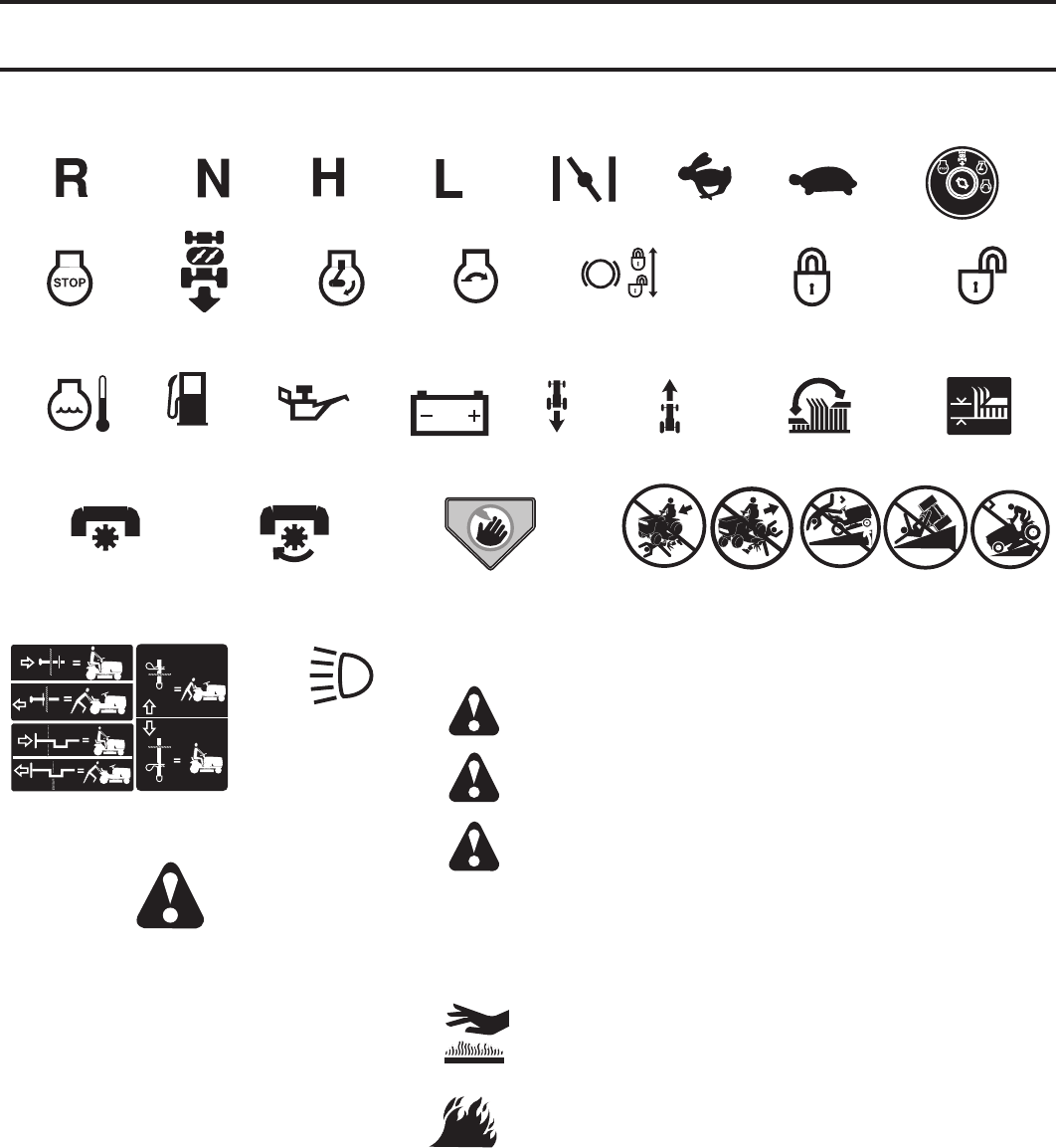
These symbols may appear on your tractor or in literature supplied with the product. Learn and understand their meaning.
DANGER, KEEP HANDS
AND FEET AWAY
FREE WHEEL
(Automatic Models only)
OVER TEMP
LIGHT
KEEP AREA CLEAR SLOPE HAZARDS
15
15
(SEE SAFETY RULES SECTION)
BATTERY REVERSE FORWARD
FAST SLOW
ENGINE ON
ENGINE OFF
OIL PRESSURE
FUEL
CHOKE
MOWER HEIGHT
PARKING BRAKE
LOCKED
PARKING BRAKE
UNLOCKED
REVERSE NEUTRAL HIGH LOW
ATTACHMENT
CLUTCH ENGAGED
PARKING BRAKE
IGNITION SWITCH
ATTACHMENT
CLUTCH DISENGAGED
P
ENGINE START
MOWER LIFT
Failure to follow instructions
could result in serious injury or
death. The safety alert symbol
is used to identify safety inform-
ation about hazards which can
result in death, serious injury
and/or property damage.
DANGER indicates a hazard which, if not avoided,
will result in death or serious injury.
WARNING indicates a hazard which, if not avoided,
could result in death or serious injury.
CAUTION indicates a hazard which, if not avoided,
might result in minor or moderate injury.
CAUTION when used without the alert symbol,
indicates a situation that could result in damage
to the tractor and/or engine.
FIRE indicates a hazard which, if not avoided,
could result in death, serious injury and/or
property damage.
HOT SURFACES indicates a hazard which,
if not avoided, could result in death, serious injury
and/or property damage.
REVERSE
OPERATION
SYSTEM (ROS)
LIGHTS ON
OPERATION
8
KNOW YOUR TRACTOR
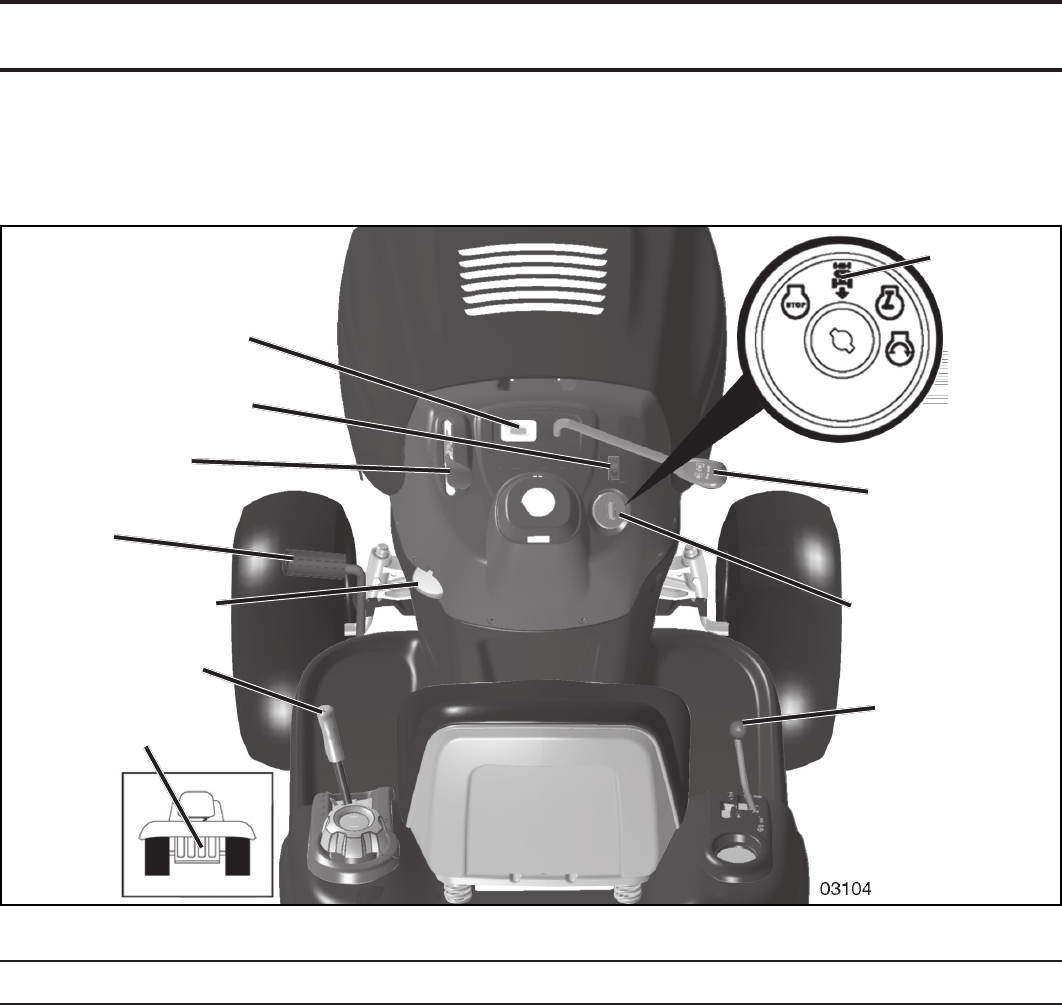
READ THIS OWNER'S MANUAL AND SAFETY RULES BEFORE OPERATING YOUR TRACTOR
Compare the illustrations with your tractor to familiarize yourself with the locations of various controls and ad just ments.
Save this manual for future reference.
ATTACHMENT CLUTCH LEVER - Used to engage the
mower blades, or other attachments mounted to your tractor.
ATTACHMENT LIFT LEVER - Used to raise, lower, and adjust
the mower deck or other attachments mounted to your tractor.
CLUTCH/BRAKE PEDAL - Used for declutching and brak-
ing the tractor and starting the engine.
MOTION CONTROL LEVER - Selects the speed and
di rec tion of the tractor.
IGNITION SWITCH - Used for starting and stopping the
engine.
LIGHT SWITCH - Turns the headlights on and off.
Our tractors conform to the applicable safety standards of the American National Standards Institute.
Fig. 3
PARKING BRAKE - Locks clutch/brake pedal into the
brake position.
REVERSE OPERATION SYSTEM (ROS) “ON” POSI-
TION - Allows operation of mower deck or other powered
attachment while in reverse.
THROTTLE/CHOKE CONTROL - Used for starting and
con trol ling engine speed.
FREEWHEEL CONTROL - Disengages transmission for
pushing or slowly tow ing the trac tor with the engine off.
SERVICE REMINDER/HOUR METER - Indicates when
service is required for the engine and mower.
PARKING BRAKE
PARKING BRAKE
CLUTCH/BRAKE
CLUTCH/BRAKE
PEDAL
PEDAL
THROTTLE/CHOKE
THROTTLE/CHOKE
CONTROL
CONTROL
ATTACHMENT
ATTACHMENT
LIFT LEVER
LIFT LEVER
IGNITION
IGNITION
SWITCH
SWITCH
ATTACHMENT
ATTACHMENT
CLUTCH LEVER
CLUTCH LEVER
ROS "ON"
ROS "ON"
POSITION
POSITION
LIGHT SWITCH
LIGHT SWITCH
HOURMETER
MOTION
MOTION
CONTROL
CONTROL
LEVER
LEVER
FREEWHEEL
FREEWHEEL
CONTROL
CONTROL
OPERATION
9
The operation of any tractor can result in foreign objects thrown into the eyes, which can result
in severe eye dam age. Always wear safety glass es or eye shields while operating your tractor
or per form ing any adjustments or repairs. We rec om mend a wide vision safety mask over spec-
tacles or stan dard safety glasses.
HOW TO USE YOUR TRACTOR
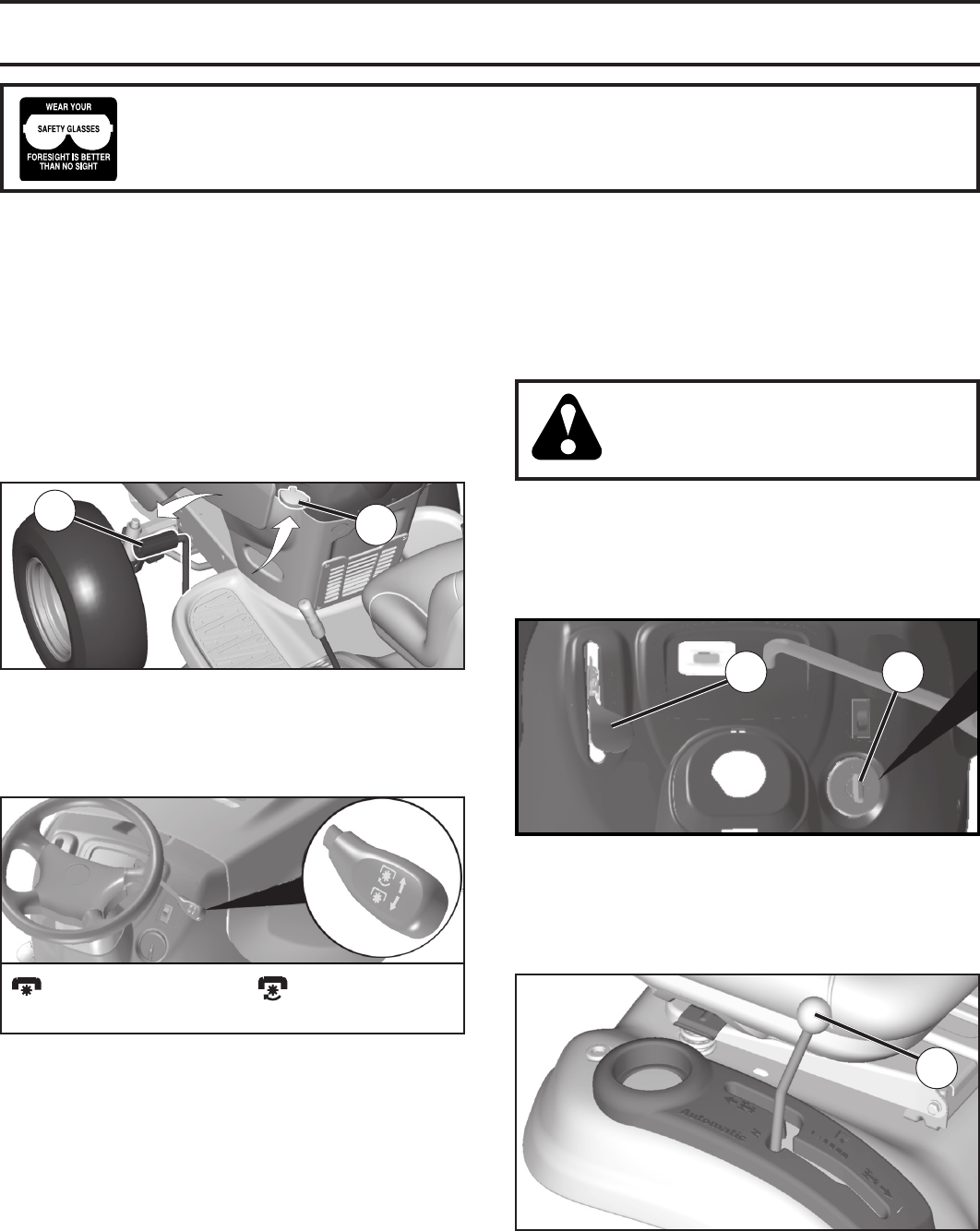
TO SET PARKING BRAKE (See Fig. 4)
Your tractor is equipped with an operator presence sens-
ing switch. When engine is running, any attempt by the
op er a tor to leave the seat without first setting the parking
brake will shut off the engine.
• Depress clutch/brake pedal into full “BRAKE” position
and hold.
• Place parking brake lever in “ENGAGED” position
and re lease pressure from clutch/brake pedal. Pedal
should re main in “BRAKE” position. Make sure parking
brake will hold tractor secure.
Fig. 4
TO USE THROTTLE CONTROL (See Fig. 6)
Always operate engine at full speed (fast).
• Operating engine at less than full speed (fast) reduces
the engine's operating efficiency.
• Full speed (fast) of fers the best mower per for mance.
STOPPING (See Fig. 5)
MOWER BLADES -
• To stop mower blades,move attachment clutch lever
to “DIS EN GAGED” po si tion.
CAUTION: Always stop tractor com-
plete ly, as described above, before leav-
ing the operator's position; to empty
grass catcher, etc.
( ) ATTACHMENT
CLUTCH LEVER
“ENGAGED”
( ) ATTACHMENT
CLUTCH LEVER
“DIS EN GAGED”
D F
Fig. 6
GROUND DRIVE -
• To stop ground drive, depress clutch/brake pedal into
full “BRAKE” position.
• Move motion control lever to neutral position.
ENGINE -
• Move throttle control between half and full speed (fast)
position.
NOTE: Failure to move throttle control between half and
full speed (fast) position, before stop ping may cause engine
to “backfire”.
• Turn ignition key to “STOP” position and remove key.
Always remove key when leaving tractor to prevent
un author ized use.
Fig. 5
TO MOVE FORWARD AND BACKWARD
(See Fig. 7)
The direction and speed of movement is controlled by the
motion control lever. (J)
• Start tractor with motion control le ver in neutral position.
• Release parking brake.
• Slowly move motion control lever to desired position.
J
Fig. 7
BC
• Never use choke to stop engine.
IMPORTANT: LEAVING THE IGNITION SWITCH IN ANY
POSITION OTHER THAN "STOP" WILL CAUSE THE BATTERY
TO BE DIS CHARGED, (DEAD).
NOTE: Under certain conditions when tractor is standing
idle with the engine running, hot en gine exhaust gases may
cause “browning” of grass. To eliminate this possibility, al-
ways stop engine when stopping tractor on grass areas.
OPERATION
10
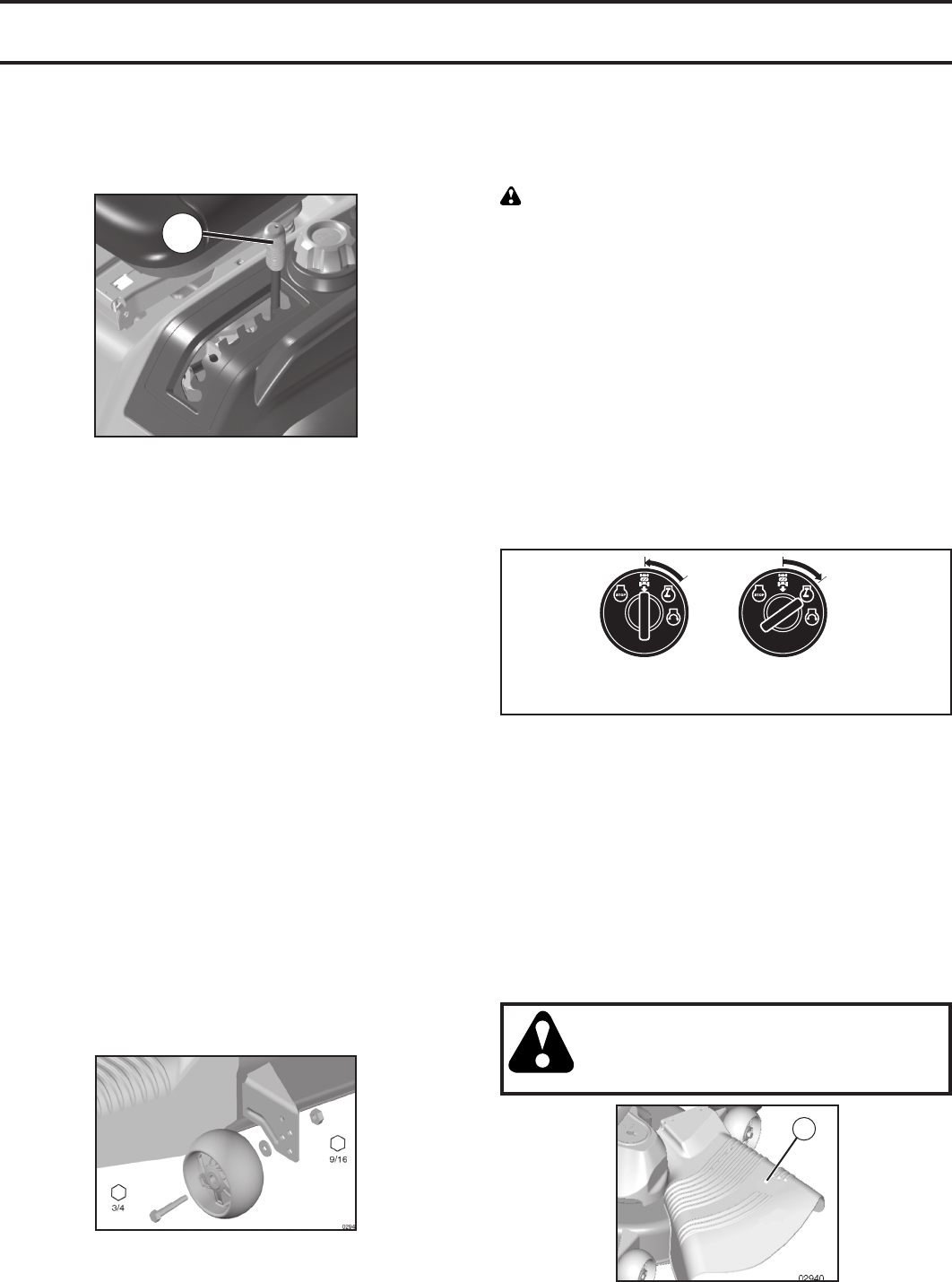
TO ADJUST MOWER CUT TING HEIGHT
(See Fig. 8)
The po si tion of the at tach ment lift le ver (A) de ter mines the
cut ting height.
• Put attachment lift lever in desired cutting height slot.
The cutting height range is ap prox i mate ly 1" to 4". The
heights are measured from the ground to the blade tip with
the engine not running. These heights are approximate
and may vary depending upon soil conditions, height of
grass and types of grass being mowed.
• The average lawn should be cut to approximately
2-1/2" during the cool season and to over 3" during
hot months. For healthier and better looking lawns,
mow often and after moderate growth.
• For best cutting performance, grass over 6" in height
should be mowed twice. Make the first cut relatively
high; the second to de sired height.
TO OPERATE MOWER
Your tractor is equipped with an operator presence sensing
switch. Any attempt by the operator to leave the seat with
the engine running and the attachment clutch engaged will
shut off the engine. You must remain fully and centrally
positioned in the seat to prevent the engine from hesitat-
ing or cutting off when operating your equipment on rough,
rolling terrain or hills.
• Select desired height of cut with attachment lift lever.
• Start mower blades by engaging at tach ment clutch.
Fig. 11
CAUTION: Do not operate the mower without
either the en tire grass catcher, on mowers
so equipped, or the deflector shield (S) in
place (See Fig. 11).
TO STOP MOWER BLADES -
• Disengage at tach ment clutch con trol.
ROS "ON"
POSITION ENGINE "ON" POSITION
(NORMAL OPERATING)
0
2
8
2
8
TO ADJUST GAUGE WHEELS (See Fig. 9)
Gauge wheels are properly adjusted when they are slightly
off the ground when mower is at the desired cutting height in
operating position. Gauge wheels then keep the deck in prop-
er position to help prevent scalping in most terrain conditions.
NOTE:Adjust gauge wheels with tractor on a flat level surface.
• Adjust mower to desired cutting height (See “TO AD-
JUST MOWER CUT TING HEIGHT” in the Operation
sec tion of this manual).
• With mower in desired height of cut po si tion, gauge wheels
should be assembled so they are slightly off the ground.
In stall gauge wheel in appropriate hole with shoulder
bolt, washer, washer, and lock nut and tighten se cure ly.
• Repeat for opposite side installing gauge wheel in same
adjustment hole.
S
Fig. 9
Fig. 10
REVERSE OPERATION SYSTEM (ROS)
Your tractor is equipped with a Reverse Operation System
(ROS). Any attempt by the operator to travel in the reverse
direction with the attachment clutch engaged will shut off the
engine unless ignition key is placed in the ROS "ON" position.
WARNING: Backing up with the attachment clutch en-
gaged while mowing is strongly discouraged. Turning the
ROS "ON", to allow reverse operation with the attachment
clutch engaged, should only be done when the operator
decides it is necessary to reposition the machine with the
attachment engaged. Do not mow in reverse unless
absolutely necessary.
USING THE REVERSE OPERATION SYSTEM (See Fig. 10)
Only use if you are certain no children or other bystanders
will enter the mowing area.
• Move motion control lever to neutral position.
• With engine running, turn ignition key counterclockwise
to ROS "ON" position.
• Look down and behind before and while backing.
• Slowly move motion control lever to reverse (R) po si tion
to start movement.
• When use of the ROS is no longer needed, turn the
ignition key clockwise to engine "ON" position.
OPERATION
A
Fig. 8
11
TOWING CARTS AND OTHER AT TACH MENTS
Tow only the attachments that are recommended by and
comply with specifications of the manufacturer of your trac-
tor. Use common sense when towing. Too heavy of a load,
while on a slope, is dangerous. Tires can lose traction with
the ground and cause you to lose control of your tractor.
BEFORE STARTING THE ENGINE
CHECK ENGINE OIL LEVEL
The engine in your tractor has been shipped, from the
factory, already filled with sum mer weight oil.
TO OPERATE ON HILLS
CAUTION: Do not drive up or down
hills with slopes greater than 15° and
do not drive across any slope.
• Choose the lowest speed before starting up or down hills.
• Avoid stopping or changing speed on hills.
• If slowing is necessary, move throttle control lever to
slower position.
• If stopping is absolutely necessary, push clutch/brake
pedal quickly to brake position and engage parking brake.
• Move motion control lever to neutral position.
IMPORTANT: THE MOTION CONTROL LEVER DOES NOT
RETURN TO NEUTRAL POSITION WHEN THE CLUTCH/BRAKE
PED AL IS DEPRESSED.
• To restart movement, slowly release parking brake and
clutch/brake pedal.
• Slowly move motion control lever to slowest setting.
• Make all turns slowly.
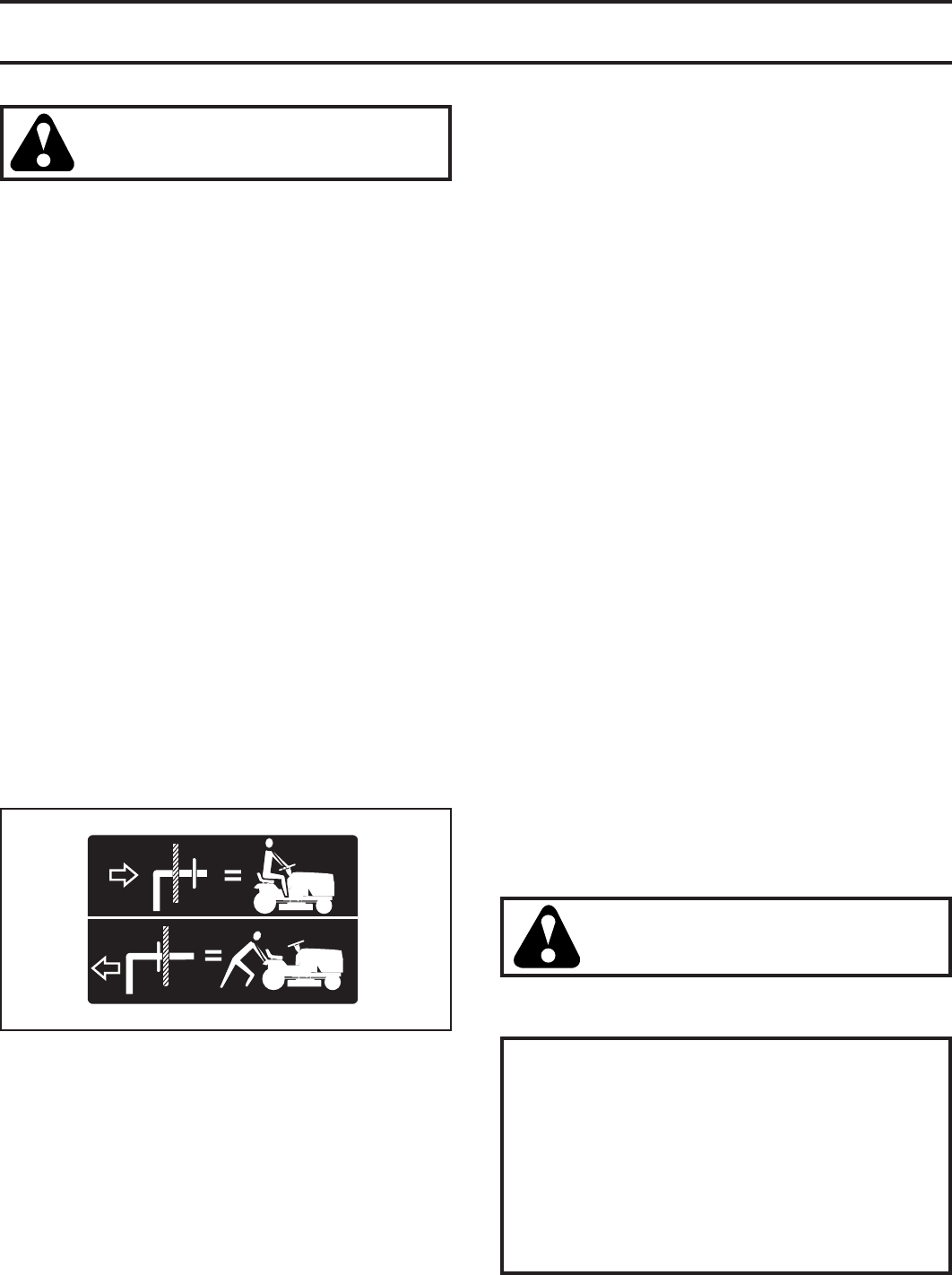
TO TRANSPORT (See Fig. 12)
When pushing or towing your tractor, be sure to disengage
transmission by placing freewheel control in free wheel ing
po si tion. Free wheel control is located at the rear drawbar
of tractor.
• Raise attachment lift to highest position with at tach ment
lift control.
• Pull freewheel control out and into the slot and release
so it is held in the disengaged position.
• Do not push or tow tractor at more than two (2) MPH.
• To reengage transmission, reverse above procedure.
NOTE: To protect hood from damage when transporting
your tractor on a truck or a trailer, be sure hood is closed
and secured to tractor. Use an appropriate means of tying
hood to tractor (rope, cord, etc.).
• Check engine oil with tractor on level ground.
• Remove oil fill cap/dipstick and wipe clean, reinsert the
dipstick and screw cap tight, wait for a few seconds,
remove and read oil level. If necessary, add oil until
“FULL” mark on dipstick is reached. Do not overfill.
• For cold weather operation you should change oil for
easier starting (See “OIL VISCOSITY CHART” in the
Maintenance sec tion of this manual).
• To change engine oil, see the Maintenance section in
this manual.
OPERATION
TRANSMISSION ENGAGED
TRANSMISSION DISENGAGED
Fig. 12
SERVICE REMINDER/HOUR METER
Service reminder shows the total number of hours the
engine has run and flashes to indicate that the engine
or mower needs servicing. When service is required, the
service reminder will flash for two hours. To service engine
and mower, see the Maintenance section of this manual.
NOTE: Service reminder runs when the ignition key is in
any position but "STOP". For accurate reading, be sure key
remains in the "STOP" position when engine is not running.
ADD GASOLINE
• Fill fuel tank to bottom of filler neck. Do not overfill.
Use fresh, clean, regular un lead ed gasoline with a
minimum of 87 octane. (Use of leaded gasoline will
increase carbon and lead oxide deposits and reduce
valve life). Do not mix oil with gasoline. Purchase fuel
in quan ti ties that can be used within 30 days to assure
fuel freshness.
CAUTION: Wipe off any spilled oil or fuel.
Do not store, spill or use gasoline near an
open flame.
IMPORTANT: WHEN OPERATING IN TEMPERATURES BELOW
32°F(0°C), USE FRESH, CLEAN WINTER GRADE GAS O LINE
TO HELP ENSURE GOOD COLD WEATHER START ING.
CAUTION: Alcohol blended fuels (called gas o hol
or using ethanol or methanol) can attract moisture
which leads to sep a ra tion and for ma tion of acids
during storage. Acidic gas can damage the fuel sys-
tem of an engine while in storage. To avoid engine
problems, the fuel system should be emptied before
stor age of 30 days or longer. Drain the gas tank,
start the engine and let it run until the fuel lines and
carburetor are empty. Use fresh fuel next sea son.
See Storage In struc tions for additional information.
Never use engine or carburetor cleaner products
in the fuel tank or permanent damage may occur.
12
NOTE: Before starting, read the warm and cold starting
procedures below.
• Insert key into ignition and turn key clockwise to “START”
position and release key as soon as engine starts.
Do not run starter continuously for more than fifteen
sec onds per minute. If the engine does not start after
several attempts, move throttle control to fast position,
wait a few minutes and try again. If engine still does
not start, move the throttle control back to the choke
position and retry.
WARM WEATHER STARTING (50°F (10°C) and above)
• When engine starts, move the throttle control to the
fast position.
• The attachments and ground drive can now be used. If
the engine does not accept the load, restart the engine
and allow it to warm up for one minute using the choke
as described above.
COLD WEATHER STARTING (50°F (10°C) and below)
• When engine starts, allow engine to run with the
throttle control in the choke position until the engine
runs roughly, then move throttle control to fast posi-
tion. This may require an engine warm-up period from
several seconds to several minutes, depending on the
tem per a ture.
AUTOMATIC TRANSMISSION WARM UP
• Before driving the unit in cold weather, the trans mis sion
should be warmed up as follows:
• Be sure the tractor is on level ground.
• Place the motion control lever in neutral.
Re lease the parking brake and let the clutch/brake
slowly return to operating position.
• Allow one minute for transmission to warm up. This
can be done during the engine warm up period.
• The attachments can also be used during the engine warm-
up period after the transmission has been warmed up.
NOTE: If at a high altitude (above 3000 feet) or in cold
temperatures (below 32° F/0° C) the carburetor fuel mixture
may need to be adjusted for best engine performance. See
“TO ADJUST CARBURETOR” in the Service and Adjust-
ments section of this manual.
OPERATION
TO START ENGINE (See Fig. 5)
When starting the engine for the first time or if the engine
has run out of fuel, it will take extra cranking time to move
fuel from the tank to the engine.
• Be sure freewheel control is in the transmission en gaged
position.
• Sit on seat in operating position, depress clutch/brake
pedal and set parking brake.
• Place motion control lever in neutral position.
• Move attachment clutch to “DISENGAGED” position.
• Move throttle control to choke position.
PURGE TRANSMISSION
CAUTION: Never engage or disengage
freewheel lever while the engine is run ning.
To ensure proper operation and performance, it is rec om-
mend ed that the transmission be purged before operating
tractor for the first time. This procedure will remove any
trapped air inside the transmission which may have de vel-
oped during shipping of your tractor.
IMPORTANT: SHOULD YOUR TRANSMISSION RE QUIRE
REMOVAL FOR SERVICE OR REPLACEMENT, IT SHOULD
BE PURGED AFTER REINSTALLATION BEFORE OPERATING
THE TRACTOR.
1. Place tractor safely on a level surface - that is clear
and open - with engine off and parking brake set.
2. Disengage transmission by placing freewheel control
in freewheeling position (See “TO TRANSPORT” in
this section of manual).
3. Sitting in the tractor seat, start engine. After the engine
is running, move throttle control to slow position. With
motion control lever in neutral po si tion, slowly disengage
clutch/brake pedal.
CAUTION: At any time, during step 4, there
may be movement of the drive wheels.
4. Move motion control lever to full forward position and
hold for five (5) seconds. Move lever to full reverse
position and hold for five (5) seconds. Repeat this
procedure three (3) times.
5. Move motion control lever to neutral position. Shut- off
engine and set parking brake.
6. Engage transmission by placing freewheel control in
engaged position (See “TO TRANSPORT” in this sec-
tion of manual).
7. Sitting in the tractor seat, start engine. After the engine
is running, move throttle control to half (1/2) speed.
With motion control lever in neutral position, slowly
disengage clutch/brake pedal.
8. Slowly move motion control lever forward, after the
tractor moves approximately five (5) feet, slowly move
motion control lever to reverse position. After the trac-
tor moves approximately five (5) feet return the motion
control lever to the neutral position. Repeat this proce-
dure with the motion control lever three (3) times.
Your transmission is now purged and now ready for normal
op er a tion.
13
OPERATION
MOWING TIPS
• Tire chains cannot be used when the mower hous ing
is attached to tractor.
• Mower should be properly leveled for best mowing
performance. See “TO LEVEL MOWER HOUSING”
in the Service and Adjustments section of this manual.
• The left hand side of mower should be used for trim ming.
• Drive so that clippings are discharged onto the area
that has been cut. Have the cut area to the right of
the tractor. This will result in a more even dis tri bu tion
of clippings and more uniform cutting.
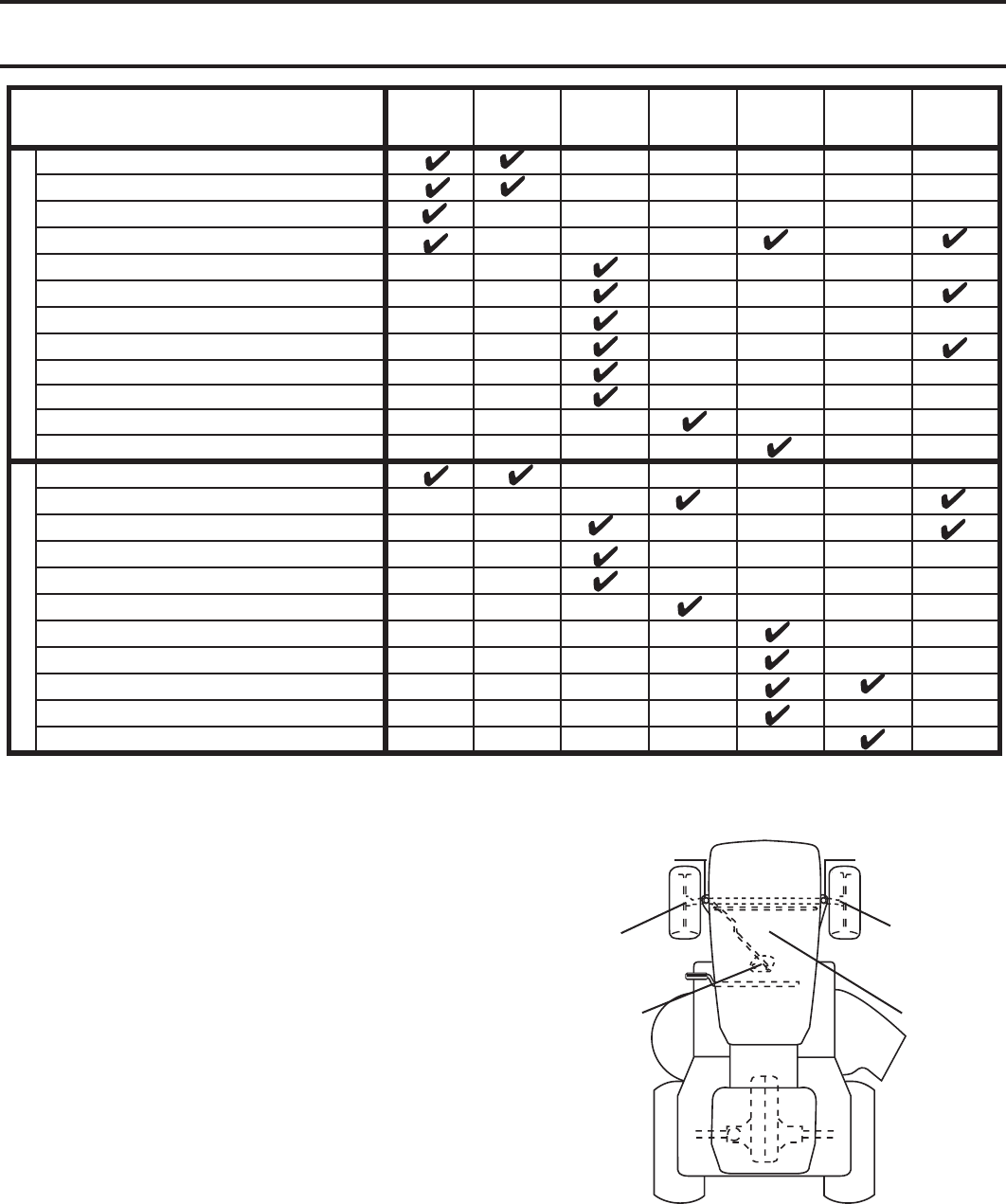
• When mowing large areas, start by turning to the right
so that clippings will discharge away from shrubs,
fences, driveways, etc. After one or two rounds, mow
in the opposite direction making left hand turns until
finished (See Fig. 13).
• If grass is extremely tall, it should be mowed twice to
reduce load and possible fire hazard from dried clip-
pings. Make first cut relatively high; the second to the
desired height.
• Do not mow grass when it is wet. Wet grass will plug
mower and leave undesirable clumps. Allow grass to
dry before mowing.
• Always operate engine at full throttle when mow-
ing to assure better mowing performance and proper
dis charge of material. Regulate ground speed by
se lect ing a low enough gear to give the mower cut ting
per for mance as well as the quality of cut desired.
• When operating attachments, select a ground speed
that will suit the terrain and give best performance of
the at tach ment being used.
Fig. 13
14
➀ General Purpose Grease
➁ Refer to Maintenance “ENGINE” Section
01965
➁ ENGINE
➀ FRONT
WHEEL
BEARING
ZERK
➀ STEERING
SECTOR
GEAR
TEETH
➀ FRONT
WHEEL
BEARING
ZERK
➀ SPINDLE ZERK ➀ SPINDLE ZERK
MAINTENANCE
T
R
A
C
T
0
R
1 - Change more often when operating under a heavy load or in high ambient temperatures.
2 - Service more often when operating in dirty or dusty conditions.
E
N
G
I
N
E
3
2
2
2
2
3 - Replace blades more often when mowing in sandy soil.
4 - Not required if equipped with maintenance-free battery.
5 - See Cleaning in Maintenance Section.
1
,
1,2
2
4
5
1,2
BEFORE
EACH
USE
EVERY
8
HOURS
EVERY
25
HOURS
EVERY
50
HOURS
EVERY
100
HOURS
EVERY
SEASON
BEFORE
STORAGE
Inspect Muffler/Spark Arrester
Clean Air Filter
Change Engine Oil (with oil filter)
Replace Air Filter Paper Cartridge
Replace Spark Plug
Check Engine Oil Level
Clean Engine Cooling Fins
Clean Air Screen
Replace Oil Filter (If equipped)
Replace Fuel Filter
Change Engine Oil (without oil filter)
Lubrication Chart
Check Brake Operation
Check Battery Level
Check Tire Pressure
Clean Battery and Terminals
MAINTENANCE
SCHEDULE
Check for Loose Fasteners
Check/Replace Mower Blades
Che
Clean Debris Off Steering Plate
ck Transaxle Cooling
Che
Check Operator Presence & ROS Systems
ck V-Belts
Check Mower Levelness
LUBRICATION CHART
GENERAL RECOMMENDATIONS
The warranty on this tractor does not cover items that have
been subjected to operator abuse or negligence. To receive
full value from the warranty, operator must main tain tractor
as instructed in this manual.
Some adjustments will need to be made periodically to
properly maintain your tractor.
At least once a season, check to see if you should make
any of the adjustments described in the Service and
Adjustments section of this manual.
• At least once a year you should replace the spark plug,
clean or replace air filter, and check blades and belts
for wear. A new spark plug and clean air filter assure
proper air-fuel mixture and help your engine run better
and last longer.
BEFORE EACH USE
• Check engine oil level.
• Check brake operation.
• Check tire pressure.
• Check operator presence and ROS systems for proper
operation.
• Check for loose fasteners.
IMPORTANT: DO NOT OIL OR GREASE THE PIVOT POINTS
WHICH HAVE SPECIAL NYLON BEARINGS. VISCOUS
LU BRI CANTS WILL ATTRACT DUST AND DIRT THAT WILL
SHORT EN THE LIFE OF THE SELF-LU BRI CAT ING BEARINGS.
IF YOU FEEL THEY MUST BE LU BRI CAT ED, USE ONLY A DRY,
POW DERED GRAPHITE TYPE LU BRI CANT SPARINGLY.
15
BATTERY
Your tractor has a battery charging system which is suf fi cient
for normal use. However, periodic charging of the battery
with an automotive charger will extend its life.
• Keep battery and terminals clean.
• Keep battery bolts tight.
• Keep small vent holes open.
• Recharge at 6-10 amperes for 1 hour.
NOTE: The original equipment battery on your tractor is
maintenance free. Do not attempt to open or remove caps
or covers. Adding or checking level of electrolyte is not
nec es sary.
TO CLEAN BATTERY AND TERMINALS
Corrosion and dirt on the battery and terminals can cause
the battery to “leak” power.
• Disconnect BLACK battery cable first then RED bat-
tery cable and remove battery from tractor.
• Rinse the battery with plain water and dry.
• Clean terminals and battery cable ends with wire brush
until bright.
• Coat terminals with grease or petroleum jelly.
• Reinstall battery (See “REPLACING BATTERY” in the
Service and Adjustment sec tion of this manual).
TRACTOR
Always observe safety rules when per form ing any main-
te nance.
BRAKE OPERATION
If tractor requires more than five (5) feet to stop at highest
speed in high est gear on a level, dry concrete or paved
surface, then brake must be checked and ad just ed. (See
“TO CHECK BRAKE” in the Ser vice and Ad just ments sec-
tion of this manual).
TIRES
• Maintain proper air pressure in all tires (See the side
of tires for proper PSI).
• Keep tires free of gasoline, oil, or insect control chemi-
cals which can harm rubber.
• Avoid stumps, stones, deep ruts, sharp objects and
other hazards that may cause tire damage.
NOTE: To seal tire punctures and pre vent flat tires due to
slow leaks, tire sealant may be purchased from your local
parts dealer. Tire sealant also pre vents tire dry rot and
corrosion.
OPERATOR PRESENCE SYS TEM AND REVERSE OP-
ERATION SYSTEM (ROS) (See Fig. 14)
Be sure operator presence and reverse operation sys tems
are work ing properly. If your tractor does not function as
described, repair the problem immediately.
• The engine should not start unless the brake pedal is
fully de pressed, and the attachment clutch con trol is
in the dis en gaged position.
CHECK OPERATOR PRESENCE SYSTEM
• When the engine is running, any attempt by the op er a tor
to leave the seat without first setting the parking brake
should shut off the engine.
• When the engine is running and the at tach ment clutch
is engaged, any attempt by the operator to leave the
seat should shut off the engine.
• The attachment clutch should never operate unless
the operator is in the seat.
CHECK REVERSE OPERATION (ROS) SYSTEM
• When the engine is running with the ignition switch in
the engine "ON" position and the at tach ment clutch
engaged, any attempt by the operator to shift into
reverse should shut off the engine.
• When the engine is running with the ignition switch in
the ROS "ON" position and the at tach ment clutch en-
gaged, any attempt by the operator to shift into reverse
should NOT shut off the engine.
BLADE CARE
For best results mower blades must be kept sharp. Re place
bent or damaged blades.
CAUTION: Use only a replacement blade ap-
proved by the manufacturer of your tractor.
Using a blade not approved by the manu-
facturer of your tractor is hazardous, could
damage your tractor and void your warranty.
Fig. 15
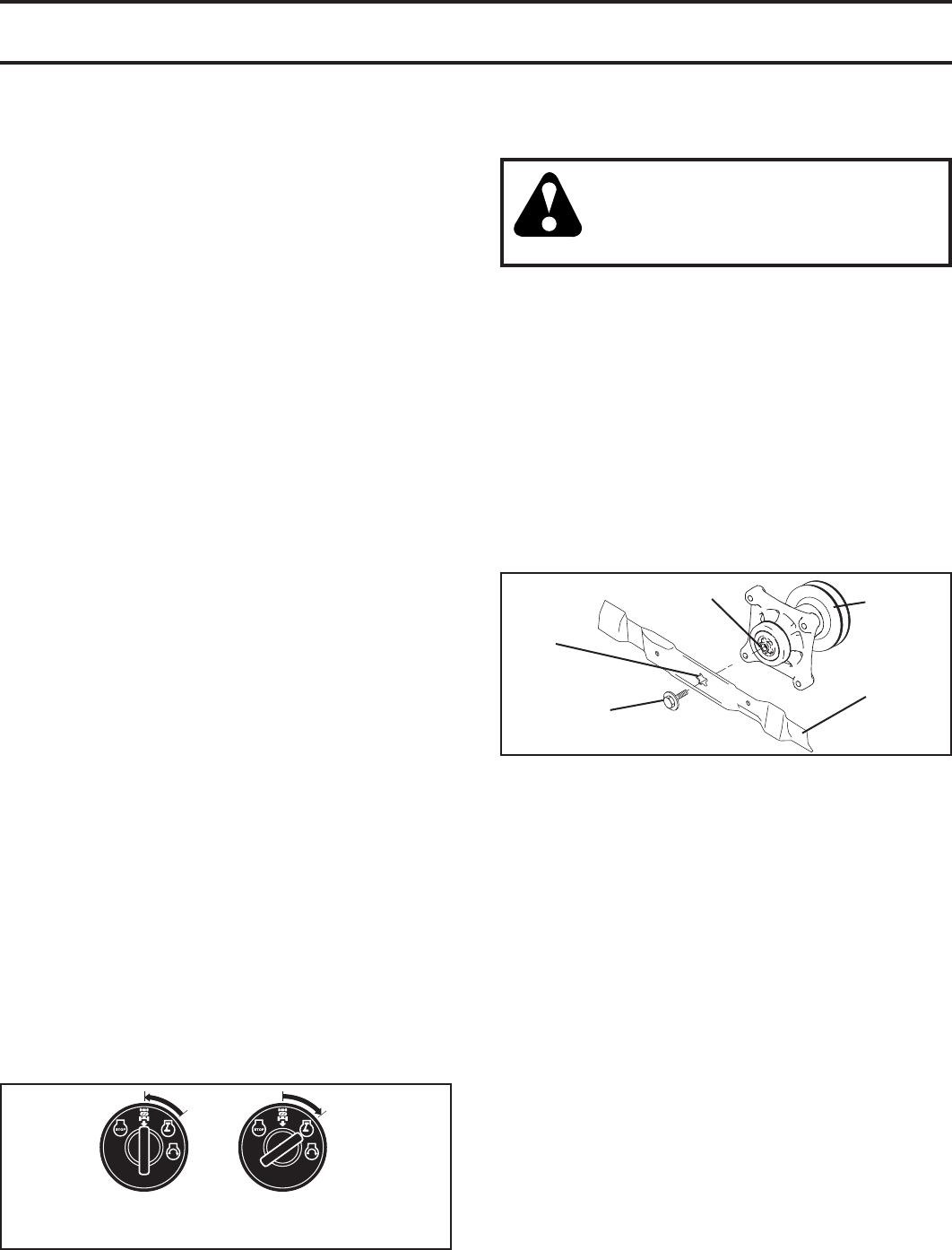
BLADE REMOVAL (See Fig. 15)
• Raise mower to highest position to allow access to
blades.
NOTE: Protect your hands with gloves and/or wrap blade
with heavy cloth.
• Remove blade bolt by turning coun ter clock wise.
• Install new blade with stamped "THIS SIDE UP" facing
deck and mandrel assembly.
IMPORTANT: To ensure proper as sem bly, center hole in
blade must align with star on mandrel assembly.
• Install and tighten blade bolt securely (45-55 Ft. Lbs.
torque).
IMPORTANT: Special blade bolt is heat treated.
02545
MANDREL
ASSEMBLY
BLADE
CENTER
HOLE
STAR
BLADE BOLT
(SPECIAL)
ROS "ON"
POSITION ENGINE "ON" POSITION
(NORMAL OPERATING)
0
2
8
2
8
Fig. 14
MAINTENANCE
16
AIR FILTER
Your engine will not run properly using a dirty air filter.
Service air cleaner more often under dusty conditions.
See Engine Manual.
MUFFLER
Inspect and replace corroded muffler and spark arrester (if
equipped) as it could create a fire hazard and/or damage.
CLEAN AIR SCREEN
Air screen must be kept free of dirt and chaff to prevent
engine dam age from overheating. Clean with a wire brush
or compressed air to re move dirt and stubborn dried gum
fibers.
Fig. 17
Fig. 16
ENGINE
LUBRICATION
Only use high quality detergent oil rated with API service
classification SG-SL. Select the oil’s SAE viscosity grade
according to your expected operating temperature.
NOTE: Although multi-viscosity oils (5W30, 10W30 etc.)
improve starting in cold weather, they will result in increased
oil consumption when used above 32°F. Check your engine
oil level more frequently to avoid possible engine damage
from running low on oil.
Change the oil after every 50 hours of operation or at least
once a year if the tractor is not used for 50 hours in one year.
Check the crankcase oil level before starting the engine
and after each eight (8) hours of operation. Tighten oil fill
cap/dipstick securely each time you check the oil level.
TEMPERATURE RANGE ANTICIPATED BEFORE NEXT OIL CHANGE
SAE VISCOSITY GRADES
-20 0 30 40 80 100
-30 -20 0 20 30 40
F
C
32
-10 10
60
5W-30
SAE 30
V-BELTS
Check V-belts for deterioration and wear after 100 hours
of operation and replace if necessary. The belts are not
ad just able. Re place belts if they begin to slip from wear.
TRANSAXLE MAINTENANCE
The transmission fan and cooling fins should be kept clean
to assure proper cooling.
Do not attempt to clean fan or transmission while engine
is running or while the transmission is hot. To prevent pos-
si ble damage to seals, do not use high pressure water or
steam to clean transmission.
• Inspect cooling fan to be sure fan blades are intact and
clean.
• Inspect cooling fins for dirt, grass clippings and other
materials. To prevent damage to seals, do not use
compressed air or high pressure sprayer to clean
cool ing fins.
TRANSAXLE PUMP FLUID
The transaxle was sealed at the factory and fluid main te-
nance is not required for the life of the transaxle. Should
the transaxle ever leak or require servicing, contact your
near est au tho rized ser vice center/department.
ENGINE OIL FILTER
Replace the engine oil filter every season or every other oil
change if the tractor is used more than 100 hours in one
year. See engine man u al.
MAINTENANCE
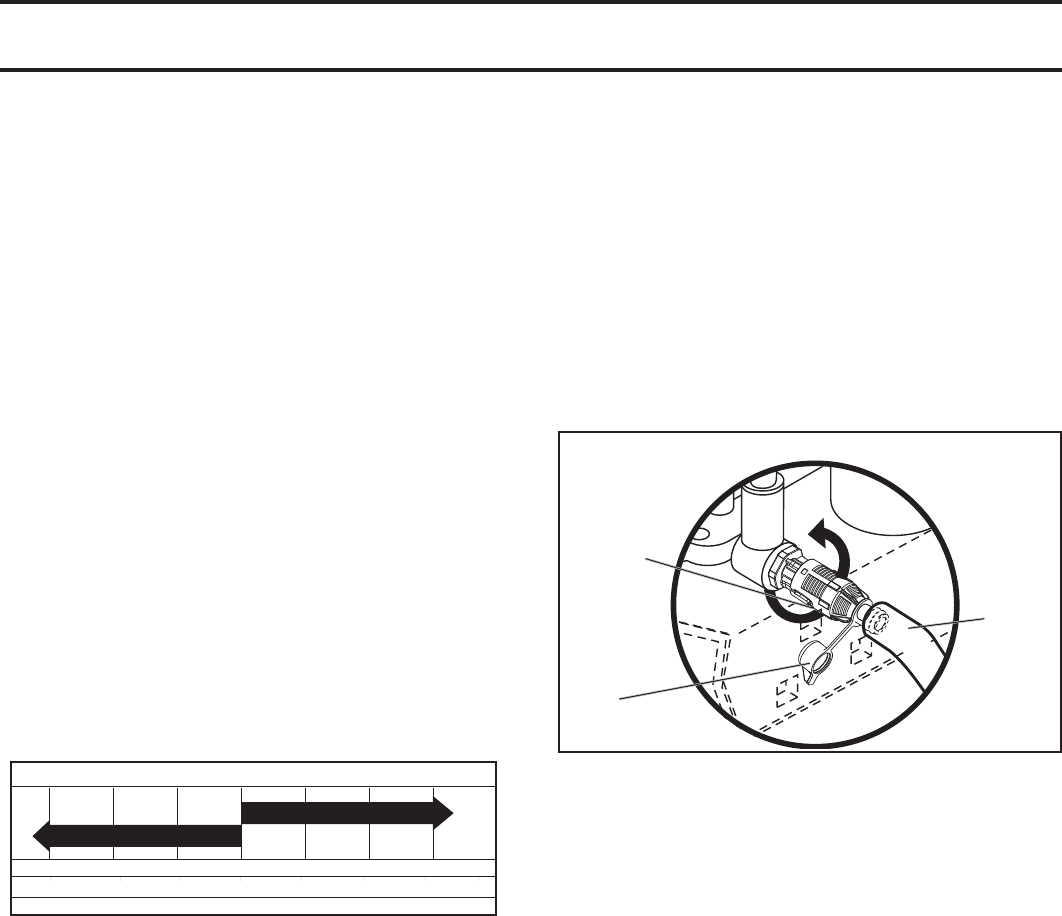
TO CHANGE ENGINE OIL (See Fig. 17)
Determine temperature range expected before oil change.
All oil must meet API service classification SG-SL..
• Be sure tractor is on level surface.
• Oil will drain more freely when warm.
• Catch oil in a suitable container.
• Remove oil fill cap/dipstick. Be careful not to allow dirt
to enter the engine when changing oil.
• Remove yellow cap from end of drain valve and install
the drain tube onto the fitting.
OIL DRAIN VALVE
02463
CLOSED AND
LOCKED
POSITION
YELLOW
CAP
DRAIN
TUBE
ENGINE COOLING SYSTEM
To ensure proper cooling, make sure the grass screen,
cooling fins, and other external surfaces of the engine are
kept clean at all times.
Every 100 hours of operation (more often under extremely
dusty, dirty conditions), remove the blower housing and
other cooling shrouds. Clean the cooling fins and external
surfaces as necessary. Ensure the cooling shrouds are
reinstalled.
NOTE: Operating the engine with a blocked grass screen,
dirty or plugged cooling fins, and/or cooling shrouds re moved
will cause engine damage due to overheating.
• Unlock drain valve by pushing inward and turning
coun ter clock wise.
• To open, pull out on the drain valve.
• After oil has drained completely, close and lock the
drain valve by pushing inward and turning clockwise
until the pin is in the locked position as shown.
• Remove the drain tube and replace the cap onto to the
bottom fitting of the drain valve.
• Refill engine with oil through oil fill dipstick tube. Pour
slowly. Do not overfill. For approximate capacity see
“PRODUCT SPECIFICATIONS” section of this man u al.
• Use gauge on oil fill cap/dipstick for checking level.
Be sure dipstick cap is tightened securely for accurate
reading. Keep oil at “FULL” line on dipstick. Tighten
cap onto the tube securely when finished.
17
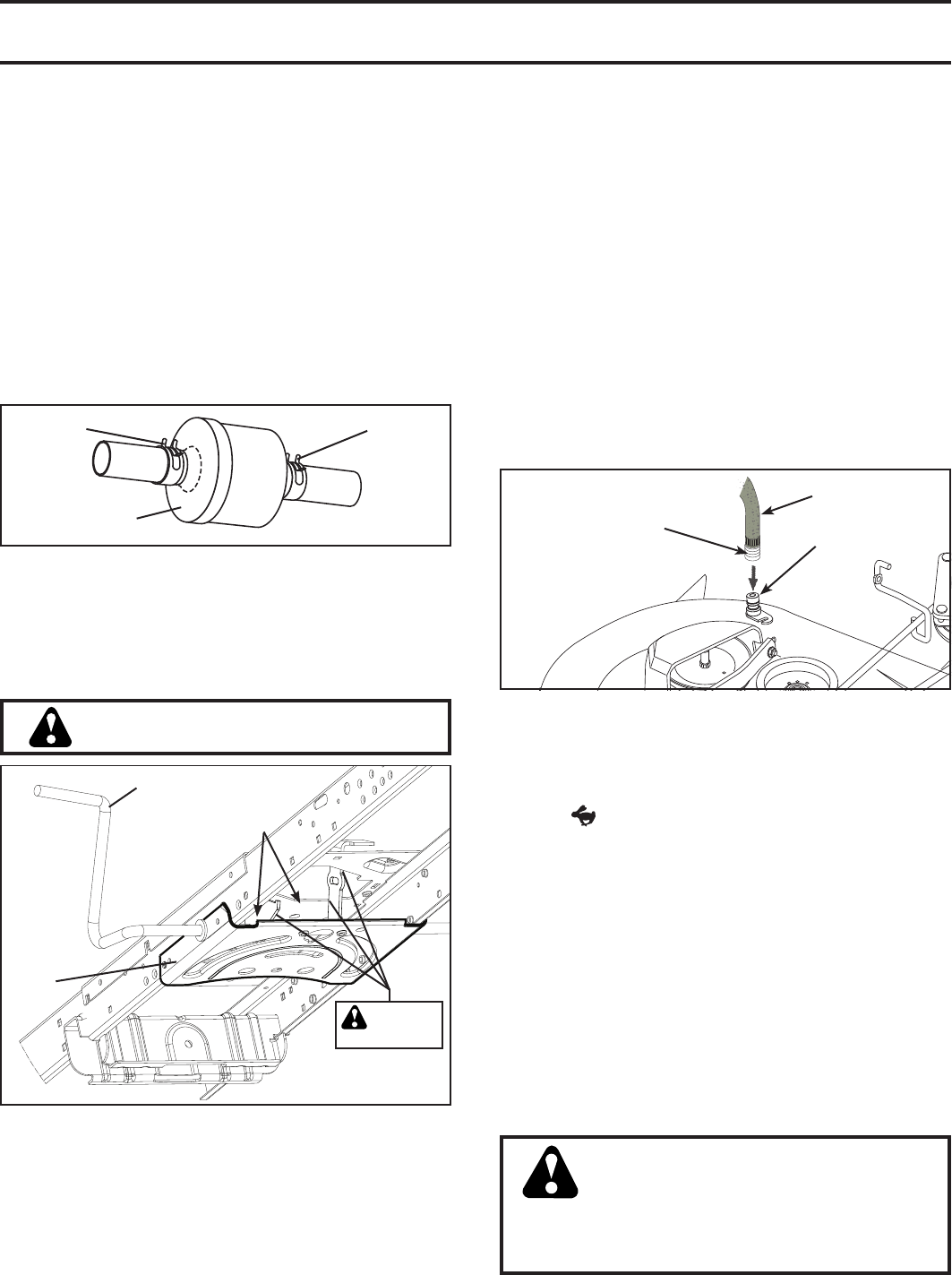
IN-LINE FUEL FILTER (See Fig. 18)
The fuel filter should be replaced once each season. If fuel
filter becomes clogged, ob struct ing fuel flow to car bu re tor,
re place ment is re quired.
• With engine cool, remove filter and plug fuel line sec tions.
• Place new fuel filter in position in fuel line with arrow
pointing towards carburetor.
• Be sure there are no fuel line leaks and clamps are
properly positioned.
• Immediately wipe up any spilled gasoline.
Fig. 18
MAINTENANCE
Fig. 19
• Keep finished surfaces and wheels free of all gasoline,
oil, etc.
• Protect painted surfaces with automotive type wax.
We do not recommend using a garden hose or pressure
washer to clean your tractor unless the engine and trans-
mission are covered to keep water out. Water in engine or
transmission will shorten the useful life of your tractor. Use
compressed air or a leaf blower to remove grass, leaves
and trash from tractor and mower.
CLEANING
• Clean engine, battery, seat, finish, etc. of all foreign
matter.
• Clean debris from steering plate. Debris can restrict
clutch/brake pedal shaft movement, causing belt slip
and loss of drive.
CAUTION: Avoid all pinch points and
movable parts (See Fig. 19)
CLUTCH/BRAKE PEDAL
STEERING
PLATE
STEERING SYSTEM,
DASH, FENDER AND
MOWER NOT SHOWN
CLEAN TOP SIDE
CAUTION:
PINCH
POINTS
00667
FUEL FILTER
CLAMP
CLAMP
DECK WASHOUT PORT (See Fig. 20)
Your tractor’s deck is equipped with a washout port on
its surface as part of its deck wash system. It should be
utilized after each use.
1. Drive the tractor to a level, clear spot on your lawn, near
enough to a water spigot for your garden hose to reach.
IMPORTANT: Make certain the tractor’s discharge chute is
directed AWAY from your house, garage, parked cars, etc.
Remove bagger chute or mulch cover if attached.
2. Make sure the attachment clutch control is in the
“DIS EN GAGED” position, set the parking brake, and
stop the engine.
3. Thread the nozzle adapter (packaged with your tractor’s
Operator’s Manual) onto the end of your garden hose.
4. Pull back the lock collar of the nozzle adapter and push
the adapter onto the deck washout port at the left end
of the mower deck. Release the lock collar to lock the
adapter on the nozzle.
IMPORTANT: Tug hose ensuring connection is secure.
5. Turn the water on.
6. While sitting in the operator’s position on the tractor,
re-start the engine and place the throttle lever in the
Fast " " position.
IMPORTANT: Recheck the area making certain the area
is clear.
7. Move the tractor’s attachment clutch control to the
“ENGAGED” position. Remain in the operator’s position
with the cutting deck engaged until the deck is cleaned.
8. Move the tractor’s attachment clutch control to the
“DIS EN GAGED” position. Turn the ignition key to the
STOP position to turn the tractor’s engine off. Turn the
water off.
9. Pull back the lock collar of the nozzle adapter to discon-
nect the adapter from the nozzle washout port.
10. Move the tractor to a dry area, preferably a concrete or
paved area. Place the attachment clutch control in the
“ENGAGED” position to remove excess water and to
help dry before putting the tractor away.
WARNING: A broken or missing washout
fitting could expose you or others to
thrown objects from contact with the blade.
• Replace broken or missing washout fitting
immediately, prior to using mower again.
• Plug any holes in mower with bolts and locknuts.
Fig. 20
WASHOUT
PORT
NOZZLE ADAPTER
HOSE
SPARK PLUGS
Replace spark plugs at the beginning of each mowing sea-
son or after every 100 hours of use, whichever comes first.
Spark plug type and gap setting is shown in "PROD UCT
SPECIFICATIONS" section of this manual.
18
WARNING: TO AVOID SE RI OUS IN JU RY, BEFORE PERFORMING ANY SERVICE OR ADJUSTMENTS:
• Depress brake pedal fully and set parking brake.
• Place motion control lever in neutral position.
• Place attachment clutch in “DISENGAGED” position.
• Turn ignition key to “STOP” and remove key.
• Make sure the blades and all moving parts have completely stopped.
• Disconnect spark plug wire from spark plug and place wire where it cannot come in contact with plug.
SERVICE AND ADJUSTMENTS
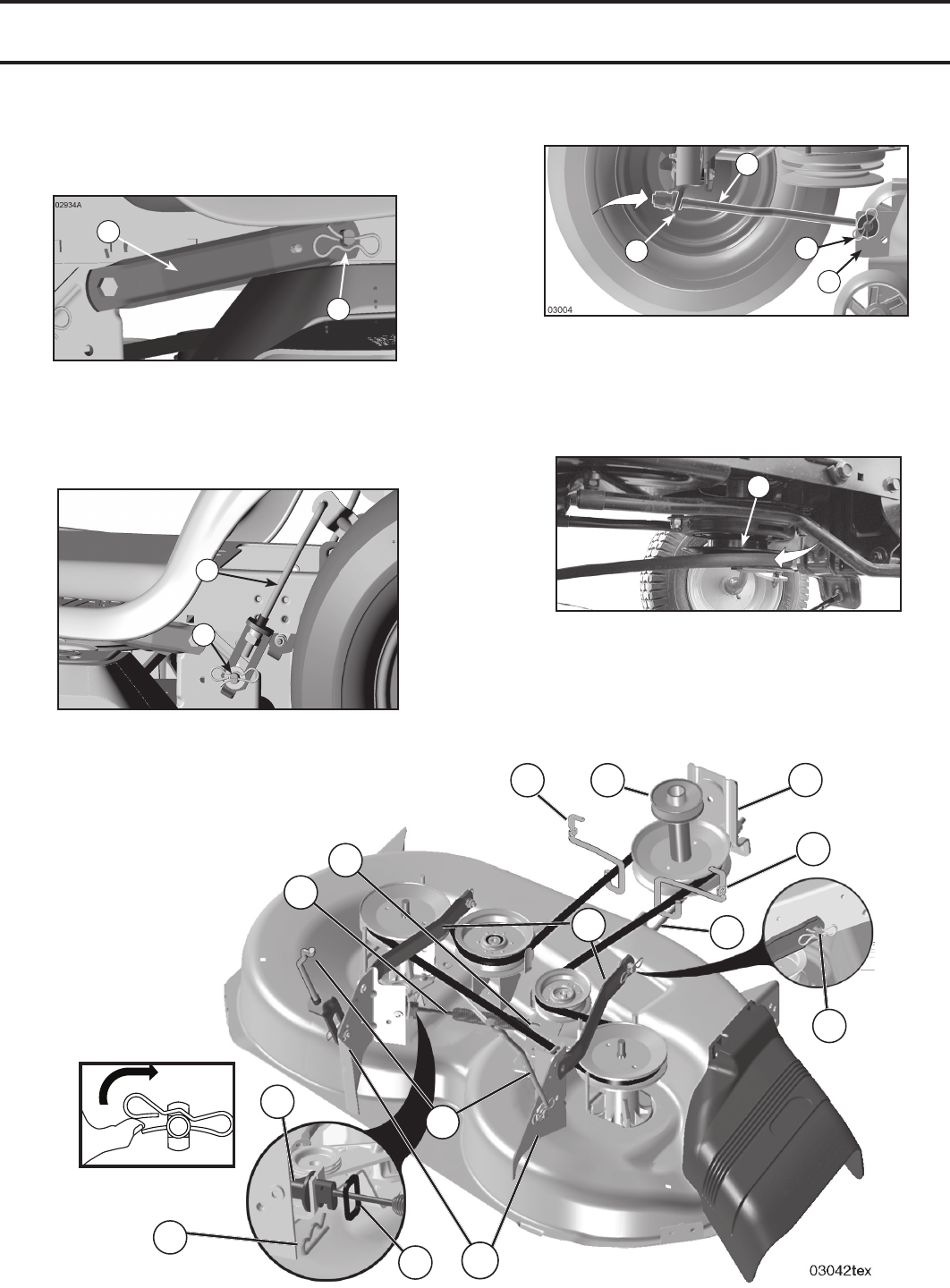
TO REMOVE MOWER (See Fig. 21)
• Place attachment clutch in “DIS EN GAGED” position.
• Lower attachment lift lever to its lowest position.
• Roll belt off engine pulley (M) and belt keepers (G).
• Remove retainer spring (K), slide col lar (L) off and
push housing guide (P) out of brack et.
• Remove clutch cable spring (Q) from idler arm (R).
• Disconnect front link (E) from mower - remove retainer
spring and washer.
• Go to either side of mower and disconnect mower
suspension arm (A) from chassis pin (B) and rear lift
link (C) from rear mower bracket (D) - remove retainer
springs and washers.
CAUTION: AFTER REAR LIFT LINKS
ARE DISCONNECTED, THE ATTACH-
MENT LIFT LEVER WILL BE SPRING
LOADED. HAVE A TIGHT GRIP ON LIFT
LEVER WHEN CHANGING POSITION
OF THE LEVER.
• Slide mower out from under right side of tractor.
IMPORTANT: IF AN ATTACHMENT OTHER THAN THE
MOWER IS TO BE MOUNTED ON THE TRAC TOR,
REMOVE THE FRONT LINK (E) AND REAR LIFT LINKS
(C) FROM TRACTOR AND HOOK THE CLUTCH SPRING
(Q) INTO THE CABLE GUIDE ON FRONT EDGE OF
LOWER DASH.
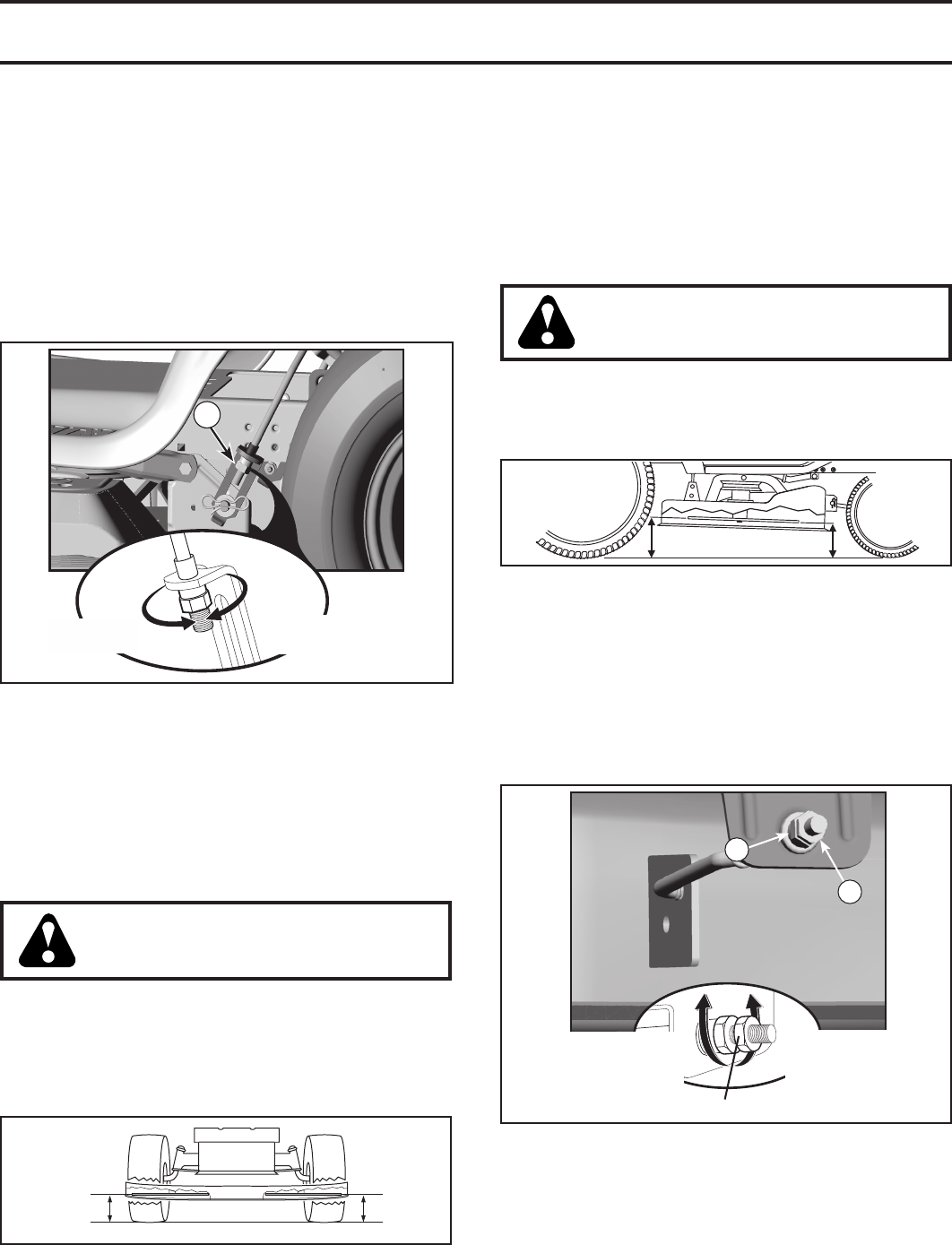
TO INSTALL MOWER (See Fig. 22-26)
Be sure tractor is on level surface and engage park ing
brake.
• Lower attachment lift lever to its lowest position.
CAUTION: LIFT LEVER IS SPRING
LOADED. HAVE A TIGHT GRIP ON
LIFT LEVER, LOWER IT SLOWLY AND
ENGAGE IN LOWEST POSITION.
NOTE: Be sure mower side suspension arms (A) are point-
ing forward before sliding mower under tractor.
• Slide mower under tractor until it is centered under
tractor.
E
F
C
G
Q
R
D
K
G
P
B
L
M
A
Fig. 21
19
SERVICE AND ADJUSTMENTS
E
F
C
G
Q
R
D
K
G
P
B
L
M
A
IMPORTANT: CHECK BELT FOR PROPER ROUTING
IN ALL MOWER PULLEY GROOVES.
• Raise attachment lift lever to highest position.
• If necessary, adjust gauge wheels before op er at ing
mower as shown in the Operation section of this manual.
E
F
H
J
M
Fig. 24
Fig. 25
A
B
D
C
Fig. 22
Fig. 23
• ATTACH MOWER SIDE SUSPENSION ARMS (A) TO
CHASSIS - Position hole in arm over pin (B) on outside
of tractor chassis and secure with retainer spring.
• Repeat on opposite side of tractor.
• ATTACH REAR LIFT LINKS (C) - Lift rear corner of
mower and position slot in link assembly over pin (D)
on rear mower bracket and secure with washer and
retainer spring.
• Insert end of link (E) into hole in front mower bracket
and secure with washer and retainer spring (J).
• Hook end of clutch cable spring (Q) into hole in idler
arm (R).
• Push clutch cable housing guide (P) into bracket, slide
collar (L) onto guide and secure with retainer spring (K).
• Install belt on engine pulley (M), in belt keepers (G).
• ATTACH FRONT LINK (E) - Work from left side of trac-
tor. Insert rod end of link assembly through front hole
in tractor front suspension bracket (F).
Fig. 26
20
SERVICE AND ADJUSTMENTS
• If adjustment is necessary, see step in Visual Adjust-
ment instructions above.
• Recheck measurements, adjust if necessary until both
sides are equal.
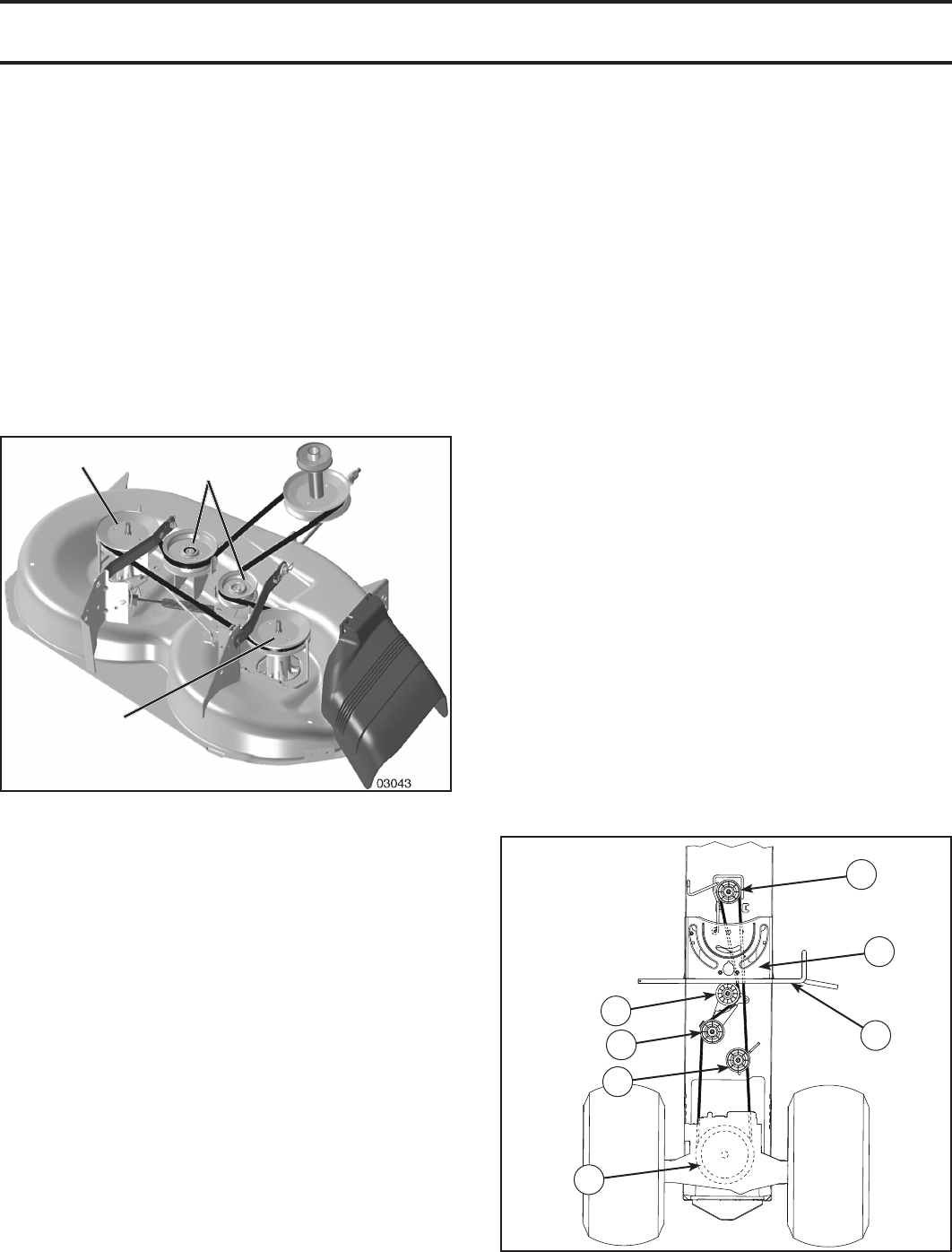
FRONT-TO-BACK ADJUSTMENT (See Figs. 29 & 30)
IMPORTANT: Deck must be level side-to-side.
To obtain the best cutting re sults, the mower blades should
be adjusted so the front tip is 1/8" to 1/2" lower than the
rear tip when the mower is in its highest position.
CAUTION: Blades are sharp. Protect
your hands with gloves and/or wrap
blade with heavy cloth.
• Raise mower to highest position.
• Position blade so the tip is pointing straight forward.
Measure distance (B) to the ground at front and rear
tip of the blade.
TO LEVEL MOWER
Make sure tires are properly inflated to the PSI shown on
tires. If tires are over or under inflated, it may affect the
appearance of your lawn and lead you to think the mower
is not adjusted properly.
VISUAL SIDE-TO-SIDE ADJUSTMENT (See Fig. 27)
• With all tires properly inflated and if your lawn appears
unevenly cut, determine which side of mower is cutting
lower.
• With a 3/4" or adjustable wrench, turn lift link adjust-
ment nut (A) to the left to lower LH side of mower, or,
to the right to raise LH side of mower.
NOTE: Each full turn of adjustment nut will change mower
height about 3/16".
• Test your adjustment by mowing some uncut grass
and visually checking the appearance. Readjust, if
necessary, until you are satisfied with the results.
PRECISION SIDE-TO-SIDE ADJUSTMENT (See Fig. 28)
• With all tires properly inflated, park tractor on level
ground or driveway.
CAUTION: Blades are sharp. Protect
your hands with gloves and/or wrap
blade with heavy cloth.
• Raise mower to its highest position.
• At both sides of mower, position blade at side and
measure the distance (A) from bottom edge of blade
to the ground. The distance should be the same on
both sides.
NOTE: Each full turn of the adjustment nut will change
mower height about 1/8".
• Recheck measurements, adjust if necessary until front
tip of blade is 1/8" to 1/2" lower than the rear tip.
• Hold adjustment nut in position with wrench and tighten
jam nut securely against adjustment nut.
02966
A
A
Fig. 28
• If front tip of blade is not 1/8" to 1/2" lower than the rear
tip, go to the front of tractor.
• With an 11/16" or adjustable wrench, loosen jam nut A
several turns to clear adjustment nut B.
• With a 3/4" or adjustable wrench, turn front link adjust-
ment nut (B) clockwise (tighten) to raise the front of
mower, or, counterclockwise (loosen) to lower the front
mower.
Fig. 30
B
02950
A
TIGHTEN ADJUST
NUT B TO RAISE
MOWER
LOOSEN
ADJUST NUT
B TO LOWER
MOWER
LOOSEN JAM NUT A FIRST
Fig. 27
0
2
9
4
8
A
Turn nut left
to lower mower
Turn nut right
to raise mower
BB
Fig. 29
21
Fig. 32
TO CHECK BRAKE
If tractor requires more than five (5) feet to stop at highest
speed in high est gear on a level, dry concrete or paved
surface, then brake must be serviced.
You may also check brake by:
1. Park tractor on a level, dry concrete or paved surface,
depress brake pedal all the way down and engage
parking brake.
2. Disengage transmission by placing freewheel control
in “transmission disengaged” position. Pull freewheel
control out and into the slot and release so it is held in
the disengaged position.
The rear wheels must lock and skid when you try to manu-
ally push the tractor forward. If the rear wheels rotate,
then the brake needs to be serviced. Contact a qualified
service center.
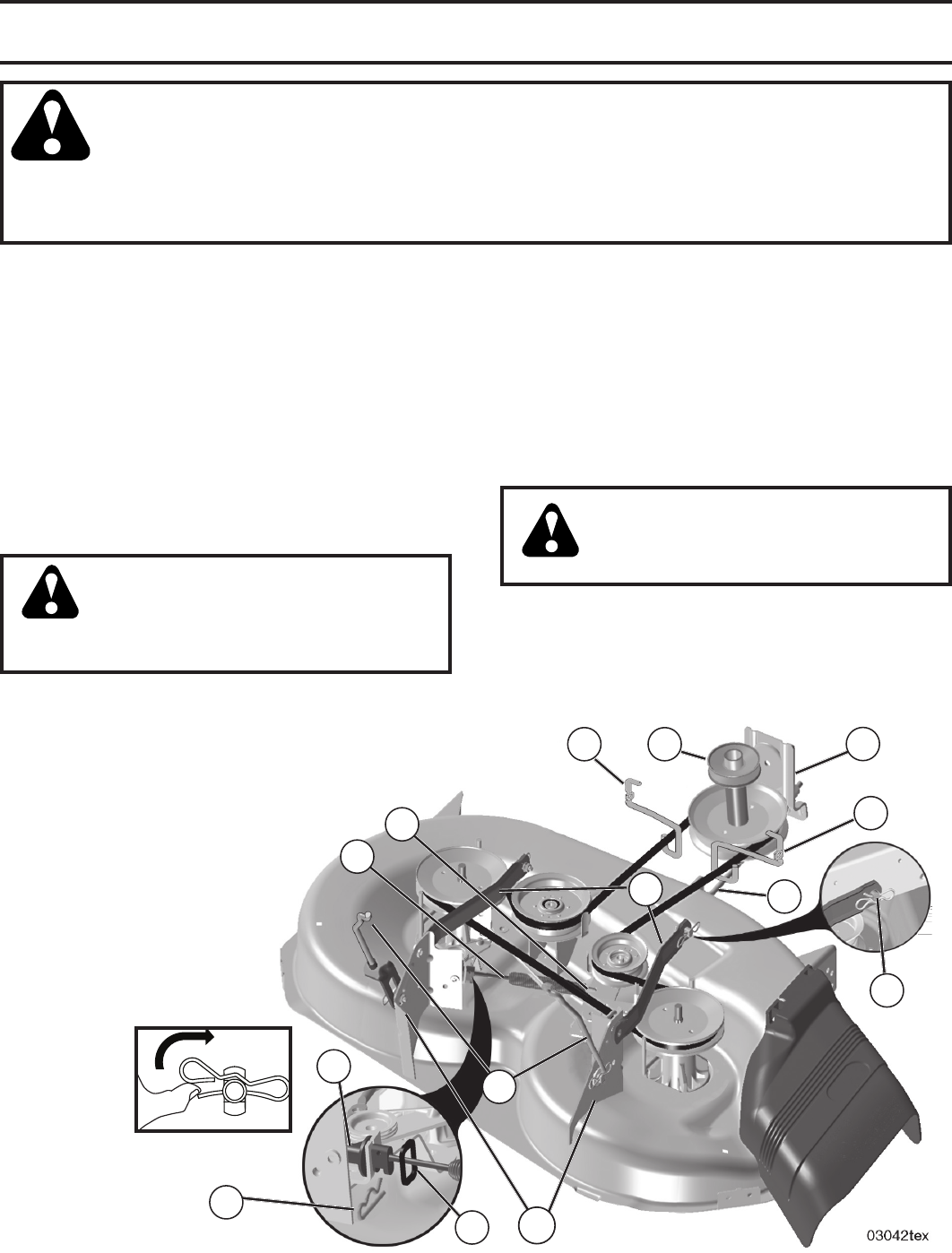
MANDREL
PULLEY IDLER
PUL LEYS
MANDREL
PULLEY
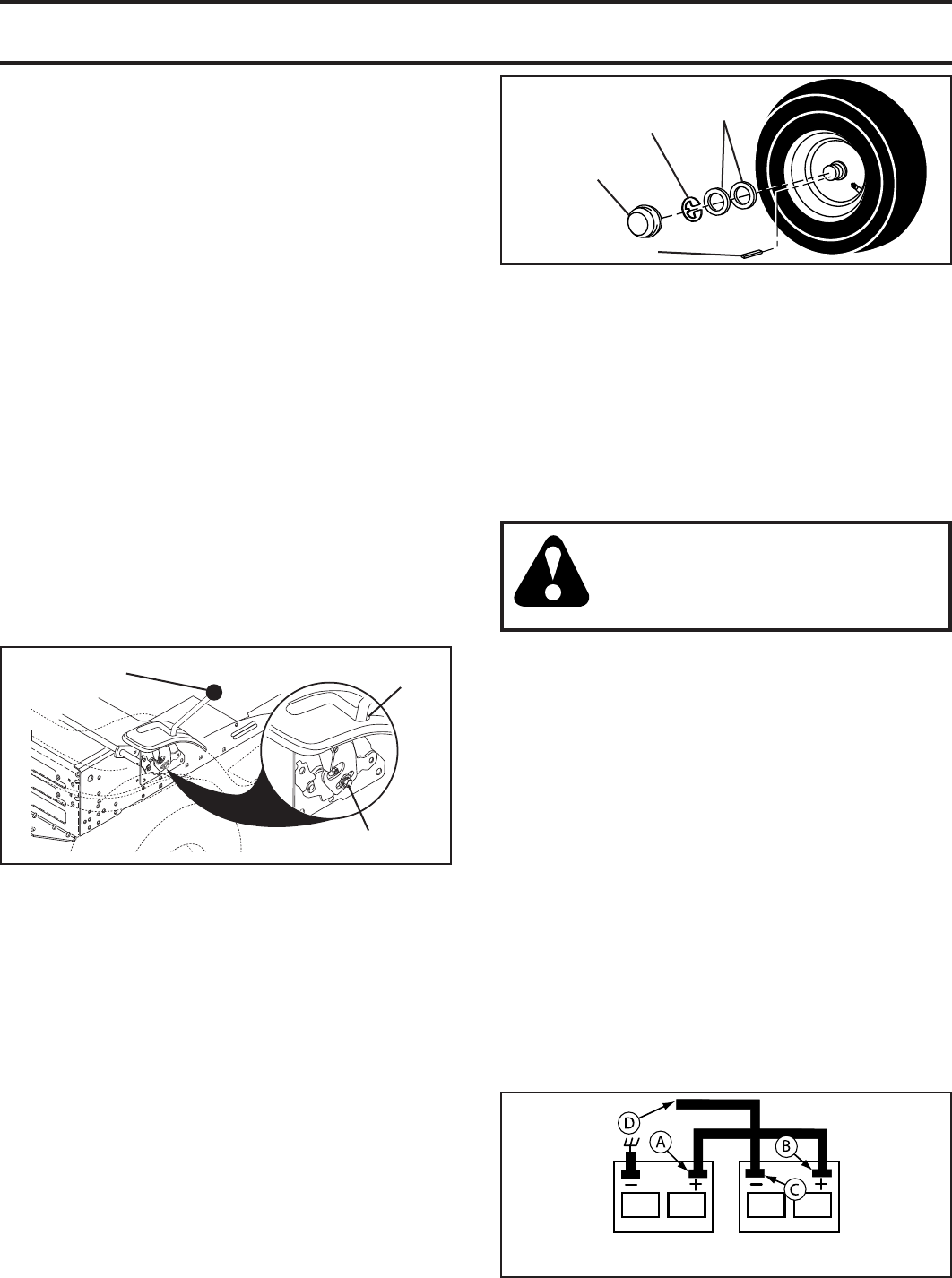
TO REPLACE MOWER BLADE DRIVE BELT
(See Fig. 31)
The mower blade drive belt may be replaced without tools.
Park the tractor on level surface. Engage parking brake.
BELT REMOVAL -
• Remove mower from tractor (See “TO REMOVE
MOW ER” in this section of manual).
• Work belt off both mandrel pulleys and idler pulleys.
• Pull belt away from mower.
BELT INSTALLATION -
• Work belt around both mandrel pulleys and idler pulleys.
• Make sure belt is in all pulley grooves and in side all
belt guides.
• Install mower (See "To Install Mower" in this section of
manual).
Fig. 31
TO REPLACE MOTION DRIVE BELT
(See Fig. 32)
Park the tractor on level surface. En gage parking brake.
For as sis tance, there is a belt installation guide decal on
bottom side of left footrest.
BELT REMOVAL -
• Remove mower (See “TO REMOVE MOWER” section
in this manual).
NOTE: Observe entire motion drive belt and position of all
belt guides and keepers.
• Remove belt from stationary idler (A) and clutching
idler (B).
• Remove belt from centerspan idler (C).
• Pull belt slack toward rear of trac tor. Carefully remove
belt up wards from trans mis sion input pulley and over
cooling fan blades (D).
• Remove belt downward from engine pulley (E).
• Slide belt toward rear of tractor, off the steering plate
(F) and remove from tractor.
BELT INSTALLATION -
• Install new belt from tractor rear to front, over the steer-
ing plate (F) and above clutch brake pedal shaft (G).
• Pull belt toward front of tractor and roll belt onto engine
pulley (E).
• Pull belt toward rear of tractor. Carefully work belt down
around transmission cooling fan and onto the input
pulley (D). Be sure belt is inside the belt keeper.
• Install belt on centerspan idler (C).
• Install belt through stationary idler (A) and clutch ing
idler (B).
• Make sure belt is in all pulley grooves and in side all
belt guides and keep ers.
• Install mower (See “TO INSTALL MOWER” section in
this manual).
02952
A
B
C
D
E
F
G
SERVICE AND ADJUSTMENTS
22
FRONT WHEEL TOE-IN/CAMBER
The front wheel toe-in and camber are not adjustable on
your tractor. If damage has occurred to affect the front wheel
toe-in or camber, contact your nearest authorized service
center/department.
TO REMOVE WHEEL FOR REPAIRS
(See Fig. 34)
• Block up axle securely.
• Remove axle cover, retaining ring and washers to allow
wheel removal (rear wheel contains a square key - Do
not lose).
• Repair tire and reassemble.
Fig. 34
RE TAIN ING
RING
WASH ERS
SQUARE KEY
(REAR WHEEL ONLY)
AXLE
COVER
TO START ENGINE WITH A WEAK BATTERY
(See Fig. 35)
WARNING: Lead-acid batteries gen-
er ate ex plo sive gases. Keep sparks,
flame and smoking ma te ri als away from
bat ter ies. Always wear eye pro tec tion
when around batteries.
If your battery is too weak to start the engine, it should be
recharged. (See "BATTERY" in the Maintenance sec tion
of this man u al).
If “jumper ca bles” are used for emer gen cy starting, follow
this pro ce dure:
IMPORTANT: YOUR TRACTOR IS EQUIPPED WITH A 12 VOLT
SYSTEM. THE OTHER VEHICLE MUST ALSO BE A 12 VOLT
SYSTEM. DO NOT USE YOUR TRACTOR BATTERY TO START
OTHER VEHICLES.
TO ATTACH JUMPER CABLES -
• Connect one end of the RED cable to the POSITIVE
(+) terminal of each battery(A-B), taking care not to
short against tractor chassis.
• Connect one end of the BLACK ca ble to the NEGA TIVE
(-) terminal (C) of fully charged battery.
• Connect the other end of the BLACK cable (D) to good
chassis ground, away from fuel tank and bat tery.
TO REMOVE CABLES, REVERSE ORDER -
• BLACK cable first from chassis and then from the fully
charged battery.
• RED cable last from both batteries.
Fig. 33
02239
ADJUSTMENT
BOLT
NEUTRAL
LOCK GATE
MOTION CONTROL LEVER
TRANSAXLE MOTION CONTROL LEVER
NEUTRAL ADJUSTMENT (See Fig. 33)
The motion control lever has been pre set at the factory
and adjustment should not be necessary.
• Loosen adjustment bolt in front of the right rear wheel,
and lightly tighten.
• Start engine and move motion control lever until tractor
does not move forward or backward.
• Hold motion control lever in that position and turn engine
off.
• While holding motion control lever in place, loosen the
adjustment bolt.
• Move motion control lever to the neutral (lock gate)
position.
• Tighten adjustment bolt securely.
NOTE: If additional clearance is needed to get to ad just ment
bolt, move mower deck height to the lowest position.
After above adjustment is made, if the tractor still creeps
forward or backward while motion control lever is in neutral
position, follow these steps:
• Loosen the adjustment bolt.
• Move the motion control lever 1/4 to 1/2" in the direc-
tion it is trying to creep.
• Tighten adjustment bolt securely.
• Start engine and test.
• If tractor still creeps, repeat above steps until satisfied.
Fig. 35
• On rear wheels only: align grooves in rear wheel hub
and axle. Insert square key.
• Replace washers and snap retaining ring securely in
axle groove.
• Replace axle cover.
NOTE: To seal tire punctures and prevent flat tires due to slow
leaks, tire sealant may be purchased from your local parts
dealer. Tire sealant also prevents tire dry rot and corrosion.
WEAK OR
DEAD BATTERY FULLY CHARGED
BATTERY
SERVICE AND ADJUSTMENTS
23
TO REPLACE HEADLIGHT BULB
• Raise hood.
• Pull bulb holder out of the hole in the backside of the grill.
• Replace bulb in holder and push bulb holder securely
back into the hole in the backside of the grill.
• Close hood.
INTERLOCKS AND RELAYS
Loose or damaged wiring may cause your tractor to run
poorly, stop running, or prevent it from starting.
• Check wiring.
TO REPLACE FUSE
Replace with 20 amp automotive-type plug-in fuse. The
fuse holder is located behind the dash.
02778
HOOD
HEADLIGHT
WIRE
CONNECTOR
Fig. 37
TO REMOVE HOOD AND GRILL ASSEMBLY
(See Fig. 37)
• Raise hood.
• Unsnap headlight wire connector.
• Stand in front of tractor. Grasp hood at sides, tilt toward
engine and lift off of tractor.
• To replace, reverse above procedure.
ENGINE
TO AD JUST THROTTLE CON TROL CABLE
The throttle control has been preset at the factory and
ad just ment should not be necessary. If adjustment is nec-
es sary, see engine manual.
TO AD JUST CHOKE CON TROL
The choke control has been preset at the factory and ad-
just ment should not be necessary. If adjustment is neces-
sary, see engine manual.
TO ADJUST CARBURETOR
Your carburetor is not adjustable. If your engine does not
operate properly due to suspected carburetor problems,
take your tractor to an authorized service center for repair
and/or adjustment.
TRANSMISSION
REMOVAL/RE PLACE MENT
Should your transmission require removal for service or
re place ment, it should be purged after reinstallation and
before operating the tractor. See “PURGE TRANS MIS SION”
in the Operation section of this manual.
SERVICE AND ADJUSTMENTS
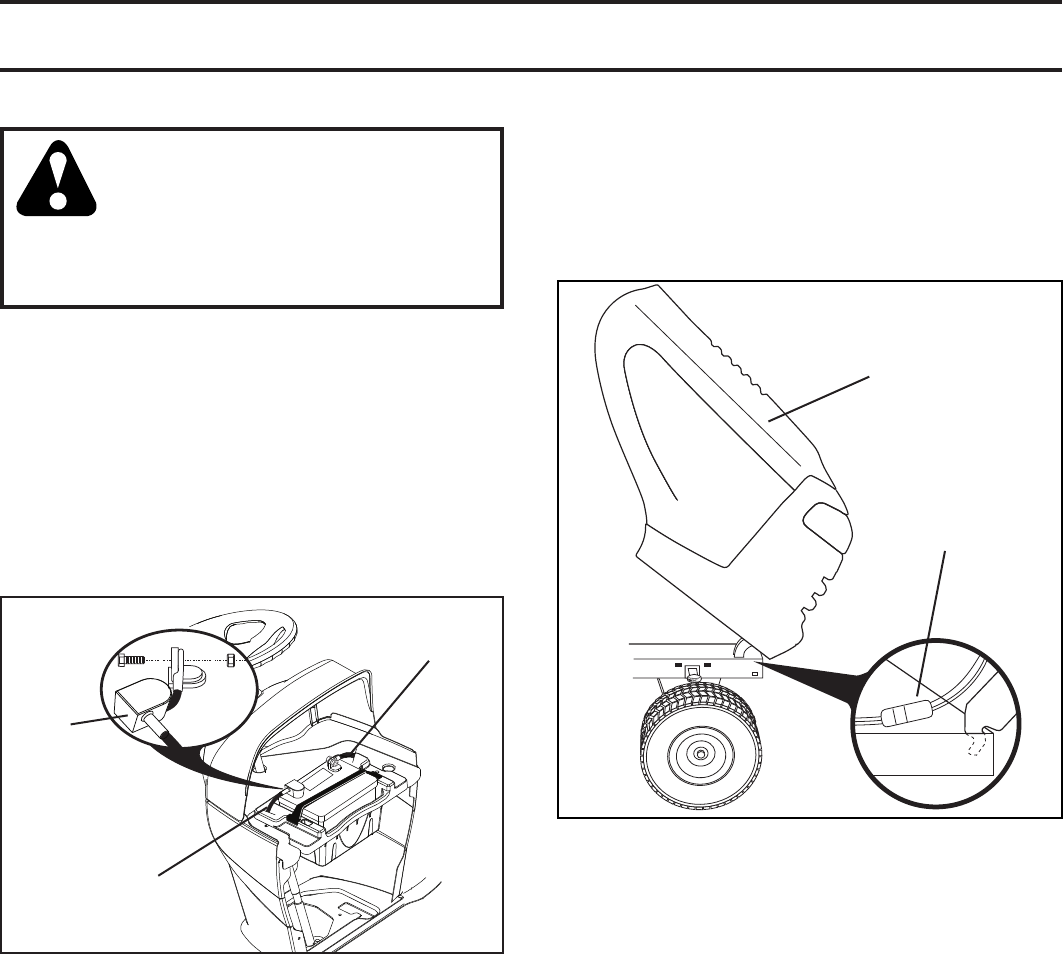
REPLACING BATTERY (See Fig. 36)
WARNING: Do not short battery ter mi-
nals by allowing a wrench or any other
object to contact both terminals at the
same time. Before connecting battery,
remove metal bracelets, wristwatch
bands, rings, etc. Positive terminal
must be connected first to prevent
sparking from ac ci den tal grounding.
• Lift hood to raised position.
• Remove terminal cover.
• Disconnect BLACK battery cable then RED battery
cable and carefully remove battery from tractor.
• Install new battery with terminals in same position as
old battery.
• Reinstall terminal cover.
• First connect RED battery cable to positive (+) battery
terminal with bolt and nut as shown. Tighten securely.
• Connect BLACK grounding cable to negative (-) bat tery
terminal with remaining bolt and nut. Tighten securely
• Close hood.
POSITIVE
(RED)
CABLE
TERMINAL
COVER
NEGATIVE
(BLACK)
CABLE
Fig. 36
24
Immediately prepare your tractor for storage at the end
of the season or if the tractor will not be used for 30 days
or more.
WARNING: Never store the trac tor with
gas o line in the tank inside a building
where fumes may reach an open flame
or spark. Allow the engine to cool before
storing in any en clo sure.
TRACTOR
Remove mower from tractor for winter storage. When mower
is to be stored for a period of time, clean it thor oughly, remove
all dirt, grease, leaves, etc. Store in a clean, dry area.
• Clean entire tractor (See “CLEANING” in the Main te -
nance section of this manual).
• Inspect and replace belts, if necessary (See belt re-
place ment instructions in the Service and Adjustments
section of this manual).
• Lubricate as shown in the Maintenance section of this
man ual.
• Be sure that all nuts, bolts and screws are securely
fastened. Inspect moving parts for damage, breakage
and wear. Replace if necessary.
• Touch up all rusted or chipped paint surfaces; sand
lightly before painting.
BATTERY
• Fully charge the battery for storage.
• After a period of time in storage, battery may require
recharging.
• To help prevent corrosion and power leakage during
long periods of storage, battery cables should be dis-
con nect ed and battery cleaned thoroughly (see “TO
CLEAN BATTERY AND TERMINALS” in the Mainte-
nance sec tion of this manual).
• After cleaning, leave cables disconnected and place
cables where they cannot come in contact with battery
terminals.
• If battery is removed from tractor for storage, do not
store battery directly on concrete or damp surfaces.
ENGINE
FUEL SYSTEM
IMPORTANT: IT IS IMPORTANT TO PREVENT GUM DEPOSITS
FROM FORMING IN ES SEN TIAL FUEL SYSTEM PARTS SUCH
AS CARBURETOR, FUEL FIL TER, FUEL HOSE, OR TANK
DURING STORAGE. ALSO, EXPERIENCE INDICATES THAT
ALCOHOL BLENDED FUELS (CALLED GASOHOL OR USING
ETHANOL OR METHANOL) CAN ATTRACT MOIS TURE WHICH
LEADS TO SEPARATION AND FOR MA TION OF ACIDS DURING
STOR AGE. ACIDIC GAS CAN DAMAGE THE FUEL SYSTEM
OF AN ENGINE WHILE IN STORAGE.
• Empty the fuel tank by starting the engine and let it run
until the fuel lines and carburetor are empty.
• Never use engine or carburetor cleaner products in the
fuel tank or permanent damage may occur.
• Use fresh fuel next season.
NOTE: Fuel stabilizer is an acceptable alternative in mini-
mizing the formation of fuel gum deposits during stor age.
Add stabilizer to gasoline in fuel tank or storage container.
Always follow the mix ratio found on stabilizer container.
Run engine at least 10 minutes after adding stabilizer to
allow the stabilizer to reach the carburetor. Do not empty
the gas tank and carburetor if using fuel stabilizer.
ENGINE OIL
Drain oil (with engine warm) and replace with clean en-
gine oil. (See “ENGINE” in the Maintenance section of
this man ual).
CYLINDER(S)
• Remove spark plug(s).
• Pour one ounce of oil through spark plug hole(s) into
cylinder(s).
• Turn ignition key to “START” position for a few seconds
to distribute oil.
• Replace with new spark plug(s).
OTHER
• Do not store gasoline from one season to another.
• Replace your gasoline can if your can starts to rust.
Rust and/or dirt in your gasoline will cause problems.
• If possible, store your tractor indoors and cover it to
give protection from dust and dirt.
• Cover your tractor with a suitable protective cover that
does not retain moisture. Do not use plastic. Plastic
cannot breathe which allows condensation to form and
will cause your tractor to rust.
IMPORTANT: NEVER COVER TRACTOR WHILE EN GINE AND
EXHAUST AREAS ARE STILL WARM.
STORAGE

25
TROUBLESHOOTING
PROBLEM CAUSE CORRECTION
Will not start 1. Out of fuel. 1. Fill fuel tank.
2. Engine not “CHOKED” properly. 2. See “TO START ENGINE” in Operation section.
3. Engine flooded. 3. Wait several minutes before attempting to start.
4. Bad spark plug. 4. Replace spark plug.
5. Dirty air filter. 5. Clean/replace air filter.
6. Dirty fuel filter. 6. Replace fuel filter.
7. Water in fuel. 7. Empty fuel tank and carburetor, refill tank with fresh
gasoline and replace fuel filter.
8. Loose or damaged wiring. 8. Check all wiring.
9. Carburetor out of adjustment. 9. See “To Adjust Carburetor” in Service Adjustments
section.
10. Engine valves out of adjustment. 10. Contact an authorized service center/department.
Hard to start 1. Dirty air filter. 1. Clean/replace air filter.
2. Bad spark plug. 2. Replace spark plug.
3. Weak or dead battery. 3. Recharge or replace battery.
4. Dirty fuel filter. 4. Replace fuel filter.
5. Stale or dirty fuel. 5. Empty fuel tank and refill tank with fresh, clean gas.
6. Loose or damaged wiring. 6. Check all wiring.
7. Carburetor out of adjustment. 7. See “To Adjust Carburetor” in Service Adjustments
section.
8. Engine valves out of adjustment. 8. Contact an authorized service center/department.
Engine will not
turn over
1. Brake pedal not depressed. 1. Depress brake pedal.
2. Attachment clutch is engaged. 2. Disengage attachment clutch.
3. Weak or dead battery. 3. Recharge or replace battery.
4. Blown fuse. 4. Replace fuse.
5. Corroded battery terminals. 5. Clean battery terminals.
6. Loose or damaged wiring. 6. Check all wiring.
7. Faulty ignition switch. 7. Check/replace ignition switch.
8. Faulty solenoid or starter. 8. Check/replace solenoid or starter.
9. Faulty operator presence switch(es). 9. Contact an authorized service center/department.
Engine clicks but
will not start
1. Weak or dead battery. 1. Recharge or replace battery.
2. Corroded battery terminals. 2. Clean battery terminals.
3. Loose or damaged wiring. 3. Check all wiring.
4. Faulty solenoid or starter. 4. Check/replace solenoid or starter.
Loss of power 1. Cutting too much grass/too fast. 1. Raise cutting height/reduce speed.
2. Throttle in “CHOKE” position. 2. Adjust throttle control.
3. Build-up of grass, leaves, trash under mower. 3. Clean underside of mower housing.
4. Dirty air filter. 4. Clean/replace air filter.
5. Low oil level/dirty oil. 5. Check oil level/change oil.
6. Faulty spark plug. 6. Clean and regap or change spark plug.
7. Dirty fuel filter. 7. Replace fuel filter.
8. Stale or dirty fuel. 8. Empty fuel tank and refill tank with fresh, clean gas.
9. Water in fuel. 9. Empty fuel tank and carburetor, refill tank with fresh
gasoline and replace fuel filter.
10. Spark plug wire loose. 10. Connect and tighten spark plug wire.
11. Dirty engine air screen/fins. 11. Clean engine air screen/fins.
12. Dirty/clogged muffler. 12. Clean/replace muffler.
13. Loose or damaged wiring. 13. Check all wiring.
14. Carburetor out of adjustment. 14. See “To Adjust Carburetor” in Service Adjustments
15. Engine valves out of adjustment. 15. Contact an authorized service center/department.
Excessive
vibration
1. Worn, bent or loose blade. 1. Replace blade. Tighten blade bolt.
2. Bent blade mandrel. 2. Replace blade mandrel.
3. Loose/damaged part(s). 3. Tighten loose part(s). Replace damaged parts.

26
TROUBLESHOOTING POINTS
PROBLEM CAUSE CORRECTION
Engine continues
to run when oper-
ator leaves seat
with attachment
clutch engaged
1. Faulty operator-safety presence control
system. 1. Check wiring, switches and connections. If not
corrected, contact an authorized service center/
department.
Poor cut - uneven 1. Worn, bent or loose blade. 1. Replace blade. Tighten blade bolt.
2. Mower deck not level. 2. Level mower deck.
3. Buildup of grass, leaves, trash under mower. 3. Clean underside of mower housing.
4. Bent blade mandrel. 4. Replace blade mandrel.
5. Clogged mower deck vent holes from
buildup of grass, leaves, and trash around
mandrels.
5. Clean around mandrels to open vent holes.
Mower blades will
not rotate
1. Obstruction in clutch mechanism. 1. Remove obstruction.
2. Worn/damaged mower drive belt. 2. Replace mower drive belt.
3. Frozen idler pulley. 3. Replace idler pulley.
4. Frozen blade mandrel. 4. Replace blade mandrel.
Poor grass
discharge
1. Engine speed too slow. 1. Place throttle control in “FAST” position.
2. Travel speed too fast. 2. Shift to slower speed.
3. Wet grass. 3. Allow grass to dry before mowing.
4. Mower deck not level. 4. Level mower deck.
5. Low/uneven tire air pressure. 5. Check tires for proper air pressure.
6. Worn, bent or loose blade. 6. Replace blade. Tighten blade bolt.
7. Buildup of grass, leaves, trash under mower. 7. Clean underside of mower housing.
8. Mower drive belt worn. 8. Replace mower drive belt.
9. Blades improperly installed. 9. Reinstall blades sharp edge down.
10. Improper blades used. 10. Replace with blades listed in parts manual.
11. Clogged mower deck vent holes from buildup
of grass, leaves, trash around mandrels. 11. Clean around mandrels to open vent holes.
Headlight(s) not
working
(if so equipped)
1. Switch is “OFF”. 1. Turn switch “ON”.
2. Bulb(s) or lamp(s) burned out. 2. Replace bulb(s) or lamp(s).
3. Faulty light switch. 3. Check/replace light switch.
4. Loose or damaged wiring. 4. Check wiring and connections.
5. Blown fuse. 5. Replace fuse.
Battery will not
charge
1. Bad battery cell(s). 1. Replace battery.
2. Poor cable connections. 2. Check/clean all connections.
3. Faulty regulator (if so equipped). 3. Replace regulator.
4. Faulty alternator. 4. Replace alternator.
Loss of drive 1. Freewheel control in “disengaged” position. 1. Place freewheel control in “engaged” position.
2. Debris on steering plate (if equipped). 2. See "CLEANING" in the maintenance section.
3. Motion drive belt worn, damaged, or broken. 3. Replace motion drive belt.
4. Air trapped in transmission during
shipment or servicing. 4. Purge transmission.
5. Axle key missing. 5. Install axle key at rear wheel. See "TO REMOVE
WHEEL" in the Service and Adjustments section.
Engine "back-
fires” when turn-
ing engine “OFF”
1. Engine throttle control not set between
half and full speed (fast) position before
stopping engine.
1. Move throttle control between half and full speed
(fast) position before stopping engine.
Engine dies when
tractor is shifted
into reverse
1. Reverse operation system (ROS) is not "ON"
while mower or other attachment is engaged. 1. Turn ignition key to ROS "ON" position. See
Operation section.
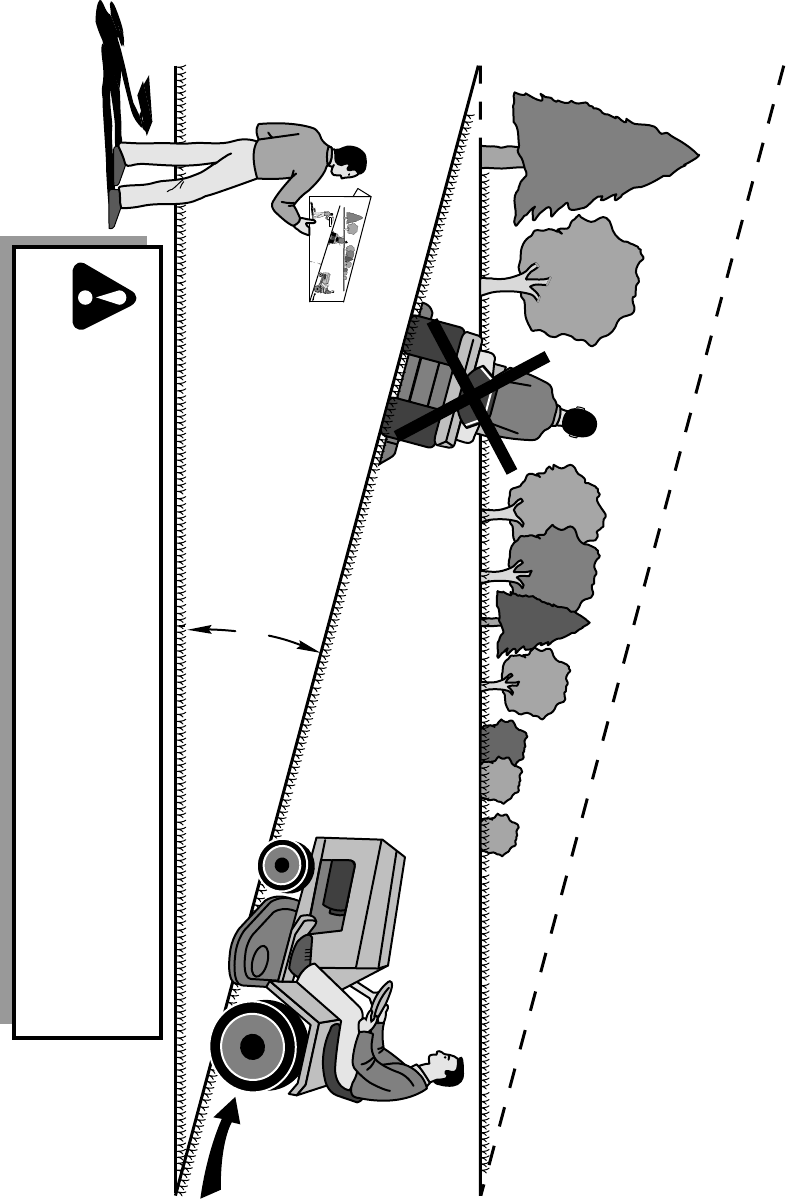
27
15 DEGREES MAX.
FOLD ALONG DOTTED LINE
THIS IS A 15 DEGREE SLOPE
ONLY RIDE UP AND DOWN HILL,
NOT ACROSS HILL
SUGGESTED GUIDE FOR SIGHTING SLOPES FOR SAFE OPERATION
WARNING: To avoid serious injury, operate your tractor up and
down the face of slopes, never across the face. Do not mow
slopes greater than 15 degrees. Make turns gradually to prevent
tipping or loss of control. Exercise extreme caution when
changing direction on slopes.
1. Fold this page along dotted line indicated above.
2. Hold page before you so that its left edge is vertically parallel to a tree
trunk or other upright structure.
3. Sight across the fold in the direction of hill slope you want to measure.
4. Compare the angle of the fold with the slope of the hill.

28
LIMITED WARRANTY
The Manufacturer warrants to the original consumer purchaser that this product as manufactured is free from defects in materi-
als and work man ship. For a period of two (2) years from date of purchase by the original consumer purchaser, we will repair or
replace, at our option, without charge for parts or labor incurred in replacing parts, any part which we find to be defective due
to materials or workmanship. This Warranty is subject to the following limitations and exclusions.
1. This warranty does not apply to the engine, transaxle/transmission components, battery (except as noted below) or com-
ponents parts thereof. Please refer to the applicable manufacturer's warranty on these items.
2. Transportation charges for the movement of any power equipment unit or attachment are the responsibility of the pur chas-
er. Transportation charges for any parts submitted for replacement under this warranty must be paid by the purchaser un-
less such return is requested by the manufacturer.
3. Battery Warranty: On products equipped with a Battery, we will replace, without charge to you, any battery which we find
to be defective in manufacture, during the first ninety (90) days of ownership. After ninety (90) days, we will exchange the
Battery, charging you 1/12 of the price of a new Battery for each full month from the date of the original sale. Battery must
be maintained in accordance with the instructions furnished.
4. The Warranty period for any products used for rental or commercial purposes is limited to 90 days from the date of original
purchase.
5. This Warranty applies only to products which have been properly assembled, adjusted, operated, and main tained in ac-
cor dance with the instructions furnished. This Warranty does not apply to any product which has been subjected to altera-
tion, misuse, abuse, improper assembly or installation, delivery damage, or to normal wear of the product.
6. Exclusions: Excluded from this Warranty are belts, blades, blade adapters, normal wear, normal adjustments, stan dard
hardware and normal maintenance.
7. In the event you have a claim under this Warranty, you must return the product to an authorized service dealer.
Should you have any unanswered questions concerning this Warranty, please contact:
giving the model number, serial number and date of purchase of your product and the name and address of the authorized
dealer from whom it was purchased.
THIS WARRANTY DOES NOT APPLY TO INCIDENTAL OR CONSEQUENTIAL DAMAGES AND ANY IMPLIED WAR RAN-
TIES ARE LIMITED TO THE SAME TIME PERIODS STATED HEREIN FOR OUR EXPRESSED WARRANTIES. Some areas
do not allow the limitation of consequential damages or limitations of how long an implied Warranty may last, so the above limi-
tations or exclusions may not apply to you. This Warranty gives you specific legal rights, and you may have other rights which
vary from locale to locale.
This is a limited Warranty within the meaning of that term as defined in the Magnuson-Moss Act of 1975.
In Canada contact:
HOP
5855 Terry Fox Way
Mississauga, Ontario
L5V 3E4
HOP
Outdoor Products Customer Service Dept.
9335 Harris Corners Parkway
Charlotte, NC 28269 USA

28
GARANTÍA LIMITADO
El fabricante le garantiza al comprador consumidor original que este producto no tendrá defectos en los materiales ni en la
mano de obra. Le repararemos o reemplazaremos, a nuestra opción, cualquier pieza que encontremos defectuosa a causa de
los materiales o mano de obra, sin incluir los costos de las piezas o de mano de obra incurridos en el reemplazo de las piezas
y durante un período de dos (2) años desde la fecha de compra del comprador consumidor original. Esta garantía está sujeta
a las siguientes limitaciones y exclusiones.
1. Esta garantía no se aplica al motor, a los componentes del transeje/transmisión, a la batería (excepto lo que se expresa a
continuación) ni partes componentes de estos. Consulte la garantía del fabricante correspondiente a estos artículos.
2. Los costos de transporte ocasionados por el traslado de cualquier unidad o accesorio de equipos motorizados son re-
sponsabilidad del comprador. El comprador debe pagar los costos de transporte de cualquiera de las piezas enviadas
para su reemplazo en garantía, excepto cuando el reemplazo haya sido solicitado por el fabricante.
3. Garantía de la batería: En los productos equipados con baterías, le reemplazaremos, sin costo al comprador, cualquier
batería que encontremos defectuosa en su fabricación durante los primeros noventa (90) días de posesión. Después de
noventa (90) días, le cambiaremos la batería, con un costo del 1/12 del precio de una batería nueva por cada mes com-
pleto desde la venta original. La batería debe ser conservada de acuerdo con las instrucciones provistas.
4. El período de garantía para cualquier producto utilizado con fines comerciales o de alquiler está limitado a 90 días desde
la fecha original de compra.
5. Esta garantía se aplica solo a productos que han sido ensamblados, ajustados, operados y conservados correctamente y
de acuerdo con las instrucciones provistas. Esta garantía no se aplica a ningún producto que haya estado sujeto a alter-
aciones, uso indebido, abuso, ensamblado o instalación incorrectas, daños por envío o al desgaste natural del producto.
6. Exclusiones: Se excluyen de esta garantía las correas, las cuchillas, los adaptadores de las cuchillas, el desgaste natural,
los ajustes normales, los accesorios estándares y el mantenimiento normal.
7. En caso de tener que hacer un reclamo durante el periodo de vigencia de esta garantía, deberá devolver el producto a un
distribuidor de servicio autorizado.
En caso de tener preguntas sobre esta garantía, póngase en contacto con:
Proporcione el número de modelo, número de serie y fecha de compra del producto, y el nombre y dirección del distribuidor
autorizado donde compró el producto.
ESTA GARANTÍA NO SE APLICA A DAÑOS INCIDENTALES O CONSECUENTES Y CUALQUIER GARANTÍA IMPLÍCITA
ESTÁ LIMITADA A LOS MISMOS PLAZOS AQUÍ ESTABLECIDOS POR NUESTRAS GARANTÍAS EXPRESAS. Algunas
jurisdicciones no permiten la limitación de daños consecuentes o limitaciones sobre el periodo de duración de una garantía
implícita, por lo que las limitaciones o exclusiones anteriormente detalladas pueden no aplicarse en su caso. Esta garantía le
otorga derechos legales específicos y es posible que usted goce de otros derechos que varían de localidad en localidad.
Esta es una garantía limitada según se define en la Ley Magnuson-Moss de 1975.
En Canadá:
HOP
5855 Terry Fox Way
Mississauga, Ontario
L5V 3E4
HOP
Outdoor Products Customer Service Dept.
9335 Harris Corners Parkway
Charlotte, NC 28269 USA
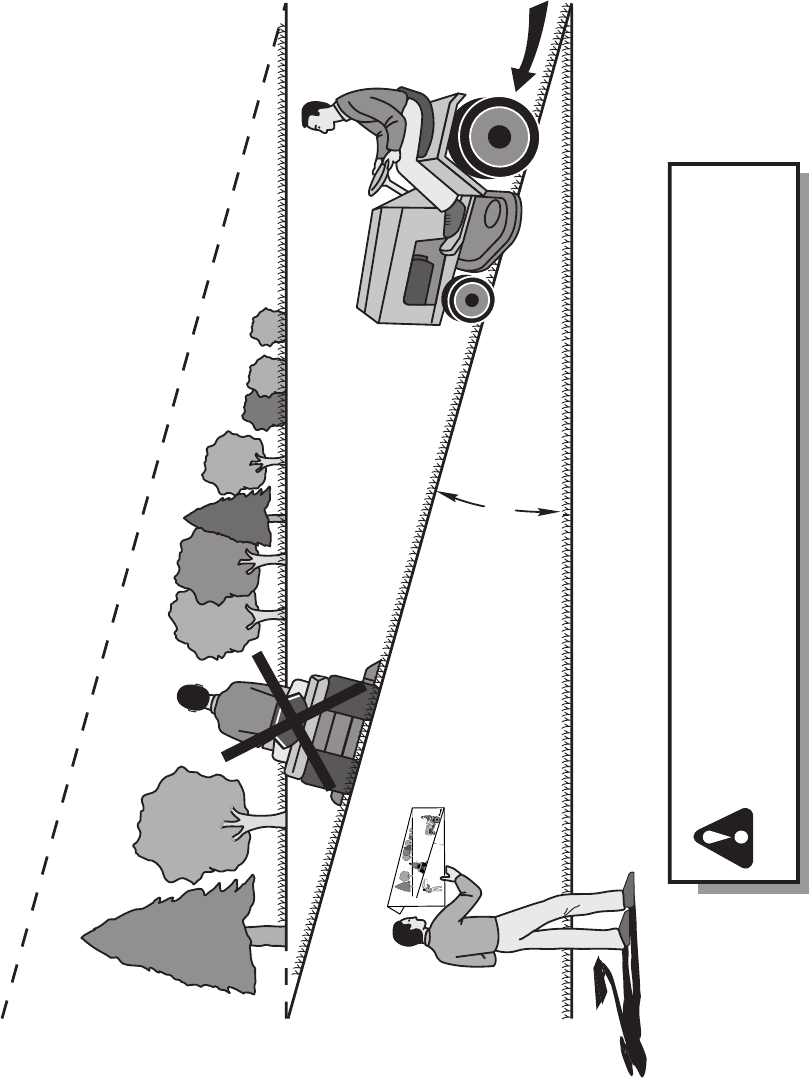
27
15 GRADOS MAX.
PLEGAR A LO LARGO DE LA LÍNEA PUNTEADA
ESTA ES UNA PENDIENTE DE 15 GRADOS
SOLAMENTE ANDE CUESTA ARRIBA O
CUESTA ABAJO Y NO ATRAVIESE EL CERRO
GUÍA SUGERIDA PARA MEDIR LAS PENDIENTES CON LA VISTA PARA UNA
OPERACIÓN SEGURA
ADVERTENCIA: Para evitar daños graves, haga funcionar su tractor arriba
y abajo de las pendientes, nunca transversalmente con respecto a las
pendientes. No cortar pendientes mayores de 15 grados. Haga los
virajes gradualmente para evitar volcarse o la pérdida de control.
Tenga mucho cuidado cuando cambie de dirección en las pendientes.
1. Plegar esta página a lo largo de la línea punteada arriba indicada.
2. Tener la página ante de sí mismos de modo que su borde izquierdo sea vertical
paralelo al tronco del árbol u otra estructura vertical.
3. Mirar a través del pliegue en dirección de la pendiente que se quiere medir.
4. Comparar el ángulo del pliegue con la pendiente del terreno.

26
IDENTIFICACIÓN DE PROBLEMAS
PROBLEMA CAUSA CORRECCIÓN
Vibración
excesiva
1. Cuchilla desgastada, doblada o suelta. 1. Cambie la cuchilla. Apriete el perno de la cuchilla.
2. Mandril de la cuchilla doblado. 2. Cambie la mandril de la cuchilla.
3. Parte(s) suelta(s)/dañada(s). 3. Apriete la(s) parte(s). Cambie las partes dañadas.
El motor continúa
funcionando cuando
el operador se baja
del asiento con el em-
brague del accesorio
enganchado
1. Sistema de control que exige la presencia del
operador –seguridad fallado. 1. Revise el alambrado, los interruptores y la conexiones.Si
no están correctas, pongase en contacto con un centro
de servicio cualificado.
El corte disparejo 1. Cuchilla desgastada, doblada o suelta. 1. Cambie la cuchilla. Apriete el perno de la cuchilla.
2. El conjunto segador no estánivelado. 2. Nivele el conjunto segador.
3. Acumulación de césped, hojas y basura debajo
de la segadora. 3. Limpie la parte inferior de la cajade la segadora.
4. Mandril de la cuchilla doblado. 4. Cambie la mandril de la cuchilla.
5. Los agujeros de ventilación del conjunto sega-
dor taponadosdebido a la acumulación de
cé-
sped, hojas y basura
alrededorde los mandriles.
5. Limpie alrededor de los mandriles para abrir los de
ventilación.
Las cuchillas
segadoras no
rotan
1. Obstrucción en el mecanismo del embrague. 1. Remueva la obstrucción.
2. La correa de impulsión de la segadora está
desgastada/dañada. 2. Cambie la correa de impulsión de la segadora.
3. Polea de guía atascada. 3. Cambie la polea de guía.
4. Mandril de la cuchilla atascado. 4. Cambie la mandril de la cuchilla.
Mala descarga del
césped
1. Velocidad del motor muy lenta. 1. Ponga el control de la aceleración en la posición de
“RÁPIDO” (fast).
2. Velocidad de recorrido demasiado rápida. 2. Cambie a una velocidad más lenta.
3. Césped mojado. 3. Permita que se seque el céspedantes de segar.
4. El conjunto segador no estánivelado. 4. Nivele el conjunto segador.
5. Presión de aire de las llantas baja o dispareja. 5. Revise las llantas para verificarque tienen la presión de aire.
6. Cuchilla desgastada, doblada o suelta. 6. Cambie/afile la cuchilla. Apriete el perno de la cuchilla.
7. Acumulación de césped, hojas y basura debajo
de la segadora. 7. Limpie la parte inferior de la cajade la segadora.
8. La correa de impulsión de la segadora está des-
gastada o desajustada. 8. Cambie/ajuste la correa de impulsión de la segadora.
9. Las cuchillas están mal coninstaladas. 9.
Vuelva a instalar las cuchillas elborde afilado hacia abajo.
10. Cuchillas inadecuadas en uso. 10. Cambie por las cuchillas enumeradas en este manual.
11. Los agujeros de ventilación del conjunto agujeros
segador taponados debido a la acumulación de
césped, hojas y basura alrededor de los mandriles.
11. Limpie alrededor de los mandriles para abrir los de
ventilación.
Las luz (ces) de
lantera(s) no
funcionando
1. El interruptor está “APAGADO”(OFF). 1. “ENCIENDA” (ON) el interruptor.
2. Bombilla(s) o lámpara(s) quemada(s). 2.
Cambie la bombilla(s) o lámpara(s).
3. Interruptor de la luz fallado. 3. Revise/cambie el interruptor de la luz.
4. Alambrado suelto o dañado. 4.
Revise el alambrado y las conexiones.
5. Fusible quemado. 5. Cambie el fusible.
La batería no carga 1.
Elemento(s) de la batería malo(s).
1. Cambie la batería.
2.
Malas conexiones de cables.
2. Revise/limpie todas las cables.
3. Regulador fallado (si equipado). 3. Cambie el regulador.
4. Alternador fallado. 4. Cambie el alternador.
Pérdida de
impulsión
1. El control de rueda libre está enla posición
“DESENGANCHADO” (dis en gaged). 1. Ponga el control de rueda libre enla posición
“ENGANCHADO”(disengaged).
2. Residuos es en de la placa de dirección. (Si los
tiene) 2. Vea “LIMPIEZA” en la sección de Mantenimento de este
manual.
3. La correa de impulsión de impulsión de movimiento. 3. Reemplace la correa de movimien-to esta gastada, dañada
o rota.
4. Aire atrapado en la transporte o el servicio. 4. Purgue la transmisión.
5. Llave cuadrada de eje es ausente. 5. Vea “PARA REMOVER LAS RUEDAS” en la sección de
Servicio y Ajustes de este manual.
El motor tiene “con-
traexplosiones”
cuando se “APAGA”
1. El control de la aceleración del motor no fue
ajustado en la posición de velocidad media y
máxima (rápida) antes de para el motor.
1. Mueva el control de la aceleración a la posición de veloci-
dad media y máxima (rápida) antes de para el motor.
El tractor se ponen
marcha atrás
1. El sistema de funcionamiento atrás (ROS) no está
"ON", cuando enganche la segadora o otro accesorio. 1. Girar el ROS en la posición "ON".Vea la sección de
operación.

25
IDENTIFICACIÓN DE PROBLEMAS
PROBLEMA CAUSA CORRECCIÓN
No arranca 1. Sin combustible. 1. Llene el estanque de combustible.
2. Motor sin la “ESTRANGULACIÓN” (CHOKE)
adecuada. 2. Vea “PARA HACER ARRANCAR EL MOTOR” en la sec-
ción de operación.
3. Motor ahogado. 3. Espere varios minutos antes detratar de arrancar.
4. Bujía mala. 4. Cambie la bujía.
5. Filtro de aire sucio. 5. Limpie/cambie el filtro de aire.
6. Filtro de combustible sucio. 6. Cambie el filtro de combustible.
7. Agua en el combustible. 7. Vaciar el estanque de combustible y el carburador, vuelva
a llenar el estanque con gasolina nueva cambie el filtro de
combustible.
8. Alambrado suelto o dañado. 8. Revise todo el alambrado.
9. Carburador desajustado. 9.
Vea “PARA AJUSTAR
EL CARBURADOR”
en la sección de
Servicio y Ajustes.
10. Válvulas del motor desajustadas. 10. Pongase en contacto con un centro de servicio cuali-
ficado.
Difícil de arrancar 1. Filtro de aire sucio. 1. Limpie/cambie el filtro de aire.
2. Bujía mala. 2. Cambie la bujía.
3. Batería baja o descargada. 3.
Vuelva a cargar o cambie la batería.
4. Filtro de combustible sucio. 4. Cambie el filtro de combustible.
5. Combustible rancio o sucio. 5. Vaciar el estanque de combustible y vuelva a llenarlo con
gasolina nueva.
6. Alambrado suelto o dañado. 6. Revise todo el alambrado.
7. Carburador desajustado. 7. Vea “PARA AJUSTAR EL CARBURADOR”
en la sección
de Servicio y
Ajustes.
8.
Válvulas del
motor desajustadas. 8. Pongase en contacto con un centro de servicio cualificado.
El motor no la
vuelta
1. Pedal del freno no presionado. 1. Presione el pedal del freno.
2. El embrague del accesorio está enganchado. 2. Desenganche el embrague del accesorio.
3. Batería baja o descargada. 3.
Vuelva a cargar o cambie la batería.
4. Fusible quemado. 4. Cambie el fusible.
5.
Terminales de la batería corroídos.
5. Limpie los terminales de la batería.
6. Alambrado suelto o dañado. 6. Revise todo el alambrado.
7. Interruptor de la ignición fallado. 7. Revise/cambie el interruptor de la ignición.
8. Solenoide o arrancador fallados. 8. Revise/cambie el solenoide o arrancador.
9. Interruptor(es) que exige(n) la presencia del
operador fallado. 9. Póngase en contacto con un centro de servicio cuali-
ficado.
El motor suena
pero no arranca
1. Batería baja o descargada 1.
Vuelva a cargar o cambie la bate
ría.
2.
Terminales de la batería corroídos.
2.
Limpie los terminales de la batería.
3. Alambrado suelto o dañado. 3. Revise todo el alambrado.
4. Solenoide o arrancador fallados. 4. Revise/cambie el solenoide o arrancador.
Pérdida de fuerza 1.
Corta mucho césped, muy rápido.
1. Eleve la altura de corte/reduzca la velocidád
2. Aceleración en la posición de
“ESTRANGU-
LACIÓN” (CHOKE).
2. Ajuste el control de la aceleración.
3. Acumulación de césped, hojas y basura debajo
de la segadora. 3. Limpie la parte inferior de la cajade la segadora.
4. Filtro de aire sucio. 4. Limpie/cambie el filtro de aire.
5. Nivel de aceite bajo/aceite sucio. 5. Revise el nivel de aceite/cambie el aceite.
6. Bujía fallada. 6. Limpie y vuelva a ajustar la abertura o cambie la bujía.
7. Filtro de combustible sucio. 7. Cambie el filtro de combustible.
8. Combustible rancio o sucio. 8. Vaciar el estanque de combustible y vuelva a llenarlo con
gasolina nueva.
9. Agua en el combustible. 9. Vaciar el estanque de combustible y el carburador, vuelva
a llenar el estanque con gasolina nueva y cambie el filtro
de combustible.
10. Alambrado de la bujía suelto. 10. Conecte y apriete el alambre de la bujía.
11. Rejilla/aletas de aire del motor sucias. 11. Limpie las rejilla/aletas de aire del motor.
12. Silenciador sucio/taponado. 12. Limpie/cambie el silenciador.
13. Alambrado suelto o dañado. 13. Revise todo el alambrado.
14. Carburador desajustado. 14. Vea “PARA AJUSTAR EL CARBURADOR”
en la sección
de Servicio y Ajustes.
15. Válvulas del motor desajustadas. 15. Pongase en contacto con un centro de servicio cuali-
ficado.

24
Inmediatamente prepare su tractor para el almacenamiento al
final de la temporada o si el tractor no se va a usar por 30 días
o más.
ADVERTENCIA: Nunca almacene el tractor
con gasolina en el estanque dentro de un
edificio en donde los gases pueden al can zar
una llama expuesta o una chispa. Per mi ta
que el motor se enfríe antes de almacenarlo
en cualquier recinto privado.
TRACTOR
Cuando el tractor se va a almacenar por cierto período de tiempo,
límpiela cuidadosamente, quite toda la mugre, la grasa, las hojas,
etc. Guárdela en una área limpia y seca.
• Limpie todo el tractor (vea “LIMPIEZA” en la sección de Man-
tenimiento en este manual).
• Inspeccione y cambie las correas, si es necesario (vea las
instrucciones para el cambio de las correas en la sección de
Servicio y Ajustes de este manual).
• Lubríquelo, según se muestra en la sección de Mantenimiento
de este manual.
• Asegúrese que todas las tuercas, los pernos y los tornillos estén
sujetados en forma segura. Inspeccione las partes movibles
para verificar si hay daño, rotura o desgaste. Cámbielas si es
necesario.
• Retoque todas superficies pintadas oxidadas o picadas; aplique
lija antes de pintar.
BATERÍA
• Cargue la batería completamente antes de guardarla.
• Después de cierto período de tiempo en almacenamiento, la
batería puede necesitar volver a cargarse.
• Para ayudar a evitar la corrosión y las fugas de potencia durante
largos períodos de almacenamiento, se deben des co nec tar los
cables de la batería y se debe limpiar cui da do sa men te (vea
“PARA LIMPIAR LA BATERÍA Y LOS TER MI NA LES” en la
sección de Mantenimientode este manual).
• Después de limpiarla, deje los cables desconectados y pónga-
los en donde no puedan entrar en contacto con los terminales
de la batería.
• Si se remueve la batería del tractor para el almacenamiento,
no la guarde directamente sobre concreto o sobre su per fi cies
húmedas.
MOTOR
SISTEMA DE COMBUSTIBLE
IMPORTANTE: ES IMPORTANT EVITAR QUE SE FORMAN
DEPOSITOS DE GOMA EN PARTES FUNDAMENTALES DEL
SISTEMA DE COMBUS-TIBLE TALES COMO EL CARBURADOR,
EL FILTRO DEL COMBUSTIBLE, LA MANGUERA DEL
COMBUSTIBLES MEZCLADOS CON ALCOHOL (CONOCIDO
COMO GASOHOL O QUE TIENEN ETANOL O METANOL)
PUEDEN ATRAER HUMEDAD, LO QUE CONDUCE A LA
SEPARACIÓN Y A LA FORMACIÓN DE ACUDOS DURANTE
ELALMACENAMIENTO. LA GASOLINA ACIDICA PUEDE
DAÑAR EL SISTEMA DE COMBUSTIBLE DE UN MOTOR
DURANTE EL PERIODO DE ALMACENAMIENTO.
• Vaciar el depósito del carburante poniendo en marcha el mo-
tor y dejándolo funcionar hasta que el carburante termine el
carburador esté vacío.
• Nunca use los productos para limpieza del carburador o del
motor en el estanque de combustible pues se pueden pro du cir
daños permanentes.
• Use combustible nuevo la próxima temporada.
AVISO: El estabilizador de combustible es una alternativa acep ta-
ble para reducir a un mínimo la formación de depósitos de goma
en el combustible durante el período de almacenamiento. Agre-
gue estabilizador a la gasolina en el estanque de combustible o
en el envase para el almacenamiento. Siempre siga la proporción
de mezcla que se encuentra en el envase del estabilizador. Haga
funcionar el motor por lo menos 10 minutos después de agregar
el estabilizador, para permitir que éste llegue al carburador. No
vaciar la gasolina del estanque de gasolina y el carburador si se
está usando estabilizador de combustible.
ACEITE DEL MOTOR
Drene el aceite (con el motor caliente) y cámbielo con aceite de
motor limpio. (Vea “MOTOR” en la sección de Mantenimiento”
de este manual.)
CILINDRO(S)
• Remueva la(s) bujía(s).
• Vacíe una onza de aceite a través del agujero(s) de la bujía
en el cilindro(s).
• Gire la llave de ignición a la posición de “Arranque” (Start),
por unos cuantos segundos para distribuir el acei te.
• Cambie por bujía(s) nueva(s).
OTROS
• No guarde la gasolina de una temporada a la otra.
• Cambie el envase de la gasolina si se empieza a oxidar. La
oxidación y/o la mugre en su gasolina producirán problemas.
• Si es posible, guarde su unidad en un recinto cerrado y cúbrala
para protegerla contra el polvo y la mugre.
• Cubra su unidad con un forro protector adecuado que no
retenga la humedad. No use plástico. El plástico no puede
respirar, lo que permite la formación de condensación, lo que
producirá la oxidación de su unidad.
IMPORTANTE: NUNCA CUBRA EL TRACTOR MIENTRAS EL
MOTOR Y L AS AREAS DE ESCAPE TODAVIA ESTAN CALIENTES.
ALMACENAMIENTO
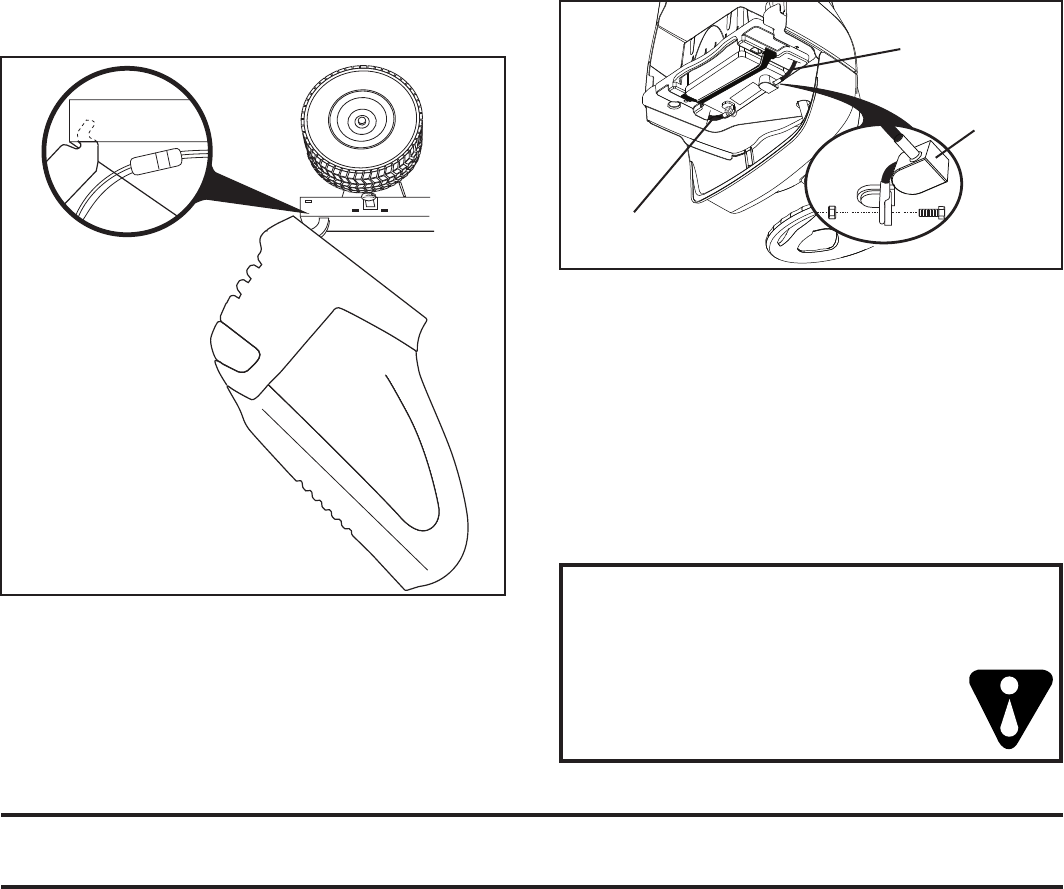
23
PARA CAMBIAR LA BOMBILLA DE LA LUZ
DELANTERA
• Levante el capó.
• Tire el sujetador de la bombilla fuera del agujero en la parte
trasera del enrejado.
• Cambie la bombilla en el sujetador y empuje el sujetador de
la bombilla, en forma segura, hacia atrás en el agujero en la
parte trasera del enrejado.
• Cierre el capó.
ENTRECIERRE Y RELÉS
El alambrado suelto o dañado puede producir el mal fun cio-
na mien to de su tractor, o que deje de funcionar, o le impida el
arrancar.
• Revise el alambrado.
PARA CAMBIAR EL FUSIBLE
Cámbielo por un fusible tipo enchufable de 30 amps, tipo au to-
mo triz. El sujetador del fusible está ubicado detrás del tablero.
PARA REMOVER EL CONJUNTO DEL CAPÓ Y
dEL ENREJADO (Vea Fig. 36)
• Levante el capó.
• Desabroche el conector del alambre de las luces delan-
teras.
• Párese delante del tractor. Agarre el capó en los lados, in-
clínelo un poco hacia el motor y sáquelo del tractor.
• Para volver a instalar el capó, asegúrese de volver a conectar
el conector del alambre de las luces.
Fig. 36
SERVICIO Y AJUSTES
Fig. 35
02778
TRANSMISIÓN
REMOCIÓN/REEMPLAZO DE LA TRANSMISIÓN
Si por acaso su transmisión debe ser removida para servicio o
reemplazo, debe ser purgada después de la reinstalación y antes
de operar el tractor. Vea “PUR GAR LA TRANSMISIÓN” en la
sección de la Operación de este manual.
MOTOR
PARA AJUSTAR EL CABLE DE CONTROL
DE LA ACELERACIÓN
El control de la aceleración ha sido preajustado en la fábrica y no
debería necesitar ajustes. Revise los ajustes que se describen a
continuación, antes de soltar el cable. Si el ajuste es necesario,
vea de manual de motor.
PARA AJUSTAR EL CONTROL DE ESTRANGULA-
CIÓN
El control de la estrangulación ha sido preajustado en la fábrica
y no debería necesitar ajustes.
PARA AJUSTAR EL CARBURADOR
El carburador ha sido preajustado en la fábrica y no debería
necesitar ajustes. Sin embargo, se pueden necesitar ajustes
de menor importancia para compensar por las diferencias en el
combustible, temperatura, altura o carga. Si el carburador ne ce-
si ta ajustes, vea de manual de motor.
REEMPLAZAR LA BATERIA (Vea Fig. 35)
ADVERTENCIA: No haga cortocircuito con los
terminales de la batería al permitir que una
llave de tuerca o cualquier otro objeto entre
en contacto con ambos terminales a la misma
vez. Antes de ins ta lar la batería remueva las
pulseras de metal, los relojes de pulsera de
metal, los anillos, etc. El terminal positivo tiene
que conectarse primero para evitar las chispas
debido a la conexión a tierra por accidente.
• Levantamos la capota a la posición levantada.
• Desconecte el cable de la batería NEGRO primero y luego
el cable de la batería ROJO y remueva la batería del tractor.
• Instale la nueva batería con los términos en misma posición
como la batería vieja.
• Reemplazamos cubierta terminal.
• Primero, conecte el cable de la batería ROJO con el terminal
positivo (+) con el perno hexagonal y la tuerca según se
muestra. Apriételos en forma segura.
• Conecte el cable de conexión a tierra NEGRO al terminal
negativo (-) con el perno hexagonal y la tuerca que queden.
Apriételos en forma segura.
• Cerramos la capota.
CUBIERTA
TERMINAL
CABLE ROJO
(POSITIVO)
CABLE NEGRO
(NEGATIVO)
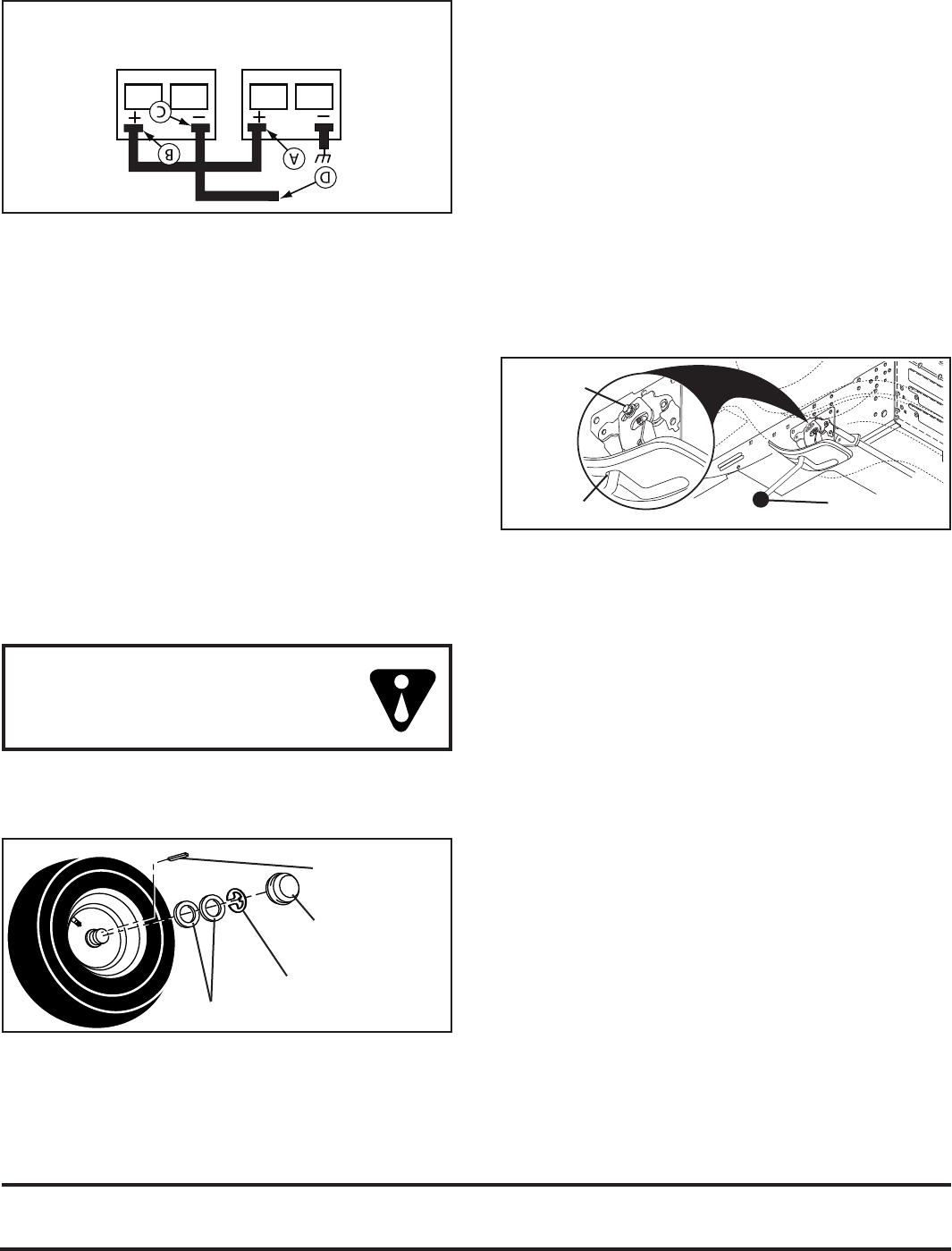
22
SERVICIO Y AJUSTES
Fig. 33
LLAVE CUADRADA
(RUEDA TRASERA SOLAMENTE)
ARANDELAS
ANILLO DE
RETENCIÓN
CUBIERTA
DEL EJE
PARA HACER ARRANCAR EL MOTOR CON UNA
BATERÍA BAJA (Vea Fig. 34)
ADVERTENCIA: Las baterías de ácido-
plo mo generan gases explosivos. Man-
tenga las chispas, las llamas y los
materiales para fumar alejados de las
baterías. Siempre use una protección
para los ojos alrededor de las baterías.
Si su batería está demasiado baja como para hacer arrancar el
motor tiene que volverse a cargar. (Vea “Batería” en la sección
de Mantenimiento de este manual).
Si se usan “cables de em pal me” para un arranque de emergen-
cia, siga este procedimiento:
IMPORTANTE: SU TRACTOR ESTA EQUIPADO CON UN SISTEMA
DE 12 VOLTS. EL OTRO VEHÍCULO TAMBIÉN TIENE QUE
TENER UN SISTEMA DE 12 VOLTS. NO USE LA BATERÍA DE SU
TRACTOR PARA HACER ARRANCAR A OTROS VEHÍCULOS.
PARA ADJUNTAR LOS CABLES DE EMPALME
• Conecte cada extremo del cable ROJO con el terminal (A-B)
POSITIVO (+) de cada batería, preocupándose de no hacer
cortocircuito en el chasis.
• Conecte un extremo del cable NEGRO con el terminal (C)
NEGATIVO (-) de una batería completamente cargada.
• Conecte el otro extremo del cable (D) NEGRO con un buena
CONEXIÓN A TIERRA DEL CHASIS, alejado del estanque
de combustible y de la batería.
PARA REMOVER LOS CABLES, INVIERTA EL ORDEN
• El cable NEGRO primero del chasis y luego de la batería
completamente cargada.
• El cable ROJO al último de ambas baterías.
02614
Batería Débil o
Descargada
Batería
Completamente
Cargada
Fig. 34
PARA REMOVER LAS RUEDAS PARA HACER
REPARACIONES (Vea Fig. 33)
• Bloquee el eje en forma segura.
• Remueva la cubierta del eje, el anillo de retención y las
arandelas para permitir la remoción de las ruedas (la
rueda trasera contiene una llave cuadrada - no la pierda).
• Repare la llanta y vuélvala a montar.
• En las ruedas traseras solamente: alinee las ranuras en el
cubo de la rueda trasera en el eje. Inserte la llave cuadrada.
IMPRESIÓN / INCLINACIÓN DE LAS RUEDAS
DELANTERAS
La impresión e inclinación de las ruedas delanteras de su nuevo
tractor vienen así de fábrica y son normales. La impresión y
la inclinación de las ruedas delanteras no son regulables. En
caso que se produzca algún daño que afecte la impresión o la
inclinación de las ruedas delanteras tal como vinieron de fábrica,
póngase en contacto con un centro de servicios centro de ser-
vicios autorizado.
Fig. 32
REGULACIÓN DE LA PALANCA DE CONTROL DEL
MOVIMIENTO NEUTRO DEL CAMBIO MECÁNICO
(Vea Fig. 32)
La palanca de control del movimiento del cambio mecánico ya
viene predefinida por la Casa constructora y por lo tanto no re-
quiere ulteriores regulaciones.
• Aflojar ligeramente el perno de regulación en la parte an te ri or
de la rueda posterior derecha;
• Poner en marcha el motor y mover la palanca de control
del movimiento del cambio mecánico hasta llevarla en una
posición en la que no se pueda mover ni adelante ni atrás;
• Mantener la palanca de control del movimiento del
cambio mecánico en esta posición y apagar el motor;
• Manteniendo la palanca en la posición arriba indicada, aflojar
el perno de regulación;
• Mover la palanca de control del movimiento en posición
neutro (cierre metálico);
• Enroscar bien el perno de regulación.
AVISO: Desplazar el plano de trabajo de la segadora hasta la
posición más baja para aumentar el juego al fin de acceder al
perno de regulación.
Si el tractor sigue deslizándose adelante y atrás, después de
esta regulación y con la palanca en posición neutro, efectuar las
operaciones indicadas de seguida.
• Aflojar el perno de regulación.
• Mover la palanca de control del movimiento de 1/4 o 1/2
pulgar en la dirección de deslizamiento.
• Enroscar bien el perno de regulación.
• Poner en marcha el motor y probarlo.
• Si el tractor sigue deslizando, repetir las operaciones ar-
riba indicadas hasta alcanzar los resultados deseados.
PALANCA DE CONTROL
DE MOVIMIENTO NEUTRO CIERRE
METÁLICO
PERNO DE
VELOCIDADES
• Vuelva a colocar las arandelas e inserte el anillo de retención
en forma segura en la ranura del eje.
• Vuelva a colocar la cubierta del eje.
AVISO: Para arreglar las llantas perforadas y péra prevenir
que tenga llantas pinchadas a causa de pequeñas fugas, com-
prar de su commerciante y utilizar el sello para llantas. Elsello
previene que las llantas se sequen y también la corrosión.
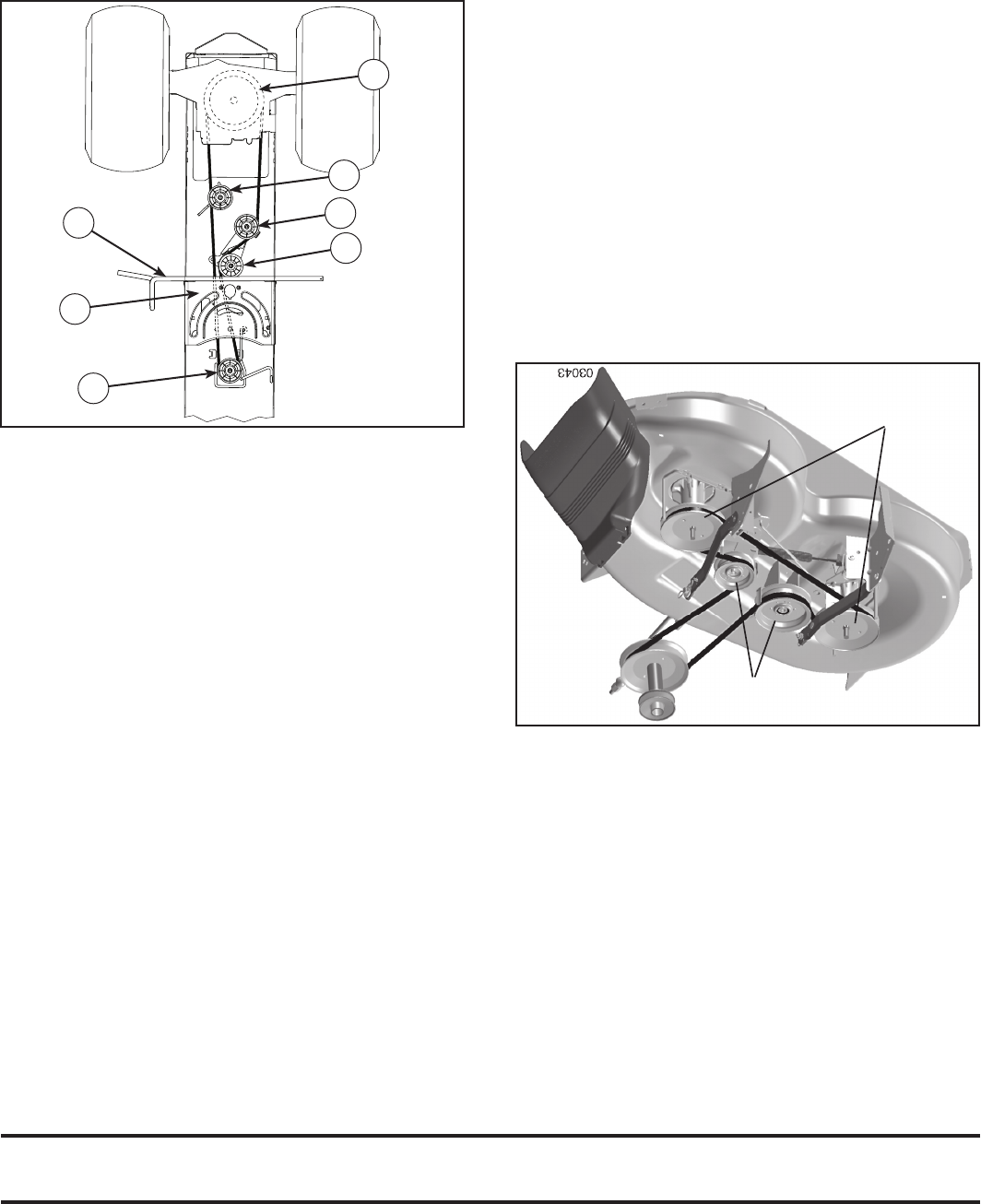
21
Fig. 30
Fig. 31
POLEAS
DE GUÍA
POLEA
DEL MANDRIL
PARA CAMBIAR LA CORREA DE IMPULSIÓN DE
LA CUCHILLA SEGADORA (Vea Fig. 30)
La correa de impulsión de la cuchilla segadora se puede cambiar
sin herramientas. Estacione el tractor en una superficie nivelada.
Enganche el freno de estacionamiento.
REMOCIÓN DE LA CORREA
• Remueva la segadora del tractor (Vea “PARA REMOV-
ER LA SEGADORA” de esta sección de este manual).
• Haga salir la correa de las poleas del mandril y de las poleas
de guía.
• Tire la correa alejándola de la segadora.
INSTALACIÓN DE LA CORREA
• Haga rodar la correa alredeor de ambas poleas del mandrin
y de las poleas-guías.
• Asegúrese las correas esten en todas las ranuras de las
peleas y al interior todas las guías de la correa.
• Instale la segadora (véa “ PARA INSTALAR LA SEGADORA
“ en esta sección de este manual).
PARA REEMPLAZAR LA CORREA DE TRANS-
MISIÓN (SEE Fig. 31)
Estacione el tractor en una superficie nivelada. Ponga el
freno de mano. Si necesita asistencia, del lado de abajo del
apoyapiés hay una guía práctica para el montaje de la correa.
SERVICIO Y AJUSTES
02952
A
B
C
D
E
F
G
DESMONTAJE DE LA CORREA
• Desmonte la cortadora (Ver “PARA DESMONTAR LA COR-
TADORA” en este capítulo del manual).
NOTE: Observe toda la correa de transmisión de la fuerza
electromotriz y la posición de todas las guías y guardacorreas.
• Retire la correa del piñón estacionario (A) y del piñón de
embrague (B).
• Retire la correa del piñón central (C).
• Jale el cable de la correa hacia la parte de atrás del trac-
tor. Con mucho cuidado, retire la correa de la polea de
entrada de la transmisión, moviéndola hacia arriba y
pasándola por encima de las paletas del ventilador (D).
• Retire la correa de la polea del motor moviéndola hacia abajo
(E).
• Deslice la correa hacia la parte de atrás del tractor,
retírela de la placa de dirección (F) y quítela del tractor.
MONTAJE DE LA CORREA
• Instale la correa nueva de la parte de atrás a la parte de
adelante del tractor, pasándola por encima de la placa de
dirección (F) y del vástago del pedal del embrague / freno
(G).
• Jale la correa hacia la parte de adelante del tractor y páselo
por sobre la polea del motor (E).
• Jale la correa hacia la parte de atrás del tractor. Con mucho
cuidado, mueva la correa hacia abajo y pásela alrededor del
ventilador de transmisión y por encima de la polea de entrada
(D). Cerciórese de que la correa esté calzada dentro del
guardacorrea.
• Coloque la correa sobre el piñón central (C).
• Pase la correa a través del piñón estacionario (A) y del piñón
del embrague (B).
• Asegúrese de que la correa calce en todas las ranuras de
las poleas y dentro de todas las guías y guardacorreas.
• Instale la SEGADORA (Ver “PARA MONTAR LA SEGADORA”
en este capítulo del manual).
CONTROLAR Y AJUSTAR EL FRENO
Si el tractor exige más de cinco (5) pies para pararse a una ve-
locidad más alta en el cambio más alto en una superficie nivelada
de hormigón seco o pavimentada, entonces se debe controlar
y ajustar el freno.
CONTROL DEL FRENO
1. Aparcar el tractor en una superficie nivelada de hor-
migón seco o pavimentada, presionar el pedal del freno
hasta el fondo y accionar el freno de estacionamiento.
2. Desembragar la transmisión colocando el mando de la rueda
libre en la posición “transmisión desembragada”. Tirar el
mando de la rueda libre fuera y dentro la ranura y soltar así
se coloca en la posición desembragada.
Las ruedas traseras tiene que bloquearse y patinar cuando se
intenta empujar hacia adelante el tractor manualmente. Sus-
tituir las zapatas del freno o contactar otro centro de servicio
cualificado.
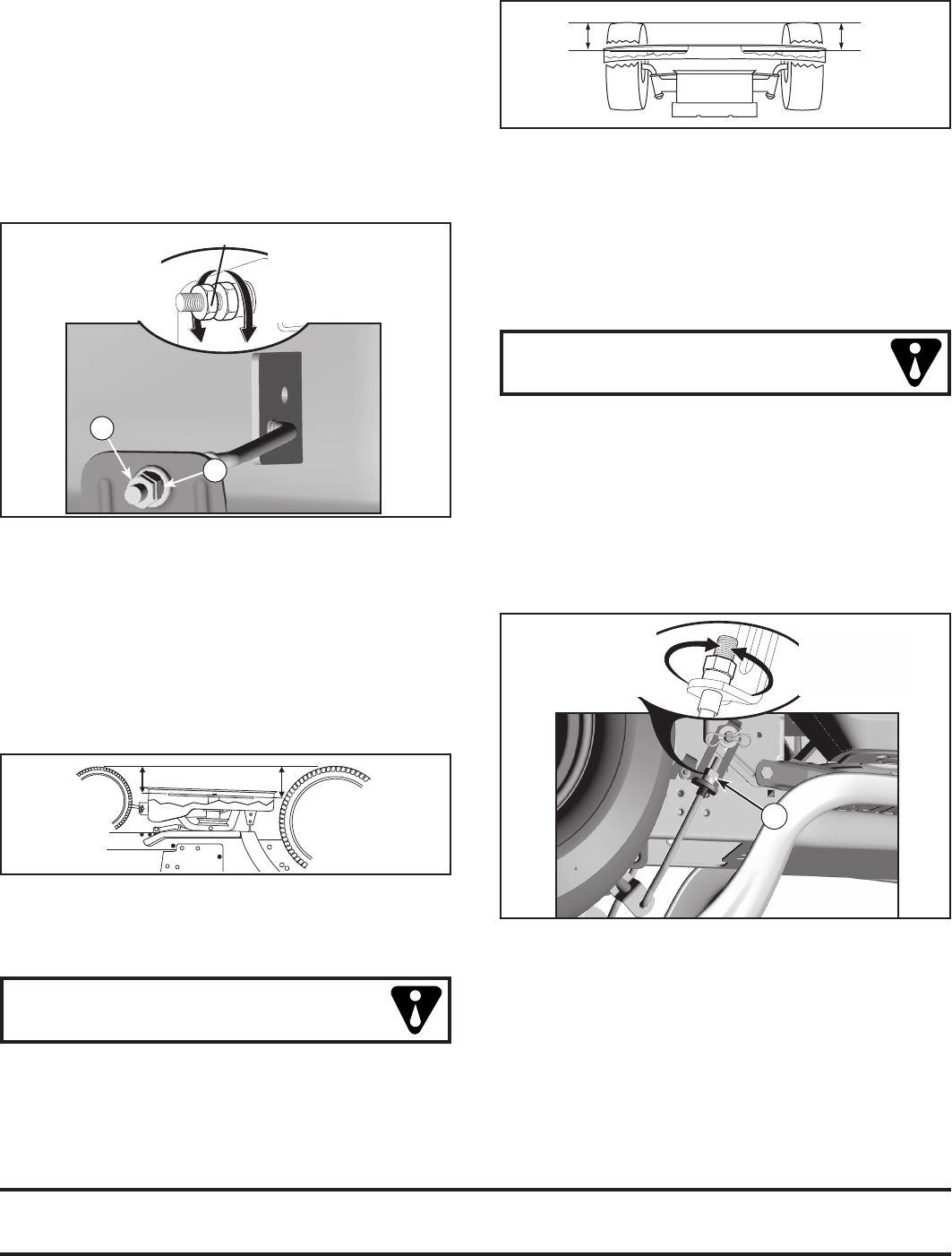
20
SERVICIO Y AJUSTES
Fig. 27
02548
BB
Fig. 26
Fig. 28
Fig. 29
B
A
02950
Ajuste La Tuerca De
Regulación De Altura
B Para Levantar La
Segadora
Afloje la tuerca
de regulación de
altura B para bajar
la segadora
Afloje la tuerca A primero
02966
A A
Haga girar la
tuerca hacia la
derecha para
subir la segadora
Haga girar la
tuerca hacia la
izquierda para
bajar la segadora
A
PARA NIVELAR LA SEGADORA
Asegúrese de que los neumáticos estén inflados a la PSI que se
indica en estos. Si están demasiado inflados o poco inflados,
el césped no le quedará bien cortado, lo cual podrá llevarlo a
pensar que la SEGADORA no está bien regulada.
REGULACIÓN VISUAL DE LADO A LADO (Vea Fig. 26)
• Si todos los neumáticos están correctamente inflados y el
césped parece haber quedado cortado desparejo, determine
qué lado de la cortadora está cortando más al ras.
• Con una llave inglesa de 3/4" o de calibre regulable, haga
girar hacia la izquierda la tuerca de ajuste de la pieza de unión
(A) para bajar lado izquierdo la cortadora, o bien hágala girar
hacia lado derecho la derecha para subirla.
NOTA: Cada vuelta completa de la tuerca de ajuste hará variar
la altura de la cortadora aproximadamente 3/16".
• Pruebe la regulación realizada cortando césped que aún no
haya cortado y observando cómo queda. Vuelva a ajustar,
en caso necesario, hasta obtener resultados satisfactorios.
REGULACIÓN DE LA PRECISIÓN DE LADO A LADO
(Vea Fig. 27)
• Con todos los neumáticos correctamente inflados, estacione
el tractor a nivel del suelo o en la entrada a la casa.
CUIDADO: Las cuchillas son afiladas. Protéjase las
manos con guantes o envuelva las cuchillas con
tela gruesa, o bien haga ambas cosas.
• Suba la SEGADORA a la posición más alta.
• A ambos lados de la cortadora, ubique la cuchilla hacia un
lado y mida la distancia (A) que hay entre el borde inferior
de la cuchilla y el suelo. Dicha distancia debe ser la misma a
ambos lados.
• En caso que sea necesario realizar un ajuste, lea los paso 2
de las instrucciones de Regulación Visual que aparecen más
arriba.
• Vuelva a verificar las medidas y ajuste nuevamente, en caso
necesario, hasta que ambos lados queden iguales.
AJUSTE DE DELANTE A ATRÁS (Vea Fig. 28 y 29)
IMPORTANTE: El piso debe quedar bien nivelado de lado a lado.
Para que el césped le quede perfectamente cortado, las cuchil-
las de la cortadora deben ajustarse de tal manera que la punta
anterior quede 1/8" a 1/2" más abajo que la punta posterior cuando
la cortadora se encuentre en su posición más alta.
CUIDADO: Las cuchillas son afiladas. Protéjase las
manos con guantes o envuelva las cuchillas con
tela gruesa, o bien haga ambas cosas.
• Suba la SEGADORA a la posición más alta.
• Ubique cualquiera de las hojas de la cuchilla de tal manera
que la punta quede apuntando directamente hacia adelante.
Mida la distancia (B) que hay entre la punta anterior y el suelo
y entre la punta posterior y el suelo.
• Si la punta anterior de la hoja de la cuchilla no está 1/8" a
1/2" más abajo que la punta posterior, diríjase a la parte de
adelante del tractor.
• Con una llave inglesa de 11/16" o de calibre regulable, afloje
la tuerca A, dándole varias vueltas para despejar la tuerca
de ajuste B.
• Con una llave inglesa de 3/4” o de calibre regulable, haga
girar la tuerca de ajuste de la pieza de unión anterior (B)
en sentido horario (ajustar) para elevar la parte de adelante
de la cortadora, o bien en sentido antihorario (aflojar) para
bajarla.
NOTA: Cada vuelta completa de la tuerca de ajuste hará variar
la altura de la cortadora 1/8”.
• Vuelva a verificar las medidas y ajuste nuevamente, en caso
necesario, hasta que la punta anterior de la hoja de la cuchilla
quede 1/8” a 1/2” más abajo que la punta posterior.
• Mantenga en la posición la tuerca de ajuste por medio de una
llave inglesa, y apriete bien la tuerca contra dicha tuerca de
ajuste.
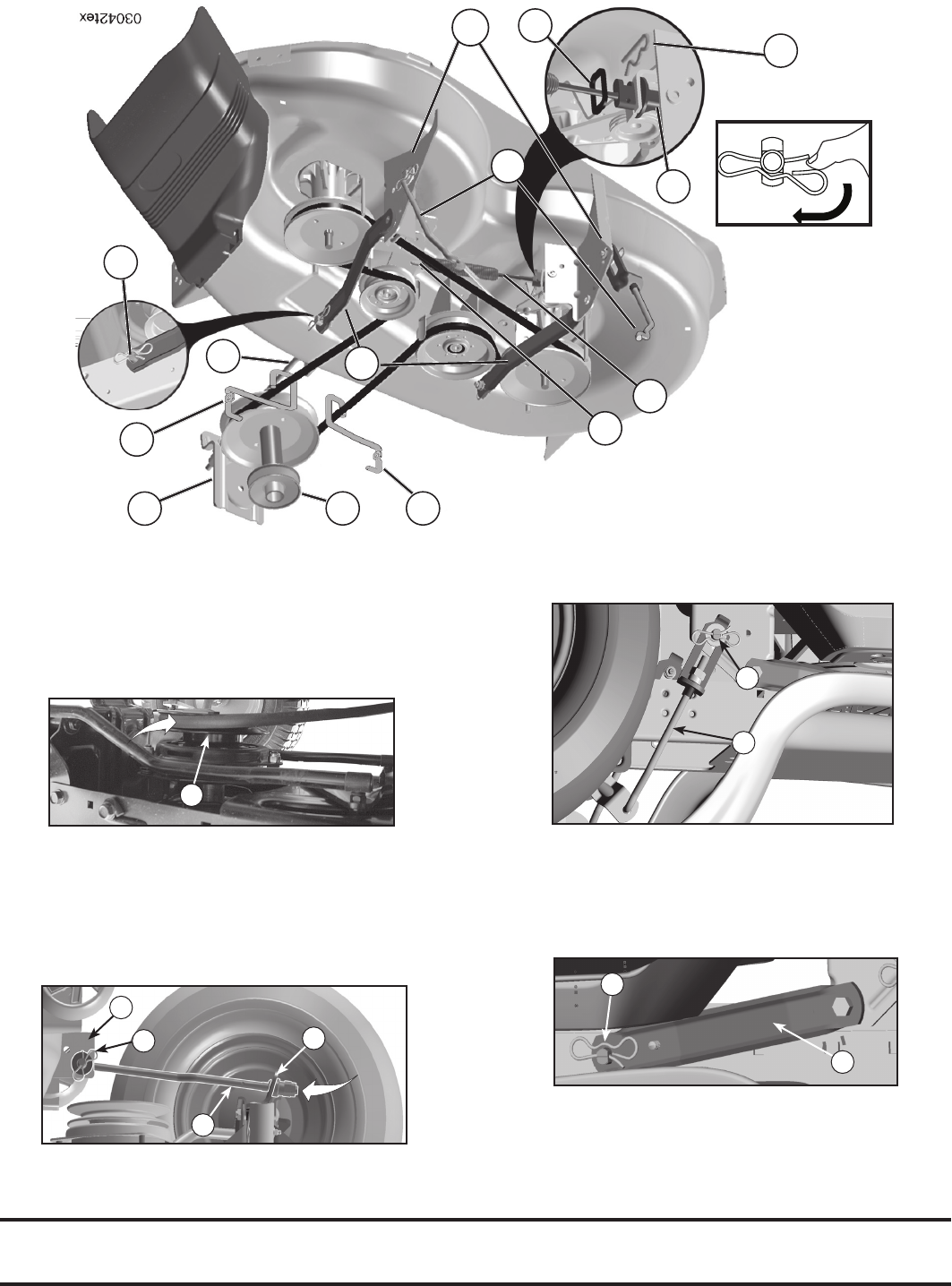
19
SERVICIO Y AJUSTES
E
F
C
G
Q
R
D
K
G
P
B
L
M
A
IMPORTANTE: VERIFIQUE QUE LA CORREA ENCAJE BIEN
EN TODAS LAS RANURAS DE LAS POLEAS DE LA CORTA-
DORA.
• Suba la palanca elevadora a la posición de más arriba.
• Si es necesario, ajuste las rueditas del calibre antes de
poner en funcionamiento la cortadora, como se ilustra en el
capítulo de Manejo de este manual.
E
F
H
J
M
FIG. 23
FIG. 24
A
B
D
C
FIG. 21
FIG. 22
• FIJE LOS BRAZOS DE SUSPENSIÓN LATERALES DE LA
CORTADORA (A) AL CHASIS - Ubique el orificio del brazo
encima de la clavija (B) que hay en la parte exterior del chasis
del tractor, y fíjelo con una resorte de contención.
• Realice el mismo procedimiento en el otro lado del tractor.
• FIJE LAS PIEZAS DE PROPULSIÓN POSTERIORES (C) –
Levante la parte posterior de la cortadora, ubique la ranura
de la pieza de unión (D) por encima de la clavija que hay en
la barra posterior de la cortadora y fíjela con una arandela
y un resorte de contención.
• Meta el fin de la conexión (E) en el hoyo en el suporte anterior
de orificio y conecte con arandela e Retén del resorte (J).
• Conecte el fin de la primavera de cable de embrague (Q) en
el orificio de holgazán (R).
• Retire el resorte de sujeción (K), deslice la abrazadera (L)
hasta quitarla, y saque a presión la guía de la caja (P) hasta
que se salga del soporte.
• Instale la correa pasándola por encima de la polea del motor
(M)
• CONECTE LA CONEXION ANTERIOR (E) - Trabajo del dejó
el lado de tractor. Meta el fin de la barra de la asamblea de
la conexión por orificio anterior en el tractor suporte anterior
de suspensión (F).
FIG. 25
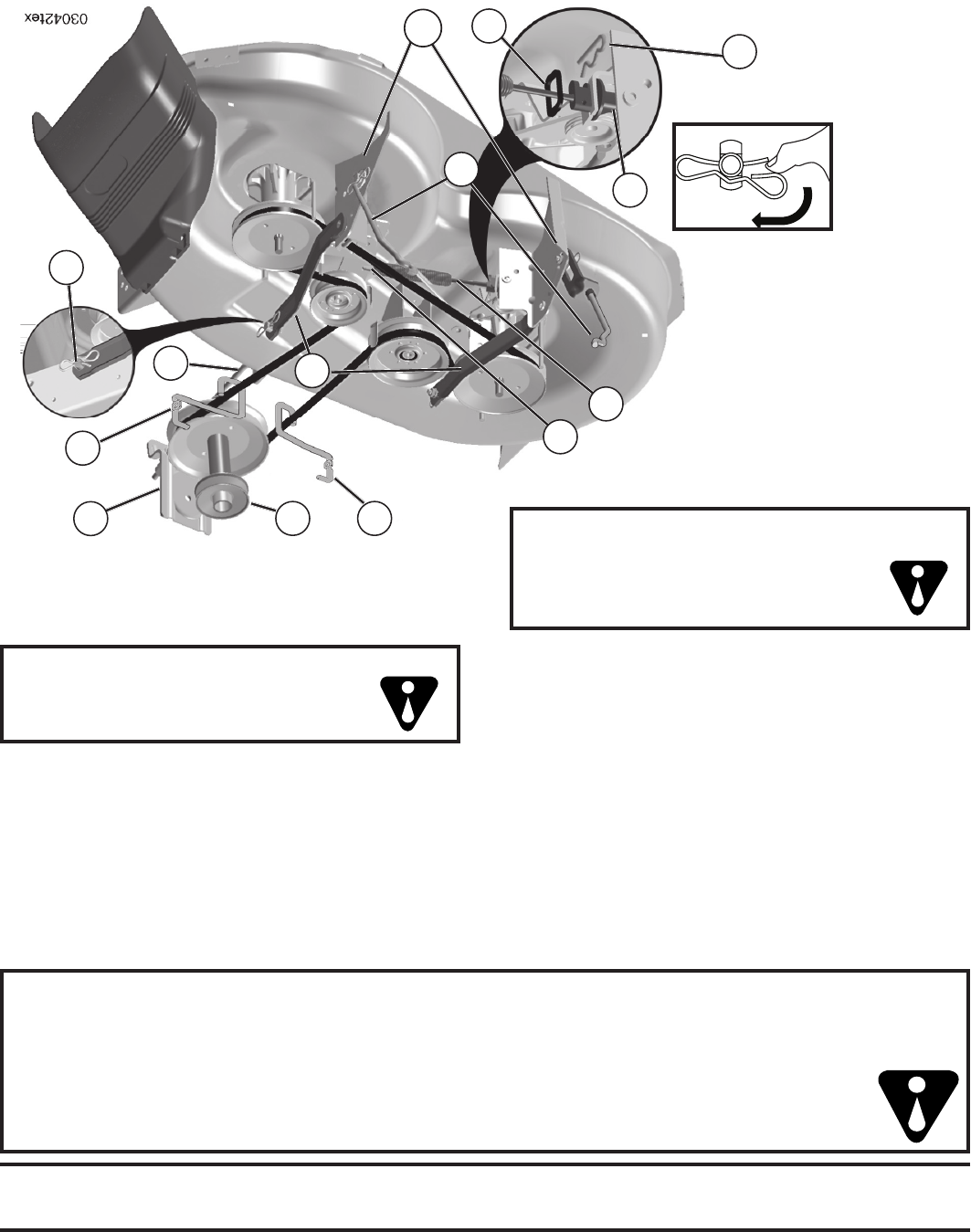
18
SERVICIO Y AJUSTES
E
F
C
G
Q
R
D
K
G
P
B
L
M
A
PARA DESMONTAR LA CORTADORA DE
CÉSPED (Vea Fig. 21)
• Suelte el embrague poniéndolo en la posición “DISEN-
GAGED” (“DESACTIVADO”).
• Baje la palanca elevadora de montaje a la posición de más
abajo.
• Ruede la correa de polea del motor (M).
• Retire el resorte de sujeción (K), deslice la abrazadera (L)
hasta quitarla, y saque a presión la guía de la caja (P) hasta
que se salga del soporte.
• Retire el resorte del cable del embrague (Q) del brazo del
engranaje (R).
• Desconecte la pieza de unión anterior (E) de la cortadora –
retire el resorte de contención y la arandela.
• Por uno de los lados de la cortadora, desconecte el brazo
de suspensión de la cortadora (A) del chasis y la pieza de
unión posterior (C) de la barra posterior de la cortadora (D)
– retire los resortes de contención y las arandelas.
CUIDADO: UNA VEZ QUE SE DES-CONECT-
EN LAS PIEZAS DE UNIÓN POSTERIORES,
LA PALANCA ELEVADORA FUNCIONARÁ
A RESORTE. SUJETE CON FUERZA LA
PALANCA ELEVADORA AL CAMBIARLA
DE POSICIÓN.
• Deslice la cortadora por debajo del lado derecho del trac-
tor.
IMPORTANTE: Si se monta un accesorio diferente del corta-
césped al tractor, hay que quitar el estribo frontal (E) y los estribos
traseros de elevación (C) del tractor y enganchar el resorte de
embrague (Q) en la guía del cable en el borde frontal del salpi-
cadero más bajo.
INSTALE LA SEGADORA (Vea Fig. 22-25)
Asegúrese de que el tractor se encuentre en una superficie
nivelada, y ponga el freno de mano.
• Haga descender la palanca elevadora a su posición más
baja.
CUIDADO: LA PALANCA ELEVADORA
FUNCIONA A RESORTE. SUJÉTELA CON
FUERZA, HÁGALA DESCENDER LENTA-
MENTE Y TRÁNQUELA EN LA POSICIÓN
MÁS BAJA.
NOTA: Cerciórese de que los brazos de suspensión de los
lados de la segadora (A) estén dirigidos hacia adelante antes
de deslizarla por
• Deslice la SEGADORA por debajo del tractor hasta que
quede bien centrada debajo de éste.
FIG. 21
ADVERTENCIA: PARA EVITAR LESIÓNES SERIAS, ANTES DE DAR CUALQUIER SERVICIO O DE
HACER AJUSTES:
• Presione el pedal del embrague/freno completamente y aplique el freno de estacionamiento.
• Ponga la palanca de control de movimiento en la posición de neutro (N).
• Ponga el embrague del accesorio en la posición desenganchado (DISENGAGED).
• Ponga la llave de ignición en la posición de apagado (STOP) y remuévala.
• Asegúrese que las cuchillas y que todas las partes movibles se hayan detenido completamente.
• Desconecte el alambre de la bujía y póngalo en donde no pueda entrar en contacto con ésta.
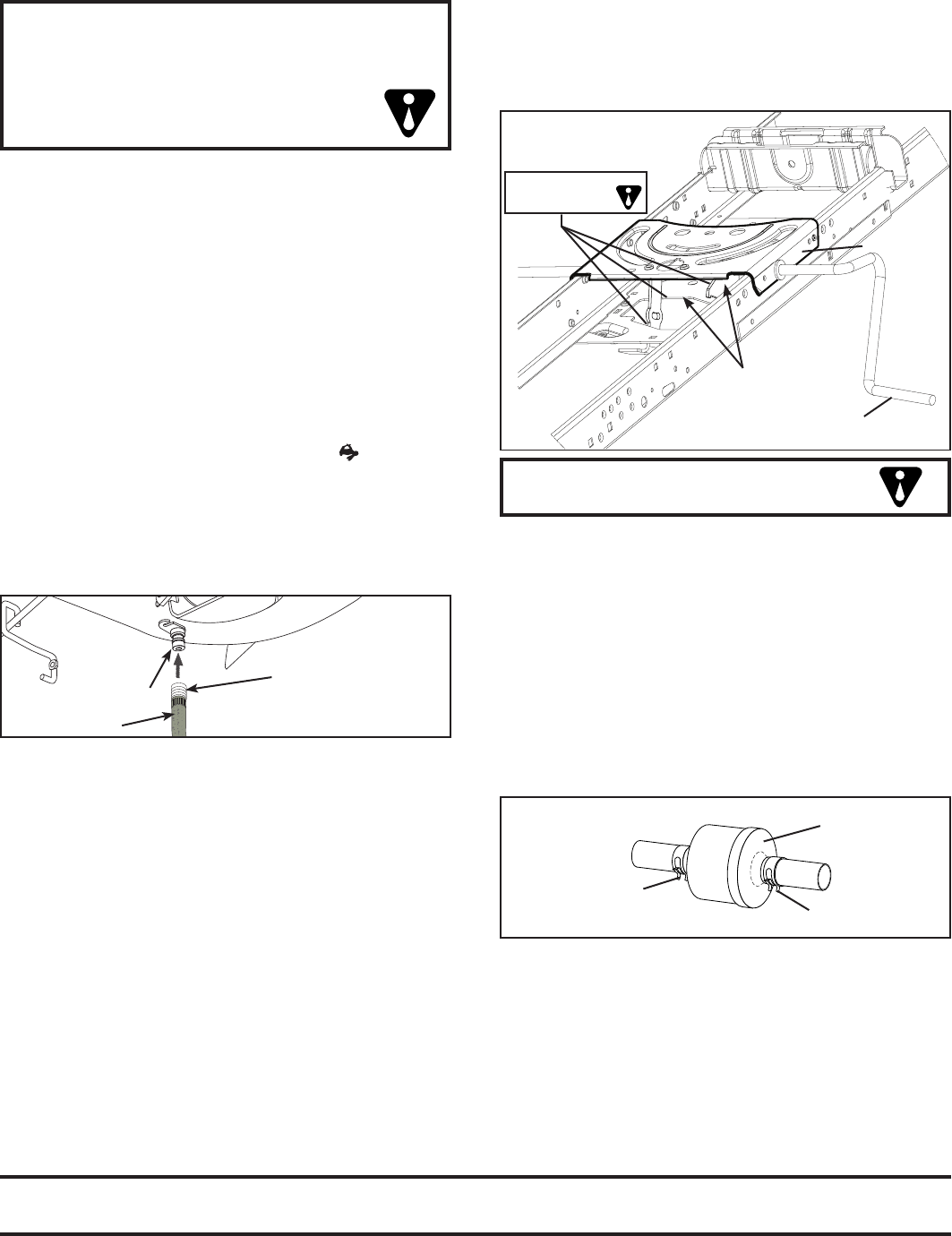
17
FILTRO DE COMBUSTIBLE EN LINEA (Vea Fig. 18)
El filtro de combustible debe cambiarse una vez cada temporada.
Si el filtro de combustible se tapona, obstruyendo el flujo del
combustible hacia el carburador, es necesario cambiarlo.
• Con el motor frío, remueva el filtro y tapone las secciones de
la línea de combustible.
MANTENIMENTO
Fig. 18
FILTRO DE
COMBUSTIBLE
ABRAZADERA
ABRAZADERA
• Ponga el filtro de combustible nuevo en su posición en la
línea de combustible con la flecha señalando hacia el car bu-
ra dor.
• Asegúrese de que no hayan fugas en la línea del combustible
y que las grapas estén colocadas en forma adecuada.
• Inmediatamente limpie toda la gasolina derramada.
Fig. 19
• Mantenga las superficies pulidas y las ruedas sin de rra mes
de gasolina, aceite, etc.
• Proteja las superficies pintadas con cera tipo automotriz.
No recomendamos que se utilice una manguera de jardín o
agua a presión para limpiar el tractor a no ser que el motor
y la transmisión estén cubiertos para protegerlos del agua.
El agua en el motor y la transmisión acortan la vida útil del trac-
tor. Utilizar aire comprimido o un soplador de hojas para remover
hierba, hojas y basura del tractor y cortacéspedes.
LIMPIEZA
• Limpie todo material extraño del motor, la batería, el asiento,
el pulido, etc.
• Limpie los desechos de la placa guía. Los desechos pueden
limitar el movimiento del eje del pedal del freno/embrague,
lo que hará que patine la correa y que se pierda la tracción.
SISTEMA DE DIRECCIÓN,
SALPICADERO, GUARDA-
BARROS Y SEGADORA NO
MOSTRADOS
PEDAL DEL
EMBRAGUE/FRENO
PLACA
DE
DIRECCIÓN
LIMPIAR PARTE
SUPERIOR
PRECAUCIÓN:
PUNTOS DE
ENGANCHE
PRECAUCIÓN: Evite todos los puntos de
enganche y las piezas móviles. (Vea Fig. 19)
BUJÍA(S)
Cambie las bujía(s) al comienzo de cada temporada de siega o
después de cada 100 horas de operación, lo que suceda pri me ro.
El tipo de bujía y el ajuste de la abertura aparecen en “ES PE CI-
FI CA CIO NES DEL PRODUCTO” sección de este manual.
Fig. 20
PUERTO DE LAVADO
ADAPTADOR
DE BOQUILLA
MANGUERA
IMPORTANTE: Tire de la manguera para asegurarse de que la
conexión está bien fija.
5. Abra la llave del agua.
6. Desde la posición del operador del tractor, vuelva a arrancar
el motor y ponga la palanca de aceleración en la posición
rápido (“ ” ).
IMPORTANTE: Vuelva a comprobar la zona para asegurarse de
que está despejada.
7. Mueva el control del embrague del accesorio a la posición
“ENGANCHAR”. Manténgase en la posición del operador con
la cubierta de corte acoplada hasta que la cubierta esté limpia.
8. Mueva el control del embrague del accesorio a la posición
“DESENGANCHADO”. Gire la llave de encendido a la posición
STOP para apagar el motor del tractor. Cierre la llave del agua.
9. Tire hacia atrás la abrazadera de cierre del adaptador de la
boquilla para desconectar el adaptador del puerto de lavado
de la cubierta.
10. Lleve el tractor a una zona seca, preferentemente de cemento
o pavimentada. Mueva el control del embrague del accesorio
a la posición “ENGANCHAR” para quitar el exceso de agua
y ayudar a que se seque antes de guardar el tractor.
PUERTO DE LAVADO DE LA CUBIERTA
(Vea Fig. 20)
La cubierta de su tractor está equipada con un puerto de lavado
sobre la superficie que forma parte del sistema de lavado de la
cubierta. Se debería utilizar cada vez que se haya usado el tractor.
1. Lleve el tractor a un lugar horizontal y despejado de su
césped, lo bastante cerca de una boca de riego como para
que llegue la manguera del jardín.
IMPORTANTE: Asegúrese de que la boca de descarga del tractor
está orientada LEJOS de su casa, garaje, coches aparcados, etc.
Quite la boca de ensacado o cubierta de mantillo si está acoplada.
2. Mueva el control del embrague del accesorio a la posición
“DESENGANCHADO”, ponga el freno de estacionamiento
y apague el motor.
3. Enrosque el adaptador de la boquilla (empaquetado con el
manual del operador del tractor) en el extremo de la manguera
del jardín.
4. Eche hacia atrás la abrazadera de cierre del adaptador de la
boquilla y empuje éste en el puerto de lavado de la cubierta
en el extremo izquierdo de la cubierta de la segadora. Suelte
la abrazadera de cierre para fijar el adaptador en la boquilla.
ADVERTENCIA: Si el accesorio de lavado está
roto o no está, Ud. y otras personas estarán ex-
puestos a que la hoja les lance aquellos objetos
con los que entre en contacto.
• Sustituya inmediatamente el accesorio de lavado
roto o que falta antes de volver a usar la segadora.
• Tape todos los orificios de la segadora con pernos
y tuercas de seguridad.
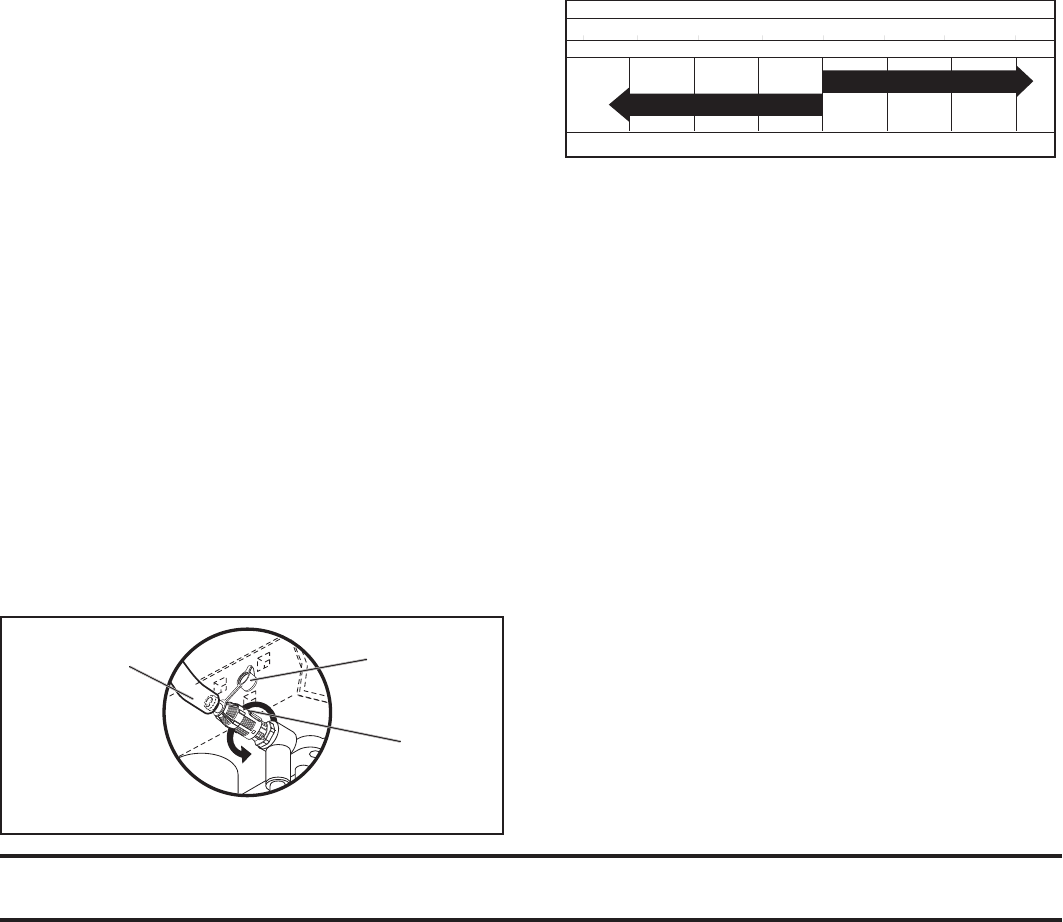
16
ENFRIAMIENTO DEL TRANSEJE
Las aletas de enfriamiento y el ventilador de la transmisión
tienen que mantenerse limpios para asegurar el enfriamiento
adecuado.
No trate de limpiar el ventilador o la transmisión cuando el motor
esté funcionando o mientras la transmisión esté caliente.
• Inspeccione el ventilador de enfriamiento para asegurarse que
las aspas del ventilador estén intactas y limpias.
• Inspeccione las aletas de enfriamiento para verificar si hay
mugre, recortes de césped u otros materiales. Para impedir
daños a las juntas, no use un rociador de aire compresado o
de alta presión para limpiar las aletas de enfriamiento
NIVEL DEL FLUIDO DE LA BOMBA DEL TRANSE-
JE
El transeje ha sido sellado en la fábrica y el mantenimiento del fluido
no es necesario para la vida del transeje. En el caso de que el
transeje se filtrase o necesitase servicio, haga el favor de ponerse en
contacto con un centro de servicio o con un otro centro de servicio
cualificado.
CORREAS V
Revise las correas V para verificar si existe deterioro y desgaste
después de 100 horas de operación y cámbielas si es necesario.
Las correas no son ajustables. Cambie las correas si empiezan
a deslizarse debido al desgaste.
MANTENIMENTO
Fig. 16
FILTRO DE ACEITE DEL MOTOR
Cambie el filtro de aceite del motor cada temporada o vez por
medio que cambie el aceite, si el tractor se usa más de 100 horas
en un año.
LIMPIEZA DE LA REJILLA DE AIRE
La rejilla de aire debe mantenerse sin mugre y paja para evitar
el daño al motor debido al sobrecalentamiento. Límpiela con un
cepillo de alambre o con aire comprimido para remover la mugre
y las fibras de goma secas, pegadas.
SILENCIADOR
Inspeccione y cambie el silenciador corroído y el amortiguador de
chispas (si viene equipado) pues pueden crear un peligro de incendio
y/o daños.
FILTRO DEL AIRE
Su motor puede sufrir averías y funcionar de manera incorrecta
con un filtro del aire sucio. Déle servicio al filtro de aire más a
menudo si se usa en condiciones polvorosas. Vea la manual de
la motor.
GAMA DE TEMPERATURA ANTICIPADA ANTES DEL PROXIMO CAMBIO DE ACEITE
CALIDADES DE VISCOSIDAD DE SAE
-20 0 30 40 80 100
-30 -20 0 20 30 40
F
C
32
-10 10
60
5W-30
SAE 30
MOTOR
LUBRICACIÓN
Use solamente aceite de detergente de alta calidad clasificado
con la clasificación SG-SL de servicio API. Seleccione la calidad
de viscosidad del aceite SAE según su temperatura de operación
esperada.
AVISO: A pesar de que los aceites de multiviscosidad (5W30,
10W30, etc.) mejoran el arranque en clima frío, estos aceites de
multiviscosidad van a aumentar el consumo de aceite cuando
se usan en temperaturas sobre 32° F (0° C). Revise el nivel del
aceite del mo tor más a menudo, para evitar un posible daño en
el motor, debido a que no tiene suficiente aceite.
Cambie el aceite después de 50 horas de operación o por lo menos
una vez al año si el trac tor se utiliza menos 50 horas el año.
Revise el nivel del aceite del cárter antes de arrancar el mo-
tor y después de cada ocho (8) horas de uso continuado.
Apriete la tapa del relleno/varilla indicadora de nivel del aceite
en forma segura cada vez que revise el nivel del aceite.
PARA CAMBIAR EL ACEITE DEL MOTOR (Vea
Fig. 17)
Determine la gama de la temperatura esperada antes de cam-
biar el aceite. Todo el aceite debe cumplir con la clasificación de
servicio API SG-SL.
• Asegúrese que el tractor esté en una superficie nivelada.
• El aceite se drenará más fácilmente cuando esté caliente.
• Recoja el aceite en un envase adecuado.
• Remueva la tapa/varilla indicadora de nivel para relleno del
aceite. Tenga cuidado de no permitir que la mugre entre en
el motor cuando cambie el aceite.
• Quite el casquillo de la guarnición inferior de la válvula de
desagüe e instale el tubo de desagüe sobre la guarnición.
• Abra la válvula de desagüe empujando hacia dentro y dando
vuelta a la izquierda.
• Para abrirse, tire hacia fuera la válvula de desagüe.
• Después de que el aceite haya drenado total-mente, cerrar
y bloquee la válvula de desagüe empujando hacia dentro y
dando vuelta en sentido de las agujas de un reloj hasta que
la clavija está en la posición bloqueada según lo mostrado.
• Remueva el tubo de desagüe y substituya el casquillo sobre
la guarnición inferior de la válvula de desagüe.
• Vuelva a llenar el motor con aceite a través del tubo de la
varilla indicadora de nivel para relleno del aceite. Vacíelo
lentamente. No lo llene demasiado. Para la capacidad aproxi-
ma da vea las “Especificaciones del Producto” sección de
este manual.
• Use un medidor en la tapa/varilla indicadora del nivel para
relleno del aceite para revisar el nivel. Mantenga el aceite
en la línea de lleno (FULL) en la varilla indicadora de nivel.
Apriete la tapa en el tubo en forma segura cuando termine.
VÁLVULA DE DESAGÜE DEL ACEITE
CASQUILLO
POSICIÓN
CERRADA Y
BLOQUEADA
TUBO DE
DESAGÜE
02463
SISTEMA DE ENFRIAMIENTO DE AIRE
Para asegurar un enfriamiento adecuado, asegúrese que la rejilla
del césped, las aletas de enfriamiento, y otras superficies ex ter nas
del motor se mantengan limpias en todo momento.
Cada 100 horas de operación (más a menudo bajo condiciones
extremadamente polvorosas o sucias), remueva la caja del
ven ti la dor y otras tapas de enfriamiento. Limpie las aletas de
en fria mien to y las superficies externas, según sea necesario.
Ase gú re se que se vuelvan a instalar las tapas de enfriamiento.
AVISO: Si se opera la máquina con una rejilla del césped blo-
queada, sucia, o con las aletas de enfriamiento taponadas, y/o
las tapas de enfriamiento removidas se producirá daño en el
motor debido al calentamiento excesivo.
Fig. 17
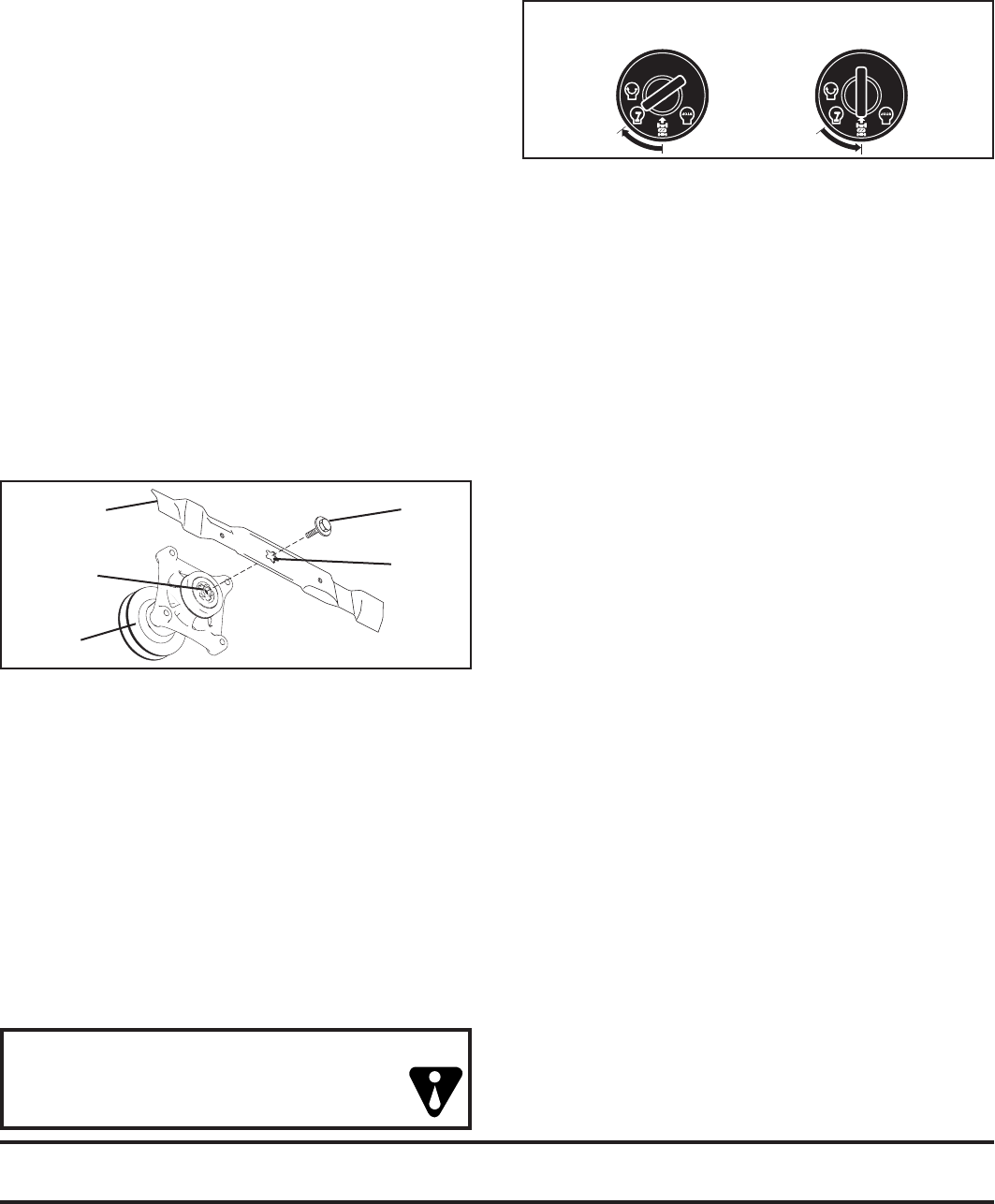
15
MANTENIMENTO
Fig. 14
Fig. 15
TRACTOR
Siempre observe las reglas de seguridad cuando dé mante ni-
mien to.
OPERACIÓN DEL FRENO
Si el tractor necesita más de cinco (5) pies para detenerse
a la máxima velocidad al cambio más alto en una superficie
nivelada, de hormigón o pavimentada, hay que hacerle
el servicio al freno. Vea “CONTROLAR Y AJUSTAR EL
FRENO” en el capítulo de Servicio y ajustes de este manual.
LLANTAS
• Mantenga todos los neumáticos con la presión de aire
adecuada (Vea la PSI que se indica en estos).
• Mantenga las llantas sin gasolina, aceite o substancias
químicas para control de insectos que pueden dañar la goma.
• Evite los tocones, las piedras, las grietas profundas, los
objetos afilados y otros peligros que pueden dañar a las
llantas.
AVISO: Para arreglar las llantas perforadas y péra prevenir
que tenga llantas pinchadas a causa de pequeñas fugas, puede
comprar el sello para llantas de su comerciante de partes de
repuesto más cercano. Elsello previene que las llantas se sequen
y también la corrosión.
SISTEMA PRESENCIA OPERADOR Y SISTEMA
FUNCIONAMIENTO ATRÁS (ROS) (Vea Fig. 14)
Asegurarse de que el sistema de presencia del operador, el
sistema de trabajo y el sistema funcionamiento atrás funcionen
bien. Si tu tractor no función como descrito, reparar el problema
inmediatamente.
• El motor no arrancará si el pedal de embrague/freno está
completamente presionado y el mando del embrague del
accesorio está desconectado.
VÉRIFIÉZ SISTEMA PRESENCIA OPERADOR
• Cuando el motor está en marcha, cualquier tentativa del
operador de abandonar el asiento sin haber puesto el freno
de estacionamiento primero, apagará el motor.
• Cuando el motor está en marcha y el embrague del
accesorio está conectado, cualquier tentativa del operador
de abandonar el asiento, apagará el motor.
• El embrague del accesorio no tendría que funcionar nunca
si el operador no está en su asiento.
VÉRIFIÉZ SISTEMA FUNCIONAMIENTO ATRÁS (ROS)
• Cuando el motor está en marcha con el interruptor de llave
en posición de motor “ON” y el embrague del accesorio
conectado, cualquier tentativa del operador de viajar marcha
atrás, apagará el motor.
• Cuando el motor está en marcha con el interruptor de llave del
sistema de funcionamiento atrás (ROS) en la posición “ON”
y el embrague del accesorio conectado, cualquier tentativa
del operador de viajar marcha atrás, NO apagará el motor.
0
2
8
2
8
POSICIÓN
ROS “ON” MOTOR EN POSICIÓN “ON”
(OPERACIÓN NORMAL)
CUIDADO DE LA CUCHILLA
Para obtener resultados óptimos, las cuchillas de la cortadora
deben estar afiladas. Reemplace las cuchillas que estén gastadas,
dobladas o dañadas.
REMOCIÓN DE LA CUCHILLA (Vea Fig. 15)
• Levante la segadora a su posición más alta para permitir el
acceso a las cuchillas.
AVISO: Proteja sus manos con guantes y/o envuelva la cuchilla
con una tela gruesa.
• Remueva el perno de la cuchilla dandole vueltas en el sentido
inverso al de las agujas del reloj.
• Instale la nueva cuchilla o cuchilla afilada con el estampado
“THIS SIDE UP” en la direccion de la segadora y del conjunto
del mandril.
IMPORTANTE: PARA ASEGURAR LA INSTALACION
APROPIADA, POSICIONE EL AGUJERO CENTRAL DE LA
CUCHILLA CON LA ESTRELLA DEL CONJUNTO DEL MANDRIL.
• Instale y apriete el perno de la cuchilla firmemente (Par 45-55
pies/libras).
IMPORTANTE: EL PERNO DE LA CUCHILLA ES TRATADO
A CALO.
CONJUNTO DEL
MANDRIL
CUCHILLA
PERNO
HEX AG O NAL
ESTRELLA
AGUJERO
CENTRAL
BATERÍA
Su tractor cuenta con un sistema de carga de la batería que es
suficiente para el uso normal. Sin embargo, si se carga la batería,
periódicamente, con un cargador de automóviles se prolongará
su duración.
• Mantenga la batería y los terminales limpios.
• Mantenga los pernos de la batería apretados.
• Mantenga los agu je ros de ventilación pequeños abiertos.
• Vuelva a cargar a 6-10 amperes por 1 hora.
AVISO: La bateria del equipo original de su trac tor no be-
cesita servicio. No intente abrir o remover las tapas o cubier-
tas. No esnecesario añadir o verificar el nivel del electrólito.
PARA LIMPIAR LA BATERÍA Y LOS TERMINALES -
La corrosión y la mugre de la batería y de los terminales pueden
producir “escapes” de potencia en la batería.
• Levantan el asiento.
• Desconecte el cable de la batería NEGRO primero y luego
el cable de la batería ROJO y remueva la batería del tractor.
• Enjuague la batería con agua corriente y séquela.
• Limpie los terminales y los extremos del ca ble de la batería
con un cepillo de alambre hasta que queden brillantes.
• Cubra los terminales con grasa o parafina.
• Reinstale la batería (Vea “REEMPLAZAR LA BATERIA” en
la sección de Servicio y Ajustes de este manual).
PRECAUCIÓN: Usar solamente la hojas de
repuesto aprobada por el fabricante de su
cortacésped. Usar una hoja no aprobada por
el fabricante de su cortacésped es peligroso,
puede dañar su cortacésped y anular su garantía.
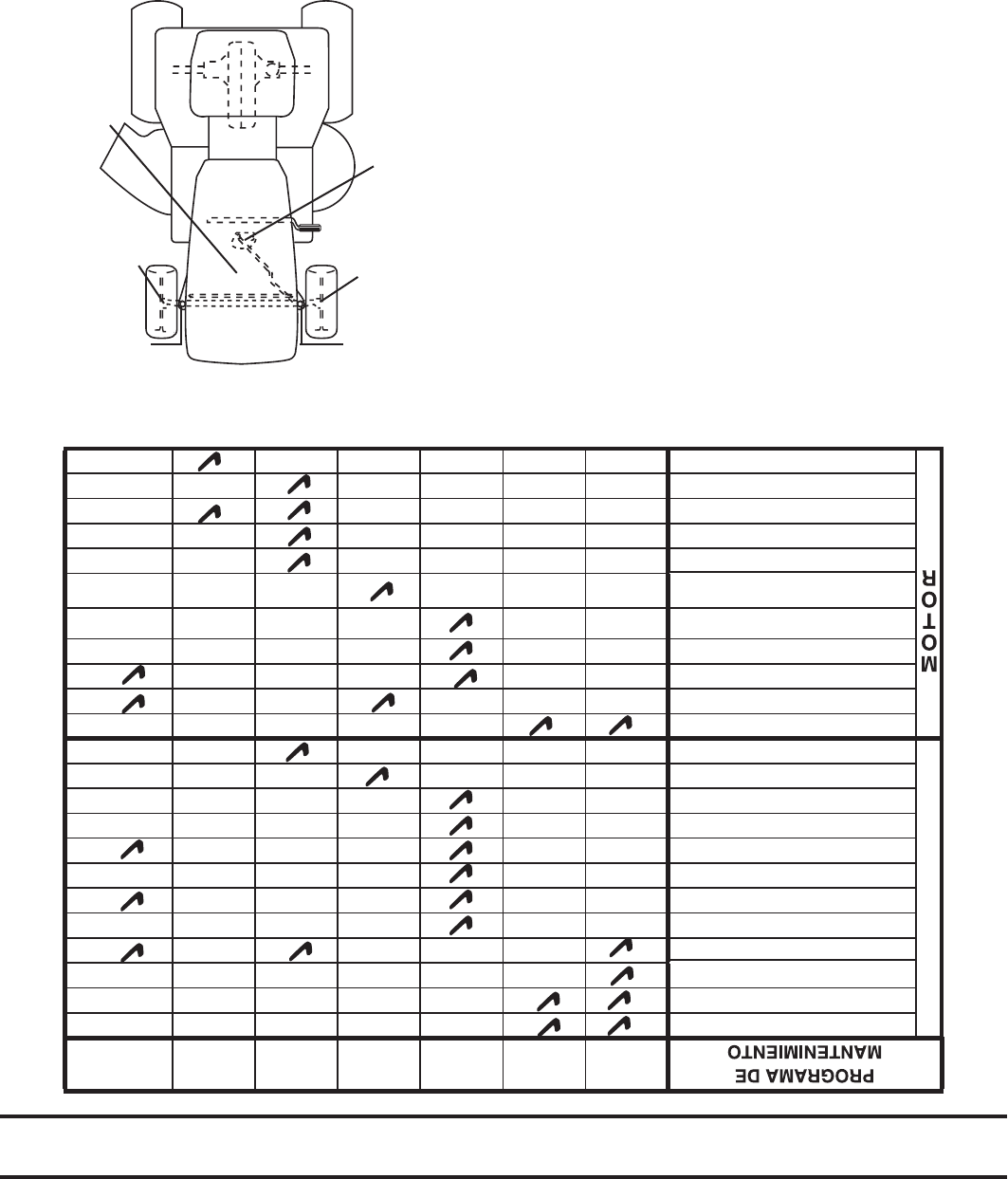
14
MANTENIMENTO
IMPORTANTE: NO ACEITE O ENGRASE LOS PUNTOS
PIVOTES, LOS QUE TIENEN RODAMIENTOS DE NILÓN
ESPECIALES. LOS LUBRICANTES VISCOSOS ATRAERÁN
POLVO Y MUGRE, LO QUE ACORTARA LA DURACIÓN
DE LOS RODAMIENTS. SI CREE QUE LUBRICARSE, USE
SOLAMENTE UN LUBRICANTE TIPO GRAFITO DE POLVO
SECO EN FORMA MODERADA.
RECOMENDACIONES GENERALES
La garantía de este tractor no cubre los artículos que han estado
sujetos al abuso o a la negligencia del operador. Para recibir todo
el valor de la garantía, el operador tiene que mantener la se ga do ra
según las instrucciones descritas en este manual.
Hay algunos ajustes que se tienen que hacer en forma
periódica para poder mantener su trac tor adecuadamente.
Al menos una vez cada estación comprobar si es necesario
efectuar los adjustes descritos en las secciones de Servicio y
Ajustes de este manual.
• Una vez al año, cambie la bujía, limpie o cambie el fil-
tro de aire y revise si las cuchillas y las correas están
desgastadas. Una bujía nueva y un filtro de aire limpio
aseguran una mezcla de aire-combustible adecuada y le
ayudan a que su motor funcione mejor y que dure más.
ANTES DE CADA USO
• Revise el nivel del aceite del motor.
• Revise la operación de los frenos.
• Revise la presión de las llantas.
• Verifique que el sistema de presencia del operado y ROS
funcionen adecuatamente.
• Revise si hay sujetadores sueltos.
TABLA DE LUBRICACIÓN
Revisar la operación del freno
Revisar la presión de las llantas
Vérifiéz la commande de présence
d'opérateur et le sistema d ROS
Revisar si hay sujetadores sueltos
Afilar/cambiar las cuchillas de la segadora
Tabla de lubricación
Revisar el nivel
Revisar el nivel del aceite del motor
Cambiar el aceite del motor (con filtro)
Limpiar el filtro de aire
Limpiar la rejilla de aire
Cambiar el filtro de aceite (si equipado)
Limpiar las aletas de enfriamiento
Cambiar la bujía
Cambiar el cartucho de papel del filtro de aire
Cambiar el filtro de combustible
Inspeccione las correas trapezoidales
Cambiar el aceite del motor (sin filtro)
1- Cambiar más a menudo cuando se opere bajo carga pesada o en ambientes con altas temperaturas
2- Dar servicio más a menudo cuando se opere en condiciones sucias o polvorosas.
3- Cambiar las cuchillas más a menudo cuando se siegue en suelo arenoso.
4- No requerido si equipado con una batería libre de mantenimiento.
5- Vea “LIMPIEZA” en la sección de Mantenimento de este manual.
T
R
A
C
T
0
R
3
2
2
2
2
1
,
1,2
2
4
5
1,2
Compruebe La Nivelación Del Cortacéspedes
Limpie los residuos de la placa de dirección.
Limpiar la batería y los terminales
Inspeccionar el silenciador/
amortiguador de chispas
CADA
8
HORAS
CADA
25
HORAS
CADA
50
HORAS
CADA
100
HORAS
CADA
TEMPORADA
ALMACENAMIENTO
ANTES DE
CADA USO
Revisar el enfriamiento del transeje
➀ Grasa de proposito general
➁ Refiérase a la sección del “MOTOR” en Mantenimiento
01965
➁ MOTOR
➀ ACCESORIO
DE GRASA DEL
RODAMIENTO
DE LA RUEDA
DELANTERA
➀ PLANCHA
DEL
ENGRANAJE
DE SECTOR
DE
DIRECCIÓN
➀ ACCESORIO
DE GRASA DEL
RODAMIENTO
DE LA RUEDA
DELANTERA
➀ ACCESORIO DE
GRASA DEL
ARBOL
➀ ACCESORIO DE
GRASA DEL
ARBOL
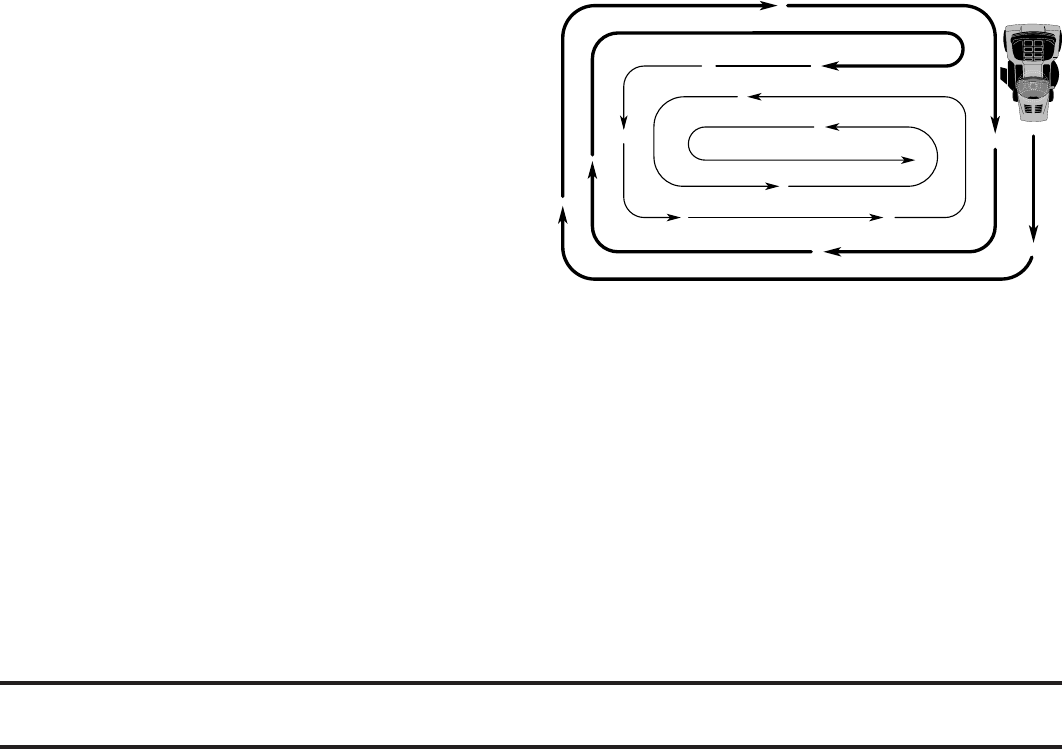
13
OPERACIÓN
CONSEJOS PARA SEGAR
• No se pueden usar las cadenas para las llantas cuando la caja
de la segadora está adjunta al tractor.
• La segadora debe estar nivelada en forma adecuada para
obtener el mejor rendimiento al segar. Vea “PARA NIVELAR
LA CAJA DE LA SEGADORA” en la sección de Servicio y
Ajustes de este manual.
• El lado izquierdo de la segadora se debe usar para recorte.
• Maneje de modo que los recortes se descarguen en el área que
ya ha sido cortada. Mantenga el área de corte a la derecha
del tractor. Esto producirá una distribución más pareja de los
recortes y un corte más uniforme.
• Al segar las área grandes, empiece girando a la derecha
de modo que los recortes se descarguen, alejándose de los
arbustos, cercos, entradas de automóviles, etc. Después de
una o dos vueltas, siegue en la dirección opuesta, haciendo
virajes a la izquierda, hasta que termine (Vea Fig. 13)
• Si el césped está demasiado alto, se debe segar dos veces
para reducir la carga y los posibles peligros de incendio debido
a los recortes secos. Haga el primer corte re la ti va men te alto;
el segundo a la altura deseada.
• No siegue el césped cuando está mojado. El césped
mojado taponará la segadora y dejará montones indese-
ables. Per mi ta que se seque el césped antes de segarlo.
• Siempre opere el motor con una aceleración completa cuan do
siegue para asegurarse de conseguir un mejor ren di mien to y
una descarga apropiada de los materiales. Regule la velocidad
de recorrido seleccionando un cambio lo su fi cien te men te bajo
para obtener un rendimiento de corte de parte de su segadora
y también la calidad del corte deseada.
• Cuando opere con accesorios, seleccione una velocidad de
recorrido que se acomode al terreno y le permita obtener el
mejor rendimiento del accesorio que se está usando.
Fig. 13
12
OPERACIÓN
PARA HACER ARRANCAR EL MOTOR
(Vea Fig. 3)
Al hacer arrancar el motor por la primera vez o si se ha acabado el
combustible del motor, se necesitará tiempo para el arranque extra
para mover el combustible desde el estanque hasta el motor.
• Asegúrese que el control de rueda libre este en la posición
enganchada.
• Siéntase en el sillón en la posición de operación, suelte el pedal
del embrague/freno y ponga el freno de estacionamiento.
• Ponga la palanca de control de movimiento en la posición
de neutro.
• Mueva el embrague del accesorio a la posición
desenganchado.
• Mueva la palanca de control de la aceleración a la posición
de estrangulación.
AVISO: Antes de arrancar, lea las instrucciones siguientes para
el arran que en clima frío y templado.
• Inserte la llave en la ignición y gire la llave en el sentido que
giran las manillas del reloj a la posición de arranque start, y
suelte la llave tan pronto como arranque el motor. No haga
funcionar el arrancador continuamente por más de quince
segundos por minuto. Si el motor no arranca después de
varios intentarlos, mueva el control de la ace le ra ción a la
posición de rápido, espere unos cuantos minutos y trate de
nuevo. Si el mo tor sigue sin funcionar, mueva el control de
la aceleración a la posición de es tran gu la ción y intente de
nuevo.
ARRANQUE CON TIEMPO TEMPLADO (50°F/10°C) y más)
• Cuando arranque el motor, mueva el control de la ace le ra-
ción a la posición de rápido.
• Los accesorios y el embrague ahora pueden ser utilizados.
Si el motor no acepta esta carga, vuelva a arrancar
el motor para permitirle que se caliente por un minuto
utilizando el estrangulador como describido arriba.
ARRANQUE CON TIEMPO Frío (50°F/10°C) y menos)
• Al hacer arrancar el motor, mantenga el control de la
aceleración a la posición de estrangulación hasta que el
motor se caliente y empieze funcionar mal. Una vez que
empieze a funcionar mal, mueva inmediatamente el control
de la aceleración a la posición rápida. El calentamiento del
motor puede tomar a partir de varios segundos a varios
minutos (cuanto más fría es la temperatura, más largo es el
calentamiento).
CALENTAMIENTO PARA LA TRANSMISION AUTOMATICA
Antes de conducir la unidad en un tiempo frío, la transmisión debe
ser calentada como las instrucciones siguientes:
• Asegúrese que el tractor este situado en una superficie
nivelada.
• Ponga la palanca de control en neutro. Alivie el freno de
estacionamiento y deje que el embrague/freno vuelva
a la posición de operación.
• Permita que la transmisión se caliente du rante un minuto.
Esto puede ser echo du rante el tiempo de calentamiento
del motor.
• Los accesorios pueden ser utilizados du rante el periodo del
recalentamiento del mo tor después que la transmisión halla
sido calentada.
AVISO: Si se encuentra a mucha altura (sobre 3000 pies) o en
clima frío (por debajo de 32°F /0°C), la mezcla del combustible
del carburador debe ser ajustada para el mejor rendimiento
del motor. (Vea “PARA AJUSTAR EL CARBURADOR”
en la sección de Servicio y Ajustes de este manual).
PURGAR LA TRANSMISIÓN
PRECAUCIÓN: Nunca enganche o desen-
ganche la palanca del control de rue da libre
cuando el motor esta fun cio nan do.
Para asegurar la operación y ejecución adecuada, es re co men-
da do que la transmisión sea purgada antes de operar el tractor
para la primera vez. Este proceso removerá cualquier aire adentro
de la transmisión que se halla formado durante el trans por te de
su tractor.
IMPORTANTE: SI POR ACASO SU TRANSMISIÓN DEBE SER
REMOVIDA PARA SERVICIO O REEMPLAZO, DEBE SER
PURGADA DESPUÉS DE LA REINSTALACIÓN Y ANTES DE
OPERAR EL TRACTOR.
1. Para mayor seguridad, ubique el tractor en una superficie
nivelada, despejada de cualquier objeto y abierta, con el
motor apagado y el freno de mano puesto.
2. Desenganche la transmisión poniendo el con trol de rueda
libre en la posición de desenganchado (Vea “PARA EL
TRANS POR TE” en esta sección de este manual).
3. Sentado en el asiento del tractor, empiece el motor. Des pués
que este corriendo el motor, mueva el control de es tran gu la-
ción a la posición de lento. Con la palanca de rueda libre en la
posición de neutral , desenganche lentamente el embrague/
el freno del pedal.
PRECAUCIÓN: En el transcurso del paso 4,
puede que de pronto se pongan en movimiento
las ruedas.
4. Mueva la palanca del control de movimiento a la posición total
de adelante y sujétela du rante cinco (5) segundos. Mueva la
palanca hacia la posición total de marcha atrás y sujétela du-
rante cinco (5) segundos. Repita este proceso tres (3) veces.
5. Mueva la palanca del control de movimiento a la posición de neu-
tro. Apague el motor y embrague el freno de estacionamiento.
6. Enganche la transmisión poniendo el control de rueda libre
en la posición de conducir (Vea “PARA TRANSPORTAR” en
esta sección del manual).
7. Sentado en el asiento del tractor, empiece el motor. Des pués
que este corriendo el motor, mueva el control de es tran gu-
la ción media (1/2) velocidad. Con la palanca de control de
movimiento a la posición de neutro , len ta men te desenganche
el embrague/el freno del ped al.
8. Mueva lentamente la palanca de control de movimiento hacia
adelante, después que el trac tor se mueva aproxi ma da men te
cinco (5) pies, mueva lentamente con la palanca de con trol
de movimiento a la posición contraria. Después que el trac-
tor se mueva aproximadamente unos cinco (5) pies vuelva
a poner la palanca de control de movimiento en la posición
de neutro. Repita este procedimiento la palanca de con trol
de movimiento tres (3) veces.
Su transmisión esta ahora purgado y dispuesto para la operación
nor mal.
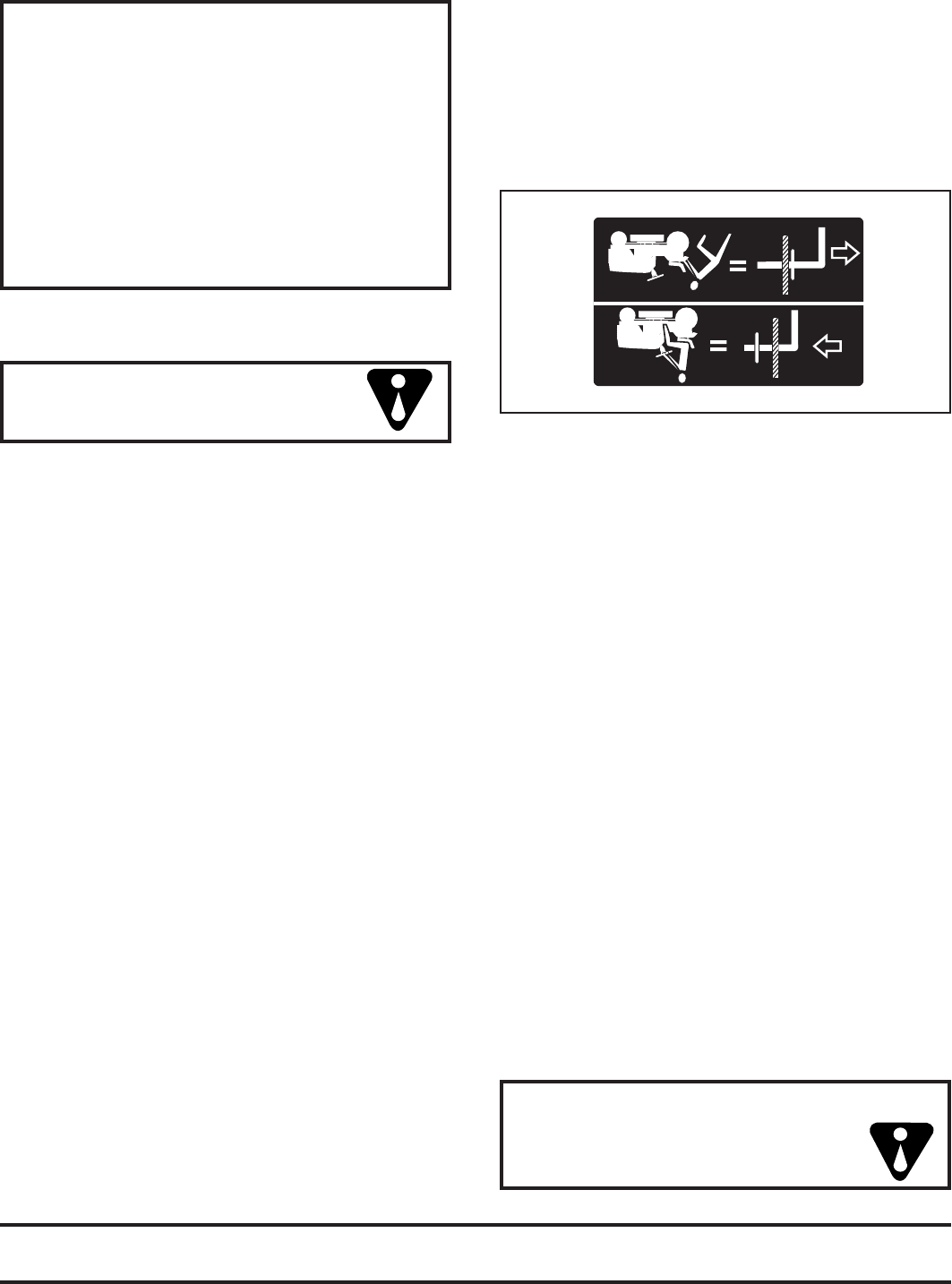
11
OPERACIÓN
PARA OPERAR EN CERROS
ADVERTENCIA: No maneje hacia arriba
o hacia abajo en cerros con pendientes
su pe rio res a 15° y no maneje atravesando
nin gu na pendiente. Utilice la guía de la pen-
diente proporcionada en la parte posteriora
de este manual.
• Escoja la velocidad más lenta antes de arrancar hacia arriba
o hacia abajo en cerros.
• Evite parar o cambiar la velocidad en cerros.
• Si es absolutamente necesario el parar, empuje el pedal
del embrague/freno rápidamente a la posición de freno y
en gan che el freno de estacionamiento.
• Mueva la palanca de control de movimiento a la posición de
neutro.
IMPORTANTE: LA PALANCA DE CONTROL DE MOVIMIENTO
NO VUELVE A LA POSICIÓN DE NEUTRO CUANDO EL PEDAL
DEL EMBRAGUE/FRENO ESTA PRESIONADO.
• Para volver a empezar con el movimiento, suelte len ta men-
te, el freno de estacionamiento y el pedal del embrague/
freno.
• Lentamente, mueva la palanca de control de movimiento al
ajuste más lento.
• Gire siempre lentamente.
PARA TRANSPORTAR (Vea Fig. 12)
Cuando empuje o arrastre su tractor asegúrese de desenganchar
la transmisión poniendo el control de la rueda libre en la posición
de marcha de rueda libre. El control de marcha de rueda libre
esta situado en la barra de tracción trasera del tractor.
• Levante la palanca de levantamiento del accesorio a su
posición más alta.
• Tire del mando de la rueda libre hacia afuera y hacia
abajo hasta que se coloque en la guía y suéltalo de man-
era que se mantenga en la posición de desenganchada.
• No empuje o arrastre el tractor a más de dos (2) MPH.
• Para volver a accionar la transmisión, invierta este pro ce di-
mien to.
AVISO: Para proteger el capó contra el daño cuando transporte
su tractor en un camión o remolcador, asegúrese que el capó
esté cerrado y asegurado al tractor. Use los medios apro pia dos
para amarrar el capó al tractor (cuerdas, cor de les, etc.).
TRANSMISIÓN ENGANCHADA
TRANSMISIÓN DESENGANCHADA
Fig. 12
AGREGUE GASOLINA
• Llene el estanque de combustible. Llene hasta la parte inferior
del cuello de relleno del estanque de gasolina. No lo llene de-
masiado. Use gasolina regular, sin plomo, nueva y limpia con el
mínimo de 87 octanos. (El uso de gasolina con plomo aumentará
los depósitos de óxido de plomo y carbono y se reducirá la du-
ración de la válvula). No mezcle el aceite con la gasolina. Para
asegurar que la gasolina utilizada sea fresca compre estanques
los cuales puedan ser utilizados durante los primeros 30 días.
REMOLQUE DE CARRETILLAS O OTROS AC-
CESORIOS
Remolque solamente los accesorios recomendados y especifica-
dos por el fabricante del tractor. Use sentido común cuado este
remolcando. Las cargas pesadas, cuando este yendo sobre una
pendiente, son peligrosas, las llantas pueden perder su tracción
con el terreno y pueden ocasionar que pierda el control de su
tractor.
ANTES DE HACER ARRANCAR EL MOTOR
REVISE EL NIVEL DE ACEITE DEL MOTOR
El motor en su tractor ha sido enviado desde la fábrica lleno con
aceite de calidad para verano.
• Revise el aceite del motor con el tractor en terreno nive-
lado.
• Levante y quite la varilla indicadora de nivel de rel-
leno del aceite; limpie el aceite. Reinserte la varilla en
el tubo y empújela hacia abajo firmemente en su lugar.
Remueva y lea el nivel del aceite. Si es necesario, ag-
regue aceite hasta se llegue a la marca de lleno (FULL)
en la varilla indicadora de nivel. No lo llene demasiado.
• Para la operación en clima frío, debe cambiar el aceite para
poder arrancar más fácilmente (Vea “Tabla de Viscosidad Del
Aceite” en la sección de Mantenimento de este manual).
• Para cambiar el aceite del motor, vea la sección de Manten-
imiento en este manual.
MECANISMO DE AVISO DE SERVICIO / CRONÓ-
METRO
El mecanismo de aviso de servicio muestra el número total de
horas que ha estado en funcionamiento el motor, y se enciende y
se apaga de manera intermitente cuando el motor o la cortadora
necesitan servicio. Cuando se requiere servicio, el mecanismo
de aviso de servicio se enciende y se apaga intermitentemente
por un lapso de dos horas. Para hacerles el servicio al motor y
a la cortadora, lea el capítulo de Mantenimiento de este manual.
NOTA: El dispositivo de aviso de servicio funciona cuando la
llave de ignición o arranque se encuentra en cualquier posición
menos en “STOP” (“PARE”). A fin de garantizar la precisión
de la lectura, asegúrese de que el arranque permanezca en la
posición “STOP” cuando el motor esté apagado.
PRECAUCIÓN: Limpie el aceite o el com-
bustible derramado. No al ma ce ne, der-
rame o use gasolina cerca de una llama
expuesta.
IMPORTANTE: Cuando se opere en temperaturas por debajo de
32°F (0°C) use gasolina de invierno limpia y nueva para auedar
a asegurar un buen arranque en clima frío.
PRECAUCIÓN: Com bus ti bles mezclados con alcohol
(conocidos como gasohol, o el uso de etanol o metanol)
pueden atraer la humedad, la que conduce a la separación
y formación de ácidos durante el almacenamiento. La
gasolina acídica puede dañar el sistema del combustible
de un motor durante el almacenamiento. Para evitar los
problemas con el motor, se debe vaciar el sistema de
combustible antes de guardarlo por un período de 30
días o más. Vacíe el estanque de combustible, haga ar-
rancar el motor y hágalo funcionar hasta que las líneas del
combustible y el carburador queden vacíos. La próxima
temporada use combustible nuevo. Vea las Ins truc cio nes
para el Almacenamiento para más información. Nunca use
productos de limpieza para el motor o para el carburador
en el estanque del combustible pues se pueden producir
daños per ma nen tes.
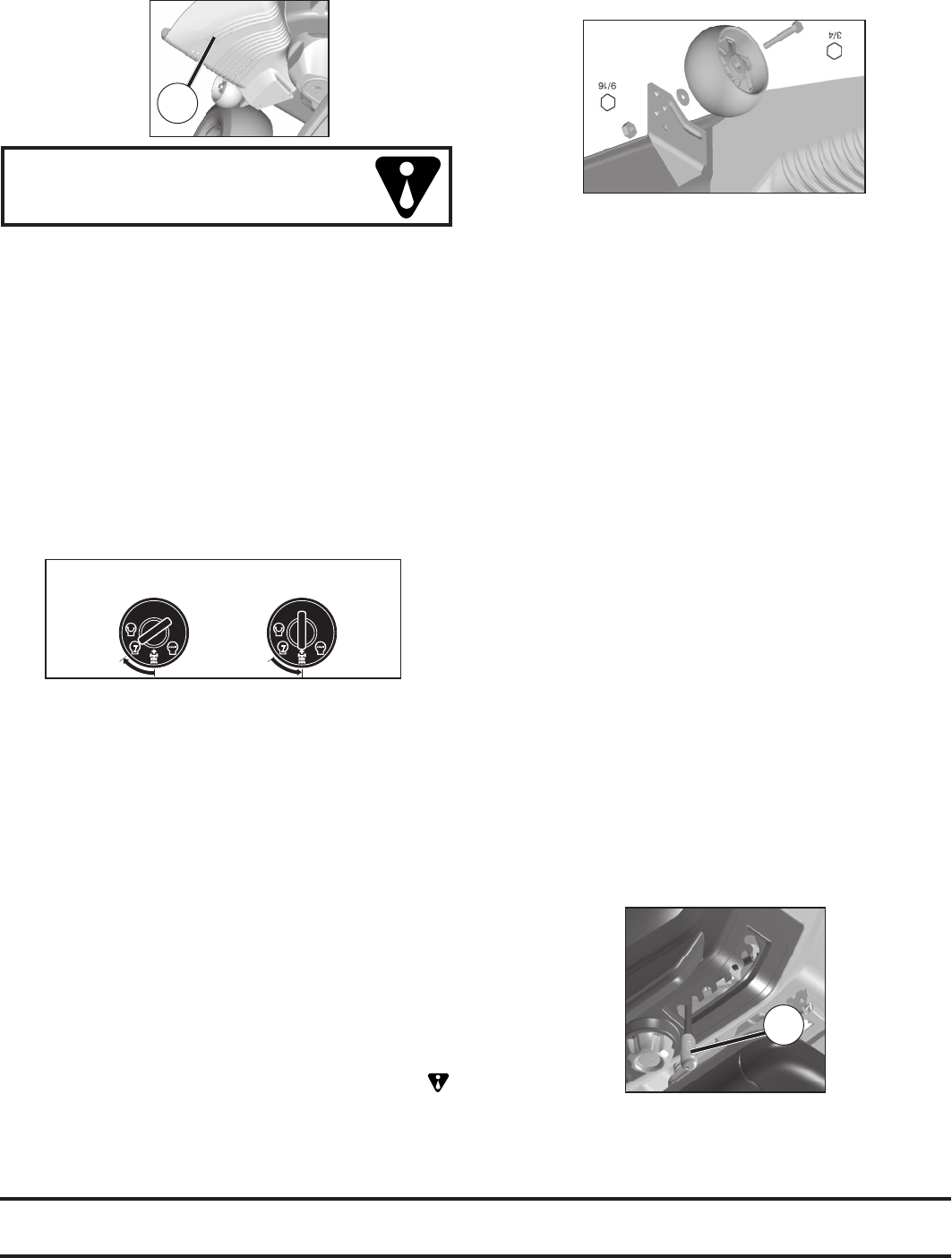
10
PARA AJUSTAR LA ALTURA DE CORTE DE LA
SEGADORA (Vea Fig. 8)
La posición de la palanca elevadora (A) determina a qué altura
se cortará el césped.
• Coloque la palanca elevadora en la ranura de la altura
deseada.
La gama de la altura de corte es de aproximadamente 1 a 4
pulgadas. Las alturas se miden desde el suelo a la punta de la
cuchilla cuando el motor no está funcionando. Estas alturas son
aproximadas y pueden variar dependiendo de las con di cio nes
del suelo, de la altura del césped y del tipo del césped que se
está segando.
• El césped promedio debe cortarse aproximadamente a 2-1/2
pulgadas durante la temporada fría y sobre 3 pulgadas durante
los meses calurosos. Para obtener un césped más saludable
y de mejor apariencia, siegue a menudo y después de un
crecimiento moderado.
• Para obtener el mejor rendimiento de corte, el césped que
tiene más de 6 pulgadas de altura debe segarse dos veces.
Haga el primer corte relativamente alto; el segundo a la
altura deseada.
OPERACIÓN
Fig. 8
Fig. 9
PARA AJUSTAR LAS RUEDAS
CALIBRADORAS (Vea Fig. 9)
Las ruedas calibradoras están bien ajustadas cuando se en-
cuentran un poco a distancia del terreno al mismo tiempo que
la segadora esté a la altura de corte deseada. Entonces las
ruedas calibradoras mantienen el conjunto segador en posición
para prevenir el corte raspeo en casi todos los terrenos.
AVISO: Ajuste las ruedas calibradoras con el trac tor en una
superficie ni ve la da plana.
• Ajuste la segadora a la altura de corte deseada con la manilla
de ajuste de altura (Vea “PARA AJUSTAR LA ALTURA DE
CORTE DE LA SEGADORA” en la sección de Operación de
este manual).
• Con la segadora a la altura deseada para la posición de corte,
se tienen que montar las ruedas calibradoras de modo que
queden un poco sobre el suelo. Instale las ruedas calibra-
doras en el agujero adecuado. Apriete con seguridad.
• Repita el procedimiento para el lado opuesto instalando la
rueda calibradora en el mismo agujero de ajuste.
PARA OPERAR LA SEGADORA
Su tractor viene equipada con un interruptor sen sor que exige
la presencia del operador. Si el motor está funcionando y el em-
bra gue del accesorio está enganchado y el operador trata de
bajarse del asiento, se apagará el motor. Tiene que mantenerse
sentado completa y centralmente en el asiento para impedir que
el motor vacile o se apague cuando se opere su equipo en terreno
disparejo, áspero o en cerros.
• Elija a qué altura cortará el césped (Vea " PARA AJUS-
TAR LA ALTURA DE CORTE DE LA SEGADORA".
• Haga arrancar las cuchillas de la segadora enganchando el
control del embrague del accesorio.
Fig. 11
Fig. 10
S
FUNCIONAMIENTO ATRÁS (Vea Fig. 10)
Tu tractor está equipado con el Sistema de Funcionamiento Atrás
(ROS). Cualquier tentativa del operador de viajar marcha atrás
con el embrague puesto apagará el motor a menos que la llave
de ignición se ponga en la posición de “ON” del ROS.
ATENCIÓN: Ir marcha atrás con el embrague puesto para
cortar, no es recomendable. Poniendo el ROS en posición “ON”,
para permitir el funcionamiento atrás con el embrague puesto, se
tiene que hacer sólo cuando el operador lo considera necesario
para reposicionar la máquina con el dispositivo embragado. No
siegue en revés a menos que sea absolutamente necesario.
USAR EL SISTEMA DE FUNCIONAMIENTO ATRÁS (ROS)
Utilice el tractor solamente si está seguro de que no ingresarán
niños ni otras personas o animales al área donde se va a cortar
el césped.
• Mover la palanca de mando del movimiento en la posición
neutro.
• Con el motor en marcha, girar la llave del interruptor de la
ignición en el sentido inverso al de las agujas del reloj hasta
la posición “ON”.
• Mire hacia abajo y hacia atrás no sólo antes de ir marcha
atrás, sino mientras esté yendo marcha atrás.
• Mover despacio la palanca de mando del movimiento
hacia la posición atrás para empezar el movimiento.
• Cuando el uso del ROS es más necesario, dé vuelta a la
llave de ignición en el sentido de las agujas del reloj hasta
la posición “ON”.
0
2
8
2
8
POSICIÓN
ROS “ON” MOTOR EN POSICIÓN “ON”
(OPERACIÓN NORMAL)
PARA PARAR LAS CUCHILLAS DE LA
SEGADORA
• Desenganche el control del embrague del accesorio.
PRECAUCIÓN: No opere la segadora sin, ya
sea, el recogedor de césped completo en las
segadoras así equipadas o con la pro tec ción
contra la descarga (S) en su lugar. (Vea Fig. 11)
A
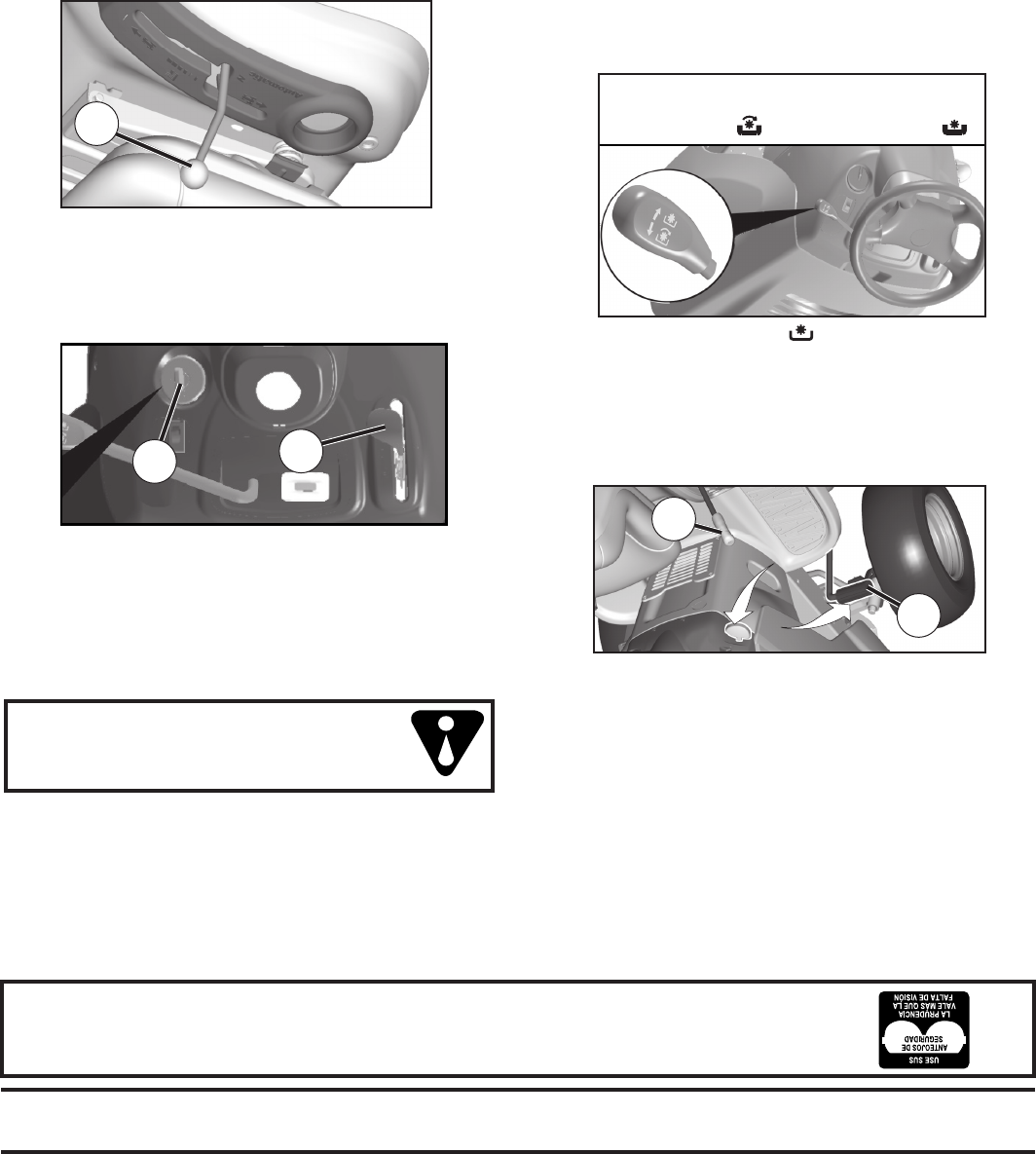
9
IMPULSIÓN DE RECORRIDO
• Para parar el mecanismo impulsor, presione el pedal del
freno/embrague completamente.
• Mueva la palanca de control de movimiento a la posición de
neutro.
MOTOR
• Mueva el control de la aceleración (D) a la posición de
lento.
AVISO: Si no se mueve el control de la aceleración a la
posición de lento y se permite que el motor ande en vacío
antes de pararlo puede producir la contraexplosión del motor.
• Gire la llave de ignición (F) a la posición de apagado “STOP”
y remueva la llave al abandonar el tractor para evitar el uso
no autorizado.
Fig. 6
La operación de cualquier tractor puede hacer que salten objetos extraños dentro de sus ojos,
lo que puede producir daños graves en éstos. Siempre use anteojos de seguridad o pro tec cio-
nes para los ojos mientras opere su tractor o cuando haga ajustes o reparaciones. Recomen-
damos gafas de seguridad o una máscara de visión amplia de seguridad usada sobre las gafas.
COMO USAR SU TRACTOR
PARA AJUSTAR EL FRENO DE ES TA CIO NA MIEN-
TO (Vea Fig. 4)
Su tractor viene equipado con un interruptor sensor que
exige la presencia del operador. Cuando el motor está fun-
cionando, si el operador trata de bajarse del asiento sin prim-
ero aplicar el freno de estacionamiento, se apagará el motor.
• Presione el pedal del freno (B) completamente y sosten-
galo.
• Jale hacia arriba la palanca del freno de mano (C) y mantén-
gala en esa posición; suelte gradualmente el pedal del freno
(B), y luego suelte la palanca del freno de mano. Asegúrese
que el freno de estacionamiento va a sujetar el tractor en
forma segura. PARA USAR EL CONTROL DE LA ACELERACIÓN
(D) (Vea Fig. 6)
Siempre opere el motor a una aceleración completa.
• Si el motor funciona a una velocidad inferior a la máxima
(rápida), su rendimiento disminuye.
• El rendimiento óptimo se obtiene a la velocidad máxima
(rápida).
OPERACIÓN
Fig. 4
Fig. 5
B
C
( ) PALANCA DEL
EMBRAGUE DEL
ACCESORIO
“DESENGANCHADO”
( ) PALANCA DEL
EMBRAGUE DEL
ACCESORIO
“ENGANCHAR”
PARADA (Vea Fig. 5)
CUCHILLAS DE LA SEGADORA
• Mueva el control del embrague del accesorio a la posición
"DESENGANCHADO" ( ).
DF
• Nunca use la estrangulación para parar el motor.
IMPORTANTE: DEJANDO EL INTERRUPTOR DE LA IGNICIÓN
EN CUALQUIER POSICIÓN OTRA QUE “STOP” CAUSAR I QUE
LA BATERÍA SE DESCARGUE (MUERTA).
AVISO: Bajo ciertas condiciones, cuando el trac tor está parado
con el motor andando en vacío, los gases de escape del mo-
tor caliente pueden hacer que el césped se ponga “café.” Para
eliminar esta posibilidad, siempre pare el motor cuando pare el
tractor en áreas con césped.
PRECAUCIÓN: Siempre pare el tractor
completamente, según se ha descrito ante-
riormente, antes de abandonar la posición
del operador.
Fig. 7
PARA MOVERSE HACIA ADELANTE Y HACIA
ATRÁS (Vea Fig. 7)
La dirección y la velocidad del movimiento son controladas por
medio de la palanca de control de movimiento (J).
J
• Haga arrancar el motor con la palanca de con trol de mo vi-
mien to en la posición de neutro.
• Suelte el freno de estacionamiento.
• Lentamente, mueva la palanca de control de movimiento a
la posición deseada.
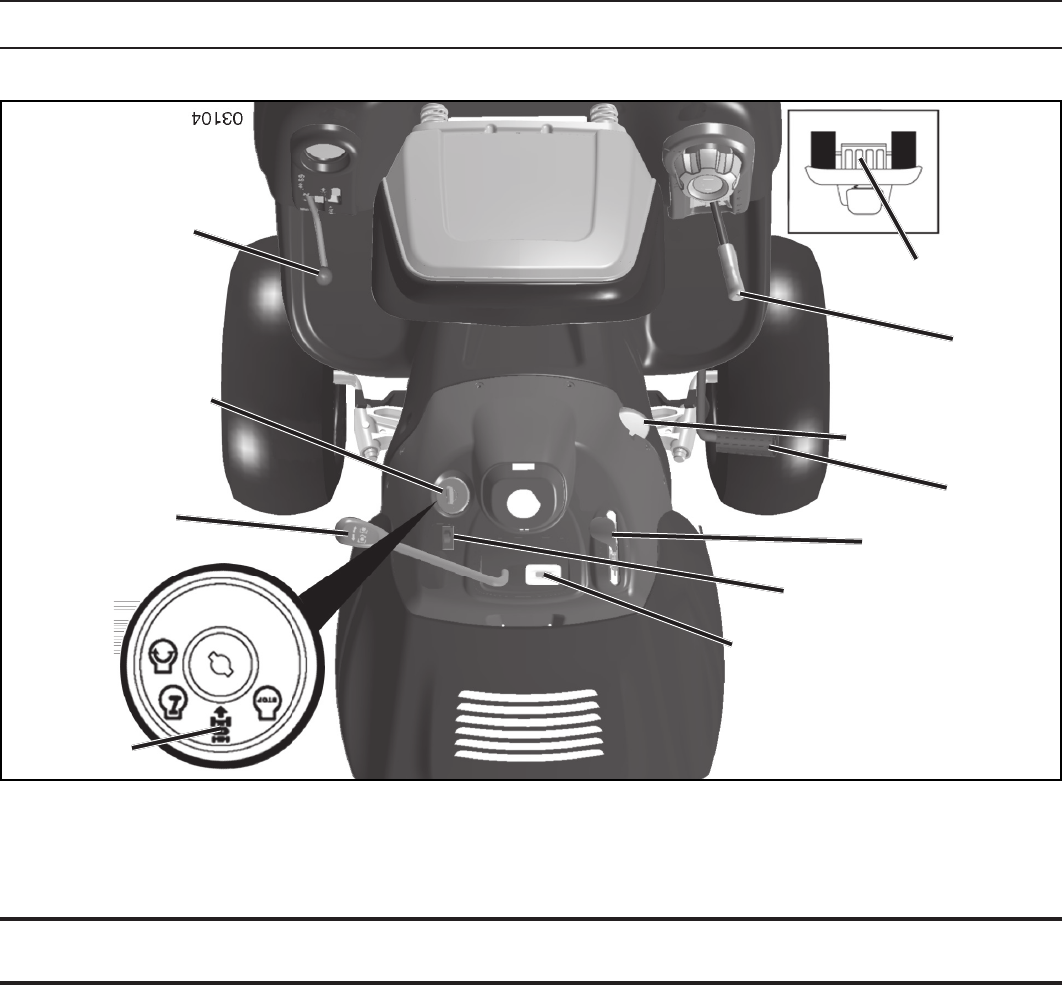
8
Nuestros tractores cumplen con los estándares de seguridad del American National Standard Institute.
PALANCA DEL LEVANTAMIENTO DEL ACCESORIO - Se usa
para levantar, bajar y ajustar el conjunto segador o los demás
ac ce so rios montados en su tractor.
PEDAL DELFRENO - Se usa para frenar el tractor y para hacer
arrancar el motor.
PALANCA DEL FRENO DE ESTACIONAMIENTO - Ase-
gu ra el pedal del embrague/freno en la posición del freno.
CONTROL DE ACELERACIÓN/ESTRANGULACIÓN - Se
usa para hacer arrancar y controlar la velocidad del mo tor.
PALANCA DEL EMBRAGUE DEL ACCESORIO - Se usa para
enganchar las cuchillas segadoras, o los demás ac ce so rios
montados en su tractor.
INTERRUPTOR DE IGNICIÓN - Se usa para hacer arrancar o
hacer parar el motor.
SISTEMA DE FUNCIONAMIENTO HACIA ATRÁS (ROS) EN
POSICIÓN “ON” - Permite la operación del conjunto segador o
otro accesorio accionado mientras que en revés.
INTERRUPTOR DE LA LUZ - Enciende y apaga las luces de-
lan te ras.
PALANCA DE CONTROL DE MOVIMIENTO - Selecciona la
velocidad y la dirección del tractor.
CONTROL DE RUEDA LIBRE - Desengancha la trans-misión
para empujar o arrastrar.
DISPOSITIVO DE AVISO DE SERVICIO/CRONÓMETRO
- Indica cuándo hay que hacerles el servicio al motor y a
la cortadora.
OPERACIÓN
Fig. 3
FAMILIARICESE CON SU TRACTOR
LEA ESTE MANUAL DEL DUEÑO Y LAS REGLAS DE SEGURIDAD ANTES DE OPERAR SU TRACTOR
Compare las ilustraciones con su tractor para familiarizarse con las ubicaciones de los diversos controles y ajustes. Guarde este
manual para referencia en el futuro.
PALANCA DEL FRENO
PALANCA DEL FRENO
DE ESTACIONAMIENTO
DE ESTACIONAMIENTO
PEDAL DEL
PEDAL DEL
FRENO
FRENO
CONTROL DE ACELERACIÓN/ES-
CONTROL DE ACELERACIÓN/ES-
TRANGULACIÓN
TRANGULACIÓN
INTERRUPTOR
INTERRUPTOR
DE IGNICIÓN
DE IGNICIÓN
ATTACHMENT CLUTCH
ATTACHMENT CLUTCH
LEVER
LEVER
ROS "ON"
ROS "ON"
POSICIÓN
INTERRUPTOR DE LA LUZ
INTERRUPTOR DE LA LUZ
CRONÓMETRO
CRONÓMETRO
CONTROL DE
RUEDA LIBRE
PALANCA DEL
PALANCA DEL
EMBRAGUE DEL
EMBRAGUE DEL
ACCESORIO
ACCESORIO
PALANCA DE
PALANCA DE
CONTROL DE
CONTROL DE
MOVIMIENTO
MOVIMIENTO
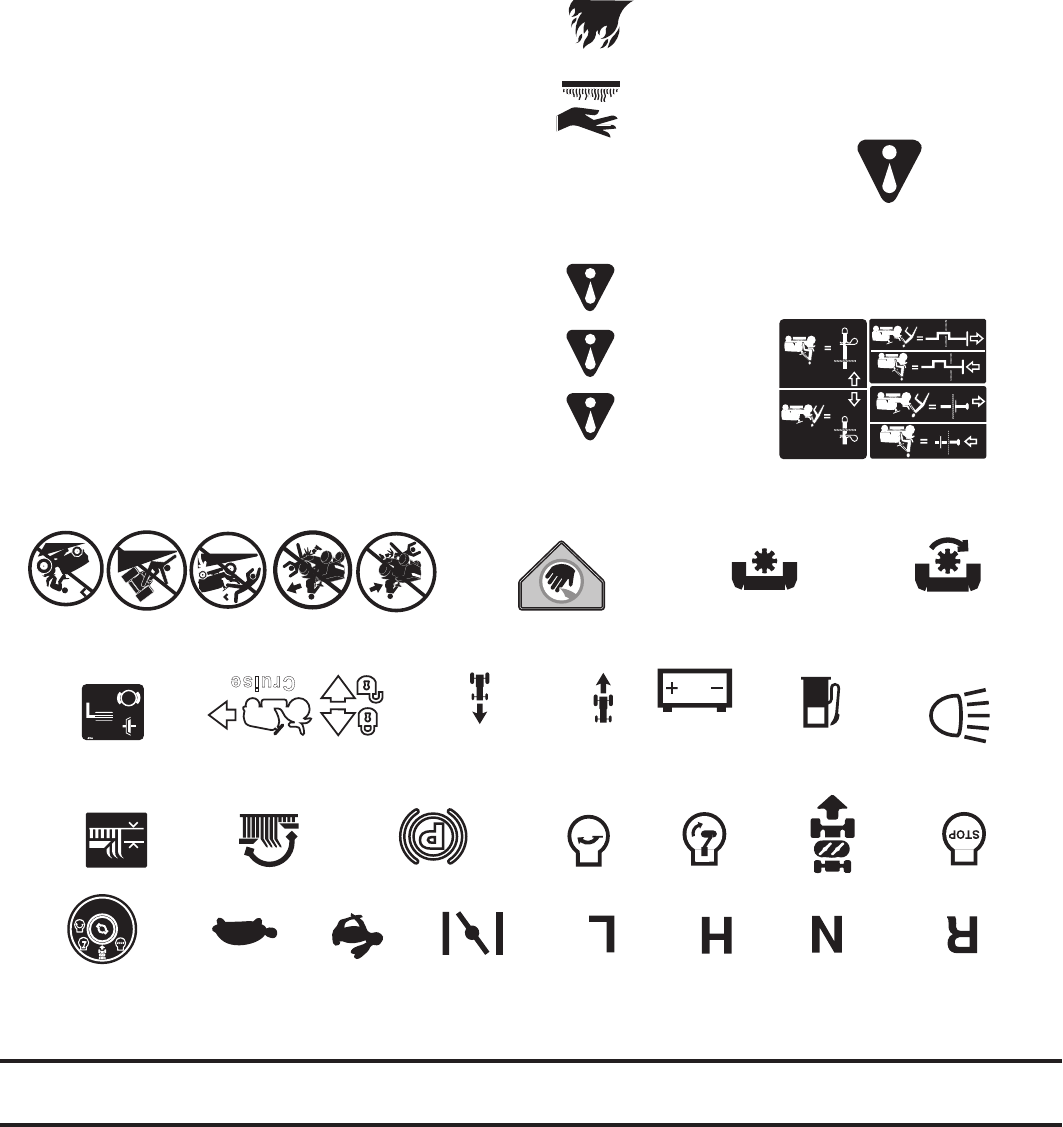
7
Estos símbolos pueden aparecer sobre su tractor o en la literatura proporcionada con el producto. Aprenda y comprenda sus signifi-
cados.
0%,)'2/ª'5!2$%ª,!3ª
-!./3ª9ª,/3ª0)%3ª,%*/3
25%$!ª,)"2%ª
3OLAMENTEªPARAªLOSª
MODELOSªAUTOMATICO
-!.4%.'!ª%,
!2%!ª$%30%*!$!ª
-!.4%.'!ª%,
!2%!ª$%30%*!$!ª
0%,)'2/3ª$%
0%.$)%.4%3
ª
ª
6EAªLAªSECCIØNªDEªLASªREGLASªDEªSEGURIDADª
"!4%2¶! -!2#(!
!42«3 -!2#(!
(!#)!ª!$%,!.4%
2«0)$/ ,%.4/
-/4/2
%.#%.$)$/
-/4/2
!0!'!$/
,5#%3
%.3%.$)$!3 #/-"534)",%
%342!.'5
,!#)».
!,452!ª$%ª,!ª
3%'!$/2!
-!2#(!ª!42«3 .%542/ !,4/ "!*/
!##%3/2)/ª$%,ª
%-"2!'5%
%.'!.#(!$/
&2%./ª$%
%34!#)/.!-)%.4/
!##%3/2)/ª$%,ª
%-"2!'5%
$%3%.'!.#(!$/
ª
-/4/2ª
%.ª-!2#(! ,%6!.4!-)%.4/
ª$%ª,!ª3%'!$/2!
.OªSEGUIRªLASªSIGUIENTESªINSTRUCCIONESª
PUEDEªPROVOCARªHERIDASªOªMUERTEª,OSª
SÓMBOLOSªDEªAVISOªDEªSEGURIDADSEªUTILIZANª
PARAªIDENTIFICARªINFORMACIONESªDEªSEGURIDADª
RELATIVASªAªPELIGROSªQUEªPUEDENPROVOCARªLAª
MUERTEªHERIDASªGRAVESªYOªDA×OSªAªLAª
MÈQUINA
0%,)'2/ªINDICAªUNªPELIGROªQUEªSIªNOªSEªEVITAª
PROVOCAªMUERTEªOªLESIONESªGRAVESª
!$6%24%.#)!ªINDICAªUNªPELIGROªQUEªSIªNOªSEªEVITAª
PUEDEªPROVOCARªMUERTEªOªLESIONESªGRAVESª
02%#!5#)».ªINDICAªUNªPELIGROªQUEªSIªNOªSEªEVITAª
PUEDEªPROVOCARªLESIONESªLIGERASªOªMODERADASª
02%#!5#)».ªCUANDOªSEªUTILIZAªSINªELªSÓMBOLOªDEªAVISOª
INDICAªUNAªSITUACIØNªQUEªPUEDEªPROVOCARªDA×OSªALª
TRACTORªYOªALªMOTORª
&5%'/ªINDICAªUNªPELIGROªQUEªSIªNOªSEªEVITAªPUEDEª
PROVOCARªLAªMUERTEªLESIONESªGRAVESªYOªDANOSª
AªLAªMÈQUINAª
350%2&)#)%3ª#!,)%.4%3ªINDICAªUNªPELIGROªQUEª
SIªNOªSEªEVITAªPUEDEªPROVOCARªLAªMUERTEªLESIONESª
GRAVESªYOªDANOSªAªLAªMÈQUINAª
ª
3)34%-!
&5.#)/.!-)%.4/
!42«3ª2/3
0%$!,ª$%ª&2%./ªª
$%ª%-"2!'5%
0!,!.#!ª$%ª-!.$/ª
#25#%2/
OPERACIÓN

6
MONTAJE
AVISO: Ahora puede rodar su tractor fuera de la corredera.
Siga las siguientes instrucciones para remover el tractor de la
corredera.
ADVERTENCIA: Antes de empezar, leer, entender y seguir
todas las instrucciones presentes en la sección Operaciones
de este manual. Asegurarse que el tractor esté en un área bien
ventilada. Asegurarse que la zona delante del tractor esté libre
de otras personas y objetos.
PARA HACER RODAR EL TRACTOR FUERA DE
LA CORREDERA (VEA LA SECCIÓN DE LA OP-
ERACIÓN PARA LA LOCALIDAD Y LA FUNCIÓN
DE LOS CONTROLES)
• Levante la palanca de levantamiento del accesorio a su
posición más alta.
• Suelte el freno de estacionamiento presionando el pedal del
embrague/freno.
• Ponga el control de la rueda libre en la posición de giro
libre para desenganchar la transmisión. (Vea “PARA
TRANS POR TAR” en la sección de Operación de este ma-
nual).
• Haga rodar el tractor hacia delante fuera de la corredera.
• Remueva las bandas que sujetan la protección contra la
descarga en contra del tractor.
REVISIÓN DE LA PRESIÓN DE LAS LLANTAS
Las llantas en su unidad fueron infladas demasiado en la fábri-
ca por razones de envío. La presión de las llantas correctas es
importante para obtener el mejor rendimiento en el corte.
• Reduzca la presión de los neumáticos a la PSI que se indica
en estos.
REVISIÓN DE LA NIVELACIÓN DEL CONJUNTO
Para obtener los mejores resultados en el corte, la caja de la
segadora tiene que estar nivelada en la forma adecuada. Vea
“PARA NIVELAR LA CAJA DE LA SEGADORA” en la sección
de Servicio y Ajustes de este manual.
REVISIÓN DE LA POSICIÓN ADECUADA DE TO-
DAS LAS CORREAS
Vea las figuras que aparecen para cambiar las correas de impul-
sión de la cuchilla de la segadora y de movimiento en la sección
de Servicio y Ajustes de este manual. Verifique que las correas
sigan su paso correcto.
REVISIÓN DEL SISTEMA DE FRENOS
Una vez que usted haya aprendido a manejar su tractor, verifique
que el freno funcione correctamente. Ver “PARA VERIFICAR
SI FUNCIONA BIEN EL FRENO” en el capítulo de Servicio y
Ajustes de este manual.
✓LISTA DE REVISIÓN
Antes de operar y de disfrutar de su tractor nuevo, le deseamos
que reciba el mejor rendimiento y la mayor satisfaccion de este
producto de calidad.
Haga el favor de revisar la lista a continuacion:
✓ Se han completado todas las instrucciones de montaje.
✓ No quedan partes sueltas en la caja de cartón.
✓ La batería está preparada y cargada en forma adecuada.
✓ El asiento ha sido ajustado en forma cómoda y apretado en
forma segura.
✓ Todas las llantas han sido infladas en forma adecuada. (Para
fines de envío, las llantas se inflaron demasiado en la fábrica.)
✓ Asegúrese que el conjunto segador esté nivelado en forma
adecuada, de lado a lado y desde adelante hacia atrás, para
obtener los mejores resultados en el corte. (Las llantas tienen
que estar infladas en forma adecuada para la nivelación.)
✓ Revise las correas de impulsión y de la segadora. Asegúrese
que recorran el paso adecuado alrededor de las poleas y
dentro de todos los fijadores de las correas.
✓ Revise el alambrado. Fíjese que todas las conexiones todavía
estén seguras y que los alambres estén sujetos en forma
adecuada.
✓ Antes de conducir el tractor, asegúrese que el control de
rueda libre este en la posición de “transmisión enganchada”
(Vea “PARA TRANSPORTAR” en la sección de la Operación
de este manual).
AL MISMO TIEMPO QUE APRENDE A COMO USAR SU
TRACTOR, PRESTE ATENCION EXTRA A LOS PUNTOS DE
IMPORTANCIA QUE SE PRESENTAN A CONTINUACION:
✓ El aceite del motor tiene que llegar al nivel adecuado.
✓ El estanque de combustible tiene que estar lleno con gasolina
sin plomo regular, nueva y limpia.
✓ Familiarícese con todos los controles - su ubicación y
su función. Opérelos antes de hacer arrancar el motor.
✓ Asegúrese que el sistema de frenos esté en una condición
de operación segura.
✓ Asegurarse de que el Sistema de Presencia del Operador
y el Sistema de Funcionamiento Atrás (ROS) funcionan de
modo adecuado (Ver las Secciones de Funcionamiento y
Mantenimiento en este manual).
✓ Es importante purgar la transmisión antes de operar
su tractor por la primera vez. Siga las instrucciones
adecuadas para el empiezo y para purgar (Vea “PARA
EMPESAR EL MOTOR” y “PARA PURGAR LA TRANS-
MISIÓN”) en la sección de la Operación de este manual.
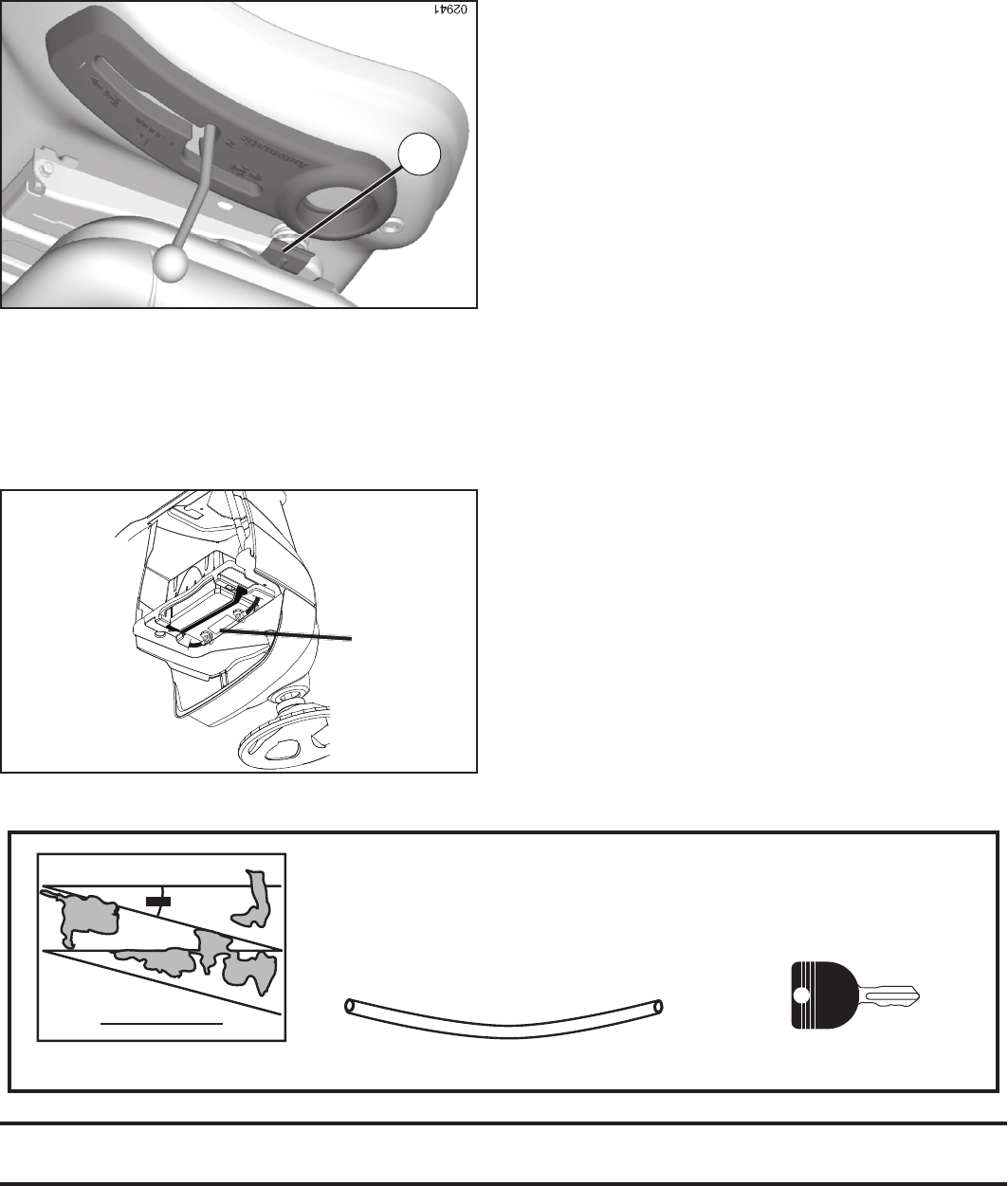
5
PEDAZOS PARA LA MONTAJE
(OJAªDEªPENDIENTE
,LAVES
,LAVE
ª4UBOªDEªDESAGàE
PARA REMOVER EL TRACTOR DE
LA CAJA DE CARTÓN
DESEMPAQUE LA CAJA DE CARTÓN
• Remueva todas las partes sueltas que estén accesibles, y
las cajas de partes, de la caja de cartón grande.
• Cortar a lo largo de las líneas de puntos en todos los cuatro
paneles de cartón. Remover los paneles de cierre y aplanar
los paneles laterales.
• Revise si hay partes sueltas adicionales o cartón y re mué-
va las.
ANTES DE REMOVER EL TRACTOR DE
LA CORREDERA
PARA AJUSTAR EL ASIENTO (Vea Fig. 2)
• Siéntese sobre el asiento.
• Levante la palanca del ajuste (A) hacia arriba y mueva el
asiento hasta que alcance una posición cómoda que le
permita presionar completamente sobre el pedal del freno.
• Desconecte la palanca para trabar el asiento en la posición.
Fig. 2
Su tractor nuevo ha sido montado en la fábrica con la excepción de aquellas partes que no se han montado por razones de envío.
HERRAMIENTAS NECESARIAS PARA EL
MONTAJE
Un juego de llaves de tubo facilitará el montaje. A continuación
se enumeran los tamaños de las llaves estándar.
(2) Llaves de 7/16" Cuchillo para todo uso
(1) Llaves de 1/2" Medidor de presión de las llantas
Pinzas
Cuando en este manual se mencionan los términos “mano de re cha”
o “mano izquierda” se refiere a cuando usted se encuentra en la
posición de operación (sentado/a detrás del volante de dirección).
VERIFIQUE LA BATERÍA (Vea Fig. 1)
• Levante del capota a la posición levantada.
AVISO: Si esta batería esta utilizada después del mes y año
indicado sobre la etiqueta (la etiqueta que se encuentra entre
los terminales), cargue la batería por un mínimo de una hora a
6-10 amps. (Vea “BATERÍA” en la sección de Mantenimento de
este manual).
• Para instale la batería, y cable de la batería, realice el pro-
cedimiento descrito en “REEMPLAZAR LA BATERÍA” del
capítulo de Servicio y Ajustes de este manual.
ETIQUETA
Fig. 1
A

4
ESPECIFICACIONES DEL PRODUCTO FELICITACIONES por la compra de su tractor. Ha sido diseñado,
planificado y fabricado para darle la mejor confiabilidad y el mejor
rendimiento posible.
En el caso de que se encuentre con cualquier problema que no
pueda solucionar fácilmente, haga el favor de ponerse en con-
tacto con un centro de servicio o con un otro centro de servicio
cualificado. Cuenta con técnicos bien capacitados y com pe ten-
tes y con las herramientas adecuadas para darle servicio o para
reparar este tractor.
Haga el favor de leer y de guardar este manual. Estas instruc-ciones
le permitirán montar y mantener su unidad en forma ade cua da.
Siempre observe las “REGLAS DE SEGURIDAD.”
RESPONSABILIDADES DEL CLIENTE
• Lea y observe las reglas de seguridad.
• Siga un programa regular de mantenimiento, cuidado y uso
de su tractor.
• Siga las instrucciones descritas en las secciones “Manten-
imiento” y “Almacenamiento” de este manual.
ADVERTENCIA: Este tractor viene equipado con un motor
de combustión interna y no se debe usar sobre, o cerca, de un
terreno no desarrollado cubierto de bosques, de arbustos o de
césped, o menos que el sistema de escape del motor venga
equipado con un amor ti gua dor de chispas que cumpla con las
leyes locales o estatales (si existen). Si se usa un amortiguador
de chispas, el operador debe mantenerlo en condiciones de
trabajo eficientes.
En el estado de California, la ley exige lo anterior (Sección 4442
del “California Public Resources Code”). Otros estados pueden
contar con otras leyes parecidas. Las leyes federales se aplican
en la tierras federales.
Su centro de Servicio más cer ca no tiene disponible amor ti gua-
do res de chispas para el si len cia dor. (Vea la sección de Partes
de Repuesto en el manual Inglés del dueño.)
Capacidad y Tipo 3 Galones (5,7 L)
de gasolina: Regular Sin Plomo
Tipo de Aceite: SAE 30 (Sobre 32°F/0°C)
(API-SG-SL) SAE 5W30 (Debajo 32°F/0°C)
Capacidad de petróleo Con filtro: 64 Oz. (1,65 L)
Sin filtro: 60 Oz. (1,4 L)
BujÍa: Champion QC12YC
(Abertura: .040")
Velocidad de Delante: 0 - 5,2
Recorrido (MPH): Marcha Atrás: 0 - 2,9
Sistema de Carga: 3 Amps batería
5 Amps Faros
Batería: Amp/Hr: 28
Min. CCA: 230
Case Size: U1R
Torsión del Perno
de la Cuchilla: 45-55 Ft. Lbs. (62-75 Nm)
TABLA DE MATERIAS
REGLAS DE SEGURIDAD ................................................... 2-3
ESPECIFICACIONES DEL PRODUCTO ................................ 4
RESPONSABILIDADES DEL CLIENTE ................................. 4
MONTAJE ............................................................................. 6-8
OPERACIÓN ....................................................................... 9-15
TABLA DEL MANTENIMIENTO ........................................... 16
MANTENIMIENTO ............................................................ 16-19
SERVICIO Y AJUSTES .................................................... 20-25
ALMACENAMIENTO ............................................................. 26
IDENTIFICACIÓN DE PROBLEMAS ............................... 27-28
GARANTÍA ............................................................................. 32
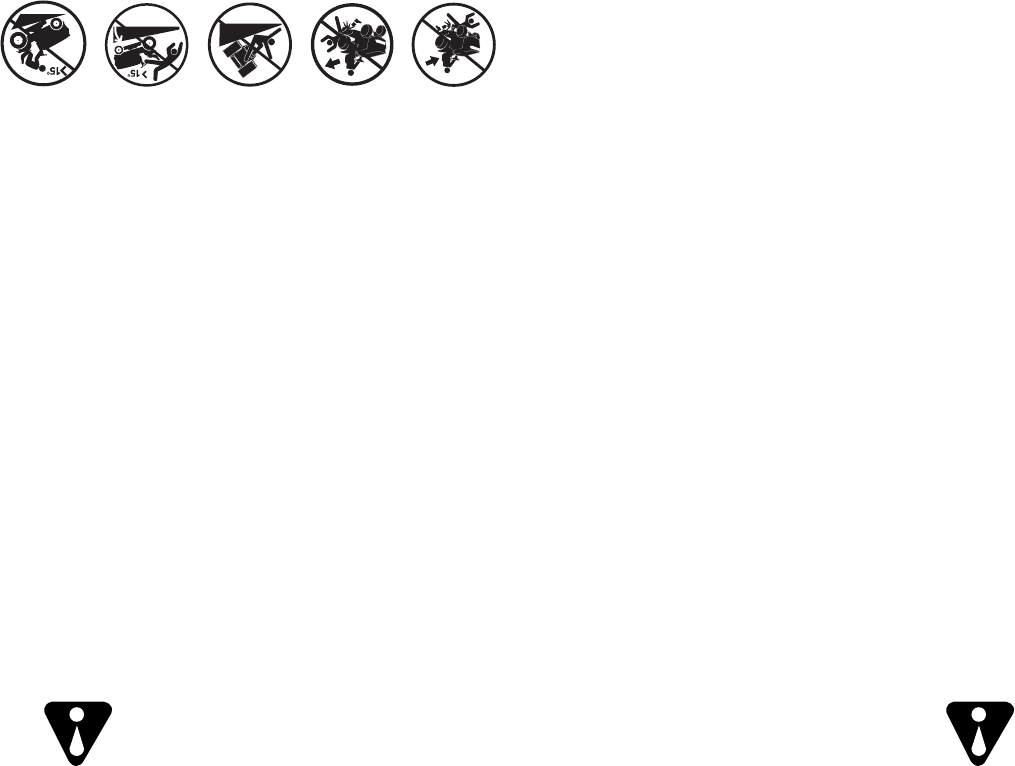
3
III. NIÑOS
Si el operador no pone atención a la presencia de los niños
pueden ocurrir accidentes trágicos. Los niños a menudo están
atraídos por la máquina y las actividad de cortar. No dar por
hecho de que los niños se queden adonde estaban la última
vez que los vistes.
• Mantener los niños fuera del área de corte y vigilados por
un adulto responsable que no sea el operador.
• Estar alerta y apagar la máquina si un niños entra en el área.
• Antes y durante la marcha atrás, mirar adelante y abajo para
ver si hay niños pequeños.
• Nunca llevar niños, incluso si hay las cuchillas apagadas.
Podrían caer y herirse seriamente o interferir con el funcio-
namiento seguro de la máquina. los niños que se han llevado
precedentemente pueden aparecer de pronto en el área de
corte por otro paseo y ser atropellados o tumbados por la
máquina.
• Nunca dejar que los niños manipulen la máquina.
• Tener el máximo cuidado cuando se acerca a cantos ciegos,
arbustos, árboles u otros objetos que pueden impedir la vista
de niños.
IV. REMOLQUE
• Remolcar sólo con una máquina que tenga un gancho dis-
eñado para remolcar. Enganchar el equipo o remolcar sólo
en el punto dispuesto al efecto.
• Seguir las recomendaciones del productor con respecto a
los límites del equipo por remolcar y el remolque en pendi-
entes.
• Nunca permitir que niños u otras personas estén dentro del
equipo por remolcar.
• En pendientes, el peso del equipo remolcado puede causar
la pérdida de tracción y la pérdida de control.
• Viajar despacio y dejar más distancia para frenar.
V. SERVICIO
MANIPULACIÓN SEGURA DE LA GASOLINA
Para evitar heridas personales o daños a las cosas, poner el
máximo cuidado a la hora de manipular la gasolina. La gasolina
es extremamente inflamable y los vapores son explosivos.
• Apagar todos los cigarrillos, cigarros, pipas y otras fuentes
de ignición.
• Usar sólo contenedores para gasolina aprobados.
• Nunca quitar el tapón de la gasolina o añadir carburante
con el motor en marcha. dejar enfriar el motor antes del
abastecimiento de la gasolina.
• Nunca abastecer la máquina al interior de un local.
• Nunca guardar la máquina o el contenedor del car-
burante donde haya una llama abierta, chispas o una luz
piloto como un calentador de agua u otros dispositivos.
• Nunca llenar los contenedores al interior de un vehículo o en
una caravana o camión recubiertos con un forro de plástico.
Colocar siempre los contenedores en el terreno lejos del
vehículo cuando se está llenando.
• Quitar el equipo de gas del camión o caravana y abastecerlo
en el terreno. Si no es posible, abastecer dicho equipo con
un contenedor portátil, más bien que de un surtidor de gaso-
lina.
• Mantener la boquilla a contacto del borde del depósito de
carburante o la abertura del contenedor durante toda la
operación de abastecimiento. No utilizar un dispositivo con
boquilla cerrada-abierta.
• Si se vierte carburante sobre la ropa, cambiarse la ropa
inmediatamente.
• Nunca llenar el depósito más de lo debido. Volver a colocar
el tapón del gas y cerrar de modo firme.
OPERACIONES DE SERVICIO GENERALES
• Nunca hacer funcionar la máquina en un área cerrada.
• Mantener todas las tuercas y pernos apretados para asegu-
rarse de que trabaja en condiciones seguras.
• Nunca modificar los dispositivos de seguridad. Controlar su
correcto funcionamiento regularmente.
• Mantener la máquina libre de hierba, hojas u otros re-
siduos acumulados. Limpiar las salpicaduras de aceite o
carburante y quitar cualquier cosa mojada con carburante.
Dejar que la máquina se enfríe antes de guardarla.
• Si se golpea un objeto ajeno, hay que pararse e inspeccionar
la máquina. Reparar, si es necesario, antes de volver a poner
en marcha.
• Nunca hacer ningún ajuste o reparación con el motor en
función.
• Verifique los componentes de la trampa para césped y la
canaleta de descarga con frecuencia y sustituya con repues-
tos recomendados por el fabricante cuando sea necesario.
• Las cuchillas del cortacésped son afiladas. Envolv-
er la cuchilla, ponerse guantes y poner la máxima
atención cuando se hacen operaciones en ellas.
• Controlar el funcionamiento del freno frecuentemente. Ajustar
y hacer las operaciones de mantenimiento cuando eso sea
necesario.
• Mantener y sustituir las etiquetas de seguridad e instrucción,
cuando sea necesario.
• Asegurarse de que el área esté libre de otras personas antes
de ponerla en marcha. para la máquina si alguien entra en
el área.
• Nunca llevar pasajeros.
• No cortar marcha atrás al no ser absolutamente necesario.
Mirar siempre abajo y delante mientras se procede atrás.
• Nunca llevar niños, incluso si hay las cuchillas apagadas.
Podrían caer y herirse seriamente o interferir con el funcio-
namiento seguro de la máquina. los niños que se han llevado
precedentemente pueden aparecer de pronto en el área de
corte por otro paseo y ser atropellados o tumbados por la
máquina.
• Mantener los niños fuera del área de corte y vigilados por
un adulto responsable que no sea el operador.
• Estar alerta y apagar la máquina si un niños entra en el
área.
• Antes y durante la marcha atrás, mirar adelante y abajo para
ver si hay niños pequeños.
• Cortar hacia arriba y abajo de una pendiente (15° Máx), no
de modo horizontal.
• Escoger una velocidad de marcha baja de modo que no sea
necesario pararse o cambiar estando en una pendiente.
• Evitar arrancar, pararse o girar en una pendiente. Si las rue-
das pierden tracción, desconectar las cuchillas y proceder
despacio cuesta abajo en la pendiente.
• Si la máquina se para mientras va cuesta arriba, desconectar
las cuchillas, poner la marcha atrás y ir hacia atrás despa-
cio.
• No girar estando en pendientes si no es necesario, y luego
girar despacio y gradualmente cuesta abajo, si es posible.
REGLAS DE SEGURIDAD
Prácticas de Operación Seguras para las Segadoras Conducibles
2
ADVERTENCIA
El tubo de escape del motor, algunos de sus constituy-
entes y algunos componentes del vehículo contienen o
desprenden productos químicos conocidos en el Estado de
California como causa de cáncer y defectos al nacimiento
u otros daños reproductivos.
ADVERTENCIA
Los bornes, terminales y accesorios relativos de la bat-
ería contienen plomo o compuestos de plomo, productos
químicos conocidos en el Estado de California como
causa de cáncer y defectos al nacimiento u otros daños
reproductivos. Lavar las manos después de manipularlos.
REGLAS DE SEGURIDAD
PELIGRO: ESTA MAQUINA CORTADORA ES CAPAZ DE AMPUTAR LAS MANOS Y LOS PIES Y DE LANZAR OBJETOS. SI NO SE
OBSERVAN LAS INSTRUCCIONES DE SEGURIDAD SIGUIENTES SE PUEDEN PRODUCIR LESIONES GRAVES O LA MUERTE.
• Nunca dejar una máquina encendida sin vigilancia. Apa-
gar siempre las cuchillas, poner el freno de estaciona-
miento, parar el motor, y quitar las llaves antes de bajar.
• Desenganche las hojas cuando no esté cortando césped.
Apague el motor y espere hasta que todas las partes se
detengan por completo antes de limpiar la máquina, retirar la
trampa para césped o destapar la canaleta de descarga.
• Hacer funcionar la máquina sólo con la luz del día o luz
artificial buena.
• No hacer funcionar la máquina estando bajo los efectos de
alcohol o droga.
• Poner atención al tráfico cuando se opera cerca de calles o
se cruzan.
• Poner la máxima atención al cargar o descargar la máquina
en una caravana o camión.
• Llevar siempre gafas de protección cuando se hace funcionar
la máquina.
• Los datos indican que los operadores a partir de los 60
años están afectados por un gran porcentaje de heridas
relativas a la conducción del cortacésped. Estos opera-
dores tendrían que evaluar su habilidad de hacer funcionar
el cortacésped de modo lo bastante seguro para prote-
ger a sí mismos y a otras personas de heridas graves.
• Seguir las recomendaciones del fabricante para los pesos
y contrapesos de las ruedas.
• Mantener la máquina libre de hierba, hojas u otros es-
combros que pueden tocar el tubo de escape / partes del
motor calientes y quemarse. No permitir que el puente del
cortacésped cargue hojas u otros residuos que pueden
causar acumulaciones. Limpiar toda salpicadura de
aceite o carburante antes de hacer operaciones sobre la
máquina o guardarla. Dejarla enfriar antes de guardarla.
II. FUNCIONAMIENTO EN PENDIENTES
Las pendientes son el mayor factor de accidentes relativos a la
pérdida de control y vuelco, que pueden causar severas heridas
o muerte. El funcionamiento en pendientes requiere una atención
extra. Si no es posible hacer marcha atrás en una pendiente o si
te sientes incomodo, no la cortes.
• Cortar hacia arriba y abajo de una pendiente, no de modo
horizontal.
• Poner atenciones a los hoyos, las raíces, los bultos, las piedras
u otros objetos escondidos. El terreno irregular puede volcar
la máquina. La hierba alta puede esconder obstáculos.
• Escoger una velocidad de marcha baja de modo que no sea
necesario pararse o cambiar estando en una pendiente.
• No cortar la hierba mojada. Las ruedas pueden perder
tracción. Poner siempre una marcha cuando se está en
pendientes. No poner en punto muerto e ir cuesta abajo.
• Evitar arrancar, pararse o girar en una pendiente. Si las rue-
das pierden tracción, desconectar las cuchillas y proceder
despacio cuesta abajo en la pendiente.
• Mantener todo los movimientos en las pendientes lentos
y gradual. No hacer cambios repentinos de velocidad o
dirección, ya que pueden causar el escape de la máquina.
• Poner la máxima atención cuando la máquina funciona con
captadores de hierba u otros dispositivos enganchados;
pueden afectar la estabilidad de la máquina. No usar en
pendientes empinados.
• No intentar estabilizar la máquina poniendo el pie en el ter-
reno.
• No cortar cerca de bajadas, cunetas y orillas. Las máquina
puede volcarse improvisamente si una rueda está en el borde
o se hunde.
I. FUNCIONAMIENTO GENERAL
• Leer, entender y seguir todas las instrucciones sobre la
máquina y en el manual antes de empezar.
• No poner las manos o los pies cerca de partes giratorias o
debajo de la máquina. Mantener siempre limpia la abertura
de descarga.
• Permitir el funcionamiento de la máquina sólo a adultos que
tengan familiaridad con las instrucciones.
• Limpiar el área de objetos como piedras, juguetes, cables,
etc. que pueden ser recogidos y disparados con las cuchil-
las.
• Asegurarse de que el área esté libre de otras personas antes
de ponerla en marcha. Parar la máquina si alguien entra en
el área.
• Nunca llevar pasajeros.
• No cortar marcha atrás al no ser absolutamente necesario.
Mirar siempre abajo y delante mientras se procede atrás.
• Nunca dirigir el material descargado hacia nadie. Evitar des-
cargar material contra paredes u obstrucciones. El material
podría rebotar hacia el operador. Parar las cuchillas cuando
se pasan superficies de grava.
• No maneje la máquina si no tiene la trampa para césped
completa, la canaleta de descarga u otros dispositivos de
seguridad en su lugar y en funcionamiento.
• Ralentizar antes de girar.
ADVERTENCIA: Siempre desconecte el
alam bre de la bujía y póngalo donde no
pueda entrar en contacto con la bujía, para
evitar el arranque por accidente, durante la
pre pa ra ción, el transporte, el ajuste o cuan do
se hacen reparaciones.
ADVERTENCIA: No avance cuesta abajo a
punto muerto ya que podría perder el control
del tractor.
ADVERTENCIA: Remolque solamente los
accesorios recomendados y conformes a las
características indicadas por el fabricante
de su tractor. Tenga cuidado y prudencia al
utilizar el tractor. Cuando se encuentre en
un declive, oper utilizando exclusivamente la
velocidad más baja. En caso de un declive una
carga excesiva podría resultar peligrosa. Los
neumáticos pueden perder la tracción con el
suelo y hacerle perder el control de su tractor.
Prácticas de Operación Seguras para las Segadoras Conducibles
MANUAL IMPORTANTE NO TÍRALO A FUERA
MANUAL DE OPERARIO
MODEL:
PB20H42YT
TRACTOR PARA CÉSPED
SIEMPRE USE PROTECCIONES PARA LOS OJOS MIENTRAS OPERE ESTE TRACTOR
Vea la página web: www.poulan-pro.com
ADVERTENCIA:
Leer, entender y seguir todas las instruc-
ciones sobre la máquina y en el manual
antes de empezar. Si no se observan las in-
strucciones de seguridad siguientes se pu-
eden producir lesiones graves o la muerte.
532 44 04-54 11.15.10 BAD Impreso en los U.S.A.
