

Alcatel-Lucent ALE-500 OXO Connect Enterprise DeskPhone User Manual
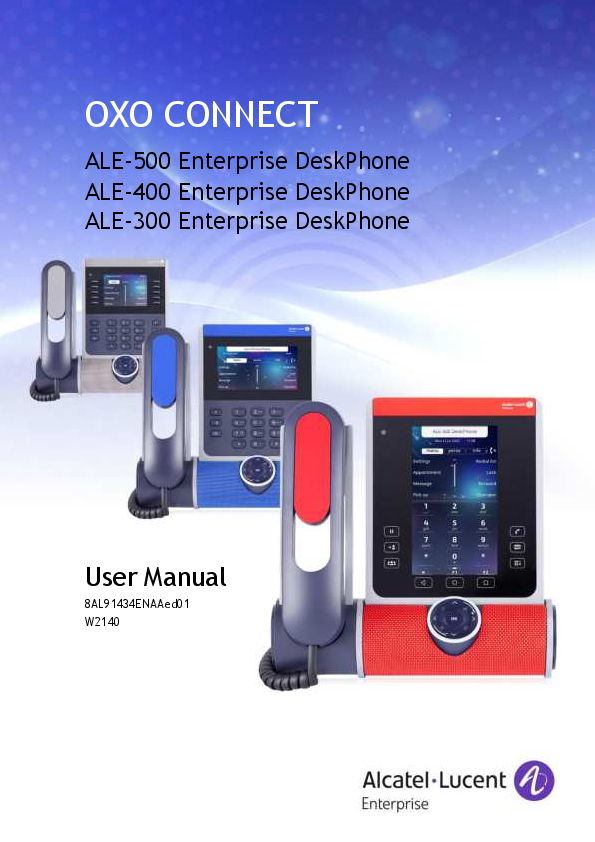
OXO Connect ALE-500/ALE-400/ALE-300 Enterprise DeskPhones User manual
This document describes the services offered by the following desk phones connected to an OXO Connect or OXO Connect Evolution system : ALE-500 Enterprise DeskPhone (ALE-500), ALE-400 Enterprise DeskPhone (ALE-400), ALE-300 Enterprise DeskPhone (ALE-300).
8AL91434ENAA;Set;Desk, Phone;8000, Family;User Manual
PDF OXO Connect ALE-500/ALE-400/ALE-300 Enterprise DeskPhones...
Introduction. Thank you for choosing an Alcatel-Lucent Enterprise desk phone. This document describes the services offered by the following desk phones connected to an OXO Connect or OXO...
OXO Connect ALE-500/ALE-400/ALE-300 Enterprise DeskPhones ...
User Manual 8AL91434ENAAed01 4 /102 1 Getting to know your telephone 9 1.1 ALE-500 Enterprise DeskPhone 9 1.1.1 Phone description 9 1.1.2 Virtual keyboard / Virtual add-on module 10
Go Now
Al-enterprise.com View guide user manual › Url: https://www.al-enterprise.com/-/media/assets/internet/documents/oxo-um-ale-500-400-300-r100-8al91434enaa-1-en
Extracted Text
OXO CONNECT
ALE-500 Enterprise DeskPhone ALE-400 Enterprise DeskPhone ALE-300 Enterprise DeskPhone

User Manual
8AL91434ENAAed01 W2140
8AL91434ENAAed01

1 /102

User Manual
Introduction
Thank you for choosing an Alcatel-Lucent Enterprise desk phone.

This document describes the services offered by the following desk phones connected to an OXO Connect or OXO Connect Evolution system.

� ALE-500 Enterprise DeskPhone (ALE-500). � ALE-400 Enterprise DeskPhone (ALE-400). � ALE-300 Enterprise DeskPhone (ALE-300).

ALE-500/ALE-400/ALE-300 Enterprise DeskPhone are the next generation of business phones with innovative and sleek industrial design built for every workstyle and workplace with vertical capabilities in the Enterprise environment.

The modular design associated with hardware and software customization capabilities offers a large spectrum of configurations to satisfy the business communications requirements of all workers generation from touch screen to physical soft keys and dialpad.

A smart touch control wheel enables legacy and future voice-oriented feature to provide a new evolutive user experience.

A wide choice is possible for professional end users with Corded Handset, Cordless Handset or No Handset, wired or wireless headset option, touch or key expansion module and physical or virtual alphabetic keyboard.

These devices are designed for 3D Symphonic HD (Enhanced High Definition Audio quality) to complement worker's computer and mobile phone with AudioHub feature, to offer Artificial Intelligence (AI) Smart Speaker - Smart Display feature for business communications.

3D Symphonic HD Audio quality is based on multi-microphone, bass reflex system with passive radiator for clear natural voice, full duplex audio for simultaneous conversation.

These desk phones are robust, future-proof, durable products based on state-of the art hardware and software platform with rich connectivity options (Dual Port Gigabit Ethernet, Wi-Fi, Bluetooth�, Dual USB-C, NFC) to be used in any communication infrastructure wired or wireless from on-premises to cloud deployment with retro-compatibility with customers installation.

ALE-500/ALE-400/ALE-300 are an all-in-one products, business phone, speaker phone and conference phone that can also charge a smart phone, with smart power management and easy to manage-easy to deploy feature to minimize the variety of devices in the Enterprise space in order to contribute to power consumption reduction.

ALE-500/ALE-400/ALE-300 include mechanisms for deploying new binaries and opening the desk phone to other systems.

To know the latest news, contact your administrator who has access to the last release notes. For example, check the availability of some features.

8AL91434ENAAed01

2 /102

User Manual
The labels and icons displayed depend on the type and the skin of the set. The label is not displayed if the corresponding feature is not configured on your telephone system. Depending on the size of the display, some labels may be truncated. All labels are displayed in color and are italicized. This icon describes a succession of actions or labels you have to do or select: . This icon describes the consequence of an action: .

8AL91434ENAAed01

3 /102

User Manual

1
1.1 1.1.1 1.1.2 1.1.3 1.2 1.2.1 1.2.2 1.3 1.3.1 1.3.2 1.4 1.4.1 1.5 1.6 1.7 1.7.1 1.7.2 1.7.3 1.8 1.9 1.9.1 1.9.2 1.9.3 1.9.4 1.10 1.11 1.12 1.13 1.14 1.14.1 1.14.2 1.14.3 1.15
2
2.1 2.2 2.2.1 2.2.2 2.2.3 2.2.4 2.2.5 2.3 2.3.1 2.3.2 2.3.3 2.3.4 2.3.5 2.3.6 2.4 2.5 2.6 2.7 2.8

Getting to know your telephone

9

ALE-500 Enterprise DeskPhone

9

Phone description

9

Virtual keyboard / Virtual add-on module

10

Ordering options and supported accessories

10

ALE-400 Enterprise DeskPhone

11

Phone description

11

Ordering options and supported accessories

12

ALE-300 Enterprise DeskPhone

13

Phone description

13

Ordering options and supported accessories

14

Removable keys (ALE-400, ALE-300)

14

To install new keys

15

Compatible accessories

15

Unboxing

16

Smart Pad

17

Description

17

Smart Pad gesture

18

LED

18

Change the theme (skin) of your phone

20

Welcome screens

21

Homepage description

21

Choose the page displayed by default on the telephone

21

Main screen and navigation keys

22

Call management screen

23

User local menu

24

Status icons/ Call icons

26

Permanent features keys

27

Alphanumeric keyboard (ALE-400, ALE-300)

28

Connectors

29

Description of the connectors

29

Plug in the phone

29

Power boost

29

Telephony encryption

29

Using your telephone

30

Identify the terminal you are on

30

Messaging portal

30

Accessing the messaging portal

30

Configure access to the messaging portal

30

Accessing the features of the messaging portal

30

Acknowledging

30

Deleting

31

Consulting the call log

31

Consult missed calls

31

Acknowledge all missed calls

31

Delete all missed calls.

32

Consulting all calls

32

Acknowledge all missed calls

32

Delete all call logs

32

Making a call

32

Receiving a call

33

Ignore the call

33

Switching between audio modes

34

Activating the loudspeaker during a conversation (handset lifted) - Group listening feature 35

8AL91434ENAAed01

4 /102

User Manual

2.9 2.9.1 2.9.2 2.10 2.11 2.11.1 2.11.2 2.12 2.13 2.13.1 2.14 2.15 2.16 2.16.1 2.16.2 2.16.3 2.17 2.18 2.19 2.19.1 2.19.2 2.19.3 2.20 2.21 2.21.1 2.21.2 2.21.3 2.22 2.23 2.24 2.25 2.25.1 2.26 2.27 2.28 2.29 2.30 2.30.1
2.30.2 2.30.3 2.31 2.31.1 2.31.2 2.32 2.32.1 2.33 2.34 2.35 2.36 2.37 2.38 2.39 2.40 2.41 2.42 2.43 2.44

Making calls by name (company directory)

35

Calling a contact using the unified directory

35

Calling a contact using the internal directory (predictive search)

36

Make calls via your programmed call keys (Perso page/F1 and F2 keys/Add-on module) 36

Filtering calls using the voice mailbox

37

Activating call screening

37

When you receive a call

37

Redialing

37

Requesting automatic callback if internal number is busy

37

Cancelling an automatic callback

37

Receiving interphony calls

38

Sending DTMF signals

38

Mute, so that your contact cannot hear you

38

From the set

38

From the Bluetooth� handset (Bluetooth� wireless handset)

39

From the headset

39

Forwarding calls to your voice message service

39

Consulting your voice mailbox

39

Sending an instant message to a contact

40

Sending an instant message using the search by name feature

40

Sending an instant message using the phone number

40

Status of the instant messages

41

Consulting instant messages

41

Answering with an instant message

42

Answering an Instant message

42

Answering a voice message

43

Answering from the call log

43

Lock / unlock your telephone

43

Placing a call on hold (hold)

43

Placing an external call on hold (parking)

44

Making a second call during a conversation

44

Retrieve the call on hold

44

Answering a second call during a conversation

45

Switching between calls (Broker call)

45

Transferring a call

45

Transfer a call to a voice mail

46

Three-way conference with internal and/or external contacts (conference)

46

Cancel the conference and recover the last active call before the conference (the other is on

hold) (If conference is active)

46

End the conference with all participants (If conference is active)

46

After the conference, to leave your two contacts talking together

46

'Meet me' conference

47

Initiate a 'Meet me' conference

47

Join a 'Meet me' conference

47

Intrusion into an internal conversation (barge-in)

48

Protection against intrusion

48

Save a number into your personal directory

48

Selecting calls to be forwarded

48

Forwarding calls to another number (immediate forward)

48

Forwarding calls when your line is busy (forward if busy)

48

Personal assistant: reaching you with one number only

49

Activate/disable the personal assistant

49

Do not disturb

49

Forwarding your calls from the receiving terminal ('Follow me')

49

Forwarding all group calls

50

Forwarding calls to your pager

50

Cancelling all forwards

50

Cancelling a specific forward

50

8AL91434ENAAed01

5 /102

User Manual

2.45 Leaving a text message for internal callers 2.45.1 Sending predefined message 2.45.2 Sending a new message 2.46 consulting text messages 2.47 Send a voice message copy 2.48 Sending a recorded message to a number or a distribution list 2.49 Message notification 2.49.1 Change the time slot 2.50 Receiving supervised call ringing 2.51 Answering the general bell 2.52 Manager/Assistant filtering 2.52.1 From the manager or assistant telephone 2.53 Call pick-up 2.54 Answering briefly in place of the operator 2.55 Hunting groups 2.55.1 Hunting group call 2.55.2 Temporary exit from your hunting group/Return into your group 2.56 Calling an internal contact on his/her pager 2.57 Answering a call on your pager 2.58 Calling a contact on his/her loudspeaker 2.59 Broadcasting a message on the loudspeakers of a station group 2.60 ACD: Agent set/ Supervisor station 2.60.1 Agent set 2.60.2 Open an agent session (login) � Agent set 2.60.3 ACD application welcome screen � Agent set 2.60.4 The four operating statuses of the agent set 2.60.5 Changing the operating status of the set � Agent set 2.60.6 Modifying your personal code � Agent set 2.60.7 Integrating another group/leaving a group � Agent set 2.60.8 Close the agent session (logout) � Agent set 2.60.9 Supervisor station 2.60.10 Supervising group mailboxes � Supervisor station

3

Do more with your desk phone

3.1 3.1.1 3.1.2 3.1.3 3.1.4 3.1.5 3.1.6 3.1.7 3.2

Configure your phone for remote working Access to the administration menu of the desk phone First connection as remote working Change the configuration PIN code Reset your PIN code Reconnect your desk phone in your business place Reconnect your desk phone in remote place Beacon: using your desk phone for geo-localization in the enterprise

4

Programming your telephone

4.1 4.2 4.3 4.4 4.4.1 4.4.2 4.4.3 4.4.4 4.4.5 4.4.6 4.5 4.6

Initializing your voice mailbox Customizing your voice greeting Modifying your personal code Adjusting the audio functions Choose the tune Adjusting the ringer volume Activate/deactivate silent mode Activate/deactivate meeting mode (progressive ringing) Activate/deactivate discreet ring mode Adjust ringer volume while a call arrives Audio ambiences Hearing Aid

8AL91434ENAAed01

50 50 51 51 51 52 52 52 52 53 53 53 53 53 54 54 54 54 54 54 54 55 55 55 55 55 56 56 56 56 56 56
57
57 57 58 59 59 59 60 60 61
62
62 62 62 63 63 63 63 63 63 64 64 64
6 /102

User Manual

4.7 Adjusting the brightness of the desk phone

64

4.7.1 Auto-adjusting of the brightness

64

4.7.2 Adjust the brightness when the phone is not in use

64

4.7.3 Adjust the brightness when the phone is in use

65

4.7.4 Adjust the dimmed brightness when the phone is not in use

65

4.7.5 Set the delay before the brightness is dimmed when the phone is not in use (screensaver) 65

4.8 Selecting the welcome page

65

4.9 Selecting language

65

4.10 Programming direct call keys (Perso page/F1 and F2 keys/Add-on module)

66

4.11 Customize the color and the style of programmable softkeys

67

4.12 Modifying direct call keys

67

4.13 Deleting direct call keys

67

4.14 Programming an appointment reminder

68

4.15 Install a USB accessory (Headset, Handsfree, Loudspeaker)

68

4.16 Installing a Bluetooth� Wireless Technology headset (pairing)

68

4.17 Manage connected devices

69

4.17.1 List of connected devices

69

4.17.2 Default device

70

4.18 Using a Bluetooth� Wireless Technology headset

70

4.19 Display all paired Bluetooth� devices

70

4.20 Removing a Bluetooth� accessory (headset, handset, etc.)

70

4.21 Activating/Deactivating 'Forced headset' mode

71

4.22 Contacting your administrator (Technical support)

71

4.22.1 Date code / Technical code

71

4.22.2 Software version

71

4.22.3 Hardware model

71

4.22.4 Documentation

71

4.22.5 Rainbow

71

4.22.6 Legal notice

72

4.22.7 Access to administrator configuration

72

4.22.8 Auto update the desk phone via USB key

72

4.22.9 Send your desk phone or your add-on module to support

73

4.22.10 Copy logs on USB drive

73

5

Accessories

74

5.1 List of accessories

74

5.1.1 USB accessories

74

5.1.2 Bluetooth� accessories

74

5.1.3 Other headsets

74

5.1.4 Other accessories

74

5.2 ALE-160 WB Cordless Handset

75

5.2.1 Description

75

5.2.2 Unboxing

76

5.2.3 LED

76

5.2.4 Installing or replacing the Bluetooth� handset battery

76

5.2.5 Enable Bluetooth�

77

5.2.6 Pairing and connecting the Bluetooth� wireless handset

77

5.2.7 Information about the connected handset and the battery level

78

5.2.8 Voice prompts

78

5.2.9 Activate/deactivate the beep touch instead of the voice prompts

79

5.2.10 Locate your handset

79

5.2.11 Remove the handset

79

5.2.12 Upgrade the handset

79

5.3 ALE-150 SWB Corded Handset

80

5.3.1 Description

80

5.3.2 Unboxing

80

5.3.3 Install a comfort wired handset

80

8AL91434ENAAed01

7 /102

User Manual

5.4 Magnetic alphabetic keyboard: ALE-100 keyboard (USB)

81

5.4.1 Description

81

5.4.2 Unboxing

81

5.4.3 Installation

81

5.4.4 How to use the keyboard

82

5.5 ALE-140 Customization kit

83

5.5.1 Description

83

5.5.2 Unboxing

83

5.5.3 Remove or install the customization kit

83

5.6 ALE-120 Key Expansion Module

86

5.6.1 Description

86

5.6.2 Unboxing

86

5.6.3 Connectors

86

5.6.4 Installation

87

5.6.5 Smart Pad

90

5.6.6 LED description

90

5.6.7 Programming keys

90

5.7 ALE-110 Wall Mounting Kit

91

5.7.1 Wall mount installation

91

5.8 ALE-108 Wireless Module

93

5.8.1 Description

93

5.8.2 Unboxing

93

5.8.3 Installation

93

5.9 Third parties headset certified in Developer and Solution Partner Program (DSPP)

94

6

Technical specifications

95

7

Ordering information

96

8

Guarantee and clauses

97

8.1 Safety Instructions

97

8.2 Regulatory Statements

98

Quick guide

101

8AL91434ENAAed01

8 /102

User Manual
1 Getting to know your telephone
1.1 ALE-500 Enterprise DeskPhone
This phone is part of the Enterprise and IP phone ranges.With its 5.5 inch color touch display and an intuitive navigation Smart Pad, the ALE-500 Enterprise DeskPhone (ALE-500) delivers a great user experience and increased convenience with an outstanding super wideband audio quality (3D Symphonic HD) in hands-free mode with a 3D audio. Its large screen can display a numeric or alphabetic keyboard and a virtual add-on with 12 keys. You can change the color of the phone by using an ALE-140 DeskPhone customization kit (Neptune Blue in the following picture). You can personalize the phone by selecting a theme (skin). It is compatible with remote working. Consequently, it is perfect for use in your Enterprise office or in Home working. Depending on the model, your desk phone improves your experience with its Bluetooth� handset. Your phone is 'Bluetooth� Smart Ready'. You can use your desk phone (hands-free mode, handset or headset) to make and receive call from your mobile phone or your personal computer.
1.1.1 Phone description

1 Smart Pad.

Color touch display with auto brightness adjustment which enhances user experience and saves 2 power (ambient light sensor).

Depending on the model of your phone, it is equipped with one of the following handsets:

3

� Cordless Bluetooth� handset (ALE-160 WideBand Cordless Handset).

� Corded handset (ALE-150 Super WideBand Corded Handset).

Permanent feature keys: quick access to the phone's main features.

4

: These predefined keys depend on the system and are reserved for specific

countries as United States. In case they are not configured as hold, tranfer and conference

keys, these keys are programmable.

5 Super wideband loudspeaker for optimized sound (3D audio).

6 Magnetic alphabetic keyboard (optional - ALE-100 Keyboard).

7 An adjustable and stable foot (60� to 0�).

8 Connectors.

9 Slot for inserting the wireless module cartridge (optional - ALE-108 Wireless Module).

10 Busy light logo on back shell.

8AL91434ENAAed01

9 /102

User Manual 1.1.2 Virtual keyboard / Virtual add-on module In addition to default homepage, the screen of the ALE-500 allows to display a virtual add-on, a numeric keyboard and an alphabetic keyboard. The appearance depends on the selected skin. Browse between different screens by swiping left or right:
1.1.3 Ordering options and supported accessories
There are three commercial variants of the ALE-500: � The desk phone with cordless handset (ALE-500, ALE-160, ALE-108). � The desk phone with corded handset (ALE-500, ALE-150). � The desk phone without handset with ALE-108 wireless module (ALE-500, ALE-108).
Some options can complete your order such as the addition of the keyboard (ALE-100), the wireless module (ALE-108), an expansion module (ALE-120) or a Bluetooth� handset (ALE-160).

8AL91434ENAAed01

10 /102

User Manual
1.2 ALE-400 Enterprise DeskPhone
This phone is part of the Enterprise and IP phone ranges. With its 4.3 inch color touch display and an intuitive navigation Smart Pad, the ALE-400 Enterprise DeskPhone (ALE-400) delivers a great user experience and increased convenience with an outstanding super wideband audio quality (3D Symphonic HD) in hands-free mode with a 3D audio. You can change the color of the phone by using an ALE-140 DeskPhone customization kit (Neptune Blue in the following picture). You can personalize the phone by selecting a theme (skin). It is compatible with remote working. Consequently, it is perfect for use in your Enterprise office or in Home working. Depending on the model, your desk phone improves your experience with its Bluetooth� handset. Your phone is 'Bluetooth� Smart Ready'. You can use your desk phone (hands-free mode, handset or headset) to make and receive call from your mobile phone or your personal computer.
1.2.1 Phone description

1 Smart Pad.

Color touch display with auto brightness adjustment which enhances user experience and saves 2 power (ambient light sensor).

Depending on the model of your phone, it is equipped with one of the following handsets:

3

� Cordless Bluetooth� handset (ALE-160 WideBand Cordless Handset).

� Corded handset (ALE-150 Super WideBand Corded Handset).

Permanent feature keys: quick access to the phone's main features.

(a) 3 permanent keys (Hang up key, messaging key, local menu key)

(b) 3 removable keys depending on the system configuration (F1/F2/abc, Hold/

4

Transfer/Conference). In case they are not configured as hold, tranfer and conference

keys, these keys are programmable. When a magnetic keyboard is connected, 'abc' key

is programmable.

5 Super wideband loudspeaker for optimized sound (3D audio).

6 Magnetic alphabetic keyboard (optional - ALE-100 Keyboard).

7 An adjustable and stable foot (60� to 0�).

8 Connectors.

9 Slot for inserting the wireless module cartridge (optional - ALE-108 Wireless Module).

10 Busy light logo on back shell.

8AL91434ENAAed01

11 /102

User Manual 1.2.2 Ordering options and supported accessories
There are two commercial variants of the ALE-400: � The desk phone with cordless handset (ALE-400, ALE-160, ALE-108). � The desk phone with corded handset (ALE-400, ALE-150).
Some options can complete your order such as the addition of the keyboard (ALE-100), the wireless module (ALE-108), an expansion module (ALE-120) or a Bluetooth� handset (ALE-160).

8AL91434ENAAed01

12 /102

User Manual
1.3 ALE-300 Enterprise DeskPhone
This phone is part of the Enterprise and IP phone ranges. With its 3.5 inch color display that comes with ten dedicated function keys and an intuitive navigation Smart Pad, the ALE-300 Enterprise DeskPhone (ALE-300) delivers a great user experience and increased convenience with an outstanding wideband audio quality or super wide band using the ALE-150 SWB Corded Handset. You can change the color of the phone by using an ALE-140 DeskPhone customization kit (Neptune Blue in the following picture). You can personalize the phone by selecting a theme (skin). It is compatible with remote working. Consequently, it is perfect for use in your Enterprise office or in Home working. You can use your desk phone (hands-free mode, handset or headset) to make and receive call from your mobile phone or your personal computer.
1.3.1 Phone description

1 Smart Pad.

Color display with auto brightness adjustment which enhances user experience and saves power 2 (ambient light sensor).

3 10 dedicated functions keys. 4 Corded handset (ALE-150 Super WideBand Corded Handset).

Permanent feature keys: quick access to the phone's main features.

(a) 3 permanent keys (Hang up key, messaging key, local menu key)

5

(b) 3 removable keys depending on the system configuration (F1/F2/abc, Hold/

Transfer/Conference). In case they are not configured as hold, tranfer and conference

keys, these keys are programmable. When a magnetic keyboard is connected, 'abc' key

is programmable.

6 Wideband loudspeaker for optimized sound.

7 Magnetic alphabetic keyboard (optional - ALE-100 Keyboard).

8 An adjustable and stable foot (60� to 0�).

9 Connectors.

10 Slot for inserting the wireless module cartridge (optional - ALE-108 Wireless Module).

11 Busy light logo on back shell.

8AL91434ENAAed01

13 /102

User Manual 1.3.2 Ordering options and supported accessories

The ALE-300 Enterprise DeskPhone is available in one version: the desk phone with corded handset.
Some options can complete your order such as the addition of the keyboard (ALE-100), the wireless module (ALE-108) and an expansion module (ALE-120).
1.4 Removable keys (ALE-400, ALE-300)
Depending on the configuration of the system, three keys can have different features.
By default, your desk phone is equipped with:
Programmable key.
Programmable key.
Alphabetic keypad / Programmable key.
The 'abc' key is either a key that switches between alphabetic and numeric keyboards (alphanumeric key) or a programmable key if an optional keyboard is already connected to the phone. F1 and F2 keys are programmable keys.
Your desk phone can also be equipped with a magnetic alphabetic keypad: ALE-100 keypad (sold separately). In this case, the alphanumeric key is disabled. The dedicated key can therefore be programmed.
If configured, you can install the three other keys. These predefined keys depend on the system and the countries, contact your installer for more information about your system.
Hold key Placing a call on hold / Retrieve the call on hold. Transfer key Transfer the call to another number. Conference key To establish a three-party conference call.

8AL91434ENAAed01

14 /102

User Manual
1.4.1 To install new keys
The extra keys are provided hanging on a support so that they do not get lost. The new key is easily detached.
� On the desk phone, take the key to replace between thumb and forefinger and pull gently to remove it. Two small notches on the side of the key allow you to lift it with your fingernail if necessary.
� Insert the new key into its slot by gently pressing it (as if you were using this key).
� Keep the old keys if necessary.
1.5 Compatible accessories
The following accessories are compatible with your desk phone and can be ordered separately: � ALE-100 Keyboard � ALE-108 Wireless Module � ALE-120 Key Expansion Module � ALE-160 WB Cordless Handset(1) � ALE-110 Wall Mounting Kit � ALE-140 Factory Customization Kit � ALE-140 Azur Customization Kit � ALE-140 Ruby Customization Kit � ALE-140 Neptune Customization Kit � ALE-150 SWB Corded Handset � USB-C 5V 3A Power Adapter
(1)not available for the ALE-300.
You can order a compatible accessory to make your desk phone evolve (see following sections: Accessories, Ordering information).

8AL91434ENAAed01

15 /102

User Manual
1.6 Unboxing
Your phone is modular. Several options are possible depending on your specific requirements.

Options delivered in the box depend on the model of your desk phone.
The following table lists all options regarding the model of your desk phone. You can order a compatible accessory to make your desk phone evolve.

ALE-500 Enterprise DeskPhone

ALE-400 Enterprise DeskPhone

ALE-300 Enterprise DeskPhone

3ML27500 3ML27510 3ML27520 3ML27410 3ML27420 3ML27310

Safety and regulatory instructions

x

x

x

x

x

x

Desk phone (base)

x

x

x

x

x

x

Corded handset

x

x

x

Cordless Bluetooth� handset

x

x

Not supported

Wireless

cartridge(1)

x

Removable keys(2)

x

x

x

x

x

Default color: Neptune Blue(3)

x

x

x

x

x

x

(1)Your phone is equipped with: ALE-108 Wireless Module.

(2)Your phone is equipped with three removable keys. F1/F2/abc keys are installed by default.

Hold/Transfer/Conference keys are delivered with your phone.

(3)The color of the desk phone is 'Neptune Blue' by default. You can change it by using a customization kit

sold separately (ALE-140).

The network cable (RJ45) is not delivered with the phone.

8AL91434ENAAed01

16 /102

User Manual
1.7 Smart Pad
1.7.1 Description

Hands-free/Loudspeaker key Pressing this key answers an incoming call in hands-free mode (when activated, the key is lit blue). When a call is in progress, pressing this key switches from hands-free mode to headset or handset mode. A long press activates the loudspeaker when a call is in progress via the handset or headset. A long press in idle state displays audio devices and lets you define the default audio device if you have connected the same type of accessory onto different connectors. Mute and interphony key Mute key: during a call, press this key to stop your contact from hearing you. When activated, the key is lit in blue and the Smart Pad ring in red. Interphony key: When idle, press this key to switch the phone to interphony mode. When you receive a call, the phone automatically answers into hands-free mode. This key lights up blue when activated. Interphony can be disabled by the administrator. Back/Exit key Use this key to go back to the previous step (short press). Use this key to go back to the homepage (long press). Use this key to delete one number or character at a time. Audiohub - Future use. To know the latest news, contact your administrator who has access to the last release notes. Use your desk phone as a Bluetooth� or USB audiohub. Plug a headset or PC into the desk phone using the USB connector, pair your smartphone through Bluetooth�, and leverage the desk phone 3D Symphonic HD audio.
Up-down navigator: used to scroll through the content of a page.
Left-right navigator: in idle state, use this key to move from one page to another. In conversation, use this key to move between tabs of current calls (call in progress, calls on hold, incoming call). In the text edition, use this key to navigate into the text box.
Rotate clockwise Turn up the volume (ringing or call state). Increase the brightness (idle state). Rotate counter clockwise Turn down the volume (ringing or call state). Decrease the brightness (idle state). OK key: Use this key to validate your choices and options while programming or configuring. Use this key to answer an incoming call with the default audio device. Use this key to turn on or off the back light in idle state. Long press this key to launch vocal assistant (depending on the software version).

8AL91434ENAAed01

17 /102

User Manual
1.7.2 Smart Pad gesture Short press

Long press

Rotate

The light ring is not touch sensitive. Please place your finger in the hollow of the Smart Pad for any actions.
1.7.3 LED The Smart Pad contains a large number of notifications indicated by the color of the leds.
The ring around the Smart Pad and the keys can light up depending on the event. The ring can light up completely or partially depending on the case.
1.7.3.1 Smart Pad ring Smart Pad ring is composed with 8 segments which can be lighted up in blue, red or purple:

Blue = Active 1.7.3.2 Smart Pad keys

Red = Warning

Purple = Other

No light = Inactive

4 keys on the Smart Pad are lit in blue when activated. These keys are dimly lit in blue to show available actions (hands-free, mute, back, exit).

8AL91434ENAAed01

18 /102

User Manual

1.7.3.3 LED management Legend:

Switch off

Strongly lit in blue

Dimly lit leds indicate the available actions.

LED
In idle state, awake, Interphony activated
Incoming call (ringing)
In conversation with handset or headset In conversation in handsfree mode Muted with handset or headset
Muted in hands-free mode

Smart Pad ring

During settings (Settings)

Blinking in blue

1.7.3.4 Use cases Incoming calls
During conversation

The Smart Pad ring is blinking blue. The hands-free/loudspeaker key is blinking blue to show hands-free hook-off capacity.
You are in conversation with the handset or the headset. The Smart Pad ring is lit in blue.

Press the hands-free/loudspeaker key to switch in hands-free mode. The key is lit in blue.

You are in conversation. Press the mute key. The key is lit in blue. The Smart Pad ring is lit in red. The microphone is muted.

8AL91434ENAAed01

19 /102

User Manual
1.7.3.5 Other use cases Idle state

Boot During boot phase, boot steps are represented by lit led on the Smart Pad ring: finished steps are fully lit up in blue, current booting step is blinking in blue and next steps will be off.
Update During software update, the Smart Pad ring rotates clockwise in purple until the update is finished.

1.8 Change the theme (skin) of your phone
You can change the theme of your phone among the 5 proposed (the following images are from: ALE400).

Horizon

Fusion

Spring

Pleiades

Business

� The phone is in idle state.

�

Skin

� Select the desired new theme from the list (Horizon, Fusion, Spring, Pleiades, Business). Some

skins depend on the release of the phone (Pleiades). The pictures are given as an example.

�

8AL91434ENAAed01

20 /102

User Manual
1.9 Welcome screens

Example of the ALE-400 home page

1.9.1 Homepage description

You can access all of your phone's features from these screens. The default display has three pages that you can access by selecting tabs at the top of the screen. Depending on your phone, touch the tab at the top of the screen (touch screen) or use the left or righr navigation keys to select it. The selected page is highlighted. The default pages can be augmented with other applications (ACD - Agent set and supersion station for example) installed and/or configured on your system.
� Menu page Menu Contains all features and applications accessible by selecting the softkey of the desired feature or application. From this page, it is possible to adjust the ringer volume, program the time of an appointment, lock the terminal, define the default page displayed, configure voice mail, and access telephone functions such as calling back one of the last numbers or intercepting calls.
� Perso page Perso Contains call line keys (allowing supervision of calls) and programmable keys.
� Info page Info Contains information on the telephone and the status of its functions: name, telephone number, number of messages (including call log events, text messages and voice messages), transfer status, appointment reminder, etc.

�

Forward icon

Press the icon (touchscreen) or the key next to this icon to program or change the forward

function.

� Depending on the model of your desk phone, touch the label on the touch screen or press the key

in front of the label to select the corresponding feature.

� Depending on the model of your desk phone, touch the programmed softkey on the touch screen or press the key in front of the softkey to activate it (call a contact, forward to a number, ...).

1.9.2 Choose the page displayed by default on the telephone

� Settings Phone Homepage � Select the default page (Menu, Perso, Info, Last page seen ...).

�

8AL91434ENAAed01

21 /102

User Manual 1.9.3 Main screen and navigation keys

1

Customization area: The company/logo of your enterprise can be added in this area (ALE-500 / ALE-400).

Top bar (date, time, status icons). 2 Desk phone dynamic status (optional, depending on system configuration).

3 Display the page by selecting the corresponding tab.

4 Forward icon.

5 Softkeys: menus and actions available depending on the selected page.

OK key: Use this key to validate your choices and options while programming or configuring.

Left-right navigator:
In idle state, use this key to move from one page to another. In conversation, use this key to move between tabs of current calls (call in progress, calls on hold, incoming call). In the text edition, use this key to navigate into the text box.

Up-down navigator: Used to scroll through the content of a page.

Back/Exit key:
or Use this key to go back to the previous step. Use this key to go back to the homepage (long press). : This key is only available on ALE-500.

Label

Use this key to go back to the homepage.

Manage your call forwarding by pressing the key associated with the forward icon.

�

Stationary arrow: no forwarding activated.

�

Blinking arrow: forwarding activated.

Label displayed on the screen:

Depending on the model of your desk phone, touch the label on the touch screen

or press the key in front of the label to select the corresponding feature. The term

'select' will be used in both cases throughout the document.

8AL91434ENAAed01

22 /102

User Manual 1.9.4 Call management screen

1 2 3 4
or Label

Customization area: The company/logo of your enterprise can be added in this area (ALE-500 / ALE-400). Tabs: incoming call icon, call in progress, call on hold, ...
notification (popup) of incoming call
softkeys: actions available depending on the call status (when presentation screen is not displayed) Left-right navigator: Each tab corresponds to a call, the status of which is symbolized by its icon (in progress, call on hold, arrival of new call). When a call is in progress, select the tab to look at calls on hold or incoming calls. Up-down navigator: All features are accessible while the call is displayed on the screen. Use the Up and Down arrows to move up or down a page. These functions (transfer, conference, etc.) are directly related to the status of the call consulted. For example, the transfer function will not be available between a call in progress or on hold and an incoming call. Back/Exit key: Use to switch to the main screen during conversation to access some functions, for example, searching by name. To retrieve the call management screen, select the 'call in progress' icon on the top bar or on the Perso page. Label displayed on the screen: Depending on the model of your desk phone, touch the label on the touch screen or press the key in front of the label to select the corresponding feature. The term 'select' will be used in both cases throughout the document.

Calls can also be managed from the Perso page. While the call is in progress, press the Back/Exit key and display the Perso page. Calls in progress or waiting calls are displayed on the different line keys. It is then possible to converse with the contact of your choice by pressing the key associated to the contact.

8AL91434ENAAed01

23 /102

User Manual
1.10 User local menu
: open the user local menu. The User Local menu can also be accessed from the system MENU: Reach the 'Menu' page Settings Phone Local Menu The user local menu depends on the type of the set.


Audio Use this menu to adjust the audio convenience according to your environment, the type of device connected and your audio preferences:
� Devices List all connected or integrated devices. If several devices have the same function (one USB headset and one Bluetooth� headset), define the preferred device to use.
� USB USB Link (future use) Use this menu to configure your desk phone to use it as a USB audiohub. You have to check this option before using your desk phone as a USB audiohub.
� Bluetooth Shared phone (future use) Use this menu when you are using your desk phone as a Bluetooth� Audiohub. Check this option if the desk phone is shared (in a meeting room for example).
� Ambiences This menu offers different audio ambience for your convenience (Neutral, Bass Boost, Clarity, Legacy).
� Hearing Aid Check this option if you are using a hearing aid.
Display Use this menu to adjust the display of your set:
� Auto-Brightness When this option is checked, the phone automatically adjusts the brightness of the display depending on the lighting conditions to improve user experience and achieve power savings (ambient light sensor).
� Brightness Adjust the brightness of the display, the LEDs and the logo on back shell (optional).
� Screensaver Set the delay before the brightness is dimmed when the phone is not in use.
� Advanced Low brightness When the phone is not in use, the brightness is dimmed. Adjust dimmed brightness.
� Advanced Busy light Activate/deactivate the light of the logo on back shell (optional). The logo on back shell can be illuminated. The color changes when you are busy.
� Advanced LED Auto-Brightness When this option is checked, the phone automatically adjusts the LED brightness and the busy light logo on the back shell (if present) depending on the lighting conditions to improve user experience and achieve power savings (ambient light sensor).

8AL91434ENAAed01

24 /102

User Manual
Bluetooth Use this menu to configure the Bluetooth� device (optional). This menu is displayed only if the desk phone is equipped with: ALE-108 Wireless Module:
� Enable Enable or disable Bluetooth� function (check or uncheck the box).
� Devices Display all paired Bluetooth� devices, remove a Bluetooth� accessory (headset, handset, etc.).
� Parameters Use your desk phone as a Bluetooth� audio accessory.
� Search devices Install a Bluetooth� Wireless accessory (headset, handset, etc.).
Skin Change the theme (skin) of your phone.
About Use this menu to find information about the software and hardware releases of your desk phone. Use this menu to obtain the link to the user manual of your desk phone or the link to the RainbowTM home page.
� Software Display all information about your desk phone's software.
� Hardware Display all information about your desk phone's hardware (model, serial number, mac address, Bluetooth� address if available).
� Documentation Display a QR code to directly access documentation for your desk phone. Scan the QR code and open the URL in your favorite web browser.
� Rainbow Display a QR code to directly access the RainbowTM homepage. Rainbow is the cloud-based collaboration application that connects you with your business community. Scan the QR code and open the URL in your favorite web browser.
Config. MMI Access to the advanced desk phone configuration. Depending on the system configuration, an administrator password is requested to access this menu
Legal Display regulatory information about your desk phone.

8AL91434ENAAed01

25 /102

User Manual
1.11 Status icons/ Call icons
Icons giving information about some specific configurations of the phone or about call status are displayed in the top bar of the screen. Status icons Depending on the size of the display, all status icons may not be displayed simultaneously. Which icons are displayed depend on their priority. The following icons are listed according to their priority, from the highest to the lowest.
Silent mode. Telephone locked. Headset connected. Handsfree connected. Appointment programmed. Light color: Bluetooth� enabled without any paired devices. Dark color: Bluetooth� accessory paired. Light color: a Bluetooth� mobile phone has been paired but it is not connected. Dark color: Bluetooth� mobile phone connected (the desk phone is used as Bluetooth� audiohub). Active Bluetooth� connection. Encrypted signal icon. Wi-Fi enabled. Light color: USB audiohub activated. Dark color: audiohub is activated and a computer is connected to the desk phone. Symphonic HD audio is used during conversation.
Call icons

Incoming call icon. Call in progress icon. Call holding icon. Retrieve call icon. End conversation icon. Encrypted call icon.
8AL91434ENAAed01

26 /102

User Manual
1.12 Permanent features keys
This chapter displays all permanent features keys available on your desk phone. The keys depend on the model of your desk phone. They are located around the screen and on the Smart Pad.
� Hang up key (lit in red) to end a call or to go back to the homepage during programming.
� When you receive a call, the key is blinking red and you can ignore the call by selecting it. Your phone no longer rings but the call is still presented.
� Redial key: to access the 'Redial' feature (long press). � Messaging key to access the messaging portal (call log, voice messages and text messages).
This key flashes blue when there is a new event such as a new voice message, a new instant message or a new event in the call log. The key remains lit until all events are acknowledged or deleted.
� Quick access to user local menu.
The following keys depend on the configuration and the model of your phone. � Programmable keys (F1 and F2 keys). Lit when the function associated with the key is activated. A service or a direct call can be associated to these keys. � Alphanumeric key Switch between the alphabetic and numeric dialpad. � Programmable key when a magnetic keyboard is connected to the desk phone (ALE-100). � Hold: the call is placed on hold. This key depends on the system configuration and countries as United States. � Programmable key when not configured as hold key.
� Transfer: transfer the call to another number. This key depends on the system configuration and countries as United States.
� Programmable key when not configured as transfer key. � Conference: establish a three-party conference call. This key depends on the system
configuration and countries as United States. � Programmable key when not configured as conference key. The following keys are only available on the ALE-500 Back/Exit key Use this key to go back to the previous step (short press). Use this key to go back to the homepage (long press). Use this key to delete one number or character at a time.
F1: Programmable key.
F2: Programmable key.
The following keys are located on the Smart Pad (for more information see section: Smart Pad)
Hands-free/Loudspeaker key
Mute and interphony key
Audiohub key - Not available at the moment, coming soon.

8AL91434ENAAed01

27 /102

User Manual
1.13 Alphanumeric keyboard (ALE-400, ALE-300)
Your phone is equipped with alphanumeric keyboard. You can switch between numeric keyboard to dial number, and alphabetic keyboard to enter text by pressing the alphanumeric key. When you are in a text zone, you can switch to the alphabetic keyboard by selecting this key. When activated, the key is lit blue. Select the same key which is lit in blue to switch to the numeric keyboard (the key switches off).
Your desk phone can also be equipped with a magnetic alphabetic keypad: ALE-100 keypad (sold separately). In this case, the alphanumeric key is disabled. The dedicated key can therefore be programmed.
� Enter alphabetic characters. The number pad keys have letters that you can display by successive presses. The number is the last character in the series. Some special characters can be displayed by successively pressing the key:
% $ / ~ & ( )[ ] = *
@ #
space | - _ 1
+ . , ;:\ ? ! < > 0

�

Press and hold the '*' key to switch from lowercase to uppercase mode, and vice versa.

� Use navigation keys to move the cursor into the text (except in dial by name feature).

�

or

Use this key to delete the last entered character. The alphabetic mode

remains activated.

Use cases:

: '1' is displayed.

+

: 'space' is displayed.

+

3 successive presses: f' is displayed.

+

Long press +

3 successive presses: 'F' is displayed.

+

5 successive presses: ':' is displayed.

8AL91434ENAAed01

28 /102

User Manual
1.14 Connectors
1.14.1 Description of the connectors

1 Universal Serial Bus (USB-C) connector(1).

2

10/100/1000 Mbps Ethernet connectors to a PC (RJ45). Use this port to connect your PC to your enterprise network.

3

10/100/1000 Mbps Ethernet connectors to the enterprise network (LAN - RJ45). Use this port to connect the desk phone to the enterprise network.

4

Wired handset connector (RJ11). Use only Alcatel-Lucent Enterprise compatible handset (ALE-150 SWB Corded Handset).

5 Universal Serial Bus (USB-C) connector(1).

(1)USB connectors (Universal Serial Bus) � USB type C.

These connectors are agnostic, meaning that you can use either connector to connect USB-C power

adapter, USB keyboard, USB headset, an audio equipment, a USB stick, a Bluetooth� USB dongle

provided with a Bluetooth� headset.This connector can be used to charge a smartphone.

USB-C

USB type C

The USB Type C is reversible and full duplex. It is able to transmit data or power.

1.14.2 Plug in the phone

The phone can be powered either via a power adapter (sold separately) or via Power over Ethernet (PoE). The power adapter can be connected to a USB-C connector (1 or 2).

1.14.3 Power boost
The Power boost feature allows a desk phone to get more power available from Power over Ethernet (PoE) than requested through a default startup, for several needs such as more USB current for accessories (smartphone charging). In this case, your administrator has to enable the USB Boost to deliver more power. After restart, the phone changes its USB current limiter management, to increase the available power from 240 mA to 1400 mA according to the model of your desk phone and can change of PoE class.

Contact your administrator if necessary.

1.15 Telephony encryption
Your desk phone supports telephony encryption. The phone automatically establishes a secured DTLS connection and signaling are encrypted.

In idle state, the following icon is displayed in the status bar to indicate that the signal is encrypted (Depending on the icon priority, see chapter:Status icons).

Your phone supports DTLS encryption. The native encryption mode is defined in the local administrator menu of the phone (Native Encrypt). For more information, contact your installer or administrator.

8AL91434ENAAed01

29 /102

User Manual

2 Using your telephone

2.1 Identify the terminal you are on
The number of your telephone is displayed on the 'Info' page.
2.2 Messaging portal
The messaging portal allows you to access and manage features such as the call log, instant messaging and voice messages. When there is a new event (new log, new instant message or new voice message) the message key blinks blue.
2.2.1 Accessing the messaging portal

�

Press the message key to access the messaging portal.

2.2.2 Configure access to the messaging portal
The system default setting requires you to enter your personal password to access the messaging portal features. The password information is retained for a few seconds so that if you quit the messaging portal you can access it again after a few seconds without having to re-enter your password. The length of this time-out depends on your system configuration. For more information, contact your installer or administrator. You can change the setting so that you don't have to enter a password each time you want to access the messaging portal features. This feature depends on the system configuration and countries as United States.

�

Access the messaging portal.

� Configure

� Authentification

� Enter your personal password.

� Set authentication to on or off.

On: password is always required.

Off: password is never required.

�

Press to confirm.

2.2.3 Accessing the features of the messaging portal
To access the available features (call log, instant messages IM, voice messages, sending an instant message), press the associated softkey.

2.2.4 Acknowledging
When you consult a new event (call log, instant message or voice message), the event is automatically acknowledged. However, you can choose to acknowledge all events without consulting them.

�

Access the messaging portal.

�

Press the associated softkey.

� Enter your password (if required) and apply.

8AL91434ENAAed01

30 /102

User Manual

�

Press the softkey associated with the type of event you want to acknowledge. If you press

the key associated with the 'all' option, all new events are acknowledged. You can also

acknowledge all events if you press the softkey associated with the check icon in the top right

corner of the screen.

�

Press to confirm.

2.2.5 Deleting
When consulting an event (call log, instant message or voice message), you can delete the event once you have consulted it. However, you can choose to delete all events in one go.

�

Access the messaging portal.

�

Press the associated softkey.

� Enter your password (if required) and apply.

�

Press the softkey associated with the type of event you want to delete.

�

Press to confirm.

2.3 Consulting the call log
At any time, you can consult all answered and unanswered incoming and outgoing calls To do this, go to the call log feature on the messaging portal

�

Access the messaging portal.

� Press the softkey associated with the call log feature.

� Enter your password (if required) and apply.

You can choose between consulting missed calls only ('Missed' tab) and consulting all call logs including unanswered/answered, incoming and/or outgoing calls ('All' tab).
2.3.1 Consult missed calls
� Select the 'Missed' tab. Unacknowledged calls are in bold characters.
� Select the log to consult.

�

Display the log details.

Information such as the name, phone number, date and time are displayed on the screen.

You can choose to call the contact, send an instant message to the contact, save the contact in the personal phonebook, or clear the log.

2.3.2 Acknowledge all missed calls
Once a new log is consulted, it is automatically acknowledged. However, you can acknowledge all new missed calls without consulting them.

�

Press the associated softkey.

�

Press the associated softkey: Missed call.

�

Press to confirm.

All missed calls are acknowledged.

8AL91434ENAAed01

31 /102

User Manual

2.3.3 Delete all missed calls

�

Press the associated softkey.

�

Press the associated softkey.

�

Press to confirm.

All missed calls are deleted.

2.3.4 Consulting all calls
� Select the 'All' tab. All calls are displayed with an icon giving information on the type of call.

Answered outgoing calls. Unanswered outgoing calls. Answered incoming calls. Unanswered incoming calls.

� Scroll through the list by using the navigation keys (if more than one page).

�

Display the contact information by selecting it in the list. Information such as the name,

phone number, date and time are displayed on the screen.

You can choose to call the contact, send an instant message to the contact, save the contact in the personal phonebook, or clear the log.

2.3.5 Acknowledge all missed calls

�

Press the associated softkey.

�

Press the associated softkey: Missed call.

�

Press to confirm.

All missed calls are acknowledged.

2.3.6 Delete all call logs

�

Press the associated softkey.

�

Press the associated softkey.

�

Press to confirm.

All call logs are deleted.

2.4 Making a call
Use one of the following:
� Dial the destination number. The hands-free mode is activated automatically. � Unhook the handset Dial the destination number. � Press the Off-hook key of the headset Dial the destination number. If your headset has no Off-

hook/On-hook key, use the phone keys and switch on the audio on the headset ( ).

�

Press the on-hook/off-hook key of the Bluetooth� device (Bluetooth� Wireless handset) Dial

the destination number.

8AL91434ENAAed01

32 /102

User Manual

�

Hands-free Dial the destination number.

� Programmed line key.

� Dial by name (enter the first letters of the contact's name on the alphapad and press OK to start

the search).

�

Redialing from the call log.

�

(long press) Redial from the last dialed numbers.

To make an external call, dial the outside line access code before dialing your contact number.

The duration of your external call may be limited in time by the administrator. In this case, a beep rings and/or a message will be displayed on the screen 20 seconds before the end of the communication.
If the internal or outside number does not reply:
� Interphony: broadcast a message on the loudspeaker of the free terminal. � �Callback: request callback to a busy terminal. � Text: send a written message.
2.5 Receiving a call
Answer the call depends on audio devices connected to your phone: handset, headset, hands-free, external hands-free or loudspeaker. Use one of the following:
� Lift the handset to take the call.

�

Press the On-Hook/Off-Hook key on the Bluetooth� handset to take the call (if handset is not

on-hooked) - Bluetooth� Wireless handset.

� Press the On-Hook/Off-Hook key on the headset to take the call.

�

Press the 'loudspeaker' key to take the call in hands-free mode.

�

Take the call with the headset if connected, or in hands-free mode.

�

Select the incoming call icon Take the call with the headset if connected, or in hands-free

mode.

� Press dedicated line key on external handsfree to take the call in hands-free mode on this device.

2.6 Ignore the call
A call is received:

�

(blinking in red) Press on the On-hook key on the permanent features keys panel.

� Your phone no longer rings but your caller still hears the ringing tone.

You can still answer the call after you have ignored it.

8AL91434ENAAed01

33 /102

User Manual
2.7 Switching between audio modes
During conversation, you can switch between different audio modes (handset, loudspeaker, hands-free or headset, if connected) by pressing the loudspeaker/hands-free key until the desired audio mode is
displayed: . This feature depends on connected devices and the default device selected in the phone configuration. If you have connected the same type of accessory via different connection methods (for example, a USB headset and a Bluetooth� headset), the default device is used for audio switching. The key is lit when the loudspeaker or hands-free mode is selected.
You are in conversation with the handset, you can switch between following audio modes by short pressing on the loudspeaker/hands-free key:

Handset

Short press

Handsfree

Short press

Handset

You are in conversation with the headset (headset or headset+loudspeaker), you can switch between following audio modes by short pressing on the loudspeaker/hands-free key:

Headset

Short press

Handsfree

Short press

Headset

You are in conversation with the headset and the handset is not hang-up, you can switch between following audio modes by short pressing on the loudspeaker/hands-free key:

Headset

Short press

Handsfree

Short press

Handset

Handset

Short press

Headset

You are in conversation, you can switch to the loudspeaker by long pressing on the loudspeaker/handsfree key (Group listening feature):

In conversation

Long press

Loudspeaker

Long press

Deactivate loudspeaker

For each audio mode, during the conversation, you can adjust the volume. The number of levels depends on the audio mode (8 for handset and headset 10 for hands-free and loudspeaker). The selected volume, for each audio mode, will be saved for future conversations.
� During a conversation.

�

Adjust the volume by using the Smart Pad (rotating clockwise or counter clockwise).

The hands-free mode can be deactivated by the administrator.

8AL91434ENAAed01

34 /102

User Manual
2.8 Activating the loudspeaker during a conversation (handset lifted) - Group listening feature
Activate or deactivate the loudspeaker when you are in conversation using the handset or the headset.

�

Activate loudspeaker (long press)

The key is blinking blue ( ).

�

Adjust the volume by using the Smart Pad (rotating clockwise or counter clockwise)

(Number of levels: 10).

�

Deactivate loudspeaker (long press)

The key is no longer lit ( ).

Press and release the loudspeaker key to switch to hands-free mode (light steady).

2.9 Making calls by name (company directory)

: If your set is not equipped with a magnetic keyboard, use the alphanumeric keyboard to enter letters. You have to switch the keyboard to the alphabetic mode by selecting the alphanumeric key. When activated, the LED corresponding to the key remains lit up.
The ALE-500 Enterprise DeskPhone has a virtual alphabetical keyboard displayed on the lower half of the screen by sliding the screen to the left.
You can call your contact using the search by name feature. The search by name feature provides two modes:
� Internal: predictive search of the corporate directory. � Unified: classic search of the corporate directory.
Please be aware that predictive searching means that you won't have access to the contact card, and therefore will only be able to call the contact on his/her company phone.
Switching between the two modes:
� Press a letter to launch the dial by name function. � Options � The current mode is displayed. � Select the new mode:
o Internal: the internal directory mode is enabled. o Unified: the unified directory mode is enabled. o OK: stay in the current mode.
2.9.1 Calling a contact using the unified directory
� Enter the first letter of your contact's surname. When entering the name you can extend the search by adding the first letters of the first name after entering the '#' symbol or pressing: 1stname

�

Start the search.

� A list of matching names is displayed on the screen. Each contact is displayed with their name

and company phone number.

� Use one of the following:

o Scroll and select your contact in the list of matching names.

o

or

Modify the search.

8AL91434ENAAed01

35 /102

User Manual

Call your contact using the company phone number
� Press the softkey associated with the company phone number.
Call your contact using another phone number (via contact card)
� Press the softkey associated with the contact name: The contact card opens and displays information about the contact: last name and first name, several phone numbers (Office, mobile, home), email address, instant message address and the company name. The contain of the contact card depends on the company directory. � Scroll through the screen with the up and down navigation keys and position the cursor on the
contact phone number you wish to call.

�

Start the call.

From the contact card you can also send an instant message.

You can change the search by name function to predictive search mode by setting the unified directory to 'Off' in the settings menu (available once a search by name is started). Please be aware that predictive searching means that you won't access the contact card and therefore can only call the contact on their company phone and connot send instant messages.

2.9.2 Calling a contact using the internal directory (predictive search)

� Enter the first letter of your contact's surname. If your phone is equipped with alphanumeric keyboard, you enter your contact's name in predictive text mode. In this mode, enter each letter of the name by pressing only once on the key with this letter.
� The search runs as soon as you enter a character (predictive search). The matching names are displayed.
� Use one of the following: o Use the navigation keys to display the previous and next names.

o

Press the OK key to start the call with the displayed contact (company phone

number).

o

or

Modify the search.

o readmore: display other information about the selected contact.

o list: display the result as a list. Use the navigation keys to select the contact and press the

OK key to start the call.

You can switch to the other search mode by enabling it in the options menu (available once a search by name is started). This feature depends on the system configuration. If necessary, contact your administrator...

2.10 Make calls via your programmed call keys (Perso page/F1 and F2 keys/Add-on module)

If you have programmed a direct call key, select it to make the call. Depending on your desk phone model and the system configuration, the following keys can be programmed (see chapter: Programming keys for call numbers and functions).

� Softkeys of the Perso page.

� Keys/softkeys of the add-on module. � F1 and F2 keys. � Abc' key in case a magnetic keyboard is connected (ALE-400, ALE-300, ALE-100).

�

,

Hold key (ALE-500)(1).

�

,

Transfer key (ALE-500)(1).

�

Conference key (ALE-500)(1).

(1)This key depends on the system configuration and countries as United States. In the event that

these keys are used for the hold, transfer and conference features, they are not programmable.

8AL91434ENAAed01

36 /102

User Manual

2.11 Filtering calls using the voice mailbox
This service lets you filter incoming calls to your voice mailbox. When your caller leaves his message you can choose to communicate with him. This feature depends on the system configuration. If necessary, contact your administrator.
2.11.1 Activating call screening
� Voice mail filtering programmed key. The programmed key has to be configured by the system. � Enter your personal password. � Same key to stop listening and deactivate the screening.
2.11.2 When you receive a call
You hear the message left by your caller. Use one of the following:

�

Hands-free to take the call.

� Unhook the handset.

�

To stop listening only.

2.12 Redialing

�

(long press).

� Select the number to redial from the last 10 dialed numbers.

�

Start the call.

You can also access this feature through the menu:
� Reach the 'Menu' page. � Redial list � Select the number to redial from the last 10 dialed numbers.

2.13 Requesting automatic callback if internal number is busy
This feature lets you to be automatically called back when your internal contact is free.
� The telephone of the internal caller you are trying to contact is busy, and you want the person to call you back as soon as they are free.
� Call back Callback request acknowledged.
� Automatic callback is not available if the set of your contact is free or if you are put on hold when the set is busy.
This feature depends on the configuration of the system.
2.13.1 Cancelling an automatic callback � When your phone rings. � Call back Cancellation of callback request acknowledged.
Canceling the callback request is only possible when the contact you tried to reach released the line.

8AL91434ENAAed01

37 /102

User Manual

2.14 Receiving interphony calls
You can answer a call without lifting the handset. When you receive a call, you are automatically connected in hands-free mode. The identity of the caller is displayed on the screen. This feature depends on the system configuration. If necessary, contact your administrator.
To activate

�

(in idle state) Corresponding LED lights up (blue). The key remains lit as long as the

interphony is not deactivated.

When your caller hangs up, interphony mode remains active.

To deactivate

�

(in idle state) The corresponding LED goes out.

Interphony can be disabled by the administrator.

2.15 Sending DTMF signals
DTMF (Dual-Tone Multi-Frequency) or FV (Fr�quence Vocale) signalling is a system whereby audible tones are used to represent buttons on a keyboard and allows communication with interactive voice servers.
During a conversation you sometimes have to send DTMF signals, such as with a voice server, an automated attendant or a remotely consulted answering machine.
� During a conversation. � �MFcode � Enter DTMF code. � �MFcode To deactivate the feature.
The function is automatically cancelled when you hang up.

Depending on the system configuration, the DTMF can be activated by default. In this case, you can send DTMF code directly by dialing it during the conversation. But if you want to make a second call during the conversation, you have to deactivate DTMF code before dialing the number.

2.16 Mute, so that your contact cannot hear you
You can hear your contact but he/she cannot hear you: 2.16.1 From the set
� During a conversation.

�

Disable microphone When muted, the key is lit in blue and the Smart Pad in red

.

�

Enable microphone The mute button is dimly lit in blue again and the Smart Pad is lit in

blue

.

8AL91434ENAAed01

38 /102

User Manual 2.16.2 From the Bluetooth� handset (Bluetooth� wireless handset)

�

Press the handset mute key (short press) When muted, the key is lit in blue and the Smart

Pad in red.

�

Press the handset mute key (short press) Enable microphone The mute button is dimly lit

in blue again and the Smart Pad is lit in blue.

2.16.3 From the headset
� Use the mute key of the headset, if there is one, to disable headset microphone or to resume the conversation.

2.17 Forwarding calls to your voice message service

� Select the forward icon � Immediate>VM Forward is acknowledged.
�

2.18 Consulting your voice mailbox
You are notified of a new event when the message key is flashing. New events are also displayed in the 'Info' page.

�

Access the messaging portal.

� Select the voice message feature (depending on your phone, use touchscreen or the associated

softkey).

� Enter your password (if required) and apply.

� Select the new voice messages tab. Use left and right navigation key or press directly on the tab

if your phone is equipped with a touch screen.

� Select the message you want to listen to (depending on your phone, use the touchscreen or

navigation keys to position the cursor on the message).

�

Select the message to listen to.

Display name of sender, with date, time and ranking of message.

� Play Listen to message.

� Clear Erase message.

� Call Call back sender of message.

� Sendcopy Copy message.

� Send IM Send an instant message.

Acknowledge all new voice messages

Once you start listening to a voice message, the message is automatically acknowledged.However, you can acknowledge voice messages without listening to them.

�

Press the associated softkey.

�

Press the associated softkey: Voice msg

�

8AL91434ENAAed01

39 /102

User Manual

Delete all messages

�

Press the associated softkey.

�

Press the associated softkey: Voice msg

�
2.19 Sending an instant message to a contact
You can only send an instant message to a colleague connected to the same telephone system (generally, a colleague in your enterprise). You can send an instant message to a contact by entering either their phone number or their name.

: If your set is not equipped with a magnetic keyboard, use the alphanumeric keyboard to enter letters. Use the alphanumeric keyboard key to switch between the numeric and alphabetic keyboard. When in alphabetic mode, the LED corresponding to the key remains lit up.
The ALE-500 Enterprise DeskPhone has a virtual alphabetical keyboard displayed on the lower half of the screen by sliding the screen to the left.
2.19.1 Sending an instant message using the search by name feature

�

Access the messaging portal.

� Send IM

� Enter the first letters of the name.

When entering the name you can extend the search by adding the first letters of the first name

after entering the '#' symbol or pressing: 1stname.

�

Start the search.

� A list of matching names is displayed on the screen. Each contact is displayed with their name

and company phone number.

� Select the contact name (depending on your phone, use touchscreen or the associated softkey).

The contact card opens and displays information about the contact: last name and first name,

several phone numbers (Office, mobile, home), email address, instant message address and the

company name. The contain of the contact card depends on the company directory.

� Scroll through the screen with the up and down navigation keys and select instant message

address if exists in the contact card.

�

Access instant message writing mode.

� Write the instant message to send.

�

Send the instant message.

2.19.2 Sending an instant message using the phone number
You can only send an instant message to a colleague connected to the same telephone system (generally, a colleague in your enterprise).

�

Access the messaging portal.

� Send IM

� Enter your password if required.

� Enter your contact's phone number.

�

Access instant message writing mode.

8AL91434ENAAed01

40 /102

User Manual

� Write the instant message to send.

�

Send the instant message.

2.19.3 Status of the instant messages
Once the instant message has been sent, the message is stored in the 'Sent' tab of the instant message feature in the messaging portal. The status of the message is as follows:

�

Press the associated softkey.

�

Press the associated softkey: IM

Instant message has been sent but not yet delivered.

Instant message has been delivered.

Instant message has been read.

2.20 Consulting instant messages

You are notified of a new event when the message key is flashing.

�

Access the messaging portal.

� Select the instant message feature (depending on your phone, use touchscreen or the associated

softkey).

� Enter your password if required.

� Select one of the following tabs: new messages, received messages, sent messages or all

messages. Use left and right navigation key or press directly on the tab if your phone is equipped

with a touch screen.

� Select the message you want to read (depending on your phone, use the touchscreen or

navigation keys to position the cursor on the message).

�

Select the instant message.

� Once the instant message is read, you can:

Answer the instant message by pressing the associated softkey.

Delete the instant message by pressing the associated key.

Press OK to call the sender of the instant message. When a message is read, the status of the message changes from unread to read on both sides (on the recipient side and the sender side).
You can use the filter key to consult messages sent by or to a particular contact. For example, when you are on a message sent by a contact, pressing the filter key shows only messages sent to or by that contact.

8AL91434ENAAed01

41 /102

User Manual

Acknowledge new instant messages
Once a new instant message is read, it is automatically acknowledged. However, you can acknowledge all new instant messages without reading them.

�

Press the associated softkey.

�

Press the associated softkey: New IM

� All new instant messages are acknowledged

Delete instant messages

When consulting the instant messages, you can choose to delete the messages stored in the following tabs: new, sent, received or all messages.

�

Press the associated softkey.

�

Press the associated with the list you want to delete.

�
2.21 Answering with an instant message
You can send instant messages to your contacts when you have received an instant message or a voicemail or you can send instant messages when consulting the call log. You can only send an instant message to a colleague connected to the same telephone system (generally, a colleague in your enterprise).

: If your set is not equipped with a magnetic keyboard, use the alphanumeric keyboard to enter letters. Use the alphanumeric keyboard key to switch between the numeric and alphabetic keyboard. When in alphabetic mode, the LED corresponding to the key remains lit up.
The ALE-500 Enterprise DeskPhone has a virtual alphabetical keyboard displayed on the lower half of the screen by sliding the screen to the left.
2.21.1 Answering an Instant message

�

Access the messaging portal.

� Select the instant message feature (depending on your phone, use touchscreen or the associated

softkey).

� Enter your password if required.

� Select the tab: New messages.

� Using the up and down navigation keys, select instant message you want to answer.

�

Select the instant message.

�

Select this icon to answer the instant message (depending on your phone, use touchscreen

or the associated softkey).

� Write the instant message to send.

�

Send the instant message.

8AL91434ENAAed01

42 /102

User Manual

2.21.2 Answering a voice message

�

Access the messaging portal.

� Select the voice message feature (depending on your phone, use touchscreen or the associated

softkey).

� Enter your password if required.

� Select one of the following tabs: new voice messages or all voice messages. Use left and right

navigation key or press directly on the tab if your phone is equipped with a touch screen.

� Select the message you want to answer (depending on your phone, use the touchscreen or

navigation keys to position the cursor on the message).

� When details of the voice message are displayed on the screen, press the softkey associated with

the instant message.

� Write the instant message to send.

�

Send the instant message.

2.21.3 Answering from the call log

�

Access the messaging portal.

� Select the call log feature (depending on your phone, use touchscreen or the associated softkey).

� Enter your password if required.

� Select one of the following tabs: missed calls or all calls. Use left and right navigation key or

press directly on the tab if your phone is equipped with a touch screen.

� Select the call log you want to consult (depending on your phone, use the touchscreen or

navigation keys to position the cursor on the message).

�

Select the call log.

� When details of the call log are displayed on the screen, press the softkey associated with the

instant message feature.

� Write the instant message to send.

�

Send the instant message.

2.22 Lock / unlock your telephone
This icon indicates that the phone is locked.
� Reach the 'Menu' page. � Lock � Enter your password Your telephone is locked/unlocked.

2.23 Placing a call on hold (hold)

During a conversation, you wish to place the call on hold and recover it later, on the same telephone.

� During a conversation. � Use one of the following:
o Hold

o

or

(1).

Your call is placed on hold .

(1)This key depends on the system configuration and countries as United States.

8AL91434ENAAed01

43 /102

User Manual

Recover the call on hold

Use one of the following:

�

Select the call on hold icon from the conversation screen(1).

�

or

(1).

� Hang up, your phone is ringing, then answer the call.

� Press the Back/Exit key to display the Perso page Select the call on hold.

(1) This key depends on the system configuration and countries as United States.

2.24 Placing an external call on hold (parking)
You can place an external call on hold and retrieve the call on another telephone.
� During a conversation. � Park call � Enter the number of the parking destination phone.
Retrieve the call from the parking destination phone: � Reach the 'Menu' page. � Pickup Unparkcall
If the parked call is not recovered within a preset time (default value 1 min 30), it is transferred to the operator.

2.25 Making a second call during a conversation

Use one of the following: � Dial directly the number for your call (depending on the system configuration).

�

or

(1) Dial directly the number for your call (depending on the system configuration,

depend on system configuration for specific countries as United States).

� Name of second contact.

� New call Number of second contact.

� New call Redial list Select the N� in the last ten issued.

� New call Indiv.rep. Select the programmed key.

�

(long press) Or

or

issued.

Menu page Redial list Select the N� in the last ten

�

or

Perso page Programmed line key.

The first call is on hold.

(1)Depend on system configuration for specific countries as United States.

2.25.1 Retrieve the call on hold

� You are in conversation with the second contact and the first one is on hold. � Use one of the following:
o Enquiry off o Hang up, your phone is ringing, then answer the call. You are in conversation with your first caller again.

If you make an error, hang up: your telephone will ring and you will recover your first call.

8AL91434ENAAed01

44 /102

User Manual

2.26 Answering a second call during a conversation

� During a conversation, another person is trying to call you. The name or number of the caller is displayed for a few seconds.

�

Select the incoming call icon.

� The first call is on hold.

Other method: � If there are two or more simultaneous incoming calls, select the incoming call icon and press the
following softkey: Answer. � Queue Or Waitqueue Answer

To return to your first contact and end the conversation in progress:

� Hang up, your phone is ringing, then answer the call. You are in conversation with your first caller again.

If you make an error, hang up: your telephone will ring and you will recover your first call.

2.27 Switching between calls (Broker call)
During a conversation, a second call is on hold.

� Select the call on hold icon from the conversation screen. Your first call is placed on hold.

Other method: � Answer � Press the Back/Exit key to display the Perso page. Select the call on hold. Your first call is placed on hold.

2.28 Transferring a call

You are in communication with a first caller Depending on the system configuration, transferring a call can be done in two ways.

1. Using the softkey � Calling a second person during a conversation The first call is on hold. � You can transfer the call immediately or wait for your contact to answer before transferring the call. Transfer � The two callers are connected.
2. Using predefined keys These predefined keys depend on the system and are reserved for specific countries as United States.

�

or

(1) The first call is on hold.

� Calling a second person during a conversation.

� You can transfer the call immediately or wait for your contact to answer before transferring

the call.

�

or

(1)

� The two callers are connected.

(1)Depend on system configuration for specific countries as United States.

8AL91434ENAAed01

45 /102

User Manual

You are in communication with a first caller. A second caller is on hold.

� You want to connect the first caller with the second. � Use one of the following:
o Transfer

o

or

(1).

� The two callers are connected.

(1)Depend on system configuration for specific countries as United States.

Transfer between two outside calls is not generally possible (depends on country concerned and system configuration).

2.29 Transfer a call to a voice mail
During the call, you want to transfer your caller to the voice mailbox of another caller � TransferVMU � Number of second contact.

2.30 Three-way conference with internal and/or external contacts (conference)

� During a conversation, a second call is on hold. � Use one of the following:
o �Conference

o

(1).

You are in conference mode.

(1)Depend on system configuration for specific countries as United States.

2.30.1 Cancel the conference and recover the last active call before the conference (the other is on hold) (If conference is active)
� Use one of the following: o �Conference

o

(1).

(1)Depend on system configuration for specific countries as United States.

2.30.2 End the conference with all participants (If conference is active) Use one of the following:

� Hang up. � On hook the handset.

2.30.3 After the conference, to leave your two contacts talking together
� Use one of the following: o �Conference Transfer

o

or

United States).

(1) (this key depends on the system configuration and countries as

(1)Depend on system configuration for specific countries as United States.

8AL91434ENAAed01

46 /102

User Manual
2.31 'Meet me' conference
The 'Meet me' function is used to set up a conference with a maximum of 6 persons: the 'master ' of the conference (who has the rights for initiating the conference) and the participants (maximum of 5) who meet for the conference.
2.31.1 Initiate a 'Meet me' conference
In order for the participants to join the conference, you must first decide on a meeting time for the conference and send them the access code.
� Lift the handset. � Enter the 'Meet me' conference activation code. This code is defined by the administrator during
system configuration. If necessary you may need to contact your administrator. � Enter your telephone number (internal). � Enter your personal password. � Enter the conference access code.
The conference is set-up. Participants must enter this access code to join the conference call. Send the conference call access code to the participants.
When the system prompts you to enter a code or password, you are allowed 3 attempts before the system rejects your request.
Call number for activating the 'Meet me' conference: this call number is used by the conference master when he wishes to initiate a conference from an external set. This number must have been defined previously by the system administrator.
2.31.2 Join a 'Meet me' conference
Once set-up by the conference master, the participants can join the 'Meet me' conference (5 participants maximum).
� Lift the handset. � Enter the joining code for the 'Meet me' conference. This code is defined by the administrator
during system configuration. If necessary you may need to contact your administrator. � Enter the conference access code.
Conference access code: 4 digit code defined by the conference master and communicated to the participants so that they can join the conference.
You are in conference mode.
When the conference master on-hooks, all the communications will be cut-off.
Call number for joining the 'Meet me' conference: this call number allows the participants to join a conference from an external set.
An audible beep rings when a participant joins the conference. 2 audible beeps sound when a participant leaves the conference.
You cannot join a conference if there are already the maximum number of participants.
If the conference has not yet been set up by the conference master you are put on hold until the conference is initiated (5 minutes maximum).
If you cannot directly reach the conference, you have to call first an internal user or an automatic operator. This one dials the call number for joining the 'Meet-me ' conference and then transfers your call (10 seconds).

8AL91434ENAAed01

47 /102

User Manual

2.32 Intrusion into an internal conversation (barge-in)
Your contact's line is busy. If the number is not 'protected' and if authorised, you can intrude into the call:
� �Intrusion � Same key to exit (�Intrusion).
2.32.1 Protection against intrusion � Press programmed key. The programmed key has to be configured by the system. � Enter contact's number.
Protection is cancelled when you hang up.
2.33 Save a number into your personal directory
During a call, to save the number onto a call key:
During a conversation.
� Save to rep � Press a call key on the Perso page. � Enter the name of your contact. � Apply
2.34 Selecting calls to be forwarded
When a forward is applied, you can select the types of call to be forwarded: outside, internal, all.
� Select the forward icon ( ). � Ext/Int Select the type of Out/Int call Type of call forwarded is displayed.
o All calls Forward internal and outside calls. o External Forward outside calls. o Internal Forward internal calls.
2.35 Forwarding calls to another number (immediate forward)
The number can be your home, mobile, voice mailbox or an internal extension (operator, etc.).
� Select the forward icon ( ). � Immediate � Number to be called Forward is acknowledged.
� You can also select the destination number of the forward through the redial feature or the individual repertory.
You can make calls, but only the destination number can call you.
2.36 Forwarding calls when your line is busy (forward if busy)
Callers can be forwarded to another telephone if you are already on the line. � Select the forward icon ( ). � Onbusy � Enter the destination number Forward is acknowledged.
�

8AL91434ENAAed01

48 /102

User Manual
2.37 Personal assistant: reaching you with one number only
As well as leaving a message in the voice mailbox, the personal assistant directs the caller to an internal number, an outside number, a mobile or the switchboard.
� reach the 'Menu' page. � settings assistant menu � you can then choose where to route the calls:
o internal Nr dial number of a colleague or your assistant. o externalNr dial an outside line number. o mobile Nr dial number of your mobile or DECT. o operator activate / deactivate transfer to operator.
� �
2.38 Activate/disable the personal assistant
� Reach the 'Menu' page. � Settings Assistant � On Or Off Activate or deactivate the assistant.
� �
2.39 Do not disturb
Callers wishing to contact you will see the 'Do Not Disturb' message displayed on their sets when they try to call.
You can make your terminal temporarily unavailable for all calls. � Select the forward icon ( ). � DoNotDisturb Forward is acknowledged.
2.40 Forwarding your calls from the receiving terminal ('Follow me')
You wish to receive your calls in your present location: use the 'Follow me' function.
� Select the forward icon ( ). � Follow-me � Enter the number of the phone you want to forward calls Forward is acknowledged.
� If you have a key programmed with this feature, you can access the feature directly.
� Press programmed key. � Enter the number of the phone you want to forward calls Forward is acknowledged.
�

8AL91434ENAAed01

49 /102

User Manual

2.41 Forwarding all group calls
You can forward all your group calls to another internal number:
� Group calls forwarding programmed key. The programmed key has to be configured by the system.
� Enter the number of the phone you want to forward calls. � Forward is acknowledged.
�
2.42 Forwarding calls to your pager
Callers will thus be able to contact you while you are moving around the company.
� Select the forward icon ( ). � Topaging Forward is acknowledged.
2.43 Cancelling all forwards
� Select the forward icon: . � Cancel fwd.
� To cancel all forwards, you can programme another type of forward too.
2.44 Cancelling a specific forward
� Programmed key corresponding to type of forward (group or selective). The programmed key has to be configured by the system.
2.45 Leaving a text message for internal callers
You can leave a text message on your terminal which will be displayed on the screen of the terminal calling you. The caller is informed of the message, and can read it by selecting the following softkey: Read message.

: If your set is not equipped with a magnetic keyboard, use the alphanumeric keyboard to enter letters. You have to switch the keyboard to the alphabetic mode by selecting the alphanumeric key. When activated, the LED corresponding to the key remains lit up.
The ALE-500 Enterprise DeskPhone has a virtual alphabetical keyboard displayed on the lower half of the screen by sliding the screen to the left.
� Select the forward icon ( ). � Text answer � Choose the type of message.
2.45.1 Sending predefined message
� Fixed Msg. � Select the message to be sent.
� Select the language of the message that will be displayed: Language. Notice that you can select the message to send by its number by selecting the option: Gotomessage.

8AL91434ENAAed01

50 /102

User Manual

The 27 standard messages are shown below:

1 Call me back 2 Call me back tomorrow 3 Call me back at _:_ (*) 4 Call back _____ (*) 5 Call the attendant 6 Call the secretary 7 I will call back at _:_ (*) 8 Use paging 9 Please fetch your fax 10 Please fetch your mail 11 Please cancel your forwarding 12 Visitors are waiting 13 You are expected at reception 14 Meeting at _:_ (*)
2.45.2 Sending a new message
� New Msg. � Write your message.

15 Meeting on ___ (*) 16 Meeting on ___ at _:_ (*) 17 Out for a while 18 Absent for the rest of the day 19 Absent, back at _:_ (*) 20 Absent, back on ___ at _:_ (*) 21 On vacation, back on ___ (*) 22 External meeting 23 External meeting, back on ___ (*) 24 I am in room nr __ (*) 25 In a meeting - do not disturb 26 At lunch 27 Indisposed (*) Messages to be completed using numeric
keypad

�
2.46 consulting text messages
the light indicates that messages have been received.

�

number of messages received.

� readTxtMsg displays the sender's message on the screen.

� readmore displays the rest of the message and the date and time it was left.

� use one of the following:

o use the left-right navigator to see previous and next messages.

o clear erase message.

o call call back sender of message.

o sendTxtMsg sending a written message to an internal caller.

o save to rep save the sender's number in your directory.

o

terminate consultation.

2.47 Send a voice message copy

�

Access the messaging portal.

� Press the softkey associated with the voice message feature: Voice msg.

� Enter your password (if required) and apply.

� Select the tab to consult.

� Using the up and down navigation keys, select the voice message you want to send.

�

Select the message to send.

� Sendcopy

� Enter the destination number.

� � Sendmessage

8AL91434ENAAed01

51 /102

User Manual

When sending a copy of the message, you can also record a comment to join to the copy. � Record � Start recording the comment. � Stop
�
2.48 Sending a recorded message to a number or a distribution list

�

Access the messaging portal.

� Press the softkey associated with the voice message feature: Voice msg.

� Enter your password (if required) and apply.

�

Press the associated softkey.

� Use one of the following:

o Enter the number of the recipient or select a destination list.

o Enter the name of the recipient using the alphapad.

� � Record � Start recording the comment.
� Stop

�

Send the message.

2.49 Message notification
A message is left in your mailbox but you are not at your desk. You can configure your telephone so that you receive notification of the message on another telephone.
� Reach the 'Menu' page. � Settings Notification � Press consecutively to activate/deactivate. � ON/OFF � Choice Press consecutively to activate/deactivate.

� This feature depends on the system configuration. If necessary, contact your administrator... 2.49.1 Change the time slot The time slot during which notification is activated can be changed.
� Schedule � Change times.

�
2.50 Receiving supervised call ringing
To receive the special ringing for calls to another number:
� Supervised call ringing programmed key. The programmed key has to be configured by the system.
� Same key to cancel.

8AL91434ENAAed01

52 /102

User Manual

2.51 Answering the general bell
When the operator is absent, outside calls to the operator are indicated by a general bell. To answer:
� Reach the 'Menu' page. � Pickup Generalbell

2.52 Manager/Assistant filtering
System configuration allows 'Manager/Assistant' groups to be formed, so that the manager's calls can be directed to one or more assistants.
2.52.1 From the manager or assistant telephone
� Filter programmed key Incoming calls are filtered by a chosen person (assistant, etc.). � Same key to cancel.
Filtering is indicated on the manager's telephone by the icon corresponding to the 'screening/unscreening' programmed key.

2.53 Call pick-up
You hear a telephone ringing in an office where no-one can answer. If authorised, you can answer the call on your own telephone.
If the telephone ringing is in your own pick-up group
� Group call pick-up programmed key. The programmed key has to be configured by the system.
If the telephone ringing is not in your pick-up group
� Reach the 'Menu' page. � Pickup Set � Enter the number of the ringing telephone.
The system can be configured to prevent call pick-up on some telephones.

2.54 Answering briefly in place of the operator
Outside calls to the operator will ring on your telephone and you can answer the call:

� 'Operator help' programmed key. The programmed key has to be configured by the system. � Your telephone will ring at the same time as the switchboard. � Same key to cancel.
Calls to the switchboard:
Calls to the switchboard will ring on your telephone.
� Lift the handset.

�

or

� 'Operator help' programmed key.

8AL91434ENAAed01

53 /102

User Manual

2.55 Hunting groups
2.55.1 Hunting group call Certain numbers can form a hunting group and can be called by dialing the group number.
� Lift the handset. � Number of group to be called.
2.55.2 Temporary exit from your hunting group/Return into your group � Leave group programmed key. The programmed key has to be configured by the system. � Enter your group number.
Belonging to a group does not affect the management of direct calls. A specific telephone within a group can always be called by using its own number.

2.56 Calling an internal contact on his/her pager
The number called does not answer and you know that the person called has a pager:
� Paging programmed key. The programmed key has to be configured by the system. � Paging in progress is displayed. Your contact can answer from any telephone in the system.

2.57 Answering a call on your pager
A call on your pager can be answered from any telephone within the system.
Your pager beeps.
� Answer paging programmed key. The programmed key has to be configured by the system. � Enter your group number.

2.58 Calling a contact on his/her loudspeaker
Your internal contact does not answer. If authorised, you can remotely activate her/his phone:
� Your contact does not reply. � Interphony You are connected to the loudspeaker on your contact's phone (if he/she has the hands-free function).

2.59 Broadcasting a message on the loudspeakers of a station group

A message not requiring an answer can be broadcasted on the loudspeakers within your broadcast group:

� Off hook. � Number of broadcast group Speak, you have 20 seconds.

�

or hang up.

The message will only be broadcast on terminals not in use and which have a loudspeaker.

8AL91434ENAAed01

54 /102

User Manual
2.60 ACD: Agent set/ Supervisor station
2.60.1 Agent set A call center solution allows optimum distribution of calls to agents according to their availability and skills. 2.60.2 Open an agent session (login) � Agent set
� Select the ACD application. � Login � Select the agent and validate.
� � Depending the displayed information, enter your password or confirm.
ACD application welcome screen is displayed. 2.60.3 ACD application welcome screen � Agent set

1 Name of the agent set. 2 Number of the agent set. 3 Operating status of the agent set. 4 Status of the queues.
4.02 means: group number 4 / 2 calls waiting / the + sign indicates that the queue capacity has been reached.
2.60.4 The four operating statuses of the agent set
An agent's availability is determined by the operating status (of which there are 4), that the agent can change at any time. These statuses are:
� Onduty In service, the agent is ready to receive calls. � Offduty Withdrawn, the agent has withdrawn from the ACD application. � C.Work Additional task, the agent is performing a task concerning a call and is not taking
other calls. � T.Absence Temporarily absent, the agent has taken a break and is not taking calls.
The agent can change the operating status directly by entering codes, pressing the function keys, or using the Agent Assistant agent software on PC (if available).

8AL91434ENAAed01

55 /102

User Manual

2.60.5 Changing the operating status of the set � Agent set
2.60.5.1 Changing using codes (all sets) The operating status change codes are defined when the system is configured. Contact the system administrator to obtain these codes.

� Enter the feature code to activate.

2.60.5.2 Change using function keys � Press the function key of the status to be activated. Information relative to the selected status is displayed on the screen. If a refusal message is displayed, contact the system administrator.
2.60.6 Modifying your personal code � Agent set

� Password � New code (6 digits).
2.60.7 Integrating another group/leaving a group � Agent set

� Groups � Press the key of the group (1 to 8) to integrate (box empty) and/or press the key of the group to
leave (box full).
2.60.8 Close the agent session (logout) � Agent set

� Logout

2.60.9 Supervisor station
� A supervisor can consult the messages left in the voicemail inboxes of the call center groups (maximum 8 groups) using the function keys.

A supervisor can also perform the agent function from the same set

2.60.10

Supervising group mailboxes � Supervisor station

2.60.10.1 Consulting the messages When a message is left in a group mailbox, the voice mail present indicator associated with the supervision key flashes.

� Press the supervision key. � Follow the instructions of the voice guide.

When a mailbox is consulted by a supervisor, the other supervisors cannot access it

2.60.10.2 Supervision keys for group mailboxes and positioning on the sets � Access the Perso page to display the positioning of the supervision keys on the sets.

8AL91434ENAAed01

56 /102

User Manual

3 Do more with your desk phone

Your desk phone is designed to evolve with its environment. It can do more than just establish communication between people or keep in touch with your contacts, your enterprise. This chapter describes some use-cases with your phone. Other improvements will be available soon.

3.1 Configure your phone for remote working
Your IP phone is compatible with remote working (VPN) via a secure connection (encrypted). Your phone supports the IKEv1 and IKEv2 protocol to send data securely. In this mode, all features available at your office will be ready for use remotely. If the telephone system of your enterprise is configured to accept remote workers (system and infrastructure), you have to configure your desk phone to be ready for remote working. The configuration of the phone depends on the infrastructure of your telephony network. For information, please consult the following guide:
� "IPsec VPN Deployment Guide for Remote Workers for DeskPhones and Premium DeskPhones Serie " 8AL90345ENAA (https://myportal.al-enterprise.com/alebp/s/PN/8AL90345ENAA)

Effortless deployment In this section we describe how to manually configure your desk phone for remote use. Alcatel-Lucent Enterprise also offers remote desk phones deployment solutions: Alcatel-Lucent Enterprise Easy Deployment Server (EDS). EDS offers a cloud server allowing easy deployment of devices in remote worker situation for Alcatel-Lucent Enterprise (ALE) systems and third-party SIP servers. For more information, contact your installer or administrator.

In this section, we describe the complete configuration of your phone for remote working. Your installer has to give you all information to configure your desk phone. You have to:
� Enable VPN. � Enter the remote VPN server information. � Enter the TFTP server information (Optional). � Enter authentication. � Setup the VPN start preferences.
3.1.1 Access to the administration menu of the desk phone
During the boot:
� Use one of the following:

o

Select the settings icon displayed at the bottom left of the screen during the boot

(after a few seconds).

o

Select this key when it displays the 'Step 2' during the boot (at the bottom right of

the screen after a few minutes)- ALE-500

o When the desk phone displays the 'Step 2' during the boot, repeatedly press the '*' and '#'

keys in succession until a menu is displayed - ALE-400, ALE-300.

� Config.MMI

From the homepage of the desk phone:

�

: open the user local menu.

� Config.MMI

8AL91434ENAAed01

57 /102

User Manual

3.1.2 First connection as remote working
When you connect your desk phone for the first time remotely, you are prompted to set a PIN code. The PIN code is requested when you enter in the VPN configuration (submenus) or when you boot your desk phone (depending on the VPN configuration).
The PIN code is retained during the session so that you can access the VPN configuration without having to re-enter your PIN code until you exit the VPN configuration.
Before configuring your phone for remote working, check if you have all the information from your administrator.

If your desk phone is equipped with the magnetic keyboard, use it to enter letters. If not, use the alphanumeric keyboard to enter letters. Use the alphanumeric keyboard key to switch between the numeric and alphabetic keyboard. When in alphabetic mode, the LED corresponding to the key remains lit up.
The ALE-500 Enterprise DeskPhone has a virtual alphabetical keyboard displayed on the lower half of the screen by sliding the screen to the left.
To configure your desk phone:

� Access to the administration menu of the desk phone (see chapter above). � VPN (scroll down the menu).
o Enter the new PIN Code.

o

Validate.

� VPN Config

o Enable VPN: you have to activate this option to use your desk phone for remote working.

o VPN Server: enter the address of the VPN server.

o

Validate.

o VPN PSK: enter the pre-shared key to establish a secure connection with the VPN server.

The PSK can be unique for all remote workers on a same installation or can be specific to

each remote worker. In the first case, the VPN authentication has to be enabled.

o IKE version: Enter the IKV version (IKEv1/IKEv2).

o Other advanced settings if requested: IKEv1 aggressive mode (when IKEv1 enabled), IKE

force encapsulation, Static Virtual IP (VIP Addr).

o

Validate.

� VPN Tftp Use TFTP servers, tftp1, tftp2,port: if the TFTP servers are required, activate this

option and enter the addresses and port of the TFTP servers.

Validate. � VPN Authent Use Authentification, User, Password: activate this option if a logon to the VPN
server (username and password) is required. The VPN authentication can be disabled in case a specific PSK is used for each remote worker.

Validate. � VPN Pincod Request Pincode on Boot: if this option is activated, the PIN code is required when
you boot your desk phone. We recommend you activate this option.

Validate. � The VPN configuration is saved and the main menu is displayed.

�

Select this icon to exit the configuration menu. The desk phone restarts.

� Enter the PIN code if you have selected the option (Request Pincode on Boot).

�

Validate.

� Your desk phone is ready for remote working.

Select this icon to save parameters

8AL91434ENAAed01

58 /102

User Manual

Select this icon to return to the main menu.

If you leave the PIN code request menu when the phone is starting, the phone will start without VPN activated.

If an error occurs when your phone is running in remote mode, a popup is displayed with an error message. Please note this message to send to your administrator (see chapter: Contacting your administrator).

3.1.3 Change the configuration You have to change a parameter of the VPN configuration.

� Access to the administration menu of the desk phone (see chapter below). � VPN (scroll down the menu). � Select a submenu to change the configuration (VPN Config, VPN Tftp, VPN Authent, VPN Pincod). � Enter your PIN code (If an administrator password is defined by the system, you can use it to
access to the VPN configuration by selecting: Use Password).

�

Validate.

� Change parameters.

�

Select this icon to save parameters.

� The VPN configuration is saved and the main menu is displayed.

�

Select this icon to exit the configuration menu. The desk phone restarts.

� Enter the PIN code if you have selected the option (Request Pincode on Boot).

�

Validate.

� Your desk phone is ready for remote working.

If an error occurs when your phone is running in remote mode, a popup is displayed with an error message. Please note this message to send to your administrator.

3.1.4 PIN code
The PIN code is composed of 4 digits. You can access the VPN configuration by entering the PIN code or the administrator password if defined by the system. Depending on the VPN configuration, the PIN code is requested when you boot your desk phone. We recommend you enable this option for security reasons and if you need your phone in remote and in business place (See Reconnect your desk phone in your business place). If the PIN code is incorrect 5 times in succession, the PIN code and VPN parameters will be erased. If no administrator password is defined by the system, the PIN code is required to access VPN configuration. Once the PIN code and the administrator password have been set, you can switch between the PIN code and the administrator password by selecting the following softkeys in the login window: User password, Use PIN code.
3.1.5 Reset your PIN code

� Access to the administration menu of the desk phone (see chapter below). � VPN (scroll down the menu). � VPN Pincod � Enter your PIN code.

�

Validate.

� Set new Pincode: enter the new PIN Code.

�

Select this icon to save parameters.

� The VPN configuration is saved and the main menu is displayed.

�

Select this icon to exit the configuration menu. The desk phone restarts.

� Enter the PIN code if you have selected the option (Request Pincode on Boot).

8AL91434ENAAed01

59 /102

User Manual

3.1.6 Reconnect your desk phone in your business place Your phone is already configured for remote working.

� Connect your desk phone to the network (and plug in the power jack if you are using an external power adapter).
� If the option to enter PIN code when you boot your desk phone is enabled in the VPN configuration (Request Pincode on Boot): o The PIN code is requested.

o

Select this icon to go back.

o The phone restarts in normal mode. The VPN is temporary disabled until the next reboot.

� If the option is not enabled:

o Access to the administration menu of the desk phone (see chapter below).

o VPN VPN Config

o Enter your PIN code.

o

Validate.

o Enable VPN: disable the remote worker.

o

Select this icon to save parameters.

o The VPN configuration is saved and the main menu is displayed.

o

Select this icon to exit the configuration menu.

o The phone restarts in normal mode.

3.1.7 Reconnect your desk phone in remote place
Your phone is already configured for remote working but it was connected in your place of business. You need to reconnect it in a remote place.

� Connect your desk phone to the network (and plug in the power jack if you are using an external power adapter).
� If the option to enter PIN code when you boot your desk phone is enabled in the VPN configuration (Request Pincode on Boot): o The PIN code is requested. o Enter PIN code.

o

Validate.

o The phone starts as teleworker.

� If the option is not enabled (Request Pincode on Boot).

o Access to the administration menu of the desk phone (see chapter below).

o VPN VPN Config

o Enter your PIN code.

o

Validate.

o Enable VPN: enable the teleworker.

o

Select this icon to save parameters.

o The VPN configuration is saved and the main menu is displayed.

o

Select this icon to exit the configuration menu.

o The phone starts as teleworker.

If an error occurs when your phone is running in remote mode, a popup is displayed with an error message. Please note this message to send to your administrator.

8AL91434ENAAed01

60 /102

User Manual
3.2 Beacon: using your desk phone for geo-localization in the enterprise
Your desk phone can behave as a beacon, by periodically emitting data, using BTLE (Bluetooth� Low Energy) technology (it has a built-in beacon). A beacon is a small Bluetooth� radio transmitter. it repeatedly transmits a single signal that other devices can use. A Bluetooth�-equipped device like a DECT or a smartphone, can detect a beacon once it's in range.
There are many applications for localization with beacon. For example, isolated worker protection is becoming more and more a concern for companies. But an infrastructure is necessary to locate device used by the worker inside the enterprise, and can be expensive. Therefore, the enterprise can use each desk phone in the site to create an infrastructure of beacons.

This feature is available if it is equipped with the Wireless module cartridge (ALE-108 Wireless Module). Your administrator can enable or disable beacon feature (see: Contacting your administrator).

8AL91434ENAAed01

61 /102

User Manual
4 Programming your telephone
4.1 Initializing your voice mailbox
� Light flashes.
� � Enter your personal code then record your name according to voice guide instructions. Your personal code is used to access your voice mailbox and to lock your telephone. Your password has 6 digits. A weak personal code with 6 identical digits (000000, 111111, etc.) or a simple sequence of 6 digits (012345, 123456, etc.) will be rejected by the system. After a system upgrade, the password may still have only 4 digits. For security reasons, we recommend you use a password with 6 digits. Contact your installer for more information. The list of weak passwords provided does not contain all the possibilities.
4.2 Customizing your voice greeting
You can replace the greeting message by a personal message.
� Reach the 'Menu' page. � Settings Mailbox � You can listen to the greeting, customize the greeting and set the default greeting (Listen,
Record name). � You can replace the greeting message by a personal message (Pers message). � You can choose between two modes: the automated attendant or recorded greeting (Mode
Record mode/Single mode) � You can pause, resume or stop the recording at any time.
4.3 Modifying your personal code
� Reach the 'Menu' page. � Settings Options Password � Old code (6 digits). � New code (6 digits).
� Until your voice mailbox is activated, the default password is defined by the administrator.
Your password has 6 digits. A weak personal code with 6 identical digits (000000, 111111, etc.) or a simple sequence of 6 digits (012345, 123456, etc.) will be rejected by the system. After a system upgrade, the password may still have only 4 digits. For security reasons, we recommend you use a password with 6 digits. Contact your installer for more information. The list of weak passwords provided does not contain all the possibilities.

8AL91434ENAAed01

62 /102

User Manual

4.4 Adjusting the audio functions
� Reach the 'Menu' page. � Settings Phone Ringing � Enter your password (if required) and apply.
4.4.1 Choose the tune
The compatible desk phone offers a choice of key ringtones including 16 new Super Wide Band ringtones.
� Int. Melody/Ext. Melody The melody must be chosen for external and internal calls.
� Select the melody of your choice (32 tunes).

�

�

End. /

or

To adjust other audio features.

One ringing is louder than the others and can be used in noisy environments.

4.4.2 Adjusting the ringer volume

� Level (Volume)

�

Select the volume you want (10 levels).

�

�

End /

or

To adjust other audio features.

One ringing is louder than the others and can be used in noisy environments.

4.4.3 Activate/deactivate silent mode

� Silent � ON/OFF Activate/deactivate.

�

�

End /

or

To adjust other audio features.

4.4.4 Activate/deactivate meeting mode (progressive ringing)

� Progressive � ON/OFF Activate/deactivate.

�

�

End /

or

To adjust other audio features.

4.4.5 Activate/deactivate discreet ring mode

� Beeps � 3 Beeps + Ringing � ON/OFF Activate/deactivate.

�

�

End /

or

To adjust other audio features.

8AL91434ENAAed01

63 /102

User Manual

4.4.6 Adjust ringer volume while a call arrives � Your telephone rings.

�

Adjusting the ringer volume.

4.5 Audio ambiences
Your desk phone provides 4 audio ambiences for a more personalized and enjoyable use. Depending on the selected ambience, the bass or treble will be more present, the range of frequencies used will be greater or less.
The audio ambience can be changed when the desk phone is in idle state or during a conversation (except if you are in conversation via the USB audiohub).

�

Audio Ambiences

� Select the desired ambience.

o Neutral: no filter.

o Bass Boost: the bass feeling is reinforced.

o Clarity: the treble are more present, the sound is clearer.

o Legacy: the audio frequency range is reduced (for sensitive users at high or low frequencies).

The default ambience is: Neutral.

4.6 Hearing Aid
If you are using your phone with a hearing device, you must install and activate the hearing aid device (HAC) to avoid hearing discomfort.

�

Audio Hearing Aid

� Check this option if you are using a hearing aid.

We recommend using the following ambience in this case: Neutral.

4.7 Adjusting the brightness of the desk phone
Adjust the brightness of the display, the LEDs, the keys (add-on) and the logo light on the back shell.
4.7.1 Auto-adjusting of the brightness The phone can automatically adjust the display brightness, LED and busy light logo on the back shell depending on the lighting conditions to improve user experience and achieve power savings (ambient light sensor).
4.7.1.1 Auto-adjusting of the display brightness

�

Display Auto-Brightness

� Activate or deactivate the feature.

4.7.1.2 Auto-adjusting of the LED brightness and the busy light logo on back shell (if present)

�

Display Advanced LED Auto-Brightness

� Activate or deactivate the feature.

4.7.2 Adjust the brightness when the phone is not in use

�

Increase or decrease the brightness.

8AL91434ENAAed01

64 /102

User Manual

4.7.3 Adjust the brightness when the phone is in use

�

Display Brightness

�

Increase or decrease the brightness.

� � 4.7.4 Adjust the dimmed brightness when the phone is not in use

�

Display Advanced Low brightness

�

Increase or decrease the brightness.

� � 4.7.5 Set the delay before the brightness is dimmed when the phone is not in use (screensaver)

�

Display Screensaver

�

Set the time delay (default 4 hours) � 4h/1h/30min/15min/5min/1min

� �
4.8 Selecting the welcome page
This function is used to choose the page displayed by default on the telephone.
� Reach the 'Menu' page. � Settings Options Homepage � Select the default page (Menu, Perso, Info, Last page seen ...).

� �
4.9 Selecting language
� Reach the 'Menu' page. � Settings Options Language � Select the language of your choice.
�

8AL91434ENAAed01

65 /102

User Manual

4.10 Programming direct call keys (Perso page/F1 and F2 keys/Add-on module)

: If your set is not equipped with a magnetic keyboard, use the alphanumeric keyboard to enter letters. Use the alphanumeric keyboard key to switch between the numeric and alphabetic keyboard. When in alphabetic mode, the LED corresponding to the key remains lit up.

The ALE-500 Enterprise DeskPhone has a virtual alphabetical keyboard displayed on the lower half of the screen by sliding the screen to the left.

Depending on your desk phone, you can program:

� Softkeys of the Perso page.

� Keys/softkeys of the add-on module. � F1 and F2 keys. � Abc' key in case a magnetic keyboard is connected (ALE-400, ALE-300, ALE-100).

�

,

Hold key (ALE-500)(1).

�

,

Transfer key (ALE-500)(1).

�

, Conference key (ALE-500)(1).

(1)This key depends on the system configuration and countries as United States. In the event that these keys are used for the hold, transfer and conference features, they are not programmable.

If the key is not programmed yet:

� Select the key to program. � Name: enter the name of the key.

� � Number: enter the number to associate with the key.

� �

If the key is already programmed:

�

long press (Or Settings Keys)

� Select the key to program.

� Name: enter the name of the key.

� � Number: enter the number to associate with the key.

� �

8AL91434ENAAed01

66 /102

User Manual

4.11 Customize the color and the style of programmable softkeys

You can customize the color and style of the softkeys of the perso page and the add-on modules by inserting a prefix in front of the label of the softkey.

When you program a softkey, add the prefix to the name of the softkey to customize it.

The prefix depends on the software version and are defined as follow:
� \C: color The prefix is followed by a number between 1 and 10 which defines the color.
� \B: bold.

The numbers for each color are as follows:

Use the color number 0 to go back to the default color.

As a reminder, if you are using the alphanumeric keyboard: '\' is displayed by pressing '0' successively, long press on '*' allows to display capital letters.
Use cases:
� SOS (Orange): \C2SOS � SOS (Red, bold): \C3\BSOS
4.12 Modifying direct call keys

�

long press (Or Settings Keys)

� Select the key to modify.

� Name: enter the name of the key.

� � Number: enter the number to associate with the key.

� �
4.13 Deleting direct call keys

�

long press (Or Settings Keys)

� Select the key to delete.

� Clear

�

8AL91434ENAAed01

67 /102

User Manual
4.14 Programming an appointment reminder
You can set the time of a temporary reminder (one within 24 hours) or a permanent reminder (every day at the same time).
� Reach the 'Menu' page. � Appointment � Enter time of appointment. � Temporary/ Permanent Select the type of appointment (temporary or permanent).
� The 'Appointment programmed' icon is displayed on the welcome page.
4.14.1 At the programmed time, your phone rings:
� If your calls are forwarded to another terminal, the forward is not applied to the reminder call.
4.14.2 To cancel your reminder request: � Reach the 'Menu' page. � Appointment � Temporary/ Permanent Select the type of appointment (temporary or permanent). � Clear
� The 'Appointment programmed' icon disappears from the welcome page.
4.15 Install a USB accessory (Headset, Handsfree, Loudspeaker)
� Connect the accessory to the USB connector. � When you plug the accessory in the USB port, the USB accessory is automatically detected. If an
another accessory is already connected with the same function (USB or Bluetooth� if available), a popup asks you to select your preferred accessory to use for this function. If you are using a Bluetooth� headset provided with a Bluetooth� USB dongle, you can connect the headset to the USB connector. Use and connectability depend on the vendor of the headset.
4.16 Installing a Bluetooth� Wireless Technology headset (pairing)
This feature is available if your desk phone is equipped with the wireless module (depending on the model of your desk phone). If it's not the case, the wireless module can be purchased separately: ALE108 Wireless Module. You can then answer a call using your Bluetooth� headset or the Bluetooth� Handset on the office set.
Before a Bluetooth� headset can be used, it must be paired to the terminal. Before performing the pairing operation, the headset must be in detectable mode.

8AL91434ENAAed01

68 /102

User Manual

Use one of the following:

�

Bluetooth Search devices

� Reach the 'Menu' page. Settings Phone Bluetooth Add device

Searching for Bluetooth� equipment. Wait for the detected equipment type and address to be displayed

� Select the relevant equipment. � Add* � Confirm Acknowledgement message and display of the headset icon on the terminal screen.

* If a password is requested, refer to the user documentation supplied with the heaset.

4.17 Manage connected devices
All audio devices connected or integrated to the desk phone can be listed. Devices are listed according to 4 types of accessories: handset, headset, handsfree, loudspeaker. For each type of accessory, you can see how the device is connected. In the following example, the desk phone is equipped with one wired handset, two headsets (USB, default and Bluetooth�), one integrated hands-free module and one integrated loudspeaker module.

If no icon is associated with an accessory type, it means that no accessory of this type is connected to the phone.
4.17.1 List of connected devices � Use one of the following:

o

long press

o

Audio Devices

� The list of connected devices is displayed. You can find information about the connector:

o : USB.

o

: Hands-free/Loudspeaker.

o

: Handset.

8AL91434ENAAed01

69 /102

User Manual
4.17.2 Default device If you have connected the same type of accessory onto different connectors (for example, one headset to the USB connector and one Bluetooth� headset), the list of used connectors is displayed for each type of accessory. You can select your preferred accessory to be used as the default accessory. The most visible icon is the default device.
In the following example a USB headset and a Bluetooth� headset are connected. The default device is the one connected to the USB connector.

� Use one of the following:

o

long press

o

Audio Devices

� The list of connected devices is displayed.

� Select the device with more than one connector icons.

� Select your preferred accessory

�
4.18 Using a Bluetooth� Wireless Technology headset
This feature is only available when your desk phone is equipped with ALE-108 wireless module. Otherwise the corresponding menu is not displayed or is inactive. Refer to the user documentation supplied with the headset.

4.19 Display all paired Bluetooth� devices
This feature is only available when your desk phone is equipped with ALE-108 wireless module. Otherwise the corresponding menu is not displayed or is inactive.

�

Bluetooth

� Devices Display of the different equipment paired.

4.20 Removing a Bluetooth� accessory (headset, handset, etc.)
This feature is only available when your desk phone is equipped with ALE-108 wireless module. Otherwise the corresponding menu is not displayed or is inactive.

�

Bluetooth

� Devices

Display of the different equipment paired.
� Select the equipment to be removed. � Remove

� Message acknowledging the equipment has been removed.

8AL91434ENAAed01

70 /102

User Manual
4.21 Activating/Deactivating 'Forced headset' mode
Forced headset mode must be activated as soon as a headset is installed instead of the handset.
� Reach the 'Menu' page. � Settings Phone ForcedHead � ON/OFF Activating/deactivating forced headset.
4.22 Contacting your administrator (Technical support)
If necessary you may need to contact your administrator. Before contacting your administrator, make sure you have information such as your phone's codes and software version to hand. 4.22.1 Date code / Technical code The codes are located on the foot of the phone. This label is an example and does not represent the one placed on your phone.
PN Product number / Technical code. SN Serial number / Date code.

4.22.2 Software version
The software version can be viewed on the phone by following this path: � Use one of the following:

o

About Software

o Reach the 'Menu' page Settings Options Version

4.22.3 Hardware model The hardware model can be viewed on the phone:

�

About Hardware (If available on your phone).

4.22.4 Documentation
Display a QR code to directly access documentation for your desk phone. Scan the QR code and open the URL in your favorite web browser.

4.22.5 Rainbow
Display a QR code to directly access the RainbowTM homepage. Rainbow is the cloud-based collaboration application that connects you with your business community.

8AL91434ENAAed01

71 /102

User Manual

4.22.6 Legal notice Display regulatory information about your desk phone. Use one of the following:

�

Legal.

�

Select the settings icon displayed at the bottom left of the screen during the boot (after a

few seconds) Legal.

4.22.7 Access to administrator configuration
Your administrator can access to the phone configuration. Depending on the system configuration, an administrator password is requested to access this menu.

�

: open the user local menu.

� Config.MMI

The User Local menu can also be accessed from the system MENU: Reach the 'Menu' page Settings Phone Local Menu

� This section allows the administrator to set or consult: o IP parameters: IP Parameters IP Status o DHCP option: IP Parameters IP Config o Phone memory: IP Parameters Memories o Used network (wired or wireless): Network o Wired network configuration: Network Wired network o Wireless network configuration: Network Wireless network o VPN configuration: VPN o Security: Security o Software information (version, run mode): Software infos o Hardware information (MAC, CPU): Hardware infos o Beacon activation: Hardware infos Bluetooth info Beacon: Enable Beacon o Software update mode: Software infos Upgrade  Enable software upgrade: upgrade via network (system).  Upgrade from USB now: use a USB drive to upgrade the software when you restart the desk phone. o All logs: Servicing o Factory configuration: Reset to Defaults

4.22.8 Auto update the desk phone via USB key You can use an USB-C key. The key has to be formated in FAT32 mode.

� Create an empty text file on the USB key: upgrade.auto Please check that the file does not have the.txt extension (especially when the file extension is hidden in system preferences).
� Create a directory on the USB key: upgrade � Copy binary files into the new directory (the file names are given as an indication):
o bin86x8P o noe86x8P � Insert the USB key in the corresponding USB-C slot. � Reboot the phone (the led is blinking during upgrade).

8AL91434ENAAed01

72 /102

User Manual

4.22.9 Send your desk phone or your add-on module to support

Please remove customization kit before sending back your desk phone or your add-on module to hardware support as hardware support will send back a generic phone. Please refer to the accessories section to see how to remove the customization kit.

4.22.10

Copy logs on USB drive

You can use an USB-C key. The key has to be formated in FAT32 mode.

� Insert the USB key in the corresponding USB-C slot.

�

Config.MMI Servicing

� Copy logs on USB drive

� Enter password.

� Select the choice: Copy logs now, Copy logs before reboot, Copy logs using Multikey

8AL91434ENAAed01

73 /102

User Manual
5 Accessories
The ALE-supported accessories are intended to work smoothly on most/all of our clients (hardphones, softphones). The list of accessories presented in this document is not contractually binding and may be modified without prior warning.
5.1 List of accessories
For more details about references, consult chapter: Ordering information.
5.1.1 USB accessories
� AH 21 M II Premium headset monaural USB-C USB-A � AH 22 M II Premium headset binaural USB-C USB-A � ALE-100 Keyboard � ALE-120 Key Expansion Module
5.1.2 Bluetooth� accessories
� ALE-108 Wireless Module (cartridge) � ALE-160 Cordless Handset � ALE-161 Cordless Handset Battery Pack
5.1.3 Other headsets Compatible headsets are validated by the Developer and Solution Partner Program (DSPP) (See chapter: Third parties headset certified in Developer and Solution Partner Program (DSPP)).
5.1.4 Other accessories
� Handset: ALE-150 Corded Handset � Wall mounting kit: ALE-110 Wall Mounting Kit � Phone customization kits:
o ALE-140 Factory Customization Kit (gray) o ALE-140 Azur Customization Kit (light blue) o ALE-140 Ruby Customization Kit (Red) o ALE-140 Neptune Customization Kit (dark blue) � USB external ringing interface module (USB Interface module 2 relays).

8AL91434ENAAed01

74 /102

User Manual
5.2 ALE-160 WB Cordless Handset
To use the Bluetooth� handset, your desk phone must be equipped with ALE-108 Wireless Module. The Bluetooth� settings menu is displayed only if the module is installed. The Bluetooth� feature must be enabled. 5.2.1 Description

Power button / Line key Switch the device on/off: press and hold to switch the device on/off. If voice prompts are enabled, you hear: "Power On / Power Off". 1 Off-hook/On-hook: press this key to take or terminate a call. Long press after switching on the device to put the handset in detectable mode (pairing mode). Switch on the device and hold down the power key for a few seconds. Mute button 2 During a call, press this key to stop your contact from hearing you. Volume up and down boutons 3 +: Increase the volume during conversation by pressing this key in quick succession. -: Decrease the volume during conversation by pressing this key in quick succession. 4 Super wideband earpiece. 5 Super wideband microphone, with led. 6 LED. 7 Battery compartment.
If the Bluetooth� handset is on its base, you do not need to press the Off-hook/On-hook key to take or terminate the call. Just off-hook/on-hook the Bluetooth� handset
The battery recharges when the Bluetooth� handset is on its base. When you put the handset on its base, the LED turns on briefly and turns off again when the battery starts to charge. The battery autonomy is more than 10 hours in conversation, and 50 hours in idle state. Charge the battery for about 6 hours before initial use.
If you are not going use the handset for a long time, we recommend to switch off the device and disconnect the battery.

8AL91434ENAAed01

75 /102

User Manual

5.2.2 Unboxing
� ALE-160 WB Cordless Handset. � Battery pack placed on the handset. � Safety and regulatory instructions.

5.2.3 LED
The LEDs are placed on the top of the handset and over the microphone. Blue, red and purple colors are used to inform you about the status of the handset.

Handset not paired Pairing mode, waiting for connection Idle state, not charging Incoming call (the phone is ringing) In conversation Microphone switched off (mute) Out of coverage Start charging Low battery Upgrading Successful/missed upgrade

Steady purple Fast blinking red and blue Switched off Blinking blue Steady blue Steady red Blinking blue Blue then switched off slow blinking red Slow blinking blue Fast blinking blue (sucessfully)/ red (missed) during 5s

5.2.4 Installing or replacing the Bluetooth� handset battery

8AL91434ENAAed01

76 /102

User Manual

To replace the battery, with the handset turned off:

1
2
3, 4, 5, 6 7 8

Press, then slide the piece towards the bottom of the device a few millimeters with your thumbs. Remove the piece by lifting it. Be careful not to break the clips. Disconnect the old battery and replace it with the new one by joining the 2 connectors.
Place the piece by respecting the notches. Slide the piece to the top of the hands a few millimeters with your thumbs.

A spare battery can be ordered from your business partner: ALE-161 WB Cordless Handset Battery Pack. 5.2.5 Enable Bluetooth� You must enable Bluetooth� if it is not already activated.

�

Bluetooth

� Enable: Activate Bluetooth� (check the box).

� Enter password.

�
5.2.6 Pairing and connecting the Bluetooth� wireless handset Before the Bluetooth� handset can be used, it must be correctly paired to the terminal. Pairing will create a wireless link between the Bluetooth� wireless handset and the desk phone.

8AL91434ENAAed01

77 /102

User Manual

5.2.6.1 Easy pairing
Your device is designed to easy pair with the desk phone.
1. Put the handset in detectable mode: a. The device is not paired: switch on the device. The device is directly in pairing mode. b. The device is aleady paired with another desk phone: Switch on the device and hold down the power key for a few seconds
If voice prompts are enabled, you hear: "Pairing mode, waiting for connection" �. The two LED flash red and blue alternately.
2. Put the handset on the holder, it is automatiically paired with the desk phone.
5.2.6.2 Usual pairing 1- Put the handset in detectable mode:
� The device is not paired: switch on the device. The device is directly in pairing mode.

2- Set your desk phone to 'discover' the Bluetooth� wireless handset

� � 3�
� � �

Use one of the following:

Bluetooth

Search devices Connect the handset with the desk phone

Searching for Bluetooth� equipment. Wait for the detected equipment type and address to

be displayed.

Select the Bluetooth� wireless handset displayed in your desk phone: "ALE-160 BT Handset".

Add the device by selecting the relevant menu on your desk phone: Add.

If voice prompts are enabled, you hear: "Device connected". The following message is displayed on the screen: "Device added".

The handset is correctly connected if it appears in the list of connected devices on your desk phone. Press the Line key of the handset to test the connection, your desk phone will prompt you to enter a number.

Please contact your installer if you encounter any problems. Before contacting your installer make sure you have information such as the serial number, the date code and the technical reference that you can find on the battery.

5.2.7 Information about the connected handset and the battery level � The handset is connected.

�

Bluetooth Devices

� Select the relevant device: "ALE-160 BT Handset".

� Information

� Display information as the MAC address, software version, serial number and battery level.

5.2.8 Voice prompts
The voice prompts help you to manage functions of the handset. Examples of voice prompt: "Power On", "Power Off", "Device connected", "Device Disconnected", "Battery low", "Mute on", "Mute off", "English language", "Pairing mode, waiting for connection".

Voice prompts are available in 8 languages (English, French, German, Italian, Japanese, Chinese Mandarin, Russian, Spanish). The default language is English. To hear the prompt, the handset has to be near your ear.

8AL91434ENAAed01

78 /102

User Manual

5.2.8.1 Define voice prompts language � The handset is connected.

�

Bluetooth Devices

� Select the relevant device: "ALE-160 BT Handset".

� Language

� Select the language of your choice

�

Next language: press simultaneously on Mute and Volume + keys. Previous language: press simultaneously on Mute and Volume - keys.
5.2.8.2 Activate/deactivate voice prompts � The handset is connected.

�

Bluetooth Devices

� Select the relevant device: "ALE-160 BT Handset".

� Voice Prompts: check/uncheck the box to activate/deactivate the voice prompts.

�

Activate/deactivate: press simultaneously on Mute and Power keys. 5.2.9 Activate/deactivate the beep touch instead of the voice prompts
� The handset is connected.

�

Bluetooth Devices

� Select the relevant device: "ALE-160 BT Handset".

� Key beeps: check/uncheck the box to activate/deactivate the key beeps.

� 5.2.10 Locate your handset Press this key to locate your handset:

� The handset is connected.

�

Bluetooth Devices

� Select the relevant device: "ALE-160 BT Handset".

� Locate

� The handset is ringing and the message is displayed on the desk phone until you stop it.

� To stop: Stop

5.2.11 Remove the handset

� The handset is connected.

�

Bluetooth Devices

� Select the relevant device: "ALE-160 BT Handset".

� Remove
� If voice prompts are enabled, you hear: "Pairing mode, waiting for connection". The following message is displayed on the screen: "Device removed".

5.2.12 Upgrade the handset
The handset version is checked when the Bluetooth� handset is connected, each time the phone is started. The update is performed when the Bluetooth� handset is hung up and the phone is in idle state. A message is displayed in the status bar.

8AL91434ENAAed01

79 /102

User Manual
5.3 ALE-150 SWB Corded Handset
5.3.1 Description The ALE-150 SWB Corded Handset is a super wide band comfort wired handset. 5.3.2 Unboxing
� ALE-150 SWB Corded Handset. � RJ11 cable. � Safety and regulatory instructions. 5.3.3 Install a comfort wired handset
Plug-in the wired handset to the appropriate connector - connector number in the picture: 4. Pay attention to the cable direction: the long side is on the back of the desk phone. Put the cable in the notch under the handset's base of the desk phone as described in the picture on the right. You can install a wired handset in place of the Bluetooth� Wireless Handset.

8AL91434ENAAed01

80 /102

User Manual
5.4 Magnetic alphabetic keyboard: ALE-100 keyboard (USB)
5.4.1 Description The keyboard depends on your country and languages. The magnetic keyboard is automatically fixed on the base of the set. It is connected to the corresponding connector behind the phone. Country variants:
� AZERTY,
� QWERTY- QWERTZ.
5.4.2 Unboxing � ALE-100 keyboard. � Safety and regulatory instructions.
5.4.3 Installation The keyboard automatically magnetizes under the phone. Connect the keyboard to the USB-C connector of the phone.

8AL91434ENAAed01

81 /102

User Manual

5.4.4 How to use the keyboard
Use the keyboard to enter text while configuring the phone. Access directly the dial by name feature by entering the name of your contact on the keyboard.

Below is a list of the function keys that allow you to access all the symbols.

Caps lock: to write text in capital letters. Maintain this key and press the letter to display in capital.

Alt key: to access specific and punctuation characters highlighted in blue on the keyboard.

Alt key: To access specific and punctuation characters highlighted in blue on the keyboard. Cursor moving key (left, right). Allows you to navigate edited boxes.

�

: Move the cursor to the right.

�

+ : Move the cursor to the left.

Enter key: to validate edited text.

Backspace key: to delete one character in an edit box. Reserved for future use

Reserved for future use

Use cases:

: F' is displayed.

+

: 'F' is displayed.

+

: ':' is displayed.

+

: '6' is displayed.

Use the international keyboard in QWERTZ mode

� Use one of the following: o Use the alt key:


+

: 'z' is displayed.


+

: 'y' is displayed.


+

: '�' is displayed.

o Configure the desk phone to default to QWERTZ layout on the international keyboard. This

means that the 'z' and 'y' are displayed without using the alt key by pressing the 'y' and 'z'

keys on the keypad respectively.


Display

 German kbd: Check this option to use the keyboard in QWERTZ layout (blue letters

for some keys).


8AL91434ENAAed01

82 /102

User Manual
5.5 ALE-140 Customization kit
Please remove customization kit before sending back your desk phone or your add-on module to hardware support as hardware support will send back a generic phone. 5.5.1 Description The ALE-140 customization kit lets you change the color of your desk phone. A default kit is installed on your phone and you can purchase the other kits separately. There are 4 colors:
� ALE-140 Azur Customization Kit (light blue) � ALE-140 Factory Customization Kit (gray) � ALE-140 Ruby Customization Kit (Red) � ALE-140 Neptune Customization Kit (dark blue)
A kit is composed of 3 pieces:

5.5.2 Unboxing � ALE-140 Customization kit. � Installation procedure. � Safety and regulatory instructions.
5.5.3 Remove or install the customization kit
: No tools are provided with the kit. We just recommend using a thin, non-sharp object to facilitate unclipping the piece that covers the loudspeaker (B).

8AL91434ENAAed01

83 /102

User Manual

8AL91434ENAAed01

84 /102

User Manual

5.5.3.1 Remove the customization kit

A

B

C

This piece is clipped to the four

1

Slide your fingernail along the piece to detach it from the phone.

corners. We recommend starting from the back of the desk phone. Carefully insert a thin, non-sharp object over the colored piece on

left side.

Press, then slide the piece towards the bottom of the device a few millimeters with your thumbs.

2

Pull perpendicular to the desk phone along the entire length of the piece. Be careful not to break the clips.

Gently lift the piece by pushing forward (you will hear a small click when the piece is removed).

Remove the piece by lifting it. Be careful not to break the clips.

3

Insert the thin, non-sharp object on the right side.

Gently lift the piece by pushing

4

forward (you will hear a small click

when the piece is removed).

5

Remove the piece by rotating it as shown in the drawing.

5.5.3.2 Install the custization kit

A

Place each clip facing the

corresponding notches. Be

1

careful to place the piece in the correct direction: the

logo must be on the right

hand side.

Press perpendicular to the

2

desk phone all along the piece. Press gently so as not

to force and break a clip.

3

B Insert the piece around the speaker of the station. Press as shown in the drawing to clip the piece in the front (you should hear a small click when the clip is in its notch).
Push the piece by slight rotation until it is in its place.
Press as shown in the drawing to clip the piece in the back (you should hear a small click when the clip is in its notch).

C
Place the piece by respecting the notches.
Slide the piece to the top of the hands a few millimeters with your thumbs.

8AL91434ENAAed01

85 /102

User Manual
5.6 ALE-120 Key Expansion Module
5.6.1 Description

The ALE-120 Key Expansion Module allows you to add 24 programmable keys with led to your desk phone. For the greatest comfort of use, it is equipped with 2 screens and a Smart Pad to navigate between pages.
5.6.2 Unboxing
� ALE-120 Key Expansion Module (default color). � 1x Foot clip. � 1x USB-C to USB-C cable. � Installation instructions. � Safety and regulatory instructions.
5.6.3 Connectors

Universal Serial Bus (USB-C) connector.

1 Use this connector to connect the add-on to another add-on already connected to

the desk phone. If free, you can use this connector to connect a headset.

2

Universal Serial Bus (USB-C) connector. Use this connector to plug a power through USB (see chapter:Ordering information).

Universal Serial Bus (USB-C) connector.

3 Use this connector to connect the add-on to the desk phone or to another add-on

already connected to the desk phone.

8AL91434ENAAed01

86 /102

User Manual 5.6.4 Installation The module can be installed on the right or left side of the desk phone if you are not using the handset. With the handset connected, it has to be installed on the right side.
5.6.4.1 Install the add-on to the desk phone

� Fix the add-on to the desk phone by using the provided foot clip. o Remove the cover on the foot of the desk phone on the side where you want to attach the add-on module. o First, place the provided foot clip on the add-on module and clip the second side to the foot of the desk phone. o Place the cover previously removed from the desk phone on the outside of the add-on module.
� .Plug the provided cord into the dedicated sockets behind your set and the add-on (USB-c to USB-
c cable, ; as described in the picture). � Restart the desk phone (unplug and plug in the power jack if you are using an external power
adapter or the Ethernet connector � LAN).

8AL91434ENAAed01

87 /102

User Manual
5.6.4.2 Install more than one add-on module It is possible to connect up to 3 similar add-on modules to a desk phone. For examples (depending on the model of your desk phone):

Depending on the phone model, the number of add-on modules and the power supply, it may be necessary to connect an additional power supply (contact your administrator for more information):

Number of add-on modules

POE Class 1/2

PoE Boost mode

Power adapter

ALE-300:

1
ALE-400/500

2

3
8AL91434ENAAed01

88 /102

User Manual

� The first add-on is connected to the desk phone. � Fix the add-on to the other add-on by using the provided foot clip.
o Remove the cover on the foot of the desk phone or the installed add-on module, on the side where you want to attach the new add-on module.
o First place the provided foot clip on the add-on module and clip the second side to the desk phone foot or installed add-on module.
o Place the cover previously removed on the outside of the add-on module. � Plug the provided cord of the new add-on into the dedicated socket behind the connected add-on (
)
� Plug the other end of the cord into the dedicated socket behind the new add-on ( ). � Restart the desk phone (unplug and plug in the power jack if you are using an external power
adapter or the Ethernet connector � LAN).

8AL91434ENAAed01

89 /102

User Manual 5.6.5 Smart Pad
Up-down navigator: used to scroll through the content of a page.
Left-right navigator: in idle state, use this key to move from one page to another. Home key
� Short press: Go back to the home page. � Long press: Long press this key to launch vocal assistant (depending on the
software version). 5.6.6 LED description
� Incoming call of a contact defined on the page: the led is blinking blue. � Event such as missed call of a contact defined on the page: the led is lit in blue. 5.6.7 Programming keys See paragraph: Programming keys for call numbers and functions.

8AL91434ENAAed01

90 /102

User Manual

5.7 ALE-110 Wall Mounting Kit

5.7.1 Wall mount installation

WW

US

WW

US

8AL91434ENAAed01

91 /102

User Manual

First remove the keyboard and add-on if installed. Use the recommended screws. Depending on your country (United States), use a standard plate (not provided with the kit).
1 Lift the phone foot. Put the support on the back side of the desk phone:

2

1. Place the two bottom support hooks at the top of the connector slot. 2. Use the dedicated screw to fix the supportt (PN: 1AD100020011, Length= 12 mm,

Diameter= 14,5 mm).

1. Depending on the case, fix the screws on the wall using the screw anchors or fix the

plate on the wall. To mount your phone on the wall, you need to install a standard wall

plate that you can easily find on the market. Follow the manufacturer's instructions to

3

install the wall plate on the wall. When the wall plate is fixed, you can prepare your

phone and mount it on the wall.

2. Hang the assembled phone with support on the wall as described in the picture.

8AL91434ENAAed01

92 /102

User Manual
5.8 ALE-108 Wireless Module
5.8.1 Description The ALE-108 Wireless Module allows to add wireless features such as Bluetooth� and Wi-Fi for wireless LAN connection in future software version. This device offers a Bluetooth� and WLAN (Wi-Fi) radio interface. This module is required:
� To connect the ALE-160 WB Cordless Handset. � To connect a Bluetooth� headset, � To use Beacon feature. Depending on the option, your desk phone can be equipped with the wireless module. In any other case, you can purchase it separately.
5.8.2 Unboxing � ALE-108 Wireless Module. � Installation procedure. � Safety and regulatory instructions.
5.8.3 Installation

1 Remove the empty cartridge from the desk phone.

2

Insert the wireless module (cartridge). The phone restarts.

8AL91434ENAAed01

93 /102

User Manual
5.9 Third parties headset certified in Developer and Solution Partner Program (DSPP)
The mission of the DSPP is to support a broad ecosystem of developers and partners throughout the desk phone lifecycle. In this context, certification tests are performed between partner applications or devices and Alcatel-Lucent Enterprise's platforms. It certifies proper inter-working with partner applications or devices.
Consult the list of available headsets: "List of certified 3rd parties Headsets for Hard phones and Soft phones.".

8AL91434ENAAed01

94 /102

User Manual

6 Technical specifications

ALE-500 without handset

Width Depth on a table Height Weight Adjustable foot stand range Color
Display
Power over Ethernet (IEEE 802.3af) Power consumption (PoE) Idle � Active - no accessory Operating conditions USB-C

163 mm 156 mm 214 mm 1056 g 25� - 60� Neptune Blue 5.5 inch color touch LCD, 720 x 1280 (16/9)
Class 2
1.4 W � 1.8 W
-5�C - +45�C (23�F 113�F) USB 2.0

ALE-500 With handset and
cable
228 mm 162 mm 219 mm 1525,4 g
25� - 60�
Neptune Blue 5.5 inch color touch LCD, 720 x 1280 (16/9)

ALE-400 With handset and
cable
228 mm 162 mm 219 mm 1527,8 g
0� - 60�
Neptune Blue 4.3 inch color touch LCD, 480 x 272 (16/9)

ALE-300 With handset
and cable
228 mm 162 mm 219 mm 1476,6 g
0� - 60�
Neptune Blue
3.5 inch clor LCD, 320 x 240 (4/3)

Class 2

Class 2

Class 1

1.7 W � 2.1 W

1.5 W � 2 W

1.4 W � 1.8 W

-5�C - +45�C (23�F 113�F) USB 2.0

-5�C - +45�C (23�F 113�F) USB 2.0

-5�C - +45�C (23�F - 113�F) USB 2.0

8AL91434ENAAed01

95 /102

User Manual

7 Ordering information
This list is not exhaustive and may change at any moment.
ALE-300 IP DeskPhone w Corded Handset ALE-400 IP DeskPhone w Corded Handset ALE-400 IP DeskPhone w Cordless Handset ALE-500 IP DeskPhone w/o Handset ALE-500 IP DeskPhone w Cordless Handset ALE-500 Enterprise DeskPhone ALE-100 Keyboard AZERTY ALE-100 Keyboard QWERTY - QWERTZ ALE-110 Wall Mounting Kit ALE-120 Key Expansion Module ALE-140 Factory Customization Kit ALE-140 Azur Customization Kit ALE-140 Ruby Customization Kit ALE-140 Neptune Customization Kit ALE-150 SWB Corded Handset ALE-160 WB Cordless Handset ALE-161 WB Cordless Handset Battery Pack AH 21 M II PREMIUM HEADSET MONAURAL USB-C USB-A AH 22 M II PREMIUM HEADSET BINAURAL USB-C USB-A ALE-108 Wireless Module
USB-C PD 5V/3A Power Supply - EU(1)
USB-C PD 5V/3A Power Supply � US(1)
USB-C PD 5V/3A Power Supply � UK(1)
USB-C PD 5V/3A Power Supply � AU(1) USB external ringing interface module(2)

3ML27310AA 3ML27410AA 3ML27420AA 3ML27500AA 3ML27510AA 3ML27520AA 3ML37100FR 3ML37100DW 3ML27110AA 3ML37120AA 3ML27140AB 3ML27140AC 3ML27140AD 3ML27140AH 3ML27150AA 3ML27160AA 3ML37161AA 3MK08018AA 3MK08014AB 3ML27108AA 3ML37190AA 3ML37190US 3ML37190UK 3ML37190AU 3GV28184AA

(1)PD stands for Power Delivery with current sensing feature (2)USB-C to USB A cable is required.

8AL91434ENAAed01

96 /102

User Manual
8 Guarantee and clauses
Safety and Regulatory Instructions relates to the following products: ALE-300 Enterprise DeskPhone (ALE300), ALE-400 Enterprise DeskPhone (ALE-400), ALE-500 Enterprise DeskPhone (ALE-500), ALE-100 Keyboard (ALE-100), ALE-140 Customization Kit (ALE-140), ALE-120 Key Expansion Module (ALE-120), ALE-150 SWB Corded Handset (ALE-150), ALE-160 WB Cordless Handset (ALE-160), ALE-161 WB Cordless Handset Battery Pack (ALE-161), ALE-108 Wireless Module (ALE-108), ALE-110 Wall Mounting Kit (ALE-110).
Read carefully before use of these equipments.
8.1 Safety Instructions
 Changes or modifications to the equipment not expressly approved by the party responsible for compliance could void the user's authority to operate the equipment.  Magnets could affect the functioning of pacemakers and implanted heart defibrillators. Keep a safe distance between your pacemaker or implant defibrillator and the handset which includes magnetic elements: 4 centimeters (1.6 inches) at least.  To limit the risk of interference, people with pacemakers must keep the wireless telephone away from their equipment (minimum distance of 15 cm/6 inches).  It is recommended to follow the standard acceptance procedures before using this equipment in human safety critical areas (hospitals...).  The handset includes magnetic elements that may attract sharp metallic objects. To prevent injury, before each use ensure sharp metallic objects are not stuck to the earpiece and microphone. Avoid using phones (other than cordless type) during an electrical storm. There may be a remote risk of electric shock from lightning.  Do not use this device in environments where there is a danger of explosion.  Do not plug this phone into an Integrated Services Digital Network (ISDN) connection or into a regular Public Switched Telephone Network (PSTN) connection. This can result in severe damage to the phone.  Never allow your telephone to come into contact with water.  When external power supply is used, it shall be connected to an easily accessible socket outlet.  Use this product in temperatures between -5�C to +45�C (23�F to 113�F).  These products are intended for use in an indoor environment only.  The PoE (Power over Ethernet) devices that supply or receive power and their connected cables must all be completely indoors.  Do not use headsets at high volumes for an extended period of time, this may cause hearing loss. Always listen at moderate levels.
Cleaning and disinfecting
Refer to document: "How to clean and disinfect Alcatel-Lucent Enterprise terminals".
Wear gloves when cleaning products. Do not use harsh chemicals such as bleach, peroxide, acetone, ethyl acid, methyl chloride, ammonia, or multi-purpose cleaners to clean plastic, metal, rubber, or screen surfaces. Wipe products with a clean, dry, microfiber non-abrasive cloth. Spray cleaning solution on the cloth before cleaning the product. Use pre-moistened wipes or dampen (but do not wet) a soft sterile cloth with the approved agent. Never spray or pour chemical agents directly onto the device as the liquid may stain the product or seep inside and damage the hardware. Do not allow liquid to pool. ALE recommends using a 70% ethanol solution for all wired and wireless ALE terminals. Daily disinfection: Up to 5 disinfections per day. Extensive wiping during cleaning or disinfection may cause surface damage to the device. ALE recommends assigning a dedicated wireless terminal to each employee rather than sharing shifts on terminals, as well as replacing the handset on wired terminals for each employee.

8AL91434ENAAed01

97 /102

User Manual

Power supplies
ALE-300, ALE-400, ALE-500: these products can be supplied by Power over Ethernet (POE) compliant with IEEE 802.3af class 1 minimum for ALE-300 and class 2 minimum for ALE-400/ALE-500, or by an USB Type C External Power Supply (EPS) with rating 5V DC, 3A minimum. ALE-120: this product is supplied by ALE-300/400/500 Deskphone through USB-A port or by an USB Type C External Power Supply (EPS) with rating 5V DC, 3A minimum. ALE-160: this product is charged by ALE-400/500 Deskphone when the handset is on-hook or by an USB Type C External Power Supply (EPS) with rating 5V DC, 0.2A minimum.
POE and USB Type-C EPS shall comply with IEC/EN/UL/CSA 62368-1 standard and relevant regulations/standards applicable in the country of intended use.
Battery
ALE-160 integrates a battery. There is a danger of explosion if the battery is replaced with an incorrect type. Use only the battery listed with the reference: 3ML37161AA (EN13300 3.7V 1.48Wh).

8.2 Regulatory Statements
Declaration of Conformity may be obtained from: ALE International 32 avenue Kl�ber � 92700 Colombes, France - ebg_global_supportcenter@alenterprise.com.
Regulatory information about ALE-300, ALE-400 and ALE-500, additional certification and regulatory marks are stored in the phone. Use one of the following:
�  Legal (or reach the 'Menu' page  Settings  Phone  Local Menu  Legal). � Select the settings icon displayed at the bottom left of the screen during the boot (after a
few seconds) Legal.
EU Countries
This equipment complies with the essential requirements of following directives:
� 2009/125/EC (ErP), 2011/65/EU (RoHS) and its amendment 2015/863 (EU), � Non-Radio equipment: 2014/30/EU (EMC), 2014/35/EU (LVD), � Radio equipment: 2014/53/EU (RED), ALE-160, ALE-108: these devices offer a Bluetooth� radio interface with a frequency range of 2402-2480 MHz and the maximum transmitted power is 10 dBm.
ALE-108: this device offers a WLAN radio interface compliant with 802.11 with a frequency range and maximum transmitted: 2402-2480 MHz(Bluetooth�): 10 dBm, 2400-2483 MHz: 20 dBm, 5150-5350 MHz: 23 dBm, 5470-5725 MHz: 23 dBm, 5725-5850MHz: 14 dBm
Frequency band restriction for wireless LAN: the device is restricted to indoor use only when operating in the 5150 to 5350 MHz frequency range in the following countries: Austria (AT), Belgium (BE), Bulgaria (BG), Croatia (HR), Cyprus (CY), Czech Republic (CZ), Denmark (DK), Estonia (EE), Finland (FI), France (FR), Germany (DE), Greece (GR), Hungary (HU), Iceland (IS), Ireland (IE), Italy (IT), Latvia (LV), Liechtenstein (LI), Lithuania (LT), Luxembourg (LU), Malta (MT), Netherlands (NL), Norway (NO), Poland (PL), Portugal (PT), Romania (RO), Slovakia(SK), Slovenia (SL), Spain (ES), Sweden (SE), Switzerland (CH), Turkey (TR).
UK
This equipment is in compliance with the essential requirements of following regulations: Radio Equipment Regulations 2017, Electromagnetic Compatibility Regulations 2016, Electrical Equipment (Safety) Regulations 2016, The Ecodesign for Energy-Related Products and Energy Information (Amendment) (EU Exit) Regulations 2020, The Restriction of the Use of Certain Hazardous Substances in Electrical and Electronic Equipment Regulations 2012.
The 5150 to 5350 MHz frequency range is restricted to indoor use.

8AL91434ENAAed01

98 /102

User Manual
Canada
Equipments with RF part comply with Industry Canada's license-exempt RSSs. Operation is subject to the following two conditions: (1) this device may not cause harmful interference, and (2) this device must accept any interference received, including interference that may cause undesired operation. These products meet the applicable Innovation, Science and Economic Development Canada technical specifications.
The devices for the band 5150�5350 MHz are only for indoor usage to reduce potential for harmful interference to co-channel Mobile Satellite systems.
USA
Equipment without RF part has been tested and found to comply with the limits for a class B digital device, pursuant to Part 15 of the FCC Rules. These limits are designed to provide reasonable protection against harmful interference in a residential installation. This equipment generates, uses and can radiate radio frequency energy and, if not installed and used in accordance with the instructions, may cause harmful interference to radio communications. However, there is no guarantee that interference will not occur in a particular installation. If this equipment does cause harmful interference to radio or television reception, which can be determined by turning the equipment off and on, the user is encouraged to try correcting the interference by consulting the dealer.
Privacy of communications may not be ensured when using any Bluetooth� device.
California - Warning: this product can expose you to chemicals including Antimony trioxide, which is known to the State of California to cause cancer, and Di-isodecyl Phthalate (DIDP), which is known to the State of California to cause birth defects or other reproductive harm. For more information go to www.P65Warnings.ca.gov.
Exposure to Radio Frequency Signals
ALE-160: this device complies with FCC, ISED and EU radiation exposure limits set forth for an uncontrolled environment. This equipment has very low levels of RF energy and is deemed to comply without testing of specific absorption rate (SAR).
ALE-108: this device complies with FCC, ISED and EU radiation exposure limits set forth for an uncontrolled environment. You have to keep a distance of at least 20 cm between human body (excluding extremities: hands, wrists, feet and ankles) and ALE-108 Wireless Module that is plugged into the phone. This device must not be co-located or operating in conjunction with any other antenna or transmitter.
National Restrictions for Wireless LAN
Always consult local authorities for the latest status of National Regulations for both 2400 and 5000 MHz wireless LANs.
Regulatory information about ALE-160
This device contains transmitter.
Europe: this equipment is compliant with Radio Equipement Directive (RED) 2014/53/EU. US: this device complies with part 15 of the FCC Rules. Operation is subject to the following two conditions: (1) this device may not cause harmful interference, and (2) this device must accept any interference received, including interference that may cause undesired operation. FCC ID: OL3ALE160. Canada: IC: 1737D-ALE160. Australia/New Zealand: this device equipment complies with the Australian and New Zealand regulatory approvals requirements.

8AL91434ENAAed01

99 /102

User Manual
Regulatory information about ALE-108
Europe: this device contains BTWDB01 RF module that is compliant with Radio Equipment Directive (RED) 2014/53/EU. UK: this equipment is compliant with UK regulations. US: this device complies with part 15 of the FCC Rules. Operation is subject to the following two conditions: (1) this device may not cause harmful interference, and (2) this device must accept any interference received, including interference that may cause undesired operation. This device contains FCC ID: OL3BTWDB01 approved radio module. Canada: this device contains IC: 1737D-BTWDB01 approved Radio module. Disposal information
This symbol means that the equipment must be returned to a collection point for electronic equipment waste disposal. Defective batteries must be returned to a collection point for chemical waste disposal.
Related Documentation
Other languages for these Safety and Regulatory Instructions and User Documentation are available at the following Web site: https://www.al-enterprise.com/products. The Alcatel-Lucent name and logo are trademarks of Nokia used under license by ALE.

www.al-enterprise.com The Alcatel-Lucent name and logo are trademarks of Nokia used under license by ALE. To view other trademarks used by affiliated companies of ALE Holding, visit: www.alenterprise.com/en/legal/trademarks-copyright. All other trademarks are the property of their respective owners. The information presented is subject to change without notice. Neither ALE Holding nor any of its affiliates assumes any responsibility for inaccuracies contained herein. � Copyright 2021 ALE International, ALE USA Inc. All rights reserved in all countries.

8AL91434ENAAed01

100 /102

Alcatel-Lucent Enterprise ALE-500 / ALE-400 / ALE-300 Enterprise DeskPhone - Quick guide OXO Connect

Quick guide
Keys
 Hang up key (lit in red) to end a call or to go back to the homepage during programming.  When you receive a call, the key is blinking red and you can ignore the call by selecting it. Your phone no longer rings but the call is still presented.  Redial key: to access the 'Redial' feature (long press).  Messaging key to access the messaging portal (call log, voice messages and text messages). This key flashes blue when there is a new event such as a new voice message, a new instant message or a new event in the call log. The key remains lit until all events are acknowledged or deleted.
 Quick access to user local menu.
The following keys depend on the configuration and the model of your phone.
 Programmable keys (F1 and F2 keys). Lit when the function associated with the key is activated. A service or a direct call can be associated to these keys.  Alphanumeric key Switch between the alphabetic and numeric dialpad.  Programmable key when a magnetic keyboard is connected to the desk phone (ALE-100).  Hold: the call is placed on hold. This key depends on the system configuration and countries as United States.  Programmable key when not configured as hold key.  Transfer: transfer the call to another number. This key depends on the system configuration and countries as United States.  Programmable key when not configured as transfer key.  Conference: establish a three-party conference call. This key depends on the system configuration and countries as United States.  Programmable key when not configured as conference key. The following keys are only available on the ALE-500  Back/Exit key  Use this key to go back to the previous step (short press).  Use this key to go back to the homepage (long press).  Use this key to delete one number or character at a time.
 F1: Programmable key.
 F2: Programmable key.
The following keys are located on the Smart Pad OK key:  Use this key to validate your choices and options while programming or configuring.  Use this key to answer an incoming call with the default audio device.  Use this key to turn on or off the back light in idle state.  Long press this key to launch vocal assistant (depending on the software version). Hands-free/Loudspeaker key  Pressing this key answers an incoming call in handsfree mode (when activated, the key is lit blue). When a call is in progress, pressing this key switches from hands-free mode to headset or handset mode. A long press activates the loudspeaker when a call is in progress via the handset or headset.  A long press in idle state displays audio devices and lets you define the default audio device if you have connected the same type of accessory onto different connectors.

Mute and interphony key  Mute key: during a call, press this key to stop your contact from hearing you. When activated, the key is lit in blue and the Smart Pad ring in red.  Interphony key: When idle, press this key to switch the phone to interphony mode. When you receive a call, the phone automatically answers into hands-free mode. This key lights up blue when activated. Interphony can be disabled by the administrator. Audiohub - Future use. To know the latest news, contact your administrator who has access to the last release notes.Use your desk phone as a Bluetooth� or USB audiohub. Plug a headset or PC into the desk phone using the USB connector, pair your smartphone through Bluetooth�, and leverage the deskp hone 3D Symphonic HD audio.
Up-down navigator: used to scroll through the content of a page.
Left-right navigator: in idle state, use this key to move from one page to another. In conversation, use this key to move between tabs of current calls (call in progress, calls on hold, incoming call). In the text edition, use this key to navigate into the text box. Rotate clockwise  Turn up the volume (ringing or call state).  Increase the brightness (idle state). Rotate counter clockwise  Turn down the volume (ringing or call state).  Decrease the brightness (idle state). Back/Exit key  Use this key to go back to the previous step (short press).  Use this key to go back to the homepage (long press).  Use this key to delete one number or character at a time.
Status icons/ Call icons
Silent mode.
Telephone locked.
Headset connected.
Handsfree connected.
Appointment programmed.
Light color: Bluetooth� enabled without any paired devices. Dark color: Bluetooth� accessory paired. Light color: a Bluetooth� mobile phone has been paired but it is not connected. Dark color: Bluetooth� mobile phone connected (the desk phone is used as Bluetooth� audiohub).
Active Bluetooth� connection.
Encrypted signal icon.
Wi-Fi enabled. Light color: USB audiohub activated. Dark color: audiohub is activated and a computer is connected to the desk phone. Symphonic HD audio is used during conversation.
Incoming call icon.
Call in progress icon.
Call holding icon.
Retrieve call icon.
End conversation icon.
Encrypted call icon.

Related Documentation - Other languages for Safety and Regulatory Instructions and User Documentations are available at the following Web site: https://www.al-enterprise.com/products. 8AL91434ENAAed01 - The Alcatel-Lucent name and logo are trademarks of Nokia used under license by ALE.. ALE International copyright � 2021

Alcatel-Lucent Enterprise ALE-500 / ALE-400 / ALE-300 Enterprise DeskPhone - Quick guide OXO Connect

Call Dial the number directly or dial the number after pressing a line key (an off-hook key phone or Bluetooth� handset, hands-free key).
Call by name (Company directory) Enter the name, contact's surname/name or initials and follow the on-screen instructions.
Answer a call Take the handset off the hook, use an off-hook key (phone or Bluetooth� handset), use the hands-free key, or press the incoming call icon.
Ignore the call / End the call.
Redial Long press to access the list of the last 8 dialed numbers.
Make a call-back request to a busy number Callback

Placing a call on hold (hold) Hold
Sending DTMF signals MF code Send numbers.
Mute
Interphony The phone automatically answers the call. Before the line is taken, you hear a succession of specific beeps.
Switching between audio modes
Making a second call during a conversation New call
Answering a second call during a conversation Select the incoming call icon.
Switching between calls (Broker call) Select the call on hold icon from the conversation screen.
To cancel your second call and recover the first You automatically recover the first call.
Transferring a call You are in conversation with one contact. Call a second contact. Transfer.
Conference Call the first contact. Call the second contact. Conference.
Make calls via your programmed call keys Press the desired programmed call key.
Programming direct call keys Select an empty programmable key or Settings Phone Key program Select the key to program. Enter the name and number to associate to the key.

(1)
Long press
(1) (1)
Perso Menu

Modify the programmed key Settings Phone Key program Press the programmed key to be modified. Follow the on-screen instructions.
Erase a programmed key Settings Phone Key program Select the key to be erased. Follow the on-screen instructions.
Customizing your voice greeting Settings Mailbox You can listen to the greeting, customize the greeting and set the default greeting.

Menu Menu

Consulting your voice mailbox

Diverting calls to your voice mailbox Select the forward icon. Immediate>VM Select the type of call forwarding required.
Cancel forward Select the forward icon. Cancel fwd.
Do not disturb Select the forward icon. DoNotDisturb (DND)
Read text messages ReadTxtMsg
Send text messages Text mail / New text message / New text messages Send Enter the destination number. Select the type of message to send (fixed Msg, New Msg,...).
Information about the phone
Lock/unlock the phone Lock
Adjust audio volume

Info Menu

Select the language of your choice Settings Options Language

Menu

Choose the tune
Settings Phone Ringing Adjust the ring via the following menus: Melody, Silent, Beeps, Volume, etc.

Menu

Adjust the brightness of the set Press the 'I' key Display Brightness

Bluetooth� feature Press the 'I' key Bluetooth

Change the theme (skin) of your phone Press the 'I' key Skin

Modify the password for your phone set Settings Options Password

Menu

Homepage Settings Phone Homepage Select the default page.

Menu

(1) Depend on system configuration for specific countries as United States.

Related Documentation - Other languages for Safety and Regulatory Instructions and User Documentations are available at the following Web site: https://www.al-enterprise.com/products. 8AL91434ENAAed01 - The Alcatel-Lucent name and logo are trademarks of Nokia used under license by ALE.. ALE International copyright � 2021