

ORA-LAB.4.14 Audits (Revised Jan 2020)
ORA-LAB.4.14 Audits (Revised Jan 2020)
508, Purpose, Scope, Responsibility, Background, References, Procedure, Glossary/Definitions, Records, Supporting , History, Change History, Attachments
"508, Purpose, Scope, Responsibility, Background, References, Procedure, Glossary/Definitions, Records, Supporting , History, Change History, Attachments"
ORA-LAB.4.14 Audits (Revised Jan 2020) - US Food and ...
Auditor: Page 3. FOOD AND DRUG ADMINISTRATION. OFFICE OF REGULATORY AFFAIRS. ORA Laboratory Manual Volume II. Number: ORA-LAB.4.14.
F DRUG A Revision #: 03 Number: O R A Revised ...
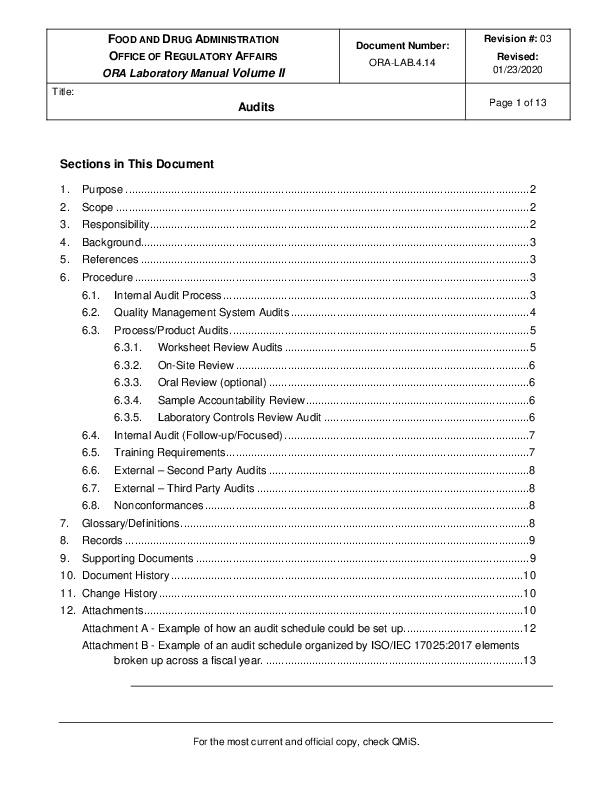
ORA Laboratory Manual Volume II Number: ORA-LAB.4.14 Revision #: 03 Revised: 01/23/2020 Title: Audits Page 1 of 13 For the most current and official copy, check QMiS. Sections in This ...
Full PDF Document

If the inline viewer fails, it will open the original document in compatibility mode automatically. You can also open the file directly.
Extracted Text
Title:

FOOD AND DRUG ADMINISTRATION OFFICE OF REGULATORY AFFAIRS ORA Laboratory Manual Volume II
Audits

Document Number: ORA-LAB.4.14

Revision #: 03 Revised: 01/23/2020
Page 1 of 13

Sections in This Document
1. Purpose ....................................................................................................................................2 2. Scope .......................................................................................................................................2 3. Responsibility............................................................................................................................2 4. Background...............................................................................................................................3 5. References ...............................................................................................................................3 6. Procedure .................................................................................................................................3
6.1. Internal Audit Process ....................................................................................................3 6.2. Quality Management System Audits ..............................................................................4 6.3. Process/Product Audits..................................................................................................5
6.3.1. Worksheet Review Audits ................................................................................5 6.3.2. On-Site Review ................................................................................................6 6.3.3. Oral Review (optional) .....................................................................................6 6.3.4. Sample Accountability Review.........................................................................6 6.3.5. Laboratory Controls Review Audit ...................................................................6 6.4. Internal Audit (Follow-up/Focused) ................................................................................7 6.5. Training Requirements...................................................................................................7 6.6. External � Second Party Audits .....................................................................................8 6.7. External � Third Party Audits .........................................................................................8 6.8. Nonconformances ..........................................................................................................8 7. Glossary/Definitions..................................................................................................................8 8. Records ....................................................................................................................................9 9. Supporting Documents .............................................................................................................9 10. Document History ...................................................................................................................10 11. Change History .......................................................................................................................10 12. Attachments............................................................................................................................10 Attachment A - Example of how an audit schedule could be set up.......................................12 Attachment B - Example of an audit schedule organized by ISO/IEC 17025:2017 elements broken up across a fiscal year. ....................................................................................13

For the most current and official copy, check QMiS.

Title:

FOOD AND DRUG ADMINISTRATION OFFICE OF REGULATORY AFFAIRS ORA Laboratory Manual Volume II
Audits

Document Number: ORA-LAB.4.14

Revision #: 03 Revised: 01/23/2020
Page 2 of 13

1. Purpose
To provide guidance describing the audit program used to evaluate, monitor, and continually improve the quality management system. A properly performed assessment of the quality management system demonstrates the level of compliance with applicable standards and regulatory requirements. The information collected is used towards continual improvement of the system.

2. Scope

This procedure applies to the Office of Regulatory Science (ORS) laboratories and laboratory work products and processes. This procedure directly concerns the laboratory's quality assurance program.
Internal quality system audits are performed on a predetermined schedule and as otherwise directed by management.

3. Responsibility A. Laboratory Management: 1. May assign auditors within the laboratory for internal audits. 2. Ensures information and access is provided to auditors. 3. Informs staff of audit schedule. 4. Ensures corrective action process is implemented B. Quality System Manager (QSM): 1. May serve as the lead auditor within the laboratory.. 2. Coordinates audits and ensures auditors have adequate training and guidance. 3. Monitors audit activities, assembles report, and ensures results of the audit are reported to relevant management. 4. Monitors continual improvement processes. 5. Ensures corrective action process is initiated for identified nonconformances. C. Auditor:
For the most current and official copy, check QMiS.

Title:

FOOD AND DRUG ADMINISTRATION OFFICE OF REGULATORY AFFAIRS ORA Laboratory Manual Volume II
Audits

Document Number: ORA-LAB.4.14

Revision #: 03 Revised: 01/23/2020
Page 3 of 13

1. Reviews background information. 2. Performs audit in accordance with defined scope. 3. Collects objective evidence to support findings. D. Staff: 1. Provides auditor with responses to audit inquiries in a timely
manner.
4. Background None
5. References A. ISO 19011:2002, Guidelines for Quality and/or Environmental Management Systems Auditing. B. ISO/IEC 17025:2017, General requirements for the competence of testing and calibration laboratories Section 8.8. C. AOAC International Guidelines for Laboratories Performing Microbiological and Chemical Analysis of Food, Dietary Supplements, and Pharmaceuticals � An Aid to Interpretation of ISO/IEC 17025:2017; August 2018
6. Procedure 6.1. Internal Audit Process A. Audits shall be conducted in accordance with the local schedule outlined in the laboratory's local procedures. B. The audit program shall address all elements of the management system, including laboratory activities and procedures. C. Internal Audits shall take into consideration the importance of the laboratory activities concerned, changes affecting the laboratory, and the results of previous audits. D. Audits should examine all aspects of the management system using both horizontal and vertical auditing techniques.
For the most current and official copy, check QMiS.

Title:

FOOD AND DRUG ADMINISTRATION OFFICE OF REGULATORY AFFAIRS ORA Laboratory Manual Volume II
Audits

Document Number: ORA-LAB.4.14

Revision #: 03 Revised: 01/23/2020
Page 4 of 13

E. The QSM defines the audit criteria, scope, frequency, objectives, methods, etc. prior to the start of an audit using a risk-based approach.
F. If an external auditor or a team is utilized, the auditor or audit team may hold opening and closing meetings with management to outline the plan of action and discuss findings and whether the laboratory conforms to stated requirements.
G. Auditors conduct the audits and receive information through several sources:
1. interviews with personnel,
2. examination of documentation,
3. observation of activities and conditions,
4. review of quality and technical records, and
5. use of checklists.
H. For all audits, objective evidence shall be obtained to support an observation.
I. When using a checklist, annotate it with specific objective evidence to support the evaluation of the decision of satisfactory or unsatisfactory. The information collected on the checklist assists with report formulation and corrective action initiation.
J. The Quality Manager provides management with a summary report documenting the area of activity audited, the audit findings and on-thespot corrections.
K. When evaluation of the audit findings cast doubt on the effectiveness of operations with its own management system or that the nonconforming work could reoccur, the laboratory shall take timely corrective action.
L. Appropriate corrections and corrective actions are recorded and implemented without undue delay.
M. Follow-up audit activities shall verify and record the implementation and effectiveness of the corrective action plan.
6.2. Quality Management System Audits
A. Audits of the entire Quality Management System are conducted at a minimum of once per year. These internal system audits are planned and scheduled by the Quality System Manager. This may be
For the most current and official copy, check QMiS.

Title:

FOOD AND DRUG ADMINISTRATION OFFICE OF REGULATORY AFFAIRS ORA Laboratory Manual Volume II
Audits

Document Number: ORA-LAB.4.14

Revision #: 03 Revised: 01/23/2020
Page 5 of 13

accomplished by piecing together many small audits that represent the whole system. B. Areas audited include, but not limited to: 1. laboratory information management systems 2. ISO/AOAC requirements; 3. methods and procedures; 4. personnel training and competency; 5. equipment management and maintenance; 6. laboratory proficiency testing; 7. quality control (QC) and QC charts; 8. workload and sample handling processes; 9. records and reports (work products); 10. standards, organisms, certified reference materials; 11. housekeeping; and 12. laboratory environment. 6.3. Process/Product Audits The information from specific process/product audits supports the completion of the comprehensive internal audit and shows performance throughout the year instead of only at one sampling point. Process/Product audits allow for earlier detection of problems, reduce propagation of error, and provide data for trend analysis if necessary. Use audit criteria and quality factors from the relevant procedures being audited. The process audits described below are performed at each laboratory, at a frequency and schedule defined in the laboratory's local procedure. A national checklist or local checklist may be used to record the review. On the spot corrections are annotated on the form.
6.3.1. Worksheet Review Audits The worksheet review audit is to verify the laboratory is following its procedures for the analysis and reporting of samples. This is a vertical audit in nature. A worksheet review audit may focus on a method; evaluate individual analyst performance; etc.
For the most current and official copy, check QMiS.

Title:

FOOD AND DRUG ADMINISTRATION OFFICE OF REGULATORY AFFAIRS ORA Laboratory Manual Volume II
Audits

Document Number: ORA-LAB.4.14

Revision #: 03 Revised: 01/23/2020
Page 6 of 13

Worksheet review audits are carried out by the Branch Directors, Supervisors, and qualified analysts performing worksheet checks according to the laboratory sampling plan. The worksheet review audit frequency and schedule include both violative and non-violative samples.
6.3.2. On-Site Review
The purpose of the on-site review is to witness a process being performed. The review may focus on a method, evaluate individual analyst performance; etc. Laboratory management performs these audits.
The recommended frequency is at least one onsite review per analyst per year. The on-site review frequency and schedule takes into consideration the methods on the laboratory's scope of accreditation.
6.3.3. Oral Review (optional)
The purpose of oral worksheet review is to verify that Analysts will be able to testify about their analyses as competent fact witnesses. Using the worksheet, the Analyst reconstructs the test procedures and explains the results. Oral reviews should be performed by someone outside the supervisory group.
6.3.4. Sample Accountability Review
The purpose of the Sample Accountability Review is to ensure samples are handled correctly as they are processed through the laboratory. FACTS information is checked for accuracy and completeness. This includes the acceptance, storage, transfers, usage, and disposal. Laboratory management performs these audits.
The recommended frequency is at least once per year or as frequently as your laboratory needs.
6.3.5. Laboratory Controls Review Audit
Responsibility for performing these audits shall be defined by the laboratory.
Laboratory control reviews are horizontal in nature and includes multiple areas and items within the laboratory.
6.3.5.1. Equipment Record Review
The purpose of the equipment audit is to check that appropriate records are present and accessible for equipment.
The recommended frequency is to review each type of equipment on an annual basis.
For the most current and official copy, check QMiS.

Title:

FOOD AND DRUG ADMINISTRATION OFFICE OF REGULATORY AFFAIRS ORA Laboratory Manual Volume II
Audits

Document Number: ORA-LAB.4.14

Revision #: 03 Revised: 01/23/2020
Page 7 of 13

6.3.5.2. Environmental Control Review
The purpose of these audits is to ensure the laboratory procedures pertaining to the laboratory environment are performed as prescribed. The processes audited may include, but are not limited to:
A. Engineering Controls (Chemical Fume Hoods, Biosafety Cabinets, Laminar Flow Hoods, etc.)
B. Water purification systems
C. Environmental monitoring
D. Access control
E. Sample and chemical storage conditions
The recommended frequency is at least once per year or as frequently as your laboratory needs.
6.3.5.3. Standards, Reagents, Media, Reference Standards/Materials
The purpose of this audit is to ensure appropriate records are available for standards, reagents, media, and physical reference standards/materials and that related procedures are being followed.
The recommended frequency is at least once per year or as frequently as your laboratory needs.
6.4. Internal Audit (Follow-up/Focused)
Follow-up or focused audits are based upon need. They may be in response to prior audits, detected nonconformances, complaints, or as effectiveness reviews for planned or completed corrective or preventive actions. These audits can be conducted without scheduling or prior notification.
6.5. Training Requirements
Audits shall be carried out by trained and qualified personnel who are, when resources permit, independent of the activity audited. Personnel conducting audits are trained and qualified based upon completion of one or more of the following criteria:
A. previous demonstration of performing audits (e.g. FDA inspections, ORA audits);
B. documented training conducted by laboratory QSM;
C. successful completion of a recognized auditing course or auditor certification.
For the most current and official copy, check QMiS.

Title:

FOOD AND DRUG ADMINISTRATION OFFICE OF REGULATORY AFFAIRS ORA Laboratory Manual Volume II
Audits

Document Number: ORA-LAB.4.14

Revision #: 03 Revised: 01/23/2020
Page 8 of 13

6.6. External � Second Party Audits
Audit performed by personnel not from the local laboratory. For example this might be an audit performed by another ORS laboratory quality manager, other ORS personnel, etc.
6.7. External � Third Party Audits
Performed by accreditation organization auditors. All audit findings resulting from a third-party audit must be addressed using the corrective action process, including root cause analysis.
6.8. Nonconformances
Nonconformances may be corrected on the spot if the issue is minor, isolated, and can be easily corrected. These nonconformances are recorded in the final report with corrections noted.
Nonconformances that are not corrected "on-the-spot" shall be addressed using the Corrective Action procedure, ORA-LAB.4.11.
7. Glossary/Definitions
A. Audit � An audit is a planned and documented investigative evaluation of an item or process to determine the adequacy of and compliance with planned arrangements and whether these arrangements are implemented effectively and are doable to achieve objectives.
B. Audit report � An Audit Report is a summary of the audit scope and findings.
C. Quality factors � These criteria are quality elements needed for purposeful work. Work requests or compliance programs directing a piece of work or general guidance documents, such as the Laboratory Manual, the Quality Management System Manual, pertinent laboratory procedures and work instructions, contain quality elements.
D. Horizontal Audit � Examination of an element of the management system across multiple samples, people, equipment, departments, etc.
E. Monitor � To monitor is to observe and record activity to measure compliance with a standard of performance, routine and ongoing collection of data about the indicator.

For the most current and official copy, check QMiS.

Title:

FOOD AND DRUG ADMINISTRATION OFFICE OF REGULATORY AFFAIRS ORA Laboratory Manual Volume II
Audits

Document Number: ORA-LAB.4.14

Revision #: 03 Revised: 01/23/2020
Page 9 of 13

F. Non-conformity � A non-conformity is non-fulfillment of a specified or implied requirement of the quality management system or of a quality work product.
G. Objective evidence � Objective evidence is information, which can be proven true, based on facts obtained through observation, measurement, test, or other means. Objective evidence includes, but is not limited to staff interviews, direct observation, document review, or record review.
H. Observation � An observation is objective evidence that creates concern that may indicate future problems.
I. On-the-spot correction - This is an immediate step taken to correct or resolve a non-conformity.
J. Performance audit � a performance audit is an assessment of the technical activities of personnel and are categorized as a quantitative appraisal of quality.
K. Requirement � A requirement is a declared, implied or routine need or expectation.
L. System audit � A system audit is an on-site assessment of the laboratory's quality management system and referred to as a qualitative appraisal of quality.
M. Vertical Audit � Examination of one sample through all aspects of handling.

8. Records

A. Completed audit checklists B. Audit Report C. Corrective Action records in QMiS

9. Supporting Documents A. ORA Laboratory Manual, Volume II, ORA-LAB.4.11 Corrective Action

For the most current and official copy, check QMiS.

Title:

FOOD AND DRUG ADMINISTRATION OFFICE OF REGULATORY AFFAIRS ORA Laboratory Manual Volume II
Audits

Document Number: ORA-LAB.4.14

Revision #: 03 Revised: 01/23/2020
Page 10 of 13

10. Document History

Revision Status*

#

(D, I, R)

Date

1.4

R

12/31/07

Author Name and Title LMEB

Approving Official Name and Title
LMEB

1.5

R

02/06/12

LMEB

LMEB

02

R

06/06/2019

LMEB

LMEB

03

R

01/23/2020

* - D: Draft, I: Initial, R: Revision

LMEB

LMEB

11. Change History

Revision # 02
03

Change
Removed EAL-G3 reference because it was not mentioned in the rest of the document. Removed ORA-QMS references so that this document can stand alone. Revised example schedules. Other revisions made as needed to align this procedure with new ISO/IEC 17025 and AOAC requirements. Revision to formatting and policy clarifications were also made. Revised "Responsibility" section as requested by ORS Management:
� Laboratory Management: Added "May assign auditors within the laboratory for internal audits"
� QSM: Changed "Serves as Lead Auditor within the laboratory" to "May serve as the lead auditor within the laboratory"

12. Attachments List of Attachments
Attachment A - Example of how an audit schedule could be set up. ..........................12
Attachment B - Example of an audit schedule organized by ISO/IEC 17025:2017 elements broken up across a fiscal year. ............................................13

For the most current and official copy, check QMiS.

Title:

FOOD AND DRUG ADMINISTRATION OFFICE OF REGULATORY AFFAIRS ORA Laboratory Manual Volume II
Audits

Document Number: ORA-LAB.4.14

Revision #: 03 Revised: 01/23/2020
Page 11 of 13

For the most current and official copy, check QMiS.

Title:

FOOD AND DRUG ADMINISTRATION OFFICE OF REGULATORY AFFAIRS ORA Laboratory Manual Volume II
Audits

Document Number: ORA-LAB.4.14

Revision #: 03 Revised: 01/23/2020
Page 12 of 13

Attachment A - Example of how an audit schedule could be set up.

The required amount columns are suggestions, not requirements. The requirement shall be set by the laboratory. TBD = To Be Determined

Review Activity Worksheet Review

Reviewer Name

Forms TBD

Schedule/Required Amount
Yearly - 2 per analyst Quarterly � 9 Class 1 and 2 each
Quarterly- 7 Class 3

On-Site Review

Name

TBD

Yearly � 1 per analyst Yearly � 1 per method

Oral Review

Name

Sample Accountability

Name

Equipment Records

Name

TBD TBD TBD

# per year Every 4 years � 1 per analyst
Quarterly � Random FACTS records, 5 active, 5 in process or unassigned;
5 completed.
Quarterly � 5 types each; equipment, measurement device, analytical instrument

Environmental Controls

Name

TBD

Quarterly - Defined %

Standards, Reagents, Media, Physical Reference
Standards/Materials
Internal Audit (Comprehensive)

Name Name

TBD
Accreditation checklist

Quarterly � Defined % Yearly

For the most current and official copy, check QMiS.

Title:

FOOD AND DRUG ADMINISTRATION OFFICE OF REGULATORY AFFAIRS ORA Laboratory Manual Volume II
Audits

Document Number: ORA-LAB.4.14

Revision #: 03 Revised: 01/23/2020
Page 13 of 13

Attachment B - Example of an audit schedule organized by ISO/IEC 17025:2017 elements broken up across a fiscal year.

ISO/IEC

17025:2017 & AOAC

OCT

NOV

DEC

JAN

FEB

MAR

APR

MAY

JUN

JUL

AUG

SEP

Requirements

4.1 � 4.2

5.1 � 5.7

8.8 � 8.9

6.1 � 6.2

6.3 � 6.4

6.5 � 6.6

7.1 � 7.3

7.4 � 7.7

7.8 � 7.11

8.1 � 8.4

8.5 � 8.7

COMPLETED

For the most current and official copy, check QMiS.