

S794 Max E Therm Rev. J 2020
File info: application/pdf · 64 pages · 8.54MB
S794 Max E Therm Rev. J 2020
Max E Therm Heater manual
MAX-E-THERM POOL AND SPA HEATER INSTALLATION AND ... - Pentair
4 Max-E-Therm Pool and Spa Heater Installation and User’s Guide P/N S794 Rev. J 8/2020 The Max-E-Therm pool heaters are designed and manufactured to provide many years of safe and reliable service when installed, operat…
https://www.pentair.com/content/dam/extranet/nam/pentair-pool/commercial/manuals/heaters/Max-E-Therm Owners Manual English
Pentair Pool Heater Manual
Extracted Text
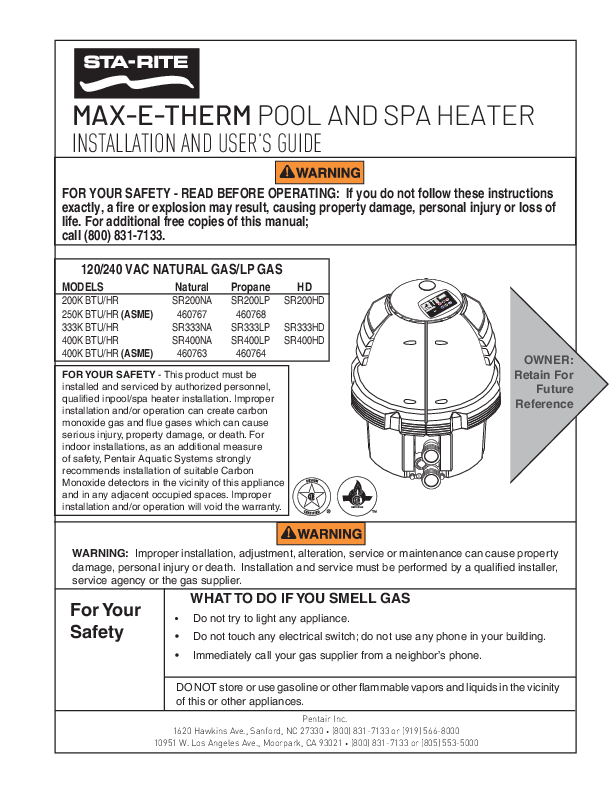
MAX-E-THERM POOL AND SPA HEATER
INSTALLATION AND USER'S GUIDE

FOR YOUR SAFETY - READ BEFORE OPERATING: If you do not follow these instructions exactly, a fire or explosion may result, causing property damage, personal injury or loss of life. For additional free copies of this manual; call (800) 831-7133.

120/240 VAC NATURAL GAS/LP GAS

MODELS 200K BTU/HR 250K BTU/HR (ASME) 333K BTU/HR 400K BTU/HR 400K BTU/HR (ASME)

Natural SR200NA 460767 SR333NA SR400NA 460763

Propane SR200LP 460768 SR333LP SR400LP 460764

HD SR200HD
SR333HD SR400HD

FOR YOUR SAFETY - This product must be installed and serviced by authorized personnel, qualified inpool/spa heater installation. Improper installation and/or operation can create carbon monoxide gas and flue gases which can cause serious injury, property damage, or death. For indoor installations, as an additional measure of safety, Pentair Aquatic Systems strongly recommends installation of suitable Carbon Monoxide detectors in the vicinity of this appliance and in any adjacent occupied spaces. Improper installation and/or operation will void the warranty.

OWNER: Retain For
Future Reference

WARNING:Improper installation, adjustment, alteration, service or maintenance can cause property damage, personal injury or death. Installation and service must be performed by a qualified installer, service agency or the gas supplier.

For Your Safety

WHAT TO DO IF YOU SMELL GAS
� Do not try to light any appliance. � Do not touch any electrical switch; do not use any phone in your building.

� Immediately call your gas supplier from a neighbor's phone.

DO NOT store or use gasoline or other flammable vapors and liquids in the vicinity of this or other appliances.
Pentair Inc. 1620 Hawkins Ave., Sanford, NC 27330 � (800) 831-7133 or (919) 566-8000 10951 W. Los Angeles Ave., Moorpark, CA 93021 � (800) 831-7133 or (805) 553-5000

2 Section 1. Safety Information and Warnings
Safety Warnings
Max-E-Therm�
Pool and Spa Heater
Congratulations on your purchase of a Max-E-Therm high performance heating system. Proper installation and service of your new heating system and correct chemical maintenance of the water will ensure years of enjoyment. The Max-ETherm heater is a lightweight, efficient, induced-draft, gas fired high performance pool and spa heater that can be directly connected to schedule 40 PVC pipe, [schedule 80 CPVC for ASME models only]. The Max-E-Therm heater also comes equipped with the Pentair multifunction temperature controller which shows, at a glance, the proper functioning of the heater. All Max-E-Therm heaters are designed with a direct ignition device, HSI (hot-surface ignition), which eliminates the need for a standing pilot. The Max-E-Therm heater requires an external power source (120/240 VAC 60 Hz) to operate.
SPECIAL INSTRUCTIONS TO OWNER: Retain this manual for future reference. This instruction manual provides operating instructions, installation and service information for the Max-E-Therm heater high performance heater. The information in this manual applies to all Max-E-Therm heater models. READ AND REVIEW THIS MANUAL COMPLETELY, it is very important that the owner/installer read and understand the section covering installation instructions, and recognize the local and state codes before installing the Max-E-Therm heater. Its use will reduce service calls and chance of injury and will lengthen product life. History and experience has shown that most heater damage is caused by improper installation practices.
IMPORTANT NOTICES
...For the installer and operator of the Max-E-Therm pool and spa heater. The manufacturer's warranty may be void if, for any reason, the heater is improperly installed and/or operated. Be sure to follow the instructions set forth in this manual. If you need any more information, or if you have any questions regarding to this pool heater, please contact Pentair Aquatic Systems at (800) 831-7133.
WARRANTY INFORMATION
The Max-E-Therm pool heater is sold with a limited factory warranty. Specific details are described on the warranty registration card which is included with the product. Return the warranty registration card after filling in the serial number from the rating plate inside the heater.
The high standards of excellence of Pentair Aquatic Systems includes a policy of continuous product improvement resulting in your state-of-the-art heater. We reserve the right to make improvements which change the specifications of the heater without incurring an obligation to update the current heater equipment.
These heaters are designed for the heating of chlorine, bromine or salt system swimming pools and spas or in non-stationary installations, and should never be employed for use as space heating boilers or general purpose water heaters. The manufacturer's warranty may be void if, for any reason, the heater is improperly installed and/or operated. Be sure to follow the instructions set forth in this manual.
CAUTION
OPERATING THIS HEATER CONTINUOUSLY AT WATER TEMPERATURE BELOW 68� F. WILL CAUSE HARMFUL CONDENSATION AND WILL DAMAGE THE HEATER AND VOID THE WARRANTY. Do not use the heater to protect pools or spas from freezing if the final maintenance temperature desired is below 68� F., as this will cause condensation related problems.

Max-E-Therm Pool and Spa Heater Installation and User's Guide

P/N S794 Rev. J 8/2020

Section 1. Safety Information and Warnings 3
CODE REQUIREMENTS
Installation must be in accordance with all local codes and/or the latest edition of the National Fuel Gas Code, ANSI Z223.1/NFPA54 and the National Electrical Code, ANSI/NFPA70 (U.S.), or standards CSA B149 � INSTALLATION CODES FOR GAS-BURNING APPLIANCES AND EQUIPMENT and/or local codes and Standard CSA C22.1 � Canadian Electrical Code, Part 1 (Canada). The heater, when installed, must be electrically grounded and bonded in accordance with local codes, or, in absence of local codes, with the Canadian Electrical Code or the National Electrical Code, ANSI/ NFPA70, as applicable.

DANGER
CARBON MONOXIDE GAS IS DEADLY � Exhaust from this pool heater contains toxic levels of carbon monoxide, a dangerous, poisonous gas you cannot see or smell.

CONSUMER INFORMATION AND SAFETY
WARNING
The U.S. Consumer Product Safety Commission warns that elevated water temperature can be hazardous. See below for water temperature guidelines before setting temperature.
1. Spa or hot tub water temperatures should never exceed 104� F. A temperature of 100� F is considered safe for a healthy adult. Special caution is suggested for young children. Prolonged immersion in hot water can induce hyperthermia.
2. Drinking of alcoholic beverages before or during spa or hot tub use can cause drowsiness which could lead to unconsciousness and subsequently result in drowning.
3. Pregnant women beware! Soaking in water above 100� F can cause fetal damage during the first three months of pregnancy (resulting in the birth of a brain-damaged or deformed child). Pregnant women should stick to the 100� F maximum rule.
4. Before entering the spa or hot tub, the user should check the water temperature with an accurate thermometer. Spa or hot tub thermostats may err in regulating water temperatures by as much as 4� F.
5. Persons with a medical history of heart disease, circulatory problems, diabetes or blood pressure problems should obtain their physician's advice before using spas or hot tubs.
6. Persons taking medication which induce drowsiness, such as tranquilizers, antihistamines or anticoagulants should
WARNING
Should overheating occur or the gas supply fail to shut off, turn off the manual gas control valve to the heater. Do not use this heater if any part has been under water. Immediately call a qualified service technician to inspect the heater and to replace any part of control system and gas control which has been under water.

P/N S794 Rev. J 8/2020

Max-E-Therm Pool and Spa Heater Installation and User's Guide

4 Section 1. Safety Information and Warnings
IMPORTANT SAFETY INSTRUCTIONS READ AND FOLLOW ALL INSTRUCTIONS SAVE THESE INSTRUCTIONS

SAFETY INFORMATION

The Max-E-Therm� pool heaters are designed and manufactured to provide many years of safe and reliable service when installed, operated and maintained according to the information in this manual. Throughout the manual, safety warnings and cautions are identified by the " " symbol. Be sure to read and comply with all of the warnings and cautions.
DANGER -- CARBON MONOXIDE GAS IS DEADLY
READ OWNERS MANUAL COMPLETELY BEFORE OPERATING THIS PRODUCT MUST BE INSTALLED AND SERVICED BY A PROFESSIONAL SERVICE TECHNICIAN, QUALIFIED IN POOL HEATER INSTALLATION. Some jurisdictions require that installers be licensed. Check with your local building authority about contractor licensing requirements. Improper installation and/or operation could create carbon monoxide gas and flue gases which could cause serious injury or death. Improper installation and/or operation will void the warranty.
Exhaust from this pool heater contains toxic levels of carbon monoxide, a dangerous, poisonous gas you cannot see or smell. Symptoms of carbon monoxide exposure or poisoning include dizziness, headache, nausea, weakness, sleepiness, muscular twitching, vomiting and inability to think clearly. IF YOU EXPERIENCE ANY OF THE ABOVE SYMPTOMS, IMMEDIATELY TURN OFF THE POOL HEATER, LEAVE THE VICINITY OF THE POOL OR SPA AND GET INTO FRESH AIR IMMEDIATELY. THE POOL HEATER MUST BE THOROUGHLY TESTED BY A GAS PROFESSIONAL BEFORE RESUMING OPERATION.
EXCESSIVE CARBON MONOXIDE EXPOSURE CAN CAUSE BRAIN DAMAGE OR DEATH. NEVER use this pool heater indoors without specified ventilation system (and properly installed vent pipe).
NEVER use this pool heater in the home or in partly enclosed areas (such as garages), unless the specified ventilation system is used. If used outdoors, install far from open windows, doors, vents and other openings. Pentair strongly recommends that all vents, pipes and exhaust systems be initially and periodically tested for proper operation. This testing can be accomplished by using a hand-held carbon monoxide meter and/or by consulting with a gas professional. Pool heaters must be used in conjunction with carbon monoxide detectors installed near the pool heater. The carbon monoxide detectors must be periodically inspected for proper operation so as to insure

WARNING -- FOR YOUR SAFETY This product must be installed and serviced by a professional service technician, qualified in pool heater installation. Some jurisdictions require that installers be licensed. Check with your local building authority about contractor licensing requirements. Improper installation and/or operation could create carbon monoxide gas and flue gases which could cause serious injury or death. Improper installation and/or operation will void the warranty.
WARNING -- This heater is equipped with an unconventional gas control valve that is factory set with a manifold pressure of -.2 inches wc. Improper installation, adjustment, alteration, service or maintenance can cause property damage, personal injury or loss of life. Installation or service must be performed by a qualified installer, service agency or the gas supplier. If this control is replaced, it must be replaced with an identical control.
Do not attempt to adjust the gas flow by adjusting the regulator setting.

Max-E-Therm Pool and Spa Heater Installation and User's Guide

P/N S794 Rev. J 8/2020

Section 1. Safety Information and Warnings 5
SAFETY INFORMATION, (cont'd.)
WARNING -- Risk of fire or explosion from incorrect fuel use or faulty fuel conversion. Do not try to run a heater set up for natural gas on propane gas or vice versa. Only qualified service technicians should attempt to convert heater from one fuel to the other. Do not attempt to alter the rated input or type of gas by changing the orifice. If it is necessary to convert to a different type of gas, consult your Pentair dealer. Serious malfunction of the burner can occur which may result in loss of life. Any additions, changes, or conversions required in order for the appliance to satisfactorily meet the application needs must be made by a Pentair dealer or other qualified agency using factory specified and approved parts. The heater is available for use with natural gas or LP (propane) gas only. It is not designed to operate with any other fuels. Refer to the nameplate for the type of gas the heater is equipped to use.
� Use heater only with the fuel for which it is designed.
� If a fuel conversion is necessary, refer this work to a qualified service technician or gas supplier before putting the heater into operation.
WARNING -- Risk of fire or explosion from flammable vapors. Do not store gasoline, cleaning fluids, varnishes, paints, or other volatile flammable liquids near heater or in the same room with heater.
WARNING -- Risk of explosion if unit is installed near propane gas storage. Propane (LP) gas is heavier than air. Consult local codes and fire protection authorities about specific installation requirements and restrictions. Locate the heater away from propane gas storage and filling equipment as specified by the Standard for the Storage and Handling of Liquefied Petroleum Gases, CAN/CSA B149.2 (latest edition) or ANSI/NFPA 58 (latest edition).
WARNING -- Risk of fire, carbon monoxide poisoning, or asphyxiation if exhaust venting system leaks. Only qualified service technicians should attempt to service the heater, as leakage of exhaust products or flammable gas may result from incorrect servicing.
WARNING -- Risk of asphyxiation if exhaust is not correctly vented. Follow venting instructions exactly when installing heater. Do not use a drafthood with this heater, as the exhaust is under pressure from the burner blower and a draft hood will allow exhaust fumes to blow into the room housing the heater. The heater is supplied with an integral venting system for outdoor installation. A vent conversion kit (See Page 23 for Part Numbers for Conversion Kits) is available for installations indoors (U.S. and Canada). Use the specified venting, and only the specified venting, when heater is installed in an enclosure or indoors.
CAUTION -- Label all wires prior to disconnection when servicing controls. Wiring errors can cause improper and dangerous operation. Wiring errors can also destroy the control board. � Connect heater to 120 or 240 Volt, 60 Hz., Single Phase power only. � Verify proper operation after servicing. � Do not allow children to play on or around heater or associated equipment. � Never allow children to use the pool or spa without adult supervision. � Read and follow other safety information contained in this manual prior to operating this pool heater.

P/N S794 Rev. J 8/2020

Max-E-Therm Pool and Spa Heater Installation and User's Guide

6 Section 1. Safety Information and Warnings
GENERAL SPECIFICATIONS
NOTICE:
� Combustion air contaminated by corrosive chemical fumes can damage the heater and will void the warranty. � The Combination Gas Control Valve on this heater differs from most appliance gas controls. If it must be replaced,
for safety reasons replace it only with an identical gas control. � The access door panels must be in place to provide proper ventilation. Do not operate the heater for more than five (5)
minutes with the access door panels removed. � This heater is design certified by CSA International as complying with the Standard for Gas Fired Pool Heaters,
ANSI Z21.56/CSA 4.7, and is intended for use in heating fresh water swimming pools or spas. � The heater is designed for the heating of chlorine, bromine or salt system swimming pools and spas. It should NOT
be used as a space heating boiler, or general purpose water heater. The heater requires an external 120 or 240 VAC single-phase electric power source. � The heater is design certified by CSA International for installation on combustible flooring. Specified minimum clearances must be maintained to combustible surfaces (see "Heater Clearances", page 20). � The heater should be located in an area where leakage of the heater or connections will not result in damage to the area adjacent to the heater or to the structure. When such locations cannot be avoided, it is recommended that a suitable drain pan, adequately drained, be installed under the heater. The pan must not restrict air flow. � The heater may not be installed within 5 ft. (1.5M ) of the inside surface of a pool or spa unless it is separated by a solid fence, wall or other permanent barrier.
CONSUMER INFORMATION AND SAFETY
WARNING
The U.S. Consumer Product Safety Commission warns that carbon monoxide is an "invisible killer". Carbon monoxide is a colorless and odorless gas.
1. Carbon monoxide is produced by burning fuel, including natural gas and propane. 2. Proper installation, operation and maintenance of fuel-burning appliances in the home is the most important
factor in reducing carbon monoxide poisoning. 3. Be sure that fuel burning appliances such as heaters are installed by professionals according to manufacturer's
instructions and codes. 4. Always follow the manufacturer's directions for safe operation. 5. Have the heating system (including vents) inspected and serviced annually by a trained service technician. 6. Examine vents regularly for improper connections, visible cracks, rust or stains. 7. Install battery-operated carbon monoxide alarms. The alarms should be certified to the requirements of the
most recent UL, IAS, CSA and IAPMO standard for carbon monoxide alarms. Test carbon monoxide alarms regularly and replace dead batteries.

Max-E-Therm Pool and Spa Heater Installation and User's Guide

P/N S794 Rev. J 8/2020

Section 1. Contents 7
Customer Service and Technical Support
Phone: (800) 831-7133
Fax: (800) 284-4151
(8 A.M. to 7:30 P.M. Eastern Time)
Web site: www.pentair.com
Contents
Section 1. Safety Information and Warnings......................................................................... 2
Important Notices.................................................................................................................................................................................. 2 Warranty Information............................................................................................................................................................................. 2 Code Requirements............................................................................................................................................................................... 3 Consumer Information and Safety Information...................................................................................................................................... 3 - 5 General Specifications / Consumer Information and Safety.................................................................................................................. 6
Section 2. Installation............................................................................................................... 9
Heater Description................................................................................................................................................................................. 9 Sequence of Operation/Putting the Heater into Service........................................................................................................................ 9 Specifications........................................................................................................................................................................................ 10 Plumbing Connections........................................................................................................................................................................... 11 Valves.................................................................................................................................................................................................... 11 Manual By-Pass.................................................................................................................................................................................... 11 Automatic By-Pass................................................................................................................................................................................ 12 Water Connections................................................................................................................................................................................ 13 Below Pool Installation.......................................................................................................................................................................... 13 Multiple Heater Installation.................................................................................................................................................................... 14 Gas Connections................................................................................................................................................................................... 15 Sediment Traps .................................................................................................................................................................................... 15 Gas Pipe Sizing..................................................................................................................................................................................... 16 Testing Gas Pressure/Gas Pressure Requirements............................................................................................................................. 16-17 Outdoor Installation (US/Canada) - Heater Clearance.......................................................................................................................... 18 Outdoor Installation Venting Guidelines................................................................................................................................................ 19 Indoor Venting--General Requirements (Category I & Category III � Clarification)............................................................................. 20 Heater Clearances................................................................................................................................................................................. 20 Outside Vent Removal........................................................................................................................................................................... 20 Combustion Air Supply.......................................................................................................................................................................... 21 Corrosive Vapors and Possible Causes................................................................................................................................................ 21 Vent Installation - Category I (Indoor Installation for U.S. and Canada)............................................................................................... 22 Vertical Venting - Negative Pressure .................................................................................................................................................... 22-24 Direct Air Intake Duct With 3-Inch Pvc Pipe (Indoor Installation).......................................................................................................... 24 Horizontal or Vertical Venting - Positive Pressure (Category III).......................................................................................................... 25 Connecting Special Gas Vent to the Heater.......................................................................................................................................... 25 - 28 Garage or Utility Room Installation........................................................................................................................................................ 28 Control Panel Positions ........................................................................................................................................................................ 29 Final Installation Check......................................................................................................................................................................... 29 Electrical Connections........................................................................................................................................................................... 30
Heater Bonding.................................................................................................................................................................................. 31 Fireman's Switch Connection/Remote Control Connections............................................................................................................. 32 Max-E-Therm Heater Wiring Diagram............................................................................................................................................... 32

P/N S794 REV. J 8/2020 P/N S794 Rev. J 8/2020

Max-E-Therm Pool and Spa Heater Installation and User's Guide

8 Section 1. Contents
Contents

Section 2. Installation (Continued).......................................................................................................................... 33
Connecting the MasterTemp Heater to the IntelliCenter Control System Load Center via RS-485................................................................... 33 Connecting the RS-485 Cable from the Heater to the Load Center...................................................................................................... 34 Heater Wiring Diagram (3-Wiring System)............................................................................................................................................ 36 Heater Electrical Schematic Ladder Diagram........................................................................................................................................ 37
Section 3. Operation................................................................................................................. 38
Basic System Operation........................................................................................................................................................................ 38 HSI (Hot-Surface Ignition) Lighting/Operation....................................................................................................................................... 38 Start-Up Operation ............................................................................................................................................................................... 38 Operating Instructions .......................................................................................................................................................................... 39 To Turn Off Gas to Appliance................................................................................................................................................................ 39 Safety Controls (Air Flow Switch (AFS)................................................................................................................................................. 40
Water Pressure Switch...................................................................................................................................................................... 40 High Limits Device............................................................................................................................................................................. 40 Operation of Ignition Control Module (ICM)....................................................................................................................................... 41 Error PS Message............................................................................................................................................................................. 41 Control Panel......................................................................................................................................................................................... 42 Menu Navigation................................................................................................................................................................................ 42 Operating the Heater......................................................................................................................................................................... 42 Menu...................................................................................................................................................................................................... 43

Section 4. Troubleshooting...................................................................................................... 44
Error and Fault Codes........................................................................................................................................................................... 44 Initial Troubleshooting........................................................................................................................................................................... 45 Troubleshooting Chart (Important Read Me First)................................................................................................................................. 45
Heater Will Not Fire - A...................................................................................................................................................................... 46 Heater Will Not Fire - B...................................................................................................................................................................... 47 IGN is On (Alarms: AGS, AFS, HLS, PS, EO1, or 126.......................................................................................................................... 48 Diagnostic Alarms: ERR, AGS or ERR HLS.......................................................................................................................................... 49 Diagnostic Alarms: ERR SFS................................................................................................................................................................ 50 Burner Troubleshooting......................................................................................................................................................................... 51 Heat Exchanger Troubleshooting.......................................................................................................................................................... 51

Section 5. Maintenance............................................................................................................
Care and Maintenance.......................................................................................................................................................................... Pressure Relief Valve (Not Factory Installed)........................................................................................................................................ After Start-Up......................................................................................................................................................................................... Spring, Fall and Winter Operation......................................................................................................................................................... Maintaining Pool Temperature.............................................................................................................................................................. Energy Saving Tips............................................................................................................................................................................... Chemical Balance..................................................................................................................................................................................

52
52 52 53 53 54 54 54 - 57

Section 6. Replacement Parts................................................................................................. 56-60

Max-E-Therm Pool and Spa Heater Installation and User's Guide

P/N S794 Rev. J 8/2020

Installation

Section 2. Installation 9

Gas

HEATER DESCRIPTION

Exhaust

Figure 1 is a diagram of the heater showing how it operates.

Precisely matched orifice plates meter the air and gas into the mixer.

Air

The blower draws the air and gas through the mixer and forces it

into the burner's flame holder. A sealed heat exchanger surrounds

the flame holder, discharging exhaust gases out the flue.

Inlet

(Cold

Water)

Two inch PVC water piping connects directly to the manifold/

header on the heat exchanger using 2" PVC slip unions provided

with the heater. The outer manifold remains cool; no heat sinks are

required. A thermal regulator and an internal bypass regulate the

water flow through the heat exchanger to maintain the correct outlet

temperature. The heater operator control panel board assembly is Outlet

(Mixed

located on top of the heater.

Water)

Mixer

Blower

Burner

Heating Coils

SEQUENCE OF OPERATION

Figure 1.

An electronic temperature sensing thermistor in the manifold adapter inlet controls the heater operation. When the inlet water temperature drops below the temperature set on the operating control, the burner controller supplies power to the combustion air blower through a series of safety interlocks. The interlocks consist of:
� the pressure switch (PS), which senses that the pump is running,
� the high limit switch (HLS), which opens if the heat exchanger outlet temperature goes above 135� F (57� C), and
� the air flow switch (AFS), which senses the pressure drop across the air metering orifice,
� the automatic gas shut-off (AGS) switch, which opens if the heat exchanger outlet temperature goes above 140� F (60� C).
� the stack flue sensor (SFS), which shuts down the heater if the flue gas temperature reaches 480� F (249� C).
The air flow switch (AFS) senses the pressure drop across the air metering orifice. As soon as there is sufficient air flow, the AFS closes, closing the circuit to the hot surface igniter (HSI), which ignites the fuel mixture. On a call for heat, the blower and HSI are energized. In about 20 seconds, the gas valve opens and ignition occurs. The HSI then switches to a sensing mode and monitors the flame.
The heater is equipped with a digital operating control that enables the user to pre-set the desired pool and spa water temperatures. The control enables the user to select between pool and spa heating, and features a digital display that indicates the water temperature.

PUTTING THE HEATER INTO SERVICE

If the heater is installed below the level of the pool, or more than two feet above pool level, the pressure switch setting should be adjusted. See WATER PRESSURE SWITCH, in the SAFETY CONTROLS Section on page 40.
Before putting the heater into service for the first time, follow the instructions under "BEFORE START-UP" (page 38) in the front of this manual. Check for proper operation of the heater by following the steps under "OPERATION INSTRUCTIONS." Damage to equipment caused by improper installation or repair will void the warranty.

P/N S794 Rev. J 8/2020

Max-E-Therm Pool and Spa Heater Installation and User's Guide

10 Section 2. Installation
SPECIFICATIONS
These installation instructions are designed for use by qualified personnel only, trained especially for installation of this type of heating equipment and related components. Some states require installation and repair by licensed personnel. If this applies in your state, be sure your contractor bears the appropriate license. See Figure 2 for Outdoor and Indoor Installations.
DIMENSIONS IN INCHES
13.59

30.03
19.41 25.15
FRONT VIEW

INLET 4.57
9.19 4.62
OUTLET

14.94

H O T
DRAIN KEEP OPEN

RS-485 Conductors Port
.63

Figure 2.

4.87
BACK VIEW

Max-E-Therm Pool and Spa Heater Installation and User's Guide

18.02 31.69
RIGHT SIDE VIEW
25.83
TOP VIEW
P/N S794 Rev. J 8/2020

PLUMBING CONNECTIONS
The Max-E-Therm� heater has the unique capability of direct schedule 40 PVC, [schedule 80 CPVC for ASME models] plumbing connections. A set of bulkhead fittings is included with the Max-E-Therm heater to insure conformity with Pentair's recommended PVC plumbing procedure. Other plumbing connections can be used. See Figure 3 for plumbing connections.
CAUTION
Before operating the heater on a new installation, turn on the circulation pump and bleed all the air from the filter using the air relief valve on top of the filter. Water should flow freely through the heater. Do not operate the heater unless water in the pool/spa is at the proper level. If a manual by-pass is installed, temporarily close it to insure that all air is purged from the heater.
VALVES

TM
Modular Media Filter
To Filter Inlet
Cool Water In From Pool

Section 2. Installation 11

From Filter Outlet to Heater Inlet

Warm Water Out to Pool or Spa

To Pool

Corrosion Resistant, Positive Seal Check Valve
Sanitizer
Cool Water In From Spa

To Spa

Figure 3.
Typical Installation

When any equipment is located below the surface of the pool or spa, valves should be placed in the circulation piping system to isolate the equipment from the pool or spa. Check valves are recommended to prevent back-siphoning. Backsiphoning is most likely to occur when the pump stops, creating a pressure-suction differential. Do NOT sanitize the pool by putting chlorine tablets or sticks into the skimmer(s). When the pump is off, this will cause a high concentration of chlorine to enter the heater, which could cause corrosion damage to the heat exchanger.
CAUTION
Exercise care when installing chemical feeders so as to not allow back siphoning of chemical into the heater, filters or pump. When chemical feeders are installed in the circulation of the piping system, make sure the feeder outlet line is down stream of the heater, and is equipped with a positive seal noncorrosive "Check Valve", (P/N R172288), between the feeder and heater.

MANUAL BY-PASS

Where the water flow rate exceeds the maximum 120 GPM, a manual bypass should be installed and adjusted. After installing the valve, adjust the valve to bring the flow rate within the acceptable range. Then remove the valve handle or lock it in place to avoid tampering. See Figure 4.

MODEL

MIN. (GPM) (LPM)

MAX. (GPM) (LPM)*

200

20 (76)

120 (454)

333

33 (125)

120 (454)

400

40 (152)

120 (454)

* Do not exceed the maximum recommended flow rate for the connecting piping.

Table 1.

See page 52 for Pressure Relief Valve Installations.

Cool Water In
Warm Water Out 1. Set Manual
Bypass Valve 2. Remove handle
Outlet to Pool Inlet from Filter
Figure 4.

P/N S794 Rev. J 8/2020

Max-E-Therm Pool and Spa Heater Installation and User's Guide

12 Section 2. Installation
AUTOMATIC BY-PASS
Figure 5 shows a plumbing diagram for an automatic BY-PASS (IntelliValve�). This in conjunction with an IntelliFlo VSF pump can provide added longevity of the heater and increased cost savings of operation. A 3-Port valve with an IntelliValve actuator is installed at the heater inlet. A check valve is installed at the heater oulet so that water cannot flow back into the heater. See instructions for Automatic Bypass valve kit (P/N 462048) for setting the open and closed position of the IntelliValve.

Figure 5.

INTELLIVALVE VALVE

CHECK VALVE

HOT WATER OUT TO POOL

COLD WATER IN

Max-E-Therm Pool and Spa Heater Installation and User's Guide

P/N S794 Rev. J 8/2020

WATER CONNECTIONS

Section 2. Installation 13

3-Way Valve

Chlorinator

The heater requires proper water flow and pressure for its operation. See Figure 6 for the recommended installation. The filter pump discharges to the filter, the filter discharges to the heater, and the heater discharges directly to the pool or spa.

Check Valve
Heater

A manual bypass valve should be installed across the heater Main when the pump flow exceeds 120 GPM (454 LPM). See Drain

"WATER FLOW RATE" Table 1 on page 11 for setting of the

Pool

manual by-pass valve.

Filter Spa

Make sure that the outlet plumbing from the heater contains no shut-off valves or other flow restrictions that could prevent flow through the heater (except for below pool installations as noted below, or winterizing valves where needed). To switch flow between the pool and spa, use a diverter valve. Do not use any valve that can shut off the flow.

From Pool

3-Way Valve

Pump
3-Way Valve Figure 6.

Install the chemical feeder downstream of the heater. Install a chemical resistant one-way check valve between the heater and the chemical feeder to prevent back-siphoning through the heater when the pump is off.

NOTICE: MULTIPLE HEATER INSTALLATION: See page 14, for multiple Max-E-Therm heater and FlowMeter installations.

NOTICE: If the heater is plumbed in backwards, it will cycle continuously. Make sure piping from filter is not reversed when installing heater. Connect the heater directly to 2" PVC pipe, using the integral unions provided. Heat sinks are not required. The low thermal mass of the heater will prevent overheating of the piping connected to the pump even if the heater shuts down unexpectedly.

Occasionally a two-speed pump will not develop enough pressure on the low speed to operate the heater. In this case, run the pump at high speed only to operate the heater. If this does not solve the problem, do not try to run the heater. Instead, correct the installation. Do not operate the heater while an automatic pool cleaner is also operating. If the circulation pump suction is plugged (for example by leaves), there may not be adequate flow to the heater. Do not rely on the pressure switch in this case.

BELOW POOL INSTALLATION

If the heater is below water level, the pressure switch must be adjusted. This adjustment must be done by a qualified service technician. See following CAUTION before installation.
CAUTION
BELOW OR ABOVE POOL INSTALLATION
The water pressure switch is set in the factory at 3.00 PSI (� 0.75 PSI). This setting is for a heater installed at pool level. If the heater is to be installed more than 1' above or below, the water pressure switch must be adjusted by a qualified service technician. See "WATER PRESSURE SWITCH", "HIGH LIMITS", page 40.

FLOW SWITCH
If the heater is installed more than 5' above the pool or more than 4' below the pool level, you will be beyond the limits of the pressure switch and a flow switch must be installed. Locate and install the flow switch externally on the outlet piping from the heater, as close as possible to the heater. Connect the flow switch wires in place of the water pressure switch wires.

P/N S794 Rev. J 8/2020

Max-E-Therm Pool and Spa Heater Installation and User's Guide

14 Section 2. Installation
MULTIPLE HEATER INSTALLATION
All plumbing on multiple heater installations must be done in parallel. See Figure 7 and Figure 8. To prevent heater overheating and to ensure heater longevity, water flow to each heater must be balanced for optimum operation. To meet recommended flow rates, be sure all installed pipes are installed in accordance with local and state codes. To allow for proper operation and service clearance, maintain spacing to adjacent heaters. Heaters installed too close to one another may encounter operational issues associated with exhaust fumes.

TOP INLET PORT (COLD WATER)

LOWER OUTLET PORT (HOT WATER)
To balance the system, extend the pipe 305 mm (12 inches) at the end of
the heater inlet.

OPTIONAL 2" Ball Valve Bypass

Optional check valves and ow meters at the heater inlets can help balance the system.
To balance the system, extend the pipe 305 mm (12 inches) at the end of the heater inlet.

60-80 GPM/Unit (recommended). Balance flow to each heater.

FILTER

Figure 7. Two Max-E-Therm Heaters Plumbing Hydraulic Diagram

TOP INLET PORT (COLD WATER)
LOWER OUTLET PORT (HOT WATER)
To balance the system, extend the pipe 305 mm (12 inches)
at the end of the heater inlet.

Optional check valves and ow meters at the heater inlets can help balance the system.
To balance the system, extend the pipe 305 mm (12 inches) at the end of the heater inlet.

Figure 8. Four Max-E-Therm Heaters Plumbing Hydraulic Diagram

Max-E-Therm Pool and Spa Heater Installation and User's Guide

P/N S794 Rev. J 8/2020

GAS CONNECTIONS

Section 2. Installation 15

GAS LINE INSTALLATIONS
Before installing the gas line, be sure to check which gas the heater has been designed to burn. This is important because different types of gas require different gas pipe sizes. The rating plate on the heater will indicate which gas the heater is designed to burn. The Gas Pipe Sizing tables, shown on page 16, show which size pipe is required for the distance from the gas meter to the heater. The table is for natural gas at a specific gravity of .65 and propane at a specific gravity of 1.55.
When sizing gas lines, calculate three (3) additional feet of straight pipe for every elbow used. When installing the gas line, avoid getting dirt, grease or other foreign material in the pipe as this may cause damage to the gas valve, which may result in heater failure.
The gas meter should be checked to make sure that it will supply enough gas to the heater and any other appliances that may be used on the same meter. The gas line from the meter will usually be of a larger size than the gas valve supplied with the heater. Therefore a reduction of the connecting gas pipe will be necessary. Make this reduction as close to the heater as possible.
The heater requires a gas supply of not less than 4" (10.2cm) wc and not more than 14" (35.6cm) wc. Gas supply pressures outside of this range may result in improper burner operation. A minimum flowing or dynamic inlet pressure (while the heater is running) of 4" (10.2cm) wc is required to maintain input rating with no more than a 2" pressure drop between static and dynamic. The gas supply must be installed in accordance with the National Fuel Gas Code, ANSIZ223.1, or standard CSA B149.1, Natural Gas and Propane Installation Codes, as applicable and all applicable local codes. Install a manual shut-off valve and a sediment trap and union located outside the heater panels, see Figure 9. Do not use a restrictive gas cock. The following minimum gas pipe sizes are recommended for natural gas supply piping, see Table 2 on page 16. For low pressure LP gas, pipe size may be reduced by 1/4", with a minimum pipe size of 1/2". Check for compliance with local codes.
The heater and any other gas appliances must be disconnected from the gas supply piping system during any pressure testing on that system, (greater than � PSI). The heater and its gas connection must be leak tested before placing the heater in operation. Do not use flame to test the gas line. Use soapy water or another nonflammable method.
NOTE A manual main shut-off valve must be installed externally to the heater.

WARNING
DO NOT INSTALL THE GAS LINE UNION INSIDE THE HEATER CABINET. THIS WILL VOID YOUR WARRANTY.

SEDIMENT TRAPS
Install a sediment trap and union located outside the heater panels in accordance with National code requirements. Do not use a restrictive gas cock. The sediment trap shall be either a tee fitting with a capped nipple in the bottom outlet which can be removed for cleaning, as illustrated in Figure 9, or an other device recognized as an effective sediment trap. All gas piping should be tested after installation in accordance with local codes.

18�24" of 3/4" Gas line from Valve

Manual Shut-off Valve

1" Dia. or larger

(See "Recommended

Pipe Sizes" Chart)

Bell Reducer

At least 9"

Union
Sediment Trap

At least 3"

Figure 9.

P/N S794 Rev. J 8/2020

Max-E-Therm Pool and Spa Heater Installation and User's Guide

16 Section 2. Installation
GAS PIPE SIZING

PIPE SIZING FOR GAS LINE CONNECTIONS

MAXIMUM EQUIVALENT PIPE LENGTH (Ft.)

Natural Gas at 1000 B.T.U. per Cubic Foot

Propane Gas at 2500 B.T.U. per Cubic Foot

1/2"

3/4"

1"

1-1/4" 1-1/2"

2"

2-1/2"

MODEL NAT PRO NAT PRO NAT PRO NAT PRO NAT PRO NAT PRO NAT PRO

200

- 20' 30' 80' 125' 250' 450' 600' - - - - - -

333

- - 10' 30' 50' 100' 200' 350' 400' 600' - - - -

400

- - - 10' 20' 60' 100' 150' 200' 450' 400' - - -

Table 2.

TESTING GAS PRESSURE
Before operating the heater, the heater and its gas connections must be leak tested. Do NOT use an open flame to test for leaks. Test all gas connections for leaks with soapy water or another non-flammable method (see page 14).
The heater and its individual shut-off valve must be disconnected from the gas supply piping system during any pressure testing of that system at test pressures in excess of 1/2 psig (3.5 kPa).
The heater must be isolated from the gas supply system by closing its individual manual shut-off valve during any pressure testing of the gas supply at test pressures equal to or less than 1/2 psig (3.5 kPa).
CHECKING THE GAS PRESSURE THROUGH THE COMBINATION GAS CONTROL VALVE
WARNING
Risk of fire and explosion. Improper installation, incorrect adjustment, alteration, service, or maintenance of the Combination Gas Control Valve can lead to fire or explosion, causing loss of life, personal injury, and/or property damage. If it is necessary to adjust the gas valve, this must be done by only by a qualified service agency. These instructions are for the use of qualified service technicians only!
Risk of fire and explosion. Improper installation, incorrect adjustment, alteration, service, or maintenance of the Combination Gas Control Valve can lead to fire or explosion, causing loss of life, personal injury, and/or property damage. If it is necessary to adjust the gas valve, this must be done by only by a qualified service agency. These instructions are for the use of qualified service technicians only!

Max-E-Therm Pool and Spa Heater Installation and User's Guide

P/N S794 Rev. J 8/2020

Section 2. Installation 17
This appliance is equipped with an unconventional gas control valve that is factory set with a manifold pressure of �.2" (�0.5cm) wc. Installation or service must be performed by a qualified installer, service agency, or the gas supplier. If this control valve is replaced, it must be replaced with an identical control.
The combination gas valve incorporates dual shut-off valves and a negative-pressure regulator. For proper operation, the regulated pressure at the outlet manifold of the valve must be �0.2" (�0.5cm) wc below the reference pressure at the blower mixer inlet, and the gas valve `VENT' tap must be connected to the end cap air orifice as shown in Figure 7.
Do not attempt to adjust the gas input by adjusting the regulator setting. The correct gas regulator setting is required to maintain proper combustion and must NOT be altered.
CAUTION
The use of Flexible Connectors (FLEX) is NOT recommended unless they are properly sized according to the supplier recommendations for the heater rating.

GAS PRESSURE REQUIREMENTS

To Air Flow Switch

Connection for Service
To Air Flow Switch

To Gas Valve Vent

To Gas Valve Vent

Connection for Test

To High Side of Differential Pressure Gauge

Pressure Tap Inlet

Vent

Figure 10.

Gas Pressure

Natural Propane Inches W.C.

Maximum Inlet

14

14

Minimum Inlet

4

4

Manifold

-0.2 � 0.1 -0.2 � 0.1

NOTE: All readings must be taken while heater is operating. Any adjustments or readings made while heater is off will result in performance problems.
Table 3.

Figure 15.

Pressure Tap
To Low Side of Differential Pressure Gauge

P/N S794 Rev. J 8/2020

Max-E-Therm Pool and Spa Heater Installation and User's Guide

18 Section 2. Installation

OUTDOOR INSTALLATION (U.S. and Canada)

For heaters located outdoors, using the built-in stackless venting system.
WARNING
Risk of explosion if a unit burning propane gas is installed in a pit or other low spot. Propane is heavier than air. Do not install the heater using propane in pits or other locations where gas might collect. Consult your local building code officials to determine installation requirements and specific installation restrictions of the heater relative to propane storage tanks and filling equipment. Installation must meet the requirements for the Standard for the Storage and Handling of Liquid Petroleum Gases, ANSI/NFPA 58 (latest edition) in the U.S., or CAN/CSA B149.2 (latest edition) in Canada. Consult local codes and fire protection authorities about specific installation restrictions.

Locate the heater on a level surface in an open area that is protected from drainage or run-off. Install the heater in an area

where leaves or other debris will not collect on or around the heater.

To avoid damage to the electronic components in the heater, take care to prevent

Bolt Down Bracket Kit
P/N 42001-0085S

prolonged exposure to driving sources of water (such as lawn sprinklers, heavy

roof runoff, hoses, etc.). Avoid operation in persistent, extreme, moist or salty

environments.

In extreme weather, shut down the heater and disconnect the power to it until the weather has moderated. In areas subject to hurricanes or very high winds, purchase the Bolt Down Bracket Kit, P/N 42001-0085S, see Figure 11.

Lead Anchor

HEATER CLEARANCES � OUTDOOR
Important!
� In an outdoor installation it is important to ensure water is diverted from overhanging eves with a proper gutter/drainage system. The heater must be set on a level foundation for proper drainage.
� This unit shall not be operated outdoors at temperatures below -20o F
If the heater is located under a roof overhang, there must be at least three feet (1M) of clearance between the bottom of the overhang and the top of the heater exhaust vent, see Figure 12. If the heater is under a roof overhang, the space around the heater must be open on three sides. DO NOT, under any circumstances, install the heater under ANY deck.

3 ft. (1 M) or more

Figure 11.

For minimum exhaust vent clearances for all building openings, including but not limited to vented eaves, doors, windows, gravity air inlet, see Figure 13, page 19. In Canada, the heater must be installed with the top of the vent at least 10 feet (3M) below, or to either side of, any opening into a building, see Figure 14, page 19.
Orient the heater for convenient access to the water connections and the gas and electrical connections. Note: Check local building codes for installing the heater from any property line set back requirements.
CAUTION If installing the heater next to or near an air conditioning unit or a heat pump, allow a minimum of 36 in. between the air conditioning unit and the heater.
Max-E-Therm Pool and Spa Heater Installation and User's Guide

Figure 12. P/N S794 Rev. J 8/2020

Section 2. Installation 19

OUTDOOR INSTALLATION VENTING GUIDELINES
SIDE VIEW
6 in. From building wall

Building

Exhaust Grill (Vent)

3' 4'
4'
Force Air Inlet

From window or door
4'
Property Line
EG(Vxreihlnlatu) stCfhoercskeltobcaaclkbrueiqlduinirgemcoednetss.

Vent Termination:
Must be at least 3 ft. above any forced air inlet located within a 10 ft. radius. Must be located 6 in. away from the building wall and the following distances away from any building wall openings, included but not limited to vented eaves, doors, windows, gravity air inlet:
4 ft. below, 4 ft. horizontally
Figure 13.

OUTDOOR INSTALLATION VENTING GUIDELINES FOR CANADA

SIDE VIEW

6 in.
(15.24cm)

From building wall

Building

Exhaust Grill (Vent)

P/N S794 Rev. J 8/2020

10'(3M)

3'(.9M) 10'(3M)

Force Air Inlet

10'(3M)

From window or door

Property Line
EG(Vxreihlnlatu) sCt fhoercskeltobcaaclkbrueiqlduinirgemcoednetss.

Vent Termination:
Must be at least 3 ft. (.9M) above any forced air inlet located within a 10 ft. (3M) radius. Must be located 6 in. (15.24cm) away from the building wall and the following distances away from any building wall openings, included but not limited to vented eaves, doors, windows, gravity air inlet:
10 ft. (3M) below, 10 ft. (3M) horizontally
Figure 14.
Max-E-Therm Pool and Spa Heater Installation and User's Guide

20 Section 2. Installation

INDOOR VENTING -- General Requirements
The heater may be installed as a Category I or Category III appliance. Vented Appliance (Category I) � Vertical only
An appliance that operates with a nonpositive vent static pressure and with a vent gas temperature that avoids excessive condensate production in the vent, see pages 22-24. Vented Appliance (Category III) � Vertical or Horizontal
An appliance that operates with a positive vent static pressure and with a vent gas temperature that avoids excessive condensate production in the vent, see pages 25-27.
If you are considering connecting this heater to a pre-existing vent system, make sure that the vent system meets the appropriate venting requirements as given in this manual on pages 20-28. If not, replace the vent system. DO NOT use a draft hood with this heater. The Max-E-Therm heaters operate with a positive vent static pressure and with a vent gas temperature less than 400� F (204�C). The total length of the horizontal run must not exceed the length that is listed in Table 9 on page 25.

HEATER CLEARANCES -- General Requirements

INDOOR INSTALLATION (U.S. / CANADA)
The following clearances must be maintained from combustible surfaces: TOP...............................6 in. (15 cm) ALL SIDES....................6 in. (15 cm) VENT.............................6 in. (15 cm)

Note: The heater is design certified by CSA International for installation

on combustible flooring. For installation on carpeting, the heater must

be mounted on a metal or wood panel that extends at least three inches

(10cm) beyond the base of the heater. If the heater is installed in a closet

or alcove, the entire floor shall be covered by the panel. On an outdoor

shelter installation, the exhaust discharges into a vent pipe.Orient the

6 in.

heater so that the vent pipe does not interfere with adjustment of the

operating controls. The operating control panel, located on the top of

the jacket, can be rotated for convenient access to the control panel.

OUTSIDE VENT COVER REMOVAL

The heater is supplied from the factory with a built-in stackless outside vent for outdoor installation. Remove the outside vent cover for outdoor shelter installation.

OSNPA

6 in. 6 in. 6 in. Figure 15.

Max-E-Therm Pool and Spa Heater Installation and User's Guide

P/N S794 Rev. J 8/2020

Section 2. Installation

Section 2. Installation 21

COMBUSTION AIR SUPPLY

Air Supply Requirements Guide

For indoor installation, the heater location must provide sufficient air supply for proper combustion and ventilation of the surrounding area.
The minimum requirements for the air supply specify that the room in which a heater is installed should be provided with two permanent air supply openings; one within 12 inches (30cm) of the ceiling, the other within 12 inches (30cm) of the floor for combustion air, in accordance with the latest edition of ANSI Z223.1, or the National Fuel Gas code, the CSA B149.1, Natural Gas and Propane Installation Codes, as applicable, and any local codes that may apply. These openings shall directly, or through duct, connect to outdoor air.

for Max-E-Therm Heaters
Minimum Net Free Open Area for Each Opening*
(Square Inches/Centimeters)

Model

All Air From Inside Building

Combustion

Vent

All Air From Outside Building

Combustion

Vent

200

200 sq. in.

200 sq. in.

50 sq. in.

1291 sq. cm. 1291 sq. cm. 323 sq. cm.

50 sq. in. 323 sq. cm.

333

333 sq. in.

333 sq. in.

84 sq. in.

2149 sq. cm. 2149 sq. cm. 542 sq. cm.

84 sq. in. 542 sq. cm.

400

400 sq. in.

400 sq. in.

100 sq. in.

2581 sq. cm. 2581 sq. cm. 645 sq. cm.

100 sq. in. 645 sq. cm.

* Area indicated is for one of two openings; one at floor level and one at the ceiling.

Table 4.

Note: Pentair does not recommend indoor installations that do not provide combustion air from outside the building.

CAUTION
Chemicals should not be stored near the heater installation. Combustion air can be contaminated by corrosive chemical fumes which can void the warranty. See Table 5.

Corrosive Vapors and Possible Causes
Area

Likely Contaminants

Chlorinated swimming pools and spas

Pool or spa cleaning chemicals. Acids, such as hydrochloric or muriatic acid.

New construction and remodeling areas

Glues and cements, construction adhesives, paints, varnishes, and paint and varnish strippers. Waxes and cleaners containing calcium or sodium chloride.

Beauty parlors

Permanent wave solutions, bleaches, aerosol cans containing chlorocarbons or fluorocarbons.

Refrigeration plants or various industrial finishing and processing plants

Refrigerants, acids, glues and cements, construction adhesives.

Dry cleaning and laundry areas

Bleaches, detergents, or laundry soaps containing chlorine. Waxes and cleaners containing chlorine, calcium or sodium chloride.

Table 5.
NOTICE: Combustion air contaminated by corrosive chemical fumes can damage the heater and will void the warranty.

P/N S794 Rev. J 8/2020

Max-E-Therm Pool and Spa Heater Installation and User's Guide

22 Section 2. Installation

VENT INSTALLATION � INDOOR INSTALLATION (US AND CANADA)

(Category I) Always vent the heater to the outdoors, see Note*. � Vent it vertically using Type "B" double wall vent connector pipe.

NOTE *: Vent must be at least eight (8) feet away from nearest vertical surface. Vents extending five (5) feet or more above the roof must be braced or guyed. Consult your local code officials for detailed information.

Locate the heater so as to minimize the length of horizontal venting and the number of vent elbows required. Horizontal vent runs must slope up 1/4" per foot (2cm/M) from the heater to allow exhaust condensate to drain and it is recommended to have a condensate drain as described in the venting installation instructions.

VERTICAL VENTING - NEGATIVE PRESSURE
(See Figures 16, 17 and 18)

Vent Body

Clean the Interior Surface
4" x 8" Metal Flue Collar

Vent the heater vertically in a negative pressure (positive draft) system in accordance with the National Fuel Gas Code, ANSI Z223.1/NFPA 54 and/or CSA B149.1, Natural Gas and Propane Installation Codes, and local codes. Type "B" Double-wall vent connector is recommended; however single-wall pipe is allowed by the National Fuel Gas Code in some circumstances. Consult your local code official for detailed information. DO NOT use a draft hood with this heater.
To connect a negative pressure metal gas vent to the heater, order the appropriate Metal Flue Collar from the chart:

Combustion Chamber Flue Collar

Clean and RTV This Surface

Figure 16.

1. See Table 6, to determine allowable vent sizes for your heater. NOTICE: Table 6 is for installations in which the total lateral vent length (that is, the

Metal Flue Collar 4 x 6"

Vent Pipe
Table 6. Part No. 77707-0076

Read "VERTICAL VENTING � NEGATIVE PRESSURE" before using this table. Table 7. Permitted Minimum and Maximum Vent Heights By Size and Heater Model

4 x 8"

77707-0077

Type "B" Double-Wall Vent with Type "B" Double-Wall Connector in Feet (Meters)

Vent Size

Model 200 Height min./max.

Model 333 Height min./max.

Model 400 Height min./max.

6 in.

6 ft. (1.8)/100 ft. (30.5)

30 ft. (9)/100 ft. (30.5)

Not Rec.

7 in.

6 ft. (1.8)/100 ft. (30.5)

10 ft. (3)/100 ft. (30.5)

15 ft. (4.6)/100 ft. (30.5)

8 in.

6 ft. (1.8)/100 ft. (30.5)

6 ft. (1.8)/100 ft. (30.5)

8 ft. (2.4)/100 ft. (30.5)

9 and 10 in.

6 ft. (1.8)/50 ft. (15.3)

6 ft. (1.8)/100 ft. (30.5)

6 ft. (1.8)/100 ft. (30.5)

Type "B" Double-Wall Vent with Single-Wall Connector in Feet (Meters)

Vent Size

Model 200 Height min./max.

Model 333 Height min./max.

Model 400 Height min./max.

6 in.

6 ft. (1.8)/15 ft. (4.6)

Not Rec.

Not Rec.

7 in.

6 ft. (1.8)/8 ft. (2.4)

10 ft. (3)/20 ft. (6)

15 ft. (4.6)/50 ft. (15.3)

8 in. 9 in. 10 in.

Not Rec. Not Rec. Not Rec.

6 ft. (1.8)/20 ft. (6) Not Rec. Not Rec.

8 ft. (2.4)/20 ft. (6) 6 ft. (1.8)/6 ft. (1.8)
Not Rec.

Max-E-Therm Pool and Spa Heater Installation and User's Guide

P/N S794 Rev. J 8/2020

horizontal distance from the flue collar to the main vertical portion of the vent) is less than 1/2 the total vent height (the vertical distance from the flue collar to the vent termination) and which have three or less elbows in the system. For venting systems which do not meet these conditions, consult the National Fuel Gas Code, ANSI Z223.1 (U.S.), or the standards CSA B149.1 and B149.2 (Canada).
2. Install the metal Flue Collar in the Vent Body of the heater (located under the outside vent cover). Fasten the metal Flue Collar to the Vent Body with two #10 sheet metal screws. Use high temperature silicone RTV to seal the Flue Collar to the Vent Body. Before connecting the metal Flue Collar to the Vent Body, wet a clean cloth or paper towel with isopropyl alcohol (rubbing alcohol) and vigorously wipe the socket of the Vent Body. Immediately wipe the cleaned surfaces dry with a clean cloth or paper towel. Repeat for the exterior of the 4" end of the metal Flue Collar. Attach the metal Flue Collar to the Vent Body using the RTV supplied with the kit, following the vent manufacturer's instructions (included with kit).
3. Attach the vent pipe to the metal Flue Collar with sheet-metal screws.

Section 2. Installation 23

Min. 10 Ft. 6" Minimum Clearance to Combustible
Materials

Listed Termination Cap Storm Collar Flashing

Class B Double Wall Metal Vent Pipe

Vent Body

Metal Flue Collar

Firestop
Support Vertical Vent Pipe so adapter does not take weight of pipe.

Figure 17. Typical Metal Vent Pipe Installation U.S. (Vertical � Negative Pressure)

WARNING
Risk of fire or asphyxiation if vent is not assembled according to manufacturer's instructions or if vent parts from different manufacturers are mixed. Vent parts from different manufacturers ARE NOT interchangeable. Mixing parts from more than one manufacturer may cause leaks or damage to vent. When assembling a vent, pick one manufacturer and be sure that all vent parts come from that manufacturer and are specified by the manufacturer for your system. Follow manufacturer's instructions, local code requirements, National Fuel Gas Code requirements (U.S.) or standards CSA B149.1 and B149.2 (Canada) carefully during assembly and installation.

Figure 18. �Typical Metal Vent Pipe Installation Canada (Vertical � Negative Pressure)

P/N S794 Rev. J 8/2020

Max-E-Therm Pool and Spa Heater Installation and User's Guide

24 Section 2. Installation
4. Install vent pipe so that it can expand and contract freely as the temperature changes. Support the vent pipe according to applicable codes and the vent manufacturer's instructions. Pipe support must allow the vent pipe free movement out and back, from side to side, or up and down as necessary, without putting a strain on the heater or vent body. Slope horizontal pipe runs up from the heater at least 1/4" per foot (2cm per meter). Install Listed condensate drains at low points where condensate might collect. Plumb condensate drains to a drain through hard piping or high temperature tubing such as silicone rubber or EPDM rubber � DO NOT USE VINYL OR OTHER LOW TEMPERATURE TUBING. FOLLOW DRAIN MANUFACTURER'S INSTALLATION INSTRUCTIONS.
5. Use Listed fire stop for floor and ceiling penetrations. Use Listed thimble for wall penetrations. Use a Listed roof flashing, roof jack, or roof thimble for all roof penetrations. Do not fill the space around the vent (that is, the clear air space in the thimble or fire stop) with insulation. The roof opening must be located so that the vent is vertical.
6. DO NOT RUN THE HEATER VENT INTO A COMMON VENT WITH ANY OTHER APPLIANCE.
WARNING
Fire Hazard. Do not vent the heater directly into a masonry chimney. Installation into a masonry chimney must use a chimney liner and must meet the National Fuel Gas Code, ANSI Z223.1/NFPA 54 and/or CSA B149.1, Natural Gas and Propane Installation Codes requirements and all local code requirements.

WARNING

Risk of fire, carbon monoxide poisoning, or asphyxiation. It is recommended to use a CO Monitor and Fire Alarm in rooms that contain gas fired appliances.

DIRECT AIR INTAKE DUCT WITH 3-INCH PVC PIPE (INDOOR INSTALLATION)

Note (*): Figure 1 - Combustion Air Intake Duct Connection Kit (Part Number 475002) for all Max-E-Therm� heater models can be purchased.

Combustion 3 in. PVC Pipe Inlet Air Intake Duct Requirements*
Combustion Air Intake 3 in. Pipe (Vertical or Horizontal)

No. of 90� Elbows
0 1 2 3 4 Table 8.

Maximum Length in Feet (M)
70 ft. (21.3 M) 58 ft. (17.7 M) 46 ft. (14.0 M) 34 ft. (10.4 M) 22 ft. ( 6.7 M)

NOTE
Each 90-degree elbow reduces the maximum horizontal PVC air intake duct run by 12 feet and each 45-degree elbow in the PVC air intake duct run reduces the maximum run by 6 feet. See the Table 5 above for the maximum lengths using 90-degree elbows.

Figure 19. Max-E-Therm Pool and Spa Heater Installation and User's Guide

WARNING!
DO NOT USE PVC PIPE FOR FLUE EXHAUST VENT. FLUE EXHAUST VENT TEMPERATURES CAN BE IN EXCESS OF 400� F. FLUE EXHAUST VENT MUST BE CATEGORY I or CATEGORY III METAL VENT.
P/N S794 Rev. J 8/2020

Section 2. Installation 25

HORIZONTAL OR VERTICAL VENTING - POSITIVE PRESSURE (See Figures 20, 21, and 22)
(Category III)
Vent the heater either horizontally or vertically using an optional vent adapter of the 4-inch special gas approved Category III vent pipes. Install the vent pipe in accordance with local codes and the provisions of the National Fuel Gas Code, ANSI Z223.1 (U.S.), or the standards CSA B149.1, Natural Gas and Propane Installation Codes (Canada), and the vent manufacturer's instructions. Do not use a draft hood with this heater. Install the vent according to the vent manufacturer's detailed instructions.
Maintain clearance between the vent pipe and combustible surfaces according to the vent manufacturer's instructions and code requirements. Do not place any insulating materials around the vent or inside the required clear air space surrounding the vent. See Table 9 for maximum permissible vent lengths.

NOTE The allowable vent runs for each vent pipe diameter are different and can not be exceeded. Each 90-degree elbow reduces the maximum horizontal vent run by 12 feet and each 45-degree elbow in the vent run reduces the maximum vent run by 6 feet. See the table below for the maximum vent lengths using 90-degree and 45-degree elbows.

The Max-E-Therm� heater may be installed as a "Category III"

appliance (which requires a four (4) inch special gas approved 4 in. Special Gas Vent (Vertical or Horizontal)*

"Category III" vent pipe) and is a forced-draft pool and spa heater

which uses positive pressure to push flue gases through the vent pipe to the outside. Flue gases under positive pressure may escape into the dwelling with any cracks or loose joints in the vent pipe,

No. of 90� Elbows

Maximum Length in Feet (M)

or improper vent installation. The vent pipe must be of a sealed-

seam construction, such as those listed for use with "Category

0

70 ft. (21.3M)

III Appliances", and for operating temperatures less than 400�F

(204�C). Vent pipe construction will be of UL 1738 approved non-

1

58 ft. (17.7M)

corrosive material, such as stainless steel. A condensate trap may be

needed. The use of "Approved" thimbles, roof jacks and/or side vent

2

46 ft. (14.0M)

terminals are required; and the proper clearances to combustible

materials must be maintained in accordance with type of vent

3

pipe employed--in the absence of a clearance recommendation

34 ft. (10.4M)

by the vent pipe manufacturer, the requirements of the Uniform

Table 9.

Mechanical Code should be met. The ventilation air requirements for the Max-E-Therm heater can be found on page

21. It is recommended that vent runs over 18 feet may need to be insulated to reduce condensation related problems and/or the use

of a condensate trap in the vent run close to the heater may be necessary in certain installations such as cold climates. Horizontal

vents 3' (1M) or less in length do not require a condensate tee. The Max-E-Therm heater is suitable for through-the-wall venting.

CAUTION

Do NOT combine exhaust vent pipes to a common exhaust vent in multiple unit installations. Run separate vent pipes.

CONNECTING SPECIAL GAS VENT TO THE HEATER

Metallic:

1. Order an optional appliance adapter kit, (Pentair offers optional appliance adapter kits, call our Customer Service dept.):
- Part No. 77707-0086 for Saf-T Vent� or Saf-T Vent� CI. - Part No. 77707-0087 for Z-Vent.
2. Remove the outside vent cover.
3. Install the Appliance Adapter in the Vent Body of the heater (located under the outside Vent Cover). Before connecting the Appliance Adapter to the Vent Body, wet a clean cloth or paper towel with isopropyl alcohol (rubbing alcohol) and vigorously wipe the socket of the Vent Body. Immediately wipe the cleaned surfaces dry with a clean cloth or paper towel. Repeat for the exterior of the heater end of the Appliance Adapter. Attach the appliance adapter to the vent body using the adhesive specified by the vent manufacturer, following the vent manufacturer's instructions.

P/N S794 Rev. J 8/2020

Max-E-Therm Pool and Spa Heater Installation and User's Guide

26 Section 2. Installation

WARNING
Risk of carbon monoxide poisoning if adapter is improperly attached. Mechanical connections (such as screws) can cause cracking and leaks in the adapter. Do NOT drill holes or use screws to connect the appliance adapter to the heater vent body. Attach with manufacturer's specified adhesive.
WARNING
Risk of fire or asphyxiation if vent is not assembled according to manufacturer's instructions or if vent parts from different manufacturers are mixed. Vent parts from different manufacturers ARE NOT interchangeable. Mixing parts from more than one manufacturer may cause leaks or damage to vent. When installing a vent, pick one manufacturer and be sure that all vent parts come from that manufacturer and are specified by the manufacturer for your system. Follow manufacturer's instructions and local and National Fuel Gas Code (U.S.) or CSA B149.1, Natural Gas and Propane Installation Codes (Canada) requirements carefully during assembly and installation.

4. Install vent pipe so that it can expand and contract Vent Cap and

freely as the temperature changes. Support the vent pipe

Riser Furnished by Installer

according to applicable codes and vent manufacturer's

instructions. Pipe support must allow the vent pipe

free movement out and back, from side to side, or up

and down as necessary, without putting a strain on the

heater or vent body. It is recommended to slope the

horizontal pipe runs up from the heater at least 1/4" per

foot (2cm/M). Install "Approved" condensate drains

at low points where condensate might collect. Plumb

condensate drains to a drain through hard piping

or high-temperature tubing such as silicone rubber

or EPDM rubber � do not use vinyl or other low

temperature tubing. Follow drain manufacturer's installation instructions.

Side Wall Vent

5. Use an "Approved" firestop for floor and ceiling Figure 20. penetrations. Use an "Approved" thimble for wall penetrations. Use an "Approved" roof flashing, roof jack, or roof thimble for all roof penetrations. Do not Vent Cap and fill the space around the vent (that is, the clear air space Riser Furnished in the thimble or firestop) with insulation. The roof by Installer opening must be located so that the vent is vertical.

6. Vent Termination � Vertical (See Figures 20 and 21), for height of vent termination above the roof. Use an "Approved" vent terminal specified by local and national codes and your manufacturer's instructions. A roof termination must be vertical. In Canada, the Vent Cap location shall have a minimum clearance of 4 feet (1.2M) horizontally from electric meters, gas meters, regulators, and relief openings.
7. Make sure entire installation is sealed according to approved standard.

Side Wall Vent

Figure 21.

Chimney or Gas Vent

Heater

Outlet Air Opening
Inlet Air Opening

Chimney or Gas Vent

Heater

Outlet Air Opening Inlet Air Opening

Max-E-Therm Pool and Spa Heater Installation and User's Guide

P/N S794 Rev. J 8/2020

Section 2. Installation 27

Vent Termination

4' Min. 4' Min.
4' Min.

4' Min. Vent Termination
1' Min.

Max. 12" Min. 3"
Vent Termination

1' Minimum above snow or finished grade (whichever is higher)

Forced Air Inlet

Gas Meter
3' Minimum clearance if horizontal distance to exhaust opening is less than 10 feet.

At least 7' above grade adjacent to public walkways

8. Vent Termination � Horizontal The terminal must be located (U.S. � See Figure 22):

Figure 22.

� at least 3" and at most 12" out from the wall (see Figure 23), following the vent manufacturer's instructions

� at least 12" above finished grade or the normally expected snow accumulation level, whichever is higher

� at least 4 feet below or horizontally from, or 1 foot above, any doors or windows or gravity air inlet to a building

� at least 3 feet above any forced air inlet located within 10 feet

� at least 4 feet horizontally from electric meters, gas meters, regulators and relief equipment

� at least 7 feet above grade adjacent to walkways or similar traffic areas

The terminal must be located (Canada � See Figure 22):

� at least 10 feet (3.3M) from any opening into a building

� at least 12" (.3M) above finished grade or the normally expected

snow accumulation level, whichever is higher

Metal

�

at

least

4

feet

(1.2M)

horizontally

from

electric

meters,

gas

Vent Body

meters, regulators and relief equipment

Metal Special Gas Vent requires Appliance

Support weight of pipe

Adapter

Condensate

Tee

Listed Terminal

� at least 7 feet (2.1M) above grade adjacent to walkways or similar traffic areas
Allow at least three feet (1M) vertical clearance over vent

Condensate drain w/Trap

Slope at least 1/4" per foot (2 cm per Meter) down towards condensate drain

3" (7.6 cm) Min., 12" (30.5 cm)Max. Clearance

termination when terminating under an overhang

Figure 23.

Avoid corners or alcoves where snow or wind could have an effect. Exhaust may affect shrubbery and some building

materials. Keep shrubbery away from termination. To prevent staining or deterioration, sealing or shielding exposed

surfaces may be required.

WARNING
Fire Hazard. Do not run the heater vent into a common vent with any other appliance. Do not run the Special Gas Vent into, through, or within any active vent such as a factory built or masonry chimney.

P/N S794 Rev. J 8/2020

Max-E-Therm Pool and Spa Heater Installation and User's Guide

28 Section 2. Installation

WARNING
Risk of asphyxiation if exhaust is not correctly vented. Follow venting instructions exactly when installing heater. Do not use a draft hood with this heater, as the exhaust is under pressure from the burner blower and a draft hood will allow exhaust fumes to blow into the room housing the heater. Exhaust venting to the outdoors is required for all outdoor shelter installations.
WARNING
Risk of explosion if a unit burning propane gas is installed in a pit or other low spot. Propane is heavier than air. Do not install the heater using propane in pits or other locations where gas might collect. Consult your local building code officials to determine installation requirements and specific installation restrictions of the heater relative to propane storage tanks and filling equipment. Installation must meet the requirements for the Standard for the Storage and Handling of Liquefied Petroleum Gases, CAN/CSA B149.2 (latest edition) or ANSI/NFPA 58 (latest edition). Consult local codes and fire protection authorities about specific installation restrictions.

The heater is design certified by CSA International for installation on combustible flooring; in alcoves; basements; in closet or utility rooms (in the U.S.).
GARAGE OR UTILITY ROOM INSTALLATION
In Canada, the heater must be installed in a room that is not normally occupied and has no openings directly to occupied areas.
WARNING
Risk of fire and explosion if installed at floor level in an automotive garage or near gasoline or flammable liquid storage. Gasoline fumes are heavier than air and will settle to floor level in closed spaces. Gasoline fumes and spilled gasoline or other volatile liquids (such as some paints and varnishes) will travel across the floor and can be ignited by a gas appliance.

In any utility room or residential garage installation, install the heater with the base at least 18 inches (.5M) above the floor, see Figure 20. In a garage, install a rail or wall to protect the heater from physical damage by a moving vehicle.
Provide an adequate ventilation air supply (See Table 9, page 25). Choose a location that will avoid contamination by chemical fumes.

CAUTION
A Propane (LPG) fired heater must not be installed in a garage in Massachusetts, by order of the Massachusetts State Fire Marshal. For more information, call the Massachusetts State Fire Marshal's office.

Leave 3 ft. (1 m) or more of clearance above heater

NOTICE: Combustion air contaminated by corrosive chemical fumes can damage the heater and will void the warranty (See Table 5, page 21).

Leave 6 in. (15 cm) of clear space between heater and combustible surface.

RAISE AT LEAST 18 in. (46 cm) above floor 18 in. to avoid flammable vapors

Figure 24.

Max-E-Therm Pool and Spa Heater Installation and User's Guide

P/N S794 Rev. J 8/2020

Section 2. Installation 29

CONTROL PANEL POSITIONS

On an outdoor shelter installation, the exhaust discharges into a vent pipe. The heater control panel assembly, on top of the jacket, can be turned to any of six positions for convenient access to the panel, see Figure 25.

1. Unbolt and separate the jacket halves.

2. Pull hair pin clips.

3. Depress plastic clips on the control panel assembly.

4. Lift panel off of support plate.

5. Turn the assembly to the desired position and snap in place.

5

6. Make sure that the operating controls can be adjusted without having to lean over the exhaust vent.

7. Replace hair pin clips.

3

8. Replace jacket halves and bolts and tighten.

FINAL INSTALLATION CHECK

Check that horizontal vent pipe runs slope uniformly at least 1/4" per foot (2cm per meter) to condensate drain(s). No sags, no dips, no high or low spots.

Check that vent is supported at elbows, tees, and horizontal and vertical runs according to manufacturer's instructions and code requirements.

Check that vent supports and wall and ceiling penetrations allow free movements up, down, and sideways without putting any strains on the heater or vent body.

Check for at least six inch (15cm) free air clearance between the heater vent pipe and combustible materials.

Check that all joints are completely together and sealed.

In Florida, building codes require that the heater be anchored to the equipment pad or platform to withstand high wind pressures created during hurricanes. A Bolt Down Bracket Kit, P/N 420010085S, see Figure 26, is available with anchor clamps designed to hold the unit to the equipment pad in high wind conditions. Insert the Bolt Down Brackets in the knockouts in the Lower Enclosure and bolt them solidly to the pad. Installation of the anchor clamps are recommended in all installations and are required in Florida, (See Florida Building Code 301.13).

BOOSTELROPWUMSPPEED HIGH SPEED

4

2 1

BO

O

LO STER

W SPEED PUM P

HIG H SPEED PUFMILPTER

A 1

UX

A 2

UX

Figure 25.

Retaining Pins
Bolt Down Bracket Kit
P/N 42001-0085S
Lead Anchor

Figure 26.

P/N S794 Rev. J 8/2020

Max-E-Therm Pool and Spa Heater Installation and User's Guide

30 Section 2. Installation
ELECTRICAL CONNECTIONS

Electrical Rating: 60 Hz 120 / 240 Volts AC, single phase: Enclose the incoming AC power line to the heater, in an approved flexible conduit connected directly to the junction box on the inside of the access door panel. Line voltage field wiring should be 14 gauge, with a circuit capacity of 15 Amps. Note: The heater operating AMP draw is about 5 AMPS at 120 VAC and 2.5 AMPS at 240 VAC. A 15 AMP circuit capacity is required for the inrush current at startup. IMPORTANT NOTICE: FOR HEATER BONDING, see next page.
CAUTION
This heater is designed to operate at 120 or 240 VAC. It is not recommended to be connected to OR operate on a 208 VAC.

NOTE
� This heater is configured for a 240V application. If it is to be installed in a 120V application, remove the jacket halves, open the control box, remove the 240V plug from the receptacle and replace it with the 120V plug. The 120V plug is located within the control box. This procedure is to be performed prior to making any electrical connection to the heater.
� If any of the original wiring supplied with this heater must be replaced, installer must supply (No. 18 AWG, 600V, 105� C. U.L. approved AWM low energy stranded) copper wire or it's equivalent.
CAUTION
The heater ships from the Factory with the 240V plug installed. Installing the 120V plug and then connecting the heater to 240V line current will immediately destroy the transformer, control board and ignition control module, and will void warranty. If you install the 240V plug and connect the heater to 120 volts line current, the heater will not operate.

Please read the boxes headed "IMPORTANT! READ ME FIRST!" on pages 38 and 46 before proceeding.

1. All wiring must be in accordance with all applicable codes.

2. The heater, when installed, must be electrically grounded and bonded in accordance with local codes or, in the absence of local codes, with the National Electrical Code or the Canadian Electrical Code (as applicable). A bonding lug is provided on the outside of the panel under the vent for this purpose.IMPORTANT NOTICE: See next page for important HEATER BONDING information.

3. Electrical power circuits to the pool heater must follow local codes and National Electrical Code or Canadian Electrical Code (as applicable).

4. All wiring between the heater and devices not attached to it, or between separate devices

which are installed in the field, must be "Type T" wire rated for 35�C rise. All line voltage

wiring shall be enclosed in approved flexible conduit, and shall be securely attached to the

field wiring box located inside the access door panel. The conduit or cable connector at the AC VOLTAGE SELECT

field wiring box should contain an insulating bushing

PLUGS: (120 or 240 VAC)

or its equivalent to prevent abrasion of the wires as

they enter the box.

240V: Red to Red (L2)

6. The filter pump should run continuously when the heater is on, and for at least 5 minutes after the heater turns off. Any switches in the pump circuit (including circuit breakers) that can disconnect the pump must also disconnect the heater.
7. Do not wire single-pole switches, including protective devices, into a grounded line. The heater is not sensitive to polarity.
8. Connect the L1 of the power supply to the Black wire, the L2 or neutral lead to the Red wire, and the Ground wire to the Green wire. A time clock controlling the filter pump should have a low-voltage Fireman's Switch that switches off the heater at least 15 minutes before shutting off the pump, see Figure 27. Always use crimp type connectors when connecting two wires.

Use the 240 V plug to for the incoming voltage (240V)

240V : Black to Black (L1)
Cutout for Conduit from Fireman's Switch

Green (Ground) to
Green (Ground)

Bonding Lug
Bonding Wire
View From Below (Exterior)

Bonding Wire

Wiring Harness to Control Box

Wire into bottom of Junction-box in Flexible Conduit

View From Above (Interior)

Figure 27.

Max-E-Therm Pool and Spa Heater Installation and User's Guide

P/N S794 Rev. J 8/2020

HEATER BONDING

Section 2. Installation 31

WARNING
A bonding lug is provided on the heater located on the upper side of the base by the plumbing side (see Figure 28). The heater along with the pool system equipment must be bonded together. Using solid copper conductor not smaller then 8 AWG to reduce voltage gradients in the pool area.
Not properly bonding and grounding the heater increases the risk of electrical shock. Damage to the heat exchanger can occur from electrolysis when the heater is not bonded properly.
All wiring must be in accordance with all applicable codes.
The heater, when installed, must be electrically grounded and bonded in accordance with local codes or, in the absence of local codes, with the National Electrical Code or the Canadian Electrical Code (as applicable).

Bonding Lug

Figure 28.

P/N S794 Rev. J 8/2020

Max-E-Therm Pool and Spa Heater Installation and User's Guide

32 Section 2. Installation
CONNECTION OF FIREMAN'S SWITCH OR REMOTE CONTACT
CAUTION
If, while there is line voltage connected to the heater, you touch either line voltage terminal with any 24VAC wire that is connected to the control board (including the Fireman's Switch jumper), you will immediately destroy the control board and void the warranty.

REMOTE CONTROL CONNECTIONS

1. Switch off power to heater at main circuit breaker panel.

2. Unbolt and remove the upper jacket halves (see Figure 29).

3. Open control box cover.

4a. To connect a 2-Wire Control (such as IntelliTouch� or EasyTouch� controll systems) or a timer:

- Remove the factory installed jumper from the Fireman's

Switch terminals.

- Connect wires between the Fireman's Switch terminals

on the heater and the relay. Connect wires from the

controller or timer to the Fireman's Switch. Controller,

timer or relay should be sized to handle 24VAC at 0.5 Amp (because it will be completing the 24VAC

control board circuit on the heater as shown in Figure 30). DO NOT apply line voltage to the Fireman's

Switch terminals. Use 18 gauge wire with a minimum 3/64" (1.2mm) thick insulation rated for a

temperature rise of at least 105�C.

- Knock-outs are provided to route the wires through the bottom of the control box and past the junction box.

TRANS

BK O
Y Y

Figure 29.

4b. To connect a 3-Wire Control:

- Connect wires between the control board terminals on the heater and the external relays, as shown

YY

24 VAC

VAL TH IND GND 24VAC 24VAC FS THERMISTOR
1

in Figure 30. Use at least 2 relays per heater, to allow for an "OFF setting" on each heater

J6

mode. Select relays that can handle logic level switching. DO NOT apply line voltage to control BK O board terminals.
- Move jumper (as shown on Figure 30) to enable external control and to disable the heater

OPERATING CONTROL

ENABLE TOGGLE DISABLE TOGGLE

MEMBRANE PAD CONNECTION

9

FUSE FUSE TRANS

membrane pad's "Pool ON" and "Spa ON"

W

buttons (the "OFF" key on the membrane pad

remains functional).

TERMINAL BOARD

- Knock-outs are provided to route the wires through the bottom and the top of the control box and past the junction box.
5. Close control box cover.
6. Re-install and bolt up the jacket halves.

L1 F1
L1

F

I

S

R

W

E M

FL

I T

A

C

N

H

S

TRAN S L2 BM

L2

W W R
R

To control heaters that are operated in parallel, connect wiring at same locations on heater as 2-Wire or 3-Wire Control. It is imperative that each control circuit is isolated from the other control circuits, to avoid that current will flow from one heater to another through the control circuits. NOTICE: The fuse for the Fireman's Switch is a 1.25 Amp 1� x �" fast blow fuse, which is commonly available.

L1

L2

BK R G
JUNCTION BOX

GND
24VAC

Time Clock or Remote (Purchase Separately �
Supplies Power to Circulator Pump)
Fireman's Switch Completes the heater 24 Volt AC Control Board Circuit. DO NOT connect this circuit to Line Voltage!

GROUND (GND )

Receptacle

12 Pin

Max-E-Therm Pool and Spa Heater Installation and User's Guide

Figure 30. P/N S794 Rev. J 8/2020

Section 2. Installation 33
Connecting the Heater to the IntelliCenterTM Control System Load Center via RS-485
For remote control and monitoring, the heater can be connected via the heater's RS-485 COM port to the IntelliCenter Control System COM port. The heater can be wired to the IntelliCenter Control System via a RS-485 connection. Up to 16 heaters can be connected. The default address of a heater is 1. If additional heaters are connected, each heater must have its own address. The address range is 1 to 16. The address for each heater is set from the heater's front LCD panel menus. When a heater is being controlled via the RS-485 interface: � The heater front panel buttons are inactive. Press a panel button to turn on the LCD display. "RS485 Control" is displayed. � Heater Alarms/Errors are displayed on IntelliCenter's control panel(s) Status Home screen.
Accessing the MasterTemp� Heater RS-485 COM Port
To access the heater control panel RS-485 COM port terminal, the RS-485 cable must be routed through the hole in the heater's side panel.
To route the RS-485 cable through the heater's panel to the control panel circuit board:
1. Switch off power to heater at main circuit breaker panel. 2. Unbolt and remove the upper jacket halves (see Figure 32). 3. Open control box cover. 4. Strip back the outer jacket four inches of the cable. Strip back each conductor �-inch. 5. Insert the RS-485 cable (from the Load Center or Power Center) through the flexible conduit or a strain relief into the exhaust
panel hole and securely attach to the heater panel. 6. Once the cable is inside the heater, route the RS-485wires under exhaust. Note: Do not let the wires contact the exhaust. 7. Using cable ties, secure to the RS-485 cable to the main wire harness that connects to heater's control panel circuit board. 8. Insert the three RS-485 wires (Pin 1-BLK, 2-GRN, 3-YEL) into the screw terminal. Secure the conductors with the screws. For
wiring details, refer to the pin configuration on next page. 9. Heater Control Panel COM Port (J4): Insert the RS-485 connector onto the heater's control panel RS-485 COM Port screw
terminal. Note Pin 1 is located on the left side of the terminal connector.
10. Continue with "Connecting the RS-485 Cable from the Heater to the Load Center" on next paage.

Figure 32. P/N S794 Rev. J 8/2020

RS-485 Wires (RED and GREEN) to automation control
system.
Figure 33.

Max-E-Term Heater (Exhaust Side)

Max-E-Therm Pool and Spa Heater Installation and User's Guide

34 Section 2. Installation
Connecting the RS-485 Cable from the Heater to the Load Center
To connect the heater to the load center: BEFORE REMOVING THE HIGH VOLTAGE COVER PANEL FROM THE LOAD CENTER OR POWER CENTER ENCLOSURE SWITCH OFF THE POWER AT THE HOUSE MAIN CIRCUIT BREAKER BOX.

1. Switch OFF AC power to the enclosure at the main house panel circuit breaker.
2. Unlatch the front door latch and open the front door. Remove the two retaining screws from the High Voltage Cover Panel and remove the panel. See Figure 34.
3. Loosen the two retaining screws securing from the top edge of the Outdoor Control Panel. Fold down the Outdoor Control Panel to access the circuit board sockets connectors for the electrical connections.

Loosen Outdoor Control Panel Retaining screws

Flip down the Outdoor Control Panel to acCircuit board and low voltage compartment

Front door

Figure 34.

LOW VOLTAGE RACEWAY

HiHigh Voltage Cover Panel slots (3) HigHighHigh Voltage Cover Panel Tabs (3)

Note: Use a 22 AWG four conductor low voltage RS-485 cable to connect to the heater to the IntelliCenter Control System Load Center:
4. Run the RS-485 cable from the heater's control board RS-485 COM port terminal connector to the Load Center or Power Center. See wiring connection Figure 35 on next page.
5. Insert the cable into the one of the plastic grommet fittings, located on the lower left side of the enclosure and pull the cable up through the low voltage to the circuit board, as shown below.
6. Strip back the outer jacket four inches. Strip back each conductor �-inch.
7. IntelliCenter Control System COM Port (J4 or J5): Insert the conductors into the COM Port screw terminals located on the top of the IntelliCenter Control System circuit board (see diagram below). Secure the conductors with the screws. For wiring details, refer to the pin configuration shown below. Note: Multiple conductors may be inserted into a single screw terminal.

Max-E-Therm Pool and Spa Heater Installation and User's Guide

P/N S794 Rev. J 8/2020

Section 2. Installation 35
Connecting the RS-485 Cable from the Heater to the Load Center (Continued)

Note: COM PORT A& B 14 VDC, 2.0A Max. Combined

+15 +DT -DT GND

4 3 2 1

COMMUNICATION PORTS A & B 14 VDC, 2.0A Max. Combined.
Connecting IntelliFlo� Pump to IntelliCenterTM Control System COM PORT: Strip 1/4" insulation from the green and yellow wire conductors. � Connect the Green wire to pin 2 on Connector J4 or J5. � Connect the Yellow wire to pin 3 on Connector J4 or J5. Note: Multiple wires may be inserted into a single terminal.
Optional: COM PORT expansion module (P/N 520818) with 3 extra COM PORTS up to 2 modules can be installed.

To heater Control Panel RS-485 COM port screw terminal
TO HEATER CONTROL PANEL RS-485 COM PORT

Figure 35.

MasterTemp COM Port Control Panel Screw Terminal
1 2 3 4

Heater to IntelliCenter wires pin assignment

MasterTemp Heater COM Port
screw terminal connector

IntelliCenter Control System COM Port (J4 or J5)

NOT USED

NOT USED

3 (YELLOW)

3 (YELLOW)

2 (GREEN)

2 (GREEN)

1 (BLACK)

1 (BLACK)

8. Close control box cover. 9. Re-install and bolt up the jacket halves. See Figure 32 on page 33. 10. SWITCH ON AC power to the IntelliCenter Control System Load Center.

P/N S794 Rev. J 8/2020

Max-E-Therm Pool and Spa Heater Installation and User's Guide

36 Section 2. Installation
MAX-E-THERM� HEATER WIRING DIAGRAM
(3-WIRE SYSTEM)

Max-E-Therm Pool and Spa Heater Installation and User's Guide

Figure 35. P/N S794 Rev. J 8/2020

Section 2. Installation 37
MAX-E-THERM� HEATERS ELECTRICAL SCHEMATIC LADDER DIAGRAM

BYPASS VALVE

P/N S794 Rev. J 8/2020

4.) EXTERNAL VALVE THAT NEEDS TO BE INSTALLED.

Figure 36.

Max-E-Therm Pool and Spa Heater Installation and User's Guide

38 Section 3. Operation
Operation Instructions

BASIC SYSTEM OPERATION
Start pump, make sure the pump is running and is primed, to close the water pressure switch and supply power to heater. Be sure the pool and/or spa is properly filled with water. Follow the Lighting/Operating instructions below.

MAX-E-THERM� HEATER HSI ELECTRONIC IGNITION LIGHTING/OPERATION

FOR YOUR SAFETY: READ BEFORE LIGHTING
WARNING
If you do not follow these instructions exactly, a fire or explosion may result causing property damage, personal injury or loss of life.
Do not attempt to light the heater if you suspect a gas leak. Lighting the heater can result in a fire or explosion which can cause personal injury, death, and property damage.

START-UP AND OPERATION
START-UP AND SHUTDOWN INSTRUCTIONS ARE ON THE LABEL ATTACHED TO THE COVER OF THE APPLIANCE CONTROL BOX.
BEFORE START-UP

A. This appliance does not have a pilot. It is equipped with an ignition device which automatically lights the burners. Do not try to light the burners by hand.
B. BEFORE OPERATING, smell all around the appliance area for gas. Be sure to smell next to the floor because some gas is heavier than air and will settle on the floor.

D. Do not use this heater if any part has been under water. Immediately call a qualified service technician to inspect the heater and to replace any part of the control system and any gas control which has been under water.
E. Do not operate the pool heater unless the pool or spa is properly filled with water.

WHAT TO DO IF YOU SMELL GAS � Do not try to light any appliance. � Do not touch any electrical switch; do not use any phone
in your building. � Immediately call your gas supplier from a neighbor's
phone. Follow the gas supplier's instructions. � If you cannot reach your gas supplier, call the Fire
Department. C. Use only your hand to turn the gas control on or off.
Never use tools. If you cannot change the ON/OFF setting by hand, don't try to repair it, call a qualified service technician. Forced or attempted repair may result in a fire or explosion.
Max-E-Therm Pool and Spa Heater Installation and User's Guide

F. Before operating the appliance for the first time or after it has been off for an extended time, perform the following checklist:

1. Remove debris or other articles from inside the heater and the area around the heater and its exhaust vent. Make sure the ventilation openings are clear of debris or obstruction. For installations in an enclosed space, make sure openings for combustion and ventilation air are unobstructed.

2. Keep heater area clear and free from combustibles, flammable liquids and chemicals.

3. Check that all water connections are tight.

4. Water must be flowing through the heater during

operation. Make sure that pool/spa is filled with water

and have pump operating. Check that water flow is

unobstructed from the appliance. When operating

for the first time or after an extended shut-down, run

filter pump for several minutes to clear all air from

the system.

P/N S794 Rev. J 8/2020

Section 3. Operation 39

OPERATING INSTRUCTIONS

1. STOP! Read the safety information on (page 37). 2. Set both pool and spa thermostats to the lowest settings.

3. Turn off all electric power to the appliance.

4. This appliance does not have a pilot. It is equipped with an ignition device which automatically lights the burner. Do not try to light the burner by hand.

5. Remove the jacket cover(s) by unfastening the screws connecting both halves of the top jacket, see Figure 37.
6. Toggle-Style Valve: Pull toggle toward you to turn gas off, see Figure 38.

5027 0505
Figure 37.

7. Wait five (5) minutes to clear out any gas. If you then smell gas, STOP! Follow "B" in the "Before Start-up" instructions (page 38). If you don't smell gas, go to the next step.

8. Toggle-Style Valve: Push toggle away from you to turn gas on.

9. Replace the jacket cover(s). All jacket covers must be in place when operating the heater.
10. Set 3-way valves on inlet and outlet to pool or spa, as appropriate.

Toggle Style Valve
Gas control is shown ON. Pull toggle toward you to turn OFF.

11. Turn on all electric power to the appliance.

12. Press either the POOL ON or SPA ON button switch on the operating control.

13. Set the thermostat to desired setting (NOTICE: Set point must be above actual water temperature or burner will not fire). See "OPERATING the CONTROL PANEL".
14. The blower should come on immediately, and after about 20 seconds, the burner should fire. When operating for the first time, the burner may not fire on the first try because of air in the gas line. If it does not fire at first, push the OFF switch, wait five minutes, and again push the POOL or SPA ON switch. The burner should fire after about 20 seconds. You may have to repeat this until all of the air has cleared the gas line.

You are here

15. The burner should fire until the pool/spa temperature reaches the desired temperature set on the thermostat. The blower will continue to run for about 45 seconds after the burner shuts off. If any of the safety interlocks should open during burner operation, the burner shuts off immediately, but the blower continues to run for about 45 seconds. Should overheating occur or the gas supply fail to shut off, turn off the manual gas control valve to the appliance.

16. If the appliance will not operate, follow the instructions below "TO TURN OFF GAS TO THE APPLIANCE", and call your service technician or gas supplier.

Figure 38.

TO TURN OFF GAS TO THE APPLIANCE
1. Press the OFF button on operating control. 2. Switch off all electric power to the unit. 3. Remove the jacket cover(s), see Figure 37. 4. Toggle-Style Valve: Pull toggle toward you to turn gas off, see Figure 38. 5. Replace the jacket cover(s).

P/N S794 Rev. J 8/2020

Max-E-Therm Pool and Spa Heater Installation and User's Guide

40 Section 3. Operation
SAFETY CONTROLS
AIR FLOW SWITCH (AFS)
The air flow switch, (see Figure 39), is a safety device used to insure that the combustion air blower (fan) is operating and has been designed to monitor the vacuum (negative) pressure within the blower housing. The air flow switch is factory set and is connected upstream of the ignition module. The ignition module does not operate unless the air pressure switch and all safety switches are closed.
WATER PRESSURE SWITCH
WARNING
Hazardous pressure. Do not bypass the Water Pressure Switch or render it inoperable.

The water pressure switch, (see Figure 40). If the water flow is restricted, the water pressure switch may prevent the burner from firing and cause the "Service System" light to go on. If the light remains on after the filter has been serviced, have a qualified service technician check the system.

For deck-level heater installations, the Water Pressure Switch is factory set at

3.00 psi (20.6 kPa). NOTE: See, Below Pool Level Installation instructions

on page 13. If the pressure switch is one feet (.3M) below or above the pool

water level, reset the switch so that it is open when the pump is off and closed

when the pump is running. Turn the star-wheel on the switch clockwise ( )

to raise setting (heater below the pool) and counterclockwise (

) to lower

the setting (heater above the pool (see Figure 41. Test the switch after resetting.

NOTICE: When the heater is mounted more than five feet (1.5M) above or four

feet (1.2M) below the deck level, a Pressure Switch is no longer adequate. A

Flow Switch must be installed instead. NOTICE: Heater operation with incorrect

Turn star wheel clockwise to raise pressure set point if pressure switch is more than 4 feet (1.2M) below water level

Pressure Switch setting may cause operation

with no water flow. Operation of the heater

without sufficient water flow may severely

damage it.

HIGH LIMITS

A "High Limit", is a safety device that opens the electrical circuit and shuts off the heater based on a water temperature set point within the "High Limit Device". The Max-E-Therm series of heaters contains two (2) high limit devices which are located on the main inlet / outlet header.

A reference scale is on the back of pressure switch

Air Flow Switch Figure 39.
Water Pressure
Switch Figure 40.
Star Wheel

Turn star wheel counterclockwise to lower pressure set point if pressure switch is more than 5 feet (1.5M) above water level
Max-E-Therm Pool and Spa Heater Installation and User's Guide

Figure 41. P/N S794 Rev. J 8/2020

SAFETY CONTROLS, (cont'd.)

Section 3. Operation 41

OPERATION OF IGNITION MODULE

The Ignition Module, (see Figure 42), is microprocessor based and operates on 24VAC supplied by the transformer. The control utilizes a microprocessor to continually and safely monitor, analyze, and control the proper operation of the gas flame holder. The module with the presence of the flame sensor, using flame rectification, allows the heater to operate.

WARNING
RISK OF EXPLOSION OR FIRE CAUSING BURNS OR DEATH IF SAFETY INTERLOCKS ARE DISABLED. DO NOT attempt to operate heater when The ERR HLS, ERR AFS, ERR IGN, ERR AGS, ERR SFS, E01, E05, E06, 126 messages on the LCD indicates a fault in the heater or its controls. If any of these messages are displayed, shut down the heater (See "TO TURN OFF GAS TO THE APPLIANCE" on page 43), and have a qualified service technician check the system.

Flame Current Check Point

Diagnostic errors are displayed on the control panel LCD: PS, HLS, SFS, AFS, AGS, IGN, or NONE. See Troubleshooting (pages 45-52)

Diagnostic Indicator (See table below)

Table 7. Diagnostic Indicator
Displayed Message CONTROL FAULT AIR FLOW FAULT FLAME NO CALL FOR HEAT IGNITION LOCKOUT WEAK FLAME
GOOD FLAME

Description Displays Message on Automation System Displays Message on Automation System Displays Message on Automation System Displays Message on Automation System Displays Message on Automation System and viewed on Heater menu Displays Message on Automation System and viewed on Heater menu

Figure 42.

ERROR PS MESSAGE
� The ERR PS message on the LCD indicates that there is insufficient water flow to the heater. If the pump is operating, this usually indicates that the filter and/or skimmers should be cleaned (some filters may require back-washing). If the message remains on after the filter/skimmers have been serviced, the system should be checked by a qualified service technician.

P/N S794 Rev. J 8/2020

Max-E-Therm Pool and Spa Heater Installation and User's Guide

42 Section 3. Operation

CONTROL PANEL

Control Panel Description

Pool/Spa LCD Temperature

Toggle Button

Display

LCD Display: The LCD displays two lines of text. During normal heater operation the current pool or spa water temperature is shown on line 1 of the display. The heater set point for the pool or spa is shown on line 2 of the display. The display will turn off after two (2) minutes of inactivity on the keypad. When the display is off due to inactivity, pressing any button will turn it back on.

POOL/SPA: Toggles between POOL and SPA mode: Displays the selected pool or spa body of water actual temperature and set point.
HEATER OFF: Press this button to put the heater into IDLE/OFF mode. The LCD will display HEATER OFF.

Heater ON Red LED Indicator

Toggle Menu/Back Temperature switch Select Controls displays Buttons Up/Down Heater/Off
Figure 42. Heater Control Panel

UP Arrow Button: Increase heater temperature set point. Scroll through menu items and change settings.

DOWN Arrow Button: Decrease heater temperature set point. Scroll through menu items and change settings.

SELECT: Select current menu item or save menu item settings.

MENU/BACK: Enter menu items. Press Down to scroll through menu item. Press Menu/Back to return to main screen.

HEATING (LED): Solid Red LED on indicates the heater currently heating. LED Off: Heater is not active. Note: During the heater ignition process, this LED blinks.

Menu Navigation
1. Press MENU/BACK displays POOL MAX. Use the DOWN or UP button to scroll through each of the highlighted menu items.
2. Press SELECT to access the highlighted item. Press UP/DOWN to change or view the highlighted item. 3. Press SELECT to save, exit the setting and return to the menu items. Note: To exit the menu without saving and
return to the main screen, press MENU/BACK two times.
Operating the Heater The heater comes factory set at 78�F for the pool mode and 100�F for the spa mode. Using the up and down arrows, you can set the thermostats to a minimum temperature of 65� F., or a maximum of 104� F.
Heating the Pool or Spa (Press the HEATER OFF button to turn OFF the heater).
� Press POOL/SPA to select either Pool or Spa. The display shows the current set point and water temperature. Press Up/Down to increase or decrease water set point temperature. If the current water temperature is below the Set point water temperature, the heater will begin heating.

Max-E-Therm Pool and Spa Heater Installation and User's Guide

P/N S794 Rev. J 8/2020

Section 3. Operation 43 Menu POOL MAX (65�F-104�F): The maximum heater operating temperature for the pool. SPA MAX (65�F-104�F): The maximum heater operating temperature for the spa. UNITS: Select F (Fahrenheit) or C (Celsius) to display change the display of the heat settings. Select US or Metric units. HISTORY: Use Up/Down button to scroll through the last five heater errors. CYCLES: Number of heater on/off cycles. RUNTIME: Total number of hours the heater has spent heating the water. SFS TEMP: Displays the current Stack Flue Sensor temperature. FLAME: Displays the current flame sensor status (Normal or Low). BACKLITE: Time-Out Enabled/Disabled:
Time-Out Enabled: The LCD backlight will turn off after two minutes of no control panel key pad activity. After three minutes of no key pad activity the LCD will turn off. When the LCD and/or the Backlight are off, any button press will turn the LCD and backlight back on. After that, the control panel buttons are in normal operating mode. Time-Out Disabled: The LCD and backlight will stay on continuously and will not timeout.
HTR ADDR: Set the heater address (1-16) for automation control. BP-VALVE (By-pass Valve): Enabled/Disabled
By-pass Valve Description The purpose of the automatic BPVALVE (bypass valve) feature is to by-pass the flow of water from the heater inlet to the heater outlet when the heater is not firing. There is a minimal amount of water flow through the heater when the heater is not firing, and a maximum water flow through the heater when the heater is firing. For more information about Manual By-Pass and Automatic By-Pass valves, see page 11-12.
By-Pass Enabled When the BYPASS VALVE feature is enabled and there is a call for heat, the by-pass valve closes to allow water to flow through the heater. It takes 30 seconds for the bypass valve to rotate to the closed position. This allows the valve to complete rotation so there is sufficient water flow and pressure to prevent the water pressure switch from trigging an error. When the call for heat ends, the water flow continues through the heat exchanger for a cool down period of one minute. After the cool down period, the by-pass valve will rotate so that water no longer flows through the heater.
By-Pass Disabled When the BYPASS VALVE feature is disabled, there is no automatic switching of the by-pass valve when the heater starts a heating cycle. The valve stays in the position and water always flows through the heater.
LANGUAGE: English, Spanish or French VERSION: View the current heater firmware version.

P/N S794 Rev. J 8/2020

Max-E-Therm Pool and Spa Heater Installation and User's Guide

44 Section 4. Troubleshooting
Troubleshooting

Initial Troubleshooting
Only qualified, trained service technicians with appropriate test equipment should service the heater. Remember that all parts of the system affect heater operation. Before starting this troubleshooting procedure, make sure that the pump is running correctly, that there are no blockages in the system, that the valves are correctly set and that the time clock is correctly set and is running.
CAUTION: Installing the BLACK 120 volt plug in the control box and then connecting the heater to a 240 volt line will destroy the transformer, control broad, and ignition control module, and will void the warranty. If you install the RED 240 volt plug and then connect the heater to a 120 volt line, the heater will not operate. See page 30.
READ THE FOLLOWING INFORMATION CAREFULLY
1. Check the line voltage to your heater. This heater will operate on either 120 Volts AC or 240 Volts AC.
2. Remove the covers and check the 12-pin plug in the back of the control box. The plug must match the voltage in the heater circuit.
3. If the 12-pin plug is not plugged into the back of the control box, select the correct plug from the bag in the control box and plug it in. The BLACK plug is for 120 volts, the RED plug is for 240 volts.

Error and Fault Codes

Table 11. Heater Error and Fault Codes

Fault Condion
Water pressure switch open

Error Code Displayed ERR PS

Hi temperature limit switch open

ERR HLS

Air flow switch open

ERR AFS

Ignion Control Module ERR IGN Automac gas shuoff ERR AGS

Excessive stack flue temperature

ERR SFS

Open stack flue sensor E05

Note
If water flow is established the the error is cleared and normal operaon is resumed. When the temperature falls below 135�F the error is cleared and normal operaon is resumed. If adequate air flow through the blower is established within 60 seconds the heater will resume normal operaon. If the error is not corrected within 60 seconds the heater will need to turned off by pressing the HEATER OFF buon. To clear the error the HEATER OFF buon must be pressed.
The front panel buons will be disabled. To reset the heater, cycle power.
The front panel buons will be disabled. To reset the heater, cycle power.

Troubleshoong
No water flow thru heater
Water temperature aer the 1st pass through the heater exchanger is more than 135�F. The blower is not on or air thru it is being restricted
The Ignion Control Module was not able to ignite the heater. Water temperature aer the 2nd pass thru the heat exchanger is more than 140�F The temperature of the stack flue is more than 480�F Follow diagram on page 49

Shorted stack flue

E06

sensor

Open water

E01

temperature sensor

Shorted water

126

temperature sensor

The front panel buons will be disabled. To reset the heater, cycle power. To clear the error the HEATER OFF buon must be pressed.

Follow diagram on page 49
Follow diagram on page 47-48 Follow diagram on page 47-48

Max-E-Therm Pool and Spa Heater Installation and User's Guide

P/N S794 Rev. J 8/2020

Troubleshooting Instructions

Section 4. Troubleshooting 45

Initial Troubleshooting
Only qualified, trained service technicians with appropriate test equipment should service the heater. Remember that all parts of the system affect heater operation. Before starting this troubleshooting procedure, make sure that the pump is running correctly, that there are no blockages in the system, that the valves are correctly set and that the time clock is correctly set and is running.

IMPORTANT! READ ME FIRST!

NOTICE: Installing the black120 volt plug in the control box and then connecting the heater to a 240 volt line will destroy the trans former, control broad, and ignition control module, and will void the warranty. If you install the red 240 volt plug and then connect the heater to a 120 volt line, the heater will not operate.
READ THE FOLLOWING CAREFULLY:
1. Check the line voltage to your heater. This heater will operate

on either 120 Volts AC or 240 Volts AC.
2. Remove the covers and check the 12-pin plug in the back of the control box. The plug must match the voltage in the heater circuit.
3. If the 12-pin plug is not plugged into the back of the control box, select the correct plug from the bag in the control box and plug it in. The BLACK plug is for 120 volts, the RED plug is for 240 volts. See page 30.

Start here for directions to specific Troubleshooting Chart

Is POOL OR SPA displayed on the LCD? See page 48.

YES

See ALARMS. Heater Error and Fault Codes, page 49.

NO
Go to ALARMS in the menu tree of the control board. See page 48.
NO
Turn off power to heater for about 5 seconds, and turn back on. Make sure temperature setting is above water temperature. Wait one minute.
Are any errors displayed on LCD?

YES NO

NO
YES
Are any ALARMS shown on LCD?
NO
Is the "Heating" LED blinking?
NO

Go to chart "HEATER WILL NOT FIRE - A" (Page 46)

Go to chart "HEATER WILL NOT FIRE - B" (Page 47)

YES

Go to specific safety switch Troubleshooting Chart (Pages 44 and 47)

YES

Go to chart `HEATER WILL NOT FIRE -A and B (Page 46 and 47)

Verify that water temperature setting is above water temperature reading. If it is, and heater either will not fire or NO
ERRORS are displayed. Replace Controll Baord.

WARNING Hazardous voltage. Can shock, burn or kill.

WARNING Fire and Explosion hazard. Do not jumper

Disconnect power before servicing any components.

switch terminals to remedy a failed safety switch.

P/N S794 Rev. J 8/2020

Max-E-Therm Pool and Spa Heater Installation and User's Guide

46 Section 4. Troubleshooting

Heater Will Not Fire - A

Start

Is POOL or SPA

NO

displayed on the LCD?

YES

Check that correct 12-pin plug is installed (red is 240V, black is 120V)
NO

YES YES

Press Pool/Spa button on pad. Does POOL or SPA displays on LCD?
NO Check for line voltage to heater.

If plug is not installed: Install correct plug. 240V plug in 120V circuit: Replace with correct plug. 120V plug in 240V circuit: Replace transformer, control board, and ignition control module (see "HEATER WILL NOT FIRE-B page 47. Check fuse and all other 24V components for damage.

Check for 24 VAC at YES secondary of Transform. er.
NO
Check for Line Voltage between L1 and L2 terminals on Terminal Board.
YES
Check for Line Voltage at Transformer primary pins. White connects to Pin 3 on Transformer, Black to Pin 2, Orange to Pin 1. 240V: check Pin1 to Pin 3. 120V: check Pin 2 to Pin 3.

YES NO
NO NO YES

YES

Jumper Fireman's Switch at Terminal Board and press POOL/SPA On button on membrane pad. Does "SPA" or "POOL" display?.
NO
Leaving jumper in place, check for 24 VAC between Fireman's Switch terminals and ground.

YES NO

Remove jumper. Check ribbon

cable connection between

Membrane Pad and J6 on

NO

Control Board. Press POOL/SPA On button is on again. Does "POOL" or "SPA"

YES

display?

YES

Jumper J6-6 and J6-3. Does

the mode toggle between

POOL and SPA?

NO

Heater should fire on demand for heat.
Restore power to heater.
Check wiring connections between power supply and Junction Box and between Junction Box and Terminal Board; restore continuity.
Check wiring connections between Terminal Board and Transformer primary and restore continuity.
Replace Transformer.
Check Fireman's Switch circuit connections (time clock, wiring, external controller relay).
Remove jumper. Check wiring between Transformer and J7 terminals on Control Board and between J7 and Fireman's Switch on Terminal Board, check fuse, and restore continuity.
Heater should fire on demand for heat.
Replace Membrane Pad.
Replace Control Board.

GO TO "HEATER WILL NOT FIRE - B" Page 47.

Max-E-Therm Pool and Spa Heater Installation and User's Guide

P/N S794 Rev. J 8/2020

Section 4. Troubleshooting 47

Heater Will Not Fire - B

Start

Is ERR PS displayed on LCD?

YES

NO

YES

Verify that pump is on, filter is

not blocked, and the water

NO

flow is above the minimum

requirement.

YES

With pump running, adjust Water Pressure Switch to lower pressure until ERR PS goes out. Then verify that ERR PS goes on with pump off.
NO

YES

Check that water pressure is NO within the adjustment range of the Pressure Switch (0-5 psig)

CONTINUE

YES
Verify that switch wiring is OK and Pressure Switch port is not blocked, and replace water Pressure Switch.

Service pump/filter and eliminate other flow obstructions.

Heater should fire on call for heat. Re-verify that water flow is above minimum requirement.

Minimum Flow Requirements

Model
175 200 250 300 400

Flow
20 gal/min (76 LPM) 20 gal/min (76 LPM) 25 gal/min (95 LPM) 30 gal/min (114 LPM) 0 gal/min (151 LPM)

If water pressure is outside of adjustment range that will open switch with pump off and close switch with pump on, replace with flow switch set above minimum flow requirement.

Minimum Flow Requirements

Model
175 200 250 300 400

Flow
20 gal/min (76 LPM) 20 gal/min (76 LPM) 25 gal/min (95 LPM) 30 gal/min (114 LPM) 40 gal/min (151 LPM)

Check if any of the other Alarms are activated.

YES

Go to "Diagnostic. (Pages 49 and 50)

NO
Go to ALARMS Diagnostics (Pages 49 and 50).

P/N S794 Rev. J 8/2020

Max-E-Therm Pool and Spa Heater Installation and User's Guide

48 Section 4. Troubleshooting

IGN is ON

ALARMS: AGS, AFS, HLS, PS, E01 or 126

Gas flow during ignition and burner fire for less than 7 seconds.

YES

Verify connection to HSI igniter, HSI is not broken, flame current status.

NO
NO Gas flow during ignition try, but burner does not fire.
YES

Check voltage across igniter leads, ok?

YES

Check gas pressure. Ok? YES

Replace HSI igniter

NO
Replace ignition control module. On a 120 V installation check the ignitor for damage if it has seen 240 VAC.

NO
Increase gas flow into heater: � Replace gas line. with larger line. � Replace regulator � Replace meter, or � All of the above.

Did blower come on? YES

NO Replace Control board.

Verify that gas is flowing to burner

during ignition try. Observe gas

NO

meter for movement during ignition

try (wait for about 30 seconds after

calling for heat)

YES

Verify connection to HSI igniter, HSI is not broken, flame current status.

Verify that gas supply is open all

the way to Gas Valve, and Gas

Valve is set at "on" position. Check for 24 VAC to Gas Valve terminals during ignition try.

YES Replace Gas Valve with identical part.

(Voltage appears about 24 seconds

after call for heat). SEE NOTE 2

NO

YES

Check for 24 VAC between NO TH and GND terminals on
Ignition Control Module.
SEE NOTE 1

Check for 24 VAC between VAL and GND terminals on ignition Control Module.

NO

Replace ignition Control Board.

SEE NOTE 2

YES

Check for 24 VAC between NO TH and GND terminals on
Control Board. SEE NOTE 1

Replace Control Board.

YES
Fix wiring between TH and GND terminals of ignition Control Module and Control Board.

Check for 24 VAC between VAL and GND terminals on Control board. SEE NOTE 2

YES

NO Fix wiring between VAL and GND terminals of Ignition Control Module and Control Board.

Check for 24 VAC between GAS terminals on Control Boards. SEE NOTE 2.
NO
Replace Control board.

YES

Fix wiring between GAS terminals on Control Board and Gas Valve.
NOTE 1:Voltage appears immediately after call for heat, and may be on for only about 30 seconds. NOTE 2: Voltage appears about 24 seconds after call for heat, and may be on for only about 7 seconds.

Max-E-Therm Pool and Spa Heater Installation and User's Guide

P/N S794 Rev. J 8/2020

Section 4. Troubleshooting 49

Diagnostic Alarms: AGS, AFS, HLS, PS, E01 or 126

ERR AGS or ERR HLS
Replace High Limit Switch (HLS) or Automatic Gas Shutoff (AGS)

Verify that water flow rate is above minimum required for heater.
YES
YES Verify that inlet water temperature is below 104� F.

CONTINUE

If problem persists, verify proper operation of Internal Bypass Valve and Thermal Governor, and check for Heat Exchanger blockage.

NO NO

Service pump and filter to restore proper flow. After servicing, verify proper operation of Pressure Switch (PS).
Replace thermistor or Control Board to correct overheating.

ERR PS
Verify that wiring is OK and pressure tap is not blocked. Replace Pressure Switch

CONTINUE

Verify that water flow rate is above minimum required for heater.
YES

NO

Service pump and filter to restore proper flow.

CONTINUE

Adjust Water Pressure Switch to close with pump running and open with pump off.

ERR AFS
Replace Blower.
Verify that wires BM and F1 are correctly connected at the terminal strip (see Heater Connection Diagram, Page 36).
YES

Does Blower operate?

YES

Verify that there is no block-

age in Blower intake, Heat

NO

Exchanger, and exhaust and

YES Disconnect Blower and check for line voltage between pins 1 and 3 of Blower Connector

that exhaust is not too long (see "Indoor Vent Installation", Page 22.

on ignition try.

Verify correct connection of

NO

wiring and that pressure taps to AFS are OK.

YES NO

Check for 24 VAC between 24 VAC and GND terminals on Ignition Control Module on ignition try. Check that IND wire is correctly connected.

Verify that vinyl tubing to AFS and Blower is not misrouted, kinked, disconnected, or punctured.

Replace Air Flow Switch

NO

(AFS).

Verify correct connection of wiring between 24 VAC and IND terminals on Ignition Control Module and Control Board, and replace Control Board.

If problem persists, replace Blower.

Disconnect wires F1 and F2 from Ignition Control Module and short them together. Does Blower come on?
YES

Connect correctly and retry. NO Does Blower start?
NO Replace Blower. Does Blower
NO start on ignition try?
Replace Ignition Control Module.

EO1 or 126

Verify Thermistor wiring. If OK, replace Thermistor.

CAUTION Do not jumper a safety switch to remedy a failed switch.

NOTE: ES1 is a spare and should be jumpered.

P/N S794 Rev. J 8/2020

Max-E-Therm Pool and Spa Heater Installation and User's Guide

50 Section 4. Troubleshooting

Diagnostic Alarms: SFS

ERR SFS
Heater starts and runs OK, but temperature of exhaust climbs to 450��500� in 3�5 minutes.
NO
Heater starts after several tries, exhaust temperature stays below 250�.
OR Heater doesn't start at all (exhaust stays cold).

YES YES

Check Heat Exchanger

NO

Coil for leaks, liming, soot,

or low flow.

YES
Check Thermal Regulator: Open at 120�?
NO

YES

Correct problem; Heater should fire.

NO

Check Thermal-Regulator: seat s correctly?

NO (HD )

Check pressure and volume of fuel supply
OK
Disconnect the sensor and check continuity across its terminals. Resistance should be 3.5-4.0 megaohms.
= open circuit; 0 = shorted. Does sensor check OK?
YES

NOT OK
Correct Fuel Supply, reset Heater and retry. Heater should fire correctly.
NO
NO Replace Stack Flue Sensor DONE
Reset power to Heater and retry. Heater should fire.

YES

Check continuity in wiring harness between Control Board and Probe. Continuity OK?

NO

Check the J3 and J6

connectors for corrosion/

looseness on the male

pins.

NO

YES

Clean/tighten pins as needed.

NO
Repeat checks on fuel supply, Thermal Regulator, check for correct orifices, etc.
YES
Does the LCD show Error Code "E05" or "E06"? NO
(Basic)

DONE

Reset power to Heater and retry. Heater should

NO

fire.

Replace Heater Membrane Pad.
DONE
Replace Heater Control Board.
DONE
Reset power to Heater and retry. Heater should fire.
NO Check Heat Exchanger Coil for leaks, liming, soot, or low flow.
Replace Heater Control Board. DONE
Reset power to Heater and retry. Heater should fire.
NO Replace Heater Membrane Pad.
DONE Reset power to Heater and retry. Heater should fire.

Max-E-Therm Pool and Spa Heater Installation and User's Guide

P/N S794 Rev. J 8/2020

Burner Troubleshooting

SYMPTOM
Loud, high-pitched whine

CAUSE
Flame is too rich.

Flame is "fluttery ." Exhaust may have acrid smell or burner may fail to stay lit.
Burner pulsates or surges, especially on ignition.
Combustion appears normal, but flame does not stay lit.

Flame is too lean.
Exhaust vent is too long. Flame current is not being sensed.

Heat Exchanger Troubleshooting

SYMPTOM
Boiling in heat exchanger. May be accompanied by "bumping" sounds.
Sweating.

CAUSE
Low water flow to heater. Heat exchanger plugged.
Bypass valve stuck open. Thermal governor stuck closed. Thermal governor failed.

Section 4. Troubleshooting 51
REMEDY
Verify pressure tap between gas valve and blower inlet. See page 15 and verify t hat t he gas regulator setting is �0.2" (�0.5cm) wc. Contact a qualified technician or service agency to replace the gas orifice. See page 16 and verify t hat t he gas regulator setting is �0.2" (�0.5cm) wc. Contact a qualified technician or service agency to replace the gas orifice. Reduce length of exhaust vent and/or number of elbows.
Check for wet or damaged igniter with low resistance to ground. Replace with new igniter. Verify burner flameholder is properly grounded. Replace Ignition Control Module.
REMEDY
Service pump and or filter. Service heat exchanger. Correct water chemistry. Service bypass valve. Replacethermal governor.
Replacethermal governor.

P/N S794 Rev. J 8/2020

Max-E-Therm Pool and Spa Heater Installation and User's Guide

52 Section 5. Maintenance

Maintenance Instructions

CARE AND MAINTENANCE
WARNING
Risk of fire or explosion from flammable vapors. Do not store gasoline, cleaning fluids, varnishes, paints, or other volatile flammable liquids near heater or in the same room with heater.
The following maintenance is recommended every six months and at the start of every swimming season:
1. Inspect the jacket covers and venting system to make sure that there are no obstructions to the flow of ventilating air or burner exhaust. Check that room air intakes are open and clear of obstructions.
2. Keep the area in and around the heater clear and free from combustible materials, gasoline and other flammable vapors and corrosive liquids.
3. Test the operation of the pressure relief valve by lifting the valve lever, (if installed). 4. Test for proper operation of the water pressure switch. (See "WATER PRESSURE SWITCH" (page 34) for testing
instructions). 5. On enclosed installations with high-temperature Special Gas Vent systems, repeat the "Final Installation Check,"
page 27. Check for evidence of joint leakage. Make sure that joints have not slipped partially or completely apart. Check pipe and fittings for cracks or breaks. The combustion air blower is permanently lubricated, and does not require periodic lubrication. The burner does not require maintenance or adjustment by the user. Call a qualified service technician if you suspect that the burner may require maintenance.
PRESSURE RELIEF VALVE (NOT FACTORY INSTALLED)

Some U.S. local codes may require installation of a pressure relief valve (PRV). Purchase separately (P/N 460925) and install a 3/4" pressure relief valve complying with the ANSI/ASME Boiler and Pressure Vessel Code, having a capacity equal to the Btu/hr rating of the heater.
The relief pressure of the valve MUST NOT EXCEED 50 PSI. The reliefvalve must be installed horizontality. To install the valve, use a 3/4" x 3-1/2" brass nipple at the manifold and one brass elbow and nipple (supplied), asshown in Figure 45. No valve is allowed to be placed between the manifoldadapter and the relief valve.

To avoid water damage or scalding from operation of the relief valve, install a drain pipe in the outlet of the pressure relief valve that will direct water discharging from the valve to a safe place for disposal. Do not install any

Pressure Relief Valve
Install brass nipple and elbow as shown, for a Pressure Relief Valve

reducing couplings or valves in the drain pipe. The drain pipe must be installed

Figure 45.

so as to allow complete drainage from the valve and drain line. The relief valve should be tested at least once a year

by lifting the valve lever.

WARNING
Explosion hazard. Any heater installed with restrictive devices in the piping system downstream from the heater, (including check valves, isolation valves, flow nozzles, or therapeutic pool valving), must have a relief valve installed as described above.

Max-E-Therm Pool and Spa Heater Installation and User's Guide

P/N S794 Rev. J 8/2020

Section 5. Maintenance 53

AFTER START-UP

CHECKING WATER FLOW

WARNING

Fire or flooding hazard. If the unit overheats and the burner fails to shut off, follow instructions under "To Turn Off Gas to the Appliance", page 33, and call a qualified service technician to repair unit.

After start-up, the outlet water pipe should feel slightly warmer than the inlet pipe. If it feels hot, or if you hear the water in the heater boiling, there may not be enough water flow to the appliance. Make sure that the filter is not plugged. If water temperature remains high but the unit continues to operate, turn off the appliance and call your service technician.
SPRING AND FALL OPERATION

If the pool is only used occasionally, lower the pool thermostat to 68� F (20� C) and leave the heater on. This will keep the pool and the surrounding ground warm enough so that the heater should restore the pool to a comfortable temperature within about one day.

WINTER OPERATION
CAUTION
� Operating this heater continuously at water temperatures below 68� F. (20� C) will cause harmful condensation and will damage the heater and void the warranty.
� If the heater has been drained for freezing condition, do NOT turn "ON" until the system is circulating water.
� Water trapped in the heat exchanger can result in freeze damage to the exchanger or headers. Freeze damage is specifically not covered by the warranty.
� When starting the heater for the swimming season with a water temperature below 50� F (10� C), the heater may be used to heat the water; however, make sure that the heater operates continuously until the water temperature reaches the heater's minimum setting of 68� F (20� C). During cold weather, if there is no danger of freezing, operate the filter pump continuously even if the heater is not operating. If air temperatures are expected to drop below freezing (32� F/0� C), shut
down the heater and winterize it.

Power

Manual/Gas Valve OFF

Junction

Gas Control Valve Throw switch to OFF

nifold

Open Petcock

Inlet Outlet

Drain Cock(s) and Plugs OPEN
Figure 38.

Close Isolation Valves

For outdoor heaters in freezing climates, shut the heater down and drain it for winter as follows, see Figure 38:

1. Turn off electrical supply to the heater and pump.
2. Close main gas control valve and manual gas valve (located outside the heater). Turn switch on heater gas valve to OFF.
3. In northern climates where they may be required, open drain cock located on the bottom of the manifold adapter, and drain the heat exchanger and manifold adapter completely. If heater is below pool water level, be sure to close isolation valves to prevent draining the pool (isolation valves are not required and should not be used on heaters installed above pool water level except when needed for winterizing valves). Assist the draining by blowing out the heat exchanger through the pressure switch fitting with low pressure compressed air (less than 5 PSI or 35 kPa).
WARNING
Explosion hazard. Purging the system with compressed air can cause components to explode, with risk of severe injury or death to anyone nearby. Use only a low pressure (below 5 PSI or 35 kPa), high volume blower when air purging the heater, pump, filter, or piping.

4. Remove the Water Pressure Switch. Plug the port in the manifold to prevent bugs and dirt from getting into the manifold.
5. Drain the plastic inlet/outlet manifold through the outlet pipe. If the pipe does not drain naturally to the pool, install a drain cock in the outlet pipe to drain the manifold.
6. Cover air inlet grate with a plastic bag to prevent bugs, leaves, etc., from getting into the heater.
NOTICE: Water trapped in the heater can cause freeze damage. Allowing the heater to freeze voids the warranty.

P/N S794 Rev. J 8/2020

Max-E-Therm Pool and Spa Heater Installation and User's Guide

54 Section 5. Maintenance
To return the heater to service after winterizing:
1. Close drain cock and fittings. 2. Before starting the heater, circulate water through the heater for several minutes until all air noises stop. See also
"BEFORE START-UP" (page 38) and "CARE AND MAINTENANCE" (page 53). (See additional notes under Important Notices in Introduction.)
MAINTAINING POOL TEMPERATURE

To maintain pool temperature, make sure that the heater switch and valving are reset to pool settings after using the spa.
ENERGY SAVING TIPS
1. Keep the pool or spa covered when not in use. This will reduce heating costs, reduce water evaporation, conserve chemicals and reduce load on the filtering system.
2. Reduce pool thermostat to 78� F (25� C) or lower; reduce spa temperature to 100� F (38� C). This is accepted as being the most healthy temperature for swimming by the American Red Cross.
3. Use a time clock to start the filter pump at 6 a.m. or later. The swimming pool loses less heat after daybreak. 4. For pools used only on weekends, lower the thermostat setting by 10� F to 15� F (5� C to 8� C) during the week to
reduce heat loss. A properly sized heater will restore normal temperature within one day. 5. Turn the heater off when the pool will not be used for an extended period. 6. Follow a regular program of preventive maintenance for the heater each new swimming season. Check operation of
the heater and its controls.
CHEMICAL BALANCE
POOL AND SPA WATER

Your Pentair pool heater was designed specifically for your spa or pool and will give you many years of trouble-free service, provided you keep your water chemistry in proper condition.

Water chemistry should follow good swimming pool water chemistry practices. When using a chlorinator, install it down stream from the heater and at a lower level than the heater outlet. Install a corrosion resistant positive seal "Check Valve", (P/N R172288), between the heater and the chlorinator to prevent concentrated chemicals from back-siphoning into the heater. Back-siphoning is most likely to occur when the pump stops, creating a pressure-suction differential. Do NOT sanitize the pool by putting chlorine tablets or sticks into the skimmer(s). When the pump is off, this will cause a high concentration of chlorine to enter the heater, which could cause corrosion damage to the heat exchanger. Three major items that can cause problems with your pool heater are: improper pH, disinfectant residual, and total alkalinity. These items, if not kept properly balanced, can shorten the life of the heater and cause permanent damage.
CAUTION
Heat exchanger damage resulting from chemical imbalance is not covered by the warranty.
WHAT A DISINFECTANT DOES

Two pool guests you do not want are algae and bacteria. To get rid of them and make pool water sanitary for swimming - as well as to improve the water's taste, odor and clarity - some sort of disinfectant must be used. Chlorine and bromine are universally approved by health authorities and are accepted disinfecting agents for bacteria control.
WHAT IS A DISINFECTANT RESIDUAL?

When you add chlorine or bromine to the pool water, a portion of the disinfectant will be consumed in the process of destroying bacteria, algae and other oxidizable materials. The disinfectant remaining is called chlorine residual or bromine residual. You can determine the disinfectant residual of your pool water with a reliable test kit, available from your local pool supply store. You must maintain a disinfectant residual level adequate enough to assure a continuous kill of bacteria or virus introduced into pool water by swimmers, through the air, from dust, rain or other sources.

Max-E-Therm Pool and Spa Heater Installation and User's Guide

P/N S794 Rev. J 8/2020

CHEMICAL BALANCE, (continued)

Section 5. Maintenance 55

It is wise to test pool water regularly. Never allow chlorine residual to drop below 0.6 ppm (parts per million). The minimum level for effective chlorine or bromine residual is 1.4 ppm.
pH - The term pH refers to the acid/alkaline balance of water expressed on a numerical scale from 0 to 14. A test kit for measuring pH balance of your pool water is available from your local pool supply store; see Table12.
Muriatic Acid has a pH of about 0. Pure water is 7 (neutral). Weak Lye solution have a pH of 13-14.
RULE: 7.4 to 7.6 is a desirable pH range. It is essential to maintain correct pH, see Table 12. If pH becomes too high (over alkaline), it has these effects: 1. Greatly lowers the ability of chlorine to destroy bacteria and algae. 2. Water becomes cloudy. 3. There is more danger of scale formation on the plaster or in the heat exchanger tubing. 4. Filter elements may become blocked. If pH is too low (over acid) the following conditions may occur:
1. Excessive eye burn or skin irritation.
2. Etching of the plaster.
3. Corrosion of metal fixtures in the filtration and recirculation system, which may create brown, blue, green, or sometimes almost black stains on the plaster.
4. Corrosion of copper tubes in the heater, which may cause leaks.
5. If you have a sand and gravel filter, the alum used as a filter aid may dissolve and pass through the filter.

CAUTION: Do not test for pH when the chlorine residual is 3.0 ppm or higher, or bromine residual is 6.0 ppm or higher. See your local pool supply store for help in properly balancing your water chemistry.

RULE: Chemicals that are acid lower pH. Chemicals that are alkaline raise pH.

ALKALINITY High or Low:

"Total alkalinity" is a measurement of the total amount of alkaline chemicals in the water, and control pH to a great degree. (It is

not the same as pH which refers merely to the relative alkalinity/acidity balance.) Your pool water's total alkalinity should be 100 -

140 ppm to permit easier pH control.

Table 12.

Disinfectant levels

Minimum

Ideal

Maximum

Free Chlorine, ppm

1.0

2.0-4.0

5.0**

Combined Chlorine, ppm

None

None

0.2

Bromine, ppm

2.0

4-6

10.0

Other Sanitizers

Levels not established. Consult local health department before use.

Chemical Values

pH

7.2

7.4-7.6

7.8**

Total Alkalinity (Buffering), ppm

60

80-100

180

as CaCO3

Salt ppm

2000

3200

5000**

Total Dissolved Solids, ppm

N/A

N/A

1,500 ppm > TDS at startup*

Calcium Hardness, ppm, as CaCO3 150

200-400

500-1,000

Heavy Metals

None

None

None

Biological Values

Algae

None

None

None

Bacteria

None

None

Refer to Local Code

*Start-up TDS includes source water TDS and any other inorganic salt added at start-up. NOTE (**): Failure to adhere to the listed water chemistry parameters may result in premature failure of the heat exchanger and
will void the heater warranty.

P/N S794 Rev. J 8/2020

Max-E-Therm Pool and Spa Heater Installation and User's Guide

56 Section 6. Replacement Parts
MAX-E-THERM� HEATER REPLACEMENT PARTS

1

For complete Electrical System parts breakdown (Key Nos. 1 through 4), See Page 61

2

3

5

9
4 12

P IL O T

VENT
PRESS TA B

6

For complete

Burner System

parts breakdown

(Key Nos. 5 through 9),

7

See Pages 59

8

11 4

10

For complete Water System parts breakdown (Key Nos. 10 through 12), See Page 60

Repair Parts are available from your Pentair dealer. If your dealer cannot supply you, call Customer Support at 1-800-831-7133.

Max-E-Therm Pool and Spa Heater Installation and User's Guide

P/N S794 Rev. J 8/2020

Section 6. Replacement Parts 57
MAX-E-THERM� HEATERS REPLACEMENT PARTS
Operating Control Assy.

CLAMP LID TUB DESIGN
24

Combustion Chamber
Cover Assy. w/Vent Cover & Vent Elbow
Electrical Control Box w/Index Plate

For heaters manufactured between 1/12/2009 and 10/31/2013 (clamp lid tub design) Note: Kits also include, O-Ring and Silicon Tube.
28
Enclosure Kit (Jacket Covers)

Lid, nut/washer (9x)
Combustion Chamber Gasket
22
Tube Sheet Coil Assy. (Heat Exchanger)
(if attached not required) 21
20
Enclosure Kit (Jacket Covers)
Lower Enclosure

P/N S794 Rev. J 8/2020

Max-E-Therm Pool and Spa Heater Installation and User's Guide

58 Section 6. Replacement Parts

MAX-E-THERM� HEATERS REPLACEMENT PARTS

REPAIR PARTS � BURNER SYSTEM
Model

Key

Part

SR200NA

SR333NA

No.

Description

Qty.

SR200LP

SR333LP

SR200HD

SR333HD

1

Combination Gas Control Valve Kit

1

2

3/4" Union

2

3

Gas Orifice

1

4

Gas Orifice O-Ring

1

�

Gas Orifice Kit � NG (Incl. Key Nos. 3 and 4)

�

Gas Orifice Kit � Propane (Incl. Key Nos. 3 and 4)

�

NG to Propane Conversion Kit

(Incl. Key Nos. 3 and 4)

�

Propane to NG Conversion Kit

(Incl. Key Nos. 3 and 4)

5

Air Blower Kit

Natural Gas Units

1

Propane Units

1

�

Air Orifice Kit (Includes Key Nos. 6 and 7)

1

6

Air Orifice

1

7

Air Orifice Grill

1

�

Blower/Adapter Plate Gasket Kit

(Includes Key Nos. 8, 9, 10, 12)

1

�

Flameholder Kit (Includes Key Nos. 10, 11, 12, 13

and on 333 & 400 models only -

Flameholder Insert)

8

Blower/Adapter Plate Gasket

1

9

Blower Adapter Plate

1

10

Flameholder/Adapter Plate Gasket

1

11

Flameholder Assembly

1

12

Flameholder/Combustion Chamber Gasket *

1

13

Flameholder Insulation Cap

1

�

Flameholder Insert

1

14

Enclosure Kit, Upper Right-Hand

1

15

Condensate Evaporator Plate

1

16

One Piece Metal Chamber/Combustion Chamber

Assembly

1

17

Lower Enclosure

1

18

Upper Enclosure Fastener: #12-11x2-1/2" Type AB,

Hex Washer Head S.S. Sheet Metal Screw

4

19

Enclosure Kit, Upper Left-Hand � Natural Gas

1

19

Enclosure Kit, Upper Left-Hand � LP Gas

1

42001-0051S 38404-4097S
77707-0431 77707-0461 77707-1461 77707-1431 77707-0251 77707-0254 77707-0111 42001-0114S 77707-0011
77707-0202
77707-0002
474095 474957 42001-0200S 42001-0001S
77707-3200N 77707-3200L

�

Insulation Kit (Includes Key Nos. 13, 15, 23, 24, 25

and 26)

1

20

Bottom Outer Insulation Blanket *

1

21

1" Bottom Inner Insulation

1

22

1" Top Insulation

1

23

Top Outer Insulation Blanket *

1

�

Lower Enclosure Insulation

1

24

One Piece Metal Elbow/Combustion Chamber

Cover Assembly

1

�

Combustion Chamber O-Ring Kit

1

25

Metal Vent Cover

1

�

Combustion Air Intake Duct Connection Kit

1

77707-0008
42001-0074S
474094 474958 42001-0214S 474201 474952 42002-0005S 475002

* Not available separately.  Not included with heater. Order separately .
For heaters manufactured between 1/12/2009 and 10/31/2013 (clamp lid tub design) Note: Kits also include Clamp Assembly, O-Ring and Silicon Tube. For heater manufactured AFTER 10/31/2013 (New 9-bolt lid tub design) For heater manufactured BEFORE 1/12/2009

42001-0051S 38404-4097S
77707-0421 77707-0451 77707-1451 77707-1421 77707-0252 77707-0255 77707-0112 42001-0114S 77707-0011
77707-0203
77707-0002
474095 474957 42001-0200S
42001-0001S
77707-3333N 77707-3333L
77707-0008
42001-0074S 474094 474958 42001-0214S 474201 474952 42002-0005S 475002

SR400NA SR400LP SR400HD 460763 - NA 460764 - LP 42001-0051S 38404-4097S
77707-0411 77707-0441 77707-1441 77707-1411 77707-0253 77707-0256 77707-0113 42001-0114S 77707-0011
77707-0204
77707-0002
474095 474957 42001-0200S
42001-0001S
77707-3400N 77707-3400L
77707-0008
42001-0074S 474094 474958 42001-0214S 474201 474952 42002-0005S 475002

Max-E-Therm Pool and Spa Heater Installation and User's Guide

P/N S794 Rev. J 8/2020

Section 6. Replacement Parts 59

MAX-E-THERM� HEATERS REPLACEMENT PARTS

1
3 45 7
6

2
8 9

22 21

10 11 12
13 14
15 16
17 18 19

20

REPAIR PARTS � WATER SYSTEM

Model

Key

Part

SR200NA

SR333NA

SR400NA

(ASME)

No.

Description

Qty.

SR200LP

SR333LP

SR400LP

460763 - NA400 460767 - NA250

SR200HD

SR333HD

SR400HD

460764 - LP400 460768 - LP250

1

Tube Sheet Coil Assembly Kit (NA, LP Series)

(Includes Key No.3)

1

Tube Sheet Coil Assembly Kit (NA - HD Series)

(Includes Key No.3)

1

Tube Pressure Vessel Kit (ASME Series)

1

77707-0232

77707-0233

77707-0234

�

474058

474060

474061

�

1

77707-0242

77707-0243

77707-0244

�

474062

474064

474065

�

1

460940 , 474096 , 474956

460941 , 474097 , 474955

�

Basic Manifold Kit (includes Key No. 3,5,10-14)

2

Manifold Kit (Includes Key Nos. 3-12, 15-22

Key Nos. 7-9 in "Electrical System", Page 53

3

Coil/Tubesheet Sealing O-Ring Kit

4

Manifold Bottom Plate

5

Manifold O-Ring

�

O-Ring Kit (Incl. Key Nos. 3, 5)

6

Manifold Insert*

7

Manifold Baffle Plate

8

Manifold Bypass Valve

8

Manifold Bypass Valve Kit (Includes Install Tool)

9

Water Pressure Switch

�

Bypass Access Plug

10

Manifold

11

5/16" Washer, S.S.

12

5/16x18x2-3/4" Hex Cap screw

13

Connector Tube O-Ring

14

Connector Tube Kit (Includes 1 Connector Tube

and 1 O-Ring)

15

Thermal Regulator Kit

(Incl. Key Nos. 16, 17, 18, 19 and Spring Clip)

15

Thermal Regulator Kit

(Includes Spring Clip and Install Tools)

16

Thermal Regulator (Includes Spring Clip)

17

Thermal Regulator Spring

18

Thermal Regulator Cap O-Ring

�

Thermal Regulator Spring Clip

19

Thermal Regulator Cap

20

Drain Plug

21

3/4" Pipe Plug

22

Pressure Relief Valve (Recommended -

Purchase Separately)

474200

474200

474200

474200

1

77707-0014

77707-0015

77707-0016

( )

77707-0117(6) 77707-0118(10) 77707-0119(12)

1

1

1

77707-0120

77707-0120

77707-0120

1

1

1

1

460923

1

42001-0060S

42001-0060S

42001-0060S

473716Z

1

472648Z

1

10

10

2

2

77707-0017

77707-0017

77707-0017

1

77707-0010

77707-0010

77707-0010

1

460924

1

38000-0007S

38000-0007S

38000-0007S 38000-0007S

1

1

35505-1313

35505-1313

35505-1313

1

1

1

U178-920P

U178-920P

U178-920P

1

U78-60ZPS

U78-60ZPS

U78-60ZPS

1

473715Z

473715Z

473715Z

473715Z

* Not available separately. � Not illustrated. For ASME heater manufactured BEFORE 4/2009 (original tub design) For heaters manufactured between 4/2009 and 10/31/2013after 1-12-2009 (clamp lid design) - Note: Kits also include Clamp Assembly, O-Ring and Silicon Tube. For ASME heater manufactured AFTER 10/31/2013 (new 9-bolt lid tub design)

P/N S794 Rev. J 8/2020

Max-E-Therm Pool and Spa Heater Installation and User's Guide

60 Section 6. Replacement Parts
MAX-E-THERM� HEATERS REPLACEMENT PARTS
1 2

16
12 13

18 17
15 14

3 4 19 5
6

7

10

11

9

6 8

REPAIR PARTS � ELECTRICAL SYSTEM
Model

Key

Part

No.

Description

SR200NA

Qty.

SR200LP

SR200HD

SR333NA SR333LP SR333HD

1

Display Cover Retainer Cap Kit,

Cap and CPSC Warning Label

1

2

Heater Display Cover

1

3

Igniter Bracket

1

4

Igniter/Igniter Gasket Kit (Incl. Key Nos. 4 and 5)

1

5

Igniter Gasket

1

6

Manifold Switch Cover

2

7

Automatic Gas Shutoff Switch (AGS)

1

8

High Limit Switch

1

9

Thermistor

1

10

Terminal Board

1

11

Fireman's Switch Fuse (1.25A, 1-1/4")

1

12

Ignition Control Module

1

13

Transformer, 115/230V

1

14

Air Flow Switch

1

15

RS485 Control board & Membrane Pad Combo Kit ** 1

�

Legacy RS485 Conversion Combo Kit

1

�

Heater Wiring Harness - 115/230V

1

�

120/240 Volt Plug Kit

1

16

Junction Box Cover Kit

1

�

Membrane Pad (NA, LP Series) (Legacy) *

1

17

RS485 Membrane Pad (NA & LP)

1

19

Stack Flue Sensor

1

77707-0009 42001-0008S 42001-0030S 77707-0054 42001-0066S 42001-0007S 42002-0025S 42001-0063S 42001-0053S 42001-0056S 32850-0099 476223 42001-0107S 42001-0061S 461105 476211 461107 42001-0105S 77707-0022
472610Z
461106
42002-0024S

77707-0009 42001-0008S 42001-0030S 77707-0054 42001-0066S 42001-0007S 42002-0025S 42001-0063S 42001-0053S 42001-0056S 32850-0099 476223 42001-0107S 42001-0061S 461105 476211 461107 42001-0105S 77707-0022
472610Z
461106
42002-0024S

SR400NA SR400LP SR400HD 460763 - NA 460764 - LP
77707-0009 42001-0008S 42001-0030S 77707-0054 42001-0066S 42001-0007S 42002-0025S 42001-0063S 42001-0053S 42001-0056S 32850-0099 476223 42001-0107S 42001-0061S 461105 476211 461107 42001-0105S 77707-0022
472610Z
461106
42002-0024S

* * Kit Includes: RS-485 control board, RS-485 membrane pad, Ignition Control Module and flame current wire.
� Not available separately. * Kit parts not available separately. ** HD, NA, LP Series

Max-E-Therm Pool and Spa Heater Installation and User's Guide

P/N S794 Rev. J 8/2020

61 NOTES

P/N S794 Rev. J 8/2020

Max-E-Therm Pool and Spa Heater Installation and User's Guide

62 NOTES

Max-E-Therm Pool and Spa Heater Installation and User's Guide

P/N S794 Rev. J 8/2020

63 NOTES

P/N S794 Rev. J 8/2020

Max-E-Therm Pool and Spa Heater Installation and User's Guide

1620 HAWKINS AVE., SANFORD, NC 27330 � (919) 566-8000 10951 WEST LOS ANGELES AVE., MOORPARK, CA 93021 � (805) 553-5000 WWW.PENTAIR.COM All indicated Pentair trademarks and logos are property of Pentair Inc. or its global affiliates in the U.S.A. and/or other countries. Third party registered and unregistered trademarks and logos are the property of their respective owners. � 2020 Pentair. All rights reserved. This document is subject to change without notice.
P/N S794 REV J 8/2020