
Home
›
Si4133/Si4123/Si4122/Si4113/Si4112 Dual-Band RF Synthesizer with Integrated VCOS for Wireless Communications

Si4133/Si4123/Si4122/Si4113/Si4112 Dual-Band RF Synthesizer with Integrated VCOS for Wireless Communications
File info: application/pdf · 36 pages · 1.14MB
Si4133/Si4123/Si4122/Si4113/Si4112 Dual-Band RF Synthesizer with Integrated VCOS for Wireless Communications
Full PDF Document

If the inline viewer fails, it will open the original document in compatibility mode automatically. You can also open the file directly.
Extracted Text
Si4133 Si4123/22/13/12

DUAL-BAND RF SYNTHESIZER WITH INTEGRATED VCOS FOR WIRELESS COMMUNICATIONS

FEATURES

 Dual-band RF synthesizers  Low phase noise

RF1: 900 MHz to 1.8 GHz

 Programmable powerdown modes

RF2: 750 MHz to 1.5 GHz

 1 �A standby current

 IF synthesizer

 18 mA typical supply current

IF: 62.5 to 1000 MHz

 2.7 to 3.6 V operation

 Integrated VCOs, loop filters,  Packages: 24-pin TSSOP,

varactors, and resonators

28-lead QFN

 Minimal (2) number of external Lead-free and RoHS compliant

components required

Applications

 Dual-band communications  Digital cellular telephones GSM 850, E-GSM 900, DCS 1800,
PCS 1900  Digital cordless phones  Analog cordless phones  Wireless local loop

Description

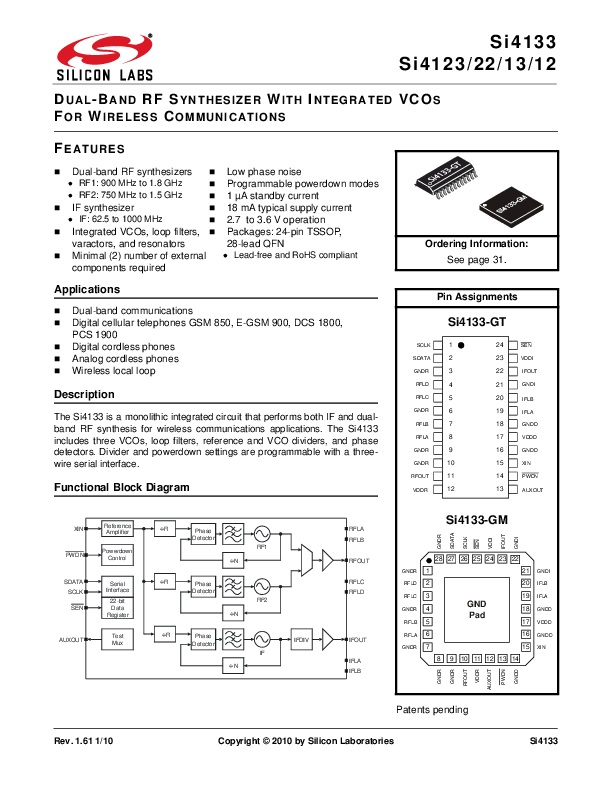
The Si4133 is a monolithic integrated circuit that performs both IF and dualband RF synthesis for wireless communications applications. The Si4133 includes three VCOs, loop filters, reference and VCO dividers, and phase detectors. Divider and powerdown settings are programmable with a threewire serial interface.

Functional Block Diagram

Ordering Information: See page 31.

Pin Assignments

Si4133-GT

SCLK

1

SDATA

2

GNDR

3

RFLD

4

RFLC

5

GNDR

6

RFLB

7

RFLA

8

GNDR

9

GNDR

10

RFOUT

11

VDDR

12

24

SEN

23

VDDI

22

IFOUT

21

GNDI

20

IFLB

19

IFLA

18

GNDD

17

VDDD

16

GNDD

15

XIN

14

PWDN

13

AUXOUT

XIN PWDN

Reference Amplifier
Powerdown Control

SDATA SCLK SEN
AUXOUT

Serial Interface
22-bit Data Register
Test Mux

R

Phase

Detector

RF1

N

R

Phase

Detector

RF2

N

R

Phase

Detector

IF

N

IFDIV

RFLA RFLB RFOUT RFLC RFLD
IFOUT IFLA IFLB

Si4133-GM

GNDR SDATA SCLK SEN VDDI IFOUT GNDI

GNDR RFLD RFLC GNDR RFLB RFLA GNDR

28 27 26 25 24 23 22

1

21 GNDI

2

20 IFLB

3

19 IFLA

4

GND

18 GNDD

Pad

5

17 VDDD

6

16 GNDD

7

15 XIN

8 9 10 11 12 13 14

GNDR GNDR RFOUT VDDR AUXOUT PWDN GNDD

Rev. 1.61 1/10

Patents pending Copyright � 2010 by Silicon Laboratories

Si4133

Si4133

2

Rev. 1.61

TABLE OF CONTENTS

Si4133

Section

Page

1. Electrical Specifications . . . . . . . . . . . . . . . . . . . . . . . . . . . . . . . . . . . . . . . . . . . . . . . . . . .4 2. Typical Application Circuits . . . . . . . . . . . . . . . . . . . . . . . . . . . . . . . . . . . . . . . . . . . . . . . 15 3. Functional Description . . . . . . . . . . . . . . . . . . . . . . . . . . . . . . . . . . . . . . . . . . . . . . . . . . . 16
3.1. Serial Interface . . . . . . . . . . . . . . . . . . . . . . . . . . . . . . . . . . . . . . . . . . . . . . . . . . . . . 16 3.2. Setting the VCO Center Frequencies . . . . . . . . . . . . . . . . . . . . . . . . . . . . . . . . . . . . 16 3.3. Extended Frequency Operation . . . . . . . . . . . . . . . . . . . . . . . . . . . . . . . . . . . . . . . . 17 3.4. Self-Tuning Algorithm . . . . . . . . . . . . . . . . . . . . . . . . . . . . . . . . . . . . . . . . . . . . . . . . 17 3.5. Output Frequencies . . . . . . . . . . . . . . . . . . . . . . . . . . . . . . . . . . . . . . . . . . . . . . . . . . 18 3.6. PLL Loop Dynamics . . . . . . . . . . . . . . . . . . . . . . . . . . . . . . . . . . . . . . . . . . . . . . . . . 18 3.7. RF and IF Outputs . . . . . . . . . . . . . . . . . . . . . . . . . . . . . . . . . . . . . . . . . . . . . . . . . . . 19 3.8. Reference Frequency Amplifier . . . . . . . . . . . . . . . . . . . . . . . . . . . . . . . . . . . . . . . . . 19 3.9. Powerdown Modes . . . . . . . . . . . . . . . . . . . . . . . . . . . . . . . . . . . . . . . . . . . . . . . . . . 19 3.10. Auxiliary Output (AUXOUT) . . . . . . . . . . . . . . . . . . . . . . . . . . . . . . . . . . . . . . . . . . 20 4. Control Registers . . . . . . . . . . . . . . . . . . . . . . . . . . . . . . . . . . . . . . . . . . . . . . . . . . . . . . . .21 5. Pin Descriptions: Si4133-GT . . . . . . . . . . . . . . . . . . . . . . . . . . . . . . . . . . . . . . . . . . . . . . . 27 6. Pin Descriptions: Si4133-GM . . . . . . . . . . . . . . . . . . . . . . . . . . . . . . . . . . . . . . . . . . . . . . 29 7. Ordering Guide . . . . . . . . . . . . . . . . . . . . . . . . . . . . . . . . . . . . . . . . . . . . . . . . . . . . . . . . . . 31 8. Si4133 Derivative Devices . . . . . . . . . . . . . . . . . . . . . . . . . . . . . . . . . . . . . . . . . . . . . . . . .31 9. Package Outline: Si4133-GT . . . . . . . . . . . . . . . . . . . . . . . . . . . . . . . . . . . . . . . . . . . . . . . 32 10. Package Outline: Si4133-GM . . . . . . . . . . . . . . . . . . . . . . . . . . . . . . . . . . . . . . . . . . . . . . 33 Document Change List . . . . . . . . . . . . . . . . . . . . . . . . . . . . . . . . . . . . . . . . . . . . . . . . . . . . .34 Contact Information . . . . . . . . . . . . . . . . . . . . . . . . . . . . . . . . . . . . . . . . . . . . . . . . . . . . . . . .36

Rev. 1.61

3

Si4133

1. Electrical Specifications

Table 1. Recommended Operating Conditions

Parameter

Symbol Test Condition

Min

Typ

Max Unit

Ambient Temperature

TA

�40

25

85

�C

Supply Voltage

VDD

2.7

3.0

3.6

V

Supply Voltages Difference

V

(VDDR � VDDD),

�0.3

--

0.3

V

(VDDI � VDDD)

Note: All minimum and maximum specifications are guaranteed and apply across the recommended operating conditions. Typical values apply at nominal supply voltages and an operating temperature of 25 �C unless otherwise stated.

Table 2. Absolute Maximum Ratings1,2

Parameter

Symbol

Value

Unit

DC Supply Voltage Input Current3

VDD

�0.5 to 4.0

V

IIN

�10

mA

Input Voltage3

VIN

�0.3 to VDD+0.3

V

Storage Temperature Range

TSTG

�55 to 150

oC

Notes: 1. Permanent device damage may occur if the above Absolute Maximum Ratings are exceeded. Functional operation should be restricted to the conditions as specified in the operational sections of this data sheet. Exposure to absolute maximum rating conditions for extended periods may affect device reliability. 2. This device is a high performance RF integrated circuit with an ESD rating of < 2 kV. Handling and assembly of this device should only be done at ESD-protected workstations. 3. For signals SCLK, SDATA, SEN, PWDN and XIN.

4

Rev. 1.61

Si4133

Table 3. DC Characteristics
(VDD = 2.7 to 3.6 V, TA = �40 to 85 �C)

Parameter Total Supply Current1 RF1 Mode Supply Current1 RF2 Mode Supply Current1 IF Mode Supply Current1

Symbol

Test Condition

Min Typ

RF1 and IF operating

--

18

--

10

--

9

--

8

Standby Current

PWDN = 0

High Level Input Voltage2 Low Level Input Voltage2 High Level Input Current2
Low Level Input Current2
High Level Output Voltage3 Low Level Output Voltage3

VIH

VIL

IIH

VIH = 3.6 V,

VDD = 3.6 V

IIL

VIL = 0 V,

VDD= 3.6 V

VOH

IOH = �500 �A

VOL

IOH = 500 �A

Notes: 1. RF1 = 1.6 GHz, RF2 = 1.1 GHz, IFOUT = 550 MHz, LPWR = 0. 2. For signals SCLK, SDATA, SEN, and PWDN. 3. For signal AUXOUT.

--

1

0.7 VDD --

--

--

�10

--

�10

--

VDD�0.4 --

--

--

Max 27 16 16 13 -- -- 0.3 VDD 10

Unit mA mA mA mA �A V V �A

10

�A

--

V

0.4

V

Rev. 1.61

5

Si4133

Table 4. Serial Interface Timing
(VDD = 2.7 to 3.6 V, TA = �40 to 85 �C)

Parameter1

Symbol

Test Condition

Min Typ Max Unit

SCLK Cycle Time

tclk

Figure 1

40

--

--

ns

SCLK Rise Time

tr

Figure 1

--

--

50

ns

SCLK Fall Time

tf

Figure 1

--

--

50

ns

SCLK High Time

th

Figure 1

10

--

--

ns

SCLK Low Time

tl

Figure 1

10

--

--

ns

SDATA Setup Time to SCLK2

tsu

Figure 2

5

--

--

ns

SDATA Hold Time from SCLK2

thold

Figure 2

0

--

--

ns

SEN to SCLKDelay Time2

ten1

Figure 2

10

--

--

ns

SCLK to SENDelay Time2

ten2

Figure 2

12

--

--

ns

SEN to SCLKDelay Time2

ten3

Figure 2

12

--

--

ns

SEN Pulse Width

tw

Figure 2

10

--

--

ns

Notes: 1. All timing is referenced to the 50% level of the waveforms unless otherwise noted. 2. Timing is not referenced to 50% level of the waveform. See Figure 2.

SCLK

80% 50% 20%

t

t

r

f

t

t

h

l

t clk

Figure 1. SCLK Timing Diagram

6

Rev. 1.61

SCLK

t

t

su

hold

Si4133

S DA TA SENB

D17

D16

ten1

D15

A1

A0

t
en2

ten3

tw
Figure 2. Serial Interface Timing Diagram

First bit clocked in

Last bit clocked in

DD DDD DD DDD DD DDD DDD A AA A 17 16 15 14 13 12 11 10 9 8 7 6 5 4 3 2 1 0 3 2 1 0

data field
Figure 3. Serial Word Format

addres s field

Rev. 1.61

7

Si4133

Table 5. RF and IF Synthesizer Characteristics
(VDD = 2.7 to 3.6 V, TA = �40 to 85 �C)

Parameter1

Symbol Test Condition

Min Typ Max Unit

XIN Input Frequency Reference Amplifier Sensitivity

fREF VREF

2

--

26

MHz

0.5

--

VDD

VPP

+0.3 V

Phase Detector Update Frequency RF1 VCO Center Frequency Range RF1 VCO Tuning Range2

f

f= fREF/R

0.010 --

1.0

MHz

fCEN

947

-- 1720 MHz

Extended frequency 1850

--

2050 MHz

operation

RF2 VCO Center Frequency Range RF Tuning Range from fCEN IF VCO Center Frequency Range IFOUT Tuning Range

fCEN fCEN

Note: LEXT �10% with IFDIV

789 �5 526 62.5

-- 1429 MHz

--

5

%

--

952 MHz

--

1000 MHz

IFOUT Tuning Range from fCEN RF1 VCO Pushing

Note: LEXT �10% Open loop

�5

--

5

%

--

500

-- kHz/V

RF2 VCO Pushing

--

400

-- kHz/V

IF VCO Pushing

--

300

-- kHz/V

RF1 VCO Pulling RF2 VCO Pulling IF VCO Pulling RF1 Phase Noise

VSWR = 2:1, all phases, open loop
1 MHz offset

--

400

--

kHzPP

--

300

--

kHzPP

--

100

--

kHzPP

--

�132

-- dBc/Hz

RF1 Integrated Phase Error

10 Hz to 100 kHz

--

0.9

-- degrees

rms

RF2 Phase Noise

1 MHz offset

--

�134

-- dBc/Hz

RF2 Integrated Phase Error

10 Hz to 100 kHz

--

0.7

-- degrees

rms

IF Phase Noise

100 kHz offset

--

�117

-- dBc/Hz

IF Integrated Phase Error

100 Hz to 100 kHz

--

0.4

-- degrees

rms

Notes:
1. f = 200 kHz, RF1 = 1.6 GHz, RF2 = 1.2 GHz, IFOUT = 550 MHz, LPWR = 0, for all parameters unless otherwise noted. 2. Extended frequency operation only. VDD  3.0 V, QFN only, VCO Tuning Range fixed by directly shorting the RFLA and
RFLB pins. See Application Note 41 for more details on the Si4133 extended frequency operation. 3. From powerup request (PWDN or SEN during a write of 1 to bits PDIB and PDRB in Register 2) to RF and IF
synthesizers ready (settled to within 0.1 ppm frequency error). 4. From powerdown request (PWDN, or SENduring a write of 0 to bits PDIB and PDRB in Register 2) to supply current
equal to IPWDN.

8

Rev. 1.61

Si4133

Table 5. RF and IF Synthesizer Characteristics (Continued)
(VDD = 2.7 to 3.6 V, TA = �40 to 85 �C)

Parameter1

Symbol Test Condition

Min Typ Max Unit

RF1 Harmonic Suppression

Second Harmonic

--

�26

�20

dBc

RF2 Harmonic Suppression

--

�26 �20

dBc

IF Harmonic Suppression

--

�26 �20

dBc

RFOUT Power Level RFOUT Power Level2

ZL = 50

�8

�3

ZL = 50RF1 active, �14

�7

Extended frequency

operation

1

dBm

1

dBm

IFOUT Power Level

ZL = 50

�8

�4

0

dBm

RF1 Output Reference Spurs

Offset = 200 kHz

--

�65

--

dBc

Offset = 400 kHz

--

�71

--

dBc

Offset = 600 kHz

--

�75

--

dBc

RF2 Output Reference Spurs

Offset = 200 kHz

--

�65

--

dBc

Offset = 400 kHz

--

�71

--

dBc

Powerup Request to Synthesizer Ready3 tpup Time
Powerdown Request to Synthesizer Off4 tpdn Time

Offset = 600 kHz Figures 4, 5
Figures 4, 5

--

�75

--

dBc

--

40/f 50/f

--

--

100

ns

Notes:
1. f = 200 kHz, RF1 = 1.6 GHz, RF2 = 1.2 GHz, IFOUT = 550 MHz, LPWR = 0, for all parameters unless otherwise noted. 2. Extended frequency operation only. VDD  3.0 V, QFN only, VCO Tuning Range fixed by directly shorting the RFLA and
RFLB pins. See Application Note 41 for more details on the Si4133 extended frequency operation. 3. From powerup request (PWDN or SEN during a write of 1 to bits PDIB and PDRB in Register 2) to RF and IF
synthesizers ready (settled to within 0.1 ppm frequency error). 4. From powerdown request (PWDN, or SENduring a write of 0 to bits PDIB and PDRB in Register 2) to supply current
equal to IPWDN.

Rev. 1.61

9

Si4133

IT IPWDN
SEN

RF and IF synthesizers settled to within 0.1 ppm frequency error.

tpup

tpdn

SDATA

PDIB = 1 PDRB = 1

PDIB = 0 PDRB = 0

Figure 4. Software Power Management Timing Diagram

IT IPWDN

RF and IF synthesizers settled to within 0.1 ppm frequency error.

tpup

tpdn

PWDN
Figure 5. Hardware Power Management Timing Diagram

10

Rev. 1.61

Si4133

TRACE A: Ch1 FM Main Time A Marker
1.424 kHz

174.04471 us

Real
160 Hz /div

711.00 Hz

176 Hz
Start: 0 s

Stop: 399.6003996 us

Figure 6. Typical Transient Response RF1 at 1.6 GHz with 200 kHz Phase Detector Update Frequency

Rev. 1.61

11

Si4133

Phase Noise (dBc/Hz)

-60

-70

-80

-90

-100

-110

-120

-130

-140

102

103

104

105

106

Offset Frequency (Hz)

Figure 7. Typical RF1 Phase Noise at 1.6 GHz with 200 kHz Phase Detector Update Frequency

Figure 8. Typical RF1 Spurious Response at 1.6 GHz with 200 kHz Phase Detector Update Frequency

12

Rev. 1.61

Phase Noise (dBc/Hz)

Si4133

-60

-70

-80

-90

-100

-110

-120

-130

-140

102

103

104

105

106

Offset Frequency (Hz)

Figure 9. Typical RF2 Phase Noise at 1.2 GHz with 200 kHz Phase Detector Update Frequency

Figure 10. Typical RF2 Spurious Response at 1.2 GHz with 200 kHz Phase Detector Update Frequency

Rev. 1.61

13

Si4133

Phase Noise (dBc/Hz)

-70

-80

-90

-100

-110

-120

-130

-140

-150

102

103

104

105

106

Offset Frequency (Hz)

Figure 11. Typical IF Phase Noise at 550 MHz with 200 kHz Phase Detector Update Frequency

Figure 12. IF Spurious Response at 550 MHz with 200 kHz Phase Detector Update Frequency

14

Rev. 1.61

2. Typical Application Circuits

Si4133

From System Controller
Printed Trace Inductors
560 pF 2 nH RFOUT

0.022 F VDD

VDD

Si4133-GT

1 SCLK
2 SDATA

24 SEN
23 VDDI

30  * 0.022 F

3 GNDR

22 IFOUT

4 RFLD

21 GNDI

5 RFLC

20 IFLB

6 GNDR

19 IFLA

7 RFLB
8 RFLA

18 GNDD
VDD 17 VDDD

0.022 F

9 GNDR

16 GNDD

10 GNDR

15 XIN

11 RFOUT

14 PWDN

12 VDDR

13 AUXOUT

* Add 30  series resistance if using IF output divide values 2, 4, or 8.
Figure 13. Si4133-GT

From System Controller

VDD 30  * 0.022F
28 27 26 25 24 23 22

40 nH 560 pF IFOUT
Printed Trace Inductor or Chip Inductor
560 pF External Clock PWDN AUXOUT
40 nH 560 pF IFOUT

GND R SDAT A SCLK
SE N VDD I IFOU T GND I

Printed Trace Inductors

1 GNDR
2 RFLD
3 RFLC
4 GNDR
5 RFLB
6 RFLA
7 GNDR

Si4133-GM

21 GNDI
20 IFLB
19 IFLA
18 GNDD
17 VDDD
16 GNDD
15 XIN

Printed Trace Inductor or Chip Inductor

VDD

0.022 F 560 pF

External Clock

GNDR GNDR RFOUT VDDR AUXOUT PWDN GNDD

PWDN

8 9 10 11 12 13 14 VDD
0.022F
* Add 30  series resistance if using IF output divide values 2, 4, or 8.
Figure 14. Si4133-GM

2 nH

560 pF

AUXOUT RFOUT

Rev. 1.61

15

Si4133

3. Functional Description
The Si4133 is a monolithic integrated circuit that performs IF and dual-band RF synthesis for wireless communications applications. This integrated circuit (IC), with minimal external components, completes the frequency synthesis function necessary for RF communications systems.
The Si4133 has three complete phase-locked loops (PLLs) with integrated voltage-controlled oscillators (VCOs). The low phase noise of the VCOs makes the Si4133 suitable for demanding wireless communications applications. Phase detectors, loop filters, and reference and output frequency dividers are integrated. The IC is programmed with a three-wire serial interface.
Two PLLs are provided for dual-band RF synthesis. These RF PLLs are multiplexed so that only one PLL is active at a time, as determined by the setting of an internal register. The active PLL is the last one to be written. The center frequency of the VCO in each PLL is set by the value of an external inductance. Inaccuracies in these inductances are compensated for by the selftuning algorithm. The algorithm is run after powerup or after a change in the programmed output frequency.
Each RF PLL, when active, can adjust the RF output frequency by �5% of its VCO's center frequency. Because the two VCOs can be set to have widely separated center frequencies, the RF output can be programmed to service two widely separated frequency bands by programming the corresponding N-Divider. One RF VCO is optimized to have its center frequency set between 947 MHz and 1.72 GHz, while the second RF VCO is optimized to have its center frequency set between 789 MHz and 1.429 GHz.
One PLL is provided for IF frequency synthesis. The center frequency of this circuit's VCO is set by the connection of an external inductance. The PLL can adjust the IF output frequency by �5% of the VCO center frequency. Inaccuracies in the value of the external inductance are compensated for by the Si4133's proprietary self-tuning algorithm. This algorithm is initiated each time the PLL is powered-up (by either the PWDN pin or by software) and/or each time a new output frequency is programmed.
The IF VCO can have its center frequency set as low as 526 MHz and as high as 952 MHz. An IF output divider divides down the IF output frequencies, if needed. The divider is programmable and is capable of dividing by 1, 2, 4, or 8.

The unique PLL architecture used in the Si4133 produces settling (lock) times that are comparable in speed to fractional-N architectures without the high phase noise or spurious modulation effects often associated with those designs.
3.1. Serial Interface
A timing diagram for the serial interface is shown in Figure 2 on page 7. Figure 3 on page 7 shows the format of the serial word.
The Si4133 is programmed serially with 22-bit words comprised of 18-bit data fields and 4-bit address fields. When the serial interface is enabled (i.e., when SEN is low) data and address bits on the SDATA pin are clocked into an internal shift register on the rising edge of SCLK. Data in the shift register is then transferred on the rising edge of SEN into the internal data register addressed in the address field. The serial interface is disabled when SEN is high.
Table 12 on page 21 summarizes the data register functions and addresses. The internal shift register ignores leading bits before the 22 required bits.
3.2. Setting the VCO Center Frequencies
The PLLs can adjust the IF and RF output frequencies �5% of the center frequencies of their VCOs. Each center frequency is established by the value of an external inductance connected to the respective VCO. Manufacturing tolerances of �10% for the external inductances are acceptable. The Si4133 compensates for inaccuracies in each inductance by executing a selftuning algorithm after PLL powerup or after a change in the programmed output frequency.
Because the total tank inductance is in the low nH range, the inductance of the package must be considered when determining the correct external inductance. The total inductance (LTOT) presented to each VCO is the sum of the external inductance (LEXT) and the package inductance (LPKG). Each VCO has a nominal capacitance (CNOM) in parallel with the total inductance, and the center frequency is as follows:

fCEN

=

-----------------------1-----------------------2 LTOT  CNOM

or

fCEN

=

-----------------------------------1------------------------------------2 LPKG + LEXT  CNOM

Tables 6 and 7 summarize the characteristics of each VCO.

16

Rev. 1.61

Si4133

Table 6. Si4133-GT VCO Characteristics

VCO fCEN Range CNOM LPKG LEXT Range

(MHz) (pF) (nH)

(nH)

Min Max

Min Max

RF1 947 1720 4.3 2.0 0.0 4.6

RF2 789 1429 4.8 2.3 0.3 6.2

IF 526 952 6.5 2.1 2.2 12.0

Table 7. Si4133-GM VCO Characteristics

VCO fCEN Range CNOM LPKG LEXT Range

(MHz) (pF) (nH)

(nH)

the correct total inductance to the VCO. In manufacturing, the external inductance can vary �10% of its nominal value and the Si4133 corrects for the variation with the self-tuning algorithm.
For more information on designing the external trace inductors, refer to Application Note 31: Inductor Design for the Si41xx Synthesizer Family.
3.3. Extended Frequency Operation
The Si4133 may operate at an extended frequency range of 1850 MHz to 2050 MHz by connecting the RFLA and RFLB pins directly. For information on configuring the Si4133 for extended frequency operation, refer to Application Note 41: Extended Frequency Operation of Silicon Laboratories Frequency Synthesizers.
3.4. Self-Tuning Algorithm

Min Max

Min Max

RF1 947 1720 4.3 1.5 0.5 5.1

RF2 789 1429 4.8 1.5 1.1 7.0

IF 526 952 6.5 1.6 2.7 12.5

L PKG 2

L
E XT

L PKG 2
Figure 15. External Inductance Connection
As a design example, consider that the goal is to synthesize frequencies in a 25 MHz band between 1120 and 1145 MHz using the Si4133-GT. The center frequency should be defined as midway between the two extremes, or 1132.5 MHz. The PLL can adjust the VCO output frequency �5% of the center frequency, or �56.6 MHz of 1132.5 MHz (i.e., from approximately 1076 to 1189 MHz). The RF2 VCO has a CNOM of 4.8 pF. A 4.1 nH inductance in parallel with this capacitance yields the required center frequency. An external inductance of 1.8 nH should be connected between RFLC and RFLD as shown in Figure 15. This, in addition to 2.3 nH of package inductance, presents

The self-tuning algorithm is initiated immediately after powerup of a PLL or, if the PLL is already powered, after a change in its programmed output frequency. This algorithm attempts to tune the VCO so that its freerunning frequency is near the required output frequency. In doing so, the algorithm compensates for manufacturing tolerance errors in the value of the external inductance connected to the VCO. It also reduces the frequency error for which the PLL must correct to get the precise required output frequency. The self-tuning algorithm leaves the VCO oscillating at a frequency in error by somewhat less than 1% of the desired output frequency.
After self-tuning, the PLL controls the VCO oscillation frequency. The PLL completes frequency locking, eliminating any remaining frequency error. From then on, it maintains frequency-lock, compensating for effects of temperature and supply voltage variations.
The Si4133's self-tuning algorithm compensates for component value errors at any temperature within the specified temperature range. However, the ability of the PLL to compensate for drift in component values that occur after self-tuning is limited. For external inductances with temperature coefficients approximately �150 ppm/oC, the PLL can maintain lock for changes in temperature of approximately �30 oC.
Applications where the PLL is regularly powered down or the frequency is periodically reprogrammed minimize or eliminate the potential effects of temperature drift because the VCO is re-tuned in either case. In applications where the ambient temperature can drift substantially after self-tuning, it might be necessary to monitor the lock-detect bar (LDETB) signal on the AUXOUT pin to determine whether a PLL is about to run out of locking capability. See "3.10. Auxiliary Output

Rev. 1.61

17

Si4133

(AUXOUT)" for how to select LDETB. The LDETB signal is low after self-tuning is completed but rises when the IF or RF PLL nears the limit of its compensation range. LDETB is also high when either PLL is executing the self-tuning algorithm. The output frequency is still locked when LDETB goes high, but the PLL eventually loses lock if the temperature continues to drift in the same direction. Therefore, if LDETB goes high both the IF and RF PLLs should be re-tuned promptly by initiating the self-tuning algorithm.
3.5. Output Frequencies

setting the bits to 11. The values of the available gains, relative to the highest gain, are as follows:

Table 8. Gain Values (Register 1)

KP Bits
00 01 10 11

Relative P.D. Gain 1 1/2 1/4 1/8

The IF and RF output frequencies are set by programming the R- and N-Divider registers. Each PLL has R and N registers so that each can be programmed independently. Programming either the R- or N-Divider register for RF1 or RF2 automatically selects the associated output.
The reference frequency on the XIN pin is divided by R and this signal is input to the PLL's phase detector. The other input to the phase detector is the PLL's VCO output frequency divided by N. The PLL acts to make these frequencies equal.
That is, after an initial transient:

The gain value bits is automatically set with the Auto KP bit (bit 2) in the Main Configuration register to 1. In setting this bit, the gain values are optimized for a given value of N. In general, a higher phase detector gain decreases in-band phase noise and increase the speed of the PLL transient until the point at which stability begins to be compromised. The optimal gain depends on N. Table 9 lists recommended settings for different values of N. These are the settings when the Auto KP bit is set.
Table 9. Optimal KP Settings

f--O----U----TN

=

f--R----E----FR

or

fOUT

=

N--R


fREF

The R values are set by programming the RF1 RDivider register (Register 6), the RF2 R-Divider register (Register 7) and the IF R-Divider register (Register 8).

The N values are set by programming the RF1 NDivider register (Register 3), the RF2 N-Divider register (Register 4), and the IF N-Divider register (Register 5).

Each N-Divider is implemented as a conventional high speed divider. That is, it consists of a dual-modulus prescaler, a swallow counter, and a lower speed synchronous counter. However, the control of these sub-circuits is automatically handled. Only the appropriate N value should be programmed.

3.6. PLL Loop Dynamics

The transient response for each PLL is determined by its phase detector update rate f (equal to fREF/R) and the phase detector gain programmed for each RF1, RF2, or IF synthesizer. See Register 1. Four different settings for the phase detector gain are available for each PLL. The highest gain is programmed by setting the two phase detector gain bits to 00, and the lowest by

RF1

N

KP1<1:0>

2047

00

2048 to 4095

00

4096 to 8191

00

8192 to 16383

01

16384 to 32767

10

32768

11

RF2 KP2<3:2>
00 00 01 10 11 11

IF KPI<5:4>
00 01 10 11 11 11

The VCO gain and loop filter characteristics are not programmable.
The settling time for the PLL is directly proportional to its phase detector update period T (T equals 1/f). A typical transient response is shown in Figure 6 on page 11. During the first 13 update periods the Si4133 executes the self-tuning algorithm. From then on the PLL controls the output frequency. Because of the unique architecture of the Si4133 PLLs, the time required to settle the output frequency to 0.1 ppm error is automatically 25 update periods. The total time after powerup or a change in programmed frequency until the synthesized frequency is settled--including time for self-tuning--is approximately 40 update periods.
Note: The settling time analysis holds for RF1 f  500 kHz. For RF1 f > 500 kHz, the settling time is larger.

18

Rev. 1.61

Si4133

3.7. RF and IF Outputs
The RFOUT and IFOUT pins are driven by amplifiers that buffer the RF VCOs and IF VCO respectively. The RF output amplifier receives its input from the RF1 or RF2 VCO, depending on which R- or N-Divider register is written last. For example, programming the N-Divider register for RF1 automatically selects the RF1 VCO output.
Figures 13 and 14 show application diagrams for the Si4133. The RF output signal must be ac coupled to its load through a capacitor. An external inductance between the RFOUT pin and the ac coupling capacitor is required as part of an output matching network to maximize power delivered to the load. This 2 nH inductance can be realized with a PC board trace. The network is made to provide an adequate match to an external 50  load for both the RF1 and RF2 frequency bands. The matching network also filters the output signal to reduce harmonic distortion.
The IFOUT pin must also be ac coupled to its load through a capacitor. The IF output level is dependent upon the load. Figure 18 on page 20 displays the output level versus load resistance for a variety of output frequencies. For resistive loads greater than 500  the output level saturates and the bias currents in the IF output amplifier are higher than required. The LPWR bit in the Main Configuration register (Register 0) can be set to 1 to reduce the bias currents and therefore reduce the power dissipated by the IF amplifier. For loads less than 500  LPWR should be set to 0 to maximize the output level.
For IF frequencies greater than 500 MHz, a matching network is required to drive a 50 load. See Figure 16. The value of LMATCH can be determined from Table 10.

Table 10. LMATCH Values

Frequency 500�600 MHz 600�800 MHz 800 MHz�1 GHz

LMATCH 40 nH 27 nH 18 nH

For frequencies less than 500 MHz, the IF output buffer can directly drive a 200  resistive load or higher. For resistive loads greater than 500  (f < 500 MHz) the LPWR bit can be set to reduce the power consumed by the IF output buffer. See Figure 17.

IFOUT

>500 pF

>200

Figure 17. IF Frequencies < 500 MHz
3.8. Reference Frequency Amplifier
The Si4133 provides a reference frequency amplifier. If the driving signal has CMOS levels it can be connected directly to the XIN pin. Otherwise, the reference frequency signal should be ac coupled to the XIN pin through a 560 pF capacitor.
3.9. Powerdown Modes
Table 11 summarizes the powerdown functionality. The Si4133 can be powered down by taking the PWDN pin low or by setting bits in the Powerdown register (Register 2). When the PWDN pin is low, the Si4133 is powered down regardless of the Powerdown register settings. When the PWDN pin is high, power management is in control of the Powerdown register bits.
The IF and RF sections of the Si4133 circuitry can be individually powered down by setting the Powerdown register bits PDIB and PDRB low, respectively. The reference frequency amplifier is also powered up if the PDRB and PDIB bits are high. Also, setting the AUTOPDB bit to 1 in the Main Configuration register (Register 0) is equivalent to setting both bits in the Powerdown register to 1.
The serial interface remains available and can be written in all powerdown modes.

IFOUT

LMATCH

560 pF 50

Figure 16. IF Frequencies > 500 MHz

Rev. 1.61

19

Si4133

3.10. Auxiliary Output (AUXOUT)
The signal appearing on AUXOUT is selected by setting the AUXSEL bits in the Main Configuration register (Register 0).
The LDETB signal can be selected by setting the AUXSEL bits to 11. This signal can be used to indicate that the IF or RF PLL is going to lose lock because of excessive ambient temperature drift and should be re-tuned. The LDETB signal indicates a logical OR result if both IF and RF are simultaneously generating a signal.

Table 11. Powerdown Configuration

PWDN Pin PWDN = 0

AUTOPDB X 0

PDIB X 0

PDRB IF Circuitry RF Circuitry

X

OFF

OFF

0

OFF

OFF

0

PWDN = 1

0

0

1

0

1

OFF

ON

1

0

ON

OFF

1

1

ON

ON

x

x

ON

ON

Output Voltage (mVrms)

450

400

350
LPWR=0 300

LPWR=1

250

200

150

100

50

0

0

200

400

600

800

1000

1200

Load Resistance ()

Figure 18. Typical IF Output Voltage vs. Load Resistance at 550 MHz

20

Rev. 1.61

Si4133

4. Control Registers

Table 12. Register Summary

Register Name

Bit Bit Bit Bit Bit Bit Bit Bit Bit Bit Bit Bit Bit Bit Bit Bit Bit Bit 17 16 15 14 13 12 11 10 9 8 7 6 5 4 3 2 1 0

0 Main

0 0 0 0 AUXSEL IFDIV 0 0 0 0 LPWR 0 AUTO AUTO RF 0

Configura-

[1:0]

[1:0]

PDB KP PWR

tion

1 Phase Detector Gain

0 0 0 0 0 0 0 0 0 0 0 0 KPI[1:0] KP2[1:0] KP1[1:0]

2

Powerdown 0 0 0 0 0 0 0 0 0 0 0 0 0

0

0

0 PDIB PDRB

3 RF1 N-Divider

4 RF2

0

N-Divider

5 IF N-Divider 0 0

6 RF1

000 0 0

R-Divider

7 RF2

000 0 0

R-Divider

8 IF R-Divider 0 0 0 0 0

9 Reserved

NRF1[17:0] NRF2[16:0] NIF[15:0] RRF1[12:0] RRF2[12:0] RIF[12:0]

. . .

15 Reserved

Note: Registers 9�15 are reserved. Writes to these registers might result in unpredictable behavior. Registers not listed here are reserved and should not be written.

Rev. 1.61

21

Si4133

Register 0. Main Configuration Address Field = A[3:0] = 0000

Bit D17 D16 D15 D14 D13 D12 D11 D10 D9 D8 D7 D6 D5 D4 D3 D2 D1 D0

Name 0 0 0 0 AUXSEL IFDIV

[1:0]

[1:0]

0 0 0 0 LPWR 0 AUTO AUTO RF 0
PDB KP PWR

Bit 17:14 13:12
11:10
9:6 5
4 3
2 1 0

Name Reserved AUXSEL[1:0]
IFDIV[1:0]
Reserved LPWR
Reserved AUTOPDB
AUTOKP RFPWR Reserved

Function
Program to zero.
Auxiliary Output Pin Definition. 00 = Reserved. 01 = Force output low. 10 = Reserved. 11 = Lock Detect--LDETB.
IF Output Divider. 00 = IFOUT = IFVCO Frequency 01 = IFOUT = IFVCO Frequency/2 10 = IFOUT = IFVCO Frequency/4 11 = IFOUT = IFVCO Frequency/8
Program to zero.
Output Power-Level Settings for IF Synthesizer Circuit. 0 = RLOAD 500 --normal power mode. 1 = RLOAD 500 --low power mode.
Program to zero.
Auto Powerdown. 0 = Software powerdown is controlled by Register 2. 1 = Equivalent to setting all bits in Register 2 = 1.
Auto KP Setting. 0 = KPs are controlled by Register 1. 1 = KPs are set according to Table 9 on page 18. Program to zero. (Used for extended frequency operation. See AN41 for more information.)
Program to zero.

22

Rev. 1.61

Si4133

Register 1. Phase Detector Gain Address Field (A[3:0]) = 0001

Bit D17 D16 D15 D14 D13 D12 D11 D10 D9 D8 D7 D6 D5 D4 D3 D2 D1 D0 Name 0 0 0 0 0 0 0 0 0 0 0 0 KPI[1:0] KP2[1:0] KP1[1:0]

Bit

Name

Function

17:6

Reserved

Program to zero.

5:4

KPI[1:0]

IF Phase Detector Gain Constant.*

N Value

KPI

<2048

= 00

2048�4095 = 01

4096�8191 = 10

>8191

= 11

3:2

KP2[1:0]

RF2 Phase Detector Gain Constant.*

N Value

KP2

<4096

= 00

4096�8191 = 01

8192�16383 = 10

>16383

= 11

1:0

KP1[1:0]

RF1 Phase Detector Gain Constant.*

N Value

KP1

<8192

= 00

8192�16383 = 01

16384�32767 = 10

>32767

= 11

*Note: When AUTOKP = 1, these bits do not need to be programmed. When AUTOKP = 0, use these recommended values for programming Phase Detector Gain.

Rev. 1.61

23

Si4133

Register 2. Powerdown Address Field (A[3:0]) = 0010

Bit D17 D16 D15 D14 D13 D12 D11 D10 D9 D8 D7 D6 D5 D4 D3 Name 0 0 0 0 0 0 0 0 0 0 0 0 0 0 0

D2 D1 D0 0 PDIB PDRB

Bit

Name

Function

17:2

Reserved

Program to zero.

1

PDIB

Powerdown IF Synthesizer.

0 = IF synthesizer powered down.

1 = IF synthesizer on.

0

PDRB

Powerdown RF Synthesizer.

0 = RF synthesizer powered down.

1 = RF synthesizer on.

Note: Enabling any PLL with PDIB or PDRB automatically powers on the reference amplifier.

Register 3. RF1 N-Divider Address Field (A[3:0]) = 0011

Bit D17 D16 D15 D14 D13 D12 D11 D10 D9 D8 D7 D6 D5 D4 D3 D2 D1 D0

Name

NRF1[17:0]

Bit 17:0

Name NRF1[17:0]

N-Divider for RF1 Synthesizer.

Function

Register 4. RF2 N-Divider Address Field = A[3:0] = 0100

Bit D17 D16 D15 D14 D13 D12 D11 D10 D9 D8 D7 D6 D5 D4 D3 D2 D1 D0

Name 0

NRF2[16:0]

Bit

Name

Function

17

Reserved Program to zero.

16:0

NRF2[16:0] N-Divider for RF2 Synthesizer.

24

Rev. 1.61

Si4133

Register 5. IF N-Divider Address Field (A[3:0]) = 0101

Bit D17 D16 D15 D14 D13 D12 D11 D10 D9 D8 D7 D6 D5 D4 D3 D2 D1 D0

Name 0 0

NIF[15:0]

Bit 17:16 15:0

Name Reserved NIF[15:0]

Function Program to zero. N-Divider for IF Synthesizer.

Register 6. RF1 R-Divider Address Field (A[3:0]) = 0110

Bit D17 D16 D15 D14 D13 D12 D11 D10 D9 D8 D7 D6 D5 D4 D3 D2 D1 D0

Name 0 0 0 0 0

RRF1[12:0]

17:13 12:0

Name Reserved RRF1[12:0]

Function
Program to zero.
R-Divider for RF1 Synthesizer. RRF1 can be any value from 7 to 8189 if KP1 = 00
8 to 8189 if KP1 = 01 10 to 8189 if KP1 = 10 14 to 8189 if KP1 = 11

Register 7. RF2 R-Divider Address Field (A[3:0]) = 0111

Bit D17 D16 D15 D14 D13 D12 D11 D10 D9 D8 D7 D6 D5 D4 D3 D2 D1 D0

Name 0 0 0 0 0

RRF2[12:0]

Bit 17:13 12:0

Name Reserved RRF2[12:0]

Function
Program to zero.
R-Divider for RF2 Synthesizer. RRF2 can be any value from 7 to 8189 if KP2 = 00
8 to 8189 if KP2 = 01 10 to 8189 if KP2 = 10 14 to 8189 if KP2 = 11

Rev. 1.61

25

Si4133

Register 8. IF R-Divider Address Field (A[3:0]) = 1000

Bit D17 D16 D15 D14 D13 D12 D11 D10 D9 D8 D7 D6 D5 D4 D3 D2 D1 D0

Name 0 0 0 0 0

RIF[12:0]

Bit 17:13 12:0

Name Reserved RIF[12:0]

Function
Program to zero.
R-Divider for IF Synthesizer. RIF can be any value from 7 to 8189 if KP1 = 00
8 to 8189 if KP1 = 01 10 to 8189 if KP1 = 10 14 to 8189 if KP1 = 11

26

Rev. 1.61

5. Pin Descriptions: Si4133-GT

Pin Number
1 2 3 4 5 6 7 8 9 10 11 12 13 14 15 16 17 18 19 20 21 22 23 24

Name
SCLK SDATA GNDR RFLD RFLC GNDR RFLB RFLA GNDR GNDR RFOUT VDDR AUXOUT PWDN XIN GNDD VDDD GNDD IFLA IFLB GNDI IFOUT VDDI SEN

SCLK

1

SDATA

2

GNDR

3

RFLD

4

RFLC

5

GNDR

6

RFLB

7

RFLA

8

GNDR

9

GNDR

10

RFOUT

11

VDDR

12

24

SEN

23

VDDI

22

IFOUT

21

GNDI

20

IFLB

19

IFLA

18

GNDD

17

VDDD

16

GNDD

15

XIN

14

PWDN

13

AUXOUT

Description
Serial clock input Serial data input Common ground for RF analog circuitry Pins for inductor connection to RF2 VCO Pins for inductor connection to RF2 VCO Common ground for RF analog circuitry Pins for inductor connection to RF1 VCO Pins for inductor connection to RF1 VCO Common ground for RF analog circuitry Common ground for RF analog circuitry Radio frequency (RF) output of the selected RF VCO Supply voltage for the RF analog circuitry Auxiliary output Powerdown input pin Reference frequency amplifier input Common ground for digital circuitry Supply voltage for digital circuitry Common ground for digital circuitry Pins for inductor connection to IF VCO Pins for inductor connection to IF VCO Common ground for IF analog circuitry Intermediate frequency (IF) output of the IF VCO Supply voltage for IF analog circuitry Enable serial port input

Si4133

Rev. 1.61

27

Si4133

Table 13. Pin Descriptions for Si4133 Derivatives--TSSOP

Pin Number Si4133

Si4123

Si4122

Si4113

Si4112

1

SCLK

SCLK

SCLK

SCLK

SCLK

2

SDATA

SDATA

SDATA

SDATA

SDATA

3

GNDR

GNDR

GNDR

GNDR

GNDD

4

RFLD

GNDR

RFLD

RFLD

GNDD

5

RFLC

GNDR

RFLC

RFLC

GNDD

6

GNDR

GNDR

GNDR

GNDR

GNDD

7

RFLB

RFLB

GNDR

RFLB

GNDD

8

RFLA

RFLA

GNDR

RFLA

GNDD

9

GNDR

GNDR

GNDR

GNDR

GNDD

10

GNDR

GNDR

GNDR

GNDR

GNDD

11

RFOUT

RFOUT

RFOUT

RFOUT

GNDD

12

VDDR

VDDR

VDDR

VDDR

VDDD

13

AUXOUT AUXOUT AUXOUT AUXOUT AUXOUT

14

PWDN

PWDN

PWDN

PWDN

PWDN

15

XIN

XIN

XIN

XIN

XIN

16

GNDD

GNDD

GNDD

GNDD

GNDD

17

VDDD

VDDD

VDDD

VDDD

VDDD

18

GNDD

GNDD

GNDD

GNDD

GNDD

19

IFLA

IFLA

IFLA

GNDD

IFLA

20

IFLB

IFLB

IFLB

GNDD

IFLB

21

GNDI

GNDI

GNDI

GNDD

GNDI

22

IFOUT

IFOUT

IFOUT

GNDD

IFOUT

23

VDDI

VDDI

VDDI

VDDD

VDDI

24

SEN

SEN

SEN

SEN

SEN

28

Rev. 1.61

6. Pin Descriptions: Si4133-GM

GNDR SDATA SCLK SEN VDDI IFOUT GNDI

GNDR RFLD RFLC GNDR RFLB RFLA GNDR

28 27 26 25 24 23 22

1

21 GNDI

2

20 IFLB

3

19 IFLA

4

GND

18 GNDD

Pad

5

17 VDDD

6

16 GNDD

7

15 XIN

8 9 10 11 12 13 14

GNDR GNDR RFOUT VDDR AUXOUT PWDN GNDD

Pin Number
1 2 3 4 5 6 7 8 9 10 11 12 13 14 15 16 17 18 19 20 21 22 23 24 25 26 27 28

Name
GNDR RFLD RFLC GNDR RFLB RFLA GNDR GNDR GNDR RFOUT VDDR AUXOUT PWDN GNDD XIN GNDD VDDD GNDD IFLA IFLB GNDI GNDI IFOUT VDDI SEN SCLK SDATA GNDR

Description
Common ground for RF analog circuitry Pins for inductor connection to RF2 VCO Pins for inductor connection to RF2 VCO Common ground for RF analog circuitry Pins for inductor connection to RF1 VCO Pins for inductor connection to RF1 VCO Common ground for RF analog circuitry Common ground for RF analog circuitry Common ground for RF analog circuitry Radio frequency (RF) output of the selected RF VCO Supply voltage for the RF analog circuitry Auxiliary output Powerdown input pin Common ground for digital circuitry Reference frequency amplifier input Common ground for digital circuitry Supply voltage for digital circuitry Common ground for digital circuitry Pins for inductor connection to IF VCO Pins for inductor connection to IF VCO Common ground for IF analog circuitry Common ground for IF analog circuitry Intermediate frequency (IF) output of the IF VCO Supply voltage for IF analog circuitry Enable serial port input Serial clock input Serial data input Common ground for RF analog circuitry

Rev. 1.61

Si4133
29

Si4133

Table 14. Pin Descriptions for Si4133 Derivatives--QFN

Pin Number Si4133 Si4123 Si4122 Si4113 Si4112

1

GNDR GNDR GNDR GNDR GNDD

2

RFLD GNDR RFLD RFLD GNDD

3

RFLC GNDR RFLC RFLC GNDD

4

GNDR GNDR GNDR GNDR GNDD

5

RFLB RFLB GNDR RFLB GNDD

6

RFLA RFLA GNDR RFLA GNDD

7

GNDR GNDR GNDR GNDR GNDD

8

GNDR GNDR GNDR GNDR GNDD

9

GNDR GNDR GNDR GNDR GNDD

10

RFOUT RFOUT RFOUT RFOUT GNDD

11

VDDR VDDR VDDR VDDR VDDD

12

AUXOUT AUXOUT AUXOUT AUXOUT AUXOUT

13

PWDN PWDN PWDN PWDN PWDN

14

GNDD GNDD GNDD GNDD GNDD

15

XIN

XIN

XIN

XIN

XIN

16

GNDD GNDD GNDD GNDD GNDD

17

VDDD VDDD VDDD VDDD VDDD

18

GNDD GNDD GNDD GNDD GNDD

19

IFLA

IFLA

IFLA GNDD IFLA

20

IFLB

IFLB

IFLB GNDD IFLB

21

GNDI GNDI GNDI GNDD GNDI

22

GNDI GNDI GNDI GNDD GNDI

23

IFOUT IFOUT IFOUT GNDD IFOUT

24

VDDI

VDDI

VDDI VDDD VDDI

25

SEN

SEN

SEN

SEN

SEN

26

SCLK SCLK SCLK SCLK SCLK

27

SDATA SDATA SDATA SDATA SDATA

28

GNDR GNDR GNDR GNDR GNDD

30

Rev. 1.61

7. Ordering Guide

Si4133

Ordering Part Number
Si4133-D-GM Si4133-D-GT Si4123-D-GM Si4123-D-GT Si4122-D-GM Si4122-D-GT Si4113-D-GM Si4113-D-GT Si4113-D-ZT1 Si4112-D-GM Si4112-D-GT

Description
RF1/RF2/IF OUT, Lead Free, QFN RF1/RF2/IF OUT, Lead Free, TSSOP
RF1/IF OUT, Lead Free, QFN RF1/IF OUT, Lead Free, TSSOP
RF2/IF OUT, Lead Free, QFN RF2/IF OUT, Lead Free, TSSOP RF1/RF2 OUT, Lead Free, QFN RF1/RF2 OUT, Lead Free, TSSOP
RF1/RF2 OUT, NiPd, TSSOP IF OUT, Lead Free, QFN
IF OUT, Lead Free, TSSOP

Operating Temperature
�40 to 85 �C �40 to 85 �C �40 to 85 �C �40 to 85 �C �40 to 85 �C �40 to 85 �C �40 to 85 �C �40 to 85 �C �40 to 85 �C �40 to 85 �C �40 to 85 �C

8. Si4133 Derivative Devices

The Si4133 performs both IF and dual-band RF frequency synthesis. The Si4112, Si4113, Si4122, and the Si4123 are derivatives of this device. Table 15 outlines which synthesizers each derivative device features and the pins and registers that coincide with each synthesizer.

Table 15. Si4133 Derivatives

Name Si4112

Synthesizer IF

Pins IFLA, IFLB

Si4113

RF1, RF2

RFLA, RFLB, RFLC, RFLD

Si4122 Si4123 Si4133

RF2, IF RF1, IF RF1, RF2, IF

RFLC, RFLD, IFLA, IFLB
RFLA, RFLB, IFLA, IFLB
RFLA, RFLB, RFLC, RFLD, IFLA, IFLB

Registers
NIF, RIF, PDIB, IFDIV, LPWR, AUTOPDB = 0, PDRB = 0
NRF1, NRF2, RRF1, RRF2, PDRB, AUTOPDB = 0, PDIB = 0
NRF2, RRF2, PDRB, NIF, RIF, PDIB, IFDIV, LPWR
NRF1, RRF1, PDRB, NIF, RIF, PDIB, IFDIV, LPWR
NRF1, NRF2, RRF1, RRF2, PDRB, NIF, RIF, PDIB, IFDIV, LPWR

Rev. 1.61

31

Si4133
9. Package Outline: Si4133-GT
Figure 19 illustrates the package details for the Si4133-GT. Table 16 lists the values for the dimensions shown in the illustration.
24 B

E1 E

ddd C B A 1 2 3

e

1 L

A D

Detail G

A

c

C

b

bbb M C B A

A1

See Detail G

Figure 19. 24-Pin Thin Shrink Small Outline Package (TSSOP)

Table 16. Package Diagram Dimensions

Symbol
A A1 b c D e E E1 L 1 bbb ddd

Millimeters

Min

Nom

Max

--

--

1.20

0.05

--

0.15

0.19

--

0.30

0.09

--

0.20

7.70

7.80

7.90

0.65 BSC

6.40 BSC

4.30

4.40

4.50

0.45

0.60

0.75

0�

--

8�

0.10

0.20

32

Rev. 1.61

Si4133
10. Package Outline: Si4133-GM
Figure 20 illustrates the package details for the Si4133-GM. Table 17 lists the values for the dimensions shown in the illustration.

Figure 20. 28-Pin Quad Flat No-Lead (QFN)

Table 17. Package Dimensions

Symbol

Millimeters

Symbol

Millimeters

A A1 b D, E e D2, E2

Min

Nom

Max

0.80

0.85

0.90

0.00

0.01

0.05

0.18

0.23

0.30

5.00 BSC

0.50 BSC

2.55

2.70

2.85

Min

Nom

Max

L

0.50

0.60

0.70

aaa

--

--

0.10

bbb

--

--

0.10

ccc

--

--

0.05

ddd

--

--

0.10


--

--

12

Notes: 1. Dimensioning and tolerancing per ANSI Y14.5M-1994. 2. This package outline conforms to JEDEC MS-220, variant VHHD-1. 3. Recommended card reflow profile is per the JEDEC/IPC J-STD-020B specification for Small Body Components.

Rev. 1.61

33

Si4133
DOCUMENT CHANGE LIST
Revision 1.4 to Revision 1.5
 "7.Ordering Guide" on page 31 updated.  Changed MLP to QFN (same package, generic
name)
Revision 1.5 to Revision 1.6
 Updated "7.Ordering Guide" on page 31.
Revision 1.6 to Revision 1.61
 Updated contact information.

34

Rev. 1.61

NOTES:

Si4133

Rev. 1.61

35

Simplicity Studio
One-click access to MCU tools, documentation, software, source code libraries & more. Available for Windows, Mac and Linux!
www.silabs.com/simplicity

MCU Portfolio www.silabs.com/mcu

SW/HW www.silabs.com/simplicity

Quality www.silabs.com/quality

Support and Community community.silabs.com

Disclaimer Silicon Laboratories intends to provide customers with the latest, accurate, and in-depth documentation of all peripherals and modules available for system and software implementers using or intending to use the Silicon Laboratories products. Characterization data, available modules and peripherals, memory sizes and memory addresses refer to each specific device, and "Typical" parameters provided can and do vary in different applications. Application examples described herein are for illustrative purposes only. Silicon Laboratories reserves the right to make changes without further notice and limitation to product information, specifications, and descriptions herein, and does not give warranties as to the accuracy or completeness of the included information. Silicon Laboratories shall have no liability for the consequences of use of the information supplied herein. This document does not imply or express copyright licenses granted hereunder to design or fabricate any integrated circuits. The products must not be used within any Life Support System without the specific written consent of Silicon Laboratories. A "Life Support System" is any product or system intended to support or sustain life and/or health, which, if it fails, can be reasonably expected to result in significant personal injury or death. Silicon Laboratories products are generally not intended for military applications. Silicon Laboratories products shall under no circumstances be used in weapons of mass destruction including (but not limited to) nuclear, biological or chemical weapons, or missiles capable of delivering such weapons.
Trademark Information Silicon Laboratories Inc., Silicon Laboratories, Silicon Labs, SiLabs and the Silicon Labs logo, CMEMS�, EFM, EFM32, EFR, Energy Micro, Energy Micro logo and combinations thereof, "the world's most energy friendly microcontrollers", Ember�, EZLink�, EZMac�, EZRadio�, EZRadioPRO�, DSPLL�, ISOmodem �, Precision32�, ProSLIC�, SiPHY�, USBXpress� and others are trademarks or registered trademarks of Silicon Laboratories Inc. ARM, CORTEX, Cortex-M3 and THUMB are trademarks or registered trademarks of ARM Holdings. Keil is a registered trademark of ARM Limited. All other products or brand names mentioned herein are trademarks of their respective holders.

Silicon Laboratories Inc. 400 West Cesar Chavez Austin, TX 78701 USA
http://www.silabs.com