

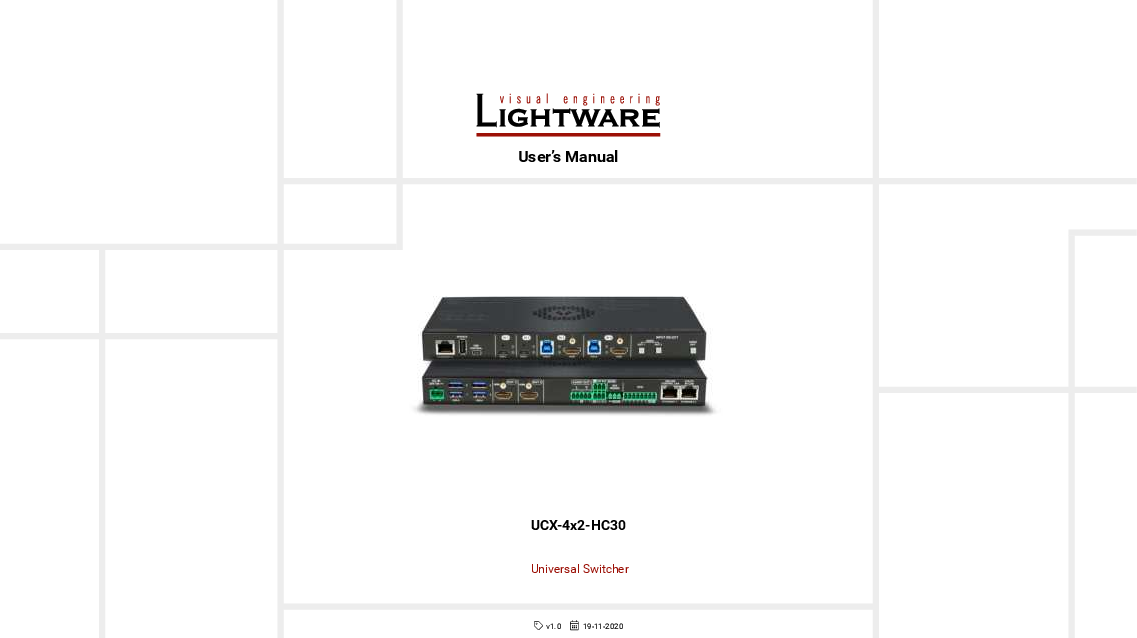
LIGHTWARE UCX-4x2-HC30 USB 3.1 Switch Hub User Manual
File info: application/pdf · 84 pages · 9.52MB
User's Manual - Lightware
the USB-C - USB-C cables are: USB 2.0(480 Mbps), min. 3A current, minimum 60W power. USB Type-A. Taurus UCX series have USB 3.1 Gen1 (max. 5 ...
Using the Normal install as the default choice is highly recommended. Installation for macOS. Mount the DMG file with double clicking on it and ...
User's Manual
Extracted Text
User's Manual
UCX-4x2-HC30
Universal Switcher
 v1.0  19-11-2020


UCX series � User's Manual

2

Important Safety Instructions

Class II apparatus construction.

The equipment should be operated only from the power source indicated on the product.
To disconnect the equipment safely from power, remove the power cord from the rear of the equipment, or from the power source. The MAINS plug is used as the disconnect device, the disconnect device shall remain readily operable.
There are no user-serviceable parts inside of the unit. Removal of the cover will expose dangerous voltages. To avoid personal injury, do not remove the cover. Do not operate the unit without the cover installed.
The appliance must be safely connected to multimedia systems. Follow instructions described in this manual.

CAUTION

AVIS

 RISK OF ELECTRIC SHOCK DO NOT OPEN RISQUE DE CHOC ELECTRIQUE

NE PAS OUVRIR

Waste Electrical & Electronic Equipment
WEEE
This marking shown on the product or its literature, indicates that it should not be disposed with other household wastes at the end of its working life. To prevent possible harm to the environment or human health from uncontrolled waste disposal, please separate this from other types of wastes and recycle it responsibly to promote the sustainable reuse of material resources. Household users should contact either the retailer where they purchased this product, or their local government office, for details of where and how they can take this item for environmentally safe recycling. Business users should contact their supplier and check the terms and conditions of the purchase contract. This product should not be mixed with other commercial wastes for disposal.

Common Safety Symbols

Symbol

Description

Direct current

Alternating current

Double insulation


Caution, possibility of electric shock

Caution

Replacing the AC fuse
Unplug the AC power cord from the device. Locate the AC fuse on the rear panel. Replace only the AC fuse as indicated on the rear panel. Connect the power cord to the switcher and to the AC power source. Make sure the switcher is working properly.
Ventilation
For the correct ventilation and to avoid overheating ensure enough free space around the appliance. Do not cover the appliance, let the ventilation holes free and never block or bypass the ventilators (if any).
WARNING
To prevent injury, the apparatus is recommended to securely attach to the floor/wall or mount in accordance with the installation instructions. The apparatus shall not be exposed to dripping or splashing and that no objects filled with liquids, such as vases, shall be placed on the apparatus. No naked flame sources, such as lighted candles, should be placed on the apparatus.


UCX series � User's Manual

3

Symbol Legend

Document Information

About Printing

The following symbols and markings are used in the document: W ARNING! Safety-related information which is highly recommended to read and keep in every case!
A TTENTION! Useful information to perform a successful procedure; it is recommended to read.
D IFFERENCE: Feature or function that is available with a specific firmware/hardware version or product variant.
I NFO: A notice which may contain additional information. Procedure can be successful without reading it.

All presented functions refer to the indicated products. The descriptions have been made during testing these functions in accordance with the indicated Hardware/Firmware/Software environment:

Item

Version

Lightware Device Controller (LDC) software Firmware package

2.5.0 1.0.0

Document revision: v1.0 Release date: 19-11-2020 Editor: Judit Barsony

Lightware Visual Engineering supports green technologies and Eco-friend mentality. Thus, this document is made for digital usage primarily. If you need to print out few pages for any reason, follow the recommended printing settings:
 Page size: A4  Output size: Fit to page or Match page size  Orientation: Landscape

T IPS AND TRICKS: Thanks to the size of the original page, a border around the content (gray on the second picture below) makes possible to organize the pages better. After punching the printed pages, they can be placed easily into a ring folder.

1

2

3

D EFINITION: The short description of a feature or a function.

T IPS AND TRICKS: Ideas which you may have not known yet but can be useful.
Navigation Buttons
 Go back to the previous page. If you clicked on a link previously, you can go back to the source page by pressing the button.
 Navigate to the Table of Contents.  Step back one page.  Step forward to the next page.

Hashtag (#) Keywords in the Document
This user's manual contains keywords with hashtag (#) to help you to find the relevant information as quick as possible. The format of the keywords is the following:
#<keyword>
The usage of the keywords: use the Search function (Ctrl+F / Cmd+F) of your PDF reader application, type the # (hashtag) character and the wished keyword.
The special keyword indicates a new feature/function that has just appeared in the latest firmware or software version.
Example
#dhcp
This keyword is placed at the DHCP setting command in the LW3 Programmer's reference section.

Applied firmware package: v1.0.0|LDC software: v2.5.0


Table of Contents
1. INTRODUCTION................................................................................6
1.1.Description ...................................................................................7 1.2.Box Contents ................................................................................7 1.3.Optional Accessories ...................................................................7 1.4.Features of the Device..................................................................8 1.5.Typical Application ......................................................................9
2. PRODUCT OVERVIEW.....................................................................10
2.1.Front View...................................................................................11 2.1.1.UCX-4x2-HC30 ................................................................................ 11
2.2.Rear View.....................................................................................11 2.2.1.UCX-4x2-HC30 ................................................................................ 11
3. FRONT PANEL CONTROL ..............................................................12
3.1.Button Functionality.................................................................13 3.1.1.Video Source Selection ................................................................... 13 3.1.2.Reset to Factory Default Settings................................................... 13
3.2.Status LEDs ................................................................................13 3.2.1.Front Panel LEDs ............................................................................. 13 3.2.2.Rear Panel LEDs .............................................................................. 13 3.2.3.Ethernet Status LEDs ...................................................................... 13
4. INSTALLATION...............................................................................14
4.1.Mounting Options.......................................................................15 4.1.1.1U High Rack Shelf.......................................................................... 15 4.1.2.Under-desk Mounting...................................................................... 15 4.1.3.Ventillation ....................................................................................... 16
4.2.Electrical Connections..............................................................17 4.2.1.HDMI Input and Output Ports ........................................................ 17 4.2.2.USB Connectors .............................................................................. 17 4.2.3.Analog Stereo Audio ....................................................................... 17 4.2.4.Secure Control LAN, Utility AV LAN, Configurable Ethernet Port . 18
4.3.Powering Options .......................................................................18 4.4.Connecting Steps........................................................................19
4.4.1.USB-C Cable Recommendation ...................................................... 19
5. DEVICE CONCEPT ..........................................................................20
5.1.Universal Switcher Concept ......................................................21 5.2.USB Interface .............................................................................21
5.2.1.USC-C Interface ............................................................................... 21 5.2.2.USB Data - USB 3.1 Gen1 Interface ................................................ 22 5.2.3.USB Service Ports - USB 2.0 Interface ........................................... 23 5.3.Video Interface ...........................................................................23 5.3.1.DisplayPort Alternate Mode............................................................ 24

UCX series � User's Manual
5.3.2.DisplayPort Alternate Mode and USB 3.x Mixed ........................... 24 5.3.3.Thunderbolt Compatibility .............................................................. 24 5.3.4.The Autoselect Feature................................................................... 24 5.4.Audio Interface ...........................................................................25 5.4.1.Analog Audio Interface ................................................................... 25 5.5.Ethernet Interface .....................................................................26
6. SOFTWARE CONTROL - LIGHTWARE DEVICE CONTROLLER .......27
6.1.Install and Upgrade ...................................................................28 6.2.Running the LDC..........................................................................28 6.3.Establishing the Connection .....................................................29 6.4.Video & Audio Crosspoint ...........................................................30
6.4.1.Port Tiles.......................................................................................... 31 6.5.Port Properties Windows...........................................................31
6.5.1.Welcome Screen.............................................................................. 31 6.5.2.USB-C Inputs.................................................................................... 32 6.5.3.HDMI Video Input ............................................................................ 34 6.5.4.HDMI Video Output ......................................................................... 35 6.5.5.Embedded Audio Input.................................................................... 36 6.5.6.Analog Audio Output ....................................................................... 37 6.5.7.Frame Detector ................................................................................ 37 6.6.USB Crosspoint...........................................................................38 6.6.1.USC-C Port Properties..................................................................... 38 6.6.2.USB-B Port Properties ..................................................................... 39 6.7.EDID Menu....................................................................................40 6.7.1.EDID Operations .............................................................................. 40 6.7.2.EDID Summary Window .................................................................. 41 6.7.3.Editing an EDID ................................................................................ 41 6.7.4.Creating an EDID - Easy EDID Creator ............................................ 42 6.8.Control Menu .............................................................................42 6.9.Ethernet......................................................................................42 6.10.Settings Menu...........................................................................43 6.10.1.Status ............................................................................................. 43 6.10.2.Network.......................................................................................... 43 6.10.3.System ........................................................................................... 44 6.11.Advanced View Window .............................................................45
7. LW3 PROGRAMMERS' REFERENCE ...............................................46
7.1.Overview ......................................................................................47 7.2.Instructions for the Terminal Application Usage ....................47 7.3.Protocol Rules...........................................................................47
7.3.1.LW3 Tree Structure and Command Structure (examples)............ 47 7.3.2.General Rules................................................................................... 47 7.3.3.Legend for the Control Commands................................................ 48
Applied firmware package: v1.0.0|LDC software: v2.5.0

4
7.3.4.Command Types ............................................................................. 48 7.3.5.Prefix Summary ............................................................................... 49 7.3.6.Error Messages ............................................................................... 49 7.3.7.Escaping .......................................................................................... 49 7.3.8.Signature.......................................................................................... 49 7.3.9.Subscription..................................................................................... 49 7.3.10.Notifications about the Changes of the Properties .................... 50 7.4.System Commands.......................................................................51 7.4.1.Set the Device Label........................................................................ 51 7.4.2.Reset the Device.............................................................................. 51 7.4.3.Restore the Factory Default Settings ............................................. 51 7.4.4.Querying the Firmware Package Version....................................... 51 7.4.5.Control Lock..................................................................................... 51 7.4.6.Set Current Time.............................................................................. 51 7.5.Video Port Settings - General....................................................52 7.5.1.Switch Video Input .......................................................................... 52 7.5.2.Switch an Input to All Outputs ........................................................ 52 7.5.3.Lock the Video Port......................................................................... 52 7.5.4.Mute the Video Port ........................................................................ 52 7.5.5.Set the Autoselect Policy ................................................................ 53 7.5.6.Change the Autoselect Included Input Ports................................. 53 7.5.7.Change the Input Port Priority ........................................................ 53 7.5.8.Query the Connected Source .......................................................... 53 7.5.9.Query the Connected Destinations................................................. 54 7.5.10.Query the Input Switchable Ability ............................................... 54 7.5.11.SignalPresent ................................................................................ 54 7.5.12.HDCP Setting (Input Port)............................................................. 54 7.5.13.HdcpMode ..................................................................................... 54 7.5.14.EmbeddedAudioPresent ............................................................... 55 7.5.15.EmbeddedAudioMute ................................................................... 55 7.5.16.OutputSignalType .......................................................................... 55 7.5.17.Output5VMode .............................................................................. 55 7.6.Welcome Screen Settings...........................................................56 7.6.1.Display Welcome Screen Image ..................................................... 56 7.6.2.Display Welcome Screen Text ........................................................ 56 7.6.3.Set Welcome Screen Text ............................................................... 56 7.7.Video Port Settings - USB-C Related Commands ......................56 7.7.1.Restart Link Training ....................................................................... 56 7.8.Audio Port Settings....................................................................56 7.8.1.Switch Audio Input .......................................................................... 56 7.8.2.Query the Connected Source .......................................................... 57 7.8.3.Query the Connected Destinations................................................. 57 7.8.4.Set Autoselect Operation Mode ..................................................... 57


UCX series � User's Manual

5

7.8.5.Set the Followed Video Port to Autoselect .................................... 57 7.8.6.Lock the Audio Port......................................................................... 57 7.8.7.Mute the Audio Port 1. .................................................................... 57 7.8.8.Mute the Audio Port 2. .................................................................... 58 7.8.9.Query the Audio Signal Presence ................................................... 58 7.8.10.Analog Audio Output Volume (dB) Setting ................................. 58 7.8.11.Analog Audio Output Volume Percent Setting ............................ 58 7.8.12.Setting the Balance ....................................................................... 58 7.8.13.Analog Audio Output Level Settings by Steps (dB)..................... 59 7.8.14.Analog Audio Output Level Settings by Steps in Percent ........... 59 7.8.15.Analog Audio Output Balance by Steps ....................................... 59 7.9.USB Port Settings ......................................................................59 7.9.1.Switch USB Input ............................................................................. 59 7.9.2.Query the Connected Source .......................................................... 59 7.9.3.Query the Connected Destinations................................................. 60 7.9.4.Set Autoselect Operation Mode ..................................................... 60 7.9.5.Set the Followed Video Port to Autoselect .................................... 60 7.9.6.Lock the USB Port ........................................................................... 60 7.9.7.Setting the 5V Sending to the USB Peripherals ............................. 60 7.10.USB Port Settings - USB-C Related Commands .......................61 7.10.1.Set USB-C Power ........................................................................... 61 7.10.2.Set Displayport Alternate Mode Policy ........................................ 61 7.10.3.Query the Host Alternate Mode Support ..................................... 61 7.10.4.Query the Status of the Alternate Mode ...................................... 61 7.10.5.Query the Port Data Role .............................................................. 62 7.10.6.Query the Port Power Role............................................................ 62 7.10.7.Set Port Power Role ...................................................................... 62 7.11.EDID Management .....................................................................62 7.11.1.Query the Emulated EDIDs............................................................ 62 7.11.2.Query the Validity of a Dynamic EDID .......................................... 63 7.11.3.Query the Preferred Resolution of a User EDID ........................... 63 7.11.4.Emulating an EDID to an Input Port.............................................. 63 7.11.5.Emulating an EDID to All Input Ports ........................................... 63 7.11.6.Copy an EDID to User Memory ..................................................... 63 7.11.7.Deleting an EDID from User Memory ........................................... 64 7.11.8.Resetting the Emulated EDIDs...................................................... 64 7.12.Ethernet Port Configuration ..................................................64 7.12.1.Set the DHCP State ....................................................................... 64 7.12.2.Change the IP Address (Static) .................................................... 64 7.12.3.Change the Subnet Mask (Static) ................................................ 65 7.12.4.Change the Gateway Address (Static) ......................................... 65 7.12.5.Apply Network Settings ................................................................ 65 7.13.LW3 Commands - Quick Summary .............................................66

8. TROUBLESHOOTING ......................................................................69
8.1.Use Case Studies .........................................................................70
9. TECHNOLOGIES .............................................................................71
9.1.EDID Management .......................................................................72 9.1.1.Understanding the EDID.................................................................. 72 9.1.2.Advanced EDID Management......................................................... 72
9.2.HDCP Management......................................................................73 9.2.1.Protected and Unprotected Content .............................................. 73 9.2.2.Disable Unnecessary Encryption.................................................... 73 9.2.3.HDCP v2.2........................................................................................ 74
9.3.Pixel Accurate Reclocking ........................................................75
10. APPENDIX ....................................................................................76
10.1.Specifications ...........................................................................77 10.2.Factory EDID List......................................................................79 10.3.Cable Wiring Guide ....................................................................80
10.3.1.Audio Ports .................................................................................... 80 10.4.Mechanical Drawings ...............................................................81 10.5.Factory Default Settings.........................................................82 10.6.Port Numbering ........................................................................82 10.7.Hashtag Keyword List ..............................................................83 10.8.Further Information.................................................................84

Applied firmware package: v1.0.0|LDC software: v2.5.0

    1. Introduction

UCX series � User's Manual

6

1
Introduction
Thank you for choosing Lightware's The Taurus UCX-series device. In the first chapter we would like to introduce the device highlighting the most important features in the below listed sections:
� Description � Box Contents � Optional Accessories � Features of the Device � Typical Application

Applied firmware package: v1.0.0|LDC software: v2.5.0

    1. Introduction

UCX series � User's Manual

7

1.1.Description
Lightware's universal switcher enhances and extends the possibilities of a meeting room and allows meeting participants to easily use their own devices such as laptops, and preferred video conference platforms while also to utilize the available assets of the meeting space, just like the HDMI displays, room cameras and other USB peripherals.
The device utilizes the USB-C connectivity for a simplified transmission of 4K video, audio, control signals and power, and allows data speeds of up to 5 Gbps under the USB 3.1 Gen1 and allowing video resolution capabilities up to 4K@60Hz at 4:4:4.
The device is designed to be a centerpiece of any collaboration space, and can be connected to USB peripherals via USB-A type connectors. The series allows the hosts to be connected to the system, and also ensures quick and easy switching between these hosts, making this universal switcher a perfect fit for smaller meeting areas, involving 6-12 people.
Model Denomination
4x video inputs full functionality

About the Serial Number
Lightware devices contain a label indicating the unique serial number of the product. The structure is the following:

UCX-4x2-HC30
2x video outputs USB-C input HDMI + USB-B input

7A000941 6-digit running sequence number

1: Jan 4: Apr 7: Jul A: Oct Month of the manufacturing: 2: Feb 5: May 8: Aug B: Nov
3: Mar 6: Jun 9: Sep C: Dec

Year of the manufacturing: (3-9, A-Y)

7=2017 8=2018 9=2019

A=2020 B=2021 C=2022

D=2023 E=2024 F=2025

1.2.Box Contents
Switcher unit

SWaafertryanatnyd Info

Quick Start Guide

Safety & warranty info, Quick Start Guide

24V DC power adaptor with interchangable plugs

Phoenix combicon 3-pole connector

Phoenix combicon 3-pole male connector

Phoenix combicon 5-pole connector

Phoenix combicon 8-pole connector

1.3.Optional Accessories
The following not-supplied accessories can be purchased and used with the device; please contact sales@lightware.com.

RAP-B511 Room Automation Panel

TBP6 Button Panel

Rack shelf

UD-Kit

Applied firmware package: v1.0.0|LDC software: v2.5.0

    1. Introduction

UCX series � User's Manual

8

1.4.Features of the Device
Common Features
3D and 4K Support High bandwidth allows extension of resolutions up to 4K and even 3D sources and displays are supported.
Pixel Accurate Reclocking Each output has a clean, jitter free signal, eliminating signal instability and distortion caused by long cables or connector reflections.
Frame Detector and Signal Analysis The exact video and audio signal format can be determined such as timing, frequencies, scan mode, HDCP encryption, color range, color space and audio sample rate.
Autoselect Function for Video Inputs The Autoselect feature can sense the port status on the video input ports and select automatically one of them. Priority number can be set for each input port and the feature allows to set various modes for the automatic input selection (First detect, Last detect).
De-embedder Function The analog audio can be de-embedded from HDMI inputs and it can be routed to the analog audio output.
HDCP-compliant The switcher fulfills the HDCP standard. HDCP capability on the digital video inputs can be disabled when non-protected content is used.
Ethernet Control Multiple simultaneous TCP/IP connections are available with a simple ASCII-based protocol for controlling, configuring the product or perform a firmware upgrade.
USB 3.1 Switch The USB 3.1 layer provides the switching of four external USB peripherals (e.g. webcamera, speakerphone, multitouch display, etc.) to four independent host computers or laptops.
USB Type C Source Connection
USB Type C port ensures USB-C connectivity to the source device with USB 3.1 data and Displayport Alternate mode for video. It provides power delivery up to 60 W for the connected device (e.g. BYOD laptop or smartphone).

Applied firmware package: v1.0.0|LDC software: v2.5.0

    1. Introduction

UCX series � User's Manual

9

1.5.Typical Application
UCX-4x2-HC30

UCX-4x2-HC30

Applied firmware package: v1.0.0|LDC software: v2.5.0

    2. Product Overview

UCX series � User's Manual

10

2

Product Overview
The following sections are about the physical structure of the device, input/ output ports and connectors:
� Front View � Rear View

Applied firmware package: v1.0.0|LDC software: v2.5.0

    2. Product Overview

UCX series � User's Manual

11

2.1.Front View

2.1.1.UCX-4x2-HC30

1 2 3 45 67 8

9

SERVICE
USB CONTROL
ETHERNET 3

IN 1

IN 2

IN 3

USB-C

USB-C

USB-B

HDMI

IN 4

USB-B

HDMI

INPUT SELECT

VIDEO

OUT 1

OUT 2

AUDIO OUT

2.2.Rear View
2.2.1.UCX-4x2-HC30
1 2 34

DC IN 24V 5A

OUT 1

OUT 2

2

4 HDMI

HDMI

1 USB-A

3 USB-A

5 67 8 9 q

AUDIO OUT

L

R

Tx2 Rx2 RS-232
OCS SENSOR

GPIO

SECURE CONTROL LAN

UTILITY AV LAN

Tx1 Rx1 IN 24V

1 2 3 4 5 6 5V

ETHERNET 1 ETHERNET 2

1 Configurable Ethernet Port 2 USB-A Port 3 USB mini-B Port 4 USB-C Ports
5 Video Input Status LEDs
6 USB-B Ports 7 USB Status LEDs 8 HDMI Input Ports 9 Input Select Buttons

RJ45 connector for configurable 100Base-T Ethernet communication.
The firmware upgrade function will be added by future firmware upgrade. The service function will be added by future firmware update.
Displayport 1.2 and USB 3.1 Gen1 connections, AV signal can be transferred up to a resolution of 4K@60Hz 4:4:4 and data speeds up to 5 Gbps with remote charging. The applied cable shall not be longer than 3m. For more details about the cables, see USB-C Cable Recommendation section. See the details in Front Panel LEDs section.
Upstream ports for connecting USB host devices (e.g. computer).
See the details in Front Panel LEDs section.
HDMI input ports for sources. The applied cable shall not be longer than 5m. Use cables certified for HDMI 2.0 (3x6Gbps) applications. For more details, see the Button Functionality section.

I NFO: Connecting USB B and HDMI ports to the same PC or laptop is recommended in case of IN3 and IN4 inputs.

1 DC Input
2 USB-A Port 3 HDMI Output Ports 4 Video Output Status
LEDs
5 Analog audio port 6 RS-232 ports 7 OCS sensor 8 GPIO 9 Secure Control LAN q Utility AV LAN

The device can be powered by an external 120W power supply. Connect the output to the 2-pole Phoenix� connector. For more info about the powering, see Powering Options section. Downstream ports for connecting USB peripherals (e.g. camera, keyboard, multitouch display) with USB 3.1 Gen1 data speed. HDMI output ports for connecting sink devices.
See the details in Rear Panel LEDs section.
5-pole Phoenix� connector for balanced analog audio output signal. The signal is de-embedded from the selected video signal.
This function will be added by future firmware update.
The OCS sensor function will be added by future firmware update.
This function will be added by future firmware update.
RJ45 connector for configurable 100Base-T Ethernet communication. RJ45 connector provides room utility Ethernet connection for e.g BYOD laptops.

W ARNING! Always use the supplied power supply. Warranty void if damage occurs due to use of a different power source.

Applied firmware package: v1.0.0|LDC software: v2.5.0

    3. Front Panel Control

UCX series � User's Manual

12

3

Front Panel Control
The following sections are about front panel operation of the device and the status LEDs:
� Button Functionality � Status LEDs

Applied firmware package: v1.0.0|LDC software: v2.5.0

    3. Front Panel Control

UCX series � User's Manual

13

3.1.Button Functionality
3.1.1.Video Source Selection

UCX-4x2-HC30 and UCX-4x2-HC30D Push OUT1 to select the video input for the HDMI OUT1 port. Push OUT2 to select the video input for the HDMI OUT2 port. Push AUDIO OUT to set the audio source of the analog audio output. The sequence is the following:

INPUT SELECT

VIDEO

OUT 1

OUT 2

AUDIO OUT

1 USB-C IN 1 2 USB-C IN 2 3 HDMI IN 3 4 HDMI IN 4

3.1.2.Reset to Factory Default Settings

To restore factory default values, do the following steps: Step 1. Make sure the device is powered on and operational.

INPUT SELECT

VIVDIDEEOO

INPUT SELECT AUDIO AUDIO

OUTO1UT1

OOUUTT22

OUT OUT

Step 2. Press and keep pressed the VIDEO OUT2 button and unplug and HDMI plug the power connector.

Step 3. The LEDs get dark, the device restores the factory default settings and reboots. #factory

Factory default settings are listed in the Factory Default Settings section.

3.2.Status LEDs
3.2.1.Front Panel LEDs

Arrangement of the status LEDs
Video Input Status USB Status

Video Input Status

USB Status

Video Input Status LED (the upper one)

off

There is no valid video signal on this port.

on

There is a valid video signal on this port.

blinks once

The port is selected by a button press.

USB Status LED (the below one)

off

No USB Host or deselected port.

on

USB Host connected and selected.

blink at once

The port is selected by a button press.

3.2.2.Rear Panel LEDs

Video Output Status off The signal is not present or muted. on The video signal is present.

3.2.3.Ethernet Status LEDs

LED state

Left LED

Function

Off

Not linked

Solid red No activity

LED state

Blinking red Activity

Right LED

Function

Off

0 Mbit/s

Solid green 100 Mbit/s

Applied firmware package: v1.0.0|LDC software: v2.5.0

    4. Installation

UCX series � User's Manual

14

4

Installation
� Mounting Options � Electrical Connections � Powering Options � Connecting Steps

Applied firmware package: v1.0.0|LDC software: v2.5.0

    4. Installation

UCX series � User's Manual

15

4.1.Mounting Options
To mount the switcher Lightware supplies optional accessories for different usage. There are two kinds of mounting kits with similar fixing method. The switcher has two mounting holes with inner thread on the bottom side; see the bottom view in the Mechanical Drawings section. To order mounting accessories please contact sales@lightware.com. Fasten the device by the screws enclosed to the accessory.
W ARNING! Always use the supplied screws. Using different (e.g. longer) ones may cause damage to the device.
4.1.1.1U High Rack Shelf
Allows rack mounting for half-rack, quarter-rack and pocket sized units.

4.1.2.Under-desk Mounting
The UD-plate makes it easy to mount a switcher on any flat surface (e.g. furniture). Step 1. Fix the UD-plate to the desk by fastening the 6 pcs screws.

1U high rack shelf provides mounting holes for fastening two half-rack or four quarter-rack sized units. Pocket-sized devices can also be fastened on the self

Step 2. Place the External power supply between the Stirrup and the Fixing plate and fasten them by fitting all the four screws.
power supply fixing plate

stirrup

external power supply

Applied firmware package: v1.0.0|LDC software: v2.5.0

    4. Installation
Step 3. Fix the switcher to the fixing plate by fastening the screws.
switcher plate switcher
Step 4. Fix the plates to the UD-plate by fastening the screw.
Step 5. Arrange the cables and fix them to the tie-down points with clamps.

UCX series � User's Manual

16

4.1.3.Ventillation
W ARNING! Never block the ventilation holes on any side of the switcher! Ensure the proper ventilation by letting the free airflow.

Direction of the airflow

Applied firmware package: v1.0.0|LDC software: v2.5.0

    4. Installation

UCX series � User's Manual

17

4.2.Electrical Connections
4.2.1.HDMI Input and Output Ports The UCX series switchers are assembled with standard 19-pole HDMI connectors with screw lock for inputs and outputs. Always use high quality HDMI cable for connecting sources and displays.
4.2.2.USB Connectors USB Type-C The switchers are supplied with USB 3.1 Gen1 (max. 5 Gbps data speed) USC C-type port for video, USB data, and Ethernet transmission. It provides power delivery for max. two connected devices up to 60W or 2 x 30W. Supported power profiles: 5V/3A, 9V/3A, 15V/2A, 15V/3A, 20V/1.5A, 20V/3A. USB-C connector has symmetrical plug and pin layout. A TTENTION! USB 2.x and 3.x data transfer happens on two independent layers simultaneously.
GND RX2+ RX2- VBUS sBU1 D- D+ CC VBUS TX1- TX1+ GND
GND TX2+ TX2- VBUS CC D+ D- sBU2 VBUS RX1- RX1+ GND
SuperSpeed Data Transfer for USB 3.x and USB 4 High Speed Data Transfer for USB 2.0 and USB 1.1
The pinout of the USB-C connector A TTENTION! USB-C functionality and speed depend on the cable and the device. Mandatory features of the USB-C - USB-C cables are: USB 2.0(480 Mbps), min. 3A current, minimum 60W power. USB Type-A
Taurus UCX series have USB 3.1 Gen1 (max. 5 Gbps data speed) USB A-type ports for connecting USB peripherials. 5V output power capability can be turned on and off for all ports. All ports are able to supply 1000mA.
I NFO: Blue color inside the connector refers to the USB 3.0 data speed.

USB Type-B

The switcher is supplied USB 3.1 Gen1 (max. 5 Gbps data speed) B-type port for connecting USB hosts.

I NFO: Blue color inside the connector refers to the USB 3.0 data speed.
4.2.3.Analog Stereo Audio
5-pole Phoenix connector is used for balanced analog audio output. Unbalanced audio signals can be connected as well. See more details about the balanced and unbalanced output port wiring in the Cable Wiring Guide section.

Pin nr. 1 2 3 4 5

Signal Left+ LeftGround RightRight+

Analog audio connector and plug pin assignments

Compatible Plug Type Phoenix� Combicon series (3.5mm pitch, 5-pole), type: MC 1.5/5-ST-3.5.

Applied firmware package: v1.0.0|LDC software: v2.5.0

    4. Installation

UCX series � User's Manual

18

4.2.4.Secure Control LAN, Utility AV LAN, Configurable Ethernet Port
The switcher contains an RJ-45 connector for 100Mbit Ethernet/LAN connection for local control functions.
The Ethernet ports can be connected to a LAN hub, switch or routerby a CATx cable. However both cable types (straight or cross) are supported and handled by the device, below pin assignment is recommended.
Wiring of LAN Cables
Lightware recommends the termination of LAN cables on the basis of TIA/EIA T 568 A or TIA/EIA T 568 B standards.

4.3.Powering Options
Remote Powering via USB-C Ports UCX-4x2-HC30 is designed to provide power delivery for the connected device over the USC-C connectors. Three operation modes are available:  Charge one device on the chosen port with up to 60W. The other port can supply up to 5V/3A.
External power supply

Top

Bottom

Side

Pin TIA/EIA T568A Wire color TIA/EIA T568B Wire color

1

white/green

white/orange

2

green

orange

3

white/orange

white/green

4

blue

blue

5

white/blue

white/blue

6

orange

green

7

white/brown

white/brown

8

brown

brown

Laptop

Power delivery max. 60W

UCX-4x2-HC30

 Charge one device with 30W (in this case , the other USB-C port can supply 30W or 5V/3A)
External power supply

Laptop

Laptop

PPowowererdedleivlievreyrymmaxa.x3. 03W0W

UCX-4x2-HC30

Supported power profiles: 5V/3A, 9V/3A, 15V/2A, 15V/3A, 20V/1.5A, 20V/3A I NFO: Selecting the appropriate power profile happens automatically, no manual intervention required.
Remote Powering via USB-A Ports (D1-D4) 5V output power capability can be turned on and off for all ports. All ports are able to supply 1000mA.

Applied firmware package: v1.0.0|LDC software: v2.5.0

    4. Installation
4.4.Connecting Steps
BYOD Laptop 1.

BYOD Laptop 2.

Room PC

Projector

USB-C

HDMI CATx

HDMI USB

HDMI

SERVICE
USB CONTROL

IN 1

IN 2

IN 3

USB-C

USB-C

USB-B

HDMI

IN 4

USB-B

HDMI

VIDEO

OUT1

OUT 2

INPUT SELECT AUDIO
OUT

UCX-4x2-HC30

CATx

AUDIO

USB

Power

Ethernet

Active Speakers

Speaker phone

Power outlet

UCX series � User's Manual

19

USB-C Connect a USB-C source (e.g. BYOD laptop) to the USB-C input port.

HDMI Connect an HDMI source (e.g. BYOD laptop or room PC) to the HDMI input port.

CATx Connect a device (e.g. BYOD laptop) to the Utility Ethernet port to access the internet or local
network.

USB HDMI

USB Type-A: Optionally connect the USB device (e.g. Speaker phone). USB Type-B: Optionally connect the USB host (e.g. PC).
Connect an HDMI sink (e.g projector) to the HDMI output port.

Audio Optionally connect an audio device (e.g. active speakers) to the analog audio output port by
an audio cable.
Power Connect the external power supply to the AC power socket and the switcher unit.
Powering the device is recommended as the final step.
I NFO: Connecting USB B and HDMI ports to the same PC or laptop is recommended in case of IN3 and IN4 inputs.
4.4.1.USB-C Cable Recommendation
Please find the below recommendation for the applied cables:  Use Full-featured USB Type-C cables made by reliable brands.  USB2.0 cables miss the Superspeed channels, neither DP video nor USB3 transmission works with them.  Type-C cables certified for USB 3.x Gen1-Gen2 (5Gbps or 10Gbps) and Displayport Alternate mode HBR2-HBR3 (5.4Gbps or 8.1Gbps) applications are recommended.  Thunderbolt cables are not backwards compatible to USB3.x or Displayport unless the manufacturer explicitly states so.  Passive, 20Gbps Thunderbolt 3 calbes which are also specified for USB3.x are a good, but more expensive choice.  5A charging capability is not required. All USB Type-C cables should support at least 3A (up to 60W) charging.

Applied firmware package: v1.0.0|LDC software: v2.5.0

    5. Device Concept

UCX series � User's Manual

20

5

Device Concept
The following chapter describes the features of the device with a few real-life examples.
� Universal Switcher Concept � USB Interface � Video Interface � Audio Interface � Ethernet Interface

Applied firmware package: v1.0.0|LDC software: v2.5.0

    5. Device Concept

UCX series � User's Manual

21

5.1.Universal Switcher Concept
UCX-4x2-HC30
Lightware's universal switcher exploits the USB-C connectivity for a simplified transmission of 4K video, audio, control signals and power providing meeting participants with easy host switching, utilizing data speeds of up to 5 Gbps under the USB 3.1 Gen1 providing video supporting up to 4k@60Hz at 4:4:4 video resolution.

HDMI USB-C
RJ45 Ethernet
USB Type-B USB Type-C
DC (24V)

HDMI
RJ45 Ethernet USB Type-C
USB Type-A
USB Type-A (5V 1A) USB Type-C (20V 3A)

5.2.USB Interface
5.2.1.USC-C Interface Summary of USB-C Ports

USB-C 3.1 Gen1 (5 Gbps)

UCX-4x2-HC30 USB-C Pinout and Data Channels
GND RX2+ RX2- VBUS sBU1 D- D+ CC VBUS TX1- TX1+ GND
GND TX2+ TX2- VBUS CC D+ D- sBU2 VBUS RX1- RX1+ GND

2x
USB Superspeed Data Channel 5 Gbps USB High Speed Data Channel 480 Mbps Power Delivery (up to 60 W)

USB-C interface consist of three main layers:
USB Data  Taurus UCX series supports USB 3.1 Gen1 (max. 5 Gbps data speed) on their USB-C ports. This data is transmitted on the USB Superspeed data channels.

USB Superspeed Data (5 Gbps) USB High Speed Data (480 Mbps) Power Delivery (up to 60 W)

 USB 2.0 data (480 Mbps) is transferred on the High-speed data channels. The built-

USB Superspeed Data (5 Gbps)
USB High Speed Data (480 Mbps)

in USB-Ethernet bridge provides Ethernet

Power Delivery (up to 60 W)

connection over the USB-C connector. This

function uses the High-speed channels. For

more details see USB Port Diagram and Ethernet Interface section.

I NFO: USB.2.x and 3.x data transfer happens on independent two layers simultaneously.

Displayport Alternate Mode (Video + Embedded Audio)

 DisplayPort Alternate Mode: Alternate mode is designed for carrying uncompressed, native Displayport video as a non-USB data (All Superspeed Data lanes deliver video signals, it reserves the whole bandwidth of the SS Lines).
 DisplayPort Alternate mode and USB 3.1 data shared: AV signals and USB 3.1 data are transmitted at the same time, shared the bandwidth (2 SuperSpeed lines for video + 2 SuperSpeed lines for USB 3.1).

DisplayPort Alternate Mode USB High Speed Data (480 Mbps)
Power Delivery (up to 60 W)
USB Superspeed Data DisplayPort Alt Mode USB High Speed Data (480 Mbps) Power Delivery (up to 60 W)

Power Delivery  Outgoing to power/charge external devices

USB Superspeed Data (5 Gbps) USB High Speed Data (480 Mbps)
Power Delivery (up to 60 W)

Applied firmware package: v1.0.0|LDC software: v2.5.0

    5. Device Concept

UCX series � User's Manual

22

5.2.2.USB Data - USB 3.1 Gen1 Interface
Summary of USB 3.1 Gen1 ports
Upstream & Downstream ports (DFP)
USB-C 3.1 Gen1 (5 Gbps)

Upstream ports (UFP)
USB-B 3.1 Gen1 (5 Gbps)

Downstream ports (DFP)
USB-A 3.1 Gen1 (5 Gbps)

USB-A, USB-B and USB-C connectors also have high-speed data lines besides Superspeed.
The built-in USB-Ethernet bridge provides Ethernet for the USB-C connection. It is still available while the USB 3.1 Gen1 data channels are reserved for video or USB data transmission. For more details, see Ethernet Port Diagram.
I NFO: USB.2.x and 3.x data transfer happens on two independent layers simultaneously.
USB Features

DisplayPort Alternate Mode

UCX-4x2-HC30

2x

2x

4x

This function is available only for USB type C connectors. See more details in DisplayPort Alternate Mode section.

USB Port Diagram

mini USB-B

CPU

USB-C (5 Gbps) USB 3.1 Gen1 (5 Gbps) USB 2.0

Host detection
One host is available at the same time. Taurus UCX series devices give a feedback about the connected hosts.
In case of USB Type-B ports: When the 5V is detected on USB Vbus, the Connected property becomes true.
In case of USB Type-C ports: USB Type-C introduced the port Power Roles: Sink port, Source port and Dual Role Power port. Supplying VBUS is not the privilege of the USB Host anymore.

USB Service
500 mA
USB Host 1.
up to 60W*
USB Host 2.
up to 60W*

USB 2.0 hub+ Ethernet bridge
USB 2.0 hub+ Ethernet bridge

SuperSpeed MUX
SuperSpeed MUX

USB Host 3.

USB Host 4.

USB 3.1 Gen1 Hub

1000 mA
USB Device 1
1000 mA
USB Device 2.
1000 mA
USB Device 3.
1000 mA
USB Device 4.

*For more details about the power delivery of the USB-C port see Powering Options section.
I NFO: The Taurus UCX series devices generally present 1 tier in the USB topology (a HUB). An exception is the USB2 layer on Type-C ports, which present two tiers (two HUBs).
The USB 3.1 standard is backwards compatible. This means the High-speed channels (USB 2.0 lines) are used if the connected device or cable capability is only USB 2.0.

Detecting the presence of a BYOD device on Type-C ports is done using the Power Delivery protocol over the Communication Channel.
Sending 5V Power to the Device
This function allows sending 5V power to the device (USB peripherial). Most USB devices powered by this 5V, so disable and enable this property is equal with unplug and plug the USB connector.
Upstream ports are monitored to detect connection of USB HUBs or Hosts /V1/MEDIA/USB/<host>.Connected=true
5V sending towards the device is allowed /V1/MEDIA/USB/H1/<device>.Power5VMode=On

Host 1 Host 2 Host 3 Host 4

5 to 20V

USB-C

5V USB-A
1000 mA

5 to 20V

USB-C

5V USB-A

UCX-4x2-HC30 1000 mA

5V

5V

USB-B

USB-A

1000 mA

5V
USB-B

5V USB-A
1000 mA

USB features in Taurus UCX series

Device 1 Device 2 Device 3
Device 4

Applied firmware package: v1.0.0|LDC software: v2.5.0

    5. Device Concept

UCX series � User's Manual

23

Application of USB - Example Huddly IQ camera Microphone

USB-A (D1) USB-A (D2)

USB-A (D3)

Active Speakers

Mac Mini (Zoom computer)

USB-B (U3) HDMI IN (I3)

SERVICE
USB CONTROL
ETHERNET 3

IN 1

IN 2

IN 3

USB-C

USB-C

USB-B

HDMI

IN 4

USB-B

HDMI

INPUT SELECT

VIDEO

OUT 1

OUT 2

AUDIO OUT

UCX-4x2-HC30

HDMI OUT (O1)

Monitor

The Concept
The Webcam and USB microphone (D2) are connected to the Mac Mini computer(U3) through a USB HUB (Taurus UCX). Zoom running on the computer sends video and embedded audio signal to the Taurus HDMI input (I3).
The switcher forwards analog audio to the active speakers and digital video to the HDMI display.
Settings Step 1. In the Crosspoint menu, USB tab, switch the Mac Mini (U3) to the USB hub(H1). Step 2. Pay attention to the connected USB devices (D1 and D2) (and turn on the Power 5V Mode). Step 3. The video crosspoint is switched to I3-O1.
USB 3.1 Gen1 data and Displayport alternate mode can operate simultaneously with shared bandwidth. For more details about this topic see DisplayPort Alternate Mode section.
5.2.3.USB Service Ports - USB 2.0 Interface
Summary of USB 2.0 ports
Service ports

USB-A USB 2.0 (480 Mbps)

mini USB- B USB 2.0
(480 Mbps)

UCX-4x2-HC30


The SERVICE-labelled USB-A connector and mini B-type connector is designed for service function. It will be added by future firmware update.

5.3.Video Interface
Summary of Video Ports

Video Inputs

Video Outputs

UCX-4x2-HC30

Displayport Alternate mode HBR2 (4x5.4Gbps)
2x

HDMI 2.0 (18 Gbps)
2x

HDMI 2.0 (18 Gbps)
2x

Port diagram
I NFO: The source, which is connected to the USB-C port, sends DisplayPort video signal. This signal is converted to HDMI by the video IC internally.

USB-C in I1 USB-C in I2

Welcome screen I5
USB-C to HDMI
converter
USB-C to HDMI
converter

4x3 audio/video crosspoint

HDMI out O1 HDMI out O2

HDMI in I3 HDMI in I4

Audio de-embedder

D/A converter

Analog audio

Analog audio out
O3

Video port diagram with the internal image source (Welcome screen)
A TTENTION! Video crosspoint has a limitation: I1 and I5 ports are not available at the same time, only one of them can be selected to any output. Busy label on the crosspoint tile refers to the limitation. Welcome screen is an internal source which can be customized by uploading image file (jpg, jpeg or bmp).

Applied firmware package: v1.0.0|LDC software: v2.5.0

    5. Device Concept

UCX series � User's Manual

24

5.3.1.DisplayPort Alternate Mode

USB-C sources sends Displayport signal for video transmission.

Displayport Alternate mode allows using the USB-C cable instead of DisplayPort cable for DP video signals. The standard uses the Superspeed data transfer channels for carrying the video stream.

DisplayPort Alternate Mode USB High Speed Data (480 Mbps)
Power Delivery (up to 60 W)

A TTENTION! The bandwidth of the video is based on the capacity of the source and the sink. USB3.1 Generation (Gen1=5Gbps, Gen2=10Gbps) is not related to DP bitrate (HBR=4x2.7Gbps, HBR2=4x5.4Gbps, HBR3=4x8.1Gbps)

USB Superspeed
data channel

USB Superspeed
data channel

GND DP Lane 2 VBUS sBU1 D- D+ CC VBUS DP Lane 1 GND

GND DP Lane 3 VBUS CC D+ D- sBU2 VBUS DP Lane 0 GND

USB Superspeed
data channel

USB Superspeed
data channel

USB-C pinout in DP Alt mode

In Alt Mode, 2 or all 4 of the USB-C Superspeed data channel can be configured as DisplayPort lanes. A fullbandwidth DisplayPort connection is always defined as 4 lanes.

The table below shows the correlation of the video resolution and the assigned lanes:

DisplayPort Video

DisplayPort Standard

Raw bandwidth
(1 lane)

Display Resolutions

HBR1 (DP 1.0 / 1.1)

2.7 Gbps

1440p@60 Hz

HBR2 (DP 1.2)

5.4 Gbps 4K@60 Hz

DisplayPort Alternate Mode

2-Lane DP

4-Lane DP

BW

Display Resolutions

BW

Display Resolutions

5.4 Gbps 1 � FullHD 10.8 Gbps 1� 4K@30 Hz

10.8 Gbps 1� 4K@30 Hz 21.6 Gbps 1 � 4K@60 Hz

5.3.2.DisplayPort Alternate Mode and USB 3.x Mixed
The two different signals (video and USB 3.x) can be transmitted at the same time with shared bandwidth.
DP video reserves 2x Superspeed Channels for the video signal in alternate mode. 2x Superspeed Channels for USB 3.x This setting can be configured manually via Software Control - Lightware Device Controller or via LW3 protocol commands (for more details see LW3 Programmers' Reference section).

DP1.2 HBR2

DP Lanes (5.4 Gbps)
USB 3.1 (5 Gbps)

5.3.3.Thunderbolt Compatibility
Thunderbolt 3 standard uses USB-C connector to transmit data. The standard is compatible backwards, so it is able to fallback Displayport Alternate mode. In this case, the maximum bandwidth of transmitted video signal based on the connected sink capability ( e.g. HBR2, 5.4Gbps per lane in case of UCX-4x2-HC30 switcher).
5.3.4.The Autoselect Feature
Beside of manual selecting of crosspoints you can choose the Autoselect option in case of video ports.
Input Source Selection Modes
Video input source can be selected the following ways:
 using the front panel buttons  using Lightware Device Controller (LDC);  sending or LW3 protocol commands; or  using the Autoselect function.
Individual input settings: this setting defines the priority level of the port. The priority property is valid for all autoselect operation modes and overrides the chronological order of the appearance of the active video signal. Always the highest priority active input is selected to transmit (1- highest priority, 100- lowest priority).
T IPS AND TRICKS: To use the individual input settings, change the default priority settings from 1 to 5 depending on their importance (e.g. I1 priority:1; I2 priority:2; I3 priority:3; I4 priority:4; I5 priority:5 ).
A TTENTION! The autoselect function remains active after the manual crosspoint switching. This operation mode works contrary to the other Lightware matrix switchers or extenders).
There are three types of Autoselect as follows:
 Disable autoselect: crosspoint state change happens manually.  First detect: selected input port is kept connected to the output as long as it has an active signal.
The crosspoint changes, when the signal becomes inactive on the chosen input, or when the video signal appears on a higher priority port.
T IPS AND TRICKS: To prevail the first detect mode, default priority settings (I1 priority:50; I2 priority:50; I3 priority:50; I4 priority:50; I5 priority:100 ) are appropriate. Lower priority of the I5 port is highly recommended, because this is an internal source with constant video signal, this port is always the first one.

Applied firmware package: v1.0.0|LDC software: v2.5.0

    5. Device Concept

UCX series � User's Manual

25

 Last detect mode: always the last attached input is selected to transmit. The crosspoint changes, when the signal becomes inactive on the chosen input, or when the active video signal appears on a port with the same or higher priority.
T IPS AND TRICKS: To prevail the last detect mode, default priority settings (I1 priority:50; I2 priority:50; I3 priority:50; I4 priority:50; I5 priority:100 ) are appropriate.
Automatic Input Selection - Example

HDMI IN 4 HDMI IN 3 USB-C IN 1

HDMI OUT 1

Laptop

PC

BYOD laptop

SERVICE

SERVICE
USB CONTROL

IN 1

IN 2

IN 3

USB-C

USB-C

USB-B

HDMI

IN 4

USB-B

HDMI

VIDEO

OUT1

OUT 2

INPUT SELECT AUDIO
OUT

UCX-4x2-HC30

Projector

The Concept
The laptop on HDMI input 4 will be automatically switched to the HDMI output if there is no other source connected to the switcher. If the PC is powered on and has active video signal, the HDMI input 3 will be switched to the HDMI output. If the BYOD Laptop is connected through the USB-C input 1, it will be switched to the HDMI output � independent of the presence of the other video signals.
Settings

 HDMI output: Set the Autoselect mode is Last detect. The priorities are the followings (the lowest

number means the highest priority):

Channel

Source device

Input port

Priority

Laptop

I4 (HDMI in 4)

3

PC

I3 (HDMI in 3)

2

BYOD Laptop

I1 (USB-C in 1)

1

Priorities can be set in Lightware Device Controller software, see related settings in the HDMI Video Output section.

5.4.Audio Interface
Summary of Audio Ports

Audio Outputs Analog audio de-embedding

UCX-4x2-HC30

5-pole Phoenix Combicon

5.4.1.Analog Audio Interface The device can receive embedded audio signal on the HDMI or USB-C inputs. The switcher has a built-in audio de-embedder which means the device is able to de-embed audio from its video ports to its analog audio output port.
Video (and Analog audio) Port Diagram of UCX-4x2-HC30

USB-C in I1 USB-C in I2

Welcome screen I5
USB-C to HDMI
converter
USB-C to HDMI
converter

4x3 audio/video crosspoint

HDMI out O1 HDMI out O2

HDMI in I3 HDMI in I4

Audio de-embedder

D/A converter

Analog audio

Analog audio out
O3

A TTENTION! Audio can not be de-embedded from I1 to O3 as long as I5 is in use. This is due to the mutually exclusive operation of I1 and I5 ports. Embedded audio signal present will read false in the above case.

Applied firmware package: v1.0.0|LDC software: v2.5.0

    5. Device Concept

5.5.Ethernet Interface
Summary of Ethernet ports

USB-C

Ethernet
81

Ethernet Port Diagram

UCX-4x2-HC30

2x

USB-C in USB-C in
Ethernet

USB-Ethernet bridge
USB-Ethernet bridge

10/100 10/100

10/100

CPU 10/100
Ethernet Layer

3x
10/100 10/100

UCX series � User's Manual

26

USB-Ethernet Bridge
The built-in USB-Ethernet bridge provides Ethernet for the USB-C connection. It is still available while the USB 3.1 Gen1 data channels are reserved for video or USB data transmission.
System Requirements of USB-Ethernet Bridge
The built-in USB-Ethernet bridge operates as a third-party USB Ethernet hub.
 Windows operation systems handle it plug and play.  Mac OS X operation systems require driver installation. Please find the driver on the following link:
https://www.microchip.com/SWLibraryWeb/producttc.aspx?product=OBJ-LAN95xx-MAC_OS_X
A TTENTION! Enabling the third-party device operation is necessary (System Preferences -> Security & Privacy -> General -> Allow software driver from "Microchip").
 For the other operation systems, please find the driver on the following link: https://www.microchip.com/wwwproducts/en/LAN9512

Ethernet Ethernet

The device can be controlled via Ethernet (standard RJ45 connector). This interface supports:
 Configure the device with Lightware Device Controller. For more information about the LDC, see Software Control - Lightware Device Controller section.
 Control Lightware devices with LW3 command protocols. See more details about the Lightware protocol in the LW3 Programmers' Reference section.
 Establish the connection to Lightware Device Updater v2 software and perform Firmware Upgrade.  Create local network, passthrough the Ethernet data traffic.

Applied firmware package: v1.0.0|LDC software: v2.5.0


6. Software Control - Lightware Device Controller

UCX series � User's Manual

27

6
Software Control - Lightware Device Controller
The device can be controlled by a computer through Ethernet by the Lightware Device Controller (LDC). The software can be installed on a Windows PC or macOS. The application and the User's Manual can be downloaded from www.lightware.com.
� Install and Upgrade � Running the LDC � Establishing the Connection � Video & Audio Crosspoint � Port Properties Windows � USB Crosspoint � EDID Menu � Control Menu � Ethernet � Settings Menu � Advanced View Window

Applied firmware package: v1.0.0|LDC software: v2.5.0


6. Software Control - Lightware Device Controller

UCX series � User's Manual

28

6.1.Install and Upgrade
I NFO: After the installation, the Windows and the Mac application has the same look and functionality. This type of the installer is equal with the Normal install in case of Windows and results in an updatable version with the same attributes.

Installation for Windows OS
Run the installer. If the User Account Control drops a pop-up message click Yes.
During the installation you will be prompted to select the type of the installation: normal and the snapshot install:

Normal install

Snapshot install

Available for Windows and macOS

Available for Windows

The installer can update only this instance

Cannot be updated

Only one updatable instance can exist More than one different version

for all users

can be installed for all users

Comparison of installation types

A TTENTION! Using the Normal install as the default choice is highly recommended.

Installation for macOS
Mount the DMG file with double clicking on it and drag the LDC icon over the Applications icon to copy the program into the Applications folder. If you want to copy the LDC into another location just drag the icon over the desired folder.

Upgrading of LDC
Step 1. Run the application.
The Device Discovery window appears automatically and the program checks the available updates on Lightware's website and opens the update window if LDC updates are found.
The current and the update version number can be seen at the top of the window and they are shown in this window even with the snapshot install.
The Update window can also be opened by clicking the About icon and the Update button.

Step 2. Set the desired update setting in the Options section.
 If you do not want to check for the updates automatically, uncheck the circle, which contains the green tick.
 If you want to postpone the update, a reminder can be set with different delays from the drop down list.
 If the proxy settings traverse the update process, set the proper values then click the OK button.

Step 3. Click the Download update button to start the upgrading.
The updates can be checked manually by clicking the Check now button.
6.2.Running the LDC
The common way to start the software is double-click on the LDC icon. But the LDC can be run by command line parameters as follows:
Connecting to a Device with Static IP Address
The LDC is connected to a device with the indicated static IP address directly; the Device Discovery window is not displayed. When the port number is not set, the default port is used: 6107 (LW3 protocol).

Format:

LightwareDeviceController -i <IP_address>:<port>

Example:

LightwareDeviceController -i 192.168.0.20:6107

Adjusting the Zoom
The window can be zoomed to a specific value to fit to the resolution of the desktop (higher/lower). '1' is the default value (100%).

Format: LightwareDeviceController -z <magnifying_value> Example: LightwareDeviceController -z 1.2
A TTENTION! The last set value is stored and applied when LDC is started without a parameter.

Applied firmware package: v1.0.0|LDC software: v2.5.0


6. Software Control - Lightware Device Controller

UCX series � User's Manual

29

6.3.Establishing the Connection
Step 1. Connect the device to a computer via Ethernet. Step 2. Run the controller software; device discovery window appears automatically.

Change IP Address
To modify IP address settings quickly it is not necessary to enter the device's settings/network menu, you can set them by clicking the pencil icon beside the IP address.
You can see the new settings only in this window.
I NFO: The factory default setting is DHCP, Static IP address can be set here.

Device discovery window in LDC Applied firmware package: v1.0.0|LDC software: v2.5.0


6. Software Control - Lightware Device Controller

6.4.Video & Audio Crosspoint
#crosspoint #switch

2

1

3 4

5

UCX series � User's Manual

30

1 Main menu

The available menu items are displayed. The active one is showed with dark grey background color.

2 Information ribbon The label shows the device label which can be edited in the
Settings menu - Status tab. Device discovery window can be displayed by
clicking on this ribbon.

3 Submenu selector The audio and video crosspoint menu and the USB crosspoint menu are
available under the two tabs.

4 Video input ports Each tile represents a video input port: Welcome Screen, USB-C Inputs, HDMI

Video Inputs. The tile below the port shows the current crosspoint setting; if

8

the port is switched to the output, the color of the tile is white, otherwise grey.

Clicking on the tile opens the input properties window.

5 Audio input ports Each tile represents an audio input port. All of them are logical audio ports,

they mean the de-embedded audio channel of the selected USB-C/HDMI

7

inputs. For more details see Embedded Audio Input.

6 Advanced view

Displaying the Advanced View Window, showing the Terminal window and

the LW3 protocol tree.

6

7 Audio output port Analog audio output port; clicking on the O3 tile opens the Analog Audio

Output window.

8 Video output ports HDMI video output ports; clicking on the tile opens the HDMI Video Output
port properties window.

A TTENTION! Video crosspoint has a limitation: I1 and I5 ports are not available at the same time, only one of them can be selected to any output. Busy label on the crosspoint tile refers to the limitation. When I5 is selected for the video source, the de-embedded audio of the I1 is not available because of the video crosspoint limitation. For more details about it see the port diagram in Audio Interface section.
T IPS AND TRICKS: Hover the mouse cursor to the information ribbon; the device label and the IP address of the device will appear as a tooltip text.

Applied firmware package: v1.0.0|LDC software: v2.5.0


6. Software Control - Lightware Device Controller

UCX series � User's Manual

31

6.4.1.Port Tiles The colors of the port tiles and the displayed icons represent different states and information:

1 Port name

2 Port icon

1

3 3
4

Port number

2

4 5

Signal present

indicator

green: present

grey: not present

5 State indicators

State Indicators

#lock #unlock #mute #unmute

Following icons display different states of the port/signal:

Icon is grey

Description

Icon is highlighted

Description

Port is unmuted

Port is muted

6.5.Port Properties Windows

Clicking on the port tile opens the Port properties window. This section shows the available settings and

status information by port types.

#lock #unlock #mute #unmute

6.5.1.Welcome Screen

Welcome screen is an internal source which can be customized by uploading an image file.

A TTENTION! Video crosspoint has a limitation:I1 and I5 ports are not available at the same time, only one of them can be selected to any output. Busy label on the crosspoint tile refers to the limitation.

Port is unlocked
Signal is not encrypted with HDCP Embedded audio is not present There is no connected device
No USB Host connected
DP or DP Alt mode is not supported by USB Host
A Autoselect is disabled
Audio is unmuted
Charging function is inactive

2.2
DP DP
A

Port is locked
Signal is encrypted with HDCP (the HDCP version is displayed)
Embedded audio is present

The device is connected DP Alternate mode successfully entered Unable to enter DP Alternate mode Autoselect is enabled Audio is muted Charges the connected device

General
Port name
The name of a port can be changed by typing the new name and clicking on the Set button. The following characters are allowed when naming: Letters (A-Z) and (a-z), hyphen (-), underscore (_), numbers (0-9), and dot (.). Max length: 63 characters.
Lock #lock #unlock
The port can be locked to the currently connected output ports by putting the tick. If the port is locked, the crosspoint state of this port cannot be changed.
Mute #mute #unmute
The welcome can be muted/unmuted by putting a tick. If the port is muted, no signal is transmitted from the input port.

Applied firmware package: v1.0.0|LDC software: v2.5.0


6. Software Control - Lightware Device Controller

UCX series � User's Manual

32

Welcome Screen Settings Display Welcome Screen Image Put a tick to Display Welcome Screen Image to enable the appearance of the internal image. Upload Image Click to the Upload Image Button to browse jpg or bmp file to customize the welcome screen picture. Recommended resolution: 1280x720 pixel, maximum file size is 4MB. A TTENTION! Uploading a new image will overwrite the previous one. Display Welcome Screen Message Put a tick to Display Welcome Screen Message to enable the appearance of the text message. Welcome Screen Message
The following characters are allowed: Letters (A-Z) and (a-z), hyphen (-), underscore (_), numbers (0-9), space ( ) and dot (.). Max length: 63 characters.
6.5.2.USB-C Inputs Clicking on the USB-C video input port icon results opening the Port properties window. The most important information and settings are available from the panel.

Lock #lock #unlock

The port can be locked to the currently connected output ports by putting the tick. If the port is locked, the crosspoint state of this port cannot be changed.

Mute #mute #unmute

The incoming signal can be muted/unmuted by putting a tick. If the port is muted, no signal is transmitted from the input port.

Status information

Connected / Signal Presence / Resolution

Allowed HDCP Version

#hdcp

A TTENTION! HDCP 2.2 signal handing is limited up to two input ports at the same time.
 Off: The connected source will detect that the switcher is not HDCP-compliant and turn off authentication if the content allows it.
 HDCP 1.4: The connected source will detect that the switcher is compliant with HDCP 1.4 but not compliant with HDCP 2.2.
 HDCP 2.2: The connected source will detect that the switcher is compliant with HDCP 2.2.

Video Status

This section gives a feedback about the current video stream:

USB-C input port properties window
General Port name The name of a port can be changed by typing the new name and clicking on the Set button. The following characters are allowed when naming: Letters (A-Z) and (a-z), hyphen (-), underscore (_), numbers (0-9), and dot (.). Max length: 63 characters.

USB-C input port properties window
Frame detector For more details see Frame Detector section.

Applied firmware package: v1.0.0|LDC software: v2.5.0


6. Software Control - Lightware Device Controller

DisplayPort Link

UCX series � User's Manual

33

Restart Link Training #linktraining
Link training is a process where the source (PC, laptop, media server) and the sink (switcher) agree on a data rate, lane count and electrical parameters. The successful link training is a pre-requisite of the video transmission. If the quality of the USB cable is insufficient to reliably handle higher data rates, link training will result in a lower data rate where stable connection between the source and the switcher can be maintained.
Clicking on the Restart Link Training button starts to build up the connection again between the switcher and the source (it happens automatically when the source is connected). It is equal with unplug and reconnect the Type-C connector.

USB-C input port properties window I NFO: The USB-C source sends Displayport video signal, so the video setting options of the USB-C port are similar to the DisplayPort. The UCX-4x2-HC30 converts DP signal to HDMI internally. DP Alternate Mode Policy The following parameters can be set: The two different signals (video and USB 3.x) can be transmitted at the same time with shared bandwidth. DP video reserves 2x Superspeed Channels for the video signal in alternate mode. 2x Superspeed Channels for USB 3.x  Auto: Taurus offers both operation modes described below. BYOD device can choose between the two.
Neither USB3, nor 4 lane DP Alt mode operation (4K@60) is guaranteed. BYOD devices supporting USB3.x usually choose shared mode: USB3.1 and 2 lane DP.  Prefer video: Uses 4 Lanes for Displayport video, in this case USB 3.x data transmission does not operate.  Prefer USB 3.1: The two different signals (DP video and USB 3.x) can be transmitted at the same time with shared bandwidth. DP video reserves 2 Lanes.
Applied firmware package: v1.0.0|LDC software: v2.5.0


6. Software Control - Lightware Device Controller

UCX series � User's Manual

34

6.5.3.HDMI Video Input
Clicking on the HDMI video input port icon results opening the Port properties window. The most important information and settings are available from the panel.

Available settings and tools
Port name
The name of a port can be changed by typing the new name and clicking on the Set button. The following characters are allowed when naming: Letters (A-Z) and (a-z), hyphen (-), underscore (_), numbers (0-9), and dot (.). Max length: 63 characters.
Lock #lock #unlock
The port can be locked to the currently connected output ports by putting the tick. If the port is locked, the crosspoint state of this port cannot be changed.
I NFO: When the locked input was switched to the output, the crosspoint state can not be changed and all inputs are locked in that line.
Mute #mute #unmute
The incoming signal can be muted/unmuted by putting a tick. If the port is muted, no signal is transmitted from the input port.
Allow HDCP Version #hdcp
A TTENTION! HDCP 2.2 signal handing is limited up to two input ports at the same time.  Off: The connected source will detect that the switcher is not HDCP-compliant and turn off
authentication if the content allows it.  HDCP 1.4: The connected source will detect that the switcher is compliant with HDCP 1.4 but not compliant
with HDCP 2.2.  HDCP 2.2: The connected source will detect that the switcher is compliant with HDCP 2.2.
Frame detector
For more details see Frame Detector section.

Port properties window of the HDMI video input

Applied firmware package: v1.0.0|LDC software: v2.5.0


6. Software Control - Lightware Device Controller

6.5.4.HDMI Video Output

Port properties window of the HDMI video output

UCX series � User's Manual

35

Available settings and tools
General Port name The name of a port can be changed by typing the new name and clicking on the Set button. The following characters are allowed when naming: Letters (A-Z) and (a-z), hyphen (-), underscore (_), numbers (0-9), and dot (.). Max length: 63 characters. Lock #lock #unlock The port can be locked to the currently connected output ports by putting the tick. If the port is locked, the crosspoint state of this port cannot be changed. Mute #mute #unmute The incoming signal can be muted/unmuted by putting a tick. If the port is muted, no signal is transmitted from the input port. HDCP Mode #hdcp  HDCP mode: Auto / Always - The transmitter forces the source sent the signal without encryption if the content allows when Auto mode is selected; #signaltype #hdcp
Output Options Output 5V Enable  Auto / On / Off - The setting lets the source and the sink devices be connected � independent from the transmitted signal. Output Signal Type  Auto / DVI - The outgoing signal format can be selected by a drop-down menu. Embedded Audio Mute Put a tick to turn off the embedded audio.
Frame detector For more details see Frame Detector section.

Applied firmware package: v1.0.0|LDC software: v2.5.0


6. Software Control - Lightware Device Controller

UCX series � User's Manual

36

Autoselect

#autoselect

Autoselect feature makes possible switching input to the output without human intervention. The crosspoint state changes the based on the active input signals.

Three operation policy can be set:

Disable autoselect: crosspoint state change happens manually.

First detect: selected input port is kept connected to the output as long as it has an active signal.

Last detect mode: always the last attached input is selected to transmit.

Individual input settings: always the highest priority active input is selected to transmit (1- highest priority, 100lowest priority).

Pay attention for the following settings for the proper operation of the Autoselect function:
� Be sure that all priority values are filled in; � Be sure that all inputs are enabled with the green tick on the right side; � Always click on the Apply autoselect settings button after the changes to launch the new settings.

6.5.5.Embedded Audio Input

See more details about the feature in The Autoselect Feature section.

Port properties window of the audio input

Available settings

#analogaudio

Port name

The name of a port can be changed by typing the new name and clicking on the Set button. The following
characters are allowed when naming: Letters (A-Z) and (a-z), hyphen (-), underscore (_), numbers (0-9), and dot (.). Max length: 63 characters.

Lock #lock #unlock

The port can be locked to the currently connected output ports by putting the tick. If the port is locked, the crosspoint state of this port cannot be changed.

Mute #mute #unmute

The incoming signal can be muted/unmuted by putting a tick. If the port is muted, no audio signal is transmitted from the input port.

A TTENTION! Video crosspoint has a limitation: I1 and I5 ports are not available at the same time, only one of them can be selected to any output. When I5 is selected for video source, the de-embedded audio of the I1 is not available because of the video crosspoint limitation. For more details about it see the port
diagram in Audio Interface section.

Applied firmware package: v1.0.0|LDC software: v2.5.0


6. Software Control - Lightware Device Controller

6.5.6.Analog Audio Output

UCX series � User's Manual

37

6.5.7.Frame Detector
The ports can show detailed information about the signal like full size and active video resolution. This feature is a good troubleshooter if compatibility problems occur during system installation. To access this function, open the port properties window and click on Frame detector button. #framedetector

Port properties window of the analog audio output

Available settings: #analogaudio #volume

#balance

 Port name  Mute/unmute the port;  Lock/unlock the port;  Autoselect settings: off / follow video (O1 or O2). Follow video option means, that the audio of
the selected video input will be switched to the analog audio output. When the video crosspoint changes, audio crosspoint follows it.
 Volume: from 100 to 0%, in step 1% (0 dB to -95.625 dB, in step 0.375 dB (default is 0 dB));  Balance: from -100 to +100, in step 1 (default is 0 = center);

Frame Detector Window
Lightware's Frame Detector function works like a signal analyzer and makes possible to determine the exact video format that is present on the port, thus helps to identify many problems. E.g. actual timing parameters may differ from the expected and this may cause some displays to drop the picture.
Frame Detector measures detailed timings on the video signals just like a built-in oscilloscope, but it is much more easy to use. Actual display area shows the active video size (light grey). Dark grey area of the full frame is the blanking interval which can contain the info frames and embedded audio data for HDMI signals. Shown values are measured actually on the signal and not retrieved only from the HDMI info frames.
Applied firmware package: v1.0.0|LDC software: v2.5.0


6. Software Control - Lightware Device Controller

UCX series � User's Manual

38

6.6.USB Crosspoint
In USB crosspoint tab, the connection between the of the upstream ports (USB-C and USB-B ports) and the USB hub (USB-A ports) can be set.

6.6.1.USC-C Port Properties

Available settings and tools General
Port name The name of a port can be changed by typing the new name and clicking on the Set button. The following characters are allowed when naming: Letters (A-Z) and (a-z), hyphen (-), underscore (_), numbers (0-9), and dot (.). Max length: 63 characters. Lock #lock #unlock The port can be locked to the currently connected output ports by putting the tick. If the port is locked, and the crosspoint state of this port cannot be changed. USB-C Power Limit Choose a powering option from the drop-down menu:
 Equal output power: both USB-C ports supplies max. 30W power.  Port 1 maximum, Port 2 minimum: U1port supplies max. 60W power, U2 port supplies 5V/3A.  Port 2 maximum, Port 1 minimum: U2port supplies max. 60W power, U1 port supplies 5V/3A.
Applied firmware package: v1.0.0|LDC software: v2.5.0


6. Software Control - Lightware Device Controller

UCX series � User's Manual

39

Settings
DP Alternate Mode Policy
This is equal with the DP Alternate Mode Policy setting on the USB-C video port.
Power Role
Dual role: The switcher can be source (and sends power to the connected device) or sink (the switcher does not send power, real power consumption does not happen) depending on the connected device.
I NFO: Using Dual role setting is highly recommended, the other options are mainly for troubleshooting. Source: When the connected device is a sink (e.g. smart phone or a dual-role laptop), the switcher charges it via the USB-port.
Sink: When the power role of the connected device is source-only (e.g. PC), the switcher has to change its power role (sink or dual-role) to build up the connection. Real power consumption does not happen.
6.6.2.USB-B Port Properties

USB Hub Properties

Available settings and tools
Port name
The name of a port can be changed by typing the new name and clicking on the Set button. The following characters are allowed when naming: Letters (A-Z) and (a-z), hyphen (-), underscore (_), numbers (0-9), and dot (.). Max length: 63 characters.
Lock #lock #unlock
The port can be locked to the currently connected output ports by putting the tick. If the port is locked, the crosspoint state of this port cannot be changed.

Available settings and tools
General
Port name
The name of a port can be changed by typing the new name and clicking on the Set button. The following characters are allowed when naming: Letters (A-Z) and (a-z), hyphen (-), underscore (_), numbers (0-9), and dot (.). Max length: 63 characters.
Lock #lock #unlock
The port can be locked to the currently connected output ports by putting the tick. If the port is locked, the crosspoint state of this port cannot be changed.
Autoselect
Autoselect settings: off / follow video (O1 or O2). Follow O2 means the same computer will be the video source for O2 output and the USB Host of all USB downstream devices.
Video and USB ports either have a common USB Type-C connector for each port, or an HDMI and USB-B are clearly marked to belong together as one port.
USB Devices
Power 5V Mode can be set for each port in the drop-down menu: When the option is Off the switcher does not send device 5V over the USB-A port. Using Auto mode is recommened.

Applied firmware package: v1.0.0|LDC software: v2.5.0


6. Software Control - Lightware Device Controller

UCX series � User's Manual

40

6.7.EDID Menu
Advanced EDID Management can be accessed by selecting the EDID menu. There are two panels: left one contains Source EDIDs, right one contains Destination places where the EDIDs can be emulated or copied.

Control Buttons

EDID Menu

Exporting an EDID (save to a file)
Importing an EDID (load from a file)
Display EDID Summary window

Opening Advanced EDID Editor with the selected EDID

Opening Easy EDID Creator

#edid

Transfer button: executing EDID emulation or copying
Deleting EDID (from User memory)
Selecting all memory places in the right panel
Selecting none of the memory places in the right panel

6.7.1.EDID Operations
Changing Emulated EDID Step 1. Choose the desired EDID list on the source panel and select an EDID. Step 2. Press the Emulated button on the top of the Destination panel. Step 3. Select the desired port on the right panel (one or more ports can be selected); the EDID(s) will be highlighted with a yellow cursor. Step 4. Press the Transfer button to change the emulated EDID.
Learning an EDID
The process is the same as changing the emulated EDID; the only difference is the Destination panel: press the User button. Thus, one or more EDIDs can be copied into the user memory either from the factory memory or from a connected sink (Dynamic).
Exporting an EDID
A TTENTION! This function is working on Windows and macOS operating systems and under Firefox or Chrome web browsers only.
Source EDID can be downloaded as a file (*.bin, *.dat or *.edid) to the computer. Step 1. Select the desired EDID from the Source panel (line will be highlighted with yellow). Step 2. Press the Export button to open the dialog box and save the file to the computer.
Importing an EDID
Previously saved EDID (*.bin, *.dat or *.edid file) can be uploaded to the user memory: Step 1. Press the User button on the top of the Source panel and select a memory slot. Step 2. Press the Import button below the Source panel. Step 3. Browse the file in the opening window then press the Open button. Browsed EDID is imported into the
selected User memory.
A TTENTION! The imported EDID overwrites the selected memory place even if it is not empty.
Deleting EDID(s)
The EDID(s) from User memory can be deleted as follows: Step 1. Press User button on the top of the Destination panel. Step 2. Select the desired memory slot(s); one or more can be selected ("Select All" and "Select None" buttons
can be used). The EDID(s) will be highlighted with yellow. Step 3. Press the Delete selected button to delete the EDID(s).

Applied firmware package: v1.0.0|LDC software: v2.5.0


6. Software Control - Lightware Device Controller

6.7.2.EDID Summary Window Select an EDID from Source panel and press Info button to display EDID summary.

UCX series � User's Manual

41

6.7.3.Editing an EDID
Select an EDID from Source panel and press Edit button to display Advanced EDID Editor window. The editor can read and write all descriptors, which are defined in the standards, including the additional CEA extensions. Any EDID from the device's memory or a saved EDID file can be loaded into the editor. The software resolves the raw EDID and displays it as readable information to the user. All descriptors can be edited, and saved in an EDID file, or uploaded to the User memory. For more details about EDID Editor please visit our website (www.lightware.com) and download the EDID Editor Application note.

EDID Summary Window Applied firmware package: v1.0.0|LDC software: v2.5.0

EDID Editor Window


6. Software Control - Lightware Device Controller

UCX series � User's Manual

42

6.7.4.Creating an EDID - Easy EDID Creator

Since above mentioned Advanced EDID Editor needs more complex knowledge about EDID, Lightware introduced a wizard-like interface for fast and easy EDID creation. With Easy EDID

Create

Creator it is possible to create custom EDIDs in four simple steps. By clicking on the Create button below

Source panel, Easy EDID Creator is opened in a new window. For more details about EDID Editor please visit

our website (www.lightware.com) and download the EDID Editor Application note.

6.8.Control Menu
6.9.Ethernet

EDID Creator Window

Ethernet tab in Control menu
Five ports are displayed in the Ethernet settings: Three of them belong to the RJ-45 Ethernet connectors. You can check the status of the Ethernet line by each ports: the speed and the duplexity of the connection. The remaining two are for configuring the Ethernet layer in the USB-C ports.
The following settings are available for each ports:
 Rename the port  Enable / disable the port;

Applied firmware package: v1.0.0|LDC software: v2.5.0


6. Software Control - Lightware Device Controller

UCX series � User's Manual

43

6.10.Settings Menu
6.10.1.Status

6.10.2.Network

Status tab in Settings menu
The most important hardware and software related information can be found on this tab: hardware and firmware version, serial numbers, MAC addresses, temperatures, and voltage information. Device label can be changed to unique description by the Set button. #buttonlock #lockbutton
You can disable the functionality of the front panel buttons with marking the Lock front panel option.

#devicelabel #label #producttype #firmwareversion #serialnumber

#status

Network tab in Settings menu IP address and DHCP settings can be set on this tab. Always press the Apply settings button to save changes.

Applied firmware package: v1.0.0|LDC software: v2.5.0


6. Software Control - Lightware Device Controller

UCX series � User's Manual

44

6.10.3.System

System tab in Settings menu Three functions are available under System tab:
 Support package - saving a log file of the device, helps during the troubleshooting process  Load factory defaults - recalling factory defaults settings and values. All factory default settings are
listed in the Factory Default Settings section.  Reboot - rebooting the system.  Set time - (internal clock) of the switcher which is used for logging events.  Pressing Sync with Computer button is aquick and easy way to set the time. #factory #log #systemlog
#reboot #restart
Applied firmware package: v1.0.0|LDC software: v2.5.0


6. Software Control - Lightware Device Controller

6.11.Advanced View Window

1

2

4

5 6

UCX series � User's Manual

45

3 7

1 LW3 protocol help Pushing the button results a help window opening which describes the most
important information about LW3 protocol commands in HTML format.

2 Edit mode

The default appearance is the read-only mode. If you want to modify the
values or parameters, tick the option. You will be prompted to confirm your selection.

3 Warning mode

If this is checked, a warning window pops up when you enable Edit mode.

4 Terminal window

Commands and responses with time and date are listed in this window. Sent command starts with `>' character, received response starts with `<' character. The color of each item depends on the type of the command and response. The content of the window can be emptied by the Clear button. If the Autoscroll option is ticked, the list is scrolled automatically when a new line is added.

5 Command line

Type the desired command and execute it by the Send button. Clear all current commands and responses in the Terminal window by the Clear button.

6 Protocol tree

LW3 protocol tree; select an item to see its content.

7 Node list
#advancedview #terminal

Correspondent parameters and nodes are shown which are connected to the selected item in the protocol tree.
Manual button: Manual (short description) of the node can be called and displayed in the terminal window.

Set button:

Saves the value/parameter typed in the textbox.

Call button:

Calls the method, e.g. reloads factory default settings.

Applied firmware package: v1.0.0|LDC software: v2.5.0


7. LW3 Programmers' Reference

UCX series � User's Manual

46

7
LW3 Programmers' Reference
The device can be controlled through Lightware 3 (LW3) protocol commands to ensure the compatibility with other Lightware products. The supported LW3 commands are described in this chapter.
� Overview � Instructions for the Terminal Application Usage � Protocol Rules � System Commands � Video Port Settings - General � Welcome Screen Settings � Video Port Settings - USB-C Related Commands � Audio Port Settings � USB Port Settings � USB Port Settings - USB-C Related Commands � EDID Management � Ethernet Port Configuration � LW3 Commands - Quick Summary

Applied firmware package: v1.0.0|LDC software: v2.5.0


7. LW3 Programmers' Reference

UCX series � User's Manual

47

7.1.Overview
The Lightware Protocol #3 (LW3) is implemented in almost all new Lightware devices (matrix switchers, signal extenders and distribution amplifiers) since 2012. The protocol is ASCII-based and all commands are terminated with a carriage return (Cr, `\r') and line feed (Lf, `\n') pair. It is organized as a tree structure that provides outstanding flexibility and user-friendly handling with `nodes', `properties' and `methods'. The Advanced View of the Lightware Device Controller software is the perfect tool for browsing and learning how the LW3 protocol can be used in practice.
7.2.Instructions for the Terminal Application Usage
Terminal Application
The LW3 protocol commands can be applied to the switcher using a terminal application. You need to install one of them to your control device, for example Putty or CLI. #terminal
Establishing Connection
Follow the steps for establishing connection to the receiver:
Step 1. Connect the receiver to a LAN over Ethernet. Step 2. Open the terminal application (e.g. Putty). Step 3. Add the IP address of the device (default:
DHCP) and the port number (6107). Step 4. Select the Raw connection type, and open the
connection.
Once the terminal window is opened, you can enter the LW3 protocol commands which are listed in the following sections.

7.3.Protocol Rules
7.3.1.LW3 Tree Structure and Command Structure (examples)

 /  V1  MEDIA  VIDEO  XP  I1  I2  I3  I4  O1  O2  AUTOSELECT  AUDIO  USB  ETHERNET  EDID  MANAGEMENT  SYS
[...]

Path of the method/property

Command type (GET/SET/CALL/MAN)

Method/property Parameters

Command Response

� CALL /V1/MEDIA/VIDEO/XP:switch(I1:O2) � mO /V1/MEDIA/VIDEO/XP:switch

Prefix of the response

Method/property

Path of the method/property

7.3.2.General Rules
 All names and parameters are case-sensitive.  The nodes are separated by a slash (`/') character.  The node name can contain the elements of the English alphabet and numbers.  Use the TCP port no. 6107 when using LW3 protocol over Ethernet.  When a command is issued by the device, the received response cannot be processed by the CPU.  The node paths describe the exact location of the node, listing each parent node up to the root.  The length of a line (command/response, command type / prefix, path, method/property and
parameters together) can be max. 800 byte.  The command lines have to be closed by Carriage return and Line Feed (CrLf)

LW3 protocol command communication in a terminal window Applied firmware package: v1.0.0|LDC software: v2.5.0


7. LW3 Programmers' Reference

7.3.3.Legend for the Control Commands Command and Response � Example � GET�/V1/MEDIA/VIDEO/I2.SignalPresent � pr�/V1/MEDIA/VIDEO/I2.SignalPresent=<signal_present>

Format

Description

<in>

Input port number

<out>

Output port number

<port> Input or output port number

<loc>

Location number

<parameter> <expression>

Variable defined and described in the command
Batched parameters: the underline means that more expressions or parameters can be placed by using a semicolon, e.g. I2;I4;I5 or F27:E1;F47:E2

�

Sent command

�

Received response

�

Space character

Further not listed <parameters> are defined at each commands.

UCX series � User's Manual

48

7.3.4.Command Types
GET command
The GET command can be used to get the child nodes, properties and methods of a specific node. It can also be used to get the value of a property. Use the dot character (.) when addressing a property: � GET /.SerialNumber � pr /.SerialNumber=87654321
GETALL command
The GETALL command can be used to get all child nodes, properties and methods of a node with one command. � GETALL /V1/MEDIA/ETHERNET � n- /V1/MEDIA/ETHERNET/P1 � n- /V1/MEDIA/ETHERNET/P2 � n- /V1/MEDIA/ETHERNET/P3 � n- /V1/MEDIA/ETHERNET/P4 � n- /V1/MEDIA/ETHERNET/P5
SET command
The SET command can be used to modify the value of a property. Use the dot character (.) when addressing the property: � SET /V1/MEDIA/VIDEO/I2/HDCP.AllowedHdcpVersion=Off � pw /V1/MEDIA/VIDEO/I2/HDCP.AllowedHdcpVersion=Off
CALL command
A method can be invoked by the CALL command. Use the colon character (:) when addressing the method: � CALL /V1/EDID:switchAll(F49) � mO /V1/EDID:switchAll
MAN command
The manual is a human readable text that describes the syntax and provides a hint for how to use the primitives. For every node, property and method in the tree there is a manual, type the MAN command to get the manual: � MAN /V1/MEDIA/VIDEO/O1.Output5VMode � pm /V1/MEDIA/VIDEO/O1.Output5VMode ["On" | "Auto" | "Off"] Enables/disables power 5V output

Applied firmware package: v1.0.0|LDC software: v2.5.0


7. LW3 Programmers' Reference

UCX series � User's Manual

49

7.3.5.Prefix Summary

D EFINITION: The prefix is a 2-character long code that describes the type of the response.

The following prefixes are defined in the LW3 protocol:

Prefix

Description

n-

a node

nE an error for a node

nm a manual for a node

Prefix

Description

pm a manual for the property

m- a method

mO a response after a success method execution

pr a read-only property

mF a response after a failed method execution

pw read-write property

mE an error for a method

pE an error for the property

mm a manual for a method

7.3.6.Error Messages

There are several error messages defined in the LW3 protocol, all of them have a unique error number.

� CALL /MEDIA/VIDEO/XP:lock(IA) � mE /MEDIA/VIDEO/XP:lock %E002:Not exist

7.3.7.Escaping

D EFINITION: An escape sequence is a sequence of characters that does not represent itself when used inside a character or string literal, but is translated into another character or a sequence of characters.

Property values and method parameters can contain characters which are used as control characters in the protocol. They must be escaped. The escape character is the backslash (`\') and escaping means injecting a backslash before the character that should be escaped (like in C language).
Control characters are the following: \ { } # % ( ) \r \n \t

The original message:

CALL /V1/MEDIA/UART/P1:sendMessage(Set(01))

The escaped message: CALL /V1/MEDIA/UART/P1:sendMessage(Set\(01\))

7.3.8.Signature
D EFINITION: The signature is a four-digit-long hexadecimal value that can be optionally placed before every command to keep a command and the corresponding responses together as a group.
Each line is terminated with a carriage return (Cr, `\r') and line feed (Lf, `\n') characters. In several cases the number of the lines in the response cannot be determined in advance, e.g. the client intends to receive for the whole response and also wants to be sure, that the received lines belong together and to the same command. In these cases, a special feature the `signature' can be used. The response to that particular command will also be preceded by the signature, and the corresponding lines will be between brackets:
� 1700#GET /V1/EDID.* � {1700 � pr /V1/EDID.EdidStatus=F49:E1;F49:E2;F49:E3;F49:E4 � m- /V1/EDID:copy � m- /V1/EDID:delete � m- /V1/EDID:reset � m- /V1/EDID:switch � m- /V1/EDID:switchAll �}
I NFO: The lines of the signature are also Cr and Lf terminated.
7.3.9.Subscription
D EFINITION: Subscription to a node means that the user will get a notification if a property of the node changes.

A user can subscribe to any node. These notifications are asynchronous messages and are useful to keep the client application up to date, without having to periodically poll the node to detect a changed property. When the user does not want to be informed about the changes anymore, he can simply unsubscribe from the node.
A TTENTION! The subscriptions are handled separately for connections. Hence, if the connection is terminated all registered subscriptions are deleted. After reopening a connection all subscribe commands have to be sent in order to get the notifications of the changes on that connection.

Subscribe to a Node
� OPEN /V1/MEDIA/VIDEO � o- /V1/MEDIA/VIDEO
Get the Active Subscriptions
� OPEN � o- /V1/MEDIA/VIDEO � o- /V1/EDID � o- /V1/DISCOVERY

Subscribe to Multiple Nodes � OPEN /V1/MEDIA/VIDEO/* � o- /V1/MEDIA/VIDEO/*
Unsubscribe from a Node � CLOSE /V1/MEDIA/VIDEO � c- /V1/MEDIA/VIDEO
Unsubscribe from Multiple Nodes � CLOSE /V1/MEDIA/VIDEO/* � c- /V1/MEDIA/VIDEO/*

Applied firmware package: v1.0.0|LDC software: v2.5.0


7. LW3 Programmers' Reference

UCX series � User's Manual

50

7.3.10.Notifications about the Changes of the Properties

When the value of a property is changed and the user is subscribed to the node, which the property belongs
to, an asynchronous notification is generated. This is notification is called as the `change message'. The format of such a message is very similar to the response for the GET command:

� CHG /EDID.EdidStatus=F48:E1

A Short Example of How to Use the Subscription

There are two independent users controlling the device through two independent connections (Connection #1 and Connection #2). The events in the rows occur after each other.

� OPEN /V1/MEDIA/AUDIO/O3 � o- /V1/MEDIA/AUDIO/O3 � GET /V1/MEDIA/AUDIO/O3.VolumePercent � pw /V1/MEDIA/AUDIO/O3.VolumePercent=100.00 � GET /V1/MEDIA/AUDIO/O3.VolumePercent � pw /V1/MEDIA/AUDIO/O3.VolumePercent=100.00 � SET /V1/MEDIA/AUDIO/O3.VolumePercent=50.00 � pw /V1/MEDIA/AUDIO/O3.VolumePercent=50.00 � CHG /V1/MEDIA/AUDIO/O3.VolumePercent=50.00

} Connection #1 } Connection #2
 Connection #1

The first user (Connection #1) set a subscription to a node. Later the other user (Connection #2) made a change, and thanks for the subscription, the first user got a notification about the change.

Applied firmware package: v1.0.0|LDC software: v2.5.0


7. LW3 Programmers' Reference

UCX series � User's Manual

51

7.4.System Commands
7.4.1.Set the Device Label I NFO: The device label can be changed to a custom text in the Status tab of the LDC software.
Command and Response #devicelabel #label � SET�/V1/MANAGEMENT/LABEL.DeviceLabel=<custom_name> � pw�/V1/MANAGEMENT/LABEL.DeviceLabel=<custom_name> The Device Label can be 49 character length and ASCII characters are allowed. Longer names are truncated.
Example � SET /V1/MANAGEMENT/LABEL.DeviceLabel=UCX_Conference_room1 � pw /V1/MANAGEMENT/LABEL.DeviceLabel=UCX_Conference_room1
7.4.2.Reset the Device The switcher can be restarted � the current connections will be terminated.
Command and Response #reboot #restart � CALL�/V1/SYS:restart() � mO�/V1/SYS:restart=
Example � CALL /V1/SYS:restart() � mO /V1/SYS:restart=
7.4.3.Restore the Factory Default Settings Command and Response � CALL�/V1/SYS:factoryDefaults() � mO�/V1/SYS:factoryDefaults= Example � CALL /V1/SYS:factoryDefaults() � mO /V1/SYS:factoryDefaults= The device is restarted, current connections are terminated, and the default settings are restored. See the complete list in the Factory Default Settings section.
#factory

7.4.4.Querying the Firmware Package Version Command and Response #firmwareversion � GET�/V1/MANAGEMENT/UID/PACKAGE.Version � pr�/V1/MANAGEMENT/UID/PACKAGE.Version=<firmware_version> Example � GET V1/MANAGEMENT/UID/PACKAGE.Version � pr /V1/MANAGEMENT/UID/PACKAGE.Version=1.0.0b2
7.4.5.Control Lock Enable/disable the operation of the front panel buttons.
Command and Response #lockbutton #buttonlock � SET�/V1/MANAGEMENT/UI.ControlLock=<lock_status> � pw�/V1/MANAGEMENT/UI.ControlLock=<lock_status>
Parameters

Parameter Parameter description
<lock_status> Front panel button locking status

Values None
Force Locked

Value description
None: all functions of the front panel button are enabled.
The front panel buttons are locked and cannot be unlocked by button combination, only in LDC (on the Status tab) or using the LW3 command.

Example

� SET /V1/MANAGEMENT/UI.ControlLock=Force Locked � pw /V1/MANAGEMENT/UI.ControlLock=Force Locked

7.4.6.Set Current Time

Command and Response #time

� CALL�/V1/MANAGEMENT/DATETIME:setTime(<current_time>) � mO�/V1/MANAGEMENT/DATETIME:setTime=

Parameters

<current_time>: The new router time in ISO 8601 date time format.

Example

� CALL /V1/MANAGEMENT/DATETIME:setTime(2020-11-01T04:39:54.000Z) � mO /V1/MANAGEMENT/DATETIME:setTime=

Applied firmware package: v1.0.0|LDC software: v2.5.0


7. LW3 Programmers' Reference

UCX series � User's Manual

52

7.5.Video Port Settings - General
7.5.1.Switch Video Input
Command and Response
� CALL�/V1/MEDIA/VIDEO/XP:switch(<in>:<out>) � mO�/V1/MEDIA/VIDEO/XP:switch=
Example
� CALL /V1/MEDIA/VIDEO/XP:switch(I5:O1) � mO /V1/MEDIA/VIDEO/XP:switch=
I NFO: When using the '0' value as an input, the input will be disconnected and no signal will appear on the output.
A TTENTION! Video crosspoint has a limitation: I1 and I5 ports are not available at the same time, only one of them can be selected to any output. When one of the outputs is switched to I1 or I5 the other output can not be switched to I1 or I5. In this case the switch command returns error message.
Example
� GET /V1/MEDIA/VIDEO/XP/O1.ConnectedSource � pw /V1/MEDIA/VIDEO/XP/O1.ConnectedSource=I5 � GET /V1/MEDIA/VIDEO/XP/O2.ConnectedSource � pw /V1/MEDIA/VIDEO/XP/O2.ConnectedSource=I5 � CALL /V1/MEDIA/VIDEO/XP:switch(I1:O1) � mE /V1/MEDIA/VIDEO/XP:switch %E006: Illegal operation
7.5.2.Switch an Input to All Outputs
Command and Response
� CALL�/V1/MEDIA/VIDEO/XP:switchAll(<input>) � mO�/V1/MEDIA/VIDEO/XP:switchAll=
Example
� CALL /V1/MEDIA/VIDEO/XP:switchAll(I1) � mO /V1/MEDIA/VIDEO/XP:switchAll=

7.5.3.Lock the Video Port Command and Response � SET�/V1/MEDIA/VIDEO/XP/<port>.Lock=<locked_state> � pw�/V1/MEDIA/VIDEO/XP/<port>.Lock=<locked_state>

Parameters Parameter
<locked_state>

Parameter description Locked state

Values

Value description

true The port is locked

false The port is unlocked

Example � SET /V1/MEDIA/VIDEO/XP/I2.Lock=false � pw /V1/MEDIA/VIDEO/XP/I2.Lock=false
7.5.4.Mute the Video Port Command and Response � SET�/V1/MEDIA/VIDEO/XP/<port>.Mute=<muted_state> � pw�/V1/MEDIA/VIDEO/XP/<port>.Mute=<muted_state>

Parameters Parameter
<muted_state>

Parameter description Muted state

Values

Value description

true The port is locked.

false The port is unlocked.

Example
� SET /V1/MEDIA/VIDEO/XP/I2.Mute=false � pw /V1/MEDIA/VIDEO/XP/I2.Mute=false

Applied firmware package: v1.0.0|LDC software: v2.5.0


7. LW3 Programmers' Reference

UCX series � User's Manual

53

7.5.5.Set the Autoselect Policy Command and Response � SET�/V1/MEDIA/VIDEO/AUTOSELECT/<out>.Policy=<autoselect_mode> � pw�/V1/MEDIA/VIDEO/AUTOSELECT/<out>.Policy=<autoselect_mode>

Parameters Parameter
<autoselect_mode>

Parameter description Values The autoselect policy Off
Last Detect

First Detect

Value description The autoselect function is disabled.
Always the last attached input is switched to the output automatically. The first active video input is selected.

Example � SET /V1/MEDIA/VIDEO/AUTOSELECT/O2.Policy=First detect � pw /V1/MEDIA/VIDEO/AUTOSELECT/O2.Policy=First detect
7.5.6.Change the Autoselect Included Input Ports Command and Response � SET�/V1/MEDIA/VIDEO/AUTOSELECT/<out>/<in>.Included=<state> � pw�/V1/MEDIA/VIDEO/AUTOSELECT/<out>/<in>.Included=<state>

Parameters
Parameter <state>

Parameter description

Values

Value description

The chosen input is ignored from the true

autoselect process or not.

false

The port is included in autoselect. The autoselect function ignores that port.

Example
� SET /V1/MEDIA/VIDEO/AUTOSELECT/O2/I1.Included=false � pw /V1/MEDIA/VIDEO/AUTOSELECT/O2/I1.Included=false

7.5.7.Change the Input Port Priority Command and Response � SET�/V1/MEDIA/VIDEO/AUTOSELECT/<out>/<in>.Priority=<prio_num> � pw�/V1/MEDIA/VIDEO/AUTOSELECT/<out>/<in>.Priority=<prio_num>
Parameters
The <prio> parameters means the priority number from 1 to 100, equal numbers are allowed. Inputs can have different priorities in relation with two or more outputs. Therefore the output port number is part of the node path of input port priorities.
Example � SET /V1/MEDIA/VIDEO/AUTOSELECT/O2/I2.Priority=51 � pw /V1/MEDIA/VIDEO/AUTOSELECT/O2/I2.Priority=51
7.5.8.Query the Connected Source Command and Response � GET�/V1/MEDIA/VIDEO/XP/<out>.ConnectedSource � pw�/V1/MEDIA/VIDEO/XP/<out>.ConnectedSource=<in> Example � GET /V1/MEDIA/VIDEO/XP/O3.ConnectedSource � pw /V1/MEDIA/VIDEO/XP/O3.ConnectedSource=I2

Applied firmware package: v1.0.0|LDC software: v2.5.0


7. LW3 Programmers' Reference

UCX series � User's Manual

54

7.5.9.Query the Connected Destinations Command and Response � GET�/V1/MEDIA/VIDEO/XP/<n>.ConnectedDestinations � pr�/V1/MEDIA/AUDIO/XP/<in>.ConnectedDestinations=<out> Example � GET /V1/MEDIA/VIDEO/XP/I3.ConnectedDestinations � pr /V1/MEDIA/VIDEO/XP/I3.ConnectedDestinations=O1;O2
7.5.10.Query the Input Switchable Ability
Video crosspoint has a limitation: I1 or I5 ports can not be selected to any output at the same time. Busy value of the switchable property refers to the limitation.
Command and Response � GET�/V1/MEDIA/VIDEO/XP/<out>/SWITCHABLE.<in> � pr�/V1/MEDIA/VIDEO/XP/<out>/SWITCHABLE.<in>=<switchable_state>

Parameters

Parameter

Parameter description

<switchable_state> The chosen input is can be switched to the output or not.

Values

Value description

OK

The connection of the chosen input and

output is allowed.

Busy

The chosen input can not be switched to the output.

Example � GET /V1/MEDIA/VIDEO/XP/O2/SWITCHABLE.I1 � pr /V1/MEDIA/VIDEO/XP/O2/SWITCHABLE.I1=Busy
7.5.11.SignalPresent Command and Response � GET�/V1/MEDIA/VIDEO/<port>.SignalPresent � pr�/V1/MEDIA/VIDEO/<port>.SignalPresent=<state>

Parameters

Parameter <state>

Parameter description
This property gives a feedback about the current signal presence of the port.

Values true
false

Value description The video signal is present.
The video signal is not present.

7.5.12.HDCP Setting (Input Port) HDCP capability can be set on the input ports, thus, non-encrypted content can be seen on a non-HDCP compliant display. See more information in the HDCP Management section.
A TTENTION! HDCP 2.2 signal handing is limited up to two input ports at the same time.
Command and Response #hdcp � SET�/V1/MEDIA/VIDEO/<in>/HDCP.AllowedHdcpVersion=<allowed_hdcp> � pw�/V1/MEDIA/VIDEO/<in>/HDCP.AllowedHdcpVersion=<allowed_hdcp>

Parameters

Parameter

Parameter description

<allowed_hdcp> The input port reports this HDCP capability.

Values
HDCP 1.4 HDCP 2.2 Off

Value description
The input port reports HDCP 1.4 capability. The input port reports HDCP 2.2 capability. The input port reports non-HDCP compliant.

Example

� SET /V1/MEDIA/VIDEO/I1/HDCP.AllowedHdcpVersion=HDCP 1.4 � pw /V1/MEDIA/VIDEO/I1/HDCP.AllowedHdcpVersion=HDCP 1.4

7.5.13.HdcpMode

HDCP capability can be set to Auto/Always on the output ports, thus, non-encrypted content can be transmitted to a non-HDCP compliant display. See more information in the HDCP Management section.

Command and Response #hdcp

� SET�/V1/MEDIA/VIDEO/<out>.HdcpMode=<hdcp_mode> � pw�/V1/MEDIA/VIDEO/<out>.HdcpMode=<hdcp_mode>

Parameters

Parameter <hdcp_mode>

Parameter description Values

HDCP encryption

Auto

setting on the output

port

Always

Value description
The encryption is enabled on the output port if the signal on the input port is encrypted. The outgoing signal is HDCP-encrypted.

Example
� SET /V1/MEDIA/VIDEO/O1/HDCP.HdcpMode=Auto � pw /V1/MEDIA/VIDEO/O1/HDCP.HdcpMode=Auto

Example
� GET /V1/MEDIA/VIDEO/I1.SignalPresent � pr /V1/MEDIA/VIDEO/I1.SignalPresent=false

Applied firmware package: v1.0.0|LDC software: v2.5.0


7. LW3 Programmers' Reference

UCX series � User's Manual

55

7.5.14.EmbeddedAudioPresent

� GET�/V1/MEDIA/VIDEO/<port>.EmbeddedAudioPresent � pr�/V1/MEDIA/VIDEO/<port>.EmbeddedAudioPresent=<embedded_state>

Parameters

Parameter

Parameter description Values

Value description

<embedded_state> It shows if the video true contains audio or not. false

There is embedded audio in the video signal. There is no embedded audio in the video signal.

Example

� GET /V1/MEDIA/VIDEO/I2.EmbeddedAudioPresent � pr /V1/MEDIA/VIDEO/I2.EmbeddedAudioPresent=false

7.5.15.EmbeddedAudioMute

� SET�/V1/MEDIA/VIDEO/<port>.EmbeddedAudioMute=<mute_state> � pw�/V1/MEDIA/VIDEO/<port>.EmbeddedAudioMute=<mute_state>

Parameters

Parameter <mute_state>

Parameter description Values

Value description

It shows if the

true The embedded audio is muted.

embedded audio is muted or not.

false

The embedded audio is unmuted.

Example
� SET /V1/MEDIA/VIDEO/O1.EmbeddedAudioMute=false � pw /V1/MEDIA/VIDEO/O1.EmbeddedAudioMute=false

7.5.16.OutputSignalType

Command and Response #signaltype

� SET�/V1/MEDIA/VIDEO/<out>.OutputSignalType=<signal_type> � pw�/V1/MEDIA/VIDEO/<out>.OutputSignalType=<signal_type>

Parameters

Parameter Parameter description Values

Value description

<signal_type> Signal type setting

Auto The outgoing signal type is HDMI.

DVI The outgoing signal type is DVI.

Example � SET /V1/MEDIA/VIDEO/O1.OutputSignalType=Auto � pw /V1/MEDIA/VIDEO/O1.OutputSignalType=Auto
7.5.17.Output5VMode The 5V power towards the sink can be enabled or disabled as follows:
Command and Response � SET�/V1/MEDIA/VIDEO/<out>.OutputSignalType=<5V_pwr> � pw�/V1/MEDIA/VIDEO/<out>.OutputSignalTypee=<5V_pwr>
Parameters

Parameter

Parameter description

<5V_pwr>

5V power towards the sink

Example
� SET /V1/MEDIA/VIDEO/O1.OutputSignalType=On � pw /V1/MEDIA/VIDEO/O1.OutputSignalType=On

Value
On Off

Value description
Enable 5V power on HDMI port Disable 5V power on HDMI port

Applied firmware package: v1.0.0|LDC software: v2.5.0


7. LW3 Programmers' Reference

UCX series � User's Manual

56

7.6.Welcome Screen Settings
7.6.1.Display Welcome Screen Image Command and Response � SET�/V1/SYS/MB/INTERNALVIDEOSRC.ShowSplashImage=<image_state> � pw�/V1/SYS/MB/INTERNALVIDEOSRC.ShowSplashImage=<image_state

Parameters
Parameter <image_state>

Parameter description Values

Value description

true The welcome screen image is displayed. false The welcome screen image is not displayed.

Example � SET /V1/SYS/MB/INTERNALVIDEOSRC.ShowSplashImage=false � pw /V1/SYS/MB/INTERNALVIDEOSRC.ShowSplashImage=false
7.6.2.Display Welcome Screen Text Command and Response � SET�/V1/SYS/MB/INTERNALVIDEOSRC.ShowInfoMessage=<text_state> � pw�/V1/SYS/MB/INTERNALVIDEOSRC.ShowInfoMessage=<text_state

Parameters
Parameter <text_state>

Parameter description Values

Value description

true The welcome screen text is displayed. false The welcome screen text is not displayed.

Example � SET /V1/SYS/MB/INTERNALVIDEOSRC.ShowInfoMessage=false � pw /V1/SYS/MB/INTERNALVIDEOSRC.ShowInfoMessage=false
7.6.3.Set Welcome Screen Text Command and Response � SET�/V1/SYS/MB/INTERNALVIDEOSRC.InfoMessage =<text> � pw�/V1/SYS/MB/INTERNALVIDEOSRC.InfoMessage=<text>

7.7.Video Port Settings - USB-C Related Commands

7.7.1.Restart Link Training

This method is equal with pulling out and plug in again the USB-C connector.

Command and Response

#linktraining

� CALL�/V1/MEDIA/VIDEO/<in>/DP:restartLinkTraining() � mO�/V1/MEDIA/VIDEO/<in>/DP:restartLinkTraining=

Example

� CALL /V1/MEDIA/VIDEO/I1/DP:restartLinkTraining() � mO /V1/MEDIA/VIDEO/I1/DP:restartLinkTraining=

7.8.Audio Port Settings

7.8.1.Switch Audio Input Command and Response � CALL�/V1/MEDIA/AUDIO/XP:switch(<audio_in>:O3) � mO�/V1/MEDIA/AUDIO/XP:switch=

Parameters Parameter
<audio_in>

Parameter description Audio input port

Values

Value description

I1-I4 Audio input port number

Example
� CALL /V1/MEDIA/AUDIO/XP:switch(I2:O3) � mO /V1/MEDIA/AUDIO/XP:switch=
I NFO: When using the '0' value as an input, the input will be disconnected and no signal will appear on the output.
A TTENTION! When I5 is selected for video source, the de-embedded audio of the I1 is not available because the video crosspoint has a limitation: I1 and I5 ports are not available at the same time, only one of them can be selected to any output. For more details about it see the port diagram in Audio Interface section.

Parameters
The <text> may consist of letters (A-Z) and (a-z), hyphen (-), underscore (_), numbers (0-9), space ( ) and dot (.). Max length: 63 character. Longer names are truncated.
Example
� SET /V1/SYS/MB/INTERNALVIDEOSRC.InfoMessage=info � pw /V1/SYS/MB/INTERNALVIDEOSRC.InfoMessage=info
Applied firmware package: v1.0.0|LDC software: v2.5.0


7. LW3 Programmers' Reference

UCX series � User's Manual

57

7.8.2.Query the Connected Source Command and Response � GET�/V1/MEDIA/AUDIO/XP/O3.ConnectedSource � pw�/V1/MEDIA/AUDIO/XP/O3.ConnectedSource=<audio_in>

Parameters Parameter
<audio_in>

Parameter description Audio input port

Values

Value description

I1-I4 Audio input port number

Example
� GET /V1/MEDIA/AUDIO/XP/O3.ConnectedSource � pw /V1/MEDIA/AUDIO/XP/O3.ConnectedSource=I2

7.8.3.Query the Connected Destinations Command and Response � GET�/V1/MEDIA/AUDIO/XP/<audio_in>.ConnectedDestinations � pr�/V1/MEDIA/AUDIO/XP/<audio_in>.ConnectedDestinations=

Parameters Parameter
<audio_in>

Parameter description Audio input port

Values

Value description

I1-I4 Audio input port number

Example � GET /V1/MEDIA/AUDIO/XP/I3.ConnectedDestinations � pr /V1/MEDIA/AUDIO/XP/I3.ConnectedDestinations=
7.8.4.Set Autoselect Operation Mode Command and Response � SET�/V1/MEDIA/AUDIO/AUTOSELECT/O3.Policy=<op_mode> � pw�/V1/MEDIA/AUDIO/AUTOSELECT/O3.Policy=<op_mode>

Parameters Parameter
<op_mode>

Parameter description Operation mode

Values Follow video Off

Value description
Follows the video crosspoint state automatically. Autoselect function is disabled.

Example
� SET /V1/MEDIA/AUDIO/AUTOSELECT/O3.Policy=Follow video � pw /V1/MEDIA/AUDIO/AUTOSELECT/O3.Policy=Follow video

7.8.5.Set the Followed Video Port to Autoselect Command and Response � SET�/V1/MEDIA/AUDIO/AUTOSELECT/O3.VideoFollowPort=<out> � pw�/V1/MEDIA/AUDIO/AUTOSELECT/O3.VideoFollowPort=<out> Example � SET /V1/MEDIA/AUDIO/AUTOSELECT/O3.VideoFollowPort=O1 � pw /V1/MEDIA/AUDIO/AUTOSELECT/O3.VideoFollowPort=O1
7.8.6.Lock the Audio Port Command and Response � SET�/V1/MEDIA/AUDIO/XP/<audio_port>.Lock=<locked_state> � pw�/V1/MEDIA/AUDIO/XP/<audio_port>.Lock=<locked_state>

Parameters Parameter
<audio_port>
<locked_state>

Parameter description Audio Port
Locked state

Values

Value description

I1-I4 Audio input port number

O3

Audio output port number

true The port is locked false The port is unlocked

Example � SET /V1/MEDIA/AUDIO/XP/I2.Lock=false � pw /V1/MEDIA/AUDIO/XP/I2.Lock=false
7.8.7.Mute the Audio Port 1. I NFO: Suspends the connection of the chosen port (no signal is forwarded).
Command and Response � SET�/V1/MEDIA/AUDIO/XP/<audio_port>.Mute=<muted_state> � pw�/V1/MEDIA/AUDIO/XP/<audio_port>.Mute=<muted_state>

Parameters Parameter
<audio_port>
<muted_state>

Parameter description Audio Port
Muted state

Values

Value description

I1-I4 Audio input port number

O3

Audio output port number

true The port is muted. false The port is unmuted.

Example
� SET /V1/MEDIA/AUDIO/XP/I2.Mute=false � pw /V1/MEDIA/AUDIO/XP/I2.Mute=false

Applied firmware package: v1.0.0|LDC software: v2.5.0


7. LW3 Programmers' Reference

UCX series � User's Manual

58

I NFO: All inputs and analog output ports have a mute property in the audio XP (e.g. /V1/MEDIA/AUDIO/ XP/I1.Mute). Outputs have a separate mute function within the port node as well:
 /V1/MEDIA/VIDEO/XP/O1.EmbeddedAudioMute  /V1/MEDIA/VIDEO/XP/O2.EmbeddedAudioMute  /V1/MEDIA/AUDIO/O3.Mute
7.8.8.Mute the Audio Port 2.
I NFO: The volume of the analog audio output is set to low.
Command and Response
� SET�/V1/MEDIA/AUDIO/O3.Mute=<muted_state> � pw�/V1/MEDIA/AUDIO/O3.Mute=<muted_state>

Parameters Parameter
<audio_port>
<muted_state>

Parameter description Audio Port
Muted state

Values

Value description

I1-I4 Audio input port number

O3

Audio output port number

true The port is muted. false The port is unmuted.

Example � SET /V1/MEDIA/AUDIO/O3.Mute=true � pw /V1/MEDIA/AUDIO/O3.Mute=true
7.8.9.Query the Audio Signal Presence Command and Response � GET�/V1/MEDIA/AUDIO/<audio_port>.SignalPresent � pr�/V1/MEDIA/AUDIO/<audio_port>.SignalPresent=<signal_state>

Parameters Parameter
<audio_port>
<signal_state>

Parameter description USB Port
Signal presence

Values

Value description

I1-I4 Audio input port number

O3

Audio output port number

true The audio signal is present. false No audio signal is present.

Example
� GET /V1/MEDIA/AUDIO/I1.SignalPresent � pr /V1/MEDIA/AUDIO/I1.SignalPresent=false

7.8.10.Analog Audio Output Volume (dB) Setting Command and Response #analogaudio #volume � SET�/V1/MEDIA/AUDIO/O3.VolumedB=<level> � pw�/V1/MEDIA/AUDIO/O3.VolumedB=<level> Parameter
The <level> parameters sets the output volume (attenuation) between -95.62 dB and 0 dB in step of -0.375 dB. The value is rounded up if necessary to match with the step value.
Example � SET /V1/MEDIA/AUDIO/O3.VolumedB=-15 � pw /V1/MEDIA/AUDIO/O3.VolumedB=-15.00
7.8.11.Analog Audio Output Volume Percent Setting Command and Response � SET�/V1/MEDIA/AUDIO/O3.VolumePercent=<percent> � pw�/V1/MEDIA/AUDIO/O3.VolumePercent=<percent> Parameters
The <percent> parameter sets the output volume (attenuation) between 100% and 0%, in step of 1%. The value is rounded up if necessary to match with the step value.
Example � SET /V1/MEDIA/AUDIO/O3.VolumePercent=50 � pw /V1/MEDIA/AUDIO/O3.VolumePercent=50.00
7.8.12.Setting the Balance Command and Response #balance � SET�/V1/MEDIA/AUDIO/O3.Balance=<level> � pw�/V1/MEDIA/AUDIO/O3.Balance=<level> Parameters
The <level> parameter sets the balance; -100 means left balance, 100 means right balance, step is 1. Center is 0 (default).
Example � SET /V1/MEDIA/AUDIO/O3.Balance=0 � pw /V1/MEDIA/AUDIO/O3.Balance=0

Applied firmware package: v1.0.0|LDC software: v2.5.0


7. LW3 Programmers' Reference

7.8.13.Analog Audio Output Level Settings by Steps (dB) Command and Response #analogaudio #volume � CALL�/V1/MEDIA/AUDIO/O3:stepVolumedB(<step>) � m0�/V1/MEDIA/AUDIO/O3:stepVolumedB= Parameters The volume is increased or decreased with the given <step> value in dB. Example � CALL /V1/MEDIA/AUDIO/O3:stepVolumedB(-1) � m0 /V1/MEDIA/AUDIO/O3:stepVolumedB= The volume is decreased with 1 dB, the current volume is -1.95 dB which means 77.84% in percent.
7.8.14.Analog Audio Output Level Settings by Steps in Percent Command and Response � CALL�/V1/MEDIA/AUDIO/O3:stepVolumePercent(<step>) � m0�/V1/MEDIA/AUDIO/O3:stepVolumePercent= Parameters The volume is increased or decreased by the given <step> value in percent. Example � CALL /V1/MEDIA/AUDIO/O3:stepVolumePercent(5) � m0 /V1/MEDIA/AUDIO/O3:stepVolumePercent= The volume is increased with 5%, the current volume is -1.52 dB which means 82.84% in percent.
7.8.15.Analog Audio Output Balance by Steps Command and Response � CALL�/V1/MEDIA/AUDIO/O3:stepBalance(<step>) � m0�/V1/MEDIA/AUDIO/O3:stepBalance= Parameters The volume is increased or decreased by the given <step> value. Example � CALL /V1/MEDIA/AUDIO/O3:stepBalance(-5) � mO /V1/MEDIA/AUDIO/O3:stepBalance= The volume is increased with 5%, the current volume is -1.52 dB which means 82.84% in percent.

UCX series � User's Manual

59

7.9.USB Port Settings

7.9.1.Switch USB Input Command and Response � CALL�/V1/MEDIA/USB/XP:switch(<host>:H1) � mO�/V1/MEDIA/USB/XP:switch=

Parameters
Parameter <host>

Parameter description USB Host

Values

Value description

U1-U4 USB-C and USB-B port number

Example
� CALL /V1/MEDIA/USB/XP:switch(U1:H1) � mO /V1/MEDIA/USB/XP:switch=
I NFO: When using the '0' value as an input, the input will be disconnected and no signal will appear on the output.

7.9.2.Query the Connected Source Command and Response � GET�/V1/MEDIA/USB/XP/H1.ConnectedSource � pw�/V1/MEDIA/USB/XP/H1.ConnectedSource=<host>

Parameters
Parameter <host>

Parameter description USB Host

Values

Value description

U1-U4 USB-C and USB-B port number

Example
� GET /V1/MEDIA/USB/XP/H1.ConnectedSource � pw /V1/MEDIA/USB/XP/H1.ConnectedSource=U4

Applied firmware package: v1.0.0|LDC software: v2.5.0


7. LW3 Programmers' Reference

7.9.3.Query the Connected Destinations Command and Response � GET�/V1/MEDIA/USB/XP/<host>.ConnectedDestinations � pr�/V1/MEDIA/USB/XP/<host>.ConnectedDestinations=H1

Parameters
Parameter <host>

Parameter description USB Host

Values

Value description

U1-U4 USB-C and USB-B port number

Example � GET /V1/MEDIA/USB/XP/U3.ConnectedDestinations � pr /V1/MEDIA/USB/XP/U3.ConnectedDestinations=H1
7.9.4.Set Autoselect Operation Mode Command and Response � SET�/V1/MEDIA/USB/AUTOSELECT/H1.Policy=<op_mode> � pw�/V1/MEDIA/USB/AUTOSELECT/H1.Policy=<op_mode>

Parameters

Parameter <op_mode>

Parameter description Operation mode

Values Follow video Off

Value description
Follows the video crosspoint state automatically. Autoselect function is disabled.

Example

� SET /V1/MEDIA/USB/AUTOSELECT/H1.Policy=Follow video � pw /V1/MEDIA/USB/AUTOSELECT/H1.Policy=Follow video

7.9.5.Set the Followed Video Port to Autoselect

Command and Response

� SET�/V1/MEDIA/USB/AUTOSELECT/H1.VideoFollowPort=<out> � pw�/V1/MEDIA/USB/AUTOSELECT/H1.VideoFollowPort=<out>

Example

� SET /V1/MEDIA/USB/AUTOSELECT/H1.VideoFollowPort=O1 � pw /V1/MEDIA/USB/AUTOSELECT/H1.VideoFollowPort=O1

UCX series � User's Manual

60

7.9.6.Lock the USB Port Command and Response � SET�/V1/MEDIA/USB/XP/<usb_port>.Lock=<locked_state> � pw�/V1/MEDIA/USB/XP/<usb_port>.Lock=<locked_state>

Parameters Parameter
<usb_port>

Parameter description USB Port

<locked_state> Locked state

Values U1-U4 H1 true false

Value description
USB-C and USB-B port number USB hub The port is locked The port is unlocked

Example � SET /V1/MEDIA/USB/XP/U2.Lock=false � pw /V1/MEDIA/USB/XP/U2.Lock=false
7.9.7.Setting the 5V Sending to the USB Peripherals The 5V power towards the USB A-type ports can be enabled or disabled as follows:
Command and Response � SET�/V1/MEDIA/USB/H1/<device_id>.Power5VMode=<device_pwr> � pw�/V1/MEDIA/USB/H1/<device_id>.Power5VMode=<device_pwr>
Parameters

Parameter <device_id>

Parameter description USB A-type port

Example
� SET /V1/MEDIA/USB/H1/D1.Power5VMode=Auto � pw /V1/MEDIA/USB/H1/D1.Power5VMode=Auto

Values D1-D4 Auto
Off

Value description
Downstream port number
The host controls the 5V power sending.
Disable 5V power on USB downstream port

Applied firmware package: v1.0.0|LDC software: v2.5.0


7. LW3 Programmers' Reference

UCX series � User's Manual

61

7.10.USB Port Settings - USB-C Related Commands
7.10.1.Set USB-C Power Command and Response � SET�/V1/SYS/MB/USBCPOWER.PowerLimit=<power> � pw�/V1/SYS/MB/USBCPOWER.PowerLimit=<power>

Parameters
Parameter <power>

Parameter description

Values

Value description

Power limit to the USB-C ports 0 1 2

Equal output power on the two ports (30W each) Port1 maximum, Port2 minimum (60W for U1) Port1 minimum, Port2 maximum (60W for U2)

Example � SET /V1/SYS/MB/USBCPOWER.PowerLimit=2 � pw /V1/SYS/MB/USBCPOWER.PowerLimit=2
7.10.2.Set Displayport Alternate Mode Policy Command and Response � SET�/V1/MEDIA/USB/<usb_port>.DpAltModePolicy=<dp_policy> � pw�/V1/MEDIA/USB/<usb_port>.DpAltModePolicy=<dp_policy>

Parameters Parameter
<usb-c_port> <dp_policy>

Parameter description Values

USB-C port number U1-U2

The preferred

Auto

video or USB data

transmission

Force C Force D

Value description
USB-C port number
Auto: Taurus offers both operation modes described below. BYOD device can choose between the two. Neither USB3, nor 4 lane DP Alt mode operation (4K@60) is guaranteed. BYOD devices supporting USB3.x usually choose shared mode: USB3.1 and 2 lane DP. Prefer video: all the four lanes reserved for video transmission, USB 3.1 data transmission does not operate. Prefer USB 3.1: 2 lanes are reserved for USB 3.1, 2 lanes for video.

Example
� SET /V1/MEDIA/USB/U2.DpAltModePolicy=Auto � pw /V1/MEDIA/USB/U2.DpAltModePolicy=Auto

7.10.3.Query the Host Alternate Mode Support Command and Response � GET�/V1/MEDIA/USB/<usb-c_port>.HostSupportsDpAltMode � pr�/V1/MEDIA/USB/<usb-c_port>.HostSupportsDpAltMode=<altmode_support> Parameters

Parameter <usb-c_port>

Parameter description Value

Value description

USB-C port number

U1-U2 USB-C port number

<altmode_support>

False The host does not support the alternate mode. True The host supports the alternate mode.

Example

� GET /V1/MEDIA/USB/U1.HostSupportsDpAltMode � pr /V1/MEDIA/USB/U1.HostSupportsDpAltMode=true

7.10.4.Query the Status of the Alternate Mode

Command and Response

� GET�/V1/MEDIA/USB/<usb-c_port>.ActiveAltMode � pr�/V1/MEDIA/USB/<usb-c_port>.ActiveAltMode=<altmode_state>

Parameters

Parameter <usb-c_port>

Parameter description USB-C port number

<altmode_state>

Example
� GET /V1/MEDIA/USB/U2.ActiveAltMode � pr /V1/MEDIA/USB/U2.ActiveAltMode=DP

Value U1-U2
N/A None DP

Value description USB-C port number
The host is not connected DP Alt mode is not active DP Alt mode is active.

Applied firmware package: v1.0.0|LDC software: v2.5.0


7. LW3 Programmers' Reference

UCX series � User's Manual

62

7.10.5.Query the Port Data Role Command and Response � GET�/V1/MEDIA/USB/<usb_port>.ActivePortDataRole � pr�/V1/MEDIA/USB/<usb_port>.ActivePortDataRole=<data_role>

Parameters
Parameter <usb-c_port> <data_role>

Parameter description
USB-C port number

Values U1-U2 N/A DFP
UFP

Value description
USB-C port number
No Downstream Facing Port (usually a Host / HUB ports) The port data role is configured as USB Host. This is for build-up the connection (USB data transmission operates after the data role swap) Upstream Facing Port (usually a device)

Example � GET /V1/MEDIA/USB/U2.ActivePortDataRole � pr /V1/MEDIA/USB/U2.ActivePortDataRole=UFP
7.10.6.Query the Port Power Role Command and Response � GET�/V1/MEDIA/USB/<usb_port>.ActivePortPowerRole � pr�/V1/MEDIA/USB/<usb_port>.ActivePortPowerRole=<power_role>

Parameters Parameter
<usb-c_port> <power_role>

Parameter description USB-C port number

Values U1-U2
N/A Sink Source

Value description USB-C port number
No information about the power role. The port is configured as a sink. The port is configured as a source

Example
� GET /V1/MEDIA/USB/U2.ActivePortPowerRole � pr /V1/MEDIA/USB/U2.ActivePortPowerRole=Source

7.10.7.Set Port Power Role Command and Response � SET�/V1/MEDIA/USB/<usb-c_port>.PortPowerRoleSetting=<power_role> � pw�/V1/MEDIA/USB/<usb_port>.PortPowerRoleSetting=<power_role>

Parameters Parameter
<usb-c_port> <power_role>

Parameter description USB-C port number

Values U1-U2
Sink Source Dual Role

Value description USB-C port number
The port is configured as a sink. The port is configured as a source The port is configured Dual Power Role mode.

Example

� SET /V1/MEDIA/USB/U1.PortPowerRoleSetting=Dual Role � pw /V1/MEDIA/USB/U1.PortPowerRoleSetting=Dual Role

7.11.EDID Management

7.11.1.Query the Emulated EDIDs

Command and Response #edid

� GET�/V1/EDID.EdidStatus � pr�/V1/EDID.EdidStatus=<source>:E1;<source>:E2; <source>:E3;<source>:E4

Parameters
Parameter <source>

Parameter description Source EDID memory place

Values

Value description

F1-F120 Factory EDIDs

U1-U14 User EDIDs

D1-D2 Dynamic EDIDs

Example � GET /V1/EDID.EdidStatus � pr /V1/EDID.EdidStatus=F89:E1;D1:E2;D1:E3;D1:E4 Emulated EDID memory for input port is listed with the EDID number that is currently emulated on the input.

Applied firmware package: v1.0.0|LDC software: v2.5.0


7. LW3 Programmers' Reference

UCX series � User's Manual

63

7.11.2.Query the Validity of a Dynamic EDID

Command and Response

� GET�/V1/EDID/D/D1.Validity � pr�/V1/EDID/D/D1.Validity=<validity>

Parameters

If the <validity> parameter is true, the EDID is valid. If the parameter is false, the EDID is invalid.

Example

� GET /V1/EDID/D/D1.Validity � pr /V1/EDID/D/D1.Validity=true

The `Validity' property is true, valid EDID is stored in D1 memory place.

7.11.3.Query the Preferred Resolution of a User EDID

Command and Response

� GET�/V1/EDID/U/<user_edid>.PreferredResolution � pr�/V1/EDID/U/<user_edid>.PreferredResolution=<preferred_resolution>

Example

� GET /V1/EDID/U/U2.PreferredResolution � pr /V1/EDID/U/U2.PreferredResolution=1920x1080p60.00Hz

I NFO: Use the Manufacturer and MonitorName properties to query further information.

7.11.4.Emulating an EDID to an Input Port

Command and Response

� CALL�/V1/EDID:switch(<source>:<destination>) � mO�/V1/EDID:switch

Parameters

Parameter <source>
<destination>

Parameter description Source EDID memory place
The emulated EDID memory of the desired input port

Values Value description F1-F120 Factory EDIDs U1-U14 User EDIDs D1-D2 Dynamic EDIDs U1-U14 User EDIDs

Example
� CALL /V1/EDID:switch(F49:E2) � mO /V1/EDID:switch

7.11.5.Emulating an EDID to All Input Ports

Command and Response

� CALL�/V1/EDID:switchAll(<source>) � mO�/V1/EDID:switchAll

Parameters

Parameter <source>

Parameter description Source EDID memory place

Example

� CALL /V1/EDID:switchAll(F47) � mO /V1/EDID:switchAll

7.11.6.Copy an EDID to User Memory

Command and Response

� CALL�/V1/EDID:copy(<source>:<destination>) � mO�/V1/EDID:copy

Parameters

Parameter <source>

Parameter description Source EDID memory place

<destination> The emulated EDID memory of the desired input port
Example � CALL /V1/EDID:copy(F1:U2) � mO /V1/EDID:copy

Values Value description F1-F148 Factory EDIDs U1-U100 User EDIDs D1-D2 Dynamic EDIDs
Values Value description F1-F148 Factory EDIDs U1-U100 User EDIDs D1-D2 Dynamic EDIDs U1-U100 User EDIDs

Applied firmware package: v1.0.0|LDC software: v2.5.0


7. LW3 Programmers' Reference

UCX series � User's Manual

64

7.11.7.Deleting an EDID from User Memory

Command and Response

� CALL�/V1/EDID:delete(<user_edid>) � mO�/V1/EDID:delete

Parameters

Parameter <user_edid>

Parameter description The emulated EDID memory of the desired input port.

Values Value description U1-U14 User EDIDs

Example

� CALL /V1/EDID:delete(U2) � mO /V1/EDID:delete

7.11.8.Resetting the Emulated EDIDs

Command and Response

� CALL�/V1/EDID:reset() � mO�/V1/EDID:reset

Parameters

Parameter <user_edid>

Parameter description The emulated EDID memory of the desired input port.

Values Value description U1-U14 User EDIDs

Example
� CALL /V1/EDID:reset() � mO /V1/EDID:reset
Calling this method switches all emulated EDIDs to factory default one. See the table in the Factory EDID List section.

7.12.Ethernet Port Configuration

7.12.1.Set the DHCP State

A TTENTION! When you change a network property the new value is stored but the applySettings method must be called always to apply the new settings. When two or more network parameters are changed the
applySettings method is enough to call once as a final step; it results the device to reboot.

Command and Response #dhcp #network

#ipaddress

� SET�/V1/MANAGEMENT/NETWORK.DhcpEnabled=<dhcp_status> � pw�/V1/MANAGEMENT/NETWORK.DhcpEnabled=<dhcp_status>

Parameters

If the <dhcp_status> parameter is true, the current IP address setting is DHCP, if the parameter is false the current IP address is static.

Example

� SET /V1/MANAGEMENT/NETWORK.DhcpEnabled=true � pw /V1/MANAGEMENT/NETWORK.DhcpEnabled=true � CALL /V1/MANAGEMENT/NETWORK:applySettings(1) � mO /V1/MANAGEMENT/NETWORK:applySettings

I NFO: The applySettings method will save and apply the new value and results the device to reboot.

I NFO: The current setting can be queried by using the GET command.

7.12.2.Change the IP Address (Static)

Command and Response

� SET�/V1/MANAGEMENT/NETWORK.StaticIpAddress=<IP_address> � pw�/V1/MANAGEMENT/NETWORK.StaticIpAddress=<IP_address>

Example

� SET /V1/MANAGEMENT/NETWORK.StaticIpAddress=192.168.0.85 � pw /V1/MANAGEMENT/NETWORK.StaticIpAddress=192.168.0.85 � CALL /V1/MANAGEMENT/NETWORK:applySettings(1) � mO /V1/MANAGEMENT/NETWORK:applySettings

I NFO: The applySettings method will save and apply the new value and results the device to reboot.

I NFO: The current setting can be queried by using the GET command.

Applied firmware package: v1.0.0|LDC software: v2.5.0


7. LW3 Programmers' Reference

UCX series � User's Manual

65

7.12.3.Change the Subnet Mask (Static) Command and Response #ipaddress � SET�/V1/MANAGEMENT/NETWORK.StaticNetworkMask=<netmask> � pw�/V1/MANAGEMENT/NETWORK.StaticNetworkMask=<netmask> Example � SET /V1/MANAGEMENT/NETWORK.StaticNetworkMask=255.255.255.0 � pw /V1/MANAGEMENT/NETWORK.StaticNetworkMask=255.255.255.0 � CALL /V1/MANAGEMENT/NETWORK:applySettings(1) � mO /V1/MANAGEMENT/NETWORK:applySettings I NFO: The applySettings method will save and apply the new value and results the device to reboot. I NFO: The current setting can be queried by using the GET command.
7.12.4.Change the Gateway Address (Static) Command and Response � SET�/V1/MANAGEMENT/NETWORK.StaticGatewayAddress=<gw_address> � pw�/V1/MANAGEMENT/NETWORK.StaticGatewayAddress=<gw_address> Example � SET /V1/MANAGEMENT/NETWORK.StaticGatewayAddress=192.168.0.5 � pw /V1/MANAGEMENT/NETWORK.StaticGatewayAddress=192.168.0.5 � CALL /V1/MANAGEMENT/NETWORK:applySettings(1) � mO /V1/MANAGEMENT/NETWORK:applySettings I NFO: The applySettings method will save and apply the new value and results the extender to reboot. I NFO: The current setting can be queried by using the GET command.
7.12.5.Apply Network Settings Command and Response � CALL�/V1/MANAGEMENT/NETWORK:applySettings() � m0�/V1/MANAGEMENT/NETWORK:applySettings Example � CALL /V1/MANAGEMENT/NETWORK:applySettings() � m0 /V1/MANAGEMENT/NETWORK:applySettings All network settings which are changed have been applied and network interface restarts.

Applied firmware package: v1.0.0|LDC software: v2.5.0


7. LW3 Programmers' Reference

UCX series � User's Manual

66

7.13.LW3 Commands - Quick Summary
System Commands
Set the Device Label � SET�/V1/MANAGEMENT/LABEL.DeviceLabel=<custom_name>
Reset the Device � CALL�/V1/SYS:restart()
Restore the Factory Default Settings � CALL�/V1/SYS:factoryDefaults()
Querying the Firmware Package Version � GET�/V1/MANAGEMENT/UID/PACKAGE.Version
Control Lock � SET�/V1/MANAGEMENT/UI.ControlLock=<lock_status>
Set Current Time � CALL�/V1/MANAGEMENT/DATETIME:setTime(<current_time>)
Video Port Settings - General
Switch Video Input � CALL�/V1/MEDIA/VIDEO/XP:switch(<in>:<out>)
Switch an Input to All Outputs � CALL�/V1/MEDIA/VIDEO/XP:switchAll(<input>)
Lock the Video Port � SET�/V1/MEDIA/VIDEO/XP/<port>.Lock=<locked_state>
Mute the Video Port � SET�/V1/MEDIA/VIDEO/XP/<port>.Mute=<muted_state>
Set the Autoselect Policy � SET�/V1/MEDIA/VIDEO/AUTOSELECT/<out>.Policy=<autoselect_mode>
Change the Autoselect Included Input Ports � SET�/V1/MEDIA/VIDEO/AUTOSELECT/<out>/<in>.Included=<state>
Change the Input Port Priority � SET�/V1/MEDIA/VIDEO/AUTOSELECT/<out>/<in>.Priority=<prio_num>
Query the Connected Source � GET�/V1/MEDIA/VIDEO/XP/<out>.ConnectedSource

Query the Connected Destinations � GET�/V1/MEDIA/VIDEO/XP/<n>.ConnectedDestinations
Query the Input Switchable Ability � GET�/V1/MEDIA/VIDEO/XP/<out>/SWITCHABLE.<in>
SignalPresent � GET�/V1/MEDIA/VIDEO/<port>.SignalPresent
HDCP Setting (Input Port) � SET�/V1/MEDIA/VIDEO/<in>/HDCP.AllowedHdcpVersion=<allowed_hdcp>
HdcpMode � SET�/V1/MEDIA/VIDEO/<out>.HdcpMode=<hdcp_mode>
EmbeddedAudioPresent � GET�/V1/MEDIA/VIDEO/<port>.EmbeddedAudioPresent
EmbeddedAudioMute � SET�/V1/MEDIA/VIDEO/<port>.EmbeddedAudioMute=<mute_state>
OutputSignalType � SET�/V1/MEDIA/VIDEO/<out>.OutputSignalType=<signal_type>
Output5VMode � SET�/V1/MEDIA/VIDEO/<out>.OutputSignalType=<5V_pwr>
Welcome Screen Settings
Display Welcome Screen Image � SET�/V1/SYS/MB/INTERNALVIDEOSRC.ShowSplashImage=<image_state>
Display Welcome Screen Text � SET�/V1/SYS/MB/INTERNALVIDEOSRC.ShowInfoMessage=<text_state>
Set Welcome Screen Text � SET�/V1/SYS/MB/INTERNALVIDEOSRC.InfoMessage =<text>
Video Port Settings - USB-C Related Commands
Restart Link Training
Audio Port Settings
Switch Audio Input � CALL�/V1/MEDIA/AUDIO/XP:switch(<audio_in>:O3)
Query the Connected Source � GET�/V1/MEDIA/AUDIO/XP/O3.ConnectedSource
Applied firmware package: v1.0.0|LDC software: v2.5.0


7. LW3 Programmers' Reference

UCX series � User's Manual

67

Query the Connected Destinations � GET�/V1/MEDIA/AUDIO/XP/<audio_in>.ConnectedDestinations
Set Autoselect Operation Mode � SET�/V1/MEDIA/AUDIO/AUTOSELECT/O3.Policy=<op_mode>
Set the Followed Video Port to Autoselect � SET�/V1/MEDIA/AUDIO/AUTOSELECT/O3.VideoFollowPort=<out> � pw�/V1/MEDIA/AUDIO/AUTOSELECT/O3.VideoFollowPort=<out>
Lock the Audio Port � SET�/V1/MEDIA/AUDIO/XP/<audio_port>.Lock=<locked_state>
Mute the Audio Port 1. � SET�/V1/MEDIA/AUDIO/XP/<audio_port>.Mute=<muted_state>
Mute the Audio Port 2. � SET�/V1/MEDIA/AUDIO/O3.Mute=<muted_state>
Query the Audio Signal Presence � GET�/V1/MEDIA/AUDIO/<audio_port>.SignalPresent
Analog Audio Output Volume (dB) Setting � SET�/V1/MEDIA/AUDIO/O3.VolumedB=<level>
Analog Audio Output Volume Percent Setting � SET�/V1/MEDIA/AUDIO/O3.VolumePercent=<percent>
Setting the Balance � SET�/V1/MEDIA/AUDIO/O3.Balance=<level>
Analog Audio Output Level Settings by Steps (dB) � CALL�/V1/MEDIA/AUDIO/O3:stepVolumedB(<step>)
Analog Audio Output Level Settings by Steps in Percent � CALL�/V1/MEDIA/AUDIO/O3:stepVolumePercent(<step>)
Analog Audio Output Balance by Steps � CALL�/V1/MEDIA/AUDIO/O3:stepBalance(<step>)
USB Port Settings
Switch USB Input � CALL�/V1/MEDIA/USB/XP:switch(<host>:H1)
Query the Connected Source � GET�/V1/MEDIA/USB/XP/H1.ConnectedSource

Query the Connected Destinations � GET�/V1/MEDIA/USB/XP/<host>.ConnectedDestinations
Set Autoselect Operation Mode � SET�/V1/MEDIA/USB/AUTOSELECT/H1.Policy=<op_mode>
Set the Followed Video Port to Autoselect � SET�/V1/MEDIA/USB/AUTOSELECT/H1.VideoFollowPort=<out>
Lock the USB Port � SET�/V1/MEDIA/USB/XP/<usb_port>.Lock=<locked_state>
Setting the 5V Sending to the USB Peripherals � SET�/V1/MEDIA/USB/H1/<device_id>.Power5VMode=<device_pwr>
USB Port Settings - USB-C Related Commands
Set USB-C Power � SET�/V1/SYS/MB/USBCPOWER.PowerLimit=<power>
Set Displayport Alternate Mode Policy � SET�/V1/MEDIA/USB/<usb_port>.DpAltModePolicy=<dp_policy>
Query the Host Alternate Mode Support � GET�/V1/MEDIA/USB/<usb-c_port>.HostSupportsDpAltMode
Query the Status of the Alternate Mode � GET�/V1/MEDIA/USB/<usb-c_port>.ActiveAltMode
Query the Port Data Role � GET�/V1/MEDIA/USB/<usb_port>.ActivePortDataRole
Query the Port Power Role � GET�/V1/MEDIA/USB/<usb_port>.ActivePortPowerRole
Set Port Power Role � SET�/V1/MEDIA/USB/<usb-c_port>.PortPowerRoleSetting=<power_role>
EDID Management
Query the Emulated EDIDs � GET�/V1/EDID.EdidStatus
Query the Validity of a Dynamic EDID � GET�/V1/EDID/D/D1.Validity
Query the Preferred Resolution of a User EDID � GET�/V1/EDID/U/<user_edid>.PreferredResolution
Applied firmware package: v1.0.0|LDC software: v2.5.0


7. LW3 Programmers' Reference

UCX series � User's Manual

68

Emulating an EDID to an Input Port � CALL�/V1/EDID:switch(<source>:<destination>)
Emulating an EDID to All Input Ports � CALL�/V1/EDID:switchAll(<source>)
Copy an EDID to User Memory � CALL�/V1/EDID:copy(<source>:<destination>)
Deleting an EDID from User Memory � CALL�/V1/EDID:delete(<user_edid>)
Resetting the Emulated EDIDs � CALL�/V1/EDID:reset()
Ethernet Port Configuration
Set the DHCP State � SET�/V1/MANAGEMENT/NETWORK.DhcpEnabled=<dhcp_status>
Change the IP Address (Static) � SET�/V1/MANAGEMENT/NETWORK.StaticIpAddress=<IP_address>
Change the Subnet Mask (Static) � SET�/V1/MANAGEMENT/NETWORK.StaticNetworkMask=<netmask>
Change the Gateway Address (Static) � SET�/V1/MANAGEMENT/NETWORK.StaticGatewayAddress=<gw_address>
Apply Network Settings � CALL�/V1/MANAGEMENT/NETWORK:applySettings()

Applied firmware package: v1.0.0|LDC software: v2.5.0

    8. Troubleshooting

UCX series � User's Manual

69

8
Troubleshooting
Usually, if the system seems not to transport the signal as expected, the best strategy for troubleshooting is to check signal integrity through the whole signal chain starting from source side and moving forward to receiver end.
At first, check front panel LEDs and take the necessary steps according to their states. For more information about front panel LEDs of the switcher see Front Panel Control section. Pictogram Legend
Section to connections/cabling. Section to front panel operation. Section to LDC software. LW3 Section to LW3 protocol commands.

Applied firmware package: v1.0.0|LDC software: v2.5.0

    8. Troubleshooting

UCX series � User's Manual

70

8.1.Use Case Studies

Symptom

Root cause

Device(s) not powered properly

Cable connection problem
No incoming signal

No picture on the video output

Not the proper video port is the active one
Not the proper interface is the active one
Output port is muted

Action Video signal Check the switcher and the other devices if they are properly powered; try to unplug and reconnect them. Cables must fit very well, check all the connectors. No video signal is present on the HDMI input ports. Check the source device and the HDMI cables. Check the video crosspoint settings.
If the source/display has more connectors, check if the proper interface is selected.
Check the mute state of output ports.

Display is not able Check the emulated EDID and select another

to receive the

(e.g. emulate the display's EDID on the input

video format

port).

HDCP is disabled Enable HDCP on input port(s) of the switcher.

No picture on the video output + signal error rate is high, HDMI2.0 scrambling is disabled, clock rate is set 1:10

The source sends 4K signals, but the emulated EDID is not supported this resolution.

Check the emulated EDID and select another (e.g. F139 EDID on the input port).

Refer to
4.4
4.4
4.4 3.1.1 6.4 LW3 7.5.1
6.4 LW3 7.5.4
6.7.1 LW3 7.11.4
6.5 LW3 7.5.12
6.7.1
LW3 7.11.4

Applied firmware package: v1.0.0|LDC software: v2.5.0

    9. Technologies

UCX series � User's Manual

71

9
Technologies
The following sections contain descriptions and useful technical information how the devices work in the background. The content is based on experiences and cases we met in the practice. These sections help to understand features and technical standards like the followings:
� EDID Management � HDCP Management � Pixel Accurate Reclocking

Applied firmware package: v1.0.0|LDC software: v2.5.0

    9. Technologies

UCX series � User's Manual

72

9.1.EDID Management
9.1.1.Understanding the EDID
The Extended Display Identification Data (EDID) is the passport of display devices (monitors, TV sets, projectors). It contains information about the capabilities of the display, such as supported resolutions, refresh rates (these are called Detailed Timings), the type and manufacturer of the display device, etc.
After connecting a source to a display (DVI, HDMI, DP), the source reads out the EDID to determine the resolution and refresh rate of the image to be transmitted.

EDID Communication

Most DVI computer displays have 128-byte long EDID structure. However, Digital Televisions and HDMI
capable displays may have another 128 bytes, which is called E-EDID and defined by CEA (Consumer Electronics Association). This extension contains information about additional Detailed Timings, audio capabilities, speaker allocation and HDMI capabilities. It is important to know that all HDMI capable devices must have CEA extension, but not all devices with CEA extension are HDMI capable.

Common Problems Related to EDID

Problem:

"My system consists of the following: a computer, a Lightware device, a WUXGA (1920x1200) LCD monitor, and an SXGA (1280x1024) projector. I would like to see the same image on the monitor and the projector. What EDID should I choose on the Lightware device?"

Solution:

If you want to see the image on both displays, you need to select the resolution of the smaller display (in this case SXGA), otherwise the smaller display may not show the higher resolution image.

Problem: "I have changed to a different EDID on an input port of the Lightware device to have a different resolution but nothing happens."

Solution:

Some graphics cards and video sources read out the EDID only after power-up and later they do not sense that EDID has been changed. You need to restart your source to make it read out the EDID again.

9.1.2.Advanced EDID Management
Each DVI sink (e.g. monitors, projectors, plasma displays, etc...) must support the EDID data structure. Source BIOS and operating systems are likely to query the sink using DDC2B protocol to determine what pixel formats and interface are supported. DVI standard uses EDID data structure to identify the monitor type and capabilities. Most DVI sources (VGA cards, set top boxes, etc.) will output DVI signal after accepting the connected sink's EDID information. In the case of EDID readout failure or missing EDID, the source will not output DVI video signal.
Lightware devices provide the Advanced EDID Management function that helps system integration. The built-in EDID Router can store and emulate factory pre-programmed- and User programmable EDIDs. The EDID of the attached monitors or projectors for each output are stored in a non-volatile memory. This way the EDID of a monitor is available when the monitor is unplugged or switched off.
Any EDID can be emulated on any input. An emulated EDID can be copied from the EDID router's memory (static EDID emulation), or from the last attached monitor's memory (dynamic EDID emulation). For example, the Lightware device can be set up to emulate a sink device, which is connected to one of the outputs. In this case, the EDID automatically changes, if the monitor is replaced with another display device (as long as it has a valid EDID).
EDID is independently programmable for all inputs without affecting each other. All inputs have their own EDID circuit.
I NFO: The user is not required to disconnect the video cable to change an EDID as opposed to other manufacturer's products. EDID can be changed even if a source is connected to the input and powered ON.
I NFO: When EDID has been changed, the router toggles the HOTPLUG signal for 2 seconds. Some sources do not sense this signal. In such cases, the source device must be restarted or powered OFF and ON again.

Applied firmware package: v1.0.0|LDC software: v2.5.0

    9. Technologies

UCX series � User's Manual

73

9.2.HDCP Management
Lightware Visual Engineering is a legal HDCP adopter. Several functions have been developed which helps to solve HDCP related problems. Complex AV systems often have both HDCP and non-HDCP components. The switcher allows transmitting HDCP encrypted and unencrypted signals. The devices will be still HDCP compliant as they will never output an encrypted signal to a non-HDCP compliant display device. If an encrypted signal is switched to a non-compliant output, a red screen alert or muted screen will appear.
9.2.1.Protected and Unprotected Content
Many video sources send HDCP protected signal if they detect that the sink is HDCP capable � even if the content is not copyrighted. This can cause trouble if an HDCP capable device is connected between the source and the display. In this case, the content cannot be viewed on non-HDCP capable displays and interfaces like event controllers. Rental and staging technicians often complain about certain laptops, which are always sending HDCP encrypted signals if the receiver device (display, matrix router, etc.) reports HDCP compliancy. However, HDCP encryption is not required all the time e.g. computer desktop image, certain laptops still do that.
To avoid unnecessary HDCP encryption, Lightware introduced the HDCP enabling/disabling function: the HDCP capability can be disabled in the Lightware device. If HDCP is disabled, the connected source will detect that the sink is not HDCP capable, and turn off authentication.
9.2.2.Disable Unnecessary Encryption
HDCP Compliant Sink
All the devices are HDCP-compliant, no manual setting is required, both protected and unprotected contents are transmitted and displayed on the sink.

Not HDCP-compliant Sink 1. Not-HDCP compliant sink is connected to the switcher. Some sources (e.g. computers) always send HDCP encrypted signals if the receiver device reports HDCP compliancy, however, HDCP encryption is not required all the time (e.g. computer desktop image). If HDCP is enabled in the switcher, the image will not be displayed on the sink.
Setting the HDCP parameter to Auto on the output port and disable HDCP on the input port, the transmitted signal will not be encrypted if the content is not protected. Thus, non-HDCP compliant sinks will display nonencrypted signal. Not HDCP-compliant Sink 2. The layout is the same as in the previous case: non-HDCP compliant display device is connected to the switcher but the source would send protected content with encryption. If HDCP is enabled on the input port of the switcher, the source will send encrypted signal.

The sink is not HDCP compliant, thus, it will not display the video signal (but blank/red/muted/etc. screen). If HDCP is disabled on the input port of the switcher, the source will not send the signal. The solution is to replace the display device to an HDCP-capable one.

Applied firmware package: v1.0.0|LDC software: v2.5.0

    9. Technologies

UCX series � User's Manual

74

9.2.3.HDCP v2.2
HDCP v2.2 is the latest evolution of copy protection. It is designed to create a secure connection between a source and a display. The 2.x version of HDCP is not a continuation of HDCPv1, and is rather a completely different link protection. One of the main differences is the number of the allowed devices within a closed A/V system: HDCP v2.2 allows 32 devices (HDCP v1.4 allows 128 devices). Further limit is that up to four level is allowed which means the protected signal can be transmitted over at most four repeater/matrix/ switcher device. HDCP content protection is activated only if an active video stream is transmitted from the source to the display. The encryption is not activated without a video signal.
HDCP v2.2 standard allows to apply a previous version of HDCP (e.g. HDCP v1.4) between the source and the display if the source device allows it. According to the standard if the image content is protected with HDCP, the highest supported content protection level has to be applied. However, if the highest level of protection is not justified by the source content the level may be decreased to avoid compatibility problems; this case is determined by the source.
HDCP v2.2 Source and HDCP v1.4 Sink
In this case the signal of an HDCP v2.2 compliant source is switched to an HDCP v1.4 compliant sink device. The signal is encrypted with HDCP v2.2 on the input and encrypted with HDCP v1.4 on the output of the Lightware device. A lower level of encryption may be applied only if the source device/content allows it according to the HDCP standard. In this case the HDCP setting on the input port has to be set to HDCP 1.4 and Depends on input on the output port.

HDCP v1.4 Source and HDCP v2.2 Sink
The below example is the reversal of the previous case. An HDCP v1.4 compliant source sends a signal with HDCP v1.4 encryption. The signal is switched to an HDCP v2.2 compliant sink device. In this case the outgoing signal has to be encrypted with the highest supported encryption level towards the sink, as the Lightware device and the sink are both HDCP v2.2 compliant. The HDCP v2.2 standard does not allow keeping the original HDCP v1.4 encryption level on the output.

What Kind of Signal Will be on the Output of the Lightware Device? See below table that summarizes the possible cases:

Incoming Signal

HDCP v1.4 Compatible Sink on the Output

HDCP v1.4

HDCP v1.4

HDCP v2.2. Compatible Sink on the Output
HDCP v2.2

HDCP v2.2 (convertable)*

HDCP v1.4

HDCP v2.2

HDCP v2.2 (not convertable)*

Red screen

HDCP v2.2

* Stream type 0: the video stream allows to convert the signal to apply a lower level of encryption. ** Stream type 1: the video stream does not allow to convert the signal.

Applied firmware package: v1.0.0|LDC software: v2.5.0

    9. Technologies

UCX series � User's Manual

75

9.3.Pixel Accurate Reclocking
Signal reclocking is an essential important procedure in digital signal transmission. After passing the reclocking circuit, the signal becomes stable, jitter-free, and can be transmitted over more equipment like processors, or event controllers. Without reclocking, sparkles, noise, and jaggies appear on the image.
Lightware's sophisticated Pixel Accurate Reclocking technology fixes more problems than general TMDS reclocking. It removes not only intra-pair skew but inter-pair skew as well. The Pixel Accurate Reclocking circuit eliminates the following errors:
Intra-pair skew
Skew between the + and - wires within a differential wire pair (e.g. Data2- and Data2+). It's caused by different wire lengths or slightly different wire construction (impedance mismatch) in DVI cable. It results in jitter.

Jitter Signal instability in the time domain. The time difference between two signal transitions should be a fixed value, but noise and other effects cause variations.
Noise Electromagnetic interference between other electronic devices such as mobile phones, motors, etc. and the DVI cable are coupled onto the signal. Too much noise results in increased jitter.

Inter-pair skew
Skew between two differential wire pairs in a cable. It is caused by different wire pair lengths or different number of twists in the DVI cable. Too much inter-pair skew results color shift in the picture or sync loss.

Applied firmware package: v1.0.0|LDC software: v2.5.0

    10. Appendix

UCX series � User's Manual

76

10
Appendix
Tables, drawings, guides, technical details and hashtag keyword list as follows:
� Specifications � Factory EDID List � Cable Wiring Guide � Mechanical Drawings � Factory Default Settings � Port Numbering � Hashtag Keyword List � Further Information

Applied firmware package: v1.0.0|LDC software: v2.5.0

    10. Appendix
10.1.Specifications
General Compliance ......................................................................................... CE Electrical safety.................................IEC 61000-3-3:2013+AMD1:2017 EMC (emission).......................................................IEC/EN 55032:2015 EMC (immunity) ......................................................IEC/EN 55035:2017 RoHS............................................................................... EN 63000:2018 Warranty .......................................................................................3 years Operating temperature ............................ 0� to +50�C (+32� to +122�F) Operating humidity ..................................10% to 90%, non-condensing Cooling...................................................................................Cooling fan
Power Power supply option ................................External 120W Power Supply Supported power source ................................ 100-240 V AC; 50/60 Hz Power consumption (max)............................................................ 120W Power consumption (min)............................................................... 10W Heat dissipation............................................................ 36 BTU/h (max) Supplied power ..................................................................... 24V DC, 5A AC power plug...................... Interchangable (EU, UK, JP/US, AUS/NZ)
Enclosure Enclosure material ................................................................ 1 mm steel Dimensions in mm............................................ 246 W x 140,3 D x 26 H Dimensions in inch .........................................9.59 W x 5.57 D x 1.01 H Weight............................................................................................. 700 g

UCX series � User's Manual
Video Inputs USB-C input Connector type...................................... 24-pole USB type C receptacle A/V standard ...............................................................................DP 1.2a HDCP compliance..................................................HDCP 1.4, HDCP 2.2 Color space .......................................................................... RGB, YCbCr Video delay.................................................................................. 0 frame Max. video resolution ............................................................................. ................... 4096x2160@60Hz RGB 4:4:4 (up to 600MHz pixel clock) .................................................................... 1920x1080@120 Hz, 36 bit Audio formats .................... all formats in line with HDMI 2.0 standard 3D support.......................................................................................... yes HDMI input Connector type................................... 19-pole HDMI Type A receptacle .................................................................... (with screw locking option) A/V standard ............................................. DVI 1.0, HDMI 1.4, HDMI 2.0 Maximum data rate.....................................................................18Gbps Maximum pixel clock.................................................................597MHz HDCP compliance..................................................HDCP 1.4, HDCP 2.2 Color space .......................................................................... RGB, YCbCr Video delay.................................................................................. 0 frame Max. video resolution ............................................................................. ................... 4096x2160@60Hz RGB 4:4:4 (up to 600MHz pixel clock) .................................................................... 1920x1080@120 Hz, 36 bit Max. input HDMI cable length (with premium cerified cable) at 3840x2160@60Hz 4:4:4 .................................................................... 5m Reclocking.................................................... Pixel Accurate Reclocking 3D support.......................................................................................... yes Audio mode .............................................................................................. ..... Simultaneous pass-through and de-embedding to the Audio layer Supported audio formats for pass-through ........................................... ..................................................................... All HDMI2.0 audio formats Applied firmware package: v1.0.0|LDC software: v2.5.0

77
Supported audio formats for de-embedding ............... Uncompressed ........................ LPCM (up to 8 channels, 192 kHz, 24 bits per sample) Compressed ................................................................ Dolby Digtal, DTS .................................................................................... Compressed HBR ............................................................................ Dolby TrueHD, DTS-HD
Video Outputs HDMI output Connector type................................... 19-pole HDMI Type A receptacle A/V standard ............................................. DVI 1.0, HDMI 1.4, HDMI 2.0 HDCP compliance..................................................HDCP 1.4, HDCP 2.2 Color space .......................................................................... RGB, YCbCr Supported resolutions at 8 bits/color *.................................................. ............. up to 4096x2048@30Hz (4:4:4) or 4096x2048@60Hz (4:2:0) ............. up to 3840x2160@30Hz (4:4:4) or 3840x2160@60Hz (4:2:0) ....................................... 1920x1080@60Hz (4:4:4) up to 12 bits/color Audio formats ........................................8 channel PCM, Dolby TrueHD ....................................................................... DTS-HD Master Audio 7.1 * All standard VESA and CEA resolutions up to 300MHz (HDMI1.4) and other custom resolutions up to 300Mhz are supported. ...............

    10. Appendix

UCX series � User's Manual

78

Audio Ports Analog audio output Connector type.............................................. 5-pole Phoenix connector Audio formats ..........................................................................2-ch PCM Sampling frequency..................................................................... 48 kHz Volume........................................................................... -95.62 dB - 0 dB Balance............................................................-100 - +100 (0 = center)v
Control Ports Ethernet port Connector type..................................................RJ45 female connector Ethernet data rate .............. 10/100Base-T, full duplex with autodetect Power over Ethernet (PoE) ..............................................Not supported GPIO port Connector type.............................................. 8-pole Phoenix connector Number of configurable pins ................................................................6 Port direction................................................................................... Input USB port Connector type............................................................C-type receptacle USB compliance................................................................ USB 3.1 Gen1 Connector type............................................................A-type receptacle USB compliance................................................. USB 2.0, USB 3.1 Gen1 Connector type............................................................B-type receptacle USB compliance..........................................................................USB 3.0 Connector type...................................................................... mini-B type USB compliance..........................................................................USB 2.0

Applied firmware package: v1.0.0|LDC software: v2.5.0

    10. Appendix

10.2.Factory EDID List

Mem.

Resolution

F1

640 x 480 @ 60.00 Hz

F2

848 x 480 @ 60.00 Hz

F3

800 x 600 @ 60.32 Hz

F4 1024 x 768 @ 60.00 Hz

F5 1280 x 768 @ 50.00 Hz

F6 1280 x 768 @ 59.94 Hz

F7 1280 x 768 @ 75.00 Hz

F8 1360 x 768 @ 60.02 Hz

F9 1280 x 1024 @ 50.00 Hz

F10 1280 x 1024 @ 60.02 Hz

F11 1280 x 1024 @ 75.02 Hz

F12 1400 x 1050 @ 50.00 Hz

F13 1400 x 1050 @ 60.00 Hz

F14 1400 x 1050 @ 75.00 Hz

F15 1680 x 1050 @ 60.00 Hz

F16 1920 x 1080 @ 50.00 Hz

F17 1920 x 1080 @ 60.00 Hz

F18 2048 x 1080 @ 50.00 Hz

F19 2048 x 1080 @ 60.00 Hz

F20 1600 x 1200 @ 50.00 Hz

F21 1600 x 1200 @ 60.00 Hz

F22 1920 x 1200 @ 50.00 Hz

F23 1920 x 1200 @ 59.56 Hz

F24 2048 x 1200 @ 59.96 Hz

F29 Universal DVI

F30 1440 x 480 @ 60.05 Hz

F31 1440 x 576 @ 50.08 Hz

F32 640 x 480 @ 59.95 Hz

F33 720 x 480 @ 59.94 Hz

F34 720 x 576 @ 50.00 Hz

Type D D D D D D D D D D D D D D D D D D D D D D D D
H H H H H

UCX series � User's Manual

79

Mem.

Resolution

Type

F35 1280 x 720 @ 50.00 Hz H

F36 1280 x 720 @ 60.00 Hz H

F37 1920 x 1080 @ 50.04 Hz H

F38 1920 x 1080 @ 50.00 Hz H

F39 1920 x 1080 @ 60.05 Hz H

F40 1920 x 1080 @ 60.05 Hz H

F41 1920 x 1080 @ 24.00 Hz H

F42 1920 x 1080 @ 25.00 Hz H

F43 1920 x 1080 @ 30.00 Hz H

F44 1920 x 1080 @ 50.00 Hz H

F45 1920 x 1080 @ 60.00 Hz H

F46 1920 x 1080 @ 60.00 Hz H

F47 Universal HDMI with PCM audio

F48 Universal HDMI with All audio

F49 Universal HDMI, all audio, deep color

F91 1024 x 2400 @ 60.01 Hz H

F98 1280 x 720 @ 60.00 Hz H

F99 1920 x 1080 @ 60.00 Hz H

F100 1024 x 768 @ 60.00 Hz H

F101 1280 x 1024 @ 50.00 Hz H

F102 1280 x 1024 @ 60.02 Hz H

F103 1280 x 1024 @ 75.02 Hz H

F104 1600 x 1200 @ 50.00 Hz H

F105 1600 x 1200 @ 60.00 Hz H

F106 1920 x 1200 @ 59.56 Hz H

F107 2560 x 1440 @ 59.95 Hz H

F108 2560 x 1600 @ 59.86 Hz H

F109 3840 x 2400 @ 24.00 Hz H

F110 3840 x 2160 @ 24.00 Hz H

F111 3840 x 2160 @ 25.00 Hz H

Mem.

Resolution

Type

F112 3840 x 2160 @ 30.00 Hz H

F118 Universal HDMI, 4K, PCM audio

F119 Universal HDMI, 4K, all audio

F120 3840 x 2160 @ 60.00 Hz H

F121 1440 x 1080 @ 59.91 Hz H

F122 2560 x 2048 @ 59.98 Hz H

F123 1280 x 800 @ 59.91 Hz H

F124 1440 x 900 @ 59.90 Hz H

F125 1366 x 768 @ 60.00 Hz H

F126 1600 x 900 @ 59.98 Hz H

F127 2048 x 1080 @ 60.00 Hz H

F128 2560 x 1080 @ 60.00 Hz H

F129 3440 x 1440 @ 24.99 Hz H

F130 3440 x 1440 @ 29.99 Hz H

F131 4096 x 2160 @ 25.00 Hz H

F132 4096 x 2160 @ 30.00 Hz H

F133 4096 x 2160 @ 60.00 Hz 4:2:0

F134 3440 x 1440 @ 23.99 Hz H

F135 4096 x 2160 @ 24.00 Hz H

F136 3840 x 2400 @ 29.99 Hz H

F137 3840 x 2160 @ 60.00 Hz H2

F138 3840 x 2160 @ 50.00 Hz H2

F139 Universal HDMI 2.0, UHD, PCM audio

F140 Universal HDMI 2.0, UHD, all audio

F141 4096 x 2160 @ 60.00 Hz 4:4:4

F142 4096 x 2160 @ 50.00 Hz 4:4:4

F143 Universal HDMI 2.0, 4K, PCM audio

F144 Universal HDMI 2.0, 4K, all audio

F146 3840 x 2160 @ 60.00 Hz HDR

F147 3840 x 2160 @ 60.00 Hz RB, PCM

Applied firmware package: v1.0.0|LDC software: v2.5.0

Mem.

Resolution

Type

F148 3840 x 2160 @ 60.00 Hz RB, ALL

U: Universal EDID, supporting many standard resolutions:
 F29: Universal EDID for DVI signals (no audio support).
 F47: HDMI EDID supporting PCM audio.  F48: HDMI EDID supporting all type of audio.  F49: HDMI EDID supporting all type of audio
and deep color.  F89: Universal EDID for analog signals (no
audio support).  F118: HDMI EDID supporting PCM audio and
4K@30 Hz signals.  F119: HDMI EDID supporting all type of audio
and 4K@30 Hz signals.
Please note that minor changes in the factory EDID list may be applied in farther firmware versions.

    10. Appendix

UCX series � User's Manual

10.3.Cable Wiring Guide
Inputs and outputs of audio devices are symmetric or asymmetric. The main advantage of the symmetric lines is the better protection against the noise therefore, they are widely used in the professional audio industry. Symmetric audio is most often referred to as balanced audio, as opposed to asymmetric, which is referred to as unbalanced audio. Ligthware products are usually built with 5-pole Phoenix connectors so we would like to help users assembling their own audio cables. See the most common cases below.
A TTENTION! Symmetric and asymmetric lines can be linked with passive accessories (e.g. special cables), but in this case half of the line level is lost.
A TTENTION! There are numerous types of regularly used connector and cable types to connect audio devices. Please always make sure that a connector or cable fits your system before use.
A TTENTION! Never join the phase-inverted (negative, cold or -) poles (either right and left) to the ground or to each other on the output side, as this can damage the unit.
I NFO: Use a galvanic isolation in case of a ground loop.

10.3.1.Audio Ports The Pinout of the 5-pole Phoenix Connector

Pin nr.
1 2 3 4 5

Signal
Left+ LeftGround RightRight+

Compatible Plug Type: Phoenix� Combicon series (3.5mm pitch, 5-pole), type: MC 1.5/5-ST-3.5.

From Balanced Output to Unbalanced Input

Phoenix - 2 x 6.3 (1/4") TS

Phoenix - 2 x RCA

From Balanced Output to Balanced Input Phoenix - 2 x 6.3 (1/4") TRS

Phoenix - 2 x XLR

80 Phoenix - 3.5 (1/8") TRS

Applied firmware package: v1.0.0|LDC software: v2.5.0

    10. Appendix

UCX series � User's Manual

81

10.4.Mechanical Drawings

140.3 26

150

246

Applied firmware package: v1.0.0|LDC software: v2.5.0

    10. Appendix

UCX series � User's Manual

82

10.5.Factory Default Settings

Parameter

Setting/Value

Network settings

Factory default IP

DHCP

Video crosspoint settings

O1 (HDMI out 1)

I1

O2 (HDMI out 2)

I3

Audio crosspoint settings

O3 (Analog out)

I1

USB crosspoint settings

H1 (USB hub)

U1 (USB-C Host 1)

Video port settings

Display Welcome Screen Image

true

Display Welcome Screen Message

false

Allowed HDCP Version

I1, I2: HDCP 1.4; I3,I4: HDCP 2.2

DP Alternate Mode Policy

Auto

Autoselect operation policy

Disable autoselect

Signal type

Auto

HDCP mode

Auto

Power 5V Enable

On

Emulated EDID on all four inputs

Factory #47: Universal HDMI PCM

Analog audio output port settings

Volume

0.00 dB (100%)

Balance

0 (center)

Autoselect

Follow video O1

USB port settings

USB-C Power Limit

Equal output power

DP Alternate Mode Policy

Auto

Port Power Role

Dual Role

Autoselect

Follow video O1

D1-D4 Power 5V Mode

Auto

Miscellaneous

Unique port names

Cleared

Unique device label

Cleared

User EDIDs

Cleared

10.6.Port Numbering
Audio/Video Ports
USB Ports

Outputs Inputs

USB Hub/ Downstream Port

Upstream Facing Ports

Port name
USB-C in 1 USB-C in 2 HDMI in 3 HDMI in 4 Welcome Screen HDMI out 1 HDMI out 2 Analog audio out

Video port nr. (LW3) I1 I2 I3 I4
I5 O1 O2 -

Audio port nr. (LW3) I1 I2 I3 I4 O1 O2 O3

Port name USB-C Host 1 USB-C Host 2 USB-B Host 3 USB-B Host 4 USB hub USB Device 1 USB Device 2 USB Device 3 USB Device 4

USB port nr. (LW3) U1 U2 U3 U4 H1 D1 D2 D3 D4

Ethernet Ports

Port name Secure Eth 1 Utility Eth 2 Utility Eth 3 USB-C in1 (Eth) USB-C in2 (Eth)

USB port nr. (LW3) P1 P2
P3
P4
P5

Applied firmware package: v1.0.0|LDC software: v2.5.0

    10. Appendix

UCX series � User's Manual

83

10.7.Hashtag Keyword List
This user's manual contains keywords with hashtag (#) to help you to find the relevant information as quick as possible.
The format of the keywords is the following:
#<keyword>
The usage of the keywords: use the Search function (Ctrl+F / Cmd+F) of your PDF reader application, type the # (hashtag) character and the wished keyword.
The special keyword indicates a new feature/function that has just appeared in the latest firmware or software version.
Example
#dhcp
This keyword is placed at the DHCP (dynamic IP address) setting in the front panel operation, the Lightware Device Controller (LDC) and the LW3 programmer's reference section.
The following list contains all hashtag keywords placed in the document with a short description belonging to them. The list is in alphabetical order by the hashtag keywords.

Hashtag Keyword  #advancedview #analogaudio #audio #backup #balance #bootload #colorspace #configurationcloning #controllock #crosspoint

Description Advanced view window Analog audio related settings Audio related settings Configuration cloning (backup) Balance (for analog audio) setting Bootload mode setting Color space converter related settings Configuration cloning (backup) Control lock Crosspoint switch setting

Applied firmware package: v1.0.0|LDC software: v2.5.0

    10. Appendix
10.8.Further Information
Limited Warranty Statement
1. Lightware Visual Engineering LLC (Lightware) warrants to all trade and end user customers that any Lightware product purchased will be free from manufacturing defects in both material and workmanship for three (3) years from purchase unless stated otherwise below. The warranty period will begin on the latest possible date where proof of purchase/delivery can be provided by the customer. In the event that no proof can be provided (empty `Date of purchase' field or a copy of invoice), the warranty period will begin from the point of delivery from Lightware.
1.1. 25G and MODEX product series will be subject to a seven (7) year warranty period under the same terms as outlined in this document.
1.2. If during the first three (3) months of purchase, the customer is unhappy with any aspect of a Lightware product, Lightware will accept a return for full credit.
1.3. Any product that fails in the first six (6) months of the warranty period will automatically be eligible for replacement and advanced replacement where available. Any replacements provided will be warranted for the remainder of the original unit's warranty period.
1.4. Product failures from six (6) months to the end of the warranty period will either be repaired or replaced at the discretion of Lightware. If Lightware chooses to replace the product then the replacement will be warranted for the remainder of the original unit's warranty period.
2. The above-stated warranty and procedures will not apply to any product that has been:
2.1. Modified, repaired or altered by anyone other than a certified Lightware engineer unless expressly agreed beforehand.
2.2. Used in any application other than that for which it was intended.
2.3. Subjected to any mechanical or electrical abuse or accidental damage.
2.4. Any costs incurred for repair/replacement of goods that fall into the above categories (2.1., 2.2., 2.3.) will be borne by the customer at a pre-agreed figure. 3. All products to be returned to Lightware require a return material authorization number (RMA) prior to shipment and this number must be clearly marked on the box. If an RMA number is not obtained or is not clearly marked on the box, Lightware will refuse the shipment.
3.1. The customer will be responsible for in-bound and Lightware will be responsible for out-bound shipping costs.
3.2. Newly repaired or replaced products will be warranted to the end of the originally purchased products warranty period.

UCX series � User's Manual

Document Revision History

Rev.

Release date

1.0 2020.11.19

Changes Initial version

Editor
Judit Barsony

Applied firmware package: v1.0.0|LDC software: v2.5.0

84

Contact Us

sales@lightware.com +36 1 255 3800

support@lightware.com +36 1 255 3810

Lightware Visual Engineering LLC. Peterdy 15, Budapest H-1071, Hungary

www.lightware.com

�2020 Lightware Visual Engineering. All rights reserved. All trademarks mentioned are the property of their respective owners.
Specifications subject to change without notice.
 Home | Lightware Visual Engineering
  Software Library | Microchip Technology