

S7-200 SMART
File info: application/pdf · 934 pages · 18.45MB
S7-200 SMART
A5E03822230-AI; V2.5, 01/2020
"A5E03822230-AI; V2.5, 01/2020"
S7-200 SMART - Digital Asset Management - Siemens
Purpose of the manual. The S7-200 SMART series is a line of micro-programmable logic controllers (Micro PLCs) that can control a variety of automation ...
Manual
CPUs | SIMATIC S7-200 SMART | Siemens India
Full PDF Document

If the inline viewer fails, it will open the original document in compatibility mode automatically. You can also open the file directly.
Extracted Text
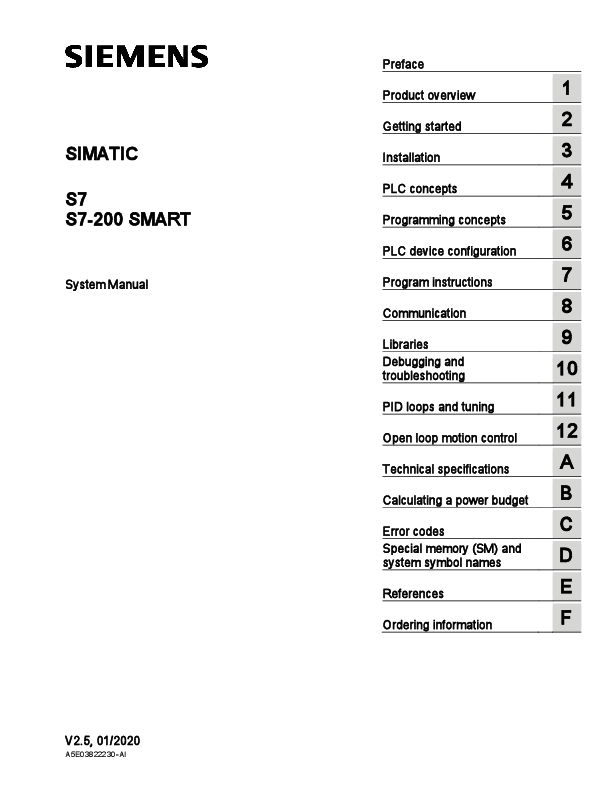
S7-200 SMART SIMATIC S7 S7-200 SMART
System Manual
V2.5, 01/2020
A5E03822230-AI
Preface
Product overview
1
Getting started
2
Installation
3
PLC concepts
4
Programming concepts
5
PLC device configuration
6
Program instructions
7
Communication
8
Libraries
9
Debugging and troubleshooting
10
PID loops and tuning
11
Open loop motion control
12
Technical specifications
A
Calculating a power budget
B
Error codes
C
Special memory (SM) and system symbol names
D
References
E
Ordering information
F
Legal information
Warning notice system
This manual contains notices you have to observe in order to ensure your personal safety, as well as to prevent damage to property. The notices referring to your personal safety are highlighted in the manual by a safety alert symbol, notices referring only to property damage have no safety alert symbol. These notices shown below are graded according to the degree of danger.
DANGER indicates that death or severe personal injury will result if proper precautions are not taken.
WARNING indicates that death or severe personal injury may result if proper precautions are not taken.
CAUTION indicates that minor personal injury can result if proper precautions are not taken.
NOTICE indicates that property damage can result if proper precautions are not taken. If more than one degree of danger is present, the warning notice representing the highest degree of danger will be used. A notice warning of injury to persons with a safety alert symbol may also include a warning relating to property damage.
Qualified Personnel
The product/system described in this documentation may be operated only by personnel qualified for the specific task in accordance with the relevant documentation, in particular its warning notices and safety instructions. Qualified personnel are those who, based on their training and experience, are capable of identifying risks and avoiding potential hazards when working with these products/systems.
Proper use of Siemens products
Note the following:
WARNING Siemens products may only be used for the applications described in the catalog and in the relevant technical documentation. If products and components from other manufacturers are used, these must be recommended or approved by Siemens. Proper transport, storage, installation, assembly, commissioning, operation and maintenance are required to ensure that the products operate safely and without any problems. The permissible ambient conditions must be complied with. The information in the relevant documentation must be observed.
Trademarks
All names identified by � are registered trademarks of Siemens AG. The remaining trademarks in this publication may be trademarks whose use by third parties for their own purposes could violate the rights of the owner.
Disclaimer of Liability
We have reviewed the contents of this publication to ensure consistency with the hardware and software described. Since variance cannot be precluded entirely, we cannot guarantee full consistency. However, the information in this publication is reviewed regularly and any necessary corrections are included in subsequent editions.
Siemens AG Division Digital Factory Postfach 48 48 90026 N�RNBERG GERMANY
A5E03822230-AI 12/2019 Subject to change
Copyright � Siemens AG 2020. All rights reserved
Preface
Purpose of the manual The S7-200 SMART series is a line of micro-programmable logic controllers (Micro PLCs) that can control a variety of automation applications. Compact design, low cost, and a powerful instruction set make the S7-200 SMART a perfect solution for controlling small applications. The wide variety of S7-200 SMART models and the Windows-based programming tool give you the flexibility you need to solve your automation problems. This manual provides information about installing and programming the S7-200 SMART CPUs and is designed for engineers, programmers, installers, and electricians who have a general knowledge of programmable logic controllers.
Required basic knowledge To understand this manual, it is necessary to have a general knowledge of automation and programmable logic controllers.
Scope of the manual This manual describes the following products: STEP 7-Micro/WIN SMART V2.5 S7-200 SMART CPU firmware release V2.5 For a complete list of the S7-200 SMART products and article numbers described in this manual, see Technical Specifications (Page 751).
Certification, CE label and other standards Refer to the technical specifications for more information.
Service and support In addition to our documentation, we offer our technical expertise on the Internet on the customer support web site (http://www.siemens.com/automation/). Contact your Siemens distributor or sales office for assistance in answering any technical questions, for training, or for ordering S7 products. Because your sales representatives are technically trained and have the most specific knowledge about your operations, process and industry, as well as about the individual Siemens products that you are using, they can provide the fastest and most efficient answers to any problems you might encounter.
S7-200 SMART
System Manual, V2.5, 01/2020, A5E03822230-AI
3
Preface
Security information
Siemens provides products and solutions with industrial security functions that support the secure operation of plants, systems, machines and networks.
In order to protect plants, systems, machines and networks against cyber threats, it is necessary to implement � and continuously maintain � a holistic, state-of-the-art industrial security concept. Siemens' products and solutions constitute one element of such a concept.
Customers are responsible for preventing unauthorized access to their plants, systems, machines and networks. Such systems, machines and components should only be connected to an enterprise network or the internet if and to the extent such a connection is necessary and only when appropriate security measures (e.g. firewalls and/or network segmentation) are in place.
For additional information on industrial security measures that may be implemented, please visit (http://www.siemens.com/industrialsecurity).
Siemens' products and solutions undergo continuous development to make them more secure. Siemens strongly recommends that product updates are applied as soon as they are available and that the latest product versions are used. Use of product versions that are no longer supported, and failure to apply the latest updates may increase customers' exposure to cyber threats.
To stay informed about product updates, subscribe to the Siemens Industrial Security RSS Feed visit (http://www.siemens.com/industrialsecurity).
S7-200 SMART
4
System Manual, V2.5, 01/2020, A5E03822230-AI
Table of contents
Preface ...................................................................................................................................................... 3
1 Product overview ..................................................................................................................................... 19
1.1
S7-200 SMART CPU ..............................................................................................................19
1.2
New features...........................................................................................................................22
1.3
S7-200 SMART expansion modules.......................................................................................23
1.4
HMI devices for S7-200 SMART.............................................................................................24
1.5
Communications options ........................................................................................................25
1.6
Programming software............................................................................................................26
2 Getting started ......................................................................................................................................... 27
2.1 2.1.1 2.1.1.1 2.1.1.2 2.1.1.3 2.1.1.4 2.1.1.5
Connecting to the CPU ...........................................................................................................27 Configuring the CPU for communication ................................................................................28 Overview .................................................................................................................................28 Establishing the Ethernet hardware communication connection............................................29 Setting up Ethernet communication with the CPU..................................................................30 Establishing the RS485 hardware communication connection ..............................................32 Setting up RS485 communication with the CPU ....................................................................32
2.2 2.2.1 2.2.2 2.2.3 2.2.4 2.2.5
Creating the sample program .................................................................................................35 Network 1: Starting the timer ..................................................................................................36 Network 2: Turning the output on ...........................................................................................37 Network 3: Resetting the timer ...............................................................................................38 Setting the CPU type and version for your project .................................................................39 Saving the sample project ......................................................................................................39
2.3
Downloading the sample program ..........................................................................................40
2.4
Changing the operating mode of the CPU..............................................................................41
3 Installation ............................................................................................................................................... 43
3.1
Guidelines for installing S7-200 SMART devices ...................................................................43
3.2
Power budget..........................................................................................................................45
3.3 3.3.1 3.3.2 3.3.3 3.3.4 3.3.5 3.3.6
Installation and removal procedures.......................................................................................46 Mounting dimensions for the S7-200 SMART devices ...........................................................46 Installing and removing the CPU ............................................................................................47 Installing and removing a signal board or battery board.........................................................50 Removing and reinstalling the terminal block connector ........................................................52 Installing and removing an expansion module .......................................................................53 Installing and removing the expansion cable..........................................................................55
3.4
Wiring guidelines.....................................................................................................................56
4 PLC concepts .......................................................................................................................................... 63
4.1
Execution of the control logic..................................................................................................63
S7-200 SMART
System Manual, V2.5, 01/2020, A5E03822230-AI
5
Table of contents
4.1.1 4.1.2 4.1.3
Reading the inputs and writing to the outputs........................................................................ 64 Immediately reading or writing the I/O ................................................................................... 65 Executing the user program................................................................................................... 65
4.2 4.2.1 4.2.2 4.2.3 4.2.4 4.2.5 4.2.6 4.2.7
Accessing data....................................................................................................................... 67 Accessing memory areas....................................................................................................... 68 Format for Real numbers ....................................................................................................... 74 Format for strings ................................................................................................................... 75 Assigning a constant value for instructions............................................................................ 75 Addressing the local and expansion I/O ................................................................................ 76 Using pointers for indirect addressing ................................................................................... 76 Pointer examples ................................................................................................................... 79
4.3 4.3.1 4.3.2 4.3.3 4.3.4 4.3.5 4.3.6 4.3.7
Saving and restoring data ...................................................................................................... 80 Downloading project components.......................................................................................... 80 Uploading project components .............................................................................................. 83 Types of storage .................................................................................................................... 84 Using a memory card ............................................................................................................. 85 Inserting a memory card in a standard CPU.......................................................................... 87 Transferring your program with a memory card..................................................................... 87 Restoring data after power on................................................................................................ 91
4.4
Changing the operating mode of the CPU ............................................................................. 92
4.5
Status LEDs ........................................................................................................................... 92
5 Programming concepts ............................................................................................................................ 95
5.1
Guidelines for designing a PLC system ................................................................................. 95
5.2
Elements of the user program................................................................................................ 96
5.3 5.3.1 5.3.2 5.3.3 5.3.4 5.3.5 5.3.6 5.3.7 5.3.8
Creating your user program ................................................................................................... 98 STEP 7-Micro/WIN SMART compatibility .............................................................................. 98 Earlier versions of STEP 7-Micro/WIN projects ..................................................................... 99 Using STEP 7-Micro/WIN SMART user interface................................................................ 101 Using STEP 7-Micro/WIN SMART to create your programs ............................................... 102 Using wizards to help you create your control program....................................................... 103 Features of the LAD editor ................................................................................................... 104 Features of the FBD editor................................................................................................... 105 Features of the STL editor ................................................................................................... 105
5.4
Data block (DB) editor.......................................................................................................... 106
5.5
Symbol table ........................................................................................................................ 108
5.6
Variable table ....................................................................................................................... 112
5.7 5.7.1 5.7.1.1 5.7.1.2 5.7.1.3 5.7.2 5.7.3 5.7.4 5.7.5 5.7.6
PLC error reaction................................................................................................................ 116 System Information .............................................................................................................. 118 System ................................................................................................................................. 118 CPU...................................................................................................................................... 119 PROFINET device ............................................................................................................... 121 Event Log ............................................................................................................................. 122 PROFINET Alarm................................................................................................................. 122 Scan Rates........................................................................................................................... 123 Non-fatal errors and I/O errors............................................................................................. 123 Fatal errors........................................................................................................................... 124
S7-200 SMART
6
System Manual, V2.5, 01/2020, A5E03822230-AI
Table of contents
5.8
Program edit in RUN mode...................................................................................................125
5.9
Features for debugging your program ..................................................................................128
6 PLC device configuration ....................................................................................................................... 129
6.1 6.1.1 6.1.2 6.1.3 6.1.4 6.1.5 6.1.6 6.1.7 6.1.8 6.1.9 6.1.10 6.1.11 6.1.12 6.1.13 6.1.14 6.1.15 6.1.16 6.1.17
Configuring the operation of the PLC system.......................................................................129 System block.........................................................................................................................129 Configuring communication ..................................................................................................131 Configuring the digital inputs ................................................................................................133 Configuring the digital outputs ..............................................................................................136 Configuring the retentive ranges...........................................................................................137 Configuring system security..................................................................................................138 Configuring the startup options.............................................................................................142 Configuring the analog inputs ...............................................................................................143 Reference to the analog inputs technical specifications.......................................................145 Configuring the analog outputs.............................................................................................146 Reference to the analog outputs technical specifications.....................................................147 Configuring the RTD analog inputs.......................................................................................147 Configuring the TC analog inputs .........................................................................................152 Configuring the RS485/RS232 CM01 communications signal board...................................155 Configuring the BA01 battery signal board...........................................................................156 Clearing PLC memory...........................................................................................................158 Creating a reset-to-factory-defaults memory card ................................................................160
6.2
High-speed I/O......................................................................................................................161
7 Program instructions .............................................................................................................................. 163
7.1 7.1.1 7.1.2 7.1.3 7.1.4 7.1.5 7.1.6 7.1.7 7.1.8 7.1.9 7.1.10 7.1.11 7.1.12
Bit logic .................................................................................................................................163 Standard inputs.....................................................................................................................163 Immediate inputs...................................................................................................................165 Logic stack overview.............................................................................................................166 STL logic stack instructions ..................................................................................................168 NOT ......................................................................................................................................170 Positive and negative transition detectors ............................................................................171 Coils: output and output immediate instructions...................................................................172 Set, reset, set immediate, and reset immediate functions....................................................173 Set and reset dominant bistable ...........................................................................................174 NOP (No operation) instruction.............................................................................................175 Bit logic input examples ........................................................................................................176 Bit logic output examples......................................................................................................177
7.2 7.2.1 7.2.2
Clock .....................................................................................................................................178 Read and set real-time clock ................................................................................................178 Read and set real-time clock extended ................................................................................181
7.3 7.3.1 7.3.2 7.3.3 7.3.4 7.3.5 7.3.5.1 7.3.5.2
Communication .....................................................................................................................184 GET and PUT (Ethernet) ......................................................................................................184 Transmit and receive (Freeport on RS485/RS232) ..............................................................191 Get port address and set port address (PPI protocol on RS485/RS232).............................204 Get IP address and set IP address (Ethernet)......................................................................205 Open user communication....................................................................................................208 OUC instructions...................................................................................................................208 OUC instruction error codes .................................................................................................219
7.4
Compare ...............................................................................................................................220
S7-200 SMART
System Manual, V2.5, 01/2020, A5E03822230-AI
7
Table of contents
7.4.1 7.4.2
7.5 7.5.1 7.5.2 7.5.3 7.5.4 7.5.5
7.6 7.6.1 7.6.2 7.6.3 7.6.4 7.6.5 7.6.6
7.7 7.7.1 7.7.2 7.7.3 7.7.4 7.7.5
7.8 7.8.1 7.8.2 7.8.3 7.8.4
7.9 7.9.1 7.9.2 7.9.3 7.9.4 7.9.5
7.10 7.10.1 7.10.2 7.10.3 7.10.4 7.10.5
7.11 7.11.1 7.11.2
7.12 7.12.1 7.12.2 7.12.3 7.12.4
7.13 7.13.1
8
Compare number values...................................................................................................... 220 Compare character strings................................................................................................... 224
Convert................................................................................................................................. 226 Standard conversion instructions......................................................................................... 226 ASCII character array conversion ........................................................................................ 229 Number value to ASCII string conversion ............................................................................ 235 ASCII sub-string to number value conversion ..................................................................... 239 Encode and decode ............................................................................................................. 242
Counters............................................................................................................................... 244 Counter instructions ............................................................................................................. 244 High-speed counter instructions .......................................................................................... 248 High-speed counter summary.............................................................................................. 251 Noise reduction for high-speed inputs ................................................................................. 252 High-speed counter programming ....................................................................................... 254 Example initialization sequences for high-speed counters .................................................. 265
Pulse output ......................................................................................................................... 273 Pulse output instruction (PLS) ............................................................................................. 273 Pulse train output (PTO) ...................................................................................................... 275 Pulse width modulation (PWM)............................................................................................ 277 Using SM locations to configure and control the PTO/PWM operation ............................... 278 Calculating the profile table values ...................................................................................... 281
Math ..................................................................................................................................... 284 Add, subtract, multiply, and divide ....................................................................................... 284 Multiply integer to double integer and divide integer with remainder................................... 288 Trigonometry, natural logarithm/exponential, and square root ............................................ 290 Increment and decrement .................................................................................................... 292
PID ....................................................................................................................................... 293 Using the PID wizard ........................................................................................................... 295 PID algorithm ....................................................................................................................... 300 Converting and normalizing the loop inputs......................................................................... 303 Converting the loop output to a scaled integer value........................................................... 304 Forward- or reverse-acting loops ......................................................................................... 304
Interrupt ................................................................................................................................ 307 Interrupt instructions ............................................................................................................ 307 Interrupt routine overview and CPU model event support ................................................... 309 Interrupt programming guidelines ........................................................................................ 310 Types of interrupt events that the S7-200 SMART CPU supports ...................................... 312 Interrupt priority, queuing, and example program................................................................ 313
Logical operations ................................................................................................................ 319 Invert .................................................................................................................................... 319 AND, OR, and exclusive OR ................................................................................................ 320
Move .................................................................................................................................... 322 Move byte, word, double word, or real................................................................................. 322 Block move........................................................................................................................... 323 Swap bytes........................................................................................................................... 324 Move byte immediate (read and write) ................................................................................ 325
Program control.................................................................................................................... 326 FOR-NEXT loop ................................................................................................................... 326
S7-200 SMART
System Manual, V2.5, 01/2020, A5E03822230-AI
Table of contents
7.13.2 7.13.3 7.13.4 7.13.5
JMP (jump to label) ...............................................................................................................327 SCR (sequence control relay)...............................................................................................329 END, STOP, and WDR (watchdog timer reset)....................................................................337 GET_ERROR (Get non-fatal error code) ..............................................................................338
7.14 7.14.1 7.14.2
Shift and rotate......................................................................................................................339 Shift and rotate......................................................................................................................339 Shift register bit .....................................................................................................................342
7.15 7.15.1 7.15.2 7.15.3
String ..................................................................................................................................... 344 String (Get length, copy, and concatenate) ..........................................................................344 Copy substring from string....................................................................................................346 Find string and first character within string ...........................................................................347
7.16 7.16.1 7.16.2 7.16.3 7.16.4
Table .....................................................................................................................................350 Add to table...........................................................................................................................350 First-in-first-out and last-in-first-out.......................................................................................351 Memory fill.............................................................................................................................353 Table find ..............................................................................................................................354
7.17 7.17.1 7.17.2 7.17.3
Timer .....................................................................................................................................358 Timer instructions..................................................................................................................358 Timer programming tips and examples ................................................................................360 Interval timers .......................................................................................................................367
7.18 7.18.1
Subroutine ............................................................................................................................. 368 CALL (subroutine) and RET (conditional return) ..................................................................368
7.19 7.19.1 7.19.2 7.19.2.1 7.19.2.2 7.19.3 7.19.3.1 7.19.3.2
PROFINET ............................................................................................................................374 Features of the programming instruction "PROFINET" ........................................................374 Read and Write data record..................................................................................................374 Input and output interface of RDREC and WRREC instruction............................................374 System-defined error code of the instructions RDREC and WRREC ..................................377 Read and Write multiple bytes between physical PROFINET and memory address...........378 Input and output interface of BLKMOV_BIR and BLKMOV_BIW .........................................378 Error code of the instructions BLKMOV_BIR and BLKMOV_BIW ........................................379
8 Communication...................................................................................................................................... 381
8.1
CPU communication connections.........................................................................................382
8.2
CPU communication ports ....................................................................................................383
8.3
HMIs and communication drivers .........................................................................................384
8.4 8.4.1 8.4.2 8.4.3 8.4.4 8.4.4.1 8.4.4.2 8.4.4.3 8.4.5 8.4.6 8.4.7 8.4.7.1 8.4.7.2
Ethernet ................................................................................................................................385 Overview ...............................................................................................................................385 Local/partner connection ......................................................................................................386 Sample Ethernet network configurations ..............................................................................386 Assigning Internet Protocol (IP) addresses ..........................................................................387 Assigning IP addresses to programming and network devices............................................387 Configuring or changing an IP address for a CPU or device in your project ........................389 Searching for CPUs and devices on your Ethernet network ................................................397 Locating the Ethernet (MAC) address on the CPU...............................................................398 HMI-to-CPU communication .................................................................................................399 Open user communication....................................................................................................401 Protocols ...............................................................................................................................401 Connections ..........................................................................................................................402
S7-200 SMART
System Manual, V2.5, 01/2020, A5E03822230-AI
9
Table of contents
8.4.7.3 8.4.8 8.4.8.1 8.4.8.2 8.4.8.3 8.4.8.4 8.4.8.5 8.4.8.6 8.4.8.7 8.4.8.8 8.4.8.9 8.4.8.10
8.5 8.5.1 8.5.1.1 8.5.1.2 8.5.1.3 8.5.1.4 8.5.1.5 8.5.1.6 8.5.1.7 8.5.1.8 8.5.1.9 8.5.1.10 8.5.1.11 8.5.1.12 8.5.1.13 8.5.1.14
8.6 8.6.1 8.6.2 8.6.2.1 8.6.2.2 8.6.3 8.6.3.1 8.6.3.2 8.6.4 8.6.4.1 8.6.4.2 8.6.5 8.6.5.1 8.6.5.2 8.6.5.3 8.6.5.4 8.6.5.5 8.6.5.6 8.6.5.7 8.6.5.8 8.6.6 8.6.6.1 8.6.6.2
Ports and TSAPs ................................................................................................................. 402 PROFINET ........................................................................................................................... 404 Introduction .......................................................................................................................... 404 I-Device ................................................................................................................................ 405 Device database file in XML: GSDML ................................................................................. 407 GSDML Management .......................................................................................................... 408 PROFINET device naming................................................................................................... 410 LED status indicators for PROFINET network ..................................................................... 413 Configuring CPU as a controller .......................................................................................... 414 Configuring CPU as an I-Device without lower-level PROFINET IO system ...................... 421 Configuring an I-Device project with lower-level PROFINET IO system ............................. 424 Example: Configuring a PROFINET network....................................................................... 426
PROFIBUS........................................................................................................................... 442 EM DP01 PROFIBUS DP module ....................................................................................... 444 Distributed Peripheral (DP) standard communications........................................................ 444 Using the EM DP01 to connect an S7-200 SMART as a DP device ................................... 444 Configuring the EM DP01 .................................................................................................... 446 Data consistency.................................................................................................................. 447 Supported configurations ..................................................................................................... 448 Installing the EM DP01 GSD file .......................................................................................... 448 Configuring the EM DP01 I/O .............................................................................................. 450 Example of V memory and I/O address area....................................................................... 453 User program considerations............................................................................................... 454 LED status indicators for the EM DP01 PROFIBUS DP...................................................... 456 Using HMIs and S7-CPUs with the EM DP01 ..................................................................... 457 Device database file: GSD ................................................................................................... 458 PROFIBUS DP communications to a CPU example program............................................. 462 Reference to the EM DP01 PROFIBUS DP module technical specifications ..................... 464
RS485 .................................................................................................................................. 464 PPI protocol.......................................................................................................................... 465 Baud rate and network address ........................................................................................... 466 Definition of baud rate and network address ....................................................................... 466 Setting the baud rate and network address for the S7-200 SMART CPU........................... 466 Sample RS485 network configurations................................................................................ 468 Single-master PPI networks................................................................................................. 468 Multi-master and multi-slave PPI networks.......................................................................... 469 Assigning RS485 addresses ................................................................................................ 470 Configuring or changing an RS485 address for a CPU or device in your project ............... 470 Searching for CPUs and devices on your RS485 network .................................................. 474 Building your network........................................................................................................... 475 General guidelines ............................................................................................................... 475 Determining the distances, transmission rates, and cable lengths for your network........... 475 Repeaters on the network .................................................................................................... 476 Specifications for RS485 cable ............................................................................................ 477 Connector pin assignments ................................................................................................. 477 Biasing and terminating the network cable .......................................................................... 478 Biasing and terminating the CM01 signal board .................................................................. 479 Using HMI devices on your RS485 network ........................................................................ 480 Freeport mode...................................................................................................................... 481 Creating user-defined protocols with Freeport mode........................................................... 481 Using the RS232/PPI Multi-Master cable and Freeport mode with RS232 devices............ 483
S7-200 SMART
10
System Manual, V2.5, 01/2020, A5E03822230-AI
Table of contents
8.7
RS232 ...................................................................................................................................485
9 Libraries................................................................................................................................................. 487
9.1
Library types (Siemens and user-defined)............................................................................487
9.2 9.2.1 9.2.2
Overview of Modbus communication....................................................................................489 Modbus addressing...............................................................................................................489 Modbus read and write functions..........................................................................................492
9.3 9.3.1 9.3.1.1 9.3.1.2 9.3.1.3 9.3.2 9.3.2.1 9.3.2.2 9.3.2.3 9.3.2.4 9.3.3 9.3.3.1 9.3.3.2 9.3.3.3 9.3.3.4 9.3.4 9.3.5
Modbus RTU library ..............................................................................................................492 Modbus communication overview.........................................................................................492 Modbus RTU library features................................................................................................492 Requirements for using Modbus instructions .......................................................................493 Initialization and execution time for Modbus protocol...........................................................494 Modbus RTU master.............................................................................................................495 Using the Modbus RTU master instructions .........................................................................495 MBUS_CTRL / MB_CTRL2 instruction (initialize master).....................................................496 MBUS_MSG / MB_MSG2 instruction....................................................................................498 Modbus RTU master execution error codes.........................................................................501 Modbus RTU slave ...............................................................................................................502 Using the Modbus RTU slave instructions............................................................................502 MBUS_INIT instruction (initialize slave)................................................................................504 MBUS_SLAVE instruction.....................................................................................................505 Modbus RTU slave execution error codes ...........................................................................506 Modbus RTU master example program................................................................................507 Modbus RTU advanced user information .............................................................................509
9.4 9.4.1 9.4.2 9.4.2.1 9.4.2.2 9.4.3 9.4.3.1 9.4.3.2 9.4.4 9.4.5 9.4.6 9.4.7
Modbus TCP library ..............................................................................................................511 Modbus TCP library features ................................................................................................511 Modbus TCP client................................................................................................................513 MBUS_CLIENT instruction ...................................................................................................513 Modbus TCP client execution error codes............................................................................516 Modbus TCP server ..............................................................................................................517 MBUS_SERVER instruction .................................................................................................517 Modbus TCP server execution error codes ..........................................................................519 Example: Modbus TCP application.......................................................................................520 Modbus TCP advanced user information .............................................................................525 Modbus TCP general exception codes.................................................................................528 Modbus TCP general communication exception codes .......................................................528
9.5 9.5.1 9.5.2 9.5.2.1 9.5.2.2 9.5.2.3 9.5.2.4 9.5.2.5 9.5.2.6 9.5.2.7 9.5.2.8 9.5.3 9.5.4 9.5.4.1
Open user communication library .........................................................................................529 Parameters common to the OUC library instructions ...........................................................530 Open user communication library instructions......................................................................532 TCP_CONNECT instruction..................................................................................................532 ISO_CONNECT instruction...................................................................................................535 UDP_CONNECT instruction .................................................................................................538 TCP_SEND instruction .........................................................................................................540 TCP_RECV instruction .........................................................................................................542 UDP_SEND instruction .........................................................................................................545 UDP_RECV instruction .........................................................................................................548 DISCONNECT instruction.....................................................................................................550 Open user communication library instruction error codes ....................................................552 Open user communication library example ..........................................................................553 Active partner (client) ............................................................................................................554
S7-200 SMART
System Manual, V2.5, 01/2020, A5E03822230-AI
11
Table of contents
9.5.4.2 9.5.4.3 9.5.4.4 9.5.4.5 9.5.4.6
CheckErrors subroutine ....................................................................................................... 562 Active partner symbol table.................................................................................................. 563 Passive partner (server)....................................................................................................... 564 CheckErrors subroutine ....................................................................................................... 570 Passive partner symbol table............................................................................................... 570
9.6 9.6.1 9.6.2 9.6.3 9.6.4
PN Read Write Record library.............................................................................................. 571 PN Read Write Record features .......................................................................................... 571 Input and output interface of PN Read Write Record library ............................................... 572 Definition of parameters for input signal "STATUS" ............................................................ 573 System_defined error code of the library PN Read Write Record ....................................... 574
9.7 9.7.1 9.7.1.1 9.7.1.2 9.7.1.3 9.7.2 9.7.2.1 9.7.2.2 9.7.2.3 9.7.2.4 9.7.2.5 9.7.2.6 9.7.2.7
USS library ........................................................................................................................... 574 USS communication overview ............................................................................................. 574 USS protocol overview......................................................................................................... 574 Requirements for using the USS protocol ........................................................................... 575 Calculating the time required for communicating with the drive .......................................... 576 USS program instructions .................................................................................................... 577 Using the USS protocol instructions .................................................................................... 577 USS_INIT instruction............................................................................................................ 578 USS_CTRL instruction ......................................................................................................... 580 USS_RPM_x instruction ....................................................................................................... 583 USS_WPM_x instruction ...................................................................................................... 585 USS protocol execution error codes .................................................................................... 588 USS protocol example program........................................................................................... 588
9.8 9.8.1 9.8.1.1 9.8.1.2 9.8.1.3 9.8.1.4 9.8.1.5 9.8.1.6 9.8.1.7 9.8.1.8 9.8.1.9 9.8.1.10 9.8.1.11 9.8.2 9.8.2.1 9.8.2.2 9.8.2.3 9.8.2.4 9.8.3 9.8.3.1 9.8.3.2 9.8.3.3
SINAMICS Library................................................................................................................ 591 SINA_POS instruction .......................................................................................................... 592 Prerequisite of using the SINA_POS instruction.................................................................. 592 Input and output interface of SINA_POS instruction............................................................ 595 Mode selection of SINAMICS with the SINA_POS instruction ............................................ 601 Relative positioning .............................................................................................................. 602 Absolute positioning ............................................................................................................. 605 Setup mode.......................................................................................................................... 609 Referencing (active referencing).......................................................................................... 613 Referencing (set reference point) ........................................................................................ 616 Traversing blocks ................................................................................................................. 618 Jog ....................................................................................................................................... 621 Incremental jog..................................................................................................................... 624 SINA_SPEED instruction ..................................................................................................... 628 Prerequisite of using the SINA_SPEED instruction ............................................................. 628 Input and output interface of SINA_SPEED instruction ....................................................... 631 Definition of "ConfigAxis" parameters .................................................................................. 633 Example of SINA_SPEED instruction .................................................................................. 633 SINA_PARA_S instruction ................................................................................................... 635 Prerequisite of using the SINA_PARA_S instruction ........................................................... 635 Input and output interface of SINA_PARA_S instruction ..................................................... 637 Example of the SINA_PARA_S instruction .......................................................................... 642
9.9
Creating a user-defined library of instructions ..................................................................... 644
10 Debugging and troubleshooting ............................................................................................................. 647
10.1 10.1.1
Debugging your program ..................................................................................................... 647 Bookmark functions ............................................................................................................. 647
S7-200 SMART
12
System Manual, V2.5, 01/2020, A5E03822230-AI
Table of contents
10.1.2
Cross reference table ...........................................................................................................647
10.2 10.2.1 10.2.2
Displaying program status ....................................................................................................649 Displaying status in the program editor ................................................................................649 Configuring the STL status options.......................................................................................652
10.3
Using a status chart to monitor your program ......................................................................652
10.4
Forcing specific values .........................................................................................................654
10.5
Writing and forcing outputs in STOP mode ..........................................................................655
10.6
How to execute a limited number of scans...........................................................................656
10.7
Hardware troubleshooting guide...........................................................................................658
11 PID loops and tuning ............................................................................................................................. 661
11.1
PID loop definition table........................................................................................................662
11.2
Prerequisites .........................................................................................................................665
11.3
Auto-hysteresis and auto-deviation ......................................................................................666
11.4
Auto-tune sequence..............................................................................................................666
11.5
Exception conditions .............................................................................................................668
11.6
Notes concerning PV out-of-range (result code 3) ...............................................................669
11.7
PID Tune control panel .........................................................................................................669
12 Open loop motion control....................................................................................................................... 673
12.1 12.1.1 12.1.2
Using the PWM output..........................................................................................................674 Configuring the PWM output.................................................................................................674 PWMx_RUN subroutine ........................................................................................................675
12.2 12.2.1 12.2.2 12.2.3
Using motion control .............................................................................................................676 Maximum and start/stop speeds...........................................................................................676 Entering the acceleration and deceleration times.................................................................677 Configuring the motion profiles .............................................................................................678
12.3
Features of motion control ....................................................................................................680
12.4
Programming an Axis of Motion............................................................................................682
12.5
Configuring an Axis of Motion...............................................................................................683
12.6 12.6.1 12.6.2 12.6.3 12.6.4 12.6.5 12.6.6 12.6.7 12.6.8 12.6.9 12.6.10 12.6.11 12.6.12 12.6.13
Subroutines created by the Motion wizard for the Axis of Motion ........................................695 Guidelines for using the Motion subroutines ........................................................................696 AXISx_CTRL subroutine.......................................................................................................697 AXISx_MAN subroutine ........................................................................................................698 AXISx_GOTO subroutine......................................................................................................700 AXISx_RUN subroutine ........................................................................................................701 AXISx_RSEEK subroutine ....................................................................................................702 AXISx_LDOFF subroutine ....................................................................................................703 AXISx_LDPOS subroutine ....................................................................................................704 AXISx_SRATE subroutine ....................................................................................................705 AXISx_DIS subroutine ..........................................................................................................706 AXISx_CFG subroutine.........................................................................................................706 AXISx_CACHE subroutine....................................................................................................707 AXISx_RDPOS subroutine ...................................................................................................708
S7-200 SMART
System Manual, V2.5, 01/2020, A5E03822230-AI
13
Table of contents
12.6.14 AXISx_ABSPOS subroutine................................................................................................. 709
12.7
12.7.1 12.7.2 12.7.3 12.7.3.1 12.7.3.2 12.7.3.3 12.7.3.4 12.7.4
Using the AXISx_ABSPOS subroutine to read the absolute position from a SINAMICS servo drive............................................................................................................................ 710 AXISx_ABSPOS and AXISx_LDPOS subroutines usage examples ................................... 711 Interconnections................................................................................................................... 712 Commissioning..................................................................................................................... 713 Control mode........................................................................................................................ 713 Setpoint pulse input channel................................................................................................ 713 Setpoint pulse train input format .......................................................................................... 713 Common engineering units basis......................................................................................... 713 Important facts to know ........................................................................................................ 716
12.8 12.8.1 12.8.2
Axis of Motion example programs........................................................................................ 717 Axis of Motion simple relative move (cut-to-length application) example ............................ 717 Axis of Motion AXISx_CTRL, AXISx_RUN, AXISx_SEEK, and AXISx_MAN example ....... 719
12.9 12.9.1 12.9.2 12.9.3 12.9.4 12.9.5
Monitoring the Axis of Motion............................................................................................... 723 Displaying and controlling the operation of the Axis of Motion ............................................ 724 Displaying and modifying the configuration of the Axis of Motion ....................................... 730 Displaying the profile configuration for the Axis of Motion ................................................... 730 Error codes for the Axis of Motion (WORD at SMW620, SMW670, or SMW720)............... 731 Error codes for the Motion instruction (seven LS bits of SMB634, SMB684, or SMB734) .............................................................................................................................. 732
12.10 12.10.1 12.10.2
Advanced topics................................................................................................................... 734 Understanding the configuration/profile table for the Axis of Motion ................................... 734 Special memory (SM) locations for the Axis of Motion ........................................................ 742
12.11 12.11.1
Understanding the RP Seek modes of the Axis of Motion................................................... 745 Selecting the work zone location to eliminate backlash ...................................................... 750
A Technical specifications ......................................................................................................................... 751
A.1 A.1.1
General specifications.......................................................................................................... 751 General technical specifications .......................................................................................... 751
A.2 A.2.1 A.2.1.1 A.2.1.2 A.2.1.3 A.2.2 A.2.2.1 A.2.2.2 A.2.2.3 A.2.3 A.2.3.1 A.2.3.2 A.2.3.3 A.2.4 A.2.4.1 A.2.4.2 A.2.4.3 A.2.5
S7-200 SMART CPUs ......................................................................................................... 756 CPU ST20, CPU SR20, and CPU CR20s ........................................................................... 756 General specifications and features..................................................................................... 756 Digital inputs and outputs..................................................................................................... 761 Wiring diagrams ................................................................................................................... 764 CPU ST30, CPU SR30, and CPU CR30s ........................................................................... 767 General specifications and features..................................................................................... 767 Digital inputs and outputs..................................................................................................... 772 Wiring diagrams ................................................................................................................... 775 CPU ST40, CPU SR40, CPU CR40s, and CPU CR40........................................................ 778 General specifications and features..................................................................................... 778 Digital inputs and outputs..................................................................................................... 783 Wiring diagrams ................................................................................................................... 786 CPU ST60, CPU SR60, CPU CR60s, and CPU CR60........................................................ 789 General specifications and features..................................................................................... 789 Digital inputs and outputs..................................................................................................... 794 Wiring diagrams ................................................................................................................... 797 Wiring diagrams for sink and source input, and relay output............................................... 800
A.3
Digital inputs and outputs expansion modules (EMs).......................................................... 801
S7-200 SMART
14
System Manual, V2.5, 01/2020, A5E03822230-AI
Table of contents
A.3.1 A.3.2 A.3.3
EM DE08 and EM DE16 digital input specifications .............................................................801 EM DT08, EM DR08, EM QR16, and EM QT16 digital output specifications ......................803 EM DT16, EM DR16, EM DT32, and EM DR32 digital input/output specifications..............807
A.4 A.4.1 A.4.2 A.4.3 A.4.4 A.4.5 A.4.6 A.4.7
Analog inputs and outputs expansion modules (EMs) .........................................................813 EM AE04 and EM AE08 analog input specifications ............................................................813 EM AQ02 and EM AQ04 analog output module specifications ............................................816 EM AM03 and EM AM06 analog input/output module specifications...................................818 Step response of the analog inputs ......................................................................................822 Sample time and update times for the analog inputs ...........................................................822 Measurement ranges of the analog inputs for voltage and current (SB and EM) ................823 Measurement ranges of the analog outputs for voltage and current (SB and EM) ..............824
A.5 A.5.1 A.5.1.1 A.5.2
Thermocouple and RTD expansion modules (EMs).............................................................825 Thermocouple expansion modules (EMs) ............................................................................825 EM AT04 thermocouple specifications .................................................................................825 RTD expansion modules (EMs)............................................................................................830
A.6 A.6.1
Digital signal boards..............................................................................................................835 SB DT04 digital input/output specifications ..........................................................................835
A.7 A.7.1 A.7.2
Analog signal boards ............................................................................................................838 SB AE01 analog input specifications ....................................................................................838 SB AQ01 analog output specifications .................................................................................840
A.8 A.8.1
RS485/RS232 signal boards ................................................................................................842 SB RS485/RS232 specifications ..........................................................................................842
A.9 A.9.1
Battery board signal boards (SBs)........................................................................................844 SB BA01 Battery board.........................................................................................................844
A.10 A.10.1 A.10.2 A.10.3
EM DP01 PROFIBUS DP module ........................................................................................845 S7-200 SMART CPUs that support the EM DP01 PROFIBUS DP module .........................847 Connector pin assignments for EM DP01 ............................................................................847 EM DP01 PROFIBUS DP module wiring diagram................................................................848
A.11 A.11.1 A.11.2 A.11.2.1 A.11.2.2 A.11.2.3
S7-200 SMART cables .........................................................................................................849 S7-200 SMART I/O expansion cable....................................................................................849 RS-232/PPI Multi-Master Cable and USB/PPI Multi-Master Cable......................................850 Overview ...............................................................................................................................850 RS-232/PPI Multi-Master Cable............................................................................................851 USB/PPI Multi-Master Cable ................................................................................................853
B Calculating a power budget ................................................................................................................... 855
B.1
Power budget........................................................................................................................855
B.2
Calculating a sample power requirement .............................................................................857
B.3
Calculating your power requirement .....................................................................................858
C Error codes ............................................................................................................................................ 859
C.1
Timestamp mismatch............................................................................................................859
C.2
PLC non-fatal error codes.....................................................................................................860
C.3
PLC non-fatal error SM flags ................................................................................................862
C.4
PLC fatal error codes ............................................................................................................863
S7-200 SMART
System Manual, V2.5, 01/2020, A5E03822230-AI
15
Table of contents
D Special memory (SM) and system symbol names ................................................................................. 865
D.1
SM (Special Memory) overview ........................................................................................... 865
D.2
SMB0: System status........................................................................................................... 867
D.3
SMB1: Instruction execution status...................................................................................... 868
D.4
SMB2: Freeport receive character ....................................................................................... 869
D.5
SMB3: Freeport character error ........................................................................................... 870
D.6
SMB4: Interrupt queue overflow, run-time program error, interrupts enabled, freeport
transmitter idle, and value forced......................................................................................... 870
D.7
SMB5: I/O error status ......................................................................................................... 871
D.8
SMB6-SMB7: CPU ID, error status, and digital I/O points................................................... 871
D.9
SMB8-SMB19: I/O module ID and errors ............................................................................ 872
D.10
SMW22-SMW26: Scan times .............................................................................................. 873
D.11
SMB28-SMB29: Signal board ID and errors ........................................................................ 873
D.12
SMB30: (Port 0) and SMB130: (Port 1) ............................................................................... 873
D.13
SMB34-SMB35: Time intervals for timed interrupts............................................................. 874
D.14
SMB36-SMB45 (HSC0), SMB46-SMB55 (HSC1), SMB56-SM65 (HSC2), SMB136SMB145 (HSC3), SMB146-SMB155 (HSC4), SMB156-SMB165 (HSC5): high-speed counters ............................................................................................................................... 875
D.15
SMB66-SMB85 (PTO0/PWM0, PTO1/PWM1), SMB166-SMB169 (PTO0), SMB176SMB179 (PTO1), and SMB566-SMB579 (PTO2/PWM2): high-speed outputs ................... 880
D.16
SMB86-SMB94 and SMB186-SMB194: Receive message control..................................... 883
D.17
SMW98: Expansion I/O bus communication errors ............................................................. 885
D.18
SMW100-SMW114 System alarms ..................................................................................... 886
D.19
SMB130: Freeport control for port 1 (See SMB30).............................................................. 887
D.20
SMB146-SMB155 (HSC4) and SMB156-SMB165 (HSC5) ................................................. 887
D.21
SMB186-SMB194: Receive message control (See SMB86-SMB94).................................. 887
D.22
SMB480-SMB515: Data log status ...................................................................................... 887
D.23
SMB600-SMB749: Axis (0, 1, and 2) open loop motion control .......................................... 888
D.24
SMB650-SMB699: Axis 1 open loop motion control (See SMB600-SMB740) .................... 889
D.25
SMB700-SMB749: Axis 2 open loop motion control (See SMB600-SMB740) .................... 889
D.26
SMB1000-SMB1049: CPU hardware/firmware ID ............................................................... 889
D.27
SMB1050-SMB1099: SB (signal board) hardware/firmware ID........................................... 890
D.28
SMB1100-SMB1399: EM (expansion module) hardware/firmware ID ................................ 890
D.29
SMB1400-SMB1699: EM (expansion module) module-specific data.................................. 893
D.30
SMB1800-SMB1999: PROFINET device status.................................................................. 893
E References ............................................................................................................................................ 895
S7-200 SMART
16
System Manual, V2.5, 01/2020, A5E03822230-AI
Table of contents
E.1
Often-used special memory bits ...........................................................................................895
E.2
Interrupt events in priority order............................................................................................896
E.3
High-speed counter summary...............................................................................................897
E.4
STL instructions ....................................................................................................................898
E.5
Memory ranges and features................................................................................................904
F Ordering information .............................................................................................................................. 909
F.1
CPU modules........................................................................................................................909
F.2
Expansion modules (EMs) and signal boards (SBs) ............................................................909
F.3
Programming software..........................................................................................................910
F.4
Communication .....................................................................................................................910
F.5
Spare parts and other hardware ...........................................................................................911
F.6
Human Machine Interface devices .......................................................................................913
Index...................................................................................................................................................... 915
S7-200 SMART
System Manual, V2.5, 01/2020, A5E03822230-AI
17
Table of contents
S7-200 SMART
18
System Manual, V2.5, 01/2020, A5E03822230-AI
Product overview
1
The S7-200 SMART series of micro-programmable logic controllers (Micro PLCs) can control a wide variety of devices to support your automation needs.
The CPU monitors inputs and changes outputs as controlled by the user program, which can include Boolean logic, counting, timing, complex math operations, and communications with other intelligent devices. The compact design, flexible configuration, and powerful instruction set combine to make the S7-200 SMART a perfect solution for controlling a wide variety of applications.
1.1
S7-200 SMART CPU
The CPU combines a microprocessor, an integrated power supply, input circuits, and output circuits in a compact housing to create a powerful Micro PLC. After you have downloaded your program, the CPU contains the logic required to monitor and control the input and output devices in your application.
LEDs for the I/O Terminal connectors Ethernet communication port Clip for installation on a
standard (DIN) rail
Ethernet status LEDs
(under door): LINK, Rx/Tx
Status LEDs: RUN, STOP and
ERROR
RS485 Communication port Optional signal board
(Standard models only)
Memory card reader (under
door) (Standard models only)
The CPU provides different models with a diversity of features and capabilities that help you create effective solutions for your varied applications. The different models of CPUs are shown below. For detailed information about a specific CPU, see the technical specifications (Page 756).
S7-200 SMART
System Manual, V2.5, 01/2020, A5E03822230-AI
19
Product overview 1.1 S7-200 SMART CPU
The S7-200 SMART CPU family includes fourteen CPU models, separated into two lines: the Compact Line and the Standard Line. The first letter of the CPU designator indicates a line, either Compact (C) or Standard (S). The second letter of the designator indicates AC power supply / relay outputs (R) or DC power supply / DC transistor (T). The number in the designator indicates the total onboard digital I/O count. The new compact models are designated by a lower case "s" character (serial port only) following the I/O count.
Note CPU CRs and CPU CR S7-200 SMART CPU firmware release V2.4 and V2.5 do not apply to the CPU CRs and CPU CR models.
Table 1- 1 S7-200 SMART CPUs
SR2 ST2 CR20 SR3 ST3 CR30 SR4 ST4 CR40 CR40 SR6 ST6 CR60 CR60
0 0 s
0 0 s
0 0 s
0
0
s
Compact serial,
X
X
X
X
X
X
non-expandable
Standard, expanda- X X ble
X X
X X
X X
Relay output
X
X
X
X
X
X
X
X
X
X
Transistor output
X
X
X
X
(DC)
I/O points (built-in) 20 20 20 30 30 30 40 40 40 40 60 60 60 60
Table 1- 2 Features
Compact serial, non-expandable CPUs CPU CR20s
CPU CR30s
Dimensions: W x H x D (mm) 90 x 100 x 81
User memory Program 12 Kbytes
User data 8 Kbytes
Retentive 2 Kbytes max.1
On-board digital I/O
� Inputs � 12 DI � Outputs � 8 DQ Relay
Expansion modules
Signal board
High-speed counters (4 total)
Single phase
A/B phase
None None 4 at 100 kHz
2 at 50 kHz
110 x 100 x 81 12 Kbytes 8 Kbytes 2 Kbytes max.1 � 18 DI � 12 DQ Relay None None 4 at 100 kHz
2 at 50 kHz
CPU CR40s, CPU CR40 125 x 100 x 81 12 Kbytes 8 Kbytes 2 Kbytes max.1
� 24 DI � 16 DQ Relay
None None 4 at 100 kHz
CPU CR60s, CPU CR60 175 x 100 x 81 12 Kbytes 8 Kbytes 2 Kbytes max.1 36 DI 24 DQ Relay
None None 4 at 100 kHz
2 at 50 kHz
2 at 50 kHz
S7-200 SMART
20
System Manual, V2.5, 01/2020, A5E03822230-AI
Product overview 1.1 S7-200 SMART CPU
Features
CPU CR20s
PID loops
8
Real-time clock with 7-day No back-up
CPU CR30s
8 No
CPU CR40s, CPU CR40 8 No
CPU CR60s, CPU CR60 8 No
1 You can configure areas of V memory, M memory, C memory (current values), and portions of T memory (current values on retentive timers) to be retentive, up to the specified maximum amount.
Table 1- 3 Standard expandable CPUs
Features
Dimensions: W x H x D (mm)
User memory Program
User data
Retentive
On-board digital � Inputs
I/O
� Outputs
CPU SR20, CPU ST20 90 x 100 x 81 12 Kbytes 8 Kbytes 10 Kbytes max.1 � 12 DI � 8 DQ
CPU SR30, CPU ST30 110 x 100 x 81 18 Kbytes 12 Kbytes 10 Kbytes max.1 � 18 DI � 12 DQ
CPU SR40, CPU ST40 125 x 100 x 81 24 Kbytes 16 Kbytes 10 Kbytes max.1 � 24 DI � 16 DQ
CPU SR60, CPU ST60 175 x 100 x 81 30 Kbytes 20 Kbytes 10 Kbytes max.1 � 36 DI � 24 DQ
Expansion modules
Signal board
High-speed counters (6 total)
Single phase A/B phase
Pulse outputs 2 PID loops Real-time clock with 7-day back-up
6 max. 1 4 at 200 kHz 2 at 30 kHz 2 at 100 kHz 2 at 20 kHz 2 at 100 kHz 8 Yes
6 max. 1 5 at 200 kHz 1 at 30 kHz 3 at 100 kHz 1 at 20 kHz 3 at 100 kHz 8 Yes
6 max. 1 4 at 200 kHz 2 at 30 kHz 2 at 100 kHz 2 at 20 kHz 3 at 100 kHz 8 Yes
6 max. 1 4 at 200 kHz 2 at 30 kHz 2 at 100 kHz 2 at 20 kHz 3 at 100 kHz 8 Yes
1 You can configure areas of V memory, M memory, C memory (current values), and portions of T memory (current values on retentive timers) to be retentive, up to the specified maximum amount.
2 The specified maximum pulse frequency is possible only for CPU models with transistor outputs. Pulse output operation is not recommended for CPU models with relay outputs.
Refer to the technical specifications (Page 751) for the power requirements of the CPU and the expansion modules. Use the worksheets in Appendix B, Calculating a power budget (Page 858) to calculate your power budget (Page 855).
S7-200 SMART
System Manual, V2.5, 01/2020, A5E03822230-AI
21
Product overview 1.2 New features
1.2
New features
Only the following CPU models with firmware V2.5 or later versions support the new features described in this chapter:
Table 1- 4 CPU models affected by firmware V2.5
CPU model CPU SR20, AC/DC/Relay CPU ST20, DC/DC/DC CPU SR30, AC/DC/Relay CPU ST30, DC/DC/DC CPU SR40, AC/DC/Relay CPU ST40, DC/DC/DC CPU SR60, AC/DC/Relay CPU ST60, DC/DC/DC
Article number 6ES7288-1SR20-0AA0 6ES7288-1ST20-0AA0 6ES7288-1SR30-0AA0 6ES7288-1ST30-0AA0 6ES7288-1SR40-0AA0 6ES7288-1ST40-0AA0 6ES7288-1SR60-0AA0 6ES7288-1ST60-0AA0
STEP 7-Micro/WIN SMART V2.5 release provides the following new features:
I-Device
STEP 7-Micro/WIN SMART V2.5 and the S7-200 SMART V2.5 CPU firmware adds I-Device (Page 405)functions for PROFINET communication.
I-Device configuration PROFINET wizard provides the function to select CPU role as I-Device (Page 421).
GSDML file export PROFINET wizard provides the function to export GSDML file. (Page 421)
LED status for PROFINET I-Device The LED status indicators (Page 413) display information for PROFINET I-Device.
I-Device Diagnostic Diagnostic functions (Page 119) are available for PROFINET I-Device.
Status Chart The Status Chart (Page 652) function is available on PROFINET I-Device.
Catalog configuration
Catalog configuration (Page 435) is a new method to configure CPU as a controller for PROFINET communication.
S7-200 SMART
22
System Manual, V2.5, 01/2020, A5E03822230-AI
Product overview 1.3 S7-200 SMART expansion modules
1.3
S7-200 SMART expansion modules
To better solve your application requirements, the S7-200 SMART family includes a wide variety of expansion modules, signal boards, and a communications module. You can use these expansion modules with the standard CPU models (SR20, ST20, SR30, ST30, SR40, ST40, SR60 or ST60) to add additional functionality to the CPU. The following table provides a list of the expansion modules that are currently available. For detailed information about a specific module, see the technical specifications (Page 751).
Table 1- 5 Expansion modules and signal boards
Type Digital expansion module
Analog expansion modules
Signal boards
Input only � 8 x DC In � 16 x DC In
� 4 x Analog In � 8 x Analog In � 2 x RTD In � 4 x RTD In � 4 x TC In � 1 x Analog In
Output only � 8 x DC Out � 8 x Relay Out � 16 x Relay Out � 16 x DC Out � 2 x Analog Out � 4 x Analog Out
� 1 x Analog Out
Combination In/Out � 8 x DC In / 8 x DC Out � 8 x DC In / 8 x Relay Out � 16 x DC In / 16 x DC Out � 16 x DC In / 16 x Relay Out
� 4 x Analog In / 2 x Analog Out � 2 x Analog In / 1 x Analog Out
Other
� 2 x DC In x 2 x DC Out
� RS485/RS232 � Battery Board
Table 1- 6 Communication expansion modules
Module
Communication expansion module (EM)
Type PROFIBUS DP SMART module
Description EM DP01 PROFIBUS DP
S7-200 SMART
System Manual, V2.5, 01/2020, A5E03822230-AI
23
Product overview 1.4 HMI devices for S7-200 SMART
1.4
HMI devices for S7-200 SMART
The S7-200 SMART supports Comfort HMIs, SMART HMIs, Basic HMIs and Micro HMIs. The TD400C and the SMART LINE Touch Panel are shown below. Refer to "HMIs and communication drivers" (Page 384) for a list of supported devices.
Table 1- 7 HMI devices
Text Display unit: The TD400C is an RS485-only display device that can be connected to the CPU. Using the Text Display wizard, you can easily program your CPU to display text messages and other data pertaining to your application.
The TD400C device provides a low-cost interface to your application by allowing you to view, monitor, and change the process variables pertaining to your application.
SMART HMIs: The SMART LINE Touch Panel provides operating and monitoring functions for small-scale machines and plants. Short configuration and commissioning times, their configuration in WinCC flexible (ASIA version), and a double-port Ethernet/RS485 interface form the highlights of these HMIs.
The Text Display wizard in STEP 7-Micro/WIN SMART helps you configure Text Display messages quickly and easily for the TD400C. To start the Text Display wizard, select the "Text Display" command from the "Tools" menu.
The SIMATIC Text Display (TD) User Manual can be downloaded from the Siemens customer support web site (http://www.siemens.com/automation/).
S7-200 SMART
24
System Manual, V2.5, 01/2020, A5E03822230-AI
Product overview 1.5 Communications options
1.5
Communications options
The S7-200 SMART offers several types of communication between CPUs, programming devices, and HMIs:
Ethernet:
� Exchange of data from the programming device to the CPU
� Exchange of data between HMIs and the CPU
� S7 peer-to-peer communication with other S7-200 SMART CPUs
� Open User Communication (OUC) with other Ethernet-capable devices
� PROFINET communication with PROFINET devices
Note
The CPU models CPU CR20s, CPU CR30s, CPU CR40s, and CPU CR60s have no Ethernet port and do not support any functions related to the use of Ethernet communications.
PROFIBUS: � High speed communications for distributed I/O (up to 12 Mbps) � One bus master connects to many I/O devices (supports 126 addressable devices). � Exchange of data between the master and I/O devices � EM DP01 module is a PROFIBUS I/O device.
RS485: � Provides a STEP 7-Micro/WIN SMART connection for programming when using a USB-PPI cable � Supports a total of 126 addressable devices (32 devices per network segment) � Supports PPI (point-to-point interface) protocol � Exchange of data between HMIs and the CPU � Exchange of data between devices and the CPU using Freeport (XMT/RCV instructions)
RS232: � Supports a point-to-point connection to one device � Supports PPI protocol � Exchange of data between HMIs and the CPU � Exchange of data between devices and the CPU using Freeport (XMT/RCV instructions)
S7-200 SMART
System Manual, V2.5, 01/2020, A5E03822230-AI
25
Product overview 1.6 Programming software
1.6
Programming software
STEP7-Micro/WIN SMART provides a user-friendly environment to develop, edit, and monitor the logic needed to control your application.
At the top is a quick access toolbar for frequent tasks, followed by menus for all common functions. At the left is the project tree and navigation bar for easy access to components and instructions. The program editor and other components that you open occupy the remainder of the user interface.
STEP7-Micro/WIN SMART provides three program editors (LAD, FBD, and STL) for convenience and efficiency in developing the control program for your application.
To help you find the information you need, STEP7-Micro/WIN SMART provides an extensive online help system.
Computer requirements STEP 7-Micro/WIN SMART runs on a personal computer. Your computer should meet the following minimum requirements: Operating system: Windows 7 or Windows 10 (both 32 bit and 64 bit versions) At least 350M bytes of free hard disk space Mouse (recommended)
Installing STEP 7-Micro/WIN SMART
Insert the STEP 7-Micro/WIN SMART CD into the CD-ROM drive of your computer or contact your Siemens distributor or sales office to download STEP7-Micro/WIN SMART from the customer support web site (Page 3). Installation starts automatically and prompts you through the installation process. Refer to the Readme file for more information about installing STEP 7-Micro/WIN SMART.
Note
To install STEP 7-Micro/WIN SMART on a Windows 7 or Windows 10 operating system, you must log in with Administrator privileges.
S7-200 SMART
26
System Manual, V2.5, 01/2020, A5E03822230-AI
Getting started
2
STEP 7-Micro/WIN SMART makes it easy for you to program your CPU. In just a few short steps using a simple example, you can learn how to create a user program that you can download and run on your CPU.
All you need for this example is an Ethernet or USB-PPI communication cable, a CPU, and a programming device running the STEP 7-Micro/WIN SMART programming software.
2.1
Connecting to the CPU
Connecting your CPU is easy. For this example, you only need to connect power to your CPU and then connect the Ethernet or USB-PPI communication cable between your programming device and the CPU.
Note
The CPU models CPU CR20s, CPU CR30s, CPU CR40s, and CPU CR60s have no Ethernet port and no functions related to the use of Ethernet communications.
Connecting power to the CPU
WARNING
Ensure power is off prior to installing, wiring or removing devices
Before you install or remove any electrical device, ensure that the power to that equipment has been turned off.
Attempts to install or connect the wiring for the CPU or related equipment with power applied could cause electric shock or faulty operation of equipment. Failure to disable all power to the CPU and related equipment during installation or removal procedures could result in death or serious injury to personnel, and/or damage to equipment.
Always follow appropriate safety precautions and ensure that power to the CPU is disabled before attempting to install or remove the CPU or related equipment.
S7-200 SMART
System Manual, V2.5, 01/2020, A5E03822230-AI
27
Getting started 2.1 Connecting to the CPU
Connect the CPU to a power source. The following figure shows the wiring connections for either a DC or an AC model of the CPU.
DC installation
AC installation
2.1.1
2.1.1.1
Configuring the CPU for communication
Overview A CPU can communicate with a STEP 7-Micro/WIN SMART programming device on two types of communications networks:
A CPU can communicate with a STEP 7-Micro/WIN SMART programming device on an Ethernet network.
A CPU can communicate with a STEP 7-Micro/WIN SMART programming device on an RS485 network.
S7-200 SMART
28
System Manual, V2.5, 01/2020, A5E03822230-AI
Getting started 2.1 Connecting to the CPU
Consider the following when setting up Ethernet communications between a CPU and a programming device: Configuration/Setup: No hardware configuration is required for a single CPU. If you want
multiple CPU's on the same network, then you must change the default IP addresses to new, unique IP addresses. No Ethernet switch is required for one-to-one communications; an Ethernet switch is required for more than two devices in a network.
Note The CPU models CPU CR20s, CPU CR30s, CPU CR40s, and CPU CR60s have no Ethernet port and do not support any functions related to the use of Ethernet communications.
2.1.1.2
Establishing the Ethernet hardware communication connection
The Ethernet interfaces establish the physical connections between a programming device and a CPU. Since Auto-Cross-Over functionality is built into the CPU, either a standard or crossover Ethernet cable can be used for the interface. An Ethernet switch is not required to connect a programming device directly to a CPU.
Follow the steps below to create the hardware connection between a programming device and a CPU:
1. Install the CPU.
2. Remove the RJ45 connection cover from the Ethernet port. Retain the cover for reuse.
3. Plug the Ethernet cable into the Ethernet port on the top left of the CPU as shown below.
4. Connect the Ethernet cable to the programming device.
PROFINET (LAN) port
S7-200 SMART
System Manual, V2.5, 01/2020, A5E03822230-AI
29
Getting started 2.1 Connecting to the CPU
2.1.1.3
Setting up Ethernet communication with the CPU
From STEP 7-Micro/WIN SMART, use one of the following methods to display the Ethernet "Communications" dialog for configuring communication to the CPU.
From the project tree, double-click the "Communications" node.
Click the "Communications" button from the navigation bar.
Select "Communications" from the "Component" drop-down list in the Windows area of the "View" menu ribbon strip.
The "Communications" dialog provides two methods of selecting the CPU to be accessed:
Click the "Find CPUs" button to have STEP 7-Micro/WIN SMART search your local network for CPUs. The IP address of each CPU found on the network is listed under "Found CPUs".
Click the "Add CPU" button to manually enter the access information (IP address and so forth) for a CPU that you wish to access. The IP address for each CPU, manually added with this method, is listed under "Added CPUs" and is retained.
S7-200 SMART
30
System Manual, V2.5, 01/2020, A5E03822230-AI
Getting started 2.1 Connecting to the CPU
For "Found CPUs" (CPUs located on your local network), use the "Communications" dialog to connect with your CPU: � Select TCP/IP for your Communication Inter-
face. � Click the "Find CPUs" button to display all
operational CPUs ("Found CPUs") on the local Ethernet network. All CPUs have a default IP address. See the Note below. � Highlight a CPU, and then click "OK".
For "Added CPUs" (CPUs on the local or remote networks), use the "Communications" dialog to connect with your CPU: � Select TCP/IP for your Communication Inter-
face. � Click the "Add CPU" button to do one of the
following: � Enter the IP address of a CPU that is ac-
cessible from the programming device, but is not on the local network. � Enter the IP address of a CPU directly that is on the local network.
All CPUs have a default IP address. See the Note below. � Highlight a CPU, and then click "OK".
After you have established communication with the CPU, you are ready to create and download the example program. To download all project components, click the Download button from the Transfer area of the File or PLC menu ribbon strip, or alternatively press the shortcut key combination CTRL+D.
If STEP 7-Micro/WIN SMART does not find your CPU, check the settings for the communications parameters and repeat these steps.
S7-200 SMART
System Manual, V2.5, 01/2020, A5E03822230-AI
31
Getting started 2.1 Connecting to the CPU
Note
The CPU list will show all of the CPUs regardless of Ethernet network class and subnet.
To make a connection to your CPU, your Communication Interface (for Ethernet, a network interface card (NIC)) and the CPU must be on the same class of network and on the same subnet. You can either set up your network interface card to match the default IP address of the CPU, or you can change the IP address of the CPU to match the network class and subnet of your network interface card.
See the "Configuring or changing an IP address for a CPU or device in your project" (Page 389) for information about how to accomplish this.
2.1.1.4
Establishing the RS485 hardware communication connection
The RS485 interfaces establish the physical connections between a programming device and a CPU.
Follow the steps below to create the hardware connection between a programming device and a CPU:
1. Install the CPU.
2. Plug the USB/PPI cable into the RS485 port on the bottom left of the CPU as shown below.
3. Connect the USB/PPI cable to the programming device.
2.1.1.5
RS485 port
Setting up RS485 communication with the CPU RS485 network information configuration or changes done in the system block are part of the project and do not become active until you download your project to the CPU.
S7-200 SMART
32
System Manual, V2.5, 01/2020, A5E03822230-AI
Getting started 2.1 Connecting to the CPU
To access this dialog, perform one of the following: In the "Navigation" bar, click the "System Block" button. In the Project tree, select the "System Block" node, then press Enter; or double-click the
"System Block" node.
Enter or change the following access information: � RS485 port address � RS485 port baud rate
After you have established communication with the CPU, you are ready to create and download the example program. To download all project components, click the Download button from the Transfer area of the File or PLC menu ribbon strip, or alternatively press the shortcut key combination CTRL+D.
If STEP 7-Micro/WIN SMART does not find your CPU, check the settings for the communications parameters and repeat these steps.
All CPUs and devices that have valid RS485 port addresses are displayed in the "Communications" dialog. In STEP 7-Micro/WIN SMART, you can access CPUs in one of two ways: From the project tree, double-click the "Communications" node. Click the "Communications" button from the navigation bar. Select "Communications" from the "Component" drop-down list in the Windows area of
the "View" menu ribbon strip.
S7-200 SMART
System Manual, V2.5, 01/2020, A5E03822230-AI
33
Getting started 2.1 Connecting to the CPU
The "Communications" dialog provides two methods of selecting the CPU to be accessed:
Click the "Find CPUs" button to have STEP 7-Micro/WIN SMART search your local network for CPUs. The RS485 network address of each CPU found on the network is listed under "Found CPUs".
Click the "Add CPU" button to manually enter the access information (RS485 network address and baud rate) for a CPU that you wish to access. The RS485 network address for each CPU, manually added with this method, is listed under "Added CPUs" and is retained.
For "Found CPUs" (CPUs located on the RS485 network), use the "Communications" dialog to connect with your CPU:
� Select "PC/PPI cable.PPI.1" for your Communication Interface.
� Click the "Find CPUs" button to display all operational CPUs ("Found CPUs") on the RS485 network. All CPUs default their RS485 network settings to address 2 and 9.6 Kbps.
� Highlight a CPU, and then click "OK".
Note: You can open multiple copies of STEP 7-Micro/WIN SMART on a computer. Be aware that when you open a second copy of STEP 7-Micro/WIN SMART or use the "Find CPUs" button in either copy, the communication connection to the CPU in your first/other copy of STEP 7-Micro/WIN SMART might be disconnected. For "Added CPUs" (CPUs on the RS485 network), use the "Communications" dialog to connect with your CPU:
� Select "PC/PPI cable.PPI.1" for your Communication Interface.
� Click the "Add CPU" button. � Enter the RS485 network address and baud
rate of a CPU that you wish to access directly on the RS485 network.
You can add multiple CPUs on the RS485 network. As always, STEP 7-Micro/WIN SMART communicates with one CPU at a time. All CPUs default their RS485 network settings to address 2 and 9.6 Kbps. � Highlight a CPU, and then click "OK".
S7-200 SMART
34
System Manual, V2.5, 01/2020, A5E03822230-AI
Getting started 2.2 Creating the sample program
2.2
Creating the sample program
Entering this example of a control program will help you understand how easy it is to use STEP 7-Micro/WIN SMART. This program uses six instructions in three networks to create a very simple, self-starting timer that resets itself.
For this example, you use the Ladder (LAD) editor to enter the instructions for the program. The following example shows the complete program in both LAD and Statement List (STL). The description column explains the logic for each network. The timing diagram shows the operation of the program. There are no network comments in the STL program.
Table 2- 1 Sample program for getting started with STEP 7-Micro/WIN SMART
LAD/FBD
STL
Network 1 LDN M0.0 TON T33, +100
Description 10 ms timer T33 times out after (100 x 10 ms = 1 s) M0.0 pulse is too fast to monitor with Status view.
Network 2 LDW>= T33, +40 = M10.0
Network 3 LD T33 = M0.0
Comparison becomes true at a rate that is visible with Status view. Turn on M10.0 after (40 x 10 ms = 0.4 s) for a 40% OFF / 60% ON waveform.
T33 (bit) pulse is too fast to monitor with Status view. Reset the timer through M0.0 after the (100 x 10 ms = 1 s) period.
Timing diagram:
� T33 (current) � Current = 100 � Current = 40 � T33 (bit) and M0.0 � M10.0
S7-200 SMART
System Manual, V2.5, 01/2020, A5E03822230-AI
35
Getting started 2.2 Creating the sample program
Notice the project tree and the program editor. You use the project tree to insert instructions into the networks of the program editor by dragging and dropping the instructions from the "Instructions" portion of the Project tree to the networks. The Program Block folder in the project tree contains all of the blocks of your program. The program editor toolbar icons provide shortcuts to PLC commands and programming operation.
After you enter and save the program, you can download the program to the CPU.
2.2.1
Network 1: Starting the timer
Network 1: Starting the timer
When M0.0 is off (0), this contact turns on and provides power flow to start the timer.
To enter the contact for M0.0: 1. Either double-click the "Bit Logic" icon or click the plus sign (+) to display the bit logic
instructions. 2. Select the "Normally Closed" contact. 3. Hold down the left mouse button and drag the contact onto the first network. 4. Enter the following address for the contact: M0.0 5. Press the Return key to enter the address for the contact.
S7-200 SMART
36
System Manual, V2.5, 01/2020, A5E03822230-AI
Getting started 2.2 Creating the sample program
To enter the timer instruction for T33: 1. Double-click the "Timers" icon to display the timer instructions. 2. Select the "TON" (on-delay timer) instruction. 3. Hold down the left mouse button and drag the timer onto the first network. 4. Enter the following timer number for the timer: T33 5. Press the Return key to enter the timer number and to move the focus to the preset time
(PT) parameter. 6. Enter the following value for the preset time: +100. 7. Press the Return key to enter the value.
2.2.2
Network 2: Turning the output on
Network 2: Turning the output on
When the timer value for T33 is greater than or equal to 40 (40 times 10 milliseconds, or 0.4 seconds), the contact provides power flow to turn on output M10.0 of the CPU.
To enter the Compare instruction:
1. Double-click the Compare icon to display the compare instructions. Select the ">=I" instruction (greater-than-or-equal-to-integer).
2. Hold down the left mouse button and drag the compare instruction onto the second network.
3. Click "???" above the contact and enter the address for the timer value: T33
4. Press the Return key to enter the timer number and to move the focus to the other value to be compared with the timer value.
5. Enter the following value to be compared with the timer value: +40
6. Press the Return key to enter the value.
S7-200 SMART
System Manual, V2.5, 01/2020, A5E03822230-AI
37
Getting started 2.2 Creating the sample program
To enter the instruction for turning on output M10.0: 1. Double-click the Bit Logic icon to display the bit logic instructions and select the output
coil. 2. Hold down the left mouse button and drag the coil onto the second network. 3. Click "???" above the coil and enter the following address: M10.0 4. Press the Return key to enter the address for the coil.
2.2.3
Network 3: Resetting the timer
Network 3: Resetting the timer
When the timer reaches the preset value (100) and turns the timer bit on, the contact for T33 turns on. Power flow from this contact turns on the M0.0 memory location. Because the timer is enabled by a Normally Closed contact for M0.0, changing the state of M0.0 from off (0) to on (1) resets the timer.
To enter the contact for the timer bit of T33: 1. Select the "Normally Open" contact from the bit logic instructions. 2. Hold down the left mouse button and drag the contact onto the third network. 3. Click "???" above the contact and enter the address of the timer bit: T33 4. Press the Return key to enter the address for the contact. To enter the coil for turning on M0.0: 1. Select the output coil from the bit logic instructions. 2. Hold down the left mouse button and drag the output coil onto the third network. 3. Click "???" above the coil and enter the following address: M0.0 4. Press the Return key to enter the address for the coil.
S7-200 SMART
38
System Manual, V2.5, 01/2020, A5E03822230-AI
2.2.4
Getting started 2.2 Creating the sample program
Setting the CPU type and version for your project
Configure your project for the CPU and version matching your physical CPU. If the project is not configured for the correct CPU and CPU version, then the download could fail or the program may not run. To select your CPU, click the "CPU" field under the "Module" column to display the dropdown list button, and select your CPU from the dropdown list. Using the same procedure, select your CPU version in the "Version" column.
2.2.5
Saving the sample project
Saving the sample project
After entering the three networks of instructions, you have finished entering the program. When you save the program, you create a project that includes the CPU type and other parameters. To save the project in a file name and location that you specify:
1. Click the down arrow under the Save button from the Operations area of the File menu ribbon strip to display the Save As button.
2. Click the Save As button and provide a filename for saving your project. 3. Enter a name for the project in the "Save As" dialog.
S7-200 SMART
System Manual, V2.5, 01/2020, A5E03822230-AI
39
Getting started 2.3 Downloading the sample program
4. Browse to a location where you want to save your project. 5. Click "Save" to save the project. After saving the project, you can download the program to the CPU.
2.3
Downloading the sample program
First, ensure that your network hardware and PLC connector cable for either Ethernet (Page 29) (standard CPUs only) or RS485 (Page 32) communications is working, and that PLC communication is operating properly.
To download all project components, click the "Download" button from the "Transfer" area of the File or PLC menu ribbon strip, or alternatively press the shortcut key combination "CTRL+D".
Click the Download dialog "Download" button.
STEP 7-Micro/WIN SMART copies the complete program or program components that you selected to the CPU.
If your CPU is in RUN mode, a dialog prompts you to place the CPU in STOP mode. Clicking "Yes" sets the CPU to STOP mode.
Note
Each project is associated with a CPU type. If the project type does not match the CPU to which you are connected, STEP 7-Micro/WIN SMART indicates a mismatch and prompts you to take an action.
See also
Hardware troubleshooting guide (Page 658) PLC fatal error codes (Page 863) Changing the operating mode of the CPU (Page 41)
S7-200 SMART
40
System Manual, V2.5, 01/2020, A5E03822230-AI
Getting started 2.4 Changing the operating mode of the CPU
2.4
Changing the operating mode of the CPU
The CPU has two modes of operation: STOP mode and RUN mode. The status LEDs on the front of the CPU indicates the current mode of operation. In STOP mode, the CPU is not executing the program, and you can download program blocks. In RUN mode, the CPU is executing the program; however, you can download program blocks.
Placing the CPU in RUN mode
1. Click the "RUN" button on either the PLC menu ribbon strip or on the program editor toolbar:
2. When prompted, click "OK" to change the operating mode of the CPU.
You can monitor the program in STEP 7-Micro/WIN SMART by clicking the "Program Status" button from the "Debug" menu ribbon strip, or from the program editor toolbar. STEP 7-Micro/WIN SMART displays the values for the instructions.
Placing the CPU in STOP mode
To stop the program, click the "STOP" button and acknowledge the prompt to place the CPU in STOP mode. You can also place a STOP instruction (Page 337) in your program logic to put the CPU in STOP mode.
S7-200 SMART
System Manual, V2.5, 01/2020, A5E03822230-AI
41
Getting started 2.4 Changing the operating mode of the CPU
S7-200 SMART
42
System Manual, V2.5, 01/2020, A5E03822230-AI
Installation
3
3.1
Guidelines for installing S7-200 SMART devices
The S7-200 SMART equipment is designed to be easy to install. You can install the S7-200 SMART either on a panel or on a standard DIN rail, and you can orient the S7-200 SMART either horizontally or vertically. The small size of the S7-200 SMART allows you to make efficient use of space.
WARNING
Safety requirements for installing S7-200 SMART PLCs
S7-200 SMART PLCs are Open Type Controllers. You must install the PLC in a housing, cabinet, or electric control room. Limit entry to the housing, cabinet, or electric control room to authorized personnel.
Failure to follow these installation requirements could result in death or serious injury to personnel, and/or damage to equipment.
Always follow these requirements when installing the PLC.
Separate the devices from heat, high voltage, and electrical noise
As a general rule for laying out the devices of your system, always separate the devices that generate high voltage and high electrical noise from the low-voltage, logic-type devices such as the PLC.
When configuring the layout of the PLC inside your panel, consider the heat-generating devices and locate the electronic-type devices in the cooler areas of your cabinet. Reducing the exposure to a high-temperature environment will extend the operating life of any electronic device.
Consider also the routing of the wiring for the devices in the panel. Avoid placing low-voltage signal wires and communications cables in the same tray with AC power wiring and highenergy, rapidly-switched DC wiring.
S7-200 SMART
System Manual, V2.5, 01/2020, A5E03822230-AI
43
Installation 3.1 Guidelines for installing S7-200 SMART devices
Provide adequate clearance for cooling and wiring S7-200 SMART devices are designed for natural convection cooling. For proper cooling, you must provide a clearance of at least 25 mm above and below the devices. Also, allow at least 25 mm of depth between the front of the modules and the inside of the enclosure.
CAUTION Temperature considerations Vertical mounting reduces the maximum allowable ambient temperature by 10 degrees C. Operating outside the maximum temperature range could result in erratic process operation and could result in minor personal injury. If your installation includes expansion modules, mount the CPU below them as shown in the following figure. Follow the prescribed guidelines for mounting modules to ensure proper cooling.
Side view Horizontal installation
Vertical installation Clearance area
When planning your layout for the PLC, allow enough clearance for the wiring and communications cable connections.
S7-200 SMART
44
System Manual, V2.5, 01/2020, A5E03822230-AI
Installation 3.2 Power budget
3.2
Power budget
Your CPU has an internal power supply that provides power for the CPU, the expansion modules, signal boards, and other 24 V DC user power requirements. Use the following information as a guide for determining how much power (or current) the CPU can provide for your configuration. The new compact CPUs (CRs) do not support expansion modules or signal boards.
Refer to the technical specifications for your particular CPU to determine the 24 V DC sensor supply power budget, the 5 V DC logic budget supplied by your CPU and the 5 V DC power requirements of the expansion modules and signal boards. Refer to the Calculating a power budget (Page 855) to determine how much power (or current) the CPU can provide for your configuration.
The standard CPU provides the 5 V DC logic power needed for any expansion in your system. Pay careful attention to your system configuration to ensure that the CPU can supply the 5 V DC power required by your selected expansion modules. If your configuration requires more power than the CPU can supply, you must remove a module.
Note
If the CPU power budget is exceeded, you may not be able to connect the maximum number of modules allowed for your CPU.
The standard CPU also provides a 24 V DC sensor supply that can supply 24 V DC for input points, for relay coil power on the expansion modules, or for other requirements. If your power requirements exceed the budget of the sensor supply, then you must add an external 24 V DC power supply to your system. You must manually connect the 24 V DC supply to the input points or relay coils.
If you require an external 24 V DC power supply, ensure that the power supply is not connected in parallel with the sensor supply of the CPU. For improved electrical noise protection, it is recommended that the commons (M) of the different power supplies be connected.
WARNING
Connecting power supplies safely
Connecting an external 24 V DC power supply in parallel with the 24 V DC sensor supply of the CPU can result in a conflict between the two supplies as each seeks to establish its own preferred output voltage level.
The result of this conflict can be shortened lifetime or immediate failure of one or both power supplies, with consequent unpredictable operation of the PLC system. Unpredictable operation could result in death or serious injury to personnel, and/or damage to equipment.
The DC sensor supply of the CPU and any external power supply should provide power to different points. A single connection of the commons is allowed.
Some of the 24 V DC power input ports in the S7-200 SMART system are interconnected, with a common logic circuit connecting multiple M terminals. For example, the following circuits are interconnected when designated as "not isolated" in the data sheets: the 24 V DC power supply of the CPU, the power input for the relay coil of an EM, or the power supply
S7-200 SMART
System Manual, V2.5, 01/2020, A5E03822230-AI
45
Installation 3.3 Installation and removal procedures
for a non-isolated analog input. All non-isolated M terminals must connect to the same external reference potential.
WARNING Avoiding unwanted current flow Connecting non-isolated M terminals to different reference potentials will cause unintended current flows that may cause damage or unpredictable operation in the PLC and any connected equipment. Failure to comply with these guidelines could cause damage or unpredictable operation which could result in death or severe personal injury and/or property damage. Always ensure that all non-isolated M terminals in an S7-200 SMART system are connected to the same reference potential.
Refer to the technical specifications for your particular CPU to determine the 24 V DC sensor supply power budget, the 5 V DC logic budget supplied by your CPU and the 5 V DC power requirements of the expansion modules and signal boards.
3.3
Installation and removal procedures
3.3.1
Mounting dimensions for the S7-200 SMART devices
The CPU and expansion modules include mounting holes to facilitate installation on panels.
S7-200 SMART module CPU SR20, CPU ST20, and CPU CR20s CPU SR30, CPU ST30, and CPU CR30s CPU SR40, CPU ST40, and CPU CR40s
46
Width A (mm) 90 110 125
Width B (mm) 45 55 62.5
S7-200 SMART System Manual, V2.5, 01/2020, A5E03822230-AI
Installation 3.3 Installation and removal procedures
S7-200 SMART module
CPU SR60, CPU ST60, and CPU CR60s1
Expansion modules:
EM 4AI, EM 8AI, EM 2AQ, EM 4AQ, EM 8DI, EM 16DI, EM 8DQ, and EM 8DQ RLY, EM 16DQ RLY, and EM 16DQ Transistor
EM 8DI/8DQ and EM 8DI/8DQ RLY
EM 16DI/16DQ and EM 16DI/16DQRLY
EM 2AI/1AQ and EM 4AI/2AQ
EM 2RTD, EM 4RTD
EM 4TC
EM DP01
Width A (mm) 175 45
45 70 45 45 45 70
Width B (mm) 37.51 22.5
22.5 35 22.5 22.5 22.5 35
1The CPU xx60 models have two sets of mounting holes. The width "B" dimension is measured from the center of each mounting hole to the corresponding edge of the housing.
Note
The compact serial CPUs (CPU SR20s, CPU SR30s, CPU SR40s, and CPU SR60s) do not support expansion modules or signal boards.
3.3.2
Installing and removing the CPU
The CPU can be easily installed on a standard DIN rail or on a panel. DIN rail clips are provided to secure the device on the DIN rail. The clips also snap into an extended position to provide a screw mounting position for panel-mounting the unit.
DIN rail installation
DIN rail clip in latched position
Figure 3-1 Installation on a DIN rail or on a panel
Panel installation Clip in extended position
S7-200 SMART
System Manual, V2.5, 01/2020, A5E03822230-AI
47
Installation 3.3 Installation and removal procedures
Before you install or remove any electrical device, ensure that the power to that equipment has been turned off. Also, ensure that the power to any related equipment has been turned off.
WARNING Remove power to PLC before installing or removing equipment Attempts to install or remove the PLC or related equipment with the power applied could cause electric shock or faulty operation of equipment. Failure to disable all power to the PLC and related equipment during installation or removal procedures could result in death or serious injury to personnel, and/or damage to equipment. Always follow appropriate safety precautions and ensure that power to the PLC is disabled before attempting to install or remove the CPU or related equipment.
Always ensure that whenever you replace or install a device, you use the correct module or equivalent device.
WARNING Module replacement If you install an incorrect module, the program in the CPU could function unpredictably. Failure to replace a device with the same model, orientation, or order could result in death or serious injury to personnel, and/or damage to equipment. Replace the device with the same model, and be sure to orient and position it correctly.
Note Install expansion modules separately after the CPU has been installed. The CPU models CPU CR20s, CPU CR30s, CPU CR40s, and CPU CR60s do not support the use of expansion modules or signal boards.
Consider the following when installing the units on the DIN rail or on a panel: For DIN rail mounting, make sure the upper DIN rail clip is in the latched (inner) position
and that the lower DIN rail clip is in the extended position for the CPU. After installing the devices on the DIN rail, move the lower DIN rail clips to the latched
position to lock the devices on the DIN rail. For panel mounting, make sure the DIN rail clips are pushed to the extended position. To install the CPU on a panel, follow these steps: 1. Locate, drill, and tap the mounting holes (M4 or American Standard number 8), using the
dimensions in the table, Mounting dimensions (mm) (Page 46). 2. Ensure that the CPU and S7-200 SMART equipment are disconnected from electrical
power.
S7-200 SMART
48
System Manual, V2.5, 01/2020, A5E03822230-AI
Installation 3.3 Installation and removal procedures
3. Secure the module(s) to the panel, using a Pan Head M4 screw with spring and flat washer. Do not use a flat head screw.
4. If you are using an expansion module, put it next to the CPU and slide together until the connectors join securely.
Note The type of screw will be determined by the material upon which it is mounted. You should apply appropriate torque until the spring washer becomes flat. Avoid applying excessive torque to the mounting screws. Do not use a flat head screw.
Table 3- 1 Task
Installing a CPU on a DIN rail
Procedure
Follow the steps below to install a CPU on a DIN rail.
1. Secure the rail to the mounting panel every 75 mm. 2. Snap open the DIN clip (located on the bottom of the module) and hook the back of
the module onto the DIN rail. 3. Rotate the module down to the DIN rail and snap the clip closed. Carefully check
that the clip has fastened the module securely onto the rail. To avoid damage to the module, press on the tab of the mounting hole instead of pressing directly on the front of the module.
Note
Using DIN rail stops could be helpful if your CPU is in an environment with high vibration potential or if the CPU has been installed vertically. Use an end bracket (8WA1 808 or 8WA1 805) on the DIN rail to ensure that the modules remain connected.
If your system is in a high-vibration environment, then panel-mounting the CPU will provide a greater level of vibration protection.
S7-200 SMART
System Manual, V2.5, 01/2020, A5E03822230-AI
49
Installation 3.3 Installation and removal procedures
Table 3- 2 Task
Removing a CPU from a DIN rail
Procedure Follow the steps below to remove a CPU from a DIN rail. 1. Remove power from the CPU and any attached I/O modules. 2. Disconnect all the wiring and cabling that is attached to the CPU. The CPU and
most expansion modules have removable connectors to make this job easier. 3. Unscrew the mounting screws or snap open the DIN clip. 4. If you have expansion modules connected, slide the CPU to the left to disengage it
from the expansion module connector. Note: unscrewing or unsnapping the DIN clips of the expansion modules can make it easier to disengage the CPU. 5. Remove the CPU.
3.3.3
Installing and removing a signal board or battery board
The CPU models CPU CR20s, CPU CR30s, CPU CR40s, and CPU CR60s do not support the use of expansion modules, signal boards or battery boards.
Table 3- 3 Task
Installing a signal board on a CPU
Procedure Follow the steps below to install a signal board or battery board 1. Ensure that the CPU and all S7-200 SMART equipment are disconnected from electri-
cal power. 2. Remove the top and bottom terminal block covers from the CPU. 3. Place a screwdriver into the slot on top of the CPU at the rear of the cover. 4. Gently pry the cover up and remove it from the CPU. 5. Place the signal board or battery board straight down into its mounting position in the
top of the CPU. 6. Firmly press the module into position until it snaps into place. 7. Replace the terminal block covers.
S7-200 SMART
50
System Manual, V2.5, 01/2020, A5E03822230-AI
Installation 3.3 Installation and removal procedures
Table 3- 4 Task
Removing a signal board or battery board on a CPU
Procedure Follow the steps below to remove a signal board or battery board 1. Ensure that the CPU and all S7-200 SMART equipment are disconnected from electri-
cal power. 2. Remove the top and bottom terminal block covers from the CPU. 3. Place a screwdriver into the slot on top of the module. 4. Gently pry the module up to disengage it from the CPU. 5. Remove the module straight up from its mounting position in the top of the CPU. 6. Replace the cover onto the CPU. 7. Replace the terminal block covers.
Note The CPU models CPU CR20s, CPU CR30s, CPU CR40s, and CPU CR60s do not support the use of expansion modules or signal boards.
Installing or replacing the battery in the SB BA01 battery board The SB BA01 battery board requires battery type CR1025. The battery is not included with the SB BA01 and must be purchased. To install the battery, follow these steps: 1. In the SB BA01, install the new battery with the positive side of the battery on top, and the
negative side next to the printed wiring board. 2. The SB BA01 is now ready to be installed in the CPU. Follow the installation directions
above. To replace the battery, follow these steps: 1. Remove the SB BA01 from the CPU following the removal directions above. 2. Carefully remove the old battery using a small screwdriver. Push the battery out from
under the clip. 3. Install a new CR1025 replacement battery with the positive side of the battery on top and
the negative side next to the printed wiring board. 4. Re-install the SB BA01 battery board following the installation directions above.
S7-200 SMART
System Manual, V2.5, 01/2020, A5E03822230-AI
51
Installation 3.3 Installation and removal procedures
3.3.4
Removing and reinstalling the terminal block connector
The S7-200 SMART modules have removable connectors to make connecting the wiring easy.
Table 3- 5 Task
Removing the connector
Procedure Prepare the system for terminal block removal by removing the power from the CPU and opening the cover above the connector. 1. Ensure that the CPU and all S7-200 SMART equipment are disconnected from
electrical power. 2. Inspect the top of the connector and locate the slot for the tip of the screwdriver. 3. Insert a small screwdriver into the slot. 4. Gently pry the top of the connector away from the CPU. The connector will release
with a snap. 5. Grasp the connector and remove it from the CPU.
Table 3- 6 Task
Installing the connector
Procedure Prepare the components for terminal block installation by removing power from the CPU and opening the cover above the connector. 1. Ensure that the CPU and all S7-200 SMART equipment are disconnected from
electrical power. 2. Align the connector with the pins on the unit. 3. Align the wiring edge of the connector inside the rim of the connector base. 4. Press firmly down and rotate the connector until it snaps into place. Check carefully to ensure that the connector is properly aligned and fully engaged.
S7-200 SMART
52
System Manual, V2.5, 01/2020, A5E03822230-AI
Installation 3.3 Installation and removal procedures
3.3.5
Installing and removing an expansion module
Install expansion modules separately after the CPU has been installed. The CPU models CPU CR20s, CPU CR30s, CPU CR40s, and CPU CR60s do not support the use of expansion modules or signal boards.
Table 3- 7 Task
Installing an expansion module
Procedure Follow the steps below to install an expansion module: 1. Ensure that the CPU and all S7-200 SMART equipment are disconnected from
electrical power. 2. Remove the cover for the I/O bus connector from the right side of the CPU. 3. Insert a screwdriver into the slot above the cover. 4. Gently pry the cover out at its top and remove the cover. Retain the cover for
reuse.
Connect the expansion module to the CPU.
1. Pull out the bottom DIN rail clip to allow the expansion module to fit over the rail.
2. Position the expansion module to the right of the CPU.
3. Hook the expansion module over the top of the DIN rail.
4. Slide the expansion module to the left until the I/O connector fully engages the connector on the right of the CPU and push the bottom clip in to latch the expansion module onto the rail.
S7-200 SMART
System Manual, V2.5, 01/2020, A5E03822230-AI
53
Installation 3.3 Installation and removal procedures
Table 3- 8 Task
Removing an expansion module
Procedure Follow the steps below to remove an expansion module: 1. Ensure that the CPU and all S7-200 SMART equipment are disconnected from
electrical power. 2. Remove the I/O connectors and wiring from the expansion module. Loosen the
DIN rail clips of all the S7-200 SMART devices. 3. Physically slide the expansion module to the right.
S7-200 SMART
54
System Manual, V2.5, 01/2020, A5E03822230-AI
Installation 3.3 Installation and removal procedures
3.3.6
Installing and removing the expansion cable
The S7-200 SMART expansion cable provides additional flexibility in configuring the layout of your S7-200 SMART system. Only one expansion cable is allowed per CPU system. You install the expansion cable either between the CPU and the first EM, or between any two EMs.
Table 3- 9 Task
Installing and removing the male connector of the expansion cable
Procedure To install the male connector: 1. Ensure that the CPU and all S7-200 SMART equipment are
disconnected from electrical power. 2. Push the male connector into the bus connector on the right
side of the expansion module or CPU. 3. The male connector is locked in place when it is fully seeded.
To remove the male connector:
1. Ensure that the CPU and all S7-200 SMART equipment are disconnected from electrical power.
2. Use your thumb to press down the latch on the top of the male connector to release it from the expansion module or CPU.
3. Remove the male connector from the expansion module or CPU by pulling it straight out.
S7-200 SMART
System Manual, V2.5, 01/2020, A5E03822230-AI
55
Installation 3.4 Wiring guidelines
Table 3- 10 Installing and removing the female connector of the expansion cable
Task
Procedure
To install the female connector:
1. Ensure that the CPU and all S7-200 SMART equipment are disconnected from electrical power.
2. Push the female connector into the bus connector on the left side of the expansion module.
3. The female connector is locked in place when it is fully seeded.
To remove the female connector:
1. Ensure that the CPU and all S7-200 SMART equipment are disconnected from electrical power.
2. Use your thumb to press down the latch on the top of the female connector to release it from the expansion module.
3. Remove the female connector from the expansion module by pulling it straight out.
Note Installing the expansion cable in a vibration environment
If the expansion cable is connected to modules that move or are not firmly fixed, the connection on the cable ends can gradually become loose.
Use a cable tie to fix the cable ends on the DIN-rail (or other place) to provide extra strain relief.
Avoid using excessive force when you pull the cable during installation. Ensure the cablemodule connection is in the correct position once installation is complete.
3.4
Wiring guidelines
Proper grounding and wiring of all electrical equipment is important to help ensure the optimum operation of your system and to provide additional electrical noise protection for your application and the PLC. Refer to the technical specifications (Page 751) for the wiring diagrams.
S7-200 SMART
56
System Manual, V2.5, 01/2020, A5E03822230-AI
Installation 3.4 Wiring guidelines
Prerequisites
Before you ground or install wiring to any electrical device, ensure that the power to that equipment has been turned off. Also, ensure that the power to any related equipment has been turned off.
Ensure that you follow all applicable electrical codes when wiring the PLC and related equipment. Install and operate all equipment according to all applicable national and local standards. Contact your local authorities to determine which codes and standards apply to your specific case.
WARNING
Attempts to install or wire the PLC or related equipment with power applied could cause electric shock or faulty operation of equipment. Failure to disable all power to the PLC and related equipment during installation or removal procedures could result in death or serious injury to personnel, and/or damage to equipment.
Always follow appropriate safety precautions and ensure that power to the PLC is disabled before attempting to install or remove the PLC or related equipment.
Always take safety into consideration as you design the grounding and wiring of your PLC system. Electronic control devices, such as the PLC, can fail and can cause unexpected operation of the equipment that is being controlled or monitored. For this reason, you should implement safeguards that are independent of the PLC to protect against possible personal injury or equipment damage.
WARNING
Control devices can fail in an unsafe condition, resulting in unexpected operation of controlled equipment. Such unexpected operations could result in death or serious injury to personnel, and/or damage to equipment.
Use an emergency stop function, electromechanical overrides, or other redundant safeguards that are independent of the PLC.
Isolation guidelines
The AC power supply boundaries and I/O boundaries to AC circuits have been designed and approved to provide safe separation between AC line voltages and low voltage circuits. These boundaries include double or reinforced insulation, or basic plus supplementary insulation, according to various standards. Components which cross these boundaries such as optical couplers, capacitors, transformers, and relays have been approved as providing safe separation. Only circuits rated for AC line voltage include safety isolation to other circuits. Isolation boundaries between 24 V DC circuits are functional only, and you should not depend on these boundaries for safety.
The sensor supply output, communications circuits, and internal logic circuits of an S7-200 SMART with included AC power supply are sourced as SELV (safety extra-low voltage) according to EN 61131-2.
S7-200 SMART
System Manual, V2.5, 01/2020, A5E03822230-AI
57
Installation 3.4 Wiring guidelines
To maintain the safe character of the S7-200 SMART low voltage circuits, external connections to communications ports, analog circuits, and all 24 V DC nominal power supply and I/O circuits must be powered from approved sources that meet the requirements of SELV, PELV, Class 2, Limited Voltage, or Limited Power according to various standards.
WARNING Safe use of power converters Use of non-isolated or single insulation supplies to supply low voltage circuits from an AC line can result in hazardous voltages appearing on circuits that are expected to be touch safe, such as communications circuits and low voltage sensor wiring. Such unexpected high voltages could result in death or serious injury to personnel, and/or damage to equipment. Use only high-voltage-to-low-voltage power converters that are approved as sources of touch-safe, limited-voltage circuits.
Grounding guidelines The best way to ground your application is to ensure that all the common and ground connections of your PLC and related equipment are grounded to a single point. This single point should be connected directly to the earth ground for your system. All ground wires should be as short as possible and should use a large wire size, such as 2 mm2 (14 AWG). When locating grounds, remember to consider safety grounding requirements and the proper operation of protective interrupting devices.
Wiring guidelines When designing the wiring for your S7-200 SMART CPU, provide a single disconnect switch that simultaneously removes power from the CPU power supply, from all input circuits, and from all output circuits. Provide over-current protection, such as a fuse or circuit breaker, to limit fault currents on supply wiring. Consider providing additional protection by placing a fuse or other current limit in each output circuit. Install appropriate surge suppression devices for any wiring that could be subject to lightning surges. Avoid placing low-voltage signal wires and communications cables in the same wire tray with AC wires and high-energy, rapidly switched DC wires. Always route wires in pairs, with the neutral or common wire paired with the hot or signal-carrying wire. Use the shortest wire possible and ensure that the wire is sized properly to carry the required current. Use wire and cable with a temperature rating 30 �C higher than the ambient temperature around the S7-200 SMART CPU (for example, a minimum of 85 �C-rated conductors for 55 �C ambient temperature). You should determine other wiring type and material requirements from the specific electrical circuit ratings and your installation environment.
S7-200 SMART
58
System Manual, V2.5, 01/2020, A5E03822230-AI
Installation 3.4 Wiring guidelines
Use shielded wires for optimum protection against electrical noise. Typically, grounding the shield at the S7-200 SMART CPU gives the best results. You should ground communication cable shields to S7-200 SMART CPU communication connector shells using connectors that engage the cable shield, or by bonding the communication cable shields to a separate ground. You should ground other cable shields using clamps or copper tape around the shield to provide a high surface area connection to the grounding point.
When wiring input circuits that are powered by an external power supply, include an overcurrent protection device in that circuit. External protection is not necessary for circuits that are powered by the 24 V DC sensor supply from the S7-200 SMART CPU because the sensor supply is already current-limited.
All S7-200 SMART CPU modules have removable connectors for user wiring. To prevent loose connections, ensure that the connector is seated securely and that the wire is installed securely into the connector.
To help prevent unwanted current flows in your installation, the S7-200 SMART CPU provides isolation boundaries at certain points. When you plan the wiring for your system, you should consider these isolation boundaries. Refer to the technical specifications (Page 751) for the amount of isolation provided and the location of the isolation boundaries. Circuits rated for AC line voltage include safety isolation to other circuits. Isolation boundaries between 24 V DC circuits are functional only, and you should not depend on these boundaries for safety.
A summary of wiring rules for the S7-200 SMART CPUs, EMs, and SBs is shown below:
Table 3- 11 Wiring rules for S7-200 SMART CPUs, EMs, and SBs
Wiring rules for... Connectible conductor crosssections for standard wires Number of wires per connection
Wire strip length Tightening torque* (maximum) Tool
CPU and EM connector 2 mm2 to 0.3 mm2 (14 AWG to 22 AWG)
1 or combination of 2 wires up to 2 mm2 (total) 6.4 mm 0.56 N-m (5 inch-pounds) 2.5 to 3.0 mm flathead screwdriver
SB connector 1.3 mm2 to 0.3 mm2 (16 AWG to 22 AWG)
1 or combination of 2 wires up to 1.3 mm2 (total) 6.3 to 7 mm 0.33 N-m (3 inch-pounds) 2.0 to 2.5 mm flathead screwdriver
* To avoid damaging the connector, be careful that you do not over-tighten the screws.
Note
Ferrules or end sleeves on stranded conductors reduce the risk of stray strands causing short circuits. Ferrules longer than the recommended strip length should include an insulating collar to prevent shorts due to side movement of conductors. Cross-sectional area limits for bare conductors also apply to ferrules.
See also
General technical specifications (Page 751)
S7-200 SMART
System Manual, V2.5, 01/2020, A5E03822230-AI
59
Installation 3.4 Wiring guidelines
Guidelines for lamp loads
Lamp loads are damaging to relay contacts because of the high turn-on surge current. This surge current will nominally be 10 to 15 times the steady state current for a tungsten lamp. A replaceable interposing relay or surge limiter is recommended for lamp loads that will be switched a large number of times during the lifetime of the application.
Guidelines for inductive loads
Use suppressor circuits with inductive loads to limit the voltage rise when a control output turns off. Suppressor circuits protect your outputs from premature failure caused by the high voltage transient that occurs when current flow through an inductive load is interrupted.
In addition, suppressor circuits limit the electrical noise generated when switching inductive loads. High frequency noise from poorly suppressed inductive loads can disrupt the operation of the PLC. Placing an external suppressor circuit so that it is electrically across the load and physically located near the load is the most effective way to reduce electrical noise.
S7-200 SMART DC outputs include internal suppressor circuits that are adequate for inductive loads in most applications. Since S7-200 SMART relay output contacts can be used to switch either a DC or an AC load, internal protection is not provided.
A good suppressor solution is to use contactors and other inductive loads for which the manufacturer provides suppressor circuits integrated in the load device, or as an optional accessory. However, some manufacturer provided suppressor circuits may be inadequate for your application. An additional suppressor circuit may be necessary for optimal noise reduction and contact life.
For AC loads, a metal oxide varistor (MOV) or other voltage clamping device may be used with a parallel RC circuit, but is not as effective when used alone. An MOV suppressor with no parallel RC circuit often results in significant high frequency noise up to the clamp voltage.
A well-controlled turn-off transient will have a ring frequency of no more than 10 kHz, with less than 1 kHz preferred. Peak voltage for AC lines should be within +/- 1200 V of ground. Negative peak voltage for DC loads using the PLC internal suppression will be ~40 V below the 24 V DC supply voltage. External suppression should limit the transient to within 36 V of the supply to unload the internal suppression.
Note
The effectiveness of a suppressor circuit depends on the application and must be verified for your particular usage. Ensure that all components are correctly rated and use an oscilloscope to observe the turn-off transient.
S7-200 SMART
60
System Manual, V2.5, 01/2020, A5E03822230-AI
Installation 3.4 Wiring guidelines
Typical suppressor circuit for DC or relay outputs that switch DC inductive loads
1N4001 diode or equivalent 8.2 V Zener (DC outputs),
36 V Zener (Relay outputs)
Output point M, 24 V reference
In most applications, the addition of a diode (A) across a DC inductive load is suitable, but if your application requires faster turn-off times, then the addition of a zener diode (B) is recommended. Be sure to size your zener diode properly for the amount of current in your output circuit.
Typical suppressor circuit for relay outputs that switch AC inductive loads
See table for C value See table for R value Output point
Ensure that the working voltage of the metal oxide varistor (MOV) is at least 20% greater than the nominal line voltage.
Choose pulse-rated, non-inductive resistors, and capacitors recommended for pulse applications (typically metal film). Verify the components meet average power, peak power, and peak voltage requirements.
If you design your own suppressor circuit, the following table suggests resistor and capacitor values for a range of AC loads. These values are based on calculations with ideal component parameters. I rms in the table refers to the steady-state current of the load when fully ON.
Table 3- 12 AC suppressor circuit resistor and capacitor values
I rms Amps 0.02 0.05
0.1 0.2 0.5
Inductive load 230 V AC VA 4.6 11.5 23 46 115
120 V AC VA 2.4 6 12 24 60
15000 5600 2700 1500
560
Suppressor values Resistor
W (power rating) 0.1 0.25 0.5 1 2.5
Capacitor nF 15 470 100 150 470
S7-200 SMART
System Manual, V2.5, 01/2020, A5E03822230-AI
61
Installation 3.4 Wiring guidelines
Inductive load
1
230
120
2
460
240
Conditions satisfied by the table values: Maximum turn-off transition step < 500 V Resistor peak voltage < 500 V Capacitor peak voltage < 1250 V Suppressor current < 8% of load current (50 Hz) Suppressor current < 11% of load current (60 Hz) Capacitor dV/dt < 2 V/s Capacitor pulse dissipation : (dv/dt)2dt < 10000 V2/s Resonant frequency < 300 Hz Resistor power for 2 Hz max switching frequency Power factor of 0.3 assumed for typical inductive load
Suppressor values
270
5
1000
150
10
1500
WARNING
Correct placement of external resistor/capacitor noise suppression circuit
When you use relay expansion modules to switch AC inductive loads, you must place the external resistor/capacitor noise suppression circuit across the AC load to prevent unexpected machine or process operation. Unexpected machine or process operation could result in death or severe personal injury.
Always be sure to follow these guidelines in placing the external resistor/capacitor noise suppression circuit.
S7-200 SMART
62
System Manual, V2.5, 01/2020, A5E03822230-AI
PLC concepts
4
The basic function of the CPU is to monitor field inputs and, based on your control logic, turn on or off field output devices. This chapter explains the concepts used to execute your program, the various types of memory used, and how that memory is retained.
4.1
Execution of the control logic
The CPU continuously cycles through the control logic in your program, reading and writing data. The basic operation is very simple:
The CPU reads the status of the inputs.
The program that is stored in the CPU uses these inputs to evaluate the control logic.
As the program runs, the CPU updates the data.
The CPU writes the data to the outputs.
The figure shows a simple diagram of how an electrical relay diagram relates to the CPU. In this example, the state of the switch for starting the motor is combined with the states of other inputs. The calculations of these states then determine the state for the output that goes to the actuator which starts the motor.
S7-200 SMART
System Manual, V2.5, 01/2020, A5E03822230-AI
63
PLC concepts 4.1 Execution of the control logic
Tasks in a scan cycle
The CPU executes a series of tasks repetitively. This cyclical execution of tasks is called the scan cycle. The execution of the user program is dependent upon whether the CPU is in STOP mode or in RUN mode. In RUN mode, your program is executed; in STOP mode, your program is not executed.
Table 4- 1 Tasks performed by the CPU in a scan cycle Scan cycle
Description
Reading the inputs: The CPU copies the state of the physical inputs to the process image input register.
Executing the control logic in the program: The CPU executes the instructions of the program and stores the values in the various memory areas.
Processing any communications requests: The CPU performs any tasks required for communications.
Executing the CPU self-test diagnostics: The CPU ensures that the firmware, the program memory, and any expansion modules are working properly.
Writing to the outputs: The values stored in the process image output register are written to the physical outputs.
4.1.1
Reading the inputs and writing to the outputs
Reading the inputs
Digital inputs: Each scan cycle begins by reading the current value of the digital inputs and then writing these values to the process image input register.
Analog inputs: The CPU does not read the analog input values as part of the normal scan cycle. Instead, an analog value is read immediately from the device when your program accesses the analog input.
Writing to the outputs
Digital outputs: At the end of every scan cycle, the CPU writes the values stored in the process-image output register to the digital outputs.
S7-200 SMART
64
System Manual, V2.5, 01/2020, A5E03822230-AI
PLC concepts 4.1 Execution of the control logic
Analog outputs: The CPU does not write analog output values as part of the normal scan cycle. Instead, the analog outputs are written immediately when your program accesses the analog output.
4.1.2
Immediately reading or writing the I/O
The CPU instruction set provides instructions that immediately read from or write to the physical I/O. These immediate I/O instructions allow direct access to the actual input or output point, even though the image registers are normally used as either the source or the destination for I/O accesses. The corresponding process image input register location is not modified when you use an immediate instruction to access an input point. The corresponding process image output register location is updated simultaneously when you use an immediate instruction to access an output point.
Note
When you read an analog input, the value is read immediately. When you write a value to an analog output, the output is updated immediately.
It is usually advantageous to use the process image register rather than to directly access inputs or outputs during the execution of your program. There are three reasons for using the image registers:
The sampling of all inputs at the start of the scan synchronizes and freezes the values of the inputs for the program execution phase of the scan cycle. The outputs are updated from the image register after the execution of the program is complete. This provides a stabilizing effect on the system.
Your program can access the image register much more quickly than it can access I/O points, allowing faster execution of the program.
I/O points are bit entities and must be accessed as bits or bytes, but you can access the image register as bits, bytes, words, or double words. Thus, the image registers provide additional flexibility.
4.1.3
Executing the user program
During the execution phase of the scan cycle, the CPU executes your main program, starting with the first instruction and proceeding to the last instruction. The immediate I/O instructions give you immediate access to inputs and outputs during the execution of either the main program or an interrupt routine.
If you use subroutines in your program, the subroutines are stored as part of the program. The subroutines are executed when they are called by the main program, by another subroutine, or by an interrupt routine. Subroutine nesting depth is 8 levels deep from the main and 4 levels deep from an interrupt routine.
If you use interrupts in your program, the interrupt routines that are associated with the interrupt events are stored as part of the program. The interrupt routines are not executed as part of the normal scan cycle, but are executed when the interrupt event occurs (which could be at any point in the scan cycle).
S7-200 SMART
System Manual, V2.5, 01/2020, A5E03822230-AI
65
PLC concepts 4.1 Execution of the control logic
Local memory is reserved for each of 14 entities: the main program, eight subroutine nesting levels when initiated from the main program, one interrupt routine, and four subroutine nesting levels when initiated from an interrupt routine. Local memory has a local scope in that it is available only within its associated program entity, and cannot be accessed by the other program entities. For more information about Local memory, refer to Local Memory Area: L in this chapter.
The following figure depicts the flow of a typical scan including the Local memory usage and two interrupt events, one during the program-execution phase and another during the communications phase of the scan cycle. Subroutines are called by the next higher level, and are executed when called. Interrupt routines are not called; they are a result of an occurrence of the associated interrupt event.
Figure 4-1 Typical scan flow
66
S7-200 SMART System Manual, V2.5, 01/2020, A5E03822230-AI
4.2
PLC concepts 4.2 Accessing data
Accessing data
The CPU stores information in different memory locations that have unique addresses. You can explicitly identify the memory address that you want to access. This allows your program to have direct access to the information. To access a bit in a memory area, you specify the address, which includes the memory area identifier, the byte address, and the bit number (which is also called "byte.bit" addressing).
Table 4- 2 Bit addressing Elements of a bit address
Description A Memory area identifier B Byte address: byte 3 C Separator ("byte.bit") D Bit location of the byte (bit 4 of 8, bits numbered 7 to 0) E Bytes of the memory area F Bits of the selected byte
In this example, the memory area and byte address ("M3") designates byte 3 of M memory, with a period (".") to separate the bit address (bit 4).
You can access data in most memory areas (V, I, Q, M, S, L, and SM) as bytes, words, or double words by using the byte-address format. To access a byte, word, or double word of data in the memory, you must specify the address in a way similar to specifying the address for a bit. This includes an area identifier, data size designation, and the starting byte address of the byte, word, or double-word value, as shown in the following figure.
S7-200 SMART
System Manual, V2.5, 01/2020, A5E03822230-AI
67
PLC concepts 4.2 Accessing data
The following table shows the range of integer values that can be represented by the different sizes of data.
Table 4- 3 Decimal and hexadecimal ranges for the different sizes of data
Representation Unsigned Integer
Signed Integer
Real (IEEE 32bit Floating Point)
Byte (B) 0 to 255 16#00 to 16#FF -128 to +127 16#80 to 16#7F Not applicable
Word (W) 0 to 65,535 16#0000 to 16#FFFF -32,768 to +32,767 16#8000 to 16#7FFF Not applicable
Double Word (D) 0 to 4,294,967,295 16#00000000 to 16#FFFFFFFF -2,147,483,648 to +2,147,483,647 16#8000 0000 to 16#7FFF FFFF +1.175495E-38 to +3.402823E+38 (positive) -1.175495E-38 to -3.402823E+38 (negative)
Data in other memory areas (such as T, C, HC, and the accumulators) are accessed by using an address format that includes an area identifier and a device number.
4.2.1
Accessing memory areas
I (process-image input)
The CPU samples the physical input points at the beginning of each scan cycle and writes these values to the process image input register. You can access the process image input register in bits, bytes, words, or double words:
Table 4- 4 Absolute addressing for I memory
Bit: Byte, Word, or Double Word:
I[byte address].[bit address] I[size][starting byte address]
I0.1
IB4, IW7, ID20
Q (process-image output)
At the end of the scan cycle, the CPU copies the values stored in the process image output register to the physical output points. You can access the process image output register in bits, bytes, words, or double words:
Table 4- 5 Absolute addressing for Q memory
Bit: Byte, Word, or Double Word:
Q[byte address].[bit address] Q[size][starting byte address]
Q1.1
QB5, QW14, QD28
S7-200 SMART
68
System Manual, V2.5, 01/2020, A5E03822230-AI
PLC concepts 4.2 Accessing data
V (variable memory)
You can use V memory to store intermediate results of operations being performed by the control logic in your program. You can also use V memory to store other data pertaining to your process or task. You can access the V memory area in bits, bytes, words, or double words:
Table 4- 6 Absolute addressing for V memory
Bit: Byte, Word, or Double Word:
V[byte address].[bit address] V[size][starting byte address]
V10.2
VB16, VW100, VD2136
M (flag memory)
You can use the flag memory area (M memory) as internal control relays to store the intermediate status of an operation or other control information. You can access the flag memory area in bits, bytes, words, or double words:
Table 4- 7 Absolute addressing for M memory
Bit: Byte, Word, or Double Word:
M[byte address].[bit address] M[size][starting byte address]
M26.7
MB0, MW11, MD20
T (timer memory)
The CPU provides timers that count increments of time in resolutions (time-base increments) of 1 ms, 10 ms, or 100 ms. Two variables are associated with a timer:
Current value: this 16-bit signed integer stores the amount of time counted by the timer.
Timer bit: this bit is set or cleared as a result of comparing the current and the preset value. The preset value is entered as part of the timer instruction.
You access both of these variables by using the timer address (T + timer number). Access to either the timer bit or the current value is dependent on the instruction used: instructions with bit operands access the timer bit, while instructions with word operands access the current value. As shown in the following figure, the Normally Open Contact instruction accesses the timer bit, while the Move Word instruction accesses the current value of the timer.
Table 4- 8 Absolute addressing for T memory
Timer:
T[timer number]
T24
S7-200 SMART
System Manual, V2.5, 01/2020, A5E03822230-AI
69
PLC concepts 4.2 Accessing data
Figure 4-2 Accessing the timer bit or the current value of a timer
C (counter memory)
The CPU provides three types of counters that count each low-to-high transition event on the counter input(s): one type counts up only, one type counts down only, and one type counts both up and down. Two variables are associated with a counter:
Current value: this 16-bit signed integer stores the accumulated count.
Counter bit: this bit is set or cleared as a result of comparing the current and the preset value. The preset value is entered as part of the counter instruction.
You access both of these variables by using the counter address (C + counter number). Access to either the counter bit or the current value is dependent on the instruction used: instructions with bit operands access the counter bit, while instructions with word operands access the current value. As shown in the following figure, the Normally Open Contact instruction accesses the counter bit, while the Move Word instruction accesses the current value of the counter.
Table 4- 9 Absolute addressing of C memory
Counter
C[counter number]
C24
Figure 4-3 Accessing the counter bit or the current value of a counter
HC (high-speed counter)
The high-speed counters count high-speed events independent of the CPU scan. Highspeed counters have a signed, 32-bit integer counting value (or current value). To access the count value for the high-speed counter, you specify the address of the high-speed counter, using the memory type (HC) and the counter number. The current value of the highspeed counter is a read-only value and can be addressed only as a double word (32 bits).
Table 4- 10 Absolute addressing of HC memory
High-speed counter
HC[high-speed counter number]
HC1
S7-200 SMART
70
System Manual, V2.5, 01/2020, A5E03822230-AI
PLC concepts 4.2 Accessing data
AC (accumulators)
The accumulators are read/write devices that can be used like memory. For example, you can use accumulators to pass parameters to and from subroutines and to store intermediate values used in a calculation. The CPU provides four 32-bit accumulators (AC0, AC1, AC2, and AC3). You can access the data in the accumulators as bytes, words, or double words.
The size of the data being accessed is determined by the instruction that is used to access the accumulator. As shown in the following figure, you use the least significant 8 or 16 bits of the value that is stored in the accumulator to access the accumulator as bytes or words. To access the accumulator as a double word, you use all 32 bits.
For information about how to use the accumulators within interrupt subroutines, refer to the Interrupt instructions (Page 307).
Table 4- 11 Absolute addressing of AC memory
Accumulator
AC[accumulator number]
AC0
Figure 4-4 Accessing the accumulators
S7-200 SMART
System Manual, V2.5, 01/2020, A5E03822230-AI
71
PLC concepts 4.2 Accessing data
SM (special memory)
The SM bits provide a means for communicating information between the CPU and your user program. You can use these bits to select and control some of the special functions of the CPU, such as: a bit that turns on for the first scan cycle, a bit that toggles at a fixed rate, or a bit that shows the status of math or operational instructions. You can access the SM bits as bits, bytes, words, or double words:
Table 4- 12 Absolute addressing of SM memory
Bit: Byte, Word, or Double Word:
SM[byte address].[bit address] SM[size][starting byte address]
For more information, see the descriptions of the SM bits (Page 865).
SM0.1
SMB86, SMW300, SMD1000
L (local memory area)
The CPU provides 64 L memory bytes for each POU (program organizational unit) in a local memory stack. A POU's associated L memory addresses are accessible only by the currently executing POU (main, subroutine, or interrupt routine). When you use interrupt routines and subroutines, the L memory stack is used to preserve L memory values of a POU that temporarily suspends execution, so another POU can execute. The suspended POU can then resume execution with the L memory values that existed prior to giving execution control to another POU.
L memory stack maximum nesting limits:
Eight subroutine nesting levels when initiated from the main program
Four subroutine nesting levels when initiated from an interrupt routine
The nesting limits allow a 14 level execution stack in your program. For example, the main program (level 1) has eight nested subroutines (levels 2 to 9). During execution of the 9th level subroutine, an interrupt occurs (level 10). The interrupt routine contains four nested subroutines (levels 11 to 14).
L memory rules:
You can use L memory for local scratchpad "TEMP" variables in all POU types (main, subroutine, and interrupt routines)
Only subroutines can use L memory for "IN" IN_OUT", and "OUT" variable types that are passed to or from subroutines.
If you are programming a subroutine in either LAD or FBD, only 60 bytes are allowed for TEMP, IN, IN_OUT, and OUT variables. STEP 7-Micro/WIN SMART uses the last four bytes of local memory
Local memory symbols, variable types, and data types are assigned in the Variable table that is available when the associated POU is opened in the program editor. Absolute L memory addresses are automatically assigned when a POU is successfully compiled.
In most cases, use L memory symbol name references in your program logic, because you cannot know all the absolute L memory addresses until after the complete POU is
S7-200 SMART
72
System Manual, V2.5, 01/2020, A5E03822230-AI
PLC concepts 4.2 Accessing data
successfully compiled. However, you can use absolute L memory addresses as shown in the following table.
Table 4- 13 Absolute addressing of L memory
Bit: Byte, Word, or Double Word:
L[byte address].[bit address] L[size] [starting byte address]
L0.0
LB33, LW5, LD20
Local memory and to global V memory use a similar address syntax, but V memory has a global scope while L memory has a local scope. Global scope means that the same memory address can be accessed from any POU. Local scope means that the L memory allocation is associated with a particular POU and cannot be accessed by another program unit.
The local scope of L memory also affects symbol usage, when a global symbol and a local symbol use the same name. If your program logic references that symbol name, the CPU ignores the global symbol and processes the address assigned to the local memory symbol.
Note
Local memory value assignments are not always preserved for successive executions of a POU
L memory addresses are reused for the next execution sequence, after the current nested sequence is completed. Depending on a POU's level in the execution stack and L memory assignments made since a POU's last execution, a POU's L memory assignments made in a previous execution may be overwritten with unexpected values.
Remember to reassign the correct values to L memory variables, in your program logic. Reinitialize all TEMP values before processing them and ensure that any output values (OUT and IN_OUT) are correct.
AI (analog input)
The CPU converts an analog value (such as temperature or voltage) into a word-length (16bit) digital value. You access these values by the area identifier (AI), size of the data (W), and the starting byte address. Since analog inputs are words and always start on evennumber bytes (such as 0, 2, or 4), you access them with even-number byte addresses (such as AIW0, AIW2, or AIW4). Analog input values are read-only values.
Table 4- 14 Absolute addressing of AI memory
Analog input
AIW[starting byte address]
AIW4
S7-200 SMART
System Manual, V2.5, 01/2020, A5E03822230-AI
73
PLC concepts 4.2 Accessing data
AQ (analog output)
The CPU converts a word-length (16-bit) digital value into a current or voltage, proportional to the digital value (such as for a current or voltage). You write these values by the area identifier (AQ), size of the data (W), and the starting byte address. Since analog outputs are words and always start on even-number bytes (such as 0, 2, or 4), you write them with evennumber byte addresses (such as AQW0, AQW2, or AQW4). Analog output values are writeonly values.
Table 4- 15 Absolute addressing of AQ memory
Analog output
AQW[starting byte address]
AQW4
S (sequence control relay)
S bits are associated with SCRs, which you can use to organize machine or steps into equivalent program segments. SCRs allow logical segmentation of the control program. You can access the S memory as bits, bytes, words, or double words.
Table 4- 16 Absolute addressing of S memory
Bit: Byte, Word, or Double Word:
S[byte address].[bit address] S[size][starting byte address]
S3.1
SB4, SW7, SD14
4.2.2
Format for Real numbers
Real (or floating-point) numbers are represented as 32-bit, single-precision numbers, whose format is described in the ANSI/IEEE 754-1985 standard. Real numbers are accessed in double-word lengths.
Figure 4-5 Format of a Real number
Note Floating-point numbers are accurate up to 6 decimal places. Therefore, you can specify a maximum of 6 decimal places when entering a floating-point constant. Calculations that involve a long series of values including very large and very small numbers can produce inaccurate results. This can occur if the numbers differ by 10 to the power of x, where x > 6. For example: 100 000 000 + 1 = 100 000 000
S7-200 SMART
74
System Manual, V2.5, 01/2020, A5E03822230-AI
4.2.3
PLC concepts 4.2 Accessing data
Format for strings
A string is a sequence of characters, with each character being stored as a byte. The first byte of the string defines the length of the string, which is the number of characters. The following figure shows the format for a string. A string can have a length of 0 to 254 characters, plus the length byte, so the maximum length for a string is 255 bytes. A string constant is limited to 126 bytes.
4.2.4
Figure 4-6 Format for strings
Assigning a constant value for instructions
You can use a constant value in many of the programming instructions. Constants can be bytes, words, or double words. The CPU stores all constants as binary numbers, which can then be represented in decimal, hexadecimal, ASCII, or real number (floating point) formats.
Table 4- 17 Representation of constant values
Representation Decimal Hexadecimal Binary ASCII Real
String
Format [decimal value] 16#[hexadecimal value] 2#[binary number] '[ASCII text]' ANSI/IEEE 754-1985
"[stringtext]"
Sample 20047 16#4E4F 2#1010_0101_1010_0101 'ABCD' +1.175495E-38 (positive) -1.175495E-38 (negative) "ABCDE"
Note
The CPU does not support "data typing" or data checking (such as specifying that the constant is stored as an integer, a signed integer, or a double integer). For example, an Add instruction can use the value in VW100 as a signed integer value, while an Exclusive Or instruction can use the same value in VW100 as an unsigned binary value.
S7-200 SMART
System Manual, V2.5, 01/2020, A5E03822230-AI
75
PLC concepts 4.2 Accessing data
4.2.5
Addressing the local and expansion I/O
The local I/O provided by the CPU provides a fixed set of I/O addresses. You can add I/O points by connecting expansion I/O modules to the right side of the CPU or by installing a signal board. The addresses of the points of the module are determined by the type of I/O and the position of the module in the chain. For example, an output module does not affect the addresses of the points on an input module, and vice versa. Likewise, analog modules do not affect the addressing of digital modules, and vice versa.
Note
Process image register space for digital I/O is always reserved in increments of eight bits (one byte). If a module does not provide a physical point for each bit of each reserved byte, these unused bits cannot be assigned to subsequent modules in the I/O chain. For input modules, the unused bits are set to zero with each input update cycle.
Analog I/O points are always allocated in increments of two points. If a module does not provide physical I/O for each of these points, these I/O points are lost and are not available for assignment to subsequent modules in the I/O chain.
The following table provides an example of the fixed mapping convention (established by STEP 7 Micro/WIN SMART and downloaded as part of the I/O configuration, in the system block).
Table 4- 18 CPU mapping convention
Starting address
CPU
I0.0 Q0.0
Signal board I7.0 Q7.0 AI12 AQ12
Expansion module 0 I8.0 Q8.0 AI16 AQ16
Expansion module 1 I12.0 Q12.0 AI32 AQ32
Expansion module 2 I16.0 Q16.0 AI48 AQ48
Expansion module 3 I20.0 Q20.0 AI64 AQ64
Expansion module 4 I24.0 Q24.0 AI80 AQ80
Expansion module 5 I28.0 Q28.0 AI96 AQ96
Note
The CPU models CPU CR20s, CPU CR30s, CPU CR40s, and CPU CR60s do not support the use of expansion modules or signal boards.
4.2.6
Using pointers for indirect addressing
Indirect addressing uses a pointer to access data in memory. Pointers are double word memory locations that contain the address of another memory location. You can only use V memory locations, L memory locations, or accumulator registers (AC1, AC2, AC3) as pointers. To create a pointer, you must use the Move Double Word instruction to move the address of the indirectly addressed memory location to the pointer location. Pointers can also be passed to a subroutine as a parameter.
S7-200 SMART
76
System Manual, V2.5, 01/2020, A5E03822230-AI
PLC concepts 4.2 Accessing data
An S7-200 SMART CPU allows pointers to access the following memory areas: I, Q, V, M, S, AI, AQ, SM, T (current value only), and C (current value only). You cannot use indirect addressing to access an individual bit or to access HC, L or accumulator memory areas. To indirectly access the data in a memory address, you create a pointer to that location by entering an ampersand character (&) and the first byte of the memory location to be addressed. The input operand of the instruction must be preceded with an ampersand (&) to signify that the address of a memory location, instead of its contents, is to be moved into the location identified in the output operand of the instruction (the pointer). Entering an asterisk (*) in front of an operand for an instruction specifies that the operand is a pointer. As shown in the following figure, entering *AC1 means that AC1 stores a pointer to the word-length value being referenced by the Move Word (MOVW) instruction. In this example, the values stored in both VB200 and VB201 are moved to accumulator AC0.
MOVD &VB200, AC1
Creates the pointer by moving the address of VB200 (initial byte of VW200) to AC1
MOVW *AC1, AC0
Moves the word value referenced by the pointer in AC1 Figure 4-7 Creating and using a pointer
As shown in the following figure, you can change the value of a pointer. Since pointers are 32-bit values, use double-word instructions to modify pointer values. Simple mathematical operations, such as adding or incrementing, can be used to modify pointer values.
S7-200 SMART
System Manual, V2.5, 01/2020, A5E03822230-AI
77
PLC concepts 4.2 Accessing data
MOVD &VB200, AC1
Creates the pointer by moving the address of VB200 (initial byte of VW200) to AC1 MOVW *AC1, AC0 Moves the word value referenced by the pointer in AC1
+D +2, AC1
Adds 2 to the accumulator to point to the next word location MOVW *AC1, AC0 Moves the word value referenced by the pointer in AC1 Figure 4-8 Modifying a pointer
Note When modifying the value of a pointer, remember to adjust for the size of the data that you are accessing: to access a byte, increment the pointer value by 1; to access a word or a current value for a timer or counter, add or increment the pointer value by 2; and to access a double word, add or increment the pointer value by 4.
S7-200 SMART
78
System Manual, V2.5, 01/2020, A5E03822230-AI
PLC concepts 4.2 Accessing data
4.2.7
Pointer examples
Using a pointer to access data in a table
This example uses LD14 as a pointer to a recipe stored in a table of recipes that begins at VB100. In this example, VW1008 stores the index to a specific recipe in the table. If each recipe in the table is 50 bytes long, you multiply the index by 50 to obtain the offset for the starting address of a specific recipe. By adding the offset to the pointer, you can access the individual recipe from the table. In this example, the recipe is copied to the 50 bytes that start at VB1500.
Table 4- 19 Example: Using a pointer to access data in a table
LAD
STL
To transfer a recipe from a table of recipes:
� Each recipe is 50 bytes long.
� The index parameter (VW1008) identifies the recipe to be loaded.
Create a pointer to the starting address of the recipe table.
Network 1 LD SM0.0 MOVD &VB100, LD14
Convert the index of the recipe to a double-word value.
ITD VW1008, LD18
Multiply the offset to accommodate the size of each recipe.
*D +50, LD18
Add the adjusted offset to the pointer. +D LD18, LD14
Transfer the selected recipe to VB1500 through VB1549
BMB *LD14, VB1500, 50
S7-200 SMART
System Manual, V2.5, 01/2020, A5E03822230-AI
79
PLC concepts 4.3 Saving and restoring data
Using an offset to access data
This example uses LD10 as a pointer to the address VB0. You then increment the pointer by an offset stored in VD1004. LD10 then points to another address in V memory (VB0 + offset). The value stored in the V memory address pointed to by LD10 is then copied to VB1900. By changing the value in VD1004, you can access any V memory location.
Table 4- 20 Example: Using an offset to read the value of any V memory location
LAD
STL
Load the starting address of the V memory to a pointer.
Network 1 LD SM0.0
MOVD &VB0, LD10
Add the offset value to the pointer. +D VD1004, LD10
Copy the value from the V memory
location (offset) to VB1900
MOVB *LD10, VB1900
4.3
4.3.1
80
Saving and restoring data
Downloading project components
Note Downloading a program block, data block, or system block to the CPU completely overwrites any pre-existing contents of that block in the CPU. Be sure that you want to overwrite the block before performing a download.
To download project components from STEP 7-Micro/WIN SMART to the CPU, follow these steps: 1. Ensure that your Communication Interface and PLC connector cable for either Ethernet
(Page 29) (standard CPUs only) or RS485 (Page 32) communications is working, and that PLC communication is operating properly. 2. Place the CPU in STOP mode (Page 41).
S7-200 SMART System Manual, V2.5, 01/2020, A5E03822230-AI
PLC concepts 4.3 Saving and restoring data
3. To download all project components, click the Download button from the Transfer area of the File or PLC menu ribbon strip, or alternatively press the shortcut key combination CTRL+D.
4. To download selected project components, click the down arrow under the Download button, and then select the specific project component you want to download (Program Block, Data Block, or System Block) from the drop-down list.
5. After clicking the Download button, if you see a Communications dialog, select the Communication Interface and the Ethernet IP address or RS485 network address for the PLC to which you want to download.
6. From the Download dialog, set the download options for the blocks, and whether you want to be prompted on CPU transitions from RUN to STOP mode (Page 41) and STOP to RUN mode (Page 41).
7. Optionally click the "Close dialog on success" check box if you want the dialog to automatically close after a successful download.
8. Click the Download button.
STEP 7-Micro/WIN SMART copies the complete program or program components that you selected to the CPU. The status icon indicates informational messages, or whether potential problems or errors occurred with the download. The status message provides specific results of the operation.
Note
You can download project components that you originally created for use in an S7-200 SMART CPU with firmware version V1.x to a CPU with firmware version V2.0 or later. However, you cannot download project components that you originally created for use in a CPU firmware version V2.0 or later to a CPU with firmware version V1.x, especially if the project components use functionality that firmware version V1.x did not support.
STEP 7-Micro/WIN SMART also supports program edit and download in RUN mode.
S7-200 SMART
System Manual, V2.5, 01/2020, A5E03822230-AI
81
PLC concepts 4.3 Saving and restoring data
What happens when you download
STEP 7-Micro/WIN SMART and the CPU perform the following tasks in sequence on your project components when you download:
Step 1.
2. 3. 4. 5.
Action Project components in the program editors serve as input for the download operation, based on the download objects you selected. The program editors can include new program data that you've entered, a saved and opened .smart project, or an uploaded ASCII import file. STEP 7-Micro/WIN SMART compile A compile or download command starts the compiler. If the compile passes, control passes to the next step; if not, the compile or download operation exits. Send blocks to CPU across communication network for PLC compile.
PLC compile If PLC compile succeeds, control passes to the next step; if not, download exits with error(s).
Program is in CPU permanent memory and ready to be executed in RUN mode.
Related topics, additional description File open Range checking Project file I/O errors Program editor errors
All STEP 7-Micro/WIN SMART compiler errors are listed in the Output Window. Double-click the error and the editor scrolls to the error location. A successful compile shows the resulting block size of the program and data block.
Communication Errors To download (Editor to PLC) or upload (PLC to Editor), PLC communication must be operating properly. Make sure your network hardware and PLC connector cable are working. The PLC Compiler verifies that the PLC hardware supports all program instructions, ranges, and structure. Click the PLC button from the Information area of the PLC menu to view the first compile error found. Fatal Errors (Page 863) and non-fatal run-time errors (Page 860) are accessible from the Information area of the PLC menu.
If the download attempt produces compiler errors or download errors, correct the errors and reattempt the download.
See also
Uploading project components (Page 83)
See also
Hardware troubleshooting guide (Page 658)
S7-200 SMART
82
System Manual, V2.5, 01/2020, A5E03822230-AI
4.3.2
PLC concepts 4.3 Saving and restoring data
Uploading project components
To upload project components from the PLC to a STEP 7-Micro/WIN SMART program editor, follow these steps: 1. Ensure that your network hardware and PLC connector cable (Ethernet (Page 29) or
RS485 (Page 32)) are working, and that PLC communication is operating properly (Page 658). 2. To upload all project components, click the Upload button from the Transfer section of the File or PLC menu ribbon strip, or press the shortcut key combination CTRL+U.
3. To upload selected project components, click the down arrow under the Upload button, and then select the specific project component you want to upload (Program Block, Data Block, or System Block).
4. If you see a Communications dialog, select the Communication Interface and the Ethernet IP address or RS485 network address of the PLC from which you want to upload.
5. From the Upload dialog, you can change your selection for which blocks to upload if you choose.
6. Optionally click the "Close dialog on success" check box if you want the dialog to automatically close after a successful upload
7. Click the "Upload" button to start the upload.
STEP 7-Micro/WIN SMART copies the complete program or program components that you selected for uploading from the PLC to the currently open project. The status icon indicates informational messages, or whether potential problems or errors occurred with the upload. The status message provides specific results of the operation.
S7-200 SMART
System Manual, V2.5, 01/2020, A5E03822230-AI
83
PLC concepts 4.3 Saving and restoring data
If the upload is successful, you can save the uploaded program, or make further changes. The PLC does not contain symbol or status chart information; hence, you cannot upload a symbol table or status chart.
Note
Uploading into a new project is a risk-free way to capture the program block, system block, and/or data block information. Since the project is empty, you cannot inadvertently destroy data. If you want to make use of material from a status chart or symbol table that are in another project, you can always open a second instance of STEP 7-Micro/WIN SMART and copy that information in from the other project file (Page 102).
Uploading into an existing project is useful if you want to overwrite all modifications that have been made to the program since it was downloaded (Page 80) to the PLC. Uploading into an existing project does, however, overwrite any additions or modifications you have made to the project. Use this option, only if you want to completely overwrite your STEP 7-Micro/WIN SMART project with the project stored in the PLC.
STEP 7-Micro/WIN SMART does not upload comments, but if you currently have a program with comments open in the program editor, the comments are retained. Take care if uploading over an existing project and use this method only if the projects are similar.
4.3.3
Types of storage
The CPU provides a variety of features to ensure that your user program and data are properly retained.
Retentive memory: selectable areas of memory that remain unchanged over a power cycle. Retentive memory can be configured in the system data block. V, M, and current values to timers and counters are the only memory areas that can be configured to be retentive.
Permanent memory: memory used to store the program block, data block, system block, forced values, as well as values configured to be retentive.
Memory card: removable microSDHC card for standard CPUs that you can use for the following purposes:
� To store the projects blocks as a program transfer card (Page 87)
� To completely erase the PLC as a restore-to-factory-defaults card (Page 160)
� To update the PLC and expansion module firmware as a firmware update card (Page 85)
S7-200 SMART
84
System Manual, V2.5, 01/2020, A5E03822230-AI
PLC concepts 4.3 Saving and restoring data
4.3.4
Using a memory card
Using a memory card The standard S7-200 SMART CPUs support the use of a microSDHC card for: User program transfer (Page 87) Reset CPU to factory default condition (Page 160) Firmware update of the CPU and attached expansion modules as supported You can use any standard, commercial microSDHC card with a capacity in the range 4GB to 16GB.
The following CPU behaviors are common, regardless of the memory card usage:
1. Inserting a memory card into a CPU in RUN mode causes the CPU to automatically transition to STOP mode.
2. A CPU cannot advance to RUN mode if a memory card is inserted.
3. Memory card evaluation is performed only after a CPU power-up or warm restart. Therefore, program transfer and firmware update can only occur after a CPU power-up or warm restart.
4. The memory card can be used to store files and folders not related to program transfer and firmware update usage as long as their names do not conflict with the file and folder names used for program transfer and firmware update usage.
WARNING
Verify that the CPU is not actively running a process before installing the memory card.
Installing the memory card will cause the CPU to go to STOP mode, which could affect the operation of an online process or machine. Unexpected operation of a process or machine could result in death or injury to personnel and/or property damage.
Before inserting the memory card, always ensure that the CPU is offline and in a safe state.
Program transfer card
You can use a memory card to transfer user program content into the CPU permanent memory, completely or partially replacing content already in the load memory.
To be used for program transfer purposes, the memory card is organized as follows:
Table 4- 21 Memory card used for program transfer card
At the root level of the card File: S7_JOB.S7S Folder: SIMATIC.S7S
A text file containing the word TO_ILM A folder containing user program files to be transferred to the CPU
S7-200 SMART
System Manual, V2.5, 01/2020, A5E03822230-AI
85
PLC concepts 4.3 Saving and restoring data
Reset to factory defaults card
You can use a memory card to erase all retained data, putting the CPU back into a factory default condition.
To be used for reset to factory default (Page 160) purposes, the memory card is organized as follows:
Table 4- 22 Memory card used to reset to factory defaults
At the root of the card File: S7_JOB.S7S
A text file containing the word RESET_TO_FACTORY
Firmware update card
You can use a memory card to update the firmware in a CPU and any connected expansion modules.
The file and folder organization of a firmware update memory card is as follows:
Table 4- 23 Memory card used for firmware update purposes
At the root level of the card File: S7_JOB.S7S Folder: FWUPDATE.S7S
A text file containing the word FWUPDATE A folder containing update files (.upd) for each device to be updated
After power-up, if the CPU detects the presence of a memory card, it locates and opens the S7_JOB.SYS file on the card. If the CPU discovers the FWUPDATE string in that file, then the CPU enters a firmware update sequence.
The CPU examines each update file (.upd) in the FWUPDATE.S7S folder and if the order ID contained in the update file name matches the order ID (MLFB) of a connected device (CPU, expansion module or signal board), then the CPU updates the firmware of that device with the firmware content contained within the update file.
Note
Firmware update from STEP 7-Micro/WIN SMART
You can also perform a firmware update from STEP 7-Micro/WIN SMART using the RS485 port. Especially for CPU models that do not have a memory card, this method is valuable. Refer to the PLC menu section of the STEP 7-Micro/WIN SMART online help for instructions.
S7-200 SMART
86
System Manual, V2.5, 01/2020, A5E03822230-AI
4.3.5
Inserting a memory card in a standard CPU
PLC concepts 4.3 Saving and restoring data
Table 4- 24 Inserting and removing a memory card in a standard CPU
Task
Procedure
Follow the steps below to insert the microSDHC memory card into the CPU.
1. Open the bottom terminal block connector cover.
2. Insert the microSDHC memory card in the memory card slot (marked X50) located above the terminal block connectors.
3. Replace the terminal block connector cover after inserting the card to ensure that the card is secure.
Follow the steps below to remove the microSDHC memory card from the CPU.
1. Open the bottom terminal block connector cover.
2. Grasp the microSDHC memory card from the CPU and pull it out of the card slot (marked Micro-SD X50).
3. Replace the bottom terminal block cover.
4.3.6
Transferring your program with a memory card
The standard S7-200 SMART CPU models support standard, commercial microSDHC cards with a capacity ranging from 4 GB to 16 GB using the FAT32 file system format. You can use a microSDHC card as a program transfer card for portable storage for your program and project data.
WARNING Verify that the CPU is not running a process before inserting the memory card.
Inserting a memory card into a CPU in RUN mode causes the CPU to automatically transition to STOP mode.
Inserting a memory card into a running CPU can cause disruption to process operation, possibly resulting in death or severe personal injury.
Always ensure that the CPU is in STOP mode (Page 41) prior to inserting a memory card.
S7-200 SMART
System Manual, V2.5, 01/2020, A5E03822230-AI
87
PLC concepts 4.3 Saving and restoring data
Creating a program transfer memory card on the PLC
Note STEP 7-Micro/WIN SMART first erases any SIMATIC content on the card prior to transferring the program to the card. Any other data on the card that you've stored using a card reader and Windows Explorer is left undisturbed. Note also that you cannot change the CPU to RUN mode if a memory card is inserted.
To program the memory card as a program transfer card, follow these steps: 1. Ensure that your network hardware and PLC connector cable are working, the CPU is
powered on and in STOP mode, and that PLC communication is operating properly (Page 30). 2. If not already inserted, insert a microSDHC memory card in the CPU. You can insert or remove the memory card while the CPU is powered on. 3. Download (Page 40) the program to the PLC, if not already downloaded. 4. Click the down arrow under the Program button in the PLC menu ribbon strip, and then select "Program Memory Card in PLC".
5. Select which of the following blocks (or all) to store on the memory card: � Program block � Data block � System Block (PLC configuration)
Note Always download system blocks together with program blocks. When the program has no password, you can download program blocks without system blocks. You can download the data blocks separately.
S7-200 SMART
88
System Manual, V2.5, 01/2020, A5E03822230-AI
6. Click the Program button.
PLC concepts 4.3 Saving and restoring data
7. Enter the password (Page 138) if one is required for programming the memory card.
Creating a program transfer memory card on the PC To save the program on the computer, follow the steps: 1. Click the down arrow under the Program button and then select "Program Memory Card in PC".
2. Select which of the following blocks (or all) to store on the memory card: � Program block � Data block � System Block (PLC configuration) Note Always download the system blocks with program blocks together. When the program has no password, you can download program blocks without system blocks. You can download the data blocks separately.
S7-200 SMART
System Manual, V2.5, 01/2020, A5E03822230-AI
89
PLC concepts 4.3 Saving and restoring data
3. Click "Browse" button and navigate to the root folder of the SD card.
4. Click the Save button and two files are generated in your SD card as follows:
Note The PLC might fail to compile the program restored from an SD card by "Program Memory Card in PC". To ensure your program/configuration is valid, Siemens recommends that you connect to a PLC and download the program at least once.
Note The memory card created in PC doesn't contain any force configuration in the program.
S7-200 SMART
90
System Manual, V2.5, 01/2020, A5E03822230-AI
PLC concepts 4.3 Saving and restoring data
Restoring the program from a program transfer memory card To copy the contents of the program transfer card to the PLC, you must cycle the power to the CPU with the program transfer card inserted. The CPU then performs the following tasks: 1. Clears RAM 2. Copies the user program, the system block (PLC configuration), and the data block from the memory card to CPU permanent memory. While the copy operation is in progress, the STOP and RUN LEDs on the S7-200 SMART CPU alternately flash. When the S7-200 SMART CPU completes the copy operation, the LEDs stop flashing.
Note Program transfer card compatibility Restoring a program transfer card that you created on a different CPU model might fail due to the differences in model types. During the restore process, the CPU validates the following characteristics of the program content stored on the memory card: � Size of program block � Size of V memory specified in the data block � Quantity of onboard digital I/O configured in the system block (Page 129) � Each retentive range that is configured in the system block � Expansion module and signal board configurations in the system block � Axis of Motion configurations in the system block � Forced memory locations
Note In addition to using a memory card as a program transfer card, you can also create a resetto-factory-defaults memory card (Page 160).
4.3.7
Restoring data after power on
The CPU performs the following actions after a power cycle: Restores the program block and the system block from permanent memory Restores the retentive memory assignments Restores the non-retentive portions of V memory from the contents of the data block in
permanent memory Clears the non-retentive portions of other memory areas
S7-200 SMART
System Manual, V2.5, 01/2020, A5E03822230-AI
91
PLC concepts 4.4 Changing the operating mode of the CPU
4.4
Changing the operating mode of the CPU
The CPU has two modes of operation: STOP mode and RUN mode. The status LEDs on the front of the CPU indicates the current mode of operation. In STOP mode, the CPU is not executing the program, and you can download program blocks. In RUN mode, the CPU is executing the program; however, you can download program blocks.
Placing the CPU in RUN mode
1. Click the "RUN" button on either the PLC menu ribbon strip or on the program editor toolbar:
2. When prompted, click "OK" to change the operating mode of the CPU.
You can monitor the program in STEP 7-Micro/WIN SMART by clicking the "Program Status" button from the "Debug" menu ribbon strip, or from the program editor toolbar. STEP 7-Micro/WIN SMART displays the values for the instructions.
Placing the CPU in STOP mode
To stop the program, click the "STOP" button and acknowledge the prompt to place the CPU in STOP mode. You can also place a STOP instruction (Page 337) in your program logic to put the CPU in STOP mode.
4.5
Status LEDs
The CPU and EM use LEDs to provide information about operational status.
CPU status LEDs The CPU provides the following LED status indicators:
State STOP STOP with Force
STOP with PROFINET
RUN RUN with Force
LED Behavior STOP: on RUN, ERROR: off RUN: off STOP: blink at 1 Hz rate ERROR: off STOP: on RUN: off ERROR: blink at 1 Hz rate
RUN: on STOP, ERROR: off RUN: on STOP: blink at 1 Hz rate ERROR: off
Description
Applicable when the CPU is in STOP Mode
Applicable when the CPU is in STOP mode and a value is forced
Applicable when the CPU is in STOP mode and any configured PROFINET device loses connection or gets alarms.
Applicable when the CPU is in RUN Mode
Applicable when the CPU is in RUN mode and a value is forced
S7-200 SMART
92
System Manual, V2.5, 01/2020, A5E03822230-AI
PLC concepts 4.5 Status LEDs
State RUN with PROFINET Busy
Memory Card Inserted Memory Card OK Memory Card Error Defective Ping
LED Behavior STOP: off RUN: on ERROR: blink at 1 Hz rate
STOP, RUN: blink out of phase at 2 Hz rate ERROR: off
STOP: blinks at 2 Hz rate RUN, ERROR: off
STOP: blinks at 2 Hz rate RUN, ERROR: off
STOP, ERROR: blink in phase at 2 Hz rate RUN: off
STOP, ERROR: on RUN: off STOP, RUN: blink out of phase at 2 Hz rate ERROR: blink in phase with RUN
Description
Applicable when the CPU is in RUN mode and any configured PROFINET device loses connection or gets alarms.
Applicable when after card evaluation during power-up or restart, a memory card operation is in progress or when a restart operation is in progress
Applicable when someone inserts a memory card into a powered-on CPU
Applicable when after card evaluation during power-up or restart, a memory card operation completes successfully
Applicable when after card evaluation during power-up or restart, a memory card operation terminates with an error
Applicable when the CPU is in Defective Mode
Applicable when the CPU receives a Signal DCP control request (Flash LEDs)
EM status LEDs The expansion modules (EM) provide the following LED status indicators: Each digital EM provides a DIAG LED that indicates the status of the module: Green indicates that the module is operational Red indicates that the module is defective or non-operational Each analog EM provides an I/O Channel LED for each of the analog inputs and outputs. Green indicates that the channel has been configured and is active Red indicates an error condition of the individual analog input or output In addition, each analog EM provides a DIAG LED that indicates the status of the module: Green indicates that the module is operational Red indicates that the module is defective or non-operational The EM DP01 has a different set of LEDs. See LED status indicators for the EM DP01 PROFIBUS DP (Page 456).
S7-200 SMART
System Manual, V2.5, 01/2020, A5E03822230-AI
93
PLC concepts 4.5 Status LEDs
The EM detects the presence or absence of power to the module (field-side power, if required).
Table 4- 25 Status LEDs for a expansion module (EM)
Description
Field-side power is off * Not configured or update in progress Module configured with no errors Error condition I/O error (with diagnostics enabled) I/O error (with diagnostics disabled) * Status is only supported on analog signal modules.
DIAG (Red / Green) Flashing red Flashing green
On (green) Flashing red
-
I/O Channel (Red / Green) Flashing red
Off On (green)
Flashing red On (green)
S7-200 SMART
94
System Manual, V2.5, 01/2020, A5E03822230-AI
Programming concepts
5
5.1
Guidelines for designing a PLC system
There are many methods for designing a PLC system. The following general guidelines can apply to many design projects. Of course, you must follow the directives of your own company's procedures and the accepted practices of your own training and location.
Partition your process or machine
Divide your process or machine into sections that have a level of independence from each other. These partitions determine the boundaries between controllers and influence the functional description specifications and the assignment of resources.
Create the functional specifications
Write the descriptions of operation for each section of the process or machine. Include the following topics: I/O points, functional description of the operation, states that must be achieved before allowing action for each actuator (such as solenoids, motors, and drives), description of the operator interface, and any interfaces with other sections of the process or machine.
Design the safety circuits
Identify equipment requiring hard-wired logic for safety. Control devices can fail in an unsafe manner, producing unexpected startup or change in the operation of machinery. Where unexpected or incorrect operation of the machinery could result in physical injury to people or significant property damage, consideration should be given to the use of electromechanical overrides which operate independently of the CPU to prevent unsafe operations.
The following tasks should be included in the design of safety circuits:
Identify improper or unexpected operation of actuators that could be hazardous.
Identify the conditions that would assure the operation is not hazardous, and determine how to detect these conditions independently of the CPU.
Identify how the CPU and I/O affect the process when power is applied and removed, and when errors are detected. This information should only be used for designing for the normal and expected abnormal operation, and should not be relied on for safety purposes.
Design manual or electro-mechanical safety overrides that block the hazardous operation independent of the CPU.
Provide appropriate status information from the independent circuits to the CPU so that the program and any operator interfaces have necessary information.
Identify any other safety-related requirements for safe operation of the process.
S7-200 SMART
System Manual, V2.5, 01/2020, A5E03822230-AI
95
Programming concepts 5.1 Guidelines for designing a PLC system
Specify the operator stations Based on the requirements of the functional specifications, create drawings of the operator stations. Include the following items: Overview showing the location of each operator station in relation to the process or machine Mechanical layout of the devices, such as display, switches, and lights, for the operator station Electrical drawings with the associated I/O of the CPU or expansion module
Create the configuration drawings Based on the requirements of the functional specification, create configuration drawings of the control equipment. Include the following items: Overview showing the location of each CPU in relation to the process or machine Mechanical layout of the CPU and expansion I/O modules (including cabinets and other equipment) Electrical drawings for each CPU and expansion I/O module (including the device model numbers, communications addresses, and I/O addresses)
Create a list of symbolic names (optional) If you choose to use symbolic names for addressing, create a list of symbolic names for the absolute addresses. Include not only the physical I/O signals, but also the other elements to be used in your program.
5.2
Elements of the user program
A program organizational unit (POU) is composed of executable code and comments. The executable code consists of a main program and any subroutines or interrupt routines. The code is compiled and downloaded to the CPU. You can use the program organizational units (main program, subroutines, and interrupt routines) to structure your user program.
The main body of the user program contains the instructions that control your application. The CPU executes these instructions sequentially, once per scan cycle.
Subroutines are optional elements of your program which are executed only when called: by the main program, by an interrupt routine, or by another subroutine. Subroutines are useful in cases where you want to execute a function repeatedly. Rather than rewriting the logic for each place in the main program where you want the function to occur, you can write the logic once in a subroutine and call the subroutine as many times as needed during the main program. Subroutines provide several benefits:
� Using subroutines reduces the overall size of your program.
� Using subroutines decreases your scan time because you have moved the code out of the main program. The CPU evaluates the code in the main program every scan cycle, whether the code is executed or not, but the CPU evaluates the code in the
S7-200 SMART
96
System Manual, V2.5, 01/2020, A5E03822230-AI
Programming concepts 5.2 Elements of the user program
subroutine only when you call the subroutine, and does not evaluate the code during the scans in which the subroutine is not called.
� Using subroutines creates code that is portable. You can isolate the code for a function in a subroutine, and then copy that subroutine into other programs with little or no rework.
Note
Using V memory addresses can limit the portability of your subroutine, because it is possible for V memory address assignment from one program to conflict with an assignment in another program. Subroutines that use the local variable table (L memory) for all address assignments, by contrast, are highly portable because there is no concern about address conflicts between the subroutine and another part of the program when using local variables.
Interrupt routines are optional elements of your program that react to specific interrupt events. You design an interrupt routine to handle a pre-defined interrupt event. Whenever the specified event occurs, the CPU executes the interrupt routine.
The interrupt routines are not called by your main program. You associate an interrupt routine with an interrupt event, and the CPU executes the instructions in the interrupt routine only on each occurrence of the interrupt event.
Note
Because it is not possible to predict when the CPU might generate an interrupt, it is desirable to limit the number of variables that are used both by the interrupt routine and elsewhere in the program.
Use the local variable table of the interrupt routine to ensure that your interrupt routine uses only the temporary memory and does not overwrite data used somewhere else in your program.
There are a number of programming techniques you can use to ensure that data is correctly shared between your main program and the interrupt routines. Refer to the descriptions of the Interrupt instructions (Page 307).
Other blocks contain information for the CPU. You can choose to download these blocks when you download your program:
� System Block: The system block allows you to configure different hardware options for the CPU.
� Data Block: The DB stores the initial values for different variables (V memory) used by your program.
S7-200 SMART
System Manual, V2.5, 01/2020, A5E03822230-AI
97
Programming concepts 5.3 Creating your user program
The following example shows a program that includes a subroutine and an interrupt routine. This sample program uses a timed interrupt for reading the value of an analog input every 100 ms.
Table 5- 1 Main
Sample program with a subroutine and an interrupt routine
Network 1 LD SM0.1 CALL SBR_0
SBR 0
Network 1 LD SM0.0 MOVB 100, SMB34 ATCH INT_0, 10 ENI
On first scan, call subroutine 0.
Set the interval to 100 ms for the timed interrupt. Enable interrupt 0.
INT 0
Network 1 LD SM0.0 MOVW AIW4,VW100
Sample the value of analog input AI4.
5.3
5.3.1
Creating your user program
The STEP 7-Micro/WIN SMART user interface provides a convenient working space for creating your user project program. (STEP 7-Micro/WIN SMART projects are files with a .smart file name extension.) To open the user interface, double-click the STEP 7-Micro/WIN SMART icon, or select "STEP 7-MicroWIN SMART" from the "SIMATIC" element on the "Start" menu.
STEP 7-Micro/WIN SMART compatibility
Siemens recommends that you don't open the projects created by the current STEP 7Micro/WIN with an earlier version of STEP-7 MicroWIN. For example, use STEP 7Micro/WIN 2.3 open projects with PROFINET configuration created by STEP-7 MicroWIN 2.4 may make the program crash.
S7-200 SMART
98
System Manual, V2.5, 01/2020, A5E03822230-AI
5.3.2
Programming concepts 5.3 Creating your user program
Earlier versions of STEP 7-Micro/WIN projects
To work with a project that was created in STEP 7-Micro/WIN Version 4.0 or greater, follow these steps:
Click the Open button from the Operations area of the File menu ribbon strip and select the desired project.
Correct program as needed.
You cannot open projects that were created with a version earlier than STEP 7-Micro/WIN Version 4.0. If you attempt to open such a project, STEP 7-Micro/WIN SMART informs you that you cannot open the project.
Note Opening projects created with an older version � Projects from earlier versions of STEP 7-Micro/WIN (.mwp files) might contain one or
more logical constructs that STEP 7-Micro/WIN SMART does not support. STEP 7-Micro/WIN SMART omits the instructions that it does not support when opening the project. You must take care to examine your project and redesign sections where STEP 7-Micro/WIN SMART omitted program logic. � STEP 7-Micro/WIN SMART ignores the system block of the old project and uses a default system block for the opened project. � STEP 7-Micro/WIN SMART omits all wizard-generated program blocks of the old project. � You cannot use Open to open a project that resides on a PLC. The project file must reside on your personal computer/ programming device. � You can only open one project for each instance of STEP 7-Micro/WIN SMART. You must run two instances of STEP 7-Micro/WIN SMART to have two projects open at the same time. When two instances are open, you can copy and paste LAD/ FBD program elements and STL text from one project to the other. � You can define a default project folder where you want STEP 7-Micro/WIN SMART to open and save new projects.
S7-200 SMART
System Manual, V2.5, 01/2020, A5E03822230-AI
99
Programming concepts 5.3 Creating your user program
WARNING
Risks with STEP 7-Micro/WIN Version 4.0 or greater (.mwp files) with absolute special memory (SM) addressing
You can open a program (.mwp file) from an earlier version of STEP 7-Micro/WIN in STEP 7-Micro/WIN SMART. If that program uses symbolic special memory (SM) addressing, then insert the System Symbol table (Page 108) in your project. The symbols map correctly to the current SM addresses. If, however, the program uses absolute SM addressing, those absolute SM addresses might no longer exist.
Programs based on inconsistent definitions of SM addresses can result in unexpected machine or process operation. Unexpected machine or process operation can cause death or serious injury to personnel, and/or damage to equipment.
If you open an .mwp file in STEP 7-Micro/WIN SMART, delete the "S7-200 Symbols" table and insert the "System Symbols" table. The symbols in the former .mwp program map to the current SM address scheme. Convert any absolute SM addresses to use the corresponding symbol name.
See also
SM (Special Memory) overview (Page 865)
100
S7-200 SMART System Manual, V2.5, 01/2020, A5E03822230-AI
5.3.3
Programming concepts 5.3 Creating your user program
Using STEP 7-Micro/WIN SMART user interface
The STEP 7-Micro/WIN SMART user interface appears below. Note that each editing window can be docked or floated and arranged on the screen as you choose. You can display each window separately, as shown below, or you can combine windows such that each one is accessible from a separate tab:
Quick access toolbar (Page 102) Project tree (Page 102) Navigation bar (Page 102) Menus (Page 102) Program editor (Page 102) Symbol information table (Page 108) Symbol table (Page 108) Status bar (Page 102) Output window (Page 102) Status chart (Page 652) Variable table (Page 112) Data block (Page 106) Cross reference (Page 647)
S7-200 SMART System Manual, V2.5, 01/2020, A5E03822230-AI
101
Programming concepts 5.3 Creating your user program
5.3.4
Using STEP 7-Micro/WIN SMART to create your programs
Quick access toolbar
The quick access toolbar appears just above the menu tabs. The quick access file button provides quick and easy access to most of the functions of the File menu, and to recent documents. The other buttons on the quick access toolbar are for the file functions New, Open, Save, and Print.
Project tree
The project tree displays all of the project objects and the instructions for creating your control program. You can drag and drop individual instructions from the tree into your program, or you can double-click an instruction to insert it at the current location of the cursor in the program editor.
The Project tree organizes your project:
Right-click the project to set a project password or set project options
Right-click the Program Block folder to insert new subroutines and interrupt routines.
Open the Program Block folder and right-click a POU to open the POU, edit its properties, password-protect it, or rename it.
Right-click a Status Chart or Symbol Table folder to insert new charts or tables.
Open the Status Chart or Symbol Table folder and right-click the icon in the instruction tree or double-click the appropriate POU tab to open it, rename it, or delete it.
Note Increased security for project, POU, and data block (data page) passwords
STEP 7-Micro/WIN SMART V2.3 increased the security for passwords from previous versions. If you are working with a project that you created with a previous version of STEP 7-Micro/WIN SMART, re-enter your passwords to activate the increased security.
Navigation bar
The Navigation bar appears at the top of the project tree and provides quick access to objects on the project tree. Clicking a navigation bar button is equivalent to expanding the project tree and clicking the same selection. The navigation bar presents groups of icons for accessing different programming features of STEP 7-Micro/WIN SMART.
Menu ribbon strips
STEP 7-Micro/WIN SMART displays a menu ribbon strip for each menu. You can minimize the menu ribbon strip to save space by right-clicking in the menu ribbon strip area and selecting "Minimize the Ribbon".
102
S7-200 SMART System Manual, V2.5, 01/2020, A5E03822230-AI
Programming concepts 5.3 Creating your user program
Program editor
The program editor contains the program logic and a variable table where you can assign symbolic names for temporary program variables. Subroutines and interrupt routines appear as tabs at the top of the program editor window. Click the tabs to move between the subroutines, interrupts, and the main program.
STEP 7-Micro/WIN SMART provides three editors for creating your program:
Ladder logic (LAD)
Statement list (STL)
Function block diagram (FBD)
With some restrictions, programs written in any of these program editors can be viewed and edited with the other program editors.
You can change the editor to LAD, FBD, or STL from the Editor section of the View menu ribbon strip. You can configure the default editor at startup from the Options button of the Settings area of the Tools menu ribbon strip.
Status bar
The status bar, which is located at the bottom of the main window, provides information on the editing mode or online status operations that you perform in STEP 7-Micro/WIN SMART.
Output window
The Output Window keeps a list of the most recently compiled POUs (Page 843) and any errors that occurred during the compilation. If you have the Program Editor window open as well as the Output Window, you can double-click an error message in the Output Window to scroll your program automatically to the network where the error is located.
5.3.5
Using wizards to help you create your control program
STEP 7-Micro/WIN SMART provides the following wizards to make aspects of your programming easier and more automatic: High speed counter Motion PID PWM (Pulse Width Modulation) Text Display Get/Put Data Log (standard CPUs only) PROFINET
S7-200 SMART System Manual, V2.5, 01/2020, A5E03822230-AI
103
Programming concepts 5.3 Creating your user program
To start a wizard, select that wizard from the STEP 7-Micro/WIN SMART Tools menu ribbon strip or from the Wizards node in the project tree. You can press F1 when a wizard is displayed and get wizard details from the online Help system.
5.3.6
Features of the LAD editor
The LAD editor displays the program as a graphical representation similar to electrical wiring diagrams.
The LAD program emulates the flow of electric current from a power source through a series of logical input conditions that in turn enable logical output conditions.
A LAD program includes a left power rail that is energized. Contacts that are closed allow energy to flow through them to the next element, and contacts that are open block that energy flow. The logic is separated into networks. The program is executed one network at a time, from left to right and then top to bottom as dictated by the program.
The various instructions are represented by graphic symbols and include three basic forms:
Contacts represent logic input conditions such as switches, buttons, or internal conditions.
Coils usually represent logic output results such as lamps, motor starters, interposing relays, or internal output conditions.
Boxes represent additional instructions, such as timers, counters, or math instructions.
Consider these main points when you select the LAD editor:
Ladder logic is easy for beginning programmers to use.
Graphical representation is easy to understand and is popular around the world.
You can always use the STL editor to display a program created with the SIMATIC LAD editor.
104
S7-200 SMART System Manual, V2.5, 01/2020, A5E03822230-AI
5.3.7 5.3.8
Programming concepts 5.3 Creating your user program
Features of the FBD editor
The FBD editor displays the program as a graphical representation that resembles common logic gate diagrams. There are no contacts and coils as found in the LAD editor, but there are equivalent instructions that appear as box instructions.
FBD does not use the concept of left and right power rails; therefore, the term "logic flow" is used to express the analogous concept of control flow through the FBD logic blocks. The logic "1" path through FBD elements is called logic flow. The origin of a logic flow input and the destination of a logic flow output can be assigned directly to an operand. The program logic is derived from the connections between these box instructions. That is, the output from one instruction (such as an AND box) can be used to enable another instruction (such as a timer) to create the necessary control logic. This connection concept allows you to solve a wide variety of logic problems. Consider these main points when you select the FBD editor: The graphical logic gate style of representation is good for following program flow. You can always use the STL editor to display a program created with the SIMATIC FBD
editor.
Features of the STL editor
The STL editor displays the program as a text-based language. The STL editor allows you to create control programs by entering the instruction mnemonics. The STL editor also allows you to create programs that you could not otherwise create with the LAD or FBD editors. This is because you are programming in the native language of the CPU, rather than in a graphical editor where some restrictions must be applied in order to draw the diagrams correctly. As shown in the following example, this text-based concept is very similar to assembly language programming.
Table 5- 2 Sample STL user program
LD I0.0
A
I0.1
=
Q1.0
// Read one input (I0.0). // AND with another input (Q1.0). // Write the value to an output 1.
The CPU executes each instruction in the order dictated by the program, from top to bottom, and then restarts at the top.
STL uses a logic stack to resolve the control logic. You insert the STL instructions for handling the stack operations.
S7-200 SMART System Manual, V2.5, 01/2020, A5E03822230-AI
105
Programming concepts 5.4 Data block (DB) editor
Consider these main points when you select the STL editor: STL is most appropriate for experienced programmers. STL sometimes allows you to solve problems that you cannot solve very easily with the
LAD or FBD editor. While you can always use the STL editor to view or edit a program that was created with
the LAD or FBD editors, the reverse is not always true. You cannot always use the LAD or FBD editors to display a program that was written with the STL editor.
5.4
Data block (DB) editor
The data block allows you to assign constants (Page 75) (either numeric values or character strings) to specific locations of V memory. You can make value assignments to byte (V or VB), word (VW), or double word (VD) addresses. You can also enter optional comments, preceded by // double forward slashes.
The first line of the data block must have an explicit address assignment. You can use a memory address (absolute address) or a symbol name from the symbol table (Page 108) that you have previously assigned to an address (symbolic address).
Subsequent lines can have explicit or implicit address assignments. An implicit address assignment is made by the editor when you type multiple data values after a single address assignment, or type a line that contains only data values. The editor assigns an appropriate amount of V memory based on your previous address allocations and the size (byte, word, or double word) of the data value(s).
The data block editor is a free-form text editor; however, it expects an address or symbol name in the first position. If you are continuing an implicit data value entry, enter at least one space in the address position before entering the implicit data value assignment. After you finish typing a line and press the ENTER key, the data block editor formats the line (aligns columns of addresses, data, and comments; capitalizes V memory addresses) and redisplays it. The data block editor accepts uppercase or lowercase letters and allows commas, tabs, or spaces to serve as separators between addresses and data values.
Pressing CTRL�ENTER after completing an assignment line auto-increments the address to the next available address.
106
S7-200 SMART System Manual, V2.5, 01/2020, A5E03822230-AI
Example: Data block page
Programming concepts 5.4 Data block (DB) editor
Note: Enter a space before the data values on the lines where you enter no explicit address.
Example: Direct address and number values
Example: Symbolic address and symbolic number assignment
S7-200 SMART System Manual, V2.5, 01/2020, A5E03822230-AI
107
Programming concepts 5.5 Symbol table
Example: Alternate binary entry methods and resultant binary assignment You can enter values of 1 or 0 for binary assignments, or "true", "false", "on" or "off" (in either lower, upper, or mixed case). The data block editor interprets your entry and shows the resultant binary assignment.
5.5
Symbol table
A symbol is a symbolic name you assign to a memory address or a constant. You can create symbol names for the following memory types: I, Q, M, SM, AI, AQ, V, S, C, T, HC. Symbols defined in the symbol table are global in scope. You can use your defined symbols in all of the Program Organizational Units (Page 96) (POUs) of your program. If you make a variable name assignment in a variable table (Page 112), the variable is local in scope. It only applies to the POU where you defined it. This type of symbol is referred to as a "local variable" to differentiate it from symbols that are global in scope. You can define symbols either before or after you create your program logic.
WARNING
Risks with STEP 7-Micro/WIN Version 4.0 or greater (.mwp files) with absolute special memory (SM) addressing
You can open a program (.mwp file) from an earlier version of STEP 7-Micro/WIN in STEP 7-Micro/WIN SMART. If that program uses symbolic special memory (SM) addressing, then insert the System Symbol table in your project. The symbols map correctly to the current SM addresses. If, however, the program uses absolute SM addressing, those absolute SM addresses might no longer exist.
Programs based on inconsistent definitions of SM addresses can result in unexpected machine or process operation. Unexpected machine or process operation can cause death or serious injury to personnel, and/or damage to equipment.
If you open an .mwp file in STEP 7-Micro/WIN SMART, delete the "S7-200 Symbols" table and insert the "System Symbols" table. The symbols in the former .mwp program map to the current SM address scheme. Convert any absolute SM addresses to use the corresponding symbol name.
108
S7-200 SMART System Manual, V2.5, 01/2020, A5E03822230-AI
Programming concepts 5.5 Symbol table
Opening a symbol table To open a symbol table from STEP 7-Micro/WIN SMART, use one of the following methods: Click the Symbol Table button on the navigation bar (Page 26). Select "Symbol Table" from the component drop down list in the Windows area of the View menu. Open the Symbol Table Folder in the project tree (Page 35); select a table name; then press Enter or double-click the table name.
System symbol table You can also use symbols from the System symbol table in your project. The pre-defined table of system symbols provides access to commonly-used PLC special memory (Page 865) addresses. If the System symbol table is missing from your project, follow these steps to insert it: 1. Right-click "Symbol Table" in the project tree 2. Select the "Insert > System Symbol Table" command from the shortcut menu.
Assigning symbols in the symbol table To assign a symbol to an address or constant value, follow the procedure below: 1. Open the symbol table. 2. Type the symbol name (for example, Input1) in the Symbol column. The maximum number of characters in a symbol name is 23 single-byte characters.
Note Until you assign an address or constant value to the symbol, it appears as an undefined symbol (green wavy underline). After you complete the Address column assignment, STEP 7-Micro/WIN SMART removes the green wavy underline. If you have selected to view both symbolic and absolute view of operands for your project, lengthy symbol names are truncated with a tilde (~) in the program editor. You can place your mouse pointer over the truncated name to see the entire name displayed in a tooltip.
3. Type the address or constant value (for example, VB0 or 123) in the Address column. Note that to assign a string constant to a symbol, you enclose the string constant in double quotation marks.
4. Optionally, type in a comment up to a maximum of 79 characters.
S7-200 SMART System Manual, V2.5, 01/2020, A5E03822230-AI
109
Programming concepts 5.5 Symbol table
You can resize the width of the columns in the symbol table editor as needed.
Note You can create multiple symbol tables; however, you cannot use the same symbol name more than once as a global symbol assignment. By contrast, you can reuse symbol names in variable tables.
Syntax rules and indication of errors STEP 7-Micro/WIN SMART indicates erroneous or incomplete symbol assignments with color and wavy underlining:
Red text indicates invalid syntax. A symbol cannot begin with a numeral. VBB0 is an invalid address. Begin is a reserved word and invalid as a symbol name. A red wavy underline indicates invalid use. Pump1 and SymConstant are duplicate symbol names. I0.0 is a duplicate address.
A green wavy underline indicates an undefined symbol. Pump1 has no address.
Observe the following syntax rules when defining symbols: Symbolic names can contain alphanumeric characters, underscores, and extended
characters from ASCII 128 to ASCII 255. The first character cannot be a numeral. Use double quotation marks to enclose an ASCII constant string that you assign to a
symbol name. Use single quotation marks to enclose an ASCII character constant in byte, word, or
double word memory. Do not use keywords as symbol names. The maximum length for a symbol name is 23 characters.
Note When you correct an erroneous symbol name or address, press the TAB key, ENTER key, or an ARROW key to complete the edited correction.
110
S7-200 SMART System Manual, V2.5, 01/2020, A5E03822230-AI
Programming concepts 5.5 Symbol table
Indirect addressing When referencing a symbol in the program editor, you can use indirect notation (& and *) with symbol names as with direct addresses. For more information about indirect addressing, see the topic on direct and indirect addressing.
Viewing overlapped and unused symbols STEP 7-Micro/WIN SMART indicates overlapped symbols with the icon and unused symbols with the icon. In the symbol table below, symbols S1 and S2 overlap the VB0 memory address. Also, symbol S1 is not used in the project.
Inserting additional rows Use one of the following methods to insert additional rows in the symbol table: Right-click a cell of the symbol table and select Insert>Row from the context menu. STEP 7-Micro/WIN SMART inserts a new row above the current location. From the Insert area of the Edit menu ribbon strip, select "Row". STEP 7-Micro/WIN SMART inserts a new row above the current location of the cursor in the symbol table. To insert a new row at the bottom of the Symbol Table, place the cursor in any cell of the last row and press the DOWN ARROW key.
Sorting a symbol table You can sort a symbol table by the Symbol or by the Address column in either ascending or descending alphabetical order. In the Address column, numeric constants sort above string constants, which sort above addresses. To sort a column, click either the Symbol or Address column header to sort by that value. To reverse the order of the sort, click the column again. STEP 7-Micro/WIN SMART displays an up or down arrow next to the column that is sorted to indicate the sort selection.
Note You can print symbol tables from the Print area of the File menu ribbon strip. You can view symbols on a network-by-network basis by displaying the symbol information table.
S7-200 SMART System Manual, V2.5, 01/2020, A5E03822230-AI
111
Programming concepts 5.6 Variable table
5.6
Variable table
A variable table allows you to define variables that are local to a specific POU. The following situations define when to use a local variable:
You want to create portable subroutines that do not make references to absolute addresses or global symbols.
You want to use interim variables (local variables declared as TEMP) to perform calculations in order to free up PLC memory.
You want to define inputs and outputs for your subroutines.
If these descriptions do not fit your situation, you do not need to use local variables; you can make all of your symbolic values global by defining them in the symbol table (Page 108).
Understanding local variables
You can use the variable table of the program editor to assign variables that are unique to an individual subroutine or interrupt routine.
Local variables can be used as parameters that are passed in to a subroutine and can be used to increase the portability or reuse of a subroutine.
Each POU (Page 96) in your program has its own variable table, with 64 bytes of L memory (60 bytes if you are programming in LAD or FBD). These local variable tables allow you to define variables that are restricted in scope: a local variable is only valid inside the POU where it was created. By contrast, global symbols, which are valid in every POU, can only be defined in the symbol table. In cases where you use the same symbolic name (e.g., INPUT1) for a global symbol and a local variable, the local definition takes precedence inside the POU where the local variable has been defined and the global definition is used in the other POUs.
You assign a declaration type (TEMP, IN, IN_OUT, or OUT) and a data type, but not a memory address, when you make assignments in a Local Variable Table; the Program Editor automatically assigns memory locations in L memory for all local variables.
A variable table symbolic address assignment associates a symbol name with an L memory address, where the data value of concern is stored. The Local Variable Table does not support symbolic constants that assign a value directly to a symbol name (this is allowed in the Symbol\Global Variable tables).
Note
Local data values are not initialized to zero by the PLC. You must initialize the local variables that you use, in your program logic.
Declaration types for local variables
The type of local variable assignment you can make depends on the POU where you are making the assignment. The main program (OB1), interrupt routines, and subroutines can use temporary (TEMP) variables. Temporary variables are only available while the block is being executed and are then free to be overwritten when the block is completed.
112
S7-200 SMART System Manual, V2.5, 01/2020, A5E03822230-AI
Programming concepts 5.6 Variable table
Data values can be passed as parameters in and out of a subroutine as follows:
If you want to pass a data value into a subroutine, then create a variable in the subroutine's variable table and specify its declaration type as IN.
If you want to pass a data value established in the subroutine back to the calling routine, then create a variable in the subroutine's variable table and specify its declaration type as OUT.
If you want to pass an initial data value into a subroutine, perform an operation that may modify the data value, and pass the modified result back to the calling routine, then create a variable in the subroutine's variable table and specify its declaration type as IN_OUT.
Declaration type IN OUT IN_OUT
TEMP
Description
Input parameter provided by the calling POU.
Output parameter returned to the calling POU.
Parameter whose value is supplied by the calling POU, modified by the subroutine, and then returned to the calling POU.
Temporary variable that is saved temporarily in the local data stack. Once the POU has been executed completely, the value of the temporary variable is no longer available. Temporary variables do not keep their value between POU executions.
Data type checking for local variables
When you pass local variables as parameters for a subroutine, the data type that you have assigned in the Local Variable Table of that subroutine must match the data type of the value in the calling POU.
Example
You call SBR0 from OB1, using a global symbol called INPUT1 as an input parameter of the subroutine.
Inside the Local Variable Table of SBR0, you have defined a local variable called FIRST as an input parameter.
When OB1 calls SBR0, the value of INPUT1 is passed to FIRST.
The data types of INPUT1 and FIRST must match.
If INPUT1 is a REAL and FIRST is a REAL, the data types match. If INPUT1 is a REAL but FIRST is an INT, the data types do not match and the program cannot be compiled until this error is corrected.
S7-200 SMART System Manual, V2.5, 01/2020, A5E03822230-AI
113
Programming concepts 5.6 Variable table
Viewing the variable table To view the variable table for the POU selected in the program editor, select "Variable table" from the Component drop-down list in the Windows area of the View menu.
Note You can put the variable table on the quick access toolbar (Page 96) for easy access.
Making assignments in the variable table
Note
Make the assignments in the variable table before using local variables in your program. When you use symbolic names in your program, the program editor checks first the Local Variable Table of the appropriate POU, and then the symbol table. If the symbolic name is undefined in both places, the program editor treats it as an undefined global symbol which is indicated by a green wavy underline. The program editor does not automatically re-read the variable table and make corrections to your program logic. If you later make a data type assignment that defines that symbolic name (in the local variable table), you must manually insert a pound symbol (#) in front of the name, like this: #UndefinedLocalVar (in the program logic). For this reason, declaring the variables prior to usage minimizes the programming effort.
The maximum limit of input/output parameters for each subroutine call is 16. If you attempt to download a program that exceeds this limit, STEP 7-Micro/WIN SMART returns an error.
To make an assignment in a variable table, follow the procedure below.
1. Ensure that the correct POU is displayed in the Program Editor window by clicking, if necessary, on the tab of the desired POU. (Since every POU has its own variable table, you need to make sure that you are making assignments to the correct POU.)
2. Display the variable table if it is not already visible by selecting "Variable Table" from the Component drop-down list in the Windows area of the view menu.
114
S7-200 SMART System Manual, V2.5, 01/2020, A5E03822230-AI
Programming concepts 5.6 Variable table
3. Choose a row that has the right variable type for the kind of variable that you want to define, and type a name for the variable in the Symbol field. If you are making an assignment in OB1 or an interrupt routine, the variable table contains only TEMP variables. If you are making an assignment in a subroutine, the variable table contains IN, IN_OUT, OUT, and TEMP variables. Do not preface the name with a pound symbol in the variable table. Pound symbols are only used to precede local variables in the program code.
Note Local variable names are permitted to contain a maximum of 23 alphanumeric characters and underscores. They are also permitted to contain extended characters (ASCII 128 to ASCII 255). The first character is restricted to alpha and extended characters only. It is illegal to use keywords as symbolic names, or to use names that begin with a number or contain characters that are not alphanumeric or in the extended character set. Local variable names are downloaded and stored in CPU memory. The use of longer variable names may reduce the memory available to store your program.
4. Click the mouse pointer in the Data Type field and use the list box to select an appropriate data type for the local variable.
Note When you assign local variables as parameters for subroutines, you must ensure that the data type that you assign to the local variable does not conflict with the operand being used in the subroutine call.
5. Optionally provide a comment describing your local variable. After you supply a value for the Symbol and Data Type fields, the Program Editor automatically assigns an L memory address to the local variable.
Entering additional variables
The variable table displays a fixed number of rows for local variables. To add more rows to the table, select a row in the table of the variable type that you want to add and click the Insert button in the variable table window. A new row is automatically generated above the row you selected, and is for the same variable type that you selected. You can also add rows by right-clicking an existing row and selecting Insert > Row or Insert > Row Below from the context menu.
Deleting variables To delete a local variable, select it in the variable table and click the Delete button . Alternatively you can delete a row by right-clicking it and selecting Delete > Row from the context menu.
S7-200 SMART System Manual, V2.5, 01/2020, A5E03822230-AI
115
Programming concepts 5.7 PLC error reaction
Variable table example The following example shows a typical variable table for SBR_0, and then a call to SBR_0 from another program block.
See also
Programming software (Page 26)
5.7
PLC error reaction
Click the "PLC" button from the "Information" section of the "PLC" menu ribbon strip to see the current status.
The "PLC Information" dialog displays as follows:
116
S7-200 SMART System Manual, V2.5, 01/2020, A5E03822230-AI
Programming concepts 5.7 PLC error reaction
The "PLC Information" dialog provides the following tree entries for status check: System:
� Connected CPU: the name of connected CPU, for example, CPU ST 60. � Configured PROFINET device: the name of configured PROFINET device, for
example, device 1. Event Log PROFINET Alarm Scan Rates
Note The "Refresh" button is used for updating the PLC information. No matter where you click the "Refresh" button, all the PLC information is updated. The "Firmware Update" button is used for updating the firmware.
Note the following information: The PLC provides SM bits for programmed reactions to errors. Refer to the listing of the
SM bits (Page 865). The GET_ERROR (Get non-fatal error code) program instruction returns the PLC's
current non-fatal error code and clears the non-fatal error information latched in the PLC. Refer to the GET_ERROR instruction (Page 338) for details.
S7-200 SMART System Manual, V2.5, 01/2020, A5E03822230-AI
117
Programming concepts 5.7 PLC error reaction
5.7.1
System Information
5.7.1.1
System
The "System" dialog displays the following information: Status: the status of system
� Operating Mode: PLC operating modes (RUN or STOP) � System Status: the status of system (OK or Error) � Force Status: whether the variable is forced or not Connected Extend Modules: the status of extend modules and CPU signal board Configured PROFINET Devices: the status of PROFINET devices The status is as follows: � Not connected: The controller cannot connect with the device. � OK � Diagnosis: An alarm is reported.
118
S7-200 SMART System Manual, V2.5, 01/2020, A5E03822230-AI
5.7.1.2
CPU The CPU dialog is as follows:
Programming concepts 5.7 PLC error reaction
S7-200 SMART System Manual, V2.5, 01/2020, A5E03822230-AI
119
Programming concepts 5.7 PLC error reaction
The CPU dialog displays the following information: Connected CPU: the CPU model
The dialog lists the following CPU information: � Order Number � Hardware Revision � Serial Number � Firmware Revision Errors: the error information. To identify specific errors, refer to error codes (Page 863). � Current Fatal Error: the latest fatal error � Last Fatal Error: The "Last Fatal Error" field shows the previous fatal error code
generated by the CPU. This value is retained after a power cycle. This location is cleared whenever all memory of the CPU is cleared. � Current Non-Fatal Error: the latest non-fatal error � Current I/O Error: the latest I/O error I-Device Identification: the I-Device information.
Note If the CPU works as an I-Device, the CPU dialog displays the I-Device Identification information.
� IP Address of Higher-level Controller: If I-Device is not connected with its higher-level controller, "--.--.--.--" is displayed here.
� Connection Status with Higher-level Controller: Not connected: The I-Device is not connected with the higher-level controller. Diagnosis: The I-Device is connected with the higher-level controller, but the I-Device configuration doesn't match with the higher-level controller configuration. OK
� IO Status with Higher-level Controller: Not connected: The I-Device is not connected with the higher-level controller. IO data error OK
120
S7-200 SMART System Manual, V2.5, 01/2020, A5E03822230-AI
5.7.1.3
PROFINET device The PROFINET device dialog is as follows:
Programming concepts 5.7 PLC error reaction
The PROFINET device dialog displays the following information of configured PROFINET devices:
Device Identification
� Device Name
� Device Type
� Device No.
� Converted Name: The system converts the device name to the name in the format supported by the PROFINET protocol. For example, if you enter a Chinese name " 1", the corresponding converted name is "xn--1-b90bx17m". If you enter a English name, the converted name is the same as the name you enter.
� IP Address
Device Status
The device status is classified as follows:
� Not connected:The controller cannot connect with the device.
� OK
� Diagnosis: An alarm is reported.
Module Status
For each module in a slot, the dialog displays the status. The module status is classified as follows:
� OK
� Error: If you click "Error" in the "Status" column, the corresponding detailed error information shows at the right.
S7-200 SMART System Manual, V2.5, 01/2020, A5E03822230-AI
121
Programming concepts 5.7 PLC error reaction
5.7.2
Event Log
The "Event Log" dialog displays the CPU's stored event history, including events such as power up, power down, errors, and mode transitions. The time of events is also listed.
If the CPU firmware version is V2.3 or earlier, the maximum number of displayed event log is 16.
If the CPU firmware version is V2.4 or later, the maximum number of displayed event log is 32.
5.7.3
PROFINET Alarm
The "PROFINET Alarm" dialog displays the PROFINET-related alarms information: device number, device name, slot number, subslot number and alarm description.
122
S7-200 SMART System Manual, V2.5, 01/2020, A5E03822230-AI
5.7.4
Scan Rates
The "Scan Rates" dialog is as follows:
Programming concepts 5.7 PLC error reaction
The "Scan Rates" dialog displays the following information: Last: the last scan rate Minimum: the minimum scan rate Maximum: the maximum scan rate If you click "Reset" button, the scan rate information in PLC is cleared. Then you can click "Refresh" button to display the updated scan rate information.
5.7.5
Non-fatal errors and I/O errors
The CPU does not change to STOP mode when it detects a non-fatal error. It only logs the event in SM memory and continues with the execution of your program. However, you can design your program to force the CPU to STOP mode when a non-fatal error is detected.
The following sample program shows a network of a program that is monitoring two of the global non-fatal error bits and changes the CPU to STOP whenever either of these bits = 1.
Table 5- 3 LAD
Example logic for detecting a non-fatal error condition
When an I/O error or a run-time error occurs, go to STOP mode
STL Network 1 LD SM5.0 O SM4.3 STOP
S7-200 SMART System Manual, V2.5, 01/2020, A5E03822230-AI
123
Programming concepts 5.7 PLC error reaction
Non-fatal errors are those indicating problems with the construction of the user program or with certain instruction execution problems in the user program. I/O errors are those indicating problems with the I/O of the CPU, signal board, and expansion modules. You can use STEP 7-Micro/WIN SMART to view the error codes that were generated by the non-fatal and I/O errors.
Click the PLC button from the Information section of the PLC menu ribbon strip, to see the current error status of a PLC connected to STEP 7-Micro/WIN SMART.
Table 5- 4 Non-fatal error types
Program-compile errors in the CPU I/O device errors
Program execution errors
Description
The CPU compiles the program as it downloads. If the CPU detects that the program violates a compilation rule, it aborts the download and generates an error code. (A program that was already downloaded to the CPU would still exist in the permanent memory and would not be lost.) After you correct your program, you can download it again.
After power-up and after a system block download, the CPU verifies that the I/O configuration stored in the system block matches the CPU, signal board, and expansion modules that are actually present. Any mismatch results in the generation of a configuration error for the device. During runtime, devices can detect other I/O problems (such as missing user power or input value exceeding limits) that cause the CPU to generate an I/O error.
The CPU stores module status information in special memory (SM) bits. Your program can monitor and evaluate these bits. SM5.0 is the global I/O error bit and remains set while any I/O error condition exists.
Your program can create error conditions during execution. These errors can result from improper use of an instruction or from the processing of invalid data by an instruction. For example, an indirect-address pointer that was valid when the program compiled could point to an out-of-range address if the program modified the pointer during execution. Modifying a pointer to an invalid address is an example of a run-time programming problem. The CPU sets SM4.3 upon the occurrence of a run-time programming problem. SM4.3 remains set while the CPU is in RUN mode.
The program can execute the GET_ERROR instruction (Page 338) to get the current non-fatal error code and reset SM4.3 to OFF.
Refer to the non-fatal error code list (Page 860) for a description of compile rule violations and run-time programming problems.
Refer to the description of the SM bits (Page 865) for more information about the SM bits used for reporting I/O and program execution errors.
5.7.6
Fatal errors
Fatal errors cause the PLC to stop the execution of your program. Depending upon the severity of the fatal error, it can render the PLC incapable of performing any or all functions. The objective for handling fatal errors is to bring the PLC to a safe state from which the PLC can respond to interrogations about the existing error conditions.
When a fatal error is detected, the PLC changes to STOP mode, turns on the STOP and the ERROR LED, overrides the output table, and turns off the outputs. The PLC remains in this condition until the fatal error condition is corrected.
124
S7-200 SMART System Manual, V2.5, 01/2020, A5E03822230-AI
Programming concepts 5.8 Program edit in RUN mode
Once you have made the changes to correct the fatal error condition, use one of the following methods to restart the PLC:
Turn the PLC power off and then on.
Using STEP 7-Micro/WIN SMART, click the "Warm Start" button in the modify area of the PLC ribbon strip. This forces the PLC to restart and clear any fatal errors.
Restarting the PLC clears the fatal error condition and performs power-up diagnostic testing to verify that the fatal error has been corrected. If another fatal error condition is found, the PLC again sets the ERROR LED, indicating that an error still exists. Otherwise, the PLC begins normal operation.
Some error conditions can render the PLC incapable of communication. In these cases, you cannot view the error code from the PLC. These types of errors indicate hardware failures that require the PLC to be repaired; they cannot be fixed by changes to the program or clearing the memory of the PLC.
Refer to the fatal error code list (Page 863) for details.
5.8
Program edit in RUN mode
WARNING
Risks when downloading a program in RUN mode
When you download program changes to a PLC in RUN mode, your changes immediately affect process operation. You have no margin for error; mistakes in your programming edits can cause death or serious injury to personnel, and/or damage to equipment. Only qualified personnel should perform a program edit in RUN mode.
Overview
The "program edit in RUN mode" feature allows you to make changes to a program and download them to your PLC without switching to STOP mode.
You can make minor changes to your current process without having to shut down.
Example: Change a parameter value.
You can debug a program more quickly with this feature.
Example: Invert the logic for a normally open or normally closed switch.
If you download changes to a real process (as opposed to a simulated process, which you might do in the course of debugging a program), be sure to think through the possible safety consequences to machines and machine operators before you download.
You can download only the program block (OB1, subroutines, and interrupts) during a program edit in RUN mode. You cannot download the system block or the data block during a program edit in RUN mode.
S7-200 SMART System Manual, V2.5, 01/2020, A5E03822230-AI
125
Programming concepts 5.8 Program edit in RUN mode
Prerequisites for editing in RUN mode
You cannot download your program edits to a PLC that is in RUN mode unless you have met these prerequisites:
Your program must compile successfully.
You must have successfully established communications between the computer where you are running STEP 7-Micro/WIN SMART and the PLC.
The firmware of the target PLC must support the program edit in RUN mode feature. Only S7-200 SMART CPUs with version V2.0 or later firmware support the program edit in RUN mode feature.
You must provide a password for a protected POU to open the block (for normal editing, edit in RUN mode, and program status operations).
If you change the PLC to STOP mode while a program edit in RUN mode is in progress, the PLC aborts the editing session.
Possible complications
To help you decide whether to download your program modifications to the PLC in RUN mode or STOP mode, consider the following effects from various types of program modifications made during a RUN mode edit:
If you delete the control logic for an output, the output maintains its last state until the next power cycle or transition to STOP mode.
If you delete HSC, Motion, or PLS functions that were running at the time of the edit in RUN mode, then these functions continue to run until the next power cycle or transition to STOP mode.
If you delete ATCH or DTCH instructions in a RUN mode edit but do not delete the associated interrupt routine, then the interrupt routine continues to execute whenever the controlling event occurs until the next power cycle or transition to STOP mode.
If you add ATCH instructions that are conditional on the first scan flag, the CPU does not enable these events until the next power cycle or STOP-to-RUN mode transition.
If you delete an ENI or DISI instruction, activated interrupt routines events still continue to operate until the next power cycle or transition from RUN to STOP mode.
126
S7-200 SMART System Manual, V2.5, 01/2020, A5E03822230-AI
Programming concepts 5.8 Program edit in RUN mode
If you modify the table address of a RCV instruction and the RCV instruction is active at the time of the edit in RUN mode, then the PLC writes the received data to the old table address. The PLC does not use the new address until the current receive request (to the old address) completes. Because you have edited your program, if the program looks for the data in the new address, the data will not be there. GET and PUT instructions function similarly.
Note The CPU models CPU CR20s, CPU CR30s, CPU CR40s, and CPU CR60s have no Ethernet port and do not support any functions related to the use of Ethernet communications.
The PLC does not execute logic that is conditional on the first scan flag until after a power cycle or a transition from STOP to RUN mode. The startup of the modified program after a RUN mode edit does not set the first scan flag.
Handling positive or negative transitions To minimize the process impact of changes that involve the relocation of positive transition (EU) and negative transition (ED) instructions in your program during a RUN mode edit, STEP 7-Micro/WIN SMART temporarily allocates a number to each transition instruction included in your program. For each transition instruction that you add in your program during a RUN mode edit, you must assign it a unique identification number. To assist you in selecting an unused number, STEP 7-Micro/WIN SMART provides an edge usage tab on the cross reference window, available when you activate the Program Edit in RUN Mode feature. This table lists all EU/ ED instructions that are currently in use in your program, so you can use this list to guide you in making changes to your program.
Performing a program edit and download in RUN mode To initiate a program edit in RUN mode, follow these steps: 1. From the Settings area of the Debug menu ribbon strip, click the Edit In Run button.
Note If you have not saved your current program in the program editor, STEP 7-Micro/WIN SMART prompts you to save your project. You can use the same name or you can change the name.
2. From the warning dialog, click the "Continue" button to confirm that you want to proceed with editing your program in RUN mode. STEP 7-Micro/WIN SMART uploads the program that is currently stored in the CPU and displays it in the program editor, where you can make the changes you need.
After you make the desired editing changes, you must download them before they can take effect in the CPU. Once you initiate a download, you cannot perform other tasks in STEP 7Micro/WIN SMART until the download completes.
S7-200 SMART System Manual, V2.5, 01/2020, A5E03822230-AI
127
Programming concepts 5.9 Features for debugging your program
Examine the output window to see whether any compile errors exist (for instance, duplicate EU or ED numbers). You can double-click the error message to edit the offending network in the program editor.
Specifying CPU allocation (background time) During a program edit in RUN mode, the CPU requires time to compile the modified program in the background while it continues to execute the currently loaded program. In the system block (Page 131), you can configure the amount of background time that is available for the compilation. Note that you can only download the system block when the CPU is in STOP mode.
5.9
Features for debugging your program
STEP 7-Micro/WIN SMART provides the following features to help you debug your program:
Adding bookmarks in your program to make it easy to move back and forth between lines of a long program
Tracking references in your program with the cross reference table (Page 647)
Using a status chart (Page 652) to display PLC data values and status
Displaying status in the program editor (Page 649)
For more information about debugging your program, refer to the chapter on diagnostics and troubleshooting (Page 647).
128
S7-200 SMART System Manual, V2.5, 01/2020, A5E03822230-AI
PLC device configuration
6
6.1
6.1.1
Configuring the operation of the PLC system
System block
The system block provides configuration of the S7-200 SMART CPU, signal boards, and expansion modules.
Note The CPU models CPU CR20s, CPU CR30s, CPU CR40s, and CPU CR60s do not support the use of expansion modules or signal boards.
Use one of the following methods to view and edit the system block to set up CPU options: Click the "System Block" button on the navigation bar (Page 26). Select "System Block" from the Component drop-down list (Page 26) in the Windows
area of the View menu ribbon strip. Select the "System Block" node, then press Enter; or double-click the "System Block"
node in the project tree (Page 26). STEP 7-Micro/WIN SMART opens the system block, and displays the configuration options that are applicable for your CPU type.
S7-200 SMART System Manual, V2.5, 01/2020, A5E03822230-AI
129
PLC device configuration 6.1 Configuring the operation of the PLC system
Hardware configuration The top part of the System Block dialog displays the modules that you have configured and allows you to add or delete modules. Use the drop-down lists to change, add, or delete the CPU model, signal board, and expansion modules. As you add modules, the input and output columns display the assigned input and output addresses.
Note
Optimally, select the CPU model and firmware version (V1 or V2) in the system block to be the model and firmware version of the actual CPU you plan to use. When downloading your project, if the CPU model and firmware version in the project does not match the model and firmware version of the connected CPU, STEP 7-Micro/WIN SMART issues a warning message. You can continue with the download, but if the connected CPU does not support the resources and capabilities that the project requires, a download error occurs.
Module options The bottom part of the system block dialog displays options for the module that you select in the top part. Click any node in the configuration options tree to modify the project configuration for the selected module.
The system block includes the following configuration options for CPU modules:
Communication (Page 131)
Digital inputs and pulse catch bits (Page 133)
Digital outputs (Page 136)
Retentive Ranges (Page 137)
Security (Page 138)
Startup (Page 142)
Configuration options specific to other devices such as analog inputs (Page 143), analog outputs (Page 146), RTD analog inputs (Page 147), Thermocouple (TC) analog inputs (Page 152), RS485/RS232 CM01 communications signal board (Page 155), Battery BA01 signal board (Page 156), and additional digital inputs and outputs are accessible from the system block when you add those modules.
You must establish communications between STEP 7-Micro/WIN SMART and your CPU before you can download or upload a system bock.
You can then download a modified system block in order to provide the CPU with a new system configuration. New properties that you enter take effect when you download (Page 40) the modifications to the CPU.
Alternatively, you can upload an existing system block from the CPU in order to make your STEP 7-Micro/WIN SMART project configuration match that of the CPU.
130
S7-200 SMART System Manual, V2.5, 01/2020, A5E03822230-AI
6.1.2
PLC device configuration 6.1 Configuring the operation of the PLC system
Configuring communication
Click the Communication node of the system block (Page 129) dialog to configure the Ethernet port, background time, and RS485 port.
Note The CPU models CPU CR20s, CPU CR30s, CPU CR40s, and CPU CR60s have no Ethernet port and do not support any functions related to the use of Ethernet communications.
Ethernet port
If you want your CPU to obtain its Ethernet network port information from the project, click the "IP address data is fixed to the values below and cannot be changed by other means" checkbox. You can then enter the following Ethernet network information:
IP address: Each device must have an Internet Protocol (IP) address. The device uses this address to deliver data on a more complex, routed network.
Subnet mask: A subnet is a logical grouping of connected network devices. Nodes on a subnet are usually located in close physical proximity to each other on a Local Area Network (LAN). The subnet mask defines the boundaries of an IP subnet. A subnet mask of 255.255.255.0 is generally suitable for a local network.
S7-200 SMART System Manual, V2.5, 01/2020, A5E03822230-AI
131
PLC device configuration 6.1 Configuring the operation of the PLC system
Default gateway: Gateways (or IP routers) are the link between LANs. Using a gateway, a computer in a LAN can send messages to other networks, which might have other LANs behind them. If the destination of the data is not within the LAN, the gateway forwards the data to another network or group of networks where it can be delivered to its destination. Gateways rely on IP addresses to deliver and receive data packets.
Station name: The station name is the name by which this CPU is identified on the network. Use a name that helps you identify the CPU on the Communications dialog.
Note
The station name follows the standard DNS (Domain Name System) naming conventions. The S7-200 SMART CPUs limit the station name to a maximum of 63 characters, which can consist of the lower case letters a through z, the digits 0 through 9, the hyphen character (minus sign) and the period character.
The CPU prohibits certain names: � The station name must not have the format n.n.n.n where n is a value of 0 through
999. � You cannot begin the station name with the string port-nnn or the string port-nnn-
nnnnn where n is a digit 0 through 9. For example, port-123 and port-123-45678 are illegal station names. A station name cannot start or end with a hyphen or period.
Background time
You can configure the percentage of the scan cycle time that is dedicated to processing the communication requests. As you increase the percentage of time that is dedicated to processing communication requests, you are increasing scan time, which makes your control process run more slowly. The scan time only increases if there are communication requests to process.
The default percentage of the scan time dedicated to processing communication requests is set to 10%. This setting provides a reasonable compromise for processing compilation/ status operations, while minimizing the impact to your control process. You can adjust this value by 5% increments up to a maximum of 50%.
As you add more communication partners to the S7-200 SMART CPU, additional background time is required to handle the requests from those partners. GET and PUT instructions need additional resources to create and maintain connections to other devices. The EM DP01 PROFIBUS DP module requires additional communication background time if you have HMIs or other CPUs communicating with the S7-200 SMART CPU through the EM DP01. Open User Communication (OUC) also adds an additional load to the CPU and may require additional background time.
132
S7-200 SMART System Manual, V2.5, 01/2020, A5E03822230-AI
RS485 port
PLC device configuration 6.1 Configuring the operation of the PLC system
Use these settings to adjust the communication parameters for system protocols for the onboard RS485 port. The system protocols are used when connecting to a programming device or HMI devices: RS485 port address: Click the scroll buttons to enter the desired CPU address (1-126).
The default port address is 2. Baud Rate: Choose the desired data baud rate from the dropdown list (9.6 Kbps, 19.2
Kbps, or 187.5 Kbps).
Note You can make the following RS485 communication connections for S7-200 SMART CPUs: � Use a USB-PPI cable to program all CPU models through any serial port, including the
RS485 port, the signal board port, and the DP01 PROFIBUS port. � Use the RS485 and RS232 ports for HMI access (Data read/write) and Freeport
communications.
Note The CPU models CPU CR20s, CPU CR30s, CPU CR40s, and CPU CR60s do not support the use of expansion modules or signal boards.
6.1.3
Configuring the digital inputs
Click the Digital Inputs node of the system block (Page 129) dialog to configure digital input filters and pulse catch bits.
S7-200 SMART System Manual, V2.5, 01/2020, A5E03822230-AI
133
PLC device configuration 6.1 Configuring the operation of the PLC system
Digital input filters
You can filter digital input signals by setting an input delay time. This delay helps to filter noise on the input wiring that could cause inadvertent changes to the states of the inputs. When an input state change occurs, the input must remain at the new state for the duration of the delay time in order to be accepted as valid. The filter rejects noise impulses and forces input lines to stabilize before the data is accepted.
The S7-200 SMART CPU allows you to select an input delay time for all of its digital input points. The quantity of input points available is dependent upon your CPU model (Page 19).
The first fourteen input points (I0.0 through I0.7 and I1.0 through I1.5) support an expanded set of delay time choices (selectable to one of seven settings in the range of 0.2 ms to 12.8 ms or one of seven settings in the range of 0.2 s to 12.8 s). The remaining input points (I1.6 and greater) support only a limited set of input delay choices (6.4 ms, 12.8 ms, or no filtering).
For example, all twelve input points of a CPU SR20 support the expanded list of input delay settings. In a CPU ST40, the expanded list of input delay choices is available for the first fourteen input points, while only the limited list of input delay choices is available for the remaining ten input points.
The default filter time for all input points is 6.4 ms.
To set an input delay, follow these steps:
1. Select the time of the delay from the drop-down list beside one or more inputs.
2. Click the OK button to enter the selections.
WARNING
Risks with changes to filter time for digital input channel
If the filter time for a digital input channel is changed from a previous setting, a new "0" level input value may need to be presented for up to 12.8 ms accumulated duration before the filter becomes fully responsive to new inputs. During this time, short "0" pulse events of duration less than 12.8 ms may not be detected or counted.
This changing of filter times can result in unexpected machine or process operation, which may cause death or serious injury to personnel, and/or damage to equipment.
To ensure that a new filter time goes immediately into effect, a power cycle of the CPU must be applied.
Pulse catch bits
The S7-200 SMART CPU provides a pulse catch feature for digital input points. The pulse catch feature allows you to capture high-going pulses or low-going pulses that are of such a short duration that they would not always be seen when the CPU reads the digital inputs at the beginning of the scan cycle.
When pulse catch is enabled for an input, a change in state of the input is latched and held until the next input cycle update. This ensures that a pulse which lasts for a short period of time will be caught and held until the S7-200 SMART CPU reads the inputs.
134
S7-200 SMART System Manual, V2.5, 01/2020, A5E03822230-AI
PLC device configuration 6.1 Configuring the operation of the PLC system
You can enable individual pulse catch operation for the first fourteen digital input points (I0.0 through I0.7 and I1.0 through I1.5), dependent upon the CPU model (Page 19). If your configuration includes an SB DT04, you can enable the two additional digital input points available on this signal board for pulse catch operation. The figure below shows the basic operation of the S7-200 SMART CPU with and without pulse catch enabled:
Because the pulse catch function operates on the input after it passes through the input filter, you must adjust the input filter time so that the pulse is not removed by the filter. The figure below shows a block diagram of the digital input circuit:
The figure below shows the response of an enabled pulse catch function to various input conditions. If you have more than one pulse in a given scan, only the first pulse is read. If you have multiple pulses in a given scan, you should use the rising/falling edge interrupt events:
S7-200 SMART System Manual, V2.5, 01/2020, A5E03822230-AI
135
PLC device configuration 6.1 Configuring the operation of the PLC system
6.1.4
Configuring the digital outputs
Click the Digital Outputs node of the system block (Page 129) to configure options for the digital outputs of the selected module.
You can set digital output points to a specific value when the CPU is in STOP mode, or preserve the output states that existed before the transition to STOP mode.
You have two ways to set the digital output behavior in STOP mode:
Freeze Outputs in last state: Click this checkbox to have all digital outputs frozen in their last states at the time of a RUN-to-STOP transition.
Substitute value: If the Freeze Outputs in last state checkbox is not checked, this table allows you to select the desired state of each output whenever the CPU is in STOP mode. Click the checkbox for each output you want set to ON (1). The default substitute value for digital outputs is OFF (0).
136
S7-200 SMART System Manual, V2.5, 01/2020, A5E03822230-AI
6.1.5
PLC device configuration 6.1 Configuring the operation of the PLC system
Configuring the retentive ranges
Click the Retentive Ranges node of the system block (Page 129) dialog to configure ranges of memory that will be retained following a power cycle.
Configure the areas of memory you want to retain through power cycles. Enter new values for V, M, T, or C memory.
You can define ranges of addresses in the following memory areas to be retentive: V, M, T, and C. For timers, only the retentive timers (TONR) can be retained, and, for both timers and counters, only the current value can be retained (timer and counter bits are cleared on each power-up).
By default, the CPU has no defined retentive memory areas, but you can configure the retentive ranges:
The S7-200 SMART CPU models CPU SR20, CPU ST20, CPU SR30, CPU ST30, CPU SR40, CPU ST40, CPU SR60, and CPU ST60 have a maximum of 10 Kbytes of retentive memory.
The S7-200 SMART CPU models CPU CR20s, CPU CR30s, CPU CR40s, and CPU CR60s have a maximum of 2 Kbytes of retentive memory.
S7-200 SMART System Manual, V2.5, 01/2020, A5E03822230-AI
137
PLC device configuration 6.1 Configuring the operation of the PLC system
Data retention after CPU power interruption
The CPU performs the following actions regarding retentive memory at power down and power up:
At power down:
The CPU saves the memory ranges designated as retentive to permanent memory.
At power up:
The CPU first clears V, M, C, and T memory, copies any initial values from the data block to V memory, and then copies the saved retentive values from permanent memory to RAM.
S7-200 SMART CPU memory addresses for retentive ranges
Data type
V T C M
Desc.
Data Memory Timers Counters Flag bits
CPU CR20s CPU CR30s CPU CR40s CPU CR60s
VB0-VB8191
T0-T31, T64-T95
C0-C255
MB0-MB31
CPU SR20 CPU ST20
VB0-VB8191 T0-T31, T64-T95 C0-C255 MB0-MB31
CPU SR30 CPU ST30
CPU SR40 CPU ST40
CPU SR60 CPU ST60
VB0-VB12281 T0-T31, T64-T95 C0-C255 MB0-MB31
VB0-VB16383 T0-T31, T64-T95 C0-C255 MB0-MB31
VB0-VB20479 T0-T31, T64-T95 C0-C255 MB0-MB31
6.1.6
Configuring system security
Click the Security node of the system block (Page 129) dialog to configure a password and security settings for the CPU.
138
S7-200 SMART System Manual, V2.5, 01/2020, A5E03822230-AI
PLC device configuration 6.1 Configuring the operation of the PLC system
The password can be any combination of letters, numbers, and symbols and is casesensitive.
Password-protected privilege levels
The CPU offers four levels of password protection, with "Full Privileges" (Level 1) providing unrestricted access and "Disallow Upload" (Level 4) providing the most restricted access. The default condition for the S7-200 SMART CPU is "Full Privileges" (Level 1).
A CPU password authorizes access to CPU functions and memory. With no CPU password downloaded ("Full privileges" (Level 1)), the S7-200 SMART CPU allows unrestricted access. If you have configured higher than "Full Privileges" (Level 1) access and downloaded a CPU password, the S7-200 SMART CPU requires password entry for access to CPU operations as defined in the table below.
The "Disallow Upload" (Level 4) password restriction protects the user program (your intellectual property) even if the password becomes known. You can never upload in Level 4 and can only change the privilege level if there is no user program present in the CPU. As a result, you can always protect your user program, even if someone discovers your password.
Table 6- 1 S7-200 SMART CPU password-protected privilege levels
Description of operation
Read and write user data
Start, stop, and power-up reset of the CPU Read the time-of-day clock
Write the time-of-day clock
Upload the user program, data, and the CPU configuration Download of program block, data block, or system block
Full privi- Read
Minimum
leges
privileges privileges
(Level 1) (Level 2) (Level 3)
Permit- Permitted Permitted ted
Permit- Restrict- Restricted
ted
ed
Permit- Permitted Permitted ted
Permit- Restrict- Restricted
ted
ed
Permit- Permitted Restricted ted
Permit- Restrict- Restricted
ted
ed
Reset to factory defaults
Delete of program block, data block, or system block
Permitted
Permitted
Restricted
Restricted
Restricted Restricted
Copy of program block, data block, or system data block to a memory card
Forcing of data in status chart
Permitted
Permitted
Restrict- Restricted ed
Restrict- Restricted ed
Disallow upload (Level 4)
Permitted
Restricted
Permitted
Restricted
Never Permitted
Restricted Note: Never permitted for the system block if the user program block is present. Password verification is required if the user downloads the program block or the data block. Restricted
Restricted Note: Never permitted for the system block if the user program block is present. Restricted
Restricted
S7-200 SMART System Manual, V2.5, 01/2020, A5E03822230-AI
139
PLC device configuration 6.1 Configuring the operation of the PLC system
Description of operation
Execute single or multiple scan operations. Writing of output in STOP mode.
Reset of scan rates in PLC information Program status
Project compare
Full privi- Read
Minimum
leges
privileges privileges
(Level 1) (Level 2) (Level 3)
Permit- Restrict- Restricted
ted
ed
Permit- Restrict- Restricted
ted
ed
Permit- Restrict- Restricted
ted
ed
Permit- Permitted Restricted ted
Permit- Permitted Restricted ted
Disallow upload (Level 4)
Restricted Restricted Restricted Never Permitted Never Permitted
Communication write restrictions
You can restrict communication writes to a specific range of V memory and disallow communication writes to other memory areas (I, Q, AQ, and M). To restrict communication writes to a specific range of V memory, select the "Restrict" checkbox, and configure the range in bytes of V memory.
This area can be as small as no bytes to as large as all V memory.
With this functionality, the user program can validate the data written into this subset of memory before using it in your application for even better security. Note that these restrictions pertain only to communication writes (for example, writes from HMIs, STEP 7-Micro/WIN SMART, or PC Access and PUTs from other CPUs,), not writes from the user program.
Note
If you restrict write access to a specific range of V memory, be sure that Text Display modules or HMIs only write within the writable range of V memory. Also, if you use the PID wizard, PID control panel, motion wizard, or motion control panel be sure that the V memory that the wizards or panels use are within the writable range of V memory.
With this restriction disabled, you can write to the full ranges of memory areas, including I, Q, M, V, and AQ.
Serial ports mode changes and Time-of-Day (TOD) writes
You can allow CPU mode changes (go-to-RUN, go-to-STOP) and TOD writes through the serial ports (both the RS485 built-in and RS485/RS232 signal board if your CPU model supports it) without a password. To do so, select the "Allow" checkbox in the "Serial Ports" section.
140
S7-200 SMART System Manual, V2.5, 01/2020, A5E03822230-AI
PLC device configuration 6.1 Configuring the operation of the PLC system
This checkbox provides backward compatibility with older HMIs that do not prompt for a password for these functions. The following selections are available: If this box is checked and the CPU is password protected, then you can change operating
modes and make TOD writes with these older HMIs. If this box is unchecked and the CPU is password protected, you cannot change
operating modes or make TOD writes with these older HMIs. If the CPU is not password protected, you can change operating modes and make TOD
writes with these older HMIs, regardless of the setting of the checkbox.
Accessing a password-protected CPU
Note When you enter the password for a password-protected CPU, the authorization level for that password remains effective for up to one minute after the programming device has been disconnected from the S7-200 SMART CPU. Always exit STEP 7-Micro/WIN SMART before disconnecting the cable to prevent another user from unauthorized access.
Entering the password over a network does not compromise the password protection for the S7-200 SMART CPU. If one authorized user is accessing restricted functions across a network, that does not authorize other users to access those functions. Only one user is allowed unrestricted access to the S7-200 SMART CPU at a time.
Disabling a password You can disable the password by changing the privilege level 4, 3, or 2 to "Full privileges" (Level 1), since Level 1 allows all unrestricted CPU access.
Note If the privilege level is at "Disallow Upload" (Level 4), you cannot download a new system block with a new password level if a valid user program exists. You must delete the user program first, and then you can download an updated system block.
What to do if you forget the password If you forget your password, you must reset your PLC to factory defaults. (Refer to clear PLC memory (Page 158) for more information.)
S7-200 SMART System Manual, V2.5, 01/2020, A5E03822230-AI
141
PLC device configuration 6.1 Configuring the operation of the PLC system
6.1.7
Configuring the startup options
Click the Startup node of the system block (Page 129) dialog to configure startup options for the PLC.
CPU mode
From this dialog you can select the mode for the CPU after a startup. You have one of the following three choices:
STOP
The CPU shall always enter STOP mode after a power up or restart (default selection).
RUN
The CPU shall always enter RUN mode after a power up or restart. For most applications, especially those where the CPU operates independently without a connection to STEP 7-Micro/WIN SMART, the RUN startup mode selection is the correct choice.
LAST
The CPU shall enter the operating mode that existed prior to the last power up or restart. This selection can be useful during program development or commissioning. Be aware that a running CPU can enter STOP mode for a variety of reasons, such as the failure of an expansion module, occurrence of a scan watchdog timeout, the insertion of a memory card, or an erratic power up event. Once the CPU enters STOP mode, it will continue to enter STOP mode each time the CPU powers up. You must restore the CPU back to RUN mode (Page 41) from STEP 7-Micro/WIN SMART.
142
S7-200 SMART System Manual, V2.5, 01/2020, A5E03822230-AI
PLC device configuration 6.1 Configuring the operation of the PLC system
Hardware options You can also configure the CPU to allow RUN mode operation under the following hardware conditions:
One or more devices specified in the hardware configuration stored in the CPU are missing.
A difference exists between the hardware configuration stored in the CPU and the devices actually present, resulting in configuration errors (for example, discrete input module in place of a configured discrete output module).
If you deselect one or both of the selections, the CPU is prohibited from entering RUN mode if any of the disallowed conditions are true.
6.1.8
Configuring the analog inputs
Click the Analog Inputs node of the system block (Page 129) dialog to configure options for an analog input module that you have selected in the top section.
Analog type configuration
For each analog input channel, you configure the type to be either voltage or current. The type selected for the even-numbered channels also applies to the odd-numbered channels: the type selection for Channel 0 also applies to Channel 1, and the type selection for Channel 2 also applies to Channel 3.
S7-200 SMART System Manual, V2.5, 01/2020, A5E03822230-AI
143
PLC device configuration 6.1 Configuring the operation of the PLC system
Range
You then configure either the voltage range or the current range for the channel. You can choose one of the following value ranges: +/- 2.5v +/- 5v +/- 10v 0 - 20ma
Rejection
Fluctuations in analog input values can also be caused by the response time of the sensor, or the length and condition of the wires carrying the analog signal to the module. In such cases, the fluctuating values could be changing too rapidly for the program logic to respond effectively. You can configure the module to reject signals to eliminate or minimize noise at the following frequencies:
10 Hz
50 Hz
60 Hz
400 Hz
Smoothing
You can also configure the module to smooth the analog input signal over a configured number of cycles, thus presenting an averaged value to the program logic. You have four choices for the smoothing algorithm:
None (no smoothing)
Weak
Medium
Strong
144
S7-200 SMART System Manual, V2.5, 01/2020, A5E03822230-AI
PLC device configuration 6.1 Configuring the operation of the PLC system
Alarm configuration You select whether to enable or disable the following alarms for the selected channel of the selected module: Upper limit exceeded (value > 32511) Lower limit exceeded (value < -32512) User power (Configured in the system block "Module Parameters" node; see the figure below.)
6.1.9
Reference to the analog inputs technical specifications
For further information on analog Input configuration options, refer to the following technical specifications:
Range: "Measurement ranges of the analog inputs for voltage and current (SB and SM)" (Page 823)
Rejection: "Sample time and update times for the analog inputs" (Page 822)
Smoothing: "Step response of the analog inputs" (Page 822)
S7-200 SMART System Manual, V2.5, 01/2020, A5E03822230-AI
145
PLC device configuration 6.1 Configuring the operation of the PLC system
6.1.10
Configuring the analog outputs
Click the Analog Outputs node of the system block (Page 129) dialog to configure options for an analog output module that you have selected in the top section.
Analog type configuration For each analog output channel you configure the type to be either voltage or current.
Range
You then configure either the voltage range or the current range for the channel. You can choose one of the following value ranges:
+/- 10 V
0 - 20 mA
Output behavior in STOP mode
You can set analog output points to a specific value when the CPU is in STOP mode or preserve the output states that existed before the transition to STOP mode.
You have two ways to set the analog output behavior in STOP mode:
Freeze outputs in last state: Click this checkbox to have all analog outputs frozen to their last values on a RUN-to-STOP transition.
Substitute value: If the "Freeze outputs in last state" checkbox is not checked, you can enter a value (-32512 to 32511) that is applied to the output whenever the CPU is in STOP mode. The default substitute value is 0.
146
S7-200 SMART System Manual, V2.5, 01/2020, A5E03822230-AI
PLC device configuration 6.1 Configuring the operation of the PLC system
Alarm configuration You select whether to enable or disable the following alarms for the selected channel of the selected module: Upper limit exceeded (value > 32511) Lower limit exceeded (value < -32512) Wire break (for current channels only) Short circuit (for voltage channels only) User power (Configured in the system block "Module Parameters" node; see the figure below.)
6.1.11
Reference to the analog outputs technical specifications
For further information on analog output range configuration, refer to the "Measurement ranges of the analog outputs for voltage and current (SB and SM)" (Page 824) technical specification.
6.1.12
Configuring the RTD analog inputs
Click the RTD analog Input node of the system block (Page 129) dialog to configure options for an RTD analog input module that you have selected in the top section.
Note The CPU models CPU CR20s, CPU CR30s, CPU CR40s, and CPU CR60s do not support the use of expansion modules or signal boards.
S7-200 SMART System Manual, V2.5, 01/2020, A5E03822230-AI
147
PLC device configuration 6.1 Configuring the operation of the PLC system
The RTD analog input module provides a current at terminals I+ and I- for resistance measurements. The current is fed to the resistance for measuring its voltage potential. The current cables must be wired directly to the resistance thermometer/resistor. Measurements programmed for 4-or 3-wire connections compensate for line resistance and return considerably higher accuracy compared to 2-wire connections.
RTD type configuration For each RTD input channel, you configure the type, choosing one of the following options: Resistance 4-wire Resistance 3-wire Resistance 2-wire Thermal Resistance 4-wire Thermal Resistance 3-wire Thermal Resistance 2-wire
148
S7-200 SMART System Manual, V2.5, 01/2020, A5E03822230-AI
Resistor
PLC device configuration 6.1 Configuring the operation of the PLC system
Depending upon the RTD type that you select, you can configure the following RTD resistors for the channel:
Table 6- 2 RTD types and available resistors
RTD types
� Resistance 4-wire � Resistance 3-wire � Resistance 2-wire Note: For these RTD types and resistors, you cannot configure temperature coefficients or temperature scales.
� Thermal Resistance 4-wire � Thermal Resistance 3-wire � Thermal Resistance 2-wire
RTD resistors � 48 ohms � 150 ohms � 300 ohms � 600 ohms � 3000 ohms
� Pt 10 � Pt 50 � Pt 100 � Pt 200 � Pt 500 � Pt 1000 � LG-Ni 1000
� Ni 100 � Ni 120 � Ni 200 � Ni 500 � Ni 1000 � Cu 10 � Cu 50 � Cu 100
Coefficient
Depending upon the RTD resistor that you select, you can configure the following RTD temperature coefficients for the channel:
� 48 ohms � 150 ohms � 300 ohms � 600 ohms � 3000 ohms
� Pt 10 � Pt 50
� Pt 100 � Pt 500
RTD resistors
RTD temperature coefficients Note: For these RTD resistors, you cannot configure temperature coefficients or temperature scales.
� Pt 0.00385055 � Pt 0.003910 � Pt 0.00385055 � Pt 0.003916 � Pt 0.003902 � Pt 0.003920 � Pt 0.003910
S7-200 SMART System Manual, V2.5, 01/2020, A5E03822230-AI
149
PLC device configuration 6.1 Configuring the operation of the PLC system
� Pt 200 � Pt 1000
RTD resistors
� Ni 100
� Ni 120 � Ni 200 � Ni 500 � Ni 1000
� Cu 10
� Cu 50 � Cu 100 � LG-Ni 1000
RTD temperature coefficients � Pt 0.00385055 � Pt 0.003916 � Pt 0.003902 � Pt 0.003920 � Ni 0.006170 � Ni 0.006180 � Ni 0.006720 � Ni 0.006180 � Ni 0.006720
� Cu 0.00426 � Cu 0.00428 � Cu 0.00427 � Cu 0.00426 � Cu 0.00428 � LG-Ni 0.005000
Scale
You configure a temperature scale for the channel, choosing one of the following options: Celsius Fahrenheit
Note For the "Resistance 4-wire", "Resistance 3-wire", and "Resistance 2-wire" RTD types and associated resistors, you cannot configure temperature coefficients or temperature scales.
Rejection
Fluctuations in RTD analog input values can also be caused by the response time of the sensor, or the length and condition of the wires carrying the RTD analog signal to the module. In such cases, the fluctuating values could be changing too rapidly for the program logic to respond effectively. You can configure the module to reject signals to eliminate or minimize noise at the following frequencies:
10 Hz
50 Hz
150
S7-200 SMART System Manual, V2.5, 01/2020, A5E03822230-AI
PLC device configuration 6.1 Configuring the operation of the PLC system
60 Hz 400 Hz
Smoothing
You can also configure the module to smooth the RTD analog input signal over a configured number of cycles, thus presenting an averaged value to the program logic. You have four choices for the smoothing algorithm:
None
Weak
Medium
Strong
Alarm configuration
You select whether to enable or disable the following alarms for the selected channel of the selected RTD module:
Wire break
Upper limit exceeded
Lower limit exceeded
User power (Configured in the system block "Module Parameters" node; see the figure below.)
S7-200 SMART System Manual, V2.5, 01/2020, A5E03822230-AI
151
PLC device configuration 6.1 Configuring the operation of the PLC system
6.1.13
Configuring the TC analog inputs
Click the TC (Thermocouple) analog input node of the system block (Page 129) dialog to configure options for a TC analog input module that you have selected in the top section.
Note The CPU models CPU CR20s, CPU CR30s, CPU CR40s, and CPU CR60s do not support the use of expansion modules or signal boards.
The TC analog expansion module measures the value of voltage connected to the module inputs.
Thermocouple type configuration For each TC analog input module channel, you configure the type, choosing one of the following options:
Thermocouple
Voltage
Thermocouple
Depending upon the thermocouple type that you select, you can configure the following thermocouples for the channel: Type B (PtRh-PtRh) Type N (NiCrSi-NiSi) Type E (NiCr-CuNi) Type R (PtRh-Pt)
152
S7-200 SMART System Manual, V2.5, 01/2020, A5E03822230-AI
PLC device configuration 6.1 Configuring the operation of the PLC system
Type S (PtRh-Pt) Type J (Fe-CuNi) Type T (Cu-CuNi) Type K (NiCr-Ni) Type C (W5Re-W26Re) TXK/XK (TXK/XK(L))
Scale
You configure a temperature scale for the channel, choosing one of the following options: Celsius Fahrenheit
Rejection
Fluctuations in thermocouple analog input values can also be caused by the response time of the sensor, or the length and condition of the wires carrying the thermocouple analog signal to the module. In such cases, the fluctuating values could be changing too rapidly for the program logic to respond effectively. You can configure the TC analog input module to reject signals to eliminate or minimize noise at the following frequencies:
10 Hz
50 Hz
60 Hz
400 Hz
Smoothing
You can also configure the module to smooth the thermocouple analog input signal over a configured number of cycles, thus presenting an averaged value to the program logic. You have four choices for the smoothing algorithm:
None
Weak
Medium
Strong
Source reference temperature You configure a source reference temperature for each TC analog input module channel, choosing one of the following options:
Set by parameter
Internal reference
S7-200 SMART System Manual, V2.5, 01/2020, A5E03822230-AI
153
PLC device configuration 6.1 Configuring the operation of the PLC system
Alarm configuration You select whether to enable or disable the following alarms for the selected channel of the selected TC analog input module: Wire break Upper limit exceeded Lower limit exceeded User power (Configured in the system block "Module Parameters" node; see the figure below.)
Basic operation of a thermocouple
Thermocouples are formed whenever two dissimilar metals are electrically bonded to each other. A voltage is generated that is proportional to the junction temperature. This voltage is small; one microvolt could represent many degrees. Measuring the voltage from a thermocouple, compensating for extra junctions, and then linearizing the result forms the basis of temperature measurement using thermocouples.
When you connect a thermocouple to the TC analog input module, the two dissimilar metal wires are attached to the module at the module signal connector. The place where the two dissimilar wires are attached to each other forms the sensor thermocouple.
Two more thermocouples are formed where the two dissimilar wires are attached to the signal connector. The connector temperature causes a voltage that adds to the voltage from the sensor thermocouple. If this voltage is not corrected, then the temperature reported will deviate from the sensor temperature.
Cold junction compensation is used to compensate for the connector thermocouple. Thermocouple tables are based on a reference junction temperature, usually zero degrees Celsius. The cold junction compensation compensates the connector to zero degrees Celsius. The cold junction compensation restores the voltage added by the connector thermocouples. The temperature of the module is measured internally, and then converted to
154
S7-200 SMART System Manual, V2.5, 01/2020, A5E03822230-AI
PLC device configuration 6.1 Configuring the operation of the PLC system
a value to be added to the sensor conversion. The corrected sensor conversion is then linearized using the thermocouple tables.
For optimum operation of the cold junction compensation, the thermocouple module must be located in a thermally stable environment. Slow variation (less than 0.1 �C/minute) in ambient module temperature is correctly compensated within the module specifications. Air movement across the module will also cause cold junction compensation errors.
If better cold junction error compensation is needed, an external iso-thermal terminal block may be used. The thermocouple module provides for use of a 0 �C referenced or 50 �C referenced terminal block.
6.1.14
Configuring the RS485/RS232 CM01 communications signal board
Click the CM01 communications signal board node of the system block (Page 129) dialog to configure options for an RS485/RS232 CM01 communications signal board that you have selected in the top section.
Note The CPU models CPU CR20s, CPU CR30s, CPU CR40s, and CPU CR60s do not support the use of expansion modules or signal boards.
CM01 signal board type configuration You configure the CM01 signal board type from the dropdown list, choosing one of the following options:
RS485
RS232
S7-200 SMART System Manual, V2.5, 01/2020, A5E03822230-AI
155
PLC device configuration 6.1 Configuring the operation of the PLC system
Address
Click the scroll buttons to enter the desired port address (1-126), for the RS485 or RS232 port: The default port address is 2.
Baud rate
Choose the desired data baud rate from the dropdown list: 9.6 Kbps 19.2 Kbps 187.5 Kbps
6.1.15
Configuring the BA01 battery signal board
Click the BA01 battery signal board node of the system block (Page 129) dialog to configure options for a BA01 battery signal board that you have selected in the top section.
Note The CPU models CPU CR20s, CPU CR30s, CPU CR40s, and CPU CR60s do not support the use of expansion modules or signal boards.
Enable bad diagnostic alarm Click the "Enable bad diagnostic alarm" checkbox to trigger an alarm when the battery fails.
156
S7-200 SMART System Manual, V2.5, 01/2020, A5E03822230-AI
PLC device configuration 6.1 Configuring the operation of the PLC system
Enable status in digital input Click the "Enable status in digital input" to enable a digital input to monitor the status of the signal board.
Operation of the Battery (BA01) Signal Board The battery signal board contains a red LED that provides the customer a visual indication of the battery health. An Illuminated LED indicates a battery low condition. The CPU automatically utilizes the real-time clock on the signal board and performs the battery test and battery health LED operation, whether or not the System block contains a configuration for the signal board. The battery signal board System block configuration contains selections that allow the customer to report the battery low state as a diagnostic alarm and/or to report the battery state (1=battery low, 0 = battery OK) in the LSB of the configured image register input byte for the device (for example, I7.0). The customer must select the battery signal board in the System block configuration in order to gain access to the additional battery health reporting options.
S7-200 SMART System Manual, V2.5, 01/2020, A5E03822230-AI
157
PLC device configuration 6.1 Configuring the operation of the PLC system
6.1.16
Clearing PLC memory
To clear designated areas of PLC memory, follow these steps: 1. Ensure that the PLC is in STOP mode. 2. Click the Clear button from the Modify area of the PLC menu ribbon strip.
WARNING
Effect of clearing PLC memory on outputs
Clearing the PLC memory affects the state of digital and analog outputs. The default is for digital and analog outputs to use a substitute value of 0. If you have defined substitute values other than 0 or chosen "Freeze" for your digital or analog outputs, you need to be aware that when you delete the system block, you are deleting the substitute and freeze information and, as a result, your outputs shall return to the default value of 0. Furthermore, if you perform a selective clear such that you keep your system block but delete your program block, then your analog outputs are frozen at their current value. Until you download a new program block, the only way to make changes to the state of the analog outputs is by means of the status chart.
If the S7-200 SMART PLC is connected to equipment when you clear the PLC memory, changes to the state of the digital outputs can be transmitted to the equipment. If you clear PLC memory without planning for the consequences to your digital and analog outputs, your equipment could operate in an unpredictable fashion, which could result in death or serious injury to personnel and/or damage to equipment.
Always follow appropriate safety precautions and ensure that your process is in a safe state before clearing the PLC memory.
3. Select what to clear - Program Block, Data Block, System Block, or all blocks, or select "Reset to factory defaults".
4. Click the Clear button.
Clearing the PLC memory requires the PLC to be in STOP mode and then deletes the selected blocks or resets the PLC to the factory-set defaults, depending on your selection. A clear operation does not clear the IP address, station name, or reset the time-of-day clock.
158
S7-200 SMART System Manual, V2.5, 01/2020, A5E03822230-AI
PLC device configuration 6.1 Configuring the operation of the PLC system
When executed, the "Reset to factory defaults" setting deletes all blocks, resets all user memory to the initial powerup state, and resets all Special Memory (Page 865) to initial values.
What to do if you forget the PLC password If you forget the PLC password (Page 138), you can clear the PLC memory using one of two methods: Use a reset-to-factory-defaults memory card (Page 160) that you have made for this purpose (standard CPU models). Select the "Reset to factory defaults" choice under "Blocks", the "Forgot Password" choice under "Options", and power cycle the CPU.
Clearing the PLC using a reset-to-factory defaults memory card For standard CPUs, you can clear the PLC using a previously-made reset-to-factory defaults memory card.
WARNING Inserting a memory card into a CPU Inserting a memory card into a CPU in RUN mode causes the CPU to automatically transition to STOP mode. You cannot change the CPU to RUN mode if a memory card is inserted. Inserting a memory card into a running CPU can cause disruption to process operation, possibly resulting in death or severe personal injury. Always ensure that the CPU is in STOP mode (Page 41) prior to inserting a memory card.
To clear the PLC using this card follow these steps: 1. Insert the reset-to-factory-defaults memory card. The CPU goes to STOP mode and
flashes the STOP LED. 2. Power cycle the CPU. The CPU flashes the RUN/STOP LEDs until the reset is complete
(about one second), and then flashes the STOP LED indicating that the reset is finished. 3. Remove the memory card. 4. Power cycle the CPU. The CPU is reset to the factory defaults. The former IP address
and baud rate settings are cleared, but the time-of-day clock is unaffected.
S7-200 SMART System Manual, V2.5, 01/2020, A5E03822230-AI
159
PLC device configuration 6.1 Configuring the operation of the PLC system
After the CPU is reset, you can assign a new password and begin programming, or load a program from another program transfer memory card (Page 87) or from your hard disk.
Note If you load a password-protected program from a memory card or file on your hard disk, you must enter the password to access the protected areas. You cannot access a passwordprotected program component without a password, nor can you clear an assigned password without entry of the password.
Clearing the PLC by reset command followed by PLC power cycle To clear the PLC when you have forgotten the password, follow these steps: 1. Click the Clear button from the Modify area of the PLC menu ribbon strip. 2. Select the "Reset to factory defaults" choice under "Blocks" and the "Forgot Password" choice under "Options".
3. Click the Clear button and power cycle the CPU within 60 seconds. Note that you must physically cycle the power within 60 seconds; a warm start or other reboot is not sufficient.
After you perform these steps within the required time frame, the CPU resets to factory defaults.
6.1.17
Creating a reset-to-factory-defaults memory card
You can create a memory card that will return a standard S7-200 SMART CPU to a factory default state. You can use this reset-to-factory-defaults memory card if you ever want to clear the contents of a standard CPU. To create a reset-to-factory-defaults memory card, follow these steps:
1. Using a card reader and Windows explorer, delete all contents from a microSDHC card.
2. Create a simple text file with an editor such as Notepad that contains one line with the string "RESET_TO_FACTORY". (Do not enter the quotation marks.)
160
S7-200 SMART System Manual, V2.5, 01/2020, A5E03822230-AI
PLC device configuration 6.2 High-speed I/O
3. Save this file to the microSDHC card root level under the file name "S7_JOB.S7S". 4. Label the card and store it in a safe place for future use.
Note A reset-to-factory-defaults card is for resetting standard CPUs only Because the compact serial (CRs) model CPUs do not have a microSD card interface, you cannot use a reset-to-factory-defaults card to clear the PLC and reset it to factory faults. See Clearing PLC memory (Page 158) for instructions on how to clear a PLC without the use of a reset-to-factory-defaults card.
6.2
High-speed I/O
High-speed counters
The CPU provides integrated high-speed counter functions that count high speed external events without degrading the performance of the CPU. Refer to the "Product overview" (Page 19) chapter for the rates supported by your CPU. Dedicated inputs exist for clocks, direction control, and reset, where these functions are supported. You can select single phase, dual phase, or AB quadrature phase for varying the counting rate. For more information, refer to the description of the high-speed counter instructions (Page 248).
High-speed pulse output
The standard CPU models support high-speed pulse outputs that generate either a highspeed pulse train output (PTO) or pulse width modulation (PWM) on certain outputs. Refer to the "Product overview" (Page 19) chapter for the quantity and rates supported by your CPU.
The PTO function provides a square wave (50% duty cycle) output for a specified number of pulses (from 1 to 2,147,483,647 pulses) and a specified frequency (in Hz). You can program the PTO function to produce either one train of pulses or a pulse profile consisting of multiple trains of pulses. For example, you can use a pulse profile to control a stepper motor through a simple ramp up, run, and ramp down sequence or more complicated sequences.
The PWM function provides a fixed cycle time with a variable duty cycle output, with the cycle time and the pulse width specified in either microsecond or millisecond increments. When the pulse width is equal to the cycle time, the duty cycle is 100 percent, and the output is turned on continuously. When the pulse width is zero, the duty cycle is 0 percent, and the output is turned off.
Refer to the pulse output instruction (Page 273) for more information. The chapter on openloop motion control provides additional information using PWM (Page 673).
S7-200 SMART System Manual, V2.5, 01/2020, A5E03822230-AI
161
PLC device configuration 6.2 High-speed I/O
Open-loop motion control
The standard CPU models support an open-loop motion control capability. Motion profiles can be constructed and executed, interactive movement can be performed under user program control, and a number of built-in reference point seek sequences are available.
Depending upon configuration, open-loop motion support in the CPU requires the use of certain CPU resources, such as high-speed outputs, high-speed counters, and edge interrupts.
Refer to the "Product overview" (Page 19) chapter for the quantity of motion axes and pulse rates supported by your CPU.
Refer to the chapter on open-loop motion control (Page 673) for a full description of the motion capabilities in your CPU.
162
S7-200 SMART System Manual, V2.5, 01/2020, A5E03822230-AI
Program instructions
7
7.1
Bit logic
7.1.1
LAD
Standard inputs
FBD
STL LD bit A bit O bit
LDN bit AN bit ON bit
Description
Test a bit value in memory (M, SM, T, C, V, S, L) or process image register (I or Q).
LAD: Normally open and normally closed switches are represented by a contact symbol. If power flow is present on the left-side and the contact is closed, then power flows through the contact to the rightside connector and to the next connected element.
� The Normally Open (N.O.) LAD contact is closed (ON) when the bit is equal to 1.
� The Normally Closed (N.C.) LAD contact is closed (ON) when the bit is equal to 0.
FBD: Normally open instructions are represented by AND/OR boxes.
Box instructions can be used to evaluate Boolean signals in the same
manner as ladder contact networks. Normally closed instructions are
also represented by boxes. A normally closed instruction is created
by placing the negation circle
, on a binary input sig-
nal connector. The number of inputs for the AND/OR boxes can be
expanded to a maximum of 31 inputs.
STL: The normally open contact is represented by the LD (load), A (AND), and O (OR) instructions. These instructions load, AND, or OR the value of the addressed bit with the top bit of the logic stack. The normally closed contact is represented by the LDN (Load NOT), AN (AND NOT), and ON (OR NOT) instructions. These instructions load, AND, or OR the logical NOT of the addressed bit value with the top bit of the logic stack.
Input / output bit (LAD, STL) Input (FBD) Output (FBD)
Data type BOOL BOOL BOOL
Operand I, Q, V, M, SM, S, T, C, L, I, Q, V, M, SM, S, T, C, L, Logic flow I, Q, V, M, SM, S, T, C, L, Logic flow
S7-200 SMART System Manual, V2.5, 01/2020, A5E03822230-AI
163
Program instructions 7.1 Bit logic
FBD AND/OR input assignment
The editor feature described in the following table is active only if an input stub is selected and colored red, inside the FBD box cursor.
Input option Add input Remove input
Place cursor On box On box and bottom input
See also Bit logic input examples (Page 176) Logic stack overview (Page 166)
Tool button
Shortcut key + -
164
S7-200 SMART System Manual, V2.5, 01/2020, A5E03822230-AI
7.1.2
LAD
Program instructions 7.1 Bit logic
Immediate inputs
FBD
STL LDI bit AI bit OI bit
LDNI bi t ANI bit ONI bit
Description
The immediate instruction obtains the physical input value when the instruction is executed, but the process image register is not updated. An immediate contact does not wait on the PLC scan cycle to update; it updates immediately.
The Normally Open Immediate contact is closed (ON) when the physical input point (bit) state is 1.
The Normally Closed Immediate contact is closed (ON) when the physical input point (bit) state is 0.
LAD: Normally open and normally closed immediate instructions are represented by contacts.
FBD: Normally open immediate instructions are represented by the verti-
cal immediate indicator
in front of an input connection.
The Normally closed immediate instruction is represented by the imme-
diate indicator and negation circle
in front of an input
connection.
The immediate indicator cannot be used when a logic flow connection is used instead of a physical input ( I ) bit address.
FBD box instructions can be used to evaluate physical signals in the same manner as ladder contacts. The number of inputs for the AND/OR boxes can be expanded to a maximum of 31 inputs.
STL: The Normally Open Immediate contact is represented by the LDI (Load Immediate), AI (AND Immediate), and OI (OR Immediate) instructions. These instructions load, AND, or OR the physical input value with the top of the logic stack.
A normally Closed Immediate contact is represented by the LDNI (Load NOT Immediate), ANI (AND NOT Immediate), and ONI (OR NOT Immediate) instructions. These instructions immediately load, AND, or OR the logical NOT of the value of the physical input value with the top of the logic stack.
Input / output bit (LAD, STL) Input (FBD)
Data type BOOL BOOL
Operand I I
S7-200 SMART System Manual, V2.5, 01/2020, A5E03822230-AI
165
Program instructions 7.1 Bit logic
FBD editor input assignment
The editor feature described in the following table is active only if an input stub is selected and colored red, inside the FBD box cursor.
Input option Add input
Remove input
Toggle negate input
Place cursor On box
On box and bottom input
On box and input
Tool button
Shortcut key +
-
F11
Toggle immediate input
On box and input
CTRL F11
See also Bit logic input examples (Page 176) Logic stack overview (Page 166)
7.1.3
Logic stack overview
The STEP 7-Micro/WIN SMART program compiler uses the logic stack to transform the graphical I/O networks of LAD and FBD programs into STL (statement list) programs. The resultant STL program is logically the same as the original LAD or FBD graphical network and can be executed as a program list. All successfully compiled LAD and FBD programs have generated the underlying STL program and can be viewed as LAD, FBD, or STL.
For LAD and FBD editing, the STL logic stack instructions are automatically generated and the programmer does not need to use the logic stack instructions.
You can also create STL programs directly with the STL editor. An STL programmer uses the logic stack instructions directly. Combination logic can be created in the STL editor that is too complex to be viewed in the LAD or FBD editor, but may be necessary for special applications.
All successfully compiled LAD and FBD programs can be viewed in STL, but not all successfully compiled STL programs can be viewed in LAD or FBD.
166
S7-200 SMART System Manual, V2.5, 01/2020, A5E03822230-AI
Program instructions 7.1 Bit logic
Input networks and the logic stack As shown in the following figure, the CPU uses a logic stack to combine the logic states of STL inputs. In these examples, "iv0" to "iv31" identify the initial values of the logic stack levels, "nv" identifies a new value provided by the instruction, and "S0" identifies the calculated value that is stored in the logic stack.
1 S0 identifies the calculated value that is stored in the logic stack. 2 After the execution of a Load, the value iv31 is lost.
Output networks and the logic stack
ENO is a binary output for boxes in LAD and FBD. If a LAD box has power flow at the EN input and is executed without error, the ENO output passes power flow to the next LAD element. You can use the ENO as an enable bit that indicates the successful completion of an instruction. The ENO bit is used with the top of stack to affect power flow for execution of subsequent instructions. STL instructions do not have an EN input. The top of the stack must have a value of logic 1 for conditional instructions to be executed. In STL there is no ENO output. However, the STL instructions that correspond to LAD and FBD instructions with ENO outputs set a special ENO bit. This bit is accessible with the AND ENO (AENO) instruction.
STL AENO
Description
AENO is used in the STL representation of LAD/FBD box ENO bit. AENO performs a logical AND of the ENO bit with the top of stack for the same effect as the ENO bit of a LAD/FBD box. The result of the AND operation is the new top of stack value.
S7-200 SMART System Manual, V2.5, 01/2020, A5E03822230-AI
167
Program instructions 7.1 Bit logic
7.1.4
STL logic stack instructions
STL1 ALD
OLD
LPS LRD LPP LDS N AENO
Description
The AND Load instruction (ALD) combines the values in the first and second levels of the stack using a logical AND operation. The result is loaded in the top of stack. After the ALD is executed, the stack depth is decreased by one.
The OR Load instruction (OLD) combines the values in the first and second levels of the stack, using a logical OR operation. The result is loaded in the top of the stack. After the OLD is executed, the stack depth is decreased by one.
The Logic Push instruction (LPS) duplicates the top value on the stack and pushes this value onto the stack. The bottom of the stack is pushed off and lost.
The Logic Read instruction (LRD) copies the second stack value to the top of stack. The stack is not pushed or popped, but the old top-of-stack value is destroyed by the copy.
The Logic Pop instruction (LPP) pops one value off of the stack. The second stack value becomes the new top of stack value.
The Load Stack instruction (LDS) duplicates the stack bit (N) on the stack and places this value on top of the stack. The bottom of the stack is pushed off and lost.
AENO is used in the STL representation of the LAD/FBD box ENO bit. AENO performs a logical AND of the ENO bit with the top of stack for the same effect as the ENO bit of a LAD/FBD box. The result of the AND operation is the new top of stack.
1 Not applicable for LAD or FBD
LDS (Load Stack) Input N
Data type BYTE
Operands Constant (0 to 31)
As shown in the following figure, the CPU uses a logic stack to resolve the control logic. In these examples, "iv0" to "iv31" identify the initial values of the logic stack, "nv" identifies a new value provided by the instruction, and "S0" identifies the calculated value that is stored in the logic stack.
168
S7-200 SMART System Manual, V2.5, 01/2020, A5E03822230-AI
Program instructions 7.1 Bit logic
1 The value is unknown (it could be either a 0 or a 1). 2 After the execution of a Logic push or a Load stack instruction, value iv31 is lost.
S7-200 SMART System Manual, V2.5, 01/2020, A5E03822230-AI
169
Program instructions 7.1 Bit logic
Logic Stack example: LAD networks transformed into STL code
LAD
STL
Network 1
LD I0.0 LD I0.1
LD I2.0
A I2.1 OLD
ALD
= Q5.0
Network 2 LD I0.0
LPS
LD I0.5 O I0.6
ALD
= Q7.0 LRD
LD I2.1
O I1.3
ALD
= Q6.0
LPP
A I1.0
= Q3.0
7.1.5
LAD
NOT
FBD
STL
Description
NOT
The Not instruction (NOT) inverts the state of the power flow input.
LAD: The NOT contact changes the state of power flow input. When power flow reaches the NOT contact, it stops. When power flow does not reach the NOT contact, it supplies power flow.
FBD: The NOT instruction is represented as a graphical negation (bubble) symbol on Boolean box input connectors and functions as a logic state inverter.
STL: The NOT instruction changes the value on the top of the stack from 0 to 1, or from 1 to 0.
See also Bit logic input examples (Page 176)
170
S7-200 SMART System Manual, V2.5, 01/2020, A5E03822230-AI
7.1.6
LAD
Program instructions 7.1 Bit logic
Positive and negative transition detectors
FBD
STL
Description
EU
The positive transition contact instruction (Edge Up) allows power to
ED
flow for one scan for each OFF-to-ON transition.
The negative transition contact instruction (Edge Down) allows power to flow for one scan for each ON-to-OFF transition.
S7-200 SMART CPUs support a combined total (positive and negative) of 1024 edge detector instructions in your program.
LAD: Positive and negative transition instructions are represented by contacts.
FBD: The transition instructions are represented by the P and N boxes.
STL: The positive transition is detected by the EU (Edge Up) instruction. Upon detection of a 0-to-1 transition in the value on the top of the stack, the top of the stack value is set to 1; otherwise, it is set to 0.
The negative transition is detected by the ED (Edge Down) instruction. Upon detection of a 1-to-0 transition in the value on the top of the stack, the top of the stack value is set to 1; otherwise, it is set to 0.
Input / output IN (FBD) OUT (FBD)
Data type BOOL BOOL
Operand I, Q, V, M, SM, S, T, C, L, Logic flow I, Q, V, M, SM, S, T, C, L, Logic flow
Note Because the Positive Transition and Negative Transition instructions require an on-to-off or an off-to-on transition, you cannot detect an edge-up or edge-down transition on the first scan. During the first scan, the CPU saves the initial input state in a memory bit. On subsequent scans, these instructions compare the current state and the state of the memory bit, to detect a transition.
See also Bit logic input examples (Page 176)
S7-200 SMART System Manual, V2.5, 01/2020, A5E03822230-AI
171
Program instructions 7.1 Bit logic
7.1.7
Coils: output and output immediate instructions
LAD
FBD
STL
Description
= bit The Output instruction writes the new value for the output bit to the process image register.
LAD and FBD: When the output instruction is executed, the S7-200 turns the output bit in the process image register ON or OFF. The assigned bit is set equal to power flow state.
STL: The value on the top of the stack is copied to the assigned bit.
=I bit The Output Immediate instruction writes the new value to both the physical output and the corresponding process image register location when the instruction is executed.
LAD and FBD: When the output immediate instruction is executed, the physical output point (bit) is immediately set equal to power flow. The "I" indicates an immediate reference; the new value is written to both the physical output point and the corresponding process image register address. This differs from the non-immediate references, which only write the new value to the process image register.
STL: The instruction immediately copies the value on the top of the stack to the assigned physical output bit and process image address.
Input / output Bit Bit (immediate) Input (LAD) Input (FBD)
Data type BOOL BOOL BOOL BOOL
Operand I, Q, V, M, SM, S, T, C, L Q Power flow I, Q, V, M, SM, S, T, C, L, Logic flow
See also
Bit logic output examples (Page 177)
172
S7-200 SMART System Manual, V2.5, 01/2020, A5E03822230-AI
7.1.8
LAD
Program instructions 7.1 Bit logic
Set, reset, set immediate, and reset immediate functions
FBD
STL S bit, N
R bit, N
Description
The Set (S) and Reset (R) instructions set (ON) or reset (OFF) the number of bits (N), starting at the address (bit). You can set or reset from 1 to 255 bits.
If the Reset instruction specifies either a timer bit (T address) or counter bit (C address), the instruction resets the timer or counter bit and clears the current value of the timer or counter.
SI bit, N RI bit, N
The Set Immediate and Reset Immediate instructions immediately set (ON) or immediately reset (OFF) the number of points (N), starting at address (bit). You can set or reset from 1 to 255 points immediately.
The "I" indicates an immediate reference; when the instruction is executed, the new value is written to both the physical output point and the corresponding process image register location. This differs from the non-immediate references, which write the new value to the process image register only.
Non-fatal errors with ENO = 0 � N = 0 (zero) � 0006H Indirect address � 0091H Operand out of range
SM bits affected None
Input / output Bit Bit (immediate) N Input (LAD) Input (FBD)
Data type BOOL BOOL BYTE BOOL BOOL
Operand I, Q, V, M, SM, S, T, C, L Q IB, QB, VB, MB, SMB, SB, LB, AC, Constant, *VD, *AC, *LD Power flow I, Q, V, M, SM, S, T, C, L, Logic flow
See also
Bit logic input examples (Page 176)
Bit logic output examples (Page 177)
S7-200 SMART System Manual, V2.5, 01/2020, A5E03822230-AI
173
Program instructions 7.1 Bit logic
7.1.9
Set and reset dominant bistable
LAD/FBD 1
Description
The bit parameter assigns the Boolean address that is set or reset. The optional OUT connection reflects the signal state of the Bit parameter.
SR (Set dominant bistable) is a latch where the set dominates. If the set (S1) and reset (R) signals are both true, the output (OUT) is true.
RS (Reset dominant bistable) is a latch where the reset dominates. If the set (S) and reset (R1) signals are both true, the output (OUT) is false.
1 Not applicable for STL
Input / outputs bit S1, R (LAD SR) S, R1 (LAD RS) OUT (LAD) S1, R (FBD SR) S, R1 (FBD RS) OUT (FBD)
Data type BOOL BOOL BOOL BOOL BOOL BOOL BOOL
Operand I, Q, V, M, S Power flow Power flow Power flow I, Q, V, M, SM, S, T, C, L, Logic flow I, Q, V, M, SM, S, T, C, L, Logic flow I, Q, V, M, SM, S, T, C, L, Logic flow
SR truth table
S1
R
0
0
0
1
1
0
1
1
RS truth table
S
R1
0
0
0
1
1
0
1
1
Out (bit) Previous state
0 1 1
Out (bit) Previous state
0 1 0
174
S7-200 SMART System Manual, V2.5, 01/2020, A5E03822230-AI
Example SR and RS
LAD
Program instructions 7.1 Bit logic
STL NETWORK 1 LD I0.0 LD I0.1 NOT A Q0.0 OLD = Q0.0 NETWORK 2 LD I0.0 LD I0.1 NOT LPS A Q0.1 = Q0.1 LPP ALD O Q0.1 = Q0.1
7.1.10
LAD
NOP (No operation) instruction
STL NOP N
Description
The No Operation (NOP) instruction has no effect on the user program execution. This instruction is not available in FBD mode. The operand N is a number from 0 to 255.
Inputs / Output N (LAD, STL)
Data type BYTE
Operand N: Constant (0 to 255)
S7-200 SMART System Manual, V2.5, 01/2020, A5E03822230-AI
175
Program instructions 7.1 Bit logic
7.1.11
LAD
Bit logic input examples
Normally-open contacts I0.0 AND I0.1 must be ON (closed) to activate Q0.0. The NOT instruction acts as an inverter. In RUN mode, Q0.0 and Q0.1 have opposite logic states.
STL Network 1 LD I0.0 A I0.1 = Q0.0 NOT = Q0.1
(Normally-open contact I0.2 must be ON) or (Normal- Network 2
ly-closed contact I0.3 must be OFF), to activate
LD I0.2
Q0.2. One or more parallel LAD branches (OR logic) ON I0.3
must be true to make the output active.
= Q0.2
A positive Edge Up input on a P contact or a nega- Network 3
tive Edge Down input on an N contact outputs a
LD I0.4
pulse with a 1 scan cycle duration. In RUN mode, the LPS
pulsed state changes of Q0.4 and Q0.5 are too fast EU
to be visible in program status view. The Set and Reset outputs latch the pulse state into Q0.3 and make the state change visible in program status view.
S Q0.3, 1 = Q0.4 LPP ED
R Q0.3, 1
= Q0.5
Run-mode timing for input example
176
S7-200 SMART System Manual, V2.5, 01/2020, A5E03822230-AI
7.1.12
LAD
Program instructions 7.1 Bit logic
Bit logic output examples
Output instructions assign bit values to external I/O (I, Q) and internal memory (M, SM, T, C, V, S, L).
STL Network 1 LD I0.0 = Q0.0 = Q0.1 = V0.0
Set a sequential group of 6 bits to a value of 1. Specify a starting bit address and how many bits to set. The program status indicator for Set is ON when the value of the first bit (Q0.2) is 1.
Network 2 LD I0.1 S Q0.2, 6
Reset a sequential group of 6 bits to a value of 0. Specify a starting bit address and how many bits to reset. The program status indicator for Reset is ON when the value of the first bit (Q0.2) is 0.
Network 3 LD I0.2 R Q0.2, 6
Sets and resets 8 output bits (Q1.0 to Q1.7) as a group.
The Set and Reset instructions perform the function of a latched relay. To isolate the Set/Reset bits, make sure they are not overwritten by another assignment instruction. In this example, Network 4 sets and resets eight output bits (Q1.0 to Q1.7) as a group. In RUN mode, Network 5 can overwrite the Q1.0 bit value and control the Set/Reset program status indicators in Network 4.
Network 4 LD I0.3 LPS A I0.4 S Q1.0, 8 LPP A I0.5 R Q1.0, 8 Network 5 LD I0.6 = Q1.0
S7-200 SMART System Manual, V2.5, 01/2020, A5E03822230-AI
177
Program instructions 7.2 Clock
Run-mode timing for output examples
7.2
Clock
7.2.1
Read and set real-time clock
LAD / FBD
STL TODR T
Description
The Read real-time clock instruction reads the current time and date from the CPU and loads it in an 8 byte Time buffer starting at byte address T.
TODW T
The Set real-time clock instruction writes a new time and date to the CPU using the 8 byte Time buffer data that is assigned by T.
178
S7-200 SMART System Manual, V2.5, 01/2020, A5E03822230-AI
Program instructions 7.2 Clock
Non-fatal errors with ENO = 0 � 0006H Indirect address � 0007H T data error
SM bits affected None
Input T
Data type BYTE
Operand IB, QB, VB, MB, SMB, SB, LB, *VD, *LD, *AC
Note READ_RTC, SET_RTC programming tips
These instructions do not accept Invalid dates. If you enter February 30, for example, a timeof-day non-fatal error occurs (0007H).
Do not use the READ_RTC / SET_RTC instructions in both the main program and in an interrupt routine. A READ_RTC / SET_RTC instruction in an interrupt routine cannot execute while another READ_RTC / SET_RTC instruction is executing. In this case, the CPU sets system flag bit SM4.3, indicating that two simultaneous accesses to the clock were attempted resulting in a T data error (non-fatal error 0007H).
The time-of-day clock in the CPU uses only the least significant two digits for the year, so 00 represents the year 2000. User programs that use the year's value must take into account the two-digit representation.
The CPU handles leap year correctly through year 2099.
Format of 8 byte time buffer, beginning at byte address T
You must assign all date and time values in BCD format (for example, 16#12 for the year 2012). The BCD value range of 00 to 99 can assign years, in 2000 to 2099 range.
T byte 0
Description Year
1
Month
2
Day
3
Hour
4
Minute
5
Second
6
reserved
7
Day of week
Data value 00 to 99 (BCD value) Year 20xx: where xx is the two digit BCD value in T-byte 0 01 to 12 (BCD value) 01 to 31 (BCD value) 00 to 23 (BCD value) 00 to 59 (BCD value) 00 to 59 (BCD value) Always set to 00 Value ignored when written with the SET_RTC / TODW instruction. Value reports correct day of week when read with the READ_RTC / TODR instruction based upon current Year/Month/Day values. 1 to 7, 1 = Sunday, 7 = Saturday (BCD value)
S7-200 SMART System Manual, V2.5, 01/2020, A5E03822230-AI
179
Program instructions 7.2 Clock
Extended power outage effect on the CPU clock
See the S7-200 SMART system manual appendix A CPU specifications, for how long the real-time clock can maintain the correct time during power outages.
A CPU initializes with the time values shown in the following table, after an extended power outage.
Date 01-Jan-2000
Time 00:00:00
Day of week Saturday
Note Compact serial (CRs) CPU models do not have a RTC (Real-time Clock)
You can use the READ_RTC and SET_RTC instructions to set the year, date, and time values in compact serial (CRs) CPU models, but the values will be lost on the next CPU power off-on cycle. On power-up, the date and time will initialize to January 1, 2000.
180
S7-200 SMART System Manual, V2.5, 01/2020, A5E03822230-AI
Program instructions 7.2 Clock
7.2.2
Read and set real-time clock extended
LAD / FBD
STL TODRX T
Description
The Read real-time clock extended instruction reads the current time, date, and daylight saving configuration from the PLC and loads it in a 19-byte buffer beginning at the address assigned by T.
TODWX T
The Set real-time clock instruction writes a new time, date, and daylight saving configuration to the PLC using the 19-byte buffer data that is assigned by byte address T.
Non-fatal errors with ENO = 0 � 0006H Indirect address � 0007H T data error � 0091H Operand out of range
SM bits affected None
Input T
Data type BYTE
Operand IB, QB, VB, MB, SMB, SB, LB, *VD, *LD, *AC
Note READ_RTCX, SET_RTCX programming tips
These instructions do not accept Invalid dates. If you enter February 30, for example, a timeof-day non-fatal error occurs (0007H).
Do not use the READ_RTCX / SET_RTCX instructions in both the main program and in an interrupt routine. A READ_RTCX / SET_RTCX instruction in an interrupt routine cannot execute while another READ_RTCX / SET_RTCX instruction is executing. In this case, the CPU sets system flag bit SM4.3, indicating that two simultaneous accesses to the clock were attempted resulting in a T data error (non-fatal error 0007H).
The time-of-day clock in the CPU uses only the least significant two digits for the year, so 00 represents the year 2000. User programs that use the year's value must take into account the two-digit representation.
The CPU handles leap year correctly through year 2099.
S7-200 SMART System Manual, V2.5, 01/2020, A5E03822230-AI
181
Program instructions 7.2 Clock
Format of 19 byte time buffer, beginning at byte address T
Note T bytes (9 to18) or (9 to 20) are used only when a time correction mode is assigned in byte 8. Otherwise, the last values written to bytes (9 to18) or (9 to 20) by STEP 7-Micro/WIN SMART or the SET_RTCX instruction are returned.
You must assign all date and time values in BCD format (for example, 16#12 for the year 2012). The BCD value range of 00 to 99 can assign the year in the range of 2000 to 2099.
T byte Description
Data value
0
Year
00 to 99 (BCD value) Year 20xx: where xx is the two digit BCD value in T-byte 0
1
Month
01 to 12 (BCD value)
2
Day
01 to 31 (BCD value)
3
Hour
00 to 23 (BCD value)
4
Minute
00 to 59 (BCD value)
5
Second
00 to 59 (BCD value)
6
reserved
Always set to 00
7
Day of week
Value ignored when written with the SET_RTCX / TODWX instruction.
Value reports correct day of week when read with the READ_RTCX / TODRX instruction based upon current Year/Month/Day values.
1 to 7, 1 = Sunday, 7 = Saturday (BCD value)
8
Correction mode:
00H = correction disabled
For Daylight saving time 01H = EU (time zone offset from UTC = 0 hrs) 1
(DST)
02H = EU (time zone offset from UTC = +1 hrs) 1
03H = EU (time zone offset from UTC = +2 hrs) 1
04H-07H = reserved
08H = EU (time zone offset from UTC = -1 hrs) 1
09H-0FH = reserved
10H = US 2
11H = Australia 3
12H = reserved
13H = New Zealand 4
14H-EDH = reserved
EEH = user defined (day of week) (using values in bytes 9-20)
EFH-FDH reserved
FEH = reserved
FFH = user defined (day of month) (using values in bytes 9-18)
The following bytes 9-18 are used only for correction mode = FFH (legacy user assigned)
9
DST correction hours
0 to 23 (BCD value)
10
DST correction minutes 0 to 59 (BCD value)
11
DST beginning month
1 to 12 (BCD value)
12
DST beginning day
1 to 31 (BCD value)
13
DST beginning hour
0 to 23 (BCD value)
14
DST beginning minute
0 to 59 (BCD value)
182
S7-200 SMART System Manual, V2.5, 01/2020, A5E03822230-AI
Program instructions 7.2 Clock
T byte Description
Data value
15
DST ending month
1 to 12 (BCD value)
16
DST ending day
1 to 31 (BCD value)
17
DST ending hour
0 to 23 (BCD value)
18
DST ending minute
0 to 59 (BCD value)
The following bytes 9-20 are used only for correction mode = EEH (extended user assigned)
9
DST correction hours
0 to 23 (BCD value)
10
DST correction minutes 0 to 59 (BCD value)
11
DST beginning month
1 to 12 (BCD value)
12
DST beginning week
1 to 5 (BCD value) 5
13
DST beginning weekday 1 to 7 (BCD value)
14
DST beginning hour
0 to 23 (BCD value)
15
DST beginning minute
0 to 59 (BCD value)
16
DST ending month
1 to 12 (BCD value)
17
DST ending week
1 to 5 (BCD value) 5
18
DST ending weekday
1 to 7 (BCD value)
19
DST ending hour
0 to 23 (BCD value)
20
DST ending minute
0 to 59 (BCD value)
1 EU convention: Adjust time ahead one hour on last Sunday in March at 1:00 a.m. UTC. Adjust time back one hour on last Sunday in October at 2:00 a.m. UTC. (The local time when the correction is made depends upon the time zone offset from UTC).
2 US convention: 2007 standard - Adjust time ahead one hour on second Sunday in March at 2:00 a.m. local time. Adjust time back one hour on first Sunday in November at 2:00 a.m. local time.
3 Australia convention: 2007 standard - Adjust time ahead one hour on first Sunday in October at 2:00 a.m. local time. Adjust time back one hour on first Sunday in April at 2:00 a.m. local time (also for Australia - Tasmania).
4 New Zealand convention: 2007 standard - Adjust time ahead one hour on last Sunday in September at 2:00 a.m. local time. Adjust time back one hour on first Sunday in April at 2:00 a.m. local time.
5 To assign the last occurrence of the weekday in the month (for example, the last Monday in April), set the week = 5.
Extended power outage effect on the CPU clock
See the S7-200 SMART system manual appendix A CPU specifications, for how long the real-time clock can maintain the correct time during power outages.
A CPU initializes with the time values shown in the following table, after an extended power outage.
Date 01-Jan-2000
Time 00:00:00
Day of week Saturday
S7-200 SMART System Manual, V2.5, 01/2020, A5E03822230-AI
183
Program instructions 7.3 Communication
Note Compact serial (CRs) CPU models do not have a RTC (Real-time Clock) You can use the READ_RTCX and SET_RTCX instructions to set the year, date, and time values in compact serial (CRs) CPU models, but the values will be lost on the next CPU power off-on cycle. On power-up, the date and time will initialize to January 1, 2000.
7.3
7.3.1
Communication
GET and PUT (Ethernet)
You can use the GET and PUT instructions for communication between S7-200 SMART CPUs through the Ethernet connection.
Note The CPU models CPU CR20s, CPU CR30s, CPU CR40s, and CPU CR60s have no Ethernet port and do not support any functions related to the use of Ethernet communications.
Table 7- 1 GET and PUT instructions
LAD/FBD
STL GET table
PUT table
Description
The GET instruction initiates a communications operation on the Ethernet port to gather data from a remote device, as defined in the description table (TABLE).
The GET instruction can read up to 222 bytes of information from a remote station.
The PUT instruction initiates a communications operation on the Ethernet port to write data to a remote device, as defined in the description table (TABLE).
The PUT instruction can write up to 212 bytes of information to a remote station.
You can have any number of GET and PUT instructions in the program, but only a maximum of 16 GET and PUT instructions can be activated at any one time. For example, you can have eight GET and eight PUT instructions, or six GET and ten PUT instructions, active at the same time in a given CPU.
When you execute a GET or PUT instruction, the CPU makes an Ethernet connection to the remote IP address in the GET or PUT table. The CPU maintains a maximum of eight connections at a time. Once a connection is established, that connection is maintained until the CPU goes to STOP mode.
184
S7-200 SMART System Manual, V2.5, 01/2020, A5E03822230-AI
Program instructions 7.3 Communication
The CPU utilizes a single connection for all GET/PUT instructions that are directed to the same IP address. For example, if there are three GET instructions enabled at the same time when the remote IP address is 192.168.2.10, then the GET instructions execute sequentially on one Ethernet connection to IP address 192.168.2.10.
If you try to create a ninth connection (a ninth IP address), the CPU searches through the connections to find the connection that has been inactive for the longest period of time. The CPU disconnects this connection and then creates a connection to the new IP address.
The GET and PUT instructions require additional communication background time (refer to "Configuring communication" (Page 131)) when they are processing/active/busy and also when they are just maintaining the connection to the other device. The amount of communication background time required depends on the number of GET and PUT instruction that are active/busy, how often the GET and PUT instructions are executed, and the number of connections that are currently open. You should adjust the communication background time to a higher value if the communication performance is slow.
Table 7- 2 Valid operands for the GET and PUT instructions
Inputs/Outputs TABLE
Data Type BYTE
Operands IB, QB, VB, MB, SMB, SB, *VD, *LD, *AC
Error conditions that set ENO = 0:
0006 (indirect address)
If the function returns an error and sets the E bit of table status byte (see the figure below)
The following figure describes the table that is referenced by the TABLE parameter, and the following table lists the error codes.
Table 7- 3
Byte offset
0 1 2 3 4 5 6 7 8 9 10
Definition of GET and PUT instructions TABLE parameter
Bit 7
Bit 6
Bit 5
Bit 4
Bit 3
Bit 2
Bit 1
D 1
A 2
E 3
0
Error code
Remote station
IP Address 4
Reserved = 0 (Must be set to zero)
Reserved = 0 (Must be set to zero)
Pointer to the data area in the
remote station (I, Q, M, V, or DB1) 5
Bit 0
S7-200 SMART System Manual, V2.5, 01/2020, A5E03822230-AI
185
Program instructions 7.3 Communication
Byte offset
11 12 13 14 15
Bit 7
Bit 6
Bit 5
Bit 4
Bit 3
Data length 6
Bit 2
Pointer to the data area in the
local station (this CPU) (I, Q, M, V, or DB1) 7
Bit 1
Bit 0
1 D - Done (function has been completed) 2 A - Active (function has been queued) 3 E - Error (function returned an error) 4 Remote station IP address: The address of the CPU whose data is to be accessed. 5 Pointer to the data area in the remote station: An indirect pointer to the data that is to be accessed
in the remote station. 6 Data length: The number of bytes of data that are to be accessed in the remote station (1 to 212
bytes for PUT and 1 to 222 bytes for GET). 7 Pointer to the data area in the local station: An indirect pointer to the data that is to be accessed in
the local station (this CPU).
Table 7- 4 Error codes for the GET and PUT instructions TABLE parameter
Code 0 1
2 3 4
Definition No error Illegal parameter in the PUT/GET table: � Local area is not I, Q, M, or V � Local area is not large enough for the data length requested � Data length is zero or greater than 222 bytes for a GET or greater than 212 bytes for a PUT � Remote area is not I, Q, M, or V � Remote IP address is illegal (0.0.0.0) � Remote IP address is a broadcast address or a multicast address � Remote IP address is the same as the Local IP address � Remote IP address is on a different subnet
Too many PUT/GET instructions are currently active (only 16 allowed) No connection available. All connections are currently active with outstanding requests Error returned from remote CPU: � Too much data was requested or sent � Writing to Q memory is not allowed in STOP mode � Memory area is write-protected (see SDB configuration)
186
S7-200 SMART System Manual, V2.5, 01/2020, A5E03822230-AI
Program instructions 7.3 Communication
Code 5
Definition No connection available to the remote CPU: � Remote CPU does not have an available server connection � Connection to remote CPU was lost (CPU powered off, physical disconnect)
6 to 9, Not used (Reserved for future use) A to F
The following figure shows an example to illustrate the utility of the GET and PUT instructions. For this example, consider a production line where tubs of butter are being filled and sent to one of four boxing machines (case packers). The case packer packs eight tubs of butter into a single cardboard box. A diverter machine controls the flow of butter tubs to each of the case packers. Four CPUs control the case packers, and a CPU with a TD 400 operator interface controls the diverter.
t
Out of butter tubs to pack; t=1, out of butter tubs
b
Box supply is low; b=1, must add boxes in the next 30 minutes
g
Glue supply is low; g=1, must add glue in the next 30 minutes
eee Error code identifying the type of fault experienced
f
Fault indicator; f=1, the case packer has detected an error
S7-200 SMART System Manual, V2.5, 01/2020, A5E03822230-AI
187
Program instructions 7.3 Communication
The following figure shows the GET table (VB200) and PUT table (VB300) for accessing the data in station 2. The Diverter CPU uses a GET instruction to read the control and status information on a continuous basis from each of the case packers. Each time a case packer has packed 100 cases, the diverter notes this and sends a message to clear the status word using a PUT instruction.
Table 7- 5 GET and PUT instructions buffer for reading from and clearing the count of Case Packer 1
GET_ TABLE buffer VB200 VB201 VB202 VB203 VB204 VB205 VB206 VB207 VB208 VB209 VB210 VB211 VB212 VB213 VB214 VB215 VB216 VB217 VB218
Bit Bit Bit Bit Bit Bit Bit Bit 7 6 5 4 3 2 1 0
DAE 0
Error code
Remote station IP address = 192.
168.
50.
2
Reserved = 0 (Must be set to zero)
Reserved = 0 (Must be set to zero)
Pointer to the data
area in the
remote station =
(&VB100)
Data length = 3 bytes
Pointer to the data
area in the
local station (this CPU) =
(&VB216)
Control
Status MSB
Status LSB
PUT_ TABLE buffer VB300 VB301 VB302 VB303 VB304 VB305 VB306 VB307 VB308 VB309 VB310 VB311 VB312 VB313 VB314 VB315 VB316 VB317
Bit Bit Bit Bit Bit Bit Bit Bit 7 6 5 4 3 2 1 0
DAE 0
Error code
Remote station IP address = 192.
168.
50.
2
Reserved = 0 (Must be set to zero)
Reserved = 0 (Must be set to zero)
Pointer to the data
area in the
remote station =
(&VB101)
Data length = 2 bytes
Pointer to the data
area in the
local station (this CPU) =
(&VB316)
0
0
In this example, the data immediately follows the PUT and GET tables. This data can be placed anywhere in the CPU memory since it is pointed to by the local station pointer in a table (for example, VB212 - VB215).
188
S7-200 SMART System Manual, V2.5, 01/2020, A5E03822230-AI
Table 7- 6 Example: GET and PUT instructions
Program instructions 7.3 Communication
Network 1 LD SM0.1 FILL +0, VW200, 40 FILL +0, VW300, 40
On the first scan, clear all receive and transmit buffers.
Network 2 LD V200.7 AW= VW217, +100 MOVB 192, VB301 MOVB 168, VB302 MOVB 50, VB303 MOVB 2, VB304 MOVW 0, VB305 MOVD &VB101, VD307 MOVB 2, VB311 MOVD &VB316, VD312 MOVW 0, VW316 PUT VB300
When the GET "Done" bit (V200.7) is set and 100 cases have been packed:
1. Load the station address of case packer 1.
2. Load a pointer to the data in the remote station.
3. Load the length of data to be transmitted.
4. Load the data to transmit.
Reset the number of cases packed by case packer 1
S7-200 SMART System Manual, V2.5, 01/2020, A5E03822230-AI
189
Program instructions 7.3 Communication
Network 3 LD V200.7 MOVB VB216, VB400
When the GET "Done" bit is set, save the control data from case packer 1.
Network 4 LDN SM0.1 AN V200.6 AN V200.5 MOVB 192, VB201 MOVB 168, VB202 MOVB 50, VB203 MOVB 2, VB204 MOVW 0, VB205 MOVD &VB100, VD207 MOVB 3, VB211 MOVD &VB216, VD212 GET VB200
If not the first scan and there are no errors:
1. Load the station address of case packer 1.
2. Load a pointer to the data in the remote station.
3. Load the length of data to be received.
4. Read the control and status data in case packer 1.
190
S7-200 SMART System Manual, V2.5, 01/2020, A5E03822230-AI
Program instructions 7.3 Communication
7.3.2
Transmit and receive (Freeport on RS485/RS232)
You can use the Transmit (XMT) and Receive (RCV) instructions for communication between a S7-200 SMART CPU and other devices through the CPU serial port(s). Each S7-200 SMART CPU provides an integrated RS485 port (Port 0). The standard CPUs additionally support an optional CM01 Signal Board (SB) RS232/RS485 port (Port 1). The communication protocol must be implemented in the user program.
Note
The CPU models CPU CR20s, CPU CR30s, CPU CR40s, and CPU CR60s do not support the use of signal boards.
LAD / FBD
STL XMT TBL, PORT
Description
The Transmit instruction (XMT) is used in Freeport mode to transmit data by means of the communications port(s).
RCV TBL, PORT
The Receive instruction (RCV) initiates or terminates the receive message function. You must specify a start and an end condition for the Receive box to operate. Messages received through the specified port (PORT) are stored in the data buffer (TBL). The first entry in the data buffer specifies the number of bytes received.
S7-200 SMART System Manual, V2.5, 01/2020, A5E03822230-AI
191
Program instructions 7.3 Communication
Non-fatal errors with ENO = 0
� 0006H Indirect address � 0009H Simultaneous Trans-
mit/Receive on port 0 � 000BH Simultaneous Trans-
mit/Receive on port 1 � 0090H Port number is invalid � Receive parameter error sets
SM86.6 or SM186.6 � CPU is not in Freeport mode
SM bits affected � SM 86.6 Receive message terminated on port 0 � SM 186.6 Receive message terminated on port 1
Input / output TBL PORT
Data type BYTE BYTE
Operand IB, QB, VB, MB, SMB, SB, *VD, *LD, *AC Constant: 0 or 1 Note: The two available ports are as follows: � Integrated RS485 port (Port 0), � CM01 Signal Board (SB) RS232/RS485 port (Port 1)
Using Freeport mode to control the serial communications port
You can select the Freeport mode to control the serial communications port of the CPU by means of your user program. When you select Freeport mode, your program controls the operation of the communications port through the use of the receive interrupts, the transmit interrupts, the Transmit instruction, and the Receive instruction and entirely controls the communications protocol while in Freeport mode. You use SMB30 and SMB130 to select the baud rate and parity.
The CPU assigns two special memory bytes to the two physical ports:
SMB30 to the integrated RS485 port (Port 0)
SMB130 to the CM01 RS232/RS485 Signal Board (SB) port (Port 1)
The Freeport mode is disabled and normal communications are re-established (for example, HMI device access) when the CPU is in STOP mode.
In the simplest case, you can send a message to a printer or a display using only the Transmit (XMT) instruction. Other examples include a connection to a bar code reader, a weigh scale, and a welder. In each case, you must write your program to support the protocol that is used by the device with which the CPU communicates while in Freeport mode.
192
S7-200 SMART System Manual, V2.5, 01/2020, A5E03822230-AI
Program instructions 7.3 Communication
You can only use Freeport communications when the CPU is in RUN mode. Enable the Freeport mode by setting a value of 01 in the protocol select field of SMB30 (Port 0) or SMB130 (Port 1). While in Freeport mode, you cannot communicate with an HMI on the same port.
Note The serial CR model CPUs disable Freeport mode when you connect a USB-PPI cable to the CPU. Likewise, the CPU inhibits the switch to Freeport mode if you connect a USB-PPI cable to the CRs CPUs.
Changing PPI communications to Freeport mode SMB30 and SMB130 configure the communications ports, 0 and 1 respectively, for Freeport operation and provide selection of baud rate, parity, and number of data bits. The following figure describes the Freeport control byte. One stop bit is generated for all configurations.
pp
Parity select
d
Data bits per character
00 = No parity
0 =
8 bits per character
01 = Even parity
1 =
7 bits per character
10 = No parity
11 = Odd parity
bbb
Freeport baud rate
mm Protocol selection
000 = 38400
00 =
PPI slave mode
001 = 19200
01 =
Freeport mode
010 = 9600
10 =
Reserved (defaults to PPI slave mode)
011 = 4800
11 =
Reserved (defaults to PPI slave mode)
100 = 2400
101 = 1200
110 = 115200
111 = 57600
Transmit data
The Transmit instruction lets you send a buffer of one or more characters, up to a maximum of 255. The following figure shows the format of the Transmit buffer.
Number of bytes to transmit Characters of the message
S7-200 SMART System Manual, V2.5, 01/2020, A5E03822230-AI
193
Program instructions 7.3 Communication
If an interrupt routine is attached to the transmit complete event, the CPU generates an interrupt (interrupt event 9 for port 0 and interrupt event 26 for port 1) after the last character of the buffer is sent.
You can transmit without using interrupts (for example, sending a message to a printer) by monitoring SM4.5 (port 0) or SM4.6 (port 1) to signal when transmission is complete.
You can use the Transmit instruction to generate a BREAK condition by setting the number of characters to zero and then executing the Transmit instruction. This generates a BREAK condition on the line for 16-bit times at the current baud rate. Transmitting a BREAK is handled in the same manner as transmitting any other message, in that a Transmit interrupt is generated when the BREAK is complete and SM4.5 or SM4.6 signals the current status of the Transmit operation.
Receive data
The Receive instruction lets you receive a buffer of one or more characters, up to a maximum of 255. The following figure shows the format of the Receive buffer.
Number of bytes received (byte field) Start character Message End character Characters of the message
If an interrupt routine is attached to the receive message complete event, the CPU generates an interrupt (interrupt event 23 for port 0 and interrupt event 24 for port 1) after the last character of the buffer is received.
You can receive messages without using interrupts by monitoring SMB86 (port 0) or SMB186 (port 1). This byte is non-zero when the Receive instruction is inactive or has been terminated. It is zero when a receive is in progress.
As shown in the following table, the Receive instruction allows you to select the message start and message end conditions, using SMB86 through SMB94 for port 0 and SMB186 through SMB194 for port 1.
Note
The receive message function is automatically terminated in case of a framing, parity, overrun, or break error.
You must define a start condition and an end condition (maximum character count) for the receive message function to operate.
194
S7-200 SMART System Manual, V2.5, 01/2020, A5E03822230-AI
Receive buffer format (SMB86 to SMB94, and SMB186 to SMB194)
Port 0 Port 1 SMB86 SMB186
Description Receive message status byte
Program instructions 7.3 Communication
SMB87 SMB187
n: 1 = Receive message function terminated; user issued disable command. r: 1 = Receive message function terminated; error in input parameters or missing start or end condition. e: 1 = End character received. t: 1 = Receive message function terminated; timer expired. c: 1 = Receive message function terminated; maximum character count achieved. p: 1 = Receive message function terminated; a parity error. Receive message control byte
SMB88 SMB89 SMW90
SMB188 SMB189 SMW190
en: 0 = Receive message function is disabled. 1 = Receive message function is enabled. The enable/disable receive message bit is checked each time the RCV instruction is executed.
sc: 0 = Ignore SMB88 or SMB188. 1 = Use the value of SMB88 or SMB188 to detect start of message.
ec: 0 = Ignore SMB89 or SMB189. 1 = Use the value of SMB89 or SMB189 to detect end of message.
il: 0 = Ignore SMB90 or SMB190. 1 = Use the value of SMB90 or SMB190 to detect start of message.
c/m: 0 = Timer is an inter-character timer. 1 = Timer is a message timer.
tmr: 0 = Ignore SMW92 or SMW192. 1 = Terminate receive if the time period in SMW92 or SMW192 is exceeded.
bk: 0 = Ignore break conditions. 1 = Use break condition as start of message detection.
Start of message character.
End of message character.
Idle line time period given in milliseconds. The first character received after idle line time has expired is the start of a new message.
S7-200 SMART System Manual, V2.5, 01/2020, A5E03822230-AI
195
Program instructions 7.3 Communication
Port 0 Port 1 SMW92 SMW192
SMB94 SMB194
Description
Inter-character/message timer time-out value given in milliseconds. If the time period is exceeded, the receive message function is terminated.
Maximum number of characters to be received (1 to 255 bytes). This range must be set to the expected maximum buffer size, even if the character count message termination is not used.
Start and End conditions for the Receive instruction
The Receive instruction uses the bits of the receive message control byte (SMB87 or SMB187) to define the message start and end conditions.
Note
If there is traffic present on the communications port from other devices when the Receive instruction is executed, the receive message function could begin receiving a character in the middle of that character, resulting in a possible parity or framing error and termination of the receive message function. If parity is not enabled the received message could contain incorrect characters. This situation can occur when the start condition is specified to be a specific start character or any character, as described in item 2 and item 6 below.
The Receive instruction supports several message start conditions. Specifying a start condition involving a break or an idle line detection avoids the problem of starting a message in the middle of a character by forcing the receive message function to synchronize the start of the message with the start of a character before placing characters into the message buffer.
196
S7-200 SMART System Manual, V2.5, 01/2020, A5E03822230-AI
Program instructions 7.3 Communication
The Receive instruction supports several start conditions: 1. Idle line detection: The idle line condition is defined as a quiet or idle time on the
transmission line. A receive is started when the communications line has been quiet or idle for the number of milliseconds specified in SMW90 or SMW190. When the Receive instruction in your program is executed, the receive message function initiates a search for an idle line condition. If any characters are received before the idle line time expires, the receive message function ignores those characters and restarts the idle line timer with the time from SMW90 or SMW190. See the following figure. After the idle line time expires, the receive message function stores all subsequent characters received in the message buffer.
The idle line time should always be greater than the time to transmit one character (start bit, data bits, parity and stop bits) at the specified baud rate. A typical value for the idle line time is three character times at the specified baud rate.
You use idle line detection as a start condition for binary protocols, protocols where there is not a particular start character, or when the protocol specifies a minimum time between messages.
Setup: il = 1, sc = 0, bk = 0, SMW90/SMW190 = idle line timeout in milliseconds
Receive instruction is executed: Starts the idle time Restarts the idle time Idle time is detected: Starts the Receive Message function First character is placed in the message buffer
2. Start character detection: The start character is any character which is used as the first character of a message. A message is started when the start character specified in SMB88 or SMB188 is received. The receive message function stores the start character in the receive buffer as the first character of the message. The receive message function ignores any characters that are received before the start character. The start character and all characters received after the start character are stored in the message buffer.
Typically, you use start character detection for ASCII protocols in which all messages start with the same character.
Setup: il = 0, sc = 1, bk = 0, SMW90/SMW190 = don't care, SMB88/SMB188 = start character
3. Idle line and start character: The Receive instruction can start a message with the combination of an idle line and a start character. When the Receive instruction is executed, the receive message function searches for an idle line condition. After finding the idle line condition, the receive message function looks for the specified start
S7-200 SMART System Manual, V2.5, 01/2020, A5E03822230-AI
197
Program instructions 7.3 Communication
character. If any character but the start character is received, the receive message function restarts the search for an idle line condition. All characters received before the idle line condition has been satisfied and before the start character has been received are ignored. The start character is placed in the message buffer along with all subsequent characters.
The idle line time should always be greater than the time to transmit one character (start bit, data bits, parity and stop bits) at the specified baud rate. A typical value for the idle line time is three character times at the specified baud rate.
Typically, you use this type of start condition when there is a protocol that specifies a minimum time between messages, and the first character of the message is an address or something which specifies a particular device. This is most useful when implementing a protocol where there are multiple devices on the communications link. In this case the Receive instruction triggers an interrupt only when a message is received for the specific address or devices specified by the start character.
Setup: il = 1, sc = 1, bk = 0, SMW90/SMW190 > 0, SMB88/SMB188 = start character 4. Break detection: A break is indicated when the received data is held to a zero value for a
time greater than a full character transmission time. A full character transmission time is defined as the total time of the start, data, parity and stop bits. If the Receive instruction is configured to start a message on receiving a break condition, any characters received after the break condition are placed in the message buffer. Any characters received before the break condition are ignored.
Typically, you use break detection as a start condition only when a protocol requires it.
Setup: il = 0, sc = 0, bk = 1, SMW90/SMW190 = don't care, SMB88/SMB188 = don't care
198
S7-200 SMART System Manual, V2.5, 01/2020, A5E03822230-AI
Program instructions 7.3 Communication
5. Break and a start character: The Receive instruction can be configured to start receiving characters after receiving a break condition, and then a specific start character, in that sequence. After the break condition, the receive message function looks for the specified start character. If any character but the start character is received, the receive message function restarts the search for a break condition. All characters received before the break condition has been satisfied and before the start character has been received are ignored. The start character is placed in the message buffer along with all subsequent characters.
Setup: il = 0, sc = 1, bk = 1, SMW90/SMW190 = don't care, SMB88/SMB188 = start character 6. Any character: The Receive instruction can be configured to immediately start receiving any and all characters and placing them in the message buffer. This is a special case of the idle line detection. In this case the idle line time (SMW90 or SMW190) is set to zero. This forces the Receive instruction to begin receiving characters immediately upon execution.
Setup: il = 1, sc = 0, bk = 0, SMW90/SMW190 = 0, SMB88/SMB188 = don't care
Starting a message on any character allows the message timer to be used to time out the receiving of a message. This is useful in cases where Freeport is used to implement the master or host portion of a protocol and there is a need to time out if no response is received from a slave device within a specified amount of time. The message timer starts when the Receive instruction executes because the idle line time was set to zero. The message timer times out and terminates the receive message function if no other end condition is satisfied.
Setup: il = 1, sc = 0, bk = 0, SMW90/SMW190 = 0, SMB88/SMB188 = don't care, c/m = 1, tmr = 1, SMW92 = message timeout in milliseconds The Receive instruction supports several ways to terminate a message. The message can be terminated on one or a combination of the following: 1. End character detection: The end character is any character which is used to denote the end of the message. After finding the start condition, the Receive instruction checks each character received to see if it matches the end character. When the end character is received, it is placed in the message buffer and the receive is terminated.
Typically, you use end character detection with ASCII protocols where every message ends with a specific character. You can use end character detection in combination with the intercharacter timer, the message timer or the maximum character count to terminate a message.
Setup: ec = 1, SMB89/SMB189 = end character 2. Intercharacter timer: The intercharacter time is the time measured from the end of one
character (the stop bit) to the end of the next character (the stop bit). If the time between
S7-200 SMART System Manual, V2.5, 01/2020, A5E03822230-AI
199
Program instructions 7.3 Communication
characters (including the second character) exceeds the number of milliseconds specified in SMW92 or SMW192, the receive message function is terminated. The intercharacter timer is restarted on each character received. See the following figure.
You can use the intercharacter timer to terminate a message for protocols which do not have a specific end-of-message character. This timer must be set to a value greater than one character time at the selected baud rate since this timer always includes the time to receive one entire character (start bit, data bits, parity and stop bits).
You can use the intercharacter timer in combination with the end character detection and the maximum character count to terminate a message.
Setup: c/m = 0, tmr = 1, SMW92/SMW192 = timeout in milliseconds
Restarts the intercharacter timer The intercharacter timer expires: Terminates the message and generates the Receive mes-
sage interrupt
200
S7-200 SMART System Manual, V2.5, 01/2020, A5E03822230-AI
Program instructions 7.3 Communication
3. Message timer: The message timer terminates a message at a specified time after the start of the message. The message timer starts as soon as the start condition(s) for the receive message function have been met. The message timer expires when the number of milliseconds specified in SMW92 or SMW192 has passed. See the following figure.
Typically, you use a message timer when the communications devices cannot guarantee that there will not be time gaps between characters or when operating over modems. For modems, you can use a message timer to specify a maximum time allowed to receive the message after the message has started. A typical value for a message timer would be about 1.5 times the time required to receive the longest possible message at the selected baud rate.
You can use the message timer in combination with the end character detection and the maximum character count to terminate a message.
Setup: c/m = 1, tmr = 1, SMW92/SMW192 = timeout in milliseconds
Start of the message: Starts the message timer The message timer expires: Terminates the message and generates the Receive message
interrupt
4. Maximum character count: The Receive instruction must be told the maximum number of characters to receive (SMB94 or SMB194). When this value is met or exceeded, the receive message function is terminated. The Receive instruction requires that the user specify a maximum character count even if this is not specifically used as a terminating condition. This is because the Receive instruction needs to know the maximum size of the receive message so that user data placed after the message buffer is not overwritten.
The maximum character count can be used to terminate messages for protocols where the message length is known and always the same. The maximum character count is always used in combination with the end character detection, intercharacter timer, or message timer.
5. Parity errors: The Receive instruction automatically terminates when the hardware signals a parity, framing, or overrun error; or if a break condition is detected after the start of a message. Parity errors occur only if parity is enabled in SMB30 or SMB130. Framing errors occur if the stop bit is not correct. Overrun errors occur if characters come in to quickly for the hardware to handle. A break condition terminates a message because it resembles a parity or framing error to the hardware. There is no way to disable this function.
6. User termination: The user program can terminate a receive message function by executing another Receive instruction with the enable bit (EN) in SMB87 or SMB187 set to zero. This immediately terminates the receive message function.
S7-200 SMART System Manual, V2.5, 01/2020, A5E03822230-AI
201
Program instructions 7.3 Communication
Using character interrupt control to receive data
To allow complete flexibility in protocol support, you can also receive data using character interrupt control. Each character received generates an interrupt. The received character is placed in SMB2, and the parity status (if enabled) is placed in SM3.0 just prior to execution of the interrupt routine attached to the receive character event. SMB2 is the Freeport receive character buffer. Each character received while in Freeport mode is placed in this location for easy access from the user program. SMB3 is used for Freeport mode and contains a parity error bit that is turned on when a parity, framing, overrun, or break error is detected on a received character. All other bits of the byte are reserved. Use the parity bit either to discard the message or to generate a negative acknowledgement to the message.
When the character interrupt is used at high baud rates (38.4 Kbps to 115.2 Kbps), the time between interrupts is very short. For example, the character interrupt for 38.4 Kbps is 260 microseconds, for 57.6 Kbps is 173 microseconds, and for 115.2 Kbps is 86 microseconds. Ensure that you keep the interrupt routines very short to avoid missing characters, or else use the Receive instruction.
Note
SMB2 and SMB3 are shared between Port 0 and Port 1. When the reception of a character on Port 0 results in the execution of the interrupt routine attached to that event (interrupt event 8), SMB2 contains the character received on Port 0, and SMB3 contains the parity status of that character. When the reception of a character on Port 1 results in the execution of the interrupt routine attached to that event (interrupt event 25), SMB2 contains the character received on Port 1 and SMB3 contains the parity status of that character.
202
S7-200 SMART System Manual, V2.5, 01/2020, A5E03822230-AI
Program instructions 7.3 Communication
Example: Transmit and Receive instructions
MAIN Network 1
Network 1 //This program receives a string of characters until a line feed character is received. The message is then transmitted back to the sender.
LD SM0.1 MOVB 16#09, SMB30
On the first scan: 1. Initialize Freeport: - Select 9600 baud. - Select 8 data bits. - Select no parity.
MOVB 16#B0, SMB87
2. Initialize RCV message control byte: - RCV enabled. - Detect end of message character. - Detect idle line condition as the message start condition.
MOVB 16#0A, SMB89
3. Set end of message character to hex 0A (line feed).
MOVW +5, SMW90
4. Set idle line timeout to 5 ms.
MOVB 100, SMB94
5. Set maximum number of characters to 100.
ATCH INT_0, 23
6. Attach interrupt 0 to the Receive Complete event.
ATCH INT_2, 9
7. Attach interrupt 2 to the Transmit Complete event.
ENI
8. Enable user interrupts.
RCV VB100, 0
9. Enable receive box with buffer at VB100.
INT 0 Network 1
Network 1
LDB= SMB86, 16#20 MOVB 10, SMB34 ATCH INT_1, 10 CRETI NOT RCV VB100, 0
Receive complete interrupt routine: 1. If receive status shows receive of end character, then attach a 10 ms timer to trigger a transmit and return. 2. If the receive completed for any other reason, then start a new receive.
INT 1 Network 1
Network 1
LD SM0.0 DTCH 10 XMT VB100, 0
INT 2 Network 1
Network 1
S7-200 SMART System Manual, V2.5, 01/2020, A5E03822230-AI
10-ms Timer interrupt: 1. Detach timer interrupt. 2. Transmit message back to user on port.
203
Program instructions 7.3 Communication
LD SM0.0 RCV VB100, 0
Transmit Complete interrupt: Enable another receive.
7.3.3
Get port address and set port address (PPI protocol on RS485/RS232)
You can use the GET_ADDR and SET_ADDR instructions to read and set the PPI network address of the selected port.
Note The CPU models CPU CR20s, CPU CR30s, CPU CR40s, and CPU CR60s do not support the use of signal boards.
LAD / FBD
STL
Description
GPA ADDR, PORT The GET_ADDR instruction reads the station address of the CPU port specified in PORT and places the value in the address specified in ADDR.
SPA ADDR, PORT The SET_ADDR instruction sets the port station address (PORT) to the value specified in ADDR. The new address is not saved permanently. After a power cycle, the affected port returns to the network address downloaded in the system block.
Non-fatal error conditions with ENO = 0
� 006H Indirect address � 0004H Attempted to perform a
SET_ADDR instruction in an interrupt routine � 0090H Port number is invalid � 0091H Port address is invalid
SM bits affected None
204
S7-200 SMART System Manual, V2.5, 01/2020, A5E03822230-AI
Program instructions 7.3 Communication
Input / output ADDR
PORT
Data type BYTE
BYTE
Operand IB, QB, VB, MB, SMB, SB, LB, AC, *VD, *LD, *AC, Constant (A constant value is valid only for the Set Port Address instruction.) Constant: 0 or 1 Note: The two available ports are as follows:
� Integrated RS485 port (Port 0), � CM01 Signal Board (SB) RS232/RS485 port (Port 1)
7.3.4
Get IP address and set IP address (Ethernet)
You can use the GIP_ADDR and SIP_ADDR instructions to read and set the Ethernet IP address, the subnet mask, and gateway address for the Ethernet port.
Note The CPU models CPU CR20s, CPU CR30s, CPU CR40s, and CPU CR60s have no Ethernet port and do not support any functions related to the use of Ethernet communications.
LAD / FBD
STL
Description
GIP ADDR, MASK, GATE The GIP_ADDR instruction copies the CPU's IP address into ADDR, the CPU's subnet mask into MASK, and the CPU's gateway into GATE.
SIP ADDR, MASK, GATE The SIP_ADDR instruction sets the CPU's IP address to the value found in ADDR, the CPU's subnet mask to the value found in MASK, and the CPU's gateway to the value found in GATE.
S7-200 SMART System Manual, V2.5, 01/2020, A5E03822230-AI
205
Program instructions 7.3 Communication
Non-fatal errors with ENO = 0
� 006H Indirect address
� 0004H Attempted to execute a SIP_ADDR instruction in an interrupt routine
� IP address cannot be changed (see following note)
� IP address is invalid for the current subnet
SM bits affected None
Input / output ADDR MASK GATE
Data type DWORD DWORD DWORD
Operand ID, QD, VD, MD, SMD, SD, LD, AC, *VD, *LD, *AC ID, QD, VD, MD, SMD, SD, LD, AC, *VD, *LD, *AC ID, QD, VD, MD, SMD, SD, LD, AC, *VD, *LD, *AC
Note
To use the SIP_ADDR instruction, do not select the "IP address data is fixed to the values below and cannot be changed by other means" option for the Ethernet Port in the Communication section of the System Block.
Execution of the SIP_ADDR instruction causes the CPU to store the IP address, subnet mask, and gateway values in persistent memory.
Example
Note that STEP 7-Micro/WIN SMART displays the outputs for the GIP_ADDR instruction, ADDR, MASK, and GATE, as string values. For the SIP_ADDR instruction, however, you provide the ADDR, MASK, and GATE inputs as hexadecimal values. For the SIP_ADDR input values, think of each octet of the IP address, MASK and GATE as a hexadecimal number.
For the SIP_ADDR instruction, consider the octets of the IP address "192.168.2.150":
Octet decimal value 192 168 2 150
Hexadecimal value C0 A8 02 96
You would use the combined hexadecimal values of the octets to form the ADDR input to the SIP_ADDR instruction: 16#C0A80296. (You could convert this number to a decimal value, but the hexadecimal value is representative of the values of the octets.)
206
S7-200 SMART System Manual, V2.5, 01/2020, A5E03822230-AI
Program instructions 7.3 Communication
Similarly, consider the octets of the subnet mask "255.255.255.0":
Octet decimal value 255 255 255 0
Hexadecimal value FF FF FF 00
You would use the combined hexadecimal values of the octets to form the MASK input to the SIP_ADDR instruction: 16#FFFFFF00. You could also use the decimal equivalent, but not a string representation.
The following program status display shows two networks:
Network 1: The GIP_ADDR reads the IP address of 192.168.2.150 with a subnet mask of 255.255.255.0.
Network 2: The SIP_ADDR sets the IP address to 192.168.2.150 (16#C0A80296) and sets the subnet mask to 255.255.255.0 (16#FFFFFF00).
Note that the default gateway is 0.
S7-200 SMART System Manual, V2.5, 01/2020, A5E03822230-AI
207
Program instructions 7.3 Communication
7.3.5
Open user communication
The Open User Communication (OUC) instructions give your program a way to communicate over an Ethernet network to another Ethernet capable device. The other Ethernet device can be another S7-200 SMART CPU or another third party device that supports either UDP, TCP, or ISO-on-TCP protocol. Your program controls all aspects of the communication from selecting the protocol, initiating the connection, sending data, receiving data, and terminating the connection.
Note
The CPU models CPU CR20s, CPU CR30s, CPU CR40s, and CPU CR60s have no Ethernet port and do not support any functions related to the use of Ethernet communications.
7.3.5.1
OUC instructions
There are four Open User Communications (OUC) instructions to control the communication process:
TCON opens the UDP, TCP, or ISO-on-TCP (RFC 1006) connection between the S7-200 SMART CPU and the remote device.
TSEND and TRCV send and receive data.
TDCON closes the connection.
Table 7- 7 OUC instructions
LAD/FBD
STL TCON table
Description
TCON initiates a UDP, TCP, or ISO-on-TCP communications connection from the CPU to a communication partner.
TSEND table TSEND sends data to another device.
TRECV table TRECV retrieves data over an existing communication connection.
TDCON table TDCON terminates a UDP, TCP, or ISO-on-TCP communications connection.
208
S7-200 SMART System Manual, V2.5, 01/2020, A5E03822230-AI
Program instructions 7.3 Communication
The OUC instructions maintain information about the connections so that your program does not need to permanently allocate V memory for the OUC Tables. The data in the tables must be kept constant while the OUC instruction is active.
The OUC instructions require additional communication background time when they are processing/active/busy and also when they are just maintaining the connection to the other device. The amount of communication background time required depends on the number of OUC instructions that are active/busy, how often the OUC instructions are executed, and the number of connections that are currently open. You should adjust the communication background time to a higher value if the communication performance is slow. Refer to "Configuring communication" (Page 131) for further information.
All of the OUC instructions use a table to store the parameters for the instructions. The content of the tables for each instruction is described below.
The S7-200 SMART CPU uses the input table parameters to determine the instance of the OUC instructions. The table parameters must be kept the same during an operation so that the S7-200 SMART CPU knows that the particular instruction (instance) is the same as during the previous scans.
Note
Siemens also offers the Open User Communication (OUC) library instructions for your convenience. The OUC Library instructions build the tables for you based upon the inputs to the library instructions. The Library instructions also retrieve the response information from the tables and provide this information on the outputs of the library instructions. Refer to "Open user communication library" (Page 529) for further information.
Table 7- 8 Valid operands for the OUC instructions
Inputs/Outputs TABLE
Data Type BYTE
Operands IB, QB, VB, MB, SMB, SB, *VD, *LD, *AC
Error conditions that set ENO = 0:
0006 (indirect address)
If the function returns an error and sets the E bit of table status byte (see the figure below)
TCON instruction
You use the TCON instruction to set up and establish a communication connection. Once the CPU establishes the connection, it is automatically maintained and monitored by the CPU. The TCON instruction has only one parameter which is the address of the TCON table. The TCON table contains the connection parameters. There are two formats for the TCON table based upon the protocol selected for the connection. UDP and TCP share a common table format. ISO-on-TCP has a special TCON table format. Refer to the TCON instruction tables below for further information.
Set the REQ bit in the table to TRUE to initiate a connection. The CPU ignores the REQ bit while the TCON instruction is active and the connection is initializing and the Active bit is TRUE. The TCON instruction set the Done bit when the CPU has established the
S7-200 SMART System Manual, V2.5, 01/2020, A5E03822230-AI
209
Program instructions 7.3 Communication
connection. The Error bit is set if there is a problem with the connection parameters or if the CPU cannot establish a connection to the remote device. The Error Code describes the reason for the connection failure if the Error bit is set.
The TCON instruction is asynchronous and can take several scans to complete. The Active bit will be set while the connection operation is pending.
The TCON instruction creates either an active (client) connection or a passive (server) connection. The CPU initiates contact with the remote devices for an active connection. Passive connections cause the CPU to wait on the remote device to contact the CPU.
You can use the TCON instruction to determine the current status of a connection. If your program calls the TCON instruction with the REQ bit set to FALSE, the CPU reports the status of the connection:
The instruction sets the Done bit (without Error) if the CPU establishes the connection and the connection is operational.
The instruction sets the Active bit if the connection is still in the process of being connected.
The instruction sets the Done and Error bits if no connection can be established. The Error Code gives the reason for the connection failure.
The REQ bit in the table is level-triggered. It is recommended that you put a positive edge trigger on the REQ input to initiate a connection so that the CPU only requests the connection establishment one time.
During the connection process (the call to the TCON instruction), your program assigns a Connection ID to the given connection. The Connection ID is a user-selected, 16-bit value passed into the TCON instruction. The Connection ID can be any number 0 to 65534 inclusive. The CPU does not allow the Connection ID to be 65535 (0xFFFF). The Connection ID value is an input to all of the OUC instructions to identify the connection to be utilized for the given operation.
You can select your own Connection ID, allowing you to use a number that is logical for your situation. For example, you can use part of your IP address as your connection ID. You can name your connection to IP address 192.168.2.10, connection ID 10.
Note that the S7-200 SMART does not automatically attempt to reconnect to a device after the connection has been closed. After a connection has been disconnected, your program must execute another TCON instruction to reconnect the device. This is true for both active and passive connections.
210
S7-200 SMART System Manual, V2.5, 01/2020, A5E03822230-AI
Program instructions 7.3 Communication
TCON instruction tables
The following tables contain the format and definitions for the TCON instruction. Refer to "OUC instruction error codes" (Page 219) for the error code listing. Refer to "Ports and TSAPs" (Page 402) for port number restrictions and further information:
Status: The first byte of the table returns the status of the operation to the user. The OUC instructions ignore the value of the status byte as an input. The status byte is valid on the return of the instruction. These are the status bit definitions:
� D = Done (Complete)
� A = Active (In progress, in other words, Busy)
� E = Error (Complete with error)
� Error Code
If there is an error, the Done and Error bits are both set. The error codes are listed in "OUC instruction error codes" (Page 219).
REQ: You use the REQ bit to initiate a new operation. The REQ bit is a level-triggered value. Your program code must provide the one shot operation if required (a positive edge contact). If the operation is not busy, a REQ value of TRUE initiates a new operation. For example, if there is not currently a TSEND instruction in progress, a TRUE value in the REQ bit causes the program to initiate a new TSEND instruction operation.
Connection ID: The Connection ID is a 16-bit value that you select to pass into the function. The range is 0 to 65534 (65535 is reserved). The Connection ID parameter is an input to the OUC instructions. The TSEND, TRECV, and TDCON instructions use the Connection ID that you select for the TCON instruction as a reference.
Table 7- 9
Byte offset
0 1 2 3 4 5 6 7 8
Definition of TCON instruction TABLE parameter structure for UDP and TCP
Bit 7
Bit 6
Bit 5
Bit 4
Bit 3
Bit 2
Bit 1
D
A
A/P 1
E
Error code (5 bits)
Connection ID (2 bytes)
Connection Type 2 Remote IP Address 3
Bit 0 REQ
S7-200 SMART System Manual, V2.5, 01/2020, A5E03822230-AI
211
Program instructions 7.3 Communication
Byte offset
9 10 11 12
Bit 7
Bit 6
Bit 5
Bit 4
Bit 3
Remote port 4
Local port 5
Bit 2
Bit 1
Bit 0
1 A/P: Active/Passive selection (1 = Active, 0 = Passive)
2 Connection Type: The Connection Type informs the TCON instruction of the desired type of connection: UDP = 19 and TCP = 11
3 Remote IP address: This is the IP address of the remote device in the case of an active connection. You should set the Remote IP Address to 0.0.0.0 for UDP connections. The IP address must be different than that of the local CPU and cannot be a multicast or broadcast address. Since the S7-200 SMART supports routing, the IP address may be on a different subnet than the local CPU. If you set the IP address for a passive (server) connection, then the CPU only accepts a connection from the specified IP address. If you set the IP address to 0.0.0.0 for a passive connection, the CPU accepts a connection from any IP address.
4 Remote Port: This is the port number in the remote device. You do not use the remote port number for UDP or passive connections, and you should set the Remote Port to zero.
5 Local Port: This is the port number for the connection in the local CPU.
Table 7- 10 Definition of TCON instruction TABLE parameter structure for ISO-on-TCP
Byte offset
0 1 2 3 4 5 6 7 8
Bit 7
D A/P 1
Bit 6 A
Bit 5 E
Bit 4
Bit 3
Bit 2
Bit 1
Error code (5 bits)
Connection ID (2 bytes)
Connection Type 2 Remote IP Address 3
Bit 0 REQ
212
S7-200 SMART System Manual, V2.5, 01/2020, A5E03822230-AI
TSEND
Program instructions 7.3 Communication
Byte offset
9 to 25 26 to 42
Bit 7
Bit 6
Bit 5
Bit 4
Bit 3
Bit 2
Remote TSAP 4 String of 2 to 16 characters (3 to 17 bytes)
Bit 1
Local TSAP 5 String of 2 to 16 characters (3 to 17 bytes)
Bit 0
1 A/P: Active/Passive selection (1 = Active, 0 = Passive)
2 Connection Type: The Connection Type informs the TCON instruction of the desired type of connection: ISO-on-TCP = 12
3 Remote IP address: This is the IP address of the remote device in the case of an active connection. The IP address must be different than that of the local CPU and cannot be a multicast or broadcast address. Since the S7-200 SMART supports routing, the IP address may be on a different subnet than the local CPU. If you set the IP address for a passive (server) connection, then the CPU only accepts a connection from the specified IP address. If you set the IP address to 0.0.0.0 for a passive connection, the CPU accepts a connection from any IP address.
4 Remote TSAP: This is the Transport Service Access Point (TSAP) of the remote device. You use the remote TSAP for ISO-on-TCP connections only. The remote TSAP is a string of 2 to 16 ASCII characters.
5 Local TSAP: This is the Transport Service Access Point (TSAP) for the connection in local CPU. You only use the local TSAP for ISO-on-TCP connections. The local TSAP is a string of 2 to 16 ASCII characters. If you use two characters, the TSAP must start with a hex "E0" character ($E0), followed by another hex character (for example, "$E0$01"). You cannot use the string "SIMATIC-".
You use the TSEND instruction to send data over an existing communication connection. The TSEND table contains the connection parameters. There are two formats for the TSEND table based upon the protocol selected for the connection. TCP and ISO-on-TCP share a common table format. UDP has a special TSEND table format. Refer to the TSEND and TRECV instruction tables below for further information.
The TSEND instruction initiates sending the specified number of bytes when your program calls the TSEND instruction with the REQ bit set and the connection is not currently busy with some other operation.
The REQ bit is level-triggered. It is recommended that you put a positive edge trigger on the REQ input so that the CPU does not initiate unintended send operations. The CPU ignores the REQ bit while the TSEND is Active. The status bits and error code show the status of the TSEND for each call:
Done without Error means the TSEND instruction completed with no errors.
Active means that the TSEND instruction is still busy.
Done with Error means there is a problem with the TSEND instruction. The Error Code contains the reason for the failure.
S7-200 SMART System Manual, V2.5, 01/2020, A5E03822230-AI
213
Program instructions 7.3 Communication
The Done/Active/Error status is shown for one call of the TSEND instruction after the send operation is complete. After that, the TSEND instruction responds with error code 24, which means no operation pending, if your program calls the instruction with REQ set to FALSE. If the REQ bit remains set, the TSEND instruction initiates another send operation.
The maximum amount of data that you can send in one message is 1024 bytes. Only one TSEND instruction can be active at a time on a given connection. The program copies the data from your send buffer in user memory to an internal buffer when the TSEND instruction executes with REQ set, so you can change your send buffer after the TSEND instruction executes.
TRECV
You use the TRECV instruction to retrieve data that the CPU has received over an existing communication connection. You assign the receive area/buffer and the maximum length of the receive area so that there is no possibility of a buffer overrun. The TRECV table contains the parameters needed for the TRECV instruction. There are two formats for the TRECV table based upon the protocol selected for the connection. TCP and ISO-on-TCP share a common table format. UDP has a special TRECV table format. Refer to the TSEND and TRECV tables below for further information.
The TRECV instruction does not have a REQ bit. After the first execution of the TRECV instruction, the status bits show the instruction as Active. All subsequent calls to the TRECV instruction show an Active status if no data has been received by the CPU for this connection.
After a successful receipt of data, the instruction sets the Done bit in the status byte of the table, and the returned Data Length value is the actual number of bytes received. The TRECV instruction copies the received data from an internal buffer to the your receive buffer only when the TRECV instruction executes and the Done bit is set to TRUE.
The maximum amount of data that you can receive in one message is 1024 bytes. Because TCP acts as a "streaming" protocol, the program can collect multiple messages in one receive message if the TRECV instruction is not called frequently. The UDP and ISO-onTCP protocols guarantee that each message is delineated as a separate message.
For example, let us suppose that there is a TCP client that sends four 20-byte messages to the S7-200 SMART in rapid succession, and your program is not calling the TRECV instruction. If your program calls the TRECV instruction after all four messages have been accepted by the CPU, the program sees this as one receive message of 80 bytes. Your program is responsible for calling the TRECV instruction as often as needed to receive each message as it is sent.
Assuming the same client and the same messages as in the above example, ISO-on-TCP and UDP delivers the four messages during four subsequent calls to the TRECV instruction. These protocols delineate the messages and keep them separate in the CPU until your program calls the TRECV instruction to retrieve them.
If the CPU receives more bytes than will fit into the user buffer, the TRECV instruction copies in the maximum number of bytes allowed (Data Length in the table) and discards the rest of the received bytes. In this situation, the TRECV instruction completes with an error to tell the user that bytes were discarded.
214
S7-200 SMART System Manual, V2.5, 01/2020, A5E03822230-AI
Program instructions 7.3 Communication
TSEND and TRECV instruction tables
The following tables contain the format and definitions for the TSEND and TRECV instructions. Refer to "OUC instruction error codes" (Page 219) for the error code listing. Refer to "Ports and TSAPs" (Page 402) for port number restrictions and further information:
Status: The first byte of the table returns the status of the operation to the user. The OUC instructions ignore the value of the status byte as an input. The status byte is valid on the return of the instruction. These are the status bit definitions:
� D = Done (Complete)
� A = Active (In progress, in other words, Busy)
� E = Error (Complete with error)
� Error Code
If there is an error, the Done and Error bits are both set. The error codes are listed in "OUC instruction error codes" (Page 219).
REQ: You use the REQ bit to initiate a new operation. The REQ bit is a level-triggered value. Your program code must provide the one shot operation if required (a positive edge contact). If the operation is not busy, a REQ value of TRUE initiates a new operation. For example, if there is not currently a TSEND instruction in progress, a TRUE value in the REQ bit causes the program to initiate a new TSEND instruction operation.
Connection ID: The Connection ID is a 16-bit value that you select to pass into the function. The range is 0 to 65534 (65535 is reserved). The Connection ID parameter is an input to the OUC instructions. The TSEND, TRECV, and TDCON instructions use the Connection ID that you select for the TCON instruction as a reference.
Table 7- 11 Definition of TSEND and TRECV instruction TABLE parameter structure for TCP and ISO-on-TCP
Byte offset
0 1 2 3
Bit 7 D
Bit 6 A
Bit 5 E
Bit 4
Bit 3
Bit 2
Bit 1
Error code (5 bits)
Connection ID (2 bytes)
Bit 0 REQ 1
S7-200 SMART System Manual, V2.5, 01/2020, A5E03822230-AI
215
Program instructions 7.3 Communication
Byte offset
4 5 6 7 8 9
Bit 7
Bit 6
Bit 5
Bit 4
Bit 3
Data Length 2
Data Pointer 3
Bit 2
Bit 1
Bit 0
1 REQ: You set the REQ bit to TRUE to initiate a new TSEND instruction operation. The TRECV instruction ignores the REQ status bit. The REQ bit is only used for the TSEND instruction. For the TRECV instruction, the Done bit means that the CPU received data (New Data Ready) and the Data_Length value returns the actual number of bytes received. If there is no data available when called, the TRECV instruction returns with the Active flag set and a Data_Length value of zero. If the number of received bytes exceeds the size of the receive buffer (data length input), the program copies the maximum number of bytes into the buffer and returns an error to the TRECV instruction.
2 Data Length: The Data Length in the TRECV instruction table is both an input and output parameter. The input value is the maximum size of the receive buffer. The output value is the number of bytes actually received. The Data Length is an input value only for the TSEND instruction.
3 Data Pointer: An S7-200 SMART pointer to the data in the local CPU.
Table 7- 12 Definition of TSEND and TRECV instruction TABLE parameter structure for UDP
Byte offset
0 1 2 3 4 5 6 7 8 9
Bit 7 D
Bit 6 A
Bit 5 E
Bit 4
Bit 3
Bit 2
Bit 1
Error code (5 bits)
Connection ID (2 bytes)
Data Length 2
Data Pointer 3
Bit 0 REQ 1
216
S7-200 SMART System Manual, V2.5, 01/2020, A5E03822230-AI
TDCON
Program instructions 7.3 Communication
Byte offset
10 11 12 13 14 15
Bit 7
Bit 6
Bit 5
Bit 4
Bit 3
Remote IP
Address 4
Remote port 5
Bit 2
Bit 1
Bit 0
1 REQ: You set the REQ bit to TRUE to initiate a new TSEND instruction operation. The TRECV instruction ignores the REQ status bit. The REQ bit is only used for the TSEND instruction. For the TRECV instruction, the Done bit means that the CPU received data (New Data Ready) and the Data_Length value returns the actual number of bytes received. If there is no data available when called, the TRECV instruction returns with the Active flag set and a Data_Length value of zero. If the number of received bytes exceeds the size of the receive buffer (data length input), the program copies the maximum number of bytes into the buffer and returns an error to the TRECV instruction.
2 Data Length: The Data Length in the TRECV instruction structures is both an input and output parameter. The input value is the maximum size of the receive buffer. The output value is the number of bytes actually received. The Data Length is an input value only for the TSEND instruction.
3 Data Pointer to the data area: An S7-200 SMART pointer to the data in the local CPU.
4 Remote IP address: This is the IP address of the remote device for a TSEND instruction. The IP address must be different than that of the local CPU and cannot be a multicast or broadcast address. Since the S7-200 SMART supports routing, the IP address may be on a different subnet than the local CPU. (The IP address must be supplied for each UDP send operation.) The IP address is a returned value for a UDP receive operation. The IP address is the address of the sender of UDP message.
5 Remote Port: This is the port number in the remote device. The remote port is a returned value for a UDP receive operation. The port is the port number of the sender of the UDP message. UDP requires the remote port number for each TSEND instruction message.
You use the TDCON instruction to terminate an existing communication connection. The instruction terminates the connection when the REQ bit is set. It is recommended that you put a positive edge trigger on the REQ input. If the your program calls the TDCON instruction and the connection is already disconnected, then the instruction responds with error code 24, which means no operation pending.
S7-200 SMART System Manual, V2.5, 01/2020, A5E03822230-AI
217
Program instructions 7.3 Communication
TDCON instruction table
The following table contains the format and definitions for the TDCON instruction. Refer to "OUC instruction error codes" (Page 219) for the error code listing. Refer to "Ports and TSAPs" (Page 402) for port number restrictions and further information:
Status: The first byte of the table returns the status of the operation to the user. The OUC instructions ignore the value of the status byte as an input. The status byte is valid on the return of the instruction. These are the status bit definitions:
� D = Done (Complete)
� A = Active (In progress, in other words, Busy)
� E = Error (Complete with error)
� Error Code
If there is an error, the Done and Error bits are both set. The error codes are listed in "OUC instruction error codes" (Page 219).
REQ: You use the REQ bit to initiate a new operation. The REQ bit is a level-triggered value. Your program code must provide the one shot operation if required (a positive edge contact). If the operation is not busy, a REQ value of TRUE initiates a new operation. For example, if there is not currently a TSEND instruction in progress, a TRUE value in the REQ bit causes the program to initiate a new TSEND instruction operation.
Connection ID: The Connection ID is a 16-bit value that you select to pass into the function. The range is 0 to 65534 (65535 is reserved). The Connection ID parameter is an input to the OUC instructions. The TSEND, TRECV, and TDCON instructions use the Connection ID that you select for the TCON instruction as a reference.
Table 7- 13 Definition of TDCON instruction TABLE parameter structure
Byte offset
0 1 2 3
Bit 7 D
Bit 6 A
Bit 5 E
Bit 4
Bit 3
Bit 2
Bit 1
Error code (5 bits)
Connection ID (2 bytes)
Bit 0 REQ
218
S7-200 SMART System Manual, V2.5, 01/2020, A5E03822230-AI
7.3.5.2
Program instructions 7.3 Communication
OUC instruction error codes The following table lists the Open User Communication (OUC) error codes:
Error code
Description
T T T T C S R D O E E C N N C O
D V N
0
No error
X X X X
1
The data length parameter is greater than the maximum
allowed (1024 bytes).
X X
2
The data buffer is not in I, Q, M, or V memory areas.
X X
3
The data buffer does not fit in the memory area.
X X
4
The table parameter does not fit into the memory area.
X X X X
5
The connection is locked in another context. You are
X X X X
attempting to access the same connection in both the
background (the Main) and in an interrupt routine at the
same time.
6
A UDP IP address or port error
X
7
An instance mismatch: The connection is busy with an-
X X X X
other instance or the input data does not match the data
stored for the requested connection ID when the request
was initiated.
8
The Connection ID does not exist because the connection X X X X
has never been created, or the connection was terminat-
ed at your request (using the TDCON instruction).
9
A TCON operation is in progress with this Connection ID.
X X X
10
A TDCON operation is in progress with this Connection
X X X
ID.
11
A TSEND instruction is in progress with this Connection
ID.
X
X
12
A temporary communication error has occurred. The
X X X
connection cannot be started at this time. Try again later.
13
The connection partner refused or actively dropped the
X X X
connection (the partner issued a disconnect to this CPU).
14
The connection partner cannot be reached (no answer to X X X
the connect request).
15
The connection aborted due to inconsistencies. Discon-
X X X X
nect and reconnect to correct the situation.
16
The Connection ID is already in use with a different IP
X
address, port, or TSAP combination.
17
No connection resource is available. All connections of
X
the requested type (active/passive) are in use.
18
The local or remote port number is reserved or the port
X
number is already in use for another server (passive)
connection.
S7-200 SMART System Manual, V2.5, 01/2020, A5E03822230-AI
219
Program instructions 7.4 Compare
Error code
Description
19
One of the following IP address errors have occurred:
T T T T C S R D O E E C N N C O
D V N
X
� The IP address is invalid (for example, address 0.0.0.0).
� This IP address is the IP address of this CPU.
� This CPU has IP address 0.0.0.0. � The IP address is a broadcast or multicast address.
20
A local or remote TSAP error (ISO-on-TCP only)
X
21
An invalid connection ID (65535 is reserved)
X
22
An active/passive error (UDP only allows passive)
X
23
The connection type is not one of the allowed types.
X
24
There is no operation pending so there is no status to
report.
X
X
25
The receive buffer is too small: The CPU received more
X
bytes than the buffer length supports. The CPU discards
the extra bytes.
31
Unknown error
X X X X
7.4
Compare
7.4.1
Compare number values
The compare instructions can compare two number values with the same data type. You can compare bytes, integers, double integers, and real numbers.
For LAD and FBD: When the comparison is TRUE, the compare instruction sets ON a contact (LAD network power flow), or output (FBD logic flow).
For STL: When the comparison is TRUE, the compare instructions can load, AND, or OR a 1 with the value on the top of the logic stack.
Types of comparison Six comparison types are available:
Comparison type
== (LAD/FBD) = (STL) <> >=
The output is TRUE only if IN1 is equal to IN2
IN1 is not equal to IN2 IN1 is greater than or equal to IN2
220
S7-200 SMART System Manual, V2.5, 01/2020, A5E03822230-AI
Program instructions 7.4 Compare
Comparison type <= > <
The output is TRUE only if IN1 is less than or equal to IN2 IN1 is greater than IN2 IN1 is less than IN2
Selecting the data types to be compared
The data type identifier that you choose determines the required data type for the IN1 and IN2 parameters.
Data type identifier B W D R
Required IN1, IN2 data type Unsigned byte Signed word integer Signed double word integer Signed real
LAD contacts, FBD boxes
STL LDB= IN1, IN2 OB= IN1, IN2 AB= IN1, IN2
Comparison result
Compare two unsigned byte values: The result is TRUE, if IN1 = IN2
LDW= IN1, IN2 OW= IN1, IN2 AW= IN1, IN2
Compare two signed integer values: The result is TRUE, if IN1 = IN2
LDD= IN1, IN2 OD= IN1, IN2 AD= IN1, IN2
Compare two signed double integer values: The result is TRUE, if IN1 = IN2
LDR= IN1, IN2 OR= IN1, IN2 AR= IN1, IN2
Compare two signed real values: The result is TRUE, if IN1 = IN2
S7-200 SMART System Manual, V2.5, 01/2020, A5E03822230-AI
221
Program instructions 7.4 Compare
Note The following conditions cause a non-fatal error, set power flow to OFF (ENO bit = 0), and use value 0 as the result of the comparison � Illegal indirect address is encountered (any compare instruction) � Illegal real number (for example, NaN) is encountered for compare real instruction To prevent these conditions from occurring, ensure that you properly initialize pointers and values that contain real numbers before executing compare instructions that use these values. Compare instructions are executed regardless of the state of power flow.
Input / output IN1, IN2
OUT
Data type BYTE INT DINT REAL BOOL
Operand IB, QB, VB, MB, SMB, SB, LB, AC, *VD, *LD, *AC, Constant IW, QW, VW, MW, SMW, SW, T, C, LW, AC, AIW, *VD, *LD, *AC, Constant ID, QD, VD, MD, SMD, SD, LD, AC, HC, *VD, *LD, *AC, Constant ID, QD, VD, MD, SMD, SD, LD, AC, *VD, *LD, *AC, Constant LAD: Power flow FBD: I, Q, V, M, SM, S, T, C, L, Logic Flow
222
S7-200 SMART System Manual, V2.5, 01/2020, A5E03822230-AI
Example compare values
LAD
Program instructions 7.4 Compare
STL
Activate I0.1 to load V memory addresses with low values that make the comparisons FALSE and that set the status indicators OFF.
Network 1 LD I0.1 MOVW -30000, VW0 MOVD -200000000, VD2 MOVR 1.012E-006, VD6
Activate I0.2 to load V memory addresses with high values that make the comparisons TRUE and that set the status indicators ON.
Network 2 LD I0.2 MOVW +30000, VW0 MOVD -100000000, VD2 MOVR 3.141593, VD6
Activate I0.3 to perform comparisons.
The Integer Word comparison tests to find if VW0 > +10000 is TRUE.
You can also compare two values stored in variable memory like VW0 > VW100.
Network 3 LD I0.3 LPS AW> VW0, +10000 = Q0.2 LRD AD< -150000000, VD2 = Q0.3 LPP AR> VD6, 5.001E-006 = Q0.4
See also
Constants (Page 75)
S7-200 SMART System Manual, V2.5, 01/2020, A5E03822230-AI
223
Program instructions 7.4 Compare
7.4.2
Compare character strings
The compare string instructions can compare two ASCII character strings.
For LAD and FBD: When the comparison is TRUE, the compare instruction turns ON the contact (LAD), or output (FBD).
For STL: When the comparison is TRUE, the compare instruction loads, ANDs, or ORs a 1 with the value on the top of the logic stack.
Comparisons can be made between two variables, or between a constant and a variable. If a constant is used in a comparison, then it must be the top parameter (LAD contact / FBD box) or the first parameter (STL).
In the program editor, a constant string parameter assignment must begin and end with a double quote character. The maximum length of a constant string entry is 126 characters (bytes).
In contrast, a variable string is referenced by the byte address of the initial length byte with the character bytes stored the next byte addresses. A variable string has a maximum length of 254 characters (bytes) and can be initialized in the data block editor (with beginning and ending double quote character).
LAD contact FBD box
STL
LDS= IN1, IN2 OS= IN1, IN2 AS= IN1, IN2
Description
Compare two character strings of STRING data type: The result is TRUE, if string IN1 equals string IN2.
LDS<> IN1, IN2 OS<> IN1, IN2 AS<> IN1, IN2
Compare two character strings of STRING data type: The result is TRUE, if string IN1 does not equal string IN2.
224
S7-200 SMART System Manual, V2.5, 01/2020, A5E03822230-AI
Program instructions 7.4 Compare
Note The following conditions cause a non-fatal error, set power flow to OFF (ENO bit = 0), and use value 0 as the result of the comparison: � Illegal indirect address is encountered (any compare instruction) � A variable string with a length greater than 254 characters is encountered (Compare
String instruction) � A variable string whose starting address and length are such that it will not fit in the
specified memory area (Compare String instruction) To prevent these conditions from occurring, ensure that you properly initialize pointers and memory locations that are intended to hold ASCII strings prior to executing compare instructions that use these values. Ensure that the buffer reserved for an ASCII string can reside completely within the specified memory area. Compare instructions are executed regardless of the state of power flow.
Input / output IN1 IN2 OUT
Data type STRING STRING BOOL
Operand
VB, LB, *VD, *LD, *AC, Constant string VB, LB, *VD, *LD, *AC LAD: Power flow FBD: I, Q, V, M, SM, S, T, C, L, Logic Flow
Format of the STRING data type
A string variable is a sequence of characters, with each character stored as a byte. The first byte of the STRING data type defines the length of the string, which is the number of character bytes.
The diagram below shows the STRING data type stored as a variable in memory. The string can have a length of 0 to 254 characters. The maximum storage requirement for a variable string is 255 bytes (the length byte plus 254 characters).
If a constant string parameter is entered directly in the program editor (126 characters maximum) or a variable string is initialized in the data block editor (254 characters maximum), the string assignment must begin and end with double quote characters.
See also Constants (Page 75)
S7-200 SMART System Manual, V2.5, 01/2020, A5E03822230-AI
225
Program instructions 7.5 Convert
7.5
Convert
7.5.1
Standard conversion instructions
These instructions convert an input value IN to the assigned format and store the output value in the memory location assigned by OUT. For example, you can convert a double integer value to a real number. You can also convert between integer and BCD formats.
Standard conversions
LAD / FBD
STL BTI IN, OUT ITB IN, OUT
ITD IN, OUT
Description
Byte to integer: Convert the byte value IN to an integer value and place the result at the address assigned to OUT. The byte is unsigned; therefore, there is no sign extension.
Integer to byte: Convert the word value IN to a byte value and place the result at the address assigned to OUT. Values 0 to 255 are converted. All other values result in overflow and the output is not affected. Note: To change an integer to a real number, execute the Integer to Double Integer instruction and then the Double Integer to Real instruction.
Integer to double integer: Convert the integer value IN to a double integer value and place the result at the address assigned to OUT. The sign is extended.
DTI IN, OUT DTR IN, OUT
Double Integer to integer:
Convert the double integer value IN to an integer value and place the result at the address assigned to OUT. If the value that you convert is too large to be represented in the output, then the overflow bit is set and the output is not affected.
Double integer to real:
Convert a 32-bit, signed integer IN into a 32-bit real number and place the result at the address assigned to OUT.
BCDI OUT IBCD OUT
BCD to Integer: Convert the binary-coded decimal WORD data type value IN to an integer WORD data type value and load the result in the address assigned to OUT. The valid range for IN is 0 to 9999 BCD.
Integer to BCD: Convert the input integer WORD data type value IN to a binary-coded decimal WORD data type and load the result at the address assigned to OUT. The valid range for IN is 0 to 9999 integer. For STL, the IN and OUT parameters use the same address.
226
S7-200 SMART System Manual, V2.5, 01/2020, A5E03822230-AI
Program instructions 7.5 Convert
LAD / FBD
STL ROUND
IN, OUT
Description
Round:
Convert the 32-bit real-number value IN to a double integer value and place the rounded result at the address assigned to OUT. If the fraction portion is 0.5 or greater, the number is rounded up.
TRUNC IN, OUT SEG IN, OUT
Truncate:
Convert the 32-bit real-number value IN into a double integer value and place the result at the address assigned to OUT. Only the whole number portion of the real number is converted, and the fraction is discarded.
Note: If the value that you are converting is not a valid real number or is too large to be represented in the output, then the overflow bit is set and the output is not affected.
SEG:
To illuminate the segments of a seven-segment display, the Segment instruction converts the character byte specified by IN to generate a bit pattern byte at the address assigned to OUT.
The illuminated segments represent the character in the least significant digit of the input byte.
Non-fatal error conditions with ENO = 0 � 0006H Indirect address � SM1.1 Overflow � SM1.6 Invalid BCD
SM bits affected � SM1.1 Overflow � SM1.6 Invalid BCD
Input / output IN
OUT
Data type BYTE WORD (BCD_I, I_BCD), INT DINT REAL BYTE WORD (BCD_I, I_BCD) INT (B_I, DI_I) DINT, REAL
Operand IB, QB, VB, MB, SMB, SB, LB, AC, *VD, *LD, *AC, Constant IW, QW, VW, MW, SMW, SW, T, C, LW, AIW, AC, *VD, *LD, *AC, Constant
ID, QD, VD, MD, SMD, SD, LD, HC, AC, *VD, *LD, *AC, Constant ID, QD, VD, MD, SMD, SD, LD, AC, *VD, *LD, *AC, Constant IB, QB, VB, MB, SMB, SB, LB, AC, *VD, *LD, *AC IW, QW, VW, MW, SMW, SW, T, C, LW, AC, *VD, *LD, *AC
IW, QW, VW, MW, SMW, SW, T, C, LW, AC,, AQW, *VD, *LD, *AC ID, QD, VD, MD, SMD, SD, LD, AC, *VD, *LD, *AC
S7-200 SMART System Manual, V2.5, 01/2020, A5E03822230-AI
227
Program instructions 7.5 Convert
Coding for a seven-segment display
Example: Using SEG to display the numeral 5 on a seven-segment display
LAD
STL
Network 1
LD I1.0
SEG VB48, AC1
228
S7-200 SMART System Manual, V2.5, 01/2020, A5E03822230-AI
Program instructions 7.5 Convert
Examples: I_DI, DI_R, and BCD_I
LAD
STL
Convert inches to centimeters:
1. Load a counter value (inches) into AC1 (ex. C10=101).
2. Convert the value to a real number (ex. VD0=101.0).
3. Multiply by 2.54 to convert to centimeters (ex. VD4=2.54, VD8=256.54).
Network 1 LD I0.0 ITD C10, AC1 DTR AC1, VD0 MOVR VD0, VD8 *R VD4, VD8 ROUND VD8, VD12
4. Convert the value back to an integer (ex. VD12=257).
See also
Convert a BCD value to an integer (ex. AC0=1234, execute BCD_I, then AC0=04D2).
Network 2 LD I0.3 BCDI AC0
See also Assigning a constant value for instructions
Assigning a constant value for instructions (Page 75)
7.5.2
ASCII character array conversion
Converting from or to ASCII character byte arrays
The ASCII character array instructions use the BYTE data type for character input or output. An array of ASCII characters is referenced a sequence of byte addresses.
This is not the STRING data type, as no length byte is used. Use the ASCII string instructions to work with the variables of the STRING data type.
S7-200 SMART System Manual, V2.5, 01/2020, A5E03822230-AI
229
Program instructions 7.5 Convert
ASCII to Hex and Hex to ASCII
LAD / FBD
STL ATH IN, OUT, LEN HTA IN, OUT, LEN
Description
ATH converts a number LEN of ASCII characters, starting at IN, to hexadecimal digits starting at OUT. The maximum number of ASCII characters that can be converted is 255 characters.
HTA converts the hexadecimal digits, starting with the input byte IN, to ASCII characters starting at OUT. The number of hexadecimal digits to be converted is assigned by length LEN. The maximum number of ASCII characters or hexadecimal digits that can be converted is 255.
Valid ASCII input characters are the alphanumeric characters 0 to 9 with a hexadecimal code value of 30 to 39, and uppercase characters A to F with a hex code value of 41 to 46.
Non-fatal error conditions with ENO = 0 � 0006H Indirect address � 0091H Operand out of range � SM1.7 ATH: Illegal ASCII value
SM bits affected � SM1.7 ATH: Illegal ASCII value
Input / output IN, OUT LEN
Data type BYTE BYTE
Operand IB, QB, VB, MB, SMB, SB, LB, *VD, *LD, *AC IB, QB, VB, MB, SMB, SB, LB, AC, *VD, *LD, *AC, Constant
Converting number values to the ASCII character representation (ITA, DTA, and RTA)
ASCII character output number format:
Positive values are written to the output buffer without a sign.
Negative values are written to the output buffer with a leading minus sign (-).
Leading zeros to the left of the decimal point (except the digit adjacent to the decimal point) are suppressed.
Values are right-justified in the output buffer.
Real numbers: Values to the right of the decimal point are rounded to fit in the assigned number of digits to the right of the decimal point.
Real numbers: The size of the output buffer must be a minimum of three bytes more than the number of digits to the right of the decimal point.
230
S7-200 SMART System Manual, V2.5, 01/2020, A5E03822230-AI
Program instructions 7.5 Convert
Integer to ASCII
LAD / FBD
STL ITA IN, OUT, FMT
Description
The Integer to ASCII instruction converts the integer value IN to an array of ASCII characters. The format parameter FMT assigns the conversion precision to the right of the decimal, and whether the decimal point is to be shown as a comma or a period. The resulting conversion is placed in 8 consecutive bytes beginning with the address assigned by OUT.
Non-fatal error conditions with ENO = 0
� 0006H Indirect address � 0091H Operand out of range � FMT bit is not zero for 4 most signifi-
cant bits of the FMT byte � nnn > 5
SM bits affected None
Input / output IN FMT OUT
Data type INT BYTE BYTE
Operand IW, QW, VW, MW, SMW, SW, T, C, LW, AC, AIW, *VD, *LD, *AC, Constant IB, QB, VB, MB, SMB, SB, LB, AC, *VD, *LD, *AC, Constant IB, QB, VB, MB, SMB, SB, LB, *VD, *LD, *AC
The size of the output buffer is always 8 bytes. The number of digits to the right of the decimal point in the output buffer is assigned by the nnn field. The valid range of the nnn field is 0 to 5. If you assign 0 digits to the right of the decimal point, then the value is converted with no decimal point. For values of nnn greater than 5, the output buffer is filled with ASCII space characters. The c bit specifies the use of either a comma (c=1) or a decimal point (c=0) as the separator between whole number and fraction. The most significant 4 bits must always be zero.
The following figure shows examples of values that are formatted using a decimal point (c=0) with three digits to the right of the decimal point (nnn=011).
FMT operand for the integer to ASCII (ITA) instruction
S7-200 SMART System Manual, V2.5, 01/2020, A5E03822230-AI
231
Program instructions 7.5 Convert
Double integer to ASCII
LAD / FBD
STL DTA IN, OUT, FMT
Description
The Double Integer to ASCII instruction converts a double word IN to an array of ASCII characters. The format parameter FMT specifies the conversion precision to the right of the decimal. The resulting conversion is placed in 12 consecutive bytes beginning with OUT.
Non-fatal error conditions with ENO = 0 SM bits affected
� 0006H Invalid indirect address
� None
� 0091H Operand out of range � FMT bit is not zero for 4 most signif-
icant bits, of the FMT byte � nnn > 5
Input / output IN FMT OUT
Data type DINT BYTE BYTE
Operand ID, QD, VD, MD, SMD, SD, LD, AC, HC, *VD, *LD, *AC, Constant IB, QB, VB, MB, SMB, SB, LB, AC, *VD, *LD, *AC, Constant IB, QB, VB, MB, SMB, SB, LB, *VD, *LD, *AC
The size of the output buffer is always 12 bytes. The number of digits to the right of the decimal point in the output buffer is assigned by the nnn field. The valid range of the nnn field is 0 to 5. If you assign 0 digits to the right of the decimal point, then the value is converted with no decimal point. For values of nnn bigger than 5, the output buffer is filled with ASCII spaces. The c bit specifies the use of either a comma (c=1) or a decimal point (c=0) as the separator between whole number and fraction. The most significant 4 bits must always be zero.
The following figure shows examples of values that are formatted using a decimal point (c=0) with four digits to the right of the decimal point (nnn=100).
FMT operand for the double integer to ASCII (DTA) instruction
232
S7-200 SMART System Manual, V2.5, 01/2020, A5E03822230-AI
Program instructions 7.5 Convert
Real to ASCII
LAD / FBD
STL RTA IN, OUT, FMT
Description
The Real to ASCII instruction converts a real-number value IN to ASCII characters. The format parameter FMT specifies the conversion precision to the right of the decimal, whether the decimal point is shown as a comma or a period, and the output buffer size. The resulting conversion is placed in an output buffer beginning with OUT.
Non-fatal error conditions with ENO = 0 SM bits affected
� 0006H Invalid indirect address
None
� 0091H Operand out of range
� nnn > 5
� ssss < 3
� ssss < number of characters in OUT
Input / output IN FMT OUT
Data type REAL BYTE BYTE
Operand ID, QD, VD, MD, SMD, SD, LD, AC, *VD, *LD, *AC, Constant IB, QB, VB, MB, SMB, SB, LB, AC, *VD, *LD, *AC, Constant IB, QB, VB, MB, SMB, SB, LB, *VD, *LD, *AC
The number (or length) of the resulting ASCII characters is the size of the output buffer and can be assigned from 3 to 15 bytes or characters.
The real-number format supports a maximum of 7 significant digits. Attempting to display more than 7 significant digits produces a rounding error.
The following figure describes the format operand (FMT) for the RTA instruction. The size of the output buffer is assigned by the ssss field. A size of 0, 1, or 2 bytes is not valid. The number of digits to the right of the decimal point in the output buffer is assigned by the nnn field. The valid range of the nnn field is 0 to 5. If you assign 0 digits to the right of the decimal point, then the value is converted without a decimal point. The output buffer is filled with ASCII spaces for values of nnn greater than 5 or when the assigned output buffer is too small to store the converted value. The c bit specifies the use of either a comma (c=1) or a decimal point (c=0) as the separator between whole number and fraction.
The following figure also shows examples of values that are formatted using a decimal point (c=0) with one digit to the right of the decimal point (nnn=001) and a buffer size of six bytes (ssss=0110).
S7-200 SMART System Manual, V2.5, 01/2020, A5E03822230-AI
233
Program instructions 7.5 Convert
FMT Operand for the Real to ASCII (RTA) instruction
Example: ASCII to Hexadecimal
LAD
STL
Network 1
LD I3.2
ATH VB30, VB40, 3
1 The "x" indicates that the "nibble" (half of a byte) is unchanged.
Example: Integer to ASCII
LAD
Convert the integer value at VW2 to 8 ASCII characters starting at VB10, using a format of 16#0B (a comma for the decimal point, followed by 3 digits).
STL Network 1 LD I2.3 ITA VW2, VB10, 16#0B
234
S7-200 SMART System Manual, V2.5, 01/2020, A5E03822230-AI
Example: Real to ASCII
LAD
Program instructions 7.5 Convert
Convert the real value at VD2 to 10 ASCII characters starting at VB10, using a format of 16#A3 (a period for the decimal point, followed by 3 digits).
STL Network 1 LD I2.3 RTA VD2, VB10, 16#A3
See also Assigning a constant value for instructions (Page 75)
7.5.3
Number value to ASCII string conversion
Format of the STRING data type
A string variable is a sequence of characters, with each character stored as a byte. The first byte of the STRING data type defines the length of the string, which is the number of character bytes.
The diagram below shows the STRING data type stored as a variable in memory. The string can have a length of 0 to 254 characters. The maximum storage requirement for a variable string is 255 bytes (the length byte plus 254 characters).
If a constant string parameter is entered directly in the program editor (126 characters maximum) or a variable string is initialized in the data block editor (254 characters maximum), the string assignment must begin and end with double quote characters.
ASCII output number format Positive values are written to the output buffer without a sign. Negative values are written to the output buffer with a leading minus sign (-). Leading zeros to the left of the decimal point (except the digit adjacent to the decimal point) are suppressed. Values are right-justified in the output string.
S7-200 SMART System Manual, V2.5, 01/2020, A5E03822230-AI
235
Program instructions 7.5 Convert
Real numbers: Values to the right of the decimal point are rounded to fit in the specified number of digits to the right of the decimal point.
Real numbers: The size of the output string must be a minimum of three bytes more than the number of digits to the right of the decimal point.
Integer to string conversion
LAD / FBD
STL ITS IN, OUT, FMT
Description
The Integer to String instruction converts an integer word IN to an ASCII string with a length of 8 characters. The format (FMT) assigns the conversion precision to the right of the decimal, and whether the decimal point is to be shown as a comma or a period. The resulting string is written to 9 consecutive bytes starting at OUT.
Non-fatal error conditions with ENO = 0
SM bits affected
� 0006H indirect address
None
� 0091H operand out of range
� Illegal format (nnn > 5)
� FMT bit is not zero for the four most significant bits of the FMT byte
Input / output IN
FMT OUT
Data type INT
BYTE STRING
Operand
IW, QW, VW, MW, SMW, SW, T, C, LW, AC, AIW, *VD, *LD, *AC, Constant IB, QB, VB, MB, SMB, SB, LB, AC, *VD, *LD, *AC, Constant VB, LB, *VD, *LD, *AC
The length of the output string is always 8 characters. The number of digits to the right of the decimal point in the output buffer is assigned by the nnn field. The valid range of the nnn field is 0 to 5. If you assign 0 digits to the right of the decimal point, then the value is converted without a decimal point. For values of nnn greater than 5, the output is a string of 8 ASCII space characters. The c bit specifies the use of either a comma (c=1) or a decimal point (c=0) as the separator between whole number and fraction. The most significant 4 bits of the format must be zero.
The following figure also shows examples of values that are formatted using a decimal point (c= 0) with three digits to the right of the decimal point (nnn = 011). The value at OUT is the length of the string stored in the next byte addresses.
236
S7-200 SMART System Manual, V2.5, 01/2020, A5E03822230-AI
FMT parameter for the integer to string instruction
Program instructions 7.5 Convert
Double integer to string conversion
LAD / FBD
STL DTS IN, OUT, FMT
Description
The Double Integer to String instruction converts a double integer IN to an ASCII string with a length of 12 characters. The format (FMT) assigns the conversion precision to the right of the decimal, and whether the decimal point is to be shown as a comma or a period. The resulting string is written to 13 consecutive bytes starting at OUT.
Non-fatal error conditions with ENO = 0
SM bits affected
� 0006H indirect address
None
� 0091H operand out of range
� Illegal format (nnn > 5)
� FMT bit is not zero for the four most significant bits of the FMT byte
Input / output IN FMT OUT
Data type DINT BYTE STRING
Operand ID, QD, VD, MD, SMD, SD, LD, AC, HC, *VD, *LD, *AC, Constant IB, QB, VB, MB, SMB, SB, LB, AC, *VD, *LD, *AC, Constant VB, LB, *VD, *LD, *AC
The length of the output string is always 12 characters. The number of digits to the right of the decimal point in the output buffer is specified by the nnn field. The valid range of the nnn field is 0 to 5. If you assign 0 digits to the right of the decimal point causes, then the value is displayed without a decimal point. For values of nnn greater than 5, the output is a string of 12 ASCII space characters. The c bit specifies the use of either a comma (c=1) or a decimal point (c=0) as the separator between the whole number and the fraction. The upper 4 bits of the format must be zero.
The following figure also shows examples of values that are formatted using a decimal point (c= 0) with four digits to the right of the decimal point (nnn = 100). The value at OUT is the length of the string stored in the next byte addresses.
S7-200 SMART System Manual, V2.5, 01/2020, A5E03822230-AI
237
Program instructions 7.5 Convert
FMT operand for the double integer to string instruction
Real to string conversion
LAD / FBD
RTS IN, OUT, FMT
Description
The Real to String instruction converts a real value IN to an ASCII string. The format (FMT) assigns the conversion precision to the right of the decimal, whether the decimal point is to be shown as a comma or a period and the length of the output string. The resulting conversion is placed in a string beginning with OUT. The length of the resulting string is specified in the format and can be 3 to 15 characters.
Non-fatal error conditions with ENO = 0
� 0006H indirect address � 0091H operand out of range � Illegal format
� (nnn > 5) � ssss < 3 � ssss < number of characters required
SM bits affected None
Input / output IN FMT OUT
Data type REAL BYTE STRING
Operand ID, QD, VD, MD, SMD, SD, LD, AC, *VD, *LD, *AC, Constant IB, QB, VB, MB, SMB, SB, LB, AC, *VD, *LD, *AC, Constant VB, LB, *VD, *LD, *AC
The real-number format used by the CPU supports a maximum of 7 significant digits. An attempt to display more than the 7 significant digits produces a rounding error.
The length of the output string is specified by the ssss field. A size of 0, 1, or 2 bytes is not valid. The number of digits to the right of the decimal point in the output buffer is assigned by the nnn field. The valid range of the nnn field is 0 to 5. If you assign 0 digits to the right of the decimal point, then the value is displayed without a decimal point. The output string is filled with ASCII space characters when nnn is greater than 5 or when the assigned length of the output string is too small to store the converted value. The c bit specifies the use of either a comma (c=1) or a decimal point (c=0) as the separator between the whole number and the fraction.
The following figure also shows examples of values that are formatted using a decimal point (c= 0) with one digit to the right of the decimal point (nnn = 001) and an output string length
238
S7-200 SMART System Manual, V2.5, 01/2020, A5E03822230-AI
Program instructions 7.5 Convert
of 6 characters (ssss = 0110). The value at OUT is the length of the string stored in the next byte addresses.
FMT operand for the real to string instruction
See Also Assigning a constant value for instructions (Page 75)
7.5.4
ASCII sub-string to number value conversion
LAD / FBD
STL
Description
STI IN, INDX, OUT ASCII sub-string to integer value conversion
STD IN, INDX, OUT ASCII sub-string to double integer value conversion
STR IN, INDX, OUT ASCII sub-string to real value conversion
Non-fatal error conditions with ENO = 0 � 0006H Indirect address � 0091H Operand out of range � 009BH Index = 0 � SM1.1 Overflow or illegal value
SM bits affected � SM1.1 Overflow or illegal value
S7-200 SMART System Manual, V2.5, 01/2020, A5E03822230-AI
239
Program instructions 7.5 Convert
Input / output IN INDX OUT
Data type STRING BYTE INT DINT, REAL
Operand VB, LB, *VD, *LD, *AC, Constant string VB, IB, QB, MB, SMB, SB, LB, AC, *VD, *LD, *AC, Constant VW, IW, QW, MW, SMW, SW, T, C, LW, AC, AQW, *VD, *LD, *AC VD, ID, QD, MD, SMD, SD, LD, AC, *VD, *LD, *AC
String input format for S_I (integer number) and S_DI (double integer number) [spaces] [+ or -] [digits 0 - 9]
String input format for S_R (real number) [spaces] [+ or -] [digits 0 - 9] [. or ,] [digits 0 - 9]
INDX parameter
The INDX value is normally set to 1, which starts the conversion with the first character of the string. The INDX value can be set to other values to start the conversion at different points within the string. This can be used when the input string contains text that is not part of the number to be converted. For example, if the input string is "Temperature: 77.8", you set INDX to a value of 13 to skip over the word "Temperature: " at the start of the string.
The Substring to Real instruction does not convert strings using scientific notation or exponential forms of real numbers. The instruction does not produce an overflow error (SM1.1) but converts the string to a real number up to the exponential and then terminates the conversion. For example, the string '1.234E6' converts without errors to a real value of 1.234.
The conversion is terminated when the end of the string is reached or when the first invalid character is found. An invalid character is any character that is not a digit (0 - 9), or one of the following characters: plus (+), minus (-), comma (,), or period (.).
The overflow error (SM1.1) is set whenever the conversion produces an integer value that is too large for the output value. For example, the Substring to Integer instruction sets the overflow error if the input string produces a value greater than 32767 or less than -32768.
The overflow error (SM1.1) is also set if no conversion is possible when the input string does not contain a valid value. For example, if the input string contains 'A123', the conversion instruction sets SM1.1 (overflow) and the output value remains unchanged.
240
S7-200 SMART System Manual, V2.5, 01/2020, A5E03822230-AI
Examples of valid and invalid input strings
Program instructions 7.5 Convert
Example string conversion: Substring to integer, double integer, and real
LAD
STL
S_I converts the numeric string to an integer value.
Network 1 LD I0.0 STI VB0, 7, VW100
STD VB0, 7, VD200
S_DI converts the numeric string to a double integer value.
STR VB0, 7, VD300
S_R converts the numeric string to a real value.
See also Assigning a constant value for instructions (Page 75)
S7-200 SMART System Manual, V2.5, 01/2020, A5E03822230-AI
241
Program instructions 7.5 Convert
7.5.5
Encode and decode
LAD / FBD
STL ENCO IN, OUT
Description
Encode writes the bit number of the least significant bit set in the input word IN, to the least significant "nibble" (4 bits) of the output byte OUT.
DECO IN, OUT
Decode sets the bit in the output word OUT that corresponds to the bit number represented by the least significant "nibble" (4 bits) of the input byte IN. All other bits of the output word are set to 0.
Non-fatal error conditions with ENO = 0
� 0006H Indirect address
SM bits affected None
Input / output IN
OUT
Data type WORD (ENCO) BYTE (DECO) BYTE (ENCO) WORD (DECO)
Operand IW, QW, VW, MW, SMW, SW, T, C, LW, AC, AIW, *VD, *LD, *AC, Constant IB, QB, VB, MB, SMB, SB, LB, AC, *VD, *LD, *AC, Constant IB, QB, VB, MB, SMB, SB, LB, AC, *VD, *LD, *AC IW, QW, VW, MW, SMW, SW, T, C, LW, AC, AQW, *VD, *LD, *AC
242
S7-200 SMART System Manual, V2.5, 01/2020, A5E03822230-AI
Example: Encode and decode
LAD
Program instructions 7.5 Convert
STL
If AC2 contains error bits:
1. The DECO instruction sets the bit in VW40 that corresponds to this error code
Network 1 LD I3.1 DECO AC2, VW40 ENCO AC3, VB50
2. The ENCO instruction converts the least significant bit set to an error code that is stored in VB50.
S7-200 SMART System Manual, V2.5, 01/2020, A5E03822230-AI
243
Program instructions 7.6 Counters
7.6
Counters
7.6.1
Counter instructions
LAD / FBD
STL CTU Cxxx, PV
CTD Cxxx, PV
Description
LAD/FBD: The CTU count up instruction counts up from the current value each time the count up CU input makes the transition from OFF to ON. When the current value Cxxx is greater than or equal to the preset value PV, the counter bit Cxxx is set ON. The current count value is reset when the reset input R is set ON, or when the reset instruction is executed for the Cxxx address. The counter stops counting when it reaches the maximum value 32,767.
STL: R reset input is the top of stack value. CU count up input is loaded in the second stack level
LAD/FBD: The CTD count down instruction counts down from the current value of that counter each time the CD count down input makes the transition from OFF to ON. When the current value Cxxx is equal to 0, the counter bit Cxxx turns ON. The counter resets the counter bit Cxxx and loads the current value with the preset value PV when the LD load input is set ON. The counter stops upon reaching zero, and the counter bit Cxxx is set ON.
STL: LD load input is the top of stack value. CD count down input value is loaded in the second stack level
CTUD Cxxx, PV
LAD/FBD: The CTUD count up/down instruction counts up each time the CU count up input makes the transition from OFF to ON, and counts down each time the CD count down input makes the transition from OFF to ON. The current value Cxxx of the counter maintains the current count. The PV preset value is compared to the current value each time the counter instruction is executed.
Upon reaching maximum value 32,767, the next rising edge at the count up input causes the current count to wrap around to the minimum value -32,768. On reaching the minimum value -32,768, the next rising edge at the count down input causes the current count to wrap around to the maximum value 32,767.
When the current value Cxxx is greater than or equal to the PV preset value, the counter bit Cxxx is set ON. Otherwise, the counter bit is OFF. The counter is reset when the R reset input is set ON, or when the Reset instruction is executed for the Cxxx address.
STL: R reset input is the top of stack value. CD count down input value is loaded in the second stack level. CU count Up input value is loaded in the third stack level
244
S7-200 SMART System Manual, V2.5, 01/2020, A5E03822230-AI
Program instructions 7.6 Counters
Input / output Cxxx CU, CD (LAD) CU, CD (FBD) R (LAD) R (FBD) LD (LAD) LD (FBD) PV
Data type WORD BOOL BOOL BOOL BOOL BOOL BOOL INT
Operand Constant (C0 to C255) Power flow I, Q, V, M, SM, S, T, C, L, Logic flow Power Flow I, Q, V, M, SM, S, T, C, L, Logic flow Power Flow I, Q, V, M, SM, S, T, C, L, Logic flow IW, QW, VW, MW, SMW, SW, LW, T, C, AC, AIW, *VD, *LD, *AC, Constant
Note Since there is one current value for each counter, do not assign the same counter number to more than one counter. (Up Counters, Up/Down Counters, and Down counters with the same number access the same current value.) When you reset a counter using the Reset instruction, the counter bit is reset and the counter current value is set to zero. Use the counter number to reference both the current value and the counter bit of that counter.
See also Configuring the retentive ranges - system block configuration (Page 137)
Counter operation
Type CTU
CTD CTUD
Operation
� CU increments the current value. � Current value continues to incre-
ment until it reaches 32,767.
Counter bit
Power cycle / first scan
The counter bit is set ON when: � Counter bit is OFF.
Current value >= Preset
� Current value can be retained 1
� CD decrements the current value The counter bit is set ON when: � Counter bit is OFF.
until the current value reaches 0. Current value = 0
� Current value can be retained 1
� CU increments the current value. The counter bit is set ON when: � Counter bit is OFF.
� CD decrements the current value. Current value >= Preset
� Current value can be retained 1
� Current value continues to increment or decrement until the counter is reset.
1 You can select the current value for the counter to be retentive, but not the counter bit value.
S7-200 SMART System Manual, V2.5, 01/2020, A5E03822230-AI
245
Program instructions 7.6 Counters Example CTD count down
LAD
Timing diagram
Count down counter C1 current value counts from 3 to 0
With I0.1 OFF, I0.0 OFF-ON decrements C1 current value
I0.1 ON loads countdown preset value 3
STL Network 1 LD I0.0 LD I0.1 CTD C1, +3
C1 bit is ON when counter C1 current value = 0
Network 2 LD C1 = Q0.0
246
S7-200 SMART System Manual, V2.5, 01/2020, A5E03822230-AI
Example CTUD count up/down
LAD I0.0 counts up I0.1 counts down I0.2 resets current value to 0
Program instructions 7.6 Counters
STL Network 1 LD I0.0 LD I0.1 LD I0.2 CTUD C48, +4
Timing diagram
Count Up/Down counter C48 turns on C48 bit when current value >= 4
Network 2 LD C48 = Q0.0
S7-200 SMART System Manual, V2.5, 01/2020, A5E03822230-AI
247
Program instructions 7.6 Counters
7.6.2
High-speed counter instructions
High-speed counters can count high-speed events that cannot be controlled by standard counters. Standard counters operate at a slower rate that is limited by the PLC scan time. You can use the HDEF and HSC instructions and create your own HSC routines, or you can simplify the programming tasks by using the High Speed Counter wizard.
LAD / FBD
STL HDEF HSC, MODE
HSC N
Description
The High-Speed Counter Definition instruction (HDEF) selects the operating mode of a specific high-speed counter (HSC0-5). The mode selection defines the clock, direction, and reset functions of the high-speed counter.
You must use one High-Speed Counter Definition instruction for each of up to six active high-speed counters. The S model CPUs1 have six HSCs. The C model CPUs2 have four HSCs.
The High-Speed Counter (HSC) instruction configures and controls the highspeed counter, based on the state of the HSC special memory bits. The parameter N specifies the high-speed counter number.
The high-speed counters can be configured for up to eight different modes of operation.
Each counter has dedicated inputs for clocks, direction control, and reset where these functions are supported. In AB quadrature phase, you can select one times (1x) or four times (4x) the maximum counting rate. All counters run at maximum rates without interfering with one another.
1 S model CPUs: SR20, ST20, SR30, ST30, SR40, ST40, SR60, and ST60 2 C model CPUs: CR20s, CR30s, CR40s, and CR60s
Error conditions with ENO = 0 HDEF:
� 0003H Input point conflict � 0004H Illegal instruction in interrupt � 000AH HSC redefinition � 0016H Attempted to use HSC or Edge
Interrupt on Input that is allocated for use by Motion Functionality � 0090H Invalid HSC number
HSC: � 0001H HSC before HDEF � 0005H Simultaneous
HSC/PLS � 0090H Invalid HSC number
SM bits affected None
Input / output HSC MODE N
Data type BYTE BYTE WORD
Operand HSC number constant (0, 1, 2, 3, 4, or 5) Mode number constant: Eight possible modes (0, 1, 3, 4, 6, 7, 9, or 10) HSC number constant (0, 1, 2, 3, 4, or 5)
248
S7-200 SMART System Manual, V2.5, 01/2020, A5E03822230-AI
Program instructions 7.6 Counters
HSC operation
A high-speed counter can be used as the drive for a drum timer, where a shaft rotating at a constant speed is fitted with an incremental shaft encoder. The shaft encoder provides a specified number of counts per revolution and a reset pulse that occurs once per revolution. The clock(s) and the reset pulse from the shaft encoder provide the inputs to the high-speed counter.
The high-speed counter is loaded with the first of several presets, and the desired outputs are activated for the time period where the current count is less than the current preset. The counter is set up to provide an interrupt when the current count is equal to preset and also when reset occurs.
As each current-count-value-equals-preset-value interrupt event occurs, a new preset is loaded and the next state for the outputs is set. When the reset interrupt event occurs, the first preset and the first output states are set, and the cycle is repeated.
Since the program interrupts occur at a much lower rate than the counting rates of the highspeed counters, precise control of high-speed operations can be implemented with relatively minor impact to the overall PLC scan cycle time. The method of interrupt attachment allows each load of a new preset to be performed in a separate interrupt routine for easy state control. (Alternatively, all interrupt events can be processed in a single interrupt routine.)
HSC input assignments and capabilities
All high-speed counters function the same way for the same mode of operation, but every mode is not supported for every HSC number. The HSC input connections (clock, direction, and reset) must use the CPU's integrated input channels as shown in the High-speed counter summary (Page 251) table. Input channels located on a signal board or an expansion module cannot be used for high-speed counters.
Note You must ensure that high-speed counter inputs are correctly filtered and wired, for counting high frequency signals.
In an S7-200 SMART CPU, all high-speed counter inputs are connected to internal input filter circuits. The S7-200 SMART default input filter setting is 6.4 ms, which limits the maximum counting rate to 78 Hz. You must change the filter settings to count higher frequencies.
Refer to "Noise reduction for high-speed inputs (Page 252)" for details about system block filter options, maximum counting frequencies, shielding requirements, and external pull-down circuits.
HSC counting mode support
The compact models support a total of four HSC devices (HSC0, HSC1, HSC2, and HSC3).
The SR and ST models support a total of six HSC devices (HSC0, HSC1, HSC2, HSC3, HSC4, and HSC5).
S7-200 SMART System Manual, V2.5, 01/2020, A5E03822230-AI
249
Program instructions 7.6 Counters
HSC0, HSC2, HSC4, and HSC5 support eight counter modes (mode 0, 1, 3, 4, 6, 7, 9, and 10).
HSC1 and HSC3 support only one counter mode (mode 0). Available HSC counter types Single-phase clock counter with internal direction control:
� Mode 0: � Mode 1: with external reset Single-phase clock counter with external direction control: � Mode 3: � Mode 4: with external reset Two-phase clock counter with 2 clock inputs (clock-up and clock-down): � Mode 6: � Mode 7: with external reset AB quadrature phase counter: � Mode 9: � Mode 10: with external reset HSC operating rules Before you use a high-speed counter, you must execute the HDEF instruction (HighSpeed Counter Definition) to select a counter mode. Use the first scan memory bit, SM0.1 (this bit is ON for the first scan and OFF for subsequent scans) to execute HDEF directly, or call a subroutine that contains the HDEF instruction. You can use all counter types with or without a reset input. When you activate the reset input, it clears the current value and holds it clear until you deactivate the reset input. Reference information Refer to the following sections for further information: High-speed counter programming (Page 254) High-speed counter summary (Page 251) Example initialization sequences for high-speed counters (Page 265) Noise reduction for high-speed inputs (Page 252)
250
S7-200 SMART System Manual, V2.5, 01/2020, A5E03822230-AI
Program instructions 7.6 Counters
7.6.3
High-speed counter summary
HSC0
Clock A I0.0
Direction Reset / Clock B
I0.1
I0.4
HSC1 I0.1
HSC2 I0.2
I0.3
I0.5
HSC3 I0.3
HSC4 I0.6
I0.7
I1.2
HSC5 I1.0
I1.1
I1.3
Single phase / Dual phase maximum clock / input rate
S model CPUs:1
AB quadrature phase maximum clock / input rate
S model CPUs:
� 200 kHz
� 100 kHz = Maximum 1x count rate � 400 kHz = Maximum 4x count rate
C model CPUs:2
C model CPUs:
� 100 kHz
� 50 kHz = Maximum 1x count rate � 200 kHz = Maximum 4x count rate
S model CPUs:
� 200 kHz
C model CPUs:
� 100 kHz
S model CPUs:
S model CPUs:
� 200 kHz
� 100 kHz = Maximum 1x count rate � 400 kHz = Maximum 4x count rate
C model CPUs:
C model CPUs:
� 100 kHz
� 50 kHz = Maximum 1x count rate � 200 kHz = Maximum 4x count rate
S model CPUs:
� 200 kHz
C model CPUs:
� 100 kHz
SR30 and ST30 model CPUs:
SR30 and ST30 model CPUs:
� 200 kHz
� 100 kHz = Maximum 1x count rate � 400 kHz = Maximum 4x count rate
SR20, ST20, SR40, ST40, SR60, and ST60 model CPUs:
SR20, ST20, SR40, ST40, SR60, and ST60 model CPUs:
� 30 kHz
� 20 kHz = Maximum 1x count rate � 80 kHz = Maximum 4x count rate
C model CPUs:
C model CPUs:
� n/a
� n/a
S model CPUs:
S model CPUs
� 30 kHz
� 20 kHz = Maximum 1x count rate � 80 kHz = Maximum 4x count rate
C model CPUs: � n/a
C model CPUs: � n/a
S7-200 SMART System Manual, V2.5, 01/2020, A5E03822230-AI
251
Program instructions 7.6 Counters
Clock A Direction Reset / Clock B
Single phase / Dual phase maximum AB quadrature phase maximum
clock / input rate
clock / input rate
1 S model CPUs: SR20, ST20, SR30, ST30, SR40, ST40, SR60, and ST60 2 C model CPUs: CR20s, CR30s, CR40s, and CR60s
7.6.4
Noise reduction for high-speed inputs
Counting high-speed pulses with HSC inputs
Note High-speed input wiring must use shielded cables
Use shielded cable with a maximum length of 50 m, when connecting HSC input channels I0.0, I0.1, I0.2, I0.3, I0.6. I0.7, I1.0, and I1.1.
One or both of the following actions may be necessary to correctly operate a high-speed counter.
Adjust the System Block digital input filter time of the input channels used by the HSC channel. The S7-200 SMART CPU applies input filtering before the counting of pulses by the HSC channel. This means that if an HSC input pulse occurs at a rate that is filtered out by the input filtering, then the HSC does not detect any pulses on the input. You must make sure that you configure the filter time of each input of the HSC to a value that allows counting at the rate your application requires. This includes direction and reset inputs. The following table shows the maximum input frequency that an HSC can detect for each input filter configuration:
Input filter time 0.2 s
0.4 s
0.8 s
1.6 s
3.2 s
6.4 s 12.8 s 0.2 ms 0.4 ms 0.8 ms 1.6 ms 3.2 ms
Maximum detectable frequency
200 kHz (S model CPUs)1 100 kHz (C model CPUs)2
200 kHz (S model CPUs) 100 kHz (C model CPUs)
200 kHz (S model CPUs) 100 kHz (C model CPUs)
200 kHz (S model CPUs) 100 kHz (C model CPUs)
156 kHz (S model CPUs) 100 kHz (C model CPUs)
78 kHz
39 kHz
2.5 kHz
1.25 kHz
625 Hz
312 Hz
156 Hz
252
S7-200 SMART System Manual, V2.5, 01/2020, A5E03822230-AI
Program instructions 7.6 Counters
Input filter time 6.4 ms 12.8 ms
Maximum detectable frequency 78 Hz 39 Hz
1 S model CPUs: SR20, ST20, SR30, ST30, SR40, ST40, SR60, ST60 2 C model CPUs: CR20s, CR30s, CR40s, and CR60s
If the device generating the HSC input signals does not drive the input signals both high and low, then signal distortion can occur at high speeds. This can occur if the output of the device is an open-collector transistor. When the transistor turns off, there is nothing driving the signal to a low state. The signal transitions to a low state, but the time to do so is dependent on the input resistance and capacitance of the circuitry. This condition can result in missed pulses. You can prevent this condition by wiring a pull-down resistor to the input signals, as seen in the following figure. Since the input voltage of the CPU is 24 V DC, the resistor has to be rated for a high wattage. A 100 ohm, 5 Watt resistor is a suitable choice.
Figure 7-1 Pull-down resistor wiring for open-collector HSC input drivers
S7-200 SMART System Manual, V2.5, 01/2020, A5E03822230-AI
253
Program instructions 7.6 Counters
7.6.5
High-speed counter programming
You can use the high-speed counter wizard to simplify HSC programming tasks. The wizard helps you select the counter type/mode, preset/current values, counter options, and generates the necessary special memory assignments, subroutines, and interrupt routines.
Note You must ensure that high-speed counter inputs are correctly filtered and wired for counting high frequency signals.
In an S7-200 SMART CPU, all high-speed counter inputs are connected to internal input filter circuits. The S7-200 SMART CPU default input filter setting is 6.4 ms, which limits the maximum counting rate to 78 Hz. You must change the filter settings to count higher frequencies.
Refer to "Noise reduction for high-speed inputs (Page 252)" for details about system block filter options, maximum counting frequency, shielding requirements, and external pull-down circuits.
Configuring high-speed counters Use one of the following actions to configure the high-speed counter wizard:
Open the wizard: Select "High-Speed Counter" in the wizards area of the Tools menu ribbon strip.
Open the wizard: Double-click "High-Speed Counter" node in the wizards folder, from the project tree.
With the wizard open, assign the HSC setup values. You can navigate through the wizard setup pages, modify parameters, and then generate new wizard program code.
Your program must perform the following basic tasks to use a high-speed counter:
Define the counter and mode (execute the HDEF instruction exactly once for each counter).
Set the control byte in SM memory.
Set the current value (starting value) in SM memory.
Set the preset value (target value) in SM memory.
Assign and enable appropriate interrupt routines.
Activate the high-speed counter (execute the HSC instruction).
HDEF instruction sets the counting mode
254
S7-200 SMART System Manual, V2.5, 01/2020, A5E03822230-AI
Program instructions 7.6 Counters
The HDEF instruction assigns HSC counter mode. The following table shows the physical inputs assigned for clock, direction control, and reset functions. The same input cannot be used for two different functions, but you can use any input not being used by the present mode of its high-speed counter for another purpose. For example, if the present mode of HSC0 is mode 1, which uses I0.0 and I0.4; then you can use I0.1, I0.2, and I0.3 for edge interrupts, HSC3, or motion control inputs.
Note All counting modes of HSC0 always use I0.0 and all counting modes of HSC2 always use I0.2, so you cannot use these inputs for other purposes when these counters are in use.
Mode Description HSC0 HSC1 HSC2 HSC3 HSC4 HSC5
0 Single-phase counter with internal direction 1 control 3 Single-phase counter with external direction 4 control 6 Two-phase counter with 2 clock inputs 7 9 AB quadrature phase counter 10
Input assignment
I0.0
I0.1
I0.1
I0.2
I0.3
I0.3
I0.6
I0.7
I1.0
I1.1
Clock
Clock
Clock
Direction
Clock
Direction
Clock Up
Clock Down
Clock Up
Clock Down
Clock A
Clock B
Clock A
Clock B
I0.4 I0.5 I1.2 I1.3 Reset Reset Reset Reset
S7-200 SMART System Manual, V2.5, 01/2020, A5E03822230-AI
255
Program instructions 7.6 Counters
How mode selection affects counter operation HSC modes 0 and 1
HSC modes 3 and 4
256
S7-200 SMART System Manual, V2.5, 01/2020, A5E03822230-AI
Program instructions 7.6 Counters
HSC modes 6 and 7
When you use counting modes 6 or 7, and rising edges on both the up clock and down clock inputs occur within 0.3 microseconds of each other, the high-speed counter could see these events as happening simultaneously. If this happens, the current value is unchanged and no change in counting direction is indicated. As long as the separation between rising edges of the up and down clock inputs is greater than this time period, the high-speed counter captures each event separately. In either case, the program generates no error, and the counter maintains the correct count value.
S7-200 SMART System Manual, V2.5, 01/2020, A5E03822230-AI
257
Program instructions 7.6 Counters
HSC modes 9 and 10 (AB quadrature phase 1x)
HSC modes 9 and 10 (AB quadrature phase 4x)
258
S7-200 SMART System Manual, V2.5, 01/2020, A5E03822230-AI
Program instructions 7.6 Counters
Reset operation
The operation of reset shown in the following figure applies to all modes that use the reset input. In the figure below, the reset operation is shown with the active state assigned as the high level.
HSC reset
S7-200 SMART System Manual, V2.5, 01/2020, A5E03822230-AI
259
Program instructions 7.6 Counters
HDEF instruction sets the reset active level and counting rate
HSC0, HSC2, HSC4, and HSC5 counters have two control bits that are used to configure the active state of the reset and to select 1x or 4x counting modes (AB quadrature phase counters only). These bits are located in the HSC control byte for the respective counter and are only used when the HDEF instruction is executed. These bits are defined in the following table.
Note
You must set these two control bits to the desired state before the HDEF instruction is executed. Otherwise, the counter takes on the default configuration for the counter mode selected.
Once the HDEF instruction has been executed, you cannot change the counter setup unless you first place the CPU in STOP mode.
HSC0 SM37.0
HSC1
Not support-
ed
HSC2 SM57.0
HSC3
Not support-
ed
HSC4
HSC5
Description (used only when HDEF is executed)
SM147.0 SM157.0 Active level control bit for Reset:*
� 0 = Reset is active high
� 1 = Reset is active low
SM37.2
Not support-
ed
SM57.2
Not support-
ed
SM147.2 SM157.2 Counting rate selection for AB quadrature phase counters:*
� 0 = 4X counting rate
� 1 = 1X counting rate
* The default setting of the reset input is active high, and the AB quadrature phase counting rate is 4x (or four times the input clock frequency).
260
S7-200 SMART System Manual, V2.5, 01/2020, A5E03822230-AI
Example: High-speed counter definition
LAD MAIN
Program instructions 7.6 Counters
On the first scan:
1. Select the reset input to be active high and select 4x mode.
2. Configure HSC0 for AB quadrature phase with reset input (mode 10).
STL Network 1 LD SM0.1 MOVB 16#F8, SMB37 HDEF 0, 10
HSC instruction enables counters, sets counting direction, and loads preset/current count values
The HSC instruction uses the control byte during execution. After you assign the counter and the counter mode, you can program the dynamic parameters of the counter. Each highspeed counter has a control byte in SM memory that allows the following actions:
Enabling or disabling the counter
Controlling the direction (modes 0 and 1 only), or the initial counting direction for all other modes
Loading the current value
Loading the preset value
HSC Control bytes
HSC0 SM37.3 SM37.4
SM37.5
HSC1 SM47.3 SM47.4
SM47.5
HSC2 SM57.3 SM57.4
SM57.5
HSC3 HSC4 HSC5 Description SM137.3 SM147.3 SM157.3 Counting direction control bit:
� 0 = Count down � 1 =Count up
SM137.4 SM147.4 SM157.4 Write the counting direction to the HSC: � 0 = No update � 1 =Update direction
SM137.5 SM147.5 SM157.5 Write the new preset value to the HSC: � 0 = No update � 1 = Update preset
S7-200 SMART System Manual, V2.5, 01/2020, A5E03822230-AI
261
Program instructions 7.6 Counters
HSC0 SM37.6
SM37.7
HSC1 SM47.6
SM47.7
HSC2 SM57.6
SM57.7
HSC3 HSC4 HSC5 Description SM137.6 SM147.6 SM157.6 Write the new current value to the
HSC: � 0 = No update � 1 =Update current value
SM137.7 SM147.7 SM157.7 Enable the HSC: � 0 = Disable the HSC � 1 =Enable the HSC
Read the HSC current value with your program
You can only read the current value of each high-speed counter using the data type HC (High-Speed-Counter Current) followed by the counter identifier number (0, 1, 2, 3, 4, or 5) as shown in the following table. Use the HC data type whenever you wish to read the current count, either in a status chart or in the user program. The HC data type is read-only double word value; you cannot write a new current count to the high-speed counter using the HC data type.
Current values of HSC0, HSC1, HSC2, HSC3, HSC4, and HSC5
Value to be read
HSC0 address
CV (counter current value) HC0
HSC1 address
HC1
HSC2 address
HC2
HSC3 address
HC3
HSC4 address
HC4
HSC5 address
HC5
Example: Reading and saving the current count value
LAD MAIN
Save the value of HSC0 into VD200 when I3.0 transitions from OFF to ON.
STL Network 1 LD I3.0 EU MOVD HC0, VD200
Set current values and preset values with your program
Each high-speed counter has a 32-bit current value (CV) and a 32-bit preset value (PV) stored internally. The current value is the actual count value of the counter, while the preset value is a comparison value optionally used to trigger an interrupt when the current value reaches the preset value. You can read the current value using the HC data type as described in the previous section. You cannot read the preset value directly. To load a new current or preset value into the high-speed counter, you must set up the control byte and the special memory double-word(s) that hold the desired new current and/or new preset values, and also execute the HSC instruction to cause the new values to be transferred to the highspeed counter. The table below lists the special memory double-words used to hold the desired new current and preset values.
262
S7-200 SMART System Manual, V2.5, 01/2020, A5E03822230-AI
Program instructions 7.6 Counters
Use the following steps to write a new current value and/or new preset value to the highspeed counter (steps 1 and 2 can be done in either order):
1. Load the value to be written into the appropriate SM new current value and/or new preset value (see the table below). Loading these new values does not affect the high-speed counter yet.
2. Set or clear the appropriate bits in the appropriate control byte to indicate whether to update the current and/or preset values (bit x.5 for preset and x.6 for current). Manipulating these bits does not affect the high-speed counter yet.
3. Execute the HSC instruction referencing the appropriate high-speed counter number. Executing this instruction causes the control byte to be examined. If the control byte specifies an update for the current, the preset, or both, then the appropriate values are copied from the SM new current value and/or new preset value locations into the highspeed counter internal registers.
Value to be loaded
New current value (new CV)
New preset value (new PV)
HSC0 SMD38
SMD42
HSC1 SMD48
SMD52
HSC2 SMD58
SMD62
HSC3
HSC4
SMD138 SMD148
HSC5 SMD158
SMD142 SMD152 SMD162
Note
Changes to the control byte and the SM locations for new current value and new preset value does not affect the high-speed counter until the corresponding HSC instruction is executed.
S7-200 SMART System Manual, V2.5, 01/2020, A5E03822230-AI
263
Program instructions 7.6 Counters
Example: Updating the current and preset values
LAD MAIN program network
Update the current count to 1000 and the preset value to 2000 for HSC0 when I2.0 transitions from OFF to ON.
STL Network 1 LD I2.0 EU MOVD 1000, SMD38 MOVD 2000, SMD42 = SM37.5 = SM37.6 HSC 0
Attaching HSC interrupt routines in your program
All high-speed counter modes support an interrupt event when the current value of the HSC is equal to the loaded preset value. Counter modes that use an external reset input support an interrupt on activation of the external reset. All counter modes except modes 0 and 1 support an interrupt on a change in counting direction. Each of these interrupt conditions can be enabled or disabled separately. For a complete discussion on the use of interrupts, see the section about Interrupt instructions (Page 307).
HSC status byte
A status byte for each high-speed counter provides status memory bits that indicate the current counting direction and whether the current value is greater than or equal to the preset value. The following table defines these status bits for each high-speed counter.
Note
Status bits are valid only while the high-speed counter interrupt routine executes. The purpose of monitoring the state of the high-speed counter is to enable interrupts for the events that are of consequence to the operation being performed.
264
S7-200 SMART System Manual, V2.5, 01/2020, A5E03822230-AI
7.6.6
Program instructions 7.6 Counters
Table 7- 14 Status bits for HSC0, HSC1, HSC2, HSC3, HSC4, and HSC5
HSC0 SM36.5 SM36.6
SM36.7
HSC1 SM46.5 SM46.6
SM46.7
HSC2 SM56.5 SM56.6
SM56.7
HSC3 HSC4 HSC5 Description SM136.5 SM146.5 SM156.5 Current counting direction status bit:
� 0 = Counting down � 1 = Counting up
SM136.6 SM146.6 SM156.6 Current value equals preset value status bit: � 0 = Not equal � 1 = Equal
SM136.7 SM146.7 SM156.7 Current value greater than preset value status bit: � 0 = Less than or equal � 1 = Greater than
Reference information Refer to the following sections for further information: High-speed counter instructions (Page 248) High-speed counter summary (Page 251) Example initialization sequences for high-speed counters (Page 265)
Example initialization sequences for high-speed counters
HSC0 is used as the counter in the following descriptions of the initialization and operation sequences.
HSC0, HSC2, HSC4, and HSC5 support counting modes (0, 1), (3, 4), (6, 7), and (9, 10).
HSC1 and HSC3 only support counting mode 0.
The initialization descriptions assume that you have just placed the CPU in RUN mode, and, for that reason, the first scan memory bit is true. If this is not the case, remember that you can execute the HDEF instruction only one time for each high-speed counter, after entering RUN mode. Executing HDEF for a high-speed counter a second time generates a run-time error and does not change the counter setup from the way it was set up on the first execution of HDEF for that counter.
Note
Although the following sequences show how to change direction, current value, and preset value individually, you can change all or any combination of them in the same sequence by setting the value of SMB37 appropriately and then executing the HSC0 instruction.
S7-200 SMART System Manual, V2.5, 01/2020, A5E03822230-AI
265
Program instructions 7.6 Counters
Initialization of modes 0 and 1 The following steps describe how to initialize HSC0 for single-phase up/down counter with internal direction (modes 0 and 1): 1. Use the first scan memory bit to call a subroutine in which the initialization operation is performed. Since you use a subroutine call, subsequent scans do not make the call to the subroutine, which reduces scan time execution and provides a more structured program. 2. In the initialization subroutine, load SMB37 according to the desired control operation. For example: SMB37 = 16#F8 produces the following results: � Enables the counter � Writes a new current value � Writes a new preset value � Sets the direction to count up � Sets the reset input to be active high 3. Execute the HDEF instruction with the HSC input set to 0 and the MODE input set to one of the following: � Mode 0 for no external reset � Mode 1 for external reset 4. Load SMD38 (double-word-sized value) with the desired current value (load with 0 to clear it). 5. Load SMD42 (double-word-sized value) with the desired preset value. 6. In order to capture the current value equal to preset event, program an interrupt by attaching the CV = PV interrupt event (event 12) to an interrupt routine. See the section that discusses the Interrupt instructions for complete details on interrupt processing. 7. In order to capture an external reset event, program an interrupt by attaching the external reset interrupt event (event 28) to an interrupt routine. 8. Execute the global interrupt enable instruction (ENI) to enable interrupts. 9. Execute the HSC instruction to cause the CPU to program HSC0. 10.Exit the subroutine.
266
S7-200 SMART System Manual, V2.5, 01/2020, A5E03822230-AI
Program instructions 7.6 Counters
Initialization of modes 3 and 4 The following steps describe how to initialize HSC0 for single-phase up/down counter with external direction control (modes 3 and 4): 1. Use the first scan memory bit to call a subroutine in which the initialization operation is performed. Since you use a subroutine call, subsequent scans do not make the call to the subroutine, which reduces scan time execution and provides a more structured program. 2. In the initialization subroutine, load SMB37 according to the desired control operation. For example: SMB37 = 16#F8 produces the following results: � Enables the counter � Writes a new current value � Writes a new preset value � Sets the initial direction of the HSC to count up � Sets the reset input to be active high 3. Execute the HDEF instruction with the HSC input set to 0 and the MODE input set to one of the following: � Mode 3 for no external reset � Mode 4 for external reset 4. Load SMD38 (double-word-sized value) with the desired current value (load with 0 to clear it). 5. Load SMD42 (double-word-sized value) with the desired preset value. 6. In order to capture the current-value-equal-to-preset event, program an interrupt by attaching the CV = PV interrupt event (event 12) to an interrupt routine. See the section that discusses the Interrupt instructions for complete details on interrupt processing. 7. In order to capture direction changes, program an interrupt by attaching the direction changed interrupt event (event 27) to an interrupt routine. 8. In order to capture an external reset event, program an interrupt by attaching the external reset interrupt event (event 28) to an interrupt routine. 9. Execute the global interrupt enable instruction (ENI) to enable interrupts. 10.Execute the HSC instruction to cause the CPU to program HSC0. 11.Exit the subroutine.
S7-200 SMART System Manual, V2.5, 01/2020, A5E03822230-AI
267
Program instructions 7.6 Counters
Initialization of modes 6 and 7 The following steps describe how to initialize HSC0 for two-phase up/down counter with up/down clocks (modes 6 and 7): 1. Use the first scan memory bit to call a subroutine in which the initialization operations are performed. Since you use a subroutine call, subsequent scans do not make the call to the subroutine, which reduces scan time execution and provides a more structured program. 2. In the initialization subroutine, load SMB37 according to the desired control operation. For example: SMB37 = 16#F8 produces the following results: � Enables the counter � Writes a new current value � Writes a new preset value � Sets the initial direction of the HSC to count up � Sets the reset input to be active high 3. Execute the HDEF instruction with the HSC input set to 0 and the MODE set to one of the following: � Mode 6 for no external reset � Mode 7 for external reset 4. Load SMD38 (double-word-sized value) with the desired current value (load with 0 to clear it). 5. Load SMD42 (double-word-sized value) with the desired preset value. 6. In order to capture the current-value-equal-to-preset event, program an interrupt by attaching the CV = PV interrupt event (event 12) to an interrupt routine. See the section on interrupts. 7. In order to capture direction changes, program an interrupt by attaching the direction changed interrupt event (event 27) to an interrupt routine. 8. In order to capture an external reset event, program an interrupt by attaching the external reset interrupt event (event 28) to an interrupt routine. 9. Execute the global interrupt enable instruction (ENI) to enable interrupts. 10.Execute the HSC instruction to cause the CPU to program HSC0. 11.Exit the subroutine.
268
S7-200 SMART System Manual, V2.5, 01/2020, A5E03822230-AI
Program instructions 7.6 Counters
Initialization of modes 9 and 10 The following steps describe how to initialize HSC0 as an AB quadrature phase counter (modes 9 and 10): 1. Use the first scan memory bit to call a subroutine in which the initialization operations are performed. Since you use a subroutine call, subsequent scans do not make the call to the subroutine, which reduces scan time execution and provides a more structured program. 2. In the initialization subroutine, load SMB37 according to the desired control operation. Example (1x counting mode): SMB37 = 16#FC produces the following results: � Enables the counter � Writes a new current value � Writes a new preset value � Sets the initial direction of the HSC to count up � Sets the reset input to be active high Example (4x counting mode): SMB37 = 16#F8 produces the following results: � Enables the counter � Writes a new current value � Writes a new preset value � Sets the initial direction of the HSC to count up � Sets the reset input to be active high 3. Execute the HDEF instruction with the HSC input set to 0 and the MODE input set to one of the following: � Mode 9 for no external reset � Mode 10 for external reset 4. Load SMD38 (double-word-sized value) with the desired current value (load with 0 to clear it). 5. Load SMD42 (double-word-sized value) with the desired preset value. 6. In order to capture the current-value-equal-to-preset event, program an interrupt by attaching the CV = PV interrupt event (event 12) to an interrupt routine. See the section on enabling interrupts (ENI) for complete details on interrupt processing. 7. In order to capture direction changes, program an interrupt by attaching the direction changed interrupt event (event 27) to an interrupt routine. 8. In order to capture an external reset event, program an interrupt by attaching the external reset interrupt event (event 28) to an interrupt routine. 9. Execute the global interrupt enable instruction (ENI) to enable interrupts. 10.Execute the HSC instruction to cause the CPU to program HSC0. 11.Exit the subroutine.
S7-200 SMART System Manual, V2.5, 01/2020, A5E03822230-AI
269
Program instructions 7.6 Counters
Change direction in modes 0 and 1 The following steps describe how to configure HSC0 for change direction for single-phase counter with internal direction (modes 0 and 1): 1. Load SMB37 to write the desired direction: SMB37 = 16#90 � Enables the counter � Sets the direction of the HSC to count down SMB37 = 16#98 � Enables the counter � Sets the direction of the HSC to count up 2. Execute the HSC instruction to cause the CPU to program HSC0.
Loading a new current value (any mode) The following steps describe how to change the counter current value of HSC0 (any mode): 1. Load SMB37 to write the desired current value: SMB37 = 16#C0 � Enables the counter � Writes the new current value 2. Load SMD38 (double-word-sized value) with the desired current value (load with 0 to clear it). 3. Execute the HSC instruction to cause the CPU to program HSC0.
Loading a new preset value (any mode) The following steps describe how to change the preset value of HSC0 (any mode): 1. Load SMB37 to write the desired preset value: SMB37 = 16#A0 � Enables the counter � Writes the new preset value 2. Load SMD42 (double-word-sized value) with the desired preset value. 3. Execute the HSC instruction to cause the CPU to program HSC0.
270
S7-200 SMART System Manual, V2.5, 01/2020, A5E03822230-AI
Program instructions 7.6 Counters
Disabling a high-speed counter (any mode) The following steps describe how to disable the HSC0 high-speed counter (any mode): 1. Load SMB37 to disable the counter: SMB37 = 16#00 � Disables the counter 2. Execute the HSC instruction to disable the counter.
S7-200 SMART System Manual, V2.5, 01/2020, A5E03822230-AI
271
Program instructions 7.6 Counters
Example: high-speed counter instruction
LAD MAIN
SBR0
On the first scan, call SBR_0.
STL Network 1 LD SM0.1 CALL SBR_0
On the first scan, configure HSC0: Network 1
1. Enable the counter � Write a new current value. � Write a new preset value. � Set the initial direction to count up.
LD SM0.1 MOVB 16#F8, SMB37 HDEF 0, 10 MOVD +0, SMD38 MOVD +50, SMD42 ATCH INT_0, 12
� Select the reset input to be ac- ENI
tive high.
HSC 0
� Select 4x mode.
2. Configure HSC0 for AB quadrature phase with reset input.
3. Clear the current value of HSC0.
4. Set the HSC0 preset value to 50.
5. Attach event 12 to interrupt routine INT_0. The interrupt is executed when HSC0 current value = preset value.
6. Global interrupt enable
7. Configure HSC0.
272
S7-200 SMART System Manual, V2.5, 01/2020, A5E03822230-AI
LAD INT0
Program instructions 7.7 Pulse output
Program HSC0:
1. Clear the current value of HSC0. 2. Select to write only a new current
and leave HSC0 enabled. 3. Configure HSC0.
STL Network 1 LD SM0.0 MOVD +0, SMD38 MOVB 16#C0, SMB37 HSC 0
Reference information Refer to the following sections for further information: High-speed counter instructions (Page 248) High-speed counter summary (Page 251) High-speed counter programming (Page 254) Interrupt instructions (Page 307)
7.7
Pulse output
7.7.1
LAD / FBD
Pulse output instruction (PLS)
The Pulse output (PLS) instruction controls the Pulse train output (PTO) and Pulse width modulation (PWM) functions available on the high-speed outputs (Q0.0, Q0.1, and Q0.3).
When using PWM, you can use an optional wizard to create the PWM instructions.
STL PLS N
Description
You can use the PLS instruction to create up to three PTO or PWM operations. PTO allows the user to control the frequency and number of pulses for a square wave (50% duty cycle) output. PWM allows the user control of a fixed cycle time output with a variable duty cycle.
S7-200 SMART System Manual, V2.5, 01/2020, A5E03822230-AI
273
Program instructions 7.7 Pulse output
Error conditions with ENO = 0
SM bits affected
� 0005H: Simultaneous HSC/PLS
None
� 000DH: Attempt to redefine pulse output while it is active
� 000EH: Number of PTO profile segments was set to 0
� 0017H: Attempt to assign resource for PTO/PWM that is already assigned to motion control
� 001BH: Attempt to change time base on enabled PWM
� 0090H: N is not 0, 1, or 2.
� 0091H: Range error
Input / output N (channel)
Data type WORD
Operand Constant: 0 (= Q0.0), 1 (= Q0.1), or 2 (= Q0.3)
The CPU has three PTO/PWM generators (PLS0, PLS1, and PLS2) that create either a high-speed pulse train or a pulse width modulated waveform. PLS0 is assigned to digital output point Q0.0, PLS1 is assigned to digital output point Q0.1, and PLS2 is assigned to digital output point Q0.3. A designated special memory (SM) location stores the following data for each generator: a PTO status byte (8-bit value), a control byte (8-bit value), a cycle time or frequency (unsigned 16-bit value), a pulse width value (unsigned 16-bit value), and a pulse count value (unsigned 32-bit value).
The PTO/PWM generators and the process image register share the use of Q0.0, Q0.1, and Q0.3. When a PTO or PWM function is active on Q0.0, Q0.1, or Q0.3, the PTO/PWM generator has control of the output, and normal use of the output point is inhibited. The output waveform is not affected by the state of the process image register, the forced value of the point, or the execution of immediate output instructions. When the PTO/PWM generator is inactive, control of the output reverts to the process image register. The process image register determines the initial and final state of the output waveform, causing the waveform to start and end at a high or low level.
Note
PTO/PWM through the PLS instruction is not possible if the selected output point is already configured for use with motion control through use of the Motion wizard.
The PTO/PWM outputs must have a minimum load of at least 10% of rated load to provide crisp transitions from off to on, and from on to off.
Before enabling PTO/PWM operation, set the value of the process image register for Q0.0, Q0.1, and Q0.3 to 0.
Default values for all control bits, cycle time/frequency, pulse width, and pulse count values are 0.
274
S7-200 SMART System Manual, V2.5, 01/2020, A5E03822230-AI
Program instructions 7.7 Pulse output
Note The Pulse Output (PLS) instruction can only be used with the following S7-200 SMART CPUs: � SR20 / ST20 (Two channels, Q0.0 and Q0.1) � SR30 / ST30, SR40 / ST40, and SR60 / ST60 (Three channels, Q0.0, Q0.1, and Q0.3)
7.7.2
Pulse train output (PTO)
PTO provides a square wave with a 50% duty cycle output for a specified number of pulses at a specified frequency. Refer to the figure below. PTO can produce either a single train of pulses or multiple trains of pulses using a pulse profile. You specify the number of pulses and the frequency:
� Number of pulses: 1 to 2,147,483,647 � Frequency:
� 1 to 100,000 Hz (multiple-segment) � 1 to 65,535 Hz (single-segment)
Use the following formula to convert from cycle time to frequency: F = 1 / CT where:
F
Frequency (Hz)
CT
Cycle time (seconds)
See the following table for pulse count and frequency limitations:
Table 7- 15 Pulse count and frequency in the PTO function
Pulse count / frequency Frequency < 1 Hz Frequency > 100,000 Hz Pulse count = 0 Pulse count > 2,147,483,647
Reaction Frequency defaults to 1 Hz Frequency defaults to 100,000 Hz Pulse count defaults to 1 pulse Pulse count defaults to 2,147,483,647 pulses
Note
When using a PTO with very short cycle times (high frequencies), you should take into account the switching delay specifications for the output points and how the switching delay can affect the duty cycle. See Appendix A for the digital output switching delay for your CPU.
S7-200 SMART System Manual, V2.5, 01/2020, A5E03822230-AI
275
Program instructions 7.7 Pulse output
The PTO function allows the "chaining" or "pipelining" of pulse trains. When the active pulse train is complete, the output of a new pulse train begins immediately. This allows continuity between subsequent output pulse trains.
Single-Segment pipelining of PTO pulses
In single-segment pipelining, you are responsible for updating the SM locations for the next pulse train. After the initial PTO segment has started, you must immediately modify the SM locations with the parameters of the second waveform. After you update the SM values, execute the PLS instruction again. The PTO function holds the attributes of the second pulse train in a pipeline until it completes the first pulse train. The PTO function can store only one entry at a time in the pipeline. When the first pulse train completes, the output of the second waveform begins, and you can store a new pulse train specification in the pipeline. You can then repeat this process to set up the characteristics of the next pulse train. Attempting to load the pipeline while it is still full results in the PTO Overflow bit (SM66.6, SM76.6, or SM566.6) being set and the instruction being ignored.
Smooth transitions between pulse trains occur unless the active pulse train completes before a new pulse train setup is captured by the execution of the PLS instruction.
Note
In single-segment pipelining, the frequency has an upper limit of 65,535 Hz. If a higher frequency is needed (up to 100,000 Hz), multiple-segment pipelining must be used.
Multiple-Segment pipelining of PTO pulses
In multiple-segment pipelining, the S7-200 SMART automatically reads the characteristics of each pulse train segment from a profile table located in V memory. The SM locations used in this mode are the control byte, the status byte, and the starting V memory offset of the profile table (SMW168, SMW178, or SMW578). Execution of the PLS instruction starts the multiple segment operation.
Each segment entry is 12 bytes in length and is composed of a 32 bit starting frequency, a 32 bit ending frequency, and a 32-bit pulse count value. The table below shows the format of the profile table configured in V memory.
The PTO generator automatically increases or decreases the frequency linearly from the starting frequency to the ending frequency. The frequency is increased or decreased by a constant value at a constant rate. Once the number of pulses reaches the specified pulse count, the next PTO segment is loaded. This sequence repeats until it reaches the end of the profile. A segment's time duration should be greater than 500 microseconds. If the time duration is too small, the CPU may not have enough time to calculate the next PTO segment values. If the next segment cannot be calculated in time, then the PTO pipeline underflow bit (SM66.6, SM76.6, and SM566.6) is set to "1" and the PTO operation terminated.
276
S7-200 SMART System Manual, V2.5, 01/2020, A5E03822230-AI
7.7.3
Program instructions 7.7 Pulse output
While the PTO profile is operating, the number of the currently active segment is available in SMB166, SMB176, or SMB576.
Table 7- 16 Profile table format for multiple-segment PTO operation1
Byte offset 0 1 5 9 13 17 21
(Continues)
Segment #1 #2 #3
Description of table entries Number of segments: 1 to 2552 Starting Frequency (1 to 100,000 Hz) Ending Frequency (1 to 100,000 Hz) Pulse count (1 to 2,147,483,647) Starting Frequency (1 to 100,000 Hz) Ending Frequency (1 to 100,000 Hz) Pulse count (1 to 2,147,483,647) (Continues)
1 Entering a profile offset and number of segments that places any part of the profile table outside of V memory generates a non-fatal error. The PTO function does not generate a PTO output.
2 Entering a value of 0 for the number of segments generates a non-fatal error. No PTO output is generated.
Pulse width modulation (PWM)
PWM provides three channels that allow a fixed cycle time output with a variable duty cycle. Refer to the figure below. You can specify the cycle time and the pulse width in either microsecond or millisecond increments:
� Cycle time: 10 �s to 65,535 �s or 2 ms to 65,535 ms
� Pulse width time: 0 �s to 65,535 �s or 0 ms to 65,535 ms
As shown in the following table, setting the pulse width equal to the cycle time (which makes the duty cycle 100 percent) turns the output on continuously. Setting the pulse width to 0 (which makes the duty cycle 0 percent) turns the output off.
Note
When using a PWM with very short cycle times, you should take into account the switching delay specifications for the output points and how the switching delay can affect the pulse width time. See Appendix A for the digital output switching delay for your CPU.
S7-200 SMART System Manual, V2.5, 01/2020, A5E03822230-AI
277
Program instructions 7.7 Pulse output
Pulse width time and cycle time and reactions in the PWM function
Pulse width time / cycle time
Reaction
Pulse width time >= Cycle time value The duty cycle is 100%: the output is turned on continuously.
Pulse width time = 0
The duty cycle is 0%: the output is turned off continuously.
Cycle time < 2 time units
The cycle time defaults to two time units.
Changing the characteristics of a PWM waveform
You can only use synchronous updates to change the characteristics of a PWM waveform. With a synchronous update, the change in the waveform characteristics occurs on a cycle boundary, providing a smooth transition.
7.7.4
Using SM locations to configure and control the PTO/PWM operation
The PLS instruction reads the data stored in the specified SM memory locations and programs the PTO/PWM generator accordingly. SMB67 controls PTO0 or PWM0, SMB77 controls PTO1 or PWM1, and SMB567 controls PTO2 or PWM2. The "SM locations for the PTO/PWM control registers" table (the first table below) describes the registers used to control the PTO/PWM operation. You can use the "PTO/PWM control byte reference" table (the second table below) as a quick reference to determine the value to place in the PTO/PWM control register to invoke the desired operation.
You can change the characteristics of a PTO or PWM waveform by modifying the locations in the SM area (including the control byte) and then executing the PLS instruction. You can disable the generation of a PTO or PWM waveform at any time by writing 0 to the PTO/PWM enable bit of the control byte (SM67.7, SM77.7, or SM567.7) and then executing the PLS instruction. The output point immediately reverts back to process image register control.
If you disable the PTO or PWM operation while the operation is producing a pulse, that pulse internally completes its full cycle time duration. However, the pulse is not present at the output point because, at that time, the process image register regains control of the output. Your program can enable the pulse generator again with no time delay as long as the following is true: the pulse mode (PTO or PWM) being enabled is the same mode that was disabled. An error may occur if your program first disables a PTO and then enables a PWM on the same output channel or if your program first disables a PWM and then enables a PTO.
The PTO Idle bit in the status byte (SM66.7, SM76.7, or SM566.4) is provided to indicate the completion of the programmed pulse train. In addition, an interrupt routine can be invoked upon the completion of a pulse train. (Refer to the descriptions of the Interrupt instructions (Page 307).) If you are using the single segment operation, the interrupt routine is invoked upon the completion of each PTO. For example, if a second PTO is loaded into the pipeline, the PTO function invokes the interrupt routine upon the completion of the first PTO, and again upon the completion of the second PTO that was loaded into the pipeline. When using the multiple segment operation, the PTO function invokes the interrupt routine upon completion of the profile table.
278
S7-200 SMART System Manual, V2.5, 01/2020, A5E03822230-AI
Program instructions 7.7 Pulse output
The following conditions set the bits of the status byte (SMB66, SMB76, and SMB566):
If an "Add Error" occurs in the pulse generator that results in an invalid frequency value, the PTO function terminates and the Delta Calculation Error bit (SM66.4, SM76.4, or SM566.4) is set to 1. The output reverts to image register control. To correct this issue, try adjusting the PTO profile parameters.
Manually disabling a PTO profile in progress sets the PTO Profile Disabled bit (SM66.5, SM76.5, or SM566.5) to 1.
The PTO/PWM overflow/underflow bit (SM66.6, SM76.6, or SM566.6) is set to 1 if either of these situations occur:
� An attempt is made to load the pipeline while it is full; this is an overflow condition.
� A PTO profile segment is too short to allow the CPU to calculate the next segment, and an empty pipeline is transferred; this is an underflow condition, and the output reverts to image register control.
You must clear the PTO/PWM overflow/underflow bit manually after it is set to detect subsequent overflows. The transition to RUN mode initializes this bit to 0.
Note � Ensure that you understand the definition of the PTO/PWM mode select bit (SM67.6,
SM77.6, and SM567.6). The bit definition may not be the same as some legacy products that support a Pulse instruction. In the S7-200 SMART, the user selects PTO or PWM mode with the following definition: 0 = PWM, 1 = PTO. � When you load a cycle time/frequency (SMW68, SMW78, or SMW568), pulse width (SMW70, SMW80, or SMW570), or pulse count (SMD72, SMD82, or SMD572), also set the appropriate update bits in the control register before you execute the PLS instruction. � For a multiple segment pulse train operation, you must also load the starting offset (SMW168, SMW178, or SMW578) of the profile table and the profile table values before you execute the PLS instruction. � If you attempt to change the time base of a PWM output while the PWM is executing, the request is ignored and a non-fatal error (0x001B - ILLEGAL PWM TIMEBASE CHG) is created.
Table 7- 17 SM locations for the PTO/PWM control registers
Q0.0 SM66.4
SM66.5
Q0.1 SM76.4
SM76.5
Q0.3
Status bits
SM566.4 PTO delta calculation error (due to an add error):
� 0 = No error � 1 = Aborted due to error
SM566.5 PTO profile disabled (due to user command):
� 0 = Profile not manually disabled
� 1 = User disabled profile
S7-200 SMART System Manual, V2.5, 01/2020, A5E03822230-AI
279
Program instructions 7.7 Pulse output
SM66.6 SM76.6 SM566.6 PTO/PWM pipeline overflow/underflow:
� 0 = No overflow/underflow
� 1 = Overflow/underflow
SM66.7 SM76.7 SM566.7 PTO idle:
� 0 = In progress � 1 = PTO idle
Q0.0
Q0.1
Q0.3
Control bits
SM67.0 SM77.0 SM567.0 PTO/PWM update the frequency/cycle time:
� 0 = No update
� 1 = Update frequency/cycle time
SM67.1 SM77.1 SM567.1 PWM update the pulse width time:
� 0 = No update � 1 = Update pulse width
SM67.2 SM77.2 SM567.2 PTO update the pulse count value:
� 0 = No update
� 1 = Update pulse count
SM67.3 SM77.3 SM567.3 PWM time base:
� 0 = 1 �s/tick � 1 = 1 ms/tick
SM67.4 SM77.4 SM567.4 Reserved SM67.5 SM77.5 SM567.5 PTO single/multiple segment operation:
� 0 = Single
� 1 = Multiple
SM67.6 SM77.6 SM567.6 PTO/PWM mode select:
� 0 = PWM
� 1 = PTO
SM67.7 SM77.7 SM567.7 PWM enable:
� 0 = Disable
� 1 = Enable
Q0.0 SMW68
SMW70 SMD72 SMB166
SMW168
Q0.1 SMW78
SMW80 SMD82 SMB176
SMW178
Q0.3 SMW568
SMW570 SMD572 SMB576
SMW578
Other registers
PTO frequency or PWM cycle time value: 1 to 65,535 Hz (PTO); 2 to 65,535 (PWM)
PWM pulse width value: 0 to 65,535
PTO pulse count value: 1 to 2,147,483,647
Number of the segment in progress: Multiple-segment PTO operation only
Starting location of the profile table (byte offset from V0): Multiple-segment PTO operation only
280
S7-200 SMART System Manual, V2.5, 01/2020, A5E03822230-AI
7.7.5
Program instructions 7.7 Pulse output
Table 7- 18 PTO/PWM control byte reference
Control register
(Hex value)
16#80 16#81
Enable
Yes Yes
Select mode
PWM PWM
Result of executing the PLS instruction
PTO Segment operation
Time base
Pulse count
Pulse width
1 �s/cycle 1 �s/cycle
16#82
Yes
16#83
Yes
PWM PWM
1 �s/cycle 1 �s/cycle
Update Update
16#88
Yes
16#89
Yes
PWM PWM
1 ms/cycle 1 ms/cycle
16#8A
Yes
16#8B
Yes
PWM PWM
1 ms/cycle 1 ms/cycle
Update Update
16#C0
Yes
16#C1
Yes
PTO PTO
Single Single
16#C4
Yes
16#C5
Yes
PTO PTO
Single Single
Update Update
16#E0
Yes
PTO
Multiple
Cycle time / frequen-
cy
Update cycle time
Update cycle time
Update cycle time
Update cycle time
Update frequency
Update frequency
Calculating the profile table values
The multiple-segment pipelining capability of the PTO generators can be useful in many applications, particularly in stepper motor control.
For example, you can use PTO with a pulse profile to control a stepper motor through a simple ramp up (acceleration), run (no acceleration), and ramp down (deceleration) sequence. More complicated sequences can be created by defining a pulse profile that consists of up to 255 segments, with each segment corresponding to a ramp up, run, or ramp down operation.
The figure below illustrates sample profile table values required to generate an output waveform:
Segment 1: Accelerates a stepper motor
Segment 2: Operates the motor at a constant speed
Segment 3: Decelerates the motor
S7-200 SMART System Manual, V2.5, 01/2020, A5E03822230-AI
281
Program instructions 7.7 Pulse output
To achieve the desired number of motor revolutions for this example, the PTO generator requires the following values: Starting and final pulse frequencies of 2 kHz A maximum pulse frequency of 10 kHz 4000 pulses During the acceleration portion of the output profile, the output wave form should reach maximum pulse frequency in approximately 200 pulses. The output wave form should complete the deceleration portion of the profile in approximately 400 pulses.
Segment 1: 200 pulses Segment 2: 3400 pulses Segment 3: 400 pulses
The following table lists the values for generating the example waveform. The profile table, for this example, is in V memory and starts at VB500. You can use any block of V memory that is available for a PTO profile table. You can include instructions in your program to load these values into V memory, or you can define the values of the profile in the data block.
Table 7- 19 Profile table values
Address VB500 VD501 VD505 VD509 VD513 VD517 VD521 VD525 VD529 VD533
Value 3
2,000 10,000
200 10,000 10,000 3,400 10,000 2,000
400
Total number of segments Starting frequency (Hz) Ending frequency (Hz) Number of pulses Starting frequency (Hz) Ending frequency (Hz) Number of pulses Starting frequency (Hz) Ending frequency (Hz) Number of pulses
Description
Segment 1 Segment 2 Segment 3
The PTO generator begins by running Segment 1. After the PTO generator reaches the required number of pulses for Segment 1, it automatically loads Segment 2. This continues until the last segment. After the number of pulses for the last segment is reached, the S7-200 SMART CPU disables the PTO generator.
282
S7-200 SMART System Manual, V2.5, 01/2020, A5E03822230-AI
Program instructions 7.7 Pulse output
For each segment of the PTO profile, the pulse train begins at the starting frequency assigned in the table. The PTO generator increases or decreases the frequency at a constant rate to achieve the ending frequency with the correct number of pulses. However, the PTO generator limits the frequency to the starting and ending frequencies specified in the table.
The PTO generator performs repeated additions to the working frequency to create a linear change in frequency over time. The constant value added to the frequency has a limited resolution. This limited resolution can introduce some truncation error into the resulting frequency. Thus, the PTO generator does not guarantee that the pulse train frequency can reach the ending frequency that was specified for that segment. In the figure below, you can see that the truncation error affects the accelerating PTO frequency. The output should be measured to verify that the frequency is within an acceptable frequency range.
Desired frequency plot Actual frequency plot
If the frequency difference (f) between the end of a segment and the beginning of the next is not acceptable, try adjusting the ending frequency to compensate for the difference. This adjustment might be an iterative process to get the output within an acceptable frequency range.
Note that changes in segment parameters affect the time it takes the PTO to complete. You can use the equation for the time duration of the segment, found later in this section of the manual, to see what effect this has on the timing. An accurate segment duration time can require some flexibility in the value of the ending frequency or the number of pulses for a given segment.
While the simplified example above is useful as an introduction, real applications can require more complicated waveform profiles. Remember that you can only assign frequencies as an integer number of Hz and perform the frequency modification at a constant rate. The S7-200 SMART CPU selects that constant rate and that rate can be different for each segment.
For legacy projects that were developed in terms of cycle time, instead of frequency, you can use the following formulas to convert to frequency:
CTFinal = CTInitial + (CT * PC)
FInitial = 1 / CTInitial
FFinal = 1 / CTFinal
where:
CTInitial CT
Starting cycle time (s) for this segment Delta cycle time (s) of this segment
S7-200 SMART System Manual, V2.5, 01/2020, A5E03822230-AI
283
Program instructions 7.8 Math
PC CTFinal FInitial FFinal
Quantity of pulses in this segment Ending cycle time (s) for this segment Starting frequency (Hz) for this segment Ending frequency (Hz) for this segment
The acceleration (or deceleration) and time duration of a given PTO profile segment can be useful in the process of determining correct profile table values. Use the following formulas to calculate the length of time, as well as the acceleration for a given profile:
F = FFinal - FInitial
Ts = PC / (Fmin + ( | F | / 2 ) )
As = F / Ts
where:
Ts
Time duration (s) of this segment
As
Frequency acceleration (Hz/s) of this segment
PC
Quantity of pulses in this segment
Fmin
Minimum frequency (Hz) for this segment
F
Delta (total change in) frequency (Hz) for this segment
7.8
Math
7.8.1
Add, subtract, multiply, and divide
LAD / FBD
ADD_DI ADD_R
SUB_DI SUB_R
STL +I IN1, OUT +D IN1, OUT +R IN1, OUT
-I IN1, OUT -D IN1, OUT -R IN1, OUT
Description The Add Integer instruction adds two 16-bit integers to produce a 16-bit result. The Add Double Integer instruction adds two 32-bit integers to produce a 32-bit result. The Add Real (+R) instruction adds two 32-bit real numbers to produce a 32-bit real number result.
� LAD and FBD: IN1 + IN2 = OUT � STL: IN1 + OUT = OUT
The Subtract Integer instruction subtracts two 16-bit integers to produce a 16-bit result. The Subtract Double Integer (-D) instruction subtracts two 32bit integers to produce a 32-bit result. The Subtract Real (-R) instruction subtracts two 32-bit real numbers to produce a 32-bit real number result.
� LAD and FBD: IN1 - IN2 = OUT � STL: OUT - IN1 = OUT
284
S7-200 SMART System Manual, V2.5, 01/2020, A5E03822230-AI
Program instructions 7.8 Math
LAD / FBD
MUL_DI MUL_R
DIV_DI DIV_R
STL *I IN1, OUT *D IN1, OUT *R IN1, OUT
/I IN1, OUT /D IN1, OUT /R IN1, OUT
Description The Multiply Integer instruction multiplies two 16-bit integers to produce a 16-bit result. The Multiply Double Integer instruction multiplies two 32-bit integers to produce a 32-bit result. The Multiply Real instruction multiplies two 32-bit real numbers to produce a 32-bit real number result.
� LAD and FBD: IN1 * IN2 = OUT � STL: IN1 * OUT = OUT
The Divide Integer instruction divides two 16-bit integers to produce a 16-bit result. (No remainder is kept.) Divide Double Integer instruction divides two 32-bit integers to produce a 32-bit result. (No remainder is kept.) The Divide Real (/R) instruction divides two 32-bit real numbers to produce a 32-bit real number result.
� LAD and FBD: IN1 / IN2 = OUT � STL: OUT / IN1 = OUT
Non-fatal errors with ENO = 0 � 0006H Indirect address � SM1.1 Overflow � SM1.3 Divide by zero
SM bits affected
� SM1.0 Result of operation = zero � SM1.1 Overflow, illegal value generated during the operation, or illegal
input � SM1.2 Negative result � SM1.3 Divide by zero
SM1.1 indicates overflow errors and illegal values. If SM1.1 is set, then the status of SM1.0 and SM1.2 is not valid and the original input operands are not altered. If SM1.1 and SM1.3 are not set, then the math operation has completed with a valid result and SM1.0 and SM1.2 contain valid status. If SM1.3 is set during a divide operation, then the other math status bits are left unchanged.
Input / output IN1, IN2
OUT
Data Type INT DINT REAL1 INT DINT, REAL
Operand IW, QW, VW, MW, SMW, SW, T, C, LW, AC, AIW, *VD, *AC, *LD, Constant ID, QD, VD, MD, SMD, SD, LD, AC, HC, *VD, *LD, *AC, Constant ID, QD, VD, MD, SMD, SD, LD, AC, *VD, *LD, *AC, Constant IW, QW, VW, MW, SMW, SW, LW, T, C, AC, *VD, *AC, *LD ID, QD, VD, MD, SMD, SD, LD, AC, *VD, *LD, *AC
1 Real (or floating-point) numbers are represented in the format described in the ANSI/IEEE 754-1985 standard (singleprecision). Refer to that standard for more information.
S7-200 SMART System Manual, V2.5, 01/2020, A5E03822230-AI
285
Program instructions 7.8 Math
Example: Integer math instructions
LAD
STL
Network
LD I0.0 +I AC1, AC0
*I AC1, VW100
/I VW10, VW200
Integer operations from the LAD example
IN1
Add data
40
Data address
AC1
IN2 + 60
AC0
OUT
=
100
AC0
Multiply data Data address
40
* 20
=
800
AC1
VW100
VW100
Divide data Data address
4000 W200
/
40
VW10
=
100
VW200
286
S7-200 SMART System Manual, V2.5, 01/2020, A5E03822230-AI
Example: Real math instructions
LAD
STL Network 1 LD I0.0 +R AC1, AC0 *R AC1, VD100 /R VD10, VD200
Program instructions 7.8 Math
Real number operations from the LAD example
Add data Data address
IN1 4000.0 AC1
IN2 + 6000.0
AC0
Multiply data Data address
400.0 AC1
* 200.0 VD100
Divide data Data address
4000.0 VD200
/
41.0
VD10
OUT
=
10000.0
AC0
=
80000.0
VD100
=
97.5609
VD200
S7-200 SMART System Manual, V2.5, 01/2020, A5E03822230-AI
287
Program instructions 7.8 Math
7.8.2
Multiply integer to double integer and divide integer with remainder
LAD / FBD
STL MUL IN1, OUT
DIV IN1, OUT
Description
The multiply integer to double Integer instruction multiplies two 16-bit integers and produces a 32-bit product. In STL, the least-significant word (16 bits) of the 32-bit OUT is used as one of the factors.
� LAD and FBD: IN1 * IN2 = OUT
� STL: IN1 * OUT = OUT
The divide integer with remainder instruction divides two 16-bit integers and produces a 32-bit result consisting of a 16-bit remainder (the most-significant word) and a 16-bit quotient (the least-significant word). In STL, the least-significant word (16 bits) of the 32-bit OUT is used as the dividend.
� LAD and FBD: IN1 / IN2 = OUT
� STL: OUT / IN1 = OUT
Non-fatal errors with ENO=0 � 0006H Indirect address � SM1.1 Overflow � SM1.3 Divide by zero
SM bits affected 1 � SM1.0 Result of operation = zero � SM1.1 Overflow, illegal value generated during the operation, or illegal input � SM1.2 Negative result � SM1.3 Divide by zero
1 For both of these instructions, SM bits indicate errors and illegal values. If SM1.3 (divide by zero) is set during a divide operation, then the other math status bits are left unchanged. Otherwise, all supported math status bits contain valid status upon completion of the math operation.
Input / output IN1, IN2 OUT
Data type INT DINT
Operand IW, QW, VW, MW, SMW, SW, T, C, LW, AC, AIW, *VD, *LD, *AC, Constant ID, QD, VD, MD, SMD, SD, LD, AC, *VD, *LD, *AC
288
S7-200 SMART System Manual, V2.5, 01/2020, A5E03822230-AI
Example: MUL and DIV instructions
LAD
STL Network 1 LD I0.0 MUL AC1, VD100 DIV VW10, VD200
Program instructions 7.8 Math
1 VD100 contains: VW100 and VW102, and VD200 contains: VW200 and VW202.
Real number operations from the LAD example
MUL data Data address
IN1
IN2
400
* 200
AC1
VW102
DIV data Data address
4000 VW202
/
41
VW10
OUT = 80000
VD100
remainder quotient
= 23
97
VW200 VW202
VD200
S7-200 SMART System Manual, V2.5, 01/2020, A5E03822230-AI
289
Program instructions 7.8 Math
7.8.3
Trigonometry, natural logarithm/exponential, and square root
Sine (SIN), Cosine (COS), and Tangent (TAN) instructions
LAD / FBD
STL SIN IN, OUT
COS IN, OUT
TAN IN, OUT
Description The sine (SIN), cosine (COS), and tangent (TAN) instructions evaluate the trigonometric function of the angle value IN and place the result in OUT. The input angle value is measured in radians. � SIN (IN) = OUT � COS (IN) = OUT � TAN (IN) = OUT
To convert an angle from degrees to radians: Use the MUL_R (*R) instruction to multiply the angle in degrees by 1.745329E-2 (approximately by /180).
For the numeric functions instructions, SM1.1 is used to indicate overflow errors and illegal values. If SM1.1 is set, then the status of SM1.0 and SM1.2 is not valid and the original input operands are not altered. If SM1.1 is not set, then the math operation has completed with a valid result and SM1.0 and SM1.2 contain valid status.
Non-fatal errors with ENO = 0 � 0006H Indirect address � SM1.1 Overflow
SM bits affected � SM1.0 Result of operation = zero � SM1.1 Overflow, illegal value generated during the operation, or illegal input � SM1.2 Negative result
Input / outputs IN OUT
Data type REAL1 REAL1
Operand ID, QD, VD, MD, SMD, SD, LD, AC, *VD, *LD, *AC, Constant ID, QD, VD, MD, SMD, SD, LD, AC, *VD, *LD, *AC
1 Real (or floating-point) numbers are represented in the format described in the ANSI/IEEE 754-1985 standard (singleprecision). Refer to that standard for more information.
290
S7-200 SMART System Manual, V2.5, 01/2020, A5E03822230-AI
Program instructions 7.8 Math
Natural logarithm (LN) and natural exponential (EXP) instructions
LAD / FBD
STL LN IN, OUT
EXP IN, OUT
Description
The Natural Logarithm instruction (LN) performs the natural logarithm of the value in IN and places the result in OUT.
The Natural Exponential instruction (EXP) performs the exponential operation of e raised to the power of the value in IN and places the result in OUT.
� LN (IN) = OUT
� EXP (IN)= OUT To obtain the base 10 logarithm from the natural logarithm: Divide the natural logarithm by 2.302585 (approximately the natural logarithm of 10).
To raise any real number to the power of another real number, including fractional exponents: Combine the Natural Exponential instruction with the Natural Logarithm instruction. For example, to raise X to the Y power, use EXP (Y * LN (X)).
Non-fatal errors with ENO = 0 � 0006H Indirect address � SM1.1 Overflow
SM bits affected � SM1.0 Result of operation = zero � SM1.1 Overflow, illegal value generated during the operation, or illegal input � SM1.2 Negative result
Input / outputs IN OUT
Data type REAL1 REAL1
Operand ID, QD, VD, MD, SMD, SD, LD, AC, *VD, *LD, *AC, Constant ID, QD, VD, MD, SMD, SD, LD, AC, *VD, *LD, *AC
1 Real (or floating-point) numbers are represented in the format described in the ANSI/IEEE 754-1985 standard (singleprecision). Refer to that standard for more information.
Square root (SQRT) instruction
LAD / FBD
STL SQRT IN, OUT
Description The Square Root instruction (SQRT) takes the square root of a real number (IN) and produces a real number result OUT.
� SQRT (IN)= OUT To obtain other roots:
� 5 cubed = 5^3 = EXP(3*LN(5)) = 125 � The cube root of 125 = 125^(1/3) = EXP((1/3)*LN(125))= 5 � The square root of 5 cubed = 5^(3/2) = EXP(3/2*LN(5)) = 11.18034
S7-200 SMART System Manual, V2.5, 01/2020, A5E03822230-AI
291
Program instructions 7.8 Math
Non-fatal errors with ENO = 0 � 0006H Indirect address � SM1.1 Overflow
SM bits affected � SM1.0 Result of operation = zero � SM1.1 Overflow, illegal value generated during the operation, or illegal input � SM1.2 Negative result
Input / outputs IN OUT
Data type REAL1 REAL1
Operand ID, QD, VD, MD, SMD, SD, LD, AC, *VD, *LD, *AC, Constant ID, QD, VD, MD, SMD, SD, LD, AC, *VD, *LD, *AC
1 Real (or floating-point) numbers are represented in the format described in the ANSI/IEEE 754-1985 standard (singleprecision). Refer to that standard for more information.
7.8.4
Increment and decrement
LAD / FBD
INC_W INC_DW
DEC_W DEC_DW
STL INCB OUT INCW OUT INCD OUT
DECB OUT DECW OUT DECD OUT
Description The increment instructions add 1 to the input value IN and place the result into the location at OUT.
� LAD and FBD: IN + 1 = OUT � STL: OUT + 1 = OUT Increment byte (INC_B) operations are unsigned. Increment word (INC_W) operations are signed. Increment double word (INC_DW) operations are signed.
The decrement instructions subtract 1 from the input value IN and place the result into the location at OUT.
� LAD and FBD: IN - 1 = OUT � STL: OUT - 1= OUT Decrement byte (DEC_B) operations are unsigned. Decrement Word (DEC_W) operations are signed. Decrement double Word (DEC_D) operations are signed.
Non-fatal errors with ENO = 0 � 0006H Indirect address � SM1.1 Overflow
SM bits affected � SM1.0 Result of operation = zero � SM1.1 Overflow, illegal value generated during the operation, or illegal input � SM1.2 Negative result
Input / output IN
Data type BYTE INT DINT
Operand IB, QB, VB, MB, SMB, SB, LB, AC, *VD, *LD, *AC, Constant IW, QW, VW, MW, SMW, SW, T, C, LW, AC, AIW, *VD, *LD, *AC, Constant ID, QD, VD, MD, SMD, SD, LD, AC, HC, *VD, *LD, *AC, Constant
292
S7-200 SMART System Manual, V2.5, 01/2020, A5E03822230-AI
Program instructions 7.9 PID
Input / output OUT
Data type BYTE INT DINT
Operand IB, QB, VB, MB, SMB, SB, LB, AC, *VD, *AC, *LD IW, QW, VW, MW, SMW, SW, T, C, LW, AC,*VD, *LD, *AC ID, QD, VD, MD, SMD, SD, LD, AC, *VD, *LD, *AC
Example: Increment and decrement
LAD
STL Network 1 LD I4.0 INCW AC0 DECD VD100
Increment/decrement operations from the LAD example
IN
Increment word
125
Data address
AC0
OUT + 1 = 126
AC0
Decrement double word Data address
128000
-
1 = 127999
VD100
VD100
7.9
PID
LAD / FBD
STL PID TBL, LOOP
Description
The PID loop instruction (PID) executes a PID loop calculation on the referenced LOOP based upon the input and configuration information in Table (TBL).
Non-fatal errors with ENO = 0 � 0013H Illegal PID loop table
SM bits affected � SM1.1 Overflow
S7-200 SMART System Manual, V2.5, 01/2020, A5E03822230-AI
293
Program instructions 7.9 PID
Input / output TBL LOOP
Data type BYTE BYTE
Operand VB Constant (0 to 7)
The PID loop instruction (Proportional, Integral, Derivative Loop) is provided to perform the PID calculation. The top of the logic stack (TOS) must be ON (power flow) to enable the PID calculation. The instruction has two operands: a TABLE address which is the starting address of the loop table and a LOOP number which is a constant from 0 to 7.
Eight PID instructions can be used in a program. If two or more PID instructions are used with the same loop number (even if they have different table addresses), the PID calculations will interfere with one another and the output will be unpredictable.
The loop table stores nine parameters used for controlling and monitoring the loop operation and includes the current and previous value of the process variable, the setpoint, output, gain, sample time, integral time (reset), derivative time (rate), and the integral sum (bias).
To perform the PID calculation at the desired sample rate, the PID instruction must be executed either from within a timed interrupt routine or from within the main program at a rate controlled by a timer. The sample time must be supplied as an input to the PID instruction via the loop table.
Auto-Tune capability has been incorporated into the PID instruction. Refer to "PID loops and tuning" (Page 661) for a detailed description of auto-tuning. The "PID Tune control panel" (Page 669) only works with PID loops created by the PID wizard.
STEP 7-Micro/WIN SMART offers the PID wizard to guide you in defining a PID algorithm for a closed-loop control process. Select the "Instruction wizard" command from the "Tools" menu and then select "PID" from the "Instruction wizard" window.
Note
The setpoint of the low range and the setpoint of the high range should correspond to the process variable low range and high range.
294
S7-200 SMART System Manual, V2.5, 01/2020, A5E03822230-AI
7.9.1
Using the PID wizard
Use the PID wizard to configure your PID loop
Screen
Program instructions 7.9 PID
Description In this dialog, you select which loops to configure. You can configure a maximum of eight loops. When you select a loop on this dialog, the tree view on the left side of the PID wizard updates with all nodes necessary for configuring that loop.
You can configure a custom name for your loop. The default name of this screen is "Loop x", where "x" is equal to the loop number.
S7-200 SMART System Manual, V2.5, 01/2020, A5E03822230-AI
295
Program instructions 7.9 PID
Screen
296
Description Set the following loop parameters: � Gain (Default value = 1.00) � Sample Time (Default value =
1.00) � Integral Time (Default value =
10.00) � Derivative Time (Default value =
0.00)
You assign how the loop Process Variable (PV) is to be scaled. You can choose from the following options: � Unipolar (default: 0 to 27648; can
edit) � Bipolar (default: -27648 to 27648;
can edit) � Unipolar 20% offset (range: 5530
to 27648; set and unchangeable) � Temperature x 10 �C � Temperature x 10 �F In the Scaling parameter, you assign how the loop setpoint (SP) is to be scaled. Default is a real number between 0.0 and 100.0.
S7-200 SMART System Manual, V2.5, 01/2020, A5E03822230-AI
Screen
Program instructions 7.9 PID
Description You enter the loop output options:
� How the loop output is to be scaled: � Analog � Digital
� Analog scaling parameter: � Unipolar (default: 0 to 27648; can edit) � Bipolar (default: -27648 to 24678; can edit) � Unipolar 20% offset (range: 5530 to 27648; is set and unchangeable
� Analog range parameter: Assign the loop output range. The possible range is -27648 to +27648, depending on your scaling selection.
You can assign what conditions to recognize with alarm inputs. Use the checkboxes to enable the alarms as required:
� Low Alarm (PV): Set normalized low alarm limit from 0.0 to high alarm limit; default is 0.10.
� High Alarm (PV): Set normalized high alarm limit from low alarm limit to 1.00; default is 0.90.
� Analog Input Error: Assign where the input module is attached to the PLC.
S7-200 SMART System Manual, V2.5, 01/2020, A5E03822230-AI
297
Program instructions 7.9 PID
Screen
Description
You can make the following code selections:
� Subroutine: The PID wizard creates a subroutine for initializing the selected PID configuration.
� Interrupt: The PID wizard creates an interrupt routine for the PID loop execution.
Note: The wizard assigns a default name for the subroutine and the interrupt routine; you can edit the default names.
� Manual control: Use the "Add Manual Control of the PID" checkbox to allow manual control of your PID loops.
298
S7-200 SMART System Manual, V2.5, 01/2020, A5E03822230-AI
Screen
Program instructions 7.9 PID
Description You can assign the starting address of the V memory byte where the configuration is placed in the data block. The wizard can suggest an address that represents an unused block of V memory of the correct size.
This screen shows a list of the subroutines and interrupt routines generated by the PID wizard and gives a brief description of how these should be integrated into your program.
STEP 7-Micro/WIN SMART includes a PID tune control panel (Page 669) that allows you to graphically monitor the behavior of your PID loops. In addition, the control panel allows you to initiate the auto-tune sequence, abort the sequence, and apply the suggested tuning values or your own tuning values.
S7-200 SMART System Manual, V2.5, 01/2020, A5E03822230-AI
299
Program instructions 7.9 PID
7.9.2
PID algorithm
In steady state operation, a PID controller regulates the value of the output so as to drive the error (e) to zero. A measure of the error is given by the difference between the setpoint (SP) (the desired operating point) and the process variable (PV) (the actual operating point). The principle of PID control is based upon the following equation that expresses the output, M(t), as a function of a proportional term, an integral term, and a differential term:
Output = Proportional term + Integral term + Differential term
M(t) = KC * e + KC 0t e dt + Minitial + KC * de/dt
where:
M(t) KC e Minitial
Loop output as a function of time Loop gain Loop error (the difference between setpoint and process variable) Initial value of the loop output
In order to implement this control function in a digital computer, the continuous function must be quantized into periodic samples of the error value with subsequent calculation of the output. The corresponding equation that is the basis for the digital computer solution is:
Output = Proportional term + Integral term + Differential term
Mn = Kc * en + KI * 1nex + Minitial + KD * (en - en-1)
where:
Mn Kc en en-1 KI M initial KD
Calculated value of the loop output at sample time n Loop gain Value of the loop error at sample time n Previous value of the loop error (at sample time n - 1) Proportional constant of the integral term Initial value of the loop output Proportional constant of the differential term
From this equation, the integral term is shown to be a function of all the error terms from the first sample to the current sample. The differential term is a function of the current sample and the previous sample, while the proportional term is only a function of the current sample. In a digital computer, it is not practical to store all samples of the error term, nor is it necessary.
Since the digital computer must calculate the output value each time the error is sampled beginning with the first sample, it is only necessary to store the previous value of the error and the previous value of the integral term. As a result of the repetitive nature of the digital computer solution, a simplification in the equation that must be solved at any sample time can be made. The simplified equation is:
Output = Proportional term + Integral term + Differential term
Mn = KC * en + KI * en + MX + KD * (en - en-1)
300
S7-200 SMART System Manual, V2.5, 01/2020, A5E03822230-AI
Program instructions 7.9 PID
where:
Mn
Calculated value of the loop output at sample time n
Kc
Loop gain
en
Value of the loop error at sample time n
en-1
Previous value of the loop error (at sample time n - 1)
KI
Proportional constant of the integral term
MX
Previous value of the integral term (at sample time n - 1)
KD
Proportional constant of the differential term
The CPU uses a modified form of the above simplified equation when calculating the loop output value. This modified equation is:
Output = Proportional term + Integral term + Differential term
Mn = MPn + MIn + MDn
where:
Mn
Calculated value of the loop output at sample time n
MPn
Value of the proportional term of the loop output at sample time n
MIn
Value of the integral term of the loop output at sample time n
MDn
Value of the differential term of the loop output at sample time n
Understanding the elements of the PID equation
Proportional term of the PID equation: The proportional term MP is the product of the gain (KC), which controls the sensitivity of the output calculation, and the error (e), which is the difference between the setpoint (SP) and the process variable (PV) at a given sample time. The equation for the proportional term as solved by the CPU is:
MPn = KC * (SPn - PVn)
where:
MPn
Value of the proportional term of the loop output at sample time n
KC
Loop gain
SPn
Value of the setpoint at sample time n
PVn
Value of the process variable at sample time n
Integral term of the PID equation: The integral term MI is proportional to the sum of the error (e) over time. The equation for the integral term as solved by the CPU is:
MIn = K1 en + MX = KC * (TS / TI) * (SPn - PVn) + MX
where:
MIn
Value of the integral term of the loop output at sample time n
KC
Loop gain
TS
Loop sample time
TI
Integral time (also called the integral time or reset)
S7-200 SMART System Manual, V2.5, 01/2020, A5E03822230-AI
301
Program instructions 7.9 PID
SPn
Value of the setpoint at sample time n
PVn
Value of the process variable at sample time n
MX
Value of the integral term at sample time n-1 (also called the integral sum or the
bias)
The integral sum or bias (MX) is the running sum of all previous values of the integral term. After each calculation of MIn, the bias is updated with the value of MIn which might be adjusted or clamped (see the section "Variables and Ranges" for details). The initial value of the bias is typically set to the output value (Minitial) just prior to the first loop output calculation. Several constants are also part of the integral term, the gain (KC), the sample time (TS), which is the cycle time at which the PID loop recalculates the output value, and the integral time or reset (TI), which is a time used to control the influence of the integral term in the output calculation.
Differential term of the PID equation: The differential term MD is proportional to the change in the error. The CPU uses the following equation for the differential term:
MDn = KC * (TD / TS) * ((SPn - PVn) - (SPn-1 - PVn-1))
To avoid step changes or bumps in the output due to derivative action on setpoint changes, this equation is modified to assume that the setpoint is a constant (SPn = SPn-1). This results in the calculation of the change in the process variable instead of the change in the error as shown:
MDn = KC * (TD / TS) * ((SPn - PVn) - (SPn-1 - PVn-1))
or just:
MDn = KC * (TD / TS) * (PVn-1 - PVn)
where:
MDn KC TS TD SPn SPn-1 PVn PVn-1
Value of the differential term of the loop output at sample time n Loop gain Loop sample time Differentiation period of the loop (also called the derivative time or rate) Value of the setpoint at sample time n Value of the setpoint at sample time n - 1 Value of the process variable at sample time n - 1 Value of the process variable at sample time n - 1
The process variable rather than the error must be saved for use in the next calculation of the differential term. At the time of the first sample, the value of PVn - 1 is initialized to be equal to PVn.
Selecting the type of loop control
In many control systems, it might be necessary to employ only one or two methods of loop control. For example, only proportional control or proportional and integral control might be required. The selection of the type of loop control desired is made by setting the value of the constant parameters.
302
S7-200 SMART System Manual, V2.5, 01/2020, A5E03822230-AI
7.9.3
Program instructions 7.9 PID
If you do not want integral action (no "I" in the PID calculation), then a value of infinity "INF", should be specified for the integral time (reset). Even with no integral action, the value of the integral term might not be zero, due to the initial value of the integral sum MX.
If you do not want derivative action (no "D" in the PID calculation), then a value of 0.0 should be assigned for the derivative time (rate).
If you do not want proportional action (no "P" in the PID calculation) and you want I or ID control, then a value of 0.0 should be specified for the gain. Since the loop gain is a factor in the equations for calculating the integral and differential terms, setting a value of 0.0 for the loop gain will result in a value of 1.0 being used for the loop gain in the calculation of the integral and differential terms.
Converting and normalizing the loop inputs
A loop has two input variables, the setpoint and the process variable. The setpoint is generally a fixed value such as the speed setting on the cruise control in your automobile. The process variable is a value that is related to loop output and therefore measures the effect that the loop output has on the controlled system. In the example of the cruise control, the process variable would be a tachometer input that measures the rotational speed of the tires.
Both the setpoint and the process variable are real world values whose magnitude, range, and engineering units could be different. Before these real world values can be operated upon by the PID instruction, the values must be converted to normalized, floating-point representations.
The first step is to convert the real world value from a 16-bit integer value to a floating-point or real number value. The following instruction sequence is provided to show how to convert from an integer value to a real number.
ITD AIW0, AC0 //Convert an input value to a double word DTR AC0, AC0 //Convert the 32-bit integer to a real number
The next step is to convert the real number value representation of the real world value to a normalized value between 0.0 and 1.0. The following equation is used to normalize either the setpoint or process variable value:
RNorm = ((RRaw / Span) + Offset)
where:
RNorm RRaw Offset
Span
is the normalized, real number value representation of the real world value is the un-normalized or raw, real number value representation of the real world value is 0.0 for unipolar values is 0.5 for bipolar values is the maximum possible value minus the minimum possible value: = 27,648 for unipolar values (typical) = 55,296 for bipolar values (typical)
S7-200 SMART System Manual, V2.5, 01/2020, A5E03822230-AI
303
Program instructions 7.9 PID
The following instruction sequence shows how to normalize the bipolar value in AC0 (whose span is 55,296) as a continuation of the previous instruction sequence:
/R
55296.0, AC0 //Normalize the value in the accumulator
+R 0.5, AC0
//Offset the value to the range from 0.0 to 1.0
MOVR AC0, VD100 //Store the normalized value in the loop TABLE
7.9.4
Converting the loop output to a scaled integer value
The loop output is the control variable, such as the throttle setting of the cruise control on an automobile. The loop output is a normalized, real number value between 0.0 and 1.0. Before the loop output can be used to drive an analog output, the loop output must be converted to a 16-bit, scaled integer value. This process is the reverse of converting the PV and SP to a normalized value. The first step is to convert the loop output to a scaled, real number value using the formula given below:
RScal Mn Offset
Span
is the scaled, real number value of the loop output is the normalized, real number value of the loop output is 0.0 for unipolar values is 0.5 for bipolar values is the maximum possible value minus the minimum possible value = 27,648 for unipolar values (typical) = 55,296 for bipolar values (typical)
The following instruction sequence shows how to scale the loop output:
MOVR VD108, AC0 //Moves the loop output to the accumulator
-R
0.5, AC0
//Include this statement only if the value is bipolar
*R
55296.0, AC0 //Scales the value in the accumulator
Next, the scaled, real number value representing the loop output must be converted to a 16bit integer. The following instruction sequence shows how to do this conversion:
ROUND AC0, AC0 //Converts the real number to a 32-bit integer
DTI
AC0, LW0 //Converts the value to a 16-bit integer
MOVW LW0, AQW0 //Writes the value to the analog output
7.9.5
Forward- or reverse-acting loops
The loop is forward-acting if the gain is positive and reverse-acting if the gain is negative. (For I or ID control, where the gain value is 0.0, specifying positive values for integral and derivative time will result in a forward-acting loop, and specifying negative values will result in a reverse-acting loop.)
304
S7-200 SMART System Manual, V2.5, 01/2020, A5E03822230-AI
Program instructions 7.9 PID
Variables and ranges The process variable and setpoint are inputs to the PID calculation. Therefore the loop table fields for these variables are read but not altered by the PID instruction. The output value is generated by the PID calculation, so the output value field in the loop table is updated at the completion of each PID calculation. The output value is clamped between 0.0 and 1.0. The output value field can be used as an input by the user to specify an initial output value when making the transition from manual control to PID instruction (auto) control of the output. (See the discussion in the "Modes" section below.) If integral control is being used, then the bias value is updated by the PID calculation and the updated value is used as an input in the next PID calculation. When the calculated output value goes out of range (output would be less than 0.0 or greater than 1.0), the bias is adjusted according to the following formulas: when the calculated output Mn > 1.0
when the calculated output Mn < 0
MX is the value of the adjusted bias
MPn is the value of the proportional term of the loop output at sample time n
MDn is the value of the differential term of the loop output at sample time n
Mn is the value of the loop output at sample time n
By adjusting the bias as described, an improvement in system responsiveness is achieved once the calculated output comes back into the proper range. The calculated bias is also clamped between 0.0 and 1.0 and then is written to the bias field of the loop table at the completion of each PID calculation. The value stored in the loop table is used in the next PID calculation.
The bias value in the loop table can be modified by the user prior to execution of the PID instruction in order to address bias value problems in certain application situations. Care must be taken when manually adjusting the bias, and any bias value written into the loop table must be a real number between 0.0 and 1.0.
A comparison value of the process variable is maintained in the loop table for use in the derivative action part of the PID calculation. You should not modify this value.
Modes
There is no built-in mode control for PID loops. The PID calculation is performed only when power flows to the PID box. Therefore, "automatic" or "auto" mode exists when the PID calculation is performed cyclically. "Manual" mode exists when the PID calculation is not performed.
The PID instruction has a power-flow history bit, similar to a counter instruction. The instruction uses this history bit to detect a 0-to-1 power-flow transition. When the power-flow transition is detected, it will cause the instruction to perform a series of actions to provide a bumpless change from manual control to auto control. In order for change to auto mode control to be bumpless, the value of the output as set by the manual control must be supplied as an input to the PID instruction (written to the loop table entry for Mn) before switching to auto control. The PID instruction performs the following actions to values in the
S7-200 SMART System Manual, V2.5, 01/2020, A5E03822230-AI
305
Program instructions 7.9 PID
loop table to ensure a bumpless change from manual to auto control when a 0-to-1 powerflow transition is detected:
Sets setpoint (SPn) = process variable (PVn)
Sets old process variable (PVn-1) = process variable (PVn)
Sets bias (MX) = output value (Mn)
The default state of the PID history bits is "set" and that state is established at startup and on every STOP-to-RUN mode transition of the controller. If power flows to the PID box the first time that it is executed after entering RUN mode, then no power-flow transition is detected and the bumpless mode change actions are not performed.
Alarm checking and special operations
The PID instruction is a simple but powerful instruction that performs the PID calculation. If other processing is required such as alarm checking or special calculations on loop variables, these must be implemented using the basic instructions supported by the CPU.
Error conditions
When it is time to compile, the CPU will generate a compile error (range error) and the compilation will fail if the loop table start address or PID loop number operands specified in the instruction are out of range.
Certain loop table input values are not range checked by the PID instruction. You must take care to ensure that the process variable and setpoint (as well as the bias and previous process variable if used as inputs) are real numbers between 0.0 and 1.0.
If any error is encountered while performing the mathematical operations of the PID calculation, then SM1.1 (overflow or illegal value) is set and execution of the PID instruction is terminated. (Update of the output values in the loop table could be incomplete, so you should disregard these values and correct the input value causing the mathematical error before the next execution of the loop's PID instruction.)
Loop table
The loop table is 80 bytes long and has the format shown in the following table.
Offset 0 4 8 12 16
Field Process variable (PVn) Setpoint (SPn) Output (Mn) Gain (KC) Sample time (TS)
Format REAL REAL REAL REAL REAL
Type In In In/Out In In
Description
Contains the process variable, which must be scaled between 0.0 and 1.0.
Contains the setpoint, which must be scaled between 0.0 and 1.0.
Contains the calculated output, scaled between 0.0 and 1.0.
Contains the gain, which is a proportional constant. Can be a positive or negative number.
Contains the sample time, in seconds. Must be a positive number.
306
S7-200 SMART System Manual, V2.5, 01/2020, A5E03822230-AI
Program instructions 7.10 Interrupt
Offset 20 24 28 32
36 to 79
Field
Format
Type
Description
Integral time or reset (TI)
REAL
In
Contains the integral time or reset, in minutes. Must be a positive number.
Derivative time or rate (TD)
REAL
In
Contains the derivative time or rate, in minutes. Must be a positive number.
Bias (MX)
REAL
In/Out
Contains the bias or integral sum value between 0.0 and 1.0.
Previous process variable (PVn-1)
REAL
In/Out
Contains the value of the process variable stored from the last execution of the PID instruction.
Reserved for auto-tuning variables. Refer to PID loop definition table (Page 662) for details.
7.10
Interrupt
7.10.1
Interrupt instructions
When you make the transition to RUN mode, interrupts are initially disabled. In RUN mode, you can enable interrupt processing by executing the ENI (enable Interrupt) instruction. Executing the DISI (disable interrupt) instruction inhibits the processing of interrupts; however, active interrupt events will continue to be queued.
ENI, DISI, and CRETI
LAD
FBD
STL
ENI
DISI
CRETI
Description The enable interrupt instruction globally enables processing of all attached interrupt events.
The disable interrupt instruction globally disables processing of all interrupt events.
The conditional return from interrupt instruction can be used to return from an interrupt, based upon the condition of the preceding program logic.
Non-fatal errors with ENO = 0
� 0004H Attempted ENI or DISI execution disallowed in an interrupt routine
SM bits affected None
S7-200 SMART System Manual, V2.5, 01/2020, A5E03822230-AI
307
Program instructions 7.10 Interrupt
ATCH, DTCH, and CEVENT
LAD / FBD
STL ATCH INT, EVNT
Description
The attach interrupt instruction associates an interrupt event EVNT with an interrupt routine number INT and enables the interrupt event.
DTCH EVNT
The detach interrupt instruction disassociates an interrupt event EVNT from all interrupt routines and disables the interrupt event.
CEVENT EVNT
The clear interrupt event instruction removes all interrupt events of type EVNT from the interrupt queue. Use this instruction to clear the interrupt queue of unwanted interrupt events. If this instruction is being used to clear out spurious interrupt events, then you should detach the event before clearing the events from the queue. Otherwise new events will be added to the queue after the clear event instruction has been executed.
Non-fatal errors with ENO = 0
SM bits affected
� 0002H Conflicting assignment of inputs to an HSC
None
� 0016H Attempt to use HSC or edge interrupt on input channel that is already allocated to a motion control function
� 0019H Attempt to use a signal board function without a signal board installed and configured
� 0090H Invalid operand (illegal event number)
Input / output INT EVNT
Data type BYTE BYTE
Operand Constant: interrupt routine number (0 to 127) Constant: interrupt event number CPUs CR20s, CR30s, CR40s, and CR60s: 0-13, 16-18, 21-23, 27, 28, and 32 CPUs SR20/ST20, SR30/ST30, SR40/ST40, and SR60/ST60: 0-13 and 16-44
308
S7-200 SMART System Manual, V2.5, 01/2020, A5E03822230-AI
7.10.2
Program instructions 7.10 Interrupt
Interrupt routine overview and CPU model event support
Before you can invoke an interrupt routine, you must assign an association between the interrupt event and the program segment that you want to execute when the event occurs. Use the attach interrupt instruction to associate an interrupt event (specified by the interrupt event number) and the program segment (specified by an interrupt routine number). You can attach multiple interrupt events to one interrupt routine, but you cannot attach one event to multiple interrupt routines.
When you attach an event and interrupt routine, new occurrences of this event cause execution of the attached interrupt routine only if the program executed the global ENI (enable interrupts) instruction and interrupt event processing is active. Otherwise, the CPU adds the event to the interrupt event queue. If you disable all interrupts using the global DISI (disable interrupts) instruction, the CPU queues each occurrence of the interrupt event until the interrupts are re-enabled, using the global ENI (enable interrupt) instruction or the interrupt queue overflows.
You can disable individual interrupt events by breaking the association between the interrupt event and the interrupt routine with the detach Interrupt instruction. The detach interrupt instruction returns the interrupt to an inactive or ignored state. The following table lists the different types of interrupt events.
Event Description
CPU CR20s CPU CR30s CPU CR40s CPU CR60s
0
I0.0 Rising edge
Y
1
I0.0 Falling edge
Y
2
I0.1 Rising edge
Y
3
I0.1 Falling edge
Y
4
I0.2 Rising edge
Y
5
I0.2 Falling edge
Y
6
I0.3 Rising edge
Y
7
I0.3 Falling edge
Y
8
Port 0 Receive character
Y
9
Port 0 Transmit complete
Y
10
Timed interrupt 0 (SMB34 controls the time interval)
Y
11
Timed interrupt 1 (SMB35 controls the time interval)
Y
12
HSC0 CV=PV (current value = preset value)
Y
13
HSC1 CV=PV (current value = preset value)
Y
14-15 Reserved
N
16
HSC2 CV=PV (current value = preset value)
Y
17
HSC2 Direction changed
Y
18
HSC2 External reset
Y
19
PTO0 Pulse count complete
N
CPU SR20/ST20
CPU SR30/ST30
CPU SR40/ST40
CPU SR60/ST60
Y Y Y Y Y Y Y Y Y Y Y Y Y Y N Y Y Y Y
S7-200 SMART System Manual, V2.5, 01/2020, A5E03822230-AI
309
Program instructions 7.10 Interrupt
Event Description
20
PTO1 Pulse count complete
21
Timer T32 CT=PT (current time = preset time)
22
Timer T96 CT=PT (current time = preset time)
23
Port 0 Receive message complete
24
Port 1 Receive message complete
25
Port 1 Receive character
26
Port 1 Transmit complete
27
HSC0 Direction changed
28
HSC0 External reset
29
HSC4 CV=PV
30
HSC4 direction changed
31
HSC4 external reset
32
HSC3 CV=PV (current value = preset value)
33
HSC5 CV=PV
34
PTO2 Pulse count complete
35
I7.0 Rising edge (signal board)
36
I7.0 Falling edge (signal board)
37
I7.1 Rising edge (signal board)
38
I7.1 Falling edge (signal board)
43
HSC5 direction changed
44
HSC5 external reset
CPU CR20s CPU CR30s CPU CR40s CPU CR60s
N Y Y Y N N N Y Y N N N Y N N N N N N N N
CPU SR20/ST20
CPU SR30/ST30
CPU SR40/ST40
CPU SR60/ST60
Y Y Y Y Y Y Y Y Y Y Y Y Y Y Y Y Y Y Y Y Y
7.10.3
Interrupt programming guidelines
Interrupt routine execution
An interrupt routine executes in response to an associated internal or external event. Once the last instruction of an interrupt routine has executed, control returns to the point in the scan cycle at the point of the interruption. You can exit the routine by executing a conditional return from interrupt instruction (CRETI).
310
S7-200 SMART System Manual, V2.5, 01/2020, A5E03822230-AI
Program instructions 7.10 Interrupt
Interrupt processing provides quick reaction to special internal or external events. Optimize your interrupt routines to perform a specific task, and then return control to the scan cycle.
Note � You cannot use the disable interrupt (DISI), enable interrupt (ENI), high-speed counter
definition (HDEF), and end (END) instructions in an interrupt routine. � Keep interrupt routine program logic short and to the point, so execution is quick and
other processes are not deferred for long periods of time. If this is not done, unexpected conditions can cause abnormal operation of equipment controlled by the main program.
System support for interrupts
Because interrupts can affect contact, coil, and accumulator logic, the system saves and reloads the logic stack, accumulator registers, and the special memory bits (SM) that indicate the status of accumulator and instruction operations. This avoids disruption to the main user program caused by branching to and from an interrupt routine.
Calling subroutines from interrupt routines
You can call four nesting levels of subroutines from an interrupt routine. The accumulators and the logic stack are shared between an interrupt routine and the four nesting levels of subroutines called from the interrupt routine
Sharing data between the main program and the interrupt routines
You can share data between the main program and one or more interrupt routines. Because it is not possible to predict when the CPU might generate an interrupt, it is desirable to limit the number of variables that are used by both the interrupt routine and elsewhere in the program. Problems with the consistency of shared data can result due to the actions of interrupt routines when the execution of instructions in your main program is interrupted by interrupt events. Use the interrupt block "variable table" (block call interface table) to ensure that your interrupt routine uses only the temporary memory and does not overwrite data used somewhere else in your program.
Ensuring access for a single shared variable
For an STL program that is sharing a single variable: If the shared data is a single byte, word, or double word variable and your program is written in STL, then correct shared access can be ensured by storing the intermediate values from operations on shared data only in non-shared memory locations or accumulators.
For a LAD program that is sharing a single variable: If the shared data is a single byte, word, or double word variable and your program is written in LAD, then correct shared access can be ensured by establishing the convention that access to shared memory locations be made using only Move instructions (MOVB, MOVW, MOVD, MOVR). While many LAD instructions are composed of interruptible sequences of STL instructions, these Move instructions are composed of a single STL instruction whose execution cannot be affected by interrupt events.
S7-200 SMART System Manual, V2.5, 01/2020, A5E03822230-AI
311
Program instructions 7.10 Interrupt
Ensuring access for multiple shared variables
For an STL or LAD program that is sharing multiple variables: If the shared data is composed of a number of related bytes, words, or double words, then the interrupt disable/enable instructions (DISI and ENI) can be used to control interrupt routine execution. At the point in your main program where operations on shared memory locations are to begin, disable the interrupts. Once all actions affecting the shared locations are complete, reenable the interrupts. During the time that interrupts are disabled, interrupt routines cannot be executed and therefore cannot access shared memory locations; however, this approach can result in delayed response to interrupt events.
7.10.4
Types of interrupt events that the S7-200 SMART CPU supports
Communication port interrupts
The serial communications port of the CPU can be controlled by your program. This mode of operating the communications port is called Freeport mode. In Freeport mode, your program defines the baud rate, bits per character, parity, and protocol. The Receive and Transmit interrupts are available to facilitate your program-controlled communications. Refer to the Transmit and Receive instructions for more information.
I/O interrupts
I/O interrupts include rising/falling edge interrupts, high-speed counter interrupts, and pulse train output interrupts. The CPU can generate an interrupt on rising and/or falling edges of an input for input channels I0.0, I0.1, I0.2, and I0.3 (and for I7.0 and I7.1 for standard CPUs with an optional digital input signal board). The rising edge and the falling edge events can be captured for each of these input points. These rising/falling edge events can be used to signify a condition that must receive immediate attention when the event happens.
Note
The CPU models CPU CR20s, CPU CR30s, CPU CR40s, and CPU CR60s do not support the use of signal boards.
The high-speed counter interrupts allow you to respond to conditions such as the current value reaching the preset value, a change in counting direction that might correspond to a reversal in the direction in which a shaft is turning, or an external reset of the counter. Each of these high-speed counter events allows action to be taken in real time in response to highspeed events that cannot be controlled at programmable logic controller scan speeds.
The pulse train output interrupts provide immediate notification of completion of the output of the prescribed number of pulses. A typical use of pulse train outputs is stepper motor control.
You enable each of the above interrupts by attaching an interrupt routine to the related I/O event.
312
S7-200 SMART System Manual, V2.5, 01/2020, A5E03822230-AI
Program instructions 7.10 Interrupt
Time-based interrupts
Time-based interrupts include timed interrupts and the timer T32/T96 interrupts. You can specify actions to be taken on a cyclic basis using a timed interrupt. The cycle time is set in 1-ms increments from 1 ms to 255 ms. You must write the cycle time in SMB34 for timed interrupt 0, and in SMB35 for timed interrupt 1.
The timed interrupt event transfers control to the appropriate interrupt routine each time the timer expires. Typically, you use timed interrupts to control the sampling of analog inputs or to execute a PID loop at regular intervals.
A timed interrupt is enabled and timing begins when you attach an interrupt routine to a timed interrupt event. During the attachment, the system captures the cycle time value, so subsequent changes to SMB34 and SMB35 do not affect the cycle time. To change the cycle time, you must modify the cycle time value, and then re-attach the interrupt routine to the timed interrupt event. When the re-attachment occurs, the timed interrupt function clears any accumulated time from the previous attachment and begins timing with the new value.
After being enabled, the timed interrupt runs continuously and executes the attached interrupt routine, at the end of each successive time interval. If you exit RUN mode or detach the timed interrupt, the timed interrupt is disabled. If the global DISI (disable interrupt) instruction is executed, timed interrupts continue to occur, but the attached interrupt routine is not processed yet. Each occurrence of the timed interrupt is queued (until either interrupts are enabled or the queue is full).
The timer T32/T96 interrupts allow timely response to the completion of a specified time interval. These interrupts are only supported for the 1-ms resolution on-delay (TON) and offdelay (TOF) timers T32 and T96. The T32 and T96 timers otherwise behave normally. Once the interrupt is enabled, the attached interrupt routine is executed when the active timer's current value becomes equal to the preset time value during the normal 1-ms timer update performed in the CPU. You enable these interrupts by attaching an interrupt routine to the T32 (event 21) and T96 (event 22) interrupt events.
7.10.5
Interrupt priority, queuing, and example program
Interrupt service
Interrupts are serviced by the CPU on a first-come-first-served basis within their respective priority group. Only one user-interrupt routine is ever being executed at any point in time. Once the execution of an interrupt routine begins, the routine is executed to completion. It cannot be pre-empted by another interrupt routine, even by a higher priority routine. Interrupts that occur while another interrupt is being processed are queued for later processing. The following table shows the three interrupt queues and the maximum number of interrupts they can store.
It is possible that more interrupts can occur than a queue can hold. Therefore, queue overflow memory bits (identifying the type of interrupt events that have been lost) are maintained by the system. The following table shows the interrupt queue overflow bits. You should use these bits only in an interrupt routine because they are reset when the queue is emptied, and control is returned to the scan cycle.
If multiple interrupt events occur at the same time, the priority (group and within a group) determines which interrupt event is processed first. Once the highest priority has been
S7-200 SMART System Manual, V2.5, 01/2020, A5E03822230-AI
313
Program instructions 7.10 Interrupt
handled, the queue is examined to find the current highest priority event that remains in the queue and the interrupt routine attached to that event is executed. This continues until the queue is empty and control is returned to the scan cycle.
Maximum number of entries per interrupt queue The following table shows all interrupt events, with their priority and assigned event number.
Queue Communications queue I/O interrupt queue Timed interrupt queue
Queue depth for all S7-200 SMART CPU models 4 16 8
Interrupt queue overflow bits
Description (0 = No Overflow, 1 = Overflow) Communications queue I/O Interrupt queue Timed Interrupt queue
SM Bit
SM4.0 SM4.1 SM4.2
Priority order for interrupt events
Priority group Communications Highest Priority
Discrete Medium Priority
Event 8 9 23 24 25 26 19 20 34 0 2 4 6 35 37 1 3 5 7
Description Port 0 Receive character Port 0 Transmit complete Port 0 Receive message complete Port 1 Receive message complete Port 1 Receive character Port 1 Transmit complete PTO0 Pulse count complete PTO1 Pulse count complete PTO2 Pulse count complete I0.0 Rising edge I0.1 Rising edge I0.2 Rising edge I0.3 Rising edge I7.0 Rising edge (signal board) I7.1 Rising edge (signal board) I0.0 Falling edge I0.1 Falling edge I0.2 Falling edge I0.3 Falling edge
314
S7-200 SMART System Manual, V2.5, 01/2020, A5E03822230-AI
Priority group
Timed Lowest Priority
Event 36 38 12 27 28 13 16 17 18 32 29 30 31 33 43 44 10 11 21 22
Program instructions 7.10 Interrupt
Description I7.0 Falling edge (signal board) I7.1 Falling edge (signal board) HSC0 CV=PV (current value = preset value) HSC0 Direction changed HSC0 External reset HSC1 CV=PV (current value = preset value) HSC2 CV=PV (current value = preset value) HSC2 Direction changed HSC2 External reset HSC3 CV=PV (current value = preset value) HSC4 CV=PV HSC4 direction changed HSC4 external reset HSC5 CV=PV HSC5 direction changed HSC5 external reset Timed interrupt 0 SMB34 Timed interrupt 1 SMB35 Timer T32 CT=PT interrupt Timer T96 CT=PT interrupt
S7-200 SMART System Manual, V2.5, 01/2020, A5E03822230-AI
315
Program instructions 7.10 Interrupt
Example 1: Input signal edge detector interrupt
LAD
MAIN Network 1
On the first scan:
1. Define interrupt routine INT_0 to be a falling-edge interrupt for I0.0.
2. Globally enable interrupts.
STL Network 1 LD SM0.1 ATCH INT_0, 1 ENI
Network 2
Network 3
INT 0 Network 1
If an I/O error is detected, disable the falling-edge interrupt for I0.0.
(This network is optional.)
Network 2 LD SM5.0 DTCH 1
When M5.0 is on, disable all Network 3
interrupts. When disabled,
LD M5.0
attached interrupt events will be DISI
queued, but the corresponding
interrupt routines will not be
executed until interrupts are re-
enabled with the ENI instruc-
tion.
I0.0 falling-edge interrupt routine: Conditional return based on an I/O error.
Network 1 LD SM5.0 CRETI
316
S7-200 SMART System Manual, V2.5, 01/2020, A5E03822230-AI
Program instructions 7.10 Interrupt
Example 2: Timed interrupt for reading the value of an analog input
LAD
MAIN Network 1
On the first scan, call subroutine 0.
STL Network 1 LD SM0.1 CALL SBR_0
SBR 0 Network 1
Set the interval for the timed interrupt 0 to 100 ms.
Attach timed interrupt 0 (Event 10) to INT_0.
Network 1 LD SM0.0 MOVB 100, SMB34 ATCH INT_0, 10 ENI
INT 0 Network 1
Global interrupt enable.
Read the value of AIW16 every Network 1
100 ms.
LD SM0.0
MOVW AIW16, VW100
S7-200 SMART System Manual, V2.5, 01/2020, A5E03822230-AI
317
Program instructions 7.10 Interrupt
Example 3: Clear interrupt event instruction
LAD SBR 1 Network 1
HSC instruction wizard: Set control bits, write preset.
PV = 6
STL Network 1 LD SM0.0 MOVB 16#A0, SMB47 MOVD +6, SMD52 ATCH HSC1_STEP1, 13
SBR 1 Network 2
Attach interrupt HSC1_STEP1: CV = PV for HC1
Configure HSC 1.
Clear unwanted interrupts caused by machine vibration.
Network 2 LD SM0.0 CEVNT 13
318
S7-200 SMART System Manual, V2.5, 01/2020, A5E03822230-AI
7.11
Logical operations
Program instructions 7.11 Logical operations
7.11.1
Invert
LAD / FBD
STL INVB OUT INVW OUT INVD OUT
Description
The Invert Byte, Invert Word, and Invert Double Word instructions form the one's complement of the input IN and load the result into the memory location OUT
Non-fatal errors with ENO = 0 � 0006H Indirect address
SM bits affected � SM1.0 Result of operation = zero
Input / output IN
OUT
Data type BYTE WORD DWORD BYTE WORD DWORD
Operand IB, QB, VB, MB, SMB, SB, LB, AC, *VD, *LD, *AC, Constant IW, QW, VW, MW, SMW, SW, T, C, LW, AC, AIW, *VD, *LD, *AC, Constant ID, QD, VD, MD, SMD, SD, LD, AC, HC, *VD, *LD, *AC, Constant IB, QB, VB, MB, SMB, SB, LB, AC,*VD, *LD, *AC IW, QW, VW, MW, SMW, SW, T, C, LW, AC, *VD, *LD, *AC ID, QD, VD, MD, SMD, SD, LD, AC, *VD, *LD, *AC
Example: Invert instruction
LAD Invert word value in AC0. Result is put in AC0.
STL Network 1 LD I4.0 INVW AC0
S7-200 SMART System Manual, V2.5, 01/2020, A5E03822230-AI
319
Program instructions 7.11 Logical operations
7.11.2
AND, OR, and exclusive OR
LAD / FBD
WAND_W WAND_DW
WOR_W WOR_DW
WXOR_W WXOR_DW
STL ANDB IN1, OUT ANDW IN1, OUT ANDD IN1, OUT
Description
The AND Byte, AND Word, and AND Double Word instructions logically AND the corresponding bits of two input values IN1 and IN2 and load the result in a memory location assigned to OUT.
� LAD and FBD: IN1 AND IN2 = OUT
� STL: IN1 AND OUT = OUT
ORB IN1, OUT ORW IN1, OUT ORD IN1, OUT
The OR Byte, OR Word, and OR Double Word instructions logically OR the corresponding bits of two input values IN1 and IN2 and load the result in a memory location assigned to OUT.
� LAD and FBD: IN1 OR IN2 = OUT
� STL: IN1 OR OUT = OUT
XORB IN1, OUT XORW IN1, OUT XORD IN1, OUT
The Exclusive OR Byte, Exclusive OR Word, and Exclusive OR Double Word instructions logically XOR the corresponding bits of two input values IN1 and IN2 and load the result in a memory location OUT.
� LAD and FBD: IN1 XOR IN2 = OUT
� STL: IN1 XOR OUT = OUT
Non-fatal errors with ENO = 0 SM bits affected
� 0006H Indirect address
� SM1.0 Result of operation = zero
Input / output IN1, IN2
OUT
Data type BYTE WORD DWORD BYTE WORD
Operand IB, QB, VB, MB, SMB, SB, LB, AC, *VD, *LD, *AC, Constant IW, QW, VW, MW, SMW, SW, T, C, LW, AC, AIW, *VD, *LD, *AC, Constant ID, QD, VD, MD, SMD, SD, LD, AC, HC, *VD, *LD, *AC, Constant IB, QB, VB, MB, SMB, SB, LB, AC, *VD, *AC, *LD IW, QW, VW, MW, SMW, SW, T, C, LW, AC, *VD, *AC, *LD
320
S7-200 SMART System Manual, V2.5, 01/2020, A5E03822230-AI
Example: AND, OR, and Exclusive OR instructions
LAD
Program instructions 7.11 Logical operations
STL Network 1 LD I4.0 ANDW AC1, AC0 ORW AC1, VW100 XORW AC1, AC0
S7-200 SMART System Manual, V2.5, 01/2020, A5E03822230-AI
321
Program instructions 7.12 Move
7.12
Move
7.12.1
Move byte, word, double word, or real
LAD / FBD
STL MOVB IN, OUT MOVW IN, OUT MOVD IN, OUT MOVR IN, OUT
Description
The Move Byte, Move Word, Move Double Word, and Move Real instructions move a data value from a source (constant or memory location) IN to a new memory location OUT, without changing the value stored in a source memory location.
Use the Move Double Word instruction to create a pointer. For more information, refer to the section on pointers and indirect addressing (Page 76).
Non-fatal error with ENO = 0 � 0006H Indirect address
SM bits affected None
Input / output IN
Data type BYTE WORD, INT DWORD, DINT
OUT
REAL BYTE WORD, INT DWORD, DINT, REAL
Operand IB, QB, VB, MB, SMB, SB, LB, AC, *VD, *LD, *AC, Constant IW, QW, VW, MW, SMW, SW, T, C, LW, AC, AIW, *VD, *AC, *LD, Constant ID, QD, VD, MD, SMD, SD, LD, HC, &VB, &IB, &QB, &MB, &SB, &T, &C, &SMB, &AIW, &AQW, AC, *VD, *LD, *AC, Constant ID, QD, VD, MD, SMD, SD, LD, AC, *VD, *LD, *AC, Constant IB, QB, VB, MB, SMB, SB, LB, AC, *VD, *LD, *AC IW, QW, VW, MW, SMW, SW, T, C, LW, AC, AQW, *VD, *LD, *AC ID, QD, VD, MD, SMD, SD, LD, AC, *VD, *LD, *AC
322
S7-200 SMART System Manual, V2.5, 01/2020, A5E03822230-AI
7.12.2
Block move
Program instructions 7.12 Move
LAD / FBD
STL BMB IN, OUT, N BMW IN, OUT, N BMD IN, OUT, N
Description
The Block Move Byte, Block Move Word, and Block Move Double Word instructions move an assigned block of data values from a source memory location (starting address IN and successive addresses) to a new memory location (starting address OUT and successive addresses). Parameter N assigns the number of bytes, words, or double words to move. The block of data values stored in the source location are not changed.
N has a range of 1 to 255.
Non-fatal errors with ENO = 0 � 0006H Indirect address � 0091H Operand out of range
SM bits affected None
Input / output IN
OUT
N
Data type BYTE WORD, INT DWORD, DINT BYTE WORD, INT DWORD, DINT BYTE
Operand IB, QB, VB, MB, SMB, SB, LB, *VD, *LD, *AC IW, QW, VW, MW, SMW, SW, T, C, LW, AIW, *VD, *LD, *AC ID, QD, VD, MD, SMD, SD, LD, *VD, *LD, *AC IB, QB, VB, MB, SMB, SB, LB, *VD, *LD, *AC IW, QW, VW, MW, SMW, SW, T, C, LW, AQW, *VD, *LD, *AC ID, QD, VD, MD, SMD, SD, LD, *VD, *LD, *AC IB, QB, VB, MB, SMB, SB, LB, AC, Constant, *VD, *LD, *AC
S7-200 SMART System Manual, V2.5, 01/2020, A5E03822230-AI
323
Program instructions 7.12 Move
Example: Block Move instruction
LAD
STL
Move (copy) data in source four byte address sequence (VB20 to VB23) to destination four byte address sequence (VB100 to VB103).
Network 1 LD I2.1 BMB VB20, VB100, 4
Source data values
30
31
32
Source data addresses
VB20
VB21
VB22
If I2.1 = 1, then execute BLKMOV_B to move source data values to destination addresses
Destination data values
30
31
32
Destination data addresses
VB100
VB101
VB102
33 VB23
33 VB103
7.12.3
Swap bytes
LAD / FBD
STL SWAP IN
Description
The Swap Bytes instruction exchanges the most significant byte with the least significant byte of the word IN.
Non-fatal errors with ENO = 0 � 0006H Indirect address
SM bits affected None
Input / output IN
Data type WORD
Operand IW, QW, VW, MW, SMW, SW, T, C, LW, AC, *VD, *LD, *AC
Example: Swap instructions
LAD
STL Network 1 LD I2.1 SWAP VW50
324
S7-200 SMART System Manual, V2.5, 01/2020, A5E03822230-AI
Program instructions 7.12 Move
Hexadecimal data values
D6
Data addresses
VB50
If I2.1 = 1, then execute SWAP to exchange the byte data in a data word
Hexadecimal data values
C3
Data addresses
VB50
C3 VB51
D6 VB51
7.12.4
Move byte immediate (read and write)
LAD / FBD
STL BIR IN, OUT
Description
The Move Byte Immediate Read instruction reads the state of physical input IN and writes the result to the memory address OUT, but the process image register is not updated.
BIW IN, OUT
The Move Byte Immediate Write instruction reads the data from the memory address IN and writes to physical output OUT, and the corresponding process image location.
Non-fatal errors with ENO = 0
� 0006H Indirect address � Unable to access expansion mod-
ule
SM bits affected None
Input / output IN (BIR) IN (BIW) OUT (BIR) OUT (BIW)
Data type BYTE BYTE BYTE BYTE
Operand IB, *VD, *LD, *AC B, QB, VB, MB, SMB, SB, LB, AC, *VD, *LD, *AC, Constant IB, QB, VB, MB, SMB, SB, LB, AC, *VD, *LD, *AC QB, *VD, *LD, *AC
S7-200 SMART System Manual, V2.5, 01/2020, A5E03822230-AI
325
Program instructions 7.13 Program control
7.13
Program control
7.13.1
FOR-NEXT loop
LAD / FBD
STL FOR INDX, INIT, FINAL
Description
The FOR instruction executes the instructions between the FOR and the NEXT instructions. You assign the index value or current loop count INDX, the starting loop count INIT, and the ending loop count FINAL.
NEXT
The NEXT instruction marks the end of the FOR loop program segment.
Non-fatal errors with ENO = 0 � 0006H Indirect address
SM bits affected None
Input / output INDX INIT, FINAL
Data type INT INT
Operand IW, QW, VW, MW, SMW, SW, T, C, LW, AC, *VD, *LD, *AC VW, IW, QW, MW, SMW, SW, T, C, LW, AC, AIW, *VD, *LD, *AC, Constant
Use the FOR and NEXT instructions to execute a program segment in a loop that is repeated for the assigned count. Each FOR instruction requires one NEXT instruction. You place a FOR-NEXT loop within a FOR-NEXT loop to a maximum nesting depth of eight.
If you enable a FOR-NEXT loop, the execution loop continues until it finishes the iterations, unless you change the FINAL value from within the loop itself. You can change the values while the FOR-NEXT loop is in the looping process. When the loop is enabled again, it copies the INIT value to the INDX value (current loop number).
For example, given an INIT value of 1 and a FINAL value of 10, the instructions between the FOR instruction and the NEXT instruction are executed 10 times with the INDX value being incremented: 1, 2, 3, ... 10.
If the INIT value is greater than the FINAL value, the loop is not executed. After each execution of the instructions between the FOR instruction and the NEXT instruction, the INDX value is incremented and the result is compared to the final value. If the INDX is greater than the final value, the execution loop is terminated.
For STL, if the top of the logic stack value is 1 when your program enters the FOR-NEXT loop, then the top of the logic stack will be 1 when your program exits the FOR-NEXT loop.
326
S7-200 SMART System Manual, V2.5, 01/2020, A5E03822230-AI
Example: FOR-NEXT loop
LAD
Program instructions 7.13 Program control
When I2.0 is ON, the outside loop (Network 1 - 4) is executed 100 times.
STL Network 1 LD I2.0 FOR VW100, +1, +100
The inside loop (Network 2 3) is executed twice for each execution of the outside loop when I2.1 is on.
Network 2 LD I2.1 FOR VW225, +1, +2
End of inside loop End of outside loop
Network 3 NEXT
Network 4 NEXT
7.13.2
JMP (jump to label)
You can use the JMP (Jump) instruction in the main program, in subroutines, or in interrupt routines. The JMP and its corresponding LBL (Label) instruction must be located within the same program segment either in the main program, a subroutine, or an interrupt routine.
Note You cannot jump from the main program to a label in either a subroutine or an interrupt routine. Likewise, you cannot jump from a subroutine or interrupt routine to a label outside that subroutine or interrupt routine. You can use a Jump instruction within an SCR program segment, but the corresponding Label instruction must be located within the same SCR program segment.
S7-200 SMART System Manual, V2.5, 01/2020, A5E03822230-AI
327
Program instructions 7.13 Program control
LAD / FBD
STL JMP N
Description The JMP (Jump) instruction performs a branch to the label N within the program.
LBL N
The LBL (Label) instruction marks the location of the jump destination n.
Input / output n
Data type WORD
Operand Constant (0 to 255)
Example: Jump to Label
LAD
If the retentive data has not been lost, jump to label 4.
STL Network 1 LDN SM0.2 JMP 4
Label 4
Network 2 LBL 4
328
S7-200 SMART System Manual, V2.5, 01/2020, A5E03822230-AI
7.13.3
Program instructions 7.13 Program control
SCR (sequence control relay)
SCR (Sequence Control Relay) instructions provide a simple yet powerful state control programming technique for a LAD, FBD, or STL program. Whenever an application consists of a sequence of operations that must be performed repetitively, you can use SCRs to structure the program so that it corresponds directly to your application. As a result, you can program and debug the application quickly and easily.
WARNING S bit usage in POUs Do not use the same S bit in more than one POU. For example, if you use S0.1 in the main program, do not use it in a subroutine. Multiple POUs accessing the same S bit could result in unexpected process operation, possibly resulting in death or severe personal injury. Check your program to ensure that multiple POUs do not access the same S bit.
Note SCR programming restrictions � You cannot jump into or out of an SCR segment; however, you can use Jump and Label
instructions to jump around SCR segments or to jump within an SCR segment. � You cannot use the END instruction in an SCR segment.
S7-200 SMART System Manual, V2.5, 01/2020, A5E03822230-AI
329
Program instructions 7.13 Program control
LAD
FBD
STL LSCR S_bit
SCRT S_bit
Description
The SCR instruction loads the SCR and logic stacks with the value of the S bit referenced by the instruction.
The resulting value of the SCR stack either energizes or de-energizes the SCR stack. The value of the SCR stack is copied to the top of the logic stack so that LAD boxes or output coils can be tied directly to the left power rail and no preceding contact instruction is required.
CSCRE SCRE
The SCRT instruction identifies the SCR bit to be enabled (the next S_bit to be set). When power flows to the coil or FBD box, the CPU turns on the referenced S_bit and turns off the S_bit of the LSCR instruction (that enabled this SCR segment).
The CSCRE (conditional SCR end) instruction, for STL and FBD, terminates execution of the SCR segment when enabled. For LAD, a conditional contact placed before a SCRE coil performs the conditional SCR end function.
The SCRE (unconditional SCR end) instruction, for STL and FBD, terminates execution of the SCR segment. For LAD, an SCRE coil connected directly to the power rail performs the unconditional SCR end function.
Input / output S_bit
Data type BOOL
Operand S
330
S7-200 SMART System Manual, V2.5, 01/2020, A5E03822230-AI
S stack and logic stack interaction
Program instructions 7.13 Program control
The figure shows the S stack and the logic stack and the effect of executing the Load SCR instruction.
Controlling program flow with SCR segments
The main program consists of instructions that execute sequentially once per scan of the PLC. For many applications, it may be appropriate to logically divide the main program into a series of operational steps that mirror steps within a controlled process (for example, a series of machine operations).
One way to logically divide a program into multiple steps is to use SCR segments. SCR segments can divide your program into a single stream of sequential steps, or into multiple streams that can be active simultaneously. It is possible to have a single stream conditionally diverge into multiple streams, and to have multiple streams conditionally re-converge into a single stream.
SCR operations
SCR (Load SCR) marks the beginning of an SCR segment, and the SCRE (End SCR) marks the end of an SCR program segment. All logic between the SCR and the SCRE instructions is dependent upon the value of the S stack for its execution. Logic between SCRE and the next SCR instruction is not dependent on the value of the S stack.
SCRT (SCR Transition) transfers control from an active SCR segment to another SCR segment.
Execution of the SCR transition instruction, when it has power flow, will reset the S bit of the currently active SCR segment and will set the S bit of the referenced segment. Resetting the S bit of the active segment does not affect the S stack at the time the SCR Transition instruction executes. Consequently, the SCR segment remains energized until it is exited.
The STL only instruction CSRE (Conditional SCR End) exits an active SCR segment without executing the instructions between the CSRE and the SCRE (SCR End) instructions. The Conditional SCR End instruction does not affect any S bit nor does it affect the S stack.
S7-200 SMART System Manual, V2.5, 01/2020, A5E03822230-AI
331
Program instructions 7.13 Program control
Example: SCR sequential control flow
In the following sample program, the first scan bit SM0.1, is used to set S0.1, which will be the active State 1 on the first scan. After a 2-second delay, T37 causes a transition to State 2. This transition deactivates the State 1 SCR (S0.1) segment and activates the State 2 SCR (S0.2) segment.
LAD
STL
On the first scan enable state 1. Network 1 LD SM0.1
S S0.1, 1
Beginning of state 1 control region.
Network 2 LSCR S0.1
Control the signals for street 1:
1. Set: Turn on the red light. 2. Reset: Turn off the yellow
and green lights. 3. Start a 2-second timer.
Network 3 LD SM0.0 S Q0.4, 1 R Q0.5, 2 TON T37, +20
After a 2 second delay, transition to state 2.
Network 4 LD T37 SCRT S0.2
End of SCR region for state 1. Network 5 SCRE
Beginning of state 2 control region.
Network 6 LSCR S0.2
Control the signals for street 2: 1. Set: Turn on the green light. 2. Start a 25-second timer.
Network 7 LD SM0.0 S Q0.2, 1 TON T38, +250
After a 25 second delay, transition to state 3.
Network 8 LD T38 SCRT S0.3
332
S7-200 SMART System Manual, V2.5, 01/2020, A5E03822230-AI
Program instructions 7.13 Program control
LAD
STL
End of SCR region for state 2.
Network 9 SCRE
Sequential control flow
A process with a well-defined sequence of steps is easy to model with SCR segments. For example, consider a cyclical process, with 3 steps, that should return to the first step when the third has completed.
Divergent control flow
In many applications, a single stream of sequential states must be split into two or more different streams. When a control stream diverges into multiple streams, all outgoing streams must be activated simultaneously.
The divergence of control streams can be implemented in an SCR program by using multiple SCRT instructions enabled by the same transition condition, as shown in the following example.
S7-200 SMART System Manual, V2.5, 01/2020, A5E03822230-AI
333
Program instructions 7.13 Program control
Example: SCR divergent flow control
LAD
STL
Beginning of state L control region
Network 1 LSCR S3.4
S3.5: Transition to state M S6.5: Transition to state N
Network 2 LD M2.3 A I2.1 SCRT S3.5 SCRT S6.5
End of the state region for state L Network 3 SCRE
Convergent flow control
When streams converge, all incoming streams must be complete before the next state is executed.
The convergence of control streams can be implemented in an SCR program by making the transition from state L to state L' and by making the transition from state M to state M'. When both SCR bits representing L' and M' are true, state N is enabled as shown in the following example.
334
S7-200 SMART System Manual, V2.5, 01/2020, A5E03822230-AI
Example: SCR convergent flow control
LAD
STL
Beginning of state L control region Network 1 LSCR S3.4
Transition to State L' End of SCR region for state L
Network 2 LD V100.5 SCRT S3.5
Network 3 SCRE
Beginning of state M control region
Network 4 LSCR S6.4
Transition to state M' End of SCR region for state M
Network 5 LD C50 SCRT S6.5
Network 6 SCRE
When both State L' and State M' are activated:
� Enable State N (S5.0) � Reset State L' (S3.5) � Reset State M' (S6.5)
Network 7 LD S3.5 A S6.5 S S5.0, 1 R S3.5, 1 R S6.5, 1
Program instructions 7.13 Program control
S7-200 SMART System Manual, V2.5, 01/2020, A5E03822230-AI
335
Program instructions 7.13 Program control
Divergence of a control stream, depending on transition conditions In other situations, a control stream might be directed into one of several possible control streams, depending upon which transition condition becomes true first.
Example: SCR divergent flow control, depending of transition conditions
LAD
STL
Beginning of state L control region Network 1 LSCR S3.4
Transition to state M Transition to state N End of SCR region for state L
Network 2 LD M2.3 SCRT S3.5
Network 3 LD I3.3 SCRT S6.5
Network 4 SCRE
336
S7-200 SMART System Manual, V2.5, 01/2020, A5E03822230-AI
7.13.4
LAD
Program instructions 7.13 Program control
END, STOP, and WDR (watchdog timer reset)
FBD
STL END STOP
WDR
Description
The conditional END instruction terminates the current scan based upon the condition of the preceding logic. You can use the conditional END instruction in the main program, but you cannot use it in either subroutines or interrupt routines.
The conditional STOP instruction terminates the execution of your program by causing a transition of the CPU from RUN to STOP mode.
If the STOP instruction is executed in an interrupt routine, the interrupt routine is terminated immediately and all pending interrupts are ignored. Remaining actions in the current scan cycle are completed, including execution of the main user program. The transition from RUN to STOP mode is made at the end of the current scan.
The watchdog reset instruction retriggers the system watchdog timer and adds 500 milliseconds to the time allowed for the scan to complete before a watchdog timeout error occurs.
Watchdog timer operation
When the CPU is in RUN mode, the duration of the main scan is limited to 500 milliseconds, by default. If the duration of the main scan exceeds 500 milliseconds, then the CPU automatically transitions to STOP mode and the non-fatal error 001AH (Scan watchdog timeout) is issued.
You can extend the duration of the Main Scan by executing the Watchdog Reset (WDR) instruction in your program. The scan watchdog timeout period is reset to 500 milliseconds each time the WDR instruction is executed.
However, there is an absolute maximum main scan duration of 5 seconds. The CPU will unconditionally transition to STOP mode if the current scan duration reaches 5 seconds.
Example: STOP, END, and WDR (Watchdog reset) instructions
LAD
STL
When an I/O error is detected, force the transition to STOP mode.
Network 1 LD SM5.0 STOP
When M5.6 is ON, execute the watchdog reset instruction to extend the allowed scan time by 500 milliseconds.
When I0.0 is ON, terminate the current scan.
Network 1 LD SM5.6 WDR
Network 1 LD I.0 END
S7-200 SMART System Manual, V2.5, 01/2020, A5E03822230-AI
337
Program instructions 7.13 Program control
Note If you expect your scan time to exceed 500 ms, or if you expect a burst of interrupt activity that prevents returning to the main scan for more than 500 ms, you should use the watchdog reset instruction to retrigger the watchdog timer. Use the watchdog reset instruction carefully. If program execution loops prevent scan completion or excessively delay the completion of the scan, then the following processes are inhibited until the scan cycle is completed. � Communications (except Freeport mode) � I/O updating (except Immediate I/O) � Forced values updating � SM bit updating (SM0, SM5 to SM29 are not updated) � RUN-time diagnostics � STOP instruction, when used in an interrupt routine
7.13.5
GET_ERROR (Get non-fatal error code)
LAD / FBD
STL GERR ECODE
Description
The get non-fatal error code instruction stores the CPU's current non-fatal error code in the location assigned to ECODE. After the error code is stored, the nonfatal error code is cleared in the CPU.
Non-fatal errors with ENO = 0 � 0006H Indirect address
SM bits affected None
Input / output ECODE
Data type WORD
Operand IW, QW, VW, MW, SMW, SW, T, C, LW, AC, *VD, *LD, *AC
Non-fatal run-time errors also affect certain special memory error flag addresses that can be evaluated along with the GET_ERROR instruction to determine the cause of a run-time fault. In the event that the generic error flag SM4.3 = 1 (Run-time programming problem) is active, a GET_ERROR execution can be used to identify the specific error.
Non-fatal error code 0000H indicates that no actual error currently exists. In the case of a temporary run-time non-fatal error, a GET_ERROR (ECODE output) produces a non-zero error value and then the next program scan can produce a zero ECODE value.
338
S7-200 SMART System Manual, V2.5, 01/2020, A5E03822230-AI
Program instructions 7.14 Shift and rotate
You should use compare logic to save the ECODE value in another memory location. Your program can then test the saved error code value and begin a programmatic reaction.
Note The error codes for the ECODE output are listed in the PLC non-fatal error codes table (see reference below). The error code values are in hexadecimal (16#xxxx).
See Also PLC non-fatal error codes (Page 860) PLC non-fatal error SM flags (Page 862)
7.14
Shift and rotate
7.14.1
Shift and rotate
Shift instructions (only the byte size LAD box is illustrated, the others are similar)
LAD / FBD
SHL_W SHR_W SHL_DW SHR_DW
STL
Shift type
SLB OUT, Shift left byte N
Shift right byte SRB OUT,
N
SLW OUT, N SRW OUT, N SLD OUT, N SRD OUT, N
Shift left word Shift right word
Shift left double word Shift right double word
Description
The shift instructions shift the bit values of input value IN right or left by the bit position shift count N and load the result in the memory location assigned to OUT.
The shift instructions fill empty bit positions with zero as each bit is shifted out. If the shift count N is greater than or equal to the maximum allowed (8 for byte operations, 16 for word operations, and 32 for double word operations), the value is shifted the maximum number of times for the operation. If the shift count is greater than 0, the overflow memory bit SM1.1 is set to the value of the last bit shifted out. The SM1.0 zero memory bit is set if the result of the shift operation is zero.
Byte operations are unsigned. For word and double word operations, the sign bit is shifted when you use signed data values.
S7-200 SMART System Manual, V2.5, 01/2020, A5E03822230-AI
339
Program instructions 7.14 Shift and rotate
Non-fatal errors with ENO=0 � 0006H Indirect address
SM bits affected � SM1.0 Result of operation = zero � SM1.1 Overflow (last bit shifted out)
Input / output IN
OUT
N
Data type
BYTE WORD DWORD BYTE WORD DWORD BYTE
Operand
IB, QB, VB, MB, SMB, SB, LB, AC, *VD, *LD, *AC, Constant IW, QW, VW, MW, SMW, SW, T, C, LW, AC, AIW, *VD, *LD, *AC, Constant ID, QD, VD, MD, SMD, SD, LD, AC, HC, *VD, *LD, *AC, Constant IB, QB, VB, MB, SMB, SB, LB, AC, *VD, *LD, *AC IW, QW, VW, MW, SMW, SW, T, C, LW, AC, *VD, *LD, *AC ID, QD, VD, MD, SMD, SD, LD, AC, *VD, *LD, *AC IB, QB, VB, MB, SMB, SB, LB, AC, *VD, *LD, *AC, Constant
Rotate instructions (only the byte size LAD box is illustrated, the others are similar)
LAD / FBD
ROL_W ROR_W ROL_DW ROR_DW
STL
Rotate type
RLB OUT, Rotate left byte N
Rotate right byte RRB OUT,
N
RLW OUT, Rotate left word
N
Rotate right
RRW OUT, word
N
RLD OUT, Rotate left dou-
N
ble word
RRD OUT, Rotate right
N
double word
Description
The rotate instructions rotate the bit values of input value IN right or left by the bit position rotate count N and load the result in the memory location assigned to OUT. The rotate operation is circular.
If the rotate count is greater than or equal to the maximum for the operation (8 for a byte operation, 16 for a word operation, or 32 for a double-word operation), the CPU performs a modulo operation on the rotate count to obtain a valid shift count before the rotation is executed. This result is a shift count of 0 to 7 for byte operations, 0 to 15 for word operations, and 0 to 31 for double-word operations.
If the rotate count is 0, a rotate operation is not performed. If the rotate operation is performed, the overflow bit SM1.1 is set to the value of the last bit rotated out.
If the rotate count is not an integer multiple of 8 (for byte operations), 16 (for word operations), or 32 (for double-word operations), the last bit value rotated out is copied to the overflow memory bit SM1.1. The zero memory bit SM1.0 is set when the value to be rotated is zero.
Byte operations are unsigned. For word and double word operations, the sign bit is rotated when you use signed data types.
Non-fatal errors with ENO=0 � 0006H Indirect address
SM bits affected � SM1.0 Result of operation = zero � SM1.1 Overflow (last bit shifted out)
340
S7-200 SMART System Manual, V2.5, 01/2020, A5E03822230-AI
Program instructions 7.14 Shift and rotate
Input / output IN
OUT
N
Data type
BYTE WORD DWORD BYTE WORD DWORD BYTE
Operand
IB, QB, VB, MB, SMB, SB, LB, AC, *VD, *LD, *AC, Constant IW, QW, VW, MW, SMW, SW, T, C, LW, AC, AIW, *VD, *LD, *AC, Constant ID, QD, VD, MD, SMD, SD, LD, AC, HC, *VD, *LD, *AC, Constant IB, QB, VB, MB, SMB, SB, LB, AC, *VD, *LD, *AC IW, QW, VW, MW, SMW, SW, T, C, LW, AC, *VD, *LD, *AC ID, QD, VD, MD, SMD, SD, LD, AC, *VD, *LD, *AC IB, QB, VB, MB, SMB, SB, LB, AC, *VD, *LD, *AC, Constant
Example: Shift and Rotate instructions
LAD
STL Network 1 LD I4.0 RRW AC0, 2 SLW VW200, 3
S7-200 SMART System Manual, V2.5, 01/2020, A5E03822230-AI
341
Program instructions 7.14 Shift and rotate
7.14.2
LAD / FBD
Shift register bit
The Shift Register Bit instruction shifts a bit value into the Shift Register. This instruction provides an easy method for sequencing and controlling product flow or data. Use this instruction to shift the entire register one bit, once per scan.
STL SHRB DATA, S_bit, N
Description
The shift register bit instruction shifts the bit value of DATA into the Shift Register. S_BIT assigns the location of the least significant bit of the shift register. N assigns the length of the Shift Register and the direction of the shift (Shift Plus = N, Shift Minus = -N).
Each bit value shifted out by the SHRB instruction is copied to the overflow memory bit SM1.1.
The shift register bits are defined by both the least significant bit S_BIT location and the number of bits assigned by the length N.
Non-fatal errors with ENO = 0 � 0006H Indirect address � 0091H Operand out of range � 0092H Error in count field
SM bits affected � SM1.1 Overflow (last bit shifted out)
Input / output DATA, S_bit N
Data type BOOL BYTE
Operand I, Q, V, M, SM, S, T, C, L IB, QB, VB, MB, SMB, SB, LB, AC, *VD, *LD, *AC, Constant
Use the following equation to compute the address of the most significant bit of the Shift Register (MSB.b):
MSB.b = [(Byte of S_BIT) + ([N] - 1 + (bit of S_BIT)) / 8].[remainder of the division by 8]
For example: if S_BIT is V33.4 and N is 14, the following calculation shows that the MSB.b is V35.1. MSB.b = V33 + ([14] - 1 +4)/8
= V33 + 17/8 = V33 + 2 with a remainder of 1 = V35.1
342
S7-200 SMART System Manual, V2.5, 01/2020, A5E03822230-AI
Program instructions 7.14 Shift and rotate
The following figure shows bit shifting for negative and positive values of N.
A Shift Minus operation is indicated by a negative value of length N. The input value of DATA shifts into the most significant bit of the shift register, and shifts out of the least significant bit location assigned by S_BIT. The data shifted out is then placed in the overflow memory bit SM1.1. A Shift Plus operation is indicated by a positive value of length N. The input value of DATA shifts into the least significant bit location assigned by S_BIT and out of the most significant bit of the Shift Register. The bit value shifted out is then placed in the overflow memory bit SM1.1. The maximum length of the shift register assigned by N is 64 bits (positive or negative).
Example: SHRB instruction
LAD
STL Network 1 LD I0.2 EU SHRB I0.3, V100.0, +4
S7-200 SMART System Manual, V2.5, 01/2020, A5E03822230-AI
343
Program instructions 7.15 String
7.15
String
7.15.1
String (Get length, copy, and concatenate)
SLEN (String length)
LAD / FBD
STL SLEN IN, OUT
Description
The string length instruction returns the length in bytes of the string specified by IN.
Note: Because Chinese characters are not represented by a single byte, the STR_LEN function does not return the number of characters in a string containing Chinese characters.
Error conditions with ENO = 0 � 0006H Indirect address � 0091H Operand out of range
SM bits affected None
Input / output IN OUT
Data type STRING BYTE
Operand VB, LB, *VD, *LD, *AC, Constant string IB, QB, VB, MB, SMB, SB, LB, AC, *VD, *LD, *AC
SCPY and SCAT (String copy and string concatenate)
LAD / FBD
STL SCPY IN, OUT
Description
The copy string instruction copies the string assigned by IN to the string assigned by OUT.
SCAT IN, OUT
The concatenate string instruction appends the string assigned by IN to the end of the string assigned by OUT.
Note: The STR_CPY and STR_CAT instructions operate on bytes and not characters. Because Chinese characters are not represented by a single byte, unexpected results can occur with the STR_CPY and STR_CAT instructions with strings containing Chinese characters. If you know the number of bytes that a character string occupies, you can use the STR_CPY and STR_CAT instructions with the correct number of bytes.
344
S7-200 SMART System Manual, V2.5, 01/2020, A5E03822230-AI
Program instructions 7.15 String
Error conditions with ENO = 0 � 0006H Indirect address � 0091H Operand out of range
SM bits affected None
Inputs/Outputs IN OUT
Data types STRING STRING
Operands VB, LB, *VD, *LD, *AC, Constant string VB, LB, *VD, *LD, *AC
Example: Concatenate string, copy string, and string length Instructions
LAD
STL
1. Append the string "WORLD" to the Network 1
string at VB0.
LD I0.0
2. Copy the string at VB0 to a new string SCAT "WORLD", VB0
at VB100.
SCPY VB0, VB100
3. Get the length of the string that starts SLEN VB100, AC0
at VB100.
S7-200 SMART System Manual, V2.5, 01/2020, A5E03822230-AI
345
Program instructions 7.15 String
7.15.2
Copy substring from string
LAD / FBD
STL SSCPY IN, INDX, N, OUT
Description
The copy substring from string instruction copies the assigned number of characters N from the string specified by IN, starting at the index INDX, to a new string assigned by OUT.
Note: The SSTR_CPY instruction operates on bytes and not characters. Because Chinese characters are not represented by a single byte, unexpected results can occur with the SSTR_CPY instruction with strings containing Chinese characters. If you know the number of bytes that a character string occupies, you can use the SSTR_CPY instruction with the correct number of bytes.
Non-fatal errors with ENO=0 � 0006H Indirect address � 0091H Operand out of range � 009BH Index = 0
SM bits affected None
Input / output IN OUT INDX, N
Data type STRING STRING BYTE
Operand VB, LB, *VD, *LD, *AC, Constant string VB, LB, *VD, *LD, *AC IB, QB, VB, MB, SMB, SB, LB, AC, *VD, *LD, *AC, Constant
Example: Copy substring instruction
AD
STL
Starting at the seventh byte after the byte count in the string at VB0, copy 5 bytes to a new string at VB20.
Network 1 LD I0.0 SSCPY VB0, 7, 5, VB20
346
S7-200 SMART System Manual, V2.5, 01/2020, A5E03822230-AI
7.15.3
Find string and first character within string
Program instructions 7.15 String
LAD / FBD
STL SFND IN1, IN2, OUT
CFND IN1, IN2, OUT
Description
STR_FIND searches for the first occurrence of the string IN2 within the string IN1. The search begins at the starting position assigned by the initial value of OUT (which must be in the range of 1 to the IN1 string length before STR_FIND execution). If a sequence of characters is found that matches exactly the string IN2, the position of the first character in the sequence within the IN1 string is written to OUT. If the string IN2 was not found in the string IN1, then OUT is set to 0.
CHR_FIND searches the string IN1 for the first occurrence of any character from the character set in the string IN2. The search begins at starting position assigned by the initial value of OUT (which must be in the range of 1 to the IN1 string length before CHR_FIND execution). If a matching character is found, then the position of the character is written to OUT. If no matching character is found, OUT is set to 0.
Note: Because Chinese characters are not represented by a single byte, and the string instructions operate on bytes and not characters, unexpected results can occur with the STR_FIND and CHR_FIND instructions with strings containing Chinese characters.
Non-fatal errors with ENO = 0 � 0006H Indirect address � 0091H Operand out of range � 009BH Index = 0
Input / output IN1, IN2 OUT
Data type STRING BYTE
SM bits affected None
Operand VB, LB, *VD, *LD, *AC, Constant String IB, QB, VB, MB, SMB, SB, LB, AC, *VD, *LD, *AC
S7-200 SMART System Manual, V2.5, 01/2020, A5E03822230-AI
347
Program instructions 7.15 String
Example: Find string within string instruction
A string stored at VB0 is used as a command for turning a pump on or off. A string "On" is stored at VB20 and a string "Off" is stored at VB30. The result of the find string within string instruction is stored in AC0 (the OUT parameter). If the result is not 0, then the string 'On' was found in the command string (VB12).
LAD
STL
1. Set AC0 to 1. (AC0 is used as the OUT parameter.)
2. Search the string at VB0 for the string at VB20 ('On'), starting at the first position (AC0=1).
Network 1 LD I0.0 MOVB 1, AC0 SFND VB0, VB20, AC0
348
S7-200 SMART System Manual, V2.5, 01/2020, A5E03822230-AI
Program instructions 7.15 String
Example: Find character within string instruction
A string stored at VB0 contains the temperature. The string constant at IN1 provides all the numeric characters (0-9, +, and -) that can identify a temperature number in a string. CHR_FIND execution finds the starting position of the character "9" in the VB0 string and then S_R execution converts the real number characters into a real number value. VD200 is used to store the real-number value of the temperature.
LAD
STL
1. Set AC0 to 1. (AC0 is used as the OUT parameter and points to the first character position in the string.)
2. Find the first numeric character in the string stored at VB0.
Network 1 LD I0.0 MOVB 1, AC0 CFND VB0, VB20, AC0 STR VB0, AC0, VD200
3. Convert the string to a real number value.
S7-200 SMART System Manual, V2.5, 01/2020, A5E03822230-AI
349
Program instructions 7.16 Table
7.16
Table
7.16.1
Add to table
LAD / FBD
STL ATT DATA, TBL
Description
The add to table instruction adds word values DATA to a table TBL. The first value in the table is the maximum table length TL. The second value is the entry count EC, which stores the number of entries in the table and is updated automatically. New data are added to the table after the last entry. Each time new data are added to the table, the entry count is incremented.
A table can have up to 100 data entries.
Non-fatal errors with ENO = 0 � 0006H Indirect address � 0091H Operand out of range � SM1.4 Table overfill
SM bits affected � SM1.4 Set to 1 if you try to overfill the table
Input / output DATA TBL
Data type INT WORD
Operand IW, QW, VW, MW, SMW, SW, T, C, LW, AC, AIW, *VD, *LD, *AC, Constant IW, QW, VW, MW, SMW, SW, T, C, LW, *VD, *LD, *AC
Note
To create a table, first make an entry for the maximum number of table entries. If you do not do this, then you cannot make any entries in the table.
Edge trigger instructions must activate all table read and table write instructions.
350
S7-200 SMART System Manual, V2.5, 01/2020, A5E03822230-AI
Program instructions 7.16 Table
Example: Add to Table instruction
LAD On the first scan only, load the maximum table length 6 to VW200.
STL Network 1 LD SM0.1 MOVW +6, VW200
When I0.0 makes a transition to 1, add a third data value (from VW100) to the table at VW200. Two data entries were previously stored in the table which can hold up to six entries.
Network 2 LD I0.0 ATT VW100, VW200
7.16.2
First-in-first-out and last-in-first-out
Table 7- 20 FIFO and LIFO instructions
LAD / FBD
STL FIFO TBL, DATA
LIFO TBL, DATA
Description
The first-in-first-out instruction moves the oldest (or first) entry in a table to an output memory address, by removing the first entry in the assigned table (TBL) and moving the value to the location assigned by DATA. All other entries of the table are shifted up one location. The entry count in the table is decremented for each FIFO execution.
The last-in-first-out instruction moves the newest (or last) entry in the table to an output memory address, by removing the last entry in the table (TBL) and moving the value to the location assigned by DATA. The entry count in the table is decremented for each LIFO execution.
S7-200 SMART System Manual, V2.5, 01/2020, A5E03822230-AI
351
Program instructions 7.16 Table
Non-fatal errors with ENO = 0
SM bits affected
� 0006H Indirect address
� SM1.5: Attempt to remove entry from empty table
� 0091H Operand out of range
� SM1.5: Attempt to remove entry from empty table
Input / output TBL DATA
Data type WORD INT
Operand IW, QW, VW, MW, SMW, SW, T, C, LW, *VD, *LD, *AC IW, QW, VW, MW, SMW, SW, T, C, LW, AC, AQW, *VD, *LD, *AC
Note
All table read and table write instructions must be activated by edge trigger instructions.
To create a table, you must first make an entry for the maximum number of table entries before any entries can be put in the table.
Example: FIFO instruction
LAD
STL Network 1 LD I4.1 FIFO VW200, VW400
352
S7-200 SMART System Manual, V2.5, 01/2020, A5E03822230-AI
Example: LIFO instruction
Program instructions 7.16 Table
Network 1 LD I0.1 LIFO VW200, VW300
7.16.3
Memory fill
LAD / FBD
STL FILL IN, OUT, N
Description
The memory fill instruction writes N consecutive words, beginning at address OUT, with the word value contained in address IN. N has a range of 1 to 255.
Non-fatal errors with ENO = 0 � 0006H Indirect address � 0091H Operand out of range
SM bits affected None
Input / output IN N OUT
Data type INT BYTE INT
Operand IW, QW, VW, MW, SMW, SW, T, C, LW, AC, AIW, *VD, *LD, *AC, Constant IB, QB, VB, MB, SMB, SB, LB, AC, *VD, *LD, *AC, Constant IW, QW, VW, MW, SMW, SW, T, C, LW, AQW, *VD, *LD, *AC
S7-200 SMART System Manual, V2.5, 01/2020, A5E03822230-AI
353
Program instructions 7.16 Table
Example: Memory fill instruction
LAD
STL Network 1 LD I2.1 FILL +0, VW200, 10
7.16.4
Table find
LAD / FBD
STL FND= TBL, PTN, INDX FND<> TBL, PTN, INDX FND< TBL, PTN, INDX FND> TBL, PTN, INDX
Description
The Table Find instruction searches a table for data that matches your search criteria. The Table Find instruction searches the table TBL, starting with the table entry INDX, for the data value or pattern PTN that matches the search criteria defined by CMD. The command parameter CMD is given a numeric value of 1 to 4 that corresponds to =, <>, <, and >, respectively.
If a match is found, the INDX points to the matching entry in the table. To find the next matching entry, the INDX must be incremented before invoking the table find instruction again. If a match is not found, the INDX has a value equal to the entry count.
A table can have up to 100 data entries. The data entries (area to be searched) are numbered from 0 to a maximum value of 99.
Non-fatal errors with ENO = 0 � 0006H Indirect address � 0091H Operand out of range
SM bits affected None
Input / output TBL PTN
Data type WORD INT
Operand IW, QW, VW, MW, SMW, SW, T, C, LW, *VD, *LD, *AC IW, QW, VW, MW, SMW, SW, T, C, LW, AC, AIW, *VD, *LD, *AC, Constant
354
S7-200 SMART System Manual, V2.5, 01/2020, A5E03822230-AI
Input / output INDX CMD
Data type WORD BYTE
Program instructions 7.16 Table
Operand IW, QW, VW, MW, SMW, SW, T, C, LW, AC, *VD, *LD, *AC Constant: � 1 = Equal (=) � 2 = Not Equal (<>) � 3 = Less Than (<) � 4 = Greater Than (>)
Note
When you use the table find instruction with tables generated with the Add-to-table, Last-infirst-out, and First-in-first-out instructions, the entry count and the data entries correspond directly. The maximum-number-of-entries word required for the Add-to-table, Last-in-first-out, or First-in-first-out instructions is not required by the Table find instruction. See the following figure.
Consequently, you should set the TBL operand of a Find instruction to one-word address (two bytes) higher than the TBL operand of a corresponding the Add-to-table, Last-in-firstout, or First-in-first-out instruction.
Differences in table formats for ATT, LIFO, FIFO, and TBL_FIND instructions
S7-200 SMART System Manual, V2.5, 01/2020, A5E03822230-AI
355
Program instructions 7.16 Table
Example: Table Find instruction
LAD
STL Network 1 LD I2.1 FND= VW202, 16#3130, AC1
Example: Table
The following program creates a table with 20 entries. The first memory location of the table contains the length of the table (in this case 20 entries). The second memory location shows the current number of table entries. The other locations contain the entries. A table can have up to 100 entries. It does not include the parameters defining the maximum length of the table or the actual number of entries (here VW0 and VW2). The actual number of entries in the table (here VW2) is automatically incremented or decremented by the CPU with every command.
Before you work with a table, assign the maximum number of table entries. Otherwise, you cannot make entries in the table. Also, be sure that all read and write commands are activated with edge instructions.
356
S7-200 SMART System Manual, V2.5, 01/2020, A5E03822230-AI
Program instructions 7.16 Table
To search the table, the index (VW106) must set to 0 before doing the find. If a match is found, the index will have the table entry number, but if no match is found, the index will match the current entry count for the table (VW2).
LAD
STL
Create table with 20 entries start- Network 1
ing with memory location 4.
LD SM0.1
� On the first scan, define the maximum length of the table.
MOVW +20, VW0
Reset table with input I0.0.
� On the rising edge of I0.0, fill memory locations from VW2 with "+0".
Network 2 LD I0.0 EU FILL +0, VW2, 21
Write value to table with input I0.1.
� On the rising edge of I0.1, copy value of memory location VW100 to table.
Network 3 LD I0.1 EU ATT VW100, VW0
Read last table value with input I0.2.
� Move the last table value to location VW102. This reduces the number of entries. On the rising edge of I0.2, move last table value to VW102.
Network 4 LD I0.2 EU LIFO VW0, VW102
Read first table value with input I0.3.
� Move the first table value to location VW104. This reduces the number of entries. On the rising edge of I0.3, move first table value to VW104.
Network 5 LD I0.3 EU FIFO VW0, VW104
Search table for the first location that has a value of 10.
� On the rising edge of I0.4, reset index pointer.
� Find a table entry that equals 10.
Network 6 LD I0.4 EU MOVW +0, VW106 FND= VW2, +10, VW106
S7-200 SMART System Manual, V2.5, 01/2020, A5E03822230-AI
357
Program instructions 7.17 Timer
7.17
Timer
7.17.1
Timer instructions
LAD / FBD
STL
Description
TON Txxx, PT Use TON On-delay timers for a timing a single time interval.
TONR Txxx, PT Use TONR On-delay retentive timers for accumulating the time value of many timed intervals.
TOF Txxx, PT Use the TOF Off-delay timer for extending a time interval past an OFF (or FALSE) condition, such as a delay time for cooling a motor.
Input / output Txxx IN PT
Data type WORD BOOL INT
Operand Timer number (T0 to T255) I, Q, V, M, SM, S, T, C, L, Power Flow IW, QW, VW, MW, SMW, SW, T, C, LW, AC, AIW, *VD, *LD, *AC, Constant
Timer resolution
TON, TONR, and TOF timers are available in three resolutions. The resolution is determined by the timer number, as shown below. Each unit of the current value is a multiple of the time base. For example, a count of 50 on a 10 ms timer represents 500 ms of elapsed time.
Your Txxx timer number assignment determines the resolution of the timer. When a valid timer number is assigned, the resolution is displayed in LAD or FBD timer boxes.
Timer number and resolution options
Timer type TON, TOF
TONR
Resolution 1 ms 10 ms 100 ms 1 ms 10 ms 100 ms
Maximum value 32.767 s 327.67 s 3276.7 s 32.767 s 327.67 s 3276.7 s
Timer number T32, T96 T33-T36, T97-T100 T37-T63, T101-T255 T0, T64 T1-T4, T65-T68 T5-T31, T69-T95
358
S7-200 SMART System Manual, V2.5, 01/2020, A5E03822230-AI
Program instructions 7.17 Timer
Note Avoid timer number conflicts You cannot use the same timer number for both a TON and TOF timer. For example, you cannot have both a TON T32 and a TOF T32.
Note To guarantee a minimum time interval, increase the preset value (PV) by 1. For example: To ensure a minimum timed interval of at least 2100 ms for a 100-ms timer, set the PV to 22.
TON and TONR timer operation The TON and TONR instructions begin timing when the enabling input IN is ON. When the current value is equal to or greater than the preset time, the timer bit is set ON. The current value of a TON timer is cleared when the enabling input is OFF. The current value of the TONR timer is maintained when the enabling input is OFF. You can use the TONR timer to accumulate time when the input IN is ON. Use the Reset instruction (R) to clear the current value of the TONR. Both the TON and the TONR timers continue timing after the preset time is reached, and they stop timing at the maximum value of 32,767.
TOF timer operation The TOF instruction is used to delay turning an output OFF for a fixed period of time after the input turns OFF. When the enabling input turns ON, the timer bit turns ON immediately, and the current value is set to 0. When the input turns OFF, timing begins and continues until the current time equals the preset time. When the preset is reached, the timer bit turns OFF and the current value stops incrementing; however, if the enabling input turns ON again before the TOF reaches the preset value, the timer bit remains ON. The enabling input must make an ON-OFF transition for a TOF timer to begin timing the OFF-delay time interval. If a TOF timer is inside an SCR region and the SCR region is inactive, then the current value is set to 0, the timer bit is turned OFF, and the current value does not increment.
S7-200 SMART System Manual, V2.5, 01/2020, A5E03822230-AI
359
Program instructions 7.17 Timer
Type Current >= Preset
State of IN, the enabling input
Power cycle / first scan
TON
Timer bit ON
ON: Current value = timing value Timer bit = OFF
Current value continues timing to 32,767
OFF: Timer bit OFF, current value Current value = 0 = 0
TONR1 Timer bit ON
ON: Current value = timing value Timer bit = OFF
Current value continues timing to 32,767
OFF: Timer bit and current value Current value can be
maintain last state and value
maintained1
TOF
Timer bit OFF
Current = Preset, stops timing
ON: Timer bit ON, current value = 0
OFF: Timer begins timing after ON-to-OFF transition
Timer bit = OFF Current value = 0
1 The retentive timer current value can be assigned for retention through a power cycle. See Configuring the retentive ranges for details (Page 137).
Note Using the Reset instruction with timer instructions
The TONR timer can only be reset with the Reset (R) instruction.
The TON and TOF timers can be reset by the timer's enable input and also the Reset (R) instruction.
The Reset instruction performs the following actions: � Timer bit = OFF � Timer current value = 0 � After a reset, TOF timers require the enable input to make the transition from ON-to-OFF
in order restart the OFF-delay timer.
7.17.2
Timer programming tips and examples
Timer types
You can use timers to implement time-based counting functions. The S7-200 instruction set provides three different types of timers.
On-Delay Timer (TON) for timing a single interval
Retentive On-Delay Timer (TONR) for accumulating a number of timed intervals
Off-Delay Timer (TOF) for extending time past an off (or false condition), such as for cooling a motor after it is turned off
360
S7-200 SMART System Manual, V2.5, 01/2020, A5E03822230-AI
Program instructions 7.17 Timer
Addressing timer values
The meaning of the T number depends on the context in your program.
"T37" assigned to a timer box identifies which timer is to use.
"T37" assigned to normally open contacts addresses the Boolean T37 timer bit.
"T37" assigned to integer operations addresses the T37 current time value, as a data word.
1-millisecond resolution
The 1-ms timers count the number of 1-ms timer intervals that have elapsed since the active 1-ms timer was enabled. The execution of the timer instruction starts the timing; however, the 1-ms timers are updated (timer bit and timer current) every millisecond asynchronous to the scan cycle. In other words, the timer bit and timer current are updated multiple times throughout any scan that is greater than 1 ms.
The timer instruction is used to turn the timer on, reset the timer, or, in the TONR timer, to turn the timer off.
Since the timer can be started anywhere within a millisecond, the preset must be set to one time interval greater than the minimum desired timer interval. For example, to guarantee a timed interval of at least 56 ms using a 1-ms timer, the preset time value should be set to 57.
10-millisecond resolution
The 10-ms timers count the number of 10-ms timer intervals that have elapsed since the active 10-ms timer was enabled. The execution of the timer instruction starts the timing; however the 10-ms timers are updated at the beginning of each scan cycle (in other words, the timer current and timer bit remain constant throughout the scan), by adding the accumulated number of 10-ms intervals (since the beginning of the previous scan) to the current value for the active timer.
Since the timer can be started anywhere within a 10-ms interval, the preset must be set to one time interval greater than the minimum desired timer interval. For example, to guarantee a timed interval of at least 140 ms using a 10-ms timer, the preset time value should be set to 15.
100-millisecond resolution
The 100-ms timers count the number of 100-ms timer intervals that have elapsed since the active 100-ms timer was last updated. These timers are updated by adding the accumulated number of 100-ms intervals (since the previous scan cycle) to the timer's current value when the timer instruction is executed.
The current value of a 100-ms timer is updated only if the timer instruction is executed. Consequently, if a 100-ms timer is enabled but the timer instruction is not executed each scan cycle, the current value for that timer is not updated and it loses time. Likewise, if the same 100-ms timer instruction is executed multiple times in a single scan cycle, the number of 100-ms intervals is added to the timer's current value multiple times, and it gains time. 100-ms timers should only be used where the timer instruction is executed exactly once per scan cycle.
S7-200 SMART System Manual, V2.5, 01/2020, A5E03822230-AI
361
Program instructions 7.17 Timer
Since the timer can be started anywhere within a 100-ms interval, the preset must be set to one time interval greater than the minimum desired timer interval. For example, to guarantee a timed interval of at least 2100 ms using a 100-ms timer, the preset time value should be set to 22.
TON On-delay timer example
LAD Timing Diagram
100 ms timer T37 times out after 1 s (10 x 100 ms) � I0.0 ON = T37 enabled, � I0.0 OFF = disable and reset T37
T37 bit is controlled by timer T37
STL Network 1 LD I0.0 TON T37, +10
Network 2 LD T37 = Q0.0
362
S7-200 SMART System Manual, V2.5, 01/2020, A5E03822230-AI
Program instructions 7.17 Timer
TON self-resetting On-delay timer example
LAD
STL
10 ms timer T33 times out after 1 s (100 x 10 ms).
M0.0 pulse is too fast to monitor with Status view.
Network 1 LDN M0.0 TON T33, +100
Timing Diagram
The Compare contact becomes TRUE at a rate that is visible in Status view.
Turn ON Q0.0 after (40 x 10 ms) for 40% OFF / 60% ON.
Network 2 LDW>= T33, +40 = Q0.0
T33 (bit) pulse is too fast to monitor with Status view.
Network 3 LD T33
Reset the timer with M0.0 after the (100 = M0.0 x 10 ms) period.
S7-200 SMART System Manual, V2.5, 01/2020, A5E03822230-AI
363
Program instructions 7.17 Timer
TONR retentive On-delay timer example
LAD
STL
10 ms TONR timer T1 times out at PT = 1 s (100 x 10 ms).
Network 1 LD I0.0 TONR T1, +100
Timing Diagram
T1 bit is controlled by timer T1.
Network 2
Q0.0 is ON after the timer accumulates LD T1
a total of 1 second.
= Q0.0
TONR timers must be reset by a Reset instruction with a T address.
Reset timer T1 (current value and bit) when I0.1 is on.
Network 3 LD I0.1 R T1, 1
364
S7-200 SMART System Manual, V2.5, 01/2020, A5E03822230-AI
Program instructions 7.17 Timer
TOF Off-delay timer example
LAD
STL
10-ms timer T33 times out after 1 s (100 x 10 ms).
� I0.0 ON-to-OFF = T33 enabled
Network 1 LD I0.0 TOF T33, +100
� I0.0 OFF-to-ON=disable and reset T33
Timer T33 controls Q0.0 through timer contact T33.
Network 2 LD T33 = Q0.0
Timing Diagram
Effect of timer resolution on when timer bits and current time values are updated
1 ms timer: The timer bit and the current value are updated asynchronous to the scan cycle. For scans greater than 1 ms, the timer bit and the current value are updated multiple times throughout the scan.
10 ms timer: The timer bit and the current value are updated at the beginning of each scan cycle. The timer bit and current value remain constant throughout the scan. Time intervals that accumulate during the scan are added to the current value at the start of each scan.
100 ms timer: The timer bit and current value are updated when the instruction is executed; therefore, ensure that your program executes the instruction for a 100-ms timer only once per scan cycle in order for the timer to maintain the correct timing.
Example: automatically retriggered One-shot timers
The corrected examples use the normally closed contact Q0.0 instead of the timer bit as the timer enabling input. This ensures that output Q0.0 is turned ON for one scan cycle, each time a timer reaches the preset value.
1 ms timer
Q0.0 is turned ON for one scan whenever the timer's current value is updated after the normally closed contact T32 is executed and before the normally open contact T32 is executed.
S7-200 SMART System Manual, V2.5, 01/2020, A5E03822230-AI
365
Program instructions 7.17 Timer
10 ms timer Q0.0 is never turned ON, because the timer bit T33 is turned ON from the top of the scan to the point where the timer box is executed. Once the timer box has been executed, the timer's current value and its T�bit are set to zero. When the normally open contact T33 is executed, T33 is OFF and Q0.0 is turned OFF.
100 ms timer Q0.0 is always turned ON for one scan whenever the timer's current value reaches the preset value.
366
S7-200 SMART System Manual, V2.5, 01/2020, A5E03822230-AI
7.17.3
Interval timers
Program instructions 7.17 Timer
LAD / FBD
STL BITIM OUT
Description
The Begin interval time instruction reads the current value of the built-in 1 millisecond counter and stores the value in OUT. The maximum timed interval for a DWORD millisecond value is 2 raised to the 32 power or 49.7 days.
CITIM IN, OUT
The Calculate interval time instruction calculates the time difference between the current time and the time provided at IN. The difference is stored in OUT. The maximum timed interval for a DWORD millisecond value is 2 raised to the 32 power or 49.7 days. CITIM automatically handles the one millisecond timer rollover that occurs within the maximum interval, depending on when the BITIM instruction was executed.
Non-fatal errors with ENO = 0 � 0006H Indirect address
SM bits affected None
Input / output IN OUT
Data type DWORD DWORD
Operand VD, ID, QD, MD, SMD, SD, LD, AC, *VD, *LD, *AC VD, ID, QD, MD, SMD, SD, LD, AC, *VD, *LD, *AC
Example: Begin and Calculate interval timers
LAD
STL
Capture the time that Q0.0 turned ON.
Network 1 LD Q0.0 EU
BITIM VD0
Ex1_Interval_time_net1
Calculate the time Q0.0 has been ON.
Network 2 LD Q0.0 CITIM VD0, VD4
S7-200 SMART System Manual, V2.5, 01/2020, A5E03822230-AI
367
Program instructions 7.18 Subroutine
7.18
Subroutine
7.18.1
CALL (subroutine) and RET (conditional return)
To add a new subroutine, select the Edit ribbon strip then Insert Object and Subroutine command. STEP 7-Micro/WIN SMART automatically adds an unconditional return from each subroutine. You can also add conditional return CRET instructions within the subroutine. From the main program, you can nest subroutines (place a subroutine call within a subroutine) to a depth of eight. From an interrupt routine, you can nest subroutines to a depth of four.
Note Recursion (a subroutine that calls itself) is not prohibited, but you should use caution when using recursion with subroutines.
LAD / FBD
STL CALL SBR_n, x1, x2, x3
CRET
Description
The Call subroutine instruction transfers control to subroutine SBR_n. You can use a Call subroutine instruction with or without parameters. After the subroutine completes its execution, control returns to the instruction that follows the Call subroutine.
The call parameters x1 (IN), x2 (IN_OUT), and x3 (OUT) represent three call parameters passed in, in and out, or out of the subroutine. The call parameters are optional. You may use from 0 to 16 call parameters.
When a subroutine is called, the entire logic stack is saved, the top of stack is set to one, all other stack locations are set to zero, and control is transferred to the called subroutine. When this subroutine is completed, the stack is restored with the values saved at the point of call, and control is returned to the calling routine.
Accumulators are common to subroutines and the calling routine. No save or restore operation is performed on accumulators due to subroutine use.
When a subroutine is called more than once in the same cycle, the edge up, edge down, timer and counter instructions should not be used.
The Conditional Return from Subroutine instruction (CRET) terminates the subroutine based upon the preceding logic.
368
S7-200 SMART System Manual, V2.5, 01/2020, A5E03822230-AI
Program instructions 7.18 Subroutine
Error conditions with ENO = 0
� 0006H Indirect address � 008H Maximum subroutine nesting
exceeded
SM bits affected None
Input / output SBR_n IN
IN_OUT
OUT
Data type WORD BOOL BYTE WORD, INT DWORD, DINT
STRING BOOL BYTE WORD, INT DWORD, DINT BOOL BYTE WORD, INT DWORD, DINT
Operand Constant: 0-127 V, I, Q, M, SM, S, T, C, L, Power Flow (LAD), Logic flow (FBD) VB, IB, QB, MB, SMB, SB, LB, AC, *VD, *LD, *AC1, Constant VW, T, C, IW, QW, MW, SMW, SW, LW, AC, AIW, *VD, *LD, *AC1, Constant VD, ID, QD, MD, SMD, SD, LD, AC, HC, *VD, *LD, *AC1, &VB, &IB, &QB, &MB, &T, &C, &SB, &AI, &AQ, &SMB, Constant *VD, *LD, *AC1, Constant V, I, Q, M, SM2, S, T, C, L VB, IB, QB, MB, SMB2, SB, LB, AC, *VD, *LD, *AC1 VW, T, C, IW, QW, MW, SMW2, SW, LW, AC, *VD, *LD, *AC1 VD, ID, QD, MD, SMD2, SD, LD, AC, *VD, *LD, *AC1 V, I, Q, M, SM2, S, T, C, L VB, IB, QB, MB, SMB2, SB, LB, AC, *VD, *LD, *AC1 VW, T, C, IW, QW, MW, SMW2, SW, LW, AC, AQW, *VD, *LD, *AC1 VD, ID, QD, MD, SMD2, SD, LD, AC, *VD, *LD, *AC1
1 Only AC1, AC2 or AC3 (AC0 not allowed) 2 Must be from byte offset 30 to byte offset 999 for read/write access
Calling a subroutine with call parameters
Subroutines have the option of using passed parameters. The parameters are defined in the variable table of the subroutine. Each parameter must be assigned a local symbol name (a maximum of 23 characters), a variable type, and a data type. A maximum of sixteen parameters can be passed to or from a subroutine. The VAR_Type type field in the variable table defines whether the variable is passed into the subroutine (IN), passed into and out of the subroutine (IN_OUT), or passed out of the subroutine (OUT).
To add a new parameter row, place the cursor on the Var_Type field of the type (IN, IN_OUT, OUT, or TEMP) that you want to add. Click the right mouse button to get a menu of options. Select the Insert option and then the Row Below option. Another parameter row of the selected type will appear below the current entry.
Temporary (TEMP) parameters can be assigned in the variable table to store data that is valid only within the scope of the subroutine execution. Local TEMP data is not passed as a call parameter. You can also assign TEMP parameters in the main routine and interrupt routines, but only subroutines can use IN, IN_OUT, and OUT call parameters.
S7-200 SMART System Manual, V2.5, 01/2020, A5E03822230-AI
369
Program instructions 7.18 Subroutine
Variable table parameter types for a subroutine
Parameter IN
IN_OUT OUT
TEMP
Description
Parameters are passed into the subroutine. If the parameter is a direct address (such as VB10), the value at the specified location is passed into the subroutine. If the parameter is an indirect address (such as *AC1), the value at the location pointed to is passed into the subroutine. If the parameter is a data constant (16#1234) or an address (&VB100), the constant or address value is passed into the subroutine.
The value at the specified parameter location is passed into the subroutine, and the result value from the subroutine is returned to the same location. Constants (such as 16#1234) and addresses (such as &VB100) are not allowed for input/output parameters.
The result value from the subroutine is returned to the specified parameter location. Constants (such as 16#1234) and addresses (such as &VB100) are not allowed as output parameters. Since output parameters do not retain the value assigned by the last execution of the subroutine, you must assign values to outputs each time the subroutine is called.
Any local memory that is not used for passed parameters can be used for temporary storage within the subroutine.
Data types allowed for call parameters
Power Flow: Boolean power flow is allowed only for bit (Boolean) inputs. This declaration assigns an input parameter to the result of power flow based on a combination of bit logic instructions. Power flow inputs are similar to the EN input in that they connect to bit logic (for ex. LAD contacts) and not to a direct/indirect address assignment. Boolean power flow input(s) must be assigned in the top row(s) of the variable table before any nonBOOL data type assignment. Only input parameters are allowed to be used this way. The enable input (EN) and the IN1 inputs in the following example use power flow logic.
BOOL: This data type is used for single bit inputs and outputs. IN3 in the following example is a Boolean input assigned to a direct address.
BYTE, WORD, DWORD: These data types identify an unsigned input or output parameter of 1, 2, or 4 bytes, respectively.
INT, DINT: These data types identify signed input or output parameters of 2 or 4 bytes, respectively.
REAL: This data type identifies a single precision (4 byte) IEEE floating-point value.
STRING: This data type is used as a four-byte pointer to a string.
370
S7-200 SMART System Manual, V2.5, 01/2020, A5E03822230-AI
Example variable table
Program instructions 7.18 Subroutine
Example: Subroutine call with call parameters
LAD
STL
STL only:
Network 1 LD I0.0 CALL SBR_0, I0.1, VB10, I1.0, &VB100, *AC1, VD200
To display correctly in LAD and FBD: Network 1 LD I0.0 = L60.0 LD I0.1 = L63.7 LD L60.0 CALL SBR_0, L63.7, VB10, I1.0, &VB100, *AC1, VD200
Note
There are two STL examples provided above. STL programmers can use the first simplified STL instructions, which can only be displayed in the STL editor. This is because the BOOL parameters used as LAD/FBD power flow inputs are not saved to L memory.
The second set of compiler generated STL instructions can be displayed in the LAD, FBD, and STL editors, because L memory is used by the program compiler to save the state of the BOOL input parameters that are assigned as power flow inputs in LAD/FBD.
Address parameters such as IN4 (&VB100) are passed into a subroutine as a DWORD (unsigned double word) value. The type of a constant parameter must be specified for the parameter in the calling routine with a constant descriptor in front of the constant value. For example, to pass an unsigned double word constant with a value of 12,345 as a parameter, the constant parameter must be specified as DW#12345. If the constant describer is omitted from the parameter, the constant can be assumed to be a different type.
S7-200 SMART System Manual, V2.5, 01/2020, A5E03822230-AI
371
Program instructions 7.18 Subroutine
There are no automatic data type conversions performed on the input or output parameters. For example, if the variable table specifies that a parameter has the data type REAL, and in the calling routine a double word (DWORD) is specified for that parameter, the value in the subroutine will be a double word.
When values are passed to a subroutine, they are placed into the local memory of the subroutine. The left-most column of the variable table shows the local memory address for each passed parameter. Input parameter values are copied to the subroutine's local memory when the subroutine is called. Output parameter values are copied from the subroutine's local memory to the specified output parameter addresses when the subroutine execution is complete.
The data element size and type are represented in the coding of the parameters. Assignment of parameter values to local memory in the subroutine is as follows:
Parameter values are assigned to local memory in the order specified by the call subroutine instruction with parameters starting at L 0.0.
One to eight consecutive bit parameter values are assigned to a single byte starting with Lx.0 and continuing to Lx.7.
Byte, word, and double word values are assigned to local memory on byte boundaries (LBx, LWx, or LDx).
In the Call Subroutine instruction with parameters, parameters must be arranged in order with input parameters first, followed by input/output parameters, and then followed by output parameters.
If you are programming in STL, the format of the CALL instruction is: CALL subroutine number, parameter 1, parameter 2, ... , parameter 16
Example: Subroutine and return from subroutine instructions
LAD MAIN
On the first scan, call subroutine 0 for initialization.
STL Network 1 LD SM0.1 CALL SBR_0
SBR0
You can use a conditional return to Network 1
leave the subroutine before the last LD M14.3
network.
CRET
SBR0
This network will be skipped if M14.3 is ON.
Network 2 LD SM0.0 MOVB 10, VB0
372
S7-200 SMART System Manual, V2.5, 01/2020, A5E03822230-AI
Program instructions 7.18 Subroutine
Example: Subroutine call using string parameter
This example copies a different string literal to a unique address depending upon the given input. The unique address of this string is saved. The string address is then passed to the subroutine by using an indirect address. The data type of the subroutine input parameter is string. The subroutine then moves the string to a different location.
A string literal can also be passed to the subroutine. The string reference inside the subroutine is always the same.
LAD MAIN
MAIN
MAIN
STL
Network 1 LD I0.0 SCPY "string1", VB100 AENO MOVD &VB100, VD0 Network2 LD I0.1 SCPY "string2", VB200 AENO MOVD &VB200, VD0
Network3 LD I0.2 CALL SBR_0, *VD0
MAIN
Network4 LD I0.3 CALL SBR_0, "string3"
SBR0
Network 1 LD SM0.0 SSCPY *LD0, VB300
S7-200 SMART System Manual, V2.5, 01/2020, A5E03822230-AI
373
Program instructions 7.19 PROFINET
7.19
PROFINET
7.19.1
Features of the programming instruction "PROFINET"
There are two groups of programming instructions under the folder "PROFINET" : RDREC and WRREC (Page 374): Read a data record from any connected PROFINET
device or write a data record to any connected PROFINET device. BLKMOV_BIR and BLKMOV_BIW (Page 378): Read multiple bytes immediately from
PROFINET device or write multiple bytes immediately to PROFINET device.
Note For any legacy instruction that can access the I or Q memory area, it accesses to the I or Q memory area of a PROFINET network.
7.19.2
Read and Write data record
7.19.2.1
Input and output interface of RDREC and WRREC instruction The RDREC and WRREC instructions are as follows:
Table 7- 21 RDREC and WRREC LAD/FBD
STL RDREC Req, Table, Done, Status
Description
Use the RDREC instruction to read a data record from PROFINET device.
WRREC Req, Table, Done, Status
Use the WRREC instruction to write a data record to PROFINET device.
374
S7-200 SMART System Manual, V2.5, 01/2020, A5E03822230-AI
Program instructions 7.19 PROFINET
The parameters of the RDREC and WRREC instructions are as follows:
Table 7- 22 Parameters of RDREC and WRREC instruction
Parameter and type
REQ
IN
TABLE IN/OUT
Data type BOOL BYTE
DONE OUT STATUS OUT
BOOL BYTE
Operand I, Q, V, M, T, C, SM, S, L Q, V, M, SM, S, L, *AC,*VD,*LD, Constant
I, Q, V, M, SM, S, L I, Q, V, M, SM, S, L
Description
REQ=1: Transfer data record
A table of parameters you set for the data read/ write record. For detailed information, refer to Definition of "TABLE" parameters (Page 376).
The instruction is completed.
The status of the current operation. For detailed information, refer to Definition of "STATUS" parameters (Page 377).
Note The supported maximum data record length is 1024 bytes.
S7-200 SMART System Manual, V2.5, 01/2020, A5E03822230-AI
375
Program instructions 7.19 PROFINET
Definition of "TABLE" parameters The following table lists the parameter information of "TABLE":
Table 7- 23 TABLE
Byte Offset 0 1
2 3 4 5 6 7 8 9 10 11
12 13
14 15 16 17
18 19 20 21 22 23
Parameter and Type Device Number
API Number
Slot Number SubSlot Number Record Index
Buffer Length
Data Address
Actual record data length PROFINET Error Code
Input Note: The value range is from 1 to 8. Input
Input Input Input
Input
Input
Output Output
Comment
Device Number, API Number, Slot Number and SubSlot Number are used to address a submodule.
You can find the Device Number, API Number, Slot Number and SubSlot Number in the PROFINET wizard.
The Record Index includes the record index from protocol or the user-defined record index. For detailed information of the index from the protocol, refer to Technical Specification for PROFINET IO (Version 2.3). This parameter refers to the number of bytes of the buffer. The buffer stores the data record read from or written to the device. The value range: from 1 to 1024. Address of the buffer read from or written to the device. Note: If the buffer length is greater than the actual record data length, the buffer contains all the record data. If the buffer length is smaller than actual record data length, the buffer contains partial record data and an error occurs. This parameter is valid for the instruction RDREC and returns the actual data length specified by the device. The error code defined by the PROFINET protocol. 0 = no error If the value is not 0, check the specific error code in Technical Specification for PROFINET IO (Version 2.3).
376
S7-200 SMART System Manual, V2.5, 01/2020, A5E03822230-AI
Program instructions 7.19 PROFINET
Definition of "STATUS" parameters The following table lists the parameter information of "STATUS":
Table 7- 24 STATUS
Byte Offset
0
Bit 7 A 1
Bit 6 E 2
Bit 5
Bit 4
Error code 3
Bit 3
Bit 2
Bit 1
Bit 0
1 A : 1 = a request is in process
2 E : 1= an error occurs
3 Error code: The system error code. For detailed information, refer to System-defined error code of the instructions RDREC and WRREC (Page 377).
7.19.2.2
System-defined error code of the instructions RDREC and WRREC The error codes are as follows:
Error code 0 1
2 3 4 5 6
7 8 9 10 11 12 13 14 15 16 17 24 25 63
Description
No error. The data length parameter is 0 or is greater than the supported maximum length (1024 bytes). The data buffer is not in I, Q, M, or V memory areas. The data buffer does not fit in the memory area. The table doesn't match with the memory. The device number is invalid and not within the range: from 1 to 8. An instance mismatch: The connection is busy with another instance, whose device number, API number, slot number and subslot number are same as the requested instance, but with a different buffer size and data address. The PROFINET device is not connected. The size of the received buffer exceeds 1024 bytes. Call sequence is invalid. Parameters are invalid (for example, out-of-range). The AR is created afresh in the meanwhile. The RPC reports a timeout error. The RPC reports a communication error. The RPC Server of the IOD signaled "busy" (for example, the call can be repeated later). CLRPC reports an error or the PDU cannot be parsed. CM response is OK, but has a PROFINET protocol defined error. The instruction parameter is invalid. REQ is not enabled. The buffer length is smaller than the actual data record length. Unknown error.
S7-200 SMART System Manual, V2.5, 01/2020, A5E03822230-AI
377
Program instructions 7.19 PROFINET
7.19.3
Read and Write multiple bytes between physical PROFINET and memory address
7.19.3.1
Input and output interface of BLKMOV_BIR and BLKMOV_BIW The BLKMOV_BIR and BLKMOV_BIW instruction is as follows:
Table 7- 25 BLKMOV_BIR and BLKMOV_BIW
LAD/FBD
STL BMIR In, Out, N
BMIW In, Out, N
Description
The "BLKMOV_BIR Immediate Read" instruction reads multiple bytes of physical PROFINET input IN and writes the result to the memory address OUT, but the process image register is not updated.
The input signal N defines the number of bytes.
Note:
� N 128
� N bytes cannot exceed the submodule boundary.
The "BLKMOV_BIW Immediate Write" instruction reads multiple bytes from the memory address IN and writes to physical PROFINET output OUT, and the corresponding process image location is updated.
The input signal N defines the number of bytes.
Note:
� N 128
� N bytes cannot exceed the submodule boundary.
The parameters of BLKMOV_BIR and BLKMOV_BIW are as follows:
Parameter and type IN (BLKMOV_BIR) IN IN (BLKMOV_BIW) IN
OUT (BLKMOV_BIR)
OUT (BLKMOV_BIW)
N
OUT OUT IN
Data type BYTE BYTE
BYTE
Operand
IB, *VD, *LD, *AC IB, QB, VB, MB, SMB, SB, LB, AC, *VD, *LD, *AC, Constant IB, QB, VB, MB, SMB, SB, LB, AC, *VD, *LD, *AC
BYTE
QB, *VD, *LD, *AC
BYTE
IB, QB, VB, MB, SMB, SB, LB, AC, Constant, *VD, *LD, *AC
378
S7-200 SMART System Manual, V2.5, 01/2020, A5E03822230-AI
7.19.3.2
Program instructions 7.19 PROFINET
Error code of the instructions BLKMOV_BIR and BLKMOV_BIW
Non-fatal errors with ENO = 0 0006H Indirect address Unable to access expansion module
SM bits affected None
S7-200 SMART System Manual, V2.5, 01/2020, A5E03822230-AI
379
Program instructions 7.19 PROFINET
380
S7-200 SMART System Manual, V2.5, 01/2020, A5E03822230-AI
Communication
8
The S7-200 SMART offers several types of communication between CPUs, programming devices, and HMIs: Ethernet:
� Exchange of data from the programming device to the CPU � Exchange of data between HMIs and the CPU � S7 peer-to-peer communication with other S7-200 SMART CPUs � Open User Communication (OUC) with other Ethernet-capable devices � PROFINET communication with PROFINET devices
Note The CPU models CPU CR20s, CPU CR30s, CPU CR40s, and CPU CR60s have no Ethernet port and do not support any functions related to the use of Ethernet communications.
PROFIBUS: � High speed communications for distributed I/O (up to 12 Mbps) � One bus master connects to many I/O devices (supports 126 addressable devices). � Exchange of data between the master and I/O devices � EM DP01 module is a PROFIBUS I/O device.
RS485: � Provides a STEP 7-Micro/WIN SMART connection for programming when using a USB-PPI cable � Supports a total of 126 addressable devices (32 devices per network segment) � Supports PPI (point-to-point interface) protocol � Exchange of data between HMIs and the CPU � Exchange of data between devices and the CPU using Freeport (XMT/RCV instructions)
RS232: � Supports a point-to-point connection to one device � Supports PPI protocol � Exchange of data between HMIs and the CPU � Exchange of data between devices and the CPU using Freeport (XMT/RCV instructions)
S7-200 SMART System Manual, V2.5, 01/2020, A5E03822230-AI
381
Communication 8.1 CPU communication connections
8.1
CPU communication connections
The CPU supports the following maximum number of simultaneous, asynchronous communication connections:
Ethernet programming port:
� Open User Communication (OUC) connections: Eight active (client) connections and eight passive (server) connections to support S7-200 SMART CPUs or other Ethernet devices.
� HMI/OPC connections: Eight dedicated HMI/OPC server connections.
� PG connections: One programming device (PG) connection.
� Peer-to-peer (GET/PUT) connections: Eight active (client) connections and eight passive (server) connections to support S7-200 SMART CPUs or network devices.
� PROFINET connections: Each PROFINET controller can support eight connections (IO device or drive).
Note You can program an S7-200 SMART CPU through the Ethernet port if your CPU model supports it. Only one PG can monitor one CPU at a time.
Note The S7-200 SMART CPU uses the GET and PUT instructions for CPU-to-CPU communications.
Note The CPU models CPU CR20s, CPU CR30s, CPU CR40s, and CPU CR60s have no Ethernet port and do not support any functions related to the use of Ethernet communications.
Integrated RS485 port (Port 0): Four connections to support HMI devices and one connection reserved for programming with STEP 7-Micro/WIN SMART.
Note
You can make the following RS485 communication connections: � Use a USB-PPI cable to program all CPU models through any serial port, including the
RS485 port, the signal board port, and the DP01 PROFIBUS port. � Use the RS485 and RS232 ports for HMI access (Data read/write) and Freeport
communications.
382
S7-200 SMART System Manual, V2.5, 01/2020, A5E03822230-AI
Communication 8.2 CPU communication ports
PROFIBUS port: Each EM DP01 PROFIBUS DP module can support six connections. CM01 Signal Board (SB) RS232/RS485 port (Port 1): Four connections to support HMI
devices.
Note The CPU models CPU CR20s, CPU CR30s, CPU CR40s, and CPU CR60s do not support the use of expansion modules or signal boards.
8.2
CPU communication ports
There are four communication interfaces on the S7-200 SMART CPU that provide the following communication types:
Ethernet port (if your CPU model supports it):
� STEP 7-Micro/WIN SMART programming
� GET/PUT communication
� HMI: Ethernet type
� Open User Communication (OUC) over UDP, TCP, or ISO-on-TCP
� PROFINET Communication
RS485 port (Port 0):
� STEP 7-Micro/WIN SMART programming when using a USB-PPI cable
� TDs/HMI: RS485 type
� Freeport (XMT/RCV) including Siemens-provided USS and Modbus RTU libraries
PROFIBUS port: The S7-200 SMART CPUs can support two EM DP01 modules for PROFIBUS DP and HMI communication if your CPU model supports expansion modules.
RS485/RS232 signal board (SB) (if present, Port 1):
� TDs/HMIs: RS485 or RS232 type
� Freeport (XMT/RCV) including Siemens-provided USS (RS485 only) and Modbus RTU (RS485 or RS432) libraries
S7-200 SMART System Manual, V2.5, 01/2020, A5E03822230-AI
383
Communication 8.3 HMIs and communication drivers
8.3
HMIs and communication drivers
HMIs
The S7-200 SMART supports the HMIs from the following Siemens HMI families: COMFORT HMIs (PROFINET and PROFIBUS):
� SIMATIC HMI TP700 COMFORT � SIMATIC HMI TP900 COMFORT � SIMATIC HMI TP1200 COMFORT � SIMATIC HMI KP400 COMFORT � SIMATIC HMI KP700 COMFORT � SIMATIC HMI KP900 COMFORT � SIMATIC HMI KP1200 COMFORT � SIMATIC HMI KTP400 COMFORT SMART HMIs (Ethernet, PPI and MPI): � SMART 700 IE V3 � SMART 1000 IE V3 BASIC HMIs (Industry Ethernet Interface & RS485 Interface): � SIMATIC HMI KTP400 BASIC MONO PN � SIMATIC HMI KTP600 BASIC MONO PN � SIMATIC HMI KTP600 BASIC COLOR PN � SIMATIC HMI KTP1000 BASIC COLOR PN � SIMATIC HMI TP1500 BASIC COLOR PN � SIMATIC HMI KP300 BASIC MONO PN BASIC HMIs (PROFIBUS): � SIMATIC HMI KTP600 BASIC COLOR DP � SIMATIC HMI KTP1000 BASIC COLOR DP Micro HMIs (PROFIBUS): � TD 400C TEXT DISPLAY, 4 LINES
Communication drivers Communication drivers for your S7-200 SMART HMIs can be selected in two locations: WinCC Flexible SMART TIA portal WinCC Flexible
384
S7-200 SMART System Manual, V2.5, 01/2020, A5E03822230-AI
Communication 8.4 Ethernet
In the WinCC Flexible SMART package, you can select the required "Communication driver" with the following menu selections: Communications Connections table In the "Connections table", select the "SIMATIC S7 200 SMART" driver. If the SMART driver is not in the list, select the "SIMATIC S7 200" driver. TIA portal In the TIA portal, you can select the required "Communication driver" with the following menu selections: HMI tags Connections In "Connections", select the "SIMATIC S7 200" driver.
Note If the HMI panel is using a PROFIBUS DP connection (RS485), then also set the "Network Profile" to PPI.
8.4
8.4.1
Ethernet
Overview
An Ethernet network is a differential (multi-point) network that can have up to 32 segments and 1,024 nodes. Ethernet allows for data transfer at a high speed (up to 100 Mbit/s) and long distances (Copper: Maximum approximately 1.5km; Optical: Maximum approximately 4.3km). Possible Ethernet connections include connections for the following: Programming devices CPU-to-CPU GET/PUT communication HMI displays Open User Communication (OUC) PROFINET Communication
Note The CPU models CPU CR20s, CPU CR30s, CPU CR40s, and CPU CR60s have no Ethernet port and no functions related to the use of Ethernet communications.
S7-200 SMART System Manual, V2.5, 01/2020, A5E03822230-AI
385
Communication 8.4 Ethernet
8.4.2
Local/partner connection
A Local / Partner (remote) connection defines a logical assignment of two communication partners to establish a communication connection. A connection is defined by the following:
Communication partners involved (one active, one passive)
Type of connection (programming device, HMI, CPU, or other device)
Connection path (network, IP address, subnet mask, gateway)
The communication partners set up and establish the communication connection. The active device establishes the connection, and the passive device either accepts or rejects the connection request from the active device. After a connection is established, it is automatically maintained by the active device and monitored by both the devices.
If the connection is terminated (for example, due to a line break or one of the partners breaks the connection), the active partner attempts to re-establish the connection. The passive device will also note the termination of the connection and take actions (for example, revoking the password privileges of the now disconnected active partner).
The S7-200 SMART CPUs are both active and passive devices. When an active device (for example, a computer running STEP 7-MicroWIN SMART or an HMI) establishes a connection, the CPU decides whether to accept or reject the connection request, based upon the type of the connection and how many connections of a given type are allowed.
8.4.3
Sample Ethernet network configurations
You have three different types of communication options when using the S7-200 SMART CPU Ethernet network: Connecting a CPU to a programming device Connecting a CPU to an HMI Connecting a CPU to another S7-200 SMART CPU
386
S7-200 SMART System Manual, V2.5, 01/2020, A5E03822230-AI
Communication 8.4 Ethernet
Programming device connected to the CPU
HMI connected to the CPU
A CPU connected to another CPU
The Ethernet port on the CPU does not contain an Ethernet switching device. A direct connection between a programming device or HMI and a CPU does not require an Ethernet switch. However, a network with more than two CPUs or HMI devices requires an Ethernet switch.
CSM1277 Ether-
net switch
You can use the rack-mounted CSM1277 4-port Ethernet switch for connecting multiple CPUs and HMI devices.
8.4.4
8.4.4.1
Assigning Internet Protocol (IP) addresses
Assigning IP addresses to programming and network devices
If your programming device is using a network adapter card connected to your plant LAN (and possibly the World Wide Web), both the programming device and the CPU must exist on the same subnet. The subnet is specified as a combination of the IP Address and subnet mask for the device. Please see your local network administrator for help.
The Network ID is the first part of the IP address (first three octets) (for example, 211.154.184.16) that determines what IP network you are on. The subnet mask normally has a value of 255.255.255.0; however, since your computer is on a plant LAN, the subnet mask may have various values (for example, 255.255.254.0) in order to set up unique subnets.
S7-200 SMART System Manual, V2.5, 01/2020, A5E03822230-AI
387
Communication 8.4 Ethernet
The subnet mask, when combined with the device IP address in a logical AND operation, defines the boundaries of an IP subnet.
Note In a World Wide Web scenario, where your programming devices, network devices, and IP routers will communicate with the world, unique IP addresses must be assigned to avoid conflict with other network users. Contact your company IT department personnel, who are familiar with your plant networks, for assignment of your IP addresses.
Note A secondary network adapter card is useful when you do not want your CPU on your company LAN. During initial testing or commissioning tests, this arrangement is particularly useful.
Assigning or checking the IP address of your programming device using "My Network Places" (on your desktop)
If you are using Windows 7, you can assign or check your programming device's IP address with the following menu selections: "Start" "Control Panel" "Network and Sharing Center" "Local Area Connection" for the network adapter connected to your CPU "Properties"
388
S7-200 SMART System Manual, V2.5, 01/2020, A5E03822230-AI
8.4.4.2
Communication 8.4 Ethernet
In the "Local Area Connection Properties" dialog, in the "This connection uses the following items:" field: � Scroll down to "Internet Protocol Version 4 (TCP/IPv4)". � Click "Internet Protocol Version 4 (TCP/IPv4)". � Click the "Properties" button. � Select "Obtain an IP address automatically" or "Use the following IP address" (to enter a static IP address).
If you have selected "Obtain an IP address automatically" you might want to change the selection to "Use the following IP address" to connect to the S7-200 SMART CPU: � Select an IP address on the same subnet as the CPU (192.168.2.1). � Set the IP address to an address with the same Network ID (for example, 192.168.2.200). � Select a subnet mask of 255.255.255.0. � Leave the default gateway blank. � This will allow you to connect to the CPU.
Note The Communication Interface (for Ethernet, a network interface card (NIC)) and the CPU must be on the same subnet to allow STEP 7-MicroWIN SMART to find and communicate to the CPU.
Consult your IT personnel to help you set up a network configuration to allow you to connect to the S7-200 SMART CPU.
Configuring or changing an IP address for a CPU or device in your project You must enter the following IP information for each S7-200 SMART CPU that is attached to your Ethernet network:
Note The CPU models CPU CR20s, CPU CR30s, CPU CR40s, and CPU CR60s have no Ethernet port and do not support any functions related to the use of Ethernet communications.
S7-200 SMART System Manual, V2.5, 01/2020, A5E03822230-AI
389
Communication 8.4 Ethernet
IP address: Each CPU or device must have an Internet Protocol (IP) address. The CPU or device uses this address to deliver data on a more complex, routed network. Each IP address is divided into four 8-bit segments and is expressed in a dotted, decimal format (for example, 211.154.184.16). The first part of the IP address is used for the Network ID (What network are you on?), and the second part of the address is for the Host ID (unique for each device on the network). An IP address of 192.168.x.y is a standard designation recognized as part of a private network that is not routed on the Internet.
Note All S7-200 SMART CPUs have a default IP address of: 192.168.2.1
Note You must have a unique IP address for each device on your network.
Subnet mask: A subnet is a logical grouping of connected network devices. Nodes on a subnet are usually located in close physical proximity to each other on a Local Area Network (LAN). The subnet mask defines the boundaries of an IP subnet.
Note A subnet mask of 255.255.255.0 is generally suitable for a local network.
Default gateway IP address: Gateways (or IP routers) are the link between LANs. Using a gateway, a computer in a LAN can send messages to other networks, which might have other LANs behind them. If the data destination is not within the LAN, the gateway forwards the data to another network or group of networks where it can be delivered to its destination. Gateways rely on IP addresses to deliver and receive data packets.
PROFINET (LAN) port
390
S7-200 SMART System Manual, V2.5, 01/2020, A5E03822230-AI
Communication 8.4 Ethernet
There are three ways to configure or change the IP information for the onboard Ethernet port of a CPU or device: Configuring the IP information in the "Communications" dialog (dynamic IP information) Configuring the IP information in the "System Block" dialog (static IP information) Configuring the IP information in the user program (dynamic IP information)
Note You can have static or dynamic IP information in the CPU: � Static IP information: If the "IP address data is fixed to the values below and cannot be
changed by other means" checkbox in the system block is checked, then the Ethernet network information that you enter is static. Static IP information must be downloaded to the CPU before it is active in the CPU, and, if you want to change the IP information, this IP information can only be changed in the system block dialog and once again downloaded to the CPU. � Dynamic IP information: If the "IP address data is fixed to the values below and cannot be changed by other means" checkbox in the system block is not checked, then you change the IP address of the CPU through other means and this IP address information is considered to be dynamic. You can change the IP address information in the Communications dialog or with the SIP_ADDR instruction in the user program. � For both static and dynamic IP, the information is stored in persistent memory.
Configuring the IP information in the Communications dialog (dynamic IP information) IP information changes done through the Communications dialog are immediate and do not require a download of the project. To access this dialog, perform one of the following:
� In the Navigation bar, click the "Communications" button. � In the Project tree, select the "Communications" node,
then press Enter; or double-click the "Communications" node.
You can access CPUs in one of two ways:
"Found CPUs": CPUs located on your local network
"Added CPUs": CPUs on the local or remote networks (for example, CPUs accessed on another network through a router)
S7-200 SMART System Manual, V2.5, 01/2020, A5E03822230-AI
391
Communication 8.4 Ethernet
For "Found CPUs" (CPUs located on your local network), use the "Communications dialog" to connect with your CPU: Click the "Communication Interface" dropdown list, and select the "TCP/IP" Network
Interface Card (NIC) for your programming device. Click the "Find CPUs" button to display all operational CPUs ("Found CPUs") on the local
Ethernet network. All CPUs have a default IP address. Highlight a CPU, and then click "OK".
For "Added CPUs" (CPUs on the local or remote networks), use the "Communications dialog" to connect with your CPU:
Click the "Communication Interface" dropdown list, and select the "TCP/IP" Network Interface Card (NIC) for your programming device.
Click the "Add CPU" button to do one of the following:
� Enter the IP address of a CPU that is accessible from the programming device, but is not on the local network.
You can add these CPUs, select them as the communication partner in STEP 7-Micro/WIN SMART, and program and operate these CPUs in the same way you would a CPU on the local network. As long as there is a valid network path through routers, STEP 7-Micro/WIN SMART can communicate with any S7-200 SMART CPU.
� Enter the IP address of a CPU directly that is on the local network.
You can add multiple CPUs, on the local network and/or remote network. As always, STEP 7-Micro/WIN SMART communicates with one CPU at a time. All CPUs have a default IP address.
Highlight a CPU, and then click "OK".
392
S7-200 SMART System Manual, V2.5, 01/2020, A5E03822230-AI
Communication 8.4 Ethernet
To enter or change IP information, perform the following: Click the required CPU. If you need to identify which CPU to configure or change, click the "Flash Lights" button.
This button flashes the STOP, RUN, and FAULT lights for the highlighted CPU in the list. Click the "Edit" button to make changes in the IP information. Change the following IP information:
� IP address � Subnet mask � Default gateway � Station name Press the "Set" button. When the "Set" button is pressed, these values are updated within the CPU. When finished, click "OK". When you configure IP information for the onboard Ethernet port in the Communications dialog, this information is "dynamic". If the "IP address data is fixed to the values below and cannot be changed by other means" checkbox in the system block dialog is not checked, then you must enter IP information in the Communications dialog. You can enter new IP address information and update this information in the CPU by clicking the "Set" button.
Configuring the IP information in the System Block dialog (static IP information) IP information configuration or changes done in the system block are part of the project and do not become active until you download your project to the CPU.
S7-200 SMART System Manual, V2.5, 01/2020, A5E03822230-AI
393
Communication 8.4 Ethernet
To access this dialog, perform one of the following:
� In the Navigation bar, click the "System Block" button. � In the Project tree, select the "System Block" node, then
press Enter; or double-click the "System Block" node.
394
S7-200 SMART System Manual, V2.5, 01/2020, A5E03822230-AI
Communication 8.4 Ethernet
To enter or change IP information, perform the following:
If not already checked, click the "IP address data is fixed to the values below and cannot be changed by other means" checkbox. The Ethernet port IP information fields are enabled.
Enter or change the following IP information:
� IP address
� Subnet mask
� Default gateway
� Station name
Note
The Station Name follows the standard DNS (Domain Name System) naming conventions. The S7-200 SMART CPUs limit the Station Name to a maximum of 63 characters. The Station Name can consist of the lower case letters a through z, the digits 0 through 9, the hyphen character (minus sign), and the period character.
Certain names are not allowed and this can depend on the tool used to set the Station Name. The Station Name must not have the format "n.n.n.n" where n is a value of 0 through 999. The Station Name cannot begin with the string "port-nnn" or the string "port-nnn-nnnnn" where "n" is a digit 0 through 9 (for example, "port-123" and "port123-45678" are illegal). The Station Name cannot start or end with the hyphen or period.
S7-200 SMART System Manual, V2.5, 01/2020, A5E03822230-AI
395
Communication 8.4 Ethernet
When you check the "IP address data is fixed to the values below and cannot be changed by other means" checkbox in the system block dialog, the IP information that you enter for the onboard Ethernet port is static. Static IP information must be downloaded to the CPU before it is active in the CPU. If you want to change the IP information, this IP information can only be changed in the system block dialog and once again downloaded to the CPU.
Note If the "IP address data is fixed to the values below and cannot be changed by other means" checkbox is checked, then the IP information cannot be set in the Communications dialog. In order to use the SIP_ADDR instruction, the "IP address data is fixed to the values below and cannot be changed by other means" checkbox must be unchecked.
After completing the IP information configuration, download the project to the CPU. All CPUs and devices that have valid IP addresses are displayed in the Communications dialog.
Configuring the IP information in the user program (dynamic IP information)
The SIP_ADDR instruction sets the CPU's IP address to the value found in its "ADDR" input, the CPU's subnet mask to the value found in its "MASK" input, and the CPU's gateway to the value found in its "GATE" input.
396
S7-200 SMART System Manual, V2.5, 01/2020, A5E03822230-AI
Communication 8.4 Ethernet
IP information or changes done through the SIP_ADDR instruction are immediate and do not require a download of the project. The IP address information set with the SIP_ADDR instruction is stored in permanent memory in the CPU. Refer to the "Get IP address and set IP address (Ethernet)" (Page 205) instructions for more information.
8.4.4.3
Searching for CPUs and devices on your Ethernet network You can search for and identify the S7-200 SMART CPUs that are attached to your Ethernet network in the "Communications" dialog. To access this dialog, click one of the following:
Communications button in the navigation bar
Communications in the project tree
Communications from the Component drop-down list in the Windows area of the View menu ribbon strip
The "Communications" dialog will autodetect all connected and available S7-200 SMART CPUs on a given Ethernet network by creating a lifelist. (See the figure below.) After selecting a CPU, the following detailed information about the CPU is listed: MAC address IP information Station name The IP address of a CPU is not associated with a STEP 7-Micro/WIN SMART project. Opening a STEP 7-Micro/WIN SMART project does not automatically select an IP address or establish a connection to a CPU. Every time you create a new or open an existing STEP 7-Micro/WIN SMART project, you must go to the Communications dialog to establish a connection to a CPU. The Communications dialog will show the last selected CPU.
S7-200 SMART System Manual, V2.5, 01/2020, A5E03822230-AI
397
Communication 8.4 Ethernet
8.4.5
Locating the Ethernet (MAC) address on the CPU
In Ethernet networking, a Media Access Control address (MAC address) is an identifier assigned to the network interface by the manufacturer for identification. A MAC address usually encodes the manufacturer's registered identification number. The standard (IEEE 802.3) format for printing MAC addresses in human-friendly form is six groups of two hexadecimal digits separated by hyphens (-) or colons (:), for example, 01-2345-67-89-ab or 01:23:45:67:89:ab.
Note Each CPU is loaded at the factory with a permanent, unique MAC address. You cannot change the MAC address of a CPU.
The MAC address is printed on the front, upper-left corner of the CPU. Note that you have to open the upper door to see the MAC address information.
398
S7-200 SMART System Manual, V2.5, 01/2020, A5E03822230-AI
Communication 8.4 Ethernet
MAC address
8.4.6
HMI-to-CPU communication
The CPU supports Ethernet communication connections to HMIs.
Note
The CPU models CPU CR20s, CPU CR30s, CPU CR40s, and CPU CR60s have no Ethernet port and do not support any functions related to the use of Ethernet communications.
S7-200 SMART System Manual, V2.5, 01/2020, A5E03822230-AI
399
Communication 8.4 Ethernet
The following requirements must be considered when setting up communications between CPUs and HMIs: Configuration/Setup:
� The CPU must be configured with an IP address. � The HMI must be setup and configured to connect with the IP address of the CPU. � No Ethernet switch is required for one-to-one communications; an Ethernet switch is
required for more than two devices in a network.
Note The rack-mounted CSM1277 4-port Ethernet switch can be used to connect your CPUs and HMI devices. The Ethernet port on the CPU does not contain an Ethernet switching device.
Supported functions: � The HMI can read/write data to the CPU. � Messages can be triggered, based upon information retrieved from the CPU. � System diagnostics
To ensure that your CPU and HMI are communicating properly, follow the sequence of steps in the table below:
Table 8- 1 Required steps in configuring communications between an HMI and a CPU
Step 1
2 3
Task
Establishing the hardware communications connection
An Ethernet interface establishes the physical connection between an HMI and a CPU. Since Auto-Cross-Over functionality is built into the CPU, you can use either a standard or crossover Ethernet cable for the interface. An Ethernet switch is not required to connect an HMI and a CPU.
Refer to "Establishing the hardware communications connection" (Page 29) for more information.
If you have already created a project with a CPU, open your project in STEP 7-Micro/WIN SMART. If not, create a project and insert a CPU In the project.
Configuring an IP address in your project
Use the same configuration process; however, you must configure IP addresses for the HMI and the CPU. You must download the configuration for each CPU and HMI device.
Refer to "Configuring or changing an IP address for a CPU or device in your project" (Page 389) for more information.
Note
You can restrict communication writes to a specific range of V memory; this can affect HMI communications. See "Configuring system security" (Page 138) for more information.
400
S7-200 SMART System Manual, V2.5, 01/2020, A5E03822230-AI
8.4.7
8.4.7.1
Communication 8.4 Ethernet
Open user communication
Protocols Open User Communication (OUC) provides a mechanism for your program to transmit and receive messages over an Ethernet network. You can select the Ethernet protocol used as the transport mechanism: UDP, TCP, or ISO-on-TCP
Note The CPU models CPU CR20s, CPU CR30s, CPU CR40s, and CPU CR60s have no Ethernet port and do not support any functions related to the use of Ethernet communications.
UDP (User Datagram Protocol)
User Datagram Protocol (UDP) uses a simple connectionless transmission model with a minimum of protocol overhead. There is no handshake mechanism in UDP protocol so the protocol is only as reliable as the underlying network. There is no guarantee of delivery, ordering, or duplicate message protection. UDP does provide checksums for data integrity and generally uses different port numbers to address different functions.
TCP (Transmission Control Protocol)
Transmission Control Protocol (TCP) is a core internet protocol. TCP provides a reliable, ordered, and error-checked delivery of messages between applications running on hosts communicating over an Ethernet network. TCP guarantees that all bytes received are identical with the bytes sent, and in the original order. TCP protocol creates a connection between an active device (the device that initiates the connection) and a passive device (the device that accepts the connection). Once a connection is established, either device can initiate a transfer of data.
TCP protocol is a "streaming" protocol. This means that there is no end sign included in a message. All the messages that are received are considered to be part of a "stream" of data. For example, the client device sends three messages of 20 bytes each to a server. The server sees only a "stream" of 60 bytes received (assuming the server executes a receive operation after the three messages are received.)
ISO-on-TCP
ISO-on-TCP is a protocol add-on using RFC 1006. The main advantage of ISO-on-TCP is that you have a clear data end sign in the data so that you know when the entire message has been received. SPS7 protocol (Put/Get) utilizes ISO-on-TCP protocol. ISO-on-TCP only uses port 102 and utilizes TSAPs (Transport Services Access Point) to route the message to the proper receiver instead of a port as in TCP.
The ISO-on-TCP protocol delineates each message received. For example, a client sends three messages to a server using the ISO-on-TCP protocol. Even if the server waits for all messages to accumulate before checking for a received message, the server will get each
S7-200 SMART System Manual, V2.5, 01/2020, A5E03822230-AI
401
Communication 8.4 Ethernet
message as it was sent and see three distinct messages. This is the difference between TCP protocol and the ISO-on-TCP protocol.
8.4.7.2
Connections
The S7-200 SMART CPU has two OUC instructions to perform connection management:
The TCON instruction to establish an active connection (client) or open a passive connection (server)
The TDCON instruction to force a disconnection (for example, close a connection). A RUN-to-STOP transition forces the closure of all open connections by the CPU.
The CPU supports two types of connections for OUC:
Active: A connection established and maintained by the local CPU. The local CPU is responsible for issuing the connection request to another device and maintaining the connection so that the connection does not time out due to inactivity.
Passive: A passive connection is one in which the local CPU opens a port and/or TSAP to accept the connection request from another device.
The CPU supports eight active and eight passive connections.
The CPU creates a passive or active connection based upon the connection table passed to the TCON instruction. UDP connections are always passive. TCP and ISO-on-TCP protocol connections use a configuration parameter to determine the type of connection.
8.4.7.3
Ports and TSAPs
Ports and Transport Service Access Points (TSAPs) provide for the routing of messages to the proper receiver within the CPU or other device.
Ports
The UDP and TCP protocols allow you to select the local and remote port numbers. The port number is fixed at port 102 when you select the ISO-on-TCP protocol.
Port numbers must be in the range of 1 to 49151. It is recommended that port numbers be in the range of 2000 to 5000. The S7-200 SMART CPU range and restriction rules for port numbers are shown in the tables below:
Port number 1 to 1999
2000 to 5000
Description
� You can use these numbers; however, they are outside the recommended range.
� Some ports are excluded (see below).
Recommended range
402
S7-200 SMART System Manual, V2.5, 01/2020, A5E03822230-AI
Communication 8.4 Ethernet
Port number 5001 to 49151
49152 to 65535
Description � You can use these numbers; however, they are outside the rec-
ommended range. � Some ports are excluded (see below).
� These are dynamic or private ports. � The use of these port numbers is restricted.
You cannot use the port numbers shown in the following table for local port numbers in the S7-200 SMART CPU. You have no restrictions for the remote port number:
Port number 20 21 25 80 102 135 161 162 443
34962 to 34964
FTP data transmission FTP control SMTP Web server ISO-on-TCP DCE for PROFINET SNMP SNMP Trap HTTPS PROFINET
Description
You can have multiple active connections use the same port number for the local and remote port numbers. For example, a TCP client can connect to multiple servers on port 2500. Both the local and remote ports would normally be port 2500 for the active connection.
You cannot have multiple passive connections use the same port number as the local port number. For example, the CPU does not allow multiple TCP servers (multiple passive connections) to be on local port 2500. The CPU does not know to which of the multiple 2500 ports to route the messages.
TSAPs
Using Transport Service Access Points (TSAPs), ISO-on-TCP protocol allows multiple connections to a single IP address. TSAPs uniquely identify these communication end point connections to an IP address.
The ISO-on-TCP protocol utilizes port 102 exclusively. You cannot set the port number for this protocol; however, you can set the TSAP for the local and remote partner.
The TSAP rules are shown below:
You always enter TSAPs as an S7-200 SMART string data type (a length byte followed by the string characters).
TSAPs must be at least 2 characters and no more than 16 ASCII characters in length.
The local TSAP cannot start with string "SIMATIC-"
The local TSAP must begin with the hexadecimal character "0xE0" if the TSAP is exactly 2 characters long. For example, the TSAP "$E0$01" is legal but the TSAP "$01$01" is not legal. (The "$" character denotes that the following value is a hexadecimal character.)
S7-200 SMART System Manual, V2.5, 01/2020, A5E03822230-AI
403
Communication 8.4 Ethernet
8.4.8
PROFINET
8.4.8.1
Introduction
What is PROFINET IO?
PROFINET IO is the Ethernet-based automation standard of PROFIBUS International. It defines a cross-vendor communication, automation, and engineering model.
With PROFINET IO, a switching technology allows all stations to access the network at any time. In this way, the network can be used much more efficiently through the simultaneous data transfer of several nodes. Simultaneous sending and receiving is enabled through the full-duplex operation of Switched Ethernet, with a bandwidth of 100 Mbps.
A PROFINET IO system consists of the following devices:
PROFINET Controller: Device that addresses the connected IO devices and exchanges input and output signals with field devices.
PROFINET IO Device: A field device that is monitored and controlled by a PROFINET Controller. A PROFINET IO Device consists of several modules and submodules.
Note
You can have a maximum of 8 PROFINET IO devices and 64 modules on your S7-200 SMART PROFINET network.
Objectives of PROFINET The objectives of PROFINET are: Industrial networking, based on Industrial Ethernet (open Ethernet standard) Compatibility of Industrial Ethernet and standard Ethernet components High robustness due to Industrial Ethernet devices. Industrial Ethernet devices are suited to the industrial environment (such as temperature and noise immunity). Real-time capability Seamless integration of other fieldbus systems
404
S7-200 SMART System Manual, V2.5, 01/2020, A5E03822230-AI
Communication 8.4 Ethernet
8.4.8.2
I-Device
I-Device functionality
I-Device is a CPU with the ''Intelligent IO device" configuration.
The I-Device functionality of a CPU enables data exchange between a CPU and an IO controller, and CPU can work as intelligent preprocessing unit of sub processes.
The preprocessing is handled by the user program on the CPU. The process values acquired in the centralized or distributed (PROFINET IO) I/O are preprocessed by the user program and made available through a PROFINET IO interface to the higher-level IO controller.
Two types of I-Device are supported for S7-200 SMART V2.5: I-Device without lower-level PROFINET IO system I-Device with lower-level PROFINET IO system
S7-200 SMART System Manual, V2.5, 01/2020, A5E03822230-AI
405
Communication 8.4 Ethernet
I-Device without lower-level PROFINET IO system The I-Device does not have its own distributed IO. The configuration and parameter assignment of I-Device in the role of an IO device is the same as for a distributed I/O system.
I-Device with lower-level PROFINET IO system In addition to the role as an IO device, an I-Device can also work as an IO controller on a PROFINET interface. This means that the I-Device can be part of a higher-level IO system through its PROFINET interface and work as an IO controller that supports its own lower-level IO system. The lower-level IO system can contain I-Devices. This makes hierarchically structured IO systems possible. Note If S7-200 SMART CPU works as I-Device with lower-level PROFINET IO system, the maximum number of supported lower-level IO devices is eight, and only one higher-level controller is supported.
406
S7-200 SMART System Manual, V2.5, 01/2020, A5E03822230-AI
Communication 8.4 Ethernet
8.4.8.3
Device database file in XML: GSDML
The properties of PROFINET devices are stored in an XML file whose structure and rules are determined by a GSDML schema.
The language used to describe the GSD files is GSDML (Generic Station Description Markup Language). You can get the GSDML schemas (as schema files) from PROFINET device manufacturers.
S7-200 SMART System Manual, V2.5, 01/2020, A5E03822230-AI
407
Communication 8.4 Ethernet
STEP 7-Micro/WIN SMART supports GSDML Specification 2.34 or earlier versions. When you import a GSDML file, STEP 7-Micro/WIN SMART validates the GSDML file. If the objects pass validation, STEP 7-Micro/WIN SMART puts them into the PROFINET device catalog tree (Page 414).
Before adding an IO device to the PROFINET network, you can import its GSDML files (Page 408) to STEP 7-Micro/WIN SMART.
8.4.8.4
GSDML Management
"GSDML Management" allows you to import or delete GSDML files. GSDML files for PROFINET describe the features of PROFINET device and related modules.
Importing GSDML files
To import GSDML files, follow these steps:
1. Click the "GSDML Management" button from the GSDML section of the File menu ribbon strip.
2. Click the "Browse" button in the "Manage general station description files" dialog.
Note
The next time you import GSDML files, the dialog displays the file path you navigate to last time.
408
S7-200 SMART System Manual, V2.5, 01/2020, A5E03822230-AI
3. Navigate to the folder where you save GSDML files.
Communication 8.4 Ethernet
4. Select the GSDML file you want to import. You can also import multiple GSDML files.
Note The GSDML file must conform to the GSDML Specification. For any issue about GSDML files, contact the manufacture.
Note The maximum number of imported GSDML file is 20.
5. Click the "Open" button. The GSDML file and the installation date displays in the "Imported GSDML files" field.
6. Click the "OK" button to close the dialog.
S7-200 SMART System Manual, V2.5, 01/2020, A5E03822230-AI
409
Communication 8.4 Ethernet
Deleting GSDML files To delete GSDML files, follow these steps: 1. Click the "GSDML Management" button from the GSDML section of the File menu ribbon strip. 2. Select the GSDML file(s) you want to delete in the "Manage general station description files" dialog. 3. Click the checkbox for your desired GSDML file, and click the "Delete" button. You can also delete multiple GSDML files.
8.4.8.5
4. Confirm to delete the GSDML file in the pop-up reminder window. 5. Click the "OK" button to close the dialog. The deleted GSDML file is removed from the "Imported GSDML files" field.
PROFINET device naming All PROFINET devices must have a device name and an IP Address. Use STEP 7Micro/WIN SMART to define the device names. Device names are assigned to the devices through PROFINET DCP (Discovery and Configuration Protocol). Make sure that the PROFINET devices and the PC are in the same subnet.
410
S7-200 SMART System Manual, V2.5, 01/2020, A5E03822230-AI
Communication 8.4 Ethernet
Open the "Find the PROFINET Devices" dialog To open the "Find PROFINET Devices", use one of the following methods: Click the "Find PROFINET Devices" button from the Tools area of the Tools menu ribbon strip.
Open the Tools folder in the project tree; select the "Find PROFINET Devices" node and press Enter, or double-click the "Find PROFINET Devices" node.
Configuring the PROFINET device name in the "Find PROFINET Devices" dialog To assign a name to a device, proceed with the following steps: 1. Open the "Find PROFINET Devices" tool. The "Find PROFINET Devices" dialog detects all connected and available PROFINET devices on the local Ethernet network. After selecting a PROFINET device, STEP 7Micro/WIN SMART displays the following detailed information about the device: � MAC Address � IP Address � Subnet Mask � Default Gateway � Device name 2. Click the "Communication Interface" dropdown list, and select the "TCP/IP" Network Interface Card (NIC) for your programming device.
S7-200 SMART System Manual, V2.5, 01/2020, A5E03822230-AI
411
Communication 8.4 Ethernet
3. Click the ''Find Devices" button to display all available PROFINET devices on the local Ethernet network.
Note: To modity the IP address for the PN devices, go to Configuring CPU as a controller (Page 414). 4. Click the required device. If you need to identify which device to configure or change, click the "Flash Lights" button. The "Flash Lights" function is work for the devices that accord with DCP standard.
412
S7-200 SMART System Manual, V2.5, 01/2020, A5E03822230-AI
8.4.8.6
Communication 8.4 Ethernet
5. Click the "Edit" button to change the device name.
Note The device name follows the standard DNS (Domain Name System) naming conventions. The naming rule is as follows: � The maximum supported characters is 63. � The device name can consist of the lower case letters a through z, the digits 0 through
9, the hyphen character "-", and the period character ".". � The device name can consist of the Chinese characters (Simplified or Traditional). � The device name must not have the format n.n.n.n where n is a value of 0 through
999. � You cannot begin the device name with the string port-nnn or the string port-nnn-
nnnnn where n is a digit 0 through 9. For example, port-123 and port-123-45678 are illegal device names. � The device name cannot start or end with the hyphen character "-" or the period character ".". � The device name cannot start with the digit. � The device name can contain name segments. Name segments are separated by the period character ".". Each name segment follows the rules above. For example, plc.1 and smart-.device are illegal device names.
6. Click the "Set" button. The device name is assigned to the device. 7. When finished, click "OK".
LED status indicators for PROFINET network The CPU status LED "Error" on the front panel indicates the operational state of PROFINET: For the IO device, the LED blinks red at 1 Hz rate when either of the following conditions occurs: � Any IO device loses connection to IO controller � Any IO device has an alarm For the I-Device, the LED blinks red at 1 Hz rate when either of the following conditions occurs: � Any I-Device loses connection to higher-level controller � Any I-Device is connected with higher-level controller, but the configuration of I-Device doesn't match with the configuration of higher-level controller.
S7-200 SMART System Manual, V2.5, 01/2020, A5E03822230-AI
413
Communication 8.4 Ethernet
8.4.8.7
Configuring CPU as a controller
Requirements
Ensure that the following conditions are met before you start to configure CPU as a controller:
GSDML files are imported for the PROFINET devices. (Page 408)
Note You can also configure a PROFINET controller through catalog configuration (Page 435).
The CPU module is selected in the system block dialog (Page 129).
Note
You can only use ST/SR 20, ST/SR 30, ST/SR 40 or ST/SR 60 as a PROFINET controller. The firmware version must be V2.4 or later.
414
S7-200 SMART System Manual, V2.5, 01/2020, A5E03822230-AI
Procedure
To configure a CPU as a controller, follow these steps: 1. Open the PROFINET Wizard.
Communication 8.4 Ethernet
Ethernet
Port
There are two methods to configure IP address:
� Assign a fixed IP address � Obtain IP address by other services, such as DCP and programming
instruction. Note: The IP address setting varies as follows:
� If you select the CPU as an I-Device, you can select any method above. � If you select the CPU as a controller, you only need to assign a fixed IP
address and station name.
S7-200 SMART System Manual, V2.5, 01/2020, A5E03822230-AI
415
Communication 8.4 Ethernet
Communica- You can assign "Send Clock" and "Start up time" for the controller.
tion
Note: Your setting for the "start up time" impacts the amount of time the CPU
takes to switch to RUN mode after the CPU is powered on. The default value
for "start up time" is 10 s, and the maximum value is one minute.
The situation varies as follows:
� If "start up time" is set as zero, the CPU switches to RUN mode immediately.
� If the full connection is established within the "start up time", the CPU switches to RUN mode after the connection is established.
� If the connection is not established after the "start up time", the CPU switches to RUN mode after the "start up time".
2. Select the "Controller" checkbox. 3. Enter a fixed IP address and station name, set send clock and start up time.
416
S7-200 SMART System Manual, V2.5, 01/2020, A5E03822230-AI
Communication 8.4 Ethernet
4. Click "Next" in the bottom of the window or click the CPU name in the PROFINET network tree to enter the configuration page.
PROFINET
network tree
PROFINET
network view
PROFINET
device catalog tree
The structure tree of PROFINET network.
The PROFINET network view.
The PROFINET device catalog. There are two nodes in the PROFINET device catalog tree:
� PLC S7-200 SMART: S7-200 SMART CPUs are displayed. � PROFINET-IO: Devices defined by the imported GSDML files are
displayed. Note: If you add S7-200 SMART CPU as the device, you can import GSDML file or just add a specific CPU from the "PLC S7-200 SMART" node (Page 435) in the PROFINET device catalog tree. Note: For the unicode character, STEP 7-Micro/WIN SMART supports importing the GSDML file that contains MBCS (Multi-Bytes Character Set) character. If you import the GSDML file that contains special unicode characters, for example, "�" and "�", STEP 7-Micro/WIN SMART cannot display GSDML file description and GSDML parameters normally and the question mark "?" shows in the PROFINET wizard.
S7-200 SMART System Manual, V2.5, 01/2020, A5E03822230-AI
417
Communication 8.4 Ethernet
PROFINET
device description
Device table
The description of the device you select from the PROFINET device catalog tree.
List of devices that are configured in the PROFINET network. You can enter the device name or add comments (optional) for the devices in the device table. The address assignment attributes in the "IP setting" drop-down list are as follows:
� Fixed: The PROFINET IO Device has a fixed IP for the interface and you do not need to set the IP address here.
� Set by user: The IP address of PROFINET IO Device is assigned by DCP protocol through controller, and you must set the IP Address.
5. Select a PROFINET device in the PROFINET device catalog tree and click the "Add" button below the device table. You can also drag and drop the device to the device table.
Result: The PROFINET device is added in the device table, network view, and PROFINET network tree.
6. Enter the device name, set IP address and add optional comments.
Note For any PROFINET device, you need to keep the device name in the device table consistent with the actual device name.
Note The comments that you enter in the PROFINET wizard are not downloaded to PLC. The comments are only saved in the project file.
418
S7-200 SMART System Manual, V2.5, 01/2020, A5E03822230-AI
Communication 8.4 Ethernet
7. Click the "Next" button or modules in the PROFINET network tree to enter the module configuration dialog.
PROFINET network tree Submodule table for
device
Module catalog tree Device parameters Submodule description
The structure tree of PROFINET network.
The table lists the module and submodules for the selected devices in the PROFINET network. You can assign the PNI/PNQ start address for the device here. For the range of the PNI/PNQ start address, refer toMemory ranges and features (Page 904). The list for the selected devices.
The parameters for the currently selected device.
The description of the submodule you select from the PROFINET device catalog tree.
8. Click the module or submodule from the module catalog tree. The slots where you can add a module or submodule turn green.
Note Make sure the module type you select exists in your real network.
9. Click the "Add" button or drag and drop the module to the slot.
S7-200 SMART System Manual, V2.5, 01/2020, A5E03822230-AI
419
Communication 8.4 Ethernet
10.Click the "Next" button or the module name in the PROFINET network tree to configure the module or to check the detailed information of the module.
Note
For the "Enable autonegotiation" option in the "Port" tab, you must keep the setting of this option consistent with that of the partner port. Otherwise, the operating parameters of the connected network are not detected, the data transmission rate and transmission mode cannot be optimally set.
420
S7-200 SMART System Manual, V2.5, 01/2020, A5E03822230-AI
11.Verify your PROFINET configuration.
Communication 8.4 Ethernet
12.Click the "Generate" button to save the configuration.
Result
The PROFINET devices and modules are added to the network and are ready for downloading.
8.4.8.8
Configuring CPU as an I-Device without lower-level PROFINET IO system
Requirement
Ensure that the CPU module is selected in the system block dialog.
Note You can only use ST/SR 20, ST/SR 30, ST/SR 40 or ST/SR 60 as an I-Device and the firmware version must be V2.5 or later.
S7-200 SMART System Manual, V2.5, 01/2020, A5E03822230-AI
421
Communication 8.4 Ethernet
Procedure
To configure an I-Device project in PROFINET wizard, follow these steps:
1. Open the PROFINET wizard.
2. Select the "I-Device" checkbox.
The I-Device PROFINET interface parameters and ports can be assigned by the I-Device itself or a higher-level IO controller:
If you select the "Parameter assignment of PROFINET interface by higher-level IO controller" checkbox, the I-Device PROFINET interface parameters are set by the higherlevel controller.
3. Configure an IP address. For IP address, you can assign a fixed IP address or obtain IP address by other services.
4. Set "Send Clock" and "Start up time".
422
S7-200 SMART System Manual, V2.5, 01/2020, A5E03822230-AI
Communication 8.4 Ethernet
5. Click the "Next" button to enter the configuration page. "Transfer area" table and "Export GSDML" field are displayed.
Transfer area work as an interface to the user program of the I-Device CPU and exchange the communication data between higher-level controller and I-Device. Inputs are processed in the user program and outputs are the result of the processing in the user program.
Note � The maximum number of supported transfer area is 8. � At least one transfer area must be configured.
The "Transfer Area" table lists the following items:
Items Transfer area name
Subslot
Description
Submodule name of one subslot. You can define the transfer area name or use the default transfer area name. Transfer area name is not downloaded to PLC. Note: The maximum number of supported characters is 64.
Subslot number. The subslot number starts from 1000, and the system automatically generates a sequential digit for the subslot number.
S7-200 SMART System Manual, V2.5, 01/2020, A5E03822230-AI
423
Communication 8.4 Ethernet
Items Type
Address
Description Transfer area type. You can select one transfer area as input or output. Transfer area IO address. You can enter the input or output address. � The input range is from IB1152 to IB1279. � The output range is from QB1152 to QB1279.
Length
Transfer area IO data length. � The maximum size of transfer area total inputs is 128 bytes. � The maximum size of transfer area total outputs is 128 bytes.
Comment
You can add optional comments for one transfer area.
The "Export GSDML" field lists the following items:
Items Designation
Description The device family name is displayed by default. For example, CPU ST60. You can also enter any information as you need: � The Chinese, English and digit character are supported. � The character '|', '\\', '/', ':', '\', ", '<', '>', '*' and '?' are not supported. � The maximum number of supported characters is 20.
Description
File name Output folder
The CPU information is displayed by default or you can enter any information as you need.
GSDML file name is automatically generated, and is of an assigned format.
The folder where you want to save the GSDML file. You can click the "Browse" button to select one folder or use the default folder.
6. Configure the transfer area.
7. Click the "Export" button to export the GSDML file.
8. Click the "Generate" button to save the configuration.
9. Download this I-Device project to a CPU.
8.4.8.9
Configuring an I-Device project with lower-level PROFINET IO system
Requirement
Ensure that the CPU module is selected in the system block dialog.
Note You can only use ST/SR 20, ST/SR 30, ST/SR 40 or ST/SR 60 as an I-Device with lowerlevel PROFINET IO system and the firmware version must be V2.5 or later.
424
S7-200 SMART System Manual, V2.5, 01/2020, A5E03822230-AI
Procedure
Communication 8.4 Ethernet
To configure an I-Device project with lower-level PROFINET network, follow these steps: 1. Open the PROFINET wizard. 2. Select the "Controller" and "I-Device" checkbox. Then two separate "I-Device" and
"Controller" configuration pages are displayed in the wizard. If you configure the I-Device with lower-level PROFINET IO system, the I-Device PROFINET interface parameters cannot be set by the higher-level controller.
3. Assign a fixed IP address, enter the station name, and set "Send Clock" and "Start up time".
4. Configure the CPU as an I-Device (Page 421) in the I-Device configuration page. In this step, you export one I-Device GSDML file.
5. Configure the CPU as a controller (Page 414)and add an IO Device in the controller configuration page.
6. Click the "Generate" button to save the configuration. 7. Download this I-Device project to a CPU.
Note For an I-Device with lower-level PROFINET IO system, if there is an error with I-Device's lower-level IO device, this I-Device sends the following error to the higher-level controller: Device is running with error.
S7-200 SMART System Manual, V2.5, 01/2020, A5E03822230-AI
425
Communication 8.4 Ethernet
8.4.8.10
Example: Configuring a PROFINET network
This example describes how to configure a PROFINET network project where one S7-200 SMART CPU works as an I-Device without lower-level PROFINET IO system and one S7200 SMART CPU works as a higher-level controller.
There are two methods to configure this PROFINET network:
Method 1: Configuring a PROFINET network by importing GSDML file.
Method 2: Configuring a PROFINET network through catalog configuration.
Catalog configuration means that there are built-in S7-200 SMART CPUs under the "PLC S7-200 SMART" node of PROFINET device catalog tree. You can select a CPU model in the "PLC S7-200 SMART" node to add it as IO device of one controller, and you don't need to import the GSDML file.
Preparation
1. Select one ST-60 S7-200 SMART CPU as an I-Device, name it as "device" and assign the following IP address: � IP address: 192.168.2.6 � Subnet Mask: 255.255.255.0 � Default Gateway: 0.0.0.0
2. Select one ST-60 S7-200 SMART CPU as a controller, name it as "controller" and assign the following IP address: � IP address: 192.168.2.1 � Subnet Mask: 255.255.255.0 � Default Gateway: 0.0.0.0
426
S7-200 SMART System Manual, V2.5, 01/2020, A5E03822230-AI
Communication 8.4 Ethernet
Method 1: Configuring a PROFINET network by importing GSDML file You can configure a PROFINET network by importing GSDML file as follows: 1. Open the PROFINET wizard, select the "I-Device" checkbox and assign a fixed IP address and name as follows:
2. Configure the following 8 transfer areas:
S7-200 SMART System Manual, V2.5, 01/2020, A5E03822230-AI
427
Communication 8.4 Ethernet
3. Export the GSDML file. An I-Device GSDML file is created. 4. Generate the configuration. Then an I-Device project is created. 5. Download this project to I-Device CPU. 6. Open a new project and import the I-Device GSDML file.
428
S7-200 SMART System Manual, V2.5, 01/2020, A5E03822230-AI
Communication 8.4 Ethernet
7. Navigate to the PROFINET wizard. Select the "Controller" checkbox, assign a fixed IP address and name as follows:
S7-200 SMART System Manual, V2.5, 01/2020, A5E03822230-AI
429
Communication 8.4 Ethernet
8. Navigate to the next page, and the CPU ST60 defined by the imported GSDML file is displayed in the "PROFINET-IO" node under "PROFINET device catalog tree".
430
S7-200 SMART System Manual, V2.5, 01/2020, A5E03822230-AI
Communication 8.4 Ethernet
9. Add "CPU ST60 V02.05.00" to device table: Since "Fixed IP address and name" is selected for I-Device configuration in this example, and you add this I-Device in device table by importing the I-Device GSDML file, you do not need to change the device name and IP address here.
S7-200 SMART System Manual, V2.5, 01/2020, A5E03822230-AI
431
Communication 8.4 Ethernet
10.Navigate to the next page and the transfer area configuration information is automatically displayed in the module configuration page.
432
S7-200 SMART System Manual, V2.5, 01/2020, A5E03822230-AI
11.Navigate to the next page to check the submodule information.
Communication 8.4 Ethernet
S7-200 SMART System Manual, V2.5, 01/2020, A5E03822230-AI
433
Communication 8.4 Ethernet
12.Verify the configuration in the completion page.
13.Click the "Generate" button to save the configuration. 14.Download this project to controller CPU.
Note For a S7-200 SMART CPU that works as a controller, if this controller configures I&M data record of its lower-level device and you download the project to the controller, after this controller connects with its lower-level device, the I&M data record will be written to the lower-level device. For a S7-200 SMART CPU that works as an I-Device, the I&M data record will be cleared if you download a project to the I-Device.
434
S7-200 SMART System Manual, V2.5, 01/2020, A5E03822230-AI
Communication 8.4 Ethernet
Method 2: Configuring a PROFINET network through catalog configuration You can configure a PROFINET network through catalog configuration as follows: 1. Open the PROFINET wizard, select the "I-Device" checkbox and assign a fixed IP address and name as follows:
2. Configure the following 8 transfer areas:
S7-200 SMART System Manual, V2.5, 01/2020, A5E03822230-AI
435
Communication 8.4 Ethernet
3. Click the "Generate" button to save the configuration. 4. Download this I-Device project to I-Device CPU.
436
S7-200 SMART System Manual, V2.5, 01/2020, A5E03822230-AI
Communication 8.4 Ethernet
5. Open a new project and navigate to the PROFINET wizard. Select the "Controller" checkbox, and assign a fixed IP address and name as follows:
S7-200 SMART System Manual, V2.5, 01/2020, A5E03822230-AI
437
Communication 8.4 Ethernet
6. Navigate to the device configuration page. S7-200 SMART CPUs are displayed in the "PLC S7-200 SMART" node of "PROFINET device catalog" tree.
438
S7-200 SMART System Manual, V2.5, 01/2020, A5E03822230-AI
Communication 8.4 Ethernet
7. Add CPU ST60V2.5.0 in the device table, and configure it as follows: � Device name: device
Note If you select "Fixed IP address and name" for I-Device configuration and add this IDevice as IO device of a higher-level controller, keep the "Device Name" here consistent with the "Station Name" of I-Device.
� IP Setting: Fixed.
Note You need to select the "IP Setting" option as "Fixed" for IP address of I-Device is fixed in the I-Device project.
S7-200 SMART System Manual, V2.5, 01/2020, A5E03822230-AI
439
Communication 8.4 Ethernet
8. Click the "Next" button and configure modules.
Note For subslots in the "Slot_Subslot" column, select the "Input submodule" and click the "Add" button to add the submodule if you set this slot as "output transfer area" in the IDevice configuration. Select the "Output submodule" and click the "Add" button to add the submodule if you set this slot as "input transfer area" in the I-Device configuration. For example, the subslot 1000 is set as "Input" in the transfer area of I-Device project, here you need to set this subslot as "output submodule".
440
S7-200 SMART System Manual, V2.5, 01/2020, A5E03822230-AI
Communication 8.4 Ethernet
9. Click the "Next" button and configure submodules or check the submodule configuration page.
Note If you select the checkbox "Parameter assignment of PROFINET interface by higher-level IO controller" when you configure I-Device project, you need to select the checkbox in this page. Then you can configure parameters under "Port 1" tab.
S7-200 SMART System Manual, V2.5, 01/2020, A5E03822230-AI
441
Communication 8.5 PROFIBUS
10.Verify the configuration in the completion page.
11.Click the "Generate" button to save the configuration. 12.Download this project to controller CPU.
8.5
PROFIBUS
The PROFIBUS protocol is designed for high-speed communications with distributed I/O devices (remote I/O). A PROFIBUS system uses a bus master to poll DP I/O devices distributed in a multi-drop fashion on an RS485 serial bus.
There are many PROFIBUS devices available from a variety of manufacturers. These devices range from simple input or output modules to motor controllers and PLCs. A PROFIBUS DP device is any peripheral device which processes information and sends its output to the master. The DP device forms a passive station on the network (since it does not have bus access rights) and can only acknowledge received messages or send response messages to the master upon request. All PROFIBUS DP devices have the same priority, and all network communication originates from the master.
A PROFIBUS master forms an "active station" on the network. PROFIBUS DP defines two classes of masters. A class 1 master (normally a central programmable controller (PLC) or a PC running special software) handles the normal communication or exchange of data with the DP devices assigned to it. A class 2 master (usually a configuration device, such as a laptop or programming console used for commissioning, maintenance, or diagnostics purposes) is a special device primarily used for commissioning DP devices and for diagnostic purposes.
442
S7-200 SMART System Manual, V2.5, 01/2020, A5E03822230-AI
Communication 8.5 PROFIBUS
PROFIBUS networks typically have one master and several DP I/O devices. (Refer to the figure below.) You configure the master device to know what types of DP devices are connected and at what addresses. The master initializes the network and verifies that the DP devices on the network match the configuration. The master continuously writes output data to the DP devices and reads input data from them. When a PROFIBUS DP master configures a DP device successfully, it then owns that DP device. If there is a second master device on the network, it has very limited access to the DP devices owned by the first master. The EM DP01 PROFIBUS DP module connects the S7-200 SMART CPU to a PROFIBUS network as a DP device. The EM DP01 can be the communications partner of DP V0/V1 masters. You can access the EM DP01 GSD file at Siemens Customer Support.
Note The CPU models CPU CR20s, CPU CR30s, CPU CR40s, and CPU CR60s do not support the use of expansion modules or signal boards.
In the figure below, the S7-200 SMART CPU is a DP device for an S7-1200 controller:
You can configure two PROFIBUS EMs per S7-200 SMART CPU (ST and SR models only).
The local CPU stores the PROFIBUS EM configuration data, and you set the PROFIBUS addresses with switches on each module. This allows simple replacement of these communications modules when necessary.
S7-200 SMART System Manual, V2.5, 01/2020, A5E03822230-AI
443
Communication 8.5 PROFIBUS
8.5.1
EM DP01 PROFIBUS DP module
8.5.1.1
Distributed Peripheral (DP) standard communications
PROFIBUS DP (or DP Standard) is a remote I/O communications protocol defined by the European Standard EN 50170. Devices that adhere to this standard are compatible even though they are manufactured by different companies. DP stands for distributed peripherals, that is, remote I/O. PROFIBUS stands for Process Field Bus.
The EM DP01 PROFIBUS DP module has implemented the DP Standard protocol as defined for DP devices in the following communications protocol standards:
EN 50 170 (PROFIBUS) describes the bus access and transfer protocol and specifies the properties of the data transfer medium.
EN 50 170 (DP Standard) describes the high-speed cyclic exchange of data between DP masters and DP devices. This standard defines the procedures for configuration and parameter assignment, explains how cyclic data exchange with distributed I/O functions, and lists the diagnostic options which are supported.
A DP master is configured to know the addresses, DP device types, and any parameter assignment information that the DP devices require. The DP master is also told where to place data that is read from the DP devices (inputs) and where to get the data to write to the DP devices (outputs). The DP master establishes the network and then initializes its DP devices. The DP master writes the parameter assignment information and I/O configuration to the DP device. The DP master then reads the diagnostics from the DP device to verify that the DP device accepted the parameters and the I/O configuration. The DP master then begins to exchange I/O data with the DP device. Each transaction with the DP device writes outputs and reads inputs. The data exchange mode continues indefinitely. The DP devices can notify the DP master if there is an exception condition, and the DP master then reads the diagnostic information from the DP device.
Once a DP master has written the parameters and I/O configuration to a DP device, and the DP device has accepted the parameters and configuration from the DP master, the DP master owns that DP device. The DP device only accepts write requests from the DP master that owns it. Other DP masters on the network can read the DP device's inputs and outputs, but they cannot write anything to the DP device.
8.5.1.2
Using the EM DP01 to connect an S7-200 SMART as a DP device
You can connect the S7-200 SMART CPU to a PROFIBUS DP network through the EM DP01 PROFIBUS DP module. You connect the EM DP01 to the S7-200 SMART CPU as an expansion module, and you connect the PROFIBUS network to the EM DP01 PROFIBUS DP module through its DP communications port. This port operates at any PROFIBUS baud rate between 9.6 Kbps and 12 Mbps. Refer to the EM DP01 PROFIBUS DP module Technical Specifications for the baud rates supported.
Note
The CPU models CPU CR20s, CPU CR30s, CPU CR40s, and CPU CR60s do not support the use of expansion modules or signal boards.
444
S7-200 SMART System Manual, V2.5, 01/2020, A5E03822230-AI
Communication 8.5 PROFIBUS
As a PROFIBUS DP device, the EM DP01 accepts several different I/O configurations from the DP master, allowing you to tailor the amount of data transferred to meet the requirements of the application. Unlike many DP devices, the EM DP01 does not transfer only I/O data. The EM DP01 also transfers inputs, counter values, timer values, or any other values that you move to the variable memory in the S7-200 SMART CPU. Likewise, the EM DP01 transfers data from the DP master to the variable memory in the S7-200 SMART CPU. You can then move this data from variable memory to other data areas.
You can attach the DP port of the EM DP01 PROFIBUS DP module to a DP master on the network and still communicate as an MPI device with other master devices such as SIMATIC HMI devices or S7-300 / S7-400 CPUs on the same network. The following figure shows a PROFIBUS network with an S7-200 SMART CPU SR20 and an EM DP01 PROFIBUS DP module:
The S7-300 with CPU 315-2 is the DP master and has been configured by a SIMATIC programming device with STEP 7 programming software. The S7-315-2 DP can read data from or write data to the EM DP01, from 1 byte up to 244 bytes.
The S7-200 SMART CPU SR20 is a DP device owned by the CPU 315-2. The ET 200 I/O module is also a DP device owned by the CPU 315-2.
The S7-400 CPU is attached to the PROFIBUS network and is reading data from the CPU SR20 by means of X_GET instructions in the S7-400 CPU user program. (Other SIMATIC CPUs can use DB1 to access V memory in the S7-200 SMART CPU.)
S7-200 SMART System Manual, V2.5, 01/2020, A5E03822230-AI
445
Communication 8.5 PROFIBUS
8.5.1.3
Configuring the EM DP01
Procedure
1. To use the S7-200 SMART EM DP01 PROFIBUS DP module as a DP device, you must set the station address of the DP port to match the address in the configuration of the DP master. The station address is set with the rotary switches on the EM DP01.
2. You must power cycle the S7-200 SMART CPU after you have made a switch change in order for the new DP device address to take effect.
Result
The DP master device exchanges data with each of its DP devices by sending information from its output area to the DP device's output buffer. The DP device responds to the message from the DP master by returning an input buffer which the DP master stores in an input area.
446
S7-200 SMART System Manual, V2.5, 01/2020, A5E03822230-AI
Communication 8.5 PROFIBUS
Configuration steps
The S7-200 SMART EM DP01 PROFIBUS DP module can be configured by the DP master to accept output data from the DP master and return input data to the DP master. The output and input data buffers reside in the variable memory (V memory) of the S7-200 SMART CPU. When you configure the DP master, you define the byte location in V memory where the output data buffer starts as part of the parameter assignment information for the EM DP01. You also define the I/O configuration as the amount of output data to be written to the S7-200 SMART CPU and amount of input data to be returned from the S7-200 SMART CPU. The EM DP01 determines the size of the input and output buffers from the I/O configuration. The DP master writes the parameter assignment and I/O configuration information to the EM DP01. The EM DP01 then transfers the V memory address and input and output data lengths to the S7-200 SMART CPU. These values are available in the special memory (SM) of the S7-200 SMART CPU for use in the user program. Refer to the SM status information in "User program considerations" (Page 454) for further details.
8.5.1.4
Data consistency PROFIBUS supports three types of data consistency: Byte: Ensures that bytes are transferred as whole units Word: Ensures that word transfers cannot be interrupted by other processes in the CPU. Buffer: Ensures that the entire buffer of data is transferred as a single unit, uninterrupted by any other process in the CPU. The EM DP01 always utilizes buffer consistency in its data handling.
S7-200 SMART CPU and EM DP01 data buffer consistency
The EM DP01 and S7-200 SMART CPU offer buffer consistency for the entire transfer:
The EM DP01 receives the outputs from the DP master in one message.
The EM DP01 transfers all outputs to the S7-200 SMART CPU in one message that cannot be interrupted.
The S7-200 SMART CPU transfers all outputs to the V memory area at one time. The transfer cannot be interrupted by a user interrupt.
The same consistency is true for the inputs to the DP master:
The S7-200 SMART CPU transfers all inputs from the V memory at one time. The transfer cannot be interrupted by a user interrupt.
The S7-200 SMART CPU transfers all the inputs to the EM DP01 in one message. This transfer cannot be interrupted.
The EM DP01 sends the inputs to the DP master in one message.
S7-200 SMART System Manual, V2.5, 01/2020, A5E03822230-AI
447
Communication 8.5 PROFIBUS
DP master consistency
Consistency in the DP master CPU is not always buffer consistent. The DP master CPUs do not handle the entire DP message as one indivisible object unless it is very small. The DP master CPUs usually move the PROFIBUS data in smaller pieces. They can either move the data to the I/O area or the user can control the movement with DPRD_DAT (Read consistent data for DP devices) and DPWR_DAT (Write consistent data for DP devices) instructions. Using the DPRD_DAT and DPWR_DAT instructions, you obtain the information for one configuration "slot" at a time. Since we allow two configuration slots, it can take two DPRD_DAT instructions to obtain all of the data. Consistency is only guaranteed for each DPRD_DAT instruction.
8.5.1.5
Supported configurations
The following table lists the configurations that are supported by the S7-200 SMART EM DP01 PROFIBUS DP module:
Table 8- 2 EM DP01 PROFIBUS DP configuration options
Configuration 1 2 3 4 5 6 7 8
Inputs to master
Outputs from master
Universal module
4 bytes
4 bytes
8 bytes
8 bytes
16 bytes
16 bytes
32 bytes
32 bytes
64 bytes
64 bytes
122 bytes
122 bytes
128 bytes
128 bytes
Data consistency Buffer consistency 1
1 All EM DP01 configurations are buffer consistent.
We can mix and match any two of these configurations in an EM DP01 configuration. Here are two examples:
A configuration of 32 bytes input and output plus a configuration of 8 bytes input and output yields a total of 40 input bytes and 40 output bytes.
A configuration of 122 bytes input and output plus a configuration of 122 bytes input and output yields a total of 244 input bytes and 244 output bytes.
The EM DP01 allows a maximum of 244 input bytes and 244 output bytes. If you use two configurations for the EM DP01, all of the input data is contiguous, and all of the output data is contiguous. Refer to "Example of V memory and I/O address area" (Page 453) for further information.
8.5.1.6
Installing the EM DP01 GSD file
A PROFIBUS GSD file describes the DP device and its capabilities. The programmer uses the GSD file to configure the DP master.
448
S7-200 SMART System Manual, V2.5, 01/2020, A5E03822230-AI
Communication 8.5 PROFIBUS
To install the EM DP01 GSD file, follow these steps: 1. Start the TIA Portal software. 2. Create a new project. 3. In the project view, locate the menu bar and select: Options > Manage general station
description files (GSD)
4. In the Source path, using the dropdown button, locate the EM DP01 GSD file that you have previously loaded on your computer.
5. Select the check box for the GSD file line. 6. Click the Install button:
S7-200 SMART System Manual, V2.5, 01/2020, A5E03822230-AI
449
Communication 8.5 PROFIBUS
7. This action installs the EM DP01 GSD file in the Hardware catalog as shown in the following figure:
8.5.1.7
8. Insert a CPU 315-2 DP, for example, as the DP master.
9. Insert the EM DP01 PROFIBUS DP module.
10.Create a PROFIBUS network between the DP master and device as shown in the figure above.
Configuring the EM DP01 I/O
You can configure the EM DP01 I/O by using pre-configured or universal module I/O configuration selections. The EM DP01 configuration allows for two slots so that you can have more than 128 bytes of data transferred between the DP master and the S7-200 SMART CPU. This makes it possible for you to configure the maximum of 244 bytes that PROFIBUS allows. Two possible I/O configuration combinations are shown in the following examples.
450
S7-200 SMART System Manual, V2.5, 01/2020, A5E03822230-AI
Communication 8.5 PROFIBUS 32 Bytes In/Out and 8 Bytes In/Out configuration In this example, slot one contains the "32 Bytes In/Out" pre-configured I/O selection, and slot two contains the "8 Bytes In/Out" pre-configured I/O selection.
In the "Properties"", "General" tab area navigation, click on "Device-specific parameters" to display the "I/O Offset in the V memory" field. Here, you can assign the starting address of the section of V memory reserved for this operation.
Universal module configuration
In this example, slots one and two contain the "Universal module" I/O selection, and you can configure these two slots with the number of inputs and outputs your application requires (up to a maximum of 244 input bytes and 244 output bytes).
S7-200 SMART System Manual, V2.5, 01/2020, A5E03822230-AI
451
Communication 8.5 PROFIBUS
In the "Properties", "General" tab area navigation, click on "I/O addresses" to display the input/output address configuration fields. In the "Input/output type:" field, you must make one of the following selections for the universal module in this slot: Input Output Input/output Then, you can configure the Input and/or output address ranges for your application.
Note "Empty slot" is the default selection for the "Input/output type:" field. You must change "Empty slot" to 'Input", "Output", or "Input/output" in order to configure your I/O addresses.
Note
In the examples above, the CPU 315-2 DP is the configured DP master. Depending on the master CPU type, the EM DP01 "Properties" can appear slightly different than those shown here.
452
S7-200 SMART System Manual, V2.5, 01/2020, A5E03822230-AI
8.5.1.8
Communication 8.5 PROFIBUS
Example of V memory and I/O address area The following figure shows an example of the V memory in the S7-200 SMART CPU and the I/O address area of an S7-300 PROFIBUS DP master:
In this example, the DP master has defined an I/O configuration consisting of two slots and a V memory offset of 1000. The example configures the first slot as 32 bytes in and out and the second slot as 8 bytes in and out. The output and input buffers in the S7-200 SMART CPU are both 40 bytes (32 + 8). The output data (from the DP master) buffer starts at V1000; the input data (to the DP master) buffer immediately follows the output buffer and begins at V1040.
All of the output data (all 40 bytes) is treated as one buffer consistent block of data in the EM DP01 and SMART CPU. The output data in the S7-300 is treated with different consistencies depending on whether the user utilizes the I and Q areas or whether they use the DPRD_DAT (Read consistent data for DP devices) and DPWR_DAT (Write consistent data for DP devices) instructions. Even using the DPRD_DAT and DPWR_DAT instructions, the data is only consistent within the 32 byte and 8 bytes blocks. The entire 40 bytes is consistent only if the user manages this by not reading or writing the data in user interrupt blocks.
Note
If you are working with a data unit (consistent data) greater than four bytes, you can use the DPRD_DAT instruction to read the inputs of the DP device and the DPWR_DAT instruction to address the outputs of the DP device. For further information, refer to "Data consistency" and the System Software for S7-300 and S7-400 System and Standard Functions Reference Manual.
You can configure the location of the input and output buffers to be anywhere in the V memory of the S7-200 SMART CPU. The default address for the input and output buffers is VB0. The location of the input and output buffers is part of the parameter assignment information that the DP master writes to the S7-200 SMART CPU. You configure the DP master to recognize its DP devices and to write the required parameters and I/O configuration to each of its DP devices.
S7-200 SMART System Manual, V2.5, 01/2020, A5E03822230-AI
453
Communication 8.5 PROFIBUS
You configure SIMATIC S7 DP masters using STEP 7 programming software. For detailed information about using this configuration and programming software package, refer to the manuals for these devices. For detailed information about the PROFIBUS network and its components, refer to the ET 200 Distributed I/O System Manual.
See also
Data consistency (Page 447)
8.5.1.9
User program considerations
After a DP master successfully configures the EM DP01 PROFIBUS DP module, the EM DP01 and the DP master enter data exchange mode. In data exchange mode, the DP master writes output data to the EM DP01, and the EM DP01 then responds with the most recent S7-200 SMART CPU input data. The EM DP01 continuously updates its inputs from the S7-200 SMART CPU in order to provide the most recent input data to the DP master. The EM DP01 then transfers the output data to the S7-200 SMART CPU. The S7-200 SMART CPU places the output data from the DP master into V memory (the output buffer) starting at the address that the DP master supplied during initialization. The S7-200 SMART CPU takes the input data to the DP master from the V memory locations (the input buffer) immediately following the output data.
The user program in the S7-200 SMART CPU must move the output data from the DP master from the output buffer to the data areas where the program uses it. Likewise, the user program must move the input data to the DP master from the various data areas to the input buffer for transfer to the master.
The S7-200 SMART CPU places the output data from the DP master into V memory immediately prior to the user program portion of the scan. The S7-200 SMART CPU copies the input data (to the DP master) from V memory to the EM DP01 for transfer to the DP master after the user program portion of the scan.
The S7-200 SMART CPU transmits the input data to the DP master on the EM DP01's next data exchange with the DP master.
Status information
There are 50 bytes of special memory (SM) allocated to each expansion module based upon its physical position. The module updates the SM locations corresponding to the modules' relative position to the CPU (with respect to other modules). If it is the first module, it updates SMB1400 through SMB1449. If it is the second module, it updates SMB1450 through SMB1499, and so on. Refer to the table below:
Table 8- 3 Special memory bytes SMB1400 to SMB1699
Intelligent module in
slot 0
SMB1400 to SMB1449
Special memory bytes SMB1400 to SMB1699
Intelligent module in
slot 1
Intelligent module in
slot 2
Intelligent module in
slot 3
Intelligent module in
slot 4
SMB1450 to SMB1499
SMB1500 to SMB1549
SMB1550 to SMB1599
SMB1600 to SMB1649
Intelligent module in
slot 5
SMB1650 to SMB1699
454
S7-200 SMART System Manual, V2.5, 01/2020, A5E03822230-AI
Communication 8.5 PROFIBUS
These SM locations show default values if DP communications have not been established with a DP master. After a DP master has written parameters and I/O configuration to the EM DP01 PROFIBUS DP module, these SM locations show the configuration set by the DP master. You should check the protocol status byte (for example SMB1424 for slot 0) to be sure that the EM DP01 is currently in data exchange mode with the DP master before using the information in the SM locations shown in the following table or data in the V memory buffer.
Note
You cannot configure the EM DP01 PROFIBUS DP I/O buffer sizes or buffer location by writing to SM memory locations. Only the DP master can configure the EM DP01 PROFIBUS DP module for DP operation.
Table 8- 4 Special memory bytes for the EM DP01 PROFIBUS DP
Intelligent ... Intelligent
module in
module in
slot 0
slot 5
Description
SMB1400
... SMB1650
DP device's station address as set by address switches (0 - 99 decimal)
SMB1401
... SMB1651
Address of the DP device's master (0 to 126) (displays 255 if no DP master is attached)
SMW1402 ... SMW1652
V memory address of the output buffer as an offset from VB (for example, 1000 means VB1000).
SMB1404 ... SMB1654 Number of bytes of output data
SMB1405 ... SMB1655 Number of bytes of input data
SMB1406 ... SMB1656 DP standard protocol status byte
Number
Description
0 DP communications not initiated since power on
1 Configuration/parameterization error detected
2 Currently in data exchange mode
3 Dropped out of data exchange mode
SMB1407 to ... SMB1657 to Reserved - cleared on power up
SMB1449
SMB1699
Note: SM locations are updated each time the DP device accepts configuration / parameterization information. These locations are updated even if a configuration/parameterization error is detected. The locations are cleared on each power up.
Note: This information is also available in the STEP 7-Micro/WIN SMART "PLC information" for the EM DP01.
Note: The user program can access this information and use it to process the EM DP01 data.
S7-200 SMART System Manual, V2.5, 01/2020, A5E03822230-AI
455
Communication 8.5 PROFIBUS
8.5.1.10
LED status indicators for the EM DP01 PROFIBUS DP
The EM DP01 PROFIBUS DP module has four status LEDs on the front panel to indicate the operational state of the DP port:
DIAG LED:
� Dual color (red / green) LED indicates the operating state and fault status of the EM DP01
� Flashing red: Upon startup, until the EM DP01 is logged in by the CPU, or if there is a fault in the EM DP01
� Flashing green: While the EM DP01 is waiting on configuration and parameterization from the S7-200 SMART CPU (immediately after login), or during a firmware update
� ON green: No fault is present and the EM DP01 is configured
POWER LED:
� ON green: If user 24 V DC is applied
� OFF: No user 24 V DC
DP ERROR LED:
� Flashing red: If there is an error in the I/O configuration or parameter information that the DP master writes to the EM DP01
� ON red: If DP communications are interrupted
� OFF: No error or data exchange has never been established
DX MODE LED:
� OFF: After the S7-200 SMART CPU is turned ON as long as DP communications are not attempted, or if DP communications are interrupted
� ON green: Once DP communications have been successfully initiated (the EM DP01 has entered Data Exchange Mode with the DP master); remains on until the EM DP01 exits Data Exchange Mode
Note
If DP communications are lost, which forces the EM DP01 to exit Data Exchange Mode, the DX MODE LED turns OFF and the DP ERROR LED turns red. This condition persists until the S7-200 SMART CPU is powered off or Data Exchange Mode is resumed.
The following table summarizes the status indications signified by the EM DP01 status LEDs:
Table 8- 5 EM DP01 PROFIBUS DP module status LEDs
Description
POWER LED (Green)
24 V DC user power good No 24 V DC user power Internal module failure
Green Off
DIAG LED (Dual Red /
Green)
Red
DP ERROR LED (Red)
DX MODE LED (Green)
456
S7-200 SMART System Manual, V2.5, 01/2020, A5E03822230-AI
Communication 8.5 PROFIBUS
8.5.1.11
Description
POWER LED (Green)
Upon startup, until the EM DP01 is logged in by the CPU, or if there is a fault in the EM DP01
While the EM DP01 is waiting on configuration and parameterization from the S7-200 SMART CPU, or during a firmware update
No fault is present; EM DP01 is configured
No DP error
DP communications interrupted; Data Exchange Mode stopped
Parameterization / configuration error (from the DP Master)
Data Exchange Mode inactive, or DP communications interrupted
Data Exchange Mode active
DIAG LED (Dual Red /
Green) Flashing red
Flashing green
Green
DP ERROR LED (Red)
Off Red Flashing red
DX MODE LED (Green)
Off Green
Using HMIs and S7-CPUs with the EM DP01
The EM DP01 PROFIBUS DP module can be used as a communications interface to MPI masters, whether or not it is being used as a PROFIBUS DP device. The EM DP01 can provide a connection from an S7-300/400 to the S7-200 SMART using the X_GET/X_PUT functions of the S7-300/400. HMI devices such as the SMART HMI or the TD 400 can be used to communicate with the S7-200 SMART through the EM DP01.
Some devices allow you to select V memory as the memory area in the S7-200 SMART CPU. If V memory is not an option, you should configure the client (CPU or HMI device) to read and write to DB1 to access the V memory in the S7-200 SMART CPU. For example, a X_GET would need the remote address set to P#DB1.DBX100.0 BYTE 20 to read 20 bytes of V memory starting at VB100.
Note
An S7-1200 PROFIBUS DP master cannot access an S7-200 SMART CPU using GET/PUT functions. The S7-1200 DP master can still access the S7-200 SMART CPU using PROFIBUS Data Exchange Mode.
When the EM DP01 PROFIBUS DP module is used for MPI communications, the address parameter of the XGET/XPUT functions must be set to the address of the EM DP01
S7-200 SMART System Manual, V2.5, 01/2020, A5E03822230-AI
457
Communication 8.5 PROFIBUS
(address switches). MPI messages sent to the EM DP01 are passed on to the S7-200 SMART CPU.
Messages from MPI and HMI devices are (serviced during)/(subject to) the communication background time in the S7-200 SMART CPU. The communication background time can be increased to provide faster responses to the MPI and HMI requests.
A maximum of six connections (six devices) in addition to the DP master can be connected to the EM DP01. In order for the EM DP01 to communicate with multiple masters, all masters must be operating at the same baud rate. Refer to the figure below for one possible network configuration:
8.5.1.12
Device database file: GSD
Different PROFIBUS devices have different performance characteristics. These characteristics differ with respect to functionality (for example, the number of I/O signals and diagnostic messages) or bus parameters, such as transmission speed and time monitoring. These parameters vary for each device type and vendor and are usually documented in a technical manual. To help you achieve a simple configuration of PROFIBUS, the performance characteristics of a particular device are specified in an electronic data sheet called a device database file, or GSD file. Configuration tools based upon GSD files allow simple integration of devices from different vendors in a single network.
The GSD device database file provides a comprehensive description of the characteristics of a device in a precisely defined format. These GSD files are prepared by the vendor for each type of device and made available to the PROFIBUS user. The GSD file allows the configuration system to read in the characteristics of a PROFIBUS device and use this information when configuring the network.
If your version of software does not include a configuration file for the EM DP01, you can access the latest GSD file (SIEM81C7.GSD) from Siemens Customer Support.
If you are using a non-Siemens master device, refer to the documentation provided by the manufacturer on how to configure the master device by using the GSD file.
458
S7-200 SMART System Manual, V2.5, 01/2020, A5E03822230-AI
Communication 8.5 PROFIBUS
GSD file for the EM DP01 PROFIBUS-DP 6ES7288-7DP01-0AA0
Table 8- 6 General parameters
Parameters #Profibus_DP GSD_Revision Vendor_Name Model_Name Revision Ident_Number Protocol_Ident Station_Type FMS_supp Hardware_Release Software_Release ; 9.6_supp 19.2_supp 45.45_supp 93.75_supp 187.5_supp 500_supp 1.5M_supp 3M_supp 6M_supp 12M_supp ; MaxTsdr_9.6 MaxTsdr_19.2 MaxTsdr_45.45 MaxTsdr_93.75 MaxTsdr_187.5 MaxTsdr_500 MaxTsdr_1.5M MaxTsdr_3M MaxTsdr_6M MaxTsdr_12M ; Redundancy Repeater_Ctrl_Sig 24V_Pins Implementation_Type Bitmap_Device
Values
= 5 = "Siemens" = "EM DP01 PROFIBUS-DP" = "V01.00.00" = 0x81C7 = 0 = 0 = 0 = 1 = "V01.00.00"
= 1 = 1 = 1 = 1 = 1 = 1 = 1 = 1 = 1 = 1
= 40 = 40 = 40 = 40 = 40 = 40 = 40 = 50 = 100 = 200
= 0 = 2 = 2 = "DPC31" = "EM_DP01N"
S7-200 SMART System Manual, V2.5, 01/2020, A5E03822230-AI
459
Communication 8.5 PROFIBUS
Table 8- 7 Slave-Specification
OrderNumber Periphery Info_Text Slave_Family
Parameters
Freeze_Mode_supp Sync_Mode_supp Set_Slave_Add_Supp Auto_Baud_supp Min_Slave_Intervall Fail_Safe ; Modular_Station Max_Module Modul_Offset ; Max_Input_len Max_Output_len Max_Data_len Max_Diag_Data_Len
Table 8- 8 DPV1 support
Parameters DPV1_Slave C1_Read_Write_supp C2_Read_Write_supp C1_Max_Data_Len C2_Max_Data_Len C1_Response_Timeout C2_Response_Timeout C1_Read_Write_required C2_Read_Write_required C2_Max_Count_Channels Max_Initiate_PDU_Length Ident_Maintenance_supp DPV1_Data_Types WD_Base_1ms_supp
460
Values = "6ES7 288-7DP01-0AA0" = "SIMATIC S7" = "PROFIBUS module for SMART CPU family." = 10@TdF@SIMATIC
= 1 = 1 = 0 = 1 = 1 = 0
= 1 = 2 = 0
= 244 = 244 = 488 = 6
= 1 = 1 = 1 = 240 = 240 = 100 = 100 = 0 = 0 = 6 = 64 = 1 = 0 = 0
Values
S7-200 SMART System Manual, V2.5, 01/2020, A5E03822230-AI
Parameters Check_Cfg_Mode Publisher_supp
Communication 8.5 PROFIBUS
Values = 0 = 0
Table 8- 9 UserPrmData-Definition
Parameters ExtUserPrmData Unsigned16 0 0-20479 EndExtUserPrmData
Values = 1 "I/O Offset in the V-memory"
Table 8- 10 UserPrmData: Length and Preset
Parameters Max_User_Prm_Data_Len Ext_User_Prm_Data_Const (0) Ext_User_Prm_Data_Ref (3)
Values = 5 = 0x00,0x00,0x00,0x00,0x00 = 1
Table 8- 11 Module Definition List
Module 20 EndModule
Module 21 EndModule
Module 22 EndModule
Module 23 EndModule
Module 24 EndModule
Module 25 EndModule
Module 26 EndModule
Parameters
Values = " 4 Bytes In/Out" 0xF1 = " 8 Bytes In/Out" 0xF3 = " 16 Bytes In/Out" 0xF7 = " 32 Bytes In/Out" 0xFF = " 64 Bytes In/Out" 0xC0, 0xDF, 0xDF = "122 Bytes In/Out" 0xC0, 0xFC, 0xFC = "128 Bytes In/Out" 0xC0, 0xFF, 0xFF
S7-200 SMART System Manual, V2.5, 01/2020, A5E03822230-AI
461
Communication 8.5 PROFIBUS
8.5.1.13
PROFIBUS DP communications to a CPU example program
An example program for the PROFIBUS DP module in slot 0 for a CPU that uses the DP port information in SM memory is shown below. The program determines the location of the DP buffers from SMW1402 and the sizes of the buffers from SMB1404 and SMB1405. This information is used to copy the data in the DP output buffer to the process image output register of the CPU. Similarly, the data in the process image input register of the CPU are copied into the V memory input buffer.
In the following example program for a DP module in position 0, the DP configuration data in the SM memory area provides the configuration of the DP device. The program uses the following data:
SMB1406 SMB1401 SMW1402 SMB1404 SMB1405 VD1000 VD1004
DP Status Master Address V memory offset of outputs Number of bytes of output data Number of bytes of input data Output Data Pointer Input Data Pointer
462
S7-200 SMART System Manual, V2.5, 01/2020, A5E03822230-AI
Communication 8.5 PROFIBUS
Table 8- 12 Example: Configuring DP communications to an S7-200 SMART CPU
LAD/FBD Network 1:
Description
Calculate the Output data pointer. If in data exchange mode:
1. Output buffer is an offset from VB0.
2. Convert V memory offset to double integer.
3. Add to VB0 address to get output data pointer.
STL LDB= SMB224, 2 MOVD &VB0, VD1000 ITD SMW226, AC0 +D AC0, VD1000
Network 2:
Calculate the Input data pointer. If in data exchange mode:
1. Copy the output data pointer.
2. Get the number of output bytes.
3. Add to output data pointer to get starting input data pointer.
LDB= SMB224, 2 MOVD VD1000, VD1004 BTI SMB228, AC0 ITD AC0, AC0 +D AC0, VD1004
S7-200 SMART System Manual, V2.5, 01/2020, A5E03822230-AI
463
Communication 8.6 RS485
LAD/FBD Network 3:
Description
Transfer Master outputs to CPU outputs. Copy CPU inputs to the Master inputs. If in data exchange mode:
1. Copy Master outputs to CPU outputs.
2. Copy CPU inputs to Master inputs.
STL
LDB= SMB224, 2
BMB *VD1000, QB0, VB1008
BMB IB0, *VD1004, VB1009
8.5.1.14
Reference to the EM DP01 PROFIBUS DP module technical specifications
For further information on the EM DP01 PROFIBUS DP module, refer to the "EM DP01 PROFIBUS DP module" (Page 845) technical specifications.
8.6
RS485
An RS485 network is a differential (multi-point) network and can have up to 126 addressable nodes per network and up to 32 devices per segment. Repeaters are used to segment the network. Repeaters are not addressable nodes; therefore, they are not included in the count of addressable nodes, but are counted in the devices per segment.
RS485 allows for data transfer at a high speed (from 100 m at 12 Mbit/s to 1 km at 187.5 Kbit/s).
RS485 can operate with the PPI protocol and Freeport:
PPI protocol: Can operate on RS485 or RS232 (half-duplex). Possible connections include:
� PPI protocol devices
� RS485 HMI displays
Freeport: Can operate on RS485 or RS232 (half-duplex). Possible connections include:
� RS485-compatible devices (for example, a bar code scanner)
� Devices that have RS485 interfaces (for example, a control system)
� Third-party devices using Freeport
� Modems
464
S7-200 SMART System Manual, V2.5, 01/2020, A5E03822230-AI
Communication 8.6 RS485
8.6.1
PPI protocol
Definition
PPI is a master-slave protocol: the master devices send requests to the slave devices, and the slave devices respond. See the following figure. Slave devices do not initiate messages, but wait until a master sends them a request or polls them for a response.
Masters communicate to slaves by means of a shared connection which is managed by the PPI protocol. PPI does not limit the number of masters that can communicate with any one slave; however, you cannot install more than 32 masters on the network.
PPI protocol and S7-200 SMART CPUs
PPI Advanced allows network devices to establish a logical connection between the devices. With PPI Advanced, there are a limited number of connections supplied by each device. See the following table for the number of connections supported by the S7-200 SMART CPU.
All S7-200 SMART CPUs support both PPI and PPI Advanced protocols.
Table 8- 13 Number of connections for the S7-200 SMART CPU
Module RS485 port RS485/RS232 signal board
Baud rate 9.6 Kbps, 19.2 Kbps, or 187.5 Kbps 9.6 Kbps, 19.2 Kbps, or 187.5 Kbps
Connections 5 4
Note
The CPU models CPU CR20s, CPU CR30s, CPU CR40s, and CPU CR60s do not support the use of expansion modules or signal boards.
S7-200 SMART System Manual, V2.5, 01/2020, A5E03822230-AI
465
Communication 8.6 RS485
8.6.2
Baud rate and network address
8.6.2.1
Definition of baud rate and network address
Baud rate
The speed that data is transmitted across the network is the baud rate, which is typically measured in units of kilobits (Kbps) or megabits (Mbps). The baud rate measures how much data can be transmitted within a given amount of time. For example, a baud rate of 19.2 Kbps describes a transmission rate of 19,200 bits per second.
Every device that communicates over a given network must be configured to transmit data at the same baud rate. Therefore, the fastest baud rate for the network is determined by the slowest device connected to the network.
The following table lists the baud rates supported by the S7-200 SMART CPU.
Table 8- 14 Baud rate supported by the S7-200 SMART CPU
Network PPI protocol Freeport Mode
Baud rate 9.6 Kbps, 19.2 Kbps, and 187.5 Kbps only 1.2 Kbps to 115.2 Kbps
Network address
The network address is a unique number that you assign to each device on the network. The unique network address ensures that the data is transferred to or retrieved from the correct device. The S7-200 SMART CPU supports network addresses from 0 to 126. The following table lists the default (factory) settings for the S7-200 SMART devices.
Table 8- 15 Default addresses for S7-200 SMART devices
S7-200 SMART device STEP 7-Micro/WIN SMART HMI S7-200 SMART CPU
Default address 0 1 2
8.6.2.2
Setting the baud rate and network address for the S7-200 SMART CPU
Introduction
To communicate over the RS485 network with STEP 7-Micro/WIN SMART or SIMATIC HMIs (Page 384), you must configure the RS485 network address and baud rate for the S7-200 SMART CPU.
The RS485 port network address must be unique for all devices on the RS485 network, and the RS485 port baud rate must be the same as the other devices on the RS485 network.
466
S7-200 SMART System Manual, V2.5, 01/2020, A5E03822230-AI
Procedure
Communication 8.6 RS485
The default RS485 port network address is 2, and the default RS485 port baud rate for each CPU port is 9.6 Kbps. The system block of the CPU stores the RS485 port network address and baud rate. After you select the parameters for the CPU, you must download the system block to the S7-200 SMART CPU.
To access the "System Block" dialog, click one of the following: System block button in the navigation bar System block in the project tree
System block in the Component drop-down list in the Windows area of the View menu ribbon strip
S7-200 SMART System Manual, V2.5, 01/2020, A5E03822230-AI
467
Communication 8.6 RS485
After you select the "System Block" dialog, you perform the following steps: 1. Select the network address and baud rate for the RS485 port. 2. Download the system block to the CPU.
Note Freeport protocol baud rates are set using SM memory.
8.6.3
Sample RS485 network configurations
8.6.3.1
Single-master PPI networks
Introduction
The following network configurations are possible using only S7-200 SMART devices: Single-master PPI networks Multi-master and multi-slave PPI networks Complex PPI networks
468
S7-200 SMART System Manual, V2.5, 01/2020, A5E03822230-AI
Communication 8.6 RS485
Single-master PPI networks In the sample network in the figure below, a human-machine interface (HMI) device (for example, a TD400C, TP, or KP) is the network master:
8.6.3.2
In the sample network, the CPU is a slave that responds to requests from the master.
Multi-master and multi-slave PPI networks The following figure shows a sample network of multiple masters with one slave. The HMI devices share the network.
The HMI devices are masters and must have separate network addresses. The S7-200 SMART CPU is a slave.
The following figure shows a PPI network with multiple masters communicating with multiple slaves. In this example, the HMI can request data from any CPU slave.
All devices (masters and slaves) have different network addresses. The S7-200 SMART CPUs are slaves.
S7-200 SMART System Manual, V2.5, 01/2020, A5E03822230-AI
469
Communication 8.6 RS485
8.6.4
Assigning RS485 addresses
8.6.4.1
Configuring or changing an RS485 address for a CPU or device in your project
You must enter the following information for each S7-200 SMART CPU that is attached to your RS485 network:
RS485 address: Each CPU or device must have an RS485 address. The CPU or device uses this address to deliver data over the network.
Baud rate: The speed that data is transmitted across the network is the baud rate, which is typically measured in units of Kbps or Mbps. The baud rate measures how much data can be transmitted within a given amount of time (for example, a transmission rate of 19.2 Kbps).
RS485 port
You must configure or change RS485 network information for the onboard RS485 port of a CPU or device in the "System Block" dialog and download the configuration to the CPU.
Configuring RS485 network information in the System Block dialog RS485 network information configuration or changes done in the system block are part of the project and do not become active until you download your project to the CPU.
470
S7-200 SMART System Manual, V2.5, 01/2020, A5E03822230-AI
Communication 8.6 RS485
To access this dialog, perform one of the following: � In the navigation bar, click the "System Block" button. � In the Project tree, select the "System Block" node, then press Enter; or double-click the "System Block" node.
Enter or change the following access information: RS485 port address RS485 port baud rate
After completing the RS485 network configuration, download the project to the CPU.
S7-200 SMART System Manual, V2.5, 01/2020, A5E03822230-AI
471
Communication 8.6 RS485
All CPUs and devices that have valid RS485 port addresses are displayed in the "Communications" dialog. You can access CPUs in one of two ways: "Found CPUs": CPUs located on the RS485 network "Added CPUs": CPUs on the RS485 network (for example, enter the RS485 network
address of a CPU directly that is on the RS485 network) For "Found CPUs" (CPUs located on your local network), use the "Communications" dialog to connect with your CPU: Click the "Communication Interface" dropdown list, and select "PC/PPI cable.PPI.1" for
your RS485 network. Click the "Find CPUs" button to display all operational CPUs ("Found CPUs") on the
RS485 network. All CPUs default their RS485 network settings to address 2 and 9.6 Kbps. Highlight a CPU, and then click "OK".
Note You can open multiple copies of STEP 7-Micro/WIN SMART on a computer. Be aware that when you open a second copy of STEP 7-Micro/WIN SMART or use the "Find CPUs" button in either copy, the communication connection to the CPU in your first/other copy of STEP 7-Micro/WIN SMART might be disconnected.
472
S7-200 SMART System Manual, V2.5, 01/2020, A5E03822230-AI
Communication 8.6 RS485
For "Added CPUs" (CPUs on the RS485 network), use the "Communications" dialog to connect with your CPU: Click the "Communication Interface" dropdown list, and select "PC/PPI cable.PPI.1" for
your RS485 network. Click the "Add CPU" button, and enter the following access information for a CPU that
you wish to access directly on the RS485 network: � RS485 network address � RS485 network baud rate You can add multiple CPUs on the RS485 network. As always, STEP 7-Micro/WIN SMART communicates with one CPU at a time. All CPUs default their RS485 network settings to address 2 and 9.6 Kbps. Highlight a CPU, and then click "OK".
S7-200 SMART System Manual, V2.5, 01/2020, A5E03822230-AI
473
Communication 8.6 RS485
8.6.4.2
Searching for CPUs and devices on your RS485 network You can search for and identify the S7-200 SMART CPUs that are attached to your RS485 network in the "Communications" dialog. To access this dialog, click one of the following:
"Communications" button in the navigation bar
"Communications" in the project tree
"Communications" from the "Component" drop-down list in the Windows area of the "View" menu ribbon strip
The "Communications" dialog autodetects all connected and available S7-200 SMART CPUs on a given RS485 network by creating a lifelist. (See the figure below.) After selecting a CPU, the dialog lists the following detailed information about the CPU: RS485 port address RS485 network baud rate The STEP 7-Micro/WIN SMART project includes all added CPUs. However, opening a STEP 7-Micro/WIN SMART project does not automatically select an RS485 network address or establish a connection to a CPU. Every time you create a new or open an existing STEP 7-Micro/WIN SMART project, you must go to the Communications dialog to establish a connection to a CPU. The Communications dialog will show the last selected CPU.
474
S7-200 SMART System Manual, V2.5, 01/2020, A5E03822230-AI
Communication 8.6 RS485
Note When you press the "Find CPUs" button, the EM DP01 PROFIBUS DP module autobauds and displays in the "Found CPUs " folder at 9.6 Kbps. If you want to communicate through a DP01 modules at a higher baud rate, you must press the "Add CPU" button and add the EM DP01 module using the module's network address and specify a baud rate such as 187.5 Kbps. You must power cycle the DP01 module to connect at the new baud rate.
8.6.5
8.6.5.1
Building your network
General guidelines Always install appropriate surge suppression devices for any wiring that could be subject to lightning surges. Avoid placing low-voltage signal wires and communication cables in the same wire tray with AC wires and high-energy, rapidly switched DC wires. Always route wires in pairs, with the neutral or common wire paired with the hot or signal-carrying wire. The communication port of the S7-200 SMART CPU is not isolated. Consider using an RS485 repeater to provide isolation for your network.
NOTICE Avoiding unwanted current flow Interconnecting equipment with different reference potentials can cause unwanted currents to flow through the interconnecting cable. These unwanted currents can cause communications errors or can damage equipment. Be sure all equipment that you are about to connect with a communications cable either shares a common circuit reference or is isolated to prevent unwanted current flows.
8.6.5.2
Determining the distances, transmission rates, and cable lengths for your network
As shown in the following table, the maximum length of a network segment is determined by two factors: isolation (using an RS485 repeater) and baud rate.
S7-200 SMART System Manual, V2.5, 01/2020, A5E03822230-AI
475
Communication 8.6 RS485
Isolation is required when you connect devices at different ground potentials. Different ground potentials can exist when grounds are physically separated by a long distance. Even over short distances, load currents of heavy machinery can cause a difference in ground potential.
Table 8- 16 Maximum length for a network cable
Baud rate
Non-isolated CPU port1 CPU port with repeater
9.6 Kbps to 187.5 Kbps
50 m
1,000 m
500 Kbps
Not supported
400 m
1 Mbps to 1.5 Mbps
Not supported
200 m
3 Mbps to 12 Mbps
Not supported
100 m
1 The maximum distance allowed without using an isolator or repeater is 50 m. You measure this distance from the first node to the last node in the segment.
8.6.5.3
Repeaters on the network
An RS485 repeater provides bias and termination for the network segment. You can use a repeater for the following purposes:
To increase the length of a network
Adding a repeater to your network allows you to extend the network another 50 m. If you connect two repeaters with no other nodes in between, (as shown in the figure below), you can extend the network to the maximum cable length for the baud rate. You can use up to 9 repeaters in series on a network, but the total length of the network must not exceed 9600 m.
To add devices to a network
Each segment can have a maximum of 32 devices connected up to 50 m at 9.6 Kbps. Using a repeater allows you to add another segment (32 devices) to the network.
To electrically isolate different network segments
Isolating the network improves the quality of the transmission by separating the network segments which may be at different ground potentials.
A repeater on your network counts as one of the nodes on a segment, even though it is not assigned a network address. The following is a sample network with repeaters.
476
S7-200 SMART System Manual, V2.5, 01/2020, A5E03822230-AI
8.6.5.4 8.6.5.5
Communication 8.6 RS485
Specifications for RS485 cable
S7-200 SMART CPU networks use the RS485 standard on twisted pair cables. The following table lists the specifications for the network cable. You can connect up to 32 devices on a network segment.
Specifications Cable type Loop resistance Effective capacitance Nominal impedance
Attenuation Cross-sectional core area Cable diameter
Description Shielded, twisted pair 115 /km 30 pF/m Approximately 135 to 160 (frequency = 3MHz to 20 MHz) 0.9 dB/100 m (frequency=200 kHz) 0.3 mm2 to 0.5 mm2 8 mm +0.5 mm
Connector pin assignments
The RS485 communication port on the S7-200 SMART CPUs is RS485-compatible on a nine-pin subminiature D connector, in accordance with the PROFIBUS standard as defined in the European Standard EN 50170. The following table shows the connector that provides the physical connection for the communication port and describes the communication port pin assignments.
Table 8- 17 Pin assignments for the S7-200 SMART CPU integrated RS485 port (Port 0)
Pin number 1 2 3 4 5 6 7 8 9 Connector shell
Connector
Signal Shield 24 V Return RS485 Signal B Request-to-Send 5 V Return +5 V +24 V RS485 Signal A Not applicable Shield
Integrated RS485 port (Port 0) Chassis ground Logic common RS485 Signal B RTS (TTL) Logic common +5 V output, 100 series resistor +24 V output RS485 Signal A Programmer detection (input) 1 Chassis ground
1 The CPU utilizes pin 9 of the RS485 connector to detect when a USB-PPI cable is connected. The check for USB-PPI cables is only done on the CRs models. The ST and SR models ignore the state of pin 9. Ensure that any cables used for Freeport do not connect to pin 9 for the CRs models.
S7-200 SMART System Manual, V2.5, 01/2020, A5E03822230-AI
477
Communication 8.6 RS485
The CM01 signal board is RS485-compatible. The following table shows the connector that provides the physical connection for the signal board and describes the pin assignments.
Table 8- 18 Pin assignments for the S7-200 SMART CM01 Signal Board (SB) port (Port 1)
Pin number 1 2 3
4 5 6
Connector
Signal Ground Tx/B Request-toSend M-ground Rx/A +5 V DC
CM01 Signal Board (SB) port (Port 1) Chassis ground RS232-Tx/RS485-B RTS (TTL)
Logic common RS232-Rx/RS485-A +5 V, 100 series resistor
Note
The CPU models CPU CR20s, CPU CR30s, CPU CR40s, and CPU CR60s do not support the use of expansion modules or signal boards.
8.6.5.6
Biasing and terminating the network cable
Siemens provides two types of network connectors that you can use to easily connect multiple devices to a network:
Standard network connector
Connector that includes a port which allows you to connect an HMI device to the network without disturbing any existing network connections
The programming port connector passes all signals (including the power pins) from the S7-200 SMART CPU through to the programming port, which is especially useful for connecting devices that draw power from the S7-200 SMART CPU (such as a TD 400C).
478
S7-200 SMART System Manual, V2.5, 01/2020, A5E03822230-AI
Communication 8.6 RS485
Both connectors have two sets of terminal screws to allow you to attach the incoming and outgoing network cables. Both connectors also have switches to bias and terminate the network selectively. The following shows typical biasing and termination for the cable connectors.
Table 8- 19 Biasing and termination for cable connectors
Cable must be terminated and biased at both ends. Bare shielding: Approximately 12 mm (1/2 in) must contact the metal guides of all locations.
Switch position = On: Terminated and biased Switch position = Off: No termination or bias Switch position = On: Terminated and biased
Table 8- 20 Termination and bias switch positions
Switch position = On: Termination and biased
Switch position = Off: No termination or bias
8.6.5.7
Pin number Network connector Cable shield
Biasing and terminating the CM01 signal board You can use the CM01 signal board to easily connect multiple devices to a network. The signal board passes all signals (including the power pins) from the S7-200 SMART CPU through to the programming port, which is especially useful for connecting devices that draw power from the S7-200 SMART CPU (such as a TD 400C).
S7-200 SMART System Manual, V2.5, 01/2020, A5E03822230-AI
479
Communication 8.6 RS485
Terminal name Terminal block Cable shield
8.6.5.8
Using HMI devices on your RS485 network
Introduction
The S7-200 SMART CPU supports many types of RS485 HMI devices from Siemens and also from other manufacturers. While some of these HMI devices (such as the TD400C) do not allow you to select the communication protocol used by the device, other devices (such as the KP and TP product lines) allow you to select the communication protocol for that device.
Guidelines
If your HMI device allows you to select the communication protocol, consider the following guideline. For an HMI device connected to the communication port of the CPU, with no other devices on the network, select the PPI protocol for the HMI device.
For more information about how to configure the HMI device, refer to the specific manual for your device (see the following table). These manuals are included in the STEP 7-Micro/WIN SMART documentation CD.
Table 8- 21 RS485 HMI devices supported by the S7-200 SMART CPU
HMI TD400C KTP600 DP KTP1000 DP
Configuration software Text Display wizard (part of STEP 7-Micro/WIN SMART) WinCC flexible WinCC flexible
480
S7-200 SMART System Manual, V2.5, 01/2020, A5E03822230-AI
Communication 8.6 RS485
8.6.6
Freeport mode
8.6.6.1
Creating user-defined protocols with Freeport mode
Introduction
Freeport mode allows your program to control the communication port of the S7-200 SMART CPU. You can use Freeport mode to implement user-defined communication protocols to communicate with many types of intelligent devices. Freeport mode supports both ASCII and binary protocols.
Using Freeport mode
To enable Freeport mode, you use special memory bytes SMB30 (for the Integrated RS485 port (Port 0)) and, if your CPU model supports it, SMB130 (for the CM01 Signal Board (SB) port (Port 1)). Your program uses the following to control the operation of the communication port:
Transmit instruction (XMT) and the transmit interrupt:
The Transmit instruction allows the S7-200 SMART CPU to transmit up to 255 characters from the COM port. The transmit interrupt notifies your program in the CPU when the transmission has been completed.
Receive character interrupt:
The receive character interrupt notifies the user program that a character has been received on the COM port. Your program can then act on that character, based on the protocol being implemented.
Receive instruction (RCV):
The Receive instruction receives the entire message from the COM port and then generates an interrupt for your program when the message has been completely received. You use the SM memory of the CPU to configure the Receive instruction for starting and stopping the receiving of messages, based on defined conditions. The Receive instruction allows your program to start or stop a message based on specific characters or time intervals. Most protocols can be implemented with the Receive instruction, instead of using the more cumbersome receive-character interrupt method.
S7-200 SMART System Manual, V2.5, 01/2020, A5E03822230-AI
481
Communication 8.6 RS485
Freeport mode is active only when the CPU is in RUN mode. Setting the CPU to STOP mode halts all Freeport communication, and the communication port then reverts to the PPI protocol with the settings which were configured in the system block of the CPU.
Note
Since the compact CRs models (CR20s, CR30s, CR40s and CR60s) have no Ethernet port, the RS485 port is the programming port. This creates a conflict if the user program is using the RS485 port for Freeport. While the user program is using the RS485 port for Freeport, STEP 7-Micro/WIN SMART cannot communicate to the the CPU.
Attaching a USB-PPI cable to the CPU's RS485 port forces the CPU to exit Freeport mode and enable PPI mode. This allows STEP 7-Micro/WIN SMART to regain control of the the CPU.
If you have attached a USB-PPI cable to the CPU's RS485 port, the CPU cannot enable Freeport. The CPU will not automatically restart Freeport when you remove the USB-PPI cable.
The CPU utilizes pin 9 of the RS485 connector to detect when you connect a USB-PPI cable. Only the CRs models perform the check for USB-PPI cables. The ST and SR models ignore the state of pin 9. Ensure that any cables used for Freeport do not connect to pin 9 for the CRs models.
482
S7-200 SMART System Manual, V2.5, 01/2020, A5E03822230-AI
Table 8- 22 Using Freeport mode Network configuration Using Freeport over an RS232 connection
Using USS protocol
Communication 8.6 RS485
Description Example: Using an S7-200 SMART CPU with an electronic scale that has an RS232 port. � Connect the two devices using one of the follow-
ing methods: � RS232/PPI Multi-Master cable connects the
RS232 port on the scale to the RS485 port on the CPU. (Set the cable to PPI/Freeport mode, switch 5 = 0.) � Using the CM01 signal board (SB) (S CPUs only) which supports RS232 and RS485, you can connect the RS232 device directly to the CPU SB RS232 without using the RS232/PPI cable. � CPU uses Freeport to communicate with the scale. � Baud rate can be from 1.200 Kbps to 115.2 Kbps. � User program defines the protocol.
Example: Using an S7-200 SMART CPU with SIMODRIVE MicroMaster drives. � STEP 7-Micro/WIN SMART provides a USS
library. � The CPU is a master, and the drives are slaves.
Creating a user program that emulates a slave device on another network
Example: Connecting S7-200 SMART CPUs to a Modbus network.
� User program in the CPU emulates a Modbus slave.
� STEP 7-Micro/WIN SMART provides a Modbus library.
8.6.6.2 Purpose
Using the RS232/PPI Multi-Master cable and Freeport mode with RS232 devices
You can use the RS232/PPI Multi-Master cable and the Freeport communication functions to connect the S7-200 SMART CPU to many devices that are compatible with the RS232 standard. The cable must be set to PPI/Freeport mode (switch 5 = 0) for Freeport operation. Switch 6 selects either Local mode (DCE) (switch 6 = 0), or Remote mode (DTE) (switch 6 = 1). In CRs models only, set switch 7 = 1 to allow Freeport mode.
S7-200 SMART System Manual, V2.5, 01/2020, A5E03822230-AI
483
Communication 8.6 RS485
The RS232/PPI Multi-Master cable is in Transmit mode when data is transmitted from the RS232 port to the RS485 port. The cable is in Receive mode when it is idle or is transmitting data from the RS485 port to the RS232 port. The cable changes from Receive to Transmit mode immediately when it detects characters on the RS232 transmit line.
The CM01 signal board (SB) (S CPUs only) supports both RS232 half-duplex and RS485. With the CM01 signal board, you can connect an RS232 device directly to the CPU SB RS232 port without using a RS232/PPI cable.
Baud Rates and turnaround time
The RS232/PPI Multi-Master cable supports baud rates between 1.2 Kbps and 115.2 Kbps. Use the DIP switches on the housing of the RS232/PPI Multi-Master cable to configure the cable for the correct baud rate. The following table shows the baud rates (bits per second) and switch positions.
Table 8- 23 Turnaround time and settings
Baud rate 115200 57600 38400 19200 9600 4800 2400 1200
Turnaround time 0.15 ms 0.3 ms 0.5 ms 1.0 ms 2.0 ms 4.0 ms 7.0 ms 14.0 ms
Settings (1 = Up) 110 111 000 001 010 011 100 101
The cable switches back to Receive mode when the RS232 transmit line is in the idle state for a period of time defined as the turnaround time of the cable. The baud rate selection of the cable determines the turnaround time, as shown in the table.
If you use the RS232/PPI Multi-Master cable in a system which uses Freeport communications, the program in the S7-200 SMART CPU must comprehend the turnaround time for the following situations:
The CPU responds to messages transmitted by the RS232 device.
After the CPU receives a request message from the RS232 device, the CPU must delay the transmission of a response message for a period of time greater than or equal to the turnaround time of the cable.
The RS232 device responds to messages transmitted from the CPU.
After the CPU receives a response message from the RS232 device, the CPU must delay the transmission of the next request message for a period of time greater than or equal to the turnaround time of the cable.
In both situations, the delay allows the RS232/PPI Multi-Master cable sufficient time to switch from Transmit mode to Receive mode so that data can be transmitted from the RS485 port to the RS232 port.
484
S7-200 SMART System Manual, V2.5, 01/2020, A5E03822230-AI
Communication 8.7 RS232
8.7
RS232
An RS232 network is a point-to-point connection between two devices. RS232 allows for data transfer at relatively slow speeds (up to 115.2 Kbps) and short distances (up to 50 feet).
Possible RS232 connections include the following:
Freeport
Modems
RS232-compatible devices (for example, a bar code scanner)
Devices that have RS232 interfaces (for example, a control system)
RS232 displays
S7-200 SMART System Manual, V2.5, 01/2020, A5E03822230-AI
485
Communication 8.7 RS232
486
S7-200 SMART System Manual, V2.5, 01/2020, A5E03822230-AI
Libraries
9
9.1
Library types (Siemens and user-defined)
Library types
Siemens provides two types of libraries with the installation of STEP 7-Micro/WIN SMART: Siemens-supplied (Modbus RTU (Page 492), Modbus TCP (Page 511), Open User
Communication (Page 529),PN Read Write Record library (Page 571), SINAMICS Library (Page 591) and USS protocol (Page 574)) User-defined (Page 644) (libraries that you create from project POUs or obtain from other sources)
Note You must start STEP 7-Micro/WIN SMART with a "Run as administrator" command to create a user-defined library.
Note You cannot give a user-defined library the same name as a Siemens-supplied library.
Note Only call the library functions from either the main program or from interrupt routines, but not both.
Note The program space varies according to the start address of V memory area. The program space of each library is calculated based on the start address VB0.
Modbus RTU
STEP 7-Micro/WIN SMART makes communicating to Modbus devices easier by including pre-configured subroutines and interrupt routines for Modbus communication through the serial ports of the CPUs. With the Modbus RTU instructions, you can configure the S7200 SMART to act as a Modbus RTU master or slave device.
You can find these instructions in the Libraries folder of the Instructions folder in the project tree (Page 102). When you put a Modbus RTU library instruction in your program, STEP 7-Micro/WIN SMART automatically puts one or more associated subroutines and interrupt routines in your project.
S7-200 SMART System Manual, V2.5, 01/2020, A5E03822230-AI
487
Libraries 9.1 Library types (Siemens and user-defined)
Modbus TCP
STEP 7-Micro/WIN SMART makes communicating to Modbus devices easier by including preconfigured subroutines that are specifically designed for Modbus communication over Industrial Ethernet. With the Modbus TCP protocol instructions, you can configure the S7200 SMART to act as a Modbus TCP client or server device.
You can find these instructions in the Libraries folder of the Instructions folder in the project tree (Page 102). When you put a Modbus TCP library instruction in your program, STEP 7-Micro/WIN SMART automatically puts one or more associated subroutines in your project.
Open user communication
Open User Communication (OUC) provides a mechanism for your program to transmit and receive messages over an Ethernet network. You can select the Ethernet protocol used as the transport mechanism: UDP, TCP, or ISO-on-TCP
You can find these instructions in the Libraries folder of the Instructions folder in the project tree (Page 102). When you put an OUC library instruction in your program, STEP 7-Micro/WIN SMART automatically puts one or more associated subroutines in your project.
Note
The CPU models CPU CR20s, CPU CR30s, CPU CR40s, and CPU CR60s have no Ethernet port and do not support any functions related to the use of Ethernet communications.
PN Read Write Record library
STEP 7-Micro/WIN SMART makes reading a data record from any connected PROFINET device or writing a data record to any connected PROFINET device easier by including preconfigured subroutines that are specifically designed for the PN Read Write Record library.
SINAMICS library
STEP 7-Micro/WIN SMART makes controlling the drive easier by including pre-configured subroutines that are specifically designed for the SINAMICS library. With the SINAMICS instructions, you can control the position and speed of a physical drive, and read or modify the drive parameters.
You can find these instructions in the Libraries folder of the Instructions folder in the project tree (Page 102). When you put a SINAMICS library instruction in your program, STEP 7-Micro/WIN SMART automatically puts one or more associated subroutines in your project.
488
S7-200 SMART System Manual, V2.5, 01/2020, A5E03822230-AI
Libraries 9.2 Overview of Modbus communication
USS protocol
The USS protocol library supports Siemens drives. The STEP 7-Micro/WIN SMART USS instruction libraries make controlling drives easier by including preconfigured subroutines and interrupt routines that are specifically designed for using the USS protocol to communicate with the drive. With the USS instructions, you can control the physical drive and the read/write drive parameters.
You can find these instructions in the Libraries folder of the Instructions folder in the project tree (Page 102). When you put a USS library instruction in your program, STEP 7-Micro/WIN SMART automatically puts one or more associated subroutines in your project
WARNING
Security: Protecting networks against physical access and possible reads and writes of PLC data
Communication through Modbus RTU, Open User Communication, and USS Protocol library instructions have no security features. If an attacker can physically access your networks through one of these forms of communication, the attacker can possibly read and write PLC data. Unauthorized access to PLC data can result in death or severe personal injury.
You must protect these forms of communication by limiting physical access. For security information and recommendations, refer to the following document: Operational Guidelines for Industrial Security (http://www.industry.siemens.com/topics/global/en/industrialsecurity/Documents/operational_guidelines_industrial_security_en.pdf)
9.2
9.2.1
Overview of Modbus communication
STEP 7-Micro/WIN SMART and the S7-200 SMART CPUs make communicating to Modbus devices easier by including pre-configured subroutines and interrupt routines for the following types of communication: Modbus RTU communication through the serial ports of the CPUs Modbus TCP communication over Industrial Ethernet Some characteristics of Modbus communication are common to both Modbus RTU and Modbus TCP.
Modbus addressing
Modbus addresses are five-to-six digit numbers that indicate the data type as well as the address value.
S7-200 SMART System Manual, V2.5, 01/2020, A5E03822230-AI
489
Libraries 9.2 Overview of Modbus communication
Modbus RTU master/ Modbus TCP client addressing
Modbus RTU master and Modbus TCP client instructions map the address to the correct functions to send to the slave device or client device. The Modbus address definitions are as follows:
00001 to 09999 are discrete outputs (coils)
10001 to 19999 are discrete inputs (contacts)
30001 to 39999 are input registers (generally analog inputs)
40001 to 49999 and 400001 to 465535 are holding registers
All Modbus addresses are one-based, meaning that the first data value starts at address one. The actual range of valid addresses depends on the slave device. Different devices support different data types and address ranges.
Modbus RTU slave/ Modbus TCP server addressing The Modbus RTU slave instructions and Modbus TCP server instructions support the following addresses: 00001 to 09216 are discrete outputs mapped to Q0.0 - Q1151.7. 10001 to 19216 are discrete inputs mapped to I0.0 - I1151.7 . 30001 to 30056 are analog input registers mapped to AIW0 - AIW110. 40001 to 49999 and 400001 to 465535 are holding registers mapped to V memory.
Mapping Modbus addresses to CPU addresses All Modbus addresses are one-based.
Table 9- 1
Mapping Modbus addresses to CPU addresses
Modbus address 00001 00002 00003 ... 01025 01026 01027 ... 09215 09216 10001 10002 10003 ... 11025
CPU address Q0.0 Q0.1 Q0.2 ...
Q128.0 1 Q128.11 Q128.21
... Q1151.61 Q1151.71
I0.0 I0.1 I0.2 ... I128.01
490
S7-200 SMART System Manual, V2.5, 01/2020, A5E03822230-AI
Libraries 9.2 Overview of Modbus communication
Modbus address
11026
11027
...
19215
19216
30001
30002
30003
...
30056
40001
400001
40002
400002
40003
400003
...
4yyyy
4zzzzz
CPU address I128.11 I128.21 ... I1151.61 I1151.71 AIW0 AIW2 AIW4 ... AIW110
Vx (Holding reg. start) Vx+2 =(Hold reg. start+2) Vx+4 =(Hold reg. start+4)
... Vx+2(yyyy-1) or Vx+2(zzzzz-1)
Note
1 CPU V2.4 and later versions support the updated memory address: Q128.0 - Q1151.7, and I128.0 - I1151.7. For the detailed information, refer to Memory ranges and features (Page 904).
MBUS parameters that limit slave accessibility
The Modbus slave/protocol allows you to limit the number of inputs, outputs, analog inputs, and holding registers (V memory) that are accessible to a Modbus master.
MaxIQ assigns the maximum number of discrete inputs or outputs (I or Q addresses) a Modbus master is allowed to access.
MaxAI assigns the maximum number of input registers (A or W addresses) a Modbus master is allowed to access.
MaxHold assigns the maximum number of holding registers (V memory words) a Modbus master is allowed to access.
See the description of the MBUS_INIT (Page 504) instruction for more information on setting up the memory restrictions for the Modbus RTU slave.
See the description of the MBUS SERVER (Page 517) instruction for more information on setting up the memory restrictions for the Modbus TCP server.
See also
MBUS_MSG / MB_MSG2 instruction (Page 498)
S7-200 SMART System Manual, V2.5, 01/2020, A5E03822230-AI
491
Libraries 9.3 Modbus RTU library
9.2.2
Modbus read and write functions
The Modbus RTU master instructions utilize the Modbus functions shown below to read or write a specific Modbus address. The Modbus RTU slave device must support the appropriate Modbus function to read or write a particular Modbus address.
Table 9- 2 Required Modbus slave function support
Modbus address 00001 � 09999 discrete outputs
Read or write Read Write
10001 � 19999 discrete inputs
30001 � 39999 input registers
40001 � 49999 holding registers 400001 - 465535
Read Write Read Write Read Write
Modbus slave function required Function 1 Function 5 for a single output point Function 15 for multiple output points Function 2 not possible Function 4 not possible Function 3 Function 6 for a single register Function 16 for multiple registers
Modbus message length
The S7-200 SMART CPU supports Modbus messages with up to 240 bytes (1920 bits or 120 registers) of data per message. Some slave devices might support fewer than 240 bytes of data.
9.3
Modbus RTU library
9.3.1
9.3.1.1
492
Modbus communication overview
Modbus RTU library features STEP 7-Micro/WIN SMART includes Siemens Modbus RTU libraries. The Modbus RTU libraries includes pre-configured subroutines and interrupt routines that make communicating to Modbus RTU master and slave devices easier. STEP 7-Micro/WIN SMART supports Modbus communication over RS-485 (integrated port 0 and optional signal board port 1) and RS-232 (optional signal board port 1 only) for both master and slave devices. Modbus RTU master instructions can configure the S7-200 SMART to act as a Modbus RTU master device and communicate to one or more Modbus RTU slave devices. You can configure up to two Modbus RTU masters. Modbus RTU slave instructions can configure the S7-200 SMART to act as a Modbus RTU slave device and communicate with Modbus RTU master devices.
S7-200 SMART System Manual, V2.5, 01/2020, A5E03822230-AI
Libraries 9.3 Modbus RTU library
Open the Libraries folder in the Instruction folder of the project tree for access to the Modbus instructions. When you place a Modbus instruction in your program, STEP 7-Micro/WIN SMART places one or more associated POUs in your project.
Note Only call the library functions from either the main program or from interrupt routines, but not both.
Note For the compact CPU models CPU CR20s, CPU CR30s, CPU CR40s, and CPU CR60s, do not connect pin 9 of the RS485 cable used for Modbus RTU communication. The CRs CPU uses pin 9 to disable Freeport mode.
9.3.1.2
Requirements for using Modbus instructions
Modbus RTU master protocol
Modbus master instructions use the following resources from the CPU:
MBUS_CTRL / MB_CTRL2 (Page 496) execution initializes the Modbus master protocol and dedicates the assigned CPU port (0 or 1) for Modbus master communication.
When you use a CPU port for Modbus communications, you cannot use it for any other purpose, including communication with an HMI.
Modbus master instructions affect all of the SM locations associated with Freeport communications on the port assigned by the MBUS_CTRL / MB_CTRL2 instruction.
Modbus master instructions use interrupts for some functions. These interrupts must not be disabled by the user program.
Modbus master instructions program size
� 3 subroutines and 1 interrupt routine
� 1942 bytes of program space for two master instructions and support routines
� Variables for Modbus master instructions require a 286 byte block of V memory. You must assign the starting address for this block using the Library Memory command in STEP 7-Micro/WIN SMART. This command is available from the shortcut memory of the Library node under the Program Block node in the project tree, or from the Libraries section of the File menu ribbon strip.
Note
To change the CPU communication port from Modbus back to PPI so that you can communicate with an HMI device, set the mode parameter of the MBUS_CTRL / MB_CTRL2 instruction to a zero (0).
S7-200 SMART System Manual, V2.5, 01/2020, A5E03822230-AI
493
Libraries 9.3 Modbus RTU library
Modbus RTU slave protocol Modbus slave protocol instructions use the following resources from the CPU: The MBUS_INIT instruction (Page 504) initializes the Modbus slave protocol and dedicates the assigned CPU port (0 or 1) for Modbus slave communication. When you use a CPU port for Modbus communication, you cannot use it for any other purpose, including communications with an HMI. Modbus slave instructions affect all of the SM locations associated with a Freeport communications on the port assigned by the MBUS_INIT instruction. Modbus slave instructions program size: � 3 subroutines and 2 interrupts. � 2113 bytes of program space for the two slave instructions and support routines. � The variables for the Modbus slave instructions require a 786 byte block of V memory. You must assign the starting address for this block using the Library Memory command in STEP 7-Micro/WIN SMART. This command is available from the shortcut memory of the Library node under the Program Block node in the project tree, or from the Libraries section of the File menu ribbon strip.
Note To change the CPU communication port from Modbus back to PPI so that you can communicate with an HMI device, set the mode parameter of the MBUS_INIT instruction to a zero (0).
9.3.1.3 494
Initialization and execution time for Modbus protocol
Modbus RTU master protocol: The master protocol requires a small amount of time every scan to execute the MBUS_CTRL and MB_CTRL2 instruction, if present. The time is about 0.2 milliseconds when MBUS_CTRL / MB_CTRL2 is initializing the Modbus master (first scan), and about 0.1 milliseconds on subsequent scans.
Execution of the MBUS_MSG / MB_MSG2 instruction extends the scan time, especially in calculating the Modbus CRC for the request and response. The CRC (Cyclic Redundancy Check) ensures the integrity of the communications message. Each word in request and in the response extends the PLC scan time by about 86 microseconds. A maximum request/response (read or write of 120 words) extends the scan time to approximately 10.3 milliseconds. A read request extends the scan mainly when the program is receiving a response from a slave, and to a lesser extent when sending the request. A write request extends the scan mainly when sending data to a slave, and to a lesser extent when receiving a response.
Modbus RTU slave protocol: Modbus communication uses a CRC (cyclic redundancy check) to ensure the integrity of the communications messages. The Modbus slave protocol uses a table of pre-calculated values to decrease the time required to process a message. The initialization of this CRC table requires about 11.3 milliseconds. The MBUS_INIT instruction performs this initialization, which normally happens during the first scan after entering RUN mode. You are responsible for resetting the watchdog timer if the time required by the MBUS_INIT instruction and any other user initialization exceeds
S7-200 SMART
System Manual, V2.5, 01/2020, A5E03822230-AI
Libraries 9.3 Modbus RTU library
the 500 millisecond scan watchdog time. Writing to the outputs of the module resets the output module watchdog timer.
MBUS_SLAVE extends the scan time when it services a request. Calculating the Modbus CRC extends the scan time by about 40 microseconds for every byte in the request and in the response. A maximum request/response (read or write of 120 words) extends the scan time by approximately 4.8 milliseconds.
9.3.2
Modbus RTU master
9.3.2.1
Using the Modbus RTU master instructions
STEP 7-Micro/WIN SMART and the S7-200 SMART CPU support two Modbus RTU Masters. For a single Modbus RTU Master, use the instructions MBUS_CTRL (Page 496)and MBUS_MSG (Page 498). For a second Modbus RTU Master, use the instructions MB_CTRL2 (Page 496) and MB_MSG2 (Page 498).
If you use two Modbus masters in your project, make sure to use different port numbers for MBUS_CTRL and MB_CTRL2.
Procedure
To use the Modbus RTU master instructions in your S7-200 SMART program, follow these steps:
1. Insert the MBUS_CTRL / MB_CTRL2 instruction in your program and execute it on every scan. You can use the MBUS_CTRL / MB_CTRL2 instruction either to initiate or to change the Modbus communications parameters. When you insert the MBUS_CTRL / MB_CTRL2 instruction, STEP 7-Micro/WIN SMART adds several protected subroutines and interrupt routines to your program.
2. Click the Memory button
from the Libraries area of the File menu ribbon strip to
assign a starting address for the V-Memory that the Modbus library requires.
Alternatively, you can right-click the Program Block node in the project tree and select
"Library Memory" from the context menu.
S7-200 SMART System Manual, V2.5, 01/2020, A5E03822230-AI
495
Libraries 9.3 Modbus RTU library
3. Place one or more MBUS_MSG / MB_MSG2 instructions in your program. You can add as many MBUS_MSG / MB_MSG2 instructions to your program as you require, but only one of these instructions can be active at a time.
4. Connect a communications cable between the S7-200 SMART CPU port you assigned with the MBUS_CTRL / MB_CTRL2 port parameter and the Modbus slave device.
NOTICE Avoiding unwanted current flow Interconnecting equipment with different reference potentials can cause unwanted currents to flow through the interconnecting cable. These unwanted currents can cause communications errors or damage equipment. Ensure that you connect all equipment that with a communications cable that either shares a common circuit reference or is isolated to prevent unwanted current flows.
9.3.2.2
MBUS_CTRL / MB_CTRL2 instruction (initialize master)
MBUS_CTRL and MB_CTRL2 have identical behavior and parameters. MBUS_CTRL is for a single Modbus RTU master. MB_CTRL2 is for a second Modbus RTU master. Correspondingly, MBUS_MSG is for use with MBUS_CTRL and a single Modbus RTU master. MB_MSG2 is for use with MB_CTRL2 and a second Modbus RTU master.
Table 9- 3 MBUS_CTRL and MB_CTRL2 instruction
LAD / FBD
STL CALL MBUS_CTRL, Mode, Baud, Parity, Port, Timeout, Done, Error
CALL MB_CTRL2, Mode, Baud, Parity, Port, Timeout, Done, Error
Description
The program calls the MBUS_CTRL / MB_CTRL2 instruction to initialize, monitor, or to disable Modbus communications.
Before executing the MBUS_MSG / MB_MSG2 instruction, the program must execute the MBUS_CTRL / MB_CTRL2 without errors. The instruction completes and sets the Done bit ON before continuing to the next instruction.
This instruction executes on each scan when the EN input is on.
The program must call the MBUS_CTRL / MB_CTRL2 instruction every scan (including the first scan) to allow it to monitor the progress of any outstanding messages initiated with the
496
S7-200 SMART System Manual, V2.5, 01/2020, A5E03822230-AI
Libraries 9.3 Modbus RTU library
MBUS_MSG / MB_MSG2 instruction. The Modbus master protocol does not operate correctly unless the program executes MBUS_CTRL / MB_CTRL2 every scan.
Table 9- 4 Parameters for the MBUS_CTRL / MB_CTRL2 instruction
Parameter Mode Baud Parity, Port Timeout Done Error
Data type BOOL DWORD BYTE WORD BOOL BYTE
Operands I, Q, M, S, SM, T, C, V, L VD, ID, QD, MD, SD, SMD, LD, AC, Constant, *VD, *AC, *LD VB, IB, QB, MB, SB, SMB, LB, AC, Constant, *VD, *AC, *LD VW, IW, QW, MW, SW, SMW, LW, AC, Constant, *VD, *AC, *LD I, Q, M, S, SM, T, C, V, L VB, IB, QB, MB, SB, SMB, LB, AC, *VD, *AC, *LD
The value for the Mode input selects the communications protocol. An input value of 1 assigns the CPU port to Modbus protocol and enables the protocol. An input value of 0 assigns the CPU port to PPI system protocol and disables Modbus protocol.
Parameter Parity is set to match the parity of the Modbus slave device. All settings use one start bit and one stop bit. The allowed values are: 0 (no parity). 1 (odd parity), and 2 (even parity).
Parameter Port sets the physical communication port (0 = RS-485 integrated in CPU, 1 = RS-485 or RS-232 located on the optional CM01 signal board).
Parameter Timeout is set to the number of milliseconds to wait for the response from the slave. The Timeout value can be set anywhere in the range of 1 millisecond to 32767 milliseconds. A typical value would be 1000 milliseconds (1 second). The Timeout parameter should be set to a value large enough so that the slave device has time to respond at the selected baud rate.
The Timeout parameter is used to determine if the Modbus slave device is responding to a request. The Timeout value determines how long the Modbus Master will wait for the first character of the response after the last character of the request has been sent. The Modbus master will receive the entire response from the Modbus slave device if at least one character of the response is received within the Timeout time.
When the MBUS_CTRL / MB_CTRL2 instruction completes, the instruction returns TRUE for the Done output.
The Error output contains the result of executing the instruction.
See also Modbus RTU master execution error codes (Page 501)
S7-200 SMART System Manual, V2.5, 01/2020, A5E03822230-AI
497
Libraries 9.3 Modbus RTU library
9.3.2.3
MBUS_MSG / MB_MSG2 instruction
MBUS_MSG and MB_MSG2 have identical behavior and parameters. MBUS_MSG is for a single Modbus RTU master. MB_MSG2 is for a second Modbus RTU master.
Table 9- 5 MBUS_MSG / MB_MSG2 instruction
LAD / FBD
STL CALL MBUS_MSG, First, Slave, RW, Addr, Count, DataPtr, Done, Error
Description
The program calls the MBUS_MSG / MB_MSG2 instruction to initiate a request to a Modbus slave and process the response.
CALL MB_MSG2, First, Slave, RW, Addr, Count, DataPtr, Done, Error
The MBUS_MSG / MB_MSG2 instruction initiates a master request to a Modbus slave when both the EN input and the First inputs are ON. Sending the request, waiting for the response, and processing the response usually requires several PLC scan times. The EN input must be ON to enable the send request, and must remain ON until the instruction returns ON (True) for the Done bit.
Only one each of MBUS_MSG or MB_MSG2 instruction can be active at a time. If the program enables more than one MBUS_MSG instruction or more than one MB_MSG2 instruction, then the CPU processes the first MBUS_MSG instruction or MB_MSG2 instruction and all subsequent MBUS_MSG or MB_MSG2 instructions will abort with an error code 6.
Table 9- 6 Parameters for the MBUS_MSG / MB_MSG2 instruction
Parameter First
Slave RW Addr Count
Data type BOOL
BYTE BYTE DWORD INT
Operands I, Q, M, S, SM, T, C, V, L (Power flow conditioned by a positive edge detection element) VB, IB, QB, MB, SB, SMB, LB, AC, Constant, *VD, *AC, *LD VB, IB, QB, MB, SB, SMB, LB, AC, Constant, *VD, *AC, *LD VD, ID, QD, MD, SD, SMD, LD, AC, Constant, *VD, *AC, *LD VW, IW, QW, MW, SW, SMW, LW, AC, Constant, *VD, *AC, *LD
498
S7-200 SMART System Manual, V2.5, 01/2020, A5E03822230-AI
Libraries 9.3 Modbus RTU library
Parameter DataPtr Done Error
Data type DWORD BOOL BYTE
Operands &VB I, Q, M, S, SM, T, C, V, L VB, IB, QB, MB, SB, SMB, LB, AC, *VD, *AC, *LD
Set parameter First ON for only one scan when there is a new request to send. Pulse the First input through an edge detection element (for example, Positive Edge), which causes the program to transmit the request one time. See the example program (Page 507) for details.
Parameter Slave is the address of the Modbus slave device. The allowed range is 0 through 247. Address 0 is the broadcast address. Use address 0 only for write requests. There is no response to a broadcast request to address 0. Not all slave devices support the broadcast address. The S7-200 SMART Modbus slave library does not support the broadcast address.
Use parameter RW to indicate whether this message is to be a read or a write: 0 (Read) and 1 (Write).
Discrete outputs (coils) and holding registers support both read and write requests. Discrete inputs (contacts) and input registers only support read requests.
Parameter Addr is the starting Modbus address. S7-200 SMART supports the following ranges of addresses:
00001 to 09999 for discrete outputs (coils)
10001 to 19999 for discrete inputs (contacts)
30001 to 39999 for input registers
40001 to 49999 and 400001 to 465535 for holding registers
The addresses that the Modbus slave device supports determine the actual range of values for Addr.
Parameter Count assigns the number of data elements to read or write in this request. The Count is the number of bits for the bit data types, and the number of words for the word data types.
Address 0xxxx Count is the number of bits to read or write
Address 1xxxx Count is the number of bits to read
Address 3xxxx Count is the number of input register words to read
Address 4xxxx or 4yyyyy Count is the number of holding register words to read or write
The MBUS_MSG / MB_MSG2 instruction reads or writes a maximum of 120 words or 1920 bits (240 bytes of data). The actual limit on the value of Count depends on the limits in the Modbus slave device.
The parameter DataPtr is an indirect address pointer that points to the V memory in the CPU for the data associated with the read or write request. For a read request, set the DataPtr to the first CPU memory location used to store the data read from the Modbus slave. For a write request, set DataPtr to point to the first CPU memory location of the data to be sent to the Modbus slave.
The program passes the DataPtr value to MBUS_MSG / MB_MSG2 as an indirect address pointer. For example, if the data to be written to a Modbus slave device starts at address
S7-200 SMART System Manual, V2.5, 01/2020, A5E03822230-AI
499
Libraries 9.3 Modbus RTU library
VW200 in the CPU, the value for the DataPtr would be &VB200 (address of VB200). Pointers must always be a type VB even if they point to word data.
Memory layout
Holding registers (address 4xxxx or 4yyyyy) and input registers (address 3xxxx) are word values (2 bytes or 16 bits). CPU words are formatted the same as Modbus registers. The lower numbered V memory address is the most significant byte of the register. The higher numbered V memory address is the least significant byte of the register. The table below shows how the CPU byte and word addressing corresponds to the Modbus register format.
Table 9- 7 Modbus Holding Register
CPU memory byte address
Address
Hex data
VB200
12
VB201
34
VB202
56
VB203
78
VB204
9A
VB205
BC
CPU memory word address
Address
Hex data
VW200
12 34
VW202
56 78
VW204
9A BC
Modbus holding register address
Address
Hex data
40001
12 34
40002
56 78
40003
9A BC
The CPU reads and writes the bit data (addresses 0xxxx and 1xxxx) areas as packed bytes; that is, each byte consists of 8 bits of data. The least significant bit of the first data byte is the addressed bit number (the parameter Addr). If you intend to write only a single bit then you must set the bit in the least significant bit (Vx.0) of the byte pointed to by DataPtr. Format for Packed Bytes (Discrete Input Ad-
dresses)
For bit data addresses that do not start on a byte boundary, you must set the bit corresponding to the starting address in the least significant bit of the byte. See the example of the packed byte format for 3 bits starting at Modbus address 10004.
Format for Packed Bytes (Discrete input starting at address 10004)
When writing to the discrete output data type (coils), you must place the bits in the correct bit positions within the packed byte before passing the data to the MBUS_MSG / MB_MSG2 instruction by means of the DataPtr.
500
S7-200 SMART System Manual, V2.5, 01/2020, A5E03822230-AI
Outputs 9.3.2.4
Libraries 9.3 Modbus RTU library
The Done output is FALSE after the program has sent a request and is receiving a response. The Done output is TRUE when the response is complete or when the MBUS_MSG / MB_MSG2 instruction aborts because of an error.
The Error output (Page 501) is valid only when the Done output is TRUE.
Modbus RTU master execution error codes
The high numbered error codes (starting with 101) are errors that are returned by the Modbus slave device. These errors indicate that the slave does not support the requested function or that the requested address (either data type or range of addresses) is not supported by the Modbus slave device.
The low numbered error codes (1 through 12) are errors that are detected by the MBUS_MSG instruction. These error codes generally indicate a problem with the input parameters of the MBUS_MSG instruction, or a problem receiving the response from the slave. Parity and CRC errors indicate that there was a response but that the data was not received correctly. This is usually caused by an electrical problem such as a bad connection or electrical noise.
MBUS_CTRL error code 0 1 2 3 4 9 10
Description
No error Invalid parity type Invalid baud rate Invalid timeout Invalid mode Invalid port number Signal board port 1 missing or not configured
MBUS_MSG error code 0 1
2 3
4
5
Description
No error Parity error in response: This is only possible if even or odd parity is used. The transmission was disturbed and possibly incorrect data was received. This error is usually caused by an electrical problem such as incorrect wiring or electrical noise affecting the communication. Not used Receive timeout: There was no response from the slave within the Timeout time. Some possible causes are bad electrical connections to the slave device, master and slave are set to a different baud rate / parity setting, and incorrect slave address. Error in request parameter: One or more of the input parameters (Slave, RW, Addr, or Count) is set to an illegal value. Check the documentation for allowed values for the input parameters. Modbus master not enabled: Call MBUS_CTRL on every scan prior to calling MBUS_MSG.
S7-200 SMART System Manual, V2.5, 01/2020, A5E03822230-AI
501
Libraries 9.3 Modbus RTU library
MBUS_MSG error code 6 7
8
11 12 101
102 103 104 105 106 107 108
Description
Modbus is busy with another request: Only one MBUS_MSG instruction can be active at a time. Error in response: The response received does not correspond to the request. This indicates some problem in the slave device or that the wrong slave device answered the request. CRC error in response: The transmission was disturbed and possibly incorrect data was received. This error is usually caused by an electrical problem such as incorrect wiring or electrical noise affecting the communication. Invalid port number Signal board port 1 missing or not configured Slave does not support the requested function at this address: See the required Modbus slave function support table in the "Using the Modbus master Instructions" help topic. Slave does not support the data address: The requested address range of Addr plus Count is outside the allowed address range of the slave. Slave does not support the data type: The Addr type is not supported by the slave device. Slave device failure Slave accepted the message but the response is delayed: This is an error for MBUS_MSG and the user program should resend the request at a later time. Slave is busy and rejected the message: You can try the same request again to get a response. Slave rejected the message for an unknown reason. Slave memory parity error: There is an error in the slave device.
9.3.3
Modbus RTU slave
9.3.3.1
Using the Modbus RTU slave instructions
Procedure
To use the Modbus slave instructions in your S7-200 SMART program, follow these steps:
1. Insert the MBUS_INIT instruction in your program and execute the MBUS_INIT instruction for one scan only. You can use the MBUS_INIT instruction either to initiate or to change the communications parameters. When you insert the MBUS_INIT instruction, several hidden subroutines and interrupt routines are automatically added to your program.
2. Click the Memory button
from the Libraries area of the File menu ribbon strip to
assign a starting address for the V memory that the Modbus library requires. Alternatively,
you can right-click the Program Block node in the project tree and select "Library
Memory" from the context menu. In addition to this V memory block, you define another V
memory block with the HoldStart and MaxHold parameters of MBUS_INIT. Be careful that
your program assignments in V memory do not overlap. If there is any overlap of the
memory areas, the MBUS_INIT instruction returns an error.
502
S7-200 SMART System Manual, V2.5, 01/2020, A5E03822230-AI
Libraries 9.3 Modbus RTU library
3. Place only one MBUS_SLAVE instruction in your program. This instruction should be called every scan to service any requests that have been received.
4. Connect a communications cable between the S7-200 SMART CPU port you assigned with the MBUS_INIT port parameter and the Modbus master device.
NOTICE
Avoiding unwanted current flow
Interconnecting equipment with different reference potentials can cause unwanted currents to flow through the interconnecting cable. These unwanted currents can cause communications errors or damage equipment.
Ensure that all equipment that is connected with a communications cable either shares a common circuit reference or is isolated to prevent unwanted current flows.
The accumulators (AC0, AC1, AC2, AC3) are used by the Modbus slave instructions and appear in the Cross Reference listing. Prior to execution, the values in the accumulators of a Modbus slave instruction are saved and restored to the accumulators before the Modbus slave instruction is complete, ensuring that all user data in the accumulators is preserved while executing a Modbus slave instruction.
The Modbus slave instructions support the Modbus RTU protocol. These instructions use the Freeport feature of the S7-200 SMART CPU to support the most common Modbus functions. The following Modbus functions are supported:
Function 1 2 3
4 5
6 15
16
Description
Read single/multiple coil (discrete output) status. Function 1 returns the on/off status of any number of output points (Qs).
Read single/multiple contact (discrete input) status. Function 2 returns the on/off status of any number of input points (Is).
Read single/multiple holding registers. Function 3 returns the contents of V memory. Holding registers are word values under Modbus and allow you to read up to 120 words in one request.
Read single/multiple input registers. Function 4 returns analog Input values.
Write single coil (discrete output). Function 5 sets a discrete output point to the specified value. The point is not forced and the program can overwrite the value written by the Modbus request.
Write single holding register. Function 6 writes a single holding register value to the V memory of the S7-200 SMART.
Write multiple coils (discrete outputs). Function 15 writes the discrete output values to the Q image register of the S7-200 SMART. The starting output point must begin on a byte boundary (for example, Q0.0 or Q2.0) and the number of outputs written must be a multiple of eight. This is a restriction for the Modbus slave protocol instructions. The points are not forced and the program can overwrite the values written by the Modbus request.
Write multiple holding registers. Function 16 writes multiple holding registers to the V memory of the S7-200 SMART. There can be up to 120 words written in one request.
S7-200 SMART System Manual, V2.5, 01/2020, A5E03822230-AI
503
Libraries 9.3 Modbus RTU library
9.3.3.2
MBUS_INIT instruction (initialize slave)
Table 9- 8 MBUS_INIT instruction
LAD/ FBD
STL CALL MBUS_INIT, Mode, Addr, Baud, Parity, Port, Delay, MaxIQ, MaxAI, MaxHold, HoldStart, Done, Error
Description
The MBUS_INIT instruction enables, initializes, or disables Modbus communications. Before an MBUS_SLAVE instruction can be used, MBUS_INIT must be executed without errors. The instruction completes and the Done bit is set immediately, before continuing to the next instruction.
The instruction is executed on each scan when the EN input is ON.
The program must execute MBUS_INIT instruction exactly once for each change in communications state. Therefore, pulse the EN input through an edge detection element, or execute MBUS_INIT only on the first scan.
Table 9- 9 MBUS_INIT parameters
Inputs/outputs Mode, Addr, Parity, Port Baud, HoldStart Delay, MaxIQ, MaxAI, MaxHold Done Error
Data type BYTE DWORD WORD BOOL BYTE
Operands VB, IB, QB, MB, SB, SMB, LB, AC, Constant, *VD, *AC, *LD VD, ID, QD, MD, SD, SMD, LD, AC, Constant, *VD, *AC, *LD VW, IW, QW, MW, SW, SMW, LW, AC, Constant, *VD, *AC, *LD I, Q, M, S, SM, T, C, V, L VB, IB, QB, MB, SB, SMB, LB, AC, *VD, *AC, *LD
The value for the Mode input selects the communications protocol: an input value of 1 assigns Modbus protocol and enables the protocol, and an input value of 0 PPI protocol and disables Modbus protocol.
Parameter Addr sets the address at inclusive values between 1 and 247.
Parameter Baud sets the baud rate at 1200, 2400, 4800, 9600, 19200, 38400, 57600, or 115200.
Parameter Parity is set to match the parity of the Modbus master. All settings use one stop bit. The accepted values are: 0 (no parity), 1 (odd parity), and 2 (even parity).
Parameter Port sets the physical communication port (0 = RS-485 integrated in CPU, 1 = RS-485 or RS-232 located on an optional signal board).
Parameter Delay extends the standard Modbus end-of-message timeout condition by adding the assigned number of milliseconds to the standard Modbus message timeout. The typical value for this parameter should be 0 when operating on a wired network. If you are using modems with error correction, set the delay to a value of 50 to 100 milliseconds. If you are using spread spectrum radios, set the delay to a value of 10 to 100 milliseconds. The Delay value can be 0 to 32767 milliseconds.
504
S7-200 SMART System Manual, V2.5, 01/2020, A5E03822230-AI
Libraries 9.3 Modbus RTU library
Parameter MaxIQ sets the number of I and Q points available to Modbus addresses 0xxxx and 1xxxx at values of 0 to 256. A value of 0 disables all reads and writes to the inputs and outputs. The suggested value for MaxIQ is 256.
Parameter MaxAI sets the number of word input (AI) registers available to Modbus address 3xxxx at values of 0 to 56. A value of 0 disables reads of the analog inputs. The suggested value for MaxAI to allow access to all of the CPU analog inputs, is as follows:
0 for CPUs CR20s, CR30s, CR40s, and CR60s
56 for all other CPU models
Parameter MaxHold sets the number of word holding registers in V memory available to Modbus address 4xxxx or 4yyyyy. For example, if you want to allow Modbus master access for 2000 bytes of V memory, set MaxHold to a value of 1000 words (holding registers).
Parameter HoldStart is the address of the start of the holding registers in V memory. This value is generally set to VB0, so the parameter HoldStart is set to &VB0 (address of VB0). Other V memory addresses can be specified as the starting address for the holding registers to allow VB0 to be used elsewhere in the project. The Modbus master has access to MaxHold number of words of V memory starting at HoldStart.
When the MBUS_INIT instruction completes, the Done output is turned ON.
The Error output (Page 506) byte contains the result of executing the instruction. This output is only valid if Done is ON. If Done is OFF, the error parameter is not changed.
9.3.3.3
MBUS_SLAVE instruction
Table 9- 10 MBUS_SLAVE instruction
LAD / FBD
STL CALL MBUS_SLAVE, Done, Error
Description
The MBUS_SLAVE instruction is used to service a request from the Modbus master and must be executed every scan to allow it to check for and respond to Modbus requests.
The instruction is executed on each scan when the EN input is ON.
The MBUS_SLAVE instruction has no input parameters.
Table 9- 11 Parameters for the MBUS_SLAVE Instruction
Parameter Done Error
Data Type BOOL BYTE
Operands I, Q, M, S, SM, T, C, V, L VB, IB, QB, MB, SB, SMB, LB, AC, *VD, *AC, *LD
The Done output is ON when the MBUS_SLAVE instruction responds to a Modbus request. The Done output is OFF, if there was no request serviced.
S7-200 SMART System Manual, V2.5, 01/2020, A5E03822230-AI
505
Libraries 9.3 Modbus RTU library
The Error output (Page 506) contains the result of executing the instruction. This output is only valid if Done is ON. If Done is OFF, the error parameter is not changed.
Table 9- 12 Example program of S7-200 SMART CPU operating as a Modbus slave
LAD
STL
Initialize the Modbus Slave protocol on the first scan. Set the slave address to 1, set port 0 to 9600 baud with even parity, all access to all I, Q and AI values, allow access to 1000 holding registers (2000 bytes) starting at VB0.
Network 1 LD SM0.1 CALL MBUS_INIT, 1, 1, 9600, 2, 0, 128, 32, 1000, &VB0, M0.1, MB1
Execute the Modbus Slave protocol on Network 2
every scan.
LD SM0.0
CALL MBUS_SLAVE, M0.2, MB2
9.3.3.4
Modbus RTU slave execution error codes
Error code 0 1 2 3 4 5 6 7 8 9 10 11 12
Description No error Memory range error Illegal baud rate or parity Illegal slave address Illegal value for Modbus parameter Holding registers overlap Modbus Slave symbols Receive parity error Receive CRC error Illegal function request/function not supported Illegal memory address in request Slave function not enabled Invalid port number Signal board port 1 missing or not configured
506
S7-200 SMART System Manual, V2.5, 01/2020, A5E03822230-AI
9.3.4
Libraries 9.3 Modbus RTU library
Modbus RTU master example program
This example program shows how to use the Modbus Master instructions to write and read four holding registers to and from a Modbus slave each time input I0.0 turns on. The CPU writes four words starting at VW100 to the holding registers of the Modbus slave starting at address 40001. The CPU then reads four holding registers from 40010 to 40013 from the Modbus slave and places the data into the V memory of the CPU starting at VW200. This example uses a single master and the MBUS_CTRL and MBUS_MSG instructions. The same concepts apply to examples with a second master and the MB_CTRL2 and MB_MSG2 instructions.
Figure 9-1 Example Program Data Transfers
The following program turns on outputs Q0.1 and Q0.2 if the MBUS_MSG instruction returns an error.
Table 9- 13 Example Modbus master program LAD
Description
Network 1 Initialize and monitor the Modbus master by calling MBUS_CTRL on every scan. The Modbus master is set for 9.6 Kbps and no parity. The slave device is allowed 1000 milliseconds (1 second) to respond.
S7-200 SMART System Manual, V2.5, 01/2020, A5E03822230-AI
Network 2 On the first scan, reset the enable flags (M2.0 and M2.1) used for the two MBUS_MSG instructions.
507
Libraries 9.3 Modbus RTU library
LAD
508
Description Network 3 When I0.0 changes from OFF to ON, set the enable flag for the first MBUS_MSG instruction (M2.0).
Network 4 Call the MBUS_MSG instruction when the first enable flag (M2.0) is ON. The First parameter must be set for only the first scan that the instruction is enabled. This instruction writes (RW = 1) 4 holding registers to slave 2. The write data is taken from VB100-VB107 (4 words) in the CPU and written to address 40001 - 40004 in the Modbus slave.
Network 5 When the first MBUS_MSG instruction is complete (Done goes from 0 to 1), clear the enable for the first MBUS_MSG and set the enable for the second MBUS_MSG instruction. If Error (MB1) is not zero, then set Q0.1 to show the error.
Network 6 Call the second MBUS_MSG instruction when the second enable flag (M2.1) is ON. The First parameter must be set for only the first scan that the instruction is enabled. This instruction reads (RW = 0) 4 holding registers from slave 2. The data is read from address 40010 - 40013 in the Modbus slave and copied to VB200 - VB207 (4 words) in the CPU.
Network 7 When the second MBUS_MSG instruction is complete (Done goes from 0 to 1), clear the enable for the second MBUS_MSG instruction. If Error (MB1) is not zero, then set Q0.2 to show the error.
S7-200 SMART System Manual, V2.5, 01/2020, A5E03822230-AI
Libraries 9.3 Modbus RTU library
9.3.5
Modbus RTU advanced user information
Overview
This topic contains information for advanced users of the Modbus RTU master library. Most users do not need this information and will not need to modify the default operation of the Modbus RTU master library.
Retries
The Modbus master instructions automatically resend the request to the slave device if one of the following errors is detected:
There is no response within the response timeout time (parameter Timeout on the MBUS_CTRL / MB_CTRL2) instruction (Error code 3).
The time between characters of the response exceeded the allowed value (Error code 3).
There is a parity error in the response from the slave (Error code 1).
There is a CRC error in the response from the slave (Error code 8).
The returned function did not match the request (Error code 7).
The Modbus Master resends the request two additional times before setting the Done and Error output parameters.
You can change the number of retries by finding the symbol mModbusRetries in the Modbus master symbol table and changing this value after the program executes MBUS_CTRL / MB_CTRL2. The mModbusRetries value is a BYTE with a range of 0 to 255 retries.
Inter-character timeout
Modbus master execution aborts a response from a slave device if the time between characters in the response exceeds an assigned time limit. The default time is set to 100 milliseconds which should allow the Modbus master instructions to work with most slave devices over wire or telephone modems. If the CPU detects this error, the MBUS CTRL / MB_CTRL2 instruction returns error code 3 in the Error parameter.
Communication might possibly require a longer time between characters, either because of the transmission medium (for example, telephone modem) or because the slave device itself requires more time. You can lengthen this timeout by finding the symbol mModbusCharTimeout in the Modbus master symbol table and changing this value after MBUS_CTRL / MB_CTRL2 has been executed. The mModbusCharTimeout value is an INT with a range of 1 to 30000 milliseconds.
Single vs. multiple bit / word write functions
Some Modbus slave devices do not support the Modbus functions to write a single discrete output bit (Modbus function 5) or to write a single holding register (Modbus function 6). These devices only support the multiple bit write (Modbus function 15) or multiple register write (Modbus function 16) instead. The MBUS_MSG / MB_MSG2 instruction returns an error code 101 if the slave device does not support the single bit/word Modbus functions.
S7-200 SMART System Manual, V2.5, 01/2020, A5E03822230-AI
509
Libraries 9.3 Modbus RTU library
The Modbus master protocol allows you to force the MBUS_MSG / MB_MSG2 instruction to use the multiple bit/word Modbus functions instead of the single bit/word Modbus functions. You can force the multiple bit/word instructions by finding the symbol mModbusForceMulti in the Modbus master symbol table and changing this value after the program executes MBUS_CTRL / MB_CTRL2. Set mModbusForceMulti to TRUE to force the use of the multiple bit/word functions when writing a single bit or register.
Accumulator usage The Modbus master instructions use accumulators (AC0, AC1, AC2, AC3), which appear in the Cross Reference listing. The Modbus master instructions save and restore the values in the accumulators. All CPU preserves all user data in the accumulators while executing the instructions.
Holding register addresses greater than 49999 Modbus holding addresses are within the range of 40001 to 49999. This range is adequate for most applications but there are some Modbus slave devices with data mapped into holding registers at a higher address range.
The MBUS_MSG / MB_MSG2 instruction allows an additional range for the parameter Addr to support an extended range of holding register addresses at addresses 400001 to 465536.
For example: to access holding register 16768, the Addr parameter of MBUS_MSG / MB_MSG2 should be set to 416768.
The extended addressing allows access to the full range of 65536 possible addresses supported by the Modbus protocol. This extended addressing is only applicable for holding registers.
510
S7-200 SMART System Manual, V2.5, 01/2020, A5E03822230-AI
9.4
9.4.1
Modbus TCP library
Libraries 9.4 Modbus TCP library
Modbus TCP library features
Modbus TCP is Modbus communication transmitted over an Industrial Ethernet TCP/IP network. The S7-200 SMART uses a client-server approach, in which a Modbus client device initiates a TCP/IP connection with a Modbus server device. With a connection established, a client makes a request to a server, which responds to the client's requests. The client can request to read a section of memory from the server device or to write a quantity of data to the memory of the server device. The server replies to the request with a response if the request is valid or an error message if the request is invalid.
STEP 7-Micro/WIN SMART provides two Modbus TCP library instructions, which are available from the Libraries folder of the Instructions folder in the STEP 7-Micro/WIN SMART project tree:
MBUS_CLIENT (Page 513)
MBUS_SERVER (Page 517)
S7-200 SMART System Manual, V2.5, 01/2020, A5E03822230-AI
511
Libraries 9.4 Modbus TCP library
Modbus TCP client protocol The Modbus client instruction (MBUS_CLIENT) uses the following resources from the CPU: One active connection resource for every connection to a Modbus server. MBUS_CLIENT automatically generates the connection ID. The Modbus client uses the following program entities: � 1 subroutine � 2849 bytes of program space � A 638-byte block of V memory for the instruction symbols You must assign the starting address for this block from the Library Memory command in STEP 7-Micro/WIN SMART. The Library Memory command is accessible from the Program Block or Program Block > Library folder in the project tree after you have placed an MBUS_CLIENT instruction in the program.
Modbus TCP server protocol The Modbus server instruction (MBUS_SERVER) uses the following resources from the CPU: One passive connection resource for every connection to a Modbus server. MBUS_SERVER automatically generates the connection ID. The Modbus server uses the following program entities: � 1 subroutine � 2969 bytes of program space � A 445-byte block of V memory for the instruction symbols You must assign the starting address for this block from the Library Memory command in STEP 7-Micro/WIN SMART. The Library Memory command is accessible from the Program Block or Program Block > Library folder in the project tree after you have placed an MBUS_SERVER instruction in the program.
512
S7-200 SMART System Manual, V2.5, 01/2020, A5E03822230-AI
Libraries 9.4 Modbus TCP library
9.4.2
Modbus TCP client
9.4.2.1
MBUS_CLIENT instruction
Table 9- 14 MBUS_CLIENT instruction
LAD / FBD
STL Call MBUS_CLIENT Req, Connect, IPAddr1, IPAddr2, IPAddr3, IPAddr4, IP_Port, RW, Addr, Count, DataPtr, Done, Error
Description
MBUS_CLIENT communicates as a Modbus TCP client through the Ethernet port on the S7-200 SMART CPU.
MBUS_CLIENT can make a client-server connection, send a Modbus function request, receive a client response, and connect to and disconnect from a Modbus TCP server.
The program execution cycle must call MBUS_CLIENT every scan until the Done output is TRUE. In each cycle, MBUS_CLIENT exits so that the program can continue to run. MBUS_CLIENT sets Done to TRUE when the client completes the request.
Table 9- 15 Data types for the parameters
Parameter and type
Req
IN
Data type BOOL
Connect
IN
BOOL
IPAddr1
IN
BYTE
Description
The Req parameter allows your program to send a Modbus request to the server.
FALSE: No Modbus communication request TRUE: Request to communicate with a Modbus TCP server
The Connect parameter allows your program to connect to and disconnect from a Modbus server device.
If Connect = TRUE and a connection does not exist, then MBUS_CLIENT attempts to make a connection to the assigned IP address and port number.
If Connect = FALSE and a connection exists, then MBUS_CLIENT attempts a disconnect operation. When Connect = FALSE, the CPU ignores any further requests. This means if the program calls MBUS_CLIENT with Req = TRUE but Connect = FALSE, the CPU ignores the request.
First octet of the IP address of the server to which the client attempts to connect and subsequently communication using the Modbus application protocol.
S7-200 SMART System Manual, V2.5, 01/2020, A5E03822230-AI
513
Libraries 9.4 Modbus TCP library
Parameter and type
IPAddr2
IN
IPAddr3
IN
IPAddr4
IN
IP_Port
IN
Data type BYTE BYTE
BYTE WORD
RW Addr
Count
IN
BYTE
IN
DWORD
IN
INT
DataPtr Done
IN_OUT DWORD
OUT
BOOL
Error
OUT
BOOL
Description
Second octet of the IP address of the server to which the client attempts to connect and subsequently communicate using the Modbus application protocol.
Third octet of the IP address of the server to which the client attempts to connect and subsequently communicate using the Modbus application protocol.
Fourth octet of the IP address of the server to which the client attempts to connect and subsequently communicate using the Modbus application protocol.
Port number of the server to which the client attempts to connect and subsequently communicate using Modbus TCP.
Default: 502
Set the port to the actual port number of your device.
Assigns the type of request (read or write) where 0 = Read and 1 = Write. See the Modbus functions table below for details.
Modbus starting Address: Assigns the starting address of the data to be accessed by MBUS_CLIENT. See the Modbus functions table below for details.
Modbus data length: Number of bits or holding registers to be accessed in this request
The ranges 10001 to 19999 and 30001 to 39999 are read-only addresses. For input and output bits, the maximum Count value is 1920 bits. For input and holding registers, the maximum Count value is 120 WORDS.
See the Modbus functions table below for details.
Pointer to the Modbus data register: DataPtr points to the V memory location for the data associated with the read or write request. For read requests, this location is the first memory location at which to store the data read from the Modbus server. For write requests, this location is the first memory location of the data to be written to the Modbus server.
TRUE: One of the following conditions is true:
� Client has established a connection with a server
� Client is disconnected to a server
� Client received a Modbus response
� Error occurred FALSE: Client is busy establishing a connection or waiting for a Modbus response from the server.
Instruction execution result
Valid for only a single cycle after the error occurred
RW and Addr parameters select the Modbus communication function
The MBUS_CLIENT instruction uses the RW input to indicate either a read or write function and the Addr input to define what type of date to read or write.
514
S7-200 SMART System Manual, V2.5, 01/2020, A5E03822230-AI
Libraries 9.4 Modbus TCP library
The following table shows the Modbus functions that the MBUS_CLIENT instruction provides based on the RW and Addr input parameters:
FC
Function
RW
Addr
Count
CPU Address
01
Read Bits
0
00001 to 09999 1 to 1920 bits
Q0.0 - Q1151.7
02
Read Bits
0
10001 to 19999 1 to 1920 bits
I0.0 - I1151.7
03
Read Words
0
40001 to 49999 1 to 120 words 400001 to 465535
V memory
04
Read Words
0
30001 to 39999 1 to 120 words
AIW0 - AIW110
05
Write Single Bit 1
00001 to 09999 1 bit
Q0.0 - Q1151.7
06
Write single Word 1
40001 to 49999 1 word 400001 to 465535
V memory
15
Write Multiple Bits 1
00001 to 09999 1 to 1920 bits
Q0.0 - Q1151.7
16
Write Multiple
1
Words
40001 to 49999 1 to 120 words 400001 to 465535
V memory
Multiple client connections
A Modbus TCP client can support multiple connections up to the maximum number of Open User Communications connections that the PLC allows. The total number of connections for a PLC, including Modbus TCP clients and servers, must not exceed the maximum number of supported Open User Communications connections (Page 382). Multiple client connections must have different IPAddr or IP_Port input parameters.
Establishing a connection
When the Connect input is TRUE, the client attempts to establish a connection with the server device at the provided IP address and IP Port. If the server device is unreachable, the connection request eventually times out, which can take several seconds. While a connection request is in progress, no other operation can interrupt or abort it. If the server is unavailable, it immediately refuses the client's connection request. If the server is available, the client establishes a connection and can send a request to the server. The MBUS_CLIENT instruction returns an error if there are no connections resources available for the Modbus client.
S7-200 SMART System Manual, V2.5, 01/2020, A5E03822230-AI
515
Libraries 9.4 Modbus TCP library
Processing a request
The client only processes requests when Connect = TRUE. Once the client has established a connection with the server, the program makes a new request by calling MBUS_CLIENT with Req = TRUE when no Modbus request is active. When the Modbus client executes the request, it captures all of the input values. Pulse the Req input through an edge detection element (for example, Positive Edge), which causes the instruction to transmit the request one time. Any subsequent changes to the input values while the request is active result in MBUS_CLIENT returning an error code.
Once the client has sent a request to the server, the client waits for a response up to the mReceiveTimeout period of time. While the client is waiting for a response, it is not available for other Modbus operations. If the client does not receive a response within the mReceiveTimeout period of time, MBUS_CLIENT returns an error.
If the client receives a valid response from the server, it processes any further actions depending on the response. The client then returns to a ready state and is available for additional requests from the program.
Disconnecting an established connection
If the Connect input is FALSE, the client attempts to disconnect from the server, if there is an active connection between the client and server. If there is a connect or send operation in progress the disconnect operation returns an error. A disconnect request cannot interrupt an operation. If no operation is in progress, the CPU terminates the active connection and the client returns to an idle state. The connection resource is then available to other operations in the CPU.
9.4.2.2
Modbus TCP client execution error codes The MBUS_CLIENT instruction (Page 513) can return the following error codes:
Error (decimal) 0 32
33
34 35 36 37
38 39 40 41
Description
No error Unknown state Check network connections and check that the program is not modifying any library symbols that intefere with client/server communication. Connection is busy with another request. A single connection can only service one Modbus request at a time. Addr input is an illegal value. Count input is an illegal value. RW input is an illegal value. Transaction ID of the request does not match the response from the server. This error indicates some problem in the server device or that the wrong server device answered the request. Received an invalid protocol ID from the server. Received an invalid protocol ID from the server. Number of bytes that the server sent does not match "Count" input value Unit identifier of the request does not match the response from the server Function code of the request does not match the response from the server
516
S7-200 SMART System Manual, V2.5, 01/2020, A5E03822230-AI
Libraries 9.4 Modbus TCP library
Error (decimal) 42 43
44 45
Description
The data that the server sent does not match the data that a Modbus TCP write function requested Receive timeout: The server did not respond within the mReceiveTimeout time. Check the connection to the Modbus server device. The input values do not match the values for the active request. The Modbus data register range exceeds the V memory range.
In addition to the MBUS_CLIENT errors listed above, refer also to the Modbus TCP general exception codes (Page 528) and Open User Communication error codes (Page 552)
9.4.3
Modbus TCP server
9.4.3.1
MBUS_SERVER instruction
Table 9- 16 MBUS_SERVER instruction
LAD / FBD
STL Call MBUS_SERVER Connect, IP_Port, MaxIQ, MaxAI, MaxHold, HoldStart, Done, Error
Description
MBUS_SERVER communicates as a Modbus TCP server through the Ethernet port.
MBUS_SERVER can accept a request to connect with Modbus TCP client, receive a Modbus function request, and send a response message.
S7-200 SMART System Manual, V2.5, 01/2020, A5E03822230-AI
517
Libraries 9.4 Modbus TCP library
Execute the MBUS_SERVER instruction in every scan in order for the Modbus server to respond to requests from Modbus clients in a reasonable amount of time. The MBUS_SERVER instruction handles establishing connections, receiving requests, and sending responses. The Modbus server cannot operate correctly unless the program calls MBUS_SERVER on every scan.
Table 9- 17 Data types for the parameters
Parameter and type
Connect
IN
IP_Port
IN
MaxIQ
IN
MaxAI
IN
MaxHold
IN
HoldStart
IN
Data type Description
BOOL
WORD WORD WORD
You use the Connect parameter to connect to or disconnect from a client device. The Modbus server attempts to create a "passive" connection, which means that the server will accept a connection request from any requesting IP address.
If Connect = TRUE, and the client has not established a connection to the server, the server will passively listen for a TCP connection request.
If Connect = FALSE and a connection does exist, the server initiates a disconnect operation. The program can thus use the Connect parameter to control when the server can accept a connection. When Connect = FALSE, MBUS_SERVER performs no other operation.
Note that MBUS_SERVER can automatically initiate a disconnect operation when specific TCP errors occur.
Port number of the server to which the client will attempt to connect and communicate using the Modbus application protocol.
Default: 502
Set the port to the actual port number of your device
Parameter MaxIQ sets the number of I and Q points available to Modbus addresses 0xxxx and 1xxxx at values of 0 to 256. A value of 0 disables all reads and writes to the inputs and outputs. The suggested value for MaxIQ is 256.
Parameter MaxAI sets the number of word input (AI) registers available to Modbus address 3xxxx at values of 0 to 56. A value of 0 disables reads of the analog inputs. To allow access to all of the CPU analog inputs, the suggested value for MaxAI is as follows:
� 0 for CPU CR40 and CR60 � 56 for all other CPU models
WORD DWORD
Parameter MaxHold sets the number of word holding registers in V memory available to Modbus address 4xxxx or 4yyyyy. For example, if you want to allow Modbus client access for 2000 bytes of V memory, set MaxHold to a value of 1000 words (holding registers).
Parameter HoldStart is a pointer to the start of the holding registers in V memory. You typically set this value to &VB0 (address of VB0). You can set other V memory addresses as the starting address for the holding registers to allow VB0 to be used elsewhere in the project. The Modbus client has access to MaxHold number of words of V memory starting at HoldStart.
If HoldStart points to a memory location that is outside the allowed range, the Modbus TCP library instruction returns an error. The CPU also generates the non-fatal error: Indirect addressing error (0x06).
518
S7-200 SMART System Manual, V2.5, 01/2020, A5E03822230-AI
Libraries 9.4 Modbus TCP library
Parameter and type
Done
OUT
Error
OUT
Data type Description
BOOL
TRUE: MBUS_SERVER performed one of the following actions:
� Connected to a client device
� Disconnected to a client
� Responded to a Modbus request
� Returned an error FALSE: No request serviced this program cycle
BYTE
Instruction execution result
Only valid for a single cycle after the error occurred
Opening a connection
When Connect = TRUE, the CPU uses a single passive connection resource from the Open User Communications available connections. Leave the Connect input TRUE while the program is expecting Modbus operations. You can set Connect to FALSE to free up a connection resource. The CPU captures the values of the input parameters when the Modbus server requests a connection. If the input values change while Connect = TRUE, MBUS_SERVER returns an error.
9.4.3.2
Modbus TCP server execution error codes The MBUS_SERVER instruction (Page 517) can return the following error codes:
Error (decimal) 0 32
33 34 35 36 37 38
Description
No error Unknown state Check network connections and check that the program is not modifying any library symbols that intefere with client/server communication. Invalid value for input MaxIQ Invalid value for input MaxAI Invalid value for input MaxHold HoldStart input is not in V memory or the range of holding registers exceeds the V memory range Holding registers overlap Modbus server symbols The input values do not match the values for the current connection. Reset the connection to update the input values.
In addition to the MBUS_SERVER errors listed above, refer also to the Modbus TCP general exception codes (Page 528) and Open User Communication error codes (Page 552)
S7-200 SMART System Manual, V2.5, 01/2020, A5E03822230-AI
519
Libraries 9.4 Modbus TCP library
9.4.4
Example: Modbus TCP application
The following example consists of a project with two Modbus TCP clients communication with two Modbus TCP servers. A unique IP Address identifies each server. The program logic monitors the Done outputs of the MBUS_CLIENT instructions to ensure that the program does not interrupt a communication request that is in progress. This example program performs the following functions:
Write output bits
Read output bits
Write holding registers
Read holding registers
The program, network, and symbol comments describe the functionality of the Modbus TCP example program in the following table.
The basic description for this example:
Two Modbus clients establish connections with two Modbus server devices.
Modbus server 01: IP Address 192.168.2.10, Port 502
Modbus server 02: IP Address 192.168.2.66, Port 502
520
S7-200 SMART System Manual, V2.5, 01/2020, A5E03822230-AI
Libraries 9.4 Modbus TCP library
When CPU Input 0 transitions to TRUE, a sequence starts in which the Modbus client sends write and read requests to both Modbus servers. CPU Input 0 set False turns off the sequence.
LAD
Description
Network 1:
On startup, clear all the flags and errors.
S7-200 SMART System Manual, V2.5, 01/2020, A5E03822230-AI
521
Libraries 9.4 Modbus TCP library
LAD
Description
Network 2:
When both clients complete the Modbus requests, start the next Modbus request.
522
S7-200 SMART System Manual, V2.5, 01/2020, A5E03822230-AI
Libraries 9.4 Modbus TCP library
LAD
Description
Network 3
Network 4: CPU_Input 0 rising edge triggers the Modbus request sequence to begin Write some data in V memory to send to the Modbus servers. Set the Req input bit TRUE. When the CPU_Input 0 is False, stop sending Modbus requests.
S7-200 SMART System Manual, V2.5, 01/2020, A5E03822230-AI
523
Libraries 9.4 Modbus TCP library
LAD
524
Description Network 5: Set the Read/Write mode and the address for the selected Modbus function. Write Ouputs = Function Code 5 (single)/ 15 (multiple). Read Outputs = Function Code 1. Write Holding Registers = Function Code 6 (single) / 16 (multiple). Read Holding Registers = Function Code 3.
Network 6: Modbus client 01 establishes a connection with Modbus server 01. When Req is TRUE, send a Modbus Request to the server. Once the Modbus Client receives and processes the response from the server, the MBUS_CLIENT instruction sets the Done output to TRUE.
S7-200 SMART System Manual, V2.5, 01/2020, A5E03822230-AI
Libraries 9.4 Modbus TCP library
LAD
Description
Network 7:
Modbus client 02 establishes a connection with Modbus server 02.
When Req is TRUE, send a Modbus Request to the server.
Once the Modbus Client receives and processes the response from the server, the MBUS_CLIENT instruction sets the Done output to TRUE.
9.4.5
Modbus TCP advanced user information
Overview
This topic contains information for advanced users of the Modbus TCP library. Most users do not need this information and will not need to modify the default operation of the Modbus TCP library.
S7-200 SMART System Manual, V2.5, 01/2020, A5E03822230-AI
525
Libraries 9.4 Modbus TCP library
MBUS_CLIENT variables
The table below shows some Modbus client variables that you can modify in your program to adjust the operation of the Modbus client if the default value is not suitable for your application:
Variable
Data type
mBlocked_Proc_Timeout REAL
Default 3000
mModbus_Unit_ID
WORD
255
mReceiveTimeout mConnected
REAL BOOL
2000 FALSE
mRetries
BYTE
3
Description
Blocked process timeout: Amount of time (in milliseconds) to wait upon a blocked Modbus client instance before removing this instance as being ACTIVE. This can occur, for example, when the program has issued a client request and the application stops executing the client function before completely finishing the request.
Modbus unit identifier: The mModbus_Unit_ID parameter corresponds to the slave address in the Modbus RTU protocol. If a Modbus TCP server is used for a gateway to a Modbus RTU protocol, the MB_UNIT_ID can be used to identify the slave device connected on the serial network. The MB_UNIT_ID would be used to forward the request to the correct Modbus RTU slave address.
Some Modbus TCP devices may require the MB_UNIT_ID parameter to be within a restricted range.
Receive message timeout: Time in milliseconds that the MBUS_CLIENT waits for a server to respond to a request. Range: 500 - 65,535 milliseconds.
Connection State: Indicates whether the connection to the assigned server is connected or disconnected:
TRUE: Connected
FALSE: Disconnected
The program can check mConnected after processing an MBUS_CLIENT request.
Retries: Number of times a client attempts to disconnect and resend the request after an initial request returns with a connection error
Range: 0 to 255
Retries
The Modbus client instruction automatically restarts the connection and resends the request to the server device if there is a connection-related error:
The Modbus client resends the request two additional times before setting the Done and Error output parameters.
You can change the number of retries by finding the symbol mModbusRetries in the Modbus client symbol table and changing the value before the program executes MBUS_CLIENT. The mRetries value is a BYTE with a range of 0 to 255 retries.
526
S7-200 SMART System Manual, V2.5, 01/2020, A5E03822230-AI
Libraries 9.4 Modbus TCP library
Single vs. multiple bit / word write functions
Some Modbus server devices do not support the Modbus functions to write a single discrete output bit (Modbus function 5) or to write a single holding register (Modbus function 6). These devices only support the multiple bit write (Modbus function 15) or multiple register write (Modbus function 16) instead. The MBUS_CLIENT instruction returns an error code 1 if the server device does not support the single bit/word Modbus functions.
The Modbus client protocol allows you to force the MBUS_CLIENT instruction to use the multiple bit/word Modbus functions instead of the single bit/word Modbus functions. You can force the multiple bit/word instructions by finding the symbol mModbusForceMulti in the Modbus client symbol table and changing this value before the program executes MBUS_CLIENT. Set mModbusForceMulti to TRUE to force the use of the multiple bit/word functions when writing a single bit or register.
Holding register addresses greater than 49999
Modbus holding addresses are within the range of 40001 to 49999. This range is adequate for most applications but there are some Modbus slave devices with data mapped into holding registers at a higher address range.
The MBUS_CLIENT instruction allows an additional range for the parameter Addr to support an extended range of holding register addresses at addresses 400001 to 465536.
For example, to access holding register 16768, set the Addr parameter of MBUS_CLIENT to 416768.
The extended addressing allows access to the full range of 65536 possible addresses supported by the Modbus protocol. This extended addressing is only applicable for holding registers.
MBUS_SERVER variables
The table below shows some Modbus server variables that you can modify in your program to adjust the operation of the Modbus server if the default value is not suitable for your application:
Variable mConnected
Data type Default BOOL 0
Description
Connection state: Indicates whether the connection to the assigned client is connected or disconnected: TRUE: Connected FALSE: Disconnected The connection state is up to date after every MBUS_SERVER instruction execution.
S7-200 SMART System Manual, V2.5, 01/2020, A5E03822230-AI
527
Libraries 9.4 Modbus TCP library
9.4.6
Modbus TCP general exception codes
Error # 1 2
3
4
5
6
7
10
11
Description
Modbus Exception (code 0x01): Illegal Function - Server does not support requested function Modbus Exception (code 0x02): Illegal Data Address - The requested address range of Addr plus Count is outside the allowed address range of the Server Modbus Exception (code 0x03): Illegal Data Value - There is an error in the Modbus protocol received by the Server Modbus Exception (code 0x04): Server Device Failure - An unrecoverable error occurred while the Server was attempting to perform the requested action Modbus Exception (code 0x05): Acknowledge - Response from Server may be delayed; resend the request at a later time
Modbus Exception (code 0x06): Server Device Busy - Server rejected the message; resend request
Modbus Exception (code 0x07): Negative Acknowledgement - Server rejected the message for an unknown reason Modbus Exception (code 0x0A): Gateway Path Unavailable - Usually means that the gateway is misconfigured or overloaded. (Modbus TCP only) Modbus Exception (code 0x0B): Gateway Target Device Failed to Respond - Usually means that the device is not present on the network. (Modbus TCP only)
9.4.7
Modbus TCP general communication exception codes
The Modbus TCP communication exception codes are as follows:
Error code 161 162 163 164 165
166 167
168
169 170 171 172
173
Description
The data length parameter is greater than the maximum allowed (1024 bytes). The data buffer is not in I, Q, M, or V memory areas. The data buffer does not fit in the memory area. The table parameter does not fit into the memory area. The connection is locked in another context. You are attempting to access the same connection in both the background (the Main) and in an interrupt routine at the same time. A UDP IP address or port error An instance mismatch: The connection is busy with another instance or the input data does not match the data stored for the requested connection ID when the request was initiated. The Connection ID does not exist because the connection has never been created, or the connection was terminated at your request (using the TDCON instruction). A TCON operation is in progress with this Connection ID. A TDCON operation is in progress with this Connection ID. A TSEND instruction is in progress with this Connection ID. A temporary communication error has occurred. The connection cannot be started at this time. Try again later. The connection partner refused or actively dropped the connection (the partner issued a disconnect to this CPU).
528
S7-200 SMART System Manual, V2.5, 01/2020, A5E03822230-AI
Error code 174 175 176 177 178 179
180 181 182 183 184 185 191
Libraries 9.5 Open user communication library
Description The connection partner cannot be reached (no answer to the connect request). The connection aborted due to inconsistencies. Disconnect and reconnect to correct the situation. The Connection ID is already in use with a different IP address, port, or TSAP combination. No connection resource is available. All connections of the requested type (active/passive) are in use. The local or remote port number is reserved or the port number is already in use for another server (passive) connection. One of the following IP address errors have occurred: � The IP address is invalid (for example, address 0.0.0.0). � This IP address is the IP address of this CPU. � This CPU has IP address 0.0.0.0. � The IP address is a broadcast or multicast address.
A local or remote TSAP error (ISO-on-TCP only) An invalid connection ID (65535 is reserved) An active/passive error (UDP only allows passive) The connection type is not one of the allowed types. There is no operation pending so there is no status to report. The receive buffer is too small: The CPU received more bytes than the buffer length supports. The CPU discards the extra bytes. Unknown error
9.5
Open user communication library
The STEP 7-Micro/WIN SMART Open User Communication (OUC) library instructions create the tables required by the OUC instructions (Page 208) (TCON, TSEND, TRECV, and TDCON). The library instructions build the table as needed, call the OUC instruction, and then present you the status values on the outputs of the library instruction. The CPU uses library memory to create a table to pass to the OUC instructions. The Open User Communication library requires 50 bytes of V memory.
The library instructions are as follows:
TCP_CONNECT: Create a TCP connection.
ISO_CONNECT: Create an ISO-on-TCP connection.
UDP_CONNECT: Create a UDP connection.
TCP_SEND: Send data instruction for TCP and ISO-on-TCP connections.
TCP_RECV: Receive data instruction for TCP and ISO-on-TCP connections.
UDP_SEND: Send data instruction for UDP connections.
UDP_RECV: Receive data instruction for UDP connections.
DISCONNECT: Terminate the connection for all protocols.
S7-200 SMART System Manual, V2.5, 01/2020, A5E03822230-AI
529
Libraries 9.5 Open user communication library
Note The CPU models CPU CR20s, CPU CR30s, CPU CR40s, and CPU CR60s have no Ethernet port and do not support any functions related to the use of Ethernet communications.
Note Only call the library functions from either the main program or from interrupt routines, but not both.
9.5.1
530
Parameters common to the OUC library instructions
The following parameters are common to the OUC library instructions:
EN: You set the EN input to TRUE to call the instruction. You must set the EN input to TRUE until the instruction completes (until either Done or Error is set). The CPU only updates the outputs when your program sets EN and calls the instruction.
Req: You use the Req (Request) input to initiate the operation. The Req input bit is leveltriggered. You should connect the Req input to the library instruction with a positive edge instruction so that the action is initiated only one time. The program ignores the Req input while the instruction is Busy.
Active: The Active input commands the connect instructions whether to create an active client connection (Active = TRUE) or a passive server connection (Active = FALSE). An active connection is one in which the local CPU initiates communications to the remote device. A passive connection is one in which the local CPU waits for the remote device to initiate communications.
The S7-200 SMART CPUs support eight active connections and eight passive connections for Open User Communication. UDP connections are counted as passive connections since there is no active communication establishment.
Done: The OUC instruction sets the Done output when the operation is complete and there are no errors. If the instruction sets the Done output, Busy, Error, and Status outputs are zero. Other outputs (for example, the number of received bytes) are valid only when the Done output is set.
Busy: The Busy output indicates that the operation is in progress. The OUC instruction sets the Busy output when you initiate an operation with Req set to TRUE. The Busy output remains set for all subsequent calls to the instruction until the operation is complete.
Error: The Error output indicates that the operation completed with an error. If the OUC instruction sets the Error output, then the Done and Busy outputs are set to FALSE. If the OUC instruction sets the Error output, the Status output indicates the reason for the error. All other outputs are not valid if the Error output is set.
ConnID: The ConnID number is the identifier for the connection. You establish the ConnID when you create the connection with TCP_CONNECT, ISO_CONNECT, or UDP_CONNECT. You can pick any value in the range 0 to 65534 for the ConnID. Each
S7-200 SMART
System Manual, V2.5, 01/2020, A5E03822230-AI
Libraries 9.5 Open user communication library
connection must have a unique ConnID. The program uses the ConnID to specify the desired connection for subsequent send, receive, and disconnect operations.
IPaddr1, IPaddr2, IPaddr3 and IPaddr4: These are the four IP address octets of the remote device. IPaddr1 is the most significant byte of the IP address, and IPaddr4 is the least significant byte of the IP address. For example: For the IP address 192.168.2.15, set these values:
� IPaddr1 = 192
� IPaddr2 = 168
� IPaddr3 = 2
� IPaddr4 = 15
The IP address cannot be any of the following values:
� 0.0.0.0 (for an active connection)
� Any broadcast IP address (for example, 255.255.255.255)
� Any multicast address
� The IP address of the local CPU
You can use the IP address of 0.0.0.0 for a passive connection. By selecting the IP address of 0.0.0.0, the S7-200 SMART CPU accepts a connection from any remote IP address. Selecting a non-zero IP address for a passive connection causes the CPU to only accept a connection from the specified address.
RemPort: The RemPort is the port number on the remote device. You use port numbers for TCP and UDP protocols to route the message within the device.
The rules for remote port numbers are as follows:
� The valid port number range is 1 to 49151.
� The suggested range for port numbers is 2000 to 5000.
� The CPU ignores the remote port number for passive connections (You can set it to zero).
LocPort: The LocPort parameter is the port number on the local CPU. You use port numbers for TCP and UDP protocols to route the message within the device. The local port number must be unique for all passive connections.
The rules for local port numbers are as follows:
� The valid port number range is 1 to 49151.
� You cannot use port numbers 20, 21, 25, 80, 102, 135, 161, 162, 443, and 34962 to 34964. These ports have specific assignments.
� The suggested range for port numbers is 2000 to 5000.
� The local port numbers must be unique for passive connections (no duplicates).
S7-200 SMART System Manual, V2.5, 01/2020, A5E03822230-AI
531
Libraries 9.5 Open user communication library
RemTsap: The RemTsap (remote Transport Service Access Point (TSAP)) parameter is a pointer to an S7-200 SMART string data type. You can only use the RemTsap parameter for the ISO-on-TCP protocol. The remote TSAP string serves the same purpose as a port number in routing the message to the proper connection.
The rules for the RemTsap are as follows:
� The TSAP is an S7-200 SMART string data type (a length byte followed by the characters).
� The TSAP string must be at least 2 characters and no more than 16 characters.
LocTsap: The LocTsap (local Transport Service Access Point (TSAP)) parameter is a pointer to an S7-200 SMART string data type. You can only use the local TSAP parameter for the ISO-on-TCP protocol. The local TSAP string serves the same purpose as a port number in routing the message to the proper connection.
The rules for the LocTsap are as follows:
� The TSAP is an S7-200 SMART string data type (a length byte followed by the characters).
� The TSAP string must be at least 2 characters and no more than 16 characters.
� If the TSAP is 2 characters, the first character must be a hexadecimal "E0".
� The TSAP cannot start with the string "SIMATIC-".
9.5.2
Open user communication library instructions
9.5.2.1
LAD/FBD
TCP_CONNECT instruction
The TCP_CONNECT instruction creates a connection to another device using the TCP protocol.
STL
Description
TCP_CONNECT Req, Active, The TCP_CONNECT creates a TCP communications connection ConnID, IPaddr1, IPaddr2, from the CPU to a communication partner.
IPaddr3, IPaddr4, RemPort,
LocPort, Done, Busy, Error, Status
532
S7-200 SMART System Manual, V2.5, 01/2020, A5E03822230-AI
Libraries 9.5 Open user communication library
The connect operation is asynchronous and can take several scans to complete. The Busy output has a value of TRUE while the connect operation is pending. When the CPU completes the operation, the instruction sets either the Done or Error output. If there is an error, the Status output contains the error code.
You must not change the input parameters of the TCP_CONNECT while the instruction is busy. The CPU requires this so that it knows that this is a continuation of the call that started the connection process.
You assign the connection ID (ConnID) input to the connection and then use this ConnID to reference this connection when sending, receiving, or disconnecting.
The Active input bit determines whether this is an active connection (Active set to TRUE) or a passive connection (Active set to FALSE).
If this is an active connection (a client), then the S7-200 SMART CPU attempts to contact and create a connection to the specified IP address and remote port number (RemPort). The CPU opens a local port (LocPort) to receive messages from the remote device.
When the Active input is set to FALSE, the S7-200 SMART CPU creates a passive (server) connection. In this case, the CPU opens the requested local port (LocPort) and accepts connection requests from a remote device. You should set the IP address to 0.0.0.0 if you wish to accept a connection request from any remote IP address. If the IP address is nonzero, the CPU accepts a connection request only from the specified IP address. The CPU ignores the remote port number (RemPort) for a passive connection, and RemPort can be set to zero.
You can call the TCP_CONNECT instruction anytime to determine the current status of a connection. Set the Req input to FALSE and provide a valid connection ID (ConnID), and TCP_CONNECT returns the following:
Busy if the connect process is still progressing.
Done if the connection is active and ready to send or receive.
Error if the connection is not usable. Status contains one of the error codes to specify the problem.
Note that active connections can require up to 30 seconds to determine if the remote device will allow the connection or not. Passive connections show a Busy status until a remote device attempts to connect to the CPU.
Note that the S7-200 SMART does not automatically attempt to reconnect to a device after the connection has been closed. If the remote device breaks the device connection, your program must execute another TCP_CONNECT instruction to reconnect the device. This is true for both active and passive connections.
Table 9- 18 Parameters of the TCP_CONNECT instruction
Parameter EN Req
Declaration IN IN
Data type BOOL BOOL
Active
IN
BOOL
Description Enable input The CPU starts the connect operation if Req = TRUE. If Req = FALSE, then the outputs show the current status of the connection.
� TRUE = active connection
� FALSE = passive connection
S7-200 SMART System Manual, V2.5, 01/2020, A5E03822230-AI
533
Libraries 9.5 Open user communication library
Example
Parameter ConnID
Declaration Data type
IN
WORD
IPaddr1
IN
...
IPaddr4
RemPort
IN
LocPort
IN
BYTE WORD WORD
Done Busy Error
OUT OUT OUT
BOOL BOOL BOOL
Status
OUT
BYTE
Description
The CPU uses the Connection ID (ConnID) number to identify this connection for the other instructions. The possible ConnID range is 0 to 65534.
These are the four IP address octets. IPaddr1 is the most significant byte and IPaddr4 is the least significant byte of the IP address.
The RemPort is the port number on the remote device. The remote port number range is 1 to 49151. Use zero for passive connections.
The LocPort is the port number on the local device. The local port number range is 1 to 49151 with some restrictions. Refer to the LocPort definition in "Parameters common to the OUC library instructions" (Page 530).
The instruction sets the Done output when the connect operation is complete with no errors.
The instruction sets the Busy output while the connection operation is in progress.
The instruction sets the Error output when the connection operation is complete with an error. Refer to "Open user communication library instruction error codes" (Page 552) for further information.
The Status output shows the error code if the instruction sets the Error output. Status is zero (no error) if the instruction sets the Busy or Done outputs.
This is an example usage of the TCP_CONNECT instruction:
534
S7-200 SMART System Manual, V2.5, 01/2020, A5E03822230-AI
Libraries 9.5 Open user communication library
9.5.2.2
LAD/FBD
ISO_CONNECT instruction
The ISO_CONNECT instruction creates a connection to another device using the ISO-onTCP protocol. This protocol uses RFC1006 in addition to the TCP protocol to better delineate messages. The advantage of ISO-on-TCP is that every sent message results in a different received message. The ISO-on-TCP protocol never combines multiple received messages into one message, as can happen with TCP protocol. The ISO-on-TCP protocol uses TSAPs (Transport Services Access Point) to route the message in the device instead of ports.
STL
Description
ISO_CONNECT Req, Active, The ISO_CONNECT creates an ISO-on-TCP communications ConnID, IPaddr1, IPaddr2, connection from the CPU to a communication partner.
IPaddr3, IPaddr4, RemTsap,
LocTsap, Done, Busy, Error, Status
The connect operation is asynchronous and can take several scans to complete. The instruction sets the Busy output while the connect operation is pending. When the CPU completes the operation, the instruction sets either the Done or Error output. If there is an error, the Status output contains the error code.
You must not change the input parameters of the ISO_CONNECT while the instruction is busy. The CPU requires this so that it knows that this is a continuation of the call that started the connection process.
You assign the connection ID (ConnID) input to the connection and then use this ConnID to reference this connection when sending, receiving, or disconnecting.
The Active input bit determines whether this is an active connection (Active set to TRUE) or a passive connection (Active set to FALSE).
If this is an active connection (a client), then the S7-200 SMART CPU attempts to contact and create a connection to the specified IP address and remote TSAP (RemTsap). The CPU opens a local TSAP (LocTsap) to receive messages from the remote device.
When the Active input is FALSE, the S7-200 SMART CPU creates a passive (server) connection. In this case, the CPU opens the requested local TSAP (LocTsap) and accepts connection requests from a remote device. You should set the IP address to 0.0.0.0 if you wish to accept a connection request from any remote IP address. If the IP address is nonzero, the CPU accepts a connection request only from the specified IP address. The CPU ignores the remote TSAP string (RemTsap) for passive connections, and the RemTsap can be set to an empty string (for example, "").
S7-200 SMART System Manual, V2.5, 01/2020, A5E03822230-AI
535
Libraries 9.5 Open user communication library
You can call the ISO_CONNECT instruction anytime to determine the current status of a connection. Set the Req input to FALSE and provide a valid connection ID (ConnID), and ISO_CONNECT returns the following:
Busy if the connect process is still progressing.
Done if the connection is active and ready to send or receive.
Error if the connection is not usable. Status contains one of the error codes to specify the problem.
Note that active connections can require up to 30 seconds to determine if the remote device will allow the connection or not. Passive connections show a Busy status until a remote device attempts to connect to the CPU.
Note that the S7-200 SMART does not automatically attempt to reconnect to a device after the connection has been closed. If the remote device breaks the device connection, your program must execute another ISO_CONNECT instruction to reconnect the device. This is true for both active and passive connections.
Table 9- 19 Parameters of the ISO_CONNECT instruction
Parameter EN Req
Declaration Data type
IN
BOOL
IN
BOOL
Active
IN
ConnID
IN
BOOL WORD
IPaddr1
IN
...
IPaddr4
RemTsap
IN
BYTE DWORD
LocTsap
IN
DWORD
Done Busy
OUT OUT
BOOL BOOL
Description
Enable input
The CPU starts the connect operation if Req = TRUE. If Req = FALSE, then the outputs show the current status of the connection.
� TRUE = active connection
� FALSE = passive connection
The CPU uses the Connection ID (ConnID) number to identify this connection for the other instructions. The possible ConnID range is 0 to 65534.
These are the four IP address octets. IPaddr1 is the most significant byte and IPaddr4 is the least significant byte of the IP address.
The RemPort is the remote TSAP string. The program uses a pointer to pass the string. (Refer to the example following this table for more information.)
The LocPort is the local TSAP string. The program uses a pointer to pass the string. (Refer to the example following this table for more information.)
The instruction sets the Done output when the connect operation is complete with no errors.
The instruction sets the Busy output while the connection operation is in progress.
536
S7-200 SMART System Manual, V2.5, 01/2020, A5E03822230-AI
Example
Parameter Error
Declaration Data type
OUT
BOOL
Status
OUT
BYTE
Libraries 9.5 Open user communication library
Description The instruction sets the Error output when the connection operation is complete with an error. Refer to "Open user communication library instruction error codes" (Page 552) for further information. The Status output shows the error code if the instruction sets the Error output. Status is zero (no error) if the instruction sets the Busy or Done outputs.
This is an example usage of the ISO_CONNECT instruction:
STEP7-Micro/WIN SMART always uses pointers to pass a string to the ISO_CONNECT instruction for the RemTsap and the LocTsap. If you use a constant string (as in the example above), STEP7-Micro/WIN SMART automatically creates the string and the pointer. If you wish to create strings in a Data Block and then pass a pointer to one of these strings, you would follow these steps:
1. In the Data Block, create the strings:
� VB100 "machine_1"
� VB120 "machine_2"
2. Use "&VB100" or "&VB120" (without the quote marks) for the TSAP parameters on the ISO_CONNECT instruction.
S7-200 SMART System Manual, V2.5, 01/2020, A5E03822230-AI
537
Libraries 9.5 Open user communication library
9.5.2.3
LAD/FBD
UDP_CONNECT instruction
The UDP_CONNECT instruction creates a passive connection using UDP protocol. UDP is a connectionless protocol so there is no actual connection created between this CPU and the remote device. The UDP connection opens the selected local port to use with UDP protocol.
STL UDP_CONNECT Req, ConnID, LocPort, Done, Busy, Error, Status
Description
The UDP_CONNECT creates a passive connection using UDP protocol to open a selected local port.
The UDP_CONNECT instruction only requires a connection ID and a local port number to create the connection. One UDP connection can send messages to any number of other devices since the IP address and remote port are supplied with each UDP_SEND instruction. You will need multiple UDP connections only if you require multiple local ports. You cannot use the same local port number for multiple UDP connections. All local port numbers must be unique.
The connect operation is asynchronous and can take several scans to complete. There is no active connection establishment with the remote device, nor are we waiting for another device to connect to this CPU. The Busy output is set while the connect operation is pending. When the connect operation is complete, the program sets the Done output. The program sets the Error output only if there is a problem with the input parameters or there is no passive connection available. The Status output byte contains the error code if the program sets the Error bit.
You must not change the parameters of the UDP_CONNECT while the instruction is busy so that the CPU knows this is a continuation of the call that started the connection process.
You can call the UDP_CONNECT instruction to determine the current status of a connection. Set the Req input FALSE and provide a valid connection ID (ConnID), and the UDP_CONNECT instruction returns the following:
The instruction sets the Done output if the connection is active and ready to send or receive. This only means that you can use the connection. This is not an indication that there is any remote device present.
The instruction sets the Busy output if the connect is still processing.
The instruction sets the Error output if the connection is not usable. The Status output byte contains one of the error codes to specify the problem.
538
S7-200 SMART System Manual, V2.5, 01/2020, A5E03822230-AI
Example
Libraries 9.5 Open user communication library
Table 9- 20 Parameters of the UDP_CONNECT instruction
Parameter EN Req
Declaration IN IN
Data type BOOL BOOL
ConnID
IN
WORD
LocPort
IN
WORD
Done Busy Error
OUT OUT OUT
BOOL BOOL BOOL
Status
OUT
BYTE
Description
Enable input
The CPU starts the connect operation if Req = TRUE. If Req = FALSE, then the outputs show the current status of the connection.
The CPU uses the Connection ID (ConnID) number to identify this connection for the other instructions. The possible ConnID range is 0 to 65534.
The LocPort is the port number on the local device. The local port number range is 1 to 49151 with some restrictions. Refer to the LocPort definition in "Parameters common to the OUC library instructions" (Page 530).
The instruction sets the Done output when the connect operation is complete with no errors.
The instruction sets the Busy output while the connection operation is in progress.
The instruction sets the Error output when the connection operation is complete with an error. Refer to "Open user communication library instruction error codes" (Page 552) for further information.
The Status output shows the error code if the instruction sets the Error output. Status is zero (no error) if the instruction sets the Busy or Done outputs.
This is an example usage of the UDP_CONNECT instruction:
S7-200 SMART System Manual, V2.5, 01/2020, A5E03822230-AI
539
Libraries 9.5 Open user communication library
9.5.2.4
LAD/FBD
TCP_SEND instruction
The TCP_SEND instruction transmits the requested number of bytes (DataLen) from the requested buffer location (DataPtr) over the existing connection (ConnID). You use the instruction for both TCP protocol and for ISO-on-TCP protocol.
STL TCP_SEND Req, ConnID, DataLen, DataPtr, Done, Busy, Error, Status
Description
The TCP_SEND transmits the requested number of bytes from the requested buffer location over an existing connection.
The TCP_SEND instruction initiates sending the specified number of bytes when the following occur:
The program calls the instruction with the Req input set to TRUE.
The connection is not currently busy with another send operation.
The Req input is level-triggered. It is recommended that you put a positive edge trigger on the Req input so that the instruction does not initiate unintended send operations. The program ignores the Req input while the TCP_SEND is busy. The Done, Busy, and Error outputs and the Status output byte show the status of the TCP_SEND for each call.
The instruction displays the Done or Error status for one call of TCP_SEND after the send operation is complete. After that, the TCP_SEND responds with error code 24, which means no operation pending, if called with the Req input set to FALSE. If the Req input is left set to TRUE, the program initiates another send operation. The figure below shows the relationship of the input and output parameters.
540
S7-200 SMART System Manual, V2.5, 01/2020, A5E03822230-AI
Libraries 9.5 Open user communication library
Req is set TRUE so that the message send begins. Busy is set TRUE. The message send is complete. Done is set, and Busy is cleared. EN is TRUE, and Req is FALSE, but no message send is in progress. So, Error is set with
error code 24.
Req is set TRUE again, so another message send begins. Busy is set TRUE. The message send is complete. Done is set, and Busy is cleared for one scan. Req remains TRUE, so another message send begins. The message send is complete.
The maximum amount of data that you can send in one send operation is 1024 bytes. The program copies the data from the send buffer in user memory to an internal buffer when the TCP_SEND executes with the Req input set TRUE. You can change the program send buffer after the TCP_SEND executes and the instruction sets the Busy output.
Table 9- 21 Parameters of the TCP_SEND instruction
Parameter EN Req
Declaration Data type
IN
BOOL
IN
BOOL
ConnID
IN
WORD
DataLen DataPtr
Done Busy
IN IN
OUT OUT
WORD DWORD
BOOL BOOL
Description
Enable input
The CPU starts the send operation if Req = TRUE. If Req = FALSE, then the outputs show the current status of the send operation.
The Connection ID (ConnID) is the number of the connection for this send operation. Use the ConnID that you selected for the TCP_CONNECT operation.
The DataLen is the number of bytes to transmit (1 to 1024).
The DataPtr is the pointer to the data to be sent. This is an S7-200 SMART pointer to I, Q, M, or V memory (for example, &VB100).
The instruction sets the Done output when the send operation is complete with no errors.
The instruction sets the Busy output while the send operation is in progress.
S7-200 SMART System Manual, V2.5, 01/2020, A5E03822230-AI
541
Libraries 9.5 Open user communication library
Example
Parameter Error
Declaration Data type
OUT
BOOL
Status
OUT
BYTE
Description
The instruction sets the Error output when the send operation is complete with an error. Refer to "Open user communication library instruction error codes" (Page 552) for further information.
The Status output shows the error code if the instruction sets the Error output. Status is zero (no error) if the instruction sets the Busy or Done outputs.
This is an example usage of the TCP_SEND instruction:
9.5.2.5
LAD/FBD
TCP_RECV instruction
The TCP_RECV instruction retrieves data over an existing connection. You use this instruction for both TCP protocol and ISO-on-TCP protocol.
STL TCP_RECV ConnID, MaxLen, DataPtr, Done, Busy, Error, Status, Length
Description The TCP_RECV retrieves data over an existing connection.
The TCP_RECV instruction only has an EN (Enable) input. The TCP_RECV instruction has no Req (Request) input. After the first execution of the TCP_RECV instruction, the status bits show the instruction is busy. Subsequent calls to TCP_RECV show a busy status until the CPU receives data on the specified connection.
542
S7-200 SMART System Manual, V2.5, 01/2020, A5E03822230-AI
Libraries 9.5 Open user communication library
After the CPU receives a message on the specified connection, the next execution of the TCP_RECV instruction performs the following tasks:
Copies the message data to your program's data area (DataPtr)
Sets the Length output to the number of bytes received
Sets the Done output, clears the Busy and Error outputs, and sets the Status output byte value to zero (no error)
You should assign the receive area/buffer (DataPtr) and the maximum length of the receive buffer (MaxLen) so there is no possibility of a buffer overrun. If the CPU receives more bytes than can fit into your program's buffer (as specified by MaxLen), the TCP_RECV instruction copies MaxLen bytes to your program's data area and discards the rest of the received bytes. In this situation, the instruction sets the Error output and the Status output byte displays error code 25, which means the receive buffer is too small.
The maximum amount of data that you can receive in one message is 1024 bytes. The TCP_RECV instruction always operates in a mode that allows receipt of messages of varying lengths.
The TCP_RECV instruction operates differently depending on the protocol used. You selected the protocol for the connection when you called either TCP_CONNECT (TCP protocol) or ISO_CONNECT (ISO-on-TCP protocol) to create the connection.
Using TCP protocol, the TCP_RECV instruction returns all the bytes received by the S7-200 SMART CPU on the specified connection since the last time your program called the TCP_RECV instruction. Your program must call the TCP_RECV instruction often enough to delineate the messages properly because TCP acts as a "streaming" protocol. There is no delineation of the messages (no begin or end markers) in TCP protocol. Therefore, the CPU does not know when messages start or end.
For example, let us suppose that there is a TCP client that sends four 20-byte messages to the CPU in rapid succession, and your program does not call the TCP_RECV instruction during this time. When the program does call the TCP_RECV instruction after all four messages have been accepted by the CPU, the TCP_RECV instruction returns this as one receive message of 80 bytes. Your program is responsible for calling the TCP_RECV instruction often enough to receive each message as it is sent.
When you create a connection using the ISO-on-TCP protocol, the protocol itself delineates the messages. The TCP_RECV instruction receives and holds all messages sent from the remote device as separate messages in the CPU, no matter when or how often the program calls the TCP_RECV instruction.
S7-200 SMART System Manual, V2.5, 01/2020, A5E03822230-AI
543
Libraries 9.5 Open user communication library
For example, let us suppose this time there is an ISO-on-TCP client that sends four 20-byte messages to the CPU in rapid succession. Assume also that your program does not call the TCP_RECV instruction during this time. The ISO-on-TCP protocol delivers the four messages during four subsequent calls to the TCP_RECV instruction (one message per call). This happens because ISO-on-TCP has start and end markers in the protocol to delineate the messages and separate them in the receiving device.
Table 9- 22 Parameters of the TCP_RECV instruction
Parameter EN ConnID
Declaration Data type
IN
BOOL
IN
WORD
MaxLen
IN
WORD
DataPtr
IN
WORD
Done
OUT
BOOL
Busy Error
OUT OUT
BOOL BOOL
Status
OUT
BYTE
Length
OUT
WORD
Description
Enable input
The Connection ID (ConnID) is the number of the connection for this receive operation (defined during the connect process).
The MaxLen is the maximum number of bytes to accept (for example, the size of the buffer at DataPtr (1 to 1024)).
The DataPtr is the pointer to where the receive data should be stored. This is an S7-200 SMART pointer to I, Q, M, or V memory (for example, &VB100).
The instruction sets the Done output when the receive operation is complete with no errors. When the instruction sets the Done output, the Length output is valid.
The instruction sets the Busy output while the receive operation is in progress.
The instruction sets the Error output when the receive operation is complete with an error. Refer to "Open user communication library instruction error codes" (Page 552) for further information.
The Status output shows the error code if the instruction sets the Error output. Status is zero (no error) if the instruction sets the Busy or Done outputs.
The Length is the actual number of bytes received. Only when the instruction sets the Done or Error outputs is the Length valid. If the instruction sets the Done output, then the instruction received the entire message. If the instruction sets the Error output, the message was greater than the buffer size (MaxLen) and has been truncated.
544
S7-200 SMART System Manual, V2.5, 01/2020, A5E03822230-AI
Example
Libraries 9.5 Open user communication library
This is an example usage of the TCP_RECV instruction:
9.5.2.6
LAD/FBD
UDP_SEND instruction
The UDP_SEND instruction transmits the requested number of bytes (DataLen) from the requested buffer location (DataPtr) to the device specified by the IP address (IPaddr1 � IPaddr4) and port (RemPort). This instruction is used only for UDP protocol and connections created with UDP_CONNECT.
STL
Description
UDP_SEND Req, ConnID,
The UDP_SEND instruction transmits the requested number of
DataLen, DataPtr, IPaddr1, bytes from the requested buffer location to the device specified by
IPaddr2, IPaddr3, IPaddr4, the IP address and port.
RemPort, Done, Busy, Error, Status
The UDP_SEND instruction initiates sending the specified number of bytes when the following occur:
The program calls the instruction with the Req input set to TRUE.
The connection is not currently busy with another send operation.
The Req input is level-triggered. It is recommended that you put a positive edge trigger on the Req input so that the instruction does not initiate unintended send operations. The program ignores the Req input while the UDP_SEND is busy. The Done, Busy, and Error outputs and the Status output byte show the status of the UDP_SEND for each call.
The instruction displays the Done or Error status for one call of UDP_SEND after the send operation is complete. After that, the UDP_SEND responds with error code 24, which means no operation pending, if called with the Req input set FALSE. If the Req input is left set to TRUE, the program initiates another send operation. The figure below shows the relationship of the input and output parameters.
S7-200 SMART System Manual, V2.5, 01/2020, A5E03822230-AI
545
Libraries 9.5 Open user communication library
Req is set TRUE so that the message send begins. Busy is set TRUE. The message send is complete. Done is set, and Busy is cleared. EN is TRUE, and Req is FALSE, but no message send is in progress. So, Error is set with
error code 24.
Req is set TRUE again, so another message send begins. Busy is set TRUE. The message send is complete. Done is set, and Busy is cleared for one scan. Req remains TRUE, so another message send begins. The message send is complete.
The maximum amount of data that you can send in one send operation is 1024 bytes. The program copies the data from the send buffer in user memory to an internal buffer when the UDP_SEND executes with the Req input set to TRUE. You can change the program send buffer after the UDP_SEND executes and the instruction sets the Busy output.
The UDP_SEND instruction requires the IP address and port number on the remote device. When the UDP_CONNECT created the connection, the local port was set. The IP address (IPaddrx) and the remote port number (RemPort) are subject to the same rules and restrictions as described earlier. (Refer to "Parameters common to the OUC library instructions" (Page 530) for these rules.)
Note that UDP messages are not guaranteed to be delivered. There is no error returned if the remote device is not present.
Table 9- 23 Parameters of the UDP_SEND instruction
Parameter EN Req
Declaration Data type
IN
BOOL
IN
BOOL
ConnID
IN
WORD
DataLen
IN
WORD
Description
Enable input
The CPU starts the send operation if Req = TRUE. If Req = FALSE, then the outputs show the current status of the send operation.
The Connection ID (ConnID) is the number of the connection for this send operation (defined during the connect process with UDP_CONNECT).
The DataLen is the number of bytes to transmit (1 to 1024).
546
S7-200 SMART System Manual, V2.5, 01/2020, A5E03822230-AI
Example
Parameter DataPtr
Declaration Data type
IN
DWORD
IPaddr1
IN
...
IPaddr4
RemPort
IN
BYTE WORD
Done Busy Error
OUT OUT OUT
BOOL BOOL BOOL
Status
OUT
BYTE
Libraries 9.5 Open user communication library
Description
The DataPtr is the pointer to the data to be sent. This is an S7-200 SMART pointer to I, Q, M, or V memory (for example, &VB100). These are the four IP address octets. IPaddr1 is the most significant byte and IPaddr4 is the least significant byte of the IP address.
The RemPort is the port number on the remote device. The remote port number range is 1 to 49151. The instruction sets the Done output when the connect operation is complete with no errors. The instruction sets the Busy output while the connection operation is in progress. The instruction sets the Error output when the connection operation is complete with an error. Refer to "Open user communication library instruction error codes" (Page 552) for further information. The Status output shows the error code if the instruction sets the Error output. Status is zero (no error) if the instruction sets the Busy or Done outputs.
This is an example usage of the UDP_SEND instruction:
S7-200 SMART System Manual, V2.5, 01/2020, A5E03822230-AI
547
Libraries 9.5 Open user communication library
9.5.2.7
LAD/FBD
UDP_RECV instruction
The UDP_RECV instruction retrieves data over an existing connection. This instruction is used only for UDP protocol on connections created with UDP_CONNECT.
STL
Description
UDP_RECV ConnID, MaxLen, DataPtr, Done, Busy, Error, Status, Length,
The UDP_RECV retrieves data over an existing connection.
IPaddr1, IPaddr2, IPaddr3,
IPaddr4, RemPort
The UDP_RECV instruction only has an EN (Enable) input. The UDP_RECV instruction has no Req (Request) input. After the first execution of the UDP_RECV instruction, the status outputs show the instruction is busy. Subsequent calls to UDP_RECV show a busy status until the CPU receives data on the specified connection.
After the CPU receives a message on the specified connection, the next execution of the UDP_RECV instruction performs the following tasks:
Copies the message data to your program's data area (DataPtr)
Sets the returned Length to the number of bytes received
Sets the IP address to the remote device that sent the message
Set the remote port number (RemPort) to the remote device's port
Sets the Done output, clears the Busy and Error outputs, and sets the Status output byte value to zero (no error)
You should assign the receive area/buffer (DataPtr) and the maximum length of the receive buffer (MaxLen) so there is no possibility of a buffer overrun. If the CPU receives more bytes than can fit into your program's buffer (as specified by MaxLen), the UDP_RECV instruction copies MaxLen bytes to your program's data area and discards the rest of the received bytes. In this situation, the instruction sets the Error output and the Status output byte displays error code 25, which means the receive buffer is too small.
The maximum amount of data that you can receive in one message is 1024 bytes. The UDP_RECV instruction always operates in a mode that allows receipt of messages of varying lengths. Each message from a remote device is delineated as a separate message in the S7-200 SMART CPU. The UDP_RECV instruction only returns one received message for each call of the instruction.
548
S7-200 SMART System Manual, V2.5, 01/2020, A5E03822230-AI
Libraries 9.5 Open user communication library
The UDP_RECV instruction also returns the IP address and port number of the remote device. This allows your program to respond to the remote device with a UDP_SEND where the remote IP address and port are required parameters.
Table 9- 24 Parameters of the UDP_RECV instruction
Parameter EN ConnID
Declaration IN IN
Data type BOOL WORD
MaxLen
IN
WORD
DataPtr
IN
DWORD
Done
OUT
BOOL
Busy Error
OUT OUT
BOOL BOOL
Status
OUT
BYTE
Length
OUT
WORD
IPaddr1 ... IPaddr4
RemPort
OUT OUT
BYTE WORD
Description
Enable input
The CPU uses the Connection ID (ConnID) number for this receive operation (defined during the connect process).
The MaxLen is the maximum number of bytes to accept (for example, the size of the buffer at DataPt (1 to 1024)).
The DataPtr is the pointer to where the receive data should be stored. This is an S7-200 SMART pointer to I, Q, M, or V memory (for example, &VB100).
The instruction sets the Done output when the receive operation is complete with no errors. When the instruction sets the Done output, the Length output is valid.
The instruction sets the Busy output while the receive operation is in progress.
The instruction sets the Error output when the receive operation is complete with an error. Refer to "Open user communication library instruction error codes" (Page 552) for further information.
The Status output shows the error code if the instruction sets the Error output. Status is zero (no error) if the instruction sets the Busy or Done outputs.
The Length is the actual number of bytes received. Only when the instruction sets the Done or Error outputs is the Length valid. If the instruction sets the Done output, then the instruction received the entire message. If the instruction sets the Error output, the message was greater than the buffer size (MaxLen) and has been truncated.
These are the four IP address octets of the remote device that sent the message. IPaddr1 is the most significant byte and IPaddr4 is the least significant byte of the IP address.
The RemPort is the port number of the remote device that sent the message.
S7-200 SMART System Manual, V2.5, 01/2020, A5E03822230-AI
549
Libraries 9.5 Open user communication library
Example
This is an example usage of the UDP_RECV instruction:
9.5.2.8
LAD/FBD
DISCONNECT instruction
The DISCONNECT instruction terminates an existing communication connection. The DISCONNECT instruction is used for all protocols.
STL DISCONNECT ConnID, LocPort, Done, Busy, Error, Status
Description
The DISCONNECT terminates an existing communication connection for all protocols.
The DISCONNECT instruction initiates the connection termination when the program calls the DISCONNECT instruction with the Req input set TRUE. The Req input is level-triggered. It is recommended that you put a positive edge trigger on the Req input.
If the requested connection (ConnID) is currently busy connecting, disconnecting, or cannot be found because the connection has been reused, the DISCONNECT instruction returns an error.
The DISCONNECT instruction displays the Done or Error output status for at least one call of the instruction after the disconnect operation is complete. The instruction may return the status of the DISCONNECT instruction for the specified connection for subsequent calls until the CPU reuses the connection for another connect operation.
550
S7-200 SMART System Manual, V2.5, 01/2020, A5E03822230-AI
Exampled
Libraries 9.5 Open user communication library
After the DISCONNECT instruction completes a disconnect, if the program calls the DISCONNECT instruction with Req set FALSE, the instruction returns error code 24, which means no operation pending.
Table 9- 25 Parameters of the DISCONNECT instruction
Parameter EN Req
ConnID
Declaration IN IN
Data type BOOL BOOL
IN
WORD
Done Busy Error
OUT OUT OUT
BOOL BOOL BOOL
Status
OUT
BYTE
Description
Enable input
The CPU starts the disconnect operation if Req = TRUE.
The CPU uses the Connection ID (ConnID) number to identify the connection to be terminated (defined during the connect process).
The instruction sets the Done output when the disconnect operation is complete with no errors.
The instruction sets the Busy output while the disconnect operation is in progress.
The instruction sets the Error output when the disconnect operation is complete with an error. Refer to "Open user communication library instruction error codes" (Page 552) for further information.
The Status output shows the error code if the instruction sets the Error output. Status is zero (no error) if the instruction sets the Busy or Done outputs.
This is an example usage of the DISCONNECT instruction:
S7-200 SMART System Manual, V2.5, 01/2020, A5E03822230-AI
551
Libraries 9.5 Open user communication library
9.5.3
Open user communication library instruction error codes
The following table lists the Open User Communication (OUC) library (Page 529) instruction error codes:
Error code
Description
C S R D
O E E
I
N N
N D
C V
S C
E
O N
C
N
T
E
C
T
0
No error
X X X X
1
The data length input parameter is greater than the max-
imum allowed (1024 bytes).
X X
2
The data buffer is not in I, Q, M, or V memory areas.
X X
3
The data buffer does not fit in the memory area.
X X
5
The connection is locked in another context. You are
X X X X
attempting to access the same connection in both the
background (the Main) and in an interrupt program organ-
izational unit (POU) at the same time.
6
A UDP IP address or port error
X
7
An instance mismatch: The connection is busy with an-
X X X X
other instance or the input data does not match the data
stored for the requested connection ID when the request
was initiated.
8
The Connection ID does not exist because the connection X X X X
has never been created, or the connection was terminat-
ed by your program using the DISCONNECT instruction.
9
A TCP_CONNECT, ISO_CONNECT, or UDP_CONNECT
instruction is in progress with this Connection ID.
X X X
10
A DISCONNECT instruction is in progress with this Con- X X X
nection ID.
11
A TCP_SEND or UDP_SEND instruction is in progress
with this Connection ID.
X
X
12
A temporary communication error has occurred. The
connection cannot be started at this time. Try again.
X X X
13
The connection partner refused or actively dropped the
X X X
connection. The partner issued a disconnect to this CPU.
14
The CPU cannot reach the connection partner. There was X X X
no answer to the connect request.
15
The CPU aborted the connection due to inconsistencies. X X X X
Disconnect and reconnect to correct the situation.
16
The Connection ID is already in use with a different IP
X
address, port, or TSAP combination.
552
S7-200 SMART System Manual, V2.5, 01/2020, A5E03822230-AI
9.5.4
Libraries 9.5 Open user communication library
Error code
Description
C S R D
O E E
I
N N
N D
C V
S C
E
O N
C
N
T
E
C
T
17
No connection resource is available. All connections of
X
the requested type (active/passive) are in use.
18
The local or remote port number is reserved or the port
X
number is already in use for another server (passive)
connection.
19
One of the following IP address errors have occurred:
X
� The IP address is invalid (for example, address 0.0.0.0).
� This IP address is the IP address of this CPU.
� This CPU has IP address 0.0.0.0. � The IP address is a broadcast or multicast address.
20
A local or remote TSAP error (ISO-on-TCP only)
X
21
An invalid connection ID (65535 is reserved)
X
24
There is no operation pending so there is no status to
report.
X
X
25
The receive buffer is too small: The CPU received more
X
bytes than the buffer length supports. The CPU discards
the extra bytes.
31
Unknown error. Disconnect and reconnect to fix the prob- X X X X
lem.
Open user communication library example
Note The CPU models CPU CR20s, CPU CR30s, CPU CR40s, and CPU CR60s have no Ethernet port and do not support any functions related to the use of Ethernet communications.
S7-200 SMART System Manual, V2.5, 01/2020, A5E03822230-AI
553
Libraries 9.5 Open user communication library
9.5.4.1
Active partner (client)
This program implements a simple state machine to manage the creating of a connection, cyclically sending/receiving a message, and handling errors.
The flow of this state machine is to connect, then repeatedly send and receive a message. If the connection is dropped, the state machine tries to reconnect.
Refer to the "Active partner symbol table" (Page 563) to see the symbol table for this program.
Network 1: On the first scan....
Initialize the State variable to initiate a connection. Clear the good and bad receive counts, and initialize some data to send.
Network 2: Process the state machine...
Determine the current state of the state machine and jump to the label for the state handler. If the state is ever illegal, the CPU goes to the STOP mode.
Network 3: State "Connect"... Start the connection process.
554
S7-200 SMART System Manual, V2.5, 01/2020, A5E03822230-AI
Libraries 9.5 Open user communication library
Network 4: Create an active connection to the passive device. The program only calls the TCP_CONNECT instruction one time in this state. Set the Req input to TRUE to start the connection process. Since this is the active side of the connection, the instruction sets the Active input to TRUE.
Network 5: If Done is TRUE, the CPU established the connection to go to the "Idle" state. If Busy is TRUE, go to the "Connect Wait" state to wait for the connection to be established. If Error is TRUE, there is probably an error with the input parameters, so check to see what state to go to next. In all cases, exit the state machine for this scan. The program continues to the next state on the next scan.
Network 6: State "Connect Wait"... Wait in this state until there is a connection created to the passive device.
Network 7: Call the TCP_CONNECT instruction with Req = FALSE and the same Connection ID (ConnID) as above. Do this to check the connection status and ensure that the CPU established the connection.
S7-200 SMART System Manual, V2.5, 01/2020, A5E03822230-AI
555
Libraries 9.5 Open user communication library
Network 8: If Done is TRUE, this means that the CPU established the connection, so continue in the "Idle" state. If Busy is TRUE, stay in the "Connect Wait" state. The TCP_CONNECT instruction eventually times out and returns an error if the other device is not present, so you do not need to have a time out mechanism for the connect process. If Error is TRUE, there is a problem connecting to the passive device. In this case, just try again by going back to the "Connect" state. Note that if the passive device is present but it rejects the connection request, the connection errors very quickly and utilizes a great amount of bandwidth as the CPU continues to attempt to create a connection. In all cases, exit the state machine for this scan. The program continues to the next state on the next scan.
Network 9: State "Idle"... This state puts a time delay between messages so that you do not flood the network. The symbol "IdleTimeDelay" specifies the delay time.
Network 10: Capture the interval timer and then change to the "Idle Wait" state to delay until it is time to transmit again.
556
S7-200 SMART System Manual, V2.5, 01/2020, A5E03822230-AI
Libraries 9.5 Open user communication library Network 11: State "Idle Wait"... Stay in this state for the number of milliseconds specified (IdleTimeDelay).
Network 12: Calculate the time since you entered the "Idle" state and, if this is greater than the "IdleTimeDelay" value, change the state to the "Transmit" state.
Network 13: State 'Transmit"...
Network 14: Create the message to send to the passive device. For the test program, fill the send buffer with 40 bytes (20 words). Write the number of bytes to send into a variable so that you can use the same value in the "TransmitWait" state.
Network 15: Send the new message to the passive device. Set Req to TRUE to initiate the new send operation.
Network 16: If Done is TRUE, the send is complete (probably will never happen this quickly), so go to the "Receive" state on the next scan.
S7-200 SMART System Manual, V2.5, 01/2020, A5E03822230-AI
557
Libraries 9.5 Open user communication library
If Busy is TRUE (this is the normal situation), go to the "Transmit Wait" state to wait for the transmit to finish. If Error is TRUE, check the reason, and you may need to change state if there is a connection issue.
Network 17: State "Transmit Wait"... Wait in this state until the transmit is complete.
Network 18: Call the TCP_SEND instruction with Req = FALSE to determine if the send is complete. Be sure to use the same send length and buffer pointer that you used to initialize the send request.
Network 19: If Done is TRUE, the send is complete, so go to the "Receive" state. If Busy is TRUE, stay in the "Transmit Wait" state. If Error is TRUE, check the reason for the error and change the state if there is a connection issue.
558
S7-200 SMART System Manual, V2.5, 01/2020, A5E03822230-AI
Libraries 9.5 Open user communication library
Network 20: State "Receive"... Clean up the receive data area and prepare to receive the response.
Network 21: Clear the receive buffer and the "RecvLength" so that there is no data left from the last received message. Capture the current interval time value (in "RecvStartTime") to support a receive timeout and then go to the "Receive Wait" state.
Network 22: State "Receive Wait"... Stay in this state until you either receive some data or time out.
Network 23: Call the TCP_RECV instruction to get any messages that the CPU has received.
Network 24: If Done is TRUE, the instruction received new data, so go to the "Receive Check" state.
If Busy is TRUE, stay in the "Receive" state until you reach the receive timeout value. If you time out in this state, disconnect the device and then reconnect it.
If Error is TRUE, check the error code to determine what to do next.
S7-200 SMART System Manual, V2.5, 01/2020, A5E03822230-AI
559
Libraries 9.5 Open user communication library
Network 25: State "RecvCheck"... Process the data returned from the passive device.
Network 26: This program only checks the returned data to ensure that you received the same amount of data as was sent and that the first word matches the "Fill Pattern". Log whether the response was good or bad, and then go to the "Idle" state to wait to send the next message.
Network 27: Go to the "Idle" state in all situations.
Network 28: State "Disconnect"... Initiate a disconnect.
Network 29: Initiate the disconnect with the ConnID by calling the DISCONNECT instruction with Req = TRUE.
560
S7-200 SMART System Manual, V2.5, 01/2020, A5E03822230-AI
Libraries 9.5 Open user communication library
Network 30: If Done is TRUE, this means that the disconnect is complete (probably will never happen), so go try to reconnect. If Busy is TRUE (this would be normal), go to the "Disconnect Wait" state. If Error is TRUE, check the reason, and you may need to change state if there is a connection issue.
Network 31: State "Disconnect Wait"... Wait in this state for the disconnect operation to complete.
Network 32: Call the DISCONNECT instruction with Req = FALSE to check the status of the disconnect operation.
Network 33: If Done is TRUE, this means that the disconnect is complete, so try to reconnect on the next scan.
If Busy is TRUE (this would be normal), stay in the "Disconnect Wait" state.
If there is an error, check the reason, and you may need to change state based upon the error code.
S7-200 SMART System Manual, V2.5, 01/2020, A5E03822230-AI
561
Libraries 9.5 Open user communication library
Network 34: Exit Switch.
9.5.4.2
CheckErrors subroutine
The CheckErrors subroutine checks the Open User Communication error codes and determines if the program requires a state change. You use the same CheckErrors subroutine for both the Active partner (client) and Passive partner (server).
Network 1: The program malfunctioned if there is no error code. Disconnect and then reconnect to correct this problem.
Network 2: If one of the partners drops the connection, the program displays error codes 8, 12, 13, and 14. The partners are currently disconnected.
In all these cases, reconnect to the partner. Set the state to "Connect".
Network 3: If the error is a parameter error (error codes 1 - 7), stop the program because there is a configuration error with one of inputs to the function. Correct this in the program.
If the error code is 9 (connect in progress), 10 (disconnect in progress), or 11 (send in progress), stop because the state machine is broken. The state machine is programmed to stay in the associated waiting state until the operation is complete, and these errors should never occur.
If the error code is between 16 and 21, these constitute connect parameter errors and should not appear here. If these errors occur, there is a malfunction, so stop program execution.
If the SEND and DISCONNECT instructions return error 24, there is no operation currently pending. This probably means that the operation is complete; however, error 24 should never appear based upon the state machine. Consider this an error, and go to stop.
562
S7-200 SMART System Manual, V2.5, 01/2020, A5E03822230-AI
Libraries 9.5 Open user communication library
Network 4: The program returns errors 15 and 31 if there are problems with the connection. Disconnect and then reconnect to correct this problem.
Network 5: The program returns error 25 when the RECV function receives more data than the buffer can support. In our case, continue as if nothing happened.
9.5.4.3
Active partner symbol table
The table below lists the Symbol names, addresses, and comments for the Active partner (client) program.
Symbol Always_On First_Scan_On State IdleTime IdleTimeStart RecvGoodCount RecvBadCount RecvStartTime RecvTime FillPattern RecvLength SendLength SendBufferW RecvBufferW StateConnect StateConnectWait StateIdle StateIdleWait StateTransmit
Address SM0.0 SM0.1 VB0 VD4 VD8 VD20 VD24 VD28 VD32 VW12 VW16 VW18 VW1000 VW2000 1 2 3 4 5
Comments Always ON On for the first scan cycle only
S7-200 SMART System Manual, V2.5, 01/2020, A5E03822230-AI
563
Libraries 9.5 Open user communication library
9.5.4.4
Symbol StateTransmitWait StateRecv StateRecvWait StateRecvCheck StateDisconnect StateDisconnectWait ExitSwitch RecvTimeout IdleTimeDelay
Address 6 7 8 9 10 11 19 100 250
Comments
Milliseconds for receive timeout Milliseconds between send commands
Passive partner (server)
This program implements a simple state machine to manage the opening of a connection, receiving a message, sending a response, and handling errors.
The flow of this state machine is to connect, then repeatedly receive a message and send a response. If the connection is dropped, the state machine reopens the passive connection.
Refer to the "Passive partner symbol table" (Page 570) to see the symbol table for this program.
Network 1: On the first scan....
Initialize the State variable to initiate a connection.
Network 2: Process the state machine...
Determine the current state of the state machine and jump to the label for the state handler. If the state is ever illegal, the CPU goes to the STOP mode.
Network 3: State Connect... 564
S7-200 SMART System Manual, V2.5, 01/2020, A5E03822230-AI
Libraries 9.5 Open user communication library
Network 4: Start the connection process. This is a server so set the Active input FALSE. Set the IPaddr inputs to zero so that the server accepts a connection from any address. Set the RemPort to zero because you do not need it for a server connection. Call the TCP_CONNECT instruction with the Req input TRUE to start the connection process.
Network 5: If Done is TRUE, the CPU established the connection so go to the "Idle" state. If Busy is TRUE, go to the "Connect Wait" state to wait for the connection to be established. If Error is TRUE, there is probably an error with the input parameters, so check to see what state to go to next. In all cases, exit the state machine for this scan. The program continues to the next state on the next scan.
Network 6: State "Connect Wait"... Wait in this state until the active partner creates a connection to this CPU.
Network 7: Call the TCP_CONNECT instruction with Req = FALSE and the same Connection ID (ConnID) as above. Do this to check the connection status.
S7-200 SMART System Manual, V2.5, 01/2020, A5E03822230-AI
565
Libraries 9.5 Open user communication library
Network 8: If Done is TRUE, this means that the CPU established the connection so continue in the "Idle" state.
If Busy is TRUE, stay in the "Connect Wait" state. Since this is a passive connection, stay in the "Busy" state until the active partner connects to the CPU. There is no timeout for a passive connection.
If Error is TRUE, a problem occurred so go back and try again to connect on the next scan.
In all cases, exit the state machine for this scan. The program continues to the next state on the next scan.
Network 9: State Receive... Stay in this state until the server receives some data.
Network 10: Call the TCP_RECV instruction to get any messages that the CPU has received.
Network 11: If Done is TRUE, the CPU received new data so go to the "Receive Check" state.
If Busy is TRUE, stay in the "Receive" state until you receive some data.
If Error is TRUE, check the error code to determine what to do next.
566
S7-200 SMART System Manual, V2.5, 01/2020, A5E03822230-AI
Libraries 9.5 Open user communication library In all cases, exit the state machine for this scan. The program continues to the next state on the next scan.
Network 12: State "Receive Check"... Check and process the received data.
Network 13: In this program, you echo the data back to the partner. Copy all of the received bytes to the send buffer. Change the state to "Transmit", and exit until the next scan.
Network 14: State "Transmit"... Network 15: Send the data back to the partner.
Network 16: If Done is TRUE, the send is complete (probably never happen this quickly), so go to the "Receive" state on the next scan.
S7-200 SMART System Manual, V2.5, 01/2020, A5E03822230-AI
567
Libraries 9.5 Open user communication library
If Busy is TRUE (this is the normal situation), go to the "Transmit Wait" state to wait for the transmit to finish. If Error is TRUE, check the reason, and you may need to change state if there is a connection issue.
Network 17: State "Transmit Wait"... Wait in this state until the transmit is complete.
Network 18: Call the TCP_SEND instruction with Req = FALSE to determine when the send is complete. Be sure to use the same send length and buffer pointer that you used to initialize the send request.
Network 19: If Done is TRUE, the send is complete so go to the "Receive" state. If Busy is TRUE, stay in the "Transmit Wait" state. If Error is TRUE, check the reason for the error and change the state if there is a connection issue.
Network 20: State "Disconnect"... 568
S7-200 SMART System Manual, V2.5, 01/2020, A5E03822230-AI
Initiate a disconnect.
Libraries 9.5 Open user communication library
Network 21: Initiate the disconnect with the ConnID by calling the DISCONNECT instruction with Req = TRUE.
Network 22: If Done is TRUE, this means that the disconnect is complete (probably will never happen), so try to reconnect.
If Busy is TRUE (this would be normal), go to the "Disconnect Wait" state.
If Error is TRUE, check the reason, and you may need to change state if there is a connection issue.
Network 23: State "Disconnect Wait"... Wait in this state for the disconnect operation to complete.
Network 24: Call the DISCONNECT instruction with Req = FALSE to check the status of the disconnect operation.
S7-200 SMART System Manual, V2.5, 01/2020, A5E03822230-AI
569
Libraries 9.5 Open user communication library
Network 25: If Done is TRUE, this means that the disconnect is complete, so try to reconnect on the next scan. If Busy is TRUE (this would be normal), stay in the "Disconnect Wait" state. If there is an error, check the reason, and you may need to change state based upon the error code.
Network 26: Exit Switch.
9.5.4.5
CheckErrors subroutine
The CheckErrors subroutine (Page 562) checks the Open User Communication error codes and determines if the program requires a state change. You use the same CheckErrors subroutine for both the Active partner (client) and Passive partner (server).
9.5.4.6 570
Passive partner symbol table
The table below lists the Symbol names, addresses, and comments for the Passive partner (server) program.
Symbol Always_On First_Scan_On State SendBuffer RecvBuffer RecvLength SendLength, SendBufferW RecvBufferW StateConnect StateConnectWait StateTransmit
Address SM0.0 SM0.1 VB0 VB1000 VB2000 VW16 VW18 VW1000 VW2000 1 2 3
Comments Always ON On for the first scan cycle only
S7-200 SMART System Manual, V2.5, 01/2020, A5E03822230-AI
Symbol StateTransmitWait StateReceive StateRecvCheck StateDisconnect StateDisconnectWait ExitSwitch
Address 4 5 6 7 8 10
Libraries 9.6 PN Read Write Record library
Comments
9.6
PN Read Write Record library
9.6.1
PN Read Write Record features
PN Read Write Record library includes the following two instructions: PN_RD_REC: Read a data record from any connected PROFINET device PN_WR_REC: Write a data record to any connected PROFINET device.
S7-200 SMART System Manual, V2.5, 01/2020, A5E03822230-AI
571
Libraries 9.6 PN Read Write Record library
9.6.2
Input and output interface of PN Read Write Record library
The PN_RD_REC and PN_WR_REC instructions are as follows:
Table 9- 26 PN_RD_REC and PN_WR_REC
LAD/FBD
STL
CALL PN_RD_REC, REQ,DeviceNum, APINum, SlotNum, SubslotNum, RecordIndex, DataLength, DataAddress, ActualDataLen, PnErrorCode, Done, STATUS
Description
Use the PN_RD_REC instruction to read a data record from PROFINET device.
CALL PN_WR_REC, REQ,DeviceNum, APINum, SlotNum, SubslotNum, RecordIndex BufferLength, DataAddress, ActualDataLen, PnErrorCode, Done, STATUS
Use the PN_WR_REC instruction to write a data record to PROFINET device.
The parameters of the PN_RD_REC and PN_WR_REC instructions are as follows:
Table 9- 27 Parameters of PN_RD_REC and PN_WR_REC instructions
Parameter and type
REQ
IN
Device
IN
Number
API Number IN
Slot Number IN
SubSlot
IN
Number
Data type
Description
BOOL
REQ=1: Transfer data record
WORD
Note:
The value range is from 1 to 8.
Device Number, API Number, Slot Number and SubSlot Number are used to address a submodule.
You can find the Device Number, API Number, Slot Number and SubSlot Number in the PROFINET wizard.
DWORD
WORD
WORD
572
S7-200 SMART System Manual, V2.5, 01/2020, A5E03822230-AI
Libraries 9.6 PN Read Write Record library
Parameter and type
Record Index
Input
Data Length Input
Data Address
Input
Actual record data length
PROFINET Error Code
Output Output
DONE STATUS
OUT OUT
Data type WORD
WORD DWORD
WORD DWORD BOOL BYTE
Description
The Record Index includes the record index from protocol or the userdefined record index. For detailed information of the index from the protocol, refer to Technical Specification for PROFINET IO (Version 2.3).
This parameter refers to the number of bytes of the buffer. The buffer stores the data record read from or written to the device. The value range: from 1 to 1024.
Address of the buffer read from or written to the device. Note: If the buffer length is greater than the actual record data length, the buffer contains all the record data.If the buffer length is smaller than actual record data length, the buffer contains partial record data and an error occurs.
This parameter is valid for the instruction RDREC and returns the actual data length specified by the device.
The error code defined by the PROFINET protocol. 0 = no error. If the value is not 0, check the specific error code in Technical Specification for PROFINET IO (Version 2.3).
The instruction is completed.
The status of the current operation. For detailed information, refer to Definition of parameters for input signal "STATUS" (Page 573).
9.6.3
Definition of parameters for input signal "STATUS"
The following table lists the parameter information of "STATUS":
Table 9- 28 STATUS
Byte Offset
0
Bit 7 A 1
Bit 6 E 2
Bit 5
Bit 4
Error code 3
Bit 3
Bit 2
Bit 1
Bit 0
1 A : 1 = a request is in process
2 E : 1= an error occurs
3 Error code: The system error code. For detailed information, refer to System_defined error code of the library PN Read Write Record (Page 574).
S7-200 SMART System Manual, V2.5, 01/2020, A5E03822230-AI
573
Libraries 9.7 USS library
9.6.4
System_defined error code of the library PN Read Write Record
The error codes are as follows:
Error code 0 1
2 3 4 5 6
7 8 9 10 11 12 13 14 15 16 17 24 25 63
Description
No error. The data length parameter is 0 or is greater than the supported maximum length (1024 bytes). The data buffer is not in I, Q, M, or V memory areas. The data buffer does not fit in the memory area. The table doesn't match with the memory. The device number is invalid and not within the range: from 1 to 8. An instance mismatch: The connection is busy with another instance, whose device number, API number, slot number and subslot number are same as the requested instance, but with a different buffer size and data address. The PROFINET device is not connected. The size of the received buffer exceeds 1024 bytes. Call sequence is invalid. Parameters are invalid (for example, out-of-range). The AR is created afresh in the meanwhile. The RPC reports a timeout error. The RPC reports a communication error. The RPC Server of the IOD signaled "busy" (for example, the call can be repeated later). CLRPC reports an error or the PDU cannot be parsed. CM response is OK, but has a PROFINET protocol defined error. The instruction parameter is invalid. REQ is not enabled. The buffer length is smaller than the actual data record length. Unknown error.
9.7
USS library
9.7.1
9.7.1.1
USS communication overview
USS protocol overview STEP 7-Micro/WIN SMART instruction libraries make controlling Siemens drives easier by including pre-configured subroutines and interrupt routines that are specifically designed for using the USS protocol to communicate with a motor drive. You can control the physical drive and the read/write drive parameters with the USS instructions.
574
S7-200 SMART System Manual, V2.5, 01/2020, A5E03822230-AI
Libraries 9.7 USS library
Siemens designed the USS communications library for use with Siemens general purpose drives such as the Siemens Micromaster series. Siemens does not intend for the USS communications library to be used with special purpose drives such as the V90 servo drive. The control interface of the V90 servo drive is different from that of a general purpose drive. For this reason, do not use the USS communications library with the V90 servo drive. You find these instructions in the "Libraries" folder of the STEP 7-Micro/WIN SMART instruction tree. When you select a USS instruction, one or more associated subroutines and interrupts are added automatically. The USS protocol library overview discusses the following subjects: Requirements for using the USS protocol (Page 575) Calculating the time required for communicating with the drive (Page 576) Refer to "Using the USS protocol instructions (Page 577)" for a listing of USS protocol instructions, error codes, and example programs.
Note Only call the library functions from either the main program or from interrupt routines, but not both.
Note For the compact CPU models CPU CR20s, CPU CR30s, CPU CR40s, and CPU CR60s, do not connect pin 9 of the RS485 cable used for USS communication. The CRs CPU uses pin 9 to disable Freeport mode.
9.7.1.2
Requirements for using the USS protocol
The STEP 7-Micro/WIN SMART instruction libraries provide subroutines, interrupt routines, and instructions to support the USS protocol. The USS instructions use the following resources in the S7-200 SMART CPU:
The USS protocol is an interrupt driven application. In the worst case, the receive message interrupt routine requires up to 2.5 ms to execute. During this time, all other interrupt events are queued for service after the receive message interrupt routine has been executed. If your application cannot tolerate this worst case delay, then you may want to consider other solutions for controlling drives.
Initializing the USS protocol dedicates an S7-200 SMART CPU port for USS communications.
You use the USS_INIT instruction to select either USS or PPI for port 0 or port 1. (USS refers to the USS protocol for Siemens drives.) When a port is set to use the USS protocol for communicating with drives, you cannot use the port for any other purpose, including communicating with an HMI. The second communications port allows STEP 7-Micro/WIN SMART to monitor the control program while USS protocol is running.
The USS instructions affect all of the SM locations that are associated with Freeport communication on the assigned port.
The USS subroutines and interrupt routines are stored in your program. The USS instructions increase the amount of memory required for your program by up to 3050
S7-200 SMART System Manual, V2.5, 01/2020, A5E03822230-AI
575
Libraries 9.7 USS library
bytes. Depending on the specific USS instructions used, the support routines for these instructions can increase the overhead for the control program by at least 2150 bytes and up to 3050 bytes.
The variables for the USS instructions require a 400-byte block of V memory. The starting address for this block is assigned by the user and is reserved for USS variables.
Some of the USS instructions also require a 16-byte communications buffer. As a parameter for the instruction, you provide a starting address in V memory for this buffer. It is recommended that a unique buffer be assigned for each instance of USS instructions.
When performing calculations, the USS instructions use accumulators AC0 to AC3. You can also use the accumulators in your program; however, the values in the accumulators will be changed by the USS instructions.
The USS instructions cannot be used in an interrupt routine.
9.7.1.3
Calculating the time required for communicating with the drive
Communications with the drive are asynchronous to the S7-200 SMART CPU scan. The CPU typically completes several scans before one drive communications transaction is completed. The following factors help determine the amount of time required:
Number of drives present
Baud rate
Scan time of the CPU
Some drives require longer delays when using the parameter access instructions. The amount of time required for a parameter access is dependent on the drive type and the parameter being accessed.
After a USS_INIT instruction assigns Port 0 to use the USS Protocol (or USS_INIT_P1 for port 1), the CPU regularly polls all active drives at the intervals shown in the following table. You must set the time-out parameter of each drive to allow for this task:
Table 9- 29 Communications times
Baud rate
1200 2400 4800 9600 19200 38400 57600 115200
Time between polls of active drives (with no parameter access instructions active) 240 ms (maximum) times the number of drives 130 ms (maximum) times the number of drives 75 ms (maximum) times the number of drives 50 ms (maximum) times the number of drives 35 ms (maximum) times the number of drives 30 ms (maximum) times the number of drives 25 ms (maximum) times the number of drives 25 ms (maximum) times the number of drives
576
S7-200 SMART System Manual, V2.5, 01/2020, A5E03822230-AI
Libraries 9.7 USS library
9.7.2
USS program instructions
9.7.2.1
Using the USS protocol instructions
Procedure
To use the USS protocol instructions in your S7-200 SMART program, follow these steps:
1. Insert the USS_INIT instruction in your program and execute the USS_INIT instruction for one scan only. You can use the USS_INIT instruction either to initiate or to change the USS protocol communication parameters.
When you insert the USS_INIT instruction, several hidden subroutines and interrupt routines are automatically added to your program.
2. Place only one USS_CTRL instruction in your program for each active drive.
You can add as many USS_RPM_x and USS_WPM_x instructions as required, but only one of these can be active at a time.
3. Click the Memory button
from the Libraries area of the File menu ribbon strip to
assign a starting address for the V Memory that the USS library requires. Alternatively,
you can right-click the Program Block node in the project tree and select "Library
Memory" from the context menu.
4. Configure the drive parameters to match the baud rate and address used in the program.
5. Connect the communications cable between the S7-200 SMART CPU and the drives.
Ensure that all of the control equipment, such as the S7-200 SMART CPU, that is connected to the drive be connected by a short, thick cable to the same ground or star point as the drive.
CAUTION
Avoiding unwanted current flow
Interconnecting equipment with different reference potentials can cause unwanted currents to flow through the interconnecting cable. These unwanted currents can cause communications errors or damage equipment.
Ensure that all equipment that is connected with a communications cable either shares a common circuit reference or is isolated to prevent unwanted current flows.
The shield must be tied to chassis ground or pin 1 on the 9-pin connector. It is recommended that you tie terminal 2-0V on the drive to chassis ground.
The USS protocol instructions consist of the following: USS_INIT (Page 578) USS_CTRL (Page 580) USS_RPM_X (Page 583) USS_WPM_x (Page 585) USS protocol program examples (Page 588) and a listing of USS protocol error codes (Page 588) are also discussed in this section.
S7-200 SMART System Manual, V2.5, 01/2020, A5E03822230-AI
577
Libraries 9.7 USS library
9.7.2.2
USS_INIT instruction
Table 9- 30 USS_INIT instruction
LAD / FBD
STL CALL USS_INIT, Mode, Baud, Port, Active, Done, Error
Description
The USS_INIT instruction is used to enable and initialize, or to disable Siemens drive communications. Before any other USS instruction can be used, the USS_INIT instruction must be executed without errors. The instruction completes and the "Done" bit is set immediately, before continuing to the next instruction.
The instruction is executed on each scan when the "EN" input is on.
Execute the USS_INIT instruction only once for each change in communications state. Use an edge detection instruction to pulse the "EN" input on. To change the initialization parameters, execute a new USS_INIT instruction.
Table 9- 31 Parameters for the USS_INIT instruction
Inputs/outputs Mode, Port Baud, Active Done Error
Data type BYTE DWORD BOOL BYTE
Operands VB, IB, QB, MB, SB, SMB, LB, AC, Constant, *VD, *AC, *LD VD, ID, QD, MD, SD, SMD, LD, Constant, AC *VD, *AC, *LD I, Q, M, S, SM, T, C, V, L VB, IB, QB, MB, SB, SMB, LB, AC, *VD, *AC, *LD
Table 9- 32 USS_INIT parameter descriptions
Parameter Mode
Baud Port Active Done Error
Description
This value selects the communications protocol:
� An input value of 1 assigns the port to USS protocol and enables the protocol.
� An input value of 0 assigns the port to PPI and disables the USS protocol.
Sets the baud rate at 1200, 2400, 4800, 9600, 19200, 38400, 57600, or 115200 Sets the physical communication port (0 = RS485 integrated in CPU, 1 = RS485 or RS232 located on the optional CM01 signal board) Indicates which drives are active. Some drives only support addresses 0 through 30. Turned on when the USS_INIT instruction completes This output byte contains the result of executing the instruction. The USS protocol execution error codes (Page 588) define the error conditions that could result from executing the instruction.
578
S7-200 SMART System Manual, V2.5, 01/2020, A5E03822230-AI
Libraries 9.7 USS library
Table 9- 33 Format for the Active drive parameter
� D0 (Drive 0 active bit): � 0 - drive not active � 1 - drive active
� D1 (Drive 1 active bit): � 0 - drive not active � 1 - drive active
� ...
This figure shows the description and format of the active drive input. Any drive that is marked as "Active" is automatically polled in the background to control the drive, collect status, and prevent serial link time-outs in the drive.
Refer to the USS protocol execution error codes (Page 588) to compute the time between status polls and the error conditions that could result from executing the instruction.
Table 9- 34 USS_INIT example program Network 1
Network 1 LD SM0.1 CALL USS_INIT, 1, 19200, 1, 16#1, M0.0, VB1
Refer to "Using the USS protocol instructions" (Page 577) for and a listing of USS protocol instructions and error codes and example programs.
S7-200 SMART System Manual, V2.5, 01/2020, A5E03822230-AI
579
Libraries 9.7 USS library
9.7.2.3
USS_CTRL instruction
Table 9- 35 USS_CTRL instruction
LAD / FBD
STL CALL USS_CTRL, RUN, OFF2, OFF3, F_ACK, DIR, Drive, Type, Speed_SP, Resp_R, Error, Status, Speed, Run_EN, D_Dir, Inhibit, Fault
Description
The USS_CTRL instruction is used to control an active Siemens drive. The USS_CTRL instruction places the selected commands in a communications buffer, which is then sent to the addressed drive ("Drive" parameter), if that drive has been selected in the "Active" parameter of the USS_INIT instruction.
Only one USS_CTRL instruction should be assigned to each drive.
Some drives report speed only as a positive value. If the speed is negative, the drive reports the speed as positive, but reverses the "D_Dir" (direction) bit.
The "EN" bit must be on to enable the USS_CTRL instruction. This instruction should always be enabled.
Table 9- 36 Parameters of the USS_CTRL instruction
Inputs/outputs RUN, OFF 2, OFF 3, F_ACK, DIR Resp_R, Run_EN, D_Dir, Inhibit, Fault Drive, Type Error Status
Data types BOOL BOOL BYTE BYTE WORD
Speed_SP Speed
REAL REAL
Operands I, Q, M, S, SM, T, C, V, L, Power Flow I, Q, M, S, SM, T, C, V, L VB, IB, QB, MB, SB, SMB, LB, AC, *VD, *AC, *LD, Constant VB, IB, QB, MB, SB, SMB, LB, AC, *VD, *AC, *LD VW, T, C, IW, QW, SW, MW, SMW, LW, AC, AQW, *VD, *AC, *LD VD, ID, QD, MD, SD, SMD, LD, AC, *VD, *AC, *LD, Constant VD, ID, QD, MD, SD, SMD, LD, AC, *VD, *AC, *LD
580
S7-200 SMART System Manual, V2.5, 01/2020, A5E03822230-AI
Libraries 9.7 USS library
RUN parameter
RUN (RUN/STOP) indicates whether the drive is on (1) or off (0). When the "RUN" bit is on, the drive receives a command to start running at the specified speed and direction. In order for the drive to run, the following must be true:
Drive must be selected as "Active" in USS_INIT.
"OFF2" and "OFF3" must be set to 0.
"Fault" and "Inhibit" must be 0.
When "RUN" is off, a command is sent to the drive to ramp the speed down until the motor comes to a stop:
The "OFF2" bit is used to allow the drive to coast to a stop.
The "OFF3" bit is used to command the drive to stop quickly.
Resp_R parameter
The "Resp_R" (response received) bit acknowledges a response from the drive. All the Active drives are polled for the latest drive status information. Each time the CPU receives a response from the drive, the "Resp_R" bit is turned on for one scan and all the following values are updated:
Parameter
Description
F_ACK (fault acknowledge)
Bit that acknowledges a fault in the drive. The drive clears the fault ("Fault" bit) when "F_ACK" goes from 0 to 1.
DIR (direction)
Bit that indicates in which direction the drive should move.
Drive
Input for the address of the drive to which the USS_CTRL command is to be sent.
(drive address) Valid addresses: 0 to 31
Type (drive type)
Input that selects the type of drive
Speed_SP
Drive speed as a percentage of full speed:
(speed setpoint) � Negative values of "Speed_SP" cause the drive to reverse its direction of rota-
tion.
� Range: -200.0% to 200.0%
Error
Status
Speed Run_EN (RUN enable)
Byte that contains the result of the latest communications request to the drive. The USS protocol execution error codes (Page 588) define the error conditions that could result from executing the instruction.
Raw value of the status word returned by the drive. The figures below show the status bits for standard status word and main feedback.
Drive speed as a percentage of full speed. Range: -200.0% to 200.0%
Indicates the drive condition:
� Running (1)
� Stopped (0)
D_Dir
Indicates the drive's direction of rotation
S7-200 SMART System Manual, V2.5, 01/2020, A5E03822230-AI
581
Libraries 9.7 USS library
Parameter Inhibit
Fault
Description Indicates the state of the "Inhibit" bit on the drive: � 0: not inhibited � 1: inhibited To clear the "Inhibit" bit, the following bits must be OFF: � "Fault" � "RUN" � "OFF2" � "OFF3"
Indicates the state of the "Fault" bit: � 0: no fault � 1: fault The drive displays the fault code. (Refer to the manual for your drive). To clear the "Fault" bit, correct the cause of the fault and turn on the "F_ACK" bit.
Table 9- 37 USS_CTRL example program
To display in LAD or FBD: Network 1 // Control box for drive 0 LD SM0.0 = L60.0 LD M10.0 = L63.7 LD M10.1 = L63.6 LD M10.2 = L63.5 LD M10.3 = L63.4 LD M10.4 = L63.3 LD L60.0 CALL USS_CTRL, L63.7, L63.6, L63.5, L63.4, L63.3, 0, 1, 100.0, M1.0, VB2, VW4, VD6, M0.1, M0.2, M0.3, M0.4 To display in STL only: Network 1 // Control box for drive 0 LD SM0.0 CALL USS_CTRL, M10.0, M10.1, M10.2, M10.3, M10.4, 0, 1, 100.0, M1.0, VB2, VW4, VD6, M0.1, M0.2, M0.3, M0.4
Refer to "Using the USS protocol instructions" (Page 577) for a listing of USS protocol instructions and error codes and example programs.
582
S7-200 SMART System Manual, V2.5, 01/2020, A5E03822230-AI
Libraries 9.7 USS library
9.7.2.4
USS_RPM_x instruction
Table 9- 38 USS_RPM_x instructions
LAD / FBD
STL CALL USS_RPM_W, XMIT_REQ, Drive, Param, Index, DB_Ptr, Done, Error, Value CALL USS_RPM_D, XMIT_REQ, Drive, Param, Index, DB_Ptr, Done, Error, Value CALL USS_RPM_R, XMIT_REQ, Drive, Param, Index, DB_Ptr, Done, Error, Value
Description
There are three read instructions for the USS protocol:
� USS_RPM_W instruction reads an unsigned word parameter.
� USS_RPM_D instruction reads an unsigned double word parameter.
� USS_RPM_R instruction reads a floating-point parameter.
� Only one read (USS_RPM_x) or write (USS_WPM_x) instruction can be active at a time.
The USS_RPM_x transactions complete when the drive acknowledges receipt of the command or when an error condition is posted. The logic scan continues to execute while this process awaits a response.
Table 9- 39 Valid operands for the USS_RPM_x instructions
Inputs/outputs XMT_REQ
Drive Param, Index DB_Ptr Value
Done Error
Data type BOOL
BYTE WORD DWORD WORD DWORD, REAL BOOL BYTE
Operands I, Q, M, S, SM, T, C, V, L, Power Flow conditioned by a rising edge detection element VB, IB, QB, MB, SB, SMB, LB, AC, *VD, *AC, *LD, Constant VW, IW, QW, MW, SW, SMW, LW, T, C, AC, AIW, *VD, *AC, *LD, Constant &VB VW, IW, QW, MW, SW, SMW, LW, T, C, AC, AQW, *VD, *AC, *LD VD, ID, QD, MD, SD, SMD, LD, *VD, *AC, *LD I, Q, M, S, SM, T, C, V, L VB, IB, QB, MB, SB, SMB, LB, AC. *VD, *AC, *LD
The "EN" bit must be on to enable transmission of a request, and should remain on until the "Done" bit is set, signaling completion of the process. For example, a USS_RPM_x request is transmitted to the drive on each scan when the "XMT_REQ" input is on. Therefore, the "XMT_REQ" input should be pulsed on through an edge detection element which causes one request to be transmitted for each positive transition of the "EN" input.
Table 9- 40 USS_RPM_x parameter descriptions
Parameter XMT_REQ (transmit request) Drive
Param Index
Description When ON, a USS_RPM_x request is transmitted to the drive on every scan.
Address of the drive to which the USS_RPM_x command is to be sent. Valid addresses of individual drives are 0 to 31. Parameter number Index value of the parameter that is to be read
S7-200 SMART System Manual, V2.5, 01/2020, A5E03822230-AI
583
Libraries 9.7 USS library
Parameter DB_Ptr
Done Error
Value
Description
The address of a 16-byte buffer must be supplied to the "DB_Ptr" input. This buffer is used by the USS_RPM_x instruction to store the results of the command issued to the drive.
Turned on when the USS_RPM_x instruction completes
This output byte contains the result of executing the instruction. The USS protocol execution error codes (Page 588) define the error conditions that could result from executing the instruction.
Parameter value returned
When the USS_RPM_x instruction completes, the "Done" output is turned on and the "Error" output byte and the "Value" output contain the results of executing the instruction. The "Error" and "Value" outputs are not valid until the "Done" output turns on.
USS_RPM_x and USS_WPM_x example program
Table 9- 41 USS_RPM_x and USS_WPM_x example program
Network 1
Network 1 LD M10.5 = L60.0 LD M10.5 EU = L63.7 LD L60.0 CALL USS_RPM_W, L63.7, 0, 5, 0, &VB20, M1.1, VB10, VW12
Network 2
Network 2 LD M10.6 = L60.0 LD M10.6 EU = L63.7 LDN SM0.0 = L63.6 LD L60.0 CALL USS_WPM_W, L63.7, L63.6, 0, 2000, 0, 50.0, &VB40, M1.2, VB14
Refer to "Using the USS protocol instructions" (Page 577) for and a listing of USS protocol instructions and error codes and example programs.
584
S7-200 SMART System Manual, V2.5, 01/2020, A5E03822230-AI
Libraries 9.7 USS library
9.7.2.5
USS_WPM_x instruction
Table 9- 42 USS_WPM_x instructions
LAD / FBD
STL CALL USS_WPM_W, XMT_REQ, EEPROM, Drive, Param, Index, Value, DB_Ptr, Done, Error CALL USS_WPM_D, XMT_REQ, EEPROM, Drive, Param, Index, Value, DB_Ptr, Done, Error CALL USS_WPM_R, XMT_REQ, EEPROM, Drive, Param, Index, Value, DB_Ptr, Done, Error
Description
There are three write instructions for the USS protocol:
� USS_WPM_W instruction writes an unsigned word parameter.
� USS_WPM_D instruction writes an unsigned double word parameter.
� USS_WPM_R instruction writes a floating-point parameter.
Only one read (USS_RPM_x) or write (USS_WPM_x) instruction can be active at a time.
The USS_WPM_x transactions complete when the drive acknowledges receipt of the command or when an error condition is posted. The logic scan continues to execute while this process awaits a response.
Table 9- 43 Valid operands for the USS_WPM_x instructions
Inputs/outputs XMT_REQ EEPROM Drive Param, Index DB_Ptr Value
Done Error
Data type BOOL BOOL BYTE WORD DWORD WORD DWORD, REAL BOOL BYTE
Operands I, Q, M, S,SM,T,C,V,L, Power Flow conditioned by a rising edge detection element I, Q, M, S, SM, T, C, V, L, Power Flow VB, IB, QB, MB, SB, SMB, LB, AC, *VD, *AC, *LD, Constant VW, IW, QW, MW, SW, SMW, LW, T, C, AC, AIW, *VD, *AC, *LD, Constant &VB VW, IW, QW, MW, SW, SMW, LW, T, C, AC, AQW, *VD, *AC, *LD VD, ID, QD, MD, SD, SMD, LD, *VD, *AC, *LD I, Q, M, S, SM, T, C, V, L VB, IB, QB, MB, SB, SMB, LB, AC. *VD, *AC, *LD
S7-200 SMART System Manual, V2.5, 01/2020, A5E03822230-AI
585
Libraries 9.7 USS library
The "EN" bit must be on to enable transmission of a request, and should remain on until the "Done" bit is set, signaling completion of the process. For example, a USS_WPM_x request is transmitted to the drive on each scan when "XMT_REQ" input is on. Therefore, the "XMT_REQ" input should be pulsed on through an edge detection element which causes one request to be transmitted for each positive transition of the "EN" input.
Table 9- 44 USS_WPM_x parameter descriptions
Parameter XMT_REQ (transmit request) EEPROM
Drive
Param Index Value DB_Ptr
Done Error
Description When ON, a USS_WPM_x request is transmitted to the drive on every scan.
This input enables writing to both RAM and EEPROM of the drive when it is on and only to the RAM when it is off. Address of the drive to which the USS_WPM_x command is to be sent. Valid addresses of individual drives are 0 to 31. Parameter number Index value of the parameter that is to be written Parameter value to be written to the RAM in the drive. The address of a 16-byte buffer must be supplied to the "DB_Ptr" input. This buffer is used by the USS_RPM_x instruction to store the results of the command issued to the drive. Turned on when the USS_RPM_x instruction completes This output byte contains the result of executing the instruction. The USS protocol execution error codes (Page 588) define the error conditions that could result from executing the instruction.
When the USS_WPM_x instruction completes, the "Done" output is turned on and the "Error" output byte contains the result of executing the instruction. The "Error" output is not valid until the "Done" output turns on.
586
S7-200 SMART System Manual, V2.5, 01/2020, A5E03822230-AI
EEPROM
Libraries 9.7 USS library
When the "EEPROM" input is turned on, the instruction writes to both the RAM and the EEPROM of the drive. When the input is turned off, the instruction writes only to the RAM of the drive.
NOTICE Do not exceed the maximum number of write cycles to the EEPROM When you use an USS_WPM_x instruction to update the parameter set stored in drive EEPROM, you must ensure that the maximum number of write cycles (approximately 50,000) to the EEPROM is not exceeded. Exceeding the maximum number of write cycles will result in corruption of the stored data and subsequent data loss, and possible property damage. The number of read cycles is unlimited. Do not exceed the maximum number of write cycles to the EEPROM.
USS_RPM_x and USS_WPM_x example program
Table 9- 45 USS_RPM_x and USS_WPM_x example program
Network 1
Network 1 LD M10.5 = L60.0 LD M10.5 EU = L63.7 LD L60.0 CALL USS_RPM_W, L63.7, 0, 5, 0, &VB20, M1.1, VB10, VW12
Network 2
Network 2 LD M10.6 = L60.0 LD M10.6 EU = L63.7 LDN SM0.0 = L63.6 LD L60.0 CALL USS_WPM_W, L63.7, L63.6, 0, 2000, 0, 50.0, &VB40, M1.2, VB14
S7-200 SMART System Manual, V2.5, 01/2020, A5E03822230-AI
587
Libraries 9.7 USS library
Refer to "Using the USS protocol instructions" (Page 577) for and a listing of USS protocol instructions and error codes and example programs.
9.7.2.6
USS protocol execution error codes
Table 9- 46 USS protocol execution error codes
Error code 0 1 2 3 4 5 6 7 8 9 10 11 12 13 14 15 16 17 18 19 20 21 22 23 24
Description No error Drive did not respond. A checksum error in the response from the drive was detected. A parity error in the response from the drive was detected. An error was caused by interference from the user program. An illegal command was attempted. An illegal drive address was supplied. The communications port was not set up for USS protocol. The communications port is busy processing an instruction. The drive speed input is out-of-range. The length of the drive response is incorrect. The first character of the drive response is incorrect. The length character in the drive response is not supported by USS instructions. The wrong drive responded. The DB_Ptr address supplied is incorrect. The parameter number supplied is incorrect. An invalid protocol was selected. USS is active; change is not allowed. An illegal baud rate was specified. No communications: the drive is not ACTIVE. The parameter or value in the drive response is incorrect or contains an error code. A double word value was returned instead of the word value requested. A word value was returned instead of the double word value requested. Invalid port number Signal board (SB) port 1 is missing or not configured.
Refer to "Using the USS protocol instructions" (Page 577) for and a listing of USS protocol instructions and error codes and example programs.
9.7.2.7
USS protocol example program
Table 9- 47 Sample USS program Network 1
588
Network 1:
S7-200 SMART System Manual, V2.5, 01/2020, A5E03822230-AI
Network 2
Libraries 9.7 USS library
Initialize USS protocol: On the first scan, enable USS protocol for port 1 at 19200 with drive address "0" active. LD SM0.1 CALL USS_INIT, 1, 19200, 16#00000001, Q0.0, VB1
Network 2: Control parameters for Drive 0 LD SM0.0 CALL USS_CTRL, M10.0, M10.1, M10.2, M10.3, M10.4, 0, 1, 100.0, M1.0, VB2, VW4, VD6, M0.1, M0.2, M0.3, M0.4
Network 3
Network 3: Read a Word parameter from Drive 0. Read parameter 5, index 0:
1. Save the state of M10.5 to a temporary location so that this network displays in LAD.
2. Save the rising edge pulse of I0.5 to a temporary L location so that it can be passed to the subroutine.
S7-200 SMART System Manual, V2.5, 01/2020, A5E03822230-AI
589
Libraries 9.7 USS library
Network 4
LD M10.5 = L60.0 LD M10.5 EU = L63.7 LD L60.0 CALL USS_RPM_W, L63.7, 0, 5, 0, &VB20, M1.1, VB10, VW12
Network 4: Write a Word parameter to Drive 0. Write parameter 2000, index 0. Note: This STL code does not compile to LAD or FBD. LD M10.6 = L60.0 LD M10.6 EU = L63.7 LDN SM0.0 = L63.6 LD L60.0 CALL USS_WPM_R, L63.7, L63.6, 0, 2000, 0, 50.0, &VB40, M1.2, VB14
Refer to "Using the USS protocol instructions" (Page 577) for and a listing of USS protocol instructions and error codes and example programs.
590
S7-200 SMART System Manual, V2.5, 01/2020, A5E03822230-AI
Libraries 9.8 SINAMICS Library
9.8
SINAMICS Library
The SINAMICS library includes pre-configured subroutines that make controlling the drives easier. You can control the position and speed of physical drive, and read or modify the drive parameters with the SINAMICS library.
STEP 7-Micro/WIN SMART provides the following two groups of SINAMICS library instructions:
SINAMICS_Control:
� SINA_POS (Page 592): Control the drive position with 8 different operating modes
� SINA_SPEED (Page 628): Control the drive speed
SINAMICS_Parameter:
SINA_PARA_S (Page 635): Read the parameters from the drive or modify the parameters to the drive
Open the Libraries folder in the Instruction folder of the project tree for access to the SINAMICS library instructions. When you place a SINAMICS library instruction in your program, STEP 7-Micro/WIN SMART places one or more associated subroutines in your project.
SINAMICS_Control SINAMICS_Control uses the following program entities: 2 subroutines: � SINA_POS � SINA_SPEED 3867 bytes of program space A 188-byte block of V memory for the instruction symbols
SINAMICS_Parameter SINAMICS_Parameter uses the following program entities: 4 subroutines: � PN_RD_REC_PARA_S � PN_WR_REC_PARA_S � SINA_PARA_S � ERROR_HANDLER 5050 bytes of program space A 1314-byte block of V memory for the instruction symbols
S7-200 SMART System Manual, V2.5, 01/2020, A5E03822230-AI
591
Libraries 9.8 SINAMICS Library
Note For the SINAMICS_Parameter instruction, if the program is large, you need to use the CPU ST30, ST40 and ST60.
9.8.1
SINA_POS instruction
9.8.1.1
Prerequisite of using the SINA_POS instruction
The prerequisite for using the SINA_POS instruction is as follows:
The SINAMICS V90 PN drive and the servo motor are ready.
The PROFINET network is connected between the drive and the S7-200 SMART CPU.
The software V-assistant is connected with SINAMICS V90 PN. For the detailed information, refer to SINAMICS V-ASSISTANT Online Help (https://support.industry.siemens.com/cs/ww/en/view/109738316). You can download the SINAMICS V-ASSISTANT software (https://support.industry.siemens.com/cs/ww/en/view/109738387) and the SINAMICS V90: PROFINET GSD file (https://support.industry.siemens.com/cs/ww/en/view/109737269) in the SIEMENS Industry Online Support Website.
Procedure for configuring SINAMICS V90 PN parameters with the V-assistant Configure the SINAMICS V90 PN parameters with the V-assistant as follows: 1. Start the V-assistant software. 2. Click "Online" to select the working mode. 3. Click the connected drive and click the "OK" button. 4. Click "Select drive" from the navigation tree, and select "Basic positioner control (EPOS)" in the "Control Mode" field.
5. Click "Set PROFINET" from the navigation tree and click "Select telegram".
592
S7-200 SMART System Manual, V2.5, 01/2020, A5E03822230-AI
Libraries 9.8 SINAMICS Library 6. In the "Selection of telegram" field, select "SIEMENS telegram 111" as the current telegram. The SINA_POS instruction only supports SIEMENS telegram 111.
Note When you configure the PROFINET network in PROFINET wizard, keep the telegram consistent with that in this step.
7. Click "Configure network" from the navigation tree.
S7-200 SMART System Manual, V2.5, 01/2020, A5E03822230-AI
593
Libraries 9.8 SINAMICS Library
8. Define the PN station name in the "Name of PN station" field.
Note When you configure the PROFINET network in PROFINET wizard, keep the device name consistent with the PN station name in this step.
9. Click the "Save and active" button. Result: The drive automatically restarts and the configured parameters take effect.
594
S7-200 SMART System Manual, V2.5, 01/2020, A5E03822230-AI
Libraries 9.8 SINAMICS Library
9.8.1.2
Input and output interface of SINA_POS instruction The SINA_POS instruction can control and set the position for drives.
Table 9- 48 SINA_POS instruction
LAD/ FBD
STL
Description
CALL SINA_POS, ModePos, Position, Velocity, EnableAxis, CancelTraversing, IntermediateStop, Execute, St_I_add, St_Q_add,
Control_table, Status_table, ActVelocity, ActPosition, Warn_code, Fault_code, Done
The SINA_POS instruction enables the position control of the drive movement.
Note For the four inputs "St_I_add", "St_Q_add", "Control_table", and "Status_table", the mode of addressing instruction operands is the indirect addressing. You must enter an ampersand (&) at the beginning of the input operand and keep the offset consistent with that in the PROFINET wizard.
You can take the Relative positioning for example:
S7-200 SMART System Manual, V2.5, 01/2020, A5E03822230-AI
595
Libraries 9.8 SINAMICS Library
Table 9- 49 Parameters of SINA_POS instruction
Parameter and type
ModePos
IN
Position
IN
Velocity
IN
EnableAxis
IN
CancelTraversing IN
IntermediateStop IN
Execute
IN
St_I_add
IN
Data type INT
DINT DINT BOOL BOOL BOOL BOOL DWORD
Description Operating mode: 1 = relative positioning 2 = absolute positioning 3 = positioning as setup 4 = referencing (active homing) 5 = referencing (set reference point) 6 = traversing block 0 � 15 7 = jog mode 8 = incremental jog Position setpoint in [LU] for direct setpoint input / MDI mode or traversing block number for traversing block mode. (Default = 0) Velocity in [LU/min] for MDI mode. (Default value = 0 [1000LU/min]) Switching command: 0 = OFF, 1 = ON 0 = reject active traversing task 1 = do not reject (Default) 0 = active traversing command is interrupted 1 = no intermediate stop (Default) Activate traversing task/setpoint acceptance/ activate reference function. Pointer of I memory area start address for PROFINET IO. For example, &IB128.
596
S7-200 SMART System Manual, V2.5, 01/2020, A5E03822230-AI
Libraries 9.8 SINAMICS Library
Parameter and type
St_Q_add
IN
Control_table
IN
Status_table
ActVelocity ActPosition Warn_code
Fault_code
Done
IN
OUT OUT OUT
OUT
OUT
Data type DWORD DWORD
DWORD DWORD DWORD WORD WORD BOOL
Description Pointer of Q memory area start address for PROFINET IO. For example, &QB128. Pointer of the start address of control_table (Page 597). For example, &VD8000.
Pointer of the start address of Status_table (Page 599). For example, &VD9000. Actual velocity Actual position in LU The warning code information from V90. For detailed information, refer to SINAMICS V90, SIMOTICS S-1FL6 Operating Instruction. The fault code information from V90. For detailed information, refer to SINAMICS V90, SIMOTICS S-1FL6 Operating Instruction. Target position is reached when the operating mode is relative positioning or absolute positioning.
Definition of "Control_table" parameters The parameters of "Control_table" are as follows:
Table 9- 50 Control_table parameter
Byte Offset 0 1 2 3 4 5 6 7 8 9 10 11
Bit7 Reserved Reserved OverV 7
Bit6 Reserved
Bit5 AckError 1
Bit4 FlyRef 2
Bit3 Jog2 3
OverAcc 8
OverDec 9
ConfigEpos 10
Bit2 Jog1 4
Bit1
Bit0
Negative 5 Positive 6
1 AckError: Acknowledging errors. (1= Acknowledging errors is valid, 0 =Acknowledging errors is invalid)
2 FlyRef: flying reference selection (1 = Reference point setting is activated, 0 = Reference point setting is not activated)
3 Jog2: Jog signal source 2 (1= positive jog is activated, 0 = positive jog is not activated)
4 Jog1: Jog signal source 1 (1= negative jog is activated, 0 = negative jog is not activated)
5 Negative: Negative direction (1 = negative rotation is activated, 0 = negative rotation is not activated)
S7-200 SMART System Manual, V2.5, 01/2020, A5E03822230-AI
597
Libraries 9.8 SINAMICS Library
6 Positive: Positive direction (1 = positive rotation is activated, 0 = positive rotation is not activated)
7 OverV: Velocity override is active for all modes. The value range is 0%- 199% and the default value is 100%. For example, you can set OverV as 60%.
8 OverAcc: Acceleration override is active. The value range is 0%-100% and the default value is 100%. For example, you can set OverAcc as 70%.
9 OverDec: Deceleration override is active. The value range is 0%-100% and the default value is 100%. For example, you can set OverAcc as 50%.
10 ConfigEpos: One input to control the EPos functions that are not directly specified at the block. For the detailed information, refer to Description of the configuration input "ConfigEPos" (Page 598).
Description of the configuration input "ConfigEPos" The following table lists the bit mapping between "ConfigEpos" and "Telegram 111":
ConfigEpos ConfigEPos.%X0 ConfigEPos.%X1 ConfigEPos.%X2 ConfigEPos.%X3 ConfigEPos.%X4 ConfigEPos.%X5 ConfigEPos.%X6 ConfigEPos.%X7 ConfigEPos.%X8 ConfigEPos.%X9 ConfigEPos.%X10 ConfigEPos.%X11 ConfigEPos.%X12 ConfigEPos.%X13 ConfigEPos.%X14 ConfigEPos.%X15 ConfigEPos.%X16 ConfigEPos.%X17 ConfigEPos.%X18 ConfigEPos.%X19 ConfigEPos.%X20 ConfigEPos.%X21 ConfigEPos.%X22 ConfigEPos.%X23 ConfigEPos.%X24 ConfigEPos.%X25 ConfigEPos.%X26
Telegram 111 STW1.%X1 STW1.%X2 EPosSTW2.%X14 EPosSTW2.%X15 EPosSTW2.%X11 EPosSTW2.%X10 EPosSTW2.%X2 STW1.%X13 EPosSTW1.%X12 STW2.%X0 STW2.%X1 STW2.%X2 STW2.%X3 STW2.%X4 STW2.%X7 STW1.%X14 STW1.%X15 EPosSTW1.%X6 EPosSTW1.%X7 EPosSTW1.%X11 EPosSTW1.%X13 EPosSTW2.%X3 EPosSTW2.%X4 EPosSTW2.%X6 EPosSTW2.%X7 EPosSTW2.%X12 EPosSTW2.%X13
598
S7-200 SMART System Manual, V2.5, 01/2020, A5E03822230-AI
Libraries 9.8 SINAMICS Library
ConfigEpos ConfigEPos.%X27 ConfigEPos.%X28 ConfigEPos.%X29 ConfigEPos.%X30
Telegram 111 STW2.%X5 STW2.%X6 STW2.%X8 STW2.%X9
Definition of "Status_table" parameters The definition of the "Status_table" bits is as follows:
Table 9- 51 Status_table
Byte offset 0
1 2 3 4 5 6 7
Bit7
Bit6
Reserved Overrange_Error 1
Error ID 8
Actmode 9
Bit5 AxisError 2
Bit4
Bit3
AxisWarn 3 Lockout 4
Bit2
Bit1
AxisRef 5 AxisPosOk 6
Bit0
Axisenabled 7
Epos_zsw1 10
Epos_zsw2 11
1 Overrange_Error: The data you enter is out of the range. For detailed information, refer to Error code 3, 4, 5 (Page 600).
2 AxisError: The drive has an error. (Default = 0)
3 AxisWarn: Drive alarm is active. (Default = 0)
4 Lockout: Switching-on inhibit. (Default = 0)
5 AxisRef: Reference point set. (Default = 0)
6 AxisPosOk: Target position of the axis is reached. (Default = 0)
7 Axisenabled: Drive is ready and switched on. (Default = 0)
8 Error ID: Identify the error type. For the detailed information, refer to Error codes for the "Status_table" parameter (Page 600).
9 Actmode: Currently active mode. (Default = 0)
10 Epos_zsw1: Status of EPos_zsw1 (bit-granular). For the detailed information, refer to Assignment of "Epos_zsw1" (Page 600).(Default = 0)
11 Epos_zsw2: Status of EPos_zsw2 (bit-granular). For the detailed information, refer to Assignment of "Epos_zsw2" (Page 601).(Default = 0)
S7-200 SMART System Manual, V2.5, 01/2020, A5E03822230-AI
599
Libraries 9.8 SINAMICS Library
Error codes for the "Status_table" parameter The following table lists the error code of the "Status_table" parameter:
Table 9- 52 Error codes for the "Status_table" parameter
Error Code 0 1 2 3 4 5
Description No error. An error from the drive is detected. The drive is disabled. The selected mode is not supported. The rate of parameters OverV, OverAcc and OverDec exceeds the supported value range. The selected block is out of range under the motion mode "traversing block".
Assignment of "Epos_zsw1" The following table lists the assignment information of "Epos_zsw1":
Table 9- 53 Epos_zsw1
Bit
Abbr.
0
ActTrvBit0
1
ActTrvBit1
2
ActTrvBit2
3
ActTrvBit3
4
ActTrvBit4
5
ActTrvBit5
6
Bit6
7
Bit7
8
StpCamMinAct
9
StpCamPlsAct
10
JogAct
11
RefAct
12
FlyRefAct
13
TrvBlAct
14
MdiStupAct
15
MdiPosAct
Designation
Drive parameter
Active traversing block, bit 0
r2670.0
Active traversing block, bit 1
r2670.1
Active traversing block, bit 2
r2670.2
Active traversing block, bit 3
r2670.3
Active traversing block, bit 4
r2670.4
Active traversing block, bit 5
r2670.5
Reserved
Reserved
STOP cam minus active
r2684.13
STOP cam plus active
r2684.14
Jog mode is active
r2094.0 1
Reference point approach mode active
r2094.1 1
Flying referencing active
r2684.1 1
Traversing blocks mode active
r2094.2 1
In the direct setpoint input / MDI mode, setup r2094.4 1 is active
In the direct setpoint input / MDI mode, posi- r2094.3 1 tioning is active
Function chart 3650 3650 3650 3650 3650 3650
3630 3630 2460 2460 3630 2460 2460
2460
1 r2669 (function diagram 3630) displays bit-granular. P2099[0] = r2699 is interconnected at the input of the connector-bivector converter for this purpose.
600
S7-200 SMART System Manual, V2.5, 01/2020, A5E03822230-AI
Libraries 9.8 SINAMICS Library
Assignment of "Epos_zsw2" The following table lists the assignment information of "Epos_zsw2":
Table 9- 54 Epos_zsw2
Bit Abbr.
Designation
0
TrkModeAct
Follow-up/tracking mode active
1
VeloLimAct
Velocity limitation active
2
SetPStat
Setpoint static
3
PrntMrkOut
Print mark outside outer window
4
FWD
Axis moves forward
5
BWD
Axis moves backward
6
SftSwMinAct
Minus software limit switch actuated
7
SftSwPlsAct
Plus software limit switch actuated
8
PosSmCam1 Position actual value <= cam switching posi-
tion 1
9
PosSmCam2 Position actual value <= cam switching posi-
tion 2
10 TrvOut1
Direct output 1 with the traversing block
11 TrvOut2
Direct output 2 with the traversing block
12 FxStpRd
Fixed stop reached
13 FxStpTrRd
Fixed stop clamping torque reached
14 TrvFxStpAct
Travel to fixed stop active
15 CmdAct
Traversing active
Drive parameter r2683.0 r2683.1 r2683.2 r2683.3 r2683.4 r2683.5 r2683.6 r2683.7 r2683.8
Function chart 3645 3645 3645 3614 3635 3635 3635 3635 4025
r2683.9
4025
r2683.10 r2683.11 <not used> (r2683.12) <not used> (r2683.13) <not used> (r2683.14) r2683.15
3616 3616 3645 3645 3645 3645
9.8.1.3
Mode selection of SINAMICS with the SINA_POS instruction The "ModePos" input is used for the operating mode selection. There are eight operating modes: Relative positioning Absolute positioning Setup mode Referencing (active referencing) Referencing (set reference point) Traversing blocks Jog Incremental jog
Basic requirements
The input operands "CancelTraversing" and "IntermediateStop" are relevant for all modes except for jog and must be set to "1" when using SINAMICS.
S7-200 SMART System Manual, V2.5, 01/2020, A5E03822230-AI
601
Libraries 9.8 SINAMICS Library
In each operating mode, follow these steps to enable the drive: Set the input operand "CancelTraversing" to 1. Set the input operand "Intermediatestop" to 1. In the Control_table, set "ConfigEpos" to 3 according to Decimal numeral system. To enable the axis, set the input operand "EnableAxis" to 1. You can use the input operand "ModePos" to set or change the operating mode.
9.8.1.4
Relative positioning
Relative positioning mode enables the motor axis start the positioning motion relative to the start position. The distance is incremental in each movement.
The Relative positioning mode is implemented with the "MDI relative positioning" function of SINAMICS V90 PN. It enables the position-controlled traversing of traversing paths using the integrated position controller of the SINAMICS V90 PN.
Requirements
The mode is selected with ModePos=1. The device is switched on with "EnableAxis". The axis does not have to be referenced or the encoder adjusted. The axis is at standstill if selected by an operating mode greater than 3. A change within
the MDI operating modes (1,2,3) is possible at any time.
Sequence
You configure the traversing path and dynamic responses with the following inputs:
"Position"
"Velocity"
"OverV" (velocity override)
"OverAcc" (acceleration override)
"OverDec" (deceleration override)
The velocity override refers to the "Velocity". For example, the velocity that takes effect is 500LU/min and the OverV is 120%, the velocity in SINAMICS V90 is 600LU/min.
You must set the signal inputs "CancelTraversing" and "IntermediateStop" to "1". "Jog1" and "Jog2" have no effect and you must set them to "0" (false).
The direction of travel in relative positioning always results from the sign of the traversing path. For example, if the position is -1000, the direction is negative. If the position is 1000, the direction is positive.
Traversing motion is started with a positive edge at "Execute". You can track the current state of the active command with "EPos_zsw1 / EPos_zsw2".
602
S7-200 SMART System Manual, V2.5, 01/2020, A5E03822230-AI
Libraries 9.8 SINAMICS Library
If the target position is reached, the value of bit "AxisPosOK" in the output signal "Status_table" is 1. If an error occurs during the traversing motion, the bit "AxisError" in the output signal "Status_table" is issued.
Note The current command can be replaced on the fly by a new command with "ExecuteMode". This is only possible for the "ModePos" 1, 2 or 3 modes.
Example of the Relative positioning mode
Set the Relative positioning mode as follows:
1. Create the following variables and write the variables to the corresponding input operands.
Symbol Address
Mode_se VW7000 tting
Posi-
VD7002
tion_setti
ng
Veloci- VD7006 ty_settin g
Enable V7010.0
Non_sto V7010.1 p
Non_Pau V7010.2 se
Start
V7010.3
Con-
VD8000
trol_table
Comment Mode selection
Corresponding input operand
ModePos
Data type
WORD
Value 1
Position length Position
DWORD 2500
Velocity
Velocity
DWORD 500
Enable the drive. EnableAxis
The status is non- CancelTrav-
stop.
ersing
No pausing.
IntermediateStop
Start the drive. Execute
The control parameters.
Control_table
BOOL 1 BOOL 1
BOOL 1
BOOL 1 DWORD VW8002
VW8004 VW8006
OverV 100 OverAcc 100 OverDec 100
S7-200 SMART System Manual, V2.5, 01/2020, A5E03822230-AI
603
Libraries 9.8 SINAMICS Library
Symbol Address Comment
Corresponding input operand
Data type
Value
VD8008 Con-
3
figEpos
Note The variable value in this example is for your reference, and you need to create the variable according to your actual situation.
2. Enter the data in the inputs "St_I_add" and "St_Q_add".
Note For the four inputs "St_I_add", "St_Q_add", "Control_table", and "Status_table", the mode of addressing instruction operands is the indirect addressing. You must enter an ampersand (&) at the beginning of the input operand. For the input operand "St_I_add" and "St_Q_add", keep the offset consistent with that in the PROFINET wizard.
Result: The drive moves 2500 LU on the basis of the previous position distance. For example, if the previous distance is 5000 LU, the drive stays at the distance of 7500 LU. The following illustration displays the movement trajectory and dynamic parameters:
604
S7-200 SMART System Manual, V2.5, 01/2020, A5E03822230-AI
Libraries 9.8 SINAMICS Library
Relative positioning Relative positioning Absolute positioning
In this illustration, "v" refers to velocity, "s" refers to position, and "t" refers to time.
9.8.1.5
Absolute positioning
The Absolute positioning mode enables the motor axis start the positioning motion to an absolute position.
The Absolute positioning mode is implemented with the "MDI absolute positioning" function of SINAMICS V90 PN. It enables the absolute movement using the integrated position controller of the SINAMICS V90 PN.
S7-200 SMART System Manual, V2.5, 01/2020, A5E03822230-AI
605
Libraries 9.8 SINAMICS Library
Requirements
The mode is selected with "ModePos"=2. The device is switched on with "EnableAxis". The axis must be referenced or the encoder adjusted. The axis is at a standstill if selected by an operating mode greater than 3. A change
within the MDI operating modes (1,2 or 3) is possible at any time.
Sequence
The traversing path and dynamic responses are specified with the following inputs: "Position" "Velocity" "OverV" (velocity override) "OverAcc" (acceleration override) "OverDec" (deceleration override) The velocity override refers to the "Velocity". For example, the velocity that takes effect is 500LU/min and the OverV is 120%, the velocity in SINAMICS V90 is 600LU/min. You must set the input signal "CancelTraversing" and "IntermediateStop" to "1". "Jog1" and "Jog2" have no effect and you must set them to "0". The direction of travel in Absolute positioning always results from the shortest distance to the target position. The inputs "Positive " and "Negative" are "0".
Note You can use the parameters "Positive" or "Negative" to specify a preferred direction to approach the target position for an axis.
Note You can select the absolute positioning direction with the following positioning control words: � POS_STW1.9: � POS_STW1.10:
� 1 = Absolute positioning/MDI direction selectionpositive � 2 = Absolute positioning/MDI direction selectionnegative � 3 = Absolute positioning through the shortest distance
Traversing motion is started with a positive edge at "Execute". You can track the current state of the active command with "EPoszsw1 / EPoszsw2".
606
S7-200 SMART System Manual, V2.5, 01/2020, A5E03822230-AI
Libraries 9.8 SINAMICS Library
If the target position is reached, the value of bit "AxisPosOK" in the output signal "Status_table" is 1. If an error occurs during the traversing motion, the bit "AxisError" in the output signal "Status_table" is issued.
Note The current command can be replaced on-the-fly by a new command via "Execute". This is only possible for the "ModePos" 1, 2, 3 modes.
Example of the Absolute positioning mode
Set the Absolute positioning mode as follows:
1. Create the following variables and write the variables to the corresponding input operands.
Symbol
Address
Mode_setti VW7000 ng
Posi-
VD7002
tion_setting
Veloci-
VD7006
ty_setting
Enable
V7010.0
Non_stop V7010.1
Non_Pause V7010.2
Start
Control_table
V7010.3 VD8000
Comment
Corresponding input operand
Mode selection
ModePos
Position length Position
Data type
WORD DWORD
Velocity
Velocity
DWORD
Enable the drive. The status is non-stop. No pausing.
Start the drive. The control parameters.
EnableAxis
CancelTraversing IntermidateStop Execute Control_table
BOOL BOOL BOOL BOOL DWORD
Value
2
100
500
1
1
1
1 VW8002 Over 100
V VW8004 Over 100
Acc
S7-200 SMART System Manual, V2.5, 01/2020, A5E03822230-AI
607
Libraries 9.8 SINAMICS Library
Symbol
Address Comment
Corresponding input operand
Data type
Value
VW8006 Over 100 Dec
VD8008 Con- 3 figEp os
Note The variable value in this example is for your reference, and you need to create the variable according to your actual situation.
2. Enter the data in the input "St_I_add" and "St_Q_add".
Note For the four inputs "St_I_add", "St_Q_add", "Control_table", and "Status_table", the mode of addressing instruction operands is the indirect addressing. You must enter an ampersand (&) at the beginning of the input operand. For the input operand "St_I_add" and "St_Q_add", keep the offset consistent with that in PROFINET wizard.
Result: Then the drive stays at the position of 100.
Note For the operating mode "absolute positioning", you must set a valid reference position by configuring it in the mode "Referencing (active referencing)" or the "Referencing (set reference point)".
The following illustration displays the movement trajectory and dynamic parameters:
608
S7-200 SMART System Manual, V2.5, 01/2020, A5E03822230-AI
Libraries 9.8 SINAMICS Library
9.8.1.6
Relative positioning Relative positioning Absolute positioning
In this illustration, "v" refers to velocity, "s" refers to position, and "t" refers to time.
Setup mode The Setup mode enables the position-controlled traversing of the axis in the positive or negative direction with constant velocity without specification of a target position with the "MDI set up" function of SINAMICS V90 PN.
S7-200 SMART System Manual, V2.5, 01/2020, A5E03822230-AI
609
Libraries 9.8 SINAMICS Library
Requirements
The mode is selected with "ModePos" = 3. The device is switched on using "EnableAxis". The axis does not have to be referenced or the encoder adjusted. The axis is at a standstill if the operating mode is greater than 3. A change within the MDI
operating modes (1, 2 or 3) is possible at any time.
Sequence
The traversing path and dynamic responses are specified with the following inputs: "Positive" or "Negative" "Velocity" "OverV" (velocity override) "OverAcc" (acceleration override) "OverDec" (deceleration override) You must set the input signal "CancelTraversing" and "IntermediateStop" to "1". "Jog1" and "Jog2" have no effect and you must set them to "0". The travel direction is determined via "Positive" and "Negative". Simultaneous selection stops the axis without further alarms or faults. Traversing motion is started with a positive edge at "Execute". You can track the current state of the active command with "EPos_zsw1 / EPos_zsw2". The output signal "AxisPosOk" is set when the setup mode is terminated with reject traversing task and the axis has stopped. If an error occurs during the traversing motion, the bit "AxisError" in the output signal "Status_table" is issued.
Note The current command can be replaced on-the-fly by a new command via "Execute". This is only possible for the "ModePos" 1, 2, 3 modes.
610
S7-200 SMART System Manual, V2.5, 01/2020, A5E03822230-AI
Example of the Setup mode
Libraries 9.8 SINAMICS Library
Set the Setup mode as follows:
1. Create the following variables and write the variables to the corresponding input operands.
Symbol
Address
Mode_setti VW7000 ng
Veloci-
VD7006
ty_setting
Enable
V7010.0
Non_stop V7010.1
Non_Paus e
Start
Control_table
V7010.2
V7010.3 VD8000
Comment
Corresponding input operand
Mode selection ModePos
Data type WORD
Value 3
Velocity
Velocity
DWORD 500
Enable the drive. The status is non-stop. No pausing.
Start the drive. The control parameters.
EnableAxis
CancelTraversing IntermediateStop Execute Control_table
BOOL BOOL BOOL BOOL DWORD
1
1
1
1 VW8002 OverV 100 VW8004 Over- 100
Acc VW8006 Over- 100
Dec VD8008 Con- 3
figEpos V8000.0 1 Positive 1 V8000.1 1 Nega- 0
tive
S7-200 SMART System Manual, V2.5, 01/2020, A5E03822230-AI
611
Libraries 9.8 SINAMICS Library
1 The value of V8000.0 and V8000.1 cannot be 1 or 0 at the same time.
Note The variable value in this example is for your reference, and you need to create the variable according to your actual situation.
2. Enter the data in the input "St_I_add" and "St_Q_add".
Note For the four inputs "St_I_add", "St_Q_add", "Control_table", and "Status_table", the mode of addressing instruction operands is the indirect addressing. You must enter an ampersand (&) at the beginning of the input operand. For the input operands "St_I_add" and "St_Q_add", keep the offset consistent with that in the PROFINET wizard.
You have the following options for the variables: In the input signal "Control_table" :
� To make the drive move toward the positive direction, set V8000.0 as 1 and V8000.1 as 0.
� To make the drive moves toward the negative direction, set V8000.1 as 1 and V8000.0 as 0.
To stop the drive, set the variable "Non_stop" to 0. To pause the drive, set the variable "Non_Pause" to 0. The following picture displays the movement trajectory and dynamic parameters:
612
S7-200 SMART System Manual, V2.5, 01/2020, A5E03822230-AI
Libraries 9.8 SINAMICS Library
In this illustration, "v" refers to velocity and "t" refers to time.
9.8.1.7
Referencing (active referencing)
The Referencing (active referencing) mode enables the reference point approach of the axis in the positive or negative direction with predefined velocity and reference mode with the "Active referencing" function of SINAMICS V90 PN.
Requirements
The mode is selected with "ModePos"=4. The device is switched on using "EnableAxis". The axis is at a standstill.
Sequence
The required velocity is saved as a velocity profile in the SINAMICS V90. Further, the preset acceleration and deceleration values are active in the traversing profile of the axis. The "OverV" velocity override affects the preconfigured traversing velocity. For example, the velocity that takes effect is 500LU/min and the OverV is 120%, the velocity in SINAMICS V90 is 600LU/min.
You must set the input signal "CancelTraversing" and "IntermediateStop" to "1". "Jog1" and "Jog2" have no effect and you must set them to "0".
The travel direction is determined via "Positive" and "Negative". Simultaneous selection is not permitted and results in a fault.
S7-200 SMART System Manual, V2.5, 01/2020, A5E03822230-AI
613
Libraries 9.8 SINAMICS Library
The reference point approach is started with a positive edge at "Execute". Traversing motion is started with a positive edge at "Execute". You can track the current state of the active command with "EPos_zsw1 / EPos_zsw2". The bit "AxisRef" in the output signal "Status_table" is set if the reference cam is appropriately found and evaluated. If an error occurs during traversing motion, the bit "AxisError" in the output signal "Status_table" is issued.
Example of the Referencing (active referencing) mode
Set the operating mode "Referencing (active referencing)" as follows:
1. Create the following variables and write the variables to the corresponding input operands.
Symbol
Address
Mode_settin g
Position_setting
Velocity_setting
Enable
VW7000 VD7002 VD7006 V7010.0
Non_stop V7010.1
Non_Pause V7010.2
Start
V7010.3
Control_table
VD8000
Comment
Mode selection Position length Velocity
Corresponding input operand ModePos
Position
Velocity
Data type Value
WORD 4 DWORD 2500 DWORD 500
Enable the drive. The status is non-stop. No pausing.
Start the drive. The control parameters.
EnableAxis BOOL
CancelTraversing
IntermediateStop
Execute
BOOL BOOL BOOL
Control_table DWORD
1
1
1
1
V8000.0 1 Positive 1 V8000.1 1 Nega- 0
tive
614
S7-200 SMART System Manual, V2.5, 01/2020, A5E03822230-AI
Libraries 9.8 SINAMICS Library
Symbol
Address Comment
Corresponding input operand
Data type Value VD8008
1 The value of V8000.0 and V8000.1 cannot be 1 or 0 at the same time.
Con- 3 figEpos
V8011. 1 6 (Bit 7)
Note
The variable value in this example is for your reference, and you need to create the variable according to your actual situation.
2. Enter the data in the input "St_I_add" and "St_Q_add".
Note
For the four inputs "St_I_add", "St_Q_add", "Control_table", and "Status_table", the mode of addressing instruction operands is the indirect addressing. You must enter an ampersand (&) at the beginning of the input operand.
For the input operands "St_I_add" and "St_Q_add", keep the offset consistent with that in the PROFINET wizard.
3. In the variable "Control_table", if you set V8000.0 as 1 and V8000.1 as 0, the drive moves toward the positive direction to find the reference point. If you set V8000.1 as 1 and V8000.0 as 0, the drive moves toward the negative direction to find the reference point.
Note
When the external reference signal connects to PLC directly, you can set V8011.6 as 1 through digital inputs. The drive stops and you set the reference point successfully.
The following picture displays the movement trajectory and dynamic parameters:
S7-200 SMART System Manual, V2.5, 01/2020, A5E03822230-AI
615
Libraries 9.8 SINAMICS Library
In this illustration, "t" refers to time.
9.8.1.8
Referencing (set reference point)
The Referencing (set reference point) mode enables the referencing of the axis at an arbitrary position and is performed through the "Set reference point" function of SINAMICS V90 PN.
Requirements
The mode is selected with "ModePos"=5. The axis can be in closed-loop control, but must be at a standstill.
Sequence
The axis is at a standstill and the reference point is set with a positive edge at "Execute".
If an error occurs while setting the reference point, the bit "AxisError" in the output signal "Status_table" is issued.
616
S7-200 SMART System Manual, V2.5, 01/2020, A5E03822230-AI
Example of the Referencing (set reference point) mode
Libraries 9.8 SINAMICS Library
Set the operating mode as "Referencing (set reference point)" as follows:
1. Create the following variables and write the variables to the corresponding input operands.
Symbol
Address
Mode_settin g
Position_setting
Velocity_setting
Enable
VW7000 VD7002 VD7006 V7010.0
Non_stop V7010.1
Non_Pause V7010.2
Start
V7010.3
Control_table
VD8000
Status_table VD9000
Comment
Mode selection Position length Velocity
Corresponding input operand ModePos
Position
Velocity
Data type
WORD DWORD DWORD
Enable the drive. The status is non-stop. No pausing.
Start the drive. The control parameters. The status parameters.
EnableAxis BOOL
CancelTraversing
IntermediateStop
Execute
BOOL BOOL BOOL
Control_table DWORD
Status_table DWORD
2. Enter the data in the input "St_I_add" and "St_Q_add".
Value
5 2500 500 1 1 1 1 VD8008 Con- 3
figEpos V9000.2 AxisRef 1
Note
For the four inputs "St_I_add", "St_Q_add", "Control_table", and "Status_table", the mode of addressing instruction operands is the indirect addressing. You must enter an ampersand (&) at the beginning of the input operand.
For the input operands "St_I_add" and "St_Q_add", keep the offset consistent with that in PROFINET wizard.
S7-200 SMART System Manual, V2.5, 01/2020, A5E03822230-AI
617
Libraries 9.8 SINAMICS Library
The following picture displays the movement trajectory and dynamic parameters:
In this illustration, "s" refers to position, and "t" refers to time.
9.8.1.9
Traversing blocks
The Traversing blocks mode is implemented through the "Traversing blocks" function of SINAMICS V90 PN.
Requirements
The mode is selected with "ModePos"=6. The device is switched on using "EnableAxis". The axis is at a standstill. The axis must be referenced or the encoder adjusted.
Sequence
Note
You can use the "Position" input to select the traversing task to start. The value is from 0 to 15.
If the value is out of the range, the error code 5 (Page 600)displays in the "Status_table" bit "Overrange_Error".
The traversing block parameters in the SINAMICS V90 specify the task modes, the target positions and dynamic responses. The velocity override "OverV" refers to the velocity setpoint stored in the traversing block. You must set the operating conditions "CancelTraversing" and "IntermediateStop" to "1". "Jog1" and "Jog2" have no effect and you must set them to "0".
618
S7-200 SMART System Manual, V2.5, 01/2020, A5E03822230-AI
Libraries 9.8 SINAMICS Library
The travel direction results from the task mode and the set position setpoint. The "Positive" and "Negative" are not relevant in this case and you must set them to "0".
Note You can use the parameters "Positive" or "Negative" to specify a preferred direction to approach the target position for an axis.
Traversing motion is started with a positive edge at "ExecuteMode". You can track the current state of the active command with "EPos_zsw1 / EPos_zsw2". The SINA_POS instruction acknowledges when the end of the traversing path is reached successfully with "AxisPosOk". If an error occurs during the traversing motion, the bit "AxisError" in the output signal "Status_table" is issued.
Note The current command can be replaced on-the-fly by a new command via "Execute". This is only possible for the same operating mode.
Example of the Traversing blocks mode
S7-200 SMART System Manual, V2.5, 01/2020, A5E03822230-AI
619
Libraries 9.8 SINAMICS Library
Set the operating mode as "Traversing blocks" as follows:
1. Create the following variables and write the variables to the corresponding input operands.
Symbol
Address Comment
Mode_setting VW7000
Position_setting
VD7002
Mode selection
Position length
Enable Non_stop Non_Pause
V7010.0 V7010.1 V7010.2
Enable the drive.
The status is non-stop.
No pausing.
Start
V7010.3
Control_table VD8000
Start the drive.
The control parameters.
Corresponding input operand
ModePos
Data type
WORD
Value 6
Position EnableAxis
DWORD BOOL
Enter the index of the desired blocks. The maximum supported blocks are 16, so the value in this variable is from 0 to 15.
1
CancelTrav- BOOL 1 ersing
IntermediateStop
BOOL 1
Execute
BOOL 1
Control_table DWORD VD8008 Con- 3 figEpos
Note The variable value in this example is for your reference, and you need to create the variable according to your actual situation.
2. Enter the data in the input "St_I_add" and "St_Q_add".
Note For the four inputs "St_I_add", "St_Q_add", "Control_table", and "Status_table", the mode of addressing instruction operands is the indirect addressing. You must enter an ampersand (&) at the beginning of the input operand. For the input operands "St_I_add" and "St_Q_add", keep the offset consistent with that in the PROFINET wizard.
The following picture displays the movement trajectory and dynamic parameters:
620
S7-200 SMART System Manual, V2.5, 01/2020, A5E03822230-AI
Libraries 9.8 SINAMICS Library
In this illustration, "v" refers to velocity, "s" refers to position, and "t" refers to time.
9.8.1.10
Jog
The Jog mode is implemented using the "Jog" function of SINAMICS V90 PN. It enables the position-controlled, velocity-dependent traversing of axes using the integrated position controller of the SINAMICS V90 PN.
Requirements
The mode is selected with "ModePos" = 7. The device is switched on using "EnableAxis". The axis is at standstill. The axis does not have to be referenced or adjusted.
Sequence
The specification of the jog velocity is performed via the V-assistant form or the SINA_PARA_S instruction for the configuration of the operating mode in the SINAMICS V90. The SINAMICS V90 uses the acceleration and deceleration for the dynamic responses of the axis.
S7-200 SMART System Manual, V2.5, 01/2020, A5E03822230-AI
621
Libraries 9.8 SINAMICS Library
The velocity override also applies in this operating mode and is set through "OverV". For example, the velocity that takes effect is 500LU/min and the OverV is 120%, the velocity in SINAMICS V90 is 600LU/min. The input signal "CancelTraversing" and "IntermediateStop" are not relevant for the operating mode and you must set them to "1".
Note "Jog1" and "Jog2" are the signal sources for the jog mode in SINA_POS. "Jog1" is the signal source for negative, and "Jog2" is the signal source for positive. You can configure the distance of traversing motion in the SINAMICS V90 PN.
The velocity setpoint sets the travel direction for jogging. The inputs "Positive" and "Negative" are not relevant for the operating mode and you can set them to "0". You can track the current state of the active command with "EPos_zsw1 / EPos_zsw2". The SINA_POS instruction displays the current command processing with "AxisEnabled" and acknowledges the termination of the jog function ("Jog1" or "Jog2" = 0) when the axis is at standstill with "AxisPosOk". If an error occurs during the traversing motion, the bit "AxisError" in the output signal "Status_table" is issued.
Note The current command can be replaced on-the-fly by a new command via "Jog1" or "Jog2". This is only possible for the "ModePos" 1, 2 or 3 mode.
Example of the Jog mode
622
S7-200 SMART System Manual, V2.5, 01/2020, A5E03822230-AI
Libraries 9.8 SINAMICS Library
Set the Jog mode as follows:
1. Create the following variables and write the variables to the corresponding input operands.
Symbol
Address Comment
Mode_setting VW7000
Enable
V7010.0
Non_stop
V7010.1
Non_Pause V7010.2
Mode selection
Enable the drive.
The status is non-stop.
No pausing.
Control_table VD8000 The control parameters.
Corresponding input operand
ModePos
Data type
WORD
Value 7
EnableAxis BOOL 1
CancelTrav- BOOL 1 ersing
IntermediateStop
BOOL 1
Control_table DWORD V8000.2 1 Jog1 0
V8000.3 1 Jog2 1
VD8008
Con- 3 figEpos
1 The value of V8000.2 and V8000.3 cannot be 1 or 0 at the same time.
Note
The variable value in this example is for your reference, and you need to create the variable according to your actual situation.
2. Enter the data in the input "St_I_add" and "St_Q_add".
Note
For the four inputs "St_I_add", "St_Q_add", "Control_table", and "Status_table", the mode of addressing instruction operands is the indirect addressing. You must enter an ampersand (&) at the beginning of the input operand.
For the input operands "St_I_add" and "St_Q_add", keep the offset consistent with that in the PROFINET wizard.
3. In the variable "Control_table", if you set V8000.2 as 1 and V8000.3 as 0, the drive moves toward the negative direction. If you set V8000.3 as 1 and V8000.2 as 0 , the drive moves toward the positive direction.
4. To pause the drive, set the variable V8000.2 or V8000.3 as 0.
The following illustration displays the movement trajectory and dynamic parameters:
S7-200 SMART System Manual, V2.5, 01/2020, A5E03822230-AI
623
Libraries 9.8 SINAMICS Library
In this illustration, "v" refers to velocity and "t" refers to time.
9.8.1.11
Incremental jog
The Incremental jog mode is implemented through the "Jog" function of SINAMICS V90 PN. It enables the position-controlled, distance-dependent traversing of axes using the integrated position controller of the SINAMICS V90 PN.
Requirements
The mode is selected with "ModePos" = 8. The device is switched on via "EnableAxis". The axis is at standstill. The axis does not have to be referenced or adjusted.
Sequence
The specification of the jog velocity is performed via the V-assistant or the SINA_PARA_S instruction for the configuration of the operating mode in the SINAMICS V90. The SINAMICS V90 uses the acceleration and deceleration for the dynamic responses of the axis.
The velocity override also applies in this operating mode and is set through "OverV". For example, the velocity that takes effect is 500LU/min and the OverV is 120%, the velocity in SINAMICS V90 is 600LU/min.
624
S7-200 SMART System Manual, V2.5, 01/2020, A5E03822230-AI
Libraries 9.8 SINAMICS Library
The operating conditions "CancelTraversing" and "IntermediateStop" are not relevant for the operating mode and can be set to "1".
Note "Jog1" and "Jog2" are the signal sources for the jog mode in SINA_POS. Jog 1 is the signal source for negative, and Jog 2 is the signal source for positive. You can configure the distance of incremental traversing motion in the SINAMICS V90 PN.
The travel direction when jogging results from the set velocity setpoint. The inputs "Positive" and "Negative" are not relevant for the operating mode and can be set to "0" as standard. The current state of the active command can be tracked via "EPosZSW1 / EPosZSW2". The block displays the current command processing with "AxisEnabled" and acknowledges the termination of the jog function ("Jog1" or "Jog2" = 0) when the axis is at standstill with bit "AxisPosOk". If an error occurs during the traversing motion, the bit "AxisError" in the output signal "Status_table" is issued.
Note The current command can be replaced on-the-fly by a new command via "Jog1" or "Jog2". This is only possible when you remain in one of the jog modes.
Example of the Incremental jog mode
S7-200 SMART System Manual, V2.5, 01/2020, A5E03822230-AI
625
Libraries 9.8 SINAMICS Library
Set the operating mode as "Incremental Jog" as follows:
1. Create the following variables and write the variables to the corresponding input operands.
Symbol
Address Comment
Mode_setting VW7000
Enable
V7010.0
Non_stop
V7010.1
Non_Pause V7010.2
Mode selection
Enable the drive.
The status is non-stop.
No pausing.
Control_table VD8000 The control parameters.
Corresponding input operand
ModePos
Data type WORD
EnableAxis BOOL
CancelTraversing
IntermediateStop
Control_table
BOOL BOOL DWORD
Value
8 1 1 1 V8000.2 1 Jog1 0 V8000.3 1 Jog2 1 VD8008 Con- 3
figEpos
1 The value of V8000.2 and V8000.3 cannot be 1 or 0 at the same time.
Note
The variable value in this example is for your reference, and you need to create the variable according to your actual situation.
2. Enter the data in the input "St_I_add" and "St_Q_add".
Note
For the four inputs "St_I_add", "St_Q_add", "Control_table", and "Status_table", the mode of addressing instruction operands is the indirect addressing. You must enter an ampersand (&) at the beginning of the input operand.
For the input operand "St_I_add" and "St_Q_add", keep the offset consistent with that in PROFINET wizard.
You have the following options for the variable: To make the drive rotate in the negative position, set V8000.2 as 1, V8000.3 as 0. To make the drive rotate in the positive position, set V8000.3 as 1, V8000.2 as 0. Result: The drive runs at the incremental jog speed set in V-assistant. When the incremental distance is reached, the motor stops, no matter whether "Jog1" or "Jog2" is set as 1. The following picture displays the movement trajectory and dynamic parameters:
626
S7-200 SMART System Manual, V2.5, 01/2020, A5E03822230-AI
Libraries 9.8 SINAMICS Library
In this illustration, "v" refers to velocity, "s" refers to position, and "t" refers to time.
S7-200 SMART System Manual, V2.5, 01/2020, A5E03822230-AI
627
Libraries 9.8 SINAMICS Library
9.8.2
SINA_SPEED instruction
9.8.2.1
Prerequisite of using the SINA_SPEED instruction
The prerequisite for using the Speed_control instruction is as follows:
The SINAMICS V90 PN drive and the servo motor are ready.
The PROFINET network is connected between the drive and the S7-200 Smart CPU.
The software V-assistant is connected with V90 PN. For the detailed information, refer to SINAMICS V-ASSISTANT Online Help (https://support.industry.siemens.com/cs/ww/en/view/109738316). You can download the SINAMICS V-ASSISTANT software (https://support.industry.siemens.com/cs/ww/en/view/109738387) and the SINAMICS V90: PROFINET GSD file (https://support.industry.siemens.com/cs/ww/en/view/109737269) in the SIEMENS Industry Online Support Website.
Procedure of configuring SINAMICS V90 PN parameters with V-assistant Configure the SINAMICS V90 PN parameters as follows: 1. Start the software V-assistant. 2. Click "Online" to select the working mode. 3. Click the connected drive and click the "OK" button. 4. Click "Select drive" from the navigation tree and select "Speed control (s)" in the "Control Mode" field.
5. Click "Set PROFINET" from the navigation tree and click "Select telegram".
628
S7-200 SMART System Manual, V2.5, 01/2020, A5E03822230-AI
Libraries 9.8 SINAMICS Library 6. In the "Selection of telegram" field, select "Standard telegram 1" as the current telegram. The SINA_SPEED instruction only supports Standard telegram 1.
Note When you configure the PROFINET network in PROFINET wizard, keep the telegram consistent with that in this step.
7. Click "Configure network" from the navigation tree.
S7-200 SMART System Manual, V2.5, 01/2020, A5E03822230-AI
629
Libraries 9.8 SINAMICS Library
8. Define the PN station name in the "Name of PN station".
Note When you configure the PROFINET network in PROFINET wizard, keep the device name consistent with the PN station name in this step.
9. Click the "Save and active" button. Result: The drive restarts and the configured parameters take effect.
630
S7-200 SMART System Manual, V2.5, 01/2020, A5E03822230-AI
Libraries 9.8 SINAMICS Library
9.8.2.2
Input and output interface of SINA_SPEED instruction The SINA_SPEED instruction is used for setting the drive speed.
Table 9- 55 SINA_SPEED instruction
LAD/ FBD
STL
Description
CALL SINA_SPEED,EnableAxis, AckError, SpeedSp, RefSpeed, ConfigAxis Starting_I_add,Starting_Q_add, AxisEnabled, Lockout, ActVelocity, Error
The SINA_SPEED instruction enables the speed control of drive movement.
Note For the two inputs "St_I_add" and "St_Q_add", the mode of addressing instruction operands is indirect addressing. You must enter an ampersand (&) at the beginning of the input operand and keep the offset consistent with that in the PROFINET wizard.
You can take the following pictures for reference:
S7-200 SMART System Manual, V2.5, 01/2020, A5E03822230-AI
631
Libraries 9.8 SINAMICS Library
The parameters of SINA_SPEED instruction are as follows:
Table 9- 56 Parameters of SINA_SPEED instruction
Parameter and type
EnableAxis
IN
AckError
IN
SpeedSp
IN
Refspeed
IN
ConfigAxis
IN
Starting_I_add Starting_Q_add AxisEnabled Lockout ActVelocity Error
IN IN OUT OUT OUT OUT
Data type BOOL BOOL REAL
REAL WORD
DWORD DWORD BOOL BOOL REAL BOOL
Description
"EnableAxis" = 1 -> switches on the drive Acknowledges axis faults -> "AckFlt"=1 Speed setpoint. SpeedSp value changes with Refspeed. For example, if you set Refspeed as 1000 rpm, the SpeedSp value range is (0, 1000 rpm). Rated speed of the drive. The value range is (6, 210000 rpm). One input to control the SINA_SPEED functions that are not directly specified at the block. For the detailed information, refer to Definition of "ConfigAxis" parameters (Page 633). (Default value = 0) Pointer of I memory area start address for PROFINET IO. Pointer of Q memory area start address for PROFINET IO. The drive is being executed or enabled. 1 = switching-on inhibited active. Actual velocity ->dependent on scaling factor RefSpeed. 1 = group fault active.
632
S7-200 SMART System Manual, V2.5, 01/2020, A5E03822230-AI
Libraries 9.8 SINAMICS Library
9.8.2.3
Definition of "ConfigAxis" parameters The following table lists the definition of "ConfigAxis" parameters:
Table 9- 57 ConfigAxis
ConfigAxis Bit0 Bit1 Bit2 Bit3 Bit4 Bit5 Bit6 Bit7 Bit8 Bit9 Bit10 Bit11 Bit12 Bit13 Bit14 Bit15
Meaning OFF2 OFF3 Inverter enable Enable ramp-function generator Continue ramp-function generator Enable speed setpoint Direction of rotation Unconditionally open holding brake Motorized potentiometer increase setpoint Motorized potentiometer, decrease setpoint Reserved Reserved Reserved Reserved Reserved Reserved
9.8.2.4
Example of SINA_SPEED instruction
The SINA_SPEED instruction is used for controlling the drive cyclically with standard telegram 1.
Example
S7-200 SMART System Manual, V2.5, 01/2020, A5E03822230-AI
633
Libraries 9.8 SINAMICS Library
Insert and configure the SINA_SPEED instruction as follows:
1. Create the following variables and write the variables to the corresponding input operands.
Symbol
Address Comment
Speed_setti ng
Max_speed
VD10002 VD10006
Config_word VW10010
Speed
Maximum speed Parameter table of ConfigAxis
Corresponding input operand SpeedSp
RefSpeed
ConfigAxis
Data type
REAL REAL WORD
Enable
V10000.0
Ack_error V10000.1
Enabled
V10012.0
Non_enable d
Current_speed
Error
V10012.1 VD10014 V10012.2
Enable the drive.
EnableAxis
Acknowledge AckError the fault.
The axis is enabled.
AxisEnabled
The drive is Lockout not enabled.
Actual velocity ActVelocity
Error from the Error drive
BOOL BOOL BOOL BOOL REAL REAL
2. Enter the data in the input "St_I_add" and "St_Q_add".
Value
100
3000
63 Note: To enable the drive, you must set this variable as 63 (Decimal). 1
Note
For the inputs "St_I_add" and "St_Q_add", the mode of addressing instruction operands is indirect addressing. You must enter an ampersand (&) at the beginning of the input operand.
For the input operands "St_I_add" and "St_Q_add", keep the offset consistent with that in the PROFINET wizard.
634
S7-200 SMART System Manual, V2.5, 01/2020, A5E03822230-AI
Libraries 9.8 SINAMICS Library
9.8.3
SINA_PARA_S instruction
9.8.3.1
Prerequisite of using the SINA_PARA_S instruction
The prerequisite for using the SINA_PARA_S instruction is as follows:
The SINAMICS V90 PN drive and the servo motor are ready.
The PROFINET network is connected between the drive and the S7-200 Smart CPU.
The software V-assistant is connected with SINAMICS V90 PN. For the detailed information, refer to SINAMICS V-ASSISTANT Online Help (https://support.industry.siemens.com/cs/ww/en/view/109738316). You can download the SINAMICS V-ASSISTANT software (https://support.industry.siemens.com/cs/ww/en/view/109738387) and the SINAMICS V90: PROFINET GSD file (https://support.industry.siemens.com/cs/ww/en/view/109737269) in the SIEMENS Industry Online Support Website.
Procedure of configuring SINAMICS V90 PN parameters with V-assistant Configure the V90 PN parameters with V-assistant as follows: 1. Start the software V-assistant. 2. Click "Online" to select the working mode. 3. Click the connected drive and click the "OK" button. 4. Click "Select drive" from the navigation tree, and select "Speed control (s)" or "Basic positioner control (EPOS)" in the "Control Mode" field.
5. Click "Set PROFINET" from the navigation tree and click "Select telegram".
S7-200 SMART System Manual, V2.5, 01/2020, A5E03822230-AI
635
Libraries 9.8 SINAMICS Library
6. In the "Selection of telegram" field, select your desired telegram as the current telegram. The SINA_PARA_S instruction only supports SIEMENS telegram 111 or Standard telegram 1.
Note When you configure the PROFINET network in PROFINET wizard, keep the telegram consistent with that in this step.
7. Click "Configure network" from the navigation tree.
636
S7-200 SMART System Manual, V2.5, 01/2020, A5E03822230-AI
8. Define the PN station name in the "Name of PN station".
Libraries 9.8 SINAMICS Library
Note
When you configure the PROFINET network in PROFINET wizard, keep the device name consistent with the PN station name that in this step.
9.8.3.2
9. Click the "Save and active" button. Result: The drive restarts and the configured parameters take effect.
Input and output interface of SINA_PARA_S instruction The SINA_PARA_S instruction is used for managing the acyclic parameters.
S7-200 SMART System Manual, V2.5, 01/2020, A5E03822230-AI
637
Libraries 9.8 SINAMICS Library
The SINA_PARA_S instruction is as follows:
Table 9- 58 SINA_PARA_S instruction
LAD/FBD
STL
CALL SINA_PARA_S,Start, ReadWrite, Parameter, Index, ValueWrite1, ValueWrite2, Device_Number, Device_Parameter, ValueRead1, ValueRead2, Format, ErrorNo, ErrorId, PN_Error_Code, Status, Status_Bit
Description
Use the SINA_PARA_S instruction to set the drive parameters or to read the parameter from drive.
The following table lists the input and output signals of SINA_PARA_S insrtruction:
Table 9- 59 Parameters of SINA_PARA_S instruction
Parameter and type
Start
IN
ReadWrite
IN
Parameter Index ValueWrite1 ValueWrite2 DeviceNo Device_Parameter ValueRead1 ValueRead2 Format ErrorNo ErrorID
IN IN IN IN IN IN
OUT OUT OUT OUT OUT
PN_Error_Code OUT
Data type BOOL BOOL
INT INT REAL DINT WORD DWORD
REAL DINT BYTE WORD DWORD
DINT
Description Start of the task (0= no task or cancel task; 1= start and execute task) Task type selection 0 = read, 1= write Parameter number Index of the parameter Value of the parameter in REAL format Value of the parameter in DINT format Device number Pointer of the start address of "Device_Parameter" (Page 639). "Device_Parameter" refers to the parameter of the PROFINET slave. Value of the parameter read from the drive (REAL format) Value of the parameter read from the drive (DINT format) Format of the read parameter (Page 639) Error number according to PROFIdrive profile (Page 640) Error ID (Page 641). First word: binary-coded indicating which parameter access is faulted Second word: type of fault Error code according to the PROFINET protocol. For detailed information, refer to Technical Specification for PROFINET IO (Version 2.3).
638
S7-200 SMART System Manual, V2.5, 01/2020, A5E03822230-AI
Libraries 9.8 SINAMICS Library
Parameter and type
Status
OUT
Status_bit
OUT
Data type BYTE BYTE
Description The status of the current operation (Page 641). Status table (Page 642)
Definition of "Device_parameter" The following table list the bit definitions of Device_parameters:
Table 9- 60 Device_parameters
Byte Offset 0 1 2 3 4 5 6 7 8 9
Bit 7
Bit 6
Bit 5
Bit 4
Bit 3
Bit 2
Bit 1
Axis number: Select 2 for the V90 drive. For other drives, refer to the related manual.
Reserved
API number1
Slot number1 Subslot number1
Bit 0
Note
1 For the API number, Slot number and Subslot number, move to the PROFINET wizard (Page 414)to check the information.
Definition of "Format" parameters The format of parameter read from the drive is as follows:
Table 9- 61 Format
ID 02 03 04 05 06 07 08 10
Description Integer 8 Integer 16 Integer 32 Unsigned 8 Unsigned 16 Unsigned 32 Floating Point Octet String 8 (16 bit)
S7-200 SMART System Manual, V2.5, 01/2020, A5E03822230-AI
639
Libraries 9.8 SINAMICS Library
ID
Description
13
Time Difference (32 bit)
41
Byte
42
Word
43
Double word
44
Error
Definition of "ErrorNo" parameters ErrorNo refers to the error code defined by the PROFIdrive protocol.
Table 9- 62 ErrorNo
Error ID 00 hex 01 hex 02 hex 03 hex 04 hex 05 hex 06 hex 07 hex
09 hex 0B hex 0F hex
11 hex
14 hex
15 hex 16 hex
17 hex 18 hex
19 hex 20 hex 21 hex 6B hex
6C hex 77 hex
Description
Illegal parameter number (access to a parameter that does not exist) Parameter value cannot be changed (change request for a parameter value that cannot be changed) Lower or upper value limit exceeded (change request with a value outside the value limits) Incorrect subindex (access to a parameter index that does not exist) No array (access with a subindex to non-indexed parameters) Incorrect data type (change request with a value that does not match the data type of the parameter) Setting not permitted, only resetting (change request with a value not equal to 0 without permission) Descriptive element cannot be changed (change request to a descriptive element that cannot be changed) Description data not available (access to a description that does not exist, parameter value is available) No master control (change request but with no master control) Text array does not exist (although the parameter value is available, the request is made to a text array that does not exist) Request cannot be executed due to the operating state (access is not possible for temporary reasons that are not specified) Inadmissible value (change request with a value that is within the limits but which is illegal for other permanent reasons, for example, a parameter with defined individual values) Response too long (the length of the actual response exceeds the maximum transfer length) Illegal parameter address (illegal or unsupported value for attribute, number of elements, parameter number, subindex or a combination of these) Illegal format (change request for an illegal or unsupported format) Number of values not consistent (number of values of the parameter data to not match the number of elements in the parameter address) Drive object does not exist (access to a drive object that does not exist) Parameter text cannot be changed Service is not supported (illegal or not support request ID) A change request for a controller that has been enabled is not possible. (The drive rejects the change request because the motor is switched on. Please observe the "Can be changed" parameter attribute (U, T) as given in the parameter list relevant section in the SINAMICS V90, SIMOTICS S-1FL6 Operating Instructions Unknown unit. Change request is not possible during download
640
S7-200 SMART System Manual, V2.5, 01/2020, A5E03822230-AI
Libraries 9.8 SINAMICS Library
Error ID 81 hex 82 hex 83 hex
84 hex 85 hex 87 hex C8 hex
C9 hex
CC hex
Description
Change request is not possible during download Accepting the master control is inhibited Desired interconnection is not possible (the connector output does not supply a float value although the connector input requires a float value) Inverter does not accept a change request (inverter is busy with internal calculations) No access methods defined Know-how protection active, access locked Change request below the currently valid limit (change request to a value that lies within the "absolute" limits, but is however below the currently valid lower limit) Change request above the currently valid limit (example: a parameter value is too large for the drive power) Change request not permitted (change is not permitted as the access code is not available)
Definition of "ErrorID" parameters There are two types of error: ErrorID[1] ErrorID[2]
Table 9- 63 ErrorID[1]
ID 0�000 0�001 0�002 0�003 0�004 0�005
Description No fault active Internal telegram error active Parameterization error active RDREC and WRREC call error active Cancelation of the job during the active data transfer by resetting the Start input to "0" Unknown data type detected; evaluation of the ErrorID[2] shows the parameter with unknown data type in the highest value bit
Table 9- 64 ErrorID[2]
ID 0�01
Description Unknown error
Definition of "STATUS" parameter The parameters of STATUS are as follows:
Table 9- 65 STATUS
Byte Offset 0
Bit 6 A 1
Bit 5 E 2
Bit 4
Bit 3
Error code 3
S7-200 SMART System Manual, V2.5, 01/2020, A5E03822230-AI
Bit 2
Bit 1
Bit 0
641
Libraries 9.8 SINAMICS Library
1 A: 1 = a request is in process
2 E: 1= an error occurs
3 Error code: The system error code. For detailed information, refer to System-defined error code of the instructions RDREC and WRREC (Page 377).
Definition of "Status_bit" parameters
Table 9- 66 Status_bit
Byte Offset 0
Bit 3 Error
Bit 2 Done
Bit 1 Busy
Bit 0 Ready
9.8.3.3
Example of the SINA_PARA_S instruction
The SINA_PARA_S instruction can read and write the drive parameters in acyclic communication.
Example
642
S7-200 SMART System Manual, V2.5, 01/2020, A5E03822230-AI
Libraries 9.8 SINAMICS Library
Modify the drive parameters with SINA_PARA_S instruction as follows:
1. Create the following variables and write the variables to the corresponding input operands.
Symbol
Address
Start_pulse
V0.0
Read_Write
V0.1
Parameter_No VW2
Index_No
VW4
Write_REAL_va VD6 lue
Write_DINT_val VD10 ue
Device_No
VW14
Device_info
VB16
Corresponding input operand Start ReadWrite Parameter Index ValueWrite1
Data type
BOOL BOOL INT INT REAL
ValueWrite2
DINT
Device_number WORD Device_Parameter DWORD
Read_REAL_va VD30 lue
Read_DINT_val VD34 ue
Format_value VB38
ErrorNo
VW40
ErrorId
VD42
PN_Error_Code VD46
Status
VB50
Status_bit
VB52
ValueRead1
ValueRead2
Format ErrorNo ErrorID PN_Error_Code Status Status bit
REAL
DINT
BYTE WORD DWORD DINT BYTE BYTE
Value
1 0 or 1 29070 1
1 VB16 VD18 VW22 VW24
Axis number
API number
Slot number
Subslot number
2 14848 1 3
V52.0 V52.1 V52.2 V52.3
Ready Busy Done Error
S7-200 SMART System Manual, V2.5, 01/2020, A5E03822230-AI
643
Libraries 9.9 Creating a user-defined library of instructions
2. Read the parameters from the drive to get the parameter data type information. � Set the variable "Read_Write" to 0 to initiate a task of reading drive parameters. � Enter the device parameter information in the variable "Device_info". � Enter the axis number in VB16 "Axis number". � Enter the parameter number in the variable "Parameter_No". Enter the index in the variable "Index_No". � Set the variable "Start_pulse" to 1 to start the task. Result: If the parameter data type is REAL, the variable "Read_REAL_value" displays the value. If the parameter data type is DINT, the variable "Read_DINT_value" displays the value.
3. Set the variable "Read_Write" to 1 to initiate a task of writing the parameters to the drive. 4. Modify the parameter in the variable "Write_REAL_value" or "Write_DINT_value":
If in step 2, the variable "Format_value" shows the following data: 16#02, 16#05, 16#41, 16#42, 16#03, 16#06, 16#0A or 16#08, you modify the parameter in the varaible "Write_REAL_value" . If in step 2, the variable "Format_value" shows the following data: 16#43, 16#04, 16#07 or 16#0D, you modify the parameter in the varaible "Write_DINT_value" . 5. Set the variable "Start_pulse" to 1. Result: In the software V-assistant, check whether you modify the parameter successfully.
9.9
Creating a user-defined library of instructions
STEP 7-Micro/WIN SMART allows you either to create a custom library of instructions, or to use a library created by someone else.
Creating a library
To create a user-defined library of instructions, you create standard STEP 7-Micro/WIN SMART subroutines and group them together. By grouping these subroutines into a library, you can hide the code. Putting code into a library helps prevent unwanted changes and provides a higher degree of protection for the technology (knowhow) of the author.
To create a user-defined library, perform the following tasks:
1. Write the program as a standard project and put the function to be included in the library into subroutines.
2. Ensure that you have assigned a symbolic name to all V memory addresses in the subroutines or interrupt routines. To minimize the amount of V memory that the library requires, use sequential V memory addresses.
3. Rename the subroutines to the names that you want to appear in the instruction library.
644
S7-200 SMART System Manual, V2.5, 01/2020, A5E03822230-AI
Libraries 9.9 Creating a user-defined library of instructions
4. Select the subroutines that you want to include in the library.
5. Click the Create button
from the Libraries area of the File menu ribbon strip to
compile and create the new library. If the subroutine references interrupts, STEP 7-
Micro/WIN SMART also includes the interrupt routines in the library.
The libraries that you create are available for new or existing projects. They are not available for the project from which you created them.
Further information See the STEP 7-Micro/WIN SMART online help library topics for library programming tips and a user-defined library example.
Note Using custom libraries You must be responsible for testing any libraries that you add to your project. Siemens bears no responsibility for custom libraries. If the CPU in your project does not support the instructions in your library, you will get errors when you compile.
S7-200 SMART System Manual, V2.5, 01/2020, A5E03822230-AI
645
Libraries 9.9 Creating a user-defined library of instructions
646
S7-200 SMART System Manual, V2.5, 01/2020, A5E03822230-AI
Debugging and troubleshooting
10
STEP 7-Micro/WIN SMART provides software tools to help you debug and test your program. These features include viewing the status of the program as it is executed by the CPU, selecting to run the CPU for a specified number of scans, and forcing values.
Use the hardware troubleshooting guide (Page 658) as a guide for determining the cause and possible solution when troubleshooting problems with the hardware.
10.1
Debugging your program
10.1.1
Bookmark functions
You can set bookmarks in your program to make it easy to move back and forth between designated networks in a long program:
Toggle Bookmark: Click this button to set or remove a bookmark at the program network designated by the current cursor location. Next Bookmark: Click this button to move to the next bookmarked network of your program. Previous Bookmark: Click this button to move to the previous bookmarked network of your program. Remove All Bookmarks: Click this button to remove all bookmarks in your program.
10.1.2
Cross reference table
Note You must compile your program in order to view the cross reference table.
Use the cross reference table when you want to know whether a symbolic name or memory assignment is already in use in your program, and where it is used. The cross reference table identifies all operands used in the program, and identifies the POU, network or line
S7-200 SMART System Manual, V2.5, 01/2020, A5E03822230-AI
647
Debugging and troubleshooting 10.1 Debugging your program
location, and instruction context of the operand each time it is used. Double-clicking an element in the cross-reference table displays that part of your POU.
Element refers to the operands used in your program. You can use the toggle button
to
toggle between symbolic and absolute addressing to change the representation of all
operands.
Block refers to the POU where the operand is used.
Location refers to the line or network where the operand is used.
Context refers to the program instruction where the operand is used.
Examples
The following examples show the cross-reference table for a simple program in all three languages: LAD, FBD, and STL.
Language LAD
Program
Cross reference
FBD STL
648
S7-200 SMART System Manual, V2.5, 01/2020, A5E03822230-AI
Debugging and troubleshooting 10.2 Displaying program status
10.2
Displaying program status
10.2.1
Displaying status in the program editor
To display current data values and I/O status in the program editor, click the Program Status
ON/OFF button from either the program editor toolbar or from the Debug menu ribbon
strip
.
Status data collection begins and shows the results of all logic operations during the
execution of the program. You can also pause and resume program status collection with the
Pause Status ON/OFF button from either the program editor toolbar or from the Debug
menu ribbon strip
.
A status chart (Page 652) displays values at the end of scan.
Execution status coloring
The power rail (LAD) is colored when the program is being scanned.
Power flow or logic flow in the diagrams is indicated by coloring.
Contacts and coils (LAD) that have power or are logically true are colored blue.
You can assign your own color choice from the Options settings of the Tool menu ribbon strip and selecting the Colors tab.
Box instructions � The box instructions are colored when the instruction has power and the instruction successfully executes without an error.
Green timers and counters indicate that the Timer or Counter has valid data.
Red indicates an instruction executed with an error.
Jump and Label instructions display in the powerflow color when active. If not active, they display in gray.
Gray color (default assignment) indicates no power flow - the instruction not scanned (jumped over or not called), or the PLC is in STOP mode.
Blue color for Boolean Powerflow bits (FBD only).
LAD, FBD, and STL program editors display the value of operands and indicate powerflow as each instruction executes during the execute program phase of a scan cycle. Execution status can display intermediate data values that may be overwritten by executing subsequent program instructions. All displayed PLC data values are collected from a single program scan cycle.
S7-200 SMART System Manual, V2.5, 01/2020, A5E03822230-AI
649
Debugging and troubleshooting 10.2 Displaying program status
Example program status in an STL program
When you start program status in STL, the program editor window is divided into a code region and a status region. You can customize the status region according to the types of values that you want to monitor.
There are three categories of values that you can monitor in STL Status:
Operands Logic stack
Instruction status bits
You can monitor up to 17 operands per instruction.
You can monitor up to the four most recent values from the logic stack.
You can monitor up to eleven status bits.
The STL Status tab of the Program Editor options (Page 652) in the Options settings of the Tools menu ribbon strip allows you to select or deselect any of these categories of values. If you deselect an item, it does not appear in the status display.
650
S7-200 SMART System Manual, V2.5, 01/2020, A5E03822230-AI
Debugging and troubleshooting 10.2 Displaying program status Example program status in the LAD program editor The example below shows status in the LAD program editor. The program editor displays the values of operands and indicates powerflow as each instruction executes during the execute program phase of a scan cycle.
Example program status in the FBD program editor The example below shows status in the FBD program editor. The red color of the ADD_I instruction box indicates errors in the operands.
S7-200 SMART System Manual, V2.5, 01/2020, A5E03822230-AI
651
Debugging and troubleshooting 10.3 Using a status chart to monitor your program
10.2.2
Configuring the STL status options
To configure the STL program status display options, follow these steps: 1. Click the Options button from the Settings area of the Tools menu ribbon strip.
10.3
2. Under Options, click Program Editor > STL > Status. 3. Configure the following STL program status options:
Type Style Size Watch Values
Number of operands
Number of Stack Bits
Instruction Status Bits
Select the font type for STL program status text.
Select Regular, Italic, Bold, or Bold Italic for the text style.
Select the point size for the font.
The check boxes and selection boxes allow you to include or remove operands, stack values, and instruction status bits (that is, flags) from the Program Status display.
If you chose to include operands in the Program Status display, you can edit the Operands list box to display more or fewer operands. The maximum number possible is 17.
If you chose to include logic stack values in the Program Status display, you can edit the Logic Stack list box to display more or fewer stack values. The maximum number possible is four.
If you chose to include instruction status bits in the program status display, select the Instruction Status Bits that you want to be shown and which (if any) should be omitted.
A check mark indicates that you are choosing to watch a particular status bit in the program status display; if you deselect the checkbox, STEP 7-Micro/WIN SMART does not display that status bit in the Program Status.
See also
How to display status in the program editor (Page 649)
Using a status chart to monitor your program
In a status chart, you can enter addresses or defined symbol names to monitor or modify the status of program inputs, outputs, or variables by displaying the current values. The status chart also allows you to force or change the values of the process variables. You can create multiple status charts in order to view elements from different portions of your program.
You can display timer and counter values as either bits or words. If you display a timer or counter value as a bit, you see the output status of the instruction (0 or 1). If you display a timer or counter value as a word, you see the current value of the timer or counter.
652
S7-200 SMART System Manual, V2.5, 01/2020, A5E03822230-AI
Debugging and troubleshooting 10.3 Using a status chart to monitor your program
Creating a new chart To create a new status chart, make sure that Chart Status and Program Status is off and use one of these methods to create a new chart: From the project tree, right-click the Status Chart folder and select the context menu command Insert > Chart. From the Insert area of the Edit menu ribbon strip, click the down arrow beneath "Object" and select "Chart" from the drop-down menu. From a status chart tab in the status chart editor, or from any cell in an existing status chart, right-click and select the context menu command Insert > Chart. From the status chart toolbar, click the insert button and select "Chart".
After you successfully insert a new status chart, the new chart appears under "Status Chart" in the project tree and a new tab appears at the bottom of the Status Chart window.
Opening an existing chart If the status chart editor is not open, you can open an existing status chart from the project tree, navigation bar, or from the Component drop-down list in the Windows area of the View menu. If the status chart editor is open, you can click a status chart tab in the editor to switch to that status chart.
Building a status chart To build a status chart, follow these steps: 1. Enter the address (or symbol name) for each desired value in the Address field. Symbol names must be names that you have already defined in the symbol table. 2. If the element is a bit (I, Q, or M, for example), the format is set as bit in the Format column. If the element is a byte, word, or double word, select the drop-down list in the Format column and select the valid format from the available options. 3. To insert an additional row, use one of the following methods: � Click the insert button on the status chart toolbar and select "Row".
� From the Insert area of the Edit menu ribbon strip, click the "Row" button.
� Right-click a cell in the status chart to bring up a context menu, and select the menu command Insert > Row.
The new row is inserted above the current location of the cursor in the status chart. You can also place the cursor in the last cell of the last row and press the DOWN ARROW key to insert a row at the bottom of the status chart.
S7-200 SMART System Manual, V2.5, 01/2020, A5E03822230-AI
653
Debugging and troubleshooting 10.4 Forcing specific values
Building a status chart from a section of program code Highlight a selection of networks in the program editor, right-click, and select "Create Status Chart" from the context menu. The new chart contains an entry for each unique operand in the selected region for which status can be gathered. STEP 7-Micro/WIN SMART places the entries in the order of their occurrence in the program, gives the chart a default name, and adds this chart after the last tab in the status chart editor.
When creating a chart from the program editor, note that only the first 150 addresses can be added each time you select "Create Status Chart". After STEP 7-Micro/WIN SMART creates the status chart, you can edit the chart entries.
You can also add an entry to a status chart by pressing the Ctrl key and dragging an operand from the LAD or FBD program editor to the status chart. From STL, you can select an address and drag it to a status chart.
Additionally, you can also copy and paste data from a Microsoft Excel spreadsheet.
Note
A project can store a maximum of 32 status charts.
Copying symbols from the symbol table to a status chart
You can copy addresses or symbol names from the symbol table and paste them into the status chart to build your chart more quickly.
10.4
654
Forcing specific values
The rule of forcing specific values is as follows: The CPU allows you to force any or all of the I/O points (I and Q bits). You can force up to 16 memory values (V or M) or analog I/O values (AI or AQ). You can force up to 100 bytes for PROFINET I/O values.
S7-200 SMART System Manual, V2.5, 01/2020, A5E03822230-AI
10.5
Debugging and troubleshooting 10.5 Writing and forcing outputs in STOP mode
V memory, M memory or PROFINET I/O values can be forced in bytes, words, or double words.
Analog values are forced as words only, on even-numbered byte boundaries, such as AIW6 or AQW14. All forced values are stored in the non-volatile memory of the CPU.
Note You cannot transfer force information for PROFINET ports with a SD card.
Because the forced data might be changed during the scan cycle (either by the program, by the I/O update cycle, or by the communication-processing cycle), the CPU reapplies the forced values at various times in the scan cycle. Reading the inputs: The CPU applies the forced values to the inputs as they are read. Executing the control logic in the program: The CPU applies the forced values to all
immediate I/O accesses. Forced values are applied for up to 16 memory values after the program has been executed. Processing any communications requests: The CPU applies the forced values to all read/write communications accesses. Writing to the outputs: The CPU applies the forced values to the outputs as they are written.
Note The Force function overrides a Read Immediate or Write Immediate instruction. The Force function also overrides the STOP mode values that you configured in the system block (Page 129). If the CPU goes to STOP mode, the output reflects the forced value and not the STOP mode value that you configured for the output in the system block.
You can use the status chart to force values. 1. To force a new value, enter the value in the New Value column of the Status Chart, then
click the Force button on the status chart toolbar, or right-click in the New Value column and select "Force" from the context menu. 2. To force an existing value, select the value in the Current Value column and click the Force button on the status chart toolbar, or right-click the value in the Current Value column and select "Force" from the context menu. The status LEDs (Page 92) indicate whether the CPU has any forced data.
Writing and forcing outputs in STOP mode
To enable Write and Force functions while in STOP mode, click the "Force in Stop" button from the Settings area of the Debug menu ribbon strip.
S7-200 SMART System Manual, V2.5, 01/2020, A5E03822230-AI
655
Debugging and troubleshooting 10.6 How to execute a limited number of scans
The S7-200 SMART PLCs support writing and forcing outputs (both analog and digital) while the PLC is in STOP mode. However, as a safety precaution, you must specifically enable this functionality in STEP 7-Micro/WIN SMART with the "Force in Stop" setting.
WARNING Effect on process equipment of writing or forcing outputs If you have connected the S7-200 SMART PLC to process equipment when you write or force an output, the PLC can transmit these changes to the equipment. This could result in unanticipated activity in the equipment, which could cause death or serious injury to personnel, and/ or property damage. Only write or force outputs when your process equipment can safely accept those changes.
By default, STEP 7-Micro/WIN SMART does not enable "Force in STOP". STEP 7Micro/WIN SMART prevents you from writing or forcing outputs while the PLC is in STOP mode. Clicking the "Force in STOP" button from the Debug menu enables writing and forcing for the current editing session with the current project. When you open a different project, "Force in STOP" returns to its default state and STEP 7-Micro/WIN SMART prevents you from either writing or forcing output addresses while the PLC is in STOP mode. The status LEDs (Page 92) indicate whether the CPU has any forced data in STOP mode.
10.6
How to execute a limited number of scans
You can specify that the PLC execute your program for a limited number of scans (from 1 scan to 65,535 scans). By selecting the number of scans for the PLC to run, you can monitor the program as it changes the process variables.
On the first scan, the value of SM0.1 is one (ON).
Before executing a single scan or multiple scans, change the PLC to STOP mode (Page 41) if the PLC is not already in STOP mode.
Executing a single scan
To execute a single scan, click the "Execute Single" button from the Scan area of the Debug menu ribbon strip.
656
S7-200 SMART System Manual, V2.5, 01/2020, A5E03822230-AI
Debugging and troubleshooting 10.6 How to execute a limited number of scans
Executing multiple scans To execute multiple scans, follow these steps: 1. Click the "Execute Multiple" button from the Scan area of the Debug menu ribbon strip.
The Execute Scans dialog box appears.
2. Enter a value for the desired number of scans, and click "Start" to execute the number of scans you entered.
Note When you are ready to resume normal program operation, change the PLC back to RUN mode (Page 41).
See also Overview of debugging and monitoring features (Page 647) How to display status in the editor windows (Page 649) How to display status in a status chart (Page 652) How to download a program (Page 80) Timestamp mismatch error (Page 859) (ensuring that project in programming device matches project in PLC) Cross reference and element usage (Page 647) (ensuring that program edits do not cause duplicate assignments) Forcing values (Page 654) Forcing outputs in STOP mode (Page 655)
S7-200 SMART System Manual, V2.5, 01/2020, A5E03822230-AI
657
Debugging and troubleshooting 10.7 Hardware troubleshooting guide
10.7
Hardware troubleshooting guide
Table 10- 1 Troubleshooting guide for the S7-200 SMART hardware
Symptom Outputs stop working
Possible cause
The device being controlled has caused an electrical surge that damaged the output
ERROR light on the CPU turns on (Red)
Wiring loose or incorrect Excessive load Output point is forced Electrical noise
None of the CPU LEDs turn on
Component damage Blown fuse
Reversed 24 V power wires Incorrect voltage
Intermittent operation associated with high energy devices
Improper grounding
Routing of wiring within the control cabinet
Time delay on input filters too short
Possible solution
When connecting to an inductive load (such as a motor or relay), a proper suppression circuit should be used. Refer to the wiring guidelines in Chapter 3.
Check wiring and correct
Check load against contact ratings
Check the CPU for forced I/O
Refer to the wiring guidelines in Chapter 3. It is very important that the control panel is connected to a good ground and that high voltage wiring is not run in parallel with low voltage wiring.
Connect the M terminal on the 24 V DC Sensor Power Supply to ground
Send in hardware for repair or replacement
Use a line analyzer and monitor the input power to check the magnitude and duration of the over-voltage spikes. Based on this information, add the proper type surge arrestor device to your power wiring.
Refer to the wiring guidelines in Chapter 3 for information about installing the field wiring.
Refer to the wiring guidelines in Chapter 3.
It is very important that the control panel is connected to a good ground and that high voltage wiring is not run in parallel with low voltage wiring.
Connect the M terminal on the 24 V DC Sensor Power Supply to ground.
Increase the input filter delay in the system data block.
658
S7-200 SMART System Manual, V2.5, 01/2020, A5E03822230-AI
Debugging and troubleshooting 10.7 Hardware troubleshooting guide
Symptom Serial communications (RS-485 or RS232) are damaged when connecting to an external device. Either the port on the external device or the port on the CPU is damaged.
Other communications problems (STEP 7-Micro/WIN SMART) Error handling
Possible cause
The communications cable can provide a path for unwanted currents if all nonisolated devices, such as PLCs, computers, or other devices do not share the same network circuit common reference. The unwanted currents can cause communications errors or damage to electric circuits.
Possible solution
� Refer to the wiring guidelines in Chapter 3 and to the network guidelines in Chapter 8.
� Purchase network isolators or isolated RS485-to-RS485 repeaters when you connect devices that do not have a common electrical reference.
Refer to Appendix F for information about article numbers for S7200 SMART equipment.
Refer to Chapter 8 for information about network communications.
Refer to Appendix C for information about error codes.
S7-200 SMART System Manual, V2.5, 01/2020, A5E03822230-AI
659
Debugging and troubleshooting 10.7 Hardware troubleshooting guide
660
S7-200 SMART System Manual, V2.5, 01/2020, A5E03822230-AI
PID loops and tuning
11
PID auto-tune capability is incorporated into the CPU, and STEP 7-Micro/WIN SMART adds a PID Tune control panel. Together, these two features greatly enhance the utility and easeof-use of the PID function provided.
You can initiate auto-tune in the user program, from an operator panel, or by the PID Tune control panel. The PID Auto-Tuner computes suggested (near optimum) values for the gain, integral time (reset), and derivative time (rate) tuning values. You can select tuning for fast, medium, slow, or very slow response of your loop.
With the PID Tune control panel, you can initiate the auto-tuning process, abort the autotuning process, and monitor the results in a graphical form. The control panel displays any error conditions or warnings that might be generated. You can apply the gain, reset, and rate values computed by auto-tune.
The purpose of the PID Auto-Tuner is to determine a set of tuning parameters that provide a reasonable approximation to the optimum values for your loop. Starting with the suggested tuning values will allow you to make fine tuning adjustments and truly optimize your process. The auto-tuning algorithm used in the CPU is based upon a technique called relay feedback suggested by K. J. �str�m and T. H�gglund in 1984. Over the past twenty years, relay feedback has been used across a wide variety of industries.
The relay feedback concept produces a small, but sustained oscillation in an otherwise stable process. Based upon the period of the oscillations and the amplitude changes observed in the process variable, the ultimate frequency and the ultimate gain of the process are determined. Then, using the ultimate gain and ultimate frequency values, the PID Autotuner suggests a value for the gain, reset, and rate tuning values.
The values suggested depend upon your selection for speed of response of the loop for your process. You can select fast, medium, slow, or very slow response. Depending upon your process, a fast response can overshoot and corresponds to an underdamped tuning condition. A medium speed response can be on the verge of overshoot and corresponds to a critically-damped tuning condition. A slow response cannot have any overshoot and corresponds to an overdamped tuning condition. A very slow response cannot have overshoot and corresponds to a heavily overdamped tuning condition.
In addition to suggesting tuning values, the PID Auto-tuner can automatically determine the values for hysteresis and peak PV deviation. You use these parameters to reduce the effect of the process noise, while limiting the amplitude of the sustained oscillations set up by the PID Auto-Tuner.
The PID Auto-Tuner can determine suggested tuning values for both direct-acting and reverse-acting P, PI, PD, and PID loops.
S7-200 SMART System Manual, V2.5, 01/2020, A5E03822230-AI
661
PID loops and tuning 11.1 PID loop definition table
11.1
PID loop definition table
Eighty (80) bytes are allocated for the loop table from the starting address you enter for Table (TBL) in the PID instruction box. The PID instruction for the S7-200 SMART CPU references this loop table that contains the loop parameters.
If you use the PID Tune control panel, all interaction with the PID loop table is handled for you by the control panel. If you need to provide auto-tuning capability from an operator panel, your program must provide the interaction between the operator and the PID loop table to initiate and monitor the auto-tuning process, and then apply the suggested tuning values.
Table 11- 1 Loop table
Offset 0
Field Process variable (PVn)
Format REAL
4
Setpoint (SPn)
REAL
8
Output (Mn)
REAL
12
Gain (KC)
REAL
16
Sample time (TS)
REAL
20
Integral time or reset (TI) REAL
24
Derivative time or rate REAL
(TD)
28
Bias (MX)
REAL
32
Previous process varia- REAL
ble (PVn-1)
36
PID Extended Table ID ASCII
40
AT Control (ACNTL)
BYTE
41
AT Status (ASTAT)
BYTE
42
AT Result (ARES)
BYTE
43
AT Config (ACNFG)
BYTE
44
Deviation (DEV)
REAL
48
Hysteresis (HYS)
REAL
52
Initial Output Step
(STEP)
REAL
56
Watchdog Time (WDOG) REAL
60
Suggested Gain (AT_KC) REAL
Type In In In/Out In In In In
Description
Contains the process variable, which must be scaled between 0.0 and 1.0.
Contains the setpoint, which must be scaled between 0.0 and 1.0.
Contains the calculated output, scaled between 0.0 and 1.0.
Contains the gain, which is a proportional constant. Can be a positive or negative number.
Contains the sample time, in seconds. Must be a positive number.
Contains the integral time or reset, in minutes.
Contains the derivative time or rate, in minutes.
In/Out In/Out Constant In Out In/Out In In In
In
In Out
Contains the bias or integral sum value between 0.0 and 1.0.
Contains the value of the process variable stored from the last execution of the PID instruction.
'PIDA' (PID Extended Table, Version A): ASCII constant
See the following table
See the following table
See the following table
See the following table
Normalized value of the maximum PV oscillation amplitude (range: 0.025 to 0.25).
Normalized value of the PV hysteresis used to determine zero crossings (range: 0.005 to 0.1). If the ratio of DEV to HYS is less than 4, a warning will be indicated during auto-tune.
Normalized size of the step change in the output value used to induce oscillations in the PV (range: 0.05 to 0.4).
Maximum time allowed between zero crossings in seconds (range: 60 to 7200).
Suggested loop gain as determined by the auto-tune process.
662
S7-200 SMART System Manual, V2.5, 01/2020, A5E03822230-AI
Offset 64 68 72 76
Field
Suggested Integral Time (AT_TI)
Suggested Derivative Time (AT_TD)
Actual Step size (ASTEP)
Actual Hysteresis (AHYS)
Format REAL REAL REAL REAL
PID loops and tuning 11.1 PID loop definition table
Type Out Out Out Out
Description
Suggested integral time as determined by the auto-tune process.
Suggested derivative time as determined by the autotune process.
Normalized output step size value as determined by the auto-tune process.
Normalized PV hysteresis value as determined by the auto-tune process.
S7-200 SMART System Manual, V2.5, 01/2020, A5E03822230-AI
663
PID loops and tuning 11.1 PID loop definition table
Table 11- 2 Expanded description of control and status fields
Field AT Control (ACNTL) Input - Byte
Description
AT Status (ASTAT) Output - Byte
EN
Set to 1 to start auto-tune; set to 0 to abort auto-tune
AT Result (ARES) Input/Output - Byte
W0
Warning: The deviation setting is not four times greater than the hysteresis set-
ting.
W1
Warning: Inconsistent process deviations may result in incorrect adjustment of the
output step value.
W2
Warning: Actual average deviation is not four times greater than the hysteresis
setting.
AH
Auto-hysteresis calculation in progress:
0 - not in progress
1 - in progress
IP
Auto-tune in progress:
0 - not in progress
1 - in progress
Each time an auto-tune sequence is started the CPU clears the warning bits and sets the in progress bit. Upon completion of auto-tune, the CPU clears the in progress bit.
Result code
D
Result Code
Done bit: 0 - auto-tune not complete 1 - auto-tune complete Must be set to 0 before auto-tune can start 00 - completed normally (suggested tuning values available) 01 - aborted by the user 02 - aborted, watchdog timed out waiting for a zero crossing 03 - aborted, process (PV) out-of-range 04 - aborted, maximum hysteresis value exceeded 05 - aborted, illegal configuration value detected 06 - aborted, numeric error detected 07 - aborted, PID instruction executed without having power flow (loop in manual mode) 08 - aborted, auto-tuning allowed only for P, PI, PD, or PID loops 09 to 7F - reserved
664
S7-200 SMART System Manual, V2.5, 01/2020, A5E03822230-AI
PID loops and tuning 11.2 Prerequisites
Field AT Config (ACNFG) Input - Byte
Description
R1 R0 Dynamic response
0
0
Fast response
0
1
Medium response
1
0
Slow response
1
1
Very slow response
DS
Deviation setting:
0 - use deviation value from loop table
1 - determine deviation value automatically
HS
Hysteresis setting:
0 - use hysteresis value from loop table
1 - determine hysteresis value automatically
Note The standard PID instruction (Page 293) is not used directly by projects with PID wizard configurations. If you use a PID wizard configuration, then your program must use "PIDx_CTRL", to activate the PID wizard subroutine.
To simplify the use of PID loop control in your application, STEP 7-Micro/WIN SMART provides a PID wizard (Page 295) to configure your PID loops.
11.2
Prerequisites
The loop that you want to auto-tune must be in automatic mode. The loop output must be controlled by the execution of the PID instruction. Auto-tune will fail if the loop is in manual mode.
Before initiating an auto-tune operation, your process must be brought to a stable state which means that the PV has reached setpoint (or for a P-type loop, a constant difference between PV and setpoint) and the output is not changing erratically.
Ideally, the loop output value needs to be near the center of the control range when autotuning is started. The auto-tune procedure sets up an oscillation in the process by making small step changes in the loop output. If the loop output is close to either extreme of its control range, the step changes introduced in the auto-tune procedure can cause the output value to attempt to exceed the minimum or the maximum range limit.
If this happens, the generation of an auto-tune error condition results, and the determination of less than near optimal suggested values certainly results.
S7-200 SMART System Manual, V2.5, 01/2020, A5E03822230-AI
665
PID loops and tuning 11.3 Auto-hysteresis and auto-deviation
11.3
Auto-hysteresis and auto-deviation
Hysteresis parameter
The hysteresis parameter specifies the excursion (plus or minus) from setpoint that the PV (process variable) is allowed to make without causing the relay controller to change the output. This value is used to minimize the effect of noise in the PV signal to more accurately determine the natural oscillation frequency of the process.
If you select to automatically determine the hysteresis value, the PID Auto-Tuner will enter a hysteresis determination sequence. This sequence involves sampling the process variable for a period of time and then performing a standard deviation calculation on the sample results.
In order to have a statistically meaningful sample, a set of at least 100 samples must be acquired. For a loop with a sample time of 200 msec, acquiring 100 samples takes 20 seconds. For loops with a longer sample time it will take longer. Even though 100 samples can be acquired in less than 20 seconds for loops with sample times less than 200 msec, the hysteresis determination sequence always acquires samples for at least 20 seconds.
Once all the samples have been acquired, the standard deviation for the sample set is calculated. The hysteresis value is defined to be two times the standard deviation. The calculated hysteresis value is written into the actual hysteresis field (AHYS) of the loop table.
Note
While the auto-hysteresis sequence is in progress, the normal PID calculation is not performed. Therefore, it is imperative that the process be in a stable state prior to initiating an auto-tune sequence. This will yield a better result for the hysteresis value and it will ensure that the process does not go out of control during the auto-hysteresis determination sequence.
Deviation parameter
The deviation parameter specifies the desired peak-to-peak swing of the PV around the setpoint. If you select to automatically determine this value, the desired deviation of the PV is computed by multiplying the hysteresis value by 4.5. The output will be driven proportionally to induce this magnitude of oscillation in the process during auto-tuning.
11.4
666
Auto-tune sequence
The auto-tuning sequence begins after the hysteresis and deviation values have been determined. The tuning process begins when the initial output step is applied to the loop output. This change in output value causes a corresponding change in the value of the process variable. When the output change drives the PV away from setpoint far enough to exceed the hysteresis boundary, a zero-crossing event is detected by the auto-tuner. Upon each zero-crossing event, the auto-tuner drives the output in the opposite direction.
S7-200 SMART System Manual, V2.5, 01/2020, A5E03822230-AI
PID loops and tuning 11.4 Auto-tune sequence
The tuner continues to sample the PV and waits for the next zero-crossing event. The tuner requires a total of twelve zero-crossings to complete the sequence. The magnitude of the observed peak-to-peak PV values (peak error) and the rate at which zero-crossings occur are directly related to the dynamics of the process.
Early in the auto-tuning process, the output step value is proportionally adjusted once to induce subsequent peak-to-peak swings of the PV to more closely match the desired deviation amount. Once the adjustment is made, the new output step amount is written into the Actual Step Size field (ASTEP) of the loop table.
If the time between zero-crossings exceeds the zero-crossing watchdog interval time, the auto-tuning sequence is terminated with an error. The default value for the zero-crossing watchdog interval time is two hours.
The following figure shows the output and process variable behaviors during an auto-tuning sequence on a direct acting loop. You use the PID Tune control panel to initiate and monitor the tuning sequence.
Notice how the auto-tuner switches the output to cause the process (as evidenced by the PV value) to undergo small oscillations. The frequency and the amplitude of the PV oscillations are indicative of the process gain and natural frequency.
Based upon the information collected about the frequency and gain of the process during the auto-tune process, the ultimate gain and ultimate frequency values are calculated. From these values, the suggested values for gain (loop gain), reset (integral time), and rate (derivative time) are calculated.
Note
Your loop type determines which tuning values are calculated by the auto-tuner. For example, for a PI loop, the auto-tuner will calculate gain and integral time values, but the suggested derivative time will be 0.0 (no derivative action).
Once the auto-tune sequence has completed, the output of the loop is returned to its initial value. The next time the loop is executed, the normal PID calculation will be performed.
S7-200 SMART System Manual, V2.5, 01/2020, A5E03822230-AI
667
PID loops and tuning 11.5 Exception conditions
11.5
Exception conditions
Warning conditions
Tuning execution can generate three warning conditions. Tuning execution reports these warnings in three bits of the ASTAT field of the loop table, and, once set, these bits remain set until the next auto-tune sequence is initiated:
Warning 0: Generated if the deviation value is not at least 4X greater than the hysteresis value. This check is performed when the hysteresis value is actually known, which depends upon the auto-hysteresis setting.
Warning 1: Generated if there is more than an 8X difference between the two peak error values gathered during the first 2.5 cycles of the auto-tune procedure
Warning 2: Generated if the measured average peak error is not at least 4X greater than the hysteresis value
Error conditions
In addition to the warning conditions, several error conditions are possible. The following table lists the error conditions, along with a description of the cause of each error.
Table 11- 3 Error conditions during tuning execution
Result code (in ARES) 01 aborted by user 02 aborted due to a zero-crossing watchdog
timeout 03 aborted due to the process out-of-range
04 aborted due to hysteresis value exceeding maximum
05 aborted due to illegal configuration value
06 aborted due to a numeric error 07 PID instruction was executed with no power
flow (manual mode) 08 auto-tuning allowed only for P, PI, PD, or PID
loops
Condition EN bit cleared while tuning is in progress Half-cycle elapsed time exceeds zero-crossing watchdog interval
PV goes out-of-range: � during the auto-hysteresis sequence, or � twice before the fourth zero-crossing, or � after the fourth zero crossing
User-specified hysteresis value, or automatically determined hysteresis value > maximum The following range checking errors: � Initial loop output value is < 0.0 or > 1.0 � User-specified deviation value is <= hysteresis value, or is >
maximum � Initial output step is <= 0.0 or is > maximum � Zero-crossing watchdog interval time is < minimum � Sample time value in loop table is negative
Illegal floating point number or divide by zero encountered PID instruction executed with no power flow while auto-tuning is in progress or is requested Loop type is not P, PI, PD, or PID
668
S7-200 SMART System Manual, V2.5, 01/2020, A5E03822230-AI
11.6 11.7
PID loops and tuning 11.6 Notes concerning PV out-of-range (result code 3)
Notes concerning PV out-of-range (result code 3)
The process variable is considered to be in-range by the auto-tuner if its value is greater than 0.0 and less than 1.0. If the PV is detected to be out-of-range during the auto-hysteresis sequence, then the tuning is immediately aborted with a process out-of-range error result. If the PV is detected to be out-of-range between the starting point of the tuning sequence and the fourth zero-crossing, then the output step value is cut in half and the tuning sequence is restarted from the beginning. If a second PV out-of-range event is detected after the first zero-crossing following the restart, then the tuning is aborted with a process out-ofrange error result. Any PV out-of-range event occurring after the fourth zero-crossing results in an immediate abort of the tuning and a generation of a process out-of-range error result.
PID Tune control panel
STEP 7-Micro/WIN SMART includes a PID Tune control panel that allows you to graphically monitor the behavior of your PID loops. In addition, the control panel allows you to initiate the auto-tune sequence, abort the sequence, and apply the suggested tuning values or your own tuning values. To use the control panel, you must be communicating with the CPU and a wizard-generated configuration for a PID loop must exist in the CPU. The CPU must be in RUN mode for the control panel to display the operation of a PID loop. To open the PID control panel, use one of the following methods: Click the "PID Control Panel" button from the Tools area of the Tools menu ribbon strip.
Open the Tools folder in the project tree, select the "PID Tune Control Panel" node and press Enter; or double-click the "PID Tune Control Panel" node.
STEP 7-Micro/WIN SMART opens the PID control panel if the connected CPU is in RUN mode:
S7-200 SMART System Manual, V2.5, 01/2020, A5E03822230-AI
669
PID loops and tuning 11.7 PID Tune control panel
The PID control panel includes the following fields: Current values: The values of the SP (Setpoint), PV (Process Variable), OUT (Output),
Sample Time, Gain, Integral time, and Derivative time are displayed. The SP, PV, OUT are shown in green, red, and blue, respectively; the same color legend is used to plot the PV, SP, and OUT values. Graphical display: The graphical display shows color-coded plots of the PV, SP, and Output as a function of time. The PV and SP share the same vertical scale which is located at the left hand side of the graph while the vertical scale for the output is located on the right hand side of the graph. Tuning Parameters: At the bottom left-hand side of the screen are the Tuning Parameters (Minutes). Here, the Gain, Integral Time, and Derivative Time values are displayed. You click in the "Calculated" column to modify any one of the three sources for these values. "Update CPU" button: You can use the" Update CPU" button to transfer the displayed Gain, Integral Time, and Derivative Time values to the CPU for the PID loop that is being monitored. You can use the "Start" button to initiate an auto-tuning sequence. Once an auto-tuning sequence has started, the "Start" button becomes a "Stop" button.
670
S7-200 SMART System Manual, V2.5, 01/2020, A5E03822230-AI
PID loops and tuning 11.7 PID Tune control panel
Sampling: In the "Sampling" area, you can select the graphical display sampling rate from 1 to 480 seconds per sample.
You can freeze the graph by clicking the "Pause" button. Click the "Resume" button to resume sampling data at the selected rate. To clear the graph, select "Clear" from the right-mouse button within the graph.
Advanced Options: You can use the "Options" button to further configure parameters for the auto-tuning process. (See the figure below.)
From the advanced screen, you can check the box that causes the auto-tuner to automatically determine the values for the Hysteresis and Deviation (default setting), or you can enter the values for these fields that minimize the disturbance to your process during the auto-tune procedure.
In the "Dynamic Response" field, use the dropdown button to select the type of loop response (Fast, Medium, Slow, or Very Slow) that you wish to have for your process. Depending upon your process, a fast response may have overshoot and would correspond to an underdamped tuning condition. A medium speed response may be on the verge of having overshoot and would correspond to a critically damped tuning condition. A slow response may not have any overshoot and would correspond to an overdamped tuning condition. A very slow response may not have overshoot and would correspond to a heavily overdamped tuning condition.
Once you have made the desired selections, click OK to return to the main screen of the PID Tune Control Panel.
Loop monitoring
After you have completed the auto-tune sequence and have transferred the suggested tuning parameters to the CPU, you can use the control panel to monitor your loop's response to a step change in the setpoint.
S7-200 SMART System Manual, V2.5, 01/2020, A5E03822230-AI
671
PID loops and tuning 11.7 PID Tune control panel
In the figure below, the loop responds to a setpoint change with the original tuning parameters (before running auto-tune). Notice the overshoot and the long, damped ringing behavior of the process using the original tuning parameters.
The loop responds to the same setpoint change after applying the values determined by the auto-tune process using the selection for a fast response. Notice that for this process there is no overshoot, but there is just a little bit of ringing.
To eliminate the ringing at the expense of the speed of response, select a medium or a slow response and re-run the auto-tuning process.
After you have a good starting point for the tuning parameters for your loop, you can use the control panel to tweak the parameters. Then you can monitor the loop's response to a setpoint change. In this way, you can fine tune your process for an optimum response in your application.
To simplify the use of PID loop control in your application, STEP 7-Micro/WIN SMART provides a PID wizard (Page 295) to configure your PID loops.
672
S7-200 SMART System Manual, V2.5, 01/2020, A5E03822230-AI
Open loop motion control
12
The S7-200 SMART CPU provides three methods of open loop motion control:
Pulse Train Output (PTO): Built into the CPU for speed and position control. See Pulse Output instruction. (Note: There is no PTO wizard available. Use the Motion wizard instead.)
Pulse Width Modulation (PWM): Built into the CPU for speed, position, or duty cycle control. See Pulse Output instruction.
Axis of Motion: Built into the CPU for speed and position control
The CPU provides three digital outputs (Q0.0, Q0.1, and Q0.3) that you can configure as PTO or PWM outputs by the PLS Instruction, PWM outputs by the PWM wizard, or as motion control outputs by the Motion wizard.
Note
The CPU models CPU CR20s, CPU CR30s, CPU CR40s, and CPU CR60s do not support motion control.
When you configure an output for PTO operation, the CPU generates a 50% duty cycle pulse train for open loop control of the speed and position for either stepper motors or servo motors. The built-in PTO function only provides the pulse train output. Your application program must supply direction and limit controls using I/O built into the PLC or provided by expansion modules.
When you configure an output for PWM operation, the CPU fixes the cycle time of the output, and your program controls the pulse width or duty cycle of the pulse. You can use the variations in pulse width to control the speed or position in your application.
The Axis of Motion provides a single pulse train output with integrated direction control and disable outputs. It also includes programmable inputs which allow the CPU to be configured for several modes of operation, including automatic reference point seek. The Axis of Motion provides a unified solution for open loop control of the speed and position for either stepper motors or servo motors.
To simplify the use of motion control in your application, STEP 7-Micro/WIN SMART provides a Motion wizard to configure Axis of Motion and a PWM wizard to configure PWM. The wizards generate motion instructions that you can use to provide dynamic control of speed and motion in your application. For the Axis of Motion, STEP 7-Micro/WIN SMART also provides a control panel that allows you to control, monitor, and test your motion operations.
S7-200 SMART System Manual, V2.5, 01/2020, A5E03822230-AI
673
Open loop motion control 12.1 Using the PWM output
12.1
Using the PWM output
PWM provides a fixed cycle time output with a variable duty cycle. The PWM output runs continuously after being started at the specified frequency (cycle time). The pulse width is varied as required to affect the desired control. Duty cycle can be expressed as a percentage of the cycle time or as a time value corresponding to pulse width. The pulse width can vary from 0% (no pulse, always off) to 100% (no pulse, always on). See the following figure.
Since the PWM output can be varied from 0% to 100%, it provides a digital output that in many ways is analogous to an analog output. For example the PWM output can be used to control the speed of a motor from stop to full speed or it can be used to control the position of a valve from closed to full open.
12.1.1
Configuring the PWM output
To configure one of the built-in outputs for PWM control, use the PWM wizard.
Use one of the following methods to open the PWM wizard: Click the "PWM" button from the Wizards area of the Tools menu.
Open the Wizards folder in the project tree and double-click "PWM", or select "PWM" and press the Enter key.
674
S7-200 SMART System Manual, V2.5, 01/2020, A5E03822230-AI
Open loop motion control 12.1 Using the PWM output
1. Select a pulse generator. 2. Change the name of a PWM channel, if required. 3. Configure the PWM channel output time base. 4. Generate project components. 5. Use the PWMx_RUN subroutine to control the duty cycle of your PWM output.
Note PWM channels are hard-coded to specific outputs: � PWM0 is assigned to Q0.0. � PWM1 is assigned to Q0.1. � PWM2 is assigned to Q0.3.
12.1.2
LAD / FBD
PWMx_RUN subroutine
To simplify the use of Pulse Width Modulation (PWM) control in your application, STEP 7-Micro/WIN SMART provides a PWM wizard (Page 674) to configure your on-board PWM generators and control the duty cycle of a PWM output.
The PWMx_RUN subroutine is used to execute PWM under program control.
STL CALL PWMx_RUN, Cycle, Pulse, Error
Description
The PWMx_RUN subroutine allows you to control the duty cycle of the output by varying the pulse width from 0 to the pulse width of the cycle time.
Table 12- 1 Parameters for the PWMx_RUN subroutine
Inputs/Outputs Cycle, Pulse Error
Data types Word Byte
Operands IW, QW, VW, MW, SMW, SW, T, C, LW, AC, AIW, *VD, *AC, *LD, Constant IB, QB, VB, MBV, SMB, LB, AC, *VD, *AC, *LD, Constant
The Cycle input is a word value that defines the cycle time for the pulse width modulation (PWM) output. The allowed range is from 2 to 65535 when milliseconds is the time base and 10 to 65535 when microseconds is the time base.
The Pulse input is a word value that defines the pulse width (Duty Cycle) for the PWM output. The allowed range of values is from 0 to 65535 units of the time base (microseconds or milliseconds) that was specified within the PWM wizard.
S7-200 SMART System Manual, V2.5, 01/2020, A5E03822230-AI
675
Open loop motion control 12.2 Using motion control
The Error is a byte value returned by the PWMx_RUN subroutine that indicates the result of execution. See the following table for a description of the possible error codes.
Table 12- 2 PWMx_RUN instruction error codes
Error code 0 131
Description No error, normal completion Pulse generator already in use by another PWM or by a motion axis, or illegal time base change
12.2
Using motion control
The motion control built into the CPU uses an Axis of Motion to control both the speed and motion of a stepper motor or a servo motor.
Using the Axis of Motion requires expertise in the field of motion control. This chapter is not meant to educate the novice in this subject. However, it provides fundamental information that will help as you use the Motion wizard to configure the Axis of Motion for your application.
12.2.1
Maximum and start/stop speeds
The Motion wizard prompts you for the maximum speed (MAX_SPEED) and Start/Stop Speed (SS_SPEED) for your application.
MAX_SPEED SS_SPEED
MAX_SPEED: Enter the value for the optimum operating speed of your application within the torque capability of your motor. The torque required to drive the load is determined by friction, inertia, and the acceleration/deceleration times.
The Motion wizard calculates and displays the minimum speed that can be controlled by the Axis of Motion based upon the MAX_SPEED that you specify.
SS_SPEED: Enter a value within the capability of your motor to drive your load at low speeds. If the SS_SPEED value is too low, the motor and load could vibrate or move in short jumps at the beginning and end of travel. If the SS_SPEED value is too high, the motor could lose pulses on start up, and the load could overdrive the motor when attempting to stop.
Motor data sheets have different ways of specifying the start/stop (or pull-in/pull-out) speed for a motor and given load. Typically, a useful SS_SPEED value is 5% to 15% of the
676
S7-200 SMART System Manual, V2.5, 01/2020, A5E03822230-AI
Open loop motion control 12.2 Using motion control
MAX_SPEED value. To help you select the correct speeds for your application, refer to the data sheet for your motor. The following figure shows a typical motor torque/speed curve.
Torque required to drive the load Motor torque versus speed characteristic Start/Stop speed versus torque: This curve moves towards lower speed as the load inertia
increases.
Maximum speed that the motor can drive the load: MAX_SPEED should not exceed this value. Start/Stop speed (SS_SPEED) for this load
12.2.2
Entering the acceleration and deceleration times
As part of the configuration, you set the acceleration and deceleration times. The default setting for both the acceleration time and the deceleration time is 1 second. Typically, motors can work with less than 1 second. See the following figure.
MAX_SPEED SS_SPEED ACCEL_TIME DECEL_TIME
Note Motor acceleration and deceleration times are determined by trial and error. You should start by entering a large value. Optimize these settings for the application by gradually reducing the times until the motor starts to stall.
S7-200 SMART System Manual, V2.5, 01/2020, A5E03822230-AI
677
Open loop motion control 12.2 Using motion control
Specify the following times in milliseconds: ACCEL_TIME: Time required for the motor to accelerate from SS_SPEED to
MAX_SPEED. Default = 1000 ms DECEL_TIME: Time required for the motor to decelerate from MAX_SPEED to
SS_SPEED. Default = 1000 ms
12.2.3
Configuring the motion profiles
A profile is a pre-defined motion description consisting of one or more speeds of movement that effect a change in position from a starting point to an ending point. You do not have to define a profile in order to use the Axis of Motion. The Motion wizard provides instructions for you to use to control moves without running a profile.
A profile is programmed in steps consisting of an acceleration/deceleration to a target speed followed by a fixed number of pulses at the target speed. In the case of single step moves or the last step in a move, there is also a deceleration from the target speed (last target speed) to stop.
The Axis of Motion supports a maximum of 32 profiles.
Defining the motion profile
The Motion wizard guides you through a motion profile definition, where you define each motion profile for your application. For each profile, you select the operating mode and define the specifics of each individual step for the profile. The Motion wizard also allows you to define a symbolic name for each profile by simply entering the symbol name as you define the profile.
678
S7-200 SMART System Manual, V2.5, 01/2020, A5E03822230-AI
Open loop motion control 12.2 Using motion control
Selecting the mode of operation for the profile
You configure the profile according to the mode of operation desired. The Axis of Motion supports absolute position, relative position, single-speed continuous rotation, and twospeed continuous rotation. The following figure shows the different modes of operation.
Mode selections for the Axis of Motion Absolute Position
Single-Speed, Continuous Rotation
Single-speed, Continuous Rotation, with triggered Relative Position stop
Two-Speed, Continuous Rotation
Two-Speed, Continuous Rotation, with triggered stop
S7-200 SMART System Manual, V2.5, 01/2020, A5E03822230-AI
679
Open loop motion control 12.3 Features of motion control
Mode selections for the Axis of Motion
Creating the steps of the profile
A step is a fixed distance that a tool moves, including the distance covered during acceleration and deceleration times. The Axis of Motion supports a maximum of 16 steps in each profile.
12.3
680
You specify the target speed and ending position or number of pulses for each step. Additional steps are entered one at a time. The figure illustrates a one-step, two-step, threestep, and a four-step profile. Notice that a one-step profile has one constant speed segment, a two-step profile has two constant speed segments, and so on. The number of steps in the profile matches the number of constant speed segments of the profile.
Features of motion control
Motion control provides the functionality and performance that you need for open-loop position control in up to three Axes of Motion: Provides high-speed control, with a range from 20 pulses per second up to 100,000
pulses per second Supports both jerk (S curve) or linear acceleration and deceleration Provides a configurable measuring system that allows you to enter data either as
engineering units (such as inches or centimeters) or as a number of pulses Provides configurable backlash compensation Supports absolute, relative, and manual methods of position control
S7-200 SMART System Manual, V2.5, 01/2020, A5E03822230-AI
Open loop motion control 12.3 Features of motion control
Provides continuous operation
Provides up to 32 motion profiles, with up to 16 speed changes per profile
Provides four different reference-point seek modes, with a choice of the starting seek direction and the final approach direction for each sequence
Provides support for SINAMICS V90 drives
You use STEP 7-Micro/WIN SMART to create all of the configuration and profile information used by the Axis of Motion. This information is downloaded to the CPU with your program blocks.
Motion control provides six digital inputs and four digital outputs that provide the interface to your motion application. See the following table. These inputs and outputs are local to the CPU. The CPU technical specifications (Page 756) provide detailed information for the CPUs and include wiring diagrams for connecting each CPU to some of the more common motor driver/amplifier units.
Table 12- 3 Motion control CPU inputs to configure
Signal STP RPS
ZP
LMT+ LMTTRIG
Description
The STP input causes the CPU to stop the motion in progress. You can select the desired operation of STP within the Motion wizard.
The RPS (Reference Point Switch) input establishes the reference point or home position for absolute move operations. In some modes, the RPS input is also used to stop the motion in progress after travelling a specified distance.
The ZP (Zero Pulse) input helps establish the reference point or home position. Typically, the motor driver/amplifier pulses ZP once per motor revolution. Note: Only used in RP Seek Modes of 3 and 4.
LMT+ and LMT- inputs establish the maximum limits for motion travel. The Motion wizard allows you to configure the operation of LMT+ and LMT- inputs.
The TRIG (Trigger) input causes the CPU, in some modes, to stop the motion in progress after travelling a specified distance.
WARNING
Risks with changes to filter time for digital input channel
If the filter time for a digital input channel is changed from a previous setting, a new "0" level input value may need to be presented for up to 12.8 ms accumulated duration before the filter becomes fully responsive to new inputs. During this time, short "0" pulse events of duration less than 12.8 ms may not be detected or counted.
This changing of filter times can result in unexpected machine or process operation, which may cause death or serious injury to personnel, and/or damage to equipment.
To ensure that a new filter time goes immediately into effect, cycle the power of the CPU.
S7-200 SMART System Manual, V2.5, 01/2020, A5E03822230-AI
681
Open loop motion control 12.4 Programming an Axis of Motion
Table 12- 4 Motion control CPU hard-coded outputs
Signal P0 P1 DIS
Description P0 and P1 are pulse outputs that control the movement and direction of movement of the motor.
DIS is an output used to disable or enable the motor driver/amplifier.
12.4
Programming an Axis of Motion
STEP 7-Micro/WIN SMART provides easy-to-use tools for configuring and programming the Axis of Motion. Simply follow these steps:
1. Configure the Axis of Motion: STEP 7-Micro/WIN SMART provides a Motion wizard for creating the configuration/profile table and the position instructions. See "Configuring the Axis of Motion" for information about configuring the Axis of Motion.
2. Test the operation of the Axis of Motion: STEP 7-Micro/WIN SMART provides a Motion control panel for testing the wiring of the inputs and outputs, the configuration of the Axis of Motion, and the operation of the motion profiles. See "Monitoring the Axis of Motion with the Motion control panel" for information about the Motion control panel.
3. Create the program to be executed by the CPU: The Motion wizard automatically creates the motion instructions that you insert into your program. See "Instructions created by the Motion wizard for the Axis of Motion" for information about the motion instructions. Insert the following instructions into your program:
� To enable the Axis of Motion, insert an AXISx_CTRL instruction. Use SM0.0 (Always On) to ensure that this instruction is executed every scan.
� To move the motor to a specific location, use an AXISx_GOTO or an AXISx_RUN instruction. The AXISx_GOTO instruction moves to a location specified by the inputs from your program. The AXISx_RUN instruction executes the motion profiles you configured with the Motion wizard.
� To use absolute coordinates for your motion, you must establish the zero position for your application. Use an AXISx_RSEEK or an AXISx_LDPOS instruction to establish the zero position.
� The other instructions that are created by the Motion wizard provide functionality for typical applications and are optional for your specific application.
4. Compile your program and download the system block, data block, and program block to the CPU.
Note
Make sure to match the measurement system configuration to the pulses/revolution and distance/revolution specifications of your stepper/servo motor controller system.
682
S7-200 SMART System Manual, V2.5, 01/2020, A5E03822230-AI
Open loop motion control 12.5 Configuring an Axis of Motion
12.5
Configuring an Axis of Motion
Configuration/profile table
You must create a configuration/profile table for the Axis of Motion in order for the CPU to control your motion application. The Motion wizard makes the configuration process quick and easy by leading you step-by-step through the configuration process. Refer to the "Advanced Topics" section of this chapter for detailed information about the configuration/profile table.
The Motion wizard also allows you to create the configuration/profile table offline. You can create the configuration without being connected to a CPU.
Starting the Motion wizard To start the Motion wizard, either click the Tools icon in the navigation bar and then doubleclick the Motion wizard icon, or select the Tools > Motion wizard menu command.
Selecting type of measurement Select the measurement system: You can select either engineering units or pulses: If you select pulses, no other information is required. If you select engineering units, enter the number of pulses required to produce one revolution of the motor (refer to the data sheet for your motor or drive), the base unit of measurement (such as inch, foot, millimeter, or centimeter), and the distance traveled in one revolution of the motor. If you change the measurement system later, you must delete the entire configuration including any instructions generated by the Motion wizard. You must then enter your selections consistent with the new measurement system.
S7-200 SMART System Manual, V2.5, 01/2020, A5E03822230-AI
683
Open loop motion control 12.5 Configuring an Axis of Motion
Configuring the input pin locations
You can program inputs related to motion control, to include STP, LMT-, LMT+, RPS, TRIG, and ZP, with a configuration in SDB0.
Table 12- 5 STP, RPS, LMT+, LMT-, TRIG, and ZP pin locations
Pin definition for inputs
Description
LMT+, LMT-, STP, RPS, TRIG Input pin 0 of the CPU can act as the LMT+, LMT-, STP, RPS, TRIG input (I0.0).
Input pin 1 of the CPU can act as the LMT+, LMT-, STP, RPS, TRIG input (I0.1).
Input pin 2 of the CPU can act as the LMT+, LMT-, STP, RPS, TRIG input (I0.2).
Input pin 3 of the CPU can act as the LMT+, LMT-, STP, RPS, TRIG input (I0.3).
Input pin 4 of the CPU can act as the LMT+, LMT-, STP, RPS, TRIG input (I0.4).
Input pin 5 of the CPU can act as the LMT+, LMT-, STP, RPS, TRIG input (I0.5).
Input pin 6 of the CPU can act as the LMT+, LMT-, STP, RPS, TRIG input (I0.6).
Input pin 7 of the CPU can act as the LMT+, LMT-, STP, RPS, TRIG input (I0.7).
Input pin 8 of the CPU can act as the LMT+, LMT-, STP, RPS, TRIG input (I1.0).
Input pin 9 of the CPU can act as the LMT+, LMT-, STP, RPS, TRIG input (I1.1).
Input pin 10 of the CPU can act as the LMT+, LMT-, STP, RPS, TRIG input (I1.2).
Input pin 11 of the CPU can act as the LMT+, LMT-, STP, RPS, TRIG input (I1.3).
ZP HSC
HSC0 of the CPU acts as the ZP input (I0.0).
HSC1 of the CPU acts as the ZP input (I0.1).
HSC2 of the CPU acts as the ZP input (I0.2).
HSC3 of the CPU acts as the ZP input (I0.3).
HSC4 of the CPU acts as the ZP input (I0.6).
HSC5 of the CPU acts as the ZP input (I1.0).
Note
After you configure an input to a specific function (for example, RPS) for a particular Axis of Motion, you cannot use that input for any other Axis of Motion or for any other input, counter, or interrupt function.
684
S7-200 SMART System Manual, V2.5, 01/2020, A5E03822230-AI
Open loop motion control 12.5 Configuring an Axis of Motion
Note High-speed input wiring must use shielded cables Use shielded cable with a maximum length of 50 m, when connecting HSC input channels I0.0, I0.1, I0.2, and I0.3.
Mapping the I/O
STEP 7-Micro/WIN SMART enforces a fixed output assignment for PWM and Axis of Motion.
P0 and P1 outputs
At a minimum, any axis that is enabled has a P0 output pin configured for it. It may also have P1 output if its "Phase" configuration is anything other than "Single-phase (1 output)". Refer to the "Editing default input and output configuration" section for more information. These output pins are hard-coded to a specific output, depending on the following criteria:
Axis 0 Axis 1
Axis 2
� P0 for Axis 0 is always configured for Q0.0. � P1 for Axis 0 is configured for Q0.2 if the "Phase" for the axis is not configured to
"Single phase (1 output)".
� P0 for Axis 1 is always configured for Q0.1. � P1 for Axis 1 is mapped in two possible locations based upon axis configuration as
follows: � If the "Phase" for Axis 1 is configured for "Single-phase (1 output)", then no P1
output is assigned. � If the "Phase" for Axis 1 is configured for "Two-phase (2 output)" or "AB quadra-
ture phase (2 output)", then P1 is configured for Q0.3. � Else, P1 for Axis 1 is configured for Q0.7.
� P0 for Axis 2 is always configured for Q0.3. � P1 for Axis 2 is configured for Q1.0 if the "Phase" for the axis is not configured to
"Single phase (1 output)". � Axis 2 is not available for use if the configured "Phase" for Axis 1 is configured to
"Two-phase (2 output)" or "AB quadrature phase (2 output)".
DIS outputs If an axis has a DIS output configured, then an entry is present in the mapping table for that output. The DIS output is also hard-coded to specific outputs based upon the following rules: DIS for Axis 0 is always configured for Q0.4. DIS for Axis 1 is always configured for Q0.5. DIS for Axis 2 is always configured for Q0.6. Pulse output units are connected to standard 24V outputs.
S7-200 SMART System Manual, V2.5, 01/2020, A5E03822230-AI
685
Open loop motion control 12.5 Configuring an Axis of Motion
Editing default input and output configuration To change or view the default configuration of the integrated inputs/outputs select the required input/output node:
In the "Active level" field, use the dropdown list to select the active level (High or Low). When the level is set to High, a logic 1 is read when current is flowing in the input. When the level is set to Low, a logic 1 is read when there is no current flow in the input. A logic 1 level is always interpreted as meaning the condition is active. The LEDs are illuminated when current flows in the input, regardless of activation level. (Default = active high)
In the "System Block", "Digital Inputs" node, you can select the filter time constant (0.20 ms to 12.80 ms) for the STP, RPS, LMT+, LMT-, and TRIG inputs. Increasing the filter time constant eliminates more noise, but it also slows down the response time to a signal state change. (Default = 6.4 ms)
WARNING Risks with changes to filter time for digital input channel
If the filter time for a digital input channel is changed from a previous setting, a new "0" level input value may need to be presented for up to 12.8 ms accumulated duration before the filter becomes fully responsive to new inputs. During this time, short "0" pulse events of duration less than 12.8 ms may not be detected or counted. This changing of filter times can result in unexpected machine or process operation, which may cause death or serious injury to personnel, and/or damage to equipment. To ensure that a new filter time goes immediately into effect, a power cycle of the CPU must be applied.
In the "Directional Control" node, you can select the following "Phasing" modes:
� Single phase (2 output)
� Two-phase (2 output)
� AB quadrature phase (2 output)
� Single phase (1 output)
You can also select the "Polarity" (positive or negative) of the outputs.
686
S7-200 SMART System Manual, V2.5, 01/2020, A5E03822230-AI
Phasing
Open loop motion control 12.5 Configuring an Axis of Motion
You have four options for the "Phasing" interface to the stepper/servo drive. These options are as follows: Single phase (2 output): If you select the single phase (2 output) option, then one output
(P0) controls the pulsing, and one output (P1) controls the direction. P1 is high (active) if pulsing is in the positive direction. P1 is low (inactive) if pulsing is in the negative direction. Single phase (2 output) is shown in the figure below (assuming positive polarity):
Two-phase (2 output): If you select the Two-phase (2 output) option, then one output (P0) pulses for positive directions, and a different output (P1) pulses for negative directions. Two-phase (2 output) is shown in the figure below (assuming positive polarity):
AB quadrature phase (2 output): If you select the AB quadrature phase (2 output) option, then both outputs pulse at the speed specified, but 90 degrees out-of-phase. The AB quadrature phase (2 output) is a 1X configuration, meaning a generated pulse is measured from one positive transition of the output to the next positive transition of the same output. In this case, the direction is determined by which output transitions high first. P0 leads P1 for the positive direction. P1 leads P0 for the negative direction. AB quadrature phase (2 output) is shown in the figures below (assuming positive polarity):
AB quadrature phase (2 output) (Positive polarity): positive rotation
(Positive polarity): negative rotation
P0 leads P1
P1 leads P0
Single phase (1 output): If you select the single phase (1 output) option, then the output (P0) controls the pulsing. Only positive motion commands are accepted by the CPU in this mode. The Motion wizard restricts you from making illegal negative configurations when you select this mode. You can save an output if your motion application is in one
S7-200 SMART System Manual, V2.5, 01/2020, A5E03822230-AI
687
Open loop motion control 12.5 Configuring an Axis of Motion
direction only. Single phase (1 output) is shown in the figure below (assuming positive polarity):
Polarity
You can switch positive and negative directions with the "Polarity" parameter. If the motor is wired in the wrong direction, this is typically done. You can avoid re-wiring the hardware by setting this parameter to negative. The negative setting changes the output operation as follows:
Single phase (2 output): P1 is low (inactive) if pulsing is in the positive direction. P1 is high (active) if pulsing is in the negative direction. This is shown in the figure below:
Two-phase (2 output): P0 pulses for negative directions. P1 pulses for positive directions. This is shown in the figure below:
AB quadrature phase (2 output): P0 leads P1 for a negative direction. P1 leads P0 for a positive direction. This is shown in the figure below:
AB quadrature phase (2 output) (Negative polarity): positive rotation
(Negative polarity): negative rotation
P1 leads P0
P0 leads P1
Single phase (1 output): Negative polarity is not allowed in this phasing mode.
688
S7-200 SMART System Manual, V2.5, 01/2020, A5E03822230-AI
Open loop motion control 12.5 Configuring an Axis of Motion
The default setting for the "Directional Control" dialog is "Single phase (2 output)" and "Positive polarity".
Note You cannot choose to which pins P0 and P1 are configured; this is hardcoded to a specific pin. Refer to the Mapping I/O section (preceding this section) for the pin mapping list.
WARNING Safety precautions when using an Axis of Motion The limit and stop functions in the Axis of Motion are electronic logic implementations that do not provide the level of protection provided by electromechanical controls. Control devices and Axis of Motion functions can fail in unsafe conditions, which can result in unpredictable operation of controlled equipment. Such unpredictable operations could result in death or serious personal injury, and/or property damage. Consider using an emergency stop function, electromechanical overrides, or redundant safeguards that are independent of the Axis of Motion and the CPU.
Configure response to physical inputs 1. Select the response to the LMT+, the LMT-, and the STP inputs. 2. Use the dropdown list to select: decelerate to a stop (default) or immediate stop.
Entering maximum start and stop speed Enter the maximum speed (MAX_SPEED) and Start/Stop Speed (SS_SPEED) for your application.
S7-200 SMART System Manual, V2.5, 01/2020, A5E03822230-AI
689
Open loop motion control 12.5 Configuring an Axis of Motion
Entering jog parameters Enter the JOG_SPEED and the JOG_INCREMENT values: JOG_SPEED: The JOG_SPEED (Jog speed for the motor) is the maximum speed that can be obtained while the JOG command remains active. JOG_INCREMENT: Distance that the tool is moved by a momentary JOG command. The following figure shows the operation of the Jog command. When the Axis of Motion receives a Jog command, it starts a timer. If the Jog command is terminated before 0.5 seconds has elapsed, the Axis of Motion moves the tool the amount specified in the JOG_INCREMENT at the speed defined by JOG_SPEED. If the Jog command is still active when the 0.5 seconds have elapsed, the Axis of Motion accelerates to the JOG_SPEED. Motion continues until the Jog command is terminated. The Axis of Motion then performs a decelerated stop. You can enable the Jog command either from the Motion Control Panel or with a motion instruction. A representation of a JOG operation is shown in the figure below.
MAX_SPEED JOG_SPEED SS_SPEED JOG_INCREMENT: JOG command is active for less than 0.5 seconds. JOG command is active for more than 0.5 seconds. JOG command is terminated (Starts ramp from JOG_SPEED to SS_SPEED). The speed reached can be anywhere from the SS_SPEED to the JOG_SPEED, depending
on the length of the JOG_INCREMENT.
Entering acceleration time Enter the acceleration and deceleration times in the edit boxes.
690
S7-200 SMART System Manual, V2.5, 01/2020, A5E03822230-AI
Open loop motion control 12.5 Configuring an Axis of Motion
Entering jerk time Available on certain types of moves, jerk compensation provides smoother position control by reducing the jerk (rate of change) in the acceleration and deceleration parts of the motion profile. See the following figure:
Jerk compensation is also known as "S curve profiling". This compensation is applied equally to the beginning and ending portions of both the acceleration and deceleration curve. Jerk compensation is not applied to the initial and final step between zero speed and SS_SPEED. Specify the jerk compensation by entering a time value (JERK_TIME). This is the time required for acceleration to change from zero to the maximum acceleration rate. A longer jerk time yields smoother operation with a smaller increase in total cycle time than would be obtained by decreasing the ACCEL_TIME and DECEL_TIME. A value of 0 ms (the default value) indicates that no compensation is to be applied.
Note A good first value for JERK_TIME is 40% of ACCEL_TIME.
Note Jerk compensation is not available for two speed moves, manual speed change moves, aborted moves, and automatic deceleration reactions upon reaching a limit or STP input.
Configuring the Backlash compensation Backlash compensation: Distance that the motor must move to eliminate the backlash (slack) in the system on a direction change. Backlash compensation is always a positive value: Default = 0 Choose a Reference Point search sequence to use backlash.
S7-200 SMART System Manual, V2.5, 01/2020, A5E03822230-AI
691
Open loop motion control 12.5 Configuring an Axis of Motion
Configuring reference point and seek parameters
1. Select using a reference point or not using a reference point for your application:
� If your application requires that movements start from or be referenced to an absolute position, you must establish a reference point (RP) or zero position that fixes the position measurements to a known point on the physical system.
� If a reference point is used, you will want to define a way to automatically relocate the reference point. The process of automatically locating the reference point is called Reference Point Seek. Defining the Reference Point Seek process requires two steps in the wizard.
2. Enter the Reference Point seek speeds (a fast seek speed and a slow seek speed):
� RP_FAST is the initial speed the module uses when performing an RP seek command. Typically, the RP_FAST value is approximately 2/3 of the MAX_SPEED value.
� RP_SLOW is the speed of the final approach to the RP. A slower speed is used on approach to the RP, so as not to miss it. Typically, the RP_SLOW value is the SS_SPEED value.
3. Define the initial seek direction and the final reference point approach direction:
� RP_SEEK_DIR is the initial direction for the RP seek operation. Typically, this is the direction from the work zone to the vicinity of the RP. Limit switches play an important role in defining the region that is searched for the RP. When performing a RP seek operation, encountering a limit switch can result in a reversal of the direction, which allows the search to continue. (Default = Negative)
� RP_APPR_DIR is the direction of the final approach to the RP. To reduce backlash and provide more accuracy, the reference point should be approached in the same direction used to move from the RP to the work zone. (Default = Positive)
4. The Motion wizard provides advanced reference point options that allow you to specify an RP offset (RP_OFFSET), which is the distance from the RP to the zero position. See the following figure:
� RP_OFFSET: Distance from the RP to the zero position of the physical measuring system.
� Default = 0
692
S7-200 SMART System Manual, V2.5, 01/2020, A5E03822230-AI
Open loop motion control 12.5 Configuring an Axis of Motion
5. The Axis of Motion provides a reference point switch (RPS) input that is used when seeking the RP. The RP is identified by a method of locating an exact position with respect to the RPS. The RP can be centered in the RPS Active zone, the RP can be located on the edge of the RPS Active zone, or the RP can be located a specified number of zero pulse (ZP) input transitions from the edge of the RPS Active zone.
6. You can configure the sequence that the Axis of Motion uses to search for the reference point. The following figure shows a simplified diagram of the default RP search sequence. Select one of the following options for the RP search sequence: � RP Seek mode 0: Does not perform a RP seek sequence � RP Seek mode 1: The RP is where the RPS input goes active on the approach from the work zone side. (Default) � RP Seek mode 2: The RP is centered within the active region of the RPS input. � RP Seek mode 3: The RP is located outside the active region of the RPS input. RP_Z_CNT specifies how many ZP (Zero Pulse) input counts should be received after the RPS becomes inactive. � RP Seek mode 4: The RP is generally within the active region of the RPS input. RP_Z_CNT specifies how many ZP (Zero Pulse) input counts should be received after the RPS becomes active.
RP seek mode 1
Figure 12-1 : RP seek direction : RP approach direction
Note The RPS Active region (which is the distance that the RPS input remains active) must be greater than the distance required to decelerate from the RP_FAST speed to the RP_SLOW speed. If the distance is too short, the Axis of Motion generates an error.
S7-200 SMART System Manual, V2.5, 01/2020, A5E03822230-AI
693
Open loop motion control 12.5 Configuring an Axis of Motion
Defining the motion profile 1. In the motion profile definition screen, click the new profile button to enable defining the profile. 2. Choose the desired mode of operation: � For an absolute position profile: Fill in the target speed and the ending position. If more than one step is needed, click the new step button and fill in the step information as required. � For a relative position profile: Fill in the target speed and the ending position. If more than one step is needed, click the new step button and fill in the step information as required. � For a single-speed, continuous rotation: Enter the target speed value in the edit box. Select the direction of rotation. If you wish to terminate the single speed, continuous rotation move using the RPS input, click the checkbox. Fill in the distance to move after the RPS input goes active (RPS input must be enabled). � For a two-speed, continuous rotation (RPS input must be enabled): Enter the target speed value when RPS is inactive in the edit box. Enter the target speed value when RPS is active in the edit box. Select the direction of rotation. If you wish to terminate the two speed, continuous rotation move using the TRIG input, click the checkbox. (TRIG input must be enabled.) Fill in the distance to move after the TRIG input goes active. 3. Define as many profiles and steps as you need to perform the desired movement.
694
S7-200 SMART System Manual, V2.5, 01/2020, A5E03822230-AI
Open loop motion control 12.6 Subroutines created by the Motion wizard for the Axis of Motion
Finishing the configuration 1. After you have configured the operation of the Axis of Motion, you simply click "Generate". The Motion wizard performs the following tasks: � Inserts the axis configuration and profile table into the system block and data block for your CPU program � Creates a global symbol table for the motion parameters � Adds the motion instruction subroutines into the project program block for you to use in your application 2. You can run the Motion wizard again in order to modify any configuration or profile information.
Note Because the Motion wizard makes changes to the program block, the data block, and the system block, you must download all three blocks to the CPU. Otherwise, the Axis of Motion will not have all the program components that it needs for proper operation.
12.6
Subroutines created by the Motion wizard for the Axis of Motion
You must ensure for each motion action that only one motion subroutine is active at a time in addition to the AXISx_CTRL, which must be active every scan. Each motion subroutine is prefixed with an "AXISx_" where "x" is the axis number channel. There are 13 motion subroutines.
Motion subroutine
AXISx_CTRL (Page 697)
AXISx_MAN (Page 698)
AXISx_GOTO (Page 700)
AXISx_RUN (Page 701)
AXISx_RSEEK (Page 702)
AXISx_LDOFF (Page 703)
AXISx_LDPOS (Page 704)
AXISx_SRATE (Page 705)
AXISx_DIS (Page 706)
Description Provides initialization and overall control of the axis
Used for manual mode operation of the axis
Commands the axis to go to a specified location
Commands the axis to execute a configured motion profile
Initiates a reference point seek operation
Establishes a new zero position that is offset from the reference point position
Changes the axis position to a new value
Modifies the configured acceleration, deceleration, and jerk compensation times Controls the DIS output
S7-200 SMART System Manual, V2.5, 01/2020, A5E03822230-AI
695
Open loop motion control 12.6 Subroutines created by the Motion wizard for the Axis of Motion
Motion subroutine
AXISx_CFG (Page 706)
AXISx_CACHE (Page 707)
AXISx_RDPOS (Page 708)
AXISx_ABSPOS (Page 709)
Description Reads the configuration block and updates the axis setup as required Pre-caches a configured motion profile Returns the current axis position Reads the absolute position value from a SINAMICS V90 servo drive
Note
The motion subroutines increase the amount of memory required for your program by up to 1700 bytes. You can delete unused motion subroutines to reduce the amount of memory required. To prevent the generation of unneeded motion subroutines, uncheck the "Generate" box for each unneeded subroutine in the "Components" node of the Motion wizard. To restore generation of a particular motion subroutine, start the Motion wizard again, navigate to the "Components" node, and check the "Generate" box for the subroutine. Click the "Generate" button to rebuild the wizard-generated subroutines.
See also
Using the Motion wizard (Page 673)
12.6.1
Guidelines for using the Motion subroutines
You must ensure that only one motion subroutine is active at a time.
You can execute the AXISx_RUN and AXISx_GOTO from an interrupt routine as long as the interrupt is called cyclically. However, it is very important that you do not attempt to start a motion subroutine in an interrupt routine if the Axis of Motion is busy processing another command. If you start a subroutine in an interrupt routine, then you can use the outputs of the AXISx_CTRL subroutine to monitor when the Axis of Motion has completed the movement.
The Motion wizard automatically configures the values for the speed parameters (Speed and C_Speed) and the position parameters (Pos or C_Pos) according to the measurement system that you selected. For pulses, these parameters are DINT values. For engineering units, the parameters are REAL values for the type of unit that you selected. For example: selecting centimeters (cm) stores the position parameters as REAL values in centimeters and stores the speed parameters as REAL values in centimeters per second (cm/sec).
Some "generate" guidelines when using motion subroutines are as follows:
Insert the AXISx_CTRL subroutine in your program, and use the SM0.0 contact to execute it every scan.
To specify motion to an absolute position, you must first use either an AXISx_RSEEK or an AXISx_LDPOS subroutine to establish the zero position.
696
S7-200 SMART System Manual, V2.5, 01/2020, A5E03822230-AI
Open loop motion control 12.6 Subroutines created by the Motion wizard for the Axis of Motion
To move to a specific location, based upon inputs from your program, use the AXISx_GOTO subroutine.
To run the motion profiles you configured with the Motion wizard, use the AXISx_RUN subroutine.
12.6.2
AXISx_CTRL subroutine
Table 12- 6 AXISx_CTRL
LAD / FBD
STL CALL AXISx_CTRL, MOD_EN, Done, Error, C_Pos, C_Speed, C_Dir
Description
The AXISx_CTRL subroutine (Control) enables and initializes the Axis of Motion by automatically commanding the Axis of Motion to load the configuration/profile table each time the CPU changes to RUN mode.
Use this subroutine only once in your project per motion axis, and ensure that your program calls this subroutine every scan. Use SM0.0 (Always On) as the input for the EN parameter.
Table 12- 7 Parameters for the AXISx_CTRL subroutine
Inputs/Outputs MOD_EN Done, C_Dir Error C_Pos, C_Speed
Data type BOOL BOOL BYTE DINT, REAL
Operands I, Q, V, M, SM, S, T, C, L, Power Flow I, Q, V, M, SM, S, T, C, L IB, QB, VB, MB, SMB, SB, LB, AC, *VD, *AC, *LD ID, QD, VD, MD, SMD, SD, LD, AC, *VD, *AC, *LD
The MOD_EN parameter must be on to enable the other motion subroutines to send commands to the Axis of Motion. If the MOD_EN parameter turns off, then the Axis of Motion aborts any command that is in progress and performs a decelerated stop.
The output parameters of the AXISx_CTRL subroutine provide the current status of the Axis of Motion.
The Done parameter turns on when the Axis of Motion completes any subroutine.
The Error parameter (Page 732) contains the result of this subroutine.
The C_Pos parameter is the current position of the Axis of Motion. Based upon the units of measurement, the value is either a number of pulses (DINT) or the number of engineering units (REAL).
The C_Speed parameter provides the current speed of the Axis of Motion. If you configured the measurement system for the Axis of Motion for pulses, C_Speed is a DINT value containing the number of pulses/second. If you configured the measurement system for
S7-200 SMART System Manual, V2.5, 01/2020, A5E03822230-AI
697
Open loop motion control 12.6 Subroutines created by the Motion wizard for the Axis of Motion
engineering units, C_Speed is a REAL value containing the selected engineering units/second (REAL).
The C_Dir parameter indicates the current direction of the motor:
Signal state of 0 = positive
Signal state of 1 = negative
Note
The Axis of Motion reads the configuration/profile table only at power-up or when commanded to load the configuration. � If you use the Motion wizard to modify the configuration, then the AXISx_CTRL
subroutine automatically commands the Axis of Motion to load the configuration/profile table every time the CPU changes to RUN mode. � If you use the Motion control panel to modify the configuration, clicking the Update Configuration button commands the Axis of Motion to load the new configuration/profile table. � If you use another method to modify the configuration, then you must also issue an AXISx_CFG command to the Axis of Motion to load the configuration/profile table. Otherwise, the Axis of Motion continues to use the old configuration/profile table.
12.6.3
AXISx_MAN subroutine
Table 12- 8 AXISx_MAN
LAD / FBD
STL CALL AXISx_MAN, RUN, JOG_P, JOG_N, Speed, Dir, Error, C_Pos, C_Speed, C_Dir
Description
The AXISx_MAN subroutine (Manual Mode) puts the Axis of Motion into manual mode. This allows the motor to be run at different speeds or to be jogged in a positive or negative direction.
You can enable only one of the RUN, JOG_P, or JOG_N inputs at a time.
698
S7-200 SMART System Manual, V2.5, 01/2020, A5E03822230-AI
Open loop motion control 12.6 Subroutines created by the Motion wizard for the Axis of Motion
Table 12- 9 Parameters for the AXISx_MAN subroutine
Inputs/Outputs RUN, JOG_P, JOG_N Speed Dir, C_Dir Error C_Pos, C_Speed
Data type BOOL
Operands I, Q, V, M, SM, S, T, C, L, Power Flow
DINT, REAL BOOL BYTE DINT, REAL
ID, QD, VD, MD, SMD, SD, LD, AC, *VD, *AC, *LD, Constant I, Q, V, M, SM, S, T, C, L IB, QB, VB, MB, SMB, SB, LB, AC, *VD, *AC, *LD ID, QD, VD, MD, SMD, SD, LD, AC, *VD, *AC, *LD
Enable the RUN (Run/Stop) parameter to command the Axis of Motion to accelerate to the specified speed (Speed parameter) and direction (Dir parameter). You can change the value of the Speed parameter while the motor is running, but the Dir parameter must remain constant. Disabling the RUN parameter commands the Axis of Motion to decelerate until the motor comes to a stop.
Enable the JOG_P (Jog Positive Rotation) or the JOG_N (Jog Negative Rotation) parameter to command the Axis of Motion to jog in either a positive or negative direction. If the JOG_P or JOG_N parameter remains enabled for less than 0.5 seconds, the Axis of Motion issues pulses to travel the distance specified in JOG_INCREMENT. If the JOG_P or JOG_N parameter remains enabled for 0.5 seconds or longer, the Axis of Motion begins to accelerate to the specified JOG_SPEED.
The Speed parameter determines the speed when RUN is enabled. If you configured the measuring system of the Axis of Motion for pulses, the speed is a DINT value for pulses/second. If you configured the measuring system of the Axis of Motion for engineering units, the speed is a REAL value for units/second. You can change this parameter while the motor is running.
Note
The Axis of Motion may not react to small changes in the Speed parameter, especially if the configured acceleration or deceleration time is short and the difference between the configured maximum speed and start/stop speed is large.
The Dir parameter determines the direction to move when RUN is enabled. You cannot change this value when the RUN parameter is enabled.
The Error parameter (Page 732) contains the result of this subroutine.
The C_Pos parameter contains the current position of the Axis of Motion. Based upon the units of measurement selected, the value is either a number of pulses (DINT) or the number of engineering units (REAL).
The C_Speed parameter contains the current speed of the Axis of Motion. Based upon the units of measurement selected, the value is either the number of pulses/second (DINT) or the engineering units/second (REAL).
The C_Dir parameter indicates the current direction of the motor:
Signal state of 0 = positive
Signal state of 1 = negative
S7-200 SMART System Manual, V2.5, 01/2020, A5E03822230-AI
699
Open loop motion control 12.6 Subroutines created by the Motion wizard for the Axis of Motion
12.6.4
AXISx_GOTO subroutine
Table 12- 10 AXISx_GOTO
LAD / FBD
STL CALL AXISx_GOTO, START, Pos, Speed, Mode, Abort, Done, Error, C_Pos, C_Speed
Description
The AXISx_GOTO subroutine commands the Axis of Motion to go to a desired location.
Table 12- 11 Parameters for the AXISx_GOTO subroutine
Inputs/Outputs START Pos, Speed Mode Abort, Done Error C_Pos, C_Speed
Data type BOOL DINT, REAL BYTE BOOL BYTE DINT, REAL
Operands I, Q, V, M, SM, S, T, C, L, Power Flow ID, QD, VD, MD, SMD, SD, LD, AC, *VD, *AC, *LD, Constant IB, QB, VB, MB, SMB, SB, LB, AC, *VD, *AC, *LD, Constant I, Q, V, M, SM, S, T, C, L IB, QB, VB, MB, SMB, SB, LB, AC, *VD, *AC, *LD ID, QD, VD, MD, SMD, SD, LD, AC, *VD, *AC, *LD
Turn on the EN bit to enable the subroutine. Ensure that the EN bit stays on until the DONE bit signals that the execution of the subroutine has completed.
Turn on the START parameter to send a GOTO command to the Axis of Motion. For each scan when the START parameter is on and the Axis of Motion is not currently busy, the subroutine sends a GOTO command to the Axis of Motion. To ensure that only one GOTO command is sent, use an edge detection element to pulse the START parameter on.
The Pos parameter contains a value that signifies either the location to move (for an absolute move) or the distance to move (for a relative move). Based upon the units of measurement selected, the value is either a number of pulses (DINT) or the engineering units (REAL).
The Speed parameter determines the maximum speed for this movement. Based upon the units of measurement, the value is either a number of pulses/second (DINT) or the engineering units/second (REAL).
The Mode parameter selects the type of move:
0: Absolute position
1: Relative position
2: Single-speed, continuous positive rotation
3: Single-speed, continuous negative rotation
700
S7-200 SMART System Manual, V2.5, 01/2020, A5E03822230-AI
Open loop motion control 12.6 Subroutines created by the Motion wizard for the Axis of Motion
The Done parameter turns on when the Axis of Motion completes this subroutine. Turn on the Abort parameter to command the Axis of Motion to stop execution of this command and decelerate until the motor comes to a stop. The Error parameter (Page 732) contains the result of this subroutine. The C_Pos parameter contains current position of the Axis of Motion. Based upon the units of measurement, the value is either a number of pulses (DINT) or the number of engineering units (REAL). The C_Speed parameter contains the current speed of the Axis of Motion. Based upon the units of measurement, the value is either a number of pulses/second (DINT) or the engineering units/second (REAL).
12.6.5
AXISx_RUN subroutine
Table 12- 12 AXISx_RUN
LAD / FBD
STL CALL AXISx_RUN, START, Profile, Abort, Done, Error, C_Profile, C_Step, C_Pos, C_Speed
Description
The AXISx_RUN subroutine (Run Profile) commands the Axis of Motion to execute the motion operation in a specific profile stored in the configuration/profile table.
Table 12- 13 Parameters for the AXISx_RUN subroutine
Inputs/Outputs START Profile
Abort, Done Error, C_Profile, C_Step C_Pos, C_Speed
Data type BOOL BYTE
BOOL BYTE DINT, REAL
Operands I, Q, V, M, SM, S, T, C, L, Power Flow IB, QB, VB, MB, SMB, SB, LB, AC, *VD, *AC, *LD, Constant I, Q, V, M, SM, S, T, C, L IB, QB, VB, MB, SMB, SB, LB, AC, *VD, *AC, *LD ID, QD, VD, MD, SMD, SD, LD, AC, *VD, *AC, *LD
Turn on the EN bit to enable the subroutine. Ensure that the EN bit stays on until the Done bit signals that the execution of the subroutine has completed.
Turn on the START parameter to send a RUN command to the Axis of Motion. For each scan when the START parameter is on and the Axis of Motion is not currently busy, the subroutine sends a RUN command to the Axis of Motion. To ensure that only one command is sent, use an edge detection element to pulse the START parameter on.
S7-200 SMART System Manual, V2.5, 01/2020, A5E03822230-AI
701
Open loop motion control 12.6 Subroutines created by the Motion wizard for the Axis of Motion
The Profile parameter contains the number or the symbolic name for the motion profile. The "Profile" input must be between 0 - 31. If not, the subroutine will return an error. Turn on the Abort parameter to command the Axis of Motion to stop the current profile and decelerate until the motor comes to a stop. The Done parameter turns on when the Axis of Motion completes this subroutine. The Error parameter (Page 732) contains the result of this subroutine. The C_Profile parameter contains the profile currently being executed by the Axis of Motion. The C_Step parameter contains the step of the profile currently being executed. The C_Pos parameter contains the current position of the Axis of Motion. Based upon the units of measurement, the value is either a number of pulses (DINT) or the number of engineering units (REAL). The C_Speed parameter contains the current speed of the Axis of Motion. Based upon the units of measurement, the value is either a number of pulses/second (DINT) or the engineering units/second (REAL).
12.6.6
AXISx_RSEEK subroutine
Table 12- 14 AXISx_RSEEK
LAD / FBD
STL CALL AXISx_RSEEK, START, Done, Error
Description
The AXISx_RSEEK subroutine (Seek Reference Point Position) initiates a reference point seek operation, using the search method in the configuration/profile table. When the Axis of Motion locates the reference point and motion has stopped, the Axis of Motion loads the RP_OFFSET parameter value into the current position.
Table 12- 15 Parameters for the AXISx_RSEEK subroutine
Inputs/Outputs START Done Error
Data type BOOL BOOL BYTE
Operands I, Q, V, M, SM, S, T, C, L, Power Flow I, Q, V, M, SM, S, T, C, L IB, QB, VB, MB, SMB, SB, LB, AC, *VD, *AC, *LD
The default value for RP_OFFSET is 0. You can use the Motion wizard, the Motion Control Panel, or the AXISx_LDOFF (Load Offset) subroutine to change the RP_OFFSET value.
Turn on the EN bit to enable the subroutine. Ensure that the EN bit stays on until the Done bit signals that the execution of the subroutine has completed.
Turn on the START parameter to send a RSEEK command to the Axis of Motion. For each scan when the START parameter is on and the Axis of Motion is not currently busy, the
702
S7-200 SMART System Manual, V2.5, 01/2020, A5E03822230-AI
Open loop motion control 12.6 Subroutines created by the Motion wizard for the Axis of Motion
subroutine sends a RSEEK command to the Axis of Motion. To ensure that only one command is sent, use an edge detection element to pulse the START parameter on. The Done parameter turns on when the Axis of Motion completes this subroutine. The Error parameter (Page 732) contains the result of this subroutine.
12.6.7
AXISx_LDOFF subroutine
Table 12- 16 AXISx_LDOFF
LAD / FBD
STL CALL AXISx_LDOFF, START, Done, Error
Description
The AXISx_LDOFF subroutine (Load Reference Point Offset) establishes a new zero position that is at a different location from the reference point position.
Before executing this subroutine, you must first determine the position of the reference point. You must also move the machine to the starting position. When the subroutine sends the LDOFF command, the Axis of Motion computes the offset between the starting position (the current position) and the reference point position. The Axis of Motion then stores the computed offset to the RP_OFFSET parameter and sets the current position to 0. This establishes the starting position as the zero position.
In the event that the motor loses track of its position (such as on loss of power or if the motor is repositioned manually), you can use the AXISx_RSEEK subroutine to re-establish the zero position automatically.
Table 12- 17 Parameters for the AXISx_LDOFF subroutine
Inputs/Outputs START Done Error
Data type BOOL BOOL BYTE
Operands I, Q, V, M, SM, S, T, C, L, Power Flow I, Q, V, M, SM, S, T, C, L IB, QB, VB, MB, SMB, SB, LB, AC, *VD, *AC, *LD
Turn on the EN bit to enable the subroutine. Ensure that the EN bit stays on until the Done bit signals that the execution of the subroutine has completed.
Turn on the START parameter to send a LDOFF command to the Axis of Motion. For each scan when the START parameter is on and the Axis of Motion is not currently busy, the subroutine sends a LDOFF command to the Axis of Motion. To ensure that only one command is sent, use an edge detection element to pulse the START parameter on.
The Done parameter turns on when the Axis of Motion completes this subroutine.
The Error parameter (Page 732) contains the result of this subroutine.
S7-200 SMART System Manual, V2.5, 01/2020, A5E03822230-AI
703
Open loop motion control 12.6 Subroutines created by the Motion wizard for the Axis of Motion
12.6.8
AXISx_LDPOS subroutine
Table 12- 18 AXISx_LDPOS
LAD / FBD
STL CALL AXISx_LDPOS, START, New_Pos, Done, Error, C_Pos
Description
The AXISx_LDPOS subroutine (Load Position) changes the current position value in the Axis of Motion to a new value. You can also use this subroutine to establish a new zero position for any absolute move command.
Table 12- 19 Parameters for the AXISx_LDPOS subroutine
Inputs/Outputs START New_Pos, C_Pos Done Error
Data type BOOL DINT, REAL BOOL BYTE
Operands I, Q, V, M, SM, S, T, C, L, Power Flow ID, QD, VD, MD, SMD, SD, LD, AC, *VD, *AC, *LD I, Q, V, M, SM, S, T, C, L IB, QB, VB, MB, SMB, SB, LB, AC, *VD, *AC, *LD
Turn on the EN bit to enable the subroutine. Ensure that the EN bit stays on until the Done bit signals that the execution of the subroutine has completed.
Turn on the START parameter to send a LDPOS command to the Axis of Motion. For each scan when the START parameter is on and the Axis of Motion is not currently busy, the subroutine sends a LDPOS command to the Axis of Motion. To ensure that only one command is sent, use an edge detection element to pulse the START parameter on.
The New_Pos parameter provides the new value to replace the current position value that the Axis of Motion reports and uses for absolute moves. Based upon the units of measurement, the value is either a number of pulses (DINT) or the engineering units (REAL).
The Done parameter turns on when the Axis of Motion completes this subroutine.
The Error parameter (Page 732) contains the result of this subroutine.
The C_Pos parameter contains the current position of the Axis of Motion. Based upon the units of measurement, the value is either a number of pulses (DINT) or the number of engineering units (REAL).
704
S7-200 SMART System Manual, V2.5, 01/2020, A5E03822230-AI
Open loop motion control 12.6 Subroutines created by the Motion wizard for the Axis of Motion
12.6.9
AXISx_SRATE subroutine
Table 12- 20 AXISx_SRATE
LAD / FBD
STL CALL AXISx_SRATE, START, ACCEL_Time, DECEL_Time, JERK_Time, Done, Error
Description
The AXISx_SRATE subroutine (Set Rate) commands the Axis of Motion to change the acceleration, deceleration, and jerk times.
Table 12- 21 Parameters for the AXISx_SRATE subroutine
Inputs/Outputs START ACCEL_Time, DECEL_Time, JERK_Time Done Error
Data type BOOL DINT
BOOL BYTE
Operands I, Q, V, M, SM, S, T, C, L ID, QD, VD, MD, SMD, SD, LD, AC, *VD, *AC, *LD, Constant I, Q, V, M, SM, S, T, C, L IB, QB, VB, MB, SMB, SB, LB, AC, *VD, *AC, *LD
Turn on the EN bit to enable the subroutine. Ensure that the EN bit stays on until the Done bit signals that the execution of the subroutine has completed.
Turn on the START parameter to copy the new time values to the configuration/profile table and sends a SRATE command to the Axis of Motion. For each scan when the START parameter is on and the Axis of Motion is not currently busy, the subroutine sends an SRATE command to the Axis of Motion. To ensure that only one command is sent, use an edge detection element to pulse the START parameter on.
The ACCEL_Time, DECEL_Time, and JERK_Time parameters determine the new acceleration time, deceleration time, and jerk time in milliseconds (ms).
The Done parameter turns on when the Axis of Motion completes this subroutine.
The Error parameter (Page 732) contains the result of this subroutine.
S7-200 SMART System Manual, V2.5, 01/2020, A5E03822230-AI
705
Open loop motion control 12.6 Subroutines created by the Motion wizard for the Axis of Motion
12.6.10
AXISx_DIS subroutine
Table 12- 22 AXISx_DIS
LAD / FBD
STL CALL AXISx_DIS, DIS_ON, Error
Description
The AXISx_DIS subroutine turns the DIS output of the Axis of Motion on or off. This allows you to use the DIS output for disabling or enabling a motor controller. If you use the DIS output on the Axis of Motion, then this subroutine can be called every scan or only when you need to change the value of the DIS output.
Table 12- 23 Parameters for the AXISx_DIS subroutine
Inputs/Outputs DIS_ON
Error
Data type BOOL
BYTE
Operands
IB, QB, VB, MB, SMB, SB, LB, AC, *VD, *AC, *LD, Constant
IB, QB, VB, MB, SMB, SB, LB, AC, *VD, *AC, *LD
When the EN bit turns on to enable the subroutine, the DIS_ON parameter controls the DIS output of the Axis of Motion.
Note
If you have not defined a "DIS" output in the Motion wizard, the AXISx_DIS subroutine will return an error.
The Error parameter (Page 732) contains the result of this subroutine.
12.6.11
AXISx_CFG subroutine
Table 12- 24 AXISx_CFG
LAD / FBD
STL CALL AXISx_CFG, START, Done, Error
Description
The AXISx_CFG subroutine (Reload Configuration) commands the Axis of Motion to read the configuration block from the location specified by the configuration/profile table pointer. The Axis of Motion then compares the new configuration with the existing configuration and performs any required setup changes or recalculations.
706
S7-200 SMART System Manual, V2.5, 01/2020, A5E03822230-AI
Open loop motion control 12.6 Subroutines created by the Motion wizard for the Axis of Motion
Table 12- 25 Parameters for the AXISx_CFG subroutine
Inputs/Outputs START Done Error
Data type BOOL BOOL BYTE
Operands I, Q, V, M, SM, S, T, C, L, Power Flow I, Q, V, M, SM, S, T, C, L IB, QB, VB, MB, SMB, SB, LB, AC, *VD, *AC, *LD
Turn on the EN bit to enable the subroutine. Ensure that the EN bit stays on until the Done bit signals that the execution of the subroutine has completed.
Turn on the START parameter to send a CFG command to the Axis of Motion. For each scan when the START parameter is on and the Axis of Motion is not currently busy, the subroutine sends a CFG command to the Axis of Motion. To ensure that only one command is sent, use an edge detection element to pulse the START parameter on.
The Done parameter turns on when the Axis of Motion completes this subroutine.
The Error parameter (Page 732) contains the result of this subroutine.
12.6.12
AXISx_CACHE subroutine
Table 12- 26 AXISx_CACHE
LAD / FBD
STL CALL AXISx_CACHE, START, Profile, Done, Error
Description
The AXISx_CACHE subroutine (Cache Profile) commands a caching of a motion profile before the profile is executed. This allows you to precache needed commands before execution. Pre-caching reduces the amount of time and provides consistency between executing a motion instruction and starting the move.
Table 12- 27 Parameters for the AXISx_CACHE subroutine
Inputs/Outputs START Profile
Abort, Done Error, C_Profile, C_Step C_Pos, C_Speed
Data type BOOL BYTE
BOOL BYTE DINT, REAL
Operands I, Q, V, M, SM, S, T, C, L, Power Flow IB, QB, VB, MB, SMB, SB, LB, AC, *VD, *AC, *LD, Constant I, Q, V, M, SM, S, T, C, L IB, QB, VB, MB, SMB, SB, LB, AC, *VD, *AC, *LD ID, QD, VD, MD, SMD, SD, LD, AC, *VD, *AC, *LD
Turn on the EN bit to enable the subroutine. Ensure that the EN bit stays on until the Done bit signals that the execution of the subroutine has completed.
Turn on the START parameter to send a CACHE command to the Axis of Motion. For each scan when the START parameter is on and the Axis of Motion is not currently busy, the
S7-200 SMART System Manual, V2.5, 01/2020, A5E03822230-AI
707
Open loop motion control 12.6 Subroutines created by the Motion wizard for the Axis of Motion
subroutine sends a CACHE command to the Axis of Motion. To ensure that only one command is sent, use an edge detection element to pulse the START parameter on. The Profile parameter contains the number or the symbolic name for the motion profile. The "Profile" input must be between 0 - 31. If not, the subroutine will return an error. The Done parameter turns on when the Axis of Motion completes this subroutine. The Error parameter (Page 732) contains the result of this subroutine.
12.6.13
AXISx_RDPOS subroutine
Table 12- 28 AXISx_RDPOS
LAD / FBD
STL CALL AXISx_RDPOS, Error, I_Pos
Description The AXISx_RDPOS subroutine returns the current motion axis position.
Table 12- 29 Parameters for the AXISx_RDPOS subroutine
Inputs/Outputs Error I_Pos
Data type BYTE DINT, REAL
Operands IB, QB, VB, MB, SMB, SB, LB, AC, *VD, *AC, *LD ID, QD, VD, MD, SMD, SD, LD, AC, *VD, *AC, *LD
Turn on the EN bit to enable the subroutine.
The Error parameter (Page 732) contains the result of this subroutine.
The I_Pos parameter contains the current motion axis position.
Note
Execution of this command returns the actual current position of the axis. Position status values provided in other motion subroutines, such as AXISx_CTRL, AXISx_GOTO, and so forth, are updated periodically. Therefore, the position values reported by those commands and the position value reported by this command may differ somewhat as a result and is normal.
708
S7-200 SMART System Manual, V2.5, 01/2020, A5E03822230-AI
Open loop motion control 12.6 Subroutines created by the Motion wizard for the Axis of Motion
12.6.14
AXISx_ABSPOS subroutine
Table 12- 30 AXISx_ABSPOS
LAD / FBD
STL CALL AXISx_ABSPOS, START, RDY, INP, Res, Drive, Port, Done, Error, D_Pos
Description
The AXISx_ABSPOS subroutine reads the absolute position from certain Siemens servo drives, such as the V90. You read the absolute position value in order to update the current position value in the Axis of Motion. This capability is supported when using a SINAMICS V90 servo drive combined with a SIMOTICS-1FL6 servo motor that has an absolute encoder installed.
Table 12- 31 Parameters for the AXISx_ABSPOS subroutine
Inputs/Outputs START RDY, INP Res
Drive
Port
Done Error D_Pos
Data type BOOL BOOL DINT
BYTE
BYTE
BOOL BYTE REAL
Operands
I, Q, V, M, SM, S, T, C, L, Power Flow I, Q, V, M, SM, S, T, C, L ID, QD, VD, MD, SMD, SD, LD, AC, *VD, *AC, *LD, Constant IB, QB, VB, MB, SMB, SB, LB, AC, *VD, *AC, *LD, Constant IB, QB, VB, MB, SMB, SB, LB, AC, *VD, *AC, *LD, Constant I, Q, V, M, SM, S, T, C, L IB, QB, VB, MB, SMB, SB, LB, AC, *VD, *AC, *LD ID, QD, VD, MD, SMD, SD, LD, AC, *VD, *AC, *LD
Turn on the EN bit to enable the subroutine. Ensure that the EN bit stays on until the DONE bit signals that the execution of the subroutine has completed.
Turn on the START parameter to obtain the current absolute position from the specified drive. To ensure that only one operation to read the current position is performed, use an edge detection element to pulse the START parameter on.
The RDY parameter indicates the readiness state of the servo drive, which is typically provided by a digital output signal from the drive. This subroutine will read the absolute position from the drive only if this parameter is on.
The INP parameter indicates the standstill state of the motor, which is typically provided by a digital output signal from the drive. This subroutine will read the absolute position from the drive only if this parameter is on.
S7-200 SMART System Manual, V2.5, 01/2020, A5E03822230-AI
709
Open loop motion control 12.7 Using the AXISx_ABSPOS subroutine to read the absolute position from a SINAMICS servo drive
The Res parameter must be set to the resolution of the absolute encoder connected to your servo motor. For example, the single turn resolution of a SIMOTICS S-1FL6 servo motor with absolute encoder is 20 bits or 1048576. Set the Drive parameter to match the RS485 address of the servo drive to be accessed by this subroutine. Valid addresses of individual drives are 0 to 31. Set the Port parameter to designate the CPU port to be used to communicate with the servo drive: 0: Onboard RS485 port (Port 0) 1: RS485/RS232 signal board (if present, Port 1) The Done parameter turns on when the subroutine's work is complete. The Error parameter (Page 732) contains the result of this subroutine. The D_Pos parameter contains the current absolute position returned by the servo drive.
Note To use this subroutine, you must configure the measurement system setting for this Axis of Motion to Engineering Units.
Note Additional subroutines The Motion wizard also creates the subroutines ABSPOS_SBR and ABSPOS_INT when you enable read position in the wizard configuration to read an absolute position from a drive.
12.7
Using the AXISx_ABSPOS subroutine to read the absolute position from a SINAMICS servo drive
The following sections provide information about how to use the AXISx_ABSPOS subroutine in your project to read the absolute position from a SINAMICS V90 servo drive.
710
S7-200 SMART System Manual, V2.5, 01/2020, A5E03822230-AI
Open loop motion control 12.7 Using the AXISx_ABSPOS subroutine to read the absolute position from a SINAMICS servo drive
12.7.1
AXISx_ABSPOS and AXISx_LDPOS subroutines usage examples
The absolute position is valid only after successful completion of the AXISx_ABSPOS subroutine (Done parameter = ON and Error parameter = "no error") when executed with the START parameter on. Since the Error and D_Pos parameters revert to default values when the subroutine is executed with the START input off, you must include instructions in your program to capture the valid absolute position value after completion of the subroutine.
Table 12- 32 Example: Using the AXISx_ABSPOS subroutine to read the absolute position from a SINAMICS V90 servo drive
LAD/FBD Network 1:
Description
Read the servo position from the drive.
STL
LD SM0.0 = L60.0 LD M0.0 EU = L63.7 LD I0.0 = L63.6 LD I0.1 = L63.5 LD L60.0 CALL AXIS0_ABSPOS, L63.7, L63.6, L63.5, 1048576,1, 0, V600.0, VB601, VD602
S7-200 SMART System Manual, V2.5, 01/2020, A5E03822230-AI
711
Open loop motion control 12.7 Using the AXISx_ABSPOS subroutine to read the absolute position from a SINAMICS servo drive
Network 2:
When the operation is done, capture the error code and also capture the servo position, if no error.
LD V600.0 LPS AB= VB601, 0 MOVD VD602, VD800 = M0.1 LPP MOVB VB601, VB804
Network 3:
Update the current position in this Axis of Motion with the captured servo position value.
LD SM0.0
= L60.0
LD M0.1
EU
= L63.7
LD L60.0
CALL AXIS0_LDPOS, L63.7, VD800, V610.0, VB611, VD612
12.7.2
Interconnections
Digital I/O
Refer to the section "Connection examples with PLCs" in the SINAMICS V90 / SIMOTICS S-1FL6 Operating Instructions document to find wiring diagrams for connection of the suggested digital control signals between an S7-200 SMART CPU and a V90 servo drive.
Communications
The AXISx_ABSPOS subroutine obtains the position data from the drive using serial communications on the RS485 link between the two devices. Therefore, connect a cable between the RS485 port on the S7-200 SMART CPU (or optionally the S7-200 SMART CM01 signal board, if your CPU model supports it) and the RS485 port on the V90 servo drive.
Refer to the appropriate sections of the S7-200 SMART System Manual and the SINAMICS V90 / SIMOTICS S-1FL6 Operating Instructions documents for descriptions of the RS485 ports on the S7-200 SMART CPU and V90 servo drive.
712
S7-200 SMART System Manual, V2.5, 01/2020, A5E03822230-AI
Open loop motion control 12.7 Using the AXISx_ABSPOS subroutine to read the absolute position from a SINAMICS servo drive
12.7.3
Commissioning
12.7.3.1
Control mode
"PTI" mode is the drive control mode setting that allows movement speed and distance to be controlled from an external pulse train. The default control mode in the V90 servo drive is basic "PTI" mode, but you can check the mode setting by reading the value of parameter "p29003" and verifying that the value = "0". It is possible to use compound control modes (PTI/S and PTI/T) with the pulse train output from the S7-200 SMART CPU. These are advanced features and are not within the scope of this document. For assistance with these features, refer to the SINAMICS V90 / SIMOTICS S-1FL6 Operating Instructions document.
12.7.3.2
Setpoint pulse input channel
For correct operation with the digital outputs of the S7-200 SMART CPU, you must select the "24 V DC single end pulse train input" setting for the setpoint pulse input channel parameter (parameter "p29014" = 1) in the V90 servo drive.
12.7.3.3
Setpoint pulse train input format
Ensure that the CPU's Axis of Motion output phasing and polarity settings (established in the "Directional Control" dialog of the STEP 7-Micro/WIN SMART Motion wizard) are consistent with the V90 servo drive's setpoint pulse train input format setting (parameter "p29010").
12.7.3.4
Common engineering units basis
When using a motion axis on the S7-200 SMART CPU to control the movement speed and distance of a servo motor, you must establish a common definition of the engineering units between the Axis of Motion (CPU) and the drive.
The following diagram shows the elements of a motion system:
To establish a common engineering unit definition between the CPU and the servo drive, you must consider the following motion system variables when commissioning your system:
S7-200 SMART System Manual, V2.5, 01/2020, A5E03822230-AI
713
Open loop motion control 12.7 Using the AXISx_ABSPOS subroutine to read the absolute position from a SINAMICS servo drive
Electronic gearing
In the V90 servo drive, the "a" and "b" values determine the drive's electronic gear ratio, a feature that allows a frequency conversion on the pulse train issued from the CPU. Since the maximum pulse frequency issued from an Axis of Motion in the S7-200 SMART CPU is 100 kHz, while the encoder resolution of SIMOTICS S-1FL6 servo motors installed with absolute encoders is 2^20 pulses per revolution, use of the drive's electronic gear feature is likely, in many applications, to achieve higher motor speeds. For example, to achieve a 10x increase in the setpoint pulse frequency within the servo drive compared to the frequency of the CPU pulse train supplied to the drive, then you must set the electronic gear ratio to "10:1".
In the V90 servo drive, setting parameter "p29012[0]" establishes the numerator of the electronic gearing ratio ("a"), while setting parameter "p29013" establishes the denominator of the ratio ("b"). Also, when using electronic gearing, set the parameter "p29011" value to "0". The valid range for the electronic gear ratio (a / b) in the V90 servo drive is between "0.02" and "200".
Refer to the "Electronic Gear Ratio" section of the SINAMICS V90 / SIMOTICS S-1FL6 Operating Instructions document for more information.
Mechanical factors
The "m" and "n" values establish the mechanical relationship between a load revolution and a motor revolution, applicable when a gearing mechanism is used. When the V90 servo drive is in "PTI" control mode, its internal mechanical gearing ratio parameters are fixed at "1:1", but the physical "m" and "n" values are important in establishing the correct engineering unit conversion factors for the Axis of Motion, as shown below.
The "c' value establishes the relationship between load movement in the specified engineering unit, and load revolutions. "20 cm of load movement per load revolution" and "360 degrees of load movement per load revolution" are examples of this conversion factor.
Encoder resolution
The "r" value is the resolution of the absolute encoder in your servo motor. As stated above, the encoder resolution of SIMOTICS S-1FL6 servo motors installed with absolute encoders is 2^20 pulses per revolution or "1048576". When the V90 servo drive is paired with a motor containing an absolute encoder, the drive automatically detects the encoder type and obtains its resolution. However, in your program, you must specify this resolution value in the AXISx_ABSPOS subroutine's "Res" input parameter and also in one of the engineering unit conversion factor calculations shown below.
Measurement system settings in the Motion wizard
When using the STEP 7-Micro/WIN SMART Motion wizard to configure the measurement system for a CPU Axis of Motion, you must assign the three conversion settings:
First setting: Relates CPU pulses to motor revolutions
Second setting: Establishes the base engineering unit name
Third setting: Relates motor revolutions to load movement
714
S7-200 SMART System Manual, V2.5, 01/2020, A5E03822230-AI
Open loop motion control 12.7 Using the AXISx_ABSPOS subroutine to read the absolute position from a SINAMICS servo drive
Setting 1: "Number of pulses required for one motor revolution" This setting defines the relationship between CPU pulses and motor revolutions. The relevant equation that yields the correct value for this setting follows: (1) Number of pulses required for one motor revolution = r * (b / a) where, "r" = encoder resolution, expressed as encoder pulses per motor revolution, "a" and "b" = electronic gearing (E-gear) ratio parameters ("a" = value of V90 parameter "p29012[0]" and "b" = value of V90 parameter "p29013") For example, if the desired E-gear ratio is "128:1" and the motor's absolute encoder resolution is 2^20 or "1048576", then: "Number of pulses required for one motor revolution" = 1048576 * (1 / 128) = 8192
Setting 2: "Base unit of measurement" This setting establishes the base engineering unit name for speed and distance settings throughout the Motion wizard. To avoid confusion, the selection should match the engineering unit relevant at the load. For example, if load movement and speed is to be expressed in "cm" and "cm / second", then the "cm" selection should be chosen for this setting.
Setting 3: "One motor revolution produces how many "xxx" of motion?" This setting defines the relationship between motor revolutions and load movement in the defined engineering unit (for example, cm and degrees). The relevant equation that yields the correct value for this setting is as follows: (2) One motor revolution produces how many "xxx" of motion = c * (m / n) where, "c" = load movement (in the defined engineering unit) per load revolution, "m/n" = external gearing ratio expressed as load revolutions per motor revolution
S7-200 SMART System Manual, V2.5, 01/2020, A5E03822230-AI
715
Open loop motion control 12.7 Using the AXISx_ABSPOS subroutine to read the absolute position from a SINAMICS servo drive
For example, if the mechanical gear ratio is "1:2" and the load movement per load revolution is 10 cm, then: "One motor revolution produces how many cm of motion" = 10 * (1 / 2) = 5
12.7.4
Important facts to know
Do not call the AXISx_ABSPOS subroutine from within an interrupt routine or from a subroutine called within an interrupt routine.
If you have configured multiple Axes of Motion in your CPU project, ensure that the AXISx_CTRL subroutines for all axes are executed prior to executing the first AXISx_ABSPOS subroutine for any axis. The AXISx_CTRL subroutine contains code to initialize the V memory area used commonly by all instances of the AXISx_ABSPOS subroutine in your program to manage the communications with the servo drive.
If you configure your motion axis measurement system to the "relative pulses" setting instead of the "engineering units" setting, you can still use the AXISx_ABSPOS subroutine to return position information from the V90 servo drive. Note, however, that the position value returned in the "D_pos" parameter of the subroutine will then be of type DINT and is the actual position value reported by the servo drive (there are no engineering unit conversions performed on the value).
716
S7-200 SMART System Manual, V2.5, 01/2020, A5E03822230-AI
12.8
Axis of Motion example programs
Open loop motion control 12.8 Axis of Motion example programs
12.8.1
Axis of Motion simple relative move (cut-to-length application) example
The example program shows a simple relative move that uses the AXISx_CTRL and AXISx_GOTO subroutines to perform a cut-to-length operation. This program does not require an RP seek mode or a motion profile, and the length can be measured in either pulses or engineering units. Enter the length (VD500) and target speed (VD504). When I0.0 (Start) turns on, the machine starts. When I0.1 (Stop) turns on, the machine finishes the current operation and stops. When I0.2 (E_Stop) turns on, the machine aborts any motion and immediately stops.
Table 12- 33 Example: Axis of Motion simple relative move (cut-to-length application)
LAD/FBD Network 1:
Description Control instruction
STL LD SM0.0 = L60.0 LDN I0.2 = L63.7 LD L60.0 CALL AXIS0_CTRL, L63.7, M1.0, VB900, VD902, VD906, V910.0
Network 2: Network 3:
Start puts machine into automatic mode.
LD I0.0 AN I0.2 EU S Q0.2, 1 S M0.1, 1
E_Stop: Stops immediately and turns off automatic mode.
LD I0.2 R Q0.2, 1
S7-200 SMART System Manual, V2.5, 01/2020, A5E03822230-AI
717
Open loop motion control 12.8 Axis of Motion example programs
LAD/FBD Network 4:
Network 5:
Network 6:
Description
STL
1. Move to a certain point: LD Q0.2
2. Enter the length to cut. = L60.0
3. Enter the target speed LD M0.1
into Speed.
EU
= L63.7
4.
Set the mode to 1 (Relative mode).
LD L60.0
CALL AXIS0_GOTO,
L63.7, VD500,
VD504, 1, I0.2,
Q0.4, VB920, VD922, VD926
When in position, turn on the cutter for 2 seconds to finish the cut.
LD Q0.2 A Q0.4 TON T33, +200 AN T33 = Q0.3
When the cut is finished, then restart unless the Stop is active.
LD Q0.2 A T33 LPS AN I0.1 = M0.1 LPP A I0.1 R Q0.2, 1
718
S7-200 SMART System Manual, V2.5, 01/2020, A5E03822230-AI
Open loop motion control 12.8 Axis of Motion example programs
12.8.2
Axis of Motion AXISx_CTRL, AXISx_RUN, AXISx_SEEK, and AXISx_MAN example
This program provides an example of the AXISx_CTRL, AXISx_RUN, AXISx_RSEEK, and AXISx_MAN subroutines. You must configure the RP seek mode and a motion profile.
Table 12- 34 Example: Axis of Motion AXISx_CTRL, AXISx_RUN, AXISx_SEEK, and AXISx_MAN subroutines application
LAD/FBD Network 1
Description Enable the axis by turning CPU_Input1 off.
Symbol and Address: 1 � Always_On = SM0.0 � AXIS0_CTRL = SBR1 � CPU_Input1 = I0.1
STL LD Always_On = L60.0 LDN CPU_Input1 = L63.7 LD L60.0 CALL AXIS0_CTRL, L63.7, M1.0, VB900, VD902, VD906, V910.0
Network 2 Network 3
Move the axis to a known position using the Jog command. You can now move the axis manually.
Symbol and Address: 1 � AXIS0_MAN = SBR2 � CPU_Input10 = I1.2 � CPU_Input12 = I1.4 � CPU_Input13 = I1.5 � CPU_Input8 = I1.0 � CPU_Input9 = I1.1
Reset the process. Set the initial step to "0".
Symbol and Address: 1 � CPU_Input1 = I0.1 � CPU_Output3 = Q0.3 � First_Scan_On = SM0.1 � Homing_Done = M1.1 � State_Machine_Step =
VB1500
LD CPU_Input8 AN M0.0 = L60.0 LD CPU_Input9 = L63.7 LD CPU_Input10 = L63.6 LD CPU_Input12 = L63.5 LD L60.0 CALL AXIS0_MAN, L63.7, L63.6, L63.5, 100000.0, CPU_Input13, VB920, VD902, VD906, V910.0 LD CPU_Input1 O First_Scan_On R M0.0, 1 MOVB 0, State_Machine_ Step R CPU_Output3, 3 R Homing_Done, 2
S7-200 SMART System Manual, V2.5, 01/2020, A5E03822230-AI
719
Open loop motion control 12.8 Axis of Motion example programs
LAD/FBD Network 4
Network 5 Network 6
Network 7
720
Description Start the process. When CPU_Input0 is toggled from off to on, the State_Machine_Step is set to "1".
Symbol and Address: 1
� CPU_Input0 = I0.0 � State_Machine_Step =
VB1500
STL LD CPU_Input0 EU S M0.0, 2 MOVB 1, State_Machine_ Step
This network turns CPU_Input1 on.
LD M0.0 = CPU_Input1
Symbol and Address: 1 � CPU_Input1 = I0.1
When the homing is complete, move to the next step.
Symbol and Address: 1 � CPU_Output3 = Q0.3 � Homing_Done = M1.1 � Homing_Error = VB930 � State_Machine_Step =
VB1500
LD Homing_Done AB= Homing_Error S CPU_Output3 MOVB 2, State_Machine_ Step
When the state machine is in Step 1, the system automatically homes the axis. If there is a Homing error, the Homing_Error output displays the error code.
Symbol and Address: 1
� Always_On = SM0.0 � AXIS0_RSEEK = SBR5 � Homing_Done = M1.1 � Homing_Error = VB930 � State_Machine_Step =
VB1500
LD Always_On = L60.0 LDB State_Machine_ Step, 1 EU = L63.7 LD L60.0 CALL AXIS0_RSEEK, L63.7, Homing_Done, Homing_Error
S7-200 SMART System Manual, V2.5, 01/2020, A5E03822230-AI
LAD/FBD Network 8
Network 9
Open loop motion control 12.8 Axis of Motion example programs
Description
STL
When the State Machine enters Step 2, it executes a move of the selected profile.
Symbol and Address: 1 � Always_On = SM0.0 � AXIS0_RUN = SBR4 � Axis_Run_Error =
VB940 � CPU_Input1 = I0.1 � Current_Position =
VD914 � Current_Profile = VB941 � Current_Speed = VD948 � Current_Step = VB942 � Move_Complete = M1.2 � Profile_Number =
VB228
LD Always_On = L60.0 LDB= State_Machine_ Step, 2 EU = L63.7 LD L60.0 CALL AXIS0_RUN, L63.7, Profile_Number, CPU_Input1, Move_Complete, Axis_Run_Error, Current_Profile, Current_Step, Current_Position, Current_Speed
� State_Machine_Step = VB1500
When the State Machine is in Step 2 and completes the move, you evaluate the error status. If there is no error, the State Machine transitions to Step 3. If there is an error, the State Machine transitions to Step 4 for error handling.
Symbol and Address: 1
� Axis_Run_Error = VB940
� CPU_Output4 = Q0.4
� Move_Complete = M1.2
� State_Machine_Step = VB1500
LDB= State_Machine_ Step, 2 A Move_Complete LPS AB= Axis_Run_Error, 0 S CPU_Output4, 1 R T33, 1 MOVB 3, State_Machine_ Step LPP AB<> Axis_Run_Error, 0 MOVB 4, State_Machine_ Step
S7-200 SMART System Manual, V2.5, 01/2020, A5E03822230-AI
721
Open loop motion control 12.8 Axis of Motion example programs
LAD/FBD Network 10 Network 11
Network 12 Network 13
722
Description Wait for Step 3.
Symbol and Address: 1 � State_Machine_Step =
VB1500
STL LDB= State_Machine_ Step, 3 TON T33, 200
If the State Machine moves LDB=
to Step 3, wait for 2 s. Then, State_Machine_
evaluate the status of the Step, 3
switches, and restart the move or stop.
A T33 LPS
R CPU_Output3, 1
Symbol and Address: 1 � CPU_Input2 = I0.2 � CPU_Output3 = Q0.3 � CPU_Output4 = Q0.4
R CPU_Output4, 1 AN CPU_Input2 MOVB 2, State_Machine_ Step
� State_Machine_Step = VB1500
LPP A CPU_Input2 MOVB 4,
State_Machine_
Step
R M0.0, 4
If the State Machine moves LDB= to Step 4, clear the outputs. State_Machine_
Step, 4
Symbol and Address: 1
R CPU_Output3, 2
� CPU_Output3 = Q0.3
� State_Machine_Step = VB1500
If the State Machine is in Step 4, flash output 5 to indicate an error.
Symbol and Address: 1
LDB= State_Machine_ Step, 4 A Clock_1s = CPU_Output5
� Clock_1s = SM0.5 (Clock pulse that is ON for 0.5 s and OFF for 0.5 s for a duty cycle time of 1 s.)
� CPU_Output5 = Q0.5
� State_Machine_Step = VB1500
S7-200 SMART System Manual, V2.5, 01/2020, A5E03822230-AI
Open loop motion control 12.9 Monitoring the Axis of Motion
LAD/FBD Network 14
Description If the State Machine is in Step 4, you must acknowledge the error by toggling Input I0.2. This action resets the state to Step 0.
Symbol and Address: 1
� CPU_Input2 = I0.2 � State_Machine_Step =
VB1500
STL LDB= State_Machine_ Step, 4 A CPU_Input2 MOVB 0, State_Machine_ Step R M0.0, 9
1 The program addresses shown are example addresses. Your program addresses could vary.
12.9
Monitoring the Axis of Motion
To aid you in the development of your motion control solution, STEP 7-Micro/WIN SMART provides the Motion control panel.
Opening the Motion control panel
To open the Motion control panel, use one of the following methods:
Click the "Motion Control Panel" button from the Tools area of the Tools menu ribbon strip.
Open the Tools folder in the project tree, select the "Motion Control Panel" node and press Enter; or double-click the "Motion Control Panel" node.
At this point, a comparison between the CPU and STEP 7-Micro/WIN SMART is executed to ensure that the configurations are the same. (See the figure below.)
S7-200 SMART System Manual, V2.5, 01/2020, A5E03822230-AI
723
Open loop motion control 12.9 Monitoring the Axis of Motion
The Axis of Motion Operation (Page 724), Configuration (Page 730), and Profile Configuration (Page 730) settings make it easy for you to monitor and control the operation of the Axis of Motion during the startup and test phases of your development process.
Use the Motion control panel to verify that the Axis of Motion is wired correctly, to adjust the configuration data, and to test each movement profile.
If additional changes need to be made in the Axis of Motion, refer to the Motion wizard (Page 683).
For error code listings, refer to the Axis of Motion error codes (Page 731) and the Motion instruction error codes (Page 732).
12.9.1
Displaying and controlling the operation of the Axis of Motion
In the Operation node, you can interact with the operations of the Axis of Motion. The control panel displays the current speed, the current position, and the current direction of the Axis of Motion. You can also see the status of the input and output LEDs (excluding the Pulse LEDs).
724
S7-200 SMART System Manual, V2.5, 01/2020, A5E03822230-AI
Open loop motion control 12.9 Monitoring the Axis of Motion
The control panel allows you to interact with the Axis of Motion by changing the speed and direction, by stopping and starting the motion, and by jogging the tool (if the CPU is stopped).
Note You cannot execute a motion command while the CPU is running. The CPU must be in STOP mode in order to change the speed and direction, stop and start the motion, and use the jog tool.
Note Exiting the Motion control panel or a loss of communications while a motion command is active causes the axis to stop its motion after a 5 second timeout.
S7-200 SMART System Manual, V2.5, 01/2020, A5E03822230-AI
725
Open loop motion control 12.9 Monitoring the Axis of Motion
Motion commands You can also generate the following motion commands:
Table 12- 35 Motion control panel commands Command
Description
Execute continuous speed move: This command allows you to use the manual controls for positioning the tool. Enter "Target Speed" and "Direction", and click "Start" to execute continuous move. Motion will continue until "Stop" is clicked (or error condition).
Seek to a reference point: This command finds the reference point by using the configured search mode. Click "Execute", and the axis will command a "Seek to Reference Point", using the search algorithm specified in the axis configuration. Click "Abort" to stop a seek process before the reference point has been found.
726
S7-200 SMART System Manual, V2.5, 01/2020, A5E03822230-AI
Command
Open loop motion control 12.9 Monitoring the Axis of Motion
Description Load reference point offset: After you use the manual controls to jog the tool to the new position, you then load the "Reference Point Offset". Use the manual controls to place the tool at the new position. Click "Execute" to save this position as the "RP_OFFSET". The current position will be set to zero.
Reload current position: This command updates the current position value and establishes a new zero position. Enter the position to set and click "Execute" to update the current position. This will also establish a new zero position.
Activate the DIS output: This command turns the DIS output of the Axis of Motion on. Click "Execute" to activate the DIS output.
S7-200 SMART System Manual, V2.5, 01/2020, A5E03822230-AI
727
Open loop motion control 12.9 Monitoring the Axis of Motion
Command
Description
De-activate the DIS output: This command turns the DIS output of the Axis of Motion off. Click "Execute" to de-activate the DIS output.
Load axis configuration: This command loads a new configuration by commanding the Axis of Motion to read the configuration block from the V memory of the CPU. Click "Execute" to have the axis read its configuration from V memory.
Move to an absolute position: This command allows you to move to a specified position at a target speed. Before using this command, you must have already established the zero position. Assign a "Target Speed" and the "Absolute Position" to move to. This option requires that the zero position be defined.
728
S7-200 SMART System Manual, V2.5, 01/2020, A5E03822230-AI
Command
Open loop motion control 12.9 Monitoring the Axis of Motion
Description Move by a relative amount: This command allows you to move a specified distance from the current position at a target speed. You can enter a positive or negative distance. Assign a "Target Speed" and a "Target Position" to move to.
Reset the axis command interface: This command clears the axis command interface for the Axis of Motion and sets the "Done" bit. Use this command if the Axis of Motion appears to not be responding to commands.
Execute profile: This command allows you to select a profile to be executed. The control panel displays the status of the profile which is being executed by the Axis of Motion. Select the profile that is to be executed, then click "Execute", and the axis will command the profile. Note: This command is only available if a profile has been defined in the Motion wizard.
S7-200 SMART System Manual, V2.5, 01/2020, A5E03822230-AI
729
Open loop motion control 12.9 Monitoring the Axis of Motion
12.9.2
Displaying and modifying the configuration of the Axis of Motion
In the Configuration node, you can view and modify the configuration settings for the Axis of Motion that is stored in the data block of the CPU.
After you modify the configuration settings, you simply click the write button to send the data values to the CPU. These data values are not saved in your STEP 7-Micro/WIN SMART project. You must manually make changes to your project that reflects the final values of these fields.
12.9.3
Displaying the profile configuration for the Axis of Motion
In the Profile Configuration node, you can view the configuration of each profile for the Axis of Motion.
Click each profile to view its mode of operation and data values.
Some data values of the profile can be modified in this dialog. After you modify the configuration settings, you simply click the write button to send the data values to the CPU. These data values are not saved in your STEP 7-Micro/WIN SMART project. You must manually make changes to your project that reflects the final values of these fields.
730
S7-200 SMART System Manual, V2.5, 01/2020, A5E03822230-AI
Open loop motion control 12.9 Monitoring the Axis of Motion
12.9.4
Error codes for the Axis of Motion (WORD at SMW620, SMW670, or SMW720)
Table 12- 36 Axis of Motion error codes
Error code 0 1 2 3 4 5 6 7 8 9 10 11 12 13 14 15 16 17 18 19 20 21
Description No error Reserved Configuration block not present Configuration block pointer error Size of configuration block exceeds available V memory Illegal configuration block format Too many profiles specified Illegal STP_RSP specification Illegal LIM- specification Illegal LIM+ specification Illegal FILTER_TIME specification Illegal MEAS_SYS specification Illegal RP_CFG specification Illegal PLS/REV value Illegal UNITS/REV value Illegal RP_ZP_CNT value Illegal JOG_INCREMENT value Illegal MAX_SPEED value Illegal SS_SPD value Illegal RP_FAST value Illegal RP_SLOW value Illegal JOG_SPEED value
S7-200 SMART System Manual, V2.5, 01/2020, A5E03822230-AI
731
Open loop motion control 12.9 Monitoring the Axis of Motion
Error code 22 23 24 25 26 27 28 29 30 31 32 33 34 35 36
37 38 39 40 41 42 43 to 127
Description Illegal ACCEL_TIME value Illegal DECEL_TIME value Illegal JERK_TIME value Illegal BKLSH_COMP value AXIS not available Invalid LMT+ location Invalid LMT- location Invalid STP location Invalid RPS location Invalid ZP location Illegal output phase No RPS input defined (If Homing is defined, then RPS must be defined also.) Invalid TRIG location Reserved No ZP input defined (If Homing mode 3 or 4 is defined, then ZP must be defined also.) Phase A (P0) output conflict Phase B (P1) output conflict DIS output conflict Reserved Invalid SDB0 record size Illegal SDB0 format Reserved
To verify that the Axis of Motion is wired correctly, to adjust the configuration data, and to test each movement profile, use the Motion control panel.
If additional changes need to be made in the Axis of Motion, go to the Motion wizard.
12.9.5
732
Error codes for the Motion instruction (seven LS bits of SMB634, SMB684, or SMB734)
In the SM table for each axis there is a byte reserved to display the result of the motion instruction (Offset 34). This byte indicates when an instruction is complete and if there was an error in the instruction.
Table 12- 37 Motion instruction error codes
Error code 0 1 2
Description
No error Aborted by user Configuration error (This error occurs if there is an error in the SDB0 configuration.)
S7-200 SMART System Manual, V2.5, 01/2020, A5E03822230-AI
Open loop motion control 12.9 Monitoring the Axis of Motion
Error code 3 4
5 6 7 8 9 10 11 12 13 14 15 16 17 18 19 20 21 22 23 24 25 26 27 to 127 128
129 130 131 132 133
134
Description Illegal command Aborted due to no valid configuration (This error occurs if there is an error in the configuration table.) Reserved Aborted due to no defined reference point Aborted due to STP input active Aborted due to LMT- input active Aborted due to LMT+ input active Aborted due to problem executing motion No profile block configured for specified profile Illegal operation mode Operation mode not supported for this command Illegal number of steps in profile block Illegal direction change Illegal distance RPS/TRIG trigger occurred before target speed reached Insufficient RPS active region width Speed out-of-range Insufficient distance to perform desired speed change Illegal position Zero position unknown No DIS output is defined Reserved Aborted due to CPU going to stop Aborted due to expiration of Motion control panel heartbeat Reserved Axis of Motion cannot process this instruction: either the Axis of Motion is busy with another instruction, or there was no Start pulse on this instruction. Reserved Axis of Motion is not enabled Reserved Reserved Illegal profile specified. The AXISx_RUN and AXISx_CACHE instructions profile number range must be between 0 - 31. Illegal mod specified in AXISx_GOTO instruction
To verify that the Axis of Motion is wired correctly, to adjust the configuration data, and to test each movement profile, use the Motion control panel.
If additional changes need to be made in the Axis of Motion, go to the Motion wizard.
S7-200 SMART System Manual, V2.5, 01/2020, A5E03822230-AI
733
Open loop motion control 12.10 Advanced topics
12.10
Advanced topics
12.10.1
Understanding the configuration/profile table for the Axis of Motion
Overview
The Motion wizard has been developed to make motion applications easy by automatically generating the configuration and profile information based upon the answers you give about your motion control system. Configuration/profile table information is provided for advanced users who want to create their own motion control routines.
The configuration/profile table is located in the V memory area of the S7-200 SMART CPU. As shown in the table below, the configuration settings are stored in the following types of information:
Configuration block: Contains information used to setup the Axis of Motion in preparation for executing position commands
Interactive block: Supports direct setup of position parameters by the user program
Profile block: Describes a pre-defined move operation to be performed by the Axis of Motion. You can configure up to 32 profile blocks.
Note
The profile block of the configuration/profile table can contain up to 32 motion profiles. To create more than 32 move profiles, you can exchange configuration/profile tables by changing the value stored in the configuration/profile table pointer.
734
S7-200 SMART System Manual, V2.5, 01/2020, A5E03822230-AI
Open loop motion control 12.10 Advanced topics
Table 12- 38 Configuration/Profile table: Configuration block
Configuration/Profile table
Byte off- Name set
0
MOD_ID
5
CB_LEN
6
IB_LEN
7
PF_LEN
8
STP_LEN
9
STEPS
10
PROFILES
11
--
13
--
14
STOP_RSP
15
LMT-_RSP
16
LMT+_RSP
17
--
18
MEAS_SYS
Function description
Type
Configuration block
Axis of Motion identification field
--
Length of the configuration block in bytes (1 byte)
--
Length of the interactive block in bytes (1 byte)
--
Length of a single profile in bytes (1 byte)
--
Length of a single step in bytes (1 byte)
--
Number of steps allowed per profile (1 byte)
--
Number of profiles from 0 to 32 (1 byte)
--
Reserved: Set to 0
--
Reserved: Set to 0
--
Specifies the drive's response to the STP input
--
(1 byte):
� 0: No action. Ignore input condition.
� 1: Decelerate to a stop and indicate STP input active.
� 2: Terminate pulses and indicate STP input.
� 3 to 255: Reserved (error if specified)
Specifies the drive's response to the negative limit
--
input (1 byte):
� 0: No action. Ignore input condition.
� 1: Decelerate to a stop and indicate limit reached. � 2: Terminate pulses and indicate limit reached.
� 3 to 255: Reserved (error if specified)
Specifies the drive's response to the positive limit
--
input (1 byte):
� 0: No action. Ignore input condition.
� 1: Decelerate to a stop and indicate limit reached.
� 2: Terminate pulses and indicate limit reached. � 3 to 255: Reserved (error if specified)
Reserved: Set to 0
--
Specifies the measurement system used to describe -moves (1 byte):
� 0: Pulses (speed measured in pulses/sec and position values measured in pulses; values are double integer)
� 1: Engineering units (speed measured in units/sec and position values measured in units; values are single precision real)
� 2 to 255: Reserved (error if specified)
S7-200 SMART System Manual, V2.5, 01/2020, A5E03822230-AI
735
Open loop motion control 12.10 Advanced topics
Configuration/Profile table
Byte off- Name set
19
--
20
PLS/REV
24
UNITS/REV
28
UNITS
32
RP_CFG
Function description
Type
Configuration block
Reserved: Set to 0
Specifies the number of pulses per revolution of the motor, (only applicable when MEAS_SYS is set to 1) (4 bytes)
Specifies the engineering units per revolution of the motor, (only applicable when MEAS_SYS is set to 1) (4 bytes)
Reserved for STEP 7-Micro/WIN SMART to store a custom units string (4 bytes)
Specifies the reference point search configuration (1 byte):
-DInt
Real
---
33
--
34
RP_Z_CNT
38
RP_FAST
RP_SEEK_DIR: This bit specifies the starting direction for a reference point search (0 - positive direction, 1 negative direction).
RP_APPR_DIR: This bit specifies the approach direction for terminating the reference point search (0 positive direction, 1 - negative direction).
MODE
Specifies the reference point search method
'0000' Reference point search disabled.
'0001'
The reference point is where the RPS input goes active.
'0010'
The reference point is centered within the active region of the RPS input.
'0011'
The reference point is outside the active region of the RPS input.
'0100'
The reference point is within the active region of the RPS input.
'0101' to Reserved (error if selected) '1111'
Reserved: Set to 0
--
Number of pulses of the ZP input used to define the DInt reference point (4 bytes)
Fast speed for the RP seek operation: MAX_SPD or DInt/Real less (4 bytes)
736
S7-200 SMART System Manual, V2.5, 01/2020, A5E03822230-AI
Open loop motion control 12.10 Advanced topics
Configuration/Profile table
Byte off- Name set
42
RP_SLOW
46
SS_SPEED
50
MAX_SPEED
54
JOG_SPEED
58
JOG_INCREMENT
62
ACCEL_TIME
66
DECEL_TIME
70
BKLSH_COMP
74
JERK_TIME
Function description
Type
Configuration block
Slow speed for the RP seek operation: Maximum
DInt/Real
speed from which the motor can instantly go to a stop
or less (4 bytes)
Start/Stop Speed. (4 bytes):
DInt/Real
The starting speed is the maximum speed to which the motor can instantly go from a stop and the maximum speed from which the motor can instantly go to a stop. Operation below this speed is allowed, but the acceleration and deceleration times do not apply.
Maximum operating speed of the motor (4 bytes)
DInt/Real
Jog speed (4 bytes): MAX_SPEED or less (4 bytes) DInt/Real
Jog increment value: The distance (or number of pulses) to move in response to a single jog pulse (4 bytes).
DInt/Real
Time required to accelerate from minimum to maxi- DInt mum speed in msec (4 bytes)
Time required to decelerate from maximum to mini- DInt mum speed in msec (4 bytes)
Backlash compensation: The distance used to compensate for the system backlash on a direction change (4 bytes).
DInt/Real
Time during which jerk compensation is applied to the DInt beginning and ending portions of an acceleration/deceleration curve (S-curve). Specifying a value of 0 disables jerk compensation. The jerk time is given in milliseconds (Range: 0 ms to 32000 ms. (4 bytes)
S7-200 SMART System Manual, V2.5, 01/2020, A5E03822230-AI
737
Open loop motion control 12.10 Advanced topics
Table 12- 39 Configuration/Profile table: Interactive block
Configuration/Profile table Byte offset Name
78
MOVE_CMD
79
--
80
TGT_POS
84
TGT_SPEED
88
RP_OFFSET
Function description
Type
Interactive block
Selects the mode of operation (1 byte):
--
� 0: Absolute position � 1: Relative position
� 2: Single-speed, continuous positive rotation
� 3: Single-speed, continuous negative rotation � 4: Manual speed control, positive rotation
� 5: Manual speed control, negative rotation
� 6: Single-speed, continuous positive rotation with triggered stop (Activation of RPS triggers the stop; TARGET_POS contains distance to travel after signal)
� 7: Single-speed, continuous negative rotation with triggered stop (Activation of RPS triggers the stop; TARGET_POS contains distance to travel after signal)
� 8 to 255: Reserved (error if specified)
Reserved: Set to 0 Target position to go to in this move (4 bytes) Target speed for this move (4 bytes) Absolute position of the reference point (4 bytes)
-DInt/Real DInt/Real DInt/Real
738
S7-200 SMART System Manual, V2.5, 01/2020, A5E03822230-AI
Open loop motion control 12.10 Advanced topics
Table 12- 40 Configuration/Profile table: Profile block 0
Configuration/Profile table Byte offset Name
92(+0) 93(+1)
STEPS MODE
94(+2) 98(+6) 102(+10) 106(+14) 110(+18) 114(+22) 118(+26) 122(+30) ... ... 214(+122) 218(+126)
Step 0: POS Step 0: SPEED Step 1: POS Step 1: SPEED Step 2: POS Step 2: SPEED Step 3: POS Step 3: SPEED Step ...: POS Step ...: SPEED Step 15: POS Step 15: SPEED
Function description
Type
Profile block 0
Number of steps in this move sequence (1 byte)
--
Selects the mode of operation for this profile block (1 -byte):
� 0: Absolute position
� 1: Relative position
� 2: Single-speed, continuous positive rotation � 3: Single-speed, continuous negative rotation
� 4: Reserved (error if specified)
� 5: Reserved (error if specified)
� 6: Single-speed, continuous positive rotation with triggered stop (RPS input signals stop)
� 7: Single-speed, continuous negative rotation with triggered stop (RPS input signals stop)
� 8: Two-speed, continuous positive rotation RPS selects speed)
� 9: Two-speed, continuous negative rotation (RPS selects speed)
� 10: Two-speed, continuous positive rotation with triggered stop (RPS selects speed, TRIG input signals stop)
� 11: Two-speed, continuous negative rotation with triggered stop (RPS selects speed, TRIG input signals stop)
� 12 to 255: Reserved (error if specified)
Position to go to in move step 0 (4 bytes) Target speed for move step 0 (4 bytes) Position to go to in move step 1 (4 bytes) Target speed for move step 1 (4 bytes) Position to go to in move step 2 (4 bytes) Target speed for move step 2 (4 bytes) Position to go to in move step 3 (4 bytes) Target speed for move step 3 (4 bytes) Position to go to in move step ... (4 bytes) Target speed for move step ... (4 bytes) Position to go to in move step 3 (4 bytes) Target speed for move step 3 (4 bytes)
DInt/Real DInt/Real DInt/Real DInt/Real DInt/Real DInt/Real DInt/Real DInt/Real DInt/Real DInt/Real DInt/Real DInt/Real
S7-200 SMART System Manual, V2.5, 01/2020, A5E03822230-AI
739
Open loop motion control 12.10 Advanced topics
Note You can have between 1 and 16 steps in the Configuration/Profile table, Profile block 0.
Table 12- 41 Configuration/Profile table: Profile block 1
Configuration/Profile table Byte offset Name
X1
STEPS
(X + 1) MODE
(X + 2) (X + 4)
...
Step 0: POS Step 0: SPEED ...
Function description
Profile block 1 Number of steps in this move sequence (1 byte) Note: There can be up to 16 steps. Selects the mode of operation for this profile block (1 byte) Position to go to in move step 0 (4 bytes) The target speed for move step 0 (4 bytes) ...
Type
--
--
DInt/Real DInt/Real ...
1 The offset of Profile block 1 and subsequent blocks is variable and dependent upon the number of steps configured in the largest profile. The offset is determined by the following formula: Offset of Profile block x = CB_LEN + IB_LEN + (x * PF_LEN)
Table 12- 42 Profile detail for Mode 0 (Absolute position)
Byte offset from start of
profile
+0
Step number
+1
+2
0
+6
(4 * n) + 2
n
($ * N) + 6
Name
STEPS MODE POS SPEED
POS SPEED
Field size
Value
byte
byte dint/fp dint/fp
n = Number of steps configured in this profile 0 = Absolute position Destination position in step 0 Target speed for step 0
dint/fp dint/fp
Destination position in step n Target speed for step n
740
S7-200 SMART System Manual, V2.5, 01/2020, A5E03822230-AI
Open loop motion control 12.10 Advanced topics
Table 12- 43 Profile detail for Mode 1 (Relative position)
Byte offset from start of
profile
+0
Step number
+1
+2
0
+6
(4 * n) + 2
n
($ * N) + 6
Name
STEPS MODE POS SPEED
POS SPEED
Field size
Value
byte
byte dint/fp dint/fp
n = Number of steps configured in this profile 0 = Relative position Distance to travel in step 0 Target speed for step 0
dint/fp dint/fp
Distance to travel in step n Target speed for step n
Table 12- 44 Profile detail for Mode 2 (Single-speed, continuous positive rotation) and Mode 3 (Singlespeed, continuous negative rotation)
Byte offset from start of
profile
+0
+1
Step number
+2
0
+6
Name
STEPS MODE
POS SPEED
Field size
Value
byte byte
dint/fp dint/fp
1
2= Single-speed, continuous positive rotation or 3 = Single-speed, continuous negative rotation
n.a. (must be set to 0)
Target speed
Table 12- 45 Profile detail for Mode 6 (Single-speed, continuous positive rotation with triggered stop) and Mode 7 (Single-speed, continuous negative rotation with triggered stop)
Byte offset from start of
profile
+0
+1
Step number
+2
0
+6
Name
STEPS MODE
POS SPEED
Field size
Value
byte byte
dint/fp dint/fp
1
6 = Single-speed, continuous positive rotation with triggered stop or 7 = Single-speed, continuous negative rotation with triggered stop
Distance to travel after activation of RPS signal (value must be positive)
Target speed
S7-200 SMART System Manual, V2.5, 01/2020, A5E03822230-AI
741
Open loop motion control 12.10 Advanced topics
Table 12- 46 Profile detail for Mode 8 (Two-speed, continuous positive rotation) and Mode 9 (Twospeed, continuous negative rotation)
Byte offset from start of
profile
+0
+1
Step number
+2
0
+6
+10
1
+14
Name
STEPS MODE
POS SPEED
POS SPEED
Field size
Value
byte byte
dint/fp dint/fp dint/fp dint/fp
2
8 = Two-speed, continuous positive rotation or 9 = Two-speed, continuous negative rotation
n.a. (must be set to 0)
Target speed if RPS signal is inactive
n.a. (must be set to 0)
Target speed if RPS signal is active
Table 12- 47 Profile detail for Mode 10 (Two-speed, continuous positive rotation with triggered stop) and Mode 11 (Two-speed, continuous negative rotation with triggered stop)
Byte offset from start of
profile
+0
+1
Step number
+2
0
+6
+10
1
+14
Name
STEPS MODE
POS SPEED
POS SPEED
Field size
Value
byte byte
dint/fp dint/fp dint/fp dint/fp
2
10 = Two-speed, continuous positive rotation with triggered stop or 11 = Two-speed, continuous negative rotation with triggered stop
Distance to travel after activation of TRIG signal (value must be positive)
Target speed if RPS signal is inactive
n.a. (must be set to 0)
Target speed if RPS signal is active
12.10.2
Special memory (SM) locations for the Axis of Motion
The CPU allocates 50 bytes of special memory (SM) to each Axis of Motion. (See the following table.) When the Axis of Motion detects an error condition or a change in status of the data, the Axis of Motion updates these SM locations. The first Axis of Motion updates SMB600 through SMB649 as required to report the error condition, the second Axis of Motion updates SMB650 through SMB699, and so on.
Table 12- 48 Special memory bytes SMB600 to SMB749
SM bytes for Axes of Motion: Axis of Motion 0
SMB600 to SMB649
Axis of Motion 1 SMB650 to SMB699
Axis of Motion 2 SMB700 to SMB749
742
S7-200 SMART System Manual, V2.5, 01/2020, A5E03822230-AI
Open loop motion control 12.10 Advanced topics
The following table shows the structure of the SM data area allocated for an Axis of Motion. The definition uses Axis 0 as an example.
Table 12- 49 Special memory area definition for the Axis of Motion 0
SM address SMB600 to SMB615 SMB616 to SMB619 SMW620 SMB622
Description Axis name (16 ASCII characters). SMB600 is the first character: "Axis 0" Reserved Axis 0: Error code (See "Axis of Motion error codes" (Page 731) list.) Axis 0: Input/output status: Reflects the status of the inputs and outputs
� DIS (Disable outputs): � 0 = No current flow � 1 = Current flow
� TRIG (Stop input): � 0 = No current flow � 1 = Current flow
� STP (Stop input): � 0 = No current flow � 1 = Current flow
� LMT- (Negative travel limit input): � 0 = No current flow � 1 = Current flow
� LMT+ (Positive travel limit input): � 0 = No current flow � 1 = Current flow
� RPS (Reference point switch input): � 0 = No current flow � 1 = Current flow
� ZP (Zero pulse input): � 0 = No current flow � 1 = Current flow
S7-200 SMART System Manual, V2.5, 01/2020, A5E03822230-AI
743
Open loop motion control 12.11 Understanding the RP Seek modes of the Axis of Motion
SM address SMB623
Description
Axis 0 Instantaneous status: Reflects the status of the configuration and rotation direction status
SMB624 SMB625 SMD626 SMD630 SMB634
� OR (Target speed out of range): � 0 = In range � 1 = Out of range
� R (Direction of rotation): � 0 = Positive rotation � 1 = Negative rotation
� CFG (Module configured): � 0 = Not configured � 1 = Configured
Axis 0: CUR_PF is a byte that indicates the profile currently being executed. Axis 0: CUR_STP is a byte that indicates the step currently being executed in the profile. Axis 0: CUR_POS is a double-word value that indicates the current position of the Axis of Motion. Axis 0: CUR_SPD is a double-word value that indicates the current speed of the Axis of Motion. Axis 0: Result of the instruction. Error conditions above 127 are generated by the instruction subroutines created by the Motion wizard.
SMB635 to SMB645 SMD646
� D (Done bit): � 0= Operation in progress � 1= Operation complete (set by the Axis of Motion during initialization)
� ERROR: (See "Motion instruction error codes" (Page 732) list.)
Reserved Axis 0: Pointer to the V memory location of the configuration/profile table. A pointer value to an area other than V memory is not valid. The Axis of Motion monitors this location until it receives a non-zero pointer value.
744
S7-200 SMART System Manual, V2.5, 01/2020, A5E03822230-AI
12.11
Open loop motion control 12.11 Understanding the RP Seek modes of the Axis of Motion
Understanding the RP Seek modes of the Axis of Motion
The following figures provide diagrams of the different options for each RP Seek mode:
RP Seek: Mode 1 shows two of the options for RP Seek mode 1. This mode locates the RP where the RPS input goes active on the approach from the work zone side.
RP Seek: Mode 2 shows two of the options for RP Seek mode 2. This mode locates the RP in the center within the active region of the RPS input.
RP Seek: Mode 3 shows two of the options for RP Seek mode 3. This mode locates the RP a specified number of zero pulses (ZP) outside the active region of the RPS input.
RP Seek: Mode 4 shows two of the options for RP Seek mode 4. This mode locates the RP a specified number of zero pulses (ZP) within the active region of the RPS input.
For each mode, there are four combinations of RP Seek direction and RP Approach direction. (Only two of the combinations are shown.) These combinations determine the pattern for the RP Seek operation. For each of the combinations, there are also four different starting points:
The work zones for each diagram have been located so that moving from the reference point to the work zone requires movement in the same direction as the RP Approach Direction. By selecting the location of the work zone in this way, all the backlash of the mechanical gearing system is removed for the first move to the work zone after a reference point seek.
Note
The RPS input must be enabled to use the RP Seek functionality. The ZP input must also be enabled if RP Seek modes 3 or 4 are to be used, unless you configure the number of ZP pulses to be received after entering the RPS active region to a value of "0".
S7-200 SMART System Manual, V2.5, 01/2020, A5E03822230-AI
745
Open loop motion control 12.11 Understanding the RP Seek modes of the Axis of Motion
RP seek mode 1 Default configuration: RP seek direction: negative and RP approach direction: positive
Default configuration: RP seek direction: positive and RP approach direction: positive
: Positive motion : Negative motion
746
S7-200 SMART System Manual, V2.5, 01/2020, A5E03822230-AI
Open loop motion control 12.11 Understanding the RP Seek modes of the Axis of Motion
RP seek mode 2 Default configuration: RP seek direction: negative and RP approach direction: positive
Default configuration: RP seek direction: positive and RP approach direction: positive
: Positive motion : Negative motion
S7-200 SMART System Manual, V2.5, 01/2020, A5E03822230-AI
747
Open loop motion control 12.11 Understanding the RP Seek modes of the Axis of Motion
RP seek mode 3 Default configuration: RP seek direction: negative and RP approach direction: positive
Default configuration: RP seek direction: positive and RP approach direction: positive
: Positive motion : Negative motion
748
S7-200 SMART System Manual, V2.5, 01/2020, A5E03822230-AI
Open loop motion control 12.11 Understanding the RP Seek modes of the Axis of Motion
RP seek mode 4 Default configuration: RP seek direction: negative and RP approach direction: positive
Default configuration: RP seek direction: positive and RP approach direction: positive
: Positive motion : Negative motion
S7-200 SMART System Manual, V2.5, 01/2020, A5E03822230-AI
749
Open loop motion control 12.11 Understanding the RP Seek modes of the Axis of Motion
12.11.1
Selecting the work zone location to eliminate backlash
The following figure shows the work zone in relationship to the reference point (RP), the RPS Active zone, and the limit switches (LMT+ and LMT-) for an approach direction that eliminates the backlash. The second part of the illustration places the work zone so that the backlash is not eliminated. The following figure shows RP seek mode 3. A similar placement of the work zone is possible, although not recommended, for each of the search sequences for each of the other RP seek modes.
Selecting the work zone location to eliminate backlash Backlash is eliminated: RP seek direction: negative and RP approach direction: negative
Backlash is not eliminated: RP seek direction: negative and RP approach direction: negative
: Positive motion Negative motion
750
S7-200 SMART System Manual, V2.5, 01/2020, A5E03822230-AI
Technical specifications
A
A.1
General specifications
A.1.1
General technical specifications
Standards compliance
The S7-200 SMART automation system complies with the following standards and test specifications. The test criteria for the S7-200 SMART automation system are based on these standards and test specifications.
CE approval
The S7-200 SMART Automation System satisfies requirements and safety related objectives according to the EC directives listed below, and conforms to the harmonized European standards (EN) for the programmable controllers listed in the Official Journals of the European Community.
EC Directive 2006/95/EC (Low Voltage Directive) "Electrical Equipment Designed for Use within Certain Voltage Limits"
� EN 61131-2: Programmable controllers - Equipment requirements and tests
EC Directive 2004/108/EC (EMC Directive) "Electromagnetic Compatibility"
� Emission standard EN 61000-6-4: AI: Industrial Environment
� Immunity standard EN 61000-6-2: Industrial Environment
The CE Declaration of Conformity is held on file available to competent authorities at:
Siemens AG Sector Industry DF FA AS DH AMB Postfach 1963 D-92209 Amberg Germany
S7-200 SMART System Manual, V2.5, 01/2020, A5E03822230-AI
751
Technical specifications A.1 General specifications
Industrial environments The S7-200 SMART automation system is designed for use in industrial environments.
Table A- 1 Industrial environments
Application field Industrial
Noise emission requirements EN 61000-6-4:
Noise immunity requirements EN 61000-6-2:
Electromagnetic compatibility
Electromagnetic Compatibility (EMC) is the ability of an electrical device to operate as intended in an electromagnetic environment and to operate without emitting levels of electromagnetic interference (EMI) that may disturb other electrical devices in the vicinity.
Table A- 2 Immunity per EN 61000-6-2
Electromagnetic compatibility - Immunity per EN 61000-6-2
EN 61000-4-2 Electrostatic discharge
�8 kV air discharge to all surfaces �4 kV contact discharge to exposed conductive surfaces
EN 61000-4-3
80 to 1000 MHz, 10 V/m, 80% AM at 1 kHz
Radiated, radio-frequency, electromagnet- 1.4 to 2.0 GHz, 3 V/m, 80% AM a 1 kHz
ic field immunity test
2.0 to 2.7 GHz, 1 V/m, 80% AM at 1 kHz
EN 61000-4-4 Fast transient bursts
2 kV, 5 kHz with coupling network to AC and DC system power 2 kV, 5 kHz with coupling clamp to I/O
EN 6100-4-5 Surge immunity
AC systems - 2 kV common mode, 1kV differential mode DC systems - 2 kV common mode, 1kV differential mode For DC systems (I/O signals, DC power systems) external protection is required.
EN 61000-4-6 Immunity to conducted disturbances
150 kHz to 80 MHz, 10 V RMS, 80% AM at 1 kHz
EN 61000-4-11 Voltage dips
AC systems 0% for 1 cycle, 40% for 12 cycles and 70% for 30 cycles at 60 Hz
Table A- 3 Conducted and radiated emissions per EN 61000-6-4
Electromagnetic compatibility - Conducted and radiated emissions per EN 61000-6-4
Conducted Emissions
0.15 MHz to 0.5 MHz
<79dB (V) quasi-peak; <66 dB (V) average
EN 55011, Class A, Group 1
0.5 MHz to 30 MHz
<73dB (V) quasi-peak; <60 dB (V) average
Radiated Emissions
30 MHz to 230 MHz
<40dB (V/m) quasi-peak; measured at 10 m
EN 55011, Class A, Group 1
230 MHz to 1 GHz
<47dB (V/m) quasi-peak; measured at 10 m
752
S7-200 SMART System Manual, V2.5, 01/2020, A5E03822230-AI
Technical specifications A.1 General specifications
Environmental conditions
Table A- 4 Transport and storage
Environmental conditions - Transport and storage EN 60068-2-2, Test Bb, Dry heat and EN 60068-2-1, Test Ab, Cold EN 60068-2-30, Test Db, Damp heat EN 60068-2-14, Test Na, temperature shock EN 60068-2-32, Free fall Atmospheric pressure
-40 �C to +70 �C
25 �C to 55 �C, 95% humidity -40 �C to +70 �C, dwell time 3 hours, 2 cycles 0.3 m, 5 times, product packaging 1139 to 660 h Pa (corresponding to an altitude of -1000 to 3500 m)
Table A- 5 Operating conditions
Environmental conditions - Operating Ambient temperature range (Inlet Air 25 mm below unit)
Atmospheric pressure Concentration of contaminants EN 60068-2-14, Test Nb, temperature change EN 60068-2-27 Mechanical shock EN 60068-2-6 Sinusoidal vibration
0 �C to 55 �C horizontal mounting 0 �C to 45 �C vertical mounting 95% non-condensing humidity 1139 to 795 hPa (corresponding to an altitude of -1000 to 2000 m) S02: < 0.5 ppm; H2S: < 0.1 ppm; RH < 60% non-condensing
5 �C to 55 �C, 3 K /minute 15 g, 11 ms pulse, 6 shocks in each of 3 axis DIN rail mount: 3.5 mm from 5-8.4 Hz, 1G from 8.4 - 150 Hz
Table A- 6 High potential isolation test
High potential isolation test
24 V DC/ 5 V DC nominal circuits
230 V AC circuits to ground and 24 V DC / 5 V DC circuits
Ethernet port to 24 V DC / 5 V DC circuits and ground1
707 V DC (type test of optical isolation boundaries) 2300 V AC or 3250 V DC
1500 V AC (type test only)
1 Ethernet port isolation is designed to limit hazard during short term network faults to hazardous voltages. It does not conform to safety requirements for routine AC line voltage isolation.
Note
The CPU models CPU CR20s, CPU CR30s, CPU CR40s, and CPU CR60s have no Ethernet port and do not support any functions related to the use of Ethernet communications.
S7-200 SMART System Manual, V2.5, 01/2020, A5E03822230-AI
753
Technical specifications A.1 General specifications
Insulation
The insulation is designed in accordance with the requirements of EN 61131-2.
Note For modules with 24 V DC supply voltage, the electrical isolation is designed for max. 60 V AC / 75 V DC and basic insulation is designed according to EN 61131-2.
Contamination level/overvoltage category according to IEC 61131-2 Pollution degree 2 Overvoltage category: II
Protection class in accordance with IEC 61131-2 Protection Class II according to EN 61131-2 (Protective conductor not required)
Degree of protection IP20
IP20 Mechanical Protection, EN 60529
Protects against finger contact with high voltage as tested by standard probe. External protection required for dust, dirt, water and foreign objects of < 12.5mm in diameter.
Rated voltages
Table A- 7 Rated voltages Rated voltage 24 V DC 120/240 V AC
Tolerance 20.4 V DC to 28.8 V DC 85 V AC to 264 V AC, 47 to 63 Hz
Note
When a mechanical contact turns on output power to the S7-200 SMART CPU, or any digital expansion module, it sends a "1" signal to the digital outputs for approximately 150 microseconds. This could cause unexpected machine or process operation which could result in death or serious injury to personnel and/or damage to equipment. You must plan for this, especially if you are using devices which respond to short duration pulses.
754
S7-200 SMART System Manual, V2.5, 01/2020, A5E03822230-AI
Technical specifications A.1 General specifications
WARNING Time duration for a mechanical contact to turn on output power When a mechanical contact turns on output power to the S7-200 SMART CPU, or any digital expansion module, it sends a "1" signal to the digital outputs for approximately 150 microseconds. This can cause unexpected machine or process operation which can result in death or serious injury to personnel and/or damage to equipment. You must plan for this situation, especially, if you use devices which respond to short duration pulses.
S7-200 SMART System Manual, V2.5, 01/2020, A5E03822230-AI
755
Technical specifications A.2 S7-200 SMART CPUs
Relay electrical service life The typical performance data supplied by relay vendors is shown below. Actual performance may vary depending upon your specific application. An external protection circuit that is adapted to the load will enhance the service life of the contacts.
Service life (x 103 operations) 250 V AC resistive load
30 V DC resistive load
250 V AC inductive load (p.f=0.4)
30 V DC inductive load (L/R=7ms)
Rated Operating Current (A)
A.2
S7-200 SMART CPUs
A.2.1
CPU ST20, CPU SR20, and CPU CR20s
A.2.1.1
General specifications and features
General specifications and features of the CPU ST20, CPU SR20, and CPU CR20s
Table A- 8 General specifications
Technical data
Article number
Dimensions W x H x D (mm)
Weight
Power dissipation
Current available (EM bus)
Current available (24 V DC)
Digital input current consumption (24 V DC)
CPU ST20 DC/DC/DC 6ES7288-1ST20-0AA0 90 x 100 x 81
CPU SR20 AC/DC/Relay 6ES7288-1SR20-0AA0 90 x 100 x 81
CPU CR20s AC/DC/Relay 6ES7288-1CR20-0AA1 90 x 100 x 81
320 grams 20 W 1400 mA max. (5 V DC)
367.3 grams 14 W 1400 mA max. (5 V DC)
363 grams 6 W Not available
300 mA max. (sensor power) 300 mA max. (sensor power) 300 mA max. (sensor power)
4 mA/input used
4 mA/input used
4 mA/ input used
756
S7-200 SMART System Manual, V2.5, 01/2020, A5E03822230-AI
Technical specifications A.2 S7-200 SMART CPUs
Table A- 9 CPU features
Technical data
User
Program
memory1 User data (V)
Retentive
On-board digital I/O
Process image
Analog image
Bit memory (M)
Temporary (local) memory (L)
Sequential control relays (S)
Expansion modules expansion
Signal board expansion
Highspeed counters
Total Single phase
A/B phase
Pulse outputs 2 Pulse catch inputs Cyclic interrupts Edge interrupts
Memory card Real time clock accuracy Real time clock retention time
CPU ST20 DC/DC/DC 12 Kbytes 8 Kbytes 10 Kbytes max.1 12 inputs/8 outputs 256 bits of inputs (I) / 256 bits of outputs (Q) 56 words of inputs (AI) / 56 words of outputs (AQ) 256 bits 64 bytes in the main program and 64 bytes in each subroutine and interrupt routine 60 bytes when programming in LAD or FBD (STEP 7Micro/WIN reserves 4 bytes) 256 bits
6
1 max. 6 4 at 200 kHz 2 at 30 kHz 2 at 100 Khz 2 at 20 kHz 2 at 100 kHz2 12 2 at 1 ms resolution 4 rising and 4 falling (6 and 6 with optional signal board) microSDHC Card (optional) +/- 120 seconds/month 7 days typ./6 days min. at 25 �C (maintenance-free Super Capacitor)
CPU SR20 AC/DC/Relay 12 Kbytes 8 Kbytes 10 Kbytes max.1 12 inputs/8 outputs 256 bits of inputs (I) / 256 bits of outputs (Q) 56 words of inputs (AI) / 56 words of outputs (AQ) 256 bits 64 bytes in the main program and 64 bytes in each subroutine and interrupt routine 60 bytes when programming in LAD or FBD (STEP 7Micro/WIN reserves 4 bytes) 256 bits
6
1 max. 6 4 at 200 kHz 2 at 30 kHz 2 at 100 Khz 2 at 20 kHz 2 at 100 kHz2 12 2 at 1 ms resolution 4 rising and 4 falling (6 and 6 with optional signal board) microSDHC Card (optional) +/- 120 seconds/month 7 days typ./6 days min. at 25 �C (maintenance-free Super Capacitor)
CPU CR20s AC/DC/Relay 12 Kbytes 8 Kbytes 2 Kbytes max.1 12 inputs/8 outputs 256 bits of inputs (I) / 256 bits of outputs (Q) Not available
256 bits 64 bytes in the main program and 64 bytes in each subroutine and interrupt routine 60 bytes when programming in LAD or FBD (STEP 7Micro/WIN reserves 4 bytes) 256 bits
Not available
Not available 4 4 at 100 kHz
2 at 50 kHz
Not available Not available 2 at 1 ms resolution 4 rising and 4 falling
Not available Not available Not available
1 You can configure areas of V memory, M memory, C memory (current values), and portions of T memory (current values on retentive times) to be retentive, up to the specified maximum amount.
2 The specified maximum pulse frequency is possible only for CPU models with transistor outputs. Pulse output operation is not recommended for CPU models with relay outputs.
S7-200 SMART System Manual, V2.5, 01/2020, A5E03822230-AI
757
Technical specifications A.2 S7-200 SMART CPUs
Table A- 10 PROFINET features
Description
CPU ST20 DC/DC/DC
CPU SR20 AC/DC/Relay
Support Controller function for PROFINET com-
Yes
munication
Support I-Device function for PROFINET com-
Yes
munication
Maximum number of PROFINET device
8
Device number of PROFINET device
1 to 8
Maximum input size of each PROFINET device
128 Bytes
Maximum output size of each PROFINET device
128 Bytes
Maximum input size of PROFINET I-Device
128 Bytes
Maximum output size of PROFINET I-Device
128 Bytes
Maximum number of modules
64
Minimum cyclic update time of PROFINET device The minimum value of the update time also depends on the communication component set for PROFINET, on the number of PROFINET devices, and the quantity of configured user data.
CPU address range of PROFINET process image input register
I128.0 to I1279.7
CPU address range of PROFINET process image output register
Q128.0 to Q1279.7
CPU address of PROFINET process image input and output register for device #1
I128.0 to I255.7 Q128.0 to Q255.7
CPU address of PROFINET process image input and output register for device #2
I256.0 to I383.7 Q256.0 to Q383.7
CPU address of PROFINET process image input and output register for device #3
I384.0 to I511.7 Q384.0 to Q511.7
CPU address of PROFINET process image input and output register for device #4
I512.0 to I639.7 Q512.0 to Q639.7
CPU address of PROFINET process image input and output register for device #5
I640.0 to I767.7 Q640.0 to Q767.7
CPU address of PROFINET process image input and output register for device #6
I768.0 to I895.7 Q768.0 to Q895.7
CPU address of PROFINET process image input and output register for device #7
I896.0 to I1023.7 Q896.0 to Q1023.7
CPU address of PROFINET process image input and output register for device #8
I1024.0 to I1151.7 Q1024.0 to Q1151.7
CPU address of PROFINET process image input and output register for I-Device
I1152.0 to I1279.7 Q1152.0 to Q1279.7
Table A- 11 Performance
Type of instruction Boolean Move Word Real math
Execution speed 150 ns instruction 1.2 s/instruction 3.6 s/instruction
758
S7-200 SMART System Manual, V2.5, 01/2020, A5E03822230-AI
Technical specifications A.2 S7-200 SMART CPUs
Table A- 12 User program elements supported
Element POUs
Accumulators Timers Counters
Type/quantity
Nesting depth Quantity Type/quantity Quantity
Description Main program: 1 Subroutines: 128 (0 to 127) Interrupt routines: 128 (0 to 127) From main program: 8 subroutine levels From interrupt routine: 4 subroutine levels 4 Non-retentive (TON, TOF): 192 Retentive (TONR): 64 256
Table A- 13 Communication
Technical data Number of ports
HMI device
Programming device (PG) CPUs (PUT/GET) Open user communication Data rates
Isolation (external signal to PLC logic)
CPU ST20 DC/DC/DC
PROFINET (LAN): 1
Serial ports: 1 (RS485)
Add-on serial ports: 1 (with optional RS232/485 signal board)
PROFINET (LAN): 8 connections
Serial ports: 4 connections per port
PROFINET (LAN): 1 connection
Serial ports: 1 connection
PROFINET (LAN): 8 client and 8 server connections
PROFINET (LAN): 8 active and 8 passive connections
PROFINET (LAN): 10/100 Mb/s
RS485 system protocols: 9600, 19200, and 187500 b/s
RS485 freeport: 1200 to 115200 b/s
PROFINET (LAN): Transformer isolated, 1500 V AC RS485:
RS485 signal to chassis ground, 500 V AC/ 707 V DC;
RS485 signal to CPU logic common, 500 V AC/ 707V DC;
CPU SR20 AC/DC/Relay
PROFINET (LAN): 1
Serial ports: 1 (RS485)
Add-on serial ports: 1 (with optional RS232/485 signal board)
PROFINET (LAN): 8 connections
Serial ports: 4 connections per port
PROFINET (LAN): 1 connection
Serial ports: 1 connection
PROFINET (LAN): 8 client and 8 server connections
PROFINET (LAN): 8 active and 8 passive connections
PROFINET (LAN): 10/100 Mb/s
RS485 system protocols: 9600, 19200, and 187500 b/s
RS485 freeport: 1200 to 115200 b/s
PROFINET (LAN): Transformer isolated, 1500 V AC RS485:
RS485 signal to chassis ground, 500 V AC/ 707 V DC;
RS485 signal to CPU logic common, 500 V AC/ 707V DC;
CPU CR20s AC/DC/Relay PROFINET (LAN): 0 Serial ports: 1 (RS485) Add-on serial ports: 0
PROFINET (LAN): Not available Serial ports: 4 connections per port PROFINET (LAN): Not available Serial ports: 1 connection PROFINET (LAN): Not available PROFINET (LAN): Not available
PROFINET (LAN): Not available RS485 system protocols: 9600, 19200, and 187500 b/s RS485 freeport: 1200 to 115200 b/s PROFINET (LAN): Not available RS485: RS485 signal to chassis ground, 500 V AC/ 707 V DC; RS485 signal to CPU logic common, 500 V AC/ 707V DC;
S7-200 SMART System Manual, V2.5, 01/2020, A5E03822230-AI
759
Technical specifications A.2 S7-200 SMART CPUs
Technical data
CPU ST20 DC/DC/DC
Cable type
PROFINET (LAN): CAT5e shielded
RS485: PROFIBUS network cable
PROFINET Communication
PROFINET controller
Yes
PROFINET device
Yes
PROFINET controller
Services
PG/OP communication Yes
S7 routing
Yes
Isochronous mode
No
Open IE communication Yes
IRT
No
MRP
No
PROFIenergy
No
Max. number of
8
PROFINET devices that
you can connect for RT
Max. number of module 64
Update times
The minimum value of the update time also depends on the communication component set for PROFINET, on the number of PROFINET devices, and the quantity of configured user data.
With RT
Send clock of 1 ms
1 ms to 512 ms
CPU SR20 AC/DC/Relay
PROFINET (LAN): CAT5e shielded
RS485: PROFIBUS network cable
CPU CR20s AC/DC/Relay
PROFINET (LAN): Not available
RS485: PROFIBUS network cable
Yes
No
Yes
No
Yes
No
Yes
No
No
No
Yes
No
No
No
No
No
No
No
8
--
64
--
The minimum value of the
No
update time also depends on
the communication compo-
nent set for PROFINET, on
the number of IO devices,
and the quantity of configured
user data.
1 ms to 512 ms
--
Table A- 14 Power supply
Technical data
Voltage range
Line frequency
Input current
CPU only at max. load
CPU with all expansion accessories at max. load
CPU ST20 DC/DC/DC
CPU SR20 AC/DC/Relay
CPU CR20s AC/DC/Relay
20.4 to 28.8 V DC
85 to 264 V AC
85 to 264 V AC
--
47 to 63 Hz
47 to 63 Hz
160 mA at 24 V DC (without 210 mA at 120 V AC (with 300 90 mA at 120 V AC
driving 300 mA sensor power) mA power sensor output)
60 mA at 240 V AC
430 mA at 24 V DC (with
90 mA at 120 V AC (without
driving 300 mA sensor power) 300 mA power sensor output)
120 mA at 240 V AC (with 300 mA power sensor output)
60 mA at 240 V AC (without 300 mA power sensor output)
720 mA at 24 V DC
290 mA at 120 V AC
--
170 mA at 240 V AC
760
S7-200 SMART System Manual, V2.5, 01/2020, A5E03822230-AI
Technical data
Hold up time (loss of power)
CPU ST20 DC/DC/DC 20 ms at 24 V DC
Inrush current (max.)
Isolation (input power to logic)
Ground leakage, AC line to functional earth
Internal fuse, not user replaceable
11.7 A at 28.8 V DC --
--
3 A, 250 V slow blow
Technical specifications A.2 S7-200 SMART CPUs
CPU SR20 AC/DC/Relay 30 ms at 120 V AC 200 ms at 240 V AC 9.3 A at 264 V AC 1500 V AC
0.5 mA max.
3 A, 250 V, slow blow
CPU CR20s AC/DC/Relay 30 ms at 120 V AC 200 ms at 240 V AC 16.3 A at 264 V AC 1500 V AC
0.5 mA max.
3 A, 250 V, slow blow
Table A- 15 Sensor power
Technical data
Voltage range
Output current rating (max.)
Maximum ripple noise (<10 MHz)
Isolation (CPU logic to sensor power)
CPU ST20 DC/DC/DC 20.4 to 28.8 V DC 300 mA (short circuit protected) < 1 V peak to peak
Not isolated
CPU SR20 AC/DC/Relay 20.4 to 28.8 V DC 300 mA (short circuit protected) < 1 V peak to peak
Not isolated
CPU CR20s AC/DC/Relay 20.4 to 28.8 V DC 300 mA (short circuit protected) < 1 V peak to peak
Not isolated
A.2.1.2
Digital inputs and outputs
Table A- 16 Digital inputs
Technical data Number of inputs Type
Rated voltage Continuous permissible voltage Surge voltage Logic 1 signal (min.)
Logic 0 signal (max.)
Isolation (field side to logic) Isolation groups
CPU ST20 DC/DC/DC
12
SinkSource (IEC Type 1 sink, except I0.0 to I0.3, I0.6 to I0.7)
24 V DC at 4 mA, nominal
30 V DC, max.
CPU SR20 AC/DC/Relay 12 Sink/Source (IEC Type 1 sink)
24 V DC at 4 mA, nominal 30 V DC, max.
35 V DC for 0.5 sec
I0.0 to I0.3, I0.6 to I0.7: 4 V DC at 8 mA
Other inputs: 15 V DC at 2.5 mA
I0.0 to I0.3, I0.6 to I0.7: 1 V DC at 1 mA
Other inputs: 5 V DC at 1 mA
500 V AC for 1 minute
35 V DC for 0.5 sec. 15 V DC at 2.5 mA
5 V DC at 1 mA 500 V AC for 1 minute
1
1
CPU CR20s AC/DC/Relay 12 Sink/Source (IEC Type 1 sink) 24 V DC at 4 mA, nominal 30 V DC, max. 35 V DC for 0.5 sec. 15 V DC at 2.5 mA
5 V DC at 1 mA
500 V AC for 1 minute 1
S7-200 SMART System Manual, V2.5, 01/2020, A5E03822230-AI
761
Technical specifications A.2 S7-200 SMART CPUs
Technical data Filter times
HSC clock input rates (max.)
Number of inputs on simultaneously Cable length (max.), in meters
CPU ST20 DC/DC/DC
CPU SR20 AC/DC/Relay
CPU CR20s AC/DC/Relay
Individually selectable on each channel (points I0.0 to I1.3):
Individually selectable on each channel (points I0.0 to I1.3):
Individually selectable on each channel (points I0.0 to I1.3):
s: 0.2, 0.4, 0.8, 1.6, 3.2, 6.4, s: 0.2, 0.4, 0.8, 1.6, 3.2, 6.4, s: 0.2, 0.4, 0.8, 1.6, 3.2, 6.4,
12.8
12.8
12.8
ms: 0.2, 0.4, 0.8, 1.6, 3.2, 6.4, ms: 0.2, 0.4, 0.8, 1.6, 3.2, 6.4, ms: 0.2, 0.4, 0.8, 1.6, 3.2, 6.4,
12.8
12.8
12.8
Single phase: 4 HSCs at 200 Single phase: 4 HSCs at 200 Single phase: 4 HSCs at 100
kHz; 2 HSCs at 30 kHz
kHz; 2 HSCs at 30 kHz
kHz
A/B phase: 2 HSCs at 100 kHz; 2 HSCs at 20 kHz
A/B phase: 2 HSCs at 100 kHz; 2 HSCs at 20 kHz
A/B phase: 2 HSCs at 50 kHz
12
12
12
I0.0 to I0.3: Shielded (only):
All inputs: Shielded:
� 500 m normal (low-speed) inputs
� 50 m HSC (high-speed) inputs
I0.6 to I0.7:
� 500 m normal inputs � 50 m HSC inputs Unshielded: � 300 m normal inputs
� Shielded (only): 500 m normal inputs
All other inputs:
� Shielded: 500 m normal inputs
� Unshielded: 300 m normal inputs
All inputs: Shielded: � 500 m normal inputs, � 50 m HSC inputs Unshielded: � 300 m normal inputs
Table A- 17 Digital outputs
Technical data Number of outputs Type
Voltage range
Logic 1 signal at max. current Logic 0 signal with 10 K load Rated current per point (max.) Rated current per common (max.) Lamp load
CPU ST20 DC/DC/DC
CPU SR20 AC/DC/Relay
8
8
Solid state - MOSFET (sourc- Relay, dry contact ing)
20.4 to 28.8 V DC
5 to 30 V DC or 5 to 250 V AC
20 V DC min.
--
0.1 V DC max.
--
0.5 A
2.0 A
6 A
10.0 A
5 W
30 W DC/200 W AC
CPU CR20s AC/DC/Relay 8 Relay, dry contact
5 to 30 V DC or 5 to 250 V AC --
--
2.0 A
10.0 A
30 W DC/200 W AC
762
S7-200 SMART System Manual, V2.5, 01/2020, A5E03822230-AI
Technical specifications A.2 S7-200 SMART CPUs
Technical data ON state resistance Leakage current per point Surge current Overload protection Isolation (field side to logic)
Isolation resistance Isolation between open contacts Isolation groups Inductive clamp voltage
Switching delay (Qa.0 to Qa.3)
Switching delay (Qa.4 to Qa.7)
Lifetime mechanical (no load) Lifetime contacts at rated load Output state in STOP mode Number of outputs on simultaneously Cable length (max.), in meters
CPU ST20 DC/DC/DC 0.6 max. 10 A max. 8 A for 100 ms max. No 500 V AC for 1 minute
---
2 L+ minus 48 V DC, 1 W dissipation 1.0 s max., off to on 3.0 s max., on to off 50 s max., off to on 200 s max., on to off --
--
Last value or substitute value (default value 0) 8
Shielded: 500 m Unshielded: 300 m
CPU SR20 AC/DC/Relay 0.2 max. when new -7 A with contacts closed No 1500 V AC for 1 minute (coil to contact) None (coil to logic) 100 M min. when new 750 V AC for 1 minute
CPU CR20s AC/DC/Relay 0.2 max. when new -7 A with contacts closed No 1500 V AC for 1 minute (coil to contact) None (coil to logic) 100 M min. when new 750 V AC for 1 minute
1 Not recommended
1 Not recommended
10 ms max.
10 ms max.
10 ms max.
10 ms max.
10,000,000 open/close cycles 10,000,000 open/close cycles
100,000 open/close cycles 100,000 open/close cycles
Last value or substitute value (default value 0)
8
Last value or substitute value (default value 0)
8
Shielded: 500 m Unshielded: 300 m
Shielded: 500 m Unshielded: 300 m
S7-200 SMART System Manual, V2.5, 01/2020, A5E03822230-AI
763
Technical specifications A.2 S7-200 SMART CPUs
A.2.1.3
Wiring diagrams
Table A- 18 Wiring diagram for the CPU ST20 DC/DC/DC (6ES7288-1ST20-0AA0)
CPU ST20 DC/DC/DC (6ES7288-1ST20-0AA0)
24 V DC Sensor Power
Out
Table A- 19 Connector pin locations for CPU ST20 DC/DC/DC (6ES7288-1ST20-0AA0)
Pin
X10
1
1M
2
DI a.0
3
DI a.1
4
DI a.2
5
DI a.3
6
DI a.4
7
DI a.5
8
DI a.6
9
--
10
--
11
--
12
--
X11 DI a.7 DI b.0 DI b.1 DI b.2 DI b.3 L+ / 24 V DC M / 24 V DC Functional Earth -----
X12 2L+ 2M DQ a.0 DQ a.1 DQ a.2 DQ a.3 DQ a.4 DQ a.5 DQ a.6 DQ a.7 L+ / 24 V DC M/ 24 V DC
764
S7-200 SMART System Manual, V2.5, 01/2020, A5E03822230-AI
Technical specifications A.2 S7-200 SMART CPUs
Table A- 20 Wiring diagram for the CPU SR20 AC/DC/Relay (6ES7288-1SR20-0AA0) CPU SR20 AC/DC/Relay (6ES7288-1SR20-0AA0)
24 V DC sensor power
output
Table A- 21 Connector pin locations for CPU SR20 AC/DC/Relay (6ES7288-1SR20-0AA0)
Pin
X10
1
1M
2
DI a.0
3
DI a.1
4
DI a.2
5
DI a.3
6
DI a.4
7
DI a.5
8
DI a.6
9
--
10
--
11
--
12
--
X11 DI a.7 DI b.0 DI b.1 DI b.2 DI b.3 L1 / 120 - 240 V AC N / 120 - 240 V AC Functional Earth -----
X12 1L DQ a.0 DQ a.1 DQ a.2 DQ a.3 2L DQ a.4 DQ a.5 DQ a.6 DQ a.7 L+ / 24 V DC Out M / 24 V DC Out
S7-200 SMART System Manual, V2.5, 01/2020, A5E03822230-AI
765
Technical specifications A.2 S7-200 SMART CPUs
Table A- 22 Wiring diagram for the CPU CR20s AC/DC/Relay (6ES7288-1CR20-0AA1) CPU CR20s AC/DC/Relay (6ES7288-1CR20-0AA1)
24 V DC sensor power
output
Table A- 23 Connector pin locations for CPU CR20s AC/DC/Relay (6ES7288-1CR20-0AA1)
Pin
X10
1
1M
2
DI a.0
3
DI a.1
4
DI a.2
5
DI a.3
6
DI a.4
7
DI a.5
8
DI a.6
9
--
10
--
11
--
12
--
X11 DI a.7 DI b.0 DI b.1 DI b.2 DI b.3 L1 / 120 - 240 V AC N / 120 - 240 V AC Functional Earth -----
X12 1L DQ a.0 DQ a.1 DQ a.2 DQ a.3 2L DQ a.4 DQ a.5 DQ a.6 DQ a.7 L+ / 24 V DC Out M / 24 V DC Out
766
S7-200 SMART System Manual, V2.5, 01/2020, A5E03822230-AI
Technical specifications A.2 S7-200 SMART CPUs
A.2.2
CPU ST30, CPU SR30, and CPU CR30s
A.2.2.1
General specifications and features
General specifications and features of the CPU ST30, CPU SR30 and CPU CR30s
Table A- 24 General specifications
Technical data
Article number
Dimensions W x H x D (mm)
Weight
Power dissipation
Current available (EM bus)
Current available (24 V DC)
Digital input current consumption (24 V DC)
CPU ST30 DC/DC/DC 6ES7288-1ST30-0AA0 110 x 100 x 81
CPU SR30 AC/DC/Relay 6ES7288-1SR30-0AA0 110 x 100 x 81
CPU CR30s AC/DC/Relay 6E88288-1CR30-0AA1 110 x 100 x 81
375 g 12 W 1400 mA max. (5 V DC)
435 g 14 W 1400 mA max. (5 V DC)
424 g 7 w Not available
300 mA max. (sensor power) 300 mA max. (sensor power) 300 mA max. (sensor power)
4 mA/ input used
4 mA/ input used
4 mA/ input used
Table A- 25 CPU features
Technical data
User
Program
memory1 User data (V)
Retentive
On-board digital I/O
Process image
Analog image
Bit memory (M)
Temporary (local) memory (L)
Sequential control relays (S)
Expansion modules expansion
Signal board expansion
CPU ST30 DC/DC/DC 18 Kbytes 12 Kbytes 10 Kbytes max.1 18 inputs/12 outputs 256 bits of inputs (I) / 256 bits of outputs (Q) 56 words of inputs (AI) / 56 words of outputs (AQ) 256 bits 64 bytes in the main program and 64 bytes in each subroutine and interrupt routine 60 bytes when programming in LAD or FBD (STEP 7Micro/WIN reserves 4 bytes) 256 bits
6
1 max.
CPU SR30 AC/DC/Relay 18 Kbytes 12 Kbytes 10 Kbytes max.1 18 inputs/12 outputs 256 bits of inputs (I) / 256 bits of outputs (Q) 56 words of inputs (AI) / 56 words of outputs (AQ) 256 bits 64 bytes in the main program and 64 bytes in each subroutine and interrupt routine 60 bytes when programming in LAD or FBD (STEP 7Micro/WIN reserves 4 bytes) 256 bits
6
1 max.
CPU CR30s AC/DC/Relay 12 Kbytes 8 Kbytes 2 Kbytes max.1 18 inputs/12 outputs 256 bits of inputs (I) / 256 bits of outputs (Q) Not available
256 bits 64 bytes in the main program and 64 bytes in each subroutine and interrupt routine 60 bytes when programming in LAD or FBD (STEP 7Micro/WIN reserves 4 bytes) 256 bits
Not available
Not available
S7-200 SMART System Manual, V2.5, 01/2020, A5E03822230-AI
767
Technical specifications A.2 S7-200 SMART CPUs
Technical data
Highspeed counters
Total Single phase
A/B phase
Pulse outputs 2 Pulse catch inputs Cyclic interrupts Edge interrupts
Memory card Real time clock accuracy Real time clock retention time
CPU ST30 DC/DC/DC
6 5 at 200 kHz 1 at 30 kHz 3 at 100 kHz 1 at 20 kHz 3 at 100 kHz 12 2 at 1 ms resolution 4 rising and 4 falling (6 and 6 with optional signal board) microSDHC Card (optional) +/- 120 seconds/month 7 days typ./6 days min. at 25 �C (maintenance-free Super Capacitor)
CPU SR30 AC/DC/Relay
6 5 at 200 kHz 1 at 30 kHz 3 at 100 kHz 1 at 20 kHz -12 2 at 1 ms resolution 4 rising and 4 falling (6 and 6 with optional signal board) microSDHC Card (optional) +/- 120 seconds/month 7 days typ./6 days min. at 25 �C (maintenance-free Super Capacitor)
CPU CR30s AC/DC/Relay 4 4 at 100 kHz
2 at 50 kHz
Not available Not available 2 at 1 ms resolution 4 rising and 4 falling
Not available Not available Not available
1 You can configure areas of V memory, M memory, C memory (current values), and portions of T memory (current values on retentive times) to be retentive, up to the specified maximum amount.
2 The specified maximum pulse frequency is possible only for CPU models with transistor outputs. Pulse output operation is not recommended for CPU models with relay outputs.
Table A- 26 PROFINET features
Description
CPU ST30 DC/DC/DC
CPU SR30 AC/DC/Relay
Support Controller function for PROFINET com-
Yes
munication
Support I-Device function for PROFINET com-
Yes
munication
Maximum number of PROFINET device
8
Device number of PROFINET device
1 to 8
Maximum input size of each PROFINET device
128 Bytes
Maximum output size of each PROFINET device
128 Bytes
Maximum input size of PROFINET I-Device
128 Bytes
Maximum output size of PROFINET I-Device
128 Bytes
Maximum number of modules
64
Minimum cyclic update time of PROFINET device The minimum value of the update time also depends on the communication component set for PROFINET, on the number of PROFINET devices, and the quantity of configured user data.
CPU address range of PROFINET process image input register
I128.0 to I1279.7
CPU address range of PROFINET process image output register
Q128.0 to Q1279.7
CPU address of PROFINET process image input and output register for device #1
I128.0 to I255.7 Q128.0 to Q255.7
768
S7-200 SMART System Manual, V2.5, 01/2020, A5E03822230-AI
Technical specifications A.2 S7-200 SMART CPUs
Description CPU address of PROFINET process image input and output register for device #2
CPU address of PROFINET process image input and output register for device #3
CPU address of PROFINET process image input and output register for device #4
CPU address of PROFINET process image input and output register for device #5
CPU address of PROFINET process image input and output register for device #6
CPU address of PROFINET process image input and output register for device #7
CPU address of PROFINET process image input and output register for device #8
CPU address of PROFINET process image input and output register for I-Device
CPU ST30 DC/DC/DC
CPU SR30 AC/DC/Relay I256.0 to I383.7 Q256.0 to Q383.7 I384.0 to I511.7 Q384.0 to Q511.7 I512.0 to I639.7 Q512.0 to Q639.7 I640.0 to I767.7 Q640.0 to Q767.7 I768.0 to I895.7 Q768.0 to Q895.7 I896.0 to I1023.7 Q896.0 to Q1023.7 I1024.0 to I1151.7 Q1024.0 to Q1151.7 I1152.0 to I1279.7 Q1152.0 to Q1279.7
Table A- 27 Performance
Type of instruction Boolean Move Word Real math
Execution speed 150 ns instruction 1.2 s/instruction 3.6 s/instruction
Table A- 28 User program elements supported
Element POUs
Accumulators Timers Counters
Type/quantity
Nesting depth Quantity Type/quantity Quantity
Description Main program: 1 Subroutines: 128 (0 to 127) Interrupt routines: 128 (0 to 127) From main program: 8 subroutine levels From interrupt routine: 4 subroutine levels 4 Non-retentive (TON, TOF): 192 Retentive (TONR): 64 256
S7-200 SMART System Manual, V2.5, 01/2020, A5E03822230-AI
769
Technical specifications A.2 S7-200 SMART CPUs
Table A- 29 Communication
Technical data
CPU ST30 DC/DC/DC
Number of ports
PROFINET (LAN): 1
Serial ports: 1 (RS485)
Add-on serial ports: 1 (with optional RS232/485 signal board)
HMI device
PROFINET (LAN): 8 connections
Serial ports: 4 connections per port
Programming device (PG) PROFINET (LAN): 1 connection
Serial ports: 1 connection
CPUs (PUT/GET)
PROFINET (LAN): 8 client and 8 server connections
Open user communication PROFINET (LAN): 8 active and 8 passive connections
Data rates
PROFINET (LAN): 10/100 Mb/s
RS485 system protocols: 9600, 19200, and 187500 b/s
RS485 freeport: 1200 to 115200 b/s
Isolation (external signal to PLC logic)
PROFINET (LAN): Transformer isolated, 1500 V AC RS485:
RS485 signal to chassis ground, 500 V AC/ 707 V DC;
RS485 signal to CPU logic common, 500 V AC/ 707V DC;
Cable type
PROFINET (LAN): CAT5e shielded
RS485: PROFIBUS network cable
PROFINET Communication
PROFINET controller
Yes
PROFINET device
Yes
PROFINET controller
Services
PG/OP communication Yes
S7 routing
Yes
Isochronous mode
No
Open IE communication Yes
IRT
No
CPU SR30 AC/DC/Relay PROFINET (LAN): 1 Serial ports: 1 (RS485) Add-on serial ports: 1 (with optional RS232/485 signal board) PROFINET (LAN): 8 connections Serial ports: 4 connections per port PROFINET (LAN): 1 connection Serial ports: 1 connection PROFINET (LAN): 8 client and 8 server connections PROFINET (LAN): 8 active and 8 passive connections PROFINET (LAN): 10/100 Mb/s RS485 system protocols: 9600, 19200, and 187500 b/s RS485 freeport: 1200 to 115200 b/s PROFINET (LAN): Transformer isolated, 1500 V AC RS485: RS485 signal to chassis ground, 500 V AC/ 707 V DC; RS485 signal to CPU logic common, 500 V AC/ 707V DC;
PROFINET (LAN): CAT5e shielded RS485: PROFIBUS network cable
Yes Yes
Yes Yes No Yes No
CPU CR30s AC/DC/Relay PROFINET (LAN): 0 Serial ports: 1 (RS485) Add-on serial ports: 0
PROFINET (LAN): Not available Serial ports: 4 connections per port PROFINET (LAN): Not available Serial ports: 1 connection PROFINET (LAN): Not available PROFINET (LAN): Not available
PROFINET (LAN): Not available RS485 system protocols: 9600, 19200, and 187500 b/s RS485 freeport: 1200 to 115200 b/s PROFINET (LAN): Not available RS485: RS485 signal to chassis ground, 500 V AC/ 707 V DC; RS485 signal to CPU logic common, 500 V AC/ 707V DC; PROFINET (LAN): Not available RS485: PROFIBUS network cable
No No
No No No No No
770
S7-200 SMART System Manual, V2.5, 01/2020, A5E03822230-AI
Technical specifications A.2 S7-200 SMART CPUs
Technical data MRP PROFIenergy Max. number of PROFINET devices that you can connect for RT Max. number of module Update times
With RT Send clock of 1 ms
CPU ST30 DC/DC/DC No No 8
CPU SR30 AC/DC/Relay No No 8
CPU CR30s AC/DC/Relay No No --
64
64
--
The minimum value of the
The minimum value of the
No
update time also depends on update time also depends on
the communication compo- the communication compo-
nent set for PROFINET, on nent set for PROFINET, on
the number of PROFINET
the number of PROFINET
devices, and the quantity of devices, and the quantity of
configured user data.
configured user data.
1 ms to 512 ms
1 ms to 512 ms
--
Table A- 30 Power supply
Technical data
CPU ST30 DC/DC/DC
CPU SR30 AC/DC/Relay
CPU CR30s AC/DC/Relay
Voltage range Line frequency In- CPU only at max. put load current
CPU with all expansion accessories at max. load Hold up time (loss of power) Inrush current (max.) Isolation (input power to logic) Ground leakage, AC line to functional earth Internal fuse, not user replaceable
20.4 to 28.8 V DC -64 mA at 24 V DC (without driving 300 mA sensor power) 365 mA at 24 V DC (with driving 300 mA sensor power)
624 mA at 24 V DC
85 to 264 V AC
47 to 63 Hz
92 mA at 120 V AC (with power sensor)
40 mA at 120 V AC (without power sensor)
52 mA at 240 V AC (with power sensor)
27 mA at 240 V AC (without power sensor)
136 mA at 120 V AC
72 mA at 240 V AC
20 ms at 24 V DC
6A at 28.8 V DC --
30 ms at 120 V AC 200 ms at 240 V AC 8.9 A at 264 V AC 1500 V AC
--
0.5 mA max.
3 A, 250 V, slow blow
3 A, 250 V, slow blow
85 to 264 V AC 47 to 63 Hz 90 mA at 120 V AC 70 mA at 240 V AC
--
30 ms at 120 V AC 200 ms at 240 V AC 16.3 A at 264 V AC 1500 V AC 0.5 mA max. 3 A, 250 V, slow blow
S7-200 SMART System Manual, V2.5, 01/2020, A5E03822230-AI
771
Technical specifications A.2 S7-200 SMART CPUs
Table A- 31 Sensor power
Technical data
Voltage range
Output current rating (max.)
Maximum ripple noise (<10 MHz)
Isolation (CPU logic to sensor power)
CPU ST30 DC/DC/DC 20.4 to 28.8 V DC 300 mA (short circuit protected) < 1 V peak to peak
Not isolated
CPU SR30 AC/DC/Relay 20.4 to 28.8 V DC 300 mA (short circuit protected) < 1 V peak to peak
Not isolated
CPU CR30s AC/DC/Relay 20.4 to 28.8 V DC 300 mA (short circuit protected) < 1 V peak to peak
Not isolated
A.2.2.2
Digital inputs and outputs
Table A- 32 Digital inputs
Technical data Number of inputs Type
Rated voltage Continuous permissible voltage Surge voltage Logic 1 signal (min.)
Logic 0 signal (max.)
Isolation (field side to logic) Isolation groups Filter times
CPU ST30 DC/DC/DC
CPU SR30 AC/DC/Relay
18
18
Sink/Source (IEC Type 1 sink, Sink/Source (IEC Type 1
except I0.0 to I0.3, I0.6 to
sink)
I0.7)
24 V DC at 4 mA, nominal
24 V DC at 4 mA, nominal
30 V DC, max
30 V DC, max.
CPU CR30s AC/DC/Relay 18 Sink/Source (IEC Type 1 sink)
24 V DC at 4 mA, nominal 30 V DC, max.
35 V DC for 0.5 sec.
I0.0 to I0.3, I0.6 to I0.7: 4 V DC at 8 mA
Other inputs: 15 V DC at 2.5 mA
I0.0 to I0.3, I0.6 to I0.7: 1 V DC at 1 mA
Other inputs: 5 V DC at 1 mA
500 V AC for 1 minute
35 V DC for 0.5 sec. 15 V DC at 2.5 mA
5 V DC at 1 mA 500 V AC for 1 minute
35 V DC for 0.5 sec. 15 V DC at 2.5 mA
5 V DC at 1 mA 500 V AC for 1 minute
1
1
1
Individually selectable on each channel (points I0.0 to I1.5):
Individually selectable on each channel (points I0.0 to I1.5):
Individually selectable on each channel (points I0.0 to I1.5):
s: 0.2, 0.4, 0.8, 1.6, 3.2, 6.4, s: 0.2, 0.4, 0.8, 1.6, 3.2, 6.4, s: 0.2, 0.4, 0.8, 1.6, 3.2, 6.4,
12.8
12.8
12.8
ms: 0.2, 0.4, 0.8, 1.6, 3.2, 6.4, ms: 0.2, 0.4, 0.8, 1.6, 3.2, 6.4, ms: 0.2, 0.4, 0.8, 1.6, 3.2, 6.4,
12.8
12.8
12.8
Individually selectable on
Individually selectable on
Individually selectable on
each channel (points I1.6 and each channel (points I1.6 and each channel (points I1.6 and
greater):
greater):
greater):
ms: 0, 6.4, 12.8
ms: 0, 6.4, 12.8
ms: 0, 6.4, 12.8
772
S7-200 SMART System Manual, V2.5, 01/2020, A5E03822230-AI
Technical specifications A.2 S7-200 SMART CPUs
Technical data
HSC clock input rates (max.) (Logic 1 Level = 15 to 26 V DC)
Number of inputs on simultaneously
Cable length (max.), in meters
CPU ST30 DC/DC/DC
Single phase: 5 HSCs at 200 kHz; 1 HSC at 30 kHz
A/B phase: 3 HSCs at 100 kHz; 1 HSC at 20 kHz
18
CPU SR30 AC/DC/Relay
Single phase: 5 HSCs at 200 kHz; 1 HSCs at 30 kHz
A/B phase: 3 HSCs at 100 kHz; 1 HSC at 20 kHz
18
CPU CR30s AC/DC/Relay Single phase: 4 HSCs at 100 kHz A/B phase: 2 HSCs at 50 kHz
18
I0.0 to I0.3: Shielded (only):
� 500 m normal (low-speed) inputs
� 50 m HSC (high-speed) inputs
All inputs:
� Shielded: 500 m normal inputs, 50 m HSC inputs
� Unshielded: 300 m normal inputs
All inputs:
� Shielded: 500 m normal inputs, 50 m HSC inputs
� Unshielded: 300 m normal inputs
I0.6 to I0.7:
� Shielded (only): 500 m normal inputs
All other inputs:
� Shielded: 500 m normal inputs
� Unshielded: 300 m normal inputs1
1 When I0.0 to I0.3 are used at high-speed counter inputs, all other inputs must use shielded cable.
Table A- 33 Digital outputs
Technical data Number of outputs Type
Voltage range
CPU ST30 DC/DC/DC
12 Solid state - MOSFET (sourcing) 20.4 to 28.8 V DC
Logic 1 signal at max. current
Logic 0 signal with 10 K load
Rated current per point (max.)
Rated current per common (max.)
Lamp load
ON state resistance
Leakage current per point
Surge current
Overload protection
20 V DC min.
0.1 V DC max.
0.5 A
6 A
5 W 0.6 max. 10 A max. 8 A for 100 ms max. No
CPU SR30 AC/DC/Relay 12 Relay, dry contact
5 to 30 V DC or 5 to 250 V AC --
--
2.0 A
10.0 A
30 W DC/200 W AC 0.2 max. when new -7 A with contacts closed No
CPU CR30s AC/DC/Relay 12 Relay, dry contact
5 to 30 V DC or 5 to 250 V AC --
--
2.0 A
10.0 A
30 W DC/200 W AC 0.2 max. when new -7 A with contacts closed No
S7-200 SMART System Manual, V2.5, 01/2020, A5E03822230-AI
773
Technical specifications A.2 S7-200 SMART CPUs
Technical data Isolation (field side to logic)
Isolation resistance Isolation between open contacts Isolation groups Inductive clamp voltage
Switching delay (Qa.0 to Qa.3)
Switching delay (Qa.4 to Qb.7)
Lifetime mechanical (no load) Lifetime contacts at rated load Output state in STOP mode Number of outputs on simultaneously Cable length (max.), in meters
CPU ST30 DC/DC/DC 500 V AC for 1 minute
---
CPU SR30 AC/DC/Relay
1500 V AC for 1 minute (coil to contact) None (coil to logic)
100 M min. when new
750 V AC for 1 minute
CPU CR30s AC/DC/Relay
1500 V AC for 1 minute (coil to contact) None (coil to logic)
100 M min. when new
750 V AC for 1 minute
1 L+ minus 48 V DC, 1 W dissipation 1.0 s max., off to on 3.0 s max., on to off 50 s max., off to on, 200 s max., on to off --
1 Not recommended 10 ms max.
10 ms max.
10,000,000 open/close cycles
1 Not recommended 10 ms max.
10 ms max.
10,000,000 open/close cycles
--
100,000 open/close cycles 100,000 open/close cycles
Last value or substitute value (default value 0)
12
Last value or substitute value (default value 0)
12
Last value or substitute value (default value 0)
12
Shielded: 500 m Unshielded: 150 m
Shielded: 500 m Unshielded: 150 m
Shielded: 500 m Unshielded: 150 m
774
S7-200 SMART System Manual, V2.5, 01/2020, A5E03822230-AI
A.2.2.3
Technical specifications A.2 S7-200 SMART CPUs
Wiring diagrams
Table A- 34 Wiring diagram for the CPU ST30 DC/DC/DC (6ES7288-1ST30-0AA0)
CPU ST30 DC/DC/DC (6ES7288-1ST30-0AA0)
24 V DC Sensor Power
Out
Table A- 35 Connector pin locations for CPU ST30 DC/DC/DC (6ES7288-1ST30-0AA0)
Pin
X10
1
1M
2
DI a.0
3
DI a.1
4
DI a.2
5
DI a.3
6
DI a.4
7
DI a.5
8
DI a.6
9
--
10
--
11
--
12
--
13
--
14
--
X11 DI a.7 DI b.0 DI b.1 DI b.2 DI b.3 DIb.4 DIb.5 DIb.6 DIb.7 DIc.0 DIc.1 L+24 V DC M / 24 V DC Functional Earth
X12 2L+ 2M DQ a.0 DQ a.1 DQ a.2 DQa.3 DQ a.4 DQ a.5 -------
X13 DQ a.6 DQ a.7 3L+ 3M DQb.0 DQb.1 DQb.2 DQb.3 L+ / 24 V DC M / 24 V DC -----
S7-200 SMART System Manual, V2.5, 01/2020, A5E03822230-AI
775
Technical specifications A.2 S7-200 SMART CPUs
Table A- 36 Wiring diagram for the CPU SR30 AC/DC/Relay (6ES7288-1SR30-0AA0)
CPU SR30 AC/DC/Relay (6ES7288-1SR30-0AA0)
24 V DC Sensor Power
Out
Table A- 37 Connector pin locations for CPU SR30 AC/DC/Relay (6ES7288-1SR30-0AA0)
Pin
X10
1
1M
2
DI a.0
3
DI a.1
4
DI a.2
5
DI a.3
6
DI a.4
7
DI a.5
8
DI a.6
9
--
10
--
11
--
12
--
13
--
14
--
X11 DI a.7 DI b.0 DI b.1 DI b.2 DI b.3 DIb.4 DIb.5 DIb.6 DIb.7 DIc.0 DIc.1 L1 / 120 - 240 V AC N / 120 - 240 V AC Functional Earth
X12 1L DQ a.0 DQ a.1 DQ a.2 DQ a.3 2L DQ a.4 DQ a.5 -------
X13 DQ a.6 DQ a.7 3L DQ b.0 DQ b.1 DQ b.2 DQ b.3 -L+ / 24 V DC Out M / 24 V DC Out -----
776
S7-200 SMART System Manual, V2.5, 01/2020, A5E03822230-AI
Technical specifications A.2 S7-200 SMART CPUs
Table A- 38 Wiring diagram for the CPU CR30s AC/DC/Relay (6ES7288-1CR30-0AA1) CPU CR30s AC/DC/Relay (6ES7288-1CR30-0AA1)
24 V DC Sensor Power
Out
Table A- 39 Connector pin locations for CPU CR30s AC/DC/Relay (6ES7288-1CR30-0AA1)
Pin
X10
1
1M
2
DI a.0
3
DI a.1
4
DI a.2
5
DI a.3
6
DI a.4
7
DI a.5
8
DI a.6
9
--
10
--
11
--
12
--
13
--
14
--
X11 DI a.7 DI b.0 DI b.1 DI b.2 DI b.3 DIb.4 DIb.5 DIb.6 DIb.7 DIc.0 DIc.1 L1 / 120 - 240 V AC N / 120 - 240 V AC Functional Earth
X12 1L DQ a.0 DQ a.1 DQ a.2 DQ a.3 2L DQ a.4 DQ a.5 -------
X13 DQ a.6 DQ a.7 3L DQ b.0 DQ b.1 DQ b.2 DQ b.3 -L+ / 24 V DC Out M / 24 V DC Out -----
S7-200 SMART System Manual, V2.5, 01/2020, A5E03822230-AI
777
Technical specifications A.2 S7-200 SMART CPUs
A.2.3
CPU ST40, CPU SR40, CPU CR40s, and CPU CR40
A.2.3.1
General specifications and features
General specifications and features of the CPU ST40, CPU SR40, and CPU CR40s
Table A- 40 General specifications
Technical data Article number
CPU ST40 DC/DC/DC 6ES7288-1ST40-0AA0
CPU SR40 AC/DC/Relay
6ES7288-1SR40-0AA0
CPU CR40s AC/DC/Relay
6ES7288-1CR40-0AA1
Dimensions W x H x 125 x 100 x 81 D (mm)
Weight
410.3 grams
Power dissipation
18 W
Current available (EM 1400 mA max. (5 V DC) bus)
Current available (24 V DC)
300 mA max. (sensor power)
Digital input current consumption (24 V DC)
4 mA/input used
125 x 100 x 81
441.3 grams 23 W 1400 mA max. (5 V DC)
300 mA max. (sensor power) 4 mA/input used
125 x 100 x 81
475 grams 8 W Not available
300 mA max. (sensor power) 4 mA/input used
CPU CR40 AC/DC/Relay 6ES7288-1CR400AA0 125 x 100 x 81
486.2 grams 8 W Not available
300 mA max. (sensor power) 4 mA/input used
Table A- 41 CPU features
Technical data
User memory
Program User data (V)
Retentive
On-board digital I/O
Process image
Analog image
Bit memory (M)
Temporary (local) memory (L)
CPU ST40 DC/DC/DC
24 Kbytes
16 Kbytes 10 Kbytes max.1
24 inputs/16 outputs
256 bits of inputs (I) / 256 bits of outputs (Q)
56 words of inputs (AI) / 56 words of outputs (AQ)
256 bits
64 bytes in the main program and 64 bytes in each subroutine and interrupt routine 60 bytes when programming in LAD or FBD (STEP 7Micro/WIN reserves 4 bytes)
CPU SR40 AC/DC/Relay
24 Kbytes 16 Kbytes 10 Kbytes max.1 24 inputs/16 outputs 256 bits of inputs (I) / 256 bits of outputs (Q) 56 words of inputs (AI) / 56 words of outputs (AQ) 256 bits 64 bytes in the main program and 64 bytes in each subroutine and interrupt routine 60 bytes when programming in LAD or FBD (STEP 7Micro/WIN reserves 4 bytes)
CPU CR40s CPU CR40 AC/DC/Relay AC/DC/Relay
12 Kbytes 8 Kbytes 2 Kbytes max.1 24 inputs/16 outputs 256 bits of inputs (I) / 256 bits of outputs (Q) Not available
256 bits 64 bytes in the main program and 64 bytes in each subroutine and interrupt routine 60 bytes when programming in LAD or FBD (STEP 7Micro/WIN reserves 4 bytes)
778
S7-200 SMART System Manual, V2.5, 01/2020, A5E03822230-AI
Technical specifications A.2 S7-200 SMART CPUs
Technical data
CPU ST40 DC/DC/DC
Sequential control relays (S)
Expansion modules expansion
Signal board expansion
Highspeed counters
Total Single phase
A/B phase
Pulse outputs 2 Pulse catch inputs Cyclic interrupts Edge interrupts
Memory card
Real time clock accuracy
Real time clock retention time
256 bits
6 max.
1 max. 6 4 at 200 kHz 2 at 30 kHz 2 at 100 kHz 2 at 20 kHz 3 at 100 kHz 14 2 at 1 ms resolution 4 rising and 4 falling (6 and 6 with optional signal board) microSDHC Card (optional) 120 seconds/month 7 days typ./6 days min. at 25 �C
CPU SR40 AC/DC/Relay
256 bits
6 max.
1 max. 6 4 at 200 kHz 2 at 30 kHz 2 at 100 kHz 2 at 20 kHz 3 at 100 kHz 14 2 at 1 ms resolution 4 rising and 4 falling (6 and 6 with optional signal board) microSDHC Card (optional) 120 seconds/month 7 days typ./6 days min. at 25 �C
CPU CR40s AC/DC/Relay
256 bits
CPU CR40 AC/DC/Relay
Not available
Not available 4 4 at 100 kHz
2 at 50 kHz
Not available Not available 2 at 1 ms resolution 4 rising and 4 falling
Not available Not available Not available
1 You can configure areas of V memory, M memory, C memory (current values), and portions of T memory (current values) on retentive, up to the specified maximum amount.
2 The specified maximum pulse frequency is possible only for CPU models with transistor outputs. Pulse output operation is not recommended for CPU models with relay outputs.
Table A- 42 PROFINET features
Description
CPU ST40 DC/DC/DC
CPU SR40 AC/DC/Relay
Support Controller function for PROFINET com-
Yes
munication
Support I-Device function for PROFINET com-
Yes
munication
Maximum number of PROFINET device
8
Device number of PROFINET device
1 to 8
Maximum input size of each PROFINET device
128 Bytes
Maximum output size of each PROFINET device
128 Bytes
Maximum input size of PROFINET I-Device
128 Bytes
Maximum output size of PROFINET I-Device
128 Bytes
Maximum number of modules
64
Minimum cyclic update time of PROFINET device The minimum value of the update time also depends on the communication component set for PROFINET, on the number of PROFINET devices, and the quantity of configured user data.
S7-200 SMART System Manual, V2.5, 01/2020, A5E03822230-AI
779
Technical specifications A.2 S7-200 SMART CPUs
Description CPU address range of PROFINET process image input register CPU address range of PROFINET process image output register CPU address of PROFINET process image input and output register for device #1
CPU address of PROFINET process image input and output register for device #2
CPU address of PROFINET process image input and output register for device #3
CPU address of PROFINET process image input and output register for device #4
CPU address of PROFINET process image input and output register for device #5
CPU address of PROFINET process image input and output register for device #6
CPU address of PROFINET process image input and output register for device #7
CPU address of PROFINET process image input and output register for device #8
CPU address of PROFINET process image input and output register for I-Device
CPU ST40 DC/DC/DC
CPU SR40 AC/DC/Relay I128.0 to I1279.7
Q128.0 to Q1279.7
I128.0 to I255.7 Q128.0 to Q255.7 I256.0 to I383.7 Q256.0 to Q383.7 I384.0 to I511.7 Q384.0 to Q511.7 I512.0 to I639.7 Q512.0 to Q639.7 I640.0 to I767.7 Q640.0 to Q767.7 I768.0 to I895.7 Q768.0 to Q895.7 I896.0 to I1023.7 Q896.0 to Q1023.7 I1024.0 to I1151.7 Q1024.0 to Q1151.7 I1152.0 to I1279.7 Q1152.0 to Q1279.7
Table A- 43 Performance
Type of instruction Boolean Move Word Real math
Execution speed 150 ns instruction 1.2 s/instruction 3.6 s/instruction
Table A- 44 User program elements supported
Element POUs
Accumulators Timers Counters
Type/quantity
Nesting depth Quantity Type/quantity Quantity
Description Main program: 1 Subroutines: 128 (0 to 127) Interrupt routines: 128 (0 to 127) From main program: 8 subroutine levels From interrupt routine: 4 subroutine levels 4 Non-retentive (TON, TOF): 192 Retentive (TONR): 64 256
780
S7-200 SMART System Manual, V2.5, 01/2020, A5E03822230-AI
Technical specifications A.2 S7-200 SMART CPUs
Table A- 45 Communication
Technical data
CPU ST40 DC/DC/DC CPU SR40 AC/DC/Relay
Number of ports PROFINET (LAN): 1 PROFINET (LAN): 1
Serial ports: 1 (RS485) Serial ports: 1 (RS485)
Add-on serial ports: 1 (with optional RS232/485 signal board)
Add-on serial ports: 1 (with optional RS232/485 signal board)
HMI device
PROFINET (LAN): 8 connections
PROFINET (LAN): 8 connections
Serial ports: 4 connec- Serial ports: 4 connec-
tions per port
tions per port
Programming device (PG)
PROFINET (LAN): 1 connection
PROFINET (LAN): 1 connection
Serial ports: 1 connec- Serial ports: 1 connec-
tion
tion
CPUs (PUT/GET) PROFINET (LAN): 8 client and 8 server connections
PROFINET (LAN): 8 client and 8 server connections
Open user communication
PROFINET (LAN): 8 active and 8 passive connections
PROFINET (LAN): 8 active and 8 passive connections
Data rates
PROFINET (LAN): 10/100 Mb/s
PROFINET (LAN): 10/100 Mb/s
RS485 system protocols: 9600, 19200, and 187500 b/s
RS485 system protocols: 9600, 19200, and 187500 b/s
RS485 freeport: 1200 to RS485 freeport: 1200 to
115200 b/s
115200 b/s
Isolation (external signal to PLC logic)
PROFINET (LAN): Transformer isolated, 1500 V AC RS485:
PROFINET (LAN): Transformer isolated, 1500 V AC RS485:
RS485 signal to chassis RS485 signal to chassis
ground, 500 V AC/ 707 ground, 500 V AC/ 707
V DC;
V DC;
RS485 signal to CPU logic common, 500 V AC/ 707V DC;
RS485 signal to CPU logic common, 500 V AC/ 707V DC;
Cable type
PROFINET (LAN): CAT5e shielded
PROFINET (LAN): CAT5e shielded
RS485: PROFIBUS network cable
RS485: PROFIBUS network cable
PROFINET Communication
PROFINET con- Yes
Yes
troller
PROFINET de- Yes
Yes
vice
CPU CR40s AC/DC/Relay PROFINET (LAN): 0 Serial ports: 1 (RS485) Add-on serial ports: 0
PROFINET (LAN): Not available Serial ports: 4 connections per port PROFINET (LAN): Not available Serial ports: 1 connection PROFINET (LAN): Not available
PROFINET (LAN): Not available
PROFINET (LAN): Not available RS485 system protocols: 9600, 19200, and 187500 b/s RS485 freeport: 1200 to 115200 b/s PROFINET (LAN): Not available RS485: RS485 signal to chassis ground, 500 V AC/ 707 V DC; RS485 signal to CPU logic common, 500 V AC/ 707V DC;
PROFINET (LAN): Not available RS485: PROFIBUS network cable
No
No
CPU CR40 AC/DC/Relay PROFINET (LAN): 1 Serial ports: 1 (RS485) Add-on serial ports: 0
PROFINET (LAN): 8 connections Serial ports: 4 connections per port PROFINET (LAN): 1 connection Serial ports: 1 connection PROFINET (LAN): 8 client and 8 server connections PROFINET (LAN): 8 active and 8 passive connections PROFINET (LAN): 10/100 Mb/s RS485 system protocols: 9600, 19200, and 187500 b/s RS485 freeport: 1200 to 115200 b/s PROFINET (LAN): Transformer isolated, 1500 V AC RS485: RS485 signal to chassis ground, 500 V AC/ 707 V DC; RS485 signal to CPU logic common, 500 V AC/ 707V DC; PROFINET (LAN): CAT5e shielded RS485: PROFIBUS network cable
No
No
S7-200 SMART System Manual, V2.5, 01/2020, A5E03822230-AI
781
Technical specifications A.2 S7-200 SMART CPUs
Technical data CPU ST40 DC/DC/DC
PROFINET controller
Services
PG/OP communi- Yes cation
S7 routing
Yes
Isochronous
No
mode
Open IE commu- Yes nication
IRT
No
MRP
No
PROFIenergy
No
Max. number of 8 PROFINET devices that you can connect for RT
Max. number of 64 module
Update times
The minimum value of the update time also depends on the communication component set for PROFINET, on the number of PROFINET devices, and the quantity of configured user data.
With RT
Send clock of 1 ms
1 ms to 512 ms
CPU SR40 AC/DC/Relay
Yes
Yes No
Yes
No No No 8
CPU CR40s AC/DC/Relay
No
No No
No
No No No --
64
--
The minimum value of No the update time also depends on the communication component set for PROFINET, on the number of PROFINET devices, and the quantity of configured user data.
1 ms to 512 ms
--
CPU CR40 AC/DC/Relay
No No No No No No No --
-No
--
Table A- 46 Power supply
Technical data
CPU ST40 DC/DC/DC
Voltage range Line frequency
20.4 to 28.8 V DC --
CPU SR40 AC/DC/Relay
85 to 264 V AC 47 to 63 Hz
CPU CR40s CPU CR40 AC/DC/Relay AC/DC/Relay 85 to 264 V AC 47 to 63 Hz
782
S7-200 SMART System Manual, V2.5, 01/2020, A5E03822230-AI
Technical specifications A.2 S7-200 SMART CPUs
Technical data
Input current (max. load)
CPU only
CPU with all expansion accessories
Hold up time (loss of power)
Inrush current (max.)
Isolation (input power to logic)
Ground leakage, AC line to functional earth
Internal fuse, not user replaceable
CPU ST40 DC/DC/DC
CPU SR40 AC/DC/Relay
CPU CR40s CPU CR40 AC/DC/Relay AC/DC/Relay
190 mA at 24 V DC (without driving 300 mA sensor power)
470 mA at 24 V DC (with driving 300 mA sensor power)
130 mA at 120 V AC (without driving 300 mA sensor power)
250 mA at 120 V (with driving 300 mA sensor power)
150 mA at 120 V AC 80 mA at 240 V AC
80 mA at 240 V AC (without driving 300 mA sensor power)
150 mA at 240 V AC (with driving 300 mA sensor power)
680 mA at 24 V DC
300 mA at 120 V AC
--
190 mA at 240 V AC
20 ms at 24 V DC
11.7 A at 28.8 V DC --
30 ms at 120 V AC 200 ms at 240 V AC
16.3 A at 264 V AC
1500 V AC
30 ms at 120 V AC 200 ms at 240 V AC
16.3 A at 264 V AC
1500 V AC
--
0.5 mA
0.5 mA
3 A, 250 V, slow blow
3 A, 250 V, slow blow
3 A, 250 V, slow blow
Table A- 47 Sensor power
Technical data
CPU ST40 DC/DC/DC
Voltage range
Output current rating (max.)
Maximum ripple noise (<10 MHz)
Isolation (CPU logic to sensor power)
20.4 to 28.8 V DC 300 mA
< 1 V peak to peak
Not isolated
CPU SR40 AC/DC/Relay
20.4 to 28.8 V DC 300 mA < 1 V peak to peak Not isolated
CPU CR40s CPU CR40 AC/DC/Relay AC/DC/Relay 20.4 to 28.8 V DC 300 mA (short circuit protected) < 1 V peak to peak
Not isolated
A.2.3.2
Digital inputs and outputs
Table A- 48 Digital inputs
Technical data
CPU ST40 DC/DC/DC
CPU SR40 AC/DC/Relay
Number of inputs Type
24
24
Sink/Source (IEC Type 1 sink, Sink/Source (IEC Type 1
except I0.0 to I0.3)
sink)
CPU CR40s CPU CR40 AC/DC/Relay AC/DC/Relay 24 Sink/Source (IEC Type 1 sink)
S7-200 SMART System Manual, V2.5, 01/2020, A5E03822230-AI
783
Technical specifications A.2 S7-200 SMART CPUs
Technical data Rated voltage Continuous permissible voltage Surge voltage Logic 1 signal (min.)
Logic 0 signal (max.) Isolation (field side to logic) Isolation group Filter times
HSC clock input rates (max.) (Logic 1 Level = 15 to 26 V DC)
Number of inputs on simultaneously Cable length (max.), in meters
CPU ST40 DC/DC/DC
24 V DC at 4 mA, nominal 30 V DC, max.
CPU SR40 AC/DC/Relay
24 V DC at 4 mA, nominal 30 V DC, max.
CPU CR40s CPU CR40 AC/DC/Relay AC/DC/Relay 24 V DC at 4 mA, nominal 30 V DC, max.
35 V DC for 0.5 sec.
I0.0 to I0.3: 4 V DC at 8 mA Other inputs: 15 V DC at 2.5 mA
I0.0 to I0.3: 1 V DC at 1 mA Other inputs: 5 V DC at 1 mA
500 V AC for 1 minute
35 V DC for 0.5 sec. 15 V DC at 2.5 mA
5 V DC at 1 mA 500 V AC for 1 minute
35 V DC for 0.5 sec. 15 V DC at 2.5 mA
5 V DC at 1 mA 500 V AC for 1 minute
1
1
1
Individually selectable on each channel (points I0.0 to I1.5):
Individually selectable on each channel (points I0.0 to I1.5):
Individually selectable on each channel (points I0.0 to I1.5):
s: 0.2, 0.4, 0.8, 1.6, 3.2, 6.4, s: 0.2, 0.4, 0.8, 1.6, 3.2, 6.4, s: 0.2, 0.4, 0.8, 1.6, 3.2, 6.4,
12.8
12.8
12.8
ms: 0.2, 0.4, 0.8, 1.6, 3.2, 6.4, ms: 0.2, 0.4, 0.8, 1.6, 3.2, 6.4, ms: 0.2, 0.4, 0.8, 1.6, 3.2, 6.4,
12.8
12.8
12.8
Individually selectable on
Individually selectable on
Individually selectable on
each channel (points I1.6 and each channel (points I1.6 and each channel (points I1.6 and
greater):
greater):
greater):
ms: 0, 6.4, 12.8
ms: 0, 6.4, 12.8
ms: 0, 6.4, 12.8
Single phase: 4 HSCs at 200 kHz; 2 HSCs at 30 kHz
A/B phase: 2 HSCs at 100 kHz; 2 HSCs at 20 kHz
Single phase: 4 HSCs at 200 kHz; 2 HSCs at 30 kHz
A/B phase: 2 HSCs at 100 kHz; 2 HSCs at 20 kHz
Single phase: 4 HSCs at 100 kHz
A/B phase: 2 HSCs at 50 kHz
24
24
24
I0.0 to I0.3: Shielded (only):
All inputs: Shielded:
� 500 m normal (low-speed) inputs,
� 50 m HSC (high-speed) inputs
All other inputs: Shielded:
� 500 m normal inputs � 50 m HSC inputs Unshielded: � 300 m normal inputs
� 500 m normal inputs Unshielded:
� 300 m normal inputs
All inputs: Shielded: � 500 m normal inputs � 50 m HSC inputs Unshielded: � 300 m normal inputs
784
S7-200 SMART System Manual, V2.5, 01/2020, A5E03822230-AI
Technical specifications A.2 S7-200 SMART CPUs
Table A- 49 Digital outputs
Technical data
Number of outputs Type
Voltage range
Logic 1 signal at max. current Logic 0 signal with 10 K load Rated current per point (max.) Rated current per common (max.) Lamp load ON state resistance Leakage current per point Surge current Overload protection Isolation (field side to logic)
Isolation resistance Isolation between open contact Isolation groups Inductive clamp voltage
Switching delay (Qa.0 to Qa.3) Switching delay (Qa.4 to Qb.7) Lifetime mechanical (no load) Lifetime contacts at rated load Output state in STOP mode Number of outputs on simultaneously Cable length (max.), in meters
CPU ST40 DC/DC/DC
16 Solid state - MOSFET (sourcing) 20.4 to 28.8 V DC
20 V DC min.
0.1 V DC max.
0.5 A
6 A
5 W 0.6 max. 10 A max. 8 A for 100 ms max. No 500 V AC for 1 minute
---
2 L+ minus 48 V DC, 1 W dissipation 1.0 s max., off to on 3.0 s max., on to off 50 s max., off to on 200 s max., on to off --
--
Last value or substitute value (default value 0) 16
Shielded: 500 m Unshielded: 150 m
CPU SR40 AC/DC/Relay
16 Relay, dry contact
CPU CR40s CPU CR40 AC/DC/Relay AC/DC/Relay 16 Relay, dry contact
5 to 30 V DC or 5 to 250 V AC
--
5 to 30 V DC or 5 to 250 V AC --
--
--
2 A
2 A
10 A
10 A
30 W DC / 200 W AC 0.2 max. when new -7 A with contacts closed No 1500 V AC for 1 minute (coil to contact) None (coil to logic) 100 M min. when new 750 V AC for 1 minute
30 W DC / 200 W AC 0.2 max. when new -7 A with contacts closed No 1500 V AC for 1 minute (coil to contact) None (coil to logic) 100 M min. when new 750 V AC for 1 minute
4
4
--
--
10 ms max.
10 ms max.
10 ms max.
10 ms max.
10,000,000 open/close cycles 10,000,000 open/close cycles
100,000 open/close cycles 100,000 open/close cycles
Last value or substitute value (default value 0)
16
Last value or substitute value (default value 0)
16
Shielded: 500 m Unshielded: 150 m
Shielded: 500 m Unshielded: 150 m
S7-200 SMART System Manual, V2.5, 01/2020, A5E03822230-AI
785
Technical specifications A.2 S7-200 SMART CPUs
A.2.3.3
Wiring diagrams
Table A- 50 Wiring diagram for the CPU ST40 DC/DC/DC (6ES7288-1ST40-0AA0)
24 V DC Sensor Power
Out
Table A- 51 Connector pin locations for CPU ST40 DC/DC/DC (6ES7288-1ST40-0AA0)
Pin X10
1
1M
2
DI a.0
3
DI a.1
4
DI a.2
5
DI a.3
6
DI a.4
7
DI a.5
8
DI a.6
9
--
10 --
11 --
12 --
13 --
14 --
15 --
16 --
17 --
18 --
19 --
20 --
X11 DI a.7 DI b.0 DI b.1 DI b.2 DI b.3 DI b.4 DI b.5 DI b.6 DI b.7 DI c.0 DI c.1 DI c.2 DI c.3 DI c.4 DI c.5 DI c.6 DI c.7 L+ / 24 V DC M / 24 V DC Functional Earth
X12 2L+ 2M DQ a.0 DQ a.1 DQ a.2 DQ a.3 DQ a.4 DQ a.5 DQ a.6 DQ a.7 3L+ ----------
X13 3M DQ b.0 DQ b.1 DQ b.2 DQ b.3 DQ b.4 DQ b.5 DQ b.6 DQ b.7 L+ / 24 V DC Out M / 24 V DC Out ----------
786
S7-200 SMART System Manual, V2.5, 01/2020, A5E03822230-AI
Technical specifications A.2 S7-200 SMART CPUs
Table A- 52 Wiring diagram for the CPU SR40 AC/DC/Relay (6ES7288-1SR40-0AA0)
24 V DC Sensor Power
Out
Table A- 53 Connector pin locations for CPU SR40 AC/DC/Relay (6ES7288-1SR40-0AA0)
Pin X10 1 1M 2 DI a.0 3 DI a.1 4 DI a.2 5 DI a.3 6 DI a.4 7 DI a.5 8 DI a.6 9 -10 -11 -12 -13 -14 -15 -16 -17 -18 --
X11 DI a.7 DI b.0 DI b.1 DI b.2 DI b.3 DI b.4 DI b.5 DI b.6 DI b.7 DI c.0 DI c.1 DI c.2 DI c.3 DI c.4 DI c.5 DI c.6 DI c.7 L1 / 120 - 240 V AC
X12 1L DQ a.0 DQ a.1 DQ a.2 DQ a.3 2L DQ a.4 DQ a.5 DQ a.6 DQ a.7 3L --------
X13 DQ b.0 DQ b.1 DQ b.2 DQ b.3 4L DQ b.4 DQ b.5 DQ b.6 DQ b.7 L+ / 24 V DC Out M / 24 V DC Out --------
S7-200 SMART System Manual, V2.5, 01/2020, A5E03822230-AI
787
Technical specifications A.2 S7-200 SMART CPUs
Pin X10
X11
X12
X13
19 --
N / 120 - 240 V AC --
--
20 --
Functional Earth
--
--
Table A- 54 Wiring diagram for the CPU CR40s AC/DC/Relay (6ES7288-1CR40s-0AA1) and CPU CR40 AC/DC/Relay (6ES7288-1CR40s-0AA0)
24 V DC Sensor Power
Out
Table A- 55 Connector pin locations for CPU CR40s AC/DC/Relay (6ES7288-1CR40-0AA1) and CPU CR40 AC/DC/Relay (6ES7288-1CR40s-0AA0)
Pin X10
1
1M
2
DI a.0
3
DI a.1
4
DI a.2
5 DI a.3
6
DI a.4
7
DI a.5
8
DI a.6
9
--
10 --
11 --
12 --
13 --
14 --
15 --
X11 DI a.7 DI b.0 DI b.1 DI b.2 DI b.3 DI b.4 DI b.5 DI b.6 DI b.7 DI c.0 DI c.1 DI c.2 DI c.3 DI c.4 DI c.5
X12 1L DQ a.0 DQ a.1 DQ a.2 DQ a.3 2L DQ a.4 DQ a.5 DQ a.6 DQ a.7 3L+ -----
X13 DQ b.0 DQ b.1 DQ b.2 DQ b.3 4L DQ b.4 DQ b.5 DQ b.6 DQ b.7 L+ / 24 V DC Out M / 24 V DC Out -----
788
S7-200 SMART System Manual, V2.5, 01/2020, A5E03822230-AI
Pin X10 16 -17 -18 -19 -20 --
X11
X12
DI c.6
--
DI c.7
--
L+ / 24 V DC
--
M / 24 V DC
--
Functional Earth
--
Technical specifications A.2 S7-200 SMART CPUs
X13 ------
A.2.4
CPU ST60, CPU SR60, CPU CR60s, and CPU CR60
A.2.4.1
General specifications and features
Table A- 56 General specifications
Technical data Article number
CPU ST60 DC/DC/DC 6ES7288-1ST60-0AA0
CPU SR60 AC/DC/Relay
6ES7288-1SR60-0AA0
CPU CR60s AC/DC/Relay
6ES7288-1CR60-0AA1
Dimensions W x H x 175 x 100 x 81 D (mm)
Weight
528.2 grams
Power dissipation
20 W
Current available (EM 1400 mA max. (5 V DC) bus)
Current available (24 300 mA max. (sensor
V DC)
power)
Digital input current consumption (24 V DC)
4 mA/input used
175 x 100 x 81
611.5 grams 25 W 1400 mA max. (5 V DC)
300 mA max. (sensor power) 4 mA/input used
175 x 100 x 81
605 grams 10 W Not available
300 mA max. (sensor power) 4 mA/input used
CPU CR60 AC/DC/Relay 6ES7288-1CR600AA0 175 x 100 x 81
621.9 grams 10 W Not available
300 mA max. (sensor power) 4 mA/input used
Table A- 57 CPU features
Technical data
CPU ST60 DC/DC/DC
CPU SR60 AC/DC/Relay
User memory
Program
User data (V)
30 Kbytes 20 Kbytes
Retentive 10 Kbytes max.1
On-board digital I/O 36 inputs/24 outputs
Process image
256 bits of inputs (I) / 256 bits of outputs (Q)
Analog image
56 words of inputs (AI) / 56 words of outputs (AQ)
Bit memory (M)
256 bits
30 Kbytes 20 Kbytes
10 Kbytes max.1 36 inputs/24 outputs 256 bits of inputs (I) / 256 bits of outputs (Q) 56 words of inputs (AI) / 56 words of outputs (AQ) 256 bits
CPU CR60s AC/DC/Relay 12 Kbytes 8 Kbytes
CPU CR60 AC/DC/Relay
2 Kbytes max.1 36 inputs/24 outputs 256 bits of inputs (I) / 256 bits of outputs (Q) Not available
256 bits
S7-200 SMART System Manual, V2.5, 01/2020, A5E03822230-AI
789
Technical specifications A.2 S7-200 SMART CPUs
Technical data
CPU ST60 DC/DC/DC
Temporary (local) memory (L)
64 bytes in the main program and 64 bytes in each subroutine and interrupt routine
60 bytes when programming in LAD or FBD (STEP 7Micro/WIN reserves 4 bytes)
Sequential control relays (S)
256 bits
Expansion modules 6 max. expansion
Signal board expan- 1 max. sion
Highspeed counters
Total
Single phase
6 4 at 200 kHz 2 at 30 kHz
A/B phase
2 at 100 kHz 2 at 20 kHz
Pulse outputs 2
3 at 100 kHz
Pulse catch inputs 14
Cyclic interrupts
2 at 1 ms resolution
Edge interrupts
4 rising and 4 falling (6 and 6 with optional signal board)
Memory card
microSDHC card (optional)
Real time clock accu- 120 seconds/month racy
Real time clock reten- 7 days typ./6 days min. at 25
tion time
�C
CPU SR60 AC/DC/Relay
CPU CR60s AC/DC/Relay
CPU CR60 AC/DC/Relay
64 bytes in the main program and 64 bytes in each subroutine and interrupt routine
64 bytes in the main program and 64 bytes in each subroutine and interrupt routine
60 bytes when programming in 60 bytes when programming in
LAD or FBD (STEP 7-
LAD or FBD (STEP 7-Micro/WIN
Micro/WIN reserves 4 bytes) reserves 4 bytes)
256 bits
256 bits
6 max.
Not available
1 max.
Not available
6 4 at 200 kHz 2 at 30 kHz 2 at 100 kHz 2 at 20 kHz 3 at 100 kHz 14 2 at 1 ms resolution 4 rising and 4 falling (6 and 6 with optional signal board) microSDHC card (optional) 120 seconds/month
4 4 at 100 kHz
2 at 50 kHz
Not available Not available 2 at 1 ms resolution 4 rising and 4 falling
Not available Not available
7 days typ./6 days min. at 25 Not available �C
1 You can configure areas of V memory, M memory, C memory (current values) and portions of T memory (current values on retentive timers) to be retentive, up to the specified maximum amount.
2 The specified maximum pulse frequency is possible only for CPU models with transistor outputs. Pulse output operation is not recommended for CPU models with relay outputs.
Table A- 58 PROFINET features
Description Support Controller function for PROFINET communication Support I-Device function for PROFINET communication Maximum number of PROFINET device Device number of PROFINET device Maximum input size of each PROFINET device Maximum output size of each PROFINET device Maximum input size of PROFINET I-Device
CPU ST60 DC/DC/DC
CPU SR60 AC/DC/Relay Yes
Yes
8 1 to 8 128 Bytes 128 Bytes 128 Bytes
790
S7-200 SMART System Manual, V2.5, 01/2020, A5E03822230-AI
Technical specifications A.2 S7-200 SMART CPUs
Description
CPU ST60 DC/DC/DC
CPU SR60 AC/DC/Relay
Maximum output size of PROFINET I-Device
128 Bytes
Maximum number of modules
64
Minimum cyclic update time of PROFINET device The minimum value of the update time also depends on the communication component set for PROFINET, on the number of PROFINET devices, and the quantity of configured user data.
CPU address range of PROFINET process image input register
I128.0 to I1279.7
CPU address range of PROFINET process image output register
Q128.0 to Q1279.7
CPU address of PROFINET process image input and output register for device #1
I128.0 to I255.7 Q128.0 to Q255.7
CPU address of PROFINET process image input and output register for device #2
I256.0 to I383.7 Q256.0 to Q383.7
CPU address of PROFINET process image input and output register for device #3
I384.0 to I511.7 Q384.0 to Q511.7
CPU address of PROFINET process image input and output register for device #4
I512.0 to I639.7 Q512.0 to Q639.7
CPU address of PROFINET process image input and output register for device #5
I640.0 to I767.7 Q640.0 to Q767.7
CPU address of PROFINET process image input and output register for device #6
I768.0 to I895.7 Q768.0 to Q895.7
CPU address of PROFINET process image input and output register for device #7
I896.0 to I1023.7 Q896.0 to Q1023.7
CPU address of PROFINET process image input and output register for device #8
I1024.0 to I1151.7 Q1024.0 to Q1151.7
CPU address of PROFINET process image input and output register for I-Device
I1152.0 to I1279.7 Q1152.0 to Q1279.7
Table A- 59 Performance
Type of instruction Boolean Move Word Real math
Execution speed 150 ns instruction 1.2 s/instruction 3.6 s/instruction
Table A- 60 User program elements supported
Element POUs
Accumulators
Type/quantity
Nesting depth Quantity
Description Main program: 1 Subroutines: 128 (0 to 127) Interrupt routines: 128 (0 to 127) From main program: 8 subroutine levels From interrupt routine: 4 subroutine levels 4
S7-200 SMART System Manual, V2.5, 01/2020, A5E03822230-AI
791
Technical specifications A.2 S7-200 SMART CPUs
Element Timers
Counters
Type/quantity Quantity
Description Non-retentive (TON, TOF): 192 Retentive (TONR): 64 256
Table A- 61 Communication
Technical data Number of ports
HMI device
Programming device (PG)
CPUs (PUT/GET) Open user communication Data rates
Isolation (external signal to PLC logic)
Cable type
CPU ST60 DC/DC/DC
PROFINET (LAN): 1
Serial ports: 1 (RS485)
Add-on serial ports: 1 (with optional RS232/485 signal board)
PROFINET (LAN): 8 connections
Serial ports: 4 connections per port
PROFINET (LAN): 1 connection
Serial ports: 1 connection
PROFINET (LAN): 8 client and 8 server connections
PROFINET (LAN): 8 active and 8 passive connections
PROFINET (LAN): 10/100 Mb/s
RS485 system protocols: 9600, 19200, and 187500 b/s
RS485 freeport: 1200 to 115200 b/s
PROFINET (LAN): Transformer isolated, 1500 V AC RS485:
RS485 signal to chassis ground, 500 V AC/ 707 V DC;
RS485 signal to CPU logic common, 500 V AC/ 707V DC;
PROFINET (LAN): CAT5e shielded
RS485: PROFIBUS network cable
CPU SR60 AC/DC/Relay
PROFINET (LAN): 1
Serial ports: 1 (RS485)
Add-on serial ports: 1 (with optional RS232/485 signal board)
PROFINET (LAN): 8 connections
Serial ports: 4 connections per port
PROFINET (LAN): 1 connection
Serial ports: 1 connection
PROFINET (LAN): 8 client and 8 server connections
PROFINET (LAN): 8 active and 8 passive connections
PROFINET (LAN): 10/100 Mb/s
RS485 system protocols: 9600, 19200, and 187500 b/s
RS485 freeport: 1200 to 115200 b/s
PROFINET (LAN): Transformer isolated, 1500 V AC RS485:
RS485 signal to chassis ground, 500 V AC/ 707 V DC;
RS485 signal to CPU logic common, 500 V AC/ 707V DC;
PROFINET (LAN): CAT5e shielded
RS485: PROFIBUS network cable
CPU CR60s AC/DC/Relay PROFINET (LAN): 0 Serial ports: 1 (RS485) Add-on serial ports: 0
PROFINET (LAN): Not available Serial ports: 4 connections per port PROFINET (LAN): Not available Serial ports: 1 connection PROFINET (LAN): Not available
PROFINET (LAN): Not available
PROFINET (LAN): Not available RS485 system protocols: 9600, 19200, and 187500 b/s RS485 freeport: 1200 to 115200 b/s PROFINET (LAN): Not available RS485: RS485 signal to chassis ground, 500 V AC/ 707 V DC; RS485 signal to CPU logic common, 500 V AC/ 707V DC;
PROFINET (LAN): Not available RS485: PROFIBUS network cable
CPU CR60 AC/DC/Relay
PROFINET (LAN): 1 Serial ports: 1 (RS485) Add-on serial ports: 0
PROFINET (LAN): 8 connections Serial ports: 4 connections per port PROFINET (LAN): 1 connection Serial ports: 1 connection
PROFINET (LAN): 8 client and 8 server connections
PROFINET (LAN): 8 active and 8 passive connections
PROFINET (LAN): 10/100 Mb/s RS485 system protocols: 9600, 19200, and 187500 b/s RS485 freeport: 1200 to 115200 b/s PROFINET (LAN): Transformer isolated, 1500 V AC RS485: RS485 signal to chassis ground, 500 V AC/ 707 V DC; RS485 signal to CPU logic common, 500 V AC/ 707V DC;
PROFINET (LAN): CAT5e shielded RS485: PROFIBUS network cable
792
S7-200 SMART System Manual, V2.5, 01/2020, A5E03822230-AI
Technical specifications A.2 S7-200 SMART CPUs
Technical data CPU ST60 DC/DC/DC
PROFINET Communication
PROFINET Yes controller
PROFINET Yes device
PROFINET controller
Services
PG/OP com- Yes munication
S7 routing
Yes
Isochronous No mode
Open IE
Yes
communica-
tion
IRT
No
MRP
No
PROFIenergy No
Max. number 8 of PROFINET devices that you can connect for RT
Max. number 64 of module
Update times
The minimum value of the update time also depends on the communication component set for PROFINET, on the number of PROFINET devices, and the quantity of configured user data.
With RT
Send clock of 1 ms to 512 ms 1 ms
CPU SR60 AC/DC/Relay
Yes Yes
Yes Yes No Yes
No No No 8
CPU CR60s AC/DC/Relay
No No
No No No No
No No No --
64
--
The minimum value of No the update time also depends on the communication component set for PROFINET, on the number of PROFINET devices, and the quantity of configured user data.
1 ms to 512 ms
--
Table A- 62 Power supply
Technical data
CPU ST60 DC/DC/DC
Voltage range Line frequency
20.4 to 28.8 V DC --
CPU SR60 AC/DC/Relay
85 to 264 V AC 47 to 63 Hz
CPU CR60 AC/DC/Relay
No No
No No No No No No No --
-No
--
CPU CR60s CPU CR60 AC/DC/Relay AC/DC/Relay 85 to 264 V AC 47 to 63 Hz
S7-200 SMART System Manual, V2.5, 01/2020, A5E03822230-AI
793
Technical specifications A.2 S7-200 SMART CPUs
Technical data
Input cur- CPU only rent (max. load)
CPU with all expansion accessories Hold up time (loss of power) Inrush current (max.) Isolation (input power to logic) Ground leakage, AC line to functional earth Internal fuse, not user replaceable
CPU ST60 DC/DC/DC 220 mA at 24 V DC (without driving 300 mA sensor power) 500 mA at 24 V DC (with driving 300 mA sensor power)
710 mA at 24 V DC
CPU SR60 AC/DC/Relay
160 mA at 120 V AC (without driving 300 mA sensor power) 280 mA at 120 V AC (with driving 300 mA sensor power) 90 mA at 240 V AC (without driving 300 mA sensor power) 160 mA at 240 V AC (with driving 300 mA sensor power) 370 mA at 120 V AC 220 mA at 240 V AC
CPU CR60s CPU CR60 AC/DC/Relay AC/DC/Relay 150 mA at 120 V AC 100 mA at 240 V AC
Not available
20 ms at 24 V DC
11.5 A at 28.8 V DC None
30 ms at 120 V AC 200 ms at 240 V AC
16.3 A at 264 V DC
1500 V AC
30 ms at 120 V AC 200 ms at 240 V AC
16.3 A at 264 V AC
1500 V AC
None
None
None
3 A, 250 V, slow blow
3 A, 250 V, slow blow
3 A, 250 V, slow blow
Table A- 63 Sensor power
Technical data
CPU ST60 DC/DC/DC
Voltage range
Output current rating (max.)
Maximum ripple noise (<10 MHz)
Isolation (CPU logic to sensor power)
20.4 to 28.8 V DC 300 mA
< 1 V peak to peak
Not isolated
CPU SR60 AC/DC/Relay
20.4 to 28.8 V DC 300 mA < 1 V peak to peak Not isolated
CPU CR60s CPU CR60 AC/DC/Relay AC/DC/Relay 20.4 to 28.8 V DC 300 mA (short circuit protected) < 1 V peak to peak
Not isolated
A.2.4.2
Digital inputs and outputs
Table A- 64 Digital inputs
Technical data
CPU ST60 DC/DC/DC
CPU SR60 AC/DC/Relay
Number of inputs Type
Rated voltage
36
36
Sink/Source (IEC Type 1 sink, Sink/Source (IEC Type 1
except I0.0 to I0.3)
sink)
24 V DC at 4 mA, nominal
24 V DC at 4 mA, nominal
CPU CR60s CPU CR60 AC/DC/Relay AC/DC/Relay 36 Sink/Source (IEC Type 1 sink)
24 V DC at 4 mA, nominal
794
S7-200 SMART System Manual, V2.5, 01/2020, A5E03822230-AI
Technical specifications A.2 S7-200 SMART CPUs
Technical data Continuous permissible voltage Surge voltage Logic 1 signal (min.)
Logic 0 signal (max.) Isolation (field side to logic) Isolation groups Filter times
HSC clock input rates (max.) (Logic 1 Level = 15 to 26 V DC)
Number of inputs on simultaneously Cable length (max.), in meters
CPU ST60 DC/DC/DC 30 V DC, max.
CPU SR60 AC/DC/Relay 30 V DC, max.
CPU CR60s CPU CR60 AC/DC/Relay AC/DC/Relay
30 V DC, max.
35 V DC for 0.5 sec.
I0.0 to I0.3: 4 V DC at 8 mA Other inputs: 15 V DC at 2.5 mA
I0.0 to I0.3: 1 V DC at 1 mA Other inputs: 5 V DC at 1 mA
500 V AC for 1 minute
35 V DC for 0.5 sec. 15 V DC at 2.5 mA
5 V DC at 1 mA 500 V AC for 1 minute
35 V DC for 0.5 sec. 15 V DC at 2.5 mA
5 V DC at 1 mA 500 V AC for 1 minute
1
1
1
Individually selectable on each channel (points I0.0 to I1.5):
Individually selectable on each channel (points I0.0 to I1.5):
Individually selectable on each channel (points I0.0 to I1.5):
s: 0.2, 0.4, 0.8, 1.6, 3.2, 6.4, s: 0.2, 0.4, 0.8, 1.6, 3.2, 6.4, s: 0.2, 0.4, 0.8, 1.6, 3.2, 6.4,
12.8
12.8
12.8
ms: 0.2, 0.4, 0.8, 1.6, 3.2, 6.4, ms: 0.2, 0.4, 0.8, 1.6, 3.2, 6.4, ms: 0.2, 0.4, 0.8, 1.6, 3.2, 6.4,
12.8
12.8
12.8
Individually selectable on
Individually selectable on
Individually selectable on
each channel (points I1.6 and each channel (points I1.6 and each channel (points I1.6 and
greater):
greater):
greater):
ms: 0, 6.4, 12.8
ms: 0, 6.4, 12.8
ms: 0, 6.4, 12.8
Single phase: 4 HSCs at 200 kHz; 2 HSCs at 30 kHz
A/B phase: 2 HSCs at 100 kHz; 2 HSCs at 20 kHz
Single phase: 4 HSCs at 200 kHz; 2 HSCs at 30 kHz
A/B phase: 2 HSCs at 100 kHz; 2 HSCs at 20 kHz
Single phase: 4 HSCs at 100 kHz
A/B phase: 2 HSCs at 50 kHz
36
36
36
I0.0 to I0.3: Shielded (only):
All inputs: Shielded:
� 500 m normal (low-speed) inputs
� 50 m HSC (high-speed) inputs
All other inputs: Shielded:
� 500 m normal inputs � 50 m HSC inputs Unshielded: � 300 m normal inputs
� 500 m normal inputs Unshielded:
� 300 m normal inputs
All inputs: Shielded: � 500 m normal inputs � 50 m HSC inputs Unshielded: � 300 m normal inputs
S7-200 SMART System Manual, V2.5, 01/2020, A5E03822230-AI
795
Technical specifications A.2 S7-200 SMART CPUs
Table A- 65 Digital outputs
Technical data
Number of outputs Type
Voltage range
Logic 1 signal at max. current Logic 0 signal with 10 K load Rated current per point (max.) Rated current per common (max.) Lamp load ON state resistance Leakage current per point Surge current Overload protection Isolation (field side to logic) Isolation resistance Isolation between open contacts Isolation groups Inductive clamp voltage
Switching delay (Qa.0 to Qa.3)
Switching delay (Qa.4 to Qc.7)
Lifetime mechanical (no load) Lifetime contacts at rated load Output behavior in STOP
Number of outputs on simultaneously Cable length (max.), in meters
CPU ST60 DC/DC/DC
24 Solid state - MOSFET (sourcing) 20.4 to 28.8 V DC
20 V DC min.
0.1 V DC max.
0.5 A
6 A
5 W 0.6 max. 10 A max. 8 A for 100 ms max. No 500 V AC for 1 minute
---
3 L+ minus 48 V DC, 1 W dissipation 1.0 s max., off to on 3.0 s max., on to off 50 s max., off to on 200 s max., on to off --
--
Last value or substitute value (default value 0) 24
Shielded: 500 m Unshielded: 150 m
CPU SR60 AC/DC/Relay
24 Relay, dry contact
CPU CR60s CPU CR60 AC/DC/Relay AC/DC/Relay 24 Relay, dry contact
5 to 30 V DC or 5 to 250 V AC
--
5 to 30 V DC or 5 to 250 V AC --
--
--
2 A
2 A
10 A
10 A
30 W DC / 200 W AC
30 W DC / 200 W AC
0.2 max. when new
0.2 max. when new
--
--
7 A with contacts closed
7 A with contacts closed
No
No
1500 V AC for 1 minute (coil 1500 V AC for 1 minute (coil to contact) None (coil to logic) to contact) None (coil to logic)
100 M min. when new
100 M min. when new
750 V AC for 1 minute
750 V AC for 1 minute
6
6
--
-
10 ms max.
10 ms max.
10 ms max.
10 ms max.
10,000,000 open/close cycles 10,000,000 open/close cycles
100,000 open/close cycles 100,000 open/close cycles
Last value or substitute value (default value 0)
24
Last value or substitute value (default value 0)
24
Shielded: 500 m Unshielded: 150 m
Shielded: 500 m Unshielded: 150 m
796
S7-200 SMART System Manual, V2.5, 01/2020, A5E03822230-AI
A.2.4.3
Technical specifications A.2 S7-200 SMART CPUs
Wiring diagrams
Table A- 66 Wiring diagram for the CPU ST60 DC/DC/DC (6ES7288-1ST60-0AA0)
24 V DC
Sensor Power Output
Table A- 67 Connector pin locations for CPU ST60 DC/DC/DC (6ES7288-1ST60-0AA0)
Pin X10 1 1M 2 DI a.0 3 DI a.1 4 DI a.2 5 DI a.3 6 DI a.4 7 DI a.5 8 DI a.6 9 DI a.7 10 DI b.0 11 DI b.1 12 DI b.2 13 DI b.3 14 DI b.4 15 DI b.5 16 DI b.6 17 DI b.7 18 DI c.0
X11 DI c.3 DI c.4 DI c.5 DI c.6 DI c.7 DI d.0 DI d.1 DI d.2 DI d.3 DI d.4 DI d.5 DI d.6 DI d.7 DI e.0 DI e.1 DI e.2 DI e.3 L+ / 24 V DC
X12 2L+ 2M DQ a.0 DQ a.1 DQ a.2 DQ a.3 DQ a.4 DQ a.5 DQ a.6 DQ a.7 3L+ 3M DQ b.0 DQ b.1 DQ b.2 DQ b.3 DQ b.4 DQ b.5
X13 4L+ 4M DQ c.0 DQ c.1 DQ c.2 DQ c.3 DQ c.4 DQ c.5 DQ c.6 DQ c.7 L+ / 24 V DC Out M / 24 V DC Out -------
S7-200 SMART System Manual, V2.5, 01/2020, A5E03822230-AI
797
Technical specifications A.2 S7-200 SMART CPUs
Pin X10
X11
X12
X13
19 DI c.1
M / 24 V DC
DQ b.6
--
20 DI c.2
Functional Earth
DQ b.7
--
Table A- 68 Wiring diagram for the CPU SR60 AC/DC/Relay (6ES7288-1SR60-0AA0)
24 V DC
Sensor Power Output
Table A- 69 Connector pin locations for CPU SR60 AC/DC/Relay (6ES7288-1SR60-0AA0)
Pin X10
1
1M
2
DI a.0
3
DI a.1
4
DI a.2
5
DI a.3
6
DI a.4
7
DI a.5
8
DI a.6
9
DI a.7
10 DI b.0
11 DI b.1
12 DI b.2
13 DI b.3
14 DI b.4
X11 DI c.3 DI c.4 DI c.5 DI c.6 DI c.7 DI d.0 DI d.1 DI d.2 DI d.3 DI d.4 DI d.5 DI d.6 DI d.7 DI e.0
X12 1L DQ a.0 DQ a.1 DQ a.2 DQ a.3 2L DQ a.4 DQ a.5 DQ a.6 DQ a.7 3L DQ b.0 DQ b.1 DQ b.2
X13 5L DQ c.0 DQ c.1 DQ c.2 DQ c.3 6L DQ c.4 DQ c.5 DQ c.6 DQ c.7 L+ / 24 V DC Out M / 24 V DC Out ---
798
S7-200 SMART System Manual, V2.5, 01/2020, A5E03822230-AI
Pin X10 15 DI b.5 16 DI b.6 17 DI b.7 18 DI c.0 19 DI c.1 20 DI c.2
X11 DI e.1 DI e.2 DI e.3 L1 / 120 - 240 V AC N / 120 - 240 V AC Functional Earth
X12 DQ b.3 4L DQ b.4 DQ b.5 DQ b.6 DQ b.7
Technical specifications A.2 S7-200 SMART CPUs
X13 -------
Table A- 70 Wiring diagram for the CPU CR60s AC/DC/Relay (6ES7288-1CR60-0AA1) and CPU CR60 AC/DC/Relay (6ES7288-1CR60-0AA0)
24 V DC
Sensor Power Output
Table A- 71 Connector pin locations for CPU CR60s AC/DC/Relay (6ES7288-1CR60-0AA1) and CPU CR60 AC/DC/Relay (6ES7288-1CR60-0AA0)
Pin X10 1 1M 2 DI a.0 3 DI a.1 4 DI a.2 5 DI a.3 6 DI a.4 7 DI a.5
X11 DI c.3 DI c.4 DI c.5 DI c.6 DI c.7 DI d.0 DI d.1
X12 1L DQ a.0 DQ a.1 DQ a.2 DQ a.3 2L DQ a.4
X13 5L DQ c.0 DQ c.1 DQ c.2 DQ c.3 6L DQ c.4
S7-200 SMART System Manual, V2.5, 01/2020, A5E03822230-AI
799
Technical specifications A.2 S7-200 SMART CPUs
Pin X10
8
DI a.6
9
DI a.7
10 DI b.0
11 DI b.1
12 DI b.2
13 DI b.3
14 DI b.4
15 DI b.5
16 DI b.6
17 DI b.7
18 DI c.0
19 DI c.1
20 DI c.2
X11 DI d.2 DI d.3 DI d.4 DI d.5 DI d.6 DI d.7 DI e.0 DI e.1 DI e.2 DI e.3 L1 / 120 - 240 V AC N / 120 - 240 V AC Functional Earth
X12 DQ a.5 DQ a.6 DQ a.7 3L DQ b.0 DQ b.1 DQ b.2 DQ b.3 4L DQ b.4 DQ b.5 DQ b.6 DQ b.7
X13 DQ c.5 DQ c.6 DQ c.7 L+ / 24 V DC Out M / 24 V DC Out ---------
A.2.5
Wiring diagrams for sink and source input, and relay output
Table A- 72 Wiring diagrams for sink input, source input, and relay output
800
S7-200 SMART System Manual, V2.5, 01/2020, A5E03822230-AI
Technical specifications A.3 Digital inputs and outputs expansion modules (EMs)
A.3
Digital inputs and outputs expansion modules (EMs)
A.3.1
EM DE08 and EM DE16 digital input specifications
Table A- 73 General specifications
Model Article number Dimensions W x H x D (mm) Weight Power dissipation Current consumption (SM Bus) Current consumption (24 V DC)
EM Digital 8 x Inputs (EM DE08) 6ES7288-2DE08-0AA0 45 x 100 x 81 141.4 grams 1.5 W 105 mA 4 mA / input used
EM Digital 16 x Inputs (EM DE16) 6ES7288-2DE16-0AA0 45 x 100 x 81 176 grams 2.3 W 105 mA 4 mA / input used
Table A- 74 Digital inputs
Model Number of inputs Type Rated voltage Continuous permissible voltage Surge voltage Logic 1 signal (min.) Logic 0 signal (max.) Isolation (field side to logic) Isolation groups Filter times
Number of inputs on simultaneously Cable length (max.), in meters
EM Digital 8 x Inputs (EM DE08) 8 Sink/Source (IEC Type 1 sink) 24 V DC at 4 mA, nominal 30 V DC, max. 35 V DC for 0.5 sec. 15 V DC at 2.5 mA 5 V DC at 1 mA 500 V AC for 1 minute 2 0.2, 0.4, 0.8, 1.6, 3.2, 6.4, and 12.8 ms (selectable in groups of 4) 8
Shielded: 500 m normal inputs Unshielded: 300 m normal inputs
EM Digital 16 x Inputs (EM DE16) 16 Sink/Source (IEC Type 1 sink) 24 V DC at 4 mA, nominal 30 V DC, max. 35 V DC for 0.5 sec. 15 V DC at 2.5 mA 5 V DC at 1 mA 500 V AC for 1 minute 4 0.2, 0.4, 0.8, 1.6, 3.2, 6.4, and 12.8 ms (selectable in groups of 4) 16
Shielded: 500 m normal inputs Unshielded: 300 m normal inputs
S7-200 SMART System Manual, V2.5, 01/2020, A5E03822230-AI
801
Technical specifications A.3 Digital inputs and outputs expansion modules (EMs)
Table A- 75 Wiring diagram for the EM DE08 Digital 8 x Inputs (6ES7288-2DE08-0AA0) and EM DE16 Digital 16 x Input (6ES7288-2DE16-0AA0)
EM DE08 Digital 8 x Inputs (6ES7288-2DE08-0AA0)
EM DE16 Digital 16 x Inputs (6ES7288-2DE16-0AA0)
Table A- 76 Connector pin locations for EM DE08 Digital 8 x Input (6ES7288-2DE08-0AA0)
Pin
X10
1
Functional Earth
2
No connection
3
1M
4
DI a.0
5
DI a.1
6
DI a.2
7
DI a.3
X11 No connection No connection 2M DI a.4 DI a.5 DI a.6 DI a.7
802
S7-200 SMART System Manual, V2.5, 01/2020, A5E03822230-AI
Technical specifications A.3 Digital inputs and outputs expansion modules (EMs)
Table A- 77 Connector pin locations for EM DE16 Digital 16 x Input (6ES7288-2DE16-0AA0)
Pin
X10
X11
X12
X13
1
No connection Functional Earth No connection
No connection
2
No connection No connection No connection
No connection
3
1M
2M
3M
4M
4
DI a.0
DI a.4
DI b.0
DI b.4
5
DI a.1
DI a.5
DI b.1
DI b.5
6
DI a.2
DI a.6
DI b.2
DI b.6
7
DI a.3
DI a.7
DI b.3
DI b.7
A.3.2
EM DT08, EM DR08, EM QR16, and EM QT16 digital output specifications
Table A- 78 General specifications
Model
Article number
Dimensions W x H x D (mm) Weight Power dissipation Current consumption (SM Bus) Current consumption (24 V DC)
EM Digital 8 x Outputs (EM DT08)
6ES7288-2DT080AA0 45 x 100 x 81 147 grams 1.5 W 120 mA --
EM Digital 8 x Outputs Relay (EM DR08)
6ES7288-2DR080AA0
45 x 100 x 81
166.3 grams
4.5 W
120 mA
11 mA / relay coil used
EM Digital 16 x Outputs Relay (EM QR16)
EM Digital 16 x Outputs Transistor (EM QT16)
6ES7288-2QR160AA0
6ES7288-2QT160AA0
45 x 100 x 81
45 x 100 x 81
221 grams
186 grams
4.5 W
1.7 W
110 mA, SM bus
120 mA, SM bus
150 mA, all relay are 50 mA on
Table A- 79 Digital outputs Model
Number of outputs Type
Voltage range
Logic 1 signal at max. current Logic 0 signal with 10 K load Rated current per point (max.) Rated current per common (max.) Lamp load
EM Digital 8 x Outputs (EM DT08)
EM Digital 8 x Outputs Relay (EM DR08)
8
8
Solid state -
Relay, dry contact
MOSFET (sourcing)
20.4 to 28.8 V DC 5 to 30 V DC or
5 to 250 V AC
20 V DC
-
0.1 V DC
-
0.75 A
2.0 A
3 A
8 A
5 W DC
30 W DC / 200 W AC
EM Digital 16 x Outputs Relay (EM QR16) 16 Relay, dry contact
5 to 30 V DC or 5 to 250 V AC 2.0 A 8 A
EM Digital 16 x Outputs Transistor (EM QT16) 16 Solid state MOSFET (sourcing) 20.4 to 28.8 V DC
20 V DC 0.1 V DC 0.75 A 3 A
30 W DC/200 W AC 5 W
S7-200 SMART System Manual, V2.5, 01/2020, A5E03822230-AI
803
Technical specifications A.3 Digital inputs and outputs expansion modules (EMs)
Model
EM Digital 8 x Outputs (EM DT08)
EM Digital 8 x Outputs Relay (EM DR08)
EM Digital 16 x Outputs Relay (EM QR16)
EM Digital 16 x Outputs Transistor (EM QT16)
ON state contact resistance Leakage current per point Surge current Overload protection Isolation (field side to logic)
Isolation resistance Isolation between open contacts Isolation groups Inductive clamp voltage Switching delay
Lifetime mechanical (no load) Lifetime contacts at rated load Output behavior in STOP
Number of outputs on simultaneously
0.6
0.2 max. when new
0.2 max. when new
0.6 max.
10 A
--
--
10 A
8 A for 100 ms max. 7 A with contacts closed
7 A with contacts closed
8 A for 100 ms max.
No
No
No
No
Optical, 500 V AC for 1 minute
1500 V AC for 1 minute (coil to contact)
1500 V AC for 1 minute (coil to contact)
500 V AC for 1 minute
None (coil to logic) None (coil to logic)
-
100 M min. when 100 M min. when -
new
new
-
750 V AC for 1
750 V AC for 1
-
minute
minute
2
2
4
4
Minus 48 V DC, 1 -
-
L+ minus 48 V, 1 W
W dissipation
dissipation
Switch on less than 10 ms max. 50 s and switch off less than 200 S
10 ms max.
Switch on less than 50 s and switch off less than 200 S
--
10,000,000
10,000,000
-
open/close cycles open/close cycles
--
100,000 open/close 100,000 open/close -
cycles
cycles
Last value or substi- Last value or substi- Last value or substi- Last value or substi-
tute value (default tute value (default tute value (default tute value (default
value 0)
value 0)
value 0)
value 0)
8
8
� 8 (no adjacent 16
points) at 60 �C
horizontal or 50
�C vertical
� 16 at 55 �C horizontal or 45 �C vertical
Cable length (max.), in meters
Shielded: 500 m
Shielded: 500 m
Shielded: 500 m
Shielded: 500 m
Unshielded: 150 m Unshielded: 150 m Unshielded: 150 m Unshielded: 150 m
804
S7-200 SMART System Manual, V2.5, 01/2020, A5E03822230-AI
Technical specifications A.3 Digital inputs and outputs expansion modules (EMs)
Table A- 80 Wiring diagrams for the EM DT08 Digital 8 x Outputs (6ES7288-2DT08-0AA0) and EM DR08 Digital 8 x Outputs x Relay (6ES7288-2DR08-0AA0)
EM DT08 Digital 8 x Outputs (6ES7288-2DT08-0AA0)
EM DR08 Digital 8 x Outputs x Relay (6ES7288-2DR08-0AA0)
Table A- 81 Connector pin locations for EM DT08 Digital 8 x Outputs (6ES7288-2DT08-0AA0
Pin
X10
1
1L+ / 24 V DC
2
1M / 24 V DC
3
Functional Earth
4
DQ a.0
5
DQ a.1
6
DQ a.2
7
DQ a.3
X11 No connection 2L+ / 24 V DC 2M / 24 V DC DQ a.4 DQ a.5 DQ a.6 DQ a.7
Table A- 82 Connector pin locations for EM DR08 Digital 8 x Outputs x Relay (6ES7288-2DR080AA0)
Pin
X10
1
L+ / 24 V DC
2
M / 24 V DC
3
1L
4
DQ a.0
5
DQ a.1
X11 Functional Earth No connection 2L DQ a.4 DQ a.5
S7-200 SMART System Manual, V2.5, 01/2020, A5E03822230-AI
805
Technical specifications A.3 Digital inputs and outputs expansion modules (EMs)
Pin
X10
6
DQ a.2
7
DQ a.3
X11 DQ a.6 DQ a.7
Table A- 83 Wiring diagrams for the EM QR16 Digital 16 x Outputs Relay (6ES7288-2QR16-0AA0) and EM QT16 Digital 16 x Outputs Transition (6ES7288-2QT16-0AA0)
EM QR16 Digital 16 x Outputs Relay (6ES7288-2QR16-0AA0)
EM QT16 Digital 16 x Outputs Transition (6ES7288-2QT16-0AA0)
Table A- 84 Connector pin locations for EM QR16 Digital 16 x Outputs Relay (6ES7288-2QR160AA0)
Pin
X10
X11
X12
X13
1
1L
L+ / 24 V DC
No connection
4L
2
DQ a.0
M / 24 V DC
No connection
DQ b.2
3
DQ a.1
Functional Earth No connection
DQ b.3
4
DQ a.2
No connection
No connection
DQ b.4
5
DQ a.3
2L
3L
DQ b.5
6
DQ a.4
DQ a.6
DQ b.0
DQ b.6
7
DQ a.5
DQ a.7
DQ b.1
DQ b.7
806
S7-200 SMART System Manual, V2.5, 01/2020, A5E03822230-AI
Technical specifications A.3 Digital inputs and outputs expansion modules (EMs)
Table A- 85 Connector pin locations for EM QT16 Digital 16 x Outputs Transition (6ES7288-2QT160AA0)
Pin
X10
X11
X12
X13
1
No connection
1L / 24 V DC
4L / 24 V DC
No connection
2
DQ a.0
1M / 24 V DC
4M / 24 V DC
DQ b.2
3
DQ a.1
Functional Earth No connection
DQ b.3
4
DQ a.2
2L / 24 V DC
3L / 24 V DC
DQ b.4
5
DQ a.3
2M / 24 V DC
3M / 24 V DC
DQ b.5
6
DQ a.4
DQ a.6
DQ b.0
DQ b.6
7
DQ a.5
DQ a.7
DQ b.1
DQ b.7
A.3.3
EM DT16, EM DR16, EM DT32, and EM DR32 digital input/output specifications
Table A- 86 General specifications
Model
Article number Dimensions W x H x D (mm) Weight Power dissipation Current consumption (SM Bus) Current consumption (24 V DC)
EM Digital 8 x Inputs/ Digital 8 x Outputs (EM DT16)
6ES7288-2DT160AA0
45 x 100 x 81
179.7g grams
2.5 W
145 mA
4 mA / Input used 11 mA / Relay coil used
EM Digital 8 x Inputs/ 8 x Relay Outputs (EM DR16)
6ES7288-2DR160AA0
45 x 100 x 81
201.9 grams
5.5 W
145 mA
4 mA / Input used 11 mA / Relay coil used
EM Digital 16 x Inputs/ Digital 16 x Outputs (EM DT32)
6ES7288-2DT320AA0
70 x 100 x 81
257.3 grams
4.5 W
185 mA
4 mA / Input used
EM Digital 16 x Inputs / 16 x Relay Outputs (EM DR32)
6ES7288-2DR320AA0
70 x 100 x 81
295.4 grams
10 W
180 mA
4 mA / Input used
Table A- 87 Digital inputs Model
Number of inputs Type Rated voltage
EM Digital 8 x Inputs/ Digital 8 x Outputs (EM DT16)
8
Sink/Source (IEC Type 1 sink)
24 V DC at 4 mA, nominal
EM Digital 8 x Inputs/ 8 x Relay Outputs (EM DR16)
8
Sink/Source (IEC Type 1 sink)
24 V DC at 4 mA, nominal
EM Digital 16 x Inputs/ Digital 16 x Outputs (EM DT32)
16
Sink/Source (IEC Type 1 sink)
24 V DC at 4 mA, nominal
EM Digital 16 x Inputs / 16 x Relay Outputs (EM DR32)
16
Sink/Source (IEC Type 1 sink)
24 V DC at 4 mA, nominal
S7-200 SMART System Manual, V2.5, 01/2020, A5E03822230-AI
807
Technical specifications A.3 Digital inputs and outputs expansion modules (EMs)
Model
Continuous permissible voltage Surge voltage Logic 1 signal (min.) Logic 0 signal (max.) Isolation (field side to logic) Isolation groups Filter times
Number of inputs on simultaneously Cable length (max.), in meters
EM Digital 8 x Inputs/ Digital 8 x Outputs (EM DT16)
30 V DC max.
35 V DC for 0.5 sec.
15 V DC
5 V DC
500 V AC for 1 minute
2
0.2, 0.4, 0.8, 1.6, 3.2, 6.4, and 12.8 ms, selectable in groups of 4
8
Shielded: 500 m normal inputs Unshielded: 300 m normal inputs
EM Digital 8 x Inputs/ 8 x Relay Outputs (EM DR16)
30 V DC max.
35 V DC for 0.5 sec.
15 V DC
5 V DC
500 V AC for 1 minute
2
0.2, 0.4, 0.8, 1.6, 3.2, 6.4, and 12.8 ms, selectable in groups of 4
8
Shielded: 500 m normal inputs Unshielded: 300 m normal inputs
EM Digital 16 x Inputs/ Digital 16 x Outputs (EM DT32)
30 V DC max.
35 V DC for 0.5 sec.
15 V DC
5 V DC
500 V AC for 1 minute
2
0.2, 0.4, 0.8, 1.6, 3.2, 6.4, and 12.8 ms, selectable in groups of 4
16
EM Digital 16 x Inputs / 16 x Relay Outputs (EM DR32) 30 V DC max. 35 V DC for 0.5 sec.
15 V DC 5 V DC 500 V AC for 1 minute 2 0.2, 0.4, 0.8, 1.6, 3.2, 6.4, and 12.8 ms, selectable in groups of 4 16
Shielded: 500 m normal inputs
Unshielded: 300 m normal inputs
Shielded: 500 m normal inputs
Unshielded: 300 m normal inputs
Table A- 88 Digital outputs Model
Number of outputs Type
Voltage range
Logic 1 signal at max. current Logic 0 signal with 10 K load Rated current per point (max.) Rated current per common (max.) Lamp load ON state contact resistance
Leakage current per point Surge current
EM Digital 8 x Inputs/ Digital 8 x Outputs (EM DT16)
EM Digital 8 x Inputs/ 8 x Relay Outputs (EM DR16)
8
8
Solid state-
Relay, dry contact
MOSFET (sourcing)
20.4 to 28.8 V DC 5 to 30 V DC or 5 to 250 V AC
20 V DC, min.
--
0.1 V DC, max.
--
0.75 A
2 A
3 A
8 A
EM Digital 16 x Inputs/ Digital 16 x Outputs (EM DT32)
EM Digital 16 x Inputs/ 16 x Relay Outputs (EM DR32)
16
16
Solid state-
Relay, dry contact
MOSFET (sourcing)
20.4 to 28.8 V DC 5 to 30 V DC or 5 to 250 V AC
20 V DC, min.
--
0.1 V DC, max.
--
0.75 A
2 A
6 A
8 A
5 W
30 W DC/200 W AC 5 W
30 W DC/200 W AC
0.6 max.
0.2 max. when new
0.6 max.
0.2 max. when new
10 A max.
--
10 A max.
--
8 A for 100 ms max. 7 A with contacts closed
8 A for 100 ms max. 7 A with contacts closed
808
S7-200 SMART System Manual, V2.5, 01/2020, A5E03822230-AI
Technical specifications A.3 Digital inputs and outputs expansion modules (EMs)
Model
Overload protection Isolation (field side to logic)
Isolation resistance Isolation between open contacts Isolation groups Inductive clamp voltage Switching delay
Lifetime mechanical (no load) Lifetime contacts at rated load Output behavior in STOP
Number of outputs on simultaneously Cable length (max.), in meters
EM Digital 8 x Inputs/ Digital 8 x Outputs (EM DT16)
EM Digital 8 x Inputs/ 8 x Relay Outputs (EM DR16)
EM Digital 16 x Inputs/ Digital 16 x Outputs (EM DT32)
EM Digital 16 x Inputs/ 16 x Relay Outputs (EM DR32)
No
No
No
No
500 V AC for 1 minute
1500 V AC for 1 minute (coil to contact)
500 V AC for 1 minute
1500 V AC for 1 minute (coil to contact)
None (coil to logic)
None (coil to logic)
--
100 M min. when --
100 M min. when
new
new
--
750 V AC for 1
--
750 V AC for 1 mi-
minute
nute
2
2
3
4
Minus 48 V
--
Minus 48 V
--
50 s max., off to on
10 ms max.
50 s max., off to on
10 ms max.
200 s max., on to off
200 s max., on to off
--
10,000,000
--
10,000,000
open/close cycles
open/close cycles
--
100,000 open/close --
100,000 open/close
cycles
cycles
Last value or substi- Last value or substi- Last value or substi- Last value or substi-
tute value (default tute value (default tute value (default tute value (default
value 0)
value 0)
value 0)
value 0)
8
8
16
16
Shielded: 500 m
Shielded: 500 m
Shielded: 500 m
Shielded: 500 m
Unshielded: 150 m Unshielded: 150 m Unshielded: 150 m Unshielded: 150 m
S7-200 SMART System Manual, V2.5, 01/2020, A5E03822230-AI
809
Technical specifications A.3 Digital inputs and outputs expansion modules (EMs)
Table A- 89 Wiring diagrams for the EM DT16 Digital 8 x Inputs / Digital 8 x Outputs (6ES7288-2DT16-0AA0) and EM DR16 Digital 8 x Inputs / 8 x Relay Outputs (6ES72882DR16-0AA0)
EM DT16 Digital 8 x Inputs / Digital 8 x Outputs (6ES7288-2DT16-0AA0)
EM DR16 Digital 8 x Inputs / 8 x Relay Outputs (6ES7288-2DR16-0AA0)
Table A- 90 Connector pin locations for EM DT16 Digital 8 x Inputs / Digital 8 x Outputs (6ES72882DT16-0AA0)
Pin X10
1
No connection
2
No connection
3
1M
4
DI a.0
5
DI a.1
6
DI a.2
7
DI a.3
X11 Functional Earth No connection 2M DI a.4 DI a.5 DI a.6 DI a.7
X12 No connection 3L+ / 24 V DC 3M / 24 V DC DQ a.0 DQ a.1 DQ a.2 DQ a.3
X13 No connection 4L+ / 24 V DC 4M / 24 V DC DQ a.4 DQ a.5 DQ a.6 DQ a.7
810
S7-200 SMART System Manual, V2.5, 01/2020, A5E03822230-AI
Technical specifications A.3 Digital inputs and outputs expansion modules (EMs)
Table A- 91 Connector pin locations for EM DR16 Digital 8 x Inputs / 8 x Relay Outputs (6ES72882DR16-0AA0)
Pin X10 1 L+ / 24 V DC 2 M / 24 V DC 3 1M 4 DI a.0 5 DI a.1 6 DI a.2 7 DI a.3
X11 Functional Earth No connection 2M DI a.4 DI a.5 DI a.6 DI a.7
X12 No connection No connection 1L DQ a.0 DQ a.1 DQ a.2 DQ a.3
X13 No connection No connection 2L DQ a.4 DQ a.5 DQ a.6 DQ a.7
Table A- 92 Wiring diagrams for the EM DT32 Digital 16 x Inputs / Digital 16 x Outputs (6ES72882DT32-0AA0 and EM DR32 Digital 16 x Inputs / 16 x Relay (6ES7288-2DR32-0AA0)
EM DT32 Digital 16 x Inputs / Digital 16 x Outputs EM DR32 Digital 16 x Inputs / 16 x Relay
(6ES7288-2DT32-0AA0)
(6ES7288-2DR32-0AA0)
S7-200 SMART System Manual, V2.5, 01/2020, A5E03822230-AI
811
Technical specifications A.3 Digital inputs and outputs expansion modules (EMs)
Table A- 93 Connector pin locations for EM DT32 Digital 16 x Inputs / Digital 16 x Outputs (6ES72882DT32-0AA0)
Pin X10
1
4L+ / 24 V DC1
2
4M / 24 V DC1
3
1M
4
DI a.0
5
DI a.1
6
DI a.2
7
DI a.3
8
DI a.4
9
DI a.5
10 DI a.6
11 DI a.7
1 In same isolation group.
X11 Functional Earth No connection 2M DI b.0 DI b.1 DI b.2 DI b.3 DI b.4 DI b.5 DI b.6 DI b.7
X12 3L+ / 24 V DC 3M / 24 V DC DQ a.0 DQ a.1 DQ a.2 DQ a.3 DQ a.4 DQ a.5 DQ a.6 DQ a.7 No connection
X13 DQ b.01 DQ b.11 DQ b.21 DQ b.31 No connection 5L+ / 24 V DC 5M / 24 V DC DQ b.4 DQ b.5 DQ b.6 DQ b.7
Table A- 94 Connector pin locations for EM DR32 Digital 16 x Inputs / 16 x Relay (6ES7288-2DR320AA0)
Pin X10
1
L+ / 24 V DC
2
M / 24 V DC
3
1M
4
DI a.0
5
DI a.1
6
DI a.2
7
DI a.3
8
DI a.4
8
DI a.5
10 DI a.6
11 DI a.7
X11 Functional Earth No connection 2M DI b.0 DI b.1 DI b.2 DI b.3 DI b.4 DI b.5 DI b.6 DI b.7
X12 1L DQ a.0 DQ a.1 DQ a.2 DQ a.3 No connection 2L DQ a.4 DQ a.5 DQ a.6 DQ a.7
X13 3L DQ b.0 DQ b.1 DQ b.2 DQ b.3 No connection 4L DQ b.4 DQ b.5 DQ b.6 DQ b.7
812
S7-200 SMART System Manual, V2.5, 01/2020, A5E03822230-AI
Technical specifications A.4 Analog inputs and outputs expansion modules (EMs)
A.4
Analog inputs and outputs expansion modules (EMs)
A.4.1
EM AE04 and EM AE08 analog input specifications
Table A- 95 General specifications
Model Article number Dimensions W x H x D (mm) Weight Power dissipation Current consumption (SM Bus) Current consumption (24 V DC)
EM Analog 4 x inputs (EM AE04) 6ES7288-3AE04-0AA0 45 x 100 x 81 147 grams 1.5 W (no load) 80 mA 40 mA (no load)
EM Analog 8 x inputs (EM AE08) 6ES7288-3AE08-0AA0 45 x 100 x 81 186 grams 2.0 W (no load) 80 mA 70 mA (no load)
Table A- 96 Analog inputs Model Number of inputs Type Range Full scale range (data word) Overshoot/undershoot range (data word)
Overflow/underflow (data word)
Resolution
Maximum withstand voltage/current Smoothing
Noise rejection Input impedance Isolation (field side to logic)
EM Analog 4 x inputs (EM AE04) 4 Voltage or current (differential), selectable in groups of 2 �10 V, �5 V, �2.5 V, or 0 to 20 mA -27,648 to 27,648 Voltage: 27,649 to 32,511 / -27,649 to 32,512 Current: 27,649 to 32,511 / -4864 to 0
Voltage: 32,512 to 32,767 / -32,513 to 32,768 Current: 32,512 to 32,767 / -4,865 to 32,768
Voltage mode: 12 bits + sign bit Current mode: 12 bits �35 V / �40 mA
None, weak, medium or strong
400, 60, 50, or 10 Hz 9 M (voltage) / 250 (current) None
EM Analog 8 x inputs (EM AE08)
8
Voltage or current (differential), selectable in groups of 2
�10 V, �5 V, �2.5 V, or 0 to 20 mA
-27,648 to 27,648
Voltage: 27,649 to 32,511 / -27,649 to 32,512 Current: 27,649 to 32,511 / -4864 to 0 (Refer to Analog input representation for voltage and Analog input representation for current (Page 823).)
Voltage: 32,512 to 32,767 / -32,513 to 32,768 Current: 32,512 to 32,767 / -4,865 to 32,768 (Refer to Analog input representation for voltage and Analog input representation for current (Page 823).)
Voltage mode: 12 bits + sign bit Current mode: 12 bits
�35 V / �40 mA
None, weak, medium or strong (Refer to Analog input response times for step response time.) (Page 822)
400, 60, 50, or 10 Hz
9 M (voltage) / 250 (current)
None
S7-200 SMART System Manual, V2.5, 01/2020, A5E03822230-AI
813
Technical specifications A.4 Analog inputs and outputs expansion modules (EMs)
Model Accuracy (25 �C / 0 to 55 �C)
Measuring principle Common mode rejection Operational signal range
Cable length (max.), in meters
EM Analog 4 x inputs (EM AE04)
Voltage mode: �0.1% / �0.2% of full scale
Current mode: �0.2% / �0.3% of full scale
Actual value conversion
40 dB, DC to 60 Hz
Signal plus common mode voltage must be less than +12 V and greater than -12 V
100 m twisted and shielded
EM Analog 8 x inputs (EM AE08) Voltage mode: �0.1% / �0.2% of full scale Current mode: �0.2% / �0.3% of full scale
Actual value conversion 40 dB, DC to 60 Hz Signal plus common mode voltage must be less than +12 V and greater than -12 V
100 m twisted and shielded
Table A- 97 Diagnostics
Model Overflow/underflow 24 V DC low voltage
EM Analog 4 x inputs (EM AE04) Yes Yes
EM Analog 8 x inputs (EM AE08) Yes Yes
EM AE04 and EM AE08 wiring current transducers
Wiring current transducers are available as 2-wire transducers and 4-wire transducers as shown below.
814
S7-200 SMART System Manual, V2.5, 01/2020, A5E03822230-AI
Technical specifications A.4 Analog inputs and outputs expansion modules (EMs)
Table A- 98 Wiring diagram EM AE04 Analog 4 x Inputs (6ES7288-3AE04-0AA0) and EM AE08 Analog 8 x Inputs (6ES7288-3AE08-0AA0
EM AE04 Analog 4 x Inputs (6ES7288-3AE04-0AA0)
EM AE08 Analog 8 x Inputs (6ES7288-3AE08-0AA0)
Note: Connectors must be gold. See Appendix F, Spare parts and other hardware, for article number.
Table A- 99 Connector pin locations for EM AE04 Analog 4 x Inputs (6ES7288-3AE04-0AA0)
Pin
X10 (gold)
1
L+ / 24 V DC
2
M / 24 V DC
3
Functional Earth
4
AI 0+
5
AI 0-
6
AI 1+
7
AI 1-
X11 (gold) No connection No connection No connection AI 2+ AI 2AI 3+ AI 3-
Table A- 100 Connector pin locations for EM AE08 Analog 8 x Inputs (6ES7288-3AE08-0AA0)
Pin
X10 (gold)
X11 (gold)
X12 (gold)
X13 (gold)
1
L+ / 24 V DC
No connection
No connection
No connection
2
M / 24 V DC
No connection
No connection
No connection
3
Functional Earth No connection
No connection
No connection
4
AI 0+
AI 2+
AI 4+
AI 6+
5
AI 0-
AI 2-
AI 4-
AI 6-
S7-200 SMART System Manual, V2.5, 01/2020, A5E03822230-AI
815
Technical specifications A.4 Analog inputs and outputs expansion modules (EMs)
Pin
X10 (gold)
6
AI 1+
7
AI 1-
X11 (gold) AI 3+ AI 3-
X12 (gold) AI 5+ AI 5-
X13 (gold) AI 7+ AI 7-
A.4.2
EM AQ02 and EM AQ04 analog output module specifications
Table A- 101 General specifications
Technical data Article number Dimensions W x H x D (mm) Weight Power dissipation Current consumption (SM Bus) Current consumption (24 V DC)
EM Analog 2 x outputs (EM AQ02) 6ES7288-3AQ02-0AA0 45 x 100 x 81 147.1 grams 1.5 W (no load) 60 mA 50 mA (no load) 90 mA (20 mA load per channel)
EM Analog 4 x outputs (EM AQ04) 6ES7288-3AQ04-0AA0 45 x 100 x 81 170.5 grams 2.1 W (no load) 60 mA 75 mA (no load) 155 mA (20 mA load per channel)
Table A- 102 Analog outputs
Technical data Number of outputs Type Range Resolution
Full scale range (data word)
Accuracy (25 �C / 0 to 55 �C) Settling time (95% of new value)
Load impedance
Output behavior in STOP Isolation (field side to logic) Cable length (max.), in meters
EM Analog 2 x outputs (EM AQ02) 2 Voltage or current �10 V or 0 to 20 mA Voltage mode: 11 bits + sign bit Current mode: 11 bits Voltage: -27,648 to 27,648 Current: 0 to 27,648
�0.5% / �1.0% of full scale Voltage: 300 s (R), 750 (R), 750 s (1 F) Current: 600 s (1 mH), 2 ms (10 mH) Voltage: 1000 Current: 500 Last value or substitute value (default value 0) None 100 m twisted and shielded
EM Analog 4 x outputs (EM AQ04) 4 Voltage or current �10 V or 0 to 20 mA Voltage mode: 11 bits + sign bit Current mode: 11 bits Voltage: -27,648 to 27,648 Current: 0 to 27,648 (Refer to the output ranges for voltage and current (Page 824).) �0.5% / �1.0% of full scale Voltage: 300 s (R), 750 (R), 750 s (1 F) Current: 600 s (1 mH), 2 ms (10 mH) Voltage: 1000 Current: 600 Last value or substitute value (default value 0) None 100 m twisted and shielded
816
S7-200 SMART System Manual, V2.5, 01/2020, A5E03822230-AI
Technical specifications A.4 Analog inputs and outputs expansion modules (EMs)
Table A- 103 Diagnostics
Technical data Overflow/underflow Short to ground (voltage mode only) Wire break (current mode only) 24 V DC low voltage
EM Analog 2 x outputs (EM AQ02) Yes Yes
Yes Yes
EM Analog 4 x outputs (EM AQ04) Yes Yes
Yes Yes
Table A- 104 Wiring diagram for the EM AQ02 Analog 2 x Outputs (6ES7288-3AQ02-0AA0) and EM AQ04 Analog 4 x Outputs (6ES7288-3AQ04-0AA0)
EM AQ02 Analog 2 x Outputs (6ES7288-3AQ02- EM AQ04 Analog 4 x Outputs (6ES7288-3AQ04-
0AA0)
0AA0)
Note: Connectors must be gold. See Appendix F, Spare parts and other hardware, for article number.
Table A- 105 Connector pin locations for EM AQ02 Analog 2 x Outputs (6ES7288-3AQ02-0AA0)
Pin
X10 (gold)
1
L+ / 24 V DC
2
M / 24 V DC
3
Functional Earth
4
No connection
5
No connection
X11 (gold) No connection No connection No connection AQ 0M AQ 0
S7-200 SMART System Manual, V2.5, 01/2020, A5E03822230-AI
817
Technical specifications A.4 Analog inputs and outputs expansion modules (EMs)
Pin
X10 (gold)
6
No connection
7
No connection
X11 (gold) AQ 1M AQ 1
Table A- 106 Connector pin locations for EM AQ04 Analog 4 x Outputs (6ES7288-3AQ04-0AA0)
Pin
X10 (gold)
X11 (gold)
X12 (gold)
X13 (gold)
1
L+ / 24 V DC
No connection
No connection
No connection
2
M / 24 V DC
No connection
No connection
No connection
3
Functional Earth No connection
No connection
No connection
4
No connection
No connection
AQ 0M
AQ 2M
5
No connection
No connection
AQ 0
AQ 2
6
No connection
No connection
AQ 1M
AQ 3M
7
No connection
No connection
AQ 1
AQ 3
A.4.3
EM AM03 and EM AM06 analog input/output module specifications
Table A- 107 General specifications
Technical data
Article number Dimensions W x H x D (mm) Weight Power dissipation Current consumption (SM Bus) Current consumption (24 V DC)
EM 2 x Analog Inputs / 1 x Analog Outputs (AM03) 6ES7288-3AM03-0AA0 45 x 100 x 81 172 grams 1.1 W (no load) 60 mA 30 mA (no load) 50 mA (20 mA load per channel)
EM 4 x Analog Inputs / 2 x Analog Outputs (AM06) 6ES7288-3AM06-0AA0 45 x 100 x 81 173.4 grams 2.0 W (no load) 80 mA 60 mA (no load) 100 mA (20 mA load per channel)
Table A- 108 Analog inputs
Model
Number of inputs Type
Range Full scale range (data word) Overshoot/undershoot range (data word)
EM 2 x Analog Inputs / 1 x Analog Outputs (AM03)
2
Voltage or current (differential): Selectable in groups of 2
�10 V, �5 V, �2.5 V, or 0 to 20 mA
-27,648 to 27,648
Voltage: 27,649 to 32,511 / -27,649 to 32,512 Current: 27,649 to 32,511 / 4,864 to 0
EM 4 x Analog Inputs / 2 x Analog Outputs (AM06)
4
Voltage or current (differential): Selectable in groups of 2
�10 V, �5 V, �2.5 V, or 0 to 20 mA
-27,648 to 27,648
Voltage: 27,649 to 32,511 / -27,649 to 32,512 Current: 27,649 to 32,511 / -4,864 to 0
818
S7-200 SMART System Manual, V2.5, 01/2020, A5E03822230-AI
Technical specifications A.4 Analog inputs and outputs expansion modules (EMs)
Model
Overflow/underflow (data word)
Resolution
Maximum withstand voltage/current Smoothing Noise rejection Input impedance Isolation (field side to logic) Accuracy (25 �C / 0 to 55 �C)
Analog to digital conversion time Common mode rejection Operational signal range
Cable length (max.), in meters
EM 2 x Analog Inputs / 1 x Analog Outputs (AM03) Voltage: 32,512 to 32,767 / -32,513 to 32,768 Current: 32,512 to 32,767 / 4,865 to -32,768
Voltage mode: 12 bits + sign Current mode: 12 bits �35 V / �40 mA
EM 4 x Analog Inputs / 2 x Analog Outputs (AM06)
Voltage: 32,512 to 32,767 / -32,513 to 32,768 Current: 32,512 to 32,767 / -4,865 to 32,768
Voltage mode: 12 bits + sign Current mode: 12 bits
�35 V / �40 mA
None, weak, medium, or strong
None, weak, medium, or strong
400, 60, 50, or 10 Hz
400, 60, 50, or 10 Hz
9 M
9 M
None
None
Voltage mode: �0.1% /�0.2% of full scale Voltage mode: �0.1% /�0.2% of full scale
Current mode: �0.2% /�0.3% of full scale Current mode: �0.2% /�0.3% of full scale
625 s (400 Hz rejection)
625 s (400 Hz rejection)
40 dB, DC to 60 Hz
40 dB, DC to 60 Hz
Signal plus common mode voltage must be less than +12 V and greater than -12 V
Signal plus common mode voltage must be less than +12 V and greater than -12 V
100 m twisted and shielded
100 m twisted and shielded
Table A- 109 Analog outputs
Technical data
Number of outputs Type Range Resolution
Full scale range (data word)
Accuracy (25 �C / 0 to 55 �C) Settling time (95% of new value)
Load impedance
Output behavior in STOP
Isolation (field side to logic) Cable length (max.), in meters
EM 2 x Analog Inputs / 1 x Analog Outputs (AM03) 1 Voltage or current �10 V or 0 to 20 mA Voltage mode: 11 bits + sign Current mode: 11 bits Voltage: -27,648 to 27,648 Current: 0 to 27,648 �0.5% / �1.0% of full scale Voltage: 300 s (R), 750 s (1 F) Current: 600 s (1 mH), 2 ms (10 mH) Voltage: 1000 Current: 500 Last value or substitute value (default value 0) None 100 m twisted and shielded
EM 4 x Analog Inputs / 2 x Analog Outputs (AM06) 2 Voltage or current �10 V or 0 to 20 mA Voltage mode: 11 bits + sign Current mode: 11 bits Voltage: -27,648 to 27,648 Current: 0 to 27,648 �0.5% / �1.0% of full scale Voltage: 300 s (R), 750 s (1 F) Current: 600 s (1 mH), 2 ms (10 mH) Voltage: 1000 Current: 500 Last value or substitute value (default value 0) None 100 m twisted and shielded
S7-200 SMART System Manual, V2.5, 01/2020, A5E03822230-AI
819
Technical specifications A.4 Analog inputs and outputs expansion modules (EMs)
Table A- 110 Diagnostics
Model
Overflow/underflow Short to ground (voltage mode only) Wire break (current mode only) 24 V DC low voltage
EM 2 x Analog Inputs / 1 x Analog Outputs (AM03) Yes Yes
Yes Yes
EM 4 x Analog Inputs / 2 x Analog Outputs (AM06) Yes Yes
Yes Yes
EM AM03 wiring current transducers
Wiring current transducers are available as 2-wire transducers and 4-wire transducers as shown below.
820
S7-200 SMART System Manual, V2.5, 01/2020, A5E03822230-AI
Technical specifications A.4 Analog inputs and outputs expansion modules (EMs)
Table A- 111 Wiring diagrams for the EM AM03 2 x Analog Inputs / 1 x Analog Outputs (6ES72883AM03-0AA and the EM AM06 4 x Analog Inputs / 2 x Analog Outputs (6ES72883AM06-0AA0)
EM AM03 2 x Analog Inputs / 1 x Analog Outputs EM AM06 4 x Analog Inputs / 2 x Analog Outputs
(6ES7288-3AM03-0AA0)
(6ES7288-3AM06-0AA0)
Note: Connectors must be gold. See Appendix F, Spare parts and other hardware, for article number.
Table A- 112 Connector pin locations for AM03 2 x Analog Inputs / 1 x Analog Outputs (6ES72883AM03-0AA0)
Pin X10 (gold)
1
L+ / 24 V DC
2
M / 24 V DC
3
Functional Earth
4
No connection
5
No connection
6
No connection
7
No connection
X11 (gold) No connection No connection No connection AI 0+ AI 0AI 1+ AI 1-
X12 (gold) No connection No connection No connection No connection No connection AQ 0M AQ 0
S7-200 SMART System Manual, V2.5, 01/2020, A5E03822230-AI
821
Technical specifications A.4 Analog inputs and outputs expansion modules (EMs)
Table A- 113 Connector pin locations for AM06 4 x Analog Inputs / 2 x Analog Outputs (6ES7288-3AM06-0AA0)
Pin
X10 (gold)
1
L+ / 24 V DC
2
M / 24 V DC
3
Functional Earth
4
AI 0+
5
AI 0-
6
AI 1+
7
AI 1-
X11 (gold) No connection No connection No connection AI 2+ AI 2A1 3+ A1 3-
X12 (gold) No connection No connection No connection AQ 0M AQ 0 AQ 1M AQ 1
A.4.4
Step response of the analog inputs
Table A- 114 Step response (ms), 0 to full-scale measured at 95%
Smoothing selection (sample averaging)
None (1 cycle): No averaging Weak (4 cycles): 4 samples Medium (16 cycles): 16 samples Strong (32 cycles): 32 samples Sample time � 4 AI x 13 bits � 8 AI x 13 bits
Noise reduction/rejection frequency (Integration time selection)
400 Hz (2.5 ms) 4 ms 9 ms 32 ms 61 ms
60 Hz (16.6 ms) 18 ms 52 ms 203 ms 400 ms
50 Hz (20 ms) 22 ms 63 ms 241 ms 483 ms
10 Hz (100 ms) 100 ms 320 ms 1200 ms 2410 ms
� 0.625 ms � 1.25 ms
� 4.17 ms � 4.17 ms
� 5 ms � 5 ms
� 25 ms � 25 ms
A.4.5
Sample time and update times for the analog inputs
Table A- 115 Sample time and update time
Rejection frequency (Integration time)
Sample time
400 Hz (2.5 ms)
60 Hz (16.6 ms) 50 Hz (20 ms) 10 Hz (100 ms)
� 4-channel SM: 0.625 ms � 8-channel SM: 1.250 ms
4.170 ms 5.000 ms 25.000 ms
Module update time for all channels
4-channel SM
8-channel SM
0.625 ms
1.250 ms
4.17 ms 5 ms 25 ms
4.17 ms 5 ms 25 ms
822
S7-200 SMART System Manual, V2.5, 01/2020, A5E03822230-AI
Technical specifications A.4 Analog inputs and outputs expansion modules (EMs)
A.4.6
Measurement ranges of the analog inputs for voltage and current (SB and EM)
Table A- 116 Analog input representation for voltage (SB and EM)
System Decimal 32767 32512 32511 27649 27648 20736 1 0 -1 -20736 -27648 -27649 -32512 -32513 -32768
Hexadecimal 7FFF1 7F00 7EFF 6C01 6C00 5100 1 0 FFFF AF00 9400 93FF 8100 80FF 8000
Voltage Measuring Range
�10 V
�5 V
11.851 V
5.926 V
11.759 V
5.879 V
10 V 7.5 V 361.7 V 0 V
5 V 3.75 V 180.8 V 0 V
-7.5 V -10 V
-3.75 V -5 V
-11.759 V -5.879 V
-11.851 V -5.926 V
�2.5 V 2.963 V
2.940 V
2.5 V 1.875 V 90.4 V 0 V
-1.875 V -2.5 V
-2.940 V
-2.963 V
�1.25 V 1.481 V
1.470 V
1.250 V 0.938 V 45.2 V 0 V
-0.938 V -1.250 V
-1.470 V
-1.481 V
Overflow Overshoot range Rated range
Undershoot range Underflow
1 7FFF can be returned for one of the following reasons: overflow (as noted in this table), before valid values are available (for example immediately upon a power up), or if a wire break is detected.
Table A- 117 Analog input representation for current (SB and EM)
Decimal 32767 32512 32511 27649 27648 20736 1 0 -1 -4864 -4865 -32768
System Hexadecimal 7FFF 7F00 7EFF 6C01 6C00 5100 1 0 FFFF ED00 ECFF 8000
0 mA to 20 mA 23.70 mA
23.52 mA
20 mA 15 mA 723.4 nA 0 mA
-3.52 mA
Current measuring range
4 mA to 20 mA
22.96 mA
Overflow
22.81 mA
Overshoot range
20 mA 16 mA 4 mA + 578.7 nA 4 mA
1.185 mA
Nominal range
Undershoot range Underflow
S7-200 SMART System Manual, V2.5, 01/2020, A5E03822230-AI
823
Technical specifications A.4 Analog inputs and outputs expansion modules (EMs)
A.4.7
Measurement ranges of the analog outputs for voltage and current (SB and EM)
Table A- 118 Analog output representation for voltage (SB and EM)
Decimal 32767 32512 32511 27649 27648 20736 1 0 -1 -20736 -27648 -27649 -32512 -32513 -32768
System Hexadecimal 7FFF 7F00 7EFF 6C01 6C00 5100 1 0 FFFF AF00 9400 93FF 8100 80FF 8000
� 10 V See note 1 See note 1 11.76 V
10 V 7.5 V 361.7 V 0 V -361.7 V -7.5 V -10 V
-11.76 V See note 1 See note 1
Voltage Output Range Overflow Overshoot range Rated range
Undershoot range Underflow
1 In an overflow or underflow condition, analog outputs will take on the substitute value of the STOP mode.
Table A- 119 Analog output representation for current (SB and EM)
Decimal 32767 32512 32511 27649 27648 20736 1 0 -1 -6912 -6913 -32512 -32513 -32768
System Hexadecimal 7FFF 7F00 7EFF 6C01 6C00 5100 1 0 FFFF E500 E4FF 8100 80FF 8000
0 mA to 20 mA See note 1 See note 1 23.52 mA
20 mA 15 mA 723.4 nA 0 mA
See note 1 See note 1
Current output range
4 mA to 20 mA
See note 1
Overflow
See note 1
22.81 mA
Overshoot range
20 mA 16 mA 4 mA + 578.7 nA 4mA 4 mA to 578.7 nA 0 mA
Rated range
Undershoot range Not possible. Output value limited to 0 mA.
See note 1 See note 1
Underflow
1 In an overflow or underflow condition, analog outputs will take on the substitute value of the STOP mode.
824
S7-200 SMART System Manual, V2.5, 01/2020, A5E03822230-AI
Technical specifications A.5 Thermocouple and RTD expansion modules (EMs)
A.5
Thermocouple and RTD expansion modules (EMs)
A.5.1
Thermocouple expansion modules (EMs)
A.5.1.1
EM AT04 thermocouple specifications
Table A- 120 General specifications
Model
EM AT04 AI 4 x 16 bit TC
Article number
6ES7288-3AT04-0AA0
Dimensions W x H x D (mm)
45 x 100 x 81
Weight
125 grams
Power dissipation
1.5 W
Current consumption (SM Bus) 80 mA
Current consumption (24 V DC) 1 40 mA
1 20.4 to 28.8 V DC (Class 2, Limited Power, or sensor power from PLC)
Table A- 121 Analog inputs
Model
EM AT04 AI 4 x 16 bit TC
Number of inputs
4
Range
See Thermocouple selection table.
Nominal range (data word)
Overrange/underrange (data word)
Overflow/underflow (data word)
Resolution
Temperature 0.1 �C / 0.1 �F
Voltage
15 bits plus sign
Maximum withstand voltage
� 35
Noise rejection
85 dB for selected filter setting (10 Hz, 50 Hz, 60 Hz or 400 Hz)
Common mode rejection
> 120 dB at 120 V AC
Impedance
10 M
Isolation
Field to logic 500 V AC
Field to 24 V 500 V AC DC
24 V DC to 500 V AC logic
Channel to channel isolation
--
Accuracy
See Thermocouple selection table.
Repeatability
�0.05% FS
Measuring principle
Integrating
S7-200 SMART System Manual, V2.5, 01/2020, A5E03822230-AI
825
Technical specifications A.5 Thermocouple and RTD expansion modules (EMs)
Model Module update time Cold junction error Cable length (meters) Wire resistance
EM AT04 AI 4 x 16 bit TC See Filter selection table. �1.5 �C 100 m to sensor max. 100 max.
Table A- 122 Diagnostics
Model Overflow/underflow 1 Wire break (current mode only) 2 24 V DC low voltage 1
EM AT04 AI 4 x 16 bit TC Yes Yes Yes
1 The overflow, underflow and low voltage diagnostic alarm information will be reported in the analog data values even if the alarms are disabled in the module configuration.
2 When wire break alarm is disabled and an open wire condition exists in the sensor wiring, the module may report random values.
The EM AT04 Thermocouple (TC) analog expansion module measures the value of voltage connected to the module inputs. The temperature measurement type can be either "Thermocouple" or "Voltage".
"Thermocouple": The value will be reported in degrees multiplied by ten (for example, 25.3 degrees will be reported as decimal 253).
"Voltage": The nominal range full scale value will be decimal 27648.
826
S7-200 SMART System Manual, V2.5, 01/2020, A5E03822230-AI
Technical specifications A.5 Thermocouple and RTD expansion modules (EMs)
Table A- 123 Wiring diagram for the EM AT04 Thermocouple 4 x 16 bit (6ES7288-3AT04-0AA0) EM AT04 4 x 16 bit (6ES7288-3AT04-0AA0)
Note: Connectors must be gold. See Appendix F, Spare Parts and other hardware for article number.
TC 2, 3, 4, and 5 not shown connected for clarity.
Table A- 124 Connector pin locations for EM AT04 4 x 16 bit (6ES7288-3AT04-0AA0)
Pin
X10 (gold)
1 L+ / 24 V DC
2 M / 24 V DC
3 Functional Earth
4 AI 0+ /TC
5 AI 0- /TC
6 AI 1+ /TC
7 AI 1- /TC
No connection No connection No connection AI 2+ /TC AI 2- /TC AI 3+ /TC AI 3- /TC
X11 (gold)
Note
Unused analog inputs should be shorted.
The thermocouple unused channels can be deactivated. No error will occur if an unused channel is deactivated.
S7-200 SMART System Manual, V2.5, 01/2020, A5E03822230-AI
827
Technical specifications A.5 Thermocouple and RTD expansion modules (EMs)
Thermocouples are formed whenever two dissimilar metals are electrically bonded to each other. A voltage is generated that is proportional to the junction temperature. This voltage is small; one microvolt could represent many degrees. Measuring the voltage from a thermocouple, compensating for extra junctions, and then linearizing the result forms the basis of temperature measurement using thermocouples.
When you connect a thermocouple to the EM AT04 Thermocouple module, the two dissimilar metal wires are attached to the module at the module signal connector. The place where the two dissimilar wires are attached to each other forms the sensor thermocouple.
Two more thermocouples are formed where the two dissimilar wires are attached to the signal connector. The connector temperature causes a voltage that adds to the voltage from the sensor thermocouple. If this voltage is not corrected, then the temperature reported will deviate from the sensor temperature.
Cold junction compensation is used to compensate for the connector thermocouple. Thermocouple tables are based on a reference junction temperature, usually zero degrees Celsius. The cold junction compensation compensates the connector to zero degrees Celsius. The cold junction compensation restores the voltage added by the connector thermocouples. The temperature of the module is measured internally, and then converted to a value to be added to the sensor conversion. The corrected sensor conversion is then linearized using the thermocouple tables.
For optimum operation of the cold junction compensation, the thermocouple module must be located in a thermally stable environment. Slow variation (less than 0.1 �C/minute) in ambient module temperature is correctly compensated within the module specifications. Air movement across the module will also cause cold junction compensation errors.
If better cold junction error compensation is needed, an external iso-thermal terminal block may be used. The thermocouple module provides for use of a 0 �C referenced or 50 �C referenced terminal block.
The ranges and accuracy for the different thermocouple types supported by the EM AT04 Thermocouple expansion module are shown in the table below.
Table A- 125 EM AT04 Thermocouple selection table
Type
Under-range Nominal range Nominal range
minimum1
low limit
high limit
J K T E R & S B
N C
-210.0 �C -270.0 �C -270.0 �C -270.0 �C -50.0 �C 0.0 �C --270.0 �C 0.0 �C
-150.0 �C -200.0 �C -200.0 �C -200.0 �C 100.0 �C 200.0 �C 800.0 �C -200.0 �C 100.0 �C
1200.0 �C 1372.0 �C 400.0 �C 1000.0 �C 1768.0 �C 800.0 �C 1820.0 �C 1300.0 �C 2315.0 �C
Over-range maximum2
1450.0 �C 1622.0 �C 540.0 �C 1200.0 �C 2019.0 �C -1820 �C 1550.0 �C 2500.0 �C
Normal range 3, 4 accuracy @ 25 �C
�0.3 �C �0.4 �C �0.5 �C �0.3 �C �1.0 �C �2.0 �C �1.0 �C �1.0 �C �0.7 �C
Normal range 1, 2 accuracy -20 �C to 55 �C �0.6 �C �1.0 �C �1.0 �C �0.6 �C �2.5 �C �2.5 �C �2.3 �C �1.6 �C �2.7 �C
828
S7-200 SMART System Manual, V2.5, 01/2020, A5E03822230-AI
Technical specifications A.5 Thermocouple and RTD expansion modules (EMs)
Type
TXK/XK(L) Voltage
Under-range minimum1
-200.0 �C -32512
Nominal range low limit
-150.0 �C -27648 -80mV
Nominal range high limit
800.0 �C 27648 80mV
Over-range maximum2
1050 �C 32511
Normal range 3, 4 accuracy @ 25 �C
�0.6 �C �0.05%
Normal range 1, 2 accuracy -20 �C to 55 �C
�1.2 �C
�0.1%
1 Thermocouple values below the under-range minimum value are reported as -32768.
2 Thermocouple values above the over-range maximum value are reported as 32767.
3 Internal cold junction error is �1.5 �C for all ranges. This adds to the error in this table. The module requires at least 30 minutes of warm-up time to meet this specification.
4 In the presence of radiated radio frequency of 970 MHz to 990 MHz, the accuracy of the EM AT04 AI 4 x 16 bit TC may be degraded.
Note Thermocouple channel
Each channel on the Thermocouple expansion module can be configured with a different thermocouple type (selectable in the software during configuration of the module).
Table A- 126 Noise reduction and update times for the EM AT04 Thermocouple
Rejection frequency selection 400 Hz (2.5 ms) 60 Hz (16.6 ms) 50 Hz (20 ms) 10 Hz (100 ms)
Integration time 10 ms 1 16.67 ms 20 ms 100 ms
4 Channel module update time (seconds) 0.143 0.223 0.263 1.225
1 To maintain module resolution and accuracy when 400 Hz rejection is selected, the integration time is 10 ms. This selection also rejects 100 Hz and 200 Hz noise.
It is recommended for measuring thermocouples that a 100 ms integration time be used. The use of smaller integration times will increase the repeatability error of the temperature readings.
Note
After power is applied, the module performs internal calibration for the analog-to-digital converter. During this time the module reports a value of 32767 on each channel until valid data is available on that channel. Your user program may need to allow for this initialization time. Because the configuration of the module can vary the length of the initialization time, you should verify the behavior of the module in your configuration. If required, you can include logic in your user program to accommodate the initialization time of the module.
S7-200 SMART System Manual, V2.5, 01/2020, A5E03822230-AI
829
Technical specifications A.5 Thermocouple and RTD expansion modules (EMs)
Representation of analog values for Thermocouple Type J A representation of the analog values of thermocouples type J is shown in the table below.
Table A- 127 Representation of analog values of thermocouples type J
Type J in �C
Decimal
> 1450.0 1450.0 : 1200.1 1200.0 : -150.0 -150.1 : -210.0 < -210.0
32767 14500 : 12001 12000 : -1500 -1501 : -2100 -32768
Units
Hexadecimal 7FFF 38A4 : 2EE1 2EE0 : FA24 FA23 : F7CC 8000
Type J in �F
> 2642.0 2642.0 : 2192.2 2192.0 : -238.0 -238.2 : -346.0 < -346.0
Decimal 32767 26420 : 21922 21920 : -2380 -2382 : -3460 -32768
Units
Hexadecimal 7FFF 6734 : 55A2 55A0 : F6B4 F6B2 : F27C 8000
Range Overflow Overrange
Rated range
Underrange
Underflow1
1 Faulty wiring (for example, polarity reversal, or open inputs) or sensor error in the negative range (for example, wrong type of thermocouple) may cause the thermocouple module to signal underflow.
A.5.2
RTD expansion modules (EMs)
EM RTD specifications
Table A- 128 General specifications
Technical data Article number Dimensions W x H x D (mm) Weight Power dissipation Current consumption (SM Bus) Current consumption (24 V DC) 1
EM RTD 2 x 16 bit (EM AR02) 6ES7288-3AR02-0AA0 45 x 100 x 81 148.7 grams 1.5 W 80 mA 40 mA
EM RTD 4 x 16 bit (EM AR04) 6ES7288-3AR04-0AA0 45 x 100 x 81 150 grams 1.5 W 80 mA 40 mA
Table A- 129 Analog inputs
Technical data Number of inputs Type
EM RTD 2 x 16 bit (EM AR02) 2 Module referenced RTD and
830
EM RTD 4 x 16 bit (EM AR04) 4 Module referenced RTD and
S7-200 SMART System Manual, V2.5, 01/2020, A5E03822230-AI
Technical specifications A.5 Thermocouple and RTD expansion modules (EMs)
Technical data
EM RTD 2 x 16 bit (EM AR02)
Range
See RTD Sensor selection table
Nominal range (data word)
Overshoot/undershoot range (data word)
Overflow/underflow (data word)
Resolution
Temperature
0.1 �C / 0.1 �F
Resistance
15 bits + sign bit
Maximum withstand voltage
�35 V
Noise rejection
85 dB at 10 Hz / 50 Hz /60 Hz / 400 Hz
Common mode rejection
>120 dB
Impedance
10 M
Isolation
Field side to logic
500 V AC
Field to 24 V DC 500 V AC
24 V DC to logic 500 V AC
Channel to channel isolation
0
Accuracy
See RTD Sensor selection table
Repeatability
�0.05% FS
Maximum sensor dissipation
0.5 m W
Measuring principle
Sigma-delta
Module update time
See Noise reduction selection table
Cable length (max.), in meters 100 m to sensor max.
Wire resistance (max.)
except 10 RTD
10 RTD
20 2.7
EM RTD 4 x 16 bit (EM AR04) See RTD Sensor selection table
0.1 �C / 0.1 �F 15 bits + sign bit �35 V 85 dB at 10 Hz / 50 Hz /60 Hz / 400 Hz >120 dB 10 M 500 V AC
500 V AC 500 V AC 0 See RTD Sensor selection table �0.05% FS 0.5 m W Sigma-delta See Noise reduction selection table 100 m to sensor max. 20
2.7
Table A- 130 Diagnostics
Technical data Overflow/underflow 1,2 Wire break 3 24 V DC low voltage 1
EM RTD 2 x 16 bit (EM AR02) Yes Yes Yes
EM RTD 4 x 16 bit (EM AR04) Yes Yes Yes
1 The overflow, underflow and low voltage diagnostic alarm information will be reported in the analog data values even if the alarms are disabled in the module configuration.
2 For resistance ranges underflow detection is never enabled.
3 When wire break alarm is disabled and an open wire condition exists in the sensor wiring, the module may report random values.
S7-200 SMART System Manual, V2.5, 01/2020, A5E03822230-AI
831
Technical specifications A.5 Thermocouple and RTD expansion modules (EMs)
The EM RTD analog expansion module measures the value of resistance connected to the module inputs. The measurement type can be selected as either "Resistor" or "Thermal resistor".
"Resistor": The nominal range full scale value will be decimal 27648.
"Thermal resistor": The value will be reported in degrees multiplied by ten (for example, 25.3 degrees will be reported as decimal 253).
The EM RTD module supports measurements with 2-wire, 3-wire and 4-wire connections to the sensor resistor.
Table A- 131 Ranges and accuracy for the different sensors supported by the RTD expansion module
Temperature coefficient
RTD type
Pt 0.003850 ITS90 DIN EN 60751
Pt 0.003902 Pt 0.003916 Pt 0.003920
Pt 0.003910
Ni 0.006720 Ni 0.006180
LG-Ni 0.005000 Ni 0.006170 Cu 0.004270 Cu 0.004260
Cu 0.004280
Pt 10 Pt 50 Pt 100 Pt 200 Pt 500 Pt 1000 Pt 100 Pt 200 Pt 500 Pt 1000 Pt 10 Pt 50 Pt 100 Pt 500 Ni 100 Ni 120 Ni 200 Ni 500 Ni 1000 LG-Ni 1000 Ni 100 Cu 10 Cu 10 Cu 50 Cu 100 Cu 10 Cu 50 Cu 100
Under range minimum1
-243.0 �C -243.0 �C
Nominal
Nominal Over range
range low limit range high maximum2
limit
-200.0 �C -200.0 �C
850.0 �C 850.0 �C
1000.0 �C 1000.0 �C
Normal
Normal
range accu- range accu-
racy
racy -20 � C
@ 25 �C to 60 �C
�1.0 �C
�2.0 �C
�0.5 �C
�1.0 �C
-243.0 �C -243.0 �C
-200.0 �C -200.0 �C
850.0 �C 850. 0�C
1000.0 �C � 0.5 �C 1000. 0�C � 0.5 �C
�1.0 �C �1.0 �C
-273.2 �C -273.2 �C
-240.0 �C -240.0 �C
1100. 0�C 1295 �C 1100.0 �C 1295 �C
�1.0 �C �0.8 �C
�2.0 �C �1.6 �C
-105.0 �C
-60.0 �C
250.0 �C 295.0 �C �0.5 �C
�1.0 �C
-105.0 �C -105.0 �C -240.0 �C -60.0 �C -60.0 �C
-240.0 �C -240.0 �C
-60.0 �C -60.0 �C -200.0 �C -50.0 �C -50.0 �C
-200.0 �C -200.0 �C
250.0 �C 180.0 �C 260.0 �C 200.0 �C 200.0 �C
295.0 �C 212.4 �C 312.0 �C 240.0 �C 240.0 �C
�0.5 �C �0.5 �C �1.0 �C �1.0 �C �0.6 �C
200.0 �C 200.0 �C
240.0 �C 240.0 �C
�1.0 �C �0.7 �C
�1.0 �C �1.0 �C �2.0 �C �2.0 �C �1.2 �C
�2.0 �C �1.4 �C
832
S7-200 SMART System Manual, V2.5, 01/2020, A5E03822230-AI
Technical specifications A.5 Thermocouple and RTD expansion modules (EMs)
Temperature coefficient
RTD type
Under range minimum1
Nominal
Nominal Over range
range low limit range high maximum2
limit
Normal range accu-
racy @ 25 �C
Normal range accuracy -20 � C
to 60 �C
1 RTD values below the under-range minimum value report -32768. 2 RTD values above the over-range maximum value report +32767.
Table A- 132 Resistance
Range
Under range minimum
Nominal range low limit
Nominal range Over range
high limit
maximum1
150
n/a
300
n/a
600
n/a
0 (0 ) 0 (0 ) 0 (0 )
27648 (150 ) 27648 (300 ) 27648 (600 )
176.383 352.767 705.534
1 Resistance values above the over-range minimum value are reported as +32767.
Normal range accuracy @ 25
�C
�0.05% �0.05% �0.05%
Normal range accuracy -20 �C to 60�C
�0.1% �0.1% �0.1%
Note
The module reports 32767 on any activated channel with no sensor connected. If open wire detection is also enabled, the module flashes the appropriate red LEDs.
When 500 and 1000 RTD ranges are used with other lower value resistors, the error may increase to two times the specified error.
Best accuracy will be achieved for the 10 RTD ranges if 4 wire connections are used.
The resistance of the connection wires in 2 wire mode will cause an error in the sensor reading and therefore accuracy is not guaranteed.
Table A- 133 Noise reduction and update times for the RTD module
Rejection frequency selection 400 Hz (2.5 ms)
60 Hz (16.6 ms) 50 Hz (20 ms) 10 Hz (100 ms)
Integration time 10 ms 1
16.67 ms 20 ms 100 ms
Update time (seconds)
4-/2-wire: 0.142 3-wire: 0.285
4-/2-wire: 0.222 3-wire: 0.445
4-/2-wire: 0.262 3-wire: .505
4-/2-wire: 1.222 3-wire: 2.445
1 To maintain module resolution and accuracy when the 400 Hz filter is selected, the integration time is 10 ms. This selection also rejects 100 Hz and 200 Hz noise.
S7-200 SMART System Manual, V2.5, 01/2020, A5E03822230-AI
833
Technical specifications A.5 Thermocouple and RTD expansion modules (EMs)
Note After power is applied, the module performs internal calibration for the analog-to-digital converter. During this time the module reports a value of 32767 on each channel until valid data is available on that channel. Your user program may need to allow for this initialization time. Because the configuration of the module can vary the length of the initialization time, you should verify the behavior or the module in your configuration. If required, you can include logic in your user program to accommodate the initialization time of the module.
Table A- 134 Wiring diagrams for the EM AR02 RTD 2 x 16 bit (6ES7288-3AR02-0AA0) and EM AR04 RTD 4 x 16 bit (6ES7288-3AR04-0AA0)
EM AR02 RTD 2 x 16 bit (6ES7288-3AR02-0AA0)
EM AR04 RTD 4 x 16 bit (6ES7288-3AR04-0AA0)
Note: Connectors must be gold. See Appendix F, Spare parts and other hardware, for article number.
Loop-back unused RTD inputs 2-wire RTD 3-wire RTD 4-wire RTD
Note: Connectors must be gold. See Appendix F, Spare parts and other hardware for article number.
834
S7-200 SMART System Manual, V2.5, 01/2020, A5E03822230-AI
Technical specifications A.6 Digital signal boards
Table A- 135 Connector pin locations for EM AR02 RTD 2 x 16 bit (6ES7288-3AR02-0AA0)
Pin
X10 (gold)
1
L+ / 24 V DC
2
M / 24 V DC
3
Functional Earth
4
AI 0 M+/RTD
5
AI 0 M-/RTD
6
AI 0 I+/RTD
7
AI 0 I-/RTD
X11 (gold) No connection No connection No connection AI 1 M+/RTD AI 1 M-/RTD AI 1 I+/RTD AI 1 I-/RTD
Table A- 136 Connector pin locations for EM AR04 RTD 4 x 16 bit (6ES7288-3AR04-0AA0)
Pin
X10 (gold)
X11 (gold)
X12 (gold)
X13 (gold)
1
L+ / 24 V DC
No connection
No connection
No connection
2
M / 24 V DC
No connection
No connection
No connection
3
Functional Earth No connection
No connection
No connection
4
AI 0 M+/RTD
AI 1 M+/RTD
AI 2 M+/RTD
AI 3 M+/RTD
5
AI 0 M-/RTD
AI 1 M-/RTD
AI 2 M-/RTD
AI 3 M-/RTD
6
AI 0 I+/RTD
AI 1 I+/RTD
AI 2 I+.RTD
AI 3 I+/RTD
7
AI 0 I-/RTD
AI 1 I-/RTD
AI 2 I-/RTD
AI 3 I/-/RTD
A.6
Digital signal boards
A.6.1
SB DT04 digital input/output specifications
Table A- 137 General specifications
Technical data Article number Dimensions W x H x D (mm) Weight Power dissipation Current consumption (5 V DC) Current consumption (24 V DC)
SB Digital 2 x Inputs / 2 x Digital Outputs (DT04) 6ES7288-5DT04-0AA0 35 x 52.2 x 16 18.1 grams 1.0 W 50 mA 4 mA / Input used
S7-200 SMART System Manual, V2.5, 01/2020, A5E03822230-AI
835
Technical specifications A.6 Digital signal boards
Table A- 138 Digital inputs
Technical data Number of inputs Type Rated voltage Continuous permissible voltage Surge voltage Logic 1 signal (min.) Logic 0 signal (max.) Isolation (field side to logic) Isolation groups Filter times
Number of inputs on simultaneously Cable length (max.), in meters
SB Digital 2 x Inputs / 2 x Digital Outputs (DT04) 2 Sink (IEC Type 1 sink) 24 V DC at 4 mA, nominal 30 V DC max. 35 V DC for 0.5 sec. 15 V DC at 2.5 mA 5 V DC at 1 mA 500 V AC for 1 minute 1 Individually selectable on each channel: s: 0.2, 0.4, 0.8, 1.6, 3.2, 6.4, 12.8 ms: 0.2, 0.4, 0.8, 1.6, 3.2, 6.4, 12.8 2
Shielded: 500 m normal inputs Unshielded: 300 m normal inputs
Table A- 139 Digital outputs
Technical data Number of outputs Output type Voltage range Logic 1 signal at max. current Logic 0 signal at max. current Rated current per point (max.) Rated current per common (max.) Lamp load On state contact resistance Leakage current per point Surge current Overload protection Isolation (field side to logic) Isolation groups Inductive clamp voltage Switching delay
Output behavior in STOP
SB Digital 2 x Inputs / 2 x Digital Outputs (DT04) 2 Solid state - MOSFET (sourcing) 20.4 to 28.8 V DC 20 V DC min. 0.1 V DC max. 0.5 A 1 A
5 W 0.6 max. 10 A max. 5 A for 100 ms max. No 500 V AC for 1 minute 1 L+ minus 48 V, 1 W dissipation 2 s max. off to on 10 s max. on to off Last value or substitute value (default value 0)
836
S7-200 SMART System Manual, V2.5, 01/2020, A5E03822230-AI
Technical specifications A.6 Digital signal boards
Technical data
Number of outputs on simultaneously
Cable length (max.), in meters
SB Digital 2 x Inputs / 2 x Digital Outputs (DT04) 2
Shielded: 500 m normal inputs Unshielded: 150 m normal inputs
Table A- 140 Wiring diagram for the SB DT04 2 Digital Input/2 Digital Output (6ES7288-5DT04-0AA0) SB DT04 2 Digital Input/2 Digital Output (6ES7288-5DT04-0AA0)
Table A- 141 Connector pin locations for SB DT04 2 Digital Input/2 Digital Output (6ES7288-5DT040AA0)
Pin
X19
1
DQ f.0
2
DQ f.1
3
DI f.0
4
DI f.1
5
L+ / 24 V DC
6
M / 24 V DC
S7-200 SMART System Manual, V2.5, 01/2020, A5E03822230-AI
837
Technical specifications A.7 Analog signal boards
A.7
Analog signal boards
A.7.1
SB AE01 analog input specifications
Table A- 142 General specifications
Technical data Article number Dimensions W x H x D (mm) Weight Power dissipation Current consumption (5 V DC) Current consumption (24 V DC)
SB Analog 1 x Input (SB AE01) 6ES7288-5AE01-0AA0 35 x 52.2 x 16 20 grams 0.4 W 50 mA (5 V and 3.3 combined) None
Table A- 143 Analog inputs
Technical data Number of inputs Type Range Resolution
Full scale range (data word) Accuracy (25 �C / 0 to 50 �C)
Overshoot/undershoot range (data word)
Overflow/underflow (data word)
Maximum withstand voltage / current Smoothing
Noise rejection Measuring principle common mode rejection Operational signal range (signal plus common mode voltage) Input impedance
Differential mode Common mode
SB Analog 1 x input (SB AE01) 1 Voltage or current (differential) �10 V, �5 V, �2.5 V, or 0 to 20 mA 11 bits + sign bit (voltage mode) 11 bits (current mode) -27,648 to 27,648 Voltage mode: �0.3 % / �0.6 % of full scale Current mode: �0.3 % / �0.6 % of full scale Voltage: 27,649 to 32,511 / -27,649 to -32,512 Current: 27,649 to 32,511 / -4864 to 0 (Refer to Analog input representation for voltage and Analog input representation for current (Page 823).) Voltage: 32,512 to 32,767 / -32,513 to -32,768 Current: 32,512 to 32,767 / -4,865 to -32,768 (Refer to Analog input representation for voltage and Analog input representation for current (Page 823).) �35 V / �40 mA
None, weak, medium, or strong (Refer to Analog input response times for step response time (Page 822).) 400, 60, 50, or 10 Hz 40 dB, DC to 60 Hz rejection
Signal plus common mode voltage must be less than +35 V and greater than -35 V
220 K (voltage) / 250 (current) 55 K (voltage) / 55 (current)
838
S7-200 SMART System Manual, V2.5, 01/2020, A5E03822230-AI
Technical data Isolation (field side to logic) Cable length (meters)
SB Analog 1 x input (SB AE01) None 100 m twisted and shielded
Technical specifications A.7 Analog signal boards
Table A- 144 Diagnostics
Model Overflow/underflow 24 V DC low voltage
SB Analog 1 x input (SB AE01) Yes None
SB AE01 wiring current transducers
Wiring current transducers are available as 2-wire transducers and 4-wire transducers as shown below.
Table A- 145 Wiring diagram for the SB AE01 Analog 1 x Input (6ES7288-5AE01-0AA0)
SB AE01 - SB Analog Input 1 x Input (6ES7288-5AE01-0AA0)
Connect "R" and "0+" for current applications.
Note: Connectors must be gold. See Appendix F, Spare parts and other hardware for article number.
S7-200 SMART System Manual, V2.5, 01/2020, A5E03822230-AI
839
Technical specifications A.7 Analog signal boards
Table A- 146 Connector pin locations for SB AE01 Analog Input 1 x Input (6ES7288-5AE01-0AA0)
Pin
X19
1
No connection
2
No connection
3
AI R
4
AI 0+
5
AI 0+
6
AI 0-
A.7.2
SB AQ01 analog output specifications
Table A- 147 General specifications
Technical data Article number Dimensions W x H x D (mm) Weight Power dissipation Current consumption (5 V DC) Current consumption (24 V DC)
SB Analog 1 x Output (SB AQ01) 6ES7288-5AQ01-0AA0 35 x 52.2 x 16 17.4 grams 1.5 W 15 mA 40 mA (no load)
Table A- 148 Analog outputs
Technical data Number of outputs Type Range Resolution
Full scale range (data word) Refer to the output ranges for voltage and current. Accuracy (25 �C / 0 to 55 �C) Settling time (95% of new value)
Load impedance
Output behavior in STOP Isolation (field side to logic) Cable length (max.), in meters
SB Analog 1 x Output (SB AQ01) 1 Voltage or current �10 V, 0 to 20 mA Voltage: 11 bits + sign Current: 11 bits -27,648 to 27,648 (-10 V to 10 V) 0 to 27,648 (0 to 20 mA)
�0.5% / �1% Voltage: 300 s (R), 750 s (1 F) Current: 600 s (1mH), 2 ms (10 mH) Voltage: 1000 ohms Current: 600 ohms Last value, substitute value (default value 0) None 10 m twisted and shielded
840
S7-200 SMART System Manual, V2.5, 01/2020, A5E03822230-AI
Technical specifications A.7 Analog signal boards
Table A- 149 Diagnostics
Technical data
Overflow/underflow Short to ground (voltage mode only) Wire break (current mode only)
SB Analog 1 x Output (SB AQ01) Yes Yes
Yes
Table A- 150 Wiring diagram for the SB AQ01 Analog 1 x Output (6ES7288-5AQ01-0AA0) SB AQ01 Analog 1 x Output (6ES7288-5AQ01-0AA0)
Table A- 151 Connector pin locations for SB AQ01 Analog 1 x Output (6ES7288-5AQ01-0AA0)
Pin
X19
1
No connection
2
No connection
3
No connection
4
Functional Earth
5
AQ 0
6
AQ 0M
S7-200 SMART System Manual, V2.5, 01/2020, A5E03822230-AI
841
Technical specifications A.8 RS485/RS232 signal boards
A.8
RS485/RS232 signal boards
A.8.1
SB RS485/RS232 specifications
Table A- 152 General specifications
Technical data Article number Dimensions W x H x D (mm) Weight Power dissipation Current consumption (5 V DC) Current consumption (24 V DC)
SB RS485/RS232 6ES7288-5CM01-0AA0 35 x 52.2 x 16 18.2 grams 0.5 W 50 mA N/A
Table A- 153 RS485 Transmitter and receiver
Technical data Common mode voltage range Transmitter differential output voltage
Termination and bias
Receiver input impedance Receiver threshold/sensitivity Isolation RS 485 signal to chassis ground RS485 signal to CPU logic common Cable length, shielded
SB RS485/RS232 -7 V to +12 V, 1 second, 3 VRMS continuous 2 V min. at RL = 100 1.5 V min. at RL = 54 4.7 K to +5 V on TXD 4.7 K to GND on RXD 12 K min. +/- 0.2 V min. 60 mV typical hysteresis None
With isolated repeater: 1000 m up to 187.5 Kbps Without isolated repeater: 50 m
Table A- 154 RS232 Transmitter and receiver
Technical data Transmitter output voltage Transmit output voltage Receiver input impedance Receiver threshold/sensitivity
Receiver input voltage
SB RS485/RS232 +/-5 V min. at RL = 3K +/- 15 V DC max. 3 K min. 0.8 V min. low, 2.4 max. high 0.5 V typical hysteresis +/- 30 V DC max.
842
S7-200 SMART System Manual, V2.5, 01/2020, A5E03822230-AI
Technical specifications A.8 RS485/RS232 signal boards
Technical data
Isolation RS232 signal to chassis ground RS232 signal to CPU logic common Cable length, shielded
SB RS485/RS232 None
10 m max.
Table A- 155 Wiring diagram for the SB CM01 RS485/RS232 (6ES7288-5CM01-0AA0) SB CM01 RS485/RS232 (6ES7288-5CM01-0AA0)
Table A- 156 Connector pin locations for SB CM01 RS485/RS232 (6ES7288-5CM01-0AA0)
Pin X20
1
Functional Earth
2
Tx/B
3
RTS
4
M
5
Rx/A
6
5 V Out (Bias Voltage)
S7-200 SMART System Manual, V2.5, 01/2020, A5E03822230-AI
843
Technical specifications A.9 Battery board signal boards (SBs)
A.9
Battery board signal boards (SBs)
A.9.1
SB BA01 Battery board
SB BA01 Battery board
The S7-200 SMART SB BA01 battery board provides for long-term backup of the real-time clock. The battery board plugs into the signal board slot of the S7-200 SMART CPU (firmware V2.0 and later versions). You must add the SB BA01 to the device configuration and download the hardware configuration to the CPU for the SB BA01 to gain access to the additional battery health reporting options.
When you purchase the SB BA01 battery board, it does not include the battery (type CR1025). You must purchase the battery separately.
Note
The SB BA01 is mechanically designed to fit the CPUs with the firmware V2.0 and later versions.
Table A- 157 General specifications Technical data Article number Dimensions W x H x D (mm) Weight Power dissipation Current consumption (5 V DC) Current consumption (24 V DC)
Battery (not included) Hold up time Battery type
Nominal voltage Nominal capacity
SB BA01 Battery Board 6ES7288-5BA01-0AA0 35 x 52.2 x 16 20 grams 0.6 W 18 mA None
SB BA01 Battery Board Approximately 1 year CR1025 Refer to Installing or replacing a battery in the SB BA01 battery board (Page 50) 3 V 30 mAH
844
S7-200 SMART System Manual, V2.5, 01/2020, A5E03822230-AI
Technical specifications A.10 EM DP01 PROFIBUS DP module
Diagnostics Critical battery level Battery diagnostic
Battery status Battery status update
SB BA01 Battery Board
< 2.5 V
Low voltage indicator:
� Low battery voltage causes the LED on the BA01 panel to illuminate with the red light continuously ON.
� Diagnostic alarm and/or digital output status of battery low condition available
Battery status bit provided 0 = Battery OK 1 = Battery low Battery status is updated at power up and then once per day while CPU is in RUN mode.
Table A- 158 Wiring diagram for the SB BA01 Battery board (6ES7288-5BA01-0AA0) SB BA01 Battery board (6ES7288-5BA01-0AA0)
A.10
EM DP01 PROFIBUS DP module
Table A- 159 General specifications
Technical data Article number Dimensions W x H x D (mm) Weight Power dissipation V DC requirements
+5 V DC (SM Bus) +24 V DC
EM DP01 PROFIBUS DP 6ES7288-7DP01-0AA0 70 x 100 x 81 176.2 g 1.5 W (no load)
150 mA (no load) See below
S7-200 SMART System Manual, V2.5, 01/2020, A5E03822230-AI
845
Technical specifications A.10 EM DP01 PROFIBUS DP module
Table A- 160 EM features
Technical data Number of ports (limited power) Electrical interface PROFIBUS DP / MPI baud rates (set automatically) Protocols Cable length Up to 93.7 Kbps 187.5 Kbps 500 Kbps 1 to 1.5 Mbps 3 to 12 Mbps Network capabilities Station address settings Maximum stations per segment Maximum stations per network MPI connections
EM DP01 PROFIBUS DP module 1
RS485 9.6, 19.2, 45.45, 93.75, 187.5, and 500 Kbps; 1.5, 3, 6, and 12 Mbps
PROFIBUS DP slave and MPI slave
1200 m 1000 m 400 m 200 m 100 m
0 to 99 (set by rotary switches) 32
126, up to 99 EM DP01 stations
6 total (1 reserved for an OP)
Table A- 161 Power supply
Technical data
EM DP01 PROFIBUS DP
24 V DC input power requirements
Voltage range
20.4 to 28.8 V DC
(Class 2, Limited Power, or sensor power from PLC)
Maximum current:
Module only with port active 30 mA
Add 90 mA of 5 V port load 60 mA
Add 120 mA of 24 V port load 180 mA
Ripple noise (< 10 MHz)
< 1 V peak to peak (maximum)
Isolation (field to logic) 1
500 V AC for 1 minute
5 V DC power on communications port
Maximum current per port
900 mA @ nominal 5 V
Current limit
2.7 A @ 5 V
Isolation (5 V DC to logic)
500 V AC for 1 minute
24 V DC power on communications port
Voltage range
20.4 to 28.8 V DC
Maximum current per port
120 mA @ nominal 24 V
846
S7-200 SMART System Manual, V2.5, 01/2020, A5E03822230-AI
Technical specifications A.10 EM DP01 PROFIBUS DP module
Technical data
EM DP01 PROFIBUS DP
24 V DC input power requirements
Current limit
0.7 to 2.4 A
Isolation
Not isolated, same circuit as input 24 V DC
1 No power is supplied to module logic by the 24 V DC supply. 24 V DC supplies power for the communications port.
A.10.1
S7-200 SMART CPUs that support the EM DP01 PROFIBUS DP module
The S7-200 SMART EM DP01 PROFIBUS DP module is an intelligent expansion module designed to work with the S7-200 SMART CPUs, firmware version 2.1 or later, shown in the following table.
Table A- 162 EM DP01 PROFIBUS DP module compatibility with S7-200 SMART CPUs, firmware version 2.1 or later
CPU ST20 SR20 ST30 SR30 ST40 SR40 ST60 SR60
Description CPU ST20 (DC/DC/DC) CPU SR20 (AC/DC/Relay) CPU ST30 (DC/DC/DC) CPU SR30 (AC/DC/Relay) CPU ST40 (DC/DC/DC) CPU SR40 (AC/DC/Relay) CPU ST60 (DC/DC/DC) CPU SR60 (AC/DC/Relay)
A.10.2
Connector pin assignments for EM DP01
The RS485 communication serial port on the EM DP01 is RS485-compatible on a nine-pin subminiature D female connector, in accordance with the PROFIBUS standard as defined in the European Standard EN 50170. The following table shows the connector that provides physical connection for the communication port and describes the communication port pin assignments.
S7-200 SMART System Manual, V2.5, 01/2020, A5E03822230-AI
847
Technical specifications A.10 EM DP01 PROFIBUS DP module
Table A- 163 Pin assignments for the S7-200 SMART EM DP01
Pin Number 1 2 3 4 5 6 7 8 9
Connector
PROFIBUS Shield 24 V Return RS485 Signal B Request-to-Send 5 V Return +5 V (isolated) +24 V RS485 Signal A NC
A.10.3
EM DP01 PROFIBUS DP module wiring diagram
Table A- 164 Wiring diagram for the EM DP01 PROFIBUS DP module (6ES7288-7DP01-0AA0 EM DP01 PROFIBUS DP module (6ES7288-7DP01-0AA0)
848
S7-200 SMART System Manual, V2.5, 01/2020, A5E03822230-AI
Technical specifications A.11 S7-200 SMART cables
Table A- 165 Connector pin locations for EM DP01 PROFIBUS DP module (6ES7288-7DP01-0AA0)
Pin X80
1
L+ / 24 V DC
2
M / 24 V DC
3
Functional Earth
A.11
S7-200 SMART cables
A.11.1
S7-200 SMART I/O expansion cable
Table A- 166 S7-200 SMART Expansion cable
Technical Data Article number Cable length Weight
6ES7288-6EC01-0AA0 1 m 80 g
Refer to the installation section for information about installing and removing the S7-200 SMART expansion cable.
S7-200 SMART System Manual, V2.5, 01/2020, A5E03822230-AI
849
Technical specifications A.11 S7-200 SMART cables
A.11.2
RS-232/PPI Multi-Master Cable and USB/PPI Multi-Master Cable
A.11.2.1
Overview RS-232/PPI Multi-Master Cable and USB/PPI Multi-Master Cable Specifications
Table A- 167 General Specifications
Technical Data Article number Supply voltage Supply current at 24 V nominal supply Isolation
RS-232/PPI Multi-Master cable 6ES7901-3CB30-0XA0 14.4 to 28.8 VDC 60 mA RMS max. RS-485 to RS-232: 500 VDC
USB/PPI Multi-Master cable 6ES7901-3DB30-0XA0 14.4 to 28.8 VDC 50 mA RMS max. RS-485 to USB: 500 VDC
RS-485 Side Electrical Characteristics Common mode voltage range
Receiver input impedance Termination/bias
Receiver threshold/sensitivity Transmitter differential output voltage
-7 V to +12 V, 1 second, 3 V RMS continuous 5.4 k min. including termination 10 k to +5 V on B, PROFIBUS pin 3 10 k to GND on A, PROFIBUS pin 8 �0.2 V, 60 mV typical hysteresis 2 V min. at RL = 100 , 1.5 V min. at RL = 54
-7 V to +12 V, 1 second, 3 V RMS continuous 5.4 k min. including termination 10 k to +5 V on B, PROFIBUS pin 3 10 k to GND on A, PROFIBUS pin 8 �0.2 V, 60 mV typical hysteresis 2 V min. at RL = 100 , 1.5 V min. at RL =54
850
S7-200 SMART System Manual, V2.5, 01/2020, A5E03822230-AI
Technical specifications A.11 S7-200 SMART cables
RS-232 Side Electrical Characteristics
Receiver input impedance
3 k min.
-
Receiver threshold/sensitivity
0.8 V min. low, 2.4 V max. high
-
0.5 V typical hysteresis
Transmitter output voltage
� 5 V min. at RL = 3 k
-
USB Side Electrical Characteristics
Full speed (12 MB/s), Human Interface Device (HID)
Supply current at 5 V
-
Power down current
-
50 mA max. 400 �A max.
Features
You can use the RS232/PPI Multi-Master cable with the S7-200 SMART CPUs in Freeport mode. See the Freeport mode for more information.
The USB cable requires the STEP 7-Micro/WIN SMART V2.3 (or later) programming software for operation.
A.11.2.2
RS-232/PPI Multi-Master Cable
Table A- 168 RS-232/PPI Multi-Master Cable - Pin-outs for RS-485 to RS-232 Local Mode Connector
RS-485 Connector Pin-out
Pin Number
Signal description
1
No connect
2
24 V Return (RS-485 logic
ground)
3
Signal B (RxD/TxD+)
4
RTS (TTL level)
5
No connect
6
No connect
7
24 V Supply
8
Signal A (RxD/TxD-)
9
Protocol select
1 Pins 4 and 6 are connected internally.
RS-232 Local Connector Pin-out
Pin number
Signal Description
1
Data Carrier Detect (DCD) (not used)
2
Receive Data (RD) (output from
PC/PPI cable)
3
Transmit Data (TD) (input to PC/PPI
cable)
4
Data Terminal Ready (DTR)1
5
Ground (RS-232 logic ground)
6
Data Set Ready (DSR) 1
7
Request To Send (RTS) (not used)
8
Clear To Send (CTS) (not used)
9
Ring Indicator (RI) (not used)
S7-200 SMART System Manual, V2.5, 01/2020, A5E03822230-AI
851
Technical specifications A.11 S7-200 SMART cables
Table A- 169 RS-232/PPI Multi-Master Cable - Pin-outs for RS-485 to RS-232 Remote Mode Connector
RS-485 Connector Pin-out
Pin Number
Signal Description
1
No connect
2
24 V Return (RS-485 logic
ground)
3
Signal B (RxD/TxD+)
4
RTS (TTL level)
5
No connect
6
No connect
7
24 V Supply
8
Signal A (RxD/TxD-)
9
Protocol select
RS-232 Remote Connector Pin-out 1
Pin Number
Signal Description
1
Data Carrier Detect (DCD) (not used)
2
Receive Data (RD) (input to
PC/PPI cable)
3
Transmit Data (TD) (output from
PC/PPI cable)
4
Data Terminal Ready (DTR) 2
5
Ground (RS-232 logic ground)
6
Data Set Ready (DSR) 2
7
Request To Send (RTS) (output from
PC/PPI cable)
8
Clear To Send (CTS) (not used)
9
Ring Indicator (RI) (not used)
1 A conversion from female to male, and a conversion from 9-pin to 25-pin is required for modems. 2 Pins 4 and 6 are connected internally.
Use the RS-232/PPI Multi-Master Cable for Freeport operation For connection directly to your personal computer: Set the PPI/Freeport mode (Switch 5=0) Set the baud rate (Switches 1, 2, and 3) Set Local (Switch 6=0). The Local setting is the same as setting the PC/PPI cable to DCE. Set the Protocol select to 10 Bit (Switch 7=1). See Note below. For connection to a modem: Set the PPI/Freeport mode (Switch 5=0) Set the baud rate (Switches 1, 2, and 3) Set Remote (Switch 6=1). The Remote setting is the same as setting the PC/PPI cable to DTE. Set the Protocol select to 10 Bit (Switch 7 = 1). See Note below.
Note The CRxxs CPUs require the protocol select switch 7 to be set to 1 to allow Freeport mode. Setting switch 7 to 0 disables Freeport mode in the CRxxs CPUs. The SR and ST CPUs ignore the select switch 7 setting.
852
S7-200 SMART System Manual, V2.5, 01/2020, A5E03822230-AI
Technical specifications A.11 S7-200 SMART cables
RS-232/PPI Multi-Master cable dimensions, label and LEDs The following figure shows the RS-232/PPI Multi-Master Cable dimensions, label and LEDs.
LED
Color
Description
Tx
Green
RS-232 transmit indicator
Rx
Green
RS-232 receive indicator
PPI
Green
RS-485 transmit indicator
A.11.2.3
USB/PPI Multi-Master Cable To use the USB cable, you must have STEP 7-Micro/WIN SMART V2.3 (or later) installed. It is recommended that you use the USB cable only with S7-200 SMART CPUs firmware version V2.3 (or later). The USB cable does not support Freeport communications.
Note If you use this cable with S7-200 SMART CPU versions prior to V2.3, certain operations are not possible (for example, downloading the user program).
Note Attaching a USB-PPI cable to the CPU's RS485 port forces the CPU to exit Freeport mode and enable PPI mode. This allows STEP 7-Micro/WIN SMART V2.3 to regain control of the the CPU.
S7-200 SMART System Manual, V2.5, 01/2020, A5E03822230-AI
853
Technical specifications A.11 S7-200 SMART cables
Table A- 170 USB/PPI Multi-Master cable - Pin-outs for the RS-485 to USB Series "A" Connector
RS-485 Connector Pin-out
Pin Number
Signal Description
1
No connect
2
24 V Return (RS-485 logic
ground)
3
Signal B (RxD/TxD+)
4
RTS (TTL level)
5
No connect
6
No connect
7
24 V Supply
8
Signal A (RxD/TxD-)
9
Protocol select
USB Connector Pin-out
Pin Number
Signal Description
1
USB -DataP
2
USB -DataM
3
USB 5 V
4
USB logic ground
-
-
-
-
-
-
-
-
-
-
The following figure shows theUSB/PPI Multi-Master Cable dimensions and LEDs.
Figure A-1 USB/PPI Multi-Master Cable Dimensions and LEDs
LED
Color
Description
Tx
Green
USB transmit indicator
Rx
Green
USB receive indicator
PPI
Green
RS-485 transmit indicator
854
S7-200 SMART System Manual, V2.5, 01/2020, A5E03822230-AI
Calculating a power budget
B
B.1
Power budget
Your CPU has an internal power supply that provides power for the CPU, the expansion modules, signal boards, and other 24 V DC user power requirements. Use the following information as a guide for determining how much power (or current) the CPU can provide for your configuration. The new compact CPUs (CRs) do not support expansion modules or signal boards.
Refer to the technical specifications for your particular CPU to determine the 24 V DC sensor supply power budget, the 5 V DC logic budget supplied by your CPU and the 5 V DC power requirements of the expansion modules and signal boards. Refer to the Calculating a power budget to determine how much power (or current) the CPU can provide for your configuration.
The standard CPU provides the 5 V DC logic power needed for any expansion in your system. Pay careful attention to your system configuration to ensure that the CPU can supply the 5 V DC power required by your selected expansion modules. If your configuration requires more power than the CPU can supply, you must remove a module.
Note
If the CPU power budget is exceeded, you may not be able to connect the maximum number of modules allowed for your CPU.
The standard CPU also provides a 24 V DC sensor supply that can supply 24 V DC for input points, for relay coil power on the expansion modules, or for other requirements. If your power requirements exceed the budget of the sensor supply, then you must add an external 24 V DC power supply to your system. You must manually connect the 24 V DC supply to the input points or relay coils.
S7-200 SMART System Manual, V2.5, 01/2020, A5E03822230-AI
855
Calculating a power budget B.1 Power budget
If you require an external 24 V DC power supply, ensure that the power supply is not connected in parallel with the sensor supply of the CPU. For improved electrical noise protection, it is recommended that the commons (M) of the different power supplies be connected.
WARNING Connecting power supplies safely Connecting an external 24 V DC power supply in parallel with the 24 V DC sensor supply of the CPU can result in a conflict between the two supplies as each seeks to establish its own preferred output voltage level. The result of this conflict can be shortened lifetime or immediate failure of one or both power supplies, with consequent unpredictable operation of the PLC system. Unpredictable operation could result in death or serious injury to personnel, and/or damage to equipment. The DC sensor supply of the CPU and any external power supply should provide power to different points. A single connection of the commons is allowed.
Some of the 24 V DC power input ports in the S7-200 SMART system are interconnected, with a common logic circuit connecting multiple M terminals. For example, the following circuits are interconnected when designated as "not isolated" in the data sheets: the 24 V DC power supply of the CPU, the power input for the relay coil of an EM, or the power supply for a non-isolated analog input. All non-isolated M terminals must connect to the same external reference potential.
WARNING Avoiding unwanted current flow Connecting non-isolated M terminals to different reference potentials will cause unintended current flows that may cause damage or unpredictable operation in the PLC and any connected equipment. Failure to comply with these guidelines could cause damage or unpredictable operation which could result in death or severe personal injury and/or property damage. Always ensure that all non-isolated M terminals in an S7-200 SMART system are connected to the same reference potential.
Refer to the technical specifications for your particular CPU (Page 756) to determine the 24 V DC sensor supply power budget, the 5 V DC logic budget supplied by your CPU and the 5 V DC power requirements of the expansion modules and signal boards.
856
S7-200 SMART System Manual, V2.5, 01/2020, A5E03822230-AI
Calculating a power budget B.2 Calculating a sample power requirement
B.2
Calculating a sample power requirement
Calculating a sample power requirement The following table shows a sample calculation of the power requirements for a CPU that includes the following: CPU SR40 AC/DC/Relay 3 each EM Digital Output 8 x Relay (EM DR08) 1 each EM Digital 8 x Inputs (EM DE08) This installation has a total of 32 inputs and 40 outputs.
Note The CPU has already allocated the power required to drive the CPUs internal relay coils. You do not need to include the internal relay coil power requirements in a power budget calculation.
The CPU in this example provides sufficient 5 V DC current, but does not provide enough 24 V DC current from the sensor supply for all of the inputs and expansion relay coils. The I/O requires 392 mA and the CPU provides 300 mA. This installation requires an additional source of at least 92 mA of 24 V DC power to operate all the included 24 V DC inputs and outputs.
Table B- 1 Calculation of the power budget for a sample configuration
CPU power budget CPU SR40 AC/DC/Relay
System requirements CPU SR40, 24 inputs Slot 0: EM DR08 Slot 1: EM DR08 Slot 2: EM DR08 Slot 3: EM DE08
5 V DC 1400 mA
5 V DC
minus
120 mA 120 mA 120 mA 105 mA
24 V DC 300 mA
24 V DC 24 * 4 mA = 96 mA 8 * 11 mA = 88 mA 8 * 11 mA = 88 mA 8 * 11 mA = 88 mA 8 * 4 mA = 32 mA
Total requirements
Current balance Current balance total
465 mA
5 V DC 275 mA
equals
392 mA
24 V DC (92 mA)
S7-200 SMART System Manual, V2.5, 01/2020, A5E03822230-AI
857
Calculating a power budget B.3 Calculating your power requirement
B.3
Calculating your power requirement
Calculating your power requirement
Use the table below to determine how much power (or current) the CPU can provide for your configuration. Refer to the technical specifications (Page 751) for the power budgets of your CPU model and the power requirements of your digital modules, analog modules or signal boards.
Table B- 2 Power budget Power budget
5 V DC
24 V DC
System requirements
5 V DC
minus
24 V DC
Total requirements
Current balance Current balance total
5 V DC
equals
24 V DC
858
S7-200 SMART System Manual, V2.5, 01/2020, A5E03822230-AI
Error codes
C
C.1
Timestamp mismatch
This warning message indicates that the timestamps for the project do not match the timestamps for the program in the PLC. This may indicate that the programs are different, in which case it would be dangerous to continue the current operation. However, the programs might be functionally identical and still have different timestamps.
What actions modify the program timestamps?
Each program contains two distinct timestamps; the "Created" timestamp and the "Last Modified" timestamp. The created timestamp is set when the project is created by the New Project option. The Created timestamp is not affected by any user edits or program compilation.
The Last Modified timestamp is used to indicate when the user last modified the program. There are many conditions that cause the Last Modified timestamp to be set:
1. An edit of instructions or operands in the program block editor.
2. Adding, deleting, or modifying a variable or global symbol.
3. Adding or deleting a POU.
4. Compiling the program block.
5. Downloading the program block (this automatically compiles the program block and therefore sets the last modified timestamp).
Note that although all of these actions will cause the last modified timestamp to be set, this does not necessarily mean that the programs are different. For this reason, STEP 7Micro/WIN SMART provides the "Compare" option, to allow you to determine whether the programs are really different
How do I tell if the programs are really different?
You can choose to compare the program block in the PLC with the project's program block by clicking the "Compare" button. The results of this comparison allow you to determine whether to continue the status operation.
How do I synchronize timestamps?
Downloading a new project to the PLC synchronizes the timestamps, which allows you to run status.
S7-200 SMART System Manual, V2.5, 01/2020, A5E03822230-AI
859
Error codes C.2 PLC non-fatal error codes
C.2
PLC non-fatal error codes
PLC compiler and run-time errors are non-fatal errors. Non-fatal errors can degrade some aspect of the performance of your PLC, but do not render the PLC incapable of executing the user program or updating the I/O.
Run-time programming errors are non-fatal error conditions created by your program while the program is being executed. An example of this is an indirect-address pointer, which was valid when the program compiled, and then modified by program execution to point to an out-of-range address. Access the PLC Information from the PLC menu ribbon strip to determine what type of error has occurred.
You can correct run-time programming errors only by modifying the user program. The CPU clears the run-time programming errors at the next transition from STOP to RUN mode.
PLC compiler errors (or program-compile errors) prevent you from downloading the program to the PLC. STEP 7-Micro/WIN SMART detects compile errors when you compile or download (Page 40) the program, and shows errors in the output window. If there is a compile error, the PLC retains the current program that is resident in the PLC.
I/O errors are also non-fatal errors. When problems occur with the I/O of the CPU, signal board, and expansion modules, the PLC records the error information in special memory (SM) bits that your program can monitor and evaluate.
Non-fatal error codes
Hexadecimal error code
0080 0081 0082 0083 0085
0086
0087 0088
0089
008B 008C 008D
0090 0091 0092 0093
Non-fatal PLC program compiler errors
The program is too large for the CPU; please reduce the program size Logic stack underflow; split the network into multiple networks Illegal instruction; check instruction mnemonics Illegal instruction before end of main program; remove incorrect instruction Illegal combination of FOR/NEXT; add FOR instruction or delete NEXT instruction Illegal combination of FOR/NEXT; add NEXT instruction or delete FOR instruction Missing label or POU; add the appropriate label Illegal instruction before end of subroutine; add RET to the end of the subroutine or remove incorrect instruction Illegal instruction before end of interrupt routine; add RETI to the end of the interrupt routine or remove incorrect instruction Illegal jump in or out of a SCR segment Duplicate label or POU name Exceeded maximum label or POU number; ensure that the number of labels allowed has not been exceeded Illegal operand Memory range error; check the operand ranges Illegal count operand; verify the maximum count size FOR/NEXT nesting level exceeded
860
S7-200 SMART System Manual, V2.5, 01/2020, A5E03822230-AI
Error codes C.2 PLC non-fatal error codes
Hexadecimal error code
0095 0096 0099 009B 009D 009F
Non-fatal PLC program compiler errors
Missing LSCR instruction Missing SCRE instruction or illegal instruction before SCRE Too many password-protected POUs Illegal index for a string operation Illegal parameter detected in system block Illegal program organization
Hexadecimal error code
0070 0071 0072
0073 0074
Transition to RUN mode prevented (run inhibit conditions)
Run inhibit due to memory card inserted Run inhibit due to missing configured device Run inhibit due to mismatched device configuration (note: this error also includes device parameterization errors) Run inhibit due to attempted firmware update Run inhibit due to serious HW error on expansion module or signal board
Hexadecimal error code
0000 0001 0002 0003 0004 0005 0006 0007 0008 0009 000A 000B 000D 000E 000F 0013
Non-fatal run-time programming problem
No non-fatal errors present HSC instruction enabled before executing HDEF instruction Input interrupt point already assigned to an HSC HSC input point already assigned to an input interrupt or other HSC Instruction not allowed in an interrupt routine Simultaneous HSC/PLS/motion instructions Indirect addressing error Time of day instructions data error Maximum user subroutine nesting level exceeded Simultaneous XMT/RCV instructions on Port 0 Execution of an HDEF instruction of a previously configured HSC Simultaneous execution of XMT/RCV instructions on Port 1 Attempt to redefine pulse output while it is active Number of PTO profile segment was set to 0 Illegal numeric value encountered in compare contact instruction Illegal PID loop table
S7-200 SMART System Manual, V2.5, 01/2020, A5E03822230-AI
861
Error codes C.3 PLC non-fatal error SM flags
See also
Hexadecimal error code
0014
0016 0017 0019 001A 001B 001C 0090 0091 0092 0098 009A 009B
Non-fatal run-time programming problem
Data log error: � There are too many DATx_WRITE subroutine executions in one program
scan. Only 10 to 15 data log writes per second can be sustained. When there are too many DATx-WRITE executions per second, then the allotted memory will be full and for a short period of time no new data log records are stored. � Executing a data log write subroutine without first configuring a data log with the data log wizard
HSC or interrupt input point already assigned to motion PTO/PWM output point already assigned to motion Signal Board not present or not configured Scan watchdog timeout. Attempt to change time base on enabled PWM Serious hardware error on expansion module or signal board Illegal operand Operand range error; check the operand ranges Illegal count operand; verify the maximum count size Illegal program edit in RUN mode Attempt to switch into freeport mode inside a user interrupt routine Illegal index for a string operation (user requested index=0)
Special memory (SM) and system symbol names (Page 865)
C.3
PLC non-fatal error SM flags
Overview
Non-fatal errors are those that may degrade some aspect of PLC performance, but do not render the PLC incapable of executing the user program and updating I/O. To help you in debugging your program, information associated with error conditions is stored in Special Memory (SM) locations (Page 865), which can be accessed by the user program. For example, if you do not want to continue in RUN mode with certain non-fatal error conditions, you can have the user program force a transition to STOP mode when the undesirable condition occurs.
The following table lists and describes the Special Memory non-fatal error information.
SM bit SM0.2 SM0.7
Non-fatal error description Retentive Data Lost RTC_Lost
SM byte SMB9 SMB11
Non-fatal error description Module 0 I/O Error Byte Module 1 I/O Error Byte
862
S7-200 SMART System Manual, V2.5, 01/2020, A5E03822230-AI
SM bit SM1.3 SM3.0 SM4.0 SM4.1 SM4.2 SM4.3 SM5.0
Non-fatal error description Divide by Zero Error Parity Error Comm. Interrupt Queue Overflow Input Interrupt Queue Overflow Timed Interrupt Queue Overflow Run-Time Programming Problem I/O Error (any I/O error bit set)
Error codes C.4 PLC fatal error codes
SM byte SMB13 SMB15 SMB17 SMB19 SMB29
Non-fatal error description Module 2 I/O Error Byte Module 3 I/O Error Byte Module 4 I/O Error Byte Module 5 I/O Error Byte Signal Board I/O Error Byte
C.4
PLC fatal error codes
Overview
Fatal errors cause the PLC to stop the execution of your program. Depending on the severity of the error, a fatal error can render the PLC incapable of performing any or all functions. The objective for handling fatal errors is to bring the PLC to a safe state from which the PLC can respond to interrogations about the existing error conditions.
The PLC performs the following tasks when a fatal error is detected.
Changes to STOP mode
Turns on both the System Fault LED and the STOP LED
Turns off the outputs
The PLC remains in this condition until the fatal error is corrected. The table shown below provides a list with descriptions for the fatal error codes that can be read from the PLC.
STEP 7-Micro/WIN SMART displays the error codes generated by the PLC, along with a
brief description, in the PLC Information dialog. To access PLC information, click the PLC
button
from the Information area of the PLC menu ribbon strip.
Once you have corrected the conditions that caused the fatal error, power-cycle the PLC or
perform a warm restart from STEP 7-Micro/WIN SMART. To perform a warm start, click the
Warm Start button
in the Modify area of the PLC menu ribbon strip.
Restarting the PLC clears the fatal error condition and causes power-up diagnostic testing. If another fatal error condition occurs, the PLC sets the System Fault LED again; otherwise, the PLC begins normal operation.
There are several possible error conditions that can render the PLC incapable of communication, in which case you cannot view the PLC error code. This type of error indicates a hardware failure requiring the PLC module to be repaired; it cannot be fixed by changes to the program or by clearing the PLC memory.
S7-200 SMART System Manual, V2.5, 01/2020, A5E03822230-AI
863
Error codes C.4 PLC fatal error codes
Fatal error codes
Hexadecimal error code 0000 0001 0002 0004 0005 0006 0007 0009 000A 000B 000C 000D 000F 0010 0015 0016 0017 0018 0019 0x0020
Description
No fatal errors present System firmware checksum error Compiled user program checksum error Permanent memory failed Permanent memory error on user program Permanent memory error on system block Permanent memory error on force data Permanent memory error on user data, DB1 Memory card failed Memory card error on user program Memory card error on system block Memory card error on force data Memory card error on user data, DB1 Internal firmware error User program has compile error on power-up User data has compile error on power-up System block has compile error on power-up CPU HW identification data not available or corrupted HW watchdog timeout error PN SDB checksum error in internal flash
864
S7-200 SMART System Manual, V2.5, 01/2020, A5E03822230-AI
Special memory (SM) and system symbol names
D
D.1
SM (Special Memory) overview
The S7-200 SMART CPU provides special memory that contains system data. SMW is the prefix that indicates a special memory word. SMB is the prefix that indicates a special memory byte. You address individual bits as SM<byte number>.<bit number>. The System Symbol table in STEP 7-Micro/WIN SMART displays the special memory.
SMB0 to SMB29, SMB480 to SMB515, SMB1000 to SMB1699, and SMB1800 to SMB1999 (S7-200 SMART read-only special memory)
The S7-200 SMART CPU writes new changes to the system data stored in special memory.
SMB0 to SMB29, SMB480 to SMB515, SMB1000 to SMB1699, and
Read system status SMB1800 to SMB1999 are read-only from your program. If a program
from the CPU
includes logic to write to a read-only SM address, STEP 7-Micro/WIN
SMART compiles the program without error. The CPU program compil-
er, however, will reject the program and display "Operand range error,
Download failed".
Your program can read data stored in special memory addresses, evaluate the current system status, and use conditional logic to decide how to respond. In run mode, the continuous scanning of your program logic provides continuous monitoring of system data.
SMB0 (Page 867) System status bits
SMB1 (Page 868) Instruction execution status bits
SMB2 (Page 869) Freeport receive character
SMB3 (Page 870) Freeport parity error
SMB4 (Page 870) Interrupt queue overflow, run-time program error, interrupts enabled, freeport transmitter idle, and forced value
SMB5 (Page 871) I/O error status bits
SMB6-SMB7 (Page 871) CPU ID, error status, and digital I/O points
SMB8-SMB19 (Page 872) I/O module ID and errors
SMW22-SMW26 (Page 873) Scan times
SMB28-SMB29 (Page 873) Signal board ID and errors
SMB480-SMB515 (Page 887) Data log status (read only)
SMB1000-SMB1049 (Page 889) CPU hardware/firmware ID
SMB1050-SMB1099 (Page 890) SB (signal board) hardware/firmware ID
S7-200 SMART System Manual, V2.5, 01/2020, A5E03822230-AI
865
Special memory (SM) and system symbol names D.1 SM (Special Memory) overview
SMB1100-SMB1399 (Page 890) EM (expansion module) hardware/firmware ID SMB1400-SMB1699 (Page 893) EM (expansion module) module-specific data SMB1800-SMB1999 (Page 893): PROFINET device status.
Note If your program uses the range SMB1800 to SMB1999 and is created in STEP 7-Micro/WIN SMART V2.3 or previous versions, the program will be cleared in V2.4 and later versions, and you must modify your program to use the other read/write SM addresses.
SMB30 to SMB194 and SMB566 to SMB749 (S7-200 SMART read/write special memory)
The S7-200 SMART CPU performs these actions:
� Reads configuration/control data from special memory
� Writes new changes to the system data in special memory.
Read system status Your program can read and write all SM addresses in this range. The
from CPU
normal usage of SM data varies according to the function of each ad-
Write (send) control dress.
commands to the
CPU
SM addresses provide a means to access system status data, configure system options, and control system functions. In run mode, continuous scanning of your program provides for continuous access to special system features.
SMB30 (Port 0) and SMB130 (Port 1) (Page 873) Port configuration for the integrated RS485 port (Port 0) and the CM01 Signal Board (SB) RS232/RS485 port (Port 1)
SMB34-SMB35 (Page 874) Time intervals for timed interrupts
SMB36-45 (HSC0), SMB46-55 (HSC1), SMB56-65 (HSC2), SMB136-145 (HSC3), SMB146-SMB155 (HSC4), SMB156-SMB165 (HSC5) (Page 875) High-speed counter configuration and operation
SMB66-SMB85 (Page 880) PLS0 and PLS1 high-speed outputs
SMB86-SMB94 and SMB186-SMB194 (Page 883) Receive message control
SMW98 (Page 885) I/O expansion bus communication errors
SMW100-SMW114 (Page 886) System alarms
SMB130 (Page 873) Port configuration for the CM01 Signal Board (SB) RS232/RS485 port (Port 1) (See SMB30)
SMB146-SMB155 (HSC4) and SMB156-SMB165 (HSC5) (Page 887) High-speed counter configuration and operation (See SMB36)
866
S7-200 SMART System Manual, V2.5, 01/2020, A5E03822230-AI
Special memory (SM) and system symbol names D.2 SMB0: System status
SMB166-SMB169 (Page 880) PTO0 profile definition table SMB176-SMB179 (Page 880) PTO1 profile definition table SMB186-SMB194 (Page 883) Receive message control (See SMB86-SMB94) SMB566-SMB575 (Page 880) PLS2 high-speed output SMB576-SMB579 (Page 880) PTO2 profile definition table SMB600-SMB649 (Page 888) Axis 0 open loop motion control SMB650-SMB699 (Page 889) Axis 1 open loop motion control SMB700-SMB749 (Page 889) Axis 2 open loop motion control
WARNING Risks with STEP 7-Micro/WIN Version 4.0 or greater (.mwp files) with absolute special memory (SM) addressing You can open a program (.mwp file) from an earlier version of STEP 7-Micro/WIN in STEP 7-Micro/WIN SMART. If that program uses symbolic special memory (SM) addressing, then insert the System Symbol table (Page 108) in your project. The symbols map correctly to the current SM addresses. If, however, the program uses absolute SM addressing, those absolute SM addresses might no longer exist. Programs based on inconsistent definitions of SM addresses can result in unexpected machine or process operation. Unexpected machine or process operation can cause death or serious injury to personnel, and/or damage to equipment. If you open an .mwp file in STEP 7-Micro/WIN SMART, delete the "S7-200 Symbols" table and insert the "System Symbols" table. The symbols in the former .mwp program map to the current SM address scheme. Convert any absolute SM addresses to use the corresponding symbol name.
D.2
SMB0: System status
Special Memory Byte 0 (SM0.0 - SM0.7) provides eight bits the S7-200 SMART CPU updates at the end of each scan cycle.
Table D- 1 SMB0 system status bits
S7-200 SMART symbol name Always_On First_Scan_On
SM address Description
SM0.0 SM0.1
This bit is always TRUE.
The CPU sets this bit to TRUE, for the first scan cycle, and sets it to FALSE thereafter. One use for this bit is to call an initialization subroutine.
S7-200 SMART System Manual, V2.5, 01/2020, A5E03822230-AI
867
Special memory (SM) and system symbol names D.3 SMB1: Instruction execution status
S7-200 SMART symbol name Retentive_Lost
RUN_Power_Up Clock_60s Clock_1s Clock_Scan RTC_Lost
SM address Description
SM0.2
SM0.3 SM0.4 SM0.5 SM0.6 SM0.7
The CPU sets this bit TRUE for one scan cycle after:
� Reset to factory communication command
� Reset to factory memory card evaluation
� Evaluation of program transfer card in which a new system block was loaded from the card.
� Problem with retentive record that the CPU stored on the last power down. This bit can be used as either an error memory bit or as a mechanism to invoke a special start-up sequence.
The CPU sets this bit to TRUE for one scan cycle when RUN mode is entered from a power-up or warm restart condition. This bit can be used to provide machine warm-up time before starting an operation.
This bit provides a clock pulse. The bit is FALSE for 30 seconds and TRUE for 30 seconds, for a cycle time of one minute. This bit provides an easy-to-use delay or a one-minute clock pulse.
This bit provides a clock pulse. The bit is FALSE for 0.5 seconds and then TRUE for 0.5 seconds for a cycle time of one second. This bit provides an easy-to-use delay or a one-second clock pulse.
This bit is a scan cycle clock that is TRUE for one scan and then FALSE for the next scan. On subsequent scans the bit alternates between TRUE and FALSE. You can use this bit as a scan counter input.
This bit applies to CPU models that have a real-time clock. The CPU sets this bit to TRUE for one scan cycle if the time on the real time clock device was reset or lost at power-up. The program can use this bit as either an error memory bit or to invoke a special start-up sequence.
D.3
SMB1: Instruction execution status
Special memory byte 1 (SM1.0 - SM1.7) provides execution status for various instructions, such as table and math operations. These bits are set and reset by instructions at execution time.
Table D- 2 SMB1 instruction execution status bits
S7-200 SMART symbol name Result_0 Overflow_Illegal
Neg_Result Divide_By_0 Table_Overflow
Table_Empty
SM address
SM1.0 SM1.1
SM1.2 SM1.3 SM1.4
SM1.5
Description
Certain instructions set this bit to TRUE when the result of the operation is zero. Certain instructions set this bit to TRUE when either an overflow results or when the instruction detects an illegal number value. Math operations set this bit TRUE when the operation produces a negative result. The CPU sets this bit TRUE when the program attempts a division by zero. The Add to Table (ATT) instruction sets this bit TRUE when the referenced data table is full. The CPU sets this bit TRUE when either LIFO or FIFO instructions attempt to read from an empty table.
868
S7-200 SMART System Manual, V2.5, 01/2020, A5E03822230-AI
Special memory (SM) and system symbol names D.4 SMB2: Freeport receive character
S7-200 SMART symbol name Not_BCD
Not_Hex
SM address SM1.6 SM1.7
Description
The CPU sets this bit TRUE for an illegal value (non-BCD) in a BCD to binary conversion. The CPU sets this bit TRUE for an illegal value (non-hex ASCII digit) during ASCII to Hex (ATH) conversion.
D.4
SMB2: Freeport receive character
Special memory byte 2 is the Freeport receive character buffer. While in Freeport mode, the CPU stores each character that the CPU receives in this byte for easy access by your program.
Table D- 3 SMB2 Freeport received character
S7-200 SMART symbol name
Receive_Char
SM address SMB2
Description
This byte contains each character that the CPU receives from Port 0 or Port 1 during Freeport communication.
Note Port 0 and Port 1 share SMB2 and SMB3
When the CPU receives a character on Port 0, note the following: � The CPU executes the interrupt routine attached to that event (interrupt event 8). � SMB2 contains the character received on Port 0. � SMB3 contains the parity status of the received character.
Likewise, when the CPU receives a character on Port 1, note the following: � The CPU executes the interrupt routine attached to that event (interrupt event 25). � SMB2 contains the character received on Port 1. � SMB3 contains the parity status of the received character.
S7-200 SMART System Manual, V2.5, 01/2020, A5E03822230-AI
869
Special memory (SM) and system symbol names D.5 SMB3: Freeport character error
D.5
SMB3: Freeport character error
The CPU sets SM3.0 TRUE when Freeport communication detects a parity, framing, break, or overrun error on a received character. Use this bit to discard the message.
Table D- 4 SMB3 Freeport character error
S7-200 SMART symbol name
Parity_Err
SM address SM3.0
Description
This bit indicates that the CPU received a parity, framing, break, or overrun error from Port 0 or Port 1: � FALSE: no error � TRUE: error
D.6
SMB4: Interrupt queue overflow, run-time program error, interrupts enabled, freeport transmitter idle, and value forced
Special memory byte 4 (SM4.0 - SM4.7) contains the interrupt queue overflow bits. These bits indicate either that interrupts are occurring at a rate greater than the CPU can process or that the global interrupt disable (DISI) instruction (Page 307) has disabled interrupts.
Other bits indicate:
Enabled or disabled status of interrupts
A run-time program error
Freeport transmitter status
One or more forced PLC memory values
Table D- 5 SMB4 system status
S7-200 SMART symbol name Comm_Int_Ovr Input_Int_Ovr Timed_Int_Ovr RUN_Err Int_Enable Xmit0_Idle Xmit1_Idle Force_On
SM address
** SM4.0 ** SM4.1 ** SM4.2 SM4.3 SM4.4 SM4.5 SM4.6 SM4.7
Description
TRUE: Communication interrupt queue has overflowed. TRUE: Input interrupt queue has overflowed. TRUE: Timed interrupt queue has overflowed. TRUE: CPU has detected a run-time programming non-fatal error. TRUE: Enabled interrupts exists TRUE: Port 0 transmitter is idle (FALSE: Transmission in progress). TRUE: Port 1 transmitter is idle (FALSE: Transmission in progress). TRUE: Existence of forced PLC memory
** Use status bits SM4.0, SM4.1, and SM4.2 only inside an interrupt routine. The CPU resets these status bits when the CPU empties the interrupt queue and returns control to the main program.
870
S7-200 SMART System Manual, V2.5, 01/2020, A5E03822230-AI
Special memory (SM) and system symbol names D.7 SMB5: I/O error status
D.7
SMB5: I/O error status
Special Memory Byte 5 (SM5.0 - SM5.7) contains a status bit that indicates error conditions in the I/O system.
Table D- 6 SMB5 I/O error status
S7-200 SMART symbol name
IO_Err
SM address SM5.0
Description This bit is set ON if any I/O errors are present.
D.8
S7-200 SMART symbol name CPU_ID
CPU_IO
SMB6-SMB7: CPU ID, error status, and digital I/O points
Special memory bytes 6 and 7 provide CPU information.
SM address
Read-only SMB6 and SMB7 (CPU ID, error status, and digital I/O point)
SMB6
MSB
LSB
7
0
1
x
x
x
c
d
0
0
SM6.4 to SM6.6
0 0 0 = CPU CR20s 0 0 1 = CPU CR40s
0 1 0 = CPU CR60s
0 1 1 = CPU SR20 / ST20
1 0 0 = CPU SR40 / ST40
1 0 1 = CPU SR60 / ST60
1 1 0 = CPU CR30s
1 1 1 = CPU SR30 / ST30
SM6.2 to SM6.3
c
Configuration / parameterization
error
0 = no error, 1 = error
d
Diagnostic alarm (See SMW100 for
alarm codes)
0 = no error, 1 = error
SMB7
MSB
LSB
7
0
i
i
i
i
q q q q
SM7.0 to SM7.7
i
i
i
i
0 to 15 bytes of digital input points
q q q q 0 to 15 bytes of digital output points
See also SMW100-SMW114 System alarm codes (Page 886)
S7-200 SMART System Manual, V2.5, 01/2020, A5E03822230-AI
871
Special memory (SM) and system symbol names D.9 SMB8-SMB19: I/O module ID and errors
D.9
SMB8-SMB19: I/O module ID and errors
SMB8 through SMB19 are organized in byte pairs for expansion modules 0 to 5.
The even-numbered byte of each pair is the module-identification register. These bytes identify the module type, the I/O type, and the number of inputs and outputs.
The odd-numbered byte of each pair is the module error register. These bytes provide an indication of any errors detected in the I/O for that module.
See also SMW100-SMW114 System alarm codes (Page 886)
872
S7-200 SMART System Manual, V2.5, 01/2020, A5E03822230-AI
Special memory (SM) and system symbol names D.10 SMW22-SMW26: Scan times
D.10
SMW22-SMW26: Scan times
SMW22, SMW24, and SMW26 contain information on the scan time. You can read the last scan time, minimum scan time, and maximum scan time (millisecond values).
Table D- 7 SMW22-SMW26 PLC scan times
S7-200 SMART symbol name Last_Scan Minimum_Scan
Maximum_Scan
SM address Description
SMW22 SMW24
SMW26
Scan time of the last scan.
Minimum scan time recorded since entering the RUN mode or since resetting these values from the PLC Information dialog.
Maximum scan time recorded since entering the RUN mode or since resetting these values from the PLC Information dialog.
D.11
SMB28-SMB29: Signal board ID and errors
SMB28-SMB29 byte addresses store the signal board type and error status.
See also SMW100-SMW110 System alarm codes (Page 886)
D.12
SMB30: (Port 0) and SMB130: (Port 1)
SMB30 configures Port 0 (onboard RS485 port).
S7-200 SMART System Manual, V2.5, 01/2020, A5E03822230-AI
873
Special memory (SM) and system symbol names D.13 SMB34-SMB35: Time intervals for timed interrupts
SMB130 configures Port 1 (optional CM01 signal board). You can read and write to SMB30 and SMB130. These bytes configure the respective communication port for Freeport operation and provide selection of either Freeport or system protocol support.
D.13
SMB34-SMB35: Time intervals for timed interrupts
Special memory bytes 34 and 35 control the time interval of timed interrupts 0 and 1 (Page 309). You can assign time intervals in 1-ms increments from 1 ms to 255 ms. The CPU captures the time-interval value at the time that the CPU attaches the interrupt routine to corresponding timed interrupt event. To change the time interval, you must reattach the timed interrupt event to the same interrupt routine or to a different interrupt routine. You can terminate a timed interrupt event by detaching the event.
Table D- 8 SMB34-SMB35 timed interrupt intervals
S7-200 SMART symbol name Time_0_Intrvl Time_1_Intrvl
SM address Description
SMB34 SMB35
Timed interrupt 0: Time interval value (in 1 ms increments from 1 ms to 255 ms). Timed interrupt 1: Time interval value (in 1 ms increments from 1 ms to 255 ms).
874
S7-200 SMART System Manual, V2.5, 01/2020, A5E03822230-AI
Special memory (SM) and system symbol names D.14 SMB36-SMB45 (HSC0), SMB46-SMB55 (HSC1), SMB56-SM65 (HSC2), SMB136-SMB145 (HSC3), SMB146-SMB1
D.14
SMB36-SMB45 (HSC0), SMB46-SMB55 (HSC1), SMB56-SM65 (HSC2), SMB136-SMB145 (HSC3), SMB146-SMB155 (HSC4), SMB156-SMB165 (HSC5): high-speed counters
These bytes provide configuration and operation information for the high-speed counters: HSC0 HSC1 HSC2 HSC3 HSC4 HSC5
Table D- 9 HSC0 configuration and operation
S7-200 SMART symbol name HSC0_Status
HSC0_Status_5 HSC0_Status_6 HSC0_Status_7 HSC0_Ctrl HSC0_Reset_Level
HSC0_Rate HSC0_Dir HSC0_Dir_Update HSC0_PV_Update HSC0_CV_Update HSC0_Enable HSC0_CV
HSC0_PV
SM address
Description
SMB36
SM36.0�SM36.4 SM36.5 SM36.6 SM36.7
SMB37 SM37.0
SM37.1 SM37.2
SM37.3 SM37.4 SM37.5 SM37.6
SM37.7 SMD38
SMD42
HSC0 counter status Note: Counter status bits are valid only while the CPU is executing an interrupt routine that a high-speed counter event triggered.
Reserved
HSC0 current counting direction status bit: TRUE: Counting up
HSC0 current value equals preset value status bit: TRUE: Equal
HSC0 current value is greater than preset value status bit: TRUE: Greater than
HSC0 counter control
HSC0 active level control bit for Reset: FALSE: Reset is active high, TRUE: Reset is active low
Reserved
HSC0 counting rate selection for Quadrature counters: FALSE: 4x counting rate; TRUE: 1x counting rate
HSC0 direction control bit: TRUE: Count up
HSC0 update direction: TRUE: update direction
HSC0 update preset value: TRUE: Write new preset value to HSC0 preset
HSC0 update current value: TRUE: Write new current value to HSC0 current
HSC0 enable bit: TRUE: enable
HSC0 new current value You use SMD38 to set HSC0 current value to any value you choose. To update the current value, write the new current value to SMD38; write 1 to SM37.6; and execute the HSC instruction. The instruction then writes the new current value to HSC0's current count register.
HSC0 new preset value You use SMD42 to set HSC0 preset value to any value you choose. To update the preset value, write the new preset value to SMD42; write 1 to SM37.5; and execute the HSC instruction. The instruction then writes the new preset value to HSC0's preset register.
S7-200 SMART System Manual, V2.5, 01/2020, A5E03822230-AI
875
Special memory (SM) and system symbol names
D.14 SMB36-SMB45 (HSC0), SMB46-SMB55 (HSC1), SMB56-SM65 (HSC2), SMB136-SMB145 (HSC3), SMB146-SMB155 (HSC4), SMB156-SMB165 (HSC5): high-speed counters
Table D- 10 HSC1 configuration and operation
S7-200 SMART symbol name HSC1_Status
HSC1_Status_5 HSC1_Status_6 HSC1_Status_7 HSC1_Ctrl
HSC1_Dir HSC1_Dir_Update HSC1_PV_Update HSC1_CV_Update HSC1_Enable HSC1_CV
HSC1_PV
SM address
Description
SMB46
SM46.0�SM46.4 SM46.5 SM46.6 SM46.7
SMB47 SM47.0-SM47.2 SM47.3 SM47.4 SM47.5 SM47.6
SM47.7 SMD48
SMD52
HSC1 counter status Note: Counter status bits are valid only while the CPU is executing an interrupt routine that a high-speed counter event triggered.
Reserved
HSC1 current counting direction status bit: TRUE: Counting up
HSC1 current value equals preset value status bit: TRUE: Equal
HSC1 current value is greater than preset value status bit: TRUE: Greater than
HSC1 control
Reserved
HSC1 direction control bit: TRUE: Count up FALSE: Count down
HSC1 update direction: TRUE: update direction
HSC1 update preset value: TRUE: Write new preset value to HSC1 preset
HSC1 update current value: TRUE: Write new current value to HSC1 current
HSC1 enable bit: TRUE: enable HSC FALSE: disable HSC
HSC1 new current value You use SMD48 to set HSC1 current value to any value you choose. To update the current value, write the new current value to SMD48; write 1 to SM47.6; and execute the HSC instruction. The instruction then writes the new current value to HSC1's current count register.
HSC1 new preset value You use SMD52 to set HSC1 preset value to any value you choose. To update the preset value, write the new preset value to SMD52; write 1 to SM47.5; and execute the HSC instruction. The instruction then writes the new preset value to HSC1's preset register.
Table D- 11 HSC2 configuration and operation
S7-200 SMART symbol name HSC2_Status
HSC2_Status_5 HSC2_Status_6 HSC2_Status_7
HSC2_Ctrl
SM address
Description
SMB56
SM56.0�SM56.4 SM56.5 SM56.6 SM56.7
SMB57
HSC2 counter status Note: Counter status bits are valid only while the CPU is executing an interrupt routine that a high-speed counter event triggered.
Reserved
HSC2 current counting direction status bit: TRUE: Counting up
HSC2 current value equals preset value status bit: TRUE: Equal
HSC2 current value is greater than preset value status bit: TRUE: Greater than
HSC2 control
876
S7-200 SMART System Manual, V2.5, 01/2020, A5E03822230-AI
Special memory (SM) and system symbol names D.14 SMB36-SMB45 (HSC0), SMB46-SMB55 (HSC1), SMB56-SM65 (HSC2), SMB136-SMB145 (HSC3), SMB146-SMB1
S7-200 SMART symbol name HSC2_Reset_Level
HSC2_Rate
HSC2_Dir HSC2_Dir_Update HSC2_PV_Update HSC2_CV_Update
HSC2_Enable HSC2_CV
SM address
SM57.0
SM57.1 SM57.2
SM57.3 SM57.4 SM57.5 SM57.6
SM57.7 SMD58
HSC2_PV
SMD62
Description
HSC2 active level control bit for Reset: FALSE: Reset is active high; TRUE: Reset is active low
Reserved
HSC2 counting rate selection for Quadrature counters: FALSE: 4x counting rate; TRUE: 1x counting rate
HSC2 direction control bit: TRUE: Count up
HSC2 update direction: TRUE: update direction
HSC2 update preset value: TRUE: Write new preset value to HSC2 preset
HSC2 update current value: TRUE: Write new current value to HSC2 current
HSC2 enable bit: TRUE: enable
HSC2 new current value You use SMD58 to set HSC2 current value to any value you choose. To update the current value, write the new current value to SMD58; write 1 to SM57.6; and execute the HSC instruction. The instruction then writes the new current value to HSC2's current count register.
HSC2 new preset value You use SMD62 to set HSC2 preset value to any value you choose. To update the preset value, write the new preset value to SMD62; write 1 to SM57.5; and execute the HSC instruction. The instruction then writes the new preset value to HSC2's preset register.
Table D- 12 HSC3 configuration and operation
S7-200 SMART symbol name
HSC3_Status
SM address SMB136
HSC3_Status_5 HSC3_Status_6 HSC3_Status_7
HSC3_Ctrl
HSC3Dir HSC3_Dir_Update HSC3_PV_Update HSC3_CV_Update
HSC3_Enable
SM136.0� SM136.4 SM136.5 SM136.6 SM136.7
SMB137 SM137.0� SM137.2 SM137.3 SM137.4 SM137.5 SM137.6
SM137.7
Description
HSC3 counter status Note: Counter status bits are valid only while the CPU is executing an interrupt routine that a high-speed counter event triggered. Reserved
HSC3 current counting direction status bit: TRUE: Counting up HSC3 current value equals preset value status bit: TRUE: Equal HSC3 current value is greater than preset value status bit: TRUE: Greater than HSC3 counter control Reserved
HSC3 direction control bit: TRUE: Count up HSC3 update direction: TRUE: Update direction HSC3 update preset value: TRUE: Write new preset value to HSC3 preset HSC3 update current value: TRUE: Write new current value to HSC3 current HSC3 enable bit: TRUE: enable
S7-200 SMART System Manual, V2.5, 01/2020, A5E03822230-AI
877
Special memory (SM) and system symbol names
D.14 SMB36-SMB45 (HSC0), SMB46-SMB55 (HSC1), SMB56-SM65 (HSC2), SMB136-SMB145 (HSC3), SMB146-SMB155 (HSC4), SMB156-SMB165 (HSC5): high-speed counters
S7-200 SMART symbol name HSC3_CV
HSC3_PV
SM address SMD138
SMD142
Description
HSC3 new current value You use SMD138 to set HSC3 current value to any value you choose. To update the current value, write the new current value to SMD138; write 1 to SM137.6; and execute the HSC instruction. The instruction then writes the new current value to HSC3's current count register.
HSC3 new preset value You use SMD142 to set HSC3 preset value to any value you choose. To update the preset value, write the new preset value to SMD142; write 1 to SM147.5; and execute the HSC instruction. The instruction then writes the new preset value to HSC3's preset register.
Table D- 13 HSC4 configuration and operation
S7-200 SMART symbol name
HSC4_Status
SM address SMB146
HSC4_Status_5 HSC4_Status_6 HSC4_Status_7
HSC4_Ctrl HSC4_Reset_Level
HSC4_Rate
HSC4Dir HSC4_Dir_Update HSC4_PV_Update HSC4_CV_Update
HSC4_Enable HSC4_CV
SM146.0� SM146.4 SM146.5 SM146.6 SM146.7
SMB147 SM147.0
SM147.1 SM147.2
SM147.3 SM147.4 SM147.5 SM147.6
SM147.7 SMD148
HSC4_PV
SMD152
Description
HSC4 counter status Note: Counter status bits are valid only while the CPU is executing an interrupt routine that a high-speed counter event triggered. Reserved
HSC4 current counting direction status bit: TRUE: Counting up HSC4 current value equals preset value status bit: TRUE: Equal HSC4 current value is greater than preset value status bit: TRUE: Greater than HSC4 counter control HSC4 active level control bit for Reset: FALSE: Reset is active high, TRUE: Reset is active low Reserved HSC4 Counting rate selection for Quadrature counters: FALSE: 4x counting rate; TRUE: 1x counting rate HSC4 direction control bit: TRUE: Count up HSC4 update direction: TRUE: update direction HSC4 update preset value: TRUE: Write new preset value to HSC4 preset HSC4 update current value: TRUE: Write new current value to HSC4 current HSC4 enable bit: TRUE: enable HSC4 new current value You use SMD148 to set HSC4 current value to any value you choose. To update the current value, write the new current value to SMD148; write 1 to SM147.6; and execute the HSC instruction. The instruction then writes the new current value to HSC4's current count register. HSC4 new preset value You use SMD152 to set HSC4 preset value to any value you choose. To update the preset value, write the new preset value to SMD152; write 1 to SM147.5; and execute the HSC instruction. The instruction then writes the new preset value to HSC4's preset register.
878
S7-200 SMART System Manual, V2.5, 01/2020, A5E03822230-AI
Special memory (SM) and system symbol names D.14 SMB36-SMB45 (HSC0), SMB46-SMB55 (HSC1), SMB56-SM65 (HSC2), SMB136-SMB145 (HSC3), SMB146-SMB1
Table D- 14 HSC5 configuration and operation
S7-200 SMART symbol name
HSC5_Status
SM address SMB156
HSC5_Status_5 HSC5_Status_6 HSC5_Status_7
HSC5_Ctrl HSC5_Reset_Level
HSC5_Rate
HSC5Dir HSC5_Dir_Update HSC5_PV_Update HSC5_CV_Update
HSC5_Enable HSC5_CV
SM156.0� SM156.4 SM156.5 SM156.6 SM156.7
SMB157 SM157.0
SM157.1 SM157.2
SM157.3 SM157.4 SM157.5 SM157.6
SM157.7 SMD158
HSC5_PV
SMD162
Description
HSC5 counter status Note: Counter status bits are valid only while the CPU is executing an interrupt routine that a high-speed counter event triggered. Reserved
HSC5 current counting direction status bit: TRUE: Counting up HSC5 current value equals preset value status bit: TRUE: Equal HSC5 current value is greater than preset value status bit: TRUE: Greater than HSC5 counter control HSC5 active level control bit for Reset: FALSE: Reset is active high, TRUE: Reset is active low Reserved HSC5 Counting rate selection for Quadrature counters: FALSE: 4x counting rate; TRUE: 1x counting rate HSC5 direction control bit: TRUE: Count up HSC5 update direction: TRUE: Update direction HSC5 update preset value: TRUE: Write new preset value to HSC5 preset HSC5 update current value: TRUE: Write new current value to HSC5 current HSC5 enable bit: TRUE: Enable HSC5 new current value You use SMD158 to set HSC5 current value to any value you choose. To update the current value, write the new current value to SMD158; write 1 to SM157.6; and execute the HSC instruction. The instruction then writes the new current value to HSC5's current count register. HSC5 new preset value You use SMD162 to set HSC5 preset value to any value you choose. To update the preset value, write the new preset value to SMD162; write 1 to SM157.5; and execute the HSC instruction. The instruction then writes the new preset value to HSC5's preset register.
S7-200 SMART System Manual, V2.5, 01/2020, A5E03822230-AI
879
Special memory (SM) and system symbol names
D.15 SMB66-SMB85 (PTO0/PWM0, PTO1/PWM1), SMB166-SMB169 (PTO0), SMB176-SMB179 (PTO1), and SMB566-SMB579 (PTO2/PWM2): high-speed outputs
D.15
SMB66-SMB85 (PTO0/PWM0, PTO1/PWM1), SMB166-SMB169 (PTO0), SMB176-SMB179 (PTO1), and SMB566-SMB579 (PTO2/PWM2): high-speed outputs
The S7-200 SMART CPU uses the following special memory to monitor and control the pulse train outputs (PTO0 and PTO1) and pulse width modulation outputs (PWM0 and PWM1) for the PLS (Pulse) instruction:
SMB66-SMB85
SMB166-SMB169
SMB176-SMB179
The CPU uses SMB566-SMB579 to monitor and control pulse train output PTO2 and pulse width modulation output PWM2.
Table D- 15 High-speed output 0 configuration and control
S7-200 SMART symbol name PTO0_Status PLS0_Abort_AE
PLS0_Disable_UC
PLS0_Ovr
SM address
SMB66 SM66.4 SM66.5 SM66.6
PLS0_Idle PLS0_Ctrl
SM66.7 SMB67
PLS0_Cycle_Update SM67.0
PWM0_PW_Update SM67.1
PTO0_PC_Update
SM67.2
PWM0_TimeBase PTO0_Operation
SM67.3 SM67.4 SM67.5
PLS0_Select PLS0_Enable PLS0_Cycle
SM67.6 SM67.7 SMW68
PWM0_PW PTO0_PC
SMW70 SMD72
Function
PTO0 Status PTO0 profile was aborted due to an add error: FALSE: No abort; TRUE: aborted PTO0 user manually disabled a PTO profile while it was running: FALSE: Not disabled; TRUE: Manually disabled PTO0 pipeline overflow/underflow, loading pipeline while full or transferring an empty pipeline: FALSE: No overflow; TRUE: Pipeline overflow/underflow PTO0 idle: FALSE: PTO in progress; TRUE: PTO is idle Monitor and control PTO0 (Pulse Train Output) and PWM0 (Pulse Width Modulation) for Q0.0 PTO0/PWM0 update the cycle time or frequency value: FALSE: No update; TRUE: Write new cycle time/frequency PWM0 update the pulse width value: FALSE: No update; TRUE: Write new pulse width PTO0 update the pulse count value: FALSE: No update; TRUE: Write new pulse count PWM0 time base: FALSE: 1 s/tick, TRUE: 1 ms/tick Reserved PTO0 select single/multiple segment operation: FALSE: Single; TRUE:Multiple PTO0/PWM0 mode select: FALSE: PWM; TRUE: PTO PTO0/PWM0 enable: FALSE: Disable; TRUE: Enable Word data type: PWM0 cycle time value (2 to 65,535 units of time base); PTO0 frequency value (1 to 65,535 Hz) Word data type: PWM0 pulse width value (0 to 65,535 units of time base) Double Word data type: PTO0 pulse count value (1 to 2,147,483,647)
880
S7-200 SMART System Manual, V2.5, 01/2020, A5E03822230-AI
Special memory (SM) and system symbol names D.15 SMB66-SMB85 (PTO0/PWM0, PTO1/PWM1), SMB166-SMB169 (PTO0), SMB176-SMB179 (PTO1), and SMB566-S
S7-200 SMART symbol name
PTO0_Seg_Num
SM address SMB166
PTO0_Profile_Offset SMW168
Function
Byte data type: The currently executing segment number for PTO0's profile Word data type: Starting location of PTO0's profile table (byte offset from V0)
Table D- 16 High-speed output 1 configuration and control
S7-200 SMART symbol name PTO1_Status PLS1_Abort_AE
PLS1_Disable_UC
PLS1_Ovr
SM address
SMB76 SM76.4 SM76.5 SM76.6
PLS1_Idle PLS1_Ctrl
SM76.7 SMB77
PLS1_Cycle_Update SM77.0
PWM1_PW_Update SM77.1
PTO1_PC_Update
SM77.2
PWM1_TimeBase PTO1_Operation
SM77.3 SM77.4 SM77.5
PLS1_Select PLS1_Enable PLS1_Cycle
SM77.6 SM77.7 SMW78
PWM1_PW PTO1_PC PTO1_Seg_Num
SMW80 SMD82 SMB176
PTO1_Profile_Offset SMW178
Function
PTO1 Status PTO1 profile was aborted due to an add error: FALSE: No abort; TRUE:Aborted PTO1 user manually disabled a PTO profile while it was running: FALSE: Not disabled; TRUE: Manually disabled PTO1 pipeline overflow/underflow, loading pipeline while full or transferring an empty pipeline: FALSE: No overflow; TRUE: Pipeline overflow/underflow PTO1 idle: FALSE: PTO in progress; TRUE: PTO is idle Monitor and control PTO1 (Pulse Train Output) and PWM1 (Pulse Width Modulation) for Q0.1 PTO1/PWM1 update the cycle time or frequency value: FALSE: No update; TRUE: Write new cycle time/frequency PWM1 update the pulse width value: FALSE: No update; TRUE: Write new pulse width PTO1 update the pulse count value: FALSE: No update; TRUE: Write new pulse count PWM1 time base: FALSE: 1 s/tick, TRUE: 1 ms/tick Reserved PTO1 select single/multiple segment operation: FALSE: Single; TRUE: Multiple PTO1/PWM1 mode select: FALSE: PWM; TRUE: PTO PTO1/PWM1 enable: FALSE: Disable; TRUE: Enable Word data type: PWM1 cycle time value (2 to 65,535 units of time base); PTO1 frequency value (1 to 65,535 Hz) Word data type: PWM1 pulse width value (0 to 65,535 units of time base) Double Word data type: PTO1 pulse count value (1 to 2,147,483,647) Byte data type: The currently executing segment number for PTO1's profile Word data type: Starting location of PTO1's profile table (byte offset from V0)
S7-200 SMART System Manual, V2.5, 01/2020, A5E03822230-AI
881
Special memory (SM) and system symbol names
D.15 SMB66-SMB85 (PTO0/PWM0, PTO1/PWM1), SMB166-SMB169 (PTO0), SMB176-SMB179 (PTO1), and SMB566-SMB579 (PTO2/PWM2): high-speed outputs
Table D- 17 High-speed output 2 configuration and control
S7-200 SMART symbol name PTO2_Status PLS2_Abort_AE
PLS2_Disable_UC
PLS2_Ovr
SM address
SMB566 SM566.4 SM566.5 SM566.6
PLS2_Idle PLS2_Ctrl
SM566.7 SMB567
PLS2_Cycle_Update SM567.0
PWM2_PW_Update SM567.1
PTO2_PC_Update
SM567.2
PLS2_TimeBase PTO2_Operation
SM567.3 SM567.4 SM567.5
PLS2_Select PLS2_Enable PLS2_Cycle
SM567.6 SM567.7 SMW568
PWM2_PW PTO2_PC PTO2_Seg_Num
SMW570 SMD572 SMB576
PTO2_Profile_Offset SMW578
Description
PTO2 Status PTO2 profile was aborted due to an add error: FALSE: No abort; TRUE:Aborted PTO2 user manually disabled a PTO profile while it was running: FALSE: Not disabled; TRUE: Manually disabled PTO2 pipeline overflow/underflow, loading pipeline while full or transferring an empty pipeline: FALSE: No overflow; TRUE: Pipeline overflow/underflow PTO2 idle: FALSE: PTO in progress; TRUE: PTO is idle Monitor and control PTO2 (Pulse Train Output) and PWM2 (Pulse Width Modulation) for Q0.3 PTO2/PWM2 update the cycle time or frequency value: FALSE: No update; TRUE: Write new cycle time/frequency PWM2 update the pulse width value: FALSE: No update; TRUE: Write new pulse width PTO2 update the pulse count value: FALSE: No update; TRUE: Write new pulse count PWM2 time base: FALSE: 1 s/tick, TRUE: 1 ms/tick Reserved PTO2 select single/multiple segment operation: FALSE: Single; TRUE: Multiple PTO2/PWM2 mode select: FALSE: PWM; TRUE: PTO PTO2/PWM2 enable: FALSE: disable; TRUE: enable Word data type: PWM2 cycle time value (2 to 65,535 units of time base); PTO2 frequency value (1 to 65,535 Hz) Word data type: PWM2 pulse width value (0 to 65,535 units of time base) Double Word data type: PTO2 pulse count value (1 to 2,147,483,647) Byte data type: The currently executing segment number for PTO2's profile Word data type: Starting location of PTO2's profile table (byte offset from V0)
882
S7-200 SMART System Manual, V2.5, 01/2020, A5E03822230-AI
D.16
Special memory (SM) and system symbol names D.16 SMB86-SMB94 and SMB186-SMB194: Receive message control
SMB86-SMB94 and SMB186-SMB194: Receive message control
You use SMB86-SMB94 and SMB186-SMB194 to control and read status of the RCV (Receive message) instruction (Page 191).
S7-200 SMART System Manual, V2.5, 01/2020, A5E03822230-AI
883
Special memory (SM) and system symbol names D.16 SMB86-SMB94 and SMB186-SMB194: Receive message control
You use the bits of the message control byte define the criteria for identifying the message. The message control byte also includes the start of message and end of message criteria. To determine the start of a message, either of two sets of logically ANDed start-of-message criteria must be true and must occur in sequence. "In sequence" means one of the following: Start character follows idle line Start character follows break A logical OR of the end-of-message criteria determines the end of a message. The equations for start and end criteria are as follows: Start of message = (il AND sc) OR (bk AND sc) End of message = ec OR tmr OR maximum character count reached
884
S7-200 SMART System Manual, V2.5, 01/2020, A5E03822230-AI
D.17
Special memory (SM) and system symbol names D.17 SMW98: Expansion I/O bus communication errors
SMW98: Expansion I/O bus communication errors
SMW98 gives you information about errors on the expansion I/O bus.
Table D- 18 SMW98 Expansion I/O bus communication error counter
S7-200 SMART symbol name
EM_Parity_Err
SM address (Read/Write)
SMW98
Description
The CPU increments this word each time the CPU detects a parity error on the expansion I/O bus. Power cycling the CPU clears the word or writing a zero to the word.
S7-200 SMART System Manual, V2.5, 01/2020, A5E03822230-AI
885
Special memory (SM) and system symbol names D.18 SMW100-SMW114 System alarms
D.18
SMW100-SMW114 System alarms
Special memory words SMW100-SMW114 provide alarm and diagnostic error codes for CPU, SB (signal board), and EM (expansion modules).
886
S7-200 SMART System Manual, V2.5, 01/2020, A5E03822230-AI
D.19
Special memory (SM) and system symbol names D.19 SMB130: Freeport control for port 1 (See SMB30)
SMB130: Freeport control for port 1 (See SMB30)
Refer to "SMB30: (Port 0) and SMB130: (Port 1)" (Page 873) for details.
D.20
SMB146-SMB155 (HSC4) and SMB156-SMB165 (HSC5)
Refer to "SMB36-45 (HSC0), SMB46-55 (HSC1), SMB56-65 (HSC2), SMB136-145 (HSC3), SMB146-SMB155 (HSC4), SMB156-SMB165 (HSC5): high-speed counters" (Page 875) for details.
D.21
SMB186-SMB194: Receive message control (See SMB86-SMB94)
Refer to "SMB86-SMB94 and SMB186-SMB194" (Page 883) for details.
D.22
SMB480-SMB515: Data log status
SMB480 through SMB515 are read-only special memory addresses that indicate the status of Data log operations.
S7-200 SMART symbol name
DL0_InitResult
SM address SMB480
DL1_InitResult DL2_InitResult DL3_InitResult DL0_Maximum DL0_Current DL1_Maximum DL1_Current DL2_Maximum DL2_Current DL3_Maximum DL3_Current
SMB481 SMB482 SMB483 SMW500 SMW502 SMW504 SMW506 SMW508 SMW510 SMW512 SMW514
Function
Initialization result code for Data Log 0: After power-up and after a download of the System block, the CPU performs the data log analysis. � 00H: data log OK � 01H: initialization in progress � 02H: data log file not found � 03H: data log initialization error � 04H to FEH: reserved � FFH: data log not configured
Initialization result code for Data Log 1 (See SMB 480 for result codes) Initialization result code for Data Log 2 (See SMB 480 for result codes) Initialization result code for Data Log 3 (See SMB 480 for result codes) Data log 0: Configured maximum allowed number of records Data log 0: Actual maximum allowed number of records Data log 1: Configured maximum allowed number of records Data log 1: Actual maximum allowed number of records Data log 2: Configured maximum allowed number of records Data log 2: Actual maximum allowed number of records Data log 3: Configured maximum allowed number of records Data log 3: Actual maximum allowed number of records
S7-200 SMART System Manual, V2.5, 01/2020, A5E03822230-AI
887
Special memory (SM) and system symbol names D.23 SMB600-SMB749: Axis (0, 1, and 2) open loop motion control
D.23
SMB600-SMB749: Axis (0, 1, and 2) open loop motion control
Axis configuration and control SM addresses Wizard-generated program code reads and writes the axis special memory data.
Axis data SM address
Axis 0
Axis 1 Axis 2
SMB600- SMB650- SMB600SMB615 SMB665 SMB615
SMB616- SMB616- SMB616SMB619 SMB619 SMB619
SMW620 SMW670 SMW720
Axis function
Axis name (16 ASCII characters). The first character is the lowest numbered byte in the sequence. Reserved
Error code - See Axis of Motion error codes (Page 731)
Axis data SM address
Axis 0
Axis 1 Axis 2
SMB624 SMB674 SMB724
SMB625 SMB675 SMB725
SMD626 SMD630
SMD676 SMD726 SMD680 SMD730
Axis function
CUR_PF is a byte that indicates which profile the Axis of Motion is currently executing. CUR_STP is a byte that indicates which step in the profile the Axis of Motion is currently executing. CUR_POS is a double-word value that indicates the current position of the axis. CUR_SPD is a double-word value that indicates the current speed of the axis.
888
S7-200 SMART System Manual, V2.5, 01/2020, A5E03822230-AI
Special memory (SM) and system symbol names D.24 SMB650-SMB699: Axis 1 open loop motion control (See SMB600-SMB740)
Axis data SM address
Axis 0
Axis 1
Axis 2
SMB635- SMB685- SMB735SMB645 SMB695 SMB745
SMD646 SMD646 SMD746
Axis function
Reserved
V memory pointer to the configuration/profile table for the axis. A pointer value to an area other than V memory is invalid.
D.24
SMB650-SMB699: Axis 1 open loop motion control (See SMB600SMB740)
Refer to "SMB600-SMB749: Axis (0, 1, and 2) open loop motion control (Page 888)" for details.
D.25
SMB700-SMB749: Axis 2 open loop motion control (See SMB600SMB740)
Refer to "SMB600-SMB749: Axis (0, 1, and 2) open loop motion control (Page 888)" for details.
D.26
SMB1000-SMB1049: CPU hardware/firmware ID
This CPU writes the information to special memory after a power-up or warm restart transition. The SMB1000-SMB1049 section of special memory is read-only.
SM address SMW1000 SMB1002 to SMB1021 SMB1022 to SMB1037 SMW1038
Description CPU vendor ID: (always 0x002A) CPU order ID (MLFB): ASCII characters, left-justified in field, padded with spaces CPU serial number: ASCII characters, left-justified in field, padded with spaces CPU hardware version: Represents the hardware E-stand; range = 0x0001 to 0xFFFD 0x0000, 0xFFFE, and 0xFFFF are reserved values.
S7-200 SMART System Manual, V2.5, 01/2020, A5E03822230-AI
889
Special memory (SM) and system symbol names D.27 SMB1050-SMB1099: SB (signal board) hardware/firmware ID
SM address SMD1040
SMW1044 SMW1046 SMW1048
Description CPU firmware version: � Byte 0: ASCII `V' � Byte 1: Functional version � Byte 2: Minor change version � Byte 3: Bug fix version
CPU firmware version counter (range 0x0000 to 0x00FF) Reserved: Always 0x0000 CPU device type: Always 0x0001
D.27
SMB1050-SMB1099: SB (signal board) hardware/firmware ID
The CPU writes the signal board information to special memory after a power-up or warm restart transition. The SMB1050-SMB1099 section of special memory is read-only.
SM address SMW1050 SMB1052 to SMB1071 SMB1072 to SMB1087 SMW1088
SMD1090
SMW1094 SMW1096 SMW1098
Description Signal board vendor ID: 0x002A if a Siemens SB is present; 0x0000 if no SB is present Signal board order ID (MLFB): ASCII characters, left-justified in field, padded with spaces Signal board serial number: ASCII characters, left-justified in field, padded with spaces Signal board hardware version: Represents the hardware E-stand; range=0x0001 to 0xFFFD 0x0000, 0xFFFE, and 0xFFFF are reserved values. Signal board firmware version: � Byte 0: ASCII `V' � Byte 1: Functional version � Byte 2: Minor change version � Byte 3: Bug fix version
Signal board firmware version counter (range 0x0000 to 0x00FF) Reserved, always 0x0000 Signal board device type: I/O=0x0003, communications=0x0004, all other values reserved
D.28
SMB1100-SMB1399: EM (expansion module) hardware/firmware ID
The CPU writes expansion module information to special memory after a power-up or warm restart transition. The SMB1100-SMB1399 section of special memory is read-only.
SM addresses for slot 0 SMW1100 SMB1102 to SMB1121 SMB1122 to SMB1137 SMW1138
Description EM bus Slot 0 vendor ID: 0x002A if a Siemens EM is present; 0x0000 if no EM is present EM bus Slot 0 order ID (MLFB): ASCII characters, left-justified in field, padded with spaces EM bus slot 0 serial number: ASCII characters, left-justified in field, padded with spaces EM bus slot 0 hardware version: represents the hardware E-stand; range = 0x0001 to 0xFFFD 0x0000, 0xFFFE, and 0xFFFF are reserved values.
890
S7-200 SMART System Manual, V2.5, 01/2020, A5E03822230-AI
Special memory (SM) and system symbol names D.28 SMB1100-SMB1399: EM (expansion module) hardware/firmware ID
SM addresses for slot 0 SMD1140
SMW1144 SMW1146 SMW1148
Description EM bus slot 0 firmware version: � Byte 0: ASCII `V'; � Byte 1: Functional version, � Byte 2: Minor change version, � Byte 3: Bug fix version
EM bus slot 0 firmware version counter (range 0x0000 to 0x00FF) Reserved, always 0x0000 EM bus slot 0 device type: I/O=0x0003, communications=0x0004, all other values reserved
SM addresses for slot 1 SMW1150 SMB1152 to SMB1171 SMB1172 to SMB1187 SMW1188
SMD1190
SMW1194 SMW1196 SMW1198
Description EM bus slot 1 vendor ID: 0x002A if a Siemens EM is present; 0x0000 if no EM is present EM bus slot 1 order ID (MLFB): ASCII characters, left-justified in field, padded with spaces EM bus slot 1: serial number: ASCII characters, left-justified in field, padded with spaces EM bus slot 1 hardware version: Represents the hardware E-stand; range=0x0001 to 0xFFFD 0x0000, 0xFFFE, and 0xFFFF are reserved values. EM bus slot 1 firmware version: � Byte 0: ASCII `V' � Byte 1: Functional version � Byte 2: Minor change version � Byte 3: Bug fix version
EM bus slot 1 firmware version counter (range 0x0000 to 0x00FF) Reserved, always 0x0000 EM bus slot 1 device type: I/O=0x0003, communications=0x0004, all other values reserved
SM addresses for slot 2 SMW1200 SMB1202 to SMB1221 SMB1222 to SMB1237 SMW1238
SMD1240
SMW1244 SMW1246 SMW1248
Description EM bus slot 2 vendor ID: 0x002A if a Siemens EM is present; 0x0000 if no EM is present EM bus slot 2 order ID (MLFB): ASCII characters, left-justified in field, padded with spaces EM bus slot 2 serial number: ASCII characters, left-justified in field, padded with spaces EM bus slot 2 hardware version: Represents the hardware E-stand; range = 0x0001 to 0xFFFD 0x0000, 0xFFFE, and 0xFFFF are reserved values. EM bus slot 2 firmware version: � Byte 0: ASCII `V' � Byte 1: Functional version � Byte 2: Minor change version � Byte 3: Bug fix version
EM bus slot 2 firmware version counter (range 0x0000 to 0x00FF) Reserved, always 0x0000 EM bus slot 2 device type: I/O=0x0003, communications=0x0004, all other values reserved
S7-200 SMART System Manual, V2.5, 01/2020, A5E03822230-AI
891
Special memory (SM) and system symbol names D.28 SMB1100-SMB1399: EM (expansion module) hardware/firmware ID
SM addresses for slot 3 SMW1250 SMB1252 to SMB1271 SMB1272 to SMB1287 SMW1288
SMD1290
SMW1294 SMW1296 SMW1298
Description EM bus slot 3 vendor ID: 0x002A if a Siemens EM is present; 0x0000 if no EM is present EM bus slot 3 order ID (MLFB): ASCII characters, left-justified in field, padded with spaces EM bus slot 3 serial number: ASCII characters, left-justified in field, padded with spaces EM bus slot 3 hardware version: Represents the hardware E-stand; range = 0x0001 to 0xFFFD 0x0000, 0xFFFE, and 0xFFFF are reserved values. EM bus slot 3 firmware version: � Byte 0: ASCII `V' � Byte 1: Functional version � Byte 2: Minor change version � Byte 3: Bug fix version
EM bus slot 3 firmware version counter (range 0x0000 to 0x00FF) Reserved, always 0x0000 EM bus slot 3 device type: I/O=0x0003, communications=0x0004, all other values reserved
SM addresses for slot 4 SMW1300 SMB1302 to SMB1321 SMB1322 to SMB1327 SMW1338
SMD1340
SMW1344 SMW1346 SMW1348
Description EM bus slot 4 vendor ID: 0x002A if a Siemens EM is present; 0x0000 if no EM is present EM bus slot 4 order ID (MLFB): ASCII characters, left-justified in field, padded with spaces EM bus slot 4 serial number: ASCII characters, left-justified in field, padded with spaces EM bus slot 4 hardware version: Represents the hardware E-stand; range = 0x0001 to 0xFFFD 0x0000, 0xFFFE, and 0xFFFF are reserved values. EM bus slot 4 firmware version: � Byte 0: ASCII `V' � Byte 1: Functional version � Byte 2: Minor change version � Byte 3: Bug fix version
EM bus slot 4 firmware version counter (range 0x0000 to 0x00FF) Reserved, always 0x0000 EM bus slot 4 device type: I/O=0x0003, communications=0x0004, all other values reserved
SM addresses for slot 5 SMW1350 SMB1352 to SMB1371 SMB1372 to SMB1387 SMW1388
Description EM bus slot 5 vendor ID: 0x002A if a Siemens EM is present; 0x0000 if no EM is present EM bus slot 5 order ID (MLFB): ASCII characters, left-justified in field, padded with spaces EM bus slot 5 serial number: ASCII characters, left-justified in field, padded with spaces EM bus slot 5 hardware version: Represents the hardware E-stand; range = 0x0001 to 0xFFFD 0x0000, 0xFFFE, and 0xFFFF are reserved values.
892
S7-200 SMART System Manual, V2.5, 01/2020, A5E03822230-AI
Special memory (SM) and system symbol names D.29 SMB1400-SMB1699: EM (expansion module) module-specific data
SM addresses for slot 5 SMD1390
SMW1394 SMW1396 SMW1398
Description EM bus slot 5 firmware version: � Byte 0: ASCII `V' � Byte 1: Functional version � Byte 2: Minor change version � Byte 3: Bug fix version
EM bus slot 5 firmware version counter (range 0x0000 to 0x00FF) Reserved, always 0x0000 EM bus slot 5 device type: I/O=0x0003, communications=0x0004, all other values reserved
D.29
SMB1400-SMB1699: EM (expansion module) module-specific data
The CPU reserves an additional 50 bytes for each expansion module for read-only modulespecific data:
SM addresses SMB1400 to SMB1449 SMB1450 to SMB1499 SMB1500 to SMB1549 SMB1550 to SMB1599 SMB1600 to SMB1649 SMB1650 to SMB1699
Description EM bus Slot 0: Module specific information EM bus Slot 1: Module specific information EM bus Slot 2: Module specific information EM bus Slot 3: Module specific information EM bus Slot 4: Module specific information EM bus Slot 5: Module specific information
D.30
SMB1800-SMB1999: PROFINET device status
The SMB1800-SMB1935 section indicates the status of IO device or cyclic data if a S7-200 SMART CPU works as a controller.
SM address SMB1800 to SMB1807
SMB1808 to SMB1871 SMB1872 to SMB1935
Description Every byte indicates the status of each PROFINET device.
� 0x00: Not configured.
� 0x80: OK.
� 0�81: Not connected. (The controller cannot connect with the device.)
� 0�82: Diagnosis. (An alarm is reported.)
Alarm status of each module. SMB1808~SMB1815 has 64 bits, which shows the alarm status of the device #1 (Device Number =1). 0 is "OK", 1 is "Error". For example, SM1808.0 indicates the first module status of the first device. SM1816.0 indicates the first module status of the second device. IO data status of IO device module. SMB1872~SMB1879 has 64 bits, which shows the alarm status of IO data in the device #1 (Device Number =1). 0 is "OK", 1 is "IO data error". For example, SM1872.0 indicates the first module IO data status of the first device. SM1880.2 indicates the third module IO data status of the second device.
S7-200 SMART System Manual, V2.5, 01/2020, A5E03822230-AI
893
Special memory (SM) and system symbol names D.30 SMB1800-SMB1999: PROFINET device status
The SM1936.0- SM1937.0 section shows the I-Device's connection status with its higherlevel controller and the I-Device IO data status if a S7-200 SMART CPU works as an IDevice.
SM address SMB1936
SM1937.0 SM1937.1 to SMB1999
Description This byte indicates the PROFINET I-Device's connection status with its higher-level controller. � 0x00: Not configured. � 0x80: OK. � 0�81: Not connected. (The I-Device is not connected with the higher-level controller.) � 0�82: Diagnosis. (The I-Device is connected with the higher-level controller, but the I-
Device configuration doesn't match with the higher-level controller configuration.)
I-Device IO data status. 0 is "OK", 1 is "IO data error". Reserved.
894
S7-200 SMART System Manual, V2.5, 01/2020, A5E03822230-AI
References
E
E.1
Often-used special memory bits
The complete list of pre-defined special memory program symbols is available to your project, in the System Symbol table.
Table E- 1 Often-used special memory bits
SM address SM0.0 SM0.1
SM0.2 SM0.3 SM0.4 SM0.5 SM0.6
SM0.7
SM1.0
SM1.1
SM1.2 SM1.3 SM1.4 SM1.5
SM1.6
SM1.7
System symbol name Always_On First_Scan_On
Retentive_Lost RUN_Power_Up Clock_60s Clock_1s Clock_Scan
RTC_Lost
Result_0
Overflow_Illegal
Neg_Result Divide_By_0 Table_Overflow Table_Empty
Not_BCD
Not_Hex
Description
This bit is always TRUE.
The CPU sets this bit to TRUE, for the first scan cycle, and sets it to FALSE thereafter. One use for this bit is to call an initialization subroutine.
TRUE for one scan cycle if retentive data is lost
TRUE for one scan cycle when RUN mode is entered from a power-up condition
Clock pulse that is TRUE for 30 s, OFF for 30 s, for a cycle time of 1 min.
Clock pulse that is TRUE for 0.5 s, OFF for 0.5 s, for a cycle time of 1 s.
Scan cycle clock that is TRUE for one scan cycle and OFF for the next scan cycle
For CPU models that have a real-time clock, the CPU sets this bit TRUE for one scan cycle if the time on the real-time clock device was reset or lost at power up. The program can use this bit as either an error memory bit or to invoke a special start-up sequence.
Set to TRUE by the execution of certain instructions when the result of the operation = 0
Set to TRUE by the execution of certain instructions on overflow or illegal numeric value
Set to TRUE when a math operation produces a negative result
Set to TRUE when an attempt is made to divide by zero
Set to TRUE when the Add to Table instruction attempts to overfill the table
Set to TRUE when a LIFO or FIFO instruction attempts to read from an empty table
Set to TRUE when an attempt is made to convert a non-BCD value to a binary value
Set to TRUE when an ASCII value cannot be converted to a valid hexadecimal value
S7-200 SMART System Manual, V2.5, 01/2020, A5E03822230-AI
895
References E.2 Interrupt events in priority order
E.2
Interrupt events in priority order
Table E- 2 Priority order for interrupt events
Priority group Communications Highest Priority
Discrete Medium Priority
Timed Lowest Priority
Event 8 9 23 24 25 26 19 20 34 0 2 4 6 35 37 1 3 5 7 36 38 12 27 28 13 16 17 18 32 29 30 31 33 43 44 10 11 21
Description Port 0 Receive character Port 0 Transmit complete Port 0 Receive message complete Port 1 Receive message complete Port 1 Receive character Port 1 Transmit complete PTO0 Pulse count complete PTO1 Pulse count complete PTO2 Pulse count complete I0.0 Rising edge I0.1 Rising edge I0.2 Rising edge I0.3 Rising edge I7.0 Rising edge (signal board) I7.1 Rising edge (signal board) I0.0 Falling edge I0.1 Falling edge I0.2 Falling edge I0.3 Falling edge I7.0 Falling edge (signal board) I7.1 Falling edge (signal board) HSC0 CV=PV (current value = preset value) HSC0 Direction changed HSC0 External reset HSC1 CV=PV (current value = preset value) HSC2 CV=PV (current value = preset value) HSC2 Direction changed HSC2 External reset HSC3 CV=PV (current value = preset value) HSC4 CV=PV HSC4 direction changed HSC4 external reset HSC5 CV=PV HSC5 direction changed HSC5 external reset Timed interrupt 0 SMB34 Timed interrupt 1 SMB35 Timer T32 CT=PT interrupt
896
S7-200 SMART System Manual, V2.5, 01/2020, A5E03822230-AI
Priority group
References E.3 High-speed counter summary
Event 22
Description Timer T96 CT=PT interrupt
E.3
High-speed counter summary
HSC0
Clock A I0.0
Direction Reset / Clock B
I0.1
I0.4
HSC1 I0.1
HSC2 I0.2
I0.3
I0.5
HSC3 I0.3
HSC4 I0.6
I0.7
I1.2
Single phase / Dual phase maximum clock / input rate
S model CPUs:1
AB quadrature phase maximum clock / input rate
S model CPUs:
� 200 kHz
� 100 kHz = Maximum 1x count rate � 400 kHz = Maximum 4x count rate
C model CPUs:2
C model CPUs:
� 100 kHz
� 50 kHz = Maximum 1x count rate � 200 kHz = Maximum 4x count rate
S model CPUs:
� 200 kHz
C model CPUs:
� 100 kHz
S model CPUs:
S model CPUs:
� 200 kHz
� 100 kHz = Maximum 1x count rate � 400 kHz = Maximum 4x count rate
C model CPUs:
C model CPUs:
� 100 kHz
� 50 kHz = Maximum 1x count rate � 200 kHz = Maximum 4x count rate
S model CPUs:
� 200 kHz
C model CPUs:
� 100 kHz
SR30 and ST30 model CPUs:
SR30 and ST30 model CPUs:
� 200 kHz
� 100 kHz = Maximum 1x count rate � 400 kHz = Maximum 4x count rate
SR20, ST20, SR40, ST40, SR60, and ST60 model CPUs:
SR20, ST20, SR40, ST40, SR60, and ST60 model CPUs:
� 30 kHz
� 20 kHz = Maximum 1x count rate � 80 kHz = Maximum 4x count rate
C model CPUs:
C model CPUs:
� n/a
� n/a
S7-200 SMART System Manual, V2.5, 01/2020, A5E03822230-AI
897
References E.4 STL instructions
HSC5
Clock A I1.0
Direction Reset / Clock B
I1.1
I1.3
Single phase / Dual phase maximum AB quadrature phase maximum
clock / input rate
clock / input rate
S model CPUs:
S model CPUs
� 30 kHz
� 20 kHz = Maximum 1x count rate
� 80 kHz = Maximum 4x count rate
C model CPUs: � n/a
1 S model CPUs: SR20, ST20, SR30, ST30, SR40, ST40, SR60, and ST60 2 C model CPUs: CR20s, CR30s, CR40s, and CR60s
C model CPUs: � n/a
E.4
STL instructions
Instructions
The STL instruction names and descriptions are shown in the tables below. See the chapter on program instructions (Page 163) for the LAD and FBD instructions.
Boolean instructions STL LD bit LDI bit LDN bit LDNI bit A bit AI bit AN bit ANI bit O bit OI bit ON bit ONI bit LDBx IN1, IN2
ABx IN1, IN2
OBx IN1, IN2
LDWx IN1, IN2
AWx IN1, IN2
Description Load Load Immediate Load Not Load Not Immediate AND AND Immediate AND Not AND Not Immediate OR OR Immediate OR Not OR Not Immediate Load result of Byte Compare IN1 (x:<, <=,=, >=, >, <>I) IN2 AND result of Byte Compare IN1 (x:<, <=,=, >=, >, <>) IN2 OR result of Byte Compare IN1 (x:<, <=,=, >=, >, <>) IN2 Load result of Word Compare IN1 (x:<, <=,=, >=, >, <>) IN2 AND result of Word Compare IN1 (x:<, <=,=, >=, >, <>)I N2
898
S7-200 SMART System Manual, V2.5, 01/2020, A5E03822230-AI
Boolean instructions STL OWxIN1, IN2
LDDx IN1, IN2
ADx IN1, IN2
ODx IN1, IN2
LDRx IN1, IN2
ARx IN1, IN2
ORx IN1, IN2
NOT EU ED = bit =I bit S bit, N R bit, N SI bit, N RI bit, N Not available in STL
LDSx IN1, IN2
ASx IN1, IN2
OSx IN1, IN2
ALD OLD LPS LRD LPP LDS n AENO
Description OR result of Word Compare IN1 (x:<, <=,=, >=, >, <>) IN2 Load result of DWord Compare IN1 (x:<, <=,=, >=, >, <>) IN2 AND result of DWord Compare IN1 (x:<, <=,=, >=, >, <>)IN2 OR result of DWord Compare IN1 (x:<, <=,=, >=, >, <>) IN2 Load result of Real Compare IN1 (x:<, <=,=, >=, >, <>) IN2 AND result of Real Compare IN1 (x:<, <=,=, >=, >, <>) IN2 OR result of Real Compare IN1 (x:<, <=,=, >=, >, <>) IN2 Stack Negation Detection of Rising Edge Detection of Falling Edge Assign Value Assign Value Immediate Set bit Range Reset bit Range Set bit Range Immediate Reset bit Range Immediate SR (Set dominate bistable) RS (Reset dominate bistable) Load result of String Compare IN1 (x: =, <>) IN2 AND result of String Compare IN1 (x: =, <>) IN2 OR result of String Compare IN1 (x: =, <>) IN2 AND Load OR Load Logic Push (stack control) Logic Read (stack control) Logic Pop (stack control) Load Stack (stack control), n= 0 to 8 AND ENO
S7-200 SMART System Manual, V2.5, 01/2020, A5E03822230-AI
References E.4 STL instructions
899
References E.4 STL instructions
Math, increment, and decrement instructions
STL
Description
+I IN1, OUT
Add Integer, Double Integer or Real
+D IN1, OUT
IN1+OUT=OUT
+R IN1, OUT
-I IN1, OUT
Subtract Integer, Double Integer, or Real
-D IN1, OUT
OUT-IN1=OUT
-R IN1, OUT
MUL IN1, OUT
Multiply Integer (16*16->32)
*I IN1, OUT
Multiply Integer, Double Integer, or Real
*D IN1, OUT
IN1 * OUT = OUT
*R IN1, IN2
DIV IN1, OUT
Divide Integer (16/16->32)
/I IN1, OUT
Divide Integer, Double Integer, or Real
/D,IN1, OUT
OUT / IN1 = OUT
/R IN1, OUT
SQRT IN, OUT
Square Root
LN IN, OUT
Natural Logarithm
EXP IN, OUT
Natural Exponential
SIN IN, OUT
Sine
COS IN, OUT
Cosine
TAN IN, OUT
Tangent
INCB OUT
Increment Byte, Word or DWord
INCW OUT
INCD OUT
DECB OUT
Decrement Byte, Word, or DWord
DECW OUT
DECD OUT
PID TBL, LOOP
PID Loop
Timer and counter instructions
STL
Description
TON Txxx, PT TOF Txxx, PT TONR Txxx, PT BITIM OUT CITIM IN, OUT
On-Delay Timer Off-Delay Timer Retentive On-Delay Timer Beginning Interval Timer Calculate Interval Timer
CTU Cxxx, PV
Count Up
CTD Cxxx, PV
Count Down
CTUD Cxxx, PV
Count Up/Down
900
S7-200 SMART System Manual, V2.5, 01/2020, A5E03822230-AI
References E.4 STL instructions
High-speed instructions STL HDEF HSC, MODE HSC n PLS n
Description Define High-Speed Counter mode Activate High-Speed Counter Pulse Output:
Real time clock instructions STL TODR T TODW T TODRX T TODWX T
Description Read Time of Day clock Write Time of Day clock Read Real Time Clock Extended Set Real Time Clock Extended
Program control instructions
STL
Description
END
Conditional End of Program
STOP
Transition to STOP Mode
WDR
WatchDog Reset (500 ms)
JMP N
Jump to defined Label
LBL N
Define a Label
CALL N [N1,...]
Call a Subroutine [N1, ... up to 16 optional parameters]
CRET
Conditional Return from SBR
FOR INDX,INIT,FINAL
For/Next Loop
NEXT
LSCR N
Load, Transition, Conditional End, and End Sequence Control Relay segment
SCRT N
CSCRE
SCRE
GERR ECODE
Get Error code
Move, Shift, and Rotate instructions
STL
Description
MOVB IN, OUT
Move Byte, Word, DWord, Real
MOVW IN, OUT
MOVD IN, OUT
MOVR IN, OUT
BIR IN, OUT
Move Byte Immediate Read
BIW IN, OUT
Move Byte Immediate Write
S7-200 SMART System Manual, V2.5, 01/2020, A5E03822230-AI
901
References E.4 STL instructions
Move, Shift, and Rotate instructions
STL
Description
BMB IN, OUT, N
Block Move Byte, Word, DWord
BMW IN, OUT, N
BMD IN, OUT, N
SWAP IN
Swap Bytes
SHRB DATA, S_BIT, N
Shift Register Bit
SRB OUT, N SRW OUT, N SRD OUT, N
Shift Right Byte, Word, DWord
SLB OUT, N
Shift Left Byte, Word, DWord
SLW OUT, N
SLD OUT, N
RRB OUT, N RRW OUT, N RRD OUT, N
Rotate Right Byte, Word, DWord
RLB OUT, N RLW OUT, N RLD OUT, N
Rotate Left Byte, Word, DWord
Logical instructions STL ANDB IN1, OUT ANDW IN1, OUT ANDD IN1, OUT ORB IN1, OUT ORW IN1, OUT ORD IN1, OUT XORB IN1, OUT XORW IN1, OUT XORD IN1, OUT INVB OUT INVW OUT INVD OUT
Description Logical AND of Byte, Word, and DWord
Logical OR of Byte, Word, and DWord
Logical XOR of Byte, Word, and DWord
Invert Byte, Word and DWord (1's complement)
902
S7-200 SMART System Manual, V2.5, 01/2020, A5E03822230-AI
String instructions
STL SLEN IN, OUT SCAT N, OUT SCPY IN, OUT SSCPY IN, INDX, N, OUT CFND IN1, IN2, OUT SFND IN1, IN2, OUT
Description String Length Concatenate String Copy String Copy Substring from String Find First Character within String Find String within String
Table, Find, and Conversion instructions
STL
Description
ATT DATA, TBL
Add data to table
LIFO TBL, DATA
Get data from table
FIFO TBL, DATA
FND= TBL, PTN, INDX
Find data value in table that matches comparison
FND<> TBL, PTN, INDX
FND< TBL, PTN, INDX
FND> TBL, PTN, INDX
FILL IN, OUT, N
Fill memory space with pattern
BCDI OUT
Convert BCD to Integer
IBCD OUT
Convert Integer to BCD
BTI IN, OUT
Convert Byte to Integer
ITB IN, OUT
Convert Integer to Byte
ITD IN, OUT
Convert Integer to Double Integer
DTI IN, OUT
Convert Double Integer to Integer
DTR IN, OUT
Convert DWord to Real
TRUNC IN, OUT
Convert Real to Double Integer
ROUND IN, OUT
Convert Real to Double Integer
ATH IN, OUT, LEN
Convert ASCII to Hex
HTA IN, OUT, LEN
Convert Hex to ASCII
ITA IN, OUT, FMT
Convert Integer to ASCII
DTA IN, OUT, FM
Convert Double Integer to ASCII
RTA IN, OUT, FM
Convert Real to ASCII
DECO IN, OUT
Decode
ENCO IN, OUT
Encode
SEG IN, OUT
Generate 7-segment pattern
ITS IN, FMT, OUT
Convert Integer to String
DTS IN, FMT, OUT
Convert Double Integer to String
RTS IN, FMT, OUT
Convert Real to String
STI STR, INDX, OUT
Convert Substring to Integer
STD STR, INDX, OUT
Convert Substring to Double Integer
STR STR, INDX, OUT
Convert Substring to Real
S7-200 SMART System Manual, V2.5, 01/2020, A5E03822230-AI
References E.4 STL instructions
903
References E.5 Memory ranges and features
Interrupt instructions STL CRETI ENI DISI ATCH INT, EVNT DTCH EVNT CEVENT EVNT
Description Conditional Return from Interrupt Enable Interrupts Disable Interrupts Attach Interrupt routine to event Detach event Clear all interrupt events of type EVNT
Communications instructions
STL
LAD/FBD
GET
Reads remote station data
PUT
Writes data to a remote station
XMT TBL, PORT
Freeport transmission
RCV TBL, PORT
Freeport receive message
GIP ADDR, MASK, GATE Get CPU address, subnet mask, and gateway
SIP ADDR, MASK, GATE Set CPU address, subnet mask, and gateway
GPA ADDR, PORT
Get Port Address
SPA ADDR, PORT
Set Port Address
Note
The CPU models CPU CR20s, CPU CR30s, CPU CR40s, and CPU CR60s have no Ethernet port and do not support any functions related to the use of Ethernet communications.
E.5
Memory ranges and features
The following table provides the memory ranges and features for CPUs of firmware V2.5. For CPUs of firmware versions prior to V2.5, refer to the S7-200 SMART System Manual for your specific CPU model and version.
Description
User program size User data size
CPU CR20s, CPU CR30s, CPU CR40s, CPU CR40, CPU CR60s, CPU CR60
12 KB
8 KB
CPU SR20, CPU ST20
12 KB 8 KB
CPU SR30, CPU ST30
18 KB 12 KB
CPU SR40, CPU ST40
24 KB 16 KB
CPU SR60, CPU ST60
30 KB 20 KB
904
S7-200 SMART System Manual, V2.5, 01/2020, A5E03822230-AI
References E.5 Memory ranges and features
Description
Process image input register Process image output register Analog inputs (read only)
Analog outputs (write only)
Variable memory (V)
Local memory (L)1
Bit memory (M)
Special Memory (SM)
Total
Read only
Timers
Retentive on-delay 1 ms 10 ms
100 ms
On/Off delay
1 ms 10 ms
100 ms
Counters
High-speed counters Sequential control relays (S) Accumulator registers Jumps/Labels Call/Subroutine Interrupt routines Positive/negative transitions
CPU CR20s, CPU CR30s, CPU CR40s, CPU CR40, CPU CR60s, CPU CR60
CPU SR20, CPU ST20
CPU SR30, CPU ST30
CPU SR40, CPU ST40
CPU SR60, CPU ST60
I0.0 to I31.7 I0.0 to I31.7 I0.0 to I31.7 I0.0 to I31.7
I0.0 to I31.7
Q0.0 to Q31.7 Q0.0 to Q31.7 Q0.0 to Q31.7 Q0.0 to Q31.7 Q0.0 to Q31.7
--
AIW0 to
AIW0 to
AIW0 to AIW110 AIW0 to AIW110
AIW110
AIW110
--
AQW0 to
AQW0 to
AQW0 to
AQW0 to
AQW110
AQW110
AQW110
AQW110
VB0 to VB8191 VB0 to VB8191
VB0 to VB12287
VB0 to VB16383 VB0 to VB20479
LB0 to LB63 LB0 to LB63 LB0 to LB63 LB0 to LB63
LB0 to LB63
M0.0 to M31.7 M0.0 to M31.7 M0 to M31.7 M0.0 to M31.7 M0.0 to M31.7
SM0.0 to SM2047.7
SM0.0 to SM2047.7
SM0.0 to SM2047.7
SM0.0 to SM2047.7
SM0.0 to SM2047.7
SM0.0 to SM29.7
SM0.0 to SM29.7
SM0.0 to SM29.7
SM0.0 to SM29.7
SM0.0 to SM29.7
SMB480.0 to SM515.7
SMB480.0 to SMB480.0 to SMB480.0 to
SM515.7
SM515.7
SM515.7
SMB480.0 to SM515.7
SM1000.0 to SM1699.7
SM1000.0 to SM1000.0 to SM1000.0 to
SM1699.7
SM1699.7
SM1699.7
SM1000.0 to SM1699.7
256 (T0 to T255)
256 (T0 to T255)
256 (T0 to T255)
256 (T0 to T255) 256 (T0 to T255)
T0, T64
T0, T64
T0, T64
T0, T64
T0, T64
T1 to T4, and T65 to T68
T1 to T4, and T1 to T4, and T1 to T4, and
T65 to T68
T65 to T68
T65 to T68
T1 to T4, and T65 to T68
T5 to T31, and T5 to T31, and T5 to T31, and T5 to T31, and T5 to T31, and
T69 to T95
T69 to T95
T69 to T95
T69 to T95
T69 to T95
T32, T96
T32, T96
T32, T96
T32, T96
T32, T96
T33 to T36, and
T97 to T100
T33 to T36, and
T97 to T100
T33 to T36, and T97 to T100
T33 to T36, and T33 to T36, and
T97 to T100
T97 to T100
T37 to T63, and
T101 to T255
T37 to T63, and
T101 to T255
T37 to T63, and T101 to T255
T37 to T63, and T37 to T63, and T101 to T255 T101 to T255
256 (C0 to C255)
256 (C0 to C255)
256 (C0 to C255)
256 (C0 to C255)
256 (C0 to C255)
HC0 to HC3 HC0 to HC5 HC0 to HC5 HC0 to HC5
HC0 to HC5
S0.0 to S31.7 S0.0 to S31.7 S0.0 to S31.7 S0.0 to S31.7 S0.0 to S31.7
AC0 to AC3 AC0 to AC3 AC0 to AC3 AC0 to AC3
AC0 to AC3
0 to 255
0 to 255
0 to 255
0 to 255
0 to 255
0 to 127
0 to 127
0 to 127
0 to 127
0 to 127
0 to 127
0 to 127
0 to 127
0 to 127
0 to 127
1024
1024
1024
1024
1024
S7-200 SMART System Manual, V2.5, 01/2020, A5E03822230-AI
905
References E.5 Memory ranges and features
Description
PID control loops Ports
CPU CR20s, CPU CR30s, CPU CR40s, CPU CR40, CPU CR60s, CPU CR60
0 to 7
Integrated RS485 port (Port 0) 2
CPU SR20, CPU ST20
CPU SR30, CPU ST30
CPU SR40, CPU ST40
CPU SR60, CPU ST60
0 to 7
0 to 7
0 to 7
Ethernet programming port, Integrated RS485 port (Port 0), CM01 Signal Board (SB) RS232/RS485 port (Port 1)
Ethernet programming port, Integrated RS485 port (Port 0), CM01 Signal Board (SB) RS232/RS485 port (Port 1)
Ethernet programming port, Integrated RS485 port (Port 0), CM01 Signal Board (SB) RS232/RS485 port (Port 1)
0 to 7
Ethernet programming port, Integrated RS485 port (Port 0), CM01 Signal Board (SB) RS232/RS485 port (Port 1)
1 LB60 to LB63 are reserved by STEP 7-Micro/WIN SMART when programming in LAD or FBD.
2 The CPU models CPU CR20s, CPU CR30s, CPU CR40s, and CPU CR60s have no Ethernet port. These CPUs do not support any functions related to the use of Ethernet communications.
The S7-200 SMART CPU firmware release V2.4 and later versions supports the PROFINET communication on the following eight CPU models. For the detailed parameters and PROFINET process image information, refer to the following table.
Description
CPU SR20, CPU SR30, CPU ST20 CPU ST30
CPU SR40, CPU ST40
CPU SR60, CPU ST60
Maximum number of PROFINET device
8
Device Number of PROFINET device
1 to 8
Maximum input size of each PROFINET device
128 Bytes
Maximum output size of each PROFINET device
128 Bytes
Maximum number of modules
64
Minimum cyclic update time of PROFINET device The minimum value of the update time also depends on the communication component set for PROFINET, on the number of PROFINET devices, and the quantity of configured user data.
CPU address range of PROFINET process image input register
I128.0 to I1151.7
CPU address range of PROFINET process image output register
Q128.0 to Q1151.7
CPU address of PROFINET process image input register for device #1
I128.0 to I255.7
CPU address of PROFINET process image input register for device #2
I256.0 to I383.7
CPU address of PROFINET process image input register for device #3
I384.0 to I511.7
CPU address of PROFINET process image input register for device #4
I512.0 to I639.7
CPU address of PROFINET process image input register for device #5
I640.0 to I767.7
906
S7-200 SMART System Manual, V2.5, 01/2020, A5E03822230-AI
References E.5 Memory ranges and features
Description
CPU address of PROFINET process image input register for device #6
CPU address of PROFINET process image input register for device #7
CPU address of PROFINET process image input register for device #8
CPU address of PROFINET process image input register for I-Device
CPU address of PROFINET process image output register for device #1
CPU address of PROFINET process image output register for device #2
CPU address of PROFINET process image output register for device #3
CPU address of PROFINET process image output register for device #4
CPU address of PROFINET process image output register for device #5
CPU address of PROFINET process image output register for device #6
CPU address of PROFINET process image output register for device #7
CPU address of PROFINET process image output register for device #8
CPU address of PROFINET process image output register for I-Device
CPU SR20, CPU ST20
CPU SR30, CPU ST30
CPU SR40, CPU ST40
I768.0 to I895.7
I896.0 to I1023.7
I1024.0 to I1151.7
I1152.0 to I1279.7
Q128.0 to Q255.7
Q256.0 to Q383.7
Q384.0 to Q511.7
Q512.0 to Q639.7
Q640.0 to Q767.7
Q768.0 to Q895.7
Q896.0 to Q1023.7
Q1024.0 to Q1151.7
Q1152.0 to Q1279.7
CPU SR60, CPU ST60
S7-200 SMART System Manual, V2.5, 01/2020, A5E03822230-AI
907
References E.5 Memory ranges and features
908
S7-200 SMART System Manual, V2.5, 01/2020, A5E03822230-AI
Ordering information
F
F.1
CPU modules
CPU models CPU SR20, AC/DC/Relay CPU ST20, DC/DC/DC CPU CR20s, AC/DC/Relay CPU SR30, AC/DC/Relay CPU ST30, DC/DC/DC CPU CR30s, AC/DC/Relay CPU ST40, DC/DC/DC CPU SR40, AC/DC/Relay CPU CR40s, AC/DC/Relay CPU SR60, AC/DC/Relay CPU ST60, DC/DC/DC CPU CR60s, AC/DC/Relay CPU CR40, AC/DC/Relay CPU CR60, AC/DC/Relay
Article number 6ES7288-1SR20-0AA0 6ES7288-1ST20-0AA0 6ES7288-1CR20-0AA1 6ES7288-1SR30-0AA0 6ES7288-1ST30-0AA0 6ES7288-1CR30-0AA1 6ES7288-1ST40-0AA0 6ES7288-1SR40-0AA0 6ES7288-1CR40-0AA1 6ES7288-1SR60-0AA0 6ES7288-1ST60-0AA0 6ES7288-1CR60-0AA1 6ES7288-1CR40-0AA01 6ES7288-1CR60-0AA01
1 For CPUs using firmware versions prior to V2.3, refer to the S7-200 SMART System Manual for your specific CPU model and version.
F.2
Expansion modules (EMs) and signal boards (SBs)
Expansion modules and signal boards EM Digital 8 x Inputs (EM DE08) EM Digital 16 x Inputs (EM DE16) EM Digital 8 x Outputs Transistor (EM DT08) EM Digital 8 x Outputs Relay (EM DR08) EM Digital 16 x Outputs Relay (EM QR16) EM Digital 16 x Outputs Transistor (EM QT16) EM Digital 8 x Inputs / Digital 8 x Outputs Transistor (EM DT16) EM Digital 8 x Inputs/ Relay 8 x Outputs (EM DR16) EM Digital 16 x Inputs / Digital 16 x Outputs Transistor (EM DT32) EM Digital 16 x Inputs / Relay 16 x Outputs (EM DR32) EM Analog 4 x Inputs (EM AE04)
S7-200 SMART System Manual, V2.5, 01/2020, A5E03822230-AI
Article number 6ES7288-2DE08-0AA0 6ES7288-2DE16-0AA0 6ES7288-2DT08-0AA0 6ES7288-2DR08-0AA0 6ES7288-2QR16-0AA0 6ES7288-2QT16-0AA0 6ES7288-2DT16-0AA0 6ES7288-2DR16-0AA0 6ES7288-2DT32-0AA0 6ES7288-2DR32-0AA0 6ES7288-3AE04-0AA0
909
Ordering information F.3 Programming software
Expansion modules and signal boards EM Analog 2 x Outputs (EM AQ02) EM Analog 4 x Outputs (EM AQ04) EM Analog 8 x Inputs (EM AE08) EM Analog 2 x Inputs / Analog 1 x Outputs (EM AM03) EM Analog 4 x Inputs / Analog 2 x Outputs (EM AM06) EM RTD 2 x 16 bit (EM AR02) EM RTD 4 x 16 bit (EM AR04) EM TC 4 x 16 bit (EM AT04) EM DP01 PROFIBUS DP SMART (EM DP01) SB Digital 2 x Inputs / Digital 2 x Outputs (SB DT04) SB Analog 1 x Output (SB AQ01) SB Analog 1 x Input (SB AE01) SB RS485/RS232 (SB CM01) SB Battery (SB BA01)
F.3
Programming software
Programming software STEP 7-Micro/WIN SMART Individual License (CD-ROM) Drives V90 (PC tools) software
F.4
Communication
Communications cards CP 5411: Short AT ISA CP 5512: PCMCIA Type II CP 5611: PCI card (version 3.0 or greater)
Article number 6ES7288-3AQ02-0AA0 6ES7288-3AQ04-0AA0 6ES7288-3AE08-0AA0 6ES7288-3AM03-0AA0 6ES7288-3AM06-0AA0 6ES 288-3AR02-0AA0 6ES7288-3AR04-0AA0 6ES7288-3AT04-0AA0 6ES7288-7PD01-0AA0 6ES7288-5DT04-0AA0 6ES7288-5AQ01-0AA0 6ES7288-5AE01-0AA0 6ES7288-5CM01-0AA0 6ES7288-5BA01-0AA0
Article number 6ES7288-8SW01-0AA0 Can be downloaded from the Siemens Services and Support website
Article number 6GK1541-1AA00 6GK1551-2AA00 6GK1561-1AA00
910
S7-200 SMART System Manual, V2.5, 01/2020, A5E03822230-AI
Ordering information F.5 Spare parts and other hardware
F.5
Spare parts and other hardware
Cables, network connectors, repeaters, and end retainers I/O Expansion cable, 1 m MPI Cable RS-232/PPI Multi-Master cable USB/PPI Multi-Master cable PROFIBUS Network cable Network Bus Connector with Programming Port Connector, Vertical Cable Outlet Network Bus Connector (no programming port connector), Vertical Cable Outlet RS485 Bus Connector with 35� Cable Outlet (no programming port connector) RS485 Bus Connector with 35� Cable Outlet (with programming port connector) RS485 IP 20 Repeater, Isolated TD/CPU Connecting cable End Retainer Thermoplast, 10 MM End Retainer, Steel
Article number 6ES7288-6EC01-0AA0 6ES7901-0BF00-0AA0 6ES7901-3CB30-0XA0 6ES7901-3BD30-0XA0 6XV1830-0EH30 6ES7972-0BB12-0XA0 6ES7972-0BA12-0XA0 6ES7972-0BA42-0XA0 6ES7972-0BB42-0XA0 6ES7972-0AA02-0XA0 6ES7901-3EB10-0XA0 8WA1808 8WA1805
Table F- 1 Terminal block spare kits If you have S7-200 SMART module (article number) CPU SR20, AC/DC/Relay (6ES7288-1SR20-0AA0)
CPU ST20, DC/DC/DC (6ES7288-1ST20-0AA0) CPU SR30, AC/DC/Relay (6ES7288-1SR30-0AA0)
CPU ST30, DC/DC/DC (6ES7288-1ST30-0AA0)
CPU ST40, DC/DC/DC (6ES7288-1ST40-0AA0)
CPU SR40, AC/DC/Relay (6ES7288-1SR40-0AA0)
CPU CR40, AC/DC/Relay (6ES7288-1CR40-0AA0)
Use this terminal block spare kit (4/pk)
Terminal block article number Terminal block description
6ES7292-1AH30-0XA0 6ES7292-1AH40-0XA0 6ES7292-1AM30-0XA0 6ES7292-1AH30-0XA0 6ES7292-1AM30-0XA0 6ES7292-1AH30-0XA0 6ES7292-1AH40-0XA0 6ES7292-1AP30-0XA0 6ES7292-1AK30-0XA0 6ES7292-1AH30-0XA0 6ES7292-1AP30-0XA0 6ES7292-1AK30-0XA0 6ES7292-1AH30-0XA0 6ES7292-1AV30-0XA0 6ES7 292-1AL30-0XA0 6ES7292-1AV30-0XA0 6ES7292-1AV40-0XA0 6ES7292-1AM30-0XA0 6ES7292-1AH30-0XA0 6ES7292-1AV30-0XA0 6ES7292-1AL30-0XA0
8 pin, tin-plated 8 pin, tin-plated, keyed 12 pin, tin-plated 8 pin, tin-plated 12 pin, tin-plated 8 pin, tin-plated 8 pin, tin-plated, keyed 14 pin, tin-plated 10 pin, tin-plated 8 pin, tin-plated 14 pin, tin-plated 10 pin, tin-plated 8 pin, tin-plated 20 pin, tin-plated 11 pin, tin-plated 20 pin, tin-plated 20 pin, tin-plated, keyed 12 pin, tin-plated 8 pin, tin-plated 20 pin, tin-plated 11 pin, tin-plated
S7-200 SMART System Manual, V2.5, 01/2020, A5E03822230-AI
911
Ordering information F.5 Spare parts and other hardware
If you have S7-200 SMART module (article number)
CPU ST60, DC/DC/DC (6ES7288-1ST60-0AA0)
CPU SR60, AC/DC/Relay (6ES7288-1SR60-0AA0)
CPU CR60, AC/DC/Relay (6ES7288-1CR60-0AA0)
EM Digital 8 x Inputs (EM DE08) (6ES7288-2DE080AA0) EM Digital 8 x Outputs (EM DT08) (6ES7288-2DT080AA0) EM Digital 8 x Outputs Relay (EM DR08) (6ES72882DR08-0AA0)
EM Digital 8 x Inputs / Digital 8 x Outputs (EM DT16) (6ES7288-2DT16-0AA0) EM Digital 8 x Inputs/ Relay 8 x Outputs (EM DR16) (6ES7288-2DR16-0AA0)
EM Digital 16 x Inputs / Digital 16 x Outputs (EM DT32) (6ES7288-2DT32-0AA0) EM Digital 16 x Inputs / Relay 16 x Outputs (EM DR32) (6ES7288-2DR32-0AA0)
EM Analog 4 x Inputs (EM AE04) (6ES7288-3AE040AA0) EM Analog 8 x Inputs (EM AE08) (6ES7288-3AE080AA0) EM Analog 2 x Outputs (EM AQ02) (6ES7288-3AQ020AA0) EM Analog 4 x Outputs (EM AQ04) (6ES7288-3AQ040AA0) EM Analog 2 x Inputs / Analog 1 x Outputs (EM AM03) (6ES7288-3AM03-0AA0) EM Analog 4 x Inputs / Analog 2 x Outputs (EM AM06) (6ES7288-3AM06-0AA0) EM RTD 2 x 16 bit (EM AR02) (6ES7288-3AR02-0AA0) EM RTD 4 x 16 bit (EM AR04) (6ES7288-3AR04-0AA0) EM TC 4 x 16 bit (EM AT04) (6ES7288-3AT04-0AA0) EM Profibus DP SMART (EM DP01) (6ES7288-7DP010AA0)
Use this terminal block spare kit (4/pk)
Terminal block article number 6ES7292-1AL40-0XA0 6ES7292-1AV30-0XA0 6ES7292-1AM30-0XA0 6ES7292-1AV30-0XA0 6ES7292-1AV40-0XA0 6ES7292-1AM30-0XA0 6ES7292-1AV30-0XA0 6ES7292-1AV40-0XA0 6ES7292-1AM30-0XA0 6ES7292-1AG30-0XA0
Terminal block description 11 pin, tin-plated, keyed 20 pin, tin-plated 12 pin, tin-plated 20 pin, tin-plated 20 pin, tin-plated, keyed 12 pin, tin-plated 20 pin, tin-plated 20 pin, tin-plated, keyed 12 pin, tin-plated 0 7 pin, tin-plated
6ES7292-1AG30-0XA0
7 pin, tin-plated
6ES7292-1AG30-0XA0 6ES7292-1AG40-0XA0 6ES7292-1AG30-0XA0
7 pin, tin-plated 7 pin, tin-plated, keyed-right 7 pin, tin-plated
6ES7292-1AG30-0XA0 6ES7292-1AG40-0XA0 6ES7292-1AL30-0XA0
7 pin, tin-plated 7 pin, tin-plated, keyed-right 11 pin, tin-plated
6ES7292-1AL30-0XA0 6ES7292-1AL40-0XA0 6ES7292-1BG30-0XA0
11 pin, tin-plated 11 pin, tin-plated, keyed 7 pin, gold-plated
6ES7292-1BG30-0XA0
7 pin, gold-plated
6ES7292-1BG30-0XA0
7 pin, gold-plated
6ES7292-1BG30-0XA0
7 pin, gold-plated
6ES7292-1BG30-0XA0
7 pin, gold-plated
6ES7292-1BG30-0XA0
7 pin, gold-plated
6ES7292-1BG30-0XA0 6ES7292-1BG30-0XA0 6ES7292-1BG30-0XA0 6ES7292-1BG30-0XA0
7 pin, gold-plated 7 pin, gold-plated 7 pin, gold-plated 7 pin, gold-plated
912
S7-200 SMART System Manual, V2.5, 01/2020, A5E03822230-AI
Ordering information F.6 Human Machine Interface devices
F.6
Human Machine Interface devices
Human Machine Interface device SMART LINE HMIs SMART LINE 700 IE SMART LINE 1000 IE Micro HMIs TD 400C TEXT DISPLAY, 4 LINES1 TD400C Blank faceplate material, A4 size (10 sheets/package)
Article number
6AV6648-0CC11-3AX0 6AV6648-0CE11-3AX0
6AV6640-0AA00-0AX1 6AV6671-0AP00-0AX0
1 : Includes one blank faceplate overlay for customization. For additional blank faceplate overlays, order the blank faceplate material for your TD device.
S7-200 SMART System Manual, V2.5, 01/2020, A5E03822230-AI
913
Ordering information F.6 Human Machine Interface devices
914
S7-200 SMART System Manual, V2.5, 01/2020, A5E03822230-AI
Index
*
*D (STL-Multiply double integer), 284 *I (STL-Multiply integer), 284 *R (STL-Multiply real), 284
.
.mwp files, 99 .smart files, 99
/
/D (STL-Divide double integer), 284 /I (STL-Divide integer), 284 /R (STL-Divide real), 284
+
+D (STL-Add double integer), 284 +I (STL-Add integer), 284 +R (STL-Add real), 284
<
<=B, 220 <=R, 220 <=W, 220 <>B, 220 <>R, 220 <>S, 224 <>W, 220 <B, 220 <R, 220 <W, 220
=
= (STL-output), 172 ==B, 220 ==R, 220 ==S, 224 ==W, 220 =I (STL-output immediate), 172
S7-200 SMART System Manual, V2.5, 01/2020, A5E03822230-AI
>
>=B, 220 >=R, 220 >=W, 220 >B, 220 >R, 220 >W, 220
A
A (STL-AND), 163 AB< (STL-AND compare byte less than), 220 AB<= (STL-AND compare byte less than or equal), 220 AB<> (STL-AND compare byte not equal), 220 AB= (STL-AND compare byte equal), 220 AB> (STL-AND compare byte greater than), 220 AB>= (STL-AND compare byte greater than or equal), 220 Absolute positioning mode, 605 AC
isolation guidelines, 57 wiring guidelines, 58 AC inductive loads, 60 Access rights CPU security, 138 password privilege levels, 138 Active/Passive communication partners, 386 AD< (STL-AND compare double word less than), 220 AD<= (STL-AND compare double word less than or equal), 220 AD<> (STL-AND compare double word not equal), 220 AD= (STL-AND compare double word equal), 220 AD> (STL-AND compare double word greater than), 220 AD>= (STL-AND compare double word greater than or equal), 220 ADD_DI, 284 ADD_I, 284 ADD_R, 284 Addressing accumulators, 71 analog inputs, 73 analog outputs, 74 counter memory, 70 creating pointers and using indirect address, 76
915
Index
example of pointer offset to access data, 80
ASCII array conversion instructions, 229
example of pointer to access data in a table, 79
Assigning
flag memory, 69
global symbols, 109
high-speed counters, 70
local variables, 114
local and expansion I/O, 76
variables (local), 112
local memory, 72
ATCH, 307
memory areas, 68
ATH, 229
process image output register, 68
ATT, 350
sequence control relay (SCR) memory, 74
Auto-tuning PID, 661
special memory (SM) bits, 72
AW< (STL-AND compare word less than), 220
symbol table, 109
AW<= (STL-AND compare word less than or
timer memory, 69
equal), 220
variable memory, 69
AW<> (STL-AND compare word not equal), 220
AENO (STL stack-AND ENO bit)
AW= (STL-AND compare word equal), 220
instruction, 168
AW> (STL-AND compare word greater than), 220
logic stack overview, 167
AW>= (STL-AND compare word greater than or
AI (STL-AND immediate), 165
equal), 220
Air flow, 44
Axis 0 motion control (SMB600-SMB649), 888
Alarms
Axis of Motion
analog input configuration, 145
ACCEL_TIME, 677
from system (SMW100-SMW114), 886
AXISx_ABSPOS, 709
ALD (STL stack-AND Load), 168
AXISx_CACHE, 707
AN (STL-AND NOT), 163
AXISx_CFG, 706
Analog I/O
AXISx_CTRL, 697
input representation (current), 823
AXISx_DIS, 706
input representation (voltage), 823
AXISx_GOTO, 700
output representation (current), 824
AXISx_LDOFF, 703
output representation (voltage), 824
AXISx_LDPOS, 704
status indicators, 93
AXISx_MAN, 698
step response times (SM), 822
AXISx_RDPOS, 708
Analog inputs
AXISx_RSEEK, 702
analog type configuration, 143
AXISx_RUN, 701
rejection, 143
AXISx_SRATE, 705
smoothing, 143
configuring, 683
system block configuration, 143
configuring reference point and seek
Analog outputs
parameters, 692
analog type configuration, 146
configuring the Backlash compensation, 691
states at RUN/ STOP transition, 146
configuring the input pin locations, 684
ANDB (STL-AND byte), 320
defining the motion profile, 694
ANDD (STL-AND dword), 320
displaying and controlling the operation of axes, 724
ANDW (STL-AND word), 320
displaying and modifying the configuration of
ANI (STL-AND NOT immediate), 165
axes, 730
AR< (STL-AND compare real less than), 220
displaying the profile configuration for the axes, 730
AR<= (STL-AND compare real less than or equal), 220 eliminating backlash, 750
AR<> (STL-AND compare real not equal), 220
entering acceleration time, 690
AR= (STL-AND compare real equal), 220
entering jerk time, 691
AR> (STL-AND compare real greater than), 220
entering jog parameters, 690
AR>= (STL-AND compare real greater than or
entering maximum start and stop speed, 689
equal), 220
error codes, 731
Article numbers, 909, 909, 910, 913
mapping the I/O, 685
AS<> (STL-AND string compare not equal), 224
Motion control panel, 724
AS= (STL-AND string compare equal), 224
phasing, 687
916
S7-200 SMART System Manual, V2.5, 01/2020, A5E03822230-AI
polarity, 688 programming, 682 RP Seek modes, 745 SM locations, 742 subroutine guidelines, 696 subroutines, 695
B
B_I, 226 BA01 battery signal board, 156 Baud rate
communications, 131 setting, 466 switch selections:RS232/PPI Multi-Master cable, 484 BCD_I, 226 BCDI (STL-BCD to integer), 226 BGN_ITIME, 367 Biasing and terminating CM01 signal board, 479 network cable, 478 Biasing PID loop, 294 BIR (STL-byte immediate read), 325 Bit logic instructions AENO (STL-AND ENO), 167 contacts, 163 contacts (Immediate), 165 edge detectors, 171 input examples, 176 NOP (No operation), 175 NOT, 170 output coils, 172 output examples, 177 set and reset bits, 173 set and reset dominant bistable, 174 STL logic stack instructions for inputs, 167 STL logic stack operations, 168 BITIM (STL-Begin interval timer), 367 BIW (STL-byte immediate write), 325 BLKMOV_B, 323 BLKMOV_D, 323 BLKMOV_W, 323 BMB (STL-block move byte), 323 BMD (STL-block move double word), 323 BMW (STL- block move word), 323 Bookmarks in programs, 647 BTI (STL-Byte to integer), 226 Buffer consistency PROFIBUS, 447 Building status charts, 652 Building your communication network, 475
S7-200 SMART
System Manual, V2.5, 01/2020, A5E03822230-AI
Index
Byte consistency PROFIBUS, 447
C
Cable expansion, 849
Cables USB/PPI Multi-Master, 850
CAL_ITIME, 367 CALL, 368 Card (memory), 88, 89 CE approval, 751 CFND (STL-Find character), 347 Character error received from Freeport (SMB3), 870 Charts
building, 652 creating, 652 opening, 652 CHR_FIND, 347 CITIM (STL-Calculate interval time), 367 Clearance for airflow and cooling, 44 Cleared memory card, 160 Clearing PLC memory, 158 Clock instructions READ_RTC, 178 READ_RTCX, 181 SET_RTC, 178 SET_RTCX, 181 CLR_EVNT, 307 CM01 signal board biasing and terminating, 479 connector pin assignments, 478 Coils output, 172 output (immediate), 172 reset bits, 173 reset bits immediate, 173 set bits, 173 set bits immediate, 173 Cold junction compensation thermocouple, 155 Thermocouple, 828 Communication drivers, 384 Communication ports, 383 connector pin assignments, 477 Freeport mode, 481 system block configuration, 131 Communications article numbers for modules, 910 choices, 464 dialog, 391, 470
917
Index
Ethernet hardware connection, 29 Ethernet, RS485, and RS232, 25, 381 IP address, 391 locating MAC address on CPU, 398 network, 28 number of connections (Ethernet), 382 number of connections (RS232), 382 number of connections (RS485), 382 point-to-point interface (PPI) protocol, 465 restricting writes, 138 RS485 configuration, 464 RS485 hardware connection, 32 RS485 network address, 470 Communications instructions receive, 191 transmit, 191 Communications protocol PROFIBUS, 442 Compare instructions compare character strings, 224 compare number value, 220 Compatibility EM DP01 PROFIBUS DP module, 847 Compiling programs downloading, 80 PLC non-fatal program errors, 860 Configuration CPU, system block, 129 dynamic IP information, 391 dynamic PROFINET device name, 411 EM DP01 PROFIBUS DP, 446 Ethernet, 391 IP address, 391 MAC address, 398 profile table (Axis of Motion), 734 RS485 network, 470 RS485 network address, 470 static IP information, 393 Configuration drawings, 95 Connections number of connections (Ethernet), 382 number of connections (RS232), 382 number of connections (RS485), 382 types of communication, 25, 381 Connector, 52 Contact information, 3 Contacts negative edge detector, 171 normally closed, 163 normally closed (immediate), 165 normally open, 163 normally open (immediate), 165
918
NOT, 170 positive edge detector, 171 Contamination level, 754 Convert instructions ASCII array conversions, 229 ASCII sub-string to number value, 239 encode and decode, 242 number value to string, 235 standard conversion, 226 Cooling, 44 COS (cosine), 290 Counter instructions high-speed counters, 248 standard counters, 245 CPU accessing data, 67 clearing memory, 158 configuring communication to HMI, 400 connecting power, 28 CPU CR20s specifications, 756 CR20s specifications, 756 CR30s specifications, 767 CR30s wiring diagram, 777 CR40 specifications, 778 CR40 wiring diagram, 786 CR40s specifications, 778 CR40s wiring diagram, 788 CR60 specifications, 789 CR60 wiring diagram, 797 CR60s specifications, 789 CR60s wiring diagram, 799 dimensions, 19, 46 DIN rail, 49 Ethernet communication, 386 Ethernet port, 391 expansion cable, 55 expansion modules supported, 23 fatal errors, 863 features, 19 installation, 47 installation on a panel, 48 IP address, 391 isolation guidelines, 57 LED indicators, 92 LEDs, 19 MAC address, 398 memory card, 88 non-fatal error memory locations, 862 number of communication connections, 382 number of PPI connections, 465 process image register, 65 RS485 network address, 470
S7-200 SMART
System Manual, V2.5, 01/2020, A5E03822230-AI
Index
RS485 network port, 470
DEC_B, 292
setting the type, 39
DEC_DW, 292
SR20 specifications, 756
DEC_W, 292
SR20 wiring diagram, 765
DECB (STL-Decrement byte), 292
SR30 specifications, 767
DECD (STL-Decrement double word), 292
SR40 specifications, 778
DECO, 242
SR40 wiring diagram, 786
DECW (STL-Decrement word), 292
SR60 specifications, 789
Default gateway IP address, 390
SR60 wiring diagram, 797
Defining
ST20 wiring diagram, 765
local variables, 114
ST30 specifications, 767
Deleting GSDML files, 410
ST30 wiring diagram, 775
Device configuration of CPU and modules, 129
ST40 specifications, 778
DI_I, 226
ST40 wiring diagram, 786
DI_R, 226
ST60 specifications, 789
DI_S, 235
ST60 wiring diagram, 797
Diagnostics
system block, 129
LED indicators, 92
types of communication, 25, 381
Differential term, PID algorithm, 302
wiring guidelines, 58
Digital input filter time, 134
CPU
Digital input filters, 134
SR30 wiring diagram, 775
Digital inputs, 134
CPU hardware/firmware ID (SMB1000-SMB1049), 889 Digital outputs, 136
CPU ID register (SMB6-SMB7), 871
Dimensions
CPU role
CPU, 19
Controller, 415
mounting, 46
Controller and I-Device, 425
DIN rail, 47, 49
I-Device, 422
DISI, 307
CRET (STL-Conditional return from subroutine), 368 Displaying status, 649
Cross reference, 647
DIV, 288
CTD (count down), 245
DIV_DI, 284
CTU (count up), 245
DIV_I, 284
CTUD (count up/down), 245
DIV_R, 284
Customer support, 3
Downloading
programs, 80
sample program, 40
D
DP device
-D (STL-Subtract double integer), 284 Data
receiving, 194 retention, 137 Data block (DB), 97 Data consistency PROFIBUS, 447 Data log status (SMB480-SMB515), 887 DC
EM DP01 PROFIBUS DP, 444 Drive communication
calculating time requirement, 576 Drives, 681, 709, 910 DTA, 229 DTCH, 307 DTI (STL-Double integer to integer), 226 DTR (STL-Double integer to real), 226 DTS (STL-Double integer to string), 235 Dynamic IP information, 391
isolation guidelines, 57
wiring guidelines, 58 DC inductive loads, 60
E
Debugging and monitoring
ED (STL-Edge Down), 171
forcing values, 654
Edge detectors, 171
program editor status, 649
Electromagnetic compatibility (EMC), 752
S7-200 SMART System Manual, V2.5, 01/2020, A5E03822230-AI
919
Index
Element usage, 647 EM (expansion module) hardware/firmware ID (SMB1100-SMB1299), 890 EM DE16 specifications, 801 EM DP01 PROFIBUS DP module
additional configuration features, 457 configuration options, 448 data exchange mode, 454 DP protocol, 444 GSD device database file, 458 on PROFIBUS network, 445 status LEDs, 848 wiring diagram, 848 ENCO, 242 END, 337 ENI, 307 Environmental industrial environments, 752 operating conditions, 753 transport and storage conditions, 753 Errors Axis of Motion, 731 character error received from Freeport communication (SMB3), 870 compile and run-time errors (PLC program), 860 data retention, 137 fatal (PLC), 863 fatal error effect on run-time execution, 124 GET_TABLE and PUT_TABLE instructions, 185 I/O error status, 871 I/O module ID and error registers (SMB8SMB19), 872 memory locations (PLC non-fatal errors), 862 Modbus RTU master execution, 501 Modbus RTU slave execution, 506 Modbus TCP client execution, 516 Modbus TCP general exception codes, 528 Modbus TCP server execution, 519 Motion instruction, 732 non-fatal error effect on run-time execution, 123 PID auto-tune, 668 PLC error handling, 117 PWMx_RUN subroutine, 676 signal board ID and error registers (SMB28SMB29), 873 timestamp mismatch (PC/PLC program difference), 859 Errors Modbus TCP general communication exception codes, 528
Ethernet configuring communication between CPU and HMI device, 400 GET, 184 IP address, 390 ISO-on-TCP protocol, 401 MAC address, 398 networks, 385 number of communication connections, 382 Ports, 402 TCP protocol, 401 TSAPs, 403 types of communication, 25, 381 UDP protocol, 401
Ethernet communications STEP 7-Micro/WIN SMART settings, 30
Ethernet network configuring the IP address for a CPU, 391 searching for CPU, 397
EU STL-Edge Up), 171 Events, interrupts, 309 Example of creating a PROFINET network, 426 Examples
Axis of Motion AXISx_CTRL, AXISx_RUN, AXISx_SEEK, and AXISx_MAN subroutines application, 719 Axis of Motion simple relative move (cut-to-length application), 717 bit logic input, 176 bit logic output, 177 configuring the PROFIBUS DP EM DP01 I/O, 450 conversion instructions, 228 count up/down counter instruction, 247 DISCONNECT instruction, 551 GET and PUT instructions, 189 high-speed counter initialization sequences, 265 high-speed counter programming, 254 installing the PROFIBUS DP EM DP01 GSD file, 448 ISO_CONNECT instruction, 537 Modbus RTU slave protocol, programming, 506 Open user communication (OUC) library, 554, 562, 564 PROFIBUS DP communications to a CPU, 462 Shift register bit (SHRB) instruction, 343 subroutine for sampling the value of an analog input, 98 Table Find (TBL_FIND) instruction, 356 tables, 356 TCP_CONNECT instruction, 534 TCP_RECV instruction, 545 UDP_CONNECT instruction, 539
920
S7-200 SMART System Manual, V2.5, 01/2020, A5E03822230-AI
Index
UDP_RECV instruction, 550 UDP_SEND instruction, 547 Using the AXISx_ABSPOS subroutine to read the absolute position from a SINAMICS V90 servo drive, 711 Executing program, 65 single or multiple scans, 656 EXP (natural exponential), 290 Expansion and local I/O addressing, 76 Expansion cable, 849 installation, 55 removal, 55 Expansion I/O bus - communication errors (SMW98), 885 Expansion module EM QR16, 803 Expansion module (EM) EM AE04 specifications, 813 EM AE04 wiring diagram, 815 EM AM06 specifications, 818 EM AM06 wiring diagram, 821 EM AQ02 specifications, 816 EM AQ02, wiring diagram, 817 EM AR02 (RTD) specifications, 830 EM AR02 (RTD) wiring diagram, 835 EM AT04 specifications, 825 EM DE08 specifications, 801 EM DE08 wiring diagram, 802 EM DR08 specifications, 803 EM DR08 wiring diagram, 805 EM DR16 specifications, 807 EM DR16 wiring diagram, 810 EM DR32 specifications, 807 EM DR32 wiring diagram, 811 EM DT08 specifications, 803 EM DT08 wiring diagram, 805 EM DT16 specifications, 807 EM DT16 wiring diagram, 810 EM DT32 specifications, 807 EM DT32 wiring diagram, 811 installing and removing, 54 wiring diagram, 825 Expansion module (SB) SB AE01 specifications, 838 Expansion module EM) EM Q04, wiring diagram, 817 expansion modules EM DE08, 801 Expansion modules, 23, 871 dimensions, 46
module error status (SMB5), 871 module ID and error registers (SMB8-SMB19), 872 Expansion modules (EM) analog input representation (current), 823 analog input representation (voltage), 823 analog output representation (current), 824 analog output representation (voltage), 824
F
Factory defaults memory card, 160 Fatal error effect on run-time execution, 124 Fatal errors (PLC), 863 FBD editor, 105 Features
CPU, 19 expansion modules supported, 23 Features of the new version, 22 FIFO, 351 File menu Download, 80 GSDML Management, 408 Upload, 83 FILL (STL-table fill), 353 FILL_N, 353 Filter time, 134 Filters, digital input configuration, 134 Find PROFINET Devices, 411 Firmware update, 86 First scan flag (SMB0), 867 First scan, executing, 656 Flag memory, 69 Floating point values, 303 FND=, <>, <, > (STL-table find), 354 FOR, 326 Force writing and forcing outputs in STOP mode, 655 Forced value indicator (SMB4), 870 Forgotten password, 138, 159 Freeport mode character interrupt control, 202 enabling, 192 example, 482 Freeport character error (SMB3), 870 Freeport configuration (SMB30-Port 0 and SMB130Port 1), 874 Freeport receive character (SMB2), 869 Freeport transmitter idle (SMB4), 870 interrupts, 312 SMB86-SMB94 and SMB186-SMB194 receive message control, 883
S7-200 SMART System Manual, V2.5, 01/2020, A5E03822230-AI
921
Index
Freeze outputs analog output configuration, 146 digital output configuration, 136
G
General technical specifications, 751 GERR (STL-Get non-fatal error code), 338 GET, 184 GET_ADDR, 204 GET_ERROR, 338 GIP_ADDR, 205 Global symbols, 109 Grounding, 58 GSD file
EM DP01 PROFIBUS DP module, 458 GSDML, 407 Guidelines
grounding and circuit, 56 installation on a panel, 48 installation procedures, 47 isolation, 57 wiring guidelines, 58
H
Hardware troubleshooting, 658 HDEF (high-speed counter definition), 248 Heat, high voltage, and electrical noise, 43 High-speed counter registers, 875 High-speed counters, 254 High-vibration environment, 49 HMI
configuring Ethernet communication, 400 devices, 480 general guidelines for networks, 480 multi-master and multi-slave PPI networks, 469 single-master PPI networks, 468 supported devices, 24, 384 Hotline, 3 HSC (high-speed counter), 161, 248 HSC0, HSC1, HSC2, HSC3, HSC4, and HSC5 highspeed counter registers (SMB36-65, SMB136-145, SMB146-155, SMB156-165), 875 HTA, 229
I
-I (STL-Subtract integer), 284 I/O
analog input representation (current), 823
analog input representation (voltage), 823 analog output representation (current), 824 analog output representation (voltage), 824 analog status indicators, 93 step response times (SM), 822 I/O addressing, 76 I/O error status PLC non-fatal error codes, 860 PLC non-fatal error SM flags, 862 SMB5, 871 I/O expansion bus - communication errors (SMW98), 885 I/O Module ID and error registers (SMB8-SMB19), 872 I_B, 226 I_BCD, 226 I_DI, 226 I_S, 235 IBCD (STL-Integer to BCD), 226 I-Device, 405 I-Device with lower-level PROFINET IO system, 406 I-Device without lower-level PROFINET IO system, 406 I-Device with lower-level PROFINET IO system, 425 I-Device without lower-level PROFINET IO system, 422 Illegal syntax symbol table, 109 Immediate I/O read/writes, 65 Immediate instructions LAD, FBD, and STL, 165 Importing GSDML files, 408 INC_B, 292 INC_DW, 292 INC_W, 292 INCB (STL-Increment byte), 292 INCD (STL-Increment double word), 292 Incremental jog mode, 624 INCW (STL-Increment word), 292 Indirect addressing creating pointers and using indirect address, 76 example of pointer offset to access data, 80 example of pointer to access data in a table, 79 symbol table, 111 Inductive loads, 60 Input filter time, 134 Input process image register, 64 Inputs edge detectors, 171 example bit logic, 176 NOT contact, 170 physical and in program, 63 pulse catch bits (system block), 134
922
S7-200 SMART System Manual, V2.5, 01/2020, A5E03822230-AI
Index
reading, 64 standard contacts, 163, 165 STL logic stack, 167 Installation clearance for airflow and cooling, 44 dimensions, 46 DIN rail, 49 expansion cable, 55 expansion module (EM), 54 grounding, 58 grounding and circuit, 56 guidelines, 43 high-vibration environment, 49 inductive loads, 60 isolation, 57 isolation guidelines, 57 lamp loads, 60 overview, 43, 47 panel, 48 separate the devices from heat, high voltage, and electrical noise, 43 signal board (SB), 51 terminal block connector, 52 wiring guidelines, 58 Instruction execution status bits (SMB1), 868 Instruction libraries, 644 Instructions GET, 184 GET_ADDR, 204 GIP_ADDR, 205 loop control (PID), 293 MBUS_CLIENT, 513 MBUS_SERVER, 517 PUT, 184 quick reference guide, 898 SET_ADDR, 204 SIP_ADDR, 205 Insulation, 754 Integral term, PID algorithm, 301 Interrupt routines, 65 elements of a user program, 97 Interrupts attach/detach, enable/disable, conditional return, and clear event instructions, 307 event support by CPU model, 309 example programs, 313 global interrupt enable state (SMB4), 870 interrupt queue overflow (SMB4), 870 overview, 309 priority and queuing, 313 programming guidelines, 310
time interval values for timed interrupts (SMB34SMB35), 874 types of interrupt events, 312 INV_B, 319 INV_DW, 319 INV_W, 319 INVB (STL-invert byte), 319 INVD (STL-invert double word), 319 INVW (STL-invert word), 319 IP address, 390 assigning, 387, 396 configuring, 391 MAC address, 398 IP router, 391 Isolation, 57 Isolation guidelines, 57 ITA, 229 ITB (STL-Integer to byte), 226 ITD (STL-Integer to double integer), 226 ITS (STL-Integer to string), 235
J
JMP, 327 Jog mode, 621
L
L memory, 112 LAD editor, 104 Lamp loads, 60 LBL, 327 LD (STL stack-Load NOT immediate), 167 LD (STL stack-Load), 167 LD (STL-Load), 163 LDB< (STL-Load compare byte less than), 220 LDB<= (STL-Load compare byte less than or equal), 220 LDB<> (STL-Load compare byte not equal), 220 LDB= (STL-Load compare byte equal), 220 LDB> (STL-Load compare byte greater than), 220 LDB>= (STL-Load compare byte greater than or equal), 220 LDD< (STL-Load compare double word less than), 220 LDD<= (STL-Load compare double word less than or equal), 220 LDD<> (STL-Load compare double word not equal), 220 LDD= (STL-Load compare double word equal), 220 LDD> (STL-Load compare double word greater than), 220
S7-200 SMART System Manual, V2.5, 01/2020, A5E03822230-AI
923
Index
LDD>= (STL-Load compare double word greater than or equal), 220 LDI (STL stack-Load immediate), 167 LDI (STL-Load NOT immediate), 165 LDN (STL stack-Load NOT), 167 LDN (STL-Load NOT), 163 LDNI (STL-Load NOT immediate), 165 LDR< (STL-Load compare real less than), 220 LDR<= (STL-Load compare real less than or equal), 220 LDR<> (STL-Load compare real not equal), 220 LDR= (STL-Load compare real equal), 220 LDR> (STL-Load compare real greater than), 220 LDR>= (STL-Load compare real greater than or equal), 220 LDS (STL stack-Load), 168 LDS<> (STL-Load string compare not equal), 224 LDS= (STL-Load string compare equal), 224 LDW< (STL-Load compare word less than), 220 LDW<= (STL-Load compare word less than or equal), 220 LDW<> (STL-Load compare word not equal), 220 LDW= (STL-Load compare word equal), 220 LDW> (STL-Load compare word greater than), 220 LDW>= (STL-Load compare word greater than or equal), 220 LED indicators
CPU status, 92 Library
creating, 644 types, 487 LIFO, 351 LN (natural logarithm), 290 Local and expansion I/O addressing, 76 Local variables, 112 Local/Partner connection, 386 Logic stack STL inputs, 167 STL stack operations, 168 Logic, control, 63 Logical operation instructions AND, OR, XOR (byte, word, and dword), 320 invert, 319 Loop control (PID) adjusting bias, 305 converting inputs, 303 converting outputs, 304 error conditions, 306 forward/reverse, 304 loop definition table, 662 modes, 305 Loop table, 306
Lost password, 159 LPP (STL stack-Logic Pop), 168 LPS (STL stack-Logic Push), 168 LRD (STL stack-Logic Read), 168 LSCR (STL-Load SCR), 329
M
MAC address, 398 Main entry, 802 Main program, 96 Math instructions
add, subtract, multiply and divide, 284 divide integer with remainder, 288 increment and decrement, 292 multiply integers to double integer and divide integer with remainder, 288 numeric functions, 290 MBUS_CLIENT, 513 MBUS_CTRL (initialize Modbus master communication), 496 MBUS_INIT (initialize slave communication), 504 MBUS_MSG / MB_MSG2 (send message from Modbus master), 498 MBUS_SERVER, 517 MBUS_SLAVE (slave response to master message), 505 Memory, 862 addresses for non-fatal error indicators, 862 clearing PLC, 158 retentive range configuration, 137 Memory card program transfer card, 88, 89 reset to factory defaults, 160 types of, 84 using, 85 Modbus general addressing, 490 advanced user information, 509, 525 initialization and execution time for Modbus protocol, 494 library features, 492 requirements for using Modbus instructions, 493 Modbus RTU library overview, 487 Modbus RTU master example program, 507 execution error codes, 501 MBUS_CTRL (initialize master communication), 496 MBUS_MSG / MB_MSG2 (send message from master), 498 using the instructions, 495
924
S7-200 SMART System Manual, V2.5, 01/2020, A5E03822230-AI
Index
Modbus RTU slave execution error codes, 506 MBUS_INIT (initialize slave communication), 504 MBUS_SLAVE (slave response to master message), 505 using the instructions, 502
Modbus TCP general exception codes, 528, 528
MODBUS TCP MBUS_CLIENT, 513 MBUS_SERVER, 517
Modbus TCP client execution error codes, 516
Modbus TCP library example, 520
Modbus TCP library features, 511 Modbus TCP library overview, 487 Modbus TCP server
execution error codes, 519 Modules
CPU CR20s, 756 CPU CR30s, 767 CPU CR40, 778 CPU CR40s, 778 CPU CR60, 789 CPU CR60s, 789 CPU SR20, 756 CPU SR30, 767 CPU SR40, 778 CPU SR60, 789 CPU ST20, 756 CPU ST30, 767 CPU ST40, 778 CPU ST60, 789 dimensions, 46 EM AE04, 813 EM AM06, 818 EM AQ02, 816 EM AR02 (RTD), 830 EM DE08, 801 EM DE16 specifications, 801 EM DP01 PROFIBUS DP, 845 EM DR08, 803 EM DR16, 807 EM DR32, 807 EM DT08, 803 EM DT16, 807 EM DT32, 807 EM QR16, 803 EM QT16, 803 SB AE01, 838 SB AQ01, 840, 841
SB CM01, 842 SB DT04, 836, 837 Motion control configuring reference point and seek parameters, 692 configuring the Backlash compensation, 691 configuring the input pin locations, 684 defining the motion profile, 694 entering acceleration time, 690 entering jerk time, 691 entering jog parameters, 690 entering maximum start and stop speed, 689 mapping the I/O, 685 Motion features, 680 phasing, 687 polarity, 688 Motion control panel, 723 displaying and controlling the operation of axes, 724 displaying and modifying the configuration of axes, 730 displaying the profile configuration for the axes, 730 Motion inputs and outputs CPU, 681 Motion instruction, error codes, 732 Motion profile configuring, 678 creating steps, 680 defining, 678 mode of operation, 679 Motion wizard configuration/profile table, 734 maximum and start/stop speeds, 676 open loop motion control, 673 SM locations, 742 Mounting DIN rail, 49 expansion cable, 55 isolation, 57 overview, 47 panel, 48 wiring guidelines, 58 MOV_B, 322 MOV_BIR, 325 MOV_BIW, 325 MOV_DW, 322 MOV_R, 322 MOV_W, 322 MOVB (STL-move byte), 322 MOVD (STL-move double word), 322 Move instructions block move (byte, word, dword), 323 move (byte, word, dword, real), 322
S7-200 SMART System Manual, V2.5, 01/2020, A5E03822230-AI
925
Index
move byte immediate (read and write), 325 SWAP (exchange byte data in a word), 324 MOVR (STL-move real), 322 MOVW (STL-move word), 322 MUL, 288 MUL_DI, 284 MUL_I, 284 MUL_R, 284 Multiple scans, 656
N
Network communications, 28 Networks (communication)
addresses, 466 biasing and terminating the network cable, 478 biasing cable, 479 calculating network distances, 475 general guidelines for building, 475 network configurations, 464 safety concerns, 475 sample RS485 network configurations, 468 selecting the network cable, 477 single-master PPI, 469 types of communication, 25, 381 New features, 22 NEXT, 326 Non-fatal error effect on run-time execution, 123 Non-fatal PLC errors compile and run-time, 860 Special Memory locations, 862 Non-volatile memory, 84 NOP, 175 Normally closed contact immediate, 165 standard, 163 Normally open contact immediate, 165 standard, 163 NOT (STL), 170 Number value to string conversion instructions, 235
O
O (STL-OR), 163 OB< (STL-OR compare byte less than), 220 OB<= (STL-OR compare byte less than or equal), 220 OB<> (STL-OR compare byte not equal), 220 OB= (STL-OR compare byte equal), 220 OB> (STL-OR compare byte greater than), 220
OB>= (STL-OR compare byte greater than or equal), 220 OB1, 96 OD< (STL-OR compare double word less than), 220 OD<= (STL-OR compare double word less than or equal), 220 OD<> (STL-OR compare double word not equal), 220 OD= (STL-OR compare double word equal), 220 OD> (STL-OR compare double word greater than), 220 OD>= (STL-OR compare double word greater than or equal), 220 OI (STL-OR immediate), 165 OLD (STL stack-OR Load), 168 ON (STL-OR NOT), 163 ONI (STL-OR NOT immediate), 165 Open loop control, 673 Open user communication (OUC)
connection instructions, 402 connection types, 402 Open user communication (OUC) library common library instruction parameters, 530 DISCONNECT instruction, 550 instruction error codes, 552 ISO_CONNECT instruction, 535 overview, 487 TCP_CONNECT instruction, 532 TCP_RECV instruction, 542 TCP_SEND instruction, 540 UDP_CONNECT instruction, 538 UDP_RECV instruction, 548 UDP_SEND instruction, 545 Opening earlier STEP 7-Micro/WIN projects, 99 Operating mode changing to RUN, 41, 92 changing to STOP, 41, 92 startup options, 142 Operator stations, 95 Options STL status, 652 OR< (STL-OR compare real less than), 220 OR<= (STL-OR compare real less than or equal), 220 OR<> (STL-OR compare real not equal), 220 OR= (STL-OR compare real equal), 220 OR> (STL-OR compare real greater than), 220 OR>= (STL-OR compare real greater than or equal), 220 ORB (STL-OR byte), 320 ORD (STL-OR dword), 320 Ordering information, 909 ORW (STL-OR word), 320 OS<> (STL-OR string compare not equal), 224 OS= (STL-OR string compare equal), 224
926
S7-200 SMART System Manual, V2.5, 01/2020, A5E03822230-AI
Index
OUC library example
expansion cable, 55
Active partner (client) program, 554
fatal errors, 863
CheckErrors subroutine program, 562
information (hardware/firmware, error status,
Passive partner (server) program, 564
run/stop event log), 117
OUC library example Active partner (client) program
installation, 47
symbol table, 563
installation on a panel, 48
OUC library example Passive partner (server) program memory card, 88
symbol table, 570
non-fatal error memory locations, 862
Output image register, 64
system block, 129
Outputs
PLC menu
coils, 172
Download, 80
example bit logic, 177
Upload, 83
physical and in program, 63
PLS
set and reset bits, 173
instruction, 273
set and reset dominant bistable, 174
Special Memory to monitor and control PTO and
writing, 65
PWM outputs, 880
Overvoltage, 754
PN Read Write library
OW< (STL-OR compare word less than), 220
PN_RD_REC instruction, 572
OW<= (STL-OR compare word less than or equal), 220 PN_WR_REC instruction, 572
OW<> (STL-OR compare word not equal), 220
PN Read Write Record library
OW= (STL-OR compare word equal), 220
overview, 487
OW> (STL-OR compare word greater than), 220
Pointer
OW>= (STL-OR compare word greater than or
creating pointers and using indirect address, 76
equal), 220
example of pointer offset to access data, 80
example of pointer to access data in a table, 79
Power interruption (PLC), 137
P
Power requirements
Password lost or forgotten, 159 privilege levels, 138
Password protection, 138 PID auto-tune
auto-deviation, 666 auto-hysteresis, 666 exception conditions, 668 prerequisites, 665 PV out-of-range, 669 sequence, 666 PID loop control loop definition table, 662 PID Tune control panel, 669 PID loop instruction alarm checking, 306 loop control types, 302 understanding, 300 PID Tune control panel, 669 Pin assignments for network connector, 477 Pipelining PTO pulses, 276 PLC clearing memory, 158
calculating, 858 CPU, 45, 855 sample, 857 Power supply, 45, 855 PPI communication changing to Freeport mode, 193 multi-master and multi-slave PPI networks, 469 port configuration in system block, 131 single-master networks, 468 Prerequisite Using SINA_PARA_S instruction, 635 Using SINA_POS instruction, 592 Using SINA_SPEED instruction, 628 Previous STEP 7-Micro/WIN projects, 99 PROFIBUS DP device, 442 S7-200 SMART EM DP01 PROFIBUS DP module, 443 Profile table values PTO generators, 281 PROFINET device naming and addressing, 410 PROFINET device status SMB1800-SMB1999, 893
compile and run-time errors, 860
S7-200 SMART System Manual, V2.5, 01/2020, A5E03822230-AI
927
Index
PROFINET instruction BLKMOV_BIR, 378 BLKMOV_BIW, 378 BMIR, 378 BMIW, 378 RDREC, 374 WRREC, 374
Program block, 96 Program control instructions
END, STOP, and WDR, 337 FOR-NEXT loop, 326 GET_ERROR, 338 JMP-LBL, 327 SCR (Sequence control relay), 329 Program editor bookmarks, 647 debugging and monitoring, 649 STL status options, 652 types, 103 using, 36 Program instructions bit logic, 163, 165, 167, 168, 170, 171, 172, 173, 174, 175, 176, 177 clock, 178, 181 compare, 220, 224 convert, 226, 229, 235, 239, 242 counters, 245, 248, 254, 265 interrupts, 307 logical operations, 319, 320 math, 284, 288, 290, 292 move, 322, 323, 324, 325 program control, 326, 327, 329, 337, 338 shift and rotate, 339, 342 string, 346, 347 subroutine, 368, 369 table, 350, 351, 353 table find, 354 timer, 358, 367 Program status building a status chart, 652 displaying in program editor, 649 executing a limited number of scans, 656 Program transfer card, 85 Programs elements, 96 executing limited scans, 656 interrupt routines, 97 memory card, 88, 89 status charts, 652 subroutines, 96
Projects opening previous STEP 7-Micro/WIN projects, 99
Proportional term, PID algorithm, 301 Protection class, 754 Protocols
PROFIBUS DP, 444 PTO0, PWM0, PTO1, PWM1, PTO2, and PWM2 highspeed outputs (SMB66-SMB85, SMB166-SMB169, SMB176-SMB179, and SMB566-SMB579), 880 Pulse catch bits, digital input configuration in system block, 134 Pulse train output (PTO)
cycle time, 275 instruction, 161 pulse output instruction (PLS), 273 Pulse width modulation (PWM) cycle time, 277 instruction, 161 output, 674, 674 pulse output instruction (PLS), 273 pulse outputs, 675 PUT, 184 PWM wizard PWMx_RUN subroutine, 675 PWMx_RUN, 675
Q
Queue interrupt overflow (SMB4), 870 quick access toolbar, 26
R
R (STL-Reset), 173 -R (STL-Subtract real), 284 R_S, 235 Rated voltages, 754 RCV (receive message control SMB86-SMB94 and SMB186-SMB194), 883 READ_RTC, 178 READ_RTCX, 181 Real number values, 74 Receive instruction
break detection, 198 end character detection, 199 end conditions, 196 idle line detection, 196 intercharacter timer, 199 maximum character count, 201 message timer, 201 parity errors, 201
928
S7-200 SMART System Manual, V2.5, 01/2020, A5E03822230-AI
Index
start character detection, 197 user termination, 202 Referencing (active referencing) mode, 613 Referencing (set reference point) mode), 616 Relative positioning mode, 602 Relay electrical service life, 756 Repeaters, 476 Reset-to-factory-defaults memory card, 160 Restoring data after power-on, 91 RET, 368 Retentive memory, 84 Retentive ranges, system block configuration, 137 RETI, 307 RI (STL-Reset immediate), 173 ROUND, 226 RS (LAD/FBD Reset dominant bistable), 174 RS232, 485 Freeport mode, 483 number of communication connections, 382 types of communication, 25, 381 RS232/PPI cable, 483 RS485 communication overview, 464 communication ports configuration, 131 number of communication connections, 382 sample network configurations, 468 setting baud rate and port network address, 467 types of communication, 25, 381 RS485 address assigning, 471 RS485 communications STEP 7-Micro/WIN SMART settings, 33 RS485 network address, 470 configuring the RS485 network address for a CPU, 470 searching for CPU, 474 RS485 network address configuring, 470 RTA, 229 RTD analog inputs coefficient, 148 rejection, 148 resistor, 148 RTD type, 148 scale, 148 smoothing, 148 system block configuration, 148 RTS (STL-Real to string), 235 RUN mode, 41, 92
RUN to STOP transition analog output states, 146 digital output states, 136
Run-time and PLC compile errors, 860
S
S (STL-Set), 173 S_DI, 239 S_I, 239 S_R, 239 S7-200 SMART
as PROFIBUS slave device, 444 Safety circuits, 95 Sample control program, 35 Sample network configurations, RS485 devices, 468 Saving project, 39 SB (signal board) hardware/firmware ID (SMB1050SMB1099), 890 Scan cycle
executing a single scan, 656 executing multiple scans, 656 scan times (SMW22-SMW26), 873 SCR, 329 SCRE, 329 SCRT, 329 Security, 138 SEG, 226 Selecting the network cable, 477 Service and support, 3 Set and reset dominant bistable instructions, 174 Set and reset immediate instructions, 173 SET_ADDR, 204 SET_RTC, 178 SET_RTCX, 181 Setting the CPU type, 39 Setup mode, 609 SFND (STL-Find string), 347 Shift and rotate instructions bit (SHRB), 342 byte, word, dword, 339 SHL_B, 339 SHL_DW, 339 SHL_W, 339 SHR_B, 339 SHR_DW, 339 SHR_W, 339 SHRB, 342 SI (STL-set immediate), 173 Siemens technical support, 3 Siemens-supplied libraries, 487
S7-200 SMART System Manual, V2.5, 01/2020, A5E03822230-AI
929
Index
Signal board (SB SB BA01 specifications, 844
Signal board (SB) installing and removing, 51 SB AQ01 specifications, 840 SB AQ01 wiring diagram, 841 SB BA01 wiring diagram, 844 SB CM01 specifications, 842 SB CM01 wiring diagram, 843 SB DT04 specifications, 836 SB DT04 wiring diagram, 837
Signal board ID and error registers (SMB28SMB29), 873 Signal boards (SB)
analog output representation (current), 824 analog output representation (voltage), 824 input representation (current), 823 input representation (voltage), 823 Signal modules (SM) step response times, 822 SIN (sine), 290 SINA_PARA_S instruction example, 642 SINA_POS instruction Absolute positioning mode example, 607 Incremental jog mode example, 625 Jog mode example, 622 operating mode selection, 601 Referencing (active referencing) mode example, 614 Referencing (set reference point) mode example, 617 Relative positioning mode example, 603 Setup mode example, 611 Traversing blocks mode example, 619 SINA_SPEED instruction example, 633 SINAMICS library overview, 487 SINA_PARA_S instruction, 638 SINA_POS instruction, 595 SINA_SPEED instruction, 631 SINAMICS_Control, 591 SINAMICS_Parameter, 591 SINAMICS library features, 591 SIP_ADDR, 205 SLB (STL-Shift left byte), 339 SLD (STL-Shift left dword), 339 SLW (STL-Shift left word), 339 SM (Special memory) assignments and functions, 865 SM locations (Axis of Motion), 742 SM memory, PTO/PWM operation, 278
SMB0 system status bits, 867 SMB1 instruction execution status bits, 868 SMB1000-SMB1049 CPU hardware/firmware ID, 889 SMB1050-SMB1099 SB (signal board) hardware/firmware ID, 890 SMB1100-SMB1299 EM (expansion module) hardware/firmware ID, 890 SMB130 Port 1 configuration, 874 SMB136-145 (HSC3) high-speed counter 3, 875 SMB146-155 (HSC4) high-speed counter 4, 875 SMB156-165 (HSC5) high-speed counter 5, 875 SMB1800-SMB1999 PROFINET device status, 893 SMB186-SMB194 receive message control, 883 SMB2 Freeport receive character, 869 SMB28-SMB29 signal board ID and error registers, 873 SMB3 Freeport character error, 870 SMB30 (Port 0) and SMB130 (Port 1) configuration, 874 SMB34-SMB35 time interval values for timed interrupts, 874 SMB36-45 (HSC0) high-speed counter 0, 875 SMB4 interrupt queue overflow, run-time program error, interrupts enabled, Freeport transmitter idle, value forced, 870 SMB46-55 (HSC1) high-speed counter 1, 875 SMB480-SMB515 Data log status, 887 SMB5 I/O error status bit, 871 SMB56-65 (HSC2) high-speed counter 2, 875 SMB566-SMB579: PTO2 and PWM2 high-speed outputs, SMB600-SMB649 Axis 0 motion control, 888 SMB66-SMB85, SMB166-SMB169, and SMB176SMB179: PTO0, PWM0, PTO1, and PWM1 high-speed outputs, SMB66-SMB85, SMB166-SMB169, SMB176-SMB179, and SMB566-SMB579: PTO0, PWM0, PTO1, PWM1, PTO2, and PWM2 high-speed outputs, SMB6-SMB7 CPU ID register, 871 SMB86-SMB94 and SMB186-SMB194 receive message control, 883 SMB8-SMB19 I/O module ID and error registers, 872 SMW100-SMW114 System alarms, 886 SMW22-SMW26 scan times, 873 SMW98 Expansion I/O bus - communication errors, 885 Software debugging, 647 Special memory assignments and functions, 865 Special memory bytes
EM DP01 PROFIBUS DP, 455 Specifications, (SB BA01)
analog input representation (current), 823
930
S7-200 SMART System Manual, V2.5, 01/2020, A5E03822230-AI
analog input representation (voltage), 823 analog output representation (current), 824 analog output representation (voltage), 824 CE approval, 751 contamination level, 754 CPU CR20s, 756 CPU CR30s, 767 CPU CR40, 778 CPU CR40s, 778 CPU CR60, 789 CPU CR60s, 789 CPU SR20, 756 CPU SR30, 767 CPU SR40, 778 CPU SR60, 789 CPU ST20, 756 CPU ST30, 767 CPU ST40, 778 CPU ST60, 789 electromagnetic compatibility (EMC), 752 EM AE04, 813 EM AM06, 818 EM AQ02, 816 EM AR02 (RTD), 830 EM AT04, 825 EM DP01 PROFIBUS DP, 845 EM DR08, 803 EM DR16, 807 EM DR32, 807 EM DT08, 803 EM DT16, 807 EM DT32, 807 EM QR16, 803 EM QT16, 803 environmental conditions, 753 general technical specifications, 751 industrial environments, 752 insulation, 754 overvoltage, 754 protection, 754 rated voltages, 754 relay electrical service life, 756 SB AE01, 838 SB AQ01, 840, 841 SB CM01, 842 SB DT04, 836, 837 step response times (SM), 822 SQRT (square root), 290 SR (LAD/FBD Set dominant bistable), 174 SRB (STL-Shift right byte), 339 SRD (STL-Shift right dword), 339 SRW (STL-Shift right word), 339
S7-200 SMART
System Manual, V2.5, 01/2020, A5E03822230-AI
Index
SSCPY (STL-Copy substring), 346 SSTR_CPY, 346 Starting
startup options, 142 Starting Ethernet communications
STEP 7-Micro/WIN SMART, 30 Starting RS485 communications
STEP 7-Micro/WIN SMART, 33 Static IP information, 391 Status
building a status chart, 652 displaying in program editor, 649 executing a limited number of scans, 656 Status error (timestamp mismatch), 859 Status LEDs CPU, 92 EM DP01 PROFIBUS DP, 456 Expansion modules (EMs), 92 PROFINET network, 413 STD (STL-Sub-string to double integer), 239 STEP 7-Micro/WIN (earlier versions), 99 STEP 7-Micro/WIN SMART connecting with the CPU, 31, 33, 34, 392, 472 equipment requirements, 26 Ethernet port configuration, 391 RS485 network port configuration, 470 RUN and STOP mode, 41, 92 Steppers in motion control, 676 STI (STL-Sub-string to integer), 239 STL logic stack operations, 168 status options, 652 STL editor, 105 STOP (instruction), 337 STOP mode, 41, 92 analog output states, 146 digital output states, 136 writing and forcing outputs, 655 STR (STL-Sub-string to real ), 239 STR_FIND, 347 String instructions copy substring, 346 Find string / character, 347 Strings format, 75 representation, 75 SUB_DI, 284 SUB_I, 284 SUB_R, 284 Subroutine instructions Call parameter and return examples, 369 CALL, RET, 368
931
Index
Subroutines Axis of Motion, 695 element of user program, 96 guidelines, 696 PWMx_RUN, 675
Support, 3 Suppression circuits, 60 SWAP, 324 Symbol table, 109 Symbols (symbolic addressing)
defining global symbols, 109 indirect addressing, 111 Synchronous updates (PWM instruction), 278 System alarms (SMW100-SMW114), 886 System block, 97 BA01 battery signal board, 156 CPU configuration, 129 digital input filters, 134 IP address of CPU, 393 password and security, 138 RS485 network address of CPU, 470 RS485/RS232 CM01 communications signal board, 155 RTD analog input module, 147 startup options, 142 TC analog input module, 152 System status bits (SMB0), 867
T
Table instructions ATT, 350 FIFO/LIFO, 351 FILL_N, 353 TBL_FIND, 354
TAN (tangent), 290 TBL_FIND, 354 TC analog input module, 152 TC analog inputs
rejection, 152 scale, 152 smoothing, 152 system block configuration, 152 TC type, 152 Technical specifications, 751 Technical support, 3 Terminal block connector, 52 Thermal zone, 44 Thermocouple basic operation, 155, 828 cold junction compensation, 155, 828
932
EM AT04 Thermocouple filter selection table, 828 EM AT04 Thermocouple selection table, 828 Timed interrupt configuration (SMB34-SMB35), 874 Time-of-day clock instructions, 178 extended clock instructions, 181 protection for reads and writes, 138 Timer instructions BITIM, CITIM, 367 interrupts, 313 programming tips and examples, 360 TON, TONR, TOF, 358 Timestamp mismatch (PC/PLC program difference), 859 TODR (STL-Read time-of-day clock), 178 TODRX (STL-Read time-of-day clock extended), 181 TODW (STL-Write time-of-day clock), 178 TODWX (STL-Write time-of-day clock extended), 181 TOF (Off-delay timer), 358 TON (On-delay timer), 358 TONR (On-delay timer retentive), 358 Tools (options) execution status coloring, 649 STL status, 652 Tools menu Find PROFINET Devices, 411 Motion control panel, 723 PID Tune control panel, 669 Transfer card, 85 Transmission rate, 475 Transmit instruction example, 203 transmitting data, 193 Traversing blocks mode, 618 Troubleshooting LED indicators, 92 Troubleshooting S7-200 SMART hardware, 658 TRUNC, 226
U
Uploading programs, 83 User-defined libraries, 644 USS protocol instructions
example program, 588 using, 577 USS_CTRL, 580 USS_INIT, 578 USS_RPM_x, 583 USS_WPM_x, 585 USS protocol library calculating time for communications, 576
S7-200 SMART
System Manual, V2.5, 01/2020, A5E03822230-AI
execution errors, 588 overview, 487, 575 requirements, 575 using the USS protocol instructions, 577
V
V90 drives, 681, 709, 910 Variable table, 112 Vibration, 49
W
WAND_B, 320 WAND_DW, 320 WAND_W, 320 WDR (watchdog timer reset), 337 Wiring diagram
EM AT04, 825 wiring diagrams
EM DE16, 802 Wiring diagrams
CPU CR30s, 777 CPU CR40, 786 CPU CR40s, 788 CPU CR60, 797 CPU CR60s, 799 CPU SR20, 765 CPU SR30, 775 CPU SR40, 786 CPU SR60, 797 CPU ST20, 765 CPU ST30, 775 CPU ST40, 786 CPU ST60, 797 EM AE04, 815 EM AM06, 821 EM AQ02, 817 EM AQ04, 817 EM AR02 (RTD), 835 EM DE08, 802 EM DP01 PROFIBUS DP module, 848 EM DR08, 805 EM DR16, 810 EM DR32, 811 EM DT08, 805 EM DT16, 810 EM DT32, 811 SB AQ01, 841 SB CM01, 843
S7-200 SMART
System Manual, V2.5, 01/2020, A5E03822230-AI
Index
Wiring diagrams SB BA01, 844
Wiring guidelines, 58 clearance for airflow and cooling, 44 DIN rail, 49 grounding, 58 grounding and circuit, 56 inductive loads, 60 installation, 43 isolation, 57 lamp loads, 60 separate the devices from heat, high voltage, and electrical noise, 43 terminal block connector, 52
Wizards high-speed counter (HSC), 254 Text Display, 24
WOR_B, 320 WOR_DW, 320 WOR_W, 320 Word access, 68 Word consistency
PROFIBUS, 447 Writing values
outputs, 65 writing and forcing outputs in STOP mode, 655 WXOR_B, 320 WXOR_DW, 320 WXOR_W, 320
X
XORB (STL-XOR byte), 320 XORD (STL-XOR dword), 320 XORW (STL-XOR word), 320
933
Index
934
S7-200 SMART System Manual, V2.5, 01/2020, A5E03822230-AI