

92-24161-148
92-24161-148
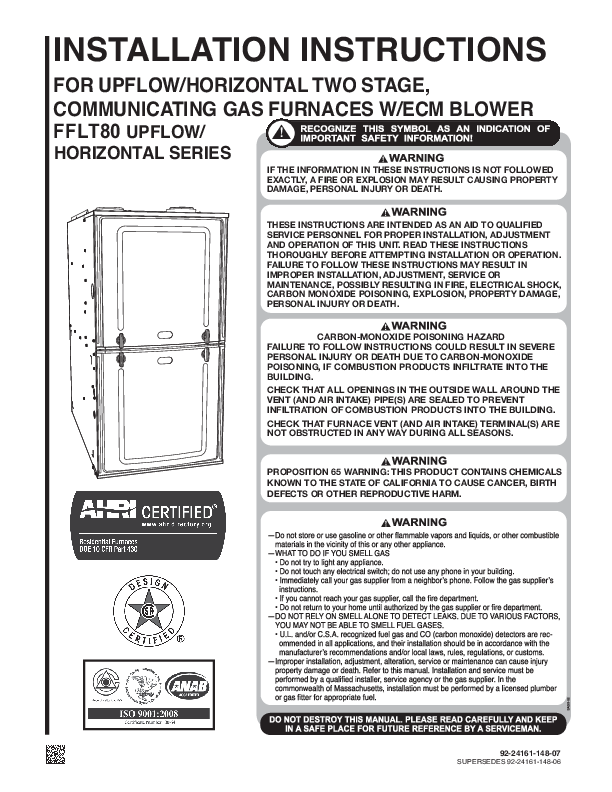
INSTALLATION INSTRUCTIONS
provisions provided in the AHRI Operations Manual for Residential Furnaces that were applicable at the date of manufacture should be used for test set up and perform-ance. GENERAL INFORMATION (cont.) General Information…
FF***LT80 - INSTALLATION INSTRUCTIONS
To change orifice spuds, shut off the manual gas valve and remove the gas manifold. On LP gas furnaces, the LP gas supply pressure must be set between 11" and ...
installation instructions for upflow/horizontal two stage, communicating gas furnaces w/ecm blower))/7 upflow/ horizontal series 92-24161-148-07 supersedes 92-24161-148-06 ...
Full PDF Document

If the inline viewer fails, it will open the original document in compatibility mode automatically. You can also open the file directly.
Extracted Text
INSTALLATION INSTRUCTIONS
FOR UPFLOW/HORIZONTAL TWO STAGE, COMMUNICATINGGAS FURNACES W/ECM BLOWER ))/7 UPFLOW/
HORIZONTAL SERIES
IF THE INFORMATION IN THESE INSTRUCTIONS IS NOT FOLLOWED EXACTLY, A FIRE OR EXPLOSION MAY RESULT CAUSING PROPERTY DAMAGE, PERSONAL INJURY OR DEATH.
THESE INSTRUCTIONS ARE INTENDED AS AN AID TO QUALIFIED SERVICE PERSONNEL FOR PROPER INSTALLATION, ADJUSTMENT AND OPERATION OF THIS UNIT. READ THESE INSTRUCTIONS THOROUGHLY BEFORE ATTEMPTING INSTALLATION OR OPERATION. FAILURE TO FOLLOW THESE INSTRUCTIONS MAY RESULT IN IMPROPER INSTALLATION, ADJUSTMENT, SERVICE OR MAINTENANCE, POSSIBLY RESULTING IN FIRE, ELECTRICAL SHOCK, CARBON MONOXIDE POISONING, EXPLOSION, PROPERTY DAMAGE, PERSONAL INJURY OR DEATH.
CARBON-MONOXIDE POISONING HAZARD FAILURE TO FOLLOW INSTRUCTIONS COULD RESULT IN SEVERE PERSONAL INJURY OR DEATH DUE TO CARBON-MONOXIDE POISONING, IF COMBUSTION PRODUCTS INFILTRATE INTO THE BUILDING. CHECK THAT ALL OPENINGS IN THE OUTSIDE WALL AROUND THE VENT (AND AIR INTAKE) PIPE(S) ARE SEALED TO PREVENT INFILTRATION OF COMBUSTION PRODUCTS INTO THE BUILDING. CHECK THAT FURNACE VENT (AND AIR INTAKE) TERMINAL(S) ARE NOT OBSTRUCTED IN ANY WAY DURING ALL SEASONS.
PROPOSITION 65 WARNING: THIS PRODUCT CONTAINS CHEMICALS KNOWN TO THE STATE OF CALIFORNIA TO CAUSE CANCER, BIRTH DEFECTS OR OTHER REPRODUCTIVE HARM.
92-24161-148-07 SUPERSEDES 92-24161-148-06

TABLE OF CONTENTS

Contents

1 TABLE OF CONTENTS . . . . . . . . . . . . . . . . . . . . . . 2
2 GENERAL INFORMATION . . . . . . . . . . . . . . . . . . . . 3 Receiving . . . . . . . . . . . . . . . . . . . . . . . . . . . . . . . . . . 4 California Proposition 65 Note . . . . . . . . . . . . . . . . . . 4 Efficiency Testing Notice. . . . . . . . . . . . . . . . . . . . . . . 4 Checklist . . . . . . . . . . . . . . . . . . . . . . . . . . . . . . . . . . . 5
3 SAFETY INFORMATION. . . . . . . . . . . . . . . . . . . . . . 6 Warnings. . . . . . . . . . . . . . . . . . . . . . . . . . . . . . . . . . . 6 Important Information About Efficiency and Quality. . 7
4 LOCATION REQUIREMENTS . . . . . . . . . . . . . . . . . 8 Site Selection . . . . . . . . . . . . . . . . . . . . . . . . . . . . . . . 8 Clearance � Accessibility . . . . . . . . . . . . . . . . . . . . . . 8 Dimensions and Clearance Table . . . . . . . . . . . . . . 10
5 DUCTING . . . . . . . . . . . . . . . . . . . . . . . . . . . . . . . . . 11 Upflow Installations. . . . . . . . . . . . . . . . . . . . . . . . . . 11 Horizontal Units . . . . . . . . . . . . . . . . . . . . . . . . . . . . 13
6 COMBUSTION AND VENTILATION AIR . . . . . . . . 14 Combustion Air Requirements . . . . . . . . . . . . . . . . . 14 Overtemperature Safety Switches . . . . . . . . . . . . . . 14 Furnace Located in an Unconfined Space . . . . . . . 15 Furnace Located in a Confined Space . . . . . . . . . . 15 Combustion Air From Attic . . . . . . . . . . . . . . . . . . . . 18 Venting . . . . . . . . . . . . . . . . . . . . . . . . . . . . . . . . . . . 19 "B-1" Vertical Venting . . . . . . . . . . . . . . . . . . . . . . . . 19 Special Vent Systems (SVS) . . . . . . . . . . . . . . . . . . 20 Power Vent Systems . . . . . . . . . . . . . . . . . . . . . . . . 22 Existing Vent Systems . . . . . . . . . . . . . . . . . . . . . . . 22
7 GAS SUPPLY AND PIPING . . . . . . . . . . . . . . . . . . 23 Gas Supply . . . . . . . . . . . . . . . . . . . . . . . . . . . . . . . . 23 Gas Piping . . . . . . . . . . . . . . . . . . . . . . . . . . . . . . . . 24 Gas Pressure . . . . . . . . . . . . . . . . . . . . . . . . . . . . . . 25 Gas Valve . . . . . . . . . . . . . . . . . . . . . . . . . . . . . . . . . 25 Setting Gas Pressure . . . . . . . . . . . . . . . . . . . . . . . . 26 Supply Gas Pressure Measurement . . . . . . . . . . . . 26
8 LP CONVERSION . . . . . . . . . . . . . . . . . . . . . . . . . . 27 NOx Models . . . . . . . . . . . . . . . . . . . . . . . . . . . . . . . 27 Orifice Installation . . . . . . . . . . . . . . . . . . . . . . . . . . . 27
9 ELECTRICAL WIRING . . . . . . . . . . . . . . . . . . . . . . 28 Electrical Connections . . . . . . . . . . . . . . . . . . . . . . . 28 Reversing The Electrical Connection. . . . . . . . . . . . 28 Thermostat . . . . . . . . . . . . . . . . . . . . . . . . . . . . . . . . 29
10 ACCESSORIES . . . . . . . . . . . . . . . . . . . . . . . . . . . . 30 Field Installed Option Accessories . . . . . . . . . . . . . . 30 Electronic Air Cleaner. . . . . . . . . . . . . . . . . . . . . . . . 30 Humidifier . . . . . . . . . . . . . . . . . . . . . . . . . . . . . . . . . 30 RXGW-C01 4-Inch Flue Adapter . . . . . . . . . . . . . . . 30 Filters . . . . . . . . . . . . . . . . . . . . . . . . . . . . . . . . . . . . 30 RXGW-B01 Chimney Adapter . . . . . . . . . . . . . . . . . 30 Twinning . . . . . . . . . . . . . . . . . . . . . . . . . . . . . . . . . . 30 Air Temperature Sensors . . . . . . . . . . . . . . . . . . . . . 30

11 HIGH ALTITUDE . . . . . . . . . . . . . . . . . . . . . . . . . . . 32 Natural Gas at High Altitudes . . . . . . . . . . . . . . . . . . 32 Orifice Ordering Information. . . . . . . . . . . . . . . . . . . 32 LP Gas at High Altitudes . . . . . . . . . . . . . . . . . . . . . 34
12 STARTUP PROCEDURES . . . . . . . . . . . . . . . . . . . 35 To Start Furnace . . . . . . . . . . . . . . . . . . . . . . . . . . . . 35 To Shut Down Furnace. . . . . . . . . . . . . . . . . . . . . . . 35 Sequence of Operation . . . . . . . . . . . . . . . . . . . . . . 35
13 INTEGRATED FURNACE CONTROL . . . . . . . . . . 36 Humidification/Dehumidification. . . . . . . . . . . . . . . . 38 Dipswitches . . . . . . . . . . . . . . . . . . . . . . . . . . . . . . . 42 Model Data Card . . . . . . . . . . . . . . . . . . . . . . . . . . . 44 Dual Seven-Segment Display . . . . . . . . . . . . . . . . . 45 Pushbutton . . . . . . . . . . . . . . . . . . . . . . . . . . . . . . . . 47 Supply & Outdoor Air Temperature Sensors . . . . . . 49 Auxiliary Inputs . . . . . . . . . . . . . . . . . . . . . . . . . . . . . 50 Thermostat Wiring Diagrams . . . . . . . . . . . . . . . . . . 51 Communicating Legacy AC Condensing (Non-Communicating). . 53 Legacy Heat Pump (Non-Communicating) . . . . . 55
14 TIMING DIAGRAM, FIELD SELECTIONS & ADJUSTMENTS. . . . . . . . . . . . . . . . . . . . . . . . . . 58
Adjusting or Checking Furnace Input. . . . . . . . . . . . 58 Setting Input Rate. . . . . . . . . . . . . . . . . . . . . . . . . . . 59
15 AIRFLOW. . . . . . . . . . . . . . . . . . . . . . . . . . . . . . . . . 60 Limit Control . . . . . . . . . . . . . . . . . . . . . . . . . . . . . . . 61 Flame Roll-Out Safety Switches . . . . . . . . . . . . . . . 61 Pressure Switch . . . . . . . . . . . . . . . . . . . . . . . . . . . . 61
16 MAINTENANCE. . . . . . . . . . . . . . . . . . . . . . . . . . . . 62
17 FILTERS . . . . . . . . . . . . . . . . . . . . . . . . . . . . . . . . . . 62
18 LUBRICATION. . . . . . . . . . . . . . . . . . . . . . . . . . . . . 62
19 MAINTENANCE. . . . . . . . . . . . . . . . . . . . . . . . . . . . 63 System Operation Information . . . . . . . . . . . . . . . . . 63
20 ANNUAL INSPECTION. . . . . . . . . . . . . . . . . . . . . . 63
21 REPLACEMENT PARTS. . . . . . . . . . . . . . . . . . . . . 63
22 DIAGNOSTICS . . . . . . . . . . . . . . . . . . . . . . . . . . . . 64 Normal Operation Codes . . . . . . . . . . . . . . . . . . . . . 64 Fault Codes with Descriptions and Solutions . . . . . 65 Lockout . . . . . . . . . . . . . . . . . . . . . . . . . . . . . . . . . . . 74 Replacing the Furnace Control . . . . . . . . . . . . . . . . 74 Diagnosing Blower Motor Issues . . . . . . . . . . . . . . . 75 Diagnosis Flowchart . . . . . . . . . . . . . . . . . . . . . . . . . 77 Wiring Diagram. . . . . . . . . . . . . . . . . . . . . . . . . . . . . 79

IMPORTANT: TO INSURE PROPER INSTALLATION AND OPERATION OF THIS PRODUCT, COMPLETELY READ ALL INSTRUCTIONS PRIOR TO ATTEMPTING TO ASSEMBLE, INSTALL, OPERATE, MAINTAIN OR REPAIR THIS PRODUCT. UPON UNPACKING OF THE FURNACE, INSPECT ALL PARTS FOR DAMAGE PRIOR TO INSTALLATION AND START-UP.

2

GENERAL INFORMATION

General Information

NOTE: A heat loss calculation should be performed to properly determine the required furnace BTU size for the structure. Also, the duct must be properly designed and installed for proper airflow. Existing ductwork must be inspected for proper size and to make sure that it is properly sealed. Proper airflow is necessary for both user comfort and equipment performance.
Before opening the furnace carton, verify that the data tags on the carton specify the furnace model number that was ordered from the distributor and are correct for the installation. If not, return the unit without opening the carton. If the model number is correct, open the carton and verify that the furnace rating label specifies the same furnace model number that is specified on the carton label. If the model numbers do not match, return the furnace to the distributor.
IMPORTANT: Proper application, installation and maintenance of this furnace and system is a must if consumers are to receive the full benefits for which they have paid.

The 80% variable speed two stage series furnaces are design certified by CSA for use with natural and propane gases as follows:
As a Category I furnace, it may be vented vertically with type B1 vent pipe and also may be common vented as described in these instructions.
This furnace should be installed in accordance with the American National Standard Z223.1 - latest edition booklet entitled "National Fuel Gas Code" (NFPA 54), and the requirements or codes of the local utility or other authority having jurisdiction including local plumbing or waste water codes.
With the introduction of higher efficiency furnaces, special attention must be paid to the venting system. Only listed venting systems may be used as stated in the installation instructions and the National Fuel Gas Code, ANSI Z223.1 (NFPA 54),. Since furnace technology and venting requirements are changing, awareness of local, state, and federal codes and industry changes is imperative.

FIGURE 1
FURNACE COMPONENTS
15 16 17 18
19
20 21
1 2 3

14

13

1.) DOOR SWITCH

2.) TRANSFORMER

12 3.) JUNCTION BOX

4.) LOW VOLTAGE TERMINAL

5.)HEAT ASSISTED LIMIT CONTROL (HALC)

6.) SOLID METAL BASE PAN

7.) FURNACE CONTROL
11 8.) CONTROL MOUNTING PLATE

9.) BLOWER

10.) POWER FACTOR CORRECTION CHOKE (PFC)

(EXCEPT 50kBTU AND 75kBTU-17")

11.) IGNITER

12.) GAS VALVE

13.) INDUCED DRAFT BLOWER

14.) 4" FLUE ADAPTER (OPTIONAL)

15.) COMBUSTION AIR INLET

10 16.) MAIN LIMIT

17.) COMBUSTION AIR DIFFUSER

18.) PRESSURE SWITCHES,

9

HIGH AND LOW STAGE 19.) OVER TEMPERATURE SWITCH

20.) BURNER

21.) FLAME SENSOR

8

4

7

5

6 ST-A1220-30 3

General Information

GENERAL INFORMATION (cont.)

Install this furnace in accordance with the American National Standard Z223.1 � latest edition entitled "National Fuel Gas Code" (NFPA54) or codes of the local utilities or other authorities having jurisdiction. This is available from the following:
National Fire Protection Association, Inc. Batterymarch Park Quincy, MA 02269
CSA-INTERNATIONAL 5060 Spectrum Way Mississauga, Ontario Canada L4W5N6 Online: www.csa.ca
RECEIVING
Immediately upon receipt, all cartons and contents should be inspected for transit damage. Units with damaged cartons should be opened immediately. If damage is found, it should be noted on the delivery papers, and a damage claim filed with the last carrier.
� After unit has been delivered to job site, remove carton taking care not to damage unit.
� Check the unit rating plate for unit size, electric heat, coil, voltage, phase, etc. to be sure equipment matches what is required for the job specification.
� Read the entire instructions before starting the installation.
� Some building codes require extra cabinet insulation and gasketing when unit is installed in attic applications.
� If installed in an unconditioned space, apply caulking around the power wires, control wires, refrigerant tubing and condensate line where they enter the cabinet. Seal the power wires on the inside where they exit conduit opening. Caulking is required to prevent air leakage into and condensate from forming inside the unit, control box, and on electrical controls.
� Install the unit in such a way as to allow necessary access to the coil/filter rack and blower/control compartment.
� Install the unit in accordance with any local code which may apply and the national codes. Latest editions are available from: "National Fire Protection Association, Inc., Batterymarch Park, Quincy, MA 02269." These publications are:
� ANSI/NFPA No. 70-(Latest Edition) National Electrical Code.
� NFPA90A Installation of Air Conditioning and Ventilating Systems.
� NFPA90B Installation of warm air heating and air conditioning systems.
� The equipment has been evaluated in accordance with the Code of Federal Regulations, Chapter XX, Part 3280.

CALIFORNIA RESIDENTS ONLY
IMPORTANT: All manufacturer products meet current Federal OSHA Guidelines for safety. California Proposition 65 warnings are required for certain products, which are not covered by the OSHA standards.
California's Proposition 65 requires warnings for products sold in California that contain, or produce, any of over 600 listed chemicals known to the State of California to cause cancer or birth defects such as fiberglass insulation, lead in brass, and combustion products from natural gas.
All "new equipment" shipped for sale in California will have labels stating that the product contains and/or produces Proposition 65 chemicals. Although we have not changed our processes, having the same label on all our products facilitates manufacturing and shipping. We cannot always know "when, or if" products will be sold in the California market.
You may receive inquiries from customers about chemicals found in, or produced by, some of our heating and air-conditioning equipment, or found in natural gas used with some of our products. Listed below are those chemicals and substances commonly associated with similar equipment in our industry and other manufacturers.
� Glass Wool (Fiberglass) Insulation � Carbon Monoxide (CO) � Formaldehyde � Benzene
More details are available at the Websites for OSHA (Occupational Safety and Health Administration), at www.osha.gov and the State of California's OEHHA (Office of Environmental Health Hazard Assessment), at www.oehha.org. Consumer education is important since the chemicals and substances on the list are found in our daily lives. Most consumers are aware that products present safety and health risks, when improperly used, handled and maintained.
EFFICIENCY TESTING NOTICE
For purposes of verifying or testing efficiency ratings, the test procedure in Title 10 APPENDIX N to Subpart B of Part 430 (Uniform Test Method for Measuring the Energy Consumption of Furnaces and Boilers) and the clarifying provisions provided in the AHRI Operations Manual for Residential Furnaces that were applicable at the date of manufacture should be used for test set up and performance.

4

Checklist

Installation Instructions remain with the furnace as a reference guide to the servicing contractor. We recommend that performance and installation data be recorded for future reference on this sheet to meet service and warranty obligations so that job site information is available when required.
Installation Checklist
REFER TO INSTALLATION INSTRUCTIONS GAS SUPPLY ______ Correct pipe size (record size) ______ Correct supply pressure (during furnace operation) (record pressure) ______ Manifold pressure (record upstream pressure) ______ No gas leaks ______ L.P. Kit Number (if applicable) (record kit number) ELECTRICAL ______ 115 V.A.C. supply (Dedicated Circuit) (record voltage) ______ Polarity observed ______ Furnace properly grounded ______ Correct wire size (record type and gauge) FURNACE INSTALLATION ______ Correct clearance to combustibles (record clearance) ______ Correct clearance for service (at front) (record clearance) DUCT STATIC PRESSURE ______ in. w.c. on heating speed (record static pressure) ______ in. w.c. on cooling speed (record static pressure) ______ Air temperature rise in heat (record air temperature rise) ______ Air temperature rise in cool (record air temperature rise) VENTING ______ Correct vent pipe diameter and length (according to NFGC tables) _________________ Vent connection size ______ Correct venting material (according to NFGC tables) ______ Correct lining for masonry chimneys ______ Adequate clearance from combustibles ______ Proper negative pressure reading in the vent ______ Vent pipe secured to induced draft blower housing COMBUSTION AIR ______ Proper source of combustion air ______ Correct combustion air opening size ______ Optional attic combustion air pull ______ Non-attic combustion air pull
5

SAFETY INFORMATION

Safety Information

! WARNING
DO NOT INSTALL THIS FURNACE IN A MOBILE HOME!! THIS FURNACE IS NOT APPROVED FOR INSTALLATION IN A MOBILE HOME. DOING SO COULD CAUSE FIRE, PROPERTY DAMAGE, PERSONAL INJURY OR DEATH.
! WARNING
INSTALL THIS FURNACE ONLY IN A LOCATION AND POSITION AS SPECIFIED IN THE LOCATION REQUIREMENTS AND CONSIDERATIONS SECTION OF THESE INSTRUCTIONS.
! WARNING
IMPROPER INSTALLATION, OR INSTALLATION NOT MADE IN ACCORDANCE WITH THE CSA INTERNATIONAL (CSA) CERTIFICATION OR THESE INSTRUCTIONS, CAN RESULT IN UNSATISFACTORY OPERATION AND/OR DANGEROUS CONDITIONS AND ARE NOT COVERED BY THE MANUFACTURER'S WARRANTY.
! WARNING
DO NOT BYPASS, JUMPER, OR REMOVE ANY SAFETY SWITCH FROM THE FURNACE CONTROL CIRCUIT. IF A SAFETY SWITCH CAUSES THE FURNACE TO SHUT DOWN OR OPERATE INTERMITTENTLY, IT IS AN INDICATION OF A POTENTIAL SAFETY HAZARD THAT MUST BE ADDRESSED BY A QUALIFIED TECHNICIAN, SERVICE AGENCY OR THE GAS SUPPLIER. DO NOT RESET SAFETY CONTROLS WITHOUT CORRECTIVE ACTION AND/OR VERIFICATION OF PROPER SAFE OPERATION BY A QUALIFIED INSTALLER, SERVICE AGENCY OR THE GAS SUPPLIER.
REPLACE ANY SAFETY CONTROL COMPONENT ONLY WITH IDENTICAL OEM REPLACEMENT PARTS. WHEN A NEW SAFETY SWITCH IS INSTALLED, IT MUST BE TESTED FOR A MINIMUM OF 15 MINUTES WITH THE FURNACE OPERATING AT MAXIMUM INPUT RATE AND WITH BOTH BLOWER AND BURNER DOOR INSTALLED. IF THE FURNACE IS INSTALLED IN A CLOSET, THE CLOSET DOOR MUST ALSO BE CLOSED FOR THIS TEST. REPEAT THE TEST AT THE MINIMUM INPUT RATE IF THE FURNACE IS A MULTI-STAGE FURNACE.
! WARNING
USE ONLY WITH THE TYPE OF GAS APPROVED FOR THIS FURNACE. REFER TO THE FURNACE RATING PLATE.
! WARNING
NEVER TEST FOR GAS LEAKS WITH AN OPEN FLAME. USE A COMMERCIALLY AVAILABLE SOAP SOLUTION MADE SPECIFICALLY FOR THE DETECTION OF LEAKS TO CHECK ALL CONNECTIONS, AS SPECIFIED IN GAS SUPPLY AND PIPING SECTION OF THESE INSTRUCTIONS.
6

! WARNING
COMBUSTION AND VENTILATION AIR MUST BE PROVIDED TO THE FURNACE AS REQUIRED BY THE NATIONAL FUEL-GAS CODE (U.S.) AND THE COMBUSTION AND VENTILATION AIR SECTION OF THESE INSTRUCTIONS.
! WARNING
COMBUSTION PRODUCTS MUST BE DISCHARGED OUTDOORS. CONNECT THIS FURNACE TO AN APPROVED VENT SYSTEM ONLY, AS SPECIFIED IN THE VENT PIPE INSTALLATION SECTION OF THESE INSTRUCTIONS.
! WARNING
WHEN A FURNACE IS INSTALLED SO THAT SUPPLY DUCTS CARRY AIR CIRCULATED BY THE FURNACE TO AREAS OUTSIDE THE SPACE CONTAINING THE FURNACE, THE RETURN AIR SHALL ALSO BE HANDLED BY DUCT(S) SEALED TO THE FURNACE CASING AND TERMINATING OUTSIDE THE SPACE CONTAINING THE FURNACE.
! WARNING
WHENEVER THE FACTORY RETURN-AIR CONNECTION IS NOT USED IT MUST BE SEALED. A SOLID METAL BASE PLATE MUST BE INSTALLED AND SEALED. FACTORY BASE PLATES ARE AVAILABLE AS ACCESSORY ITEMS. (PART NUMBERS ARE LISTED IN THE SPEC SHEET FOR THE FURNACE.) FAILURE TO INSTALL AND SEAL THE BASE PLATE AND RETURN AIR DUCT CONNECTIONS MAY ALLOW CARBON MONOXIDE AND OTHER CONTAMINANTS TO BE DRAWN INTO THE CONDITIONED AIR SPACE AND DISTRIBUTED THROUGHOUT THE HEATED SPACE.
! WARNING
DO NOT OPERATE THE SYSTEM WITHOUT FILTERS. A PORTION OF THE DUST ENTRAINED IN THE AIR MAY TEMPORARILY LODGE IN THE AIR DUCT RUNS AND AT THE SUPPLY REGISTERS. ANY CIRCULATED DUST PARTICLES WILL BE HEATED AND CHARRED BY CONTACT WITH THE FURNACE HEAT EXCHANGER. THIS SOOTY RESIDUE WILL SOIL CEILINGS, WALLS, DRAPES, CARPETS AND OTHER HOUSEHOLD ARTICLES. SOOT DAMAGE MAY ALSO RESULT WITH, OR WITHOUT, FILTERS IN PLACE, WHEN CERTAIN TYPES OF CANDLES ARE BURNED, OR CANDLEWICKS ARE LEFT UNTRIMMED.
! WARNING
IN COMPLIANCE WITH RECOGNIZED CODES, IT IS RECOMMENDED THAT AN AUXILIARY DRAIN PAN BE INSTALLED UNDER THIS FURNACE AND ANY INSTALLED EVAPORATOR COIL THAT IS LOCATED IN ANY AREA OF A STRUCTURE WHERE DAMAGE TO THE BUILDING OR BUILDING CONTENTS MAY OCCUR AS A RESULT OF AN OVERFLOW OF THE A/C COIL DRAIN PAN.

SAFETY

Safety Information

! WARNING
BLOWER AND BURNERS MUST NEVER BE OPERATED WITHOUT THE BLOWER DOOR IN PLACE. THIS IS TO PREVENT DRAWING GAS FUMES (WHICH COULD CONTAIN HAZARDOUS CARBON MONOXIDE) INTO THE HOME THAT COULD RESULT IN PERSONAL INJURY OR DEATH.
! WARNING
ALWAYS INSTALL THE FURNACE TO OPERATE WITHIN THE FURNACE'S INTENDED TEMPERATURE-RISE RANGE WITH A DUCT SYSTEM WHICH HAS AN EXTERNAL STATIC PRESSURE WITHIN THE ALLOWABLE RANGE, AS SPECIFIED IN THE DUCTING SECTION OF THESE INSTRUCTIONS. SEE ALSO FURNACE RATING PLATE.
INSTALLATION MUST COMPLY WITH ALL INSTALLATION INSTRUCTIONS INCLUDING:
 PROPER VENT INSTALLATION;  FURNACE OPERATING UNDER THERMOSTAT
CONTROL;
 RETURN AIR DUCT SEALED TO THE FURNACE;  AIR FILTERS IN PLACE;  SET FURNACE INPUT RATE AND TEMPERA-
TURE RISE PER RATING PLATE MARKINGS;
 MEANS FOR PROVIDING OUTDOOR AIR RE-
QUIRED FOR COMBUSTION;
 RETURN AIR TEMPERATURE MAINTAINED BE-
TWEEN 55�F (13�C) AND 80�F (27�C); AND
 CLEAN FURNACE, DUCT WORK AND COMPO-
NENTS UPON SUBSTANTIAL COMPLETION OF THE CONSTRUCTION PROCESS, AND VERIFY THAT THE FURNACE OPERATING CONDITIONS INCLUDING IGNITION, INPUT RATE, TEMPERATURE RISE AND VENTING, ACCORDING TO THE INSTRUCTIONS AND CODES.
IMPORTANT INFORMATION ABOUT EFFICIENCY AND INDOOR AIR QUALITY
Central cooling and heating equipment is only as efficient as the duct system that carries the cooled or heated air. To maintain efficiency, comfort and good indoor air quality, it is important to have the proper balance between the air being supplied to each room and the air returning to the cooling and heating equipment.
Proper balance and sealing of the duct system improves the efficiency of the heating and air conditioning system and improves the indoor air quality of the home by reducing the amount of airborne pollutants that enter homes from spaces where the ductwork and / or equipment is located. The manufacturer and the U.S. Environmental Protection Agency's Energy Star Program recommend that central duct systems be checked by a qualified contractor for proper balance and sealing.

! WARNING
DUCT LEAKS CAN CREATE AN UNBALANCED SYSTEM AND DRAW POLLUTANTS SUCH AS DIRT, DUST, FUMES AND ODORS INTO THE HOME CAUSING PROPERTY DAMAGE. FUMES AND ODORS FROM TOXIC, VOLATILE OR FLAMMABLE CHEMICALS, AS WELL AS AUTOMOBILE EXHAUST AND CARBON MONOXIDE (CO), CAN BE DRAWN INTO THE LIVING SPACE THROUGH LEAKING DUCTS AND UNBALANCED DUCT SYSTEMS CAUSING PERSONAL INJURY OR DEATH (SEE FIGURE 2). � IF AIR-MOVING EQUIPMENT OR DUCTWORK IS LO-
CATED IN GARAGES OR OFF-GARAGE STORAGE AREAS - ALL JOINTS, SEAMS, AND OPENINGS IN THE EQUIPMENT AND DUCT MUST BE SEALED TO LIMIT THE MIGRATION OF TOXIC FUMES AND ODORS INCLUDING CARBON MONOXIDE FROM MIGRATING INTO THE LIVING SPACE. � IF AIR-MOVING EQUIPMENT OR DUCTWORK IS LOCATED IN SPACES CONTAINING FUEL BURNING APPLIANCES SUCH AS WATER HEATERS OR BOILERS ALL JOINTS, SEAMS, AND OPENINGS IN THE EQUIPMENT AND DUCT MUST ALSO BE SEALED TO PREVENT DEPRESSURIZATION OF THE SPACE AND POSSIBLE MIGRATION OF COMBUSTION BYPRODUCTS INCLUDING CARBON MONOXIDE INTO THE LIVING SPACE.
FIGURE 2
MIGRATION OF DANGEROUS SUBSTANCES, FUMES, AND ODORS INTO LIVING SPACES
Adapted from Residential Duct Diagnostics and Repair, with permission of Air Conditioning Contractors of America (ACCA).

7

LOCATION REQUIREMENTS

GENERAL INFORMATION

! WARNING
WHEN THIS FURNACE IS INSTALLED IN A RESIDENTIAL GARAGE, IT MUST BE INSTALLED SO THE BURNERS AND IGNITION SOURCE ARE LOCATED NO LESS THAN 18 INCHES [450MM] ABOVE THE FLOOR. THIS IS TO PREVENT THE RISK OF IGNITING FLAMMABLE VAPORS WHICH MAY BE PRESENT IN A GARAGE. ALSO, THE FURNACE MUST BE LOCATED OR PROTECTED TO AVOID PHYSICAL DAMAGE BY VEHICLES. FAILURE TO FOLLOW THESE WARNINGS CAN CAUSE A FIRE OR EXPLOSION, RESULTING IN PROPERTY DAMAGE, PERSONAL INJURY OR DEATH.
1. IMPORTANT: If installing the unit over a finished ceiling or living area, be certain to install an auxiliary condensate drain pan under the entire unit. This auxiliary drain pan should extend under any evaporator coil installed with the furnace.
2. IMPORTANT: If using a cooling evaporator coil with this furnace, be sure the air passes over the heat exchanger before passing over the cooling coil. The cooled air passing over the warm ambient air inside the heat exchanger tubes can cause condensation inside the tubes resulting in corrosion and eventual failure.
If there are manual dampers, they must be equipped to prevent heating or cooling operation unless the damper is in the full heat or cool position.
3. NOTE: This furnace is shipped with heat exchanger support brackets installed under the back of the heat exchanger. These may be removed before installation, but it is not required.
4. IMPORTANT: This furnace is not approved or recommended for installation on its back, with access doors facing upwards.
5. This furnace is suitable for installation in buildings constructed on-site. This heating unit should be centralized with respect to the heat distribution system as much as practicable.
6. NOTE: These furnaces are approved for installation in attics, as well as alcoves, utility rooms, closets and crawlspaces.
7. IMPORTANT: Support this unit when installed. For attic or crawl space installation, horizontal furnaces may be installed on combustible wood flooring or by using support brackets. See Figure 3.
8. IMPORTANT: If installing in a utility room, be sure the door is wide enough to:
a. allow the largest part of the furnace to pass; or
b. allow any other appliance (such as a water heater) to pass.

! WARNING
THIS FURNACE IS NOT APPROVED OR RECOMMENDED FOR INSTALLATION ON ITS BACK, WITH ACCESS DOORS FACING UPWARDS.
SITE SELECTION
1. Select a site in the building near the center of the proposed, or existing, duct system.
2. Give consideration to the vent system piping when selecting the furnace location. Be sure the venting system can get from the furnace to the termination with minimal length and elbows.
3. Locate the furnace near the existing gas piping. Or, if running a new gas line, locate the furnace to minimize the length and elbows in the gas piping. See Figure 3.
4. Locate the furnace to maintain proper clearance to combustibles as shown in following Figure 4.
! WARNING
DO NOT LIFT THE UNIT BY THE HEAT EXCHANGER TUBES. DOING SO CAN DAMAGE THE HEAT EXCHANGER ASSEMBLY.
CLEARANCE � ACCESSIBILITY
The design of forced air furnaces with input ratings as listed in the tables under Figure 4 are certified by CSA-International for the clearances to combustible materials shown in inches.
See name/rating plate and clearance label for specific model number and clearance information.
Service clearance of at least 24 inches (61 cm) is recommended in front of all furnaces.
NOTE: Use recommended 24" (61 cm) clearance if accessibility clearances are greater than fire protection clearances.
ACCESSIBILITY CLEARANCES, WHERE GREATER, MUST TAKE PRECEDENCE OVER FIRE PROTECTION CLEARANCES.

Location

8

LOCATION REQUIREMENTS

GENERAL INFORMATION (cont.)

! WARNING
UPFLOW AND HORIZONTAL FURNACES ARE DESIGNCERTIFIED FOR INSTALLATION ON COMBUSTIBLE FLOORS. NOTE, HOWEVER, THAT FURNACES MUST NOT BE INSTALLED DIRECTLY ON CARPETING, TILE OR OTHER COMBUSTIBLE MATERIAL OTHER THAN WOOD FLOORING. INSTALLATION ON A COMBUSTIBLE MATERIAL CAN RESULT IN FIRE, CAUSING PROPERTY DAMAGE, PERSONAL INJURY OR DEATH.

FIGURE 3

NOTE:
HORIZONTAL LEFT ORIENTATION DEPICTED IN ILLUSTRATION. HORIZONTAL RIGHT ORIENTATION IS SIMILAR IN INSTALLATION.

! WARNING
COMBUSTIBLE MATERIAL MUST NOT BE PLACED ON OR AGAINST THE FURNACE JACKET. THE AREA AROUND THE FURNACE MUST BE KEPT CLEAR AND FREE OF ALL COMBUSTIBLE MATERIALS INCLUDING GASOLINE AND OTHER FLAMMABLE VAPORS AND LIQUIDS. PLACEMENT OF COMBUSTIBLE MATERIALS ON, AGAINST OR AROUND THE FURNACE JACKET CAN CAUSE AN EXPLOSION OR FIRE RESULTING IN PROPERTY DAMAGE, PERSONAL INJURY OR DEATH. THE HOMEOWNER SHOULD BE CAUTIONED THAT THE FURNACE AREA MUST NOT BE USED AS A BROOM CLOSET OR FOR ANY OTHER STORAGE PURPOSES.

AIR FLOW

ST-A1220-03

Location

9

FIGURE 4
UPFLOW/HORIZONTAL DIMENSIONS
10

BOTTOM
RETURN AIR

Location
TOP
SUPPLY AIR
HOT

CLEARANCE TO COMBUSTIBLE MATERIAL (INCHES) UPFLOW/HORIZONTAL MODELS

REDUCED CLEARANCE (IN.)

Input

A

B

C

D

E

F

Left Side

Right Side

Back

Top

Front

Vent

Ship. Wgts.

050

14

1227/32

105/8


111/2

17/8

0

4

0

1

3

6 85 lbs.

REDUCED CLEARANCE (IN.)

SHIP

050MODEL 171/2 A 1611/32 B 123/8C

 D

E15 F 2L1E/F2T SIDE RI0GHT SIDE 3BACK

T0OP

F1RONT VEN3T WGT6S. 105 lbs.

075 5 171/2 14 16111/33227/321213/08 5/8

7

17 1/2 16 11/32 12 3/8


11 11/52 1 7/8 21/2 0
15 2 1/2 0

0

4 3

30
0

0 1
1

1 3
3

66  3

85 lb6s.
105 lbs.

105 lbs.

075 10 21 21 19217/93227/321411/48 1/8  18118/21/2 2 1/2 21/2 0

0 0

0 0

0 1

1 3 6 3 120 6lbs. 120 lbs.

100

12 15

212244

1/2 1/2

192227/33321111//332214111/558

7/8 7/8


2212281/2

2 1/2 2 1/2

21/2

0 0

0

0 0

0

0 0

0 11

1

3 3

66  3

140 150

6llbbss..

120 lbs.

125

241/2 2311/32

157/8


22

21/2

0

0 MAY REQU0IRE 3" TO 14" OR 3" TO35" ADAPT6ER. 140 lbs.

150

241/2 2311/32

157/8


22

21/2

0

4" ADAPTER INCLUDED WITH (-)801P UNITS.

0 MAY BE 00" WITH TYP1E B VENT. 3

6 150 lbs.

MMaAyYreBqEu1i"reW3I"THtoTY4P"EoBr V3E"NoTr.5" adapter.

4" adapter optional.

 May be 0" with type B vent.

 May be 1" with type B vent.

*See furnace spec sheet for model availability.

GAS CONNECTION
ELECTRICAL CONNECTION LINE VOLTAGE
ELECTRICAL CONNECTION LOW VOLTAGE
LEFT SIDE

A I R F L O W
FRONT

OPTIONAL GAS CONNECTION

OPTIONAL LINE VOLTAGE WIRING
OPTIONAL LOW VOLTAGE WIRING
RIGHT SIDE

ST-A1220-04

DUCTING

Proper air flow is required for the correct operation of this furnace. Restricted air flow can cause erratic operation and can damage the heat exchanger. The duct system must carry the correct amount of air for heating and cooling if summer air conditioning is used.
! WARNING
SOME HEATING AIRFLOW VALUES MAY BE HIGHER THAN THOSE REQUIRED FOR COOLING. BE SURE TO SIZE DUCT FOR THE MAXIMUM POSSIBLE AIRFLOW VALUE.
SIZE AIRFLOW DISTRIBUTION SYSTEM TO ACCEPTABLE INDUSTRY STANDARDS AND METHODS. TOTAL STATIC PRESSURE DROP OF THE AIR DISTRIBUTION SYSTEM SHOULD NOT EXCEED .8 INCHES W.C. THIS WILL INCLUDE ANY AIR CONDITIONER COIL, AIR FILTRATION SYSTEM, ZONING SYSTEM, DUCTWORK, ETC. REFER TO ADDED EQUIPMENT TECHNICAL INFORMATION TO OBTAIN PRESSURE DROP INFORMATION WHEN EQUIPMENT IS OPERATING AT RECOMMENDED HEATING OR COOLING CFMS.
! WARNING
ZONING SYSTEMS ARE NOT DIRECTLY SUPPORTED IN THIS MANUAL. IF A THIRD PARTY SYSTEM IS USED REFER TO THE MANUFACTURER OF THAT PRODUCT FOR INSTALLATION AND OPERATION INSTRUCTIONS.
ZONING SYSTEMS USED ON THIS PRODUCT MUST HAVE SENSORS TO PREVENT FURNACES AND/OR HEATING ELEMENTS FROM CYCLING ON INTERNAL LIMIT CONTROLS. THE ZONING SYSTEM MUST NOT ALLOW THE EVAPORATOR COILS AND/OR HYDRONIC COILS TO FREEZE.
IMPORTANT: When using outside air, design and adjust the system to maintain a return air temperature ABOVE 55� F during the heating season.
NOTE:Return air grilles and warm air registers must not be obstructed or closed.
! WARNING
UPFLOW FURNACE: THE SOLID METAL BASE (SHIPPED WITH THE FURNACE) PLATE MUST BE INSTALLED IN THE FURNACE BOTTOM WHEN USING SIDE AIR RETURN. FAILURE TO INSTALL A BASE PLATE COULD CAUSE THE PRODUCTS OF COMBUSTION TO CIRCULATE INTO THE LIVING SPACE AND CREATE POTENTIALLY HAZARDOUS CONDITIONS, INCLUDING CARBON MONOXIDE POISONING OR DEATH. FOR BOTTOM RETURN, A SOLID METAL BASE PAN MUST NOT BE INSTALLED. SEE FIGURE 5.

UPFLOW INSTALLATIONS
1. Position the unit to minimize long runs of duct or runs of duct with many turns and elbows.
2. For side return: Cut an opening in the side. The opening should be cut the full width and height of the knockouts on the unit. See Figure 6.
3. If summer air conditioning is desired, position the indoor coil on the supply-air side of the unit. Ensure that no air can bypass the coil.
4. Connect the furnace to the supply air plenum. See Figure 7.
5. Connect the return air ducting to the return-air opening at the bottom and/or side of the unit. Make the connections air-tight to prevent the migration of toxic fumes and odors including carbon monoxide from migrating into the living space.
6. If a filter is installed near the furnace, be sure to have adequate space for installation and removal of the unit filter.
7. NOTE: Where the maximum airflow is 1800 CFM or more, BOTH sides or the bottom must be used for the return air. Do not take return air from the back of the unit.
NOTE: DO NOT take return air from furnace rooms, garages or cold areas. Avoid return air from utility rooms, kitchens, laundry rooms and bathrooms.
! WARNING
BLOWER AND BURNERS MUST NEVER BE OPERATED WITHOUT THE BLOWER DOOR IN PLACE. THIS IS TO PREVENT DRAWING GAS FUMES (WHICH COULD CONTAIN HAZARDOUS CARBON MONOXIDE) INTO THE HOME THAT COULD RESULT IN PERSONAL INJURY OR DEATH.

11

Ducting

DUCTING
FIGURE 5

NOTE: SOLID BASE PLATE PROVIDED WITH (-)801P MODELS ONLY.
WHEN SOLID BASE PLATE IS USED . TAPE AROUND BOTTOM FLANGES OF CABINET BEFORE THE UNIT IS INSTALLED.

LIFT UP, PULL OUT

SOLID BASE FLANGE FITS UNDER
CABINET BOTTOM

1. REMOVE 2 SCREWS, LIFT BASE UP, SLIDE FORWARD TO REMOVE. 2. INSTALLATION IS REVERSE OF REMOVAL. ** VERIFY REAR FLANGE IS SEALED PROPERLY AS SHOWN IN DETAIL.
FIGURE 6

ST-A1220-10-X0 ST-A1220-10
FIGURE 7

Ducting

ST-A1220-08
12

ST-A1220-11

DUCTING

HORIZONTAL UNITS
1. Position the unit to minimize long runs of duct or runs of duct with many turns and elbows.
2. Unit can be mounted left or right side airflow configuration.
3. Position the unit on adequate supports or by using support brackets (see Figure 8) and connect supply plenum.
4. If summer air conditioning is desired, position the indoor coil on the supply air side of the unit. Insure that no air can bypass this coil.
5. Secure the four angle brackets to the return air opening. See Figure 9. Connect the return air ducting to the return air opening at the top of the unit. Make the connection air tight to prevent entraining combustion gases from an adjacent fuel-burning appliance.
NOTE: Do not block furnace access with support rods. Maintain clearances recommended in Figure 8. Allow enough space for proper service maintenance or replacement of the heat exchanger and blower assembly.
FIGURE 8
HORIZONTAL FURNACE INSTALLED W/SUPPORT BRACKETS
NOTE: HORIZONTAL LEFT ORIENTATION DEPICTED IN ILLUSTRATION. HORIZONTAL RIGHT ORIENTATION IS SIMILAR IN INSTALLATION.

FIGURE 9
HORIZONTAL RETURN AIR DUCT (LEFT-HAND AIRFLOW POSITION SHOWN)

AIRFLOW

RETURN
REAR VIEW
FOUR ANGLE BRACKETS CAN BE INSTALLED HORIZONTALLY. THESE BRACKETS MAY BE USED TO SECURE THE RETURN AIR DUCT TO A HORIZONTAL UNIT.

NOTE: DO NOT BLOCK FURNACE ACCESS WITH SUPPORT RODS, ALLOW SPACE FOR PROPER SERVICE MAINTIENCE OR REPLACEMENT OF THE HEAT EXCHANGER AND BLOWER ASSEMBLY .

AIR FLOW

ST-A1220-03

Ducting

13

COMBUSTION AND VENTILATION AIR

Combustion Air

COMBUSTION AIR REQUIREMENTS

IMPORTANT: This is not a direct vent furnace. Review venting instructions before installing.
! WARNING
THIS FURNACE AND ANY OTHER FUEL-BURNING APPLIANCE MUST BE PROVIDED WITH ENOUGH FRESH AIR FOR PROPER COMBUSTION AND VENTILATION OF THE FLUE GASES. MOST HOMES WILL REQUIRE THAT OUTSIDE AIR BE SUPPLIED INTO THE FURNACE AREA. FAILURE TO DO SO CAN CAUSE DEATH FROM CARBON MONOXIDE POISONING.
! WARNING
ADEQUATE FACILITIES FOR PROVIDING AIR FOR COMBUSTION AND VENTILATION MUST BE PROVIDED IN ACCORDANCE WITH SECTION 5.3, AIR FOR COMBUSTION AND VENTILATION, OF THE NATIONAL FUEL GAS CODE, ANSI, Z223.1 LATEST EDITION OR APPLICABLE PROVISIONS FOR THE LOCAL BUILDING CODES, AND NOT OBSTRUCTED SO AS TO PREVENT THE FLOW OF AIR TO THE FURNACE.
1. IMPORTANT: Air for combustion and ventilation must not come from a corrosive atmosphere. Any failure due to corrosive elements in the atmosphere is excluded from warranty coverage.
2. Combustion air must be free of acid forming chemicals; such as sulphur, fluorine and chlorine. These elements are found in aerosol sprays, detergents, bleaches, cleaning solvents, air fresheners, paint and varnish removers, refrigerants and many other commercial and household products. Vapors from these products when burned in a gas flame form acid compounds. The acid compounds increase the dew point temperature of the flue products and are highly corrosive after they condense.
3. The following types of installation may require OUTDOOR AIR for combustion, due to chemical exposures:
� Commercial buildings � Buildings with indoor pools � Furnaces installed in laundry rooms � Furnaces in hobby or craft rooms � Furnaces installed near chemical storage areas.
4. If combustion air is exposed to the following substances (but not limited to the following), it should not be used and the furnace may require outdoor air for combustion.
� Permanent wave solutions � Chlorinated waxes and cleaners � Chlorine-based swimming pool chemicals � Water softening chemicals � De-icing salts or chemicals � Carbon tetrachloride

� Halogen type refrigerants � Cleaning solvents (such as perchloroethylene) � Printing inks, paint removers, varnishes, etc. � Hydrochloric acid � Cements and glues � Antistatic fabric softeners for clothes dryers � Masonry curing and acid washing materials
! WARNING
ALL FURNACE INSTALLATIONS MUST COMPLY WITH THE NATIONAL FUEL GAS CODE AND LOCAL CODES TO PROVIDE ADEQUATE COMBUSTION AND VENTILATION AIR FOR THE FURNACE. FAILURE TO DO SO CAN CREATE HAZARDOUS CONDITIONS RESULTING IN PROPERTY DAMAGE, BODILY INJURY OR DEATH FROM SMOKE, FIRE OR CARBON MONOXIDE.
Combustion air requirements are determined by whether the furnace is in an open (unconfined) area or in a confined space such as a closet or small room.
When the furnace is installed in the same space with other gas appliances, such as a water heater, be sure there is an adequate supply of combustion and ventilation air for the furnace and the other appliances. Do not delete or reduce the combustion air supply required by the other gas appliances in this space. See Z223.1, National Fuel Gas Code (NFPA 54). An unconfined space must have at least 50 cubic feet (volume) for each 1,000 BTUH of the total input of all appliances in the space. If the open space containing the appliances is in a building with tight construction (contemporary construction), outside air may still be required for the appliances to burn and vent properly. Outside air openings should be sized the same as for a confined space.
IMPORTANT: ONLY THE CURRENT VENT INSTRUCTIONS APPLY. All gas furnaces cannot be common-vented.
OVERTEMPERATURE SAFETY SWITCHES
Furnaces are equipped with safety switches in the burner compartment to protect against over-temperature conditions caused by inadequate combustion air supply. If a switch is tripped it must be manually reset after clearing the fault condition which caused it to open.
! WARNING
DO NOT BYPASS, JUMPER, OR REMOVE ANY SAFETY SWITCH FROM THE FURNACE CONTROL CIRCUIT. IF A SAFETY SWITCH CAUSES THE FURNACE TO SHUT DOWN OR OPERATE INTERMITTENTLY, IT IS AN INDICATION OF A POTENTIAL SAFETY HAZARD THAT MUST BE ADDRESSED BY A QUALIFIED TECHNICIAN, SERVICE AGENCY OR THE GAS SUPPLIER. DO NOT RESET SAFETY CONTROLS WITHOUT CORRECTIVE ACTION AND/OR VERIFICATION OF PROPER SAFE OPERATION BY A QUALIFIED INSTALLER, SERVICE AGENCY OR THE GAS SUPPLIER.
REPLACE ANY SAFETY CONTROL COMPONENT ONLY WITH IDENTICAL OEM REPLACEMENT PARTS

14

COMBUSTION AND VENTILATION AIR (cont.)

Combustion Air

COMBUSTION AIR REQUIREMENTS: CONFINED AND UNCONFINED SPACES

! WARNING
ALL FURNACE INSTALLATIONS MUST COMPLY WITH THE NATIONAL FUEL GAS CODE, NFPA 54 AND LOCAL CODES TO PROVIDE ADEQUATE COMBUSTION AND VENTILATION AIR FOR THE FURNACE. FAILURE TO DO SO CAN RESULT IN EXPLOSION, FIRE, PROPERTY DAMAGE, CARBON MONOXIDE POISONING, PERSONAL INJURY OR DEATH.
For improved indoor air quality, added safety and product performance we recommend direct vent type installations. If non-direct type vent system is used, the requirements for combustion air must be provided as identified in the National Fuel Gas Code.
Combustion air requirements are determined by whether the furnace is in an open (unconfined) area or in a confined space such as a closet or small room.
! WARNING
READ AND FOLLOW THE GENERAL VENTING REQUIREMENTS AND GUIDELINES OF THIS MANUAL FOR ADDITIONAL VENTING REQUIREMENTS PERTAINING TO ALL FURNACE INSTALLATIONS (INCLUDING DIRECT AND NON-DIRECT VENTING). FAILURE TO FOLLOW ALL INSTRUCTIONS IN THIS MANUAL CAN RESULT IN EQUIPMENT FAILURE, EQUIPMENT DAMAGE, PROPERTY DAMAGE, PERSONAL INJURY OR DEATH.
FURNACE LOCATED IN AN UNCONFINED SPACE
USING INDOOR AIR FOR COMBUSTION:
An unconfined space must have at least 50 cubic feet for each 1,000 BTUH of total input for all appliances in the space. Table 1 below specifies minimum space requirements and a few examples of the room sizes required for different inputs. The sizes are based on 8-foot ceilings.
If the open space containing the furnace is in a building with tight construction, outside air may still be required for the furnace to operate and vent properly. Outside air openings should be sized the same as for a confined space.

TTAABBLLEE17: M: MINIIMNUIMMUSMPACSEPARCEQEURIREEQMUEINRTESMENTS FFOORRUUNNCOCNOFNINFEIDNESDPASCPEA, NCOEN, N-DOIRNE-CDTIRVEENCTT VENT*

Input (BTUH)
50,000 75,000 100,000 125,000 150,000

Minimum Space
(Cubic Ft)
2,500 3,750 5,000 6,300 7,500

Minimum Area with 8
Ceilings (sq )
313 470 625 790 940

Typical Room Size w/ 8'
Ceilings ( x )
16 x 20 24 x 20 32 x 20 36 x 30 32 x 30

FURNACE LOCATED IN A CONFINED SPACE
A confined space is defined as any space for a given furnace input rating which is smaller than that which is specified in Table 1 as minimum for an "unconfined" space. If the space is less than that specified in this table, the space is defined as "confined".
If the space is small enough to be designated as "confined", it must have openings into the space which are located in accordance with the requirements set forth in the following subsections A and B. Size connected to the heated area or to the outside, and by the input of ALL appliances in the space.
If the confined space is within a building with tight construction, combustion air must be taken from outdoors or from an area freely communicating with the outdoors.
A. USING INDOOR AIR FOR COMBUSTION:
IMPORTANT: Air should not be taken from a heated space with a fireplace, exhaust fan or other device that may produce negative pressure.
If combustion air is taken from the heated area, the openings must each have at least 100 square inches of free area. Each opening must have at least one square inch of free area for each 1,000 BTUH of total input in the space. Table 2 shows some typical examples of openings required for combustion air openings required for a confined space.

TTAABBLLEE28: M: MININMIUMMUFMREFERAEREEAAREA OOPPEENNINING GRERQEUQIRUEIDRFEODRFAOR A FFUURRNNAACECELOLCOACTAEDTEINDAIN A CCOONNFIFNINEDEDSPSAPCAECUESIUNSGING IINNDDOOORORAIARIFROFROCROMCOBUMSBTIUOSNT. ION.

Input (BTUH)
50,000 75,000 100,000 125,000 150,000

Free Area for Each Opening (sq inches)
100 100 100 130 150

B. USING OUTDOOR AIR FOR COMBUSTION:
IMPORTANT: Do not take air from an attic space that is equipped with power ventilation.
The confined space must communicate with the outdoors in accordance with Methods 1 or 2 below. The minimum dimension of air openings shall not be less than 3 inches. Where ducts are used, they shall be of the same cross-sectional area as the free area of the openings to which they connect.
METHOD 1: Two permanent openings, one located within 12 inches of the top and one located within 12 inches of the bottom of the enclosure, shall be provided. The openings shall communicate directly, or by ducts, with the outdoors or spaces (crawl or attic) that freely communicate with the outdoors.

15

Combustion Air

COMBUSTION AND VENTILATION AIR (cont.)

COMBUSTION AIR REQUIREMENTS: CONFINED AND UNCONFINED SPACES

TTAABBLLEE 39:: MMININIMIMUUMMFRFEREEEARAERAEARERQEUQIRUEIRDED

FOORREEAACCHHOOPPEENNININGG(W(WHEHNETNWTOWOOPEONPIENNGISNGS

AARREE UUSSEEDD))WWITITHHAAFFUURNRNACAEC:E:

11.. LLOOCCAATTEEDDININAACCOONNFIFNIENDEDSPSAPCAECE

22.. UUSSIINNGGOOUUTDTODOOROARIRAIFROFROCROCMOBMUSBTUIOSTNION

33.. CCOOMMMMUUNNICIACTAINTIGNDGIRDEIRCETCLYTLTYOTTOHTEHE

3. 3.

OTOTHUHURTRTSOOSIUDIUGDEGHETHTAHHARVROVEOUREGRUTIHTGCIAHCALANALDONVUPEOCENTNP.TEINNDGIUNOCGRT.O*R

Total Input for ALL Gas
Appliances (BTUH)
50,000 75,000 100,000 125,000 150,000

Free Area for Each Opening when 2 Separate Openings are used (sq inches)
13 19 25 32 38

Round Pipe Duct Diameter ( Vercal Duct Only) (inches)
5 5 6 8 8

A. Where directly communicating with the outdoors through an opening or where communicating to the outdoors through vertical ducts as shown in Figure 11, each opening shall have a minimum free area of 1 square inch for each 4,000 BTUH of total appliance input rating of all equipment in the enclosure. Table 3 specifies the minimum area for each of the 2 combustion air openings and minimum round duct diameter for direct openings and vertical ducting only.
B. Where communicating with the outdoors through horizontal ducts, each opening shall have a minimum free area of 1 square inch for each 2,000 BTUH of total appliance input rating of all equipment in the enclosure (see Figure 12). Table

TTAABBLLEE41:0M: MINIIMNIUMMUFMREFEREAEREAARERAEQRUEIQREUDIRED
FFOORREEAACCHHOOPEPNENINIGNG(W(HWEHNETNWTOWOOPEONPINEGNSINGS
AARREEUUSSEEDD) )WWITIHTHAAFUFRUNRANCAEC: E:
11..LLOOCCAATTEEDDININAACOCNOFNINFIENDESDPSAPCAECE 22..UUSSININGGOOUTUDTODOOROARIRAIFRORFOCROMCOBMUSBTUIOSNTION 33..CCOOMMMMUNUINCAICTAINTGINDGIRDEICRTELCYTTLYO TTOHETHE 3. OOUUTTSSIDIDEETTHHRROOUUGHGHAAHOHROIZROIZNOTANLTADLUCDTU. CT.

Free Area for

Total Input for Each Opening Round Pipe Duct

ALL Gas Appliances
(BTUH)

when 2 Separate

Diameter

Openings are (Horizontal Duct

used (sq inches) Only) (inches)

50,000

25

6

75,000

38

8

100,000

50

8

125,000

63

10

150,000

75

10

TTAABBLLEE51:1M: MINIINMIUMMUFMREFERAEEREAARERAEQRUEIQRUEDIRED
FFOORREAANCOHPOEPNEINNIGNG(W(WHHEENNOTNWEOOOPPEENNININGGISS
AURSEEDU)SWEDI)TWH IATHFUARFNUARCNEA:CE: 11..LLOOCCAATTEEDDININAACCOONFNIFNIENDEDSPSAPCAECE 22..UUSSIINNGGOOUUTDTODOOROARIRAIFROFROCROCMOBMUSBTUIOSNTION 33..CCOOMMMMUNUINCIACTAINTGINDGIRDEICRTELCYTLTYOTTOHETHE 3. OOUUTSTISDIDE ET.H*ROUGH A HORIZONTAL DUCT.

Total Input for ALL Gas
Appliances (BTUH)
50,000 75,000 100,000 125,000 150,000

Free Area for an Opening when 1 Opening is used
(sq inches)
25 38 50 63 75

Round Pipe Duct Diameter (inches)
6 8 8 10 10

4 specifies the minimum area for each of the 2 combustion air openings and minimum round duct diameter for horizontal ducting only.
METHOD 2: One permanent opening located within 12 inches of the top of the enclosure, shall be permitted where the equipment has clearances of at least 1 inch from the sides and back and 6 inches from the front of the appliance. The opening shall directly communicate with the outdoors or communicate through a vertical or horizontal duct to the outdoors or spaces (crawl or attic) that freely communicate with the outdoors, and shall have a minimum of:

FIGURE 10
NON-DIRECT VENT AIR FROM HEATED SPACE

VENT PENETRATIONS
FOR NON DIRECT VENT FURNACES AIR FROM HEATED SPACE

GAS WATER HEATER

12" MAX

FURNACE
12" MAX

NOTE: EACH OPENING SHALL HAVE A FREE AREA OF NOT LESS THAN ONE SQUARE INCH PER 1,000 BTU PER HOUR OF THE TOTAL INPUT RATING OF ALL EQUIPMENT IN THE ENCLOSURE, BUT NOT LESS THAN 100 SQUARE INCHES.

ST-A1227-01

16

Combustion Air

COMBUSTION AND VENTILATION AIR (cont.)

COMBUSTION AIR REQUIREMENTS: CONFINED AND UNCONFINED SPACES

FIGURE 11
NON-DIRECT VENT AIR FROM ATTIC OR CRAWL SPACE

OUTLET AIR IN ATTIC MUST BE ABOVE INSULATION

VENT PENETRATIONS
FOR NON DIRECT VENT FURNACES
AIR FROM ATTIC/CRAWL SPACE

GABLE VENT

VENTILATED ATTIC GABLE OR SOFFIT VENTS

FIGURE 12
NON-DIRECT VENT OUTSIDE AIR USING A HORIZONTAL DUCT

VENT PENETRATIONS
FOR NON DIRECT VENT FURNACES
AIR FROM ATTIC/CRAWL SPACE

1 SQ. INCH PER 4000 BTUH OUTLET AIR

OUTLET AIR 1 SQ. INCH PER 4000 BTUH

OUTLET AIR 1 SQ. INCH PER 2000 BTUH

OPTIONAL 1 SQ. INCH PER 4000 BTUH INLET AIR

GAS WATER HEATER

FURNACE
12" MAX 1 SQ. INCH PER 4000 BTUH INLET AIR

ST-A1227-02

INLET AIR 1 SQ. INCH PER 4000 BTUH

GAS WATER HEATER

FURNACE

12" MAX

INLET AIR 1 SQ. INCH PER 2000 BTUH

ST-A1227-03

A. 1 Square inch for each 3,000 BTUH of the total input rating of all equipment located in the enclosure
and
B. Not less than the sum of the areas of all vent connectors in the confined space.
If the unit is installed where there is an exhaust fan, sufficient ventilation must be provided to prevent the exhaust fan from creating negative pressure.

AIR INTAKE PIPE CONNECTION
A double-elbow may be installed to top inlet air opening, BUT IS NOT REQUIRED. This will help to prevent accidental blockage of the intake opening. Reference Figure 13 for proper elbow diameter.
NOTE: Inlet is specifically designed to prevent material from being pulled into furnace. If elbows are not used, the intake opening must be kept clean and free of debris.

FIGURE 13
COMBUSTION AIR FITTING � NON-ATTIC COMBUSTION AIR PULL

ATTACH OPTIONAL DOUBLE ELBOW TO TOP INLET AIR

OPENING TO PREVENT ACCIDENTAL BLOCKAGE OF

INTAKE OPENING. THIS IS NOT A REQUIREMENT. (SEE

PREVIOUS PAGE.) SINGLE ELBOW IS ALLOWED BUT

MAY NOT PREVENT DEBRIS FROM BEING DROPPED

INTO THE FURNACE.

EXHAUST

6" MIN.

PVC DOUBLE ELBOW
6" MININUM CLEARANCE
#8 SCREWS

METAL FLUE PIPE ONLY
#8 SCREWS

GROUND OR SHELF SURFACE
17

Combustion Air

COMBUSTION AND VENTILATION AIR (cont.)

It is also acceptable to run the condensate drain (or refrigerant) line access over the air intake hole as long as a 1" minimum clearance is maintained.
Combustion air openings must not be restricted in any manner.
IMPORTANT: When indoor combustion air is used, the inlet air opening at the furnace must be protected from accidental blockage.
IMPORTANT: If the furnace is in a location with an exhaust fan, there must be sufficient ventilation to prevent the exhaust fan from creating a negative pressure in the room.
Combustion air openings must NOT BE RESTRICTED in any manner.
CONSULT LOCAL CODES FOR SPECIAL REQUIREMENTS.
B: Method 3
For the optimum in quiet operation, attic air may be brought directly to the furnace.
IMPORTANT: In applications using Method 3 for combustion air, the attic must be ventilated by gable or soffit vents.

! CAUTION
COMBUSTION AIR INTAKES CANNOT BE TERMINATED OUTSIDE. DOING SO CAN CAUSE IMPROPER OPERATION OF THE FURNACE.
COMBUSTION AIR FROM ATTIC
If attic combustion air is used, the inlet air opening at the furnace must be protected from accidental blockage. Install a 90� elbow pointing horizontally at the top of inlet air pipe. See Figure 14 (maximum of 2, 45� or 90� elbows, allowed).
NOTE: Maximum length of pipe that may be used for combustion air is 10 feet with two elbows. Lengths of more than 10 feet can result in nuisance pressure switch trips.

FIGURE 14
COMBUSTION AIR FITTING � OPTIONAL ATTIC COMBUSTION AIR PULL
ATTACH A 90� ELBOW TO TOP INLET AIR OPENING TO PREVENT ACCIDENTAL BLOCKAGE OF INTAKE OPENING.

PVC ELBOW

EXHAUST

12" MIN. FROM TOP OF INSULATION

INSULATION

ATTIC SPACE

10 FT. MAX.
INCLUDING HORIZONTAL DIRECTION
#8 SCREW

6" MINIMUM CLEARANCE
PVC COUPLER

METAL FLUE PIPE ONLY INDOOR SPACE #8 SCREWS

! CAUTION
USE OF SHEET METAL AIR INTAKE PIPE INSTEAD OF PVC MAY RESULT IN NOISE ISSUES.

18

Combustion Air

COMBUSTION AND VENTILATION AIR (cont.)

VENTING

GENERAL INFORMATION
The furnace must be vented in accordance with these instructions, National Fuel Gas Code, ANSI Z223.1 and requirements or codes of the local utility or other authority having jurisdiction.
! WARNING
DEVICES ATTACHED TO THE FLUE OR VENT FOR THE PURPOSE OF REDUCING HEAT LOSS UP THE CHIMNEY HAVE NOT BEEN TESTED AND HAVE NOT BEEN INCLUDED IN THE DESIGN CERTIFICATION OF THIS FURNACE. WE, THE MANUFACTURER, CANNOT AND WILL NOT BE RESPONSIBLE FOR INJURY OR DAMAGE CAUSED BY THE USE OF SUCH UNTESTED AND/OR UNCERTIFIED DEVICES, ACCESSORIES OR COMPONENTS.
DRAFT INDUCER
! WARNING
VENT PIPE ATTACHING HOLES MUST BE PREDRILLED IN THE DRAFT INDUCER COLLAR TO PREVENT DAMAGING THE INDUCER. DRILL 1/8" DIAMETER HOLES THROUGH THE VENT PIPE AND COLLAR AND USE #8 SCREWS TO ATTACH. SEE FIGURE 16. FAILURE TO FOLLOW THIS WARNING CAN CAUSE RECIRCULATION OF FLUE PRODUCTS CAUSING CARBON MONOXIDE POISONING RESULTING IN PERSONAL INJURY OR DEATH.
FURNACE CATEGORY INFORMATION
This furnace is shipped as a Category I type induced draft furnace. A Category I furnace operates with a nonpositive vent pressure and has a vent gas temperature at least 140�F above the dew point of the vent gases. A Category I type may be a draft hood equipped furnace or have a fan assisted combustion system (induced draft). The inducer is used to pull flue products through the combustion chamber and as they leave the furnace, most of the energy has been dissipated. The buoyant effect of the flue gases provides venting to the outdoors.
During the off cycle, the inducer is off and there is very little flow through the vent, cooling the vent. During the on cycle there is no dilution airflow, as with a draft hood type furnace. Although the vent heats up rapidly without dilution air, the flue products contain more water vapor, which results in a higher dew point temperature. It is most important that you follow the guidelines in these instructions to prevent the possible formation of condensation in the venting system.
As a Category I furnace it may be vented vertically with type B-1 vent pipe and also may be common vented, as described in these instructions.

IMPORTANT APPLICATION NOTES
When the furnace is used as a replacement, the existing vent system should be inspected to assure that there are no obstructions, blockage, or any signs of corrosion and is properly sized for use with this furnace.
NOTE: When the vent table permits more than one diameter of pipe for a connector or vent, the smallest permitted diameter must be used.
Vent pipe may be type "B-1," either rigid or suitable flexible construction that carries a U.L. listing.
Common venting is allowed with vertical B-1 vent systems, and lined masonry chimneys. Follow the National Fuel Gas Code, ANSI Z223.1.
NOTE: Follow combustion air instructions as outlined in this manual.
Single wall vent connectors to "B-1 vent or masonry chimneys" may be used under the guidelines of the National Fuel Gas Code, ANSI Z223.1.
The entire length of the vent connector shall be readily accessible for inspection, cleaning and replacement.

"B-1" VERTICAL VENTING

NOTE: Refer to the National Fuel Gas Code, ANSI Z223.1.
Type "B-1" vents must be installed in accordance with the terms of their listings and the vent manufacturer's instructions.
"B-1" vents must be supported and spaced in accordance with their listings and the manufacturer's instructions. All vents must be supported to maintain their minimum clearances from combustible material.

VERTICAL VENTING

Input

Categorized Furnace Vent Size Recommended

(See NFGC)

50K

3"

75K

*4"

100K

*4"

125K

*5"

150K

*5"

*NOTE: All furnaces have a 3" vent connection as shipped from the factory. A 3" to 4", 3" to 5", or 4" to 5" vent transition may be required when vertically vented or common vented with metal vent pipes. THE VENT TRANSITION CONNECTION MUST BE MADE AT THE FURNACE VENT EXIT. It must originate with an adapter if required, at the furnace flue collar and terminate either in a listed cap or roof assembly. When common venting, the vent connector size may differ from the above diameters depending on application. See National Fuel Gas Code ANSI Z223.1 or latest edition tables.

19

COMBUSTION AND VENTILATION AIR (cont.)

Combustion Air

VERTICAL VENT SYSTEMS: 1. A gas vent shall terminate above the roof surface with a listed
cap or listed roof assembly. Gas vents 12 inches in size or smaller with listed caps shall be permitted to be terminated in accordance with Figure 15, provided they are at least 8 feet from a vertical wall or similar obstruction. All other gas vents shall terminate not less than 2 feet above the highest point where they pass through the roof and at least 2 feet higher than any portion of a building within 10 feet.
2. A type B-1 gas vent shall terminate at least 5 feet in vertical height above the highest connected equipment draft hood or flue collar.
3. Must rise 1/4" per foot away from the furnace on horizontal runs and be supported with straps or hangers so it has no sags or dips. Supports at 4 foot intervals and at all elbows are recommended.
4. The vent connector must be mechanically fastened to the outlet collar of the furnace with at least (2) sheet metal screws except vent connectors that are B-1 material. These shall be assembled in accordance with the manufacturer's instructions. See Figures 16 and 17.
5. Any angle greater than 45 degrees from the vertical is considered horizontal.The total horizontal distance of a vent plus the horizontal vent connector serving draft-hood equipped appliances shall not be greater than 75 percent of the vertical height of the vent.

Single appliance venting of a fan assisted furnace into a tile-lined masonry chimney is prohibited. The chimney must be lined with either Type B vent or with a listed, single wall, metal lining system. Reference National Fuel Gas Code, ANSI Z223.1. See Figure 18 for typical B-1 vent chase.
NOTE: A chimney adapter is available as an accessory (see accessory section of this manual). Follow manufacturer's instructions.
! WARNING
DO NOT CONNECT THIS FURNACE TO A CHIMNEY USED TO VENT A SOLID FUEL APPLIANCE (WOOD OR COAL). VENTING WITH A SOLID FUEL APPLIANCE CAN LEAD TO IMPROPER FUNCTIONING OF THE UNIT, AND DUE TO SOOTING, THE POSSIBILITY OF FIRE RESULTING IN PROPERTY DAMAGE, PERSONAL INJURY OR DEATH.
SPECIAL VENT SYSTEMS (SVS)
IMPORTANT: It is THE FURNACE MANUFACTURER's position now that new installations of any HTPV pipe used in a category III vent application, including Selkirk's SelventTM II HTPV product, should cease immediately.

FIGURE 15
TYPICAL VENTING WITH "B-1" VENT
LISTED CAP

- MINIMUM ALLOWABLE HEIGHT FROM ROOF TO DISCHARGE OPENING

LISTED GAS VENT
X 12
ROOF PITCH = X/12

FIGURE 16
ATTACHING TO DRAFT INDUCER COLLAR

ST-A1220-24
ST-A1220-24
20

ROOF PITCH FLAT TO 6/12 OVER 6/12 TO 7/12 OVER 7/12 TO 8/12 OVER 8/12 TO 9/12 OVER 9/12 TO 10/12 OVER 10/12 TO 11/12 OVER 11/12 TO 12/12 OVER 12/12 TO 14/12 OVER 14/12 TO 16/12 OVER 16/12 TO 18/12 OVER 18/12 TO 20/12 OVER 20/12 TO 21/12

"H" (MIN.) FT. 1.0 1.25 1.5 2.0 2.5 3.25 4.0 5.0 6.0 7.0 7.5 8.0

A0991-01

Combustion Air

COMBUSTION AND VENTILATION AIR (cont.)

FIGURE 17
FRESH AIR INLET

1. STANDARD 3" FLUE CONNECTION. 2. 4" ADAPTER - OPTIONAL SEE NATIONAL FUEL GAS CODE FOR SIZING OPTIONS
1. 2.

ST-A1220-09-01 ST-A1220-09
FIGURE 18
DEDICATED VENTING THROUGH CHIMNEY WITH "B-1" VENT

21

Combustion Air

COMBUSTION AND VENTILATION AIR (cont.)

POWER VENT SYSTEMS
When vertical venting is not possible, the only acceptable method for horizontal venting is with the use of Tjernlund model GPAK1TR or Field Controls models SWG-4R power venter. Type B vent pipe and fittings must be used. Common venting is not permitted
All application and installation instructions supplied with the power venter must be followed.
Please address all questions regarding power venter installation, agency listings and furnace model compatibility to:
Tjernlund Products, Inc. (800) 255-4208 or (612) 426-2993
Field Controls L.L.C. (800) 742-8368 or (919) 522-0214
EXISTING VENT SYSTEMS
IMPORTANT RETROFIT VENTING INSTRUCTIONS
If this furnace is a replacement installation, ALWAYS INSPECT the existing vent system to be sure there are no obstructions, blockages, or signs of corrosion.
When the existing furnace is removed from a venting system serving other appliances, the venting is likely to be too large to properly vent the remaining attached appliances.
The following steps shall be followed with each appliance that remains connected to the common venting system, while the other appliances that remain connected to the common venting systems are not in operation.
NOTE: When the vent table permits more than one diameter of pipe for a connector or vent, the smallest permitted diameter must be used.1. Seal any unused openings in the common venting system.
NOTE: Ensure existing venting system complies with latest addition of National Fuel Gas Code ANSI Z223.1 and all local codes/regulations.

1. Visually inspect the venting system for proper size and horizontal pitch and determine that there is no blockage, restriction, leakage, corrosion or other deficiencies which could cause an unsafe condition.
2. Insofar as is practical, close all building doors, windows and all doors between the space where the appliances remaining connected to the common venting system are located. Turn on clothes dryers and any appliance not connected to the common venting system. Turn on any exhaust fans, such as range hoods and bathroom exhausts, so they will operate at maximum speed. Do not operate a summer exhaust fan. Close fireplace dampers.
3. Follow the lighting instructions. Place the appliance being inspected into operation. Adjust the thermostat so the appliance will operate continuously.
4. Test for spillage at the draft hood relief opening after 5 minutes of main burner operation. Use the flame of a match or candle, or smoke from a cigarette, cigar, or pipe.
5. After it has been determined that each appliance that remains connected to the common venting system properly vents (when tested as outlined above) return doors, windows, exhaust fans, fireplace dampers and any other gas-burning appliance to their previous conditions of use.
6. If improper venting is observed during any of the above tests, the common venting system must be resized. Refer to National Fuel Gas Code, ANSI Z223.1.

22

GAS SUPPLY

Gas Supply

GAS SUPPLY AND PIPING
IMPORTANT SAFETY INFORMATION
NATURAL GAS AND PROPANE (LIQUEFIED PETROLEUM GAS / LPG) SAFETY
GAS SUPPLY
! WARNING
� FURNACES USING PROPANE GAS ARE DIFFERENT FROM NATURAL GAS MODELS. A NATURAL GAS HEATER WILL NOT FUNCTION SAFELY ON PROPANE AND VICE VERSA. CONVERSIONS OF HEATER GAS TYPE SHOULD ONLY BE MADE BY QUALIFIED INSTALLERS USING FACTORY SUPPLIED COMPONENTS. THE FURNACE SHOULD ONLY USE THE FUEL TYPE IN ACCORDANCE WITH LISTING ON RATING PLATE. ANY OTHER FUEL USAGE WILL RESULT IN DEATH OR SERIOUS PERSONAL INJURY FROM FIRE AND/OR EXPLOSION.
� BOTH NATURAL GAS AND PROPANE HAVE AN ODORANT ADDED TO AID IN DETECTING A GAS LEAK. SOME PEOPLE MAY NOT PHYSICALLY BE ABLE TO SMELL OR RECOGNIZE THIS ODORANT. IF YOU ARE UNSURE OR UNFAMILIAR WITH THE SMELL OF NATURAL GAS OR PROPANE, ASK YOUR LOCAL GAS SUPPLIER. OTHER CONDITIONS, SUCH AS "ODORANT FADE," WHICH CAUSES THE ODORANT TO DIMINISH IN INTENSITY, CAN ALSO HIDE, CAMOUFLAGE, OR OTHERWISE MAKE DETECTING A GAS LEAK BY SMELL MORE DIFFICULT.
� UL OR CSA RECOGNIZED FUEL GAS DETECTORS ARE RECOMMENDED IN ALL ENCLOSED PROPANE AND NATURAL GAS APPLICATIONS WHEREIN THERE IS A POTENTIAL FOR AN EXPLOSIVE MIXTURE OF FUEL GAS TO ACCUMULATE. FUEL DETECTOR INSTALLATION SHOULD BE IN ACCORDANCE WITH THE DETECTOR MANUFACTURER'S RECOMMENDATIONS AND/OR LOCAL LAWS, RULES, REGULATIONS, OR CUSTOMS.
� BEFORE ATTEMPTING TO LIGHT THE FURNACE, MAKE SURE TO LOOK AND SMELL FOR GAS LEAKS. USE A SOAPY SOLUTION TO CHECK ALL GAS FITTINGS AND CONNECTIONS.
BUBBLING AT A CONNECTION INDICATES A LEAK THAT MUST BE CORRECTED. WHEN SMELLING TO DETECT A GAS LEAK, BE SURE TO ALSO SNIFF NEAR THE FLOOR. PROPANE GAS IS HEAVIER THAN AIR AND TENDS TO COLLECT AT LOWER LEVELS MAKING IT MORE DIFFICULT TO SMELL AT NOSE LEVEL. NATURAL GAS IS LIGHTER THAN AIR
(Continued on next column)

AND WILL RISE, POSSIBLY ACCUMULATING IN HIGHER PORTIONS OF THE STRUCTURE.
� IF A GAS LEAK IS PRESENT OR SUSPECTED:
- DO NOT ATTEMPT TO FIND THE CAUSE YOURSELF.
- NEVER USE AN OPEN FLAME TO TEST FOR GAS LEAKS. THE GAS CAN IGNITE RESULTING IN DEATH, PERSONAL INJURY, OR PROPERTY DAMAGE.
- DO NOT TRY TO LIGHT ANY APPLIANCE.
- DO NOT TOUCH AND ELECTRICAL SWITCH.
- DO NOT USE ANY PHONE IN YOUR BUILDING.
- LEAVE THE BUILDING IMMEDIATELY AND CALL THE GAS SUPPLIER FROM A NEIGHBOR'S PHONE. FOLLOW THE GAS SUPPLIER'S INTRUCTIONS.
- IF YOU CANNOT REACH YOUR GAS SUPPLIER, CALL THE FIRE DEPARTMENT.
- DO NOT RETURN TO THE BUILDING UNTIL AUTHORIZED BY THE GAS SUPPLIER OR FIRE DEPARTMENT.
� SHOULD OVERHEATING OCCUR OR THE GAS SUPPLY FAIL TO SHUT OFF, TURN OFF THE MANUAL GAS CONTROL VALVE TO THE FURNACE.
� CONSULT WITH THE LOCAL BUILDING DEPARTMENT AND FUEL GAS SUPPLIER BEFORE INSTALLING THE HEATER:
- THE INSTALLATION AND PURGING OF GAS PIPING MUST CONFORM TO LOCAL CODES, UTILITY COMPANY REQUIREMENTS, AND THE LATEST EDITION OF NATIONAL FUEL GAS CODE (NFGC) - ANSI Z223.1/NFPA 54.
- LP FURNACES SHOULD NOT BE INSTALLED BELOW GRADE (IN A BASEMENT FOR EXAMPLE) IF SUCH INSTALLATION IS PROHIBITED BY FEDERAL, STATE, PROVINCIAL, AND/OR LOCAL LAWS, RULES, REGULATIONS, OR CUSTOMS.
- INSTALLATION OF A GAS PRESSURE REGULATOR MAY BE REQUIRED IN THE GAS SUPPLY LINE. THE REGULATOR SHOULD NOT EXCEED THE MAXIMUM SUPPLY PRESSURE LISTED ON THE FURNACE RATING PLATE. DO NOT USE AN INDUSTRIAL-TYPE GAS REGULATOR.
- FOLLOW ALL LOCAL CODES AND SECTION 8.3 OF NFGC WITH REGARD TO PURGING OF GAS PIPING TO ENSURE THAT THE AIR AND/OR FUEL GAS IN THE GAS PIPING IS PROPERLY VENTED TO A LOCATION WHERE AN EXPLOSIVE MIXTURE CANNOT ACCUMULATE.
23

Gas Supply

GAS SUPPLY

GAS PIPING

! WARNING
THIS FURNACE IS EQUIPPED AT THE FACTORY FOR USE ON NATURAL GAS ONLY. CONVERSION TO LP GAS REQUIRES A SPECIAL KIT IS AVAILABLE AT THE DISTRIBUTOR. FAILURE TO USE THE PROPER CONVERSION KIT CAN CAUSE FIRE, CARBON MONOXIDE POISONING, EXPLOSION, PROPERTY DAMAGE, PERSONAL INJURY OR DEATH. SEE THE CONVERSION KIT INDEX SUPPLIED WITH THE FURNACE. THIS INDEX IDENTIFIES THE PROPER LP GAS CONVERSION KIT REQUIRED FOR EACH PARTICULAR FURNACE.
IMPORTANT: Any additions, changes or conversions required for the furnace to satisfactorily meet the application should be made by a qualified installer, service agency or the gas supplier, using factory-specified or approved parts.
IMPORTANT: Connect this furnace only to gas supplied by a commercial utility or commercial fuel provider.
IMPORTANT: A U.L. or CSA recognized fuel gas and CO detector(s) are recommended in all applications, and their installation should be in accordance with the detector manufacturer's recommendations and/or local laws, rules, regulations or customs.
Install the gas piping according to all local codes, state codes and regulations of the utility company, whichever holds jurisdiction.
If possible, run a separate gas supply line directly from the meter to the furnace. Consult the local gas company for the location of the manual main shut-off valve. The gas line and manual gas valve must be adequate in size to prevent undue pressure drop and never smaller than the pipe size to the combination gas valve on the furnace. Refer to Table 6 for the recommended pipe size for natural gas and Table 7 for LP gas pipe sizes.
IMPORTANT: It is permissible to run flexible gas connector inside the unit to a piece of black pipe. If local codes allow the use of a flexible gas appliance connector, always use a new listed connector. Do not use a connector which has previously serviced another gas appliance. Massachusetts law limits flexible gas connectors to a maximum of 36".
Install a ground joint union outside the cabinet and within 3 feet to easily remove the control valve assembly. Install a manual shut-off valve in the gas line outside the furnace casing. The valve should be readily accessible to turn the gas supply on or off. Install a drip leg in the gas supply line as close to the furnace as possible. Always use a pipe compound resistant to the action of liquefied petroleum gases on all threaded connections.

IMPORTANT: When making gas pipe connections, use a back-up wrench to prevent any twisting of the control assembly and gas valve. Do not overtighten the connection.
Any strains on the gas valve can change the position of the gas orifices in the burners. This can cause erratic furnace operation.
IMPORTANT: ENSURE that the furnace gas control valve not be subjected to high gas line supply pressures.
DISCONNECT the furnace and its individual shut-off valve from the gas supply piping during any pressure testing that exceeds 1/2 PSIG (3.48 kPa).

FIGURE 19
GAS PIPING INSTALLATION
GAS PIPE INSTALLATION

MANUAL GAS VALVE (IN CLOSED POSITION)

UPFLOW

GAS VALVE

4 TO 5 FEET ABOVE FLOOR REQ'D BY SOME
UTILITIES

MANIFOLD

DRIP LEG

UNION

BURNERS FLAME SENSOR

DIRECT SPARK IGNITOR

4 TO 5 FEET ABOVE FLOOR REQ'D BY SOME
UTILITIES

HORIZONTAL
MANUAL GAS VALVE (IN CLOSED POSITION)
DUCT UNION

DRIP LEG

DIRECT SPARK IGNITOR

BURNERS

FLAME SENSOR

GAS VALVE MANIFOLD

24

GAS SUPPLY (cont.)

Gas Supply

GAS PRESSURE

IMPORTANT: ENSURE that the furnace gas valve is not to be subjected to high gas line supply pressures.
DISCONNECT the furnace and its individual manual gas stop from the gas supply piping during any pressure testing that exceeds 1/2 PSIG. (3.48 kPa).
Natural gas supply pressure must be 5" to 10.5" w.c. LP gas supply pressure must be 11" to 13" w.c. This pressure must be maintained with all other gas-fired appliances in operation.
The minimum gas supply pressure to the gas valve for proper furnace input adjustments is 5" w.c. for natural gas, however 6" to 7" is recommended. The minimum gas supply pressure is 11" w.c. for LP gas.
! CAUTION
ELEVATIONS ABOVE 2000 FT. REQUIRE THAT THE FURNACE INPUT RATING BE ADJUSTED AND THAT THE SIZE OF THE BURNER ORIFICES BE RECALCULATED BASED ON ELEVATION AND GAS HEATING VALUE. THE BURNER ORIFICES MAY (OR MAY NOT) NEED TO BE CHANGED. SEE THE SECTION TITLED "HIGH ALTITUDE INSTALLATIONS" OF THIS BOOK FOR INSTRUCTIONS.

FIGURE 20
TYPICAL GAS VALVE (WHITE RODGERS)
OUTLET PRESSURE TAP
HIGH-FIRE MANIFOLD PRESSURE ADJUSTMENT
REGULATOR CAPS

INLET PRESSURE TAP

LOW-FIRE MANIFOLD PRESSURE ADJUSTMENT

! WARNING
NEVER PURGE A GAS LINE INTO THE COMBUSTION CHAMBER. NEVER USE MATCHES, FLAME OR ANY IGNITION SOURCE FOR CHECKING LEAKAGE. FAILURE TO ADHERE TO THIS WARNING CAN CAUSE A FIRE OR EXPLOSION RESULTING IN PROPERTY DAMAGE, PERSONAL INJURY OR DEATH. TO CHECK FOR GAS LEAKAGE, USE AN APPROVED CHLORIDE-FREE SOAP AND WATER SOLUTION, OR OTHER APPROVED METHOD.

GAS VALVE
This furnace has a 24-volt gas valve. It has ports for measuring supply and manifold gas pressure. The valve body contains a pressure regulator to maintain proper manifold gas pressure.
A control switch is on the valve body. It can be set to only the "ON" or "OFF" positions. The gas valve is a slow-opening valve. See Figure 20.
When energized, it takes 2 to 3 seconds to fully open.

TABLE 6
NATURAL GAS PIPE CAPACITY TABLE (CU. FT./HR.)

Capacity of gas pipe of different diameters and lengths in cu. ft. per hr. with pressure drop of 0.3 in. and specific gravity of 0.60 (natural gas).

Nominal Iron Pipe Size, Inches

Length of Pipe, Feet

10

20

30

40

50

60

70

80

1/2

132

92

73

63

56

50

46

43

3/4

278

190

152

130

115

105

96

90

1

520

350

285

245

215

195

180

170

1-1/4

1,050

730

590

500

440

400

370

350

1-1/2

1,600

1,100

890

760

670

610

560

530

After the length of pipe has been determined, select the pipe size which will provide the minimum cubic feet per hour re-

quired for the gas input rating of the furnace. By formula:

Cu. Ft. Per Hr. Required =

Gas Input of Furnace (BTU/HR) Heating Value of Gas (BTU/FT3)

The gas input of the furnace is marked on the furnace rating plate. The heating value of the gas (BTU/FT3) may be determined

by consulting the local natural gas utility or the LP gas supplier.

25

GAS SUPPLY (cont.)

Gas Supply

GAS PRESSURE

SETTING GAS PRESSURE
The maximum gas supply pressure to the furnace must not exceed 10.5" w.c. natural gas, or 13" w.c. LP gas. The minimum supply gas pressure to the gas valve should be 5 w.c. natural gas or 11 w.c. LP gas. A properly calibrated manometer is required for accurate gas pressure measurements.
SUPPLY GAS PRESSURE MEASUREMENT
An inlet pressure tap is on the input side of the gas valve.
1. With gas shut off to the furnace at the manual gas valve outside the unit.
2. Loosen (do NOT remove) the inlet pressure tap using a 3/32 allen-head wrench (see Figure 20).
3. Connect a manometer to the pressure tap. The pressure tap requires a 5/16 I.D. hose.
A kit is available from Prostock Replacement Parts which includes the following:
A. 3/32 allen-head wrench B. 5/16 to 1/4 hose reducer fitting C. Short piece of 5/16 I.D. hose Kit part number is: F0092-100300S1
4. Turn on the gas supply and operate the furnace and all other gas-fired units on the same gas line as the furnace.
5. Note or adjust the line gas pressure to give:
A. 5 - 10.5 w.c. for natural gas.
B. 11 - 13 w.c. for LP gas.
6. Shut off the gas at the manual gas valve and remove the manometer and hose.
7. Tighten the allen-head screw in the inlet pressure tap using a 3/32 allen-head wrench (see Figure 20).
8. Turn on the gas supply and check for gas leaks using an approved leak detector. Do NOT use a flame of any kind to check for leaks. Repair any leaks and repeat.
If the supply gas line pressure is above these ranges, install an in-line gas regulator to the furnace for natural gas units. With LP gas, have the LP supplier reduce the line pressure at the regulator.
If supply gas line pressure is below these ranges, either remove any restrictions in the gas supply piping or enlarge the gas pipe. See Tables 6 and 7. With LP gas, have the LP supplier adjust the line pressure at the regulator.

! CAUTION
ELEVATIONS ABOVE 2000 FT. REQUIRE THAT THE FURNACE INPUT RATING BE ADJUSTED AND THAT THE SIZE OF THE BURNER ORIFICES BE RECALCULATED BASED ON ELEVATION AND GAS HEATING VALUE. THE BURNER ORIFICES MAY (OR MAY NOT) NEED TO BE CHANGED. SEE THE SECTION TITLED "HIGH ALTITUDE INSTALLATIONS" OF THIS BOOK FOR INSTRUCTIONS.
MANIFOLD GAS PRESSURE MEASUREMENT
Natural gas manifold pressure should be 3.5" (� .3) w.c. for high fire and 1.8" (� .1) w.c. for low fire. LP gas manifold pressure should be 10.0" (� .5) w.c. for high fire and 4.9" (� .2) w.c. for low fire. Only small variations in gas pressure should be made by adjusting the pressure regulator.
1. With the gas to the unit shut off at the manual gas valve outside the unit.
2. Loosen (do NOT remove) the outlet pressure tap plug using a 3/32 allen-head wrench (see Figure 20).
3. Connect a manometer to this pressure tap. The pressure tap requires a 5/16 I.D. hose.
A kit is available from Prostock Replacement Parts which includes the following:
A. 3/32 allen-head wrench B. 5/16 to 1/4 hose reducer fitting C. Short piece of 5/16 I.D. hose Kit part number is: F0092-100300S1
4. Turn on the gas supply and operate the furnace (apply a heat call).
5. Note or adjust the manifold gas pressure to give:
A. 3.5 (� .3) w.c. high fire/1.8 (� .1) w.c. low fire natural gas.
B. 10.0 (� .5) w.c. high fire/4.9 (� .2) w.c. low fire L.P.G.
6. To adjust the pressure regulators, remove the regulator caps. (See Figure 20.)
7. Turn the adjustment screw clockwise to increase pressure, or counterclockwise to decrease pressure.
8. Securely replace the regulator caps.
9. Shut off gas at the manual gas valve and remove the manometer and hose.
10. Tighten the allen-head screw in the outlet pressure tap using a 3/32 allen-head wrench (see Figure 20).
11. Turn on the gas supply and apply a heat call to the furnace then check for gas leaks using an approved leak detector. Do NOT use a flame of any kind to check for leaks. Repair any leaks and repeat.

26

LP CONVERSION

LP Conversion

NOTE: The valve can be converted to use liquified petroleum (LP) gas by replacing the pressure regulator spring with the conversion kit spring. This LP kit spring allows the regulator to maintain the proper manifold pressure for LP gas. See Figure 21.
NOTE: Order the correct LP conversion kit from the furnace manufacturer. Furnace conversion to LP gas must be performed by a qualified installer, service agency or the gas supplier.
NOx MODELS
When converting furnaces equipped with NOx inserts to LP gas, remove the NOx insert assemblies. Steps for removal are listed below:
1. Turn off all electrical power and the gas supply to the furnace.
2. Remove the burner door from the furnace.
3. Remove the burner assembly � handle with care.
4. Remove the two screws attaching the NOx insert retainer bracket to the center panel and remove NOx inserts.
5. Put the two screws back into the holes in the center panel.
6. Re-install the burner assembly.
7. Replace burner door.
8. Turn on electrical power and gas supply to the unit.
NOTE: Some NOx models may have one less NOx insert.
ORIFICE INSTALLATION
LP Gas is a manufactured gas that has consistent heating value across most regions.
The Sea Level input should still be reduced by 4% per thousand ft. and the orifice size must be selected based on the reduced input selection chart in High Alt. Instruction Section.
To change orifice spuds for either conversion to LP or for elevation:
1. Shut off the manual main gas valve and remove the gas manifold.
2. Replace the orifice spuds.
3. Reassemble in reverse order.

4. Turn the gas supply back on and check for proper operation and manifold pressure.
5. Attach the notice label alerting the next service technician that the furnace has been converted to LP gas.
! WARNING
LP TANKS FROM LOCAL LP SUPPLIER MUST NOT BE USED TO STORE ANYTHING (SUCH AS FERTILIZER) EXCEPT LP GAS. THIS INCLUDES ALL DELIVERY VESSELS (LP TRUCKS). IF MATERIAL OTHER THAN LP GAS IS USED IN THE SAME VESSELS/TANK AS THE LP GAS, THE LP GAS CAN BECOME CONTAMINATED AND DAMAGE THE FURNACE. THIS WILL VOID THE MANUFACTURER'S WARRANTY. CONTACT THE SUPPLIER TO MAKE SURE FERTILIZER IS NOT USED IN THE SAME TANKS USED TO STORE AND DELIVER LP GAS.
FIGURE 21 TYPICAL LP KIT CONTENTS

TABLE 7
LP GAS PIPE CAPACITY TABLE (CU. FT./HR.)

Maximum capacity of pipe in thousands of BTU per hour of undiluted liquefied petroleum gases (at 11 inches water column inlet pressure). (Based on a Pressure Drop of 0.5 Inch Water Column)

Nominal Iron Pipe Size, Inches
1/2 3/4 1 1-1/4 1-1/2 2

Length of Pipe, Feet

10 275 567 1,071 2,205 3,307 6,221

20 189 393 732 1,496 2,299 4,331

30 152 315 590 1,212 1,858 3,465

40 129 267 504 1,039 1,559 2,992

50 114 237 448 913 1,417 2,646

60 103 217 409 834 1,275 2,394

70 96 196 378 771 1,181 2,205

80 89 182 346 724 1,086 2,047

90 83 173 322 677 1,023 1,921

100 78 162 307 630 976 1,811

125 69 146 275 567 866 1,606

150 63 132 252 511 787 1,496

Example (LP): Input BTU requirement of unit, 120,000 Equivalent length of pipe, 60 ft. = 3/4" IPS required.

27

ELECTRICAL WIRING

ELECTRICAL WIRING

! WARNING
TURN OFF ELECTRIC POWER AT FUSE BOX OR SERVICE PANEL BEFORE MAKING ANY ELECTRICAL CONNECTIONS. FAILURE TO DO SO CAN CAUSE ELECTRICAL SHOCK RESULTING IN PERSONAL INJURY OR DEATH.

These may be obtained from: National Fire Protection Association, Inc. Batterymarch Park Quincy, MA 02269
FIGURE 22

! WARNING
THE CABINET MUST HAVE AN UNINTERRUPTED GROUND ACCORDING TO THE LATEST EDITION OF THE NATIONAL ELECTRICAL CODE, ANSI/NFPA70- OR LOCAL CODES THAT APPLY. DO NOT USE GAS PIPING AS AN ELECTRICAL GROUND. A GROUND SCREW IS PROVIDED IN THE JUNCTION BOX. FAILURE TO DO SO CAN CAUSE ELECTRICAL SHOCK RESULTING IN PERSONAL INJURY OR DEATH.

! WARNING
THIS FURNACE IS EQUIPPED WITH A BLOWER DOOR SAFETY SWITCH. DO NOT DISABLE THIS SWITCH. FAILURE TO FOLLOW THIS WARNING CAN RESULT IN ELECTRICAL SHOCK, PERSONAL INJURY OR DEATH.
ELECTRICAL CONNECTIONS
Before proceeding with the electrical connections, be certain that the voltage, frequency and phase corresponds to that specified on the furnace rating plate. For single furnace application, maximum over-current protection is 15 amperes.
Use a separate fused branch electrical circuit containing a properly sized fuse or circuit breaker. Run this circuit directly from the main switch box to an electrical disconnect that is readily accessible and located near the furnace (as required by code). Connect from the electrical disconnect to the junction box on the left side of the furnace, inside the blower compartment. For the proper connection, refer to the appropriate wiring diagram located on the inside cover of the furnace control box and in these instructions.
NOTE: The electrical junction box may be moved to the right side if necessary. A knockout is provided. Seal the opposite hole with plug provided.
NOTE: L1 (hot) and L2 (neutral) polarity must be observed when making field connections to the furnace. The ignition control may not sense flame if L1 and L2 are reversed. Make all electrical connections in accordance with the latest edition of the National Electrical Code ANSI/NFPA70.
28

LOCKING TABS
ST-A1220-05
REVERSING THE ELECTRICAL CONNECTION (JUNCTION BOX)
NOTE: Reversing the junction box is not possible in 14.0 inch cabinets. If the line voltage electrical needs to be moved to the opposite side of the furnace, the following steps should be taken: 1. The furnace must NOT be electrically connected to line volt-
age prior to reversing the electrical connection. 2. Disconnect the wires from the door switch. 3. Remove the junction box from the furnace cabinet wall by re-
moving the two screws that hold it to the cabinet. Leave the wires connected to the junction box. 4. Remove 7/8" plug from hole opposite j-box location. Drill 2 @ 3/16" � holes in the jacket. NOTE: Dimples/marks are provided in the sheet metal for correct drilling location. 5. Move the junction box to the opposite side of the cabinet. Install using the two screws removed in step 3 above. Note that all screws penetrating the junction box must be blunt � no sharp tipped screws can be used. 6. Replace the plug from the opposite of the furnace (the new jbox location) to the old j-box location and install qty=2 1/4" plugs from parts bag in empty screw holes in old location of j-box into the mounting screw holes in the old junction box location.

Electrical Wiring

ELECTRICAL WIRING

REVERSING ELECTRICAL CONNECTION & THERMOSTAT

7. Using a flat screwdriver, squeeze the retaining arms on the door switch and gently pry the door switch from it's opening.
8. Install the door switch in the same opening on the opposite of the furnace and reconnect the electrical connectors (removed in Step 2) to the door switch.
THERMOSTAT
See Thermostat Wiring Diagrams section for thermostat connections. The room thermostat must be compatible with the furnace. See manufacturer's thermostat spec sheet for compatability concerns. Generally, all thermostats that are not of the "current robbing" type are compatible with the integrated furnace control. The low voltage wiring should be sized as shown.

NOTE: Do not use 24 volt control wiring smaller than No. 18 AWG.
Install the room thermostat in accordance with the instruction sheet packed in the box with the thermostat. Run the thermostat lead wires inside the blower compartment and connect to low voltage terminals as shown on the wiring diagram. Never install the thermostat on an outside wall or where it will be influenced by drafts, concealed hot or cold water pipes or ducts, lighting fixtures, radiation from fireplace, sun rays, lamps, televisions, radios or air streams from registers.
FIGURE 23
ISOLATION RELAY

FIGURE 24
LINE VOLTAGE CONNECTIONS

ST-A1194-59-00

Electrical Wiring

ST-A1194-60-00
29

Accessories

ACCESSORIES

FIELD INSTALLED OPTION ACCESSORIES

ELECTRONIC AIR CLEANER
Line voltage power can be supplied from the terminal labeled "EAC" and a line voltage neutral terminal on the control board. This will power the electronic air cleaner whenever the circulating air blower is in operation.
HUMIDIFIER
Humidifier output is a set of dry contacts. The logic controlling these contacts and the necessary wire diagrams for installing a humidifier are detailed in the section of this manual titled Humidification/Dehumidification.
RXGW-C01 4-INCH FLUE ADAPTER
(See Figure 25)
Refer to "Venting" section of this manual for more information. See National Fuel Gas Code for sizing options.
FILTERS (See Figure 26)
Keep filters clean at all times. A filter is not provided with the furnace, but one must be field-supplied and installed.
It is recommended to replace the furnace filter periodically to maintain optimum furnace performance.

RXGW-B01 CHIMNEY ADAPTER
IMPORTANT: CHIMNEY ADAPTER IS CERTIFIED FOR USE ON 80% VARIABLE SPEED TWO STAGE MODELS. This appliance is CSA certified for use with RXGW-B01 Chimney Adapter. Refer to Kit Installation Instructions 92-101682-01.
TWINNING
Twinning of these furnaces is NOT permitted!
AIR TEMPERATURE SENSORS
Outdoor Air Temperature Kit RXGJ-J02 Supply Air Temperature Sensor 47-24225-01 Refer to supply and outdoor air temperature section of integrated furnace control for more information.

FIGURE 25

11.. SSTTAANNDDAARDRD3" 3F"LUFELUCEONCNOENCNTIEOCN.TION 22.. 44""AADDAAPPTETRER OPTIONAL SSEEEE NNAATTIOIONNAAL LFUFEULEGLAGS ACSODCEOFDOER FSOIZRINGSIOZPINTIGONOSPTIONS
1. 2.

30

SSTT-A-A121202-2270-0-20 7

Accessories

ACCESSORIES
FIELD INSTALLED OPTION ACCESSORIES (cont.)
FIGURE 26
FILTER LOCATIONS
FLANGE WRAPS AROUND BACK AND SCREWS TO THE REAR OF THE FURNCE, AT THE LOCATIONS PROVIDED

FIELD SUPPLIED FILTER
RXGF-CD ACCESSORY FILTER RACK
SIDE RETURN

CUT OUT USING EMBOSSED ANGLES
AS A GUIDE FOR PROPER SIZE
23" X 14"

ST-A1220-07-X0

ST-A1220-07-00

RXGF-CB ACCESSORY FILTER RACK FIELD SUPPLIED FILTER
BOTTOM RETURN

RXGF-CB


 FIELD SUPPLIED FILTER
ST-A12S20T-0-6A-X10220-06-00
HORIZONTAL RETURN
31

High Altitude

HIGH ALTITUDE

NATURAL GAS AT HIGH ALTITUDES

! WARNING
INSTALLATION OF THIS FURNACE AT ALTITUDES ABOVE 2000 FT (610 m) SHALL BE IN ACCORDANCE WITH LOCAL CODES, OR IN THE ABSENCE OF LOCAL CODES, THE NATIONAL FUEL GAS CODE, ANSI Z223.1/NFPA 54.
! CAUTION
ELEVATIONS ABOVE 2000 FT. REQUIRE THAT THE FURNACE INPUT RATING BE ADJUSTED AND THAT THE SIZE OF THE BURNER ORIFICES BE RE-CALCULATED BASED ON ELEVATION AND GAS HEATING VALUE. THE BURNER ORIFICES MAY (OR MAY NOT) NEED TO BE CHANGED. THE FOLLOWING EXAMPLES SHOW HOW TO DETERMINE IF AN ORIFICE CHANGE WILL BE NECESSARY AND HOW TO DETERMINE THE NEW ORIFICE SIZE.
34" 80 Plus furnaces installed above 2,000 ft. require the furnace to be de-rated 4% per thousand feet above sea level.
IMPORTANT: Factory installed orifices are calculated and sized based on a sea level Natural Gas heating value of 1050 BTU per cubic ft.
NOTE: Orifices are available through your local distributor.
Reference Table 8 for approximate orifice sizing.
The following are examples of orifice sizing using the National Fuel Gas Code Appendix E, 2015 edition.
For a simplified estimation of orifice size based on gas heating value and elevation, Table 8 may be used. However, calculations are the best method.
Example: 900 BTU/ft3 Regional Natural Gas Heating Value
I/H = Q 25000 / 900 = 27.78 ft3
I = Sea Level input (per burner): 25000 H = Sea Level Heating Value: 900 Q = 27.78 ft3 Natural Gas per hour.

From Table E1.1a of National Fuel Gas Code, 2015 (3.5 w.c. column).
Orifice required at Sea Level: #40
From Table E1.1d of National Fuel Gas Code, 2015. Orifice required at 5000 ft. elevation (4% de-rate per thousand ft): #42 Orifice required at 8000 ft. elevation (4% de-rate per thousand ft.): #44
Example: 1050 BTU/ft3 Regional Natural Gas Heating Value
I / H = Q 25000 / 1050 = 23.81ft3
I = Sea Level input (per burner): 25000 H = Sea Level Heating Value: 1050 Q = 23.81 ft3 Natural Gas per hour.
From Table E1.1a of National Fuel Gas Code, 2015 (3.5 w.c. column).
Orifice required at Sea Level: #43
From Table E1.1d of National Fuel Gas Code, 2015
Orifice required at 5000 ft. elevation (4% de-rate per thousand ft.): #45
Orifice required at 8000 ft elevation (4% de-rate per thousand ft): #47
ORIFICE ORDERING INFORMATION
Orifice sizes are selected by adding the 2-digit drill size required in the orifice part number. Drill sizes available are 39 through 64; metric sizes available 1.10mm (-90) and 1.15mm (-91):
Orifice Part Number 62-22175-(drill size)
Example 1: # 60 drill size orifice required Part # 62-22175-60
Example 2: 1.15mm drill size orifice required Part # 62-22175-91

32

High Altitude

HIGH ALTITUDE

NATURAL GAS AT HIGH ALTITUDES (cont.)
TABLE 8
SUPPLEMENTAL ORIFICE SIZE CHART
NATURAL GAS ORIFICE SELECTION BASED ON HEATING VALUE & ELEVATION*
Notes: 1. All (-)80+ units are factory equipped with orifices sized for 1050 sea level heating value gas. 2. Installer must be aware of the local heating value (sea level standard) to use the chart below. 3. This chart is based on the National Fuel Gas Code (NFGC) Annex E, 2015 Edition, based on natural gas with a specific gravity of 0.60 4. The recommended orifices below allow the furnace to operate within 10% of design rate. However, NFGC calculations are the best method. 5. Furnace operation is optimized when operating at design rate. Installer is responsible to verify rate. 6. This table applies to 80+ models only with 25,000BTU/Burner. DO NOT USE THIS CHART FOR ANY 90+ FURNACE MODEL.

ELEVATION

Grey Cells Indicate Factory Sea Level

Orifice Size

to 1,999'

43 1,000-1,100
42

42

Gas Heating 900-999

41

Value

40

(BTU's/ft3)

39

@ Sea

800-899

38

Level**

37

37

700-799

36

35

2,000' to 2,999'
44 42 42 42 41 40 39 38 38 37 36

3,000' to 3,999'
44 43 43 42 42 41 40 39 39 38 36

4,000' to 4,999'
44 43 43 42 42 41 41 39 39 38 37

5,000' to 5,999'
45 43 43 43 42 42 41 40 40 39 37

6,000' to 6,999'
45 44 44 43 43 42 42 41 41 40 38

7,000' to 7,999'
46 44 44 44 43 43 42 42 42 41 39

8,000' to 8,999'
47 45 45 44 44 43 43 42 42 41 40

9,000' to 9,999'
47 46 46 45 44 44 43 43 43 42 41

10,000'
48 47 47 46 45 44 44 43 43 43 42

*Table is derived from Appendix of the National Fuel Gas Code. To determine the correct orifice for your installation consult the National Fuel Gas Code tables E1.1(a) and E1.1(d), 2015 Edition

**Be sure to use sea level heating value. When requesting the heating value from a local utility, it must be converted to sea level equivalent in order to use this table.

33

HIGH ALTITUDE

LP GAS AT HIGH ALTITUDES

LP GAS (TABLE 9)
NOTE: Keep any parts removed during LP conversion procedure stored with the product literature for future use.
LP Gas is a manufactured gas that has consistent heating value across most regions.
The NFGC guidelines are used with the following exception:
The recommended LP Gas high altitude orifice selections differ slightly in that the NFGC LP orifice chart, as they are not accurate for these products. The National Fuel Gas Code LP orifices are

based on an 11" of water column pressure at the orifice, which differs from products that use 10" of water column at the orifice. This difference requires a deviation from the NFGC orifice size recommendations. The Sea Level input should still be reduced by 4% per thousand ft. and the orifice size must be selected based on the reduced input in Table 9.

TABLE 9
LP GAS IMPORTANT: 80+ MODELS ONLY! DO NOT USE THIS CHART WITH ANY 90+ MODELS.

Altitude

Input (per burner) 25000

Orifice Size

0 to 2000 ft.

25,000

54

2000-3000

23,000

54

3000-4000

22,000

54

4000-5000

21,000

54

5000-6000

20,000

55

6000-7000

19,000

55

7000-8000

18,000

55

8000-9000

17,000

55

9000-10000

16,000

55

High Altitude

34

START-UP PROCEDURES

Communicating Furnace

START-UP AND SEQUENCE OF OPERATIONS

This furnace is equipped with a direct ignition control. Each time the room thermostat calls for heat, the ignitor lights the main burners directly. See the lighting instructions on the furnace.
TO START THE FURNACE
1. Remove the burner compartment control access door.
2. IMPORTANT: Be sure that the manual gas control has been in the "OFF" position for at least five minutes. Do not attempt to manually light the main burners.
3. Turn off the furnace electrical power and set the room thermostat to its lowest setting.
4. Turn the gas control to the "ON" position or move the gas control lever to the "On" position.
5. Replace the burner compartment control access door.
6. Turn on the furnace electrical power.
7. Set the room thermostat to a point above room temperature to light the main burners. The heat call should be adequate to activate the high stage gas heat � generally, the thermostat setpoint should be more than 2�F above room temperature. Consult your thermostat specs to be sure.
8. Operate high gas heat for a minimum period of 15 minutes and adjust input rate (See Section of this book titled Adjusting Input Rate).
9. Once high heat operation has been successfully verified and rate adjusted, the thermostat should be adjusted to set the heat call to low stage. This is generally with the heating setpoint at about 1�F above room temperature. Consult your thermostat specs to be sure.
10. Operate low gas heat for a minimum period of 15 minutes and adjust input rate (page 56).
TO SHUT DOWN THE FURNACE
1. Set the room thermostat to its lowest setting and wait for furnace to shut down.
2. Remove the burner compartment control access door.
3. Shut off the gas to the main burners by turning the gas control to the "OFF" position.
SEQUENCE OF OPERATION
HONEYWELL CONTROLS Integrated Controls with Direct Spark Ignition.
1. Each time the thermostat "W" (Heating) contacts close (legacy) or a communicating heat call is transmitted to the furnace control from a communicating thermostat, the furnace control checks to make sure that both pressure switches are open. This is true of a low or high heat call as "W" is energized on either call. Next the induced draft blower (inducer) begins a pre-purge cycle at high stage.
2. The air proving negative pressure switches (both low and high) close. Inducer will then immediately shift to low speed.
3. After the 30-second pre-purge, the gas valve opens on low stage for an 8-second trial for ignition.

! WARNING
SHOULD OVERHEATING OCCUR OR THE GAS SUPPLY FAIL TO SHUT OFF, CLOSE THE MANUAL GAS VALVE FOR THE APPLIANCE BEFORE SHUTTING OFF THE ELECTRICAL SUPPLY. FAILURE TO DO SO CAN CAUSE AN EXPLOSION OR FIRE RESULTING IN PROPERTY DAMAGE, PERSONAL INJURY OR DEATH.
4. The spark igniter is energized to light the gas burners and stays energized for the up to 7 seconds after the gas valve opens.
5. Eight seconds after the gas valve opens the remote flame sensor must prove flame ignition for one second using the process of flame rectification. If the burners don't light, the system goes through another ignition sequence. It does this up to four times before entering a 1-hour lockout.
6. Twenty seconds after flame is sensed, the gas valve is set to the thermostat demand (low or high) and the main blower will be energized at either the low or high gas heat stage depending on the thermostat demand.
7. When the thermostat "W" (legacy) or communicated heat call ends, the gas valve closes, flame is extinguished, the induced draft blower stops after a 10-second post-purge, and the negative pressure switch opens.
8. The main blower continues until timed off by the setting on the integrated furnace control board.

35

Communicating Furnace

INTEGRATED FURNACE CONTROL
FIGURE 27
80% VARIABLE SPEED TWO-STAGE COMMUNICATING FURNACE CONTROL LAYOUT
36

19
24 VAC TO LOW VOLTAGE SIDE OF CONTROL TRANSFORMER

20
P100/P101 FUSE
E11 24VAC (FROM XFMR)
E10 24VAC SEC (FROM XFMR)

18

T2

24VAC

THERMOSTAT

INPUTS

1 TO MAIN (TWIST-LOCK)
WIRING HARNESS
P1 4-TERMINAL LOW VOLTAGE CONNECTION
P5 5-TERMINAL LOW VOLTAGE CONNECTION
P2 7-TERMINAL LOW VOLTAGE CONNECTION

2

J1 RJ-11 COMMUNICATION CONNECTION

T1 SPARK IGNITION

3

TRANSFORMER

S4 BIAS/TERMINATION

4

DIPSWITHES(COMM ONLY)

(ALL MUST BE OFF)

COMMUNICATIONS LED'S

TRANSMIT(TX)

5

RECEIVE(RX)

6
120 VAC TERMINALS (L1)

P3 INDUCER OUTPUT

7

17
T5

S1

AUX 1

CONNECTION

S2

AUX 2

CONNECTION

S3

COMMON FOR AUX 1 & AUX 2
INPUTS

SUPPLY AIR SENSOR INPUT

16 T4

OUTDOOR AIR TEMPERATURE
SENSOR INPUT

S8 PUSH BUTTON
15

U38 DUAL 7 SEGMENT DIAGNOSTIC DISPLAY
14

P6 MEMORY CARD CONNECTOR
13

NEUTRAL TERMINALS (NEUTRAL)

NEUTRAL FOR

ELECTRONIC AIR CLEANER OUTPUT

9

ELECTRONIC

T3

AIR CLEANER OUTPUT

HUMIDIFIER RELAY OUT (DRY CONTACTS)

10

P4

CIRCULATION BLOWER

COMMUNICATIONS

11

CONNECTION

S1 S2 S3 DIP SWITCH BANKS

12

8
ST-A1194-51

INTEGRATED FURNACE CONTROL

1. P1 (4-Pin), P2 (7-Pin) and P5 (5-Pin) - Low-Voltage Internal Wiring Connections � Connect main twistlock wire harness to these connections. Pre-wired from the factory.
2. RJ-11 CONNECTOR (J1)
! WARNING
DO NOT CONNECT A TELEPHONE OR PHONE LINE TO THE CONNECTOR (JACK) AT POSITION J11. DOING SO COULD CAUSE IRREPARABLE DAMAGE TO EITHER THE FURNACE CONTROL (I.F.C.) OR THE TELEPHONE (OR TELEPHONE LINE) OR BOTH.
This connector is used to program the furnace control at the factory. It should never be connected to a telephone line or a telephone. Doing so could damage the furnace control or the telephone (or telephone lines) or both.
3. SPARK IGNITION TRANSFORMER (T1) The spark ignition transformer resides on the furnace control. The transformer provides spark energy at approximately 60 hz frequency and a minimum of 12KV.
4. BIAS / TERMINATION (S4) For current installations, all three of the dipswitches in bank SW4 must be in the "OFF" position. If not, the system may not be able to communicate.
5. COMMUNICATIONS LED'S (U38) Two LED's are provided to indicate the status of communications. A red LED (Labeled TX) is provided for transmit and a green LED (Labeled RX) is provided for receive. These LED's will be lit in an undefined pattern when other communicating components are attached and communicating with the furnace control.
6. LINE VOLTAGE CONNECTIONS (120VAC, L1) Four �" Quick-Connect style terminals are provided for internal connections and accessories.
7. INDUCED DRAFT MOTOR (INDUCER) OUTPUT (P3) This three-pin Mate-n-Lok style connector provides power to both the high and low speed inducer outputs.
8. NEUTRAL TERMINALS (N) Four �" Quick-Connect style terminals are provided for internal connections and accessories.
9. ELECTRONIC AIR CLEANER (E.A.C.) OUTPUT (T3) This output is used to energize an electronic air cleaner. The output will provide 1.0 amp at 115 VAC. This output is energized any time the blower motor is above the airflow CFM values specified below. Airflow below this value is not considered to be enough for a typical electronic air cleaner to perform properly.
For � HP motors - Electronic air cleaner is energized

any time the blower is above 500 CFM For � HP motors - Electronic air cleaner is energized any time the blower is above 600 CFM For 1 HP motors - Electronic air cleaner is energized any time the blower is above 700 CFM Continuous fan speeds are selectable and some lower fan speeds may not deliver enough airflow to operate an electronic air cleaner. The IFC determines the minimum airflow necessary to operate an electronic air cleaner and will not turn on the electronic air cleaner unless the airflow is high enough for the EAC.
FIGURE 28
ELECTRONIC AIR CLEANER AND HUMIDIFIER TERMINALS
ST-A1194-64-00
10. HUMIDIFICATION (T3) AND DEHUMIDIFICATION HUMIDIFIER � The humidifier contacts (labeled "HUM" (2)) are "dry" contacts on the I.F.C. This means that the terminals are connected directly to the contacts of a board-mounted relay. The coil of the relay is controlled by the microprocessor of the IFC. The coil is engaged roughly any time the heat speed blower is engaged and (1) 24VAC is present on the thermostat terminal of the IFC labeled "HUM STAT" or (2) a communicating thermostat with humidification and dehumidification capability is installed with call for humidification present. (See Figure 28 for location of humidification/dehumidification inputs on furnace control.)

37

Communicating Furnace

INTEGRATED FURNACE CONTROL

HUMIDIFICATION/DEHUMIDIFICATION

An optional 24VAC humidistat can be installed as shown in Figures 29 thru 32. With the optional humidistat, two separate conditions must be met before humidification can begin 1). There must be a call for heat and the blower must be engaged and 2.) The humidistat must determine that there is a need for humidification. Note: Dipswitch S2-8 (labeled "ODD") enables ("ON") or disables ("OFF") de-humidification operation. However, it has no affect on humidification operation. If this switch is set to the "ON" position and no humidistat is installed, the cooling airflow will be permanently reduced by approximately 15% giving less than optimal performance and possibly causing problems. It is not recommended to leave this switch in the "ON" position without a humidistat installed.
Control of dehumidification in cooling and/or humidification in heating can be done with a variety of methods depending on whether there is a communicating thermostat or a humidistat available and depending on the type of operation desired.
With systems configured with communicating thermostats and condensers, dehumidification is controlled by the thermostat and is not affected by the position of dipswitch SW2-1 or the voltage at the thermostat input T2 labeled "HUM STAT" on the furnace. To determine which wiring diagram and method to use, select from the following configurations:
A. HUMIDIFICATION CONTROL ONLY WITH NO
DEHUMIDIFICATION (REQUIRES OPTIONAL
HUMIDIFIER).
A1. WITH COMMUNICATING THERMOSTAT
Humidifier control is included with EcoNet communicating thermostats. To wire the furnace for humidification control using an EcoNet communicating thermostat, refer to the wiring diagram in Figure 29. Be sure not to install the jumper between "R" and "HUM STAT" on the furnace control. Installing this jumper will operate the humidifier any time there is a heat call. Without the jumper, the humidification call from the thermostat must be active and a heat call must be present with the blower running.
A2. WITH NON-COMMUNICATING THERMOSTAT
A2-1 CONTINUOUS HUMIDIFIER OPERATION DURING HEATING.
For continuous humidifier operation during heating, refer to Figure 29 and make sure to install the jumper between the thermostat terminals labeled "R" and "HUM STAT". A separate humidistat is not required for this configuration and the humidifier will turn on whenever there is a call for heat and the blower is running.

A2-2 CONTROLLED HUMIDIFIER OPERATION USING A HUMIDISTAT (REQUIRES OPTIONAL HUMIDISTAT).
Controlled humidification can be accomplished using a humidistat as shown in Figures 30 or 31. These figures show installation of a humidifier with external and internal power supplies respectively. Dehumidification operation will be disabled if the dipswitch S2-8 is in the "OFF" position. If this switch is in the "ON" position, dehumidification control will be active.
B. DEHUMIDIFICATION CONTROL WITH NO HUMIDIFICATION
B1. WITH COMMUNICATING THERMOSTAT
For communicating thermostats listed with this furnace, dehumidification is controlled automatically when selected at the thermostat and additional wiring is not necessary. The actual airflow demand (reduced for dehumidification) is requested of the furnace by the thermostat.
B2. WITH NON-COMMUNICATING THERMOSTAT (REQUIRES OPTIONAL HUMIDISTAT)
Control of dehumidification only (no humidification) can be accomplished by installing an optional humidistat as shown in Figure 32. The dipswitch S2-8 must be set to the "ON" position. If this switch is not turned "ON", dehumidification operation will not take place. Further, if this switch is "ON" and no humidistat is installed, airflow in cooling will be permanently reduced by approximately 15%.
C. HUMIDIFICATION AND DE-HUMIDIFICATION CONTROL (REQUIRES OPTIONAL HUMIDIFIER).
C1. WITH COMMUNICATING THERMOSTAT
Humidifier control is included with EcoNet communicating thermostats. To wire the furnace for humidification and dehumidification control using an EcoNet communicating thermostat, refer to the wiring diagram in Figure 29 Option A. Be sure not to install the jumper between "R" and "HUM STAT" on the furnace control. Installing this jumper, as in Figure 29 Option B, will operate the humidifier any time there is a heat call and dehumidification will never take place when in cooling. Without the jumper, a humidification call from the thermostat must be active and a heat call must be present with the blower running for the "HUM" relay contacts to close.

38

Communicating Furnace

INTEGRATED FURNACE CONTROL

HUMIDIFICATION/DEHUMIDIFICATION

C2. WITH NON-COMMUNICATING THERMOSTAT (REQUIRES OPTIONAL HUMIDISTAT)
For non-communicating thermostats, an optional humidistat must be installed. Controlled humidification and dehumidification can be accomplished using a humidistat as shown in

Figures 30 or 31. These figures show installation of a humidifier with external and internal power supplies respectively. Dehumidification operation will be disabled if the dipswitch S2-8 is in the "OFF" position. If this switch is in the "ON" position, dehumidification control will be active.

FIGURE 29
WIRING FOR OPTIONAL HUMIDIFICATION (AND DE-HUMIDIFICATION WITH COMMUNICATING THERMOSTAT) WITH OPTIONAL
HUMIDIFIER AND NO HUMIDISTAT (HUMIDIFICATION ACTIVE DURING ANY HEAT CALL)
(FOR USE WITH COMMUNICATING OR NON-COMMUNICATING THERMOSTATS)

FIELD INSTALLED JUMPER FROM "R" TO "HUM STAT" TERMINALS OPTION:
A. DO NOT INSTALL JUMPER - THERMOSTAT CONTROLS HUM/DEHUMIDIFIER.
B. INSTALL JUMPER - ACTIVATES HUM ON HEAT CALL. DOES NOT CONTROL DEHUMIDIFIER.

NEUTRAL OR COMMON

HUMIDIFIER WITH EXTERNAL 110V OR 24V POWER SUPPLY

ST-A1194-55-01

110V OR 24V POWER SUPPLY AS NECESSARY FOR HUMIDIFIER

FIGURE 30
WIRING FOR OPTIONAL DE-HUMIDIFICATION AND HUMIDIFICATION (WITH OPTIONAL HUMIDISTAT AND HUMIDIFIER). NOTE: CAN BE USED WITH COMMUNICATING OR NON-COMMUNICATING SYSTEMS.

Communicating Furnace

ST-A1194-56-00
39

INTEGRATED FURNACE CONTROL
HUMIDIFICATION/DEHUMIDIFICATION
FIGURE 31
WIRING FOR OPTIONAL DE-HUMIDIFICATION AND HUMIDIFICATION WITH OPTIONAL HUMIDIFIER (HUMIDIFIER WITH INTERNAL POWER SUPPLY). NOTE: FOR USE WITH NON-COMMUNICATING SYSTEMS.

Communicating Furnace

FIGURE 32
HUMIDISTAT USED TO CONTROL DEHUMIDIFICATION IN COOLING ONLY (NO HUMIDIFIER)
NOTE: FOR USE WITH NON-COMMUNICATING THERMOSTATS.

ST-A1194-57-00

ST-A1194-58-00

11. COMMUNICATING ECM MOTOR COMMUNICATIONS (CONTROL) CONNECTION (P4)
This connector sends and receives messages to and from the blower motor through a single peer-to-peer network. The blower motor does not communicate on the same communications buss as the furnace, condenser (or heat-pump) and thermostat. Further, a different communications protocol is used.

12. DIPSWITCHES; S1, S2 AND S3
NOTES: 1. There is a protective cover over the dipswitches
that must be penetrated to change the dipswitch position. Use a pen or similar tool to penetrate the cover and change the position. This is normal and penetration of the protective cover will not damage the dipswitch.

40

Communicating Furnace

INTEGRATED FURNACE CONTROL DIPSWITCHES
FIGURE 33
DIPSWITCH MAP
41

A

D

G

B

E

H

C

1200 1000 800 600

2000 1600 1400 1200

Low airflow is 75% of full airflow with switch 9 in the OFF position. If Switch 9 is in the ON position, low airflow is 50%
of full airflow.

Switch 9

1st Stage Compressor Airflow (TDM)

F

I

J
+ 7�
~ -7� ~~+12�
K/L
ST-A1210-03

INTEGRATED FURNACE CONTROL

DIPSWITCHES

2. For communicating systems, dipswitches are not used. Configuration changes are made with the thermostat.

A. Seven-Segment Display Orientation; S1-1

As the control will be applied in a multi-position furnace a means of changing the orientation of the seven segment display is provided. This dipswitch is to be labeled S1-1. Factory setting of the S1-1 dipswitch is OFF.

S1-1 = OFF = Upflow (as-shipped) position

S1-1 = ON = Downflow position

B. Cool Blower-Off Delay; S1-2 & S1-3

A means of selecting the cooling speed blower "off" delay time is provided. In legacy mode, dipswitches are required to select the delay time. These dipswitches are to be labeled S1-2 and S13. The following table defines the settings:

S1-2 SW3 Selection

OFF OFF 30 seconds Note: Factory setting = 30 seconds

ON OFF 45 seconds

OFF ON 60 seconds

ON ON 0 seconds

C. Cooling Airflow Selection; S1-4 & S1-5

S1-4 and S1-5 are to be used to select cooling airflow in legacy mode. The value used for each selection is specified below.

HIGH COOL SELECTIONS:

� HP Blower S1-4 S1-5 50 + 75 BTU
(17" Cabinet) 75k Model

� HP Blower 100 + 125

OFF OFF 1200 CFM 1600 CFM

2000 CFM (Factory Setting)

ON OFF 1000 CFM 1400 CFM

1600 CFM

OFF ON 800 CFM

1200 CFM

1400 CFM

ON ON 600 CFM

1000 CFM

1200 CFM

LOW COOL SELECTIONS:
The following model data fields are multipliers to be used for low stage legacy cooling unless dipswitch S2-9 is in the ON position - in which case the low cooling airflow becomes 50% of the high cooling airflow.

� HP Blower S1-4 S1-5 50 + 75 BTU
(17" Cabinet) 75k Model

OFF OFF 900 CFM

1200 CFM

ON OFF 750 CFM OFF ON 600 CFM ON ON 450 CFM

1050 CFM 900 CFM 750 CFM

� HP Blower 100 + 125
1500 CFM (Factory Setting)
1200 CFM
1050 CFM
900 CFM

Airflow dipswitches are to be used to determine airflow when a legacy (24 VAC) call is placed on the thermostat inputs of the control. Communicated calls will have CFM requirements as part of the call (when a legacy condenser is attached to a communicating furnace the airflow demand will be transmitted from the communicating thermostat as the installer will configure the cooling airflow requirements for the non-communicating condenser at the thermostat and the airflow requirements for the condenser will be stored at and transmitted from the thermostat).

D. Cooling/Heat Pump Airflow Trim; S1-6 & S2-7

Two dipswitches (S1-6, S2-7) are to be provided for legacy cool airflow trim. The value used for each selection is specified below. Two of these values are taken from the furnace Model Data file.

Selections are as follows:

S1-6 S2-7 Description

OFF OFF No Adjust. (Factory Setting)

ON OFF +10%

OFF ON -10%

ON ON No Adjust.

E. ODD (On Demand Dehumidification); S2-8

One dipswitch (S2-8) is to be provided to enable the dehumidification feature in legacy mode. Selections are as follows:

S2-8=OFF

ODD not enabled. (Factory Setting)

S2-8=ON

ODD enabled. 0VAC on "HUM STAT" will decrease airflow in cooling.

F. Tandem Airflow Select; S2-9

One dipswitch (S2-9) shall be used to select the percentage of airflow for the base first stage cooling airflow in legacy mode. Note that further adjustments may also be applied (e.g. for active dehumidification or cooling airflow trim).

Communicating Furnace

42

INTEGRATED FURNACE CONTROL

DIPSWITCHES

Low Cool % of 2nd S2-9 Stage Cooling Airflow

ON 50% OFF 75% OFF is Factory Setting

G. Auto Stage; S2-10 & S2-11

There are applications where a single stage thermostat is used with the two stage furnace. With these applications the furnace will initially operate in the low heat stage. Based upon a user selected time, the furnace will automatically stage to high heat stage mode. Auto staging will take place with a 24VAC signal on "W1" when autostaging is turned on. "W2" will be recognized as a call for stage 2 heat even when autostaging is active. The following dipswitches are available to accommodate this requirement:

S2-10 S2-11 AutoStage

OFF ting)

OFF Normal 2 stage operation (Autostaging is off)(factory set-

ON OFF AutoStage, 10 minutes on low, then to high with call on "W1"

OFF ON

AutoStage, 15 minutes on low, then to high with call on "W1"

ON ON AutoStage, 20 minutes on low, then to high with call on W1"

H. Continuous Fan Speed; S2-12

One dipswitch (S2-12) is to be provided for legacy continuous fan adjustment.

Selections are as follows:

S2-12 =OFF = 500 CFM for � HP, 700 for 3/4HP, 800 CFM for 1 HP motors. (factory setting)

S2-12 =ON = 800 CFM for � HP, 1200 for 3/4HP, 1600 CFM for 1 HP motors.

I. Low Gas Heat Rise (Airflow) Adjustment; S313, S3-14

Two dipswitches (S3-13, S3-14) shall be used to select low (1st stage) gas heat rise airflow adjustment in legacy mode. Each selection will use a different airflow demand for first stage gas heat. The selections are set to approximate a specified temperature rise as follows. Note: Temperature rise will vary based on conditions and technician should always check temperature rise.

S3-13 S3-14 Target Temperature Rise
OFF OFF Nominal Value Specified on Rating Label (Factory Setting) (Approx.)
ON OFF Approx. +7�F
OFF ON Do not use
ON ON Approx. +12�F
J. High Gas Heat Rise (Airflow) Adjustment; S315, S3-16
Two dipswitches (S3-15, S3-16) shall be used to select high (2nd stage) gas heat rise airflow adjustment in legacy mode. Each selection will use a different airflow demand for second stage gas heat. The selections are set to approximate a specified temperature rise as follows. Note: Temperature rise will vary based on conditions and technician should always check temperature rise.
S3-15 S3-16 Target Temperature Rise
OFF OFF Nominal Value Specified on Rating Label (Factory Setting) (Approx.)
ON OFF Approx. +7�F
OFF ON Do not use
ON ON Approx. +12�F
K. Heat Blower Off Delay; S3-17, S3-18
Two dipswitches (S3-17, S3-18) can be used to select heat blower off delays (in seconds) in legacy mode.
S3-17 S3-18 Heat OFF Delay (high & low)
OFF OFF 90 (Factory Setting)
ON OFF 120
OFF ON 160
ON ON 180
L. Manual Fault Clear
Dipswitch S3-18 also doubles as a means to clear the fault history buffer. The switch can be turned off/on/off/on/off/on (three times) or on/off/on/off/on/off (three times) within less than 30 seconds and the fault buffer will be cleared.

Communicating Furnace

43

INTEGRATED FURNACE CONTROL

MODEL DATA CARD & DUAL SEVEN-SEGMENT DISPLAY

13. MODEL DATA CARD CONNECTOR (P6)
There is a factory-installed model data card which is wire-tied to the furnace. At no time should this card be removed from the furnace except during replacement of the control.
MODEL DATA CARD
A model data card is defined as an electronic card that carries a copy of the furnace model data.
! WARNING
DO NOT REPLACE THE FURNACE CONTROL OR MODEL DATA CARD OF THE FURNACE WITH A FURNACE CONTROL OR MODEL DATA CARD OF ANOTHER FURNACE OR ANOTHER COMPONENT (E.G.: A MODEL DATA CARD FROM A CONDENSER OR AIR HANDLER). THE WRONG FURNACE CONTROL OR MODEL DATA CARD MAY SPECIFY PARAMETERS WHICH WILL MAKE THE FURNACE RUN AT UNDESIRED CONDITIONS INCLUDING (BUT NOT NECESSARILY LIMITED TO) REDUCED AIRFLOW DURING HEATING CAUSING EXCESSIVE UNDESIRED OPERATION OF THE MAIN LIMIT CONTROL. FURTHER, THE MODEL DATA CARD IS SPECIFIC TO THE MODEL NUMBER AND BTU INPUT RATING FOR A SPECIFIC FURNACE AND THIS INFORMATION SHOULD NOT BE TRANSPORTED FROM ONE FURNACE (OR COMPONENT) TO AN-
The furnace control receives model-specific data from the model data card.
Replacement model data cards with the appropriate furnace model data for any given model can be ordered from the Replacement Parts Division. In the event that the original model data card is lost, the original furnace control has been replaced and there is no furnace model data, the replacement model data card must be ordered and installed into the connector at P6 to give the furnace valid furnace model data. The furnace will not operate properly without the correct furnace model data. When no furnace model data is present either at the memory or on the furnace microprocessor a "d1" (NO MODEL DATA) fault code will be displayed at both the thermostat active fault screen and at the furnace control (I.F.C.) seven-segment displays.
If the original model data card is lost, it should be replaced even if there is valid furnace model data on the IFC microprocessor. The valid furnace model data on the IFC microprocessor should only be considered as a backup to the model data card.

14. DUAL SEVEN-SEGMENT DISPLAY AND FAULT CODES (U38)
NOTE: Verify display orientation is correct before interpreting fault codes. Otherwise the fault codes may be upside down.
A dual seven segment display shall be provided to display status and diagnostic code information. A fault level 1 is a low-level fault. In general, a level 2 fault is a fault that is severe enough that it prevents furnace or other critical (e.g. cooling) operation. Level 1 faults generally permit operation to continue but operation may not be at optimum performance (e.g. blower operating at power maximum). Standard operating codes (e.g. C for high-stage cooling) are considered fault level "0" as they are not faults at all but only indications of current modes of operation which are considered normal (some operational codes are displayed simultaneously with low level faults which do not interrupt operation - see paragraphs below for details).
Since usually only one fault can be displayed at the seven-segment display at any given time (see exceptions below), the fault displayed when two or more faults are present at the same time shall be resolved by the fault code list below which calls out the fault code priority. Lower numbers are considered higher priority than larger numbers. Therefore, fault code priority 0 has the highest priority and shall be displayed when present regardless of any other fault that might also be present at the same time. This mechanism does not prevent simultaneous faults from being logged into the fault code buffer.
The mode displays for heat mode ("h" "H") shall reflect the demand from the thermostat. This includes when only a first stage heat call; "W1" is present ("W2" not present), the mode displayed should reflect the first stage demand by displaying the lower-case "h" and not the actual output of the furnace during ignition (since this configuration ignites at high stage).
Three exceptions to this rule exist as follows:
1. When the thermostat demand is for high stage and only low heat can be provided because the high pressure switch will not close or has opened and will not re-close. In this case, the mode "h" (low heat) shall be displayed alternately along with the fault "57" (open high pressure switch) (See item 5 below in this section).
2. When autostaging has been activated and a response to "W1" heat has been increased to high heat by the furnace control after the user-specified time even though a call for high heat ("W2") is not present. In this case a capital "H" shall be displayed and not a lower-case "h".

Communicating Furnace

44

INTEGRATED FURNACE CONTROL

DUAL SEVEN-SEGMENT DISPLAY

3. When the furnace is in a heat or cool blower off elay, the display should be "0".
A standard operating code (with fault level "0") shall be displayed steady-on.
When displaying a fault code, it shall be flashed and not be displayed steady-on. It shall be flashed on for one second, then off for � second then on again. Cycle repeats until the fault is cleared. Each fault is flashed (displayed) a minimum of two times even if the fault condition has cleared before the fault can be displayed twice.
Dual Faults Displayed
Normally only one fault or status character is displayed at the Seven-segment display at any given time. Exceptions for some dual faults are noted below.
Sequence of display:
A. The first fault will be displayed for one second
B. The upper-most horizontal segment of the right seven-segment display is energized for � second
C. The second fault is displayed for one second
D. The upper-most horizontal segment of the right seven-segment display is energized for � again.
This cycle repeats until one or both faults are gone or otherwise as noted below:
1. When both low pressure switch and high pressure switch are open and both should be closed fault codes "45" and "57" will be displayed alternately as described above (A-D).
2. When a failed ignition has occurred four times in a row, the control enters one-hour lockout and fault codes "10" and "11" will be displayed alternately as described above (A-D).
3. When flame is lost five times in a row, the control enters one-hour lockout and fault codes "10" and "13" will be displayed alternately as described above (A-D).
4. When both the low pressure switch and high pressure switch are closed and both should be open (as in during the pressure switch proving period). In this case fault codes "44" and "55" will be displayed alternately as described above (A-D).

5. When the high pressure switch is open and the demand from the thermostat is set to 100% heat. . . In this case the operation code "h" (for low heat) and the fault code "57" (open high pressure switch) will be displayed alternately.
6. While the control is in one-hour lockout due to an unexpected flame, the fault codes "14" (unexpected flame) and "10" (soft lockout) will be displayed alternately as described above (A-D). NOTE: Fault code 10 will not be displayed until after fault has cleared.
7. While the control has entered a one-hour lockout after declaring a dead blower after the main limit control has been open for more than 150 seconds, the fault codes "61" (Non-operational blower) and "10" (soft lockout) will be displayed alternately as described above (A-D). Note: the dead blower fault and associated one-hour lockout will occur up to four times in one heat call. Upon declaring this fault for the fourth time in one heat call, the control will enter hard lockout.
8. When the main limit has been open during a gas heat call for more than 150 seconds and has not yet re-closed, the fault codes "61" (Non-operational blower) and "22" (open limit) will be displayed alternately as described above (A-D) until the limit re-closes.
9. When IFC is in soft lockout and fault "93" is active, the fault code "93" is to be displayed alternately with the fault code "10".
10. When gas valve is open, flame is sensed and IFC detects a fault condition which will not prevent gas heating operation from continuing (like fault "57", "12", "66",...) , IFC will display the operation code "h" or "H" alternately with the active fault code.

Communicating Furnace

45

INTEGRATED FURNACE CONTROL

DUAL SEVEN-SEGMENT DISPLAY
The fault and mode codes and fault priorities are listed below. Priority is to be used to determine which fault to display when two or more faults are present simultaneously.

NOTE: Verify display orientation is correct before interpreting fault codes. Otherwise the fault codes may be upside-down. If a fault code is not on this list, the display may be upside down.

30

93

d1

68

61

26

58

Circuit Open P41-P42 (should be filtered)

14

33

23

22

10

44

45

46

55

57

11

13

66

60

12

H

h

C

c

cd

Cd

hP

HP

dF

F

82

84

81

d4

d6

0

99

Communicating Furnace

46

INTEGRATED FURNACE CONTROL

PUSHBUTTON

15. PUSHBUTTON (S8)

The status mode is entered when the pushbutton is pressed for less than 2 seconds. While in the Status menu at the seven segment displays, the category field is displayed first for one second immediately followed by the appropriate value for one second. This cycle repeats until 60 seconds has expired or the pushbutton as been pushed again for less than two seconds. If the button is pressed again for less than 2 seconds within the 60 second period, the next field will be displayed and the 60 second timer will be reset. After displaying all of the categories listed, the control will loop back to the first category when the button is pressed again for less than 2 seconds.

If within the status menu, if the button is pressed for more than 2 seconds but less than 5 seconds, the display will exit the status menu upon release of the push-button. Otherwise, the status menu will automatically exit if no activity is sensed on the pushbutton for 60 seconds.

The categories will be displayed in the following sequence:

Category Information

FL

Up to six faults (Example: --d1-14-26--)

AF

IBM CFM

(Example: 1251 = 12-51, 745 = 7-45)

Fr

Fire rate % (Example: 70)

UI

Furnace size

tr

Temperature Rise in Degrees F

(example 75)*

*If the Supply air temp sensor is not available the category will not be displayed.

Fault history display (FL)

Up to 6 faults are stored in the buffer with the most recent replacing the oldest fault.

Unless otherwise specified, when a fault becomes active it is to be stored in non-volatile memory provided no more than three occurrences of any given fault code are already stored in the fault buffer. If a fault occurs and there are already 3 occurrences of the same fault in the buffer, the current fault will replace the oldest of the same fault in the buffer but will become the most recent fault displayed.

Before updating the fault history the history will be examined for the previous most recent record. If the most recent record in the history is the same fault number but has a lower fault level than the new fault, then instead of adding the new fault to the buffer, the previous fault and level are replaced with the new fault and level. The time

stamp will also be updated. This way, the existing fault will be updated but a new fault will not be added.
Faults older than 168 powered hours will be automatically deleted from the fault buffer.
When fault recall is activated, the six most recent faults which have occurred within 1 week (168 powered hours) will be displayed on the seven segment display in succession from the most recent to the oldest.
When displaying fault codes stored in the buffer, the control will flash the A and D segments of the least most significant SSD for � second to indicate the beginning of the fault recall. Each fault shall be displayed steady for one second followed by energizing the top segment (A or D depending on the position of the Display Orientation Dipswitch) of the least significant (right most) Seven-segment display for � second followed by the next fault displayed for one second. This cycle repeats until all faults in the buffer are displayed. After all of the faults are displayed, the control will again energize the A and D segment of the least significant S.S.D. for � second.
Airflow Display (AF)
Displayed CFM range is between 100 and 9999 per following sequence:

+ (4 9&*;
L"4+% 95<:D;
L"4+% 93<5;

5

<


4(

#

!

*# 0    2 !

?

:


&)#

!

#

!

The sequence repeats until the status menu is exited or the pushbutton is pressed again.
Fire Rate Display (Fr)
Gas heat fire rate is displayed for 1 second as follows:
"0" is displayed when flame is not lit.
"HI" is displayed when flame is lit and the fire rate is high.
"Lo" is displayed when flame is lit and the fire rate is low.
Model BTU Capacity/1000 (Unit Input) (UI)
The furnace input BTU will be taken from the model data field Furnace BTU's/1000. Values less than 100 will be displayed as two digits (example 70 displayed as 70). Values of 100 or greater will be displayed as three digits. The most significant digit will be displayed for one second on the left SSD followed by the remaining two digits which are also displayed for one second. Example: 112 would be displayed as 1 followed by 17.
Temperature Rise (tr)
Temperature rise is to be displayed (Supply Temp � Return Temp). If the Supply air temp sensor is not available the category will not be displayed.

47

Communicating Furnace

INTEGRATED FURNACE CONTROL

PUSHBUTTON

Clearing Fault History
The fault buffer can be cleared with the pushbutton while the Fault History Display (FL) menu is active by holding down the pushbutton for 5 seconds or more. For indication that the fault buffer is clear the IFC will flash segments A and D of the right-most seven segment displays one second on and one second off three times after the fault clear command has been recognized.

Extended Display Mode
If the pushbutton is pressed during the power-up sequence, IFC will turn on the extended display mode. The extended display mode modifies the display operation per the following table:

EXTENDED DISPLAY MODE � DISPLAY PROPERTIES

Communicating Furnace

48

Communicating Furnace

INTEGRATED FURNACE CONTROL

SUPPLY & OUTDOOR AIR TEMPERATURE SENSORS

16. SUPPLY AND OUTDOOR AIR TEMPERATURE SENSOR INPUTS (T4)
Optional field installed supply air SA1, SA2 outdoor air sensors (10K NTC thermistor) shall be read from the T4 screw terminal block.
Control to resolve temperature within +/-2�F at 70�F
There is to be an automatic detection of the supply and outdoor air sensors. If the resistance between the terminals is within a valid 10K thermistor range (supply air temp range = -40�F to 200�F, outdoor air temp range = -40 to 200�F), both sensors temperatures will be accessible.
If the resistance between the supply air terminals is determined to be out of range to a high resistance, it shall be interpreted as an uninstalled supplied air sensor and shall not cause an error condition unless a valid thermistor value was previously sensed on the same power cycle. If the sensor was determined to be present and then is opened the control should display a fault "82". The fault is a level 1 fault and will not inhibit furnace operation. Also, if the resistance between the terminals is determined to be out of range to a low resistance and a valid thermistor value was sensed on

the same power cycle, a fault "82" is to be displayed on the seven segment displays.
If the resistance between the outdoor air terminals (OAT) is determined to be out of range to a high resistance, it shall be interpreted as an uninstalled supplied outdoor air sensor and shall not cause an error condition unless a valid thermistor value was previously sensed on the same power cycle. If the sensor was determined to be present and then is opened the control should display a fault "84". The fault is a level 1 fault and will not inhibit furnace operation.
Also, if the resistance between the terminals on the OAT is determined to be out of range to a low resistance, a fault "84" is to be displayed on the seven segment displays only if a valid thermistor value was previously sensed on the same power cycle.
Fault codes "82" and "84" shall only be present for three minutes after the fault is detected. After three minutes has expired, the fault will no longer be set even if the condition creating the fault is still present. These faults are also only logged into the fault buffer one time. Should the sensor error later clear and then appear again the same sequence as noted previously will be repeated.

FIGURE 34
WIRING OF SUPPLY AIR (SA) AND OUTDOOR AIR (OAT) TEMPERATURE SENSORS.

ST-A1194-63 (BOTTOM)
49

INTEGRATED FURNACE CONTROL

AUXILIARY INPUTS
17. AUXILIARY INPUTS (COMMUNICATING SYSTEMS ONLY) (T5) (SEE FIGURE 35)
Terminal T5 is porovided for field installation of up to two auxiliary switches. The auxiliary inputs shall be used to provide a means of using traditional drain pan switches, smoke detectors, freeze switches, etc. The inputs are to be labeled Aux 1 and Aux 2. The switch inputs are for communicating systems only. One or both inputs can be configured at the communicating

thermostat as either normally-opened or normally closed contacts. System operation when the contacts either open or close can be configured at the communicating thermostat.
A resistance of greater than 1k ohms to common shall be detected as an open switch and a resistance of less than 100 ohms shall be recognized as a closed switch.

FIGURE 35
WIRING OF AUXILIARY INPUTS (USE WITH COMMUNICATING SYSTEMS ONLY).

Communicating Furnace

ST-A1194-63 (TOP)
50

INTEGRATED FURNACE CONTROL

THERMOSTAT WIRING DIAGRAMS-COMMUNICATING

18. THERMOSTAT INPUTS (T2) � THERMOSTAT WIRING DIAGRAMS
Both communicating and legacy thermostats are to be connected at terminal block T2.
A. COMMUNICATING SYSTEMS
The furnace is capable of communicating with a thermostat and condenser to improve cooling and heat-pump airflow, displaying active faults and active furnace information at the thermostat and improved diagnostics and troubleshooting.
WIRING A FURNACE FOR COMMUNICATIONS.
Maximum wire lengths and notes about wiring communicating systemsare noted below.
MAXIMUM COMMUNICATING WIRE LENGTHS (E1, E2, R & C)
Max Wire Length � Thermostat to Furnace = 125 FT @ 18 AWG*
Max Wire Length � Furnace to Condenser = 125 FT @ 18 AWG*
Max Wire Length � Between any 2 devices = 125 FT @ 18 AWG*
Sum Max Total Wire Length for All Components = 500 ft (see Figure 36)
Notes:
1. Wires may be solid or stranded.

2. *Wire gage smaller than 18 AWG is not approved or recommended for this application.
3. If the thermostat wiring will be located near or in parallel with high voltage wiring, cable TV, Ethernet wiring, or radio frequency equipment, then shielded thermostat wire can be used to reduce or eliminate potential interference. The shielding must be contiguous (have continuity) across all devices and all wire segments. This should be done by twisting the shielding wires from adjacent segments together. Further, the shielding for the entire system must be grounded in a single location. Multiple grounds on the shielding system are NOT permitted. The shield wire should be connected to the C terminal, or ground, at the indoor unit. The shield wire should NOT be connected to any terminal at the Control Center (aka;Thermostat). Connecting the shield to ground at both ends can cause current loops in the shield, reducing shield effectiveness.
4. When using existing wire from a previous installation, be sure to trim the tip of the wire back past the insulation and strip a small amount of insulation from the wire to expose clean new copper for the communicating connections. Fresh copper must be exposed when making the communicating connections or communications may not be properly established.
A. WIRING OF FULLY COMMUNICATING SYSTEMS.

FIGURE 36
WIRING DIAGRAM FOR A FULLY COMMUNICATING SYSTEM.

Communicating Furnace

ST-A1217-01
51

INTEGRATED FURNACE CONTROL

THERMOSTAT WIRING DIAGRAMS-CONDENSING UNIT (NON-COMMUNICATING)

Figure 36 is the wiring diagram for connecting the furnace to an approved EcoNet communicating thermostat and approved EcoNet communicating condenser. The only approved configuration is to install dedicated wires directly from the furnace to the thermostat and a separate set of dedicated wires directly from the furnace to the condenser.
Additional EcoNet devices can be added to the system as shown in Figure 36. The approved wiring configuration is the daisy-chain configuration shown in Figure 36. A star wiring configuration is not approved and should not be

used.
Note: The only approved configuration requires that four dedicated wires (E1,E 2, R and C) be installed from the furnace to the condenser.
B. SPECIAL CONFIGURATION � WIRING OF NON COMMUNICATING CONDENSORS WITH COMMUNICATING FURNACE AND THERMOSTAT (SEE FIGURE 37).

FIGURE 37
WIRING DIAGRAM FOR NON-COMMUNICATING CONDENSOR UNIT WITH COMMUNICATING FURNACE AND THERMOSTAT.
A. WIRING DIAGRAM

SPECIAL CONFIGURATION: COMMUNICATING THERMOSTAT AND FURNACE
WITH NON-COMMUNICATING CONDENSER (SINGLE - STAGE ONLY CONDENSER)
125 FEET MAX. @ 18 GA.

E1

EcoNet COMMUNICATING THERMOSTAT E2

(CONTROL CENTER)

R

C

C NON-COMMUNICATING

CONDENSER UNIT

Y1

1 2 R C HUM STAT W1 W2

G Y1 Y2

B
S1

SA1 SA2 OAT1 OAT2

S2

S3

O

L1

HUM

HUM

EAC

NEUTRAL

B. WIRING DIAGRAM

SPECIAL CONFIGURATION: COMMUNICATING THERMOSTAT AND FURNACE
WITH NON-COMMUNICATING CONDENSER (TWO - STAGE ONLY CONDENSER)
125 FEET MAX. @ 18 GA.

EcoNet

E1

COMMUNICATING THERMOSTAT E2

(CONTROL CENTER)

R

C

C

NON-COMMUNICATING

Y1

CONDENSER UNIT

Y2

ST-A1194-54-03

TWO-STAGE CONDENSER ONLY

1

2 R C HUM STAT W1 W2

G Y1 Y2

B
S1

SA1 SA2 OAT1 OAT2

S2

S3

O

L1

HUM

HUM

EAC

NEUTRAL

Integrated Furnace Control

52

INTEGRATED FURNACE CONTROL

THERMOSTAT WIRING DIAGRAMS-CONDENSING UNIT (NON-COMMUNICATING)

C. SYSTEMS WITH LEGACY (NON-COMMUNICATING) THERMOSTATS
C1. WIRING OF A 1-STAGE LEGACY THERMOSTAT WITH AUTOSTAGING SELECTED (SEE FIGURE 38).

C2. WIRING OF A 2-STAGE LEGACY THERMOSTAT (SEE FIGURE 39)

FIGURE 38
WIRING DIAGRAM FOR A LEGACY SINGLE-STAGE THERMOSTAT WITH AUTOSTAGING.

SINGLE-STAGE THERMOSTAT (NON-COMMUNICATING)

TWO-STAGE / MODULATING GAS FURNACE CONTROL

JUMPER

1 2 R C
HUM STAT
W1
W2 G Y1 Y2 B

CONDENSER UNIT

ST-A1194-61-04

NOTE: 1.) FOR TIMED STAGING, THE DIPSWITCHES 10 AND 11 (S2-10 AND S2-11) MUST NOT BE LEFT IN THE "OFF" POSITION. IF THE SWITCHES ARE LEFT IN THE "OFF" POSITION WITH THIS CONFIGURATION, THE FURNACE WILL NEVER GET TO HIGH STAGE HEAT. (SEE DIPSWITCH SECTION OF THIS BOOK).
2.) FOR SINGLE STAGE COOLING A JUMPER BETWEEN Y1 AND Y2 IS REQUIRED.

Integrated Furnace Control

53

INTEGRATED FURNACE CONTROL

THERMOSTAT WIRING DIAGRAMS-CONDENSING UNIT (NON-COMMUNICATING)

FIGURE 39
WIRING DIAGRAM FOR A LEGACY TWO-STAGE THERMOSTAT.

TWO-STAGE THERMOSTAT (NON-COMMUNICATING)

TWO-STAGE / MODULATING GAS FURNACE CONTROL

CONDENSER UNIT

1 2 R C
HUM STAT
W1
W2 G Y1 Y2 B

ST-A1194-62-04

Integrated Furnace Control

54

INTEGRATED FURNACE CONTROL
THERMOSTAT WIRING DIAGRAMS-HEAT PUMP (NON-COMMUNICATING)
D. SPECIAL CONFIGURATION � WIRING OF NONCOMMUNICATING HEAT-PUMPS WITH COMMUNICATING FURNACE AND THERMOSTAT (SEE FIGURE 40).

NEUTRAL

FIGURE 40
WIRING DIAGRAM FOR NON-COMMUNICATING HEAT PUMPS WITH COMMUNICATING FURNACE AND THERMOSTAT

A. WIRING DIAGRAM

SPECIAL CONFIGURATION: COMMUNICATING THERMOSTAT AND FURNACE
WITH NON-COMMUNICATING HEAT PUMP (SINGLE - STAGE ONLY)
125 FEET MAX. @ 18 GA.

E1

EcoNet

COMMUNICATING THERMOSTAT

E2

(CONTROL CENTER)

R

C

R

NON-COMMUNICATING OUTDOOR UNIT

C D Y1

B

B. WIRING DIAGRAM

1 2 R C HUM STAT W1 W2

G Y1 Y2

B
S1

SA1 SA2 OAT1 OAT2

S2

S3

O

L1

HUM

HUM

EAC

SPECIAL CONFIGURATION: COMMUNICATING THERMOSTAT AND FURNACE
WITH NON-COMMUNICATING HEAT PUMP (TWO - STAGE ONLY)
125 FEET MAX. @ 18 GA.

E1

EcoNet

E2

COMMUNICATING THERMOSTAT

(CONTROL CENTER)

R

C

R

C

NON-COMMUNICATING

D

OUTDOOR UNIT

Y1

Y2

B

ST-A1194-87-01 ST-A1194-87-01

1 2 R C HUM STAT W1 W2

G Y1 Y2

B
S1

SA1 SA2 OAT1 OAT2

S2

S3

O

L1

HUM

HUM

EAC

NEUTRAL

Integrated Furnace Control

55

INTEGRATED FURNACE CONTROL

THERMOSTAT WIRING DIAGRAMS-HEAT PUMP (NON-COMMUNICATING)

E. HEAT PUMP SYSTEMS W/LEGACY THERMOSTATS
E1. WIRING OF A SINGLE-STAGE LEGACY THERMOSTAT WITH AUTOSTAGING SELECTED (SEE FIGURE 41).

E2. WIRING OF A TWO-STAGE LEGACY THERMOSTAT (SEE FIGURE 42)

FIGURE 41
WIRING DIAGRAM FOR A LEGACY SINGLE-STAGE THERMOSTAT WITH AUTOSTAGING.

SINGLE-STAGE THERMOSTAT (NON-COMMUNICATING)

TWO-STAGE / MODULATING GAS FURNACE CONTROL

OUTDOOR UNIT

1 2 R C

HUM STAT

W1

D

W2

G Y1
Y2 JUMPER
B

ST-A1194-92-01

NOTE: 1.) FOR TIMED STAGING, THE DIPSWITCHES 10 AND 11 (S2-10 AND S2-11) MUST NOT BE LEFT IN THE "OFF" POSITION. IF THE SWITCHES ARE LEFT IN THE "OFF" POSITION WITH THIS CONFIGURATION, THE FURNACE WILL NEVER GET TO HIGH STAGE HEAT. (SEE DIPSWITCH SECTION OF THIS BOOK).
2.) FOR SINGLE STAGE COOLING A JUMPER BETWEEN Y1 AND Y2 IS REQUIRED.

Integrated Furnace Control

56

INTEGRATED FURNACE CONTROL
THERMOSTAT WIRING DIAGRAMS-HEAT PUMP (NON-COMMUNICATING)
FIGURE 42
WIRING DIAGRAM FOR A LEGACY 2-STAGE THERMOSTAT
TWO-STAGE / MODULATING GAS FURNACE CONTROL

1 2 R C

HUM STAT

W1

D

W2

G Y1 Y2

B

ST-A1194-93-01

19. 24VAC AND COMMON CONNECTIONS (E10/E11)
For connection to the low voltage side of the control transformer. Terminals are �" quick-connect style.

20. FUSE (P100/P101)
A fuse is provided to protect low-voltage (24VAC) circuits from shorts between 24VAC and Ground or Common. A fault code 30 is displayed at the furnace control when the fuse has been opened.

Integrated Furnace Control

57

Field Selections

TIMING DIAGRAM, FIELD SELECTIONS & ADJUSTMENTS
TABLE 10
TIMING DIAGRAM
NOT MONITORED DURING LOW INDUCER SPD/LOW HT

ADJUSTING OR CHECKING FURNACE INPUT

The maximum gas supply pressure to the furnace should be 10.5" w.c. for natural gas and 13.0" w.c. for L.P. The minimum gas supply pressure for purposes of input adjustment to the furnace should be 5" w.c for natural gas and 11.0" w.c. for L.P.
A calibrated manometer is required for accurate gas pressure readings.
The manifold pressure should be set at 3.5" w.c. high fire, 1.8" low fire, for natural gas and 10.0" w.c. high fire and 4.9" w.c. low fire for L.P. Only small variations in the gas flow should be made by means of the pressure regulator adjustment. In no case should the final manifold pressure vary more than plus or minus 0.3" w.c. from the abovespecified pressures. To adjust the pressure regulator, remove the regulator cap and turn the adjustment screw clockwise to increase pressure or counterclockwise to decrease pressure. Then replace the regulator cap securely. Any necessary major changes in the gas flow rate should be made by changing the size of the burner orifices.
58

To change orifice spuds, shut off the manual gas valve and remove the gas manifold. On LP gas furnaces, the LP gas supply pressure must be set between 11" and 13" w.c. by means of the tank or branch supply regulators. The furnace manifold pressure should be set at 10" w.c. at the gas control valve. For elevations up to 2,000 feet, rating plate input ratings apply. For high altitudes (elevations over 2,000 ft.), see conversion kit index for derating and orifice spud sizes.
Checking furnace input is important to prevent over firing beyond its design-rated input. NEVER SET INPUT ABOVE THAT SHOWN ON THE RATING PLATE. Use the following table or formula to determine input rate. Start the furnace and measure the time required to burn one cubic foot of gas. Prior to checking the furnace input, make certain that all other gas appliances are shut off, with the exception of pilot burners. Time the meter with only the furnace in operation.

Field Selections

TIMING DIAGRAM, FIELD SELECTIONS & ADJUSTMENTS

TABLE 11
METER TIME

METER TIME IN MINUTES AND SECONDS FOR NORMAL INPUT RATING OF FURNACES EQUIPPED FOR NATURAL GAS OR L.P.

INPUT METER SIZE (BTU/HR) (FT3/REV)

50,000 75,000 100,000 125,000 150,000

ONE TEN ONE TEN ONE TEN ONE TEN ONE TEN

900

MIN

SEC

1

5

10

48

0

43

7

12

0

32

5

24

0

26

4

19

0

22

3

36

HEATING VALUE OF GAS (BTU/FT3)

1000

1040

1100

MIN

SEC

MIN

SEC

MIN

SEC

1

12

1

15

1

19

12

0

12

29

13

12

0

48

0

50

0

53

8

0

8

19

8

48

0

36

0

37

0

40

6

0

6

14

6

36

0

29

0

30

0

32

4

48

4

60

5

17

0

24

0

25

0

26

4

0

4

10

4

24

2500

MIN

SEC

3

0

30

0

2

0

20

0

1

30

15

0

1

12

12

0

1

0

10

0

Formula: Input BTU/HR = Heating Value of Gas (BTU/FT3) x 3600 x correction factor Formula: Input BTU/HR = Time (in seconds) for 1 cubic FT of Gas

SETTING INPUT RATE
The furnace is shipped from the factory with #42 orifices. They are sized for natural gas having a heating value of 1050 BTU/cu. ft. and a specific gravity of .60.
Since heating values vary geo-graphically, the manifold pressure and/or gas orifice size may need to be changed to adjust the furnace to its nameplate input. Consult the local gas utility to obtain the yearly average heating value

and orifice size required to fire each individual burner at 25,000 BTU/HR.
NOTE: Refer to the High Altitude Section of this manual and the National Fuel Gas Code for high altitude rate adjustment above 2,000 ft.

59

AIRFLOW

Airflow

The importance of proper air flow over the heat exchanger cannot be over emphasized.
! CAUTION
IT IS IMPORTANT THAT EACH DUCT SYSTEM BE SIZED AND INSTALLED FOR THE SPECIFIC APPLICATION BY PROPERLY APPLYING THE APPROPRIATE INDUSTRY ACCEPTED STANDARD. IF LESS THAN MINIMUM STANDARDS ARE APPLIED, THE EQUIPMENT USER COULD EXPECT TO EXPERIENCE HIGHER UTILITY BILLS, MAJOR COMPONENT FAILURE, VARYING DEGREES OF AIR NOISE OR OTHER UNSATISFACTORY ISSUES, OVER WHICH THE MANUFACTURER HAS NO CONTROL.
One of the most common causes of heat exchanger failure is overheating due to low air flow. Airflow selections are in the dipswitch section of this manual.
TEMPERATURE RISE CHECK To determine if the air flow is correct, make a temperature rise check.
1. Insert a thermometer in the supply air duct as close to the furnace as possible yet out of a direct line from the heat exchanger. See Figure 43.
2. Insert a thermometer in the return air duct as close to the furnace as possible.
3. Operate the furnace. 4. When the thermometer in the supply air duct stops rising (ap-
proximately five minutes), subtract the return air temperature from the supply air temperature. The difference is the temperature rise. 5. Compare the measured temperature rise to the approved temperature rise range listed on the furnace name plate. See Figure 44.
If the measured temperature rise is above the approved range, either the air flow is too low or the manifold pressure needs to be adjusted. More air must be moved by speeding up the blower, by removing restrictions in the duct system, or by adding more supply or return air duct. If the measured temperature rise is below the approved range, either the air flow is too much or the manifold pressure needs to be adjusted. Use lower speed selection on the variable speed blower.
IMPORTANT: The measured temperature rise should be in the middle of the range.
IMPORTANT: Some high-efficiency filters have a greater than normal resistance to airflow. This can adversely affect furnace operation. BE SURE TO CHECK AIRFLOW if using any filter other than factory-provided filter.
! WARNING
THE MEASURED TEMPERATURE RISE SHOULD BE AS CLOSE TO THE MIDDLE OF THE STATED RANGE AS POSSIBLE. FOR EXAMPLE, IF THE RISE RANGE IS 40 TO 70�F (4.5�-21�C), THE MIDDLE OF THE RISE RANGE IS 55�F (12.8�C). IN ALL APPLICATIONS, THE INSTALLER MUST ADJUST THE TEMPERATURE RISE TO THIS "MIDDLE" POINT AS CLOSELY AS POSSIBLE. ALSO, THE TEMPERATURE RISE SHOULD NEVER BE ABOVE OR FALL BELOW THE STATED RANGE. DOING SO COULD CAUSE DAMAGE TO THE HEAT EXCHANGER OR INTERMITTENT OPERATION. THIS COULD CAUSE INJURY OR DEATH AND WILL VOID THE MANUFACTURER'S WARRANTY FOR THIS
60

FIGURE 43
TEMPERATURE RISE MEASUREMENT

FIGURE 44
TYPICAL FURNACE NAME PLATE
RHEEM SALES COMPANY, INC. FORT SMITH, ARKANSAS

ENERGY PERFORMANCE
VERIFIED

MODEL NUMBER 802VA075417ZSA SERIAL NUMBER XXXXXX
MFG. DATE: CONTROL SYSTEM: XX
CATEGORY I FORCED AIR FURNACE FOR INDOOR ONLY, IN A BUILDING CONSTRUCTED ON-SITE.

ELECTRIC 115 V. 60 HZ. 1 PH., MINIMUM CIRCUIT AMPACITY ,IB MOTOR FLA ,ID MOTOR FLA

MAXIMUM OVERCURRENT PROTECTION DEVICE Nox EMISSION LIMIT(NANOGRAMS / JOULE)

AMPERS.

HOURLY INPUT RATING

MAXIMUM

Btu/hr

(Kw)

HOURLY INPUT RATING

MINIMUM

Btu/hr

(Kw)

FACTORY EQUIPPED FOR FOR GAS

IN THE U.S., AT ELEVATIONS ABOVE 2,000 FT. (610M), DERATE THE INPUT 4% PER 1,000 FT. (305M) ABOVE SEA LEVEL THIS APPLIANCE EQUIPPED FOR ALTITUDES

ORIFICE

#

DMS

LIMIT SETTING

�F(�C)

NATURAL GAS

LP GAS OR PROP

AUXILIARY LIMIT SETTING

�F(�C)

IN. W.C.(kPa)

MAXIMUM PERMISSIBLE GAS SUPPLY PRESSURE TO FURNACE

10.5 (2.61)

MINIMUM GAS SUPPLY PRESSURE FOR PURPOSES OF INPUT ADJUSTMENT 5.0 (1.24)

MANIFOLD PRESSURE

3.5 (0.87)

IN. W.C.(kPa) 13.0 (3.23) 11.0 (2.73) 10.0 (2.49)

AIR TEMPERATURE RISE/

HIGH FIRE

TO

LOW FIRE

TO

MAXIMUM EXTERNAL STATIC PRESSURE

�F(�C) �F(�C)

INCHES W.C. (kPa)

ASSEMBLED IN MEXICO

91-22176-11
ST-A1194-100-00

SAFETY FEATURES

LIMIT CONTROL/HALC
The high limit cut-off temperature is set at the factory and cannot be adjusted. The temperature setting prevents the air temperature leaving the furnace from exceeding the maximum outlet air temperature, which, if exceeded, will shut the furnace down.
There are several reasons for a limit switch to open and almost always involve low airflow through the furnace.
1. A dirty or restricted air filter.
2. A dirty or restricted cooling coil.
3. Undersized or restricted return air system.
4. Undersized or restricted supply air system.
5. A problem affecting the main blower:
A. A wrong speed selection.
B. Failing motor bearings.
C. Low voltage to the motor.
D. Dirty blower wheel.
E. Wrong motor rotation.
F. Blower wheel slipping on the F. motor shaft.
G. Bad power factor correction choke.
6. Overfiring the furnace with too much gas pressure.
7. Ventilation problems.
8. Failed blower motor.
FLAME ROLL-OUT SAFETY SWITCHES
Furnaces are equipped with safety switches to protect against flame roll-out conditions in the burner compartment, which, if tripped, will terminate the heating cycle. In the event of a flame roll-out condition, the switch will shut the furnace down. Switches for the furnaces are located on either side of the burner cover plate and just above the burners on the blower divider panel. If a switch is tripped, it must be manually reset. DO NOT jumper or reset this switch. If this switch should trip, a qualified installer, service agency or the gas supplier should be called to diagnose and/or correct the source of tripping. If this unit is mounted in a closet, the door must be closed when making this check.

PRESSURE SWITCH
This furnace is equipped with a normally-open pressure switches that monitors pressure conditions within the furnace vent system during the heating cycle.
There are several reasons for the pressure switch not to close.
1. An inoperative induced draft blower.
2. A loose or leaky pressure switch hose.
3. A blockage in the vent.
4. Severe downdrafts canceling the draft from the inducer fan.
5. A leaky gasket at the induced draft blower.
6. Improperly sized or installed vent.
The pressure switch contacts must open before the unit can go through another heating cycle.
See diagnostic chart in this book for diagnostic recommendations.
! WARNING
DO NOT BYPASS, JUMPER, OR REMOVE ANY SAFETY SWITCH FROM THE FURNACE CONTROL CIRCUIT. IF A SAFETY SWITCH CAUSES THE FURNACE TO SHUT DOWN OR OPERATE INTERMITTENTLY, IT IS AN INDICATION OF A POTENTIAL SAFETY HAZARD THAT MUST BE ADDRESSED BY A QUALIFIED TECHNICIAN, SERVICE AGENCY OR THE GAS SUPPLIER. DO NOT RESET SAFETY CONTROLS WITHOUT CORRECTIVE ACTION AND/OR VERIFICATION OF PROPER SAFE OPERATION BY A QUALIFIED INSTALLER, SERVICE AGENCY OR THE GAS SUPPLIER.
REPLACE ANY SAFETY CONTROL COMPONENT ONLY WITH IDENTICAL OEM REPLACEMENT PARTS. WHEN A NEW SAFETY SWITCH IS INSTALLED, IT MUST BE TESTED FOR A MINIMUM OF 15 MINUTES WITH THE FURNACE OPERATING AT MAXIMUM INPUT RATE AND WITH BOTH BLOWER AND BURNER DOOR INSTALLED. IF THE FURNACE IS INSTALLED IN A CLOSET, THE CLOSET DOOR MUST ALSO BE CLOSED FOR THIS TEST. REPEAT THE TEST AT THE MINIMUM INPUT RATE IF THE FURNACE IS A MULTI-STAGE FURNACE.

Safety Features

61

MAINTENANCE

MAINTENANCE

! WARNING
THESE INSTRUCTIONS ARE INTENDED AS AN AID TO QUALIFIED SERVICE PERSONNEL FOR PROPER INSTALLATION, ADJUSTMENT AND OPERATION OF THIS UNIT. READ THESE INSTRUCTIONS THOROUGHLY BEFORE ATTEMPTING INSTALLATION OR OPERATION. FAILURE TO FOLLOW THESE INSTRUCTIONS MAY RESULT IN IMPROPER INSTALLATION, ADJUSTMENT, SERVICE OR MAINTENANCE, POSSIBLY RESULTING IN

FIRE, ELECTRICAL SHOCK, CARBON MONOXIDE POISONING, EXPLOSION, PROPERTY DAMAGE, PERSONAL INJURY OR DEATH.
DISCONNECT MAIN ELECTRICAL POWER TO THE UNIT BEFORE ATTEMPTING ANY MAINTENANCE. FAILURE TO DO SO CAN CAUSE ELECTRICAL SHOCK RESULTING IN PERSONAL INJURY OR DEATH.

FILTERS

! CAUTION
DO NOT OPERATE THE SYSTEM WITHOUT FILTERS. A PORTION OF THE DUST ENTRAINED IN THE AIR MAY TEMPORARILY LODGE IN THE AIR DUCT RUNS AND AT THE SUPPLY REGISTERS. ANY RECIRCULATED DUST PARTICLES WILL BE HEATED AND

CHARRED BY CONTACT WITH THE FURNACE HEAT EXCHANGER. THIS RESIDUE WILL SOIL CEILINGS, WALLS, DRAPES, CARPETS AND OTHER HOUSEHOLD ARTICLES.

LUBRICATION

IMPORTANT: DO NOT attempt to lubricate the bearings on the blower motor or the induced draft blower motor. Addition of lubricants can reduce the motor life and void the warranty.
The blower motor and induced draft blower motor are permanently lubricated by the manufacturer and do not require further attention.
It is recommended that the blower motor and induced draft blower motor be cleaned periodically by a qualified installer, service agency, or the gas supplier to prevent the

possibility of overheating due to an accumulation of dust and dirt on the windings or on the motor exterior. And, as suggested elsewhere in these instructions, the air filters should be kept clean. Dirty filters can restrict airflow. The motor depends upon sufficient air flowing across and through it to keep from overheating.

Maintenance

62

MAINTENANCE

SYSTEM OPERATION INFORMATION

ADVISE THE CUSTOMER
1. Keep the air filters clean. The heating system will operate better, more efficiently and more economically.
2. Arrange the furniture and drapes so that the supply air registers and the return air grilles are unobstructed.
3. Close doors and windows. This will reduce the heating load on the system.
4. Avoid excessive use of kitchen exhaust fans. 5. Do not permit the heat generated by television, lamps
or other heat generating devices to influence the thermostat operation.

6. Except for the mounting platform, keep all combustible articles 3 feet from the furnace and vent system.
7. IMPORTANT: Replace all blower doors and compartment covers after servicing the furnace. Do not operate the unit without all panels and doors securely in place.
8. Explain the advantages of continuous fan operation to the customer.

ANNUAL INSPECTION

� The furnace should operate for many years without excessive scale build-up in the flue passageways. However, it is recommended that a qualified installer, service agency, or the gas supplier annually inspect the flue passageways, the vent system and the main burners for continued safe operation. Pay particular attention to deterioration from corrosion or other sources.
� IMPORTANT: It is recommended that at the beginning and at approximately half way through the heating season, a visual inspection be made of the main burner flames for the desired flame appearance by a qualified installer, service agency or the gas supplier. If the flames are distorted and/or there is evidence of back pressure, check the combustion and ventilation air system for blockage. If there is carbon and scale in the heat exchanger tubes, the heat exchanger assembly should be replaced.
! WARNING
HOLES IN THE VENT PIPE OR HEAT EXCHANGER CAN CAUSE TOXIC FUMES TO ENTER THE HOME, RESULTING IN CARBON MONOXIDE POISONING OR DEATH. THE VENT PIPE OR HEAT EXCHANGER MUST BE REPLACED IF THEY LEAK.

� IMPORTANT: It is recommended that at the beginning of the heating season, the flame sensor be cleaned with fine steel wool or Scotch Bright Pad by a qualified installer, service agency or the gas supplier.
� IMPORTANT: It is recommended that an annual inspection and cleaning of all furnace markings be made to assure legibility. Attach a replacement marking, which can be obtained through the distributor, if any are found to be illegible or missing.

REPLACEMENT PARTS
Homeowners please visit www.rheem.com for product information.
WIRING DIAGRAM
Figure 48 is a complete wiring diagram for the furnace.

Replacement parts division visit http://www.rheemparts.com/Catalog/
A wiring diagram is also available on the unit.

Maintenance

63

DIAGNOSTICS

Below are two lists; a list of normal operating codes and a list of fault codes. The fault code list provides diagnostic and troubleshooting information to help determine the problem and fix it. Normal operating codes are not fault codes and the presence of a normal operating code indicates a no-fault condition.

NOTE: Verify display orientation is correct before interpreting fault codes. Otherwise, the fault codes may be upside-down. If a fault code or operating code is not on these lists, the display may be upside-down.

TABLE 12
80% VARIABLE SPEED TWO STAGE NORMAL OPERATION CODES

Key
CODE DISPLAYED
AT DUAL SEVENSEGMENT DISPLAY OF CONTROL

NORMAL OPERATION CODES
NAME
DESCRIPTION

NORMAL OPERATION CODE

STANDBY MODE

0

DESCRIPTION: This code is displayed anytime there is no fault present and no thermostat call present. The furnace is idle.

H or h C or c

GAS HEAT MODE
DESCRIPTION: This code is displayed anytime there is a call for gas heat. The lower-case "h" is displayed when the thermostat is requesting low gas heat and the upper-case "H" is displayed when the thermostat is requesting high-stage gas heat.
COOLING MODE
DESCRIPTION: This code is displayed anytime there is a call for cooling. The lower-case "c" is displayed when the thermostat is requesting low-stage cooling and the upper-case "C" is displayed when the thermostat is requesting high-stage cooling.

HP or hP

HEAT-PUMP HEATING MODE
DESCRIPTION: This code is displayed anytime there is a call for heat-pump heat. The lower-case "hP" is displayed when the thermostat is requesting low-stage heat-pump heat and the upper-case "HP" is displayed when the thermostat is requesting highstage heat-pump heat.

F

CONTINUOUS FAN MODE

DESCRIPTION: This code is displayed anytime there is a call for continuous fan from the thermostat.

DEFROST MODE

dF

DESCRIPTION: This code indicates that the heat-pump is in defrost mode (dual-fuel systems only) and furance is operating for

defrost operation which is fixed at low-stage gas heating operation.

Cd or cd

COOLING IN DE-HUMIDIFICATION MODE
DESCRIPTION: This code indicates that there is a both cooling and dehumidication demand present at the same time. When de-humidification is active, the cooling airflow will be reduced in order to allow water to accumulate on the condenser therby removing humidity from the conditioned environment. The lower-case "cd" is displayed when the thermostat is requesting lowcooling with de-humidification and the upper-case "Cd" is displayed when the thermostat is requesting high-stage cooling with de-humidification.

64

Diagnostics

TABLE 13
80% VARIABLE SPEED TWO STAGE FAULT CODES WITH DESCRIPTIONS AND SOLUTIONS

Key
FAULT CODE DISPLAYED
AT DUAL SEVENSEGMENT DISPLAY OF CONTROL

FAULT CODES
DISPLAYED TEXT
STATUS DESCRIPTION EXPECTED OPERATION
CAUSE
SOLUTION

FAULT CODES

NO MODEL DATA

STATUS: This is a critical fault. The furnace will not operate in any mode.

DESCRIPTION: This code is displayed anytime there is no model data at the furnace or (for communicating systems only) on

the network (e.g. at the condenser or thermostat). The model data is electronically stored data that is used to define (among

other things) blower operation. Without the model data, the furnace can not function. Note that model data may be available

even if there is no card attached to the furnace control. A missing memory card will display fault code "d4" if model data is

available on the network.

EXPECTED OPERATION: No operation (including thermostat) will be permitted without the model data. The model data

defines the IBM (Indoor Blower Motor) speed-torque curve. Without this information, the IBM can not operate. Refer to the

d1

section of this manual titled "INTEGRATED FURNACE CONTROL" under the subsection titled "MEMORY CARD" for details on

the hierarchy of use of multiple copies of model data and distribution (among other details) of model data.

CAUSE: Typically, the memory card will be missing from the furnace. In most cases, the cause of this fault will be the loss or disconnection of the original memory card from the furnace control (or I.F.C.). When the furnace control (or I.F.C.) is replaced, the memory card must be saved and installed in the replacement control. SOLUTION: Replace the missing memory card into the connector labeled P6 on the furnace control (I.F.C.). If the original card can not be found, a replacement card can be ordered from ProStock. Be sure to order the correct memory card for the furnace. Note: Furnace power must be cycled off and then on again after replacing the card or the model data will not be read.

NO VALID MODEL DATA ON MEMORY CARD

STATUS: This is a non-critical fault. The furnace should operate in any mode.

DESCRIPTION: The memory card inserted into the slot at position P6 of the furnace control is corrupt and can not be used OR

there is no memory card installed at all. However, a valid copy of model data for the furnace still resides in the furnace

microprocessor.

EXPECTED OPERATION: model data from the memory card can not be used because it is invalid or not present at all.

Operation should proceed as normal with this fault (d4) only being displayed during the standby mode.

d4

CAUSE: This fault is displayed when there is no information on the memory card (blank), the card is not present or the memory

card has corrupted and can not be properly read.

SOLUTION: Remove the memory card and replace with the original memory card from the furnace or the correct replacement

memory card. Never replace the memory card of a furnace with a memory card from another furnace or component (e.g.

condenser or air handler). Doing so could result in improper operation of the blower which may cause damage to the

heat exchanger. If the original memory card for the furnace control is available and working, it must be used. A correct

replacement memory card can be ordered from ProStock. Be sure to have the furnace model and serial number available when

ordering.

HORSEPOWER CONFLICT ON MEMORY CARD
STATUS: This is a non-critical fault. The furnace should operate in any mode. DESCRIPTION: The horsepower reported by the motor does not match the horsepower stored in memory in the model data of the memory card. However, the model data stored on the microprocessor of the furance control does match the attached motor.

EXPECTED OPERATION: model data from the memory card can not be used because it is invalid. Operation should proceed

as normal with this fault (d6) only being displayed during the standby mode.

d6

CAUSE: There are two possible causes for this fault: (1) The blower motor has recently been replaced and the wrong

horspower motor was used. (2) The memory card or furnace control has recently been replaced and the wrong card or

replacement control was used.

SOLUTION: Determine the correct motor and/or model data card for the furnace and replace the incorrect or damaged part with

a new, correct part. Never replace the memory card of a furnace with a memory card from another furnace or

component (e.g. condenser or air handler). Doing so could result in improper operation of the blower which may cause

damage to the heat exchanger. If the original memory card for the furnace control is available and working, it must be

used. A correct replacement memory card can be ordered from ProStock. Be sure to have the furnace model and serial

number available when ordering.

Diagnostics

65

TABLE 13 (continued)
80% VARIABLE SPEED TWO STAGE FAULT CODES WITH DESCRIPTIONS AND SOLUTIONS

ONE-HOUR LOCKOUT
STATUS: This is a critical fault. The furnace will not operate in gas heat modes but all other modes (e.g. cooling) should function. DESCRIPTION: This fault is displayed under the following conditions: 1. When a failed ignition has occurred four times in a row, the control enters one-hour lockout and fault codes "10" and "11" will be displayed alternately at the seven-segment display. See fault code 11 for a description on expected operation, causes and solutions for this fault code.
2. While the control has entered a one-hour lockout after declaring a dead blower after the main limit control has been open for more than 150 seconds, the fault codes "61" (Non-operational blower) and "10" (soft lockout) will be displayed alternately at the seven-segment display. Note: the dead blower fault and associated one-hour lockout will occur up to four times in one heat call. Upon declaring this fault for the fourth time in one heat call, the control will enter hard lockout requiring manual reset of power to the furnace. See fault code 61 for a description on expected operation, causes and solutions for this fault code.
10
3. When IFC is in soft lockout and fault "93" is active, the fault code "93" is to be displayed alternately with the fault code "10" at the furnace seven-segment display. See fault code 93 for a description on expected operation, causes and solutions for this fault code.
4. When flame is lost five times in a row, the control enters one-hour lockout and fault codes "10" and "13" will be displayed alternately at the IFC seven-segment display. See fault code 13 for a description on expected operation, causes and solutions for this fault code.
5. While the control is in one-hour lockout due to an unexpected flame, the fault codes "14" (unexpected flame) and "10" (soft lockout) will be displayed alternately at the furnace seven-segment display. See fault code 14 for a description on expected operation, causes and solutions for this fault code.

FAILED IGNITION
STATUS: Up to three failed ignitions will not constitute a critical condition. Critical condition (with no heating operation) is only noted when the furnace has failed to ignite four or more times consecutively. After four failed ignition attempts, the IFC enters one-hour lockout and the dual faults "11" and "10" are alternately displayed at the IFC's seven-segment display.

DESCRIPTION: This fault is displayed at the furnace control after the first failed ignition attempt. It continues to be displayed until successful ignition or the furnace control has failed to ignite four consecutive times. After four attempts, the status of the fault is elevated to "10" and the furnace control (or I.F.C.) reacts as described under description for the fault code "10". Note: This fault will not be displayed to the homeowner on communicating systems unless it occurs at least three times within a single heat call. It will not be displayed to the homeowner after the first or even second failure. However, it will be displayed in the active fault screen of thermostat immediately after the first failure (and all subsequent failures) during a single heat call. Further, this fault (11) will only be logged into the fault buffer one time. It will not log more than once in the buffer.

EXPECTED OPERATION: After the first failed ignition attempt, the fault ("11") is displayed and the inducer will complete a 20

second post-purge followed by a second ignition attempt. This cycle will be repeated until gas heat is established or until the

11

fourth failed ignition attempt. After the fourth failed attempt, the furnace control (IFC) will proceed to one-hour lockout.

CAUSE: There can be several causes for a failed ignition attempt(s). The most common are: (1) The flame sense rod is unable to sense flame. It may need cleaning or may not be properly connected. (2) The gas valve may be turned off. (3) The igniter is not working properly. It may not be properly connected or the spark location may not be correct. (4) The furnace control may not be working properly and may need to be replaced. (5) The flame may not be properly spreading from the first burner to the last. SOLUTION: The solution will depend on the cause. Solutions to noted causes (1) through (5) above are: (1) Clean or replace the flame sense rod or check all connections and wire between the rod and the furnace control (or I.F.C.). Make sure furnace ground is properly connected. (2) Turn the valve on. (3) Replace or reposition the igniter or check all connections and wire between the igniter and the furnace control (or I.F.C.).

(4) Replace the furnace control. (5) Check the manifold pressure during ignition. For natural gas it should be approx. 3.5" wc and for LP gas it should be approx. 10" wc. If manifold pressure is good, watch the burner during ignition. If the first burner lights, but the second, third and so on do not light, the burner may need to be replaced.

Diagnostics

66

TABLE 13 (continued)
80% VARIABLE SPEED TWO STAGE FAULT CODES WITH DESCRIPTIONS AND SOLUTIONS
LOW FLAME SENSE
STATUS: The status of this fault is non-critical and furnace operation will continue as normal in heating (and all other) mode(s). If flame sense is low, the furnace control (or I.F.C.) may soon no longer be able to properly sense the flame and status of the problem may be elevated to the level of fault code "13" or fault "11" (if flame can not be sensed at all).
DESCRIPTION: The flame sense current from the flame sense rod at the furnace control (or I.F.C.) is weak or marginal at best.
EXPECTED OPERATION: All operation (including gas heat) will proceed as normal with only the fault code ("12") displayed at the furnace control (I.F.C.) and "LO FLAME SENSE" displayed in the fault area of a communicating thermostat.
12
CAUSE: (1) The most common cause for low flame sense during heat operation is that the flame sense rod may need cleaning or may not be properly connected or wiring between the rod and the furnace control may be shorted or opened.
(2) Another cause for low flame may be an improperly mounted or poorly grounded flame sensor. SOLUTION: (1) Clean or replace the flame sense rod or check all connections and wire between the rod and the furnace control (or I.F.C.).
(2) Reinstall or replace flame sensor and check wiring and connections. Also make sure the furnace is properly grounded.

FLAME LOST AFTER ESTABLISHED
STATUS: Flame loss is not a critical fault. Subsequent ignition attempts will follow and normal operation should resume. However, a lost flame can often be followed by failed ignition attempts then a one-hour lockout. Once the status has reached one-hour lockout, the fault condition is critical (although attempts at ignition will be made again after the 1 hour lockout).

DESCRIPTION: After a successful ignition trial, the flame (which was properly sensed) is no longer sensed. This can happen

any time after successful ignition while a valid heat call is present.

EXPECTED OPERATION: When flame is lost, the fault code ("13") is immediately displayed at the IFC SSD's. The IBM (Indoor

Blower Motor) is energized (if it was not already) at the correct speed (based on the demand from the thermostat) and

completes a 90 second blower off delay. The IDM (Induced Draft Motor) remains energized at the most recent speed (based on

the demand from the thermostat or as required for ignition cycle) for a 20 second post-purge. After both the post-purge and

blower off delay are complete, the fault code ("13") is removed and a new attempt at ignition is made. Often, the new ignition

attempt will fail and operation will proceed as though a failed ignition has occurred from that point (see fault code "11").

Note: This fault will not be displayed to the homeowner on communicating systems unless it occurs at least three times within a

single heat call. It will not be displayed to the homeowner after the first or even second failure. However, it will be displayed in

the active fault screen of thermostat immediately after the first failure (and all subsequent failures) during a single heat call.

13

Further, this fault (13) will only be logged into the fault buffer one time. It will not log more than once in the buffer.

CAUSE: (1) The most common cause for low flame sense during heat operation is that the flame sense rod may need cleaning or may not be properly connected or wiring between the rod and the furnace control may be shorted or opened.
(2) Another cause for low flame may be an improperly mounted or poorly grounded flame sensor. (3) Flame pattern may be unstable. SOLUTION: (1) Clean or replace the flame sense rod or check all connections and wire between the rod and the furnace control (or I.F.C.).
(2) Reinstall or replace flame sensor and check wiring and connections. Also make sure the furnace is properly grounded.
(3) Check that all burner assembly components are properly installed. Check for good seals between the burner and blower compartments. Insure that the combustion door gasket is in place and the door is properly installed and sealed.

FLAME PRESENT WITH GAS VALVE OFF

STATUS: This is an extremely critical fault and should rarely (if ever) be seen in the field. The furnace will not operate with this

fault present.

DESCRIPTION: This fault indicates flame is present when it should not be. Flame is seen to be present when the gas valve is

supposed to be off.

EXPECTED OPERATION: When unexpected flame is sensed, the IBM (Indoor Blower Motor) is energized at maximum heat

speed and IDM (Induced Draft Motor) is energized at high speed. Both will remain energized until the fault is cleared.

Response to any thermostat call is not permitted until the fault is cleared. Note that the gas valve circuit should not have been

energized when the unexpected flame was sensed. When the condition causing the fault is cleared, the IDM will complete a 20

second post-purge and the IBM will complete a 90 second blower off-delay. The control will then enter a one-hour lockout and

14

display the fault codes "10" (one-hour lockout) and "14" (unexpected flame) alternately for the duration of the one-hour lockout.

Operation is returned to normal after the lockout period.

CAUSE: (1) Field mis-wiring of 24VAC to the gas valve main solenoid. (2) Faulty gas valve stuck in the "OPEN" position. (3) Faulty furnace control (signal improperly sensed when it should not be sensed at all). SOLUTION: (1) Wire properly. (2) Replace gas valve. (3) Replace furnace control.

Diagnostics

67

TABLE 13 (continued)
80% VARIABLE SPEED TWO STAGE FAULT CODES WITH DESCRIPTIONS AND SOLUTIONS f the furnace was in
stop and the furnace will shut down normally with post-purge at the correct speed. After the post purge (or immediately if no
furnace. Check the rate and outlet air temperature for high and low heat using a jumper wire between R and W/W1 respectively. Compare them to the nameplate maximum values and adjust if necessary. If a SA sensor is used cycle power to the furnace.
68

Diagnostics

TABLE 13 (continued)
80% VARIABLE SPEED TWO STAGE FAULT CODES WITH DESCRIPTIONS AND SOLUTIONS

OPEN FUSE

STATUS: This is a critical fault. The furnace will not operate in any mode.

DESCRIPTION: The fuse has been opened. This usually occurs when there is a 24VAC short to common or ground on the low-

votage side of the transformer.

30

EXPECTED OPERATION: The fault code is displayed and no other operation can take place.

CAUSE:

An electrical short from low voltage (24VAC) to ground or common has occurred.

SOLUTION:

Repair the short circuit condition and replace fuse.

OVER-TEMPERATURE SWITCH (ROLL-OUT) OPEN (AKA MRLC)
STATUS: This is a critical fault. The furnace will not operate in gas heat modes but all other modes (e.g. cooling) should function.
DESCRIPTION: The Manually Reset Limit Control (M.R.L.C.) is also known by the name "Rollout Limit". There can be several on any given furnace. When one or more of these limits open, they must be manually pushed back to the closed position (hence the name; Manually Reset) to force the acknowledgement of a critical fault. This fault will occur when flames have rolled out of the normal area in the heat exchanger and into the burner compartment. This fault should rarely (if ever) be seen in the field and indicates a very serious problem that must be repaired before furnace operation can continue.

EXPECTED OPERATION: When the MRLC (Manually Reset Limit Control) circuit has been opened, the IBM (Indoor Blower

Motor) is energized at maximum heating speed. The gas valve circuit is de-energized (if it was energized) and the IDM (Induced

Draft Motor) is energized at high speed. Response to thermostat cooling calls will take place as normal with IBM energizing at

the higher of the two blower speeds (high heat or cool) when a call for cooling is also present. When the fault is cleared, the

IDM will remain energized for a 20 second post-purge and the IBM will remain energized for the user-selected blower off-delay

33

period.

CAUSE:

(1) Insufficient venting through either the inlet or exhaust.

(2) Loose or faulty wiring.

(3) Unstable flame pattern.

SOLUTION:

(1) Check that the pressure switch(es) have not been welded closed or bypassed. Check that the inducer is operating at the

proper rpm. Insure that the venting does not exceed the maximum specified lengths. Check for obstructions in combustion

venting. Check that all gaskets between the inducer and center panel / heat exchanger are properly installed and sealed.

(2) Check wiring and connections. Replace and/or repair as necessary. (3) Check that all burner assembly components are properly installed. Check that all seals between the burner and blower compartments are tight. Insure that the door seals are in place and that the burner door is properly installed and does not leak. Check to make sure that the heat exchanger has not been damaged; i.e.: crushed tubes, breached collector box and etc.

LOW PRESSURE SWITCH CLOSED, INDUCER OFF
STATUS: This is a critical fault. The furnace will not operate in gas heat modes but all other modes (e.g. cooling) should function if present simultaneously with a heating call (e.g. defrost call in dual-fuel mode). DESCRIPTION: The low pressure control (or switch) should not be closed when the inducer is not running. If it is, this is a sign of a serious condition. The switch may be welded closed or purposely bypassed in the field. Before any heat cycle can begin, the pressure switch is tested to make sure that it is opened. The switch is ignored except in gas heating modes.

EXPECTED OPERATION: There will be no other operation than displaying of the fault code and diagnostic messages to the homeowner and technician. The fault code is only present during a heat call before pre-purge begins.

44

CAUSE:

(1) Faulty switch.

(2) Pressure switch physically bypassed in the field.

(3) Loose or faulty wiring.

(4) Abnormally high negative pressure present on vent system without inducer running.

SOLUTION:

(1) Replace low pressure control (switch).

(2) Remove bypass and restore correct operation. Determine reason for bypass (e.g. vent length too long) and correct issue.

Notify homeowner and proper authorities of illeagle tampering if necessary.

(3) Check wiring and connections. Replace and/or repair as necessary.

(4) Check for proper venting and terminations as defined in the furnace installation instructions.

Diagnostics

69

TABLE 13 (continued)
80% VARIABLE SPEED TWO STAGE FAULT CODES WITH DESCRIPTIONS AND SOLUTIONS
LOW PRESSURE SWITCH OPEN, INDUCER ON HIGH SPEED
STATUS: This is a critical fault. The furnace will not operate in gas heat modes but all other modes (e.g. cooling) should function if present simultaneously with a heating call (e.g. defrost call in dual-fuel mode). DESCRIPTION: This fault indicates that the low pressure switch is open when the inducer is energized at high speed. The switch must close after the inducer is energized and before the ignition sequence can begin. The switch is ignored except in heating modes.
EXPECTED OPERATION: (1) DISPLAYED BEFORE HEAT IS ESTABLISHED: The IBM (Indoor Blower Motor) will not be energized. The fault code will not be displayed until the IDM (Induced Draft Motor) has been energized for a minimum of ten seconds. The IDM will remain energized at the high speed (high speed is default pre-purge speed) for a period of five minutes after the beginning of the pre-purge attempt. After five minutes, the IDM is de-energized and second attempt at pre-purge is made (as long as the heat call is still present). This cycle is repeated indefinately until either the pressure switch closes or the heat call is lost. (2) DISPLAYED AFTER HEAT IS ESTABLISHED - If this fault is displayed after heat is established, the gas valve will be de-energized, the IBM will be energized (if not already energized) at the correct heat speed (determined by the firing rate required by the thermostat) and the IDM will remain energized at high speed. The IBM will complete a 90 second blower off-delay and the IDM will complete a 20 second post-purge (at high speed). After these delays, a new attempt at ignition will be made provided the call for heat is still present.

45

CAUSE:

(1) Blockage or improper termination in either the inlet or exhaust vents.

(2) The flue vent length and/or number of elbows exceeds the maximum number specified.

(3) Faulty or disconnected inducer.

(4) Faulty control board (inducer relay).

(5) Loose or faulty wiring.

(6) Disconnected, blocked, split or cut pressure switch hoses.

(7) Wind gusts (sporadic).

(8) Faulty pressure switch.

SOLUTION:

(1) Check the vent system for blockage and proper termination and repair as necessary.

(2) Check the specification sheets and/or installation instructions. Remove excess venting.

(3) Repair or replace inducer and/or inducer wiring and/or electrical connections.

(4) Replace control board.

(5) Check wiring and connections. Replace and/or repair as necessary.

(6) Replace hoses as necessary.

(7) Insure proper termination and determine if high altitude kit may be necessary (see item 4)

(8) Replace the pressure switch.

LOW PRESSURE SWITCH OPEN, INDUCER ON LOW SPEED
STATUS: This is a critical fault. The furnace will not operate in gas heat modes but all other modes (e.g. cooling) should function if present simultaneously with a heating call (e.g. defrost call in dual-fuel mode). DESCRIPTION: This fault indicates that the low pressure switch is open when the inducer is energized at low speed. Since the furnace only ignites at high fire, this condition should never be seen except after the blower on delay period of the ignition cycle and only after the furnace attempt to switch to low stage heating. The switch is ignored except in heating modes.

EXPECTED OPERATION: This fault is displayed only after heat is established and switched to low fire with the IBM (Indoor Blower Motor) energized at low speed. When this fault is displayed the gas valve will be de-energized, the IBM will remain energized at the low heat speed and the IDM (Induced Draft Motor) will remain energized at the low speed. The IBM will complete the user-selected blower off-delay (at low speed) and the IDM will complete a 20 second post-purge (at low speed). After these delays, a new attempt at ignition will be made provided the call for heat is still present.

CAUSE:

(1) Blockage or improper termination in either the inlet or exhaust vents.

(2) The flue vent length and/or number of elbows exceeds the maximum number specified.

(3) Faulty or disconnected inducer.

46

(4) Faulty control board (inducer relay).

(5) High altitude kit not installed in areas of high elevation.

(6) Loose or faulty wiring.

(7) Disconnected, blocked, split or cut pressure switch hoses.

(8) Wind gusts (sporadic).

(9) Faulty pressure switch.

SOLUTION:

(1) Check the vent system for blockage and proper termination and repair as necessary.

(2) Check the specification sheets and/or installation instructions. Remove excess venting.

(3) Repair or replace inducer and/or inducer wiring and/or electrical connections.

(4) Replace control board.

(5) Check elevation of the installation and consult the specifications for the furnace to determine if a high altitude kit is needed.

Install proper kit as necessary.

(6) Check wiring and connections. Replace and/or repair as necessary.

(7) Replace hoses as necessary.

(8) Insure proper termination and determine if high altitude kit may be necessary (see item 4)

(9) Replace the pressure switch.

Diagnostics

70

TABLE 13 (continued)
80% VARIABLE SPEED TWO STAGE FAULT CODES WITH DESCRIPTIONS AND SOLUTIONS

HIGH PRESSURE SWITCH CLOSED, INDUCER OFF
STATUS: This is a critical fault. The furnace will not operate in gas heat modes but all other modes (e.g. cooling) should function if present simultaneously with a heating call (e.g. defrost call in dual-fuel mode). DESCRIPTION: The high pressure control (or switch) should not be closed when the inducer is not running. If it is, this is a sign of a serious condition. The switch may be welded closed or purposely bypassed in the field. Before any heat cycle can begin, the pressure switch is tested to make sure that it is opened. The switch is ignored except in gas heating modes.

EXPECTED OPERATION: There will be no other operation than displaying of the fault code and diagnostic messages to the homeowner and technician. The fault code is only present during a heat call before pre-purge begins.

55

CAUSE:

(1) Faulty switch.

(2) Pressure switch physically bypassed in the field.

(3) Loose or faulty wiring.

(4) Abnormally high negative pressure present on vent system without inducer running.

SOLUTION:

(1) Replace high pressure control (switch).

(2) Remove bypass and restore correct operation. Determine reason for bypass (e.g. vent length too long) and correct issue.

Notify homeowner and proper authorities of illeagle tampering if necessary.

(3) Check wiring and connections. Replace and/or repair as necessary.

(4) Check for proper venting and terminations as defined in the furnace installation instructions.

HIGH PRESSURE SWITCH OPEN, INDUCER ON HIGH SPEED
STATUS: This is a critical fault. The furnace will not operate in gas heat modes but all other modes (e.g. cooling) should function if present simultaneously with a heating call (e.g. defrost call in dual-fuel mode). If this fault is experienced during high heat operation and the low pressure switch remains engaged, the furnace will switch to low fire heat and continue to run (if possible) to try to satisfy the thermostat. DESCRIPTION: This fault indicates that the high pressure switch is open when the inducer is energized at high speed. This fault can be displayed any time during the heat call except during low heat call and only after the pre-purge and blower on delays are complete. EXPECTED OPERATION: (1) DISPLAYED BEFORE HEAT IS ESTABLISHED: The IBM (Indoor Blower Motor) will not be energized. The fault code will not be displayed until the IDM (Induced Draft Motor) has been energized for a minimum of ten seconds. The IDM will remain energized at the high speed (high speed is default pre-purge speed) for a period of five minutes after the beginning of the pre-purge attempt. After five minutes, the IDM is de-energized and second attempt at pre-purge is made (as long as the heat call is still present). This cycle is repeated indefinately until either the pressure switch closes or the heat call is lost. (2) DISPLAYED AFTER HEAT IS ESTABLISHED - If this fault is displayed after heat is established, the IDM will remain energized at high speed and the firing rate will drop to low stage provided the low pressure switch remains closed. The IBM will energize at, or switch to, the low-fire rate (also provided the low pressure switch remains closed). Low heat is provided until the heat call ends or the high pressure switch closes. If the high pressure switch closes, the heat rate and blower speed will be adjusted to the correct (higher) rate required by the thermostat and the IDM will remain energized at high speed. If the low pressure switch also will not remain closed, operation will be as described under fault code # 46 ("LPC OPEN") above.

57
CAUSE: (1) Blockage or improper termination in either the inlet or exhaust vents. (2) The flue vent length and/or number of elbows exceeds the maximum number specified. (3) Faulty or disconnected inducer. (4) Faulty control board (inducer relay). (5) High altitude kit not installed in areas of high elevation. (6) Loose or faulty wiring. (7) Disconnected, blocked, split or cut pressure switch hoses. (8) Wind gusts (sporadic). (9) Faulty pressure switch. SOLUTION:
(1) Check the vent system for blockage and proper termination and repair as necessary. (2) Check the specification sheets and/or installation instructions. Remove excess venting. (3) Repair or replace inducer and/or inducer wiring and/or electrical connections. (4) Replace control board. (5) Check elevation of the installation and consult the specifications for the furnace to determine if a high altitude kit is needed. Install proper kit as necessary. (6) Check wiring and connections. Replace and/or repair as necessary. (7) Replace hoses as necessary. (8) Insure proper termination and determine if high altitude kit may be necessary (see item 4) (9) Replace the pressure switch.

WATER CIRCUIT OPEN
STATUS: This is a critical fault experienced by the furnace. The furnace will not operate in gas heat modes but all other modes (e.g. cooling) should function if a call is present.
DESCRIPTION: The IFC cannot detect electrical continuity between pins 1 and 2 of connector P4 of the furnace control. The IFC looks for continuity between these pins via a jumper wire between the terminals.

EXPECTED OPERATION: No gas heating operation can proceed and the fault is displayed. All other modes (e.g. cooling) of

58

operation should operate as normal.

CAUSE:

(1) Jumper wire or connector has been compromised.

SOLUTION: (1) Repair or replace wiring or connector.

Diagnostics

71

TABLE 13 (continued)
80% VARIABLE SPEED TWO STAGE FAULT CODES WITH DESCRIPTIONS AND SOLUTIONS

BLOWER FAULT - BLOWER CAN STILL RUN
STATUS: This is a non-critical fault experienced by the furnace. All operations (including thermostat calls) should continue as normal with no perceivable difference in operation. DESCRIPTION: A blower fault which is non-critical allows the blower to continue to run but at less-than-optimal conditions.

EXPECTED OPERATION: All (including thermostat) operation should continue as normal. Blower operation may be slightly

60

compromised but will continue.

CAUSE:

(1) The blower has hit the maximum speed or torque limit specified by the manufacturer or is running at the temperature limit

because the static pressure is too high.

SOLUTION:

(1) The static pressure is too high because the ductwork is improperly designed or is restricted for some other reason or the

filter needs cleaning or replacing. Remove the obstruction or repair the duct so that static pressure does not exceed published

values in the specification sheets or installation instructions.

BLOWER FAULT - MOTOR CANNOT RUN
STATUS: This is a critical fault. The furnace will not operate in any mode.

EXPECTED OPERATION: If the furnace was in heating operation when this fault occurred, blower operation will immediately stop and the furnace will shut down normally with post-purge at the correct speed. After the post purge (or immediately if no heat call was present), no other operation (including thermostat calls) will occur until this fault is cleared. This fault may be displayed in heating or cooling modes and may also be displayed in heating mode after the main limit control has been opened four times consecutively for more than 150 seconds (2m:30sec) each time. If this happens, the IFC determines that the motor and/or blower is not functional and enters a hard lockout condition requiring repair of the blower/motor and manual reset of power to the furnace.

CAUSE:

61

(1) The motor has tripped on thermal limit because of a restriction or bearing failure.

(2) The motor Power Factor Correction (P.F.C.) choke is faulty and needs replacing.

(3) The furnace model data is faulty or corrupted.

(4) Wiring to the motor and/or P.F.C. has become compromised.

(5) The blower wheel has become damaged or is not properly attached to the motor shaft.

(6) The motor has failed catastrophically.

SOLUTION:

(1) Remove obstruction or replace motor.

(2) Replace the Power Factor Correction choke.

(3) Replace the furnace memory card with the correct replacement part from ProStock.

(4) Inspect and replace or repair wiring and/or connectors to the motor and/or P.F.C. as necessary.

(5) Replace the blower wheel and/or attach the blower wheel to the motor shaft properly.

(6) Replace the motor.

Diagnostics

72

TABLE 13 (continued)
80% VARIABLE SPEED TWO STAGE FAULT CODES WITH DESCRIPTIONS AND SOLUTIONS

BLOWER CUTBACK

STATUS: This is a non-critical fault experienced by the furnace. All operations (including thermostat calls) should continue as

normal with no perceivable difference in operation.

DESCRIPTION: The blower motor is operating at the highest rpm or torque that specifications allow but the application requires

more torque or speed in order to get the desired airflow under the current static pressure conditions. The motor will continue to

operate because internal software will prevent operation above the permitted range. However, a fault is sent to the furnace

control (or I.F.C.) from the motor.

Note: This fault will

not be displayed after the first three minutes of blower operation after power reset. Further, this fault will not be logged in the

fault buffer or fault history after the first hour of operation and will only be logged into the fault buffer a maximum of one time.

This code (66) indication is intended as a tool to notify the installer of inadequate airflow due to excessive static pressure in the

66

duct of the system. The code is not intended to be a fault code. It is merely an operating indicator.

EXPECTED OPERATION: All (including thermostat) operation should continue as normal. Blower operation may be slightly compromised but will continue. CAUSE: (1) The blower has hit the maximum speed or torque limit specified by the manufacturer because the static pressure is too high.
SOLUTION: (1) The static pressure is too high because the ductwork is improperly designed or is restricted for some other reason or the filter needs cleaning or replacing. Remove the obstruction or repair the duct so that static pressure does not exceed published values in the specification sheets or installation instructions for the furnace.
NO BLOWER COMMUNICATIONS
STATUS: This is a critical fault. The furnace will not operate in any mode. DESCRIPTION: The furnace control (I.F.C.) can not communicate with the blower motor. EXPECTED OPERATION: If the furnace was in heating operation when this fault occurred, the gas valve will immediately close (flame will be lost), IBM (Indoor Blower Motor) operation will immediately stop and the furnace will shut down normally (except without IBM operation) with IDM (Induced Draft Motor) post-purge at the correct speed. After the post purge (or immediately if no heat call was present), no other operation (including thermostat calls) will occur until this fault is cleared.

CAUSE:

68

(1) The wires between the blower motor have been disconnected or there is a poor connection.

(2) There is no line voltage to the motor.

(3) The furnace model data is faulty or corrupted.

(4) The motor has failed catastrophically.

SOLUTION:

(1) Check wiring, connectors and terminals - repair or replace as necessary.

(2) Check line voltage wiring, connectors and terminals to the Power Factor Correction choke and ECM motor. Repair and

replace as necessary.

(3) Replace the furnace memory card with the correct replacement part from ProStock.

(4) Replace the motor.

INTERNAL CONTROL FAULT DETECTED

STATUS: This is a critical fault. The furnace will not operate in any mode of operation.

DESCRIPTION: This is a severe fault that should rarely (if ever) be discovered in the field. It is an indicator of an internal

microprocessor fault on the furnace control (or I.F.C.) or voltage applied to the main gas valve solenoid when there should be

none.

EXPECTED OPERATION: If possible, if the furnace was in heating operation when this fault occurred, the gas valve will

immediately close (flame will be lost), IBM (Indoor Blower Motor) operation will immediately stop and the furnace will shut down

normally (except without IBM operation) with IDM (Induced Draft Motor) post-purge at the correct speed. After the post purge (or

93

immediately if no heat call was present), no other operation (including thermostat calls) will occur until this fault is cleared.

However, this fault may also indicate an internal microprocessor failure. This may mean that the heat call will not end as

expected and that all outputs will be de-energized and gas valve closed immediately when the fault is sensed.

CAUSE: (1) 24VAC or similar voltage applied to the main gas valve solenoid circuit unexpectedly. (2) Furnace control software test failure - failed furnace control (or I.F.C.). SOLUTION: (1) Check for miswiring in the furnace. (2) Replace the furnace control (or I.F.C.).

99

REMOTE FAULTS RESET PERFORMED

This is a notification that fault codes in the fault buffer have been reset.

Diagnostics

73

DIAGNOSTICS

LOCKOUT AND REPLACING THE FURNACE CONTROL

All lockout conditions can be cleared immediately provided that the original fault causing the lockout is cleared and power to the unit is cycled off and then back on again or (soft lockout only) if a heat call is cycled off for greater than 2 seconds but less than 20 seconds.
The furnace control will not initiate a heat cycle during any lockout condition. A call for compressor or continuous fan will generally be responded to but control will display the lockout error fault code instead of the "C" (for compressor) or "F" (for Continuous fan).
FIVE-MINUTE LOCKOUT
A five minute "soft" lockout will be initiated if the low pressure switch fails to close after 60 seconds of continuous inducer operation at the beginning of a normal heat cycle (pressure switch proving period). The seven-segment display will display the appropriate fault. Lockout will automatically be reset after five minutes.
ONE-HOUR LOCKOUT
A one hour "soft" lock out will be initiated when:
- Flame has not been detected after four ignition trials.
- Flame has been lost for five times in one heat call.
- Undesired flame has been detected. The onehour period will commence after flame is no longer detected.
- Dead Blower has been detected (main limit circuit open for more than 150 seconds)
- When voltage has unexpectedly been detected on the gas valve circuit and voltage goes away when inducer is shut off.
- If a Water Sensed condition is detected once during heat call (heat cycle terminated in response to fault) and then clears and then is detected again within 5 minutes of the next heat attempt (same heat call).
The seven-segment display will alternately display "10" and the code number for the fault causing the lockout. Lockout will automatically be reset after one hour.
HARD LOCKOUT
Three conditions shall cause a hard lockout:
1. The control senses an unspecified internal fault. Fault code "93" is set and displayed. This lockout condition cannot be reset by cycling the heat call.
2. Voltage is detected unexpectedly on the gas valve contacts (welded relay) and will not clear by cycling
74

the inducer . Fault code "93" is set and displayed. This lockout condition cannot be reset by cycling the heat call.
3. The furnace control will declare that the blower motor is inoperable (dead) if the main limit control has been open for more than 150 seconds. Gas heating is terminated. However, the control continues to try to operate heating for up to four attempts in case the blower motor starts working again. If a dead blower has been declared four times in one heat call, the furnace control enters a hardlockout. Fault code "61" is set and displayed. This lockout condition CAN be reset by cycling the heat call.
REPLACING THE FURNACE CONTROL
In the event that the furnace control must be replaced, the model data card must be removed from the original furnace control and retained with the furnace. A plastic tether with a note wrapped around the tether is used to remind the technician not to remove the card from the furnace. Use this card to insert into the model data card connector labeled P6 of the replacement control board. Failure to save and connect the model data card properly to the replacement control may result in no operation or undesired operation of the furnace.
When replacing the furnace control, be sure to match the dipswitch settings of the original control on the replacement.
DO NOT CUT THE PLASTIC WIRE TIE USED AS A TETHER TO THE ATTACHED MODEL DATA CARD. DOING SO WILL DEFEAT THE PURPOSE OF RETAINING THE MODEL DATA CARD � WHICH COULD LEAD TO A LOSS OF CRITICAL DATA NECESSARY TO OPERATE THE FURNACE. THE CARD MUST STAY WITH THE FURNACE � EVEN WHEN THE FURNACE CONTROL (IFC) MUST BE REPLACED. NEVER USE A CONTROL BOARD TAKEN FROM ANOTHER FURNACE AS A REPLACEMENT CONTROL FOR THIS FURNACE. FURNACE CONTROLS TAKEN FROM OTHER FURNACES MAY CONTAMINATE THE SYSTEM WITH THE WRONG MODEL DATA WHICH CAN ONLY BE FIXED BY REPLACING THE MODEL DATA CARD WITH THE ORIGINAL MODEL DATA CARD FROM THE ORIGINAL FURNACE OR A REPLACEMENT MODEL DATA CARD DESIGNED FOR THE ORIGINAL FURNACE.
DIAGNOSING BLOWER MOTOR ISSUES
If the main circulating blower motor will not operate when it should, there are some different methods for diagnosing the problem.

Diagnostics

DIAGNOSTICS

DIAGNOSING BLOWER MOTOR ISSUES

1. MOTOR POWER AND COMMUNICATIONS ISSUES (FAULT CODE "68")
Is the motor communicating properly with the furnace control? If not, the fault code "68" will be displayed any time there is a call for cooling, heating or continuous fan. To determine the cause of this issue, follow these steps:
A. Remove the line voltage connector from the motor. This is the 5-pin connector. With the door switch closed, verify that there is 115-120VAC between pins 4 and 5 of the connector (see photos in Figure 45B). If no line voltage is detected, check the wiring and correct the issue. Line voltage should be present at these pins any time the furnace is powered. Make sure that the pins of the connector are fully seated in the housing to ensure good contact with the connection at the motor. When voltage is confirmed at these pins, replace the connector on the motor.

B. Remove the motor control connector from the furnace control at P5 and apply 24VAC to pins 3 & 4 (see photo). With the door switch closed (motor powered) and 24VAC on pins 3 & 4, the motor should start operating at 75% of capacity. If the motor is operating at a good speed, it is likely not the motor that is the problem. If the motor is not operating, verify that the control wiring between the motor and furnace control (to P5) is good and that all the pins on both ends are fully seated. If the wiring connections looks good, and the motor still will not operate, the motor likely needs to be replaced.

FIGURE 45
LINE VOLTAGE AND LOW VOLTAGE CONNECTIONS TO THE COMMUNICATING MOTOR

/ >

 B

Diagnostics

( .  $
 $


 @>

A

(
 .  $


 9>


* !1@9
(
 .  $


B

75

DIAGNOSTICS

DIAGNOSING BLOWER MOTOR ISSUES

FIGURE 46
LOW VOLTAGE CONNECTION PIN DETAIL
/ >

 B

*

!

1

@

( .  $


2. OVERSPEED OPERATION (CODE "66")
Note: This code will only be displayed during the first three minutes of blower operation and then only if the call for fan is great enough to force the motor into speed limit.
A. Is the duct work of the system restrictive or confined? Or, maybe many (or all) of the supply registers are closed in the duct system. If so, the motor may indicate that it is operating in power limit under certain conditions by displaying code "66". Remove the restrictions or reconfigure the duct work to avoid this code.

B. Is the motor set-screw not tightened to the motor shaft? This may cause erratic motor operation and cause the furnace to display a "66" fault code. Further, airflow will be low or air may not be moving at all.
3. INTERNAL ERROR � MOTOR UNABLE TO OPERATE (FAULT CODE "61")
If the blower motor is able to communicate with the furnace control but is experiencing an internal issue � such as overheating, the fault code "61" will be displayed. Internal overloading may reset once the condition causing the problem has been removed. However, it is likely that the motor will need to be replaced.
A. Is the motor wheel blocked by an obstruction? If so, the motor may be in locked-rotor state and the furnace control will report fault code "61". Remove the obstruction and try to operate the motor again. If the motor continues to fail, it may be permanently damaged and may need to be replaced.
B. Is the motor overheating? If so, it may report an overheat condition to the furnace control and the control will report fault code "61". Determine the cause of overheating and repair. Try to operate the motor again. If the motor continues to fail, it may be permanently damaged and may need to be replaced.
4. INTERNAL ERROR � MOTOR ABLE TO OPERATE (FAULT CODE "60")
This is a low-level fault that is not likely to be displayed often. Operation will continue as normal but fault code will be displayed. Long-term permanent damage to the motor is not expected.

Diagnostics

76

Diagnostics
Capital "H"

FIGURE 47
DIAGNOSTICS FLOWCHART

2-STAGE COMMUNICATING INTEGRATED FURNACE CONTROL (IFC) DIAGNOSTIC CHART
Be sure to note dip switch settings before troubleshooting.
1) For communicating systems, Remove communications connections from the T-stat (E1, E2) and use a jumper wire between R & W2 to set high stage gas heat. For legacy systems ensure W2 & W1 are properly connected and make sure both are energized w/ 240 AC after the heat call is placed. 2) Set FAN switch to "AUTO" on T-stat. 3) Set thermostat to call for heat (set temp. differential to greater
than 10�F). (Comm. jumper W1 to R and W2 to R) 4) "H" should be displayed at "SSD's" and should be on steady, if
flashing check dip switches (Item "1").

ECM = Constant CFM Blowers. (Electronically commutated motor) TSTAT = Thermostat. IDM = Induced Draft Motor (or Inducer). IFC = Integrated Furnace Control (or control board). PS = Pressure Switch(es). PFC = Power Factor Correction Choke. SE = Spark Electrode (s). SSD = Seven Segment Display of Furnace control COMM. = Communication. I&O = Installation & Operation Instructions Manual.

Dual SSD'S "ON" ?

Does the IDM Start on Low Speed?

Is thermostat heat call present? For 24 VAC (Non-Comm. T-stat., is 24 VAC on W1 and/or W2 of IFC. H or h should be displayed at SSD'S. ?

DISCONNECT POWER BEFORE SERVICING. SERVICE MUST BE BY A TRAINED, QUALIFIED SERVICE TECHNICIAN.

IS "A Lower case H is displayed at IFC SSD'S" ?
Lower case "h"
(pre-purge) IDM runs for 30 sec. at low speed?
Spark Electrodes (SE) Energize?
Does Main Burner Light and stay lit on Low?
ECM BLOWER "ON" DELAY Does ECM blower start on Low heat
speed 15-20 seconds after burners light?

Is a fault code displayed at IFC? (After 10 Sec. a fault code will display anyway)

FAULT
Under "Troubleshooting" in I & O Manual

H or h only For 1st 10 Sec. only

-Check line voltage at I.D.M. -Check Wires And connections between I.D.M. and I.F.C. -Ensure line voltage between P3, Pin 2 & P3, Pin 3 of I.F.C. (High IND Output). -Check I.D.M. Capacitor.

Check t-stat, replace if necessary.

Check W2 & connections, replace or repair as necessary
Does IDM Run for 60 Sec. and then off for five minutes with fault 45, 46 or 57 displayed?

- See FAULT CODES under "Troubleshooting" in I&O Manual.

PROBLEM G0 T0 PERSISTS ?
I

See I&O.
Does gas valve remain energized?

- Check all connections between I.F.C. & E.C.M. Motor. - Check 24v to E.C.M. control (4pin connector, pin 1-4) - Check Dip switch setting. - Check P.F.C. choke. (if present) - Check all wiring and connections to P.F.C choke. - Check fault code display, see "fault codes" in I & O. (if present) - Check line voltage to motor (115VAC).

scotchbrite pad).
P2 - 6 P2 - 4 on IFC.
NOTE: If IFC goes into lockout, shut off main power to unit, wait 30 seconds then reset power or removed heat call and re-establish.

Note: IFC SSD's will display "22 or 33".

?
Note: If good flame is not sensed a fault code "11" or "13" will be displayed at SSD's Note: "12" is low flame sense, furnace should still operate well.

Fault code "45", "46" or "57" displayed
at SSD's.

STEADY LOW HIGH

LOW HEAT CALL END

CHECK: AIRFLOW - ensure no restrictions, such as dirty filter, blower wheel, dampers or closed registers, Etc. exist. LIMITS - ensure good wire and connections between I.F.C. and all limits. makes sure limits are not open when circulating air temperature is within a specific range. ROLLOUTS - Ensure rollouts or overtemperature limits do not need to be reset. make sure no flame rollout in burner compartment due to blocked flue or heat exchanger or combustion restriction. OVERFIRE - ensure furnace is not overfired (temp rise is above stated range). Check gas valve, proper orifice size, gas presure

Apply the 2nd stage heat call while low heat call remains. Ensure 24 VAC to W1 & to W2
A capital "H" should be displayed.

Does Gas valve switch to High Fire?

CHECK: -Grounding on I.F.C. in place and continuity between screw and field
-installed ground. -Flame sense rod clean (clean if nessessary). -Wire continunity between flame sense rod and Pin P2-7 on I.F.C. -Flame carries across all burners, and all burners stay lit.
Is gas valve remaining on Low or de-energizing completely?
CHECK: - Fault codes at IFC SSD - see FAULT CODES under troubleshooting
in I&O manual. - 24V Between IFC pins P2-5 & P2-4 of I.F.C. - Make sure High heat call present at T-stat. - T-stat wires and connections

ST-A1194-66-00

77

FIGURE 47 (cont.)
DIAGNOSTICS FLOWCHART
After Blower on delay, Does IDM switch to High speed and remain at low speed after switching?
Does I. B. M. energize at High speed?
STEADY HIGH HEAT Does furnace continue to operate at high fire until T-stat satisfied or heat call removed?

- Check wire and all connections between I.F.C.and I.D.M - Check for 115 VAC on P3-1 & P3-3. - Check I.D.M. capacitor. - Check I.D.M. low speed. Replace if neccessary.

PROBLEM PERSISTS

Low

Check to make sure test mode dip switches are properly set.

C

Ensure T-stat not switching to low fire or test mode not timing out (1 hour limit)

- Check all connections between IFC and ECM motor. - Check 24V to ECM Motor. (low voltage connector, pins 1 & 4) - Check P.F.C. Choke. (except 1/2 HP motors) - Check all wiring and connections to P.F.C. choke. - Check fault code display and see "fault codes" In I & O.

Remove heat call by setting T-stat below room temp.

Double check - is heat call completely off at IFC?

Does IDM Shut off after post purge?

Does I. B. M. shut off after 90 seconds? (plus slew)
Remove power to furnace, open blower compartment and restore dip switches to original settings. Replace blower door. Restore power to unit.

Fault code displayed? See FAULT CODES under troubelshooting in the I & O Manual

** System will attempt to light 4 times. Voltage Is present at gas valve for only 7 seconds during each ignition trial. System will enter a 1 hour lockout after 4 attempts.

REPEAT THIS SEQUENCE UNTIL TROUBLE- FREE OPERATION

ST-A1194-66-00

Diagnostics

78

FIGURE 48
FOR MODELS WITH UT ELECTRONIC CONTROLS 1028-928 INTEGRATED FURNACE CONTROL AND DIRECT SPARK IGNITION
DISC FU
79

4-PIN 50K CONNECTOR
PL-7

AND 75K MODELS
4-PIN CONNECTOR
PL-6

R

IDM

BK W

EMPTY

100K, 125K MODELS

5-PIN CONNECTOR
PL-7

5-PIN CONNECTOR
PL-6

IDM

R BK EMPTY W EMPTY

LPC PR

PR/BK PR
HPC PR/W

R/W

R/G

OVERTEMP. SWITCHES

MRLC

MRLC

R

R

R/G

3-PIN CONNECTOR
PL-9

LC R/BK
(MAIN LIMIT CONTROL)

MAIN

3

BL

GAS

2

Y

VALVE

1

W

FLAME SENSOR

FLMS O

WIRING INFORMATION
LINE VOLTAGE -FACTORY STANDARD -FACTORY OPTION
-FIELD INSTALLED
LOW VOLTAGE -FACTORY STANDARD -FACTORY OPTION
-FIELD INSTALLED
REPLACEMENT WIRE -MUST BE THE SAME SIZE AND TYPE OF I NSULATION AS ORIGINAL (105C. MIN.)
WARNING -CABINET MUST BE PERMANE NTLY GROUNDED AND CONFORM TO I.E.C., N.E.C., C.E.C., NATIONAL WIRING REGULATIONS, AND LOCAL CODES A S APPLICABLE.

R 4-PIN CONNECTOR

Y 4-PIN CONNECTOR

CONTROL VOLTAGE LINE VOLTAGE

24 VAC

115 VAC

SE GND

BURNER COMPARTMENT BLOWER COMPARTMENT
FUSE 24VAC COM
120VAC NEUTRAL PFC

O

TWIST-LOCK GROMMET

7-PIN CONNECTOR
PL-2 TO P-2

TO PS

PR

TO HPC PR/W

TO MRLC R/G

TO GVC Y

TO LGV

W

R

TO MGV BL

TO FLMS O

TO LC

R/BK

CT

Y

W

W

R/B HALC
R/B
Y

TO IDM
TO IDM TO IDM

TO LPC TO LC
R
BK W

EMPTY EMPTY
PR/BK R/W

PL-12 TO IFC P5
R Y/PK O/W
BR

PL-13 TO IBM

Y

SEE INSTALLATIONR

INSTRUCTIONS TO

WIRE THERMOSTAT

SEC COM

Y IBM

P4 O

P1

5-PIN

CONNECTOR

PL-16 TO

P2

IBM

SUPPLY AIR SENSOR
S/A SENSOR W1 W2 Y1 Y2 G C R
B

NEUTRAL
V P5-1 TX P5-2 RX P5-3 C P5-4
NEUTRAL

1

$ 0

IBM

2 3

/ 5 3

POWER

4

0 -

1

2

3

4

5

BK BK G W BK GND PL-14

P5 NEU P3

SPARK IGNITER
T1 L1

HUM-STAT P4-1

MRLC

MRLC

P4-2 P4-4 P2-3

120VAC

120VAC

P1-2

P1-4

GND

PL-15

LC

P1-1

BK PFC

W WW

BK BK BK POWER

HALC CONTACTS P1-3

NEUTRAL IN

J-BOX

BK

BK

BK

W

BK

SUPPLY TO 115/1/60
NL

P1-5

P2-1

HPC

P2-2

LPC

P4-3 LGVR

EAC RELAY
IDR

120VAC IN EAC PBS
P3-1 LOW SPEED

P3-2 HIGH SPEED

EARTH GND

5-PIN CONNECTOR
PL-1 TO P-1

TO GND W

GND

3-PIN

CONNECTOR

2-STAGE GAS VALVE
LOW

HALC HEATER

P2-5 P2-4

NEUTRAL

P3-3

IDM

HUMIDIFIER RC

G G
4-PIN CONNECTOR
PL-4 TO P-4 ON IFC
3-PIN

3-PIN CONNECTOR
PL-18

PL-5
G W
BK
PBS (BLOWER DOOR
SWITCH) IN DOOR BRACKET

G J - BOX

P2-6 HGVR HIGH

GND

GND TO FURNACE

P1-4
2 STAGE ECM IFC 80+

P2-7 SPARK IGNITER

FLMS

SE

GND

CONNECTOR PL-3

CABINET

IGNITER VOLTAGE GND

TO P-3 ON IFC

WIRE COLOR CODE
BK......BLACK G........GREEN PR......PURPLE

NOTES

COMPONENT CODES

BLWR

BLOWER RELAY SWITCH

HUM

HUMIDIFIER OUTPUT

PL

JUMPER USED IN PLACE OF PFC C

COMMON

IBM

INDUCED BLOWER MOTOR

PS

ON 1/2 HP MOTOR MODELS

CC

COOLING CONTACTOR

IDM

INDUCED DRAFT MOTOR

RC

PLUG PRESSURE SWITCH RUN CAPACITOR

BR......BROWN GY......GRAY BL.......BLUE O........ORANGE

R........RED W.......WHITE Y........YELLOW

ELECTRICAL WIRING DIAGRAM

CT

CONTROL TRANSFORMER

IDR

INDUCED DRAFT RELAY

SE

SPARK ELECTRODE

DISC

DISCONNECT SWITCH

IFC

INTEGRATED FURNACE CONT TM

THERMISTOR

UPFLOW - HORIZONTAL

EAC

ELECT. AIR CLEANER OUTPUT LC

LIMIT CONTROL

WS

WATER SENSOR

FLMS

FLAME SENSOR

LGV

LOW GAS VALVE

WIRE NUT

FR

FAN RELAY

LPC

LOW PRESSURE CONTROL

FU

FUSE

M

MAIN

GND

GROUND

MC

MEMORY CARD

BLOWER INDUCED DRAFT TWO STAGE 80 PLUS ECM GAS FIRED, FORCED AIR FURNACE W/ ECM MOTOR & ECO NET

GVC GVR HALC ACR HGV HPC

GAS VALVE COMMON GAS VALVE RELAY HEAT ASSISTED LIMIT CONTROL HEAT/COOL RELAY HIGH GAS VALVE HIGH PRESSURE CONTROL

MGV MRLC NEU NPC PBS PFC

MAIN GAS VALVE MAN. RESET LIMIT CONTROL NEUTRAL NEGATIVE PRESSURE CONT. PUSH BUTTON SWITCH POWER FACTOR CHOKE

= CHASIS GROUND = EARTH GROUND

APPROVED:

CHECKED:

JHB MODELED
BY:

DATE: 8-5-14

PART NO.: 90-104961-07

ORIGINAL RELEASE NO.:
G-1021S044
REV: 02

Wiring Diagram

80

CM 0917