

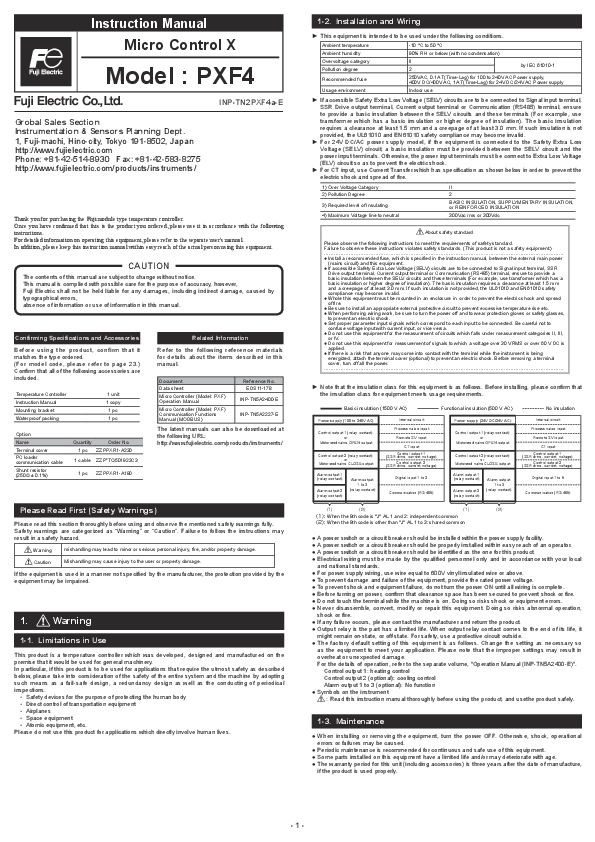
Fuji Electric Micro Control X PXF4 Instruction Manual
Model: PXF4
Manufacturer: Fuji Electric Co., Ltd.
Document Number: INP-TN2PXF4a-E
Introduction
Thank you for purchasing the Fuji module type temperature controller. This manual provides essential information for the safe and effective use of the PXF4 model. Please read this manual thoroughly and keep it accessible for future reference. For detailed operating instructions, refer to the separate user's manual.
CAUTION: The contents of this manual are subject to change without notice. Fuji Electric is not liable for damages resulting from typographical errors, omissions, or misuse of information contained herein.
Confirming Specifications and Accessories
Before use, verify that the product matches your order. Confirm that all accessories are included:
- Temperature Controller: 1 unit
- Instruction Manual: 1 copy
- Mounting bracket: 1 pc
- Waterproof packing: 1 pc
Optional Accessories: Terminal cover, PC loader communication cable, Shunt resistor.
Related Information: Data sheet (EDS11-178), Operation Manual (INP-TN5A2400-E), Communication Functions Manual (MODBUS) (INP-TN5A2227-E) are available for download at http://www.fujielectric.com/products/instruments/
Safety Warnings
Warning: Mishandling may lead to serious personal injury, fire, and/or property damage.
Caution: Mishandling may cause injury to the user or property damage. If the equipment is used in a manner not specified by the manufacturer, its protection may be impaired.
1. Limitations in Use
This product is designed for general machinery applications. For applications requiring utmost safety (e.g., safety devices for human protection, direct control of transportation, aerospace, atomic equipment), implement fail-safe designs, redundancy, and periodical inspections. Do not use this product for applications that directly involve human lives.
1-2. Installation and Wiring Conditions
This equipment is intended for use under the following conditions:
- Ambient temperature: -10 °C to 50 °C (max 45 °C for 200V AC power supply)
- Ambient humidity: 90% RH or below (non-condensing)
- Overvoltage category: II (IEC 61010-1)
- Pollution degree: 2
- Usage environment: Indoor use
Recommended fuse: 250VAC, 0.1A T (Time-Lag) for 100-240V AC; 400V DC/AC, 1A T (Time-Lag) for 24V DC/AC.
Safety Standards: Observe instructions regarding fuse installation, basic insulation for SELV circuits, mounting within an enclosure, external protective circuits, wiring precautions (power off, protective gloves/glasses), correct parameter input signals, and avoiding measurement categories II, III, or IV, or voltages over 30 VRMS/60 V DC. Terminal covers are optional for preventing electric shock.
Insulation Class: Basic insulation (1500 V AC), Functional insulation (500 V AC). Confirm compliance with usage requirements.
1-3. Maintenance
Turn power OFF before installation or removal. Periodic maintenance is recommended for continuous and safe use. Some parts have a limited life. The warranty period is three years from the date of manufacture, if used properly.
Cautions
2-1. Cautions when Installing
Avoid installation in locations with:
- Ambient temperatures outside -10 to 50 °C range.
- Rapid temperature changes causing condensation.
- Corrosive or flammable gases.
- Direct vibration or shock.
- Contact with water, oil, chemicals, steam, or hot water.
- High concentrations of dust, salt, or iron particles.
- Large inductive interference (static electricity, magnetic fields, noise).
- Direct sunlight.
- Radiant heat sources.
Recommended site conditions: Ambient humidity between 45 to 85% RH during operation.
EMC Standard: This is a Class A equipment for industrial locations. Use in domestic establishments may cause radio interference. Maximum external cable length is 30 m.
2-2. Cautions when Attaching to the Panels
Insert the controller into the panel cutout and secure with the mounting bracket. Ensure the included packing is attached correctly for NEMA-4X (IP66) waterproof compliance. Do not block the sides or air vents for heat dissipation.
2-3. Cautions for Wiring
Use designated leads for thermocouples and low-resistance wires for resistance bulbs. Separate input signal wires from power/load lines and from output signal wires. Use shielded wires. Consider noise filters for noisy power sources. Twist power wires for noise reduction. Allow for operation preparation time for contact outputs. Use auxiliary relays for maximum rated loads. For high output operation frequency, consider SSR/SSC drive output. Use a common power line for heater and controller if CT is selected. Use surge absorbers for inductive loads.
2-4. Key Operation Cautions/Error Operations
Verify alarm settings before operation. The display will show "UUUU" if input wiring breaks. Always turn power OFF before replacing sensors.
2-5. Others
Use a neutral cleaning agent for cleaning; avoid organic solvents. Keep mobile phones at least 50 cm away to prevent malfunctions. Dispose of equipment as industrial waste.
For Proper Usage
Confirmation of model code: Verify the delivered model matches your order (refer to Section 15).
Installation and Mounting: Refer to Section 3 for external dimensions, panel cut dimensions, and mounting procedures.
Wiring Connection: Refer to Section 4 for terminal connection diagrams.
Turn Power On: Ensure all wiring is complete before powering on.
Display and Operations: Refer to Section 5 for details on part names, functions, and basic operations.
Parameter List: Refer to Section 6 for a comprehensive list of parameters.
Functions: Refer to Section 7 for details on temperature control functions.
Advanced Usage: Refer to Section 8 for input/output/control settings, and Section 7 for auto-tuning and other control methods.
Error Indications: Refer to Section 9 for troubleshooting error displays.
Caution: Allow 30 minutes for the controller to stabilize thermally before taking measurements.
3. Installation and Mounting
3-1. External/Panel Cut Dimensions
The PXF4 is a 48x48mm unit. Detailed dimensions for the unit, mounting frame, and panel cutouts are provided in diagrams. Note that installing multiple controllers horizontally may compromise waterproof capabilities. Terminal blocks are rear-mounted. Ensure panel cut dimensions meet specifications after coating. Cautions for close-fit mounting include maintaining ambient temperature limits and ensuring adequate clearance around the unit.
Cautions when wiring: Start wiring from left-hand terminals (1-6). Use appropriate screws and tighten to approximately 0.8 N/m. Do not attach anything to unused terminals.
4. Wiring
4-1. Terminal Connection Diagram (Standard type)
This section details terminal connections for various configurations of control output 1, control output 2, alarm outputs, power supply, and input signals (universal input, thermocouple, RTD, current, voltage). Specific terminal assignments and output specifications (e.g., relay contact ratings, current/voltage output ranges) are provided.
Control Output 1/2 Specifications: Includes relay output (SPST/SPDT), SSR output, current output (4-20mA), and voltage output (0-10V).
Alarm Output 1 and 3 Specifications: Relay output (250V DC, 1A).
Note: SSR control voltage differs between PXF, PXR, and PXG models.
4-2. Terminal Connection Diagram (Motorized valve control type)
This diagram illustrates terminal connections specific to the motorized valve control type, including valve control outputs, alarm outputs, power supply, and input signals. Specifications for valve control output and alarm outputs are also listed.
5. Display and Operations
5-1. Part names and functions
Operation Parts: Includes USER key, SEL key,
Display Indicators: The display panel shows Process Value (PV), Set Point (SV), Screen No., and various indicators for OUT1, OUT2, digital outputs (EV1-EV3), standby (STBY), manual (MANU), lock, auto-tuning (AT), manual output (MV), time (TM), remaining time (RMN), temperature unit (°C/°F), and value units (A/%/kW/h).
5-2. Basic Operations
Describes mode transitions (Operation mode, Operation control mode, Channel selection mode, Setup mode) and key operations for navigating between these modes and changing values.
5-3. Changing values on operation screen
Instructions are provided for changing SV (set values) and MV (control output values) using the front panel keys.
6. Parameter List
This section details various parameters organized by channel. Key categories include:
- Operation control parameters: For switching modes (auto/manual, RUN/standby), SV selection, PID selection, and alarm settings.
- Ch1 PID (control parameters): Parameters for proportional band, integration time, differential time, hysteresis, cooling band, dead band, anti-reset windup, and output limits.
- Ch2 PLT (PID palette parameters): Allows for multiple PID parameter sets.
- Ch3 PRG (ramp soak parameters): For setting up programmed temperature profiles with multiple steps, ramp times, and soak times.
- Ch4 MON (monitor parameters): For displaying operational status, output values, heater current, communication status, and error sources.
- Ch5 ALM (alarm parameters): Configuration for alarm types, hysteresis, delay, and optional functions for ALM1, ALM2, and ALM3. Includes heater burnout and shorted-load alarms.
- Ch6 SET (setup parameters): For configuring PV input type, scaling, decimal point position, output ranges, and control direction (normal/reverse).
- Ch7 SYS (system parameters): For assigning functions to USER keys, digital inputs (DI), output types, and LED indicators. Includes control method and startup mode settings.
- Ch8 MATH (calculation parameters): For simple calculation functions.
- Ch9 COM (communication parameters): Settings for communication type (MODBUS RTU), station number, baud rate, parity, and permissions.
- Ch10 PFB (PFB parameters): Settings for dead band and valve stroke time.
- Ch11 DSP (parameter mask): For controlling parameter display visibility.
- Ch12 CFG (configuration parameters): Includes operation timeout, display settings, brightness, and model code display.
- Ch13 PASS (password parameters): For setting passwords.
Detailed descriptions, setting ranges, initial values, and remarks are provided for each parameter.
7. Functions
This controller offers six types of temperature control functions:
- ON/OFF (2-position) Control: Simple ON/OFF switching based on PV vs. SV comparison. Suitable when high accuracy is not critical.
- PID Controls: Standard PID control with parameters adjustable manually or via auto-tuning.
- Fuzzy PID Control: PID control with reduced overshoot, effective for suppressing overshoot when SV changes.
- Self-tuning Control: Automatically calculates PID parameters based on control target or SV changes. Useful when control conditions change frequently.
- PID2 Control: Suppresses overshoot during ON→OFF→ON power supply cycles.
- 2-Degrees-of-Freedom PID Control: Further suppresses overshoot using an SV filter, allowing for smoother response after SV changes or startup.
7-1. ON/OFF Control: Details reverse (heating) and normal (cooling) operations with hysteresis settings.
7-2. PID Controls: Explains manual tuning and auto-tuning (AT) for PID parameters.
7-3. Fuzzy PID Control: Describes setting up fuzzy PID control, requiring auto-tuning.
7-4. Self-tuning Control: Outlines conditions for using and halting self-tuning, and the procedure for setting it up.
7-5. PID2 Control: Explains its function in suppressing overshoot and the auto-tuning process for PID2.
7-6. 2-Degrees-of-Freedom PID Control: Details its overshoot suppression capability and how to adjust coefficients α and β.
7-7. Auto-tuning: Describes the process for running auto-tuning (standard and low PV types) and important points to consider.
7-8. Manual Output: Allows manual setting of control output (MV) and describes switchover methods (front key, communication, parameter).
7-9. Ramp Soak Function: Enables automatic temperature profiling with up to 64 steps and 15 pattern types. Includes details on creating patterns, running ramp soak, and the guaranty soak function.
7-10. Other Functions: Covers Soft Start (limits MV output for a set time), Error Output Function (halts control on error), Standby Output Function (sets output for standby mode), Ramp SV Function (smooth SV changes), SV Selection Function (switches between 8 SV sets), and PID Selection Function (switches between PID parameter sets).
8. Setting the Temperature Controller
8-1. Input Setting
Configure the input sensor type (thermocouple, RTD, voltage, current), PV scaling (input range), and decimal point position. Factory settings are often sufficient.
8-2. Output Setting
Set the range for control outputs (OUT1, OUT2) if they are current or voltage outputs (e.g., 0-20mA, 4-20mA, 0-10V).
8-3. Control Setting
Select between normal operation (cooling) and reverse operation (heating) for control outputs.
9. Error Indications
The controller displays error codes for various issues, such as sensor burnout ("0000"), PV exceeding limits ("LLLL"), or incorrect settings ("ERR"). Troubleshooting steps involve eliminating the cause and restarting the controller. Control output behavior during errors is also described.
10. Input Range and Codes (standard range)
This section lists various input types (RTD, Thermocouple, DC voltage, DC current) along with their corresponding input codes, measurement ranges in Celsius (°C) and Fahrenheit (°F), and minimum input increments. This information is crucial for setting up the PV input correctly.
11. Alarm Action Type Codes
Details various alarm types (e.g., Absolute value, High/Low, Deviation, Zone alarms) and their corresponding action diagrams. It includes timer-based alarms, open/short circuit alarms, and maintenance-related alarms. Alarms can be configured with or without hold functionality.
12. USER key assignment
This section lists functions that can be assigned to the USER key and its combinations (e.g., USER + UP, USER + DOWN). Functions include mode switching, auto-tuning start, ramp soak control, and latch release.
13. OUT, Alarm output, indicators assignment
This table maps output types (Relay/SSR, Current/Voltage), alarm outputs, and indicators to specific functions and categories. It details assignments for control outputs, alarm outputs, status indicators, and event outputs related to ramp soak operations.
14. Digital input (DI) function
Describes how to allocate functions to digital inputs (DI1, DI2, DI3). Available functions include standby/auto-manual/local-remote switchover, auto-tuning start, ramp SV/soak control, timer functions, SV/PID number increments, pattern number increments, and delay start.
15. Model Specifications
15-1. Standard type
Details the model codes for the standard 48x48mm PXF4 unit, specifying options for control outputs, alarm outputs, power supply, and communication interfaces (RS-485, Digital Input, Remote SV Input, CT Input). Notes clarify specific combinations and requirements.
15-2. Motorized valve control type
Details the model codes for the motorized valve control type, specifying options for control outputs, alarm outputs, power supply, and communication interfaces.
16. Specifications
Provides technical specifications including power supply voltage and consumption, control output types and ratings (relay, SSR, current, voltage), process value input accuracy, alarm output contact ratings, digital input specifications, transfer output details, remote SV input, CT input, motorized valve control output, communication interface (RS-485, Loader), storage/operating temperature and humidity, altitude, recommended fuse, and service life.
17. Limited warranty
1. Scope of warranty
Fuji Electric offers free repair or replacement for malfunctions occurring within the warranty period due to manufacturing defects. Exclusions include damage from improper conditions, handling, unauthorized repairs, lack of maintenance, unforeseen factors, unintended use, or natural disasters. Call-out fees may apply for on-site service.
2. Exclusion of liability for loss of opportunity
Fuji Electric's liability is limited to the contract amount and excludes incidental, consequential, or passive damages such as lost profits.
3. Scope of application
The equipment must be used in applications where failure does not pose a serious accident risk, with external safety measures in place. It is designed for general industrial applications. Use in critical safety areas (nuclear, medical, defense, etc.) requires special consultation and agreement.