

LEAB RBC IP66 Charger User Manual
File info: application/pdf · 28 pages · 1.30MB
Charger RBC IP66
Charger RBC IP66 - LEAB Automotive GmbH
1 About this Manual................................................................................................................ 3. 2 Safety.
Charger RBC IP66 - leab.eu
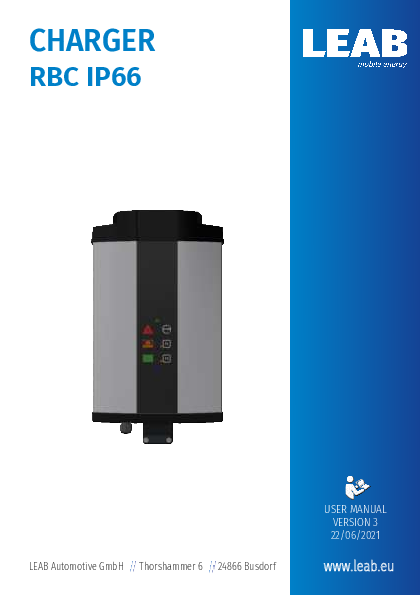
www.leab.eu USER MANUAL VERSION 3 22/06/2021 CHARGER RBC IP66 LEAB Automotive GmbHThorshammer 624866 Busdorf
Full PDF Document

If the inline viewer fails, it will open the original document in compatibility mode automatically. You can also open the file directly.
Extracted Text
CHARGER
RBC IP66

LEAB Automotive GmbH Thorshammer 6 24866 Busdorf

USER MANUAL VERSION 3 22/06/2021
www.leab.eu

Table of Contents

LEAB Automotive GmbH

Table of Contents
1 About this Manual ................................................................................................................ 3 2 Safety ......................................................................................................................................... 4
2.1 Intended Use............................................................................................................... 4 2.2 Foreseeable Misuse.................................................................................................. 5 3 About this Product ............................................................................................................... 6 4 Technical Specifications .................................................................................................... 8 5 Package Contents ................................................................................................................. 9 6 Assembly .................................................................................................................................. 9 7 Setting the Charging Parameters................................................................................... 9 8 Checking the Charging Parameter Settings ............................................................... 12 9 Changing charging parameters....................................................................................... 13 10 Installation .............................................................................................................................. 13 11 Operation................................................................................................................................. 16 11.1 Switching On ............................................................................................................... 16 11.2 Switching Off ............................................................................................................... 17 12 Maintenance ........................................................................................................................... 18 13 Disposal .................................................................................................................................... 18 14 EU Declaration of Conformity.......................................................................................... 18 15 Appendix .................................................................................................................................. 18

LEAB Automotive GmbH

1 About this Manual

1 About this Manual
Read this manual carefully and keep it in a safe place. This manual is aimed at Users with prior knowledge of automotive electrics.
Any modifications to the product or its components are prohibited and do not conform to its intended use. Only use original LEAB or LEAB-approved accessories.
Throughout the manual, you will be alerted to warnings and safety notices about potential hazards associated with handling the device. The colours and signal words indicate the severity of the hazard:

Notice
Possibility of material damage
The signal word Attention indicates that there is a possibility of material damage. To avoid material damage, follow the instruction.

CAUTION
Danger that can lead to minor injuries
Safety instructions with the signal word CAUTION indicate a hazard which, if not avoided, can result in minor or moderate injury. Read the safety instructions carefully and follow them to avoid the hazard.

WARNING
Hazards that can lead to severe injuries or death
Safety instructions with the signal word WARNING indicate a hazard which, if not avoided, can result in death or severe injury. Read the safety instructions carefully and follow them to avoid the hazard.

LEAB Automotive GmbH

Thorshammer 6

24866 Busdorf

3

2 Safety

LEAB Automotive GmbH

DANGER
Danger that will lead to severe injury or death Safety instructions with the signal word Danger indicate a hazard which, if not avoided, will result in death or severe injury. Read the safety instructions carefully and follow them to avoid the hazard.
You will find useful tips and tricks in certain parts of the manual. These appear as follows:
TIP
Tips provides additional, useful information. Read the tip carefully and follow the instructions where applicable.
2 Safety
This manual will help you to handle the device safely. Use the device solely in accordance with its intended use. Any modifications to the device or its components are prohibited and do not conform to its intended use. Observe the safety instructions. Keep this manual is a place where it can be accessed quickly.
2.1 Intended Use
The charger is a robust charger for permanent installation in vehicles, with 12 and 24 V on-board power supply, for charging lead batteries and LION Brix lithium batteries. The device is designed for a temperature range of -35 �C ... 55 �C. Do not charge batteries with this charger outside the specified temperature range. At higher temperatures, the output power of the charger automatically decreases.

4

LEAB Automotive GmbH

Thorshammer 6

24866 Busdorf

LEAB Automotive GmbH

2 Safety

WARNING
Risk of fire from overheated battery Flammable gases can escape if the battery overheats.
1. Always charge batteries in well-ventilated rooms and away from ignition sources.

WARNING
Burns from escaping acid Acid can leak out when handling batteries.
1. Wear acid-proof clothing when handling batteries.

WARNING
Risk of injury from damaged, frozen or deformed batteries Damaged, frozen or deformed batteries can cause injuries.
1. Before using the battery, make sure that the battery is undamaged and the electrolyte is not frozen.
2.2 Foreseeable Misuse
The charger is designed for Interior use in vehicles. Never assemble the charger outside the vehicle. The charger is designed to charge all types of Leadacid batteries (wet, gel, AGM) and lithium batteries. Charge only the specified battery types with the charger. To avoid damage, never pinch the leads of the charger. In the event of damage, unplug the charger immediately and contact your dealer or LEAB.
Notice
Device defects from incorrect installation Incorrect installation can result in device defects.
1. Install the device in a dry and cool location.

LEAB Automotive GmbH

Thorshammer 6

24866 Busdorf

5

3 About this Product

LEAB Automotive GmbH

3 About this Product
RBC chargers are microprocessor-controlled battery chargers for charging open and closed lead-acid, lead-gel and AGM batteries.

8 7
6

1 2 3
4
5

Fig. 1: RBC charger front view
1 'Data connection' LED 3 F1 button 5 'Ready for operation' LED 7 'Charging' LED

2 Stop button 4 F2 button (no function) 6 'Charging complete' LED 8 'Error` LED

6

LEAB Automotive GmbH

Thorshammer 6

24866 Busdorf

LEAB Automotive GmbH

3 About this Product

1

2

Fig. 2: RBC charger connection side

1 Mains connection cable of the charger
3 Charging cable, blue
5 Mounting bracket

3

4

5

2 Charging cable, red 4 Battery data line

LEAB Automotive GmbH

Thorshammer 6

24866 Busdorf

7

4 Technical Specifications

LEAB Automotive GmbH

4 Technical Specifications

0101036982

0101036991

0101078270

Modell

RBC 1280

RBC 2440

RBC 2480

Battery type

Open and closed Open and closed Open and closed

lead batteries (wet, lead batteries (wet, lead batteries (wet,

gel/AGM)

gel/AGM)

gel/AGM)

Charging charac- 30 selectable char- 30 selectable char- 30 selectable char-

teristics

ging parameters ging parameters ging parameters

Battery capacity 50 Ah ... 800 Ah 50 Ah ... 800 Ah 50 Ah ... 800 Ah

Charging current 80 A

40 A

80 A

Ripple

3 %

3 %

3 %

Main charging 14.1 V - 14.4 V

28.2 V - 28.8 V

28.2 V - 28.8 V

Trickle charging 13.5 V - 13.8 V

27.0 V - 27.6 V

27.0 V - 27.6 V

Input values

230 V/50 Hz

230 V/50 Hz

230 V/50 Hz

Input voltage

195 V ... 264 V

195 V ... 264 V

195 V ... 264 V

Input frequency 47 Hz ... 63 Hz

47 Hz ... 63 Hz

47 Hz ... 63 Hz

Degree of efficiency, max.

> 93%

> 93%

> 93%

International Pro- IP66

IP66

IP66

tection (IP class)

Protection class I

I

I

Operating temper- -35 �C ... +55 �C ature

-35 �C ... +55 �C

-35 �C ... +55 �C

Cooling

Passive

Passive

Active

Dimensions (L x W 410 mm x 235 mm x 410 mm x 230 mm x 367 mm x 230 mm x

x H)

78 mm

78 mm

83 mm

Weight

5.5 kg

5.6 kg

6.9 kg

AC cable

1.5 m, two-pin earthed plug

1.5 m, two-pin earthed plug

1.5 m, two-pin earthed plug

DC cable

2 x 2 m, without 2 x 2 m, without 2 x 2 m, without

plug

plug

plug

8

LEAB Automotive GmbH

Thorshammer 6

24866 Busdorf

LEAB Automotive GmbH

7 Setting the Charging Parameters

5 Package Contents

Item

No.

Battery charger

1x

Mounting plate

1x

User manual

1x

6 Assembly
To assemble the device, proceed as follows: � Choose a cool, dry and well-ventilated assembly site. � Do not mount the device directly next to or above batteries. � Guarantee adequate cooling for an unimpeded supply of cooling air.
1. Mount the assembly plate with the side holes (5 mm �) on a flat surface.
2. Slide the device into the mounting rails of the assembly plate. � The device is assembled.

7 Setting the Charging Parameters
The RBC charger contains 30 different charging parameters (charging characteristic, battery capacity and charging mode) which you can select before connecting to the battery. A graphical illustration of the charging characteristics can be found in Appendix [} 18]. To set the charging parameters, proceed as follows: � Before setting, select the desired settings using the table below. � The charger is disconnected from the 230 V mains. � The charger is not connected to the battery.
1. Connect the mains plug to a 230 V mains supply.
2. As soon as the 'Ready for operation' LED lights up blue (after approx. 5 s), press the STOP button for 10 s until all LEDs are flashing briefly. � You are in configuration mode.
NOTE! When first used, charging parameters 1 (charging characteristic LK10-06) and 9 (battery capacity 50 Ah) are preset by default.

LEAB Automotive GmbH

Thorshammer 6

24866 Busdorf

9

7 Setting the Charging Parameters

LEAB Automotive GmbH

3. To select a parameter from the list, keep pressing the STOP button until you reach the desired position.

4. Select or deselect a setting by pressing the F1 button.

5. Remove the device from the 230 V mains.

Fig. 3: F1 and F2 buttons

� The charging parameters are set and saved.
Set the following parameters for the different 'Power Supply' charging modes:

NOTE! Depending on the charger, a voltage of 12 V or 24 V is permanently output as standard in the 'Power Sup-
ply' charging modes. If you require a higher voltage,
please contact LEAB directly.

Charging mode Charging mode (default)
PDO Power Supply
SDO Power Supply

Settings 25, Charging mode: OFF 27, CAN mode: OFF 30: Charging mode: OFF 25, Charging mode: OFF 27, CAN mode: ON 30: Charging mode: OFF 25, Charging mode: ON 27, CAN mode: ON 30: Charging mode: OFF

10

LEAB Automotive GmbH

Thorshammer 6

24866 Busdorf

LEAB Automotive GmbH

7 Setting the Charging Parameters

Fig. 4: Charging parameter settings

LEAB Automotive GmbH

Thorshammer 6

24866 Busdorf

11

8 Checking the Charging Parameter Settings

LEAB Automotive GmbH

8 Checking the Charging Parameter Settings
To check the charging parameter settings, it is necessary to switch back to configuration mode.
Check the Charging Characteristic Setting To check the charging characteristic setting, proceed as follows: � The desired charging parameters are set and saved. � The charger is disconnected from the 230 V mains.
1. Connect the mains plug to a 230 V mains supply.
2. As soon as the 'Ready for operation' LED lights up blue (after approx. 5 s), press the Stop button for 10 s until all LEDs are flashing. � The device is in configuration mode.
3. Press the Stop button until you are in the desired setting for the charging characteristic.
� The LED next to the F1 button lights up orange. The charging characteristic is set and saved.
Check the battery capacity setting To check the battery capacity settings, proceed as follows:
4. Keeping pressing the Stop button until you are in the desired battery capacity setting.
� The LED next to the F1 button lights up orange. The battery capacity is set and saved.
Check the charging mode setting The charging mode setting can be checked using the following features:
� If one of the charging modes 'Charging mode (25), External input On (26), CAN mode Master (27), ON:Parallel operation activated (28) or Charging mode (30)' is set, the LED next to the F1 button is not lit.
� If one of the charging modes 'Power Supply (25), External Input Off (26) or CAN mode Master ext. (27)' is set, the LED next to the F1 button lights up orange.

12

LEAB Automotive GmbH

Thorshammer 6

24866 Busdorf

LEAB Automotive GmbH

10 Installation

9 Changing charging parameters
The settings of the charging parameters can be changed at any time. To do this, proceed as follows: � The device is disconnected from the 230 V mains supply. � The device is not connected to a battery.
1. Connect the mains plug to a 230 V mains supply.
2. As soon as the 'Ready for operation' LED lights up blue (after approx. 5 s), press the Stop button for 10 s until all LEDs are flashing. � The device is in configuration mode.
3. Set the desired charging parameters as described in Setting the Charging Parameters [} 9].
� The charging parameters are changed.

10 Installation

Battery Connection
To install the device in the vehicle, proceed as follows:
1. Disconnect the battery from the on-board power supply.
WARNING! Disconnect the negative cable first. 2. Secure the positive cable of the device as close as possible to the vehicle
battery with a suitable fuse.
3. Connect the positive cable of the device to the positive terminal of the battery.
4. Connect the negative cable of the device to the negative terminal of the battery.
5. Connect the vehicle battery to the on-board power supply. � The device is installed.

LEAB Automotive GmbH

Thorshammer 6

24866 Busdorf

13

10 Installation

LEAB Automotive GmbH

Connection to the 230 V Mains
To install the device to the 230 V mains, proceed as follows:
NOTE! The charger is only suitable for connection to fused, earthed 230 V mains supplies.
1. Connect the mains plug to a 230 V mains supply. � The charger is connected to the 230 V mains supply.

Connecting the Sensor Cable
The sensor cable measures the battery temperature (sensor cable TS) or the battery temperature and voltage (sensor cable CTS) in order to charge the battery optimally.
To connect the sensor cable, proceed as follows:
NOTE! When connecting, pay attention to the instructions and notes in the sensor cable installation instructions.
1. Connect the sensor cable to the charger.
� The sensor cable is connected.

Connecting the D-Sub Connector
The integrated D-Sub connector allows you to control various signals.

Pin Description

1

CAN Bus high*

2

Voltage sensor (+)

3

Temperature sensor (+)

4

LED green (+)

5

LEB yellow (+)

7

Insulated ground*

8

Pilot Brix

9

CBL relay contact, normally closed

10

CAN bus low*

11

Remote input (-)*

12

Temperature sensor (-)

14

LEAB Automotive GmbH

Thorshammer 6

24866 Busdorf

LEAB Automotive GmbH

10 Installation

Pin Description

14

LED red (-)

18

CBL relay contact, normally open

19

Remote input (+)*

20

Voltage sensor (-)

22

LED (-)

25

Insulated 5 V (50 mA) output (+)*

26

CBL input

*The CAN bus signals, CBL, the remote input and the insulated 5 V output are galvanically isolated from the DC output.

NOTE! Pins that are not listed are not assigned.

External LED Connection
The LED shows the charge status of the battery. To connect the external LEDs, proceed as follows:
1. Connect the wire ends of the external LEDs to pin 4, pin 5, pin 14 and pin 22. � The external LEDs are connected.

EBrix Connection (24 V)
You can connect the RBC 24 V charger to the eBrix system using a suitable adapter.

CBL Control Relay Connection
A potential-free changeover contact is integrated in the RBC chargers, which switches during charging operation. This option can be used, for example, to implement an electrical start interlock with 230 V connection or charge monitoring.

LEAB Automotive GmbH

Thorshammer 6

24866 Busdorf

15

11 Operation

LEAB Automotive GmbH

Switching Function of the Changeover Contact

� When the charger is switched off, pin 9 and pin 26 are connected.

� When the charger is switched on, pin 26 and pin 18 are connected.

Fig. 5: Switching Function of the Changeover Contact

Technical Data (insulation) Capacity (max. values)

Output to hous- 500 V ing:

Max. 60 V (DC): 0.25 A

Output to ground 120 V

To install the CBL control relay, proceed as follows:

1. Solder the end of the cable to the D-sub connector.

2. Connect the wire ends to pin 26, pin 9 and pin 18.

3. Plug the D-sub connector into the connector for the CBL control relay on the device.

� The CBL control relay is installed.

11 Operation

11.1 Switching On
To switch on the device, proceed as follows:
1. Connect the mains plug to a 230 V mains supply. � The device is switched on.
NOTE! After connection to the mains, the LED flashes red for 2 seconds (device test).
NOTE! When the battery is charging, the 'Charging' LED is lit orange.
NOTE! When the battery is fully charged, the 'Charging complete' LED is lit green.

16

LEAB Automotive GmbH

Thorshammer 6

24866 Busdorf

LEAB Automotive GmbH

11 Operation

Operating status

Description

Battery not connected/No CAN signal

Charging is interrupted

Charger in first charging phase

Charger in second charging phase

Charger in third charging phase

Battery fully charged

Charger waiting for remote

Tab. 1: Display of the operating status LEDs

Charging the Battery
The charger begins to charge the battery as soon as the charger is connected to the 230 V mains.

Interrupting the Charging Process
To interrupt the charging process, proceed as follows: 1. To interrupt charging, press the Stop button.
� `Charging complete' LED flashes green. 2. To continue charging, press the Stop button again. � The charging process is now interrupted NOTE! If the Stop button is not pressed again, charging remains interrupted.

11.2 Switching Off
To switch off the charger, proceed as follows:

LEAB Automotive GmbH

Thorshammer 6

24866 Busdorf

17

15 Appendix

LEAB Automotive GmbH

1. Disconnect the mains plug from the 230 V mains. � The device is switched off.

12 Maintenance
Check the charger as follows every time before you use it:
� Check the mains cable and mains plug for damage.
� Check charging cables and connections for damage.
� Check the charger for external damage.
� Ensure that the wiring between the charging cable and the charger is secure.
NOTE! For battery maintenance, refer to the battery manufacturer's instructions.

13 Disposal

Dispose of the device in accordance with the Waste Electrical and Electronic Equipment Regulations (WEEE).
The system must not be disposed of with household waste. Take it to a recycling point or return it to your point of sale.

14 EU Declaration of Conformity
The RBC charger complies with the requirements of the following directives: � 2014/30/EU: EMV � 2014/35/EU: NRL � 2011/65/EU: RoHS
15 Appendix
Charging Characteristics
NOTE! To select the correct charging characteristic for your battery, refer to the instructions of your battery manufacturer.

18

LEAB Automotive GmbH

Thorshammer 6

24866 Busdorf

LEAB Automotive GmbH

15 Appendix

NOTE! The current, compared to the nominal capacity, is given in coulombs (C), e.g. 0.2 C for a 100 Ah battery results in 20 A.
LK10-05 - Freely ventilated lead-acid

Fig. 6: Charging characteristic LK10-05
In the "Top-Fill" charging phase, the battery is charged with +15% more current compared to the main charging phase.
In the range [-30 �C ... -35 �C] and [+45 �C ... +60 �C] the current is reduced to 0.

Voltage per cell 2.4 V/ 2.8 V/ 2.29 V

12 V system 14.4 V/ 16.8 V/ 13.74 V

24 V system 28.8 V/ 33.6 V/ 27.48 V

LEAB Automotive GmbH

Thorshammer 6

24866 Busdorf

19

15 Appendix LK10-06 - Freely ventilated lead-acid (default)

LEAB Automotive GmbH

Fig. 7: Charging characteristic LK10-06
In the "Top-Fill" charging phase, the battery is charged with +15% more current compared to the main charging phase.
In the range [-30 �C ... -35 �C] and [+45 �C ... +60 �C] the current is reduced to 0.
In the maintenance phase, the battery voltage is checked periodically; if the battery voltage falls below 2.17 V per cell, the battery is charged for 2 minutes with a pulse charge of 0.05 C.

Voltage per cell 2.4 V/2.8 V/Off

12 V system 14.4 V/16.8 V/Off

24 V system 28.8 V/33.6 V/Off

20

LEAB Automotive GmbH

Thorshammer 6

24866 Busdorf

LEAB Automotive GmbH LK10-18 - Freely ventilated lead-acid

15 Appendix

Fig. 8: Charging characteristic LK10-18
In the "Top-Fill" charging phase, the battery is charged with +6 % more current compared to the main charging phase. In addition, the battery is charged with a pulse charge to accelerate the charging process.
In the range [-30 �C ... -35 �C] and [+45 �C ... +60 �C] the current is reduced to 0.
In the maintenance phase, the battery voltage is checked periodically; if the battery voltage falls below 2.17 V per cell, the battery is charged for 2 minutes with a pulse charge of 0.05 C.

Voltage per cell 2.4 V/2.8 V/Off

12 V system 14.4 V/16.8 V/Off

24 V system 28.8 V/33.6 V/Off

LEAB Automotive GmbH

Thorshammer 6

24866 Busdorf

21

15 Appendix LK20-09 - Sealed gel lead-acid

LEAB Automotive GmbH

Fig. 9: Charging characteristic LK20-09
The charging characteristic contains an equalisation charge. If the battery is connected to the charger for 16 h, the battery is charged with a 30 hour equalisation charge, a current of 0.006 C and a voltage of 2.8 V per cell.

Voltage per cell 2.35 V/2.8 V/Off

12 V system 14.1 V/16.8 V/Off

24 V system 28.2 V/33.6 V/Off

22

LEAB Automotive GmbH

Thorshammer 6

24866 Busdorf

LEAB Automotive GmbH PP100 - Freely ventilated lead-acid

15 Appendix

Fig. 10: Charging characteristic PP100
In the range [-30 �C ... -35 �C] and [+45 �C ... +50 �C] the current is reduced to 0.
NOTE! This charging characteristic contains a detection for weak batteries: 0.5 V per cell. Make sure that you do not charge batteries with a smaller number of cells. For example, do not charge a 12 V battery with a 24 V charging characteristic.

Voltage per cell 2.4 V/2.25 V

12 V system 14.4 V/13.5 V

24 V system 28.8 V/27 V

LEAB Automotive GmbH

Thorshammer 6

24866 Busdorf

23

15 Appendix PP101 - Sealed gel lead-acid

LEAB Automotive GmbH

Fig. 11: Charging characteristic PP101
In the range [-30 �C ... -35 �C] and [+45 �C ... +50 �C] the current is reduced to 0.
NOTE! This charging characteristic contains a detection for weak batteries: 0.5 V per cell. Make sure that you do not charge batteries with a smaller number of cells. For example, do not charge a 12 V battery with a 24 V charging characteristic.

Voltage per cell 2.35 V/2.26 V

12 V system 14.1 V/13.56 V

24 V system 28.2 V/27.12 V

24

LEAB Automotive GmbH

Thorshammer 6

24866 Busdorf

LEAB Automotive GmbH PP102 - Sealed gel lead-acid "Sunshine"

15 Appendix

Fig. 12: Charging characteristic PP102
In the range [-30 �C ... -35 �C] and [+45 �C ... +50 �C] the current is reduced to 0.
NOTE! This charging characteristic contains a detection for weak batteries: 0.5 V per cell. Make sure that you do not charge batteries with a smaller number of cells. For example, do not charge a 12 V battery with a 24 V charging characteristic.

Voltage per cell 2.4 V/2.3 V

12 V system 14.4 V/13.8 V

24 V system 28.8 V/27.6 V

LEAB Automotive GmbH

Thorshammer 6

24866 Busdorf

25

15 Appendix

LEAB Automotive GmbH

26

LEAB Automotive GmbH

Thorshammer 6

24866 Busdorf

LEAB Automotive GmbH

15 Appendix

LEAB Automotive GmbH

Thorshammer 6

24866 Busdorf

27

We make energy mobile.
LEAB Automotive GmbH Thorshammer 6 DE-24866 Busdorf Tel: +49 (0) 4621 9 78 60-0 Fax: +49 (0) 4621 9 78 60-260 info@leab.eu It is prohibited to copy, duplicate, translate or otherwise pass on the content of this guide to third parties without the express written permission of LEAB.