
Home
›
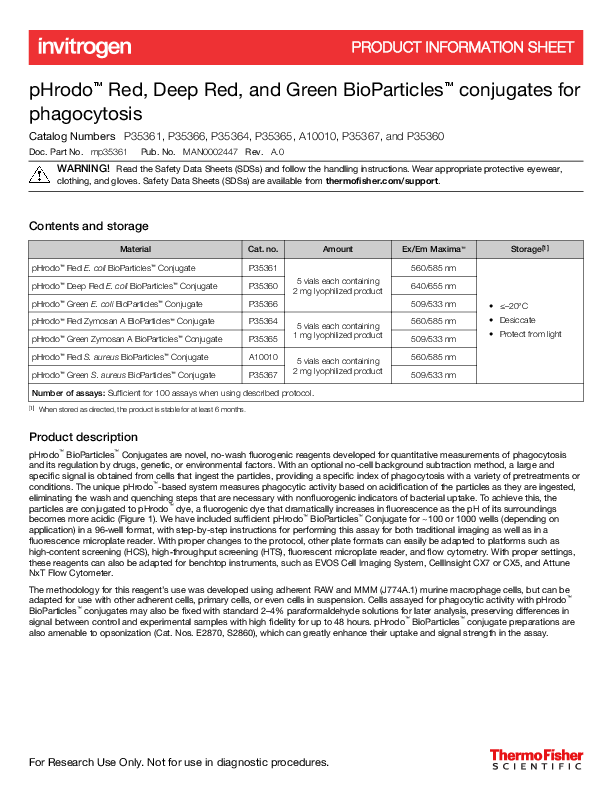
pHrodo Red, Deep Red, and Green BioParticles conjugates for phagocytosis User Guide (Pub.No. MAN0002447 A.0)

pHrodo Red, Deep Red, and Green BioParticles conjugates for phagocytosis User Guide (Pub.No. MAN0002447 A.0)
File info: application/pdf · 7 pages · 585.03KB
pHrodo Red, Deep Red, and Green BioParticles conjugates for phagocytosis User Guide (Pub.No. MAN0002447 A.0)
pHrodo Red, Deep Red, and Green BioParticles conjugates for ...
Full PDF Document

If the inline viewer fails, it will open the original document in compatibility mode automatically. You can also open the file directly.
Extracted Text
PRODUCT INFORMATION SHEET
pHrodoTM Red, Deep Red, and Green BioParticlesTM conjugates for phagocytosis
Catalog Numbers P35361, P35366, P35364, P35365, A10010, P35367, and P35360
Doc. Part No. mp35361 Pub. No. MAN0002447 Rev. A.0
WARNING! Read the Safety Data Sheets (SDSs) and follow the handling instructions. Wear appropriate protective eyewear,
clothing, and gloves. Safety Data Sheets (SDSs) are available from thermofisher.com/support.

Contents and storage

Material

Cat. no.

Amount

pHrodoTM Red E. coli BioParticlesTM Conjugate pHrodoTM Deep Red E. coli BioParticlesTM Conjugate pHrodoTM Green E. coli BioParticlesTM Conjugate

P35361 P35360 P35366

5 vials each containing 2 mg lyophilized product

pHrodoTM Red Zymosan A BioParticlesTM Conjugate pHrodoTM Green Zymosan A BioParticlesTM Conjugate

P35364 P35365

5 vials each containing 1 mg lyophilized product

pHrodoTM Red S. aureus BioParticlesTM Conjugate pHrodoTM Green S. aureus BioParticlesTM Conjugate

A10010 P35367

5 vials each containing 2 mg lyophilized product

Number of assays: Sufficient for 100 assays when using described protocol. [1] When stored as directed, the product is stable for at least 6 months.

Ex/Em MaximaTM 560/585 nm 640/655 nm 509/533 nm 560/585 nm 509/533 nm 560/585 nm 509/533 nm

Storage[1]
� �20�C � Desiccate � Protect from light

Product description
pHrodoTM BioParticlesTM Conjugates are novel, no-wash fluorogenic reagents developed for quantitative measurements of phagocytosis and its regulation by drugs, genetic, or environmental factors. With an optional no-cell background subtraction method, a large and specific signal is obtained from cells that ingest the particles, providing a specific index of phagocytosis with a variety of pretreatments or conditions. The unique pHrodoTM-based system measures phagocytic activity based on acidification of the particles as they are ingested, eliminating the wash and quenching steps that are necessary with nonfluorogenic indicators of bacterial uptake. To achieve this, the particles are conjugated to pHrodoTM dye, a fluorogenic dye that dramatically increases in fluorescence as the pH of its surroundings becomes more acidic (Figure 1). We have included sufficient pHrodoTM BioParticlesTM Conjugate for ~100 or 1000 wells (depending on application) in a 96well format, with step-by-step instructions for performing this assay for both traditional imaging as well as in a fluorescence microplate reader. With proper changes to the protocol, other plate formats can easily be adapted to platforms such as high-content screening (HCS), highthroughput screening (HTS), fluorescent microplate reader, and flow cytometry. With proper settings, these reagents can also be adapted for benchtop instruments, such as EVOS Cell Imaging System, CellInsight CX7 or CX5, and Attune NxT Flow Cytometer. The methodology for this reagent's use was developed using adherent RAW and MMM (J774A.1) murine macrophage cells, but can be adapted for use with other adherent cells, primary cells, or even cells in suspension. Cells assayed for phagocytic activity with pHrodoTM BioParticlesTM conjugates may also be fixed with standard 2�4% paraformaldehyde solutions for later analysis, preserving differences in signal between control and experimental samples with high fidelity for up to 48 hours. pHrodoTM BioParticlesTM conjugate preparations are also amenable to opsonization (Cat. Nos. E2870, S2860), which can greatly enhance their uptake and signal strength in the assay.

For Research Use Only. Not for use in diagnostic procedures.

Figure 1 The fluorescence emission spectra of pHrodoTM Deep Red , Red, and Green conjugates Plate viable cells per well

Resuspend pHrodoTM BioParticlesTM in Live Imaging Solution:
pHrodo E. coli or S .aureus at 1 mg/mL pHrodo Zymosan at 0.5 mg/mL
Vortex/Sonicate well to homogeneously disperse the particles and opsonize
if desired
(Optional) Pretreat cells with effector compound (e.g., 10 M cytochalasin D)
Remove media and replace with BioParticles suspension
(for microplate) Or
Add BioParticles to cells in media (for imaging)

Incubate for 30 minutes to 3 hours at 37�C

Analyze

Figure 2 Workflow for pHrodoTM BioParticlesTM conjugates

EVOS M5000 or M7000
Varioskan LUX plate reader
Attune Acoustic Focusing Cytometer/Flow Cytometry
CellnSight CX5 or CX7 (HCS)
Traditional Fluorescence Microscopy

2

pHrodoTM Red, Deep Red, and Green BioParticlesTM conjugates for phagocytosis User Guide

Figure 3 Effect of different concentrations of Cytochalasin D in MMM cells detected with (A) pHrodoTM Deep Red E. coli BioParticlesTM, (B) pHrodoTM Red E. coli BioParticlesTM, (C) pHrodoTM Green E. coli BioParticlesTM conjugates in RAW cells while using a fluorescent microplate reader (shown here without the background substraction).

Required materials not provided
� Macrophage RAW and MMM cells cultured in cell growth medium. Other cell lines may also be used, if preferred.
� Uptake Buffer; we recommend using Live Cell Imaging Solution (Cat. No. A14291DJ) for best results. Alternatively, you may use any other appropriate buffer at pH 7.4.
� 96-well microplate or any other plate, with proper installment capable of detecting fluorescence according to emission/excitation maxima given in Table 1.
� Bath Sonicator � (Optional) Opti-MEMTM culture medium (Cat. No. 31985-062). � (Optional) Stock solutions of experimental effector
compounds for testing their influence on phagocytosis (for example, cytochalasin D inhibits phagocytosis by inhibiting actin cytoskeletal rearrangements).
Experimenal protocol for imaging
The following protocol describes an experimental test of phagocytic function with appropriate controls in a 96-well plate; however, other plate formats can be adopted with proper adjustments to the protocol. This protocol describes the use of one vial of particles, prepared at 1 mg/mL in the buffered saline solution of your choice then added to cells in complete media at 1:10 for a final concentration of 0.1 mg/mg in the imaging assay. To minimize background fluorescence from non-ingested pHrodoTM BioParticlesTM Conjugate, we strongly recommend controlling the extracellular pH by adding Live Cell Imaging Solution (Cat. No. A14291DJ) for best results. Alternatively, you may use any other appropriate buffer at pH 7.4
Procedural guidelines
� Work with cells in aseptic conditions to prevent microbial contamination
� Warm buffer and pHrodo bioparticlesTM to 20�25�C Note: The kit will use 2 mL of buffer per vial to generate a 10X solution of particles that is enough for 1,000 tests at 100 g/mL working concentration.

� (Optional) Remove cell culture medium, wash once and replace with pH neutral saline solution warmed to 37�C. Ensure it contains 5�10 mM glucose to support metabolism during the assay. Note: This step will remove the cell culture medium, which can be a source of autofluorescence in the assay. If the assay is done in saline solution, be sure that the 37�C incubation step happens in a benchtop incubator, and not in the 5% CO2 atmospheric conditions of a cell culture incubator required for carrying out the experiment in cell culture media.
Preparing the cells
1. Subculture the RAW or MMM macrophage cells (or preferred cell type) in complete medium for 3�4 days in advance of performing the assay.
2. On the day of the assay, harvest the cells from the culture plates and centrifuge the suspension. Resuspend the pellet in FluoroBriteTM DMEM (Cat. No. A1896701) medium or preferred culture medium at 106 cells/mL. Scale your culture to aim for 2 � 106 cells per vial of pHrodoTM BioParticlesTM Conjugate. Alternatively, cells can be plated into the 96-well plate a day or more in advance, with the aim of having 10,000 viable cells per well on the day of the assay. If you are using cells other than RAW or MMM, you may need to determine optimal cell culture conditions and densities for your specific cell type. In general, better signals in the plate reader are obtained with maximal cell densities.
3. Plate the cells into a 96-well plate at 10,000 cells/well using 100 L per well. We recommend plating your positive control and experimental wells in triplicate or greater. Be sure to leave one well empty of cells for every positive control well, so that a no-cell control background subtraction may be performed. For example, plate four columns of four wells, leaving the fifth column of four empty for the no-cell control. Note that higher background fluorescence levels may be seen with acidic poly-D-lysine coated microplates.

pHrodoTM Red, Deep Red, and Green BioParticlesTM conjugates for phagocytosis User Guide

3

4. Add 100 L of FluoroBriteTM DMEM (Cat. No. A1896701) medium or complete culture medium to the wells left aside for the no-cell background determination.
5. Cover the loaded microplate and allow the cells to settle and adhere to the microplate for at least one hour in a humidified incubator with 5% CO2 at 37�C.
6. Prepare the experimental wells by adding the experimental phagocytosis effector (e.g., Cytochalasin D) at the desired concentrations, taking care to add vehicle controls to untreated wells. Note that the time and concentration of experimental effector pretreatment may vary greatly with the agent or treatment under study.
Preparing the BioParticlesTM conjugate
1. Resuspend the pHrodo BioParticlesTM in pH neutral saline solution by adding 2 mL of buffered saline solution to a vial to generate a 1 mg/mL stock suspension or 0.5 mg/mL for pHrodoTM Zymosan A BioParticlesTM.
2. Triturate the particles well to ensure complete hydration. Note: For best results, place the vial of resuspended particles in a bath sonicator for 10 minutes. Aggregation of the particles immediately after resuspension is normal and monodispersion of particles will aid in phagocytic uptake and subsequent microscopic examination. If particle aggregates are still evident after 10 minutes, repeat the 10 minute sonication step.
3. (Optional) Opsonization of the bioparticles may be desired. If so, pretreat the particles with opsonizing reagent after sonication as detailed in Cat No. E2870.
Adding the Fluorescent Particles
1. Add the suspension of particles to the cell culture microplate in a 1:10 dilution, or 10 L of particles added to 100 L of cell culture medium for a particle concentration of 100 g/mL.
2. Mix well to ensure complete dispersion of the particles into the preparation. Typical imaging and high content analysis protocols will vary widely based on cell type and density. Most will achieve the best signal with particles present between 50 and 200 g/mL.
3. Place the cells at 37�C for 30 minutes to 3 hours. This will vary with the cell type in use and the cellular activity, but fluorescence from internalized particles should become visible after 30 to 60 minutes, when the pH of the phagosome begins to drop below 6. The experiment can be left to run as long as necessary to achieve signal maximum. Typical phagocytosis experiments are left to run for two hours.
Fluorescence Measurements and Results
� Image all experimental, control, and no-cell control wells using the appropriate imaging conditions according to the excitation and emission maxima according to the table in "Contents and storage" on page 1.

� To visualize signal onset in a time lapse experiment, it is best to generate a set of data at the endpoint to determine the optimal exposure time and illumination intensity that will be used in a follow up study to monitor internalization and signal generation from the particles. Typical exposure conditions should keep the signal between 25% and 30% of maximum RFUs for the system to avoid overexposure.
Experimental Protocol for Microplates
Phagocytosis assay protocol
The following protocol describes an experimental test of phagocytic function with appropriate controls in a 96-well plate; however, other plate formats can be adopted with proper adjustments to the protocol. Cellular auto fluorescence background is determined with cells plated free of pHrodoTM BioParticlesTM Conjugates (but otherwise under control and experimental conditions), and reagent background fluorescence is determined using wells that contain the pHrodoTM BioParticlesTM Conjugates but no cells. This protocol describes the use of one vial of particles, prepared at 1 mg/mL in the buffered saline solution of your choice. To minimize background fluorescence from non-ingested pHrodoTM BioParticlesTM Conjugate, we strongly recommend controlling the extracellular pH by adding Live Cell Imaging Solution (Cat. no. A14291DJ) for best results. Alternatively, you may use any other appropriate buffer at pH 7.4.
Assay controls
To minimize experimental errors, we recommend making measurements from a minimum of three replicates of positive control, experimental, and no-cell control samples, though the numbers of experimental and control wells can be adjusted as required to meet the needs of the particular study.
Amount of BioParticlesTM
A single vial of pHrodoTM BioParticlesTM conjugate dilutes to 2 mL of volume that will be used in the assay, which is distributed across 20 wells. 100 L of this suspension is used per sample well, including no-cell background controls. The average fluorescence value of these no-cell background control wells is subtracted from all cell-containing wells at the end of the assay to yield a cellspecific, net phagocytosis signal. Note that a large specific signal can readily be obtained with or with out background substraction, as shown in Figure 3.
Preparing the cells
1. Subculture the RAW or MMM macrophage cells (or preferred cell type) in complete medium for 3�4 days in advance of performing the assay.
2. On the day of the assay, harvest the cells from the culture plates and centrifuge the suspension. Resuspend the pellet in Opti-MEMTM medium or preferred culture medium at 106 cells/mL. Scale your culture to aim for 2 � 106 cells per vial of pHrodoTM BioParticlesTM Conjugate. Alternatively, cells can be plated into the 96-well plate a day or more in advance, with the aim of having 100,000 viable cells per well on the day of the assay. If you are using cells other than RAW or MMM, you may need to determine optimal cell culture conditions and densities for your specific cell type. In general, better signals in the plate reader are obtained with maximal cell densities.

4

pHrodoTM Red, Deep Red, and Green BioParticlesTM conjugates for phagocytosis User Guide

3. Plate the cells into a 96-well plate at 100,000 cells/well using 100 L per well. We recommend plating your positive control and experimental wells in triplicate or greater. Be sure to leave one well empty of cells for every positive control well, so that a no-cell control background subtraction may be performed. For example, plate four columns of four wells, leaving the fifth column of four empty for the no-cell control. Note that higher background fluorescence levels may be seen with acidic poly-D-lysine coated microplates.
4. Add 100 L of Opti-MEMTM medium or complete culture medium to the wells left aside for the no-cell background determination.
5. Cover the loaded microplate and allow the cells to settle and adhere to the microplate for at least one hour in a humidified incubator with 5% CO2 at 37�C.
6. Prepare the experimental wells by adding the experimental phagocytosis effector (e.g., Cytochalasin D) at the desired concentrations, taking care to add vehicle controls to untreated wells. Note that the time and concentration of experimental effector pretreatment may vary greatly with the agent or treatment under study.

Fluorescence measurements and results
1. Scan or image all experimental, control, and no-cell control wells of the microplate in the fluorescence plate reader or any other appropriate florescent instrument using the appropriate settings according to the excitation and emission maxima given in Table 1.
2. If using a fluorescence plate reader, calculate the net phagocytosis and the response to the phagocytosis effector agent. Net phagocytosis is calculated by subtracting the average fluorescence intensity of the no-cell negative-control wells from all positivecontrol and experimental wells. The mean and standard deviation of the net positive control and net experimental wells should then be calculated. The phagocytosis response to the experimental effector (% Effect) can then be calculated as a fraction of the net positive control phagocytosis as follows:

Preparing the BioParticlesTM conjugate
1. Thaw one vial each of the pHrodoTM BioParticlesTM fluorescent particles for every 20 wells to be tested. This number includes the no-cell control wells that will receive fluorescent particles, but no cells. Pipette 2 mL Uptake Buffer such as the Live Cell Imaging Solution (Cat. No. A14291DJ) into the vial containing lyophilized product and briefly vortex the solution to completely resuspend the particles so that you have 1 mg/mL for pHrodoTM E. coli or S. aureus BioParticlesTM, or 0.5 mg/mL for pHrodoTM Zymosan A BioParticlesTM.
2. Transfer the suspension into a clean glass tube and sonicate for 10 minutes, until all the fluorescent particles are homogeneously dispersed.

Adding the fluorescent particles
1. After the cells have adhered and the phagocytosis effectors have been added, remove the culture medium from each of the microplate wells by vacuum aspiration.
2. Quickly replace the culture medium with 100 L of the prepared pHrodoTM BioParticlesTM suspension from step 2.2 on page 5, adding it to the positive control, experimental, and no-cell background subtraction wells. Experimental effector solutions may be prepared ahead of time with separate vials of pHrodoTM BioParticlesTM suspension to keep them present throughout the assay.
3. Cover and transfer the microplate to an incubator warmed to 37�C for 1�2 hours to allow phagocytosis and acidification to reach its maximum. Although aseptic techniques have been used to produce pHrodoTM BioParticlesTM conjugates, these products are not sterile and incubation of more than 4 hours is not recommended. Do not use an elevated CO2 cell culture incubator unless the Uptake Buffer in use has a bicarbonate buffering system, because elevated CO2 levels will artificially acidify the buffer and elevate the background fluorescence.

pHrodoTM Red, Deep Red, and Green BioParticlesTM conjugates for phagocytosis User Guide

5

Product list
Current prices may be obtained from our website or from our Customer Service Department.

Cat #

Product Name

A10010

pHrodoTM Red S. aureus BioParticlesTM conjugate for phagocytosis

P35361

pHrodoTM Red E. coli BioParticlesTM conjugate for phagocytosis

P35364

pHrodoTM Red Zymosan A BioParticlesTM conjugate *for phagocytosis*

P35365

pHrodoTM Green Zymosan A BioParticlesTM conjugate *for phagocytosis*

P35366

pHrodoTM Green E. coli BioParticlesTM conjugate *for phagocytosis*

P35367

pHrodoTM Green S. aureus BioParticlesTM conjugate *for phagocytosis*

P35360

pHrodoTM Deep Red E. coli BioParticlesTM conjugate for phagocytosis

Related Products

P10361

pHrodoTM Red dextran, 10,000 MW *for endocytosis*

P35368

pHrodoTM Green dextran, 10,000 MW *for endocytosis*

P36600

pHrodoTM Red, succinimidyl ester (pHrodoTM Red, SE)

P35370 P35371 A10025

pHrodoTM Green C2-maleimide pHrodoTM Red C2-maleimide pHrodoTM Red E. coli BioParticlesTM Phagocytosis Kit *for flow cytometry* *100 tests*

A10026

pHrodoTM Red Phagocytosis Particle Labeling Kit *for flow cytometry* *100 tests*

P35362

pHrodoTM Red Avidin *Fluorogenic pH sensor*

P35363

pHrodoTM Red Microscale Labeling Kit *Fluorogenic pH sensor* *3 labelings*

A14291DJ

Live Cell Imaging Solution

R37602

Image-iTTM Fixation/Permeabilization Kit

R37603

BackDropTM Background Suppressor *for live cells*

R37605

NucBlueTM Live Cell Stain *Hoechst 33342 special formulation*

R37606

NucBlueTM Fixed Cell Stain *DAPI special formulation*

E2870

Escherichia coli BioParticlesTM opsonizing reagent

S2860

Staphlyococcus aureus BioParticlesTM opsonizing reagent

Unit Size 5 � 2 mg 5 � 2 mg 5 � 1 mg 5 � 1 mg 5 � 2 mg 5 � 2 mg 5 � 2 mg
0.5 mg 0.5 mg 1 mg 1 mg 1 mg
1 kit 1 kit 1 mg 1 kit 500 mL 1 kit 1 kit 1 kit 1 kit 1 unit 1 unit

Limited product warranty
Life Technologies Corporation and/or its affiliate(s) warrant their products as set forth in the Life Technologies' General Terms

and Conditions of Sale at www.thermofisher.com/us/en/home/ global/terms-and-conditions.html. If you have any questions, please contact Life Technologies at www.thermofisher.com/ support.

Life Technologies Corporation | 29851 Willow Creek | Eugene, OR 97402 For descriptions of symbols on product labels or product documents, go to thermofisher.com/symbols-definition.

The information in this guide is subject to change without notice. DISCLAIMER: TO THE EXTENT ALLOWED BY LAW, THERMO FISHER SCIENTIFIC INC. AND/OR ITS AFFILIATE(S) WILL NOT BE LIABLE FOR SPECIAL, INCIDENTAL, INDIRECT, PUNITIVE, MULTIPLE, OR CONSEQUENTIAL DAMAGES IN CONNECTION WITH OR ARISING FROM THIS DOCUMENT, INCLUDING YOUR USE OF IT.

Revision history: Pub. No. MAN0002447 Revision 5.0 4.0

Date 29 October 2020
30 May 2013

Description Rebranding and addition of imaging protocol Baseline for revision

Important Licensing Information: These products may be covered by one or more Limited Use Label Licenses. By use of these products, you accept the terms and conditions of all applicable Limited Use Label Licenses. �2020 Thermo Fisher Scientific Inc. All rights reserved. All trademarks are the property of Thermo Fisher Scientific and its subsidiaries unless otherwise specified.

6

pHrodoTM Red, Deep Red, and Green BioParticlesTM conjugates for phagocytosis User Guide

thermofisher.com/support | thermofisher.com/askaquestion thermofisher.com
9 November 2020