

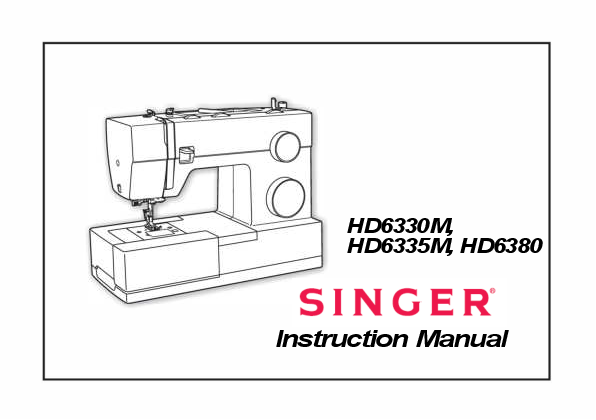
SINGER HD6330M, HD6335M, HD6380 Instruction Manual
Comprehensive guide for your SINGER Heavy Duty Sewing Machine
Illustration of a SINGER Heavy Duty Sewing Machine:
- The machine features a robust design with a main body, a needle area, and a removable extension table.
- Two large circular dials are visible on the right side of the machine body.
- The needle and presser foot assembly are prominent in the front working area.
- The overall appearance suggests a sturdy and functional sewing machine.
IMPORTANT SAFETY INSTRUCTIONS
This household sewing machine is designed to comply with IEC/EN 60335-2-28 and UL1594.
DANGER - To reduce the risk of electric shock:
- A sewing machine should never be left unattended when plugged in. Always unplug this sewing machine from the electric outlet immediately after using and before cleaning, removing covers, lubricating, or when making any other user servicing adjustments mentioned in the instruction manual.
- The LED lamp maximum power is 0.3W, maximum voltage is DC 9V. If the lamp is damaged, the product should not be used; it should be sent to SINGER or a service agent for immediate repair or replacement.
WARNING - To reduce the risk of burns, fire, electric shock, or injury to person:
- Do not allow the machine to be used as a toy. Close attention is necessary when this sewing machine is used by or near children.
- Use this sewing machine only for its intended use as described in this manual. Use only attachments recommended by the manufacturer as contained in this manual.
- Never operate this sewing machine if it has a damaged cord or plug, if it is not working properly, if it has been dropped or damaged, or dropped into water. Return the sewing machine to the nearest authorized dealer or service center for examination, repair, electrical or mechanical adjustment.
- Never operate the sewing machine with any air openings blocked. Keep ventilation openings of the sewing machine and foot control free from the accumulation of lint, dust, and loose cloth.
- Keep fingers away from all moving parts. Special care is required around the sewing machine needle.
- Always use the proper needle plate. The wrong plate can cause the needle to break.
- Do not use bent needles.
- Do not pull or push fabric while stitching. It may deflect the needle causing it to break.
- Wear safety glasses.
- Switch the sewing machine off ("O") when making any adjustment in the needle area, such as threading needle, changing needle, threading bobbin, or changing presser foot, etc.
- Never drop or insert any object into any opening.
- Do not use outdoors.
- Do not operate where aerosol (spray) products are being used or where oxygen is being administered.
- To disconnect, turn all controls to the off ("O") position, then remove plug from outlet.
- Do not unplug by pulling on cord. To unplug, grasp the plug, not the cord.
- The foot control is used to operate the machine. Avoid placing other objects on the foot control.
- Do not use the machine if it is wet.
- If the LED lamp is damaged or broken, it must be replaced by the manufacturer or its service agent or a similarly qualified person, in order to avoid a hazard.
- If the supply cord connected with the foot control is damaged, it must be replaced by the manufacturer or its service agent or a similarly qualified person, in order to avoid a hazard.
- This sewing machine is provided with double insulation. Use only identical replacement parts. See instructions for Servicing of Double-Insulated Appliances.
SAVE THESE INSTRUCTIONS
For Europe only:
This appliance can be used by children aged from 8 years and above and persons with reduced physical, sensory or mental capabilities or lack of experience and knowledge if they have been given supervision or instruction concerning use of the appliance in a safe way and understand the hazards involved. Children shall not play with the appliance. Cleaning and user maintenance shall not be made by children without supervision.
The noise level under normal operating conditions is less than 75dB(A).
The machine must only be used with foot control of type FC-1902A (110-120V area)/ FC-2902A, FC-2902D (220-240V area) manufactured by ZHEJIANG FOUNDER MOTOR CORPORATION LTD. (China)/ 4C-316Q(110-125V area) manufactured by Wakaho Electric Ind. Co., Ltd. (Vietnam).
For outside Europe:
This sewing machine is not intended for use by persons (including children) with reduced physical, sensory or mental capabilities, or lack of experience and knowledge, unless they have been given supervision or instruction concerning use of the sewing machine by a person responsible for their safety. Children should be supervised to ensure that they do not play with the sewing machine.
SERVICING OF DOUBLE INSULATED PRODUCTS
In a double-insulated product, two systems of insulation are provided instead of grounding. No ground means is provided on a double-insulated product, nor should a means for grounding be added to the product. Servicing of a double-insulated product requires extreme care and knowledge of the system and should be done only by qualified service personnel.
Replacement parts for a double-insulated product must be identical to those parts in the product. A double-insulated product is marked with the words "DOUBLE INSULATION" or "DOUBLE INSULATED".
Congratulations
As the owner of a new Singer sewing machine, users are about to begin an exciting adventure in creativity. From the moment of first use, users will find they are sewing on one of the easiest to use sewing machines ever made.
It is recommended that, before starting to use the sewing machine, users discover its many features and ease of operation by going through this instruction book, step by step, while seated at the machine.
To ensure that users are always provided with the most modern sewing capabilities, the manufacturer reserves the right to change the appearance, design or accessories of this sewing machine when considered necessary.
SINGER is the exclusive trademark of The Singer Company Limited S.à.r.l. or its Affiliates. ©2019 The Singer Company Limited S.à.r.l. or its Affiliates. All rights reserved.
Machine Basics
Principal Parts of the Machine
The following list details the principal parts of the sewing machine, referenced by numbers in the accompanying diagrams:
- Thread tension dial
- Presser foot pressure adjustment
- Thread take-up lever
- Reverse sewing lever
- Thread cutter
- Presser foot
- Needle plate cover
- Removable extension table/ accessory storage
- Three needle position dial
- Bobbin stopper
- Stitch width dial
- Stitch length dial
- Pattern selector dial
- Automatic threader
- One step buttonhole lever
- Horizontal spool pin
- Bobbin winding spindle
- Hole for second spool pin
- Handwheel
- Buttonhole stitch balance adjustment slot
- Power and light switch
- Main plug socket
- Bobbin thread guide
- Upper thread guide
- Face plate
- Handle
- Presser foot lifter
- Drop feed control
- Foot speed control
- Power cord
Diagrams illustrate the location of each numbered part on the sewing machine, including a detailed view of the automatic threader and one-step buttonhole lever area, and a separate illustration of the foot speed control and power cord.
Connecting Machine to Power Source
Connect the machine to a power source as illustrated in the manual.
Attention:
Unplug power cord when machine is not in use.
Foot control
The foot control pedal regulates the sewing speed.
Attention:
Consult a qualified electrician if in doubt of how to connect machine to power source. Unplug power cord when machine is not in use.
Sewing light
Press main switch (A) to "I" for power and light.
Diagram 1 shows the power cord connecting the sewing machine to an electrical outlet, with the foot control also connected. Diagram 2 illustrates a foot pressing down on the foot control pedal.
Two Step Presser Foot Lifter
When sewing several layers or thick fabrics, the presser foot can be raised to a higher position for easy positioning of the work (indicated as A in the diagram).
Diagram illustrates the presser foot lifter in its raised position, allowing for thicker fabrics.
Adjusting Presser Foot Pressure
The presser foot pressure of the machine has been pre-set and requires no particular readjustment according to the type of fabric (light- or heavy-weight).
However, if adjustment of the presser foot pressure is needed, turn the presser adjusting screw with a coin.
For sewing very thin fabric, loosen the pressure by turning the screw counter-clockwise. For heavy fabric, tighten by turning it clockwise.
Diagram shows a top-down view of the presser foot pressure adjustment screw, with arrows indicating clockwise (+) for tightening and counter-clockwise (-) for loosening.
Accessories
The following accessories are included with the machine:
- All purpose foot
- Zipper foot
- Buttonhole foot
- Button sewing foot
- Seam ripper/ brush
- Edge/ quilting guide
- Pack of needles
- Spool holders
- Bobbin (3x)
- L-screwdriver
- Auxiliary Spool Pin
- Spool pin felt
- Soft cover
- Sew Easy Foot
- Overcasting Foot
- Blind Hem Foot
- Straight Stitch Foot
- Clearance plate
- Non-Stick Foot
- Needle bag
Diagrams display various presser feet and tools, including an all-purpose foot, zipper foot, buttonhole foot, button sewing foot, seam ripper/brush, edge/quilting guide, pack of needles, spool holders, bobbins, L-screwdriver, auxiliary spool pin, spool pin felt, soft cover, Sew Easy Foot, Overcasting Foot, Blind Hem Foot, Straight Stitch Foot, Clearance plate, Non-Stick Foot, and Needle bag, arranged visually.
Winding the Bobbin
- Place thread and corresponding spool holder onto the spool pin. (Illustrated as steps 1 and 2 in the diagram).
- Snap thread into the thread guide. (Illustrated as step 3).
- Wind thread clockwise around bobbin winder tension discs. (Illustrated as step 4).
- Thread bobbin as illustrated and place on spindle. (Illustrated as step 5).
- Push bobbin spindle to the right. (Illustrated as step 6).
- Hold thread end. (Illustrated as step 7).
- Step on foot control pedal. (Illustrated as step 8).
- Cut thread. (Illustrated as step 9).
- Push bobbin spindle to the left (illustrated as step 10) and remove.
Please Note:
When the bobbin winder spindle is in "bobbin winding" position, the machine will not sew and the handwheel will turn. To start sewing, push the bobbin winder spindle to the left (sewing position).
A series of diagrams illustrate the step-by-step process of winding the bobbin, showing thread path, bobbin placement, and cutting the thread.
Inserting the Bobbin
When inserting or removing the bobbin, the needle must be fully raised.
- Insert the bobbin in the bobbin case with the thread running counter-clockwise (arrow).
- Pull the thread through the slit (A).
- Draw the thread clockwise until it slips into the notch (B).
- Pull out about 15 cm (6 inches) of thread and attach the bobbin cover plate (C).
Attention:
Turn power switch to off ("O") before inserting or removing the bobbin.
Four diagrams illustrate the bobbin insertion process: 1) placing the bobbin with counter-clockwise thread direction, 2) pulling thread through slit A, 3) drawing thread into notch B, and 4) attaching the bobbin cover plate C.
Threading the Upper Thread
This is a simple operation but it is important to carry out correctly as by not doing so several sewing problems could result.
- Start by raising the needle to its highest point (1), and continue turning the handwheel counter-clockwise until the needle just slightly begins to descend. Raise the presser foot to release the tension discs.
- Note: For safety, it is strongly suggested to turn off the power before threading.
- Lift up the spool pin. Place the spool of thread on the holder with the thread coming off the spool as shown. For small thread spools, place the small side of the spool holder next to the spool. (2)
- Draw thread from the spool through the upper thread guide (3) and pull thread through the pre-tension spring as illustrated. (4)
- Thread the tension module by leading thread down the right channel and up the left channel. (5) During this process it is helpful to hold the thread between the spool and thread guide.
- At the top of this movement pass thread from right to left through the slotted eye of the take-up lever and then downwards again. (6)
- Now pass the thread behind the horizontal thread guide, and then behind the thin wire needle clamp guide (7) and then down to the needle which should be threaded from front to back.
- Pull about 6-8 inches of thread to the rear beyond the needle eye. Trim thread to length with the built-in thread cutter. (8)
A series of diagrams illustrate the complete upper threading path, from spool placement and thread guides to the take-up lever and finally the needle eye, including a close-up of the thread cutter.
Automatic Needle Threader
- Raise the needle to its highest position.
- Press lever (A) down as far as it will go.
- The threader automatically swings to the threading position (B).
- Pass thread around thread guide (C).
- Pass the thread in front of the needle around the hook (D) from bottom to top.
- Release lever (A).
- Pull the thread through the needle eye.
Attention:
Turn power switch to off ("O")!
Two diagrams illustrate the automatic needle threading process: Diagram 1 shows the threader lever (A) pressed down, the threader swinging to position (B), thread around guide (C), and thread around hook (D). Diagram 2 shows the thread pulled through the needle eye after the process.
Raising the Bobbin Thread
- Hold the upper thread with the left hand. Turn the handwheel (1) towards you (counter-clockwise), lowering, then raising the needle.
- Gently pull on the upper thread to bring the bobbin thread up through the needle plate hole. (2)
- Lay both threads to the back under the presser foot. (3)
Note:
If it is difficult to raise the bobbin thread, check to make sure the thread is not trapped by the hinged cover or the Removable Extension Table.
Three diagrams illustrate the process: Diagram 1 shows turning the handwheel while holding the upper thread. Diagram 2 shows pulling the upper thread to bring the bobbin thread loop up. Diagram 3 shows both threads laid back under the presser foot.
Thread Tension
Upper thread tension
Basic thread tension setting: "4". (1)
- To increase the tension, turn the dial to the next number up. To reduce the tension, turn the dial to the next number down.
- A. Normal thread tension for straight stitch sewing.
- B. Thread tension too loose for straight stitch sewing. Turn dial to a higher number.
- C. Thread tension too tight for straight stitch sewing. Turn dial to a lower number.
- D. Normal thread tension for zig-zag and decorative sewing. Correct thread tension is when a small amount of the upper thread appears on the bottom side of the fabric.
Lower thread tension
The bobbin tension has been set correctly at the factory, so no adjustment is needed.
Please note:
- Proper tension setting is important for strong seams.
- There is no single tension setting appropriate for all stitch functions, thread or fabric.
- A balanced tension (identical stitches both top and bottom) is usually only desirable for straight stitch construction sewing.
- 90% of all sewing will be between "3" and "5".
- For zig-zag and decorative sewing stitch functions, thread tension should generally be less than for straight stitch sewing.
- For all decorative sewing, a nicer stitch and less fabric puckering will be obtained when the upper thread appears on the bottom side of the fabric.
Diagrams illustrate the thread tension dial and examples of stitch appearance for different tension settings (A, B, C, D) on fabric, showing normal, loose, tight, and zig-zag tensions.
How to Choose Your Pattern
The diagram on this page displays the stitch patterns available on the machine.
Stitches in the top of the diagram are indicated on the Pattern Selector Dial in gray. To select the patterns indicated with the gray color, turn the Pattern Selector Dial (e). Use the Stitch Length Dial (d) to adjust the stitch length as desired for the project. Use the Stitch Width Dial (c) to adjust the width of the stitch as desired.
To obtain the other patterns, turn the stitch length dial to "S1" or "S2", select the pattern desired with the pattern selector dial, and adjust the stitch width with the stitch width dial.
The Pattern Selector Dial may be turned in either direction.
- Reverse Sewing Lever
- Three Needle Position Dial
- Stitch Width Dial
- Stitch Length Dial
- Pattern Selector Dial
Diagrams show the sewing machine with labels for the reverse sewing lever, three needle position dial, stitch width dial, stitch length dial, and pattern selector dial. Below, a grid displays various stitch patterns categorized by S1 and S2 settings, including straight stitches, zig-zag stitches, and decorative patterns.
Three Needle Position Dial
The needle position can be altered with the "Three needle position dial". For normal work, the needle position is middle.
For edge stitching or sewing parallel lines of top stitch, select needle position left or right. For twin needle stitching, needle position is middle.
- Straight stitch
- Zig-zag stitch
- L. Left Needle Position
- M. Middle Needle Position
- R. Right Needle Position
Diagram illustrates three needle positions (L, M, R) and how they affect straight (a) and zig-zag (b) stitch lines, showing the needle's alignment relative to the stitch.
Stitch Width Dial & Stitch Length Dial
Function of stitch width dial
The maximum zig-zag stitch width for zig-zag stitching is 6mm; however, the width can be reduced on any patterns. The width increases as the zig-zag dial moves from "0" - "6". (1)
Diagram 1 shows a dial with settings from 0 to 6, illustrating how stitch width increases with higher numbers, along with examples of zig-zag stitches at different widths.
Function of stitch length dial while zig-zag stitching
Set the Pattern Selector Dial to zig-zag.
The density of zig-zag stitches increases as the setting of the stitch length dial approaches "0".
Standard zig-zag stitches are usually achieved at "3" or below. (2)
Dense zig-zag stitches are called satin stitches. (2)
Function of stitch length dial for when straight stitching
For straight stitch sewing, turn the Pattern Selector Dial to the straight stitch setting. Turn the Stitch Length Dial, and the length of the individual stitches will decrease as the dial approaches "0". The length of the individual stitches will increase as the dial approaches "4". Generally speaking, use a longer stitch length when sewing heavier weight fabrics or when using a thicker needle or thread. Use a shorter stitch length when sewing lighter weight fabrics or when using a finer needle or thread.
Diagram 2 shows a dial with settings from 0 to 4 and S1/S2, illustrating how stitch length changes with different numbers, along with examples of straight stitches at various lengths and dense zig-zag stitches (satin stitches).
Sewing Straight Stitch
- To begin sewing, set the machine for straight stitch. (1)
- Place the fabric under the presser foot with the fabric edge lined up with the desired seam guide line on the needle plate. (2)
- Lower the presser foot lifter, and then step on the foot controller to start sewing. (3)
Diagram 1 shows a visual representation of a straight stitch line. Diagram 2 illustrates fabric placed under the presser foot, aligned with a seam guide line. Diagram 3 shows the presser foot lowered onto the fabric, ready for sewing.
Reverse Sewing
To secure the beginning and the end of a seam, press down the reverse sewing lever (A). Sew a few reverse stitches. Release the lever and the machine will sew forward again. (1)
Diagram 1 shows the reverse sewing lever (A) being pressed down, indicating the machine is sewing in reverse. Diagram 2 shows the machine sewing forward after the lever is released.
Removing the Work
Turn the handwheel toward you (counter-clockwise) to bring the thread take-up lever to its highest position, raise the presser foot and remove work behind the needle and presser foot. (2)
Cutting the Thread
Pull the threads under and behind the presser foot. Guide the threads to the side of the face plate and into the thread cutter (B). Pull threads down to cut. (3)
Diagram 3 illustrates the thread cutter (B) located on the side of the machine's face plate, showing how threads are guided into it for cutting.
Choosing Stretch Stitch Patterns
The stretch stitch patterns are indicated with blue and red colors on the pattern selector dial. To select these stitches, turn the pattern selector dial to the desired pattern. Then, turn the stitch length dial to the indicator marked "S1" or "S2". Though there are several stretch patterns, here are two examples:
Straight Stretch Stitch (1)
- Set the pattern selector dial to the straight stretch stitch symbol (three vertical dashed lines).
- Set the stitch width dial to "1".
- Used to add triple reinforcement to stretch and hardwearing seams.
- The machine sews two stitches forward and one stitch backwards.
Diagram 1 shows the pattern selector dial set to the straight stretch stitch symbol, the stitch width dial set to '1', and an example of the resulting reinforced straight stitch.
Ric Rac (2)
- Set the pattern selector dial to the Ric Rac stitch symbol (a zig-zag with small loops).
- Set the stitch length dial to "S1" or "S2".
- Adjust the stitch width dial to between "3" and "6".
- Ric rac stitch is suitable for firm fabrics like denim, corduroy, poplin, duck, etc.
Diagram 2 shows the pattern selector dial set to the Ric Rac stitch symbol, the stitch length dial set to S1/S2, and an example of the resulting Ric Rac stitch pattern.
Blind Hem
For hems on curtains, trousers, skirts, etc.
- ⠶⠶⠶⠶ Blind hem for stretch fabrics.
- ⠶⠶⠶⠶⠶⠶ Blind hem for firm fabrics.
Set the Stitch Length Dial with the range shown on the diagram. Blind hems, however, are normally sewn with a longer stitch length setting. Set the Stitch Width Dial at a setting appropriate for the weight/type of fabric being sewn, within the range shown in the diagram. Generally, a narrower stitch is used for lighter weight fabrics, and a wider stitch is used for heavier weight fabrics. Sew a test first to make sure the machine settings are appropriate for the fabric.
Blind Hemming Procedure:
- Turn up the hem to the desired width and press. Fold back (as shown in Fig. 1) against the right side of the fabric with the top edge of the hem extending about 7 mm (1/4") to the right side of the folded fabric.
- Start to sew slowly on the fold, making sure the needle touches slightly the folded top to catch one or two fabric threads. (2)
- Unfold the fabric when hemming is completed and press.
Note:
To make blind hem sewing even easier, use a blind hem foot, available from a SINGER® retailer. (See page 6 for part number)
Diagrams illustrate the stitch length and width dials for blind hemming, examples of blind stitches, and a step-by-step visual guide for folding fabric and sewing a blind hem.
Sew 1-step Buttonholes
Buttonhole sewing is a simple process that provides reliable results. However, it is strongly suggested to always make a practice buttonhole on a sample of the fabric and stabilizer.
Making a Buttonhole
- Using tailor's chalk, mark the position of the buttonhole on the fabric.
- Attach the buttonhole foot and set the Pattern Selector Dial to the buttonhole symbol. Set the stitch length dial to the buttonhole symbol. Set the stitch width at "6". The width however may need to be adjusted according to the project. Sew a test first to determine this.
- Lower the presser foot aligning the marks on the foot with the marks on the fabric (A). (The front bar tack will be sewn first.) (Align the mark on the fabric (a) with the mark on the foot (b).)
- Open the button plate and insert the button (B).
- Lower the buttonhole lever and gently push it back (C).
- While lightly holding the upper thread, start the machine.
- Buttonhole stitching is done in the order (D).
- Stop the machine when the buttonhole cycle has completed.
Diagrams illustrate the buttonhole settings on the dials, the alignment of fabric and buttonhole foot (A), inserting the button into the button plate (B), lowering the buttonhole lever (C), and the stitching order of a buttonhole (D).
Making a Buttonhole on Stretch Fabrics (E)
When sewing buttonholes on stretch fabric, hook heavy thread or cord under the buttonhole foot. When the buttonhole is sewn the legs will overcast the cord.
- Mark the position of the buttonhole on the fabric with the tailor's chalk, attach the buttonhole foot, and set the pattern selector dial to the buttonhole symbol. Set stitch length dial to the buttonhole symbol.
- Hook the heavy thread onto the back end of the buttonhole foot, then bring the two heavy thread ends to the front of the foot, insert them into the grooves and temporarily tie them there.
- Lower the presser foot and start sewing.
*Set the stitch width to match the diameter of the gimp thread.
- Once sewing is completed, gently pull the heavy thread to remove any slack, then trim off the excess.
Diagram E illustrates the process of making a buttonhole on stretch fabric, showing how to hook heavy thread or cord under the buttonhole foot to overcast the cord.
Left and Right Side Balance for Buttonhole
Stitch density on right and left sides of buttonhole can be adjusted by the buttonhole balance control dial.
This dial should usually be in a neutral position (between "+" and "-").
- If the stitches on the left side of the buttonhole are too close together, turn the dial to the left (+). Turning the dial to the left opens the left side.
- If the stitches on the left side of the buttonhole are too open, turn the dial to the right (-). Turning the dial to the right closes the left side.
Diagrams show the buttonhole balance control dial and how turning it left (+) or right (-) affects the stitch density on the left side of the buttonhole, illustrating stitches becoming looser or tighter.
Sewing on Buttons
- Move the drop feed control to the right side to lower the feed dogs. (1)
- Change the all-purpose foot to the button sewing foot. (2)
- Set the stitch length to "0".
- Place the button and fabric under the Button Sewing foot, as illustrated in (3).
- Set the machine for zig-zag stitch, then set the width to number "3" - "6". Turn the handwheel to check that the needle goes cleanly into the left and right holes of the button. Adjust the stitch width, as needed, according to the distance between the holes of the button. Slowly sew on the button with about 10 stitches.
- Raise the needle out of the fabric. Set the machine for straight stitch again, then sew a few securing stitches to finish.
If a shank is required, place a darning needle on top of the button and sew. For buttons with 4 holes, sew through the front two holes first, push the work forward and then sew through the back two holes.
Diagrams illustrate the drop feed control position, the button sewing foot, and the process of sewing a button onto fabric, showing needle placement through buttonholes.
Installing the Removable Extension Table
- Hold the removable extension table horizontally, and push it in the direction of the arrow. (1)
- To remove the extension table, pull it toward the left.
The inside of the removable extension table can be utilized as an accessory box.
- To open, flip cover down as shown. (2)
Diagram 1 shows the removable extension table being pushed horizontally into the sewing machine. Diagram 2 illustrates the extension table's cover being flipped down to reveal its accessory storage compartment.
Attaching the Presser Foot Shank
- Raise the presser bar (a) with the presser foot lifter. Attach the presser foot shank (b) as illustrated. (1)
Diagram 1 shows the presser bar (a) and how to attach the presser foot shank (b).
Attaching the Presser Foot
- Lower the presser foot shank (b) using the presser foot lifter, until the cut-out (c) is directly above the pin (d). (2) The presser foot (f) will engage automatically.
Diagram 2 illustrates lowering the presser foot shank (b) so that its cut-out (c) aligns with the pin (d), allowing the presser foot (f) to snap into place.
Removing the Presser Foot
- Raise the presser foot using the presser foot lifter. (3)
- Raise the lever (e) and the foot disengages.
Diagram 3 shows raising the lever (e) to disengage the presser foot.
Attaching the Edge/ Quilting Guide
- Attach the edge/ quilting guide (g) in the slot as illustrated. Adjust as needed for hems, pleats, quilting, etc. (4)
Attention:
Turn power switch to off ("O") when carrying out any of the above operations!
Diagram 4 illustrates attaching the edge/quilting guide (g) into its designated slot.
Needle/ Fabric/ Thread Chart
NEEDLE, FABRIC, THREAD SELECTION GUIDE
| NEEDLE SIZE | FABRICS | THREAD |
|---|---|---|
| 9-11 (70-80) | Lightweight fabrics-thin cottons, voile, silk, muslin, interlocks, cotton knits, tricots, jerseys, crepes, woven polyester, shirt & blouse fabrics. | Light-duty thread in cotton, nylon, polyester or cotton wrapped polyester. |
| 11-14 (80-90) | Medium weight fabrics-cotton, satin, kettlecloth, sailcloth, double knits, lightweight woolens. | Most threads sold are medium size and suitable for these fabrics and needle sizes. |
| 14 (90) | Medium weight fabrics-cotton duck, woolen, heavier knits, terrycloth, denims. | Use polyester threads on synthetic materials and cotton on natural woven fabrics for best results. |
| 16 (100) | Heavyweight fabrics-canvas, woolens, outdoor tent and quilted fabrics, denims, upholstery material (light to medium). | Always use the same thread on top and bottom. |
| 18 (110) | Heavy woolen, overcoat fabrics, upholstery fabrics, some leathers and vinyls. | Heavy duty thread, carpet thread. |
IMPORTANT: Match needle size to thread size and weight of fabric.
NEEDLE, FABRIC SELECTION
| NEEDLES | EXPLANATION | TYPE OF FABRIC |
|---|---|---|
| SINGER® 2020 | Standard sharp needles. Sizes range thin to large. 9 (70) to 18 (110). | Natural woven fabrics-wool, cotton, silk, etc. Not recommended for double knits. |
| SINGER® 2045 | Semi-ball point needle, scarfed. 9 (70) to 18 (110). | Natural and synthetic woven fabrics, polyester blends. Knits-polyesters, interlocks, tricot, single and double knits. Also sweater knits, Lycra®, swimsuit fabric, elastic. |
| SINGER® 2032 | Leather needles. 12 (80) to 18 (110). | Leather, vinyl, upholstery. (Leaves smaller hole than standard large needle.) |
Note:
- For best sewing results always use genuine SINGER® needles.
- Replace needle often (approximately every other garment) and/ or at first thread breakage or skipped stitches.
How To Drop Feed Dog
For ordinary sewing, keep the feed dog up. For freehand embroidery, sewing on buttons and darning, drop the feed dog.
- To raise (a) and lower (b) feed dog. (2)
Diagram 1 shows the feed dog in the raised position. Diagram 2 illustrates the lever for raising (a) and lowering (b) the feed dog, with visual examples of the feed dog in both positions.
Inserting & Changing Needles
Change the needle regularly, especially if it is showing signs of wear and causing problems. For best sewing results always use SINGER® Brand Needles.
Insert the needle as illustrated as follows:
- A. Loosen the needle clamp screw and tighten again after inserting the new needle. (1)
- B. The flat side of the shaft should be towards the back.
- C/D. Insert the needle as far up as it will go.
Attention:
Turn power switch to off ("O") before inserting or removing the needle.
Needles must be in perfect condition. (2)
Problems can occur with:
- A. Bent needles
- B. Damaged points
- C. Blunt needles
Diagram 1 illustrates the process of inserting a needle, showing loosening the screw (A), the flat side of the needle shaft (B), and inserting the needle fully (C/D). Diagram 2 shows examples of needles in poor condition: bent (A), damaged point (B), and blunt (C).
Troubleshooting Guide
| Problem | Cause | Correction |
|---|---|---|
| Upper thread breaks |
|
|
| Lower thread breaks |
|
|
| Skipped stitches |
|
|
| Needle breaks |
|
|
| Loose stitches |
|
|
| Seams gather or pucker |
|
|
| Uneven stitches, uneven feed |
|
|
| The machine is noisy |
|
|
| The machine jams | Thread is caught in the hook. | Remove the upper thread and bobbin case, turn the handwheel backwards and forwards by hand and remove the thread. |
Product Disposal and Recycling Information
This product must be safely recycled in accordance with relevant National legislation relating to electrical/electronic products. Electrical appliances should not be disposed of as unsorted municipal waste; separate collection facilities should be used. Local government can provide information regarding available collection systems. When replacing old appliances with new ones, the retailer may be legally obligated to take back the old appliance for disposal free of charge.
If electrical appliances are disposed of in landfills or dumps, hazardous substances may leak into the groundwater and enter the food chain, potentially damaging health and well-being.
CE - Authorised Representative
VSM Group AB, SVP Worldwide
Drottninggatan 2, SE-56184, Huskvarna, SWEDEN
Models: HD6330M, HD6335M, HD6380, Heavy Duty Sewing Machine