
Home
›
BZBGEAR
›
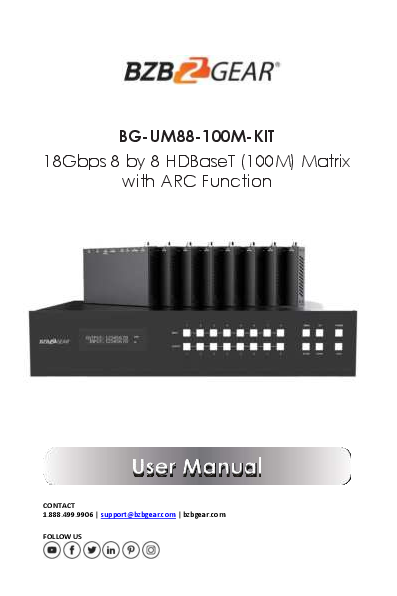
BZBGEAR BG-UM88-100M-KIT 18Gbps 8x8 HDBaseT (100M) Matrix with ARC Function User Manual

BZBGEAR BG-UM88-100M-KIT 18Gbps 8x8 HDBaseT (100M) Matrix with ARC Function User Manual
File info: application/pdf · 32 pages · 1.66MB
BG-UM88-100M-KIT user manual (v1)
1 / 29 - 1. Introduction The BG-UM88-100M-KIT is an 18Gbps 8 by 8 HDBaseT(100M) matrix switch that can connect 8 HDMI sources to 16 displays. Each HDMI output can be mirrored to allow a
Product manuals | BZBGEAR
Full PDF Document

If the inline viewer fails, it will open the original document in compatibility mode automatically. You can also open the file directly.
Extracted Text
BG-UM88-100M-KIT 18Gbps 8 by 8 HDBaseT (100M) Matrix
with ARC Function
CONTACT 1.888.499.9906 | support@bzbgear.com | bzbgear.com FOLLOW US

Thank you for purchasing this product
For optimum performance and safety, please read these instructions carefully before connecting, operating or adjusting this product. Please keep this manual for future reference.
Surge protection device recommended
This product contains sensitive electrical components that may be damaged by electrical spikes, surges, electric shock, lighting strikes, etc. Use of surge protection systems is highly recommended in order to protect and extend the life of your equipment.
Table of Contents
1. Introduction. .................................................................................................................... 1 2. Features............................................................................................................................ 1 3. Package Contents. ......................................................................................................... 2 4. Specifications. ................................................................................................................. 2 5. Operation Controls and Functions. ............................................................................... 4
5.1. Matrix Panel............................................................................................................ 4 5.2. HDBaseT Receiver Panel. ...................................................................................... 6 6. IR Remote......................................................................................................................... 7 7. IR Control System. ........................................................................................................... 9 8. IR Cable Pin Assignment. ............................................................................................... 11 9. EDID Management.......................................................................................................... 11 10. Matrix Audio and RS-232 Introduction........................................................................ 13 11. Web GUI User Guide. .................................................................................................... 14 12. RS-232 Control Command. .......................................................................................... 22 13. Application Example. ................................................................................................... 29 14. Tech Support.................................................................................................. Back cover 15. Warranty......................................................................................................... Back cover 16. Mission Statement. ........................................................................................ Back cover

1. Introduction
The BG-UM88-100M-KIT is an 18Gbps 8 by 8 HDBaseT(100M) matrix switch that can connect 8 HDMI sources to 16 displays. Each HDMI output can be mirrored to allow a simultaneous output using a CAT cable. Resolution is up to 4K@60Hz4:4:4. The HDBaseT output's transmission distance is up to 328ft / 100m over a single CAT 5e/6/7 cable. The device supports IR matrix and Audio matrix functionality. The ARC function allows the HDMI or HDBaseT display device's audio signal to be returned to or extracted from the coaxial and analog audio outputs using the Web GUI or ASCII code control. The IR and RS-232 signal transmission is bi-directional. For example, the IR signal will transmit from port 1 of the matrix to the HDBaseT receiver connected to output port 1. The BG-UM88-100M-KIT can be controlled via the front panel buttons, IR remote, RS232, LAN, and Web GUI
2. Features
 HDMI 2.0b, HDCP 2.2 and HDCP 1.4 compliant  8 HDMI inputs, 8 HDMI outputs and 8 HDBaseT mirrored outputs  R esolution up to 4K@60Hz 4:4:4  HDMI ports transmit 18Gbps lossless uncompressed video bandwidth  18Gbps lossless compressed HDBaseT signal transmission  4K->1080P Down Scaler  Dolby Vision, HDR10+, HLG are supported  HDBaseT output can extend video transmission distance up to 328ft / 100 meters via a
single CAT 5e/6/7 cable.  HDMI audio pass-through up to 7.1CH HD audio (LPCM, Dolby TrueHD and DTS-HD
Master Audio)  ARC function on local HDMI and HDBaseT output ports  IR matrix and Audio matrix are supported  Smart EDID management  24V POC on all HDBaseT ports  Control via front panel buttons, IR remote, RS-232, LAN, and Web GUI
- 1 / 29 -

3. Package Contents
 1x 8 by 8 HDMI and HDBaseT Matrix Switch  8x HDBaseT Receiver  1x Matrix IR Remote  1x 100~240V AC 50/60Hz Power cable  1x RS-232 serial cable (1.5 meters, male to female head)  16x 3-pin Phoenix Connector  9x IR Blaster cable (1.5 meters)  10x 20~60KHz IR Receiver cable (1.5 meters)  18x Mounting Ear (Matrix and Receiver)  1x User Manual

4. Specifications

Technical HDMI Compliance HDCP Compliance Video Bandwidth Video Resolution Color Space Color Depth
HDMI Audio Formats (Pass-through) Coax Audio Formats L/R Audio Formats
HDR formats Infrared
ESD Protection Connection Matrix
Input Ports

HDMI 2.0b HDCP 2.2 and HDCP 1.4 18Gbps Up to 4K2K@50/60Hz (4:4:4) RGB, YCbCr 4:4:4/4:2:2/4:2:0 12-bit (4K), 16-bit (1080P) PCM2.0/5.1/7.1CH, Dolby Digital/Plus/EX, Dolby True HD, DTS, DTS-EX,DTS-96/24, DTS High Res, DTS-HD Master Audio, DSD PCM 2.0, Dolby Digital / Plus, DTS, PCM2.0 4:4:4,4:2:2,4:2:0(10,12bit deep color) HDR10,HDR10+,Dolby Vision, HLG 20KHz ~ 60KHz Human-body Model: �8kV (Air-gap discharge) , �4kV (Contact discharge)
8�INPUT [HDMI Type A, 19-pin female] 10�IR INPUT [3.5mm Stereo Mini-jack] 2�Stereo Audio [3.5mm Stereo Mini-jack B] 1�SPDIF(OPTICAL) 1�SPDIF(COAX)

- 2 / 29 -

Output Ports

8�HDMI OUTPUT [HDMI Type A, 19-pin female] 8�HDBaseT port [RJ45] 9�IR OUTPUT [3.5mm Stereo Mini-jack] 8�RS-232 [3-pin Phoenix connector] 8�SPDIF(COAX) 8�Stereo Audio[3.5mm Stereo Mini-jack] 1�LAN [RJ45]

Control Ports

1�TCP/IP [RJ45] 1�RS-232 [D-Sub 9]

HDBaseT Receiver

Input Ports

1�HDBaseT IN [ RJ45] 1�IR IN [3.5mm Stereo Mini-jack]

Output Ports

1�HDMI OUT [HDMI Type A, 19-pin female] 1�IR OUT [3.5mm Stereo Mini-jack]

Control Ports

1�SERVICE [Micro USB, Update port] 1�RS-232 [Phoenix jack] 2�LAN [RJ45]

Mechanical

Housing

Metal Enclosure

Color

Black

Dimensions

TX: 440mm (W)�362mm (D)�88mm (H) RX: 163mm (W)�90.3mm (D)�18mm (H)

Weight Power Supply Power Consumption

TX: 6.9 kg, RX: 392g AC 100 - 240V 50/60Hz 128W (Max)

Operating Temperature 0�C ~ 40�C / 32�F ~ 104�F

Storage Temperature -20�C ~ 60�C / -4�F ~ 140�F

Relative Humidity Resolution / Distance

20~90% RH (non-condensing) 4K60 - Feet / Meters

CAT 5e/6/7 Resolution / Cable length

4K60 Feet / Meters

328ft / 100M
4K30 Feet / Meters

1080P60 Feet / Meters

HDMI IN / OUT

16ft / 5M

32ft / 10M

50ft / 15M

The use of "Premium High Speed HDMI" cable is highly recommended.

- 3 / 29 -

5. Operation Controls and Functions
5.1 Matrix Panel Front Panel

NO.

Name

Function Description

Display matrix switching status, input / output port, EDID, 1 OLED screen Baud rate, IP Address.

2 Power LED

The LED will illuminate in green when the product is connected to power supply, and red when the product is on standby.

3

Input / Output buttons

You need to press an output button (1~8) firstly and then press an input button (1~8) to select the corresponding input source for the output port.

 EDID Check: On the initial OLED display screen, press "MENU" button to enter the Matrix switching state interface, then press "UP/DOWN" button to check the current EDID information of each HDMI input port.

 EDID setting: On the initial OLED display screen, press

"MENU" button to enter the EDID setting interface, press

"UP/DOWN" button to select the required EDID, and press

the "ENTER" button. A prompt "copy to input :" will appear.

4

MENU / ENTER / UP /DOWN

Then press "UP/DOWN" button to select the input port you need to set, and press "ENTER" button again to confirm.  Baud rate setting: On the initial OLED display screen,

press "MENU" button to enter the Baud rate interface, and

press "UP/DOWN" button to select the required Baud rate,

finally press the "ENTER" button to confirm the setting.

 IP Address Check: On the initial OLED display screen, press "MENU" button to enter the IP interface, then press "UP/DOWN" button to check the current IP address. Pressing the "MENU" button again will return to the initial OLED display status.

5

POWER button

Press and hold the POWER button for 3 seconds to enter standby mode, then short press it to wake up the device.

6 IR Window

IR receiver window, it only receives the IR remote signal from this product.

7

LOCK button

Short press the LOCK button to lock front panel buttons (Except the power button); Press it again to unlock.

- 4 / 29 -

Rear Panel

No.

Name

Function Description

1

INPUT ports (1-8)

HDMI input ports, connect to HDMI source device such as DVD or PS4 with an HDMI cable.

HDBaseT ports, connect to HDBaseT Receiver via CAT cable.

2

OUTPUT ports (1-8)

HDMI output ports, connect to HDMI display device such as TV or monitor with an HDMI cable.

3 LAN

This port is connected to a router and the LAN port of the HDBaseT Receiver can connect Internet device such as PC or laptop.

4

AUDIO IN ports

L/R, optical and coaxial audio input ports, connect to external audio source device such as PC or DVD.

Connect to a PC or control system by 3-pin phoenix connector

RS-232 port serial cable to transmit command between the Matrix and

(1-8)

HDBaseT Receiver.

5 DIGITAL port Coaxial audio output port, connect to audio output device

(1-8)

such as audio amplifier via a coaxial cable.

STEREO port Stereo audio output port, connect to an amplifier or speaker

(1-8)

via a 3.5mm audio cable.

6 IR EXT

If the IR receiver window of the unit is blocked or the unit is
installed in a closed area out of infrared line of sight, the IR
receiver cable can be inserted to the "IR EXT" port to receive the IR remote signal.

7

IR INPUT ports

Connect to IR receiver cable, the IR receive signal will emit to "IR OUT" port of the corresponding HDBaseT Receiver.

8

IR OUTPUT ports

Connect to IR blaster cable, the IR emit signal is from "IR IN" port of the corresponding HDBaseT Receiver.

9 TCP/IP port 10 RS-232 port

This port is the link port for TCP/IP control and connect to an active Ethernet link by an RJ45 cable.
Connect to a PC or control system by D-Sub 9-pin cable to control the Matrix.

11 GND

Grounding terminal.

12 POWER input Connect to 100~240V AC 50/60Hz power cable.

- 5 / 29 -


Data Signal Indicator Lamp
 Illuminating: HDMI signal with HDCP.  Flashing: HDMI signal without HDCP.  Dark: No HDMI signal.

OUTPUT port

5.2 HDBaseT Receiver Panel

Connection Signal Indicator Lamp
 Illuminating: Matrix and HDBaseT Receiver are in good connection status.  Flashing: Matrix and HDBaseT Receiver are in poor connection status.  Dark: Matrix and HDBaseT Receiver are not connected.

No.

Name

Function Description

1

POWER LED

Power LED indicator, LED will illuminate when the device is connected with power supply.

2 SERVICER port Firmware update port

P. lug the DC 24V/1A power cord into this port and connect

the adapter to AC wall outlet.

3 DC 24V

Note: The Matrix supports POC function, so the Receiver

doesn't need to connect power supply when HDBaseT IN

port is connected to HDBaseT port of the Matrix.

4

HDBaseT IN port

Connect to HDBaseT output port of the Matrix with CAT cable.

Connection  Illuminating: Matrix and Receiver are in good connection status. 5 Signal Indicator  Flashing: Matrix and Receiver are in poor connection status.
Lamp (Green)  Dark: Matrix and Receiver are not connected.

Data Signal  Illuminating: HDMI signal with HDCP.

6 Indicator Lamp  Flashing: HDMI signal without HDCP.

(Orange)

 Dark: No HDMI signal.

- 6 / 29 -

No.

Name

Function Description

7 IR IN

Connect to IR receiver cable, the IR signal will emit to corresponding IROUT port of the Matrix.

8 IR OUT

Connect to IR blaster cable, the IR signal will be received from the corresponding IR IN port of the Matrix.

9

HDMI OUT port

HDMI output port, connect to HDMI display device such as TV or monitor with HDMI cable.

10 RS-232 port 11 LAN ports

Connect to a PC or control system by 3-pin phoenix connector cable to transmit command between the Matrix and HDBaseT Receiver.
Connect Ethernet cables to these ports to provide a wired Ethernet connection to local devices.

6. IR Remote

 Power on or Standby: Power on the Matrix or set it to standby mode.  Input 1/2/3/4/5/6/7/8: Select input source button.
: Select the last or next input source button.
 Output 1/2/3/4/5/6/7/8 button: Select output source button.
All: Select all output source simultaneously. For example,
when you press the "All" button and then press input "1" button, at this time the input "1" source will output to all display devices.
Operation instruction: You need to press the output button firstly and then press input button to select the corresponding input source. For example, Press Output-X (X means output button from 1 to 8 , including "All" button) Then press Input-Y (Y means input button from 1 to 8 )

The Matrix can be selected input and output source by using the IR remote. There are two ways to receive the IR remote signal.
The first way: The IR window accepts the IR remote signal. When using the IR remote, the furthest distance is 7 meters and the angle is � 45�. The diagram is shown as below:

- 7 / 29 -

Alternate method: If the IR receiver window of the Matrix is blocked or the Matrix is installedin a closed area out of infrared line of sight, the IR receiver cable can be inserted to the "IR EXT" port to receive the IR remote signal. The furthest distance of using the IR remote is 7 meters and the IR remote is directly faced to the IR receiver head. The diagram is shown asbelow.
- 8 / 29 -

7. IR Control System
The device is not only a matrix switch but also an extender. It supports bi-directional IR control. When the matrix is connected to an HDBaseT Receiver through CAT 5e/6/7 cable, users can control remote display devices (HDBaseT) or input source devices (Matrix) through IR signal transmission. Note that the IR signal transmission method is different from Matrix (local) to HDBaseT Receiver (remote) than from HDBaseT Receiver (remote) to Matrix (local). At the Matrix end (Local end): the IR signal is one-to-one transmission. This means the IR INPUT 1 port signal of the Matrix will emit to the IR output port of the HDBaseT Receiver 1 and the IR INPUT 2 port signal of the Matrix will emit to IR output port of the HDBaseT Receiver 2 etc. The IR signal doesn't follow the video switch. The IR INPUT ALL port signal of the Matrix will emit to all IR output ports of HDBaseT receivers simultaneously. Please see the following connection diagram.
Figure 1: IR connection diagram (Matrix end) - 9 / 29 -

At HDBaseT receiver (Remote end): The IR signal follows video switch. For example, the HDMI output signal on the HDBaseT Receiver 1 is from the HDMI INPUT 3 port, so IR input signal of the HDBaseT Receiver 1 will emit to IR OUTPUT 3 port of the Matrix. The HDMI output signal on the HDBaseT Receiver 3 is from the HDMI INPUT 6 port. Then, IR input signal of the HDBaseT Receiver 3 will emit to IR OUTPUT 6 port of the Matrix etc. Any of HDBaseT Receiver's IR IN signal can output from IR OUTPUT ALL port of the Matrix and the IR signal output of the Matrix depends on your IR remote of source device. Please see the following connection diagram.
Figure 2: IR connection diagram (HDBaseT Receiver end)
- 10 / 29 -

8. IR Cable Pin Assignment

IR RECEIVER

IR BLASTER

9. EDID Management
This Matrix has 21 factory defined EDID settings, 2 user-defined EDID modes and 16 copy EDID modes. You can select defined EDID mode or copy EDID mode to input port through front panel buttons, ASCII control or Web GUI. On-panel button operation: On the initial OLED display screen, press "MENU" button to enter the EDID setting interface, press "UP/DOWN" button to select the required EDID, and press the "ENTER" button. A prompt "copy to input :" will appear. Then press "UP/DOWN" button to select the input port you need to set, and press "ENTER" button again to confirm this operation.
RS-232 control operation: Connect the Matrix to PC with a serial cable, then open a Serial Command tool on PC to send ASCII command "s edid in x from z!" to set EDID. For details, please refer to "EDID Setting" in the ASCII command list of "12. RS-232 Control Command".
Web GUI Operation: Please check the EDID management in the "Input page" of "11. Web GUI User Guide".
- 11 / 29 -

The defined EDID setting list of the product is shown as below:

EDID Mode 1 2 3 4
5 6 7 8 9 10 11 12 13 14 15 16 17 18 19 20 21 22 23 24~31 32~39

EDID Description 1080p, Stereo Audio 2.0 1080p, Dolby/DTS 5.1 1080p, HD Audio 7.1 1080i, Stereo Audio 2.0 1080i, Dolby/DTS 5.1 1080i, HD Audio 7.1 3D, Stereo Audio 2.0 3D, Dolby/DTS 5.1 3D, HD Audio 7.1 4K2K30_444, Stereo Audio 2.0 4K2K30_444, Dolby/DTS 5.1 4K2K30_444, HD Audio 7.1 4K2K60_420, Stereo Audio 2.0 4K2K60_420, Dolby/DTS 5.1 4K2K60_420, HD Audio 7.1 4K2K60_444, Stereo Audio 2.0 4K2K60_444, Dolby/DTS 5.1 4K2K60_444, HD Audio 7.1 4K2K60, Stereo 2.0 HDR 4K2K60, Dolby/DTS 5.1 HDR 4K2K60, HD Audio 7.1HDR User1 User2 Copy from HDMI output 1~8 Copy from HDBaseT output 1~8
- 12 / 29 -

10. Matrix Audio and RS-232 Introduction
The audio Matrix supports 28 channel audio inputs and 16 channel audio outputs. Audio inputs include 8 channel HDMI input audio, 8 channel HDMI output ARC audio, 8 channel HDBaseT output ARC audio, 2 channel analog audio input, 1 channel optical audio input, and 1 channel coaxial audio input; audio outputs include 8 channel coaxial/analog audio output (When the audio format is PCM, coaxial audio and analog audio are the same; when it is multi-channel audio, only the coaxial audio output is active), and 8 channel HDMI audio embedded output. You can switch audio and set audio parameters through RS-232 command and Web GUI, please refer to Web and RS-232 instructions for details. The RS-232 channel is also one-to-one transmission. For example, the RS-232 port of the OUTPUT 1 at Matrix end follows the RS-232 port at HDBaseT Receiver 1, The RS-232 port of the OUTPUT 3 at Matrix end follows the RS-232 port at HDBaseT Receiver 3 etc. Please see the following connection diagram.
Figure 3: Audio and RS-232 connection diagram - 13 / 29 -

Figure 4: 3-pin phoenix connector to USB
11. Web GUI User Guide
The Matrix can be controlled by Web GUI. The operation method is shown as below: Step 1: Obtain the current IP Address. The default IP address is 192.168.1.100. You can obtain the current Matrix IP address in two ways: Method 1: View the current IP address via panel buttons. On the initial OLED display, press "MENU" button to enter the IP interface, then press "UP/DOWN" button to check the current IP address. Method 2: You can get the IP address via RS-232 control. Send the ASCII command " r ipconfig!" through a Serial Command tool, then you'll get the feedback information as shown below:
IP: 192.168.62.109 in the above figure is the IP Address of the Matrix (the IP address is variable, depending on what the specific machine returns). For the details of RS-232 control, please refer to "12. RS-232 Control Command".
- 14 / 29 -

Step 2: Connect the TCP/IP port of the Matrix to a PC with an ethernet cable and set the IP address of the PC to be in the same network segment with the Matrix. Step 3: Input the current IP address of Matrix into your browser on the PC to enter Web GUI page. After entering the Web GUI page, there will be a Login page, as shown below:
Select the Username from the list and enter the password. The default passwords are: Username User Admin Password user admin
After entering the password, click the "LOGIN" button and the following Status page will appear.  Status Page The Status page provides basic information about the installed firmware version and the network settings of the device.
- 15 / 29 -

 Video Page
You can perform the following operations on the Video page:  Output: The current device's OUTPUT port. Users can select signal source.  Input: Click the drop-down menu to select signal source for the corresponding OUTPUT port.  Presets Name: Name the current scene with maximum length of 12 characters.  Presets: Restore the settings of the last saved audio-video matrix configuration.  Presets Save: Save audio-video matrix switching configuration.  Presets Clear: Clear the saved audio-video matrix switching configuration.  Audio-HDMI Page
You can do the following operations on the Audio-HDMI page:  HDMI: Audio channel of the current Output.  Audio Source: The input source of the current audio channel. Switch the input source by clicking the corresponding drop-down box to select the desired input source.
- 16 / 29 -

 Audio-Extract Page
Users can perform the following operations on the Audio-Extract page:  Channel: Audio output channel for coaxial audio or analog audio.  Audio Source: The input source of the current audio channel. You can switch the input source by clicking the corresponding drop-down box to select the desired input source.  Audio Delay: Set the output delay. You can modify it by entering the corresponding value (range: 0 ~ 300) in the input box.  Mute: You can mute or unmute the audio output channel by clicking the blue button.  Audio Volume (Analog): You can set the volume value (range: 0~30) for the analog output channel by clicking "-"/"+"or entering the value in the input box.  Input Page
Users can perform the following operations on the Input page:  Inputs: Input channel of the device.  Active: Indicates whether the channel is connected to a signal source.  Name: The input channel's name. Modify it by entering the corresponding name (max length: 12 characters) in the input box.  EDID: Set the current channel's EDID. The specific operation is as follows:
- 17 / 29 -

Set EDID for the User Click the "Browse" button, then select the bin file. If you select the wrong EDID file, there will be a prompt, as shown in the following figure:
Make sure to select the correct file, then you can check the name of the selected file. Select "User 1" or "User 2", then click "Upload". After successful setting, it will prompt as follows:
Download the EDID File for the Corresponding Input Channel Click the drop-down box of "Select EDID File" to select the corresponding input channel. Then click "Download" to download the corresponding EDID file.  Output Page
Users can perform the following operations on the Output page:  Outputs: Output channel of the device.  Name: The current output channel's name. Modify it by entering the corresponding name (max length: 12 characters) in the input box.  Type: The current output channel's type (HDMI or HDBT).  Cable: Indicates the connection status of output ports. When the output port is connected to the display it shows green, otherwise, it shows gray.
- 18 / 29 -

 Scaler Mode: Set the current output resolution mode.  ARC: Turn on/off the ARC function.  Stream: Turn on/off the output stream.  CEC Page
Users can perform CEC management on this page:  Input Control: Control the operation of each input source by pressing the iconson the page.  Output Control: Control the operation of each display, such as power on/off, volume +/-, active source switching.  Network Page
- 19 / 29 -

Set the Default Network Click "Set Network Defaults" button, there will be a prompt, as shown in the following figure:
Click "OK" to search the IP Address again, as shown in the following figure:
After searching is completed, it will switch to the login page, the default network setting is completed. Modify User Password Click the "User" button, enter the correct Old Password, New Password, and Confirm Password, then click "Save". After successful modification, there will be a prompt, as shown in the following figure:
Note: Input rules for changing passwords: (1) The password can't be empty. (2) New Password can't be the same as Old Password. (3) New Password and Confirm Password must be the same.
- 20 / 29 -

Modify Network Setting Modify the Mode/IP Address/Gateway/Subnet Mask/Telnet Port as required, click "Save" to save the settings, then it will come into effect. After modification, if the Mode is "Static", it will switch to the corresponding IP Address; if the Mode is "DHCP", it will automatically search and switch to the IP Address assigned by the router.
 System Page
 Panel Lock: Click "Panel Lock" to lock/unlock panel buttons. "On" indicates that panel buttons are unavailable; "Off" indicates panel buttons are available.  Beep: Click "Beep" to turn on/off the beep.  LCD: You can turn on/off the LCD, and set the turn-on time (15s/30s/60s).  Serial Baud Rate: Click the value to set the Serial Baud Rate.  Firmware Update: Click "Browse" to select the update file, then click "Update" to complete firmware update.  Factory Reset: You can reset the machine to factory defaults by clicking "Reset".  Reboot: You can reboot the machine by clicking "Reboot". Note: After reset/reboot, it will switch to the login page.
- 21 / 29 -

12. RS-232 Control Command
The product also supports RS-232 control. You need a serial cable with RS-232 male head and DB9 transfer USB male head. The RS-232 head of the serial cable is connected to the RS-232 control port with DB 9 at the rear of the Matrix, and the USB head of the serial cable is connected to a PC. The connection method is as follows:
RS232

Then, open a Serial Command tool on PC to send ASCII command to control the Matrix. The ASCII command list about the product is shown as below.

ASCII Command

Serial port protocol. Baud rate: 115200, Data bits: 8bit, Stop bits:1, Check bit: 0

x - Parameter 1 y - Parameter 2 ! - Delimiter
ASCII Command Power

Function Description

Example

Feedback

Power on

Default Setting

s power z! r power!

Power on/off the device,z=0~1 (z=0 power off, z=1 power on)

s power 1!

Get current power state

r power!

System Initializing... Initialization Finished! power on power off POWER 0
power on/power off
Reboot...

s reboot!

Reboot the device

System Setup help! r type!

List all commands Get device model

r status!

Get device current status

s reboot!
help! r type! r status!

System Initializing... Initialization Finished! FW version 1.00.01
HDM-B88H100P Get the unit all status: power, beep, lock, in/ out connection, video/ audio crosspoint, edid, scaler,hdcp, network status

- 22 / 29 -

ASCII Command

Function Description

Example

r fw version! r link in x!

Get Firmware version

r fw version!

Get the connection status of the

x input portx=0~8(0=all)

r link in 1!

Feedback
MCU BOOT: V1.00.02 MCU APP: V1.00.01 WEB GUI: V1.01
hdmi input 1: connect

Default Setting

r link out y!

Get the connection status of the y output porty=0~8(0=all)

r link out 1!

hdmi output 1: connect hdbt output 1: connect

s reset!
s beep z! r beep! s lock z! r lock! s lcd on time z!
r lcd mode!
s save preset z!
s recall preset z! s clear preset z! r preset z! s ptp!

Reset to factory defaults

s reset!

Enable/Disable buzzer function, z=0~1(z=0 beep off, z=1 beep on)

s beep 1!

Reset to factory defaults

System Initializing...

Initialization Finished!

FW version 1.00.01

beep on beep off

beep on

Get buzzer state

r beep!

beep on / beep off

Lock/Unlock front panel button, s lock 1! z=0~1 (z=0 lock off,z=1 lock on)

panel button lock on panel button panel button lock off lock off

Get panel button lock state
Set LCD screen remain on time, z=0~4 (0:off, 1:always on, 2:15s, 3:30s, 4:60s)

r lock! s lcd on time 1!

panel button lock on/off

lcd on always

lcd on 30 seconds

Get the backlight status of lcd screen

r lcd mode!

lcd on always

Save switch state between all output port and the input port to preset z, z=1~8

s save preset 1! save to preset 1

Call saved preset z scenarios, z=1~8

s recall preset 1! recall from preset 1

Clear stored preset z scenarios, s clear preset 1! clear preset 1 z=1~8

Get preset z information, z=1~8 r preset 1!

video/audio crosspoint

s ptp!

ptp

ptp

Output Setting

s in x av out y!

Set input x to output y x=1~8y=0~8(0=all)

s in 1 av out 2! input 1 -> output 2

input 1 -> output 1 input 2 -> output 2 input 3 -> output 3 input 4 -> output 4 input 5 -> output 5 input 6 -> output 6 input 7 -> output 7 input 8 -> output 8

r av out y! s hdmi y stream z!

Get output y signal status y=0~8(0=all)
Set hdmi output y stream on/off, y=0~8(0=all) z=0~1(0:disable,1:enable)

input 1 -> output 1

r av out 0!

input 2 -> output 2 ......

input 7 -> output 7

input 8 -> output 8

Enable hdmi output 1

stream

Disable hdmi output 1

s hdmi 1 stream 1! stream

Enable hdmi all

s

hdmi

0

stream

1!

Enable stream

hdmi

all

outputs

outputs

stream

Disable hdmi all outputs stream

r hdmi y stream!

Get hdmi output y stream status, r hdmi 1 stream! y=0~8(0=all)

Enable hdmi output 1 stream Disable hdmi output 1 stream

- 23 / 29 -

ASCII Command

Function Description

Example

Feedback

Default Setting

Set hdbt output y stream on/off, s hdbt y stream z! y=0~8(0=all)
z=0~1(0:disable,1:enable)

r hdbt y stream!

Get hdbt output y stream status, y=0~8(0=all)

Set hdmi output y port output s hdmi y scaler z! scaler modey=0~8(0=all),
z=1~3(1=bypass,2=4k->1080p, 3=Auto)

Enable hdbt output 1
stream
Disable hdbt output 1 s hdbt 1 stream 1! stream
Enable hdbt all s hdbt 0 stream 1! Enable hdbt all outputs outputs stream
stream
Disable hdbt all outputs stream

r hdbt 1 stream!

Enable hdbt output 1 stream
Disable hdbt output 1 stream

hdmi output 1 set to s hdmi 1 scaler 1! bypass mode
s hdmi 0 scaler 1! hdmi all outputs set to bypass mode

hdmi all outputs set to bypass

r hdmi y scaler! Get hdmi output y port output mode y=0~8(0=all)

s hdbt y scaler z!

Set hdbt output x port output scaler modey=0~8(0=all), z=1~3(1=bypass,2=4k->1080p, 3=Auto)

r hdmi 1 scaler!
s hdbt 1 scaler 2! s hdbt 0 scaler 2!

hdmi output 1 set to bypass mode hdbt output 1 set to 4k->1080p mode
hdbt all outputs set to 4k->1080p mode

hdbt all outputs set to bypass

r hdbt y scaler !

Get hdbt output y port output scaler mode y=0~8 (0=all)

r hdbt 1 scaler !

hdbt output 1 set to 4k->1080p mode

EDID Setting s edid in x from z!

Set input x EDID from default

EDID z, x=0~8(0=all),z=1~39 1=1080p,Stereo Audio 2.0 2=1080p,Dolby/DTS 5.1 3=1080p,HD Audio 7.1 4=1080i,Stereo Audio 2.0 5=1080i,Dolby/DTS 5.1 6=1080i,HD Audio 7.1 7=3D,Stereo Audio 2.0 8=3D,Dolby/DTS 5.1 9=3D,HD Audio 7.1

10=4K2K30_444,Stereo Audio 2.0

11=4K2K30_444,Dolby/DTS 5.1 12=4K2K30_444,HD Audio 7.1

s edid in 1 from 1!

IN 1 EDID:1080p, Stereo Audio 2.0

13=4K2K60_420,Stereo Audio 2.0

14=4K2K60_420,Dolby/DTS 5.1

15=4K2K60_420,HD Audio 7.1

16=4K2K60_444,Stereo Audio 2.0

17=4K2K60_444,Dolby/DTS 5.1

18=4K2K60_444,HD Audio 7.1

19=4K2K60_444,Stereo Audio 2.0

HDR 20=4K2K60_444,Dolby/DTS 5.1
HDR 21=4K2K60_444,HD Audio 7.1
HDR 22=User1 23=User2 24~31=copy from hdmi output 1~8

32~39=copy from hdbt output 1~8

IIN1: 1080p, Stereo Audio 2.0 IN2: 1080p, Stereo Audio 2.0 IN3: 1080p, Stereo Audio 2.0 IN4: 1080p, Stereo Audio 2.0 IN5: 1080p, Stereo Audio 2.0 IN6: 1080p, Stereo Audio 2.0 IN7: 1080p, Stereo Audio 2.0 IN8: 1080p, Stereo Audio 2.0

- 24 / 29 -

ASCII Command

Function Description

Example

r edid in x!

Get EDID status of the input x x=0~8(0=all input)

r edid in 0!

Feedback
IN1 EDID: 4K2K60_ 444,Stereo Audio 2.0 IN2 EDID: 4K2K60_ 444,Stereo Audio 2.0 IN3 EDID: 4K2K60_ 444,Stereo Audio 2.0 IN4 EDID: 4K2K60_ 444,Stereo Audio 2.0 IN5 EDID: 4K2K60_ 444,Stereo Audio 2.0 IN6 EDID: 4K2K60_ 444,Stereo Audio 2.0 IN7 EDID: 4K2K60_ 444,Stereo Audio 2.0 IN8 EDID: 4K2K60_ 444,Stereo Audio 2.0

Default Setting

r edid data hdmi y! Get the EDID data of the hdmi output y porty=1~8

r edid data hdbt y!

Get the EDID data of the hdbt output y porty=1~8

r internal edid!

Get all built-in EDID information for unit support

r edid data hdmi 1! EDID: 00 FF FF FF FF FF FF 00 .........

r edid data hdbt 1! EDID: 00 FF FF FF FF FF FF 00 .........

r internal edid!

1,1080p,Stereo Audio 2.0 2,1080p,Dolby/DTS 5.1 3,1080p,HD Audio 7.1 4,1080i,Stereo Audio 2.0 ....... 20,4K2K60,Dolby/ DTS 5.1 HDR 21,4K2K60,HD Audio 7.1 HDR

Audio Setting

s hdmi y arc z!

Turn on/off ARC of HDMI output y, s hdmi 1 arc 1!

y=0~8(0=all)

z=0~1(z=0,off,z=1 on)

s hdmi 0 arc 1!

hdmi output 1 arc on hdmi output 1 arc off
hdmi all outputs hdmi all outputs arc on arc off hdmi all outputs arc off

r hdmi y arc!

Get the ARC state of HDMI output r hdmi 1 arc! yy=0~8(0=all)

hdmi output 1 arc on

s hdbt y arc z! r hdbt y arc!

Turn on/off ARC of HDBT output y, s hdbt 1 arc 1! y=0~8(0=all)

z=0~1(z=0,off,z=1 on)

s hdbt 0 arc 1!

Get the ARC state of HDMI output r hdbt 1 arc! yy=0~8(0=all)

hdbt output 1 arc on hdbt output 1 arc off
hdbt all outputs hdbt all outputs arc on arc off hdbt all outputs arc off
hdbt output 1 arc on

Set HDMI/HDBT output audio

y=0~8(0=all),z=0~28

HDMI/HDBT output 1

z=0, Default

audio: from HDMI

z=1~8 from HDMI input 1~8

s out 1 audio from 1! input 1

HDMI/HDBT all

s out y audio from z! z=9~16 from HDMI out 1~8 ARC

outputs from

z=17~24 from HDBT out 1~8 ARC s out 0 audio from 1! HDMI/HDBT all outputs default

z=25~28 from embed audio 1~4

audio: from HDMI

Attention: when z=0,HDMI/HDBT

input 1

audio can't set audio delay.

r out y audio!

Get HDMI/HDBT output audio status y=0~8(0=all)

r out 1 audio!

HDMI/HDBT output 1 from HDMI input 1

- 25 / 29 -

ASCII Command

Function Description

Example

Feedback

Default Setting

Set coaxial output audio y=0~8 (0=all),z=1~28

Coaxial_Analog output

s coax_analog out 1 audio: from HDMI

1 audio from 1! input 1

Coaxial_Analog

s coax_analog z=1~8 from HDMI input 1~8

all outputs audio:

out y audio from z! z=9~16 from HDMI out 1~8 ARC s coax_analog out Coaxial_Analog all from HDMI input 1

z=17~24 from HDBT out 1~8 ARC 0 audio from 1! outputs

audio:

z=25~28 from embed audio 1~4

fromHDMI input 1

s coax_analog out Set coax_analog output audio y audio delay z! delay y=0~8(0=all), z=0~300ms

s coax_analog out Coaxial_Analog output 1 audio delay 100! 1 audio delay 100ms Coaxial_Analog

s 0

coax_analog out audio delay 100!

Coaxial_Analog all outputs audio delay 100ms

all

outputs

audio delay

100ms

s coax_analog out Set analog output audio volume

y audio vol z!

y=0~8(0=all), z=0~30,+,-;

s analog out 1audio vol 30! s analog out 1audio vol +!

s analog out 0audio vol 30! s analog out 0audio vol +!

Analog output 1 audio

volume 30

all Analog output

audio volume 20

Analog all outputs

audio volume 30

s coax_analog out y audio mute z!

Mute on/off coax_analog output audio y=0~8(0=all), z=0~1(z=0 off,z=1 on)

r coax_analog out Get coax_analog output audio

y audio!

status y=0~8(0=all)

s coax_analog out Mute coax_analog 1 audio mute 1! output 1 audio

Mute off all coax_ analog out audio

r coax_analog out 1 audio!

Coaxial_Analog output 1 audio from HDMI input 1 Coaxial_Analog output 1 audio delay 0ms Analog output 1 audio volume 20 Mute off coax_analog output 1 audio

CEC Setting

s cec in x on! s cec in x off! s cec in x menu! s cec in x back! s cec in x up! s cec in x down! s cec in x left!

set input x power on by CEC, x=0~8(0=all input)

s cec in 1 on!

set input x power off by CEC, x=0~8(0=all input)

s cec in 1 off!

set input x open menu by CEC, x=0~8(0=all input)

s cec in 1 menu!

set input x back operation by CEC, x=0~8(0=all input)

s cec in 1 back!

set input x menu up operation by CEC, x=0~8(0=all input)

s cec in 1 up!

set input x menu down operation by CEC, x=0~8(0=all input)

s cec in 1 down!

set input x menu left operation by CEC, x=0~8(0=all input)

s cec in 1 left!

input 1 power on
input 1 power off
input 1 open menu
input 1 back operation
input 1 menu up operation input 1 menu down operation input 1 menu left operation

s cec in x right!

set input x menu right operation by CEC, x=0~8(0=all input)

s cec in 1 right!

input 1 menu right operation

s cec in x enter!

set input x menu enter by CEC, s cec in 1 enter! iInput 1 menu enter

x=0~8(0=all input)

operation

s cec in x play!

set input x play by CEC, x=0~8(0=all input)

s cec in 1 play! input 1 play operation

s cec in x pause! set input x pause by CEC, x=0~8(0=all input)

s cec in 1 pause! iInput 1 pause operation

- 26 / 29 -

ASCII Command

Function Description

Example

Feedback

Default Setting

s cec in x stop!

set input x stop by CEC, x=0~8(0=all input)

s cec in 1 stop! input 1 stop operation

s cec in x rew!

set input x rewind by CEC, x=0~8(0=all input)

s cec in 1 rew!

input 1 rewind operation

s cec in x mute!

set input x volume mute by CEC, x=0~8(0=all input)

s cec in 1 mute!

input 1 volume mute

s cec in x vol-!

set input x volume down by CEC, x=0~8(0=all input)

s cec in 1 vol-!

input 1 volume down

s cec in x vol+!

set input x volume up by CEC, x=0~8(0=all input)

s cec in 1 vol+!

input 1 volume up

s cec in x ff!

set input x fast forward by CEC, x=0~8(0=all input)

s cec in 1 ff!

input 1 fast forward operation

s cec in x previous!

set input x previous by CEC, x=0~8(0=all input)

s

cec

in 1 previous!

input 1 previous operation

s cec in x next!

set input x next by CEC, x=0~8(0=all input)

s cec in 1 next! input 1 next operation

s cec hdmi out y set hdmi output y power on by s cec hdmi out 1 hdmi output 1 power

on!

CEC, y=0~8(0=all hdmi output) on!

on

s cec hdbt out y on!

set hdbt output y power on by CEC, y=0~8(0=all hdbt output)

s cec hdbt out 1 on! hdbt output 1 power on

s cec hdmi out y set hdmi output y power off by s cec hdmi out 1 hdmi output 1 power

off!

CEC, y=0~8(0=all hdmi output) off!

off

s cec hdbt out y off! set hdbt output y power off by s cec hdbt out 1 off! hdbt output 1 power off CEC, y=0~8(0=all hdbt output)

s cec hdmi out y mute!
s cec hdbt out y mute!
s cec hdmi out y vol-!
s cec hdbt out y vol-! s cec hdmi out y vol+!
s cec hdbt out y vol+!
s cec hdmi out y active!

set hdmi output y volume mute by s cec hdmi out 1 CEC, y=0~8(0=all hdmi output) mute!
set hdbt output y volume mute by s cec hdbt out 1 CEC, y=0~8(0=all hdbt output) mute!
set hdmi output y volume down s cec hdmi out by CEC, y=0~8(0=all hdmi output) 1vol-!
set hdbt output y volume down by s cec hdbt out CEC, y=0~8(0=all hdbt output) 1vol-!
set hdmi output y volume up by s cec hdmi out 1 CEC, y=0~8(0=all hdmi output) vol+!
set hdbt output y volume up by s cec hdbt out 1 CEC, y=0~8(0=all hdbt output) vol+!
set hdmi output y active source s cec hdmi out 1 by CEC, y=0~8(0=all hdmi output) active!

hdmi output 1 volume mute
hdbt output 1 volume mute
hdmi output 1 volume down hdbt output 1 volume down
hdmi output 1 volume up
hdbt output 1 volume up
hdmi output 1 active source

s cec hdbt out y set hdbt output y active source s cec hdbt out 1 hdbt output 1 active

active!

by CEC, y=0~8(0=all hdbt output) active!

source

Network Setting

r ipconfig!

Get the Current IP Configuration r ipconfig!

r mac addr!

Get network MAC address

r mac addr!

IP Mode: DHCP IP:192.168.62.106 Subnet Mask: 255.255.255.0 Gateway:192.168.62.1 TCP/IP port:8000 Telnet port:23 Mac address: 6C:DF:FB:0C:B3:8E Mac address: 6C:DF:FB:0C:B3:8E

- 27 / 29 -

ASCII Command

Function Description

Example

Feedback

Default Setting

s ip mode z!

Set network IP mode to static IP s ip mode 0! or DHCP, z=0~1 (z=0 Static, z=1 DHCP )

Set IP mode:Static (Please use "s net reboot!" command or repower device to apply new config!)

DHCP ON

r ip mode!

Get network IP mode

s ip addr xxx.xxx.xxx.xxx!

Set network IP address

r ip mode!
s ip addr 192.168.1.100!

IP Mode: DHCP Set IP address: 192.168.1.100 (Please use "s net reboot!" command or repower device to apply new config!) DHCP on, Device can't config static address, set DHCP off first.

r ip addr!

Get network IP address

s subnet xxx.xxx.xxx.xxx!

Set network subnet mask

r subnet!

Get network subnet mask

s gateway xxx.xxx.xxx.xxx!

Set network gateway

r ip addr!
s subnet 255.255.255.0!
r subnet!
s gateway 192.168.1.1!

IP:192.168.62.106
Set subnet Mask address:255.255.255.0 (Please use "s net reboot!" command or repower device to apply new config!) DHCP on, Device can't config subnet mask, set DHCP off first.
Subnet Mask: 255.255.255.0
Set gateway: 192.168.1.1 Please use "s net reboot!" command or repower device to apply new config! DHCP on, Device can't config gateway, set DHCP off first.

r gateway!

Get network gateway

r gateway!

Gateway:192.168.1.1

s tcp/ip port x! r tcp/ip port!

Set network TCP/IP port (x=1~65535)
Get network TCP/IP port

s tcp/ip port 8000! Set TCP/IP port:8000

r tcp/ip port!

TCP/IP port:8000

Set tcp/ip port:8000

s telnet port x!

Set network telnet port (x=1~65535)

s telnet port 23! Set Telnet port:23

Set telnet port:23

r telnet port!

Get network telnet port

r telnet port!

Telnet port:23

s net reboot!

Reboot network modules

s net reboot!

Search for IP,Please wait ...! IP Mode: DHCP IP:192.168.62.111 Subnet Mask: 255.255.255.0 Gateway:192.168.62.1 TCP/IP port:8000 Telnet port:23 Mac address: 6C:DF:FB:0C:B3:8E

s uart x mode y!

Set the mode of x local and hdbt

Local And Far Uart1

uart , x=0-8 ,y=0-1, 0:bypass mode, 1:user control mode

s uart 1 mode 1! Control Mode

s uart x datalen y!

Set the data length of x local and hdbt uart , x=0-16, y=1-2, 1:8bit 2:7bit

LocalUart1 DataLen is s uart 1 datalen 1! 8bit

- 28 / 29 -

ASCII Command

Function Description

Example

Feedback

Set the baudrate of x local and hdbt uart , x=0-16, y=1-8, s uart x baudrate y! 1: 115200(Default) 2: 57600 3: 56000 4:38400 5:19200 6:14400 7:9600 8:4800

s uart 1 baudrate 1!

LocalUart%d Baudrate is 115200

s uart x parity y!
s uart x type z senddata y end! r uart status x!

Set the Parity of x local and hdbt

uart, x=0-16, y=1-3, 1:none 2:odd 3:even

s uart x parity 1!

Send data y from x local and hdbt uart, z=0 ascii, z=1 hex ,x=0-16

s uart 1 type 0 senddata abcdefg end!

Get the Status of x local and hdbt uart , x=0-16

r uart status 1!

LocalUart1 Parity is None
LocalUart1 data: abcdefg

Default Setting

13. Application Example

- 29 / 29 -

14. Tech Support
Before contacting tech support, we may have answered your question already! Visit our BZBGEAR support page at bzbgear.com/support for valuable information on our products.
Here you will find our Knowledge Base (bzbgear.com/knowledge-base) consisting of tutorials, quick start guides, and step-by-step troubleshooting instructions. Also visit our YouTube channel BZB TV at youtube.com/c/BZBTVchannel for help setting up, connecting, and other how-to videos regarding our products.
If you still need answers, please call 1.888.499.9906, email support@bzbgear.com, or chat at bzbgear.com.
15. Warranty
BZBGEAR Pro AV products and Cameras come with a three-year warranty. An extended two-year warranty is available for our Cameras upon registration for a total of five years.
For an extended two-year warranty on our Cameras, follow these steps:
1. Register your Camera within 90 days of purchase by visiting bzbgear.com/warranty.
2. Complete the registration form. Provide all necessary proof of purchase details, including serial number and a copy of your sales receipt.
For complete warranty information, please visit bzbgear.com/warranty or scan the QR code below.
16. Mission Statement
BZBGEAR manifests from the competitive nature of the audiovisual and live streaming industry to innovate while keeping the customer in mind. AV solutions can cost a pretty penny, and new technology only adds to it. We believe everyone deserves to see, hear, and feel the advancements made in today's AV world without having to break the bank. BZBGEAR is your answer for applications requiring the latest pro AV and live streaming solutions.
You'll notice comparably lower prices with BZBGEAR while the performance and quality are on par with the top brands in the industry. Our team offers system design consultation and expert tech support seven days a week for all BZBGEAR products. Our unparalleled support is our way of showing we care for every one of our customers. Whether you're an integrator, home theater enthusiast, or a do-it-yourselfer, BZBGEAR offers solutions allowing you to focus on your project and not your budget.