

LT1461 (Rev. C)
File info: application/pdf · 18 pages · 619.60KB
LT1461 (Rev. C)
Micropower, Precision, Low Dropout, Series Voltage Reference
Full PDF Document

If the inline viewer fails, it will open the original document in compatibility mode automatically. You can also open the file directly.
Extracted Text
LT1461
Micropower Precision Low Dropout Series
Voltage Reference Family

FEATURES
nn Trimmed to High Accuracy: 0.04% Max nn Low Drift: 3ppm/�C Max nn Low Supply Current: 50�A Max nn High Output Current: 50mA Min nn Low Dropout Voltage: 300mV Max nn Excellent Thermal Regulation nn Power Shutdown nn Thermal Limiting nn All Parts Guaranteed Functional from �40�C to 125�C nn Voltage Options: 2.5V, 3V, 3.3V, 4.096V and 5V nn AEC-Q100 Qualified for Automotive Applications
APPLICATIONS
nn A/D and D/A Converters nn Precision Regulators nn Handheld Instruments nn Power Supplies

DESCRIPTION
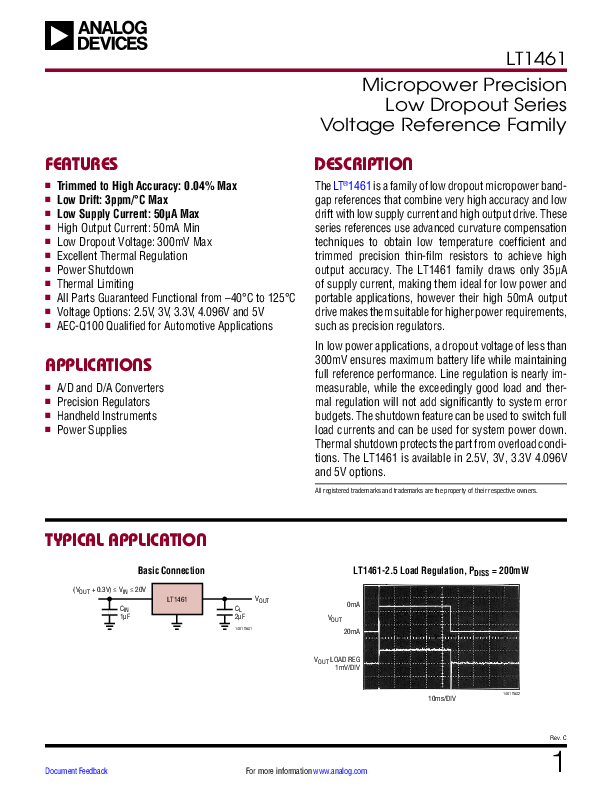
The LT�1461 is a family of low dropout micropower bandgap references that combine very high accuracy and low drift with low supply current and high output drive. These series references use advanced curvature compensation techniques to obtain low temperature coefficient and trimmed precision thin-film resistors to achieve high output accuracy. The LT1461 family draws only 35�A of supply current, making them ideal for low power and portable applications, however their high 50mA output drive makes them suitable for higher power requirements, such as precision regulators.
In low power applications, a dropout voltage of less than 300mV ensures maximum battery life while maintaining full reference performance. Line regulation is nearly immeasurable, while the exceedingly good load and thermal regulation will not add significantly to system error budgets. The shutdown feature can be used to switch full load currents and can be used for system power down. Thermal shutdown protects the part from overload conditions. The LT1461 is available in 2.5V, 3V, 3.3V 4.096V and 5V options.
All registered trademarks and trademarks are the property of their respective owners.

TYPICAL APPLICATION

Basic Connection

(VOUT + 0.3V)  VIN  20V CIN 1�F

LT1461

VOUT CL 2�F
1461 TA01

LT1461-2.5 Load Regulation, PDISS = 200mW

0mA VOUT
20mA
VOUT LOAD REG 1mV/DIV

10ms/DIV

1461 TA02

Rev. C

Document Feedback

For more information www.analog.com

1

LT1461

ABSOLUTE MAXIMUM RATINGS
(Note 1)
Input Voltage .............................................................20V Output Short-Circuit Duration........................... Indefinite Operating Temperature Range
(Note 2).............................................. �40�C to 125�C Storage Temperature Range (Note 3)...... �65�C to 150�C Specified Temperature Range
Commercial.............................................. 0�C to 70�C Industrial..............................................�40�C to 85�C High.................................................... �40�C to 125�C Lead Temperature (Soldering, 10 sec).................... 300�C

PIN CONFIGURATION

TOP VIEW

DNC* 1 VIN 2
SHDN 3 GND 4

8 DNC* 7 DNC* 6 VOUT 5 DNC*

S8 PACKAGE 8-LEAD PLASTIC SO
*DNC: DO NOT CONNECT TJMAX = 150�C, JA = 190�C/W
(Note 3)

ORDER INFORMATION

LEAD FREE FINISH LT1461ACS8-2.5#PBF LT1461ACS8-3#PBF LT1461ACS8-3.3#PBF LT1461ACS8-4#PBF LT1461ACS8-5#PBF LT1461BCS8-2.5#PBF LT1461BCS8-3#PBF LT1461BCS8-3.3#PBF LT1461BCS8-4#PBF LT1461BCS8-5#PBF LT1461CCS8-2.5#PBF LT1461CCS8-3#PBF LT1461CCS8-3.3#PBF LT1461CCS8-4#PBF LT1461CCS8-5#PBF LT1461AIS8-2.5#PBF LT1461AIS8-3#PBF LT1461AIS8-3.3#PBF LT1461AIS8-4#PBF LT1461AIS8-5#PBF LT1461BIS8-2.5#PBF LT1461BIS8-3#PBF LT1461BIS8-3.3#PBF LT1461BIS8-4#PBF LT1461BIS8-5#PBF LT1461CIS8-2.5#PBF LT1461CIS8-3#PBF LT1461CIS8-3.3#PBF

TAPE AND REEL LT1461ACS8-2.5#TRPBF LT1461ACS8-3#TRPBF LT1461ACS8-3.3#TRPBF LT1461ACS8-4#TRPBF LT1461ACS8-5#TRPBF LT1461BCS8-2.5#TRPBF LT1461BCS8-3#TRPBF LT1461BCS8-3.3#TRPBF LT1461BCS8-4#TRPBF LT1461BCS8-5#TRPBF LT1461CCS8-2.5#TRPBF LT1461CCS8-3#TRPBF LT1461CCS8-3.3#TRPBF LT1461CCS8-4#TRPBF LT1461CCS8-5#TRPBF LT1461AIS8-2.5#TRPBF LT1461AIS8-3#TRPBF LT1461AIS8-3.3#TRPBF LT1461AIS8-4#TRPBF LT1461AIS8-5#TRPBF LT1461BIS8-2.5#TRPBF LT1461BIS8-3#TRPBF LT1461BIS8-3.3#TRPBF LT1461BIS8-4#TRPBF LT1461BIS8-5#TRPBF LT1461CIS8-2.5#TRPBF LT1461CIS8-3#TRPBF LT1461CIS8-3.3#TRPBF

2

PART MARKING 461A25 1461A3 461A33 1461A4 1461A5 461B25 1461B3 461B33 1461B4 1461B5 461C25 1461C3 461C33 1461C4 1461C5 61AI25 461AI3 61AI33 461AI4 461AI5 61BI25 461BI3 61BI33 461BI4 461BI5 61CI25 461CI3 61CI33

PACKAGE DESCRIPTION 8-LEAD PLASTIC SO 8-LEAD PLASTIC SO 8-LEAD PLASTIC SO 8-LEAD PLASTIC SO 8-LEAD PLASTIC SO 8-LEAD PLASTIC SO 8-LEAD PLASTIC SO 8-LEAD PLASTIC SO 8-LEAD PLASTIC SO 8-LEAD PLASTIC SO 8-LEAD PLASTIC SO 8-LEAD PLASTIC SO 8-LEAD PLASTIC SO 8-LEAD PLASTIC SO 8-LEAD PLASTIC SO 8-LEAD PLASTIC SO 8-LEAD PLASTIC SO 8-LEAD PLASTIC SO 8-LEAD PLASTIC SO 8-LEAD PLASTIC SO 8-LEAD PLASTIC SO 8-LEAD PLASTIC SO 8-LEAD PLASTIC SO 8-LEAD PLASTIC SO 8-LEAD PLASTIC SO 8-LEAD PLASTIC SO 8-LEAD PLASTIC SO 8-LEAD PLASTIC SO

For more information www.analog.com

SPECIFIED TEMPERATURE RANGE 0�C to 70�C 0�C to 70�C 0�C to 70�C 0�C to 70�C 0�C to 70�C 0�C to 70�C 0�C to 70�C 0�C to 70�C 0�C to 70�C 0�C to 70�C 0�C to 70�C 0�C to 70�C 0�C to 70�C 0�C to 70�C 0�C to 70�C �40�C to 85�C �40�C to 85�C �40�C to 85�C �40�C to 85�C �40�C to 85�C �40�C to 85�C �40�C to 85�C �40�C to 85�C �40�C to 85�C �40�C to 85�C �40�C to 85�C �40�C to 85�C �40�C to 85�C
Rev. C

LT1461

ORDER INFORMATION

LEAD FREE FINISH

TAPE AND REEL

PART MARKING

PACKAGE DESCRIPTION SPECIFIED TEMPERATURE RANGE

LT1461CIS8-4#PBF

LT1461CIS8-4#TRPBF

461CI4

8-LEAD PLASTIC SO

�40�C to 85�C

LT1461CIS8-5#PBF

LT1461CIS8-5#TRPBF

461CI5

8-LEAD PLASTIC SO

�40�C to 85�C

LT1461DHS8-2.5#PBF LT1461DHS8-2.5#TRPBF

61DH25

8-LEAD PLASTIC SO

�40�C to 125�C

LT1461DHS8-3#PBF

LT1461DHS8-3#TRPBF

461DH3

8-LEAD PLASTIC SO

�40�C to 125�C

LT1461DHS8-3.3#PBF LT1461DHS8-3.3#TRPBF

61DH33

8-LEAD PLASTIC SO

�40�C to 125�C

LT1461DHS8-4#PBF

LT1461DHS8-4#TRPBF

461DH4

8-LEAD PLASTIC SO

�40�C to 125�C

LT1461DHS8-5#PBF

LT1461DHS8-5#TRPBF

461DH5

8-LEAD PLASTIC SO

�40�C to 125�C

AUTOMOTIVE PRODUCTS**

LT1461DHS8-2.5#WPBF LT1461DHS8-2.5#WTRPBF 61DH25

8-LEAD PLASTIC SO

�40�C to 125�C

LT1461DHS8-3#WPBF LT1461DHS8-3#WTRPBF

461DH3

8-LEAD PLASTIC SO

�40�C to 125�C

LT1461DHS8-3.3#WPBF LT1461DHS8-3.3#WTRPBF 61DH33

8-LEAD PLASTIC SO

�40�C to 125�C

LT1461DHS8-4#WPBF LT1461DHS8-4#WTRPBF

461DH4

8-LEAD PLASTIC SO

�40�C to 125�C

LT1461DHS8-5#WPBF LT1461DHS8-5#WTRPBF

461DH5

8-LEAD PLASTIC SO

�40�C to 125�C

Contact the factory for parts specified with wider operating temperature ranges. *The temperature grade is identified by a label on the shipping container.

Tape and reel specifications. Some packages are available in 500 unit reels through designated sales channels with #TRMPBF suffix.

**Versions of this part are available with controlled manufacturing to support the quality and reliability requirements of automotive applications. These models are designated with a #W suffix. Only the automotive grade products shown are available for use in automotive applications. Contact your local Analog Devices account representative for specific product ordering information and to obtain the specific Automotive Reliability reports for these models.

AVAILABLE OPTIONS

INITIAL ACCURACY 0.04% Max 0.04% Max 0.06% Max 0.06% Max 0.08% Max 0.08% Max 0.15% Max

TEMPERATURE COEFFICIENT 3ppm/�C Max 3ppm/�C Max 7ppm/�C Max 7ppm/�C Max 12ppm/�C Max 12ppm/�C Max 20ppm/�C Max

TEMPERATURE RANGE
0�C to 70�C �40�C to 85�C 0�C to 70�C �40�C to 85�C 0�C to 70�C �40�C to 85�C �40�C to 125�C

2.5V LT1461ACS8-2.5 LT1461AIS8-2.5 LT1461BCS8-2.5 LT1461BIS8-2.5 LT1461CCS8-2.5 LT1461CIS8-2.5 LT1461DHS8-2.5

3.0V LT1461ACS8-3 LT1461AIS8-3 LT1461BCS8-3 LT1461BIS8-3 LT1461CCS8-3 LT1461CIS8-3 LT1461DHS8-3

OUTPUT VOLTAGE 3.3V
LT1461ACS8-3.3 LT1461AIS8-3.3 LT1461BCS8-3.3 LT1461BIS8-3.3 LT1461CCS8-3.3 LT1461CIS8-3.3 LT1461DHS8-3.3

4.096V LT1461ACS8-4 LT1461AIS8-4 LT1461BCS8-4 LT1461BIS8-4 LT1461CCS8-4 LT1461CIS8-4 LT1461DHS8-4

5.0V LT1461ACS8-5 LT1461AIS8-5 LT1461BCS8-5 LT1461BIS8-5 LT1461CCS8-5 LT1461CIS8-5 LT1461DHS8-5

ELECTRICAL CHARACTERISTICS The l denotes the specifications which apply over the specified
temperature range, otherwise specifications are at TA = 25�C. VIN � VOUT = 0.5V, Pin 3 = 2.4V, CL = 2�F, unless otherwise specified.

PARAMETER

CONDITIONS

MIN

TYP

MAX

UNITS

Output Voltage (Note 4)

LT1461ACS8/LT1461AIS8 LT1461BCS8/LT1461BIS8 LT1461CCS8/LT1461CIS8 LT1461DHS8

�0.04 �0.06 �0.08 �0.15

0.04

%

0.06

%

0.08

%

0.15

%

Output Voltage Temperature Coefficient (Note 5)

LT1461ACS8/LT1461AIS8

l

LT1461BCS8/LT1461BIS8

l

LT1461CCS8/LT1461CIS8

l

LT1461DHS8

l

1

3

ppm/�C

3

7

ppm/�C

5

12

ppm/�C

7

20

ppm/�C

Rev. C

For more information www.analog.com

3

LT1461

ELECTRICAL CHARACTERISTICS The l denotes the specifications which apply over the specified
temperature range, otherwise specifications are at TA = 25�C. VIN � VOUT = 0.5V, Pin 3 = 2.4V, CL = 2�F, unless otherwise specified.

PARAMETER

CONDITIONS

MIN

TYP

MAX

UNITS

Line Regulation

(VOUT + 0.5V)  VIN  20V l

2

8

ppm/V

12

ppm/V

LT1461DHS8

l

15

50

ppm/V

Load Regulation Sourcing (Note 6)

VIN = VOUT + 2.5V 0  IOUT  50mA

12

30

ppm/mA

l

40

ppm/mA

Dropout Voltage
Output Current Shutdown Pin

LT1461DHS8, 0  IOUT  10mA

l

50

ppm/mA

VIN � VOUT, VOUT Error = 0.1%

IOUT = 0mA

IOUT = 1mA

l

IOUT = 10mA

l

IOUT = 50mA, I and C Grades Only l

0.06

V

0.13

0.3

V

0.20

0.4

V

1.50

2.0

V

Short VOUT to GND

100

mA

Logic High Input Voltage

l 2.4

V

Logic High Input Current, Pin 3 = 2.4V l

2

15

�A

Logic Low Input Voltage

l

Logic Low Input Current, Pin 3 = 0.8V l

0.5

0.8

V

4

�A

Supply Current

No Load

35

50

�A

l

70

�A

Shutdown Current

RL = 1k

25

35

�A

l

55

�A

Output Voltage Noise (Note 7) Long-Term Drift of Output Voltage, SO-8 Package (Note 8)

0.1Hz  f  10Hz 10Hz  f  1kHz
See Applications Information

8

ppmP-P

9.6

ppmRMS

60

ppm/kHr

Thermal Hysteresis (Note 9)

T = 0�C to 70�C T = �40�C to 85�C T = �40�C to 125�C

40

ppm

75

ppm

120

ppm

Note 1: Stresses beyond those listed under Absolute Maximum Ratings may cause permanent damage to the device. Exposure to any Absolute Maximum Rating condition for extended periods may affect device reliability and lifetime.
Note 2: The LT1461 is guaranteed functional over the operating temperature range of �40�C to 125�C.
Note 3: Output may shift due to thermal hysteresis. Thermal hysteresis affects parts during storage as well as operation.
Note 4: ESD (Electrostatic Discharge) sensitive device. Extensive use of ESD protection devices are used internal to the LT1461, however, high electrostatic discharge can damage or degrade the device. Use proper ESD handling precautions.
Note 5: Temperature coefficient is calculated from the minimum and maximum output voltage measured at TMIN, Room and TMAX as follows:
TC = (VOMAX � VOMIN)/(TMAX � TMIN) Incremental slope is also measured at 25�C.
Note 6: Load regulation is measured on a pulse basis from no load to the specified load current. Output changes due to die temperature change must be taken into account separately.
Note 7: Peak-to-peak noise is measured with a single pole highpass filter at 0.1Hz and a 2-pole lowpass filter at 10Hz. The unit is enclosed in a still-

air environment to eliminate thermocouple effects on the leads. The test time is 10 seconds. RMS noise is measured with a single pole highpass filter at 10Hz and a 2-pole lowpass filter at 1kHz. The resulting output is full-wave rectified and then integrated for a fixed period, making the final reading an average as opposed to RMS. A correction factor of 1.1 is used to convert from average to RMS and a second correction of 0.88 is used to correct for the nonideal bandpass of the filters.
Note 8: Long-term drift typically has a logarithmic characteristic and therefore, changes after 1000 hours tend to be much smaller than before that time. Total drift in the second thousand hours is normally less than one third that of the first thousand hours with a continuing trend toward reduced drift with time. Long-term drift will also be affected by differential stresses between the IC and the board material created during board assembly. See the Applications Information section.
Note 9: Hysteresis in output voltage is created by package stress that depends on whether the IC was previously at a higher or lower temperature. Output voltage is always measured at 25�C, but the IC is cycled hot or cold before successive measurements. Hysteresis is roughly proportional to the square of the temperature change. Hysteresis is not normally a problem for operational temperature excursions where the instrument might be stored at high or low temperature. See Applications Information section.

Rev. C

4

For more information www.analog.com

LT1461

TYPICAL PERFORMANCE CHARACTERISTICS Characteristic curves are similar for most LT1461s.
Curves from the LT1461-2.5 and the LT1461-5 represent the extremes of the voltage options. Characteristic curves for other output voltages fall between these curves and can be estimated based on their output.

REFERENCE VOLTAGE (V)

2.5V Reference Voltage vs Temperature
2.5020 TEMPCO �60�C TO 120�C
2.5015 3 TYPICAL PARTS
2.5010
2.5005
2.5000
2.4995
2.4990
2.4985
2.4980 � 60 � 40 � 20 0 20 40 60 80 100 120 TEMPERATURE (�C)
1461 G01
2.5V Minimum Input/Output Voltage Differential vs Load Current
10

OUTPUT VOLTAGE CHANGE (ppm)

2.5V Load Regulation
1600 VIN = 7.5V

1200 800

125�C 25�C

400 � 55�C

0

0.1

1

10

100

OUTPUT CURRENT (mA)

1461 G02

2.5V Supply Current vs Input Voltage
1000

SUPPLY CURRENT (�A)

INPUT/OUTPUT VOLTAGE (V)

1

0.1 0.1

125�C 25�C � 55�C

1

10

OUTPUT CURRENT (mA)

100
1461 G04

2.5V Output Impedance vs Frequency
1000
COUT = 2�F

COUT = 1�F 100

100 125�C 25�C
� 55�C

10 0

5

10

15

20

25

INPUT VOLTAGE (V)

1461 G05

2.5V Turn-On Time

20

VIN

10

0

RIPPLE REJECTION RATIO (dB)

LINE REGULATION (ppm/V)

2.5V Line Regulation vs Temperature
0

�1

�2

�3

�4

�5

�6

�7 SUPPLY  = 15V 5V � 20V
�8 �40 � 20 0 20 40 60 80
TEMPERATURE (�C)

100 120

1461 G03

2.5V Ripple Rejection Ratio vs Frequency
100

90

80

70

60 50

40

30

20

10

0 0.01

0.1

1

10

100 1000

FREQUENCY (kHz)

1641 G06

2.5V Turn-On Time

20

VIN

10

0

VOLTAGE (V)

VOLTAGE (V)

OUTPUT IMPEDANCE ()

2

10

VOUT

1

CIN = 1�F

0

CL RL

= =

2�F


1

0.01

0.1

1

10

TIME (100�s/DIV)

2 VOUT
1
0

CIN = 1�F CL = 2�F RL = 50

TIME (100�s/DIV)

FREQUENCY (kHz)

1461 G08

1461 G09

1461 G07

Rev. C

For more information www.analog.com

5

LT1461

TYPICAL PERFORMANCE CHARACTERISTICS Characteristic curves are similar for most LT1461s.
Curves from the LT1461-2.5 and the LT1461-5 represent the extremes of the voltage options. Characteristic curves for other output voltages fall between these curves and can be estimated based on their output.

2.5V Transient Response to 10mA Load Step

2.5V Line Transient Response

2.5V Output Noise 0.1Hz  f  10Hz

IOUT 0mA 10mA/DIV

5V VIN 4V

OUTPUT NOISE (10�V/DIV)

REFERENCE VOLTAGE (V)

VOUT 50mV/DIV
CL = 2�F

1461 G10

VOUT 50mV/DIV
CIN = 0.1�F

1461 G11

TIME (2SEC/DIV)

1461 G12

5V Reference Voltage vs Temperature
5.0040 TEMPCO �60�C TO 120�C
5.0030 3 TYPICAL PARTS 5.0020 5.0010 5.0000 4.9990 4.9980 4.9970 4.9960 4.9950 4.9940 4.9930
�60 �40 �20 0 20 40 60 80 100 120 TEMPERATURE (�C)
1461 G13
5V Minimum Input/Output Voltage Differential vs Load Current
10

LOAD REGULATION (ppm)

5V Load Regulation
2000 VIN = 10V
1600
1200

125�C 25�C
�55�C

800
400
0 0.1

25�C

�55�C

125�C

1

10

OUTPUT CURRENT (mA)

100
1461 G14

5V Supply Current vs Input Voltage
10000

INPUT/OUTPUT VOLTAGE (V)

SUPPLY CURRENT (�A)

1 25�C 125�C

1000 100

�55�C 0.1
10

125�C

�55�C

25�C

0.01 0.1
6

1

10

OUTPUT CURRENT (mA)

100
1461 G16

1

0

5

10

15

20

25

INPUT VOLTAGE (V)

1461 G17

For more information www.analog.com

RIPPLE REJECTION RATIO (dB)

LINE REGULATION (ppm/V)

5V Line Regulation vs Temperature
0

�1

�2

�3

�4

�5

�6

�7 SUPPLY  = 14V 6V TO 20V
�8 �40 �20 0 20 40 60 80
TEMPERATURE (�C)

100 120

1461 G15

5V Ripple Rejection Ratio vs Frequency
100

90

80

70

60 50

40

30

20

10

0 0.01

0.1

1

10 100 1000

FREQUENCY (kHz)

146R1 Ge1v8. C

LT1461
TYPICAL PERFORMANCE CHARACTERISTICS Characteristic curves are similar for most LT1461s.
Curves from the LT1461-2.5 and the LT1461-5 represent the extremes of the voltage options. Characteristic curves for other output voltages fall between these curves and can be estimated based on their output.

OUTPUT IMPEDANCE ()

5V Output Impedance vs Frequency
1000

100

COUT = 2�F

COUT = 1�F

10

1 0.01

0.1

1

FREQUENCY (kHz)

10
1461 G19

2V/DIV

5V Turn-On Time

6

VIN

4

2

0

VOUT

4

2

CIN = 1�F

0

COUT = 2�F

IOUT = 0

200�s/DIV

1461 G20

5V Transient Response to 10mA Load Step

5V Line Transient Response

0mA IOUT
10mA VOUT 50mV/DIV

7V VIN
6V VOUT 50mV/DIV

2V/DIV

5V Turn-On Time

6

VIN

4

2

0

VOUT

4

2

CIN = 1�F

0

COUT = 2�F

IOUT = 50mA

200�s/DIV

1461 G21

5V Output Noise 0.1Hz  f  10Hz

OUTPUT NOISE (10�V/DIV)

CL = 2�F

1461 G22

CIN = 0.1�F

1461 G23

TIME (2SEC/DIV)

1461 G24

SUPPLY CURRENT (�A)

Supply Current vs Temperature
50
IS 40
IS(SHDN)
30

20

10

0 � 40 �20

0 20 40 60 80 100 120 TEMPERATURE (�C)
1461 G25

CURRENT LIMIT (mA)

Current Limit vs Temperature
140

120

100

80

60

40 �50 �25

0 25 50 75 TEMPERATURE (�C)

100 125
1461 G26

For more information www.analog.com

SHDN PIN CURRENT (�A)

SHDN Pin Current vs SHDN Input Voltage
200
180

160

140

125�C

120

25�C

� 55�C

100

80

60

40 20

0

0

5

10

15

20

SHDN PIN INPUT VOLTAGE (V)

146R1eGv27. C

7

LT1461
TYPICAL PERFORMANCE CHARACTERISTICS Characteristic curves are similar for most LT1461s.
Curves from the LT1461-2.5 and the LT1461-5 represent the extremes of the voltage options. Characteristic curves for other output voltages fall between these curves and can be estimated based on their output.

8

NUMBER OF UNITS

NUMBER OF UNITS

NUMBER OF UNITS

0�C to 70�C Hysteresis

20

18

WORST-CASE HYSTERESIS ON 35 UNITS

16

14

70�C TO 25�C

0�C TO 25�C

12

10

8

6

4

2

0

�100 � 80 � 60 � 40 � 20

0

20

40

60

HYSTERESIS (ppm)

80 100
1461 G29

�40�C to 85�C Hysteresis

20

18

WORST-CASE HYSTERESIS ON 35 UNITS

16

14 85�C TO 25�C
12

� 40�C TO 25�C

10

8

6

4

2

0

�100 � 80 � 60 � 40 � 20

0

20

40

60

HYSTERESIS (ppm)

80 100
1461 G30

�40�C to 125�C Hysteresis

16

WORST-CASE HYSTERESIS 14 ON 35 UNITS

12

125�C TO 25�C

� 40�C TO 25�C

10

8

6

4

2

0

�200 �160 �120 �80 �40

0

40

HYSTERESIS (ppm)

80

120

160 200
1461 G31

For more information www.analog.com

Rev. C

LT1461
TYPICAL PERFORMANCE CHARACTERISTICS Characteristic curves are similar for most LT1461s.
Curves from the LT1461-2.5 and the LT1461-5 represent the extremes of the voltage options. Characteristic curves for other output voltages fall between these curves and can be estimated based on their output.

ppm

Long-Term Drift (Number of Data Points Reduced at 650 Hours)*
250 LT1461S8 3 TYPICAL PARTS SOLDERED ONTO PCB
200 TA = 30�C
150

100

50

0

�50 0

200 400 600 800 1000 1200 1400 1600 1800 2000 HOURS
1461 G28

*SEE APPLICATIONS INFORMATION FOR DETAILED EXPLANATION OF LONG-TERM DRIFT

Rev. C

For more information www.analog.com

9

LT1461

APPLICATIONS INFORMATION
Examples shown in this Applications section use the LT1461-2.5. The response of other voltage options can be estimated by proper scaling.
Bypass and Load Capacitors
The LT1461 family requires a capacitor on the input and on the output for stability. The capacitor on the input is a supply bypass capacitor and if the bypass capacitors from other components are close (within 2 inches) they

should be sufficient. The output capacitor acts as frequency compensation for the reference and cannot be omitted. For light loads 1mA, a 1�F nonpolar output capacitor is usually adequate, but for higher loads (up to 75mA), the output capacitor should be 2�F or greater. Figures 1 and 2 show the transient response to a 1mA load step with a 1�F output capacitor and a 50mA load step with a 2�F output capacitor.

IOUT 0mA 1mA/DIV 1mA
VOUT 20mV/DIV
1461 F01
Figure 1. 1mA Load Step with CL = 1�F

IOUT 50mA/DIV
VOUT 200mV/DIV
1461 F02
Figure 2. 50mA Load Step with CL = 2�F

Rev. C

10

For more information www.analog.com

LT1461

APPLICATIONS INFORMATION
Precision Regulator The LT1461 will deliver 50mA with VIN = VOUT + 2.5V and higher load current with higher VIN. Load regulation is typically 12ppm/mA, which means for a 50mA load step, the output will change by only 1.5mV. Thermal regulation, caused by die temperature gradients and created from load current or input voltage changes, is not measurable. This often overlooked parameter must be added to normal line and load regulation errors. The load regulation photo, on the first page of this data sheet, shows the output response to 200mW of instantaneous power dissipation and the reference shows no sign of thermal errors. The reference has thermal shutdown and will turn off if the junction temperature exceeds 150�C.
Shutdown The shutdown (Pin 3 low) serves to shut off load current when the LT1461 is used as a regulator. The LT1461 operates normally with Pin 3 open or greater than or equal to 2.4V. In shutdown, the reference draws a maximum supply current of 35�A. Figure 3 shows the transient response of shutdown while the part is delivering 25mA. After shutdown, the reference powers up in about 200�s.
5V
PIN 3
0V
VOUT
0V
1461 F03
Figure 3. Shutdown While Delivering 25mA, RL = 100

PC Board Layout
In 13- to 16-bit systems where initial accuracy and temperature coefficient calibrations have been done, the mechanical and thermal stress on a PC board (in a card cage for instance) can shift the output voltage and mask the true temperature coefficient of a reference. In addition, the mechanical stress of being soldered into a PC board can cause the output voltage to shift from its ideal value. Surface mount voltage references are the most susceptible to PC board stress because of the small amount of plastic used to hold the lead frame.
A simple way to improve the stress-related shifts is to mount the reference near the short edge of the PC board, or in a corner. The board edge acts as a stress boundary, or a region where the flexure of the board is minimum. The package should always be mounted so that the leads absorb the stress and not the package. The package is generally aligned with the leads parallel to the long side of the PC board as shown in Figure 5a.
A qualitative technique to evaluate the effect of stress on voltage references is to solder the part into a PC board and deform the board a fixed amount as shown in Figure 4. The flexure #1 represents no displacement, flexure #2 is concave movement, flexure #3 is relaxation to no displacement and finally, flexure #4 is a convex movement. This motion is repeated for a number of cycles and the relative
1
2
3
4
1461 F04
Figure 4. Flexure Numbers

For more information www.analog.com

Rev. C
11

LT1461

APPLICATIONS INFORMATION
output deviation is noted. The result shown in Figure 5a is for two LT1461S8-2.5s mounted vertically and Figure 5b is for two LT1461S8-2.5s mounted horizontally. The parts oriented in Figure 5a impart less stress into the package because stress is absorbed in the leads. Figures 5a and 5b show the deviation to be between 125�V and 250�V and implies a 50ppm and 100ppm change respectively. This corresponds to a 13- to 14-bit system and is not a problem for most 10- to 12-bit systems unless the system has a calibration. In this case, as with temperature hysteresis, this low level can be important and even more careful techniques are required.

The most effective technique to improve PC board stress is to cut slots in the board around the reference to serve as a strain relief. These slots can be cut on three sides of the reference and the leads can exit on the fourth side. This "tongue" of PC board material can be oriented in the long direction of the board to further reduce stress transferred to the reference.
The results of slotting the PC boards of Figures 5a and 5b are shown in Figures 6a and 6b. In this example the slots can improve the output shift from about 100ppm to nearly zero.

2

2

OUTPUT DEVIATION (mV)

OUTPUT DEVIATION (mV)

1

1

0

LONG DIMENSION

�1

0

10

20

30

FLEXURE NUMBER

Figure 5a. Two Typical LT1461S8-2.5s, Vertical Orientation without Slots

2

40
1461 F05a

0 SLOT

�1

0

10

20

30

40

FLEXURE NUMBER

1461 F06a

Figure 6a. Same Two LT1461S8-2.5s in Figure 5a, but with Slots

2

OUTPUT DEVIATION (mV)

OUTPUT DEVIATION (mV)

1

1

0

LONG DIMENSION

�1

0

10

20

30

FLEXURE NUMBER

Figure 5b. Two Typical LT1461S8-2.5s, Horizontal Orientation without Slots

40
1461 F05b

0 SLOT

�1

0

10

20

30

40

FLEXURE NUMBER

1461 F06b

Figure 6b. Same Two LT1461S8-2.5s in Figure 5b, but with Slots

Rev. C

12

For more information www.analog.com

LT1461

APPLICATIONS INFORMATION

Long-Term Drift
Long-term drift cannot be extrapolated from accelerated high temperature testing. This erroneous technique gives drift numbers that are wildly optimistic. The only way long-term drift can be determined is to measure it over the time interval of interest. The erroneous technique uses the Arrhenius Equation to derive an acceleration factor from elevated temperature readings. The equation is:

EA K


1� T1

1 T 2

AF = e

where: EA = Activation Energy (Assume 0.7) K = Boltzmann's Constant T2 = Test Condition in �Kelvin T1 = Use Condition Temperature in �Kelvin
To show how absurd this technique is, compare the LT1461 data. Typical 1000 hour long-term drift at 30�C = 60ppm. The typical 1000 hour long-term drift at 130�C = 120ppm. From the Arrhenius Equation the acceleration factor is:

AF

=

0.7  1 0.0000863 303
e

�

1 403

=

767

The erroneous projected long-term drift is:
120ppm/767 = 0.156ppm/1000 hr
For a 2.5V reference, this corresponds to a 0.39�V shift after 1000 hours. This is pretty hard to determine (read impossible) if the peak-to-peak output noise is larger than this number. As a practical matter, one of the best laboratory references available is the Fluke 732A and its long-term drift is 1.5�V/mo. This performance is only available from the best subsurface zener references utilizing specialized heater techniques.
The LT1461 long-term drift data was taken with parts that were soldered onto PC boards similar to a "real world" application. The boards were then placed into a constant temperature oven with TA = 30�C, their outputs were scanned regularly and measured with an 8.5 digit DVM.

As an additional accuracy check on the DVM, a Fluke 732A laboratory reference was also scanned. Figure 7 shows the long-term drift measurement system. The data taken is shown at the end of the Typical Performance Characteristics section of this data sheet. The long-term drift is the trend line that asymptotes to a value at 2000 hours. Note the slope in output shift between 0 hours and 1000 hours compared to the slope between 1000 hours and 2000 hours. Long-term drift is affected by differential stresses between the IC and the board material created during board assembly.

PCB3 PCB2 PCB1

SCANNER

8.5 DIGIT DVM

COMPUTER
1461 F07

FLUKE 732A LABORATORY REFERENCE
Figure 7. Long-Term Drift Measurement Setup
Hysteresis
The hysteresis curves found in the Typical Performance Characteristics represent the worst-case data taken on 35 typical parts after multiple temperature cycles. As expected, the parts that are cycled over the wider �40�C to 125�C temperature range have more hysteresis than those cycled over lower ranges. Note that the hysteresis coming from 125�C to 25�C has an influence on the �40�C to 25�C hysteresis. The �40�C to 25�C hysteresis is different depending on the part's previous temperature. This is because not all of the high temperature stress is relieved during the 25�C measurement.
The typical performance hysteresis curves are for parts mounted in a socket and represent the performance of the

For more information www.analog.com

Rev. C
13

LT1461

APPLICATIONS INFORMATION
parts alone. What is more interesting are parts IR soldered onto a PC board. If the PC board is then temperature cycled several times from �40�C to 85�C, the resulting hysteresis curve is shown in Figure 8. This graph shows the influence of the PC board stress on the reference.
When the LT1461 is soldered onto a PC board, the output shifts due to thermal hysteresis. Figure 9 shows the effect of soldering 40 pieces onto a PC board using standard IR reflow techniques. The average output voltage shift is �110ppm. Remeasurement of these parts after 12 days shows the outputs typically shift back 45ppm toward their initial value. This second shift is due to the relaxation of stress incurred during soldering.

The LT1461 is capable of dissipating high power, i.e., for the LT1461-2.5, 17.5V � 50mA = 875mW. The SO-8 package has a thermal resistance of 190�C/W and this dissipation causes a 166�C internal rise producing a junction temperature of TJ = 25�C + 166�C = 191�C. What will actually occur is the thermal shutdown will limit the junction temperature to around 150�C. This high temperature excursion will cause the output to shift due to thermal hysteresis. Under these conditions, a typical output shift is �135ppm, although this number can be higher. This high dissipation can cause the 25�C output accuracy to exceed its specified limit. For best accuracy and precision, the LT1461 junction temperature should not exceed 125�C.

NUMBER OF UNITS

12

11

WORST-CASE HYSTERESIS ON 35 UNITS

10

9

8

7

6

5

4

3

2

1

0 � 200 �160 �120 � 80

85�C TO 25�C

� 40

0

40

HYSTERESIS (ppm)

� 40�C TO 25�C
80 120 160 200
1461 F08

Figure 8. �40�C to 85�C Hysteresis of 35 Parts Soldered Onto a PC Board

NUMBER OF UNITS

12 10
8 6 4 2 0 �300 �200 �100 0 100 200 300
OUTPUT VOLTAGE SHIFT (ppm)
1461 F09
Figure 9. Typical Distribution of Output Voltage Shift After Soldering Onto PC Board

Rev. C

14

For more information www.analog.com

SIMPLIFIED SCHEMATIC
100k SHDN 3

LT1461
2 VIN 6 VOUT
4 GND
1461 SS

For more information www.analog.com

Rev. C
15

LT1461 PACKAGE DESCRIPTION

S8 Package 8-Lead Plastic Small Outline (Narrow .150 Inch)
(Reference LTC DWG # 05-08-1610 Rev G)

.050 BSC

.045 �.005

.189 � .197
(4.801 � 5.004) NOTE 3

8

7

6

5

.245

MIN

.160 �.005

.228 � .244

(5.791 � 6.197)

.150 � .157 (3.810 � 3.988)
NOTE 3

.030 �.005 TYP
RECOMMENDED SOLDER PAD LAYOUT

1

2

.010 (0.254

� �

.020 0.508)

�

45�

.008 � .010 (0.203 � 0.254)

0�� 8� TYP

.053 � .069 (1.346 � 1.752)

.016 � .050

(0.406 � 1.270)

NOTE: 1. DIMENSIONS

IN

INCHES (MILLIMETERS)

.014 � .019
(0.355 � 0.483) TYP

2. DRAWING NOT TO SCALE

3. THESE DIMENSIONS DO NOT INCLUDE MOLD FLASH OR PROTRUSIONS.

MOLD FLASH OR PROTRUSIONS SHALL NOT EXCEED .006" (0.15mm)

4. PIN 1 CAN BE BEVEL EDGE OR A DIMPLE

34
.004 � .010 (0.101 � 0.254)
.050 (1.270)
BSC
SO8 REV G 0212

Rev. C

16

For more information www.analog.com

REVISION HISTORY
REV DATE DESCRIPTION A 04/15 Features modified Correction to VIN description, Typical Application schematic Order Information updated Note 3 thermal hysteresis description updated Related Parts list updated B 09/15 Removed unneeded Pin Functions section C 10/19 Added automotive note to Order Information

LT1461
PAGE NUMBER 1 1 2 4 18 10 3

Information furnished by Analog Devices is believed to be accurate and reliable. However, no responsibility is assumed by Analog
Devices for its use, nor for any infringements of patents or other rights of third parties that may result from its use. Specifications
subject to change without notice. No license Fisogrrmanoterdebiny fiomrpmlicaattionn owrwotwhe.arwniasleougn.cdeormany patent or patent rights of Analog Devices.

Rev. C
17

LT1461 TYPICAL APPLICATION
35�A VCC LT1461-2.5
VOUT
GND

Low Power 16-Bit A/D

200�A

VCC 1�F

1�F INPUT

0.1�F

VCC FO
LTC2400

VREF SCK SD0

VIN

CS

SPI INTERFACE

GND

1461 TA03

NOISE PERFORMANCE*
VIN = 0V, VNOISE = 1.1ppmRMS = 2.25�VRMS = 16�VP-P VIN = VREF/2, VNOISE = 1.6ppmRMS = 4�VRMS = 24�VP-P VIN = VREF, VNOISE = 2.5ppmRMS = 6.25�VRMS = 36�VP-P
*FOR 24-BIT PERFORMANCE USE LT1236 REFERENCE

RELATED PARTS

PART NUMBER DESCRIPTION

COMMENTS

LT1460

Micropower Series References

0.075% Accuracy, 10ppm/�C Drift, 20mA Drive

LT1790

Micropower Series References

0.05% Accuracy, 10ppm/�C Drift, 60�A Supply Current

LTC�1798

Micropower Series Reference

200mV Dropout at 10mA Drive, Sinks 2mA, 4A Supply Current

LT6650

Micropower Reference and Buffer

0.5% Accuracy, 5.6A Supply Current, SOT23 Package

LTC6652

Micropower Series Reference

0.05% Accuracy, 5ppm/�C Drift, �40�C to 125�C Operation

LT6654 LT6656

All Purpose, Rugged and Precise Micropower References 0.05% Accuracy, 10ppm/�C Drift, �55�C to 125�C Operation, �10mA Output Drive, 100mV Dropout, 1.6ppmP-P Noise

1�A Precision Voltage Reference

0.05% Accuracy, 10ppm/�C, 800nA Supply Current, SOT-23 Package

LT6660

Tiny Micropower Series Reference

0.2% Accuracy, 20ppm/�C Drift, 20mA Drive, 2mm � 2mm DFN Package

18

For more information www.analog.com

Rev. C
10/19
www.analog.com
 ANALOG DEVICES, INC. 1999-2019