

File info: application/pdf · 20 pages · 2.38MB
SER 260D - Products - Fantech
Operation and Installation Manual, 1 pc ... the airfiow of the ENERGY Recovery Ventilator using the balancing procedure found in this manual.
Full PDF Document

If the inline viewer fails, it will open the original document in compatibility mode automatically. You can also open the file directly.
Extracted Text
Installation and Operation Manual

Item #: 428244 Rev Date: 2020-10-05

SER 260D
Energy Recovery Ventilator
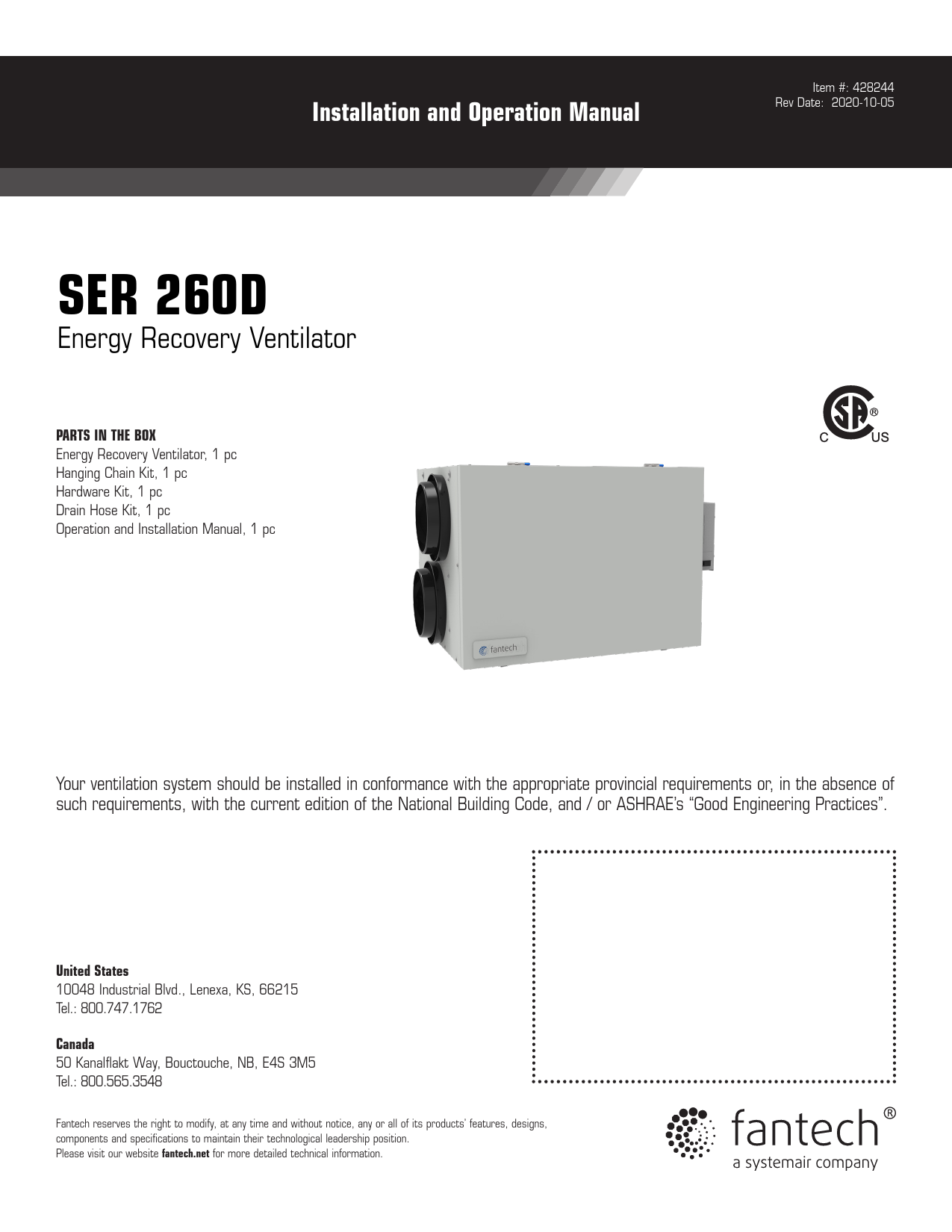
PARTS IN THE BOX Energy Recovery Ventilator, 1 pc Hanging Chain Kit, 1 pc Hardware Kit, 1 pc Drain Hose Kit, 1 pc Operation and Installation Manual, 1 pc

Your ventilation system should be installed in conformance with the appropriate provincial requirements or, in the absence of such requirements, with the current edition of the National Building Code, and / or ASHRAE's "Good Engineering Practices".
United States 10048 Industrial Blvd., Lenexa, KS, 66215 Tel.: 800.747.1762 Canada 50 Kanalflakt Way, Bouctouche, NB, E4S 3M5 Tel.: 800.565.3548
Fantech reserves the right to modify, at any time and without notice, any or all of its products' features, designs, components and specifications to maintain their technological leadership position. Please visit our website fantech.net for more detailed technical information.

2

Note

Warning/ Information Technical Practical tip

Important

information

note

PLEASE READ AND SAVE THESE INSTRUCTIONS
For residential use only
Before installation careful consideration must be given to how this system will operate if connected to any other piece of mechanical equipment, i.e. a forced air furnace or air handler operating at a higher static pressure. After installation, the compatibility of the two pieces of equipment must be confirmed by measuring the airflow of the ENERGY Recovery Ventilator using the balancing procedure found in this manual. It is always important to assess how the operation of any ERV may interact with vented combustion equipment (i.e. Gas Furnaces, Oil Furnaces, Wood Stoves, etc.)
Products are designed and manufactured to provide reliable performance, but they are not guaranteed to be 100% free of defects. Even reliable products will experience occasional failures, and this possibility should be recognized by the user. If these products are used in a life support ventilation system where failure could result in loss or injury, the user should provide adequate back-up ventilation, supplementary natural ventilation or failure alarm system, or acknowledge willingness to accept the risk of such loss or injury.
Your ventilation system should be installed in accordance with the local building code that is in effect, in absence of such requirements, it is recommenced to check with local authorities having jurisdiction in your area prior to installing this product.

3
TABLE OF CONTENTS
DETERMINING YOUR AIRFLOW REQUIREMENT  . . . . . . . . . . . . . . . . . . . . . . . . . . . . . . . . . . . . . . . . . . . . . . . . . . . . . . 4
INSTALLATION EXAMPLES Fully dedicated system  . . . . . . . . . . . . . . . . . . . . . . . . . . . . . . . . . . . . . . . . . . . . . . . . . . . . . . . . . . . . . . . . . 5 Partially dedicated system  . . . . . . . . . . . . . . . . . . . . . . . . . . . . . . . . . . . . . . . . . . . . . . . . . . . . . . . . . . . . . . 6 Simplified Installation  . . . . . . . . . . . . . . . . . . . . . . . . . . . . . . . . . . . . . . . . . . . . . . . . . . . . . . . . . . . . . . . . . . 7
EXTERIOR DUCTING INSTALLATION Weatherhood Location  . . . . . . . . . . . . . . . . . . . . . . . . . . . . . . . . . . . . . . . . . . . . . . . . . . . . . . . . . . . . . . . . . 8 Installing the ducting to the weatherhood  . . . . . . . . . . . . . . . . . . . . . . . . . . . . . . . . . . . . . . . . . . . . . . . . . . . . 8
INTERIOR DUCTING INSTALLATION General Tips . . . . . . . . . . . . . . . . . . . . . . . . . . . . . . . . . . . . . . . . . . . . . . . . . . . . . . . . . . . . . . . . . . . . . . . . . 9 Installing duct to ERV . . . . . . . . . . . . . . . . . . . . . . . . . . . . . . . . . . . . . . . . . . . . . . . . . . . . . . . . . . . . . . . . . . 9 Supply & Exhaust Air Grilles Location . . . . . . . . . . . . . . . . . . . . . . . . . . . . . . . . . . . . . . . . . . . . . . . . . . . . . . . 9
ERV INSTALLATION . . . . . . . . . . . . . . . . . . . . . . . . . . . . . . . . . . . . . . . . . . . . . . . . . . . . . . . . . . . . . . . . . . . . . . . . . 10
AIRFLOW ADJUSTMENT & BALANCING Start up procedure . . . . . . . . . . . . . . . . . . . . . . . . . . . . . . . . . . . . . . . . . . . . . . . . . . . . . . . . . . . . . . . . . . .  11 Airflow balancing  . . . . . . . . . . . . . . . . . . . . . . . . . . . . . . . . . . . . . . . . . . . . . . . . . . . . . . . . . . . . . . . . . . . .  11
LOW VOLTAGE CONTROL SYSTEMS  . . . . . . . . . . . . . . . . . . . . . . . . . . . . . . . . . . . . . . . . . . . . . . . . . . . . . . . . . . . . . 13 WIRING DIAGRAM . . . . . . . . . . . . . . . . . . . . . . . . . . . . . . . . . . . . . . . . . . . . . . . . . . . . . . . . . . . . . . . . . . . . . . . . .  14 TROUBLESHOOTING . . . . . . . . . . . . . . . . . . . . . . . . . . . . . . . . . . . . . . . . . . . . . . . . . . . . . . . . . . . . . . . . . . . . . . . . .  16 ERV MAINTENANCE CHART . . . . . . . . . . . . . . . . . . . . . . . . . . . . . . . . . . . . . . . . . . . . . . . . . . . . . . . . . . . . . . . . . . .  17 ERV CORE WASHING INSTRUCTION  . . . . . . . . . . . . . . . . . . . . . . . . . . . . . . . . . . . . . . . . . . . . . . . . . . . . . . . . . . . . .  18 PARTS LIST . . . . . . . . . . . . . . . . . . . . . . . . . . . . . . . . . . . . . . . . . . . . . . . . . . . . . . . . . . . . . . . . . . . . . . . . . . . . . . .  19

4
DETERMINING YOUR AIRFLOW REQUIREMENT

1 CFM = 0.47 L/s 1 L/s = 2.13 CFM

Room Count Method

Room classification Master bedroom
Basement

Number of rooms yes or no

Bedrooms Living room Others Kitchen Bathroom Laundry room

Utility room

CFM (L/s) x 10 L/s (20 CFM)
if yes add 10 L/s (20 CFM) if no = 0
x 5 L/s (10 CFM) x 5 L/s (10 CFM) x 5 L/s (10 CFM) x 5 L/s (10 CFM) x 5 L/s (10 CFM) x 5 L/s (10 CFM) x 5 L/s (10 CFM)

CFM Required = = = = = = = = =

Total Ventilation Requirements (add last column )

=

ASHRAE method

Floor area

Ft2

m2

1 CFM

Ventilation Air requirements

Bedrooms

2

3

L/s

CFM

L/s

CFM

L/s

<500 501-1000 1001-1500 1501-2000 2001-2500 2501-3000

<47 47-93 94-139 140-186 187-232 233-279

30

128

38

18

45

21

45

21

53

24

60

28

60

28

68

31

75

35

75

35

83

38

90

42

90

42

98

45

105

49

105

49

113

52

120

56

3001-3500 3501-4000 4001-4500 4501-5000

280-325 326-372 373-418 419-465

120

56

128

59

135

63

135

63

143

66

150

70

150

70

158

73

165

77

165

77

173

80

180

84

* ASHRAE 62.2-2016 Table 4.1, Ventilation and Acceptable Indoor Air Quality in Low-Rise Residential Buildings.

4

CFM

L/s

53

25

68

31

83

38

98

45

113

52

128

59

143

66

158

73

173

80

188

87

5

CFM

L/s

60

28

75

35

90

42

105

49

120

56

135

63

150

70

165

77

180

84

195

91

Bathroom: If the ERV is going to provide the required local exhaust ventilation for each bathroom with each a continuous 20 CFM (10 L/s), this ventilation rate can be considered as part of the whole-building ventilation rate.

INSTALLATION EXAMPLES
Example only � duct configuration may differ depending on the model.
FULLY DEDICATED SYSTEM BEST FOR NEW CONSTRUCTION
1. Stale air is drawn from key areas of the home requiring local exhaust (bathroom, kitchen, laundry room).
2. Fresh air is distributed directly to habitable rooms in the house (bedrooms, living room)
3. The ERV's airflow must be balanced after installation using the procedure found in the section "AIRFLOW BALANCING"

5
Suggested installation for: � Hydronic baseboard � Infloor heating � Electric baseboard � Mini split heat pump
Benefits: Provides the best fresh air distribution in the house; lowest operation cost since the furnace/air handler unit is not needed.

ERV ducting for fully Dedicated System
* Ductwork layout may differ depending on model
Fresh air from outside

Air from inside

Stale air to outside

Fresh air to living areas

* Unit air flow should be balanced while ERV is on "Normal" speed and furnace blower is running.

6
INSTALLATION EXAMPLES (CONT'D)
DIRECT CONNECTION of the FRESH air to living area to the RETURN PLENUM of the AIR HANDLER (Stale air drawn from key areas of home)
PARTIALLY DEDICATED SYSTEM (BETTER)
1. In order to provide proper distribution of the fresh air, it is recommended that the furnace blower be set to run continuously or interconnected with ERV. See furnace electrical connection on page 15.
2. Stale air is drawn from key areas of the home (bathroom, kitchen, laundry room).
3. Fresh air is supplied to the return air plenum of the furnace. 4. Due to the difference in pressure between the ERV and the equipment
it is being connected to the ERV's airflow must be balanced on site, using the procedure found in the section "AIRFLOW BALANCING" * In the case of a multi-zone system, please contact Fantech customer service prior to installing any installation type requiring the use of the furnace interlock"

Suggested installation for: � Central furnace (air
handling unit or central air conditioners) � When ducting fresh air to living area is not possible or practical, i.e. expensive or when the central AHU will operate year-round.
Benefits: Conditions the fresh air prior to distributing it throughout the house

ERV/Furnace ducting for Partially Dedicated System
* Ductwork layout may differ depending on model

Air return

Make sure the ERV is capable of meeting the required airflow rate.

Fresh air from outside

Air from inside

1 m (3' 3") min.
recommended
Motorized damper

Stale air to outside

Fresh air to living areas

Cold air return

* Unit air flow should be balanced while ERV is on "Normal" speed and furnace blower is running.

Fantech energy recovery ventilators (ERV) that use a supply fan shutdown for frost prevention do not include an outdoor air motorized damper. If you are using a simplified installation, i.e. connecting the ERV supply air duct to a furnace's return air duct, the ERV must operate continuously. When the ERV is turned off, no warm exhaust air will flow through the ERV but the furnace's fan will continue to draw in outdoor air directly into the furnace. If it's cold outside, cold air will be introduced, without re-heating, directly into the furnace.
If the ERV is installed such that the homeowner may turn off the ERV during the winter, we recommend installing a motorized damper between the ERV's supply air and the furnace's return air duct that closes when the ERV is not operating. See wiring diagram (figure 1). You may also choose to use a Fantech ERV that uses a recirculation defrost that incorporates an outdoor air damper.

24 VAC Transformer 24V

120V

COM

NO

ERV Furnace interlock See page 15.

Damper Motor

Figure 1
*Transformer and Damper motor not included

INSTALLATION EXAMPLES (CONT'D)
DIRECT CONNECTION of both the ERV SUPPLY AIR STREAM and EXHAUST AIR STREAM to the FURNACE COLD AIR RETURN
SIMPLIFIED INSTALLATION
(GOOD) (RETURN/RETURN METHOD)

7
Suggested installation for: � When bathroom and kitchen
already have local exhaust system � May be suitable for retrofitting
Benefits: Least expensive installation type

1. Furnace blower must operate when ventilation from ERV is required. The furnace should be set to run continuously or interlocked with ERV. See furnace electrical connection on page 15.
2. A minimum separation of 1m (39'') is recommended between the two direct connections.
3. In order to prevent exhausting any fresh air, the ERV's exhaust air connection should be upstream of the ERV's supply air connection when ducting to the furnace's cold air return.
4. Due to the difference in pressure between the ERV and the equipment it is being connected to the ERV's airflow must be balanced on site, using the procedure found in the section "AIRFLOW BALANCING"
* In the case of a multi-zone system, please contact Fantech customer service prior to installing any installation type requiring the use of the furnace interlock"
ERV/Furnace ducting for Simplified Installation - Option 1

* Ductwork layout may differ depending on model

Air return

Fresh air from outside

Air from inside
Motorized damper

1 m (3' 3")
min.
recommended

Stale air to outside

Fresh air to living areas
* Unit air flow should be balanced while ERV is on "Normal" speed and furnace blower is running.

1 m (3' 3")
min.
recommended

Fantech energy recovery ventilators (ERV) that use a supply fan shutdown for frost prevention do not include an outdoor air motorized damper. If you are using a simplified installation, i.e. connecting the ERV supply air duct to a furnace's return air duct, the ERV must operate continuously. When the ERV is turned off, no warm exhaust air will flow through the ERV but the furnace's fan will continue to draw in outdoor air directly into the furnace. If it's cold outside, cold air will be introduced, without re-heating, directly into the furnace.
If the ERV is installed such that the homeowner may turn off the ERV during the winter, we recommend installing a motorized damper between the ERV's supply air and the furnace's return air duct that closes when the ERV is not operating. See wiring diagram (figure 1). You may also choose to use a Fantech ERV that uses a recirculation defrost that incorporates an outdoor air damper.

Cold air return

24 VAC Transformer 24V

120V

COM

NO

ERV Furnace interlock See page 15.

Damper Motor

Figure 1
*Transformer and Damper motor not included

8
EXTERIOR DUCTING INSTALLATION

WEATHERHOOD LOCATION
� Decide where your intake and exhaust hoods will be located.

OUTSIDE CORNER 36" (1m)

Locating the Intake Weatherhood � Should be located upstream (if there are prevailing winds) from the
exhaust outlet. � At a minimum distance to 900 mm (3') away from dryer vents and furnace
exhaust (medium or high efficiency furnaces), driveways, oil fill pipes, gas meters, or garbage containers. � At a minimum height of 460mm (18'') above the ground, or above the level of expected snow accumulation. � Ideally, keep weatherhoods 1m (3') from corners. � Do not locate in the garage, attic, crawl space, or underneath deck.

INTAKE 18" (460mm)

Locating the Exhaust Weatherhood � At least 460mm (18") above ground or above the depth of expected snow accumulation � Ideally, keep weatherhoods 1m (3') from corners. � Not near a gas meter, electric meter or a walkway where fog or ice could create a hazard � Do not locate in a garage, workshop or other unheated space

INSTALLING THE DUCTING TO THE WEATHERHOODS
A well designed and installed ducting system will allow the ERV to operate at its
maximum efficiency. The inner liner of the flexible insulated duct must be secured to the sleeve of the weatherhood (as close to the outside as possible) and to the appropriate duct connection on the ERV. The insulation should remain full and not crushed. The outer liner, which acts as a vapor barrier, must be completely sealed to the outer wall and the ERV using tape and/or caulking. A good bead of high quality caulking (preferably acoustical sealant) will seal the inner flexible duct to both the ERV duct connection and the weatherhood prior to securing them.
To minimize airflow restriction, the flexible insulated duct that connects the two outside weatherhoods to the ERV should be stretched tightly and be as short as possible.
Twisting or folding the duct will severely restrict airflow. See "Installation Diagram Examples" for installation examples.

STEPS FOR HOOD INSTALLATION:

INSIDE CORNER 36" (1m)

3' (900mm) min.

EXHAUST 18" (460mm)

REQUIRES A WEATHERHOOD WITH A BACKDRAFT DAMPER ON THE EXHAUST SIDE.

1 Using the duct connection of the outside hood, outline the intake & exhaust holes to be cut. The holes should be slightly larger than the duct connection to allow for the thickness of the insulated flexible duct. Cut a hole for both the intake and exhaust hoods.

2 Pull the insulated flexible duct through the opening until it is well extended and straight. Slide the duct's inner vinyl sleeve over the hood duct connection and secure. Pull the insulation over the duct and pull the vapor barrier over the sleeve. Secure with appropriate tape or sealant.

3 Push the hood into the opening and then attach the hood to the outside wall with mounting screws. Repeat the installation procedure for both the supply and exhaust hoods.

4 Using a caulking gun, seal around both hoods to prevent any leaks.

9
INTERIOR DUCTING INSTALLATION
� To maximize airflow through the ductwork system, all ducts should be kept short and have as few bends or elbows as possible. � 45� elbows are preferable to 90�. � Use "Y" ducts instead of "T" ducts whenever possible. � All duct joints must be fastened with screws or duct sealant and wrapped with aluminum foil duct tape to prevent leakage. � Galvanized ducting from the ERV to the living areas in the house is recommended whenever possible, although flexible ducting
can be used in moderation when necessary. � To avoid possible noise transfer through the ductwork system, a short length (approximately 300 mm, 12'') of nonmetallic flexible
insulated duct should be connected between the ERV and the supply/exhaust ductwork system. � The main supply and return line to/from the ERV must have the same diameter as the duct connection or larger. � Branch lines to the individual rooms may be as small as 100 mm (4'').
Installing ducting to ERV
For flexible duct installation, slide flexible ducting onto duct connection. Then install a cable tie over flexible duct to prevent leakage between the ducting and the duct connection.
In the case of solid ducting, slide duct over duct connection, screw in place and seal.
Supply air grilles location
In homes without a forced air furnace, fresh air should be supplied to all habitable rooms, including bedrooms and living areas. It should be supplied from high wall or ceiling locations. Grilles that diffuse the air comfortably are recommended. In homes with a forced air furnace, you may want to connect the ERV to the furnace ductwork (see information below).
Exhaust air grilles location
The stale air exhaust system is used to draw air from the points in the house where the worst air quality problems occur. It is recommended that return air ducts be installed in the bathroom, kitchen, and laundry room. Additional return air ducts from strategic locations may be installed. The furnace return duct may also be used to exhaust from. In this method, the exhaust air is not ducted back from bathrooms, kitchens, etc to the ERV with "dedicated lines".
As per building codes and installation requirements for combustion appliances: Air return ducts, or openings for air return, should not be placed in enclosed spaces containing combustion appliances that are subject to spillage.

10
ERV INSTALLATION

� Have a nearby power supply (120 volts, 60Hz)
� Choose a location which allows the possibility of mounting the unit to supporting beams.
� The unit should be level in order to allow proper condensate drainage
� To minimize noise, do not install unit in living area
� Ensure proper drainage

LOCATION
The ERV must be located in a conditioned space where it will be possible to conveniently service the unit. Typically the ERV would be located in the mechanical room or an area close to the outside wall where the weatherhoods will be mounted. If a basement area is not convenient or does not exist, a utility room may be used.
Attic installation must meet the following conditions:
� Attic temperature must be above freezing conditions at all times and for best performance should be 12�C (54 �F).
� The condensate drain (if included) must be installed so that the condensate drains and is protected from freezing. � The attic is easily accessible for equipment maintenance and inspection.
Connecting appliances to the ERV is not recommended. These include:
� Clothes dryer � Range top � Stovetop fan � Central vacuum system � Bathroom exhaust fans unless they are specifically designed for this purpose These appliances may cause lint, dust or grease to collect in the ERV, damaging the unit.

Connecting any of these types of appliances to the ERV will void your warranty.

Mounting- Chain mount

1 Place fastening hooks on the strapping board or the floor joists.

2 Attach a hanging chain (provided) to each 19 mm (3/4") bolt (provided) in the top 4 corners of the unit and tighten.

3 Hang the unit by slipping a link onto the hanging hooks, making sure the unit is level.

4 Install a spring on each chain. Hook the spring in the links so a loop is created in the chain. The spring will then support the unit's weight and absorb vibrations.

11
INSTALLING DRAIN LINE
Through normal operation and during its defrost mode, the ERV may produce some condensation. This water should flow into a nearby drain, or be taken away by a condensate pump. The ERV and all condensate lines must be installed in a space where the temperature is maintained above the freezing point. A "P" trap should be made in the drain line. This will prevent odors from being drawn back up into the unit.
The drain nipple is placed upside down in the unit to prevent it being damaged during shipping or the installation of the unit. For both drain and drainless installation the drain nipple needs to be flipped.

1 Remove the nutsert.

2 Invert the drain nipple. Make sure to place gasket between the unit and the drain nipple inside the unit.

3 Secure the drain nipple using the nutsert.

4 Install the drain hose making a "P" trap, secure the condensate line drain connection using the tube clamp provided. Fill the condensate line with water.

Caution:
A Drain and Tubing (included) must be installed for all HRV units. For ERV units, drain is not required, however, it is recommended for climates where outdoor temperature typically remains below -25�C (-13�F) combined with an indoor relative humidity higher than 40% for a period of 24 hours or several days in a row.

Start up procedure

The Switch on the side of the unit is used to toggle between STANDBY, REDUCED speed and NORMAL speed modes.

Place the unit in NORMAL speed to perform the balancing.

Airflow balancing
IF THE UNIT'S AIR FLOWS ARE NOT PROPERLY BALANCED... � THE UNIT'S EFFICIENCY MAY BE REDUCED. � THE UNIT'S CORE MAY BECOME DAMAGED. � NORMAL OPERATION OF THE UNIT COULD CAUSE THE PRESSURIZATION OR DEPRESSURIZATION OF YOUR HOME, WHICH CAN LEAD TO AIR LEAKS OR BACKDRAFTING OF ANY COMBUSTION APPLIANCES.
The balancing procedure consists of measuring the supply air flow and the return air flow to ensure that they are equal. A difference of up to 10% is considered acceptable. In the cases where the air flow is not exactly the same, it is recommended to have a higher return air flow to ensure that the temperature of the supply air flow coming from outside is as close to room temperature as possible.
For optimal performance, ERV unit should be re-balanced after a major renovation or after the installation of extra grilles or registers.

12
Airflow balancing (Cont'd)
Adjusting airflows
A damper is integrated into the Fresh Air to Building collar and on to the Stale Air to Outside. This damper replaces the installation of a separate damper into the Fresh Air to Building and on to the Stale Air to Outside ducting line.
The damper-collar is pre-set in the fully opened position. If the procedure requires a reduction in airflow to the fresh air duct, simply turn positioning knob located on the side of the collar clockwise until desired airflow is obtained. The damper position can be determined by the orientation of the pointers situated on the side of the damper. The damper is fully open when the pointers are towards the top of the collar (as shown in picture) and fully closed when they are sideways.
Once procedure is completed, install a piece of tape over positioning knob to avoid any tampering by the home owner.
WARNING! DO NOT TURN POSITIONING KNOB COUNTERCLOCKWISE WHEN DAMPERS ARE FULLY OPENED AS DAMAGE MAY OCCUR TO THE MECHANISM
Measuring the airflow using station (grid) method

1 Cut hole in duct and insert flow measuring station. Make sure that the flow measuring station's air direction arrow points in the direction of the airflow. Secure the flow measuring station with duct tape.

2 Before taking the reading, make sure that the magnehelic gauge is level and at 0. Refer to the flow measuring station's chart to determine your unit's airflow velocity.

3 Adjust the "Supply Air Out" damper until you reach the desired velocity. Follow steps 1-3 to adjust the "Exhaust Air Out" damper, if needed.

Minimum 457mm (18")
Measure here

Measure here
Minimum 457mm (18")

� To avoid airflow turbulence and incorrect readings, the airflow velocity should be measured on a section of steel ducting. Reading should also be taken at a minimum distance of 457 mm (18") from the unit or elbow. Measurement should also be made prior to any transition in the duct work so entire airflow is measured.

Low Voltage Control Systems
* Please see instruction manuals for individual controls for proper wiring and set up of control systems.

CENTRAL CONTROLS These cannot be used with another central control

CONTROLS

FEATURES

CONNECT TO

ECO-Touch�

� Our most complete, yet easy to use control system

� Sleek design with backlight touchscreen LCD

� ECO mode selects the best operating mode and speed for the season, minimizing energy use associated with ventilation
� Set preferred indoor relative humidity range and ventilation mode for day

W W

and night conditions

� No battery to replace, all programmed settings are retained during power

outage

� Maintenance reminder indicator

� Error code messages reduce troubleshooting time

EDF7

� MODE button provides 3 modes of operations: Ventilation , Recircula-

tion and Standby

� User selected fan speed: Reduced, Medium, Normal and 20 minutes W

per hour

W

� AUTO setting allows the homeowner to deactivate the dehumidistat

� When the humidity exceeds the desired setpoint, the ventilation sys-

tem operates at Normal speed.

� Once the desired humidity level is achieved, your ventilation system

resumes to its previous mode of operation

EDF1

� Press button once for continuous Reduced speed

� Press button twice and the unit will cycle 20 minutes ON/ 40 minutes

OFF and repeat

W

� Press button a third time and the system will run continuously on HIGH W

speed

AUXILIARY CONTROL �These controls can be paired with central controls or combined together.

RTS2*

� 20- minute timer with LED light � Boosts system to high speed with the touch of a button � Up to 5 can be used in one system � Use in bathroom, kitchen, laundry room

13
1. Ensure that unit is not plugged when connecting the control
2. Recirculation mode is only available with the "R" suffix at the end of the model number.
The wiring connectors can be removed for easier connection.
*Maintain polarity between control and ERV
(+  + ; - -)
+T -T

RTS5

� 20/40/60 minute timer with LED light

� Boosts system to high speed with the touch of a button

+T

� Up to 5 can be used in one system

-T

� Use in bathroom, kitchen, laundry room

MDEH1

� Rotary dial Dehumidistat

� Multiple units can be used

� We recommend setting the relative humidity above 80% during the summer
D
D

SW3 SW2

14
WIRING DIAGRAM

Observe polarity on all accessory controls where applicable.

Blu Org

DAMPER MOTOR

Blk

Yel

Brn Pur

REDUCED

RED

STAND BY

GRN

NORMAL

BLK

SW1

SPEEDS LOW 55V

HIGH 120V
JP5

90V 75V
JP3

SPEED JUMPER SETTINGS

WHITE BLUE BLACK

YELLOW

RED

TR1
BROWN GREY
BROWN

T.P

HIGH

SPEEDS LOW

120V JP5

90V JP3

AUTO XFMR

55V

75V

BLACK NO COM
WHITE

NO COM PC

CAP4

WHT/BLK

CAP3

CAP1

CAP2

WHT/RED

WHT/BLK GREY BLACK

BROWN
BLUE EXH 1
BLACK

WHT/BLK GREY BLACK
WHT/RED BLUE RED

BROWN
BLUE EXH 2
BLACK
BROWN
BLUE SUP 1
BLACK

WHT/RED BLUE RED

BROWN
BLUE SUP 2
BLACK

NO C NC
F4 Damper Voltage

J2 J1

J4 J3

J6 J5

J7

T+ TW W D+ D-

A

B

S-

S+

LEGEND: Low voltage factory wiring Line voltage factory wiring. Optional components
NOTES: 1. Use speci ed CSA/UL certi ed
glass fuse: MUST be 3A with I�T>20.

Model
SER260 SHR260RD

JUMPER SETTINGS
J7 J6 J5 J4 J3 J2 J1
OFF OFF OFF ONONONON ON OFF OFF OFF ONONON

Damper Voltage Jumper Settings
Speed Jumper Settings
JP3 90V JP5 120V

15
WIRING DIAGRAM (CONT'D)

WIRING DIAGRAM TO FURNACE
FOR A FURNACE CONNECTION TO A COOLING SYSTEM:
On some newer furnaces and older thermostats, energizing the R and G terminal at the furnace has the effect of energizing the Y at the thermostat and thereby turning on the cooling system. If you identify this type of thermostat, you must use the "Alternate Furnace Interlock Wiring"

SSttaannddaardrdAFcucrensascoeryInCtoenrtlrooclkCWonirtaincgt
THERMOSTAT TERMINALS

FOUR WIRE TWO WIRE heating only
W
R
G
C Y
FURNACE 24-VOLT TERMINAL BLOCK

W

R

GY

TWO WIRE

COOLING SYSTEM

AlAteltrenrantaivtee AFcucrensascoeryInCteornltorcokl WCoinrtinacgt
THERMOSTAT TERMINALS

FOUR WIRE TWO WIRE heating only
W
R
G
C Y
FURNACE 24-VOLT TERMINAL BLOCK

W

R

GY

WIRE JOINT
TWO WIRE

COOLING SYSTEM

As per building codes and installation requirements for combustion appliances: Air return ducts, or openings for air return, should not be placed in enclosed spaces containing combustion appliances that are subject to spillage.

16
TROUBLESHOOTING

Problem

Causes

Solutions

Air is too dry Air is too humid
Persistent condensation on window Poor Air Flows
Supply air feels cold

Dehumidistat control is set too low
ERV out of balance Dehumidistat control is set too high
Sudden change in temperature
Storing too much wood for heating
Dryer vent exhaust is inside home Poor air circulation near windows ERV out of balance Well sealed basement door is closed Failed damper system may be stuck in recirculation
mode Improper adjustment of dehumidistat control
ERV out of balance Poor air circulation near windows 1/4" (6mm) mesh on the outside hoods is plugged Filters plugged Core obstructed Indoor grilles closed or blocked Inadequate power supply at site Ductwork is restricting airflow Improper speed control setting
ERV airflow improperly balanced Ducting has fallen down or been disconnected from ERV Poor location of supply grilles, the airflow may irritate
the occupant
Outdoor temperature extremely cold

Increase the desired level of humidity. Change ventilation mode from continuous mode to standby. Have contractor balance ERV airflows
Reduce the desired level of humidity. Combine this with the use of continuous exchange mode. Wait until outside temperature stabilizes (winter). Heating will also improve situation. Store a majority of your wood outside. Even dried, a cord of wood contains more than 20 gallons of water. Make sure the dryer vent is exhausting outside.
Open curtains or blinds. Have contractor balance ERV airflows
Open the door or install a grill on the door.
Check defrost damper. If damper is always blocking incoming fresh air, have contractor verify damper system.
Reduce the desired level of humidity. Combine this step with use of continuous exchange mode. Have contractor balance ERV
Open curtains or blinds.
Clean exterior hoods or vents
Remove and clean filter
Remove and clean core
Check and open grilles
Have electrician check supply voltage
Check duct installation
Increase the speed of the ERV (i.e. change unit control from REDUCED to NORMAL speed)
Have contractor balance ERV airflows
Have contractor reconnect ducting
Locate the grilles high on the walls or under the baseboards, install ceiling mounted diffuser or grilles so as not to directly spill the supply air on the occupant (eg. Over a sofa) Turn down the ERV supply speed. A small duct heater (1kw) could be used to temper the supply air Placement of furniture or closed doors is restricting the movement of air in the home If supply air is ducted into furnace return, the furnace fan may need to run continuously to distribute ventilation air comfortably

ERV and/or Ducts frosting up
Condensation or Ice Build Up in Insulated Duct to the Outside
LED is flashing

ERV air flows are improperly balanced Malfunction of the ERV defrost system Incomplete vapor barrier around insulated duct A hole or tear in outer duct covering Everything is in good operations

Have HVAC contractor balance the ERV airflows Note: minimal frost build-up is expected on the core before unit initiates
defrost cycle functions Tape and seal all joints
Tape any holes or tears made in the outer duct covering Ensure that the vapor barrier is completely sealed.

LED is not flashing

No Power is being transmitted to the Control Board

Note: It is best to get the unit checked by a certified HVAC Contractor/Technician.

Make sure unit is plugged. Transformer may need replacing.

ERV MAINTENANCE CHART

Maintenance Required Recommended Frequency Date Maintenance Performed

Check and Clean Filters Every 3 months or if dirty

Check Energy Recovery Every 6 months Core

Check Drain Pan and Lines

Every 3 months

Vacuum the Inside of the Annually Unit

Clean and Un-block Outside Hoods

Annually

Clean and Inspect Duct Annually Work

General Servicing by a Annually Qualified Contractor

* Schedule may be altered to meet your own needs. More frequent servicing may be required depending on the severity of your home's indoor and outdoor environments.

Contractor

Telephone Number

Date Serviced

17
Limited Warranty
� The Energy recovery core has limited 5 year warranty.
� The warranty is limited to 5 years on parts and 7 years on fans from the date of purchase, including parts replaced during this time period. If there is no proof of purchase available, the date associated with the serial number will be used for the beginning of the warranty period.
� The fans found in all Fantech ERVs require no lubrication, and are factory balanced to prevent vibration and promote silent operation.
� The limited warranty covers normal use. It does not apply to any defects, malfunctions or failures as a result of improper installation, abuse, mishandling, misapplication, fortuitous occurrence or any other circumstances outside Fantech's control.
� Inappropriate installation or maintenance may result in the cancellation of the warranty.
� Any unauthorized work will result in the cancellation of the warranty.
� Fantech is not responsible for any incidental or consequential damages incurred in the use of the ventilation system.
� Fantech is not responsible for providing an authorized service centre near the purchaser or in the general area.
� Fantech reserves the right to supply refurbished parts as replacements.
� Transportation, removal and installation fees are the responsibility of the purchaser.
� The purchaser is responsible to adhering to all codes in effect in his area.
* This warranty is the exclusive and only warranty in effect relative to the ventilation system and all other warranties either expressed or implied are invalid.

18
ERV CORE WASHING INSTRUCTIONS
For proper maintenance of your energy recovery core please follow these instructions

1

2

3

5

4

1 Remove both filters by sliding them out.
2 Remove the core from the unit.
3 With one of your core's air inlets facing down, place it in a large sink, bathtub, or shower.
4 Pour clean tap water through the face of the core facing upwards until it runs clear. Ensure the entire surface is rinsed.
5 Rotate the core so that its other air inlet is facing down and repeat step 5.
6 With plates still oriented vertically allow the core to dry, normally 2-3 hours.
7 Slide back the core into the unit
8 Replace both filters.

6 7

8

PARTS LIST

19
12

2

4

BOM #
1 2 3 4 5 6 7 8 9 10 12 13

5 13 10

Description
8" Collar 8" Collar Insert Temperature Probe Electrostatic Filters Kit 11.5" x 11" Energy Recovery Cell Door Switch Capacitors, 6uF Electronic Board Auto-Transformer Control Switch Kit Drain Plug Motor Assembly Kit, Filter,2xMERV6,11.5x11.4"
Door Kit* Kit, Chain

SER260D (99299) 410533 411467 40326 40328 422712 410867 422677 402004 411963 410213 40315 405520 414911 445194 404261

8 7 9
1
** If the first set of digits (can be between 7 and 10 digits long) of your serial number is # 1005044790 or lower, your replacement door kit is #427141. ** Si la premi�re s�rie de chiffres ( entre 7 et 10 chiffres) de votre num�ro de s�rie est 1005044790 ou moins, votre porte de volet de remplacement est #47141.

Fantech reserves the right to make technical changes. For updated documentation please refer to www.fantech.net
Fantech�