

ANZ 2019 ESG Supplement
File info: application/pdf · 88 pages · 10.98MB
ANZ 2019 ESG Supplement
global standard for reporting community investment (available on https:// corporate-citizenship.com/our-insights/lbg-guidance- · manual/);.
Extracted Text
ANZ
2019 ESG SUPPLEMENT
Managing our ESG opportunities and risks

COVER STORY
Growing business sustainably

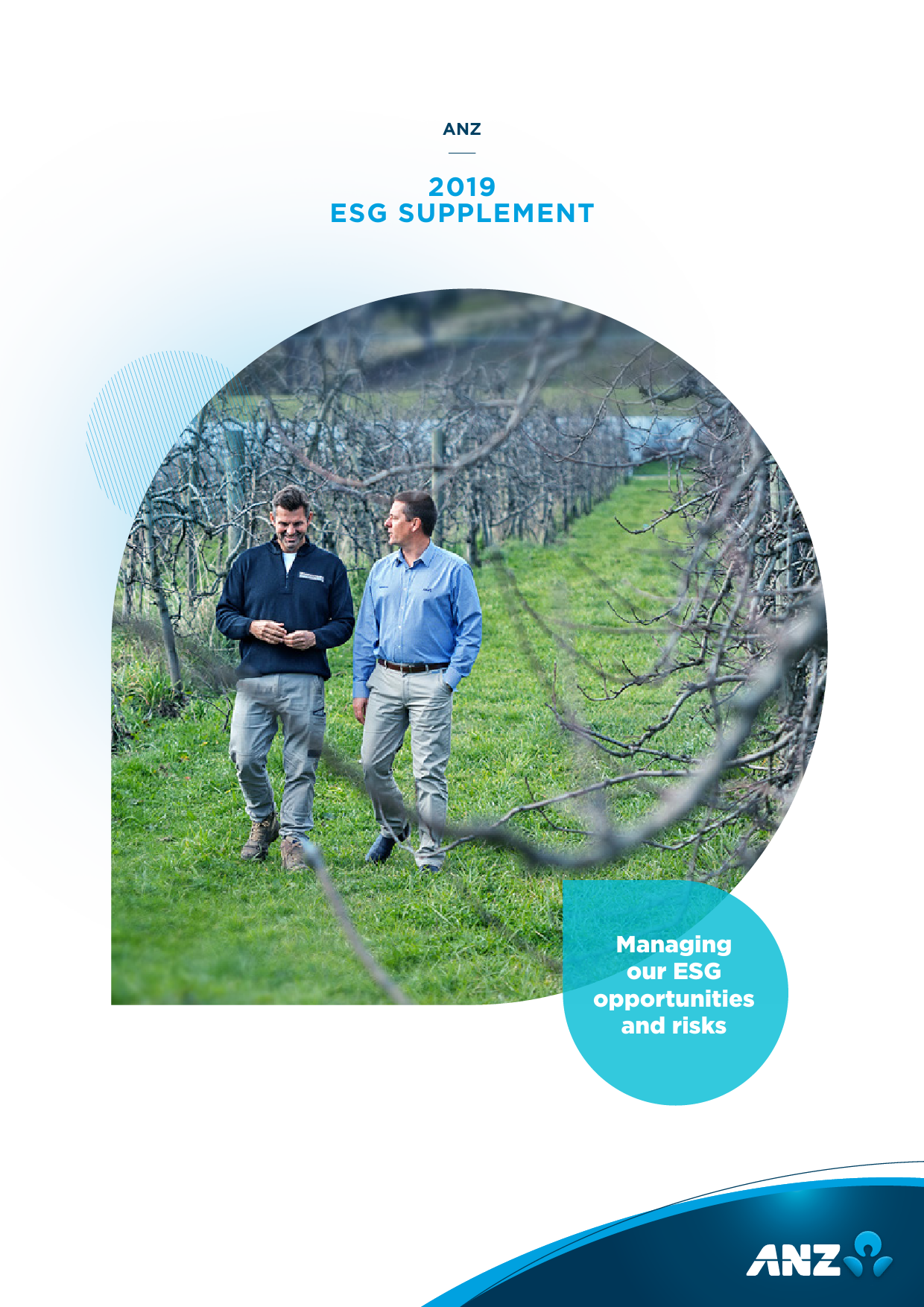
Willie Smith's Organic Apples and Cider is a family-run business in Huonville, Tasmania. The family started apple farming in 1888 and the business has since evolved into a premium supplier of organic apples, cider and spirits.

Over the years they have faced many challenges, including bushfires and the collapse of Tasmania's apple export industry in 1973 (the result of Britain joining the European Common Market). In response, Ian Smith, a third-generation orchardist, built controlledatmosphere cool stores and began exporting to Asia in the 1980s.
More recently his son Andrew has converted the orchard into an organic farm, in the belief that growing food without the need for chemical fertilisers and pesticides is better for their land, their customers and the Tasmanian environment.
Willie Smith's has had a banking relationship with ANZ for more than 100 years. In June this year members of our Board and Executive visited the cider production facilities and packing shed,

meeting with the workers and learning about what matters to them and their local community.
"I have worked hard to evolve Willie Smith's into a vertically integrated agribusiness in the last 20 years. The key ingredients have been innovation, hard work and good relationships. I feel confident and comfortable in our working relationship with ANZ," said Andrew.
Supporting the agricultural sector is an important part of ANZ's history, and banking customers like Willie Smith's aligns with our focus on helping our customers grow their business sustainably.
Image: Andrew Smith

Contents

Our 2019 reporting suite

1

2019 ESG performance snapshot

2

About our business

4

ESG governance and risk management

5

What matters most

6

Stakeholder engagement

9

Becoming a fairer and more responsible bank

11

ESG targets

12

Improving conduct and culture

14

Employee engagement, development and wellbeing

16

Delivering improved customer outcomes

18

Supporting customers potentially vulnerable to financial difficulty 22

Managing customer complaints

24

Improving customer experience through digital solutions

26

Cyber security

28

Data protection

29

Financial crime

30

Respecting human rights

32

Managing ESG risks in our supply chain

34

Responsible business lending

35

Supporting the transition to a net-zero carbon economy

37

Green Bond impact report � summary

40

Reducing our environmental footprint

41

Housing

44

Financial wellbeing

47

Workplace participation and diversity

53

Supporting Indigenous Australians

56

Building an accessible and inclusive bank

58

Community investment

60

Voluntary tax transparency

64

2019 ESG performance summary

66

Responsible business lending

67

Environment

70

Employees

72

Community

78

Customers

79

Voluntary tax transparency

81

Explanatory notes

82

Independent Limited Assurance Report to the Directors of ANZ

Banking Group Limited

83

ANZ 2019 ESG SUPPLEMENT

Our 2019 reporting suite

2019 Annual Report anz.com/annualreport

2019 ESG Supplement anz.com/cs

2019 Climate-related Financial Disclosures 2019 Corporate Governance Statement

anz.com/annualreport

anz.com/corporategovernance

About this Environment, Social and Governance (ESG) Supplement
This provides stakeholders with more detailed information on the Australia and New Zealand Banking Group Limited's1 ESG performance and challenges.
It is structured in three sections. The first outlines our purpose and values; our approach to ESG governance and risk management; our approach to the identification and prioritisation of material issues; our stakeholder engagement and our 2020 ESG targets.
The second section our management of materially significant issues aligning with our priority areas of fair and responsible banking, environmental sustainability, housing and financial wellbeing.
The third section contains our comparative performance data.
This report has been prepared in accordance with the GRI Standards: Comprehensive option. A complete GRI Index is available on anz.com/cs.
KPMG has provided limited assurance in respect of this ESG Supplement, including considering whether the appropriate indicators have been reported in accordance with GRI Sustainability Reporting Standards Comprehensive level of disclosure. KPMG has also provided limited assurance over ESG content2 within our Annual Report, Annual Review and our 2019 Climate-related Financial Disclosures report. A copy of KPMG's independent limited assurance report is on pages 83�84.
This report covers all ANZ operations worldwide over which, unless otherwise stated, we have control for the financial year commencing on 1 October 2018 and ending 30 September 2019. Monetary amounts in this document are reported in Australian dollars, unless otherwise stated.

Reporting suite
We produce a suite of reports to meet the needs and requirements of a wide range of stakeholders, including investors, customers, employees, regulators, non-government organisations and the community.
This ESG Supplement complements our 2019 Annual Report available on anz.com/annualreport. In preparing pages 1 to 65 of the Annual Report we applied aspects of the International Integrated Reporting Framework to describe how our business model, strategy, governance and risk management processes are addressing risks and opportunities in our operating environment and delivering value for our stakeholders.
Our 2019 Corporate Governance Statement discloses how we have complied with the ASX Corporate Governance Council's `Corporate Governance Principles and Recommendations � 3rd edition' available on anz.com/corporategovernance.
Our 2019 Climate-related Financial Disclosures are contained in a separate document available on anz.com/annualreport.
Additional disclosures are available on anz.com/shareholder/centre.
We are continually seeking to improve our reporting suite and welcome feedback on this report. Please address any questions, comments or suggestions to corporate.sustainability@anz.com.
Political donations
ANZ policy is that we will make an annual donation to each of the major parties. On 6 October 2017, ANZ made donations of $150,000 to the Federal Liberal and Labor parties. The payments were incorrectly treated as having been reported for the 2016�17 financial year and were not reported in 2017�18.
ANZ filed an amended Australian Electoral Commission return for the 2017�18 year in February 2019 on discovery of the error.

1. Group: Australia and New Zealand Banking Group Limited (the Company) and the entities it controlled at the year end and from time to time during the financial year (together, the Group). 2. ESG content includes the following sections of the 2019 Annual Report and 2019 Annual Review: 2019 Performance Snapshot, What Matters Most, Working with our stakeholders, Becoming a
fairer and more responsible bank, Our Customers, Our People, Our Community, Risk Management: Our approach to climate change and ESG metrics on page 65. 3. The 2019 Annual Review is comprised of pages 1 to 65 and 229 to 230 of the 2019 Annual Report and a Remuneration Overview.
1

2019 ESG performance snapshot

77%
employee engagement

$142.2m

32.5%
representation of women in leadership roles2

Almost
$
1 million
people reached through our financial wellbeing programs3

in community investment1
$
$19.1b
funded and facilitated in environmentally sustainable
solutions since 2015

42.4%

of employees volunteered
CO 2
25%
reduction in scope 1 and 2 greenhouse gas emissions
against a 2015 baseline

730+
people recruited from under-represented groups4

Ranked
4TH
Australia5 and New Zealand6 retail Net Promoter Score

1. Figure includes forgone revenue of $109 million, being the cost of providing low or fee free accounts to a range of customers such as government benefit recipients, not-forprofit organisations and students.
2. Measures representation at the Senior Manager, Executive and Senior Executive levels. Includes all employees regardless of leave status but not contractors (who are included in FTE).
3. MoneyMinded, MoneyBusiness and Saver Plus since 2002, employment and community programs and targeted banking products and services for small business and retail customers.

4. Including Aboriginal and Torres Strait Islander peoples, people with disability and refugees since 2016.
5. Roy Morgan Research Single Source, Australian population aged 14+, Main Financial Institution, six-month rolling average to Sep'19. Ranking based on the four major Australian banks.
6. Retail Market Monitor, Camorra Research, six-month rolling average to Sep'19. Ranking based on the five major New Zealand banks.

2

ANZ 2019 ESG SUPPLEMENT

$

Over 87,000 people
participated in MoneyMinded
in 2019
COMMUNITY STORY
MoneyMinded � building the confidence to save

Reshma and her daughter Asmaa completed MoneyMinded through the Brotherhood of St Laurence's `Stepping Stones' program.

Reshma arrived in Australia from Dubai seven years ago with her husband and three children. Reshma and her husband were born and grew up in the southern region of India however moved to Dubai when her husband found work. In Dubai, life was a financial struggle. The family were planning to move back to India, but an opportunity arose to move to Australia.
Prior to MoneyMinded, the family manually recorded all their expenses but it did not change their behaviour or attitude towards money. MoneyMinded impressed upon Reshma the importance of having savings goals and differentiating between needs and wants. It gave purpose to the practice of tracking their spending.
Reshma's daughter Asmaa had always been a good saver, she had a casual job and always made sure she had money for a rainy day. Asmaa focused so much on saving that she felt guilty spending money or using money to enjoy life.
"I learned from MoneyMinded, that it's not about completely not spending it or completely spending it. It's about having a goal to

work towards and having a budget for each thing. It doesn't mean that if you want to save, that you cut out on your fun time or any of your entertainment expenses," she said.
The rest of the family have also been influenced by MoneyMinded. Reshma and Asmaa encourage them to distinguish between their needs and wants, to search for better prices, and save towards their goals.
The family are delighted about how much fun it is at home discussing money, doing the research and saving up for their goals. They are currently saving for a holiday to Dubai; this was not the case before MoneyMinded.
"We have confidence now that we will save, so we made a decision that we'll go," said Reshma.
As a family they have joined together to improve their financial wellbeing, using the tools they learned in MoneyMinded.
Image: MoneyMinded participant Reshma and her daughers, Asmaa (also a participant) and Faridah.

3

About our business
We provide banking and financial products and services to around eight million individual and business customers, and operate in and across 33 markets.
Our culture and values Our values are the foundation of how we work and are supported by our Code of Conduct. All employees and contractors must comply with the Code, which contains guiding principles and sets the standards for the way we do business at ANZ.
We care about:

Integrity

Collaboration

Accountability

Respect

Excellence

Our purpose
Our purpose is to help shape a world in which people and communities thrive. That means striving to create a balanced, sustainable society in which everyone can take part and build a better life.
One of the ways we are bringing our purpose to life is through helping to act on complex issues that matter to society and are core to our business strategy. We are focusing our efforts on:
� financial wellbeing � improving the financial wellbeing of our customers, employees and the community by helping them make the most of their money throughout their lives;
� environmental sustainability � supporting household, business and financial practices that improve environmental sustainability; and
� housing � improving the availability of suitable and affordable housing options for all Australians and New Zealanders.
We are contributing to these challenges by: developing innovative and responsible financial products and services; participating in relevant policy development and research; strengthening stakeholder partnerships; and harnessing the skills of our people. Fundamental to our approach is a commitment to fair and responsible banking � keeping pace with the expectations of our customers, employees and the community, behaving fairly and responsibly and maintaining high standards of conduct.
Throughout this report we illustrate how we are embedding purpose into our business strategy, including through our ESG targets and performance objectives.

The United Nations Sustainable Development Goals (SDGs) seek to respond to the world's most pressing challenges. Business has an important role to play in helping achieve the SDGs. Recognising this, we have continued to map our material issues and ESG targets to relevant SDGs. In addition, throughout this report we have sought to identify the relevant SDG targets to which we are making a contribution.
Across our 2020 target suite we are supporting 11 of the 17 SDGs.
This year we became a founding signatory to the UN Principles for Responsible Banking. Under the Principles we are required to set at least two targets that address our most significant (potential) positive and negative impacts, aligned with the SDGs and the Paris Climate Agreement. From 2020, we will report on our progress with respect to the Principles in our annual reporting suite.

4

ANZ 2019 ESG SUPPLEMENT

ESG governance and risk management
Our governance framework provides the structure for effective and responsible decision-making within the organisation.

The Board is responsible for the oversight of the bank and its sound and prudent management, with specific duties as set out in its charter available on anz.com/corporategovernance.
There are six principal Board Committees � the Audit Committee, the Ethics, Environment, Social and Governance (EESG) Committee, the Risk Committee, the Human Resources Committee, the Digital Business and Technology Committee and the Nomination and Board Operations Committee. Each Committee has its own charter setting out its roles and responsibilities.
At management level, the Group Executive Committee comprises ANZ's most senior executives. There is a delegations of authority framework that clearly outlines those matters delegated to the CEO and other members of senior management. In addition, there are a number of formally established management committees that deal with particular sets of ongoing issues.
Our ESG governance processes have been strengthened over the past two years by increased Board and management oversight through our Board EESG Committee and management Ethics and Responsible Business Committee. This was communicated at our annual ESG market briefing and is set out in detail at anz.com/shareholder/centre/reporting/sustainability.
These bodies` focus is also supported by a Royal Commission and APRA Self-Assessment Oversight Group (refer to page 11 for further detail), our Customer Fairness Officer, Colin Neave, who reports directly to the CEO and our Customer Advocate in Australia, who reports directly to the Group Executive, Australia Retail and Commercial Banking (refer to page 25 for further detail).
Our most material ESG issues (refer to pages 6�8) are captured and managed within the Group's Key Material Risks (for further information on risk management refer to pages 44�47 of our 2019 Annual Report available on anz.com/annualreport).
For further detail on our governance framework see our 2019 Corporate Governance Statement available on anz.com/corporategovernance.

Ethics, Environment, Social and Governance (EESG) committee
The EESG Board Committee, led by ANZ's Chairman, is responsible for oversight, review and/or approval of matters relating to our ESG priorities, including performance against targets. The Committee also oversees the ethical and ESG risks and opportunities relevant to the bank's ability to advance our purpose and operate as a fair, responsible and sustainable business.
The EESG committee meets quarterly and each meeting opens with an overview of the ESG operating environment, covering current and emerging issues, including regulatory and parliamentary inquiries, community sentiment, competitor activity, relevant international developments and our stakeholder engagement activities.
Further information on oversight activities and issues discussed by the Committee during this year are outlined in our 2019 Annual Report on pages 36�37 available on anz.com/annualreport.
Ethics and Responsible Business Committee (ERBC)
The ERBC, chaired by the CEO, is comprised of senior executives from business divisions and Group functions. Independent ethics adviser, Dr Simon Longstaff, also participates as an observer.
The Committee is a leadership and decision-making body that exists to advance ANZ's purpose. It oversees `who we bank' and `how we bank', seeking to align our lending decisions and products, services and processes with our purpose. It considers and decides on current and emerging ethical and ESG risks and opportunities, particularly those that have the potential to impact the bank's reputation. It also sets the bank's ESG targets and monitors performance against them quarterly.
Issues discussed during 2019 included: external perspectives on community standards and expectations; product suitability; customer due diligence in emerging economies; supporting our customers in the transition to a low carbon economy; `lessons learnt' from the Royal Commission; implementation of the 2019 Banking Code of Conduct requirements; and our approach to live animal exports.

5

What matters most

A focus on fair and responsible banking
Through our annual materiality assessment we engage with internal and external stakeholders to inform our identification of ESG risks and opportunities. We seek to identify those issues that have the most potential to impact our ability to operate successfully and create value for our stakeholders.
These issues may change over time, reflecting changes in our business and external operating environment and the expectations of stakeholders. We use the results of the assessment to inform our strategy and our priority areas of financial wellbeing, environmental sustainability, housing and fair and responsible banking; reporting and targets; and to guide the content of this report and the applicable GRI Standards. A complete GRI content index is available on anz.com/cs.
This year, we focused our assessment solely on fairness and ethical conduct, which has been ranked as our most material issue for the last three years. Specifically, we sought external stakeholder views on the actions we are taking following the Royal Commission into Misconduct in the Banking, Superannuation and Financial Services Industry (the Royal Commission). Views were sought from institutional investors, retail shareholders, consumer advocates, financial counsellors and analysts. One-on-one interviews were conducted with the stakeholders by an external consultant who specialises in stakeholder engagement and governance, particularly in the financial services sector.
Stakeholders provided us with three key observations:
1There was surprise at the extent of the sector's failings, with many expressing the belief that unethical (not just illegal) behaviour will erode shareholder value. They expect us to focus on long-term value creation, not short-term profit maximisation;
2While the actions we have taken to date in response to the Royal Commission are considered good and necessary, they want us to do more. In particular, they expect Board and management to demonstrate customer-centric actions in line with the letter and the `spirit' of the Royal Commission's findings; and
3They see a broader role for the Board in overseeing conduct and culture and an expectation that real and lasting change happens as a result of the Royal Commission. They also expect transparent disclosure on progress against our Royal Commission commitments to improve customer outcomes (refer to pages 11 and 18�25).

These observations were presented to the Board Ethics, Environment, Social and Governance Committee, the management Ethics and Responsible Business Committee and the management Royal Commission and Self-Assessment Oversight Group, and are informing our continuing work on improving customer outcomes.
Our most material issues While we focused on fairness and ethical conduct this year, we also undertook some additional steps to identify any changes in risks and opportunities that should be reflected in our full list of material issues (as published in our 2018 Sustainability Review on page 11 available on anz.com/cs). We considered the following:
� our key material risks (refer to pages 46�47 of our 2019 Annual Report available on anz.com/annualreport);
� our strategy (refer to page 9 of our 2019 Annual Report available on anz.com/annualreport);
� a media scan; � annual employee engagement survey results ; � peer review; � industry trends, including the United States Sustainability
Accounting Standards Board Materiality Map and the 2019 Global Risks Report by the World Economic Forum; and � the United Nations Sustainable Development Goals (SDGs).
We concluded that the only change required to our list of material issues was the addition of housing as an issue. We added housing because it is a key priority within our strategy and a focus area within the SDGs.
This year, we focused our materiality assessment solely on fairness and ethical conduct, ranked as our most material issue for the last three years.

6

ANZ 2019 ESG SUPPLEMENT

Our material issues (stakeholder ranking)

Our material issues and ranking

Description of issue

Fairness and ethical conduct

A strong corporate culture, known for ethics, values, fairness and transparency. Simple and understandable products and communications (ie. product disclosure, including bank fees and charges) and appropriate hardship/collections policies.

Location of disclosures
2019 Annual Report, page 16, available on anz.com/annualreport 2019 ESG Supplement, pages 11, 14�15 and 18�25

Relevant United Nations Sustainable Development Goals

Fraud and data security

Policies and processes in place to prevent fraud and protect customer data and privacy. Includes customer access to personal data.

2019 Annual Report, page 20, available on anz.com/annualreport
2019 ESG Supplement, pages 28�31

Customer experience

Delivering value and improved customer experience through appropriate financial products and services for all customers, small business and personal.

2019 Annual Report, pages 17�20, available on anz.com/annualreport
2019 ESG Supplement, pages 18�27

Corporate governance

Appropriate governance frameworks in place (ie. processes and policies, including those relating to risk management, executive remuneration and accountability) to ensure ANZ is managed in the longterm interests of stakeholders.

2019 Annual Report, pages 32�47, available on anz.com/annualreport
2019 Corporate Governance Statement available on anz.com/corporategovernance
2019 ESG Supplement, page 5

Digital innovation

Keeping pace with digital innovation to ensure we are offering our customers competitive and convenient products and services in a rapidly changing market.

2019 Annual Report, page 20, available on anz.com/annualreport
2019 ESG Supplement, pages 26�27

7

What matters most continued

Our material issues and ranking

Description of issue

Location of disclosures

Responsible business lending

Social and environmental impacts that may result from our business lending, particularly our lending to large business customers (eg. lending to sensitive sectors such as mining, military etc.). Includes our due diligence processes in relation to our customers' human rights obligations.

2019 ESG Supplement, pages 32�33 and 35�36

Relevant United Nations Sustainable Development Goals

Financial wellbeing

Promoting and enabling access to safe and affordable products and services, particularly for lower-income and vulnerable consumers. Work with cross-sector partners to help customers, employees and the broader community meet current financial commitments and needs, and improve their financial resilience.

2019 Annual Report, pages 28�31, available on anz.com/annualreport
2019 ESG Supplement, pages 47�63

Financial system Financial system stability and regulation of the banking

stability and

sector, including government policy relating to access to

regulation

markets and bank licences.

2019 Annual Report, pages 4�5, 16 and 21�23, available on anz.com/annualreport
2019 ESG Supplement, page 11

Anti-money laundering and terrorism financing

Compliance with international sanctions, anti-money laundering and terrorism financing requirements.

2019 ESG Supplement, pages 30�31

Diverse and inclusive workforce

Attracting and retaining an engaged, diverse and inclusive workforce to help us serve our customers better and drive strong business performance across the markets in which we operate.

2019 Annual Report, page 26, available on anz.com/annualreport
2019 ESG Supplement, pages 16�17 and 53�59

Climate change

Managing the business risks and opportunities associated with climate change. Includes the role we play in supporting our customers to transition to a low carbon economy.

2019 Climate-related Financial Disclosures available on anz.com/annualreport
2019 Annual Report, pages 48�49, available on anz.com/annualreport
2019 ESG Supplement, pages 37�43

Labour rights and employee wellbeing

Fair and equitable wages, freedom of association, safe

2019 ESG Supplement,

working conditions (including effective policies to maintain pages 14�17 and 53�59

physical and mental health and wellbeing), fair hours, no

discrimination, regular work and whistleblower policies.

Investing in the community

Supporting the communities in which we operate through workplace giving and volunteering; and recovery from natural disasters.

2019 Annual Report, page 28�31, available on anz.com/annualreport
2019 ESG Supplement, pages 43, 46, 52 and 60�63

Sustainable supply chain

Social and environmental impacts of our procurement practices (ie. identifying and managing the risks and opportunities associated with our supply chain).

2019 ESG Supplement pages 32�34

Housing1

Improving the availability of suitable and affordable housing options for all Australians and New Zealanders.

2019 Annual Report, pages 18 and 28�31, available on anz.com/annualreport
2019 ESG Supplement, pages 44�46

1. Position in list not reflective of ranking. This issue was not ranked by stakeholders in 2018 as we only added it in this year. Stakeholders will be asked to rank this issue in our 2020 materiality assessment.

8

ANZ 2019 ESG SUPPLEMENT

Stakeholder engagement
Stakeholder relationships are essential to our success and our ability to create long term value.
Transparent and responsive stakeholder engagement is one of the most important ways we can demonstrate trustworthiness and rebuild community confidence. Stakeholder engagement is embedded in our policies, processes and operations. Outlined below are the key issues raised by our stakeholders throughout the year and how we responded.

CUSTOMERS
HOW WE ENGAGED � ANZ's online customer research
community � Online and face to face, forums,
surveys, focus groups, co-creation sessions and individual in-depth interviews � `Voice of Customer' platform capturing feedback on customers' experience with ANZ � Conversations with our Customer Advocate and Customer Fairness Adviser � Complaints Resolution Centre � Social media
KEY ISSUES RAISED � Conduct and culture, financial advice
and treatment of customers in financial difficulty � Product suitability � Customer service � Fees and charges � Dissatisfaction relating to digital products
HOW WE RESPONDED Our response to the issues raised by customers can be found on pages 11, 14�15 and 18�27.

SHAREHOLDERS
HOW WE ENGAGED
� Results briefings � Strategy briefings, Environment,
Social and Governance (ESG) briefings and other market updates � Annual General Meeting � Disclosure documents, including results announcements, investor presentations, external reporting suite and other ASX lodgements
� Dedicated ANZ shareholder website
KEY ISSUES RAISED
� Opportunities and challenges associated with the current operating environment
� ANZ's strategic focus and business priorities, including the execution of our strategy
� Financial performance, composition and sustainability of earnings
� Capital and balance sheet management, including quantum of capital held, impact of current regulatory proposals and efficient use of capital
� Balance sheet quality and liquidity and funding positions
� Dividend, franking and dividend policy � ESG approach, commitment
and progress
HOW WE RESPONDED
We seek to provide shareholders with quality information in a timely fashion through ANZ's reporting suite, announcements and briefings to the market, half-yearly shareholder letters and our dedicated shareholder site at anz.com/shareholder.
In 2019, in addition to interim and full-year results briefings, we held our second ESG briefing providing an update on our approach to ESG, including our purpose and priorities and our governance structure.

EMPLOYEES
HOW WE ENGAGED
� `My Voice' survey of employee engagement
� Regular interactive webcasts with CEO and Executive Committee members
� Direct communication and formal twice-yearly performance appraisals with line managers
� Internal communications channels, including intranet and Yammer
� Meetings with unions representing ANZ employees
KEY ISSUES RAISED
� Royal Commission � hearings, impacts and implications
� Strategic focus and business priorities, including purpose and values
� Growth and development, including `New Ways of Leading'
� `Speak up' including raising ideas, issues and concerns without fear of negative consequences
� Employee health, safety and wellbeing
� Engaging on key priority areas under ANZ's purpose (eg. financial wellbeing)
� Diversity and inclusion � Flexible working arrangements � Organisational restructuring � Performance management � Remuneration and reward
HOW WE RESPONDED
Our response to the issues raised by employees can be found on pages 14�17 and 53�59.

9

Stakeholder engagement continued

GOVERNMENT AND REGULATORS
HOW WE ENGAGED � Appearance before, and written
submissions to, the Royal Commission into Misconduct in the Banking, Superannuation and Financial Services Industry
� Regular meetings with political stakeholders, officials and regulators
� Submissions to parliamentary committee inquiries and other government and regulatory consultations
KEY ISSUES RAISED Australia: � Customer detriment caused by
poor conduct and governance failures in the banking industry
� Implementation of Royal Commission recommendations, related government and industry reforms
� Consultations on remuneration, responsible lending, consumer data right, auditing, and trade and the economy
� Public policy development on issues, research and programs related to our mutual interest in financial wellbeing and capability
� Co-investment in financial capability program Saver Plus
New Zealand: � Conduct and culture
� Regulatory issues including bank capital, retirement savings, financial advice, responsible consumer lending and farm debt mediation
� Public policy development on issues including financial inclusion, housing, open banking, the future of cash and freshwater management
HOW WE RESPONDED ANZ seeks to listen and engage constructively with the Royal Commission, regulators, government and policy makers. In addition to participating in the Royal Commission, we have participated in a wide range of government consultations and parliamentary inquiries. An overview of the work underway in response to issues raised is outlined on pages 11, 14�15 and 18�27.

NON-GOVERNMENT ORGANISATIONS (NGOs)
HOW WE ENGAGED
� A regular program of CEO and senior executive meetings with civil society leaders to exchange ideas and discuss material social, economic and environmental issues of mutual interest
� Direct engagement with NGOs and academics
� Regular engagement with peak bodies for professional community services, such as financial counselling
� Regular meetings with our community partners
KEY ISSUES RAISED
� Conduct and culture
� Remediation and compensation schemes
� Responsible gambling initiatives and policies
� Vulnerable customers, hardship programs and consumer protection
� Support for customers and communities impacted by drought and other natural disasters in Australia
� Climate change, carbon risk management and the role of banks in supporting an orderly and just transition to a low carbon economy
� Strategies to tackle unemployment and build social and economic participation
� Building financial wellbeing in the community across ANZ's operations in Australia, New Zealand, Asia and the Pacific in partnership with the community sector
� Opportunities and challenges associated with homelessness in Australia
HOW WE RESPONDED
Our response to the issues raised by NGOs can be found on pages 11, 14�15, 22�23, 32�39 and 44�63. Our 2019 Climate-related Financial Disclosures are contained in a separate document available at anz.com/annualreport.

INDUSTRY ASSOCIATIONS
HOW WE ENGAGED
ANZ is a member of a number of industry associations. The most significant of these memberships are the Australian Banking Association (ABA), the Business Council of Australia, the Financial Services Council, the Association of Superannuation Funds of Australia, Insurance Council of Australia, the New Zealand Bankers' Association, and Business New Zealand.
Via these memberships we participated in:
� the development and implementation of the industry consumer protection reform program in Australia
� discussions about industry-wide issues and strategy
� providing input into industry association responses to parliamentary inquiries and government consultations
KEY ISSUES RAISED
� Conduct and culture
� Remuneration, particularly retail sales commissions and productbased payments and commissions
� Comprehensive credit reporting and open banking
� Climate change policies and alignment, including advocacy
HOW WE RESPONDED
We engaged with key industry associations, including the ABA, (we assumed the role of Chair Bank), and the Financial Services Council to develop strategic responses to reputational issues.
Together with other Australian banks we continued to implement the industry reform program. As part of this work, the Australian Securities and Investments Commission (ASIC) approved a new Banking Code of Practice that came into effect in July 2019. Refer to the Improving Customer Outcomes section on pages 18�19 for more detail.

10

ANZ 2019 ESG SUPPLEMENT

Becoming a fairer and more responsible bank
During this year we have continued to make changes to our culture, governance and accountability mechanisms to help improve customer outcomes and restore community trust.

Our response to the Royal Commission
The Royal Commission into Misconduct in the Banking, Superannuation and Financial Services Industry (the Royal Commission) has had a profound impact on our organisation.
The Commission's report led us to further examine how we serve our customers. We identified eight lessons from our misconduct and failures to meet community standards and expectations. These lessons have informed our response to the `spirit and letter' of the Royal Commission. We are now identifying measures that will allow us to be confident that these lessons have been acted on.
Our first step was to identify which Commission recommendations we could quickly act on. This led to 16 initiatives to improve the treatment of our retail customers, small businesses and farmers in Australia. Some of the key commitments we have delivered on are:
� removing overdrawn and dishonour fees on our Pensioner Advantage account (available to eligible recipients of Centrelink or Veterans' Affairs pensions);
� improving our service to Indigenous customers in remote communities by setting up a dedicated phone service and giving them easier options to prove their identity;
� publishing principles to help family farming customers in financial distress;
� publishing principles on acting as a model litigant in disputes with our customers; and
� implementing pay reforms that replace individual-based bonuses for most of our employees with an incentive based on the overall performance of the Group.
In addition to progressing these 16 initiatives, Colin Neave, former Commonwealth Ombudsman and our first Customer Fairness Adviser (appointed in 2016), reviewed individual ANZ cases highlighted at the Royal Commission, taking action where appropriate to resolve matters.
The Royal Commission represented a critical moment for our industry. As an organisation we are committed to doing the right thing by our customers, and making the necessary changes to improve our governance, accountability, culture, products and practices. We are determined to learn from our failures and build a bank that is worthy of the trust and respect of our customers and the community.

APRA Self-Assessment
In late 2018, the Australian Prudential Regulation Authority (APRA) asked a range of financial services companies, including ANZ, to examine through a Self-Assessment Report their behaviours and operations in the wake of highly publicised misconduct in the sector.
We submitted our Self-Assessment Report to APRA in November 2018, and have since developed a `roadmap' to act on the themes raised in that report.
We identified five focus areas in which to concentrate our efforts to deliver better outcomes. These areas were identified both through the self-assessment as well as issues that were examined by the Royal Commission.

Focus areas
Simplification

of our business, products and processes

Culture

including the way we reward and recognise our people

Governance and accountability
Remediation
Management of operational risk

including how we are held to account, and how we manage and execute change
including expansion of our specialist customer remediation team
review and improvement of our operational risk framework

Executive Committee members have been assigned `ownership' of each focus area and they are responsible for monitoring performance.
We have established a Royal Commission and Self-Assessment Oversight Group to oversee an integrated response to the Royal Commission and Self-Assessment.
Further detail of our self-assessment can be found on bluenotes.anz.com.

11

ESG targets
Each year we set public ESG targets, many of which are aligned with the United Nations Sustainable Development Goals, that reflect our ESG priorities, support the delivery of our business strategy and respond to our most material issues.
Progress against our targets is reviewed by the Ethics and Responsible Business Committee quarterly and twice a year by the Board Ethics, Environment, Social and Governance Committee. 2019 ESG targets performance This year we have achieved or made good progress against the majority of our targets. Detailed performance information is available throughout this supplement.
21% Achieved
74% Partially achieved or in progress
5% Not achieved
2020 ESG targets
Fair and responsible banking Keeping pace with the expectations of our customers, employees and the community, behaving fairly and responsibly, and maintaining high standards of conduct
RepTrak� community sentiment indicator � lead and improve relative to peers.
Complete a review of ANZ's customer complaints policies and standards by end 2020 to validate the improvement in our internal dispute resolution processes with respect to: � recording, management and escalation of complaints; and � systemic issue identification and management (Australia).
Develop and implement a gambling self-exclusion capability for consumer credit card accounts by end 2020 (Australia).
Continue to allocate dedicated resources to customer remediation to improve our processes and ensure that by 2020 we have: � decreased the time taken to reimburse customers; and � delivered an education program to employees to share `lessons learnt' from customer remediation and to prevent future remediation
from occurring (Australia).

12

ANZ 2019 ESG SUPPLEMENT

TARGETS
Environmental sustainability

RELEVANT UNITED NATIONS SDGS

Supporting household, business and financial practices that improve environmental sustainability

Fund and facilitate at least $50 billion by 2025 towards sustainable solutions for our customers, including initiatives that help improve environmental sustainability and increase access to affordable housing and promote financial wellbeing.

Encourage and support 100 of our largest customers in the energy, transport, buildings and food, beverage and agricultural sectors to establish, and where appropriate, strengthen existing low carbon transition plans, by 2021.
Reduce the direct impact of our business activities on the environment by1: � reducing scope 1 and 2 emissions by 24% by 2025 and by 35% by 2030 (against a 2015 baseline); � increasing renewable energy use in our Australian operations by 13% by 2020 (against a 2017 baseline); � reducing paper consumption in Australia and New Zealand (office and customer paper use only) by 40%
by 2020 (against 2015 baseline); � increasing recycling rates in our Australian commercial offices (>20,000m2) by 12% by 2020
(against a 2017 baseline); and � reducing water consumption in our Australian commercial offices (>10,000m2) by 15% by 2020
(against a 2015 baseline).

Housing Improving the availability of suitable and affordable housing options for all Australians and New Zealanders
Fund and facilitate $1 billion of investment by 2023 to deliver ~3,200 more affordable, secure and sustainable homes to buy and rent (Australia).
Provide NZ$100 million of interest-free loans to insulate homes for ANZ mortgage holders (New Zealand).
Expand the availability of financial coaching support to ANZ first home buyers (Australia and New Zealand).
Financial wellbeing Improving the financial wellbeing of our people, customers and communities by helping them make the most of their money throughout their lives
Help enable social and economic participation of 1 million people by 2020 through our initiatives to support financial wellbeing, including our financial inclusion, employment and community programs, and targeted banking products and services for small business and retail customers.
Build a diverse and inclusive workforce by: � increasing the representation of Women in Leadership to 34.1% by 2020 � recruiting >1,000 people from under-represented groups including Indigenous Australians,
people with a disability and refugees, by 2020.

1. These targets expire on 30 June 2020. We have already publicly announced a new target to achieve 100% renewable energy for ANZ's global operations by 2025 (endorsed by the EESG in September 2019). Additional new targets will be developed for Committee approval in Q2 FY20.
13

Fair and responsible banking

Improving conduct and culture

We are developing the culture, capabilities and behaviours we need to live our purpose and values and deliver our strategy.

Our desired culture is underpinned by our purpose, values and Code of Conduct (Code), as well as being focused on delivering great customer outcomes, making things simpler and always learning.
We have continued to make changes to our culture, governance and accountability mechanisms to help improve customer outcomes and restore community trust. Highlights during the year include: implementing our strengthened Accountability and Consequence Framework; evolving our approach to measurement and governance of culture initiatives; and redesigning and launching changes to how we manage and reward our people.
Accountability and Consequence Framework
TARGET
Implement strengthened Consequence Management Framework, applicable to employees in breach of our Code of Conduct, by 2019.
PERFORMANCE
We have strengthened the principles and guidance that underpin our Accountability and Consequence Framework, including the development of:
� Consequence Management Principles that guide a more consistent approach to consequence management across the bank, including impacts on remuneration;
� Accountability Principles that define the various categories of accountability (eg. direct, indirect, collective); and
� Accountability Review Guidance to guide people leaders on when and how to undertake accountability reviews.
The program of work has been implemented within FY19 as planned. The focus for FY20 and beyond will be to ensure ongoing effectiveness through the oversight of our Consequence Review Group, chaired by the Chief Executive Officer.
New Accountability and Consequence Principles set out when and how an accountability review will be conducted following a material risk or audit event, define the various categories of accountability and provide guidelines for the relevant Group Executive to consider in determining appropriate consequences.
The Consequence Review Group (CRG), chaired by the CEO, oversees the implementation and ongoing effectiveness of the
Culture
For further information on how we are transforming our culture refer to the `Our People' section of our 2019 Annual Report, available on anz.com/annualreport

Accountability and Consequence Framework, being cognisant of its impact on the culture of ANZ. The CRG reviews material risk and audit events and associated accountability and consequences. Refer to our Remuneration Report on pages 66 to 98 of our 2019 Annual Report for further detail available on anz.com/annualreport.
In 2019, there were 784 breaches of our Code by employees across our operations that resulted in a formal consequence or resignation, down from 1,114 in 2018. Breaches ranged from compliance/ procedural breaches through to email/systems misuse, fraud, bullying and harassment. Outcomes following investigations of breaches this year included 117 resignations, 151 terminations and 516 warnings.
Code of Conduct (Code)
Our Code describes how we work at ANZ. It sets the expected standards of behaviour and guides us in applying our values. Our Code explicitly requires all employees and contractors to be ethical and professional, act with integrity, treat everyone with dignity and respect, manage conflicts of interest, protect privacy and confidentiality, and also call out unacceptable behaviour and stand up for what is right. Our Code requires all employees and contractors to comply with the law as well as all of our policies and procedures.
The Code is supported by a suite of policies that are reviewed regularly to ensure they reflect any legislative changes and otherwise remain fit for purpose.1 We expect our banking partners (such as suppliers, service providers and other relevant third parties) to adopt and maintain similar conduct and ethics principles to those outlined in the Code and supporting policies.
All employees and contractors are required to complete training courses within two months of commencing with ANZ and then on an annual basis. The courses include training on `Living the Code', `Equal Opportunity Essentials' (including in relation to sexual harassment), and `Compliance Essentials' (including in relation to Anti-Money Laundering and Operational Risk Essentials). The Living the Code course reinforces the importance of our values and Code, and seeks a declaration of compliance with the Code. By completing the course, participants are confirming they understand the Code's principles and have complied with them over the last 12 months.
In 2019, 99.5% of our employees and contractors completed the training. From 2019, individuals who fail to complete this training, or other mandatory learning requirements, within 30 days of the due date are (in the absence of genuinely exceptional circumstances) ineligible for any salary increase or incentive as part of our annual remuneration review.
Our Performance Assessment Guide, revised in 2018, continues to be available to all employees on our intranet. It clearly articulates the impact to overall performance outcomes and remuneration in our annual performance and remuneration review when an employee's behaviour does not meet expectations.

1. A copy of our Code of Conduct and the full list of policies is available on anz.com/corporategovernance.

14

ANZ 2019 ESG SUPPLEMENT

Whistleblower policy
We seek to support a strong `speak up' culture and ensure managers recognise exemplary risk and audit behaviours. We are incorporating culture into leader-led team activities to facilitate open, purposeful conversations about our culture and practices and create a psychologically safe environment for employees to speak up.
Whistleblowing is one of the more high-profile channels for speaking up and our global Whistleblower Policy (Policy) ensures that all current and former employees, officers, associates, goods and service providers (and their employees and subcontractors) and relatives or family members of anyone in these categories can do so without fear of repercussion.
The number of Whistleblower reports made during 2019 increased to 156 disclosures, up from 137 in 2018.
During the year we extensively redrafted our Policy to capture the new Australian legal regime offering greater protections for whistleblowers, which came into force on 1 July. The new legislation recognises not only the protections needed for whistleblowers but the value they deliver to organisations and the wider communities in which they operate. Among other significant changes, the new Policy uses plain English to outline the expanded categories of individuals who may make a whistleblower disclosure; the broadened subject matter of reportable disclosures; and the investigative process and protection from detriment afforded under the Policy and our Whistleblower Program.
Compliance training has been designed and rolled out to specific individuals who have a designated role as an eligible recipient under the new legislation. The training provides information on our obligations under the new laws as well as the obligations of the individual in relation to handling reports and protecting whistleblowers, including maintaining the confidentiality of whistleblowers' identities. In 2019, over 400 eligible recipients were identified across the Group and provided with the training, including the Executive Committee, the Board of Directors, Company Secretary, internal auditors and others.
We continue to raise employee awareness of the various ways that they can `speak up', and this year held our inaugural Whistleblower Awareness Week. Our Group Integrity team delivered 177 awareness sessions throughout the year (up from 65 sessions in 2018) to various business units across our operations. The number of Whistleblower reports made during 2019 increased to 156 disclosures, up from 137 in 2018.

HIGHLIGHT
The importance of speaking up
In August 2019 we held our inaugural Whistleblower Awareness Week � an interactive campaign to promote our updated Whistleblower Policy and highlight the continued importance of speaking up and raise awareness of whistleblowing channels at ANZ.
In Australia, employees learnt how the Whistleblower Program works, including the process of making a report and the role of Whistleblower Protection Officers. Elsewhere, awareness raising events were held by Group Integrity in conjunction with local business units, including in Auckland, Wellington, Sydney, Adelaide, Brisbane, India and the Pacific.
During the week we hosted an interactive panel discussion between external experts including: Warren Day, Executive Director and Regional Commissioner at ASIC, who leads ASIC's Office of the Whistleblower; high-profile whistleblower Dennis Gentilin1; A J Brown, Professor of Public Policy and Law at Griffith University; and Rachel Nicolson, Partner at law firm Allens. The session was broadcast across our sites and provided insight into the challenges associated with speaking up, the importance of whistleblowing and, more specifically, how the new laws impact our employees and whistleblowers.
"You can have internal controls, you can have internal audits, you can have all sorts of systems for making sure that wrongdoing comes to light or that problems are dealt with," said Professor Brown. "But all the research shows that nothing is as good as the human factor � people who are prepared to simply say `hang on a minute, I don't think that's right'."

1. Dennis Gentilin, now a director in Deloitte's Risk Advisory practice, was one of the whistleblowers in one of the largest foreign exchange trading scandals in Australian corporate history. 15

Fair and responsible banking

Employee engagement, development and wellbeing
We are creating an environment where our people can learn and grow every day, helping us to build organisational agility and capability to remain competitive.

Engagement
This year employee engagement increased to 77% (from 73% in 2018). Over 30,000 employees participated in our annual engagement survey providing feedback on various aspects of our purpose, values, culture and conduct.
Over 30,000 employees participated in our annual engagement survey
The increase in engagement score is encouraging given the findings of the Royal Commission, ongoing organisational change, increasing regulatory pressure and community expectations. In addition, we saw increases in scores relating to `speaking up' and raising issues, leadership and growth and development, indicating that our continued focus on these areas is having a positive impact.
Development
We are building the capabilities critical to delivering our strategy, including investing in data and engineering talent with new roles and development opportunities in data analysis and science.
In 2019 we collaborated with Melbourne Business School to develop and deliver the `Data for Decision-Makers' training program. The program develops the data capabilities of our business leaders, building a data analytics mindset and enabling program participants to improve their decision-making capabilities through the use of data. To date, almost 400 business leaders across ANZ have completed the program.
In our Technology Division, our six-month intensive `Accelerator Program' fast-tracks the development of skills needed for engineering roles within our business through classroom theory and practical assignments. The program builds technical coding and programming skills and equips participants with additional skills such as customer research, design thinking and `lean startup' techniques.
We are developing an `Always Learning' culture, encouraging all employees to create and action annual individual development plans as part of our performance management framework. These plans focus on developing the skills necessary to support the employee in performing their role as well as their career aspirations.

During 2019 we continued to embed our New Ways of Leading � focusing on five behaviours relevant for all employees and imperative for people leaders: be curious, create shared clarity, empower people, connect with empathy and grow people selflessly. We also launched Our Way of Learning (OWL) � a new social learning platform offering employees free access to internal subject matter experts at ANZ and external content providers and user-generated content.
Our people
Refer to the Our People section on pages 24�26 of our 2019 Annual Report, available on anz.com/annualreport for further detail.
Wellbeing
We continue to make progress in supporting our people's safety and wellbeing. Our Health and Safety Policy and associated programs outline our commitment to provide an environment that enables employees to participate fully in the workplace and perform at their best.
This year we launched our Wellbeing `channel' � providing access to resources and training on mental, physical, social and financial wellbeing for all employees via our new social learning platform (OWL).
We completed the rollout of our facilitated mental health awareness training to frontline managers in our retail environment in Australia and New Zealand. We also released two online training programs focused on mental health awareness, one for employees and one for people leaders, available in all our geographies.
Our Employee Assistance Program (EAP) is available to all employees and their immediate family members. The EAP provides confidential, free counselling and guidance for work and personal problems, and includes online resources covering topics such as managing stress, mindfulness, and relaxation. In addition to this, proactive mental health support is provided to employees in high-risk areas of the business, for example frontline staff and employees involved in regulatory matters.

16

ANZ 2019 ESG SUPPLEMENT

HIGHLIGHT
Starting a conversation about mental wellbeing
In 2019, we established our Mental Health and Wellbeing Network with the aim of creating a positive workplace culture to ensure those who experience mental health difficulties, and those who support them, do not feel alone and receive the support they need.
What started as one employee sharing her experience of living with a mental health condition with her team in Australia, the network has now grown to over 1,300 members globally. Members share stories of struggles, encouragement and triumph that, coupled with mental health awareness training, help to break the stigma of mental illness.
The Network promotes events such as `RU OK Day' and World Mental Health Day
The Network promotes events such as `RU OK Day' and World Mental Health Day and provides information on the support and resources available to all our employees. It highlights how being curious, connecting with empathy and empowering people is aligned with the bank's purpose.

Health and safety risks vary across our business and our wellbeing and safety plans include risk controls to account for these differences. A key focus this year has been improving our risk controls for employees who visit non-ANZ locations and those who drive for work. We have developed an interactive awareness program that is available in all locations. The program provides information on issues such as planning for trips; avoiding driver fatigue; different risks to be aware of outside of ANZ locations and what to do in dangerous or uncomfortable situations.
We encourage early reporting of incidents/illness and hazards, in order to effectively support the wellbeing of our employees. This also allows us to identify any trends so we can implement relevant prevention programs to minimise injuries and enable employees to remain at work, or return to work as soon as possible.
Data relating to our health and safety performance in 2019 is available on page 77. This year we have seen a decrease in `lost time injuries', with no new identifiable trends. The majority of these injuries continue to be related to slips, trips, ergonomics and injuries caused by bumping into stationary objects.
We also support the social and financial wellbeing of our employees through a number of programs and initiatives that are discussed in further detail on pages 47�59 of this report.

We are developing an `Always Learning' culture, encouraging all employees to create and action annual individual development plans.
17

Fair and responsible banking

Delivering improved customer outcomes
We seek to treat our customers fairly and responsibly, providing them with suitable and appropriate products and services, supported by strong data protection.

Customer remediation
Fair, responsible and efficient customer remediation is a focus for the bank with significant investment being made across our Australia, Wealth and New Zealand Divisions.
Our Australia Retail and Commercial Responsible Banking team has increased the number of dedicated remediation resources working on large scale customer remediation matters from around 150 to around 275. More than 500 people throughout the Australia Retail and Commercial business are also working on a number of smaller customer remediations, fixes and investigations.
Similarly, the team within Wealth has expanded from around 120 to around 170 over the last 12 months and our team in New Zealand has almost 60 dedicated remediation resources. These additional resources, together with an increase in infrastructure and capability, are enabling us to refund impacted customers in a scalable and repeatable way.
TARGET
Continue to allocate dedicated resources to customer remediation to improve our processes and ensure that by 2020 we have:
� decreased the time taken to reimburse customers; and
� delivered an education program to employees to share `lessons learnt' from customer remediation and to prevent future remediation from occurring (Australia).
PERFORMANCE
� A t the end of September 2019, our Australia Retail and Commercial Responsible Banking team has remediated over one million customer accounts1 and issued refunds of around $62 million.
� We are delivering an ongoing education program to share `lessons learnt' and to highlight the impacts on customers when we fail to get it right. In creating a collective understanding of the root causes of our existing remediations, we continue to build a shared accountability for the prevention of future issues.
Our Wealth team has remediated nearly 26,000 cases in total and made payments of $95.2 million as at 30 September 2019.
For further information on our customer remediation, refer to page 19 of our 2019 Annual Report, available on anz.com/annualreport.

Shining a light on mortgage pricing
Home buyers in Australia have been experiencing record low interest rates for some time and competition between lenders has been intense.
At the same time, there have been calls for greater transparency about mortgage pricing.
We regularly review interest rates, considering factors such as competition and market conditions, the cost of funding, our business performance and impacts on our customers.
This year we have passed on 57 basis points of the 75 basis points of the Reserve Bank of Australia (RBA) official cash rate cuts to our variable rate home loan customers. More than 90% of our customers have chosen to use the rate cuts to pay down their debt faster (ie. keeping their payments the same and paying off principal). However, lower home loan rates mean that depositors receive less, and balancing the interests of borrowers, depositors and shareholders is a continuing challenge.
Since July 2019 we have been reporting to regulators on the average level of discounting for new and existing mortgage customers. We believe publishing this data as an industry average will help customers negotiate with mortgage providers and deliver improved transparency.
We welcome the Australian Competition and Consumer Commission (ACCC) inquiry into mortgage pricing in Australia. The review provides an opportunity to `shine a light' on how mortgage pricing works. The ACCC is expected to deliver its interim report by 30 March 2020 and a final report by 30 September 2020.

1. In certain instances we make: - a community service payment in lieu of a payment to a customer account. In 2019 charity payments were made for ~111,000 accounts totalling ~$355,000. - the customer payment via cheque. In 2019 cheques were issued for ~178,000 accounts totalling ~$11,088,000. A proportion of these cheques remain unrepresented.

18

ANZ 2019 ESG SUPPLEMENT

Product suitability
TARGET
Communicate with more than 700,000 of our retail and commercial customers by 2019 to help them get more value from our products and services and establish positive financial behaviours, such as improved savings habits (Australia).
PERFORMANCE
We have contacted more than one million of our retail and commercial customers, including customers who:
� are in receipt of eligible Centrelink or Veterans' Affairs benefits to offer to help them move to a low-cost, basic bank account. Since June 2019, we have contacted 128,624 customers (via email or letters);
� are experiencing persistent credit card debt; � have Interest Only home loans set to expire within six months,
reminding them of the expiry period and notifying them of the options available at the end of the period; � have opened an ANZ Access Advantage account within the last 13�16 days, reminding them to credit their account with regular salary payments; and � have Progress Saver periodical payment or direct debit due to expire in the next month to remind them an automated credit can help them receive bonus interest on their account.

CUSTOMER STORY
Helping customers to get on top of credit card debt
We have been contacting credit card customers who are carrying persistent debt1 on their card to help them pay their debt faster.
Customers have been offered financial education, and the opportunity to close their card and repay the remaining debt at a lower interest rate. We have contacted 9,500 customers as at 30 September 2019.
Earlier this year we contacted John*, a long-term customer who has held a credit card facility with ANZ since 1976. John had a balance of $9,500 (on a $10,000 limit) and the entirety of the balance was on a cash advance interest rate of 21.74% per annum. John had not transacted on the card since 2016 and had been making payments only slightly above the minimum monthly repayment amount.
Continuing his current repayment behaviour, John would have taken more than 9 years to pay off the debt � assuming there was no further spending on the card � accruing at least $12,000 in interest over that time.
After contacting John and explaining his options, John agreed to an instalment plan with an interest rate of 7% per annum. This will enable him to pay off the debt in five years or less, saving more than $10,000 in interest charges.
This program has been welcomed by many customers, including John who said, "I wish this had happened a long time ago ... it's such a relief."
1. Where for at least the last 12 months a credit card has over 80% of the credit utilised and the customer has been paying 2�3% of the outstanding balance on average each month.
* Customer name has been changed.
19

Fair and responsible banking

Customer experience
Consistently delivering a positive customer experience enables us to create value for all of our stakeholders and is critical to our long-term success.
One way in which we measure the experience of our customers is through Net Promoter Score. Net Promoter Score is measured by asking customers how likely they are to recommend ANZ (on a 0�10 scale) and is calculated by subtracting the percentage of detractors (those who give a score of 0�6) from the percentage of promoters (those who give a 9 or 10).

TARGET Improve (or where ranked #1, maintain) our Net Promoter Score ranking relative to peers in our Retail, Commercial and Institutional businesses.
PERFORMANCE

Australia � Retail: ranked 4th (down from 3rd at end of 2018)1 � Commercial: ranked equal 3rd (no change from 2018)2 � Institutional: ranked 1st in 2019 (no change from 2018)3
New Zealand � Retail: ranked 4th (no change from 2018)4 � Commercial & Agricultural: ranked 5th (no change from 2018)5 � Institutional: ranked 1st in 2019 (no change from 2018)6

1. Roy Morgan Research Single Source, Australian population aged 14+, Main Financial Institution, six-month rolling average to Sep'19. Ranking based on the four major Australian banks. 2. DBM Business Financial Services Monitor. Base: Commercial Banking (<$100 million annual turnover) Main Financial Institution customers. Six-month average to Sep'19. Ranking based
on the four major Australian banks. 3. Peter Lee Associates, 2019 Large Corporate and Institutional Relationship Banking surveys, Australia. 4. Retail Market Monitor, Camorra Research, six-month rolling average to Sep'19. Ranking based on the five major New Zealand banks. 5. Business Finance Monitor, TNS Kantar Research. Base: Commercial ($3 million � $150 million annual turnover) and Agricultural (>$500,000 annual turnover) customers. Four-quarter
rolling average to Q3'19. Ranking based on the five major New Zealand commercial/agricultural banks. 6. Peter Lee Associates, 2019 Large Corporate and Institutional Relationship Banking surveys, New Zealand.
20 ANZ 2019 ESG SUPPLEMENT

With respect to our Australian and New Zealand retail and commercial customers we failed to meet our target to improve our Net Promoter Score relative to peers. Although we are currently ranked fourth among the majors in the Australian retail market, our Net Promoter Score has been improving since mid-2019. Our reputation was severely impacted by the Royal Commission. Perceptions of service were also impacted by this time but have since been recovering. We are ranked fourth among the majors in the New Zealand retail market. We noted a decline in our New Zealand Net Promoter Scores following the departure of CEO David Hisco and we recognise the impact this has had on our reputation. While we will continue to report publicly on our Net Promoter Score results, next year we will also disclose our performance against a reputation assessment. Conducted quarterly by Reputation Institute, RepTrak� community sentiment indicator measures the top 60 companies in Australia (by revenue) asking survey respondents to "Rate your level of trust/admiration/good feeling/ esteem for [COMPANY]".
Banking Code benefiting customers We are changing our practices in line with the new Banking Code of Practice to benefit all customers, particularly those experiencing vulnerability. In order to comply with the Code we made changes to our policies, processes, systems and product offerings, training more than 8,000 frontline employees in the new requirements.
Throughout the year we gathered more than 400,000 pieces of feedback from our customers in Australia. This feedback is integral to helping us understand how our customers experience our products and services � whether positively or negatively � and informs our efforts to improve customer satisfaction.

Key customer improvements implemented to meet our 2019 Banking Code of Practice commitments
Being inclusive and accessible � employees trained to better respond to the needs of
customers experiencing vulnerability � active promotion of affordable banking products and a
dedicated telephone service to assist Aboriginal and Torres Strait Islander peoples with their banking needs (refer to page 57 for further information)
A responsible approach to lending � a new process for bankers to ensure co-borrowers
understand the risks associated with entering into a loan � in exercising the care and skill of a diligent and prudent
banker, improved assessment of a small business' ability to repay based on financial position or account conduct � ceased the sale of credit card insurance and personal loan protection insurance
Small business � clearer direction provided on information required for a small
business loan application � simpler and fairer small business loan contracts, accompanied
by a Key Terms Sheet � at least three months' advance notice of facility expiry date to
enable customers to repay or refinance in an orderly manner
Helping customers in need � new correspondence notifying customers when listed with a
credit reporting bureau or when debt is sold to a third party � use of data analytics to improve identification of customers
who may be at risk of experiencing financial difficulty and direct customer contact before they default on their payments
Guaranteeing a loan � three-day signing period to provide guarantors the necessary
time to consider the borrower documentation � guarantor notifications if a borrower gets into financial
difficulty or enters into a repayment arrangement
Account management � clearly disclosed account acquisition fees for deposit and
lending products and a clear record of agreement � credit card process changes such as: not retrospectively
charging interest; online facility for card holders to cancel or reduce limits; and notification of expiring introductory credit card balance transfer offers

21

Fair and responsible banking

Supporting customers potentially vulnerable to financial difficulty

Financial wellbeing contributes significantly to overall social and economic participation.

Our research1 identifies that 13% of Australian adults fall into the lowest category of financial wellbeing and struggle to meet day-to-day commitments, have little or no savings, often borrow to meet every-day expenses, and have low confidence in their money management and ability to control their financial future.
We know that these people are more likely to be experiencing vulnerability and are at risk of financial difficulty. We also know that there are people, who because of their life circumstances are at risk of vulnerability.
The revised Banking Code of Practice (the Code) includes new provisions requiring banks to `take extra care' with customers who may be vulnerable.
This year we have focused on ensuring compliance with the Code and acting on related issues examined by the Royal Commission.
A number of initiatives have been delivered, including:
implementation of mandatory training on customer vulnerability for frontline and operational employees, providing them with the skills and confidence to support customers encountering difficult life circumstances;
developing vulnerable customer reference documents for use by frontline employees to assist them to identify potentially vulnerable customers; and
centralised management of customers in financial hardship who have been affected by family and domestic violence to ensure their situations are handled with care by a specialist team trained with the assistance of Financial Counselling Australia.
When a customer is experiencing vulnerability and at risk of financial hardship, they may need to engage with multiple service providers � from their bank to their telecommunications, energy and water service providers. We see the value of working with other organisations to take collective action to minimise the impact on the customer. Our membership of the Thriving Communities Partnership provides an avenue to develop cross-industry initiatives to improve support for customers experiencing vulnerability or hardship.

HIGHLIGHT
Seeking to reduce harm caused by problem gambling
We have introduced a restriction on the use of credit cards for gambling.
Gambling transactions are blocked when the customer's card has been utilised beyond 85% of its limit. The purpose is to reduce harm to potentially vulnerable customers who are using credit cards for gambling, while minimising consequences for the general population of card users. We consulted with industry and community groups before implementing this measure.
As at 30 September more than 149,000 credit cards have had over 473,000 transactions (to the value of $44.9 million) declined as a result of these restrictions.
In response to stakeholder concerns about the accrual of credit card debt by problem gamblers we are developing a tool which will enable our credit card holders to elect to block gambling transactions. As part of our ongoing engagement with the Australian Securities and Investments Commission following their credit cards industry Report (Report 580 Credit card lending in Australia), we have committed to implement this capability in 2020.
These initiatives operate alongside our responsible lending policies which are aimed at ensuring credit is provided only to those who can afford it.
Customer hardship
There are times when our customers may be unable to meet their financial commitments. Some customers may struggle to meet their loan repayment obligations for a period of time, but may get back on track if they are given the time and flexibility to deal with their situation. Events such as job loss, unexpected medical needs or a relationship breakdown can lead to these difficulties. Whatever the reason, we work with customers who are in hardship and experiencing financial difficulty, and seek to assist them fairly, respectfully and with dignity.
We have changed the way we report customer requests for hardship assistance � we now measure applications for hardship assistance, as opposed to the number of accounts flagged as receiving hardship assistance. This effectively means that if a customer applies for hardship assistance and has both a personal loan and a credit card, this will be counted as one application, whereas in previous years it would have been counted as two. In 2019 we received 21,979 applications for hardship assistance in Australia2.

1. 2017 Survey of Adult Financial Wellbeing, available on https://www.anz.com.au/about-us/sustainability-framework/financial-wellbeing. 2. Number is not comparable to previous years' due to the change in methodology.

22

ANZ 2019 ESG SUPPLEMENT

Assistance offered to our hardship customers includes payment moratoriums, temporarily reducing payments, debt waiver, longterm payment arrangements, referral to a financial counsellor and information in relation to budgeting and financial literacy. Customers have access to a financial counsellor hotline managed by Customer Connect, our dedicated customer hardship team, and supported by an independent financial counsellor liaison officer. Each Customer Connect team member receives specialised training enabling them to deal effectively and empathetically with customers experiencing hardship. We continue to refer customers requiring holistic support and not just financial counselling services to CareRing.
This year we facilitated a Hardship Awareness training program for employees in the Australian Branch Network in Western Australia targeted at supporting customers impacted by the mining downturn and related decline in property prices. This training will be rolled out to the rest of our branch network in the coming year.
The Australian Banking Association supported initiative `Way Forward Debt Solutions' (Way Forward) has now been in operation for a year. Funded initially by donations from Australia's four major banks, Way Forward is a registered charity providing free debt management services to support people in financial difficulty to return to financial stability.
Debt solutions are provided through two key services:
� advocating on the client's behalf to establish affordable arrangements with their creditors; and
� management of debt repayments though one regular payment by the client to Way Forward, which is subsequently distributed to creditors.
As at 30 September, we had referred 32 customers to Way Forward, representing close to $709,000 of debt. For further information on Way Forward refer to wayforward.org.au.
Kildonan CareRing
We understand that customers experiencing financial hardship may also be struggling with unemployment, a family situation, health concern or other bills. In recognition of the need for a more holistic approach, ANZ and Uniting (Kildonan) launched CareRing for our customers in hardship in 2015.
Customers requiring more than financial counselling assistance are referred to CareRing, a centralised, single point of contact connecting customers to a coordinated range of support services including housing support, social worker counselling, drug and alcohol services, home energy assessments and employment services. Clients of the CareRing program can also be referred to our MoneyMinded program to develop their basic budgeting skills.

This year we have extended our financial support of CareRing to deliver a pilot program for those who have experienced domestic violence. The program provides triage support to customers who require immediate financial assistance as a result of leaving a domestic violence situation. Assistance offered includes family support, drug and alcohol support, mental health support, housing assistance and referrals to other services.
CASE STUDY
Rosie's Story (CareRing)
Rosie, the primary carer for her three young children, was referred by us to CareRing due to ongoing debts in excess of $30,000 and her difficult personal circumstances.
Having experienced domestic violence and suffering from several serious health issues, Rosie was finding it hard to deal with her finances, manage daily life and provide a stable home for her children. Rosie was also facing eviction from her rental property as she was several months in arrears.
A CareRing Case Worker referred Rosie to the Tenancy Assistance and Advocacy Program (TAAP). The TAAP assisted by negotiating with Rosie's property provider and paying the outstanding rent with funds provided by a CareRing partner.
With the support of her CareRing Case Worker, Rosie was able to manage her anxiety sufficiently to take the necessary steps towards stability and apply for the Disability Support Pension from Centrelink.
Rosie also engaged with a CareRing Financial Counsellor over the phone, disclosing the nature of her debts that included a personal loan taken out to purchase a car for her former partner, still in his possession. The Financial Counsellor negotiated with Rosie's creditors who, after receiving evidence of Rosie's medical issues, income, expenses and successful pension application, waived the outstanding debts. Rosie was also provided with financial literacy support to help her to manage her money so that she does not fall back into debt.
Now debt free, Rosie has maintained her rental payments and will soon sign a longer term lease, providing further stability for herself and her children.

23

Fair and responsible banking

Managing customer complaints
Listening to our customers and responding to their complaints in a timely, transparent and fair way is key to maintaining their confidence and trust in us.

Retail and small business complaint volumes increased this year. At the same time, the performance of our complaints handling declined. We are taking too long to respond to and resolve customer complaints. Our Customer Fairness Advisor is advising on our work to improve our complaints handling processes and procedures.
Both the Australian Financial Complaints Authority (AFCA) and the Australian Securities and Investments Commission (ASIC) raised the need for significant improvements.
We have established a detailed action plan which sets out our commitment to improve how we manage complaints, including:
� faster and better complaint resolution through investment in resourcing, training, process and technology enhancements and expert support and advice;
� implementing a public complaint management policy that is accessible, easy to understand and clear on our intent to meet complaint management standards;
� improving complaint recording, management and analysis, including those complaints which are resolved at the first point of contact; and
� establishing a systemic issues management capability to identify, investigate and manage potential systemic issues arising from complaints.
We have also set a target to complete a review of our customer complaints policies and standards in Australia by the end of 2020 to assess the performance of our internal dispute resolution (IDR) processes.

Dispute resolution principles
TARGET
Implement new Dispute Resolution Principles by 2019 (Australia).
PERFORMANCE
New Dispute Resolution Principles, incorporating model litigant guidelines, have been released. The principles apply to our people and our representatives when managing individual retail and small business customer complaints, disputes and litigation in Australia.
In April 2019 we released our dispute resolution principles to ensure customer complaints and legal matters are handled fairly and meet community expectations. The principles provide a template for employees and external lawyers involved in any disputes, complaints or legal matters with individual retail and small business customers to act fairly and as model litigants.
The principles have been written in plain English to make them easily accessible and understandable to all parties involved in a relevant dispute resolution process. They will continue to evolve with experience and input from interested parties such as community groups.
Complaints management
We encourage our frontline employees to resolve complaints on first contact. If this is not possible the complaint can be escalated to the relevant IDR team. Alternatively, our customers can complain directly to the IDR team. A dedicated specialist will then investigate the complaint and seek to resolve it with the customer. If a customer is not satisfied with the proposed resolution of their complaint, they may escalate their complaint to our Customer Advocate or AFCA in Australia, or the Banking Ombudsman Scheme (BOS) in New Zealand.
Data relating to complaints is available on pages 79�80.

Australia � retail and commercial customers
Retail and commercial complaint volumes increased 12% from 2018. Issues generating the most complaints included product interest rates and fees, service quality, activist complaints (eg. fossil fuel funding and live animal export trading) and dissatisfaction with our decision to cease offering banking services within Australia Post outlets.
The percentage of complaints resolved within the first day of receipt decreased to 36% (39% in 2018); however, the percentage of complaints resolved within five and 21 days of receipt increased to 65% (61% in 2018) and 87% (84% in 2018) respectively.
As a result of the sale of our OnePath pensions and investment business to IOOF Holdings Limited, and the sale of our life insurance business to Zurich Financial Services Australia, we have transitioned the management of complaints relating to lenders mortgage insurance, share investing, general insurance distribution and our financial planning businesses to our Australia Retail and Commercial business.

24 ANZ 2019 ESG SUPPLEMENT

In 2019 we received 2,832 complaints relating to the continuing operations of Wealth, a decrease of 55% from 2018. This decrease is largely attributable to the resolution of technical issues experienced by customers when we changed our online share trading platform in September 2018, resulting in a spike in complaints that month.
Excluding the complaints about our share investing business, complaints associated with lenders mortgage insurance, general insurance distribution and our financial planning businesses increased from 943 in 2018 to 1,484 in 2019. This increase has been driven primarily by complaints relating to disputed sales and incorrect processing or information provision at point of sale.
Complaints relating to our divested Wealth Australia businesses decreased by 6% from 2018. Key complaint drivers included the Royal Commission's examination of the `fee for no service' issue, repricing of insurance products and the sale of our Wealth businesses.
New Zealand � retail, business banking and wealth customers
Complaint volumes increased 26% from 2018. Complaints relating to a range of customer service issues accounted for nearly 43% of total complaints received, with account fees being the single most complained about issue. Credit and debit cards, transaction accounts and home loans were the most complained about products. We also observed a high number of transaction disputes and fraud complaints attributed to online scam activity, the use of remoteaccess software and fraudulent international money transfers.
The percentage of complaints resolved within the first day of receipt increased to 79% (78% in 2018); however the percentage of complaints resolved within five and 21 days of receipt decreased to 92% (93% in 2018) and 94% (consistent with 2018) respectively.
We resolved 92% of customer complaints in New Zealand within five days of receipt.
ANZ Customer Advocate
The Customer Advocate works with customers and ANZ to facilitate fair complaint outcomes.
Retail and small business customers in Australia can ask AFCA or the Customer Advocate to review their complaint if they are not satisfied with the outcome of our dispute resolution process.
The volume of reviews completed by the Customer Advocate in 2019 increased 22% from 2018, with the majority of reviews relating to disputes about general banking products (eg. home loans, savings accounts and credit cards), with a much smaller number relating to insurance, financial advice and investments. Data regarding volumes and outcomes is included on page 80.

CASE STUDY

X

Maladministration

In 2010, Mr and Mrs Adams* obtained a loan of $352,200 over a 30-year term, with the primary purpose of refinancing an existing loan and renovating their home.

The customers were reliant on a government pension and planned to sell the newly renovated property quickly and downsize, as they would not be in position to afford the repayments in the longer term.
Mr and Mrs Adams unsuccessfully marketed their property over a four-year period, during which time their loan fell into arrears. We agreed to their request for a three-month repayment moratorium. While the property sold during this period, they believed a higher price would have been achieved had they been given further time to sell and raised this concern with the Customer Advocate.
The Customer Advocate's review concluded that, given the Adams' efforts to sell the property over the previous four years, the customers obtained the best possible price at the time. The Customer Advocate was unable to identify any breach of duty or obligation by us in refusing further time for the customers to sell their property.
The Customer Advocate did, however, observe that the customers were reliant on a pension income and, as part of the review, considered whether we had complied with our responsible lending obligations.
It was found that we should have made further enquiries to clarify Mr Adams' income given the declared income included the full government pension and a salary of $2,193 per month. If these enquiries were made, it is likely that we would have become aware that Mr Adams was only receiving the government pension and had no further income.
Mr and Mrs Adams accepted the Customer Advocate's recommended settlement of $106,000.
*Names have been changed.

25

Fair and responsible banking
Improving customer experience through digital solutions
2019 digital performance highlights
The use of mobile payment devices continues to increase with the number of wallet transactions, such as Apple and Google Pay, increasing from 64.2 million in 2018 to 120 million in 2019 in Australia.
26 ANZ 2019 ESG SUPPLEMENT

We have developed new features in the ANZ App to help our customers work towards their financial objectives by setting and tracking goals. Currently in the pilot phase, new features include data-driven `nudges' (messages) to customers via the app, with milestones and tips to help them meet their savings goals. We rolled out PayID Registrations and Payments for eligible ANZ App users, meaning customers can now enjoy faster payments in less than 60 seconds. We introduced clearer transaction descriptions for credit and debit card customers enabling identification of transactions through relevant merchant details such as trading name and location. We have also given our customers greater control over how we contact them for marketing offers and promotions through the new `Offers & Promotions Preference Centre', available in Internet Banking.
We are seeking to ensure our products and services are inclusive and accessible to everyone. Advances in technology provide opportunities to create or improve accessible services for our customers with disability. This year we improved the accessibility of the ANZ App for customers with vision impairment through enhanced `VoiceOver' and `TalkBack' efficacy. Using spoken word, vibration and other audible feedback, customers know what is on their screen, what they are touching, and the functions that can be performed. Refer to pages 58�59 for further information on our commitment to accessibility.
Less than 10 percent of our customers' banking transactions occur in a bank branch.
This year, we reduced the number of branches by 52 in Australia and 15 in New Zealand. Customer interactions in branch now tend to be focused on more complex banking requirements such as home or business loans.
We recognise the impact that branch closure may have on our customers, especially small business customers with cash handling needs. Our decision in 2018 to no longer provide banking services through Australia Post outlets has also had an impact on customers and we have been working with customers affected by closures. For example, we have helped around 100 customers by providing them a cash pick up service with Armaguard as an interim measure and more than 200 customers continue to use a cheque mailing service. A small number of customers have decided to leave ANZ and we have helped them with the transition.
We continue to explore opportunities to use advanced technologies to improve our products and services. This year we applied machine learning to perform pre-checks on nearly 90% of incoming requests for limits, terms and facility conditions for Institutional Trade Guarantees1. The benefits include:
� faster transaction times for customers, with an average of 20 minutes saved per transaction;
� a 40% improvement in the amount of time it takes us to respond to customer requests; and
� an estimated reduction in printing of approximately two million sheets of A4 paper.

Open banking regulation came into force at the start of July in Australia, supporting the sharing of generic product data with third parties, with the aim of making it easier for customers to compare products. We are now working towards the implementation of Stage 2 of Open Banking in early 2020 � the application of the Consumer Data Right legislation. This will enable consumers to access data about themselves and share it with accredited third parties of their choice. For further detail on Open Banking, refer to page 20 of the Annual Report, available on anz.com/annualreport.
HIGHLIGHT
Digitisation making bank guarantees faster and more secure
Together with two of our domestic peers, and IBM and Scentre Group, we have developed a platform that enables the complete digitisation of bank guarantees.
Bank guarantees, often required as part of a retail property lease, have historically been issued manually on paper and relied on physical delivery, storage and verification. Digitising the process reduces the risk of fraud for all parties involved, decreases the potential for errors and significantly increases the speed of execution.
The platform, called Lygon, uses blockchain technology � allowing secure communication between authorised parties on an `immutable ledger' (a blockchain term which essentially means that, once entered on the ledger, a record cannot be changed).
Currently in the pilot phase of development, initial findings suggest that the platform has the potential to reduce the time it takes to issue a bank guarantee from up to a month to on, or around, the same day.

1. Guarantees are a mechanism to pay a stated or maximum sum of money to a named party (beneficiary) on presentation of a written demand for payment, in the event of non-performance or default by a party in the underlying relationship.
27

Fair and responsible banking

Cyber security

We have invested heavily in our cyber security capability, and are in a strong position to keep our systems, data and customers safe from the increasing pace, scale and sophistication of cyber attacks.

Our focus this year has been on:
protection � to prevent unauthorised access to ANZ systems and information;
detection and response � to identify successful attacks quickly, assess the impact, remediate the damage, and notify key stakeholders; and
education of employees and customers � to build the necessary skills and behaviours to keep ANZ and its customers secure.
We seek to safeguard our customers' money and personal information. We do this by striving to be a leader in threat intelligence capability and information sharing, regularly engaging with law enforcement, government, global peer banks and major security vendors. Our cyber security team works closely with industry and research organisations to seek to ensure we have the ability to detect, respond and recover in the event that a cyber threat becomes reality.

While technical controls are important, people are our first line of defence. Educating our employees and customers is key to fostering a security-centric culture within the bank and, more broadly, across the community.
This year we produced a number of education materials, including videos and articles, designed to make cyber security easy to understand and implement for our employees, customers and the community. Many of our cyber security team members also volunteer their time to build community and industry cyber security awareness through regular speaking roles at schools, universities and community groups.
Cyber security is everyone's responsibility, and our educational campaigns such as our `Protect your Virtual Valuables' campaign and internal `Simplifying Cyber' workshops have proven successful in informing and empowering employees, customers and communities on how to play their part.

CASE STUDY
Protect Your Virtual Valuables
During the year we launched `Protect Your Virtual Valuables', a campaign encouraging people to protect their online valuables as they would their physical ones � such as locking their house or car.
Central to the campaign was the introduction of `PACT' � four simple steps people can take to improve their cyber security:
PAUSE before sharing personal information
ACTIVATE two layers of security with Two Factor Authentication
CALL OUT suspicious messages
TURN ON automatic software updates
Our employees and customers were encouraged to make a PACT to protect their virtual valuables through a series of speaker events and a national media program.
We also released a four-part digital video series across social media to both employees and customers. Using simple language and wit, as opposed to `scare tactics', the videos aimed to disrupt people's traditional view of cyber security by demonstrating how simple it is to start adopting safer online habits. The series reached 72% of ANZ's Facebook community and 82% of our YouTube followers.

CASE STUDY
Simplifying cyber security
This year we ran `Simplifying Cyber', a series of interactive and educational 45-minute sessions designed to enable ANZ employees to `get on top' of their cyber security.
The sessions were provided face-to-face to more than 9,000 employees, with content personalised to increase relevance and make cyber security easy to understand and action.
Of those who completed the post-event survey, 99% felt empowered or better equipped to get on top of their cyber security and 96% would recommend the session to a friend or work colleague. The feedback also revealed that employees were eager to continue to strengthen their cyber security abilities.
The effectiveness of the Simplifying Cyber sessions was reinforced by a subsequent shift in our Security Behavioural Index (SBI) � a single indicator between 1 and 10 measuring employee behaviours that impact information protection and cyber compromise. Following the sessions we noted an improvement in SBI demonstrating greater cyber security awareness and ability.
The Simplifying Cyber sessions have since been modified for ANZ branch and small business presentations. We have also provided a number of `train-the-trainer' classes to ensure our people are equipped to spread the `simplifying cyber' messaging to our customers and the community.

28 ANZ 2019 ESG SUPPLEMENT

Data protection

We want our customers to feel confident when entrusting us with their data. The importance of data protection is in sharp focus, with highly publicised data breaches happening around the world over the last 12 months.

In response, governments are increasingly strengthening or enacting regulatory and legislative requirements to protect their citizens' data. These changes have the capacity to impact ANZ's operations.
Protecting customer information is absolutely integral to our brand, to our integrity, and what our customers expect from us.
Our Enterprise Data Governance (EDG) team works proactively to ensure that ANZ policies and standards for the collection, storage, use, disclosure, transfer, retention and disposal of information are compliant with legislative requirements in the countries in which we operate. The team has Group-wide oversight, collaborating with divisional data governance and compliance teams to drive improvements in data quality and management, and to monitor and report on compliance with ANZ policies and regulatory requirements.
We have refined our data breach processes in line with the Office of the Australian Notifiable Data Breach Scheme and the European Union EU General Data Protection Regulation requirements. These inform a centrally driven and consistent approach to how we respond to data events, assisting employees to: � make an initial assessment as to whether there is a possible risk
of serious harm to the individuals affected; � determine whether a data breach has occurred; � report the breach to the relevant internal stakeholders for further
investigation; and
� ensure agreed actions for remediation are undertaken by the appropriate team and monitored closely until completion.

HIGHLIGHT
Privacy Month
In early 2019 we held our inaugural Privacy Month, a campaign focused on increasing employee awareness and protecting our customers' privacy.
The campaign highlighted increasing customer concerns about how their personal information is being collected, used and shared, and what employees can do to mitigate the risk of a data breach. Employees were challenged to consider the customer perspective and to understand that a loss of personal information is not seen just as ANZ's data loss, it has the potential to impact a customer's personal life.
Awareness sessions for employees focused on the impact of the Open Banking regime on privacy rights and included training on the European General Data Protection Regulations. This training is mandatory for our European, United Kingdom and Institutional employees and optional for all others.
As part of the campaign we launched our new Customer Privacy Centre on anz.com, providing customers with a simplified Privacy Policy and making it easier for them to understand how we collect, use and share their personal information.

29

Fair and responsible banking

Financial crime

We have teams of experts that act swiftly and collaboratively to manage threats posed to our customers and the community by money launderers, financial supporters of terrorism, fraudsters, sanctions evaders and other perpetrators of financial crime. We work with regulators, security and law enforcement agencies to deter, discover and disrupt financial crime.

Employees and contractors are required to undertake annual training to ensure awareness and understand their role in preventing fraud, bribery, corruption, money laundering, terrorism financing and sanctions.
We work in partnership with industry, government and other organisations to minimise, disrupt and prevent the impacts of financial crime more broadly across the community. We have supported International Fraud Awareness Week and Australia's National Scams Awareness Week. We partner with ID Care, an Australian and New Zealand not-for-profit charity dedicated to support the victims of identity and cyber concerns.
In addition, we have been an active member in numerous industry groups, including Fintel Alliance Scams working group; Financial Coalition Against Child Pornography and Future Financial Intelligence Sharing.

Fraud
The increased use and complexity of technology used by fraudsters increases the need for a swift and effective response to emerging threats.
Our approach to fraud risk management is focused on proactively identifying fraud to minimise the occurrence and its consequences to customers, shareholders and employees.
Our Fraud Policy and Requirements establish minimum standards for the prevention, detection and investigation of fraud.
The policy outlines each person's responsibilities to prevent and detect fraud and how to report suspected or actual fraud. The policy directs that all instances of fraud (whether internal or external) must be reported in accordance with defined internal reporting requirements.
The implementation of the policy is supported by requirements including the assessment of fraud risk, measurement against a defined risk appetite, and the use of technology and controls to detect and prevent fraud. The requirements also detail the standards for investigating incidents, including those involving employees.
We use advanced analytical and detective systems to monitor and detect suspected fraudulent behaviour.
We also provide customer education and awareness on common fraud scenarios and we continue to develop and implement better ways to secure customer interactions with us. For example, we have been working with aged care providers to raise awareness in relation to fraud and scams targeted at elderly persons.

30 ANZ 2019 ESG SUPPLEMENT

Anti-money laundering and counter terrorism financing
Our Anti-Money Laundering and Counter Terrorism Financing Program (AML/CTF Program) establishes minimum standards, guiding and directing our Group-wide approach to detecting and deterring money laundering and terrorism financing (ML/TF) activities. Risk assessments are completed both at the enterprise level as well as country level to identify, manage and mitigate ML/TF risk across the organisation.
We apply mandatory standards to customer due diligence. Verification of identity is undertaken using independent and reliable documents or electronic data. Customers identified as posing a high risk of money laundering or terrorism financing are subjected to enhanced due diligence measures and monitoring, senior management review and compliance approval.
We undertake monitoring to identify transactions that appear to be abnormally complex, unusual or have no apparent economic or visibly lawful purpose. Transaction monitoring enables us to identify and manage potential money laundering or terrorism financing.
Sanctions compliance
Our Sanctions Compliance Program establishes minimum standards, guiding and directing our Group-wide approach to meeting our sanctions obligations. Risks are assessed to identify, manage and mitigate the sanctions risk across the organisation. Customer relationships and activities that pose a higher sanctions risk are subject to enhanced due diligence measures, monitoring and approval.
Anti-bribery and anti-corruption
Our Anti-Bribery and Anti-Corruption (ABAC) Policy prohibits employees and contingent workers from engaging in activity that constitutes bribery and corruption, and puts in place a framework to ensure that bribery and corruption risks within ANZ's business are properly identified, mitigated and managed. The ABAC Policy defines unacceptable behaviour and activity relating to bribery and corruption and the implementation of the policy is supported by detailed requirements which serve as a single and consistent antibribery and anti-corruption standard across the bank.
As part of the prevention, detection and management of bribery and corruption issues, mandatory training is conducted throughout ANZ, with additional role-specific training tailored to particular roles. Regular risk assessments and monitoring activities are also conducted to identify and manage bribery and corruption risks. The ABAC Policy mandates thresholds and recording systems for gifts, entertainment or sponsored travel given or received. The framework requires a risk-based approach to the development and management of key anti-bribery controls, including third-party and employee due diligence, and outlines the approach with respect to donations, sponsorships, risk assessments, record keeping, reporting and training.

Update on actions to prevent financial crime
Following shareholder queries, we recently provided an update on the actions ANZ has taken to assist in the prevention of financial crime in the Australian banking system. We also confirmed ANZ is not aware of any impending litigation from the Australian Transaction Reports and Analysis Centre (AUSTRAC).
In a statement released to the media, ANZ Chief Risk Officer Kevin Corbally said: "Protecting the Australian banking system from criminal use is one of our most important roles and one all of our people are trained in and take incredibly seriously."
"ANZ has been working with AUSTRAC, law enforcement and the broader industry to detect, prevent and disrupt serious financial crimes. This includes money laundering, terrorism, human trafficking, tax evasion and child exploitation."
"Given recent issues identified by AUSTRAC within the industry, we have been reviewing the systems and processes we use to transfer money to ensure we are reporting the information required by regulators. While the review is ongoing, it has found no material issues to date," Mr Corbally said.
In March 2017, ANZ joined the Fintel Alliance, a publicprivate partnership led by AUSTRAC to combat serious financial crime, including child exploitation.

31

Fair and responsible banking

Respecting human rights

Our Human Rights Standards reflect international norms for responsible business conduct including the United Nations Guiding Principles on Business and Human Rights (UN Guiding Principles).

The Standards are embedded in our business activities via our group-wide policies, including our Code of Conduct, our internal training programs and our customer and supplier screening tools and policies.
Managing our human rights risks
We review our major business customers regularly and seek to understand how they manage their human rights risks. There are a range of tools to assist with this review, including due diligence and screening, dialogue with customers, their ESG reporting, stakeholder engagement and assessment of publicly reported allegations. Our review informs discussions with customers and enables us to consider whether we may have contributed to, or are directly linked to any actual or potential human rights impacts.
We take the following steps when investigating our business customers' potential human rights impacts:
� undertake a desktop review of allegations using independent third party databases that collate media reports and other sources of information (government, union, NGO reports);
� engage a cross-disciplinary team of internal specialists and bankers to consider our response;
� consider the customer response, including through engagement with the business to examine how they have responded to the issue/s and met stakeholder expectations with regard to responsiveness, transparency and actions; and, if appropriate,
� escalate concerns to relevant executives within the bank including the Ethics and Responsible Business Committee, led by the CEO.
In instances where our Standards have not been met, our preference is to work with our business, supporting them to improve with an agreed specific and time-bound plan. We follow-up on progress and public reporting against such plans. Where a customer does not, over time, meet our expectations of performance improvement, we consider exiting the relationship.

CASE STUDY
Applying our Standards
We were provided with an opportunity to consider financing a large industrial park development in a regional developing economy.
The proposed site was being used for farming. The company had obtained all necessary legal permits and did not have any significant outstanding allegations regarding management of similar developments. Our Land Acquisition Statement and Human Rights Standards explicitly discuss the importance of appropriate land acquisition, including potential economic resettlement. Economic resettlement does not involve physical displacement but it can lead to permanent or temporary "loss of assets or access to assets that leads to loss of income sources or other means of livelihood."1 For example, a household may have a portion of their land acquired for the development of an access road. The bank conducted an initial review of the financing request with internal ESG specialists. After consideration, we decided not to participate in the financing of the project. One of the contributing factors for the decision not to proceed was the complexity of assessing whether the potential resettlement and other social and environmental issues were aligned with our standards.
We review our major business customers regularly and seek to understand how they manage their human rights risks.

1. International Finance Corporation performance standard 5, 2015.

32

ANZ 2019 ESG SUPPLEMENT

Our human rights grievance processes
Stakeholders � including our employees, customers, suppliers and affected communities � need to be able to raise concerns regarding potential human rights impacts.
We provide a number of channels for grievances, including:
� Employees: detailed complaints processes are available on our intranet or `people assist' phone service, including steps and timeframes for complaint resolution on matters such as alleged bullying or harassment. Our Whistleblowing policy is an important mechanism for employees who feel unable to raise their concerns via their line manager (refer to page 15 for further detail).
� Retail and small business customers: can access a customer complaint resolution process, including our Customer Advocate if a customer is not satisfied with the outcome of our internal dispute resolution process (refer to pages 24�25 for further detail).
� Communities: our existing practice � access to a senior executive � will be subject to a major review in 2020.
Modern Slavery Act � Australia
The Modern Slavery Act (MSA) was passed into legislation in Australia on 1 January 2019. We will respond and publicly release our first statement as required prior to March 2021.
We are currently assessing potential risks and gaps in our processes and policies; identifying possible improvements in our due diligence processes; and seeking to build awareness internally of human rights impacts arising from our business activities, including those relating to modern slavery.

Our salient human rights risks
When we established our Standards, we undertook a process to identify the most significant negative human rights impacts we could potentially cause or contribute to through our own activities and business relationships. These were reviewed with an independent expert. These are our salient human rights risks and they include:
� safety and security of our people;
� labour rights, including modern slavery;
� privacy and consumer protection;
� corruption and bribery;
� environmental protection; and
� land access and rights.
We review our salient risks to ensure they remain `fit for purpose' through both internal and independent expert reviews and taking into account stakeholder feedback.
What is a salient human right? A company's salient human rights issues are those rights most at risk due to the company's activities or business relationships. The nature and operations of a particular company will influence an assessment of its salient risks. A bank's risks will differ from a mining or forestry company though some will be common to each � for example labour rights will typically feature in every company's list of salient risks.

Our progress in 2019 and focus for 2020
This year we have focused on improving our human rights performance in:
� our lending policies, which now require our customers to have grievance mechanisms in place, especially for large infrastructure projects;
� our due diligence screening assessments for business customers, which were strengthened. For example, seeking to ensure that our customers in higher-risk sectors respect labour rights, including rest and meal breaks; and
� staff training, which continues to be provided to ensure compliance with our Social and Environmental Risk policy and our Standards.
In 2020 we plan to review and improve our human rights policy and processes and will seek input from a range of internal and external stakeholders.
We will also prepare our first Australian Modern Slavery Act statement in 2020, aligning this with our existing UK Modern Slavery Act reporting.

Update: Phnom Penh Sugar
The final report on a complaint against ANZ under the Organisation for Economic Co-operation and Development's Multinational Enterprise Guidelines was released during the year. The complaint was made by NGOs in 2014 about our involvement with the Phnom Penh Sugar Company Co. (PPS).
The report recommended we take steps to improve our due diligence, promote internal compliance with our Standards, and establish a grievance mechanism to support the effective operation of our Standards.
We have made a number of changes, including to improve our human rights due diligence in line with the recommendations. For example, we now expect our customers to establish effective, transparent grievance mechanisms for communities, especially for large projects.
We continue to participate in discussions on this matter with the relevant stakeholders.

33

Fair and responsible banking

Managing ESG risks in our supply chain

We recognise that our procurement activities have social and environmental impacts.

A key way in which we seek to minimise those impacts is through our Supplier Code of Practice (SCOP). The SCOP applies to all suppliers across our operations and outlines our minimum requirements on human rights, workplace relations, workplace health and safety, ethical business practices and environmental management. We will be undertaking a review of our SCOP in 2020 to ensure it meets legislative requirements and leading practice, including requirements under the Modern Slavery Act in Australia. Further information on our SCOP is available on anz.com/cs.
The way we ensure suppliers conduct their business in accordance with our expectations is through managing their adherence to the SCOP via contractual commitment. We request an annual attestation to adherence to the SCOP for our major suppliers managed at Group level.
The supplier screening program utilises a third-party tool which screens suppliers, including subcontractors and named fourth parties, through a lens of 28 environmental, social and governance issues, including human rights.
We have publicly released statements under the UK Modern Slavery Act since 2016 and we are consulting with groups such as the United Nations Global Compact to ensure we are prepared to meet the obligations for the new modern slavery legislation in Australia. In anticipation of this we have refreshed and rolled out our training for procurement managers to ensure they understand what modern slavery is, where potential risks to ANZ may occur and how to minimise the likelihood of occurrence. We have also extended our whistleblower program, which already includes suppliers and contractors, to cover subcontractors as well as family members and dependants of our suppliers.

Supporting social enterprises
We have a responsibility to facilitate social and economic growth in our communities through collaboration with our suppliers. This year we joined Social Traders, an organisation helping to create jobs for disadvantaged Australians by linking business and government to social enterprises. In our first year of membership we spent over $2 million with member firms.
In New Zealand we have joined Akina as a member of the Buyer Group through which we can access a wide range of certified social enterprise suppliers as we continue to explore ways to increase our engagement with social enterprises.
We recognise that late payment of invoices can have a significant effect on the health of businesses and we are a signatory to the Business Council of Australia's Supplier Payment Code. As a signatory, we are committed to paying eligible Australian small business suppliers1 within 30 days of receiving a correct invoice. Our aim is to take far fewer days than that and, on average, payment is made in around 16 days from receipt of the invoice. Purchasing and invoicing guides, available on anz.com/cs, provide our suppliers with the necessary information to issue invoices in accordance with our requirements.
In Australia in 2019 we processed an average of 58,000 payments to suppliers per month (including purchasing card transactions), with small business suppliers making up approximately 55% of these transactions.

We screen suppliers through a lens of 28 environmental, social and governance issues, including human rights.

1. A small business supplier is defined as one with whom our spend is less than $1 million in a 12-month period. 34 ANZ 2019 ESG SUPPLEMENT

Responsible business lending
We seek to assess our business customers' social and environmental risks through the application of our Social and Environmental Risk Policy (the Policy) and accompanying `sensitive sector' requirements for:

Energy

Extractive industries

Forestry and forests

Military equipment

Hydropower

Water

The Policy incorporates social and environmental considerations into lending decisions for all customer sectors. Relationship managers are required to examine and consider a broad range of social and environmental questions before the bank enters into a relationship with any major business customer. Under our credit policy we typically review our business customers annually, including the consideration of relevant social and environmental issues.
The Policy incorporates our Human Rights Standards, including our `zero tolerance' for improper land acquisition and involuntary resettlement.
To ensure the Policy remains `fit for purpose' we review it annually, considering changes to customer practices, international standards, emerging social and environmental issues and stakeholder expectations.

with even though we may not have a specific policy. This year we restricted retail customers' use of ANZ credit cards for gambling in order to reduce impacts on customers experiencing vulnerability � see case study on page 22.
Our Board Ethics, Environment, Social and Governance Committee and our executive Ethics and Responsible Business Committee also considered a range of emerging social issues that, through our lending to customers, could result in risks if not managed appropriately. Issues considered this year included animal welfare, obesity, aged care, data privacy, emerging technologies and genetic data.
We update the committees at least annually on these issues (and others as they emerge).

Due diligence
All major business customers undergo regular screening using our social and environmental risk screening tool. We expect our customers in all sectors to implement appropriate stakeholder engagement strategies and plans and we have included this consideration in our screening tool. We continue to apply a strengthened due diligence for thermal coal extraction and associated transport and power generation customers.
Where a business' practices may not be consistent with our policies, we work with the customer to understand the circumstances and, where necessary, identify specific and time-bound improvement plans. If customers are unwilling to adapt their practices in an appropriate timeframe, we may decline further financing or exit the relationship.
We monitor the social and environmental risks of our business customers through our monthly `Reputation Risk Radar'. Notable publicly reported incidents and allegations are referred to our regular risk management meetings that consider social, environmental, governance and credit risks. We also rely on regular dialogue between relationship managers and their customers to alert us to issues.
Consideration of emerging social issues
We regularly consider both current and emerging ESG issues to determine whether we should review our policy and lending approach. There are some industries we restrict our involvement

CASE STUDY
Engaging with stakeholders on emerging social issues
Animals Australia (AA) has been campaigning for banks to cease business with companies engaged in live animal export and other intensive farming practices.
We received over 2,000 complaints in the first six months of 2019 supporting AA's position, all of which we responded to with an offer to discuss further.
We met with AA and confirmed that, following the expiry of our 12-month drought relief measures at the end of 2019, we will introduce incentives for farmers to incorporate `sustainability' initiatives in their practices. These initiatives could include drought resilience, animal welfare, sustainable farming practices and efficient resource management.
Our agribusiness team in Australia is also working to improve the awareness and understanding of staff with regard to animal welfare industry standards. In 2020 we will be introducing face-to-face training for our agri-bankers, which includes a module on animal welfare and industry standards.

35

Fair and responsible banking
Responsible business lending continued

Employee training
We have a range of social and environmental training programs to educate our employees on our policies and standards and how they are applied in practice. This year we expanded the scope of our online Social and Environmental Risk training to our research and analytics team in Bengaluru, India. This team helps to screen our large business customers on their social and environmental performance as part of the credit assessment process. The training covered our sensitive sector requirements and our approach to human rights. This training is mandatory for new employees able to make credit decisions for business customers.
Equator principles
The Equator Principles (EP) is a risk management framework adopted by ANZ for determining, assessing and managing social and environmental risks in major projects such as mines, windfarms and pipelines. The EP provide a minimum standard for due diligence and monitoring to support responsible decision-making in four financial products: advisory services, project finance, project-related corporate loans and project-related bridge loans.
We regard the EP as complementary to our sensitive sector requirements and our Social and Environmental Risk Policy.
When determining whether a project complies with the EP, a social and environmental due diligence report prepared by an independent expert is typically commissioned. Matters we examine include:
� client capacity and commitment to manage environmental and social issues;
� the scope of the transaction which includes the value of the loan and whether it is specific to a project or for general corporate purposes;
� how an Environmental Impact Assessment (if required) will be addressed through the company's Environmental Management System; and
� the level of community concern regarding potential impacts of the projects, for example on water or land and effectiveness of the company's stakeholder engagement in response to any significant community concern.
We will not provide finance to projects where the customer will not, or is unable to, comply with EP. Information on our 2019 project finance advisory services and transactions is available on page 69.
In recent years the EP have been under review by the Equator Principles Association and we have actively participated in this process. An updated version, EP4, was recently adopted by the Association and will apply from 1 July 2020. The key changes are:
� revised approach to Free, Prior and Informed Consent (FPIC) in Designated Countries;
� strengthened human rights commitments;
� recognition of the Paris Agreement and introduction of the climate change risk assessment for physical and transition risks, aligned with the risk categories of the Financial Stability Board Taskforce on Climate-related Financial Disclosures; and
� a reduced threshold for project-related corporate loans and named reporting of these transactions.
For further information refer to: https://equator-principles.com/ep4.

CASE STUDY
Equator Principles � Coal seam gas project
In 2018 we were approached to fund a coal seam gas extraction project in Queensland.
The project had achieved government approvals however, we required the project be subject to an EP due diligence assessment. The project was categorised as a `B'under the EP1, and therefore triggered the requirement for an independent report to be prepared to review all social and environmental issues that could arise during construction and operation.
Issues such as water management, land access and stakeholder engagement were seen as key for a project of this nature. We therefore required commitments to ensure these issues were effectively managed through appropriately designed and implemented management systems and plans.
CASE STUDY
Equator Principles � Metallurgical coal mine
In 2019 we participated in the funding of the development and operation of a new metallurgical coal mine in Australia.
On initial assessment we determined that the project would need to be assessed against the EP. The project was categorised as `B' under EP1. Accordingly an independent consultant was appointed to undertake a social and environmental due diligence report.
Issues identified were discussed with the client and commitments were included in the loan documentation to ensure that the mine would be constructed and operated in accordance with local laws, our Human Rights Standards and social and environmental management plans.

1. Under the EP, projects are categorised as `A', `B' or `C' based on the magnitude of potential social and environmental risks and impacts. Category B projects are those with potential limited adverse social and environmental risks and/or impacts that are few in number, generally site-specific, largely reversible and readily addressed through mitigation measures.
36 ANZ 2019 ESG SUPPLEMENT

Environmental sustainability

Supporting the transition to a net-zero carbon economy

We are working with our customers to support the transition to a net-zero carbon economy.

Our communities and customers could be impacted by climate change directly through increasing severity of weather events (`physical risks'), or through legislative, regulatory or policy responses, such as carbon pricing and climate change adaptation or mitigation policies (`transition risks'). While we are aware of the transition and physical risks of climate change, we also understand it can present significant opportunities.
We are taking action to support the transition to a net-zero carbon economy, focusing on:
1.providing finance and advisory services for activities such as energy efficiency improvements, low carbon energy generation, resilient infrastructure and carbon abatement;
2.helping our business customers to transition by encouraging them to identify their climate change risks, create transition plans and report publicly on their progress; and
3.reducing our own impact by managing and reducing our environmental footprint.
Climate-related financial disclosures
This is the third year we have reported using the recommendations of the Financial Stability Board Taskforce on Climate-related Financial Disclosures (TCFD).
For further detail on our approach to climate change and our ability to manage the associated risks and opportunities, refer to our pages 48�50 of our 2019 Annual Report and our standalone 2019 Climate-related Financial Disclosures, available on anz.com/annualreport.
Our Climate Change Statement is available on anz.com/cs.

Sustainable finance opportunities
The provision of finance to support the transition is essential if the objectives of the Paris Agreement are to be met.
TARGET
Fund and facilitate at least $15 billion by 2020 towards environmentally sustainable solutions for our customers, including initiatives that help lower carbon emissions, improve water stewardship and minimise waste
PERFORMANCE
We have funded and facilitated $19.1 billion in environmentally sustainable solutions such as `green' buildings, low emissions transport, green bonds, renewable energy and efficient irrigation, since 2015, exceeding our target ahead of time
RELEVANT UNITED NATIONS SUSTAINABLE DEVELOPMENT GOALS
7.2 By 2030, increase substantially the share of renewable energy in the global energy mix.
9.1 Develop quality, reliable, sustainable and resilient infrastructure, including regional and transborder infrastructure, to support economic development and human wellbeing, with a focus on affordable and equitable access for all.
9a Facilitate sustainable and resilient infrastructure development in developing countries through enhanced financial, technological and technical support.
15.2 By 2020, promote the implementation of sustainable management of all types of forests, halt deforestation, restore degraded forests and substantially increase afforestation and reforestation globally.

This year we funded and facilitated $7.6 billion in environmentally sustainable solutions, across 61 transactions. The majority of these transactions were in the green building and renewables sectors (49% and 38% of total transactions respectively), with the remaining transactions in sectors including sustainable forestry, conservation, water, and transport.

We have funded and facilitated $19.1 billion in environmentally sustainable solutions since 2015.

37

Environmental sustainability
Supporting the transition to a net-zero carbon economy continued

2019 Transactions

Renewables 38%
Transport 5% Other 2%
Conservation 1% Forestry 5%

Green buildings 49%

Eleven of the 61 transactions were labelled as green bonds or loans. This included Woolworths Group Limited's (Woolworths) inaugural $400 million green bond, the first Climate Bonds Initiative (CBI) certified green bond issued by a supermarket retailer globally, and by a retailer in Australia. ANZ acted as sole green bond adviser and joint lead manager, working with Woolworths to implement its Green Bond Framework, determine the portfolio of eligible assets, and facilitate assurance and certification under the Green Bond Principles and the CBI criteria.
We are also providing incentives for customers to reduce emissions, facilitating, in partnership with government, concessional loans for corporate and agribusiness customers to buy energy-efficient equipment. This year we announced an additional $100 million commitment to the ANZ/Clean Energy Finance Corporation Energy Efficient Asset Finance Program, taking our total commitment to $250 million since December 2017. Through this program we have helped finance almost $130 million of investment in over 666 clean energy technology deals (to end of September 2019) for our Business and Private customers. Energy Efficiency remains the major asset category, with customers seeing rapid paybacks associated with upgrades to new and more efficient plant and machinery.
Having this year exceed our $15 billion by 2020 environmentally sustainable solutions target, we have set a new $50 billion by 2025 sustainable finance target. This target will fund and facilitate initiatives that will help improve environmental sustainability, increase access to affordable housing and promote financial wellbeing.
Sustainable finance market growth ANZ is a market leader in the Australian and New Zealand green, social and sustainability bond and loan market. Further examples of some of our recent transactions are available on page 50 of our 2019 Annual Report, available on anz.com/annualreport.

CUSTOMER STORY
Supporting customers to improve environmental sustainability
Infratec is supporting the development of renewable generation and distribution systems in New Zealand, the Pacific and ASEAN countries.
In July 2019 the company completed its latest project � four solar power plants delivering reliable renewable energy to four islands in the southern group of the Cook Islands. The company also has projects in Solomon Islands, Nauru, Kiribati and Tuvalu, where it has focused on giving local communities the skills and knowledge to run and maintain their plants themselves.
"Our mission is to deliver renewable energy solutions," says Chris Service, Infratec's Pacific Business Development Manager. "We're deploying innovative technology, but the innovation we're really proud of is how we engage locally to make sure there's added value for local communities."
Banking customers like Infratec aligns with our commitment to support businesses that improve environmental sustainability � an issue particularly relevant in the Pacific given the impacts of climate change.
Our presence in the Pacific has directly benefited Infratec, providing access to local employees in countries where it is considering new projects, as well as introductions to other customers, leading to new business opportunities.
"The opportunities we can open up to our customers can make a real difference," says Nathan Wilson, ANZ's Head of Commercial � Fiji. "Projects like those carried out by Infratec are critical to the future and sustainability of Pacific nations and their local economies."
"We have provided a number of introductions which will hopefully lead to the first solar battery mini grid in the outer Islands of Fiji � that's a really powerful sort of matchmaking."

38 ANZ 2019 ESG SUPPLEMENT

Customer engagement
Our Institutional business has a key role to play in helping our business customers in their transition. In seeking to support the shift to a net-zero carbon economy we are seeking long term, publicly available transition plans from 100 of our major emitting customers. We chose these customers informed by key criteria that includes:
� direct emissions, ie. emissions from company owned or operated assets;
� indirect emissions from their `value chains', ie. both upstream and downstream emissions associated with their operational footprint; and
� the depth and strength of our relationships.
We have started engaging with these customers to encourage and support them to develop and publish their low carbon transition plans. We know our customers have different starting points and strategies when it comes to the transition � just as we are seeking to improve our own disclosures we can play a role in helping our customers to do the same.
TARGET
Encourage and support 100 of our largest emitting customers in the energy, transport, buildings and food, beverage and agricultural sectors to establish, and where appropriate, strengthen existing low carbon transition plans, by 2021.
PERFORMANCE
We have analysed the carbon disclosures of over 80 of our largest emitting customers and engaged with 29 of these to support them to establish, and where appropriate, strengthen existing low carbon transition plans.
RELEVANT UNITED NATIONS SUSTAINABLE DEVELOPMENT GOALS
13.1 Strengthen resilience and adaptive capacity to climaterelated hazards and natural disasters in all countries.
To help our relationship managers talk with customers about climate change as part of their regular engagement, we have provided training and prepared guidance materials that can be shared with customers. We have also published a podcast interview with our Managing Director, Institutional Australia to explain our work, to ensure the reasons for engaging with customers are transparent to our external stakeholders, including customers, investors, regulators and civil society organisations.
All of the customers we have engaged with have understood why we are doing this work and are happy to share their progress with us. This engagement will inform the development of a model applicable to our broader customer base enabling us to encourage customers to improve the management and disclosure of their climaterelated risks and opportunities. Both through customer discussions and reviews of public disclosures we are developing a better understanding of our customers' preparation for, and management of, their most likely climate-related risks and opportunities.
We are providing regular updates regarding our progress on this work to our ERBC and Board EESG committees. For further detail of our customer engagement refer to our 2019 Climate-related Financial Disclosures, available on anz.com/annualreport.

CASE STUDY

CO 2

Customer transition �

starting out

We met with local representatives of an international public transport company to discuss their low carbon transition planning.

This company has a decentralised ESG model with local corporate social responsibility (CSR) leads in most countries responsible for the implementation of a group-wide ESG strategy � including targets.
During the conversation between our social and environmental specialists and the customer management team we learnt that there was little public reporting in alignment with the TCFD, and no publicly disclosed climate scenario analysis.
We have maintained our engagement with the local CSR team and are assisting them to identify opportunities to improve the company's transition planning.

CASE STUDY
Customer transition � advanced planning
BHP has an integrated strategy that focuses on: reducing operational GHG emissions; addressing value chain (scope 3) emissions; managing climate-related risk and opportunity; and working with others to enhance the industry and global response via policy engagement, support for market mechanisms and disclosure.
Commitments and initiatives related to transition planning include:
1.targets to hold net operational emissions at or below 2017 levels by 2022 while continuing to grow their business, and achieve net-zero operational emissions in the latter half of this century, consistent with the Paris agreement;
2.investments in emerging and existing technologies that make step-change reductions in GHG emissions, both from their own operations (including introduction of electric vehicles into mining fleet) and from the downstream processing and use of their products (eg. carbon capture, utilisation and storage for steelmaking);
3.active stewardship role working with customers, suppliers and other value chain participants to influence reductions in scope 3 emissions; and
4.increasing integration of climate risk (both threats and opportunities) into strategic planning via scenario analysis and internal carbon pricing.

39

Environmental sustainability

Green Bond impact report � summary
ANZ issued a $600 million, five year fixed rate green bond to wholesale investors in June 2015 (Green Bond).

The Green Bond finances in part, a portfolio of loan assets for renewables energy projects and low carbon buildings in the Asia Pacific region (eligible assets) totalling approximately $700 million (as at 30 September 2019).

This is the second time we are reporting on the environmental impact and other benefits from the Green Bond Proceeds. The full Green Bond Impact report is available on debtinvestors.anz.com.

Green Bond impacts

Low carbon buildings Buildings financed in part by the Green Bond have been specifically designed to minimise operational energy use and the associated emissions arising from that use of energy.
4.99
The weighted-average energy rating of low carbon buildings � well above the average of 4.30 stars
8.98 million kWh
The combined energy savings achieved compared to equivalent office buildings

Renewable energy projects The wind power projects financed in part by the Green Bond are helping to displace electricity generated from the burning of fossil fuels. This helps to lower the overall emissions intensity of the grid that final energy users draw their electricity from.
2.19 million MWh
The renewable energy supplied by the 12 operational wind projects financed by ANZ

1,578
The equivalent households powered by these energy savings1

543,900
The equivalent households powered by this energy1

119
ANZ PROPORTIONAL IMPACT (equivalent households powered by this energy)

224,157
ANZ PROPORTIONAL IMPACT (equivalent households powered by this energy)

10,604 tCO -e 2 The estimated greenhouse gas emissions saved overall by the projects
3,302
The equivalent cars off the road for a year1

1.21 million tCO -e 2 The estimated greenhouse gas emissions saved overall by these projects
377,912
The equivalent cars off the road for a year1

391
ANZ PROPORTIONAL IMPACT (equivalent cars off the road for a year)

160,718
ANZ PROPORTIONAL IMPACT (equivalent cars off the road for a year)

1. Refer to debtinvestors.anz.com/green-sustainability-bonds for the full Green Bond Impact Report, including the methodology used to calculate this data. 40 ANZ 2019 ESG SUPPLEMENT

Reducing our environmental footprint
Our environmental footprint targets seek to reduce the impact of our operations through innovation and efficiency. We are focused on energy, water and waste due to their relevance to the customers we bank and the markets in which we operate.

Reducing our carbon emissions
TARGET Reduce scope 1 and 2 emissions by 24% by 2025 and by 35% by 2030 (against a 2015 baseline)1
PERFORMANCE Scope 1 and 2 emissions have decreased by 25%, tracking ahead of the required reduction to meet our targets
RELEVANT UNITED NATIONS SUSTAINABLE DEVELOPMENT GOALS
7.3 By 2030, double the global rate of improvement in energy efficiency.
13.3 Improve education, awareness-raising and human and institutional capacity on climate change mitigation, adaptation, impact reduction and early warming.
Our 25% reduction in emissions (against our 2015 baseline year) is mostly due to: � divestment and consolidation of our property portfolio across
Asia Pacific, Europe and America; � improved energy efficiency in our new data centres; � continuous improvement in energy efficiency initiatives, such as
lighting upgrades within our branches and corporate offices; and � the closure of our 100 Queen Street, Melbourne office and
relocation of employees to our new, energy-efficient building, `ANZ Campus', in Docklands.

CO 2

Since 2010 our business operations have been carbon neutral.

Renewable energy
TARGET Increase renewable energy use in our Australian operations by 13% by 2020 (against a 2017 baseline)
PERFORMANCE We have entered into a Power Purchase Agreement to `off-take' power from Murra Warra Wind Farm 1 (Victoria). ANZ wind turbines commenced generation in May 2019. Renewable energy certificates received from the project will be retired to deliver against our renewable energy target
RELEVANT UNITED NATIONS SUSTAINABLE DEVELOPMENT GOALS
7.3 By 2030, double the global rate of improvement in energy efficiency.
13.3 Improve education, awareness-raising and human and institutional capacity on climate change mitigation, adaptation, impact reduction and early warming.
HIGHLIGHT
RE100
In September this year we announced our commitment to procure 100% renewable electricity for our operations by 2025. Moving to 100% renewable electricity by 2025 not only makes good business sense, it is good for the planet and reflects our ongoing support for the goals of the Paris Climate Agreement.

As at 1 July 2019, the Murra Warra Wind Farm turbines have generated 1,672 MWh of electricity.

1. This target was submitted to the Science Based Targets Initiative (SBTI) for informal review, and SBTI provided written confirmation that it may be considered and communicated as sciencebased. We prepared our target using the Science Based Targets Initiative (SBTI) methodology, however this does not include emissions arising from our financing activities (scope 3) given there is currently no standard framework or SBTI methodology to account for these emissions. We will continue to monitor and consider participating in future developments in this area.
41

Environmental sustainability
Reducing our environmental footprint continued

Paper
TARGET
Reduce paper consumption in Australia and New Zealand (office and customer paper use only) by 40% by 2020 (against a 2015 baseline)
PERFORMANCE
Paper consumption has decreased by 38%, tracking ahead of the required reduction to meet our target
RELEVANT UNITED NATIONS SUSTAINABLE DEVELOPMENT GOALS
12.5 By 2030, substantially reduced waste generation through prevention, reduction, recycling and reuse.
Increasing digitisation is driving a reduction in paper use, as is improved employee awareness of printing behaviours and customers' preference towards receiving electronic communications.
Recycling
TARGET
Increase recycling rates in our Australian commercial offices (>20,000m2) by 12% by 2020 (against a 2017 baseline)
PERFORMANCE
Recycling rate has increased by 1% since 2017, tracking below the required increase to meet our 2020 target
RELEVANT UNITED NATIONS SUSTAINABLE DEVELOPMENT GOALS
12.5 By 2030, substantially reduced waste generation through prevention, reduction, recycling and reuse.
When we established our waste and recycling baseline our estimated average recycling rate was 43%. We sought to lift this by 12% to 55% in alignment with the unofficial industry benchmark for office-service-based corporations. Since establishing this target our data capture and analysis methods have improved. We have determined our 2017 baseline average recycling rate was 67% � while a more positive baseline percentage, we have continued our target to increase our recycling rate by 12%, focusing on the following to lift performance.
Site relocation We implemented our `triple R' approach to reduce, redistribute and recycle waste streams during the closure of our 100 Queen Street office and relocation of employees to ANZ Campus. We focused on a range of waste streams including stationary, furniture and electronics, resulting in a 3% improvement in our recycling rate at 100 Queen Street (from 2017).

Infrastructure improvement We implemented new and improved waste separation and recycling infrastructure across numerous commercial sites and branches. Waste signage and recycling infrastructure was also updated.
We have increased the number of recyclable waste streams available to employees, including additional battery recycling options and the extension of the #kickthecup coffee cup recycling program to our five largest commercial buildings in Australia.
Employee engagement Our `Green Ambassador' employee engagement program has expanded to 11 markets. The program helps employees reduce their environmental footprint, connect with nature and develop solutions to environmental problems. In response to employee surveys, the program's primary focus this year has been on waste minimisation.
Water
TARGET
Reduce water consumption in our Australian commercial offices (>10,000m2) by 15% by 2020 (against a 2015 baseline)
PERFORMANCE
Water consumption has decreased by 8% since July 2015, tracking behind the required reduction to meet our 2020 target
RELEVANT UNITED NATIONS SUSTAINABLE DEVELOPMENT GOALS
6.4 By 2030, substantially increase water-use efficiency across all sectors and ensure sustainable withdrawals and supply of freshwater to address water scarcity and substantially reduce the number of people suffering from water scarcity.
During this year faults with both the blackwater treatment plant and river water heat rejection system at our Melbourne headquarters impacted progress on our water target. Capital works are underway to rectify these issues.
We continue to implement water saving initiatives and ensure that our sites operate as efficiently as possible. We have installed flow restrictors in our `end-of-trip' facilities, upgraded sensors to improve use of rainwater tanks for irrigation and implemented water saving equipment as part of our standard design approach for new and refurbished branches.

42 ANZ 2019 ESG SUPPLEMENT

Over 1,250 employees volunteered 18,360 hours to clean up over 60 beaches

COMMUNITY STORY
Cleaning up New Zealand's coastlines

We partnered with Sustainable Coastlines as part of our annual employee volunteering drive to support our focus on environmental sustainability.

Sustainable Coastlines' mission is to enable people to look after coastlines and waterways through education and large-scale events.
"The number of staff using their volunteer leave has grown steadily, so we're now in a place to take ANZ's volunteering to the next level by organising several mass volunteering events," said Mike Bullock, ANZ Chief Operating Officer NZ.
Over 1,250 employees volunteered 18,360 hours to clean up over 60 beaches across New Zealand, collecting more than 10,000 litres of rubbish at seven coastal clean-up events during March and April.
Image: ANZ volunteers cleaning up New Zealand's coastlines.

43

Housing

Housing
We are committed to helping improve the availability of suitable and affordable housing options for Australians and New Zealanders, including the supply of homes to buy, homes to rent, and access to safe accommodation.

Australia and New Zealand currently have among the highest levels of home ownership in the world. At the same time, purchase and rental affordability in our major cities is a significant issue.
Factors such as planning regimes, regulation, taxation laws, infrastructure supply and population growth all affect the range and availability of housing options available. Experts acknowledge there is a supply gap between the number of houses built and current and projected demand.
Both the Australian and New Zealand governments have been targeting policies that aim to support first home buyers into the market and growth in the affordable and social housing market.
We have undertaken significant engagement with industry stakeholders to ensure that as an organisation we are directly linked to the housing policy agenda, offering market expertise to support government, customers and the community with relevant insights to inform decision-making.
We have entered into a three-year partnership with CoreLogic to deliver a bi-annual housing affordability report. The report provides in-depth market analysis of the Australian housing market for both buyers and renters.
Delivering on our housing commitments
Housing-related lending is a central activity of a bank. We lend to home owners and investors, and for property development and infrastructure. We believe we can play a broader role in improving the availability and affordability of housing, including support for innovative housing delivery models across the private, public and not-for-profit sectors.

Increasing housing supply
TARGET
Fund and facilitate $1 billion of investment by 2023 to deliver around 3,200 more affordable, secure and sustainable homes to buy and rent (Australia).
PERFORMANCE
We are developing a housing supply pipeline through direct engagement with our clients (new and existing), supporting innovative models to finance new supply. This includes:
� jointly leading the inaugural bond issue of $315 million for the Commonwealth's National Housing Finance and Investment Corporation (NHFIC), the largest social bond for housing in Australia; and
� arranging the first two financial wellbeing bonds in New Zealand for Housing New Zealand Corporation (total NZ$1.1 billion).
We have established a Housing `Virtual Fund' to access an additional $100 million in finance to support emerging housing delivery models.
RELEVANT UNITED NATIONS SUSTAINABLE DEVELOPMENT GOALS
9.1 Develop quality, reliable, sustainable and resilient infrastructure, including regional and transborder infrastructure, to support economic development and human wellbeing, with a focus on affordable and equitable access for all.
10.2 By 2030, empower and promote the social, economic and political inclusion of all, irrespective of age, sex, disability, race, ethnicity, origin, religion or economic or other status.
11.1 By 2030, ensure access for all to adequate, safe and affordable housing and basic services and upgrade slums.
17.17 Encourage and promote effective public, publicprivate and civil society partnerships, building on the experience and resourcing strategies of partnerships.
Our Housing `Virtual Fund' (the Fund) enables us to accommodate non-conforming risk aspects of new housing models. Emerging housing models generally come with increased risk for the developer, the bank and the consumer, preventing innovative models from being brought to market at scale. The Fund ensures that we have a comprehensive internal review process, allowing us to utilise all of our expertise in understanding and managing risk.

44 ANZ 2019 ESG SUPPLEMENT

Support for first home buyers
TARGET
Offer all ANZ first home buyers access to financial coaching support (Australia and New Zealand).
PERFORMANCE
We are continuing to improve the skills of our frontline staff enabling them to provide tailored guidance and support to first home buyers. This includes: � providing over 3,300 frontline staff with Home Loan Coach training across Australia and New Zealand; � improving our First Home Coach training in Australia � nearly 800 of our frontline staff have completed this training; and � providing Construction Coach training in New Zealand to support customers building or renovating a home � more than 220 frontline staff have received training.
We are helping people save for, buy and own a sustainable and affordable home.
Our research shows that 64% of first home buyers are uncertain of what to do when it comes to buying their first property and they want someone they can trust to guide them through the process. In response, we are improving the skills of our frontline staff enabling them to provide tailored guidance and support to first home buyers.
We have also developed the most accurate property price predictor in the market to support customers in establishing the value of their future home.
In recognition of our commitment to this customer segment we have been named Bank of the Year for First Home Buyers by Canstar for three years running (2017�2019).
Making homes healthier in New Zealand
TARGET
Provide NZ$100 million of interest-free loans to insulate homes for ANZ mortgage holders (New Zealand).
PERFORMANCE
More than 1,800 interest-free home loans (to the value of NZ$6.3m) have been drawn down as at 30 September 2019.

According to research by the Building Research Association of New Zealand, about half of the homes built are unsuitable for the climate � they are not adequately insulated, have insufficient heating and are damp with visible signs of mould.
We have set aside NZ$100 million so our customers can enjoy warmer, healthier homes while potentially also keeping energy costs down. Last year, we offered our home loan customers (both owner-occupiers and investors) an interest-free home loan top-up (up to NZ$5,000). The top-up offer was also expanded to include heat pumps in July 2019.
In April 2019, we launched a Healthy Home Loan Package, (an expansion of our Healthy Homes Initiative) that includes discounts to standard home loan rates, as well as fee waivers across a range of accounts, for customers buying, building or renovating a home to 6 Homestar or above, in New Zealand.
It is still early days, but already 34 customers are on the package (funds under management of NZ$11.7 million) and we are working to identify existing eligible customers to transition them across to the package.
Partnering for change
We have a long history of supporting the communities in which we live and work through our workplace giving program, employee volunteering and the ANZ Community Foundation (refer to pages 60�63 for further detail). In the past year, we have sought to extend more of some of that support to community organisations seeking to end homelessness.

RELEVANT UNITED NATIONS SUSTAINABLE DEVELOPMENT GOALS
11.1 By 2030, ensure access for all to adequate, safe and affordable housing and basic services and upgrade slums.
17.17 Encourage and promote effective public, publicprivate and civil society partnerships, building on the experience and resourcing strategies of partnerships.

HIGHLIGHT
Sleeping out to support those experiencing homelessness
This year 40 ANZ leaders � including our Chief Executive Officer � participated in the St Vincent de Paul CEO Sleepout (Australia) and Lifewise Big Sleepout (New Zealand), collectively raising over $157,000 to help end the cycle of homelessness. Of those participating, 70% were involved for the first time. The total amount raised equates to more than 5,000 meals for those experiencing homelessness.

45

Housing

COMMUNITY STORY
A cup of coffee can change someone's life

Social enterprise, Society Melbourne runs a life-changing traineeship program which pays trainee wages and funds rental subsidies to help young homeless gradually become selfsufficient in private rental.
Through its home.two cafe located on The University of Melbourne campus, Society Melbourne provides opportunities for young people experiencing homelessness or who are at risk of homelessness to ground themselves in stable accommodation, with access to education that allows them for the first time to pursue skills development.
Not only are students helped to prepare for the future, they are also supported with a case worker and secure accommodation by one of Victoria's biggest homelessness and housing service providers, Launch Housing through its Education First Youth Foyer program.
Co-founder and Managing Director of Society Melbourne Tenille Gilbert believes the approach is best described as an empowerment model.
"It's about recognising that people who are in disadvantaged circumstances, don't just need a handout, they need a hand up," she says.

"The training program is about supporting young people who may not have had a positive experience in employment before. We're trying to provide a safe community space for them to acknowledge their value and realise they can be respected in the workplace."
We provided 100% of the money raised through our 2018 Kaleidoscope charity art auction to Society Melbourne to help fund the fit-out of home.two.
Image: home.two
HIGHLIGHT
Property Industry Foundation (PIF)
For 20 years, the PIF has used the resources of the property and construction industry to build bedrooms for homeless young people. Individuals and teams from across the sector in New South Wales, Victoria and Queensland donate their time, expertise, resources and money in an effort to reduce youth homelessness.
This year we entered into a three-year partnership with PIF, committing $150,000 to support their `House Program' which aims to deliver 125 bedrooms by 2021.
The first ANZ-sponsored project will support the development of two extra bedrooms and the refurbishment of four existing bedrooms at PIF House Kingsford. The rooms are being built for St Laurence House Youth Services and will provide a safe, welcoming home for six homeless young people.

46

ANZ 2019 ESG SUPPLEMENT

Financial wellbeing

Financial wellbeing

Our strategy is focused on improving the financial wellbeing of our customers; having the right people who listen, learn and adapt; putting the best tools and insights into their hands; and focusing on those few things that really add value to customers and doing them right the first time.

Our financial wellbeing focus is centred on what role we can play to help improve the capacity for a person to:
� meet their current financial commitments;
� have sufficient spare money for a comfortable life; and
� possess the resilience to maintain these elements into the future.
We have committed to evolve our understanding of financial wellbeing through a full survey every three years, ensuring our approach remains current and incorporates the latest international thinking.
Combined with other customer and market insights, this work has influenced the decision to elevate financial wellbeing to the core of ANZ's business strategy.
Specific insights gleaned from the survey have also resulted in a number of further applications across the business such as: the development of the ANZ Roy Morgan Financial Wellbeing Indicator; increased focus on the financial wellbeing of older Australians; and improved evaluation of the impact of our financial wellbeing programs.
The ANZ Roy Morgan Financial Wellbeing Indicator The ANZ Roy Morgan Financial Wellbeing Indicator (FWI) will become an important, statistically robust quarterly snapshot of the personal financial wellbeing of Australians using the weekly Roy Morgan single source survey of 50,000 Australians.
ANZ has partnered with Roy Morgan to replicate key financial wellbeing questions from our 2017 Financial Wellbeing Survey. The power of the Roy Morgan Single Source survey enables us to amplify the results of our 2017 survey and examine financial wellbeing at a more granular level. It will provide important new insights across local geographies and for different population demographics.
The FWI will play a unique role in tracking financial wellbeing over time and highlighting potential areas for greater action to improve financial wellbeing. The FWI will provide time series data in a previously untracked dimension of how Australians are faring.
Key summary insights from the FWI will be released at regular instalments, and will focus on emerging issues of interest to policymakers, business and civil society.
We are also supporting selected cross-sector partners with access to the data, to support further research and the development of appropriate actions to build the financial wellbeing of individuals and the broader community.
Financial wellbeing of older Australians In November 2018 we published an analysis by RMIT University into the financial wellbeing of older people in Australia. The critical issues facing Australia's ageing population are often related to people's financial wellbeing and capability.

While our survey initially suggested that older Australians generally enjoyed higher financial wellbeing than average, it was important to explore some of the issues that may have been masked in the high-level survey report. For example, the increasing reliance on digital banking, apps and new payment platforms can create a barrier for some older people in managing their money.
This has led to a commitment in our Financial Inclusion Action Plan (FIAP) to support our customers to build their digital literacy skills, with a focus on older customers. The research also emphasised the value of financial wellbeing programs like MoneyMinded in addressing the concerns of some older customers. Data from this study is being used by a range of academics and other stakeholders to develop a clearer picture of the financial wellbeing and capabilities of older people.
Evaluation of ANZ's flagship financial wellbeing programs Over many years, ANZ and research partners have demonstrated impact on a range of measures for vulnerable and lower-income participants in our financial wellbeing programs, MoneyMinded and Saver Plus. In light of the financial wellbeing survey, we have ensured the financial wellbeing measures identified have been central to a recent evaluation of these programs.
Supporting our customers
The banking industry has a role to play in fostering financial wellbeing within the community. We already reach millions of people with our products and services, and therefore are well placed to support people in developing their money skills and confidence, through everyday conversations with our customers. We also have a responsibility to apply our marketing influence in a responsible way, helping to raise community awareness about improving financial wellbeing and building resilience for the future.
Financial wellbeing starts with fair and responsible banking It is important to retain a focus on building the financial wellbeing of those potentially vulnerable to financial exclusion, such as customers experiencing financial hardship, people who live on low incomes and people with low levels of money management capabilities and confidence.
In light of findings from the Royal Commission and implementation of the new Banking Code of Practice, our approach to working with potentially vulnerable customers has been refreshed, with strengthened oversight and accountability and a bank-wide view of issues facing those customers. Refer to pages 22�23 for further detail.

47

Financial wellbeing

A focus on collective action and responsibility has seen us continue our commitment to the Financial Inclusion Action Plan (FIAP) program, managed by Good Shepherd Microfinance and supported by the Australian Government. In December 2018 we launched our second FIAP, together with our public commitments to Accessibility. ANZ's Approach to Accessibility and Financial Inclusion demonstrates how many issues can result from diverse challenges and vulnerabilities.
Financial wellbeing
TARGET
Enable social and economic participation of 1 million people by 2020 through our targeted initiatives to support financial wellbeing (including financial inclusion, employment and community programs) and banking products and services for small business and retail customers.
PERFORMANCE
More than 998,470 people have been reached through our financial wellbeing programs, and targeted banking products and services for small business and retail customers.
RELEVANT UNITED NATIONS SUSTAINABLE DEVELOPMENT GOALS
1.4 By 2030, ensure that all men and women, in particular the poor and the vulnerable, have equal rights to economic resources, as well as access to basic services and financial services.
8.3 Promote development-oriented policies that support productive activities and encourage the formalisation and growth of micro, small- and medium-sized enterprises, including through access to financial services.
10.2 By 2030, empower and promote the social, economic and political inclusion of all.
17.16 Enhance the global partnership and multistakeholder partnerships, to support the achievement of the sustainable development goals in all countries.

As at 30 September 2019:
� Saver Plus had reached over 43,600 lower-income participants (since the program commenced in 2003);
� over 668,520 people were estimated to have participated in MoneyMinded across Australia, New Zealand, Asia and the Pacific (since the program commenced in 2002);
� we have recruited 734 people from under-represented groups (since the target commenced in 2016);
� more than 2,340 people have been assisted through our mentoring programs, including those supporting start-ups and entrepreneurs, as well as our Seeds of Renewal grants program; and
� more than 283,110 people have been assisted through our products and services targeted towards small businesses and retail customers, including our roll-out of goMoneyTM mobile phone banking in the Pacific.
Lifting financial wellbeing through active saving � Saver Plus Over many years, evaluation of Saver Plus has shown that the program utilises the combined power of goals, incentives and personal support to assist lower-income people to build savings behaviour.
For the first time, RMIT's program research, Saver Plus � Pathways to Wellbeing, published in 2018, applied the measures of financial wellbeing utilised in our Australian and New Zealand financial wellbeing surveys. Importantly, the research also demonstrated that 87% of survey respondents continued to save the same amount or more between three to seven years after completing the program.
Developed by Brotherhood of St Laurence and ANZ in 2003, program participants open an ANZ savings account, set a savings goal and save towards it regularly over 10 months while also attending MoneyMinded financial education sessions. Upon reaching their goal, savings are matched by ANZ dollar for dollar, up to $500, which must be spent on education.
In 2019, 3,350 participants enrolled in Saver Plus, setting goals to save over $2 million collectively. Since 2003, Saver Plus has reached approximately 43,600 lower-income participants and is expected to enable over $33 million of private sector funds to be invested in education by 2020. The program is delivered in partnership with community organisations and the Australian Government.

After participating in Saver Plus:

Financial wellbeing scores:

1. We have abbreviated the SDG `targets' to highlight the most relevant contribution by ANZ (see https://www.un.org/sustainabledevelopment/sustainable-development-goals/ for full targets). 2. Using Kempson et al. (2017) Financial Wellbeing Scale, which is comprised of three components: meeting commitments, feeling financially comfortable, and resilience for the future.
The financial wellbeing scores range from 0�100.
48 ANZ 2019 ESG SUPPLEMENT

In 2019, 3,350 participants enrolled in Saver Plus, setting goals to save over $2 million collectively

COMMUNITY STORY
Saver Plus � learning to budget can be life changing

While many Saver Plus participants are first drawn by the offer of $500 in matched savings, it is the financial education that remains with participants long after they have finished the program.

Single mother of two, Georgia, signed up to Saver Plus when hearing about the $500 in an effort "just to save".
"I learned how to budget using different online accounts. I was surprised how I was able to do this as I thought I don't have a lot of money to be budgeting with," she said.
Since completing the program, Georgia has set up online accounts for her car payment, for groceries and one for children's parties. "It's a massive relief to learn how to budget; it reduces the

stress in the family. I reach my goals with automatic direct debits and my children are better cared for now because I have money set aside for food and everyday expenses."
"I highly recommend everyone that is eligible to take up this program. It is life changing and I feel so much more relaxed now that I have my bills all ready to be paid by the due dates."
Image: Saver Plus participant Georgia and her children

49

Financial wellbeing

Lifting financial wellbeing through behaviours and confidence � MoneyMinded
MoneyMinded is ANZ's flagship financial education program, supporting people with low levels of financial literacy and those on lower incomes across 21 markets. The program is delivered by community partner organisations in Australia and New Zealand, and a mix of community organisations and ANZ employees in Asia and the Pacific. Of the estimated 87,577 people who participated in MoneyMinded (including MoneyBusiness, refer to page 56 for further information) in 2019, the majority of them were women.
The flexibility of MoneyMinded enables a large network of accredited facilitators to use the program to address the specific needs of their clients. Over many years, the program has been successful in supporting people engaged with family, mental health, youth, migrant, disability, drug and alcohol and other community services.

Financial wellbeing scores for MoneyMinded participants
Australia

New Zealand Fiji Kiribati

28 37
31

73 55
65
70
67

This year for the first time we applied a consistent measure of financial wellbeing outcomes to the evaluation of MoneyMinded in different locations across the region (Australia, New Zealand, Fiji and Kiribati). These results again show that MoneyMinded is effective in changing behaviours and building financial wellbeing � and that, provided our approach is consistent and in genuine partnership with our customers and the community, we can play a role in lifting financial wellbeing for many thousands of people every year.

0

20

40

60

80

After MoneyMinded program Before MoneyMinded program

Of Australian MoneyMinded participants

Of New Zealand, Asia and Pacific MoneyMinded participants
50 ANZ 2019 ESG SUPPLEMENT

Supporting economic growth in the Pacific
ANZ's goMoneyTM has the capacity to transform lives in rural communities, providing customers access to deposits, withdrawals and person-to-person transfers through merchants, many of whom are local shopkeepers. Customers are able to check account balances and transaction history on their mobile phones and are supported with financial literacy training to build skills and financial wellbeing. Prior to the introduction of goMoneyTM in the Pacific, many customers had to travel to access branches or ATMs, in some cases very long distances from rural areas. Others had no choice but to remain `unbanked'.
A total of 198,277 Pacific customers were registered to use goMoneyTM at the end of September 2019, 113,772 of these being new ANZ customers.
In 2018 we announced the sale of our Retail, Commercial and Small to Medium Sized Enterprise banking business in Papua New Guinea (PNG). There were 115,359 customers registered for goMoneyTM in PNG in 2019. Following the completion of the sale in September 2019 we will no longer be reporting on the number of active goMoneyTM users in PNG.

HIGHLIGHT
Supporting our MoneyMinded partners through Ace the Open
During the 2019 Australian Open tennis championship we used ANZ's profile as major sponsor to raise awareness of financial wellbeing and support our customers to `get on top of their money'.
Throughout our Ace the Open campaign, we donated $10 for every ace served during the championship to our community partner organisations � Berry Street, Brotherhood of St Laurence, The Benevolent Society and The Smith Family, to support their work with MoneyMinded in the community.
Over 6,000 aces were served resulting in a donation of $100,000. These funds enabled our partners to:
� conduct awareness campaigns encouraging people to complete MoneyMinded online;
� provide small grants for trained MoneyMinded facilitators to reach more Australians in face-to-face workshops; and
� run additional targeted MoneyMinded activities.

COMMUNITY STORY
MoneyMinded � helping people invest in the future
Around 12,000 people in Fiji have taken part in MoneyMinded since 2010. John* lives with his wife, his parents and two uncles. He has a steady job but before MoneyMinded had not saved or thought about his financial future.

Although John had a regular income, before participating in MoneyMinded his "finances were all over the place." Doing the program prompted him to develop a budget, examine where his money went and encouraged him for the first time to live within his means. MoneyMinded helped him to shift his mindset from the `now' to the `future'.
Before MoneyMinded, John frequently had to use moneylenders, and borrow from friends and family to make ends meet. His dependence on short-term loans worried him. His spending involved buying things often for the sake of appearing to have a certain lifestyle and to meet perceived expectations of his family. John found it difficult to say no when it came to spending money and this would put a strain on the household budget.
MoneyMinded completely changed his attitude towards buying things he could not afford and spending money for the sake of appearances within the community:

"If I cannot afford it, I just cannot afford it and I just live within my means... That big change in me is that I can be more disciplined now," he said.
John is now focused on investing in the future for himself and his family. Before MoneyMinded he said he never considered buying a house as he was content to be dependent on his parents and he was using his income to live day-to-day. Since doing MoneyMinded John has achieved his goal of purchasing a house.
MoneyMinded has changed how John feels about money and his life. He has come to realise that feeling financially secure is important to his and his family's wellbeing. He is less stressed and now has financial goals.
Image caption: MoneyMinded facilitator workshop in Fiji. *Names have been changed.

51

Financial wellbeing

CUSTOMER STORY
Supporting drought affected communities in rural Australia

Last year ANZ donated $500,000
to the Financial Counselling
Foundation working in drought affected
communities

Brian and Heather Coxon established BJ & HD Coxon Oyster Farmers in 1985 � a time when stocks were plentiful and business was booming. Since that time, the business has faced some difficult times.

An ANZ customer for 10 years, Brian has appreciated the bank's support through those times. "During the algae bloom in 2010 I went to ANZ and pleaded relief. We did not know when things would pick up. I am grateful for ANZ sticking with us through that time".
Fast forward to 2019 and Brian's business is once again facing difficulties, this time as a result of the drought impacting much of Australia.
"Oyster farming needs fresh water," says Brian. "Famine on the land means famine in the sea. The oysters have poor growth, it's difficult to maintain their condition and they're harder to sell."
Last year in response to the drought ANZ donated $500,000 to the Financial Counselling Foundation for use by rural counselling agencies working in drought affected communities.

Brian recently found himself seeking the assistance of one of those agencies, reaching out to the Rural Financial Counselling Services (Southern NSW). The service, which is free, supports rural businesses through ongoing drought, poor production or anything else affecting their business and their life.
"When you're doing it tough it's all too hard, and the state you are in does not always lead to rational decisions," says Brian. "The financial counsellor looks at you as a person, as well as a business."
Brian looks forward to building up the business again, but he doubts things will ever be as good as they were in 1985. "This business is mostly about loving the lifestyle. People who want to be on the water and love working outdoors in Australia's oldest aquaculture industry."
Image: Brian Coxon.

52

ANZ 2019 ESG SUPPLEMENT

Workplace participation and diversity
We are making progress on our priority to build an engaged, diverse and inclusive workforce. We want our workforce to reflect the communities we serve and believe that leveraging the diversity of our people will allow us to innovate and improve customer experience.

Harnessing the passion of our people to make ANZ a great place to belong We drive our diversity and inclusion agenda through employee engagement (refer to page 16) and our employee networks, such as our Abilities and Pride networks (refer to pages 58 and 54 respectively).
Over the last year we have welcomed three new employee networks encouraging people to share their diversity of thought and to reflect the various beliefs, backgrounds and cultures of the communities we serve: � Cultural Diversity and Inclusion, supporting our employees from
culturally diverse backgrounds in Australia with mentoring and opportunities to help accelerate their career progression; � Faith, a multi-faith network that recognises and celebrates the diversity of beliefs across our Australian employees, customers and community; and � Mental Health and Wellbeing (refer to page 17).
This year we ran a full-day workshop to recognise and support our network leaders in Australia, providing them with an opportunity to learn from each other.
Achieving gender balance in our business
TARGET
Build a diverse and inclusive workforce by increasing the representation of Women in Leadership1 to 33.1% by 2019 (34.1% by 2020).
PERFORMANCE
G roup-wide representation of Women in Leadership has increased to 32.5% (up from 32.0% as at September 2018).
RELEVANT UNITED NATIONS SUSTAINABLE DEVELOPMENT GOALS
5.5 Ensure women's full and effective participation and equal opportunities for leadership at all levels of decision-making in political, economic and public life.
We have more to do to improve the representation of Women in Leadership and are disappointed we are not on track to meet our target.

While at a Group level progress has been slow, over the last year we have made progress in Group Technology and Institutional, the two areas with the lowest representation of Women in Leadership, with increases of 3.3% and 3.2% respectively. Group Technology has developed a number of initiatives to promote the participation of women in the technology workforce, and this year launched the ANZ Return to Work Program. This program is for people who have taken a career break and is designed to help them transition back into the workforce.
Progress against our target to increase the representation of women in leadership is reviewed monthly by the CEO and the Group Executive Committee.
We now have five women on our Group Executive Committee (45.5% female representation): the Chief Financial Officer; the Group Executive Talent and Culture; the Group Executive Digital and Australia Transformation; the Acting CEO New Zealand, and the Deputy Chief Executive Officer and Group Executive Wealth Australia.
Three of our eight Board members are female (37.5% female representation2).
A focus on gender pay equity
We continue to closely monitor our gender pay gap and seek to identify opportunities to remove potential bias whenever remuneration decisions are made. This year, we applied a gender lens throughout the redesign of the way we financially reward our people across the Group, ensuring the redesign did not increase our gender pay gap and seeking to remove any systemic gender bias.
We calculate, measure and report on our gender pay gap, using the following two-pronged approach to enable us to better understand and explain the root causes of our gender pay gap.
1. the `category average' methodology, which calculates average salary gaps between women and men by category, and can uncover issues such as women's access to senior and high-paying roles in an organisation; and
2. the `like-for-like' methodology, which compares the pay of women and men in the same or similar roles, and can highlight bias in pay decisions.
Changes to remuneration
For further detail on our changes to remuneration, refer to page 25 and the Remuneration Report section of the 2019 Annual Report, available on anz.com/annualreport.

1. Measures representation at the Senior Manager, Executive and Senior Executive levels. Includes all employees regardless of leave status but not contractors (who are included in FTE). 2. Values are as at 30 September 2019. On 4 November ANZ announced that Paul O'Sullivan joined the ANZ Board, effective immediately.
53

Financial wellbeing
Workplace participation and diversity continued

Pay gap (Australia)1

Category

Av. salary �

YoY Like-for

YoY

by category change -like roles change

Senior Executives

98.2%

0.9 100.6%

-0.4

Executives

97.0%

-0.4

98.0%

-0.5

Senior Managers

96.7%

0.4

98.2%

0.4

Managers

92.8%

0.4

98.3%

-0.2

Non-managers

93.7%

0.6 101.7%

0.3

INCREASED BY

NARROWED BY

CASE STUDY
Return to Work
This year on International Women's Day we launched our Return to Work Program � a program focused on helping individuals, particularly women, return to roles within technology with confidence, support networks and flexibility.
"Through looking at the problem from the lens of working mothers and individuals who've taken career breaks for different reasons we were able to design a program that genuinely talked to the challenges and barriers in returning to work," said Carina Parisella, Group Technology Initiatives Lead and the Return To Work Lead.
"These individuals are highly skilled and are an incredible asset to the company, but had we used traditional methods of recruitment and marketing, we may have never found them. This is about leveraging untapped talent and changing lives in the process."
Using recruitment methods focused on genuine connections, the program generated a considerable response with over 640 applications received within three weeks.
"We were given the tools we required to succeed in our role, and the confidence to ask if we didn't know something", one participant commented. "It felt like a very safe environment which was incredibly important as it removed a great deal of stress surrounding returning to work. I can't even put onto words how grateful I am for the experience."
To date we have hired 30 highly skilled individuals in roles across ANZ with the majority of these roles in Group Technology.

Increasing the representation of women in leadership roles remains our primary focus as we recognise that addressing the barriers preventing women from being fairly represented in senior roles is the key to closing our gender pay gap. The minimal progress against our women in leadership target this year prevented us from significantly improving our category average gender pay gap, although we have made incremental progress in almost all categories.
We recognise we have more to do, particularly with respect to our Manager category which has the biggest category average gap. This is due to women being disproportionately represented in the most junior roles and men being disproportionately represented in the most senior roles within the Manager category. This results in a significant category average gap (92.8%) and a minimal like-for-like gap (98.3%). In comparison, the representation of women at the most senior roles within the Manager category increased by 0.7% and the Manager category average pay gap narrowed by 0.4% this year.
We are committed to achieving gender balance in our business as our gender pay equity analysis continues to indicate that the core issue is one of under-representation, not bias in pay decisions.
Pride at ANZ Our LGBTIQ+2 network, Pride, focuses on being a voice, contact point and support mechanism for LGBTIQ+ people and their allies. Pride is active in 11 countries and has over 2,200 members.
ANZ has been recognised as a leading employer for LGBTIQ+ inclusion, having been named a Platinum Employer in the 2019 Australian Workplace Equality Index, Silver Employer in the 2019 Hong Kong LGBT+ Inclusion Index and a Rainbow Tick Accredited organisation in New Zealand.
Welcome Here
In 2019 ANZ became the largest organisation to join the `Welcome Here' Project which supports Australian businesses to create and promote visibly welcoming environments inclusive of LGBTIQ+ communities.
All major ANZ locations, starting with every branch in Australia, now display a `Welcome Here' sticker by the front door as a sign of our commitment to creating safe spaces that are visibly welcoming and inclusive of the LGBTIQ+ community.
HIGHLIGHT
Mardi Gras grants
Now in its second year, the ANZ and Sydney Mardi Gras Community Grants program is an extension of our partnership with Sydney Mardi Gras beyond official festivities to further support the LGBTIQ+ community.
The program provides grants of up to $10,000 to LGBTIQ+ not-for-profit organisations, charities and individuals to help support local LGBTIQ+ communities. Thirty grants, worth a total of $200,000, have been distributed to date.
Assisting Your Life to Achieve (AYLA Inc.) is an organisation that has benefited from the program, receiving $8,000 in the first round of grants. AYLA Inc. provides several services to the community including crisis accommodation for LGBTIQ+ youth who are homeless or identify as being at risk of homeless within Western Australia.

1. Australia-only data. Effective date 2 August 2019. `Senior Executives' is Group 1, `Executives' is Group 2, `Senior Managers' is Group 3, `Managers' is Group 4, and `Non-managers' is Groups 5 and 6. Excludes Executive Committee, casuals, fixed-term employees, and trainees/interns.
2. ANZ recognises the many individuals in our rainbow community. We use the acronym of LGBTIQ+ (Lesbian, Gay, Bisexual, Transgender, Intersex, Queer, and other rainbow identities) for ease of communication and do not intend to exclude anyone or their identity.
54 ANZ 2019 ESG SUPPLEMENT

Participation of under-represented groups in our workforce
TARGET
Build a diverse and inclusive workforce by recruiting >1,000 people from under-represented groups including Aboriginal and Torres Strait Islander peoples, people with disability and refugees by 2020.
PERFORMANCE
We have recruited 734 people from under-represented groups (since 2016 when we announced this target).
RELEVANT UNITED NATIONS SUSTAINABLE DEVELOPMENT GOALS
8.5 By 2030, achieve full and productive employment and decent work for all women and men, including for young people and persons with disabilities, and equal pay for work of equal value.
10.2 By 2030, empower and promote the social, economic and political inclusion of all, irrespective of age, sex, disability, race, ethnicity, origin, religion or economic or other status.
In 2019 we recruited:
� 106 Aboriginal and Torres Strait Islander people (against our Reconciliation Action Plan target of 100);
� 103 people with disability; and
� 15 refugees through our Given the Chance program.
Promoting the participation of under-represented groups in our workforce contributes to our goal of creating a diverse and inclusive workforce and is aligned with our purpose.
In addition to our commitment to recruit people from underrepresented groups, we are also focused on the engagement, retention, career progression and development opportunities for people not just from these groups but all our diverse groups. We monitor the representation (including by job category) and engagement of our workforce including by age, cultural/ethnic background, disability, gender identity, sexual orientation and use of flexible working arrangements.
Given the Chance
Since 2007, ANZ has worked in partnership with the Brotherhood of St Laurence (BSL), welcoming over 230 refugees and asylum seekers to our workplace through BSL's Given the Chance program. The program supports job seekers into six-month work placement opportunities.
At ANZ, candidates have been employed in diverse areas of the bank, predominantly across operations, contact centres and branches.
During the year we have worked together with BSL to expand Given the Chance, encouraging other employers to support the program. This has resulted in a number of new corporate relationships for BSL, with some companies adapting the model for their own business context and local communities. We have also focused on refining the program operating model, creating new promotional material and reviewing training content for candidates and hiring managers.

CASE STUDY
Creating meaningful employment opportunities for refugees
After more than a decade in Victoria, ANZ has expanded the Given the Chance program into NSW.
In March this year we commenced a pilot welcoming the first of four participants in NSW, all of whom have joined our Customer Service Operations team.
One of the successful candidates was Omer (pictured), a highly accomplished professional with more than 12 years experience in financial services, most recently as executive vice-president for a leading commercial bank in his home country. After arriving in Australia at the end of 2018, Omer applied for many corporate roles but was told that he was overqualified and lacked Australian experience.
"The program has been extremely helpful for me in terms of job interview tips and work culture in Australia. The people who worked with me during the hiring process were very professional, kind and eager to help," he said.
After a successful work placement, Omer has now been offered a 12-month contract with the Customer Service Operations team and has a bright future with ANZ.
"Given the Chance has connected me back to the industry of my passion and paved the way for me to work with the bank of my choice, ANZ," says Omer. "When I arrived in Australia I opened my account with ANZ and aimed to work for them because the corporate values of the bank match my personal values."

55

Financial wellbeing
Supporting Indigenous Australians
Our focus remains on enabling the social and economic participation of Aboriginal and Torres Strait Islander peoples: creating employment opportunities and supporting career progression; and building the capacity of Aboriginal and Torres Strait Islander businesses.

Our 2016�2019 Reconciliation Action Plan (RAP) is coming to an end. As we consider our future commitments to enable social and economic participation of Aboriginal and Torres Strait Islander peoples, we will reflect on those goals we have not fully achieved and set new aspirations for the future.
Indigenous employment
We exceeded our 2019 target for Indigenous employment, with 106 (90 trainees and 16 direct hires) people being employed (against a target of 100) in our branches, business offices and contact centres.
We recognise we have more to do, particularly when it comes to encouraging Indigenous professionals to join our team at all levels, from trainee to leadership level. This year we launched our first partnership with a specialised Aboriginal and Torres Strait Islander recruitment panel in line with our commitment to invest and develop meaningful career pathways for Aboriginal and Torres Strait Islander peoples.
This new partnership has been established with two Supply Nation certified partners, Aboriginal Employment Strategy and Indigenous Workstars, who will help extend our reach in to communities across Australia.
"The intention is that wherever ANZ engages with a recruitment panel, we will be able to select one of our Indigenous providers to help us encourage Aboriginal and Torres Strait Islander candidates to be considered for our roles," said Fallon Wanganeen, Indigenous Recruitment Employee Journey Expert, Talent and Culture.
The partnership is in addition to an existing dedicated recruitment resource who sources and supports Aboriginal and Torres Strait Islander candidates through the recruitment selection process including phone screening and interview preparation, and provides post-placement support for both the employee and the hiring manager.
$ In 2019, more than 8,560
Aboriginal and Torres Strait Islander peoples participated in MoneyBusiness.

Financial wellbeing
In 2019, more than 8,560 people participated in MoneyBusiness, our adult financial education program designed to build the money management skills and confidence of Aboriginal and Torres Strait Islander peoples. Operating since 2005, MoneyBusiness has reached over 79,560 participants and has been delivered in over 320 communities through either Australian Government-funded service providers or ANZ's community partners.
$
CASE STUDY
Increasing awareness
We are creating opportunities for our branch employees to attend MoneyBusiness facilitator training, regularly provided by ANZ to financial capability workers and financial counsellors working with Indigenous communities.
Melissa Savage, Branch Manager in Smithfield Queensland, participated in MoneyBusiness training with community workers from different organisations.
"One of the key takeaways from the training was receiving feedback first hand from some of the organisations that deal directly with the issues that Indigenous people face and how that impacts them financially," said Melissa.
The involvement of our employees in this training aims to deepen their awareness of the issues faced by our Indigenous customers and establish appropriate referral pathways for customers who could benefit from additional money management support.
Refer to pages 47�51 for further detail on our financial wellbeing programs.

56 ANZ 2019 ESG SUPPLEMENT

Procurement
Research shows that Indigenous businesses employ Indigenous people, reconnect their employees to culture, instil pride and aspiration in Indigenous communities and invest back into communities. Over the last three years we have spent over $4.0 million with Indigenous businesses in Australia, compared to just $190,000 in 2016.
This year we increased the number of Indigenous businesses in our supply chain by 18, bringing the total number of Indigenous businesses supported since 2016 to 45. We added Tjindgarmi to the list of Indigenous stationery suppliers we use. Proceeds from sales of the Tjindgarmi range support the Teter Mek Foundation, which produces educational materials and lesson plans for schools to teach about Indigenous culture.
Aboriginal and Torres Strait Islander telephone service
The Royal Commission highlighted the need to provide better support to our Aboriginal and Torres Strait Islander customers, some of whom were having difficulty accessing our banking services.
On 1 May we launched a dedicated telephone service to assist Aboriginal and Torres Strait Islander customers, particularly those living in remote and regional areas. The service seeks to make it easier for customers to verify their identity over the phone and access banking services through their channel of choice.
The telephone line is serviced by 20 Melbourne-based bankers who have been trained and accredited in Indigenous Cultural Professionalism by BlackCard, a 100% Aboriginal owned and operated business certified with Supply Nation.
The service operates Monday to Friday 8 am to 8 pm AEST. Since the launch the team has supported more than 1,622 customers, with an average wait time of 73 seconds.

CASE STUDY
Indigenous traineeship
An Indigenous School Based Traineeship is completed during Years 11 and 12. The program combines study, work and training to provide students with a head start on their career.
School Based Trainee, Jemasin, has thrived during her two years at one of our New South Wales south coast branches.
"Some of the highlights from the traineeship have definitely been working with such an accepting and welcoming team," said Jemasin. "It has definitely built a lot on my personal skills like self-confidence and time management. It's also a really good experience to have after school. I can say that I've done this and I've worked up to it and worked on my professional development".
Lisa Uz, Jemasin's Branch Manager, recognises the value of the program, "From what I've experienced with Jem being here in the branch, I think it's really a good pathway to get kids who are studying in high school to have that opportunity to be out in the workforce and interact among a team."
"We're really proud of Jem and what she's achieved. She's really respectful, she takes on feedback, she's always willing to learn and ask questions. She's a joy to have in the branch."
Jemasin's commitment towards off-the-job training at school and on-the-job training with ANZ has gained her recognition as winner of the 2019 NSW Training Awards Aboriginal and Torres Strait Islander Student of the Year.
Since 2003, we have hosted over 1,200 Indigenous trainees with many developing their careers both within and outside of ANZ.
Image: Jemasin, School Based Trainee.

57

Financial wellbeing

Building an accessible and inclusive bank
We have refreshed our accessibility commitments, and consolidated them with our financial inclusion commitments, ensuring we are able to take a more holistic view of our approach to improving the financial wellbeing of our employees, customers and communities.

The new plan was launched on International Day of People with Disability, in conjunction with our annual Star awards, where we celebrate employees who have made an exceptional contribution to making ANZ more accessible and inclusive.
Customers and community
A core commitment for us this year has been to implement the new Australian Bankers Association Accessibility Principles, Every Customer Counts. The result of a year-long consultation across the banking industry, involving peak disability organisations, the Principles are an important step towards Universal Design1 across the banking sector. We have completed a review of relevant accessibility-related Standards and Guidelines to understand and address any gaps across our business. We are now embedding the Principles across our products, services, technology and digital channels through a human-centred design approach.
We are also building the awareness and capability of our Group Technology and digital design employees. This year, a number of our digital designers attended Inclusive Design workshops run by Vision Australia. We also welcomed two Apple Ambassadors, each with lived experience of disability, who shared their stories of empowerment and participation when accessibility comes `out of the box' as standard, and is built into product design.
We recognise that change is often best achieved through collaboration and were pleased to be an active participant in the Australian Payments Network industry group this year, working to develop accessibility guidelines around `Pin on Glass' for touchscreen EFTPOS payment devices. This initiative has involved significant consultation across disability organisations, seeking advice and insights from many people with disability to ensure the guidelines are practical and useful.
Our commitment to greater accessibility across our channels is also reflected in ongoing work to ensure digital communications are accessible, including online advertising, creative campaigns and direct customer communications. We work closely with our suppliers to ensure they understand and implement our commitment to meeting the Web Content Accessibility Guidelines. This year we made all our online statements fully accessible. We also delivered refreshed staff training to our Contact Centre teams in supporting our customers with hearing and communication impairment who get in touch with us through the National Relay Service.

HIGHLIGHT
Abilities Network
This year our employee-led Abilities Network ran a campaign on Global Accessibility Awareness Day, to better understand the experience of people who are blind or low vision and use assistive technology, including challenges they face with technology.
The campaign included a video message from a number of employees with lived experience of disability and called on employees to `lose their mouse' for the day, experiencing the challenges of digital accessibility when the only way to navigate the screen is through a keyboard. Stories were shared across our social channels, promoting greater understanding among our people.
"The biggest tool that we have as human beings is communication: letting other people know where we're at and hearing from them where they're at as well", said Anna Spiteri, Change and Communication Manager and Abilities Network Co-Chair. "By creating that conversation we create opportunity for everybody to be involved, to contribute their ideas and to participate."
Our Abilities Network is also the key driver for disability mentoring program, PACE, run in conjunction with the Australian Network on Disability. PACE connects job seekers with a disability to professional mentors for a 16-week supported mentoring program. In 2019, over 100 of our employees participated in the program, across six Australian cities. The program continues to play an important role in building ANZ's disability confidence and competence and in 2019 we helped to broaden the reach and impact of the program by hosting events with more than 20 other participating employers.
In 2019, over 100 of our employees participated in our disability mentoring program, PACE.

1. Refers to the design of products, environments, programs and services so that they may be accessed, understood and used to the greatest possible extent, without the need for adaptation, modification, assistive devices or specialised solutions, by any persons of any age or ability.
58 ANZ 2019 ESG SUPPLEMENT

HIGHLIGHT
Changing community attitudes
ANZ was a founding sponsor of the Attitude Foundation, established in 2014 to advance the inclusion of people with disability.
This year, the Foundation realised its long-held aim of producing a documentary series which depicts rarely told Australian stories. The series, Perspective Shift, which screened on national broadcaster, SBS, focuses on three artists with disability, with their life experience explored in relation to their craft.
"The aim is to improve community attitudes to disability and spark inclusion, which has inherent human rights benefits but could also add billions to the Australian economy over the next decade, as a result of greater participation," says Graeme Innes, Attitude Foundation founder and Chair.
ANZ has provided support to the Foundation in its early years, through the secondment of skilled staff, representation on the board, and promotion of the Foundation's message of inclusive and authentic representation in mainstream media. The Foundation has now commenced work on further episodes of the documentary series, as well as an Online Resource Portal to support its mission.
Image: A young artist working on a tactile art piece while seated in a production setting. Text, "SBS presents, Perspective Shift, Exploring new dimensions in the arts". Taste Creative and Attitude Foundation logos are displayed. Image source: www.attitude.org.au.

Employees
Employment of people with disability continues to be an area of focus and we are pleased to have hired more than 100 people across our businesses this year. We recognise that there continue to be barriers to employment, both visible and invisible, and we actively work to identify and address these in our hiring processes so we can be confident we are hiring from the widest possible talent pool. This year, we continued to grow our disability confidence training for our recruiters. We also reviewed our resources to ensure that our approach to disability inclusion and providing adjustments at all stages of the recruitment process was clear.
Our Spectrum Program is designed to offer employment opportunities to the autism community to build fulfilling careers in areas such as cyber security, coding and testing. This year we welcomed additional participants and nearly half of our original cohort moved into permanent ongoing employment with ANZ
We recognise that barriers can also persist in workplace practices and culture. We are aware that many systems, particularly older, legacy systems, are not compatible with assistive technology. This can be frustrating for individuals and impact their opportunities for progression. We are committed to working with these individuals where we can, including understanding what can be done to ensure greater accessibility of systems into the future.
This year, we were invited by JobAccess, the Australian Government's national hub for disability employment information and advice, to support their `Employ Their Ability' campaign to highlight the benefits of employing people with disability. ANZ contributed to the development of their national Employer Toolkit which provides resources and guidance to employers to help promote disability employment, and the supporting videos feature a number of ANZ employees sharing their experiences of the inclusive workplace culture at ANZ.

HIGHLIGHT
Removing barriers
This year, we worked closely with the Dylan Alcott Foundation on a number of initiatives. This included the #removethebarrier awareness campaign, which aims to shine a light on the invisible barriers that can prevail in the community for people with disability.
"We know we have more to do to ensure people with disability can fully participate in our community," said Meg Dalling, ANZ's Head of Accessibility. "Stereotypes, stigmas and misconceptions are still prevalent � these are the invisible barriers that can be much harder to break down. This has been an area of focus for us at ANZ."
ANZ assisted the Foundation to extend the reach of the campaign, supporting search engine marketing and promotion on social media channels and digital screens in our branches.
We were also a major partner of the Foundation's Ability Fest 2019, held at Coburg Velodrome in Melbourne. Ability Fest is a unique all abilities music festival, which aims to use music as an inclusive platform to normalise disability. 100% of the proceeds go towards helping young Australians with disability.
ANZ designed a Sensory Zone for the festival, providing guests with a `chill out' space to get away from the noise when needed. We also provided key infrastructure to support the financial success of the day, including two onsite ATMs and mobile payment devices to accept donations on the spot. More than 20 ANZ employees volunteered at the festival, assisting with setup, clean-up and fundraising.

59

Financial wellbeing

Community investment

We invest significantly in, the communities in which we operate.

We provide many opportunities for our people to get involved, from volunteering, funding and participating in community projects to donating through our workplace giving programs.

Since 2005, we have measured the dollar value of our community investment in accordance with the London Benchmarking Group (LBG) methodology, a global standard for reporting community investment. In 2019, our community investment was $142.2 million, an increase of 4% from 2018.

Contribution by type1

$
Cash $22,751,026

Time $5,283,832

In kind $563,953

$

Management costs
$4,117,617

Forgone revenue
$109,496,224

Total $142,212,652

Giving
Workplace Giving Program � Australia
Our workplace giving program enables employees in Australia to make contributions to around 30 charity partners through regular pre-tax payroll deductions.
Many of our charity partners work in areas aligned to our priority areas of financial wellbeing, housing and environmental sustainability. We also support charities in the areas of health, international aid and children because we know many of our employees care about these issues. This year we added Attitude Foundation, Dylan Alcott Foundation, Lighthouse Foundation and Melbourne City Mission to our workplace giving program. In 2019, together with our employees, we donated $1,420,172 to charitable organisations in Australia � a 44% increase from 2018.

Staff foundations
Established in Australia in 1988, the ANZ Community Foundation (formerly ANZ Staff Foundation) is a charitable trust that provides grants of up to $30,000 to charities around Australia. The Foundation is jointly funded by employee contributions and ANZ double matches their contributions. A National Advisory Board and state committees comprised of employees manage the Foundation and are responsible for assessing the grants for funding. This year, the Foundation provided 12 grants to organisations and projects aligned to our priority areas, totalling $315,000. Since its establishment, the Foundation has provided over 870 grants, granting more than $5,290,000.
In New Zealand, the Staff Foundation, established in 2000, is a charitable trust that provides grants of up to NZ$25,000 to New Zealand charities. Similar to our workplace giving program in Australia, employees donate from their fortnightly pay and their donations are double matched by ANZ. A board of New Zealand Staff Foundation volunteer members is responsible for assessing the grants for funding. This year 84 grants were made, providing more than NZ$626,303 to community organisations across New Zealand.

1. Cash: gross monetary amount paid in support of a community organisation/project. Time: cost to the company of the paid working hours contributed by employees to a community organisation or activity. In-kind services: other non-cash resources to community activities (eg. company products or services or corporate resources). Management costs: costs incurred in making contributions, such as salaries and overheads. Forgone revenue: the cost of providing low or fee free accounts to a range of customers such as government benefit recipients, not-forprofit organisations, students and the elderly.
60 ANZ 2019 ESG SUPPLEMENT

One organisation to receive a grant was the Raukatauri Music Therapy Centre (pictured), which launched a music therapy program across three schools on Waiheke Island, to work with 16 children and young people with special needs. Once a week a registered music therapist catches a ferry to the island to conduct the program, removing the financial and logistical barriers to music therapy services for special needs families on Waiheke. Established in 2004, Raukatauri is the only music therapy centre in New Zealand, reaching approximately 350 children and adults weekly through its centres and 25 outreach partnerships.
In Fiji, the ANZ Staff Foundation was established in 2006 as a charitable trust, managed and run by a board of Staff Foundation members. It is funded by voluntary employee payroll donations and matched dollar for dollar by ANZ. The Foundation provides a variety of opportunities for staff involvement � including assisting a charitable organisation to apply for funding or helping a funded project come to life through volunteer efforts. This year $95,500 in grants was distributed.

HIGHLIGHT
Workplace giving � three times the impact
Our workplace giving program enables employees in Australia and New Zealand to make contributions to our community partners through regular or once-off pre-tax payroll deductions.
This year we refreshed the program and introduced `double matching' � for every dollar donated by an employee (up to $5,000 per Australian employee in a tax year) through the program, ANZ donates two dollars.
Since introducing double matching in Australia there has been a 32% increase in employee participation in the program. For one of our partners, Foodbank Australia, ANZ's workplace giving contributions provided more than 54,000 meals to people facing food insecurity.

61

Financial wellbeing
Community investment continued

COMMUNITY STORY
Inspiration for a new generation of change makers
This year, for the first time we hosted The Smith Family's Work Inspiration program for high school students.

The three-day program was led and run by ANZ's Group Treasury team in partnership with The Smith Family and offered insights and opportunities to young people from disadvantaged backgrounds who may be struggling at school, or who lack the encouragement, to explore their future career options.
The students who attended gained first-hand experience in what a career at ANZ might look like, and were given the opportunity to participate in practical workshops developing their communication and presentation skills. The students had access to sessions with executives and senior leaders reflecting on their own careers, in which they could ask questions and seek advice.

One student described her session with Michelle Jablko, ANZ's Chief Financial Officer, as one of her favourite parts of the program. "When [Michelle] came into the room I was so overwhelmed because she's so powerful. It can actually inspire women like me and other girls out there. It showed me it's not only men that can do great things � but women can do great things too."
Reflecting on his involvement in the program, ANZ CEO, Shayne Elliott, said that he believed the bank had a role in showing young people the potential career pathways available � "Being able to have these kids come in, talk to them about what we do, answer their questions, build their confidence and show them they can have a future that is bright and bold."

Customer donations program
Our customer donations program provides our Internet Banking customers in Australia with a convenient and simple way to donate to charitable organisations. In 2019 more than $457,900 was donated to 32 charities through this facility.
Shareholder giving program
Our shareholder giving program allows shareholders to donate some or all of their cash dividends to our community partners. This year more than $35,600 was donated by our shareholders.

communities. This year, we funded $250,000 in community grants, shared between 23 projects in regional Australia. One organisation to receive a grant was Peel Bright Minds in Western Australia. Their grant will fund the production of five videos depicting local youth employment success stories. The focus will be to promote employment pathways in the entrepreneurship, science, technology, engineering arts and maths (ESTEAM) fields, to inspire young people in the Peel region. Further information on the projects funded is available on www.frrr.org.au/grants/ANZ-seeds-of-renewal.

Seeds of renewal program
The Seeds of Renewal grants program, administered by the Foundation for Rural & Regional Renewal has been running since 2003 and demonstrates ANZ's commitment to regional Australia by providing grants that help build vibrant and sustainable

$

In 2019, we funded $250,000

in community grants, shared

between 23 projects in

regional Australia.

62 ANZ 2019 ESG SUPPLEMENT

Digital giving
In 2019, we facilitated more than $17.9 million in donations through our customers, employees, shareholders and our Shout for Good giving platform. More than half ($9.2 million) was donated from the general public through Shout for Good (Shout), our digital giving platform enabling over 270 charities to fundraise digitally via SMS and online. The Shout app on ANZ BladePayTM devices is an easy way for people to donate via their debit and credit cards, smart phones and digital watches. The key benefit to charities of using Shout is that there are no commission fees, ongoing fees or transaction fees for Visa or Mastercard credit card transactions, meaning the full amount of the donation goes to the charity.
Further information on Shout is available on https://shoutforgood.com.
Volunteering
Our Volunteer Leave Policy, which applies to permanent, regular and fixed-term employees, provides for at least one day of paid volunteer leave each year. This year our people volunteered 134,930 hours to community organisations. This represents more than 16,800 working days and almost $5.3 million in value to the community. Participation also increased, with 42.4% of employees across the Group volunteering, compared to 34.6% in 2018.
Disaster relief
We have a role to play in helping customers and communities manage and recover from natural disasters. Our Disaster Relief and Recovery Policy guides an efficient, coordinated and proportionate response to disasters. The policy encompasses a range of measures for affected communities and customers, including charitable donations, hardship assistance, financial advice and employee volunteering to assist with community rebuilding.
In February 2019 extensive flooding caused significant damage to northern Queensland, with Townsville declared a disaster zone. We responded by implementing our customer assistance package and donated $50,000 to the Australian Red Cross and $50,000 to the Financial Counselling Foundation. We also announced additional relief measures to support flood-affected farmers, including:
� ANZ will not take possession of a flood-affected family farm without permission of the property owner for a period of three years;
� where possible, and taking into account the customer's interests and ANZ's lending obligations, conversion of lending to interest only for a period of up to three years; and
� where possible, discounted lending for approved loan requests for the purpose of rebuilding, including herd replacement and associated infrastructure costs, to a maximum term of three years, extending ANZ's existing $130 million commitment of discounted loans for previously drought-affected areas to $200 million. This funding is available for purposes such as restocking or replacing farm infrastructure.

During the year we also implemented our customer assistance package for customers in Australia affected by bushfires in Queensland, New South Wales (NSW) and Victoria; hailstorms in NSW; and cyclones Trevor and Veronica in the Northern Territory and Western Australia respectively.
In March 2019 we contributed over NZ$100,000 to the Christchurch Foundation's `Our People, Our City' Fund to support families impacted by the Christchurch Mosque shooting.
In August 2019 we donated over INR1,300,000 to United Way Bengaluru for people affected by floods in the regions of Karnataka, Maharashtra and Kerala.
In September 2019 we donated over US$6,300 to World Vision Laos to support relief effects in the Saravan District of Laos, from floods caused by tropical cycle Podul and tropical depression Kaiji to assist 158 households with food items and drinking water.
COMMUNITY STORY
Supporting drought � affected communities
In response to the extremely difficult circumstances being experienced by many of our regional and rural customers impacted by drought conditions in NSW and Queensland, in 2018 we donated $500,000 to the Foundation for Rural & Regional Renewal (FRRR).
This donation has contributed to FRRR's Tackling Tough Times Together (TTTT) grant program and has also assisted 1,000 families through FRRR's Back to School program.
Making Tracks Far West NSW Inc. in Broken Hill received a TTTT grant to support the delivery of their Making Tracks program.
The program provides education, training and wellbeing support for young people (many of whom are Indigenous) who have disengaged from the mainstream education system. It promotes social engagement and cohesion through handson activities using scientific equipment and iPad applications to support mental and social wellbeing. The grant will assist to strengthen youth identity, culture, heritage and community connectedness, with many of the current 24 program participants also being mentored by local Indigenous elders.

63

Voluntary tax transparency

Across the countries in which we operate, we contribute directly to the economy by paying taxes, money which is then used by governments to provide public services and amenities for the benefit of the wider community.

ANZ's tax disclosures meet the requirements of the Australian Board of Tax, Voluntary Tax Transparency Code (TTC). We have prepared our tax transparency disclosures in this report in conformance with the TTC. Refer to page 81 for additional disclosures.
In 2019, ANZ global net taxes borne amounted to $3,172 (2018: $3,188 million). ANZ also directly remitted an additional $3,932 (2018: $4,460 million) in taxes which were collected (primarily relating to GST/VAT and employee remuneration) on behalf of and paid to the governments of the countries in which we operate.

Total taxes borne by ANZ Group (A$ million)

Income Tax Expense Consisting of:
Australia New Zealand APEA
Unrecovered GST/VAT Employee Related Taxes Other Taxes / Duties Total Tax Payments Borne

2019

2018

$1,719 $629 $298
$2,646 $299 $175 $52
$3,1721

$1,685 $702 $282
$2,669 $294 $183 $42
$3,188

ANZ operates in 33 markets through branches and subsidiaries. We have nine subsidiaries in countries which the Australian Taxation Office (ATO) classifies as `specified countries' (ie. tax havens). These subsidiaries operate in countries in which ANZ holds a banking licence and are used as part of banking activities. They have been fully disclosed to the ATO.
The Major Bank Levy Act 2017 (the levy) was introduced in 2017, effective from 1 July 2017. We have determined that the levy represents a finance cost for the bank and is included as a component of net interest income. This is presented within interest expense in the Income Statement, available in the 2019 Annual Report on anz.com/annualreport and amounts to $363 million.

Our tax strategy and governance framework
ANZ operates under a global tax governance policy which is owned by the Board Audit Committee and states that our tax affairs are managed in accordance with the Group's low-risk appetite and a philosophy based on an open and transparent relationship with Revenue Authorities. The policy covers all taxes, associated credits and tax attributes. Under the policy, the Board Audit Committee ensures that there is a framework in place to keep them informed about tax risk matters, the effectiveness of the tax control framework and whether tax paid aligns with business results.
As part of our tax governance framework, we have implemented compliance policies, procedures and programs to ensure continued adherence with the tax laws in all the countries where we operate. Tax compliance is a fundamental part of business practices of ANZ and our controlled entities. ANZ undertakes periodic internal tax control testing and reports this to the Board Audit Committee.
ANZ's tax culture and business practices are consistent with ANZ's values and aspirations. ANZ does not enter into any arrangements that are designed to avoid or reduce the tax that we or our customers and partners owe. The tax governance and tax transfer pricing governance policies are publicly available on anz.com/corporategovernance.
In our two largest markets we have been party to an Annual Compliance Arrangement (ACA) and Cooperative Compliance Arrangement (CCA) with the Australian and New Zealand Federal Tax Regulators respectively for a number of years. Where possible, ANZ has sought to agree Advanced Pricing Arrangements (APA's) regarding the tax treatment of our International Related Party Dealings. These arrangements continue to be effective in demonstrating ANZ's focus on corporate governance standards, tax risk management processes and comprehensive disclosure.

$

In 2019, ANZ global net taxes

borne amounted to $3,172 million

(2018: $3,188 million).

1. Includes discontinued operations. 64 ANZ 2019 ESG SUPPLEMENT

Australian tax transparency
In line with Australian legislation requiring the ATO to publish specific income tax return data of corporate tax entities that report a total income of $100 million or more, the following table provides further transparency on our 2018 Australian income tax return data, expected to be published by the ATO in December 2019.

A$ million
Total Income4 Taxable Income5 Statutory Tax Rates Tax Liability/(Refund)

30 September 2018

Total1

Banking Wealth Business2 Business3
Super/pension members

$32,829 $32,829

$8,637 $7,485 $1,152

30% 15%/0%

$2,199 $2,2056

($6)

International Related Party Dealings
ANZ provides a broad range of banking and financial products and services to individual and business customers in multiple geographic markets. In the course of serving our customers across the markets in which we operate, transactions take place which give rise to International Related Party Dealings (IRPDs) with offshore branches and subsidiaries.

The main IRPDs that impact ANZ are set out below.
� Funding � To support normal business operations, namely to facilitate customer lending and to meet regulatory capital requirements, ANZ related parties may undertake cross-border short- and long-term funding transactions.
� Service Centre support � To obtain cost, risk management and enhanced customer service advantages, ANZ locates Service Centres in India, the Philippines, China and Fiji to provide support services to other ANZ related parties.
� Support and Technology Services � Business support, operations and technology functions are centralised principally in Australia, and provide support to multiple ANZ related parties.
� Derivatives and related activities � ANZ's Markets line-ofbusiness operates in a truly global derivative market, and consequently, ANZ related parties will engage in derivative sale and trading arrangements with other ANZ related parties.
Consistent with the principles of the ANZ Tax Transfer Pricing governance policy, ANZ's IRPDs are conducted in a manner consistent with Australian taxation law and international taxation norms, including applying the `arm's length principle'.7 ANZ does not use transfer pricing as a means to shift income, costs or profits to/from tax-preferred countries.
The main counterparties ANZ Australia deals with are branches and subsidiaries located in New Zealand, Singapore, the United Kingdom, Hong Kong, the United States and India. Each counterparty has its own significant local country business presence, a large workforce of employees and economic substance.

1. As expected to be reported by the ATO when published. 2. Includes ANZ's income from its life insurance business. 3. Income attributable to super/pension policyholders is not included in ANZ's income, however taxable income of policyholders is required to be included in ANZ's income tax return. This
amount represents tax paid/refundable by/to ANZ on behalf of super/pension policyholders @ 15%/0% and includes franking credits, foreign income tax offsets and Capital Gains Tax discounts. For the 2018 year, superannuation contribution tax was paid directly to the ATO from the OnePath MasterFund. 4. Total Australian income before all expenses (eg. interest, expense, employee costs, depreciation etc). This amount includes exempt income, other non-assessable income and foreign source income. 5. Taxable income represents assessable income derived from all sources less allowable deductions incurred in gaining that income. 6. The 2018 tax liability includes tax offset reductions of $41 million relating to franking credits and foreign income tax offsets. 7. All IRPDs must be priced as if the related parties were acting at arm's length. In essence the pricing determined should be equivalent to that found in a normal commercial pricing arrangement between non-associated parties.
65

2019 ESG performance summary

Responsible business lending

67

Environment

70

Employees

72

Community

78

Customers

79

Voluntary tax transparency

81

66 ANZ 2019 ESG SUPPLEMENT

Responsible business lending
Group lending profile Total group EAD ($b)1
Exposure at default (EAD) as a % of group total1 Consumer Lending Finance, Investment and Insurance Property Services Manufacturing Agriculture, Forestry, Fishing Government and Official Institutions Wholesale Trade Retail Trade Transport & Storage Business Services Resources (Mining) Electricity, Gas and Water Supply Construction Other
Group Resources (Mining) exposure by sector ($b) Oil and Gas Extraction Metal Ore Mining Thermal Coal Mining Metallurgical Coal Mining Services to Mining Other Mining Total

2019 977

2018 944

2017 903

2016 894

2015 903

2019 37.6% 20.3%
7.0% 5.1% 3.6% 7.3% 3.0% 2.2% 2.2% 1.6% 1.8% 1.3% 1.3% 5.8%

2018 39.7% 19.6%
6.8% 4.6% 3.7% 6.9% 3.0% 2.2% 2.0% 1.6% 1.6% 1.2% 1.4% 5.7%

2017 41.5% 17.2%
6.6% 4.5% 3.8% 7.2% 3.0% 2.3% 2.0% 1.7% 1.5% 1.3% 1.4% 6.0%

2016 40.6% 17.4%
6.8% 5.2% 3.9% 6.2% 3.1% 2.4% 2.2% 1.7% 1.8% 1.3% 1.4% 6.0%

2015 38.6% 18.8%
6.6% 6.3% 3.7% 4.6% 3.9% 2.6% 2.3% 1.9% 2.2% 1.4% 1.6% 5.5%

2019 8.2 5.2 0.8 0.7 1.5 1.0
17.3

2018 7.4 4.4 0.7 0.7 1.2 0.9
15.3

2017 7.0 3.5 0.8 0.3 1.4 1.0
14.0

2016 7.8 4.0 1.2 0.4 1.7 1.1
16.1

2015 8.6 4.9 1.7 0.6 2.9 1.3
20.0

1. Post CRM EAD, net of credit risk mitigation such as guarantees, credit derivatives, netting and financial collateral. Excludes amounts for `Securitisation' and `Other Assets' Basel asset classes. 67

Responsible business lending continued

Group Electricity, Gas and Water Supply exposures by sector ($b) Electricity Generation Electricity Transmission Gas Supply Electricity Distribution and Supply Water Supply Sewerage and Drainage Services Total
Group Agriculture exposures by sector ($b) Dairy Grain/Wheat Beef Sheep and Other Livestock Horticulture/Fruit/Other crops Forestry and Fishing/Agriculture Services Total
Average emission intensity of generation financed (tonnes CO �e per megawatt hour of electricity generated)1
2
Australia Outside Australia
Project finance portfolio (%) Renewables Coal Gas
Project finance commitment to renewable energy ($m)2 Renewables

2019 6.2 2.9 1.6 1.4 0.8 0.1
13.0

2018 4.8 2.6 1.4 1.5 0.9 0.3
11.4

2017 4.8 2.9 1.6 1.4 1.1 0.1
11.8

2016 5.4 1.9 1.8 1.4 0.9 0.1
11.5

2015 5.6 1.9 1.8 1.7 1.7 0.1
12.8

2019 12.3
6.2 5.1 3.4 4.6 3.6 35.2

2018 12.6 5.9 5.1 3.3 4.4 3.6 34.8

2017 12.8
5.7 4.8 3.1 4.2 3.3 34.0

2016 13.7 5.6 4.7 3.2 4.0 3.3 34.5

2015 13.0 5.4 4.6 3.1 4.0 3.1 33.2

2019

2018

2017

2016

2015

0.54

0.66

0.58

0.62

0.64

0.02

0.08

0.24

0.16

0.20

2019 83%
9% 8%

2018 76% 10% 13%

2017 70% 16% 13%

2016 63% 19% 18%

2015 60% 18% 22%

2019 1,371

2018 1,076

2017 1,141

2016 875

2015 881

1. Refer to page 10 of our 2019 Climate-related Financial Disclosures, available on anz.com/annualreport for calculation methodology. 2. Refers to ANZ's lending commitments as at 30 September 2019 to renewable energy projects made only on a non or limited recourse basis to the ultimate sponsors.
This figure does not include ANZ lending made to renewable energy projects that may be funded under corporate debt facilities or through other lending products.
68 ANZ 2019 ESG SUPPLEMENT

Equator principles category
By sector Mining Infrastructure Oil & Gas Power Other
By region Australia & New Zealand Asia Europe, Middle East and Africa Americas
By country designation4 Designated Non-designated
Independent review5 Yes No

Project Finance transactions

A1

B2

C3

7

2

1 2
1 5

Project-related corporate loans

A1

B2

C3

Project Advisory Services
1

1

7

2

1

7

2

1

7

2

1. Category A: projects with potential significant adverse social or environmental impacts that are diverse, irreversible or unprecedented. 2. Category B: projects with potential limited adverse social and environmental impacts that are few in number, generally site-specific, largely reversible and readily addressed through
mitigation measures. 3. Category C: projects with minimal or no social or environmental impacts. 4. Designated countries are defined by the Equator Principles as "those countries deemed to have robust environmental and social governance, legislation systems and institutional capacity
designed to protect their people and the natural environment." The list of designated countries can be found at http://equator-principles.com/. 5. An independent review may not be required for all projects eg. an independent review is not required for category C projects. Please refer to the Equator Principles for detail on what is
required for each category and product type.
69

Environment1
GHG emissions scope 1 & 2 (tonnes CO -e)2 2
Australia New Zealand Asia Pacific, Europe and America Scope 1 & 2 GHG emissions (tonnes CO2-e)
GHG emissions scope 1, 2 & 3 (tonnes CO -e) 2
Scope 1 Premises energy Vehicle transport Other3 Scope 2 Premises energy Scope 3 Premises energy Vehicle transport Travel � flights & accommodation Employee commuting4 Paper Waste Water5 Total global GHG emissions (tonnes CO2-e)
Premises energy use (global) Electricity (MWh) Natural gas (MWh) Diesel (MWh) Total (MWh)

2019

2018

2017

2016

2015

115,688 123,056 126,881 136,751 147,499

6,846 7,887 6,992 7,910 9,189

34,034 40,069 47,120 48,908 52,843

156,568 171,012 180,993 193,569 209,531

2019

2018

2017

2016

2015

3,091 13,018
140

3,534 14,294
142

3,361 15,527
136

3,688 17,290
144

3,618 18,920
150

140,319 153,042 161,969 172,447 186,844

28,367 32,235 27,218 34,812 38,678

2,069 2,178 2,824 3,035 3,716

38,927 35,324 35,166 38,886 53,268

19,400 20,504 21,231 22,437 22,888

2,720 2,861 3,300 4,270 4,930

2,511 2,463 2,154 2,215 2,073

297

329

329

NA

NA

250,857 266,906 273,216 299,224 335,085

2019

2018

2017

2016

2015

191,945 212,299 226,948 236,144 243,228

14,843 17,159 16,185 16,650 17,350

2,819 3,097 2,897 2,308 1,589

209,607 232,555 246,030 255,102 262,167

1. Environmental reporting year runs 1 July � 30 June to align with environmental regulatory reporting requirements. 2. Incorporates Scope 2 emissions calculated in accordance with the 'location-based' method as outlined in the 'GHG Protocol Scope 2 Guidance' that amends the GHG Protocol Corporate Standard.
When applying the 'market-based' method to calculate ANZ's Scope 2 emissions, there are no changes to the reported figures for ANZ's Australia, New Zealand or APEA operations in 2019. 3. Indicates estimated emissions arising from the operation of a black water treatment plant at ANZ's Global Headquarters in Melbourne, Australia. 4. Represents employee commuting emissions from staff working in key commercial office locations in Australia and New Zealand. This was calculated and externally assured for the first time
in 2015. 5. Represents water emissions from key commercial office locations in Australia and New Zealand. This was calculated and externally assured for the first time in 2017.
70 ANZ 2019 ESG SUPPLEMENT

Road transport energy use (global) Vehicle fuel (MWh)
Paper use (Australia & New Zealand)1 Office paper (tonnes) Customer paper (tonnes) Total (tonnes)
Waste (Australia & New Zealand) Waste to landfill (tonnes)2 Recycling rate3
Water (Australia)4 Water consumption (kL)

2019 51,089

2018 56,309

2017 61,727

2016 67,741

2015 66,251

2019 502
2,140 2,642

2018 634
2,188 2,823

2017 709
2,468 3,178

2016 876
3,009 3,885

2015 988
3,274 4,262

2019 928 68%

2018 924 66%

2017 900 67%

2016 1,099
NA

2015 1,183
NA

2019

2018

2017

2016

2015

121,168 128,270 125,853 131,606 132,266

1. Values may not add to totals due to rounding. 2. In 2017�18 ANZ revised the 2016�17 waste baseline for AU target sites. This has been used to extrapolate and restate 2016�17 figures and the new 2017-18 figures. Comparisons with previous
year's figures must be viewed with caution due to different methodology. 3. Represents the recycling rates in our Australian commercial offices (>20,000m2). This was calculated and externally assured for the first time in 2018. 4. Represents water consumption in our Australian commercial offices (>10,000m2). This was calculated and externally assured for the first time in 2017.
71

Employees1

Employee profile
Employee headcount Group total

2019 2018 2017 41,269 42,787 47,774

Employees by contract type and gender
Permanent Full-time Part-time Fixed term Full-time Part-time Casual Total

2019 Female Male

2018 Total Female Male

2017 Total Female Male

Total

16,273 18,336 34,609 17,056 18,635 35,691 19,114 20,495 39,609

4,543

693 5,236 4,891

707 5,598 5,210

712 5,922

308

350 658

303

402 705

543

861 1,404

139

59 198

111

47 158

104

39 143

435

133 568

492

143 635

541

155 696

21,698 19,571 41,269 22,853 19,934 42,787 25,512 22,262 47,774

Employees by gender and region Asia Pacific Australia New Zealand Europe, America, Middle East and India Total

Female Male Total Female Male Total Female Male Total 3,686 2,788 6,474 4,442 3,256 7,698 6,241 4,725 10,966
10,921 9,480 20,401 11,332 9,342 20,674 11,940 9,842 21,782 4,701 3,315 8,016 4,811 3,369 8,180 4,921 3,473 8,394 2,390 3,988 6,378 2,268 3,967 6,235 2,410 4,222 6,632 21,698 19,571 41,269 22,853 19,934 42,787 25,512 22,262 47,774

1. Employee headcount is used as the basis for these disclosures. Includes all employees regardless of leave status but not contractors (which are included in FTE).

72

ANZ 2019 ESG SUPPLEMENT

Employees new hires by gender, age and region
Employee new hires by gender Female Male Total Employee new hires by age <20 20�24 25�34 35�44 45�54 55�65 >65 Total Employee new hires by region Asia Pacific Australia New Zealand Europe, America, Middle East and India Total

2019

Number

Rate

(% of total

employees)

2,964 2,927 5,891

7.2% 7.1% 14.3%

96 1,118 2,459 1,550
503 151 14 5,891

0.2% 2.7% 6.0% 3.8% 1.2% 0.4% 0.0% 14.3%

768 3,177
911 1,035 5,891

1.9% 7.7% 2.2% 2.5% 14.3%

2018

Number

Rate

(% of total

employees)

2,631 2,245 4,876

6.1% 5.2% 11.4%

114 1,105 2,124 1,017
382 122 12 4,876

0.3% 2.6% 5.0% 2.4% 0.9% 0.3% 0.0% 11.4%

845 2,505
865 661 4,876

2.0% 5.9% 2.0% 1.5% 11.4%

2017

Number

Rate

(% of total

employees)

3,664 3,472 7,136

7.7% 7.3% 14.9%

120 1,412 3,404 1,514
537 133 16 7,136

0.3% 3.0% 7.1% 3.2% 1.1% 0.3% 0.0% 14.9%

2,081 2,766 1,032 1,257 7,136

4.4% 5.8% 2.2% 2.6% 14.9%

73

Employees continued

Turnover Voluntary turnover Involuntary turnover Total Rate (%)

2019 4,166 3,605 7,771 18.8%

2018 5,318 4,768 10,086 23.6%

2017 6,339 2,454 8,793 18.1%

Employee turnover by gender, age and region
Employee turnover by gender Female Male Total Employee turnover by age <20 20�24 25�34 35�44 45�54 55�65 >65 Total Employee turnover by region Asia Pacific Australia New Zealand Europe, America, Middle East and India Total

Number

2019
Rate (% of category)

Number

2018
Rate (% of category)

Number

2017
Rate (% of category)

4,349 3,422 7,771

20.0% 17.5% 18.8%

5,413 4,673 10,086

23.7% 23.4% 23.6%

4,783 4,010 8,793

18.7% 18.0% 18.4%

46 712 2,894 2,276 1,120 570 153 7,771

40.0% 30.6% 20.1% 16.7% 16.0% 17.0% 40.1% 18.8%

64 995 4,063 3,038 1,284 533 109 10,086

45.4% 40.2% 25.7% 22.7% 17.8% 15.7% 30.8% 23.6%

70 959 3,793 2,293 1,049 547 82 8,793

49.3% 33.1% 20.4% 15.8% 13.4% 15.9% 23.6% 18.4%

2,105 3,700 1,143
823 7,771

32.5% 18.1% 17.9% 10.3% 18.8%

4,177 3,776 1,105 1,028 10,086

54.3% 18.3% 13.5% 16.5% 23.6%

3,237 3,249 1,190 1,117 8,793

29.5% 14.9% 14.2% 16.8% 18.4%

74

ANZ 2019 ESG SUPPLEMENT

Diversity and inclusion
Women in leadership Total women in leadership (%)1

2019 32.5%

2018 32.0%

2017 31.1%

Employees by category and diversity Employees by category and gender (% of category) ANZ Executive Committee Senior Executive2 Executive3 Senior Manager4 Total in Leadership roles1 Manager5 Non-management6 ANZ overall

Female
45.5% 25.2% 28.4% 33.9% 32.5% 42.3% 62.8% 52.6%

2019 Male
54.5% 74.8% 71.6% 66.1% 67.5% 57.7% 37.2% 47.4%

Female
33.3% 25.2% 29.5% 33.2% 32.0% 43.1% 54.7% 53.4%

2018 Male
66.7% 74.8% 70.5% 66.8% 68.0% 56.9% 45.3% 46.6%

Female
33.3% 27.2% 27.9% 32.3% 31.1% 43.0% 62.3% 53.4%

2017 Male
66.7% 72.8% 72.1% 67.7% 68.9% 57.0% 37.7% 46.6%

Employees by category and age (% of total employees 2019) ANZ Executive Committee Senior Executive2 Executive3 Senior Manager4 Manager5 Non-management6 ANZ overall

<20
0.0% 0.0% 0.0% 0.0% 0.0% 0.5% 0.3%

20�24
0.0% 0.0% 0.0% 0.0% 0.3% 10.0% 5.6%

25�34
0.0% 0.0% 0.4% 5.0% 27.0% 45.0% 35.0%

35�44
0.0% 12.0% 28.0% 44.0% 44.7% 23.0% 33.1%

45�54
64.0% 50.0% 57.0% 41.0% 19.7% 12.0% 16.9%

55�64
36.0% 33.0% 13.0% 10.0% 7.7% 8.0% 8.1%

>65
0.0% 5.0% 1.2% 0.0% 0.6% 1.0% 0.9%

Recruitment of under represented groups Aboriginal and Torres Strait Islander peoples Recruitment of those with self-disclosed disability Recruitment of refugees Total

2019 106 103 15 224

2018 100 131 29 260

2017 100 109 41 250

1. Measures representation at the Senior Manager, Executive and Senior Executive levels. Includes all employees regardless of leave status but not contractors (which are included in FTE). 2. Senior Executive comprises persons holding roles within ANZ designated as Group 1. These roles typically involve leading large businesses, geographies or the strategy, policy and
governance of business areas (excludes Group Executive Committee). 3. Executive comprises persons holding roles within ANZ designated as Group 2. 4. Senior Manager comprises persons holding roles within ANZ designated as Group 3. 5. Manager comprises persons holding roles within ANZ designated as Group 4. 6. Non-management comprises women holding roles within ANZ designated as Group 5 and 6.
75

Employees continued

Parental leave1 Employees who took parental leave during the year Employees returning to work after parental leave during the year Parental leave return to work rate (%) Employees who returned to work after parental leave and were still employed 12 months after return Parental leave retention rate 12 months after return (%)
Training
Average hours of training per employee2 Senior Manager Manager Non-management
Average hours of training by gender2 Female Male
Investment in learning and development Investment in learning and development ($m)3
Employee conduct
Code of Conduct Code of Conduct breaches Investigations resulting in termination Whistleblowing reports

Female 1,012 1,042 80% 750
71%

Male 487 488 91% 387
77%

Total 1,499 1,530 84% 1,137
73%

2019 13.0 16.8 33.7
2019 27.7 23.0
2019 56.1

2018 13.8 16.0 24.4
2018 21.6 19.2
2018 48.9

2017 10.7 13.6 22.0
2017 19.2 17.2
2017 45.9

2016 15.6 15.4 21.8
2016 20.0 18.0
2016 50.8

2019 784 151 156

2018 1,114
226 137

2017 1,443
262 121

2016 1,408
254 71

1. Parental leave data is only available for Australia, New Zealand and India employees only. 2. Based on training completed through our online learning management system (The EDGE). The EDGE is used to capture formal learning including online, instructor-led, blended and compliance
training. From 2019 the EDGE also captures Continuous Professional Development activity. It does not include all courses conducted by external providers or any informal learning. 3. Includes learning and development cost base (i.e. salary and on-costs of employees within learning and development cost centre).
76 ANZ 2019 ESG SUPPLEMENT

Health & safety
Lost time injury frequency rate1 Australia � Australia2 New Zealand Asia Pacific, Europe and America India
Absenteeism rate (%)3 Australia New Zealand India
Employee engagement
Employee engagement (%)4
Remuneration
Female to male salary ratios (%)5
Senior Executive6 Executive7 Senior Manager8 Manager9 Non-management10

2019 0.9 0.5 1.7 0.0 0.0
2019 2.0% 2.0% 1.9%

2018 1.8 1.2 1.4 0.3 0.0
2018 2.0% 1.8% 1.9%

2017 1.5 0.9 1.1 0.2 0.3
2017 2.0% 1.6% 1.9%

2016 1.4 0.9 1.1 0.7 0.2
2016 2.0% 1.5% 1.9%

2019 77%

2018 73%

2017 72%

2016 74%

2019

2018

Average salary � by category (%)

Like-for-

Average

like roles salary � by

category (%)

Like-forlike roles

98.2% 97.0% 96.7% 92.8% 93.7%

100.6% 98.0% 98.2% 98.3% 101.7%

97.3% 97.4% 96.3% 92.4% 93.1%

101.0% 98.5% 97.8% 98.5% 101.4%

1. Lost time injury frequency rate, the number of lost time injuries per million hours worked. 2. LTIFR claims: an Australian financial industry benchmarking measure which includes LTIs that result in claims. This measure is not applicable in other countries. 3. Absenteeism is calculated as actual absenteeism hours lost (excluding carers leave) as a percentage of total hours scheduled to be worked by the workforce. 4. The 2017 engagement survey was run as a pulse survey sent to 10% of the bank's employees with a 57% response rate. Previously, the employee engagement survey was sent to all staff. 5. Australia-only data. Excludes Executive Committee, casuals, fixed term employees, and trainees/interns. 6. Senior Executive comprises persons holding roles within ANZ designated as Group 1. These roles typically involve leading large businesses, geographies or the strategy, policy and
governance of business areas (excludes Group Executive Committee). 7. Executive comprises persons holding roles within ANZ designated as Group 2. 8. Senior Manager comprises persons holding roles within ANZ designated as Group 3. 9. Manager comprises persons holding roles within ANZ designated as Group 4. 10. Non-management comprises women holding roles within ANZ designated as Group 5 and 6.
77

Community

Giving & volunteering Community Investment ($m)1 Volunteer hours Employee volunteering participation rate (%)2
Financial inclusion programs MoneyMinded � estimated number of people reached Saver Plus � number of people reached

2019 142.2 134,930 42.4%

2018 136.9 124,113 34.6%

2017 131.1 113,127 29.4%

2016 89.8
113,071 �

2015 74.8
108,142 �

2019 >87,500
3,350

2018 >84,200
4,024

2017 >76,000
4,074

2016 >60,900
4,649

2015 >67,000
2,826

1. Includes foregone revenue, being the cost of providing low or fee free accounts to a range of customers such as government benefit recipients, not for profit organisations and students. 2. Commenced reporting in 2017.

78

ANZ 2019 ESG SUPPLEMENT

Customers
Net Promoter Score ranking (relative to peers) Australia Retail1 Australian Commercial2 Australia Institutional3 New Zealand Retail4 New Zealand Commercial and Agricultural5 New Zealand Institutional6
Customer complaints Retail and Commercial Australia Wealth continuing operations7 Wealth discontinued operations8 Retail and Business Bank New Zealand Wealth New Zealand
Complaints referred by customers to external dispute resolution bodies Retail and Commercial Australia9 Wealth continuing operations7 Wealth discontinued operations8 Retail, Business Bank and Wealth New Zealand

2019 4 3 1 4 5 1

2018 3 3 1 4 5 1

2017 4 4 2 4 5 3

2016 2 4 1 4 5 1

2015 4 4 5 5 -

2019 61,046
2,832 9,628 38,904
345

2018 54,690
6,285 10,205 31,391
278

2017 45,596
� � 18,630 175

2016 51,771
� � 18,953 466

2015 47,140
� � 13,283 567

2019
4,320 125 660 37

2018
3,519 105 338 37

2017
2,839 � � 53

2016
2,472 � � 84

2015
2,360 � � 98

1. Roy Morgan Research Single Source, Australian population aged 14+, Main Financial Institution, six-month rolling average to Sep'15, Sep'16, Sep'17, Sep'18 & Sep'19. Ranking based on the four major Australian banks.
2. DBM Business Financial Services Monitor. Base: Commercial (<$100 million annual turnover) Main Financial Institution customers. Six-month average to Sep'15, Sep'16, Sep'17, Sep'18 & Sep'19. Ranking based on the four major Australian banks.
3. Peter Lee Associates 2019 Large Corporate and Institutional Relationship Banking survey, Australia. 4. Retail Market Monitor, Camorra Research, six-month rolling average to Sep'15, Sep'16, Sep'17, Sep'18 & Sep'19. Ranking based on the five major New Zealand banks. 5. Business Finance Monitor, TNS Kantar Research. Base: Commercial ($3 million � $150 million annual turnover) and Agricultural (>$500,000 annual turnover) customers. Four-quarter rolling
average to Q3'15, Q3'16, Q3'17, Q3'18 & Q3'19. Ranking based on the five major New Zealand commercial / agricultural banks. 6. Peter Lee Associates Large Corporate and Institutional Relationship Banking surveys New Zealand 2016�2019, ranked against the Top 4 competitors (in 2016 rank based on question `which
bank would you be most likely to recommend'). 7. We have separated reporting of complaints associated with our divested Wealth Australia division into `continuing operations' and `discontinued operations'. Wealth continuing operations
includes complaints relating lenders mortgage insurance, share investing, general insurance distribution and our financial planning businesses. We have transitioned the management of these complaints to our Australia Retail and Commercial business. 8. Wealth discontinued includes complaints relating to our OnePath pensions and investment business (sold to IOOF Holdings Limited) and our life insurance business (sold to Zurich Financial Services Australia). 9. Based on volumes reported by AFCA.
79

Privacy complaints Australia New Zealand
Customer Advocate completed reviews (Australia) General banking product reviews Resolved wholly or partially in favour of the customer (%) Insurance, superannuation and investments reviews Resolved wholly or partially in favour of the customer (%)
Hardship Customer requests for hardship assistance (Australia)1

2019 214 167

2018 307 123

2017 169 59

2016 174 95

2015 205 69

2019 1,892 49%
315 25%

2018 1,386 50%
418 29%

2017 1,128 45%
423 44%

2016 1,294 52%
398 49%

2015 1,032 58%
401 50%

2019 21,979

2018 37,313

2017 40,470

2016 49,150

2015 43,385

1. 2019 value is not comparable to previous years' due to a change in methodology. Customer requests for hardship are now measured as applications for hardship assistance, as opposed to the number of accounts flagged as receiving hardship assistance.
80 ANZ 2019 ESG SUPPLEMENT

Voluntary tax transparency

Profit before income tax (PBT) from continuing operations1 Prima Facie income tax expense based on local statutory tax rate Permanent differences Share of Associates' Profit Gains or losses on sale from divestments Interest on Convertible Instruments Other Income tax expense relating to current year liability Temporary differences (movement) Allowance for expected credit losses Individually assessed allowances for expected credit losses Other provisions Software Lease Finance Other Total temporary differences (movement) Other adjustments impacting current tax payable2 Current year income tax payable from continuing operations3 Total income tax expense (ITE) from continuing operations Income tax expense relating to current year liability Prior year adjustments to amounts provided Other Total income tax expense from continuing operations1 Effective Tax Rate (ITE/PBT) Statutory tax rate4

2019 AU$ million

Australia New Zealand

APEA

5,391

2,355

1,174

1,617

659

288

-77

-1

�

3

-28

�

63

�

�

64

3

6

1,670

633

294

9

8

4

-15

-6

1

26

39

4

89

7

1

10

15

-1

11

-7

-6

130

56

3

-7

�

�

1,793

689

297

1,670 -24 36
1,682 31.20% 30%/15%/0%

633 1 -5
629 26.71%
28%

294 6 -2
298 25.38% various

Total 8,920 2,564
-78 -25 63 73 2,597
21 -20 69 97 24
-2 189
-7 2,779
2,597 -17 29
2,609 29.25%

1. Consistent with Note 4 of 2019 Annual Report which is reported on a continuing basis. Geography split is based on a legal view. 2. Represents estimated tax offsets. 3. Australian current tax payable including discontinued operations is expected to amount to $1.738 billion. 4. Wealth Business (super/pension members) statutory tax rates at 15%/0%.
81

Explanatory notes

Target to fund and facilitate $15 billion in sustainable solutions (the $15 billion target)
`Sustainable solutions' is defined as the products and services provided to our customers across the markets in which we operate, to the extent they are related to the defined activities below.
The $15 billion target is reported as at 30 September 2019 and is a five-year Group-wide target, from 2016 to 2020. It includes all financing either funded or facilitated by ANZ through its products and services, including, but not limited to, loans, guarantees and bonds, markets products and advisory services.
Our approach to our $15 billion target:
� draws on the Climate Bonds Initiative (CBI) criteria (available on climatebonds.net/standard) and the expertise of our internal specialist teams to guide which activities qualify for inclusion. The CBI criteria is designed to be consistent with the Intergovernmental Panel on Climate Change (IPCC) AR5 report and is intended for broad guidance only;
� takes into account the nature of a customer's business such that where only part of a customer's operations or activities met the criteria, we will determine what proportion of general purposes financing provided to that customer is included. (General purposes financing is financing provided for application to a customer's general expenditure requirements and not specifically identified projects for example, capital or operational expenditure); and
� includes conducting an annual review of activities and methodologies used to guide activities that qualify for the $15 billion target. This may result in the inclusion of new activities and any material changes will be transparently disclosed. Changes in methodology will not be applied retrospectively.
The $15 billion target activities specifically include, but are not limited to:
� energy efficiency;
� low emissions transport, transport infrastructure;
� green buildings � demonstrating 4.5 star National Australian Built Environment Rating System (`NABERS') equivalent and 4 star NABERS rating for retrofits with minimum 2 star upgrade;
� re-forestation, sustainable forestry and agricultural practices;
� renewable energy, battery storage;
� pollution reduction and waste management;
� emerging technologies (eg. carbon capture and storage);
� climate change adaptation measures; and
� water recycling, procurement, treatment and efficiency.
The target includes products and services (including refinancing) that have been provided since 1 October 2015 above a threshold of $1 million.

Target to help enable social and economic participation of 1 million people by 2020 (the target)
`Help enable social and economic participation' is defined as assisting customers, employees and our community to take part in society and build a better life via our:
� financial wellbeing initiatives;
� employment, training and development initiatives;
� community programs and initiatives; and
� targeted banking products and services for small businesses and retail customers across the markets in which we operate, to the extent that they are related to the defined activities below.
The target is reported as at 30 September 2019 and is a four-year Group-wide target from 2017 to 2020. Our approach:
� draws on the London Benchmarking Group methodology, a global standard for reporting community investment (available on https://corporate-citizenship.com/our-insights/lbg-guidancemanual/);
� includes individuals who have participated in more than one program or product (for example, people who have participated in MoneyMinded as part of Saver Plus are counted twice as they are included in both the MoneyMinded and Saver Plus program totals);
� businesses that have benefited are counted as one `person'; and
� includes an annual review of programs and initiatives and may result in the inclusion of new programs. Any material change will be disclosed. Changes will not be applied retrospectively.
The target activities specifically include, but are not limited to:
� delivery of MoneyMinded and Saver Plus;
� employment and training opportunities for under-represented groups (including but not limited to: Aboriginal and Torres Strait Islander peoples, people with disability, refugees, interns);
� provision of development programs to support start-ups and entrepreneurs;
� provision of formal community programs including workplace giving, mentoring opportunities and community grants;
� provision of fee-free accounts and services to targeted groups including international students, migrant banking (NZ), new businesses less than two years old (NZ), farmer start-up accounts (NZ) and superannuation advice for women;
� provision of access to goMoneyTM mobile phone banking in rural and remote Pacific communities;
� supporting small businesses to grow through targeted products including ANZ Employment Hero and Business Growth programs; and
� provision of medium- to long-term disaster relief grants.

82 ANZ 2019 ESG SUPPLEMENT

Independent Limited Assurance Report to the Directors of ANZ Banking Group Limited

Conclusion
Based on the evidence we obtained from the procedures performed, we are not aware of any material misstatements in the ANZ 2019 Environment, Social and Governance Reporting, which has been prepared by ANZ Banking Group Limited in accordance with the GRI Standards and Management's Basis of Reporting for the year ended 30 September 2019.

What did KPMG's work involve � scope of work
Australia and New Zealand Banking Group Limited (ANZ) engaged KPMG to perform a limited assurance engagement in relation to the ANZ 2019 Environment, Social and Governance (ESG) Reporting. KPMG's scope of work comprised limited assurance over all material text and data claims in the ANZ 2019 ESG Supplement, ANZ 2019 Climate-related Financial Disclosures and ESG information in the ANZ 2019 Annual Report and ANZ 2019 Annual Review as specified in the table below (collectively "ESG Reporting").

ESG Information subject to assurance in the 2019 ANZ Annual Report and 2019 ANZ Annual Review 2019 Performance Snapshot What Matters Most Working with our stakeholders Becoming a fairer and more responsible bank Our Customers Our People Our Community Risk Management: Our approach to climate change ESG Metrics

Page
1 3 12 16 17�20 24�27 28�31 48�50 65

The ANZ 2019 ESG Reporting covers ANZ's global operations for the year ended 30 September 2019 unless otherwise indicated. The ANZ 2019 Climate-related Financial Disclosures, ANZ 2019 Annual Report and ANZ 2019 Annual Review are available on anz.com/shareholder/centre/reporting.

What was the reporting criteria used?
The ANZ 2019 ESG Reporting was prepared in accordance to the GRI Standards published by the Global Reporting Initiative (GRI) and Management's Basis of Reporting, a summary of which is included in the Explanatory Notes section of both the ANZ 2019 ESG Supplement and ANZ 2019 Climate-related Financial Disclosures ("the criteria").

What was the basis for KPMG's conclusion? We conducted our work in accordance with International Standard on Assurance Engagements ISAE 3000 (Standard). In accordance with the Standard we have:
� used our professional judgement to plan and perform the engagement to obtain limited assurance that we are not aware of any material misstatements in the ANZ 2019 ESG Reporting, whether due to fraud or error;
� considered relevant internal controls when designing our assurance procedures, however we do not express a conclusion on their effectiveness; and
� ensured that the engagement team possess the appropriate knowledge, skills and professional competencies.
What did KPMG do to support the scope of work � our procedures Our limited assurance conclusion is based on the evidence obtained from performing the following procedures:
� enquiries of relevant management to understand ANZ's process for determining material ESG issues
� interviews with relevant management concerning ANZ's ESG framework and policies for material ESG issues, and the implementation of these across the business
� interviews with relevant staff responsible for developing the content (text and data) within the ANZ 2019 ESG Reporting to understand the approach for management, monitoring, collation and reporting of such information and the accuracy, completeness and existence of reported text and data within the ANZ 2019 ESG Reporting
� comparing text and data (on a sample basis) presented to underlying sources. This included considering whether all material matters had been included or excluded
� an assessment of information reported was in accordance with the GRI Standards Comprehensive level of disclosures
� reviewing the accuracy of statements in relation to the Financial Stability Board's Task Force on Climate-related Financial Disclosures

83

Consideration of other information
Other information includes ESG related information contained in the ANZ 2019 Corporate Governance Statement, ANZ 2019 Annual Report and ANZ 2019 Annual Review (excluding ESG information subject to assurance specified in the table above) for the year ended 30 September 2019. Our responsibility is to read the other information to check for consistency with the ANZ 2019 ESG Reporting and our knowledge obtained through our assurance engagement. We do not express an assurance conclusion over the other information.
What is limited assurance and material misstatement?
A limited assurance engagement is restricted primarily to enquiries and analytical procedures. The procedures performed in a limited assurance engagement vary in nature and timing from, and are less in extent than for a reasonable assurance engagement. Consequently the level of assurance obtained in a limited assurance engagement is substantially lower than the assurance that would have been obtained had a reasonable assurance engagement been performed. The Standard requires our report to be worded around what we have not found, rather than what we have found.
Misstatements, including omissions, are considered material if, individually or in the aggregate, they could reasonably be expected to influence relevant decisions of the Directors of ANZ.

ANZ is responsible for: � determining that the criteria is appropriate to meet their needs;
� preparing and presenting the ANZ 2019 ESG Reporting and other ESG related information in accordance with the criteria; and
� establishing internal controls that enable the preparation and presentation of the ANZ 2019 ESG Reporting that is free from material misstatement, whether due to fraud or error.
KPMG is responsible for: Our responsibility is to perform a limited assurance engagement in relation to the ANZ 2019 ESG Reporting for the year ended 30 September 2019, and to issue an assurance report that includes our conclusion.
KPMG Independence and Quality Control We have complied with our independence and other relevant ethical requirements of the Code of Ethics for Professional Accountants issued by the Australian Professional and Ethical Standards Board, and complied with the applicable requirements of Australian Standard on Quality Control 1 to maintain a comprehensive system of quality control. We have also complied with ANZ's Stakeholder Engagement Model for Relationship with External Auditor (available on anz.com).

Use of this Assurance Report
This report has been prepared for the Directors of ANZ for the purpose of providing an assurance conclusion on the ANZ 2019 ESG Reporting and may not be suitable for another purpose. We disclaim any assumption of responsibility for any reliance on this report, to any person other than the Directors of ANZ, or for any other purpose than that for which it was prepared.

KPMG 12 December 2019

84 ANZ 2019 ESG SUPPLEMENT

Our international presence
AUSTRALIA
NEW ZEALAND
INTERNATIONAL
Asia China, Hong Kong, India, Indonesia, Japan, Laos, Malaysia, Myanmar, The Philippines, Singapore, South Korea, Taiwan, Thailand, Vietnam
Pacific American Samoa, Cook Islands, Fiji, Guam, Kiribati, New Caledonia, Papua New Guinea, Samoa, Solomon Islands, Timor-Leste, Tonga, Vanuatu
Europe France, Germany, United Kingdom
Middle East United Arab Emirates (Dubai)
United States of America

DISCLOSURE INSIGHT ACTION

Founding Signatory of:

anz.com/cs
Australia and New Zealand Banking Group Limited (ANZ) ABN 11 005 357 522. ANZ's colour blue is a trade mark of ANZ.