

File info: application/pdf · 2 pages · 493.31KB
Flexible 80A
Flexible 80A - Formlabs
Green. Post-Cured2. Green. Post-Cured2. Mechanical Properties. Ultimate Tensile Strength3. 3.7 MPa. 8.9 MPa. 539 psi. 1290 psi. ASTM D 412-06 (A).
Extracted Text
ENGINEERING RESIN
Flexible 80A
Flexible 80A Resin for Hard Flexible Prototypes
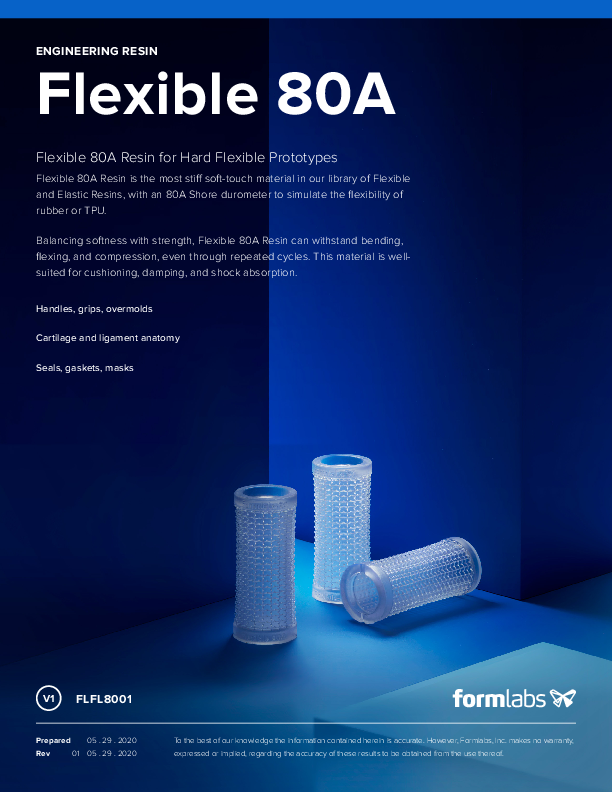
Flexible 80A Resin is the most stiff soft-touch material in our library of Flexible and Elastic Resins, with an 80A Shore durometer to simulate the flexibility of rubber or TPU.
Balancing softness with strength, Flexible 80A Resin can withstand bending, flexing, and compression, even through repeated cycles. This material is wellsuited for cushioning, damping, and shock absorption.
Handles, grips, overmolds
Cartilage and ligament anatomy
Seals, gaskets, masks

V1 FLFL8001

Prepared 05 . 29 . 2020

Rev

01 05 . 29 . 2020

To the best of our knowledge the information contained herein is accurate. However, Formlabs, Inc. makes no warranty, expressed or implied, regarding the accuracy of these results to be obtained from the use thereof.

Flexible 80A Resin Material Properties Data

Mechanical Properties Ultimate Tensile Strength3 Stress at 50% Elongation Stress at 100% Elongation Elongation at Break Shore Hardness Compression Set (23 �C for 22 hours) Compression Set (70 �C for 22 hours) Tear Strength4
Ross Flex Fatigue at 23 �C
Ross Flex Fatigue at -10 �C
Bayshore Resilience Thermal Properties
Glass transition temperature (Tg)

METRIC1

Green

Post-Cured2

IMPERIAL1

Green

Post-Cured2

METHOD

3.7 MPa 1.5 MPa 3.5 MPa 100%
70A Not Tested Not Tested
11 kN/m
Not Tested
Not Tested
Not Tested

8.9 MPa 3.1 MPa 6.3 MPa 120%
80 A 3% 5% 24 kN/m >200,000 cycles
>50,000 cycles
28%

539 psi 218 psi 510 psi 100%
70A Not Tested Not Tested
61 lbf/in
Not Tested
Not Tested
Not Tested

1290 psi 433 psi 909 psi 120%
80 A 3% 5% 137 lbf/in >200,000 cycles
>50,000 cycles
28%

ASTM D 412-06 (A) ASTM D 412-06 (A) ASTM D 412-06 (A) ASTM D 412-06 (A)
ASTM 2240 ASTM D 624-00 ASTM D 395-03 (B) ASTM D 395-03 (B) ASTM D1052, (notched), 60� bending, 100 cycles/minute
ASTM D1052, (notched), 60� bending, 100 cycles/minute
ASTM D2632

Not Tested

27 �C

Not Tested

27 �C

DMA

1 M aterial properties can vary with part geometry, print orientation, print settings and temperature.

2 Data was obtained from parts printed using Form 3, 100 m, Flexible 80A settings, washed in Form Wash for 10 minutes and postcured with Form Cure at 60 �C for 10 minutes.

3 T ensile testing was performed after 3+ hours at 23 �C, using a Die C specimen cut from sheets.

4 T ear testing was performed after 3+ hours at 23 �C, using a Die C tear specimen directly printed.

Solvent Compatibility
Percent weight gain over 24 hours for a printed and post-cured 1 x 1 x 1 cm cube immersed in respective solvent:

Solvent Acetic Acid, 5 % Acetone Isopropyl Alcohol Bleach, ~5 % NaOCl Butyl Acetate Diesel Diethyl glycol monomethyl ether Hydrolic Oil Skydrol 5 Tripropylene Glycol Methyl Ether

24 Hour Weight Gain (%) 0.9 37.4 11.7 0.6 51.4 2.3 19.3 1.0 10.7 13.6

Solvent Hydrogen Peroxide (3 %) Isooctane (aka gasoline) Mineral Oil, light Mineral Oil, heavy Salt Water (3.5 % NaCl) Sodium hydroxide (0.025 %, pH = 10) Water Xylene Strong Acid (HCI Conc)

24 Hour Weight Gain (%) 0.7 1.6 0.1 <0.1 0.5 0.6 0.7 64.1 28.6