

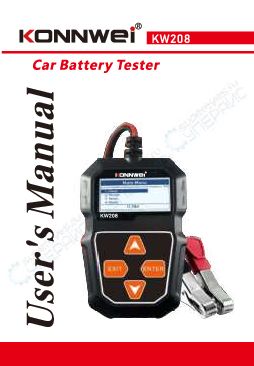
KONNWEI KW208 Car Battery Tester
This document serves as the user's manual for the KONNWEI KW208 Car Battery Tester.
1. Product Summary
1.1 Product Profile
The KW208 Battery Tester utilizes state-of-the-art conductance testing technology to easily, quickly, and accurately measure the actual cold cranking amps (CCA) capability of a vehicle's starting battery, assess the battery's health, and identify common faults in the vehicle's starting and charging systems. This assists maintenance personnel in quickly and accurately diagnosing and resolving issues, enabling prompt vehicle repairs.
Key capabilities include:
- Testing all automotive cranking lead-acid batteries, including ordinary lead-acid, AGM flat plate, AGM spiral, and Gel batteries.
- Direct detection of a bad cell battery.
- Reverse polarity protection, preventing damage to the tester, vehicle, or battery from incorrect connection.
- Testing batteries with low electricity; full charge is not required before testing.
- Compliance with major global battery standards, such as CCA, BCI, CA, MCA, JIS, DIN, and SAE.
- Support for multiple languages, allowing customers to select their preferred language package. Supported languages include English, German, French, Dutch, Russian, Spanish, Italian, and Portuguese.
1.2 Product Function
The KW208 battery tester offers the following functions: battery test, cranking test, charging test, and other additional functions.
The primary purpose of the battery test is to analyze the battery's healthy status and calculate its actual cold cranking capability and aging extent. This provides reliable evidence for battery testing and maintenance, potentially notifying the user to replace the battery in advance if it is aging.
The cranking test is used to analyze the starting motor. It measures the actual required cranking current and voltage to determine if the starting motor is functioning correctly. Starting malfunctions can be indicated by increased starting loaded torque or increased friction from the starting motor's rotor. The charging test verifies and analyzes the charging system, including the generator, rectifier, and rectifier diode, to ensure the generator's output voltage is normal and the rectifier diode is functioning correctly. Abnormalities can lead to overcharging or incomplete charging of the battery, potentially damaging it and shortening the lifespan of other electrical appliances.
1.3 Technical Parameters
1. Cold Cranking Amps Measurement Range:
| Measurement Standard | Measurement Range |
|---|---|
| CCA | 100-2000 |
| BCI | 100-2000 |
| CA | 100-2000 |
| MCA | 100-2000 |
| JIS | 26A17-245H2 |
| DIN | 100-1400 |
| IEC | 100-1400 |
| EN | 100-2000 |
| SAE | 100-2000 |
2. Voltage Measurement Range:
8-16V DC
1.4 Working Environment Requirement
Working Environment Temperature: 0°C – 50°C (-32°F – 122°F).
This tester is applicable for automotive manufacturers, automotive maintenance and repair workshops, automotive battery factories, automotive battery distributors, and educational organizations.
2. Battery Test
After entering the battery test program, the tester displays the Main Menu. The tester will display the following contents in sequence; select accordingly.
Battery In-vehicle or Out-of-Vehicle Selection
From the startup screen, or by pressing the [EXIT] button to enter the Main Menu, use the [UP/DOWN] keys to select the battery location (In-Vehicle or Out-of-Vehicle), then press the [ENTER] key to confirm.
1. In-Vehicle
2. Out-of-Vehicle
(1/2)
2.1 Battery Test in vehicle
When surface charge is detected by the tester, it prompts "Surface charge, turn lights on". Turn lights on as prompted to eliminate battery surface charge. The tester will then display the following messages in sequence.
1. Battery Test
2. Cranking Test
3. Charging Test
(1/3)
Once the surface charge is eliminated, the tester will turn off the lights as prompted. Press the [ENTER] key, and the tester will proceed with the automatic test.
Select Battery Type
After the battery charge status is selected, the tester will prompt you to select the battery type. Options include Regular Flooded, AGM Flat plate, AGM Spiral, Gel, and EFB battery. Use the [UP/DOWN] keys to select the battery type, then press the [OK] key to confirm.
Battery System Standard and Rating
The KW208 battery tester evaluates each battery according to the selected system and rating. Use the [UP/DOWN] keys to select the actual system standard and rating marked on the battery. Refer to the image below for the indicated location.
Description of the car battery image: A typical automotive lead-acid battery is shown, with labels indicating various standards and ratings.
Standard Definitions:
- CCA: Cold Cranking Amps, specified by SAE & BCI, most frequently used value for starting batteries at 0°F (-18°C).
- BCI: Battery Council International standard.
- CA: Cranking Amps standard, effective starting current value at 0°C.
- MCA: Marine Cranking Amps standard, effective starting current value at 0°C.
- JIS: Japan Industrial Standard, displayed on the battery as a combination of numbers and letters, e.g., 55D23, 80D26.
- DIN: German Auto Industry Committee Standard.
- IEC: International Electrotechnical Commission Standard.
- EN: European Automobile Manufacturers Association Standard.
- SAE: Society of Automotive Engineers Standard.
From the [Select Type] screen, press the [UP/DOWN] keys to select the Standard, then press the [ENTER] key to confirm.
1. CCA
2. IEC
3. EN
4. DIN
5. CA
6. BCI
(1/9)
Rating Range
Input the correct test standard and rating, then press the [ENTER] key. The tester will start the test, and a dynamic interface showing "Under measurement ..." will be prompted. See below.
400 A
CCA
It takes approximately 1 second to display the battery test result.
Battery Test Results
The tester provides several possible results for the battery test:
1. Good Battery
STD: 500A CCA
SOH:100% 654A
SOC: 38% 12.53V
R:4.59mΩ
GOOD BATTERY
Interpretation: The battery is without any problems and can be used with confidence.
2. Good, Recharge
STD: 100A CCA
SOH:65% 81A
SOC: 0% 11.93
R:37.10mΩ
GOOD-RECHARGE
Interpretation: The battery is good but has low current; it should be recharged before use.
3. Replace
STD:700A CCA
SOH:19% 311A
SOC:38% 12.23V
R:9.67mΩ
REPLACE
Interpretation: The battery is nearing or has reached the end of its service life. Replace the battery to avoid potential issues.
4. Bad cell, Replace
STD:500A CCA
SOH:0% 9A
SOC:0% 12.53V
R:43.29mΩ
BAD CEL
Interpretation: The battery's interior is damaged, has a bad cell, or is short-circuited. Replace the battery.
5. Charge, Retest
STD:100A CCA
SOH:34% 59A
SOC:0% 10.93V
R:50.50mΩ
CHARGE-RETEST
Interpretation: An unstable battery should be recharged and retested. If the same test result persists after recharging and retesting, the battery is considered damaged and should be replaced.
Attention for "Replace" Result
If the "Replace" result is obtained in IN-VEHICLE mode, it might be due to the vehicle cable not being properly connected to the battery. Ensure the cable is securely connected and retest the battery in OUT-OF-VEHICLE mode before deciding to replace the battery.
NOTE: After testing, if you need to exit, press the [EXIT] key to directly return to the startup interface.
2.2 Battery out of vehicle test
OUT-OF-VEHICLE means the battery is not connected to any vehicle load; its connection is cut off.
From the startup screen, or by pressing the [EXIT] button to enter the Main Menu, use the [UP/DOWN] keys to select the battery location (In-Vehicle or Out-of-Vehicle), then press the [ENTER] key to confirm.
1. In-Vehicle
2. Out-of-Vehicle
(1/2)
After the battery charge status is selected, the tester will prompt you to select the battery type. Options include Regular Flooded, AGM Flat plate, AGM Spiral, Gel, and EFB battery. Use the [UP/DOWN] keys to select the battery type, then press the [OK] key to confirm.
Follow the same steps as described in "Battery System Standard and Rating" and "Rating Range" to input the correct test standard and rating, and then press [ENTER] to start the test.
2.3 Review
This function allows you to review previous test results.
From the startup screen, or by pressing the [EXIT] button to enter the Main Menu, use the [UP/DOWN] button to select the [Review] function in the Main Menu and press the [ENTER] button. The screen will display the interface as shown below:
1. Review the last result
2. Delete result
(1/2)
To review the last result:
Press the [UP/DOWN] button to select the "Review the last result" function and press [ENTER]. The screen will display the interface as shown below:
STD: 500A CCA
SOH:100% 654A
SOC: 38% 12.53V
R:4.59mΩ
GOOD BATTERY
You can then press the [UP/DOWN] button to select to review SOH or SOC data.
3. Service Procedures
If you have any questions, please contact your local store, distributor, or visit our website at http://www.konnwei.com.
If it becomes necessary to return the tool for repair, please contact your local distributor for more information.