
Home
›
APPLICATION OF THE BASIC BUILDING BLOCKS (BBB) FRAMEWORK FOR AERONAUTICAL INFORMATION MANAGEMENT

APPLICATION OF THE BASIC BUILDING BLOCKS (BBB) FRAMEWORK FOR AERONAUTICAL INFORMATION MANAGEMENT
File info: application/pdf · 3 pages · 153.84KB
APPLICATION OF THE BASIC BUILDING BLOCKS (BBB) FRAMEWORK FOR AERONAUTICAL INFORMATION MANAGEMENT
3
ASSEMBLY — 40TH SESSION
Aeronautical Information Services Manual. 1. INTRODUCTION . 1.1 The sixth edition of the GANP proposes a multilayer structure to better communicate with high-level and technical managers and to not leave behind any Stat…
Full PDF Document

If the inline viewer fails, it will open the original document in compatibility mode automatically. You can also open the file directly.
Extracted Text
International Civil Aviation Organization WORKING PAPER

A40-WP/1561
TE/62 31/7/19

ASSEMBLY -- 40TH SESSION
TECHNICAL COMMISSION Agenda Item 28: Aviation safety and air navigation policy
APPLICATION OF THE BASIC BUILDING BLOCKS (BBB) FRAMEWORK FOR AERONAUTICAL INFORMATION MANAGEMENT
(Presented by the 54 Contracting States2, Members of the African Civil Aviation Commission (AFCAC))

EXECUTIVE SUMMARY
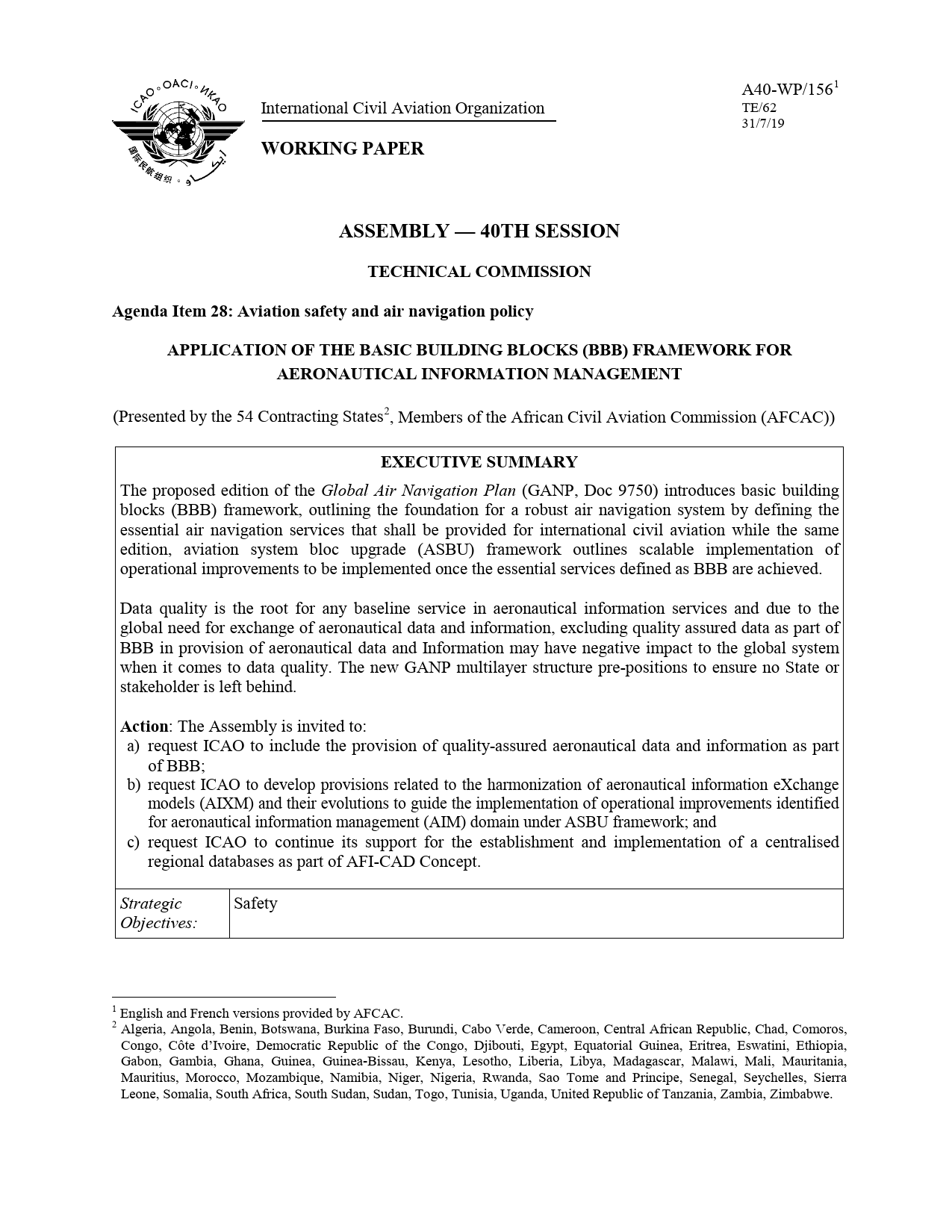
The proposed edition of the Global Air Navigation Plan (GANP, Doc 9750) introduces basic building blocks (BBB) framework, outlining the foundation for a robust air navigation system by defining the essential air navigation services that shall be provided for international civil aviation while the same edition, aviation system bloc upgrade (ASBU) framework outlines scalable implementation of operational improvements to be implemented once the essential services defined as BBB are achieved.
Data quality is the root for any baseline service in aeronautical information services and due to the global need for exchange of aeronautical data and information, excluding quality assured data as part of BBB in provision of aeronautical data and Information may have negative impact to the global system when it comes to data quality. The new GANP multilayer structure pre-positions to ensure no State or stakeholder is left behind.
Action: The Assembly is invited to: a) request ICAO to include the provision of quality-assured aeronautical data and information as part
of BBB; b) request ICAO to develop provisions related to the harmonization of aeronautical information eXchange
models (AIXM) and their evolutions to guide the implementation of operational improvements identified for aeronautical information management (AIM) domain under ASBU framework; and c) request ICAO to continue its support for the establishment and implementation of a centralised regional databases as part of AFI-CAD Concept.

Strategic Objectives:

Safety

1 English and French versions provided by AFCAC. 2 Algeria, Angola, Benin, Botswana, Burkina Faso, Burundi, Cabo Verde, Cameroon, Central African Republic, Chad, Comoros,
Congo, C�te d'Ivoire, Democratic Republic of the Congo, Djibouti, Egypt, Equatorial Guinea, Eritrea, Eswatini, Ethiopia, Gabon, Gambia, Ghana, Guinea, Guinea-Bissau, Kenya, Lesotho, Liberia, Libya, Madagascar, Malawi, Mali, Mauritania, Mauritius, Morocco, Mozambique, Namibia, Niger, Nigeria, Rwanda, Sao Tome and Principe, Senegal, Seychelles, Sierra Leone, Somalia, South Africa, South Sudan, Sudan, Togo, Tunisia, Uganda, United Republic of Tanzania, Zambia, Zimbabwe.

A40-WP/156

- 2 -

TE/62

Financial implications:
References:

Annex 15 -- Aeronautical Information Services Doc 10066, Procedure for Air Navigation Services -- Aeronautical Information Management (PANS-AIM) Doc 9750, Global Air Navigation Plan Doc 8126, Aeronautical Information Services Manual

1. INTRODUCTION

1.1

The sixth edition of the GANP proposes a multilayer structure to better communicate with

high-level and technical managers and to not leave behind any State or stakeholder. The four-layer

structure is made up of global strategic level (Level 1), global technical level (Level 2) regional level

(Level 3) and national level (Level 4). The global level is structured to support technical managers in

planning the implementation of basic air navigation services and new operational improvements in a cost

effective manner.

1.2

The global technical level features the BBB framework which outlines the foundation for a

robust air navigation system by defining the essential air navigation services that shall be provided for

international civil aviation; and the ASBU framework for scalable implementation, an associated

performance framework (PF) which includes a catalogue of performance objectives, a list of key

performance indicators; and a performance-based method for implementation planning of air navigation

operational improvements, including a catalogue of performance objectives and indicators.

1.3

The BBB are considered an independent framework and not a block of the ASBU

framework as they represent the minimum baseline rather than evolutionary steps.

1.4

The provision of quality-assured aeronautical data and information is placed under the

ASBU framework hence is considered as an operational improvement to be achieved once the basic

services are achieved (Ref. DAIM-B1/1 Provision of quality-assured aeronautical data and information).

2. DISCUSSION

2.1

The scope of traditional aeronautical information service (AIS) has significantly changed

with the sixteenth edition of Annex 15 -- Aeronautical Information Services and new Procedure for Air

Navigation Services -- Aeronautical Information Management (PANS-AIM, Doc 10066) which

introduced the digitization of information through the definition of various data sets (aeronautical

information publication (AIP), terrain, obstacle, aerodrome mapping and instrument flight procedure data

sets) as well as the introduction of aeronautical data catalogue requirements.

2.2

The digitization process also requires standardisation of the information-sharing at State,

regional as well as global level. In a highly automated environment such as air traffic management (ATM),

quality and accuracy of data must also be assured and guaranteed throughout the entire data chain due to

the large number of data originators and end users in the value chain.

2.3

The transition from AIS to AIM focuses on the quality of data with emphasis on quality

management systems (QMS) and the exchange of this digital information utilising standardised exchanges

- 3 -

A40-WP/156

TE/62

models such as the AIXM via system wide information management (SWIM) bringing on the fore front the global nature of aeronautical information management as a service.

3. CONCLUSION

3.1

Quality is the root for any baseline service in aeronautical information management and

due to the global need for the exchange of aeronautical data and information, localising standards for

services to be provided as regional or national targets may have negative impact to the global system when

it comes to data quality.

3.2

Failure to factor the placement of provision of quality aeronautical data as part of BBB

framework should be viewed as a compromise between achieving compliance (being seen as meeting

minimum requirement for robust air navigation system) and prioritising safety. In addition, regions with

low levels of implementation for the transition from AIS to AIM may experience complacency towards

provision of quality assured aeronautical data and information and at the end negating the attainment of the

key objective of the multilayer structure GANP of not to leave behind any State or stakeholder.

-- END --