

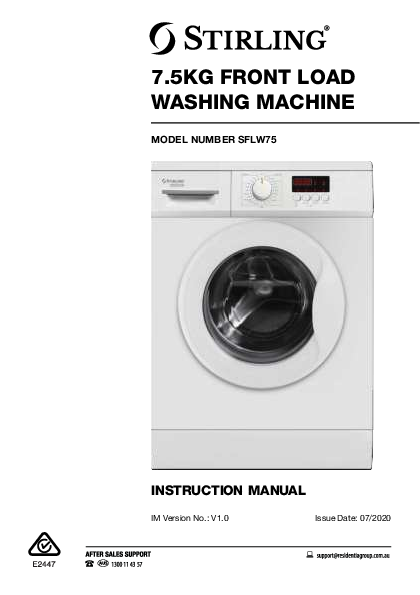
STIRLING 7.5KG FRONT LOAD WASHING MACHINE
Model Number: SFLW75
Document Type: Instruction Manual
Version: V1.0
Issue Date: 07/2020
Welcome
Congratulations on choosing to buy a STIRLING® product. All products brought to you by STIRLING® are manufactured to the highest standards of performance and safety and, as part of our philosophy of customer service and satisfaction, are backed by our comprehensive 3 Year In Home Warranty. We hope you will enjoy using your purchase for many years to come.
Warranty Details
Register your purchase at www.aldi.com.au/en/about-aldi/product-registration/ to keep up-to-date with important product information.
The product is guaranteed to be free from defects in workmanship and parts for a period of 36 months from the date of purchase. Defects that occur within this warranty period, under normal use and care, will be repaired, replaced or refunded at our discretion. The benefits conferred by this warranty are in addition to all rights and remedies in respect of the product that the consumer has under the Competition and Consumer Act 2010 and similar state and territory laws.
Our goods come with guarantees that cannot be excluded under the Australian Consumer Law. You are entitled to a replacement or refund for a major failure and for compensation for any other reasonably foreseeable loss or damage. You are also entitled to have the goods repaired or replaced if the goods fail to be of acceptable quality and the failure does not amount to a major failure.
Warranty Period: 3 Years In Home Warranty
Safety Instructions
General Warnings
Before the installation and use of the appliance, carefully read the supplied instructions.
The manufacturer is not responsible if an incorrect installation and use causes injuries and damages.
Always keep the instructions with your appliance for future reference.
⚠️ WARNING! To prevent any loss of life, injury or damage to property, follow the safety notes.
⚠️ WARNING! Caution, risk of fire!
This appliance is not intended for use by persons (including children) with reduced physical, sensory or mental capabilities, or lack of experience and knowledge, unless they have been given supervision or instruction concerning use of the appliance by a person responsible for their safety.
Children should be supervised to ensure that they do not play with the appliance.
Conditions of Use
This appliance is intended to be used in household and similar applications such as farm houses or by clients in serviced apartments, holiday apartments and other residential type environments.
Unpacking
During transportation, protective packaging was used to protect the appliance against any damage. After unpacking, please dispose of all elements of packaging in a way that will not cause damage to the environment. All materials used for packaging the appliance are environmentally friendly; they are 100% recyclable and are marked with the appropriate symbol.
CAUTION! During unpacking, the packaging materials (polythene bags, polystyrene pieces, etc.) should be kept out of reach of children.
Disposal of the Appliance
Old appliances should not simply be disposed of with normal household waste, but should be delivered to a collection and recycling centre for electric and electronic equipment. A symbol shown on the product, the instruction manual or the packaging shows that it is suitable for recycling.
Materials used inside the appliance are recyclable and are labelled with information concerning this. By recycling materials or other parts from used devices you are making a significant contribution to the protection of our environment.
Information on appropriate disposal centres for used devices can be provided by your local authority.
- Disconnect the appliance from the mains supply.
- Cut off the mains cable and discard it.
- Remove the door catch to prevent children and pets to get closed in the appliance.
Installation
Remove all the packaging and transport bolts before using the appliance otherwise you risk damaging the appliance.
- This washing machine is for indoor use only.
- Do not install or use a damaged appliance.
- Make sure that the floor where you install the appliance is flat, stable, heat resistant and clean.
- Always remove the plug and turn off the water supply to the appliance after every use.
- Sharp and rigid items such as coins, nails and screws may cause serious damage to this appliance - always ensure pockets of clothing are empty.
- Always ensure that the drum has drained all water before opening the appliance door. If water is visible, do not open the appliance door.
- Do not install the appliance behind a lockable door, a sliding door or a door with a hinge on the opposite side, where the appliance door cannot be fully opened.
Always be careful when you move the appliance because it is heavy. Always wear safety gloves. Always move the appliance vertically. The rear surface of the appliance must be put against the wall.
This appliance should not be installed in a bathroom or similar wet rooms, as well as rooms with explosive or caustic gases.
Washing machines with a single water inlet should only be connected to the cold water supply outlet. Models featuring two inlet valves can be connected to both the hot and cold water outlets.
The appliance is not intended for built-in use. Plug must be accessible after installation.
When the appliance is put in its permanent position, check if it is fully level with the aid of a spirit level. If it is not, adjust the feet until it is.
Appliance Use
WARNING! Risk of fire, explosion, electric shock or damage to the appliance.
- Use this appliance in a household only.
- Before operating this appliance, ensure that all packaging and transport bolts have been removed. Otherwise, serious damage can occur to the appliance.
- Before washing any clothes for the first time, the washing machine should be operated for one whole cycle without any clothes inside.
- Do not climb up or sit on top of the appliance.
- Do not change the specification of this appliance.
- If you use fabric softener or similar products, obey the instructions on the packaging.
- Do not sit or stand on the open door.
- Obey the maximum load volume of 7.5 kg (refer to the "Program chart" chapter).
- Ensure all objects are removed from clothing pockets such as lighters and matches.
- Please only use front load washing machine detergents. Flammable and explosive or toxic solvents are forbidden for use with this appliance. Gasoline and alcohol should not be used as a detergent.
- Never wash carpets or rugs within the appliance.
- Be careful to avoid burns when the machine drains hot washing water.
- After a wash program completes, please wait two minutes before opening the door.
- If a tumble dryer is installed on top of the washing machine, use the suitable stacking kit. The stacking kit, available from your authorized vendor, can be used only with the appliance specified in the instructions, supplied with the accessory. Read it carefully before installation (Refer to the Installation leaflet).
- Never lean against the machine door.
- Please do not close the machine door with excessive force and if you find it difficult to close the door, ensure that the clothing load isn't excessive.
Transport
- Always move the appliance cautiously.
- Do not use the machine door or the handle of the detergent dispenser, to lift the appliance.
- Transportation bolts should be reinstalled within the machine by a specialised person, prior to transporting the appliance.
- Ensure that all accumulated water is drained from the appliance before moving.
Electrical Connection
WARNING! Caution, risk of fire and electrical shock!
- The appliance must be earthed.
- Make sure that the electrical information on the rating plate agrees with the power supply. If not, contact an electrician.
- Always use a correctly installed shockproof socket.
- Do not use multi-plug adapters and extension cables.
- Make sure not to cause damage to the mains plug and to the mains cable. Should the appliance power supply cable need to be replaced, this must be carried out by our Service Centre.
- Connect the mains plug to the mains socket only at the end of the installation. Make sure that there is access to the mains plug after the installation.
- Do not connect the appliance plug with a power connection board.
- Do not pull the mains cable to disconnect the appliance. Always pull the mains plug.
- Do not touch the mains cable or the mains plug with wet hands.
- This appliance complies with the E.E.C. Directives.
Care & Cleaning
WARNING! Caution, risk of injury or damage to the appliance.
- Before maintenance, deactivate the appliance and disconnect the mains plug.
- Do not use water spray and steam to clean the appliance.
- Clean the appliance with a moist soft cloth. Only use neutral detergents. Do not use abrasive products, abrasive cleaning pads, solvents or metal objects.
Installation Positioning
Ensure that your appliance is installed on solid and flat ground, in a level position.
Please do not place the appliance on a slope, soft carpet or wooden floor.
The appliance is not intended for built-in use. Do not install the appliance outdoors.
Diagram Description: A diagram shows a washing machine with a minimum clearance of 20mm (W > 20mm) around it, indicating the need for space for ventilation.
Removing the Transportation Bolts
Before using this washing machine, transport bolts must be removed from the backside of this machine.
Please take the following steps to remove the bolts:
- Loosen all bolts with a spanner and then remove them.
- Use the plugs (supplied) to plug the holes.
- Keep the transport bolts for future use.
Diagram Description: Four steps illustrate removing transportation bolts from the rear of the machine, using a spanner and then plugging the holes with provided caps.
Connecting Water Supply Hose
- Do not kink, crush, modify or sever the water inlet hose.
- For the model with hot valve, connect it to hot water tap with hot water supply hose. Energy consumption will decrease automatically for some programs.
Connect the inlet pipe as indicated. There are two ways to connect the inlet pipe:
Diagram Description: Two diagrams show how to connect the inlet hose. Diagram 1 shows connecting to an ordinary tap with threads. Diagram 2 shows connecting to a special tap with threads, using a slide bushing and clamp nut.
Steps for connecting:
- Connection between ordinary tap and inlet hose.
- Connection between screw tap and inlet hose.
Special tap for washing machine: Connect the inlet pipe to the inlet valve at the backside of the product and fasten the pipe tightly clockwise.
The Drain Hose
Before using this washing machine, transport bolts must be removed from the backside of this machine.
Please take the following steps to remove the bolts:
- Loosen all bolts with a spanner and then remove them.
- Use the plugs (supplied) to plug the holes.
- Keep the transport bolts for future use.
Warning!
- Do not kink or protract the drain hose.
- Position drain hose properly, otherwise damage might result of water leakage.
There are two ways to place the end of drain hose:
- Put it into the water trough.
- Connect it to the branch drain pipe of the trough.
Diagram Description: Diagrams show two methods for draining: into a water trough, or connected to a branch drain pipe. It also shows recommended height ranges (Min. 60cm, Max. 100cm) for the drain hose and a hose retainer.
Warning! When installing drain hose, fix it properly with a rope. If drain hose is too long, do not force it into washing machine as it will cause abnormal noises.
Level Adjusting
If the floor is obviously uneven, your appliance feet need to be adjusted. If your appliance isn't level, it will cause your appliance to vibrate, and potentially move from its position.
Once you've positioned your washing machine, press down from the top in all four corners to ensure that it's completely stable (i.e. not rocking in any direction). Also use a spirit level to ensure that it is completely level in all directions.
Should you need to make adjustments, use a spanner to turn the appliance legs until it makes contact with the floor. Turn the leg using one hand and then fasten the nut up against the appliance cabinet, to lock the leg in place.
After making any adjustments to the appliance legs, re-check to ensure it is level and no rocking occurring.
Diagram Description: A four-step diagram shows how to adjust the feet: 1. Lower the foot. 2. Raise the foot. 3. Lock nut. 4. Foot.
Operation in Case of Emergency
In the event of an emergency you should:
- Switch off washing machine power.
- Switch the machine off at the isolation switch or at the fuse box.
- Call the After Sales Support Team on: 1300 11 HELP (4357).
Some minor faults can be fixed by referring to the instructions given in the Troubleshooting section of this manual.
Product Overview
The Appliance Components:
- Water supply hose
- Detergent Drawer
- Door
- Top cover
- Power supply cord
- Control panel
- Drum
- Drain hose
- Service filter
Control Panel Functions:
- Off: Product is switched off.
- Start / Pause: Press the button to start or pause the wash cycle.
- Program Selection: Turn the dial to select your desired wash cycle.
- Spin Speed: Adjusts the spin speed.
- Child Lock: Activates/deactivates the child lock function.
- Extra Rinse: Adds an extra rinse cycle.
- Delay: Sets a delayed start time (0-24H).
Detergent Dispenser Compartments:
- Pre wash detergent (Compartment I)
- Main wash detergent (Compartment II)
- Softener
- Liquid detergent
- Powder detergent
Diagram Description: A diagram of the washing machine shows the location of the water supply hose, detergent drawer, door, top cover, power supply cord, control panel, drum, drain hose, and service filter. The control panel features a program selection dial and buttons for Delay, Extra Rinse, Spin Speed, Child Lock, and Start/Pause. The detergent drawer has compartments for pre-wash, main wash, softener, liquid detergent, and powder detergent.
Quick Start Guide
CAUTION!
- Before washing, please make sure it's installed properly.
- Before washing at first time, the washing machine must run through one whole cycle without clothes.
Before washing:
- Plug in the power supply.
- Open the tap.
- Load your washing.
- Close the door.
- Add detergent according to your load type and volume.
Washing:
- Power on.
- Select Program.
- Select additional functions if desired.
- Press the Start / Pause button to begin your cycle.
Operating the Appliance
Preparation Before Washing Your Clothes
Please follow these steps carefully to avoid trouble with your washing machine and damaging your clothing.
Washing Considerations
- New clothes in particular, can leach colour onto other clothing items, particularly whites. Consider washing these and bright colours separately.
- Stained clothing should be treated with a stain remover, prior to washing.
- Temperature sensitive clothes should be washed in accordance with their care direction label. Otherwise distortion and/or changes in colour could occur.
- Never allow washing to sit in the machine for a long period of time - particularly when wet. Clothes can become mouldy and develop an odour.
- Certain clothing cannot be washed in a washing machine and their care directions may state dry cleaning or hand washing required.
- Wrinkle style clothes, embossed clothes, resin clothes, etc. may become distorted when immersed in water.
- Avoid washing clothes without care direction labels within the appliance, to be safe.
- Always remove all items from clothing pockets, as hard items can cause damage to the appliance.
- Try to wash clothing colours and sizes in like loads, as this will improve the effectiveness of the washing and results.
- Close all clothing zips and ensure all buttons are fastened securely.
- Delicate items such as bras, handkerchiefs and ties should be washed within a special washing bag, to prevent damage to themselves and other clothes.
- When washing a large single item that could become heavy (i.e. a towel or jacket), it can cause the appliance to become unbalanced during its spin cycle. Therefore it's recommended to add one or two more clothing items to help the machine balance.
- Try to remove any pet hair, dust and stains from clothing prior to washing.
- Baby clothing should be washed separately.
- Clothing that gets easily "fuzzed" or loses fibers easily, should be washed separately.
- Black clothing items should be washed separately.
- Do not wash waterproof materials within the washing machine.
Pay Attention to Detergents
WARNING! Always keep detergents and additives out of reach from children.
- Only use suitable front load washing machine detergents with this appliance. Powders and liquid detergents only.
- Only ever use the recommended quantity of detergent, as per the manufacturer's guidelines, as an excessive quantity can cause excessive bubbles and overflow to occur.
- It can also result in detergent residue remaining on the clothing after completion of the wash cycle.
Clothing Classifications
The symbol types on care labels are typically classified into the following textiles: Cotton, Blended Fiber, Synthetic Fiber, Silk, Wool and Artificial Fiber.
Confirm the Washing Capacity
Never load the machine with excessive weights, as it will affect your washing results.
| Fiber type | Maximum Load Capacity |
|---|---|
| Cotton | 6.0kg |
| Synthetics | 3.0kg |
| Wool | 2.0kg |
| Delicates | 2.5kg |
First Time Use
Before washing any clothes, please perform one cycle without clothes inside as follows:
- Connect the power source and water.
- Insert a small amount of detergent into Compartment II of the detergent drawer and close it.
- Select the desired program.
- Press the "Start/Pause" button on the appliance.
Allow the program to complete and your washing machine is now ready for use.
Selecting a Procedure
You should select your washing program based on the type of clothing, quantity and dirtiness level, in combination with the following temperature table.
| Temperature Mode | Application |
|---|---|
| 90°C | Seriously soiled clothing, pure white cotton (i.e. bed linen, towels, table cloths, etc) |
| 60°C | Moderately soiled clothing, cotton and synthetic articles with certain decolourising degree (i.e. shirts, pyjamas, etc) |
| 40°C, 30°C, 20°C, Cold Water | Lightly soiled clothing, synthetics and wool |
To Select a Program
- First turn the Program Selection Dial to the corresponding wash program, according to the type of textiles being washed.
- Secondly, select the desired temperature based on the level of dirtiness. Note: Generally the higher the temperature, the more power that's consumed.
- Finally, select your desired spin speed. The higher the spin speed, the drier the textiles will be at completion, however more delicate textiles will be more wrinkled. Delicate textiles should be set with a lower spin speed.
Program Descriptions
Daily Wash (15' 30' 45')
This procedure is suitable for washing a small quantity of clothes without heavy soiling.
Mix
You can select this procedure to wash tough clothes that need much more time and strength. It is used for daily clothes for cotton, such as sheets, chained, pillowcases, bathrobe and underwear.
Delicate
You can select this procedure to wash your delicate clothes. Its washing intensity is gentler and spin speed is low compared with the "Synthetic" procedure. It is recommended for washing any articles requiring a soft wash.
Cotton Eco
This procedure saves energy and limits the washing temperature to 40°C or 60°C. Use with a small quantity of clothes which are only lightly dirty.
Cotton
To increase the washing results, the main washing time is increased. It is recommended for washing clothes for babies or worn by persons with skin allergies. It is recommended for washing durable cotton articles, for example: bed sheets, quilt covers, pillowcases, gowns, underwear, etc.
Synthetic
The procedure is shorter compared with that for cottons and the washing intensity is relatively gentle. It is recommended for washing synthetic articles, for example: shirts, coats, etc.
Rinse & Spin
This procedure provides a short rinse cycle followed by a spin cycle.
Drain Only
This procedure provides a drain only option.
Spin Only
This procedure provides a spin only option. Residual soapy water shall be drained out before spinning.
Drum Clean
This procedure provides a 90°C high temperature sterilization to clean the drum. When this procedure is performed, clothes or other items should not be added. You may use this program regularly according to your needs.
Special Functions
Child Lock
To avoid the washing procedure being altered by children, you can activate the child lock function. All buttons and dials won't alter the machines settings, however the On/Off button will still function.
Note: If the machine is switched off when Child Lock is active, it will remain in Child Lock mode when switched back on.
To activate or deactivate the Child Lock:
- Press and hold the "Extra Rinse" and "Spin Speed" buttons together at the same time for 3 seconds, whilst the machine is operating.
The machine will make an audible tone to let you know that the Child Lock is activated or deactivated.
Note: At the completion of a wash program, the child lock will become deactivated automatically.
Mute
You can mute the washing machine alert by holding the Delay button for 3 seconds. The setting will remain on until the next reset.
Extra Rinse
The laundry will undergo an extra rinse cycle if selected.
Delay
Delay function can be set with this button, the delaying time is 0-24H.
Spin Speed
The spin speed can be set by pressing the button until the desired speed is set.
Muting the machine
To activate muting the machine, press and hold the Delay button for 3 seconds. Repeat this process to unmute the machine.
Washing Programs Table
This procedure is suitable for washing a small quantity of clothes without heavy soiling.
| Program | 7.5kg Load | Temp. (°C) | Default Time | Spin Speed (rpm) |
|---|---|---|---|---|
| Cotton Eco 40°C | 7.5 | 40 | 2:43 | 1200 |
| Cotton Eco 60°C | 7.5 | 60 | 5:17 | 1200 |
| Cotton | 7.5 | Cold | 1:35 | 1200 |
| Cotton 20°C | 7.5 | 20 | 1:19 | 1200 |
| Cotton 30°C | 7.5 | 30 | 1:20 | 1200 |
| Cotton 40°C | 7.5 | 40 | 1:40 | 1200 |
| Cotton 60°C | 7.5 | 60 | 1:45 | 1200 |
| Cotton 90°C | 7.5 | 90 | 2:40 | 1200 |
| Synthetic | 3.75 | Cold | 1:18 | 1000 |
| Synthetic 40°C | 3.75 | 40 | 1:33 | 1000 |
| Synthetic 60°C | 3.75 | 60 | 1:43 | 1000 |
| Drum Clean | 90 | 1:21 | 400 | |
| Spin Only | 7.5 | 0:12 | 1200 | |
| Drain Only | 0:01 | |||
| Rinse & Spin | 7.5 | 0:31 | 1200 | |
| Delicate 30°C | 2.5 | 30 | 1:00 | 600 |
| Delicate | 2.5 | Cold | 0:55 | 600 |
| Mix 60°C | 7.5 | 60 | 1:23 | 1000 |
| Mix 40°C | 7.5 | 40 | 1:02 | 1000 |
| Mix | 7.5 | Cold | 1:13 | 1000 |
| Daily Wash 45' | 2.0 | 30 | 0:45 | 800 |
| Daily Wash 30' | 2.0 | 20 | 0:30 | 800 |
| Daily Wash 15' | 2.0 | Cold | 0:15 | 800 |
Note:
- Energy labelling program: Cotton at 60°C and maximum spin speed is the program used for the AS/NZS 2040.2 MEPS energy rating.
- The programs on the left are only recommendations and users can choose the appropriate program according to their personal requirements and habits.
- The speed is: 800: 0-400-600-800; 1000: 0-400-600-800-1000; 1200: 0-400-600-800-1000-1200
Cleaning and Maintenance
WARNING! Before beginning any cleaning or maintenance, always ensure the appliance is switched off, the power plug is removed from the power outlet and the water supply has been closed.
Cleaning the Washing Machine
Proper maintenance of your washing machine will keep it looking as new and extend its working life.
- The exterior surface can be cleaned with household cleaners and a soft damp cleaning cloth.
- If there is any residual water at the completion of a washing program, please use a cloth to wipe it off immediately.
Note: Never use solvents or harsh cleaning chemicals on your washing machine's exterior.
Cleaning the Internal Drum
Should any rust form on the inside drum (i.e. water was left to sit for an extended period of time), please remove immediately using a chlorine free detergent. Never use steel wool or a harsh abrasive.
Frozen Washing Machine
Should the temperature drop below zero and your washing machine becomes frozen, you should:
- Disconnect the power supply for the washing machine.
- Wash the tap connection with warm water, to help you to disconnect the inlet pipe.
- Remove the inlet pipe and immerse in warm water (i.e. within a bathtub).
- Pour some warm water into the washing machine drum and wait for approximately 10 minutes.
- Reconnect the inlet pipe to the tap and washing machine and open the water supply.
- Wait until the room's ambient temperature returns to above 0°C before trying to operate the washing machine.
Cleaning the Door Seal and Glass
Wipe the glass and seal after each wash to remove lint and stains. If lint builds up it can cause leaks. Remove any coins, buttons and other objects from the seal after each wash.
Cleaning the Detergent Drawer
You should periodically follow these steps to ensure the detergent drawer remains clean:
- Do not use alcohol, solvents or chemical products to clean the machine.
- Press down on the arrow, located on the cover for the fabric softener compartment of the detergent drawer.
- Lift the clip up and remove the fabric softener compartment cover.
- Wash all grooves with warm water.
- Re-install the fabric softener compartment cover into the detergent drawer, and push the drawer back into position.
Diagram Description: A four-step diagram shows cleaning the detergent drawer: 1. Pull out the dispenser drawer with press A. 2. Clean the dispenser drawer under water. 3. Clean inside the recess with an old toothbrush. 4. Insert the dispenser drawer.
Cleaning the Inlet Filter
You should clean the inlet filter periodically, or if you find that insufficient water is being supplied to your washing machine when the supply tap is open.
Washing the filter in the tap
- Close the water supply tap.
- Remove the water supply hose from the tap.
- Clean the filter.
- Reconnect the water supply hose.
To clean the washing machine filter:
- Screw off the inlet pipe from the rear of the washing machine.
- Pull out the filter with long nose pliers, wash it thoroughly with water and re-install the filter.
- Reconnect the inlet pipe to the rear of the washing machine.
- Open the water supply at the tap and ensure there is no water leakage.
- Once finished, close the water supply tap.
Note: If the brush is not clean, you can pull out the filter washed separately; Reconnect, turn on the tap.
Cleaning the Drain Pump Filter
Removing foreign objects
WARNING! To avoid the risk of an electric shock, always remove the power plug from the power outlet before cleaning the Drain Pump filter.
Periodically you should clean the drain pump filter to ensure normal operation of your washing machine. The type of washing, frequency and soil level of your washing cycles will alter how often this procedure needs to be undertaken, however you should inspect the filter regularly.
Should your washing machine not empty and/or spin, or your machine makes unusual noises during operation, your Drain Pump filter could be blocked. Follow this procedure to check or remove any foreign objects.
- After disconnecting the power, open the filter cover at the front base of your washing machine.
- Unscrew the filter in an anti-clockwise direction and remove any foreign objects.
- Re-install the filter and close the service panel.
WARNING! Never remove the pump cover when the washing machine is in operation, always wait until the appliance has finished and the is empty. There can be hot water within the pump, so be careful to avoid burns, should it have operated recently. When replacing the cover, be careful to ensure it is closed securely.
Diagram Description: A four-step diagram shows cleaning the drain pump filter: 1. Open the Service filter. 2. Open the filter by turning to the counter clockwise. 3. Remove extraneous matter. 4. Close the lower cover cap.
Troubleshooting
WARNING! Only authorised technicians can carry out repairs.
Before contacting our customer service team, please refer to the table below to see if your fault can be fixed by yourself. Should a service technician visit be arranged and its found there are no faults with the appliance, a call out charge will apply. If the below table does not resolve your fault please turn off the washing machine and remove it from the power outlet.
| FAULT | SOLUTION |
|---|---|
| Washing Machine won't start-up | Check that the mains plug is inserted and switched on at the power point. Check that the door is closed securely. Check that the relevant fuse hasn't blown. Check that the water supply tap has been opened. |
| Door won't open | The machine's safety protection is working. Disconnect the power and reconnect the power. |
| Water is leaking | The drainage waste pipe may be blocked. Check and fasten all water connection pipes. Inlet or Outlet hoses may be damaged. Please check. |
| Display isn't lighting up | Check that the power isn't disconnected. PC board may have issues. Please contact our customer service team. |
| Detergent residues remain in the detergent drawer | Ensure you are using a correct amount of detergent. Follow the cleaning steps to remove any damp residual detergent from the drawer. |
| Washing results aren't to expectations | Ensure you are using a sufficient amount of detergent. Ensure the correct quantity of clothes are being used depending on the wash program selected. Ensure you are using the correct wash program to suit the clothing and level of dirtiness. Try using an alternative detergent. |
| Washing machine is making an abnormal noise or vibrating | Ensure the washing machine is level. Ensure that all transportation bolts have been removed. Ensure the appliance has been installed on a solid and level floor. Ensure that all legs are making contact with the floor and adjust as required. Follow the Drain Pump cleaning procedure and ensure there are no foreign objects. |
Troubleshooting (Cont.)
| Indication Lights | Solution |
|---|---|
| Flashing Pause/Start light and Lock light ( ) or E30 displayed | Restart after the door is closed |
| Door is not closed properly | Check if there are clothes or washing articles stuck |
| Flashing No Spin light or E10 displayed | Check if the water pressure is too low |
| Water injecting problem while washing | Straighten the water pipe Check if the inlet valve filter is blocked |
| Flashing No Spin and Pause/Start light or E21 displayed | Check if the drain hose is blocked |
| Overtime water draining | Restart the washer |
| Flashing Extra Rinse light and on Lock light ( ) or E12 displayed | |
| Water overflow |
Note: If the above steps don't resolve your issue or you cannot resolve the fault by yourself:
- Press the "On/Off" button.
- Switch off the appliance at the power outlet and remove the plug.
- Call our customer service team on 1300 11 4357.
Other Useful Information
Technical Specifications
| Product | STIRLING 7.5kg Front Load Washing Machine |
| Model Number | SFLW75 |
| Rated capacity | 7.5kg |
| Power Supply | 220-240V, ~50Hz, 10Amp |
| Rated Power | 2000W |
| Standard Water Pressure | 0.05MPa~1.0MPa |
| Dimensions | 595 (W) x 565 (D) x 850 (H) mm |
| Net Weight | 68kg |
Note: This product is subject to continuous improvement, specification are subject to change without prior notice.
This product was tested in accordance with AS/NZS 2040.2 and AS/NZS6400 using program: "Cotton Eco 60", which is the program recommended for a normally soiled cotton load at rated capacity.
The RCM Mark (Regulatory Compliance Mark) indicates that the product complies with the relevant guidelines of the ACMA as well as corresponding government requirements for the safety of electrical devices.
Responsible Disposal
At the end of its working life, do not throw this appliance out with your household rubbish. Electrical and electronic products contain substances that can have a detrimental effect on the environment and human health if disposed of inappropriately. Observe any local regulations regarding the disposal of electrical consumer goods and dispose of it appropriately for recycling. Contact your local authorities for advice on recycling facilities in your area.
Repair and Refurbished Goods or Parts Notice
Unfortunately, from time to time, faulty products are manufactured which need to be returned to the Supplier for repair.
Please be aware that if your product is capable of retaining user-generated data (such as files stored on a computer hard drive, telephone numbers stored on a mobile telephone, songs stored on a portable media player, games saved on a games console or files stored on a USB memory stick) during the process of repair, some or all of your stored data may be lost. We recommend you save this data elsewhere prior to sending the product for repair.
You should also be aware that rather than repairing goods, we may replace them with refurbished goods of the same type or use refurbished parts in the repair process. Please be assured though, refurbished parts or replacements are only used where they meet ALDI's stringent quality specifications.
If at any time you feel your repair is being handled unsatisfactorily, you may escalate your complaint. Please telephone us on 1300 11 43 57 or write to us at:
165 Barkly Avenue,
Burnley VIC 3121
Australia
Email: support@residentiagroup.com.au
Helpline hours of operation:
Mon-Fri
9:00 AM - 5:00 PM
3 YEAR IN HOME WARRANTY
Important Information
? Please read the manual: It will help you get the best out of your product.
❓ Still have questions? Call After Sales Support 1300 11 4357
? Or visit www.residentiagroup.com.au
Warranty Returns
Should you for any reason need to return this product for a warranty claim, make sure to include all accessories with the product.
Product Does Not Work?
If you encounter problems with this product, or if it fails to perform to your expectations, make sure to contact our After Sales Support Centre on 1300 11 4357.
For an electronic copy of this manual, go to www.stirlingappliances.com.au and download a copy.
 ALDI Supermarkets - Good Different