
Home
›
SEAGULL MODELS
›
SEAGULL MODELS SEA 314 Decathlon 60-85CC-3d Rechargeable Aeroplane Instruction Manual

SEAGULL MODELS SEA 314 Decathlon 60-85CC-3d Rechargeable Aeroplane Instruction Manual
File info: application/pdf · 62 pages · 3.53MB
Code : SEA 314 ASSEMBLY MANUAL
DECATHLON 60-85cc-3D Instruction Manual. 2 ank you for choosing the DECATHLON 60-85cc-3D ARTF by SG MODELS . e DECATHLON 60-85cc-3D was designed with the intermediate/advanced sport y
Manual
Seagull Models ( SG-Models ) DECATHLON 60-85CC 3D ARF GELB 3,1M
Extracted Text
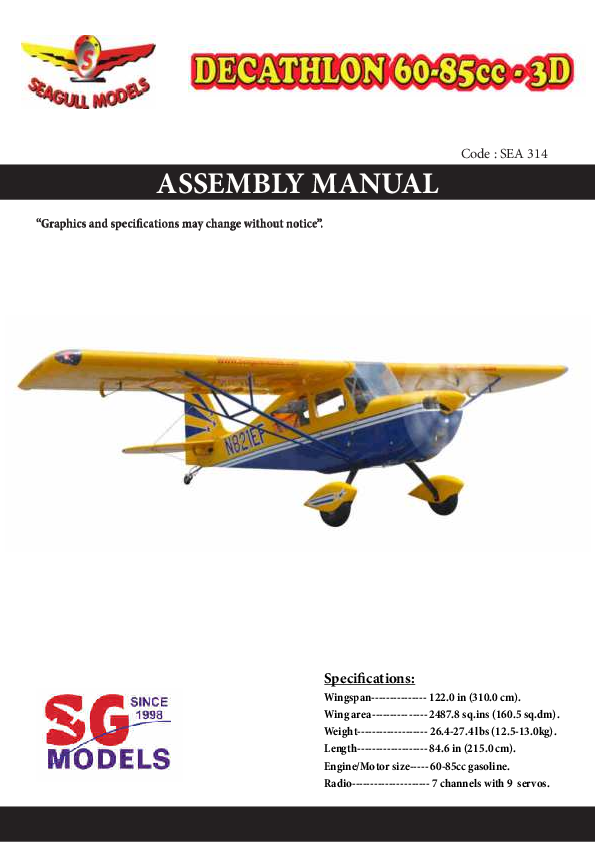
Code : SEA 314
ASSEMBLY MANUAL
Speci cations:
Wingspan--------------- 122.0 in (310.0 cm). Wing area--------------- 2487.8 sq.ins (160.5 sq.dm). Weight------------------- 26.4-27.4 lbs (12.5-13.0kg). Length------------------- 84.6 in (215.0 cm). Engine/Motor size----- 60-85cc gasoline. Radio--------------------- 7 channels with 9 servos.
1

DECATHLON 60-85cc-3D

Instruction Manual.

INTRODUCTION ank you for choosing the DECATHLON 60-85cc-3D ARTF by SG MODELS . e DECATHLON 60-85cc-3D was designed with the intermediate/advanced sport yer in mind. It is a semi scale airplane which is easy to y and quick to assemble. e airframe is conventionally built using balsa, plywood to make it stronger than the average ARTF, yet the design allows the aeroplane to be kept light. You will nd that most of the work has been done for you already. e motor mount has been tted and the hinges are pre-installed. Flying the DECATHLON 60-85cc-3D is simply a joy.
is instruction manual is designed to help you build a great ying aeroplane. Please read this manual throughly before starting assembly of your DECATHLON 60-85cc-3D Use the parts listing below to indentify all parts.
WARNING
Please be aware that this aeroplane is not a toy and if assembled or used incorrectly it is capable of causing injury to people or property. WHEN YOU FLY THIS AEROPLANE YOU ASSUME ALL RISK & REPONSIBILITY.
If you are inexperienced with basic R/C ight we strongly recommend you contact your R/C supplier and join your local R/C model Flying Club. R/C Model Flying Clubs o er a variety of training procedures designed to help the new pilot on his way to successful R/C ight.
ey will also be able to advise on any insurance and safety regulations that may apply.

KIT CONTENTS

3

2

2

1

12

6 10

8 4

11

9

5 7

2

KIT CONTENTS SEA314 DECATHLON 60-85cc-3D 1. Fuselage 2. Wing set (2) 3. Tail set (2) 4. Canopy 5. Cowling 6. Wing tube 7. Pilot 8. landing gear 9. Fuel tank 10. Tail wheel 11. Pushrod set 12. Ep Motor box
ADDITIONAL ITEMS REQUIRED  60-85cc gasoline engine.  Computer radio 7 channel with 9
servos.  Glow plug to suit engine.  Propeller to suit engine.  Protective foam rubber for radio
system.

WINGTIP BULBS Please see below pictures. 1.
Two white lights for cowling and rudder, the green light for right wing tip, and the red light for le wing tip. ey are designed to operate on voltages 12 volts. Connect four lights into switch circuit so that optional the di erent ashes mode. 2.

TOOLS & SUPPLIES NEEDED

in cyanoacrylate glue.

Medium cyanoacrylate glue.

30 minute epoxy.

5 minute epoxy. Hand or electric drill.

3.

Assorted drill bits.

Modelling knife.

Straight edge ruler.

2mm ball driver.

Phillips head screwdriver.

220 grit sandpaper.

90� square or builder's triangle.

Wire cutters.

Masking tape & T-pins.

read-lock.

Paper towels.

3

DECATHLON 60-85cc-3D 4.

Instruction Manual.
8.

5.

9.

6.

10.

7.

11.

4

12.

16.

13.

17.

14.

18.

15.

19.

5

DECATHLON 60-85cc-3D 20.

Instruction Manual.
24.

INSTALL THE AILERONS

21.

CONTROL HORN

1.

Fiberglass control horn

22.

2.

23.

3.

Epoxy.

6

4.
Epoxy. Ailerons control horn INSTALLING THE AILERON SERVOS 1.

Place the servo between the mounting blocks and space it from the hatch. Use a pencil to mark the mounting hole locations on the blocks. Use drill bit in a pin vise to drill the mouting holes in the blocks. 3.
40mm
4.

5. 2.

1.5mm

Minimum servo spec. Torque : 250 oz-in (18 kg-cm) @ 4.8V;
333 oz-in (24 kg-cm) @ 6.0V

Apply 2-3 drops of thin C/A to each of the mounting holes. Allow the C/A to cure without using accelerator. 6.

Because the size of servos di er, you may need to adjust the size of the precut opening in the mount. e notch in the sides of the mount allow the servo lead to pass through.

C/A glue

7

DECATHLON 60-85cc-3D
Use dental oss or heatshrunk tube to 10. secure the connection so they cannot become unplugged. 7.

Instruction Manual.

Secure the servo to the aileron hatch us-

ing Phillips screwdriver and the screws provided with the servo.

11.

8.

12. Apply 1-2 drops of thin C/A to each of the mounting tabs. Allow the C/A to cure without using accelerator. 9.
13. C/A glue

Remove the string from the wing at the servo location and use the tape to attach it to the servo extension lead. Pull the lead through the wing and remove the string.
8

Set the aileron hatch in place and use a Phillips screw driver to install it with four wood screws.

14.

3x10mm

3.

15.

INSTALLING THE FLAP PUSHROD

1.

AILERON PUSHROD INSTALLATION

1.

2.

130mm.

130mm.

150mm.

2. 150mm.

Attach the ap servo to the ap servo cover. Center the ap servo (or set the values to 0 for both up and down) and install the servo arm perpendicular to the servo centerline. e clevis will attach to the arm 13/16 inches (21mm) from the center of the arm.
9

DECATHLON 60-85cc-3D 3.

Instruction Manual.
6.

Use a pin vise and 3/32-inch (2mm) drill bit to clear the paint from the ap control horn. 4.

Route the servo lead for the ap servo out at the root of the wing. Connect the ap servo to the radio system. With the radio system on, place the ap servo into position. 7.

Attach the ap linkage to the control horn. Slide the clevis retainer over the forks of the clevis. 5.

Adjust the linkage so the ap is in the mid- ap position. It may take a few tries to properly adjust the linkage. 8.

Attach the clevis to the ap servo arm.
10

Once adjusted, make sure all clevis retainers are in position. Apply a drop of threadlock near the clevis, then tighten the nut against the clevis to keep the linkage from changing length inside the wing.

9.

3x10mm

12.

10.

13.

Set the ap control at the transmitter to the down ap position. Adjust the ap travel at the transmitter until it matches the control throws listed in this manual. 11.

Fit the ap linkage cover into position. Check the operation of the ap to make sure the cover does not interfere with the
ap linkage. 14.

Trim the ap linkage cover using a hobby knife and hobby scissors.

Use canopy glue to attach the cover to the wing. Use low-tack tape to keep the cover in position until the adhesive fully cures.

11

DECATHLON 60-85cc-3D 15.

Instruction Manual.
3.

4. INSTALLING LANDING GEAR Locate items necessary to install Sprin Landing Gear. 1.
5.
2.
6.

12

7.

11.

8.

12.

9.

13.

Collar. M3x4mm.

10.

14.

4x25mm.

3x15mm.

13

DECATHLON 60-85cc-3D 15.

Instruction Manual.
198.

16.

20.

17.

INSTALLING THE FUSELAGE SERVOS

.
Because the size of servos di er, you may need to adjust the size of the precut opening in the mount. e notch in the sides of the mount allow the servo lead to pass through.

Install the rubber grommets and brass collets into all servos. Test t the servos into the fuselage servo mounts.

18.

1.

14

2.

6.

3.

7.

4.

8.

5.

9.

Elevator servo.

Rudder servo.

15

DECATHLON 60-85cc-3D 10.
11. Elevator servo arm .

Instruction Manual.
3.
.
Switch.
INSTALLING THE ENGINE SWITCH 1.

Rudder servo arm.

INSTALLING THE RECEIVER SWITCH

Install the switch into the precut hole in

2.

the side, in the fuselage.

1. 3/32" Hole.

Trim and cut. Switch.

2.

INSTALLING THE STOPPER

ASSEMBLY

Trim and cut.

Using a modeling knife, carefully cut o the rear portion of one of the 3 nylon tubes leaving 1/2" protruding from the rear of the stopper. is will be the fuel pick up tube.

16

Using a modeling knife, cut one length of silicon fuel line. Connect one end of the line to the weighted fuel pick up and the other end to the nylon pick up tube. 1.
2.

With the stopper assembly in place, the weighted pick-up should rest away from the rear of the tank and move freely inside the tank. e top of the vent tube should rest just below the top of the tank. It should not touch the top of the tank. When satis ed with the alignment of the stopper assembly tighten the 3x20mm machine screw until the rubber stopper expands and seals the tank opening. Do not overtighten the assembly as this could cause the tank to split.
FUEL TANK INSTALLATION 1.

3. Vent tube.

Fuel pick up tube.

Fuel lltube.

You should mark which tube is the vent and which is the fuel pickup when you attach fuel tubing to the tubes in the stopper. Once the tank is installed inside the fuselage, it may be di cult to determine which is which.
Slide the fuel tank into the fuselage. Guide the lines from the tank through the hole in the ewall.
2.

Carefully bend the second nylon tube up at a 45� angle. is tube is the vent tube. Test t the stopper assembly into the tank. It may be necessary to remove some of the ashing around the tank opening using a modeling knife. If ashing is present, make sure none falls into the tank.
17

DECATHLON 60-85cc-3D

3.

2.

Balsa wood.

Instruction Manual.

Epoxy.

4.

Vent tube.

3.

Fuel pick up tube.

Fuel ll tube.

Connect the lines from the tank to the engine and mu er. e vent line will con-

4.

nect to the mu er and the line from the

clunk tothe carburetor.

Blow through one of the lines to ensure the fuel lines have not become kinked inside the fuel tank compartment. Air should ow through easily.

MOUNTING THE ENGINE

Please see below pictures.

1.

5.

18

6.

10.

7.

11.

8.

12.

180mm

9.

6x90mm

13.

19

DECATHLON 60-85cc-3D 14.

Instruction Manual.
18.

15.

19.

16. Ignition Modude.
17.
20

20.
THROTTLE SERVO ARM INSTALLATION
Install adjustable servo connector in the servo arm as same as picture below:

1.

2.

2.

Move the throttle stick to the closed position and move the carburetor to closed.

Use a 2.5mm hex wrench to tighten the

screw that secures the throttle pushrod

wire. Make sure to use threadlock on the

screw so it does not vibrate loose.

3.

Reinstall the servo horn by sliding the connector over the pushrod wire. Center the throttle stick and trim and install the servo horn perpendicular to the servo center line. 1.

COWLING Please see below pictures. 1.

21

DECATHLON 60-85cc-3D 2.

Instruction Manual.
6.

3. 7.
4. 8.

5.

9.

22

10.

14.

11.

Use a drill and drill bit to drill the holes for the cowl mounting screws. Make sure

the cowl position is correct before drill-

ing each hole.

15.

12.

Tape the cowl to the fuselage using lowtack tape. 13.

Install the mu er and mu er extension onto the engine and make the cutout in the cowl for mu er clearance. Connect the fuel and pressure lines to the carburetor, mu er and fuel ler valve. Secure the cowl to fuselage using the M4x25mm socket head screws.Putting a small length of silicon fuel tube under the head of the screw helps with vibration. 16.

23

DECATHLON 60-85cc-3D 17.

Instruction Manual.
21.

Nylon screw 4x25mm.

18.

22.

19.

ELECTRIC POWER CONVERSION

Locate the items neccessary to install the electric power conversion included with your model.

1.

20. Recommend the items necessary to install the electric power conversion parts included with your model.
24

- Motor: 80cc - 195 KV

6.

- Propeller: 27 x 10

- ESC: 200A

- 12S- 14S Lipo

2.

7.
3. 18mm.

8. 4.

5.

9.

25

DECATHLON 60-85cc-3D 10.

Instruction Manual.
14.

11.

Attach the electric motor box to the rewall centered with the cross lines drawn

on the electric motor box and rewall.

Using M6x25mm to secure the motor box

to the rewall. Please see pictures below.

15.

12.

16.

13. 6x35mm.
Attach the motor to the front of the electric motor box using four 4mm blind nut, four M6x35mm hex head bolts to secure the motor. Please see picture shown.
26

17.

21.

18.

6mm.

19.

Blind nut.
Attach the motor mount to the front of the electric motor box using four 4mm blind nut, four M6x25mm hex head bolts to secure the motor. Please see picture shown. 22.
6x25mm.

23. en, use 8mm drill bit to enlarge the holes on the electric motor box. 20.
8mm.

180mm

27

DECATHLON 60-85cc-3D
24. 6x25mm

Instruction Manual.
27.

25.

28.

Balsa stick.

Epoxy.

Attach the speed control to the side of 29. the motor box using two-sided tape and tie wraps. Connect the appropriate leads from the speed control to the motor. Make sure the leads will not interfere with the operation of the motor. 26.
30.

Speed control.

28

31.

INSTALLING THE SPINNER

B atter y.

Install the spinner backplate, propeller and spinner cone. 1.

32.

e propeller should not touch any part of the spinner cone. If it does, use a sharp modeling knife and carefully trim away the spinner cone where the propeller comes in contact with it.

33.

2.

34. INSTALL NAIL HINGE ELEVATOR
Test t the hinges into the elevator, and then the hinges into the tail. Ensure that the hinge pockets line up, and that the hinges move freely.
29

DECATHLON 60-85cc-3D 1.
Epoxy.

Instruction Manual.
Install the elevator control horn using the same method as same as the elevator control horns. 1.

2. 2.

3. 3.
4. 4.
INSTALL ELEVATOR CONTROL HORN 30

INSTALL NAIL HINGE RUDDER

4.

Test t the hinges into the rudder, and then the hinges into the tail. Ensure that the hinge pockets line up, and that the hinges move freely. 1.

Epoxy.

Plug in the power cord 5.

2. 6.

3. 7.

31

DECATHLON 60-85cc-3D 8.
9.

Instruction Manual.
12.
Epoxy. 13.

INSTALL RUDDER CONTROL HORN

Install the elevator control horn using

the same method as same as the aileron

10.

control horns.

1.

11.
2. 20mm

32

3.
4.
5.
6. Epoxy.

7.
8.
INSTALLING WING TUBE VERTICAL STABILIZE
Parts requirement.See pictures below. 1.
2.
33

DECATHLON 60-85cc-3D 3.

Instruction Manual.
8.

4. 9.

5.

10.

3x20mm.

6.

11. 7.

34

12.

3.

4.

13.

3x20mm.

5.

INSTALLING HORIZONTAL STABLLIZER

4.

1.

6.

2. 7. 4x12mm.

35

DECATHLON 60-85cc-3D 8.
4x12mm.
9.

Instruction Manual.
2. 4x12mm.
Elevator control horn. 3.
135mm.

4.

ELEVATOR PUSHROD HORN INSTALLATION

Install the elevator control horn using the same method as with the aileron control horns.

Position the elevator control horn on the

5.

both side of elevator.

1.

155mm. 155mm.

Elevator control horn. 36

RUDDER PUSHROD INSTALLATION Repeat steps as same as steps done for elevator.

1.

3.

100mm.

120mm.

2.

Elevator pushrod.

4.

Rudder.

MOUNTING THE TAIL WHEEL

Locate items necessary to install tail wheel.

5.

1.

6. 2.

37

DECATHLON 60-85cc-3D 7.

Instruction Manual.
11.

8.

12.

9.

13.

10.

14.

38

15.

19.

16.

20.

17.

21.

18.

22.

3x20mm.

39

DECATHLON 60-85cc-3D 23.
3x20mm.

Instruction Manual.
27.

24.

28.

25.

29.

26. 3x20mm.
40

30. 3x6mm.

31.

35.

32.

36.

33.

37.

3x6mm.

34.

38.

41

DECATHLON 60-85cc-3D 39.

Instruction Manual.
43.

40.

44.

41.

45.

3x6mm.

42.

46.

42

47.

51.

48.

52.

3x6mm.

49.

INSTALLING THE WING STRUT

Parts requirement.See pictures below.

1.

50.

43

DECATHLON 60-85cc-3D 2.

Instruction Manual.
6.

3.

7.

4.

8.

5.

9.

44

10.

14.

11.

15.

12.

16.

13.

17.

45

DECATHLON 60-85cc-3D 18.

Instruction Manual.
22.

19.

23.

20.

24.

21.

25.

46

26.

30.

27.

31.

28.

32.

29.

33.

47

DECATHLON 60-85cc-3D 34.

Instruction Manual.
38.

35.

39.

36.

40.

37.

41.

48

42.

46.

43. INSTALL THE WINDOW
Parts requirement.See pictures below. 1.
44.
2.
45.

49

DECATHLON 60-85cc-3D 3.

Instruction Manual.
7.

4.

8.

5. Epoxy.
6.
50

9.
10. Epoxy.

11.

15.

12.

16.

13.

17.

14.

18.

51

DECATHLON 60-85cc-3D 19.

Instruction Manual.
23.

20.

24.

21.

25.

22. INSTALLATION PILOT AND CANOPY Locate items necessary to install pilot and canopy.
52

1.

3.

A scale pilot is included with this ARF. e 4. Pilot included tting well to the cockpit. (or you can order others scale pilot gures made by SG Models. ey are available at SG Models distributors.) If you are going to install a pilot gure, please use a sanding bar to sand the base of the gure so that it is at. Position the pilot gure on the canopy
oor as show. Locate the oval shaped on the canopy oor and remove the cover- 5. ing. Use epoxy to glue this into the base of the pilot gure and glue the cockpit panel in place with C/A glue, please see pictures as shown. 2.
6.

Epoxy.

53

DECATHLON 60-85cc-3D 7.

Instruction Manual.
11.

8.

12.

Epoxy.

9.

13.

10. 54

14. Epoxy.

15.

19.

Epoxy canopy onto the fuselage. Trace around the canopy and onto the fuselage using a epoxy. 16.

ATTCHMENT WING-FUSELAGE Attach the aluminiu, thube into fuselage. 1.

17. 2.
Epoxy. 18.

55

DECATHLON 60-85cc-3D 3.

Instruction Manual.
7.

4.

8.

5.

9.

6.

10.

56

11.

15.

12.

INSTALLING TOW RELEASE FOR

SAIL PLANE.

Screw the aero-tow mechanism into the hole just behind the canopy, and apply threadlock id to prevent the coupling and nut from working loose.
e aluminium part must be shortened enough so that the clevis can move freely, adjust the rods accordingly

1. 13.

2. 14.

57

DECATHLON 60-85cc-3D 3.

Instruction Manual.
1.

It is best to operate the aero-tow release mechanism using a momentary switch

2.

mounted on the joystick. servo travel

must be set accordingly.

4.

3. 5.

4.
INSTALLING NEEDED ANTEN Parts requirement.See pictures below. 58

APPLY THE DECALS
If all the decals are precut and ready to stick. Please be certain the model is clean and free from oily ngerprints and dust. Position decal on the model where desired, using the photos on the box and aid in their location. If all the decals are not precut, please use scissors or a sharp hobby knife to cut the decals from the sheet. Please be certain the model is clean and free from oily ngerprints and dust. Position decal on the model where desired, using the photos on the box and aid in their location.
BAL ANCING It is critical that your airplane be balanced correctly. Improper balance will cause your plane to lose control and crash. THE CENTER OF GRAVITY IS LOCATED 170MM BACK FROM THE LEADING EDGE OF THE WING AT THE WING ROOT. Mount the wing to the fuselage. Place a piece of masking tape on the top of each wing 170mm back from the leading edge at the wing root. With the model inverted, place your ngers on the masking tape and carefully li the plane. is is the point at which your model should balance for your rst ights. Later, you may wish to experiment by shi ing the balance up to 10mm forward or back to change the ying characteristics. Moving the balance forward may improve the smoothness and arrow- like tracking, but it may then require more speed for take o and make it more di cult to slow down for landing. Moving the balance a makes the model more agile with a lighter and snappier "feel". In any case, please start at the location we recommend.

*If possible, rst attempt to balance the model by changing the position of the receiver battery and receiver. If you are unable to obtain good balance by doing so, then it will be necessary to add weight to the nose or tail to achieve the proper balance point. With the wings attached to the fuselage, all parts of the model installed ( ready to
y), and empty fuel tanks, hold the model at the marked balance point with the stabilizer level. Li the model. If the tail drops when you li , the model is "tail heavy" and you must add weight* to the nose. If the nose drops, it is "nose heavy" and you must add weight* to the tail to balance. 1.
170mm.

CONTROL THROWS

Ailerons: High Rate :
Up : 40 mm Down : 40 mm Low Rate : Up : 70 mm Down : 70 mm

Rudder: High Rate :
Right : 50 mm Le : 50 mm Low Rate : Right : 70 mm Le : 70 mm

Elevator: High Rate : Up : 60 mm Down : 60 mm
Low Rate : Up : 100 mm Down : 100 mm

Flap: Mid : 40mm Full : 140 mm

59

DECATHLON 60-85cc-3D

Instruction Manual.

Fuselage Wing

60-100mm 60-100mm
50-70mm 50-70mm

40-70mm 40-70mm

40mm 140mm

60

FLIGHT PREPARATION Check the operation and direction of the elevator, rudder, ailerons and throttle.
A) Plug in your radio system per the manufacturer's instructions and turn everything on.
B) Check the elevator rst. Pull back on the elevator stick. e elevator halves should move up. If it they do not, ip the servo reversing switch on your transmitter to change the direction.
C) Check the rudder. Looking from behind the airplane, move the rudder stick to the right. e rudder should move to the right. If it does not, ip the servo reversing switch on your transmitter to change the direction.
D) Check the throttle. Moving the throttle stick forward should open the carburetor barrel. If it does not, ip the servo reversing switch on your transmitter to change the direction.
E) From behind the airplane, look at the aileron on the right wing half. Move the aileron stick to the right. e right aileron should move up and the other aileron should move down. If it does not, ip the servo reversing switch on your transmitter to change the direction.

PREFLIGHT CHECK 1) Completely charge your transmitter and receiver batteries before your rst day of ying. 2) Check every bolt and every glue joint in the DECATHLON 60-85cc-3D to ensure that everything is tight and well bonded. 3) Double check the balance of the airplane. Do this with the fuel tank empty. 4) Check the control surfaces. All should move in the correct direction and not bind in any way. 5) If your radio transmitter is equipped with dual rate switches double check that they are on the low rate setting for your rst few ights. 6) Check to ensure the control surfaces are moving the proper amount for both low and high rate settings.
7) Check the receiver antenna. It should be fully extended and not coiled up inside the fuselage.
8) Properly balance the propeller. An out of balance propeller will cause excessive vibration which could lead to engine and/or airframe failure.

We wish you many safe and enjoyable ights with your DECATHLON 60-85cc-3D .

61

DECATHLON 60-85cc-3D

Instruction Manual.

If you have any queries, or are interested in our products, please feel free to contact us
Factory : 12/101A - Hamlet 4 - Le Van Khuong Street - Dong anh Ward Hoc Mon District - Ho Chi Minh City - Viet Nam.
O ce : 62/8 Ngo Tat To Street - Ward 19 - Binh anh District - Ho Chi Minh City - Viet Nam
Phone : 848 - 86622289 or 848- 36018777 Website : www.SeagullModels.com Email : Sales@seagullmodels.com Facebook : www.facebook.com/SeaGullModels.

62