

Orion Premium 20-Piece 1.25" Color Planetary Filter Set Instruction Manual
File info: application/pdf · 27 pages · 5.39MB
Orion Premium 20-Piece 1.25" Color Planetary Filter Set Instruction Manual
Orion Premium 20-Piece 1.25' Color Planetary Filter Set Instruction Manual
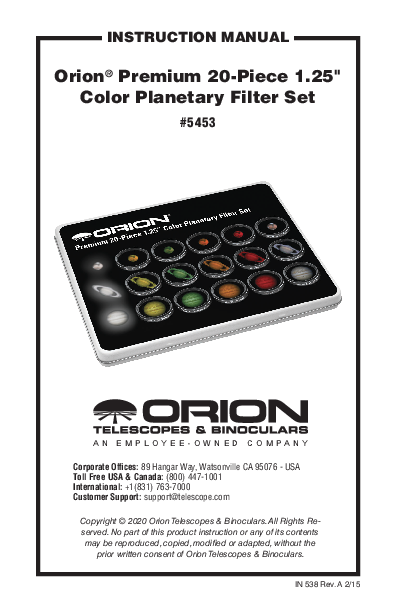
2 Your new Orion Premium 20-Piece 1.25" Color Planetary Filter Set will add versatility and viewing pleasure to your astronomy experi-ence. This set contains 20 color filters and a metal storage case.
Full PDF Document

If the inline viewer fails, it will open the original document in compatibility mode automatically. You can also open the file directly.
Extracted Text
INSTRUCTION MANUAL
Orion� Premium 20-Piece 1.25" Color Planetary Filter Set
#5453
AN EMPLOYEE-OWNED COMPANY Corporate Offices: 89 Hangar Way, Watsonville CA 95076 - USA Toll Free USA & Canada: (800) 447-1001 International: +1(831) 763-7000 Customer Support: support@telescope.com
Copyright � 2020 Orion Telescopes & Binoculars. All Rights Reserved. No part of this product instruction or any of its contents may be reproduced, copied, modified or adapted, without the
prior written consent of Orion Telescopes & Binoculars. IN 538 Rev. A 2/15

Your new Orion Premium 20-Piece 1.25" Color Planetary Filter Set will add versatility and viewing pleasure to your astronomy experience. This set contains 20 color filters and a metal storage case. Please read these instructions thoroughly for proper use and care of the filters.
Color Eyepiece Filters Color filters will enhance your visual and photographic observation of the Moon and planets, allowing you to see greater contrast between planetary details of differing colors. Some filters offer additional uses such as enhancing structure detail in galaxies, reducing unwanted false color from achromatic refractors and terrestrial observing at dawn or dusk. How They Work Planetary surface details and atmospheric phenomena reflect sunlight as contrasting colors which we see as details on the disc of a planet. A color eyepiece filter passes (transmits) a specific color of reflected light and blocks (reflects) their complementary colors: for example, red. Passing red will reveal detail of a contrasting color, blue, in this example. This lightening of similar colors and darkening of contrasting colors enhances the detail that you see. Color filters do not actually increase the level of detail, they merely make it easier to see.
Figure 1. Comparison illustration of using filters for planetary observation.
Attaching the Filters Filters require a 1.25" telescope eyepiece that can accept threaded filters. Any Orion 1.25" eyepiece will work. Simply thread the filter into the eyepiece barrel until it is finger tight.
2

Figure 2. Attaching a filter to a 1.25" eyepiece with filter threads. Stacking Filters You can also "stack" filters by threading another filter into the bottom of the first. Please note to check the transmission curves of the filters that you are stocking to make sure they have some overlap otherwise all visible wavelengths may be blocked or may be too limiting for smaller aperture telescopes. Photography Use the filters photographically by threading them into eyepieces used in teleextenders and universal camera adapters. Some cameras, camera adapters, diagonals and barlow lenses also have the proper threads to accept filters directly. Please note that a UV/IR blocking filter may also need to be used with monochrome cameras to block wavelengths outside of the visible spectrum. Color cameras generally have this filter already attached but monochrome cameras may not. Change Filters Quickly and Safely Without Interrupting Observing or Photography There's also an easy way to change the filter you want for observing or photography. With a filter wheel or filter slider, it is possible to change filters without having to remove your eyepiece or camera thus saving observing time and eliminating the need to fumble around in the dark screwing filters onto accessories.
Figure 3. The Orion 1.25" 5-position (manual) filter wheel and the Orion Nautilus 1.25" 7-position (motorized) filter wheel.
3

Figure 4. The Orion 1.25" 8-slot filter slider provides an affordable method to use and exchange filters quickly. Filter Descriptions Numbering/Naming of Filters Each filter is referred to by its color and Wratten number (based upon the historical standard numbering system developed by Kodak/Wratten).
Figure 5. Filter showing name and Wratten number (No 15. Yellow).
Luminance transmittance % Associated with each filter is a luminance transmittance value (LT %). All filters will reduce the total amount of light reaching the eye based upon this value. For small aperture telescopes best results will be found by using filters that have a higher luminance transmittance value. Larger aperture telescopes are required for low transmission filters such as the W46 Deep Blue (2% LT), the W47 Violet (3% LT) and the W29 Deep Red (6% LT).
4

Types of Filters The following types of filters are included in this set.

YELLOWS WB Light Yellow W11 Yellow-Green W12 Yellow W15 Deep Yellow

83% LT 40% LT 74% LT 66% LT

ORANGES AND REDS

W21 Orange

46% LT

W23A Light Red

25% LT

W25 Red

14% LT

W29 Deep-Red

6% LT

MAGENTAS W30 Light Magenta W32 Magenta

27% LT 13% LT

BLUES AND BLUE GREENS

W38A Blue

17% LT

W44A LightBlueGreen

14% LT

W46 Deep Blue

2% LT

W47 Violet 3% LT

3% LT

W56 Light Green

53% LT

W57 Medium Green

33% LT

W58 Green

24% LT

W64 Blue-Green

25% LT

LIGHT BALANCING W80A Medium Blue W82A Pale Blue

28% LT 73% LT

5

Figure 6. Visible spectrum graph (400nm to 700nm). Visible spectrum transmission graphs A spectral curve graph in the visible spectrum range (400nm to 700nm) is given for each filter and can be used to examine how the spectral transmittance curve of a particular filter transmits or blocks certain wavelengths.
Figure 7. The handy quick lookup matrix. Quick lookup matrix Use the quick lookup matrix found on the inside of the storage box lid as a quick reference guide to how the filters can be used on different targets. 6

Description and Uses for Individual Filters
#8 Lt. Yellow 83% Transmission Description: Longpass filter blocking visible wavelengths below 465nm Enhances:
� Detail in red and orange features � Lunar detail in small telescopes � Surface plains and maria on Mars � Belts of Jupiter � Dawn/dusk terrestrial viewing � Observation of planets in daytime � Improved resolution of dusky detail on Uranus and Neptune in 10" aperture
and above � Reduces color from achromatic refractors
7

#11 Yellow-Green 40% Transmission Description: Color correction filter Enhances:
� Reduces lunar glare � Darkens maria on Mars � Cloud bands of Jupiter � Comet impacts on Jupiter � Improved resolution of dusky detail on Uranus and Neptune in 10" aperture
and above � Reduces color from achromatic refractors
8

#12 Yellow 74% Transmission
Description: Minus blue filter Complements #32 minus green and #44A minus red Longpass filter blocking visible wavelengths below 500nm Enhances:
� Mercury/sky contrast � Surface features on Mercury � Lunar feature contrast � Reduces Lunar glare � Atmospheric clouds on Mars � Desert regions of Mars � Polar ice caps of Mars � Festoons of Jupiter � Clouds on Saturn � Blue/green contrast on Uranus � Blue/green contrast on Neptune
9

#15 Deep Yellow 6% Transmission Description: Longpass filter blocking visible wavelengths below 510nm Enhances:
� Mercury/sky contrast � Lunar feature contrast � Reduces Lunar glare � Atmospheric clouds on Mars � Surface plains and maria on Mars � Polar ice caps of Mars � Belts of Jupiter � Belts of Saturn � Cassini division of Saturn's rings � Improved resolution of dusky detail on Uranus and Neptune in 10" aperture
and above � Reduces color from achromatic refractors
10

#21 Orange 46% Transmission Description: Longpass filter blocking visible wavelengths below 530nm Enhances:
� Mercury/sky contrast � Surface plains and maria on Mars � Dust storms on Mars � Cloud bands on Jupiter � Loops, festoons and ovals on Jupiter � Polar regions of Jupiter � Great Red Spot on Jupiter � Belts of Saturn � Polar regions of Saturn
11

#23A Lt. Red 25% Transmission Description: Longpass filter blocking visible wavelengths below 550nm Enhances:
� Mercury/sky contrast � Venus/sky contrast � Surface plains and maria on Mars � Belts of Jupiter � Polar regions of Jupiter � Belts of Saturn � Polar regions of Saturn
12

#25 Red 14% Transmission
Description: Longpass filter blocking visible wavelengths below 580nm Enhances:
� Mercury/sky contrast � Surface features on Mercury � Venus/sky contrast � Reduces glare from Venus � Terminator on Venus � Lunar transient phenomenon (LTP) � Surface plains and maria on Mars � Dust storms on Mars � Polar ice caps of Mars � Belts of Jupiter � Transits of the moons of Jupiter � Clouds of Saturn � Rings of Saturn
13

#29 Deep Red 6% Transmission Description: Longpass filter blocking visible wavelengths below 600nm Enhances:
� Mercury/sky contrast � Surface features on Mercury � Venus/sky contrast � Terminator on Venus � Surface plains and maria on Mars � Polar ice caps of Mars � Belts of Jupiter � Transits of the moons of Jupiter � Clouds of Saturn � Collimating telescopes with large apertures
14

#30 Lt. Magenta 27% Transmission Description: Green absorption filter. Transmits red and blue. Enhances:
� Red and blue features on Mars � Ovals of Jupiter � Rings of Saturn � Blue/green contrast on Uranus � Blue/green contrast on Neptune
15

#32 Magenta 13% Transmission Description: Minus green filter Complements #12 minus blue and #44A minus red Enhances:
� Red and blue features on Mars � Ovals of Jupiter � Rings of Saturn � Blue/green contrast on Uranus � Blue/green contrast on Neptune
16

#38A Blue 17% Transmission Description: Absorbs red, some UV and some green light Enhances:
� Clouds and atmospheric features of Venus � Contrast of Venus in large telescopes � Atmospheric clouds on Mars � Dust storms on Mars � Belts on Jupiter � Great Red Spot on Jupiter � Belts on Saturn
17

#44A Lt. Blue-Green 14% Transmission Description: Minus red filter Complements #12 minus blue and #32 minus green Enhances:
� Lunar transient phenomenon (LTP) � Limb hazes of Mars � Terminator clouds of Mars
18

#46 Deep Blue 2% Transmission Description: Absorption filter Enhances:
� Clouds/atmospheric features on Venus � Reduces Venus glare in large telescopes � Lunar detail in large telescopes � "Blue clearing" on Mars in large telescopes
19

#47 Violet 3% Transmission Description: Blue tricolor filter used for color separation Enhances:
� Clouds/atmospheric features on Venus � Reduces Venus glare in large telescopes � Lunar detail in large telescopes � "Blue clearing" on Mars in large telescopes � Polar ice caps of Mars in large telescopes � Limb hazes and terminator clouds of Mars � Rings of Saturn in large telescopes
20

#56 Lt. Green 53% Transmission Description: Absorption filter Enhances:
� Lunar detail in small telescopes � Dust storms of Mars � Polar ice caps of Mars � Frost patches of Mars � Surface fogs of Mars � Belts of Jupiter � Rings of Saturn
21

#57 Med. Green 33% Transmission Description: Absorption filter Enhances:
� Mercury/sky contrast � Lunar detail in small telescopes � Rings of Saturn � Blue/green contrast on Uranus � Blue/green contrast on Neptune
22

#58 Green 24% Transmission
Description: Green tricolor filter used for color separation Enhances:
� Clouds/atmospheric features on Venus � Polar ice caps of Mars � Melt lines on Mars � Frost patches on Mars � Limb hazes on Mars � Terminator clouds on Mars � Cloud bands of Jupiter � Loops of Jupiter � Festoons of Jupiter � Ovals of Jupiter � Great Red Spot of Jupiter � Belts of Saturn � Polar regions of Saturn � Rings of Saturn
23

#64 Blue-Green 25% Transmission Description: Minus red absorption filter Enhances:
� Ice fogs of Mars � Polar hazes of Mars
24

#80A Med. Blue 28% Transmission
Description: Light balancing filter Enhances:
� Lunar feature contrast � Reduces Lunar glare � Atmospheric clouds on Mars � Polar ice caps of Mars � Belts of Jupiter � Cloud bands of Jupiter � Loops of Jupiter � Festoons of Jupiter � Ovals of Jupiter � Great Red Spot of Jupiter � Belts of Saturn � Polar regions of Saturn � Rings of Saturn � Reduces color from achromatic refractors
25

#82A Lt. Blue 73% Transmission
Description: Cooling light balancing filter Enhances:
� Areas of low contrast on the Moon � Areas of low contrast on Mars � Areas of low contrast on Jupiter � Areas of low contrast on Saturn � Structure detail in galaxies
Care and Storage When not in use, your filters should be kept in their original foam-lined case. Given proper care and storage, the filters should last a lifetime. Should a filter need cleaning for any reason, use the following directions to clean the filter without damaging it. Any quality optical lens cleaning tissue and optical lens cleaning fluid specifically designed for multi-coated optics can be used to clean the glass surfaces of the filter. Never use regular glass cleaner or cleaning fluid designed for eyeglasses. Before cleaning with fluid and tissue, blow any loose particles off the surface with a blower bulb or compressed air. Then apply some cleaning fluid to the tissue, never directly on the optics. Wipe the lens gently in a circular motion then remove any excess fluid with a fresh lens tissue. Oily fingerprints and smudges may be removed using this method. Use caution: rubbing too hard may scratch the filter glass. Do not remove the filter glass from its housing for cleaning.
26

One-Year Limited Warranty
This Orion product is warranted against defects in materials or workmanship for a period of one year from the date of purchase. This warranty is for the benefit of the original retail purchaser only. During this warranty period Orion Telescopes & Binoculars will repair or replace, at Orion's option, any warranted instrument that proves to be defective, provided it is returned postage paid. Proof of purchase (such as a copy of the original receipt) is required. This warranty is only valid in the country of purchase.
This warranty does not apply if, in Orion's judgment, the instrument has been abused, mishandled, or modified, nor does it apply to normal wear and tear. This warranty gives you specific legal rights. It is not intended to remove or restrict your other legal rights under applicable local consumer law; your state or national statutory consumer rights governing the sale of consumer goods remain fully applicable.
For further warranty information, please visit www.OrionTelescopes.com/warranty.

AN EMPLOYEE-OWNED COMPANY

Corporate Offices: 89 Hangar Way, Watsonville CA 95076 - USA Toll Free USA & Canada: (800) 447-1001 International: +1(831) 763-7000 Customer Support: support@telescope.com

Copyright � 2020 Orion Telescopes & Binoculars. All Rights Reserved. No part of this product instruction or any of its contents may be reproduced, copied, modified or adapted, without the
prior written consent of Orion Telescopes & Binoculars.

27