

Carrier PCV007-070 Compact Water Source Heat Pumps Owner's Manual
File info: application/pdf · 60 pages · 3.46MB
50PC-7SI
Installation, Start-Up, and Service Instructions - Carrier
SAFETY CONSIDERATIONS. Installation and servicing of air-conditioning equipment can be hazardous due to system pressure and electrical components. Only.
Installation, Start-Up, and Service Instructions
Manufacturer reserves the right to discontinue, or change at any time, specifications or designs without notice and without incurring obligations.
50PC-7SI - Instalacion, Arranque y Servicio - CP | Climaproyectos S.A. de C.V.
Full PDF Document

If the inline viewer fails, it will open the original document in compatibility mode automatically. You can also open the file directly.
Extracted Text
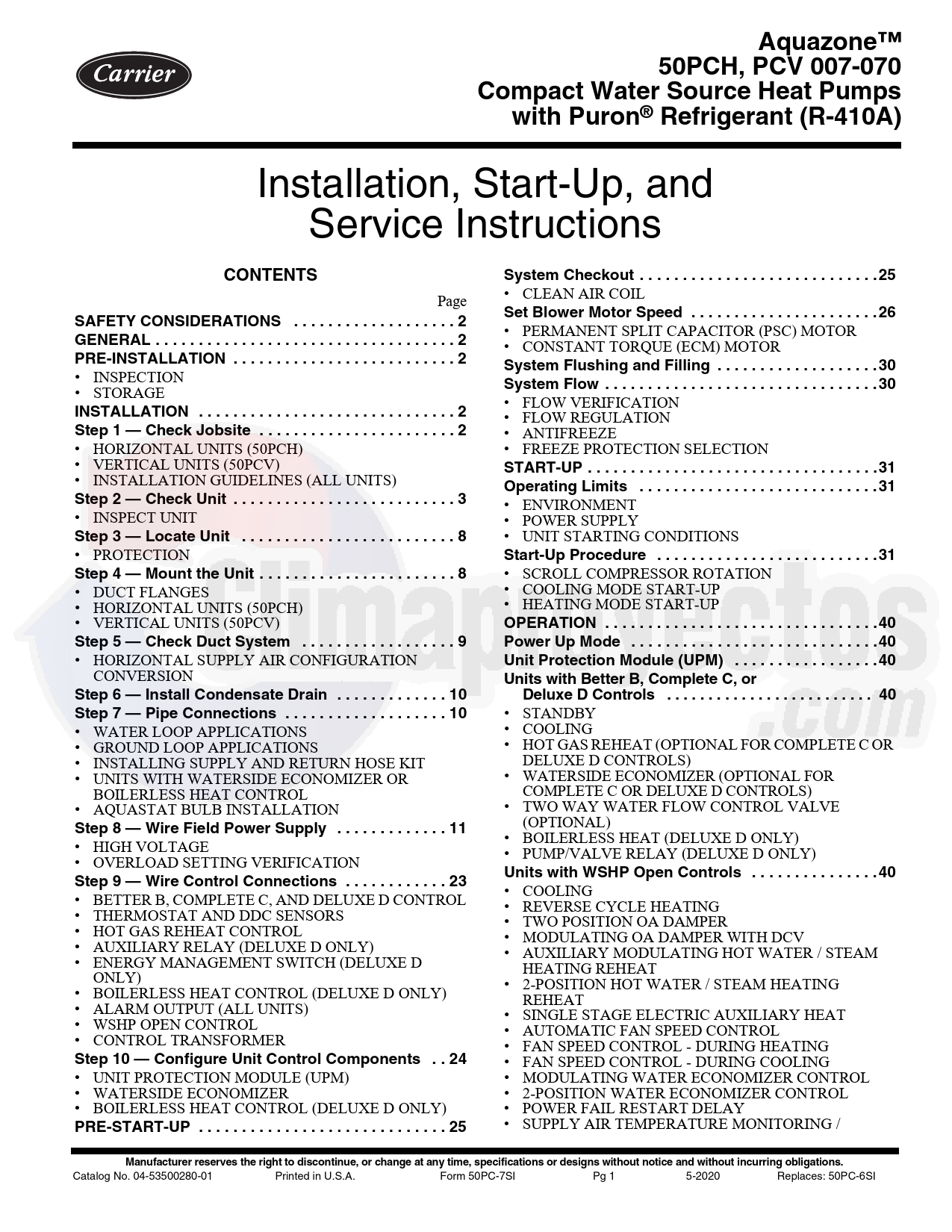
AquazoneTM 50PCH, PCV 007-070 Compact Water Source Heat Pumps with Puron� Refrigerant (R-410A)

Installation, Start-Up, and Service Instructions

CONTENTS
Page SAFETY CONSIDERATIONS . . . . . . . . . . . . . . . . . . . 2 GENERAL . . . . . . . . . . . . . . . . . . . . . . . . . . . . . . . . . . . 2 PRE-INSTALLATION . . . . . . . . . . . . . . . . . . . . . . . . . . 2 � INSPECTION � STORAGE INSTALLATION . . . . . . . . . . . . . . . . . . . . . . . . . . . . . . 2 Step1--Check Jobsite . . . . . . . . . . . . . . . . . . . . . . . 2 � HORIZONTAL UNITS (50PCH) � VERTICAL UNITS (50PCV) � INSTALLATION GUIDELINES (ALL UNITS) Step2--Check Unit . . . . . . . . . . . . . . . . . . . . . . . . . . 3 � INSPECT UNIT Step3--Locate Unit . . . . . . . . . . . . . . . . . . . . . . . . . 8 � PROTECTION Step4--Mount the Unit . . . . . . . . . . . . . . . . . . . . . . . 8 � DUCT FLANGES � HORIZONTAL UNITS (50PCH) � VERTICAL UNITS (50PCV) Step5--Check Duct System . . . . . . . . . . . . . . . . . . 9 � HORIZONTAL SUPPLY AIR CONFIGURATION
CONVERSION Step6--Install Condensate Drain . . . . . . . . . . . . . 10 Step7--Pipe Connections . . . . . . . . . . . . . . . . . . . 10 � WATER LOOP APPLICATIONS � GROUND LOOP APPLICATIONS � INSTALLING SUPPLY AND RETURN HOSE KIT � UNITS WITH WATERSIDE ECONOMIZER OR
BOILERLESS HEAT CONTROL � AQUASTAT BULB INSTALLATION Step8--Wire Field Power Supply . . . . . . . . . . . . . 11 � HIGH VOLTAGE � OVERLOAD SETTING VERIFICATION Step9--Wire Control Connections . . . . . . . . . . . . 23 � BETTER B, COMPLETE C, AND DELUXE D CONTROL � THERMOSTAT AND DDC SENSORS � HOT GAS REHEAT CONTROL � AUXILIARY RELAY (DELUXE D ONLY) � ENERGY MANAGEMENT SWITCH (DELUXE D
ONLY) � BOILERLESS HEAT CONTROL (DELUXE D ONLY) � ALARM OUTPUT (ALL UNITS) � WSHP OPEN CONTROL � CONTROL TRANSFORMER Step10--Configure Unit Control Components . . 24 � UNIT PROTECTION MODULE (UPM) � WATERSIDE ECONOMIZER � BOILERLESS HEAT CONTROL (DELUXE D ONLY) PRE-START-UP . . . . . . . . . . . . . . . . . . . . . . . . . . . . . 25

System Checkout . . . . . . . . . . . . . . . . . . . . . . . . . . . .25 � CLEAN AIR COIL Set Blower Motor Speed . . . . . . . . . . . . . . . . . . . . . . 26 � PERMANENT SPLIT CAPACITOR (PSC) MOTOR � CONSTANT TORQUE (ECM) MOTOR System Flushing and Filling . . . . . . . . . . . . . . . . . . . 30 System Flow . . . . . . . . . . . . . . . . . . . . . . . . . . . . . . . . 30 � FLOW VERIFICATION � FLOW REGULATION � ANTIFREEZE � FREEZE PROTECTION SELECTION START-UP . . . . . . . . . . . . . . . . . . . . . . . . . . . . . . . . . .31 Operating Limits . . . . . . . . . . . . . . . . . . . . . . . . . . . . 31 � ENVIRONMENT � POWER SUPPLY � UNIT STARTING CONDITIONS Start-Up Procedure . . . . . . . . . . . . . . . . . . . . . . . . . .31 � SCROLL COMPRESSOR ROTATION � COOLING MODE START-UP � HEATING MODE START-UP OPERATION . . . . . . . . . . . . . . . . . . . . . . . . . . . . . . . .40 Power Up Mode . . . . . . . . . . . . . . . . . . . . . . . . . . . . .40 Unit Protection Module (UPM) . . . . . . . . . . . . . . . . .40 Units with Better B, Complete C, or
Deluxe D Controls . . . . . . . . . . . . . . . . . . . . . . . . . 40 � STANDBY � COOLING � HOT GAS REHEAT (OPTIONAL FOR COMPLETE C OR
DELUXE D CONTROLS) � WATERSIDE ECONOMIZER (OPTIONAL FOR
COMPLETE C OR DELUXE D CONTROLS) � TWO WAY WATER FLOW CONTROL VALVE
(OPTIONAL) � BOILERLESS HEAT (DELUXE D ONLY) � PUMP/VALVE RELAY (DELUXE D ONLY) Units with WSHP Open Controls . . . . . . . . . . . . . . . 40 � COOLING � REVERSE CYCLE HEATING � TWO POSITION OA DAMPER � MODULATING OA DAMPER WITH DCV � AUXILIARY MODULATING HOT WATER / STEAM
HEATING REHEAT � 2-POSITION HOT WATER / STEAM HEATING
REHEAT � SINGLE STAGE ELECTRIC AUXILIARY HEAT � AUTOMATIC FAN SPEED CONTROL � FAN SPEED CONTROL - DURING HEATING � FAN SPEED CONTROL - DURING COOLING � MODULATING WATER ECONOMIZER CONTROL � 2-POSITION WATER ECONOMIZER CONTROL � POWER FAIL RESTART DELAY � SUPPLY AIR TEMPERATURE MONITORING /

Manufacturer reserves the right to discontinue, or change at any time, specifications or designs without notice and without incurring obligations.

Catalog No. 04-53500280-01

Printed in U.S.A.

Form 50PC-7SI

Pg 1

5-2020

Replaces: 50PC-6SI

CONTROL / ALARM � DEHUMIDIFICATION � SPACE TEMPERATURE ALARMS � CONDENSER WATER TEMPERATURE MONITORING
/ CONTROL / ALARM � HIGH CONDENSATE / OVERFLOW ALARM � FILTER STATUS ALARM � COMPRESSOR FAULT/LOCKOUT ALARM � INSUFFICIENT VENTILATION ALARM � RELATIVE HUMIDITY ALARM � TIME SCHEDULES � HOLIDAY SCHEDULES � OVERRIDE SCHEDULES SERVICE . . . . . . . . . . . . . . . . . . . . . . . . . . . . . . . . . . . 44 Filters . . . . . . . . . . . . . . . . . . . . . . . . . . . . . . . . . . . . . 45 Condensate Drain Pans . . . . . . . . . . . . . . . . . . . . . . 45 Refrigerant System . . . . . . . . . . . . . . . . . . . . . . . . . . 45 Compressor . . . . . . . . . . . . . . . . . . . . . . . . . . . . . . . . 45 Fan Motors . . . . . . . . . . . . . . . . . . . . . . . . . . . . . . . . . 45 Condensate Drain Cleaning . . . . . . . . . . . . . . . . . . . 45 Air Coil Cleaning . . . . . . . . . . . . . . . . . . . . . . . . . . . . 45 Condenser Cleaning . . . . . . . . . . . . . . . . . . . . . . . . . 45 � GRAVITY FLOW METHOD � FORCED CIRCULATION METHOD Checking System Charge . . . . . . . . . . . . . . . . . . . . . 46 Refrigerant Charging . . . . . . . . . . . . . . . . . . . . . . . . . 46 Air Coil Fan Motor Removal . . . . . . . . . . . . . . . . . . . 46 TROUBLESHOOTING . . . . . . . . . . . . . . . . . . . . . . . . 46 � UNIT PROTECTION MODULE (UPM) Freeze Protection Sensors . . . . . . . . . . . . . . . . . . . . 48 Thermostatic Expansion Valves . . . . . . . . . . . . . . . 48 � TXV FAILURE START-UP CHECKLIST. . . . . . . . . . . . . . . . . . . . . . . . . . CL-1
IMPORTANT: Read the entire instruction manual before starting installation.
SAFETY CONSIDERATIONS
Installation and servicing of air-conditioning equipment can be hazardous due to system pressure and electrical components. Only trained and qualified service personnel should install, repair, or service air-conditioning equipment. Untrained personnel can perform basic maintenance functions of cleaning coils and filters and replacing filters. All other operations should be performed by trained service personnel. When working on air-conditioning equipment, observe precautions in the literature, tags and labels attached to the unit, and other safety precautions that may apply. Improper installation, adjustment, alteration, service, maintenance, or use can cause explosion, fire, electrical shock or other conditions which may cause personal injury or property damage. Consult a qualified installer, service agency, or your distributor or branch for information or assistance. The qualified installer or agency must use factory-authorized kits or accessories when servicing or repairing this product. Refer to the individual instructions packaged with the kits or accessories when installing. Follow all safety codes. Wear safety glasses and work gloves. Use quenching cloth for brazing operations. Have fire extinguisher available. Read these instructions thoroughly and follow all warnings or cautions attached to the unit. Consult local building codes and the National Electrical Code (NEC) for special installation requirements. Understand the signal words -- DANGER, WARNING, and CAUTION. DANGER identifies the most serious hazards which will result in severe personal injury or death. WARNING signifies

hazards that could result in personal injury or death. CAUTION is used to identify unsafe practices, which would result in minor personal injury or product and property damage. It is important to recognize safety information. This is the safety-alert symbol ( ). When you see this symbol on the unit and in instructions or manuals, be alert to the potential for personal injury.
WARNING
Electrical shock can cause personal injury and death. Shut off all power to this equipment during installation. There may be more than one disconnect switch. Tag all disconnect locations to alert others not to restore power until work is completed.
GENERAL This Installation and Start-Up Instructions literature is for AquazoneTM water source heat pump systems. Water source heat pumps (WSHPs) are single-package horizontally and vertically mounted units with electronic controls designed for year-round cooling and heating.
IMPORTANT: The installation of water source heat pump units and all associated components, parts, and accessories which make up the installation shall be in accordance with the regulations of ALL authorities having jurisdiction and MUST conform to all applicable codes. It is the responsibility of the installing contractor to determine and comply with ALL applicable codes and regulations.
PRE-INSTALLATION INSPECTION Upon receipt of shipment, carefully check the shipment against the bill of lading. Make sure all units have been received. Inspect the carton or crating of each unit, and inspect each unit for damage on both the interior and exterior. Ensure the shipping company makes proper notation of any shortages or damage on all copies of the freight bill. Concealed damage not discovered during unloading must be reported to the shipping company within 5 days of receipt of shipment. NOTE: It is the responsibility of the purchaser to file all necessary claims with the shipping company. STORAGE If the equipment is not needed for immediate installation upon its arrival at the job site, it should be left in its shipping carton and stored in a clean, dry area between 50�F and 95�F. Units must only be stored or moved in the normal upright position as indicated by the UP arrows on each carton at all times. If unit stacking is required, stack units as follows: vertical units less than 6 tons, no more than two high; horizontal units less than 6 tons, no more than three high. Do not stack units larger than 6 tons.
INSTALLATION Step1--Check Jobsite Installation, operation and maintenance instructions are provided with each unit. Before unit start-up, read all manuals and become familiar with the unit and its operation. Thoroughly check out the system before operation. Complete the inspections and instructions listed below to prepare a unit for installation. See Tables 1 and 2 for unit physical data.

2

HORIZONTAL UNITS (50PCH) Horizontal units are designed for indoor installation only. Be sure to allow adequate space around the unit for installation and servicing. See Fig. 1 for overall unit dimensions.
VERTICAL UNITS (50PCV) Vertical units are designed for indoor installations only. Vertical units are typically installed in a floor-level closet or a small mechanical room, Be sure to allow adequate space around the unit for installation and servicing. See Fig. 2 for overall unit dimensions.
CAUTION
EQUIPMENT DAMAGE HAZARD To avoid equipment damage, do not use these units as a source of heating or cooling during the construction process. The mechanical components and filters used in these units quickly become clogged with construction dirt and debris which may cause system damage.
INSTALLATION GUIDELINES (ALL UNITS) 1. Be sure that the location chosen for unit installation provides
ambient temperatures maintained above freezing. 2. Be sure the installation location is isolated from sleeping
areas, private offices and other acoustically sensitive spaces. 3. Be sure unit is mounted at a height sufficient to provide an
adequate slope of the condensate lines. If an appropriate slope cannot be achieved, a field-supplied condensate pump may be required. 4. On horizontal units, allow adequate room below the unit for condensate drain trap and do not locate the unit above supply piping. 5. Provide sufficient space for duct connection. Do not allow the weight of the ductwork to rest on the unit. 6. Provide adequate clearance for filter replacement and drain pan cleaning. Do not allow piping, conduit, etc. to block filter access. 7. Provide sufficient access to allow maintenance and servicing of the blow and blower motor, compressor and coils. Removal of the entire unit from the closet should not be necessary. 8. Provide an unobstructed path to the unit within the closet or mechanical room. Space should be sufficient to allow return air to freely enter the space. 9. Provide ready access to water valves and fittings, and screwdriver access to unit side panels, discharge collar, and all electrical connections. 10. Where access to side panels is limited, pre-removal of the control box side mounting screws may be necessary for future servicing.
Step2--Check Unit Upon receipt of equipment at the jobsite, inspect the carton or crating of each unit, and inspect each unit for damage on both the

interior and exterior. Note any damage and contact your local equipment sales office.
CAUTION
EQUIPMENT DAMAGE HAZARD DO NOT store or install units in corrosive environments or in locations subject to temperature or humidity extremes (e.g., attics, garages, rooftops, etc.). Corrosive conditions and high temperature or humidity can significantly reduce performance, reliability, and service life. Always move units in an upright position. Tilting units on their sides may cause equipment damage.
INSPECT UNIT
To prepare the unit for installation, complete the procedures listed below: 1. Verify that the correct unit has been received. Check the unit
capacity (tonnage), voltage, orientation, and configuration. 2. Compare the electrical data on the unit nameplate with to ver-
ify the jobsite power feed (voltage, amperage, MCA) and power protection (MOCP).
3. Verify that the unit is the correct model for the entering water temperature of the job (standard or extended range)
4. Remove the unit packaging, keeping the unit attached to the shipping pallet. Do not destroy packaging. Save for re-installation on the unit if the unit will not be fully installed.
5. Open a unit access panel. Verify that the refrigerant tubing is free of kinks or dents, and that it does not touch other unit components.
6. Check the water piping and piping connections to make sure they are free from defects, kinks, dents, and appear to be water tight. Verify system operating water pressure.
7. Inspect the blower assembly. Verify that the blower has not come lose during shipping. Verify clearance between the blower wheel and the blower housing. Verify free blower rotation.
8. Inspect all electrical connections. Be sure connections are clean and tight at the terminals.
9. Check unit controls. If Better B, Complete C, or Deluxe D, verify field provided thermostat is available. If WSHP Open, verify proper sensor has been provided and a commissioning interface will be available.
10. 50PCH Only - Locate the hanging bracket kit located in the compressor compartment.
11. Remove the foam blower shipping support from underneath the blower section.
12. Remove any shipping brackets from the unit.

3

Table1--PhysicalData--50PCH,PCV(007-030)Units

50PCH,PCV UNIT
COMPRESSOR (1 each) Maximum Water Working Pressure (psig)
PSC FAN MOTOR AND BLOWER Fan Motor Type Fan Motor (hp) Blower Wheel Size (Dia x W) (in.)
ECM FAN MOTOR AND BLOWER Fan Motor Type/Speeds Fan Motor (hp) Blower Wheel Size (Dia x W) (in.)
WATER CONNECTION SIZE FPT (in.)
Coaxial Coil Volume (gal)
VERTICAL CABINET
Refrigeration Charge (oz)
Air Coil Dimensions (H x W) Std. Filter - 1 in. Throwaway (L x H) Opt. Filter - 2 in. MERV 8 or 13 Throwaway (L x H) Weight - Operating (lb) Weight - Shipping (lb) HORIZONTAL CABINET
Refrigeration Charge (oz)
Air Coil Dimensions (H x W) Std. Filter - 1 in. Throwaway (L x H) Opt. Filter - 2 in. MERV 8 or 13 Throwaway (L x H) Weight - Operating (lb) Weight - Shipping (lb)

007 Cu CuNi

009

012

Cu CuNi Cu CuNi

Rotary

015 Cu CuNi
400*

018

024

030

Cu CuNi Cu CuNi Cu CuNi

Rotary

Scroll

1/10 4.5 x 4.5

5.5 x 4.5

PSC 1/6

1/4 9 x 7

C.T. ECM

N/A

1/3

9 x 7

3/4

0.06

Cu: 0.06 Cu/Ni: 0.08

0.08

0.09

0.14

0.24

Cu: 19

16

19

21

Cu/Ni: 19 (captube)/

22

17 (TXV)

Cu: 35 Cu/Ni: 33

10 x 14

12 x 16.5 16 x 16.5

20 x 16.5

10 x 16

16 x 20

20 x 20

10 x 16

16 x 20

20 x 20

98

103

105

123

173

177

190

126

130

132

151

201

205

217

Cu: 16 Cu/Ni: 19

10 x 14

10 x 16

10 x 16

96

100

128

132

19

22

12 x 16.5 16 x 16.5

16 x 20

16 x 20

105

136

174

134

158

208

Cu: 35 Cu/Ni: 33

16 x 20.5

16 x 25

16 x 25

181

190

212

224

LEGEND CT -- Constant Torque ECM -- Electronically Commutated Motor FPT -- Female Pipe Thread PSC -- Permanent Split Capacitor TXV -- Thermostatic Expansion Valve

* 300 psig when unit is built with the 2-way solenoid valve option.

4

Table2--PhysicalData--50PCH,PCV(036-070)Units

50PCH,PCV UNIT
COMPRESSOR (1 each) Maximum Water Working Pressure (psig)
PSC FAN MOTOR AND BLOWER Fan Motor Type Fan Motor (hp) Blower Wheel Size (Dia x W) (in.)
ECM FAN MOTOR AND BLOWER Fan Motor Type/Speeds Fan Motor (hp) Blower Wheel Size (Dia x W) (in.)
WATER CONNECTION SIZE FPT (in.) Coaxial Coil Volume (gal)
VERTICAL CABINET Refrigeration Charge (oz)
Air Coil Dimensions (H x W) Std. Filter - 1 in. Throwaway (L x H) Opt. Filter - 2 in. MERV 8 or 13 Throwaway (L x H) Weight - Operating (lb) Weight - Shipping (lb) HORIZONTAL CABINET Refrigeration Charge (oz)

036 Cu CuNi
1/2 9 x 7
1/2 9 x 7
Cu: 44 Cu/Ni: 40 24 x 20.2 24 x 24 24 x 24
229 255 40

Air Coil Dimensions (H x W) Std. Filter - 1 in. Throwaway (L x H) Opt. Filter - 2 in. MERV 8 or 13 Throwaway (L x H) Weight - Operating (lb) Weight - Shipping (lb)

18 x 27.5 18 x 30 18 x 30
226 270

LEGEND CT -- Constant Torque ECM -- Electronically Commutated Motor FPT -- Female Pipe Thread PSC -- Permanent Split Capacitor TXV -- Thermostatic Expansion Valve

* 300 psig when unit is built with the 2-way solenoid valve option.

041 Cu CuNi

042

048

Cu CuNi Cu CuNi

Scroll

400*

060 Cu CuNi

070 Cu CuNi

PSC

3/4

1/2

10 x 8

3/4 10 x 9

11 x 9

C.T. ECM 3/4 10 x 8

1 11 x 9

3/4 0.27

1

0.49

0.62

38
20 x 16 20 x 20 20 x 20
217 243

Cu: 43 Cu/Ni: 39 24 x 20.2 24 x 24
24 x 24
239 265

52

59

24 x 26.75 24 x 30

24 x 30

287

307

312

331

64
32 x 26.2 16 x 30 (2) 16 x 30 (2)
336 360

Cu: 43 Cu/Ni: 39

18 x 27.5

N/A

18 x 30 18 x 30

51

62

20 x 32 20 x 34.5 20 x 34.5

61
20 X 42 20 x 24 (2) 20 x 24 (2)

231

274

288

316

264

299

318

365

5

D

E C

RT

F

H G

B

Compressor

Electrical

Access

Knock-Outs

Left Hand Return End Blow (FLE)

NOTE: Models 048 and 060 Left Hand Return units have condenser water connections on the front right and electrical knockouts on the front left.

Condenser Water Out
Condenser Water In

Return Air

D

Opening

E

Q

F

TR

K

N

J

Condensate Drain
A

Return Air Opening

K J
A

MC
N
Condensate Drain

Q

K

N

P

B

Return Air Opening
Condensate Drain
A

Left Hand Return Straight Through (FLS)

Return Air Opening

C

M

C

K

P

N

B

Condensate Drain

B

A

Right Hand Return End Blow (FRE)

LEGEND FLE -- Front Water, Left Return, End
Supply FLS -- Front Water, Left Return, Straight
Through Supply FRE -- Front Water, Right Return, End
Supply FRS -- Front Water, Right Return, Straight
Through Supply R/A -- Return Air

Blower Access 18" Minimum 24" Opti mum

Service Clearances

Right Hand Return Straight Through (FRS)

AIR COIL Blower

Electrical Control Box
Compressor

Compressor Access and Control Access 24" Minimum 36" Optimum

A

B

C

D

E

F

G

H

J

K

50PCH UNIT SIZE

WIDTH *

DEPTH

HEIGHT

CAB END TO FILTER RACK

R/A DUCT WIDTH

CAB FRONT
TO FILTER RACK

WATER WATER INLET OUTLET

SIDE TO DISC. WIDTH

DISC. WIDTH

007 19.0 33.0 11.5

1.5

009 19.0 33.0 11.5

1.5

012 19.0 33.0 11.5

1.5

015 22.0 43.0 17.0 1.5

015** 22.0 43.0 17.0 1.5

018 22.0 43.0 17.0 1.5

024 22.0 43.0 18.0

1.5

030 22.0 43.0 18.0

1.5

036 22.0 54.5 19.0

1.5

042 22.0 54.5 19.0

1.5

048 25.0 54.5 21.0

1.5

060 25.0 54.5 21.0

1.5

070 25.0 65.0 21.0

1.5

16.15 15.35 2.38 16.15 15.35 2.38 16.15 15.35 2.38 20.15 21.35 2.86 20.15 21.35 2.86 20.15 21.35 2.86 25.00 16.50 2.86 25.00 16.50 2.47 30.15 22.85 2.86 30.15 22.85 2.86 34.60 18.40 2.86 34.60 18.40 2.86 48.10 15.40 2.86

9.50 9.50 9.50 15.00 15.00 14.13 14.13 15.00 16.13 16.13 18.52 18.52 18.52

5.375 5.375 5.250 8.150 5.420 5.420 5.420 5.420 6.470 5.270 7.250 6.320 6.320

6.30 6.30 6.43 6.43 9.13 9.13 9.13 9.13 9.13 10.45 10.45 11.76 11.76

M TOP TO DISC. (FLE AND FRS) 5.97 5.97 6.31 9.55 6.11 6.11 6.11 6.11 7.50 6.46 7.46 6.81 6.81

N

P

END DISC. TO HEIGHT DISC.
(STR)

4.10 4.10 4.10 4.10 9.65 9.65 9.65 9.65 10.28 11.30 11.36 12.50 12.50

4.875 4.875 4.750 7.650 4.920 4.920 4.920 4.920 5.970 4.770 6.750 5.820 5.820

Q

R

T

TOP TO DISC. (FRE AND FLS)

FILTER RACK HEIGHT

R/A DUCT FLANGE HEIGHT

CONDENSER WATER
CONNECTIONS FPT

RECOMMENEDED REPLACEMENT NOMINAL FILTER SIZE

1.41 11.3

8.6

3/4

1.41 11.3

8.6

3/4

1.14 11.3

8.6

3/4

3.40 16.8 15.0

3/4

1.23 16.8 15.0

3/4

1.23 16.8 15.0

3/4

1.23 16.8 15.0

3/4

1.23 16.8 15.0

3/4

1.21 18.8 17.0

3/4

1.22 18.8 17.0

3/4

2.16 20.8 19.0

1

1.68 20.8 19.0

1

1.68 20.8 19.0

1

10x16x1 10x16x1 10x16x1 16x20x1 16x20x1 16x20x1 16x25x1 16x25x1 18x30x1 18x30x1 20x34.5x5x1 20x34.5x5x1 20x24x1 (2)

*When waterside economizer is installed, increase width by 7 inches. When WSHP Open Controller is installed, increase depth by 2.6 inches. When waterside
economizer is installed, increase depth by 7 inches. **50PCH015 units built with ECM motor option. When waterside economizer is installed, increase height by 1 inch.

NOTES: 1. Alldimensionsarewithin�0.125inch. 2. All condensate drain connections are 3/4 in. FPT. 3. Unit sizes 015-070 can be field converted between end blow and straight through supply air configurations. 4. Specifications subject to change without notice. 5. The 1-in. filter rack extends 1.23-in. beyond the side of the unit. The 2-in. filter rack extends 2.89-in. beyond the side of the unit. The 2-in. filter rack is 4-sided with a filter access door on one end and can accept either a 1-in. or 2-in. filter.

Fig.1--50PCH007-070 Unit Dimensions

6

FE G

D

Access Panels

D

EF Q

C B

Condenser Water Out

J K
H

Condenser Water In
Electrical Connections

A

A

C
Condensate Drain B

Left Hand Return

Right Hand Return

M NP
Return Air (Filter) View

A

Blower

I

R

C O I L

Blower Access 18" Minimum 24" Optimum

Compressor
Front of Unit Service Clearances

Compressor Access and Electrical/Control Access 24" Minimum 36" Optimum
Electrical Control Box

50PCV UNIT SIZE

A

B

C

D

E

F

G

H

J

K

M

N

P

WIDTH *

DEPTH

HEIGHT

DISC. DEPTH

DISC. WIDTH

CABINET EDGE TO
DISC.

LEFT SIDE TO DISC.

WATER INLET

WATER OUTLET

CONDENSATE DRAIN

R/A DUCT WIDTH

R/A DUCT FLANGE HEIGHT

FILTER RACK HEIGHT

Q

CONDENSER RECOMMENEDED

WATER

REPLACEMENT

CONNECTIONS NOMINAL FILTER

FPT

SIZE

007

19.0 19.00 24.25 10.0

8.0

4.5

9.3 2.44

9.68

13.87

16.0

8.0

10.0 5.4

3/4

10x16x1

009

19.0 19.00 24.25 10.0

8.0

4.5

9.3 2.44

9.68

13.87

16.0

8.0

10.0 5.4

3/4

10x16x1

012

19.0 19.00 24.25 10.0

8.0

4.5

9.3 2.44

9.68

13.87

16.0

8.0

10.0 5.4

3/4

10x16x1

015

21.5 21.50 32.25 10.0

8.0

5.8 10.0 2.85

8.45

15.87

20.0

14.0

16.0 3.5

3/4

16x20x1

015** 21.5 21.50 32.25 14.0 14.0

3.1

5.2 2.85

8.45

15.87

20.0

14.0

16.0 5.2

3/4

16x20x1

018

21.5 21.50 32.25 14.0 14.0

3.1

5.2 2.85

8.45

15.87

20.0

14.0

16.0 5.2

3/4

16x20x1

024

21.5 21.50 39.25 14.0 14.0

3.1

5.2 2.80

8.45

18.87

20.0

18.0

20.0 5.2

3/4

20x20x1

030

21.5 21.50 39.25 14.0 14.0

3.1

5.2 2.80

8.45

18.87

20.0

18.0

20.0 5.2

3/4

20x20x1

036

21.5 26.00 43.25 16.0 14.0

4.0

5.0 2.75 10.77

18.87

24.0

22.0

24.0 5.0

3/4

24x24x1

041

21.5 21.50 40.25 16.0 14.0

1.7

4.7 2.80

8.45

18.87

20.0

18.0

20.0 4.7

3/4

20x20x1

042

21.5 26.00 44.25 16.0 14.0

4.0

5.0 2.75 10.77

18.87

24.0

22.0

24.0 5.0

3/4

24x24x1

048

24.0 32.50 45.25 18.0 14.0

7.0

6.2 3.26 13.20

20.87

30.0

22.0

24.0 6.2

1

24x30x1

060

24.0 32.50 45.25 18.0 14.0

7.0

6.2 3.26 13.20

20.87

30.0

22.0

24.0 6.2

1

24x30x1

070

26.0 33.25 58.25 18.0 16.0

7.8

7.2 2.92 13.36

25.87

30.0

30.0

32.0 7.2

1

16x30x1 (2)

* When waterside economizer is installed, increase width by 7 inches for Left Hand Return Units, increase width by 12 inches for Right Hand Return Units
 When WSHP Open Controller is installed, increase depth by 2.6 inches. When Waterside economizer is installed, increase depth by 7 inches.
** 50PCV015 units built with ECM motor option.

NOTES: 1. Alldimensionsarewithin�0.125inch. 2. All condensate drain connections are 3/4 in. FPT. 3. Specifications subject to change without notice. 4. The 1-in. filter rack extends 1.23-in. beyond the side of the unit. The 2-in. filter rack extends 2.89-in. beyond the side of the unit. The 2-in. filter rack is 4 sided with a filter access door on one end and can accept either a 1-in. or 2-in. filter.

Fig.2--50PCV007-070 Unit Dimensions

7

Step3--Locate Unit Locate the unit in an indoor area that allows easy removal of the filter and access panels, and has enough room for service personnel to perform maintenance or repair. Provide sufficient room to make fluid, electrical, and duct connection(s). If the unit is located in a confined space such as a closet, provisions must be made for return air to freely enter the space. Unit condensate drains are not internally trapped. Allow room below the unit base for horizontal models for an adequate condensate trap. These units are not approved for outdoor installation; therefore, they must be installed inside the structure being conditioned. Do not locate units in areas that are subject to freezing. Units must be installed in conditioned space that is not subject to extremes of temperature or humidity to avoid cabinet sweating and/or equipment damage.
IMPORTANT: Care must be taken to prevent the introduction of dust, pain, debris, or chemicals into the unit, which can cause damage to the unit, delay start-up, and may impact unit longevity.
Do not use units for temporary heating, air conditioning or ventilation during construction or remodeling, especially when plastering, sanding or painting or when replacing carpet or flooring. Dust and debris can clog the coil and blower. Chemical vapors can lead to formicary corrosion and damage the coil. Ensure adequate ventilation and debris collection during construction or remodeling. PROTECTION Once the units are properly positioned on the jobsite, cover them with either a shipping carton, vinyl film, or an equivalent protective covering. Cap open ends of pipes stored on the jobsite. This precaution is especially important in areas where painting, plastering, or spraying of fireproof material, etc. is not yet complete. Foreign material that accumulates within the units can prevent proper start-up and require costly clean-up operations. Before installing any of the system components, be sure to examine each pipe, fitting, and valve, and remove any dirt or foreign material found in or on these components. Step4--Mount the Unit
DUCT FLANGES The unit heat pumps feature foldout return and supply air duct flanges. These fold-out flanges allow the heat pumps to more easily fit through doorways and other tight spaces, and also prevent damage in shipping and handling. It is recommended that all fold-out flanges be folded out once the heat pump is installed to ensure that return and supply airflow is not obstructed. These flanges can be easily folded using standard or duckbill pliers. Once folded out these flanges can be used to support light ductwork loads. HORIZONTAL UNITS (50PCH) While horizontal units may be installed on any level surface strong enough to hold their weight, they are typically suspended above a ceiling by threaded rods. All horizontal units come with a Hanging Bracket Kit to facilitate suspended unit mounting. Hanging brackets are installed as shown in Fig. 3.

Fig.3--Hanging Bracket Locations The hanging bracket kit includes the following: � (5) Brackets � (5) Rubber vibration isolators � (8) Screws #10 x 1/2 in. � (10) Bolts 1/4 -- 28 x 1/2 in. hex bolt (not used on this
model) The following additional materials are needed and must be fieldsupplied: � Threaded rod (3/8 in. maximum diameter) � Hex nuts � Washers (13/4 in. minimum O.D.) Hanging Bracket Installation 1. Remove and discard factory-provided screws from location
where hanging brackets will be installed. See Fig. 4.
Fig.4--Removing Factory Screws 2. Mount 4 brackets to unit corner post using the bolts provided
in the kit, as shown in Fig. 5. DO NOT re-use the screws removed from the unit during Step 1 to mount the hanging brackets on the unit.

Fig.5--Mounting Brackets 8

3. Install rubber grommet on the bracket as shown in Fig. 6. 4. Hang the unit and assemble the field-provided threaded rod,
nuts, and washers on the brackets as shown in Fig. 6.
Fig.6-- Hanging the Unit IMPORTANT: Units larger than six tons include an integral angle iron frame with mounting holes present. Horizontal units installed above the ceiling must conform to all local codes. An auxiliary drain pan if required by code, should be at least 4 in. larger than the bottom of the heat pump. Plumbing connected to the heat pump must not come in direct contact with joists, trusses, walls, etc. Some applications require an attic floor installation of the horizontal unit. In this case the unit should be set in a full size secondary drain pan on top of a vibration absorbing mesh. The secondary drain pan prevents possible condensate overflow or water leakage damage to the ceiling. The secondary drain pan is usually placed on a plywood base isolated from the ceiling joists by additional layers of vibration absorbing mesh. In both cases, a 3/4-in. drain connected to this secondary pan should be run to an eave at a location that will be noticeable.
CAUTION If the unit is located in a crawl space, the bottom of the unit must be at least 4-in. above grade to prevent flooding of the electrical parts due to heavy rains. VERTICAL UNITS (50PCV) Vertical units should be mounted level on a vibration absorbing pad slightly larger than the unit base in order to minimize vibration transmission from the unit to the building structure. See Fig. 7. It is generally not necessary to anchor the unit unless required by local code.
VIBRATION MOUNTING PAD

All major service access for the vertical models is from the front side of the unit. When installing the unit in a confined space such as a closet, ensure that the service panel screws are accesible, that the filter can be replaced without damage and that water and electrical connections are accesible. For models with a unitmounted disconnect switch, make sure the switch can be easily seen and operated. To reduce sound transmission, units should be installed using flexible electrical conduit and hose kits. Care should be taken to ensure that no part of the unit cabinet is touching part of the building structure. For ducted return applications, a flexible duct connection should be used. Mount the unit on a vibration absorption pad slightly larger than the entire base to minimize vibration transmission. It is not necessary to mount the unit on the floor. Step5--Check Duct System All units are provided with a return air duct flange and supply air duct connections. Refer to unit dimensional drawings (Fig. 1 and 2) for physical dimensions of the collar and flange. A flexible connector is recommended for supply and return air duct connections on metal duct systems. All metal ducting should be insulated with a minimum of 1 in. duct insulation to avoid heat loss or gain and prevent condensate from forming during the cooling operation. Application of the unit to uninsulated ductwork is not recommended as the unit's performance will be adversely affected.
CAUTION
Do not connect discharge ducts directly to the blower outlet. The factory filter rack should be left in place on a free return system.
If the unit will be installed in a new installation with new ductwork, the installation should be designed using current ASHRAE (American Society of Heating, Refrigerating, and AirConditioning Engineers) procedures for duct sizing. If the unit will be connected to an existing duct system, a check should be made to assure that the duct system has the capacity to handle the air required for the unit application. If the duct system is too small, larger ductwork must be installed. Be certain to check for existing leaks and repair. The duct system and all diffusers should be sized to handle the designed airflow quietly. To maximize sound attenuation of the unit blower, the supply and return air plenums should be insulated. There should be no direct straight air path through the air grille into the heat pump. The return air inlet to the heat pump must have at least one 90-degree turn away from the space return air grille. If air noise or excessive airflow are a problem, the blower speed can be changed to a lower speed to reduce airflow. (Refer to motor speeds and settings in Tables 9 and 10 on page 27.)
HORIZONTAL SUPPLY AIR CONFIGURATION CONVERSION The supply air location on horizontal units can be quickly field converted from end blow to straight through or vice-versa. To convert the supply air direction, follow the steps below: 1. If connected to power, shut off the unit and disconnect switch
or circuit breaker. 2. Unscrew and remove the blower access panel. 3. Disconnect the wires from the unit electrical box to the
blower motor. Note which speed taps are wired for units with PSC or constant torque motors. 4. Unscrew and carefully remove the blower panel with the blower and motor attached. Be careful not to damage the refrigerant coils or any other internal unit components.

Fig.7--Mounting Vertical Units 9

5. Remove the blower support brackets from the bottom of the blower housing and relocate them to the top of the blower housing.
6. Turn the blower panel 180 degrees so that the blower support brackets are now at the bottom of the blower.
7. Insert the blower panel with the blower and motor into the desired location. Be careful not to damage the refrigerant coils or any other internal unit components. Screw the panel into place.
8. Replace the wires between the blower motor and electrical box. Make sure to connect wires to the proper speed taps.
9. Replace the blower access panel. 10. Reconnect power to the unit. Step6--Install Condensate Drain All units include a condensate drain pan under the evaporator coil. Units with waterside economizer have an additional condensate drain pan under the economizer coil. A drain line must be connected to each drain pain and pitched away from the unit a minimum of 1/8-in. per foot to allow the condensate to flow away from the unit. This connection must be in conformance with local plumbing codes. A trap must be installed in the condensate line to ensure free condensate flow. (Heat pumps are not internally trapped.) A vertical air vent is sometimes required to avoid air pockets. See Fig. 8.
Fig.8--Condensate Drain The depth of the trap depends on the amount of positive or negative pressure on the drain pan. A second trap must not be included. The horizontal unit should be pitched approximately 1/4-in. towards the drain in both directions, to facilitate condensate removal. (See Fig. 9.) Step7--Pipe Connections Depending on the application, there are 3 types of WSHP piping systems to choose from: water loop, ground-water and ground loop. Refer to Piping Section of Carrier System Design Manual for additional information. All WSHP units use female pipe thread fittings for water connections. Refer to Tables 1 and 2 for connection sizes. When making piping connections, consider the following: � Use a backup wrench when making screw connections to
unit to prevent internal damage to piping. � Insulation may be required on piping to avoid condensa-
tion in the case where fluid in loop piping operates at temperatures below dew point of adjacent air.

WHEENLMEOVAUTNIOTENDLILNEEVEL

1/4

Fig.9--Pitched Unit
� Piping systems that contain steel pipes or fittings may be subject to galvanic corrosion. Dielectric fittings may be used to isolate the steel parts of the system to avoid galvanic corrosion.
WATER LOOP APPLICATIONS Water loop applications usually include a number of units plumbed to a common piping system. Maintenance to any of these units can introduce air into the piping system. Therefore, air elimination equipment comprises a major portion of the mechanical room plumbing. The flow rate is usually set between 2.25 and 3 gpm per ton of cooling capacity. For proper maintenance and servicing, pressuretemperature (P/T) ports are necessary for temperature and flow verification. In addition to complying with any applicable codes, consider the following for system piping: � Piping systems using water temperatures below 50�F re-
quire 1/2-in. closed cell insulation on all piping surfaces to eliminate condensation. � Avoid all plastic to metal threaded fittings due to the potential to leak. Use a flange fitted substitute. � Teflon tape thread sealant is recommended to minimize internal fouling of the heat exchanger. � Use backup wrench. Do not overtighten connections. � Route piping to avoid service access areas to unit. � Flush the piping system prior to operation to remove dirt and foreign materials from the system.
GROUND LOOP APPLICATIONS Temperatures between 25 and 110�F and a cooling capacity of 2.25 to 3 gpm of flow per ton are recommended. In addition to complying with any applicable codes, consider the following for system piping: � Limit piping materials to only polyethylene fusion in the
buried sections of the loop. � Do not use galvanized or steel fittings at any time due to
corrosion. � Avoid all plastic to metal threaded fittings due to the po-
tential to leak. Use a flange fitted substitute. � Do not overtighten connections. � Route piping to avoid service access areas to unit. � Use pressure-temperature (P/T) plugs to measure flow of
pressure drop.

10

INSTALLING SUPPLY AND RETURN HOSE KIT Follow these piping guidelines: 1. Install a drain valve at the base of each supply and return riser
to facilitate system flushing. 2. Install shutoff/balancing valves and unions at each unit to per-
mit unit removal for servicing. 3. Place strainers at the inlet of each system circulating pump. 4. Select the proper hose length to allow slack between connec-
tion points. Hoses may vary in length by +2% to �4% under pressure. 5. Do not exceed the minimum bend radius for the hose selected. Refer to Table 3. Exceeding the minimum bend radius may cause the hose to collapse, which reduces water flow rate. Install an angle adapter to avoid sharp bends in the hose when the radius falls below the required minimum. NOTE: Piping must comply with all applicable codes.
Table3--Metal Hose Minimum Bend Radii

HOSE DIAMETER (in.) 1/2 3/4 1

MINIMUM BEND RADII (in.) 2 1/2 4 5 1/2

Insulation is not required on loop water piping except where the piping runs through unheated areas or outside the building or when the loop water temperature is below the minimum expected dew point of the pipe ambient. Insulation is required if loop water temperature drops below the dew point.

UNITS WITH WATERSIDE ECONOMIZER OR BOILERLESS HEAT CONTROL
Units with Complete C or Deluxe D controls and waterside economizer or units with boilerless heat control (Deluxe D Only) include an aquastat with a remote sensing bulb. Units built with the waterside economizer option are not available with the Better B Package.

IMPORTANT: Do not bend or kink supply lines or hoses.

Pipe joint compound is not necessary when Teflon1 threaded tape is pre-applied to hose assemblies or when flared-end connections are used. If pipe joint compound is preferred, use compound only in small amounts on the male pipe threads of the fitting adapters. Prevent sealant from reaching the flared surfaces of the joint. NOTE: When anti-freeze is used in the loop, assure that it is compatible with Teflon tape or pipe joint compound employed. Maximum allowable torque for brass fittings is 30 ft-lb. If a torque wrench is not available, tighten finger-tight plus one quarter turn. Tighten steel fittings as necessary. Optional pressure-rated hose assemblies designed specifically for use with Carrier units are available. Similar hoses can be obtained from alternate suppliers. Supply and return hoses are fitted with swivel-joint fittings at one end to prevent kinking during installation.

CAUTION Backup wrench is required when tightening water connections to prevent water line damage. Failure to use a backup wrench could result in equipment damage. Male adapters secure hose assemblies to the unit and risers. Install hose assemblies properly and check them regularly to avoid system failure and reduced service life. See Fig. 10.

1. Teflon is a registered trademark of DuPont.

RIB CRIMPED

SWIVEL BRASS FITTING

BRASS FITTING

LENGTH (2 ft LENGTH STANDARD)

MPT

Fig.10--Supply/Return Hose Kit

AQUASTAT BULB INSTALLATION Units with Complete C or Deluxe D controls and waterside economizer or units with Boilerless Heat Control (all Deluxe D) include an aquastat with remote sensing bulb that must be field installed on the incoming water piping. The remote sensing bulb must be installed on a straight section of uninsulated pipe that provides a good measurement of the entering water temperature. It is recommended to insulate the sensing bulb after installation for better water temperature sensing. Step8--Wire Field Power Supply See Fig. 11-18 for typical wiring diagrams. See Tables 4 and 5 for additional electrical data. Please refer to the unit wiring diagram attached to the control panel for field installation.

WARNING To avoid possible injury or death due to electrical shock, open the power supply disconnect switch and secure it in an open position during installation.

CAUTION All power connections must be properly torqued to avoid the risk of overheating.
HIGH VOLTAGE All field-installed wiring must comply with the National Electric Code as well as all applicable local codes. Refer to the unit electrical data on the unit nameplate for wire and branch circuit protection sizing. Supply power voltage and phasing should match the required voltage and phasing shown on the unit nameplate. Operating the unit below the minimum voltage, above the maximum voltage or with incorrect phasing can result in poor system performance or damage to the heat pump. All field wiring should be installed by qualified and trained personnel. Refer to the unit wiring diagram for field connection requirements. Power wiring to the heat pump should be enclosed in flexible conduit to minimize the transmission of vibration from the unit cabinet to the building. For heat pumps with unit mounted disconnect switches, field power should be connected to the marked terminals on the disconnect switch. For heat pumps without unit-mounted disconnect switches (except units with dual power supply), power is connected to the line (L) side of the compressor contactor and the ground lug in the unit electrical box.
CAUTION The power supply ground wire should never be used as a neutral wire.
Transformer Settings for 208/230-v Units As factory built, all 208/230-v units are wired for 230-v operation. For jobsites with a 208-v power supply, the primary leads on the unit transformer will need to be changed from 230-v to 208-v. Refer to the unit wiring diagram for details.

11

UPM STATUS LED - BLINK CODES 1 HIGH PRESSURE FAULT 2 LOW PRESSURE FAULT 3 CONDENSER FREEZE CONDITION 4 CONDENSATE OVERFLOW FAULT 5 BROWN OUT FAULT 6 EVAPORATOR FREEZE CONDITION

BLK (HI) BLU (MED) RED (LOW)

12

50PC111000 REV 5
Fig.11-- PSC Motor, Single Phase/Single Stage, Better B or Complete C Control

UPM STATUS LED - BLINK CODES 1 HIGH PRESSURE FAULT 2 LOW PRESSURE FAULT 3 CONDENSER FREEZE CONDITION 4 CONDENSATE OVERFLOW FAULT 5 BROWN OUT FAULT 6 EVAPORATOR FREEZE CONDITION

BLK (HI) BLU (MED) RED (LOW)

13

50PC111001 REV 5
Fig.12--PSC Motor, Single Phase/Single Stage, Deluxe D Control

14

UPM STATUS LED - BLINK CODES 1 HIGH PRESSURE FAULT 2 LOW PRESSURE FAULT 3 CONDENSER FREEZE CONDITION 4 CONDENSATE OVERFLOW FAULT 5 BROWN OUT FAULT 6 EVAPORATOR FREEZE CONDITION
50PC111002 REV 3
Fig.13-- Constant Torque Motor, Single Phase/Single Stage, Better B or Complete C Control

15

UPM STATUS LED - BLINK CODES 1 HIGH PRESSURE FAULT 2 LOW PRESSURE FAULT 3 CONDENSER FREEZE CONDITION 4 CONDENSATE OVERFLOW FAULT 5 BROWN OUT FAULT 6 EVAPORATOR FREEZE CONDITION
50PC111003 REV 6
Fig.14--Constant Torque Motor, Single Phase/Single Stage, Deluxe D Control

16

UPM STATUS LED - BLINK CODES 1 HIGH PRESSURE FAULT 2 LOW PRESSURE FAULT 3 CONDENSER FREEZE CONDITION 4 CONDENSATE OVERFLOW FAULT 5 BROWN OUT FAULT 6 EVAPORATOR FREEZE CONDITION
BLK (HI) BLU (MED) RED (LOW)
50PC311000 REV 4
Fig.15-- PSC Motor, Three Phase/Single Stage, Better B or Complete C Control

17

UPM STATUS LED - BLINK CODES 1 HIGH PRESSURE FAULT 2 LOW PRESSURE FAULT 3 CONDENSER FREEZE CONDITION 4 CONDENSATE OVERFLOW FAULT 5 BROWN OUT FAULT 6 EVAPORATOR FREEZE CONDITION
50PC311002 REV 3
Fig.16--Constant Torque Motor, Three Phase/Single Stage, Better B or Complete C Control

ORG BLK BLU RED

18

UPM STATUS LED - BLINK CODES 1 HIGH PRESSURE FAULT 2 LOW PRESSURE FAULT 3 CONDENSER FREEZE CONDITION 4 CONDENSATE OVERFLOW FAULT 5 BROWN OUT FAULT 6 EVAPORATOR FREEZE CONDITION
BLK (HI) BLU (MED) RED (LOW)
50PC311016 REV 5
Fig.17-- Constant Torque Motor, Three Phase/Single Stage, WSHP Open

UNIT TERMINAL BLOCK (TB1) CLASS II VOLTAGE

OPTIONAL WIRING
STANDARD COMPONENTS:
DATS - DISCHARGE AIR TEMP SENSOR LWTS - LEAVING WATER TEMP SENSOR

1 3

2

19

1 J1-9 USED TO CONNECT FIRE ALARM RELAY OR PHASE MONITOR OPTIONS

2

FACTORY JUMPER IS INSTALLED ON J5-5 AND J5-6 IF CONDENSATE FLOAT SWITCH (NC) IS NOT PRESENT

3 FOR 2-STAGE UNITS, CONNECT CMR CONN ACROSS PINS 4 AND 6 OF CMR1 WITH SIGNAL CMR-4 GOING TO PIN 4 AND SIGNAL CMR-2 GOING TO PIN 6.

Fig.18--WSHP Open DDC Wiring Diagram

Table4--50PC Electrical Data with PSC Blower Motor

50PC UNIT 50PC007 50PC009 50PC012 50PC015 50PC018 50PC024 50PC030
50PC036
50PC041 50PC042 50PC048
50PC060
50PC070

RATED VOLTAGE V-PH-HZ 208-230/1/60 265/1/60 208-230/1/60 265/1/60 115/1/60 208-230/1/60 265/1/60 208-230/1/60 265/1/60 208-230/1/60 265/1/60 208-230/1/60 265/1/60 208-230/3/60 460/3/60 208-230/1/60 265/1/60 460/3/60 208-230/1/60 208-230/1/60* 265/1/60 208-230/3/60 460/3/60 208-230/1/60 208-230/3/60 460/3/60 208-230/1/60 208-230/3/60 460/3/60 208-230/1/60 208-230/3/60 460/3/60 575/3/60 208-230/1/60 208-230/1/60 208-230/3/60 460/3/60 575/3/60 208-230/1/60 208-230/3/60 460/3/60 575/3/60

VOLTAGE MIN/MAX
197/253 238/292 197/253 238/292 103/126 197/253 238/292 197/253 238/292 197/253 238/292 197/253 238/292 197/253 414/506 197/253 238/292 414/506 197/253 197/253 238/292 197/253 414/506 197/253 197/253 414/506 197/253 197/253 414/506 197/253 197/253 414/506 517/633 197/253 197/253 197/253 414/506 517/633 197/253 197/253 414/506 517/633

LEGEND FLA -- Full Load Amps HACR -- Heating, Air-Conditioning and Refrigeration LRA -- Locked Rotor Amps RLA -- Rated Load Amps

COMPRESSOR

QTY RLA LRA

1

2.5

17.7

1

2.1

13.5

1

3.4

22.2

1

2.9

18.8

1

9.6

58.4

1

4.6

27.9

1

3.8

22.2

1

5.6

29.0

1

4.6

20.0

1

7.4

33.0

1

6.0

28.0

1

13.5

58.3

1

9.0

54.0

1

7.1

55.4

1

3.5

28.0

1

12.8

64.0

1

10.9

60.0

1

5.1

28.0

1

15.2

79.0

1

15.4

83.9

1

11.6

72.0

1

10.4

73.0

1

5.8

38.0

1

15.4

83.9

1

10.4

73.0

1

5.8

38.0

1

16.2 109.0

1

11.2

84.0

1

5.6

44.0

1

19.6 130.0

1

13.7

83.1

1

6.2

41.0

1

4.8

33.0

1

26.3 134.0

1

24.7 166.0

1

15.6 110.0

1

7.8

52.0

1

5.8

38.9

1

28.3 178.0

1

19.2 136.0

1

8.7

66.1

1

6.9

55.3

BLOWER MOTOR

FLA

HP

FLA

0.96

0.10

3.5

0.85

0.10

3.0

0.96

0.10

4.4

0.85

0.10

3.8

2.20

0.10

11.8

0.96

0.10

5.6

0.85

0.10

4.7

1.10

0.17

6.7

0.90

0.17

5.5

1.80

0.25

9.2

1.60

0.25

7.6

1.80

0.25

15.3

1.60

0.25

10.6

1.80

0.25

8.9

0.90

0.25

4.4

1.80

0.25

14.6

1.60

0.25

12.5

0.90

0.25

6.0

4.40

0.50

19.6

4.40

0.50

19.8

3.30

0.50

14.9

4.40

0.50

14.8

1.80

0.50

7.6

4.40

0.75

19.8

4.40

0.75

14.8

2.80

0.75

8.6

4.40

0.50

20.6

4.40

0.50

15.6

1.80

0.50

7.4

4.40

0.75

24.0

4.40

0.75

18.1

2.80

0.75

9.0

2.60

0.75

7.4

5.50

0.75

31.8

5.50

0.75

30.2

5.50

0.75

21.1

2.80

0.75

10.6

2.60

0.75

8.4

5.50

0.75

33.8

5.50

0.75

24.7

2.80

0.75

11.5

2.60

0.75

9.5

MIN CIRCUIT
AMP 4.1 3.5 5.2 4.5
14.2 6.7 5.6 8.1 6.7
11.1 9.1
18.7 12.9 10.7
5.3 17.8 15.2
7.3 23.4 23.7 17.8 17.4
9.1 23.7 17.4 10.1 24.7 18.4
8.8 28.9 21.5 10.6
8.6 38.4 36.4 25.0 12.6
9.9 40.9 29.5 13.7 11.2

* For units produced after week 46 of 2019. Forunitsproducedafterweek48of2019.

MAX FUSE/ HACR
15 15 15 15 20 15 15 15 15 15 15 30 20 15 15 30 25 15 35 35 25 25 15 35 25 15 40 25 15 45 35 15 15 60 60 40 20 15 60 45 20 15

20

Table5--50PC Electrical Data with Constant Torque ECM Blower Motor

50PC UNIT 50PC015 50PC018 50PC024
50PC030
50PC036
50PC041 50PC042 50PC048 50PC060 50PC070

VOLTAGE CODE
1 2 1 2 1 2 3 4 1 2 3 4 1 1 2 3 4 1 3 4 1 3 4 1 3 4 1 1 3 4 1 3 4

RATED VOLTAGE V-PH-HZ 208-230/1/60 265/1/60 208-230/1/60 265/1/60 208-230/1/60 265/1/60 208-230/3/60 460/3/60 208-230/1/60 265/1/60 208-230/3/60 460/3/60 208-230/1/60 208-230/1/60* 265/1/60 208-230/3/60 460/3/60 208-230/1/60 208-230/3/60 460/3/60 208-230/1/60 208-230/3/60 460/3/60 208-230/1/60 208-230/3/60 460/3/60 208-230/1/60 208-230/1/60 208-230/3/60 460/3/60 208-230/1/60 208-230/3/60 460/3/60

VOLTAGE MIN/MAX
197/253 238/292 197/253 238/292 197/253 238/292 197/253 414/506 197/253 238/292 197/253 414/506 197/253 197/253 238/292 197/253 414/506 197/253 197/253 414/506 197/253 197/253 414/506 197/253 197/253 414/506 197/253 197/253 197/253 414/506 197/253 197/253 414/506

LEGEND

FLA HACR LRA RLA

-- Full Load Amps -- Heating, Air-Conditioning and Refrigeration -- Locked Rotor Amps -- Rated Load Amps

COMPRESSOR

BLOWER MOTOR

QTY RLA LRA FLA

HP

FLA

1

5.6 29.0 2.8

1

4.6 20.0 2.6

1

7.4 33.0 2.8

1

6.0 28.0 2.6

1 13.5 58.3 2.8

1

9.0 54.0 2.6

1

7.1 55.4 2.8

1

3.5 28.0 2.1

1 12.8 64.0 2.8

1 10.9 60.0 2.6

1

8.3 58.0 2.8

1

5.1 28.0 2.1

1 16.7 79.0 4.1

1 15.4 83.9 4.1

1 11.6 72.0 3.6

1 10.4 73.0 4.1

1

5.8 38.0 2.1

1 15.4 83.9 6.0

1 10.4 73.0 6.0

1

5.8 38.0 3.2

1 16.7 109.0 6.0

1 11.2 84.0 6.0

1

5.6 44.0 3.2

1 19.6 130.0 6.0

1 13.7 83.1 6.0

1

6.2 41.0 3.2

1 26.3 134.0 7.6

1 24.7 166.0 7.6

1 15.6 110.0 7.6

1

7.8 52.0 4.0

1 28.3 178.0 7.6

1 19.2 136.0 7.6

1

8.7 66.0 4.0

0.33

8.4

0.33

7.2

0.33 10.2

0.33

8.6

0.33 16.3

0.33 11.6

0.33

9.9

0.50

5.6

0.33 15.6

0.33 13.5

0.33 11.1

0.50

7.2

0.50 20.8

0.50 19.5

0.50 15.2

0.50 14.5

0.50

7.9

0.75 21.4

0.75 16.4

0.75

9.0

0.75 22.7

0.75 17.2

0.75

8.8

0.75 25.6

0.75 19.7

0.75

9.4

1.00 33.9

1.00 32.3

1.00 23.2

1.00 11.8

1.00 35.9

1.00 26.8

1.00 12.7

* For units produced after week 46 of 2019. Forunitsproducedafterweek48of2019.

MIN CIRCUIT
AMP 9.8 8.4
12.1 10.1 19.7 13.9 11.7
6.5 18.8 16.2 13.2
8.5 25.0 23.4 18.1 17.1
9.4 25.3 19.0 10.5 26.9 20.0 10.2 30.5 23.1 11.0 40.5 38.5 27.1 13.8 43.0 31.6 14.9

MAX FUSE/ HACR
15 15 15 15 30 20 15 15 30 25 20 15 40 35 25 25 15 40 25 15 40 30 15 50 35 15 60 60 40 20 70 50 20

21

OVERLOAD SETTING VERIFICATION When a Thermal Overload Relay is included with a unit (see Fig. 19 for location), prior to energizing the unit, visually verify that the amperage setting of the overload relay is set as defined in Table 6, below and Fig. 20-22.
Table6--Thermal Overload Settings

Unit Size and Voltage 50PC036 208/230V 1Ph
50PC036 265V 1Ph 50PC042 208/230V 1Ph

Set Point (in Amperes) 16 12.8 17.6

Fig.20--036-1 PSC and EON Units (Size 036, 208/230V) Overload Settings

Fig.19--Overload Relay Electrical Box Mounting Location

Fig.21--036-2 Units (Size 036, 265V) Overload Settings

Fig.22--042-1 Units (Size 042, 208/230V)Overload Settings
22

Step9--Wire Control Connections BETTER B, COMPLETE C, AND DELUXE D CONTROL All control wiring is connected to a terminal block located in the unit electrical box. Refer to the unit wiring diagram for connection details.
WARNING To avoid possible injury or death due to electrical shock, open the power supply disconnect switch and secure it in an open position during installation.
CAUTION Never route control wiring through the same conduit as power supply wiring. Electrical noise and transients from the power wiring can cause communication issues or damage to the control wiring and connected control components. The units with the Better B, Complete C or Deluxe D control package can be controlled using the included thermostat inputs (R, O, Y1, C, G) for single stage heat pump thermostat or field-installed DDC (Direct Digital Controls) controls. Note that the reversing valve on the unit is energized when the unit is in the cooling mode. See Fig. 23 for typical thermostat connections.
CO Y R G
Fig.23--Typical Thermostat Connections THERMOSTAT AND DDC SENSORS Thermostats or DDC space sensors should be located on an interior wall away from supply ducts. Avoid locations subject to direct sunlight or drafts, or external walls. Thermostat wiring should be 18 AWG (American Wire Gage). Refer to the installation instructions for the thermostat for further details.
IMPORTANT: Exceptionally long runs of thermostat wire should be avoided to prevent voltage drops in the control circuit. HOT GAS REHEAT CONTROL Units with hot gas reheat (HGRH) will include an additional H terminal on the input terminal board for dehumidification control. To enable a call for dehumidification, a 24V signal must be sent to the H terminal with no voltage applied to the Y1 or O terminals.

Any call for cooling (Y1 and O) will override the dehumidification call. AUXILIARY RELAY (DELUXE D ONLY) All units with Deluxe D control include an auxiliary relay that can be field wired to enable a field provided loop pump or solenoid valve when there is a call for compressor operation. See Fig. 14. ENERGY MANAGEMENT SWITCH (DELUXE D ONLY) All units with Deluxe D control include an energy management switch (EMS) relay that can be field wired to disable unit operation when a 24V signal is removed from the relay. Removing the 24V signal causes the relay to open, which cuts 24V power to the unit control circuit. All unit components will be disabled at when the EMS is deactivated. See Fig. 14. NOTE: Units with constant torque ECM motors may experience a 30 second delay between when the EMS is activated and when the blower finally shuts off. Constant torque ECM blowers are factory programmed with a 30 second delay when losing the control signal, to prevent nuisance shut downs. BOILERLESS HEAT CONTROL (DELUXE D ONLY) All units with Deluxe D control include a boilerless heat relay that can be field wired to enable an external heat source when the water loop temperature drops below the boilerless heat control set point. See Fig. 14. ALARM OUTPUT (ALL UNITS) If the unit is being connected to a thermostat or DDC control with an alarm indicator, this connection is made at the unit malfunction output on the Unit Protection Module (UPM). See the Unit Protection Module heading in the Set Up Unit Controls section for further details. WSHP OPEN CONTROL WSHP Open is a factory installed DDC control that requires the use of Carrier ZS or WS sensors or the Carrier Equipment Touch or System Touch for space temperature sensing. WSHP Open is not compatible with thermostats or third party temperature sensors. All WSHP Open wiring is completed at the WSHP Open control board. See Fig. 18 for details. For further instructions on WSHP Open, please visit HVACPartners.com or Carrier.com for the WSHP Open V4 Integration Guide and Points/Properties Guide. CONTROL TRANSFORMER All units with the Better B control package include a 75VA transformer and are not available with the HGRH or waterside economizer options. All units with Complete C control and without HGRH or waterside economizer include a 50VA transformer. All units with Complete C control and with HGRH or waterside economizer use a 75VA transformer. All units with Deluxe D control or WSHP Open include a 75VA transformer.
CAUTION Exceeding the transformer capacity can result in low control voltage, erratic unit operation or damage to the heat pump.
The VA capacity of the transformer should be considered when applying low voltage accessories, such as shut off valves, thermostats, or DDC controls. Table 7 shows the VA draw of factorymounted components in the low voltage heat pump. The total VA draw of the heat pump internal components plus any attached accessories must be lower than the VA capacity of the unit control transformer.

23

Step10--Configure Unit Control Components
WARNING To avoid possible injury or death due to electrical shock, open the power supply disconnect switch and secure it in an open position during installation. UNIT PROTECTION MODULE (UPM) All units with Better B, Complete C, Deluxe D, or WSHP Open are factory provided with a unit protection module (UPM) controls the compressor and has built safeties. See Fig. 24. Freeze Sensor The default setting for the freeze limit trip is 30�F for applications without anti-freeze. This can be changed to 15�F for applications with anti-freeze by cutting the R30 resistor located on top of the DIP switch SW1.
CAUTION
If unit is employing a fresh water system (no anti-freeze protection), it is extremely important to have the Freeze1 R30 resistor set to 30�F in order to shut down the unit at the appropriate leaving-water temperature and protect your heat pump from freezing if a freeze sensor is included.

13 12 11
1
2 3 4 5

17

6

7 15 14

8 16

9

10

1

Board Power Indicator

2

UPM Status LED Indicator

3

Water Coil Freeze Protection Temperature Selection [R30]

4

Air Coil Freeze Protection Temperature Selection

5

UPM Settings

6

Water Coil Freeze Connection

7

Air Coil Freeze Connection

8

LED Status-Diagnostic Connection

9

24VAC Power Input

10

Compressor Contact Output

11

High Pressure Switch Connection

12

Call for Compressor Y1

13

Low Pressure Switch Connection

14

24VAC Power Common

15

Condensate Overflow Sensor

16

Dry Contact

17

UPM Ground Standoff

Fig.24--Unit Protection Module (UPM)

STANDARD CONSTRUCTION

Component

VA

Blower Relay (PSC Motors Only)

6-7

Reversing Valve Solenoid

8-9

Compressor Contactor

6-8

UPM Board Total VA Draw

2 22-26

Table7--Low Voltage VA Draw

HOT GAS REHEAT OR ECONOMIZER

Component

VA

Total from `Standard'

22-26

Additional Control Relays
Hot Gas Reheat Solenoid --
Total VA draw

12-14
8-9 -- 42-49

OPTIONAL COMPONENTS

Component

VA

Monitor Relay (VA draw per relay)

6-7

Internal 2 Way Motorized Valve

7

24

UPM Dip Switch Settings The DIP switches are used to configure most of the available features of the UPM as follows: � Lockout mode: two (2) or four (4) strikes � Reset mode: Y signal or R signal � Alarm mode: Constant or Pulse � Test mode: Normal or Test operation Figure 25 shows the factory default settings for most heat pump applications. However, the unit wiring diagram is the ultimate guide for factory DIP switch default settings. See the Unit Protection Module section in the Troubleshooting section for further details.

the aquastat set point, the economizer is enabled. The recommended aquastat set point is 55�F. See Fig. 26. BOILERLESS HEAT CONTROL (DELUXE D ONLY) All units with Deluxe D control include an aquastat for boilerless heat control. The aquastat can be adjusted between 20�F and 60�F. When the water loop temperature is below the aquastat set point, the heat pump heating is disabled and a field provided auxiliary heat can be enabled. The recommended aquastat set point is 55�F. See Fig. 26.

Fig.25--Typical DIP Switch Factory Defaults
Table 8 below shows the available options on the UPM board DIP switch banks.
Table8--UPM DIP Switch Options

SWITCH NUMBER
4 3 2 1

DIP SWITCH
LOCKOUT RESET ALARM TEST

ON
4 R CONT YES

OFF
2 Y PULSE NO

CAUTION Operation of unit in test mode can lead to accelerated wear and premature failure of components. The "TEST" switch must be set back to "NO" after troubleshooting/servicing.
Alarm Output Alarm output is normally open (NO) dry contact. If pulse is selected the alarm output will be pulsed. The fault output will depend on the DIP switch setting for ALARM. If it is set to CONST, a constant signal will be produced to indicate a fault has occurred and the unit requires inspection to determine the type of fault. If it is set to PULSE, a pulse signal is produced and a fault code is detected by a remote device indicating the fault. The remote device must have a malfunction detection capability when the UPM board is set to PULSE.
IMPORTANT: If 24 VAC output is needed R must be wired to ALR-COM terminal; 24 VAC will be available to the ALR-OUT terminal when the unit is in the alarm condition.
WATERSIDE ECONOMIZER Units with the waterside economizer option are not available with the Better B package. When the waterside economizer option is built with the Complete C or Deluxe D controls, it will include an aquastat for economizer control. The aquastat can be adjusted between 20�F and 60�F. When the water loop temperature is below

Fig.26--Aquastat for Waterside Economizer and Boilerless Control
PRE-START-UP
System Checkout
After completing the installation, and before energizing the unit, the following system checks should be made prior to initial startup: 1. Verify that the supply voltage to the heat pump is in accor-
dance with the nameplate ratings. 2. Verify that the control transformer is set to the correct voltage
for 208/230V units (factory setting is 230V).
3. Make sure that all electrical connections are tight and secure.
4. Check the electrical fusing/breaker and wiring for the correct size.
5. Verify that the low voltage wiring between the thermostat or DDC controls and the unit is correct.
6. Verify that the water piping is complete and correct.
7. Verify that there are no leaks in the external piping or in the internal unit piping. Correct as necessary.
8. Verify that the isolation or flow control valves are open and that any automatic flow control valve or balancing valve are set to the correct setting.
9. Check that the water flow is correct and adjust if necessary.
10. Check the blower for free rotation, and that it is secured to the shaft.
11. Verify that the foam blower shipping support has been removed.
12. Vertical Units Only - Verify that vibration isolation has been provided and that the unit has been installed on a solid structure.

25

13. Horizontal Units Only - Verify that the hanging brackets have been installed and that the unit is secured to an adequate support structure.
14. Verify that the unit has proper service clearance. Be certain that all access panels are secured in place.
15. Verify that ductwork has been properly fastened to supply and return duct collars.
16. Verify that the ductwork is free from obstruction and that all dampers or registers are open.
17. Make sure return air filters are positioned correctly in the filter rack if removed during installation.
18. Verify that the unit is not in TEST mode.
19. Verify that all control components have been properly configured and that all control components have been wired.
20. For units with WSHP Open, verify that a ZS sensor, WS sensor, Equipment Touch, or System Touch has been installed and that a commissioning interface is available.
CLEAN AIR COIL
To obtain maximum performance, clean the air coil before starting the unit. A ten percent solution of dishwasher detergent and water is recommended for both sides of the coil. Rinse thoroughly with water.
Set Blower Motor Speed
PERMANENT SPLIT CAPACITOR (PSC) MOTOR
All 50PC units are available with PSC blower motors. For 208V, 230V, 277V, or 460V units, the PSC motor has three speed settings. For 575V units, the PSC motor only has one speed setting. See Table 9 for the factory default motor setting. See Table 11 for blower performance by speed setting. If a motor speed change is required, follow the instructions below: 1. Disconnect power to the heat pump and follow all proper
lockout and tagout procedures to ensure that power is removed from the unit. 2. Remove the front access cover.
3. Remove the blower speed wire from the blower relay. Clip the � in. quick connect from the lead and cap the unused lead.

4. Uncap the desired blower speed wire and terminate with � in. quick connect. Connect to the blower relay.
5. If the motor is a 460 V motor and the speed is changed from high to medium or low, connect the high speed motor lead to the orange intermediate winding lead instead of simply capping it.
CONSTANT TORQUE (ECM) MOTOR The 50PC units from size 015 to 070 in 208V, 230V, 277V, or 460V are available with constant torque ECM blower motors. Constant Torque ECM motors have five speed settings. See Table 10 for the factory default motor setting. See Table 12 for blower performance by speed setting. If a motor speed change is required, follow the instructions below: 1. Disconnect power to the heat pump and follow all proper
lockout and tagout procedures to ensure that power is removed from the unit. 2. Remove the blower access panel and access the torque tap wire on the motor. 3. Change the torque tap wire to on the molex plug to one of the five speed settings. See Fig. 27.
YL 1 P20-1-SPD1 OR 2 P20-2-SPD2 PU 3 P20-3-SPD3 BL 4 P20-4-SPD4 BR 5 P20-5-SPD5 GY 9 P20-6-COM
Fig.27--Constant Torque ECM Pin Diagram NOTE: Constant Torque Motors (ECM) are programmed to have a 30s ramp up/down. Contact application engineering for details on applications where immediate ramp down is required.

26

Table9--PSC Motor Selection

UNIT SIZE 50PCH, PCV 007 009 012 015 018 024 030 036 041 042 048 060 070

MOTOR HP 1/10 1/10 1/10 1/6 1/4 1/4 1/4 1/2 3/4 1/2 3/4 1 1

TAP 1 LOW LOW LOW LOW LOW LOW LOW LOW LOW LOW LOW LOW LOW

TAP 2 MED MED MED MED MED MED MED MED MED MED MED MED MED

NOTE: Bold type indicates factory default motor setting.

Table10--Constant Torque ECM Selection

UNIT SIZE 50PCH, PCV 015 018 024 030 036 041 042 048 060 070

MOTOR HP 1/3 1/3 1/3 1/2 1/2 3/4 3/4 1 1 1

NOTE: Bold type indicates factory default motor setting.

TAP 1 LOW LOW LOW LOW LOW LOW LOW LOW LOW LOW

TAP 2 MED-LOW MED-LOW MED-LOW MED-LOW MED-LOW MED-LOW MED-LOW MED-LOW MED-LOW MED-LOW

TAP 3 MED MED MED MED MED MED MED MED MED MED

TAP 4 MED-HI MED-HI MED-HI MED-HI MED-HI MED-HI MED-HI MED-HI MED-HI MED-HI

TAP 3 HIGH HIGH HIGH HIGH HIGH HIGH HIGH HIGH HIGH HIGH HIGH HIGH HIGH
TAP 5 HIGH HIGH HIGH HIGH HIGH HIGH HIGH HIGH HIGH HIGH

27

50PC UNIT 007 009 012 015 018 024 030 036 041 042 048 (208/230v) 048 (460v) 060 070

FAN SPEED
Low Med High Low Med High Low Med High Low Med High Low Med High Low Med High Low Med High Low Med High Low Med High Low Med High Low Med High Low Med High Low Med High Low Med High

Table11--50PCH,PCV (007-070) PSC Blower Performance

RATED AIRFLOW
300 350 400 500 600 800 950 1200 1250 1400 1600 1600 2000 2100

0.10 370 390 410 370 390 410 300 380 420 500 560 700 630 810 1010 740 830 1000 740 830 1000 1290 1410 1500 950 1200 1490 1210 1460 1750 1450 1700 1930 1886 2029 2225 1560 1890 2220 1570 1900 2240

0.20 340 360 380 340 360 380 290 380 400 450 520 650 590 790 970 730 810 950 730 810 950 1250 1350 1440 900 1140 1400 1210 1450 1710 1440 1670 1870 1853 1993 2170 1550 1880 2200 1560 1890 2220

AIRFLOW (cfm) AT EXTERNAL STATIC PRESSURE (in. wg)

0.30 0.40 0.50 0.60 0.70 0.80 0.90 1.00

295 250

--

--

--

--

--

--

330 300 260

--

--

--

--

--

350 315 280 210

--

--

--

--

295 250

--

--

--

--

--

--

330 300 260

--

--

--

--

--

350 315 280 210

--

--

--

--

290 300

--

--

--

--

--

--

360 330 290

--

--

--

--

--

380 360 340 320

--

--

--

--

400

--

--

--

--

--

--

--

480 430 400

--

--

--

--

--

600 550 500 450 400

--

--

--

560

--

--

--

--

--

--

--

760 730 680 590

--

--

--

--

920 870 800 680 530

--

--

--

700 660 610

--

--

--

--

--

770 730 680 620

--

--

--

--

900 830 750 690 630

--

--

--

700 660 610

--

--

--

--

--

770 730 680 620

--

--

--

--

900 830 750 690 630

--

--

--

1200 1150 1080 1000 --

--

--

--

1290 1220 1150 1060 900

--

--

--

1370 1290 1210 1120 1000 900

--

--

840 780 720 700

--

--

--

--

1080 1010 930 870 820

--

--

--

1320 1240 1160 1080 990 910

--

--

1190 1160 1120 1080 --

--

--

--

1430 1390 1330 1250 1160 --

--

--

1670 1620 1560 1460 1330 1210 1080 --

1420 1400 1360 1320 --

--

--

--

1630 1580 1530 1470 1400 --

--

--

1810 1740 1670 1600 1520 1430 1340 --

1818 1773 1724 1654 1562 1481 1386 1299

1946 1897 1837 1763 1662 1564 1460 1360

2105 2032 1961 1885 1793 1666 1541 1435

1540 1530 1505 1475 1440 1400 --

--

1870 1860 1825 1790 1730 1670 1590 1500

2150 2100 2050 2000 1940 1870 1800 1700

1550 1540 1530 1505 1475 1440 1400 --

1880 1870 1860 1825 1790 1730 1670 1590

2200 2150 2100 2050 2000 1940 1870 1800

1.10 -- -- -- -- -- -- -- -- -- -- -- -- -- -- -- -- -- -- -- -- -- -- -- -- -- -- -- -- -- -- -- -- -- 883 1254 1298 -- -- 1590 -- 1500 1700

1.20 -- -- -- -- -- -- -- -- -- -- -- -- -- -- -- -- -- -- -- -- -- -- -- -- -- -- -- -- -- -- -- -- -- -- -- -- -- -- -- -- -- 1590

28

50PCH, PCV 015 018 024 030 036 041 042 048 060 070

Table12--50PCH,PCV (015-070) Constant Torque ECM Motor Blower Performance

TAP #
1 2 3 4 5 1 2 3 4 5 1 2 3 4 5 1 2 3 4 5 1 2 3 4 5 1 2 3 4 5 1 2 3 4 5 1 2 3 4 5 1 2 3 4 5 1 2 3 4 5

RATED AIRFLOW
500 650 850 950 1200 1250 1400 1600 2000 2100

0.10 480 530 600 650 710 630 720 790 910 1010 620 730 820 940 1070 620 730 820 940 1070 1120 1260 1330 1400 1470 840 1220 1430 1540 1620 1270 1440 1540 1650 1730 1390 1600 1730 1830 1930 1900 2000 2110 2220 2340 2050 2150 2270 2390 2520

0.20 440 490 560 600 660 590 700 770 890 970 600 710 790 910 1010 600 710 790 910 1010 1090 1230 1290 1360 1420 770 1150 1360 1460 1550 1250 1420 1530 1630 1720 1370 1580 1700 1810 1910 1880 1970 2090 2200 2320 2010 2120 2230 2350 2480

AIRFLOW (cfm) AT EXTERNAL STATIC PRESSURE (in. wg)

0.30 0.40 0.50 0.60 0.70 0.80 0.90 1.00

410

370

340

--

--

--

--

--

450

420

380

340

--

--

--

--

510

470

440

410

370

--

--

--

560

520

500

480

440

380

--

--

620

580

550

520

490

470

--

--

560

530

490

--

--

--

--

--

670

630

600

560

--

--

--

--

750

710

670

620

560

--

--

--

850

810

740

670

590

520

--

--

920

860

810

750

660

530

--

--

570

540

490

--

--

--

--

--

670

640

610

550

--

--

--

--

760

740

710

670

630

--

--

--

880

850

800

740

660

--

--

--

950

900

840

760

670

--

--

--

570

540

490

--

--

--

--

--

670

640

610

550

--

--

--

--

760

740

710

670

630

--

--

--

880

850

800

740

660

--

--

--

950

900

840

760

670

--

--

--

1055 1030 1000

--

--

--

--

--

1200 1170 1140 1080

--

--

--

--

1250 1210 1170 1100 1030

--

--

--

1310 1250 1190 1120 1040 960

--

--

1360 1290 1220 1140 1050 970

890

--

700

620

--

--

--

--

--

--

1080 1010 950

--

--

--

--

--

1280 1200 1130 1080

--

--

--

--

1380 1300 1220 1140 1060

--

--

--

1470 1370 1260 1180 1090 1000

--

--

1230 1210

--

--

--

--

--

--

1410 1410 1400 1380 1340

--

--

--

1510 1500 1490 1470 1430 1350

--

--

1610 1600 1580 1530 1460 1360 1240

--

1700 1670 1620 1570 1490 1380 1260 1100

1350 1320

--

--

--

--

--

--

1550 1530 1510

--

--

--

--

--

1670 1650 1630 1600 1580 1540

--

--

1780 1760 1740 1710 1670 1600 1520

--

1880 1860 1830 1780 1720 1640 1540 1420

1860 1820

--

--

--

--

--

--

1950 1920 1890 1860

--

--

--

--

2060 2030 2010 1970 1940 1910 1880

--

2170 2140 2110 2080 2050 2060 2050 2000

2290 2260 2230 2210 2180 2150 2110 2070

1970 1930

--

--

--

--

--

--

2080 2030 1990 1960

--

--

--

--

2200 2160 2120 2080 2040 2010 1980

--

2320 2280 2250 2200 2160 2130 2100 2070

2450 2420 2380 2330 2290 2260 2220 2170

1.10 -- -- -- -- -- -- -- -- -- -- -- -- -- -- -- -- -- -- -- -- -- -- -- -- -- -- -- -- -- -- -- -- -- -- -- -- -- -- -- -- -- -- -- 1920 2000 -- -- -- 2030 2100

1.20 -- -- -- -- -- -- -- -- -- -- -- -- -- -- -- -- -- -- -- -- -- -- -- -- -- -- -- -- -- -- -- -- -- -- -- -- -- -- -- -- -- -- -- -- 1930 -- -- -- -- 2020

29

System Flushing and Filling
Once the piping is complete, units require final purging and loop charging. A flush cart pump of at least 1.5 hp is needed to achieve adequate flow velocity in the loop to purge air and dirt particles from the loop. Flush the loop in both directions with a high volume of water at a high velocity. Follow the steps below to properly flush the loop: 1. Verify power is off. 2. Fill loop with water from hose through flush cart before using
flush cart pump to ensure an even fill. Do not allow the water level in the flush cart tank to drop below the pump inlet line to prevent air from filling the line.
3. Maintain a fluid level in the tank above the return tee to avoid air entering back into the fluid.
4. Shutting off the return valve that connects into the flush cart reservoir will allow 50 psig surges to help purge air pockets. This maintains the pump at 50 psig.
5. To purge, keep the pump at 50 psig until maximum pumping pressure is reached.
6. Open the return valve to send a pressure surge through the loop to purge any air pockets in the piping system.
7. A noticeable drop in fluid level will be seen in the flush cart tank. This is the only indication of air in the loop. NOTE: If air is purged from the system while using a 10 in. PVC flush tank, the level drop will only be 1 to 2 in. since liquids are incompressible. If the level drops more than this, flushing should continue since air is still being compressed in the loop. If level is less than 1 to 2 in., reverse the flow.
8. Repeat this procedure until all air is purged.
9. Restore power.
Antifreeze may be added before, during or after the flushing process. However, depending on when it is added in the process, it can be wasted. Refer to the Antifreeze section on page 31 for more detail. Loop static pressure will fluctuate with the seasons. Pressures will be higher in the winter months than during the warmer months. This fluctuation is normal and should be considered when charging the system initially. Run the unit in either heating or cooling for several minutes to condition the loop to a homogenous temperature. When complete, perform a final flush and pressurize the loop to a static pressure of 40 to 50 psig for winter months or 15 to 20 psig for summer months. After pressurization, be sure to remove the plug from the end of the loop pump motor(s) to allow trapped air to be discharged and to ensure the motor housing has been flooded. Be sure the loop flow center provides adequate flow through the unit by checking pressure drop across the heat exchanger. Compare the results to the data in Table 13.
System Flow
FLOW VERIFICATION
The 50PC WSHP units do not include a factory flow switch as standard. It is recommend to field installed a flow switch or special order a flow switch as factory installed to prevent the compressor from operating without loop flow.
IMPORTANT: It is recommended to have a flow switch to prevent the unit from running if water flow is lost.

FLOW REGULATION Flow regulation can be accomplished by two methods. Most water control valves have a flow adjustment built into the valve. By measuring the pressure drop through the unit heat exchanger, the flow rate can be determined. Adjust the water control valve until the desired flow rate is achieved. Since the pressure constantly varies, two pressure gages may be needed in some applications. See Table 13 for flow rates based on waterside pressure drop. An alternate method of flow regulation is to install an automatic flow control valve. These valves feature a removable cartridge that controls the maximum flow through the valve assembly. Verify that the water flow control cartridge matches the application flow requirement.
Table13--Waterside Pressure Drop

50PC UNIT SIZE 007 009 012 015 018 024 030 036 041 042 048 060 070

WATER FLOW RATE (gpm)
1.0 2.0 3.0 1.0 2.0 3.0 1.5 2.5 3.5 2.0 3.0 4.0 2.5 4.0 5.0 3.0 4.0 6.0 4.0 6.0 8.0 4.5 6.0 9.0 5.0 8.0 11.0 5.0 8.0 11.0 6.0 8.0 12.0 7.5 10.0 15.0 9.0 12.0 18.0

WATERSIDE PRESSURE
DROP (psi)
0.3 1.1 2.3 0.5 1.7 3.5 1.0 2.6 4.8 1.9 3.9 6.5 1.1 2.7 4.0 1.7 2.8 5.8 2.0 4.2 7.0 1.6 2.6 5.4 2.0 4.6 8.2 2.0 4.6 8.2 0.8 1.4 2.8 1.4 2.3 4.8 2.0 3.4 7.0

WATERSIDE PRESSURE DROP WITH 2-WAY FLOW CONTROL VALVE
(psi) 0.5 1.8 3.8 0.6 2.3 5.0 1.4 3.6 6.7 2.5 5.3 9.1 2.1 5.2 8.0 2.0 3.4 7.2 2.6 5.6 9.6 2.4 4.0 8.6 3.0 7.2
13.1 3.0 7.2
13.0 1.4 2.5 5.4 2.4 4.1 8.8 3.4 5.9
12.7

30

ANTIFREEZE
In areas where entering loop temperatures drop below 40�F or where piping will be routed through areas subject to freezing, antifreeze is needed. Alcohols and glycols are commonly used as antifreeze agents. Freeze protection should be maintained to 15�F below the lowest expected entering loop temperature. For example, if the lowest expected entering loop temperature is 30�F, the leaving loop temperature would be 22 to 25�F. Therefore, the freeze protection should be at 15�F (30�F - 15�F = 15�F). NOTE: All alcohols should be pre-mixed and pumped from a reservoir outside of the building or introduced under water level to prevent fuming. Calculate the total volume of fluid in the piping system. See Table 14. Use the percentage by volume in Table 15 to determine the amount of antifreeze to use. Antifreeze concentration should be checked from a well-mixed sample using a hydrometer to measure specific gravity.
Table14--Approximate Fluid Volume (gal.) per 100 Ft of Pipe

PIPE Copper Rubber Hose
Polyethylene
LEGEND

DIAMETER (in.) 1
1.25 1.5 1 3/4 IPS SDR11 1 IPS SDR11 11/4 IPS SDR11 1/2 IPS SDR11 2 IPS SDR11 11/4 IPS SCH40 11/2 IPS SCH40 2 IPS SCH40

VOLUME (gal.) 4.1 6.4 9.2 3.9 2.8 4.5 8.0
10.9 18.0
8.3 10.9 17.0

IPS -- Internal Pipe Size SCH -- Schedule SDR -- Standard Dimensional Ratio
NOTE: Volume of heat exchanger is approximately 1.0 gallon.
Table15--Antifreeze Percentages by Volume

ANTIFREEZE
Methanol (%) 100% USP Food Grade Propylene Glycol (%) Ethanol (%)

MINIMUM TEMPERATURE FOR FREEZE PROTECTION (�F)

10

15

20

25

25

21

16

10

38

30

22

15

29

25

20

14

FREEZE PROTECTION SELECTION The 30�F FP1 factory setting (water) should be used to avoid freeze damage to the unit. Once antifreeze is selected, the JW3 jumper (FP1) should be clipped on the control to select the low temperature (antifreeze 15�F) set point to avoid nuisance faults.

START-UP Use the procedure outlined below to initiate proper unit start-up. Operating Limits ENVIRONMENT This equipment is designed for indoor installation only. Extreme variations in temperature, humidity and corrosive water or air will adversely affect the unit performance, reliability and service life.

NOTE: Two factors determine the operating limits of a unit: entering-air temperature and water temperature. Whenever any of these factors are at a minimum or maximum level, the other two factors must be at a normal level to ensure proper unit operation. See Tables 17-29.
POWER SUPPLY A voltage variation of � 10% of nameplate utilization voltage is acceptable.
UNIT STARTING CONDITIONS Depending on the model, units should start and operate with entering water temperature temperatures between 20 and 110�F and entering air temperatures between 45 and 95�F. Water flow rates should be between 1.5 and 3.0 GPM/nominal cooling ton. NOTE: These operating limits are not normal or continuous operating conditions. Assume that such a start-up is for the purpose of bringing the building space up to occupancy temperature. See Table 16 for operating limits.
Table16--Operating Limits

AIR LIMITS

STANDARD UNIT

EXTENDED RANGE OPTION

COOLING

Minimum cooling entering air db/wb F

68/57

68/57

Maximum cooling entering air db/wb F

95/85

95/85

Minimum cooling entering fluid temp. F

70

50

Water loop typical coil entering fluid range temperature F

70/90

70/90

Maximum cooling entering fluid temperature F

110

110

HEATING

Minimum heating entering air db F

50

50

Maximum heating entering air db F

80

80

Normal water coil entering fluid range F 50-80

25-80*

Minimum water coil entering Fluid F

50

25*

LEGEND

DB -- Dry Bulb WB -- Wet Bulb *Antifreeze solution is required at these fluid temperatures.
Start-Up Procedure

WARNING When the disconnect switch is closed, high voltage is present in some areas of the electrical panel. Exercise caution when working with the energized equipment. Failure to heed this warning could lead to personal injury.

1. Restore power to system. 2. Turn thermostat blower position to ON or use the DDC inter-
face to enable the unit blower. The blower should start.
3. Balance airflow at diffusers/dampers.
4. Adjust all water valves to the full open position.
5. Use the thermostat or DDC control to enable the compressor by placing the unit in cooling mode.
6. Verify compressor operation. If scroll compressor, verify compressor rotation direction.

31

SCROLL COMPRESSOR ROTATION
It is important to be certain compressor is rotating in the proper direction. To determine whether or not compressor is rotating in the proper direction: 1. Connect service gages to suction and discharge pressure fit-
tings. 2. Energize the compressor by using the thermostat or DDC
control to put the unit in cooling mode. 3. The suction pressure should drop and the discharge pressure should rise, as is normal on any start-up.
If the suction pressure does not drop and the discharge pressure does not rise to normal levels: 1. Turn off power to the unit. Install disconnect tag. 2. Reverse any two of the unit power leads.
3. Reapply power to the unit and verify pressures are correct. The suction and discharge pressure levels should now move to their normal start-up levels.
When the compressor is rotating in the wrong direction, the unit makes more noise and does not provide cooling. After a few minutes of reverse operation, the scroll compressor internal overload protection will open, thus activating the unit lockout. This requires a manual reset. To reset the lockout, turn the thermostat on and then off or power cycle the unit power feed. NOTE: There is a 5-minute time delay before the compressor will re-start.
COOLING MODE START-UP
1. Using the thermostat or DDC control, operate the unit in the cooling cycle. Refer to Table 16 for operating limits. Allow the unit to run for a minimum of five minutes and record the operating data.
2. Check for water leaks and vibration.
3. Check for cool air delivery at unit grille a few minutes after the unit has begun to operate.
4. Verify that the compressor is on and that the water flow rate is correct by measuring pressure drop through the heat

exchanger using P/T plugs. Check the elevation and cleanliness of the condensate lines; any dripping could be a sign of a blocked line. Be sure the condensate trap includes a water seal.
5. Check the temperature of both supply and discharge water. Compare to Tables 17-29. If temperature is within range, proceed. If temperature is outside the range, check the cooling refrigerant pressures in Tables 17-29.
6. Check air temperature drop across the coil when compressor is operating. Air temperature drop should be between 15�F and 25�F.
7. Disable cooling mode and wait a period of 5 minutes to allow system pressures to equalize.
HEATING MODE START-UP
1. After waiting for a period of 5 minutes after the cooling cycle, use the thermostat or DDC control to operate the unit in the heating cycle. Refer to Table 16 for operating limits. Allow the unit to run for a minimum of five minutes and record the operating data.
2. Check for water leaks and vibration.
3. Check for warm air delivery at unit grille a few minutes after the unit has begun to operate.
4. Verify that the compressor is on and that the water flow rate is correct by measuring pressure drop through the heat exchanger using P/T plugs.
5. Check the temperature of both supply and discharge water. Compare to Tables 17-29. If temperature is within range, proceed. If temperature is outside the range, check the cooling refrigerant pressures in Tables 17-29.
6. Check air temperature rise across the coil when compressor is operating. Air temperature rise should be between 20�F and 30�F.
7. Disable heating mode.

32

Table17--50PC007 Typical Unit Operating Pressures and Temperatures

ENTERING WATER
TEMP (�F) 30 40 50 60 70 80 90 100
LEGEND

WATER FLOW (GPM/TON)
1.4 1.9 1.4 1.9 1.4 1.9 1.4 1.9 1.4 1.9 1.4 1.9 1.4 1.9 1.4 1.9

Suction Pressure
(PSIG) -- --
106-129 102-124 115-141 111-135 124-152 120-146 134-163 128-187 143-175 137-168 152-186 146-179 161-197 155-190

COOLING

Discharge Pressure
(PSIG)

Water Temp Rise (�F)

--

--

--

--

146-178

17-21

133-162

10-13

180-220

17-20

163-200

10-12

213-261

16-19

194-237

10-12

247-302

15-19

225-275

9-11

281-343

14-18

255-312

9-11

315-385

14-17

286-350

8-10

349-426

13-16

317-387

8-10

Air Temp Drop
(�F) DB -- --
18-22 19-23 17-21 18-23 17-21 18-22 17-20 18-21 16-20 17-21 16-19 17-20 15-19 16-20

Suction Pressure
(PSIG) 58-68 62-72 71-81 77-87 88-98 95-105 105-115 114-124 125-135 135-145 146-156 159-169 169-179 186-196
-- --

HEATING

Discharge Pressure
(PSIG)

Water Temp. Rise (�F)

275-285

5-6

280-290

3-4

290-300

7-8

296-306

4-5

308-318

7-8

315-325

4-5

324-334

9-10

331-341

5-6

340-350

10-11

348-358

6-7

356-366

12-13

366-376

7-8

374-384

13-14

386-396

8-9

--

--

--

--

DB -- Dry Bulb -- -- No Operation in This Temperature Range
Table18--50PC009 Typical Unit Operating Pressures and Temperatures

ENTERING WATER
TEMP (�F) 30 40 50 60 70 80 90 100
LEGEND

WATER FLOW (GPM/TON)
1.8 2.4 1.8 2.4 1.8 2.4 1.8 2.4 1.8 2.4 1.8 2.4 1.8 2.4 1.8 2.4

Suction Pressure
(PSIG) -- --
112-137 106-130 116-142 111-135 121-148 115-140 126-154 119-146 130-159 124-151 135-165 128-157 140-171 133-162

COOLING

Discharge Pressure
(PSIG)

Water Temp Rise (�F)

--

--

--

--

144-176

14-17

137-167

10-12

177-217

13-16

169-206

9-12

211-258

13-16

200-245

9-11

245-299

13-15

232-284

9-11

278-340

12-15

264-323

9-11

312-381

12-15

296-362

9-10

345-422

12-14

328-401

8-10

Air Temp Drop
(�F) DB -- --
22-27 23-28 21-26 22-27 21-26 22-27 20-25 21-26 20-24 21-26 19-24 20-25 19-23 20-24

Suction Pressure
(PSIG) 91-111 95-116 107-130 112-137 123-150 129-158 139-170 146-179 156-190 163-200 172-210 180-220 188-230 197-241
-- --

HEATING

Discharge Pressure
(PSIG)

Water Temp. Rise (�F)

251-307

5-6

256-313

3-4

267-327

6-7

273-333

4-5

284-347

7-9

289-353

5-6

300-366

8-10

306-374

6-7

316-386

9-12

322-394

7-8

332-406

11-13

339-414

8-9

349-426

12-15

355-434

8-10

--

--

--

--

DB -- Dry Bulb -- -- No Operation in This Temperature Range

Air Temp. Drop (�F)
19-23 20-24 22-26 23-27 25-29 27-31 28-32 30-34 32-36 33-37 35-39 37-41 39-43 41-45
-- --
Air Temp. Drop (�F)
21-25 22-26 24-29 25-30 27-33 28-34 30-37 32-39 33-41 35-43 36-44 38-47 39-48 41-51
-- --

33

Table19--50PC012 Typical Unit Operating Pressures and Temperatures

ENTERING WATER
TEMP (�F) 30 40 50 60 70 80 90 100
LEGEND

WATER FLOW (GPM/TON)
2.6 3.0 2.6 3.0 2.6 3.0 2.6 3.0 2.6 3.0 2.6 3.0 2.6 3.0 2.6 3.0

Suction Pressure
(PSIG) -- --
117-143 112-137 126-154 121-148 131-160 125-153 135-165 130-158 140-171 134-164 144-176 138-169 149-182 143-174

COOLING

Discharge Pressure
(PSIG)

Water Temp Rise (�F)

--

--

--

--

189-231

14-17

178-217

8-9

221-270

14-17

207-253

8-9

252-308

13-16

237-290

8-9

284-347

13-16

266-326

7-9

320-391

13-16

300-367

7-9

360-440

13-16

338-414

7-9

405-495

13-15

381-465

7-9

Air Temp Drop
(�F) DB -- --
18-22 19-24 18-21 19-23 17-21 18-22 17-20 18-22 16-20 17-21 16-19 17-21 15-19 16-20

Suction Pressure
(PSIG) 73-89 77-94 86-105 90-110 162-198 170-208 110-134 115-141 122-150 129-157 134-164 141-172 147-179 154-188
-- --

HEATING

Discharge Pressure
(PSIG)

Water Temp. Rise (�F)

266-325

5-6

272-333

3-4

279-341

6-7

286-350

4-5

293-358

7-8

300-366

5-6

306-374

8-10

314-383

6-7

320-391

9-11

327-400

6-8

333-407

11-13

341-417

7-9

347-424

12-14

355-434

8-10

--

--

--

--

Air Temp. Drop (�F)
15-18 16-19 17-21 18-22 20-24 21-25 22-27 23-29 24-30 26-32 27-33 28-35 29-36 31-38
-- --

DB -- Dry Bulb -- -- No Operation in This Temperature Range
Table20--50PC015 Typical Unit Operating Pressures and Temperatures

ENTERING WATER
TEMP (�F) 30 40 50 60 70 80 90 100
LEGEND

WATER FLOW (GPM/TON)
2.8 3.8 2.8 3.8 2.8 3.8 2.8 3.8 2.8 3.8 2.8 3.8 2.8 3.8 2.8 3.8

Suction Pressure
(PSIG) -- --
122-149 117-143 131-160 126-154 136-166 131-160 141-172 135-165 145-178 140-171 150-183 144-176 155-189 149-182

COOLING

Discharge Pressure
(PSIG)

Water Temp Rise (�F)

--

--

--

--

183-224

14-18

172-210

8-10

214-261

14-18

201-245

8-10

244-298

14-17

230-281

8-10

275-336

14-17

258-316

8-10

310-378

14-17

291-356

8-10

349-426

14-17

238-401

8-10

392-480

13-16

369-451

8-9

Air Temp Drop
(�F) DB -- --
19-23 20-24 18-22 19-24 18-22 19-23 17-21 18-22 17-20 18-22 16-20 17-21 16-19 17-21

Suction Pressure
(PSIG) 74-90 78-95 87-106 91-111 164-201 173-211 111-136 117-143 124-152 131-160 136-166 143-175 149-182 156-191
-- --

HEATING

Discharge Pressure
(PSIG)

Water Temp. Rise (�F)

244-299

3-4

251-306

2-3

257-314

4-5

263-322

3-3

269-329

5-6

276-337

3-4

282-344

6-7

289-353

4-5

294-360

7-8

302-369

5-6

307-375

8-9

314-384

5-6

319-390

8-10

327-400

6-7

--

--

--

--

Air Temp. Drop (�F)
13-15 13-16 15-18 16-19 17-20 18-22 19-23 20-24 21-25 22-27 23-28 24-30 25-30 26-32
-- --

DB -- Dry Bulb -- -- No Operation in This Temperature Range

34

Table21--50PC018 Typical Unit Operating Pressures and Temperatures

ENTERING WATER
TEMP (�F) 30 40 50 60 70 80 90 100
LEGEND

WATER FLOW (GPM/TON)
3 5 3 5 3 5 3 5 3 5 3 5 3 5 3 5

Suction Pressure
(PSIG) -- --
122-140 120-138 123-141 122-140 124-142 123-141 126-144 125-143 128-146 127-145 130-148 129-147 132-150 131-149

COOLING

Discharge Pressure
(PSIG)

Water Temp Rise (�F)

--

--

--

--

220-240

17-19

192-212

10-12

236-256

15-17

214-234

9-11

268-288

15-17

246-266

9-11

305-325

14-16

282-302

8-10

346-366

14-16

323-343

8-10

392-412

14-16

368-388

8-10

442-462

14-16

418-438

8-10

Air Temp Drop
(�F) DB -- --
21-25 22-26 21-25 21-25 20-24 21-25 20-24 20-24 19-23 20-24 19-23 19-23 18-22 18-22

Suction Pressure
(PSIG) 58-68 62-72 71-81 77-87 88-98 95-105 105-115 114-124 125-135 135-145 146-156 159-169 169-179 186-196
-- --

HEATING

Discharge Pressure
(PSIG)

Water Temp. Rise (�F)

270-290

5-6

275-295

3-4

285-305

7-8

291-311

4-5

303-323

7-8

310-330

4-5

319-339

9-10

326-346

5-6

335-355

10-11

343-363

6-7

351-371

12-13

361-381

7-8

369-389

13-14

381-401

8-9

--

--

--

--

DB -- Dry Bulb -- -- No Operation in This Temperature Range

Air Temp. Drop (�F)
19-23 20-24 22-26 23-27 25-29 27-31 28-32 30-34 32-36 33-37 35-39 37-41 39-43 41-45
-- --

Table22--50PC024 Typical Unit Operating Pressures and Temperatures

ENTERING WATER
TEMP (�F) 30 40 50 60 70 80 90 100
LEGEND

WATER FLOW (GPM/TON)
4 6 4 6 4 6 4 6 4 6 4 6 4 6 4 6

Suction Pressure
(PSIG) -- --
123-140 122-139 124-141 123-140 126-143 125-142 128-145 127-144 130-147 129-146 132-149 131-148 134-151 133-150

COOLING

Discharge Pressure
(PSIG)

Water Temp Rise (�F)

--

--

--

--

216-234

17-19

196-214

11-13

234-252

15-17

218-236

10-12

269-287

15-17

252-270

10-12

307-325

15-17

290-308

9-11

349-367

14-16

333-351

9-11

396-414

14-16

380-398

9-11

449-467

14-16

432-450

9-11

Air Temp Drop
(�F) DB -- --
22-26 22-26 21-25 22-26 21-25 21-25 20-24 20-24 19-23 20-24 19-23 19-23 18-22 18-22

Suction Pressure
(PSIG) 69-79 73-83 83-93 87-97 100-110 106-116 118-128 125-135 139-149 147-157 160-170 171-181 185-195 199-209
-- --

HEATING

Discharge Pressure
(PSIG)

Water Temp. Rise (�F)

276-296

5-6

281-301

3-4

291-311

7-8

296-316

4-5

310-330

7-8

316-336

5-6

329-349

9-10

336-356

6-7

347-367

10-11

354-374

7-8

364-384

11-12

372-392

8-9

382-402

13-14

391-411

9-10

--

--

--

--

DB -- Dry Bulb -- -- No Operation in This Temperature Range

Air Temp. Drop (�F)
19-23 20-24 22-26 23-27 25-29 26-30 28-32 29-33 31-35 33-37 35-39 36-40 38-42 40-44
-- --

35

Table23--50PC030 Typical Unit Operating Pressures and Temperatures

ENTERING WATER
TEMP (�F) 30 40 50 60 70 80 90 100
LEGEND

WATER FLOW (GPM/TON)
4 7 4 7 4 7 4 7 4 7 4 7 4 7 4 7

Suction Pressure
(PSIG) -- --
120-138 118-136 121-139 120-138 123-141 122-140 125-143 123-141 127-145 126-144 129-147 128-146 131-149 130-148

COOLING

Discharge Pressure
(PSIG)

Water Temp Rise (�F)

--

--

--

--

233-251

20-22

200-218

11-13

249-267

18-20

223-241

10-12

283-301

18-20

257-275

10-12

323-341

17-19

295-313

10-12

366-384

17-19

341-359

9-11

414-432

17-19

388-406

9-11

466-484

17-19

441-459

9-11

Air Temp Drop
(�F) DB -- --
21-25 22-26 21-25 21-25 21-25 21-25 20-24 20-24 19-23 19-23 19-23 19-23 18-22 18-22

Suction Pressure
(PSIG) 64-74 70-80 77-87 84-94 94-104 103-113 111-121 122-132 130-140 143-153 150-160 167-177 173-183 193-203
-- --

HEATING

Discharge Pressure
(PSIG)

Water Temp. Rise (�F)

289-309

7-8

295-315

4-5

305-325

8-9

314-334

5-6

327-347

9-10

336-356

5-6

344-364

10-11

354-374

6-7

361-381

12-13

373-393

7-8

378-398

14-15

392-412

8-9

397-417

16-17

413-433

9-10

--

--

--

--

DB -- Dry Bulb -- -- No Operation in This Temperature Range

Air Temp. Drop (�F)
19-23 20-24 22-26 23-27 25-29 27-31 28-32 30-34 32-36 34-38 35-39 38-42 39-43 41-45
-- --

Table24--50PC036 Typical Unit Operating Pressures and Temperatures

ENTERING WATER
TEMP (�F) 30 40 50 60 70 80 90 100
LEGEND

WATER FLOW (GPM/TON)
4.5 9.0 4.5 9.0 4.5 9.0 4.5 9.0 4.5 9.0 4.5 9.0 4.5 9.0 4.5 9.0

Suction Pressure
(PSIG) -- --
119-135 116-132 121-137 118-134 123-139 120-136 124-140 122-138 126-142 124-140 128-144 126-142 130-146 128-144

COOLING

Discharge Pressure
(PSIG)

Water Temp Rise (�F)

--

--

--

--

226-250

23-25

183-207

11-13

259-283

22-24

214-238

11-13

295-319

22-24

248-272

11-13

335-359

22-24

285-309

10-12

378-402

21-23

327-351

10-12

425-449

20-22

372-396

10-12

477-501

20-22

423-447

10-12

Air Temp Drop
(�F) DB -- --
22-26 23-27 21-25 22-26 21-25 21-25 20-24 21-25 20-24 20-24 19-23 20-24 19-23 19-23

Suction Pressure
(PSIG) 60-70 66-76 72-82 81-91 86-96 97-107 101-111 115-125 117-127 135-145 135-145 157-167 155-165 181-191
-- --

HEATING

Discharge Pressure
(PSIG)

Water Temp. Rise (�F)

278-298

7-8

285-305

3-4

292-312

9-10

302-322

4-5

308-328

10-11

319-339

5-6

323-343

12-13

335-355

6-7

337-357

14-15

352-372

7-8

352-372

16-17

370-390

8-9

369-389

17-18

390-410

9-10

--

--

--

--

DB -- Dry Bulb -- -- No Operation in This Temperature Range

Air Temp. Drop (�F)
17-21 18-22 19-23 21-25 22-26 24-28 25-29 27-31 28-32 31-35 31-35 34-38 34-38 38-42
-- --

36

Table25--50PC041 Typical Unit Operating Pressures and Temperatures

ENTERING WATER
TEMP (�F) 30 40 50 60 70 80 90 100
LEGEND

WATER FLOW (GPM/TON)
6 9 6 9 6 9 6 9 6 9 6 9 6 9 6 9

Suction Pressure
(PSIG) -- --
120-136 119-135 122-138 121-137 124-140 123-139 126-142 125-141 128-144 127-143 131-147 130-146 133-149 132-148

COOLING

Discharge Pressure
(PSIG)

Water Temp Rise (�F)

--

--

--

--

197-227

17-19

176-206

11-13

229-259

16-18

207-237

11-13

264-294

16-18

241-271

10-12

303-333

15-17

278-308

10-12

346-376

15-17

321-351

10-12

393-423

15-17

366-396

10-12

443-473

14-16

416-446

9-11

Air Temp Drop
(�F) DB -- --
22-26 22-26 21-25 22-26 21-25 21-25 20-24 21-25 20-24 20-24 19-23 20-24 19-23 19-23

Suction Pressure
(PSIG) 62-82 68-88 74-94 82-102 88-108 98-118 102-122 116-136 118-138 135-155 136-156 157-177 156-176 181-201
-- --

HEATING

Discharge Pressure
(PSIG)

Water Temp. Rise (�F)

326-346

8-9

334-354

4-5

341-361

9-10

351-371

5-6

357-377

11-12

369-389

6-7

347-394

12-13

390-410

7-8

393-413

14-15

412-432

8-9

413-433

16-17

436-456

9-10

434-454

18-19

461-481

10-11

--

--

--

--

DB -- Dry Bulb -- -- No Operation in This Temperature Range

Table26--50PC042 Typical Unit Operating Pressures and Temperatures

ENTERING WATER
TEMP (�F) 30 40 50 60 70 80 90 100
LEGEND

WATER FLOW (GPM/TON)
6 10
6 10
6 10
6 10
6 10
6 10
6 10
6 10

Suction Pressure
(PSIG) -- --
120-136 119-135 122-138 120-136 124-140 122-138 126-142 124-140 127-143 126-142 129-145 128-144
-- 129-145

COOLING

Discharge Pressure
(PSIG)

Water Temp Rise (�F)

--

--

--

--

209-233

18-20

182-206

11-13

241-265

18-20

212-236

11-13

276-300

17-19

245-269

10-12

315-339

17-19

282-306

10-12

357-381

17-19

323-347

10-12

403-427

17-19

369-393

9-11

--

--

418-442

10-12

Air Temp Drop
(�F) DB -- --
21-25 22-26 21-25 21-25 20-24 21-25 20-24 20-24 19-23 20-24 19-23 19-23
-- 19-23

Suction Pressure
(PSIG) 65-75 69-79 77-87 83-93 91-101 99-109 107-117 116-126 123-133 136-146 142-152 158-168 163-173 182-192
-- --

HEATING

Discharge Pressure
(PSIG)

Water Temp. Rise (�F)

280-304

6-7

285-309

3-4

294-318

7-8

301-325

4-5

309-333

8-9

316-340

5-6

322-346

10-11

330-354

6-7

336-360

11-12

346-370

7-8

351-375

13-14

363-387

8-9

367-391

14-15

380-404

9-10

--

--

--

--

DB -- Dry Bulb -- -- No Operation in This Temperature Range

Air Temp. Drop (�F)
19-23 21-25 22-26 23-27 24-28 27-31 28-32 30-34 31-35 33-37 34-38 37-41 37-41 41-45
-- --
Air Temp. Drop (�F)
18-22 19-23 20-24 21-25 23-27 24-28 26-30 27-31 28-32 30-34 31-35 33-37 34-38 37-41
-- --

37

Table27--50PC048 Typical Unit Operating Pressures and Temperatures

ENTERING WATER
TEMP (�F) 30 40 50 60 70 80 90 100
LEGEND

WATER FLOW (GPM/TON)
6 12
6 12
6 12
6 12
6 12
6 12
6 12
6 12

Suction Pressure
(PSIG) -- --
113-129 110-126 115-131 112-128 116-132 114-130 119-135 116-132 121-137 118-134 122-138 120-136 125-141 122-138

COOLING

Discharge Pressure
(PSIG)

Water Temp Rise (�F)

--

--

--

--

216-236

22-24

179-199

11-13

247-267

22-24

208-228

11-13

282-302

21-23

240-260

10-12

320-340

20-22

276-296

10-12

361-381

20-22

315-335

10-12

406-426

20-22

358-378

10-12

454-474

19-21

406-426

10-12

Air Temp Drop
(�F) DB -- --
22-26 22-26 21-25 22-26 21-25 21-25 20-24 21-25 20-24 20-24 19-23 20-24 19-23 19-23

Suction Pressure
(PSIG) 62-82 68-88 74-94 82-102 88-108 98-118 102-122 116-136 118-138 135-155 136-156 157-177 156-176 181-201
-- --

HEATING

Discharge Pressure
(PSIG)

Water Temp. Rise (�F)

326-346

8-9

334-354

4-5

341-361

9-10

351-371

5-6

357-377

11-12

369-389

6-7

374-394

12-13

390-410

7-8

393-413

14-15

412-432

8-9

413-433

16-17

436-456

9-10

434-454

18-19

461-481

10-11

--

--

--

--

DB -- Dry Bulb -- -- No Operation in This Temperature Range
Table28--50PC060 Typical Unit Operating Pressures and Temperatures

ENTERING WATER
TEMP (�F) 30 40 50 60 70 80 90 100
LEGEND

WATER FLOW (GPM/TON)
8 12
8 12
8 12
8 12
8 12
8 12
8 12
8 12

Suction Pressure
(PSIG) -- --
113-138 110-134 116-142 112-137 118-145 115-140 121-148 117-143 123-151 120-146 126-154 122-149 128-157 125-152

COOLING

Discharge Pressure
(PSIG)

Water Temp Rise (�F)

--

--

--

--

173-212

18-22

162-198

12-14

207-253

17-21

193-236

12-14

240-293

17-21

224-274

11-14

273-334

17-21

255-312

11-14

307-375

16-20

287-350

11-13

340-416

16-20

318-388

11-13

373-456

16-19

349-426

11-13

Air Temp Drop
(�F) DB -- --
19-23 20-24 19-23 19-24 18-23 19-23 18-22 19-23 18-22 19-23 18-22 18-22 17-21 18-22

Suction Pressure
(PSIG) 68-84 73-89 81-99 86-105 93-114 99-121 106-129 113-138 118-145 126-154 131-160 139-170 143-175 152-186
-- --

HEATING

Discharge Pressure
(PSIG)

Water Temp. Rise (�F)

256-313

5-7

261-319

4-5

277-339

7-8

283-346

5-6

299-365

8-9

305-373

6-7

321-392

9-11

327-400

7-8

342-418

10-12

349-427

8-9

364-444

11-14

371-454

8-10

385-471

12-15

393-480

9-11

--

--

--

--

DB -- Dry Bulb -- -- No Operation in This Temperature Range

Air Temp. Drop (�F)
19-23 21-25 22-26 23-27 24-28 27-31 28-32 30-34 31-35 33-37 34-38 37-41 37-41 41-45
-- --
Air Temp. Drop (�F)
19-23 20-25 22-26 23-28 24-29 25-31 26-32 28-34 29-35 30-37 31-38 33-40 33-41 35-43
-- --

38

Table29--50PC070 Typical Unit Operating Pressures and Temperatures

ENTERING WATER
TEMP (�F) 30 40 50 60 70 80 90 100
LEGEND

WATER FLOW (GPM/TON)
12 16 12 16 12 16 12 16 12 16 12 16 12 16 12 16

Suction Pressure
(PSIG) -- --
117-143 114-139 120-147 117-143 123-150 119-146 126-154 122-149 129-157 125-153 132-161 128-156 134-164 131-160

COOLING

Discharge Pressure
(PSIG)

Water Temp Rise (�F)

--

--

--

--

182-222

11-14

170-208

15-18

215-263

14-17

201-246

11-13

248-304

14-17

232-284

10-13

282-344

14-17

263-322

10-13

315-385

13-16

294-360

10-12

348-426

13-16

326-398

10-12

382-466

12-15

357-436

9-11

Air Temp Drop
(�F) DB -- --
21-26 22-27 20-25 21-26 20-24 21-25 19-24 20-25 19-23 19-24 18-22 19-23 17-21 18-22

Suction Pressure
(PSIG) 68-84 73-89 81-99 86-105 93-114 99-121 106-129 113-138 118-145 126-154 131-160 139-170 143-175 152-186
-- --

HEATING

Discharge Pressure
(PSIG)

Water Temp. Rise (�F)

256-313

5-7

261-319

4-5

277-339

7-8

283-346

5-6

299-365

8-9

305-373

6-7

321-392

9-11

327-400

7-8

342-418

10-12

349-427

8-9

364-444

11-14

371-454

8-10

385-471

12-15

393-480

9-11

--

--

--

--

DB -- Dry Bulb -- -- No Operation in This Temperature Range

Air Temp. Drop (�F)
19-23 20-25 22-26 23-28 24-29 25-31 26-32 28-34 29-35 30-37 31-38 33-40 33-41 35-43
-- --

39

OPERATION
Power Up Mode The unit will not operate until all the inputs, terminals and safety controls are checked for normal operation. NOTE: The compressor will have a 5-minute anti-short cycle upon power up.
Unit Protection Module (UPM) Figure 28 shows the UPM sequence of operations for unit safeties. All 50PC units are equipped with a UPM.
Units with Better B, Complete C, or Deluxe D Controls
STANDBY Y and W terminals are not active in Standby mode; however, the O and G terminals may be active, depending on the application. The compressor will be off.
COOLING Y and O terminals are active in Cooling mode. After power up, the first call to the compressor will initiate a 270 to 300 second random start delay and a 5-minute anti-short cycle protection time delay. After both delays are complete, the compressor is energized. NOTE: On all subsequent compressor calls the random start delay is omitted. HEATING STAGE 1 Terminal Y is active in heating stage 1. After power up, the first call to the compressor will initiate a 270 to 300 second random start delay and a 5-minute anti-short cycle protection time delay. After both delays are complete, the compressor is energized. NOTE: On all subsequent compressor calls the random start delay is omitted.
HOT GAS REHEAT (OPTIONAL FOR COMPLETE C OR DELUXE D CONTROLS) Terminal H is active in dehumidification mode with hot gas reheat. After a call for H, the reversing valve (O), compressor (Y), and fan (G) are also enabled. NOTE: Any call for cooling (Y), heating (Y or W), or reversing valve (O) will override dehumidification mode (H).
WATERSIDE ECONOMIZER (OPTIONAL FOR COMPLETE C OR DELUXE D CONTROLS) Y and O terminals are active in Cooling mode. When the entering water temperature drops below the entering water temperature set point on the waterside economizer aquastat, the compressor and reversing valve are disabled and the waterside economizer is enabled. The waterside economizer three way control valve will divert water to the economizer coil for free cooling. When the entering water temperature rises above the aquastat set point, the waterside economizer is disabled and the compressor and reversing valve are enabled.
TWO WAY WATER FLOW CONTROL VALVE (OPTIONAL) The two way water flow control valve is enabled anytime there is a call for cooling (Y), heating (Y), or dehumidification (H) and allows water to flow through the unit. When there is no call for cooling, heating, or dehumidification, the water flow control valve is disabled, stopping flow through the unit.
BOILERLESS HEAT (DELUXE D ONLY) When the entering water temperature is below the boilerless heat aquastat entering water temperature set point and there is a call for heating (Y), the compressor is disabled and the auxiliary heat output is enabled. When the entering water temperature is above the aquastat set point, the auxiliary heat output is disabled and the compressor is enabled.

PUMP/VALVE RELAY (DELUXE D ONLY) The pump/valve relay is enabled anytime there is a call for cooling (Y), heating (Y), or dehumidification (H) and can be used to enable/disable field installed flow control valves or circulator pumps. When there is no call for cooling, heating, or dehumidification, pump/valve relay is disabled.
Units with WSHP Open Controls Units with WSHP Open still feature a UPM board for unit operation, so the operation will be similar to the sequence for the other control packages. WSHP Open does feature advanced functionality, such as automatic fan speed control and intelligent alarming, which will differ from the other control packages. Below is an overview of the different features for the WSHP Open controls. For more details of the WHSP Open operation, please refer to the WSHP Open Integration Guide and the WSHP Points/Properties Manual. See Fig. 29 for WSHP Open Control Board overview.
COOLING The control will operate one or two stages of compression to maintain the desired cooling setpoint. To improve dehumidification and reduce noise, the control operates the fan at the lowest speed possible to satisfy the load conditions. If cooling is active and should the SAT approach the minimum SAT limit, the fan will be indexed to the next higher speed. Should this be insufficient and if the SAT falls further (equal to the minimum SAT limit), the fan will be indexed to the maximum speed. If the SAT still continues to falls 5 degrees below the minimum SAT limit, all cooling stages will be disabled. During Cooling, the reversing valve output will be held in the cooling position (either B or O type as configured) even after the compressor is stopped. The valve will not switch position until the opposite mode is required.
REVERSE CYCLE HEATING The control will operate one or two stages of compression to maintain the desired heating setpoint. To reduce noise, the control operates the fan at the lowest speed possible. If the heating is active and should the SAT approach the maximum SAT limit, the fan will be indexed to the next higher speed. Should this be insufficient, then if the SAT rises further and reaches the Maximum Heating SAT limit, the fan will be indexed to the maximum speed. If the SAT still continues to rise 5�F above the maximum limit, all heating stages will be disabled. During Heating, the reversing valve output will be held in the heating position (either B or O type as configured) even after the compressor is stopped. The valve will not switch position until the opposite mode is required.
TWO POSITION OA DAMPER The control can be configured to operate a 2-position ventilation damper to provide the minimum ventilation requirements during occupied periods.
MODULATING OA DAMPER WITH DCV The control can be configured to operate a modulating ventilation damper during occupied periods that responds to changing CO2 levels from an optional sensor. The control monitors the CO2 level and compares it to the configured setpoints and adjusts the ventilation rate as required. The control provides proportional ventilation to meet the requirements of ASHRAE specifications by providing a base ventilation rate and then increasing the rate as the CO2 level increases. The control has three user adjustable setpoints; start ventilation maximum ventilation and maximum damper position. The control will begin to proportionally increase ventilation when the CO2 level rises above the start ventilation setpoint and will reach the full ventilation rate (maximum damper position) when the CO2 level is at or above the maximum setpoint. A user configurable minimum damper position ensures that proper base ventilation is delivered when occupants are not present.

40

START
Y1 = ON NO
YES POWER/ SWITCHES/SENSOR
STATUS CHECK

RESET ON Y NO

RESET ON R

YES

CLEAR FAULTS

YES R = 24VAC
NO

V > 18VAC NO
YES

BLINK CODE ON STATUS LED SOFT LOCKOUT RECORD ALARM
START COUNTER (IF APPLICABLE)

COUNTER NEEDED?
NO
YES

HPC = CLOSED
NO

YES

LPC =CLOSED

YES

NO

CC OUPUT= ON NO

YES
START TIMER

TIME > 120 SEC
NO

YES

CNT = CNT+1

LOCKOUT CAN BE SET TO 4 VIA DIP SWITCH
NO

COUNT = 2 OR
COUNT = 4

YES

BLINK CODE ON STATUS LED

NO HARD
LOCKOUT?

FRZ >TEMP LIMIT NO
YES

START TIMER

TIME > 30 SEC

YES

NO

YES
BLINK CODE ON STATUS LED DISPLAY OUTPUT = PULSE ALR OUTPUT = ON/PULSE

CON > 0 NO
YES
INITIAL POWER UP
NO YES

START ANTI SHORT CYCLE
START RANDOM START UP

CC OUTPUT = OFF

NO

T > ASCCOCR
RS SEC

YES

CC OUTPUT = ON

Fig.28--UPM Sequence of Operations

41

Fig.29--WSHP Open Control Board

AUXILIARY MODULATING HOT WATER / STEAM HEATING REHEAT
The control can modulate a hot water or steam valve connected to a coil on the discharge side of the unit and supplied by a boiler in order to maintain the desired heating setpoint should the compressor capacity be insufficient or a compressor failure occurs. Unless the compressor fails, the valve will only operate to supplement the heat provided by the compressor if the space temperature falls two degrees or more below the desired heating setpoint. The valve will be controlled so the SAT will not exceed the Maximum Heating SAT limit.

2-POSITION HOT WATER / STEAM HEATING REHEAT The control can operate a two position, NO or NC, hot water or steam valve connected to a coil on the discharge side of the unit and supplied by a boiler in order to maintain the desired heating setpoint should the compressor capacity be insufficient or a compressor failure occurs. Unless the compressor fails, the valve will only open to supplement the heat provided by the compressor if the space temperature falls two degrees or more below the desired heating setpoint. The valve will be controlled so the SAT will not exceed the Maximum Heating SAT limit and subject to a two minute minimum OFF time to prevent excessive valve cycling.

42

SINGLE STAGE ELECTRIC AUXILIARY HEAT The control can operate a single stage of electric heat connected to a coil on the discharge side of the unit in order to maintain the desired heating setpoint should the compressor capacity be insufficient or a compressor failure occurs. Unless the compressor fails, the heat stage will only operate to supplement the heat provided by the compressor if the space temperature falls two degrees or more below the desired heating setpoint. The heat stage will be controlled so the SAT will not exceed the Maximum Heating SAT limit and subject to a two minute minimum OFF time to prevent excessive cycling.
AUTOMATIC FAN SPEED CONTROL The control is capable of controlling up to three fan speeds. The motor will operate at the lowest speed possible to provide quiet and efficient fan operation. The motor will increase speed if additional cooling or heating is required to maintain the desired space temperature setpoint. The control increases the motor's speed by one step for each 2�F above the cooling or below the heating setpoint. Also, the control will increase the fan speed as the Supply Air Temperature approaches the configured minimum or maximum limits. Fan speed for PSC motors is controlled by energizing and de-energizing low, medium and high speed relays. Fan speed for ECMs is controlled by first energizing the low speed tap. If a higher speed is required, the low speed tap remains energized while the medium speed tap is also energized. If high motor speed is required, all three speed taps are energized. If more than one speed tap is energized for an ECM, the ECM will default to the higher speed.
FAN SPEED CONTROL - DURING HEATING Whenever heat is required and active, the control continuously monitors the supply air temperature to verify it does not rise above the configured Maximum Heating SAT Limit (110�F Default). As the SAT approaches this value, the control will increase the fan speed as required to ensure the SAT will remain within the limit. This feature provides the most quiet and efficient operation by operating the fan at the lowest speed possible.
FAN SPEED CONTROL - DURING COOLING Whenever mechanical cooling is required and active, the control continuously monitors the supply air temperature to verify it does not fall below the configured Minimum Cooling SAT Limit (50�F Default). As the SAT approaches this value, the control will increase the fan speed as required to insure the SAT will remain within the limit.
MODULATING WATER ECONOMIZER CONTROL The control has the capability to modulate a water valve to control condenser water flowing through a coil on the entering air side of the unit. COOLING The purpose is to provide an economizer cooling function by using the water loop when the entering water loop temperature is suitable (at least 5�F below space temperature). If the water loop conditions are suitable, then the valve will modulate open as required to maintain a Supply Air Temperature that meets the load conditions. Should the economizer coil capacity be insufficient for a period greater than 5 minutes, or should a high humidity condition occur, then the compressor will be started to satisfy the load. As the SAT approaches the Minimum Cooling SAT limit, the economizer valve will modulate closed during compressor operation. HEATING Additionally, the control will modulate the water valve should the entering water loop temperature be suitable for heating (at least 5�F above space temperature) and heat is required. The valve will be controlled in a similar manner except to satisfy the heating requirement. Should the coil capacity be insufficient to satisfy the space load conditions for more than 5 minutes, then the compressor will be started to satisfy the load. As the SAT approaches the

Maximum Heating SAT limit, the economizer valve will modulate closed during compressor operation.
2-POSITION WATER ECONOMIZER CONTROL The control has the capability to open a NO or NC, two position, water valve to control condenser water flow through a coil on the entering air side of the unit. COOLING The purpose is to provide a cooling economizer function directly from the condenser water loop when the entering water loop temperature is suitable (at least 5�F below space temperature). If the optional coil is provided and the water loop conditions are suitable, then the valve will open to provide cooling to the space when required. Should the capacity be insufficient for a period greater than 5 minutes, or should a high humidity condition occur, then the compressor will be started to satisfy the load. Should the SAT reach the Minimum Cooling SAT limit, the economizer valve will close during compressor operation. HEATING Additionally, the economizer control will open the water valve should the entering water loop temperature be suitable for heating (at least 5�F above space temperature) and heat is required. The valve will be controlled in a similar manner except to satisfy the heating requirement. Should the coil capacity be insufficient to satisfy the space load for more than 5 minutes, then the compressor will be started to satisfy the load. Should the SAT reach the Maximum Heating SAT limit, the economizer valve will close during compressor operation.
POWER FAIL RESTART DELAY The control provides a delay when recovering from a power failure in order to ensure stable utility power and to prevent excessive demand when many units start simultaneously. Each unit can be user configured for a unique delay between 0 and 600 seconds. The factory programmed default delay is 60 seconds. (Note that the onboard control will not start the compressor on any call for heating, cooling or dehumidification until 5 minutes has elapsed from the power restoration. If a lower restart time delay is configured, only the fan start will be affected as the internal logic boards will prevent compressor operation for more than 300 seconds).
SUPPLY AIR TEMPERATURE MONITORING / CONTROL / ALARM The control has 2 configurable control limits for supply air temperature. The control will monitor the supply air temperature (SAT) and verify it is within limits. During cooling, the control will increase fan speed and reduce compressor stages should the SAT approach the Maximum Cooling SAT limit. Likewise, during heating, should the SAT approach the Maximum Heating SAT limit, the fan speed will be increased, followed by reducing compressor stages. Auxiliary heating coils are controlled so as not to exceed the Maximum Heating SAT limit. Additionally, a separate High SAT Alarm Limit and Low SAT Alarm Limit are provided so that an alarm can be generated to indicate an abnormal SAT condition should the SAT exceeds the alarm limit for more than 1 minute.
DEHUMIDIFICATION The control can monitor the space relative humidity and if the unit is equipped with the factory installed hot gas reheat, whenever the humidity exceeds the appropriate (occupied or unoccupied) humidity setpoint and if the unit is not heating or cooling, the control will activate cooling (compressor and reversing valve) and the hot gas reheat outputs to start dehumidification. The fan will operate at medium speed if equipped with a three speed fan.
SPACE TEMPERATURE ALARMS The control provides the ability to generate an alarm whenever the space temperature exceeds the alarm setpoint. A separate occupied hysteresis and unoccupied high and low alarm setpoints

43

are provided. The control provides a 5 minute alarm delay during unoccupied periods. During occupied periods, the control uses the occupied temperature setpoint and applies the hysteresis value to determine the alarm setpoints. Whenever an occupancy transition from unoccupied to occupied occurs or the occupied temperature setpoints are changed causing an alarm condition to occur, the control will automatically calculate an alarm delay (equivalent to the configured delay time in minutes / deg F times the temperature error that occurred). This will prevent nuisance alarms whenever an occupancy change occurs and allows time for the unit to correct an alarming temperature condition.
CONDENSER WATER TEMPERATURE MONITORING / CONTROL / ALARM The control has 4 configurable alarm limits for condenser water temperature. The control will verify that the water temperature is within operating range (between high and low limits) for the specific operating mode (heating or cooling) before energizing the compressor. Once the compressor is started, the condenser water temperature is further monitored to verify that it is within limits to insure sufficient water is flowing through the coil. Should the leaving water temperature rise above or fall below the appropriate limits, and alarm is generated and the compressors will be shut down if the condition occurs for more than 15 seconds.
HIGH CONDENSATE / OVERFLOW ALARM The control will monitor a discrete input to determine the state of a condensate level switch. The input can be configured to alarm on either an open or closed switch condition. Should this input be in an alarm state, the control will start a timer and after the timer exceeds a configurable 'Condensate Overflow Alarm Delay' limit (10 seconds default), the control will generate an alarm and the unit will disable the compressor, dehumidification and fan outputs.
FILTER STATUS ALARM The control provides the ability to generate a dirty filter alarm after the number of fan run hours exceeds a configurable filter alarm timer limit. The control monitors the fan output and if the fan is operating at any speed, it accumulates run time. Should the fan run time hours exceed the configurable limit, an alarm is generated. To reset the alarm timer after the alarm has been generated, a 'Reset Filter Alarm' input is provided. The filter alarm can be disabled by setting the 'Filter Alarm Timer Delay' to zero (factory default).
COMPRESSOR FAULT/LOCKOUT ALARM The control will monitor a discrete input to determine the compressor state. Should the input state not match the desired compressor operating state for greater than 6 minutes, the control assumes the compressor has been locked-out and will generate an alarm. Also, when this fault occurs and if the unit is equipped with an auxiliary heating coil or a water economizer and the water temperature is suitable for heating, should heating be required, the control will utilize the auxiliary heating source as the primary heating source until the fault condition is corrected.
INSUFFICIENT VENTILATION ALARM The control provides the ability to generate a high CO2 level alarm during occupied periods whenever the CO2 sensor value exceeds the user adjustable limit. Whenever an occupancy transition from unoccupied to occupied occurs, or the occupied alarm limit is changed to a value that causes an alarm condition to occur, the control will automatically calculate an alarm delay based on the error from setpoint (15 minutes minimum). This prevents nuisance alarms from occurring when occupancy changes. The IAQ alarm can be disabled by setting 'Occupied High IAQ Alarm Limit' to zero.
RELATIVE HUMIDITY ALARM The control provides the ability to generate an alarm whenever the space relative humidity exceeds the alarm setpoint. A separate occupied and unoccupied alarm setpoint is provided. The control

provides a 5 minute alarm delay during unoccupied periods. During occupied periods, the controller uses the occupied high RH alarm limit Whenever an occupancy transition from unoccupied to occupied occurs or the occupied high alarm limit is lowered causing an alarm condition to occur, the control will automatically calculate an alarm delay (equivalent to the configured delay time in minutes / % RH times the humidity error condition that occurred). This will prevent nuisance alarms whenever an occupancy change occurs and allows time for the unit to correct an alarming humidity condition. TIME SCHEDULES The control has an onboard time clock and configurable time schedules to provide occupancy scheduling. HOLIDAY SCHEDULES The control has holiday schedules that can be programmed to override the normal occupancy operation and cause the unit to go unoccupied for the duration of the schedule. Each schedule consists of a start date and time and an end date and time so each schedule can span more than a single day duration. OVERRIDE SCHEDULES The control has override schedules that can be programmed to override the normal occupancy and holiday operation and cause the unit to go occupied for the duration of the schedule. Each schedule consists of a start date and time and an end date and time so each schedule can span more than a single day duration.
SERVICE Perform the procedures outlined below periodically, as indicated. An annual "checkup" is recommended by a licensed refrigeration mechanic. Recording the performance measurements of volts, amps, and water temperature differences (both heating and cooling) is recommended. This data should be compared to the information on the unit's data plate and the data taken at the original start-up of the equipment. Periodic lockouts almost always are caused by air or water flow problems. The lockout (shutdown) of the unit is a normal protective measure in the design of the equipment. If continual lockouts occur call a mechanic immediately and have them check for: water flow problems, water temperature problems, airflow problems or air temperature problems. Use of the pressure and temperature charts for the unit may be required to properly determine the cause.
IMPORTANT: When a compressor is removed from this unit, system refrigerant circuit oil will remain in the compressor. To avoid leakage of compressor oil, the refrigerant lines of the compressor must be sealed after it is removed.
WARNING To avoid injury and the discharge of refrigerant into the environment, all refrigerant discharged from this unit must be recovered without exception. Technicians must follow industry accepted guidelines and all local, state and federal statutes for the recovery and disposal of refrigerants.
WARNING To avoid injury and the release of refrigerant into the atmosphere, the refrigerant circuit of this unit must only be serviced by technicians who meet local, state and federal proficiency requirements.

44

WARNING To prevent injury or death due to electrical shock or contact with moving parts, open unit disconnect switch before servicing unit.
Filters Filter changes or cleanings are required at regular intervals. The time period between filter changes will depend upon type of environment the equipment is used in. In a single family home, that is not under construction, changing or cleaning the filter every 60 days may be sufficient. In other applications such as motels, where daily vacuuming produces a large amount of lint, filter changes may be need to be as frequent as biweekly. See Fig. 1 and 2 for replacement filter sizes. Note that horizontal units containing two filters are taped together at the factory to facilitate removal. This should be done by end user as new filters are installed.
IMPORTANT: Units should never be operated without a filter.
CAUTION Equipment should never be used during construction or renovation due to possibility of contaminants entering the air coil of the equipment which permanently affects the performance and may shorten the life of the equipment.
Condensate Drain Pans The condensate drain should be checked quarterly by cleaning and flushing to ensure proper drainage. Refrigerant System Verify air and water flow rates are at proper levels before servicing. To maintain sealed circuitry integrity, do not install service gages unless unit operation appears abnormal. Check to see that unit is within the superheat and subcooling temperature ranges shown in Tables 17-29. If the unit is not within these ranges, recover and reweigh in refrigerant charge. Compressor Conduct annual amperage checks to ensure that amp draw is no more than 10% greater than indicated on the serial plate data. Fan Motors All units have lubricated fan motors. Fan motors should never be lubricated unless obvious, dry operation is suspected. Periodic maintenance oiling is NOT recommended as it will result in dirt accumulating in the excess oil and cause eventual motor failure. Conduct annual dry operation check and amperage check to ensure amp draw is no more than 10% greater than indicated on serial plate data and to remove any build up on the blower assembly. Condensate Drain Cleaning Clean the drain line and unit drain pan at the start of each cooling season. Check flow by pouring water into drain. Be sure trap is filled to maintain an air seal. Air Coil Cleaning Remove dirt and debris from evaporator coil as required by condition of the coil. A 10% solution of dishwasher detergent and water is recommended for cleaning both sides of the coil, followed by a thorough water rinse. Clean coil with a stiff brush, vacuum cleaner, or compressed air. Use a fin comb of the correct tooth spacing when straightening mashed or bent coil fins.

Condenser Cleaning Water-cooled condensers may require cleaning of scale (water deposits) due to improperly maintained closed-loop water systems. Sludge build-up may need to be cleaned in an open water tower system due to induced contaminants. Local water conditions may cause excessive fouling or pitting of tubes. Condenser tubes should therefore be cleaned at least once a year, or more often if the water is contaminated. Proper water treatment can minimize tube fouling and pitting. If such conditions are anticipated, water treatment analysis is recommended. Refer to the Carrier System Design Manual, Part 5, for general water conditioning information.

CAUTION Follow all safety codes. Wear safety glasses and rubber gloves when using inhibited hydrochloric acid solution. Observe and follow acid manufacturer's instructions.
Clean condensers with an inhibited hydrochloric acid solution. The acid can stain hands and clothing, damage concrete, and, without inhibitor, damage steel. Cover surroundings to guard against splashing. Vapors from vent pipe are not harmful, but take care to prevent liquid from being carried over by the gases. Warm solution acts faster, but cold solution is just as effective if applied for a longer period. GRAVITY FLOW METHOD Do not add solution faster than vent can exhaust the generated gases. When condenser is full, allow solution to remain overnight, then drain condenser and flush with clean water. Follow acid manufacturer's instructions. See Fig. 30.

FILL CONDENSER WITH CLEANING SOLUTION. DO NOT ADD SOLUTION MORE RAPIDLY THAN VENT CAN EXHAUST GASES CAUSED BY CHEMICAL ACTION.

PAIL FUNNEL

VENT PIPE

1" PIPE
5' APPROX

3' TO 4'

CONDENSER

PAIL
Fig.30--Gravity Flow Method FORCED CIRCULATION METHOD Fully open vent pipe when filling condenser. The vent may be closed when condenser is full and pump is operating. See Fig. 31. Regulate flow to condenser with a supply line valve. If pump is a non-overloading type, the valve may be fully closed while pump is running.

45

PUMP
SUCTION PUMP SUPPORT

PRIMING CONN.

GAS VENT GLOBE VALVES
SUPPLY
1" PIPE

CONDENSER

TANK

REMOVE WATER REGULATING VALVE

FINE MESH SCREEN

RETURN

Fig.31--Forced Circulation Method
For average scale deposit, allow solution to remain in condenser overnight. For heavy scale deposit, allow 24 hours. Drain condenser and flush with clean water. Follow acid manufacturer's instructions.
Checking System Charge Units are shipped with full operating charge. If recharging is necessary: 1. Insert thermometer bulb in insulating rubber sleeve on liquid
line near filter drier. Use a digital thermometer for all temperature measurements. DO NOT use a mercury or dial-type thermometer. 2. Connect pressure gage to discharge line near compressor. 3. After unit conditions have stabilized, read head pressure on discharge line gage. NOTE: Operate unit a minimum of 15 minutes before checking charge. 4. From standard field-supplied Pressure-Temperature chart for R-410A, find equivalent saturated condensing temperature. 5. Read liquid line temperature on thermometer; then subtract from saturated condensing temperature. The difference equals subcooling temperature. 6. Compare the subcooling temperature with the normal temperature listed in Tables 17-29. If the measured liquid line temperature does not agree with the required liquid line temperature, ADD refrigerant to raise the temperature or REMOVE refrigerant (using standard practices) to lower the temperature (allow a tolerance of � 3�F).
Refrigerant Charging
WARNING
To prevent personal injury, wear safety glasses and gloves when handling refrigerant. Do not overcharge system -- this can cause compressor flooding.
NOTE: Do not vent or depressurize unit refrigerant to atmosphere. Remove and recover refrigerant following accepted practices.
Air Coil Fan Motor Removal
CAUTION
Before attempting to remove fan motors or motor mounts, place a piece of plywood over evaporator coils to prevent coil damage.

Disconnect motor power wires from motor terminals before motor is removed from unit. 1. Shut off unit main power supply and apply lock-out/tag-out. 2. Loosen bolts on mounting bracket so that fan belt can be
removed. 3. Loosen and remove the 2 motor mounting bracket bolts on
left side of bracket. 4. Slide motor/bracket assembly to extreme right and lift out
through space between fan scroll and side frame. Rest motor on a high platform such as a step ladder. Do not allow motor to hang by its power wires. TROUBLESHOOTING When troubleshooting problems with a WSHP, consider the following. UNIT PROTECTION MODULE (UPM) Each unit is factory provided with a UPM board that controls the compressor operation and monitors the safeties. The UPM board should be one of the first areas to start with troubleshooting an equipment issue. See Fig. 32.
13 12 11
1
2 3 4
5

17

6

7 15 14

8 16

9

10

1

Board Power Indicator

2

UPM Status LED Indicator

3

Water Coil Freeze Protection Temperature Selection [R30]

4

Air Coil Freeze Protection Temperature Selection

5

UPM Settings

6

Water Coil Freeze Connection

7

Air Coil Freeze Connection

8

LED Status-Diagnostic Connection

9

24VAC Power Input

10

Compressor Contact Output

11

High Pressure Switch Connection

12

Call for Compressor Y1

13

Low Pressure Switch Connection

14

24VAC Power Common

15

Condensate Overflow Sensor

16

Dry Contact

17

UPM Ground Standoff

Fig.32--Unit Protection Module (UPM)

46

Safety controls include the following: � High-pressure switch located in the refrigerant discharge
line and wired across the HPC terminals on the UPM. � Low-pressure switch located in the unit refrigerant suction
line and wired across terminals LPC1 and LPC2 on the UPM board. � UPM board dry contacts are normally open (NO). � Water-side freeze protection sensor, mounted close to condensing water coil, monitors refrigerant temperature between condensing water coil and thermal expansion valve. If temperature drops below or remains at freeze limit trip for 30 seconds, the controller will shut down the compressor and enter a soft lockout condition. The default freeze limit trip is 30�F, however this can be changed to 15�F by cutting the R30 or Freeze1 resistor located on top of DIP switch SW1. Refer to Fig. 32, Item 3 for resistor location. If unit is employing a fresh water system (no anti-freeze protection), it is extremely important to have the Freeze1 R30 resistor set to 30�F in order to shut down the unit at the appropriate leaving water temperature and protect heat pump from freezing if a freeze sensor is included. � Evaporator freeze protection sensor, mounted between the thermal expansion device and the evaporator, monitors refrigerant temperature between the evaporator coil and thermal expansion valve. If temperature drops below or remains at freeze limit trip for 30 seconds, the controller will shut down the compressor and enter into a soft lockout condition. The default freeze limit trip is 30�F. (See Fig. 33 and 34.) � The condensate overflow protection sensor is located in the drain pan of the unit and connected to the `COND' terminal on the UPM board.
Fig.33--Water-Side Freeze Protection Sensor

The UPM board includes the following features: Anti-short Cycle Timer A 5-minute delay on break timer prevents compressor short cycling. Random Start Each controller has an unique random start delay ranging from 270 to 300 seconds on initial power up to reduce the chance of multiple units simultaneously starting at the same time after power up or after a power interruption, thus avoiding creating large inrush current. Low Pressure Bypass Timer If the compressor is running and the low-pressure switch opens, the controller will keep the compressor ON for 120 seconds. After 2 minutes if the low-pressure switch remains open, the controllers will shut down the compressor and enter a soft lockout. The compressor will not be energized until the low-pressure switch closes and the anti-short cycle time delay expires. If the low-pressure switch opens 2 to 4 times in 1 hour, the unit will enter a hard lockout. In order to exit hard lockout power to the unit would need to be reset. Brownout/Surge/Power Interruption Protection The brownout protection in the UPM board will shut does the compressor if the incoming power falls below 18 VAC. The compressor will remain OFF until the voltage is above 18 VAC and ANTI-SHORT CYCLE TIMER (300 seconds) times out. The unit will not go into a hard lockout. Malfunction Output Alarm output is normally open (NO) dry contact. If pulse is selected the alarm output will be pulsed. The fault output will depend on the DIP switch setting for ALARM. If it is set to CONST, a constant signal will be produced to indicate a fault has occurred and the unit requires inspection to determine the type of fault. If it is set to PULSE, a pulse signal is produced and a fault code is detected by a remote device indicating the fault. The remote device must have a malfunction detection capability when the UPM board is set to PULSE. LED Fault Indicator The UPM includes an alarm indicator with blink codes to indicate a UPM fault. See Table 30.
Table30--UPM Board Fault Blink Codes

LED BLINKS

FAULT

0 None

1 High Pressure

2 Low Pressure

3

Water Coil Freeze Condition

4 Condensate Overflow

5 Brown Out

6

Air Coil Freeze Condition

FAULT CRITERIA
All fault conditions nominal Refrigerant discharge pressure
has exceeded 600 psig
Refrigerant suction pressure has fallen below 40 psig
Refrigerant temperature to the water coil has fallen below 30�F for 30 seconds
Condensate levels in the unit drain pan are too high
Control voltage has fallen below 18 VAC
Refrigerant temperature to the air coil has fallen below 30�F for 30 seconds

Fig.34--Air Coil Freeze Protection Sensor 47

Freeze Protection Sensors 1 and 2 (FP1 and FP2) FP1 is located on the refrigerant liquid line between the TXV and the coaxial heat exchanger. If the temperature of the refrigerant entering the coaxial coil (heating mode) drops below or remains at 26�F (-6.6�C) for 30 seconds the UPM controller will shut down the compressor and enter into a soft lockout condition. Both the status LED and the Alarm contact will be active. The LED will flash three (3) times for this alarm condition. If this alarm occurs 2 times (or 4 times if the Lockout DIP switch is set to 4) within an hour the controller will enter into a hard lockout condition. The FP1 freeze limit trip can be lowered to 15�F (-9.4�C) by cutting the R30 sensor located near the top of DIP switch SW1. However, careful consideration should be given before cutting resistor R30. For example, if the unit is employing a fresh water system resistor R30 should remain to protect the coaxial heat exchanger from freezing and damaging the unit. FP2 is located on the refrigerant liquid line between the TXV and the indoor coil. If the temperature of the refrigerant entering the indoor coil (cooling mode) drops below or remains at 26�F (-6.6�C) for 30 seconds the UPM controller will shut down the compressor and enter into a soft lockout condition. Both the status LED and the Alarm contact will be active. The LED will flash six (6) times for this alarm condition. If this alarm occurs 2 times (or 4 times if the Lockout DIP switch is set to 4) within an hour the controller will enter into a hard lockout condition. The FP2 freeze limit trip can be lowered to 15�F (-9.4�C) by cutting the R24 sensor located near the top of DIP switch SW1. However, careful consideration should be given before cutting resistor R24. For example, a low refrigerant temperature could cause frosting on the indoor coil, which restricts airflow causing the unit to malfunction. Intelligent Reset If a fault condition is initiated, the 5 minute delay on break time period is initiated and the unit will restart after these delays expire. During this period the fault LED will indicate the cause of the fault. If the fault condition still exists or occurs 2 or 4 times (depending on 2 or 4 setting for LOCKOUT DIP switch) before 60 minutes, the unit will go into a hard lockout and requires a manual lockout reset. A single condensate overflow fault will cause the unit to go into a hard lockout immediately, and will require a manual lockout reset. Lockout Reset A hard lockout can be reset by turning the unit thermostat off and then back on when the RESET DIP switch is set to "Y" or by shutting off unit power at the circuit breaker when the RESET DIP switch is set to "R". Selectable Alarm Mode The UPM board can be configured to have either a constant or pulse signal. If constant (CONT) is selected the UPM will provide a closed contact at the alarm output until the alarm is cleared. If pulsed (PULSE) is selected the UPM will sequence the alarm contact with the fault LED flashes. Test Mode (TEST) In test mode the ASC and Random Start time delays are reduced (5 seconds and 10 seconds respectively), and serve no function to

the end user equipment. The alarm and display relays also pulse for both soft and hard lockout conditions, and are both cleared through a manual reset. UPM Sequence of Operations Figure 28 shows the UPM sequence of operations.
Freeze Protection Sensors The control system employs 2 nominal 10,000 ohm thermistors (FP1 and FP2) that are used for freeze protection. Be sure FP1 is located in the discharge fluid and FP2 is located in the air discharge. See Fig. 35.
Thermostatic Expansion Valves Thermostatic expansion valves (TXV) are used as a means of metering the refrigerant through the evaporator to achieve a preset superheat at the TXV sensing bulb. Correct superheat of the refrigerant is important for the most efficient operation of the unit and for the life of the compressor. Packaged heat pumps typically use one bi-flow TXV to meter refrigerant in both modes of operation. When diagnosing possible TXV problems it may be helpful to reverse the refrigerant flow to assist with the diagnosis. Geothermal and water source heat pumps are designed to operate through a wide range of entering-water temperatures that will have a direct effect on the unit refrigerant operating pressures. Therefore, diagnosing TXV problems can be difficult.
TXV FAILURE The most common failure mode of a TXV is when the valve fails while closed. Typically, a TXV uses spring pressure to close the valve and an opposing pressure, usually from a diaphragm, to open the valve. The amount of pressure exerted by the diaphragm will vary, depending on the pressure inside of the sensing bulb. As the temperature of and pressure within the bulb decreases, the valve will modulate closed and restrict the refrigerant flow through the valve. The result is less refrigerant in the evaporator and an increase in the superheat. As the temperature at the bulb increases the diaphragm pressure will increase, which opens the valve and allows more refrigerant flow and a reduction in the superheat. If the sensing bulb, connecting capillary, or diaphragm assembly are damaged, pressure is lost and the spring will force the valve to a closed position. Often, the TXV will not close completely so some refrigerant flow will remain, even if there is inadequate flow for the heat pump to operate. The TXV sensing bulb must be properly located, secured, and insulated as it will attempt to control the temperature of the line to which it is connected. The sensing bulb must be located on a dedicated suction line close to the compressor. On a packaged heat pump, the bulb may be located almost any place on the tube running from the compressor suction inlet to the reversing valve. If the bulb is located on a horizontal section, it should be placed in the 10:00 or 2:00 position for optimal performance.

48

AIRFLOW ( F)

AIR COIL

AIRFLOW ( F)

EXPANSION VALVE

FP2

FP1

COAX

SUCTION COMPRESSOR DISCHARGE

CONDENSATE OVERFLOW (CO)

LEGEND COAX -- Coaxial Heat Exchanger

AIR COIL FREEZE PROTECTION

Airflow

Refrigerant Liquid Line Flow

LIQUID LINE

WATER IN

WATER COIL FREEZE PROTECTION

WATER OUT

Fig.35--FP1 and FP2 Thermistor Location

4. Noncondensables may be present in the system. Non-con-

CAUTION Use caution when tightening the strap. The strap must be tight enough to hold the bulb securely but caution must be taken not to over-tighten the strap, which could dent, bend, collapse or otherwise damage the bulb.

densables includes any substance other than the refrigerant or oil such as air, nitrogen, or water. Contamination can be the result of improper service techniques, use of contaminated components, and/or improper evacuation of the system.
Symptoms

The bulb must be secured to the pipe using a copper strap. The use of heat transfer paste between the bulb and the pipe will also help ensure optimum performance. The bulb must also be properly insulated to eliminate any influence on valve operation by the surrounding conditions. Cork tape

The symptoms of a failed TXV can be varied and will include one or more of the following:
� Low refrigerant suction pressure � High refrigerant superheat � High refrigerant subcooling

is the recommended insulation as it can be molded tight to the

� TXV and/or low pressure tubing frosting

bulb to prevent air infiltration.

� Equalizer line condensing and at a lower temperature than

Causes of TXV Failure

the suction line or the equalizer line frosting

The most common causes of TXV failure are: 1. A cracked, broken, or damaged sensing bulb or capillary can
be caused by excessive vibration of the capillary during shipping or unit operation. If the sensing bulb is damaged or if the capillary is cracked or

� FP1 faults in the heating mode in combination with any of the symptoms listed above
� FP2 faults in the cooling mode in combination with any of the symptoms listed above. Some symptoms can mimic a failed TXV but may actually be caused be another problem.

broken, the valve will be considered failed and must be Before conducting an analysis for a failed TXV the following

replaced. Replacement of the TXV "power head" or sensing must be verified:

bulb, capillary, diaphragm assembly is possible on some TXVs. The power head assembly screws onto most valves, but not all are intended to be replaceable. If the assembly is not replaceable, replace the entire valve.
2. Particulate debris within the system can be caused by several sources including contaminated components, tubing, and service tools, or improper techniques used during brazing operations and component replacement. Problems associated with particulate debris can be compounded by refrigerant systems that use POE (polyol ester

� Confirm that there is proper water flow and water temperature in the heating mode.
� Confirm that there is proper airflow and temperature in the cooling mode.
� Ensure coaxial water coil is clean on the inside; this applies to the heating mode and may require a scale check.
� Refrigerant may be undercharged. To verify, subcooling and superheat calculations may be required.
Diagnostics

oil). POE oil has solvent-like properties that will clean the interior surfaces of tubing and components. Particulates can

Several tests may be required to determine if a TXV has failed. The following tools may be required for testing:

be released from interior surfaces and may migrate to the 1. Refrigerant gage manifold compatible with the refrigerant in

TXV strainer, which can lead to plugging of the strainer.

the system.

3. Corrosive debris within the system may happen after a failure, such as a compressor burn out, if system was not prop-

2. Digital thermometer, preferably insulated, with wire leads that can be connected directly to the tubing.

erly cleaned.

3. Refrigerant pressure-temperature chart for the refrigerant

used.

49

To determine that a TXV has failed, verify the following: � The suction pressure is low and the valve is non-responsive. � The TXV sensing bulb can be removed from the suction
line and warmed by holding the bulb in your hand. This action should result in an increase in the suction pressure while the compressor is operating. The sensing bulb can also be chilled by immersion in ice water, which should result in a decrease in the suction pressure while the compressor is operating. No change in the suction pressure would indicate a nonresponsive valve. � Simultaneous LOW suction pressure, HIGH refrigerant subcooling and HIGH superheat. � LOW suction pressure, LOW subcooling and HIGH superheat may indicate an undercharge of refrigerant. HIGH subcooling and LOW superheat may indicate an overcharge of refrigerant. The suction pressure will usually be normal or high if there is an overcharge of refrigerant. � LOW suction pressure and frosting of the valve and/or equalizer line may indicate a failed valve. However, these symptoms may also indicate an undercharge of refrigerant. Calculate the subcooling and superheat to verify a failed valve or refrigerant charge issue. Repair
WARNING
Puron� refrigerant (R-410A) operates at higher pressure than R-22, which is found in other WSHPs. Tools such as manifold gages must be rated to withstand the higher pressures. Failure to use approved tools may result in a failure of tools, which can lead to severe damage to the unit, injury or death.

IMPORTANT: Due to the hygroscopic nature of the POE oil in Puron refrigerant (R-410A) and other environmentally balanced refrigerants, any component replacement must be conducted in a timely manner using caution and proper service procedure for these types of refrigerants. A complete installation instruction will be included with each replacement TXV/filter drier assembly. It is of critical importance these instructions are thoroughly understood and carefully followed. Failure to follow these instructions can result in a system that is contaminated with moisture to the extent that several filter drier replacements may be required to properly dry the system.
IMPORTANT: Repair of any sealed refrigerant system requires training in the use of refrigeration tools and procedures. Repair should only be attempted by a qualified service technician. A universal refrigerant handling certificate will be required. Local and/or state license or certificate may also be required. Figure 36 illustrates the typical refrigerant diagram for 50PC units. See Table 31 for additional troubleshooting information.
CAUTION Disconnect power from unit before removing or replacing connectors, or servicing motor. Wait 5 minutes after disconnecting power before opening motor.

WARNING Most TXVs are designed for a fixed superheat setting and are therefore considered non-adjustable. Removal of the bottom cap will not provide access for adjustment and can lead to damage to the valve or equipment, unintended venting of refrigerant, personal injury, or possibly death.
CAUTION Always recover the refrigerant from the system with suitable approved tools, recovery equipment, and practices prior to attempting to remove or repair any TXV.
CAUTION Use caution when tightening the strap. The strap must be tight enough to hold the bulb securely but caution must be taken not to over-tighten the strap, which could dent, bend, collapse or otherwise damage the bulb.
CAUTION Puron� refrigerant (R-410A) requires the use of synthetic lubricant (POE oil). Do not use common tools on systems that contain R-22 refrigerants or mineral oil. Contamination and failure of this equipment may result.

50

Fig.36--Typical Refrigerant Diagram - 50PC Units 51

Table31--Troubleshooting

FAULT No Compressor Operation but Fan Runs

COOLING HEATING X X X X X

X

X

X

X

X

X

X

X

CHECK Is fault LED
Blinking 1 time?
Is fault LED Blinking 2 times?
Is fault LED Blinking 3 times?
Is fault LED Blinking 4 times?
Is fault LED Blinking 5 times?
Is fault LED Blinking 6 times?
No fault LED contactor not
energized No fault LED -
contactor energized

POSSIBLE CAUSE

SOLUTION

High Pressure fault - no or low Check water valves and/or pumps for proper

water flow

operation. Check for water coil blockage.

High Pressure fault - high water temperature

Check water temperature - is it in range?

High Pressure fault - fouled or Check for proper flow rate and water temperature, but

scaled water coil

low water side temp rise in cooling.

Check fan motor for proper operation.

High Pressure fault - no or low Check air filter.

airflow

Inspect air coil for dirt/debris.

Check ductwork - are dampers closed or blocked?

Check fan motor for proper operation.

Low Pressure fault - no or low Check air filter

airflow

Inspect air coil for dirt/debris

Check ductwork - are dampers closed or blocked?

Low Pressure fault - low refrigerant

Check refrigerant pressure with gage set

Low Pressure fault - no or low Check water valves and/or pumps for proper

water flow

operation. Check for water coil blockage.

Low Pressure fault - low refrigerant

Check for proper flow rate and water temperature, but low water side temp drop in heating.

Freeze fault, water coil - no or Check water valves and/or pumps for proper

low water flow

operation. Check for water coil blockage.

Freeze fault - low water temperature

Check water temperature - is it below 40�F entering? If heat pump is connected to a closed loop with antifreeze check that the "FREEZE 1" resistor on the Complete C board has been cut to set the unit to antifreeze mode.

Freeze fault - low refrigerant Check refrigerant pressure with gage set

Condensate fault - poor drainage

Check condensate pan for high water level. Check drain line for blockages, double trapping or inadequate trapping.

Condensate fault - blocked return air

Check condensate pan for high water level. Check air filter and return air ductwork for blockage. Check that there is adequate space between the return air opening and walls or other obstructions on free return applications.

Brown out fault - low supply voltage

Check primary voltage - ensure it is within the limits listed on the unit data plate.

Brown out fault overloaded control circuit

Check control voltage - if it is below 18 V check accessories connected to the unit and ensure that they do not exceed the VA draw shown on page 24.

Brown out fault - bad thermostat connection

Check that thermostat wiring is proper gage and length, that it is not damaged and that all connections at the thermostat and heat pump are secure.

Check fan motor for proper operation.

Freeze fault, air coil - no or low airflow

Check air filter Inspect air coil for dirt/debris

Check ductwork - are dampers closed or blocked?

Freeze fault, air coil - blocked return air

Check that there is adequate space between the return air opening and walls or other obstructions on free return applications.

Freeze fault, air coil - low refrigerant

Check refrigerant pressure with gage set.

Thermostat not calling for compressor operation

Ensure that the thermostat is on and calling for "Y".

Bad thermostat connection

Check "Y" connection from thermostat. Ensure that there is 24 VAC between "Y" and "C".

Loose wire to contactor coil

Check wiring - ensure that there is 24 VAC across the contactor coil.

Burned out contactor coil

Test contactor with 24VAC (between "R" and "C"). Ohm contactor coil - an open circuit indicates a burned coil.

Open compressor overload

Check for supply voltage at the load side of the contactor. For 3 phase models check phase rotation and voltage at all 3 phases.

Poor wiring connections

Look for signs of heat on the wiring insulation. Check that all wiring connections are secure and properly torqued.

Burned out compressor

Does compressor hum when power is applied? If not check the resistance of the compressor windings using the values shown in the compressor characteristics chart. Note that the compressor must be cool (70�F) when checking the windings.

52

Table31--Troubleshooting (cont)

FAULT No compressor or fan operation
No fan operation (PSC motor) No fan operation (constant torque motor)
No fan operation (constant airflow motor)
Unit not shifting into cooling Excessively cold supply air temperature in cooling or excessively hot supply air temperature in heating Excessively warm supply air temperature in cooling and/or excessively cool air in heating High humidity

COOLING HEATING

X

X

X

X

X

X

X

X

X

X

X

X

X

X

CHECK Power LED on Power LED off
Fan relay energized Fan relay not energized
Reversing valve solenoid energized
Reversing valve solenoid not energized
Reduced airflow Airflow too high High or low water
temperature Air leakage
Loss of refrigeration
capacity Airflow too high
Loss of refrigeration
capacity Short cycling

POSSIBLE CAUSE Bad thermostat connection / faulty thermostat Low or no supply power
Faulty control transformer
Faulty motor No fan operation signal Bad fan relay No fan operation signal Loose wiring Faulty motor
No fan operation signal Loose wiring Interface board problems
Faulty motor
Faulty solenoid Miswired/faulty thermostat Loose wire on "O" terminal Dirty Filter Fan speed too low
Excessive duct pressure drop
Fan speed setting too high Inlet water temperature out of range Leaky ductwork Low refrigerant Fan speed setting too high Low refrigerant Unit oversized Poor thermostat location

SOLUTION Check thermostat and wiring. Check unit terminal block for 24 VAC between "Y" and "C" and "G" and "C". Ensure that the supply voltage to the unit is with in the range shown on the unit data plate. Check for 24 VAC between "R" and "C" on the unit terminal block. For 75 and 100 VA transformers, check that the transformer circuit breaker has not tripped. Check low voltage circuit for overload conditons or short circuits before replacing the transformer. Check supply voltage from the fan relay to the motor. Check that all motor wires are secure. With power off spin the motor shaft - noise, resistance or uneven motion can be signs of motor failure. Check for 24 VAC across the fan relay coil. Check all wiring connections. If the relay coil is energized but the relay does not pull in, check the resistance across the relay coil - an open circuit is an indicator of a faulty relay. Check for 24 VAC between "G" and "C". Check all wiring connections. Check all wiring connections at motor and control box. Check supply voltage to the motor. Check that all motor wires are secure. With power off spin the motor shaft - noise, resistance or uneven motion can be signs of motor failure. Check for 24 VAC between "G" and "C". Check all wiring connections. Make sure that the thermostat connection plug is securely connected. Check all wiring connections at motor and control box. Check that power and control harnesses are securely connected. Make sure that the interface board is not damged and that all DIP switches are in the proper configuration (refer to the blower performance tables). Check supply voltage to the motor. Check that all motor wires are secure. Move the "TEST" DIP switch to "ON" and the other switches to "OFF" on the "ADJUST" switch block on the interface board - the motor should run at 70% torque whrn "G" is called. With power off spin the motor shaft - noise, resistance or uneven motion can be signs of motor failure. Check that the reversing valve solenoid is receiving 24 VAC. If so, check the resistance of the solenoid an open circuit may indicate a burned out solenoid. Check that the reversing valve theromstat wire is connected to the "O" terminal of the thermostat. Check for a contact closure between "O" and "R". Check that the wires from the thermostat to the unit are securely connected and that the wires from the electrical box to the reversing valve are connected. Replace filter. Consult blower performance table and increase fan speed if possible.
Consult blower performance table and increase fan speed if possible.
Consult blower performance table and reduce fan speed if possible.
Check unit capacity vs. water temperature.
Inspect ductwork.
Check refrigerant pressures with gage set.
Consult blower performance table and reduce fan speed if possible.
Check refrigerant pressures with gage set.
Check unit performance against building load calculations. Make sure that thermostat is not located by a supplyair duct.

53

FAULT Objectionable noise levels

Table31--Troubleshooting (cont)

COOLING HEATING

CHECK

POSSIBLE CAUSE

SOLUTION

Air noise

Poor ductwork/grille design Fan speed setting too high

Ensure ductwork and grilles are properly sized for unit airflow. Consult blower performance table and reduce fan speed if possible.

X

X

Unit not mounted on full vibration pad

Mount unit on a vibration pad.

Structure bourne noise

Unit not connected with flexible conduit, water lines and/or ductwork

Install unit in accordance with instructions.

Unit cabinet touching wall or other building component

Adjust unit location to avoid unit touching structure.

X

High water temperature or low water flow rate elevating head pressure

Increase water flow rate and/or reduce water temperature if possible.

Compressor noise Scaled or fouled water coil elevating heat pressure

Clean/descale water coil.

X

Low airflow elevating head pressure

Check filter. Increase fan speed.

X

X

Water hammer Fast closing valves installed Change valves to slow-close type.

54

�2020Carrier

Manufacturer reserves the right to discontinue, or change at any time, specifications or designs without notice and without incurring obligations.

Catalog No. 04-53500280-01

Printed in U.S.A.

Form 50PC-7SI

Pg 56

5-2020

Replaces: 50PC-6SI

50PCH,PCV START-UP CHECKLIST (Remove and use for job file.)

NOTE: To avoid injury to personnel and damage to equipment or property when completing the procedures listed in this start-up checklist, use good judgment, follow safe practices, and adhere to the safety considerations/information as outlined in preceding sections of this Installation Instruction document.

CUSTOMER: __________________________ MODEL NO.: __________________________

JOB NAME: ________________________________________ SERIAL NO.: ____________________ DATE: ________

I. PRE-START-UP DOES THE UNIT VOLTAGE CORRESPOND WITH THE SUPPLY VOLTAGE AVAILABLE? (Y/N) HAVE THE POWER AND CONTROL WIRING CONNECTIONS BEEN MADE AND TERMINALS TIGHT? (Y/N) HAVE WATER CONNECTIONS BEEN MADE AND IS FLUID AVAILABLE AT HEAT EXCHANGER? (Y/N) HAS PUMP BEEN TURNED ON AND ARE ISOLATION VALVES OPEN? (Y/N) HAS CONDENSATE CONNECTION BEEN MADE AND IS A TRAP INSTALLED? (Y/N) IS AN AIR FILTER INSTALLED? (Y/N)

II. START-UP IS FAN OPERATING WHEN COMPRESSOR OPERATES? (Y/N) IF 3-PHASE SCROLL COMPRESSOR IS PRESENT, VERIFY PROPER ROTATION PER INSTRUCTIONS. (Y/N)

UNITVOLTAGE--COOLINGOPERATION

PHASE AB VOLTS PHASE AB AMPS

PHASE BC VOLTS

PHASE CA VOLTS

(if 3 phase)

(if 3 phase)

PHASE BC AMPS

PHASE CA AMPS

(if 3 phase)

(if 3 phase)

CONTROL VOLTAGE

IS CONTROL VOLTAGE ABOVE 21.6 VOLTS? (Y/N)

.

IF NOT, CHECK FOR PROPER TRANSFORMER CONNECTION.

Manufacturer reserves the right to discontinue, or change at any time, specifications or designs without notice and without incurring obligations.

Catalog No. 04-53500280-01

Printed in U.S.A.

Form 50PC-7SI

Pg CL-1

5-2020

Replaces: 50PC-6SI

TEMPERATURES FILL IN THE ANALYSIS CHART ATTACHED.

COAXIAL HEAT COOLING CYCLE: EXCHANGER FLUID IN

HEATING CYCLE: FLUID IN

AIR COIL

COOLING CYCLE: AIR IN

HEATING CYCLE: AIR IN

HEATING CYCLE ANALYSIS

F FLUID OUT

F

F FLUID OUT

F

F AIR OUT

F

F AIR OUT

F

AIR COIL

F

F

EXPANSION VALVE

COAX

PSI

FLOW

PSI

FLOW

PSI

SAT

F

SUCTION COMPRESSOR DISCHARGE

a50-8445

F LIQUID LINE

COOLING CYCLE ANALYSIS

AIR COIL

�F

�F

EXPANSION VA LV E

F
PSI WATER IN

F
PSI WATER OUT

LOOK UP PRESSURE DROP IN TABLE 26 TO DETERMINE FLOW RATE

PSI

SAT

�F

COAX

SUCTION COMPRESSOR DISCHARGE

�F LIQUID LINE

�F
PSI WATER IN

�F
PSI WATER OUT

LOOK UP PRESSURE DROP IN TABLE 26 TO DETERMINE FLOW RATE

CL-2

HEAT OF EXTRACTION (ABSORPTION) OR HEAT OF REJECTION =

FLOW RATE (GPM) x
(Btu/hr)

TEMP. DIFF. (DEG. F) x

FLUID FACTOR* =

SUPERHEAT = SUCTION TEMPERATURE � SUCTION SATURATION TEMPERATURE

=

(DEG F)

SUBCOOLING = DISCHARGE SATURATION TEMPERATURE � LIQUID LINE TEMPERATURE

=

(DEG F)

*Use 500 for water, 485 for antifreeze.

CL-3

�2020Carrier

Manufacturer reserves the right to discontinue, or change at any time, specifications or designs without notice and without incurring obligations.

Catalog No. 04-53500280-01

Printed in U.S.A.

Form 50PC-7SI

Pg CL-4

5-2020

Replaces: 50PC-6SI

- - - - - - - - - - - - - - - - - - - - - - - - - - - - - - - - - - - - - - - - - - - - - - - - - - - - - - - - - - - - - - - - - - - - - - - - - - - - - - - - - - - - - - - - - - - - - - - - - - - - - - - - - - - - - - - - - - - - - - - - - - - - - - - - - - - - - - - - - - - - - - - - - - - - - - - - - - - - - - - - - - - - - - - - - - - - - -- - - - - - - - - - - - - - - - - - - -

CUT ALONG DOTTED LINE

CUT ALONG DOTTED LINE