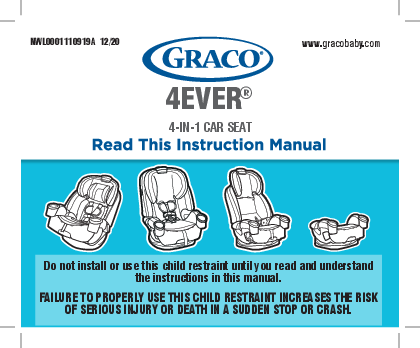
GRACO 2074900 4Ever 4-In-1 Car Seat Instruction Manual
File info: application/pdf · 112 pages · 10.32MB
4EVER
Even if this car seat seems easy to figure out on your own, you must follow ... For future reference or if you change addresses, record the model name, model.
4ever Cleaning Services | Keyword Rankings
Extracted Text
NWL0001110919A 12/20 4EVER� 4-IN-1 CAR SEAT www.gracobaby.com Do not install or use this child restraint until you read and understand the instructions in this manual. FAILURE TO PROPERLY USE THIS CHILD RESTRAINT INCREASES THE RISK OF SERIOUS INJURY OR DEATH IN A SUDDEN STOP OR CRASH. 1 Important 1-A Quick Guide to Your Manual 1-B Welcome to the Graco Family 1-C Right Mode of Use 1-D Before You Begin Register This Car Seat If You Need Help Cer tification Car Seat's Useful Life Vehicle Seat Protection Warm Weather Use 1-E Safety Warnings 2 Features 2 Pages 6-25 Pages 26-31 3 Rear-Facing Pages 32-44 3-A Rear-Facing Use 3-B Install Rear-Facing with Lower Anchor Attachment 3-C Install Rear-Facing with Vehicle Seat Belt 4 Forward-Facing 4-A Forward-Facing Use 4-B Install Forward-Facing with LATCH 4-C Install Forward-Facing with the Vehicle Seat Belt Pages 45-57 3 5 Booster 5-A Booster Use 5-B Install Highback Booster 5-C Install Backless Booster Pages 58-73 6 Securing Child 6-A Securing Child 5-Point Harness 6-B Securing Child Highback Booster 6-C Securing Child Backless Booster Pages 74-90 7 Moving Lower Anchor Attachment Pages 91-94 4 8 Accessories Page 95 9 Vehicle Information Pages 96-106 9-A How to Uninstall Lower Anchor Connectors and Tether 9-B Choosing Vehicle Seat Location 9-C Unsafe Vehicle Seat Location 9-D Vehicle Seat Belts 10 Care & Cleaning 10-A Cleaning Seat Pad 10-B Cleaning Buckle 10-C Cleaning Harness, Lower Anchor and Tether Pages 107-110 5 1-A Quick Guide to Your Manual This car seat is for children: Rear-Facing: 4-40 lb (1.8-18 kg) Forward-Facing: 22-65 lb (10-30 kg) Booster: 40-120 lb (18.1-54 kg) Install Cup Holders The cup holders must be installed. To attach the cup holders, match the right cup holder to the right side of the seat and the left to the left. Align the R tab on the cup holder with the slot in L the seat and slide down. You will hear a "Click" when they are secured in place. 6 Get to Know Your Car Seat Review section 2-A to see all of the features of this car seat. What Seating Location Should I Use? The best seating location for this car seat is one that: � Is recommended by your vehicle owner's manual, and � Results in a secure installation of this car seat. Some vehicles have specific requirements for where the car seat can be installed, so be sure to check your vehicle owner's manual for available seating positions, if any. For example, sometimes the center rear seat has a lap belt only vehicle seat belt, which cannot be used when this car seat is in Booster mode. Review section 9-C, 9-D of this manual AND your vehicle owner's manual. continue next page NEVER place this child restraint rear-facing in a vehicle seating location that has an active front air bag. In the event there is no back seat, review your vehicle owner's manual to see how to use your infant child restraint. 7 According to accident statistics, children are safer when properly restrained in the rear seating positions than in the front seating positions. The center of the back seat can be the safest during a possible side impact. Which Installation Method Should I Use? This car seat can be installed in your vehicle using either the vehicle seat belt OR the lower anchor attachment. Both are equally safe to use. INSTALL USING ONLY ONE METHOD. Graco allows the securing of the car seat with the LATCH system in the booster mode, only if the vehicle manufacturer allows it. The child still MUST BE SECURED with the vehicle lap/shoulder seat belt. Vehicle Seat Belt: Review section 9 and your vehicle owner's manual to learn how to install your car seat with the vehicle seat belts. LATCH or Lower Anchor Attachment: The LATCH system or Lower Anchor Attachment allows you to securely attach your safety seat in your car without using the vehicle seat belt and possibly to get a better fit. All 2003 and newer model year vehicles are required to have a LATCH system, although some manufacturers began including LATCH earlier. Some vehicle owner manuals use the term ISOFIX to identify the LATCH system. 8 What is LATCH? LATCH consists of lower anchors and a tether anchor, which are built-in to your vehicle, and a lower anchor attachment and a tether that is built-in to your car seat. The lower anchor attachment is used INSTEAD of the vehicle's seat belt to secure the child seat to the vehicle. The tether is used IN ADDITION to the lower anchor attachment OR the vehicle's seat belt to secure a forward-facing car seat to the vehicle. Review your vehicle's owner manual for exact location and use. Vehicle's Tether Anchor 11" (28 cm) Typical seat in a passenger vehicle. Other vehicle types may have different lower anchor locations. Vehicle Seat Bight Vehicle's Lower Anchor 9 When Installing Rear-Facing or Forward-Facing Lower Anchor Attachment The lower anchor attachment consists of two lower anchors, which are built-in to your vehicle, and lower anchor connectors that are built-in your car seat. Review section 3-B, 4-B of this manual AND your vehicle owner's manual before installing. Lower anchor attachment can ONLY be used if the vehicle lower anchor spacing is 11 inches (28 cm) from the center of one lower anchor to the center of the other lower anchor. Vehicle Seat Belt There are two types of vehicle seat belts that can be used. Lap/Shoulder Seat Belt or Lap Only Seat Belt. Review section 3-C, 4-C and 9 of this manual AND your vehicle owner's manual before installing. 10 When Installing As a Booster Vehicle Seat Belt Only use the Lap/Shoulder seat belt configuration. Review section 5-B, 5-C of this manual AND your vehicle owner's manual. 11 Does Your Car Seat Fit Your Child Correctly? To make sure your child is secured properly, review section 3,4 and 5 to understand all of the actions you need to take to properly adjust the car seat to fit your child. For Rear-Facing and Forward-Facing, You Need to Adjust: Harness Height, Rear-Facing (A) Harness straps at or just below the child's A shoulders. Review section 6. Harness Height, Forward-Facing (B) Harness straps at or just above the child's shoulders and top of child's ears below top of headrest (C). Review section 6. C Buckle Position (D) The correct slot is the one that is closest to your child without being underneath them. Review section 6. E Harness Tightness (E) If your fingers slide off the harness straps without pinching the straps, it is tight enough. Review section 6. B D 12 For Booster, You Need to Adjust: Use Lap/Shoulder Belt Only Position Lap Belt Lap belt must go behind armrest and lie low across your child's hips and thighs. Position Shoulder Belt Shoulder belt lies across shoulder between neck and edge of shoulder. 13 Did You Do Everything Correctly? Rear-Facing Car Seat Does Not Move More than 1" (2.5 cm) at the Belt Path (A) Review section 3 Level Indicator's Bubble in the Blue Zone (B) Review section 3 Harness Straps at or Just Below the Child's Shoulders (C) Review section 6. Chest Clip Even With Armpits (D) Review section 6 Cannot Pinch Harness Straps at the Shoulder (E) Review section 6 AB CD E 14 Forward-Facing Use the tether strap when using forward-facing (A) A When used properly, the tether helps reduce injury in a sudden stop or crash. Review section 4 Car Seat Does Not Move More than 1" (2.5 cm) at the Belt B C Path (B) Review section 4 Harness Straps at or Just Above Child's Shoulders (C) Review section 6 Chest Clip Even With Armpits (D) Review section 6 D E Cannot Pinch Harness Straps at the Shoulder (E) Review section 6 15 Never Use Lap Belt Only Review section 6 Booster Lap Belt Behind Armrest and Lies Low Across Hips and Thighs Review section 6 Shoulder Belt Lies On the Shoulder, Between the Neck and Edge of Shoulders Review section 6 16 1-B Welcome to the Graco Family! Your child's safety depends on you. No car seat can guarantee protection from injury in every situation, but proper use helps reduce the risk of serious injury or death. Even if this car seat seems easy to figure out on your own, you must follow the detailed instructions in this instruction manual to ensure the steps below are performed correctly. 17 1-C Right Mode of Use 4 lb (1.8 kg) 22 lb (10 kg) 40 lb (18 kg) 65 lb (30 kg) 120 lb (54 kg) Rear-Facing with 5-Point Harness Must be 49" (125 cm) or less: 4-22 lb (1.8-10 kg) less than 1 year old MUST be rear-facing. 22-40 lb (1018 kg) SHOULD be rear-facing.* Forward-Facing with 5-Point Harness Must be 49" (125 cm) or less: 22-40 lb (10-18 kg) can sit upright unassisted CAN be forward-facing. 40-65 lb (18-30 kg) SHOULD be forward-facing.* Booster Mode with Vehicle Lap/Shoulder Seat Belt Must be 43-57" (110.1-145 cm) and 4+ years old: 4065 lb (18.1-30 kg) CAN be in highback booster mode. 40-65 lb (18.1-30 kg) CAN be in backless booster mode.Over 65 lb (30 kg) MUST be in booster mode.* * Check your state laws and the AAP/NHTSA recommendations. See page 24. Note: Preterm or low birth weight infants may be at special risk in a vehicle or aircraft. According to the AAP, these infants may suffer breathing issues if improperly reclined in a car seat. When rear-facing, use the corrected age for preemies. Graco advises that you have your physician or hospital staff evaluate your infant and recommend the proper car seat or car bed before you and your infant leave the hospital. 18 1-D Before You Begin Register This Child Restraint Please fill out the prepaid registration postcard attached to the harness and mail it in today or register online at www.gracobaby.com/ carseatregistration. Child restraints could be recalled for safety reasons. You must register this restraint to be reached in a recall. Send your name, address, and the restraint's model number and manufacturing date to: Graco Children's Products, Inc. Attn: Customer Service P.O. Box 169, Elverson, PA 19520-9901 or call 1-800-345-4109 or register online at www.gracobaby.com/carseatregistration For recall information, call the U.S. Government's Vehicle Safety Hotline at 1-888-327-4236 (TTY: 1�800�424�9153), or go to http://www.NHTSA.gov. 19 For future reference or if you change addresses, record the model name, model number, date of manufacture and purchase date of this car seat on the below. You can find this information either on the registration card if you still have it or on the date label located on the back of the car seat. Model Name_________________________ Model Number _______________________ Date of Manufacture __________________ Date of Purchase _____________________ If You Need Help In the U.S.A, please contact our Customer Service Department with any questions you may have concerning parts, use, or maintenance. When you contact us, please have your product's model number and date of manufacture ready so that we may help you efficiently. These numbers can be found on a sticker on the back side of your car seat. For additional resources or to get your car seat checked by a child passenger safety technician, please visit the following web sites: www.nhtsa.gov � www.seatcheck.org � www.safekids.org 20 Certification This child restraint meets or exceeds all applicable requirements of Federal Motor Vehicle Safety Standard 213 for use in motor vehicles. This child restraint is certified for use in aircraft only when used with the internal harness system. Use only on forward-facing aircraft seats. Follow the instructions for vehicle installation. For rear-facing installation, see section 3-C and 9-D Lap Belt Installation. For forward-facing installation, see section 4-C and 9-D Lap Belt Installation, but do not use tether. This child restraint is NOT certified for use in aircraft when used as a booster seat because aircrafts do not have shoulder belts. Contact the airline for their specific polices. Car Seat's Useful Life STOP using this car seat and throw it away 10 years after the date of manufacture. Look for this sticker on back of the car seat. Graco Children's Products Inc. advises against loaning or passing along a car seat unless you know the complete history of the product. We also advise against purchasing a car seat second hand. 21 Vehicle Seat Protection Protect vehicle seat. Use a car seat mat, towel, or thin blanket under and behind car seat. Warm Weather Use Car seat parts can get very hot in the sun or warm weather. To avoid burns, always check before putting child in car seat. 1-E Safety Warnings No car seat can guarantee protection from injury in every situation, but proper use helps reduce the risk of serious injury or death. READ THIS MANUAL CAREFULLY. 22 Failure to follow these instructions and child restraint's labels can result in child striking the vehicle's interior during a sudden stop or crash. ! NEVER PLACE THIS CHILD RESTRAINT REAR-FACING IN A VEHICLE SEATING LOCATION THAT HAS AN ACTIVE FRONT AIR BAG. If an air bag inflates, it can hit the child and car seat with great force and cause serious injury or death to your child. ! Review your vehicle owner's manual for more information about air bags and car seat use. ! If your vehicle does not have a back seat, review your vehicle owner's manual. 23 ! Children are safer riding rear-facing and should ride rear-facing as long as possible, until they reach the maximum rear-facing height or weight rating for their car seat. Then children should ride forward-facing, using the built-in harness system for as long as possible until they reach the maximum forward-facing weight or height for their car seat. At that point, children should ride in a belt-positioning booster seat. A booster is no longer needed once the vehicle seat belt fits properly, typically when they reach 4 feet 9 inches (145 cm) tall and are between ages 8-12. Be sure to check your local and state laws, as well as AAP and NHTSA recommendations, for car seat usage.* ! Choose the correct mode of use for the car seat depending on your child's size. Infants less than 22 lb (10 kg) MUST use this car seat rearfacing. ! Select a suitable location for the car seat in your vehicle. ! Secure car seat with a vehicle seat belt or lower anchor attachment that is properly routed as shown in this manual. ! Vehicle seat belt system MUST hold car seat securely. Not all vehicle seat belts can be used with a car seat. ! If vehicle seat belt does not hold car seat securely, read "Vehicle Seat Belts" section 9-D and your vehicle owner's manual. *Graco Supports the American Academy of Pediatrics and National Highway Traffic Safety Administration`s Car Seat Guidelines. Visit www.gracobaby.com/en-US/safety for information on car seat usage recommendations. 24 ! Always secure car seat with lower anchor attachment or a vehicle seat belt, even when unoccupied. In a crash, an unsecured car seat can injure passengers. ! If car seat is in a crash, it must be replaced. DO NOT use it again! A crash can cause unseen damage and using it again could result in serious injury or death. ! DO NOT use car seat if it is damaged or missing parts. ! DO NOT use accessories or parts other than those provided by Graco except for a thin towel or mat to protect your vehicle seat or a rolled towels or pool noodles to help get your car seat level. Their use could alter the performance of the car seat. ! DO NOT remove LATCH system from car seat. If using vehicle seat belt to secure car seat, lower anchor connectors must be stored. ! Never leave child unattended, even when sleeping. Child may become tangled in harness straps and suffocate or strangle. ! Rear-facing car seat must be properly leveled: � Too reclined can result in injury or ejection. � Too upright can result in breathing difficulties. ! Never attach two lower anchor connectors to one vehicle lower anchor point unless specifically allowed by the vehicle manufacturer. ! Do not use both the vehicle seat belt and lower anchor attachment at the same time when using the car seat with the 5-point harness. 25 2 Features 2-A Car Seat Features A B D C E F H I G N J K L M 26 2 Features A Headrest/Harness Adjustment Lever B Headrest C Booster Shoulder Belt Guide D Head Support E Body Support F Harness Covers G Harness Straps H Chest Clip I Buckle J Harness Release Lever (under flap) K Harness Adjustment Strap L Recline Handle M Seat Base N Cup Holder 27 A B D 2 Features G E C H F 28 2 Features A Level Indicator B Tether Strap C Lower Anchor Strap D Forward-Facing Belt Path E Booster Lap Belt Path F Recline Position Indicator G Rear-Facing Belt Path H Rear-Facing Lower Anchor Connector Storage (under seat) 29 2 Features A B C 30 A B 2 Features A Tether Strap Storage B Forward-Facing Lower Anchor Connector Storage C Instruction Manual Storage 31 3-A Rear-Facing Use Lower Anchor Attachment Vehicle Seat Lap/ Shoulder Belt Rear-Facing: 4-40 lb (1.8-18 kg) and top of head is at least 1" (2.5 cm) below the headrest adjustment handle � Infants who weigh less than 22 lb (10 kg) MUST be rear-facing. � Place car seat rear-facing in the vehicle back seat. � Make sure lower anchor strap or vehicle seat belt is routed through the rear-facing belt path marked with a blue label. � Install this car seat tightly in your vehicle. Car seat should not move at the rear-facing belt path more than 1" (2.5 cm) from side to side, front to back. � Check recline level making sure the bubble is within the blue area. Vehicle MUST be on level ground. 32 3 Rear Facing � Harness straps need to be even with or just below the top of child's shoulders and chest clip is at armpit level. � Children are safer riding rear-facing and should ride rear-facing as long as possible, until they reach the maximum rear-facing height or weight rating for their car seat. Then children should ride forward-facing, using the built-in harness system for as long as possible until they reach the maximum forward-facing weight or height for their car seat. Be sure to check your local and state laws, as well as AAP and NHTSA recommendations, for car seat usage. Vehicle Seat Lap Belt 3 Rear Facing NEVER place this child restraint rear-facing in a vehicle seating location that has an active front air bag. 33 3-B Install Rear-Facing with Lower Anchor Attachment Review your vehicle's owner manual for lower anchor location and use. 1. Store Tether Strap Attach tether hook to the plastic bar on either side of the car seat. 2. Remove Lower Anchor Connectors from Storage Location Push in on the red buttons on the lower anchor connectors and remove from storage position. 34 3 Rear Facing 3. Make Sure Lower Anchor Strap is in the Rear-Facing Belt Path Marked With a Blue Label If not, See section 7 to move lower anchor attachment. 4. Recline the Car Seat Place the car seat in 1st, 2nd or 3rd recline position. 35 3 Rear Facing 5. Place Car Seat Rear-Facing in Back Seat of the Vehicle Place rear-facing in vehicle seat and center the car seat between the lower anchors. The base should sit as flat as possible on the vehicle seat. Make sure base is a minimum of 80% on the vehicle seat. 6. Extend the Lower Anchor Strap For easier installation, extend the lower anchor strap to its maximum length by pressing the grey button and pulling on the strap. 7. Check the Level Indicator Vehicle MUST be on level ground. Check the level indicator on the car seat. The bubble must be completely within the blue zone. Adjust the recline until the bubble is completely within the blue zone. 36 3 Rear Facing 8. Attach Lower Anchor Connectors to Vehicle's Lower Anchors. Lower anchor strap should lie flat and not be twisted. Lower anchor attachment can ONLY be used if the vehicle lower anchor spacing is 11 inches (28 cm) from the center of one lower anchor to the center of the other lower anchor. Click! 9. Tighten the Lower Anchor Strap Press down firmly in the center of the car seat while tightening the lower anchor strap. You may need to tighten through the slit in the pad at the belt path as shown. 37 3 Rear Facing 10. Test For Tightness Grab the sides of the seat where the lower anchor strap is and slide the car seat sideto-side and front-to-back. If the seat moves less than 1" (2.5 cm), it is tight enough. 11. Check the Level Indicator Vehicle MUST be on level ground. Check the level indicator on the car seat. The bubble must be completely within the blue zone. Readjust if needed. See section 6-A to secure your child. Recheck the level indicator with child in seat. 38 3 Rear Facing Is Everything Correct? Car Seat Does Not Move More than 1" (2.5 cm) at the Belt Path Level Indicator's Bubble in the Blue Zone and Vehicle on Level Ground Harness Straps at or Just Below the Child's Shoulders. Review section 6 Chest Clip Even With Armpits Review section 6 Cannot Pinch Harness Straps at the Shoulder Review section 6 39 3 Rear Facing 3-C Install Rear-Facing with Vehicle Seat Belt 1. Store Tether and Lower Anchor Straps Attach tether hook and lower anchor connectors to the plastic bars as shown. 2. Recline the Car Seat Place the car seat in 1st, 2nd or 3rd recline position. 40 3 Rear Facing 3. Place Car Seat Rear-Facing in Back Seat of the Vehicle Place rear-facing in vehicle seat. The base should sit as flat as possible on the vehicle seat. Make sure base is a minimum of 80% on the vehicle seat. 4. Check the Level Indicator Vehicle MUST be on level ground. Check the level indicator on the car seat. The bubble must be completely within the blue zone. Adjust the recline until the bubble is completely within the blue zone. 41 3 Rear Facing Review your vehicle's owner manual for vehicle seat belt use 5. Route the Vehicle Seat Belt Thread vehicle seat belt through the rearfacing belt path (marked with a blue label) and out the other side. Buckle it. The seat belt should lie as flat as possible and not be twisted. Note: It may be easier to route the vehicle seat belt by lifting seat pad up to expose the belt path. Make sure the vehicle seat belt is in front of the buckle strap when the buckle is in the inner-most position, and in behind when in the outer-most position. 6. Lock Vehicle Seat Belt In most vehicles today, slowly pull the shoulder belt all the way out and then let it go back in. You will hear a clicking sound. Slowly pull out on the belt and it should be locked. If not, review your car's owner manual and section 9-D. 42 3 Rear Facing 7. Tighten the Vehicle Seat Belt Press down firmly in the center of the car seat. Pull on the shoulder belt to tighten while feeding the slack back in the retractor. 8. Test For Tightness Grab the sides of the seat where the vehicle seat belt is and slide the car seat side-toside and front-to-back. If the seat moves less than 1" (2.5 cm), it is tight enough. 9. Check the Level Indicator Vehicle MUST be on level ground. Check the level indicator on the car seat. The bubble must be completely within the blue zone. Readjust if needed. See section 6-A to secure your child. Recheck the level indicator with child in seat. 43 3 Rear Facing Is Everything Correct? Car Seat Does Not Move More than 1" (2.5 cm) at the Belt Path Level Indicator's Bubble in the Blue Zone and Vehicle on Level Ground Harness Straps at or Just Below the Child's Shoulders. Review section 6 Chest Clip Even With Armpits Review section 6 Cannot Pinch Harness Straps at the Shoulder Review section 6 44 3 Rear Facing 4 Forward Facing 4-A Forward-Facing Use Forward-Facing: 22-65 lb (10-30 kg) 49" (125 cm) or less � For children 22-40 lb (10-18 kg) you MUST use recline position 4. � Place car seat forward-facing in the vehicle back seat. � Make sure lower anchor strap or vehicle seat belt is routed through the forward-facing belt path marked with a orange label. � Install this car seat tightly in your vehicle. Car seat should not move at the forward-facing belt path more than 1" (2.5 cm) from side to side, front to back. � Harness straps need to be even with or just above the top of child's shoulders and chest clip is at armpit level. LATCH Do not install by this method for a child weighing more than 45 lb (20 kg) 45 4 Forward Facing Vehicle Lap/Shoulder Belt with Tether � Children are safer riding rear-facing and should ride rear-facing as long as possible, until they reach the maximum rear-facing height or weight rating for their car seat. Then children should ride forward-facing, using the built-in harness system for as long as possible until they reach the maximum forward-facing weight or height for their car seat. At that point, children should ride in a belt-positioning booster seat. Be sure to check your local and state laws, as well as AAP and NHTSA recommendations, for car seat usage. Vehicle Seat Lap Belt with Tether 46 4 Forward Facing 4-B Install Forward-Facing with LATCH Review your vehicle's owner manual for LATCH location and use. 1. Remove Lower Anchor Connectors from Storage Location Push in on the red buttons on the lower anchor connectors and remove from storage position. 2. Make Sure Lower Anchor Strap is in the Forward-Facing Belt Path Marked with Orange Label 47 4 Forward Facing 3. Unhook Tether Strap From Storage Unhook tether and lay it in the seat. 4. Adjust the Car Seat Place the car seat in the 4th, 5th or 6th recline position. For Children 22-40 lb (10-18 kg) MUST use recline position 4. 48 4 Forward Facing 5. Place Car Seat Forward- Facing in Back Seat of the Vehicle Place forward-facing in vehicle seat and center the car seat between the lower anchors. The base should sit as flat as possible on the vehicle seat. Make sure base is a minimum of 80% on the vehicle seat. 6. Extend the Lower Anchor Strap For easier installation, extend the lower anchor strap to its maximum length by pressing the grey button and pulling on the strap. 49 4 Forward Facing 7. Attach Lower Anchor Connectors to Vehicle's Lower Anchors Lower anchor attachment can ONLY be used if the vehicle lower anchor spacing is 11 inches (28 cm) from the center of one lower anchor to the center of the other lower anchor. Lower anchor strap should not be twisted. Click! 8. Tighten the Lower Anchor Strap Press down firmly in the center of the car seat while tightening the lower anchor strap. You may need to tighten through the slit in the pad at the belt path as shown. 50 4 Forward Facing 9. Attach Tether Strap Extend the tether by lifting up on the tether lock and attach. Consult vehicle's owner manual for specific location. 10. Tighten Tether Strap Remove all the slack. 11. Test For Tightness Grab the sides of the seat where the lower anchor strap is and slide the car seat sideto-side and front-to-back. If the seat moves less than 1" (2.5 cm), it is tight enough. See section 6-A to secure your child. 51 4 Forward Facing Is Everything Correct? Car Seat Does Not Move More than 1" (2.5 cm) at the Belt Path Harness Straps at or Just Above the Child's Shoulders Review section 6 Chest Clip Even With Armpits Review section 6 Cannot Pinch Harness Straps at the Shoulder Review section 6 52 4 Forward Facing 4-C Install Forward-Facing with Vehicle Seat Belt 1. Store Lower Anchor Connectors Attach lower anchor connectors to the plastic bars as shown. 2. Adjust the Car Seat Place the car seat in the 4th, 5th or 6th recline position. For Children 22-40 lb (10-18 kg) MUST use recline position 4. 53 4 Forward Facing 3. Unhook Tether Strap From Storage Unhook tether and lay it in the seat. 4. Place Car Seat Forward- Facing in Back Seat of the Vehicle Place forward-facing in vehicle seat. The base should sit as flat as possible on the vehicle seat. Make sure base is a minimum of 80% on the vehicle seat. Review your vehicle's owner manual for vehicle seat belt use 5. Route the Vehicle Seat Belt Thread vehicle seat belt through the forward-facing belt path (marked with a orange label) and out the other side. Buckle it. The seat belt should lie as flat as possible and not be twisted. 54 4 Forward Facing 6. Lock the Vehicle Seat Belt In most vehicles today, slowly pull the shoulder belt all the way out and then let it go back in. You will hear a clicking sound. Slowly pull out on the belt and it should be locked. If not, review your car's owner manual and section 9-F. 7. Tighten the Vehicle Seat Belt Press down firmly in the center of the car seat. Pull on the shoulder belt to tighten while feeding the slack back in the retractor. 55 4 Forward Facing 8. Attach Tether Strap Extend the tether by lifting up on the tether lock and attach. Consult vehicle's owner manual for specific location. 9. Tighten the Tether Strap Push the car seat back while tightening the tether strap to remove all the slack. 10. Test For Tightness Grab the sides of the seat where the vehicle seat belt is and slide the car seat side-to-side and front-to-back. If the seat moves less than 1" (2.5 cm), it is tight enough. See section 6-A to secure your child. 56 4 Forward Facing Is Everything Correct? Car Seat Does Not Move More than 1" (2.5 cm) at the Belt Path Harness Straps at or Just Above the Child's Shoulders Review section 6 Chest Clip Even With Armpits Review section 6 Cannot Pinch Harness Straps at the Shoulder Review section 6 57 5-A Booster Use 5 Booster Vehicle Lap/Shoulder Seat Belt Vehicle Seat Lap/ Shoulder Belt Highback Booster: 40-100 lb (18.1-45 kg) 43-57 in. (110.1-145 cm) at least 4 years old Backless Booster: 40-120 lb (18.1-54 kg) 43-57 in. (110.1-145 cm) at least 4 years old � Place car seat forward-facing in the vehicle back seat. � Make sure vehicle seat's lap belt is adjusted snugly and lays low on the child's hip and is routed behind the armrest in the booster's belt path marked with green label. � Vehicle belts MUST lie flat against child and MUST NOT be twisted. � Vehicle seat's shoulder belt is adjusted snugly and should lie between child's neck and edge of shoulder. � Never use a vehicle lap-only belt across front of child. 58 � DO NOT position vehicle shoulder belt under the child's arm or back. � DO NOT allow child to slouch or slide down in the booster seat. � DO NOT position vehicle belt over top of armrests. � Vehicle's seat headrest SHOULD NOT create a gap between vehicle seat and booster seat. � The front of booster seat MUST NOT hang over front of vehicle seat. � If child will not keep vehicle belt properly positioned, DO NOT use this booster seat. Use a different car seat. � When forward-facing, children should use the built-in harness system for as long as possible until they reach the maximum forward-facing weight or height for their car seat. At that point, children should ride in a belt-positioning booster seat. A booster is no longer needed once the vehicle seat belt fits properly, typically when they reach 4 feet 9 inches (145 cm) tall and are between ages 8-12. Be sure to check your local and state laws, as well as AAP and NHTSA recommendations, for car seat usage. 59 Never Use a Vehicle Lap-Only Belt Across Front of Child 5 Booster 5 Booster 5-B Install Highback Booster A 1. Store The Harness System A. Loosen the shoulder straps as much as possible B B. Raise the headrest to the highest position C. Unbuckle the chest clip and the buckle strap D D C 60 E. Unsnap Pad and Expose Seat Back E Undo the 2 snaps in the headrest pad. F. Lift the headrest pad flap up out of F the way 5 Booster G. Unsnap Bottom Seat Pad G Undo the 2 lower snaps. 61 H H. Pull Bottom Seat Pad Back To Expose the Plastic Shell 5 Booster I I. Open the Harness Storage Door J. Place Harness, Chest Clip, Buckle Tongues Inside Storage Compartment and Close the Door J J 62 K. Store Buckle as Shown K L. Replace Seat Pad Move the headrest back to its proper L position for your child. 5 Booster 63 5 Booster 2. Adjust the Car Seat Place the car seat in the 6th recline position. 3. Place the Booster Seat ForwardFacing in the Back Seat of Vehicle Place forward-facing on a vehicle seat that has a lap/shoulder seat belt. The base should sit as flat as possible on the vehicle seat. 64 5 Booster Graco allows the securing of the car seat with LATCH in the booster mode, only if the vehicle manufacturer allows it. The child still MUST BE SECURED with the vehicle lap/ shoulder seat belt. LATCH can be used in the booster mode regardless of the weight of the child up to 100 lb (45 kg). Verify the following before using LATCH in the booster mode: �The lower anchor connector DO NOT interfere with any vehicle seat belts or buckles. If the lower anchor connectors interfere with the vehicle seat belts or if the chosen seating position does not have lower anchors, you MUST store the lower anchor strap. Store the lower anchor strap by pushing in on the red button on the connectors and attach to the plastic bars as shown. Store the tether strap as shown. Always secure car seat with lower anchor strap or a vehicle seat belt, even when unoccupied. In a crash, an unsecured car seat can injure passengers. Skip to Step 10 if Not Using LATCH 4. Make Sure Lower Anchor Strap is in the Forward-Facing Belt Path Marked with Orange Label Continue to next step if correct. See section 4 if it is not. 65 5 Booster 5. Unhook Tether Strap From Storage Location and Lay it in the Seat 6. Attach Lower Anchor Connectors to Vehicle's Lower Anchors Lower anchor strap should not be twisted. Click! 66 5 Booster 7. Tighten the Lower Anchor Strap Remove all the slack. 8. Attach Tether Strap Extend the tether by lifting up on the tether lock and attach. Consult vehicle's owner manual for specific location. 9. Tighten Tether Strap Remove all the slack. 67 5 Booster 10. Thread the Vehicle Seat Shoulder Belt Through Seat Belt Guide on the Headrest See section 6-B to secure your child. 68 5 Booster 5-C Install Backless Booster 1. Remove the Seat Back by First Loosening the Harness Straps Press down on the harness release lever while pulling out on the harness straps at the chest clip. Unbuckle the chest clip and the buckle strap. 2. Remove Harness Straps from Splitter Plate 69 5 Booster 3. Make Sure Lower Anchor Connectors are in the Forward-Facing Belt Path and in the Stored Position See section 7 to change positions. 4. Unsnap Bottom Seat Pad Unsnap seat pad and expose the bottom of seat base. 70 5. Lift the Red Backrest Locks Up A With the car seat in the 6th recline position, lift the red backrest locks up (A) and slide together (B). B 6. Remove Seat Back from Seat Base Push the seat back up and lift out of base. To replace the seat back, reverse steps 4 though 6. 5 Booster 71 5 Booster 7. Relock the Red Backrest Locks Make sure they are both flat and locked into place 8. Store Splitter Plate Pull the harness adjustment strap all the way out and then store the splitter plate. 9. Store Buckle Strap 72 5 Booster 10. Attach Base Pad to the Back of Base Attach the elastic straps onto base as shown. 11. Place the Booster Seat ForwardFacing in the Back Seat of Vehicle Place forward-facing on a vehicle seat that has a lap/shoulder seat belt. The base should sit as flat as possible on the vehicle seat. See section 6-C to secure your child. 73 WARNING! In cold weather, do not put snowsuits or bulky garments on your child when placing them in the car seat. Bulky clothing can prevent the harness straps from being tightened properly. To keep child warm, buckle your child in the car seat and place a blanket around the child or place the child's coat on backwards after buckling in. 6-A Securing Child 5-Point Harness A 1. Loosen Harness Straps (A) Press down on the harness release lever while pulling out on the harness straps at the chest clip. B (B) Unbuckle the chest clip and the buckle. (C) Place harness straps off to the sides. 74 6 Securing Child 2. Place Your Child in the Seat Make sure their back is flat against the car seat back. 3. Place Harness Straps Over Child's Shoulders and Buckle You will hear a "click" when buckle tongues are securely attached. Pull up on each buckle tongue to make sure it is securely attached. 75 6 Securing Child Rear-Facing Forward-Facing 4. Be Sure the Harness Straps Are at the Proper Height Rear-Facing: Harness straps must be at or just below the child's shoulders and top of head must be at least 1" (2.5 cm) below the headrest/harness adjustment handle. Forward-Facing: Harness straps must be at or just above the child's shoulders and top of child's ears must be below top of headrest. Remove the headrest and body support. 5. To Raise or Lower Headrest/Harness Adjustment Lever Squeeze the adjustment lever and lift or lower headrest for the proper harness height. 6 Securing Child 76 6. Check the Buckle Position The correct slot the one that is closest to your child without being underneath your child. 7. To Adjust Buckle Strap Recline the car seat and locate the metal retainer under the car seat shell. 8. Rotate Metal Retainer and Insert It Up Through the Shell and Pad From the top of the car seat, pull the buckle out. 77 6 Securing Child 9. Insert Metal Retainer in the New Buckle Strap Slot Reach underneath the car seat and pull the metal retainer through. 10. Pull Up on Buckle Strap to Make Sure it is Secured Rear-Facing: Make sure the lower anchor strap or vehicle belt is in front of the buckle strap when the buckle is in the inner-most position (A), and in behind when in the outermost position (B) and that it is flat and is not twisted. 6 Securing Child A B 78 11. Buckle the Chest Clip You will hear a "click" when the chest clip is securely buckled. 12. Pull All the Slack Out From Around the Waist Pull up on the harness strap while pushing the chest clip down. Do this to both sides. 79 6 Securing Child 13. Tighten the Harness by Pulling the Harness Adjustment Strap When you are not able to pinch any of the harness webbing at your child's shoulder, the harness is tight enough. A snug harness should not allow any slack. It lies in a relatively straight line without sagging. It does not press on the child's flesh or push the child's body into an unnatural position. 80 6 Securing Child 14. Raise the Chest Clip to Child's Armpit Level 15. Check Tightness Again, Tighten More if Needed 81 6 Securing Child 6-B Securing Child Highback Booster Use only the vehicle lap and shoulder belt system when restraining the child in the booster seat. 1. Place Child In Seat Have your child sit in the booster seat, with his/her back flat against the back of the booster seat. 2. Thread Vehicle's Shoulder Belt Into Seat Belt Guide in the Headrest 82 6 Securing Child 3. Buckle the Vehicle Lap/Shoulder Seat Belt Be sure the lap portion of the vehicle seat belt goes behind the armrests. Be sure the lap portion of the vehicle seat belt lies low across your child's hips. Be sure the shoulder belt lies across your child's shoulders, between the neck and edge of shoulder. The belt guides should be even with or just above the shoulders. 83 6 Securing Child Is Everything Correct? Never Use Lap Belt Only Lap Belt Behind Armrest and Lies Low Across Hips and Thighs Shoulder Belt Lies On the Shoulder, Between the Neck and Edge of Shoulders 84 6 Securing Child 6-C Securing Child Backless Booster Use only the vehicle lap and shoulder belt system when restraining the child in the booster seat. 1. Place Child In Seat Have your child sit in the booster seat, with his/her back flat against the back of the vehicle seat. 2. Ears Must Be Below the Top of the Vehicle Seat Back or Headrest. 85 6 Securing Child 3. Buckle the Vehicle Lap/Shoulder Seat Belt Be sure the lap portion of the vehicle seat belt goes behind the armrests. Be sure the lap portion of the vehicle seat belt lies low across your child's hips. Be sure the shoulder belt lies across your child's shoulders, between the neck and edge of shoulder. You may need to use the belt positioning clip to help get a good fit. 86 6 Securing Child Is Everything Correct? Never Use Lap Belt Only Lap Belt Behind Armrest and Lies Low Across Hips and Thighs Shoulder Belt Lies On the Shoulder, Between the Neck and Edge of Shoulders 87 6 Securing Child Using Belt Positioning Clip 1. Make Sure Vehicle's Seat Shoulder Belt Lays in the Red Zone As Shown If the vehicle's seat shoulder belt lays outside this zone, you MUST use the belt positioning clip. 2. Attach Belt Positioning Clip Insert the loop end of the strap through the same slot as the harness adjustment strap as shown. 88 6 Securing Child 3. Push Clip and Strap Through Loop 4. Pull to Tighten Strap 5. Push Clip Through Slot In Pad 6. Attach Seat Pad to Base 89 6 Securing Child 7. Place Child in Seat, Buckle Child In Seat and Attach Belt Positioning Clip With child's back flat against the back of the vehicle seat, buckle child in. Then slide the clip onto the vehicle's seat shoulder belt as shown. Lengthen Shorten 8. Adjust the Belt Positioning Clip to Fit Your Child Lengthen or shorten the belt length as shown. Clip should fit right at the top of shoulder as shown. 90 6 Securing Child 7 Moving Lower Anchor 7-A Moving Lower Anchor Attachment 1. For Ease of Moving the Lower Anchor Attachment B A. Loosen the harness straps. B. Raise the headrest to the highest position. C. Unbuckle the chest clip. D. Unbuckle the buckle. A C D 91 7 Moving Lower Anchor 2. Unsnap Bottom Seat Pad to Expose the Lower Anchor Attachment 3. Pull Lower Anchor Connectors Out of the Belt Path Openings into the Center of the Car Seat 4. Slide Entire Lower Anchor Strap Along Bar to the Desired Belt Path Openings Rear-Facing: Slide lower anchor strap along bar to the front of the seat. Forward-Facing: Slide the lower anchor strap up along bar to the top. 92 5. Push the Lower Anchor Connectors Out Through the Desired Belt Path Openings on Each Side of Car Seat Rear-Facing: Make sure the lower anchor strap or vehicle belt is in front of the buckle strap when the buckle is in the inner-most position (A), and in behind when in the outer-most position (B) and that it is flat and is not twisted. RearFacing A B Forward-Facing: Make sure the lower anchor strap or vehicle belt is routed behind the harness strap, is flat, and is not twisted. 93 ForwardFacing 7 Moving Lower Anchor 7 Moving Lower Anchor 6. Replace Seat Pad 7. Move the Headrest to Its Proper Position for Your Child 94 8 Accessories 8-A Accessories (on select models) Harness Covers Make sure that harness covers do not interfere with placement of the chest clip at armpit level. To remove, undo the fastening strips and remove. Body Support Use only in the rear-facing mode. Body support must be used if shoulders are below the lowest harness setting. Never allow body support to bunch or fold behind child. Head Support Use only in the rear-facing mode. To adjust the support, pull up until desired height. Do not use without the body support. To remove, slide the support out from the body support. 95 9-A How to Uninstall Lower Anchor Connectors and Tether Lower Anchor Connectors To remove the lower anchor connectors from the lower anchors, push in on the red buttons and pull them off. Tether To remove, lift up on the tether lock to release the tension. Press in on the hook's spring. Push tether hook in, then lift up and pull away from tether anchor. 96 9 Vehicle Information 9-B Choosing Vehicle Seat Location Review your vehicle's owner manual for Seating Locations The best seating location for this car seat is one that: � Is recommended by your vehicle owner's manual, and � Results in a secure installation of this car seat In the event there is no available back seat and / or you have no other option than to place a child other than an infant in a rear-facing car seat in a front passenger seating position, the National Highway Traffic Safety Administration (NHTSA) recommends that you take the following steps: � Ensure the child is properly restrained according to their age and size � Move the seat as far back as possible � Make sure the child is not leaning out of position, such as leaning forward into the deployment path of the air bag � Set the air bag ON-OFF switch, if available, to the OFF position � Move the seat as far back as possible 97 9 Vehicle Information 9-C Unsafe Vehicle Seat Location Never install this car seat in any of the following vehicle seating locations: rear-facing or sidefacing vehicle seats rear-facing with an booster mode with vehicle active front air bag lap belt only seat belt 9 Vehicle Information 98 9-D Vehicle Seat Belts Review your vehicle's owner manual for vehicle seat belt use This car seat can be installed using a vehicle seat belt. To do this, you will need to change the seat belt to a locked mode for use with car seats. With some vehicle seat belts, this is done with the latchplate; with other vehicle seat belts, this is done with the retractor. Vehicle Seat Belt Terms Retractor A device that winds up the unused vehicle seat belt. It is often hidden inside the panels on the walls of the vehicle or in the vehicle seatback. Latch Plate The male end of the seat belt with the silver tongue. Seat Bight The crease where the vehicle seat back and seat bottom meet. 99 9 Vehicle Information Identify Your Seat Belt Type There are two different types of vehicle seat belts that can be used with this car seat: Lap/Shoulder Belt 3 connections points. Can be used in all car seats modes of use. Lap Belt Only 2 connection points. Can ONLY be used in harness mode. The following types of vehicle seat belts CANNOT be Belts Forward of the used safely with this car seat: Seat Bight Lap Belt with Motorized Lap Belt or Shoulder Shoulder Belt Belt Mounted on Door 100 Some vehicles you may not get a secure fit. Read both your vehicle and car seat manuals. 9 Vehicle Information Lap/Shoulder Belt Installation - Rear-Facing/Forward Facing Modes Always review your vehicle owner's manual for specific information about your vehicle seat belts. There are three types of retractors: ELR (Emergency Locking Retractor), ALR (Automatic Locking Retractor) , and Switchable (ELR switch to ALR). To determine your type of retractor, follow these steps: 1. Slowly pull the belt out about halfway and stop. 2. Let the belt retract back several inches. 3. Try to slowly pull the belt out more. If the belt cannot be pulled any further, it is ALR. If it can be pulled further, go to the next step. 4. Slowly pull the belt all the way out, and then allow it to retract several inches. 5. Try to pull the belt all the way out again. If it cannot be pulled out, it is Switchable. If it can still be pulled out freely, it is ELR. Note: Most vehicles manufactured after 1996 will have Switchable retractors in the back seat. If you have any questions about your retractor type, consult your vehicle owner's manual or call Graco for assistance. 94 101 9 Vehicle Information How to Lock Your Lap and Shoulder Vehicle Seat Belt Sliding Latch Plate and Switchable Retractor A latchplate that slides freely on the belt webbing and cannot, by itself, hold the belt snug around a car seat. When installing the car seat, route the vehicle seat belt through the proper belt path and buckle it in. Slowly pull the shoulder belt all the way out to switch it to locking mode. Then, as you pull the vehicle seat belt tight, feed all the slack back into the retractor. Grab the sides of the seat at the belt path and slide the seat side-to-side and front-to-back. The seat should not move more than 1" (2.5 cm). 9 Vehicle Information Note: With the vehicle seat belt in this locking mode, all the tension is upwards in the shoulder belt. This may start to tilt your car seat sideways. If this happens, use a locking clip instead of this switching the retractor. See Sliding Latch Plate and ELR Retractor. 102 95 Locking Latchplate and ELR Retractor A latchplate that holds the lap belt snug after it has been adjusted; contains a metal bar on the underside of the hardware that "locks" the belt in position. When installing the car seat, route the vehicle seat belt through the proper belt path and buckle it in. Then, pull upwards on the shoulder belt so that the lap belt gets tight around the car seat. Grab the sides of the seat at the belt path and slide the seat side-to-side and front-toback. The seat should not move more than 1" (2.5 cm). 103 9 Vehicle Information Sliding Latch Plate and ALR Retractor A latchplate that slides freely on the belt webbing and cannot, by itself, hold the belt snug around a car seat. Slowly pull the shoulder belt all the way out. Route the vehicle seat belt through the proper belt path and buckle it in. Then, as you pull the vehicle seat belt tight, feed all the slack back into the retractor. Grab the sides of the seat at the belt path and slide the seat side-to-side and front-toback. The seat should not move more than 1" (2.5 cm). 104 9 Vehicle Information Sliding Latch Plate and ELR Retractor A latchplate that slides freely on the belt webbing and cannot, by itself, hold the belt snug around a car seat. With this retractor, you will need to use the locking clip to lock the vehicle seat belt. To get a locking clip, call 1-800-345-4109. Route the vehicle seat belt through the proper belt path and buckle it in. Pull the vehicle seat belt tight. While pushing down on seat, pinch the two straps together behind the buckle tongue. Unbuckle the belt without allowing it to slip. Attach locking clip to lap and shoulder belts as shown. Rebuckle belt. Check that lap belt does not move by pulling hard. If belt loosens or lengthens, repeat procedure. Locking Clip 1" (2.5 cm) 9 Vehicle Information 105 Lap Belt Installation - DO NOT use in Booster Mode Always review your vehicle owner's manual for specific information about your vehicle seat belts. Grab the sides of the seat at the belt path and slide the seat side-to-side and frontto-back. The seat should not move more than 1 " (2.5 cm). Locking Latch Plate and No Retractor When installing the car seat, route the lap seat belt through the proper path and buckle it in. Then, pull upwards on the tail of the belt so that the lap belt gets tight around the car seat. Sewn On Latch Plate and ALR Slowly pull the lap belt all the way out. Route the vehicle seat lap belt through the proper belt path and buckle it in. Then, pull the lap belt tight while feeding all the slack back into the retractor. 9 Vehicle Information 106 10 Care & Cleaning 10-A Cleaning Seat Pad Refer to seat pad care tag for washing instructions. Headrest Pad Clean with a damp sponge using mild soap and cool water. If needed, pad may be removed for cleaning. To remove, unsnap headrest pad from plastic shell. Undo the 2 elastic straps from the back of headrest and remove the pad. Slide the elastic retaining loops out of the belts guides. 107 10 Care & Cleaning Machine wash pad in cold water on delicate cycle and drip-dry. DO NOT USE BLEACH. Reverse the steps to reattach the pad on the headrest. Seat Pad Clean with a damp sponge using mild soap and cool water. If needed, cover may be removed for cleaning. To remove, unsnap base pad from side pad. Undo the elastic straps in the rear-facing belt path.Pull plastic tab out of armrest. Undo the 2 elastic straps by the recline handle. Machine wash pad in cold water on delicate cycle and drip-dry. DO NOT USE BLEACH. Reverse the steps to reattach the pad to the shell. 108 10 Care & Cleaning 10-B Cleaning Buckle Recline the car seat and locate the metal retainer. Rotate the metal retainer up through the shell and pad. From the front, pull the buckle strap out. To clean buckle, place in a cup of warm water and gently agitate the buckle. Press the red button several times while in the water. DO NOT SUBMERGE THE BUCKLE STRAP. DO NOT USE SOAPS, HOUSEHOLD DETERGENTS or LUBRICANTS. Shake out excess water and allow to air dry. Repeat steps as needed until it fastens with a click. Re-insert the buckle into the same slot it was removed. Pull up on buckle strap to make sure it is secured. WARNING! Inspect and clean buckle from time to time to remove any objects or debris that could prevent latching. 109 10 Care & Cleaning 10-C Cleaning Harness, Lower Anchor and Tether Straps Surface wash only with mild soap and damp cloth. DO NOT IMMERSE THE HARNESS STRAPS or LOWER ANCHOR STRAP or TETHER STRAP IN WATER. Doing so may weaken the straps. If harness straps or lower anchor belt or tether strap are frayed or heavily soiled, contact Customer Service at www.gracobaby.com or 1-800-345-4109. 110 Notes 111 Replacement Parts To purchase parts or accessories in the United States, please contact us at the following: www.gracobaby.com or 1-800-345-4109 Store instruction manual in the slot with the instruction book icon as shown.
