

DAIKIN DBC3003V000001S Commercial Package Air Conditioner Instruction Manual
File info: application/pdf · 108 pages · 7.11MB
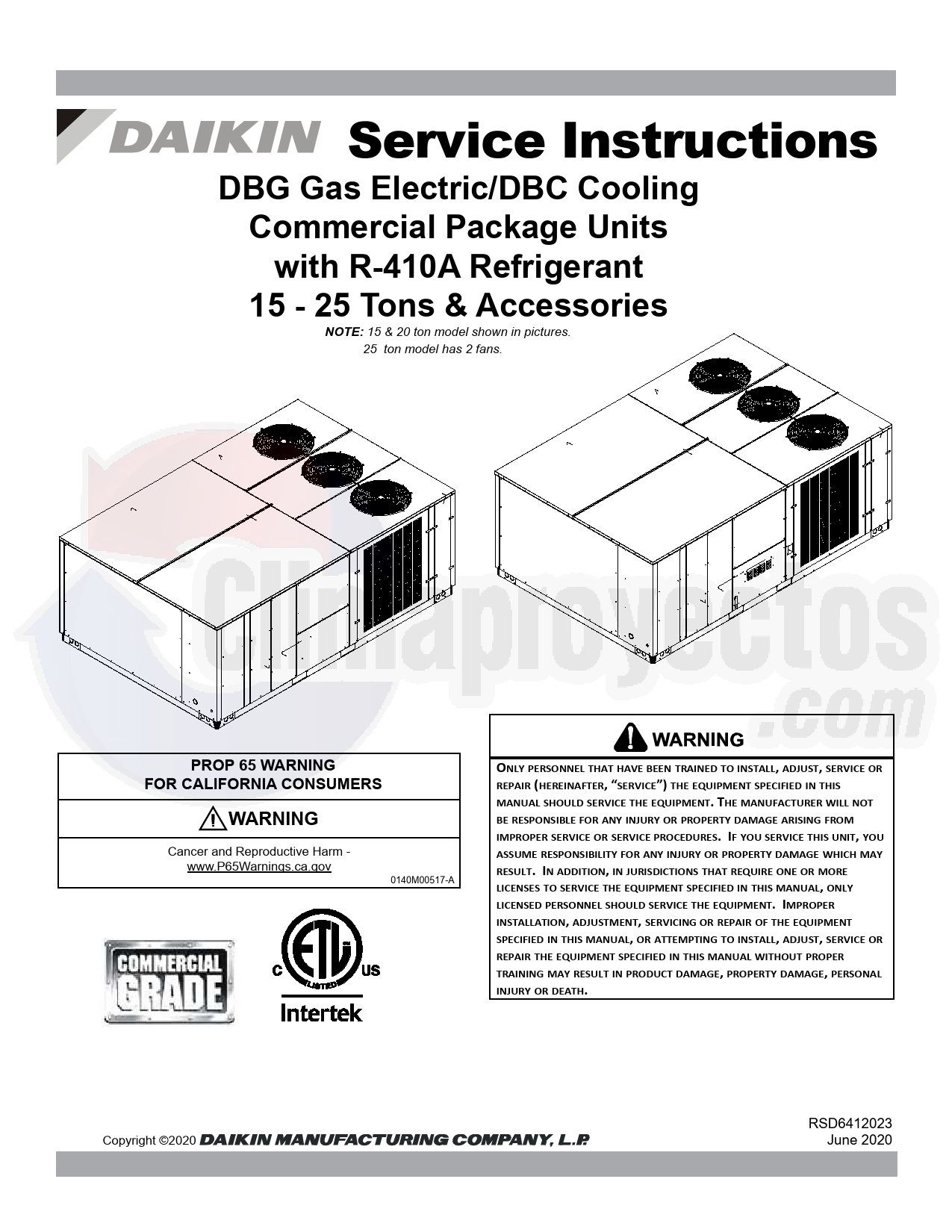
Service Instructions
DGB - service - CP | Climaproyectos S.A. de C.V.
Full PDF Document

If the inline viewer fails, it will open the original document in compatibility mode automatically. You can also open the file directly.
Extracted Text
Service Instructions DBG Gas Electric/DBC Cooling Commercial Package Units with R-410A Refrigerant 15 - 25 Tons & Accessories NOTE: 15 & 20 ton model shown in pictures. 25 ton model has 2 fans. PROP 65 WARNING FOR CALIFORNIA CONSUMERS WARNING Cancer and Reproductive Harm www.P65Warnings.ca.gov 0140M00517-A ONLY PERSONNEL THAT HAVE BEEN TRAINED TO INSTALL, ADJUST, SERVICE OR REPAIR (HEREINAFTER, "SERVICE") THE EQUIPMENT SPECIFIED IN THIS MANUAL SHOULD SERVICE THE EQUIPMENT. THE MANUFACTURER WILL NOT BE RESPONSIBLE FOR ANY INJURY OR PROPERTY DAMAGE ARISING FROM IMPROPER SERVICE OR SERVICE PROCEDURES. IF YOU SERVICE THIS UNIT, YOU ASSUME RESPONSIBILITY FOR ANY INJURY OR PROPERTY DAMAGE WHICH MAY RESULT. IN ADDITION, IN JURISDICTIONS THAT REQUIRE ONE OR MORE LICENSES TO SERVICE THE EQUIPMENT SPECIFIED IN THIS MANUAL, ONLY LICENSED PERSONNEL SHOULD SERVICE THE EQUIPMENT. IMPROPER INSTALLATION, ADJUSTMENT, SERVICING OR REPAIR OF THE EQUIPMENT SPECIFIED IN THIS MANUAL, OR ATTEMPTING TO INSTALL, ADJUST, SERVICE OR REPAIR THE EQUIPMENT SPECIFIED IN THIS MANUAL WITHOUT PROPER TRAINING MAY RESULT IN PRODUCT DAMAGE, PROPERTY DAMAGE, PERSONAL INJURY OR DEATH. Copyright �2020 RSD6412023 June 2020 TABLE OF CONTENTS IMPORTANT INFORMATION.................................2 - 3 SERVICING........................................................25 - 50 PRODUCT IDENTIFICATION ..................................... 4 ACCESSORIES................................................. 51 - 56 PRODUCT DESIGN ...............................................5 - 8 ACCESSORIES WIRING DIAGRAMS ...............57 -66 SYSTEM OPERATION.........................................9 - 19 HEATER KITS .......................................................... 67 SCHEDULED MAINTENANCE ..........................20 - 21 HEATER KIT WIRING DIAGRAMS ...................68 - 94 TROUBLESHOOTING CHARTS........................22 - 23 UNIT WIRING DIAGRAMS........................................ 95 SERVICING TABLE OF CONTENTS ........................ 24 IMPORTANT INFORMATION Pride and workmanship go into every product to provide our customers with quality products. It is possible, however, that during its lifetime a product may require service. Products should be serviced only by a qualified service technician who is familiar with the safety procedures required in the repair and who is equipped with the proper tools, parts, testing instruments and the appropriate service manual. REVIEW ALL SERVICE INFORMATION IN THE APPROPRIATE SERVICE MANUAL BEFORE BEGINNING REPAIRS. IMPORTANT NOTICES FOR CONSUMERS AND SERVICERS RECOGNIZE SAFETY SYMBOLS, WORDS AND LABELS WARNING Do not store combustible materials or use gasoline or other flammable liquids or vapors in the vicinity of this appliance as property damage or personal injury could occur. Have your contractor point out and identify the various cut-off devices, switches, etc., that serves your comfort equipment. HIGH VOLTAGE! Disconnect ALL power before servicing or installing this unit. Multiple power sources may be present. Failure to do so may cause property damage, personal injury or death. To locate an authorized servicer, please consult your telephone book or the dealer from whom you purchased this product. For further assistance, please contact: CONSUMER INFORMATION LINE - DAIKIN BRAND PRODUCTS TOLL FREE 1-855-770-5678 (U.S. only) email us at: customerservice@daikindaikinac.com fax us at: (713) 856-1821 (Not a technical assistance line for dealers.) Outside the U.S., call 1-713-861-2500 (Not a technical assistance line for dealers.) Your telephone company will bill you for the call. 2 SAFE REFRIGERANT HANDLING While these items will not cover every conceivable situation, they should serve as a useful guide. WARNING Refrigerants are heavier than air. They can "push out" the oxygen in your lungs or in any enclosed space.To avoid possible difficulty in breathing or death: � Never purge refrigerant into an enclosed room or space. By law, all refrigerants must be reclaimed. � If an indoor leak is suspected, thoroughly ventilate the area before beginning work. � Liquid refrigerant can be very cold. To avoid possible frostbite or blindness, avoid contact with refrigerant and wear gloves and goggles. If liquid refrigerant does contact your skin or eyes, seek medical help immediately. � Always follow EPA regulations. Never burn refrigerant, as poisonous gas will be produced. WARNING To avoid possible injury, explosion or death, practice safe handling of refrigerants. The compressor POE oil for R-410A units is extremely susceptible to moisture absorption and could cause compressor failure. Do not leave system open to atmosphere any longer than necessary for installation. To avoid possible explosion, use only returnable (not disposable) service cylinders when removing refrigerant from a system. � Ensure the cylinder is free of damage which could lead to a leak or explosion. � Ensure the hydrostatic test date does not exceed 5 years. � Ensure the pressure rating meets or exceeds 400 lbs. When in doubt, do not use cylinder. WARNING System contaminants, improper service procedure and/or physical abuse affecting hermetic compressor electrical terminals may cause dangerous system venting. The successful development of hermetically sealed refrigeration compressors has completely sealed the compressor's moving parts and electric motor inside a common housing, minimizing refrigerant leaks and the hazards sometimes associated with moving belts, pulleys or couplings. Fundamental to the design of hermetic compressors is a method whereby electrical current is transmitted to the compressor motor through terminal conductors which pass through the compressor housing wall. These terminals are sealed in a dielectric material which insulates them from the housing and maintains the pressure tight integrity of the hermetic compressor. The terminals and their dielectric embedment are strongly constructed, but are vulnerable to careless compressor installation or maintenance procedures and equally vulnerable to internal electrical short circuits caused by excessive system contaminants. In either of these instances, an electrical short between the terminal and the compressor housing may result in the loss of integrity between the terminal and its dielectric embedment. This loss may cause the terminals to be expelled, thereby venting the vaporous and liquid contents of the compressor housing and system. A venting compressor terminal normally presents no danger to anyone, providing the terminal protective cover is properly in place. If, however, the terminal protective cover is not properly in place, a venting terminal may discharge a combination of (a) hot lubricating oil and refrigerant (b) flammable mixture (if system is contaminated with air) in a stream of spray which may be dangerous to anyone in the vicinity. Death or serious bodily injury could occur. Under no circumstances is a hermetic compressor to be electrically energized and/or operated without having the terminal protective cover properly in place. See Service Section S-17 for proper servicing. 3 PRODUCT IDENTIFICATION D B G 300 3 V 400 C S A X X X X X X X X A* 1 2 3 4,5,6 7 8 9,10,11 12 13 14 15 16 17 18 19 20 21 22 23 24 Brand D Daikin B B Revision Levels Major & Minor C Cooling G Gas Heat 180 300 3 7 4 Supply Fan/Drive Type/Motor V B S B Gas/Electric B 400 B A/C Factory-Installed Electric Heat XXX No Heat 031 30 kW X X X X A Powered convenience outlet B Non-powered convenience outlet C Hinge Panels D Hinged Panels and Powered convenience outlet E Hinged Panels and non-powered convenience outlet X A B Phase Monitor E Non-Fused Disconnect and Phase Monitor Electrical b C H b X A Standard Aluminized Exchanger S Stainless Steel Exchanger Controls A Electro-mechanical controls M M mb X A X X A RA Smoke Detector B SA Smoke Detector C RA & SA Smoke Detector Economizer Sensors 4 PRODUCT DESIGN UNIT LOCATION WARNING TO PREVENT POSSIBLE EQUIPMENT DAMAGE, PROPERTY DAMAGE, PERSONAL INJURY OR DEATH, THE FOLLOWING BULLET POINTS MUST BE OBSERVED WHEN INSTALLING THE UNIT. All Installations: Important Note:If unit is equipped with crankcase heater unit should be energized 24 hours prior to compressor start up to ensure crankcase heater has sufficiently warmed the compressors. Compressor damage may occur if this step is not followed. NOTE: This appliance is a dedicated downflow design. Proper installation of the unit ensures trouble-free operation. Improper installation can result in problems ranging from noisy operation to property or equipment damages, dangerous conditions that could result in injury or personal property damage and that are not covered by the warranty. Give this booklet to the user and explain it's provisions. The user should retain these instructions for future reference. � For proper flame pattern within the heat exchanger and proper condensate drainage, the unit must be mounted level. � The flue outlet must be at least 12 inches from any opening through which flue gases could enter a building, and at least three feet above any forced air inlet located within ten feet. The economizer/manual fresh air intake/motorized fresh air intake and combustion air inlet mounted on the unit are not affected by this restriction. � Do not locate the unit in an area where the outdoor air (i.e. combustion air for the unit) will be frequently contaminated by compounds containing chlorine or fluorine. Common sources of such compounds include swimming pool chemicals and chlorine bleaches, paint stripper, adhesives, paints, varnishes, sealers, waxes (which are not yet dried) and solvents used during construction and remodeling. Various commercial and industrial processes may also be sources of chlorine/fluorine compounds. � To avoid possible illness or death of the building occupants, do NOT locate outside air intake device (economizer, manual fresh air intake, motorized fresh air intake) too close to an exhaust outlet, gas vent termination, or plumbing vent outlet. For specific distances required, consult local codes. � Allow minimum clearances from the enclosure for fire protection, proper operation, and service access (see unit clearances). These clearances must be permanently maintained. � The combustion air inlet and flue outlet on the unit must never be obstructed. If used, do not allow the economizer/ manual fresh air damper/ motorized fresh air damper to become blocked by snow or debris. In some climates or locations, it may be necessary to elevate the unit to avoid these problems. � When the unit is heating, the temperature of the return air entering the unit must be between 50� F and 100� F. Ground Level Installations Only: � When the unit is installed on the ground adjacent to the building, a level concrete (or equal) base is recommended. Prepare a base that is 3" larger than the package unit footprint and a minimum of 3" thick. � The base should also be located where no runoff of water from higher ground can collect in the unit. Roof top Installations Only: � To avoid possible property damage or personal injury, the roof must have sufficient structural strength to carry the weight of the unit(s) and snow or water loads as required by local codes. Consult a structural engineer to determine the weight capabilities of the roof. � The unit may be installed directly on wood floors or on Class A, Class B, or Class C roof covering material. � To avoid possible personal injury, a safe, flat surface for service personnel should be provided. � As indicated on the unit data plate, a minimum clearance of 36" to any combustible material is required on the furnace access side of the unit. All combustible materials must be kept out of this area. � This 36" clearance must also be maintained to insure proper combustion air and flue gas flow. The combustion air intake and furnace flue discharge must not be blocked for any reason, including blockage by snow. � Adequate clearances from the furnace flue discharge to any adjacent public walkways, adjacent buildings, building openings or openable windows must be maintained in accordance with the latest edition of the National Fuel Gas Code (ANSI Z223.1) � Minimum horizontal clearance of 48" from the furnace flue discharge to any electric meters, gas meters, regulators and relief equipment is required. Unit Precautions � Do not stand or walk on the unit. � Do not drill holes anywhere in panels or in the base frame of the unit(except where indicated). Unit access panels provide structural support. � Do not remove any access panels until unit has been installed on roof curb or field supplied structure. � Do not roll unit across finished roof without prior approval of owner or architect. � Do not skid or slide on any surface as this may damage unit base. The unit must be stored on a flat, level surface. Protect the condenser coil because it is easily damaged. 5 PRODUCT DESIGN Roof Curb Installations Only: Curb installations must comply with local codes and should be done in accordance with the established guidelines of the National Roofing Contractors Association. Proper unit installation requires that the roof curb be firmly and permanently attached to the roof structure. Check for adequate fastening method prior to setting the unit on the curb. Full perimeter roof curbs are available from the factory and are shipped unassembled. Field assembly, squaring, leveling and mounting on the roof structure are the responsibility of the installing contractor. All required hardware necessary for the assembly of the sheet metal curb is included in the curb accessory. CLEARANCES 75" 6" 48" *75" for DBG models 36" MINIMUM 48" ROOF OVERHANG WARNING TO PREVENT POSSIBLE EQUIPMENT DAMAGE, PROPERTY DAMAGE, PERSONAL INJURY OR DEATH, THE FOLLOWING BULLET POINTS MUST BE OBSERVED WHEN INSTALLING THE UNIT. � Sufficient structural support must be determined prior to locating and mounting the curb and package unit. � Ductwork must be constructed using industry guidelines. The duct work must be placed into the roof curb before mounting the package unit. Our full perimeter curbs include duct connection frames to be assembled with the curb. Cantilevered type curbs are not available from the factory. � Curb insulation, cant strips, flashing and general roofing material are furnished by the contractor. The curbs must be supported on parallel sides by roof members. The roof members must not penetrate supply and return duct opening areas as damage to the unit might occur. NOTE: The unit and curb accessories are designed to allow vertical duct installation before unit placement. Duct installation after unit placement is not recommended. *In situations that have multiple units, a 48" minimum clearance is required between the condenser coils. UNIT CLEARANCES Adequate clearance around the unit should be kept for safety, service, maintenance, and proper unit operation. A 75" clearance on the non-service side of the unit is required to facilitate possible blower assembly, shaft, wheel replacement and coil removal. *DBG ONLY- A 75" Clearance on the service is required for removal of the gas heat exchanger. This unit must not be installed beneath any obstruction. This unit should be installed remote from all building exhausts to inhibit ingestion of exhaust air into the unit's fresh air intake. Protrusion Inspect curb to ensure that none of the utility services (electric) routed through the curb protrude above the curb. CAUTION CAUTION ALL CURBS LOOK SIMILAR. TO AVOID INCORRECT CURB POSITIONING, CHECK JOB PLANS CAREFULLY AND VERIFY MARKINGS ON CURB ASSEMBLY. INSTRUCTIONS MAY VARY IN CURB STYLES AND SUPERCEDE INFORMATION SHOWN. See the manual shipped with the roof curb for assembly and installation instructions. IF PROTRUSIONS EXIST, DO NOT ATTEMPT TO SET UNIT ON CURB. INFORMATION SHOWN. ELECTRICAL WIRING WARNING HIGH VOLTAGE ! DISCONNECT ALL POWER BEFORE SERVICING OR INSTALLING THIS UNIT. MULTIPLE POWER SOURCES MAY BE PRESENT. FAILURE TO DO SO MAY CAUSE PROPERTY DAMAGE, PERSONAL INJURY OR DEATH. 6 PRODUCT DESIGN WARNING HIGH VOLTAGE ! TO AVOID PERSONAL INJURY OR DEATH DUE TO ELECTRICAL SHOCK, DO NOT TAMPER WITH FACTORY WIRING. THE INTERNAL POWER AND CONTROL WIRING OF THESE UNITS ARE FACTORY-INSTALLED AND HAVE BEEN THOROUGHLY TESTED PRIOR TO SHIPMENT. CONTACT YOUR LOCAL REPRESENTATIVE IF ASSISTANCE IS REQUIRED. CAUTION TO PREVENT IMPROPER AND DANGEROUS OPERATION DUE TO WIRING ERRORS, LABEL ALL WIRES PRIOR TO DISCONNECTION WHEN SERVICING CONTROLS. VERIFY PROPER OPERATION AFTER SERVICING. NOTE: A weather-tight disconnect switch, properly sized for the unit total load, must be field or factory installed. An external field supplied disconnect may be mounted on the exterior panel. CAUTION TO PREVENT DAMAGE TO THE WIRING, PROTECT WIRING FROM SHARP EDGES. FOLLOW NATIONAL ELECTRICAL CODE AND ALL LOCAL CODES AND ORDINANCES. DO NOT ROUTE WIRES THROUGH REMOVABLE ACCESS PANELS. CAUTION CONDUIT AND FITTINGS MUST BE WEATHER-TIGHT TO PREVENT WATER ENTRY INTO THE BUILDING. For unit protection, use a fuse or HACR circuit breaker that is in excess of the circuit ampacity, but less than or equal to the maximum overcurrent protection device. DO NOT EXCEED THE MAXIMUM OVERCURRENT DEVICE SIZE SHOWN ON UNIT DATA PLATE. Ensure the data plate is not covered by the field-supplied disconnect switch. � Some disconnect switches are not fused. Protect the power leads at the point of distribution in accordance with the unit data plate. � The unit must be electrically grounded in accordance with local codes or, in the absence of local codes, with the latest edition of the National Electrical Code (ANSI-NFPA 70). A ground lug is provided for this purpose. Size grounding conductor in accordance with Table 250-95 of the National Electrical Code. Do not use the ground lug for connecting a neutral conductor. � Connect power wiring to the electrical middle contactor within the main control box of power block, if equipped. All line voltage connections must be made through weatherproof fittings. All exterior power supply and ground wiring must be in approved weatherproof conduit. The main power supply wiring to the unit and low voltage wiring to accessory controls must be done in accordance with these instructions, the latest edition of the National Electrical Code (ANSI/NFPA 70), and all local codes and ordinances. All field wiring shall conform with the temperature limitations for Type T wire (63�F/35�C rise). The main power supply shall be three-phase, three wire. The unit is factory wired for the voltage shown on the unit's data plate. NOTE: If supply voltage is 208V, all leads on primary of transformer TRANS1 must be moved from the 230V to the 208V tap. Line voltage connects to middle contactor on 460v and 575v Gas Packs (or power block if equipped) Power Block (Coolers & 230V Gas Packs Only) Line voltage connects to power block on Coolers and the 230v Gas Packs Ground Lug Low Voltage Terminal Strip Main power wiring should be sized for the minimum wire ampacity shown on the unit's database. Size wires in accordance with the ampacity tables in Article 310 of the National Electrical Code. If long wires are required, it may be necessary to increase the wire size to prevent excessive voltage drop. Wires should be sized for a maximum of 3% voltage drop. Field wiring enters from this direction Thermostat wiring for all units connect to low voltage strip CAUTION TO AVOID PROPERTY DAMAGE OR PERSONAL INJURY DUE TO FIRE, USE ONLY COPPER CONDUCTORS. POWER AND LOW VOLTAGE BLOCK LOCATIONS 7 PRODUCT DESIGN Route field control wiring through grommet Field connecon for control wiring at terminal block Field connecon for line voltage ELECTRICAL ENTRANCE LOCATIONS Unit is equipped with a Low Voltage Terminal Block and has Single Point wiring to the contactor. Field wiring LOW enters from this direcon HIGH Ground Lug 25 TON POWER AND LOW VOLTAGE BLOCK LOCATIONS WARNING FAILURE OF UNIT DUE TO OPERATION ON IMPROPER LINE VOLTAGE OR WITH EXCESSIVE PHASE UNBALANCE CONSTITUTES PRODUCT ABUSE MAY CAUSE SEVERE DAMAGE TO THE UNIT ELECTRICAL COMPONENTS. Areas Without Convenience Outlet It is recommended that an independent 115V power source be brought to the vicinity of the roof top unit for portable lights and tools used by the service mechanic. NOTE: Refer to local codes for requirements. These outlets can also be factory installed. Units installed on Roof Tops Main power and low voltage wiring may enter the unit through the side or through the roof curb. Install conduit connectors at the desired entrance locations. External connectors must be weatherproof. All holes in the unit base must be sealed (including those around conduit nuts) to prevent water leakage into building. All required conduit and fittings are to be field supplied. Supply voltage to roof top unit must not vary by more than 10% of the value indicated on the unit data plate. Phase voltage unbalance must not exceed 2%. Contact your local power company for correction of improper voltage or phase unbalance. Low Voltage Control Wiring 1. A 24V thermostat must be installed for unit operation. It may be purchased with the unit or field -supplied. Thermostats may be programmable or electromechanical as required. 2. Locate thermostat or remote sensor in the conditioned space where it will sense average temperature. Do not locate the device where it may be directly exposed to supply air, sunlight or other sources of heat. Follow installation instructions packaged with the thermostat. 3. Use #18 AWG wire for 24V control wiring runs not exceeding 75 feet. Use #16 AWG wire for 24V control wiring runs not exceeding 125 feet. Use #14 AWG wire for 24V control wiring runs not exceeding 200 feet. Low voltage wiring may be National Electrical Code (NEC) Class 2 where permitted by local codes. 4. Route thermostat wires from sub-base terminals to the unit. Control wiring should enter through the duct panel (dimple marks entrance location). Connect thermostat and any accessory wiring to low voltage terminal block TB1 in the main control box. NOTE: Field-supplied conduit may need to be installed depending on unit/curb configuration. Use #18 AWG solid conductor wire whenever connecting thermostat wires to terminals on sub-base. DO NOT use larger than #18 AWG wire. A transition to #18 AWG wire may be required before entering thermostat sub-base. NOTE: Refer to unit wiring diagrams for thermostat hookups. 8 SYSTEM OPERATION DBG***XXX**XXX FOR YOUR SAFETY READ BEFORE OPERATING If you do not follow these instructions exactly, a fire or explosion may result causing property damage, personal injury or loss of life. A. This appliance does not have a pilot. It is equipped with an ignition device which automatically lights the burners. Do not try to light the burners by hand. B. BEFORE OPERATING smell around the appliance area for gas. Be sure to smell next to the floor because some gas is heavier than air and will settle on the floor. WHAT TO DO IF YOU SMELL GAS Do not try to light any appliance. Do not touch any electric switch; do not use any telephone in your building. Immediately call your supplier from a neighbor's phone. Follow the gas suppliers instructions. If you cannot reach your gas supplier, call the fire department. C. Use only your hand to move the gas control switch or knob. Never use tools. If the gas control switch or knob will not operate, don't try to repair it, call a qualified service technician. Force or attempted repair may result in a fire or explosion. D. Do not use this appliance if any part has been under water. Immediately call a qualified service technician to inspect the appliance and to replace any part of the control system and any gas control which has been under water. OPERATING INSTRUCTIONS WARNING: Improper alteration, service or maintenance can cause injury or property damage. Refer to the user's information manual provided with this consult a qualified or the gas supplier. This furnace must be instructions and local codes. In the absence of local codes, follow the National Fuel Gas Code, ANSI Z223.1. 1. STOP! Read the safety information above on this label. 2. Set the thermostat to lowest setting. 3. Turn off all electric power to the appliance. 4. This appliance is equipped with an automatic ignition system which automatically lights the burners. Do not try to light the burners by hand. 5. Remove control access panel. 6. Move the gas control switch or knob to "OFF". GAS CONTROL SWITCH SHOWN IN "ON" POSITION 7. Wait five (5) minutes to clear out any gas. If you then smell gas, STOP! Follow "B" in the safety information above on this label. If you don't smell gas, go to the next step. 8. Move the gas control switch or knob to "ON". 9. Replace control access panel. 10. Turn on all electric power to the appliance. 11. Set the thermostat to the desired setting. 12. If the appliance will not operate, follow the instructions "To Turn Off Gas To Appliance" and call your service technician or gas supplier. GAS CONTROL KNOB GAS CONTROL SWITCH SHOWN IN "ON" POSITION TO TURN OFF GAS TO APPLIANCE 1. Set the thermostat to its lowest setting. 2. Turn off all electric power to the appliance if service is to be performed. 3. Remove control access panel. 4. Move the gas control switch or knob to "OFF". Do not force. 5. Replace control access panel. For outdoor installation only. WARNING: If not installed, operated and maintained in accordance with the manufacturer's instructions, this product could expose you to substances in fuel combustion which can cause death or serious illness and which are known to the State of California to cause cancer, birth defects or other reproductive harm. This product contains fiberglass insulation. Fiberglass insulation contains a chemical California to cause cancer. FOR YOUR SAFETY Do not store or use gasoline or other flammable vapors and liquids in the vicinity of this or any other appliance. B14933-239 9 SYSTEM OPERATION Typical Package Cooling or Package Gas Indoor Coil DBC/DBG***XXX**XXX Outdoor Coil Thermostatic Expansion Valve 10 SYSTEM OPERATION Direct Spark Ignition (DSI) Systems DCG units are equipped with a direct spark ignition system. Ignition is provided by 22,000 volt electronic spark. A flame sensor then monitors for the presence of flame and closes the gas valve if flame is lost. The system may be controlled by most good heating and cooling thermostats with an adjustable heat anticipator. NOTE: Some night setback thermostats that do not have a common terminal use a power robbing circuit in the off cycle to maintain the batteries. This type of thermostat may interfere with the operation of the ignition control module and should not be used. HIGH VOLTAGE! Disconnect ALL power before servicing or installing this unit. Multiple power sources may be present. Failure to do so may cause property damage, personal injury or death. 11 SYSTEM OPERATION GAS SUPPLY PIPING WARNING TO PREVENT PERSONAL INJURY OR DEATH DUE TO IMPROPER INSTALLATION, ADJUSTMENT, ALTERATION, SERVICE OR MAINTENANCE, REFER TO THIS MANUAL. FOR ADDITIONAL ASSISTANCE OR INFORMATION, CONSULT A QUALIFIED INSTALLER, SERVICE AGENCY OR THE GAS SUPPLIER. IMPORTANT NOTE: This unit is factory set to operate on natural gas at the altitudes shown on the rating plate. WARNING TO PREVENT PROPERTY DAMAGE, PERSONAL INJURY OR DEATH WHEN EITHER USING PROPANE GAS ALONE OR AT HIGHER ALTITUDES, OBTAIN AND INSTALL THE PROPER CONVERSION KIT(S). FAILURE TO DO SO CAN RESULT IN UNSATISFACTORY OPERATION AND/OR EQUIPMENT DAMAGE. HIGH ALTITUDE KITS ARE FOR U.S. INSTALLATIONS ONLY AND ARE NOT APPROVED FOR USE IN CANADA. The rating plate is stamped with the model number, type of gas and gas input rating. Make sure the unit is equipped to operate on the type of gas available. Conversion to propane (LP) gas is permitted with the use of the factory authorized conversion kit (see the unit Spec Sheet Manual for the appropriate kit). For High Altitude derates, refer to the latest edition of the National Fuel Gas Code NFPA 54/ANSI Z223.1. NATURAL PROPANE INLET GAS PRESSURE Min. 5.0" W.C., Max. 10.0" W.C. Min. 11.0" W.C., Max. 14.0" W.C. Inlet Gas Pressure Must Not Exceed the Maximum Value Shown in Table Above. The minimum supply pressure should not vary from that shown in the table above because this could prevent the unit from having dependable ignition. In addition, gas input to the burners must not exceed the rated input shown on the rating plate. Overfiring of the unit could result in premature heat exchanger failure. Piping IMPORTANT NOTE: To avoid possible unsatisfactory operation or equipment damage due to under firing of equipment, do not undersize the natural/propane gas piping from the meter/tank to the unit. When sizing a trunk line, include all appliances on that line that could be operated simultaneously. The rating plate is stamped with the model number, type of gas and gas input rating. Make sure the unit is equipped to operate on the type of gas available. The gas line installation must comply with local codes, or in the absence of local codes, with the latest edition of the National Fuel Gas Code NFPA 54/ANSI Z223.1. Natural Gas Capacity of Pipe in Cubic Feet of Gas Per Hour (CFH) Length of Pipe in Feet 10 Nominal Black Pipe Size (inches) 1/2 3/4 1 1 1/4 1 1 /2 132 278 520 1050 1600 20 92 190 350 730 1100 30 73 152 285 590 980 40 63 130 245 500 760 50 56 115 215 440 670 60 50 105 195 400 610 70 46 96 180 370 560 80 43 90 170 350 530 90 40 84 160 320 490 100 38 79 150 305 460 Pressure= .50 PSIG or less and Pressure Drop of 0.3" W.C. (Based on 0.60 Specific Gravity Gas) CFH = BTUH Furnace Input Heating Value of Gas (BTU/Cubic Foot Refer to the Proper Piping Practice drawing for the general layout at the unit. The following rules apply: 1. Use black iron pipe and fittings for the supply piping. The use of a flex connector and/or copper piping is permitted as long as it is in agreement with local codes. 2. Use pipe joint compound on male threads only. Pipe joint compound must be resistant to the action of the fuel used. 3. Use ground joint unions. 4. Install a drip leg to trap dirt and moisture before it can enter the gas valve. The drip leg must be a minimum of three inches long. 5. Use two pipe wrenches when making connection to the gas valve to keep it from turning. 6. Install a manual shut-off valve in a convenient location (within six feet of unit) between the meter and the unit. 7. Tighten all joints securely. 8. The unit must be connected to the building piping by one of the following methods: � Rigid metallic pipe and fittings � Semirigid metallic tubing and metallic fittings (Aluminum alloy tubing must not be used in exterior locations) � Listed gas appliance connectors used in accordance with the terms of their listing that are completely in the same room as the equipment � In the prior two methods above the connector or tubing must be protected from physical and thermal damage. Aluminum alloy tubing and connectors must be coated to protect against external corrosion when in contact with masonry, plaster or insulation or are subject to repeated wettings by liquids (water - not rain water, detergents or sewage). 1N2atural Gas Connection SYSTEM OPERATION GAS INLET LOCATION (3/4" NPT) Gas Piping Checks 46-1/10" 74-11/12" DOOR HOOD LOCATED INSIDE HEAT SECTION DURING SHIPPING PROVIDE CLEARANCE FOR REMOVAL OF ACCESS PANELS MANUAL SHUT OFF VALVE DRIP LEG GROUND JOINT UNION CAUTION TO PREVENT PROPERTY DAMAGE OR PERSONAL INJURY DUE TO FIRE, THE FOLLOWING INSTRUCTIONS MUST BE PERFORMED REGARDING GAS CONNECTIONS AND PRESSURE TESTING: � THE UNIT AND ITS GAS CONNECTIONS MUST BE LEAK TESTED BEFORE PLACING IN OPERATION. BECAUSE OF THE DANGER OF EXPLOSION OR FIRE, NEVER USE A MATCH OR OPEN FLAME TO TEST FOR LEAKS. NEVER EXCEED SPECIFIED PRESSURES FOR TESTING. HIGHER PRESSURE MAY DAMAGE GAS VALVE AND CAUSE OVERFIRING WHICH MAY RESULT IN PREMATURE HEAT EXCHANGE FAILURE. � THIS UNIT AND ITS SHUT-OFF VALVE MUST BE DISCONNECTED FROM THE GAS SUPPLY DURING ANY PRESSURE TESTING OF THAT SYSTEM AT TEST PRESSURES IN EXCESS OF 1/2 PSIG (3.48 KPA). � THIS UNIT MUST BE ISOLATED FROM THE GAS SUPPLY SYSTEM BY CLOSING ITS MANUAL SHUT-OFF VALVE DURING ANY PRESSURE TESTING OF THE GAS SUPPLY PIPING SYSTEM AT TEST PRESSURES EQUAL TO OR LESS THAN 1/2 PSIG (3.48 KPA). WARNING TO AVOID PROPERTY DAMAGE OR PERSONAL INJURY, BE SURE THERE IS NO OPEN FLAME IN THE VICINITY DURING AIR BLEEDING. Proper Piping Practice NOTE: The unit gas supply entrance is factory sealed with plugs. Keep plugs in place until gas supply is ready to be installed. Once ready, replace the plugs with the supplied grommets and install gas supply line. There will be air in the gas supply line after testing for leaks on a new installation. Therefore, the air must be bled from the line by loosening the ground joint union until pure gas is expelled. Tighten union and wait for five minutes until all gas has been dissipated in the air. Be certain there is no open flame in the vicinity during air bleeding procedure. The unit is placed in operation by closing the main electrical disconnect switch for the unit. PROPANE GAS INSTALLATIONS WARNING TO AVOID PROPERTY DAMAGE, PERSONAL INJURY OR DEATH DUE TO FIRE OR EXPLOSION CAUSED BY A PROPANE GAS LEAK, INSTALL A GAS DETECTING WARNING DEVICE. SINCE RUST CAN REDUCE THE LEVEL OF ODORANT IN PROPANE GAS, A GAS DETECTING WARNING DEVICE IS THE ONLY RELIABLE WAY TO DETECT A PROPANE GAS LEAK. CONTACT A LOCAL PROPANE GAS SUPPLIER ABOUT INSTALLING A GAS DETECTING WARNING DEVICE. IMPORTANT NOTE: Propane gas conversion kits must be installed to convert units to propane gas. All propane gas equipment must conform to the safety standards of the National Board of Fire Underwriters (See NBFU Manual 58). Line pressure 11.3 - 14" w.c. 13 SYSTEM OPERATION For satisfactory operation, propane gas manifold pressure must be within 9.7 - 10.3 inches w.c. for high fire and within 6.7 - 7.3 inches w.c. low fire at the manifold with all gas appliances in operation. Maintaining proper gas pressure depends on three main factors: 1. Vaporization rate, which depends on (a) temperature of the liquid, and (b) wetted surface area of the container or containers. 2. Proper pressure regulation. 3. Pressure drop in lines between regulators, and between second stage regulator and the appliance. Pipe size required will depend on length of pipe run and total load of all appliances. PROPANE TANK SIZING (MINIMUM) MAXIMUM GAS NEEDED TO VAPORIZE* 125K BTU/HR (50 CFH) 250K BTU/HR (100 CFH) 375K BTU/HR (150 CFH) 500K BTU/HR (200 CFH) 750K BTU/HR (300 CFH) TANK SIZE REQUIRED IF LOWEST OUTDOOR TEMPERATURE (AVG. FOR 24 HOURS) REACHES 32�F 115 GAL 250 GAL 300 GAL 400 GAL 750 GAL 20�F 115 GAL 250 GAL 400 GAL 500 GAL 1000 GAL 10�F 115 GAL 250 GAL 500 GAL 750 GAL 1500 GAL 0�F 250 GAL 400 GAL 500 GAL 1000 GAL 2000 GAL -10�F 250 GAL 500 GAL 1000 GAL 1500 GAL 2500 GAL -20�F 400 GAL 1000 GAL 1500 GAL 2000 GAL 4000 GAL -30�F 600 GAL 1500 GAL 2500 GAL 3500 GAL 5000 GAL * AVERAGE RATE/HOUR WITHDRAWL IN 8 HOUR PERIOD TYPICAL PROPANE PIPING First Stage Regulator 5 to 15 PSIG (20 PSIG Max.) Continuous 11" W.C. 200 PSIG Maximum Second Stage Regulator Although the unit itself cannot be installed in an excavated or confined space, the gas piping may be routed through such areas and we strongly recommend that you contact your propane supplier about installing a gas detecting warning device that would alert you to a gas leak. � Propane gas is heavier than air and any leaking gas can settle in any low areas or confined spaces. � Propane gas odorant may fade, making the gas undetectable except with a warning device. An undetected gas leak will create a danger of explosion or fire. If you suspect the presence of gas, follow the instructions on page 9. Failure to do so could result in serious personal injury or death. PROPANE GAS PIPING CHARTS Sizing Between First and Second Stage Regulator Maximum Propane Capacities listed are based on 1 PSIG Pressure Drop at 10 PSIG Setting. Capacities in 1,000 BTU/HR PIPE OR TUBING LENGTH, FEET 30 TUBING SIZE, O.D., TYPE L 3/8" 1/2" 5/8" 3/4" 309 700 1,303 2,205 40 265 599 1,115 1,887 50 235 531 988 1,672 60 213 481 896 1,515 70 196 446 824 1,394 80 182 412 767 1,297 90 171 386 719 1,217 100 161 365 679 1,149 150 130 293 546 923 200 111 251 467 790 250 90 222 414 700 300 89 201 378 634 350 82 185 345 584 400 76 172 321 543 To convert to Capacities at 15 PSIG Settings -- Multiply by 1.130 To convert to Capacities at 5 PSIG Settings -- Multiply by 0.879 7/8" 3,394 2,904 2,574 2,332 2,146 1,996 1,873 1,769 1,421 1,216 1,078 976 898 836 NOMINAL PIPE SIZE, SCHEDULE 40 1/2" 1,843 1,577 1,398 1,267 1,165 1,084 1,017 961 772 660 585 530 488 454 3/4" 3,854 3,298 2,923 2,649 2,437 2,267 2,127 2,009 1,613 1,381 1,224 1,109 1,020 949 Sizing Between Single or Second Stage Regulator and Appliance* Maximum Propane Capacities Listed are Based on 1/2" W.C. Pressure Drop at 11" W.C. Setting. Capacities in 1,000 BTU/HR PIPE OR TUBING TUBING SIZE, O.D., TYPE L LENGTH, FEET 3/8" 1/2" 5/8" 3/4" 7/8" 1/2" 10 49 110 206 348 539 291 20 34 76 141 239 368 200 30 27 61 114 192 296 161 40 23 52 97 164 253 137 50 20 46 86 146 224 122 60 19 42 78 132 203 110 80 16 36 67 113 174 94 100 14 32 59 100 154 84 125 12 28 52 89 137 74 150 11 26 48 80 124 67 200 10 22 41 69 106 58 250 9 19 36 61 94 51 300 8 18 33 55 85 46 350 7 16 30 51 78 43 400 7 15 28 47 73 40 *DATA IN ACCORDANCE WITH NFPA PAMPHLET NO. 54 NOMINAL PIPE SIZE, SCHEDULE 40 3/4" 608 418 336 284 255 231 198 175 155 141 120 107 97 89 83 1" 1,146 788 632 541 480 436 372 330 292 265 227 201 182 167 156 1-1/4" 2,353 1,617 1,299 1,111 985 892 764 677 600 544 465 412 374 344 320 1-1/2" 3,525 2,423 1,946 1,665 1,476 1,337 1,144 1,014 899 815 697 618 560 515 479 14 SYSTEM OPERATION Roof Top Location and Installation The gas supply piping location and installation for roof top units must be in accordance with local codes or, in the absence of locals codes, with ordinances of the latest edition of the National Fuel Gas Code (ANSI Z223.1). A manual gas shut off valve must be field installed external to the roof top unit. In addition, a drip leg must be installed near the inlet connection. A ground joint union connection is required between the external shut off valve and the unit connection to the gas valve to permit removal of the burner assembly for servicing. 1. Route gas piping to unit so that it does not interfere with the removal of access panels. Support and align piping to prevent strains or misalignment of the manifold assembly. 2. All units are furnished with standard female NPT pipe connections. Connection pipe size is 3/4" NPT. The size of the gas supply piping to the unit must be based on length of run, number of units on the system, gas characteristics, BTU requirement and available supply pressure. All piping must be done in accordance with local codes or, in the absence of local codes, with the latest edition of the National Fuel Gas Code (ANSI Z223.1). NOTE: The gas connection size at the unit does NOT establish the size of the supply line. 3. These units are designed for either natural or propane (LP) gas and are specifically constructed at the factory for only one of these fuels. The fuels are NOT interchangeable. However, the furnace can be converted in the field from natural gas to LP gas with the appropriate factory kit (see unit Spec Sheet Manual for the appropriate kit). Only a qualified contractor, experienced with natural and propane gas systems, should attempt conversion. Kit instructions must be followed closely to assure safe and reliable unit operation. 4. With all units on a common line operating under full fire, natural gas main supply pressure should be adjusted to approximately 7.0" w.c., measured at the unit gas valve. If the gas pressure at the unit is greater than 10.5" w.c., the contractor must furnish and install an external type positive shut off service pressure regulator. The unit will not function satisfactorily if supply gas pressure is less than 5.5" w.c. or greater than 10.5" w.c.. NOTE: A minimum horizontal distance of 48" between the regulator and the furnace flue discharge is required. 5. With all units on a common line operating under full LP gas main supply pressure should be at least 11.0" w.c. and must be no greater than 14.0" w.c., measured at the unit gas valve. Unit will not function satisfactorily if supply gas pressure is less than 11.0" w.c. or greater than 14.0" w.c.. 6. All pipe connections should be sealed with a pipe thread compound, which is resistant to the fuel used with the furnace. A soapy water solution should be used to check all joints for leaks. A 1/8" NPT plugged tap is located on the entering side of the gas valve for test gauge connection to measure supply (main) gas pressure. Another 1/8" tap is provided on the side of the manifold for checking manifold pressure. WARNING THIS UNIT AND ITS INDIVIDUAL SHUTOFF VALVE MUST BE DISCONNECTED FROM THE GAS SUPPLY SYSTEM DURING ANY PRESSURE TESTING OF THAT SYSTEM AT TEST PRESSURES IN EXCESS OF 1/2 PSIG (13.8" W.C.). CAUTION THIS UNIT MUST BE ISOLATED FROM THE GAS SUPPLY PIPING SYSTEM BY CLOSING ITS INDIVIDUAL MANUAL SHUTOFF VALVE DURING ANY PRESSURE TESTING EQUAL TO OR LESS THAN 1/2 PSIG. 7. There must be no obstruction to prevent the flow of combustion and ventilating air. A vent stack is not required and must never be used. The power ventor will supply an adequate amount of combustion air as long as the air passageways are kept free of any obstructions and the recommended external unit clearances are maintained. CIRCULATING AIR AND FILTERS Ductwork The supply duct should be provided with an access panel large enough to inspect the air chamber downstream of the heat exchanger. A cover should be tightly attached to prevent air leaks. Ductwork dimensions are shown in the roof curb installation manual. If desired, supply and return duct connections to the unit may be made with flexible connections to reduce possible unit operating sound transmission. VENTING NOTE: Venting is self-contained. CONDENSATE DRAIN CONNECTION Condensate Drain Connection A 1" female NPT drain connection is supplied on the side of the unit and a 1" male NPT on the bottom of the drain pan for condensate piping. An external trap must be installed for proper condensate drainage. 15 SYSTEM OPERATION Base Rail Open Vent 2" Min WARNING MOVING MACHINERY HAZARD! TO PREVENT POSSIBLE PERSONAL INJURY OR DEATH, DISCONNECT POWER TO THE UNIT AND PADLOCK IN THE "OFF" POSITION BEFORE SERVICING FANS. See NOTE Drain Plug Roof Curb NOTE: Trap should be deep enough to offset maximum unit static difference. A minimum 4" trap is recommended. Drain Connection Install condensate drain trap as shown. Use 1" drain line and fittings or larger. Do not operate without trap. Horizontal Drain Drainage of condensate directly onto the roof may be acceptable; refer to local code. It is recommended that a small drip pad of either stone, mortar, wood or metal be provided to prevent any possible damage to the roof. Cleaning Due to the fact that drain pans in any air conditioning unit will have some moisture in them, algae and fungus will grow due to airborne bacteria and spores. Periodic cleaning is necessary to prevent this build-up from plugging the drain. STARTUP, ADJUSTMENTS, AND CHECKS WARNING HIGH VOLTAGE! TO AVOID PERSONAL INJURY OR DEATH DUE TO ELECTRICAL SHOCK, BOND THE FRAME OF THIS UNIT TO THE BUILDING ELECTRICAL GROUND BY USE OF THE GROUNDING TERMINAL PROVIDED OR OTHER ACCEPTABLE MEANS. DISCONNECT ALL POWER BEFORE SERVICING OR INSTALLING THIS UNIT. CAUTION TO PREVENT PROPERTY DAMAGE OR PERSONAL INJURY, DO NOT START THE UNIT UNTIL ALL NECESSARY PRE-CHECKS AND TEST HAVE BEEN PERFORMED. Contractor Responsibility The installing contractor must be certain that: � All supply and return air ductwork is in place, properly sealed, and corresponds with installation instructions. � All thermostats are mounted and wired in accordance with installation instructions. � All electric power, all gas, hot water or steam line connections, and the condensate drain installation have been made to each unit on the job. These main supply lines must be functional and capable of operating all units simultaneously. � Requirements are met for venting and combution air. � Air filters are in place. � Input rate and temperature rise are adjusted per rating plate. � Return air temperature is maintained between 55�F (13�C) and 80�F (27�C). Roof Curb Installation Check Inspect the roof curb for correct installation. The unit and curb assembly should be level. Inspect the flashing of the roof mounting curb to the roof, especially at the corners, for good workmanship. Also check for leaks around gaskets. Note any deficiencies in a separate report and forward to the contractor. Obstructions, Fan Clearance and Wiring Remove any extraneous construction and shipping materials that may be found during this procedure. Rotate all fans manually to check for proper clearances and that they rotate freely. Check for bolts and screws that may have jarred loose during shipment to the job site. Retighten if necessary. Re-tighten all electrical connections. Field Duct Connections Verify that all duct connections are tight and that there is no air bypass between supply and return. Filter Section Check Remove filter section access panels and check that filters are properly installed. Note airflow arrows on filter frames. 16 SYSTEM OPERATION Pre-startup Precautions Transformer and Induced Draft Motor NOTE: On the 208/230 volt units only. Ensure the transformer and induced draft motor are set on the appropriate voltage taps. Both the transformer tap and induced draft motor are set on 230v from the factory. To change transformer and induced draft motor voltage to 208V, move the black wire on the transformer from the 230V tap to the 208V tap. It is important to your safety that the unit has been properly grounded during installation. Check ground lug connection in main control box for tightness prior to closing circuit breaker or disconnect switch. Verify that supply voltage on line side of disconnect agrees with voltage on unit identification plate. System Voltage - That nominal voltage value assigned to a circuit or system for the purpose of designating its voltage class. Nameplate Voltage - That voltage assigned to a piece of equipment for the purpose of designating its voltage class and for the purpose of defining the minimum and maximum voltage at which the equipment will operate. 2 SPEED MODELS NOTE: For 2 Speed Models, airflow adjustments must be made with the evaporator motor operating at high speed,i.e, 2nd stage cooling or in heat mode. BELT DRIVE MODELS ONLY The drive on the supply fan is typically set in the middle of the RPM range. The drive motor sheave pitch diameter is field adjustable for the required airflow. Upon completion of the air flow balancing, we recommend replacing the variable pitched motor sheave with a properly-sized fixed sheave. A matching fixed sheave will provide longer belt and bearing life and vibration free operation. Initially, it is best to have a variable pitched motor sheave for the purpose of airflow balancing, but once the balance has been achieved, fixed sheaves maintain alignment and minimize vibration more effectively. For direct drive units, move fan speed wire. Start-up Procedure and Checklist for 2 Speed Models: Models with a V in the 11th position of the model number. AIR FLOW ADJUSTMENTS When the final adjustments are complete, the current draw of the motor should be checked and compared to the full load current rating of the motor. The amperage must not exceed the service factor stamped on the motor nameplate. The total airflow must not be less than that required for operation of the electric heaters or the furnace. If an economizer is installed, check the unit operating balance with the economizer at full outside air and at minimum outside air. NOTE:Airflow setting below 300 CFM/Ton is not recommended, as evaporator freezing or poor unit performance is possible.Start-up Procedure and Checklist for 2 Speed Models. Set Evaporator Fan Rpm Actual RPM's must be set and verified with a tachometer or strobe light. With disconnect switch open, disconnect thermostat wires from terminals Y and W. This will prevent heating and mechanical cooling from coming on. Place a jumper wire across terminals R and G at TB1 terminal block. Close disconnect switch; evaporator fan motor will operate so RPM can be checked. For gas heat units, the airflow must be adjusted so that the air temperature rise falls within the ranges given stated on Data Plate. For 2 speed models, the indoor blower will operate on low speed when in "Fan Only" mode or while in first stage "Cooling" mode. Unit will operate on high speed in "Heating" mode and while in second stage "Cooling" mode. The start-up procedure is the same as for "Air Conditioning Start-up Procedure" with the understanding that in Step 6, the indoor blower will run at low speed (~1175 motor rpm) and in Step 7, the indoor blower will operate at high speed (~1775 motor rpm). NOTE: While in the Cooling Mode, to prevent frost from forming on the evaporator while the unit is operating in outdoor temperatures of 65�F or lower, it is recommended that a low ambient kit (LAKT-**) is used. This is strongly recommended for 2 Speed models due to the lower airflow while in the first stage cooling. To further protect the compressor from damage during low ambient conditions, a Freezestat Kit (FSK***) can be added that turns the compressor off when the evaporator temperature drops too low. Electrical Input Check Make preliminary check of evaporator fan ampere draw and verify that motor nameplate amps are not exceeded. A final check of amp draw should be made upon completion of air balancing of the duct system. 17 SYSTEM OPERATION Bearing Check Prior to energizing any fans, check and make sure that all setscrews are tight so that bearings are properly secured to shafts. GAS SYSTEM Ignitor Flame Sensor MAXIMUM INPUT (BTUH) NUMBER of BURNERS MAXIMUM BTUH/BURNER GAS ORIFICES NATURAL PROPANE (LP) 350,000 7 50,000 #30 #48 400,000 8 50,000 #30 #48 HEAT EXCHANGER AND BURNER ORIFICE SPECIFICATIONS NOTE: Gas appliances located more than 2000 feet above sea level must be derated 4% per 1000 feet of total elevation and that variance in gas heating value and specific gravity require change in manifold pressure to obtain rating, it is mandatory that the input be adjusted at the installation site. All installations should be made as outlined in the latest edition of the National Fuel Gas Code ANSI Z223.1, section "Procedures To Be Followed To Place An Appliance in Operation". Refer also to the "User's Information Manual" supplied with the unit for additional information on the gas furnace. NORMAL SEQUENCE OF OPERATION NOTE: The ignition control board blower off delay is factory set at 150 seconds. This factory setting can also be set to 120 or 135 seconds by placing the jumper on the desired setting. Heating This unit has one (RS) Manual Reset Limit Control Switch. Check the limit to make sure it has not tripped. The limit may arrive at the job site tripped as a result of shipping shock. If the ventor motor comes on, but the unit does not attempt ignition, check if the ALS (Automatic Reset High Limit Control 18 Switch) requires resetting. 1. With electricity and gas turned on, the system switch in the "HEAT" or "AUTO" position and the fan switch in the "AUTO" position, the thermostat will close the circuit between unit terminals R and W (R-W) when the temperature falls below the thermostat setting. 2. D1 on IIC energizes relay IDMR. 3. Relay IDMR energizes the ventor motor IDM. 4. Operation of the vent motor closes the pressure switch PS located in the burner compartment. the control then initiates a 15-second pre-purge time delay. During this period, the ventor motor will clear the combustion chamber of any residual gas. 5. After the pre-purge period, the ignition control energizes the Wl-C gas valve and simultaneously initiates a "three (3)-try" spark ignition sequence. 6. When the burners are ignited, a minimum four (4) micro-amp DC current will flow through the flame between the sensor electrode and the grounded burner. 7. When the controller proves that the flame has been established, it will keep the gas valve energized and discontinue the ignition spark. First stage manifold pressure will be approximately 2.0" w.c. for natural gas and 7.0" w.c. for propane (LP). 8. If the control is unable to ignite the burners after its initial attempt, it will initiate another purge and spark sequence. A third purge and spark sequence will be initiated if the second attempt is unsuccessful. If the third attempt is unsuccessful, the controller will close the gas valve and lock itself out. It may be reset by momentarily interrupting power. This may be accomplished by briefly lowering the room thermostat set-point below room temperature, or by shutting off the main power to the unit. (See TP-105 for more details.) 9. Integrated ignition control will close its normally open contacts after a delay of approximately 30 seconds. This action energizes contactor BC and starts the supply fan motor. Operation of the supply fan circulates air across the heat exchanger and delivers heated air to the conditioned space. 10. When the space temperature rises, the thermostat will open R-W. Opening R-W will cause the gas valve to close, and the furnace to shut down. 11. The furnace has three high temperature limit controls, which can shut down the burner. They do not shut down the ventor motor. Unit Shutdown 1. Set the thermostat to lowest setting. 2. Turn off the electrical power supply to the unit. 3. Remove the heat exchanger door on the side of the unit by removing screws. 4. Move the gas control valve switch to the OFF position. Do not force. 5. Close manual gas shut off valve external to the unit. SYSTEM OPERATION 6. Replace the heat exchanger door on the unit. 7. If cooling and/or air circulation will be desired, turn ON the electrical power. Automatic Reset High Limit Control (LS) Located in the burner compartment on the heat exchanger, its sensing element projects through the blower section bulkhead and senses the temperature at the rear of the furnace. It will cycle the furnace off if the temperature exceeds 100�F plus maximum rise. 6. Slowly lower the cooling temperature until first stage COOL (LOW COOL) starts. The blower, both fans, and first stage compressor should now be operating. Allow the unit to run 10 minutes, make sure cool air is being supplied by the unit. 7. Lower the cooling temperature further until second stage COOL (HIGH COOL) starts. The blower, both fans, and both compressors should now be operating. Allow the unit to run 10 minutes, make sure cool air is being supplied by the unit. Auxiliary Reset High Limit Control (ALS) Located in the blower compartment on the blower housing, it senses air temperature within the blower compartment and protects the filters from excessive temperature. It will shut down the furnace if it senses excessive temperatures. Elevated temperatures at the control are normally caused by blower failure. The reason for the opening should be determined and repaired prior to resetting. Manual Reset Flame Rollout Control (RS) Located in the burner compartment at the top of the burner assembly, it senses high temperature that could occur if the heat exchanger tubes were plugged and the flame was rolling out instead of entering the tubes. It has a manual push-button reset that cannot be actuated until the limit control has cooled. The reason for elevated temperatures at the control should be determined and repaired prior to resetting this manual reset control. WARNING TO AVOID PROPERTY DAMAGE, PERSONAL INJURY OR DEATH DUE TO FIRE OR EXPLOSION, A QUALIFIED SERVICER MUST INVESTIGATE THE REASON FOR THE ROLLOUT PROTECTION DEVICE TO OPEN BEFORE MANUALLY RESETTING THE ROLLOUT PROTECTION DEVICE. NORMAL SEQUENCE OF OPERATION Cooling Begin with power turned off at all disconnects. 1. Turn thermostat system switch to "Cool," and fan switch to "Auto" and turn temperature setting as high as it will go. 2. Inspect all registers and set them to the normal open position. 3. Turn on the electrical supply at the disconnect. 4. Turn the fan switch to the "ON" position. The blower should operate after a 7-second delay. 5. Turn the fan switch to "Auto" position. The blower should stop after a 65 second delay. 8. Turn the temperature setting to the highest position, stopping the unit. The indoor blower will continue to run for 65 seconds. 9. Turn the thermostat system switch to "OFF" and disconnect all power when servicing the unit. WARNING HIGH VOLTAGE! DISCONNECT ALL POWER BEFORE SERVICING OR INSTALLING THIS UNIT. MULTIPLE POWER SOURCES MAY BE PRESENT. FAILURE TO DO SO MAY CAUSE PROPERTY DAMAGE, PERSONAL INJURY OR DEATH. Refrigeration Check The unit is equipped with a thermal expansion valve as a metering device. Ensure the hold-down bolts on the compressor are secure and have not vibrated loose during shipment. Check that vibration grommets have been installed. Visually check all piping for damage and leaks; repair if necessary. The entire system has been factory charged and tested, making it unnecessary to field charge. Factory charges are shown on the unit's nameplate. To confirm charge levels or, if a leak occurs and charge needs to be added to the system, it is recommended to evacuate the system and recharge refrigerate to unit nameplate specifications. This unit has been rated in the cooling mode at the AHRI rated conditions of: Indoor (80� db / 67� wb) and outdoor (95� db). While operating at this condition, the subcooling should range from 12� to 15� F for each refrigeration circuit, for 15 and 20 ton models. Sucooling for 25 ton models should be from 16� to 19� F for circuit 1, and from 12� to 15� F for circuit 2. Final System Checks 1. Check to see if all supply and return air grilles are adjusted and the air distribution system is balanced for the best compromise between heating and cooling. 2. Check for air leaks in the ductwork. See Sections on Air Flow Adjustments. 3. Make sure the unit is free of "rattles", and the tubing in the unit is free from excessive vibration. Also make sure tubes or lines are not rubbing against each other or sheet metal surfaces or edges. If so, correct the trouble. 4. Set the thermostat at the appropriate setting for cooling and heating or automatic change over for normal use. 19 SCHEDULED MAINTENANCE 5. Be sure the Owner is instructed on the unit operation, filter, servicing, correct thermostat operation, etc. MAINTENANCE WARNING HIGH VOLTAGE ! DISCONNECT ALL POWER BEFORE SERVICING OR INSTALLING THIS UNIT. MULTIPLE POWER SOURCES MAY BE PRESENT. FAILURE TO DO SO MAY CAUSE PROPERTY DAMAGE, PERSONAL INJURY OR DEATH. WARNING TO PREVENT PERSONAL INJURY OR DEATH DUE TO IMPROPER INSTALLATION, ADJUSTMENT, ALTERATION, SERVICE OR MAINTENANCE, REFER TO THIS MANUAL. FOR ADDITIONAL ASSISTANCE OR INFORMATION, CONSULT A QUALIFIED INSTALLER, SERVICE AGENCY OR THE GAS SUPPLIER. Filters CAUTION TO PREVENT PROPERTY DAMAGE DUE TO FIRE AND LOSS OF EQUIPMENT EFFICIENCY OR EQUIPMENT DAMAGE DUE TO DUST AND LINT BUILD UP ON INTERNAL PARTS, NEVER OPERATE UNIT WITHOUT AN AIR FILTER INSTALLED IN THE RETURN AIR SYSTEM. Every application may require a different frequency of replacement of dirty filters. Filters must be replaced at least every three (3) months during operating seasons. Dirty filters are the most common cause of inadequate heating or cooling performance. Filter inspection should be made at least every two months; more often if necessary because of local conditions and usage. Dirty throwaway filters should be discarded and replaced with a new, clean filter. Disposable return air filters are supplied with this unit. See the unit Specification Sheet for the correct size and part number. To remove the filters, remove the filter access panel on return side of the unit. CAUTION SHEET METAL PARTS, SCREWS, CLIPS AND SIMILAR ITEMS INHERENTLY HAVE SHARP EDGES, AND IT IS NECESSARY THAT THE INSTALLER AND SERVICE PERSONNEL EXERCISE CAUTION. Cabinet Finish Maintenance Use a fine grade automotive wax on the cabinet finish to maintain the finish's original high luster. This is especially important in installations with extended periods of direct sunlight. Preventive maintenance is the best way to avoid unnecessary expense and inconvenience. Have this system inspected at regular intervals by qualified service personnel, at least twice a year. Routine maintenance should cover the following items: 1. Tighten all belts, set screws, and wire connections. 2. Clean evaporator and condenser coils mechanically or with cold water, if necessary. Usually any fouling is only matted on the entering air face of the coil and can be removed by brushing. Condenser and Induced Draft Motors Bearings on the condenser fan motors and the combustion fan motor are permanently lubricated. No additional oiling is required. Lubrication The fan shaft bearings and the supply fan motor have grease fittings that should be lubricated during normal maintenance checks. 3. Lubricate motor bearings. 4. Align or replace belts as needed. 5. Replace filters as needed (see below). 6. Check for blockage of condensate drain. Clean Outside Coil (Qualified Servicer Only) The coil with the outside air flowing over it should be inspected annually and cleaned as frequently as necessary to keep the finned areas free of lint, hair and debris. 7. Check power and control voltages. 8. Check running amperage. 9. Check operating temperatures and pressures. 10. Check and adjust temperature and pressure controls. 11. Check and adjust damper linkages. 12. Check operation of all safety controls. Flame Sensor (Qualified Servicer Only) A drop in the flame current can be caused by a nearly invisible coating on the flame sensor. This coating, created by the fuel or combustion air supply, can be removed by carefully cleaning the flame sensor with steel wool. NOTE: After cleaning, the microamp signal should be stable and in the range of 4 - 6 microamps DC. 13. Examine gas furnaces (see below and the User's Information Manual). 14. Check condenser fans and tighten set screws. Flue Passages (Qualified Servicer Only) At the start of each heating season, inspect and, if necessary, clean the unit flue passage. 20 SCHEDULED MAINTENANCE Inspection & Cleaning All flue product carrying areas of the furnace, its vent system, and main burners should be examined by a qualified service agency before the start of each heating season. This examination is necessary for continued safe operation. Particular attention should be given to deterioration from corrosion or other sources. This examination is accomplished in the following manner. 1. Disconnect power to the unit and remove furnace section access panel. 2. Remove burner assembly: a. Disconnect the three wires from the gas valve after noting which wires are connected to each terminal. b. Disconnect wires from the flame rod and ignition electrode. c. Disconnect the gas piping at the union. d. The entire burner assembly can now be removed from the unit. NOTE: Use all screws that were removed; they are necessary for safe and proper operation of the unit. 3. Inspect and periodically clean the vent outlet (bird screen) on the access panel. NOTE: Periodic observation of the flame and a log of C02 measurements are recommended. This will aid in determining whether the furnace is operating efficiently or if the furnace requires cleaning. Flames should be stable, soft and blue (dust may cause orange tips but must not be yellow). The flames must extend directly outward from the burner without curling, floating or lifting off. NOTE: This will involve removing and reinstalling the heat exchanger door on the unit, which is held by two screws. If you are uncertain about your ability to do this, contact a qualified servicer. If a strong wind is blowing, it may alter the airflow pattern within the unit enough that an inspection of the burner flames is not possible. Functional Parts Refer to the unit Parts Catalog for a list of functional parts. Parts are available from your distributor. Burner Flame WARNING TO AVOID PERSONAL INJURY OR DEATH DUE TO ELECTRIC SHOCK, DO NOT REMOVE ANY INTERNAL COMPARTMENT COVERS OR ATTEMPT ANY ADJUSTMENT. CONTACT A QUALIFIED SERVICER AT ONCE IF AN ABNORMAL FLAME SHOULD DEVELOP. At least once a year, prior to or during the heating season, make a visual check of the burner flames. 21 Complaint COOLING ANALYSIS CHART No Cooling Unsatisfactory Cooling System Operating Pressures DBC***XXX**XXX SYMPTOM System will not start Compressor will not start - fan runs Comp. and Cond. Fan will not start Evaporator fan will not start Condenser fan will not start Compressor runs - goes off on overload Compressor cycles on overload System runs continuously - little cooling Too cool and then too warm Not cool enough on warm days Certain areas too cool, others too warm Compressor is noisy Low suction pressure High suction pressure High head pressure See Service Procedure Ref. POSSIBLE CAUSE DOTS IN ANALYSIS GUIDE INDICATE "POSSIBLE CAUSE" Test Method Remedy Power Failure Blown Fuse Unbalanced Power, 3PH Loose Connection Shorted or Broken Wires Open Fan Overload Faulty Thermostat Faulty Transformer Shorted or Open Capacitor Internal Compressor Overload Open Shorted or Grounded Compressor Compressor Stuck Faulty Compressor Contactor Faulty Fan Relay Open Control Circuit Low Voltage Faulty Evap. Fan Motor Shorted or Grounded Fan Motor Improper Cooling Anticipator Shortage of Refrigerant Restricted Liquid Line Dirty Air Filter Dirty Indoor Coil Insufficient air across Indoor Coil Too much air across Indoor Coil Overcharge of Refrigerant Dirty Outdoor Coil Noncondensibles Recirculation of Condensing Air Infiltration of Outdoor Air Improperly Located Thermostat Air Flow Unbalanced System Undersized Broken Internal Parts Broken Valves Inefficient Compressor Expansion Device Restricted Loose Hold-down Bolts Flowrator Not Seating Properly 22 � � �� � �� � �� ������ Test Voltage Inspect Fuse Size & Type Test Voltage Inspect Connection - Tighten Test Circuits With Ohmmeter �� Test Continuity of Overload � �� � Test Continuity of Thermostat & Wiring �� Check Control Circuit with Voltmeter � ���� Test Capacitor � Test Continuity of Overload � � Test Motor Windings � �� Use Test Cord � �� Test Continuity of Coil & Contacts � Test Continuity of Coil And Contacts � Test Control Circuit with Voltmeter � �� Test Voltage � � Repair or Replace � � Test Motor Windings �� Check Resistance of Anticipator �� � Test For Leaks, Add Refrigerant �� � � Remove Restriction, Replace Restricted Part � �� � Inspect Filter-Clean or Replace � �� � Inspect Coil - Clean � �� � Check Blower Speed and Rotation, Belt, Pulleys, Duct Static, Filter � Reduce Blower Speed, Check Pulley Adjustment �� � � � Recover Part of Charge ��� � � Inspect Coil - Clean �� � � Recover Charge, Evacuate, Recharge �� � � Remove Obstruction to Air Flow � �� Check Windows, Doors, Vent Fans, Etc. � � Relocate Thermostat �� Readjust Air Volume Dampers �� Refigure Cooling Load � Replace Compressor � � � Test Compressor Efficiency � � Test Compressor Efficiency ��� � � � Remove Restriction, Replace Expansion Device � Tighten Bolts � � Check Flowrator & Seat or Replace Flowrator � Cooling Cycle S-1 S-1 S-1 S-2, S-3 S-2, S-3 S-17A S-3 S-4 S-15 S-17A S-17B S-17D S-7, S-8 S-7 S-4 S-1 S-16 S-16 S-3B S-101,103 S-112 S-200,205, 206, 207 S-205, 207 S-113 S-114 S-115 S-104 S-104 111 S-111 SERVICING Complaint GAS HEATING ANALYSIS CHART No Heat Unsatisfactory Heat DBG***XXX**XXX SYMPTOM System Will Not Start Burner Won't Ignite Burner Ignites-Locks Out Burner Lights - Little or No Air Through Vents Burner Shuts Off prior to T'Stat being Satasfied Short Cycles Long Cycles Soot and /or Fumes To Much Heat Not Enough Heat See Service Procedure Reference POSSIBLE CAUSE DOTS IN ANALYSIS GUIDE INDICATE "POSSIBLE CAUSE" Test Method Remedy Power Failure Blown Fuse Loose Connection Shorted or Broken Wires No Low Voltage Faulty Thermostat Faulty Transformer Poor or High Resistance Ground Improper Heat Anticipator Setting Improper Thermostat Location Faulty Limit or Roll Out Switch Faulty Flame Sensor Faulty Ignition Control Gas Valve or Gas Supply Shut Off Faulty Induced Draft Blower Dirty Flame Sensor, Low uA Flame Sensor not in Flame, Low uA Faulty Gas Valve Open Auxillary Limit Improper Air Flow or Distribution Faulty Blower Motor, Belt, or Pulley Locking out on Main Limit Delayed Ignition Flashback Orifice Size Gas Pressure Cracked Heat Exchanger Stuck Gas Valve Furnace Undersized Faulty Pressure Switch Blocked or Restricted Flue Open Roll Out Switch Bouncing On Pressure Switch � Test Voltage � Test Voltage � Check Wiring � Check Wiring � Check Transformer � �� � Check Thermostat � Check Transformer � Measure Ground Resistance �� � � Adjust Heat Anticipator Setting �� � � Relocate Thermostat � � Test Control � Test Flame Sensor ���� Test Control � Turn Valves to On Position �� � Test Blower � Clean Flame Sensor � Test/Adjust Position of Flame Sensor � � � Replace Gas Valve � �� Check Blower Speed, Rotation, Belt, Pulleys, Duct Static, Filter �� � Check Blower Speed, Rotation, Belt, Pulleys, Duct Static, Filter � Check Blower Speed, Rotation, Belt, Pulleys, Duct Static, Filter �� � � �� � �� � � Check Limit, Gas Press., Temp. Rise, Blower Rotation, Belt, Pulleys, Duct Static, Filter � Test for Delayed Ignition � Test for Flashback � � � Check Orifices � � � Check Gas Pressure � Check Burner Flames �� Replace Gas Valve � Replace with Proper Size Furnace Test Pressure Switch � Check Flue/Drawdown Pressure Test Control Test Negative Pressure, Flue Blockage S-1 S-1 S-2, S-3 S-2, S-3 S-4 S-3 S-4 S-313 S-3 S-300-302 S-314 S-313 S-304 S-303 S-314 S-314 S-304 S16A,16D,200, 201,205,206,207 S16A,16D,200, 201,205,206,207 S16A,16D,200, 201,205,206,207 S-300, 307, 201 S-308 S-309 S-306 S-307 S-302 S-304 S-310 S-310 S-302 S-310 23 SERVICING Table of Contents S-1 Checking Voltage...........................................25 S-2 Checking Wiring ............................................26 S-3 Checking Thermostat, Wiring & Anticipator ...26 S-3A Thermostat & Wiring......................................26 S-3B Cooling Anticipator.........................................26 S-3C Heating Anticipator ........................................26 S-7 Checking Contactor and/or Relays................27 S-8 Checking Contactor Contacts........................27 S-9 Checking Fan Relay Contact.........................27 S-11 Checking Loss of Charge Protection .............29 S-12 Checking High Pressure Control ...................29 S-13 Checking Low Pressure Control ....................29 S-15 Checking Capacitor .......................................29 S-15A Resistance Check..........................................30 S-15B Capacitance Check .......................................31 S-16 Checking Motors............................................31 S-16A Checking Fan Motor Windings (PSC Motors).................................................31 S-17 Checking Compressor Windings ...................31 S-17A Resistance Test .............................................32 S-17B Ground Test ...................................................32 S-17D Operation Test ...............................................33 S-18 Testing Crankcase Heater (Optional Item) ....33 S-50 Checking Heater Limit Control(s) ..................33 S-100 Refrigeration Repair Practice ........................34 S-101 Leak Testing ..................................................34 S-102 Evacuation.....................................................34 S-103 Charging ........................................................35 S-104 S-106 S-109 S-112 S-113 S-114 S-115 S-200 S-201 S-205 S-206 S-207 S-300 S-301 S-302 S-303 S-304 S-305 S-306 S-307 S-308 S-309 S-310 S-311 S-313 S-314 Checking Compressor Efficiency...................36 Overfeeding ...................................................36 Checking Subcooling.....................................37 Checking Restricted Liquid Line ....................37 Refrigerant Overcharge .................................37 Non-condensables.........................................37 Compressor Burnout .....................................40 Checking Extedrnal Static Pressure ..............40 Checking Temperature Rise ..........................40 Checking Belt Tension ...................................41 Indoor Fan Rotation Check ...........................41 Motor Sheave Adjustment ............................42 Testing Primary Limit .....................................42 Testing Auxiliary Limit ....................................43 Checking Flame Rollout Switch.....................43 Testing Inducer Motor ....................................44 Testing Gas Valve..........................................44 Checking Main Burners .................................45 Checking Orifices ..........................................45 Checking Gas Pressure.................................46 Checking For Delayed Ignition ......................46 Checking for Flashback .................................47 Checking Pressure Control............................47 High Altitude Application ................................47 Testing Ignition Control Module .....................48 Checking Flame Sensor ................................50 HIGH VOLTAGE! Disconnect ALL power before servicing or installing this unit. Multiple power sources may be present. Failure to do so may cause property damage, personal injury or death. 24 SERVICING S-1 CHECKING VOLTAGE HIGH VOLTAGE! Disconnect ALL power before servicing or installing this unit. Multiple power sources may be present. Failure to do so may cause property damage, personal injury or death. 1. Remove doors, control panel cover, etc. from unit being tested. With power ON: WARNING Line Voltage now present. 2. Using a voltmeter, measure the voltage across terminals L1 and L2 of the contactor for single phase units, and L3, for 3 phase units. 3. No reading - indicates open wiring, open fuse(s) no power or etc. from unit to fused disconnect service. Repair as needed. 4. With ample voltage at line voltage connectors, energize the unit. 5. Measure the voltage with the unit starting and operating, and determine the unit Locked Rotor Voltage. Locked Rotor Voltage is the actual voltage available at the compressor during starting, locked rotor, or a stalled condition. Measured voltage should be above minimum listed in chart below. To measure Locked Rotor Voltage attach a voltmeter to the run "R" and common "C" terminals of the compressor, or to the T1 and T2 terminals of the contactor. Start the unit and allow the compressor to run for several seconds, then shut down the unit. Immediately attempt to restart the unit while measuring the Locked Rotor Voltage. 6. Voltmeter should read within the voltage tabulation as shown. If the voltage falls below the minimum voltage, check the line wire size. Long runs of undersized wire can cause low voltage. If wire size is adequate, notify the local power company in regards to either low or high voltage. Unit Supply Voltage Voltage Min. 208/230 198 460 437 575 546 Max. 253 506 604 Three phase units require a balanced 3 phase power supply to operate. If the percentage of voltage imbalance exceeds 3% the unit must not be operated until the voltage condition is corrected. % Voltage = Imbalance Max. Voltage Deviation From Average Voltage X 100 Average Voltage To find the percentage of imbalance, measure the incoming power supply. L1 - L2 = 240V L1 - L3 = 232V Avg. V = 710 = 236.7 L2 - L3 = 238V 3 Total 710V To find Max. deviation: 240 - 236.7 = +3.3 232 - 236.7 = -4.7 238 - 236.7 = +1.3 Max deviation was 4.7V % Voltage Imbalance = 4.7 = 1.99% 236.7 If the percentage of imbalance had exceeded 3%, it must be determined if the imbalance is in the incoming power supply or the equipment. To do this rotate the legs of the incoming power and retest voltage as shown below. L1 - L2 = 240V L1 - L3 = 227V L2 - L3 = 238V Rotate all 3 incoming legs as shown. L1 L2 L3 L1 - L2 = 227V L1 - L3 = 238V L2 - L3 = 240V L1 L2 L3 By the voltage readings we see that the imbalance rotated or traveled with the switching of the incoming legs. Therefore the imbalance lies within the incoming power supply. If the imbalance had not changed then the problem would lie within the equipment. Check for current leakage, shorted motors, etc. 25 SERVICING S-2 CHECKING WIRING HIGH VOLTAGE! Disconnect ALL power before servicing or installing this unit. Multiple power sources may be present. Failure to do so may cause property damage, personal injury or death. 1. Check wiring visually for signs of overheating, damaged insulation and loose connections. 2. Use an ohmmeter to check continuity of any suspected open wires. 3. If any wires must be replaced, replace with comparable gauge and insulation thickness. S-3 CHECKING THERMOSTAT, WIRING, AND ANTICIPATOR THERMOSTAT WIRE SIZING CHART LENGTH OF RUN MIN. COPPER WIRE GAUGE (AWG) 25 feet 18 50 feet 16 75 feet 14 100 feet 14 125 feet 12 150 feet 12 3. No voltage indicates the trouble is in the thermostat or wiring. 4. Check the continuity of the thermostat and wiring. Repair or replace as necessary. S-3B COOLING ANTICIPATOR The cooling anticipator is a small heater (resistor) in the thermostat. During the "off" cycle, it heats the bimetal element helping the thermostat call for the next cooling cycle. This prevents the room temperature from rising too high before the system is restarted. A properly sized anticipator should maintain room temperature within 1 1/2 to 2 degree range. The anticipator is supplied in the thermostat and is not to be replaced. If the anticipator should fail for any reason, the thermostat must be changed. S-3C HEATING ANTICIPATOR The heating anticipator is a wire-wound adjustable heater, which is energized during the "ON" cycle to help prevent overheating of the conditioned space. The anticipator is a part of the thermostat and if it should fail for any reason, the thermostat must be replaced. See the following for recommended heater anticipator setting. To determine the proper setting, use an ammeter to measure the current on the "W" wire going to the thermostat. Use an amprobe as shown below. Wrap 10 turns of thermostat wire around the stationary jaw of the amprobe and divide the reading by 10. S-3A THERMOSTAT AND WIRING WARNING Line Voltage now present. 10 TURNS OF THERMOSTAT WIRE (From "W" on thermostat) STATIONARY JAW OF AMPROBE With power ON, thermostat calling for cooling 1. Use a voltmeter to check for 24 volts at thermostat wires C and Y in the unit control panel. 2. No voltage indicates trouble in the thermostat or wiring. 3. Check the continuity of the thermostat and wiring. Repair or replace as necessary. Indoor Blower Motor With power ON: WARNING Line Voltage now present. 1. Set fan selector switch at thermostat to "ON" position. 2. With voltmeter, check for 24 volts at wires C and G. READS 4 AMPS CURRENT DRAW WOULD BE .4 AMPS Checking Heat Anticipator Amp Draw 26 SERVICING S-4 CHECKING TRANSFORMER AND CONTROL CIRCUIT 1. Remove the leads from the holding coil. 2. Using an ohmmeter, test across the coil terminals. HIGH VOLTAGE! Disconnect ALL power before servicing or installing this unit. Multiple power sources may be present. Failure to do so may cause property damage, personal injury or death. A step-down transformer (either 208-240, 460 or 575 volt primary to 24 volt secondary) is provided with each unit. This allows ample capacity for use with resistance heaters. If the coil does not test continuous, replace the relay or contactor. S-8 CHECKING CONTACTOR CONTACTS HIGH VOLTAGE! Disconnect ALL power before servicing or installing this unit. Multiple power sources may be present. Failure to do so may cause property damage, personal injury or death. WARNING Disconnect ALL power before servicing. 1. Disconnect the wire leads from the terminal (T) side of the contactor. 2. With power ON, energize the contactor. 1. Remove control panel cover to gain access to transformer. With power ON: WARNING Line Voltage now present. 3. Using a voltmeter, test across terminals. 2. Using a voltmeter, check voltage across secondary voltage side of transformer (R to C). 3. No voltage indicates faulty transformer, bad wiring, or bad splices. 4. Check transformer primary voltage at incoming line voltage connections and/or splices. 5 If line voltage available at primary voltage side of transformer and wiring and splices good, transformer is inoperative. Replace. S-7 CHECKING CONTACTOR AND/OR RELAYS A. L1-L2, L1-L3, and L2-L3 - If voltage is present, proceed to B. If voltage is not present, check breaker or fuses on main power supply.. B. T1-T2, T1-T3, and T2-T3 - If voltage readings are not the same as in "A", replace contactor. T3 T2 T1 VOLT/OHM METER CC L3 L2 L1 HIGH VOLTAGE! Disconnect ALL power before servicing or installing this unit. Multiple power sources may be present. Failure to do so may cause property damage, personal injury or death. Ohmmeter for testing holding coil Voltmeter for testing contacts TESTING COMPRESSOR CONTACTOR (ThreePhase) S-9 CHECKING FAN RELAY CONTACTS The compressor contactor and other relay holding coils are wired into the low or line voltage circuits. When the control circuit is energized, the coil pulls in the normally open contacts or opens the normally closed contacts. When the coil is de-energized, springs return the contacts to their normal position. NOTE: Most single phase contactors break only one side of the line (L1), leaving 115 volts to ground present at most internal components. DCG: The fan relays are incorporated into the control board. See section S-313 for checking control board for single phase gas models. For 3 phase and belt drive models, the procedure for testing the fan relay contacts will be the same as checking the compressor contactor contacts (See section S-8). 27 SERVICING DCC: The Electronic Blower Time Delay Relay is used on PSC and belt driven models. Testing relay contacts WARNING Disconnect ALL power before servicing. HIGH VOLTAGE! Disconnect ALL power before servicing or installing this unit. Multiple power sources may be present. Failure to do so may cause property damage, personal injury or death. Turn power off. 1. Using a VOM, test resistance across relay terminals 2 and 4. Should read open. 2. Turn power on. Checking EBTDR High Voltage Contacts 1. With power off, remove wires from terminals NC, COM, and NO. 2. Using a VOM, check for resistance from NO to COM. Should read open. Next, check for resistance from NC to COM. Should read closed. 3. If not as above, replace EBTDR. Checking EBTDR Contact Operation With power on: 3. Apply 240 volts to coil terminals 1 and 3. 4. Using a VOM, check for 240 volts from terminals 3 and 1 of relay. Should read 240 volts. In no voltage, check wiring from heater kit to relay. If voltage present, proceed to step 5. 5. Using a VOM, check for 240 volts from L1 at contactor to terminal 4 of relay. Should read 240 volts. Next check from L1 at contactor to terminal 2 of relay. Should read 240 volts. If not as above, replace relay. 1. Set the thermostat to the fan "on" position. 2. Check for 24 volts at the C and G terminals of the EBTDR. 3. If no voltage present, check fan circuit from thermostat. If 24 volts present, proceed to step 4. 4. Using A VOM check for 24 volts between the NO terminal on the on the EBTDR and C on the EBTDR board. If voltage is present go to step 5. 5. With a call for continuous fan from the thermostat using a VOM check for 24 volts between the COM terminal EBTDR and C on the EBTDR board. If voltage is present go to step 6 if not replace the EBTDR. 6. Using a VOM check for 24 volts between the green wire connection and the blue wire connect ion at the Blower contactor. If 24 volts is present Replace the contactor. 3. Apply 24 volts to coil terminals 1 and 3. 4. Using a VOM, check for 24 volts from terminals 3 and 2 of relay. Should read 24 volts. If no voltage, check low voltage wiring from transformer to relay. If voltage present, proceed to step 5. 5. Using a VOM, check for 24 volts from terminals 3 and 4 of relay. Should read 24 volts. If not as above, replace relay. WARNING Disconnect ALL power before servicing. Turn power off. Testing relay holding coil 1. Remove the leads from the holding coil terminals 1 and 3. 2. Using an ohmmeter, test across the coil terminals 1 and 3. If the coil does not test continuous, replace the relay. 28 SERVICING S-11 CHECKING LOSS OF CHARGE PROTECTOR (Heat Pump Models) The loss of charge protector senses the pressure in the liquid line and will open its contacts on a drop in pressure. The low pressure control will automatically reset itself with a rise in pressure. The low pressure control is designed to cut-out (open) at approximately 22 PSIG. It will automatically cut-in (close) at approximately 50 PSIG. Test for continuity using a VOM and if not as above, replace the control. S-12 CHECKING HIGH PRESSURE CONTROL If it cuts-out at 660 PSIG � 10 PSIG, it is operating normally (See causes for high head pressure in Service Problem Analysis Guide). If it cuts out below this pressure range, replace the control. The control should reset at 420 PSIG � 25 PSIG. S-13 CHECKING LOW PRESSURE CONTROL The low pressure control senses the pressure in the suction line and will open its contacts on a drop in pressure. The low pressure control will automatically reset itself with a rise in pressure. The low pressure control is designed to cut-out (open) at approximately 22 PSIG � 7 PSIG. It will automatically cut-in (close) at approximately 50 PSIG � 7 PSIG. Test for continuity using a VOM and if not as above, replace the control. S-15 CHECKING CAPACITOR HIGH VOLTAGE! Disconnect ALL power before servicing or installing this unit. Multiple power sources may be present. Failure to do so may cause property damage, personal injury or death. The high pressure control senses the pressure in the discharge line. If abnormally high discharge pressures develop, the contacts of the control open, breaking the control circuit before the compressor motor overloads. This control is automatically reset. 1. Using an ohmmeter, check across terminals of high pres- sure control, with wire removed. If not continuous, the contacts are open. 3. Attach a gauge to the access fitting on the liquid line. With power ON: CAPACITOR, RUN A run capacitor is wired across the auxiliary and main windings of a single phase permanent split capacitor motor. The capacitors primary function is to reduce the line current while greatly improving the torque characteristics of a motor. This is accomplished by using the 90� phase relationship between the capacitor current and voltage in conjunction with the motor windings so that the motor will give two phase operation when connected to a single phase circuit. The capacitor also reduces the line current to the motor by improving the power factor. CAPACITOR, START SCROLL COMPRESSOR MODELS Hard start components are not required on Scroll compressor equipped units due to a non-replaceable check valve located in the discharge line of the compressor. However hard start kits are available and may improve low voltage starting characteristics. This check valve closes off high side pressure to the compressor after shut down allowing equalization through the scroll flanks. Equalization requires only about one or two seconds during which time the compressor may turn backwards. Your unit comes with a 180-second anti-short cycle to prevent the compressor from starting and running backwards. 4. Start the system and place a piece of cardboard in front of the condenser coil, raising the condensing pressure. 5. Check pressure at which the high pressure control cutsout. MODELS EQUIPPED WITH A HARD START DEVICE A start capacitor is wired in parallel with the run capacitor to increase the starting torque. The start capacitor is of the electrolytic type, rather than metallized polypropylene as used in the run capacitor. A switching device must be wired in series with the capacitor to remove it from the electrical circuit after the compressor starts to run. Not removing the start capacitor will overheat the capacitor and burn out the compressor windings. 29 SERVICING These capacitors have a 15,000 ohm, 2 watt resistor wired across its terminals. The object of the resistor is to discharge the capacitor under certain operating conditions, rather than having it discharge across the closing of the contacts within the switching device such as the Start Relay, and to reduce the chance of shock to the servicer. See the Servicing Section for specific information concerning capacitors. RELAY, START A potential or voltage type relay is used to take the start capacitor out of the circuit once the motor comes up to speed. This type of relay is position sensitive. The normally closed contacts are wired in series with the start capacitor and the relay holding coil is wired parallel with the start winding. As the motor starts and comes up to speed, the increase in voltage across the start winding will energize the start relay holding coil and open the contacts to the start capacitor. Two quick ways to test a capacitor are a resistance and a capacitance check. S-15A RESISTANCE CHECK HIGH VOLTAGE! Disconnect ALL power before servicing or installing this unit. Multiple power sources may be present. Failure to do so may cause property damage, personal injury or death. OHMMETER CAPACITOR TESTING CAPACITOR RESISTANCE 2. Set an ohmmeter on its highest ohm scale and connect the leads to the capacitor a. Good Condition - indicator swings to zero and slowly returns to infinity. (Start capacitor with bleed resistor will not return to infinity. It will still read the resistance of the resistor). b. Shorted - indicator swings to zero and stops there -replace. c. Open - no reading - replace. (Start capacitor would read resistor resistance.) 1. Discharge capacitor and remove wire leads. WARNING Discharge capacitor through a 20 to 30 OHM resistor before handling. 30 SERVICING S-15B CAPACITANCE CHECK Using a hookup as shown below, take the amperage and voltage readings and use them in the formula: HIGH VOLTAGE! Disconnect ALL power before servicing or installing this unit. Multiple power sources may be present. Failure to do so may cause property damage, personal injury or death. VOLTMETER AMMETER 15 AMP FUSE 1. Remove the motor leads from its respective connection points and capacitor (if applicable). 2. Check the continuity between each of the motor leads. 3. Touch one probe of the ohmmeter to the motor frame (ground) and the other probe in turn to each lead. If the windings do not test continuous or a reading is obtained from lead to ground, replace the motor. S-17 CHECKING COMPRESSOR WINDINGS CAPACITOR TESTING CAPACITANCE WARNING Discharge capacitor through a 20 to 30 OHM resistor before handling. WARNING Hermetic compressor electrical terminal venting can be dangerous. When insulating material which supports a hermetic compressor or electrical terminal suddenly disintegrates due to physical abuse or as a result of an electrical short between the terminal and the compressor housing, the terminal may be expelled, venting the vapor and liquid contents of the compressor housing and system. Capacitance (MFD) = 2650 X Amperage Voltage S-16 CHECKING MOTORS S-16A CHECKING FAN MOTOR WINDINGS (PSC MOTORS) Applies only to the condenser fan motors The auto reset fan motor overload is designed to protect the motor against high temperature and high amperage conditions by breaking the common circuit within the motor, similar to the compressor internal overload. However, heat generated within the motor is faster to dissipate than the compressor, allow at least 45 minutes for the overload to reset, then retest. If the compressor terminal PROTECTIVE COVER and gasket (if required) are not properly in place and secured, there is a remote possibility if a terminal vents, that the vaporous and liquid discharge can be ignited, spouting flames several feet, causing potentially severe or fatal injury to anyone in its path. This discharge can be ignited external to the compressor if the terminal cover is not properly in place and if the discharge impinges on a sufficient heat source. Ignition of the discharge can also occur at the venting terminal or inside the compressor, if there is sufficient contaminant air present in the system and an electrical arc occurs as the terminal vents. Ignition cannot occur at the venting terminal without the presence of contaminant air, and cannot occur externally from the venting terminal without the presence of an external ignition source. Therefore, proper evacuation of a hermetic system is essential at the time of manufacture and during servicing. To reduce the possibility of external ignition, all open flame, electrical power, and other heat sources should be extinguished or turned off prior to servicing a system. 31 SERVICING S-17A RESISTANCE TEST Each compressor is equipped with an internal overload. The line break internal overload senses both motor amperage and winding temperature. High motor temperature or amperage heats the disc causing it to open, breaking the common circuit within the compressor on single phase units. Heat generated within the compressor shell, usually due to recycling of the motor, high amperage or insufficient gas to cool the motor, is slow to dissipate. Allow at least three to four hours for it to cool and reset, then retest. HIGH VOLTAGE! Disconnect ALL power before servicing or installing this unit. Multiple power sources may be present. Failure to do so may cause property damage, personal injury or death. WARNING Disconnect ALL power before servicing. Disconnect all power to unit, making sure that all power legs are open. 1. DO NOT remove protective terminal cover. Disconnect the three leads going to the compressor terminals at the nearest point to the compressor. 2. Identify the leads and using a Megger, Hi-Potential Ground Tester, or other suitable instrument which puts out a voltage between 300 and 1500 volts, check for a ground separately between each of the three leads and ground (such as an unpainted tube on the compressor). Do not use a low voltage output instrument such as a volt-ohmmeter. 1. Remove the leads from the compressor terminals. HI-POT See warnings S-17 before removing compressor terminal cover. 2. Using an ohmmeter, test continuity between terminals S-R, C-R, and C-S, on single phase units or terminals T1, T2 and T3, on 3 phase units. COMPRESSOR GROUND TEST 3. If a ground is indicated, then carefully remove the com- pressor terminal protective cover and inspect for loose leads or insulation breaks in the lead wires. 4. If no visual problems indicated, carefully remove the leads at the compressor terminals. OHMMETER C S R COMP WARNING Damage can occur to the glass embedded terminals if the leads are not properly removed. This can result in terminal and hot oil discharging. TESTING COMPRESSOR WINDINGS If either winding does not test continuous, replace the compressor. NOTE: If an open compressor is indicated, allow ample time for the internal overload to reset before replacing compressor. Carefully retest for ground, directly between compressor terminals and ground. 5. If ground is indicated, replace the compressor. S-17B GROUND TEST If fuse, circuit breaker, ground fault protective device, etc., has tripped, this is a strong indication that an electrical problem exists and must be found and corrected. The circuit protective device rating must be checked, and its maximum rating should coincide with that marked on the equipment nameplate. With the terminal protective cover in place, it is acceptable to replace the fuse or reset the circuit breaker ONE TIME ONLY to see if it was just a nuisance opening. If it opens again, DO NOT continue to reset. 32 SERVICING S-17D OPERATION TEST If the voltage, capacitor, overload and motor winding test fail to show the cause for failure: HIGH VOLTAGE! Disconnect ALL power before servicing or installing this unit. Multiple power sources may be present. Failure to do so may cause property damage, personal injury or death. 1. Remove unit wiring from disconnect switch and wire a test cord to the disconnect switch. NOTE: The wire size of the test cord must equal the line wire size and the fuse must be of the proper size and type. 2. With the protective terminal cover in place, use the three leads to the compressor terminals that were disconnected at the nearest point to the compressor and connect the common, start and run clips to the respective leads. 3. Connect good capacitors of the right MFD and voltage rating into the circuit as shown. 4. With power ON, close the switch. WARNING Line Voltage now present. A. If the compressor starts and continues to run, the cause for failure is somewhere else in the system. B. If the compressor fails to start - replace. 2. Start the system and run a "Cooling Performance Test. If the test shows: a. Below normal high side pressure. b. Above normal low side pressure. c. Low temperature difference across coil. d. Low amp draw at compressor. And the charge is correct. The compressor is faulty - replace the compressor. S-50 CHECKING HEATER LIMIT CONTROL(S) (OPTIONAL ELECTRIC HEATERS) Each individual heater element is protected with an automatic rest limit control connected in series with each element to prevent overheating of components in case of low airflow. This limit control will open its circuit at approximately 150�F. to 160�F and close at approximately 110�F. WARNING Disconnect ALL power before servicing. 1. Remove the wiring from the control terminals. 2. Using an ohmmeter test for continuity across the nor- mally closed contacts. No reading indicates the control is open - replace if necessary. Make sure the limits are cool before testing. IF FOUND OPEN - REPLACE - DO NOT WIRE AROUND. S-52 CHECKING HEATER ELEMENTS S-18 TESTING CRANKCASE HEATER (OPTIONAL ITEM) The crankcase heater must be energized a minimum of four (4) hours before the condensing unit is operated. Crankcase heaters are used to prevent migration or accumulation of refrigerant in the compressor crankcase during the off cycles and prevents liquid slugging or oil pumping on start up. A crankcase heater will not prevent compressor damage due to a floodback or over charge condition. WARNING Disconnect ALL power before servicing. 1. Disconnect the heater lead in wires. 2. Using an ohmmeter, check heater continuity - should test continuous. If not, replace. The condition of the scroll flanks is checked in the following manner. 1. Attach gauges to the high and low side of the system. Optional electric heaters may be added, in the quantities shown in the spec sheet for each model unit, to provide electric resistance heating. Under no condition shall more heaters than the quantity shown be installed. HIGH VOLTAGE! Disconnect ALL power before servicing or installing this unit. Multiple power sources may be present. Failure to do so may cause property damage, personal injury or death. 1. Disassemble and remove the heating element(s). 2. Visually inspect the heater assembly for any breaks in the wire or broken insulators. 3. Using an ohmmeter, test the element for continuity - no reading indicates the element is open. Replace as necessary. 33 SERVICING S-100 REFRIGERATION REPAIR PRACTICE DANGER Always remove the refrigerant charge in a proper manner before applying heat to the system. Pressure test the system using dry nitrogen and soapy water to locate leaks. If you wish to use a leak detector, charge the system to 10 psi using the appropriate refrigerant then use nitrogen to finish charging the system to working pressure, then apply the detector to suspect areas. If leaks are found, repair them. After repair, repeat the pressure test. If no leaks exist, proceed to system evacuation. When repairing the refrigeration system: WARNING Disconnect ALL power before servicing. 1. Never open a system that is under vacuum. Air and moisture will be drawn in. 2. Plug or cap all openings. 3. Remove all burrs and clean the brazing surfaces of the tubing with sand cloth or paper. Brazing materials do not flow well on oxidized or oily surfaces. 4. Clean the inside of all new tubing to remove oils and pipe chips. 5. When brazing, sweep the tubing with dry nitrogen to prevent the formation of oxides on the inside surfaces. 6. Complete any repair by replacing the liquid line drier in the system, evacuate and charge. BRAZING MATERIALS Copper to Copper Joints - Sil-Fos used without flux (alloy of 15% silver, 80% copper, and 5% phosphorous). Recommended heat 1400�F. Copper to Steel Joints - Silver Solder used without a flux (alloy of 30% silver, 38% copper, 32% zinc). Recommended heat - 1200�F. S-101 LEAK TESTING (NITROGEN OR NITROGEN-TRACED) S-102 EVACUATION WARNING REFRIGERANT UNDER PRESSURE! Failure to follow proper procedures may cause property damage, personal injury or death. This is the most important part of the entire service procedure. The life and efficiency of the equipment is dependent upon the thoroughness exercised by the serviceman when evacuating air (non-condensables) and moisture from the system. Air in a system causes high condensing temperature and pressure, resulting in increased power input and reduced performance. Moisture chemically reacts with the refrigerant oil to form corrosive acids. These acids attack motor windings and parts, causing breakdown. The equipment required to thoroughly evacuate the system is a high vacuum pump, capable of producing a vacuum equivalent to 25 microns absolute and a thermocouple vacuum gauge to give a true reading of the vacuum in the system NOTE: Never use the system compressor as a vacuum pump or run when under a high vacuum. Motor damage could occur. WARNING Do not front seat the service valve(s) with the compressor open, with the suction line of the comprssor closed or severely restricted. WARNING To avoid the risk of fire or explosion, never use oxygen, high pressure air or flammable gases for leak testing of a refrigeration system. WARNING To avoid possible explosion, the line from the nitrogen cylinder must include a pressure regulator and a pressure relief valve. The pressure relief valve must be set to open at no more than 150 psig. 1. Connect the vacuum pump, vacuum tight manifold set with high vacuum hoses, thermocouple vacuum gauge and charging cylinder as shown. 2. Start the vacuum pump and open the shut off valve to the high vacuum gauge manifold only. After the compound gauge (low side) has dropped to approximately 29 inches of vacuum, open the valve to the vacuum thermocouple gauge. See that the vacuum pump will blank-off to a maximum of 25 microns. A high vacuum pump can only produce a good vacuum if its oil is non-contaminated. 34 SERVICING LOW SIDE GAUGE AND VALVE HIGH SIDE GAUGE AND VALVE Only use refrigerant certified to AHRI standards. Used refrigerant may cause compressor damage. The manufacturer is not responsible for damage or the need for repairs resulting from the use of unapproved refrigerant types or used or recycled refrigerant. Most portable machines cannot clean used refrigerant to meet AHRI standards. EVACUATION 3. If the vacuum pump is working properly, close the valve to the vacuum thermocouple gauge and open the high and low side valves to the high vacuum manifold set. With the valve on the charging cylinder closed, open the manifold valve to the cylinder. 4. Evacuate the system to at least 29 inches gauge before opening valve to thermocouple vacuum gauge. 5. Continue to evacuate to a maximum of 250 microns. Close valve to vacuum pump and watch rate of rise. If vacuum does not rise above 1500 microns in three to five minutes, system can be considered properly evacuated. 6. If thermocouple vacuum gauge continues to rise and levels off at about 5000 microns, moisture and non-condensables are still present. If gauge continues to rise a leak is present. Repair and re-evacuate. 7. Close valve to thermocouple vacuum gauge and vacuum pump. Shut off pump and prepare to charge. S-103 CHARGING WARNING REFRIGERANT UNDER PRESSURE! * Do not overcharge system with refrigerant. * Do not operate unit in a vacuum or at negative pressure. Failure to follow proper procedures may cause property damage, personal injury or death. Charge the system with the exact amount of refrigerant. Refer to the specification section or check the unit nameplates for the correct refrigerant charge. An inaccurately charged system will cause future problems. 1. Using a quality set of charging scales, weigh the proper amount of refrigerant for the system. Allow liquid refrigerant only to enter the high side. 2. After the system will take all it will take, close the valve on the high side of the charging manifold. 3. Start the system and charge the balance of the refrigerant through the low side. NOTE: R410A should be drawn out of the storage container or drum in liquid form due to its fractionation properties, but should be "Flashed" to its gas state before entering the system. There are commercially available restriction devices that fit into the system charging hose set to accomplish this. DO NOT charge liquid R410A into the compressor. 4. With the system still running, close the valve on the charging cylinder. At this time, you may still have some liquid refrigerant in the charging cylinder hose and will definitely have liquid in the liquid hose. Reseat the liquid line core. Slowly open the high side manifold valve and transfer the liquid refrigerant from the liquid line hose and charging cylinder hose into the suction service valve port. CAREFUL: Watch so that liquid refrigerant does not enter the compressor. Final Charge Adjustment The outdoor temperature must be 60�F or higher. Set the room thermostat to COOL, fan switch to AUTO, and set the temperature control well below room temperature. After system has stabilized per startup instructions, compare the operating pressures and outdoor unit amp draw to the numbers listed in the spec sheet manual. If pressures and amp draw are too low, add charge. If pressures and amp draw are too high, remove charge. Check subcooling and superheat as detailed in the following section. 5. With the system still running, remove hose and reinstall both valve caps. 6. Check system for leaks. Due to their design, Scroll compressors are inherently more tolerant of liquid refrigerant. 35 SERVICING NOTE: Even though the compressor section of a Scroll compressor is more tolerant of liquid refrigerant, continued floodback or flooded start conditions may wash oil from the bearing surfaces causing premature bearing failure.S-104 CHECKING COMPRESSOR EFFICIENCY The reason for compressor inefficiency is broken or damaged suction and/or discharge valves, or scroll flanks on Scroll compressors, reducing the ability of the compressor to pump refrigerant vapor. The condition of the valves or scroll flanks is checked in the following manner. 1. Attach gauges to the high and low side of the system. 2. Start the system and run a Cooling Performance Test. If the test shows- Below normal high side pressure. Above normal low side pressure. Low temperature difference across coil. Low amp draw at compressor. -and the charge is correct. The compressor is faulty - replace the compressor. S-104 CHECKING COMPRESSOR EFFICIENCY The reason for compressor inefficiency is broken or damaged scroll flanks on Scroll compressors, reducing the ability of the compressor to pump refrigerant vapor. During the "OFF" cycle, the high side pressure bleeds to the low side through the fixed orifice restriction device. Check equalization time as follows: 1. Attach a gauge manifold to the suction and liquid line dill valves. 2. Start the system and allow the pressures to stabilize. 3. Stop the system and check the time it takes for the high and low pressure gauge readings to equalize. If it takes more than seven (7) minutes to equalize, the restrictor device is inoperative. Replace, install a liquid line drier, evacuate and recharge. S-106 OVERFEEDING Overfeeding by the expansion valve results in high suction pressure, cold suction line, and possible liquid slugging of the compressor. If these symptoms are observed: 1. Check for an overcharged unit by referring to the cooling performance charts in the spec sheet manual. 2. Check the operation of the power element in the valve as explained in S-110 Checking Expansion Valve Operation. 3. Check for restricted or plugged equalizer tube. S-108 CHECKING SUPERHEAT Refrigerant gas is considered superheated when its temperature is higher than the saturation temperature corresponding to its pressure. The degree of superheat equals the degrees of temperature increase above the saturation temperature at existing pressure. See Temperature - Pressure Chart . CAUTION To prevent personal injury, carefully connect and disconnect manifold gauge hoses. Escaping liquid refrigerant can cause burns. Do not vent refrigerant to atmosphere. Recover during system repair or final unit disposal. 1. Run system at least 10 minutes to allow pressure to stabilize. 2. Temporarily install thermometer on suction (large) line near compressor with adequate contact and insulate for best possible reading. 3. Refer to the superheat table provided for proper system superheat. Add charge to lower superheat or recover charge to raise superheat. Superheat Formula = Suct. Line Temp. - Sat. Suct. Temp. Ambient Condenser Inlet Temp (�F Drybulb) 100 95 90 85 80 75 70 65 60 Return Air Temp. (�F Drybulb) 65 70 75 80 85 --- --- --- 10 10 --- --- 10 10 10 --- --- 12 15 18 --- 10 13 17 20 --- 10 15 21 26 10 13 17 25 29 10 17 20 28 32 13 19 26 32 35 17 25 30 33 37 System Superheat EXAMPLE: a. Suction Pressure = 143 b. Corresponding Temp. �F. = 50 c. Thermometer on Suction Line = 59�F. To obtain the degrees temperature of superheat, subtract 50.0 from 59.0�F. The difference is 9� Superheat. The 9� Superheat would fall in the � range of allowable superheat. 36 SERVICING S-109 CHECKING SUBCOOLING Refrigerant liquid is considered subcooled when its temperature is lower than the saturation temperature corresponding to its pressure. The degree of subcooling equals the degrees of temperature decrease below the saturation temperature at the existing pressure. 1. Attach an accurate thermometer or preferably a thermocouple type temperature tester to the liquid line close to the pressure switch. 2. Install a high side pressure gauge on the high side (liquid) service valve at the front of the unit. 3. Record the gauge pressure and the temperature of the line. 4. Compare the hi-pressure reading to the "Required Liquid Line Temperature" chart on the preceding page. Find the hi-pressure value on the left column. Follow that line right to the column under the design subcooling value. Where the two intersect is the required liquid line temperature. Alternately you can convert the liquid line pressure gauge reading to temperature by finding the gauge reading in Temperature - Pressure Chart and reading to the left, find the temperature in the �F. Column. 5. The difference between the thermometer reading and pressure to temperature conversion is the amount of subcooling. Add charge to raise subcooling. Recover charge to lower subcooling. Subcooling Formula = Sat. Liquid Temp. - Liquid Line Temp. EXAMPLE: a. Liquid Line Pressure = 417 b. Corresponding Temp. �F. = 120� c. Thermometer on Liquid line = 109�F. To obtain the amount of subcooling, subtract 109�F from 120�F. The difference is 11� subcooling. See the specification sheet for the design subcooling range for your unit. See R410A Pressure vs. Temperature chart. S-110 CHECKING EXPANSION VALVE OPERATION 1. Remove the remote bulb of the expansion valve from the suction line. 2. Start the system and cool the bulb in a container of ice water, closing the valve. As you cool the bulb, the suction pressure should fall and the suction temperature will rise. 3. Next warm the bulb in your hand. As you warm the bulb, the suction pressure should rise and the suction temperature will fall. 4. If a temperature or pressure change is noticed, the expansion valve is operating. If no change is noticed, the valve is restricted, the power element is faulty, or the equalizer tube is plugged. 5. Capture the charge, replace the valve and drier, evacuate and recharge. S-112 CHECKING RESTRICTED LIQUID LINE When the system is operating, the liquid line is warm to the touch. If the liquid line is restricted, a definite temperature drop will be noticed at the point of restriction. In severe cases, frost will form at the restriction and extend down the line in the direction of the flow. Discharge and suction pressures will be low, giving the appearance of an undercharged unit. However, the unit will have normal to high subcooling. Locate the restriction, replace the restricted part, replace drier, evacuate and recharge. S-113 OVERCHARGE OF REFRIGERANT An overcharge of refrigerant is normally indicated by an excessively high head pressure. An evaporator coil, using an expansion valve metering device, will basically modulate and control a flooded evaporator and prevent liquid refrigerant return to the compressor. An evaporator coil, using a fixed orifice restrictor device (flowrator) metering device, could allow liquid refrigerant to return to the compressor under extreme overcharge conditions. Also with a fixed orifice restrictor device (flowrator) metering device, extreme cases of insufficient indoor air can cause icing of the indoor coil and liquid refrigerant return to the compressor, but the head pressure would be lower. There are other causes for high head pressure which may be found in the "Service Problem Analysis Guide." If other causes check out normal, an overcharge or a system containing non-condensables would be indicated. If this system is observed: 1. Start the system. 2. Remove and capture small quantities of refrigerant as from the suction line access fitting until the head pressure is reduced to normal. 3. Observe the system while running a cooling performance test. If a shortage of refrigerant is indicated, then the system contains non-condensables. S-114 NON-CONDENSABLES If non-condensables are suspected, shut down the system and allow the pressures to equalize. Wait at least 15 minutes. Compare the pressure to the temperature of the coldest coil since this is where most of the refrigerant will be. If the pressure indicates a higher temperature than that of the coil temperature, non-condensables are present. Non-condensables are removed from the system by first removing the refrigerant charge, replacing and/or installing liquid line drier, evacuating and recharging. 37 SERVICING PSIG 12 14 16 18 20 22 24 26 28 30 32 34 36 38 40 42 44 46 48 50 52 54 56 58 60 62 64 66 68 70 72 74 76 78 80 82 84 86 88 90 92 94 96 98 100 102 104 106 108 110 112 �F -37.7 -34.7 -32.0 -29.4 -36.9 -24.5 -22.2 -20.0 -17.9 -15.8 -13.8 -11.9 -10.1 -8.3 -6.5 -4.5 -3.2 -1.6 0.0 1.5 3.0 4.5 5.9 7.3 8.6 10.0 11.3 12.6 13.8 15.1 16.3 17.5 18.7 19.8 21.0 22.1 23.2 24.3 25.4 26.4 27.4 28.5 29.5 30.5 31.2 32.2 33.2 34.1 35.1 35.5 36.9 PSIG 114.0 116.0 118.0 120.0 122.0 124.0 126.0 128.0 130.0 132.0 134.0 136.0 138.0 140.0 142.0 144.0 146.0 148.0 150.0 152.0 154.0 156.0 158.0 160.0 162.0 164.0 166.0 168.0 170.0 172.0 174.0 176.0 178.0 180.0 182.0 184.0 186.0 188.0 190.0 192.0 194.0 196.0 198.0 200.0 202.0 204.0 206.0 208.0 210.0 212.0 214.0 Pressure vs. Temperature Chart R-410A �F PSIG �F 37.8 216.0 74.3 38.7 218.0 74.9 39.5 220.0 75.5 40.5 222.0 76.1 41.3 224.0 76.7 42.2 226.0 77.2 43.0 228.0 77.8 43.8 230.0 78.4 44.7 232.0 78.9 45.5 234.0 79.5 46.3 236.0 80.0 47.1 238.0 80.6 47.9 240.0 81.1 48.7 242.0 81.6 49.5 244.0 82.2 50.3 246.0 82.7 51.1 248.0 83.3 51.8 250.0 83.8 52.5 252.0 84.3 53.3 254.0 84.8 54.0 256.0 85.4 54.8 258.0 85.9 55.5 260.0 86.4 56.2 262.0 86.9 57.0 264.0 87.4 57.7 266.0 87.9 58.4 268.0 88.4 59.0 270.0 88.9 59.8 272.0 89.4 60.5 274.0 89.9 61.1 276.0 90.4 61.8 278.0 90.9 62.5 280.0 91.4 63.1 282.0 91.9 63.8 284.0 92.4 64.5 286.0 92.8 65.1 288.0 93.3 65.8 290.0 93.8 66.4 292.0 94.3 67.0 294.0 94.8 67.7 296.0 95.2 68.3 298.0 95.7 68.9 300.0 96.2 69.5 302.0 96.6 70.1 304.0 97.1 70.7 306.0 97.5 71.4 308.0 98.0 72.0 310.0 98.4 72.6 312.0 98.9 73.2 314.0 99.3 73.8 316.0 99.7 PSIG 318.0 320.0 322.0 324.0 326.0 328.0 330.0 332.0 334.0 336.0 338.0 340.0 342.0 344.0 346.0 348.0 350.0 352.0 354.0 356.0 358.0 360.0 362.0 364.0 366.0 368.0 370.0 372.0 374.0 376.0 378.0 380.0 382.0 384.0 386.0 388.0 390.0 392.0 394.0 396.0 398.0 400.0 402.0 404.0 406.0 408.0 410.0 412.0 414.0 416.0 418.0 �F 100.2 100.7 101.1 101.6 102.0 102.4 102.9 103.3 103.7 104.2 104.6 105.1 105.4 105.8 106.3 106.6 107.1 107.5 107.9 108.3 108.8 109.2 109.6 110.0 110.4 110.8 111.2 111.6 112.0 112.4 112.6 113.1 113.5 113.9 114.3 114.7 115.0 115.5 115.8 116.2 116.6 117.0 117.3 117.7 118.1 118.5 118.8 119.2 119.6 119.9 120.3 PSIG 420.0 422.0 424.0 426.0 428.0 430.0 432.0 434.0 436.0 438.0 440.0 442.0 444.0 446.0 448.0 450.0 452.0 454.0 456.0 458.0 460.0 462.0 464.0 466.0 468.0 470.0 472.0 474.0 476.0 478.0 480.0 482.0 484.0 486.0 488.0 490.0 492.0 494.0 496.0 498.0 500.0 502.0 504.0 506.0 508.0 510.0 512.0 514.0 516.0 518.0 520.0 �F 120.7 121.0 121.4 121.7 122.1 122.5 122.8 123.2 123.5 123.9 124.2 124.6 124.9 125.3 125.6 126.0 126.3 126.6 127.0 127.3 127.7 128.0 128.3 128.7 129.0 129.3 129.7 130.0 130.3 130.7 131.0 131.3 131.6 132.0 132.3 132.6 132.9 133.3 133.6 133.9 134.0 134.5 134.8 135.2 135.5 135.8 136.1 136.4 136.7 137.0 137.3 *Based on ALLIED SIGNAL Data 38 PSIG 522.0 524.0 526.0 528.0 530.0 532.0 534.0 536.0 538.0 540.0 544.0 548.0 552.0 556.0 560.0 564.0 568.0 572.0 576.0 580.0 584.0 588.0 592.0 596.0 600.0 604.0 608.0 612.0 616.0 620.0 624.0 628.0 632.0 636.0 640.0 644.0 648.0 652.0 656.0 660.0 664.0 668.0 672.0 676.0 680.0 684.0 688.0 692.0 696.0 �F 137.6 137.9 138.3 138.6 138.9 139.2 139.5 139.8 140.1 140.4 141.0 141.6 142.1 142.7 143.3 143.9 144.5 145.0 145.6 146.2 146.7 147.3 147.9 148.4 149.0 149.5 150.1 150.6 151.2 151.7 152.3 152.8 153.4 153.9 154.5 155.0 155.5 156.1 156.6 157.1 157.7 158.2 158.7 159.2 159.8 160.3 160.8 161.3 161.8 SERVICING REQUIRED LIQUID LINE TEMPERATURE LIQUID PRESSURE AT ACCESS FITTING (PSIG) 189 195 202 208 215 222 229 236 243 251 259 266 274 283 291 299 308 317 326 335 345 354 364 374 384 395 406 416 427 439 450 462 474 486 499 511 REQUIRED SUBCOOLING TEMPERATURE (�F) 8 10 12 14 16 18 58 56 54 52 50 48 60 58 56 54 52 50 62 60 58 56 54 52 64 62 60 58 56 54 66 64 62 60 58 56 68 66 64 62 60 58 70 68 66 64 62 60 72 70 68 66 64 62 74 72 70 68 66 64 76 74 72 70 68 66 78 76 74 72 70 68 80 78 76 74 72 70 82 80 78 76 74 72 84 82 80 78 76 74 86 84 82 80 78 76 88 86 84 82 80 78 90 88 86 84 82 80 92 90 88 86 84 82 94 92 90 88 86 84 96 94 92 90 88 86 98 96 94 92 90 88 100 98 96 94 92 90 102 100 98 96 94 92 104 102 100 98 96 94 106 104 102 100 98 96 108 106 104 102 100 98 110 108 106 104 102 100 112 110 108 106 104 102 114 112 110 108 106 104 116 114 112 110 108 106 118 116 114 112 110 108 120 118 116 114 112 110 122 120 118 116 114 112 124 122 120 118 116 114 126 124 122 120 118 116 128 126 124 122 120 118 39 SERVICING S-115 COMPRESSOR BURNOUT When a compressor burns out, high temperature develops causing the refrigerant, oil and motor insulation to decompose forming acids and sludge. If a compressor is suspected of being burned-out, attach a refrigerant hose to the liquid line dill valve and properly remove and dispose of the refrigerant. NOTICE Violation of EPA regulations may result in fines or other penalties. 6. Continue to run the system for a minimum of twelve (12) hours and recheck the pressure drop across the drier. Pressure drop should not exceed 6 PSIG. 7. Continue to run the system for several days, repeatedly checking pressure drop across the suction line drier. If the pressure drop never exceeds the 6 PSIG, the drier has trapped the contaminants. Remove the suction line drier from the system. 8. If the pressure drop becomes greater, then it must be replaced and steps 5 through 9 repeated until it does not exceed 6 PSIG. NOTICE: Regardless, the cause for burnout must be determined and corrected before the new compressor is started. Now determine if a burn out has actually occurred. Confirm by analyzing an oil sample using a Sporlan Acid Test Kit, AK-3 or its equivalent. Remove the compressor and obtain an oil sample from the suction stub. If the oil is not acidic, either a burnout has not occurred or the burnout is so mild that a complete clean-up is not necessary. If acid level is unacceptable, the system must be cleaned by using the clean-up drier method. CAUTION Do not allow the sludge or oil to contact the skin. Severe burns may result. NOTE: Daikin does NOT approve the flushing method using R-11 refrigerant. Suction Line Drier Clean-Up Method The POE oils used with R410A refrigerant is an excellent solvent. In the case of a burnout, the POE oils will remove any burnout residue left in the system. If not captured by the refrigerant filter, they will collect in the compressor or other system components, causing a failure of the replacement compressor and/or spread contaminants throughout the system, damaging additional components. The suction line filter drier should be installed as close to the compressor suction fitting as possible. The filter must be accessible and be rechecked for a pressure drop after the system has operated for a time. It may be necessary to use new tubing and form as required. NOTE: At least twelve (12) inches of the suction line immediately out of the compressor stub must be discarded due to burned residue and contaminates. 1. Remove the liquid line drier and expansion valve. 2. Purge all remaining components with dry nitrogen or carbon dioxide until clean. 3 Install new components including liquid line drier. 4. Braze all joints, leak test, evacuate, and recharge system. 5. Start up the unit and record the pressure drop across the drier. S-200 CHECKING EXTERNAL STATIC PRESSURE The minimum and maximum allowable duct static pressure is found in the Specifications Sheet Manual. Too great of an external static pressure will result in insufficient air that can cause icing of the coil, whereas too much air can cause poor humidity control, and condensate to be pulled off the evaporator coil causing condensate leakage. Too much air can cause motor overloading and in many cases this constitutes a poorly designed system. To determine proper air movement, proceed as follows: 1. Using a draft gauge (inclined manometer) measure the static pressure of the return duct at the inlet of the unit, (Negative Pressure). 2. Measure the static pressure of the supply duct, (Positive Pressure). 3. Add the two readings together. NOTE: Both readings may be taken simultaneously and read directly on the manometer if so desired. 4. Consult proper table for quantity of air. If the external static pressure exceeds the minimum or maximum allowable statics, check for closed dampers, dirty filters, undersized or poorly laid out ductwork. S-201 CHECKING TEMPERATURE RISE Temperature rise is related to the BTUH output of the unit and the amount of air (CFM) circulated over the heat exchanger. All units are designed for a given range of temperature increase. This is the temperature of the air leaving the unit minus the temperature of the air entering the unit. The more air (CFM) being delivered through a given unit the less the rise will be; so the less air (CFM) being delivered, the greater the rise. The temperature rise should be adjusted in accordance to a given unit specifications and its external static pressure. 1. Check BTUH input to unit do not exceed input rating stamped on rating plate. 2. Take entering and leaving air temperatures. 40 SERVICING 3. Select the proper speed tap or dip switch setting for direct drive units. 4. For gas heat units, the airflow must be adjusted so that the air temperature rise falls within the ranges given stated on Data Plate by adjusting the variable pitch sheave on the motor (see Blower Performance section in appropriate Specifications Sheet Manual for correct pulley adjustment). 5. Take motor amperage draw to determine that the motor is not overloaded during adjustments. S-205 CHECKING BELT TENSION NOTE: Section on high static tables may require a field motor change. BELT DRIVE Tension and Alignment Adjustment Check drive for adequate run-in belt tension. Correct belt tension is very important. A belt that is loose will have a substantially shorter life, and a belt that is too tight may cause premature motor and bearing failure. Correct belt tension on these units can be checked by measuring the force required to deflect the belt 1/8" at the midpoint of the span length (Figure 21). Belt tension force can be measured using a belt tension checker, available through most belt manufacturers. The correct deflection force is 5 Ibs. for a new belt and 3.5 Ibs. for a belt that has been run in. New belt tension includes initial belt stretch. When new V-belts are installed on a drive the initial tension will drop rapidly during the first few hours. Check tension frequently during the first 24 hours of operation. Subsequent retensioning should fall between the minimum and maximum force. To determine the deflection distance from the normal position, use a straightedge or stretch a cord from sheave to sheave to use as a reference line. On multiple belt drives, an adjacent undeflected belt can be used as a reference. SPAN LENGTH t *DEFLECTION FORCE D h Hd C *Apply force to the center of the span. t = Span length, inches C = Center distance, inches D = Larger sheave diameter, inches d = Smaller sheave diameter, inches h = Deflection height, inches DRIVE BELT TENSION ADJUSTMENT 15&20 TON MODELS MODEL TYPE BELT DRIVE SHEAVE DIAMETER (in) DEFLECTION FORCE (lbs) Used New DEFLECTION (in) 15 Ton B, BA Standard 4.3 to 5.5 5.5 + .5 8.2 + .5 20 Ton B, BA Standard 4.3 to 5.5 5.5 + .5 8.2 + .5 25 Ton 1/4 � 1/16 1/4 � 1/16 RECOMMENDED POUNDS OF FORCE PER BELT S-206 INDOOR FAN ROTATION CHECK Evaporator Fan Rotation Check (Three Phase Models Only) Check that fan rotates clockwise when viewed from the drive side of unit and in accordance with rotation arrow shown on blower housing. If it does not, reverse any two incoming power cables at Single Point Power Block. In this case, repeat bearing check. Do not attempt to change load side wiring. Internal wiring assures all motors and compressors will rotate in correct direction once evaporator fan motor rotation check has been made. 41 SERVICING S-207 MOTOR SHEAVE ADJUSTMENTS Vl, Vm & 2vp Variable Pitch Key Type Motor Sheaves The driving and driven motor sheaves should be in alignment with each other and the shafts parallel. S-300 TESTING PRIMARY LIMIT CONTROL DCG units use a snap-disk type primary limit device. Sometimes referred to as "stat on a stick". The limit setting is fixed and must not be readjusted in the field. Vl & Vm Sheaves Adjustment 1. Loosen set screw "B" using a 5/32" Allen key. 2. Making half or full turns from closed position, adjust sheave pitch diameter for desired speed. DO NOT OPEN MORE THAN SIX FULL TURNS. 3. Tighten set screw "B" securely over flat. 4. Carefully put on belts and adjust belt tension. DO NOT FORCE BELTS OVER GROOVES. 5. Ensure all keys are in place and the set screws tight before starting drive. Recheck set screws and belt tension after 24 hours service. NOTE: Future adjustments should be made by loosening the belt tension and increasing or decreasing the pitch diameter of the sheave by half or full turns as required. Readjust belt tension before starting drive. C B TESTING PRIMARY LIMIT CONTROL Refer to the specification section to determine the proper limit cutout temperature for the model being serviced. In all instances the limit control is wired in series with the ignition control. If the temperature within the furnace should exceed this setting, the control will open, de-energizing the ignition control which in turn will open the electrical circuit to the gas valve. The control will automatically reset when the temperature within the combustion chamber is sufficiently lowered. VL & VM NOTE: Do not operate sheave with flange projecting beyond the hub end. HIGH VOLTAGE! Disconnect ALL power before servicing or installing this unit. Multiple power sources may be present. Failure to do so may cause property damage, personal injury or death. 1. Remove electrical power to unit. Some units may have more than one source of power. 2. Remove the wires from the limit control terminals. 3. Using an ohmmeter, test for continuity across the two terminals. 4. If limit test open allow unit to cool and retest. 5. If still open, replace the control. 42 SERVICING S-301 TESTING AUXILIARY LIMIT The auxiliary limit control is a preset nonadjustable control mounted in the blower compartment area. It is connected in series with the rollout switch wiring to the gas valve. If its temperature should be exceeded, it will open, interrupting the voltage to the gas valve causing it to open. An additional limit (primary limit) control is required for safety control of high temperature within the furnace or ductwork. AUXILIARY LIMIT SWITCH PLACEMENT FOR BELT DRIVE MODELS TESTING AUXILIARY LIMIT CONTROL AUXILIARY LIMIT SWITCH PLACEMENT FOR DIRECT DRIVE MODELS HIGH VOLTAGE! Disconnect ALL power before servicing or installing this unit. Multiple power sources may be present. Failure to do so may cause property damage, personal injury or death. S-302 CHECKING FLAME ROLLOUT SWITCH DCG units are equipped with a temperature-activated manual reset control. This control is mounted to the manifold assembly and is wired in series with the auxiliary limit and gas valve. The control is designed to open should a flame roll out occur. An over firing condition or flame impingement on the heat shield can also cause the control to open. If the rollout control has opened, the circuit between the ignition control and gas valve will be interrupted and the ignition control module will go into lockout. The servicer should reset the ignition control by opening and closing the thermostat circuit. The servicer should look for the ignitor glowing which indicates there is power to the ignition control. The servicer should measure the voltage between each side of the rollout control and ground while the ignition control is try to power the gas valve. 1. Remove the wires from the auxiliary limit control terminals. 2. Using an ohmmeter, test for continuity across the two terminals. No reading indicates the control is open. Push the red reset button, test again - if still open, replace the control. 3. If limit tests open, allow unit to cool and retest. 4. If still open, replace the control. CHECKING FLAME ROLLOUT SWITCH Limit Switch Operation (Applies to Primary, Auxiliary, and Roll Out Limits) DSI systems. 43 SERVICING If a limit switch opens, the indoor blower is energized on heat speed and the induced draft blower is energized. The LED on the control flashes "4" to indicate an open limit switch. The blower and inducer remain on while the limit switch is open. The gas valve is de-energized. Power to the thermostat "R" is removed while the limit switch is open. When the limit switch re-closes, the induced draft motor runs through its post purge and the indoor blower goes through the heat off delay. If a call for heat exists when the limit switch re-closes, the control goes through a pre-purge period and then makes an ignition attempt. The indoor blower remains on (for the delay off time) during the re-ignition attempt. 1. If no voltage is measured on either side of control it indicates ignition control or wiring to control problem. 2. If voltage is measured on one side of the control and not the other, it indicates the control is open. 3. If voltage is measured on both sides of the control the wiring to gas valve or valve is at fault. Servicing procedure with furnace not firing. 1. Confirm that the outer door was in place and all screws tightened. (No leaks under the door.) 2. Check to see if any damage was done to the furnace especially the wiring. 3. Confirm that heat exchanger is not obstructed by feeling for discharge air from the flue hood when the combustion blower is running but the unit is not firing. If the above steps do not suggest the reason the control has tripped the furnace should be fired. 1. Remove the heating compartment door. 2. Turn of the power or open the thermostat circuit. 3. Reset the rollout control. 4. Turn power on and put the unit into a call for heating. CAUTION Flame rollout could occur. Keep face and hands a safe distance from burner area. S-303 TESTING INDUCER MOTOR HIGH VOLTAGE! Disconnect ALL power before servicing or installing this unit. Multiple power sources may be present. Failure to do so may cause property damage, personal injury or death. 1. Disconnect the motor wire leads from its connection point at integrated ignition control module. 2. Using and ohmmeter, test for continuity between each of the motor leads. 3. Touch one probe of the ohmmeter to the motor frame (ground) and the other probe in turn to each lead. If the windings do not test continuous or a reading is obtained to ground, replace the motor. 4. After completing check and/or replacement of induced draft blower motor. 5. Turn on electrical power and verify proper unit operation. S-304 TESTING GAS VALVE Direct Spark Ignition (DSI) Systems TWO STAGE MODELS ONLY: A two-stage combination redundant operator type gas valve which provides all manual and automatic control functions required for gas fired heating equipment is used. The valve provides control of main burner gas flow, pressure regulation, and 100 percent safety shut-off. HIGH VOLTAGE! Disconnect ALL power before servicing or installing this unit. Multiple power sources may be present. Failure to do so may cause property damage, personal injury or death. 5. Look under the heat shield as the unit is running. Flames 1. Ensure gas valve and main gas supply are on. should be drawn into firing tubes. 2. Using a voltmeter, check from C and M on gas valve for a. If only one burners flame is not drawn into the tube, 24 volts to gas valve. that tube is restricted. 3. If 24 volts are present and no gas flows through the valve, b. If, without the air circulation blower running, all flames replace valve. are not drawn into the tubes either the collector box, combustion blower, or flue outlet is obstructed. If the combustion blower or flue outlet is obstructed, the pressure switch should have opened preventing the unit from firing, also inspect the unit pressure switch and wiring. c. If the burner flame is not drawn into the tube only when the air circulation blower is running, then a cracked heat exchanger tube is present. 44 SERVICING INLET Regulator Cover Screws (Reg. Adj. Beneath these screws) High Fire Adjust Low Fire Adjust OUTLET Gas Valve On/Off Switch WHITE-RODGERS 36H54 PRESSURE ADJUSTMENTS WARNING Disconnect gas and electrical power supply. In checking main burners, look for signs of rust, oversized and undersized carry-over ports restricted with foreign material, etc. S-306 CHECKING ORIFICES A predetermined fixed gas orifice is used in all of these furnaces. That is an orifice which has a fixed bore and position. A GAS STREAM B DENT OR BURR GAS STREAM B HONEYWELL 0151M00015 PRESSURE ADJUSTMENTS S-305 CHECKING MAIN BURNERS The main burners are used to provide complete combustion of various fuels in a limited space, and transfer this heat of the burning process to the heat exchanger. Proper ignition, combustion, and extinction are primarily due to burner design, orifice sizing, gas pressure, primary and secondary air, vent and proper seating of burners. The length of Dimension "A" determines the angle of Gas Stream Defraction, "B". A dent or burr will cause severe deflection of gas stream. No resizing should be attempted until all factors are taken into consideration such as inlet manifold gas pressure, alignment, and positioning, specific gravity and BTU content of the gas being consumed. The only time resizing is required is when a reduction in firing rate is required for an increase in altitude. Orifices should be treated with care in order to prevent damage. They should be removed and installed with a box-end wrench in order to prevent distortion. In no instance should an orifice be peened over and redrilled. This will change the angle or deflection of the vacuum effect or entraining of primary air, which will make it difficult to adjust the flame properly. This same problem can occur if an orifice spud of a different length is substituted. BECKETT BURNER WARNING Disconnect gas and electrical power supply. 1. Check orifice visually for distortion and/or burrs. 45 SERVICING 2. Check orifice size with orifice sizing drills. 3. If resizing is required, a new orifice of the same physical size and angle with proper drill size opening should be installed. S-307 CHECKING GAS PRESSURE Gas inlet and manifold pressures should be checked and adjusted in accordance to the type of fuel being consumed. WARNING Disconnect gas and electrical power supply. 1. Connect a water manometer or adequate gauge to the inlet pressure fitting of the gas valve. 2. Remove the pressure tap fitting at the manifold if provided or check at the gas valve outlet fitting and connect another manometer or gauge. OUTLET (MANIFOLD) PRESSURE MANOMETER (FIELD SUPPLIED) INLET (SUPPLY) PRESSURE MANOMETER (FIELD SUPPLIED) NOTE! MANIFOLD PRESSURE IS TO BE BETWEEN 3.2 & 3.7 NATURAL AND 10.0 & 11.0 INCHES L.P. HIGH FIRE OR SINGLE STAGE AND BETWEEN 1.7 AND 2.3 INCHES NATURAL 7.0 & 8.0 INCHES LOW STAGE NOTE! SUPPLY PRESSURE IS TO BE BETWEEN 5.0 & 7.0 INCHES NATURAL AND 11.0 & 14.0 INCHES L.P. WITH THE FURNACE OPERATING. WARNING Line Voltage now present. 3. Put unit into heating cycle and turn on all other gas consuming appliances. For NATURAL GAS: a. Inlet pressure should be a nominal 7" w.c. b. (2 stage heat models only) Manifold pressure on low stage should be 2.0" w.c. + 3" w.c. c. Manifold pressure for single stage heat models and 2 stage heat models on high stage should be 3.5" � .3"w.c. For PROPANE GAS: a. Inlet pressure should be a nominal 11" w.c. b. (2 stage heat modles only) Manifold pressure for 2 stage heating models on low stage should be 6" w.c. c. Manifold pressure for single stage heat models and 2 stage heat models on high stage should be 10" w.c. Natural Propane MANIFOLD GAS PRESSURE 2 Stage Heat Models Gas Range Nominal Low Stage High Stage 1.6 - 2.2" w.c. 2.0" w.c. 3.2 - 3.8" w.c. 3.5" w.c. Low Stage High Stage 5.7 - 6.3" w.c. 6.0" w.c. 9.7 - 10.3" w.c. 10.0" w.c. If operating pressures differ from chart, make necessary pressure regulator adjustments, check piping size, etc., and/ or consult with local utility. TWO-STAGE H VALVE MEASURING INLET AND MANIFOLD GAS PRESSURE HONEYWELL 2 STAGE GAS VALVE S-308 CHECKING FOR DELAYED IGNITION Delayed ignition is a delay in lighting a combustible mixture of gas and air which has accumulated in the combustion chamber. When the mixture does ignite, it may explode and/or rollout causing burning in the burner venturi. If delayed ignition should occur, the following should be checked: 1. Improper gas pressure - adjust to proper pressure. (See S-307) 2. Improper burner positioning - burners should be in locating slots, level front to rear and left to right. 3. Carry over (lighter tube or cross lighter) obstructed - clean. 4. Main burner orifice(s) deformed, or out of alignment to burner - replace. With Power ON: 46 SERVICING S-309 CHECKING FOR FLASHBACK Flashback will also cause burning in the burner venturi, but is caused by the burning speed being greater than the gasair flow velocity coming from a burner port. Flashback may occur at the moment of ignition, after a burner heats up or when the burner turns off. The latter is known as extinction pop. Since the end results of flashback and delayed ignition can be the same (burning in the burner venturi) a definite attempt should be made to determine which has occurred. If flashback should occur, check for the following: 1. Improper gas pressure - adjust to proper pressure. See S-307. 2. Check burner for proper alignment and/or replace burner. 3. Improper orifice size - check orifice for obstruction. S-310 CHECKING PRESSURE CONTROL A pressure control device is used to measure negative pressure at the induced draft blower motor inlet to detect a partial or blocked flue. Pressure Switch Operation (DSI Direct Spark System) The pressure switch is ignored unless there is a call for heat. When the control receives a call for heat, the control checks to see that the pressure switch is open. If the control sees that the pressure switch is closed before the induced draft blower is energized, the LED will flash a code of "2" (to indicate the pressure switch is stuck closed) and the inducer will remain off until the pressure switch opens. If the pressure switch opens before the ignition period, the induced draft blower will remain on and the control will stay in pre-purge until the pressure switch is closed for an entire 15 second pre-purge period. The LED will flash a code of "3" to indicate open pressure switch. If the pressure switch opens after the gas valve has been energized, the control will de-energize the gas valve and run the indoor blower through the heat off delay. The inducer stays on until the pressure switch re-closes. Then the control makes another ignition attempt. HIGH VOLTAGE! Disconnect ALL power before servicing or installing this unit. Multiple power sources may be present. Failure to do so may cause property damage, personal injury or death. 1. Remove wires from the electrical terminals. 2. Using a VOM check from Common to NO (Normally Open) - should read open. If switch reads as noted proceed to Step 3, otherwise replace control. 3. Remove the pressure control hose from the control and interconnect with an inclined manometer as shown: HOSE TO J-TUBE 1/4" COPPER TEE PRESSURE SWITCH INCLINED MANOMETER Reconnect wires to the Common and NO terminals. With Power ON: WARNING Line Voltage now present. 4. Energize furnace for heating cycle. The induced draft blower motor will begin to run. The inclined manometer should read approximately -1.2" � 0.3" W.C with no combustion. 5. Remove and check the two electrical wires and using the VOM check from Common to NO (Normally Open), it should read closed (with I.D. motor running). If not as above, replace pressure control. 6. Reconnect all wires to the control and place in heating cycle. 7. As the unit fires on high stage, the inclined manometer negative pressure will drop to -0.9" � 0.3" W.C. 8. If not as listed, replace control. Note: the pressure switch must be mounted with the diaphragm in a vertical position. S-311 HIGH ALTITUDE APPLICATION IMPORTANT NOTE: The gas/electric units naturally derate with altitude. Do not attempt to increase the firing rate by changing orifices or increasing the manifold pressure. This can cause poor combustion and equipment failure. At all altitudes, the manifold pressure must be within 0.3 inches W.C. of that listed on the nameplate for the fuel used. At all altitudes and with either fuel, the air temperature rise must be within the range listed on the unit nameplate. Refer to the Installation Manual provided with the LP kit for conversion from natural gas to propane gas and for altitude adjustments. When this package unit is installed at high altitude, the appropriate High Altitude orifice kit must be installed. As altitude increases, there is a natural reduction in the density of both the gas fuel and combustion air. This kit will provide the proper design certified input rate within the specified altitude range. High altitude kits are not approved for use in Canada. For installations above 2,000 feet, use kit HAKT36300. The HAKT36300 kit is used for both Natural and LP gas at high altitudes. 47 SERVICING Use LPKT180300A propane conversion kit for propane conversions at altitudes below 2000 feet. Natural gas installations below 2000 feet do not require a kit. For propane conversions above 2000 feet, high altitude kit HAKT36300 is required in addition to LPKT180300A propane conversion kit. L2 L2 L2 L2 COOL HEAT UNUS ED L1 L1 D1 FS 3 2 1 6 5 4 9 8 7 12 11 10 Blower Off Delay Settings speed up Diagnostic LED NATURAL GAS AND LP GAS INSTALLATIONS AT ALTITUDES > 2000 FT. INPUT/BURNER HIGH ALTITUDE KIT 2000 35,000 BTUH NAT/33,000 BTUH/L.P. ELEVATION ABOVE SEA-LEVEL (FEET) 3000 4000 4500 5000 6000 7000 8000 U.S. BURNER ORIFICE HAKT36300 35/53 36/53 36/53 - 37/53 37/53 38/53 39/54 CANADA BURNER ORIFICE HAKT36300 35/53 - - 39/54 - - - - Transformer INPUT/BURNER U.S. BURNER ORIFICE CANADA BURNER ORIFICE HIGH ALTITUDE KIT 2000 50,000 BTUH NAT/45,000 BTUH/L.P. ELEVATION ABOVE SEA-LEVEL (FEET) 3000 4000 4500 5000 6000 7000 8000 HAKT36300 29/48 30/48 30/49 - 30/49 30/49 31/50 31/50 HAKT36300 29/48 - - 31/50 - - - - S-313 TESTING IGNITION CONTROL MODULE NOTE: Failure to earth ground the unit, reversing the neutral and hot wire connection to the line (polarity), or a high resistance connection in the ground or neutral lines may cause the control to lockout due to failure to detect flame. The ground wire must run from the unit all the way back to the electrical panel. Proper grounding can be confirmed by disconnecting the electrical power and measuring resistance between the neutral (white) connection and the burner closest to the flame sensor. Resistance should be less than 10 ohms. DSI Direct Spark Ignition Systems NORMAL SEQUENCE OF OPERATION (DSI Direct Spark Ignition System) 1. Thermostat calls for heat by energizing "W". The control checks the pressure switch for open condition. If the pressure switch is closed the control will flash code "3" and wait for the pressure switch to open. 2. The induced draft motor is energized and the control flashes code "2" and waits for the pressure switch to close. Once the pressure switch is closed, the LED stops flashing and the control begins timing the 15 second pre-purge. DSI Control Board 3. The control energizes the spark igniter and gas valve for 7 seconds. If flame is established, the control goes into a 30 second heat on delay. 4. The indoor blower is energized at the heat speed after a 30 second on delay. 5. The control monitors the safety circuit inputs, flame, and thermostat during operation. 6. When the thermostat is satisfied, the gas valve is de-energized and the induced draft blower remains on for a 29 second post purge. The indoor blower remains on for the selected heat blower off delay (90, 120, or 150 seconds). Indoor blower off timing begins when thermostat call for heat ends. Testing Direct Spark Ignition (DSI) systems Thermostat calling for heat (15 second prepurge time and 7 second trial for ignition). 1. Check for 230 VAC from L1 terminal of control module to L2. No voltage - check wire connections, continuity, etc. 2. Check for 24 VAC at "R" to "C" thermostat terminals. a. No voltage - check 3 amp automotive type fuse on control board. A blown fuse would indicate a short in the 24 VAC circuit (thermostat or limit circuit). b. Voltage Present - check limit, auxiliary limit and rollout (S-300, S-301 and S-302). If limit, auxiliary limit and rollout are closed, then check for 24 VAC at the gas valve terminals. No 24 VAC at gas valve - replace Control board. 48 SERVICING TROUBLESHOOTING Ignition Control Error Codes The following presents probable causes of questionable unit operation. Refer to Diagnostic Indicator Chart for an interpretation of the signal and to this section for an explanation. Remove the control box access panel and note the number of diagnostic LED flashes. Refer to Diagnostic Indicator Chart for an interpretation of the signal and to this section for an explanation. Internal Control Failure If the integrated ignition control in this unit encounters an internal fault, it will go into a "hard" lockout and turn off the diagnostic LED. If diagnostic LED indicates an internal fault, check power supply to unit for proper voltage, check all fuses, circuit breakers and wiring. Disconnect electric power for five seconds. If LED remains off after restoring power, replace control. Abnormal Operation - Heating Codes External Lockout (1 FLASH CODE) An external lockout occurs if the integrated ignition control determines that a measurable combustion cannot be established within three (3) consecutive ignition attempts. If flame is not established within the seven (7) second trial for ignition, the gas valve is deenergized, 15 second inter-purge cycle is completed, and ignition is reattempted. The control will repeat this routine three times if a measurable combustion is not established. The control will then shut off the induced draft blower and go into a lockout state. If flame is established but lost, the control will energize the circulator blower at the heat speed and then begin a new ignition sequence. If flame is established then lost on subsequent attempts, the control will recycle for four (4) consecutive ignition attempts (five attempts total) before locking out. The diagnostic fault code is 1 flash for a lockout due to failed ignition attempts or flame dropouts. The integrated control will automatically reset after one hour, or it can be reset by removing the thermostat signal or disconnecting the electrical power supply for over five seconds. If the diagnostic LED indicates an external lockout, perform the following checks: � Check the supply and manifold pressures � Check the gas orifices for debris � Check gas valve for proper operation � Check secondary limit A dirty filter, excessive duct static, insufficient air flow, a faulty limit, or a failed circulator blower can cause this limit to open. Check filters, total external duct static, circulator blower motor, blower motor speed tap (see wiring diagram), and limit. An interruption in electrical power during a heating cycle may also cause the auxiliary limit to open. The automatic reset secondary limit is located on top of the circulator blower assembly. � Check rollout limit If the burner flames are not properly drawn into the heat exchanger, the flame rollout protection device will open. Possible causes are restricted or blocked flue passages, blocked or cracked heat exchanger, a failed induced draft blower, or insufficient combustion air. The rollout protection device is a manual reset limit located on the burner bracket. The cause of the flame rollout must be determined and corrected before resetting the limit. � Check flame sensor A drop in flame signal can be caused by nearly invisible coating on the sensor. Remove the sensor and carefully clean with steel wool. � Check wiring Check wiring for opens/shorts and miswiring. IMPORTANT: If you have to frequently reset your gas/ electric package unit, it means that a problem exists that should be corrected. Contact a qualified servicer for further information. Pressure Switch Stuck Open (2 FLASH CODE) A pressure switch stuck open can be caused by a faulty pressure switch, faulty wiring, a disconnected or damaged hose, a blocked or restricted flue, or a faulty induced draft blower. If the control senses an open pressure switch during the pre-purge cycle, the induced draft blower only will be energized. If the pressure switch opens after ignition has begun the gas valve is deenergized, the circulator blower heat off cycle begins, and the induced draft blower remains on. The diagnostic fault code is two flashes. Pressure Switch Stuck Closed (3 FLASH CODE) A stuck closed pressure switch can be caused by a faulty pressure switch or faulty wiring. If the control encounters a pressure switch stuck closed, the induced draft blower remains off. The diagnostic LED code for this fault is three (3) flashes. Open Thermal Protection Device (4 FLASH CODE) If the primary limit switch opens, the gas valve is immediately deenergized, the induced draft and air circulating blowers are energized. The induced draft and air circulator blowers remain energized until the limit switch recloses. The diagnostic fault code for an open limit is four (4) flashes. A primary limit will open due to excessive supply air temperatures. This can be caused by a dirty filter, excessive duct static, insufficient air flow, or a faulty limit. Check filters, total external duct static, blower motor, blower motor speed tap (see wiring diagram), and limit. This limit will automatically reset once the temperature falls below a preset level. 49 SERVICING Flame Detected with Gas Valve Closed (5 FLASH CODE) If flame is detected with the gas valve deenergized, the combustion and air circulator blowers are energized. The diagnostic fault code is five (5) flashes for this condition. The control can be reset by removing the power supply to the unit or it will automatically reset after one hour. Miswiring is the probable cause for this fault. Abnormal Operation - Cooling Codes Short Cycle Compressor Delay (6 FLASH CODE) The automatic ignition control has a built-in feature that prevents damage to the compressor in short cycling situations. In the event of intermittent power losses or intermittent thermostat operation, the ignition control will delay output to the compressor contactor for three minutes from the time power is restored. (Compressor is off a total of three minutes). The diagnostic LED will flash six (6) times to indicate the compressor contactor output is being delayed. NOTE: Some electronic thermostats also have a builtin compressor short cycle timer that may be longer than the three minute delay given above. If you are using an electronic thermostat and the compressor has not started after three minutes, wait an additional five minutes to allow the thermostat to complete its short cycle delay time. NOTE: The flash rate is 0.25 seconds on, 0.25 seconds off, with a 2-second pause between codes. S-314 CHECKING FLAME SENSOR A flame sensing device is used in conjunction with the ignition control module to prove combustion. If a microamp signal is not present the control will de-energize the gas valve and "retry" for ignition or lockout. DSI Direct Spark Ignition Systems HIGH VOLTAGE! Disconnect ALL power before servicing or installing this unit. Multiple power sources may be present. Failure to do so may cause property damage, personal injury or death. 1. Disconnect the flame sensor wire from terminal FS of the ignition control module. Flame Sensor Flame Sensor 2. Connect a microamp meter in series with this wire and terminal FS. 3. Be sure the negative side of the meter is to the wire and the positive of the meter is to terminal FS. 4. Turn on Power. WARNING Line Voltage now present. 5. With Power ON, Place the unit into a heating cycle. 6. As soon as flame is established a microamp reading should be evident once proof of flame (microamp reading) is established, the hot surface ignitor will be de-energized. 7. The microamp reading should be 4 - 6 microamps. 8. If the microamp current is less than 0.5 microamp the control will lockout and flash a code of 1 flash after attempting to reestablish flame sense. 9. If the microamp reading is less than the minimum specified, check for high resistance wiring connections, the distance (3/16") between the sensor and burner, flame sensor connections, dirty flame sensor or poor grounding. 10. If no reading, check for continuity on all components and if good - replace ignition control module. NOTE: Contaminated fuel or combustion air can create a nearly invisible coating on the flame sensor. This coating works as an insulator causing a loss in the flame sense signal. If this situation occurs the flame sensor must be cleaned with steel wool. Do not use sand paper, the silicone in sand paper will further contaminate the sensor. 50 ACCESSORIES - GAS/ELECTRIC 51 ACCESSORIES - GAS/ELECTRIC 52 ACCESSORIES 53 ACCESSORIES 54 ACCESSORIES ROOF CURB D14CURB180300 INSULATED PANELS A C B D14CURB180300 Models 15 - 25 Ton A B 78 123 Measurement in inches. C 14.5 MOTORIZED FRESH AIR DAMPERS MODELS 15-25 Tons 25% FRESH AIR DAMPER MOTORIZED MANUAL S50MFD180300 S50MFD180300 55 ACCESSORIES POWER EXHAUST FOR USE WITH DB* MODELS MODEL 424651121 424651131 424651141 POWER EXHAUST VOLTAGE 208-230V 460V 575V USED WITH 15 - 25 Ton 15 - 25 Ton 15 - 25 Ton MODELS 15 - 25 Tons FLUE EXTENSION KIT FLUE EXTENSION KIT KIT # A B C 220-GX-03 4.25 3.00 6.50 D 3.18 E 36.00 56 ACCESSORIES WIRING DIAGRAMS ECONOMIZER HIGH VOLTAGE! DISCONNECT ALL POWER BEFORE SERVICING OR INSTALLING THIS UNIT. MULTIPLE POWER SOURCES MAY BE PRESENT. FAILURE TO DO SO MAY CAUSE PROPERTY DAMAGE, PERSONAL INJURY OR DEATH. Wiring is subject to change. Always refer to the wiring diagram on the unit for the most up-to-date wiring. 57 ACCESSORIES WIRING DIAGRAMS POWERED CONV. OUTLET HIGH VOLTAGE! DISCONNECT ALL POWER BEFORE SERVICING OR INSTALLING THIS UNIT. MULTIPLE POWER SOURCES MAY BE PRESENT. FAILURE TO DO SO MAY CAUSE PROPERTY DAMAGE, PERSONAL INJURY OR DEATH. FOR UNITS WITH SERIALS BEFORE 1607 15 - 25 TON UNITS T3 L3 T2 L2 CC T1 L1 RD BK SEE NOTE 1 H4 H3 208V H2 230V H1 46 0/575 V TRAN X1 SEE NOTE 2 X2 BK X3 BK OB GR GR WH GFI-CO NOTES: 1. FOR 208V OPERATION MOVE BLACK WIRE FROM H2 TO H3 ON TRANSFORMER. 406V AND 575V UNITS WILL LEVE FACTORY WITH BK WIRE CONNECTED TO HI. 2. FOR 575V MODELS, BK WILL GO TO X1 ON TRANSFORMER AND WH WILL GO TO X3. LEGEND: CC - COMPRESSOR CONTACT TRAN - OUTLET TRANSFORMER OB - OUTLET BREAKER GFI-CO - GROUND FAULT INTERUPTED - CONVENIENCE OUTLET 0140L00698 REV A Wiring is subject to change. Always refer to the wiring diagram on the unit for the most up-to-date wiring. 58 ACCESSORIES WIRING DIAGRAMS HIGH VOLTAGE! DISCONNECT ALL POWER BEFORE SERVICING OR INSTALLING THIS UNIT. MULTIPLE POWER SOURCES MAY BE PRESENT. FAILURE TO DO SO MAY CAUSE PROPERTY DAMAGE, PERSONAL INJURY OR DEATH. FOR UNITS WITH SERIALS 1607 AND NEWER 15 - 25 TON UNITS T3 L3 T2 L2 CC T1 L1 RD BK SEE NOTE 1 H1 X1 H2 208v H3 230v H4460/575v X2 X3 TRAN SEE NOTE 2 BK BK OB GR GR WH GFI-CO NOTES: 1. FOR 208v OPERATION MOVE BLACK WIRE FROM H3 TO H2 ON TRANSFORMER. 460v AND 575v UNITS WILL LEAVE FACTORY WITH BK WIRE CONNECTED TO H4. 2. FOR 575v MODELS, BK WILL GO TO X1 ON TRANSFORMER AND WH WILL GO TO X3. LEGEND: CC - COMPRESSOR CONTACTOR TRAN - OUTLET TRANSFORMER OB - OUTLET BREAKER GFI-CO - GROUND FAULT INTERUPTED - CONVENIENCE OUTLET 0140L05871-A Wiring is subject to change. Always refer to the wiring diagram on the unit for the most up-to-date wiring. 59 ACCESSORIES WIRING DIAGRAMS HIGH VOLTAGE! DISCONNECT ALL POWER BEFORE SERVICING OR INSTALLING THIS UNIT. MULTIPLE POWER SOURCES MAY BE PRESENT. FAILURE TO DO SO MAY CAUSE PROPERTY DAMAGE, PERSONAL INJURY OR DEATH. PACKAGE SYSTEM WIRING DIAGRAM - 1 STAGE ELECTRIC HEAT SEE NOTE 1 #18 GAUGE 7 WIRE REQUIRED FOR HEAT PUMPS TYPICAL HP ROOM THERMOSTAT Y O C W1 G R E PACKAGE UNIT LOW VOLTAGE JUNCTION BOX BL 21 OUTDOOR THERMOSTAT CLOSE ON TEMPERATURE FALL R R RED Y Y YELLOW G G GREEN O O ORANGE BR W WHITE R BL BL BLUE PACKAGE SYSTEM WIRING DIAGRAM - 2 STAGE ELECTRIC HEAT ABOVE 10 KW SEE NOTE 1 #18 GAUGE 8 WIRE FOR HEAT PUMPS TYPICAL HP ROOM THERMOSTAT W2 Y O C W1 G R E PACKAGE UNIT LOW VOLTAGE JUNCTION BOX SEE NOTE 2 R Y G O BR W R R RED Y YELLOW G GREEN O ORANGE W WHITE BR BROWN 21 OUTDOOR THERMOSTAT CLOSE ON TEMPERATURE FALL BL BL BLUE NOTES: 1) "O" and "E" used on heat pumps only. 2) Connect wire from terminal #1 on outdoor thermostat to the white wire on package units if single stage indoor thermostat is used. OT18-60A OUTDOOR THERMOSTAT Color Codes R - Red Y - Yellow BL - Blue BR - Brown O - Orange W - White G - Green Wiring is subject to change. Always refer to the wiring diagram on the unit for the most up-to-date wiring. 60 ACCESSORIES WIRING DIAGRAMS HIGH VOLTAGE! DISCONNECT ALL POWER BEFORE SERVICING OR INSTALLING THIS UNIT. MULTIPLE POWER SOURCES MAY BE PRESENT. FAILURE TO DO SO MAY CAUSE PROPERTY DAMAGE, PERSONAL INJURY OR DEATH. FOR UNITS WITH SERIALS BEFORE 1409 CONNECT PARALLEL TO REVERSING VALVE 24 VAC ( IF USED ) SEE NOTE 2 S3 S2 VAC PUMP S1 24 HEAT PROBE PROBE PROBE HARD START N.C. HEAT PUMP MODELS: DB*180 AND 240 480-600 120-277 VAC VAC ICM CONTROLS RD L1 L2 L3 CC 2 T1 T2 T3 RD RD BK L1 L2 L3 CC RD 1 T1 T2 T3 LINE 2 10 AMP MAX FULL VARIABLE SPEED SPPED CUT OUT SPEED MOTOR 2 SENSOR SENSOR RD PU C FC1 BR F RD PU C FC2 BR F RD PU C FC3 BR F BK PU BR PU BR BK CIRCUIT #1 CIRCUIT #2 INSERT PROBE 2/3 UP IN FIN PACK ON HEADER END OF COIL CONNECT TO TERMINAL BLOCK Y (CALL FOR COOL) BL (COMMON) TB2 PU BR BK BK BK BK CM3 BK BR CM2 PU BR BK CM1 PU LEGEND RD RED BK BLACK PU PURPLE BR BROWN YL YELLOW BL BLUE NOTES: 1. USE COPPER CONDUCTORS ONLY. 2. ALTERNATE WIRING FOR HEAT PUMP APPLICATION, MAKE A PARALLEL CONNECTION FROM THE REVERSING VALVE 24 VAC POWER SUPPLY TO THE HEAT PUMP TERMINALS ON THE CONTROL. THE SELECT JUMPER MUST BE IN THE NORMALLY CLOSED POSITION FOR NON-ENERGIZED REVERSING VALVE DURING HEATING. 3. WIRING DIAGRAM SHOWS CONTROLLER CONNECTION FOR 120 TO 277 VOLTS SUPPLY; FOR 480-600 VOLT APPLICATION, CONNECT POWER SUPPLY BETWEEN LINE 2 AND THE 480-600 VAC TERMINALS. 0140L01008 REV A NOTICE: The cut out speed & hard start settings are factory preset. Changing those settings may cause early motor failure. LOW AMBIENT DBC/DBG 180 & 240 Wiring is subject to change. Always refer to the wiring diagram on the unit for the most up-to-date wiring. 61 480-600 120-277 LINE 2 VAC VAC LINE 1 / MOTOR 1 ICM CONTROLS N.C. HEAT PUMP 24 HEAT PROBE PROBE PROBE VAC PUMP S1 10 AMP MAX FULL VARIABLE SPEED SPPED CUT OUT SPEED S2 HARD START S3 MOTOR 2 ACCESSORIES WIRING DIAGRAMS HIGH VOLTAGE! DISCONNECT ALL POWER BEFORE SERVICING OR INSTALLING THIS UNIT. MULTIPLE POWER SOURCES MAY BE PRESENT. FAILURE TO DO SO MAY CAUSE PROPERTY DAMAGE, PERSONAL INJURY OR DEATH. FOR UNITS WITH SERIALS 1409 AND NEWER NOTICE: The cut out speed & hard start settings are factory preset. Changing those settings may cause early motor failure. LOW AMBIENT FOR DBC/DBG 180 & 240 Wiring is subject to change. Always refer to the wiring diagram on the unit for the most up-to-date wiring. 62 ACCESSORIES WIRING DIAGRAMS HIGH VOLTAGE! DISCONNECT ALL POWER BEFORE SERVICING OR INSTALLING THIS UNIT. MULTIPLE POWER SOURCES MAY BE PRESENT. FAILURE TO DO SO MAY CAUSE PROPERTY DAMAGE, PERSONAL INJURY OR DEATH. FACTORY INSTALLED DISCONNECT SUPPLY VOLTAGE SUPPLY VOLTAGE L3 L2 L1 C DISCONNECT FACTORY WIRING LINE VOLTAGE FIELD WIRING HIGH VOLTAGE 0140L01645-A Wiring is subject to change. Always refer to the wiring diagram on the unit for the most up-to-date wiring. 63 SMOKE DETECTOR Wiring is subject to change. Always refer to the wiring diagram on the unit for the most up-to-date wiring. 64 RD ... 1 23 24V PK PK PK BBLK...... BL BL ... SEE NOTE 2 SEN1 YY RB BK RD YL YL SEN2 YYRB YL YL RD BK YY RB SEN1 YYRB SEN2 24V AC/DC 24V AC/DC AUX OUT + AUX OUT - PK S1 S2 R C G W1 W2 Y1 Y2 BL TB PK SEE NOTE 1 BR BR RD RD PK WH TO CONTACTOR COMMON BL 4 6 WH (SEE NOTE 5) BK 1 2 XREL BK TO X13 MOTOR SEE NOTE 3 ACC ACC R RESET R TEST ALARM INT + INT/AUX - _ + 2 11 15 12 1 20 19 9 10 BL BR PK RD WH 4 5 13 3 14 16 6 17 8 18 7 PK NO C NC NO C NC NO C NC NO C ALARM SUP AUX A SDCONT AUX B NOTES: 1. RED JUMPER SHOWN ON UNIT DIAGRAM IS REMOVED AND REPLACED WITH WIRES SHOWN. 2. NUMBER OF SENSORS MAY VARY DEPENDING ON WHICH KIT IS INSTALLED. ... 3. XREL AND DASHED WIRES ARE ONLY USED ON MODEL NUMBERS CPG0601403D*, CPG0600903D*, CPC060XXX3D*, AND CPH060XXX3D* 4. WIRES ENDING IN ( ) ARE SHOWN FOR REFERENCE ONLY. 5. WIRE CONNECTS TO L1 ON CONTACTOR FOR AC & HP; CONNECTS TO TRANSFORMER TERMINAL 3 ON GAS UNITS. COMPONENT LEGEND SDCONT SEN1 SEN2 TB TRAN XREL SMOKE DETECTOR CONROL SENSOR # 1 SENSOR # 2 UNIT LOW VOLTAGE TERMINAL BLOCK UNIT 24V TRANSFORMER X13 RELAY WIR ING LINE VOLTAGE LOW VOLTAGE WIR E CODE BL BLUE BK BLACK PK PINK RD RED YL YELLOW WH WHITE BR BROWN 0140L00766 REV A ACCESSORIES WIRING DIAGRAMS HIGH VOLTAGE! DISCONNECT ALL POWER BEFORE SERVICING OR INSTALLING THIS UNIT. MULTIPLE POWER SOURCES MAY BE PRESENT. FAILURE TO DO SO MAY CAUSE PROPERTY DAMAGE, PERSONAL INJURY OR DEATH. ACCESSORIES WIRING DIAGRAMS HIGH VOLTAGE! DISCONNECT ALL POWER BEFORE SERVICING OR INSTALLING THIS UNIT. MULTIPLE POWER SOURCES MAY BE PRESENT. FAILURE TO DO SO MAY CAUSE PROPERTY DAMAGE, PERSONAL INJURY OR DEATH. PHASE MONITOR WIRING - NO SMOKE DETECTOR TB1 REMOVE S1-S2 JUMPER S1 S2 R C G W1 W2 Y1 Y2 O DH T1 T2 T3 T4 T5 PK PK PK L1 BK PK BL L2 RD BL L3 OR 3 PHASE MONITOR OR RD BK L3 L2 L1 BC T3 T2 T1 NOTES: 1. ENSURE THAT THE PIGGY BACK WIRES ARE NOT TOUCHING THE OTHER TERMINALS ON THE BLOWER CONTACTOR. IT IS RECOMMENDED TO CONNECT THE PIGGY BACK TERMINALS TO THE OUTER MOST TERMINALS ON L1 AND L2. COMPONENT LEGEND BC BLOWER CONTACTOR TB1 TERMINAL BLOCK WIRING LINE VOLTAGE LOW VOLTAGE WIRE CODE BL BLUE BK BLACK PK PINK RD RED OR ORANGE 0140L05994-A 3 PHASE MONITOR Wiring is subject to change. Always refer to the wiring diagram on the unit for the most up-to-date wiring. 65 ACCESSORIES WIRING DIAGRAMS HIGH VOLTAGE! DISCONNECT ALL POWER BEFORE SERVICING OR INSTALLING THIS UNIT. MULTIPLE POWER SOURCES MAY BE PRESENT. FAILURE TO DO SO MAY CAUSE PROPERTY DAMAGE, PERSONAL INJURY OR DEATH. PHASE MONITOR WIRING WHEN UNIT EQUIPPED WITH SMOKE DETECTOR REMOVE S1-S2 JUMPER TB1 S1 S2 R C G W1 W2 Y1 Y2 O DH T1 T2 T3 T4 T5 PK PK L1 BK PK BL L2 RD BL L3 OR 3 PHASE MONITOR OR RD BK PK L3 L2 L1 SMK/EMG BC T3 T2 T1 COMPONENT LEGEND BC TB1 SMK/EMG BLOWER CONTACTOR TERMINAL BLOCK SMOKE DETECTOR WIRING LINE VOLTAGE LOW VOLTAGE FIELD WIRING LOW VOLTAGE NOTES: 1. ENSURE THAT THE PIGGY BACK WIRES ARE NOT TOUCHING THE OTHER TERMINALS ON THE BLOWER CONTACTOR. IT IS RECOMMENDED TO CONNECT THE PIGGY BACK TERMINALS TO THE OUTER MOST TERMINALS ON L1 AND L2. WIRE CODE BL BLUE BK BLACK PK PINK RD RED OR ORANGE 0140L05995-A 3 PHASE MONITOR Wiring is subject to change. Always refer to the wiring diagram on the unit for the most up-to-date wiring. 66 HEATER KITS ELECTRIC HEAT KITS UNIT 15 TON 20 TON 25 TON HEATER KIT MINIMUM CFM HEATER KIT MODEL NUMBER Downshot MODEL NUMBER EHK3-31 5250 EHK4-31 EHK3-46 5250 EHK4-46 EHK3-60 5250 EHK4-60 EHK3-31 7000 EHK4-31 EHK3-46 7000 EHK4-46 EHK3-60 7000 EHK4-60 EHK3-75 7000 EHK4-75 MINIMUM CFM Downshot 5250 5250 5250 7000 7000 7000 7000 HEATER KIT MINIMUM CFM MODEL NUMBER Downshot EHK7-31 5250 EHK7-46 5250 EHK7-60 5250 EHK7-31 7000 EHK7-46 7000 EHK7-60 7000 EHK7-75 7000 ATTENTION INSTALLING PERSONNEL Use only the heater kit specified for each model as dictated by the table above. When using electric heat kit, use of the single point kit installed in the unit is required to meet UL requirements 67 HEATER KIT WIRING DIAGRAMS EHK3-31 HIGH VOLTAGE! DISCONNECT ALL POWER BEFORE SERVICING OR INSTALLING THIS UNIT. MULTIPLE POWER SOURCES MAY BE PRESENT. FAILURE TO DO SO MAY CAUSE PROPERTY DAMAGE, PERSONAL INJURY OR DEATH. FOR UNITS WITH SERIALS BEFORE 1409 Wiring is subject to change. Always refer to the wiring diagram on the unit for the most up-to-date wiring. 68 Wiring is subject to change. Always refer to the wiring diagram on the unit for the most up-to-date wiring. 69 FL BK FL HTR 3 HTR 2 TL BK TL YL FL BK FL HTR 3 TL BK HTR 2 TL YL FL HTR 1 TL FL HTR 1 TL YL RD RD YL RD RD BL M1 M2 RS 1 RD M1 M3 M2 M4 RS 2 YL BK BK M1 M2 RS 1 RD M1 M3 M2 M4 RS 2 YL BK BK OP OP OP L1 L2 L3 OP OP OP L1 L2 L3 BR WIRING CODE: HIGH VOLTAGE LOWVOLTAGE MODEL - EHK3-46 COMPONENT CODE PC = 9 PIN CONNECTOR HTR =HEATER ELEMENT TL = THERMAL LIMIT RS = RELAY/SEQUENCER FL = FUSE LINK OR NON RESETTING THERMOSTAT OP = OVERLOAD PROTECTION FL BK FL HTR 3 TL BK HTR 2 TL YL FL HTR 1 TL YL WH RD M1 M2 RS 1 RD RD M1 M3 M2 M4 RS 2 YL BK BL WH BK M1 M2 RS 4 OP OP OP L1 L2 L3 PC 1 2 3 BL 4 BR 5 WH 6 7 PU 8 PU 9 0140L01003-A HIGH VOLTAGE! DISCONNECT ALL POWER BEFORE SERVICING OR INSTALLING THIS UNIT. MULTIPLE POWER SOURCES MAY BE PRESENT. FAILURE TO DO SO MAY CAUSE PROPERTY DAMAGE, PERSONAL INJURY OR DEATH. FOR UNITS WITH SERIALS BEFORE 1409 HEATER KIT WIRING DIAGRAMS EHK3-46 HEATER KIT WIRING DIAGRAMS HIGH VOLTAGE! DISCONNECT ALL POWER BEFORE SERVICING OR INSTALLING THIS UNIT. MULTIPLE POWER SOURCES MAY BE PRESENT. FAILURE TO DO SO MAY CAUSE PROPERTY DAMAGE, PERSONAL INJURY OR DEATH. EHK3-46 with Time Delay Wiring is subject to change. Always refer to the wiring diagram on the unit for the most up-to-date wiring. 70 FL BK FL HTR 3 HTR 2 TL BK TL YL FL BK FL HTR 3 HTR 2 TL BK TL YL FL HTR 1 TL FL HTR 1 TL YL RD M1 M2 RS 1 RD RD M1 M3 M2 M4 RS 2 YL BK YL BL BK RD M1 M2 RS 1 RD RD M1 M3 M2 M4 RS 2 YL BK BK OP OP OP L1 L2 L3 OP OP OP L1 L2 L3 BR FL BK FL HTR 3 HTR 2 TL BK TL YL FL HTR 1 TL YL WH RD M1 M2 RS 1 RD RD M1 M3 M2 M4 RS 2 YL BK BL WH BK M1 M2 RS 4 OP OP OP L1 L2 L3 PC 1 2 3 BL 4 BR 5 WH 6 7 PU 8 PU 9 WIRING CODE: HIGH VOLTAGE LOW VOLTAGE WH BR MODEL - EHK3-46 COMPONENT CODE PC = 9 PIN CONNECTOR HTR = HEATER ELEMENT TL = THERMAL LIMIT RS = RELAY/SEQUENCER FL = FUSE LINK OR NON RESETTING THERMOSTAT OP = OVERLOAD PROTECTION T2 T1 COM NO 0140L02287-A EHK3-46 HEATER KIT WIRING DIAGRAMS HIGH VOLTAGE! DISCONNECT ALL POWER BEFORE SERVICING OR INSTALLING THIS UNIT. MULTIPLE POWER SOURCES MAY BE PRESENT. FAILURE TO DO SO MAY CAUSE PROPERTY DAMAGE, PERSONAL INJURY OR DEATH. Wiring is subject to change. Always refer to the wiring diagram on the unit for the most up-to-date wiring. 71 FL BK FL HTR 3 HTR 2 TL BK TL YL FL HTR 1 TL RD YL RD BL CT1 L1 L2 L3 RD YL BK BK OP OP OP L1 L2 L3 FL BK FL HTR 3 HTR 2 TL BK TL YL FL HTR 1 TL RD YL RD CT2 L1 L2 L3 RD YL BK FL BK FL HTR 3 HTR 2 TL BK TL YL FL HTR 1 TL RD YL RD BK CT3 L1 L2 L3 RD YL BK BL BK WH M1 M2 RS1 OP OP OP L1 L2 L3 BR OP OP OP L1 L2 L3 PC 1 2 3 BL 4 BR 5 WH 6 7 PU 8 PU 9 EHK3-46 WIRING CODE: HIGH VOLTAGE LOW VOLTAGE MODEL - EHK3-46 COMPONENT CODE PC = 9 PIN CONNECTOR HTR = HEATER ELEMENT TL = THERMAL LIMIT RS = RELAY/SEQUENCER FL = FUSE LINK OR NON RESETTING THERMOSTAT OP = OVERLOAD PROTECTION CT = CONTACTOR 0140L02353-A HEATER KIT WIRING DIAGRAMS HIGH VOLTAGE! DISCONNECT ALL POWER BEFORE SERVICING OR INSTALLING THIS UNIT. MULTIPLE POWER SOURCES MAY BE PRESENT. FAILURE TO DO SO MAY CAUSE PROPERTY DAMAGE, PERSONAL INJURY OR DEATH. FOR UNITS WITH SERIALS BEFORE 1409 Wiring is subject to change. Always refer to the wiring diagram on the unit for the most up-to-date wiring. 72 FL BK FL HTR 3 TL BK HTR 2 TL YL FL HTR 1 TL YL RD RD M1 M2 RS 1 RD M1 M3 M2 M4 RS 2 YL BK BK OP OP OP L1 L2 L3 FL BK FL HTR 3 HTR 2 TL BK TL YL FL BK FL HTR 3 TL BK HTR 2 TL YL FL HTR 1 TL FL HTR 1 TL YL RD RD YL RD RD BL M1 M2 RS 1 RD M1 M3 M2 M4 RS 2 YL BK BK M1 M2 RS 1 RD M1 M3 M2 M4 RS 2 YL BK BK OP OP OP L1 L2 L3 OP OP OP L1 L2 L3 BR FL BK FL HTR 3 TL BK HTR 2 TL YL FL HTR 1 TL YL WH RD M1 M2 RS 1 RD RD M1 M3 M2 M4 RS 2 YL BK BL WH BK M1 M2 RS 4 OP OP OP L1 L2 L3 PC 1 2 3 BL 4 BR 5 WH 6 7 PU 8 PU 9 WIRING CODE: HIGH VOLTAGE LOW VOLTAGE MODEL - EHK3-60 COMPONENT CODE PC = 9 PIN CONNECTOR HTR = HEATER ELEMENT TL = THERMAL LIMIT RS = RELAY/SEQUENCER FL = FUSELINKORNONRESETTINGTHERMOSTAT OP = OVERLOAD PROTECTION 0140L01011- A EHK3-60 HEATER KIT WIRING DIAGRAMS HIGH VOLTAGE! DISCONNECT ALL POWER BEFORE SERVICING OR INSTALLING THIS UNIT. MULTIPLE POWER SOURCES MAY BE PRESENT. FAILURE TO DO SO MAY CAUSE PROPERTY DAMAGE, PERSONAL INJURY OR DEATH. EHK3-60 with Time Delay Wiring is subject to change. Always refer to the wiring diagram on the unit for the most up-to-date wiring. 73 FL BK FL HTR 3 TL BK HTR 2 TL YL FL HTR 1 TL YL RD RD M1 M2 RS 1 RD M1 M3 M2 M4 RS 2 YL BK BK OP OP OP L1 L2 L3 FL BK FL HTR 3 HTR 2 TL BK TL YL FL BK FL HTR 3 TL BK HTR 2 TL YL FL HTR 1 TL FL HTR 1 TL YL RD RD YL RD RD BL M1 M2 RS 1 RD M1 M3 M2 M4 RS 2 YL BK BK M1 M2 RS 1 RD M1 M3 M2 M4 RS 2 YL BK BK OP OP OP L1 L2 L3 BL WH OP OP OP L1 L2 L3 BR FL BK FL HTR 3 TL BK HTR 2 TL YL FL HTR 1 TL YL WH RD M1 M2 RS 1 RD RD M1 M3 M2 M4 RS 2 YL BK BL WH BK M1 M2 RS 4 OP OP OP L1 L2 L3 PC 1 2 3 BL 4 BR 5 WH 6 7 PU 8 PU 9 T2 T1 COM BR NO WIRING CODE: HIGH VOLTAGE LOW VOLTAGE MODEL - EHK3-60 COMPONENT CODE PC = 9 PIN CONNECTOR HTR = HEATER ELEMENT TL = THERMAL LIMIT RS = RELAY/SEQUENCER FL = FUSE LINK OR NON RESETTING THERMOSTAT OP = OVERLOAD PROTECTION 0140L02288-A EHK3-60 HEATER KIT WIRING DIAGRAMS HIGH VOLTAGE! DISCONNECT ALL POWER BEFORE SERVICING OR INSTALLING THIS UNIT. MULTIPLE POWER SOURCES MAY BE PRESENT. FAILURE TO DO SO MAY CAUSE PROPERTY DAMAGE, PERSONAL INJURY OR DEATH. Wiring is subject to change. Always refer to the wiring diagram on the unit for the most up-to-date wiring. 74 FL BK FL FL HTR 3 HTR 2 TL BK TL YL HTR 1 TL YL RD RD CT 1 L1 L2 L3 BK RD YL BK OP OP OP L1 L2 L3 FL BK FL HTR 3 HTR 2 TL BK TL YL FL BK FL HTR 3 TL BK HTR 2 TL YL FL HTR 1 TL YL RD RD FL HTR 1 TL RD YL RD BL CT 2 L1 L2 L3 CT 3 L1 L2 L3 BK RD YL BK RD YL BK BK OP OP OP L1 L2 L3 OP OP OP L1 L2 L3 BR FL BK FL HTR 3 TL BK HTR 2 TL YL FL HTR 1 TL RD YL RD CT 4 L1 L2 L3 WH RD YL BK BL M1 M2 RS 1 WH BK OP OP OP L1 L2 L3 PC 1 2 3 BL 4 BR 5 WH 6 7 PU 8 PU 9 EHK3-60 WIRING CODE: HIGH VOLTAGE LOW VOLTAGE MODEL - EHK3-60 COMPONENT CODE PC = 9 PIN CONNECTOR HTR = HEATER ELEMENT TL = THERMAL LIMIT RS = RELAY/SEQUENCER FL = FUSE LINK OR NON RESETTING THERMOSTAT OP = OVERLOAD PROTECTION CT = CONTACTOR 0140L02355-A Wiring is subject to change. Always refer to the wiring diagram on the unit for the most up-to-date wiring. 75 FL BK FL FL HTR 3 HTR 2 TL BK TL YL HTR 1 TL YL RD RD M1 M2 RS 1 RD M1 M3 M2 M4 RS 2 YL BK BK OP OP OP L1 L2 L3 FL BK FL HTR 3 TL BK HTR 2 TL YL FL HTR 1 TL YL RD RD M1 M2 RS 1 RD M1 M3 M2 M4 RS 2 YL BK BK OP OP OP L1 L2 L3 WIRING CODE: HIGH VOLTAGE LOWVOLTAGE MODEL - EHK3-75 COMPONENT CODE PC = 9 PIN CONNECTOR HTR = HEATER ELEMENT TL = THERMAL LIMIT RS = RELAY/SEQUENCER FL = FUSE LINK OR NON RESETTING THERMOSTAT OP = OVERLOAD PROTECTION FL BK FL HTR 3 HTR 2 TL BK TL YL FL BK FL HTR 3 TL BK HTR 2 TL YL FL HTR 1 TL FL HTR 1 TL YL RD RD YL RD RD BL M1 M2 RS 1 RD M1 M3 M2 M4 RS 2 WH YL BK BK M1 M2 RS 1 RD M1 M3 M2 M4 RS 2 YL BK BK OP OP OP L1 L2 L3 OP OP OP L1 L2 L3 BR FL BK FL HTR 3 TL BK HTR 2 TL YL FL HTR 1 TL YL RD RD BL M1 M2 RS 1 RD M1 M3 M2 M4 RS 2 YL BK WH BK M1 M2 RS 4 OP OP OP L1 L2 L3 PC 1 2 3 BL 4 BR 5 WH 6 7 PU 8 PU 9 0140 L0 10 10 - A HIGH VOLTAGE! DISCONNECT ALL POWER BEFORE SERVICING OR INSTALLING THIS UNIT. MULTIPLE POWER SOURCES MAY BE PRESENT. FAILURE TO DO SO MAY CAUSE PROPERTY DAMAGE, PERSONAL INJURY OR DEATH. FOR UNITS WITH SERIALS BEFORE 1409 HEATER KIT WIRING DIAGRAMS EHK3-75 HEATER KIT WIRING DIAGRAMS HIGH VOLTAGE! DISCONNECT ALL POWER BEFORE SERVICING OR INSTALLING THIS UNIT. MULTIPLE POWER SOURCES MAY BE PRESENT. FAILURE TO DO SO MAY CAUSE PROPERTY DAMAGE, PERSONAL INJURY OR DEATH. Wiring is subject to change. Always refer to the wiring diagram on the unit for the most up-to-date wiring. 76 FL BK FL HTR 3 TL FL BK BK HTR 2 TL YL FL HTR 3 TL BK HTR 2 TL YL FL BK FL HTR 3 TL BK FL BK HTR 2 TL FL YL HTR 3 TL BK HTR 2 TL YL FL BK FL HTR 3 TL BK HTR 2 TL YL FL YL RD HTR 1 TL RD FL YL RD HTR 1 TL RD CT1 L1 L2 L3 RD YL BK CT2 L1 L2 L3 RD YL BK FL YL RD HTR 1 TL RD BL CT3 L1 L2 L3 RD YL BK FL YL RD HTR 1 TL RD CT4 L1 L2 L3 RD YL BK FL YL RD HTR 1 TL RD CT5 L1 L2 L3 WH RD YL BK BL RS 1 M1 M2 OP OP OP L1 L2 L3 OP OP OP L1 L2 L3 OP OP OP L1 L2 L3 OP OP OP L1 L2 L3 OP OP OP L1 L2 L3 BR PC 1 2 3 BL 4 BR 5 WH 6 7 PU 8 PU 9 EHK3-75 WIRING CODE: HIGH VOLTAGE LOW VOLTAGE MODEL - EHK3-75 COMPONENT CODE PC = 9 PIN CONNECTOR HTR = HEATER ELEMENT TL = THERMAL LIMIT RS = RELAY/SEQUENCER FL = FUSE LINK OR NON RESETTING THERMOSTAT OP = OVERLOAD PROTECTION CT = CONTACTOR 0140L02357-A HEATER KIT WIRING DIAGRAMS EHK4-31 / EHK7-31 HIGH VOLTAGE! DISCONNECT ALL POWER BEFORE SERVICING OR INSTALLING THIS UNIT. MULTIPLE POWER SOURCES MAY BE PRESENT. FAILURE TO DO SO MAY CAUSE PROPERTY DAMAGE, PERSONAL INJURY OR DEATH. Wiring is subject to change. Always refer to the wiring diagram on the unit for the most up-to-date wiring. 77 HEATER KIT WIRING DIAGRAMS EHK4-31 / EHK7-31 HIGH VOLTAGE! DISCONNECT ALL POWER BEFORE SERVICING OR INSTALLING THIS UNIT. MULTIPLE POWER SOURCES MAY BE PRESENT. FAILURE TO DO SO MAY CAUSE PROPERTY DAMAGE, PERSONAL INJURY OR DEATH. FOR UNITS WITH SERIALS BEFORE 1409 Wiring is subject to change. Always refer to the wiring diagram on the unit for the most up-to-date wiring. 78 HEATER KIT WIRING DIAGRAMS EHK4-46 / EHK7-46 HIGH VOLTAGE! DISCONNECT ALL POWER BEFORE SERVICING OR INSTALLING THIS UNIT. MULTIPLE POWER SOURCES MAY BE PRESENT. FAILURE TO DO SO MAY CAUSE PROPERTY DAMAGE, PERSONAL INJURY OR DEATH. FOR UNITS WITH SERIALS BEFORE 1409 0140L01002-A PU 8 9 WH 6 7 5 4 3 2 PC 1 PU BR BL M1 M2 RS 4 RS 2 M4 M3 YL BK YL BK BK OP OP OP L1 L2 L3 BR M2 M1 BK BL RD M1 M2 RS 1 RD WH RS 2 YL BK M4 M3 YL BK BK OP OP OP L1 L2 L3 MODEL - EHK4-46, EHK7-46 COMPONENT CODE PC= 9 PIN CONNECTOR HTR =HEATERELEMENT TL =THERMAL LIMIT RS =RELAY/SEQUENCER FL =FUSELINK OR NONRESETTINGTHERMOSTAT OP =OVERLOAD PROTECTION M2 M1 BK RD M1 M2 RS 1 RD FL HTR 3 TL FL HTR 2 TL FL HTR 1 TL FL HTR 3 TL FL HTR 2 TL FL HTR 1 TL FL HTR 3 TL FL HTR 2 TL FL HTR 1 TL Wiring is subject to change. Always refer to the wiring diagram on the unit for the most up-to-date wiring. 79 RS 2 M4 M3 YL BK YL BK BK OP OP OP L1 L2 L3 IWRINGCODE: HIGHVOLTAGE LOWVOLTAGE M2 M1 BK RD M1 M2 RS 1 RD HEATER KIT WIRING DIAGRAMS FL FL FL FL FL FL FL FL FL HTR 3 HTR 2 HTR 1 HTR 3 HTR 2 HTR 1 HTR 3 HTR 2 HTR 1 TL TL TL TL TL TL TL TL TL HIGH VOLTAGE! DISCONNECT ALL POWER BEFORE SERVICING OR INSTALLING THIS UNIT. MULTIPLE POWER SOURCES MAY BE PRESENT. FAILURE TO DO SO MAY CAUSE PROPERTY DAMAGE, PERSONAL INJURY OR DEATH. EHK4-46 / EHK7-46 with Time Delay Wiring is subject to change. Always refer to the wiring diagram on the unit for the most up-to-date wiring. 80 BK BK BK BK BK BK RD M1 M2 RS 1 RD YL BK M1 M3 M2 M4 RS 2 YL BK RD M1 M2 RS 1 RD YL BK M1 M3 M2 M4 RS 2 YL BK BL RD M1 M2 RS 1 RD WH YL BK M1 M3 M2 M4 RS 2 YL BK M1 M2 RS 4 OP OP OP L1 L2 L3 WH OP OP OP L1 L2 L3 BL WIRING CODE: HIGH VOLTAGE LOW VOLTAGE BR MODEL - EHK4-46, EHK7-46 COMPONENT CODE PC = 9 PIN CONNECTOR HTR = HEATER ELEMENT TL = THERMAL LIMIT RS = RELAY/SEQUENCER FL = FUSE LINK OR NON RESETTING THERMOSTAT OP = OVERLOAD PROTECTION OP OP OP L1 L2 L3 BR T2 T1 COM NO PC 1 2 3 BL 4 BR 5 WH 6 7 PU 8 9 PU 0140L02286-A EHK4-46 / EHK7-46 HEATER KIT WIRING DIAGRAMS HIGH VOLTAGE! DISCONNECT ALL POWER BEFORE SERVICING OR INSTALLING THIS UNIT. MULTIPLE POWER SOURCES MAY BE PRESENT. FAILURE TO DO SO MAY CAUSE PROPERTY DAMAGE, PERSONAL INJURY OR DEATH. Wiring is subject to change. Always refer to the wiring diagram on the unit for the most up-to-date wiring. 81 BK BK FL HTR 1 FL FL HTR 2 HTR 3 TL TL TL RD YL BK CT1 L1 L2 L3 RD YL BK OP OP OP L1 L2 L3 BK BK FL FL FL HTR 1 HTR 2 HTR 3 BK BK FL FL FL HTR 1 HTR 2 HTR 3 TL TL TL RD YL BK CT2 L1 L2 L3 BR RD YL BK OP OP OP L1 L2 L3 TL TL TL BL RD YL BK CT3 L1 L2 L3 WH RD YL BK OP OP OP L1 L2 L3 M1 M2 RS 1 1 2 3 BL 4 BR 5 WH 6 7 PU 8 9 PU EHK4-46 / EHK7-46 WIRING CODE: HIGH VOLTAGE LOW VOLTAGE MODEL - EHK4-46, EHK7-46 COMPONENT CODE PC = 9 PIN CONNECTOR HTR = HEATER ELEMENT TL = THERMAL LIMIT RS = RELAY/SEQUENCER FL = FUSE LINK OR NON RESETTING THERMOSTAT OP = OVERLOAD PROTECTION CT = CONTACTOR 0140L02354-A HEATER KIT WIRING DIAGRAMS HIGH VOLTAGE! DISCONNECT ALL POWER BEFORE SERVICING OR INSTALLING THIS UNIT. MULTIPLE POWER SOURCES MAY BE PRESENT. FAILURE TO DO SO MAY CAUSE PROPERTY DAMAGE, PERSONAL INJURY OR DEATH. FOR UNITS WITH SERIALS BEFORE 1409 FL HTR 3 TL FL HTR 2 TL FL HTR 1 TL FL HTR 3 TL FL HTR 2 TL FL HTR 1 TL FL HTR 3 TL FL HTR 2 TL FL HTR 1 TL FL HTR 3 TL FL HTR 2 TL FL HTR 1 TL Wiring is subject to change. Always refer to the wiring diagram on the unit for the most up-to-date wiring. 82 BK BK BK BK BK BK BK BK RD M1 M2 RS 1 RD YL BK M1 M3 M2 M4 RS 2 YL BK RD M1 M2 RS 1 RD YL BK M1 M3 M2 M4 RS 2 YL BK OP OP OP L1 L2 L3 WIRING CODE: HIGH VOLTAGE LOWVOLTAGE OP OP OP L1 L2 L3 MODEL - EHK4-60, EHK7-60 COMPONENT CODE PC = 9 PIN CONNECTOR HTR = HEATER ELEMENT TL = THERMAL LIMIT RS = RELAY/SEQUENCER FL = FUSE LINK OR NONRESETTING THERMOSTAT OP = OVERLOAD PROTECTION RD M1 M2 RS 1 RD YL BK M1 M3 M2 M4 RS 2 YL BK BL RD M1 M2 RS 1 RD WH YL BK M1 M3 M2 M4 RS 2 YL BK M1 M2 RS 4 OP OP OP L1 L2 L3 OP OP OP L1 L2 L3 BR PC 1 2 3 BL 4 BR 5 WH 6 7 PU 8 9 PU 0140L01001-A EHK4-60 / EHK7-60 HEATER KIT WIRING DIAGRAMS FL FL FL FL FL FL FL FL FL FL FL FL HTR 3 HTR 2 HTR 1 HTR 3 HTR 2 HTR 1 HTR 3 HTR 2 HTR 1 HTR 3 HTR 2 HTR 1 TL TL TL TL TL TL TL TL TL TL TL TL HIGH VOLTAGE! DISCONNECT ALL POWER BEFORE SERVICING OR INSTALLING THIS UNIT. MULTIPLE POWER SOURCES MAY BE PRESENT. FAILURE TO DO SO MAY CAUSE PROPERTY DAMAGE, PERSONAL INJURY OR DEATH. EHK4-60 / EHK7-60 with Time Delay Wiring is subject to change. Always refer to the wiring diagram on the unit for the most up-to-date wiring. 83 BK BK BK BK BK BK BK BK RD M1 M2 RS 1 RD YL BK M1 M3 M2 M4 RS 2 YL BK OP OP OP L1 L2 L3 RD M1 M2 RS 1 RD YL BK M1 M3 M2 M4 RS 2 YL BK OP OP OP L1 L2 L3 RD M1 M2 RS 1 RD YL BK M1 M3 M2 M4 RS 2 YL BK BL RD M1 M2 RS 1 RD WH YL BK M1 M3 M2 M4 RS 2 YL BK M1 M2 RS 4 OP OP OP L1 L2 L3 OP OP OP L1 L2 L3 BR PC 1 2 3 BL 4 BR 5 WH 6 7 PU 8 9 PU WH BR T2 T1 COM NO WIRING CODE: HIGH VOLTAGE LOW VOLTAGE MODEL - EHK4-60, EHK7-60 COMPONENT CODE PC = 9 PIN CONNECTOR HTR = HEATER ELEMENT TL = THERMAL LIMIT RS = RELAY/SEQUENCER FL = FUSE LINK OR NONRESETTING THERMOSTAT OP = OVERLOAD PROTECTION 0140L02285-A EHK4-60 / EHK7-60 HEATER KIT WIRING DIAGRAMS HIGH VOLTAGE! DISCONNECT ALL POWER BEFORE SERVICING OR INSTALLING THIS UNIT. MULTIPLE POWER SOURCES MAY BE PRESENT. FAILURE TO DO SO MAY CAUSE PROPERTY DAMAGE, PERSONAL INJURY OR DEATH. Wiring is subject to change. Always refer to the wiring diagram on the unit for the most up-to-date wiring. 84 BK BK FL FL FL HTR 1 HTR 2 HTR 3 TL TL TL RD YL BK RD YL BK OP OP OP L1 L2 L3 BK BK FL FL FL HTR 1 HTR 2 HTR 3 TL TL TL RD YL BK BK BK FL FL FL HTR 1 HTR 2 HTR 3 TL TL TL RD YL BK BL RD YL BK OP OP OP L1 L2 L3 BR RD YL BK OP OP OP L1 L2 L3 BK BK FL FL FL HTR 2 HTR 3 TL TL TL RD YL BK WH RD YL BK OP OP OP L1 L2 L3 M1 M2 RS 4 PC 1 2 3 BL 4 BR 5 WH 6 7 PU 8 9 PU EHK4-60 / EHK7-60 WIRING CODE: HIGH VOLTAGE LOW VOLTAGE MODEL - EHK4-60, EHK7-60 COMPONENT CODE PC = 9 PIN CONNECTOR HTR = HEATER ELEMENT TL = THERMAL LIMIT RS = RELAY/SEQUENCER FL = FUSE LINK OR NONRESETTING THERMOSTAT OP = OVERLOAD PROTECTION CT = CONTACTOR 0140L02356-A HEATER KIT WIRING DIAGRAMS HIGH VOLTAGE! DISCONNECT ALL POWER BEFORE SERVICING OR INSTALLING THIS UNIT. MULTIPLE POWER SOURCES MAY BE PRESENT. FAILURE TO DO SO MAY CAUSE PROPERTY DAMAGE, PERSONAL INJURY OR DEATH. FOR UNITS WITH SERIALS BEFORE 1409 FL HTR 3 TL FL HTR 2 TL FL HTR 1 TL FL HTR 3 TL FL HTR 2 TL FL HTR 1 TL FL HTR 3 TL FL HTR 2 TL FL HTR 1 TL FL HTR 3 TL FL HTR 2 TL FL HTR 1 TL FL HTR 3 TL FL HTR 2 TL FL HTR 1 TL Wiring is subject to change. Always refer to the wiring diagram on the unit for the most up-to-date wiring. BK BK BK BK BK BK BK BK BK BK RD M1 M2 RS 1 RD YL BK M1 M3 M2 M4 RS 2 YL BK RD M1 M2 RS 1 RD YL BK M1 M3 M2 M4 RS 2 YL BK RD M1 M2 RS 1 RD YL BK M1 M3 M2 M4 RS 2 YL BK BL RD M1 M2 RS 1 RD WH YL BK M1 M3 M2 M4 RS 2 YL BK RD M1 M2 RS 1 RD YL BK M1 M3 M2 M4 RS 2 YL BK M1 M2 RS 4 OP OP OP L1 L2 L3 WIRING CODE: HIGH VOLTAGE LOWVOLTAGE OP OP OP L1 L2 L3 MODEL - EHK4-75,EHK7-75 COMPONENT CODE PC = 9 PIN CONNECTOR HTR = HEATER ELEMENT TL = THERMAL LIMIT RS = RELAY/SEQUENCER FL =FUSELINK OR NONRESETTINGTHERMOSTAT OP = OVERLOAD PROTECTION OP OP OP L1 L2 L3 OP OP OP L1 L2 L3 BR OP OP OP L1 L2 L3 PC 1 2 3 BL 4 BR 5 WH 6 7 PU 8 PU 9 0140L01000- A EHK4-75 / EHK7-75 85 HEATER KIT WIRING DIAGRAMS HIGH VOLTAGE! DISCONNECT ALL POWER BEFORE SERVICING OR INSTALLING THIS UNIT. MULTIPLE POWER SOURCES MAY BE PRESENT. FAILURE TO DO SO MAY CAUSE PROPERTY DAMAGE, PERSONAL INJURY OR DEATH. Wiring is subject to change. Always refer to the wiring diagram on the unit for the most up-to-date wiring. 86 BK BK FL HTR 1 FL HTR 2 FL HTR 3 BK BK FL HTR 1 FL HTR 2 FL HTR 3 BK BK FL HTR 1 FL HTR 2 FL HTR 3 BK BK FL HTR 1 FL HTR 2 FL HTR 3 TL TL TL RD YL BK CT1 L1 L2 L3 RD YL BK OP OP OP L1 L2 L3 TL TL TL RD YL BK CT2 L1 L2 L3 RD YL BK OP OP OP L1 L2 L3 TL TL TL RD YL BK CT3 L1 L2 L3 RD YL BK OP OP OP L1 L2 L3 TL TL TL RD YL BK BL CT4 L1 L2 L3 WH BR RD YL BK OP OP OP L1 L2 L3 BK BK FL HTR 1 FL HTR 2 FL HTR 3 TL TL TL RD YL BK CT5 L1 L2 L3 RD YL BK OP OP OP L1 L2 L3 M1 M2 RS1 PC 1 2 3 BL 4 BR 5 WH 6 7 PU 8 PU 9 EHK4-75 / EHK7-75 WIRING CODE: HIGH VOLTAGE LOW VOLTAGE MODEL - EHK4-75, EHK7-75 COMPONENT CODE PC = 9 PIN CONNECTOR HTR = HEATER ELEMENT TL = THERMAL LIMIT RS = RELAY/SEQUENCER FL = FUSE LINK OR NONRESETTING THERMOSTAT OP = OVERLOAD PROTECTION CT = CONTACTOR 0140L02358-A HEATER KIT WIRING DIAGRAMS EHK3-31 HIGH VOLTAGE! DISCONNECT ALL POWER BEFORE SERVICING OR INSTALLING THIS UNIT. MULTIPLE POWER SOURCES MAY BE PRESENT. FAILURE TO DO SO MAY CAUSE PROPERTY DAMAGE, PERSONAL INJURY OR DEATH. FOR UNITS WITH SERIALS 1409 AND NEWER 1 LC 2 FL HTR 4 TL BK BK 1 LC 2 FL HTR 5 TL RD FL YL RD 1 LC 2 HTR 6 TL YL RD BK FL BK FL RD FL YL HTR 1 HTR 2 1 LC 2 TL 1 LC 2 TL 1 LC 2 HTR 3 TL YL BK RD BK RD BK RD YL YL BK RD BK RD YL YL BL CT1 BK BK BK OP OP OP L1 L2 L3 CT2 BK BK BK OP OP OP BR L1 L2 L3 MODEL-EHK3-30, EHK3-31, EHK4-30, EHK7-30 COMPONENT CODE PC = 9 PIN CONNECTOR HTR = HEATER ELEMENT TL = THERMAL LIMIT RS = RELAY/SEQUENCER FL = FUSE LINK OP = OVERLOAD PROTECTION CT = CONTACTOR WIRING CODE: HIGH VOLTAGE LOW VOLTAGE BL WH PC 1 2 3 BL 4 RS1 BR 5 WH 6 7 PU 8 PU 9 0140L04073-A Wiring is subject to change. Always refer to the wiring diagram on the unit for the most up-to-date wiring. 87 HEATER KIT WIRING DIAGRAMS EHK3-46 HIGH VOLTAGE! DISCONNECT ALL POWER BEFORE SERVICING OR INSTALLING THIS UNIT. MULTIPLE POWER SOURCES MAY BE PRESENT. FAILURE TO DO SO MAY CAUSE PROPERTY DAMAGE, PERSONAL INJURY OR DEATH. FOR UNITS WITH SERIALS 1409 AND NEWER FL HTR 7 1 LC 2 BK TL FL HTR 8 1 LC 2 TL RD 1 LC 2 BK FL HTR 9 TL YL YL RD FL FL BK FL YL RD HTR 4 1 LC 2 BK TL 1 LC 2 HTR 5 TL RD 1 LC 2 HTR 6 TL YL 1 LC 2 HTR 1 BK FL TL FL FL BK RD 1 LC 2 HTR 2 TL RD 1 LC 2 HTR 3 TL YL RD YL BK CT1 BK BK BK OOO PPP L1 L2 L3 MODEL - EHK3-46 COMPONENT CODE PC = 9 PIN CONNECTOR HTR = HEATER ELEMENT TL = THERMAL LIMIT RS = RELAY/SEQUENCER FL = FUSE LINK OP = OVERLOAD PROTECTION CT = CONTACTOR WIRING CODE: HIGH VOLTAGE LOW VOLTAGE BL BL CT2 BK BK BK OOO PPP L1 L2 L3 CT3 BK BK BK WH OOO PPP L1 L2 L3 WH BR PC BL 1 M1 2 M2 RS1 3 BL 4 BR 5 WH 6 7 PU 8 PU 9 0140L04070-A Wiring is subject to change. Always refer to the wiring diagram on the unit for the most up-to-date wiring. 88 HEATER KIT WIRING DIAGRAMS EHK3-60 HIGH VOLTAGE! DISCONNECT ALL POWER BEFORE SERVICING OR INSTALLING THIS UNIT. MULTIPLE POWER SOURCES MAY BE PRESENT. FAILURE TO DO SO MAY CAUSE PROPERTY DAMAGE, PERSONAL INJURY OR DEATH. FOR UNITS WITH SERIALS 1409 AND NEWER 1 LC 2 FL HTR 10 BK TL 1 LC 2 FL HTR 11 TL RD 1 LC 2 BK FL HTR 12 TL YL YL RD FL FL BK FL YL RD HTR 7 1 LC 2 TL BK 1 LC 2 HTR 8 TL RD 1 LC 2 HTR 9 TL YL FL FL BK FL YL RD HTR 4 1 LC 2 TL BK 1 LC 2 HTR 5 TL RD 1 LC 2 HTR 6 TL YL FL FL FL BK RD 1 LC 2 HTR 1 BK TL 1 LC 2 HTR 2 TL RD 1 LC 2 HTR 3 TL YL RD YL BK CT1 BK BK BK OPOP OP L1 L2 L3 BL BL CT2 BK BK BK OP OP OP L1 L2 L3 CT3 BK BK BK OP OP OP L1 L2 L3 BR BL BL CT4 BK BK BK WH M M1 2 RS1 OPOP OP L1 L2 L3 WH BR PC 1 2 3 BL 4 BR 5 WH 6 7 PU 8 PU 9 MODEL - EHK3-60 COMPONENT CODE PC = 9 PIN CONNECTOR HTR = HEATER ELEMENT TL = THERMAL LIMIT RS = RELAY/SEQUENCER FL = FUSE LINK OP = OVERLOAD PROTECTION CT = CONTACTOR WIRING CODE: HIGH VOLTAGE LOW VOLTAGE 0140L04071-A Wiring is subject to change. Always refer to the wiring diagram on the unit for the most up-to-date wiring. 89 HEATER KIT WIRING DIAGRAMS EHK3-75 HIGH VOLTAGE! DISCONNECT ALL POWER BEFORE SERVICING OR INSTALLING THIS UNIT. MULTIPLE POWER SOURCES MAY BE PRESENT. FAILURE TO DO SO MAY CAUSE PROPERTY DAMAGE, PERSONAL INJURY OR DEATH. FOR UNITS WITH SERIALS 1409 AND NEWER 1 LC 2 FL HTR 13 BK TL 1 LC 2 FL HTR 14 TL RD 1 LC 2 BK FL HTR 15 TL YL YL RD 1 LC 2 FL HTR 10 TL BK 1 LC 2 FL HTR 11 TL RD 1 LC 2 BK FL HTR 12 TL YL YL RD FL FL BK FL YL RD HTR 7 1 LC 2 TL BK 1 LC 2 HTR 8 TL RD 1 LC 2 HTR 9 TL YL FL FL BK FL YL RD 1 LC 2 HTR 4 TL BK 1 LC 2 HTR 5 TL RD 1 LC 2 HTR 6 TL YL 1 LC 2 FL HTR 1 BK TL FL FL BK RD 1 LC 2 HTR 2 TL RD 1 LC 2 HTR 3 TL YL RD YL BK CT1 BK BK BK OP OP OP L1 L2 L3 CT2 BK BK BK OP OP OP L1 L2 L3 BL BL CT3 BK BK BK OP OP OP L1 L2 L3 CT4 BK BK BK OP OP OP L1 L2 L3 BR BL BL CT5 BK BK BK WH M M1 2 RS1 OP OP OP L1 L2 L3 WH BR PC 1 2 3 BL 4 BR 5 WH 6 7 PU 8 PU 9 MODEL - EHK3-75 COMPONENT CODE PC = 9 PIN CONNECTOR HTR = HEATER ELEMENT TL = THERMAL LIMIT RS = RELAY/SEQUENCER FL = FUSE LINK OP = OVERLOAD PROTECTION CT = CONTACTOR WIRING CODE: HIGH VOLTAGE LOW VOLTAGE 0140L04072-A Wiring is subject to change. Always refer to the wiring diagram on the unit for the most up-to-date wiring. 90 HEATER KIT WIRING DIAGRAMS EHK4-31 / EHK7-31 HIGH VOLTAGE! DISCONNECT ALL POWER BEFORE SERVICING OR INSTALLING THIS UNIT. MULTIPLE POWER SOURCES MAY BE PRESENT. FAILURE TO DO SO MAY CAUSE PROPERTY DAMAGE, PERSONAL INJURY OR DEATH. FOR UNITS WITH SERIALS 1409 AND NEWER BK BK FL HTR 1 FL HTR 2 FL HTR 3 BK BK FL HTR 1 FL HTR 2 FL HTR 3 TL RD TL TL YL BK CT1 TL TL TL RD YL BK BL CT2 BR RD YL BK OP OP OP L1 L2 L3 MODEL- EHK4-31, EHK7-31 COMPONENT CODE PC = 9 PIN CONNECTOR HTR = HEATER ELEMENT TL = THERMAL LIMIT RS = RELAY/SEQUENCER FL = FUSE LINK OR NON RESETTING THERMOSTAT OP = OVERLOAD PROTECTION CT = CONTACTOR WIRING CODE: HIGH VOLTAGE LOW VOLTAGE WH RD YL BK OP OP OP L1 L2 L3 M1 M2 RS1 PC 1 2 3 BL 4 BR 5 WH 6 7 PU 8 PU 9 0140L02352-B Wiring is subject to change. Always refer to the wiring diagram on the unit for the most up-to-date wiring. 91 HEATER KIT WIRING DIAGRAMS EHK4-46 / EHK7-46 HIGH VOLTAGE! DISCONNECT ALL POWER BEFORE SERVICING OR INSTALLING THIS UNIT. MULTIPLE POWER SOURCES MAY BE PRESENT. FAILURE TO DO SO MAY CAUSE PROPERTY DAMAGE, PERSONAL INJURY OR DEATH. FOR UNITS WITH SERIALS 1409 AND NEWER BK BK FL HTR 1 FL FL HTR 2 HTR 3 BK BK FL HTR 1 FL FL HTR 2 HTR 3 BK BK FL HTR 1 FL FL HTR 2 HTR 3 TL TL TL RD YL BK BL CT1 TL TL TL RD YL BK CT2 RD YL BK OP OP OP L1 L2 L3 BR RD YL BK OP OP OP L1 L2 L3 TL TL TL RD YL BK BL BL CT3 WH M1 M2 RS WH 1 RD YL BK OP OP OP L1 L2 L3 PC 1 2 3 BL 4 BR 5 WH 6 7 PU 8 PU 9 MODEL - EHK4-46, EHK7-46 COMPONENT CODE PC = 9 PIN CONNECTOR HTR = HEATER ELEMENT TL = THERMAL LIMIT RS = RELAY/SEQUENCER FL = FUSE LINK OR NON RESETTING THERMOSTAT OP = OVERLOAD PROTECTION CT = CONTACTOR WIRING CODE: HIGH VOLTAGE LOW VOLTAGE 0140L02354-B Wiring is subject to change. Always refer to the wiring diagram on the unit for the most up-to-date wiring. 92 HEATER KIT WIRING DIAGRAMS EHK4-60 / EHK7-60 HIGH VOLTAGE! DISCONNECT ALL POWER BEFORE SERVICING OR INSTALLING THIS UNIT. MULTIPLE POWER SOURCES MAY BE PRESENT. FAILURE TO DO SO MAY CAUSE PROPERTY DAMAGE, PERSONAL INJURY OR DEATH. FOR UNITS WITH SERIALS 1409 AND NEWER BK BK FL HTR 1 FL FL HTR 2 HTR 3 BK BK FL HTR 1 FL FL HTR 2 HTR 3 BK BK BK BK FL HTR 1 FL FL HTR 2 HTR 3 FL HTR 1 FL FL HTR 2 HTR 3 TL TL TL RD YL BK BL TL TL TL RD YL BK TL TL TL RD YL BK BL TL TL TL RD YL BK CT1 RD YL BK CT2 BR RD YL BK CT3 CT4 WH BR RD YL BK RD YL BK OP OP OP L1 L2 L3 OP OP OP L1 L2 L3 OP OP OP L1 L2 L3 OP OP OP L1 L2 L3 M1 M2 RS1 PC 1 2 3 BL 4 BR 5 WH 6 7 PU 8 PU 9 MODEL - EHK4-60, EHK7-60 COMPONENT CODE PC = 9 PIN CONNECTOR HTR = HEATER ELEMENT TL = THERMAL LIMIT RS = RELAY/SEQUENCER FL = FUSE LINK OR NONRESETTING THERMOSTAT OP = OVERLOAD PROTECTION CT = CONTACTOR WIRING CODE: HIGH VOLTAGE LOW VOLTAGE 0140L02356-B Wiring is subject to change. Always refer to the wiring diagram on the unit for the most up-to-date wiring. 93 HEATER KIT WIRING DIAGRAMS EHK4-75 / EHK7-75 HIGH VOLTAGE! DISCONNECT ALL POWER BEFORE SERVICING OR INSTALLING THIS UNIT. MULTIPLE POWER SOURCES MAY BE PRESENT. FAILURE TO DO SO MAY CAUSE PROPERTY DAMAGE, PERSONAL INJURY OR DEATH. FOR UNITS WITH SERIALS 1409 AND NEWER BK BK FL FL FL HTR 1 HTR 2 HTR 3 BK BK FL FL FL HTR 1 HTR 2 HTR 3 BK BK FL HTR 1 FL FL HTR 2 HTR 3 BK BK FL HTR 1 FL FL HTR 2 HTR 3 BK BK FL HTR 1 FL FL HTR 2 HTR 3 TL TL TL RD YL BK TL TL TL RD YL BK CT1 CT2 RD YL BK OP OP OP L1 L2 L3 RD YL BK OP OP OP L1 L2 L3 TL TL TL RD YL BK TL TL TL RD YL BK BL CT3 CT4 RD YL BK OP OP OP L1 L2 L3 WH BR RD YL BK OP OP OP L1 L2 L3 TL TL TL RD YL BK CT5 M1 M2 RS1 RD YL BK OP OP OP L1 L2 L3 PC 1 2 3 BL 4 BR 5 WH 6 7 PU 8 PU 9 MODEL - EHK4-75, EHK7-75 COMPONENT CODE PC = 9 PIN CONNECTOR HTR = HEATER ELEMENT TL = THERMAL LIMIT RS = RELAY/SEQUENCER FL = FUSE LINK OR NONRESETTING THERMOSTAT OP = OVERLOAD PROTECTION CT = CONTACTOR WIRING CODE: HIGH VOLTAGE LOW VOLTAGE 0140L02358-B Wiring is subject to change. Always refer to the wiring diagram on the unit for the most up-to-date wiring. 94 DBC COMMERCIAL 15 - 25 Ton Packaged Air Conditioner Unit WIRING DIAGRAMS 95 UNIT WIRING DIAGRAMS Wiring is subject to change. Always refer to the wiring diagram on the unit for the most up-to-date wiring. 96 DBC180-240XXX(3,4,7)V***A* HIGH VOLTAGE! DISCONNECT ALL POWER BEFORE SERVICING OR INSTALLING THIS UNIT. MULTIPLE POWER SOURCES MAY BE PRESENT. FAILURE TO DO SO MAY CAUSE PROPERTY DAMAGE, PERSONAL INJURY OR DEATH. UNIT WIRING DIAGRAMS DBC180-240XXX(3,4,7)V***A* Wiring is subject to change. Always refer to the wiring diagram on the unit for the most up-to-date wiring. 97 HIGH VOLTAGE! DISCONNECT ALL POWER BEFORE SERVICING OR INSTALLING THIS UNIT. MULTIPLE POWER SOURCES MAY BE PRESENT. FAILURE TO DO SO MAY CAUSE PROPERTY DAMAGE, PERSONAL INJURY OR DEATH. UNIT WIRING DIAGRAMS LINE VOLTAGE L1 L2 L3 POWER DIAGRAM DCC300 ***(3,4,7) DBC300XXX(3,4,7)B***AB DBC300XXX(3,4,7)V***A* HIGH VOLTAGE! DISCONNECT ALL POWER BEFORE SERVICING OR INSTALLING THIS UNIT. MULTIPLE POWER SOURCES MAY BE PRESENT. FAILURE TO DO SO MAY CAUSE PROPERTY DAMAGE, PERSONAL INJURY OR DEATH. 7 L1 L2 L3 PB BK RD YL BR PU OR GND BK RD YL BK RD PU CC1 BK L1 T1 BK RD L2 T2 RD YL L3 T3 YL CC2 BK L1 T1 BK RD L2 T2 RD PU L3 T3 PU L1 L2 COMP 1 L3 L1 L2 COMP 2 L3 BK GY BK CCAS1 BK CCAS2 BK GY BK GY BK CCH1 GR BR BK PU BK CCH 2 GR BK BR PU FB 1 BK BK F1 BR BR F2 PU PU F3 BK CMC 1 L1 T1 BK BR L2 T2 BR L3 T3 YL PLF PLM BK 1 1 BK L1 BR 2 2 BR L2 CM1 GR YL 3 3 PU L3 PU BR PU BK T3 T2 T1 8 LAC MC BK L1 T1 BK BR L2 T2 BR YL L3 T3 YL 24V CNTL VOLTAGE 4 TR1 2,3 BK LINE RD VOLTAGE FB 2 BK BK F4 BK RD RD F5 RD OR F6 OR BC1 BK L1 T1 BK RD L2 T2 RD OR L3 T3 OR BC 2 BK L1 T1 YL RD L2 T2 BL OR L3 T3 GY BK BR RD PU PU CMC 2 BK L1 T1 BK L2 PU L3 T2 BR T3 PU PLF PLM BK BK 11 L1 BR 2 2 BR L2 CM2 GR PU PU 33 L3 RD BK CB1 HIGH SPEED L1 T1 BK L2 T2 RD L3 T3 OR CB2 LOW SPEED L1 T1 YL L2 T2 BL L3 T3 GY 5 YL (11) YL (13) YL (12) BK (1) BK (3) BK (2) COMPONENT LEGEND BC BLOWER CONTACTOR BR BLOWER RELAY CB CIRCUIT BREAKER CC COMPRESSORCONTACTOR CCAS CC AUX SWITCH CCH CCR COMP CM CRANK CASE HEATER COMPRESSORCONTACTOR RELAY COMPRESSOR CONDENSERMOTOR CMC CMR CONDENSERMOTOR CONTACTOR CONDENSERMOTOR RELAY EBTDR ELECTRONICBLOWER TIME DELAY RELAY ECON ECONOMIZER EM FB1 EVAPORATOR MOTOR CM/CCH/TR1FUSE BLOCK FB2 FM EM FUSEBLOCK EVAPORATOR FREEZESTAT MODULE F1, F2, F3 CM/CCH/TR1FUSES F4, F5, F6 EM FUSES HPS HIGHPRESSURE SWITCH LACMC LOW AMBIENT CONDENSERMOTOR CONTACTOR LAM LOW AMBIENTMODULE LAR LOW AMBIENT RELAY LAT LOW AMBIENTTIMER LPS PB PLF PLM TB1 LOW PRESSURE SWITCH POWER DISTRIBUTION BLOCK FEMALE PLUG / CONNECTOR MALE PLUG / CONNECTOR LOW VOLTAGE TERMINAL BLOCK 1 TB3 LOW VOLTAGE TERMINAL BLOCK 3 TR1 CONTROL TRANSFORMER (LINE VOLTAGE/24VAC) EM GR FACTORY WIRING LINE VOLTAGE LOW VOLTAGE OPTIONAL HIGH VOLTAGE FIELD WIRING HIGH VOLTAGE LOW VOLTAGE WIRE CODE BK BLACK BL BLUE BR BROWN GR GREEN GY GRAY OR PK PU RD WH YL ORANGE PINK PURPLE RED WHITE YELLOW NOTES: 1. REPLACEMENT WIRE MUST BE SAME SIZE AND TYPE OF INSULATION AS ORIGINAL (USE COPPER CONDUCTORS ONLY). 2. THE CONTROL TRANSFORMER HAS MULTIPLE HIGH VOLTAGE TAPS. ENSURE WIRE CONNECTIONS ARE CORRECT FOR UNIT SUPPLY VOLTAGE RATING 3. 208/230V SUPPL Y POWER UNITS ARE FACTORY CONNECTED TO THE CONTROL TRANSFORMER 240V TAP. MOVE WIRE CONNECTION FROM 240V TAP TO 208V TAP WHEN 208V POWER SUPPLY IS USED. 4. SEE CONTROL DIAGRAM FOR CONTROL TRANSFORMER LOW VOLTAGE CONNECTIONS 5. OPTIONAL; CB1,CB2,BC2 AND ASSOCIATED WIRING IS PRESENT ONLY WITH 2-SPEED EVAPORATOR MOTOR. 6. USE COPPER CONDUCTORS ONLY. UNIT TERMINALS ARE NOT DESIGNED FOR OTHER CONDUCTORS. THE USE OF OTHER TYPE CONDUCTORS MAY CAUSE DAMAGE TO THE UNIT. 7. SEE ACCESSORY KIT LITERATURE FOR OPTIONAL ELEC HEAT AND CONVENIENCE OUTLET WIRING DIAGRAMS. 8. IF LOW AMBIENT KIT INSTALLED, DISCONNECT CONDENSER MOTOR WIRES (BK,BR,YL) FROM CMC1 (T1,T2,T3) AND CONNECT TO CORRESPONDING BK,BR,YL WIRES ON LOW AMBIENT HARNESS (INSULATED MALE QUICK CONNECT). ALSO CONNECT LOW AMBIENT HARNESS WIRES (BK,BR,YL) (INSULATED FEMALE QUICK CONNECT) TO T1,T2,T3 ON CMC1. 0140L04899 -A Wiring is subject to change. Always refer to the wiring diagram on the unit for the most up-to-date wiring. 98 UNIT WIRING DIAGRAMS DBC300XXX(3,4,7)V***A* HIGH VOLTAGE! DISCONNECT ALL POWER BEFORE SERVICING OR INSTALLING THIS UNIT. MULTIPLE POWER SOURCES MAY BE PRESENT. FAILURE TO DO SO MAY CAUSE PROPERTY DAMAGE, PERSONAL INJURY OR DEATH. CLASS 2 FIELD CONTROL WIRING W1 W2 G R WH Y2 YI S2 S1 TB1 4 C 5 RD WH YL WH BR GR RD PU YL BK RD BL THERMOSTAT WIRING 2 STAGE COOLING W WH W G GR G R RD R Y1 YL Y1 Y2 PK Y2 C BL C O OR O TB1 STAT SMOKE DETECTOR 24V AC/DC BL 10 PK 9 Y Y SENSOR 1 R RD 16 AUX A B BR 6 Y 17 SENSOR 2 Y R 8 AUX B B 18 7 Y Y SEN1 R B Y Y SEN2 R B SMK DET OPTION 5 SUPPLY (LINE) VOLTAGE TR1 GR RD BL 24 VAC TB3 3 BL BL RD RD BK 3 TB3 RD RD RD YL YL YL OR CCR1 4 5 6 1 3 2 BK OR BL BL OR BK CCR 2 4 B2R BL YL BL BL BK BL HPS1 LPS1 YL YL YL YL BL CC1 YL BL FM1 1 2 3 PLF PLM RD RD 1 1 RD RD 2 2 WH WH -t� HPS2 LPS2 PU PU PU CC2 PU BL PU BL 5 6 PU BL PU 1 3 BL FM2 PU PLF PLM 1 BL 2 BR 3 OR OR WH 1 1 OR 2 2 OR WH -t� BL YL BL BL YL PU CMC1 GY GY BL CMR PU 4 2 GY RD YL 5 6 GY PU BL RD BL 1 3 GY WH YL WH BR GR RD PU YL RD RD PU YL BR2 PU 4 WH 5 6 YL 1 3 WH BR GR RD PU YL PU YL GR 3 2 1 PLM 3 2 1 3PLF 3 RD RD PU YL GR WH WH YL2 BL BL BL GR GR BK BK BR YL BR BR1 4 5 6 1 3 ECON ECON SHRT PLF PLM 2 YL 1 PU 2 PU 3 YL 4 YL 1 PU 2 PU 3 YL 4 BL 5 5 GR 6 6 7 7 WH 8 8 RD 9 9 LAM1 1 2 3 PU PLF PLM BK 1 BK 2 BK 1 BK 2 WH WH -t� GR 2 BL BL BL BR BL BL CMC2 PU BL BL BL BL BC2 LOW SPEED BR BL BL BC1 HIGH SPEED BK BL BK BL 2 ECON PLM 1 2 3 4 5 6 7 8 9 GRD LUG ECON MODULE 1 2 AUX2-I 3 OCC 4 E-GND 1 EXH1 MAT 1 MAT 2 OAT 1 OAT 2 2 AUX1-O S-BUS 1 1 Y2-I S-BUS 2 2 Y2-O IAQ 2-10 1 3 Y1-I IAQ COM 2 4 Y1-O IAQ 24V 3 1C ACT COM 1 2R ACT 24V 2 3 4 MAS OD ENTH ECON ACT ECON OPTION BL BL BL RD YL BK LAR 4 2GY 5 6 OR BL 1 3 BL OR BK YL RD WH WH BR GR RD RD GR GR WH BL BR WH PU RD 1 23 4 5678 9 HEAT PLF RD RD RD GR GR PU RD GR BL EBTDR XFMR-R 3A R G XFMR-C C SPEE DUP M1 (NC) M2 COM 6 (NO) NOTES: 1. REPLACEMENT WIRE MUST BE SAME SIZE AND TYPE OF INSULATION AS ORIGINAL (USE COPPER CONDUCTORS ONLY). 2. IF OPTIONAL ECONOMIZER IS INSTALLED, REMOVE ECON SHRT PLM AND CONNECT ECON PLM TO ECON PLF. 3. TB3 LOW VOLTAGE TERMINAL BLOCK.4 TERMINALS FOR 24VAC PWR (RD,BK,BR WIRE) AND 6 TERMINALS FOR 24VAC COM (BL WIRE). 4. CONNECTIONS SHOWN ARE FOR 1-STAGE HEAT OPERATION. WHEN 2-STAGE OPERATION IS REQUIRED REMOVE WH JUMPER WIRE CONNECTING W2 TO W1 ON TB1. 5. IF OPTIONAL SMOKE DETECTOR IS INSTALLED, REMOVE RD JUMPER WIRE CONNECTING S1 TO S2 ON TB1 AND MAKE THE FOLLOWING WIRE CONNECTIONS: RD WIRE TO S1,BR WIRE TO TB3 (24V/PWR),BL WIRE TO TB3 (24V/COM). OR BL BL GY 8 LAM2 1 WH 2 WH 3 PLF PLM WH 1 1 2 2 WH LAT BK BL T1 T6 8 YL T2 9 RD BL WH WH -t� BL 7 BL LOW AMB OPTION LA CMC RD BL BL BL 6. EBTDR RELAY ENERGIZES 7 SEC AFTER 24VAC IS APPLIED TO "G". THE RELAY DE-ENERGIZES 65 SEC AFTER 24VAC IS REMOVED FROM "G". 7. EBDTR RELAY DELAYS WILL DECREASE TO APPROX 3-5 SEC WHEN "SPEEDUP" IS SHORTED TO "C". 8. IF LOW AMBIENT KIT IS INSTALLED, CONNECT GY WIRE FROM LAM2-3 TO CMR-4. ALSO CONNECT BL COM WIRES FROM LAT-T6 AND LAM2 -2 TO TB3 (24V COM). 9. LAT ON/OFF TIME SETTINGS : ON -TIME (LEFT COLUMN) : 2,8 = ON OFF -TIME (RIGHT COLUMN) : 8 = ON ALL OTHER DIP SWITCHES = OFF CONTROLS DIAGRAM DCC300***(3,4,7) V 2SPD EM 0140L04764-A Wiring is subject to change. Always refer to the wiring diagram on the unit for the most up-to-date wiring. 99 DBG COMMERCIAL 15 - 25 Ton Packaged Gas/Electric Unit WIRING DIAGRAMS 100 HIGH VOLTAGE! DISCONNECT ALL POWER BEFORE SERVICING OR INSTALLING THIS UNIT. MULTIPLE POWER SOURCES MAY BE PRESENT. FAILURE TO DO SO MAY CAUSE PROPERTY DAMAGE, PERSONAL INJURY OR DEATH. UNIT WIRING DIAGRAMS 24 16 24 16 BL YL BL BL PU CCHR1 CCHR2 BK OR OR RD BK BK BK CCH1 T3 COMP T2 1 T1 CCH2 T3 COMP T2 2 T1 12 YL 13 YL 11 YL HIGH EM LOW BK BK BK 2 3 1 YL T3 L3 RD T2 L2 CC1 BK T1 L1 BL RD RD YL YL T3 L3 RD T2 L2 CC2 BK T1 L1 BL L3 L2 L1 T3 T2 T1 PU OR RD BK GY BL YL L3 L2 L1 T3 T2 T1 CB1 HIGH SPEED OR RD BK CB2 LOW SPEED GY BL YL BL T3 L3 T2 L2 BC1 T1 L1 T3 L3 T2 L2 BC2 T1 L1 OR BK RD BK BL BL BK BK VM WH 3 4 VMR 1 6 BL WH OR TR 123 C 208 240 24V GR PK SEE NOTE 2 BL YL BL PU PU BL BL PK WH 3 6 9 HPS2 HPS1 PLF 1 RD 2 5 8 WH 147 BL CCR1 22 3 41 YL BL CCR2 WH BL YL YL YL YL SEE NOTE 6 PK BK RD 5 NC 3 4 BK BK RD BK OR RD OR RD BK BK NO 1 OR OR OR RD BK 2 BL BR2 BL OR WH OR WH BK OR RD 5 GR DBG180-240XXX3V***A* PB BK BK RD RD OR OR GR GR POWER SUPPLY SEE NOTE 4 208V / 240V - 3 ph - 60Hz GRND BK RD PU C FC1 BR F RD PU C FC2 BR F RD PU C FC3 BK BR F BR PU BR PU TB2 BK BK PU BR BK BK CM3 BR PU CM2 GR GR YL 1 3 2 NO NC BR1 4 GR PU RD WH PU GR WH PU BL 22 3 41 RD LPS2 YL LPS1 PU YL YL ALS PU PU RS YL YL YL PU BL GV BR PK BR RD RD BL BL BL YL YL PU PU WH BR YL PU WH S1 S2 R C G W1 W2 Y1 Y2 O RD WH WH GR RD SEE NOTE 5 REPLACE JUMPER WITH SMOKE/FIRE DETECTOR 0140L03766-A TO THERMOSTAT SEE NOTE 7 YL GR GR WH GR BR PU PS CM1 YL YL RD PU BL WH RD LS BL BR BR BL L2 GR UNUSED GR COOL HEAT YL RD BR YL 3 2 1 IIC YL RD 6 5 4 L1 DI 9 8 79 RD YL 12 11 10 RD WH GR PLF2 YL WH GR FS FS RD IGN OR Wiring is subject to change. Always refer to the wiring diagram on the unit for the most up-to-date wiring. 101 UNIT WIRING DIAGRAMS 102 Wiring is subject to change. Always refer to the wiring diagram on the unit for the most up-to-date wiring. DBG180-240XXX3V***A* HIGH VOLTAGE! DISCONNECT ALL POWER BEFORE SERVICING OR INSTALLING THIS UNIT. MULTIPLE POWER SOURCES MAY BE PRESENT. FAILURE TO DO SO MAY CAUSE PROPERTY DAMAGE, PERSONAL INJURY OR DEATH. HIGH VOLTAGE! DISCONNECT ALL POWER BEFORE SERVICING OR INSTALLING THIS UNIT. MULTIPLE POWER SOURCES MAY BE PRESENT. FAILURE TO DO SO MAY CAUSE PROPERTY DAMAGE, PERSONAL INJURY OR DEATH. UNIT WIRING DIAGRAMS DBG180-240XXX(4,7)V***AB 24 16 24 16 BL YL BL BL PU SEE NOTE 6 PK RD WH RD CCHR1 CCHR2 BK OR OR RD BK BK BK CCH1 T3 COMP T2 1 T1 CCH2 T3 COMP T2 2 T1 12 YL 13 YL 11 YL HIGH EM LOW BK BK BK 2 3 1 YL T3 L3 RD T2 L2 CC1 BK T1 L1 BL RD RD YL YL T3 L3 RD T2 L2 CC2 BK T1 L1 BL L3 L2 L1 T3 T2 T1 PU OR RD BK GY BL YL L3 L2 L1 T3 T2 T1 CB1 HIGH SPEED OR RD BK CB2 LOW SPEED GY BL YL BL T3 L3 T2 L2 BC1 T1 L1 T3 L3 T2 L2 BC2 T1 L1 BL BK OR OR BL BK RD BK BL BK BK VM WH 3 4 VMR 1 6 460 OR APPROPRIATE INPUT VOLTAGE 240 TR 1 2 C 460 575 24V GR PK SEE NOTE 2 BL PU BL CCR1 WH BK RD BK BK RD BK OR RD BK BK OR RD OR OR OR RD BK BL WH BK OR RD GR GR GR BK RD BK PB RD OR OR POWER SUPPLY SEE NOTE 4 460V / 575V - 3 ph - 60Hz GRND BK RD PU C FC1 BR F RD PU C FC2 BR F RD PU C FC3 BK BR F BR PU BR PU PU BR TB2 BK BK BK BK CM3 GR YL YL BL BL PU 22 3 41 1 3 1 3 2 5 2 5 NO NC NO NC BR1 4 BR2 4 PU RD PK BL BL WH 3 6 9 GR HPS2 HPS1 PLF 1 RD 2 5 8 WH 147 BL WH PU YL YL BL CCR2 WH GR GR BR PU CM2 YL YL YL WH PU BL 22 3 41 RD LPS2 YL LPS1 PU YL YL ALS PU PU RS YL YL YL PU BL GV BR RD PK BR RD BL BL BL YL YL PU PU WH BR YL PU WH S1 S2 R C G W1 W2 Y1 Y2 O RD WH WH GR RD YL GR GR WH GR BR PU PS CM1 YL YL RD PU BL WH RD LS BL BR BR BL L2 GR UNUSED GR COOL HEAT YL RD BR YL 3 2 1 IIC YL RD 6 5 4 L1 DI 9 8 79 RD YL 12 11 10 RD WH GR PLF2 YL WH GR FS FS RD IGN OR SEE NOTE 5 REPLACE JUMPER WITH SMOKE/FIRE DETECTOR TO THERMOSTAT SEE NOTE 7 0140L03768-A Wiring is subject to change. Always refer to the wiring diagram on the unit for the most up-to-date wiring. 103 UNIT WIRING DIAGRAMS 104 Wiring is subject to change. Always refer to the wiring diagram on the unit for the most up-to-date wiring. DBG180-240XXX(4,7)V***AB HIGH VOLTAGE! DISCONNECT ALL POWER BEFORE SERVICING OR INSTALLING THIS UNIT. MULTIPLE POWER SOURCES MAY BE PRESENT. FAILURE TO DO SO MAY CAUSE PROPERTY DAMAGE, PERSONAL INJURY OR DEATH. UNIT WIRING DIAGRAMS DBG300XXX3(B,V)***AB LINE VOLTAGE L1 L2 L3 7 L1 L2 L3 PB BK RD YL BR PU OR BK RD YL BK RD PU GND POWER DIAGRAM DCG300***3 IIC DIAGNOSTIC BLINK CODES STAT US LIGHT ON OFF 1 BLINK EQUIPMENT STATUS NORMAL OPERATION NO POWER OR INTERNAL CONTROL IGNITION FAILURE OPEN ROLLOU T SWITCH OPEN AUX LIMIT SWITCH CHECK ------- CHECK INPUT POWER CHECK FUSE ON CONTROL REPLACE CONTROL GAS FLOW GAS PRESSURE GAS VALVE FLAME SENSER FLAME ROLLOUT BAD SWITCH AUX.LIMIT OPEN 2 BLINKS PRESSURE SWITCH OPEN CHECK PRESSURE SWITCH 3 BLINKS PRESSURE SWITCH CLOSED WITHOUT INDUC ER ON CHECK PRESSURE SWITCH 4 BLINKS OPEN LIMIT SWITCH MAIN LIMIT OPEN BAD SWITCH 5 BLINKS FALSE FLAME SENSED STICKING GAS VALVE 6 BLINKS COMPRESSOR OUTPUT DELAY 3 MIN. COMP. ANTI-CYCLE TIMER CC1 BK L1 T1 BK RD L2 T2 RD YL L3 T3 YL L1 L2 COMP 1 L3 CC2 BK L1 T1 BK RD L2 T2 RD PU L3 T3 PU L1 L2 COMP 2 L3 CCAS1 BK BK GY CCAS2 BK PU GY BK GY BK CCH 1 GR BR BK PU BK CCH 2 GR BR BK BR PU FB 1 BK BK F1 BR BR F2 PU PU F3 BK CMC 1 L1 T1 BK BR L2 T2 BR L3 T3 YL PLF PLM BK 1 1 BK L1 BR 2 2 BR L2 CM1 GR YL 3 3 PU L3 PU BR PU BK T3 T2 T1 LAC MC 8 BK L1 T1 BK BR L2 T2 BR YL L3 T3 YL 4 TR1 2,3 24V CNTL VOLTAG E LINE RD VOLTAGE RD BK BK BK IIC VMR RD IGN 13 OR IGN BR PU PU BK CMC 2 L1 T1 BK L2 T2 BR PU L3 T3 PU RD BK WH WH BK BK VM GR BK BK RD RD OR FB 2 F4 BK F5 RD F6 OR BC1 BK L1 T1 BK RD L2 T2 RD OR L3 T3 OR BC 2 BK L1 T1 YL RD L2 T2 BL OR L3 T3 GY CB1 HIGH SPEED L1 T1 BK L2 T2 RD L3 T3 OR CB2 LOW SPEED L1 T1 YL L2 T2 BL L3 T3 GY 5 YL (11) YL (13) YL (12) BK (1) BK (3) BK (2) EM GR PLF PLM BK BK 11 L1 BR 2 2 BR L2 CM2 GR PU PU 33 L3 COMPONENT LEGEND ALS BC BR CB CC CCAS CCH CCR COMP CM CMC CMR ECON EM FB1 FB2 FM FS F1, F2, F3 F4, F5, F6 F7 GND GV HPS IIC IGN LACMC LAM LAR LAT LPS LS PB PLF PLM RS TB1 TB3 TR1 TR2 VM VMR AUXILLARY LIMIT SWITCH BLOWER CONTACTOR BLOWER RELAY CIRCUIT BREAKER COMPRESSOR CONTACTOR CC AUX SWITCH CRANK CASE HEATER COMPRESSOR CONTACTOR RELAY COMPRESSOR CONDENSER MOTOR CONDENSER MOTOR CONTACTOR CONDENSER MOTOR RELAY ECONOMIZER EVAPORATOR MOTOR CM/CCH/TR1 FUSE BLOCK EM FUSE BLOCK EVAPORATOR FREEZE STAT MODULE FLAME SENSOR CM/CCH/TR1 FUSES EM FUSES IIC 24V POWER FUSE EQUPIMENT GROUND GAS VALVE HIGH PRESSURE SWITCH INTEGRATED IGNITION CONTROL IGNITOR LOW AMBIENT CONDENSER MOTOR CONTACTOR LOW AMBIENT MODULE LOW AMBIENT RELAY LOW AMBIENT TIMER LOW PRESSURE SWITCH LIMIT SWITCH POWER DISTRIBUTION BLOCK FEMALE PLUG / CONNECTOR MALE PLUG / CONNECTOR ROLLOUT SWITCH LOW VOLTAGE TERMINAL BLOCK 1 LOW VOLTAGE TERMINAL BLOCK 3 CONTROL TRANSFORMER (LINE VOLTAGE/24VAC) VENT MOTOR TRANSFORMER (LINE VOLTAGE/230VAC) VENT MOTOR VENT MOTOR RELAY FACTORY WIRING LINE VOLTAGE LOW VOLTAGE OPTIONAL HIGH VOLTAGE FIELD WIRING HIGHVOLTAGE LOW VOLTAGE WIRE CODE BK BLACK BL BLUE BR BROWN GR GREEN GY GRAY OR ORANGE PK PINK PU PURPLE RD RED WH WHITE YL YELLOW NOTES: 1. REPLACEMENT WIRE MUST BE SAME SIZE AND TYPE OF INSULATION AS ORIGINAL (USE COPPER CONDUCTORS ONLY). 2. THE CONTROL TRANSFORMER HAS MULTIPLE HIGH VOLTAGE TAPS. ENSURE WIRE CONNECTIONS ARE CORRECT FOR UNIT SUPPLY VOLTAGE RATING 3. 208/230V SUPPLY POWER UNITS ARE FACTORY CONNECTED TO THE CONTROL TRANSFORMER 240V TAP. MOVE WIRE CONNECTION FROM 240V TAP TO 208V TAP WHEN 208V POWER SUPPLY IS USED. 4. SEE CONTROL DIAGRAM FOR CONTROL TRANSFORMER LOW VOLTAGE CONNECTIONS 5. OPTIONAL; CB1,CB2,BC2 AND ASSOCIATED WIRING IS PRESENT ONLY WITH 2-SPEED EVAPORATOR MOTOR. 6. USE COPPER CONDUCTORS ONLY. UNIT TERMINALS ARE NOT DESIGNED FOR OTHER CONDUCTORS. THE USE OF OTHER TYPE CONDUCTORS MAY CAUSE DAMAGE TO THE UNIT. 7. SEE ACCESSO RY KIT LITERATURE FOR OPTIONAL CONVENIENCE OUTLET WIRING DIAGRAM. 8. IF LOW AMBIENT KIT INSTALLED, DISCONNECT CONDENSER MOTOR WIRES (BK,BR,YL) FROM CMC1 (T1,T2,T3) AND CONNECT TO CORRESPONDING BK,BR,YL WIRES ON LOW AMBIENT HARNESS (INSULATED MALE QUICK CONNECT). ALSO CONNECT LOW AMBIENT HARNESS WIRES (BK,BR,YL) (INSULATED FEMALE QUICK CONNECT) TO T1,T2,T3 ON CMC1. 0140L04897 -A Wiring is subject to change. Always refer to the wiring diagram on the unit for the most up-to-date wiring. HIGH VOLTAGE! DISCONNECT ALL POWER BEFORE SERVICING OR INSTALLING THIS UNIT. MULTIPLE POWER SOURCES MAY BE PRESENT. FAILURE TO DO SO MAY CAUSE PROPERTY DAMAGE, PERSONAL INJURY OR DEATH. 105 UNIT WIRING DIAGRAMS LINE VOLTAGE L1 L2 L3 6 L1 L2 L3 PB BK RD YL BR PU OR GND BK RD YL BK RD PU CC1 BK L1 T1 BK RD L2 T2 RD YL L3 T3 YL CC2 BK L1 T1 BK RD L2 T2 RD PU L3 T3 PU DBG300XXX(4,7)(B,V)****AB POWER DIAGRAM DCG300***(4,7) IIC DIAGNOSTIC BLINK CODES STATUS LIGHT ON OFF 1 BLINK EQUIPMENT STATUS NORMAL OPERATION NO POWER OR INTERNAL CONTROL IGNITION FAILURE OPEN ROLLOU T SWITCH OPEN AUX LIMIT SWITCH CHECK ------- CHECK INPUT POWER CHECK FUSE ON CONTROL REPLACE CONTROL GAS FLOW GAS PRESSURE GAS VALVE FLAME SENSER FLAME ROLLO UT BAD SWITCH AUX.LIMIT OPEN 2 BLINKS PRESSURE SWITCH OPEN CHECK PRESSURE SWITCH 3 BLINKS PRESSURE SWITCH CLOSED WITHOUT INDUC ER ON CHECK PRESSURE SWITCH 4 BLINKS OPEN LIMIT SWITCH MAIN LIMIT OPEN BAD SWITCH 5 BLINKS FALSE FLAME SENSED STICKING GAS VA LVE 6 BLINKS COMPRESSOR OUTPUT DELAY 3 MIN. COMP. ANTI-CYCLE TIMER L1 L2 COMP 1 L3 L1 L2 COMP 2 L3 BK GY CCAS1 BK CCAS2 BK GY BK GY BK CCH1 GR BR BK PU BK CCH 2 GR HIGH VOLTAGE! DISCONNECT ALL POWER BEFORE SERVICING OR INSTALLING THIS UNIT. MULTIPLE POWER SOURCES MAY BE PRESENT. FAILURE TO DO SO MAY CAUSE PROPERTY DAMAGE, PERSONAL INJURY OR DEATH. 106 BK BR PU FB 1 BK BK F1 BR BR F2 PU PU F3 CMC 1 BK BK L1 T1 BK BR L2 T2 BR L3 T3 YL PLF PLM BK 1 1 BK L1 BR 2 2 BR L2 CM1 GR YL 3 3 PU L3 T3 T2 T1 PU BR PU BK LAC MC 7 BK L1 T1 BK BR L2 T2 BR YL L3 T3 YL BK RD 460V TR2 OR 575V 230V COM BK RD OR 24V CNTL VOLTAGE 3 TR1 2 BK LINE VOLTAG E BK OR RD BK BR RD PU PU CMC 2 BK L1 T1 BK L2 T2 BR PU L3 T3 PU BK RD BK VMR IIC RD 13 WH WH IGN BK BK VM GR OR IGN FB 2 BK F4 RD F5 OR F6 BC1 BK BK L1 T1 BK RD RD L2 T2 RD OR OR L3 T3 OR CB1 HIGH SPEED L1 T1 BK L2 T2 RD L3 T3 OR 4 YL (11) YL (13) YL (12) BC 2 BK L1 T1 YL RD L2 T2 BL OR L3 T3 GY CB2 LOW SPEED L1 T1 YL L2 T2 BL L3 T3 GY BK (1) BK (3) BK (2) EM GR PLF PLM BK BK 11 L1 BR 2 2 BR L2 CM2 GR PU PU 33 L3 COMPONENT LEGEND ALS AUXILLARY LIMIT SWITCH BC BLOWER CONTACTOR BR BLOWER RELAY CB CIRCUIT BREAKER CC COMPRESSOR CONTACTOR CCAS CC AUX SWITCH CCH CRANK CASE HEATER CCR COMP CM COMPRESSOR CONTACTOR RELAY COMPRESSOR CONDENSER MOTOR CMC CONDENSER MOTOR CONTACTOR CMR CONDENSER MOTOR RELAY ECON ECONOMIZER EM EVAPORATOR MOTOR FB1 CM/CCH/TR1 FUSE BLOCK FB2 EM FUSE BLOCK FM EVAPORATOR FREEZE STAT MODULE FS FLAME SENSOR F1, F2, F3 CM/CCH/TR1 FUSES F4, F5, F6 EM FUSES F7 IIC 24V POWER FUSE GND EQUPIMENT GROUND GV HPS IIC GAS VALVE HIGH PRESSURE SWITCH INTEGRATED IGNITION CONTROL IGN IGNITOR LACMC LOW AMBIENT CONDENSER MOTOR CONTACTOR LAM LOW AMBIENT MODULE LAR LOW AMBIENT RELAY LAT LOW AMBIENT TIMER LPS LOW PRESSURE SWITCH LS LIMIT SWITCH PB POWER DISTRIBUTION BLOCK PLF PLM RS TB1 TB3 TR1 FEMALE PLUG / CONNECTOR MALE PLUG / CONNECTOR ROLLOUT SWITCH LOW VOLTAGE TERMINAL BLOCK 1 LOW VOLTAGE TERMINAL BLOCK 3 CONTROL TRANSFORMER (LINE VOLTAGE/24VAC) TR2 VENT MOTOR TRANSFORMER (LINE VOLTAGE/230VAC) VM VENT MOTOR VMR VENT MOTOR RELAY FACTORY WIRING LINE VOLTAGE LOW VOLTAGE OPTIONAL HIGHVOLTAGE FIELD WIRING HIGHVOLTAGE LOW VOLTAGE WIRE CODE BK BLACK BL BLUE BR BROWN GR GREEN GY GRAY OR ORANGE PK PINK PU PURPLE RD RED WH WHITE YL YELLOW NOTES: 1. REPLACEMENT WIRE MUST BE SAME SIZE AND TYPE OF INSULATION AS ORIGINAL (USE COPPER CONDUCTORS ONLY). 2. THE CONTROL TRANSFORMER HAS MULTIPLE HIGH VOLTAGE TAPS. ENSURE WIRE CONNECTIONS ARE CORRECT FOR UNIT SUPPLY VOLTAGE RATING 3. SEE CONTROL DIAGRAM FOR CONTROL TRANSFORMER LOW VOLTAGE CONNECTIONS 4. OPTIONAL; CB1,CB2,BC2 AND ASSOCIATED WIRING IS PRESENT ONLY WITH 2-SPEED EVAPORATOR MOTOR. 5. USE COPPER CONDUCTORS ONLY. UNIT TERMINALS ARE NOT DESIGNED FOR OTHER CONDUCTORS. THE USE OF OTHER TYPE CONDUCTORS MAY CAUSE DAMAGE TO THE UNIT. 6. SEE ACCESSO RY KIT LITERATURE FOR OPTIONAL CONVENIE NCE OUTLET WIRING DIAGRAM. 7. IF LOW AMBIENT KIT INSTALLED, DISCONNECT CONDENSER MOTOR WIRES (BK,BR,YL) FROM CMC1 (T1,T2,T3) AND CONNECT TO CORRESPO NDING BK,BR,YL WIRES ON LOW AMBIENT HARNESS (INSULATED MALE QUICK CONNECT). ALSO CONNECT LOW AMBIENT HARNESS WIRES (BK,BR,YL) (INSULATED FEMALE QUICK CONNECT) TO T1,T2,T3 ON CMC1. 0140L04898-A Wiring is subject to change. Always refer to the wiring diagram on the unit for the most up-to-date wiring. UNIT WIRING DIAGRAMS DBG300XXX(3,4,7)V***AB HIGH VOLTAGE! DISCONNECT ALL POWER BEFORE SERVICING OR INSTALLING THIS UNIT. MULTIPLE POWER SOURCES MAY BE PRESENT. FAILURE TO DO SO MAY CAUSE PROPERTY DAMAGE, PERSONAL INJURY OR DEATH. CLASS 2 FIELD CONTROL WIRING W1 W2 G R Y2 YI S2 S1 TB1 4 C 5 WH RD WH WH YL WH BR GR RD PU YL BK RD BL RD THERMOSTAT WIRING 2 STAGE COOLING W WH W G GR G R RD R Y1 YL Y1 Y2 PK Y2 C O TB1 BL C OR O STAT SMOKE DETECTOR 24V AC/DC BL 10 PK 9 Y Y SENSOR 1 R RD 16 AUX A B BR 6 Y 17 SENSOR 2 Y R Y 5 Y SEN1 R B Y Y SEN2 R 8 AUX B B B 18 7 SMK DET OPTION SUPPLY (LINE) VOLTAGE TR1 RD BL 24 VAC GR TB3 3 BL BL RD BK RD YL 3 YL TB3 RD RD YL OR PU PU CCR 1 2 4 BK OR 5 6 BL 1 3 BL OR BK CCR2 4 B2R 5 6 BL 1 3 BL BL BL HPS1 LPS1 YL YL YL YL CC1 YL BL YL FM1 PLF PLM BL 1 RD RD WH 1 1 BL 2 RD RD WH 3 2 2 BK -t� HPS2 PU PU LPS2 PU CC2 PU BL PU BL PU BL BR FM2 1 2 3 PLF PLM OR OR 1 1 OR 2 2 OR WH WH -t� BL YL WH WH WH BR GR RD PU YL YL RD RD PU YL PU PU RD YL RD CMR 4 5 6 1 3 G2 Y GY BL BL YL PU GY LAM1 PU 1 BL 2 GY 3 PU PLF PLM BK 1 BK 2 BK 1 BK 2 WH WH -t� BL CMC1 GY BL BL CMC2 PU BL BL BL WH WH YL WH BR GR RD PU YL RD RD PU YL BR2 PU 4 YL2 WH 5 6 YL BL 1 3 BL GR BR1 BK 4 BR 5 6 YL 1 3 BL 2 GR BL BL BL BC2 LOW SPEED BR BL BL BC1 HIGH SPEED BK BL GR BR BK PU YL GR 3 2 1 PLM 3 BL WH 2 1 3PLF 3 WH BR GR RD PU YL RD RD PU YL GR ECON ECON SHRT PLF PLM 2 2 YL YL 1 1 PU PU 2 2 PU 3 YL 4 PU 3 YL 4 BL 5 5 YL GR YL GR 6 6 WH WH BR RD RD 7 7 WH 8 8 RD 9 9 RD GR WH IIC COOL WH GR RD RD YL GR YL GR BR GR RD YL BK OR LAR 4 5 6 1 3 OR BK YL RD 2GY BL BL OR GR HEAT GR BL L2 BL RD L1 24V 1 1 RD 3A RD 24V COM 2 2 BL GV 3 4 3 PU 4 RD LIMIT SW 5 PRESSURE 6 SW G IN 7 PRESSURE 8 SW R9 W IN 10 RD 5 6 YL 7 GR 8 YL RD 9 WH 10 Y IN 11 COMP OUT 12 FS D1 L2 11 YL 12 YL BR GY BL BL BL PU RD RD YL YL BR FS GY BL BL LS RD RD YL YL VMR GY BL ECON PLM 1 2 3 4 5 6 7 8 9 BR BK BL BL BL GRD LUG ECON MODULE 1 2 AUX2-I 3 OCC 4 E-GND MAT 1 MAT 2 OAT 1 1 EXH1 OAT 2 2 AUX1-O S-BUS 1 1 Y2-I S-BUS 2 2 Y2-O IAQ 2-10 1 3 Y1-I IAQ COM 2 4 Y1-O IAQ 24V 3 1C ACT COM 1 2R ACT 24V 2 3 4 MAS OD ENTH ECON ACT ECON OPTION OR BL BL GY 6 BK YL PU LAM2 1 2 3 PLF PLM WH 1 WH 2 WH 1 2 WH WH LOW AMB OPTION WH -t� LAT BK BL T1 T6 6 YL T2 7 LA CMC RD BL RD BL BL BR ALS BL GV RS BR 2ND STG PU 1ST STG COM PU BL BL BL PS BL NOTES: 1. REPLACEMENT WIRE MUST BE SAME SIZE AND TYPE OF INSULATION AS ORIGINAL (USE COPPER CONDUCTORS ONLY). 2. IF OPTIONAL ECONOMIZER IS INSTALLED, REMOVE ECON SHRT PLM AND CONNECT ECON PLM TO ECON PLF. 3. TB3 LOW VOLTAGE TERMINAL BLOCK.4 TERMINALS FOR 24VAC PWR (RD,BK,BR WIRE) AND 6 TERMINALS FOR 24VAC COM (BL WIRE). 4. CONNECTIONS SHOWN ARE FOR 1-STAGE HEAT OPERATION. WHEN 2-STAGE OPERATION IS REQUIRED REMOVE WH JUMPER WIRE CONNECTING W2 TO W1 ON TB1. 5. IF OPTIONAL SMOKE DETECTOR IS INSTALLED, REMOVE RD JUMPER WIRE CONNECTING S1 TO S2 ON TB1 AND MAKE THE FOLLOWING WIRE CONNECTIONS: RD WIRE TO S1,BR WIRE TO TB3 (24V/PWR),BL WIRE TO TB3 (24V/COM). 6. IF LOW AMBIENT KIT IS INSTALLED, CONNECT GY WIRE FROM LAM2-3 TO CMR-4. ALSO CONNECT BL COM WIRES FROM LAT-T6 AND LAM2 -2 TO TB3 (24V COM). 7. LAT ON/OFF TIME SETTINGS : ON - TIME (LEFT COLUMN) : 2,8 = ON OFF - TIME (RIGHT COLUMN) : 8 = ON ALL - OTHER DIP SWITCHES = OFF CONTROLS DIAGRAM DCG300***(3,4,7) V 2SPD EM 0140L04765 -A Wiring is subject to change. Always refer to the wiring diagram on the unit for the most up-to-date wiring. 107 CUSTOMER FEEDBACK Daikin is very interested in all product comments. Please fill out the feedback form on the following link: https://daikincomfort.com/contact-us You can also scan the QR code on the right to be directed to the feedback page. 108