

Safety Data Sheet: Acetone
File info: application/pdf · 18 pages · 382.59KB
Safety Data Sheet: Acetone
Extracted Text
Safety data sheet
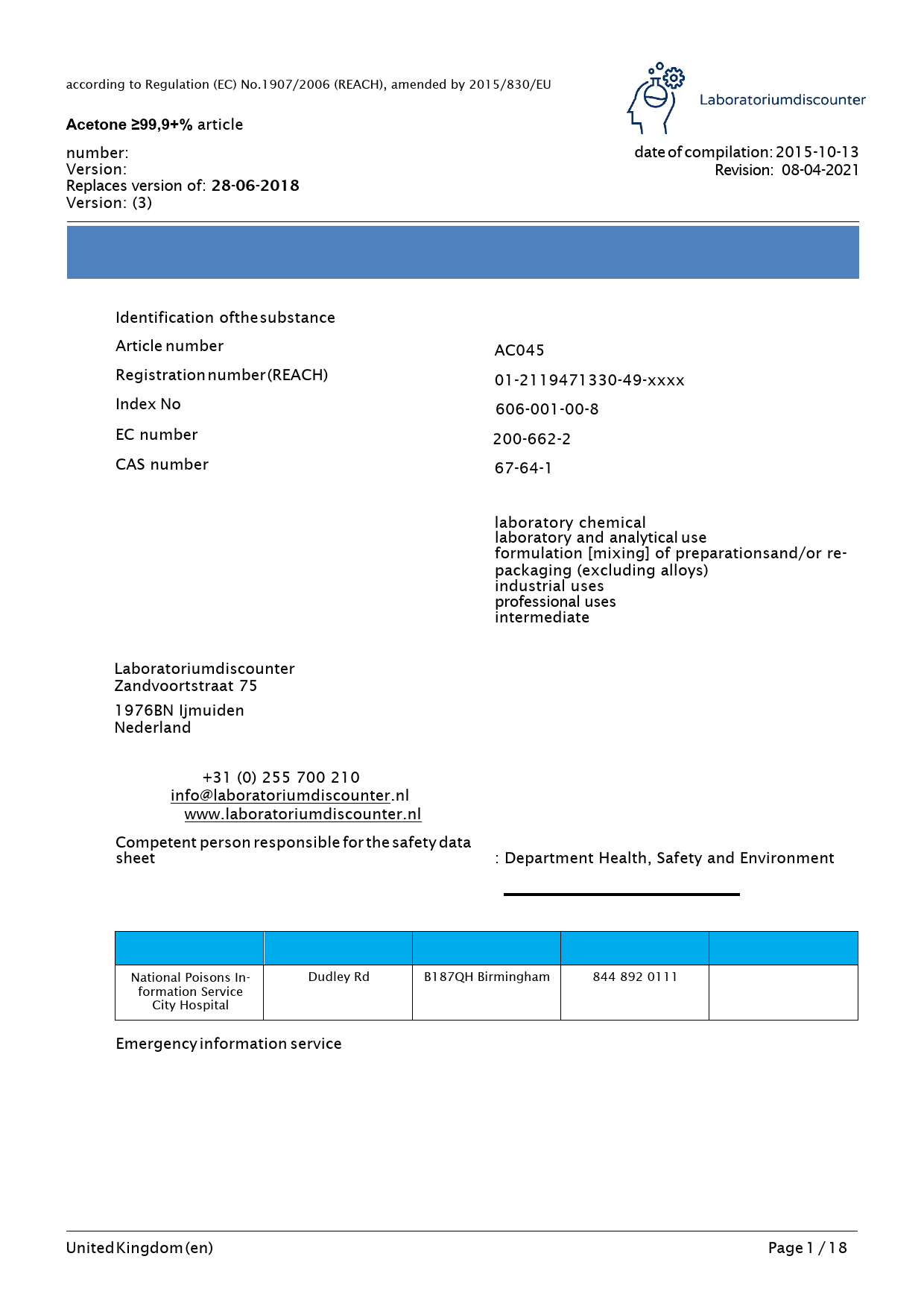
according to Regulation (EC) No.1907/2006 (REACH), amended by 2015/830/EU

Acetone 99,9+% article
number: AC045 Version: 4.0 en Replaces version of: 28-06-2018 Version: (3)

date of compilation: 2015-10-13 Revision: 08-04-2021

SECTION 1: Identification of the substance/mixture and of the company/ undertaking

1.1 Product identifier

Identification ofthesubstance

Acetone

Article number Registration number (REACH) Index No

AC045 01-2119471330-49-xxxx 606-001-00-8

EC number CAS number

200-662-2 67-64-1

1.2 Relevant identified uses of the substance or mixture and uses advised against

Identified uses:

laboratory chemical laboratory and analytical use formulation [mixing] of preparationsand/or re-
packaging (excluding alloys) industrial uses professional uses intermediate

1.3 Details of the supplier of the safety data sheet
Laboratoriumdiscounter Zandvoortstraat 75
1976BN Ijmuiden Nederland

Telephone: +31 (0) 255 700 210 e-mail: info@laboratoriumdiscounter.nl Website: www.laboratoriumdiscounter.nl
Competent person responsible for the safety data sheet

: Department Health, Safety and Environment

e-mail (competent person)

: info@laboratoriumdiscounter.nl

1.4 Emergency telephone number

Name

Street

Postal code/city

Telephone

Website

National Poisons Information Service City Hospital

Dudley Rd

B187QH Birmingham

844 892 0111

Emergency information service

+31 (0) 255 700 210

UnitedKingdom (en)

Page 1 / 18

Safety data sheet
according to Regulation (EC) No. 1907/2006 (REACH), amended by 2015/830/EU

Acetone 99,9+% article number: AC045

SECTION 2: Hazards identification

2.1 Classification of the substance ormixture Classification according to Regulation (EC) No 1272/2008 (CLP) Classification acc. to GHS

Section

Hazard class

2.6 3.3 3.8D

flammable liquid
serious eye damage/eye irritation
specific target organtoxicity- singleexposure (narcotic effects, drowsiness)

Hazard class and category
(Flam. Liq. 2) (Eye Irrit. 2) (STOT SE 3)

Hazard statement
H225
H319
H336

Supplemental hazard information

Code

Supplemental hazard information

EUH066

repeated exposure may cause skin dryness or cracking

The most important adverse physicochemical, human health and environmental effects Narcotic effects. 2.2 Label elements Labelling according to Regulation (EC) No 1272/2008 (CLP)

Signal word

Danger

Pictograms

GHS02, GHS07

Hazard statements
H225 H319 H336

Highly flammable liquid and vapour Causes serious eyeirritation May cause drowsiness or dizziness

Precautionary statements

Precautionary statements - prevention

P210

Keep away from heat, sparks, open flames, hot surfaces. No smoking.

Precautionary statements - response
P305+P351+P338 IF IN EYES: Rinse cautiously with water for several minutes. Remove contact lenses, if present and easy to do. Continue rinsing.

Precautionary statements - storage

P403+P233

Store in a well-ventilated place. Keep container tightly closed.

UnitedKingdom (en)

Page 2 / 18

Safety data sheet
according to Regulation (EC) No. 1907/2006 (REACH), amended by 2015/830/EU

Acetone 99,9+%

article number: AC045

Supplemental hazard information

EUH066

Repeated exposure may cause skin dryness or cracking.

Labelling of packages where the contents do not exceed 125 ml Signal word: Danger
Symbol(s)

EUH066

Repeated exposure may cause skin dryness or cracking.

2.3 Other hazards There is no additional information.

SECTION 3: Composition/information on ingredients

3.1 Substances Name ofsubstance Index No Registration number (REACH) EC number CAS number

Acetone 606-001-00-8
01-2119471330-49-xxxx 200-662-2 67-64-1

Molecular formula Molar mass

CHO 58,08 g/mol

SECTION 4: First aid measures
4.1 Description of first aid measures

General notes Take off contaminated clothing.
Following inhalation Provide fresh air. In all cases of doubt, or when symptoms persist, seek medical advice.
Following skin contact Rinseskin with water/shower. Preventiveskin protection (barrier creams/ointments) is recommended.
Following eye contact Irrigate copiously with clean, fresh water for at least 10 minutes, holding the eyelids apart. In case of eye irritation consult anophthalmologist.
Following ingestion Rinse mouth. Do not induce vomiting. Aspiration hazard. Call a physician immediately.

UnitedKingdom (en)

Page 3 / 18

Safety data sheet
according to Regulation (EC) No. 1907/2006 (REACH), amended by 2015/830/EU
Acetone 99,9+%
article number: AC045 2. Most important symptoms and effects, both acute and delayed
Irritation, Nausea, Vomiting, Gastrointestinal complaints, Headache, Vertigo, Dizziness, Drowsiness, Narcosis 3. Indication of any immediate medical attention and special treatment needed none
SECTION 5: Firefighting measures
5.1 Extinguishing media

Suitable extinguishing media Co-ordinate fire-fighting measures to the fire surroundings water spray, foam, dry extinguishing powder, carbon dioxide (CO2) Unsuitable extinguishing media water jet
2. Special hazards arising from the substance or mixture Combustible. Vapours are heavier than air, spread along floors and form explosive mixtures with air.
Hazardous combustion products In case of fire may be liberated: carbon monoxide (CO), carbon dioxide (CO2) 3. Advice for firefighters Vapours are heavier than air. Beware of reignition. Fight fire with normal precautions from a reasonable distance. Wear self-contained breathing apparatus.
SECTION 6: Accidental release measures
6.1 Personal precautions, protective equipment and emergency procedures

For non-emergency personnel Avoid contact with skin and eyes. Provide adequate ventilation. Do not breathe vapour/spray. Avoidance of ignition sources. 2. Environmental precautions Keep away from drains, surface and ground water. Explosive properties. 3. Methods and material for containment and cleaning up
Advice on how to contain a spill Covering of drains.
Advice on how to clean up a spill Absorb with liquid-binding material (e.g. sand, diatomaceous earth, acid- or universal binding agents).
Other information relating to spills and releases Place in appropriate containers for disposal. Ventilate affected area.

UnitedKingdom (en)

Page 4 / 18

Safety data sheet
according to Regulation (EC) No. 1907/2006 (REACH), amended by 2015/830/EU
Acetone 99,9+%
article number: AC045 6.4 Reference to other sections
Hazardouscombustion products: see section 5. Personalprotectiveequipment: see section 8. Incompatible materials: see section 10. Disposal considerations: see section 13.
SECTION 7: Handling and storage
1. Precautions for safe handling Provide adequate ventilation as well as local exhaustion at critical locations. When not in use, keep containers tightly closed. � Measures to prevent fire as well as aerosol and dust generation

Keep away from sources of ignition - No smoking. Take precautionary measures against static discharge. Due to danger of explosion, prevent leakage

of vapours into cellars, flues and ditches.

Advice on general occupational hygiene Wash hands before breaks and after work. Keep away from food, drink and animal feedingstuffs. When using do notsmoke. 2. Conditions for safe storage, including any incompatibilities Store in a well-ventilated place. Keep container tightly closed. Incompatible substances or mixtures
Observe hints for combined storage.
Consideration of other advice Ground/bond container and receiving equipment.

� Ventilation requirements Use local and general ventilation. � Specific designs for storage rooms or vessels Recommended storage temperature: 15 � 25 �C. 3. Specific end use(s) No information available.

SECTION 8: Exposurecontrols/personal protection

8.1 Control parameters

National limit values

Occupational exposure limit values (Workplace Exposure Limits)

Cou ntry

Name of agent

CAS No

Notation

Identifier

TWA [pp m]

TWA
[mg/ m�]

STEL [pp m]

STEL
[mg/ m�]

Source

EU

acetone

67-64-1

IOELV

500 1.210

2000/39/EC

GB

acetone

67-64-1

WEL

500 1.210 1.500 3.620 EH40/2005

Notation STEL

Short-term exposure limit: a limit value above which exposure should not occur and which is related to a 15minute period (unless otherwise specified)

UnitedKingdom (en)

Page 5 / 18

Safety data sheet
according to Regulation (EC) No. 1907/2006 (REACH), amended by 2015/830/EU

Acetone 99,9+%

article number: AC045

Notation TWA

Time-weighted average(long-term exposure limit): measured or calculated in relation to a reference period of 8 hours time-weighted average (unless otherwise specified)

Relevant DNELs/DMELs/PNECs and other threshold levels

� human health values

Endpoint

Threshold level

Protection goal, route of exposure

Used in

DNEL

1.210 mg/m� human, inhalatory

worker (industry)

DNEL

2.420 mg/m� human, inhalatory

worker (industry)

DNEL

186 mg/kg bw/ day

human, dermal

worker (industry)

Exposure time
chronic - systemic effects acute - local effects
chronic - systemic effects

� environmental values

Endpoint PNEC PNEC PNEC PNEC PNEC PNEC

Threshold level 10,6 mg/l 1,06 mg/l 100 mg/l 30,4 mg/kg 3,04 mg/kg 29,5 mg/kg

Environmental compartment freshwater
marine water sewage treatment plant (STP)
freshwater sediment marine sediment soil

Exposure time short-term (single instance) short-term (single instance) short-term (single instance) short-term (single instance) short-term (single instance) short-term (single instance)

8.2 Exposure controls Individual protection measures (personal protective equipment) Eye/face protection

Use safety goggle with side protection. Skin protection

� hand protection
Wear suitable gloves. Chemical protection gloves are suitable, which are tested according to EN 374. For special purposes, it is recommended to check the resistance to chemicals of the protective gloves mentioned above together with the supplier of these gloves. The times are approximate values from measurements at 22 � C and permanent contact. Increased temperatures due to heated substances, body heat etc. and a reduction of the effective layer thickness by stretching can lead to a considerable reduction of the breakthrough time. If in doubt, contact manufacturer. At an approx. 1.5 times larger / smaller layer thickness, the respective breakthrough time is doubled / halved. The data apply only to the pure substance. When transferred to substance mixtures, they may only be considered as a guide.
� type of material
Butyl caoutchouc (butyl rubber)

UnitedKingdom (en)

Page 6 / 18

Safety data sheet
according to Regulation (EC) No. 1907/2006 (REACH), amended by 2015/830/EU
Acetone 99,9+%
article number: AC045 � material thickness 0,7mm � breakthrough times of the glove material >480 minutes (permeation: level 6) � other protection measures Takerecovery periodsfor skin regeneration.Preventiveskinprotection (barrier creams/ointments) is recommended. Flame-retardant protective clothing. Respiratory protection

Respiratory protection necessary at: Aerosol or mist formation. Type: AX (gas filters and combined filters against low-boiling point organic compounds, colour code: Brown).
Environmental exposure controls Keep away from drains, surface and ground water.

SECTION 9: Physical and chemical properties

9.1 Information on basic physical and chemical properties

Appearance

Physical state

liquid (fluid)

Colour

colourless

Odour

mild sweet fruity

Odour threshold

No data available

Other physical and chemical parameters pH (value)

5 � 6 (water: 395 g/l, 20 �C)

Melting point/freezing point Initial boiling point and boiling range

-94,8 �C 56,05 �C

Flash point

-17 �C

Evaporation rate Flammability(solid, gas)

no data available not relevant (fluid)

Explosive limits

� lower explosion limit (LEL) � upper explosion limit (UEL) Explosionlimitsofdust clouds

2,6 vol% 12,8 vol% not relevant

Vapour pressure

240 hPa at 20 �C

Density

0,79 g/cm� at 20�C

Vapour density

2,01 (air = 1)

Bulk density

Not applicable

UnitedKingdom (en)

Page 7 / 18

Safety data sheet
according to Regulation (EC) No. 1907/2006 (REACH), amended by 2015/830/EU

Acetone 99,9+%
article number: AC045 Relative density Solubility(ies) Water solubility Partition coefficient n-octanol/water (log KOW) Auto-ignition temperature Decomposition temperature Viscosity � kinematic viscosity � dynamic viscosity Explosiveproperties Oxidising properties

Information on this property is not available.
miscible in any proportion
-0,23 (ECHA) 465 �C - ECHA no data available
0,4051 mm�/s 0,32 mPa s at 20 �C Shall not be classified as explosive none

9.2 Other information Temperature class (EU, acc. to ATEX)

T1 (Maximum permissible surface temperature on the equipment: 450�C)

SECTION 10: Stabilityand reactivity

1. Reactivity Risk of ignition. Vapours can form explosive mixtures with air.
2. Chemical stability The material is stable under normal ambient and anticipated storage and handling conditions of temperature and pressure.
3. Possibility of hazardous reactions

Riskof ignition:Strongoxidiser,Reducingagents,Nitricacid,Chromium(VI) oxide,Exothermic reaction with: Alkali metals, Alkali hydroxide (caustic alkali), Bromine, Halogenated hydrocarbons, Danger of explosion: Hydrogen peroxide, Chloroform
4. Conditions to avoid Keep away from heat.
5. Incompatible materials Rubber articles, different plastics
6. Hazardous decomposition products Hazardous combustion products: see section 5.

UnitedKingdom (en)

Page 8 / 18

Safety data sheet
according to Regulation (EC) No. 1907/2006 (REACH), amended by 2015/830/EU

Acetone 99,9+%

article number: AC045

SECTION 11: Toxicological information

11.1 Information on toxicological effects

Acute toxicity

Shall not be classified as acutely toxic.

Exposure route

Endpoint

Value

oral

LD50

5.800 mg/kg

Species rat

Source ECHA

Skin corrosion/irritation Shall not be classified as corrosive/irritant to skin. Serious eye damage/eye irritation Causes serious eye irritation. Respiratory or skin sensitisation Shall not be classified as a respiratory or skin sensitiser. Summary of evaluation of the CMR properties Shall not be classified as germ cell mutagenic, carcinogenic nor as a reproductive toxicant � Specific target organ toxicity - single exposure May cause drowsiness or dizziness. � Specific target organ toxicity - repeatedexposure Shall not be classified as a specific target organ toxicant (repeated exposure). Aspiration hazard Shall not be classified as presenting an aspiration hazard.

Symptoms related to the physical, chemical and toxicological characteristics
� If swallowed gastrointestinal complaints, vomiting, aspiration hazard � If in eyes Causes serious eye irritation, corneal opacity � If inhaled Irritation to respiratory tract, fatigue, dizziness, vertigo, headache, nausea, narcosis � If on skin repeated exposure may cause skin dryness or cracking Other information None

UnitedKingdom (en)

Page 9 / 18

Safety data sheet
according to Regulation (EC) No. 1907/2006 (REACH), amended by 2015/830/EU

Acetone 99,9+%

article number: AC045

SECTION 12: Ecological information

12.1 Toxicity acc. to 1272/2008/EC: Shall not be classified as hazardous to the aquatic environment.

Aquatic toxicity (acute)

Endpoint

Value

Species

Source

Exposure time

LC50

5.540 mg/l

fish

ECHA

96 h

Aquatic toxicity (chronic) Endpoint

Value

EC50 NOEC growth (EbCx) 12%

61,15 g/l 2.212 mg/l 1.000 mg/l

Species
microorganisms aquatic invertebrates
microorganisms

Source
ECHA ECHA ECHA

Exposure time 30 min
28 d
30 min

12.2 Process of degradability

The substance is readily biodegradable. Theoretical Oxygen Demand: 2,204 mg/mg Theoretical Carbon Dioxide: 2,273 mg/mg Biochemical Oxygen Demand: 1,85 g/g at 5 d

Process

Degradation rate

carbon dioxide generation

90,9 %

Time 28 d

12.3 Bioaccumulative potential

Does not significantly accumulate in organisms.

n-octanol/water (log KOW)

-0,23

BOD5/COD

963,54166667

4. Mobility in soil Data are not available. Henry's lawconstant

2,929 Pa m�/mol at 25 �C

5. Results of PBT and vPvBassessment Data are not available.
6. Other adverse effects Data are not available.

UnitedKingdom (en)

Page 10 / 18

Safety data sheet
according to Regulation (EC) No. 1907/2006 (REACH), amended by 2015/830/EU
Acetone 99,9+% article number: AC045
SECTION 13: Disposal considerations
13.1 Waste treatment methods

This material and its container must be disposed of as hazardous waste. Dispose of contents/container in accordance with local/regional/national/international regulations.

Sewage disposal-relevant information Do not empty into drains.

Waste treatment of containers/packagings It is a dangerous waste; only packagings which are approved (e.g. acc. to ADR) may be used.

Sewage disposal-relevant information Do not empty into drains.

Waste treatment of containers/packagings It is a dangerous waste; only packagings which are approved (e.g. acc. to ADR) may be used.

2. Relevant provisions relating to waste
The allocation of waste identity numbers/waste descriptions must be carried out according to the EEC, specific to the industry and process.

3. Remarks
Waste shall be separated into the categories that can be handled separately by the local or national waste management facilities. Please consider the relevant national or regional provisions.

SECTION 14: Transport information

1. UN number 2. UN proper shipping name
Hazardous ingredients

1090 ACETONE Acetone

3. Transport hazardclass(es)

Class

3 (flammable liquids)

4. Packing group

II(substance presenting medium danger)

5. Environmental hazards

none (non-environmentallyhazardousacc.tothe danger-
ous goodsregulations)

6. Special precautions for user Provisions for dangerous goods (ADR) should be complied within the premises.

7. Transport in bulk according to Annex II of MARPOL and the IBC Code The cargo is not intended to be carried in bulk.

8. Information for each of the UN Model Regulations

� Transport of dangerous goods by road, rail and inland waterway (ADR/RID/ADN)

UN number

1090

UnitedKingdom (en)

Page 11 / 18

Safety data sheet
according to Regulation (EC) No. 1907/2006 (REACH), amended by 2015/830/EU

Acetone 99,9+%
article number: AC045 Proper shipping name Particulars in the transport document Class Classification code Packinggroup Danger label(s)

ACETONE UN1090,ACETONE,3, II,(D/E) 3 F1 II 3

Excepted quantities (EQ)

E2

Limited quantities (LQ)

1 L

Transport category (TC)

2

Tunnel restriction code (TRC)

D/E

Hazard identification No

33

Emergency Action Code

2YE

� International Maritime Dangerous Goods Code(IMDG)

UN number

1090

Proper shipping name Particulars in the shipper's declaration

ACETONE UN1090, ACETONE,3, II,-17�Cc.c.

Class

3

Marine pollutant

-

Packinggroup

II

Danger label(s)

3

Special provisions (SP)

-

Excepted quantities (EQ)

E2

Limited quantities (LQ)

1 L

EmS

F-E, S-D

Stowage category

E

� International Civil Aviation Organization (ICAO-IATA/DGR)

UN number

1090

Proper shipping name Particulars in the shipper's declaration

Acetone UN1090, Acetone,3, II

Class

3

Packing group

II

UnitedKingdom (en)

Page 12 / 18

Safety data sheet
according to Regulation (EC) No. 1907/2006 (REACH), amended by 2015/830/EU

Acetone 99,9+%

article number: AC045

Danger label(s)

3

Excepted quantities (EQ)

E2

Limited quantities (LQ)

1 L

SECTION 15: Regulatory information

1. Safety, health and environmental regulations/legislation specific for the substance or mixture Relevant provisions of the European Union (EU)

� Regulation 649/2012/EU concerning the export and import of hazardous chemicals (PIC) Not listed. � Regulation 1005/2009/EC on substances that deplete the ozone layer (ODS) Not listed. � Regulation 850/2004/EC on persistent organic pollutants (POP) Not listed. � Restrictions according to REACH, Annex XVII

Name of substance

CAS No

Wt% Type of registration Conditions

No

of restric-

tion

Acetone

100

1907/2006/EC annex

R3

3

XVII

Legend R3

Acetone

100

1907/2006/EC annex

R40

40

XVII

1. Shall not be usedin:
-ornamental articles intended to produce light or colour effects by means of different phases, for example in ornamental lamps andashtrays, - tricks andjokes, - games for one or more participants, or any article intended to be used as such, even with ornamental aspects,
2. Articles not complying with paragraph 1 shall not be placed on the market.
3. Shall not be placed on the market if they contain a colouring agent, unless required for fiscal reasons, or perfume, or both, if they: - can be used as fuel in decorative oil lamps for supply to the general public, and, - present an aspiration hazard and are labelled with R65 or H304,
4. Decorative oil lamps for supply to the general public shall not be placed on the market unless they conform to the European Standard on Decorative oil lamps (EN 14059) adopted by the European Committee for Standardisation (CEN). 5. Without prejudice to the implementation of other Community provisions relating to the classification, packaging andlabelling of dangerous substances and mixtures, suppliers shall ensure, before the placing on the market, that the following requirements are met: (a) lamp oils, labelled with R65 or H304, intended for supply to the general public are visibly, legibly and indelibly marked as follows: `Keep lamps filled with this liquid out of the reach of children'; and, by 1 December 2010, `Just a sip of lamp oil - or even sucking the wick of lamps - may lead to life-threatening lung damage'; (b) grill lighter fluids, labelled with R65 or H304, intended for supply to the general public are legibly and indelibly marked by 1 December 2010 as follows: `Just a sip of grill lighter may lead to life threatening lung damage'; (c)lamp oils and grill lighters, labelled with R65 or H304, intended for supply to the general public are packaged in black opaque containers not exceeding 1 litre by 1 December 2010. 6. No later than 1 June 2014, the Commission shall request the European Chemicals Agency to prepare a dossier, in accordance with Article 69 of the present Regulation with a view to ban, if appropriate, grill lighter fluids and fuel for decorative lamps, labelled R65 or H304, intended for supply to the general public. 7. Natural or legal persons placing on the market for the first time lamp oils and grill lighter fluids, labelled with
R65 or H304, shall by 1 December 2011, and annually thereafter, provide data on alternatives to lamp oils and grill lighter fluids labelled R65 or H304 to the competent authority in the Member State concerned. Member States shall make those data available to the Commission.

UnitedKingdom (en)

Page 13 / 18

Safety data sheet
according to Regulation (EC) No. 1907/2006 (REACH), amended by 2015/830/EU

Acetone 99,9+%

article number: AC045

Legend R40

1. Shall not be used, as substance or as mixtures in aerosol dispensers where these aerosol dispensers are intended for supply to the general public for entertainment and decorative purposes such as the following: - metallic glitter intended mainly for decoration, - artificial snow andfrost, - `whoopee'cushions, - silly string aerosols, - imitation excrement, - horns for parties, - decorative flakes andfoams, - artificial cobwebs,
- stink bombs.
2. Without prejudice to the application of other Community provisions on the classification, packaging and labelling of substances, suppliers shall ensure before the placing on the market that the packaging of aerosol dispensers referred to above is marked visibly, legibly and indelibly with: `For professional users only'.
3. By way of derogation, paragraphs 1 and 2 shall not apply to the aerosol dispensers referredto Article 8 (1a) of Council Directive 75/324/EEC(2). 4. The aerosol dispensers referred to in paragraphs 1 and 2 shall not be placed on the market unless they con-
form to the requirements indicated.

� Restrictions according to REACH, Title VIII None. � List of substances subject to authorisation (REACH, Annex XIV)/SVHC - candidate list not listed � Seveso Directive
2012/18/EU (Seveso III)

No Dangerous substance/hazard categories

Qualifying quantity (tonnes) for the application of lower and upper-tier requirements

P5c flammable liquids (cat. 2, 3)

5.000

50.000

Notation 51) Flammable liquids, categories 2 or 3 not covered by P5a and P5b

�Directive 75/324/EEC relating to aerosol dispensers

Filling batch Deco-Paint Directive (2004/42/EC)
VOC content

100 % 790g/l

Directive on industrial emissions (VOCs, 2010/75/EU)

VOC content

100 %

VOC content

790 g/l

Notes 51)

Directive 2011/65/EU onthe restriction ofthe useof certain hazardous substances in electrical and electronic equipment (RoHS) - Annex II not listed
Regulation 166/2006/EC concerning the establishment of a European Pollutant Release and Transfer Register (PRTR)
not listed
Directive 2000/60/EC establishing a framework for Community action in the field of water policy (WFD)
not listed

UnitedKingdom (en)

Page 14 / 18

Safety data sheet
according to Regulation (EC) No. 1907/2006 (REACH), amended by 2015/830/EU

Acetone 99,9+%

article number: AC045 Regulation 98/2013/EU on the marketing and use of explosives precursors

Explosives precursors which are subject to restrictions

Name of substance Acetone

CAS No 67-64-1

Type of registration Annex II

CN

CN

Code 1 Code 2

2914 11 3824 90

00

97

Remarks

Limit value

Legend
annex II Substances on their own or in mixtures or in substances for which suspicious transactions shall be reported CN Code 1 Combined Nomenclature (CN) code for a separate chemically defined compound meeting the requirements of
Note 1 to Chapter 28 or 29 of the CN, respectively CN Code 2 Combined Nomenclature (CN) code for a mixture without constituents (e.g. mercury, precious or rare-earth metals
or radioactive substances) which would determine classification under another CN code

Regulation 111/2005/EC laying downrules forthe monitoring of trade between the Community and third countries in drug precursors

Name of substance

CAS No

Classification

CN Code

Threshold level

Acetone

67-64-1

Category 3

2914 11 00

National inventories Substance is listed in the following national inventories:

Country

National inventories

AU

AICS

CA

DSL

CN

IECSC

EU

ECSI

EU

REACH Reg.

JP

CSCL-ENCS

KR

KECI

MX

INSQ

NZ

NZIoC

PH

PICCS

TR

CICR

TW

TCSI

US

TSCA

Legend

AICS

AustralianInventoryofChemicalSubstances

CICR

Chemical Inventory and Control Regulation

CSCL-ENCS List of Existing and New Chemical Substances (CSCL-ENCS)

DSL

Domestic Substances List(DSL)

ECSI

EC Substance Inventory (EINECS, ELINCS, NLP)

IECSC

Inventoryof Existing Chemical Substances Producedor Importedin China

INSQ

National Inventory of Chemical Substances

KECI

Korea Existing Chemicals Inventory

NZIoC

New Zealand Inventory of Chemicals

PICCS

Philippine Inventoryof Chemicalsand Chemical Substances

REACH Reg. REACH registeredsubstances

TCSI

TaiwanChemical Substance Inventory

TSCA

Toxic Substance Control Act

UnitedKingdom (en)

Status substance is listed substance is listed substance is listed substance is listed substance is listed substance is listed substance is listed substance is listed substance is listed substance is listed substance is listed substance is listed substance is listed
Page 15 / 18

Safety data sheet
according to Regulation (EC) No. 1907/2006 (REACH), amended by 2015/830/EU

Acetone 99,9+%
article number: AC045 15.2 Chemical Safety Assessment
No Chemical Safety Assessment has been carried out for this substance.

SECTION 16: Other information

16.1 Indication of changes (revised safety datasheet)

Section

Former entry (text/value)

Actual entry (text/value)

2.2

Pictograms:

change in the listing (table)

8.1

Occupationalexposurelimitvalues(Workplace

Exposure Limits):

change in the listing (table)

8.1

� human health values:

change in the listing (table)

8.1

� environmental values:

change in the listing (table)

Safetyrelev-
ant yes
yes
yes
yes

Abbreviations and acronyms

Abbr. 2000/39/EC
ADN
ADR
BOD CAS CLP CMR CN Code COD DGR DMEL DNEL EC50
EH40/2005 EINECS ELINCS EmS GHS IATA IATA/DGR

Descriptions of used abbreviations Commission Directiveestablishing afirstlist of indicative occupationalexposurelimitvalues in implementation of Council Directive 98/24/EC Accordeurop�en relatif au transport international des marchandises dangereuses par voies de navigation int�rieures (European Agreement concerning the International Carriage of Dangerous Goods by Inland Waterways) Accordeurop�en relatif au transport international des marchandises dangereuses par route(European Agreement concerning the International Carriage of Dangerous Goods by Road) Biochemical Oxygen Demand Chemical Abstracts Service (service that maintains the most comprehensive list of chemical substances) Regulation (EC) No 1272/2008 on classification, labelling and packaging of substances and mixtures
Carcinogenic, Mutagenic or toxic for Reproduction Combined Nomenclature chemical oxygen demand Dangerous Goods Regulations (see IATA/DGR) Derived Minimal Effect Level Derived No-Effect Level Effective Concentration 50 %. The EC50 corresponds to the concentration of a tested substance causing 50 % changes in response (e.g. on growth) during a specified time interval
EH40/2005 Workplace exposure limits (http://www.nationalarchives.gov.uk/doc/open-government-licence/) European Inventory of Existing Commercial Chemical Substances European List of Notified Chemical Substances
Emergency Schedule "Globally Harmonized System of Classification and Labelling of Chemicals" developed by the United Nations International Air Transport Association
Dangerous Goods Regulations (DGR) for the air transport (IATA)

UnitedKingdom (en)

Page 16 / 18

Safety data sheet
according to Regulation (EC) No. 1907/2006 (REACH), amended by 2015/830/EU

Acetone 99,9+% article number: AC045

Abbr. ICAO IMDG index No
IOELV LC50
LD50
MARPOL NLP NOEC PBT PNEC ppm REACH RID
STEL SVHC TWA VOC vPvB WEL

Descriptions of used abbreviations International Civil Aviation Organization International Maritime Dangerous Goods Code the Index number is the identification code given to the substance in Part 3 of Annex VI to Regulation (EC) No 1272/2008 indicative occupational exposure limit value Lethal Concentration 50%: the LC50 corresponds to the concentration of a testedsubstance causing 50 % lethality during a specified time interval Lethal Dose 50 %: the LD50 corresponds to the dose of a tested substance causing 50 % lethality during a specified time interval International Convention for the Prevention of Pollution from Ships (abbr. of "Marine Pollutant") No-Longer Polymer No Observed Effect Concentration Persistent, Bioaccumulative and Toxic Predicted No-Effect Concentration parts per million Registration, Evaluation, Authorisation and Restriction of Chemicals R�glementconcernant le transport International ferroviaire des marchandises Dangereuses (Regulations concerning the International carriage of Dangerous goods by Rail) short-term exposure limit Substance of Very High Concern time-weighted average Volatile Organic Compounds very Persistent and very Bioaccumulative workplace exposure limit

Key literature references and sources for data
- Regulation (EC) No. 1907/2006 (REACH), amended by 2015/830/EU - Regulation (EC) No. 1272/2008 (CLP, EU GHS) - Dangerous Goods Regulations (DGR) for the air transport (IATA) - International Maritime Dangerous Goods Code (IMDG)

List of relevant phrases (code and full text as stated in chapter 2 and 3)

Code H225 H319 H336

Text highly flammable liquid and vapour causes serious eye irritation may cause drowsiness or dizziness

UnitedKingdom (en)

Page 17 / 18

Safety data sheet
according to Regulation (EC) No. 1907/2006 (REACH), amended by 2015/830/EU
Acetone 99,9+%
article number: AC045
Disclaimer The above information describes exclusively the safety requirements of the product and is based on our present-day knowledge. The information is intended to give you advice about the safe handling of the product named in this safety data sheet, for storage, processing, transport and disposal. The information cannot be transferred to other products. In the case of mixing the product with other products or in the case of processing, the information on this safety data sheet is not necessarily valid for the new made-up material.

UnitedKingdom (en)

Page 18 / 18