

CBL200 Series
File info: application/pdf · 3 pages · 237.34KB
CBL200 Series
CBL200 Series - BIOPAC
May 7, 2022 — CBL200 CBL200 consists of a 2 mm female socket leading to a 1.5 mm female Touchproof socket. This. 10 cm extension is required when converting an old-style ...
Extracted Text
PRODUCT SHEET

info@biopac.com support@biopac.com www.biopac.com

CBL200 SERIES LEAD CONNECTOR CONVERSION CABLES See also: Guide to External Device Interfaces for connections to common devices

CBL205

CBL206

CBL207

CBL200

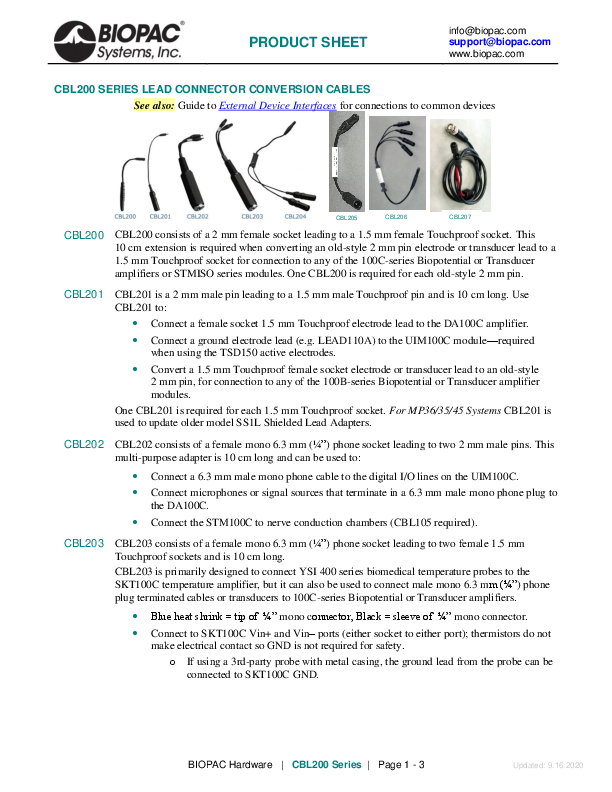
CBL200 consists of a 2 mm female socket leading to a 1.5 mm female Touchproof socket. This 10 cm extension is required when converting an old-style 2 mm pin electrode or transducer lead to a 1.5 mm Touchproof socket for connection to any of the 100C-series Biopotential or Transducer amplifiers or STMISO series modules. One CBL200 is required for each old-style 2 mm pin.

CBL201

CBL201 is a 2 mm male pin leading to a 1.5 mm male Touchproof pin and is 10 cm long. Use CBL201 to:
� Connect a female socket 1.5 mm Touchproof electrode lead to the DA100C amplifier.
� Connect a ground electrode lead (e.g. LEAD110A) to the UIM100C module--required when using the TSD150 active electrodes.
� Convert a 1.5 mm Touchproof female socket electrode or transducer lead to an old-style 2 mm pin, for connection to any of the 100B-series Biopotential or Transducer amplifier modules.
One CBL201 is required for each 1.5 mm Touchproof socket. For MP36/35/45 Systems CBL201 is used to update older model SS1L Shielded Lead Adapters.

CBL202 CBL202 consists of a female mono 6.3 mm (�") phone socket leading to two 2 mm male pins. This multi-purpose adapter is 10 cm long and can be used to:
� Connect a 6.3 mm male mono phone cable to the digital I/O lines on the UIM100C. � Connect microphones or signal sources that terminate in a 6.3 mm male mono phone plug to
the DA100C. � Connect the STM100C to nerve conduction chambers (CBL105 required).

CBL203

CBL203 consists of a female mono 6.3 mm (�") phone socket leading to two female 1.5 mm Touchproof sockets and is 10 cm long.
CBL203 is primarily designed to connect YSI 400 series biomedical temperature probes to the SKT100C temperature amplifier, but it can also be used to connect male mono 6.3 mm (�") phone plug terminated cables or transducers to 100C-series Biopotential or Transducer amplifiers.

� Blue heat shrink = tip of �" mono connector, Black = sleeve of �" mono connector.
� Connect to SKT100C Vin+ and Vin� ports (either socket to either port); thermistors do not make electrical contact so GND is not required for safety.
o If using a 3rd-party probe with metal casing, the ground lead from the probe can be connected to SKT100C GND.

BIOPAC Hardware | CBL200 Series | Page 1 - 3

Updated: 9.16.2020

PRODUCT SHEET

info@biopac.com support@biopac.com www.biopac.com

CBL204
CBL204MRI CBL205 CBL205MRI
CBL206

CBL204 consists of a single female 1.5 mm Touchproof socket leading to two male 1.5 mm Touchproof pins and is 25 cm long.
CBL204 plugs into any 100C series Biopotential amplifier input or STMISO series stimulator output and provides two sockets to connect to electrode leads terminating in a 1.5 mm Touchproof "Y" electrode lead adapter.
This 1.5 mm Touchproof "Y" electrode lead adapter is required when multiple electrode sites are to be connected to a single amplifier input or stimulator output.
Multiple CBL204s can be plugged together to reference three or more electrode leads to the same input or output.
This "Y" cable is functionally identical to the CBL204 but designed for use in the MRI environment when referencing two or more electrodes to a single biopotential amplifier input. Primarily used for NICO (noninvasive cardiac output) measurements in the MRI. Two 1.5 mm Touchproof male inputs to one 1.5 mm Touchproof female input, cable length 5 cm.
MRI Use: MR Conditional to 9T
Components: Carbon composition, tin plated and gold plated brass connectors
� For two or more amplifier inputs to one electrode, use JUMP100C-MRI; two 1.5 mm Touchproof female to one 1.5 mm Touchproof male--MRI equivalent of JUMP100C.
CBL205 is a 1.5 mm Touchproof male to female 1.5 mm AC-coupled electrode lead adapter and is 10 cm long. One end of the adapter plugs into the ground on the biopotential amplifier and the other end accepts the electrode lead. (LEAD110)
Use CBL205 when more than one ground is required while recording EDA (electrodermal activity) and other biopotential(s).
CBL205-MRI is functionally identical to CBL205 but designed for recording in the MRI or fMRI environment.
� MR Safe carbon composite construction
� 16.5 cm long with 7.6 mm diameter
� Plugs into LEAD108B/C
CBL205/CBL205-MRI: To record EDA with other biopotential signals (ECG, EEG, EOG, EGG, EMG, ERS), BIOPAC recommends using CBL205/CBL205-MRI connected to one ground on any of the biopotential amplifiers. The subject will be grounded through the Vin- of the EDA electrodes, but in some cases, it is necessary to have more than one ground; in such cases, use an AC-coupled lead adapter (CBL205/CBL205-MRI) to prevent galvanic ground loops.
For example, if--while recording a biopotential and EDA--the EDA electrode is removed during a stage of the experiment, you will want to maintain ground for the biopotential. To always have a ground and no ground loops: connect the Vin- lead of the EDA as ground and connect an ACcoupled ground to the biopotential amplifier GND.
Safety Note--If using any two EDA100C modules at the same time on the same MP System, ground loops can be a problem due to non-isolation between module excitation currents. A solution is to record with one module connected to a separate IPS100C/D and AMI100D/HLT100C, and the remaining module to the MP System. Use OUTISO signal isolators to connect the first module outputs (via AMI100D/HLT100C) to the UIM100C on the MP System side.
Lead junction TPF to 4X TPM. Reference four electrodes from one. Connect via the MEC110C to the NICO100C and EBI100C cardiac output amplifier modules.

BIOPAC Hardware | CBL200 Series | Page 2 - 3

Updated: 9.16.2020

PRODUCT SHEET

info@biopac.com support@biopac.com www.biopac.com

CBL207

1 m, BNC (m) to 2 x 1.5 mm TP (m). Use with:
� 1.5 mm Touchproof (f) electrodes � STM200 Unipolar Pulse Stimulator Module � MECMRI-STIMISO cable/filter system to connect to STM200 in the MRI control room

CBL229

~3 cm, RJ11 to Touchproof female socket adapter
Allows a ground lead (such as LEAD110 or LEAD110A) to be connected to the subject if active electrodes TSD150A or TSD150B are being used when no other wired ground is present.
Safety Note--This adapter is required if only active electrodes are being used and no other wired signals are being recorded; if there is another C-series biopotential amplifier that has a ground connection to the subject, this adapter is not required.

CBL231-MRI

This adapter is an MR Safe carbon composite radio translucent electrode lead that connects a nonferrous 2 mm pin to a Touchproof 1.5 mm female connector, 46 cm (18") long.
Use for tDCS systems in an fMRI environment or connecting other MR Safe electrodes and cables that use a 2 mm socket interface.
MR Conditional: Use during fMRI or MRI scanning sequences (including multi-band) up to 7T.

CBL237

The Smart Amp Output "Y" Adapter allows for the signals from a 100D-Series Smart Amplifier connected to either an AMI100D or an IPS100D to be sent to other equipment. An RJ12 cable plugs into either the AMI100D or IPS100D, the Smart Amplifier to one port of the adapter, and either an OUTISOA for connecting signals to mains powered equipment or another cable if Unisolated connections are needed (such as CBL123).
Works with 100D-Series Smart Amplifiers, 100CSeries Amplifiers, BioNomadix Receivers, STP100C Isolated Digital Interface, or the STM100C Stimulator Module as part of an MP160 Research System.
Important: Only one Smart Amplifier should be connected to the adapter at a time. Connecting more than one Smart Amplifier to a single channel input is not supported.

BIOPAC Hardware | CBL200 Series | Page 3 - 3

Updated: 9.16.2020