

C:\USERS\PKITCH~1\APPDATA\LOCAL\TEMP\KK009-96 1 EN.FRX
File info: application/pdf · 6 pages · 25.95KB
C:\USERS\PKITCH~1\APPDATA\LOCAL\TEMP\KK009-96 1 EN.FRX
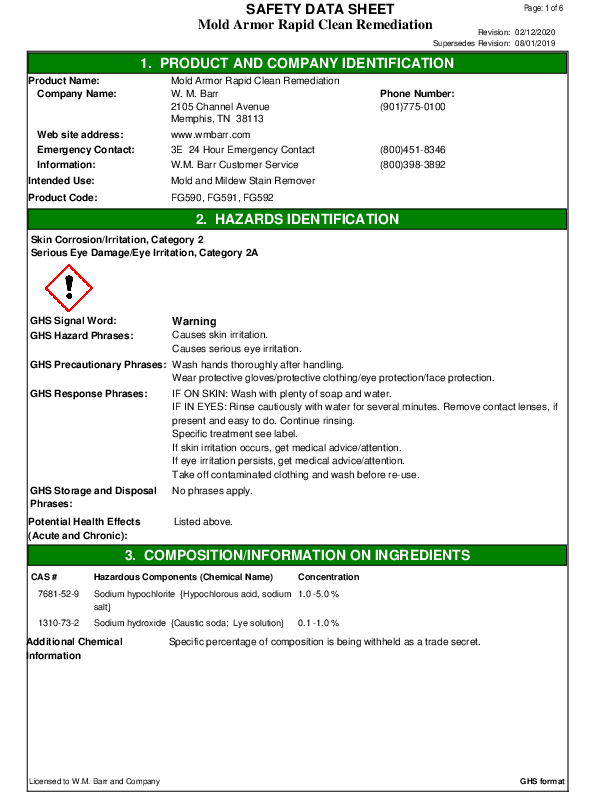
SAFETY DATA SHEET Page: 1 of 6 Mold Armor Rapid Clean ...
Revision: 02/12/2020 Page: 1 of 6 Mold Armor Rapid Clean Remediation SAFETY DATA SHEET Supersedes Revision: 08/01/2019 Product Name: Mold Armor Rapid Clean Remediation Company Name: W. M. Barr 2105 Channel Avenue Memphi…
Revision: 02/12/2020 Page: 2 of 6 Mold Armor Rapid Clean Remediation SAFETY DATA SHEET Supersedes Revision: 08/01/2019 4. FIRST AID MEASURES Inhalation: If user experiences breathing difficulty, move to air free of vapo…
Extracted Text
SAFETY DATA SHEET

Page: 1 of 6

Mold Armor Rapid Clean Remediation

Revision: 02/12/2020

Supersedes Revision: 08/01/2019

1. PRODUCT AND COMPANY IDENTIFICATION

Product Name: Company Name:

Mold Armor Rapid Clean Remediation W. M. Barr 2105 Channel Avenue Memphis, TN 38113

Phone Number: (901)775-0100

Web site address:

www.wmbarr.com

Emergency Contact:

3E 24 Hour Emergency Contact

(800)451-8346

Information:

W.M. Barr Customer Service

(800)398-3892

Intended Use:

Mold and Mildew Stain Remover

Product Code:

FG590, FG591, FG592

2. HAZARDS IDENTIFICATION

Skin Corrosion/Irritation, Category 2 Serious Eye Damage/Eye Irritation, Category 2A

GHS Signal Word:

Warning

GHS Hazard Phrases:

Causes skin irritation.

Causes serious eye irritation.

GHS Precautionary Phrases: Wash hands thoroughly after handling. Wear protective gloves/protective clothing/eye protection/face protection.

GHS Response Phrases:

IF ON SKIN: Wash with plenty of soap and water. IF IN EYES: Rinse cautiously with water for several minutes. Remove contact lenses, if

present and easy to do. Continue rinsing.

Specific treatment see label.

If skin irritation occurs, get medical advice/attention.

If eye irritation persists, get medical advice/attention.

Take off contaminated clothing and wash before re-use.

GHS Storage and Disposal No phrases apply. Phrases:

Potential Health Effects (Acute and Chronic):

Listed above.

3. COMPOSITION/INFORMATION ON INGREDIENTS

CAS #

Hazardous Components (Chemical Name)

Concentration

7681-52-9 Sodium hypochlorite {Hypochlorous acid, sodium 1.0 -5.0 % salt}

1310-73-2 Sodium hydroxide {Caustic soda; Lye solution} 0.1 -1.0 %

Additional Chemical Information

Specific percentage of composition is being withheld as a trade secret.

Licensed to W.M. Barr and Company

GHS format

Emergency and First Aid Procedures:

SAFETY DATA SHEET

Page: 2 of 6

Mold Armor Rapid Clean Remediation

Revision: 02/12/2020

Supersedes Revision: 08/01/2019

4. FIRST AID MEASURES

Inhalation: If user experiences breathing difficulty, move to air free of vapors. Administer oxygen or artificial respiration until medical assistance can be rendered.

Skin contact: Wash with soap and large quantities of water for at least 15 minutes. Seek medical attention if irritation from contact persists.

Eye contact: Immediately flush eyes with water, remove any contact lens, continue flushing with water for at least 15 minutes. Get medical attention.

Signs and Symptoms Of Exposure: Note to Physician:

Ingestion: If conscious, drink one or two glasses of water or milk, or give milk of magnesia. Never attempt to give anything by mouth to an unconscious person. Call your poison control center, hospital emergency room, or physician immediately. Refer to Section 2.
Treat symptomatically and supportively.

5. FIRE FIGHTING MEASURES

Flash Pt:

NA

Explosive Limits:

LEL: N.D.

UEL: N.D.

Autoignition Pt:

N.D.

Suitable Extinguishing Media:Non-combustible liquid - use extinguishing media for underlying cause of fire.

Unsuitable Extinguishing None known.

Media:

Fire Fighting Instructions: Self-contained respiratory protection should be provided for fire fighters fighting fires in

buildings or confined areas. Use water spray to cool nearby containers and structures

exposed to fire.

Flammable Properties and This material is non-combustible. Hazards:

Hazardous Combustion

No data available.

Products:

6. ACCIDENTAL RELEASE MEASURES

Steps To Be Taken In Case Material Is Released Or Spilled:

Clean-up: Keep unnecessary people away, isolate hazard area and deny entry. Stay upwind, out of low areas, and ventilate closed spaces before entering.

Small spills: Take up the spilled liquid with sand, earth, or other noncombustible absorbent material and place in a plastic container where applicable.

Large spills: Dike far ahead of spill for later disposal.

Keep material out of sewers, storm drains, surface waters, and soil. Sodium hypochlorite is very toxic to aquatic life.

Licensed to W.M. Barr and Company

GHS format

SAFETY DATA SHEET

Page: 3 of 6

Mold Armor Rapid Clean Remediation

Revision: 02/12/2020

Supersedes Revision: 08/01/2019

7. HANDLING AND STORAGE

Precautions To Be Taken in Read carefully all cautions and directions on product label before use. Since empty

Handling:

container retains residue, follow all label warnings even after container is empty.

Dispose of empty container according to all regulations. Do not reuse this container.

Precautions To Be Taken in Keep container tightly closed when not in use. Store in a cool, dry place. Protect from

Storing:

freezing. Avoid extreme high or low temperatures.

8. EXPOSURE CONTROLS/PERSONAL PROTECTION

CAS #

Chemical Name

Jurisdiction

Recommended Exposure Limits

Notations

1310-73-2 Sodium hydroxide {Caustic soda; Lye solution}

ACGIH TLV OSHA PELs

CEIL: 2 mg/m3 PEL: 2 mg/m3

Respiratory Equipment (Specify Type):

Ensure adequate ventilation.

Eye Protection:

Eye protection recommended.

Protective Gloves:

Rubber or neoprene gloves.

Other Protective Clothing:

Various application methods can dictate use of additional protective safety equipment, such as impermeable aprons, etc., to minimize exposure. Before reuse, thoroughly clean any clothing or protective equipment that has been contaminated by prior use. Discard any clothing or other protective equipment that cannot be decontaminated, such as gloves or shoes.

Engineering Controls (Ventilation etc.):

Use only with adequate ventilation to prevent build-up of vapors. Open all windows and doors. Use only with a cross ventilation of moving fresh air across the work area. If strong odor is noticed or you experience slight dizziness, headache, nausea, or eye-watering -- Stop -- ventilation is inadequate. Leave area immediately.

Work/Hygienic/Maintenance A source of clean water should be available in the work area for flushing eyes and skin. Practices:
Do not eat, drink, or smoke in the work area.

Wash hands thoroughly after use.

9. PHYSICAL AND CHEMICAL PROPERTIES

Physical States: Appearance and Odor:
pH: Melting Point: Boiling Point: Flash Pt: Evaporation Rate: Flammability (solid, gas): Explosive Limits: Vapor Pressure (vs. Air or mm Hg): Vapor Density (vs. Air = 1):

[ ] Gas [ X ] Liquid [ ] Solid

Clear.

Bleach odor.

Odor threshold not determined.

12.5 - 13

N.D.

> 99.90 F

NA

N.D.

No data available.

LEL: N.D.

UEL: N.D.

N.D.

N.D. Air = 1

Licensed to W.M. Barr and Company

GHS format

SAFETY DATA SHEET

Page: 4 of 6

Mold Armor Rapid Clean Remediation

Revision: 02/12/2020

Supersedes Revision: 08/01/2019

Specific Gravity (Water = 1): 1.07 - 1.08

Density:

8.92 - 9.17 LB/GL

Solubility in Water:

Complete.

Octanol/Water Partition

N.D.

Coefficient:

Percent Volatile:

N.D.

Autoignition Pt:

N.D.

Decomposition Temperature: N.D.

Viscosity:

N.D.

Additional Physical

N.D. = Not Determined

Information

10. STABILITY AND REACTIVITY

Stability:

Unstable [ ] Stable [ X ]

Conditions To Avoid Instability:

None known.

Incompatibility - Materials To Incompatible with acids, ammonia, or other household chemicals. Do not mix with acids,

Avoid:

ammonia, or other household chemicals as dangerous fumes may result.

Incompatible with strong oxidizing and reducing agents.

Hazardous Decomposition or Thermal decomposition may produce chlorine gas. Byproducts:

Possibility of Hazardous Reactions:

Will occur [ ] Will not occur [ X ]

Conditions To Avoid Hazardous Reactions:

None known.

11. TOXICOLOGICAL INFORMATION

Toxicological Information:

This product was not tested as a whole. Refer to section 2 for acute and chronic effects. CAS# 1310-73-2: Standard Draize Test, Skin, Species: Rabbit, 500.0 MG, 24 H, Severe. Result: Blood:Change in clotting factors. Musculoskeletal: Other changes. - "Sbornik Vysledku Toxixologickeho Vysetreni Latek A Pripravku," , Institut Pro Vychovu Vedoucicn P, Marhold, J.V., Institut Pro Vychovu Vedoucicn, Pracovniku Chemickeho, Prumyclu Praha Czechoslovakia, Vol/p/yr: -,7, 1972

Standard Draize Test, Eyes, Species: Rabbit, 1.000 %, Severe. Result: Blood:Other hemolysis with or withot anemia. Blood:Other changes. Biochemical: Metabolism (Intermediary): Other proteins. - American Journal of Ophthalmology., Ophthalmic Pub. Co., 435 N. Michigan Ave., Suite 1415, Chicago, IL 60611, Vol/p/yr: 29,1363, 1946

Licensed to W.M. Barr and Company

GHS format

CAS # 7681-52-9 1310-73-2

SAFETY DATA SHEET

Page: 5 of 6

Mold Armor Rapid Clean Remediation

Revision: 02/12/2020

Supersedes Revision: 08/01/2019

Hazardous Components (Chemical Name)

NTP

IARC

ACGIH

OSHA

Sodium hypochlorite {Hypochlorous acid, sodium salt}

n.a.

n.a.

n.a.

n.a.

Sodium hydroxide {Caustic soda; Lye solution}

n.a.

n.a.

n.a.

n.a.

General Ecological Information:
Waste Disposal Method:

12. ECOLOGICAL INFORMATION
This product was not tested as a whole.
13. DISPOSAL CONSIDERATIONS
Dispose of in accordance with local, state, and federal laws.

14. TRANSPORT INFORMATION
LAND TRANSPORT (US DOT): DOT Proper Shipping Name: Not Regulated. DOT Hazard Class: UN/NA Number:

MARINE TRANSPORT (IMDG/IMO):

IMDG/IMO Shipping Name: UN Number: Hazard Class: IMDG EMS Number: IMDG EMS Page:

Environmentally hazardous substances, liquid, n.o.s. (sodium hypochlorite)

3082

Packing Group:

III

IMDG Classification:

9

S-F

IMDG MFAG Number:

7, 8

Marine Pollutant:

Yes

Additional Transport Information:

The shipper / supplier may be able to apply one of the following exceptions if allowed under 49 CFR Regulations: Combustible Liquid, Consumer Commodity, Limited Quantity, Viscous Liquid, Does Not Sustain Combustion, or others, as allowed under 49 CFR Hazmat Regulations. Please consult 49 CFR Subchapter C to ensure that subsequent shipments comply with these exceptions.

15. REGULATORY INFORMATION

EPA SARA (Superfund Amendments and Reauthorization Act of 1986) Lists

CAS #

Hazardous Components (Chemical Name)

S. 302 (EHS)

7681-52-9

Sodium hypochlorite {Hypochlorous acid, sodium No salt}

1310-73-2 Sodium hydroxide {Caustic soda; Lye solution} No

S. 304 RQ Yes 100 LB
Yes 1000 LB

S. 313 (TRI) No
No

CAS # 7681-52-9
1310-73-2

Hazardous Components (Chemical Name)

Other US EPA or State Lists

Sodium hypochlorite {Hypochlorous acid, sodium salt} Sodium hydroxide {Caustic soda; Lye solution}

TSCA: Inventory TSCA: Inventory

Licensed to W.M. Barr and Company

GHS format

Additional Regulatory Information

SAFETY DATA SHEET

Page: 6 of 6

Mold Armor Rapid Clean Remediation

Revision: 02/12/2020

Supersedes Revision: 08/01/2019

This product is regulated by the United States Consumer Product Safety Commission and is subject to certain labeling requirements under the Federal Hazardous Substances Act. These requirements differ from the classification criteria and hazard information required for safety data sheets (SDS). The product label also includes other important information, including directions for use, and should always be read in its entirety prior to using the product.

16. OTHER INFORMATION

Revision Date: Preparer Name:

02/12/2020 W.M. Barr EHS Dept (901)775-0100

Additional Information About N.D.: Not determined.

This Product:

Company Policy or

The information contained herein is presented in good faith and believed to be accurate

Disclaimer:

as of the effective date shown above. This information is furnished without warranty of

any kind. Employers should use this information only as a supplement to other

information gathered by them and must make independent determination of suitability

and completeness of information from all sources to assure proper use of these

materials and the safety and health of employees. Any use of this data and information

must be determined by the user to be in accordance with applicable federal, state and

local laws and regulations.

Licensed to W.M. Barr and Company

GHS format