

File info: application/pdf · 120 pages · 2.10MB
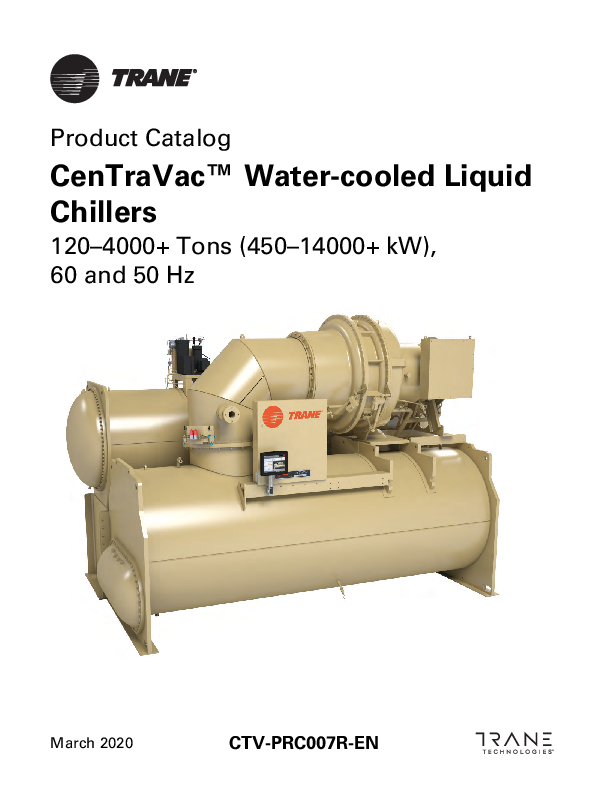
Product Catalog CenTraVac™ Water-cooled Liquid Chillers
CenTraVac™ Water-cooled Liquid Chillers 120–4000 Tons (450–14000 kW), 60 and 50 Hz March 2020 CTV-PRC007R-EN Product Catalog
Full PDF Document

If the inline viewer fails, it will open the original document in compatibility mode automatically. You can also open the file directly.
Extracted Text
Product Catalog
CenTraVacTM Water-cooled Liquid Chillers
120�4000+ Tons (450�14000+ kW), 60 and 50 Hz
March 2020
CTV-PRC007R-EN
Introduction
World's Most Efficient Lowest Emissions Chiller
Ingersoll Rand EcoWiseTM Portfolio--Trane has always taken a leadership position in environmental stewardship without compromising efficiency, reliability or safety. CenTraVacTM chillers are among the Trane� products within the EcoWiseTM portfolio and can operate with either R-123 or next-generation refrigerants R-514A or R-1233zd, both featuring ultra-low GWPs of less than two. For more information, visit: trane.com/ecowise
Environmental Product Declaration--The entire CenTraVacTM chiller portfolio has earned product-specific Type III Environmental Product Declaration (EPD) verification, the first commercial chiller in the world to provide this documentation. This EPD substantiates our environmental claims regarding chiller performance and documents conformance with the stringent third-party certification requirements of the International Standards Organization (ISO) and verified by Underwriters Laboratories in accordance with ISO 14025.
Standard of Excellence--Trane found that the straightest path to achieve the highest efficiency with the best reliability is through simplicity of design. The CenTraVacTM chiller has only one primary moving part--a single rotating shaft supported by two bearings. This direct drive concept minimizes the chance of failure by reducing the number of critical parts--no gear boxes, couplings, extra shafts, or shaft seals.
Economically and Environmentally Sound--The CenTraVacTM chiller has a proven track record as the world's most efficient, lowest emissions chiller. It is selectable at an unmatched efficiency level of 0.45 kW/ton at standard AHRI conditions. The full load efficiency levels of CenTraVacTM chillers are simply the best available, averaging at least 13.5 percent better than the next best centrifugal chiller available today.
Lowest Refrigerant Emissions--The key to the highest energy efficiency and lowest leak rate is use of the low pressure refrigerants. CenTraVacTM chillers are designed to be leak-tight, delivering the industry's lowest documented refrigerant leak rate--less than 0.5 percent annually versus the industry-accepted rate of 2.0 percent. We are so confident in our ability to keep the refrigerant inside our CenTraVacTM chillers, we back each one with a Leak-Tight Warranty--the first offered by any HVAC manufacturer.
EarthWiseTM System Design--This high-performance system design approach reduces first cost, lowers operating costs, and is substantially quieter than traditional applied systems. Central to the design are low flow, low temperature, and high efficiency for both airside and waterside systems, along with optimized control algorithms for sustainable performance. Tracer� AdaptiViewTM controls provide the system intelligence required to manage the performance and document the benefits. Smaller equipment and ductwork means supplying less airflow at colder temperatures and enables quieter operation. This also reduces relative humidity in the building, improving indoor air quality. Compared to conventional designs, an EarthWiseTM chilled water system reduces the total cost of ownership by lowering installation and operating costs. For more information, visit: trane.com/earthwise
Trane Copyright
This document and the information in it are the property of Trane, and may not be used or reproduced in whole or in part without written permission. Trane reserves the right to revise this publication at any time, and to make changes to its content without obligation to notify any person of such revision or change.
Trademarks
All trademarks referenced in this document are the trademarks of their respective owners.
Revision History
Updated waterbox lengths tables in Unit Specifications--Imperial (I-P) Units and Unit Specifications--International System (SI) Units chapters.
�2020 Trane
CTV-PRC007R-EN
Table of Contents
General Information . . . . . . . . . . . . . . . . . . . . . . . . . . . . . . . . . . . . . . . . . . . . . . . . . . . . . . . . . . . 6 Local Support . . . . . . . . . . . . . . . . . . . . . . . . . . . . . . . . . . . . . . . . . . . . . . . . . . . . . . . . . . . . . . . 6 Custom Built Unit . . . . . . . . . . . . . . . . . . . . . . . . . . . . . . . . . . . . . . . . . . . . . . . . . . . . . . . . . . . . 6 ISO 9001 Certified. . . . . . . . . . . . . . . . . . . . . . . . . . . . . . . . . . . . . . . . . . . . . . . . . . . . . . . . . . . . 6 Certified AHRI Performance. . . . . . . . . . . . . . . . . . . . . . . . . . . . . . . . . . . . . . . . . . . . . . . . . . . 6 District Cooling . . . . . . . . . . . . . . . . . . . . . . . . . . . . . . . . . . . . . . . . . . . . . . . . . . . . . . . . . . . . . . 6 Turbine Inlet Cooling . . . . . . . . . . . . . . . . . . . . . . . . . . . . . . . . . . . . . . . . . . . . . . . . . . . . . . . . . 6 CenTraVac Chiller Portfolio . . . . . . . . . . . . . . . . . . . . . . . . . . . . . . . . . . . . . . . . . . . . . . . . . . . 7 The Ingersoll Rand Climate Commitment . . . . . . . . . . . . . . . . . . . . . . . . . . . . . . . . . . . . . . 8 Next-Generation Refrigerants . . . . . . . . . . . . . . . . . . . . . . . . . . . . . . . . . . . . . . . . . . . . . . . . . 8 Benefits of Low Pressure . . . . . . . . . . . . . . . . . . . . . . . . . . . . . . . . . . . . . . . . . . . . . . . . . . . . . 9 Standard Features . . . . . . . . . . . . . . . . . . . . . . . . . . . . . . . . . . . . . . . . . . . . . . . . . . . . . . . . . . 10 0.0% Leak-Tight Warranty . . . . . . . . . . . . . . . . . . . . . . . . . . . . . . . . . . . . . . . . . . . . . . . . . . . 11 Integrated Rapid Restart . . . . . . . . . . . . . . . . . . . . . . . . . . . . . . . . . . . . . . . . . . . . . . . . . . . . . 11 Optional Features . . . . . . . . . . . . . . . . . . . . . . . . . . . . . . . . . . . . . . . . . . . . . . . . . . . . . . . . . . . 12
Unit Options . . . . . . . . . . . . . . . . . . . . . . . . . . . . . . . . . . . . . . . . . . . . . . . . . . . . . . . . . . . . . . . . . . 15 Factory Performance Testing . . . . . . . . . . . . . . . . . . . . . . . . . . . . . . . . . . . . . . . . . . . . . . . . 15 Trane Starters and Drives. . . . . . . . . . . . . . . . . . . . . . . . . . . . . . . . . . . . . . . . . . . . . . . . . . . . 15 Enhanced Electrical Protection Package Option . . . . . . . . . . . . . . . . . . . . . . . . . . . . . . . . 23 Free Cooling Option. . . . . . . . . . . . . . . . . . . . . . . . . . . . . . . . . . . . . . . . . . . . . . . . . . . . . . . . . 25
System Options. . . . . . . . . . . . . . . . . . . . . . . . . . . . . . . . . . . . . . . . . . . . . . . . . . . . . . . . . . . . . . . 29 Full Heat Recovery . . . . . . . . . . . . . . . . . . . . . . . . . . . . . . . . . . . . . . . . . . . . . . . . . . . . . . . . . . 29 Partial Heat Recovery . . . . . . . . . . . . . . . . . . . . . . . . . . . . . . . . . . . . . . . . . . . . . . . . . . . . . . . 30 Thermal/Ice Storage . . . . . . . . . . . . . . . . . . . . . . . . . . . . . . . . . . . . . . . . . . . . . . . . . . . . . . . . 33
Application and Job Site Considerations. . . . . . . . . . . . . . . . . . . . . . . . . . . . . . . . . . . . . . 35 Condenser Water Control. . . . . . . . . . . . . . . . . . . . . . . . . . . . . . . . . . . . . . . . . . . . . . . . . . . . 35 Water Treatment. . . . . . . . . . . . . . . . . . . . . . . . . . . . . . . . . . . . . . . . . . . . . . . . . . . . . . . . . . . . 35 Water Pumps . . . . . . . . . . . . . . . . . . . . . . . . . . . . . . . . . . . . . . . . . . . . . . . . . . . . . . . . . . . . . . . 35 Water Flow . . . . . . . . . . . . . . . . . . . . . . . . . . . . . . . . . . . . . . . . . . . . . . . . . . . . . . . . . . . . . . . . . 35 Shipment and Assembly . . . . . . . . . . . . . . . . . . . . . . . . . . . . . . . . . . . . . . . . . . . . . . . . . . . . 36
CTV-PRC007R-EN
3
Table of Contents
Controls . . . . . . . . . . . . . . . . . . . . . . . . . . . . . . . . . . . . . . . . . . . . . . . . . . . . . . . . . . . . . . . . . . . . . . 37 Tracer AdaptiView Controller . . . . . . . . . . . . . . . . . . . . . . . . . . . . . . . . . . . . . . . . . . . . . . . . 37 Optional Enhanced Flow Management Package . . . . . . . . . . . . . . . . . . . . . . . . . . . . . . . 39 Optional Extended Operation Package . . . . . . . . . . . . . . . . . . . . . . . . . . . . . . . . . . . . . . . . 41 Communications Interfaces. . . . . . . . . . . . . . . . . . . . . . . . . . . . . . . . . . . . . . . . . . . . . . . . . . 42 Building Automation and Chiller Plant Control . . . . . . . . . . . . . . . . . . . . . . . . . . . . . . . . 43 Standard Protections. . . . . . . . . . . . . . . . . . . . . . . . . . . . . . . . . . . . . . . . . . . . . . . . . . . . . . . . 44 Enhanced Protection Option . . . . . . . . . . . . . . . . . . . . . . . . . . . . . . . . . . . . . . . . . . . . . . . . . 47
Chiller Selection . . . . . . . . . . . . . . . . . . . . . . . . . . . . . . . . . . . . . . . . . . . . . . . . . . . . . . . . . . . . . . 49 Fully Customizable Chiller Selection . . . . . . . . . . . . . . . . . . . . . . . . . . . . . . . . . . . . . . . . . . 49 Full-Load and Part-Load Performance . . . . . . . . . . . . . . . . . . . . . . . . . . . . . . . . . . . . . . . . 50 myPLV Chiller Performance Evaluation Tool . . . . . . . . . . . . . . . . . . . . . . . . . . . . . . . . . . 51
Unit Specifications--Imperial (I-P) Units . . . . . . . . . . . . . . . . . . . . . . . . . . . . . . . . . . . . . . 52 Performance Data. . . . . . . . . . . . . . . . . . . . . . . . . . . . . . . . . . . . . . . . . . . . . . . . . . . . . . . . . . . 52 Weights (lb) . . . . . . . . . . . . . . . . . . . . . . . . . . . . . . . . . . . . . . . . . . . . . . . . . . . . . . . . . . . . . . . . 56 Physical Dimensions . . . . . . . . . . . . . . . . . . . . . . . . . . . . . . . . . . . . . . . . . . . . . . . . . . . . . . . . 63 Waterbox Lengths . . . . . . . . . . . . . . . . . . . . . . . . . . . . . . . . . . . . . . . . . . . . . . . . . . . . . . . . . . 69
Unit Specifications--International System (SI) Units. . . . . . . . . . . . . . . . . . . . . . . . . . 75 Performance Data. . . . . . . . . . . . . . . . . . . . . . . . . . . . . . . . . . . . . . . . . . . . . . . . . . . . . . . . . . . 75 Weights (kg). . . . . . . . . . . . . . . . . . . . . . . . . . . . . . . . . . . . . . . . . . . . . . . . . . . . . . . . . . . . . . . . 79 Physical Dimensions . . . . . . . . . . . . . . . . . . . . . . . . . . . . . . . . . . . . . . . . . . . . . . . . . . . . . . . . 85 Waterbox Lengths . . . . . . . . . . . . . . . . . . . . . . . . . . . . . . . . . . . . . . . . . . . . . . . . . . . . . . . . . . 92
4
CTV-PRC007R-EN
Table of Contents
Mechanical Specifications . . . . . . . . . . . . . . . . . . . . . . . . . . . . . . . . . . . . . . . . . . . . . . . . . . . . 97 Compressor . . . . . . . . . . . . . . . . . . . . . . . . . . . . . . . . . . . . . . . . . . . . . . . . . . . . . . . . . . . . . . . . 97 Evaporator . . . . . . . . . . . . . . . . . . . . . . . . . . . . . . . . . . . . . . . . . . . . . . . . . . . . . . . . . . . . . . . . . 98 Condenser/Heat Recovery Condenser . . . . . . . . . . . . . . . . . . . . . . . . . . . . . . . . . . . . . . . . 99 Economizer . . . . . . . . . . . . . . . . . . . . . . . . . . . . . . . . . . . . . . . . . . . . . . . . . . . . . . . . . . . . . . . 100 Purge System . . . . . . . . . . . . . . . . . . . . . . . . . . . . . . . . . . . . . . . . . . . . . . . . . . . . . . . . . . . . . 100 Chiller Controller . . . . . . . . . . . . . . . . . . . . . . . . . . . . . . . . . . . . . . . . . . . . . . . . . . . . . . . . . . 100 Isolation Pads . . . . . . . . . . . . . . . . . . . . . . . . . . . . . . . . . . . . . . . . . . . . . . . . . . . . . . . . . . . . . 102 Refrigerant and Oil Charge . . . . . . . . . . . . . . . . . . . . . . . . . . . . . . . . . . . . . . . . . . . . . . . . . 102 0.0% Leak-Tight Warranty . . . . . . . . . . . . . . . . . . . . . . . . . . . . . . . . . . . . . . . . . . . . . . . . . . 102 Thermometer Wells and Sight Glasses . . . . . . . . . . . . . . . . . . . . . . . . . . . . . . . . . . . . . . 102 Insulation . . . . . . . . . . . . . . . . . . . . . . . . . . . . . . . . . . . . . . . . . . . . . . . . . . . . . . . . . . . . . . . . . 102 Refrigerant Pumpout/Reclaim Connections . . . . . . . . . . . . . . . . . . . . . . . . . . . . . . . . . . 102 Painting . . . . . . . . . . . . . . . . . . . . . . . . . . . . . . . . . . . . . . . . . . . . . . . . . . . . . . . . . . . . . . . . . . . 103 Unit-Mounted Starter and Adaptive Frequency Drive Options. . . . . . . . . . . . . . . . . . 103
Appendix A: Chiller Views . . . . . . . . . . . . . . . . . . . . . . . . . . . . . . . . . . . . . . . . . . . . . . . . . . . 104 Appendix B: Evaporator Waterbox Configuration . . . . . . . . . . . . . . . . . . . . . . . . . . . . 106 Appendix C: Condenser Waterbox Configuration . . . . . . . . . . . . . . . . . . . . . . . . . . . . 109 Appendix D: Marine Waterbox Arrangement . . . . . . . . . . . . . . . . . . . . . . . . . . . . . . . . 111 Appendix E: CenTraVac Chiller Operating Cycles . . . . . . . . . . . . . . . . . . . . . . . . . . . . 113
Compressor Motor. . . . . . . . . . . . . . . . . . . . . . . . . . . . . . . . . . . . . . . . . . . . . . . . . . . . . . . . . 114 Fixed Orifice Flow Control . . . . . . . . . . . . . . . . . . . . . . . . . . . . . . . . . . . . . . . . . . . . . . . . . . 114 Low Speed, Direct Drive Compressor . . . . . . . . . . . . . . . . . . . . . . . . . . . . . . . . . . . . . . . . 114 Multiple Stages of Compression . . . . . . . . . . . . . . . . . . . . . . . . . . . . . . . . . . . . . . . . . . . . 114 Inlet Guide Vanes . . . . . . . . . . . . . . . . . . . . . . . . . . . . . . . . . . . . . . . . . . . . . . . . . . . . . . . . . . 114 Flash Economizer . . . . . . . . . . . . . . . . . . . . . . . . . . . . . . . . . . . . . . . . . . . . . . . . . . . . . . . . . . 114 Refrigerant/Oil Pump Motor . . . . . . . . . . . . . . . . . . . . . . . . . . . . . . . . . . . . . . . . . . . . . . . . 115 Purge System . . . . . . . . . . . . . . . . . . . . . . . . . . . . . . . . . . . . . . . . . . . . . . . . . . . . . . . . . . . . . 115 Appendix F: CenTraVac Chiller Pressure-Enthalpy (P-H) Diagrams . . . . . . . . . . . 116 Appendix G: Standard Conversions. . . . . . . . . . . . . . . . . . . . . . . . . . . . . . . . . . . . . . . . . . 118
CTV-PRC007R-EN
5
General Information
Local Support
The performance and reliability of CenTraVacTM chillers is backed by a team of knowledgeable engineers, HVAC systems specialists, and technical professionals. Your local Trane team will see you through the entire chiller bid process, from building analysis to equipment specification and through installation and commissioning.
Custom Built Unit
Each CenTraVacTM chiller is custom built to meet your specific project requirements, optimizing the configuration based on design parameters such as full- and part-load performance and waterside pressure drops.
ISO 9001 Certified
The quality management system used by the Trane CenTraVacTM chiller manufacturing facility is the ISO 9001 Standard. This standard documents office, manufacturing, and testing procedures for maximum consistency in meeting or exceeding customer expectations. ISO 9001 requires extensive documentation on how quality assurance activities are managed, performed, and continuously monitored. Included in the system are verification checkpoints from the time the order is entered until final shipment. In addition, product development is subjected to formal planning, review, and validation.
Certified AHRI Performance
CenTraVacTM chillers are rated within the scope of the Air-Conditioning, Heating & Refrigeration Institute (AHRI) Certification Program and display the AHRI Certified� mark as a visual confirmation of conformance to the certification sections of AHRI Standard 550/590 (I-P) and ANSI/AHRI Standard 551/591 (SI). The purge is rated in accordance with AHRI Standard 580.
The applications in this catalog specifically excluded from the AHRI certification program are:
� Free cooling � Low temperature applications (below 36�F [2.2�C]), including ice storage � 60 Hz chillers larger than 3000 tons (10551 kW) and/or greater than 15000 volts � 50 Hz chillers larger than 3000 tons (10551 kW) and/or greater than 15000 volts � Heat recovery and heat pump ratings � Auxiliary condenser � Glycol and brines
District Cooling
Trane Adaptive ControlTM algorithms and the multi-stage design allow all CenTraVacTM chillers to deliver low leaving chilled water temperatures (e.g., 34�F [1.1�C]) without the use of glycol or other freeze inhibitors. This reduces the cost of delivering cooling capacity over long distances. Pre-engineered CenTraVacTM chiller thermal storage systems extend the chiller's exceptional reliability to the rest of the district cooling plant.
Turbine Inlet Cooling
Trane chillers are frequently used in conjunction with combustion turbines to increase the power capacity, efficiency, and life of the turbine. Turbine inlet cooling can eliminate the need for inlet water spray to reduce NOx emissions. With turbine inlet cooling, plants can delay or even avoid the need for additional turbines because more capacity can be obtained from existing turbines.
6
CTV-PRC007R-EN
CenTraVac Chiller Portfolio
General Information
Elevated Chilled-Water Temperature Applications
The Series LTM CenTraVacTM chiller (model CVHL) is a direct result of the Trane commitment to provide the right technology for the right application at the right time.
Because industrial processes and data center applications have unique cooling requirements, the Series L chiller features optimized compressor and drive technology to deliver 60�F�70�F (15.6�C� 21.1�C) chilled water with up to 35 percent better efficiency at full-load and off-design conditions.
Premium Efficiency Chiller for Small Spaces
The Series STM CenTraVacTM chiller (models CVHM and CVHS) is an ideal solution for any lowtonnage application, especially retrofits and replacements. This compact chiller was designed to fit through standard double doors and features a bolt-together design for disassembly when access to the mechanical room is even tighter. While smaller in size, Series STM CenTraVacTM chillers continue to deliver the high efficiency, proven reliability, and ultra-quiet operation that Trane centrifugal chillers have provided for more than 75 years.
CTV-PRC007R-EN
7
General Information
The Ingersoll Rand Climate Commitment
Ingersoll Rand Climate Commitment
50%
Reduction in the greenhouse gas refrigerant footprint of our products by 2020, and incorporating alternatives with lower GWP across the company's product portfolio by 2030.
35%
Reduction in greenhouse gas footprint of our own operations
by 2020.
$500M
Investment in product-related research and development by 2020 to fund the long-term reduction of GHG emissions.
The Ingersoll Rand EcoWiseTM portfolio of products designed to lower environmental impact with next-generation, low global warming potential (GWP) refrigerants and highefficiency operation is part of our climate commitment to increase energy efficiency and reduce the greenhouse gas emissions (GHG) related to our operations and products.
Next-Generation Refrigerants
Trane has always taken a balanced approach to selecting refrigerants, considering factors such as safety, sustainability, efficiency, reliability, and overall lifecycle impact. Expanding the CenTraVacTM chiller portfolio to operate with either R-123 or with one of two low pressure nextgeneration refrigerants (R-514A or R-1233zd) enables Trane to continue our commitment as the industry evolves through its next refrigerant transition, from HCFCs and HFCs to next-generation, low-GWP refrigerants.
Low pressure refrigerants have been a key element of the CenTraVacTM chiller design dating back to the very first Trane� centrifugal chiller in 1938. These new models continue the tradition offering a low pressure, leak-tight chiller that delivers best-in-class efficiencies.
CenTraVacTM chillers are available with either R-123, R-514A, or R-1233zd (CDHH and CVHH only). Classified as an "A1" refrigerant per ASHRAE Standard 34, R-1233zd is one of the few nonflammable olefin options available today. Likewise, R-514A is another next-generation refrigerant with a GWP of less than two.
8
CTV-PRC007R-EN
General Information
Benefits of Low Pressure
Trane CenTraVacTM chillers feature a time-tested and proven low-pressure design utilizing environmentally friendly refrigerants, R-123, R-514A, and R-1233zd. They provide the safety of low pressure with continued product enhancements in leak-tight design. Consider the benefits of a low pressure CenTraVacTM chiller versus medium pressure machines:
Table 1. Operating pressure comparison at AHRI conditions
Evaporator
Low Pressure
Medium Pressure
� Always at negative pressure
� Operates at positive pressure
� Air leaks inward
� Refrigerant leaks outward at moderate rate
� Refrigerant lost: (# air leak in) x purge efficiency(a) � Refrigerant loss is difficult to know,
� No refrigerant loss into equipment room
performance is degraded
� Refrigerant loss is into equipment room
Condenser
� Usually at neutral to negative pressure during inactivity (air might leak inward)
� At slightly positive pressure during operation
� In the event of a leak, refrigerant could leak outward, but at a very low rate
� Always at high positive pressure
� In the event of a leak, refrigerant would leak outward at a very high rate
Monitoring of leak rate
� Unit purge is able to continuously monitor in leakage with the run meter, whether the chiller is on or off.
� Refrigerant monitor as required by ASHRAE.
� Purge can be connected to a building automation system for notification of increased purge operation (in-leak). Similarly, the BACnet� module allows the refrigerant monitor to be connected to the building automation system.
� Only ways to monitor leak rate on medium pressure chiller are:
� periodic leak checks
� purchase refrigerant monitor
� Refrigerant monitor as required by ASHRAE.
� Typically, the only time a leak is detected on a medium pressure chiller is during spring startup. This means that a chiller which develops a leak in the summer may leak continuously until the following spring.
Typical Pressures Evaporator: 38�F (3.3�C) Condenser: 100�F (37.8�C)
R-123 Evaporator: -9.2 psig (-63.4 kPaG) Condenser: 6.1 psig (42.1 kPaG) R-514A Evaporator: -9.5 psig (-65.4 kPaG) Condenser: 5.3 psig (36.3 kPaG) R-1233zd Evaporator: -6.6 psig (-45.8 kPaG) Condenser: 14.4 psig (99.3 kPaG)
(a) Trane� purge efficiency does not exceed 0.02 units of refrigerant per unit of air.
R-134a Evaporator: 33.1 psig (228.5 kPaG) Condenser: 124.2 psig (856.0 kPaG) R-513A Evaporator: 37.6 psig (259.0 kPaG) Condenser: 130.7 psig (901.2 kPaG) R-1234ze Evaporator: 20.8 psig (143.1 kPaG) Condenser: 89.9 psig (619.8 kPaG)
CTV-PRC007R-EN
9
General Information
Standard Features
The following features are provided as standard with all Trane CenTraVacTM chillers:
A. Tracer� AdaptiViewTM Chiller Controller--Feed Forward Adaptive ControlTM is a predictive control strategy designed to anticipate and compensate for load changes via entering water temperatures and flow rates. Control algorithms shorten chiller response time for energy-saving variable pumping strategies. The controller includes a unit-mounted control panel, the main processor, and an intuitive animated operator interface.
B. Unit Mounted Starters and Adaptive Frequency Drives--Trane offers a large selection of starters and drives. Trane starters offer standard features for safe, efficient application and ease of installation. Adaptive FrequencyTM drives are the industry's most capable variable speed drives, optimizing compressor speed control to reduce energy use.
C. Flash Economizer--CenTraVacTM chillers leverage a multi-stage design with two or three impellers, making it possible to flash refrigerant gas at intermediate pressure(s) between the evaporator and condenser. This feature increases chiller efficiency up to 4.5 percent for twostage chillers and up to 7 percent for three-stage chillers.
D. Refrigerant Cooled Motor--All Trane CenTraVacTM chiller motors are cooled by liquid refrigerant surrounding the motor winding and rotor. Using liquid refrigerant in uniform low temperatures prolongs motor life, as to open designs. As an additional benefit, motor heat is rejected out to the cooling tower, helping to keep the equipment room at a desirable temperature.
E. Low Pressure Design--Low pressure refrigerants have been a key element of the Trane centrifugal chiller design since 1938. Backed by the Trane 0.0% Leak Tight Warranty, the CenTraVacTM chiller's tight vessel low-pressure operation minimizes the chance for outward refrigerant leaks.
F. Purge System--The high efficiency purge system is designed with automatic regeneration capability. When the filter senses that it is full, the regeneration cycle begins, and reclaimed refrigerant is automatically returned to the chiller, keeping the purge's productivity at its peak without the need to exchange carbon canisters. The CenTraVacTM chiller purge system has capability to run even when the chiller is turned off.
G. Direct Drive Low�Speed Compressor--The exclusive CenTraVacTM compressor has only one moving part supported by just two bearings, providing reliability through simplicity of design. The low-speed, direct-drive design not only gives the CenTraVacTM compressor the most reliable and efficient operation, but also the lowest sound and vibration levels in the industry. This feature also eliminates the need for costly jacketing and energy-wasting liquid-refrigerant sound attenuation.
10
CTV-PRC007R-EN
General Information
0.0% Leak-Tight Warranty
Terms and Conditions
The Company warrants for the lesser of 60 months from initial start-up or 66 months from date of shipment that the CenTraVacTM chiller will be leak-tight against refrigerant loss or the Company will furnish replacement refrigerant (the limited "Leak-Tight Warranty"). The limited Leak-Tight Warranty covers CenTraVacTM chillers (models CDHF, CDHH, CVHE, CVHF, CVHH, CVHL, CVHM, and CVHS) installed in the United States and Canada that ship from the factory in La Crosse, Wisconsin, September 1, 2004 or later. The Company's obligations and liabilities under this warranty are limited to furnishing replacement refrigerant; no other parts or labor are covered under this limited warranty. No liability whatever shall attach to the Company until appropriate actions (acceptable to Company) have been taken to eliminate the source of the leak.
If the chiller is placed under a comprehensive Trane service and maintenance agreement (Trane "Select Agreement" or better) prior to the expiration of the standard Leak-Tight Warranty, the protection against refrigerant loss shall continue under the Trane Select Agreement for as long as an active Trane Select Agreement remains in effect without interruption.
If a 10-Year Parts, Labor and Refrigerant Warranty was purchased for the chiller and the chiller is placed under the Trane Select Agreement (or better) prior to the expiration of the 10-Year Parts, Labor and Refrigerant Warranty, the protection against refrigerant loss shall continue under the Trane Select Agreement for as long as an active Trane Select Agreement remains in effect without interruption.
Any further warranty must be in writing, signed by an authorized representative of the Company.
NOTWITHSTANDING ANYTHING TO THE CONTRARY, IN NO EVENT SHALL THE COMPANY BE LIABLE FOR ANY INCIDENTAL OR CONSEQUENTIAL DAMAGES EVEN IF A PARTY HAS BEEN ADVISED OF SUCH POSSIBLE DAMAGES OR IF SAME WERE REASONABLY FORESEEABLE AND REGARDLESS OF WHETHER THE CAUSE OF ACTION IS FRAMED IN CONTRACT, NEGLIGENCE, ANY OTHER TORT, WARRANTY, STRICT LIABILITY, OR PRODUCT LIABILITY.
Integrated Rapid Restart
Note: Restart times are based on chillers with a electromechanical speed starter. Restart times with a Trane Adaptive FrequencyTM Drive (AFD) will vary. Contact your local Trane account manager for more information.
A loss of cooling capacity can be costly, which is why CenTraVacTM chillers are designed to integrate seamlessly with uninterruptible power supplies (UPS) and have the shortest restart times in the industry.
In the event of a power interruption, the chiller defaults to its rapid restart mode, optimizing electrical and mechanical variables, including guide vane position. This not only helps the chiller get back online faster, but it also provides the least amount of load on your building's electrical infrastructure, which can make a big difference if your building has a backup generator.
Even under extreme conditions, CenTraVacTM chiller restart times have been verified at as few as 43 seconds, as shown in the following figure. Thanks to fast restart times like these, you can substantially minimize the risks of financially devastating damage to assets caused by overheating due to power outages. Of course, the truest test of a chiller's restart capabilities is the amount of time it takes to resume full-load cooling, and this is where the CenTraVacTM chiller really shines. An 80 percent cooling load can be achieved in less than three minutes after power restoration--your assurance that the cooling capacity your equipment requires is just a few minutes away.
CTV-PRC007R-EN
11
General Information
Figure 1. Tracer AdaptiView restart time after power loss (with UPS)--single compressor CenTraVac chiller models
Compressor Start
Chiller loading time 180 s
Confirm condenser flow 6 s
Close inlet guide vanes 20�43 s
Confirm evaporator flow 6 s Confirm oil flow 10 s Power loss timer 15 s
Time to Restart (s)
0
43
223
1. Restart time shown in this figure assumes chiller starter power restored within 120 seconds. 2. Time to close inlet guide vanes (20�43 seconds) is a function of chiller load. 3. Time to confirm oil flow (10 seconds) is for an oil pump on UPS. 4. Chiller loading time (180 seconds) is the estimated time to 80 percent load.
Optional Features
Heat Recovery--Full or Partial Utilize heat that would otherwise be rejected into the atmosphere
� Improve overall system efficiency
� Reduce ancillary power
� Simplify system controls
� Lower operating costs For more information, refer to "Full Heat Recovery," p. 29 and "Partial Heat Recovery," p. 30.
Model CVHH use two separate bundles within the same condenser shell.
Note: CVHF unit shown.
Free Cooling Take advantage of cold ambient conditions � Better system efficiency � No additional footprint � Integrated control � Lower first, install, and maintenance costs � Predictable performance For more information, refer to "Free Cooling Option," p. 25.
12
CTV-PRC007R-EN
CTV-PRC007R-EN
General Information
Low Supply Temperature Leaving water down to 34�F (1.1�C) without glycol � Eliminate energy wasting glycol � Simplify system design � Increase capacity of existing distribution system
Thermal/Ice Storage Take advantage of low cost energy � Manage energy costs � Reduce demand charges � Shift system load demand � Stability of cooling capacity � Dual-duty operation For more information, refer to "Thermal/Ice Storage," p. 33.
Separable Shells Bolt together design allows for chiller break down � Ease of installation for existing buildings
Enhanced Flow Management Maintain stable, precise, capacity control � Operate chiller at greater variable evaporator flows � Tighten leaving temperature control � Minimize variable-flow disturbance � Maintain control stability at low flow For more information, refer to "Optional Enhanced Flow Management Package," p. 39. Enhanced Electrical Protection Enhance the CenTraVacTM chiller's already robust design: � Features modified controls and electrical components � Operate in hazardous or sensitive environments � Includes operator safeguards and chiller protection � Meets intent of NEMA 4 For more information, refer to "Enhanced Electrical Protection Package Option," p. 23.
13
General Information
14
Thermal Insulation Prevent condensation on chiller shells � Available in two thicknesses: 0.75 in. (19 mm) and 4.5 in. (114 mm) � Provides flexible thermal barrier � Manufactured without the use of CFC, HCFC, or HFC � Low VOCs, fiber free and resistant to mold For more information, refer to "Insulation," p. 102.
Adaptive Frequency Drive Lower chiller power consumption � Most reliable and lowest maintenance drive � Optimize chiller efficiency � Total Demand Distortion (TDD) down to 5 percent � Direct to drive technology � Integrate with Trane chiller controls For more information, refer to "Adaptive Frequency Drive," p. 19. Waterbox Options Trane provides an extensive selection of waterboxes for your specific application � One-, two-, or three-pass evaporator configurations � Standard and marine available � Victaulic� or welded raised face flanges � Hinged waterbox options � CSE-6100 Series Epoxy Phenolic Coating and anodes available For more information, refer to "Appendix B: Evaporator Waterbox Configuration," p. 106 and "Appendix C: Condenser Waterbox Configuration," p. 109.
Factory Testing Validate performance under operating conditions � Ensure chiller's actual performance matches predictions � Prove performance under special conditions, like variable primary flow,
free cooling, rapid restart and more � Visit Trane� manufacturing facility in La Crosse, Wisconsin for a factory
hosted Witness Test � Watch testing in the comfort of your office with the new Remote Witness
Test option For more information, refer to "Factory Performance Testing," p. 15. Special Tube Options Customize evaporator heat transfer surface for specific applications � Available in 1 in. (25 mm) or 0.75 in. (19 mm) diameters � Choose from standard copper to cupronickel, stainless steel, or titanium � From ultra-high efficiency to low fouling or even smooth-bore � Range of tube wall thicknesses (0.025 in. to 0.035 in. [0.635 mm to
0.889])
CTV-PRC007R-EN
Unit Options
Factory Performance Testing
CenTraVacTM chillers that fall within the scope of the AHRI Standard 550/590 (I-P) and ANSI/AHRI Standard 551/591 (SI) Certification Process bear the AHRI seal. All other CenTraVacTM chillers, and the selection software itself, are rated in accordance with the Standard. Performance testing is a key part of this program. Factory performance tests confirm that your chiller's actual performance matches what was predicted during the selection process, before the chiller is installed.
Standard AHRI tests are a well-recognized industry practice; however, a chiller's operating conditions vary significantly based on the needs of the building and its occupants. Data centers, hospitals, and retail locations all have specific requirements unique to their application and location. The Trane myTestTM program offers a fully customizable portfolio of chiller test packages and proof-of-performance options, in addition to standard AHRI tests. All tests and demonstrations are done in accordance with AHRI Standard 550/590, and the testing equipment is calibrated and validated by the National Institute of Standards Technology (NIST).
AHRI allows for standard tolerances in its certified selections; however, some customers may require tighter tolerances. Selecting and testing to zero tolerance requirements ensures that the full capacity and performance benefit are realized.
To learn more, contact your local Trane account manager or visit www.trane.com/myTest.
Trane Starters and Drives
A Wide Array of Low- and Medium-Voltage Starters
Trane offers a comprehensive portfolio of electromechanical starters and frequency drives for low-voltage and medium voltage chiller applications. Table 2, p. 15 presents a summary of the starters and drives available at these applications.
The selection program chooses the correct starter or frequency drive based on chiller amperage. Table 5, p. 33 provides a summary of the starters and frequency drives available at the two voltage classes. When referring to frequency drives, Trane has trademarked the term Adaptive FrequencyTM drive (AFD) to describe the unique control algorithms used to optimize chiller efficiency while operating at variable speeds. For more detailed information on all electrical topics including starters and AFDs, refer to CTV-PRB004*-EN (Engineering Bulletin: Frequency Drives, Starters and Electrical Components for CenTraVac Chillers).
Table 2. Trane CenTraVacTM chiller starter and drive choices
Low Voltage (208�600V)(a)
Medium Voltage (2300�6600V)
Medium Voltage (10000�13800V)
Remote-Mounted
Wye-Delta � Circuit breaker option
Solid-State � Circuit breaker
required
Adaptive FrequencyTM Drive (AFD) � Circuit breaker
standard
Unit-Mounted
Wye-Delta � Circuit breaker option
Solid-State � Circuit breaker
required
Refrigerant-Cooled AFD � Circuit breaker
standard 380�480V
Air-Cooled AFD � Circuit breaker
standard 460�480V
Remote-Mounted
Across-the-Line � Isolation switch,
power fuses standard
Primary Reactor � Isolation switch,
power fuses standard
Autotransformer � Isolation switch,
power fuses standard
AFD � Isolation switch,
power fuses standard
Unit-Mounted
Across-the-Line � Isolation switch,
power fuses standard
Primary Reactor � Isolation switch,
power fuses standard
Autotransformer � Isolation switch,
power fuses standard
Remote-Mounted
Across-the-Line
� Isolation switch, power fuses standard
Primary Reactor
� Isolation switch, power fuses standard
Autotransformer
� Isolation switch, power fuses standard
CTV-PRC007R-EN
15
Unit Options
Table 2. Trane CenTraVacTM chiller starter and drive choices (continued)
(a) Models CDHH and CVHH Low Voltage (380�600V)
Overview, Standard and Optional Features
All factory-installed or remote-mounted starters provided by Trane offer the following standard features for safe, efficient application and ease of installation:
Standard Features
� NEMA 1 starter enclosure. � Starter enclosures capable of being padlocked (unit-mounted wye-delta and solid-state
starters). � 120 volt, 60 hertz, 1-phase fused pilot and safety circuits. � Control power transformer (4 kVA) producing 120V, 60 and 50 Hz, single-phase. This provides
auxiliary power for all chiller-mounted devices (except remote-mounted medium-voltage AFDs and customer-supplied starters). � Control power transformer and oil pump motor circuit (models CDHH and CVHH):
� 60 and 50 Hz low voltage units: 4 kVA single phase control power transformer to provide power for all chiller-mounted control devices (except remote-mounted medium-voltage AFDs and customer-supplied starters) with 120V secondary voltage and 3-phase line voltage 380�600 Vac to provide power to the three-phase oil pump motor circuit.
� 60 and 50 Hz medium voltage units: 8 kVA single phase control power transformer with dual secondary voltage to provide power for all chiller-mounted control devices (except remote-mounted medium-voltage AFDs and customer-supplied starters) with 120V secondary voltage and 200�240V secondary voltage to provide power to the single phase oil pump motor circuit.
� Three-phase incoming line terminals. � Six output load terminals for low-voltage starters (at or below 600 Vac), three output load
terminals for medium voltage (greater than 600 Vac). Unit-mounted starters are factoryconnected to the motor. � Automatic closed-transition transfer from wye to delta on any two-step starter (unitmounted). � One pilot relay to initiate start sequence from CenTraVacTM chiller control circuit signal.
Optional Features
� Ground fault protection. � Digital metering devices. � Surge protector/lighting arrestor. � Standard and high interrupt circuit breakers that are mechanically interlocked to disconnect
line power when the starter door is open. � Special NEMA enclosures. � Analog ammeters and voltmeters.
Advantages of Factory-Installed Starters
� Enhance electrical system reliability � Reduce starter installation costs 20�35 percent � Decrease required equipment room floor space � Optimize control of motor and compressor � Provide factory-quality control of the starter-to-chiller electrical connections � Reduce system design time with pre-engineered starter components and interconnecting
wiring
Standard Motor Protections
Trane provides the key motor protection and metering functions within the chiller microprocessor control panel as standard. Having the motor control and chiller control in one panel provides better integration and optimization of the two control systems. For example, the
16
CTV-PRC007R-EN
Unit Options
chiller controller can unload the chiller when approaching an overload "trip" point, so that the chiller stays online.
The standard motor protections include:
� Overload protection � Long acceleration protection � Motor overheat protection � Momentary power loss protection (distribution fault) � Phase failure/loss protection � Phase imbalance protection � Phase reversal protection � Under/overvoltage protection � Short cycling protection
CTV-PRC007R-EN
17
Unit Options
Low Voltage Starter and Adaptive Frequency Drive Options
The following table shows the most common low-voltage starter and Adaptive FrequencyTM drive types, and lists advantages and disadvantages of each.
Table 3. Comparison of low-voltage starter and drive types
Starter Type (closedtransition)
Inrush Current % LRA
Percent Rated Torque
Advantages
Disadvantages
Typical Acceleration
Time (seconds)
Constant Speed
� Equal reduction of torque and
inrush current
Wye-Delta
� Only applicable up to 600V
(Star-Delta)
33
33
� Simple, easy to service and
maintain
� Small "spike" at transition
5�12
� Lower cost
Solid-State
~45�60
Variable Speed
� Gradual inrush/ramp up
� Higher inrush current than wye-delta
33
� No "spike" at transition
� Harmonics may be an issue
� Price comparable to the wye-
� Requires higher level of
delta
service expertise than wyedelta
5�12
Adaptive Frequency Drive (AFD)
<13 (<RLA)
Varies
� Lowest inrush current
� Better chiller efficiency at reduced lift
� Most expensive � Efficiency losses at full load � Harmonics may be an issue
8�30
Conventional chillers use inlet guide vanes to provide stable operation at part-load conditions. Capacity is reduced by closing the vanes while maintaining a constant motor speed. A variable speed drive can be used to maximize chiller efficiency and reduce power consumption by adapting the compressor motor speed and inlet guide vanes to the chiller operating temperatures.
Wye (Star) Delta Starter
One of the most common starters in the industry is the wye (star)-delta. It is an air-cooled electromechanical starter initially set up in a "wye" or "star" configuration, which then transitions to a "delta" configuration during the starting sequence. In the wye configuration, the voltage applied to the motor windings is reduced, resulting in a reduction in the inrush current. The inrush current is 0.33 times the full voltage locked rotor current rating of the motor. The accelerating torque of the motor is also reduced to 33 percent of the full-voltage torque rating, which is sufficient to fully accelerate the compressor motor. During acceleration, when the line current drops to approximately 0.85 times rated load current, transition is initiated. With the completion of transition, the motor windings are connected in the delta configuration with full line voltage. This starter type can selected as either a unit- or remote-mounted option.
18
CTV-PRC007R-EN
Unit Options
Solid-State Starter
A solid-state starter controls the starting characteristics of a motor by controlling the voltage to the motor. It does so through the use of Silicon Controlled Rectifiers (SCRs) and an integral bypass contactor for power control. This starter type is offered as a unit-mounted or remote option.
Silicon Controlled Rectifiers An SCR will conduct current in one direction only when a control signal (gate signal) is applied. Because the solid-state starter is for use on alternating current (AC), two SCRs per phase are connected in parallel, opposing each other so that current may flow in both directions. For three phase loads, a full six-SCR configuration is used. During starting, control of current or acceleration time is achieved by gating the SCR on at different times within the half-cycle. The gate pulses are originally applied late in the half-cycle and then gradually applied sooner in the half-cycle. If the gate pulse is applied late in the cycle, only a small increment of the wave form is passed through, and the output is low. If the gate pulse is applied sooner in the cycle, a greater increment of the wave form is passed through, and the output is increased. So, by controlling the SCRs output voltage, the motor's acceleration characteristic and current inrush can be controlled.
Integral Bypass Contactors When the SCRs are fully "phased on," the integral bypass contactors are energized. The current flow is transferred from the power pole to the contactors. This reduces the energy loss associated with the power pole, which otherwise is about one watt per amp per phase. When the starter is given the stop command, the bypass contactors are de-energized, which transfers the current flow from the contactors back to the power poles. The SCRs are then turned off, and the current flow stops. Because the SCRs are turned off during normal operation, the design can be air-cooled and harmonic currents are not an issue.
Adaptive Frequency Drive
An Adaptive FrequencyTM Drive (AFD) may be used in lieu of a constant speed starter. Adaptive FrequencyTM is the trademarked term for a Trane� variable frequency drive (VFD) which is made to Trane specifications and uses proprietary control logic. The primary purpose of a VFD is to reduce energy consumption by changing the speed of the motor, but other benefits include improved power factor and soft starts. The combination of speed control and inlet guide vane (IGV) position is optimized mathematically and controlled simultaneously. The Adaptive ControlTM microprocessor controller allows the chiller to operate longer at higher efficiencies and with greater stability. The AFD regulates output voltage in proportion to output frequency to maintain ideal motor flux and constant torque-producing capability. It controls load-side frequency and voltage to adjust the compressor motor speed. The AFD is a voltage-source, pulse-width modulated (PWM) design. It consists of three primary power sections as shown in the following figure: the active rectifier, the DC bus, and the inverter.
Figure 2. AFD power sections
M
Rectifier
Determines line-side harmonics
DC Bus
Inverter
Determines load-side harmonics
CTV-PRC007R-EN
19
Unit Options
Trane offers four low voltage options:
Unit-mounted refrigerant-cooled AFD with full harmonic attenuation--Available for use with 460/480V 60 Hz or 380�415V 50 Hz. This drive features an active rectifier to filter incoming AC power and convert it to a fixed DC voltage and meets the less than 5 percent total demand distortion (TDD) as standard, without the need for additional line-side filters to meet IEEE harmonic requirements.
Unit-mounted refrigerant-cooled AFD for CVHS/M--Operates the high-efficiency Permanent Magnet motor installed in all CVHS and CVHM chillers. The AFD includes an internal DC choke to provide TDD of approximately 30%, with the option to add an external passive harmonic filter to be IEEE-519 compliant. Available for use with 460V/480V 60Hz on CVHS, 460V/480V 60hz or 380� 415V 50/60Hz on CVHM.
Compact unit-mounted air-cooled AFD--This low profile AFD has a DC choke that minimizes harmonic distortion and results in a TDD of approximately 30 percent. Available for CVHE and CVHF models, 120 to 500 tons, 460/480V and 575/600V 60 Hz input power, �10 percent.
Remote (free-standing) air-cooled AFD--The remote AFD comes as a complete, free-standing package that includes the necessary controls, control power and programming needed for operation. Input voltage options include 460, 480, 575, and 600V. The remote AFD has as standard a 5 percent link reactor to help minimize harmonics, however it is a 6-pulse AFD which means the TDD is ~30 percent.
Figure 3. Typical AFD layout (unit-mounted, refrigerant-cooled AFD)
1
5
2
4
3
6
1. Pre-charge contactor 2. Inductor (behind the panel) 3. Adjustable-speed drive (inverter) 4. Circuit breaker (standard) 5. Active rectifier 6. 3 kVA control-power transformer
IEEE Standard 519 Harmonic Filter and Transformer Options
It is important to recognize that the IEEE Standard 519 as a guideline relates to the entire system, not specifically to any one load or product. IEEE Standard 519 establishes requirements at the point of common coupling (PCC) where the building connects to the utility system. The Standard contains no specific requirements for the internal electrical loads. Even though a Trane� AFDequipped chiller may attenuate its own harmonics, other non-linear loads on the same system may still create harmonic problems. In buildings where harmonics might be a concern, Trane
20
CTV-PRC007R-EN
Unit Options
recommends conducting a power-distribution system analysis to determine if there is a need to further attenuate harmonics at the system level.
Application of Drives on Chillers
Certain system characteristics favor installation of an AFD because of energy cost savings and shorter payback. These systems include:
� Condenser water temperature relief (colder than design temperatures) � Chilled-water reset � Utilities with high kWh and low kW demand rates
Condenser Water Temperature Relief or Chilled-Water Reset
Compressor lift reduction is required for a VFD chiller application, both to provide stable chiller operation and to achieve greater energy savings. A reduction in lift, also referred to as "relief," assumes colder entering condenser temperatures compared to the design entering temperature. Intelligent control to reduce condenser water temperature, or chilled-water reset strategies, are key to VFD savings in chiller system applications. Many believe that VFDs offer better efficiency at part load because part load values are often reported assuming condenser relief. A VFD can incrementally improve efficiency over a constant speed chiller at any load if you have substantial hours with reduced entering condenser water temperatures.
High Operating Hours with Relief
The following figure is based on an 800-ton (2800-kW) chiller at 42�F/55�F (5.6�C/12.8�C) in the evaporator, and 85�F (29.4�C) entering condenser water temperature, and 2.5 gpm/ton (0.045 L/ s�kW) of flow. Three lines are plotted (ECWT at 85�F [29.4�C], 75�F [23.9�C], and 65�F [18.3�C]); the y-axis is kW/ton and the x-axis is chiller percent load.
First, note the unloading curve with the 85�F (29.4�C) entering condenser water--this would be considered unloading with no relief. Then compare this curve with next two curves showing unloading with relief at 75�F (23.9�C) and 65�F (18.3�C), respectively. Note that efficiency improves significantly independent of the chiller load. This is why AFDs should be applied when there are significant hours of operation during which the condensing temperature is reduced.
Figure 4. Unloading curves with AFD chiller and 85�F (29.4�C), 75�F (23.9�C), 65�F (18.3�C) ECWT temps
kW/ton Chiller with a Unit-Mounted Variable Speed Drive Designed at 42�F/54�F (5.6�C/12.8�C) and 2.5 gpm/ton (0.045 L/s�kW)
800-ton (2800-kW) Centrifugal Water-Cooled Chiller 1.200
1.100
ECWT 85�F (29.4�C)
1.000 0.900 0.800
ECWT 75�F (23.9�C) ECWT 65�F (18.3�C)
0.700
0.600
0.500
0.400
0.300
0.200 10% 20% 30% 40% 50% 60% 70% 80% 90% 100%
Load
CTV-PRC007R-EN
21
Unit Options
High kW Demand Charges
Electric utility bills typically include both peak-based and consumption-based components. The demand or distribution charges are significant portions of the energy bill, even in deregulated markets. These charges are established by usage during utility peak hours, by individual peak usage, or a combination of peak and individual usage. This portion may or may not be influenced by installation of a VFD, because a VFD-equipped chiller draws more power at full load. If the peak chiller load coincides with utility peak hours, then the peak-based portion of the utility bill will increase. The energy or kWh portion will almost certainly be reduced because of the improved efficiency of the chiller plant during part-load and part-lift conditions throughout the year. The greater the kWh charge, and the smaller demand or distribution charges, the shorter the payback.
Medium-Voltage Starter Options
The following table shows the most common medium-voltage starter types and the advantages and disadvantages of each.
Table 4. Comparison of medium-voltage starter types
Starter Type (closedtransition)
Inrush Current % LRA
Percent Rated Torque
Advantages
Disadvantages
Typical Acceleration
Time (seconds)
Constant Speed
Across-the-Line
(Full Voltage)
100
Primary Reactor 65% TAP
65
� Low cost
100
� Least complex
� Least maintenance
� Draws highest inrush current at startup
� More expensive than Across-
42
� Good compromise between first
the-Line
cost and reduced inrush current
� Larger than Across-the-Line
3�5 5�12
Autotransformer 65% TAP
45
Variable Speed
� Almost equal reduction of
42
torque and inrush current
� Lowest inrush current
� More expensive than Primary Reactor
� Larger than Across-the-Line
5�12
Adaptive Frequency Drive (AFD)
<13 (<RLA)
Varies
� Efficiency at part lift � Power factor
� Most expensive � Large and heavy � Complex
5�12
The AMPGARD� medium-voltage starter family by Eaton Cutler-Hammer�, built to Trane specifications, is available as a factory-installed option for use with CenTraVacTM chillers. Trane mounts, wires, and tests 2300�6600V unit-mounted starters (higher voltages are remote-mount only) at the factory, so you don't have to. This reduces, or eliminates altogether, the time, expense, and any added risk associated with having the starter installed and wired at the job site.
Medium-voltage starters have traditionally been freestanding due to their large size and weight. With advances in contactor technology and component layout, medium-voltage starters have become small enough to make unit-mounting feasible. When this is done, the starter becomes an integral part of the chiller, saving on equipment floor space.
Across-the-Line (Full Voltage)
An across-the-line starter is the smallest medium-voltage starter option. These starters draw the highest inrush current at starting line up (100 percent of locked roter amp or LRA), and have the shortest acceleration time (3-5 seconds).
22
CTV-PRC007R-EN
Unit Options
Primary Reactor
Primary reactor type starters have an inrush current draw of 65 percent of LRA at startup. Their acceleration time (3�8 seconds) is slightly higher than an across-the-line starter.
Autotransformer
Autotransformer starters have the lowest inrush current draw of 45 percent of LRA at startup. They have an acceleration time of 3�8 seconds.
Standard Features
� Models CDHH and CVHH: UL listed � Factory-installed (unit-mounted only) � Non-load-break isolation switch and current limiting fuses � NEMA Class E2 fused interrupting ratings
� 200 MVA @ 3000V � 400 MVA @ 4600V � 750 MVA @ 6600V � Voltage range of 2300�6600 Volts (unit-mounted) � Types: Across-the-line (full voltage), primary reactor, autotransformer � Phase voltage sensors for kW, volts/phase protection, under/overvoltage � Eaton Cutler-Hammer� AMPGARD�, designed and built to Trane specifications
Optional Features
� IQ150 and IQDP 4130 electrical metering packages � Ground fault protection � Factory-installed power factor correction capacitors sized specific to the motor, factory-wired
and mounted inside the starter � Models CDHH and CVHH: CE-compliant per EU directives and IEC standards � Models CDHH and CVHH: When a starter-mounted control power transformer is selected, it
will have an oil pump motor circuit to drive the single phase oil pump motor
Starter by Others
If the CenTraVacTM chiller starter will be provided by another manufacturer, the starter must be designed in accordance with the current Trane Starter by Others engineering specification. The system designer and installer are responsible for providing proper starting and control systems.
If another manufacturer's starter will be used with a CE-marked chiller (models CVHH and CDHH only), the system designer/engineer and installer are responsible for ensuring that both the starter and the wiring/connections between the starter and the chiller and the wiring connections into the starter itself meet all applicable CE/IEC standards including CE/IEC EMC standards.
Enhanced Electrical Protection Package Option
The Enhanced Electrical Protection Package is an option for both low and medium voltage CenTraVacTM chillers. Chillers with this option feature modified controls and electrical components to comply with more stringent industrial demands. The chiller construction meets the intent of NEMA 4 with completely enclosed wiring in seal-tight conduits and polycarbonate junction boxes. All warning markings and wire components have phenolic (permanent) labels. This option includes a control panel with screw-type control terminal-block connections. The purge is also upgraded to meet the intent of NEMA 4, including gasketed seal-tight conduits for electrical and control wiring, sealed motor terminal box, and a totally enclosed fan-cooled (TEFC) motor.
Note: The control panel, purge panel, junction boxes, terminal boxes, wiring/conduit and conduit connections do NOT have an environmental NEMA 4 rating on them. The chiller, itself, is still NEMA 1 rated and can only be used indoors. Even with the Enhanced Electrical Protection Package option, these units are not rated to be hosed down with water.
When the Enhanced Electrical Protection Package is selected, there are additional options available, which can be applied to remote-mounted medium-voltage starters, both from Trane and from other starter manufacturers.
CTV-PRC007R-EN
23
Unit Options
Control Power Transformer (CPTR) Option for Low- and Medium-Voltage Starters
Models CDHF, CDHG, CVHE, CVHF, and CVHG: Unit-mounted, factory-wired, separate enclosure mounted next to the control panel with:
� Flanged disconnect � Secondary fuse status indictor (blown or not-blown) � Fused primary and secondary power � UL 508 tested Type 12 construction � 4 kVA control power transformer (480 to 115 volts)
Models CDHH and CVHH: The CPTR option allows the customer to bring in a clean, dedicated/ independent source of power to power the controls and oil pump motor. When this option is selected, the control power transformer and oil pump motor circuit are located in a separate enclosure mounted on the chiller itself, outside of the starter or drive panel, and includes the following:
� Flanged disconnect � Three-phase customer connection with fused primary (380�600 Vac) and secondary (107�
120 Vac) voltage for powering the controls and secondary voltage of 200�240 Vac for medium-voltage applications to power the single phase oil pump motor. � UL 508A/CE construction
The CPTR option may be selected for either low voltage or medium voltage chillers:
� The low-voltage CPTR option includes a 4 kVA control power transformer and is used with the 3-phase oil pump motor.
� The medium-voltage CPTR option includes two 4 kVA control power transformers and is used with the single phase oil pump motor.
Please note that a control power transformer is always required for the chiller and is standard inside the Trane� AFD/starter for all units except for those configured with a customer-supplied starter or a medium voltage AFD. The CPTR option is sometimes a selectable option and, in some instances, a required item. Please contact your local Trane account manager with any questions.
Supplemental Motor Protection (SMP) on Medium-Voltage Starters Only
Unit-mounted, factory-wired, separate enclosure mounted to the motor with:
� Surge capacitors � Field-accessible terminal block for trouble-shooting via panel � Lightning arrestors � Zero-sequence ground fault � UL 347 tested Type 12 construction
Differential Motor Protection (DMP) on Medium-Voltage Starters Only
Models CDHF, CDHG, CVHE, CVHF, and CVHG: The DMP option includes all of the SMP features except that a flux summation self-compensating differential protection scheme is used instead of the zero-sequence ground fault to remove the line power more quickly and more precisely during a fault.
Note: DMP is available only for 1062 kW and larger motor sizes up to 5000 volts.
Customer-Supplied Vacuum Circuit (CVAC) Breaker on Medium-Voltage Starters Only
Models CDHF, CDHG, CDHH, CVHE, CVHF, CVHG, and CVHH:
� Three-pole disconnect � Relays for vacuum circuit-breaker starter type � Industrial terminal block � Secondary 120 to 30 volt power transformers (for medium-voltage units)
24
CTV-PRC007R-EN
Unit Options
Free Cooling Option
The Trane patented free cooling option for CenTraVacTM chillers adapts the basic chiller so it may function as a simple heat exchanger using refrigerant as the working fluid. A free cooling CenTraVacTM chiller can provide cooling without running the compressor, enabling significant energy and cost savings in many situations. For example, it may be possible to cool a building with a high cooling load located in a climate with cold winters exclusively with free cooling during three to six months of the year. In this case, the free cooling payback can easily be less than a year. Additionally, unlike a plate-and-frame heat exchanger solution, this factory-installed option requires no additional floor space or piping beyond the standard CenTraVacTM chiller.
The free cooling cycle is based on the principle that refrigerant migrates to the area of lowest pressure. When the condenser water is at a lower temperature than the chilled water, the refrigerant pressure will also be lower in the condenser than in the evaporator. This pressure difference causes refrigerant to boil in the evaporator and migrate to the condenser. The refrigerant returns to a liquid state in the condenser and flows by gravity back to the evaporator. This completes the refrigerant flow cycle, which can be repeated as long as a temperature/ pressure difference exists. The temperature differential between the evaporator and condenser determines the rate of refrigerant flow, and therefore, the cooling capacity delivered. The greater the temperature difference, the greater the cooling capacity--up to 45 percent of the nominal chiller capacity. When the free cooling cycle can no longer provide sufficient capacity to meet cooling requirements, mechanical cooling is restarted automatically by the unit control panel.
Figure 5. Free cooling schematic
Benefits Application
CTV-PRC007R-EN
When condenser water is available at temperatures lower than the desired chilled water temperature, free cooling can provide up to 45 percent of nominal chiller capacity without operation of the compressor. Besides substantial energy cost savings, this Trane solution provides: � Single-Source Responsibility: Trane-engineered, -manufactured, and -installed. � Ease of Installation: Completely factory-installed and leak-tested, with factory-wired valves
and controls. � Ease of Operation: Changeover to/from free cooling automatically or by single switch control. � Reliability: Two simple valves are the only moving parts.
Modern buildings often require some form of year-round cooling to handle interior zones, solar loads, or computer loads. As the outside air temperature falls below the inside air temperature, it is often possible to use an outside air economizer to satisfy the cooling requirements. There are many situations, however, in which a free cooling CenTraVacTM chiller offers advantages over the use of an outside air economizer. It is possible for the free cooling chiller to satisfy the cooling load for many hours, days, or months during the fall, winter, or spring seasons without operation
25
Unit Options
Operation
26
of the compressor motor. This method of satisfying the cooling requirement can result in significant total energy savings over other types of systems. The savings available are most easily determined through the use of a computer energy analysis and economic program, such as TRACETM (Trane Air Conditioning Economics).
The suitability of free cooling for any particular installation depends upon a number of factors, including the temperature and quality of the outside air, the availability of cold condenser water, the type of airside system, the temperature and humidity control requirements, and the cost of electricity.
Temperature and quality of the outside air--In general, locations that have a substantial number of days with ambient temperatures below 45�F (7.2�C) wet bulb or more than 4000 degree days per year are well suited to free cooling operation. Additionally, a free cooling CenTraVacTM chiller may be a better solution than an outside air economizer in areas that have fouled air.
Availability of cold condenser water from a cooling tower, river, lake, or pond--A cooling tower must be winterized for offseason operation and the minimum sump temperature is limited by some cooling tower manufacturers. Cooling tower manufacturers should be consulted for recommendations on low temperature operation. With river, lake, or pond supply, condenser water temperatures down to freezing levels are possible.
Type of airside system--Airside systems like dual-duct, multi-zone and reheat systems which heat and cool the air can often effectively use a free cooling chiller. With an outside air economizer, as the outside temperature begins to fall, the cool outside air satisfies the cooling requirements. But, as the outdoor air temperature becomes very low, the outdoor air may need to be heated in order to maintain the design supply air temperature when it is mixed with return air. This "heating penalty" can be eliminated by using free cooling CenTraVacTM chiller. Warmer chilled water provided by the free cooling chiller would allow a warmer air temperature off the chilled-water coils, eliminating the heating energy required by an outside air economizer. With the high cost of electricity in most areas of the country, the heating penalty of an outside air economizer can be very significant.
Temperature and humidity control requirements--Low temperature outside air from an outside air economizer often requires a large amount of energy for humidification, which can often be reduced with a free cooling chiller. However, applications which require extremely precise humidity control typically cannot tolerate the warmer-than-design chilled-water temperatures delivered by a free cooling chiller. Likewise, free cooling is not used in conjunction with heat recovery systems, since mechanical cooling must be used to recover heat that will be used elsewhere in the building for simultaneous heating.
Free cooling operates on the principle that refrigerant flows to the area of lowest pressure in the system. The Chiller Plant Control (CPC) application in the Tracer� SC system controller can be used for automatic free cooling control. When condenser water is available at a temperature lower than the required leaving chilled-water temperature, the CPC starts the free cooling cycle. If the load cannot be satisfied with free cooling, the CPC or a customer-supplied system can automatically switch to the powered cooling mode. If desired, the chiller can be manually switched to the free cooling mode at the unit control panel. Upon changeover to free cooling, the liquid and gas line shutoff valves are opened and a lockout circuit prevents compressor energization. Liquid refrigerant drains from the storage tank (except models CDHH and CVHH) into the evaporator, flooding the tube bundle. Because of the water temperature difference, the refrigerant temperature and pressure are higher in the evaporator than in the condenser, so the refrigerant gas that boils off in the evaporator will flow to the condenser. The refrigerant then condenses and flows by gravity back to the evaporator. This free cooling cycle is sustained as long as a temperature difference exists between the condenser and evaporator water; it is this difference that determines the rate of refrigerant flow between the two shells and hence the free cooling capacity.
If the system load becomes greater than the free cooling capacity, free cooling operation is disabled--either manually by the operator; via a binary input from a customer-supplied system; or automatically by the CPC. The gas and liquid valves close and the compressor starts. Refrigerant gas is drawn out of the evaporator by the compressor, compressed, and introduced into the condenser. Most of the condensed liquid first takes the path of least resistance by
CTV-PRC007R-EN
Unit Options
flowing into the storage tank (except models CDHH and CVHH) which is vented to the high pressure economizer sump by a small bleed line. When the storage tank (except models CDHH and CVHH) is filled, liquid refrigerant must flow through the bleed line restriction. The pressure drop through the bleed line is greater than that associated with the orifice flow control device, hence liquid refrigerant flows normally from the condenser through the orifice system and into the economizer. The free cooling option consists of the following factory-installed or supplied components: � Additional refrigerant charge required for the free cooling cycle � Manual free cooling controls on the unit control panel � Refrigerant gas line with electrically actuated shutoff valve between the evaporator and
condenser � Refrigerant storage vessel adjacent to the economizer � Liquid line with electrically activated shutoff valve between the condenser sump and
evaporator Figure 6. CenTraVac chiller compressor operation schematic
1 22 3
5
4
1. Condenser 2. Economizer 3. Refrigerant Storage Tank (except CDHH) 4. Compressor 5. Evaporator
CTV-PRC007R-EN
27
Unit Options
Figure 7. CenTraVac chiller free cooling operation schematic
1 22 3
5
4
1. Condenser 2. Economizer 3. Refrigerant Storage Tank (except CDHH) 4. Compressor 5. Evaporator For specific information on free cooling applications, contact your local Trane sales office.
28
CTV-PRC007R-EN
System Options
Full Heat Recovery
A heat recovery CenTraVacTM chiller can significantly reduce energy costs by using heat which would normally be rejected to the atmosphere. This heat may be used for perimeter zone heating, reheat air conditioning systems, and preheating domestic hot water. Any building with a simultaneous heating and cooling load is a potential candidate.
Most heating applications require water warmer than the 85�F to 95�F (29.4�C to 35�C) typically sent to the cooling tower. Therefore, most heat recovery chillers are required to produce higher leaving condenser water temperatures, and thus will not achieve the energy efficiencies of standard, cooling-only chillers. The following figure illustrates the typical operating cycles of a cooling-only and a heat recovery chiller. The most noticeable differences are:
1. The pressure differential of the compressor is much greater for the heat recovery cycle.
2. The amount of heat rejected from the heat recovery condenser is greater than that which would be rejected in cooling-only operation.
3. There is a decrease in the refrigeration effect (RE). Higher condensing pressures increase the intermediate pressure in the economizer. Therefore, the liquid in the economizer has a higher enthalpy during the heat recovery mode than during standard chiller operation and the RE is slightly decreased. Because of this decreased RE, the compressor must pump more gas per ton of refrigeration.
Figure 8. Typical operating cycles
Heat Recovery Operating Cycle
Pressure Economizer System Compressor
Condenser
Evaporator
RE-Standard Chiller RE1-Heat Recovery Chiller
Heat Recovery
Chiller Standard
Chiller
Pressure Differential
Standard Cooling Only Operating Cycle
Enthalpy Note: RE = Refrigeration Effect
The effect of this increased pressure differential and decreased refrigeration effect is a heat recovery machine which consumes more energy during heat recovery operation.
Typical catalog efficiencies for heat recovery machines operating in the heat recovery mode range from 0.64 to 0.84 kW/ton (5.49 to 4.18 COP) and range from 0.54 to 0.57 kW/ton (6.51 to 6.16 COP) for a cooling-only machine. Not only can there be an energy consumption penalty due to the inherent differences in operating cycles for heat recovery machines, but traditional chiller designs can add to that energy handicap. A heat recovery machine's operating efficiency is penalized year-round by having the capability to produce high heating water temperatures. Impellers are selected to produce the maximum refrigerant pressure difference between the evaporator and condenser, which is shown in Figure 9, p. 30. This means the impeller diameters are determined by the heat recovery operating conditions.
The CenTraVacTM chiller compressor and advanced impeller design reduce this costly energy penalty. The higher lift and stability of the multi-stage compressor enables a closer match of impeller size for both the cooling only and heat recovery operating conditions.
CTV-PRC007R-EN
29
System Options
Simultaneous Heating and Cooling
The heat recovery CenTraVacTM chiller is an excellent choice for applications requiring simultaneous heating and cooling. These chillers save energy by recovering heat that would normally be rejected to the atmosphere and using it to provide space heating, hot water for the building, or process hot water.
Figure 9. Refrigerant pressure difference
95�F/105�F (35�C/40.6�C)
Heating Water
85�F/95�F (29.4�C/35�C)
Cooling Tower Water
54�F/44�F
(12.2�C/6.7�C)
Chilled Cooling Only
Water
Refrigerant
Pressure
Difference
Heat Recovery Refrigerant Pressure Difference
This heat is provided at a fraction of conventional heating systems cost. A heat recovery CenTraVacTM chiller can provide 95�F to 105�F (35�C to 40.6�C) hot water depending upon the operating conditions. Two separate condenser shells are used with the heat recovery option for models CDHF, CVHE, and CVHF. The heating circuit and cooling tower circuit are separate, preventing cross contamination. Refrigerant gas from the compressor flows into both condense shells allowing heat rejection to one or both condenser water circuits.
The heat recovery option for model CVHH uses two separate bundles within the same condenser shell. Refrigerant gas from the compressor then flows into the single condenser shell allowing heat rejection to one or both condenser water circuits.
The reliability of the heat recovery CenTraVacTM chiller has been proven in installations around the world. This option is completely factory packaged.
Partial Heat Recovery
Models CDHF, CDHG, CVHE, CVHF, CVHG, and CVHH: All heat recovery systems require a simultaneous demand for heating and cooling. While a traditional (full) heat recovery system uses higher temperature water to satisfy a building heating load or the full heat input for domestic hot water, partial heat recovery with the auxiliary condenser option can be used for smaller heating demand, such as reheat air conditioning systems, swimming pools or to preheat domestic or boiler makeup water. Schools, hospitals, office buildings, and hotels have all proved to be excellent applications for the auxiliary condenser option.
30
CTV-PRC007R-EN
Figure 10. Auxiliary condenser option
Cooling Tower
Water Feed
Boiler
P
P
Auxiliary Condenser
P
System Options
Heating Load
P
Cooling Load
Heating Water Temperatures and Control
To further reduce the system energy requirements, the following design considerations should be incorporated into any heat recovery system.
It is always desirable to use the lowest heating water temperature the application allows. Experience has shown that a design heating water temperature of 105�F to 110�F (40.6�C to 43.3� C) can satisfy most heating requirements. Lower temperatures increase the chiller operating efficiency in both the heating and cooling modes. In general, the heat recovery power consumption will increase 7 to 14 percent for every 10�F (5.6�C) increase in the design heating water temperature. Equally important is how that temperature is controlled. In most cases, the heating water temperature control should maintain the return heating water temperature. By allowing the supply water temperature to float, the mean water temperature in the system drops as the chiller load decreases and less heat is rejected to the condenser. As the mean heating water temperature drops, so does the refrigerant condensing temperature and pressure difference which the compressor is required to produce at part load. This increases the unloading range of the compressor.
When the supply heating water temperature to the building system is maintained and the return heating water temperature to the condenser is allowed to float, the mean heating water temperature actually rises as the chiller load decreases and less heat is rejected to the condenser. As the following figure illustrates, when the compressor unloads, the pressure difference that it must oppose to prevent surging remains essentially the same, while the compressor's ability to handle the pressure difference decreases. Therefore, the chiller's ability to unload without the use of hot gas bypass is reduced.
CTV-PRC007R-EN
31
System Options
Mean Condenser Water Temperature
Figure 11. Heating water control
105�F (40.6�C)
Heating Water Control 100% Load
100% Load 50% Load
102.5�F (39.2�C)
100�F (37.8�C)
100�F (37.8�C)
50% Load
100�F (37.8�C)
97.5�F (36.4�C)
95�F (35�C)
Holding Return Heating Water Temperature
Holding Supply Heating Water Temperature
Hot gas bypass artificially increases the load on the compressor by diverting refrigerant gas from the condenser back to the compressor. Although hot gas bypass increases the unit's power consumption by forcing the compressor to pump more refrigerant gas, it will increase the heat available to recover for those applications where significant heating loads remain as the cooling load decreases.
Application
All heat recovery systems require a simultaneous demand for heating and cooling. While a traditional (full) heat recovery system uses higher temperature water to satisfy a building heating load or the full heat input for domestic hot water, partial heat recovery with the auxiliary condenser option can be used for smaller heating demand, such as reheat air conditioning systems, swimming pools or to preheat domestic or boiler makeup water. Schools, hospitals, office buildings, and hotels have all proved to be excellent applications for the auxiliary condenser option.
Increased Chiller Efficiency
The auxiliary condenser not only captures energy otherwise lost, it also increases chiller efficiency by increasing condenser heat transfer surface area and lowering the pressure differential the compressor must generate. This is because the auxiliary condenser water is always at a lower temperature than the standard condenser water.
Auxiliary condensers are available in standard and large. Because the auxiliary condenser is a separate condenser, there is no cross contamination between the cooling tower water and the heat recovery water circuits. No temperature controls are required and auxiliary condensers come factory-mounted.
Controls
The auxiliary condenser was designed for simplicity of operation. Machine load, water flow rate, and temperature determine the amount of heat recovered. There are no controls needed for heating water temperature because no attempt is made to maintain a specific hot water temperature in or out of the auxiliary condenser.
Operation
The auxiliary condenser is a factory-mounted, separate, shell and tube heat exchanger available on models CDHF, CDHG, CVHE, CVHF, CVHG, and CVHH CenTraVacTM chillers.
Because refrigerant gas always migrates to the area of lowest temperature, auxiliary condenser operation is simple. As the discharge gas leaves the compressor, it is free to flow to the auxiliary condenser or the standard condenser. Since water entering the auxiliary condenser is normally colder than that entering the standard condenser, the auxiliary condenser will have a lower bundle temperature and will attract the refrigerant gas. The auxiliary condenser will recover as much heat as the machine cooling load, heating water temperature, and flow rate will allow. All remaining heat will automatically be rejected through the standard condenser to the atmosphere
32
CTV-PRC007R-EN
System Options
through the cooling tower. No controls are needed to balance heat rejection in the two condensers.
Good system design will include a heated water bypass to ensure that water does not circulate through the auxiliary condenser when the chiller is de-energized. There are several ways to bypass the auxiliary condenser. When the hot water system is installed as shown, the bypass is automatic if the heating water pump is interlocked with the chiller compressor motor.
Another bypass arrangement is to install a diverting valve. When interlocked with the compressor motor, this valve diverts the heating water flow to the conventional heating system whenever the chiller is not operating. These are only examples of the many ways available to accomplish a bypass.
Contact your local Trane sales office for further specific information.
Table 5. Auxiliary condenser flow limits and connection sizes
Auxiliary Condenser Bundle Size
Standard (80) Large (130)
Two Pass
Internally Enhanced IECU
Low Fouling TLCU
Connection Size (in.)
Minimum (gpm) Maximum (gpm) Minimum (gpm) Maximum (gpm)
74
276
69
194
5
121
453
112
318
5
Thermal/Ice Storage
An ice storage system uses a dual-duty chiller to make ice at night when utilities charge less for electricity. The ice supplements or even replaces mechanical cooling during the day when utility rates are at their highest. This reduced need for cooling results in significant utility cost savings.
Another advantage of ice storage is standby cooling capacity. If the chiller is unable to operate, one or two days of ice may still be available to provide cooling. In that time, the chiller can be repaired before building occupants feel any loss of comfort.
The CenTraVacTM chiller is uniquely suited for low temperature applications, like ice storage, because it uses multiple stages of compression, versus competitive designs with only one stage. This allows the chiller to produce ice efficiently with less stress on the machine. The multi-stage compressor allows the lower suction temperatures required to produce ice and the higher chiller efficiencies attributed to centrifugal chillers. Trane� three-stage and two-stage centrifugal chillers produce ice by supplying ice storage vessels with a constant supply of 20�F to 25�F (-6.7� C to -3.9�C) glycol solution. CenTraVacTM chillers selected for these lower leaving fluid temperatures are also selected for efficient production of chilled fluid at normal comfort cooling conditions. The ability of Trane� chillers to serve "double duty" in ice production and comfort cooling greatly reduces the capital cost of ice storage systems.
A glycol solution is used to transfer heat from the ice storage tanks to the CenTraVacTM chiller and from the cooling coils to either the chiller or the ice storage tanks. The use of a freezeprotected solution eliminates the design time, field construction cost, large refrigerant charges, and leaks associated with ice plants. Ice is produced by circulating 20�F to 25�F (-6.7�C to -3.9�C) glycol solution through modular insulated ice storage tanks. Each tank contains a heat exchanger constructed of polyethylene tubing. Water in each tank is completely frozen with no need for agitation. The problems of ice bridging and air pumps are eliminated.
When cooling is required, ice chilled glycol solution is pumped from the ice storage tanks directly to the cooling coils. No expensive heat exchanger is required. The glycol loop is a sealed system, eliminating expensive annual chemical treatment costs. The centrifugal chiller is also available for comfort cooling duty at nominal cooling conditions and efficiencies. The modular concept of glycol ice storage systems and the proven simplicity of Trane Tracer� controls allow the successful blend of reliability and energy saving performance in any ice storage application.
The ice storage system operates in six different modes, each optimized for the utility cost of the hour:
1. Off
2. Freeze ice storage
CTV-PRC007R-EN
33
System Options
3. Provide comfort cooling with ice 4. Provide comfort cooling with chiller 5. Provide comfort cooling with ice and chiller 6. Freeze ice storage when comfort cooling is required Figure 12. Ice storage demand cost savings
500
400 Ice
300
200 Chiller
100
Tons
Midnight 6 a.m.
Noon Time
6 p.m. Midnight
Simple and smart control strategies are another advantage the CenTraVacTM chiller has for ice storage applications. Trane Tracer� building management systems can actually anticipate how much ice needs to be made at night and operate the system accordingly. The controls are integrated right into the chiller. Two wires and preprogrammed software dramatically reduce field installation cost and complex programming.
Tracer� optimization software controls operation of the required equipment and accessories to easily transition from one mode of operation to another. Even with ice storage systems, there are numerous hours when ice is neither produced or consumed, but saved. In this mode, the chiller is the sole source of cooling. To cool the building after all ice is produced, but before high electrical demand charges take effect, Tracer� controls set the CenTraVacTM chiller leaving fluid setpoint to the system's most efficient setting and start the chiller.
When electrical demand is high, the ice pump is started and the chiller is either demand-limited or shut down completely. Tracer controls have the intelligence to optimally balance the contribution of ice and chiller in meeting the cooling load.
The capacity of the chiller plant is extended by operating the chiller and ice in tandem. Tracer controls ration the ice, augmenting chiller capacity while reducing cooling costs.
When ice is produced, Tracer� controls will lower the CenTraVacTM chiller leaving fluid setpoint and start the chiller, ice pumps, and other accessories. Any incidental loads that persist while producing ice can be addressed by starting the load pump and drawing spent cooling fluid from the ice storage tanks.
For specific information on ice storage applications, contact your local Trane sales account manager.
34
CTV-PRC007R-EN
Application and Job Site Considerations
Condenser Water Control
CenTraVacTM chillers start and operate over a wide range of load conditions with controlled water temperatures. Reducing the condenser water temperature is an effective way to lower the chiller power input; however, the effect of lowering the condenser water temperature may cause an increase in system power consumption. Although CenTraVacTM chillers can start and operate without control of the condenser water temperature, However, for optimum system power consumption, and for multiple-chiller applications, control of the condenser water circuit is recommended. integrated control of the chillers, pumps, and towers is easily accomplished with the chiller controller and/or Tracer� building controls.
Most chillers are designed for entering tower temperatures around 85�F (29.5�C), but CenTraVacTM chillers can operate at reduced lift down to a 3 psid (20.7 kPaD) pressure differential between the condenser and evaporator at any steady state load without oil loss, oil return, motor cooling, refrigerant hang-up, or purge problems. This can equate to safe minimum entering condenser water temperatures at or below 55�F (12.8�C) dependent on a variety of factors such as load, leaving evaporator temperature, and component combinations. Startup below this differential is possible as long as the 3 psid (20.7 kPaD) minimum pressure differential is achieved within a given amount of time. Refer to CTV-PRB006*-EN (Engineering Bulletin: Condenser Water Temperature Control for CenTraVac Centrifugal Chiller Systems with Tracer AdaptiView Controls) for additional information.
Water Treatment
The use of untreated or improperly treated water in a chiller may result in scaling, erosion, corrosion, algae, or slime. It is recommended that the services of a qualified water treatment specialist be used to determine what treatment, if any, is advisable. Trane assumes no responsibility for the results of untreated, or improperly treated water.
Water Pumps
Avoid specifying or using 60 Hz (3600 rpm) or 50 Hz (3000 rpm) condenser and chilled-water pumps. Such pumps may operate with objectionable noises and vibrations. In addition, a low frequency beat may occur due to the slight difference in operating rpm between water pumps and CenTraVacTM chiller motors. Where noise and vibration-free operation are important, Trane encourages the use of 60 Hz (1750 rpm) or 50 Hz (1500 rpm) pumps.
Water Flow
Today's technology challenges AHRI's traditional design of 3 gpm/ton (0.054 L/s�kW) through the condenser. Reduced condenser flows are a simple and effective way to reduce both first and operating costs for the entire chiller plant. This design strategy will require more effort from the chiller. But pump and tower savings will typically offset any penalty. This is especially true when the plant is partially loaded or condenser relief is available.
In new systems, the benefits can include dramatic savings associated with:
� Size and cost of the water pumps and cooling tower � Pump and cooling tower fan energy (30 to 35 percent reduction) � Size and cost for condenser lines and valves
Replacement chiller plants can reap even greater benefits from low flow condensers. Because the water lines and tower are already in place, reduced flows offer tremendous energy savings. Theoretically, a 2 gpm/ton (0.036 L/s�kW) design applied to a 3 gpm/ton (0.054 L/s�kW) system would offer a 70 percent reduction in pump energy. At the same time, the original tower would require a nozzle change but would then be able to produce about two degrees colder condenser water than before. These two benefits would typically offset any extra effort required by the chiller.
Contact your local Trane account manager for information regarding optimum condenser water temperatures and flow rates for a specific application.
CTV-PRC007R-EN
35
Application and Job Site Considerations
Shipment and Assembly
Each CenTraVacTM chiller ships as a factory assembled, factory tested package, fully charged, ready to rig into place on factory-supplied isolation pads. A full oil charge is shipped in the oil sump (except for model CVHS chillers, which are oil-free), and a 5 psig (34.5 kPaG) (for CDHF, CDHG, CVHE, CVHF, CVHG, CVHL, CVHM, and CVHS) and 3 to 5 psig (20.7 to 34.5 kPaG) (for CDHH and CVHH) dry nitrogen charge prevents condensation and confirms a leak-free seal before installation. Figure 13. Shrink-wrapped chiller, ready to ship from the factory
Figure 14. Unit control panel
Each CenTraVacTM chiller is shrink-wrapped to help ensure that it is delivered to the customer in the same condition it left the factory. The packaging process used is industry-leading; each unit is covered with a six-sided 10 mil, military-grade recyclable film.
36
CTV-PRC007R-EN
Controls
Tracer AdaptiView Controller
CenTraVacTM chillers leverage a Tracer� AdaptiViewTM controller, which uses Feed Forward Adaptive ControlTM strategies to anticipate and compensate for changes in the chiller's operating conditions. Key features and benefits of the Tracer� AdaptiViewTM chiller control are highlighted here with additional information available in CTV-PRB009*-EN (Engineering Bulletin: Tracer AdaptiView Control for EarthWise CenTraVac Chillers).
Control Panel and Operator Interface
The Tracer� AdaptiViewTM control panel is a 12 inch (30.5 centimeter) touchscreen display that provides an intuitive navigation system. This control panel allows the user to select from 27 different languages to ensure that the operator can easily see and understand how the chiller is operating.
Figure 15. Tracer AdaptiView control
� Data graphs � Mode overrides � Status (all subsystems) with animated graphics � Auto/Stop commands � 60 diagnostics � ASHRAE chiller log � Setpoint adjustment (daily user points)
Feed Forward Adaptive Control
Feed Forward Adaptive ControlTM is an open loop, predictive control strategy that uses the evaporator entering water temperature as an indicator of load change, allowing the controller to respond faster and to maintain stable leaving water temperatures. Feed Forward Adaptive ControlTM algorithms are patented control strategies that respond to both normal and extreme operating conditions to maintain effective chiller plant operation.
CTV-PRC007R-EN
37
Controls
Variable-Primary Flow (VPF)
Chilled-water systems that vary the water flow through the chiller evaporator have caught the attention of engineers, contractors, building owners, and operators. Varying the water flow reduces the energy consumed by pumps, while having limited effect on the chiller energy consumption. This strategy can be a significant source of energy savings, depending on the application. As standard, the CenTraVacTM chiller can handle up to 30 percent change in flow per minute and stay online. Add the "," for even greater capacity control and the ability to display the evaporator and condenser flow rates on the control panel.
34�F (1.1�C) Leaving Water Temperature
Another benefit of Feed Forward Adaptive ControlTM is the ability to operate the CenTraVacTM chiller at low leaving evaporator water temperatures without the use of glycol. Colder water is generally used in wide delta-T systems, reducing the pumping energy required and making it less expensive to deliver cooling capacity over long distances. For this reason, low leaving water temperatures are frequently used in district cooling applications, but can also be used in comfort cooling applications. Your local Trane account manager can assist in making chiller two- or three-pass selections using 34�F to 36�F (1.1�C to 2.2�C) leaving water temperatures. Special installation procedures may be required.
Chilled-Water Reset
Chilled-water reset reduces chiller energy consumption during periods of the year when heating loads are high and cooling loads are reduced. It is based on return chilled-water temperature. Resetting the chilled-water temperature reduces the amount of work that the compressor must do by increasing the evaporator refrigerant pressure. This increased evaporator pressure reduces the pressure differential the compressor must generate while in the heat recovery mode. Chilledwater reset is also used in combination with the hot-water control. By resetting the chilled-water temperature upward, the compressor can generate a higher condenser pressure, resulting in higher leaving hot-water temperatures.
Figure 16. Chilled-water reset
85�F/95�F (29.4�C/35�C)
Cooling Tower Water
95�F/105�F (35�C/40.6�C)
Heating Water
Heat
58�F/48�F
Recovery
(125.42C��hFCi/l/l4e64d.�7F�C)ReCfroOiognleliynrag(n1t4.4CW�hCailt/lee8rd.9�C)
Refrigerant Pressure Difference
Water
Pressure
Difference
Hot-Water Control
In the hot-water mode, the chiller produces hot water as its primary objective, rather than chilled water--similar to the heat recovery operation. A leaving condenser water set point is maintained while the leaving evaporator temperature is allowed to modulate with the load. The hot-water mode is performed without a secondary condenser. As an option, the "Optional Extended Operation Package," p. 41 allows an external controller to enable, disable, and modulate this mode.
38
CTV-PRC007R-EN
Controls
Ice-Making Control
For chillers that have been selected for ice-making operation, the standard control package includes the ice-making mode. As an option, the "Optional Extended Operation Package," p. 41 allows an external controller to enable, disable, and modulate this mode.
Optional Enhanced Flow Management Package
With the Enhanced Flow Management Package, the Tracer� AdaptiViewTM chiller controller reliably accommodates variable evaporator water flow and virtually eliminates its effect on the chilled water temperature. This option includes transducers for the differential evaporator and condenser water pressures. Flow switches or some other means to prove flow are still required and must be field connected. One type of sensor handles all pressure ranges up to 300 psig (2068.4 kPaG).
The Tracer� AdaptiViewTM chiller controller uses a patented, variable water-flow compensation algorithm to maintain stable, precise capacity control. If the water-pressure transducer fails and the flow switch continues to prove flow, water-flow compensation will be disabled and the design delta-T will be used. For applications designed to operate with variable-primary water flow, variable-flow compensation allows the chiller to respond quickly to changes in chilledwater flow rate. By automatically adjusting the control gain, large changes in the water-flow rate are accommodated. Figure 17, p. 40 demonstrates water-temperature control without flow compensation. In contrast, Figure 18, p. 40 demonstrates water-temperature control with flow compensation enabled. The chilled-water temperature remains stable, even when the water flow rate drops 50 percent in 30 seconds.
Another benefit is disturbance rejection. Figure 19, p. 41 shows the test results from step changes in water flow with increasing magnitudes. The leaving chilled-water temperature remains largely unaffected. Even the most severe change--dropping water flow 66 percent in 30 seconds--caused only a small, 1.5�F (0.83�C) variation in chilled-water temperature. While it is unlikely that a chiller application would make water flow changes of this magnitude, the results demonstrate that the chiller is more than capable of supporting variable water flow applications.
The following data will be shown on the Tracer� AdaptiViewTM control panel, the Tracer� TU display, and at the Tracer� controls:
� Evaporator capacity (tons, kW) � Evaporator and condenser flow rates (gpm, L/s) � Evaporator and condenser differential water pressures (psid, kPaD)
It will automatically adjust capacity control to:
� Minimize variable-flow disturbance � Maintain control stability at low flow
CTV-PRC007R-EN
39
Water Flow (gpm)
Controls
Figure 17. Capacity control without Enhanced Flow Management Package
130
1500
120
1300
110
1100
Water Temperature (�F)
100
900
90
Evaporator Water Flow
700
80
500
70
300
60
Evaporator Entering
50
Water Temperature
100 -100
40 Evaporator Leaving
Water Temperature 30
0:00:00
0:10:00
Chiller Off 0:20:00
Chiller On 0:30:00
-300
Chiller Off -500
0:40:00
0:50:00
Time (hours:minutes:seconds)
Figure 18. Capacity control with Enhanced Flow Management Package
130
1500
120
1300
110
1100
Water Temperature (�F)
100
900
90
Evaporator Water Flow
700
80
500
70 Evaporator Entering
60 Water Temperature
50
300 100 -100
40
30 0:00:00
0:10:00
Evaporator Leaving Water Temperature
0:20:00
0:30:00
0:40:00
Time (hours:minutes:seconds)
-300
-500 0:50:00
Water Flow (gpm)
40
CTV-PRC007R-EN
Controls
Figure 19. Capacity control with flow changes and Enhanced Flow Management Package
130
1500
120
1300
110
1100
Water Temperature (�F) Water Flow (gpm)
100
900
90
700
80
500
70
Evaporator Water Flow
60
Evaporator Entering
50
Water Temperature
300 100 -100
40
30 0:00:00
Evaporator Leaving Water Temperature
1:00:00
2:00:00
3:00:00
Time (hours:minutes:seconds)
4:00:00
-300 -500
Optional Extended Operation Package
Select the extended-operation package for chillers that require external ice-building control, hot water control, and/or base-loading capabilities. This option includes the following: refrigerant monitor input, external base-loading binary input, external base-loading control, external icebuilding binary input, external ice-building control and external hot-water control binary input.
Base-Loading Control--This option allows an external controller to directly modulate the capacity of the chiller. It is typically used in applications where virtually infinite sources of evaporator load and condenser capacity are available and it is desirable to control the loading of the chiller. Two examples are industrial process applications and cogeneration plants.
Ice-Making Control--This option allows an external controller to control the chiller in an ice storage system. While the standard controller is fully capable of running the chiller in ice-making mode, installation savings and additional energy savings can be realized by using the Chiller Plant Control module of the Tracer� building automation system. Chiller Plant Control anticipates how much ice needs to be made at night and operates the system accordingly. The controls are integrated with the chiller--two wires and pre-programmed software reduce fieldinstallation cost and complex custom programming.
Hot-Water Control--This option allows an external controller to enable/disable and modulate the hot-water control mode. Occasionally, CenTraVacTM chillers are used to provide heating as a primary operation. In this case the external controller or operator would select a hot-water temperature set point and the chiller capacity would be modulated to maintain the set point. Heating is the primary function and cooling is a waste product or a secondary function. This technique provides application flexibility, especially in multiple-chiller plants in conjunction with undersized heating plants.
Refrigerant Monitor--This option allows for a refrigerant monitor to send a 4�20 mA signal to the Tracer� AdaptiViewTM control display. It can be calibrated to correspond to either 0�100 ppm or 0�1000 ppm concentration levels. The concentration level is displayed on the Tracer� AdaptiViewTM control panel, but the chiller will not take any action based on the input from the refrigerant monitor.
Alternatively, the BACnet� module allows the refrigerant monitor to be connected to Trane Tracer� controls, which have the ability to increase ventilation in the equipment room in response to high refrigerant concentrations.
CTV-PRC007R-EN
41
Controls
Communications Interfaces
LonTalk Communications Interface (LCI-C)
The optional LonTalk� Communications Interface for Chillers (LCI-C) is available factory or field installed. It is an integrated communication board that enables the chiller controller to communicate over a LonTalk� network. The LCI-C is capable of controlling and monitoring chiller setpoints, operating modes, alarms, and status. The Trane LCI-C provides additional points beyond the standard LonMark� defined chiller profile to extend interoperability and support a broader range of system applications. These added points are referred to as open extensions. The LCI-C is certified to the LonMark� Chiller Controller Functional Profile 8040 version 1.0, and follows LonTalk� FTT-10A free topology communications.
Native BACnet Communications
Tracer� AdaptiViewTM control can be configured for BACnet� communications at the factory or in the field. This enables the chiller controller to communicate on a BACnet� MS/TP network. Chiller setpoints, operating modes, alarms, and status can be monitored and controlled through BACnet�.
Tracer� AdaptiViewTM controls conform to the BACnet� B-ASC profile as defined by ANSI/ ASHRAE Standard 135-2004.
Modbus Communications
Tracer� AdaptiViewTM controls can be configured for Modbus� communications at the factory or in the field. This enables the chiller controller to communicate as a slave device on a Modbus� network. Chiller setpoints, operating modes, alarms, and status can be monitored and controlled by a Modbus� master device.
Tracer TU Interface
The Tracer� chiller controller adds a level of sophistication better served by a PC application to improve service technician effectiveness and minimize chiller downtime. The Tracer� AdaptiViewTM control's operator interface is intended to serve only typical daily tasks. The portable PC-based service-tool software, Tracer� TU, supports service and maintenance tasks.
Tracer� TU serves as a common interface to all UC800 and BCI-C (BACnet�) based Trane� chillers, and will customize itself based on the properties of the chiller with which it is communicating. Thus, the service technician learns only one service interface.
The panel bus is easy to troubleshoot using LED sensor verification. Only the defective device is replaced. Tracer� TU can communicate with individual devices or groups of devices.
All chiller status, machine configuration settings, customizable limits, and up to 100 active or historic diagnostics are displayed through the service-tool software interface.
LEDs and their respective Tracer� TU indicators visually confirm the availability of each connected sensor, relay, and actuator.
Tracer� TU is designed to run on a customer's laptop, connected to the Tracer� AdaptiViewTM control panel with a USB cable.
Laptop requirements for Tracer� TU:
� 1 GB RAM (minimum) � 1024 x 768 screen resolution � CD-ROM drive � Ethernet 10/100 LAN card � An available USB 2.0 port � Microsoft� Windows� operating system: Windows� 7 Enterprise, Windows� 8 Enterprise,
or Windows� Professional (32-bit or 64-bit) � Microsoft� .NET Framework 4.0 or later
Contact your local Trane account manager for more information.
42
CTV-PRC007R-EN
Controls
Building Automation and Chiller Plant Control
System and Chiller Plant Controls
Tracer� SC allows you to streamline facility management without reinventing the entire system. Adding Tracer� SC to your system provides a flexible, cost effective solution for building automation and climate control that can extend to lighting and energy consumption. Accessible from a personal computer, tablet or smart phone, Tracer� SC eliminates the need for a dedicated computer so you can manage system performance whenever and wherever it is convenient. Tracer� SC is a simplified, web-based management tool that reduces scheduling, reporting and system application chores to simple "point and click" tasks. Tracer� SC strikes the perfect balance between tenant comfort and energy efficiency, resulting in operating cost savings and a better bottom line.
Note: Tracer SC can be factory installed as an option in the Agility Control Panel.
Area Application
The Area application coordinates groups of equipment based on tenant or occupant organization within a building, allowing for standard calculations and functions. The Area application can be configured to use multiple algorithms, along with area temperatures and humidity inputs, to make an economizing decision. Users are presented with a simplified, logical user interface with logical areas rather than directly interfacing with equipment. The Area application also supports:
� Optimal start/stop � Humidity pulldown � Night purge � Unoccupied heating/cooling setpoints � Unoccupied humidify/dehumidify � Timed override functions
For more information, refer to BAS-APG007*-EN (Applications Guide: Air Systems [including EarthWise Systems] for the Tracer SC System Controller).
Chiller Plant Control (CPC)
The Chiller Plant Control (CPC) application permits users to configure a chiller plant for optimal efficiency and reliability, while providing a means for monitoring and controlling the daily operation. Depending upon the chiller plant configuration and design, the CPC application can do the following:
� Provide overall chiller plant status information and alarms to local and remote Tracer� SC users
� Enable or disable chiller plants � Start, stop, and monitor the status of system chilled water pumps � Calculate individual chilled water setpoints for chillers in series chiller plants � Request when chillers are added or subtracted according to building load requirements and
user-specified add and subtract logic � Rotate chillers according to user-defined intervals � Remove chillers from the rotation in the event
For more information, refer to BAS-APG012*-EN (Applications Guide: Tracer SC System Controller Chiller Plant Control Application).
Chiller-Tower Optimization
The Tracer� chiller-tower optimization extends Adaptive ControlTM to the rest of the chiller plant. Chiller-tower optimization is a unique control algorithm for managing the chiller and cooling tower subsystem. It considers the chiller load and real-time ambient conditions, then optimizes the tower setpoint temperature to maximize the efficiency of the entire subsystem. This real-time optimization may vary tower temperatures between 50�F�90�F (10�C�32.2�C) depending upon current outdoor conditions, chiller loading, and ancillary efficiencies.
CTV-PRC007R-EN
43
Controls
Tracer Building Controls
The Tracer� AdaptiViewTM chiller controller is designed to communicate with a wide range of building automation systems. To leverage all of your CenTraVacTM chiller capabilities, integrate your chiller into a Tracer� SC system controller or a comprehensive Tracer� ES building management system.
The Tracer� SC system controller can manage multiple systems within a building. It provides a flexible solution for managing your building's HVAC system, with an intuitive, web-based user interface and industry-leading 3D graphics and pre-programmed features such as:
� Chiller plant management--Allows you to manage multiple chillers of any size and coordinate with other equipment as part of your chiller plant operation for even greater energy efficiency and reduced operating costs.
� EarthWiseTM Systems--Apply integrated pre-packaged design concepts that are optimized for energy and environmental performance; sustainable systems that deliver measurable, repeatable and superior performance with lower operating costs.
The Tracer� ES building management software provides a web-based, scalable, integration platform for managing all of your facilities as a single enterprise. It allows you to view status and manage alarms and schedules from one system--from anywhere, and its reports enable enterprise-wide decision making for optimized performance. It also offers easy integration with other systems via BACnet� IP.
Standard Protections
The Tracer� AdaptiViewTM controller uses proportional-integral-derivative (PID) control for all limits--there is no dead band. This removes oscillation above and below setpoints and extends the capabilities of the chiller. Some of the standard protection features of the chiller controller are described in this section.
For a complete listing of CenTraVacTM motor protection capabilities, refer to CTV-PRB004*-EN (Engineering Bulletin: Frequency Drives, Starters, and Electrical Components for CenTraVac Chillers). For a complete listing of the Tracer� AdaptiViewTM chiller protection capabilities, refer to CTV-SVD03*-EN (Diagnostics Manual: Diagnostic Descriptions, Troubleshooting Tables, and Control Component Overview for Water-cooled CenTraVac Chillers with Tracer AdaptiView Control). Contact your local Trane sales office with any questions or for more information.
High Condenser-Pressure Protection
The chiller will protect itself from a starter failure that prevents disconnecting the compressor motor from the incoming line power.
The chiller controller's condenser limit keeps the condenser pressure under a specified maximum pressure. The chiller will run up to 100 percent of this setpoint before the Adaptive ControlTM mode reduces capacity.
Starter-Contactor Failure Protection
The chiller will protect itself from a starter failure that prevents the compressor motor from disconnecting from the line to the limits of its capabilities.
The controller starts and stops the chiller through the starter. If the starter malfunctions and does not disconnect the compressor motor from the line when requested, the controller will recognize the fault and attempt to protect the chiller by operating the evaporator and condenser water pumps, oil/refrigerant pumps and attempting to unload the compressor.
Loss of Water-Flow Protection
Tracer� AdaptiViewTM control has an input that will accept a contact closure from a proof-of-flow device such as a flow switch or pressure switch. Customer wiring diagrams also suggest that the flow switch be wired in series with the cooling-water and condenser-water pump starter auxiliary contacts. When this input does not prove flow within a fixed time during the transition from Stop to Auto modes of the chiller, or if the flow is lost while the chiller is in the Auto mode of operation, the chiller will be inhibited from running by a diagnostic.
44
CTV-PRC007R-EN
Controls
Evaporator Limit Protection
Evaporator Limit is a control algorithm that prevents the chiller from tripping on its low refrigerant-temperature cutout. The machine may run down to the limit but not trip. Under these conditions the intended chilled-water setpoint may not be met, but the chiller will do as much as it can. The chiller will deliver as much cold water as possible even under adverse conditions.
Low Evaporator-Water Temperature
Low evaporator-water temperature protection, also known as Freeze Stat protection, avoids water freezing in the evaporator by immediately shutting down the chiller and attempting to operate the chilled-water pump. This protection is somewhat redundant with the Evaporator Limit protection, and prevents freezing in the event of extreme errors in the evaporatorrefrigerant temperature sensor.
The cutout setting should be based on the percentage of antifreeze used in the customer's water loop. The chiller's operation and maintenance documentation provides the necessary information for percent antifreeze and suggests leaving-water temperature-cutout settings for a given chilled-water temperature setpoint.
High Vacuum-Lockout Protection
The controller inhibits a compressor start with a latching diagnostic whenever the evaporator pressure is less than or equal to 3.1 psia (21.4 kPaA). This protects the motor by locking out chiller operation while the unit is in a high vacuum--preventing startup without a refrigerant change during commissioning.
Oil-Temperature Protection
Low oil-temperature trips when the oil pump and/or compressor are running may be an indication of refrigerant diluting the oil (except for model CVHS chillers, which are oil-free). If the oil temperature is at or below the low oil-temperature setpoint, the compressor is shut down on a latching diagnostic and cannot be started. The diagnostic is reported at the user interface. The oil heater is energized in an attempt to raise the oil temperature above the low oil-temperature setpoint.
High oil-temperature protection is used to avoid overheating the oil and the bearings.
Low Differential Oil-Pressure Protection
Oil pressure is indicative of oil flow and active oil-pump operation (except for model CVHS chillers, which are oil-free). A significant drop in oil pressure indicates a failure of the oil pump, oil leakage, or a blockage in the oil circuit.
During compressor prelube the differential pressure should not fall below 12 psid (82.7 kPaD). A shutdown diagnostic will occur within 2 seconds of the differential pressure falling below twothirds (CDHF, CDHG, CVHE, CVHF, CVHG, CVHL, and CVHM) or three-quarters (CDHH and CVHH) of the low differential oil-pressure cutout.
When the compressor is running the shutdown diagnostic will occur when the differential pressure falls below the differential oil-pressure cutout for more than (cutout x 3) seconds. This allows for a relatively high cutout to be violated longer before triggering shutdown, as compared to a low cutout.
Excessive Purge Detection
Pump-out activity indicates the amount of air leaking into the chiller refrigerant system. The operator is informed when the air-leakage rate changes. The operator can specify an expected leakage rate, and can be notified through a diagnostic if the rate is higher than expected.
Occasionally, when a service technician performs a mechanical repair on the chiller, an unusually high pump-out rate is expected for a certain period of time following the procedure. The service excessive pump-out override allows the technician to specify a time period for the purge system to rid the chiller of air in the system. This temporarily suspends excessive purge detection.
CTV-PRC007R-EN
45
Controls
Phase-Unbalance Protection
Phase-unbalance protection is based on an average of the three-phase current inputs. The ultimate phase-unbalance trip point is 30 percent. In addition, the RLA of the motor is derated by resetting the active current limit setpoint based on the current unbalance. The RLA derate protection can be disabled in the field-startup menu.
The following derates apply when the phase-unbalance limit is enabled.
For CDHF, CDHG, CVHE, CVHF, CVHG, CVHL, CVHM, and CVHS:
10% unbalance = 100% RLA available 15% unbalance = 90% RLA available 20% unbalance = 85% RLA available 25% unbalance = 80% RLA available 30% unbalance = Shutdown
For CDHH and CVHH:
Less than 20% unbalance = 100% RLA available 20% unbalance = 80% RLA available 25% unbalance = 86% RLA available 30% unbalance = Shutdown
Phase-Loss Protection
The controller will shut down the chiller if any of the three-phase currents feeding the motor drop below 10 percent RLA. The shutdown will result in a latching phase-loss diagnostic. The time to trip is 1 second at minimum, 3 seconds maximum.
Phase Reversal/Rotation Protection
The controller detects reverse-phase rotation and provides a latching diagnostic when it is detected. The time to trip is 0.7 seconds.
Momentary Power Loss and Distribution Fault Protection
Three-phase momentary power loss (MPL) detection gives the chiller improved performance through many different power anomalies. MPLs of 2.5 cycles or longer will be detected and cause the unit to shut down. The unit will be disconnected from the line within 6 line cycles of detection. If enabled, MPL protection will be active any time the compressor is running. MPL is not active on reduced-voltage starters during startup to avoid nuisance trips. The MPL diagnostic is an automatic reset diagnostic.
An MPL has occurred when the motor no longer consumes power. An MPL may be caused by any drop or sag in the voltage that results in a change in the direction of power flow. Different operating conditions, motor loads, motor size, inlet guide vane position, etc., may result in different levels at which this may occur. It is difficult to define an exact voltage sag or voltage level at which a particular motor will no longer consume power, but we are able to make some general statements concerning MPL protection:
The chiller will remain running under the following conditions:
� Second-order or lower harmonic content on the line � Control-voltage sags of any magnitude less than 3 line cycles � Control-voltage sags of 40 percent or less for any amount of time � Line-voltage sag of 1.5 line cycles or less for any voltage magnitude sag
The chiller may shut down under the following conditions:
� Line-voltage sags of 1.5 or more line cycles for voltage dips of 30 percent or more � Third-order or higher harmonic content on the line � Control-voltage sags of three or more line cycles for voltage dips of 40 percent or more
Current-Overload Protection
The control panel will monitor the current drawn by each line of the motor and shut the chiller off when the highest of the three line currents exceeds the trip curve. A manual reset diagnostic describing the failure will be displayed. The current overload protection does not prohibit the
46
CTV-PRC007R-EN
Controls
chiller from reaching its full-load amperage. The chiller protects itself from damage due to current overload during starting and running modes, but is allowed to reach full-load amps.
High Motor-Winding Temperature Protection
This function monitors the motor temperature and terminates chiller operation when the temperature is excessive. The controller monitors each of the three winding-temperature sensors any time the controller is powered up, and displays each temperature at the service menu. The controller will generate a latching diagnostic if the winding temperature exceeds 265�F (129.4�C) for 0.5�2 seconds.
Surge Detection Protection
Surge detection is based on current fluctuations in one of three phases. The default detection criterion is two occurrences of root-mean square (RMS) current change of 30 percent within 0.8 seconds in 60 seconds �10 percent. The detection criterion is adjustable with the Tracer� chiller controller.
Overvoltage and Undervoltage Protection
While some components of the chiller are impervious to dramatically different voltages, the compressor-motor is not. The control panel monitors all three line-to-line voltages for the chiller, and bases the over and undervoltage diagnostics on the average of the three voltages. The default protection resets the unit if the line voltage is �10 percent of nominal for 60 seconds.
Power Factor and Kilowatt Measurement
Three-phase measurement of kilowatts (kW) and unadjusted power factor yields higher accuracy during power imbalance conditions.
Short-Cycling Protection
This function mimics heat dissipation from a motor start using two setpoints: Restart Inhibit Free Starts and Restart Inhibit Start-to-Start Timer. This allows the CenTraVacTM chiller to inhibit too many starts in a defined amount of time while still allowing for fast restarts. The default for CenTraVacTM chillers is three Free Starts and a 20 minute Start-to-Start Timer. The control panel generates a warning when the chiller is inhibited from starting by this protection.
Restart Inhibit Free Starts: This setting will allow a maximum number of rapid restarts equal to its value. If the number of free starts is set to 1, this will allow only one start within the time period set by the Start-to-Start Time setting. The next start will be allowed only after the start-tostart timer has expired. If the number of free starts is programmed to 3, the control will allow three starts in rapid succession, but thereafter, it would hold off on a compressor start until the Start-to-Start timer expired.
Restart Inhibit Start-to-Start Time Setting: This setting defines the shortest chiller cycle period possible after the free starts have been used. If the number of free starts is programmed to 1, and the Start-to-Start Time setting is programmed to 10 minutes, the compressor will be allowed one start every 10 minutes. The start-to-start time is the time from when the motor was directed to energize to when the next prestart is issued.
Enhanced Protection Option
This optional package includes sensors and transducers that enable the following protection features:
Enhanced Condenser-Limit Control
Includes factory-installed condenser-pressure transducer and all necessary interconnecting piping and wiring. Enhanced condenser-limit control provides high-pressure cutout avoidance by energizing a relay to initiate head relief.
Note: This option is in addition to the standard high refrigerant-pressure safety contact.
CTV-PRC007R-EN
47
Controls
Optional Compressor-Discharge Refrigerant-Temperature Protection
Includes a factory-installed sensor and safety cutout on high compressor discharge temperature. Allows the chiller controller to monitor compressor discharge temperature, which is displayed at Tracer� AdaptiViewTM control and operator interface, Tracer� TU, and Tracer� building controls.
Note: When the chiller is selected with hot gas bypass, this sensor and its associated protections are included as standard.
Sensing of Leaving Oil Set Temperature For Each Bearing
Optional factory-installed sensors allow high-temperature safety cutouts to monitor the leaving bearing-oil temperatures (except for model CVHS chillers, which are oil-free). The chiller controller, Tracer� ES, and Tracer� SC display these temperatures. The compressor thrust bearing on models CDHH and CVHH chillers has three resistance temperature detectors (RTDs) that measure the bearing pad temperature during operation. The high bearing-temperature cutout is fixed at 180�F (82.2�C). If either bearing temperature violates the cutout, a latching diagnostic will be generated.
48
CTV-PRC007R-EN
Chiller Selection
Fully Customizable Chiller Selection
The CenTraVacTM chiller product line provides more than 200,000 individual unit selections over a capacity range of 120 through 4000+ cooling tons (420 through 14000+ kW). Chiller selections and performance data can be obtained through the use of the CenTraVacTM chiller selection program available in local Trane sales offices. This program can provide AHRI-certified chiller selections optimized to match specific project requirements.
Performance
Trane Official Product Selection System (TOPSSTM) software provides performance data for each chiller selection at the full-load design point and part-load operating points as required.
Changing the number of water passes or water flow rates may significantly alter the performance of a particular chiller. To obtain the maximum benefit from the wide range of selections available, designers are encouraged to develop performance specifications and use the computer selection program to optimize their selections. This will allow the selection of the particular compressor-evaporator-condenser combination that most closely meets the job requirements. All selections are made using the TOPSSTM selection program.
The TOPSSTM selection program is certified by AHRI in accordance with AHRI Standards 550/590 (I-P) and 551/591 (SI). To ensure that the specific chiller built for your project will meet the required performance, and to ensure a more trouble-free startup, it is recommended that the chiller be performance tested on an AHRI-approved factory test loop.
The TOPSSTM selection program has the flexibility to select chillers for excessive field fouling allowances.
Contact your local Trane account manager for more information or visit www.trane.com/myTest.
Fouling Factors
All heat exchanger tubes are subject to a certain amount of fouling during operation due to contaminants in the water and based on water treatment at the facility. Fouling impedes heat transfer and makes the chiller work harder.
AHRI Standards 550/590 (I-P) and 551/591 (SI) include a definition of the standard fouling factors to be used in water-cooled chiller ratings. The standard fouling adjustment is a 0.0001 increment from 0.0000 ("clean") on the evaporator and 0.00025 increment from 0.0000 ("clean") on the condenser.
Chiller specifications should be developed using the most current standard fouling factors.
Unit Performance with Fluid Media Other Than Water
CenTraVacTM chillers can be selected with a wide variety of media other than water. Typically used media include ethylene glycol or propylene glycol either in the evaporator, condenser, or both. Chillers using media other than water are excluded from the AHRI Certification Program, but are rated in accordance with AHRI Standard 550/590. Trane� factory performance tests are only performed with water as the cooling and heat rejection media. For fluid media other than water, contact your local Trane account manager for chiller selections and information regarding factory performance testing.
Flow Rate Limits
Flow rate limits for multiple pass combinations for evaporators and condensers are tabulated in the data section for the appropriate chiller family. For applications outside of these limits, please contact your local Trane account manager.
Roughing-in Dimensions
Dimensional drawings illustrate overall measurements of the chiller. The recommended space envelope indicates clearances required to easily service the CenTraVacTM chiller. A view of the unit with its support feet is superimposed on this drawing.
CTV-PRC007R-EN
49
Chiller Selection
All catalog dimensional drawings are subject to change. Refer to the current submittal drawings for detailed dimensional information. If the unit must be disassembled in the field, refer to the Installation Guide: Disassembly and Reassembly Units for your specific model chiller (CVHESVN04*-EN for models CDHF, CDHG, CVHE, CVHF, and CVHG; CVHH-SVN001*-EN for models CDHH and CVHH; CVHM-SVN001*-EN for model CVHM; CVHS-SVN04*-EN for model CVHS) for detailed information. Contact your local Trane account manager for submittal and template information.
Evaporator and Condenser Data Tables
Evaporator and condenser data is shown in "Performance Data," p. 52 (Imperial [I-P] Units) and "Performance Data," p. 75 (International System [SI] Units). It includes minimum and maximum water flow limits and water connection sizes for all standard pass configurations and tube types. Pressure drops are calculated by the chiller computer selection program.
Full-Load and Part-Load Performance
The CenTraVacTM chiller possesses excellent performance characteristics over its full range of operation due to multi-stage, direct drive compressor that enables stable and efficient operation over a wide range of conditions, virtually eliminating the need for the energy-wasting hot gas bypass typically found on single-stage chillers. Reference Topps for your specific order selection for unit specific part load performance as selected. Always run selections at any expected off design conditions to verify proper expectations. .
In order to evaluate total energy costs over a period of time, an in-depth examination of projectspecific conditions and energy rate structures should be performed. Trane Air Conditioning Economics, or TRACETM, is a software program that helps HVAC professionals perform this type of analysis and optimize the design of a building's heating, ventilating and air conditioning system based on energy utilization and life-cycle cost. Visit www.traneCDS.com for more information.
Local utilities may offer substantial monetary rebates for centrifugal chillers with specific efficiency ratings. Contact your local utility or your local Trane account manager for further information.
The electrical rate structure is a key component of an economic evaluation. Most power bills include a significant demand charge in addition to the usage charge. The full-load power consumption of the chiller plant is likely to set the kW peak and demand charge for the billing period. This places an increased emphasis on the need to minimize the full-load power consumption of the chiller plant.
There are a number of variables that should be considered when developing a chiller load profile to compare part load performance of one chiller versus another. The use of outdoor air economizers, variations in chiller sequencing, and chiller plant load optimization strategies should be considered. Decoupled, primary/secondary water loops or variable-primary flow designs are more efficient ways to control multiple chiller water plants. These control strategies result in one chiller operating at a more fully loaded condition rather than multiple chillers operating at part load, which would require more pumping energy.
AHRI Standard 550/590 defines the entering condenser water temperatures for loads of 100, 75, 50, and 25 percent. Each point is tested, and then the Integrated Part Load Value (IPLV) can be calculated. Although some manufacturers focus on IPLV only, chiller efficiency is measured at
50
CTV-PRC007R-EN
Chiller Selection
full load and part load operation. High efficiency at full load determines the capability of the chiller to minimize the electrical infrastructure required, and reduces the impact of demandbased charges and real-time pricing during peak periods. The full load efficiency rating is required for buildings to comply with most local codes. Both full load and IPLV ratings are required for LEED� Energy and Atmosphere (EA) credits.
myPLV Chiller Performance Evaluation Tool
The myPLVTM tool provides a simpler tool than TRACE provides for quick and reliable chiller economic comparisons considering both full and part load ratings.
The manufacturer-agnostic tool leverages industry-standard building model data, calculating four performance points (94, 75, 50 and 25 percent) based on the specific building type, location and plant design, providing accurate weighting points and condenser temperatures. The myPLVTM tool also calculates the ton-hours at each of those points necessary to accurately estimate annualized energy use.
Utilizing the myPLVTM tool from the beginning assures that the selected chiller is appropriate for the particular application. Then, myTestTM certification confirms the chiller performs as expected.
To learn more or to download a free copy of the myPLVTM tool, please visit www.trane.com/ myPLV.
Figure 20. myPLV--compare chiller performance
CTV-PRC007R-EN
51
Unit Specifications--Imperial (I-P) Units
Performance Data
Table 6. Minimum and maximum evaporator flow rates (gpm)--CDHF, CDHG, CVHE, CVHF, CVHG, CVHL, CVHM, and CVHS chillers
Bundle Shell Size
Size EVSZ
EVBS
IECU/IMCU Min Max
One Pass IMC1
Min Max
240 192 1407 216 1581
250 251 1837 282 2064
260 320 2346 359 2635
030A/B 270 389 2854 437 3206
Two Pass
TECU
IECU/IMCU
IMC1
Min Max Min Max Min Max
248 1820 96 704 108 791
298 2188 125 919 141 1032
358 2626 160 1173 180 1317
415 3041 195 1427 219 1603
Three Pass
TECU
IECU/IMCU
IMC1
Min Max Min Max Min Max
124 910 --
--
--
--
149 1094 --
--
--
--
179 1313 --
--
--
--
207 1520 --
--
--
--
TECU
Min Max
--
--
--
--
--
--
--
--
280 459 3362 515 3777 471 3455 229 1681 258 1888 236 1728 --
--
--
--
--
--
290 528 3870 593 4348 528 3870 264 1935 296 2174 264 1935 --
--
--
--
--
--
300 597 4379 671 4918 584 4285 299 2189 335 2459 292 2142 --
--
--
--
--
--
032S
200 155 1137 -- 230 179 1312 -- 250 191 1399 --
-- 241 1325 78 568 -- -- 270 1486 89 656 -- -- 297 1635 95 700 --
-- 120 662 52 379 -- -- 135 743 60 437 -- -- 149 818 64 466 --
--
80 442
--
90 495
--
99 545
280 216 1596 219 1603 339 1866 108 798 109 801 170 933 72 532 73 534 113 622
032S/L 320 245 1814 249 1822 379 2085 123 907 124 911 190 1042 82 605 83 607 126 695
350 269 1989 272 1998 --
-- 134 995 136 999 --
--
90 663 91 666 --
--
390 310 2273 --
-- 473 2603 155 1137 --
-- 237 1301 103 758 --
-- 158 868
480 370 2711 --
-- 578 3179 185 1355 --
-- 289 1589 123 904 --
-- 193 1060
050S/L 580 447 3279 --
-- 691 3801 224 1640 --
-- 346 1900 149 1093 --
-- 230 1267
700 538 3979 545 3996 813 4469 269 1989 272 1998 406 2234 179 1326 182 1332 271 1490
860 650 4809 659 4831 --
-- 325 2405 329 2415 --
-- 217 1603 220 1610 --
--
080S/L
740 880 1050
579 4285 587 4304 --
-- 290 2142 293 2152 --
-- 193 1428 196 1435 --
--
686 5028 --
-- 959 1676 343 2514 --
-- 480 2638 229 1676 --
-- 320 1758
841 6165 --
-- 1097 6035 420 3082 --
-- 549 3018 280 2055 --
-- 366 2012
1210 978 7170 --
-- 1227 6749 489 3585 --
-- 614 3375 326 2390 --
-- 409 2250
1400 1135 8394 1150 8432 1411 7763 567 4197 575 4216 706 3881 378 2798 383 2811 470 2588
960 750 5516 761 5577 --
-- 375 2758 380 2789 --
-- 250 1839 254 1859 --
--
142M/L
1200 898 6601 910 6675 920 6749 449 3301 455 3338 460 3375 299 2200 303 2225 307 2250 1320 1058 7774 1072 7861 1037 7602 529 3887 536 3930 518 3801 353 2591 357 2620 346 2534 1600 1194 8773 1210 8871 1156 8477 597 4386 605 4435 578 4238 398 2924 403 2957 385 2826
1750 1347 9902 1365 10013 1307 9583 674 4951 683 5006 653 4791 449 3301 455 3338 436 3194 1890 1460 10727 1479 10847 1407 10320 730 5364 740 5423 704 5160 487 3576 493 3616 469 3440
960 752 5552 761 5577 --
-- 376 2776 380 2789 --
-- 251 1851 254 1859 --
--
1200 900 6645 910 6675 920 6749 450 3323 455 3338 460 3375 300 2215 303 2225 307 2250
142E
1320 1060 7826 1072 7861 1037 7602 530 3913 536 3930 518 3801 353 2609 357 2620 346 2534 1600 1196 8831 1210 8871 1156 8477 598 4416 605 4435 578 4238 399 2944 403 2957 385 2826
1750 1350 9968 1365 10013 1307 9583 675 4984 683 5006 653 4791 450 3323 455 3338 436 3194
1890 1463 10799 1479 10847 1407 10320 731 5399 740 5423 704 5160 488 3600 493 3616 469 3440
52
CTV-PRC007R-EN
Unit Specifications--Imperial (I-P) Units
Table 6. Minimum and maximum evaporator flow rates (gpm)--CDHF, CDHG, CVHE, CVHF, CVHG, CVHL, CVHM, and CVHS chillers (continued)
Bundle Shell Size
Size EVSZ
EVBS
IECU/IMCU Min Max
One Pass IMC1
Min Max
Two Pass
TECU
IECU/IMCU
IMC1
Min Max Min Max Min Max
Three Pass
TECU
IECU/IMCU
IMC1
Min Max Min Max Min Max
TECU Min Max
1610 1229 9013 1246 9134 1470 8085 615 4507 623 4567 735 4043 410 3004 415 3045 490 2695
210L
1760 1380 10118 1398 10254 1642 9030 690 5059 699 5127 821 4515 460 3373 466 3418 547 3010 1900 1525 11180 1545 11330 1824 10032 762 5590 772 5665 912 5016 508 3727 515 3777 608 3344
2100 1619 11873 1641 12033 2010 11057 810 5937 820 6016 1005 5528 540 3958 547 4011 670 3686
2280 1616 11848 --
-- 2002 11011 808 5924 --
-- 1001 5505 --
--
--
--
--
--
250E
2300 1762 12919 -- 2480 1789 13116 --
-- 2174 11955 881 6460 -- -- 2201 12105 894 6558 --
-- 1087 5978 587 4306 --
-- 1100 6052 --
--
--
-- 725 3985
--
--
--
2500 1929 14144 --
-- 2394 13165 964 7072 --
-- 1197 6582 643 4715 --
-- 798 4388
1610 1224 8975 --
-- 1421 7816 --
--
--
--
--
--
--
--
--
--
--
--
210D 1850 1397 10244 --
-- 1680 9241 --
--
--
--
--
--
--
--
--
--
--
--
2100 1567 11493 --
-- 1935 10643 --
--
--
--
--
--
--
--
--
--
--
--
2100 1567 11493 --
-- 1943 10688 --
--
--
--
--
--
--
--
--
--
--
--
250D/M/X 2300 1734 12719 --
-- 2101 11556 --
--
--
--
--
--
--
--
--
--
--
--
2500 1899 13925 --
-- 2314 12725 --
--
--
--
--
--
--
--
--
--
--
--
Note: The minimum evaporator water velocity is 1.5 ft/s for IECU tubes and 2.0 ft/s for all other tubes. For a variable evaporator water flow system, the minimum GPME is generally not applicable at full load, and may be limited by other factors such as glycol. Confirm actual minimum and maximum flows for each selection before operating near flow boundaries. Values in this table are based on 0.025-in. wall tubes for M, L, S, and E bundles and 0.028-in. wall tubes for D, M, and X bundles.
Table 7. Minimum and maximum condenser flow rates (gpm)--CDHF, CDHG, CVHE, CVHF, CVHG, CVHL, CVHM, and CVHS chillers
Bundle Shell Size
Size CDSZ
CDBS
IMCU Min Max
250
434 1590
260
550 2018
270 030A/B
280
673 2466 795 2915
290
917 3363
300 1028 3771
032S
230
432 1584
250
487 1785
032S/L 280
541 1985
320
607 2226
050S
360
689 2527
400
777 2848
050S/L 450
875 3209
500
974 3570
080S
500
974 3570
560 1088 3991
One Pass TECU
Min Max 434 1590 550 2018 673 2466 795 2915 917 3363 1028 3771 417 1528 466 1715 521 1916 576 2118 655 2403 738 2713 831 3056 487 1785 921 3378 1031 3780
IECU Min Max 576 2112 646 2368 716 2624 780 2860 844 3096 906 3321 434 1592 489 1793 544 1995 610 2236 692 2539 780 2861 879 3224 978 3586 978 3586 1093 4009
IMCU Min Max 217 795 275 1009 336 1233 397 1457 459 1682 550 1753 216 792 243 892 271 993 304 1113 345 1263 388 1424 438 1604 487 1785 487 1785 544 1995
Two Pass TECU
Min Max 217 795 275 1009 336 1233 397 1457 459 1682 550 1753 208 764 233 857 260 958 288 1059 328 1201 369 1357 415 1528 487 1785 461 1689 515 1890
IECU Min Max 288 1056 323 1184 358 1312 390 1430 422 1548 478 1568 217 796 245 897 272 997 305 1118 346 1269 390 1431 440 1612 489 1793 489 1793 547 2005
CTV-PRC007R-EN
53
Unit Specifications--Imperial (I-P) Units
Table 7. Minimum and maximum condenser flow rates (gpm)--CDHF, CDHG, CVHE, CVHF, CVHG, CVHL, CVHM, and CVHS chillers (continued)
Bundle Shell Size
Size CDSZ
CDBS
IMCU Min Max
One Pass TECU
Min Max
IECU Min Max
IMCU Min Max
Two Pass TECU
Min Max
IECU Min Max
630 1220 4472 1160 4266 1225 4493 610 2236 580 2133 613 2247
080S/L 710 1367 5014 1311 4821 1374 5037 684 2507 655 2410 687 2519
800 1537 5635 1472 5398 1544 5662 768 2818 739 2708 772 2831
890 1739 6378 1667 6112 1747 6407 870 3189 833 3056 874 3204
980 1936 7100 1854 6798 1945 7132 968 3550 927 3399 973 3566
142L
1080 2166 7942 2071 7595 2176 7979 1083 3971 1036 3797 1088 3989
1220 2418 8864 2316 8492 2429 8905 1209 4432 1158 4246 1214 4453
1420 2795 10248 2610 9571 2808 10296 1397 5124 1305 4786 1404 5148
1610 2970 10890 2602 9541 2984 10940 1485 5445 1301 4771 1492 5470
210L
1760 1900
3287 12053 2880 10560 3302 12109 1644 3599 13196 3158 11578 3616 13257 1799
6027 6598
1440 1579
5280 5789
1651 1808
6055 6629
2100 3900 14299 3441 12617 3918 14366 1950 7150 1721 6309 1959 7183
2100 3894 14279 3441 12617 3912 14345 1947 7140 1721 6309 1956 7173
250L
2300 4277 15683 3782 13868 4297 15756 2139 7842 1891 6934 2149 7878
2500 4655 17067 4131 15149 4676 17146 2327 8533 2066 7574 2338 8573
1610 2970 10890 2602 9541 2984 10940 --
--
--
--
--
--
1760 3287 12053 2880 10560 1421 12109 --
--
--
--
--
--
210D
1900 3599 13196 3158 11578 1680 13257 --
--
--
--
--
--
2100 3900 14299 3441 12617 3918 14366 --
--
--
--
--
--
2100 3894 14279 3441 12617 3912 14345 --
--
--
--
--
--
250D/M/X 2300 4277 15683 3782 13868 4297 15756 --
--
--
--
--
--
2500 4655 17067 4131 15149 4676 17146 --
--
--
--
--
--
Note: The minimum condenser water velocity is 3 ft/s and the maximum is 11 ft/s and may be limited by other factors such as glycol. Confirm actual minimum and maximum flows for each selection before operating near flow boundaries. Values in this table are based on 0.028-in. wall tubes.
Table 8. Minimum and maximum evaporator flow rates (gpm)--CDHH and CVHH chillers
Tube Type
Shell Bundle
IECU
Size Size
(EVSZ) (EVBS) 1
2
3
IMC1
TECU
Number of Passes
1
2
3
1
2
IMCU
3
1
Min Max Min Max Min Max Min Max Min Max Min Max Min Max Min Max Min Max Min Max
810 762 5589 393 2706 264 1826 761 5577 392 2701 263 1822 716 5254 367 2565 252 1703 -- --
100M 870 810 5941 417 2882 282 1936 808 5928 416 2876 281 1932 753 5523 385 2700 264 1792 -- --
1000 972 7129 501 3454 330 2354 970 7114 500 3447 329 2349 860 6307 440 3081 298 2061 -- --
810 762 5589 393 2706 264 1826 761 5577 392 2701 263 1822 716 5254 367 2565 252 1703 -- --
100L 870 810 5941 417 2882 282 1936 808 5928 416 2876 281 1932 753 5523 385 2700 264 1792 -- --
1000 972 7129 501 3454 330 2354 970 7114 500 3447 329 2349 860 6307 440 3081 298 2061 -- --
1040 975 7151 501 3476 330 2310 973 7136 500 3469 329 2306 877 6430 448 3148 296 2084 -- --
130M 1140 1074 7877 552 3829 363 2552 1072 7861 551 3821 362 2547 952 6979 486 3417 322 2252 -- --
1300 1191 8735 612 4247 414 2662 1189 8717 611 4238 413 2657 1027 7528 524 3686 353 2353 -- --
54
CTV-PRC007R-EN
Unit Specifications--Imperial (I-P) Units
Table 8. Minimum and maximum evaporator flow rates (gpm)--CDHH and CVHH chillers (continued)
Tube Type
Shell Bundle
IECU
Size Size
(EVSZ) (EVBS) 1
2
3
IMC1
TECU
Number of Passes
1
2
3
1
2
IMCU
3
1
Min Max Min Max Min Max Min Max Min Max Min Max Min Max Min Max Min Max Min Max
1290 1212 8889 606 4445 405 2948 1210 8871 605 4435 404 2942 1062 7786 541 3820 354 2588 -- --
160M 1390 1341 9835 672 4907 447 3278 1338 9815 671 4896 446 3272 1149 8424 574 4212 383 2801 -- --
1600 1521 11155 762 5567 507 3718 1518 11132 761 5555 506 3711 1280 9388 640 4694 428 3126 -- --
1520 1296 9505 678 4533 -- -- 1293 9486 677 4523 -- -- 1166 8548 606 4100 414 2655 -- --
1680 1455 10671 744 5215 501 3322 1452 10649 743 5204 500 3316 1300 9533 674 4593 466 3025 -- -- 200L
1840 1590 11662 834 5545 558 3498 1587 11637 832 5533 557 3491 1427 10463 738 5052 518 3294 -- --
2000 1704 12498 915 5787 627 3674 1701 12472 913 5775 626 3667 1525 11180 849 4952 581 3450 -- --
1850 1809 13268 905 6634 603 4423 1805 13240 903 6620 602 4413 1567 11494 784 5747 522 3831 -- --
220L 2000 1998 14654 999 7327 666 4885 1994 14624 997 7312 665 4875 1720 12614 860 6307 573 4205 -- --
2200 2268 16634 1134 8317 756 5545 2264 16600 1132 8300 755 5533 1974 14474 987 7237 658 4825 -- --
3040 1296 9505 -- -- -- -- --
--
-- -- -- -- 1198 8788 -- -- -- -- 1288 9444
3360 1455 10671 -- -- -- -- --
--
-- -- -- -- 1337 9801 -- -- -- -- 1446 10602
400M
3680 1590 11662 -- -- -- -- --
--
-- -- -- -- 1467 10757 -- -- -- -- 1580 11586
4000 1704 12498 -- -- -- -- --
--
-- -- -- -- 1567 11494 -- -- -- -- 1693 12417
3700 1809 13268 -- -- -- -- --
--
-- -- -- -- 1611 11817 -- -- -- -- 1797 13182
440M 4000 1998 14654 -- -- -- -- --
--
-- -- -- -- 1768 12969 -- -- -- -- 1985 14559
4400 2268 16634 -- -- -- -- --
--
-- -- -- -- 2029 14881 -- -- -- -- 2254 16526
3700 1809 13268 -- -- -- -- --
--
-- -- -- -- 1611 11817 -- -- -- -- 1797 13182
440X 4000 1998 14654 -- -- -- -- --
--
-- -- -- -- 1768 12969 -- -- -- -- 1985 14559
4400 2268 16634 -- -- -- -- --
--
-- -- -- -- 2029 14881 -- -- -- -- 2254 16526
Table 9. Minimum and maximum condenser flow rates (gpm)--CDHH and CVHH chillers
Shell Size Bundle Size
(CDSZ)
(CDBS)
IECU
1
2
Min
Max
Min
Max
810
2078
7621
1039
3810
100M
870
2292
8403
1146
4202
1000
2461
9025
1231
4512
810
2078
7621
1039
3810
100L
870
2292
8403
1146
4202
1000
2461
9025
1231
4512
810
2089
7661
1045
3831
10HM
870
2286
8383
1143
4192
1000
2456
9005
1228
4502
1040
2593
9506
1296
4753
130M
1140
2844
10429
1422
5214
1300
3085
11311
1542
5656
Tube Type
IMCU
Number of Passes
1
2
Min
Max
Min
Max
2112
7745
1056
3873
2329
8540
1165
4270
2501
9172
1251
4586
2112
7745
1056
3873
2329
8540
1165
4270
2501
9172
1251
4586
2123
7786
1062
3893
2324
8520
1162
4260
2496
9151
1248
4576
2635
9661
1317
4830
2891
10599
1445
5299
3135
11495
1568
5748
TECU
1
Min
Max
1853
6796
2034
7459
2193
8042
1853
6796
2034
7459
2193
8042
1853
6796
2034
7459
2223
8153
2314
8485
2544
9329
2747
10073
2
Min
Max
927
3398
1017
3730
1097
4021
927
3398
1017
3730
1097
4021
927
3398
1017
3730
1112
4076
1157
4242
1272
4664
1374
5036
CTV-PRC007R-EN
55
Unit Specifications--Imperial (I-P) Units
Table 9. Minimum and maximum condenser flow rates (gpm)--CDHH and CVHH chillers (continued)
Shell Size Bundle Size
(CDSZ)
(CDBS)
IECU
1
2
Min
Max
Min
Max
1040
2593
9506
1296
4753
13HM
1140
2844
10429
1422
5214
1300
3085
11311
1542
5656
1520
2954
10830
1477
5415
200M
1680 1840
3282 3610
12033 13236
1641 1805
6017 6618
2000
3900
14299
1950
7150
1520
2954
10830
1477
5415
200L
1680 1840
3282 3610
12033 13236
1641 1805
6017 6618
2000
3883
14239
1942
7120
1520
2954
10830
1477
5415
20HM
1680 1840
3282 3610
12033 13236
1641 1805
6017 6618
2000
3763
13798
1882
6899
1850
3900
14299
1950
7150
220L
2000
4283
15703
2141
7852
2200
4633
16987
2316
8493
1850
3894
14279
1947
7140
22HL
2000
4288
15723
2144
7862
2200
4627
16967
2314
8483
3700
3900
14299
--
--
440M
4000
4283
15703
--
--
4400
4633
16987
--
--
3700
3900
14299
--
--
440X
4000
4283
15703
--
--
4400
4633
16987
--
--
Tube Type
IMCU
Number of Passes
1
2
Min
Max
Min
Max
2635
9661
1317
4830
2891
10599
1445
5299
3135
11495
1568
5748
3002
11006
1501
5503
3335
12229
1668
6115
3669
13452
1834
6726
3963
14532
1982
7266
3002
11006
1501
5503
3335
12229
1668
6115
3669
13452
1834
6726
3947
14471
1973
7236
3002
11006
1501
5503
3335
12229
1668
6115
3669
13452
1834
6726
3824
14023
1912
7011
3963
14532
1982
7266
4352
15959
2176
7979
4708
17263
2354
8632
3958
14512
1979
7256
4358
15979
2179
7990
4703
17243
2351
8621
3963
14532
--
--
4352
15959
--
--
4708
17263
--
--
3963
14532
--
--
4352
15959
--
--
4708
17263
--
--
TECU
1
Min
Max
2314
8485
2544
9329
2747
10073
2594
9510
2865
10505
3142
11520
3422
12546
2594
9510
2865
10505
3142
11520
3422
12546
2594
9510
2860
10485
3142
11520
3282
12033
3422
12546
3756
13772
4110
15069
3422
12546
3756
13772
4112
15079
3422
12546
3756
13772
4110
15069
3422
12546
3756
13772
4110
15069
2
Min
Max
1157
4242
1272
4664
1374
5036
1297
4755
1433
5253
1571
5760
1711
6273
1297
4755
1433
5253
1571
5760
1711
6273
1297
4755
1430
5243
1571
5760
1641
6017
1711
6273
1878
6886
2055
7535
1711
6273
1878
6886
2056
7540
--
--
--
--
--
--
--
--
--
--
--
--
Weights (lb)
Important: The weight information provided here should be used for general information only. Trane does not recommend using this weight information for considerations relative to chiller handling, rigging, or placement. The large number of variances between chiller selections drives variances in chiller weights that are not recognized in these tables. For specific weights for your chiller, refer to your submittal package.
56
CTV-PRC007R-EN
Unit Specifications--Imperial (I-P) Units
Table 10. Representative weights, 60 Hz chillers (lb)--CVHM, CVHS, CVHE, CVHF, CVHL, and CDHF chillers
Model CVHS CVHM
CVHE
Comp Size NTON 300 300 300 300
230�320
230�320 230�320 230�320 230�320 230�320 360�500 360�500 360�500 360�500 360�500 360�500 360�500 360�500
CPKW
210 210 210 210 233 289 289 289 289 289 289 455 455 455 455 455 455 455 455
Evap Size EVSZ 030A 030B 030A 030B
Cond Size CDSZ 030A 030B 030A 030B
032S
032S
032S 032L 050S 050S 050L 050S 050S 050L 050S 050L 080S 080S 080L
032L 032L 050S 050L 050L 050S 050L 050L 080S 080L 080S 080L 080L
Weights without Starters
Operating
Shipping
-- -- -- -- 14828 -- 15433 16277 20035 21001 22352 20717 21683 23034 23200 26793 29854 31442 33463
-- -- -- -- 13469 -- 13924 14574 17599 18356 19304 18281 19038 19986 20265 22976 25634 26917 28333
Weights with Starters
Operating
Shipping
22396 23738 22430 23822
19686 20747 19870 20931
--
--
16508
15149
17113
15604
17957
16254
21715
19279
22681
20036
24032
20984
22397
19961
23363
20718
24714
21666
24880
21945
28473
24656
31534
27314
33122
28597
35143
30013
CTV-PRC007R-EN
57
Unit Specifications--Imperial (I-P) Units
Table 10. Representative weights, 60 Hz chillers (lb)--CVHM, CVHS, CVHE, CVHF, CVHL, and CDHF chillers (continued)
Model
Comp Size NTON
CPKW
Evap Size EVSZ
Cond Size CDSZ
Weights without Starters
Operating
Shipping
Weights with Starters
Operating
Shipping
CVHF
CVHL CDHF
350�570 350�570 350�570 350�570 350�570 350�570 350�570 350�570 350�910 350�910 350�910 350�910 350�910 350�910 1070�1300 1070�1300 1070�1300 1070�1300 1070�1300 1070�1300 1070�1300 1070�1300 1070�1300
1470 1470�1720 1470�1720
600 600 810 810 1200 1200 1800 1500�2000 2170�2550 3000
3500
588 588 588 588 588 588 588 588 957 957 957 957 957 957 1062 1062 1062 1062 1062 1062 1062 1062 1062 1340 1340 1340 257 231 360 360 587 587 957 745 1062 1062 957 1229
050S 050S 050L 050S 050L 080S 080S 080L 080S 080S 080L 080L 142M 142L 080L 142M 142L 142E 142M 142L 142E 210L 250E 210L 142L 250E 080S 080L 080L 080L 080L 210L 250E 210D 250D 250M
250X
050S 050L 050L 080S 080L 080S 080L 080L 080S 080L 080L 142L 142L 142L 142L 142L 142L 142L 210L 210L 210L 210L 250L 210L 210L 250L 080S 080L 080L 142L 142L 210L 250E 210D 250D 250M
250X
20487 21453 22703 22970 26512 31845 32131 34319 32843 34481 36669 44814 48446 49667 45710 49116 50337 51762 55062 56333 57758 61899 76152 64550 58984 78803
-- -- -- -- -- -- -- 95319 110325 125690 -- 138730
17984 18741 19567 19968 22557 26997 27318 28855 28385 29668 31205 37663 40540 41453 38559 41210 42123 43109 46057 46970 47956 51929 63330 54580 49621 65981
-- -- -- -- -- -- -- 80069 91405 103670 -- 114199
22167 23133 24383 24650 28192 32173 33811 35999 35843 37481 39669 47814 51446 52667 48710 52116 53337 54762 58062 59333 60758 64899 79152 67550 61984 81803 30218 34140 35381 44019 44786 60979 79132 101319 116325 131690 133835
--
19664 20421 21247 21648 24237 27715 28998 30535 31385 32668 34205 40663 43540 44453 41559 44210 45123 46109 49057 49970 50956 54929 66330 57580 52621 68981 25861 28677 29760 36968 37737 51107 66160 86069 97405 109670 109305
--
58
CTV-PRC007R-EN
Unit Specifications--Imperial (I-P) Units
Table 10. Representative weights, 60 Hz chillers (lb)--CVHM, CVHS, CVHE, CVHF, CVHL, and CDHF chillers (continued)
Model
Comp Size NTON
CPKW
Evap Size EVSZ
Cond Size CDSZ
Weights without Starters
Operating
Shipping
Weights with Starters
Operating
Shipping
Notes: 1. 2. 3. 4. 5. 6. 7. 8.
TECU tubes, 0.028 in. tube wall thickness. 300 psig marine waterboxes. Heaviest possible bundle and motor combination. Operating weights assume the largest possible refrigerant charge. Weights with starters assume the heaviest possible starter (AFD when it's an allowed option). Industrial Control Panel (INDP) option, add 50 lb. Control Power Transformer (CPTR) option, add 130 lb. Supplemental Motor Protection (SMP) option, add 500 lb.
Table 11. Representative weights, 60 Hz chillers (lb)--CVHH and CDHH chillers
Model
Comp Size NTON
CPKW
Evap Size EVSZ
Cond Size CDSZ
Weights without Starters
Operating
Shipping
900�1200
1228
100M
100M
47451
41071
900�1200
1228
100L
100L
49252
42368
900�1200
1340
100M
10HM
54999
47798
900�1200
1340
130M
130M
52868
44894
900�1200
1340
130M
13HM
62184
53398
CVHH
900�1200 900�1200
1340 1340
160M 200L
200M 220L
63653 71963
53621 58931
900�1200
1340
220L
220L
79082
64664
1500�1700
1340
200L
200L
70921
59137
1500�1700
1340
200L
20HL
80262
67562
1500�1700
1340
220L
220L
79082
64664
1500�1700
1340
220L
22HL
93396
78060
2000�2600
1340
400M
440M
124422
100930
CDHH
2800�3300
1340
440M
440M
134278
108299
2800�3300
1340
440X
440X
141614
113420
Notes: 1. 2. 3. 4. 5. 6. 7. 8.
TECU tubes, 0.028 in. tube wall thickness. 300 psig marine waterboxes. Heaviest possible bundle and motor combination. Operating weights assume the largest possible refrigerant charge. Industrial Control Panel (INDP) option, add 50 lb. Control Power Transformer (CPTR) option, add 280 lb. Supplemental Motor Protection (SMP) option, add 500 lb. To calculate the maximum chiller weight with starter/drive, add the starter/AFD weight from the following table (maximum weights, unit-mounted starters/AFDs [lb]) to the chiller maximum weight from this table. Note that DuplexTM chiller models CDHH will have two starters, one for each compressor.
CTV-PRC007R-EN
59
Unit Specifications--Imperial (I-P) Units
Table 12. Representative weights, 50 Hz chillers (lb)--CVHE, CVHG, and CDHG chillers
Model CVHE
Comp Size NTON
190�320 190�320 190�320 190�320 190�320 190�320 300�500 300�500 300�500 300�500 300�500 300�500 300�500
CPKW
215 231 215 231 215 231 215 231 215 231 215 231 360 379 360 379 360 379 360 379 360 379 360 379 360 379
Evap Size EVSZ 032S 032S 032L 050S 050S 050L 050S 050S 050L 050S 080S 080S 080L
Cond Size CDSZ 032S 032L 032L 050S 050L 050L 050S 050L 050L 080S 080S 080L 080L
Weights without Starters
Operating
Shipping
14785
13426
--
--
15390
13881
--
--
16234
14531
--
--
19696
17195
--
--
20712
17952
--
--
21829
18682
--
--
21307
18806
--
--
22323
19563
--
--
23524
20390
--
--
24923
21589
--
--
30740
26520
--
--
32328
27803
--
--
34349
29219
--
--
Weights with Starters
Operating
Shipping
--
--
16456
15097
--
--
17061
15552
--
--
17905
16202
--
--
21419
18918
--
--
22435
19675
--
--
23636
20502
--
--
22608
20107
--
--
23624
20864
--
--
24825
21691
--
--
26224
22890
--
--
32041
27821
--
--
33629
29104
--
--
35650
30520
60
CTV-PRC007R-EN
Unit Specifications--Imperial (I-P) Units
Table 12. Representative weights, 50 Hz chillers (lb)--CVHE, CVHG, and CDHG chillers (continued)
Model
Comp Size NTON
CPKW
Evap Size EVSZ
Cond Size CDSZ
Weights without Starters
Operating
Shipping
480�565
489
050S
050S
22258
19747
480�565
489
050S
050L
23274
20504
480�565
489
050L
050L
24391
21244
480�565
489
050S
080S
25874
22538
480�565
489
050L
080L
28712
24647
480�565
489
080S
080L
33279
28754
670�780
621
080S
080S
32952
28732
670�780
621
080S
080L
34540
30015
670�780
621
080L
080L
36561
31431
CVHG
670�780
621
080L
142L
45020
38203
670�780
621
142M
142L
49518
41562
670�780
621
142L
142L
50789
42475
920�1100
621
080L
142L
46086
39269
920�1100
892
142M
142L
50988
43032
920�1100
892
142L
142L
52259
43945
920�1100
892
142M
210L
56984
47879
920�1100
892
142L
210L
58205
48792
920�1100
892
142E
210L
59630
49778
920�1100
892
210L
210L
63821
53751
1250
621
210D
210D
99463
84013
1750
621
210D
210D
99463
84013
CDHG
2150
892
210D
210D
103720
88298
2250
892
210D
210D
102408
Notes: 1. 2. 3. 4. 5. 6. 7. 8.
TECU tubes, 0.028 in. tube wall thickness. 300 psig marine waterboxes. Heaviest possible bundle and motor combination. Operating weights assume the largest possible refrigerant charge. Weights with starters assume the heaviest possible starter (AFD when it's an allowed option). Industrial Control Panel (INDP) option, add 50 lb. Control Power Transformer (CPTR) option, add 130 lb. Supplemental Motor Protection (SMP) option, add 500 lb.
86953
Weights with Starters
Operating
Shipping
22815
20304
23831
21061
24948
21801
26431
23095
29269
25204
33836
29311
33509
29289
35097
30572
37118
31988
45577
38760
50075
42119
51346
43032
46643
39826
51545
43589
52816
44502
57541
48436
58762
49349
60187
50335
64378
54308
100577
85127
100577
85127
104834
89412
103522
88067
CTV-PRC007R-EN
61
Unit Specifications--Imperial (I-P) Units
Table 13. Representative weights, 50Hz chillers (lb)--CVHH and CDHH chillers
Model
Comp Size NTON
CPKW
Evap Size EVSZ
Cond Size CDSZ
Weights without Starters
Operating
Shipping
950�1050
1023
100M
100M
49024
42643
950�1050
1023
100L
100L
50824
43940
950�1050
1023
100M
10HM
56723
49522
950�1050
1023
130M
130M
54592
46618
950�1050
1023
130M
13HM
63908
55122
CVHH
950�1050 950�1050
1023 1023
160M 200L
200M 220L
65377 73687
55345 60655
950�1050
1023
220L
220L
80806
66388
1550
1023
200L
200L
72345
60561
1550
1023
200L
20HL
81686
68986
1550
1023
220L
220L
80506
66088
1550
1023
220L
22HL
94820
79484
1750�2250
1023
400M
440M
127870
104378
CDHH
3050
1023
440M
440M
137126
111147
3050
1023
440X
440X
144462
116268
Notes: 1. 2. 3. 4. 5. 6. 7. 8.
TECU tubes, 0.028 in. tube wall thickness. 300 psig marine waterboxes. Heaviest possible bundle and motor combination. Operating weights assume the largest possible refrigerant charge. Industrial Control Panel (INDP) option, add 50 lb. Control Power Transformer (CPTR) option, add 280 lb. Supplemental Motor Protection (SMP) option, add 500 lb. To calculate the maximum chiller weight with starter/drive, add the starter/AFD weight from the following table (maximum weights, unit-mounted starters/AFDs [lb]) to the chiller maximum weight from this table. Note that DuplexTM chiller models CDHH will have two starters, one for each compressor.
Table 14. Maximum weights, unit-mounted starters/Adaptive FrequencyTM Drives (AFDs) (lb)-- CVHH and CDHH chillers
Low Voltage (less than 600 volts)
Wye-delta
557
Solid State
557
Adaptive Frequency Drive (less than 600 volts)
900 amp 1210 amp
3000 3000
Across-the-line
652
Medium Voltage (2300�6600 volts)
Primary Reactor
1602
Autotransformer
1702
Note: All weights are nominal and �10%.
62
CTV-PRC007R-EN
Unit Specifications--Imperial (I-P) Units
Physical Dimensions
Single Compressor Chillers
Figure 21. Space envelope for 60 and 50 Hz single compressor chillers--CVHE, CVHF, CVHG, CVHH, CVHL, CVHM, and CVHS chillers (CVHF unit shown)
Required for compressor service/overhaul
36 in. (914 mm) Recommended Clearance
Space Envelope
18 in. (457 mm) Recommended Clearance
Height E
W
Width
72 in. (1829 mm) for CVHS only
Width
C 1/C 2
L
L
36 in. (914 mm)
Recommended Clearance
Length
C 1/C 2
L
L
E L
Note: Physical dimensions without unit-mounted starters. Refer to the following tables for I-P data for single compressor CenTraVacTM chillers; refer to"Single Compressor Chillers," p. 85 for SI data for single compressor CenTraVacTM chillers.
Table 15. Chiller water connection pipe size (in.)--CVHE, CVHF, CVHG, CVHL, CVHM, and CVHS chillers
Water Passes Evaporator
030
032
Shell Size
050
080
142
Nominal Pipe Size
210
250
1 Pass
10
8
10
12
16
16
16
2 Pass
8
6
8
10
12
14
14
3 Pass
--
5
6
8
10
12
12
Condenser
Nominal Pipe Size
1 Pass 2 Pass
10
8
10
12
16
16
16
8
6
8
10
12
14
14
CTV-PRC007R-EN
63
Unit Specifications--Imperial (I-P) Units
Table 16. Chiller water connection pipe size (in.)--CVHH chillers
Water Passes
Evaporator 1 Pass 2 Pass 3 Pass
Condenser 1 Pass 2 Pass
100
12 10 8
12 10
130
12 10 8
14 12
Shell Size 160
Nominal Pipe Size 14 12 10
Nominal Pipe Size -- --
200
16 14 12
16 14
220
20 14 12
24 14
Table 17. Physical dimensions for 60 Hz compressor chillers (in.)--CVHE, CVHF, CVHL, CVHM, and CVHS chillers
Model CVHM CVHS
CVHE
Comp Size 300 300 230�320
360�500
Shell Size
Shell Arrange
030 030 032 050 050 050/080 080
A B A B SS SL / LL SS SL / LL SS SL / LL SS LL SS SL / LL
Envelope
Length
EL 353
Width
Terminal LV Unit
LV Unit
Box Only Mounted Mounted
Starters(a) AFD
EW
EW
EW
--
--
142.7
414
--
--
142.7
353
--
--
142.7
414
--
--
142.7
317
132
134
150
408
132
134
150
318
135
147
158
409
135
147
158
318
135
147
158
409
135
147
158
328
144
149
167
419
144
149
167
328
153
158
168
419
153
158
168
Clearance
Tube Pull
CL1 156 186 156 186 141 186 141 186 141 186 141 186 141 186
CL2 47 47 47 47 41 41 42 42 42 42 52 52 52 52
Base Unit Dimensions
Length 150.0 180.3 150.0 180.3 135.0 180.3 135.0 180.3 135.0 180.3 135.0 180.3 135.0 180.3
Height 80.6 80.6 80.6 80.6 93.8 93.8 98.3 98.3 98.7 98.7 103.8 103.8 114.9 114.9
Width 88.7 88.7 88.7 88.7 69.1 69.1 80.6 80.6 80.5 80.5 90.3 90.3 96.8 96.8
64
CTV-PRC007R-EN
Unit Specifications--Imperial (I-P) Units
Table 17. Physical dimensions for 60 Hz compressor chillers (in.)--CVHE, CVHF, CVHL, CVHM, and CVHS chillers (continued)
Envelope
Clearance
Model
Comp Size
Shell Size
050
Shell Arrange
SS SL / LL
Length
EL 318
Width
LV Unit Terminal
LV Unit
Box Only Mounted Mounted
Starters(a) AFD
EW
EW
EW
134
147
149
409
134
147
149
Tube Pull
CL1 141 186
CL2 42 42
SS 350�570 050/080
LL
328
144
149
167
141
52
419
144
149
167
186
52
SS
328
152
157
167
141
52
080
SL / LL
419
152
157
167
186
52
SS
328
161
157
175
141
52
080
SL / LL
419
161
157
175
186
52
650�910
080/142
LL
426
175
175
198
186
59
142
ML / LL
426
172
169
196
186
59
CVHF
080/142
LL
426
177
176
199
186
59
ML / LL
426
177
173
199
186
59
142
EL
471
177
173
199
209
59
1070�1300
ML / LL
426
185
181
210
186
59
142/210
EL
471
185
181
210
209
59
210
LL
426
182
178
204
186
59
250
EL
474
191
195
212
209
62
LL 142/210
EL
1470�1720
210
LL
426
181
187
207
186
59
471
181
187
207
209
59
426
189
186
205
186
59
250
EL
474
191
195
212
209
62
SS
328
--
600
080
LL
419
--
--
150
141
52
--
150
186
52
080
LL
419
--
810
CVHL
080/142
LL
426
--
--
174
186
52
--
172
186
59
080/142
LL
426
--
1200
210
LL
426
--
--
172
186
59
--
181
186
59
1800
250
EL
474
--
--
190
209
62
Notes: 1. 2. 3. 4. 5. 6.
CL1 can be at either end of the machine and is required for tube pull clearance. CL2 is always at the opposite end of the machine from CL1 and is required for service clearance. DMP = Differential Motor Protection
SMP = Supplemental Motor Protection, no unit-mounted starter
CPTR = Control Power Transformer option, no unit-mounted starter
Refer to Figure 21, p. 63 for the space envelope for single compressor CenTraVacTM chillers.
(a) Dimensions for low-voltage unit-mounted starters. Medium-voltage starters are also available for unit mounting.
Base Unit Dimensions
Length 135.0 180.3 135.0 180.3 135.0 180.3 135.0 180.3 180.3 180.3 180.3 180.3 202.8 180.3 202.8 180.3 202.8 180.3 202.8 180.3 202.8 135.0 180.3 180.3 180.3 180.3 180.3 202.8
Height 100.0 100.0 103.6 103.6 114.7 114.7 114.9 114.9 117.8 121.3 121.6 121.5 121.5 128.9 128.9 135.2 139.3 130.9 130.9 137.2 141.4 114.7 114.7 114.9 117.8 121.6 135.2 141.4
Width 80.4 80.4 90.2 90.2 96.7 96.7 97.2 97.2 120.9 115.4 121.7 118.3 118.3 126.8 126.8 124.8 137.3 126.9 126.9 124.7 137.3 84.4 84.4 84.7 84.7 102.2 106.6 120.9
CTV-PRC007R-EN
65
Unit Specifications--Imperial (I-P) Units
Table 18. Physical dimensions for 50 and 60 Hz single compressor chillers (in.)--CVHH chillers
Units
Comp Size
Shell Configuration Evap/Cond
Space Envelope Terminal Box
Length (EL) Only (EW)
100M/100M
373.0
176.0
Clearance
Tube Pull
CL1 166.0
CL2 47.0
Base Unit Dimensions
Length
Height
Width
160.0
121.2
122.0
100L/100L
413.5
176.0
186.0
47.0
180.3
121.2
122.0
CVHH (50 Hz)
950 1050
130M/130M 160M/200M 200L/220L
373.0 373.0 413.5
178.1 180.1 185.2
166.0 166.0 186.0
47.0 47.0 47.0
160.0 160.0 180.3
127.9 135.4 137.7
124.1 126.1 131.2
220L/220L
413.5
192.1
186.0
47.0
180.3
141.6
138.1
1550
200L/200L 220L/220L
413.5 413.5
181.1 192.1
186.0 186.0
47.0 47.0
180.3 180.3
137.7 141.6
127.1 138.1
CVHH Heat Recovery (50 Hz)
950 1050
1550
100M/10HM 130M/13HM 160M/20HM 200L/20HL 220L/22HL
373.0 373.0 373.0 413.5 413.5
191.8 194.0 200.7 203.8 225.5
166.0 166.0 166.0 186.0 186.0
47.0 47.0 47.0 47.0 47.0
160.0 160.0 160.0 180.3 180.3
121.2 127.9 135.4 137.7 141.6
137.8 140.0 146.7 149.8 171.5
100M/100M
373.0
176.0
166.0
47.0
160.0
121.2
122.0
100L/100L
413.5
176.0
186.0
47.0
180.3
121.2
122.0
CVHH (60 Hz)
900 1000 1200
130M/130M 160M/200M 200L/220L
373.0 373.0 413.5
178.0 180.1 185.2
166.0 166.0 186.0
47.0 47.0 47.0
160.0 160.0 180.3
127.9 135.4 137.7
124.0 126.1 131.2
220L/220L
413.5
192.1
186.0
47.0
180.3
141.6
138.1
1500 1700
200L/200L 220L/220L
413.5 413.5
181.1 192.1
186.0 186.0
47.0 47.0
180.3 180.3
137.7 141.6
127.1 138.1
CVHH Heat Recovery (60 Hz)
900 1000 1200
1500 1700
100M/10HM 130M/13HM 160M/20HM 200L/20HL 220L/22HL
373.0 373.0 373.0 413.5 413.5
191.8 194.0 200.7 203.8 222.0
166.0 166.0 166.0 186.0 186.0
47.0 47.0 47.0 47.0 47.0
160.0 160.0 160.0 180.3 180.3
121.2 127.9 135.4 137.7 141.6
137.8 140.0 146.7 149.8 168.0
Notes: 1.
2. 3. 4. 5.
Dimensions do not include waterboxes, hinges, starters, or other unit-mounted options that may affect unit size. Contact your Trane representative
for more information.
CL1 can be at either end of the machine and is required for tube pull clearance. CL2 is always at the opposite end of the machine from CL1 and is required for service clearance. Physical dimensions do NOT include unit-mounted starters.
Refer to Figure 21, p. 63 for the space envelope for single compressor CenTraVacTM chillers.
66
CTV-PRC007R-EN
Unit Specifications--Imperial (I-P) Units
Table 19. Physical dimensions for 50 Hz compressor chillers (in.)--CVHE and CVHG chillers
Envelope
Clearance
Model
Comp Size
190�270
Shell Size
032 050
Shell Arrange
SS SL / LL
SS SL / LL
Length
EL 317 408 318 409
Width
Terminal Box Only
LV Unit Mounted Starters(a)
EW
EW
132
134
132
134
135
147
135
147
Tube Pull
CL1 141 186 141 186
CL2 41 41 42 42
CVHE
SS
318
135
147
141
42
050
SL / LL
409
135
147
186
42
SS
328
144
149
141
52
300�420
050/080
LL
419
144
149
186
52
SS
328
153
158
141
52
080
SL / LL
419
153
158
186
52
SS
318
135
148
141
42
050
SL / LL
409
135
148
186
42
SS
328
146
152
141
52
480�565
050/080
LL
419
146
152
186
52
SS
328
155
151
141
52
080
SL / LL
419
155
151
186
52
SS
328
153
159
141
52
080
SL / LL
419
153
159
186
52
670�780
080/142
LL
426
175
175
186
59
CVHG
142
ML / LL
426
174
170
186
59
080/142
LL
426
177
176
186
59
142
ML / LL
426
174
170
186
59
920�1067
ML / LL
426
185
181
186
59
142/210
EL
471
185
181
209
59
210
LL
426
182
179
186
59
080/142
LL
426
177
176
186
59
1100
142
ML / LL
426
177
173
186
59
210
LL
426
182
179
186
59
Notes: 1. 2. 3. 4. 5. 6.
CL1 can be at either end of the machine and is required for tube pull clearance. CL2 is always at the opposite end of the machine from CL1 and is required for service clearance. DMP = Differential Motor Protection
SMP = Supplemental Motor Protection, no unit-mounted starter
CPTR = Control Power Transformer option, no unit-mounted starter
Refer to Figure 21, p. 63 for the space envelope for single compressor CenTraVacTM chillers.
(a) Dimensions for low-voltage unit-mounted starters. Medium-voltage starters are also available for unit mounting.
Base Unit Dimensions
Length 135.0 180.3 135.0 180.3 135.0 180.3 135.0 180.3 135.0 180.3 135.0 180.3 135.0 180.3 135.0 180.3 135.0 180.3 180.3 180.3 180.3 180.3 180.3 202.8 180.3 180.3 180.3 180.3
Height 93.8 93.8 98.3 98.3 98.7 98.7 103.8 103.8 114.9 114.9 102.9 102.9 104.7 104.7 115.8 115.8 114.9 114.9 117.8 121.3 119.2 121.1 126.6 126.6 132.8 121.6 121.5 135.2
Width 69.1 69.1 80.6 80.6 80.6 80.6 90.3 90.3 96.9 96.9 80.8 80.8 91.4 91.4 97.1 97.1 97.1 97.1 120.9 115.5 121.8 115.4 126.8 126.8 124.6 121.8 118.3 124.6
CTV-PRC007R-EN
67
Unit Specifications--Imperial (I-P) Units
Dual Compressor Chillers
Figure 22. Space envelope for 60 and 50 Hz dual compressor chillers--CDHF, CDHG, and CDHH chillers (CDHF unit shown)
Required for compressor service/overhaul
36 in. (914 mm) Recommended Clearance
18 in. (457 mm) Recommended Clearance
Space Envelope
Height E
W
Width
Width
C 1/C 2
L
L
Length
39 in. (991 mm) Recommended Clearance for CDHF and CDHG
36 in. (914 mm) Recommended Clearance for CDHH
C 1/C 2
L
L
E L
Note: Physical dimensions without unit-mounted starters. Refer to the following tables for I-P data for dual compressor CenTraVacTM chillers; refer to "Dual Compressor Chillers," p. 90 for SI data for dual compressor CenTraVacTM chillers.
Table 20. Chiller water connection pipe sizes (in.)--CDHF and CDHG chillers
Water Passes
Evaporator 1 Pass
Condenser 1 Pass
210D 16 16
Shell Size
250D
250M
Nominal Pipe Size
16
18
Nominal Pipe Size
16
20
250X 18 20
Table 21. Chiller water connection pipe sizes (in.)--CDHH chillers
Water Passes
Evaporator 1 Pass 2 Pass 3 Pass
Condenser 1 Pass 2 Pass
400
16 -- --
-- --
Shell Size
440
20 -- --
24 --
68
CTV-PRC007R-EN
Unit Specifications--Imperial (I-P) Units
Table 22. Physical dimensions dual 60 and 50 Hz compressor units (in.)--CDHF and CDHG chillers
Envelope
Clearance
Model
Comp Size
1500 2000
Shell Size
Shell Arrange
210
DD
Length EL 606
Terminal Box Only
EW
Width MV Unit Mounted Starters
EW
LV Unit Mounted
AFD EW
183
203
208
Tube Pull
CL1 264
CL2 84
2170
CDHF
250
DD
606
194
207
215
264
84
2550
3000
250
MM
714
194
207
215
318
84
3500
250
XX
810
194
207
215
366
84
1250
210
DD
606
185
205
N/A
264
84
CDHG 1750
2250
210
DD
606
184
204
N/A
264
84
Notes: 1. 2. 3.
CL1 can be at either end of the machine and is required for tube pull clearance. CL2 is always at the opposite end of the machine from CL1 and is required for service clearance. Refer to Figure 22, p. 68 for the space envelope for dual compressor CenTraVacTM chillers.
Base Unit Dimensions
Length Height Width
258
133.0
125.0
258
139.3
136.8
312
141.2
136.7
360
141.2
136.7
258
133.0
124.9
258
135.2
124.9
Table 23. Physical dimensions for 60 and 50 Hz dual compressor chillers (in.)--CDHH chillers
Units
CDHH (50 Hz)
Comp Size
Shell Configuration EVAP/COND
Space Envelope Terminal Box
Length (EL) Only (EW)
1750 2250
3050
400M/440M
440M/440M 440X/440X
698.0
706.0 802.0
185.2
192.1 192.1
Clearance
Tube Pull
CL1
CL2
318.0
68.0
318.0 366.0
76.0 76.0
Base Unit Dimensions
Length
Height
Width
312.0
312.0 360.0
137.7
141.6 141.6
131.2
138.1 138.1
CDHH (60 Hz)
2000 2600 2800
400M/440M 440M/440M
698.0 706.0
185.2 192.1
318.0 318.0
68.0 76.0
312.0 312.0
137.7 141.6
131.2 138.1
3300
440X/440X
802.0
192.1
366.0
76.0
360.0
141.6
138.1
Notes: 1.
2. 3. 4.
Dimensions do not include waterboxes, hinges, starters, or other unit-mounted options that may affect unit size. Contact your Trane representative
for more information.
CL1 can be at either end of the machine and is required for tube pull clearance. CL2 is always at the opposite end of the machine from CL1 and is required for service clearance. Refer to Figure 22, p. 68 for the space envelope for dual compressor CenTraVacTM chillers.
Waterbox Lengths
Table 24. 150 psig waterbox lengths (in.)--CDHF, CDHG, CVHE, CVHF, CVHG, CVHL, CVHM, and CVHS chillers
Shell
Passes
Evaporator
Supply Length
Return Length
Condenser
Supply Length
Return Length
Non-Marine Waterboxes
1
12.7
--
14.7
--
300
2
12.7
7.4
14.7
8.0
3
--
--
--
--
CTV-PRC007R-EN
69
Unit Specifications--Imperial (I-P) Units
Table 24. 150 psig waterbox lengths (in.)--CDHF, CDHG, CVHE, CVHF, CVHG, CVHL, CVHM, and CVHS chillers (continued)
Shell
Passes
Evaporator
Supply Length
Return Length
Condenser
Supply Length
Return Length
1
320
2
3
1
500
2
3
1
800
2
3
1
1420
2
3
1
2100
2
3
1
2500
2
3
2100 (DuplexTM)
1
2500 (DuplexTM)
1
Marine Waterboxes
300
1
2 300
3
1
320
2
3
1
500
2
3
1
800
2
3
1
1420
2
3
1
2100
2
3
12.8 12.8 12.8 12.7 12.7 12.7 13.2 13.2 13.2 14.6 14.6 14.6 16.0 16.0 16.0 18.9 18.9 18.9 16.0 18.9
18.3 18.3 18.3 15.9 15.9 15.9 18.3 18.3 18.3 23.2 23.2 23.2 27.9 27.9 27.9 28.4 28.4 28.4
-- 6.8 -- -- 7.4 -- -- 7.3 -- -- 8.4 -- -- 9.6 -- -- 10.4 -- -- --
-- 7.4 -- -- 6.8 -- -- 7.4 -- -- 7.3 -- -- 8.4 -- -- 9.6 --
13.0 9.3 -- 14.7 14.7 -- 15.9 14.1 -- 19.0 17.5 -- 19.5 17.9 -- 20.5 19.3 -- 19.5 20.5
21.3 15.9
-- 17.1 16.8
-- 21.3 15.9
-- 22.9 23.3
-- 39.5 37.5
-- 40.5 38.3
--
-- 6.1 -- -- 8.0 -- -- 8.8 -- -- 13.6 -- -- 14.1 -- -- 15.1 -- -- --
-- 8.0 -- -- 6.1 -- -- 8.0 -- -- 8.8 -- -- 13.6 -- -- 14.1 --
70
CTV-PRC007R-EN
Unit Specifications--Imperial (I-P) Units
Table 24. 150 psig waterbox lengths (in.)--CDHF, CDHG, CVHE, CVHF, CVHG, CVHL, CVHM, and CVHS chillers (continued)
Shell
Passes
Evaporator
Supply Length
Return Length
Condenser
Supply Length
Return Length
1
2500
2
3
2100 (DuplexTM)
1
2500 (DuplexTM)
1
30.2 30.2
-- 28.4 30.2
-- 10.4
-- -- --
45.0 41.0
-- 40.5 45.0
-- 15.1
-- -- --
Table 25. 300 psig waterbox lengths (in.)--CDHF, CDHG, CVHE, CVHF, CVHG, CVHL, CVHM, and CVHS chillers
Shell
Passes
Evaporator
Supply Length
Return Length
Condenser
Supply Length
Return Length
Non-Marine Waterboxes
1
12.7
--
15.5
--
300
2
12.7
6.7
24.4
10.4
3
--
--
--
--
1
12.8
--
13.3
--
320
2
12.8
6.8
20.1
7.6
3
12.8
--
--
--
1
12.7
--
15.5
--
500
2
12.7
6.7
24.4
10.4
3
12.7
--
--
--
1
13.8
--
15.8
--
800
2
13.8
7.8
24.7
10.6
3
13.8
--
--
--
1
15.2
--
21.1
--
1420
2
15.2
9.5
19.6
15.9
3
15.2
--
--
--
1
--
--
22.1
--
2100
2
--
9.8
20.5
15.7
3
--
--
--
--
1
21.2
--
24.6
--
2500
2
21.2
13.2
21.9
17.3
3
21.2
--
--
--
2100 (DuplexTM)
1
--
--
22.1
--
2500 (DuplexTM)
1
21.2
--
24.6
--
Marine Waterboxes
1
18.9
--
23.6
--
300
2
18.9
6.7
18.2
8.2
3
--
--
--
--
1
15.9
--
17.2
--
320
2
15.9
6.8
17.0
7.6
3
15.9
--
--
--
CTV-PRC007R-EN
71
Unit Specifications--Imperial (I-P) Units
Table 25. 300 psig waterbox lengths (in.)--CDHF, CDHG, CVHE, CVHF, CVHG, CVHL, CVHM, and CVHS chillers (continued)
Shell
Passes
Evaporator
Supply Length
Return Length
Condenser
Supply Length
Return Length
1
18.9
--
23.6
--
500
2
18.9
6.7
18.2
8.2
3
18.9
--
--
--
1
25.3
--
28.5
--
800
2
25.3
7.1
28.0
8.6
3
25.3
--
--
--
1
29.9
--
35.0
--
1420
2
29.9
8.8
33.0
9.7
3
29.9
--
--
--
1
31.7
--
38.7
--
2100
2
31.7
9.8
34.9
13.7
3
31.7
--
--
--
1
33.9
--
38.2
--
2500
2
--
--
38.2
14.7
3
--
--
--
--
2100 (DuplexTM)
1
31.7
--
38.7
--
2500 (DuplexTM)
1
33.9
--
38.2
--
Table 26. 150 psig waterbox lengths (in.)--CDHH and CVHH chillers
Shell
Passes
Non-Marine Waterboxes
1 100M/L
2
100M/L
3
1
130M
2
3
1
160M
2
3
1
200M/L
2
3
1
220L
2
3
400M
1
440M/X
1
1 10HM
2
Evaporator
Supply Length
Return Length
20.3 21.9 19.3 21.4 23.1 20.4 23.3 23.3 22.6 17.3 16.9 16.3 18.3 17.6 17.5 17.3 18.3
-- --
20.3 13.8 19.3 21.4 14.8 20.4 23.3 15.3 22.6 17.3 9.6 16.3 18.3 10.4 17.5 23.3 18.3
-- --
Condenser
Supply Length
Return Length
18.5 20.4
-- 21.5 21.4
-- -- -- -- 21.1 21.2 -- 22.0 22.2 -- 21.1 22.0 17.1 20.5
18.5 11.9
-- 21.5 13.4
-- -- -- -- 21.1 14.1 -- 22.0 15.1 -- 21.1 22.0 17.1 8.7
72
CTV-PRC007R-EN
Unit Specifications--Imperial (I-P) Units
Table 26. 150 psig waterbox lengths (in.)--CDHH and CVHH chillers (continued)
Shell
Passes
1 13HM
2
1 20HM/L
2
1 22HM/L
2
Marine Waterboxes
1
100M/L
2
3
1
130M
2
3
1
160M
2
3
1
200M/L
2
3
1
220L
2
3
400M
1
440M/X
1
Evaporator
Supply Length
Return Length
--
--
--
--
--
--
--
--
--
--
--
--
40.1 40.1 40.1 41.1 41.1 41.1 47.5 46.3 46.3 34.8 34.8 34.8 39.1 39.1
-- 34.8 39.1
40.1 13.8 40.1 41.1 14.8 41.1 47.5 15.3 46.3 34.8 9.6 31.6 39.1 10.4
-- 34.8 39.1
Condenser
Supply Length
Return Length
17.1
17.1
20.5
8.7
20.1
20.1
20.4
8.7
17.4
17.4
20.4
8.7
37.3 37.3
-- 38.8 38.8
-- -- -- -- 43.7 41.2 -- 52.0 41.5 -- -- 52.0
37.3 11.9
-- 38.8 13.4
-- -- -- -- 43.7 14.1 -- 52.0 15.1 -- -- 52.0
Table 27. 300 psig waterbox lengths (in.)--CDHH and CVHH chillers
Shell
Passes
Non-Marine Waterboxes
1
100M/L
2
3
1
130M
2
3
1
160M
2
3
1
200M/L
2
3
Evaporator
Supply Length
Return Length
--
--
--
8.3
--
--
--
--
--
8.3
--
--
--
--
--
8.4
--
--
--
--
--
9.8
--
--
Condenser
Supply Length
Return Length
20.0 20.4
-- 21.9 22.4
-- -- -- -- 22.2 22.2 --
20.0 12.4
-- 21.9 14.0
-- -- -- -- 22.2 12.5 --
CTV-PRC007R-EN
73
Unit Specifications--Imperial (I-P) Units
Table 27. 300 psig waterbox lengths (in.)--CDHH and CVHH chillers (continued)
Shell
Passes
1
220L
2
3
400M
1
440M/X
1
Marine Waterboxes
1
100M/L
2
3
1
130M
2
3
1
160M
2
3
1
200M/L
2
3
1
220L
2
3
400M
1
440M/X
1
Evaporator
Supply Length
Return Length
21.2
21.2
21.2
13.1
21.2
21.2
--
--
21.2
21.2
28.0 28.0 28.0 28.0 28.0 28.0 29.2 29.2 29.2 38.7 38.7 38.7 45.3 45.3
-- 38.7 45.3
28.0 8.3 23.9 28.0 8.3 23.9 29.2 8.4 26.1 38.7 9.8 35.5 45.3 13.3 -- 38.7 45.3
Condenser
Supply Length
Return Length
24.9
24.9
23.6
14.7
--
--
22.2
22.2
24.9
24.9
37.9 35.9
-- 40.7 39.0
-- -- -- -- 39.1 36.4 -- 54.4 43.8 -- -- 54.4
37.9 12.4
-- 40.7 14.0
-- -- -- -- 39.1 12.5 -- 54.4 14.7 -- -- 54.4
74
CTV-PRC007R-EN
Unit Specifications--International System (SI) Units
Performance Data
Table 28. Minimum and maximum evaporator flow rates (L/s)--CDHF, CDHG, CVHE, CVHF, CVHG, CVHL, CVHM, and CVHS chillers
Shell Size EVSZ
Bundle Size IECU/IMCU EVBS Min Max
One Pass IMC1
Min Max
240
12
89
14 100
250
16 116 18 130
260
20 148 23 166
030A/B 270
25 180 28 202
TECU Min Max 16 115 19 138 23 166 26 192
Two Pass
IECU/IMCU
IMC1
Min Max Min Max
6
44
7
50
8
58
9
65
10 74 11
83
12 90 14 101
Three Pass
TECU
IECU/IMCU
IMC1
TECU
Min Max Min Max Min Max Min Max
8
57
--
--
--
--
--
--
9
69
--
--
--
--
--
--
11 83
--
--
--
--
--
--
13 96
--
--
--
--
--
--
280
29 212 32 238 30 218 14 106 16 119 15 109 --
--
--
--
--
--
290
33 244 37 274 33 244 17 122 19 137 17 122 --
--
--
--
--
--
300
38 276 42 310 37 270 19 138 21 155 18 135 --
--
--
--
--
--
200
10
72
--
--
15
84
5
36 --
--
8
42
3
24 --
--
5
28
032S
230
11
83
--
--
17
94
6
41 --
--
9
47
4
28 --
--
6
31
250
12
88
--
--
19
103
6
44 --
--
9
52
4
29 --
--
6
34
280
14 101 14 101 21
118
7
50
7
032S/L 320
15 114 16 115 24
132
8
57
8
350
17 125 17 126 --
--
8
63
9
51
11 59
5
34
5
34
7
39
57
12 66
5
38
5
38
8
44
63
--
--
6
42
6
42
--
--
390
20 143 --
--
30 164 10 72 --
--
15 82
7
48 --
-- 10 55
480
23 171 --
--
36 201 12 85 --
050S/L 580
28 207 --
--
44 240 14 103 --
--
18 100 8
57 --
-- 12 67
--
22 120 9
69 --
-- 15 80
700
34 251 34 252 51
282
17 125 17
126 26 141 11 84 11 84 17 94
860
41 303 42 305 --
--
21 152 21 152
--
--
14 101 14 102 --
--
740
37 270 37 271 --
--
18 135 19 136
--
--
12 90 12 90
--
--
880
43 317 --
--
60 106 22 159 --
--
30 166 14 106 --
-- 20 111
080S/L 1050 53 389 --
--
69 381 27 194 --
--
35 190 18 130 --
-- 23 127
1210 62 452 --
--
77 426 31 226 --
--
39 213 21 151 --
-- 26 142
1400 72 530 73 532 89 490 36 265 36 266 45 245 24 177 24 177 30 163
960
47 348 48 352 --
--
24 174 24 176
--
--
16 116 16 117 --
--
1200 57 416 57 421 58 426 28 208 29 211 29 213 19 139 19 140 19 142
1320 67 490 68 496 65 480 33 245 34 248 33 240 22 163 23 165 22 160 142M/L
1600 75 553 76 560 73 535 38 277 38 280 36 267 25 184 25 187 24 178
1750 85 625 86 632 82 605 42 312 43 316 41 302 28 208 29 211 27 202 1890 92 677 93 684 89 651 46 338 47 342 44 326 31 226 31 228 30 217
960
47 350 48 352 --
--
24 175 24 176
--
--
16 117 16 117 --
--
1200 57 419 57 421 58 426 28 210 29 211 29 213 19 140 19 140 19 142
1320 67 494 68 496 65 480 33 247 34 248 33 240 22 165 23 165 22 160 142E
1600 75 557 76 560 73 535 38 279 38 280 36 267 25 186 25 187 24 178
1750 85 629 86 632 82 605 43 314 43 316 41 302 28 210 29 211 27 202
1890 92 681 93 684 89 651 46 341 47 342 44 326 31 227 31 228 30 217
CTV-PRC007R-EN
75
Unit Specifications--International System (SI) Units
Table 28. Minimum and maximum evaporator flow rates (L/s)--CDHF, CDHG, CVHE, CVHF, CVHG, CVHL, CVHM, and CVHS chillers (continued)
Shell Size EVSZ
Bundle Size IECU/IMCU EVBS Min Max
One Pass IMC1
Min Max
TECU Min Max
Two Pass
IECU/IMCU
IMC1
Min Max Min Max
Three Pass
TECU
IECU/IMCU
IMC1
TECU
Min Max Min Max Min Max Min Max
1610 78 569 79 576 93 510 39 284 39 288 46 255 26 190 26 192 31 170
210L
1760 87 638 88 647 104 570 1900 96 705 97 715 115 633
44 319 44 48 353 49
323 52 285 29 213 29 216 35 190 357 58 316 32 235 32 238 38 211
2100 102 749 104 759 127 697 51 374 52 380 63 349 34 250 35 253 42 232
2280 102 747 --
-- 126 695 51 374 --
--
63 347 --
--
--
--
--
--
250E
2300 111 815 -- 2480 113 827 --
-- 137 754 56 407 -- -- 139 764 56 414 --
--
69 377 37 272 --
-- 46 251
--
69 382 --
--
--
--
--
--
2500 122 892 --
-- 151 830 61 446 --
--
75 415 41 297 --
-- 50 277
1610 77 566 --
--
90 493
--
--
--
--
--
--
--
--
--
--
--
--
210D 1850 88 646 --
-- 106 583
--
--
--
--
--
--
--
--
--
--
--
--
2100 99 725 --
-- 122 671
--
--
--
--
--
--
--
--
--
--
--
--
2100 99 725 --
-- 123 674
--
--
--
--
--
--
--
--
--
--
--
--
250D/M/X 2300 109 802 --
-- 133 729
--
--
--
--
--
--
--
--
--
--
--
--
2500 120 878 --
-- 146 803
--
--
--
--
--
--
--
--
--
--
--
--
Note: The minimum evaporator water velocity is 0.457 m/s for IECU tubes and 0.610 m/s for all other tubes. For a variable evaporator water flow system, the minimum GPME is generally not applicable at full load, and may be limited by other factors such as glycol. Confirm actual minimum and maximum flows for each selection before operating near flow boundaries. Values in this table are based on 0.64-mm wall tubes for M, L, S, and E bundles and 0.71-mm wall tubes for D, M, and X bundles.
Table 29. Minimum and maximum evaporator flow rates, L/s--CDHH and CVHH chillers
Tube Type
Shell Bundle
IECU
Size Size
(EVSZ) (EVBS)
1
2
3
IMC1
TECU
Number of Passes
1
2
3
1
2
3
IMCU 1
Min Max Min Max Min Max Min Max Min Max Min Max Min Max Min Max Min Max Min Max
810 48 353 25 171 17 115 48 352 25 170 17 115 45 331 23 162 16 107 -- --
100M 870 51 375 26 182 18 122 51 374 26 181 18 122 48 348 24 170 17 113 -- --
1000 61 450 32 218 21 149 61 449 32 217 21 148 54 398 28 194 19 130 -- --
810 48 353 25 171 17 115 48 352 25 170 17 115 45 331 23 162 16 107 -- --
100L 870 51 375 26 182 18 122 51 374 26 181 18 122 48 348 24 170 17 113 -- --
1000 61 450 32 218 21 149 61 449 32 217 21 148 54 398 28 194 19 130 -- --
1040 62 451 32 219 21 146 61 450 32 219 21 145 55 406 28 199 19 131 -- --
130M 1140 68 497 35 242 23 161 68 496 35 241 23 161 60 440 31 216 20 142 -- --
1300 75 551 39 268 26 168 75 550 39 267 26 168 65 475 33 232 22 148 -- --
1290 76 561 38 280 26 186 76 560 38 280 25 186 67 491 34 241 22 163 -- --
160M 1390 85 620 42 310 28 207 84 619 42 309 28 206 72 531 36 266 24 177 -- --
1600 96 704 48 351 32 235 96 702 48 350 32 234 81 592 40 296 27 197 -- --
1520 82 600 43 286 -- -- 82 598 43 285 -- -- 74 539 38 259 26 167 -- --
1680 92 673 47 329 32 210 92 672 47 328 32 209 82 601 42 290 29 191 -- -- 200L
1840 100 736 53 350 35 221 100 734 53 349 35 220 90 660 47 319 33 208 -- --
2000 108 788 58 365 40 232 107 787 58 364 39 231 96 705 54 312 37 218 -- --
76
CTV-PRC007R-EN
Unit Specifications--International System (SI) Units
Table 29. Minimum and maximum evaporator flow rates, L/s--CDHH and CVHH chillers (continued)
Tube Type
Shell Bundle
IECU
Size Size
(EVSZ) (EVBS)
1
2
3
IMC1
TECU
Number of Passes
1
2
3
1
2
3
IMCU 1
Min Max Min Max Min Max Min Max Min Max Min Max Min Max Min Max Min Max Min Max
1850 114 837 57 418 38 279 114 835 57 418 38 278 99 725 49 363 33 242 -- --
220L 2000 126 924 63 462 42 308 126 922 63 461 42 307 109 796 54 398 36 265 -- --
2200 143 1049 72 525 48 350 143 1047 71 524 48 349 125 913 62 457 42 304 -- --
3040 82 600 -- -- -- -- -- -- -- -- -- -- 76 554 -- -- -- -- 81 596
3360 92 673 -- -- -- -- -- -- -- -- -- -- 84 618 -- -- -- -- 91 669 400M
3680 100 736 -- -- -- -- -- -- -- -- -- -- 93 679 -- -- -- -- 100 731
4000 108 788 -- -- -- -- -- -- -- -- -- -- 99 725 -- -- -- -- 107 783
3700 114 837 -- -- -- -- -- -- -- -- -- -- 102 745 -- -- -- -- 113 831
440M 4000 126 924 -- -- -- -- -- -- -- -- -- -- 112 818 -- -- -- -- 125 918
4400 143 1049 -- -- -- -- -- -- -- -- -- -- 128 939 -- -- -- -- 142 1042
3700 114 837 -- -- -- -- -- -- -- -- -- -- 102 745 -- -- -- -- 113 831
440X 4000 126 924 -- -- -- -- -- -- -- -- -- -- 112 818 -- -- -- -- 125 918
4400 143 1049 -- -- -- -- -- -- -- -- -- -- 128 939 -- -- -- -- 142 1042
Table 30. Minimum and maximum condenser flow rates (L/s)--CDHF, CDHG, CVHE, CVHF, CVHG, CVHL, CVHM, and CVHS chillers
Shell Size CDSZ
Bundle Size CDBS
IMCU
Min
Max
One Pass
TECU
Min
Max
IECU
Min
Max
IMCU
Min
Max
Two Pass
TECU
Min
Max
IECU
Min
Max
250
27
100
27
100
36
133
14
50
14
50
18
67
260
35
127
35
127
41
149
17
64
17
64
20
75
270
42
156
42
156
45
166
21
78
21
78
030A/B
280
50
184
50
184
49
180
25
92
25
92
23
83
25
90
290
58
212
58
212
53
195
29
106
29
106
27
98
300
65
238
65
238
57
210
35
111
35
111
30
99
032S
230
27
100
26
96
27
100
14
50
13
48
14
50
250
31
113
29
108
31
113
15
56
15
54
032S/L
280
34
125
33
121
34
126
17
63
16
60
15
57
17
63
320
38
140
36
134
38
141
19
70
18
67
19
71
050S
360
43
159
41
152
44
160
22
80
21
76
22
80
400
49
180
47
171
49
180
24
90
23
86
050S/L
450
55
202
52
193
55
203
28
101
26
96
25
90
28
102
500
61
225
31
113
62
226
31
113
31
113
31
113
500
61
225
58
213
62
226
31
113
29
107
080S
560
69
252
65
238
69
253
34
126
33
119
31
113
34
126
630
77
282
73
269
77
283
38
141
37
135
080S/L
710
86
316
83
304
87
318
43
158
41
152
39
142
43
159
800
97
355
93
341
97
357
48
178
47
171
49
179
CTV-PRC007R-EN
77
Unit Specifications--International System (SI) Units
Table 30. Minimum and maximum condenser flow rates (L/s)--CDHF, CDHG, CVHE, CVHF, CVHG, CVHL, CVHM, and CVHS chillers (continued)
Shell Size CDSZ
Bundle Size CDBS
IMCU
Min
Max
One Pass
TECU
Min
Max
IECU
Min
Max
IMCU
Min
Max
Two Pass
TECU
Min
Max
IECU
Min
Max
890
110
402
105
386
110
404
55
201
53
193
55
202
980
122
448
117
429
123
450
61
224
58
214
61
225
142L
1080
137
501
131
479
137
503
68
250
65
240
69
252
1220
152
559
146
536
153
562
76
280
73
268
77
281
1420
176
646
165
604
177
649
88
323
82
302
89
325
1610
187
687
164
602
188
690
94
343
82
301
94
345
210L
1760
207
760
182
666
208
764
104
380
91
333
1900
227
832
199
730
228
836
114
416
100
365
104
382
114
418
2100
246
902
217
796
247
906
123
451
109
398
124
453
2100
246
901
217
796
247
905
123
450
109
398
123
452
250L
2300
270
989
239
875
271
994
135
495
119
437
136
497
2500
294
1077
261
956
295
1082
147
538
130
478
147
541
1610
187
687
164
602
188
690
--
--
--
--
--
--
1760
207
760
182
666
90
764
--
--
--
--
210D
1900
227
832
199
730
106
836
--
--
--
--
--
--
--
--
2100
246
902
217
796
247
906
--
--
--
--
--
--
2100
246
901
217
796
247
905
--
--
--
--
--
--
250D/M/X 2300
270
989
239
875
271
994
--
--
--
--
--
--
2500
294
1077
261
956
295
1082
--
--
--
--
--
--
Note: The minimum condenser water velocity is 0.914 m/s and the maximum is 3.35 m/s, and may be limited by other factors such as glycol. Confirm actual minimum and maximum flows for each selection before operating near flow boundaries. Values in this table are based on 0.71-mm wall tubes.
Table 31. Minimum and maximum condenser flow rates (L/s)--CDHH and CVHH chillers
Tube Type
Shell Size (CDSZ)
Bundle Size
(CDBS)
100M 100L 10HM 130M
810 870 1000 810 870 1000 810 870 1000 1040 1140 1300
IECU
1 Min Max 131 481 145 530 155 569 131 481 145 530 155 569 132 483 144 529 155 568 164 600 179 658 195 714
2
Min Max
66
240
72
265
78
285
66
240
72
265
78
285
66
242
72
264
77
284
82
300
90
329
97
357
IMCU
Number of Passes
1
2
Min Max Min Max
133 489
67
244
147 539
73
269
158 579
79
289
133 489
67
244
147 539
73
269
158 579
79
289
134 491
67
246
147 537
73
269
157 577
79
289
166 609
83
305
182 669
91
334
198 725
99
363
TECU
1 Min Max 117 429 128 471 138 507 117 429 128 471 138 507 117 429 128 471 140 514 146 535 160 588 173 635
2 Min 58 64 69 58 64 69 58 64 70 73 80 87
Max 214 235 254 214 235 254 214 235 257 268 294 318
78
CTV-PRC007R-EN
Unit Specifications--International System (SI) Units
Table 31. Minimum and maximum condenser flow rates (L/s)--CDHH and CVHH chillers (continued)
Tube Type
Shell Size (CDSZ)
Bundle Size
(CDBS)
13HM 200M 200L 20HM 220L 22HL 440M 440X
1040 1140 1300 1520 1680 1840 2000 1520 1680 1840 2000 1520 1680 1840 2000 1850 2000 2200 1850 2000 2200 3700 4000 4400 3700 4000 4400
IECU
1 Min Max 164 600 179 658 195 714 186 683 207 759 228 835 246 902 186 683 207 759 228 835 245 898 186 683 207 759 228 835 237 870 246 902 270 991 292 1072 246 901 270 992 292 1070 246 902 270 991 292 1072 246 902 270 991 292 1072
2
Min Max
82
300
90
329
97
357
93
342
104 380
114 417
123 451
93
342
104 380
114 417
122 449
93
342
104 380
114 417
119 435
123 451
135 495
146 536
123 450
135 496
146 535
--
--
--
--
--
--
--
--
--
--
--
--
IMCU
Number of Passes
1
2
Min Max Min Max
166 609
83
305
182 669
91
334
198 725
99
363
189 694
95
347
210 771 105 386
231 849 116 424
250 917 125 458
189 694
95
347
210 771 105 386
231 849 116 424
249 913 124 456
189 694
95
347
210 771 105 386
231 849 116 424
241 885 121 442
250 917 125 458
275 1007 137 503
297 1089 148 544
250 915 125 458
275 1008 137 504
297 1088 148 544
250 917
--
--
275 1007
--
--
297 1089
--
--
250 917
--
--
275 1007
--
--
297 1089
--
--
TECU
1 Min Max 146 535 160 588 173 635 164 600 181 663 198 727 216 791 164 600 181 663 198 727 216 791 164 600 180 661 198 727 207 759 216 791 237 869 259 951 216 791 237 869 259 951 216 791 237 869 259 951 216 791 237 869 259 951
2 Min 73 80 87 82 90 99 108 82 90 99 108 82 90 99 104 108 118 130 108 118 130 -- -- -- -- -- --
Max 268 294 318 300 331 363 396 300 331 363 396 300 331 363 380 396 434 475 396 434 476 -- -- -- -- -- --
Weights (kg)
Important: The weight information provided here should be used for general information only. Trane does not recommend using this weight information for considerations relative to chiller handling, rigging, or placement. The large number of variances between chiller selections drives variances in chiller weights that are not recognized in these tables. For specific weights for your chiller, refer to your submittal package.
CTV-PRC007R-EN
79
Unit Specifications--International System (SI) Units
Table 32. Representative weights, 60 Hz chillers (kg)--CVHM, CVHS, CVHE, CVHF, CVHL, and CDHF chillers
Model CVHS CVHM
CVHE
Comp Size NTON 300 300 300 300
230�320
230�320 230�320 230�320 230�320 230�320 360�500 360�500 360�500 360�500 360�500 360�500 360�500 360�500
CPKW
210 210 210 210 233 289 289 289 289 289 289 455 455 455 455 455 455 455 455
Evap Size EVSZ 030A 030B 030A 030B
Cond Size CDSZ 030A 030B 030A 030B
032S
032S
032S 032L 050S 050S 050L 050S 050S 050L 050S 050L 080S 080S 080L
032L 032L 050S 050L 050L 050S 050L 050L 080S 080L 080S 080L 080L
Weights without Starters
Operating
Shipping
-- -- -- -- 6726 -- 7000 7383 9088 9526 10139 9397 9835 10448 10523 12153 13542 14262 15179
-- -- -- -- 6109 -- 6316 6611 7983 8326 8756 8292 8635 9065 9192 10422 11627 12209 12852
Weights with Starters
Operating
Shipping
10095 10704 10111 10742
8866 9347 8950 9431
--
--
7488
6871
7762
7078
8145
7373
9850
8745
10288
9088
10901
9518
10159
9054
10597
9398
11210
9828
11285
9954
12915
11184
14304
12389
15024
12971
15941
13614
80
CTV-PRC007R-EN
Unit Specifications--International System (SI) Units
Table 32. Representative weights, 60 Hz chillers (kg)--CVHM, CVHS, CVHE, CVHF, CVHL, and CDHF chillers (continued)
Model
Comp Size NTON
CPKW
Evap Size EVSZ
Cond Size CDSZ
Weights without Starters
Operating
Shipping
Weights with Starters
Operating
Shipping
CVHF
CVHL CDHF
350�570 350�570 350�570 350�570 350�570 350�570 350�570 350�570 350�910 350�910 350�910 350�910 350�910 350�910 1070�1300 1070�1300 1070�1300 1070�1300 1070�1300 1070�1300 1070�1300 1070�1300 1070�1300
1470 1470�1720 1470�1720
600 600 810 810 1200 1200 1800 1500�2000 2170�2550 3000
3500
588 588 588 588 588 588 588 588 957 957 957 957 957 957 1062 1062 1062 1062 1062 1062 1062 1062 1062 1340 1340 1340 257 231 360 360 587 587 957 745 1062 1062 957 1229
050S 050S 050L 050S 050L 080S 080S 080L 080S 080S 080L 080L 142M 142L 080L 142M 142L 142E 142M 142L 142E 210L 250E 210L 142L 250E 080S 080L 080L 080L 080L 210L 250E 210D 250D 250M
250X
050S 050L 050L 080S 080L 080S 080L 080L 080S 080L 080L 142L 142L 142L 142L 142L 142L 142L 210L 210L 210L 210L 250L 210L 210L 250L 080S 080L 080L 142L 142L 210L 250E 210D 250D 250M
250X
9293 9731 10298 10419 12026 14445 14574 15567 14897 15640 16633 20327 21975 22529 20734 22279 22832 23479 24976 25552 26199 28077 34542 29279 26755 35744
-- -- -- -- -- -- -- 43236 50043 57012 -- 62927
8157 8501 8875 9057 10232 12246 12391 13088 12875 13457 14154 17084 18389 18803 17490 18693 19107 19554 20891 21305 21752 23555 28726 24757 22508 29928
-- -- -- -- -- -- -- 36319 41461 47024 -- 51800
10055 10493 11060 11181 12788 14593 15336 16329 16258 17001 17994 21688 23336 23889 22094 23639 24193 24840 26336 26913 27559 29438 35903 30640 28115 37105 13707 15486 16049 19967 20315 27660 35894 45958 52764 59734 60707
--
8919 9263 9637 9819 10994 12571 13153 13850 14236 14818 15515 18444 19749 20164 18851 20053 20467 20915 22252 22666 23113 24915 30087 26118 23868 31289 11730 13008 13499 16768 17117 23182 30010 39040 44182 49745 49580
--
CTV-PRC007R-EN
81
Unit Specifications--International System (SI) Units
Table 32. Representative weights, 60 Hz chillers (kg)--CVHM, CVHS, CVHE, CVHF, CVHL, and CDHF chillers (continued)
Model
Comp Size NTON
CPKW
Evap Size EVSZ
Cond Size CDSZ
Weights without Starters
Operating
Shipping
Weights with Starters
Operating
Shipping
Notes: 1. 2. 3. 4. 5. 6. 7. 8.
TECU tubes, 0.71 mm tube wall thickness. 2068.4 kPaG non-marine waterboxes. Heaviest possible bundle and motor combination. Operating weights assume the largest possible refrigerant charge. Weights with starters assume the heaviest possible starter (AFD when it's an allowed option). Industrial Control Panel (INDP) option, add 23 kg. Control Power Transformer (CPTR) option, add 59 kg. Supplemental Motor Protection (SMP) option, add 227 kg.
Table 33. Representative weights, 60 Hz chillers (kg)--CVHH and CDHH chillers
Model
Comp Size NTON
CPKW
Evap Size EVSZ
Cond Size CDSZ
Weights without Starters
Operating
Shipping
900�1200
1228
100M
100M
21523
18629
900�1200
1228
100L
100L
22340
19218
900�1200
1340
100M
10HM
24947
21681
900�1200
1340
130M
130M
23981
20364
900�1200
1340
130M
13HM
28206
24221
CVHH
900�1200 900�1200
1340 1340
160M 200L
200M 220L
28873 32642
24322 26731
900�1200
1340
220L
220L
35871
29331
1500�1700
1340
200L
200L
32169
26824
1500�1700
1340
200L
20HL
36406
30646
1500�1700
1340
220L
220L
35871
29331
1500�1700
1340
220L
22HL
42364
35407
2000�2600
1340
400M
440M
56437
45781
CDHH
2800�3300
1340
440M
440M
60907
49124
2800�3300
1340
440X
440X
64235
51446
Notes: 1. 2. 3. 4. 5. 6. 7. 8.
TECU tubes, 0.71 mm tube wall thickness. 2068.4 kPaG marine waterboxes. Heaviest possible bundle and motor combination. Operating weights assume the largest possible refrigerant charge. Industrial Control Panel (INDP) option, add 23 kg. Control Power Transformer (CPTR) option, add 127 kg. Supplemental Motor Protection (SMP) option, add 227 kg. To calculate the maximum chiller weight with starter/drive, add the starter/AFD weight from the following table (maximum weights, unit-mounted starters/AFDs [kg]) to the chiller maximum weight from this table. Note that DuplexTM chiller models CDHH will have two starters, one for each compressor.
82
CTV-PRC007R-EN
Unit Specifications--International System (SI) Units
Table 34. Weights, 50 Hz chillers (kg)--CVHE, CVHG, and CDHG chillers
Model
Comp Size NTON
190�320
190�320
190�320
190�320
190�320
190�320
CVHE
300�500
300�500
300�500
300�500
300�500
300�500
300�500
CPKW
215 231 215 231 215 231 215 231 215 231 215 231 360 379 360 379 360 379 360 379 360 379 360 379 360 379
Evap Size EVSZ
Cond Size CDSZ
032S
032S
032S
032L
032L
032L
050S
050S
050S
050L
050L
050L
050S
050S
050S
050L
050L
050L
050S
080S
080S
080S
080S
080L
080L
080L
Weights without Starters
Operating
Shipping
6706
6090
--
--
6981
6296
--
--
7364
6591
--
--
8934
7800
--
--
9395
8143
--
--
9901
8474
--
--
9665
8530
--
--
10126
8874
--
--
10670
9249
--
--
11305
9793
--
--
13943
12029
--
--
14664
12611
--
--
15580
13254
--
--
Weights with Starters
Operating
Shipping
--
--
7464
6848
--
--
7739
7054
--
--
8122
7349
--
--
9715
8581
--
--
10176
8924
--
--
10721
9300
--
--
10255
9120
--
--
10716
9464
--
--
11260
9839
--
--
11895
10383
--
--
14534
12619
--
--
15254
13201
--
--
16171
13844
CTV-PRC007R-EN
83
Unit Specifications--International System (SI) Units
Table 34. Weights, 50 Hz chillers (kg)--CVHE, CVHG, and CDHG chillers (continued)
Model
Comp Size NTON
CPKW
Evap Size EVSZ
Cond Size CDSZ
Weights without Starters
Operating
Shipping
480�565
489
050S
050S
10096
8957
480�565
489
050S
050L
10557
9300
480�565
489
050L
050L
11064
9636
480�565
489
050S
080S
11736
10223
480�565
489
050L
080L
13024
11180
480�565
489
080S
080L
15095
13043
670�780
621
080S
080S
14947
13033
670�780
621
080S
080L
15667
13615
670�780
621
080L
080L
16584
14257
CVHG
670�780
621
080L
142L
20421
17329
670�780
621
142M
142L
22461
18852
670�780
621
142L
142L
23038
19266
920�1100
621
080L
142L
20904
17812
920�1100
892
142M
142L
23128
19519
920�1100
892
142L
142L
23704
19933
920�1100
892
142M
210L
25848
21718
920�1100
892
142L
210L
26401
22132
920�1100
892
142E
210L
27048
22579
920�1100
892
210L
210L
28949
24381
1250
621
210D
210D
45116
38108
1750
621
210D
210D
CDHG
2150
892
210D
210D
45116 47047
38108 40051
2250
892
210D
210D
46451
Notes: 1. 2. 3. 4. 5. 6. 7. 8.
TECU tubes, 0.71 mm tube wall thickness. 2068.4 kPaG non-marine waterboxes. Heaviest possible bundle and motor combination. Operating weights assume the largest possible refrigerant charge. Weights with starters assume the heaviest possible starter (AFD when it's an allowed option). Industrial Control Panel (INDP) option, add 23 kg. Control Power Transformer (CPTR) option, add 59 kg. Supplemental Motor Protection (SMP) option, add 227 kg.
39441
Weights with Starters
Operating
Shipping
10349
9210
10810
9553
11316
9889
11989
10476
13276
11432
15348
13295
15199
13285
15920
13867
16836
14510
20673
17581
22714
19105
23290
19519
21157
18065
23380
19772
23957
20186
26100
21970
26654
22384
27300
22832
29201
24634
45621
38613
45621
38613
47552
40557
46957
39947
84
CTV-PRC007R-EN
Unit Specifications--International System (SI) Units
Table 35. Representative weights, 50 Hz chillers (kg)--CVHH and CDHH chillers
Model
Comp Size NTON
CPKW
Evap Size EVSZ
Cond Size CDSZ
Weights without Starters
Operating
Shipping
950�1050
1023
100M
100M
22237
19343
950�1050
1023
100L
100L
23053
19931
950�1050
1023
100M
10HM
25729
22463
950�1050
1023
130M
130M
24763
21146
950�1050
1023
130M
13HM
28988
25003
CVHH
950�1050 950�1050
1023 1023
160M 200L
200M 220L
29655 33424
25104 27513
950�1050
1023
220L
220L
36653
30113
1550
1023
200L
200L
32815
27470
1550
1023
200L
20HL
37052
31292
1550
1023
220L
220L
36517
29977
1550
1023
220L
22HL
43010
36053
1750�2250
1023
400M
440M
58001
47345
CDHH
3050
1023
440M
440M
62199
50415
3050
1023
440X
440X
65527
52738
Notes: 1. 2. 3. 4. 5. 6. 7. 8.
TECU tubes, 0.71 mm tube wall thickness. 2068.4 kPaG marine waterboxes. Heaviest possible bundle and motor combination. Operating weights assume the largest possible refrigerant charge. Industrial Control Panel (INDP) option, add 23 kg. Control Power Transformer (CPTR) option, add 127 kg. Supplemental Motor Protection (SMP) option, add 227 kg. To calculate the maximum chiller weight with starter/drive, add the starter/AFD weight from the following table (maximum weights, unit-mounted starters/AFDs [kg]) to the chiller maximum weight from this table. Note that DuplexTM chiller models CDHH will have two starters, one for each compressor.
Table 36. Maximum weights, unit-mounted starters/Adaptive FrequencyTM Drives (AFD) (kg)--CVHH and CDHH chillers
Low Voltage (less than 600 volts)
Wye-delta
253
Solid State
253
Adaptive Frequency Drive (less than 600 volts)
900 amp 1210 amp
1361 1361
Across-the-line
296
Medium Voltage (2300�6600 volts)
Primary Reactor
727
Autotransformer
772
Note: All weights are nominal and �10%.
Physical Dimensions
Single Compressor Chillers
Notes: �
�
Physical dimensions without unit-mounted starters. Refer to the following tables for SI data for single compressor CenTraVacTM chillers; refer to"Single Compressor Chillers," p. 63 for I-P data for single compressor CenTraVacTM chillers.
Refer to Figure 21, p. 63 for space envelope information for single compressor CenTraVacTM chillers.
CTV-PRC007R-EN
85
Unit Specifications--International System (SI) Units
Table 37. Chiller water connection pipe size (mm)--CVHE, CVHF, CVHG, CVHL, CVHM, and CVHS chillers
Water Passes Evaporator
030
032
050
Shell Size 080
Metric Pipe Size
142
210
250
1 Pass
DN250
DN200
DN250
DN350
DN400
DN400
DN400
2 Pass
DN200
DN150
DN200
DN250
DN300
DN350
DN350
3 Pass Condenser
--
DN125
DN150
DN200
DN250
DN300
DN300
Metric Pipe Size
1 Pass
DN250
DN200
DN250
DN350
DN400
DN400
DN400
2 Pass
DN200
DN150
DN200
DN250
DN300
DN350
DN350
Table 38. Chiller water connection pipe sizes (mm)--CVHH chillers
Water Passes
Evaporator 1 Pass 2 Pass 3 Pass
Condenser 1 Pass 2 Pass
100
DN300 DN250 DN200
DN300 DN250
130
DN300 DN250 DN200
DN350 DN300
Shell Size 160
Metric Pipe Size DN350 DN300 DN250
Metric Pipe Size -- --
200
DN400 DN350 DN300
DN400 DN350
220
DN500 DN350 DN300
DN600 DN350
Table 39. Physical dimensions for 60 Hz compressor chillers (mm)--CVHM, CVHS, CVHE, CVHF, and CVHL chillers
Model
Comp Size
CVHM
300
CVHS
300
Shell Size
030 030
Shell Arrange
A B A B
Envelope
Length
EL 9017
Width
LV Unit Terminal
LV Unit
Box Only Mounted Mounted
Starters(a) AFD
EW
EW
EW
--
3625
10566
--
3625
9017
--
3625
10566
--
3625
Clearance
Tube Pull
CL1 3962 4732 3962 4732
CL2 1194 1194 1194 1194
Base Unit Dimensions
Length 3810 4580 3810 4580
Height 2047 2047 2047 2047
Width 2253 2253 2253 2253
86
CTV-PRC007R-EN
Unit Specifications--International System (SI) Units
Table 39. Physical dimensions for 60 Hz compressor chillers (mm)--CVHM, CVHS, CVHE, CVHF, and CVHL chillers (continued)
Model
Comp Size
Shell Size
Shell Arrange
032 230�320
050
CVHE
050
360�500 050/080
080
050
350�570 050/080
080
CVHF
650�910
080
080/142 142
080/142
142
1070�1300 142/210
210 250
142/210
1470�1720 210
250
600
080
CVHL
810 1200 1800
080 080/142 080/142
210 250
SS SL / LL
SS SL / LL
SS SL / LL
SS LL SS SL / LL SS SL / LL SS LL SS SL / LL SS SL / LL LL ML / LL LL ML / LL EL ML / LL EL LL EL LL EL LL EL SS LL LL LL LL LL EL
Envelope
Length
EL 8052
Width
LV Unit Terminal
LV Unit
Box Only Mounted Mounted
Starters(a) AFD
EW
EW
EW
3353
3404
3810
10351
3353
3404
3810
8077
3429
3734
4013
10376
3429
3734
4013
8077
3429
3734
4013
10376
3429
3734
4013
8331
3658
3785
4242
10630
3658
3785
4242
8331
3886
4013
4267
10630
3886
4013
4267
8077
3404
3734
3785
10376
3404
3734
3785
8331
3658
3785
4242
10630
3658
3785
4242
8331
3861
3988
4242
10630
3861
3988
4242
8331
4089
3988
4445
10630
4089
3988
4445
10808
4445
4445
5029
10808
4369
4293
4978
10808
4496
4470
5055
10808
4496
4394
5055
11951
4496
4394
5055
10820
4699
4597
5334
11963
4699
4597
5334
10808
4623
4521
5182
12027
4581
4953
5385
10820
4609
4750
5258
11963
4597
4750
5258
10808
4801
4724
5207
12027
4851
4953
5385
8331
--
--
3810
10643
--
--
3810
10643
--
--
4420
10821
--
--
4369
10821
--
--
4369
10821
--
--
4598
12040
--
--
4826
Clearance
Tube Pull
CL1 3581 4731 3581 4731 3581 4731 3581 4731 3581 4731 3581 4731 3581 4731 3581 4731 3581 4731 4731 4731 4731 4731 5302 4731 5302 4731 5302 4731 5302 4731 5302 3581 4725 4725 4725 4725 4725 5309
CL2 1041 1041 1067 1067 1067 1067 1321 1321 1321 1321 1067 1067 1321 1321 1321 1321 1321 1321 1499 1499 1499 1499 1499 1499 1499 1499 1575 1499 1499 1499 1575 1321 1321 1321 1499 1499 1499 1575
Base Unit Dimensions
Length 3429 4578 3429 4578 3429 4578 3429 4578 3429 4578 3429 4578 3429 4578 3429 4578 3429 4578 4578 4578 4578 4578 5150 4578 5150 4578 5150 4578 5150 4578 5150 3429 4580 4580 4580 4580 4580 5151
Height 2383 2383 2497 2497 2507 2507 2637 2637 2918 2918 2540 2540 2631 2631 2913 2913 2918 2918 2992 3081 3089 3086 3086 3274 3274 3434 3538 3326 3326 3485 3592 2914 2914 2918 2992 3089 3434 3592
Width 1755 1755 2407 2047 2045 2045 2293 2293 2459 2459 2042 2042 2291 2291 2456 2456 2469 2469 3071 2931 3091 3005 3005 3221 3221 3170 3487 3223 3223 3167 3487 2144 2144 2151 2596 2596 2708 3071
CTV-PRC007R-EN
87
Unit Specifications--International System (SI) Units
Table 39. Physical dimensions for 60 Hz compressor chillers (mm)--CVHM, CVHS, CVHE, CVHF, and CVHL chillers (continued)
Envelope
Clearance
Model
Comp Size
Shell Size
Shell Arrange
Length
Width
LV Unit Terminal
LV Unit
Box Only Mounted Mounted
Starters(a) AFD
Tube Pull
Notes: 1. 2. 3. 4. 5. 6.
EL
EW
EW
EW
CL1
CL1 can be at either end of the machine and is required for tube pull clearance. CL2 is always at the opposite end of the machine from CL1 and is required for service clearance. DMP = Differential Motor Protection
SMP = Supplemental Motor Protection, no unit-mounted starter
CPTR = Control Power Transformer option, no unit-mounted starter
Refer to Figure 21, p. 63 for the space envelope for single compressor CenTraVacTM chillers.
CL2
(a) Dimensions for low-voltage unit-mounted starters. Medium-voltage starters are also available for unit mounting.
Base Unit Dimensions Length Height Width
Table 40. Physical dimensions for 60 and 50 Hz single compressor chillers (mm)--CVHH chillers
Units
CVHH (50 Hz)
CVHH Heat Recovery (50 Hz)
CVHH (60 Hz)
CVHH Heat Recovery (60 Hz)
Comp Size
Shell Configuration Evap/Cond
Space Envelope Terminal Box
Length (EL) Only (EW)
100M/100M
9474
4470
100L/100L
10503
4470
950 1050
130M/130M 160M/200M
9474 9474
4524 4575
200L/220L
10503
4704
220L/220L
10503
4878
1550
200L/200L 220L/220L
10503 10503
4600 4878
950 1050
100M/10HM 130M/13HM 160M/20HM
9474 9474 9474
4872 4928 5097
1550
200L/20HL 220L/22HL
10503 10503
5177 5728
100M/100M
9474
4470
900 1000 1200
100L/100L 130M/130M 160M/200M 200L/220L
10503 9474 9474 10503
4470 4521 4575 4704
220L/220L
10503
4878
1500 1700
200L/200L 220L/220L
10503 10503
4600 4878
900 1000 1200
100M/10HM 130M/13HM 160M/20HM
9474 9474 9474
4872 4928 5097
1500 1700
200L/20HL 220L/22HL
10503 10503
5177 5639
Clearance
Tube Pull
CL1 4216
CL2 1194
4731
1194
4216
1194
4216
1194
4731
1194
4731
1194
4731
1194
4731
1194
4216
1194
4216
1194
4216
1194
4731
1194
4731
1194
4216
1194
4731
1194
4216
1194
4216
1194
4731
1194
4731
1194
4731
1194
4731
1194
4216
1194
4216
1194
4216
1194
4731
1194
4731
1194
Base Unit Dimensions
Length
Height
Width
4064 4578 4064 4064 4578 4578 4578 4578 4064 4064 4064 4578 4578 4064 4578 4064 4064 4578 4578 4578 4578 4064 4064 4064 4578 4578
3078 3078 3248 3439 3498 3597 3498 3597 3078 3248 3439 3498 3597 3078 3078 3248 3439 3498 3597 3498 3597 3078 3248 3439 3498 3597
3099 3099 3152 3203 3332 3507 3228 3507 3500 3556 3725 3805 4356 3099 3099 3150 3203 3332 3507 3228 3507 3500 3556 3725 3805 4267
88
CTV-PRC007R-EN
Unit Specifications--International System (SI) Units
Table 40. Physical dimensions for 60 and 50 Hz single compressor chillers (mm)--CVHH chillers (continued)
Space Envelope
Clearance
Base Unit Dimensions
Units
Comp Size
Shell Configuration
Evap/Cond
Terminal Box Length (EL) Only (EW)
Tube Pull
CL1
CL2
Length
Height
Width
Notes:
1. Dimensions do not include waterboxes, hinges, starters, or other unit-mounted options that may affect unit size. Contact your Trane representative
for more information.
2. CL1 can be at either end of the machine and is required for tube pull clearance. 3. CL2 is always at the opposite end of the machine from CL1 and is required for service clearance. 4. Physical dimensions do NOT include unit-mounted starters.
5. Refer to Figure 21, p. 63 for the space envelope for single compressor CenTraVacTM chillers.
Table 41. Physical dimensions for 50 Hz compressor chillers (mm)--CVHE and CVHG chillers
Model
Comp Size
Shell Size
Shell Arrange
032 190�270
050
CVHE
050
300�420
050/080
080
050
480�565
050/080
080
CVHG
670�780 920�1067
080
080/142 142
080/142 142
142/210
1100
210 080/142
142 210
SS SL / LL
SS SL / LL
SS SL / LL
SS LL SS SL / LL SS SL / LL SS LL SS SL / LL SS SL / LL LL ML / LL LL ML / LL ML / LL EL LL LL ML / LL LL
Length
EL 8052 10351 8077 10376 8077 10376 8331 10630 8331 10630 8077 10376 8331 10630 8331 10630 8331 10630 10808 10808 10808 10808 10808 11951 10808 10808 10808 10808
Envelope
Width
Terminal Box Only
LV Unit Mounted Starters(a)
EW
EW
3353
3404
3353
3404
3429
3734
3429
3734
3429
3734
3429
3734
3658
3785
3658
3785
3886
4013
3886
4013
3429
3759
3429
3759
3708
3861
3708
3861
3937
3835
3937
3835
3886
4039
3886
4039
4445
4445
4420
4318
4496
4470
4420
4318
4699
4597
4699
4597
4623
4547
4496
4470
4496
4394
4623
4547
Clearance
Tube Pull
CL1 3581 4731 3581 4731 3581 4731 3581 4731 3581 4731 3581 4731 3581 4731 3581 4731 3581 4731 4731 4731 4731 4731 4724 5309 4731 4731 4731 4731
CL2 1041 1041 1067 1067 1067 1067 1321 1321 1321 1321 1067 1067 1321 1321 1321 1321 1321 1321 1499 1499 1499 1499 1499 1499 1499 1499 1499 1499
Base Unit Dimensions
Length 3429 4578 3429 4578 3429 4578 3429 4578 3429 4578 3429 4578 3429 4578 3429 4578 3429 4578 4578 4578 4578 4578 4578 5150 4578 4578 4578 4578
Height 2383 2383 2497 2497 2507 2507 2637 2637 2918 2918 2614 2614 2659 2659 2941 2941 2918 2918 2992 3081 3028 3076 3215 3215 3373 3089 3086 3434
Width 1755 1755 2047 2047 2047 2047 2294 2294 2461 2461 2052 2052 2322 2322 2466 2466 2466 2466 3071 2934 3094 2931 3220 3220 3165 3094 3005 3165
CTV-PRC007R-EN
89
Unit Specifications--International System (SI) Units
Table 41. Physical dimensions for 50 Hz compressor chillers (mm)--CVHE and CVHG chillers (continued)
Envelope
Clearance
Model
Comp Size
Shell Size
Shell Arrange
Length
Width
Terminal Box Only
LV Unit Mounted Starters(a)
Tube Pull
Notes: 1. 2. 3. 4. 5. 6.
EL
EW
EW
CL1
CL1 can be at either end of the machine and is required for tube pull clearance. CL2 is always at the opposite end of the machine from CL1 and is required for service clearance. DMP = Differential Motor Protection
SMP = Supplemental Motor Protection, no unit-mounted starter
CPTR = Control Power Transformer option, no unit-mounted starter
Refer to Figure 21, p. 63 for the space envelope for single compressor CenTraVacTM chillers.
CL2
(a) Dimensions for low-voltage unit-mounted starters. Medium-voltage starters are also available for unit mounting.
Base Unit Dimensions
Length Height
Width
Dual Compressor Chillers
Notes: �
�
Physical dimensions without unit-mounted starters. Refer to the following table for SI data for dual compressor CenTraVacTM chillers; refer to"Dual Compressor Chillers," p. 68 for I-P data for dual compressor CenTraVacTM chillers.
Refer to Figure 22, p. 68 for space envelope information for dual compressor CenTraVacTM chillers.
Table 42. Chiller water connection pipe sizes (mm)--CDHF and CDHG chillers
Water Passes
Evaporator 1 Pass
Condenser 1 Pass
210D DN400 DN400
Shell Size
250D
250M
Nominal Pipe Size
DN400
458
Nominal Pipe Size
DN400
508
250X 458 508
Table 43. Chiller water connection pipe sizes (mm)--CDHH chillers
Water Passes
Metric Pipe Size 1 Pass 2 Pass 3 Pass
Condenser 1 Pass 2 Pass
400
DN400 -- --
-- --
Shell Size
440
DN500 -- --
DN600 --
90
CTV-PRC007R-EN
Unit Specifications--International System (SI) Units
Table 44. Physical dimensions dual 60 and 50 Hz compressor units (mm)--CDHF and CDHG chillers
Envelope
Clearance
Model
Comp Size
1500 2000
Shell Size
Shell Arrange
210
DD
Length EL
15392
Terminal Box Only
EW
Width MV Unit Mounted Starters
EW
LV Unit Mounted
AFD EW
4628
5156
5283
Tube Pull
CL1 6706
CL2 2134
2170
CDHF
250
DD
2550
15392
4928
5258
5461
6706
2134
3000
250
MM
18136
4928
5258
5461
8077
2134
3500
250
XX
20574
4928
5258
5461
9296
2134
1250
210
DD
15392
4699
5207
CDHG 1750
N/A
6706
2134
2250
210
DD
15392
4674
5182
N/A
6706
Notes: 1. 2. 3.
CL1 can be at either end of the machine and is required for tube pull clearance. CL2 is always at the opposite end of the machine from CL1 and is required for service clearance. Refer to Figure 22, p. 68 for the space envelope for dual compressor CenTraVacTM chillers.
2134
Base Unit Dimensions
Length Height Width
6553
3378
3174
6553 7925 9144 6553 6553
3538 3586 3586 3377 3435
3474 3472 3472 3172 3172
Table 45. Physical dimensions for 60 and 50 Hz dual compressor chillers (mm)--CDHH chillers
Units
CDHH (50 Hz)
Comp Size
Shell Configuration EVAP/COND
Space Envelope Terminal Box
Length (EL) Only (EW)
1750 2250
3050
400M/440M
440M/440M 440X/440X
17729
17932 20371
4704
4878 4878
Clearance
Tube Pull
CL1
CL2
8077
1727
8077 9296
1930 1930
Base Unit Dimensions
Length
Height
Width
7925
7925 9144
3498
3597 3597
3332
3507 3507
CDHH (60 Hz)
2000 2600 2800
400M/440M 440M/440M
17729 17932
4704 4878
8077 8077
1727 1930
7925 7925
3498 3597
3332 3507
3300
440X/440X
20371
4878
9296
1930
9144
3597
3507
Notes: 1.
2. 3. 4.
Dimensions do not include waterboxes, hinges, starters, or other unit-mounted options that may affect unit size. Contact your Trane representative
for more information.
CL1 can be at either end of the machine and is required for tube pull clearance. CL2 is always at the opposite end of the machine from CL1 and is required for service clearance. Refer to Figure 22, p. 68 for the space envelope for dual compressor CenTraVacTM chillers.
CTV-PRC007R-EN
91
Unit Specifications--International System (SI) Units
Waterbox Lengths
Table 46. 1034.2 kPaG waterbox lengths (mm)--CDHF, CDHG, CVHE, CVHF, CVHG, CVHL, CVHM, and CVHS chillers
Shell
Passes
Non-Marine Waterboxes
1
300
2
3
1
320
2
3
1
500
2
3
1
800
2
3
1
1420
2
3
1
2100
2
3
1
2500
2
3
2100 (DuplexTM)
1
2500 (DuplexTM)
1
Marine Waterboxes
1
300
2
3
1
320
2
3
1
500
2
3
1
800
2
3
1
1420
2
3
Evaporator
Supply Length
Return Length
324
--
323
188
--
--
325
--
325
173
325
--
324
--
323
188
323
--
335
--
335
185
335
--
370
--
370
214
370
--
406
--
406
243
406
--
480
--
479
264
479
--
406
--
480
--
464
--
464
188
464
--
403
--
403
173
403
--
464
--
464
188
464
--
590
--
590
185
590
--
709
--
709
214
709
--
Condenser
Supply Length
Return Length
374
--
374
202
--
--
330
--
235
154
--
--
374
--
374
202
--
--
404
--
357
224
--
--
482
--
443
345
--
--
496
--
455
359
--
--
521
--
489
384
--
--
495
--
521
--
542
--
405
202
--
--
435
--
426
154
--
--
542
--
405
202
--
--
583
--
591
224
--
--
1004
--
953
345
--
--
92
CTV-PRC007R-EN
Unit Specifications--International System (SI) Units
Table 46. 1034.2 kPaG waterbox lengths (mm)--CDHF, CDHG, CVHE, CVHF, CVHG, CVHL, CVHM, and CVHS chillers (continued)
Shell
Passes
Evaporator
Supply Length
Return Length
Condenser
Supply Length
Return Length
1
721
2100
2
721
3
721
1
766
2500
2
766
3
--
2100 (DuplexTM)
1
721
2500 (DuplexTM)
1
767
--
1030
--
243
973
359
--
--
--
--
1144
--
264
1042
384
--
--
--
--
1029
--
--
1143
--
Table 47. 2068.4 kPaG waterbox lengths (mm)--CDHF, CDHG, CVHE, CVHF, CVHG, CVHL, CVHM, and CVHS chillers
Shell
Passes
Evaporator
Supply Length
Return Length
Condenser
Supply Length
Return Length
Non-Marine Waterboxes
1
324
--
393
--
300
2
322
171
619
263
3
--
--
--
--
1
325
--
339
--
320
2
325
173
510
193
3
325
--
--
--
1
324
--
393
--
500
2
322
171
619
263
3
323
--
--
--
1
349
--
402
--
800
2
349
199
627
268
3
349
--
--
--
1
387
--
535
--
1420
2
387
241
491
403
3
387
--
--
--
1
--
--
562
--
2100
2
--
250
521
400
3
--
--
--
--
1
539
--
625
--
2500
2
539
335
555
440
3
539
--
--
--
2100 (DuplexTM)
1
--
--
562
--
2500 (DuplexTM)
1
539
--
625
--
Marine Waterboxes
1
480
--
600
--
300
2
480
171
463
209
3
--
--
--
--
CTV-PRC007R-EN
93
Unit Specifications--International System (SI) Units
Table 47. 2068.4 kPaG waterbox lengths (mm)--CDHF, CDHG, CVHE, CVHF, CVHG, CVHL, CVHM, and CVHS chillers (continued)
Shell
Passes
Evaporator
Supply Length
Return Length
Condenser
Supply Length
Return Length
1
403
--
437
--
320
2
403
173
431
193
3
403
--
--
--
1
480
--
600
--
500
2
480
171
463
209
3
480
--
--
--
1
642
--
725
--
800
2
642
179
712
217
3
642
--
--
--
1
760
--
890
--
1420
2
760
224
839
246
3
760
--
--
--
1
804
--
984
--
2100
2
804
250
886
348
3
804
--
--
--
1
860
--
971
--
2500
2
--
--
971
375
3
--
--
--
--
2100 (DuplexTM)
1
804
--
984
--
2500 (DuplexTM)
1
860
--
971
--
Table 48. 1034.2 kPaG waterbox lengths (mm)--CDHH and CVHH chillers
Shell
Passes
Non-Marine Waterboxes
1
100M/L
2
3
1
130M
2
3
1
160M
2
3
1
200M/L
2
3
1
220L
2
3
400M
1
440M/X
1
Evaporator
Supply Length
Return Length
515
515
555
350
490
490
544
544
588
376
518
518
592
592
592
389
573
573
440
440
430
243
413
413
466
466
447
264
444
444
440
592
466
466
Condenser
Supply Length
Return Length
470
470
518
302
--
--
545
545
543
341
--
--
--
--
--
--
--
--
536
536
537
359
--
--
559
559
563
384
--
--
536
536
559
559
94
CTV-PRC007R-EN
Unit Specifications--International System (SI) Units
Table 48. 1034.2 kPaG waterbox lengths (mm)--CDHH and CVHH chillers (continued)
Shell
Passes
1 10HM
2
1 13HM
2
1 20HM/L
2
1 22HM/L
2
Marine Waterboxes
1
100M/L
2
3
1
130M
2
3
1
160M
2
3
1
200M/L
2
3
1
220L
2
3
400M
1
440M/X
1
Evaporator
Supply Length
Return Length
--
--
--
--
--
--
--
--
--
--
--
--
--
--
--
--
1018 1018 1018 1043 1043 1043 1207 1176 1176 885 885 885 993 993
-- 885 993
1018 351 1018 1043 376 1043 1207 389 1176 885 243 802 993 264 -- 885 993
Condenser
Supply Length
Return Length
433
433
520
220
433
433
520
220
512
512
519
220
443
443
519
220
949 949 -- 987 987 -- -- -- -- 1111 1047 -- 1322 1054 -- -- 1322
949 302 -- 987 341 -- -- -- -- 1111 359 -- 1322 384 -- -- 1322
Table 49. 2068.4 kPaG waterbox lengths (mm)--CDHH and CVHH chillers
Shell
Passes
Non-Marine Waterboxes
1
100M/L
2
3
1
130M
2
3
1
160M
2
3
Evaporator
Supply Length
Return Length
--
--
--
211
--
--
--
--
--
211
--
--
--
--
--
214
--
--
Condenser
Supply Length
Return Length
507
507
518
315
--
--
557
557
568
356
--
--
--
--
--
--
--
--
CTV-PRC007R-EN
95
Unit Specifications--International System (SI) Units
Table 49. 2068.4 kPaG waterbox lengths (mm)--CDHH and CVHH chillers (continued)
Shell
Passes
1
200M/L
2
3
1
220L
2
3
400M
1
440M/X
1
Marine Waterboxes
1
100M/L
2
3
1
130M
2
3
1
160M
2
3
1
200M/L
2
3
1
220L
2
3
400M
1
440M/X
1
Evaporator
Supply Length
Return Length
--
--
--
250
--
--
538
538
538
334
538
538
--
--
538
538
712 712 712 712 712 712 742 742 742 984 984 984 1152 1152 -- 984 1152
712 211 607 712 211 607 742 214 662 984 250 901 1152 337 -- 984 1152
Condenser
Supply Length
Return Length
565
565
565
318
--
--
633
633
599
373
--
--
565
565
633
633
963 912 -- 1034 989 -- -- -- -- 992 924 -- 1381 1113 -- -- 1381
963 315 -- 1034 356 -- -- -- -- 992 318 -- 1381 373 -- -- 1381
96
CTV-PRC007R-EN
Mechanical Specifications
Compressor
Inlet Guide Vanes
Fully modulating variable inlet guide vanes provide capacity control. The guide vanes are controlled by an externally-mounted electric vane operator in response to refrigeration load on the evaporator.
Impellers
Fully shrouded impellers made of high strength aluminum alloy are directly connected to the motor rotor shaft operating at 3600 rpm (60 Hz) or 3000 rpm (50 Hz). The impellers are dynamically balanced and over-speed tested at 4500 rpm (60 Hz) and 3750 (50 Hz). The motorcompressor assembly is balanced to a maximum vibration of 0.15 in./s (3.8 mm/s) at 3600 rpm (60 Hz) or 3000 rpm (50 Hz) as measured on the motor housing.
Compressor Casing
Separate volute casings of refrigerant-tight, close-grained cast iron are used on the centrifugal compressor; each incorporating a parallel wall diffuser surrounded by a collection scroll. The diffuser passages are machined to ensure high efficiency. All casings are proof- and leak-tested.
Motor
Compressor motors are hermetically sealed two-pole, squirrel cage induction-type (except for models CVHM and CVHS chillers, which use a permanent magnet motor--a specially designed, eight-pole motor suitable for unit inputs of low voltage 60 or 50 Hz, three phase current). Compressor motors are built in accordance with Trane specifications and guaranteed by the manufacturer for continuous operation at the nameplate rating. A load-limit system provides protection against operation in excess of this rating. The rotor shaft is heat-treated carbon steel and designed such that the critical speed is well above the operating speed. The control circuit prevents motor energization unless positive oil pressure is established. Impellers are keyed directly to the motor shaft and locked in position. Nonferrous, labyrinth-type seals minimize recirculation and gas leakage between the stages of the compressor.
200�600V, 3-phase 60 Hz and 380�415V, 3-phase 50 Hz motors are supplied with six terminal posts for reduced-voltage wye-delta starting. For low-voltage, solid-state starters and AFDs, connecting links are furnished to convert the motor to a 3-lead motor.
2300�13800V, 3-phase 60 Hz and 3300�11000V, 3-phase 50 Hz motors are supplied with three terminal posts for full-voltage (across-the-line) or reduced-voltage (primary reactor or autotransformer) starting. Motor terminal pads are supplied. A removable sheet metal terminal box encloses the terminal board area.
Motor Cooling
Motor cooling is accomplished by a patented refrigerant pump that supplies liquid refrigerant to the motor. The refrigerant circulates uniformly over the stator windings and between the rotor and stator. All motor windings are specifically insulated for operation within a refrigerant atmosphere.
Lubrication
A direct-drive, positive-displacement oil pump is driven by a 120-volt, single-phase, 3/4-hp motor (except for model CVHS chillers, which are oil-free). The motor and pump assembly are submerged in the oil sump to assure a positive oil supply to the compressor bearings at all times. A low watt-density heater maintains the oil temperature to minimize its affinity for refrigerant.
The oil pump for low voltage model CDHH and CVHH chillers is driven by a 380�600V, 50/60 Hz, 3-phase, 2 hp motor, while the oil pump for medium voltage models is driven by a 200�240V, 50/ 60 Hz, 1-phase, 2 hp motor. The motor and pump assembly are submerged in the oil sump to
CTV-PRC007R-EN
97
Mechanical Specifications
ensure a positive oil supply to the compressor bearings at all times. Two low watt density heaters maintain the oil temperature to minimize its affinity for refrigerant.
The oil tank is constructed in accordance with ASME Section VIII, Division I. It is designed with an open internal volume to accommodate the separation of refrigerant vapor from oil during operation. An electrically actuated ball valve prevents foaming and oil loss during a chiller start. It utilizes two heater elements and a cooling sub-system that consists of a small brazed plate heat exchanger working in combination with a solenoid valve.
Evaporator
Shell and Waterboxes
For CDHF, CDHG, CVHE, CVHF, CVHL, CVHM, and CVHS chillers, the evaporator shell is constructed of carbon steel plate and incorporates a carbon rupture disc in accordance with the ANSI/ASHRAE 15 Safety Code; for CDHH and CVHH, the evaporator shell is constructed of carbon steel plate and incorporates a steel rupture disc in accordance with the ASME Section VIII, Division I. A refrigerant temperature coupling is provided for a low limit controller or customer use.
Multiple pass arrangements are available at 150 psig (1034.2 kPaG) or 300 psig (2068.4 kPaG) water side working pressures, with grooved connections. Flanged connections and/or marinetype waterboxes are also available.
Tube Sheets
A thick carbon steel tube sheet is welded to each end of the shell and then drilled and reamed to accommodate the tubes. Three annular grooves are machined into each tube hole to provide a positive liquid and vapor seal between the refrigerant and water side of the shell after tube rolling. Intermediate tube support sheets are positioned along the length of the shell to avoid contact and relative motion between adjacent tubes.
Tubes
Individually replaceable, seamless tubing available in a variety of materials, depending on the customer's needs, is used as the evaporator heat transfer surface; tubing is available in either 1 inch (25 mm) or 0.75 inch (19 mm) outside diameter. Tubes are externally and internally enhanced, and mechanically expanded into the tube sheets (and are secured to the intermediate supports with tube clips) to provide a leak-free seal and eliminate tube contact and abrasion due to relative motion.
Eliminators
Multiple layers of metal mesh screen form the eliminators and are installed over the tube bundle along the entire length of the evaporator. The eliminators prevent liquid refrigerant carryover into the compressor.
Refrigerant Distribution
A refrigerant distributor on the base of the evaporator assures uniform wetting of the heat transfer surface over the entire length of the shell and under varying loads. High velocity, refrigerant-spray impingement on the tubes is prevented through this design.
Refrigerant Flow Control
A multiple orifice flow-control system maintains the correct pressure differential between the condenser, economizer, and evaporator over the entire range of loading. This patented system contains no moving parts.
Shell Tests
Models CDHF, CDHG, CVHE, CVHF, CVHG, CVHL, CVHM, and CVHS: The refrigerant side of the evaporator shell, complete with tubes but without waterbox covers, is proof-tested at 45 psig (310.3 kPaG), vacuum leak-tested, and finally pressure leak-tested with a helium mass
98
CTV-PRC007R-EN
Mechanical Specifications
spectrometer. The water side of the evaporator shell, with waterboxes in place, is hydrostatically tested at 1.5 times the design working pressure, but not less than 225 psig (1551.3 kPaG).
Models CDHH and CVHH: The refrigerant side of the evaporator shell, complete with tubes but without waterbox covers, is proof-tested at 65 psig (448.2 kPaG) for ASME and 71.5 psig (493.0 kPaG) for PED (European Code), vacuum leak-tested, and finally pressure leak-tested with a helium mass spectrometer. The water side of the evaporator shell, with waterboxes in place, is hydrostatically tested at 1.3 times the design working pressure, but not less than 195 psig (1344.5 kPaG) for 150 psig (1034.2 kPaG) waterboxes or 390 psig (2689.0 kPaG) for 300 psiG (2068.4 kPaG) waterboxes.
Note: These tests are not to be repeated at installation.
Condenser/Heat Recovery Condenser
Shell and Waterboxes
The condenser shell is constructed of carbon steel plate designed and constructed in accordance with ANSI/ASHRAE 15 Safety Code (for CDHF, CDHG, CVHE, CVHF, CVHG, CVHL, CVHM, and CVHS chillers) or ASME Section VIII, Division I (for CDHH and CVHH chillers).
Multiple pass arrangements are available at 150 psig (1034.2 kPaG) or 300 psig (2068.4 kPaG) water side working pressures, with grooved connections. Flanged connections and/or marinetype waterboxes are also available.
Tube Sheets
A thick carbon steel tube sheet is welded to each end of the shell and is drilled and reamed to accommodate the tubes. Three annular grooves are machined into each tube hole to provide a positive liquid and vapor seal between the refrigerant and water sides of the shell after tube rolling. Intermediate tube support sheets are positioned along the length of the shell to avoid contact and relative motion between adjacent tubes.
Tubes
Individually replaceable, seamless copper tubing available in either 1 in. (25 mm) or 0.75 in. (19 mm) outside diameter is used as the evaporator heat transfer surface. Tubes are externally and internally enhanced, and mechanically expanded into the tube sheets (and are secured to the intermediate supports with tube clips) to provide a leak-free seal and eliminate tube contact and abrasion due to relative motion.
Refrigerant Gas Distribution
A baffle plate between the tube bundle and the condenser shell distributes the hot compressordischarge gas longitudinally throughout the condenser and downward over the tube bundle. The baffle plate prevents direct impingement of high velocity compressor-discharge gas upon the tubes.
Shell Tests
Models CDHF, CDHG, CVHE, CVHF, CVHG, CVHL, CVHM, and CVHS: The refrigerant side of the condenser shell, complete with tubes, but without waterbox covers, is proof-tested at 45 psig (310.3 kPaG), vacuum leak-tested, and finally pressure leak-tested with a helium mass spectrometer. The water side of the condenser shell, with waterboxes in place, is hydrostatically tested at 1.5 times the design working pressure, but not less than 225 psig (1551.3 kPaG).
Models CDHH and CVHH: The refrigerant side of the condenser shell, complete with tubes, but without waterbox covers, is proof-tested at 65 psig (448.2 kPaG), vacuum leak-tested, and finally pressure leak-tested with a helium mass spectrometer. The water side of the condenser shell, with waterboxes in place, is hydrostatically tested at 1.3 times the design working pressure, but not less than 195 psig (1344.5 kPaG).
Note: These tests are not to be repeated at installation.
CTV-PRC007R-EN
99
Mechanical Specifications
Economizer
CVHE and CVHG CenTraVacTM chillers utilize two-stage economizer (single-stage economizer on CVHF, CVHM, and CVHS units). CVHH two-stage (60 Hz) chillers utilize a single-stage economizer, and CVHH three-stage (50 Hz) chillers utilize a two-stage economizer.
The economizer is constructed in accordance with ASME Section VIII, Division I and consists of either one or two interstage pressure chambers which utilize a multiple orifice system to maintain the correct pressure differential between the condenser, economizer, and evaporator over the entire range of loading. This patented system contains no moving parts.
CDHF and CDHH DuplexTM models (60 Hz) models use a single-stage economizer per circuit. CDHG and CDHH DuplexTM (50 Hz) models use a two-stage economizer per circuit.
Purge System
Standard Features
� 115 Vac, 50/60 Hz, 1-Phase. � 175 watt carbon tank heater. � 12.3 minimum circuit ampacity. � 335 psig (2309.7 kPaG) design pressure high side. � 175 psig (1206.6 kPaG) design pressure low side. � The purge is 25.75 in. (654 mm) high, 27.5 in. (699 mm) wide, and 21.75 in. (552 mm) deep. � The purge uses an R-404A refrigeration circuit with a 1/4 hp condensing unit/10.3 total unit
amps (fan, compressor, expansion valve), and a compressor suction temperature sensor.
The purge tank has a fusible plug, evaporator coil, normally-closed float switch, and the following connections:
� 1/4 in. (6 mm) liquid return with filter-drier and moisture indicator � 5/8 in. (16 mm) vapor line
The expansion valve automatically controls the purge suction pressure to 34 psia (234.4 kPaA).
The pump-out system consists of a pump-out compressor, pump-out solenoid valve, and an exhaust solenoid valve.
The carbon bed tank incorporates a temperature sensor and a regenerative cycle, a 175-watt resistive heater, 150 psig (1034.2 kPaG) pressure relief valve, and a temperature sensor. The carbon bed tank automatically collects and scrubs refrigerant molecules from the noncondensable gas and drives any collected refrigerant vapor back into the chiller. This design keeps the purge efficiency at peak levels throughout its life without the maintenance required on other purges.
The purge controller interfaces with the following intelligent devices on an IPC3 communications link: liquid-level switch, dual relay output, quad relay output, dual triac output, suction temperature sensor, and carbon temperature sensor. Fifty hertz applications have a separate voltage correction transformer.
The purge controller communicates with the Tracer� AdaptiViewTM controller and display, which is mounted on the front of the chiller control panel. Descriptive text indicates purge operating mode, status, set points, purge operating data reports, diagnostics, and alarms. Operating modes Stop, On, Auto, and Adaptive operate the purge refrigeration circuit and accumulate noncondensables with or without the chiller running.
Chiller Controller
The microcomputer control panel is factory installed and tested on the CenTraVacTM chiller. All controls necessary for the safe and reliable operation of the chiller are provided including oil management (when required), purge operation, and interface to the starter or Adaptive Frequency DriveTM (AFD). The control system is powered by a control power transformer included in the starter panel. The microcomputer control system processes the leaving evaporator fluid temperature sensor signal to satisfy the system requirements across the entire load range.
100
CTV-PRC007R-EN
CTV-PRC007R-EN
Mechanical Specifications
The microprocessor controller is compatible with reduced-voltage or full-voltage electromechanical starters, variable-speed drives, or solid-state starters. Depending on the applicability, the drives may be factory mounted or remote mounted.
The controller will load and unload the chiller via control of the stepper motor/actuator which drives the inlet guide vanes open or closed. The load range can be limited either by a current limiter or by an inlet guide vane limit (whichever controls the lower limit). It will also control the evaporator and condenser pumps to ensure proper chiller operation.
Approximately 200 diagnostic checks are made and displayed when a fault is detected. The display indicates the fault, the type of reset required, the time and date the diagnostic occurred, the mode in which the machine was operating at the time of the diagnostic, and a help message. A diagnostic history displays the last 10 diagnostics with the time and date of their occurrence.
The panel features machine protection shutdown requiring manual reset for:
� Low oil flow (except for model CVHS chillers, which are oil-free) � Low oil temperature (except for model CVHS chillers, which are oil-free) � Actuator drive circuit fault � Low differential oil pressure (except for model CVHS chillers, which are oil-free) � Extended compressor surge � Excessive loss of communication � High condenser refrigerant pressure � Critical sensor or detection circuit faults � Low evaporator refrigerant temperature � Free-cooling valve closure failure (free cooling applications only)
The display also provides reports that are organized into six groupings: Evaporator, Condenser, Compressor, Motor, Purge, and the ASHRAE Chiller Log. Each report contains data that is accessed by scrolling through the menu items. Each grouping will have a heading which describes the type of data in that grouping. This data includes:
� Phase currents � Last 10 diagnostics � Phase voltages � Current limit setpoint � Water flows (optional) � Purge suction temperature � Oil temperature and pressures (except for model CVHS chillers, which are oil-free) � Motor winding temperatures � Current chiller operating mode � Water pressure drops (optional) � Watts and power factor (optional) � Bearing temperatures (optional) � Outdoor air temperature (optional) � Evaporator refrigerant temperature � All water temperatures and setpoints � Condenser liquid refrigerant temperature � Compressor starts and hours running � Saturated refrigerant temperatures and pressures � Refrigerant detection external to chiller in ppm (optional) � Control source (i.e., local panel, external source, remote BAS)
The controller is capable of receiving signals from a variety of control sources (which are not mutually exclusive--i.e., multiple control sources can coexist simultaneously) and of being programmed at the keypad as to which control source has priority. Control sources can be:
� Tracer� building controls (interface optional) � The local operator interface (standard) � A 4�20 mA or 2�10 Vdc signal from an external source (interface optional, control source not
supplied by chiller manufacturer) � Process computer (interface optional, control source not supplied by chiller manufacturer)
101
Mechanical Specifications
� Generic BAS (interface optional, control source not supplied by chiller manufacturer)
The control source with priority will then determine the active setpoints via the signal that is sent to the control panel.
Isolation Pads
Isolation pads are supplied with each CenTraVacTM chiller for placement under all support points. They are constructed of molded neoprene.
Refrigerant and Oil Charge
A full charge of refrigerant and oil is supplied with each unit (except for model CVHS chillers, which are oil-free). The oil ships in the unit's oil sump and the refrigerant ships directly to the job site from refrigerant suppliers.
0.0% Leak-Tight Warranty
The CenTraVacTM chiller features a 5-year limited Leak-Tight Warranty which is valid for the lesser of 60 months from initial start-up or 66 months from date of shipment. The limited LeakTight Warranty covers models CDHF, CDHH, CVHE, CVHF, CVHH, CVHL, CVHM, and CVHS chillers installed in the United States or Canada. The Company's obligations and liabilities under this warranty are limited to furnishing replacement refrigerant due to manufacturing defect (as an example, a rupture disc blowing due to equipment room mishaps not covered). No other parts or labor are covered under this limited warranty. No liability whatever shall attach to the Company until appropriate actions have been taken (acceptable to Company) to eliminate the source of the leak, and then said liability shall be limited to furnishing the replacement refrigerant.
If the chiller is placed under a comprehensive Trane service and maintenance agreement (Trane "Select Agreement" or better) prior to the expiration of the standard Leak-Tight Warranty, the protection against refrigerant loss shall continue under the Trane Select Agreement for as long as an active Trane Select Agreement remains in effect without interruption.
If a 10-Year Parts, Labor and Refrigerant Warranty was purchased for the chiller and the chiller is placed under a Trane Select Agreement (or better) prior to the expiration of the 10-Year Parts, Labor and Refrigerant Warranty, the protection against refrigerant loss shall continue under the Trane Select Agreement for as long as an active Trane Select Agreement remains in effect without interruption.
Thermometer Wells and Sight Glasses
In addition to the thermometer wells provided for use with the standard unit safety controls, a well is provided for measurement of the liquid refrigerant condensing temperature and a coupling for the evaporating temperatures. Sight glasses are provided for monitoring oil charge level and oil flow (except for model CVHS chillers, which are oil free, compressor rotation, and purge condenser drum.
Insulation
Factory applied insulation is available as an option on all units. All low temperature surfaces are covered with 3/4 in. (19 mm) Armaflex� II or equal, with a thermal conductivity = 0.28 Btu/h�ft2 (0.79 W/m2), including the evaporator, waterboxes, and suction elbow and for CDHH and CVHH
chillers, also including the economizer and motor cooling lines. For CDHF, CDHG, CVHE, CVHF,
CVHG, CVHL, CVHM, and CVHS chillers, the economizer and motor cooling lines are insulated
with 3/8 in. (9.5 mm) and 1/2 in. (12.7 mm) insulation respectively.
Refrigerant Pumpout/Reclaim Connections
Connections are factory-provided as standard to facilitate refrigerant reclaim/removal required during maintenance or overhaul in accordance with ANSI/ASHRAE 15.
102
CTV-PRC007R-EN
Mechanical Specifications
Painting
All painted CenTraVacTM chiller surfaces are coated with a beige epoxy single coat that is baked to finish (on CVHE, CVHF, CVHG, CVHL, CVHM, and CVHS chillers) or two coats of air-dry beige (primer and finish top coat) solvent-based enamel paint prior to shipment (on CDHF, CDHG, CDHH, and CVHH).
Unit-Mounted Starter and Adaptive Frequency Drive Options
Low-voltage (200�600V) unit-mounted starters can be wye-delta, solid-state, or Adaptive FrequencyTM Drive (AFD) in a NEMA 1 enclosure. Low-voltage unit-mounted starters can be wye delta or solid state (380�600V), or an Adaptive Frequency drive in a NEMA 1 enclosure (380� 480V).
Medium-voltage starters (2300�6600V) are available to unit-mount on most sizes in across-theline (full voltage), primary reactor, or autotransformer.
CTV-PRC007R-EN
103
Appendix A: Chiller Views
Note: Each of the following figures show five different views of the various CenTraVacTM chillers: front, left, right, top, and rear view. These views and various combinations are used in "Appendix B: Evaporator Waterbox Configuration," p. 106 and "Appendix C: Condenser Waterbox Configuration," p. 109, and are intended to help you visualize the possible connections and combinations that may be available for your unit. You must contact your local Trane account manager to configure your selection for an as-built drawing to confirm it is available and to provide appropriate dimensions.
Figure 23. Front, left, right, top, and rear views--CDHF, CDHG, CVHE, CVHF, and CVHG chillers (CVHF unit shown)
Rear
Left Front
Top
Right
Figure 24. Front, left, right, top, and rear views--CVHL chillers
Rear
Left Front
Top
Right
104
CTV-PRC007R-EN
Appendix A: Chiller Views
Figure 25. Front, left, right, top, and rear views--CVHM and CVHS chillers (CVHS unit shown)
Left Top
Rear Right
Front
Figure 26. Front, left, right, top, and rear views--CDHH and CVHH chillers (CVHH unit shown)
Rear
Left Front
Top Right
CTV-PRC007R-EN
105
Appendix B: Evaporator Waterbox Configuration
Notes: �
�
The following figures are intended to help you visualize the possible connections and combinations that may be available for your unit. You must contact your local Trane account manager to configure your selection for an as-built drawing to confirm it is available and to provide appropriate dimensions.
Evaporator waterbox arrangements for models CDHH and CVHH differ from other CenTraVacTM chillers. Please contact your local Trane account manager for more information.
Figure 27. Two-pass non-marine evaporator waterbox configurations
CVHE/CVHF/CVHG/CVHL
CVHE/CVHF/CVHG/CVHL
Left End/Left End
Right End/Right End
CVHM/CVHS
CVHM/CVHS
Figure 28. Two-pass non-marine evaporator waterbox configurations (250E only)
CVHF/CVHG
CVHF/CVHG
Left End/Left End
Right End/Right End
Figure 29. One-pass or three-pass non-marine evaporator waterbox configurations
Left End/Left End
CVHE/CVHF/CVHG/CVHL
CVHE/CVHF/CVHG/CVHL
CVHE/CVHF/CVHG/CVHL
CVHE/CVHF/CVHG/CVHL
Right End/Right End
Figure 30. One-pass or three-pass non-marine evaporator waterbox configurations (250E only)
Left End/Right End
Right End/Left End
106
CTV-PRC007R-EN
Appendix B: Evaporator Waterbox Configuration
Figure 31. Two-pass marine evaporator waterbox configurations
CVHE/CVHF/ CVHG/CVHL
CVHE/CVHF/ CVHG/CVHL
Left Front/Left Rear
Left Rea r/Left Front
CVHM /CVHS
CVHM /CVHS
CVHE /CV HF/ CVHG /CV HL
CVHE /CV HF/ CVHG /CV HL
Righ tFront/Right Rear
Righ t Rear/R ight Front
CVHM /CV HS
CVHM /CV HS
Figure 32. One-pass or three-pass marine evaporator waterbox configurations
CVHE/CVHF/CVHG/CVHL
CVHE/CVHF/CVHG/CVHL
CVHE/CVHF/CVHG/CVHL
CVHE/CVHF/CVHG/CVHL
CVHE/CVHF/CVHG/CVHL
CVHE/CVHF/CVHG/CVHL
Left Front/Right Rear Right Rear/Left Front Right Front/Left Rear
Left Rear/Right Front
CVHE/CVHF/CVHG/CVHL
CVHE/CVHF/CVHG/CVHL
CTV-PRC007R-EN
107
CVHE/CVHF/CVHG/CVHL
CVHE/CVHF/CVHG/CVHL
CVHE/CVHF/CVHG/CVHL
CVHE/CVHF/CVHG/CVHL
Appendix B: Evaporator Waterbox Configuration
Figure 33. One-pass only marine evaporator waterbox configurations
Left Front/Right Front Right Front/Left Front
Left Rear/Right Rear Right Rear/Left Rear
CVHE/CVHF/CVHG/CVHL
CVHE/CVHF/CVHG/CVHL
CVHE/CVHF/CVHG/CVHL
CVHE/CVHF/CVHG/CVHL
108
CTV-PRC007R-EN
Appendix C: Condenser Waterbox Configuration
Notes: �
�
The following figures are intended to help you visualize the possible connections and combinations that may be available for your unit. You must contact your local Trane account manager to configure your selection for an as-built drawing to confirm it is available and to provide appropriate dimensions.
Condenser waterbox arrangements for models CDHH and CVHH differ from other CenTraVacTM chillers. Please contact your local Trane account manager for more information.
Figure 34. Two-pass non-marine condenser waterbox configurations
CVHE/CVHF/CVHG/CVHL
CVHE/CVHF/CVHG/CVHL
Left End/Left End
Right End/Right End
CVHM/CVHS
CVHM/CVHS
Figure 35. One-pass non-marine condenser waterbox configurations
CVHE/CVHF/CVHG/CVHL
CVHE/CVHF/CVHG/CVHL
CVHE/CVHF/CVHG/CVHL
CVHE/CVHF/CVHG/CVHL
Left End/Left End
Right End/Right End
Figure 36. Two-pass marine condenser waterbox configurations
CVHE /CVHF /CVHG /CVHL
CVHE /CVHF /CVHG /CVHL
Left Rear/Left Rear
Left Rear/Left Front Left Front/LeftRear
Left Front/Left Front
CVHM/CVHS
CVHM/CVHS
CVHE /CVHF /CVHG /CVHL
CVHE /CVHF /CVHG /CVHL
CTV-PRC007R-EN
CVH M/C VHS
Right Rear/Right Rear Right Rear/Righ t Front Righ t Front/Right Rear Righ t Front/Right Fron t
CVH M/C VHS
109
Appendix C: Condenser Waterbox Configuration
Figure 37. One-pass marine condenser waterbox configurations
Left Front/Right Front
Left Rear/Right Rear
CVHE/CVHF/CVHG/CVHL CVHE/CVHF/CVHG/CVHL
CVHE/CVHF/CVHG/CVHL
Right Front/Left Front Left Top/Right Top
Right Rear/Left Rear
CVHE/CVHF/CVHG/CVHL
Right Top/Left Top
110
CTV-PRC007R-EN
Appendix D: Marine Waterbox Arrangement
Table 50. Evaporator waterbox arrangement--CDHF, CDHG, CVHE, CVHF, CVHG, CVHL, CVHM, and CVHS chillers
EVWA LFRF RFLF LRRR RRLR LFRR RFLR LRRF RRLF
Inlet LH Front RH Front LH Rear RH Rear LH Front RH Front LH Rear RH Rear
Outlet RH Front LH Front RH Rear LH Rear RH Rear LH Rear RH Front LH Front
Note: Data based on looking at unit on control panel side.
Table 51. Condenser waterbox arrangement--CDHF, CDHG, CVHE, CVHF, CVHG, CVHL, CVHM, and CVHS chillers
CDWA LFRF RFLF LRRR RRLR LTRT RTLT LBRB RBLB LFRR LFRT LFRB RFLR RFLT RFLB LRRF LRRT LRRB RRLF RRLT RRLB LTRF LTRR LTRB RTLF RTLR RTLB LBRF LBRR
Inlet LH Front RH Front LH Rear RH Rear LH Top RH Top LH Bottom RH Bottom LH Front LH Front LH Front RH Front RH Front RH Front LH Rear LH Rear LH Rear RH Rear RH Rear RH Rear LH Top LH Top LH Top RH Top RH Top RH Top LH Bottom LH Bottom
Outlet RH Front LH Front RH Rear LH Rear RH Top
LH Top RH Bottom LH Bottom
RH Rear RH Top RH Bottom LH Rear LH Top LH Bottom RH Front RH Top RH Bottom LH Front LH Top LH Bottom RH Front RH Rear RH Bottom LH Front LH Rear LH Bottom RH Front RH Rear
CTV-PRC007R-EN
111
Appendix D: Marine Waterbox Arrangement
Table 51. Condenser waterbox arrangement--CDHF, CDHG, CVHE, CVHF, CVHG, CVHL, CVHM, and CVHS chillers (continued)
CDWA
Inlet
LBRT
LH Bottom
RBLF
RH Bottom
RBLR
RH Bottom
RBLT
RH Bottom
Note: Data based on looking at unit on control panel side.
Outlet RH Top LH Front LH Rear LH Top
112
CTV-PRC007R-EN
Appendix E: CenTraVac Chiller Operating Cycles
Figure 38. Three-stage refrigerant flow (models CVHE, CVHG, and 50 Hz CVHH)
Cooling Tower
94.5�F
(34.7�C)
Condenser
G1
G2
Liquid
Economizer
O1
Low Side High Side
G1 G2
Journal/Sleeve Bearing
Duplex Ball
Bearing
O2 Liquid and Gas
Liquid
O3
Evaporator Liquid and Gas
44�F (7�C)
Semi-Hermetic
I II
1
2
3
Motor
54�F (12�C)
Moveable Inlet Guide Vane
System Load
Notes: 1. For two-stage refrigerant flow (models CVHF and 60 Hz CVHH), remove the third impeller (I3) and orifice (O2) to yield a single phase economizer (G1 only). 2. For the Series L refrigerant flow (model CVHL), remove the second and third impellers (I2 and I3) and the economizer, such that the liquid refrigerant flows directly from the condenser to the evaporator. 3. Model CVHH utilizes a hydrodynamic bearing instead of a duplex ball bearing.
Figure 39. Two-stage refrigerant flow (models CVHM and CVHS)
Cooling Tower
94.5�F (34.7�C)
85�F (30�C)
Condenser Liquid
GG11
Gas Economizer
GG11 O1
Gas Liquid and Gas
Evaporator
Liquid O2 Liquid and Gas
Hybrid Ceramic
Bearings Moveable Inlet
Guide Vane
44�F
54�F (7�C)
(12�C)
SSyysstetemmLoLoadad
CTV-PRC007R-EN
113
Appendix E: CenTraVac Chiller Operating Cycles
Compressor Motor
All CenTraVacTM chiller motors are cooled by liquid refrigerant surrounding the motor windings and rotor. Using liquid refrigerant results in uniform low temperatures throughout the motor, which prolongs motor life over open designs. Motor heat is rejected out to the cooling tower, which helps keep the equipment room at a desirable temperature.
Induction--A specially designed squirrel-cage, two-pole motor suitable for 60 or 50 Hz, threephase current.
Model CVHM and CVHS: Permanent Magnet--A specially designed, six-pole motor suitable for unit inputs of low voltage 60 or 50 Hz, three-phase current.
Fixed Orifice Flow Control
For proper refrigerant flow control at all load conditions, the CenTraVacTM chiller design incorporates the Trane� patented fixed orifice system. The orifices are optimized for full- and part-load chiller performance during the selection process. It eliminates float valves, thermal expansion valves, and other moving parts. Since there are no moving parts, reliability is increased.
Low Speed, Direct Drive Compressor
The direct drive, low speed compressor with a motor shaft supported by only two bearings provides quiet, reliable and more efficient operation.
With only one primary rotating component--the rotor/impeller assembly--the CenTraVacTM chiller is inherently quieter than gear-driven compressors. Typical CenTraVacTM chiller sound measurements are among the quietest in the industry. Trane can guarantee sound levels with factory testing and measurements in accordance with AHRI Standard 1280.
Compressors using gears suffer mesh losses and extra bearing losses in the range of three to five percent at full load. Since these losses are fairly constant over the load range, increasingly larger losses (as a percentage) result as the load decreases.
Multiple Stages of Compression
The multi-stage design provides a stable operating envelope to meet dynamic system needs for reliable operation in all real-world conditions. It also enables the use of a flash economizer for better efficiency.
Inlet Guide Vanes
Part-load performance is further improved through the use of moveable inlet guide vanes. Inlet guide vanes improve performance by throttling refrigerant gas flow to exactly meet part-load requirements and by pre-rotating the refrigerant gas. Pre-rotation minimizes turbulence and increases efficiency.
Flash Economizer
CenTraVacTM chillers leverage a multi-stage design with two or three impellers, making it possible to flash refrigerant gas at intermediate pressure(s) between the condenser and evaporator, significantly increasing chiller efficiency.
� Two-stage CenTraVacTM chillers (60 Hz models CDHF, CDHH, CVHF, CVHM, CVHS, and CVHH) utilize a single-stage economizer, providing up to 4.5 percent better efficiency than designs with no economizer.
� Three-stage CenTraVacTM chillers (60/50 Hz model CVHE and 50 Hz models CDHG, CDHH, CVHG, and CVHH) utilize a two-stage economizer, providing up to 7 percent better efficiency than designs with no economizer.
These improvements in efficiency are not possible in single-stage chillers where all compression is done by one impeller.
114
CTV-PRC007R-EN
Appendix E: CenTraVac Chiller Operating Cycles
Refrigerant/Oil Pump Motor
Models CDHF, CDHG, CVHE, CVHF, CVHG, CVHL, and CVHM: The oil pump motor is a 120 volt, 60/50 Hz, 3/4 hp, 1-phase motor with protective fusing and panel mounted contactor.
Models CDHH and CVHH: Low voltage chillers will have a 200�240V 60/50 Hz, 1-phase, 2 hp motor.
Purge System
The purge design features a high-efficiency carbon filter with an automatic regeneration cycle. The filter separates refrigerant from non-condensable gas and collects it. When the filter senses that it is full, the regeneration cycle begins, and reclaimed refrigerant is automatically returned to the chiller. This keeps the purge efficiency at its peak without the need to exchange carbon canisters.
Normal operating efficiency does not exceed 0.02 units of refrigerant lost per unit of dry air removed. The purge system can be operated at any time, independent of chiller operation, per ASHRAE Standard 147.
CTV-PRC007R-EN
115
Appendix F: CenTraVac Chiller Pressure-Enthalpy (P-H) Diagrams
Figure 40. Three-stage CenTraVac chiller P-H diagram
Pressure
P
6
c
Condenser
P
7
1
High Side Economizer
P8 2
Low Side Economizer
P1 e
Evaporator 2
RE
RE1
(No Economizer)
5 Compressor 4 Third Stage Compressor 3 Second Stage
Compressor First Stage
Enthalpy Note: RE = Refrigeration Effect Figure 41. Two-stage CenTraVac chiller P-H diagram
Pressure
P c
P 1
8
P1 e
Condenser 6
Economizer
Evaporator RE RE1
(No Economizer)
4
Compressor Second Stage 3
Compressor First Stage 2
Enthalpy
Note: RE = Refrigeration Effect
The pressure-enthalphy (P-H) diagrams describe refrigerant flow through the major chiller components. The diagrams confirm the superior cycle efficiency of the multi-stage CenTraVacTM compressor with economizer.
Evaporator--A liquid-gas refrigerant mixture enters the evaporator (point 1). Liquid refrigerant is vaporized (point 2) as it absorbs heat from the system cooling load. The vaporized refrigerant then flows into the compressor's first stage.
Compressor First Stage--Refrigerant gas is drawn from the evaporator into the compressor. The first-stage impeller accelerates the gas, increasing its temperature and pressure into the first stage of the compressor (point 3).
Compressor Second Stage--Refrigerant gas leaving the first stage of the compressor is mixed with cooler refrigerant gas from the low pressure side of the economizer. This mixing lowers the
116
CTV-PRC007R-EN
Appendix F: CenTraVac Chiller Pressure-Enthalpy (P-H) Diagrams
enthalpy of the mixture entering the second stage. The second-stage impeller accelerates the gas, further increasing its temperature and pressure (point 4).
Compressor Third Stage--For CenTraVacTM chillers with three-stage compressors, the refrigerant gas leaving the compressor's second stage is mixed with cooler refrigerant gas from the high pressure side of the two-stage economizer. This mixing lowers the enthalpy of the gas mixture entering the third stage of the compressor. The third-stage impeller accelerates the gas, further increasing its temperature and pressure (point 5), then discharges it to the condenser.
Condenser--Refrigerant gas enters the condenser where the system cooling load and heat of compression are rejected to the condenser water circuit. This heat rejection cools and condenses the refrigerant gas to a liquid (point 6).
For three-stage CenTraVacTM chillers with the patented two-stage economizer and refrigerant orifice system, liquid refrigerant leaving the condenser (point 6) flows through the first orifice and enters the high pressure side of the economizer. The purpose of this orifice and economizer is to pre-flash a small amount of refrigerant at an intermediate pressure (P1). Pre-flashing some liquid refrigerant cools the remaining liquid (point 7). Refrigerant leaving the first stage economizer flows through the second orifice and enters the second-stage economizer. Some refrigerant is pre-flashed at an intermediate pressure (P2). Pre-flashing the liquid refrigerant cools the remaining liquid (point 8).
For two-stage CenTraVacTM chillers with economizer and refrigerant orifice system, liquid refrigerant leaving the condenser (point 6) flows through the first orifice system and enters the economizer. The purpose of the orifice and economizer is to pre-flash a small amount of refrigerant at an intermediate pressure (P1) between the evaporator and condenser. Pre-flashing some liquid refrigerant cools the remaining liquid (point 8).
Another benefit of flashing refrigerant is to increase the total evaporator refrigeration effect from RE1 to RE; refer to "Flash Economizer," p. 114.
To complete the operating cycle, liquid refrigerant leaving the economizer (point 8) flows through a second orifice system. Here, refrigerant pressure and temperature are reduced to evaporator conditions (point 1).
The pressure enthalpy (P-H) diagrams show refrigerant flow through the major chiller components. The diagrams confirm the superior cycle efficiency of the multi-stage Agility compressor with economizer.
Evaporator -- A liquid gas refrigerant mixture enters the evaporator (point 9). Liquid refrigerant is vaporized (point 1) as it absorbs heat from the system cooling load. The vaporized refrigerant then flows into the compressor's first stage.
Compressor First Stage -- Refrigerant gas is drawn from the evaporator into the compressor. The first stage impeller accelerates the gas, increasing its temperature and pressure into the first state of the compressor (point 2).
Compressor Second Stage -- Refrigerant gas leaving the first stage of the compressor is mixed with cooler refrigerant gas from the secondary side of the brazed plate heat exchanger economizer (point 7). This mixing lowers the enthalpy of the mixture entering the second stage. The second stage impeller accelerates the gas, further increasing its temperature and pressure (point 3).
Condenser -- Refrigerant gas enters the condenser where the system cooling load and heat of compression are rejected to the condenser water circuit. This heat rejection cools and condenses the refrigerant gas to a liquid (point 4). The liquid refrigerant flows through an internal subcooler, where additional energy in the refrigerant liquid passes into the condenser water circuit (point 5).
Economizer -- The liquid refrigerant is split such that the primary flow is directed through one side of the brazed plate heat exchanger economizer, while a significantly smaller portion of the flow passes through an expansion valve, lowering refrigerant pressure and temperature before entering phase refrigerant (point 6). The heat transfer between the primary and secondary channels in the BPHE results in further subcooling of the primary liquid (point 8) as it rejects heat to, and consequently superheats, the secondary flow. The additional subcooling of the liquid prior to expansion through the main electronically controlled valve (point 9) effectively increases the overall capacity of the evaporator.
CTV-PRC007R-EN
117
Appendix G: Standard Conversions
To Convert From: Length Feet (ft) Inches (in.) Area Square feet (ft2) Square inches (in.2) Volume Cubic feet (ft3) Cubic inches (in.3) Gallons (gal) Gallons (gal) Flow Cubic feet/min (cfm) Cubic feet/min (cfm) Gallons/minute (gpm) Gallons/minute (gpm) Velocity Feet per minute (fpm) Feet per second (fps) Energy, Power, and Capacity British thermal units per hour (Btu/h) British thermal units per hour (Btu) Tons (refrig. effect) Tons (refrig. effect) Horsepower Pressure Feet of water (ft H2O) Inches of water (in. H2O) Pounds per square inch (psi) Pounds per square inch (psi) Weight Ounces Pounds (lb) Fouling factors for heat exchangers 0.00085 ft2��F�h/Btu 0.00025 ft2��F�h/Btu
To:
meters (m) millimeters (mm)
square meters (m2) square millimeters (mm2)
cubic meters (m3) cubic mm (mm3) liters (L) cubic meters (m3)
cubic meters/second (m3/s) cubic meters/hr (m3/h) cubic meters/hr (m3/h) liters/second (L/s)
meters per second (m/s) meters per second (m/s)
kilowatt (kW) kilocalorie (kcal) kilowatt (refrig. effect) kilocalories per hour (kcal/hr) kilowatt (kW)
pascals (Pa) pascals (Pa) pascals (Pa) bar or kg/cm2
kilograms (kg) kilograms (kg)
= 0.132 m2��K/kW = 0.044 m2��K/kW
Temperature Conversions
Scale
Celsius Fahrenheit
x�C = x�F =
Temperature
�C
�F
x
1.8x + 32
(x-32) / 1.8
x
1�C = 1�F =
Multiply By:
0.30481 25.4
0.093 645.2
0.0283 16387 3.785 0.003785
0.000472 1.69884 0.2271 0.06308
0.00508 0.3048
0.000293 0.252 3.516 3024 0.7457
2990 249 6895 6.895 x 10⁻²
0.02835 0.4536
Temperature Interval
�C
�F
1
9/5 = 1.8
5/9
1
118
CTV-PRC007R-EN
Notes
CTV-PRC007R-EN
119
The AHRI Certified mark indicates Trane U.S. Inc. participation in the AHRI Certification program. For verification of individual certified products, go to ahridirectory.org.
Trane - by Trane Technologies (NYSE: TT), a global climate innovator - creates comfortable, energy efficient indoor environments for commercial and residential applications. For more information, please visit trane.com or tranetechnologies.com.
Trane has a policy of continuous product and product data improvement and reserves the right to change design and specifications without notice. We are committed to using environmentally conscious print practices.
CTV-PRC007R-EN 14 Mar 2020
Supersedes CTV-PRC007Q-EN (Oct 2018)
�2020 Trane