

File info: application/pdf · 105 pages · 18.07MB
Environmental Progress Report - Apple
Most Efficient List for 2020 and 2021.10 ... chain. As of March 2021, 109 manufacturing partners in 24 ... cleaning and drying instructions.
Covering fiscal year 2020
Extracted Text
Environmental Progress Report
Covering fiscal year 2020

Introduction Climate Change Resources Smarter Chemistry Appendix

Environmental Progress Report 2

Contents

Introduction

Letter from Lisa Jackson

3

Our environmental strategy

4

Report highlights

5

Our shared commitment

6

Climate Change

Goals and highlights

9

Our approach

10

Apple's comprehensive carbon footprint

12

Our carbon roadmap

13

Low-carbon design

15

Energy efficiency

17

Renewable electricity

20

Direct emissions abatement

26

Carbon removal

28

Resources

Goals and highlights

31

Our approach

32

Materials33

Sourcing and efficiency

34

Product environmental features

35

Progress by material

37

Packaging40

Product longevity

41

Product end-of-life

45

Water stewardship

48

Zero waste

51

Smarter Chemistry

Goals and highlights

55

Our approach

56

Mapping and engagement

57

Assessment59

Innovation61

Appendix

A: Apple's environmental data

67

B: Supplier Commitments

72

C: Facilities renewable energy supplement

73

D: Assurance and review statements

84

E: Environmental health and safety policy statement

100

F: ISO 14001 certification

101

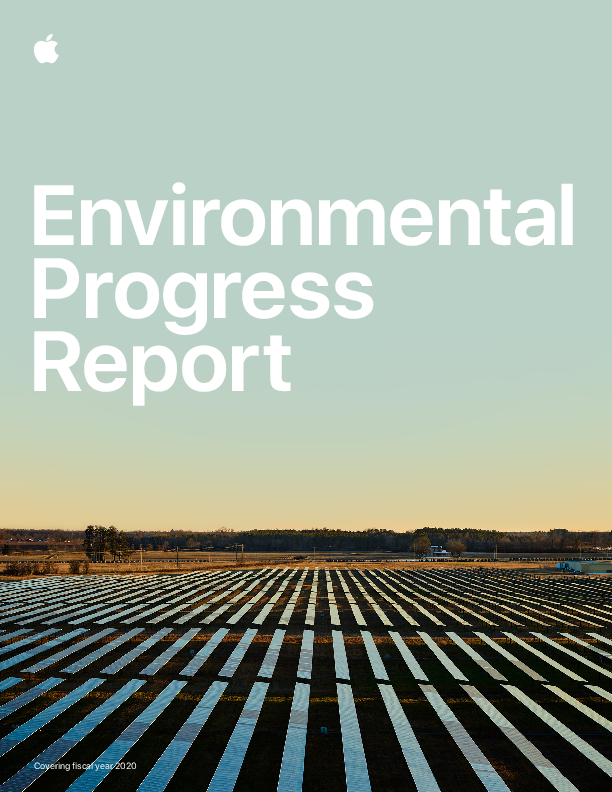
Cover photo This North Carolina solar facility is one of the many energy solutions utilized by Apple's suppliers to support their commitments to 100 percent
renewable energy for Apple production.

Introduction Climate Change Resources Smarter Chemistry Appendix

Environmental Progress Report 3

Our year in review

Developing solutions to global challenges is never an easy journey, and it isn't one that can be undertaken alone. In a year like no other, Apple has continued to work with a global network of colleagues, companies, and advocates to further our efforts to make our environmental work a force for good in people's lives--and give the communities most impacted by climate change a seat at the table.
As a result, this has been a year of progress powered by collaboration. As a company, we moved ahead with greater urgency than ever before to create a stronger, healthier future for our planet and her people.
In 2020, that meant real progress in our fight against climate change. Apple became carbon neutral for our worldwide operations, and we committed to becoming carbon neutral by 2030 for our entire footprint--from our supply chain to the use of the products we make. Those same products now use more recycled materials than ever, like the 40 percent recycled content in the MacBook Air with Retina display, and the 99 percent recycled tungsten we now use in iPhone 12 and Apple Watch Series 6.
There's an old saying that if you want to go fast, go alone. If you want to go far, go together. Well this year we did both, setting ambitious goals for Apple while helping more than 100 of our suppliers commit to joining our journey to being carbon neutral. That progress was powered by our new renewable energy projects spanning the globe--from an award-winning, 180-acre solar project in Reno, Nevada, to two of the world's largest onshore wind turbines in Denmark.
While we helped bring more than 4 gigawatts of renewable energy online, we doubled down on our efforts to remove carbon from the atmosphere. That included an innovative new partnership with Conservation International and Goldman Sachs called the Restore Fund to invest in working forests, revitalizing ecosystems with the goal of removing 1 million metric tonnes of carbon every year.

Shaping all of this work is Apple's commitment to equity. At this moment of rebuilding, we know we can help spur an economic recovery that tackles systemic barriers to opportunity and empowers local communities--especially the communities most vulnerable to the impacts of climate change.
One way we're doing this is with the Impact Accelerator we launched last year, which invests in minority-owned businesses on the cutting edge of green technology and clean power. The Accelerator is part of our $100 million Racial Equity and Justice Initiative, which is advancing equitable opportunity in our economy, our schools, and our criminal justice system.
But our commitment to equity goes much further. Everything, from our clean energy investments to our partnerships, considers the impacts on the local community. And we continue to ask ourselves how we can make our work an even greater force for good.
In every case, the answer is to listen, to engage, and to work together. For one of our first solar projects in China, that meant building solar panels high enough above the ground for local farmers' yaks to graze under. In Colombia, it meant partnering with local community, government, and conservation organizations, which help preserve mangrove forests deeply intertwined with the economic and cultural lives of their communities. And in Kenya, it meant bolstering the pioneering work of conservationists supporting sustainable tree farming and preserving savannas degraded by unsustainable landuse practices.
These projects are definitive proof that the fight against climate change is also a fight for local economies, for the rights of indigenous peoples, and for the communities whose lives and livelihoods are most threatened by climate change.
These are systemic and long-standing issues, and we don't pretend to have all the answers. What we do have are goals to strive for, and a global community of businesses committed to doing the right thing by people and the planet. Thank you for your role in our progress to push this urgent work forward.

Lisa Jackson Vice President, Environment, Policy & Social Initiatives

Introduction Climate Change Resources Smarter Chemistry Appendix

Environmental Progress Report 4

Our environmental strategy
Science drives our environmental strategy. Our ambitions--including our commitment to carbon neutrality by 2030--are defined by data. And so are the three pillars of our strategy: climate change, resources, and smarter chemistry. Our comprehensive carbon footprint informs the work we do to address our climate impact, including our roadmap to carbon neutrality. Within our resources pillar, data on environmental, social, and supply impacts prioritize materials we transition to recycled and renewable sources. And a detailed process of data collection and chemical assessments drives our smarter chemistry innovations. All the work we do aims to improve environmental health, not just for our customers, suppliers, and employees, but also for broader global communities.

Climate Change
We've set a goal to become carbon neutral across our entire footprint by 2030. We will get there by reducing our emissions by 75 percent compared to 2015, and then investing in carbon removal solutions for the remaining emissions.
Low-carbon design  Energy efficiency  Renewable electricity  Direct emissions abatement  Carbon removal

Resources
We aim to make products and packaging using only recycled or renewable materials. At the same time, we're committed to stewarding water resources and sending zero waste to landfill.
Materials  Water stewardship  Zero waste to landfill

Smarter Chemistry
Through chemistry innovation and rigorous controls, we design our products to be safe for anyone who assembles, uses, or recycles them-- and to be better for the environment.
Mapping and engagement  Assessment  Innovation

Introduction Climate Change Resources Smarter Chemistry Appendix

Environmental Progress Report 5

Report highlights
Impact Accelerator empowers Blackand Brown-owned businesses addressing
environmental challenges

100+ suppliers committed to 100% renewable
electricity

100% renewable energy
sourced for all Apple facilities

99% recycled tungsten in iPhone 12
and Apple Watch Series 6

Safer Choice Partner of the Year
award from the EPA

Carbon neutral for corporate operations
since April 2020

40% of all material in MacBook Air with Retina display comes from recycled sources

Restore Fund will invest up to $200M in natural climate solutions

Introduction Climate Change Resources Smarter Chemistry Appendix

Environmental Progress Report 6

Our shared commitment

We remain committed to our mission of creating products that enrich the lives of our customers. And we're equally committed to doing so in a manner that doesn't deplete the earth's resources. This commitment acknowledges our responsibility for our entire value chain--which extends across our facilities and through the entire life cycle of our products. And it drives our strategy-- whether innovating solutions to environmental challenges or creating opportunities for minority-owned businesses and institutions that have been historically disadvantaged. We're striving to enable the type of world we want to live in. That means taking steps to help others reduce their footprint, as well as protect communities that often disproportionately bear the costs of environmental harm.

Only by engaging with others can we meet our ambitious goals and realize the changes our world needs. We learn from the expertise of others, including our Green Chemistry Advisory Board. We seek out those who inspire us, like the Malala Fund, which we support in their work at the intersection of climate change and education. We collaborate to advance our environmental initiatives, like our work with the Platform for Accelerating the Circular Economy (PACE) to promote circular supply chains. And, by sharing our strategy and approach, we aim to maximize the impact of our efforts while empowering others. When our CEO Tim Cook addressed the United Nations' Climate Ambition Summit, he resoundingly reinforced our commitment to transition to a carbon neutral economy and create inclusive opportunities.

Our stake Our prod Our corpor

holders

Standards bodies

Industry

Suppliers

Customers

Employees

uct life cycle

NGOs

Product use

Product transport

End-of-life recovery

Scientific community

Product final assembly
Component manufacturing

ate facilities
Apple stores

Apple offices

Policymakers

Material sourcing

Apple data centers

Introduction Climate Change Resources Smarter Chemistry Appendix

Environmental Responsibility Report 7

"This is no time for changes at the margins. Together, we can transition to a carbon neutral economy and usher in a new era of inclusive opportunity. This is a moment for ambition, cooperation, and leadership."
Tim Cook, CEO United Nations' Climate Ambition Summit December, 2020
Photo credit: EcoPhotography

Introduction Climate Change Resources Smarter Chemistry Appendix
Climate Change

Environmental Progress Report 8

Introduction Climate Change Resources Smarter Chemistry Appendix

Environmental Progress Report 9

Goals and highlights
At Apple, we're committed to utilizing our resources as an organization to combat climate change. Our commitment to carbon neutrality by 2030 is both ambitious and necessary. These efforts require innovations at scale--like designing and implementing new technologies, mobilizing financing structures, and rapidly deploying renewable energy. Everything we do is driven by science and the urgency to tackle climate change.
Goals

Achieve carbon neutrality for our entire carbon footprint by 2030, and reach our science-based
emissions reduction target

Create products with net zero carbon
impact by 2030

Highlights
Carbon neutral for corporate operations
since April 2020

15M metric tons of emissions avoided due to
carbon reduction initiatives

100% renewable energy sourced for all Apple facilities

100+ suppliers committed to 100% renewable
electricity

Energy use reduced by 13.9M kWh
through efficiency efforts
Restore Fund will invest up to $200M in natural climate solutions

Introduction Climate Change Resources Smarter Chemistry Appendix

Environmental Progress Report 10

Our approach

Climate change is one of the greatest threats of our time, putting at risk people's access to clean air, adequate food, safe drinking water, and sanitation.
This means the impact of the changes we make--improving energy efficiency and transitioning to renewable energy across our supply chain--extends beyond our factories, stores, and offices to benefit those who live in the communities where we operate. The future success of our company depends on taking urgent and decisive action. For years, we have increased energy efficiency and the use of renewable energy, yet we know we have to do more. That's why last year, we unveiled our most ambitious plan to date: to achieve carbon neutrality for the entire life cycle of our products by 2030. This goal places us 20 years ahead of the recommendations put forward by the Intergovernmental Panel on Climate Change (the United Nations body for assessing the science related to climate change) calling for carbon neutrality as a planet by 2050. The science is clear: Our world cannot wait for an inclusive, carbon neutral economy. Every business has a responsibility to create a meaningful plan to reduce its emissions.
Our goal and approach are informed by science. We focus on avoiding activities that generate carbon in the first place. And, wherever possible, we're switching to lower-carbon alternatives. In cases where emissions can't be avoided, we'll then remove the equivalent amount of carbon from the atmosphere. While we pursue viable solutions, we also align to the same carbon mitigation hierarchy in our strategy. It isn't the easiest approach, but it's the one science shows is necessary to address climate change.

Our philosophy for achieving carbon neutrality follows these principles:
� Taking a comprehensive approach: Our responsibility extends beyond our direct operations to the entire life cycle of our products. We calculate emissions from the production of raw materials, product manufacturing, shipping, the energy used to power our facilities and our customers' devices, as well as material recycling and recovery. Our commitment to reach neutrality for our full product life cycle shapes the actions we pursue. We can effect direct change through product design and using low-carbon inputs. Through supplier engagement, we can work with our manufacturing partners to transition to 100 percent renewable energy. And through the power of policy and industry collaboration, we can unlock climate solutions on a global scale.
� Set ambitious targets: Our plan to reach neutrality by 2030 centers around our strategy to reduce emissions by 75 percent, relative to our 2015 footprint. This reduction aligns with what current climate science shows is necessary to limit warming to 1.5� Celsius. We'll invest in high-quality carbon removal projects to address the emissions that remain, prioritizing the protection of ecosystems as a powerful, natural carbon solution. These projects will also align to rigorous international standards to ensure their impact. And by avoiding emissions first, we'll also reduce the carbon we need to remove.
� Match solutions to sources: For each activity within our value chain, we will choose decarbonization actions that tie to the source of those emissions. We'll address emissions from electricity with renewable energy and emissions from transportation with alternative fuels. By matching solutions to carbon sources, we will do our part to decarbonize the economy.

Our Green Bond engages investors in our work toward carbon neutrality. In our 2020 Green Bond report, we disclose progress on the projects funded over the last year that bring us closer to our 2030 goal. Read our 2020 Green Bond report (PDF).

Introduction Climate Change Resources Smarter Chemistry Appendix

Environmental Progress Report 11

� Align business operations with environmental progress: We believe what is good for the environment is also good business practice. We've demonstrated that meeting our environmental goals doesn't have to come at the expense of our bottom line. Our use of low-carbon aluminum reduces our environmental footprint while maintaining our design standards. We've also established investment funds for clean energy and nature-based solutions, designed to deliver both environmental benefits and financial returns. And we are leveraging the funds from Apple's 2 billion (approximately US$2.2 billion) bond issuance in 2019 to help meet our climate goal, while providing a return to investors.
� Explore all solutions: Climate change is a complex problem that demands that global actors use multiple tools to address it. That's why our ambitious roadmap includes a portfolio of solutions across a 10-year time frame. We have to scale proven solutions now, while also exploring the solutions of the future. This includes the development of new technologies, like our support for direct carbon-free aluminum smelting.
� Be open: We are committed to disclosing our climate strategy and progress, as well as climate risk�related financial information. By sharing our approach, we aim to send clear signals to our partners and invite them to work with us. We also hope to empower our peers in their pursuit of carbon neutrality and engage investors in our pursuit of carbon neutrality through green bonds. Our reports, as well as our response to the global disclosure nonprofit CDP, will provide details on our progress.

Our 10-year climate roadmap will address Apple's carbon footprint through five pillars:
Low-carbon design We will design products and manufacturing processes to be less carbon-intensive through thoughtful material selection, increased material efficiency, and greater product energy efficiency.
Energy efficiency We will increase energy efficiency at our own facilities and in our supply chain by finding opportunities, such as retrofitting, to reduce energy use.
Renewable electricity We will maintain our use of 100 percent renewable electricity for our own facilities and transition our entire supply chain to 100 percent clean, renewable sources of electricity.
Direct emissions abatement We will avoid direct greenhouse gas emissions in our own facilities and in our supply chain through process innovation, emissions abatement, and the use of nonfossilbased lowcarbon fuels.
Carbon removal Working in parallel with our emissions reduction efforts, we will scale up investments in carbon removal projects, including naturebased solutions that protect and restore ecosystems around the world.

Introduction Climate Change Resources Smarter Chemistry Appendix

Apple's comprehensive carbon footprint
To achieve our goal of carbon neutrality by 2030, we must first understand our carbon footprint today. So we meticulously model emissions from our entire value chain, including both our corporate operations and our full product life cycle. That includes emissions from manufacturing, transporting, using, and even recycling our devices. This data defines our strategy to reduce emissions by 75 percent and reach neutrality across our product life cycle.

Apple's 2020 carbon footprint

Corporate emissions Product life cycle emissions

Apple's carbon footprint*
22.6Million
metric tons of CO2e

*This total represents our gross emissions in fiscal year 2020, and does not account for emissions offset.

Environmental Progress Report 12

Scope 1 Direct emissions
Scope 2 Emissions from electricity
Scope 3 Business travel and employee commute Product manufacturing Product transport Product use Material recovery
Emissions offset

<1% 0%
1% 71% 8% 19% <1% -<1%

The WRI Greenhouse Gas Protocol defines the methodology for classifying GHG emissions.
Scope 1 emissions are those greenhouse gases resulting from fuel combustion from sources we own or operate--like vehicles or natural gas for heating.
Scope 2 emissions refer to those resulting from the use of electricity. Renewable energy generates minimal Scope 2 emissions, whereas burning coal, oil, or natural gas to produce electricity releases carbon dioxide and other greenhouse gases into the atmosphere.
Scope 3 emissions refer to all other indirect emissions that occur in a company's value chain, including upstream and downstream activities.

Introduction Climate Change Resources Smarter Chemistry Appendix

Environmental Progress Report 13

Our carbon roadmap

Since our 2015 baseline year, we've seen consistent reductions in our carbon footprint, even as net revenue increased.
Our footprint has decreased by 40 percent, marking steady progress toward our 2030 target. And we avoided more than 15 million metric tons of emissions through initiatives to use low-carbon materials, drive energy efficiency, and switch to clean energy--carbon reduction efforts that separated a rise in sales from increases in our carbon footprint. Our historical emissions challenge the idea that good business requires growth in carbon emissions, and we aim to show this even more clearly going forward.

Measuring our footprint
We calculate our comprehensive carbon footprint using a life cycle�based approach. Apple-specific data drives many of our most critical calculations; in cases where that data isn't available we rely on secondary sources, including industry averages. We continually refine our model to include new sources of product life cycle data--and offer a more accurate and transparent assessment of our footprint. Our comprehensive carbon footprint and our methodology are verified by a third party each year to ensure accuracy and transparency (see Appendix C). Improving the accuracy of our carbon footprint is an ongoing process we work on continually--as we learn more, we will revise our roadmap to incorporate new information. And, as our data improves, we will continually refine our emissions from previous years and our projections.

Historical carbon footprint (million metric tons CO2e per fiscal year)

Our plan to become carbon neutral by 2030 centers around a 75 percent emissions reduction relative to our 2015 footprint. We plan to address residual emissions through carbon removals. Already we've reduced our carbon footprint by 40 percent since 2015.
Note: We include a range for recently estimated emissions to reflect the potential variances inherent to modeling product-related carbon emissions. Each year, we refine our methodology to ensure the accuracy of our estimates. Projected emissions are displayed with a straight-line trajectory toward a reduction of 75 percent by 2030. Projected carbon removal is displayed with a similar straight-line growth to reach net zero carbon emissions by 2030.

Historical emissions
Emissions with reductions Avoided emissions Emissions offset Emissions range

Projected future emissions
Projected emissions Projected carbon removal Net difference between projected carbon emissions and projected removals

2012 2013 2014 2015 2016 2017 2018 2019 2020 2021 2022 2023 2024 2025 2026 2027 2028 2029 2030

30.9 33.8 34.2 38.4 29.5 27.5 25.2 25.1 22.6

Net zero carbon emissions by 2030

Introduction Climate Change Resources Smarter Chemistry Appendix

Environmental Progress Report 14

Looking forward to 2030
We're focused on the road ahead, demonstrated by our pursuit of carbon neutrality by 2030. This goal sets us ahead of the Intergovernmental Panel on Climate Change (IPCC) recommendations by 20 years--because we believe our planet and our most vulnerable communities can't wait. We aim to reach neutrality by reducing emissions by 75 percent relative to our 2015 baseline, while addressing residual emissions through carbon removals.1
Corporate scopes 1 and 2 emissions
Our journey to address our corporate emissions signals our plan to reach carbon neutrality for our full supply chain. Since 2011, our scopes 1 and 2 emissions have declined by 73 percent, and we had zero scope 2 electricity-related emissions for the second year in a row. Even as our business grew, our work to drive energy efficiency and transition to renewable energy reduced our footprint--avoiding over 4.6 million metric tons of emissions, the equivalent of taking almost 1 million cars off the road for a year.2 We've addressed our remaining scope 1 emissions through nature-based solutions, achieving carbon neutrality for our corporate footprint.
Conducting a climate scenario analysis for our business
We're looking to the future by conducting a climate scenario analysis that helps us better understand the potential physical and transition effects of climate change.
To align with the Task Force on Climate-Related Financial Disclosures (TCFD) recommendations, we considered a range of future scenarios, including a scenario below 2� Celsius. And we assessed geographies around the world to capture both corporate and supplier activities. The analysis highlighted how our renewable energy program and carbon neutrality goals could contribute to our corporate resiliency. It also provided environmental data that we'll consider in our strategies to maintain supply chain diversification, as well as promote the security of global assets.

Apple's emissions since 2011 (scope 1 and scope 2)
(thousand metric tons CO2e)
Apple emissions3 Emissions after accounting for Apple's renewable energy program Emissions avoided Total emissions avoided due to Apple's use of renewable energy Emissions offset Total scope 1 emissions offset
2011 2012 2013 2014 2015 2016 2017 2018 2019 2020

175.9 160.4 120.8 91.7 70.5 75.3 83.3 66.2 52.7 47.4

Net zero emissions as of April 2020

Introduction Climate Change Resources Smarter Chemistry Appendix

Environmental Progress Report 15

Low-carbon design

We believe that well-designed products have a lower environmental footprint. This is a principle we strive to bring to everything we create, and a central pillar of our 2030 goal to achieve carbon neutrality for our entire product life cycle.
Each year, we aim to reduce the carbon emissions that result from manufacturing and the use of our devices, without compromising performance.
Our carbon footprint helps us identify opportunities to reduce the carbon intensity of our product designs. We work to transition to materials from recycled sources or those made using low-carbon energy. We prioritize the materials and components that account for significant portions of our carbon emissions, so that the choices we make product-by-product can scale toward reducing our overall footprint.
Using material efficiently
Less means more when it comes to our approach with materials. As we reduce the amount of materials used to make our products, we see greater progress toward our goal of carbon neutrality. This helps us reduce the transportation and energy-intensive processing these materials require as well as limit the amount of scrap generated along the way. We continue to investigate new ways to manufacture more efficiently, limiting the amount of waste created in the process.
In 2020, we've made clear gains with our work on integrated circuits and boards and flexes--components we've prioritized because they are carbon-intensive. Integrated circuits perform vital functions in electronic devices, yet require significant energy to manufacture. With the Apple M1 chip, we've created a more efficiently designed chip tailored to the needs of Mac devices. This efficiency gain also brings with it environmental benefits. For example, switching to the Apple M1 chip for Mac mini reduced the energy needed to use the device and drove down the overall carbon footprint by 34 percent.4

We're also driving efficiencies in the design of boards and flexes, which account for significant carbon emissions. We've launched a strategic initiative to optimize our designs to find alternatives to these components and reduce their contributions to our footprint. For example, with iPad (8th generation) we switched from using flexes to lower-carbon alternatives in certain applications--one of many changes that helped reduce the total carbon footprint of the product by 7 percent compared to the previous generation.
We're also focusing on the accessories we ship with each product. In 2020, iPhone 12 and Apple Watch Series 6 devices shipped without power adapters in the box. The change allowed for smaller, lighter packaging. It also allowed us to fit up to 70 percent more products on a shipping pallet--which, in turn, helps reduce emissions associated with shipping. This change also eliminated the need for significant quantities of plastic and zinc since power adapters comprise our largest usage of these materials.
Leveraging low-carbon alternatives
Another design consideration is our choice of materials. By transitioning to materials that lend themselves more readily to low-carbon processing and recycling, we can reduce our carbon footprint. As these materials account for more significant proportions of the materials we use, we move closer to our goal of carbon neutrality for our products.
We've seen clear progress with aluminum--a material where we've had success in shifting to recycled materials and those generated from low-carbon processes. Several of our products use 100 percent recycled aluminum in their enclosures-- including our latest MacBook Air, Mac mini, and the latest iPad devices. And all enclosures made with virgin aluminum for products released in 2020 were smelted using hydroelectricity rather than fossil fuels--for a lower carbon impact. As a result of these changes, our carbon emissions associated with aluminum have decreased by 72 percent since 2015.
We're also making progress in how we source recycled aluminum. The material we derive from our manufacturing scrap provides high-quality aluminum with fewer associated carbon emissions than newly mined materials. And, for the first time, we're expanding our sourcing to include post-consumer recycled aluminum from building and construction scrap that meets the high standards our products require.

34%
Switching to the Apple M1 chip for Mac mini reduced the energy needed to use the device and drove down the overall carbon footprint by 34 percent.
72%
By switching to recycled and hydro-smelted aluminum, our carbon emissions associated with aluminum have decreased by 72 percent since 2015.

Introduction Climate Change Resources Smarter Chemistry Appendix

Environmental Progress Report 16

Driving product energy efficiency
Designing energy-efficient products even as we continually enhance performance represents another essential pillar of our approach to carbon neutrality. Product energy use accounts for 19 percent of our carbon footprint--and has an impact on the individual energy use of each of our customers. This is why we've set aggressive targets to reduce our products' energy usage. We approach this challenge in the earliest phases of design, taking a holistic view of each product from how efficiently software operates to the power requirements of individual components.
While this is a continual effort with each new generation of products, we've already made progress. The transition to Apple silicon on Mac devices, for example, is driving efficiency improvements--the Mac mini consumes up to 60 percent less energy while in active use than the previous generation.5 Through our efforts to improve energy efficiency, the average product energy use across all major product lines has declined by more than 70 percent since 2008.6 And Apple products are consistently ranked by ENERGY STAR, which sets specifications that typically reflect the 25 percent most energy-efficient devices on the market. The group recognized Pro Display XDR on the ENERGY STAR Most Efficient List for 2020 and 2021. In fiscal year 2020, 100 percent of our eligible products received an ENERGY STAR rating for superior energy efficiency.7 And 100 percent of our eligible products earned the highest award from EPEAT, another environmental rating system for electronic products that considers energy efficiency a highlighted feature.8

Product energy efficiency

66%
iPad (8th generation) consumes 66 percent less energy than the requirement for ENERGY STAR, thanks in part to a more energy-efficient power adapter.9
Most Efficient
Pro Display XDR made the ENERGY STAR Most Efficient List for 2020 and 2021.10
53%
iPhone 12 consumes 53 percent less energy than the U.S. Department of Energy requirements for battery charger systems.11

Introduction Climate Change Resources Smarter Chemistry Appendix

Environmental Progress Report 17

Energy efficiency

Our energy efficiency goals extend well beyond our products. We're focused on using less energy across our operations, beginning with how we design, operate, and maintain our facilities. And we continue these same efforts into our supply chain, which benefits those living in areas where our suppliers operate.
Drawing less energy from electrical grids--many of which still rely heavily on fossil fuels--helps reduce local air pollution and improve air quality for nearby communities.
Reducing energy use is an essential business process. We track and monitor energy use across our operations and supply chain, conducting audits to find opportunities to work more efficiently. And we view our energy use holistically, from the point of design to the point of manufacture.
Operating Apple facilities efficiently
Finding ways to avoid using energy in the first place is the central focus of our energy efficiency program. We work with design teams to tailor our building systems selection process to our occupants' and lab users' specific needs. This helps ensure our facilities are utilized efficiently and productively. We focus on natural gas and electricity usage at each site--our offices, data centers, R&D facilities, and retail stores--auditing how we perform and, when needed, using best practices for energy management to reduce our loads.
Measurement is critical to this. We continue to develop our system of energy tracking and benchmarking. This helps us identify performance issues at our sites early. We can then take corrective action to restore building system efficiencies and actively manage our energy footprint.
We're also working to find energy savings through different approaches--from renovating and retrofitting more than 100 older locations to collaborating with our local utilities to ensure that we deploy the best available energy efficiency strategies. As we renovate sites, we review all aspects of the building for efficiency opportunities--from lighting and electrical systems to heating and cooling systems. For example, in Santa Clara Valley, we worked directly with PG&E and Silicon Valley Power to optimize how we run select facilities, so that we draw less energy from the grid.

Energy efficiency principles are incorporated early in the design of new facilities. We look at each location's conditions, designing and building to local temperature, humidity, and light. As each site becomes operational, we monitor how well we're performing and make needed adjustments. And we opened new retail locations in 2020 based on our energy-efficient retail facilities prototype.
We can see the results of these efforts. Our data centers, for example, perform about 60 percent better than the ASHRAE 90.4 baseline specific to data centers.12 And design optimizations at our Flagship Stores locations are expected to contribute up to about 40 percent energy savings, compared to the ASHRAE benchmark. In fiscal year 2020, our energy efficiency program helped us reduce our usage by an additional 13.9 million kilowatt-hours and 199,700 therms per year through adjustments made to 7.1 million square feet of new and existing buildings.13 Together, these new initiatives will avoid about 4,900 metric tons of CO2e per year.
Working with our suppliers toward a more energy-efficient supply chain
The most significant opportunity to make an impact on energy efficiency is with our suppliers. Currently, manufacturing accounts for approximately 70 percent of Apple's comprehensive carbon footprint. Energy usage drives those emissions, so with our suppliers, we prioritize optimizing energy use and then shifting to renewable energy sources.
Our Supplier Energy Efficiency program works side-by-side with our Supplier Clean Energy program in supporting suppliers to reduce emissions. By helping a supplier reduce the energy they use, we lower the amount of renewable energy they will need to meet their clean energy commitments. While not all suppliers have the same level of access to renewables, each has the opportunity to work more efficiently with the energy they're using. We began addressing energy efficiency with the suppliers who expressed interest in optimizing their energy use and with manufacturers with significant energy usage.
Now we're focusing on scaling the program content and services to the broader supply chain, as part of our strategic effort to reduce the energy required to make our products. From the collaborative actions we've taken with our suppliers to accelerate toward carbon neutrality, more than 900,000 annualized metric tons of supply chain carbon emissions were avoided, a 44 percent improvement over 2019.14

13.9M
We reduced our energy use by 13.9 million kilowatt-hours through efficiency efforts implemented in fiscal year 2020.
900K
Suppliers in our Supplier Energy Efficiency program avoided more than 900,000 annualized metric tons of supply chain carbon emissions.

Introduction Climate Change Resources Smarter Chemistry Appendix

Environmental Progress Report 18

As suppliers join our energy efficiency program, we encourage them to deeply understand their greenhouse gas emissions. As of 2019, we required our suppliers to report both their emissions and their reduction targets.15
To help suppliers reduce their energy use, we provide guidance designed to help them uncover opportunities for energy efficiency. We also assist them with assessments and technical issues where appropriate. Typical projects may include replacing outdated or inefficient heating, cooling, and lighting systems; repairing compressed air leaks; and recovering waste heat. We've also provided support through workshops and trainings, including multiday classroom trainings for employees complete with a capstone project. We continue to expand the support we provide to suppliers as they build more energy-efficient systems, through new training materials and increased access to funding opportunities.
We're focused on the impact of some of our most popular products. One example is our three-year initiative to improve the efficiency of iPhone manufacturing. Collectively, the six participating supplier facilities achieved their goal of 20 percent reductions by the end of 2020 compared to the established 2017 baseline. In addition, final assembly sites for AirPods, iPad, and Apple Watch have all launched multiyear energy reduction initiatives in 2020.

The Impact Accelerator
"Systemic racism and climate change are not separate issues, and they will not abide separate solutions."
Lisa Jackson Vice President, Environment, Policy and Social Initiatives
A program for Black- and Brown-owned businesses
To ensure that our work to protect the planet also helps advance equality, Apple has launched an Impact Accelerator for Black- and Brown-owned businesses.16 The Accelerator expands access to opportunity by ensuring that our investments in sectors like renewable energy, carbon removal, and recycling innovation also help fight systemic barriers impacting communities that are disproportionately affected by environmental issues like climate change. With customized training, access to Apple experts, and an expanding alumni community, our Impact Accelerator is tailored to support companies as they achieve their next stage of development.
The Impact Accelerator is just one of many efforts within Apple's $100 million Racial Equity and Justice Initiative, which focuses on efforts that address education, economic equality, and criminal justice reform in the United States. With our partners in these efforts, we aim to redefine business as usual and drive progress toward a more equitable future.
To apply to our Impact Accelerator program, or to learn more about our Racial Equity and Justice Initiative, visit www.apple.com/racial-equity-justice-initiative.

Introduction Climate Change Resources Smarter Chemistry Appendix

Environmental Progress Report 19

Expanding access to energy efficiency

Last year, one of our manufacturers in Guangzhou, China, deployed a state-ofthe-art energy management system. With the system in place, the manufacturer can monitor and optimize their complex network of air conditioners, fans, pumps, and air compressors at the facility.
The new system allowed the facility managers to find efficiencies in energy usage across their site, even as the facility carried out highly engineered and specified manufacturing processes for Apple. The facility team also installed a waste heat recovery system that captured the heat generated by energy-intensive equipment--like air compressors--and converted it to warm water for use in living areas. These upgrades improved the energy efficiency at the manufacturer's site and helped to reduce the facility's carbon impact.
Energy efficiency upgrades like these require a combination of innovative technical solutions and organizational priorities that support these goals. But, there's another important element: capital investment. The project at the Guangzhou manufacturing site was made possible by capital from Asia Green Fund, as part of a US$100 million investment initiative.

This initiative brings together Asia Green Fund's investors and energy management contractors to offer energy efficiency as a service to participating suppliers for the first time. This fund makes energy-saving opportunities accessible to suppliers-- the upfront investment challenges and implementation risks will be taken by the investors. As our suppliers realize savings from energy costs, investors recoup their capital.
Apple doesn't directly invest capital or draw financial returns through this initiative, but connects suppliers to Asia Green Fund that offers both financing and energy efficiency expertise to support complex capital intensive projects. A key barrier to achieving energy efficiency at scale is access to capital funding. "Energy efficiency as a service" through the fund presents an alternative approach to solve this challenge. The fund draws on Apple's relationships and deep knowledge of our suppliers' facilities and engineering processes, resulting in supplier projects that improve energy efficiency and positive environmental impact. These benefits carry over to the other technology products our suppliers create as well, reducing both our footprint and those of our industry. To date, US$7.5 million of investments have been made in supplier efficiency projects using this model, bringing us closer to our goal of carbon neutrality.

Steps in the Asia Green Fund energy efficiency process

1

2

3

4

5

6

Supplier engagement Apple connects suppliers interested in energy savings to service providers specializing in energy management and project capital investment.

Service identification Investor and supplier work together directly to identify energy-saving opportunities at the supplier site and confirm which ones they would like to pursue.

Energy efficiency updates Investor provides energy efficiency as a service by making any needed process or equipment updates to create energy savings.

Energy savings and investment return As the supplier manufactures products for Apple and others, the supplier experiences a cost savings from reduced energy use and shares that savings with the investor.

End service Investor gives supplier ownership of energy efficiency equipment after the contract period.

Scale-up Apple connects additional suppliers to this service model to explore new opportunities.

Introduction Climate Change Resources Smarter Chemistry Appendix

Environmental Progress Report 20

Renewable electricity

We're at a pivotal moment in addressing

Renewable electricity at Apple facilities

climate change. Renewable energy is

Our retail stores, data centers, and offices around the world

poised to replace fossil fuels as the future of electricity. Its adoption means healthier air, stronger local economies, and lower carbon emissions. All at cost-competitive rates.
Our commitment to transition to 100 percent renewable energy for our entire supply chain enables resiliency in the face of challenges like climate change, and moves us closer to becoming carbon neutral by 2030.
In 2018, we announced our own operations were fully transitioned to 100 percent renewable electricity. And we continue to expand on our commitment to green technologies by bringing new renewable electricity projects online around the world. In the long term, these projects provide more cost-effective energy with less price volatility. Renewable electricity can offer a clear competitive advantage by providing power to our operations, as well as those of our suppliers, with greater control over energy supply and little exposure to cost fluctuations. And by adopting green technologies, we and our suppliers are in a unique position to drive environmental action and support our goal of carbon neutrality by 2030.

currently source 100 percent renewable energy. We are proud of this accomplishment--and as we grow, we're working diligently to maintain this benchmark. Where possible, we focus on creating new renewables. New renewables require investment--whether in the form of direct ownership of renewable energy projects, equity investments, or long-term power purchase agreements. Our projects in 2020 included more than 180 megawatts of solar power near Fredricksburg, Virginia, and outside of Reno, Nevada, as well as 130 megawatts of wind power near Chicago, and in Viborg, Denmark. In total, Apple-created renewable sources account for 90 percent of the renewable electricity our facilities use--around 1.5 gigawatts currently in use and another 30 megawatts under contract.
Our "Apple-created" projects for facilities include:
Direct ownership (10 percent of Applecreated projects) We build our own projects, including solar, biogas fuel cells, and low-impact hydro projects, where feasible, to provide renewable electricity.

Our approach is twofold. We find ways to consume energy more efficiently, and we seek out opportunities to transition to renewable sources that support our goal of 100 percent renewable energy across our operations and supply chain.

Equity investment (3 percent of Applecreated projects) We invest capital in new solar PV or wind projects in some markets, matching the renewable generation with our energy use.

Long-term renewable energy contracts

With the renewable energy we source, we aim to achieve the

(87 percent of Applecreated projects)

greatest impact possible. Before we engage in an energy project, We sign longterm contracts for renewable electricity when

we evaluate it with a holistic view of its potential environmental and needed. Through power purchase agreements, virtual

social impact. Whenever possible, we create new renewable energy, power purchase agreements, and other forms of long-term

going above and beyond what might be available on the local grid. commitments, we help support new, local, and primarily solar

We also follow stringent accountability standards to verify our clean PV and wind projects that are in line with our renewable energy�

energy projects.

sourcing standards.

10%
of Applecreated projects are directly owned.
3%
of Applecreated projects are equity investments.
87%
of Applecreated projects are long-term renewable energy contracts.

Introduction Climate Change Resources Smarter Chemistry Appendix

Environmental Progress Report 21

To cover any gaps in our renewable energy needs beyond what's provided by Apple-created projects, we directly purchase renewable energy--about 5 percent of our total corporate load--through available utility green energy programs. Colocation facility vendors also supply about 3 percent of our total load of renewable energy. And in certain situations, we go to the market for renewable energy credits (RECs)--for example, when we need to bridge before a renewable project comes online or when there's a lack of availability. These RECs, which account for about 1 percent of our total load, must be tied to recently constructed projects, Green-e Energy certified, where available, and share the same power grid as the Apple facility they support. These purchases are subject to the same standards as our Applecreated renewables. Appendix C provides additional details on Apple's renewable energy solutions.
Creating additional impact
Achieving 100 percent renewable energy at Apple facilities provided us a starting point to make an even greater impact. We've focused our efforts to source renewables around several key pillars: undertaking projects that deliver clear benefits to local communities, working on storage solutions that facilitate the use of renewable electricity, and supporting renewable energy innovations.
Supporting social impact Power for Impact, the program we launched in 2019, continues to provide local communities with needed energy resources. Following our initial projects--solar developments in communities in the Philippines and Thailand facing energy cost and availability challenges--we supported solar power in Diepsloot, a densely populated township in Johannesburg, South Africa, home to an estimated 180,000 families. A portion of these families lack many essential services including potable water, waste management, and electricity. This system combines 152 kilowatts of PV and 830 kilowatt hours of storage across 230 solar towers and will provide electricity to more than 3600 households.

Developing energy storage Wind and solar power provide the most cost-effective new source of electricity to many parts of the world. Yet, the intermittent nature of these technologies has presented an obstacle to widespread adoption--and resulted in continued reliance on fossil fuel�powered grids. One solution to intermittency is energy storage, which can retain generated power until it is needed. We've invested in utility scale storage in California and in research into new energy storage technologies, even as we continue to build upon our distributed storage capabilities in Santa Clara Valley and optimize storage at our Apple Park microgrid.
Apple is sponsoring the construction of one of the largest battery projects in the country--an industry-leading grid-scale energy storage project in California capable of storing 240 megawatthours of electricity. This project supports our 130-megawatt California Flats solar farm that provides all of our renewable energy in California, by storing excess energy generated during the day and deploying it when it is most valuable.
We're also continuing to support biological methanation research at Aarhus University, Denmark, which explores the production of synthetic methane for storage in the existing gas grid. In this process, bacteria consumes both hydrogen produced from excess renewable energy and captured carbon dioxide to produce methane, the principal component of natural gas. Methane produced from renewables is a versatile energy carrier that can be used as a fuel source in households, industry, and transportation.

240
megawatt-hours
Amount of electricity capable of being stored at the Apple-sponsored California Flats energy storage project.

Introduction Climate Change Resources Smarter Chemistry Appendix

Environmental Progress Report 22

Advancing renewable energy through innovations In 2020, we've pursued innovations in how we create and consume renewable energy. We announced our investment in the world's largest onshore wind turbines. The Denmark-based project, near the town Esbjerg, features two 200-meter-tall turbines that are expected to produce 62 gigawatt-hours each year--enough to power almost 20,000 homes. The power produced onsite will support Apple's data center in Viborg, with all surplus energy going into the Danish grid. The project will also act as a test site for powerful offshore wind turbines. Our agreement to purchase the electricity at an established price has helped make this effort financially viable as it comes online.

Some innovations are market-based. Outside of Fredricksburg, Virginia, we've helped to realize a renewable energy aggregation project, which brings together multiple buyers in a single energy transaction. For this 165-megawatt project, we worked with our partners Akamai, Swiss Re, and Etsy to help attain economies of scale through our collective purchasing power.

Below: In total, Applecreated renewable sources account for 90 percent of the renewable electricity our facilities use, and include wind projects in Viborg, Denmark, and Prineville, Oregon (pictured below).

Introduction Climate Change Resources Smarter Chemistry Appendix

Environmental Progress Report 23

Renewable electricity at our suppliers
Electricity usage in our supply chain is the single greatest contributor to our carbon emissions. While this is a global issue, the impact is also local. Bringing renewable energy online with our suppliers and, where possible, displacing fossil fuels helps decarbonize power grids and improves local air quality for communities. That's why our efforts to enable our suppliers to reduce energy use and transition to renewables are essential to reaching our 2030 goal of carbon neutrality. This work presents challenges: technical and regulatory barriers, capital requirements, and lack of awareness on where to find and access high-quality and cost-effective solutions.
Two initiatives drive our approach: our Supplier Energy Efficiency Program and our Supplier Clean Energy Program. These work hand in hand to reduce the energy used in our supply chain and transition the remaining energy to renewables. We take responsibility for our supply chain as part of our comprehensive carbon footprint. But we also know that we can achieve even more significant climate impact by providing a model for other companies to follow with their suppliers, helping to reduce emissions beyond our industry.

We've made tremendous progress toward our goal of transitioning our manufacturing supply chain to 100 percent renewable electricity by 2030. One important benchmark we've achieved is our initial goal, set in 2015, of bringing online over 4 gigawatts of additional renewable energy to our supply chain-- with additional supplier commitments bringing the total to nearly 8 gigawatts. The renewable energy already online generated 11.4 million megawatt-hours of clean energy in fiscal year 2020, avoiding 8.6 million metric tons of carbon emissions in our supply chain. As of March 2021, 109 manufacturing partners in 24 different countries have committed to 100 percent renewable energy for Apple production (see Appendix B). And to cover emissions even further upstream, Apple has invested directly in nearly 500 megawatts of renewable energy projects.
Moving clean energy forward in our supply chain
While we celebrate our transition to 100 percent renewable energy at our facilities,17 we want to see a world in which renewable energy is widely available and broadly used. Starting with our suppliers, we aim to accelerate this change as we support their transition to renewables. Our own experience gives us knowledge we can share. And we help break down barriers, through innovative funding structures and by advocating for clean energy�friendly policies. In 2020, we received the RE100 award for "best green catalyst" due to our work engaging our suppliers on renewable energy.

Supplier energy efficiency and clean energy achievements

2015
Launch of the Supplier Clean Energy Program and Supplier Energy Efficiency Program

2017
Launch of the Supplier Clean Energy Portal
Initial investment in the development of nearly 500 megawatts of solar and wind projects in China and Japan to address upstream emissions in our supply chain

Supplier Code of Conduct requires suppliers to maintain an inventory of air emissions including greenhouse gases

2018

2019

iPhone final assembly sites in China set three-year target to reduce energy use by 20 percent
Launch of the China Clean Energy Fund, which will enable Apple and our suppliers to invest in more than 1 gigawatt of renewable energy in China

Key supplier commitments reached in major supply chain countries
First in-person training hosted by Apple for over 30 suppliers in China
Launch of partnership with Asia Green Fund to drive energy efficiency

2020
More than 100 suppliers committed to 100 percent renewable electricity for Apple production
AirPods, iPad, and Apple Watch final assembly sites in China kick off multiyear efficiency reduction goals
More than 4 gigawatts of renewable energy brought online, and nearly 8 gigawatts of renewable energy commitments reached

Introduction Climate Change Resources Smarter Chemistry Appendix

Environmental Progress Report 24

Galvanizing internal champions Apple employees are passionate about the environment and excited about our 2030 commitment. We're empowering supplier-facing employees with the tools they need to support our mission and speed a supplier's transition to renewable energy. It starts with data and transparency. We track the progress of our suppliers, including those just beginning to learn about renewables and others that are well on their way to 100 percent renewable. We've also created internal trainings and crafted a simple engagement process, backed by resources for both Apple employees and our suppliers. By connecting our suppliers with resources and helping them assess their performance, our teams are scaling impact across our supply chain.

Supply chain clean energy progress
Renewable energy operational and committed in gigawatts (GW)
Operational Committed

0

1

2

3

4

5

6

7

8

FY16

FY17 FY18

Supporting supplier capacity We share the experience gained through our own transition to 100 percent renewable energy with our suppliers. We introduce suppliers to resources and training materials with country-specific information to guide them in their transition to renewables. These tools are available through our Supplier Clean Energy Portal. We also educate suppliers through advanced and customized training with leading experts. And we support the creation and growth of renewable energy industry associations that our suppliers can join to learn about local opportunities.
Long-standing energy structures can make it difficult to bring new renewable energy online in some regions, prompting some of our suppliers to maximize existing renewable energy solutions--like onsite solar installations. Others have pioneered new purchasing methods, creating renewable energy businesses or even participating in some of the world's largest and most innovative renewable energy deals.
Advocating for policy change Government policies and rules can present some of the largest barriers to transitioning to renewables. We lend our voice and stand with other companies and NGOs to break down policy barriers to achieve thriving clean energy markets with, for example, enhanced grid resiliency and greater energy innovation. Across regions, we engage with policymakers to support renewable energy that is cost-effective, accessible to companies, and sourced from high-quality projects with a material impact on local markets. For more information, jump to the section on our climate policy engagements.

FY19 FY20

2020 goal

Expanding renewable energy opportunities The transition to renewables means helping our suppliers find energy solutions and make the right investments to address their specific needs. When we face barriers to accessing cost-effective clean energy, we innovate. That's why we developed the China Clean Energy Fund. The fund enables Apple and our suppliers to invest in clean energy--to date, these projects account for 134 megawatts in renewable power. We've also invested in renewable energy solutions to cover upstream emissions in our supply chain--playing a pivotal role in developing nearly 500 megawatts of solar and wind projects in China and Japan.

Toward our 2030 goal

Introduction Climate Change Resources Smarter Chemistry Appendix

Environmental Progress Report 25

Promoting and protecting sound climate policies

In April 2019, the U.S. Environmental Protection Agency (EPA) adopted the Affordable Clean Energy (ACE) Rule, which effectively repealed and replaced the Clean Power Plan (CPP).

Apple had previously voiced our support for the CPP because it played an important role in allowing developers, utilities, and financiers to invest in renewable energy with confidence, and it incentivized utilities to provide corporate energy buyers like Apple with increasing supplies of renewable energy. The adoption of the ACE Rule eliminated those incentives. Apple spoke out on this issue, as we believed that the ACE Rule would reduce access to renewable energy sources and drive up the cost of renewable energy.

In January 2021, the U.S. Court of Appeals for the D.C. Circuit held that the ACE Rule and its repeal of the Clean Power Plan was inconsistent with the U.S. Clean Air Act. We anticipate new challenges ahead, but our position on strong climate policy is clear: Each one of us has a role to play in addressing the climate crisis. We undertake our advocacy--whether in pushing for more robust policies or fighting to protect those already in place--because it makes business sense for Apple and it is what our customers, shareholders, and stakeholders expect of us. Our collective action on climate change is crucial for the planet and the long-term health of our business.
Apple sees three steps that governments can take to create effective climate policy:
1. Set strong targets based on science. Policymakers should set national or regional targets that seek to limit warming to no more than 1.5� Celsius. These goals need to include interim targets and mechanisms to enforce short-term accountability. To meet these targets requires a price on carbon and parallel participation in international policy negotiation.
2. Create sector-specific policies. Limiting warming to 1.5� Celsius is a goal that requires actions across the entire economy. Policies need to address sector-specific needs and facilitate the transition to decarbonize industries where there are challenges or there is a need for infrastructure to support the goal.

3. Support a green economy for all. Climate policies should have positive, long-term fiscal impacts and support the development of the new green economy, with job opportunities focused on advancing clean innovation.
We're pursuing clean energy policies in countries where we operate. In Europe, Apple called on European leaders to increase their climate ambition to achieve a target of at least 55 percent of greenhouse gas emissions by 2030 and to achieve climate neutrality by 2050. The EU--which adopted this standard in December of 2020--serves as an example for how policy ambition is crucial for climate progress and how companies like Apple can play a role in showing how economic and climate progress go hand in hand.
Last year in Seoul, we hosted members of RE100, a global initiative of some of the world's most influential businesses committed to 100 percent renewable electricity. In Vietnam, we advocated for government action to enable companies to purchase renewable energy. Also, in Japan, we became the first of several multinationals to join the Japan Climate Leader's Partnership, which aligns business objectives with environmental goals.
Our own goals show our commitment to these principles, as our 2030 emissions reduction target aligns with the actions needed to limit warming to 1.5� Celsius.

Above: Apple's CEO Tim Cook speaks regularly on the company's environmental commitments in public forums around the world.

Introduction Climate Change Resources Smarter Chemistry Appendix

Environmental Progress Report 26

Direct emissions abatement

Some materials that are integral to our products result in significant emissions. The same is true for certain manufacturing processes. To address these emissions we seek technological solutions, either through emissions abatement or switching to low-carbon fuel options.
Rethinking aluminum manufacturing
Many Apple products utilize aluminum as a signature material-- it is strong, durable, and enhances the longevity of devices. But, the current smelting process for producing aluminum used by manufacturers around the world is carbon-intensive. For the first time, aluminum smelted with a direct emissions-free process is being used in production of the 16-inch MacBook Pro.

Addressing fluorinated greenhouse gas emissions
Many components essential to products like ours, including integrated circuit (IC) chips and display panels, currently rely on manufacturing processes that use fluorinated gases. We're partnering closely with key manufacturers to prevent these gases from being released into the atmosphere, where they have high global warming potential. First, we encourage suppliers to optimize manufacturing processes--reducing the use of fluorinated greenhouse gases (F-GHG) in the first place. Then we ask suppliers to deploy abatement technologies, curtailing the release of emissions from the gases that remain. As of December 2020, our display suppliers have installed mitigation technologies to reduce F-GHG emissions associated with producing all of our display panels by more than 90 percent on average. Since the launch of our efforts in 2019, our key display suppliers have reduced the equivalent of more than 2,300,000 annualized metric tons of CO2e.

90%+
As of December 2020, our display suppliers have installed mitigation technologies to reduce F-GHG emissions associated with producing all of our display panels by more than 90 percent on average.

This innovation, called Elysis, is the result of a joint venture of two aluminum manufacturers. The venture aims to commercialize patented technology that eliminates direct greenhouse gas emissions from the traditional smelting process. This aligned with our goals to reduce emissions associated with our products--and to pursue innovations that can carry industry-wide impact. Apple and the governments of Canada and Quebec have joined with the founders of Elysis to invest in research and development of the technology. Part of this funding is being used to construct a new facility in Quebec. Once finished, this R&D facility will significantly scale the carbon-free smelting technology, making this highperformance, low-emissions material available commercially.

Transporting products
Each year, we ship hundreds of millions of products from our manufacturers to our consumers. We've approached this process as we have other carbon emissions objectives. We're shifting toward less carbon-intensive shipping methods, like rail and maritime carriers, where possible. And we're seeking out technical innovations, including alternative fuels and electric vehicles.
HomePod recently launched using lower-carbon forms of transportation, significantly reducing emissions associated with shipping. In Europe, we're working with carriers who prioritize "carbon neutral delivery" using electric vehicles, including e-bikes and e-cars. These innovations help reduce our impact in the communities where our customers purchase our products. And by preferring vendors that offer low-carbon options, we signal the value of these options to us and reward those driving decarbonization in their industry.

Introduction Climate Change Resources Smarter Chemistry Appendix

Environmental Progress Report 27

Improving employee travel and commute
We are also exploring ways to reduce our carbon footprint from employee commuting. Although the Covid-19 pandemic significantly impacted the number of our employees commuting to Apple facilities and retail stores--temporarily reducing our carbon footprint--our strategy to reduce commuting-related emissions looks beyond this to the long term. Our efforts incorporate remote working through our At Home Advisor program, while also transitioning away from single-occupancy vehicles through mass transit, coach services, and campus bicycles. We also offer more than 2300 EV charging stations across our U.S.-based campuses. In total, these initiatives have helped us reduce our CO2e emissions by more than 16,000 metric tons in fiscal year 2020.

Supporting elephant conservation and national parks
Through donations, Apple works with a diverse set of partners to enhance environmental protections and support global communities. For the launch of the Apple TV+ documentary, The Elephant Queen, Apple partnered with Conservation International and Save the Elephants to support communitybased elephant conservation in Kenya--including improved elephant tracking and the Reteti Elephant Sanctuary.
Apple also celebrated the 104th birthday of the national parks with a donation to the National Park Foundation. With support from Apple, the National Park Foundation's youth programs have given thousands of kids the chance to learn about and experience the parks through school activities, trips, and service corps programs. These programs include efforts to bring youth from underserved communities into the parks and recruit interns from historically black colleges and universities.

Introduction Climate Change Resources Smarter Chemistry Appendix

Environmental Progress Report 28

Carbon removal

Our goal to reach carbon neutrality by 2030 requires more than reducing emissions. To address the emissions we can't avoid for the foreseeable future, we need to take active steps to remove carbon dioxide from the atmosphere. This is a necessary complement to our emissions reduction efforts--and an essential pillar of our strategy.

the atmosphere. We will also share our measurements through international registries to ensure transparency and accuracy-- and that any emissions savings aren't counted twice. This will also involve close engagement with local and indigenous communities to respect and protect their rights and livelihoods. Our priorities will focus on projects that protect lands with high conservation values and that use native species to maintain and restore biodiversity in the areas that we restore. To ensure the integrity of these programs, we will work with independent auditors to verify our impact.

$200M
Amount Apple will invest through the Restore Fund to remove carbon from the atmosphere.

The purpose of our carbon removal work is clear and urgent. All global actors need to take immediate action to combat climate change. That's why we've set our goal to reduce emissions by 75 percent by 2030. And why we use the best tools available today to remove the remainder of our emissions: naturebased solutions.
Investing in nature-based solutions
Nature provides some of the best tools to remove carbon from the atmosphere. Forests, wetlands, and grasslands draw carbon from the atmosphere and store it away in their soils, roots, and branches. This approach not only is proven and scalable, but also provides livelihoods for local communities and improves ecosystems. That's why we've begun with nature-based carbon removal solutions to support our goal of achieving carbon neutrality across our full product life cycle by 2030.
In developing our strategy, we recognize that forest restoration and habitat protection don't always have to be a cost, but can represent an investment opportunity. That is why we're partnering with Conservation International and Goldman Sachs to launch the Restore Fund. Apple will invest up to US$200 million in projects that aim to permanently remove carbon from the atmosphere, all while meeting clear social and environmental impact criteria and offering a financial return.
How these investments will perform is of critical importance. Our partnership with Conservation International and Goldman Sachs helps ensure the impact of investments, by seeking out projects that meet the highest environmental and social standards. The Restore Fund will align with international standards developed by organizations such as Verra, the Intergovernmental Panel on Climate Change, and the UN Climate Convention, which ensure that the carbon stored in forests is being conservatively and accurately quantified, and is permanently locked out of

In its pilot phase, the Restore Fund has a goal of removing more than 1 million metric tons of carbon dioxide per year with impact scaling up over time. By 2030, we aim to remove enough carbon dioxide from the atmosphere to cover the residual emissions that we are unable to avoid directly within our value chain. This fund is unique because it changes carbon removal from a cost to a profitable investment. Through creating a fund that generates both a financial return as well as real and measurable carbon impact, we aim to drive broader change in the future-- encouraging capital investment in carbon removal around the globe.
Achieving carbon neutrality for corporate emissions
Long-term carbon removal solutions, like the fund, will help us reach neutrality for our end-to-end carbon footprint. At the same time, we are not waiting to address our corporate emissions in the short term. As of April 2020, Apple has been carbon neutral across all of our corporate emissions--including stores, data centers, and corporate facilities--as well as business travel and employee commuting. We've already addressed the vast majority of our corporate emissions through renewable energy and energy efficiency efforts. However, the carbon footprint of some activities is difficult to avoid today--whether it is emissions from the use of natural gas in some of our buildings or the emissions from employee air travel. To address these emissions as the Restore Fund comes online, we partnered with Conservation International on projects that generate carbon credits to cover our corporate footprint.

Introduction Climate Change Resources Smarter Chemistry Appendix

Environmental Progress Report 29

Nature-based climate solutions

In Kilifi, Kenya, just south of the Arabuko Sokoke National Reserve, a forestry business is seeking to change the way commercial forestry operates in this region of Africa.

Komaza is a "micro-forestry" company that partners with and empowers tens of thousands of marginalized farmers to earn a living from sustainable tree farming. The company works with farmers from planting, to harvesting, to processing--supporting an eight-year growth cycle to create responsible wood products.

There is an urgent need for the work that Komaza is doing. Across Africa, the demand for wood has grown with rising populations in tandem with rapid urbanization--at a rate that far exceeds what the continent's forests can provide. This has led to increased deforestation and the cascading effects of damage to critical ecosystems, including the loss of biodiversity and increased carbon emissions. By blending sustainable practices with a scalable approach to commercial forestry, Komaza is aiming to reverse these impacts, while supporting the livelihood and well-being of local communities.
Apple is partnering with Conservation International and Komaza to invest in the micro-forestry model and its positive impacts on carbon removal, biodiversity conservation, and socio-economic development. Through our partnership, Conservation International will help Komaza measure and value the carbon removal impact of this forestry work to produce verified carbon credits.
These efforts build on our history of work to protect and restore critical ecosystems including forests, wetlands, and grasslands around the world. Through our partnerships with World Wildlife Fund and The Conservation Fund, we have protected or improved the management of over 1 million acres of forests in China and the U.S. And in 2018, we partnered with Conservation International, INVEMAR Research Institute, and CVS (Corporaci�n Aut�noma Regional del Valles del Sin�) to protect and restore 27,000 acres of mangrove forest in Colombia. Mangroves are critical ecosystems at both the local and global scales. They fortify coastlines, supporting local communities and their livelihoods.

And mangrove forests also sequester more than 10 times the carbon than forests on land. Our partnership with Conservation International was the first project to accurately capture the value of this "blue carbon" and, for the first time in 2021, the project will issue carbon credits that help to further conservation efforts in the region.
We have also partnered with Conservation International in Kenya to protect and restore savanna with the Maasai Wilderness Conservation Trust and the Big Life Foundation in the iconic Chyulu Hills region. Our funds will help to repair damage caused by unsustainable land-use practices that degrade grasslands and soils, endanger local wildlife, release carbon into the atmosphere, and deprive local communities of vital agricultural resources.
Both the mangrove and savanna ecosystems have significant carbon removal benefits--as well as offering an opportunity to work with local partners to make a direct impact. These solutions complement our existing efforts to find efficiencies and reduce the carbon footprint of our operations. As we work to maintain our carbon neutrality each year, these projects represent an investment in ecosystems that will last for generations.

Above: Apple is partnering with Conservation International to invest in Komaza, a responsible "micro-forestry" company, to help measure and value the carbon removal impact of its forestry work. Photo credit: Will Swanson, courtesy of Komaza

Introduction Climate Change Resources Smarter Chemistry Appendix

Environmental Progress Report 30

Resources

Introduction Climate Change Resources Smarter Chemistry Appendix

Environmental Progress Report 31

Goals and highlights
Last year, we made our most ambitious commitment yet--to achieve carbon neutrality by 2030. The resources we depend on to make our products have a significant impact on this goal. This is yet another reason to make the most of the resources we use--through our work to one day make our products using only recycled and renewable materials, to build long-lasting products with a lower carbon intensity, and to create recycling technologies to end our reliance on carbon-intensive mining. And all of these efforts also help conserve the earth's finite resources.
Goals

Use only recycled and renewable materials in our products and packaging

Eliminate plastics in our packaging by
2025

Minimize the use of freshwater
resources in water-stressed
locations

Eliminate waste sent to landfill from our corporate
facilities and our suppliers

Highlights

40% of all material in MacBook Air with Retina
display comes from recycled sources

10.4 million devices refurbished
for new users in fiscal year 202018

65% less single-use plastic
in packaging compared to 2015

99% recycled tungsten in
iPhone 12 and Apple Watch
Series 6

All established final assembly sites are Zero Waste certified19

Introduction Climate Change Resources Smarter Chemistry Appendix

Environmental Progress Report 32

Our approach
We take responsibility for our relationship with all of the resources that make our work possible. Our efforts to responsibly source materials, minimize water use, and eliminate waste are directly connected to the creation of our products--and span both our own operations and those of our suppliers.
We start by looking at our products and the resources we use to make them. We're moving toward a future where we build products using only recycled and renewable materials, and at the same time, implement low-carbon designs. We aim to build durable, long-lasting products to make the best use of the resources inside them. When a product is ready to be recycled, we're engaging partners and designing technologies to recover raw materials for new products.
Water is another vital resource for our business. We rely on it to manufacture products and run our offices, data centers, and stores. That's why we are optimizing our current use, leveraging alternative and recycled sources of water, and managing our discharge responsibly.
We're working to eliminate landfill waste--to conserve the world's resources and protect those communities disproportionately exposed to waste. We make progress by reducing the amount we create, recycling wherever possible, and innovating opportunities for reuse. This is a collaborative effort. Our suppliers have the greatest ability to help us conserve resources, to realize the potential for recycling, and to lower our carbon footprint by doing more with less.

Within resources, we focus on three main areas of impact:
Materials Transition to only recycled or renewable materials in our products and packaging, and maximize material efficiency, product longevity, and recovery.
Water stewardship Reduce freshwater use, transition to alternative sources, improve the quality of water we discharge, and protect shared water resources.
Zero waste to landfill Minimize overall waste generated and eliminate waste sent to landfill from key manufacturing facilities as well as corporate offices, data centers, and retail stores.

Introduction Climate Change Resources Smarter Chemistry Appendix

Environmental Progress Report 33

Materials
Our products rely on the availability of high-quality materials. We're increasingly sourcing more of these valuable commodities from circular supply chains, drawn from recycled content and renewable resources.
Our goal is to one day achieve independence from mined resources--those continually extracted from the earth in a carbon-intensive process. As we progress toward this goal, we're doing so without sacrificing the quality and durability of our products. And we're working on innovations in recycling to enhance material recovery and support circular supply chains for ourselves and others.
The scale of this challenge is significant. But so is our potential to have an impact. The changes that we push forward affect the people who interact with our products, influence the markets in which we operate, and create change for broader global communities. Whether through technological innovation or by achieving regulatory cooperation, our actions carry results that extend beyond our business.
We're using three different levers to reduce our footprint and achieve circularity:
� Sourcing and efficiency: Sourcing recycled and renewable materials for our products and packaging, and using these materials more efficiently. And we source materials responsibly, whether from virgin, recycled, or renewable sources.
� Product longevity: Making the most of the materials we use through designing long-lasting products. We design durable hardware, leverage software updates to extend functionality, provide convenient access to repair services, refurbish devices for their next user, and reuse parts with more to give.
� Product end-of-life: Enhancing product collection and recycling innovation, so we and others can use old devices as raw material sources for the future.

How we define a circular supply chain Efficiency

Sourcing

Longevity

Recovery
Sourcing Use responsibly-sourced recycled and renewable materials Efficiency Minimize material inputs Longevity Extend product life Recovery Collect and recover materials from end-of-life

Introduction Climate Change Resources Smarter Chemistry Appendix

Environmental Progress Report 34

Sourcing and efficiency

For the last few years, we've worked diligently toward the goal of relying solely on recycled and renewable materials for our products and our packaging.
We've signaled to markets that we care about the source of our materials--and seek those that can be used continually without depleting the earth's resources. Many partners have joined us in these efforts, and we hope to engage others as we see a broader global transition. We continue to source materials responsibly and use materials efficiently in the design of new products.

At the same time, we're adhering to rigorous sourcing standards. Our recycled and renewable material specifications follow standards set out by the international community. To ensure that these materials meet our requirements, we ask our suppliers for third-party certifications.21 This helps us confirm a material has been recycled or comes from a renewable source--one that can continually produce without depleting the earth's resources.22 As we introduce materials from new sources, we continue to evaluate each for its chemical safety. This allows us to scale our use of materials that are better for the environment, while ensuring they are also safe for use in our products.

Last year, we saw progress across materials--from expanding our use of recycled aluminum enclosures to sourcing solder made with recycled tin. In October, we introduced iPhone 12 and iPhone 12 Pro, the first Apple products made with 99 percent recycled tungsten and 98 percent recycled rare earth elements. And we released seven products with more than 20 percent recycled content. MacBook Air with Retina display (2020) had the highest total--made with more than 40 percent recycled content device-wide, including 100 percent recycled aluminum in the enclosure. These and other innovations helped us increase our use of recycled or renewable content to 12 percent of all the material used in products this year. And more than half of our recycled materials have been third-party certified.20
We continue to focus our efforts on our 14 priority materials, which accounted for more than 90 percent of the total product mass shipped to customers in fiscal year 2020. We prioritized these materials based on their environmental, social, and supply impacts outlined in their Material Impact Profiles. This year, we expanded the profiles to include a new indicator for biodiversity, helping us assess the likelihood that a material may come from critical habitats. We recognize that mining activities affect local species and ecosystems, so with this and other information captured in the profiles, we prioritize materials to switch to recycled and renewable sources.

This diligence carries over to our efforts to source responsibly, regardless of whether we are using virgin or recycled materials. This is a natural extension of our environmental efforts--and it draws from the same reliance on international standards. Our Responsible Sourcing Standards are based on leading international guidance, including the United Nations Guiding Principles on Business and Human Rights and the Organisation for Economic Co-operation and Development (OECD) due diligence guidance.
In 2020, 100 percent of the identified tin, tantalum, tungsten, gold, cobalt, and lithium smelters and refiners in Apple's supply chain participated in an independent third-party audit program. We also map and conduct additional diligence on other materials in our products. We're partnering with the smelters and refiners identified through this process as we build supply chains for recycled material as well. And we continue to engage with the Responsible Materials Initiative--a multi-industry initiative focused on responsible mineral sourcing issues--and other industry partners to promote transparency across supply chains and to establish additional auditing and due diligence systems.
Our efforts to use recycled and renewable materials also support our climate goals. In most cases, the recycled content has a lower carbon footprint than primary materials. As we continue to drive efficient, sustainable use of the earth's resources, we're working with policymakers to support international standards that enable the use of these materials globally.

We're prioritizing 14 materials to transition to recycled and renewable content: Aluminum Cobalt Copper Glass Gold Lithium Paper Plastics Rare earth elements Steel Tantalum Tin Tungsten Zinc
Apple is committed to setting the highest standards for responsible sourcing of the materials used in our products. For more information, read our Supplier Responsibility Report and our Conflict Minerals Report on the following site: Supplier Responsibility.

Introduction Climate Change Resources Smarter Chemistry Appendix

Environmental Progress Report 35

Product environmental features

indicates recycled content is new for product

1 Enclosure or case
Made with 100% recycled aluminum
Found in products MacBook Air Mac mini iPad iPad Air Apple Watch

2 Main logic board
Made with 100% recycled tin solder
Found in products MacBook Air MacBook Pro 27-inch iMac Mac Pro Pro Display XDR Mac mini iPad Pro iPad Air iPad iPad mini iPhone

3 Braided solo loop
Polyester yarns are made with 100% recycled materials23
Found in products Apple Watch

4 Taptic Engine
Made with 100% recycled rare earth elements and 100% recycled tungsten24
Found in products iPhone 12 Apple Watch Series 6

Introduction Climate Change Resources Smarter Chemistry Appendix

Environmental Progress Report 36

100% recycled tungsten in the Taptic Engine

Tungsten is one of the many materials that help make Apple products come to life. It is a key metal used in our Taptic Engine, which gives devices like iPhone and Apple Watch their unique feel through haptic feedback. It is also a material we've prioritized as we actively source recycled alternatives.

Last fall marked a significant achievement in our journey--we released iPhone 12 and Apple Watch Series 6 with 100 percent recycled tungsten in the Taptic Engine. This meant we used 99 percent recycled tungsten in each device, and this marked a first for a smartphone.

This achievement grew out of many years of work. We kicked off this effort in 2016, in parallel with our goal of finding recycled sources for metals like tin, by mapping the supply chain and identifying available recycled content. We eventually identified a recycler that produced 100 percent recycled tungsten-- showing us that our goal was possible. We continued to engage suppliers to use the recycled material until we reached scale; in some cases, working with suppliers to revamp their entire manufacturing processes to focus only on recycled inputs.
Locating and sourcing recycled material was one element of the process. The other, equally important task is to verify that this resource will perform at the level required for our products. With tungsten, we undertook more than a year of testing to determine whether we could utilize the recycled material provided by the new sources. Eventually, we determined that the recycled content did meet our rigorous standards.

The next part of the process was supply chain architecture: the important task of getting the recycled raw material to our parts suppliers. While tungsten is widely recycled, the streams come from varied sources and are of differing qualities. One challenge is that tungsten used in industrial applications creates two distinct types of scrap. And we found through our testing that only one--which goes through a more complicated recycling process--could be used in our applications.
Once this new supply chain was in place, we had established the path to using 100 percent recycled tungsten in the Taptic Engine. And this transition creates impact--we will avoid using the equivalent of an estimated 300,000 metric tons of mined material by sourcing recycled tungsten for iPhone 12 and Apple Watch Series 6. Some of the impact of our work extends beyond our own footprint as well. By building a supply chain solely for recycled content, we helped advance the market for this recycled material and further incentivize recovery across our industry.

Above: We use 100 percent recycled tungsten in the Taptic Engine of iPhone 12, which represents 99 percent of the total tungsten in the device.

Introduction Climate Change Resources Smarter Chemistry Appendix

Environmental Progress Report 37

Progress by material

The transition to recycled and renewable resources presents inherent challenges, as well as opportunities. By engaging each, we've made progress and gained a clear understanding of the task ahead.

Key challenges to circular supply chains:
Regulatory barriers: Transboundary movement regulations--originally intended to create environmental protections--inadvertently inhibit the ability to recover materials from scrap, end-of-life products, and parts for use in new products.
Contamination: The manner in which materials are recovered for recycling can impact the composition of the material, reducing its purity and usability.
Technical properties: Recycled or renewable material may have unique technical properties that need to be accounted for in product design.

Availability: End-of-life products and industrial sources of scrap for recycling may not be readily available, constraining the supply of recycled material. And the production of renewable material is sometimes limited.
Supply chains: Recycled or renewable content may not be easily accessible on the market, requiring the development of new supply chains.
Transparency: Information about the source of materials--whether mined, recycled, or renewable--may not be readily available.
Scale: Identifying and mobilizing high-quality recycled or renewable materials to scale use across our products.

Material
Aluminum
Cobalt Copper Glass

Primary use Enclosures Batteries Display Main logic board
Batteries
Enclosures Batteries Cameras Printed circuit boards Power adapters Connectors Enclosures Displays

Key challenges Regulatory barriers Contamination Technical properties Scale
Regulatory barriers Availability
Contamination Supply chains Scale
Contamination Technical properties Availability Scale

Progress
After creating a new aluminum alloy that incorporates recycled content without compromising product performance, we're now scaling recycled content across products. We continue to use 100 percent recycled aluminum in the enclosures of Apple Watch, MacBook Air, and Mac mini, and expanded to iPad and iPad Air. The transition to recycled aluminum also produced a significant carbon savings--supporting our pursuit of low-carbon designs. Our recycled material comes from several sources, including Apple's manufacturing scrap and post-industrial sources. And in 2020, we expanded our sourcing of recycled aluminum to include post-consumer scrap recovered from building and construction projects.
We've worked to increase our recycled cobalt year after year-- doubling the amount of recycled material used in fiscal year 2020 from the previous year. And the cobalt from iPhone batteries disassembled by Daisy is being returned to the general market. This more efficient and economical approach makes the material available to others beyond our supply chain, and continues to create a positive environmental benefit.
We're reducing the copper needed to build key components, while also piloting the use of high quantities of recycled content. We're continuing to use foils that rely on less copper in our printed circuit boards (PCBs), where we've also incorporated copper from recycled sources. We're working to apply this same approach to the foils we use in batteries and other modules.
We've worked to incorporate recycled content into the material we use to produce glass parts--keeping glass at its highest-purity use. As we collect and reuse scrap in new parts, we use the material more efficiently. And this year we used recycled glass in multiple parts of our iPhone devices--including the cover glass.

Introduction Climate Change Resources Smarter Chemistry Appendix

Environmental Progress Report 38

Material
Gold
Lithium Paper
Plastics
Rare earth elements

Primary use

Key challenges

Main logic board components Printed circuit boards Camera Connectors

Regulatory barriers Transparency

Batteries Packaging

Regulatory barriers Availability Supply chains
Technical properties

Enclosures Speakers Keyboards

Regulatory barriers Contamination Technical properties Transparency

Enclosures Speakers Receivers Taptic Engine Cameras

Regulatory barrier Supply chains Scale

Progress
We have looked to both increase the use of recycled content and reduce the amount of gold required to make components, and at the same time, we're supporting greater transparency in global supply chains.
We've focused some of our reduction efforts on reassessing the gold plating requirements in our components. Through this, we were able to build the printed circuit board for iPhone 12 with 50 percent less gold plating than the prior generation. We also continue to pursue the use of recycled material where possible--including 100 percent certified recycled gold on the plating of select circuit boards for iPhone.
We're working to shift our use of virgin sources of lithium to recycled materials recovered from batteries, as these options become more viable and economical. This involves testing to ensure the recycled material meets our performance standards. And we're forging relationships with partners and recyclers capable of bringing more of this material into the market.
Progress toward our 2025 commitment to eliminate plastics in packaging centers around switching to innovative fiber replacements. We're expanding the number of products that use fiber-based packaging and creating new fiber-based designs, like the paper screen films on iPhone 12. As we use more fiber, we continue to engage in circular supply chains that recycle and regenerate fiber sources. All of the wood fiber in our packaging comes from recycled materials or responsibly managed forests. And we're upholding our commitment to protect or create responsibly managed forests sufficient to cover the amount of wood fiber we use in our packaging. By educating customers on the recyclability of our packaging, we aim to contribute back to the recycled material market as well.
Plastics encompass a wide range of materials, and we're continuing to identify recycled plastics that meet our high standards. And we're scaling the use of these materials across our products. The mesh fabric of HomePod mini, for example, is made with 90 percent recycled plastic. And we use 100 percent recycled polyester yarns in the Apple Watch Braided Solo Loop.25 In total, we introduced more than 70 parts with an average of 50 percent recycled plastic in fiscal year 2020. And 17 additional components used plastics made from bio-based content rather than fossil fuels, an important step as we continue to pursue certified renewable plastic sources.
After proving we could make a high-performance magnet using only recycled rare earth elements, we're focused on expanding use across devices. We've successfully introduced recycled rare earth magnets in several products this year including Apple Watch, HomePod mini, iPad Air--and most notably, iPhone including MagSafe accessories. iPhone 12 uses the highest concentration of any iPhone yet: 98 percent recycled rare earth elements in the whole device. We're also working to reduce the total material used. By switching to a new cutting technology, we reduced the rare earth elements needed to manufacture MagSafe components by 12 percent.

Introduction Climate Change Resources Smarter Chemistry Appendix

Environmental Progress Report 39

Material
Steel
Tantalum Tin Tungsten Zinc

Primary use Enclosures Screws Small parts
Capacitors
Printed circuit boards
Taptic Engine
Main logic board Power adapter

Key challenges Regulatory barriers Contamination Technical properties
Regulatory barriers Availability Supply chains
Regulatory barriers Scale
Regulatory barrier Technical properties
Technical properties Supply chains

Progress
This year, we saw the results of our efforts to reduce the total amount of steel in the iPhone 11 Pro enclosures, saving nearly 10,000 metric tons of steel in fiscal year 2020. And we continued to improve steel efficiency in iPhone 12 Pro manufacturing. This is an example of our low-carbon design approach, which seeks to increase the use of recycled materials and decrease the total amount of material required. Since steel is highly recycled, our main focus is keeping it in the highest-quality form possible. That's why we continue to work to make sure high-purity steel gets recovered from our manufacturing scrap and our products at end-of-life.
While a market exists for recycled tantalum, we continue to address the challenge of building new supply chains to provide 100 percent recycled content at the quality and scale we need. Recovery from end-of-life electronics remains an area of opportunity that we're actively investigating to develop further use of this recycled material.
In fiscal year 2020, more than 25 percent of our tin came from recycled sources as we continued to scale our use. Our focus remains on its application in the solder of the main logic boards of our iPhone, iPad, MacBook, and select Mac devices. We're also continuing to use recycled tin in our accessories, including our power adapters and the Wireless Charging Case for AirPods Pro. And we introduced recycled tin solder on the True Tone flash of iPad Pro and the wireless charger for Apple Pencil as well.
In 2020, we used 100 percent recycled tungsten in the Taptic Engine of iPhone and Apple Watch for the first time, which represents 99 percent of the total tungsten in the device. In total, more than 35 percent of the tungsten we used in fiscal year 2020 came from recycled sources. And with the help of our disassembly robots, Daisy and Dave, the tungsten from our Taptic Engine can be recovered and recycled.
We continue to work to identify high-quality sources of recycled zinc, a challenge as the material is prone to accumulate impurities during recycling. And each source we identify, we rigorously test to ensure the recycled materials meet our high performance standards.

Introduction Climate Change Resources Smarter Chemistry Appendix

Environmental Progress Report 40

Packaging

The final step in the iPhone unboxing process--peeling back the protective film covering the screen--marks the moment when the device is ready to be used. This year, iPhone 12 owners will notice something new when they unbox their devices.
We've replaced the traditional transparent protective plastic film with a paper alternative. It's a small detail, but part of our larger goal to eliminate all plastics in our packaging by 2025. We've made significant progress toward this goal since 2015, replacing large plastic trays, wraps, and foam cushioning with fiber alternatives. These changes have allowed us to drastically cut plastic use, including an 80 percent reduction in plastic packaging in the 16-inch MacBook Pro. In fiscal year 2020, all newly released iPhone, iPad, Apple Watch, and MacBook devices shipped in packaging made with more than 90 percent fiber.
Now we're focusing on the detailed work of addressing the smaller, but no less significant, uses of plastic. The pouch enclosing Apple Watch, for example, is made from paper, as are the folded wraps securing cables for iPad, iPhone, AirPods, and MacBook. And we supply the wood fiber for all of our packaging from recycled sources or responsibly managed forests.26

We've set these goals as part of our broader strategy to reduce waste through eliminating single-use plastics and focusing on recycled and renewable materials in our products and packaging. And as countries around the world adopt regulatory efforts with similar goals, we find ourselves ahead of the curve in meeting new requirements. For example, our transition to paper bags in our retail stores anticipated local regulations on plastic bags in select regions. As countries from Argentina to Spain consider regulations to reduce waste, we also advocate for action that promotes the efficient use of low-impact materials, reduces single-use plastics, and encourages requirements that consider the entire packaging life cycle.

Our white paper on Apple's Paper and Packaging Strategy (PDF) details our approach toward creating responsibly designed and sourced packaging.

Our ability to proactively meet new standards not only serves the environment, it makes business sense. We're able to tackle design, sourcing, and logistical challenges thoughtfully and in alignment with all of our goals and efforts. This includes our commitment to using responsibly sourced wood fiber while, at the same time, contributing to the global supply of these responsible materials. Through partnerships with The Conservation Fund and the World Wildlife Fund, we've protected more than 1 million acres of working forests in the U.S. and China. In fiscal year 2020, these forests generated enough responsibly sourced fiber to balance all the fiber used in our packaging.27

Packaging fiber and plastic footprint* We've reduced plastic in our packaging by 65 percent since 2015. And since 2017, 100 percent of the virgin wood fiber used in our packaging has come from responsible sources.

Plastic Recycled fiber Responsibly sourced virgin fiber**

21%

2016 165,000

49%

30%

14%

2017 169,000

56%

30%

10%

2018

58%

187,000

32%

8%

2019

59%

189,000

33%

2020 226,000

6% 59% 35%

* These data include the materials used in our packaging. Fiber used at our corporate facilities represents less than 1 percent of our overall fiber use. ** Since 2017, all of the virgin wood fiber used in our packaging has come from responsible sources. Responsible sourcing of wood fiber is defined in
Apple's Sustainable Fiber Specification (PDF). We consider wood fibers to include bamboo.

Introduction Climate Change Resources Smarter Chemistry Appendix

Environmental Progress Report 41

Product longevity

Apple designs its products for longevity.
Our customers expect their devices to be ready when they need them, with minimal interruption for maintenance or repair. We believe designing long-lasting products encourages our customers to come back to Apple for their next one. And by encouraging our customers to access the value of their current device through Apple Trade In or third-party trade-in platforms, not only are we making their next purchase more affordable--we are also enabling a new customer to experience Apple products and services. And this approach is good for the planet. Keeping a product in use as long as possible--whether for one customer or more over the course of the product's life--enables us to get the most out of the resources used to build the product.

Because our design process prioritizes longevity, iPhone devices hold their value for longer than the competition. Apple delivers on our commitment to provide long-lasting devices by building durable hardware designed to endure the rigors of everyday use, offering years of software updates to unlock new features and functionality, and providing convenient access to safe and reliable repair services for whenever they might be needed. We aim to support the broadest range of devices possible so more customers can benefit from advances in software, whether their device is new or several generations older. We also strive to continuously improve durability with every generation of a product by delivering features that minimize the need for repair, such as water resistance and better drop performance. And we're improving the repairability of devices and expanding options

iPhone longevity journey

Repairable at retail stores, Apple Authorized Service Providers, and central repair locations Features to enhance durability

iPhone (1st generation) SIM tray

iPhone 4
SIM tray Battery Haptics Rear camera

iPhone 6s
SIM tray Battery Haptics Rear camera MLB Display

iPhone X
SIM tray Battery Haptics Rear camera MLB Display Speaker Enclosure Splash, water, and dust resistant: IP67 (maximum depth of one meter up to 30 minutes*)

iPhone 12
SIM tray Battery Haptics Rear camera MLB Display Speaker Enclosure Splash, water, and dust resistant: IP68 (maximum depth of six meters up to 30 minutes*) Ceramic Shield

2007

2010

2015

2018

2020

* iPhone X and iPhone 12 models are splash, water, and dust resistant and were tested under controlled laboratory conditions. iPhone X has a rating of IP67 under IEC standard 60529 (maximum depth of 1 meter up to 30 minutes). iPhone 12 has a rating of IP68 under IEC standard 60529 (maximum depth of 6 meters up to 30 minutes). Splash, water, and dust resistance are not permanent conditions and resistance might decrease as a result of normal wear. Do not attempt to charge a wet iPhone; refer to the user guide for cleaning and drying instructions. Liquid damage not covered under warranty.

Introduction Climate Change Resources Smarter Chemistry Appendix

Environmental Progress Report 42

for repair around the world--including to independent repair businesses--so our customers can access repair services should they need it. Put together, it's no surprise that our active installed base of products grew to 1.65 billion devices in the last year.

Designed for durability
We design for durability because long-lasting products that minimize repair or replacement make for a better customer experience. Apple products are designed to endure daily life, and an essential element of the product experience is confidence in the reliability of the device.

This work involves developing innovative designs that are engineered to withstand rigorous conditions, coupled with testing to assess them against our strict durability standards. We set these standards according to in-depth user studies to understand how our customers use--and misuse--their products. To measure against these requirements, we design custom test methods to better simulate real-world conditions--like an accidental drop.
During each product's development, thousands of units are tested, and each test informs the next round of design. Engineers in our Reliability Testing Lab measure the performance of materials, components, and fully assembled products to ensure every aspect of our product is thoroughly assessed for durability. For example, Apple Watch prototypes are exposed to different liquids like pool water, ocean water, and synthetic sweat to make sure devices are ready to be used during exercise. With our drop tower, we let products fall from dozens of different heights and angles onto a range of surfaces to improve their resilience to an accidental drop. And we test recycled or renewable materials to the same performance standards as other materials--making sure our products stay as durable as ever, even as we explore new material sources. Through our iterative testing approach, we continuously improve designs until they meet our strict standards and are ready to face the world.

With each new product, we strive to improve on the durability of the prior generation. Last fall, we released iPhone 12 with Ceramic Shield, a transparent ceramic cover glass that has four times better drop performance than the previous generation.28 It is an innovation that contributes to the durability of each device, minimizes the need for replacement parts, and helps retain product value that customers can access through trade in. This advancement enhances durability alongside features like the IP68 water resistance of iPhone 12.29 And each improvement we make is one more step in our ongoing journey to creating even more durable products.

Above: A solar test replicates and accelerates the UV exposure a product would experience by a window or in full sunlight over its lifetime.

Introduction Climate Change Resources Smarter Chemistry Appendix

Environmental Progress Report 43

Convenient, safe, and reliable repairs
We design our products for durability in order to minimize the need for repair. But in the instance a repair is needed, we believe our customers should have convenient access to safe and reliable repair services, to get their product back up and running as quickly as possible.
We are continuing to broaden the availability of repair services around the world. Our customers can receive repair with genuine parts, whether they go to an Apple Store, Apple Authorized Service Provider (AASP), participating Independent Repair Provider, mail-in repair center, or receive onsite service. We have grown our network to over 5000 AASP locations and over 1500 Independent Repair Providers around the world.

Our Independent Repair Provider program, now in its second year, is designed to enable independent repair businesses--large and small--to have access to Apple genuine parts, tools, diagnostics, and training. The program underwent two major changes in 2020: expansion to Europe and Canada, and inclusion of Mac repair in addition to iPhone repair. We're also increasing coverage for onsite service options in select cities across the United States, providing the ultimate convenience to our customers. And we've trained more than 265,000 repair technicians to provide quality repair support. We're also improving the repairability of many of our products. The new iPhone 12 design, for example, allows for more repairs to be performed at more repair locations than ever before.
We're constantly working to improve the convenience of our repair services as well as the durability of our devices. And we know there's more work to be done on this journey.

Global repair locations
Apple Authorized Service Providers Retail stores Independent Repair Providers

Introduction Climate Change Resources Smarter Chemistry Appendix

Environmental Progress Report 44

Software support keeps our products up to date
Product longevity relies as much on software support as it does on durable hardware design. Our customers expect us to deliver the latest software features and security updates to their existing devices for years. That's why we work to continually improve the operating systems that power our products. We engineer each software release to make sure it runs beautifully on all supported devices. This helps us maximize the number of customers who benefit from the latest software updates, regardless of whether their device is brand new or several generations older.
iOS 14, our most recent release, extends support back to iPhone 6s (2015). iPadOS 14 compatibility goes back to iPad Air 2 (2014) and macOS Big Sur supports MacBook models from 2013 onward. The updates in each operating system make the latest capabilities--from widgets on iPhone to the latest macOS design--available to a broad user base, keeping their devices up to date and extending their usability. These updates also ensure that more customers have access to the newest security and privacy features available.
Many of our customers are eager to use these updates. By February 2021, 86 percent of all iPhone devices introduced in the last four years had updated to iOS 14. And iPadOS 14 was being used on 84 percent of devices released in the last four years. Our continually high rates of adoption show that our customers value these software updates.
Refurbishing extends the life of devices
Products that last longer make the best use of the resources we rely on to create them. By finding ways to refurbish and reuse these products, we can lower each device's impact on the environment--including their carbon intensity per year of life. And by building our products to serve more than one owner and encouraging customers to exchange devices for an upgrade, we extend the life of our products.

We collect devices for refurbishing through a number of programs including Apple Trade In, the iPhone Upgrade Program, AppleCare, and our corporate Hardware Reuse Program. In fiscal year 2020, we sent 10.4 million devices to be refurbished for new users. We've also expanded our Trade In program to 25 countries, to make this program as convenient and accessible as possible to our customers.
Our customers drive the success of our trade-in programs and those of third parties. Whether through trading in their devices, passing down their device to a family member, or purchasing refurbished products, their actions recognize the long-term value we've designed and built into our products. And it enables us to make progress toward our goals of reducing our overall environmental footprint.

Visit our Certified Refurbished site where we offer like-new products backed by a one-year warranty and the Apple Certified Refurbished promise.30

Reuse realizes the value of our materials and parts
After extending the life of devices for as long as possible, we aim to do the same for the parts inside. Through recovery and reuse of components from products at end-of-life, we can realize their potential--either using them for replacement parts or in new creative applications. By extending their use as long as possible, we're making the most of the materials and energy needed to build them in the first place.
We've expanded our efforts to recover more parts from end-of-life devices for reuse. Those parts that can be refurbished to our high quality and performance standards can be reused as replacements. We're then able to repair more devices while creating fewer spare parts. Our teams continue to look for innovative opportunities to reuse accessories sent for recycling as well. For example, we send collected power cables and adapters to our final assembly sites, where they power production lines.

Introduction Climate Change Resources Smarter Chemistry Appendix

Environmental Progress Report 45

Product end-of-life

Our responsibility for our products begins with the design process and carries through endof-life. While we first look for opportunities for reuse, a product or part that no longer functions as intended can still be a source of valuable materials.
Through recycling we can realize the potential of these sources. And by keeping materials in the highest-quality form possible, we can reduce the energy needed to manufacture new products, driving down emissions. It is through this outlook on the endof-life of our products that we can design and build the next generation of devices even better for our planet.
Optimizing recycling through partnerships and innovation
Our approach toward creating circular supply chains rests on how well we recycle our products. Making recycling options easy and accessible is key to these efforts. At our retail locations, our customers not only can experience and purchase our latest products, but also can recycle devices they're no longer using. Through both retail and online platforms like Trade In, we continue to provide product take-back and recycling collection programs in 99 percent of the countries where we sell products. These programs allowed us to direct more than 39,000 metric tons of e-waste to recycling globally in fiscal year 2020.
To do this, we seek out and partner with recyclers who are the best-in-class, those who show high recovery rates and can uphold our standards. To ensure the effectiveness of these partnerships, we audit our recyclers for compliance with environmental, health, and safety regulations, and encourage best practices. In fiscal year 2020, we conducted more than 50 audits globally--and we performed additional audits relating to security. And all of our recyclers in North America are either e-Stewards or R2 certified, the electronics industry's leading certifications.

We also partner with recyclers to make sure there is a recycling solution for each Apple product. This is a collaborative effort. Through training and ongoing support, we help our recycling partners develop the ability to disassemble our products, recovering as much material as possible while limiting waste. This year, we've also launched new Apple Recycler Guides to provide guidance for professional electronics recyclers on how to safely disassemble Apple products--and maximize recovery of resources. The guides provide valuable insight on the steps for recycling, as well as the recommended downstream material recycler for the disassembled parts. Launched with our Pro Display XDR, these efforts will continue to expand to other products.
Product by product, this has a cumulative effect. As we continue to improve material recovery, we're making sure more high-quality recycled content is available on the market for us and others to use.
Developing disassembly, improving recovery
Disassembling a product for recycling presents an inherent challenge: What is the best way to minimize waste and maximize recovery? We've approached this challenge at our Material Recovery Lab (MRL) based in Austin, Texas, where our team works on developing better, more efficient recycling technologies. In 2020, our engineers worked virtually with this year's class of MRL interns from universities across the U.S. and Canada to innovate new approaches to disassembly.
We've continued to build upon our recycling innovations. Dave, our newest recycling robot, disassembles the Taptic Engine from iPhone to enable the recovery of key materials such as rare earth magnets, tungsten, and steel. And, we're exploring new ways to expand these recovery capabilities to other products. We're also designing, developing, and testing additional disassembly tools--including new methods for recovering materials from Apple Pencil. And Daisy, our first disassembly robot, continues to disassemble iPhone devices so recyclers can recover more material inside. Just one metric ton of iPhone main logic boards, flexes, and camera modules disassembled by Daisy contain the same amount of gold and copper as over 150 metric tons of mined earth. These materials make it back to the general market, so that we and others can use recycled materials for the next generation of products.

We support The Recycling Partnership, a U.S. nonprofit, in their efforts to improve residential recycling across the country. In 2020, The Partnership developed a first-of-itskind national recycling database that covers 97 percent of the U.S. population, providing real-time insights on what materials are recyclable locally. The Recycling Partnership also developed a free best practice management guide and tools for communities to use for better disposal of e-waste and lithium-ion batteries.

Introduction Climate Change Resources Smarter Chemistry Appendix

Environmental Progress Report 46
Left: Dave, our newest recycling robot, disassembles the Taptic Engine from iPhone to better recover key materials such as rare earth magnets, tungsten, and steel.

Designing next-generation technology
We're also taking a long-term approach to recycling innovation. While our current technologies for recovering valuable materials continue to improve, we recognize that new and emerging technologies represent some of the best opportunities to impact the future. And that our investments in research and development can yield transformative change. That's why we're supporting research initiatives that fundamentally reimagine disassembly and recovery.
Our recently completed project with Carnegie Mellon University's Biorobotics Lab developed machine learning models to enable better sorting of e-waste at recyclers. These software models, which learn from different images of devices, aim to provide the next generation of robots with the intelligence to disassemble devices they've never seen before. Typically a model requires a large amount of data--in this case, images of an object--to be able to recognize that object for recycling. Unfortunately, this data is not readily available. This research applies the concept

of domain randomization, by synthetically creating the data real images would provide, to grant robots the ability to recognize a broad, varied stream of e-waste for recycling at scale. The newly developed software will be open-sourced, available to be used by others in new applications throughout the recycling industry.
"Carnegie Mellon University is excited to work with Apple in developing key robotics and artificial intelligence technologies to advance electronics recycling. Apple is the ideal partner for their combination of real-world experience and technical expertise--and they are engaged at every stage of the project. Research like this aims to apply the latest technology to create industry-wide change."
Matthew Travers Carnegie Mellon University Robotics Institute31

Introduction Climate Change Resources Smarter Chemistry Appendix

Environmental Progress Report 47

Leading on resource recovery policy

In March 2019, the United Nations convened the fourth session of the Environment Assembly in Nairobi, Kenya.
The event drew representatives of 193 nations and nongovernmental stakeholders from across the globe. Apple was there as well. While much of our resource work centers on innovating technical solutions to enable circular supply chains around our products, there's another equally important task: advocating for the policies that support resource recovery and reuse. Our engagement with the U.N. Environment Assembly and other organizations, including the World Circular Economy Forum, and Platform for Accelerating the Circular Economy where we serve on the board, furthers this goal. We're committed to turning these important conversations into actions, and realizing the benefits to the environment from our preliminary successes across our entire supply chain.
And just as policies can support these efforts, they can also present unintended obstacles. We learned this through our experience with iPhone, where we've had considerable success recovering and recycling material from our devices. For example, the same amount of gold and copper can be recovered from one metric ton of end-of-life iPhone modules as can be extracted from 150 metric tons of mined earth.

That same material was categorized as hazardous waste under some regulations, making it difficult to ship and then return parts to the supply chain. Those regulations exist to provide an essential protection--ensuring that vulnerable communities are protected from global waste streams. Yet we believe there is an opportunity to adjust policies to reinforce critical protections for these communities, while also facilitating circular supply chains that benefit the environment.
Apple is engaging in a dialogue with a diverse set of stakeholders to find a novel solution to this challenge. We believe that countries should have the agency to opt-in to expedite the efficient movement of regulated materials for circular supply chains. But that they should do so in a manner that enables the traceable and responsible movement of recoverable material to preapproved facilities with sound social and environmental practices. This is aligned with the objectives of the Basel Convention and maintains strong protections against the illegal movement of waste, while streamlining shipments to responsible recyclers to allow for circular supply chains to compete with extractive ones. We're open to engaging with and learning from thought leaders who also believe both objectives are possible.

Below: In the hands of the right recycler, iPhone devices disassembled by Daisy can be a valuable source of key materials like gold, copper, and aluminum.

Introduction Climate Change Resources Smarter Chemistry Appendix

Environmental Progress Report 48

Water stewardship

Water is essential to our operations and product manufacturing.
Freshwater resources are increasingly scarce and vulnerable to the effects of climate change. As a community resource, water is shared by people and ecosystems across very different environments. Our efforts to reduce our freshwater withdrawals and return clean water back to the watersheds in which we operate reflect our commitment to managing this shared resource responsibly.
We apply a context-based approach to water stewardship. The foundation of this is a clear understanding of our local footprint. At our own facilities, we measure and continually monitor our usage, and at our suppliers' sites, we survey and model each facility's impact. This process involves understanding how we use water and how discharge should be handled at each site.
Each area has unique water conditions. Tools like the World Wildlife Fund (WWF) Risk Filter and the World Resources Institute (WRI) Water Risk Atlas provide us detailed profiles of geographically specific water consumption and water-related risks that inform our local strategy. We prioritize those areas with high water risk--where approximately 46 percent of our corporate water use occurs.32 Our strategy goes further to proactively address areas of medium risk as well.
This year, we've adopted a new approach to estimate water use in the far reaches of our supply chain. The data we model combines water survey data collected from more than 1200 direct suppliers with an advanced life cycle assessment model for more accurate estimate of upstream water use. Though it is not common in our industry to consider the impact of the activities of these upstream suppliers, we believe it is essential to addressing our holistic water footprint.

Our efforts to address the water footprint of our corporate sites and of our suppliers' sites focus on the following key efforts:
� Using water efficiently.
� Expanding the use of alternative water sources.
� Discharging water responsibly.
� Enhancing our water stewardship to keep watersheds healthy for all who rely on them.
Improving efficiency across our operations
As our facilities and activities grow, we're working to address the challenges of water usage and efficiency. We prioritize regions with high water risk and focus our efforts on reducing the amount we use. This is site-specific work as we and our suppliers optimize water use for sanitation, climate control, maintaining green spaces, or manufacturing. And we recognize we have progress yet to make.
In fiscal year 2020, our facilities used 1.29 billion gallons of water, about 54 percent of which we discharged back into the watershed for use by others.33 We saved 111 million gallons of freshwater this fiscal year due to efficiency projects implemented since 2017, including 11 million gallons due to new improvements made this year.34 This progress underscores our commitment to reducing water use.
Behind these numbers are local initiatives. At our Mesa, Arizona, data center, our efforts to upgrade infrastructure and address inefficiencies yielded an improvement in water use efficiency. At one of our locations in Santa Clara Valley, equipment upgrades-- including an improved cooling system--resulted in almost 1 million gallons of water savings per year.

Introduction Climate Change Resources Smarter Chemistry Appendix

Environmental Progress Report 49

While we continue to focus on our corporate water use, we recognize that far more water is used within our supply chain. As we develop our capabilities to model this usage, we find opportunities for water savings across locations. This requires engagement with our manufacturers, who can work with our supplier Clean Water program to access assessment tools and technical guidance needed to make improvements. Some efforts require little investment, like employee education on more efficient rinsing processes. Others require upgrades to waterefficient equipment and wastewater reclamation systems, as well as redesigning manufacturing locations. We partner with our suppliers on solutions that can yield efficiencies and impact our overall usage.
The more than 172 suppliers in our Clean Water program have already demonstrated savings from these initiatives. In 2020, they saved 10.8 billion gallons of water, for a total of 41 billion gallons of water savings since the launch of the program in 2013.
Finding alternatives to freshwater
We're focused on reducing our reliance on freshwater sources. The more we leverage alternative sources of water at each of our locations, the less impact we'll have on the local watershed. These potential alternative water sources include recycled water, reclaimed water, rainwater, and condensate.
Last year, alternative water sources accounted for 9 percent of our total corporate water usage. At Apple locations in Texas, North Carolina, Ireland, and Japan, we utilized rainwater capture systems to source 5 million gallons of water. We're also piloting advanced water recovery systems. In Santa Clara Valley, we installed a 1200-gallon condensate recovery system to collect water produced as a by-product of cooling and air conditioning systems. This not only diverts water away from the local wastewater system, it also creates an onsite source of high-quality water reused directly for irrigation.

Water use at corporate facilities We track our corporate water use for our data centers, retail stores, and corporate offices.
(millions of gallons)

Freshwater* Recycled water** Other alternative sources***

90% 9% <1%

1,287Mgal

* We define freshwater as drinking-water quality, the majority of which comes from municipal sources and less than 5 percent comes from groundwater.
** Recycled water represents a key alternative water source. Our recycled water comes primarily from municipal treatment plants, with less than 5 percent from onsite treatment. Recycled water is primarily used for irrigation, make-up water in cooling, or toilet flushing.
*** Other alternative sources of freshwater include rainwater and recovered condensate that is captured onsite.

Introduction Climate Change Resources Smarter Chemistry Appendix

Environmental Progress Report 50

Our suppliers are also implementing freshwater alternatives. In some cases, these require a change of process to allow water to be reused onsite. In other instances, suppliers have installed advanced systems to clean and recycle water to allow it to be used again. The suppliers within our Clean Water program reused on average 40 percent of wastewater in 2020.

context-based sustainable water use in the watershed. And also in Prineville, we partnered with the city to create an aquifer storage and recovery system, which will achieve commercial operation in 2021. This aquifer will hold up to 180 million gallons of water for use in peak months, reducing pressure on the local watershed.

Pursuing water stewardship
Water is a community resource. We take seriously our responsibility for both the quantity and the quality of water we return to the watershed. For our corporate locations, we estimate that 54 percent of the water we use is discharged into the watershed for use by others.35 We ask our suppliers to do their part as well, by adhering to the high standards for water discharge outlined in the Apple Supplier Code of Conduct. We aim to do more than comply with local regulations governing water discharge, whether at our facilities or our suppliers.
We're committed to preserving the health of each local watershed where we operate. Our Prineville, Oregon, data center was the first Apple-owned or operated site--and the first data center worldwide--to achieve certification under the Alliance for Water Stewardship (AWS), demonstrating our commitment to

Through the Clean Water program, we encourage performance that goes far beyond compliance. To date, 13 facilities have received certification of which 10 were Platinum status, the highest level of recognition by AWS. We are working with AWS and WWF China to manage the Water Stewardship China Network (WSCN). WSCN includes nearly 50 companies, local government, and civil society organizations collaborating to drive shared solutions at the basin-level and adoption of the AWS Standard in high-risk areas. In 2020, we worked with AWS and the Responsible Business Alliance (RBA) to establish the Information and Communications Technology (ICT) water stewardship working group. This group will promote the adoption of water stewardship practices throughout the industry, by developing training materials and providing opportunities for sharing knowledge and best practices.

Introduction Climate Change Resources Smarter Chemistry Appendix

Environmental Progress Report 51

Zero waste

We're working toward waste-free operations, where we rely on recyclable or reusable materials and send nothing to landfill.
This effort takes into account all materials, from kitchenware to construction materials. And we're working with our suppliers to eliminate waste from manufacturing, so that we leave no waste behind in the communities where our products are made. Countless innovations support this effort--it is our job to rethink how we do our work to achieve it. The goal to preserve resources is just one factor driving our efforts. This work also protects the most vulnerable communities disproportionately exposed to waste.
Rethinking waste at our corporate facilities
We're working to reduce and divert the waste created from our business, whether from our offices, data centers, or retail stores. This effort is part of our goal to send zero waste to landfill. Since our Zero Waste Program launched in 2018, our major U.S. campuses and global retail stores have been our focus.
In fiscal year 2020, we diverted more than 70 percent of our waste to recycling or composting rather than landfill.36 And we are excited to announce our Prineville data center is the first Apple facility to have received TRUE certification--meaning more than 90 percent of its waste is sent to recycling or composting.37 We achieved this by partnering with local businesses to divert our compost and plastics, by upgrading our infrastructure to allow for better waste separation, and by switching to reusable alternatives from single-use materials.
These high diversion rates helped limit the amount of waste sent to landfill to about 12,000 metric tons for our global operations.38 This was a reduction compared to the previous year, resulting in part from the temporary closure of stores and offices due to the Covid-19 pandemic. However, our zero waste initiatives helped reduce waste at data centers and other locations that continued to operate.

Wherever possible, our aim is to minimize waste created in the first place. We're working with our key suppliers to transition to bulk, recyclable, or reusable packaging. At our Prineville data center, we switched to reusable crates, pallets, and racks to safely ship equipment. This decreased a key stream of waste coming to the site and reduced disposal costs as well.
The waste we can't avoid, we work to divert from landfill. This starts with building the right infrastructure and enhancing messaging to ensure items end up in the correct bin. We are rolling out consolidated bins for recycling, composting, and landfill, and improved signage to reduce contamination and increase recycling rates. The majority of our corporate sites and retail stores worldwide recycle paper, plastic, aluminum, and cardboard materials. And more than 450 of our offices and retail stores across North America participate in composting as well.
Yet our work continues to evolve as waste streams do. The health of employees, customers, and communities is our first priority; so we've supported our employees to wear all necessary personal protective equipment for the Covid-19 pandemic. We rapidly developed waste diversion options including a waste-to-energy solution for face masks and gloves used in our offices in the Santa Clara Valley and at more than 250 retail locations in the United States.39
We maintain our commitment to the safe and responsible management of hazardous waste, both onsite and offsite. The Transportation, Storage, and Disposal facilities (TSDFs) we work with are audited to ensure that the waste is treated, recycled, or incinerated within the governing safety standards for health and the environment. Any facility that doesn't meet our requirements is replaced by another approved waste facility.

90%+
Our Prineville data center is the first Apple facility to receive TRUE certification--meaning more than 90 percent of its waste is sent to recycling or composting.

Introduction Climate Change Resources Smarter Chemistry Appendix

Environmental Progress Report 52

Working toward waste-free manufacturing
Our suppliers play an essential role in realizing our goals for zero waste. In 2015, we launched our supplier Zero Waste Program for our manufacturing partners. More than 165 participating facilities can access resources including guidance on waste diversion, tools to improve waste management, and in some cases, onsite support. Each effort contributes to our goal. Suppliers diverted over 400,000 metric tons of waste destined for landfills in 2020, bringing the total to 1.65 million metric tons diverted since the program's inception in 2015. This is the equivalent of eliminating more than 200,000 garbage trucks of waste sent to landfill.

Building on the progress made over the past several years, we continue to drive toward zero waste at our final assembly sites. We've recently engaged facilities assembling our Beats products, in addition to locations assembling iPhone, iPad, Mac, Apple Watch, AirPods, HomePod, and Apple TV. With this latest achievement, as of December 2020, 100 percent of established final assembly sites are now Zero Waste certified.40 We've continued to expand the program further to include component manufacturing sites, with a particular focus on Apple Watch. Select Apple Watch components, including batteries and speakers, are already made at Zero Waste certified facilities.
Across all product lines, a total of 70 suppliers achieved certification by the end of 2020, representing a nearly 40 percent increase from 2019. This includes our Goertek AirPods assembly site in Vietnam--a first for Apple and for the country.

We've supported our suppliers in achieving these certifications, finding innovative solutions to reduce and recycle waste. We've broadened the use of Recyclable Protective Film (RPF)--which protects products during manufacturing--to Mac and iPad product lines in addition to iPhone. By ensuring that the film is recycled, we have been able to divert more than 4700 metric tons of waste from incineration. We've also expanded the use of a more efficient shrink-wrap to pilot AirPods, iPad, and iPhone assembly sites--reducing material used by 25 percent. By sharing this innovation with other industry leaders, including a major e-commerce company in China, we hope to help expand its impact beyond our own supply chain to other industries.

Above: By switching to recycled and reusable alternatives--including the Recyclable Protective Film pictured here--70 supplier sites have achieved Zero Waste certifications.

Introduction Climate Change Resources Smarter Chemistry Appendix

Environmental Progress Report 53

Promoting better buildings worldwide

Left: Our Marina Bay Sands retail store in Singapore features energy-efficient design and FSC-certified wood.

The buildings where we meet and create-- retail stores, data centers, offices--are key to preserving the creativity and collaboration unique to Apple. Our shared spaces inspire innovation. They also reflect our values. It's our duty to examine the impact each of our buildings has on the environment.
Prioritizing this work starts with aligning our design and construction criteria to industry-recognized best practices for green buildings. These promote activities like water conservation, energy efficiency, and responsible material sourcing. To date, 80 of our sites are LEED (Leadership in Energy and Environment Design) or BREEAM (Building Research Establishment Environmental Assessment Method) certified. And we continue to increase that total as we support the construction of more than 15 million square feet of green building space around the world.
Our retail stores illustrate our dedication to the environment-- from the early phases of design through the everyday use of a site. This approach informed the construction of our Marina Bay Sands retail space in Singapore. The glazing system on the glass fa�ade capitalizes on daylight while limiting solar exposure. This reduces the electricity needed for both lighting and cooling, so the overall energy performance exceeds the ASHRAE 90.1 benchmark.41 The site also uses FSC-certified wood materials, and meets Singapore's Green Mark standard for environmental performance.

Our footprint extends to our corporate offices. Each project is unique, and varies to adapt to new locations and climates. For example, at our office in Hyderabad, India, outdoor temperatures can often reach above 100� Fahrenheit. To ensure the efficient use of resources and a comfortable environment for our employees, we customized the systems installed to adjust temperature and light. Daylight sensors near windows automatically dim or brighten based on the location of the sun. Best-in-class water-cooled chillers and HVAC systems optimize and reduce energy use. An onsite facility treats and reuses 80 percent of the location's wastewater for cooling, flushing, and irrigation, reducing overall water demand. All of these processes are closely monitored by a Building Management System, allowing our operations teams to continually optimize energy and resource efficiency.
The Covid-19 pandemic greatly impacted the way we manage our spaces. Over the past year, we've adjusted lighting and HVAC systems across our facilities on an ongoing basis, to adapt to reduced capacity and use patterns. As people return to our facilities, we're constantly monitoring occupancy levels to determine what additional ventilation and air filtration is needed to protect our employees. Safety remains our first priority, which has to be considered alongside our environmental goals.
Human-centric design cannot exist without considering how the built environment interacts with the world around us. We are constantly challenging ourselves to find new ways to build creative spaces that prioritize the environment we all share.

Introduction Climate Change Resources Smarter Chemistry Appendix

Environmental Progress Report 54

Smarter Chemistry

Introduction Climate Change Resources Smarter Chemistry Appendix

Environmental Progress Report 55

Goals and highlights
The well-being of our suppliers, employees, customers, and the planet is a priority for Apple, which is why we're committed to using safer materials to create safer products. This requires diligent work--to build a comprehensive picture of chemicals across our supply chain, to promote the use of better chemical management processes and safer chemical alternatives, and to innovate through design for smarter approaches to making our products.
Goals

Drive comprehensive reporting
of chemicals used in our supply chain to make our products

Integrate Smarter Chemistry innovation into the way we design and build
our products

Avoid exposure to chemicals that could be harmful to human health or the
environment

Highlights
700+ parts and material suppliers share chemical
ingredients with Apple
A+ rating received from the
Mind the Store campaign

40,000 materials included in our comprehensive
material library

100% of supplier final assembly sites
use safer cleaners

1400+ new materials evaluated for safety

Safer Choice Partner of the Year
award from the EPA

600+ manufacturing partner facilities shared how chemicals are used and safely managed

Introduction Climate Change Resources Smarter Chemistry Appendix

Environmental Progress Report 56

Our approach
Apple continues to lead on smarter chemistry, pushing for advancements in new materials that not only can have an impact on human health and the environment, but also influence how our industry operates.
Our work begins with the substances in our products. By focusing on safety in our product designs, we strive to protect the people who design, make, use, and recycle our devices. Through close engagement with leading members of the scientific community, NGOs, and industry initiatives, we aim to drive a broader global shift toward materials that are safer to use and reuse.
To do this right means doing more than abiding by regulations governing harmful substances. It means applying higher standards and ensuring that those we work with comply with these standards. We've done this with our Regulated Substances Specification (RSS), which exceeds many regional regulatory requirements. As we drive innovation--promoting the development and use of safer materials--we seek to share what we learn with others in industry.
By holding ourselves and our suppliers to these standards, we create products that are safer across their entire life cycle. Materials with smarter chemistries can be more readily recycled and reused, enabling our efforts to create circular supply chains for our products. This impacts not only our design processes, but also our manufacturing processes--transitioning suppliers to safer alternatives protects workers and the world we live in. We also recognize that when safe materials are recycled within circular supply chains, it benefits communities that may otherwise be exposed to waste. And our work never stops. As we and our suppliers identify and design new materials and chemistries, we are committed to taking a leadership role in evaluating and pursuing safe and sustainable alternatives--and promoting this progress beyond our supply chain.

The pillars of our smarter chemistry strategy:
Mapping and engagement: Engage our supply chain partners to build a comprehensive inventory of chemicals used to make our products and go beyond regulatory compliance.
Assessment: Assess the potential human health and environmental risks of chemicals to evaluate compliance with our requirements and inform product design.
Innovation: Exceed regional requirements by innovating safer alternatives and improving how we and oursuppliers manage potential risks of chemicals.

Introduction Climate Change Resources Smarter Chemistry Appendix

Environmental Progress Report 57

Mapping and engagement

Our commitment to smarter chemistry starts with a deep understanding of the materials and chemistries used to make our products.
We work closely with our supplier partners to ensure that they understand and share our goals. This includes improving the safety of the chemicals we use in both our products and manufacturing processes. And as our products advance and suppliers evolve with us, we collect information on the chemical composition of the new materials our suppliers use.
The goal of this work is to ensure the safety of our products across their life cycle. We set out to understand the impact of chemicals at each milestone: from the manufacturing process, to the customer experience, to end-of-life--when materials in a product are recovered or recycled.
This is an area where we are leading. Few electronics manufacturers have gone to such an extent to understand the chemical composition of their products. Without this vital data, they are limited in their ability to address potential toxicological risks that may be associated with their manufacturing processes and the products they make. Given the highly sensitive nature of this information, it's often hard for those who make these materials to share with manufacturers further up in the supply chain. The information we gather--and the process we use-- can guide others in our industry to improve the overall safety of electronic product design and manufacturing. Progress across our industry matters to us. Only by restricting the use of potentially harmful chemicals in products can we all safely build circular economies at scale.
Creating a comprehensive inventory of chemicals used in our products
The first step in this process is gathering the most detailed information possible to inform the actions we take. In 2016, we launched the Full Material Disclosure program to catalog and map each of the chemicals in our products. Material manufacturers deep in our supply chain play a critical role, reporting detailed-- and often proprietary--data on their material compositions and manufacturing processes. This greater clarity on the chemical composition of the materials used in our products empowers our suppliers and us to make informed choices on materials selection--and drive change for future products across our industry.

Each supplier is required to report the materials used to manufacture Apple products. To streamline this requirement, we've created an advanced collection system to capture this data. Our suppliers reference our library of over 40,000 materials to provide the most detailed and accurate description of each material they report--and each material within this library has been validated against information from the material manufacturer. If a supplier is using a material not found in our library, we engage with both the supplier and the material manufacturer to confirm the material is genuine. In many cases, we'll already have information from the manufacturer on the material's makeup. In the cases where we do not, our experts then evaluate the material composition provided by the suppliers to make sure it aligns with expected properties for that class of material--an extra step to use the most accurate data possible.
Through these efforts we've been able to understand the detailed composition of our final products. We prioritize those that are key for biocompatibility--we have collected detailed chemical information for all materials that come under prolonged skin contact and require qualification from our biocompatibility team. For iPhone, iPad, and Mac products released in 2020, we collected detailed chemical information on more than 85 percent, on average, of product mass. For the 13-inch MacBook Pro (2020), we collected information on more than 90 percent of the product by mass. This includes tens of thousands of parts and assemblies.
This process represents a distinct innovation for smarter chemistry. While there is important work to be done in developing newer chemistries with reduced potential toxicological risks, there is also an opportunity that comes with developing a foundation of knowledge. By creating and maintaining a comprehensive database with accurate, precise, and current information on materials, we're able to inform the entire product life cycle--from the materials we select, to how we choose to manufacture and, eventually, recycle and reuse them. This benefits not just our products, but through driving access to information, contributes to the safety of the broader electronics industry.

40K
40,000 materials included in our comprehensive material library.

Introduction Climate Change Resources Smarter Chemistry Appendix

Environmental Progress Report 58

Mapping chemicals our suppliers use in manufacturing
We prioritize the health and safety of the people who make our products. Protecting those working within our supply chain means looking beyond our end products. When selecting chemicals and supporting better chemical management, we consider the full experience of the people building our products. Our Code and Standards set clear workplace safety requirements for our suppliers.
Our Chemical Safety Disclosure program advances disclosure around the chemistries used in manufacturing processes for our products. We work with participating suppliers to identify how chemicals are used and stored, as well as what mechanisms suppliers have in place to protect their employees. This enhanced access to information allows us to help our suppliers prioritize chemistries to substitute or manage through enhanced controls or safety procedures.
This effort captures information on process chemicals across our supply chain. More than 600 facilities have shared their chemical inventories. This data includes how the chemical is used, stored and the safety practices each site follows to protect employees. Through this process, we've identified 14,000 unique process chemicals and applications. And by collecting information on both the chemistries themselves and how they are used, we're able to remove chemistries that don't meet our health and safety standards. We also identify opportunities to create safer alternatives--contributing to a safer work environment for the millions of people who work with our suppliers.

Leading our suppliers on global requirements
The global regulatory and compliance landscape continually evolves. Our environmental approach, and the science we work from, mean our requirements may exceed those of local material safety regulations. When new regulatory benchmarks are put in place, we work directly with our suppliers to take steps to support the development of compliant programs at each of our suppliers' facilities. This process involves direct local-language training covering Regulated Substance Specification (RSS), our Full Material Disclosure and Chemical Safety Disclosure programs, and new compliance standards.
For example, in March, China released the national regulation around Volatile Organic Compounds (VOCs) as part of its "Blue Sky Initiative." We previously had requirements in place governing VOCs--which often appear in inks, coatings, adhesives, and cleaners--to track how our suppliers use them and restrict their use in select applications. With the launch of the new regulation, we provided additional support with trainings for more than 2000 supplier participants. And we've deployed a new VOC specification worldwide to help drive adoption of low-VOC alternatives. Through this specification, we're signaling to our suppliers around the world the importance of these improved alternatives.
Our supplier engagement efforts show clear results when new regulations are passed. The strong foundation of data provided by our disclosure programs plays a key role. It establishes a clear understanding of the chemistries across our supply chain that may be impacted by new regulations. And these efforts support the safety of our supply chain.

Comprehensive chemical mapping
Chemicals are used to make materials Through our Full Material Disclosure (FMD) program, manufacturers share chemical ingredients used to make materials with Apple. With FMD data, Apple evaluates the chemicals in materials against restrictions.

Chemicals are used at factories to make Apple products
Information on how chemicals are used, how they're stored, and how employees are protected is shared with Apple by suppliers through our Chemical Safety Disclosure (CSD) program.
With CSD data, Apple helps suppliers manage chemicals.

Apple products are used by consumer
FMD and CSD programs represent our ongoing efforts to evaluate materials against the strict requirements of our RSS, inform use of safer materials in manufacturing processes and our products, and promote safety within our supply chain.

F ull Material Disclosure program Chemical Safety Disclosure program

Introduction Climate Change Resources Smarter Chemistry Appendix

Environmental Progress Report 59

Assessment

With our products, we aim to make the best chemical and material choices possible to allow for the protection of human health and the environment. To evaluate compliance with our standards--including the RSS-- we require our material suppliers to adhere to specifications that restrict the use of certain chemicals.
Apple subjects the materials in our products to rigorous evaluation and testing, and our board-certified toxicologists review these results and the chemical formulation of materials for safety.
The data we collect forms the foundation for key decisions in the design and manufacturing processes. Our assessment system helps ensure that only materials that meet our stringent requirements can be used in Apple products. And by establishing conservative restrictions on chemicals, testing for substances of concern, and conducting toxicological evaluations, Apple prioritizes the safety of our customers and those who make and recycle our products.
Setting and maintaining high standards for chemical safety
Building on our history of advancements in material safety, Apple published the Regulated Substances Specification (RSS) in 2002, setting standards for the chemicals in our products and manufacturing processes. To create the RSS, we worked from the guidance of experts, including toxicologists and dermatologists, and harmonized with international laws and directives regulating harmful chemicals--as well as our own policies.

The RSS continuously evolves to incorporate the latest scientific research and is regularly updated with new chemicals and scopes of restrictions. These changes expand chemical restrictions that, in many instances, already exceed local regulatory requirements. Most recently, we added a group of acrylate monomers, two sub-classes of PFAS chemicals, and broadened our restrictions on VOCs with a dedicated specification. This year, we also restricted additional process chemicals and expanded the scope of select existing restrictions. Each RSS update is reviewed by our Green Chemistry Advisory Board, made up of leading toxicologists, researchers, and academics. This independent review helps to ensure that we're leading the way to protect our customers and those who make or recycled our products.
We pay special attention to the materials that will be in prolonged skin contact and apply rigorous controls defined in our Restricted Chemicals for Prolonged Skin Contact Materials list. In particular, the restrictions focus on avoiding skin reactions most commonly reported across wearable products, like jewelry. We've updated our list of restricted chemicals to align with leading standards, recommendations from toxicologists and dermatologists, international laws and directives, and Apple policies. We vet supplier compliance, confirming that each material that comes into prolonged contact with skin is evaluated according to the latest standards.
All of our specifications are incorporated into contractual obligations for our suppliers, and each helps us maintain our high standards.

Our restrictions on potentially harmful chemicals are available online in the Apple Regulated Substances Specification (PDF) and in Apple's Restricted Chemicals for Prolonged Skin Contact Materials (PDF) list.

Introduction Climate Change Resources Smarter Chemistry Appendix

Environmental Progress Report 60

Assessing against and building upon our standards in the Environmental Testing Lab
Apple's Environmental Testing Lab performs chemical analyses to evaluate the safety of our products and materials. Our chemists test materials for safety and monitors compliance with the specifications. To meet this challenge, the Lab continues to grow, both in its mission and capacity. As we develop our Full Material Disclosure and Chemical Safety Disclosure programs, we're also expanding our testing facilities with new technologies to conduct chemical analysis. In addition to the work done at our lab, our teams review test reports from suppliers to evaluate substances against the RSS. In fiscal year 2020, we performed toxicological assessments on 1400 new materials to proactively evaluate and eliminate potentially harmful substances from our products. Each year, we conduct more than 100 chemical assessments on chemistries before they are used in our manufacturing processes.

The data we collect from our disclosure programs drives our assessments. We're able to generate comprehensive assessments, like GreenScreen�, a methodology we use to gauge the impact of chemicals on individual health and the environment based on 18 criteria. We also develop toxicological profiles for new chemicals, using both scientific literature and internal assessments to determine safe thresholds for use. These profiles detail the features of each chemical, providing data that allows us to evaluate the safety of the use of a substance in a particular product. And, in 2020, we expanded the scope of biocompatibility testing beyond individual materials to include modules and whole products. Through toxicological evaluations of materials within the product, we can assess potential indirect exposure to substances during use.

In A Protocol for Prioritizing Chemicals of Concern in the Electronics Industry (PDF), we share a framework to help actors across industries systematically evaluate chemistries.

MaterialPsreloecdtiuoncatndd cesign
Designing in environment
ct use

cturing patibilitrystaensdtindgegreasers
n
Rec

Smarter chemistry innovation at every stage in the product life cycle
Material characterization testing When testing is carried out Testing impact
Material characterization testing informs the materials we select for use in our products.
RSS and biocompatibility testing When testing is carried out Testing impact
We test materials, parts, and final products to ensure biocompatibility and compliance with our RSS, so that our products are safe to make, use, and recycle.
Use of safer cleaners and degreasers When they're used
We help our suppliers to use safer cleaners and degreasers in manufacturing, protecting the workers in our supply chain.
Designing in environmentally preferred materials When materials are used Impact of materials
We collaborate with our suppliers to create more environmentally preferred materials for use in products.
Supply chain data collection (FMD/CSD) When collection occurs Data collection impact
We collect data from our suppliers to inform how we design our products and processes to ensure safety and compliance with our requirements.

and hinarnacotevriazattiioonntesting
ally preferred materials

Supply

chain

data

RSS Use of safer
collectio

and biocom cleane

Manufa

overy

Produ

Introduction Climate Change Resources Smarter Chemistry Appendix

Environmental Progress Report 61

Innovation
What we learn about the safety of our materials enables us to make world-changing products while moving our industry forward to support the protection of health and the environment.
Our efforts to map and assess the chemicals within our supply chain ultimately fuel innovations. We use toxicology data at each point in the product life cycle, from design, to manufacturing, to end-of-life. This allows us to seek out and develop safer chemistries that have an impact on each phase--and contribute to continually improving the overall safety of our products and processes.

Designing and manufacturing with safer chemistries
The earlier we focus on chemical safety in the product life cycle, the more options we have along the way to innovate solutions to improve the substances used. We're able to approach smarter chemistry holistically, designing to our customers' needs, so that our products are safer for use, reuse, and recycling.

Choosing the materials we include in our products is one important element of this. We utilize our comprehensive chemical profiles of each material to inform design choices. Our toxicological assessments look at each chemical within a material, with a particular focus on those that come into prolonged contact with skin. As we select the materials to include in our products, we assess the process chemicals required with each design choice. We account for the storage and application of each of these materials, evaluating the exposure to potentially harmful substances. In 2020, we conducted reviews of more than 100 process chemicals prior to launch, so we could, where appropriate, adopt a safer alternative before production started. For example, we worked with a supplier to create a new low-VOC alternative cleaner that met our requirements.
And, finally, we consider what happens when our products reach their end-of-life. Potentially harmful substances can have an impact on the recyclability of a material. In some cases, chemistries that are harmless in small quantities become more concentrated through recycling cycles. This can lead to downcycling--use of the material in lower-quality applications--or

could make the material unsafe for any use. This is true of the brominated flame retardants (BFRs) that have historically been used in plastics. The negative environmental effects of these chemicals outweigh the benefits they offer--and come at the expense of the recyclability of the material they're used in. Finding safer alternative flame retardants to replace BFRs means our products are both safer to use and more desirable for recycling.
By selecting materials with safer chemistries at the outset, we can improve their recoverability. This not only protects those who use our products, but also enables the reuse of key materials like plastic and aluminum. Our efforts to eliminate BFRs from the plastics we use in our products have improved the recyclability of our plastic components. And our detailed knowledge of the makeup of our high-quality aluminum adds to the benefits of collecting and reusing our aluminum scrap. By keeping potentially harmful chemicals out of our supply chain at the outset, we can be confident that the material we recover maintains our quality and performance standards.

Above: Our detailed knowledge of the makeup of our high-quality aluminum adds to the benefits of collecting and reusing our aluminum scrap.

Introduction Climate Change Resources Smarter Chemistry Appendix

Environmental Progress Report 62

Our 30-year history of smarter chemistry
PVC and phthalates Replaced with safer thermoplastic elastomers.42 Both are still used by other companies in power cords and headphone cables.
Brominated flame retardants (BFRs) Eliminated from thousands of parts such as enclosures, cables, circuit boards, and connectors in 2008. We use safer metal hydroxides and phosphorus compounds in their place.42
Mercury Eliminated from displays in 2009. We use energy-efficient, mercury-free LEDs and OLEDs instead of mercury-based fluorescent lamps in all our displays.
Lead Phased out of display glass and solder in 2006.42
Arsenic Eliminated from display glass since 2008. Arsenic was traditionally used in glass.42
Beryllium Eliminated from all new product designs. Beryllium is found in copper alloys used to make connectors and springs.

Innovating new smarter chemistries
We've made safer materials a priority for our business--and used our procurement process to encourage our suppliers to follow suit. Our strict environmental standards governing potentially harmful substances in our products and processes have created a market for safer alternatives. And we're working with our suppliers to meet this demand, lending the expertise we've developed to create safer chemistries where none exist. We've done the critical work of phasing out chemistries that don't meet our standards; this next step of innovating smarter chemistries will change how the industry operates--and help fulfill our aim of working toward a world we want to live within, one free of harmful substances.
This has required collaboration. We've used our extensive research and analysis of materials to enable our suppliers to find safer alternatives. In cases where these alternatives have yet to be created, we lend our technical capabilities in material science as we work with our suppliers to develop entirely new chemistries. We subject these new alternatives to the same rigorous testing, evaluating the material against our high performance and safety standards.
These innovations to continually improve chemistries build on our history of successfully phasing out potentially harmful chemicals. Since the late 1990s, we have diligently identified and removed potentially harmful chemicals from our products, including phthalates, lead, mercury, and arsenic, among others.42 This has required developing alternatives--by creating safer compounds to replace potentially harmful chemistries or replacing components with alternatives that meet our safety standards. In some cases, we've redesigned our products to eliminate the need for parts that incorporate these materials.
Our work has received recognition. For the third year in a row, Apple received an A+ rating from Mind the Store, an external campaign that evaluates the largest retailers in North America on how they ensure the chemical safety of their products and packaging.

Introduction Climate Change Resources Smarter Chemistry Appendix

Environmental Progress Report 63

Encouraging safer alternatives at our suppliers' facilities
Our work on smarter chemistry is resource-intensive, from gathering the information, to assessing the data, to developing safer alternatives. Our suppliers often don't have the same capacity to subject their materials and processes to the level of due diligence required to assess their safety. For this reason, we support our suppliers by sharing the safer alternatives we've identified. And by promoting the use of substances that meet our standards.
An area where we are making an immediate impact is the application of cleaners and degreasers. These substances account for some of the highest use materials within our supply chain--and their chemistries have been the focus of considerable attention from regulators and environmental health and safety organizations.
Rather than reviewing our suppliers' inventories for potentially harmful chemistries, we've reversed the process--creating a list of cleaners and degreasers that have been determined to be safer for use with appropriate controls. We invested in the in-depth assessment and evaluation of these substances, incorporating leading guidance by GreenScreen� and the U.S. Environmental Protection Agency's Safer Choice program. In 2020, we evaluated 54 new cleaners, bringing our total approved alternatives to cleaners and degreasers to 80. All of our final assembly sites now use these safer cleaners. We want to make the transition to safer alternatives accessible to others as well. That's why we have partnered with Clean Production Action, an advocacy nonprofit, to create clear criteria to assess the safety of cleaners in use across our industry.

These efforts have a direct impact--and the potential to change how our industry operates. More than 80,000 workers within our supply chain now use safer alternative cleaners and degreasers. In 2020, we were the first consumer electronics company to receive the EPA Safer Choice Partner of the Year Award in recognition for our work to scale the use of safer process chemicals, and protect those working in our supply chain.
We're also partnering with NGOs to make information about these materials readily available throughout the electronics industry. One effort is ChemFORWARD, a nonprofit collaboration of brands, retailers, suppliers, and environmental organizations that share high-quality, actionable chemical hazard data via a globally harmonized repository. With ChemFORWARD, we'll share our list of safe cleaners and degreasers and our evaluation framework with companies beyond our suppliers and even our industry.
We also worked with the Clean Electronics Production Network (CEPN)--a multi-stakeholder initiative working to address health and safety challenges in the electronics supply chain-- to develop the Process Chemicals Data Collection (PCDC) Tool. The PCDC Tool is a free, standardized reporting tool that improves the process of collecting and managing data related to process chemicals usage in the electronics industry. Among other benefits, the tool creates an industry-wide format for consistent collection of information across the supply chain, and enables identification and quantification of chemical use, to help drive safer substitutions across the industry. All of the changes we make today contribute to our goal of protecting the planet we share.

1st
We are the first consumer electronics company to receive the EPA Safer Choice Partner of the Year Award for our work to scale use of safer cleaners.

Introduction Climate Change Resources Smarter Chemistry Appendix

Environmental Progress Report 64

Smarter chemistry through thoughtful cooperation

We've also joined with multiple industry initiatives to contribute to the broader global movement toward safer chemistries. This includes our engagement with Clean Production Action and now ChemFORWARD; we engage with both on their efforts around identifying harmful substances and developing safer alternatives for the electronics industry. We also helped found and sit on the board of the Clean Electronics Production Network (CEPN), a collection of stakeholders working to address complex health and safety challenges specific to the electronics supply chain. The Center for Sustainability Solutions at Green America, a leading environmental advocacy organization, facilitates this network of civil society organizations, academic researchers, worker rights advocates, and companies.

Left: We plan to share the list of safe cleaners and degreasers used in our own supply chain with companies beyond our industry, through our partnership with ChemFORWARD.

We're moving toward an industry-wide response to reducing potentially harmful substances in our products and processes to support our goals of ensuring a healthy workplace for those that make our products and promoting a circular economy. By eliminating chemicals that would negatively impact the ability for our products to be recycled and reused, we can achieve this goal.

Envisioning a future with safer chemistries is a shared enterprise.
This year, when we updated our Regulated Substances Specification (RSS), we engaged the group of experts from our Green Chemistry Advisory Board to review our guidelines and provide direct feedback. Their input on the RSS was part of our ongoing engagement with the Board, a community of toxicologists and researchers Apple convened who share our vision of developing safer chemistries. We value the insight and experience of others engaging in the urgent work of keeping potentially harmful chemicals out of product materials and manufacturing processes. This cooperation fuels our innovations around smarter chemistry and developing alternatives to potentially harmful substances.

"Apple demonstrates leadership not only by using safer alternative chemistries in its own supply chain, but also by collaborating to encourage and facilitate others to do the same. This is a key example of the systems transformation we see taking place to enable safer chemical use globally, across industries."
Stacy Glass Executive Director, ChemFORWARD43

Introduction Climate Change Resources Smarter Chemistry Appendix

Environmental Progress Report 65

Appendix

Introduction Climate Change Resources Smarter Chemistry Appendix

Appendix contents

Appendix A

Greenhouse gas emissions

67

Apple's life cycle assessment methodology

68

Energy

69

Resources

70

Normalizing factors

71

Appendix B

Supplier commitments

72

Appendix C

Facilities renewable energy supplement

73

Appendix D

Assurance and review statements

84

Comprehensive fiber footprint (Fraunhofer Institute)

85

Facilities energy, carbon, waste, paper,

and water data (Apex)

88

Packaging plastic footprint (Fraunhofer Institute)

91

Supplier clean energy program (Apex)

94

Comprehensive carbon footprint (Fraunhofer Institute) 96

Appendix E

Environmental health and safety policy statement

100

Appendix F

ISO 14001 certification

101

Environmental Progress Report 66

Introduction Climate Change Resources Smarter Chemistry Appendix

Environmental Progress Report 67

Appendix A
Greenhouse gas emissions

Corporate facilities emissions (metric tons CO2e)1
Product life cycle emissions (metric tons CO2e)8
Total comprehensive carbon footprint (metric tons CO2e)9

Scope 1 Natural gas, diesel, propane2 Fleet vehicles Process emissions3
Scope 2 (market-based)4 Electricity
Scope 35 Business travel6 Employee commute7
Manufacturing (purchased goods and services)
Product transportation (upstream and downstream) Product use (use of sold products) End of life treatment

Fiscal year 2020 47,430 39,340 4,270 3,830 0 0 22,550,000 153,000 134,000 16,100,000
1,800,000
4,300,000
60,000 22,600,000

2019 52,730 40,910 6,950 4,870 0 0 24,980,000 326,000 195,000 18,900,000
1,400,000
4,100,000
60,000 25,100,000

2018 57,440 42,840 11,110 3,490 8,730 8,730 25,070,000 337,000 183,000 18,500,000
1,300,000
4,700,000
50,000 25,200,000

2017 47,050 36,210 8,300 2,540 36,250 36,250 27,330,000 121,000 172,000 21,100,000
1,200,000
4,700,000
40,000 27,500,000

2016 34,370 27,000 7,370 41,000 41,000 29,500,000 118,000 186,000 22,800,000
1,200,000
4,900,000
300,000 29,500,000

1 Apple is carbon neutral for corporate emissions as of April 2020. Scope 1 emissions have been re-stated for fiscal years 2017-2018 based on improved data sources. 2 Starting in fiscal year 2016, scope 1 emissions capture diesel use in emergency back-up generators and propane gas use in corporate offices. 3 Emissions from R&D processes. Data reported beginning in 2017. 4 The building operations and cooling emissions (PUE) associated with our colocated data facilities are beyond our operational control and therefore these emissions are not included in our report. 5 In fiscal year 2017, we started calculating scope 3 emissions not listed above. In fiscal year 2020, these include electricity transmission and distribution losses (72,000 metric tons CO2e) and life cycle emissions
associated with renewable energy (26,000 metric tons CO2e). 6 We are constantly revisiting our methodology to hold ourselves to high accountability standards. So in fiscal year 2018, we changed how we calculate emissions from business travel in order to better account for
classes of service in air travel. As a result of this change, our scope 3 transportation emissions increased by 77 percent between 2017 and 2018. Without the methodology change, these emissions would have increased by 14 percent, which reflects the growth in our business. 7 We adjusted our methodology for fiscal year 2017 to take into account Apple's "At Home Advisors" program, where employees work remotely. 8 Because we're committed to accuracy and transparency, we're constantly refining our product life cycle assessment model and sources of data. For example, we recently obtained more accurate data for the amount of electricity used to manufacture a number of components like onboard electronics, bare boards and flexes, and various module assemblies. The net result was an increase in our 2019 carbon footprint. When using the same data and model as 2018, our carbon emissions in 2019 would have been about 23 million metric tons, or a decrease of 7 percent. 9 Due to rounding, our total comprehensive carbon footprint is not always the sum of the subtotals disclosed above.
Notes: For data on previous years, please reference past Environmental Progress Reports, available at apple.com/environment. Dash indicates data that are not available. Due to rounding, totals may not be the sum of the subtotals.

Introduction Climate Change Resources Smarter Chemistry Appendix

Environmental Progress Report 68

Apple's life cycle assessment methodology

Apple uses five steps when conducting a product life cycle assessment (LCA):
1To model the manufacturing phase, we use part-by-part measurements of the entire product along with data on part production. The measurements help us accurately determine the size and weight of the components and materials in the product, while data on manufacturing processes and yield loss during production allows us to account for the impact of manufacturing. The LCA includes accessories and packaging, as well as decreased emissions through Apple's Supplier Clean Energy Program. When calculating Apple's comprehensive carbon footprint, we also include units that are repaired and replaced through AppleCare.
2To model customer use, we measure the power consumed by a product while it is running in a simulated scenario. Daily usage patterns are specific to each product and are a mixture of actual and modeled customer use data. For the purposes of our assessment, years of use, which are based on first owners, are modeled to be four years for macOS and tvOS devices and three years for iOS, iPadOS and watchOS devices. Most Apple products last longer and are often passed along, resold, or returned to Apple by the first owner for others to use. More information on our product energy use is provided in our Product Environmental Reports.
3To model transportation, we use data collected on shipments of single products and multipack units by land, sea, and air. We account for transporting materials between manufacturing sites; transporting products from manufacturing sites to regional distribution hubs; transporting products from regional distribution hubs to individual customers; and transporting products from final customers to recycling facilities.

4To model end of life, we use material composition data on our products and estimate the ratio of products that are sent to recycling or disposal. For products sent to recycling, we capture the initial processing by the recycler to prepare the product for recovery of electronic, metal, plastic, and glass material streams. Subsequent downstream recycling processes are not included, as these are considered stages of production and not endoflife processing. For products sent to disposal, we capture the emissions associated with landfilling or incineration of each type of material.
5After we collect data about manufacturing, use, transportation, and end of life, we combine it with detailed greenhouse gas emission data. This emission data is based on a combination of Apple-specific and industry-average datasets for material production, manufacturing processes, electricity generation, and transportation. Renewable energy used in the supply chain, initiated by suppliers independently or through the Apple Supplier Clean Energy Program, is also accounted for within the LCA model. Combining productspecific information with emission data in our LCA allows us to compile detailed results for greenhouse gas emissions as they relate to each product. The data and modeling approaches are checked for quality and accuracy by the Fraunhofer Institute in Germany.
There is inherent uncertainty in modeling carbon emissions due primarily to data limitations. For the top component contributors to Apple's carbon emissions, Apple addresses this uncertainty by developing detailed process-based environmental models with Apple-specific parameters. For the remaining elements of Apple's carbon footprint, we rely on industry average data and assumptions.

Introduction Climate Change Resources Smarter Chemistry Appendix

Environmental Progress Report 69

Energy

Corporate facilities energy use1

Electricity

Total

U.S.

International

Fuel

Total

Natural gas

Biogas

Propane liquid

Gasoline

Diesel (other)

Diesel (mobile combustion)

Energy efficiency2 Corporate facilities
Supplier facilities3

Electricity savings3 Fuel savings Electricity savings Fuel savings

Renewable electricity Corporate facilities
Supplier facilities

Renewable electricity use % Renewable electricity4 Scope 2 emissions avoided5
Renewable energy capacity (operational)
Renewable energy capacity (committed)
Renewable energy use

Unit
MWh MWh MWh MWh MWh MWh MWh MWh MWh MWh
MWh/year mmBTU/year MWh/year mmBTU/year
MWh percent of total energy metric tons COe GW
GW
MWh

Fiscal year 2020

2019

2018

2017

2016

2,580,000 2,192,000 389,000 439,170 202,360 210,820 140 14,910 9,610 1,330

2,427,000 2,075,000 351,000 462,680 202,340 217,140 280 23,950 16,450 2,520

2,182,000 1,830,000 351,000 494,460 204,970 226,660 280 37,740 20,270 4,540

1,832,000 1,536,000 296,000 420,650 174,420 193,280 280 31,310 20,670 690

1,420,000 1,157,000 262,000 325,480 132,970 152,650 280 29,200 9,920 460

244,690 297,090 1,101,440 752,678

208,640 277,120 943,890 25,120

113,200 254,140 798,930 25,120

69,980 245,340 473,510 5,620

55,280 222,850 159,110 �

2,580,000 100% 948,000 4.5
7.9
11,400,000

2,430,000 100% 899,000 2.7
5.1
5,700,000

2,170,000 99% 690,000 1.9
3.3
4,100,000

1,770,000 97% 589,000 1.2
2.0
1,900,000

1,350,000 96% 541,000 0.7
1.3
200,000

1 Natural gas use has been re-stated for fiscal years 2017�2019 based on corrected billing data. 2 Because energy efficiency measures have lasting benefits, energy efficiency savings are calculated cumulatively since 2012. All efficiency measures are retired based on their effective useful lifetime as documented
by the California Energy Commission. Due to the Covid-19 pandemic, corporate facilities energy use declined temporarily as we adjusted lighting and climate controls due to shutdowns and reduced occupancy. These savings are not included in the total savings from our energy efficiency program initiatives. We also recognize that energy use at our employees' homes likely increased during this period. 3 Prior to 2020, supplier energy savings are calculated on a calendar year basis. Beginning in 2020, supplier energy savings are calculated based on the fiscal year. 4 We calculate our progress toward 100 percent renewable energy on a calendar year basis. Beginning January 1, 2018, 100 percent of the electricity we use to power our global facilities is sourced from renewable energy. 5 We have adjusted previous years' avoided emissions to remove double counting biogas emissions.
Note: For data on previous years, please reference past Environmental Progress Reports, available at www.apple.com/environment.

Introduction Climate Change Resources Smarter Chemistry Appendix

Environmental Progress Report 70

Resources
KPI

Water Corporate facilities
Supply chain

Total1 Freshwater2 Recycled water3 Other alternative sources4 Freshwater saved

Unit
million gallons million gallons million gallons million gallons million gallons

Waste

Corporate facilities5

Landfill diversion rate

Landfilled (municipal solid waste)

Recycled

Composted

Hazardous waste

Waste to energy6

Supply chain

Waste diverted from landfill7

Product packaging footprint Total packaging

Recycled fiber

Responsibly sourced virgin fiber8

Plastic

pounds pounds pounds pounds pounds
metric tons percent percent percent percent

Fiscal year 2020

2019

1,287 1,168 113 5 10,800

1,291 1,178 106 7 9,300

2018
1,258 1,190 63 4 7,600

2017
1,000 973 24 3 5,100

2016
630 3,800

70% 25,826,550 63,812,300 6,302,410 4,053,770 786,250 400,000 226,000 59% 35% 6%

66% 38,317,120 72,338,130 10,882,120 6,096,600 1,129,080 322,000 189,000 59% 33% 8%

67% 32,372,890 66,380,630 10,397,430 6,277,800 1,105,140 375,000 187,000 58% 32% 10%

71% 31,595,200 68,509,300 14,567,500 3,342,700 645,000 351,000 169,000 56% 30% 14%

64% 21,618,850 28,198,560 13,737,320 2,287,320 200,000 165,000 49% 30% 21%

1 Beginning in fiscal year 2017, our boundary expanded to include more than 150 million gallons of water used annually at distribution centers and co-located data centers. Water use has been re-stated for fiscal year 2019 based on improved data sources.
2 We define freshwater as drinking-water quality, the majority of which comes from municipal sources and less than 5 percent comes from onsite groundwater sources. 3 Recycled water represents a key alternative water source. Our recycled water is sourced primarily from municipal treatment plants, with less than 5 percent from onsite treatment. Recycled water is primarily used for
irrigation, make-up water in cooling, or toilet flushing. 4 Other alternative sources of water include rainwater and recovered condensate that is captured onsite. Water used for construction for activities like dust control is not included in this total, and represents 8 million
gallons of water used in fiscal year 2020. 5 Beginning in fiscal year 2017, we're including waste from Apple's distribution centers. Total does not include construction and demolition waste nor electronic waste. We're refining our methodology for collecting this
data and plan to include it in future years. We have also re-stated the total for 2018 without these categories of waste. 6 Beginning in fiscal year 2017, waste processed in "Waste to energy" facilities is reported separately. 7 Calculated on a calendar year basis. 8 Since 2017, all of the virgin wood fiber used in our packaging has come from responsible sources. Responsible sourcing of wood fiber is defined in Apple's Sustainable Fiber Specification. We consider wood fibers to
include bamboo.
Note: Dash indicates data that are not available.

Introduction Climate Change Resources Smarter Chemistry Appendix

Environmental Progress Report 71

Normalizing factors*

Revenue (in millions) Number of employees

2020 $274,515 147,000

2019 $260,174 137,000

2018 $265,595 132,000

2017 $229,234 123,000

2016 $215,639 116,000

* As reported in Apple's Form 10-K Annual Report filed with the SEC.

Introduction Climate Change Resources Smarter Chemistry Appendix

Environmental Progress Report 72

Appendix B
Supplier commitments

To date, 109 suppliers across 24 countries have committed to manufacturing Apple products with 100 percent renewable energy. For more information, please read our Supplier Clean Energy Program Update.

II-VI Incorporated 3M Advanced International Multitech AKM Meadville Electronics Alpha and Omega Semiconductor Limited* Amphenol Arkema ASE Technology Holding Asia Vital Components Company Limited* ATL AT&S Auras Technology Co., Ltd.* Avary Holding Bemis Associates Biel Crystal (HK) Manufactory Ltd. Blueway Electronic Co. Ltd.* BOE Boyd Corporation BYD Electronic (International) Company Limited Catcher Technology CCL Industries Incorporated* The Chemours Company* Cheng Loong Corporation* Compal Electronics Compeq Cooler Master Co., Ltd.* Corning Incorporated COSMO Cowell Optic Electronics Ltd. CymMetrik* Daesang Dexerials Corporation DSM Engineering Materials ECCO Leather Everlight Electronics Co., Ltd.* Fastway Creation Flex Ltd.

Future Hi Tech Company Limited* General Interface Solution Ltd.* Goertek Goertek Microelectronics* Golden Arrow Printing Technology Co., LTD H.B. Fuller Hama Naka Shoukin Industry Company Limited* Henkel Hi-P International Limited* Hon Hai Precision Industry Huizhou Desay Battery Co., Ltd.* Hutchinson Technology, Inc. ITM Semiconductor Co., Ltd.* Jabil Jiangyin Kangrui Molding Technology Co., Ltd.* Jones Tech. Plc.* Keiwa Incorporated Kersen Science & Technology Kunshan KIMD Co., Ltd LEALEA Enterprise Co., Ltd Lens Technology Lingyi iTech Lishen Luen Fung Group Luxshare-ICT Marian Inc.* Mingxun* Murata Manufacturing Co., Ltd.* MYS Group Co., Ltd.* Nidec Ningbo Magsound Industry Co., Ltd. Nitto Denko Corporation Nordic Semiconductor ASA* Pai Shing International Limited* Pegatron Phone In Mag-Electronics Primax Group

Qorvo Quadrant Quanta Computer RRD RyPax Wing Fat Inc. SAES Getters S.p.A.* SDK Seiko Advance Ltd. Seoul Semiconductor* Shenghe Resource Shenzhen Fortunta Technology Company Limited* Shenzhen Sunway Communication Co., Ltd. Simplo Technology Company Limited* SK hynix Solvay Sony Semiconductor Solutions STMicroelectronics Stora Enso Oyj* Sunwoda Electronic Suzhou Anjie Technology Suzhou Hengmingda Electronic Technology Co., Ltd.* Taiyo Holdings Co., Ltd. tesa SE Tianma Micro-Electronics (Hong Kong) Ltd.* Tong Tai Ying Technology Co., Ltd.* Trinseo S.A.* Trio Metal Co., Ltd.* TSMC Tsujiden Co., Ltd.* Unisteel* VARTA Microbattery GmbH* Wistron Ying Shing Enterprises Limited* Yuto Zhuhai CosMX Battery Co., Ltd.*

* Suppliers that have committed to 100 percent renewable energy since publication of the last Program Update in July 2020.

Introduction Climate Change Resources Smarter Chemistry Appendix

Environmental Progress Report 73

Appendix C
Facilities renewable energy supplement

Use of renewable energy at our facilities has been a central component of our emissions reduction strategy since 2011. We've learned a lot about how best to secure renewable energy, which has helped us educate suppliers and expand our renewable energy efforts into our supply chain. This appendix summarizes the types of renewable energy solutions we've deployed, and details how we implement renewable energy at our data centers--our largest energy loads.
How we procure renewable energy
Since launching our renewable energy program in 2011, we have implemented a number of solutions to procure renewable energy. Our strategy has evolved over time to create the most positive impact.
Ownership and PURPA: In 2011, Apple's 100 percent equity ownership of our Maiden solar arrays was the first time a non-energy commercial company built its own utility-scale solar PV project. We used a 1978 federal law called the Public Utility Regulatory Policies Act (PURPA) to structure the project. We then applied this same structure to two more large solar PV and biogas fuel cell projects in North Carolina and two microhydro projects in Oregon. This was a landmark moment in corporate renewable energy development and led to an increased use of PURPA in these states.
Direct Access: Since 2012, in California and Oregon, we've used a program called Direct Access to bypass the default electricity generation offered by the utilities servicing our data centers in those states. Instead, we contracted directly with independent power producers who could supply 100 percent renewable electricity.

After initially buying from existing, thirdparty owned projects, we're now procuring renewable energy from projects we created: The Solar Star II and Montague Wind projects deliver renewables to our Oregon data center, and the California Flats solar project to our data center, offices, and retail stores in California.
Green Rider: In 2013, we opened a new data center in Reno, Nevada. With no PURPA or Direct Access options in Nevada, we worked directly with the local utility, NV Energy, to create a whole new regulatory structure. The "Nevada Green Rider" enables us to secure a long-term, fixed-price contract for renewable electricity from a new solar PV project built for us, but managed by the utility. We've used this partnership to create four solar projects totaling 320 megawatts.
Equity investment: In 2014, we invested in two 20-megawatt solar PV projects in Sichuan, China, to support all of our incountry retail stores, corporate offices, and data storage facilities. This project represented the first time a commercial company created a new large-scale project in China for its own use. We've since replicated this model many times for Apple's supply chain.
Portfolio solutions: In 2015 and 2016, we adapted to land scarcity constraints in Singapore and Japan by contracting for solar PV on 800 rooftops in Singapore and 300 in Japan. We adapted our approach in each country to fit local partnerships and regulatory structures: We signed a long-term agreement similar to a power purchase agreement in Singapore and made an equity investment in Japan. These projects offer us long-term flexibility as our load grows.
Renewable microgrid: Since 2017, we've been powering Apple Park with 100 percent renewable energy--about 75 percent of which is generated onsite and managed by a microgrid. The onsite generation comes from 14 megawatts of rooftop solar PV and 4 megawatts of baseload biogas fuel cells. Any additional energy required is drawn by Direct Access from the California Flats solar project in nearby Monterey County. The microgrid system with battery storage manages the renewable energy generation and the building's energy use; optimizes demand management, load shifting, and frequency regulation services; and ensures uninterrupted energy reliability against local grid outages.

Introduction Climate Change Resources Smarter Chemistry Appendix

Environmental Progress Report 74

Facilities renewable energy projects
To reach 100 percent renewable electricity for Apple's own facilities, Apple has helped to create 1524 MW of renewable energy around the world, with another 32 MW in development (contracted)--for a total of 1557 megawatts. The projects listed to the right represent Apple-created renewable energy projects supporting Apple facilities' electricity use and contributing to cleaner grids around the world. Operational projects apply a mix of clean energy technology including wind (21.6 percent), solar (77.2 percent), micro-hydro (0.22 percent), and biogas fuel cells (0.92 percent).
This table represents all operational renewable energy projects that Apple has helped create.

Location Australia Brazil China mainland Denmark Denmark France India Israel Japan Mexico Singapore South Africa Taiwan Turkey USA (AZ) USA (CA) USA (CA) USA (IL) USA (NC) USA (NC) USA (NV) USA (OR) USA (OR) USA (OR) USA (TX) USA (VA)

Renewable energy technology PV Wind PV PV Wind PV PV PV PV Wind PV PV PV PV PV Biogas fuel cell PV Wind Biogas fuel cell PV PV Micro-hydro PV Wind PV PV Total

Note: Data current as of February 2021 (operational).

Size (MW) 0.5 0.5 130 42 17 <0.1 2 5 12 0.8 35 0.1 1 4 54 4 146 112 10 164 320 3 125 200 1 133.6 1,524

Introduction Climate Change Resources Smarter Chemistry Appendix

Environmental Progress Report 75

Fiscal year 2020 energy and carbon footprint (corporate facilities)
The chart below provides a detailed breakdown of fiscal year 2020 energy use, which we used to calculate our greenhouse gas emissions.

Location
Corporate Cupertino, CA Elk Grove, CA Austin, TX Other USA Cork, Ireland Singapore China Other international

Scope 1 Total gas (mmBTU) 825,121 699,485 10,908 11,076 24,818 15,732 538 2,703 59,860

Renewable biogas (mmBTU) 218,703 218,703 -

Scope 1 emissions (metric tons CO2e) 319,32 25,549 580 588 1,322 836 29 144 2,884

Scope 2 Electricity (million kWh) 689 374 16 60 50 15 14 24 136

Renewable electricity (million kWh) 689 374 16 60 50 15 14 24 136

Scope 2 emissions (metric tons CO2e) 0 0 0 0 0 0 0 0 0

Data centers

501,459

500,642

71

Maiden, NC

500,642

500,642

27

Mesa, AZ

312

-

17

Newark, CA

-

-

-

Prineville, OR

505

-

27

Reno, NV

-

-

-

Viborg, Denmark

-

-

-

Colocation facilities

N/A

N/A

N/A

(USA)1

Colocation facilities

N/A

N/A

N/A

(International)1

Other international

N/A

N/A

N/A

1,700

1,700

0

358

358

0

227

227

0

99

99

0

279

279

0

345

345

0

13

13

0

293

293

0

80

80

0

7

7

0

Retail stores

83,230

0

Domestic (USA)

53,309

-

International

29,921

-

4,421 2,831 1,590

191

191

0

91

91

0

100

100

0

Total

1,409,809

719,344

36,424

2,580

2,580

0

Dash indicates data are not tracked. N/A = Gas use at colocation facilities are considered outside of Apple's operational control. 1  We've updated our fiscal year 2016 colocation facilities footprint to reflect more accurately Apple's operational boundaries. Per the WRI Greenhouse Gas Protocol, we've removed electricity use associated
with colocation facility cooling and building operations. This energy use, however, is still covered by renewable energy.

Introduction Climate Change Resources Smarter Chemistry Appendix

Environmental Progress Report 76

A focus on data centers
We used over 1.7 billion kWh of electricity in fiscal year 2020 to power our data centers and colocation facilities around the world. We're proud that 100 percent of that electricity came from clean, renewable sources including solar, wind, biogas fuel cells, and low-impact hydro power. To cover our needs, we build our own renewable power projects and work with utilities to purchase clean energy from locally obtained resources.

We're staying at 100 percent even as Apple's data center presence continues to grow.
We now operate six data centers, and more are being developed. These data centers are spread across North America, Europe, and Asia. Each has unique design features that conserve energy and reflect the climate, as well as other aspects, of its location.

Solar + Biogas Fuel Cells Maiden, North Carolina 100 percent renewable since opening June 2010

Between 2011 and 2015, we installed 68 megawatts of Apple-created projects: two 20-megawatt solar projects, an 18-megawatt solar project, and 10 megawatts of biogas fuel cells. We then partnered with the local utility, Duke Energy, to help build five solar projects through its Green Source Rider program. These solar projects came online beginning in 2015 and were Duke Energy's first Green Source Rider projects to become operational. We worked with Duke Energy for several years to develop this green energy tariff option, which allowed Apple and Duke Energy to work together to develop new renewable energy projects. The five Green Source Rider projects have a combined capacity of 22 megawatts. In 2017, we made long-term commitments to five more solar projects

in North Carolina, for an additional 85 megawatts of clean energy. In fiscal year 2020, the Maiden data center was supported by projects that generated 358 million kWh of renewable energy, which is equivalent to the energy used by nearly 27,000 homes in North Carolina for a year. Use of renewable energy allowed us to avoid over 97,000 metric tons of COe during the fiscal year.2
Energy efficiency measures we've implemented at our Maiden data centers include use of outside air cooling through a waterside economizer during night and cool-weather hours, which, along with water storage, allows the chillers to be idle 75 percent of the time.

Maiden, North Carolina: Grid mix vs. Apple-sourced renewable energy Electricity use in fiscal year 2020: 358 million kWh

Default grid mix (North Carolina) Coal Gas Nuclear Hydro Renewable Other

(%) Apple actual renewable energy use

(%)

24 Apple's solar projects

72

32 Apple's biogas fuel cells

18

31 Duke Green Source Rider (100 percent solar)

10

5

7

<1

eGrid 2018

Actual fiscal year 2020 energy data

2 Emissions avoided are calculated using the World Resources Institute Greenhouse Gas Protocol methodology for calculating market-based emissions. Carbon emissions equivalences are calculated using U.S. Energy Information Administration, 2019 data: https://www.eia.gov/electricity/sales_revenue_price/pdf/table5_a.pdf.

Introduction Climate Change Resources Smarter Chemistry Appendix

Environmental Progress Report 77

Wind + Solar + Low-Impact Hydro Prineville, Oregon 100 percent renewable since opening May 2012

To support our Prineville data center, we signed a 200-megawatt power purchase agreement for a new Oregon wind farm, the Montague Wind Power Facility, which entered commercial operation at the end of 2019. It's our largest project to date, producing over 562 million kWh of clean, renewable energy a year.
This is in addition to our power purchase agreement for the 56-megawatt Solar Star Oregon II project located just a few miles from our data center. This solar PV project, which came online and began supporting the data center in 2017, produces 141 million kWh of renewable energy per year. To strengthen the connection between Apple and these projects, we use Oregon's Direct Access program to supply the renewable energy from these projects directly to our data center.

Also supporting the data center are two micro-hydro projects that harness the power of water flowing through local irrigation canals that have been operating for over 60 years. These micro-hydro projects generate up to 7 to 10 million kWh of renewable energy a year. To supplement these projects, we executed a long-term purchase agreement for all environmental attributes from a 69-megawatt portfolio of eight solar projects in Oregon.
In fiscal year 2020, the Prineville data center was supported by projects that generated 279 million kWh of renewable energy, which is equivalent to the energy used by over 25,000 homes in Oregon for a year. Use of renewable energy allowed us to avoid over 197,000 metric tons of COe during the fiscal year.3
Our Prineville data center takes advantage of the cool and dry climate by cooling its servers with outside air whenever possible. Indirect evaporative cooling is enabled when the outside air temperature gets too high to cool the servers with outside air alone.

Prineville, Oregon: Grid mix vs. Apple-sourced renewable energy Electricity use in fiscal year 2020: 279 million kWh

Default grid mix (Oregon) Coal Gas Hydro Renewable
eGrid 2018

(%) Apple actual renewable energy use

(%)

2 Apple's micro-hydro projects

1

28 Oregon solar and wind (via Direct Access)

98

56 Apple's solar projects

<1

15

Actual fiscal year 2020 energy data

3 Emissions avoided are calculated using the World Resources Institute Greenhouse Gas Protocol methodology for calculating market-based emissions. Carbon emissions equivalences are calculated using U.S. Energy Information Administration, 2019 data: https://www.eia.gov/electricity/sales_revenue_price/pdf/table5_a. pdf.

Introduction Climate Change Resources Smarter Chemistry Appendix

Environmental Progress Report 78

Solar Reno, Nevada 100 percent renewable since opening December 2012

Unlike competitive energy markets where we've located some of our data centers, the regulated electricity supply in Nevada did not offer a simple solution for us to create new renewable energy projects dedicated to our data center. So, in 2013, we created a partnership with the local utility, NV Energy, to develop the Fort Churchill Solar project. Apple designed, financed, and constructed the project, and NV Energy operates it and directs all the renewable energy it produces to our data center. The Fort Churchill Solar project uses a photovoltaic panel with curved mirrors that concentrate sunlight. The 20-megawatt array has an annual production capacity of over 43 million kWh.
To facilitate further renewable development in Nevada, Apple worked with NV Energy and the Nevada utility commission to create a green energy option open to all commercial customers, called the Nevada Green Rider, that does not require the customer to fund project development up-front. Thanks to this new option, in 2015 we announced our second Nevada solar project, the 50-megawatt Boulder Solar II project. This project came online in 2017, producing about 137 million kWh of renewable energy per year. We have used the Nevada Green Rider two more times, first for the 200-megawatt Techren Solar II project. Apple's largest solar project to date, it is estimated to produce over 540 million kWh per year and came online in late 2019.

Next was the 50-megawatt Turquoise Nevada project, which came online in late 2020. The project is estimated to produce 110 million kWh of renewable energy per year. In fiscal year 2020, the Reno data center was supported by projects that generated 345 million kWh of renewable energy, which is equivalent to the energy used by nearly 32,000 homes in Nevada for a year. Use of renewable energy allowed us to avoid more than 125,000 metric tons of COe during the fiscal year.4
Like in Prineville, our Reno data center takes advantage of the mild climate by cooling its servers with outside air whenever possible. When the outside air is too warm to cool the servers alone, it draws from indirect evaporative cooling.

Reno, Nevada: Grid mix vs. Apple-sourced renewable energy Electricity use in fiscal year 2020: 345 million kWh

Default grid mix (Nevada) Coal Gas Hydro Renewable
eGrid 2018

(%) Apple actual renewable energy use

(%)

6 Apple's solar projects (via the Nevada Green Rider program)

100

67

5

22

Actual fiscal year 2020 energy data

4 Emissions avoided are calculated using the World Resources Institute Greenhouse Gas Protocol methodology for calculating market-based emissions. Carbon emissions equivalences are calculated using U.S. Energy Information Administration, 2019 data: https://www.eia.gov/electricity/sales_revenue_price/pdf/table5_a.pdf.

Introduction Climate Change Resources Smarter Chemistry Appendix

Environmental Progress Report 79

Solar Newark, California 100 percent renewable since January 2013

Our data center in Newark, California, is powered by 100 percent renewable energy. We hit this milestone in January 2013, when we began serving the data center with energy sourced primarily from California wind power.
We acquired this energy directly from the wholesale market through California's Direct Access program.

In 2017, Apple's 130-megawatt California Flats solar project in nearby Monterey County came online, and now we use Direct Access to supply power from that project directly to our data center as well as other Apple facilities in California.
In fiscal year 2020, the Newark data center was supported by projects that generated 99 million kWh of renewable energy, which is equivalent to the energy used by nearly 15,000 homes in California for a year. Use of renewable energy allowed us to avoid more than 7,000 metric tons of COe during the fiscal year.5

Newark, California: Grid mix vs. Apple-sourced renewable energy Electricity use in fiscal year 2020: 99 million kWh

Default grid mix (California) Coal Gas Nuclear Hydro Renewable Other
eGrid 2018

(%) Apple actual renewable energy use

(%)

<1 Bundled solar (via Direct Access)

100

46

9

13

30

<1

Actual fiscal year 2020 energy data

5 Emissions avoided are calculated using the World Resources Institute Greenhouse Gas Protocol methodology for calculating market-based emissions. Carbon emissions equivalences calculated using U.S. Energy Information Administration, 2019 data: www.eia.gov/electricity/sales_revenue_price/pdf/table5_a.pdf.

Introduction Climate Change Resources Smarter Chemistry Appendix

Environmental Progress Report 80

Solar Mesa, Arizona 100 percent renewable since opening March 20176

Our global command data center in Mesa, Arizona, came online in 2016. To support this facility, we partnered with the local utility, the Salt River Project (SRP), to build the 50-megawatt Bonnybrooke solar project, which became operational in December 2016. This project produces over 148 million kWh of clean, renewable energy a year, which roughly matches the energy used by the data center.
As the Mesa data center grew, it became apparent that we needed additional sources of renewable energy to maintain our 100 percent renewable electricity goal.
We began to explore onsite solar options at the data center and determined that we could provide valuable shaded parking that paid for itself through energy bill reductions while adding to our renewable energy portfolio. The resulting PV facility includes five elevated parking canopies and three ground mounted arrays, for a total generating capacity of 4.67 MW. The onsite PV system began commercial operation in February 2019 and is expected to generate 9,000 MWh per year.

In addition, we began working with SRP to develop a customer renewable energy program in 2017, resulting in their Sustainable Energy Initiative, launched in 2019, to provide a diverse mix of commercial electric customers with new renewable energy at an affordable price. Under this program, Apple has executed an agreement with SRP to purchase a portion of the output of their proposed 100 MW Central Line PV Facility, expected to begin operations in 2022.
In fiscal year 2020, the Mesa data center was supported by 227 million kWh of renewable energy, which is equivalent to the energy used by over 18,000 Arizona homes. Use of renewable energy allowed us to avoid more than 107,000 metric tons of COe during the fiscal year.7

Mesa, Arizona: Grid mix vs. Apple-sourced renewable energy Electricity use in fiscal year 2020: 227 million kWh

Default grid mix (Arizona) Coal Gas Nuclear Hydro Renewable

(%) Apple actual renewable energy use

(%)

28 Apple's solar project

100

33

28

6

53

eGrid 2018

Actual fiscal year 2020 energy data

6 Apple took operational control of the building in October 2015 and converted it to a data center that began servicing customers in March 2017: www.srpnet.com/about/stations/pdfx/2018irp.pdf.
7 Emissions avoided are calculated using the World Resources Institute Greenhouse Gas Protocol methodology for calculating market-based emissions. Carbon emissions equivalences are calculated using U.S. Energy Information Administration, 2019 data: https://www.eia.gov/electricity/sales_revenue_price/pdf/table5_a. pdf.

Introduction Climate Change Resources Smarter Chemistry Appendix

Environmental Progress Report 81

Solar Denmark 100 percent renewable energy from its first day of operations

Our data center came online in 2020. The data center's construction phase was powered with 100 percent wind energy from a local renewable energy retailer in Denmark. Our Northern Jutland PV project achieved commercial operation in late 2019, will meet all of the data center's near-term energy needs, and at 42 megawatts, is one of Denmark's largest solar power plants. Our second renewable project in Denmark, a 17 MW wind project, also came online in late 2020. We have secured long-term supply contracts with both Danish renewable projects, which will scale up as our data center loads grow.

The power system design at the data center is based on a resilient substation that eliminates the need for backup diesel generators. This reduces the carbon footprint of the data center and completely eliminates the need for large diesel fuel storage systems and diesel engine emissions that would impact the local community.
In fiscal year 2020, the Denmark data center sourced 13 million kWh of renewable energy, avoiding more than 5,000 metric tons of COe.

Denmark: Grid mix vs. Apple-sourced renewable energy Electricity use in fiscal year 2020: 13 million kWh

Default grid mix (Denmark) Coal Gas Renewable Other

(%) Apple actual renewable energy use

(%)

11 Apple's solar project

90

6 Retailer sourced renewables

10

76

7

https://www.iea.org/data-and-statistics?country=DENMARK&fuel=Energy%20 supply&indicator=ElecGenByFuel

Actual fiscal year 2020 energy data

Introduction Climate Change Resources Smarter Chemistry Appendix

Environmental Progress Report 82

China
We have two new data centers in development in China, one in Guizhou Province, the other in Inner Mongolia. Both data centers are scheduled to come online in 2021, and we have lined up renewable projects in China to supply the data centers with 100 percent renewable energy.

Our colocation facilities
The majority of our online services are provided by our own data centers; however, we also use third-party colocation facilities for additional data center capacity. While we don't own these shared facilities and use only a portion of their total capacity, we include our portion of their energy use in our renewable energy goals.

Air quality
Data centers often rely on diesel-powered emergency generators to provide a backup source of power in case of electrical outages. Emergency generators must be exercised periodically to ensure their operational reliability. These preventative maintenance activities as well as emergency operations during power outages consume diesel fuel and result in air pollutant emissions. As a source of air pollutant emissions, the emergency generators at Apple's data centers are operated under air permits issued by regulatory agencies. These permits require monitoring, testing, inspection, and reporting at regular intervals.
We've voluntarily installed emissions control systems on our emergency generators to reduce emissions of nitrogen oxides and particulates. And we're standardizing our approach to preventative maintenance activities to minimize annual testing hours.

Starting January 2018, 100 percent of our power for colocation facilities was matched with renewable energy generated within the same state or NERC region for facilities in the United States, or within the same country or regional grid for those around the world. As our loads grow over time, we'll continue working with our colocation suppliers to match 100 percent of our energy use with renewables.
Furthermore, we worked with one of our main suppliers of colocation services to help it develop the capability to provide renewable energy solutions to its customers. This partnership advances Apple's renewable energy program and those of other companies that use this colocation provider.

To further reduce air emissions at our data centers, we're finding innovative ways to minimize the use of diesel-powered emergency generators. In Denmark, we've deployed a new substation design, in conjunction with the local utility, with the highest level of resiliency and automation. It will allow Apple to eliminate emergency generators altogether--in addition to eliminating air emissions associated with diesel fuel delivery. At our data centers in Nevada, North Carolina, and Oregon, we have added a second transmission line, which increases the reliability of the power supply and, therefore, minimizes the need for emergency operation of the generators.

Introduction Climate Change Resources Smarter Chemistry Appendix

Environmental Progress Report 83

Energy use and emissions at Apple's colocation facilities

FY2011 FY2012 FY2013 FY2014 FY2015 FY201611 FY2017 FY2018 FY2019 FY2020

Total energy use (kWh) 42,500 38,552,300 79,462,900 108,659,700 142,615,000 145,520,900 289,195,800 327,663,800 339,047,649 372,901,398

Renewable energy (kWh) 0 1,471,680 46,966,900 88,553,400 121,086,100 143,083,200 286,378,100 326,959,700 339,047,649 372,901,398

Default utility emissions8 (metric tons CO2e)

Apple's emissions � including renewable energy9 (metric tons CO2e)

10

10

17,200

16,500

31,800

14,500

44,300

11,000

60,500

12,700

66,300

1,600

125,600

1,500

146,600

400

146,400

0

153,459

0

Percent renewable energy10 0% 4% 59% 81% 85% 98% 99% 99.8% 100% 100%

Third-party computing
Beyond the use of our own data centers and colocation facilities, we also use third-party services to support some of our ondemand cloud computing and storage services. We are requiring these suppliers to adopt a 100 percent renewable energy strategy for their Apple energy use, and we continue to work with our suppliers to refine estimates for the carbon emissions associated with their services.

8We calculate "default utility emissions" to provide baseline emissions of what our carbon footprint would have been without the use of renewable energy. This allows us to demonstrate the savings resulting from our renewable energy program.
9Apple's greenhouse gas emissions are calculated using the World Resources Institute Greenhouse Gas Protocol methodology for calculating market-based emissions. 10We calculate our progress toward our 100 percent renewable energy goal on a calendar year basis, while the numbers reported in this table are based on fiscal year. Beginning
January 1, 2018, all of the electricity use at our colocation facilities is from 100 percent renewable energy. 11Over the past few years, we have been installing submeters in colocation facilities to better track electricity usage. Beginning in FY2016, we started reporting this submetered
electricity usage. Prior to fiscal year 2016, reported electricity usage was conservatively estimated based on maximum contract capacity quantities. We've updated our fiscal year 2016 colocation facilities footprint to reflect more accurately Apple's operational boundaries. Per the WRI Greenhouse Gas Protocol, we've removed from our electricity usage and scope 2 calculations those emissions associated with colocation facility cooling and building operations.

Introduction Climate Change Resources Smarter Chemistry Appendix

Environmental Progress Report 84

Appendix D
Assurance and review statements

Introduction Climate Change Resources Smarter Chemistry Appendix

Environmental Progress Report 85

Review Statement
Comprehensive Fiber Footprint
Fraunhofer IZM reviewed Apple's comprehensive fiber footprint data related to corporate fiber usage from products, corporate, and retail operations in fiscal year 2020.
1 Summary
This review checks transparency of data and calculations, appropriateness of supporting product and packaging related data and assumptions, and overall plausibility of the calculated corporate annual fiber footprint of Apple products shipped in fiscal year 2020 and of corporate and retail operations in the same period.
As there is no standardised method available for calculating a product or company fiber footprint Apple defined a methodology for internal use. The scope of the Fiber Footprint includes Apple's corporate fiber usage from products, corporate, and retail operations. The fiber footprint tracks the total amount of wood, bamboo, and bagasse fiber, both virgin and recycled, that Apple uses in packaging, and other paper products. Apple obtains and analyses supplier-specific data for each product line and sums up these figures for the entire company using sell-in numbers. For some products, a representative supplier is chosen to calculate the product-specifc packaging. The output is a total fiber footprint.
The review of the corporate annual fiber footprint has considered the following criteria:
 The system boundaries are clearly defined  Assumptions and estimations made are appropriate  Use of supplier data is appropriate and methodologies used are adequately
disclosed Data reported by Apple is as follows:

Comprehensive Fiber Footprint Review Client: Apple Inc.

1

Introduction Climate Change Resources Smarter Chemistry Appendix

Environmental Progress Report 86

2020 Packaging Fiber Retail Bag Fiber Corporate Fiber Total

Total Fiber
213,000
1,000 1,000 215,500
[metric tons fiber]

Virgin Fiber
78,500
500 500 79,500
[metric tons fiber]

Recycled Fiber
134,500
1,000 500 136,000
[metric tons fiber]

All results and figures reviewed for fiscal year 2020 are plausible.

2 Reviewed Data and Findings

As part of this review Apple disclosed following data to Fraunhofer IZM:
 Calculation methodology for the corporate fiber footprint  Sales data for FY2020, including accessories  Aggregated fiber data for all products and the total corporate fiber footprint for
the fiscal year 2020
The methodology paper (Fiber Footprint at Apple - Methodology Description - V1.1) provided by Apple and reviewed in 2017, is considered a sound and appropriate guidance for determining the company fiber footprint. Where appropriate, this approach follows methodological principles applied for state-of-the-art Life Cycle Assessments.
This review comprises a check of packaging fiber data for selected products (iPhone 11, iPhone 11 Pro Max, iPad 2019).
Plausibility of some data has been questioned and discussed with Apple in detail. No corrections were needed. This review was done remotely. All questions raised in the course of the review were answered by Apple.

Comprehensive Fiber Footprint Review Client: Apple Inc.

2

Introduction Climate Change Resources Smarter Chemistry Appendix

Environmental Progress Report 87

Based on the process and procedures conducted, there is no evidence that the corporate fiber footprint is not materially correct and is not a fair representation of fiber data and information.
Berlin, March 23, 2021

- Marina Proske Fraunhofer IZM Dept. Environmental and Reliability Engineering

- Karsten Schischke Fraunhofer IZM Dept. Environmental and Reliability Engineering

Reviewer Credentials and Qualification
Marina Proske: Experience and background in the field of Life Cycle Assessments include  Life Cycle Assessment course and exam as part of the Environmental Engineering studies (Dipl.-Ing. Technischer Umweltschutz, Technische Universit�t Berlin, 2009)  Critical Reviews of LCA studies incl. water, fiber and plastic footprints since 2012 for 2 industry clients and of the EPEAT Environmental Benefits Calculator  Life Cycle Assessment of modular smartphones (Fairphone 2, Fairphone 3)  Studies on the environmental assessment and carbon footprint of ICT  Studies on material and lifetime aspects within the MEErP methodology
Further updated information at: https://de.linkedin.com/in/marina-proske-74347164/en
Karsten Schischke: Experience and background in the field of Life Cycle Assessments include  Life Cycle Assessment course and exam as part of the Environmental Engineering studies (Dipl.-Ing. Technischer Umweltschutz, Technische Universit�t Berlin, 1999)  More than 100 Critical Reviews of LCA studies since 2005 (batteries, displays, mobile devices, networked ICT equipment, home automation devices, servers, desktop computers) for 5 different industry clients and of the EPEAT Environmental Benefits Calculator  Coordination of and contribution to compilation of more than 100 ELCD datasets (available at www.lca2go.eu; product groups: hard disk drives, semiconductors, printed circuit boards, photovoltaics)  Environmental Lifecycle Assessments following the MEEuP / MEErP methodology in several Ecodesign Product Group Studies under the European Ecodesign Directive since 2007 (external power supplies, complex set-top boxes, machine tools, welding equipment)  Various environmental gate-to-gate assessments in research projects since 2000 (wafer bumping, printed circuit board manufacturing)
Further updated information at: www.linkedin.com/in/karsten-schischke

Comprehensive Fiber Footprint Review Client: Apple Inc.

3

Introduction Climate Change Resources Smarter Chemistry Appendix

Environmental Progress Report 88

INDEPENDENT ASSURANCE STATEMENT
To: The Stakeholders of Apple Inc.
Introduction and objectives of work Apex Companies, LLC (Apex) was engaged by Apple Inc. (Apple) to conduct an independent assurance of select environmental data reported in its 2020 environmental report (the Report). This assurance statement applies to the related information included within the scope of work described below. The intended users of the assurance statement are the stakeholders of Apple. The overall aim of this process is to provide assurance to Apple's stakeholders on the accuracy, reliability and objectivity of Subject Matter included in the Report. This information and its presentation in the Report are the sole responsibility of the management of Apple. Apex was not involved in the collection of the information or the drafting of the Report.
Scope of Work Apple requested Apex to include in its independent review the following (Subject Matter):
 Assurance of select environmental data and information included in the Report for the fiscal year 2020 reporting period (September 29, 2019 through September 26, 2020), specifically, in accordance with Apple's definitions and World Resources Institute (WRI)/World Business Council for Sustainable Development (WBCSD) Greenhouse Gas Protocol: o Energy: Direct (Million Therms) and Indirect (Million kilowatt hours (mkWh)) o Renewable Energy (mkWh) o Water Withdrawal (Million Gallons) o Greenhouse Gas (GHG) Emissions: Direct Scope 1 emissions by weight, Indirect Scope 2 emissions by weight, Indirect Scope 3 emissions by weight (Employee Commute and Business Travel) (Metric Tonnes of Carbon Dioxide equivalent) o Waste Quantities and Disposition (Metric Tonnes) o Paper Quantities (Metric Tonnes) o Appropriateness and robustness of underlying reporting systems and processes, used to collect, analyze, and review the environmental information reported
Excluded from the scope of our work is any assurance of information relating to:  Text or other written statements associated with the Report  Activities outside the defined assurance period
Assessment Standards Our work was conducted against Apex's standard procedures and guidelines for external Verification of Sustainability Reports, based on current best practice in independent assurance. Apex procedures are based on principles and methods described in the International Standard on Assurance Engagements (ISAE) 3000 Revised, Assurance Engagements Other than Audits or Reviews of Historical Financial Information (effective for assurance reports dated on or after Dec. 15, 2015), issued by the International Auditing and Assurance Standards Board. Methodology Apex undertook the following activities:
1. Virtual remote site visits to Apple facilities in Chengdu, China; Shenzhen, China; and Viborg, Denmark;
2. Remote visit/meetings with personnel from Apple corporate offices in Cupertino, California; 3. Interviews with relevant personnel of Apple; 4. Review of internal and external documentary evidence produced by Apple;

Introduction Climate Change Resources Smarter Chemistry Appendix

Environmental Progress Report 89

5. Audit of environmental performance data presented in the Report, including a detailed review of a sample of data against source data; and
6. Review of Apple information systems for collection, aggregation, analysis and internal verification and review of environmental data.
The work was planned and carried out to provide reasonable assurance for all indicators and we believe it provides an appropriate basis for our conclusions.
Our Findings Apex verified the following indicators for Apple's Fiscal Year 2020 reporting period (September 29, 2019 through September 26, 2020):

Parameter Natural Gas Consumption

Quantity 14.0

Electricity Consumption

2,580

Renewable Energy Scope 1 GHG Emissions

2,580 47,430

Scope 2 GHG Emissions (Location-Based)

890,189

Scope 2 GHG Emissions 0 (Market-Based)

Scope 3 GHG Emissions � 153,000 Business Travel

Scope 3 GHG Emissions � 134,000 Employee Commute

Water Withdrawal

1,287

Trash disposed in Landfill 11,715

Hazardous Waste (Regulated waste)
Recycled Material (Removal by recycling contractor) Composted Material

1,839 28,907 2,859

Waste to Energy

357

Paper

1,048

Units Million Therms Million kilowatt hours (mkWh) Million kilowatt hours (mkWh) metric tons of carbon dioxide equivalent (tCO2e) tCO2e tCO2e tCO2e
tCO2e
Million gallons Metric tonnes Metric tonnes Metric tonnes Metric tonnes Metric tonnes Metric tonnes

Boundary/ Protocol
Worldwide occupied properties / Apple Internal Protocol Worldwide occupied properties / Apple Internal Protocol Worldwide / Invoiced quantities & self-generated
Worldwide occupied properties / WRI/WBCSD GHG Protocol
Worldwide occupied properties / WRI/WBCSD GHG Protocol Worldwide occupied properties / WRI/WBCSD GHG Protocol Worldwide occupied properties / WRI/WBCSD GHG Protocol Value Chain (Scope 3) Worldwide occupied properties / WRI/WBCSD GHG Protocol Value Chain (Scope 3) Worldwide occupied properties / Apple Internal Protocol Worldwide occupied properties / Apple Internal Protocol Worldwide occupied properties / Apple Internal Protocol Worldwide occupied properties / Apple Internal Protocol Worldwide occupied properties / Apple Internal Protocol Worldwide occupied properties / Apple Internal Protocol Worldwide occupied properties / Apple Internal Protocol

Apex Companies, LLC

Page 2 of 3

Introduction Climate Change Resources Smarter Chemistry Appendix

Environmental Progress Report 90

Our Conclusion Based on the assurance process and procedures conducted regarding the Subject Matter, we conclude that:
� The Energy, Water, Waste, Paper, and Scope 1, 2 & 3 GHG Emissions assertions shown above are materially correct and are a fair representation of the data and information; and
� Apple has established appropriate systems for the collection, aggregation and analysis of relevant environmental information, and has implemented underlying internal assurance practices that provide a reasonable degree of confidence that such information is complete and accurate.
Statement of independence, integrity and competence Apex has implemented a Code of Ethics across the business to maintain high ethical standards among staff in their day to day business activities. We are particularly vigilant in the prevention of conflicts of interest. No member of the assurance team has a business relationship with Apple, its Directors or Managers beyond that required of this assignment. We have conducted this verification independently, and there has been no conflict of interest. The assurance team has extensive experience in conducting verification and assurance over environmental, social, ethical and health and safety information, systems and processes, has over 30 years combined experience in this field and an excellent understanding of Apex standard methodology for the Assurance of Sustainability Reports.
Attestation:

Trevor A. Donaghu, Lead Assuror Program Manager Sustainability and Climate Change Services
March 8, 2021

John Rohde, Technical Reviewer Practice Lead Sustainability and Climate Change Services

Apex Companies, LLC

Page 3 of 3

Introduction Climate Change Resources Smarter Chemistry Appendix

Environmental Progress Report 91

Review Statement
Corporate Packaging Plastic Footprint
Fraunhofer IZM reviewed Apple's corporate packaging plastic footprint data related to corporate packaging plastic usage from products and retail operations in fiscal year 2020.
1 Summary
This review checks transparency of data and calculations, appropriateness of supporting product and packaging related data and assumptions, and overall plausibility of the calculated corporate annual packaging plastic footprint of Apple products shipped in fiscal year 2020 and of retail operations in the same period.
As there is no standardised method available for calculating a packaging plastic footprint Apple defined a methodology for internal use. The scope of the plastic packaging footprint includes Apple's corporate packaging plastic usage from products and retail operations. The packaging plastic footprint tracks the total amount of plastic, adhesives, and ink, that Apple uses in packaging. Apple obtains and analyses supplier-specific data for each product line and sums up these figures for the entire company using sell-in numbers. For some products, a representative supplier is chosen to calculate the product-specifc packaging. The output is a total packaging plastic footprint.
The review of the corporate annual packaging plastic footprint has considered the following criteria:
 The system boundaries are clearly defined  Assumptions and estimations made are appropriate  Use of supplier data is appropriate and methodologies used are adequately
disclosed Data reported by Apple is as follows:

Corporate Packaging Plastic Footprint Review Client: Apple Inc.

1

Introduction Climate Change Resources Smarter Chemistry Appendix

Environmental Progress Report 92

2020

Total Plastic
13,000
[metric tons plastic]

Packaging Plastic
12,800
[metric tons plastic]

Retail Bags
200
[metric tons plastic]

All results and figures reviewed for fiscal year 2020 are plausible.

2 Reviewed Data and Findings

As part of this review Apple disclosed following data to Fraunhofer IZM:
 Calculation methodology for the corporate packaging plastic footprint  Sales data for FY2020, including accessories  Selected product and supplier specific data on packaging materials and production
yields
 Aggregated packaging plastic data for all products and the total corporate
packaging plastic footprint for the fiscal year 2020
The methodology paper provided by Apple (Packaging Plastic Footprint at Apple � Methodology Description � V1.0) in 2018, is considered a sound and appropriate guidance for determining the company packaging plastic. Where appropriate, this approach follows methodological principles applied for state-of-the-art Life Cycle Assessments.
This review comprises a check of packaging plastic data for selected products (iPhone 11, iPhone 11 Pro Max, and iPad 2019).
Plausibility of some data has been questioned and discussed with Apple in detail. No corrections were needed.
This review was done remotely. All questions raised in the course of the review were answered by Apple and related evidence was provided where needed.

Corporate Packaging Plastic Footprint Review Client: Apple Inc.

2

Introduction Climate Change Resources Smarter Chemistry Appendix

Environmental Progress Report 93

Based on the process and procedures conducted, there is no evidence that the corporate packaging plastic footprint is not materially correct and is not a fair representation of plastic data and information. The excellent analysis meets the principles of good scientific practice.
Berlin, March 23, 2021

- Marina Proske Fraunhofer IZM Dept. Environmental and Reliability Engineering

- Karsten Schischke Fraunhofer IZM Dept. Environmental and Reliability Engineering

Reviewer Credentials and Qualification
Marina Proske: Experience and background in the field of Life Cycle Assessments include  Life Cycle Assessment course and exam as part of the Environmental Engineering studies (Dipl.-Ing. Technischer Umweltschutz, Technische Universit�t Berlin, 2009)  Critical Reviews of LCA studies incl. water, fiber and plastic footprints since 2012 for 2 industry clients and of the EPEAT Environmental Benefits Calculator  Life Cycle Assessment of modular smartphones (Fairphone 2, Fairphone 3)  Studies on the environmental assessment and carbon footprint of ICT  Studies on material and lifetime aspects within the MEErP methodology
Further updated information at: https://de.linkedin.com/in/marina-proske-74347164/en
Karsten Schischke: Experience and background in the field of Life Cycle Assessments include  Life Cycle Assessment course and exam as part of the Environmental Engineering studies (Dipl.-Ing. Technischer Umweltschutz, Technische Universit�t Berlin, 1999)  More than 100 Critical Reviews of LCA studies since 2005 (batteries, displays, mobile devices, networked ICT equipment, home automation devices, servers, desktop computers) for 5 different industry clients and of the EPEAT Environmental Benefits Calculator  Coordination of and contribution to compilation of more than 100 ELCD datasets (available at www.lca2go.eu; product groups: hard disk drives, semiconductors, printed circuit boards, photovoltaics)  Environmental Lifecycle Assessments following the MEEuP / MEErP methodology in several Ecodesign Product Group Studies under the European Ecodesign Directive since 2007 (external power supplies, complex set-top boxes, machine tools, welding equipment)  Various environmental gate-to-gate assessments in research projects since 2000 (wafer bumping, printed circuit board manufacturing)
Further updated information at: www.linkedin.com/in/karsten-schischke

Corporate Packaging Plastic Footprint Review Client: Apple Inc.

3

Introduction Climate Change Resources Smarter Chemistry Appendix

Environmental Progress Report 94

INDEPENDENT ASSURANCE STATEMENT
To: The Stakeholders of Apple Inc.
Introduction and objectives of work Apex Companies, LLC (Apex) was engaged by Apple Inc. (Apple) to conduct an independent assurance of its Supplier Clean Energy Program data reported in its 2020 environmental report (the Report). This assurance statement applies to the related information included within the scope of work described below. The intended users of the assurance statement are the stakeholders of Apple. The overall aim of this process is to provide assurance to Apple's stakeholders on the accuracy, reliability and objectivity of select information included in the Report. This information and its presentation in the Report are the sole responsibility of the management of Apple. Apex was not involved in the collection of the information or the drafting of the Report.
Scope of Work Apple requested Apex to include in its independent review the following:
 Methodology for tracking and verifying supplier clean energy contributions, including the Energy Survey, Renewable Energy Agreement, and other forms of supporting documentation provided by suppliers where available;
 Assurance of Clean Energy Program data and information for the fiscal year 2020 reporting period (September 29, 2019 through September 26, 2020), specifically, in accordance with Apple's definitions: o Energy: Reported megawatt-hours (MWh) of clean energy attributed to the Clean Energy Program for suppliers; o Avoided Greenhouse Gas (GHG) emissions associated with clean energy attributed to the Clean Energy Program; o Operational Capacity in megawatts (MWac) of clean energy in support of Apple manufacturing as a part of Apple's Supplier Clean Energy Program; o Appropriateness and robustness of underlying reporting systems and processes, used to collect, analyze, and review the information reported;
Excluded from the scope of our work is any assurance of information relating to:  Text or other written statements associated with the Report  Activities outside the defined assurance period
Assessment Standards Our work was conducted against Apex's standard procedures and guidelines for external Verification of Sustainability Reports, based on current best practice in independent assurance. Apex procedures are based on principles and methods described in the International Standard on Assurance Engagements (ISAE) 3000 Revised, Assurance Engagements Other than Audits or Reviews of Historical Financial Information (effective for assurance reports dated on or after Dec. 15, 2015), issued by the International Auditing and Assurance Standards Board. Methodology Apex undertook the following activities:
1. Remote virtual visit to Apple corporate offices in Cupertino, California; 2. Interviews with relevant personnel of Apple; 3. Review of internal and external documentary evidence produced by Apple; 4. Audit of reported data, including a detailed review of a sample of data against source data;
and 5. Review of Apple information systems for collection, aggregation, analysis and internal
verification and review of environmental data.

Introduction Climate Change Resources Smarter Chemistry Appendix

Environmental Progress Report 95

The work was planned and carried out to provide reasonable assurance for all indicators and we believe it provides an appropriate basis for our conclusions.
Our Findings Apex verified the following indicators for Apple's Fiscal Year 2020 reporting period (September 29, 2019 through September 26, 2020):

Parameter Clean Energy Use
Avoided GHG Emissions

Quantity 11.4
8.6

Operational Capacity

4,531

Units Million megawatt hours (mMWh) Million metric tons of carbon dioxide equivalent (mMtCO2e) Megawatts (MWac)

Boundary/ Protocol Apple suppliers / Apple Internal Protocol Apple suppliers / Apple Internal Protocol
Apple suppliers / Apple Internal Protocol

Our Conclusion Based on the assurance process and procedures conducted, we conclude that:
� The Clean Energy Use, Avoided GHG Emissions, and Operational Capacity assertions shown above are materially correct and are a fair representation of the data and information; and
� Apple has established appropriate systems for the collection, aggregation and analysis of relevant environmental information, and has implemented underlying internal assurance practices that provide a reasonable degree of confidence that such information is complete and accurate.

Statement of independence, integrity and competence Apex has implemented a Code of Ethics across the business to maintain high ethical standards among staff in their day to day business activities. We are particularly vigilant in the prevention of conflicts of interest. No member of the assurance team has a business relationship with Apple, its Directors or Managers beyond that required of this assignment. We have conducted this verification independently, and there has been no conflict of interest. The assurance team has extensive experience in conducting verification and assurance over environmental, social, ethical and health and safety information, systems and processes, has over 30 years combined experience in this field and an excellent understanding of Apex standard methodology for the Assurance of Sustainability Reports.
Attestation:

Trevor A. Donaghu, Lead Assuror Program Manager Sustainability and Climate Change Services
March 17, 2021

John Rohde, Technical Reviewer Practice Lead Sustainability and Climate Change Services

Apex Companies, LLC

Page 2 of 2

Introduction Climate Change Resources Smarter Chemistry Appendix

Environmental Progress Report 96

Letter of Assurance
Comprehensive Carbon Footprint � Scope 3: Product related Carbon Footprint for Fiscal Year 2020
Fraunhofer IZM reviewed Apple's scope 3 carbon footprint data related to the products manufactured and sold by Apple Inc. in fiscal year 2020.
1 Summary
This review checks transparency of data and calculations, appropriateness of supporting product related data and assumptions, and overall plausibility of the calculated comprehensive annual carbon footprint comprised of emissions derived from the life cycle assessment (LCA) of Apple products shipped in fiscal year 2020. This review and verification focuses on Scope 3 emissions for products sold by Apple Inc. (as defined by WRI/WBCSD/Greenhouse Gas Protocol � Scope 3 Accounting and Reporting Standard). It is noted that emissions relating to the facilities that are owned or leased by Apple (scope 1 and 2 emissions) as well as business travel and employee commute were subject to a separate third party verification and are therefore excluded from the scope of this statement. Confidential data relating to product sales and shipments were also excluded from the scope of this verification.
This review and verification covers Apple's annual greenhouse gas emissions and does not replace reviews conducted for individual product LCAs for greenhouse gas emissions (GHGs). The life cycle emissions data produced by Apple for individual products has been calculated in accordance to the standard ISO 14040/14044: Environmental management � Life cycle assessment � Principles and framework / Requirements and guidelines. This review and verification furthermore complies with ISO 14064-3: Greenhouse gases � Part 3: Specification with guidance for the validation and verification of greenhouse gas assertions.
The review of the annual carbon footprint has considered the following criteria:
 The system, boundaries and functional unit are clearly defined
 Assumptions and estimations made are appropriate
 Selection of primary and secondary data is appropriate and methodologies used
are adequately disclosed
These criteria are also fundamental to the review of LCAs conducted for individual product emissions. The reviewers note that the largest share (98%) of Apple Inc. annual carbon

Comprehensive Carbon Footprint Letter of Assurance Client: Apple Inc.

1

Introduction Climate Change Resources Smarter Chemistry Appendix

Environmental Progress Report 97

footprint is comprised of scope 3 emissions from individual products. The aforementioned criteria have been regularly reviewed by Fraunhofer IZM since 2007 with a view to providing independent feedback that can facilitate continuous improvement and refinement in the LCA methodology applied by Apple Inc.

Data reported by Apple is as follows:

Manufacturing Transportation Product Use

2020

16.13

1.77

4.29

[MMT CO2e]

[MMT CO2e]

[MMT CO2e]

MMT CO2e: million metric tons carbon dioxide equivalents

Recycling 0.06
[MMT CO2e]

Including a reported value of 0.33 million metric tons CO2e for facilities (out of scope of this verification), total comprehensive carbon footprint is reported to be 22.59 million metric tons CO2e.

Apple's comprehensive carbon footprint includes an increasing amount of greenhouse gas emissions reductions for manufacturing resulting from Apple renewable energy projects, supplier renewable electricity purchases, and supplier renewable electricity installations. These reductions are part of Apple's Clean Energy Program. Fraunhofer IZM has not verified these emissions reductions.

Based on the process and procedures conducted, there is no evidence that the Greenhouse Gas (GHG) assertion with regards to scope 3 carbon footprint

 is not materially correct and is not a fair representation of GHG data and
information, and

 has not been prepared in accordance with the related International Standard on
GHG quantification, monitoring and reporting.

2 Reviewed Data and Plausibility Check

A verification and sampling plan as required by ISO 14046-3 has been established for the comprehensive carbon footprint review and verification, defining the level of assurance, objectives, criteria, scope and materiality of the verification.
As part of this review and verification Apple disclosed following data to Fraunhofer IZM:
 Sales data for FY2020, including accessories and including AppleCare, Apple's
extended warranty and technical support plans for their devices.
 Life cycle GHG emissions for all products, differentiating the actual product
configurations (e.g. memory capacity)

Comprehensive Carbon Footprint Letter of Assurance Client: Apple Inc.

2

Introduction Climate Change Resources Smarter Chemistry Appendix

Environmental Progress Report 98

 Calculation methodology for the comprehensive carbon footprint and
methodological changes implemented in 2020
 The total carbon footprint � scope 3 for the fiscal year 2020  Detailed analysis of the comprehensive carbon footprint including:
o The breakdown of the carbon footprint into life cycle phases manufacturing, transportation, product use and recycling
o Detailed product specific split into life cycle phases
o The contribution of individual products and product families to the overall carbon footprint
The data and information supporting the GHG assertion were projected (use phase and recycling) and historical (i.e. fiscal year 2020 data regarding sales figures, manufacturing, transportation, use patterns where available).
This review comprises a check of selected data, which are most influential to the overall carbon footprint. The overall plausibility check addressed the following questions:
 Are product LCAs referenced and updated with more recent data correctly?  Are results for products, for which no full LCA review was undertaken, plausible?  Are carbon emission data for individual products plausible in the light of
methodological changes as indicated by Apple?
This review was done remotely.
3 Findings
In FY2020 and beginning of FY2021 4 recent product LCA studies have been reviewed successfully against ISO 14040/44. These LCAs cover product segments iPhone, MacBook Pro, iMac, and Apple Watch. These recently reviewed LCA studies cover products which represent in total 9.7% of the total scope 3 carbon footprint. Representatives of other product segments (iPad, iPod, Mac Pro, MacBook Air, HomePod, AirPort Express / AirPort Extreme, Apple TV, Airpods and Beats products) underwent no or only minor design changes compared to those which went through a full LCA review in former years. All reviewed LCA studies up to now cover in total 74.5% of the total scope 3 carbon footprint.

Comprehensive Carbon Footprint Letter of Assurance Client: Apple Inc.

3

Introduction Climate Change Resources Smarter Chemistry Appendix

Environmental Progress Report 99

All questions raised in the course of the review were answered by Apple and related evidence was provided where needed.
4 Conclusions
Apple's assessment approach is excellent in terms of granularity of the used calculation data. A significant share of components is modelled with accurate primary data from Apple's suppliers.
For all product LCA calculations, where exact data was missing, the principle of a worstcase approach has been followed and results have been calculated with rather conservative estimates.
The review has not found assumptions or calculation errors on the carbon footprint data level that indicate the scope 3 carbon footprint has been materially misstated. The excellent analysis meets the principles of good scientific practice.
Berlin, April 1, 2021

- Karsten Schischke Fraunhofer IZM Dept. Environmental and Reliability Engineering

- Marina Proske Fraunhofer IZM Dept. Environmental and Reliability Engineering

Comprehensive Carbon Footprint Letter of Assurance Client: Apple Inc.

4

Introduction Climate Change Resources Smarter Chemistry Appendix

Environmental Progress Report 100

Appendix E
Environmental health and safety policy statement
Mission statement Apple Inc. is committed to protecting the environment, health, and safety of our employees, customers, and the global communities where we operate.
We recognize that by integrating sound environmental, health, and safety management practices into all aspects of our business, we can offer technologically innovative products and services while conserving and enhancing resources for future generations.
Apple strives for continuous improvement in our environmental, health, and safety management systems and in the environmental quality of our products, processes, and services.
Guiding principles Meet or exceed all applicable environmental, health, and safety requirements. We will evaluate our EHS performance by monitoring ongoing performance results and through periodic management reviews.
Where laws and regulations do not provide adequate controls, we will adopt our own standards to protect human health and the environment.
Support and promote sound scientific principles and fiscally responsible public policy that enhance environmental quality, health and safety.
Advocate the adoption of prudent environmental, health, and safety principles and practices by our contractors, vendors, and suppliers.
Communicate environmental, health, and safety policies and programs to Apple employees and stakeholders.
Design, manage, and operate our facilities to maximize safety, promote energy and water efficiency, and protect the environment.
Strive to create products that are safe in their intended use, conserve energy and resources, and prevent pollution throughout the product life cycle including design, manufacture, use, and endoflife management.
Ensure that all employees are aware of their role and responsibility to fulfill and sustain Apple's environmental, health, and safety management systems and policy.
Luca Maestri, Senior Vice President and CFO January 2020

Introduction Climate Change Resources Smarter Chemistry Appendix
Appendix F
ISO 14001 certification
Apple operates manufacturing facilities in Cork, Ireland. We certify 100 percent of these facilities with ISO 14001

Environmental Progress Report 101

Introduction Climate Change Resources Smarter Chemistry Appendix

Environmental Progress Report 102

Introduction Climate Change Resources Smarter Chemistry Appendix

Environmental Progress Report 103

Introduction Climate Change Resources Smarter Chemistry Appendix

Environmental Progress Report 104

Report Notes:
About this report: This report is published annually in April, and focuses primarily on fiscal year activities. This report addresses environmental impacts and activities at Apple facilities (corporate offices, data centers, and retail stores), as well as the life cycle impacts of our products, including in the manufacturing, transportation, use, and endof-life phases. To provide feedback on this report, please contact environment-report@apple.com.
Reporting year: All references to year throughout the report refer to the calendar year unless fiscal year is specified.
Definitions
Recycled materials: Recycling makes better use of finite resources by sourcing from recovered rather than mined materials. We ask our suppliers to have recycled content verified by an independent third party to a standard that conforms to ISO 14021. Bio-based plastics: Bio-based plastics are made from biological sources rather than from fossil-fuel sources. Bio-based plastics allow us to reduce reliance on fossil fuels. Renewable materials: We define bio-materials as those that can be regenerated in a human lifespan, like paper fibers or sugarcane. Bio-materials can help us use fewer finite resources. But even though bio-materials have the ability to regrow, they are not always managed responsibly. Renewable materials are a type of bio-material managed in a way that enables continuous production without depleting earth's resources. That's why we focus on sources that are certified for their management practices.
End notes
1 Apple has recently received validation of a target to reduce emissions by 61.7 percent relative to our 2019 emissions by the Science Based Targets initiative (SBTi), a global initiative that promotes best practices in corporate emissions reductions targets in line with climate science.
2 U.S. EPA Greenhouse Gas Equivalencies Calculator: www.epa.gov/energy/greenhouse-gas-equivalencies-calculator. 3 Natural gas use has been re-stated for fiscal years 2017�2019 based on corrected billing data. 4 Mac mini (2018) was used for comparison as the most recently released and similar device. Preproduction Mac mini (M1, 2020) with 256GB storage was compared to shipping
Mac mini (2018) since these are the two lowest configurations offered. 5 Testing conducted by Apple in October 2020 using a preproduction Mac mini with Apple M1 chip, 8GB of memory, 256GB SSD and LG UltraFine 5K Display, and a shipping
Mac mini with a quadcore Intel Core i3 processor, 8GB of memory, 256GB SSD, and LG UltraFine 5K Display. Energy consumption was measured during wireless browsing of top websites. 6 Based on sales-weighted averages of Mac, iPad, iPhone, Apple Watch, Apple TV, HomePod, AirPods, and Beats. 7 Eligible products are those in a product category for which ENERGY STAR certification exists. For more information, visit www.energystar.gov. ENERGY STAR and the ENERGY STAR mark are registered trademarks owned by the U.S. Environmental Protection Agency. 8 Our eligible products achieved a Gold rating in the United States and Canada, in accordance with IEEE 1680.1 or UL 110, and are listed as such on the Electronic Product Environmental Assessment Tool (EPEAT) Registry. Eligible products are those in a product category for which EPEAT registration exists, including computers, displays, and mobile phones based on environmental requirements in these standards. For more information, visit www.epeat.net. 9 Energy consumption and energy efficiency values are based on the ENERGY STAR Program Requirements for Computers, including the max energy allowance for iPad (8th generation). For more information, visit www.energystar.gov. ENERGY STAR and the ENERGY STAR mark are registered trademarks owned by the U.S. Environmental Protection Agency. iPad (8th generation) is tested with a fully charged battery and powered by the 20W USB Power Adapter with the USB-C to Lightning Cable (1m). � Sleep: Low power state that is entered automatically after two minutes of inactivity (default) or by pressing the Sleep/Wake button. Connected to Wi-Fi. All other settings
were left in their default state. � Idle--Display on: Display brightness was set as defined by ENERGY STAR Program Requirements for Computers, and Auto-Brightness was turned off. Connected to Wi-Fi.
All other settings were left in their default state. � Power adapter, no-load: Condition in which the 20W USB Power Adapter with the USB-C to Lightning Cable (1m) is connected to AC power but not connected to iPad
(8th generation). � Power adapter efficiency: Average of the 20W USB Power Adapter with the USB-C to Lightning Cable (1m) measured efficiency when tested at 100 percent, 75 percent,
50 percent, and 25 percent of the power adapter's rated output current. 10 Based on ENERGY STAR Most Efficient list for computer monitors in 2020 and 2021. 11 Efficiency performance is based on the U.S. Department of Energy Federal Energy Conservation Standards for Battery Chargers. Energy efficiency terms: The energy efficiency
values are based on the following conditions. � Power adapter, no-load: Condition in which the Apple USB Power Adapter with the USB-C to Lightning Cable (1m) is connected to AC power, but not connected to iPhone. � Power adapter efficiency: Average of the Apple 20W USB Power Adapter with the USB-C to Lightning Cable (1m) measured efficiency when tested at 100 percent, 75 percent,
50 percent, and 25 percent of the power adapter's rated output current. 12 ASHRAE, the American Society of Heating, Refrigerating and Air-Conditioning Engineers--creates global standards for energy-efficient design including the ASHRAE 90.4
standard specific to data centers. This standard specifically addresses mechanical and electrical system efficiencies within a data center, and uses two metrics: mechanical load component (MLC) and electrical load component (ELC). For more information visit: ashrae.org. 13 Due to the Covid-19 pandemic, our energy use declined temporarily as we adjusted lighting and climate controls due to shutdowns and reduced occupancy. These savings are not included in the total savings from our energy efficiency program initiatives. We also recognize that energy use at our employees' homes likely increased during this period. 14 Annualized metric tons of supply chain carbon compared to fiscal year 2019 metrics. In previous environmental progress reports, this metric was reported based on calendar year data. 15 Our GHG reporting requirement applies to all suppliers under our Code of Conduct. 16 The Impact Accelerator is a capacity-building program for companies that are at least 51 percent owned, operated, and controlled by an African American, Hispanic American/ LatinX, or Indigenous American individual. 17 This includes all direct electricity use within our scope 2 boundary. 18 Includes all devices collected by Apple for refurbishing during fiscal year 2020. 19 As of December 2020, all established final assembly supplier sites--or those that have been Apple suppliers for more than one year--for iPhone, iPad, Mac, Apple Watch, AirPods, HomePod, Apple TV, and Beats are third-party certified as Zero Waste by UL LLC (UL 2799 Standard). UL requires at least 90 percent diversion through methods other than waste to energy to achieve Zero Waste to Landfill (Silver 90�94 percent, Gold 95�99 percent, and Platinum 100 percent) designations. 20 This recycled content has been verified by an independent third party to a recycled content standard that conforms to ISO 14021. 21 Recycling makes better use of finite resources by sourcing from recovered rather than mined materials. We ask our suppliers to have recycled content verified by an independent third party to a standard that conforms to ISO 14021. 22 We define bio-materials as those that can be regenerated in a human lifespan, like paper fibers or sugarcane. Bio-materials can help us use fewer finite resources. But even though bio-materials have the ability to regrow, they are not always managed responsibly. Renewable materials are a type of bio-material managed in a way that enables continuous production without depleting earth's resources. That's why we focus on sources that are certified for their management practices.

Introduction Climate Change Resources Smarter Chemistry Appendix

Environmental Progress Report 105

23 Made from 100 percent recycled materials, the 16,000 polyester yarn filaments in each band are interwoven with thin silicone threads using advanced braiding machinery. 24 Rare earth elements in the magnets can represent about 2�4 percent of the mass of the Taptic Engine, and tungsten represents about 40�63 percent. 25 Made from 100 percent recycled materials, the 16,000 polyester yarn filaments in each band are interwoven with thin silicone threads using advanced braiding machinery. 26 Responsible sourcing of wood fiber is defined in Apple's Sustainable Fiber Specification (PDF). We consider wood fibers to include bamboo. 27 Based on expected equivalent fiber production from our forestry projects and virgin fiber used for Apple product packaging. To determine the output of Apple's projects, we
work with our partners to understand the productive potential of these working forests. The forest management plans required to achieve or maintain certification limit harvest volumes to sustainable levels. We use these potential harvest volumes to estimate the sustainable productive capacity of these forests. 28 Claim based on iPhone 12 Ceramic Shield front compared with previous-generation iPhone. 29 iPhone 12 is splash, water, and dust resistant and was tested under controlled laboratory conditions with a rating of IP68 under IEC standard 60529 (maximum depth of 6 meters up to 30 minutes). Splash, water, and dust resistance are not permanent conditions and resistance might decrease as a result of normal wear. Do not attempt to charge a wet iPhone; refer to the user guide for cleaning and drying instructions. Liquid damage not covered under warranty. 30 Refurbished products are not available in all countries. 31 The Carnegie Mellon University Robotics Institute receives funding from Apple as part of this recycling technology initiative. 32 We define high risk as those areas with high or extremely high overall water risk based on the WRI Aqueduct Water Risk Atlas tool. 33 This total includes freshwater use as well as alternative water sources including recycled water, rainwater, and recovered condensate. We define freshwater as drinking-water quality, the majority of which comes from municipal sources and less than 5 percent comes from onsite groundwater sources. Recycled water represents a key alternative water source. Our recycled water is sourced primarily from municipal treatment plants, with less than 5 percent from onsite treatment. Recycled water is primarily used for irrigation, make-up water in cooling, or toilet flushing. Other alternative sources of freshwater include rainwater and recovered condensate that is captured onsite. Water used for construction for activities like dust control is not included in this total, and represents 8 million gallons of water used in fiscal year 2020. Our actual water discharge may vary by 10 percent relative to our estimates. In these estimates, we've taken into account consumptive activities including irrigation and cooling towers. 34 These savings do not include reduction in water use from facility closures and reduced occupancy due to the Covid-19 pandemic. We consider those savings temporary and also acknowledge that the water use was transferred to employees' homes. 35 We calculate water discharge based on known evaporation, from activities like cooling and irrigation. For sites where these evaporative activities are not present we estimate that water withdrawn is returned to municipal systems. We estimate our margin of error to be approximately 10 percent, and will continue to update our model with new sources of data. 36 Diversion rates do not include construction and demolition waste or electronic waste for fiscal year 2020. Electronic waste is accounted for in the total metric tons of electronic waste we sent to recycling found on page 45. 37 Our Prineville facility is third-party certified as Zero Waste by USGBC TRUE. TRUE requires 90 percent diversion or higher from the landfill without the use of waste-to-energy to achieve Zero Waste to Landfill. 38 Total does not include construction and demolition waste nor electronic waste for fiscal year 2020. 39 This waste-to-energy option is not yet available to sites in Alaska and Hawaii. 40 All established final assembly supplier sites--or those that have been Apple suppliers for more than one year--for iPhone, iPad, Mac, Apple Watch, AirPods, HomePod, Apple TV, and Beats are third-party certified as Zero Waste by UL LLC (UL 2799 Standard). UL requires at least 90 percent diversion through methods other than waste to energy to achieve Zero Waste to Landfill (Silver 90�94 percent, Gold 95�99 percent and Platinum 100 percent) designations. 41 ASHRAE--the American Society of Heating, Refrigerating and Air-Conditioning Engineers--creates global standards for energy-efficient design. For more information visit: ashrae.org. 42 Apple defines its restrictions on harmful substances, including thresholds for each substance, in the Apple Regulated Substances Specification. Apple products are free of PVC and phthalates with the exception of AC power cords in India, Thailand, and South Korea--where we continue to seek government approval for our PVC and phthalates replacement. Apple's phaseout of BFRs and PVC covers all new Apple product designs manufactured since 2009, all Beats products manufactured since 2016, and Beddit Sleep Monitors manufactured since late 2018. While Apple's phaseout covers the vast majority of products and components, some older Apple product designs may not be fully BFRfree and PVCfree. However, these products, including their replacement parts and accessories, were still designed to meet regulatory requirements. Apple products comply with the European Union Directive 2011/65/EU and its amendments, including exemptions for the use of lead. Apple is working to phase out the use of these exempted substances where technically possible. Arsenic is present in minuscule quantities in some semiconductor devices. 43 As part of our collaboration, Apple provided a grant to ChemFORWARD to support the creation of the safer cleaner framework and repository.

� 2021 Apple Inc. All rights reserved. Apple and the Apple logo are trademarks of Apple Inc., registered in the U.S. and other countries and regions. Beats is a trademark of Beats Electronics, LLC., registered in the U.S. and other countries and regions. IOS is a trademark or registered trademark of Cisco in the U.S. and other countries and is used under license. ENERGY STAR and the ENERGY STAR mark are registered trademarks owned by the U.S. Environmental Protection Agency. Other product and company names mentioned herein may be trademarks of their respective companies.