
Home
›
carrier
›
carrier AquaEdge 19XR Single Stage and Two-Stage Semi-Hermetic Centrifugal Liquid Chillers Instruction Manual

carrier AquaEdge 19XR Single Stage and Two-Stage Semi-Hermetic Centrifugal Liquid Chillers Instruction Manual
File info: application/pdf · 128 pages · 19.08MB
19XR-CLT-18SS
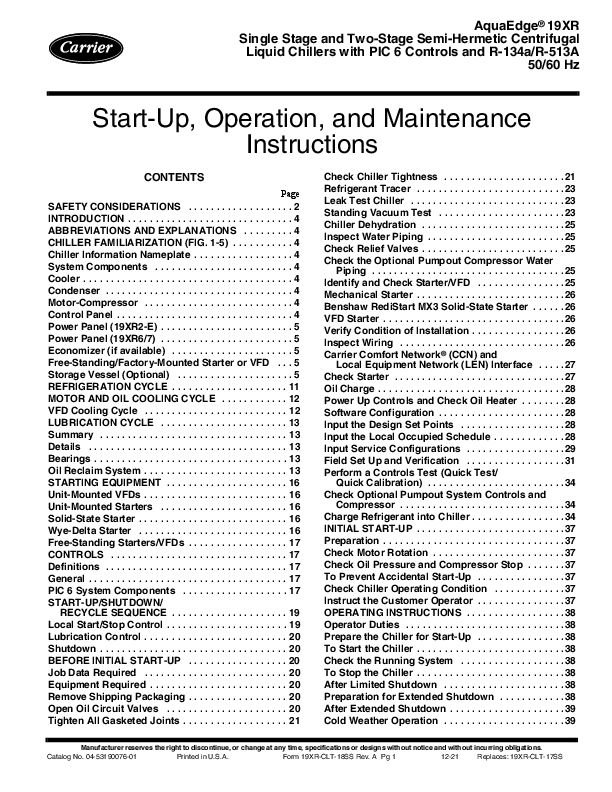
Start-Up, Operation, and Maintenance Instructions - Carrier
14 nov 2021 — SAFETY CONSIDERATIONS. Centrifugal liquid chillers are designed to provide safe and reli- able service when operated within design specifications. When.
19XR AquaEdge Single Stage and Two-Stage Semi-Hermetic Centrifugal Liquid Chillers with PIC 6 Controls and R-134a/R-513A, 50/60 Hz
What's New In Literature - HVACpartners
Full PDF Document

If the inline viewer fails, it will open the original document in compatibility mode automatically. You can also open the file directly.
Extracted Text
AquaEdge�19XR Single Stage and Two-Stage Semi-Hermetic Centrifugal Liquid Chillers with PIC 6 Controls and R-134a/R-513A 50/60 Hz Start-Up, Operation, and Maintenance Instructions CONTENTS Page SAFETY CONSIDERATIONS . . . . . . . . . . . . . . . . . . . 2 INTRODUCTION . . . . . . . . . . . . . . . . . . . . . . . . . . . . . . 4 ABBREVIATIONS AND EXPLANATIONS . . . . . . . . . 4 CHILLER FAMILIARIZATION (FIG. 1-5) . . . . . . . . . . . 4 Chiller Information Nameplate . . . . . . . . . . . . . . . . . . 4 System Components . . . . . . . . . . . . . . . . . . . . . . . . . 4 Cooler . . . . . . . . . . . . . . . . . . . . . . . . . . . . . . . . . . . . . . 4 Condenser . . . . . . . . . . . . . . . . . . . . . . . . . . . . . . . . . . 4 Motor-Compressor . . . . . . . . . . . . . . . . . . . . . . . . . . . 4 Control Panel . . . . . . . . . . . . . . . . . . . . . . . . . . . . . . . . 4 Power Panel (19XR2-E) . . . . . . . . . . . . . . . . . . . . . . . . 5 Power Panel (19XR6/7) . . . . . . . . . . . . . . . . . . . . . . . . 5 Economizer (if available) . . . . . . . . . . . . . . . . . . . . . . 5 Free-Standing/Factory-Mounted Starter or VFD . . . 5 Storage Vessel (Optional) . . . . . . . . . . . . . . . . . . . . . 5 REFRIGERATION CYCLE . . . . . . . . . . . . . . . . . . . . . 11 MOTOR AND OIL COOLING CYCLE . . . . . . . . . . . . 12 VFD Cooling Cycle . . . . . . . . . . . . . . . . . . . . . . . . . . 12 LUBRICATION CYCLE . . . . . . . . . . . . . . . . . . . . . . . 13 Summary . . . . . . . . . . . . . . . . . . . . . . . . . . . . . . . . . . 13 Details . . . . . . . . . . . . . . . . . . . . . . . . . . . . . . . . . . . . 13 Bearings . . . . . . . . . . . . . . . . . . . . . . . . . . . . . . . . . . . 13 Oil Reclaim System . . . . . . . . . . . . . . . . . . . . . . . . . . 13 STARTING EQUIPMENT . . . . . . . . . . . . . . . . . . . . . . 16 Unit-Mounted VFDs . . . . . . . . . . . . . . . . . . . . . . . . . . 16 Unit-Mounted Starters . . . . . . . . . . . . . . . . . . . . . . . 16 Solid-State Starter . . . . . . . . . . . . . . . . . . . . . . . . . . . 16 Wye-Delta Starter . . . . . . . . . . . . . . . . . . . . . . . . . . . 16 Free-Standing Starters/VFDs . . . . . . . . . . . . . . . . . . 17 CONTROLS . . . . . . . . . . . . . . . . . . . . . . . . . . . . . . . . 17 Definitions . . . . . . . . . . . . . . . . . . . . . . . . . . . . . . . . . 17 General . . . . . . . . . . . . . . . . . . . . . . . . . . . . . . . . . . . . 17 PIC 6 System Components . . . . . . . . . . . . . . . . . . . 17 START-UP/SHUTDOWN/ RECYCLE SEQUENCE . . . . . . . . . . . . . . . . . . . . . 19 Local Start/Stop Control . . . . . . . . . . . . . . . . . . . . . . 19 Lubrication Control . . . . . . . . . . . . . . . . . . . . . . . . . . 20 Shutdown . . . . . . . . . . . . . . . . . . . . . . . . . . . . . . . . . . 20 BEFORE INITIAL START-UP . . . . . . . . . . . . . . . . . . 20 Job Data Required . . . . . . . . . . . . . . . . . . . . . . . . . . 20 Equipment Required . . . . . . . . . . . . . . . . . . . . . . . . . 20 Remove Shipping Packaging . . . . . . . . . . . . . . . . . . 20 Open Oil Circuit Valves . . . . . . . . . . . . . . . . . . . . . . 20 Tighten All Gasketed Joints . . . . . . . . . . . . . . . . . . . 21 Check Chiller Tightness . . . . . . . . . . . . . . . . . . . . . . 21 Refrigerant Tracer . . . . . . . . . . . . . . . . . . . . . . . . . . .23 Leak Test Chiller . . . . . . . . . . . . . . . . . . . . . . . . . . . . 23 Standing Vacuum Test . . . . . . . . . . . . . . . . . . . . . . .23 Chiller Dehydration . . . . . . . . . . . . . . . . . . . . . . . . . .25 Inspect Water Piping . . . . . . . . . . . . . . . . . . . . . . . . . 25 Check Relief Valves . . . . . . . . . . . . . . . . . . . . . . . . . . 25 Check the Optional Pumpout Compressor Water Piping . . . . . . . . . . . . . . . . . . . . . . . . . . . . . . . . . . . 25 Identify and Check Starter/VFD . . . . . . . . . . . . . . . .25 Mechanical Starter . . . . . . . . . . . . . . . . . . . . . . . . . . .26 Benshaw RediStart MX3 Solid-State Starter . . . . . . 26 VFD Starter . . . . . . . . . . . . . . . . . . . . . . . . . . . . . . . . .26 Verify Condition of Installation . . . . . . . . . . . . . . . . .26 Inspect Wiring . . . . . . . . . . . . . . . . . . . . . . . . . . . . . .26 Carrier Comfort Network� (CCN) and Local Equipment Network (LEN) Interface . . . . .27 Check Starter . . . . . . . . . . . . . . . . . . . . . . . . . . . . . . .27 Oil Charge . . . . . . . . . . . . . . . . . . . . . . . . . . . . . . . . . .28 Power Up Controls and Check Oil Heater . . . . . . . .28 Software Configuration . . . . . . . . . . . . . . . . . . . . . . .28 Input the Design Set Points . . . . . . . . . . . . . . . . . . .28 Input the Local Occupied Schedule . . . . . . . . . . . . . 28 Input Service Configurations . . . . . . . . . . . . . . . . . .29 Field Set Up and Verification . . . . . . . . . . . . . . . . . .31 Perform a Controls Test (Quick Test/ Quick Calibration) . . . . . . . . . . . . . . . . . . . . . . . . .34 Check Optional Pumpout System Controls and Compressor . . . . . . . . . . . . . . . . . . . . . . . . . . . . . .34 Charge Refrigerant into Chiller . . . . . . . . . . . . . . . . .34 INITIAL START-UP . . . . . . . . . . . . . . . . . . . . . . . . . . .37 Preparation . . . . . . . . . . . . . . . . . . . . . . . . . . . . . . . . .37 Check Motor Rotation . . . . . . . . . . . . . . . . . . . . . . . .37 Check Oil Pressure and Compressor Stop . . . . . . .37 To Prevent Accidental Start-Up . . . . . . . . . . . . . . . .37 Check Chiller Operating Condition . . . . . . . . . . . . .37 Instruct the Customer Operator . . . . . . . . . . . . . . . .37 OPERATING INSTRUCTIONS . . . . . . . . . . . . . . . . . .38 Operator Duties . . . . . . . . . . . . . . . . . . . . . . . . . . . . .38 Prepare the Chiller for Start-Up . . . . . . . . . . . . . . . .38 To Start the Chiller . . . . . . . . . . . . . . . . . . . . . . . . . . .38 Check the Running System . . . . . . . . . . . . . . . . . . .38 To Stop the Chiller . . . . . . . . . . . . . . . . . . . . . . . . . . .38 After Limited Shutdown . . . . . . . . . . . . . . . . . . . . . . 38 Preparation for Extended Shutdown . . . . . . . . . . . .38 After Extended Shutdown . . . . . . . . . . . . . . . . . . . . .39 Cold Weather Operation . . . . . . . . . . . . . . . . . . . . . . 39 Manufacturer reserves the right to discontinue, or change at any time, specifications or designs without notice and without incurring obligations. Catalog No. 04-53190076-01 Printed in U.S.A. Form 19XR-CLT-18SS Rev. A Pg 1 12-21 Replaces: 19XR-CLT-17SS Manual Guide Vane Operation . . . . . . . . . . . . . . . . . 39 Refrigeration Log . . . . . . . . . . . . . . . . . . . . . . . . . . . . 39 PUMPOUT AND REFRIGERANT TRANSFER PROCEDURES . . . . . . . . . . . . . . . . . 39 Preparation . . . . . . . . . . . . . . . . . . . . . . . . . . . . . . . . . 39 Operating the Optional Pumpout Unit (Fig. 37) . . . 41 GENERAL MAINTENANCE . . . . . . . . . . . . . . . . . . . . 44 Refrigerant Properties . . . . . . . . . . . . . . . . . . . . . . . . 44 Adding Refrigerant . . . . . . . . . . . . . . . . . . . . . . . . . . 44 Adjusting the Refrigerant Charge . . . . . . . . . . . . . . 44 Refrigerant Leak Testing . . . . . . . . . . . . . . . . . . . . . 44 Leak Rate . . . . . . . . . . . . . . . . . . . . . . . . . . . . . . . . . . 44 Test After Service, Repair, or Major Leak . . . . . . . . 44 Repair the Leak, Retest, and Apply Standing Vacuum Test . . . . . . . . . . . . . . . . . . . . . 44 Checking Guide Vanes . . . . . . . . . . . . . . . . . . . . . . . 44 Trim Refrigerant Charge . . . . . . . . . . . . . . . . . . . . . . 44 WEEKLY MAINTENANCE . . . . . . . . . . . . . . . . . . . . . 47 Check the Lubrication System . . . . . . . . . . . . . . . . . 47 SCHEDULED MAINTENANCE . . . . . . . . . . . . . . . . . . 47 Service Ontime . . . . . . . . . . . . . . . . . . . . . . . . . . . . . 47 Inspect the Control Panel . . . . . . . . . . . . . . . . . . . . . 47 Changing Oil Filter . . . . . . . . . . . . . . . . . . . . . . . . . . 47 Oil Specification . . . . . . . . . . . . . . . . . . . . . . . . . . . . 47 Oil Changes . . . . . . . . . . . . . . . . . . . . . . . . . . . . . . . . 47 Refrigerant Filter . . . . . . . . . . . . . . . . . . . . . . . . . . . . 47 VFD Refrigerant Strainer (if equipped) . . . . . . . . . . 48 Oil Reclaim Filter . . . . . . . . . . . . . . . . . . . . . . . . . . . . 48 Inspect Refrigerant Float System . . . . . . . . . . . . . . 48 Inspect Relief Valves and Piping . . . . . . . . . . . . . . . 49 Compressor Bearing and Gear Maintenance . . . . . 49 Inspect the Heat Exchanger Tubes and Flow Devices . . . . . . . . . . . . . . . . . . . . . . . . . . . . . 49 Water Leaks . . . . . . . . . . . . . . . . . . . . . . . . . . . . . . . . 49 Water Treatment . . . . . . . . . . . . . . . . . . . . . . . . . . . . 49 Inspect the Starting Equipment or VFD . . . . . . . . . . 50 Recalibrate Pressure Transducers . . . . . . . . . . . . . 50 Optional Pumpout System Maintenance . . . . . . . . . 50 Ordering Replacement Chiller Parts . . . . . . . . . . . . 50 TROUBLESHOOTING GUIDE . . . . . . . . . . . . . . . . . . 51 Overview . . . . . . . . . . . . . . . . . . . . . . . . . . . . . . . . . . . 51 Checking Display Messages . . . . . . . . . . . . . . . . . . 51 Checking Temperature Sensors . . . . . . . . . . . . . . . 51 Checking Pressure Transducers . . . . . . . . . . . . . . . 55 High Altitude Locations . . . . . . . . . . . . . . . . . . . . . . 55 Quick Test . . . . . . . . . . . . . . . . . . . . . . . . . . . . . . . . . 55 Pumpdown/Lockout . . . . . . . . . . . . . . . . . . . . . . . . . 55 Physical Data . . . . . . . . . . . . . . . . . . . . . . . . . . . . . . . 55 APPENDIX A -- PIC 6 SCREEN AND TABLE STRUCTURE . . . . . . . . . . . . . . . . . . . . . . . . . . . . 109 APPENDIX B -- CCN COMMUNICATION WIRING FOR MULTIPLE CHILLERS (TYPICAL) . . . . . . . 111 APPENDIX C -- MAINTENANCE SUMMARY AND LOG SHEETS . . . . . . . . . . . . . . . . . . . . . . . 112 INDEX . . . . . . . . . . . . . . . . . . . . . . . . . . . . . . . . . . . . 115 INITIAL START-UP CHECKLIST FOR 19XR SEMI-HERMETIC TWO-STAGE CENTRIFUGAL LIQUID CHILLER . . . . . . . . . . . CL-1 SAFETY CONSIDERATIONS Centrifugal liquid chillers are designed to provide safe and reliable service when operated within design specifications. When operating this equipment, use good judgment and safety precautions to avoid damage to equipment and property or injury to personnel. Be sure you understand and follow the procedures and safety precautions contained in the chiller instructions as well as those listed in this guide. DANGER Failure to follow these procedures will result in severe personal injury or death. DO NOT VENT refrigerant relief valves within a building. Outlet from rupture disc or relief valve must be vented outdoors in accordance with the latest edition of ANSI/ ASHRAE 15 (American National Standards Institute/ American Society of Heating, Refrigerating, and AirConditioning Engineers). The accumulation of refrigerant in an enclosed space can displace oxygen and cause asphyxiation. PROVIDE adequate ventilation in accordance with ANSI/ ASHRAE 15, especially for enclosed and low overhead spaces. Inhalation of high concentrations of vapor is harmful and may cause heart irregularities, unconsciousness, or death. Misuse can be fatal. Vapor is heavier than air and reduces the amount of oxygen available for breathing. Product causes eye and skin irritation. Decomposition products are hazardous. DO NOT USE OXYGEN to purge lines or to pressurize a chiller for any purpose. Oxygen gas reacts violently with oil, grease, and other common substances. NEVER EXCEED specified test pressures; VERIFY the allowable test pressure by checking the instruction literature and the design pressures on the equipment nameplate. DO NOT USE air for leak testing. Use only refrigerant or dry nitrogen. DO NOT VALVE OFF any safety device. BE SURE that all pressure relief devices are properly installed and functioning before operating any chiller. RISK OF INJURY OR DEATH by electrocution. High voltage is present on motor leads even though the motor is not running when a solid-state or wye-delta mechanical starter is used. Open the power supply disconnect before touching motor leads or terminals. 2 WARNING Failure to follow these procedures may result in personal injury or death. DO NOT USE TORCH to remove any component. System contains oil and refrigerant under pressure. To remove a component, wear protective gloves and goggles and proceed as follows: 1. Shut off electrical power to unit. 2. Recover refrigerant to relieve all pressure from system using both high-pressure and low pressure ports. 3. Traces of vapor should be displaced with nitrogen and the work area should be well ventilated. Refrigerant in contact with an open flame produces toxic gases. 4. Cut component connection tubing with tubing cutter and remove component from unit. Use a pan to catch any oil that may come out of the lines and as a gage for how much oil to add to the system. 5. Carefully unsweat remaining tubing stubs when necessary. Oil can ignite when exposed to torch flame. DO NOT USE eyebolts or eyebolt holes to rig chiller sections or the entire assembly. DO NOT work on high-voltage equipment unless you are a qualified electrician. DO NOT WORK ON electrical components, including control panels, switches, starters, or oil heater until you are sure ALL POWER IS OFF and no residual voltage can leak from capacitors or solid-state components. LOCK OPEN AND TAG electrical circuits during servicing. IF WORK IS INTERRUPTED, confirm that all circuits are de-energized before resuming work. AVOID SPILLING liquid refrigerant on skin or getting it into the eyes. USE SAFETY GOGGLES. Wash any spills from the skin with soap and water. If liquid refrigerant enters the eyes, IMMEDIATELY FLUSH EYES with water and consult a physician. NEVER APPLY an open flame or live steam to a refrigerant cylinder. Dangerous overpressure can result. When it is necessary to heat refrigerant, use only warm (110�F [43�C]) water. DO NOT REUSE disposable (nonreturnable) cylinders or attempt to refill them. It is DANGEROUS AND ILLEGAL. When cylinder is emptied, evacuate remaining gas pressure, loosen the collar. and unscrew and discard the valve stem. DO NOT INCINERATE. CHECK THE REFRIGERANT TYPE before adding refrigerant to the chiller. The introduction of the wrong refrigerant can cause damage or malfunction to this chiller. Operation of this equipment with refrigerants other than those cited herein should comply with ANSI/ASHRAE 15 (latest edition). Contact Carrier for further information on use of this chiller with other refrigerants. DO NOT ATTEMPT TO REMOVE fittings, covers, etc., while chiller is under pressure or while chiller is running. Be sure pressure is at 0 psig (0 kPa) before breaking any refrigerant connection. CAREFULLY INSPECT all relief valves, rupture discs, and other relief devices AT LEAST ONCE A YEAR. If chiller operates in a corrosive atmosphere, inspect the devices at more frequent intervals. DO NOT ATTEMPT TO REPAIR OR RECONDITION any relief device when corrosion or build-up of foreign material (rust, dirt, scale, etc.) is found within the valve body or mechanism. Replace the device. DO NOT install relief devices in series or backwards. WARNING USE CARE when working near or in line with a compressed spring. Sudden release of the spring can cause it and objects in its path to act as projectiles. CAUTION Failure to follow these procedures may result in personal injury or damage to equipment. DO NOT STEP on refrigerant lines. Broken lines can whip about and release refrigerant, causing personal injury. DO NOT climb over a chiller. Use platform, catwalk, or staging. Follow safe practices when using ladders. USE MECHANICAL EQUIPMENT (crane, hoist, etc.) to lift or move inspection covers or other heavy components. Even if components are light, use mechanical equipment when there is a risk of slipping or losing your balance. BE AWARE that certain automatic start arrangements CAN ENGAGE THE STARTER, TOWER FAN, OR PUMPS. Open the disconnect ahead of the starter, tower fans, or pumps. CAUTION USE only repair or replacement parts that meet the code requirements of the original equipment. DO NOT VENT OR DRAIN waterboxes containing industrial brines, liquid, gases, or semisolids without the permission of your process control group. DO NOT LOOSEN waterbox cover bolts until the waterbox has been completely drained. DO NOT LOOSEN a packing gland nut before checking that the nut has a positive thread engagement. PERIODICALLY INSPECT all valves, fittings, and piping for corrosion, rust, leaks, or damage. PROVIDE A DRAIN connection in the vent line near each pressure relief device to prevent a build-up of condensate or rain water. DO NOT re-use compressor oil or any oil that has been exposed to the atmosphere. Dispose of oil per local codes and regulations. DO NOT leave refrigerant system open to air any longer than the actual time required to service the equipment. Seal circuits being serviced and charge with dry nitrogen to prevent oil contamination when timely repairs cannot be completed. 3 INTRODUCTION Prior to initial start-up of the 19XR unit, those involved in the start-up, operation, and maintenance should be thoroughly familiar with these instructions and other necessary job data. Procedures in this manual are arranged in the sequence required for proper chiller start-up and operation. This book also outlines the control system for those involved in the start-up, operation, and maintenance of the unit before performing startup procedures. It is intended to be used in combination with the 19XR Controls Operation and Troubleshooting manual that describes PIC 6 controls in detail. CAUTION UNIT DAMAGE HAZARD This unit uses a microprocessor-based electronic control system. Do not use jumpers or other tools to short out components or to bypass or otherwise depart from recommended procedures. Any short-to-ground of the control board or accompanying wiring may destroy the electronic modules or electrical components. CAUTION Do NOT punch holes or drill into the top surface of the starter enclosure for field wiring. Knockouts are provided for field wiring connections. CAUTION PROVIDE MACHINE PROTECTION. Store machine and starter indoors, protected from construction dirt and moisture and if required follow Carrier Long Term Storage guidelines. Inspect under shipping tarps, bags, or crates to be sure water has not collected during transit. Keep protective shipping covers in place until machine is ready for installation. CAUTION Be aware of electrostatic discharge (static electricity) when handling or making contact with circuit boards or module connections. Always touch a chassis (grounded) part to dissipate body electrostatic charge before working inside control center. Use extreme care when handling tools near boards and when connecting or disconnecting terminal plugs. Circuit boards can easily be damaged. Always hold boards by the edges and avoid touching components and connections. This equipment uses, and can radiate, radio frequency energy. If not installed and used in accordance with the instruction manual, it may cause interference to radio communications. The PIC 6 control boards have been tested and found to comply with the limits for a Class A computing device pursuant to International Standard in North America EN 61000-2/3 which are designed to provide reasonable protection against such interference when operated in a commercial environment. Operation of this equipment in a residential area is likely to cause interference, in which case the user, at his own expense, will be required to take whatever measures may be required to correct the interference. Always store and transport replacement or defective boards in anti-static shipping bag. CAUTION WHEN FLUSHING THE WATER SYSTEMS isolate the chiller from the water circuits to prevent damage to the heat exchanger tubes. ABBREVIATIONS AND EXPLANATIONS Frequently used abbreviations in this manual include: CCN ECDW ECW EMS HGBP HMI I/O ISM LCDW LCW LED OLTA PIC 6 RLA SCR TXV VFD -- Carrier Comfort Network� -- Entering Condenser Water -- Entering Chilled Water -- Energy Management System -- Hot Gas Bypass -- Human Machine Interface -- Input/Output -- Integrated Starter Module -- Leaving Condenser Water -- Leaving Chilled Water -- Light-Emitting Diode -- Overload Trip Amps -- Product Integrated Controls 6 -- Rated Load Amps -- Silicon Controlled Rectifier -- Thermostatic Expansion Valve -- Variable Frequency Drive Factory-installed additional components are referred to as options in this manual; factory-supplied but field-installed additional components are referred to as accessories. CHILLER FAMILIARIZATION (Fig. 1-5) Chiller Information Nameplate The information nameplate is located on the right side of the chiller control panel. System Components The components include cooler and condenser heat exchangers in separate vessels, motor-compressor, lubrication package, control panel/HMI, power panel, economizer, and motor starter or VFD. Cooler This vessel (also known as the evaporator) is located underneath the compressor. The cooler is maintained at lower temperature/pressure so evaporating refrigerant can remove heat from water flowing through its internal tubes. Condenser The condenser operates at a higher temperature/pressure than the cooler and has water flowing through its internal tubes in order to remove heat from the refrigerant. Motor-Compressor This component maintains system temperature and pressure differences and moves the heat- carrying refrigerant from the cooler to the condenser. The 19XR compressor frames 2, 3, 4, and 5 are single-stage compressors with one impeller. Frame C, E, 6, and 7 are two-stage compressors with two impellers. Control Panel The control panel includes the Carrier PIC 6 HMI touchscreen. It allows user interface for controlling the chiller. It regulates the chiller's capacity as required to maintain proper leaving chilled water temperature. The control panel: � registers cooler, condenser, and lubricating system pressures � shows chiller operating condition and alarm shutdown conditions � records the total chiller operating hours � sequences chiller start, stop, and recycle under micropro- cessor control � displays status of motor starter � provides access to other CCN (Carrier Comfort Network�) devices and energy management systems � supports languages that may be preinstalled at factory, in- cluding English, Chinese, Korean, Italian, Japanese, French, and German. 4 Power Panel (19XR2-E) The power panel contains oil heater and oil pump contactors, as well as the envelope control/HGBP relay if specified. The power panel also contains transformers T1/T2 for 24 VAC control power, as well as the low voltage starter interlock and communication terminals. Power Panel (19XR6/7) The control panel contains both power components for heaters, oil pump and electrical actuators as well as low voltage control components. They are separated by a barrier. Economizer (if available) This chamber reduces the refrigerant pressure to an intermediate level between the cooler and condenser vessels. In the economizer, vapor is separated from liquid, the separated vapor flows to the second stage of the compressor, and the liquid flows into the cooler. The energy removed from the vaporized refrigerant in the economizer allows the liquid refrigerant in the cooler to absorb more heat when it evaporates and benefits the overall cooling efficiency cycle. Free-Standing/Factory-Mounted Starter or VFD The starter or VFD allows for the proper start and disconnect of electrical energy for the compressor-motor, oil pump, oil heater, and control panel. Storage Vessel (Optional) There are 2 sizes of storage vessels available. The vessels have double relief valves, a magnetically-coupled dial-type refrigerant level gage, a 1 in. FPT drain valve, and a 1/2-in. male flare vapor connection for the pumpout unit. NOTE: If a storage vessel is not used at the jobsite, factory installed isolation valves on the chiller may be used to isolate the chiller charge in either the cooler or condenser. An optional pumpout system is used to transfer refrigerant from vessel to vessel. 5 19XR� 52 51 3 8 H UG T* 64 Description 19XR -- High Efficiency Semi-Hermetic Centrifugal Liquid Chiller 19XRV -- High Efficiency Semi-Hermetic Centrifugal Liquid Chiller with Unit-Mounted VFD Evaporator Size 10-12 (Frame 1) 15-17 (Frame 1) 20-22 (Frame 2) 30-32 (Frame 3) 35-37 (Frame 3) 40-42 (Frame 4) 45-47 (Frame 4) 50-54 (Frame 5) 5A-5C (Frame 5)** 55-59 (Frame 5) 5F-5H (Frame 5)** 5K-5R (Frame 5) 5T-5Z (Frame 5) 60-64 (Frame 6) 6K-6R (Frame 6) 65-69 (Frame 6) 6T-6Z (Frame 6) 70-74 (Frame 7) 7K-7R (Frame 7) 75-79 (Frame 7) 7T-7Z (Frame 7) 80-84 (Frame 8) 8K-8R (Frame 8) 85-89 (Frame 8) 8T-8Z (Frame 8) Condenser Size 10-12 (Frame 1) 15-17 (Frame 1) 20-22 (Frame 2) 30-32 (Frame 3) 35-37 (Frame 3) 40-42 (Frame 4) 45-47 (Frame 4) 50-54 (Frame 5) 55-59 (Frame 5) 60-64 (Frame 6) 65-69 (Frame 6) 70-74 (Frame 7) 75-79 (Frame 7) 80-84 (Frame 8) 85-89 (Frame 8) * Digit 15 will refer to the Gear Code for the following models: 1. Digit 10 (Compressor Frame) is C or E. 2. Digit 10 (Compressor Frame) is 3 and Digit 13 of the Motor Code is U. Frame sizes 1 through 6 available on single-stage units only. ** Refer to 19XR,XRV Computer Selection Program for details on these sizes. Frame sizes with K-R and T-Z are with 1-in. OD evaporator tubing. *** Refer to the 19XR,XRV Computer Selection Program for motor size details. Special Order Indicator � -- Standard S -- Special Order Motor Voltage Code Code Volts-Phase-Hertz 60 -- 200-3-60 61 -- 230-3-60 62 -- 380-3-60 63 -- 416-3-60 64 -- 460-3-60 65 -- 575-3-60 66 -- 2400-3-60 67 -- 3300-3-60 68 -- 4160-3-60 69 -- 6900-3-60 50 -- 230-3-50 52 -- 400-3-50 53 -- 3000-3-50 54 -- 3300-3-50 55 -- 6300-3-50 5A -- 10000-3-50 5B -- 11000-3-50 6A -- 11000-3-60 6B -- 11000-3-60 6C -- 13800-3-60 Motor Efficiency Code Compressor Frame 2, 3, 4, 5 H -- High Efficiency S -- Standard Efficiency Gear Code Compressor Frame C C,E,G,J,M,P -- Gear Ratio Compressor Frame E A,B,C,D,E-- A-E Gear Ratio Compressor Frame 3, U Motor R,S,T,U,V,W-- R-W Gear Ratio Motor Code*** Impeller Diameter Impeller Shroud Compressor Frame 2, 3, 4, 5 -- Single-Stage C, E -- Two-Stage Fig.1--19XR,XRV Single-stage Compressor and Two-stage Compressor Frame Size C and E 6 19XR� A45 A47 636 M N Description 19XR -- High Efficiency Semi-Hermetic Centrifugal Liquid Chiller Evaporator Size Code (Digits 6, 7, 8) A40-A42 A45-A47 A4A-A4C* A4F-A4H* A60-A62 A65-A67 A6A-A6C* A6F-A6H* B60-B62 B65-B67 B80-B82 B85-B87 B6A-B6C* B6F-B6H* B8A-B8C* B8F-B8H* C60-C62 C65-C67 C80-C82 C85-C87 C6A-C6C* C6F-C6H* C8A-C8C* C8F-C8H* Condenser Size Code (Digits 9, 10, 11) A40-A42 A45-A47 A4A-A4C* A4F-A4H* A60-A62 A65-A67 A6A-A6C* A6F-A6H* B40-B42 B45-B47 B4A-B4C* B4F-B4H* B60-B62* B65-B67* B6A-B6C* B6F-B6H* C60-C62 C65-C67 C80-C82 C85-C87 C6A-C6C* C6F-C6H* C8A-C8C* C8F-C8H* D60-D62 D65-D67 D80-D82 D85-D87 D6A-D6C* D6F-D6H* D8A-D8C* D8F-D8H* * Frame sizes with A-C and F-H are with 1-in. OD tubing. Heat exchanger available with frame 7 compressor only. Week of Year 7 Special Order Indicator � -- Standard S -- Special Order Motor Voltage Code Code Volts-Phase-Hertz 2 -- 400-3-50 (19XR6 only) 4 -- 3000-3-50 5 -- 3300-3-50 6 -- 6300-3-50 7 -- 10000-3-50 8 -- 11000-3-50 A -- 380-3-60 (19XR6 only) C -- 460-3-60 (19XR6 only) E -- 2400-3-60 F -- 3300-3-60 G -- 4160-3-60 H -- 6900-3-60 J -- 11000-3-60 K -- 13800-3-60 Motor Size Code Compressor Frame Size 6 N -- 1500 HP P -- 1625 HP Q -- 1750 HP R -- 1875 HP S -- 2000 HP T -- 2100 HP Compressor Frame Size 7 U -- 2250 HP V -- 2375 HP W -- 2500 HP X -- 2625 HP Y -- 2750 HP Z -- 2900 HP Gear Code Compressor Frame Size 6 E J M P Compressor Frame Size 7 R T V X Y Compressor Size Code Frame Size (12th Digit) 6 -- Frame Size 6 7 -- Frame Size 7 Shroud Size (13th Digit) 1 (Frame Size 7 Only) 2 3 4 5 (Frame 7 Only) Impeller Diameter (14th Digit) 2 4 6 8 0 SERIAL NUMBER BREAKDOWN 27 18 Q 19843 Unique Number Year of Manufacture Place of Manufacture Fig.2--19XR Two-Stage Compressor Frame Size 6 and 7 7 FRONT VIEW 15 14 12 13 11 10 9 8 7 1 2 3 4 LEGEND 1 -- Guide Vane Actuator 2 -- Suction Elbow 3 -- Chiller Identification Nameplate 4 -- Condenser Dual Relief Valves 5 -- Condenser In/Out Temperature Thermistors 6 -- Evaporator In/Out Temperature Thermistors 7 -- Evaporator Pressure Transducer 8 -- Refrigerant Storage Tank Connection 9 -- Control Panel 10 -- Carrier Controller HMI 11 -- Oil Drain/Charger Valve 12 -- Oil Level Sightglass 13 -- Power Panel 14 -- Refrigerant Oil Cooler (not shown) 15 -- Compressor Motor Housing 5 6 REAR VIEW 16 17 LEGEND 16 -- Evaporator Relief Valve 17 -- Refrigerant Charging Valve 18 -- Motor Sightglass 19 -- ASME Nameplates 20 -- Starter/VFD 21 -- Discharge Isolation Valve (Optional) 22 -- Refrigerant Charging Valve/ Pump Out Connection 18 22 21 20 19 Fig.3--19XR,XRV Single-Stage Compressor, Frame Size 2, 3, 4, 5 8 FRONT VIEW 17 18 2 1 3 16 15 14 13 12 11 10 9 8 7 6 5 LEGEND 1 -- Suction Elbow 2 -- Chiller Identification Nameplate 3 -- Condenser Auto Reset Relief Valves 4 -- Condenser In/Out Temperature Thermistors 5 -- Evaporator In/Out Temperature Thermistors 6 -- Refrigerant Storage Tank Connection Valve (barely visible) 4 7 -- Evaporator Pressure Transducer 8 -- Liquid Line Isolation Valve (optional) 9 -- Typical Flange Connection 10 -- Refrigerant Isolation Valve 11 -- Control Panel (PIC 6) 12 -- Guide Vane Actuator 13 -- Oil Level Sight Glasses 14 -- Oil Drain Charging Valve 15 -- Auxiliary Power Panel 16 -- Refrigerant Oil Evaporator (hidden) 17 -- Compressor Motor Housing REAR VIEW 33 34 18 19 32 31 30 29 27 28 26 25 24 LEGEND 18 -- Refrigerant Charging Valve/Pumpout Connection 19 -- Damper Valve 20 -- Evaporator Auto. Reset Relief Valves 20 21 -- Solid-State Starter Control Display (optional) 22 -- Motor Sight Glass 23 -- Evaporator Return-End Waterbox Cover 24 -- ASME Nameplate 21 25 -- Vessel Take-Apart Connector 26 -- Typical Waterbox Drain Port 27 -- Condenser Return-End Waterbox Cover 28 -- Refrigerant Moisture/Flow Indicator (hidden) 29 -- Refrigerant Filter/Drier (hidden) 30 -- Linear Float Valve Chamber Orifice 31 -- Economizer Assembly 32 -- Discharge Isolation Valve (optional) 33 -- Economizer Float Ball Valve Assembly (far end of economizer assembly) 34 -- Condenser Pressure Transducer 22 23 Fig.4--19XR,XRV Two-Stage Compressor Frame Size C and E 9 FRONT VIEW 15 LEGEND 1 23 4 1 -- Guide Vane Actuator* 2 -- Suction Elbow 3 -- Chiller Identification Nameplate 4 -- Auxiliary Power Panel 5 5 -- Condenser Auto. Reset Relief Valves 6 -- Condenser Return End Waterbox Cover 7 -- Evaporator Return End Waterbox Cover 8 -- Evaporator Auto. Reset Relief Valves 9 -- Evaporator Pressure Transducer 6 10 -- Liquid Line Isolation Valve (Optional) 11 -- Refrigerant Storage Tank Connection Valve 12 -- HMI (Human Machine Interface) Panel 13 -- Typical Flange Connection 14 -- Oil Level Sight Glasses 15 -- Compressor Motor Housing *See certified drawing for Frame 7 location. 14 13 12 11 10 9 REAR VIEW 8 7 31 32 30 33 34 29 28 27 26 25 24 16 17 21 LEGEND 16 -- Oil Evaporator 18 17 -- Oil Drain Changing Valve (Hidden) 18 -- Motor Sight Glass 19 -- Evaporator In/Out Temperature Thermistors 20 -- Typical Waterbox Drain Port 21 -- Vessel Take-Apart Connector 22 -- Condenser In/Out Temperature Thermistors 23 -- ASME Nameplate 24 -- Refrigerant Moisture/Flow Indicator 25 -- Refrigerant Filter/Drier 26 -- High Side Float Chamber 27 -- High Side Float Ball Valve Assembly (Inside) 28 -- Economizer Assembly 19 29 -- Economizer Float Ball Assembly (Inside) 30 -- Evaporator Auto. Reset Relief Valve 31 -- Condenser Pressure Transducer 32 -- Refrigerant Charging Valve/Pumpout Connection 33 -- Damper Valve 20 34 -- Discharge Isolation Valve (Optional) 23 22 NOTE: Frame 6 is shown. Fig.5--19XR Two-Stage Compressor Frame Sizes 6 and 7 10 REFRIGERATION CYCLE The compressor continuously draws refrigerant vapor from the cooler at a rate set by the amount of guide vane opening and motor speed. As the compressor suction reduces the pressure in the cooler, the remaining refrigerant boils at a fairly low temperature (typically 38 to 42�F [3 to 6�C]). The energy required for boiling is obtained from the water flowing through the cooler tubes. With heat energy removed, the water becomes cold enough to use in an air conditioning circuit or for process liquid cooling. After taking heat from the water, the refrigerant vapor is compressed. Compression adds still more heat energy, and the refrigerant is quite warm (typically 98 to 102�F [37 to 40�C]) when it is discharged from the compressor into the condenser. Relatively cool (typically 65 to 90�F [18 to 32�C]) water flowing into the condenser tubes removes heat from the refrigerant and the vapor condenses to liquid. The liquid refrigerant passes through orifices into the FLASC (Flash Subcooler) chamber (Fig. 6 and 7). Since the FLASC chamber is at a lower pressure, part of the liquid refrigerant flashes to vapor, thereby cooling the remaining liquid. The FLASC vapor is re-condensed on the tubes which are cooled by entering condenser water. The liquid drains into a float valve chamber between the FLASC chamber and cooler. Here the AccuMeterTM float valve forms a liquid seal to keep FLASC chamber vapor from entering the cooler. When liquid refrigerant passes through the valve, some of it flashes to vapor in the reduced pressure on the cooler side. In flashing, it removes heat from the remaining liquid. The refrigerant is now at a temperature and pressure at which the cycle began. Refrigerant from the condenser also cools the oil and optional variable speed drive. The refrigeration cycle for a 19XRV chiller with two-stage compressor is similar to the one described above, with the following exception: Liquid refrigerant from the condenser FLASC chamber linear float valve or orifice plate flows into an economizer at intermediate pressure (see Fig. 7). As liquid enters the chamber, due to the lower pressure in the economizer, some liquid flashes into a vapor and cools the remaining liquid. The separated vapor flows to the second stage of the compressor for greater cycle efficiency. A damper valve located on the economizer line to the compressor acts as a pressure regulating device to stabilize low load, low condensing pressure operating conditions. The damper will back up gas flow and thereby raise the economizer pressure to permit proper refrigerant flow through the economizer valve during those conditions. The damper also is closed during start-up conditions to allow the second stage impeller to start unloaded. The subcooled liquid remaining in the economizer flows through a float valve and then into the cooler. Fig.6--RefrigerationCycle--19XR(V)Single-StageCompressor a191550tf 11 Fig.7--RefrigerationCycle--19XR(V)Two-StageCompressor MOTOR AND OIL COOLING CYCLE The motor and the lubricating oil are cooled by liquid refrigerant taken from the bottom of the condenser vessel (Fig. 8 and 9). Refrigerant flow is maintained by the pressure differential that exists due to compressor operation. After the refrigerant flows past an isolation valve, an in-line filter, and a sight glass/moisture indicator, the flow is split between the motor cooling and oil cooling systems. CAUTION To avoid adverse effects on chiller operation, consideration must be made to condenser water temperature control. For steady state operation, the minimum operating refrigerant pressure differential between cooler and condenser is approximately 20 psi (138 kPa) with a maximum evaporator refrigerant temperature of 65�F (18�C). Consult Chiller Builder for required steady state operational limits. Inverted start conditions are acceptable for short durations of time, but for periods exceeding 5 minutes, a special control solution strategy should be used to allow the chiller to establish a minimum refrigerant pressure differential, and thereby adequate equipment cooling. Flow to the motor cooling system passes through an orifice and into the motor. Once past the orifice, the refrigerant is directed over the motor by spray nozzles. The refrigerant collects in the bottom of the motor casing and is then drained back into the cooler through the motor refrigerant drain line. An orifice (in the motor shell) maintains a higher pressure in the motor shell than in the cooler. The motor is protected by a temperature sensor embedded in the stator windings. An increase in motor winding temperature past the motor override set point overrides the temperature capacity control to hold, and if the motor temperature rises 10F (5.5C) above this set point, the controls close the inlet guide vanes. If the temperature rises above safety limit, the compressor shuts down. Refrigerant that flows to the oil cooling system is regulated by expansion valves. The expansion valves regulate flow into the oil/refrigerant plate and frame-type heat exchanger (the oil cooler in Fig. 8), and control oil temperature to the bearings. The refrigerant leaving the oil cooler heat exchanger returns to the chiller cooler. VFD Cooling Cycle If equipped with a refrigerant-cooled unit-mounted VFD, the refrigerant line that feeds the motor cooling and oil cooler also feeds the heat exchanger on the unit-mounted VFD. Refrigerant is metered through an orifice as refrigerant is leaving the VFD heat exchanger. The refrigerant leaving the heat exchanger returns to the cooler. Alternatively, if equipped with an aircooled unit-mounted VFD the cooling of the VFD is integral to the VFD by means of cooling with ambient air. 12 LUBRICATION CYCLE Summary The oil pump, oil filter, and oil cooler make up a package located partially in the transmission casing of the compressor-motor assembly. The oil is pumped into a filter assembly to remove foreign particles and is then forced into an oil cooler heat exchanger where the oil is cooled to proper operational temperatures. After the oil cooler, part of the flow is directed to the gears and the high speed shaft bearings; the remaining flow is directed to the motor shaft bearings. Oil drains into the transmission oil sump to complete the cycle (Fig. 8 and 9). Details Oil is charged into the lubrication system through a hand valve. Two sight glasses in the oil reservoir permit oil level observation. Normal oil level is between the middle of the upper sight glass and the top of the lower sight glass when the compressor is shut down. The oil level should be visible in at least one of the 2 sight glasses during operation. Oil sump temperature is displayed on the HMI default screen. During compressor operation, the oil sump temperature ranges between 125 and 165F (52 and 74C). The oil pump suction is fed from the oil reservoir. An oil pressure relief valve maintains differential pressure in the system at the pump discharge. A range of 18 to 40 psid (124 to 172 kPad) is normal. This differential pressure can be read directly from the default HMI screen. The oil pump discharges oil to the oil filter assembly. This filter can be closed to permit removal of the filter without draining the entire oil system. The oil is then piped to the oil cooler heat exchanger. The oil cooler uses refrigerant from the condenser as the coolant. The refrigerant cools the oil to a temperature between 120 and 140F (49 and 60C). As the oil leaves the oil cooler, it passes the oil pressure transducer and the sensor for the refrigerant expansion valve on the oil cooler. The oil is then divided. Part of the oil flows to the thrust bearing, forward pinion bearing, and gear spray. The rest of the oil lubricates the motor shaft bearings and the rear pinion bearing. The oil temperature is measured in the bearing housing as it leaves the bearings. The oil then drains into the oil reservoir at the base of the compressor. The control measures the temperature of the oil in the sump and maintains the temperature during shutdown. This temperature is read on the HMI default screen. See the Controls Operation and Troubleshooting Manual for details. During the chiller start-up, the oil pump is energized and provides 40 seconds of lubrication to the bearings after pressure is verified before starting the compressor. During shutdown, the oil pump runs for 60 seconds to ensure lubrication as the compressor coasts to a stop. Ramp loading can be adjusted to help to slow the rate of guide vane opening to minimize oil foaming at start-up. If the guide vanes open quickly, the sudden drop in suction pressure can cause any refrigerant in the oil to flash. The resulting oil foam cannot be pumped efficiently; therefore, oil pressure falls off and lubrication is poor. If oil pressure falls below 15 psid (103 kPad) differential, the controls will shut down the compressor. The oil pump is a gerotor-style pump with external filters. A gerotor pump has two rotors, one inside the other; their center points are offset with respect to each other. This type of pump provides a smooth continuous flow. It is also quieter than other designs. See Fig. 10 and 11. Bearings The 19XR compressor assemblies include a combination of radial and thrust bearings. The low speed shaft assembly is supported by two journal bearings. For 19XR2-E the bearings are located between the motor rotor and the bull gear -- overhung rotor design. The 19XR6-7 is fully supported with bearings located on each end of the low speed shaft. The bearing closer to the bull gear includes a smaller babbitted thrust face, designed to handle axial forces. For Frame 2 19XR compressors the high speed shaft assembly is supported by two journal bearings located at the transmission end and mid-span, behind the labyrinth seal. The transmission side of the midspan bearing also contains a tilting shoe type thrust bearing which opposes the main axial forces tending to pull the impeller towards the suction end. The impeller side face of the midspan bearing includes a babbitted thrust face, designed to handle counter-thrust forces. For 19XR Frame 3, 4, 5, C, E, 6 and 7 compressors the high speed shaft assembly utilize rolling element bearings (radial and thrust). Machines employing rolling element bearings can be expected to have higher oil pressure and thrust bearing temperatures than those compressors using journal bearing design. Oil Reclaim System The oil reclaim system returns oil lost from the compressor housing back to the oil reservoir by recovering the oil from 2 areas on the chiller. The guide vane housing is the primary area of recovery. Oil is also recovered by skimming it from the operating refrigerant level in the cooler vessel. PRIMARY OIL RECOVERY MODE Oil is normally recovered through the guide vane housing on the chiller. This is possible because oil is normally entrained with refrigerant in the chiller. As the compressor pulls the refrigerant up from the cooler into the guide vane housing to be compressed, the oil normally drops out at this point and falls to the bottom of the guide vane housing where it accumulates. Using discharge gas pressure to power an eductor, the oil is drawn from the housing and is discharged into the oil reservoir. SECONDARY OIL RECOVERY METHOD The secondary method of oil recovery is significant under light load conditions, when the refrigerant going up to the compressor suction does not have enough velocity to bring oil along. Under these conditions, oil collects in a greater concentration at the top level of the refrigerant in the cooler. Using discharge gas to power eductors, this oil and refrigerant mixture is skimmed from the side of the cooler and is then drawn up to the guide vane housing. There is a filter in this line. Because the guide vane housing pressure is much lower than the cooler pressure, the refrigerant boils off, leaving the oil behind to be collected by the primary oil recovery method. 13 REAR MOTOR BEARING FWD MOTOR BEARING OIL SUPPLY TO FORWARD HIGH SPEED BEARING LABYRINTH GAS LINE MOTOR COOLING LINE REAR HIGH SPD BRG OIL FILTER FLOW OIL PRESS REGULATOR TXV BULB ISOLATION PRESSURE VALVES TRANSDUCER OIL COOLER OIL PUMP AND MOTOR OIL HEATER EDUCTORS SIGHT GLASS Fig.8--19XR2-E Compressor Lubrication System 10 1 STRAINERS SIGHT GLASS FILTER OIL SKIMMER LINE COOLER 2 3 9 4 5 OIL LINE VENT LINE 6 7 8 LEGEND 1 -- Motor Stator 6 -- Oil Heater 2 -- Impellers 7 -- Oil Pump 3 -- Variable Inlet Guide Vanes 8 -- Oil Filters 4 -- Transmission 9 -- Motor Rotor 5 -- High Speed Shaft Bearings 10 -- Motor Shaft Bearings Fig.9--19XR6-7 Compressor Lubrication System 14 LEGEND 1 -- Gerotor Oil Pump 2 -- Isolation Valve 3 -- Oil Pressure Regulator Valve 4 -- Oil Sump Pressure Transducer 5 -- Oil Sump Drain 6 -- Bearing Temperature Sensor Terminal Block 7 -- Oil Heater 1 2 4 6 5 7 3 Fig.10--19XR2-E Gerotor Oil Pump LEGEND 1 -- Gerotor Oil Pump a19-2116 2 -- Oil Pressure Regulator Valve 3 -- Oil Sump Pressure Transducer 4 -- Oil Sump Drain Valve 5 -- High Speed Compressor End Bearing and Low Speed Compressor End Bearing (Terminal Box #2) 6 -- Low Speed Compressor End Bearing and High Speed Motor End Bearing (Terminal Box #1) 7 -- Compressor Oil Sump Temperature 8 -- Oil Heater 3 1 2 5 8 76 4 Fig.11--19XR6-7 Gerotor Oil Pump 15 STARTING EQUIPMENT The 19XR chiller requires a motor starter or VFD to operate the centrifugal hermetic compressor motor. The starter or VFD have communication wiring between itself and Carrier power panel (19XR2-E) or Carrier control panel (19XR6-7). See Carrier's specifications for specific starter/VFD requirements. All starters/VFDs must meet these specifications in order to properly start and satisfy mechanical safety requirements. There may be multiple circuit breakers inside the starter. These include the main compressor motor circuit breaker, a circuit breaker which provides power to the chiller control panel, and a possible circuit breaker for starter specific controls. The control breaker(s) are typically wired in parallel with the first so that power is provided to those services when the main breaker is open. The disconnect switch on the starter front cover is connected to the main breaker. For 19XR2-E units it is typical that the starter provides control power and if specified 3-phase power to the oil pump (for medium/high voltage there is an option for a transformer). For 19XR6-7 it is typical that 3-phase power is field supplied to the Carrier control panel which powers oil-pump, heater and controls. Consult specific wiring diagrams for details. WARNING The main circuit breaker on the front of the starter/VFD disconnects the main motor power only. Power may be still energized for other circuits. Always check wiring diagrams before initiating any work on the chiller and follow applicable lock-out/tag-out procedures. Failure to disconnect power will result in personal injury. Unit-Mounted VFDs The 19XR2-E starter options include a variable frequency drive motor controller mounted on the condenser. These unitmounted VFDs are offered with low voltage motors between 380 and 575 vac. It reduces the starting current inrush by controlling the voltage and frequency to the compressor motor. Once the motor has accelerated to minimum speed, the PIC 6 modulates the compressor speed and guide vane position to control chilled water temperature. Operational parameters and fault codes are displayed relative to the drive. Refer to specific drive literature along with troubleshooting sections (consult VFD nameplate on inside of door if uncertain of drive model). The display is also the interface for entering specific chiller operational parameters. These parameters have been preprogrammed at the factory. An adhesivebacked label on the inside of the drive has been provided for verification of the specific job parameters. See Initial Start-Up Checklist section for details. NOTE: The factory offers a variety of unit-mounted VFDs. LiquiFlo2 is an active front end drive while PowerFlex 755, VLT HVAC FC-102, and PowerFlex 700L are 6-pulse passive rectifier drives. Consult Carrier Specification Z-420 and Z-417 respectively, along with drive-specific literature for details. Unit-Mounted Starters The 19XR2-E chiller offers unit-mounted wye-delta and solid state starters. See Carrier Specification Z-415 for specific starter requirements. Typically three separate circuit breakers are inside the starter. This includes (1) the main compressor motor circuit breaker, (2) a circuit breaker which provides power to chiller controls and the oil heater (provided at 115 vac), and (3) a circuit breaker which provides power at line voltage to the oil pump. The latter two are typically wired in parallel with the first so that power is provided to those services when the main breaker is open. The disconnect switch on the starter front cover is connected to the main breaker. Solid-State Starter WARNING The main circuit breaker on the front of the starter disconnects the main motor power only. Power is still energized for two other circuits. Two additional circuit breakers inside of the starter must be turned off to disconnect power to the oil pump, PIC 6 controls, and the oil heater. Failure to disconnect power will result in personal injury. The 19XR chiller may be equipped with a solid-state, reduced voltage starter. This starter's primary function is to provide onoff control of the compressor motor. This type of starter reduces the peak starting torque, controls the motor inrush current, and decreases mechanical shock. This capability is summed up by the phrase "soft starting." Consult E-Cat for full information about starter offerings. The solid-state starter manufacturer's name is located inside the starter access door. A solid-state, reduced-voltage starter operates by reducing the starting voltage. The starting torque of a motor at full voltage is typically 125% to 175% of the running torque. When the voltage and the current are reduced at start-up, the starting torque is reduced as well. The object is to reduce the starting voltage to adjust the voltage necessary to develop the torque required to get the motor moving. The voltage is reduced by silicon controlled rectifiers (SCRs). The voltage and current are then ramped up in a desired period of time. Once full voltage is reached, a bypass contactor is energized to bypass the SCRs. WARNING When voltage is supplied to the solid-state circuitry (CB1 is closed), the heat sinks in the starter as well as the wires leading to the motor and the motor terminal are at line voltage. Do not touch the heat sinks, power wiring, or motor terminals while voltage is present or serious injury will result. The display on the front of the solid-state or wye-delta starter is useful for troubleshooting and starter checkout. The display indicates: � line voltage � control voltage status � power indication � proper phasing for rotation � start circuit energized � ground fault � current unbalance � run state Wye-Delta Starter The 19XR chiller may be equipped with a wye-delta starter mounted on the unit. This starter is used with low-voltage motors (under 600 v). It reduces the starting current inrush by connecting each phase of the motor windings into a wye configuration. This occurs during the starting period when the motor is accelerating up to speed. Once the motor is up to speed, the starter automatically connects the phase windings into a delta configuration. When connected in delta the currents through the motor windings is 1/(3) (57.7%) of line current. Additional information about current unit-mounted starters can be located as follows: Benshaw MX3 Low Voltage Solid-State Starter Manual HVACPartners Form Number = 890003-06-01 Benshaw MX3 Low Voltage Wye-Delta Starter Manual HVACPartners Form Number = 890003-07-02 16 Free-Standing Starters/VFDs In addition to unit-mounted starters the 19XR product line offers free-standing starter types of Across the Line, Solid State, Auto-Transformer and VFD. 19XR6-7 are only offered with free-standing starters/VFDs. For free-standing starters/VFDs refer to job submittal drawings. CONTROLS Definitions ANALOG SIGNAL An analog signal varies in proportion to the monitored source. It quantifies values between operating limits. (Example: A temperature sensor is an analog device because its resistance changes in proportion to the temperature, generating many values.) DISCRETE SIGNAL A discrete signal is a 2-position representation of the value of a monitored source. (Example: A switch produces a discrete signal indicating whether a value is above or below a set point or boundary by generating an on/off, high/low, or open/closed signal.) General The 19XR centrifugal liquid chiller contains a microprocessorbased control center that monitors and controls all operations of the chiller. The microprocessor control system matches the cooling capacity of the chiller to the cooling load while providing state-of-the-art chiller protection. The system controls cooling load within the set point plus the deadband by sensing the leaving chilled water or brine temperature and regulating the inlet guide vane via a mechanically linked actuator motor. The guide vane is a variable flow pre-whirl assembly that controls the refrigeration effect in the cooler by regulating the amount of refrigerant vapor flow into the compressor. An increase in guide vane opening increases capacity. A decrease in guide vane opening decreases capacity. Additionally if a unit is equipped with VFD then the controller will control both compressor speed and guide vane for optimum efficiency at a particular load. The microprocessor-based control center protects the chiller by monitoring the digital and analog inputs and executing capacity overrides or safety shutdowns, if required. PIC 6 System Components The chiller control system is called the PIC 6 (Product Integrated Control 6). See Table 1. As with previous PIC versions, the PIC 6 system controls the operation of the chiller by monitoring all operating conditions. The PIC 6 control system can diagnose a problem and let the operator know what the problem is and what to check. It positions the guide vanes to maintain leaving chilled water temperature. It interfaces with auxiliary equipment such as pumps and cooling tower fans to turn them on when required. It continually checks all safeties to prevent unsafe operating conditions. It also regulates the oil heater while the compressor is off and regulates the envelope control (HGBP) and any other automatic valves, if installed. The PIC 6 controls provide critical protection for the compressor motor and control the motor starter. Table1--Major PIC 6 Components and Panel Locations PIC 6 COMPONENT Chiller Human Machine Interface (HMI) and Display Integrated Starter Module (ISM) Motor Starter Protection Module (e.g ISM, MX3 or drive control) Chiller IO Boards and Field Wiring Terminal Blocks Oil Heater Contactor (1C) Oil Pump Contactor (2C) Hot Gas Bypass Relays (HCLR, HOPR) (Optional) Control Transformers (T1, T2, T3) Temperature Sensors Pressure Transducers PANEL LOCATION HMI Control Panel Starter Cabinet Starter/VFD dependent Control Panel 19XR2-E; Power Panel 19XR6-7: Control Panel 19XR2-E; Power Panel 19XR6-7: Control Panel 19XR2-E; Power Panel 19XR6-7: Control Panel 19XR2-E; Power Panel 19XR6-7: Control Panel See Fig. 12 and Fig. 13 See Fig. 12 and Fig. 13 NOTE: For detailed information about the PIC 6 HMI (human machine interface), see the 19XR with PIC 6 Controls Operation and Troubleshooting manual. 17 Fig.12--Chiller Controls and Sensor Locations OIL RECLAIM SIGHT GLASS DIFFUSER PRESSURE AND DIFFUSER ACTUATOR CABLE (FRAME 4 & 5 COMPRESSOR ONLY) GUIDE VALVE ACTUATOR CABLE MOTOR TEMPERATURE SENSOR CABLE COMPRESSOR OIL DISCHARGE PRESSURE CABLE BEARING TEMPERATURE SENSOR CABLE COMPRESSOR OIL SUMP PRESSURE CABLE COMPRESSOR OIL SUMP TEMPERATURE CABLE CABLE FROM CONTROL PANEL COMPRESSOR DISCHARGE TEMPERATURE SENSOR CABLE HIGH PRESSURE SWITCH LOCATION OIL COOLER THERMOSTATIC EXPANSION VALVE (TXV) OIL COOLER THERMOSTATIC EXPANSION VALVE (TXV) BULB OIL HEATER TERMINAL BOX a19-1606 Fig.13--19XRV Compressor Controls and Sensor Locations (Reference Only) 18 START-UP/SHUTDOWN/ RECYCLE SEQUENCE Local Start/Stop Control Local start-up (or manual start-up) is initiated by pressing the gray Start/Stop icon on the HMI interface. See Fig. 14. Note the display may change based on product type and options selected. Fig.14--Chiller Start/Stop Icon This initiates the PIC 6 starting sequence by displaying the list of operating modes. Press Local On to initiate start-up. See Fig. 15. Fig.15--Local On NOTE: Prior to start-up, the start-to-start timer and the stop-tostart timer must have elapsed and all alarms must be cleared (see Troubleshooting Guide section on page 51). When start-up is initiated, the status screen displays start-up progress and the Start/Stop icon blinks green. Once local start-up begins, the PIC 6 control system performs a series of pre-start tests to verify that all pre-start alerts and safeties are within acceptable limits. Table 2 shows appropriate Prestart Alerts/Alarms conditions. If a test is not successful, the start-up is delayed or aborted. If the tests are successful, the start-up will be in progress and the COMPRESSOR RUN STATUS shall be "Startup." The control shall then energize the chilled water/brine pump relay. Five seconds later, the condenser pump relay energizes. Thirty seconds later the PIC 6 control system monitors the chilled water and condenser water flow devices and waits until the WATER FLOW VERIFY TIME (operator-configured, default 5 minutes) expires to confirm flow. After flow is verified, the chilled water temperature is compared to CONTROL POINT plus 1/2 CHILLED WATER DEADBAND. If the temperature is less than or equal to this value, the PIC 6 control system turns off the condenser pump relay and goes into a Recycle mode. If the water/brine temperature is high enough, the start-up sequence continues and checks the guide vane position. If the guide vanes are more than 4% open, the start-up waits until the PIC 6 control system closes the vanes. If the vanes are closed and the oil pump pressure is less than 6 psi (41.4 kPa), the oil pump relay energizes. The PIC 6 control system then waits until the oil pressure (OIL PRESS VERIFY TIME, operator-configured, default of 40 seconds) reaches 18 psi (124 kPa) which indicates satisfactorily oil pump pressure to continue start-up. After oil pressure is verified, the PIC control system waits 40 seconds, and the compressor start relay energizes to start the compressor. Compressor ontime and service ontime timers start, and the compressor STARTS IN 12 HOURS counter and the number of starts over a 12-hour period counter advance by one. Failure to verify any of the requirements up to this point will result in the PIC 6 control system aborting the start and displaying the applicable pre-start alert alarm state number near the bottom of the home screen on the HMI panel. A prestart failure does not advance the STARTS IN 12 HOURS counter. Any failure after the start command relay has energized results in a safety shutdown, advances the starts in 12 hours counter by one, and displays the applicable shutdown status on the display. For normal start-up the minimum time to complete the entire prestart sequence is approximately 185 seconds. See Fig. 16 for normal start-up timing sequence. See Table 2 for a list of prestart checks. Table2--Prestart Checks PRESTART CHECK CONDITION* STARTS IN 12 HOURS 8 (not counting recycle restarts or auto restarts after power failure) OIL SUMP TEMP 140�F(60�C)and OIL SUMP TEMP EVAP_SAT+50�F(27.8�C) COND PRESSURE CONDPRESSOVERRIDE�20psi #RECYCLE RESTARTS LAST 4 HOURS > 5 COMP BEARING TEMPS COMP BEARING ALERT�10�F(5.6�C) COMP MOTOR WINDING TEMP MOTOR TEMP OVERRIDE � 10�F(5.6�C) COMP DISCHARGE TEMPERATURE COMP DISCHARGE ALERT�10�F(5.6�C) EVAP REFRIG LIQUID TEMP OR EVAP_SAT < EVAP REFRIG TRIPPOINT + EVAP OVERRIDE DELTA T AVERAGE LINE VOLTAGE UNDERVOLTAGE THRESHOLD AVERAGE LINE VOLTAGE OVERVOLTAGE THRESHOLD CHECK FOR GUIDE VANE CALIBRATION STATE NUMBER Alert�100 Alert�101 Alert�102 Alert�103 Alarm�230 Alarm�231 Alarm�232 Alarm�233 Alarm�234 Alarm�235 Alarm�236 * If Prestart Check Condition is True, then resulting State is as indicated in the State Number column. See the Controls Operation and Troubleshooting guide for alarm and alert codes. ** Refrig trip point = 33�F (0.6�C) (water) and configurable for brine application. 19 Lubrication Control As part of the pre-start checks executed by the controls, the oil sump temperature is compared to the evaporator saturated refrigerant temperature. If the oil temperature is less than 140F (60C) and less than evaporator saturated refrigerant temperature plus 50F (27.8C), the start-up will be delayed until either of these conditions is no longer true. Once this temperature is confirmed, the start-up continues. The oil heater relay is energized whenever the chiller compressor is off and the oil sump temperature is less than 140F (60C) or the oil sump temperature is less than the evaporator saturated refrigerant temperature plus 53F (29.4C). The oil heater is turned off when either of the following conditions is true: � Oil sump temperature is more than 152F (66.7C) � Oil sump temperature is more than 144F (62.2C) and more than the evaporator saturated refrigerant temperature plus 55F (30.6C) The oil heater is always off when the compressor is running. The oil pump is also energized for 30 seconds after each 30 minutes of oil heat relay being energized in order to stir the oil for more evenly distributed heating. For 19XR6/7 the oil pump stir frequency has options. AB CDE FG O/A A -- START INITIATED: Pre-start checks are made; evaporator pump started.* B -- Condenser water pump started (5 seconds after A). C -- Water flows verified (30 seconds to 5 minutes maximum after B). Chilled water temperatures checked against control point. Guide vanes checked for closure. Oil pump started; tower fan control enabled. D -- Oil pressure verified (15 seconds minimum, 300 seconds maximum after C). E -- Compressor motor starts; compressor ontime and service ontime start, 15-minute inhibit timer starts (10 seconds after D), total compressor starts advances by one, and the number of starts over a 12-hour period advances by one. F -- SHUTDOWN INITIATED -- Compressor motor stops; compressor ontime and service ontime stop, and 1-minute inhibit timer starts. G -- Oil pump and evaporator pumps de-energized (60 seconds after F). Condenser pump and tower fan control may continue to operate if condenser pressure is high. Evaporator pump may continue if in RECYCLE mode. O/A -- Restart permitted (both inhibit timers expired: minimum of 15 minutes after E; minimum of 1 minute after F). * Auto Restart After Power Failure Timing sequence will be faster. Fig.16--Control Timing Sequence for Normal Start-Up Shutdown The unit can be stopped locally using the HMI by pressing the green Start/Stop icon . The Unit Start/Stop screen is displayed. Press Confirm Stop (see Fig. 17). Fig.17--Confirm Stop BEFORE INITIAL START-UP Job Data Required � list of applicable design temperatures and pressures (product data submittal) � chiller certified prints � starting equipment details and wiring diagrams � diagrams and instructions for special controls or options � 19XR Installation Instructions Equipment Required � mechanic's tools (refrigeration) � digital volt-ohmmeter (DVM) � true RMS (root mean square) digital multimeter with clamp-on current probe or true RMS digital clamp-on ammeter for at least 480 vac � electronic leak detector � absolute pressure manometer or wet-bulb vacuum indicator (see Fig. 18) � insulation tester for compressor motor rated at motor design voltage Fig.18--Electronic Micron Gage Remove Shipping Packaging Remove any packaging material from the unit and starter. Open Oil Circuit Valves Check to ensure the oil filter isolation valves are open by removing the valve cap and checking the valve stem. 20 Tighten All Gasketed Joints Gaskets normally relax by the time the chiller arrives at the jobsite. Tighten all gasketed joints to ensure a leak-tight chiller (does not apply to refrigerant joints covered by factory insulation). Gasketed joints (excluding O-rings) may include joints at some or all of the following: � waterbox covers � compressor suction elbow flanges (at compressor and at the cooler) � compressor discharge flange � compressor discharge line spacer (both sides) if no isola- tion valve � cooler inlet line spacer (both sides) if no isolation valve � hot gas bypass valve (both sides of valve) � hot gas bypass flange at compressor See Tables 3 and 4 for bolt torque requirements. Check Chiller Tightness Figure 19 outlines the proper sequence and procedures for leak testing. The 19XR chillers are shipped with the refrigerant contained in the condenser shell and the oil charge in the compressor. The cooler is shipped with a small positive pressure refrigerant holding charge. Units may be ordered with the refrigerant shipped separately, along with a 15 psig (103 kPa) nitrogenholding charge in each vessel. To determine if there are any leaks, the chiller should be charged with refrigerant. Use an electronic leak detector to check all flanges and solder joints after the chiller is pressurized. If any leaks are detected, follow the leak test procedure (page 23). If the chiller is spring isolated, keep all springs blocked in both directions to prevent possible piping stress and damage during the transfer of refrigerant from vessel to vessel during the leak test process, or any time refrigerant is being transferred. Adjust the springs when the refrigerant is in operating condition and the water circuits are full. Table3--Bolt Torque Requirements, Foot Pounds BOLT SIZE (in.) 1/4 5/16 3/8 7/16 1/2 9/16 5/8 3/4 7/8 1 11/8 11/4 13/8 11/2 15/8 13/4 17/8 2 21/4 21/2 23/4 3 SAE 2, A307 GR A HEX HEAD NO MARKS LOW CARBON STEEL MINIMUM 4 8 13 21 32 46 65 105 140 210 330 460 620 740 1010 1320 1630 1900 2180 3070 5120 6620 MAXIMUM 6 11 19 30 45 65 95 150 200 300 475 660 885 1060 1450 1890 2340 2720 3120 4380 7320 9460 SAE 5 SOCKET HEAD OR HEX WITH 3 RADIAL LINES, OR SA499 MEDIUM CARBON STEEL MINIMUM 6 13 22 35 53 75 105 175 265 410 545 770 1,020 1,220 1,670 2,180 2,930 3,150 4,550 5,000 8,460 11,040 MAXIMUM 9 18 31 50 75 110 150 250 380 580 780 1,100 1,460 1,750 2,390 3,110 4,190 4,500 6,500 7,140 12,090 15,770 SAE 8 HEX HEAD WITH 6 RADIAL LINES OR SA354 GR BD MEDIUM CARBON STEEL MINIMUM MAXIMUM 9 13 20 28 32 46 53 75 80 115 115 165 160 225 260 370 415 590 625 893 985 1,410 1,380 1,960 1,840 2,630 2,200 3,150 3,020 4,310 3,930 5,610 5,280 7,550 5,670 8,100 8,200 11,710 11,350 16,210 15,710 22,440 19,900 28,440 BOLT SIZE (METRIC) M4 M6 M8 M10 M12 M16 M20 M24 M27 Table4--Bolt Torque Requirements, Foot Pounds (Metric Bolts) MINIMUM 1.75 6 14 28 48 118 230 400 580 CLASS 8.8 MAXIMUM 2.5 9 20 40 70 170 330 570 830 MINIMUM 2.5 8 20 40 70 170 330 570 820 CLASS 10.9 MAXIMUM 3.5 12 30 57 100 240 470 810 1175 21 ) ))))))))) 22 Fig.19--19XR Leak Test Procedures Refrigerant Tracer Carrier recommends the use of an environmentally acceptable refrigerant tracer for leak testing with an electronic detector. Ultrasonic leak detectors can also be used if the chiller is under pressure. WARNING Do not use air or oxygen as a means of pressurizing the chiller. Mixtures of HFC-134a and air can undergo combustion, resulting in equipment damage and possible personal injury. Leak Test Chiller Due to regulations regarding refrigerant emissions and the difficulties associated with separating contaminants from the refrigerant, Carrier recommends the following leak test procedure. Refer to Tables 5 and 6 for refrigerant pressure/temperature values. 1. If the pressure readings are normal for the chiller condition: a. Evacuate the holding charge from the vessels, if present. b. Raise the chiller pressure, if necessary, by adding refrigerant until pressure is at the equivalent saturated pressure for the surrounding temperature. Follow pumpout procedures in the Transfer Refrigerant from Pumpout Storage Tank to Chiller section, Steps 1a-e, page 42. CAUTION Never charge liquid refrigerant into the chiller if the pressure in the chiller is less than 35 psig (241 kPa) for HFC134a or less than 39 psig (268 kPa) for R-513A. Charge as a gas only, with the cooler and condenser pumps running, until this pressure is reached, using PUMPDOWN/LOCKOUT (located in the Maintenance menu) and TERMINATE LOCKOUT mode on PIC 6 control interface. Flashing of liquid refrigerant at low pressures can cause tube freeze-up and considerable damage. c. Leak test chiller as outlined in Steps 3 to 9. 2. If the pressure readings are abnormal for the chiller condition: a. Prepare to leak test chillers shipped with refrigerant (Step 2h). b. Check for large leaks by connecting a nitrogen bottle and raising the pressure to 30 psig (207 kPa). Soap test all joints. If the test pressure holds for 30 minutes, prepare the test for small leaks (Steps 2g and 2h). c. Plainly mark any leaks that are found. d. Release the pressure in the system. e. Repair all leaks. f. Retest the joints that were repaired. g. After successfully completing the test for large leaks, remove as much nitrogen, air, and moisture as possible, given the fact that small leaks may be present in the system. This can be accomplished by following the dehydration procedure outlined in the Chiller Dehydration section, page 25. h. Slowly raise the system pressure to a maximum of 160 psig (1103 kPa) but no less than 35 psig (241 kPa) for HFC-134a by adding refrigerant (below 35 psig refrigerant must be added as a gas). Proceed with the test for small leaks (Steps 3 to 9). 3. Check the chiller carefully with an electronic leak detector or soap bubble solution. 4. Leak Determination -- If an electronic leak detector indicates a leak, use a soap bubble solution, if possible, to confirm. Total all leak rates for the entire chiller. Leakage at rates greater than 0.1% of the total charge per year must be repaired. Note the total chiller leak rate on the start-up report. 5. If no leak is found during the initial start-up procedures, complete the transfer of refrigerant gas from the storage tank to the chiller. Retest for leaks. 6. If no leak is found after a retest: a. Transfer the refrigerant to the storage tank and perform a standing vacuum test as outlined in the Standing Vacuum Test section, below. b. If the chiller fails the standing vacuum test, check for large leaks (Step 2b). c. If the chiller passes the standing vacuum test, dehydrate the chiller. Follow the procedure in the Chiller Dehydration section, page 25. Charge the chiller with refrigerant. 7. If a leak is found after a retest, pump the refrigerant back into the storage tank or, if isolation valves are present, pump the refrigerant into the non-leaking vessel. See the Transfer Refrigerant from Pumpout Storage Tank to Chiller section on page 42. 8. Transfer the refrigerant until the chiller pressure is at 18 in. Hg (40 kPa absolute). 9. Repair the leak and repeat the procedure, beginning from Step 2h, to ensure a leak-tight repair. (If the chiller is opened to the atmosphere for an extended period, evacuate it before repeating the leak test.) Standing Vacuum Test When performing the standing vacuum test or chiller dehydration, use a manometer or a digital vacuum gage. Dial gages cannot indicate the small amount of acceptable leakage during a short period of time. 1. Attach an absolute pressure manometer or digital vacuum gage to the chiller. 2. Evacuate the vessel to at least 18 in. Hg vac (41 kPa [abs]), using a vacuum pump or the pumpout unit. 3. Valve off the pump to hold the vacuum and record the manometer or indicator reading. 4. Check the leakage rate. a. If the leakage rate is less than 0.05 in. Hg (0.17 kPa) in 24 hours, the chiller is sufficiently tight. b. If the leakage rate exceeds 0.05 in. Hg (0.17 kPa) in 24 hours, re-pressurize the vessel and test for leaks if refrigerant is available. If not, use nitrogen and a refrigerant tracer. Raise the vessel pressure in increments until the leak is detected. If refrigerant is used, the maximum gas pressure is approximately 70 psig (483 kPa) for HFC-134a at normal ambient temperature. If nitrogen is used, limit the leak test pressure to 160 psig (1103 kPa) maximum. 5. Repair the leak, retest, and proceed with dehydration. 23 Table5--Pressure--Temperature(F) TEMPERATURE (F) 0 2 4 6 8 10 12 14 16 18 20 22 24 26 28 30 32 34 36 38 40 42 44 46 48 50 52 54 56 58 60 62 64 66 68 70 72 74 76 78 80 82 84 86 88 90 92 94 96 98 100 102 104 106 108 110 112 114 116 118 120 122 124 126 128 130 132 134 136 138 140 HFC-134a PRESSURE (PSIG) 6.50 7.52 8.60 9.66 10.79 11.96 13.17 14.42 15.72 17.06 18.45 19.88 21.37 22.90 24.48 26.11 27.80 29.53 31.32 33.17 35.08 37.04 39.06 41.14 43.28 45.48 47.74 50.07 52.47 54.93 57.46 60.06 62.73 65.47 68.29 71.18 74.14 77.18 80.30 83.49 86.17 90.13 93.57 97.09 100.70 104.40 108.18 112.06 116.02 120.08 124.23 128.47 132.81 137.25 141.79 146.43 151.17 156.01 160.96 166.01 171.17 176.45 181.83 187.32 192.93 198.66 204.50 210.47 216.55 222.76 229.09 R-513A PRESSURE (PSIG) 9.22 10.32 11.45 12.62 13.84 15.09 16.39 17.73 19.11 20.54 22.02 23.54 25.11 26.73 28.40 30.12 31.89 33.71 35.59 37.52 39.51 41.56 43.66 45.83 48.05 50.34 52.68 55.09 57.57 60.11 62.72 65.40 68.14 70.96 73.84 76.80 79.83 82.94 86.13 89.39 92.73 96.14 99.64 103.23 106.89 110.64 114.48 118.40 122.41 126.51 130.71 134.99 139.37 143.84 148.41 153.08 157.85 162.72 167.69 172.76 177.94 183.23 188.62 194.12 199.74 205.47 211.31 217.26 223.34 229.54 235.85 Table6--Pressure--Temperature(C) TEMPERATURE (C) �17.8 �16.7 �15.6 �14.4 �13.3 �12.2 �11.1 �10.0 �8.9 �7.8 �6.7 �5.6 �4.4 �3.3 �2.2 �1.1 0.0 1.1 2.2 3.3 4.4 5.6 6.7 7.8 8.9 10.0 11.1 12.2 13.3 14.4 15.6 16.7 17.8 18.9 20.0 21.1 22.2 23.3 24.4 25.6 26.7 27.8 28.9 30.0 31.1 32.2 33.3 34.4 35.6 36.7 37.8 38.9 40.0 41.1 42.2 43.3 44.4 45.6 46.7 47.8 48.9 50.0 51.1 52.2 53.3 54.4 55.6 56.7 57.8 58.9 60.0 HFC-134a PRESSURE (kPa) 44.8 51.9 59.3 66.6 74.4 82.5 90.8 99.4 108.0 118.0 127.0 137.0 147.0 158.0 169.0 180.0 192.0 204.0 216.0 229.0 242.0 255.0 269.0 284.0 298.0 314.0 329.0 345.0 362.0 379.0 396.0 414.0 433.0 451.0 471.0 491.0 511.0 532.0 554.0 576.0 598.0 621.0 645.0 669.0 694.0 720.0 746.0 773.0 800.0 828.0 857.0 886.0 916.0 946.0 978.0 1010.0 1042.0 1076.0 1110.0 1145.0 1180.0 1217.0 1254.0 1292.0 1330.0 1370.0 1410.0 1451.0 1493.0 1536.0 1580.0 R-513A PRESSURE (kPa) 63.6 71.1 79.0 87.0 95.4 104.1 113.0 122.2 131.8 141.6 151.8 162.3 173.1 184.3 195.8 207.6 219.9 232.4 245.4 258.7 272.4 286.5 301.0 316.0 331.3 347.1 363.2 379.9 396.9 414.5 432.4 450.9 469.8 489.2 509.1 529.5 550.4 571.9 593.8 616.3 639.4 662.9 687.0 711.7 737.0 762.8 789.3 816.3 844.0 872.3 901.2 930.7 960.9 991.7 1023.3 1055.4 1088.3 1121.9 1156.2 1191.1 1226.9 1263.3 1300.5 1338.4 1377.2 1416.7 1456.9 1498.0 1539.9 1582.6 1626.1 24 Chiller Dehydration Dehydration is recommended if the chiller has been open for a considerable period of time, if the chiller is known to contain moisture, or if there has been a complete loss of chiller holding charge or refrigerant pressure. CAUTION Do not start or megohm-test the compressor motor or oil pump motor, even for a rotation check, if the chiller is under dehydration vacuum. Insulation breakdown and severe damage may result if voltage is applied to the motor. WARNING Starters must be disconnected by an isolation switch before placing the machine under a vacuum. To be safe, isolate any starter before evacuating the chiller if you are not sure if there are live leads to the hermetic motor. Dehydration can be done at room temperatures. Using a cold trap (Fig. 20) may substantially reduce the time required to complete the dehydration. The higher the room temperature, the faster dehydration takes place. At low room temperatures, a very deep vacuum is required to boil off any moisture. If low ambient temperatures are involved, contact a qualified service representative for the dehydration techniques required. Fig.20--Dehydration Cold Trap Perform dehydration as follows: 1. Connect a high capacity vacuum pump (5 cfm [.002 m3/s] or larger is recommended) to the refrigerant charging valve (Fig. 3-5). Tubing from the pump to the chiller should be as short in length and as large in diameter as possible to provide least resistance to gas flow. 2. Use an absolute pressure manometer or a digital vacuum gage to measure the vacuum. 3. If the entire chiller is to be dehydrated, open all isolation valves (if present). 4. With the chiller ambient temperature at 60F (15.6C) or higher, operate the vacuum pump until the manometer reads 29.72 in. Hg (vac) (754.9 mm Hg), or a vacuum indicator reads 35F (1.7C). Operate the pump an additional 2 hours. Do not apply a vacuum greater than 29.73 in. Hg (vac) (755.1 mm Hg) or go below 33F (0.56C) on the wet bulb vacuum indicator. At this temperature and pressure, isolated pockets of moisture can turn into ice. The slow rate of evaporation (sublimation) of ice at these low temperatures and pressures greatly increases dehydration time. 5. Valve off the vacuum pump, stop the pump, and record the instrument reading. 6. After a 2-hour wait, take another instrument reading. If the reading has not changed, dehydration is complete. If the reading indicates vacuum loss, repeat Steps 4 and 5. 7. If the reading continues to change after several attempts, perform a leak test up to the maximum 160 psig (1103 kPa) pressure. Locate and repair the leak, and repeat dehydration. 8. Once dehydration is complete, the evacuation process can continue. The final vacuum prior to charging the unit with refrigerant should in all cases be 29.9 in. Hg (500 microns, 0.07 kPa [abs]) or less. Inspect Water Piping Refer to piping diagrams provided in the certified drawings and the piping instructions in the 19XR Installation Instructions manual. Inspect the piping to the cooler and condenser. Be sure that the flow directions are correct and that all piping specifications have been met. Piping systems must be properly vented with no stress on waterbox nozzles and covers. Water flows through the cooler and condenser must meet job requirements. Measure the pressure drop across the cooler and the condenser. CAUTION Water must be within design limits, clean, and treated to ensure proper chiller performance and to reduce the potential of tube damage due to corrosion, scaling, or erosion. Carrier assumes no responsibility for chiller damage resulting from untreated or improperly treated water. Check Relief Valves Be sure the relief valves have been piped to the outdoors in compliance with the latest edition of ANSI/ASHRAE Standard 15 and applicable local safety codes. Piping connections must allow for access to the valve mechanism for periodic inspection and leak testing. The standard 19XR relief valves are set to relieve at 185 psig (1275 kPa) chiller design pressure. Check the Optional Pumpout Compressor Water Piping If the optional pumpout storage tank and/or pumpout system are installed, check to ensure the pumpout condenser water has been piped in. Check for field-supplied shutoff valves and controls as specified in the job data. Check for refrigerant leaks on field-installed piping. Identify and Check Starter/VFD Verify that the starter/VFD in submittal paperwork matches the actual starter/VFD on the jobsite. Typical design characteristic is for the stater/VFD to be able to operate in the following environment conditions. In all cases identify the starter by reviewing marking/part number on the inside/outside of the starter cabinet doors. See Table 7. Table7--Starter/VFD Identification CONDITION SPECIFICATION AMBIENT TEMPERATURE (OUTSIDE NEMA 1 ENCLOSURE) 32 to 104�F (0 to 40�C) STORAGE TEMPERATURE (AMBIENT) �40 to 149�F (�40 to 65�C) HUMIDITY 5% to 95% (non-condensing) Locate the appropriate wiring diagrams associated with the identified starter. 25 WARNING BE AWARE that certain automatic start arrangements can engage the starter/VFD. Open the disconnect ahead of the starter/VFD in addition to shutting off the chiller or pump. Failure to do so could result in serious personal injury of death from electric shock. WARNING The main disconnect on the starter/VFD front panel may not de-energize all internal circuits. Open all internal and remote disconnects before servicing the starter/VFD. Failure to do so could result in serious personal injury or death from electric shock. Mechanical Starter 1. Check all field wiring connections for tightness, clearance from moving parts, and correct connection. 2. Check the contactor(s) to ensure they move freely. Check the mechanical interlock between contactors to ensure that 1S and 2M contactors cannot be closed at the same time. Check all other electro-mechanical devises, such as relays, for free movement. If the devices do not move freely, contact the starter manufacturer for replacement components. 3. Reapply starter control power (not main chiller power) to check the electrical functions. Ensure the starter (with relay 1CR closed) goes through a complete and proper start cycle. Benshaw RediStart MX3 Solid-State Starter WARNING This equipment is at line voltage when AC power is connected. Pressing the STOP button does not remove voltage. CAUTION An isolation switch or circuit breaker must be open ahead of any VFD or solid-state starter when the chiller is in a vacuum. If not, damage to the machine may result. 1. Ensure all wiring connections are properly terminated to the starter. 2. Verify the ground wire to the starter is installed properly and is sufficient size. 3. Verify the motors are properly grounded to the starter. 4. Verify the proper ac input voltage is brought into the starter according to the certified drawings. 5. Confirm the field wiring does not have external power supply connected to the chiller controls/starter inputs. 6. Apply power to the starter. VFD Starter Use the following instructions to verify the condition of the installation: 1. Turn off, lockout, and tag the input power to the drive. 2. Wait a minimum of 5 minutes for the DC bus to discharge. 3. All wiring should be installed in conformance with the applicable local, national, and international codes (e.g.,NEC/CEC). 4. Remove any debris, such as metal shavings, from the enclosure. Metal shavings on power module enclosure will void drive warranty. 5. Check that there is adequate clearance around the machine. 6. Verify that the wiring to the terminal strip and the power terminals is correct with no external power supplied to the inputs of the Carrier/starter controls. 7. Verify that all of the VFD power module circuit board connectors are fully engaged and taped in place. 8. Check that the wire size is within terminal specifications and that the wires are tightened properly. 9. Check that specified branch circuit protection is installed and correctly rated. 10. Check that the incoming power is within 10% of chiller nameplate voltage. 11. Verify that a properly sized ground wire is installed and a suitable earth ground is used. Check for and eliminate any grounds between the power leads. Verify that all ground leads are unbroken. Verify Condition of Installation Use the following instructions to verify condition of installation: 1. Turn off, lockout, and tag the input power to the drive. 2. Wait a minimum of 5 minutes for the DC bus to discharge. 3. All wiring should be installed in conformance with the applicable local, national, and international codes (e.g.,NEC/CEC). 4. Remove any debris, such as metal shavings, from the enclosure. Metal shavings on power module enclosure will void drive warranty. 5. Check that there is adequate clearance around the machine. 6. Verify that the wiring to the terminal strip and the power terminals is correct. 7. Verify that all of the VFD power module circuit board connectors are fully engaged and taped in place. 8. Check that the wire size is within terminal specifications and that the wires are tightened properly. 9. Check that specified branch circuit protection is installed and correctly rated. 10. Check that the incoming power is within 10% of chiller nameplate voltage. 11. Verify that a properly sized ground wire is installed and a suitable earth ground is used. Check for and eliminate any grounds between the power leads. Verify that all ground leads are unbroken. Inspect Wiring WARNING Do not check the voltage supply without proper equipment and precautions. Serious injury may result. Follow power company recommendations. CAUTION Do not apply any kind of test voltage, even for a rotation check, if the chiller is under a dehydration vacuum. Insulation breakdown and serious damage may result. 1. Examine the wiring for conformance to the job wiring diagrams and all applicable electrical codes. 2. On low-voltage compressors (600 v or less) connect a voltmeter across the power wires to the compressor starter and measure the voltage. Compare this reading to the voltage rating on the compressor and starter/VFD nameplates. 3. Compare the ampere rating on the starter/VFD nameplate to rating on the compressor nameplate. 4. The starter/VFD for a centrifugal compressor motor must contain the components and terminals required for PIC6 refrigeration control. Check the certified drawings. Note that the starter/VFD must share control of cooler and condenser liquid pumps. 5. Check the phase to phase and phase to ground line voltage to the starter/VFD, control panel (19XR6/7), power panel (19XR2-E) and optional pumpout compressor. 26 6. Ensure that fused disconnects or circuit breakers have been supplied for all power leads to the chiller or associated equipment. 7. Ensure all electrical equipment and controls are properly grounded in accordance with job drawings, certified drawings, and all applicable electrical codes. 8. Ensure the customer's contractor has verified proper operation of the pumps, cooling tower fans, and associated auxiliary equipment. This includes ensuring motors are properly lubricated and have proper electrical supply and proper rotation. 9. Tighten all wiring connections and inspect power panel (19XR2-E) or control panel (19XR6/7) to ensure contractor has used the knockouts to feed the wires into the enclosures and that appropriate strain relief is provided. 10. Verify all field connected wiring including option control wiring to control panel. 11. Field-installed starters only (or for VFD units only if chiller controls indicate ground fault), test the chiller compressor motor and its power lead insulation resistance with a 500-v insulation tester such as a megohmmeter. (Use a 5000-v tester for motors rated over 600 v.) Factory mounted starters do not require a megohm test. a. Open the starter main disconnect switch and follow lockout/tagout rules. CAUTION If the motor starter is a solid-state starter or VFD, the motor leads must be disconnected from the starter before an insulation test is performed. The voltage generated from the tester can damage the starter/VFD components. CAUTION Do not route control wiring carrying 30 v or less within a conduit carrying 50 v or higher. Failure to observe this precaution could result in electromagnetic interference in the control wiring. b. With the tester connected to the motor leads, take 10second and 60-second megohm readings as follows: 6-Lead Motor -- Tie all 6 leads together and test between the lead group and ground. Next tie the leads in pairs: 1 and 4, 2 and 5, and 3 and 6. Test between each pair while grounding the third pair. 3-Lead Motor -- Tie terminals 1, 2, and 3 together and test between the group and ground. c. Divide the 60-second resistance reading by the 10-second reading. The ratio, or polarization index, must be one or higher. Both the 10 and 60-second readings must be at least 50 megohms. If the readings on a fieldinstalled starter are unsatisfactory, repeat the test at the motor with the power leads disconnected. Satisfactory readings in this second test indicate the fault is in the power leads. NOTE: Unit-mounted starters do not have to be megohm tested. 12. Tighten all wiring connections to the plugs on the IOBs and PIC6 HMI panel. 13. On chillers with free-standing starters, inspect the power panel (19XR2/E) to ensure that the contractor has fed the wires into the bottom or side of the panel. The installation of wiring into the top of the panel can cause debris to fall into the contactors. Clean and inspect the contactors if this has occurred. 14. Torque all AC power terminals to specified torque. WARNING Do not apply power unless a qualified Carrier technician is present. Serious personal injury may result. Carrier Comfort Network� (CCN) and Local Equipment Network (LEN) Interface The Communication bus wiring is supplied and installed by the electrical contractor. It consists of shielded, 3-conductor cable with drain wire. The system elements are connected to the communication bus in a daisy chain arrangement. The positive pin of each system element communication connector must be wired to the positive pins of the system element on either side of it. The negative pins must be wired to the negative pins. The signal ground pins must be wired to the signal ground pins. See installation manual. NOTE: Conductors and drain wire must be 20 AWG (American Wire Gage) minimum stranded, tinned copper. Individual conductors must be insulated with PVC, PVC/nylon, vinyl, Teflon1, or polyethylene. An aluminum/polyester 100% foil shield and an outer jacket of PVC, PVC/nylon, chrome vinyl, or Teflon with a minimum operating temperature range of �4F to 140F (�20C to 60C) is required. See table below for cables that meet the requirements. MANUFACTURER CABLE NO. ALPHA 2413 or 5463 AMERICAN A22503 BELDEN 8772 COLUMBIA 02525 When connecting the communication bus to a system element, a color code system for the entire network is recommended to simplify installation and checkout. For freestanding Benshaw starters communicating via Modbus (RS-485), Carrier recommends to use Belden 3106A communication cable. The following color code is recommended: SIGNAL TYPE + GROUND � Check Starter CCN BUS CONDUCTOR INSULATION COLOR Red Black White CCN TERMINAL CONNECTION Red (+) Black (G) White (�) MECHANICAL STARTER 1. Check all field wiring connections for tightness, clearance from moving parts, and correct connection. 2. Check the contactor(s) to ensure they move freely. Check all other electro-mechanical devices, such as relays, for free movement. If the devices do not move freely, contact the starter manufacturer for replacement components. 3. Reapply starter control power (not main chiller power) to check the electrical functions. 1. Teflon is a registered trademark of DuPont. 27 Oil Charge The oil charge for the 19XR: � Frame 2 compressor -- 8 gal (30 L) � Frame 3 compressor -- 8 gal (30 L) � Frame 4 compressor -- 12 gal (45 L) � Frame 4 compressor with split ring diffuser option -- 12 gal (45 L) � Frame C compressor -- 14.1 gal (53.4 L) � Frame 5 compressor -- 22.5 gal (85.2 L) � Frame E compressor -- 15.3 gal (57.9 L) � Frame 6 compressor -- 28.5 gal (107.9 L) � Frame 7 compressor -- 44.4 gal (168 L) The chiller is shipped with oil in the compressor. When the sump is full, the oil level should be no higher than the middle of the upper sight glass, and minimum level is the bottom of the lower sight glass (Fig. 3-5). If oil is added, it must meet Carrier's specification for centrifugal compressor use as described in the Oil Specification section on page 47. Charge the oil through the oil charging valve located near the bottom of the transmission housing. The oil must be pumped from the oil container through the charging valve due to higher refrigerant pressure. The pumping device must be able to lift from 0 to 200 psig (0 to 1380 kPa) or above unit pressure. Oil should only be charged or removed when the chiller is shut down. Power Up Controls and Check Oil Heater Ensure that an oil level is visible in the compressor and the chiller is not in a vacuum before energizing the controls. Typically for 19XR2-E a circuit breaker in the starter energizes the oil heater and the control circuit. For 19XR6/7 oil heater and control circuit is powered from the control panel. The oil heater is energized by powering the control circuit. This should be done several hours before start-up to minimize oil-refrigerant migration. The oil heater is controlled by the PIC 6 and is powered through a contactor in the power panel (19XR2-E) control panel (19XR6/7). A separate circuit breaker powers the heater, oil pump, and the control circuit. This arrangement allows the heater to energize when the main motor circuit breaker is off for service work or extended shutdowns. Software Configuration Fig.21--Main Menu Icon The Main Menu screen is displayed. Press the Set Point Table icon (Fig. 22). Note that Login level must exceed Basic to have access to this set point. Fig.22--MainMenu--SetPointTableIcon The set point screen is displayed (see Fig. 23). Set the base demand limit set point, and either the LCW set point or the ECW set point. To set a value, press the appropriate set point, enter the value, and press OK. For more information, see the 19XR with PIC 6 Controls Operation and Troubleshooting manual. WARNING Do not operate the chiller before the control configurations have been checked and a Control Test has been satisfactorily completed. Protection by safety controls cannot be assumed until all control configurations have been confirmed. Do not assume the values in the chiller are correct. They should match the chiller labels and data sheets for the selection. If you have questions contact the Carrier Technical Service Manager or Service Engineering. See the 19XR with PIC 6 Controls Operation and Troubleshooting manual for instructions on using the PIC 6 interface to configure the 19XR unit. As the unit is configured, all configuration settings should be written down. A log, such as the one shown on pages CL-1 to CL-11, provides a list for configuration values for future reference. When installing new software ensure to select to keep all configuration data so all data does not have to be reentered manually. Input the Design Set Points To access the set point screen, press the Main Menu icon on the home screen. See Fig. 21. Fig.23--Set Point Table Screen Input the Local Occupied Schedule Access the schedule screen and set up the occupied time schedule according to the customer's requirements. If no schedule is available, the default is factory set for 24 hours occupied, 7 days per week including holidays. The Schedule Menu as well as the Holiday Menu can be reached through the Configuration Menu (see Appendix A on page 109 for an overview of the available menus). When the control mode is LOCAL SCHEDULE, the chiller will be automatically started if the configured local schedule is occupied; it will be shut 28 down by the unoccupied schedule, EMSTOP software point, STOP button on HMI screen, or remote emergency stop contact. The Network Schedule should be configured if a CCN system is being installed. When control mode is NETWORK, the chiller can be started and stopped by the CHIL_S_S software point as written by other equipment through the network command and network schedule. The chiller can be shut down by EMSTOP software point and remote emergency stop contact. For more information about setting time schedules, see the 19XR with PIC 6 Controls Operation and Troubleshooting manual. Input Service Configurations For specific values for the following configurations, refer to the chiller performance data or job-specific data sheet: � password � log in/logout � input time and date � service parameters � equipment configuration � automated control test PASSWORD The PIC 6 control system provides different levels of access: Basic access, User access, and Service access. User access provides access to the chiller controls such as Setpoint, Schedules, Time/date and Water Reset menu along with the ability to reading key input and output values pressures and temperatures. Factory user has access to factory tables - this is required in order to properly set up the chiller during commissioning. The PIC 6 default password configurations are as follows: � Basic: No password required � User: 1111 (factory default) � Factory: Access Only authorized with Carrier SmartService USER CONFIGURATION allows change of the User access password. Passwords must be from 1 to 5 digits (range from 1 to 65535). IMPORTANT: Be sure to remember the password. Retain a copy for future reference. Without the password, access to will not be possible unless accessed by a Carrier representative. LOGIN/LOGOUT Press the lock icon on the home screen to enter the password. See Fig. 24. Fig.24--Lock Icon For access levels higher than Basic there are two options. User Login (default password 1111) gives limited access to chiller tables. For full access a Factory Login is required. Factory Login access requires either Carrier SmartService web access or the SmartService app on a connected mobile device. Service Login requires a code given by administrator, which will give temporary access to PIC6 Service Menu tables. The User Login Screen is displayed. Enter the password on this screen. See Fig 25. The language and system of measurement can also be changed on this screen. For details, see the 19XR with PIC 6 Controls Operation and Troubleshooting guide. To access the Service and Factory Login Menus select the Service Login icon. NOTE: Password is validated after user presses the log-in icon. Fig.25--User Login Screen ENGLISH/METRIC UNITS To change PIC display from English to metric units or to change the default language, select the Globe icon; see Fig. 26. The Globe icon is next to the Lock icon (Fig. 24). Fig.26--Unit Selection INPUT TIME AND DATE Set day and time and if applicable Holidays through Main Menu System Configuration Date/time Configuration. See the Controls Operation and Troubleshooting guide for details. Because a schedule is integral to the chiller control sequence, the chiller will not start until the time and date have been set. User password is required to access Input Time and Date menu. MODIFY CONTROLLER IDENTIFICATION IF NECESSARY The module address can be changed from the Configuration Menu. Change this address under CONTROL IDENTIFICATION for each chiller if there is more than one chiller at the jobsite. Write the new address on the HMI module for future reference. CONFIGURE AND VERIFY FACTORY PARAMETER TABLES (Service Password Required) Access the Factory Parameters table through Main Menu Configuration Menu to modify or view the job site parameters. 29 The applicable configuration tables are dependent upon the starter/ VFD type and manufacturer. For all factory unit-mounted equipment all starter configurations should be completed at the factory, but will need to be verified during chiller commissioning. For starters without ISM, the appropriate starter selection must be configured through MAIN MENU CONFIGURATION MENU FACTORY VFD/STARTER OPTION. Options are as follows: 0 = Starter with ISM 1 = Free Standing VFD with ISM [North America options: Toshiba VFD, Allen Bradley PF7000, PowerFlex 700L (unit mount)] 3 = Rockwell LF2 VFD (LiquiFlo2) 4 = Eaton VFD (LCX9000) 5 = Rockwell STD VFD (Allen Bradley PowerFlex 755) 7 = Danfoss VFD 8 = Benshaw Starter (Wye-delta or Solid State starters with MX3 (TM) and no ISM) For constant speed machines verify all listed parameters in ISM Configuration. Similarly, for unit-mounted VFDs verify all parameters listed in UM VFD Configuration Tables 8-11. Verify against chiller electrical nameplates. For units that are doing native communicating Modbus without a UPC gateway ensure that the Modbus Gateway Option in MAIN MENUCONFIGURATION MENUMODBUS MASTER is changed to 0=Native along with baud rate and Slave Device Address. Baud rate is typically 9,600 and slave address is 1. Liquid bypass option allows bypass of the economizer. When Enabled and available the 19XR with frame C bypass valve will modulate based on lift and % Amps to allow for high cooling capacity at low load. Dynamic Demand Limit is a control feature which will demand limit the chiller to prevent refrigerant stack-up due to high refrigerant flow at low lift. It is required to set LCW at Selection Point and LCDW at Selection Point as well as Enable the Dynamic Demand Limit function to make this feature active. Table8--Typical Job Site Parameters (Main MenuConfiguration MenuCONF_OPTOption Configuration [for all Starter/VFD options]) PARAMETER TABLE AUTO RESTART OPTION CONF_OPT -- Disable/Enable SWIFT RESTART OPTION CONF_OPT -- Disable/Enable COMMON SENSOR OPTION CONF_OPT -- Disable/Enable EC/HG (HGBP) VALVE OPTION CONF_OPT -- 0=No HGBP valve, 1= Continuous (two contactor control - one to open, one to close with feedback of fully closed and open position), 2= on/off (1 contactor control - either on or off and no feedback), 3 = mA (control by 4-20 mA signal with feedback) EC/HG (HGBP) VALVE SELECTION CONF_OPT - 0 = Disable, 1=Surge (HGBP valve activates when surge prevention is high), 2= Low Load (EC valves activates based on IGV position and delta T for low load operation). EC valve is to Open when IGV position is less than the configured ECV Open IGV1 Position and (cooling mode) the water Delta T (ECW-LCW) is less than or equal to ECV On DT for Low Load minus ECV Low Load DB. EC valve is to Close when IGV position is greater than the ECV Close IGV1 Position and (cooling mode) water Delta T is greater than the ECV Off DT for Low Load plus ECV Low Load DB. 3=Combined (EC valves controlled by both surge and low load algorithms) HPR VLV OPTION Disable/Enable. When enabled, values for HPR VLV Delta Pos 0% (4 mA), HPR VLV Delta Pos 100% (20 mA), HPR VLV Min Output (minimum output %), and HPR VLV Deadband can be set. Typically HPR VLV Deadband must be set at 0.5 psig for normal operation. TOWER FAN HIGH SETPOINT Default 75�F REFRIG LEAKAGE OPTION Disable/Enable OIL COOLER EXV OPTION Disable/Enable CUSTOMER ALERT OPTION Disable/Enable ICE BUILD OPTION Disable/Enable VAPOR SOURCE SV OPTION Disable/Enable VAPOR SOURCE SV DELAY Default 5 min EVAP LIQUID TEMP OPT Disable/Enable EVAP APP CAL SELECTION 0 = Saturation Temp, 1 = Refrigerant Temperature *With variable flow systems this point may be configured to the lower end of the range. Table9--Typical Job Site Parameters (Main MenuConfiguration MenuOption2Option Configuration [for all Starter/VFD options]) PARAMETER IOB3 OPTION IOB4 OPTION FREE COOLING WATER PRESSURE OPTION WATER FLOW MEASUREMENT WATER FLOW DETERMINATION MARINE OPTION TABLE No/Yes (always "Yes" for North America 19XRs) No/Yes (select if optional fourth IOB board is present) No/Yes 0=No, 1=WTR Flow PD TRD (dedicated water pressure transducers), 2=WTR Flow PD TRM (differential water flow pressure transmitter - 4-20 mA) 0=No, 1=WTR Flow MTR (4-20 mA water flow sensors), 2=WTR Flow PD (based on water pressure drop measurement) 0=Saturated Temp, 1=Flow Switch, 2=Water Flow PD Disable/Enable 30 Table10--Typical Job Site Parameters (Main MenuConfiguration MenuGeneral [for all Starter/VFD options]) PARAMETER TABLE DEMAND LIMIT TYPE GENCONF - 0=Base Demand, 1=4-20mA PULLDOWN RAMP TYPE GENCONF - 0=Temperature, 1= Load DEMAND LIMIT SOURCE GENCONF - 0=Amperes, 1= kW NOTE: Other parameters in this menu are normally left at the default settings; they may be changed as required. Table11--Typical Job Site Parameters (19XRC) (Main MenuConfiguration MenuLow Load) PARAMETER ECO LBP VLV OPTION ECO LBP BYPASS VLV LIMIT DSH DEADBAND FOR LBP ECO LBP VLV EVAP APPROACH DYNAMIC DEMAND LIMIT (DDL) IGNORE DDL TIME LCW AT SELECTION POINT LCDW AT SELECTION POINT 100% LIFT DEMAND LIMIT MIDDLE LIFT PERCENT MIDDLE LIFT DEMAND LIMIT 20% LIFT DEMAND LIMIT LQBP - Disable/Enable LQBP - 100% LQBP - 2^F LQBP - 5^F Disable/Enable 30 min (default) 45�F (default) 95�F (default) 100% (default) 60% (default) 80 (default) 45% (default) TABLE Field Set Up and Verification IMPORTANT: Some parameters are specific to the chiller configuration and will need to be verified prior to operation. All command functions must be initiated from the HMI. Use the HMI touch screen to confirm that the configuration values match the chiller parameter labels and Chiller Builder design data sheet. See typical jobsite parameters in Tables 8 and 10. Different service tables will need to be checked based on starter selection. LABEL LOCATIONS Verify the following labels have been installed properly and match the chiller requisition: � Surge Parameters -- Located inside the chiller control panel. � Chiller identification nameplates -- Located on the right side of the control panel. A unit-mounted VFD alternate information nameplate will have two additional labels. (See Fig. 27.) - External Machine Electrical Nameplate -- located right side of the VFD (See Fig. 28). - Internal Machine Electrical Nameplate -- located on the inside of the left VFD enclosure door. STARTER/DRIVE PROTECTION AND OTHER INCOMING WIRING 1. Verify that the branch disconnects or other local discon- nects are open and properly tagged out. 2. Verify that the branch circuit protection and AC input wir- ing to the starter are in accordance with NEC/CEC (National Electrical Code/California Energy Commission) and all other local codes. 3. Verify that the fuses are per the field wiring diagram. 4. Verify that the incoming source does not exceed the SCCR (short circuit current rating) of the equipment marking. 5. Verify the power lugs in the starter/VFD and branch protection are properly secured. Inspect the ground cable and ensure it is properly connected at the branch and to the ground lug in the starter. 6. Verify the conduit for the power wiring in securely connected to the starter flanged cover and runs continuously to the branch protection. 7. Ensure the control and signal wires connected to the chiller controller or the starter/VFD are in separate conduits. FINE TUNING VPF (VARIABLE PRIMARY FLOW) SURGE PREVENTION Figures 29-32 show how the parameters defined below will affect the configured surge line. The menu can be found under MAIN MENU CONFIGURATION MENU SURGE CORRECTION CONFIG. NOTE: Before tuning surge prevention, check for VFD speed limitation or capacity overrides. If the source of low capacity is found in one of these places, do not proceed with an attempt to tune the Surge Prevention configurations. If capacity is not reached and 1. ACTUAL GUIDE VANE POSITION < GUIDE VANE TRAVEL RANGE and 2. SURGE PREVENTION ACTIVE = YES (can be identi- fied in MAIN MENU MAINTENANCE MENU SURGE CORRECTION) and 3. PERCENT LINE CURRENT < 100% then the surge line is probably too conservative. 31 A United Technologies Company TM REFRIGERATION MACHINE MACHINE COMP'R COOLER CONDENSER ECON STOR TANK RATED TONS RATED iKW MODEL NUMBER SERIAL NO. REFRIGERANT R- COMPRESSOR MOTOR DATA LBS. CHARGED VOLTS/PHASE/HERTZ RL AMPS OLT AMPS MAX FUSE/CIRCUIT BKR MIN. CIRCUIT AMPACITY LR AMPS YLR AMPS D- TEST PRESSURE PSI DESIGN PRESSURE PSI CLR.WATER PRESSURE PSI COND.WATER PRESSURE PSI CARRIER CHARLOTTE 9701 OLD STATESVILLE ROAD CHARLOTTE, NORTH CAROLINA 28269 MADE IN USA PRODUCTION YEAR: 20XX SAFETY CODE CERTIFICATION THIS UNIT IS DESIGNED,CONSTRUCTED, AND TESTED IN CONFORMANCE WITH ANSI/ASHRAE 15 (LATEST REVISION), SAFETY CODE FOR MECHANICAL REFRIGERATION. THE COMPRESSOR MOTOR CONTROLLER AND OVERLOAD PROTECTION MUST BE IN ACCORDANCE WITH CARRIER SPECIFICATION Z-415. KGS. AC KPA KPA KPA KPA a19-1881 19XR05009801 TYPICALCHILLERIDNAMEPLATE--CONSTANTSPEED STARTER OR FREESTANDING VFD Fig.27--Machine Identification Nameplate : INTERNAL EXTERNAL Fig.28--Machine Electrical Data Nameplate Delta Tsat 40 35 30 Tsmin=30 25 Tsmin=40 20 15 Tsmin=50 10 5 0 0 10 20 30 40 50 60 70 80 90 100 110a19-1959 GV_POS Fig.29--Effect of SURGE DELTA TSMIN on Surge Prevention Delta Tsat 45 40 35 Tsmax=60 30 25 Tsmax=70 20 15 Tsmax=80 10 5 0 0 10 20 30 40 50 60 70 80 GV_POS 90 100 1a1019-1960 Fig.30--Effect of SURGE DELTA TSMAX on Surge Prevention 60.00 55.00 50.00 45.00 40.00 Shape factor = -0.020 Delta Tsat 35.00 30.00 Shape factor = -0.040 25.00 20.00 15.00 Shape factor = -0.050 10.00 5.00 0.00 0 10 20 30 40 50 60 70 80 90 100 110 GV_POS Fig.31--Effect of SURGE LINE SHAPE FACTOR on Surge Prevention 32 40 35 30 Speed Factor =1.60 25 Speed Factor 20 =1.85 Delta Tsat 15 Speed Factor =2.00 10 5 0 0 10 20 30 40 50 60 70 80 90 10a0191-110962 GV_POS Fig.32--Effect of SURGE LINE SPEED FACTOR on Surge Prevention Note the following parameters from HMI when maximum ACTUAL LINE CURRENT is achieved: � EVAPORATOR REFRIGERANT TEMP � EVAPORATOR PRESSURE � CONDENSER REFRIG TEMP � CONDENSER PRESSURE � ACTUAL GUIDE VANE POSITION � ACTUAL LINE CURRENT The ACTIVE DELTA TSAT and the CALC REF DELTA TSAT can be monitored on the MAINTENANCE MENU SURGE CORRECTION screen. When ACTUAL DELTA TSAT exceeds CALC REF DELTA TSAT + ENVELOPE LINE OFFSET surge prevention will occur. If ACTUAL GUIDE VANE POSITION is less than 30%, then increase SURGE DELTA TSMIN in steps of 2�F (1.2�C) until one of the three conditions listed above no longer applies. Do not change SURGE DELTA TSMAX. If ACTUAL GUIDE VANE POSITION is greater than 60%, then increase SURGE DELTA TSMAX in steps of 2�F (1.2�C) until cooling capacity is reached or one of conditions listed above no longer applies. Do not change SURGE/HGBP DELTA TSMIN. If ACTUAL GUIDE VANE POSITION is more than 30% AND less than 60%, then: 1. Increase SURGE DELTA TSMIN in steps of 2�F (1.2�C). Alternatively if Pressure Ratio Method is used for surge protection increase PR at Minimum Opening. 2. Increase SURGE DELTA TSMAX in steps of 2�F (1.2�C). Alternatively if Pressure Ratio Method is used for surge protection increase PR at Full Load Opening. 3. Repeat Steps 1 and 2 until one of the conditions listed above no longer applies. NOTE: DELTA TSMIN should seldom need to be increased more than 10 degrees above the selection program value. Likewise, DELTA TSMAX rarely requires more than a 2�F (1.2�C) increase. If surge is encountered then the controls surge prevention algorithm surge line is probably too optimistic or high. Note following parameters from HMI at surge: � EVAPORATOR REFRIGERANT TEMP � EVAPORATOR PRESSURE � CONDENSER REFRIG TEMP � CONDENSER PRESSURE � ACTUAL GUIDE VANE POSITION � AVERAGE LINE CURRENT If ACTUAL GUIDE VANE POSITION is less than 30%, go to Step 1. If ACTUAL GUIDE VANE POSITION is greater than 60%, then go to Step 3. 1. Do not change SURGE LINE SHAPE FACTOR from the value selected by Chiller Builder (ECAT). Decrease SURGE DELTA TSMIN or PR at Minimum Opening. Monitor chiller for surge. 2. If ACTUAL GUIDE VANE POSITION is still less than 30% and Step 1 failed, increase the value of SURGE LINE SHAPE FACTOR in steps of 0.01 up to 2 times. For example, if surge is encountered when shape factor is � 0.06, increase the SURGE LINE SHAPE FACTOR to � 0.05. If this does not solve the problem, go to Step 5, even if ACTUAL GUIDE VANE POSITION is less than 30%. 3. Do not change SURGE LINE SHAPE FACTOR from the value selected by Chiller Builder (ECAT). Decrease SURGE DELTA TSMAX or PR at Full Load Opening. Monitor chiller for surge. 4. If ACTUAL GUIDE VANE POSITION is greater than 60% and Step 3 failed to eliminate surge, then set SURGE DELTA TSMAX or PR at Full Load Opening to below the value specified by Chiller Builder (ECAT). Increase the value of the SURGE LINE SHAPE FACTOR in steps of 0.01 up to 2 times. For example, if surge is encountered when the SURGE LINE SHAPE FACTOR is �0.06, increase the SURGE LINE SHAPE FACTOR to �0.05. If this does not solve the problem, go to Step 5, even if ACTUAL GUIDE VANE POSITION is greater than 60%. 5. If ACTUAL GUIDE VANE POSITION is greater than 30% but less than 60% or if Step 2 failed (with ACTUAL GUIDE VANE POSITION less than 30) or if Step 4 failed (with ACTUAL GUIDE VANE POSITION greater than 60), then perform this step. Do not change SURGE LINE SHAPE FACTOR from the value specified by Chiller Builder (ECAT). Reset SURGE DELTA TSMIN or PR at Minimum Opening and SURGE DELTA TSMAX, or PR at Full Load Opening to the value specified by Chiller Builder (ECAT). Decrease both SURGE DELTA TSMIN / PR at Minimum Opening and SURGE DELTA TSMAX / PR at Full Load Opening with equal steps. Monitor chiller for surge. If the chiller is equipped with a VFD and the drive does not slow down adequately at part load, then the machine is likely operating at a point above the configured "software" surge line and the machine is in surge prevention mode. Check for a surge protection message on the HMI. If the unit is not in a surge protection state, then the ENVELOPE SPEED FACTOR may need to be increased (more aggressive surge line protection) in combination with a decrease (less negative) in the SURGE LINE SHAPE FACTOR. Units configured with Surge Line Configuration 0=PR (Pressure Ratio) can be similarly adjusted. In lieu of changing Tsmax/Tsmin values, pressure ratios at Full/Minimum Load are to be adjusted to obtain the same results. NOTE: A good starting point if adjustments are needed with a two stage compressor is a shape factor of 2.10 and a speed factor of �0.045. 33 MODIFY EQUIPMENT CONFIGURATION IF NECESSARY The Configuration Menu has other tables to select, view, or modify parameters. Carrier's certified drawings have the configuration values required for the jobsite. Modify these values only if requested. Tables include Service Parameters, General Configuration, Reset Configuration, and Protocol Configuration. Modifications can include: � Chilled water reset (CONFIGURATION MENU RESET CONFIGURATION MENU) � Entering chilled water control (Enable/Disable) (MAIN MENUSETPOINT) � 4 to 20 mA demand limit (CONFIGURATION MENU GENERAL CONFIGURATION) � Auto restart option (Enable/Disable) (CONFIGURATION MENU OPTION CONFIGURATION MENU) � Remote contact option (Enable/Disable) -- active when chiller is in Remote mode See the 19XR with PIC 6 Controls Operation and Troubleshooting guide for more details about these functions. VFD CONTROL VERIFICATION (NON-RUNNING) VFDs with ISM requires low voltage controls verification. The PIC software monitors VFD Target Speed (VFD_Out; J8B1,2), VFD Speed Feedback (VFD_In; J6-1,2); it will declare abnormal condition Alarm if the VFD Target Speed and Actual VFD speed differs by greater than �10%. The ISM outputs a 420 mA target speed signal to the drive from terminal J8B-1. The speed output and the actual drive frequency need to be calibrated to match along the speed curve. This low calibration is done with the drive in "Low Voltage Test Mode" or without the power leads connected to the motor so the chiller cannot start. Go to MAINTENANCE MENU ISM CALIBRATION J8B 4-20 MA OUTPUT. ENABLE calibration and set for 20 mA signal. Record and enter actual mA signal as received by VFD or mA meter and execute. Then go to VFD status screen and verify that the Target VFD speed is 100.0%. It will now need to be confirmed that the target VFD speed is 100% at the drive. Then the Actual VFD Speed is verified on the PIC (this is the VFD Speed Feedback of 5 or 10 vdc (depending on selection) vdc to input of the ISM is J6-1,2. If the Target and Actual VFD Speed values are different when given a 100% target speed signal and after the signal at the VFD panel is confirmed to be 60 Hz (50 Hz), then the output voltage from the drive can be calibrated to match the actual voltage being read at ISM terminals J6-1,2 (MAINTENANCE MENU ISM CALIBRATION J6 0-10V INPUT). The chiller must be shut down to enable ISM Calibration. Upon successful calibrating the drive and the ISM setting at the 100% target speed repeat at speed settings 90%, 80% and 70%. See Table 12. Table12--Calibration Settings SIGNAL J8B (4-20 mA) TARGET SPEED (%) FREQ (50 Hz), Hz FREQ (60 Hz), Hz 20.0 100 50 60 18.4 90 45 54 16.8 80 40 48 15.2 70 35 42 Procedure is complete when for all points the Target VFD % matches the Actual VFD Speed % as obtained from the PIC5 VFD Status screen matches within 5% or better. Perform a Controls Test (Quick Test/ Quick Calibration) Check the safety controls status by performing an automated controls test. Actuators with feedback like inlet guide vane actuator need to be calibrated using the Quick Calibration menu prior to unit startup. Other controls tests can be done using the Quick Test Menu. The Quick Test or Quick Calibration menu can be accessed from the MAIN MENU. (The QUICK TEST screen can only be accessed when the chiller is in STOP mode.) On the QUICK TEST table screen, select a test to be performed. The Quick Test checks all outputs and inputs for function. In order to successfully proceed with the controls test, the compressor should be off, no alarms showing, and voltage should be within �10% of rating plate value. Each test asks the operator to confirm the operation is occurring and whether or not to continue. If an error occurs, the operator can try to address the problem as the test is being done or note the problem and proceed to the next test. NOTE: If during the controls test the guide vanes do not open, verify the low pressure alarm is not active. (An active low pressure alarm causes the guide vanes to close.) NOTE: The oil pump test will not energize the oil pump if cooler pressure is below �5 psig (�35 kPa). When the controls test is finished, the test stops and the QUICK TEST menu displays. If a specific automated test procedure is not completed, access the particular control test to test the function when ready. For information about calibration, see the sections Checking Pressure Transducers, page 55, and High Altitude Locations, page 55. Quick Calibration, which is also located in the Main Menu, is used to calibrate inlet guide vanes and devices with 4-20mA feedback. Calibration is mandatory for chiller function and controls will not allow the chiller to start if calibration is not completed. Check Optional Pumpout System Controls and Compressor Controls include an on/off switch, a 0.5-amp fuse, the compressor overloads, an internal thermostat, a compressor contactor, refrigerant low pressure cut-out, and a refrigerant high pressure cutout. The high pressure cutout is factory set to open at 185 psig (1276 kPa) and reset at 140 psig (965 kPa). The low pressure cutout is factory set to open at 7 psia (�15.7 in. HG) and close at 9 psia (�11.6 in. HG). Ensure the water-cooled condenser has been connected. Ensure oil is visible in the compressor sight glass. Add oil if necessary. See the Pumpout and Refrigerant Transfer Procedures and Optional Pumpout System Maintenance sections, pages 39 and 50, for details on the transfer of refrigerant, oil specifications, etc. Charge Refrigerant into Chiller CAUTION The transfer, addition, or removal of refrigerant in spring isolated chillers may place severe stress on and damage external piping if springs have not been blocked in both up and down directions. CAUTION Always operate the condenser and chilled water pumps during charging operations to prevent freeze-ups. The standard 19XR chiller is shipped with the refrigerant already charged in the vessels. However, the 19XR chiller may be ordered with a nitrogen holding charge of 15 psig (103 kPa). Evacuate the nitrogen from the entire chiller, and charge the chiller from refrigerant cylinders. 34 CHILLER EQUALIZATION WITHOUT A PUMPOUT UNIT CAUTION When equalizing refrigerant pressure on the 19XR chiller after service work or during the initial chiller start-up, do not use the discharge isolation valve to equalize. A charging hose (connected between the charging valves on top of the cooler and condenser) should be used as the equalization valve. Failure to follow this procedure may damage equipment. To equalize the pressure differential on a refrigerant isolated 19XR chiller, use the terminate lockout function PUMPDOWN/LOCKOUT (located in the Maintenance Menu). This helps to turn on pumps and advises the operator on proper procedures. The following steps describe how to equalize refrigerant pressure in an isolated 19XR chiller without a pumpout unit. 1. Access terminate lockout function on the Maintenance Menu. (Alternatively, the Quick Test provides a means for cooler and condenser pump control.) IMPORTANT: Turn on the chilled water and condenser water pumps to prevent freezing 2. Slowly open the refrigerant charging valves. The chiller cooler and condenser pressures will gradually equalize. This process takes approximately 15 minutes. 3. Once the pressures have equalized, the cooler isolation valve, the condenser isolation valve, and the hot gas isolation valve may now be opened. Refer to Fig. 33 and 34 for the location of the valves. WARNING Whenever turning the discharge isolation valve, be sure to reattach the valve locking device. This prevents the valve from opening or closing during service work or during chiller operation. Failure to follow this procedure may damage equipment and result in bodily injury. CHILLER EQUALIZATION WITH FREE-STANDING PUMPOUT UNIT The following steps describe how to equalize refrigerant pressure on an isolated 19XR chiller using the pumpout unit. 1. Access the terminate lockout function on the PUMPDOWN/ LOCKOUT screen (located in the Maintenance Menu). IMPORTANT: Turn on the chilled water and condenser water pumps to prevent freezing. 2. Open valve 4 on the pumpout unit and open valves 1a and 1b on the chiller cooler and condenser, Fig. 33 and 34. Slowly open valve 2 on the pumpout unit to equalize the pressure. This process takes approximately 15 minutes. 3. Once the pressures have equalized, the discharge isolation valve, cooler isolation valve, optional hot gas bypass isolation valve, and refrigerant isolation valve can be opened. Close valves 1a and 1b, and all pumpout unit valves. WARNING Whenever turning the discharge isolation valve, be sure to reattach the valve locking device. This prevents the valve from opening or closing during service work or during chiller operation. Failure to follow this procedure may damage equipment and result in bodily injury. The full refrigerant charge on the 19XR chiller will vary with chiller components and design conditions, as indicated on the job data specifications. An approximate charge may be determined by adding the condenser charge to the cooler charge as listed in the Heat Exchanger Data tables in the Physical Data section that begins on page 55. CAUTION Always operate the condenser and chilled water pumps whenever charging, transferring, or removing refrigerant from the chiller. Always confirm that water flow is established. Failure to follow this procedure may result in equipment damage. Use the PUMPDOWN/LOCKOUT terminate lockout function to monitor conditions and start the pumps. If the chiller has been shipped with a holding charge, the refrigerant is added through the pumpout charging connection (Fig. 33 and 34, valve 1b). First evacuate the nitrogen holding charge from the chiller vessels. Charge the refrigerant as a gas until the system pressure exceeds 35 psig (241 kPa) for HFC-134a or 39 psig (268 kPa) for R-513A. After the chiller is beyond this pressure the refrigerant should be charged as a liquid until all the recommended refrigerant charge has been added. The charging valve (Fig. 33 and 34, valve 7) can be used to charge liquid to the cooler if the cooler isolation valve (11) is present and is closed. Do not charge liquid backwards through any of the floats to the condenser. TRIMMING REFRIGERANT CHARGE The 19XR chiller is shipped with the correct charge for the design duty of the chiller. Trimming the charge can best be accomplished when the design load is available. To trim the charge, check the temperature difference between the leaving chilled water temperature and cooler refrigerant temperature at full load design conditions. If necessary, add or remove refrigerant to bring the temperature difference to design conditions or minimum differential. See the 19XR Installation Instructions manual for required chiller refrigerant charge or consult chiller nameplates. If low load oil loss is experienced, operate the chiller at low load with the guide vanes nearly closed and observe the flow through the sight glass in the oil skimmer line. Under low load operation one should be able to see a flow of bubbly oil and refrigerant in the sight glass. If there is no visible flow, add refrigerant. If the sight glass shows a flow of nearly clear fluid remove refrigerant. 35 CHILLER CONDENSER VESSEL CHILLER COOLER VESSEL 1b REFRIGERANT CHARGING VALVE 1a REFRIGERANT CHARGING VALVE COOLER 11 REFRIGERANT ISOLATION VALVE 7 LIQUID LINE SERVICE VALVE TEE FOR CHARGING PRESSURE RELIEF SAFETY VALVE STORAGE 10 TANK LIQUID VALVE OIL SEPARATOR PUMPOUT COMPRESSOR = SERVICE VALVE ON PUMPOUT UNIT = SERVICE VALVE ON CHILLER (FIELD 2 3 SUPPLIED) = MAINTAIN AT LEAST 2 FT (610mm) CLEARANCE AROUND STORAGE TANK FOR SERVICE AND OPERATION WORK. 4 5 PUMPOUT CONDENSER PUMPOUT CONDENSER WATER SUPPLY AND RETURN 6 STORAGE TANK VAPOR VALVE Fig.33--Typical Optional Pumpout System Piping Schematic with Storage Tank CHILLER CONDENSER VESSEL REFRIGERANT 1b CHARGING VALVE CHILLER COOLER VESSEL COOLER 11 REFRIGERANT ISOLATION VALVE 7 LIQUID LINE SERVICE VALVE PRESSURE RELIEF SAFETY VALVE REFRIGERANT 1a CHARGING VALVE OIL SEPARATOR = SERVICE VALVE ON PUMPOUT UNIT PUMPOUT = SERVICE VALVE ON COMPRESSOR CHILLER 2 3 4 5 PUMPOUT CONDENSER PUMPOUT CONDENSER WATER SUPPLY AND RETURN Fig.34--Typical Free-Standing Pumpout System Piping Schematic without Storage Tank 36 INITIAL START-UP IMPORTANT: Startup engineer is to be properly certified for the starter/VFD. Extended VFD warranty may be affected. Preparation Before starting the chiller, verify: 1. Power is on to the main starter, oil pump relay, tower fan starter, oil heater relay, and the chiller control panel. 2. Cooling tower water is at proper level and at-or-below design entering temperature. 3. Chiller is charged with refrigerant and all refrigerant and oil valves are in their proper operating positions. 4. Oil is at the proper level in the reservoir sight glasses. 5. Oil reservoir temperature is above 140F (60C) or above CALC EVAP SAT TEMP plus 50F (28C). 6. Valves in the evaporator and condenser water circuits are open and water pressure differentials are equal to unit design. NOTE: If the pumps are not automatic, ensure water is circulating properly. CAUTION Do not permit water or brine that is warmer than 110F (43�C) to flow through the cooler or condenser. Refrigerant overpressure may discharge through the relief valves and result in the loss of refrigerant charge. 7. Access the PUMPDOWN/LOCKOUT feature from the Maintenance Menu. Press the End Lockout button on the touch screen and accept the "press OK to Terminate Lockout?" prompt. The unit is reset to operating mode. The chiller is locked out at the factory in order to prevent accidental start-up. Check Motor Rotation 1. Disengage the main starter disconnect and engage the con- trol panel power circuit breaker. NOTE: The circuit breaker may be located in the starter if the disconnect and step down transformer option was ordered with the starter. If located in the starter, close the door securely after this step. 2. Close the starter enclosure door. 3. The starter checks for proper phase rotation as soon as power is applied to the starter and the PIC 6 controls power up. 4. An alarm message will appear on the HMI screen if the phase rotation is incorrect. If this occurs reverse any 2 of the 3 incoming power leads to the starter and reapply power. The motor is now ready for a rotation check. 5. Start the chiller by Local On (assumes LOCAL operation mode) by pressing the Start/Stop button on the HMI and following the prompts. The PIC 6 control performs startup checks. 6. When the starter is energized and the motor begins to turn, check for clockwise motor rotation (Fig. 35). IMPORTANT: Do not check motor rotation during coastdown. Rotation may have reversed during equalization of vessel pressures. Check Oil Pressure and Compressor Stop 1. When the motor is at full speed, note the differential oil pressure reading on the HMI default screen. It should be between 18 and 40 psid (124 and 206 kPad). The oil pump will generate design oil pressure only with the correct electrical phasing of ABC. 2. Press the Stop button and listen for any unusual sounds from the compressor as it coasts to a stop. Fig.35--Correct Motor Rotation To Prevent Accidental Start-Up A chiller STOP override setting may be entered to prevent accidental start-up during service or whenever necessary. From the Main Menu, access the General Parameters Menu and use the down arrow to reach Stop Override on the GENUNIT table. Change Stop Override to Yes; then execute the command by touching the lightning button. The message "ALM-276 Protective Limit - Stop Override" will appear in the Home Screen message area. To restart the chiller, access the same screen and change the Stop Override option to No. Check Chiller Operating Condition Check to be sure that chiller temperatures, pressures, water flows, and oil and refrigerant levels indicate the system is functioning properly. Instruct the Customer Operator Ensure the operator(s) understands all operating and maintenance procedures. Point out the various chiller parts and explain their function as part of the complete system. COOLER-CONDENSER High side float chamber, relief valves, refrigerant charging valve, temperature sensor locations, pressure transducer locations, Schrader fittings, waterboxes and tubes, and vents and drains. OPTIONAL PUMPOUT STORAGE TANK AND PUMPOUT SYSTEM Transfer valves and pumpout system, refrigerant charging and pumpdown procedure, and relief devices. MOTOR COMPRESSOR ASSEMBLY Guide vane actuator, transmission, motor cooling system, oil cooling system, temperature and pressure sensors, oil sight glasses, integral oil pump, isolatable oil filter, extra oil and motor temperature sensors, synthetic oil, and compressor serviceability. MOTOR COMPRESSOR LUBRICATION SYSTEM Oil pump, cooler filter, oil heater, oil charge and specification, operating and shutdown oil level, temperature and pressure, and oil charging connections. ECONOMIZER Float valve, drain valve, Schrader fitting, damper valve. CONTROL SYSTEM CCN and LOCAL start, reset, menu, softkey functions, HMI operation, occupancy schedule, set points, safety controls, and auxiliary and optional controls. 37 AUXILIARY EQUIPMENT Starters and disconnects, separate electrical sources, pumps, and cooling tower. DESCRIBE CHILLER CYCLES Refrigerant, motor cooling, lubrication, and oil reclaim. REVIEW MAINTENANCE Scheduled, routine, and extended shutdowns, importance of a log sheet, importance of water treatment and tube cleaning, and importance of maintaining a leak-free chiller. SAFETY DEVICES AND PROCEDURES Electrical disconnects, relief device inspection, and handling refrigerant. CHECK OPERATOR KNOWLEDGE Start, stop, and shutdown procedures, safety and operating controls, refrigerant and oil charging, and job safety. REVIEW THE START-UP, OPERATION, AND MAINTENANCE MANUAL. NOTE: Manuals and notebooks should not be stored under the VFD power module as they will block airflow into the power module cooling fan. Remove the manuals if they were placed under the power module during shipping. OPERATING INSTRUCTIONS Operator Duties 1. Become familiar with the chiller and related equipment before operating the chiller. 2. Prepare the system for start-up, start and stop the chiller, and place the system in a shutdown condition. 3. Maintain a log of operating conditions and document any abnormal readings. 4. Inspect the equipment, make routine adjustments, and per- form a Control Test. Maintain the proper oil and refrigerant levels. 5. Protect the system from damage during shutdown periods. 6. Maintain the set point, time schedules, and other PIC functions. Prepare the Chiller for Start-Up Follow the steps described in the Initial Start-Up section, page 37. To Start the Chiller 1. Start the water pumps, if they are not automatic. 2. Press the Start/Stop icon on the HMI home screen to start the system. If the chiller is in the OCCUPIED mode and the start timers have expired, the start sequence will start. Follow the procedure described in the Start-Up/Shutdown/ Recycle Sequence section, page 19. Check the Running System After the compressor starts, the operator should monitor the display and observe the parameters for normal operating conditions: 1. The oil reservoir temperature should be above 120�F (49�C) during shutdown. Normal operating temperature is 120 to 165�F (49 to 74�C). 2. For 19XR2-E: The bearing oil temperature accessed on the TEMP screen should be 120 to 165�F (49 to 74�C) for compressors with rolling element bearings. If the bearing temperature reads more than 180�F (83�C) with the oil pump running, stop the chiller and determine the cause of the high temperature. Do not restart chiller until corrected. For 19XR6/7: The bearing temperature accessed from the Temperatures menu should be 140 to 210�F (60 to 99�C) for compressors with rolling element bearings. If the bearing temperature is high or in Alarm/Alert state with the oil pump running, stop the chiller and determine the cause of the high temperature. Do not restart chiller until corrected. 3. The oil level should be visible anywhere in one of the two sight glasses. Foaming oil is acceptable as long as the oil pressure and temperature are within limits. 4. The oil pressure should be between 18 and 40 psid (124 and 207 kPad) differential, as seen on the HMI Transmission Status screen. Typically the reading will be 18 to 35 psid (124 to 241 kPad) at initial start-up. 5. The moisture indicator sight glass on the refrigerant motor cooling line should indicate refrigerant flow and a dry condition. 6. The condenser pressure and temperature varies with the chiller design conditions. Typically the pressure will range between 60 and 135 psig (390 and 950 kPa) with a corresponding temperature range of 60 to 105�F (15 to 41�C). The condenser entering water temperature should be controlled below the specified design entering water temperature to save on compressor kilowatt requirements. 7. Cooler pressure and temperature also will vary with the design conditions. Typical pressure range will be between 29.5 and 40.1 psig (203.4 and 276.4 kPa), with temperature ranging between 34 and 45�F (1.1 and 7.2�C). 8. The compressor may operate at full capacity for a short time after the pulldown ramping has ended, even though the building load is small. The active electrical demand setting can be overridden to limit the compressor kW, or the pulldown rate can be decreased to avoid a high demand charge for the short period of high demand operation. Pulldown rate can be based on load rate or temperature rate and is accessed on the MAINTENANCE MENU CAPACITY CONTROLS RAMP_DEM (Ramping Demand Limit Value). 9. The economizer (if installed) has two sight glasses that look into the float chamber. When the chiller is operating, the top sight glass is empty and the bottom sight glass is full. To Stop the Chiller The occupancy schedule starts and stops the chiller automatically once the time schedule is configured. The unit can be stopped manually using the HMI by pressing the green Start/Stop icon . The Unit Start/Stop screen is displayed. Press Confirm Stop. The compressor will then follow the normal shutdown sequence as described in the StartUp/Shutdown/Recycle Sequence section on page 19. The chiller is now in the OFF control mode. IMPORTANT: Do not attempt to stop the chiller by opening an isolating knife switch. High intensity arcing may occur. If the chiller is stopped by an alarm condition, do not restart chiller until the problem is diagnosed and corrected. After Limited Shutdown No special preparations should be necessary. Follow the regular preliminary checks and starting procedures. Preparation for Extended Shutdown The refrigerant should be transferred into the pumpout storage tank (if supplied; see Pumpout and Refrigerant Transfer Procedures on page 39) to reduce chiller pressure and the possibility of leaks. Maintain a holding charge of 5 to 10 lb (2.27 to 4.5 kg) of refrigerant or nitrogen to prevent air from leaking into the chiller. For season chiller shutdown and lay-up, if the treated water is not drained then provisions should be made to start the pumps weekly to circulate the water and avoid corrosion. Consult the water treatment company for details. Carrier is not responsible for waterside corrosion. 38 If freezing temperatures are likely to occur in the chiller area, drain the chilled water, condenser water, and the pumpout condenser water circuits to avoid freeze-up. Keep the waterbox drains open. It is recommended not to store the refrigerant in the unit if below freezing temperatures are anticipated. A nitrogen holding charge is recommended in this case. Leave the oil charge in the chiller with the oil heater and controls energized to maintain the minimum oil reservoir temperature. After Extended Shutdown Ensure the water system drains are closed. It may be advisable to flush the water circuits to remove any soft rust that may have formed. This is a good time to brush the tubes and inspect the Schrader fittings on the waterside flow devices for fouling, if necessary. Check the cooler pressure on the HMI panel and compare it to the original holding charge that was left in the chiller. If (after adjusting for ambient temperature changes) any loss in pressure is indicated, check for refrigerant leaks. See Check Chiller Tightness section, page 21. Recharge the chiller by transferring refrigerant from the pumpout storage tank (if supplied). Follow the Pumpout and Refrigerant Transfer Procedures section. Observe freeze-up precautions. Carefully make all regular preliminary and running system checks. If the compressor oil level appears abnormally high, the oil may have absorbed refrigerant. Ensure that the oil temperature is above 40�F (4.4�C) or above the EVAP SAT TEMP plus 50F (27C). Cold Weather Operation When the entering condenser water temperature drops very low, the operator should automatically cycle the cooling tower fans off to keep the temperature up. Piping may also be arranged to bypass the cooling tower. IMPORTANT: A field-supplied water temperature control system for condenser water should be installed. The system should maintain the leaving condenser water temperature at a temperature that is at least 20F (11C) above the leaving chilled water temperature. Manual Guide Vane Operation It is possible to manually operate the guide vanes in order to check control operation or to control the guide vanes in an emergency. Manual operation is possible by overriding the target guide vane position. NOTE: Manual control overrides the configured pulldown rate during start-up and permits the guide vanes to open at a faster rate. Motor current above the electrical demand setting, capacity overrides, and chilled water temperature below the control point override the manual target and close the guide vanes. For descriptions of capacity overrides and set points, see the 19XR with PIC 6 Controls Operation and Troubleshooting guide. Refrigeration Log A refrigeration log (as shown in Fig. 36), is a convenient checklist for routine inspection and maintenance and provides a continuous record of chiller performance. It is also an aid when scheduling routine maintenance and diagnosing chiller problems. Keep a record of the chiller pressures, temperatures, and liquid levels on a sheet similar to the one in Fig. 36. Automatic recording of data is possible by using CCN devices such as the Data Collection module and a Building Supervisor. Contact a Carrier representative for more information. PUMPOUT AND REFRIGERANT TRANSFER PROCEDURES Preparation The 19XR chiller may come equipped with an optional pumpout storage tank, pumpout system, or pumpout compressor. The refrigerant can be pumped for service work to either the chiller compressor vessel or chiller condenser vessel by using the optional pumpout system. If a pumpout storage tank is supplied, the refrigerant can be isolated in the storage tank. The following procedures describe how to transfer refrigerant from vessel to vessel and perform chiller evacuation. CAUTION The power to the pumpout compressor oil heater must be on whenever any valve connecting the pumpout compressor to the chiller or storage tank is open. Leaving the heater off will result in oil dilution by refrigerant and can lead to compressor failure. If the compressor is found with the heater off and a valve open, the heater must be on for at least 4 hours to drive the refrigerant from the oil. When heating the oil the compressor suction must be open to a vessel to give the refrigerant a means to leave the compressor. CAUTION Always run the chiller cooler and condenser water pumps and always charge or transfer refrigerant as a gas when the chiller pressure is less than 35 psig (241 kPa). Below these pressures, liquid refrigerant flashes into gas, resulting in extremely low temperatures in the cooler/condenser tubes and possibly causing tube freeze-up. 39 REFRIGERATION LOG CARRIER 19XR SEMI-HERMETIC CENTRIFUGAL REFRIGERATION MACHINE PLANT___________________________ MACHINE MODEL NO. ________________________ MACHINE SERIAL NO. _____________________________ DATE __ COOLER CONDENSER ECON. COMPRESSOR REFRIGERANT FLOW TEMP. REFRIGERANT FLOW TEMP. REFRIG. BEARING TEMPS. OIL MOTOR TIME PRESS. TEMP. GPM IN OUT PRESS. TEMP. GPM IN OUT PRESS. #1 LS ME #2 LS CE #3 HS ME #4 HS CE PRESS. DIFF. SUMP TEMP LEVEL FLA/AMPS (OR VANE POSITION) OPERATOR INITIALS REMARKS 40 REMARKS: Indicate shutdowns on safety controls, repairs made, and oil or refrigerant added or removed. Include amounts. Fig.36--Refrigeration Log DANGER During transfer of refrigerant into and out of the optional storage tank, carefully monitor the storage tank level gage. Do not fill the tank more than 90% of capacity to allow for refrigerant expansion. Overfilling may result in damage to the tank or the release of refrigerant which will result in personal injury or death. CAUTION Do not mix refrigerants from chillers that use different compressor oils. Compressor damage can result. Operating the Optional Pumpout Unit (Fig. 37) Oil should be visible in the pumpout unit compressor sight glass under all operating conditions and during shutdown. If oil is low, add oil as described under Optional Pumpout System Maintenance section, page 50. The pumpout unit control wiring schematic is detailed in Fig. 38. TO READ REFRIGERANT PRESSURES (during pumpout or leak testing): 1. The display on the chiller control panel is suitable for determining refrigerant-side pressures and low (soft) vacuum. To assure the desired range and accuracy when measuring evacuation and dehydration, use a quality vacuum indicator or manometer. This can be placed on the Schrader connections on each vessel by removing the pressure transducer (Fig. 3-5). 2. To determine pumpout storage tank pressure, a 30 in. Hg vacuum -0-400 psi (101-0-2758 kPa) gage is attached to the storage tank. 3. Refer to Fig. 33 and 34 for valve locations and numbers. CAUTION Transfer, addition, or removal of refrigerant in spring-isolated chillers may place severe stress on and damage external piping if springs have not been blocked in both up and down directions. L1 FIELD POWER L2 SUPPLY L3 GND POSITIVE PRESSURE CHILLERS WITH STORAGE TANKS In the Valve/Condition tables that accompany these instructions, the letter "C" indicates a closed valve. Figures 33 and 34 show the locations of the valves. CAUTION Always run chiller cooler and condenser water pumps and always charge or transfer refrigerant as a gas when chiller vessel pressure is less than 35 psig (241 kPa). Below these pressures, liquid refrigerant flashes into gas, resulting in extremely low temperatures in the cooler/condenser tubes and possibly causing tube freeze-up. FRAME ASSEMBLY CONTROL PANEL VALVE 2 VALVE 4 VALVE 5 ENTERING WATER VALVE 3 COMPRESSOR OIL HEATER LEAVING WATER OIL SEPARATOR CONDENSER OIL FILL FITTING a23-1546 Fig.37--Pumpout Unit C 2 OL C 2 OL C 2 OL L1 8 L2 7 MTR-1 PUMP OUT COMPRESSOR HTR-1 CRANKCASE HEATER 240-600v 27-40 WATT FU1 0.25A FU2 0.25A H1 H4 CONTROL POWER TRANSFORMER X1 X2 XFMR-1 69 VA FU3 0.5A HIGH PRESSURE SAFETY NC OPEN > 185psig X2 2 1 6 SS-1 OFF AUTO ON 2 LOW PRESSURE CONTROL 4 NC OPEN < 7 psia (-15.7 in. HG) 2 CLOSE > 9 psia (-11.6 in. HG) 3 X2 5 C Fig.38--Pumpout Unit Wiring Schematic LEGEND C -- Contactor FU -- Fuse GND -- Ground HTR -- Heater MTR -- Motor NC -- Normally Closed OL -- Overload SS -- Selector Switch 41 Transfer Refrigerant from Pumpout Storage Tank to Chiller WARNING During transfer of refrigerant into and out of the 19XR storage tank, carefully monitor the storage tank level gage. Do not fill the tank more than 90% of capacity to allow for refrigerant expansion. Overfilling may result in damage to the tank and personal injury. 1. Equalize refrigerant pressure. a. Turn on chiller water pumps and monitor chiller pressures. b. Close pumpout and storage tank valves 2, 4, 5, and 10, and close refrigerant charging valve 7; open chiller isolation valve 11 and any other chiller isolation valves, if present. c. Open pumpout and storage tank valves 3 and 6; open chiller valves 1a and 1b. VALVE CONDITION 1A 1B 2 3 4 5 6 7 10 11 C CC CC d. Gradually crack open valve 5 to increase chiller pressure to 35 psig (241 kPa). Slowly feed refrigerant to prevent freeze-up. e. Open valve 5 fully after the chiller pressure rises above the freezing point of the refrigerant. Let the storage tank and chiller pressure equalize. Open refrigerant charging valve 7 and storage tank charging valve 10 to let liquid refrigerant drain into the chiller. VALVE CONDITION 1A 1B 2 3 4 5 6 7 10 11 C C 2. Transfer remaining refrigerant. a. Close valve 5 and open valve 4. Turn off pumpout condenser water, and turn on pumpout compressor in manual mode to push liquid refrigerant out of storage tank. Monitor the storage tank level until tank is empty. b. Close refrigerant charging valves 7 and 10. c. Turn off the pumpout compressor. d. Turn off the chiller water pumps. e. Close valves 3 and 4. f. Open valves 2 and 5. VALVE CONDITION 1A 1B 2 3 4 5 6 7 10 11 CC CC g. Turn on pumpout condenser water. h. Run the pumpout compressor in manual mode until the storage tank pressure reaches 5 psig (34 kPa), 18 in. Hg vacuum (41 kPa absolute). i. Turn off the pumpout compressor. j. Close valves 1a, 1b, 2, 5, and 6. VALVE CONDITION 1A 1B 2 3 4 5 6 7 10 11 CCCCCCCCC k. Turn off pumpout condenser water. Transfer the Refrigerant from Chiller to Pumpout Storage Tank 1. Equalize refrigerant pressure. a. Valve positions: VALVE CONDITION 1A 1B 2 3 4 5 6 7 10 11 C CC CC b. Slowly open valve 5 and refrigerant charging valves 7 and 10 to allow liquid refrigerant to drain by gravity into the storage tank. VALVE CONDITION 1A 1B 2 3 4 5 6 7 10 11 C C 2. Transfer the remaining liquid. a. Turn off pumpout condenser water. Place valves in the following positions: VALVE CONDITION 1A 1B 2 3 4 5 6 7 10 11 CC b. Run the pumpout compressor in automatic mode until vacuum switch is satisfied and compressor stops. Close valves 7 and 10. VALVE CONDITION 1A 1B 2 3 4 5 6 7 10 11 CC CC c. Turn off the pumpout compressor. 3. Remove any remaining refrigerant. a. Turn on chiller water pumps. b. Turn on pumpout condenser water. c. Place valves in the following positions: VALVE CONDITION 1A 1B 2 3 4 5 6 7 10 11 C C CC d. Run the pumpout compressor until the chiller pressure reaches 35 psig (241 kPa); then shut off the pumpout compressor. Warm chiller condenser water will boil off any entrapped liquid refrigerant and chiller pressure will rise. e. When chiller pressure rises to 40 psig (276 kPa), turn on the pumpout compressor until the pressure again reaches 35 psig (241 kPa); then turn off the pumpout compressor. Repeat this process until the chiller pressure no longer rises; then turn on the pumpout compressor and pump out until the chiller pressure reaches 18 in. Hg vacuum (41 kPa absolute). This can be done in On or Automatic mode. f. Close valves 1a, 1b, 3, 4, and 6. VALVE CONDITION 1A 1B 2 3 4 5 6 7 10 11 CCCCCCCCC g. Turn off the pumpout condenser water. 4. Establish vacuum for service. To conserve refrigerant, operate the pumpout compressor as described in Step 3e until the chiller pressure is reduced to 18 in. Hg vacuum (41 kPa absolute). This operation can be done in Automatic or On mode. In Automatic mode, the compressor will stop automatically at approximately 15 in. Hg vacuum (51 kPa absolute). CHILLERS WITH ISOLATION VALVES The valves referred to in the following instructions are shown in Fig. 33 and 34. Valve 7 remains closed. Transfer All Refrigerant to Chiller Condenser Vessel 1. Push refrigerant into chiller condenser vessel. a. Turn on the chiller water pumps and monitor the chiller pressure. b. Valve positions: VALVE CONDITION 1A 1B 2 3 4 5 11 C C c. Equalize refrigerant in the chiller cooler and condenser. d. Turn off chiller water pumps and pumpout condenser water supply. e. Turn on pumpout compressor to push liquid out of the chiller cooler vessel. f. When all liquid has been pushed into the chiller con- denser vessel, close the cooler refrigerant isolation valve (11). g. Turn on the chiller water pumps. 42 h. Turn off the pumpout compressor. 2. Evacuate gas from chiller cooler vessel. a. Close liquid line service valves 2 and 5; open valves 3 and 4. VALVE CONDITION 1A 1B 2 3 4 5 11 C C C b. Turn on pumpout condenser water. c. Run pumpout compressor until the chiller cooler ves- sel pressure reaches 18 in. Hg vacuum (41 kPa absolute). Monitor pressures on the chiller control panel and on refrigerant gages. This operation can be done in Automatic or On mode. In Automatic mode, the compressor will stop automatically at approximately 15 in. Hg vacuum (51 kPa absolute). d. Close valve 1a. e. Turn off pumpout compressor. f. Close valves 1b, 3, and 4. VALVE CONDITION 1A 1B 2 3 4 5 11 C C C C C C C g. Turn off pumpout condenser water. h. Turn off chiller water pumps and lock out chiller com- pressor. Transfer All Refrigerant to Chiller Cooler Vessel 1. Push refrigerant into the chiller cooler vessel. a. Turn on the chiller water pumps and monitor the chiller pressure. b. Valve positions: VALVE CONDITION 1A 1B 2 3 4 5 11 C C c. Equalize refrigerant in the chiller cooler and condenser. d. Turn off chiller water pumps and pumpout condenser water. e. Turn on pumpout compressor to push refrigerant out of the chiller condenser. f. When all liquid is out of the chiller condenser, close valve 11 and any other liquid isolation valves on the chiller. g. Turn off the pumpout compressor. 2. Evacuate gas from chiller condenser vessel. a. Turn on chiller water pumps. b. Make sure that liquid line service valves 3 and 4 are closed and valves 2 and 5 are open. VALVE CONDITION 1A 1B 2 3 4 5 11 C C C c. Turn on pumpout condenser water. d. Run the pumpout compressor until the chiller con- denser reaches 18 in. Hg vacuum (41 kPa absolute) in Manual or Automatic mode. Monitor pressure at the chiller control panel and refrigerant gages. e. Close valve 1b. f. Turn off pumpout compressor. g. Close valves 1a, 2, and 5. VALVE CONDITION 1A 1B 2 3 4 5 11 C C C C C C C h. Turn off pumpout condenser water. i. Turn off chiller water pumps and lock out chiller compressor. Return Refrigerant to Normal Operating Conditions 1. Be sure that the chiller vessel that was opened has been evacuated. 2. Turn on chiller water pumps. 3. Open valves 1a, 1b, and 3. VALVE CONDITION 1A 1B 2 3 4 5 11 C C C C 4. Crack open valve 5, gradually increasing pressure in the evacuated chiller vessel to 35 psig (241 kPa). Feed refrigerant slowly to prevent tube freeze-up. 5. Leak test to ensure chiller vessel integrity. 6. Open valve 5 fully. VALVE CONDITION 1A 1B 2 3 4 5 11 C C C 7. Close valves 1a, 1b, 3, and 5. 8. Open chiller isolation valve 11 and any other isolation valves, if present. VALVE CONDITION 1A 1B 2 3 4 5 11 C C C C C C 9. Turn off chiller water pumps. DISTILLING THE REFRIGERANT 1. Transfer the refrigerant from the chiller to the pumpout storage tank as described in the Transfer the Refrigerant from Chiller to Pumpout Storage Tank section on page 42. 2. Equalize the refrigerant pressure. a. Turn on chiller water pumps and monitor chiller pressures. b. Close pumpout and storage tank valves 2, 4, 5, and 10, and close chiller charging valve 7; open chiller isolation valve 11 and any other chiller isolation valves, if present. c. Open pumpout and storage tank valves 3 and 6; open chiller valves 1a and 1b. VALVE CONDITION 1A 1B 2 3 4 5 6 7 10 11 C CC CC d. Gradually crack open valve 5 to increase chiller pressure to 35 psig (241 kPa). Slowly feed refrigerant to prevent freeze-up. e. Open valve 5 fully after the chiller pressure rises above the freezing point of the refrigerant. Let the storage tank and chiller pressure equalize. 3. Transfer remaining refrigerant. a. Close valve 3. b. Open valve 2. VALVE CONDITION 1A 1B 2 3 4 5 6 7 10 11 CC CC c. Turn on pumpout condenser water. d. Run the pumpout compressor until the storage tank pressure reaches 5 psig (34 kPa), 18 in. Hg vacuum (41 kPa absolute) in Manual or Automatic mode. e. Turn off the pumpout compressor. f. Close valves 1a, 1b, 2, 5, and 6. g. Turn off pumpout condenser water. VALVE CONDITION 1A 1B 2 3 4 5 6 7 10 11 CCCCCCCCC 4. Drain the contaminants from the bottom of the storage tank into a container. Dispose of contaminants safely. 43 GENERAL MAINTENANCE Refrigerant Properties The standard refrigerants for the 19XR chiller are HFC-134a/ R-513A. At normal atmospheric pressure, HFC-134a/R-513A will boil at �14�F (�25�C)/ �28�F (�33�C) and must, therefore, be kept in pressurized containers or storage tanks. The refrigerant is practically odorless when mixed with air and is noncombustible at atmospheric pressure. Read the Material Safety Data Sheet and the latest ASHRAE Safety Guide for Mechanical Refrigeration to learn more about safe handling of this refrigerant. DANGER HFC-134a/R-513A will dissolve oil and some nonmetallic materials, dry the skin, and, in heavy concentrations, may displace enough oxygen to cause asphyxiation. When handling this refrigerant, protect the hands and eyes and avoid breathing fumes. Adding Refrigerant Follow the procedures described in Trim Refrigerant Charge section, this page. CAUTION Always use the compressor pumpdown function in the PUMPDOWN/LOCKOUT feature to turn on the cooler pump and lock out the compressor when transferring refrigerant. Liquid refrigerant may flash into a gas and cause possible freeze-up when the chiller pressure is below 35 psig (241 kPa) for HFC-134a or 39 psig (268 kPa) for R-513A. Adjusting the Refrigerant Charge If the addition or removal of refrigerant is required to improve chiller performance, follow the procedures given under the Trim Refrigerant Charge section, page 44. Refrigerant Leak Testing Because HFC-134a is above atmospheric pressure at room temperature, leak testing can be performed with refrigerant in the chiller. Use an electronic halogen leak detector, soap bubble solution, or ultrasonic leak detector. Ensure that the room is well ventilated and free from concentration of refrigerant to keep false readings to a minimum. Before making any necessary repairs to a leak, transfer all refrigerant from the leaking vessel. Leak Rate It is recommended by ASHRAE that chillers be taken off line immediately and repaired if the refrigerant leak rate for the entire chiller is more than 10% of the operating refrigerant charge per year. In addition, Carrier recommends that leaks totaling less than the above rate but more than a rate of 0.1% of the total charge per year should be repaired during annual maintenance or whenever the refrigerant is transferred for other service work. Test After Service, Repair, or Major Leak If all the refrigerant has been lost or if the chiller has been opened for service, the chiller or the affected vessels must be pressure tested and leak tested. Refer to the Leak Test Chiller section on page 23 to perform a leak test. WARNING HFC-134a/HFO-513A should not be mixed with air or oxygen and pressurized for leak testing. In general, this refrigerant should not be present with high concentrations of air or oxygen above atmospheric pressures, because the mixture can undergo combustion. TESTING WITH REFRIGERANT TRACER Use an environmentally acceptable refrigerant as a tracer for leak test procedures. Use dry nitrogen to raise the machine pressure to leak testing levels. TESTING WITHOUT REFRIGERANT TRACER Another method of leak testing is to pressurize with nitrogen only and to use a soap bubble solution or an ultrasonic leak detector to determine if leaks are present. TO PRESSURIZE WITH DRY NITROGEN NOTE: Pressurizing with dry nitrogen for leak testing should not be done if the full refrigerant charge is in the vessel because purging the nitrogen is very difficult. 1. Connect a copper tube from the pressure regulator on the cylinder to the refrigerant charging valve. Never apply full cylinder pressure to the pressurizing line. Follow the listed sequence. 2. Open the charging valve fully. 3. Slowly open the cylinder regulating valve. 4. Observe the pressure gage on the chiller and close the regulating valve when the pressure reaches test level. Do not exceed 140 psig (965 kPa). 5. Close the charging valve on the chiller. Remove the copper tube if it is no longer required. Repair the Leak, Retest, and Apply Standing Vacuum Test After pressurizing the chiller, test for leaks with an electronic halide leak detector, soap bubble solution, or an ultrasonic leak detector. Bring the chiller back to atmospheric pressure, repair any leaks found, and retest. After retesting and finding no leaks, apply a standing vacuum test. Then dehydrate the chiller. Refer to the Standing Vacuum Test and Chiller Dehydration sections (pages 23 and 25) in the Before Initial Start-Up section. Checking Guide Vanes During normal shutdown, when the chiller is off, the guide vanes are closed. Check that the coupling is tight on the shaft and make sure that the guide vane shaft is closed. Complete the following steps to adjust position (see Fig. 39-43): 1. Remove the set screw in the guide vane coupling. 2. Loosen the holddown bolts on the guide vane actuator. 3. Pull the guide vane actuator away from the suction housing. 4. If required, rotate the guide vane sprocket fully clockwise and spot-drill the guide vane actuator shaft. Spot-drilling is necessary when the guide vane actuator sprocket set screws on the guide vane actuator shaft need to be reseated. (Remember: Spot-drill and tighten the first set screw before spot-drilling for the second set screw.) Trim Refrigerant Charge If to obtain optimal chiller performance it becomes necessary to adjust the refrigerant charge, operate the chiller at design load and then add or remove refrigerant slowly until the difference between the leaving chilled water temperature and the cooler refrigerant temperature reaches design conditions or becomes a minimum. Do not overcharge. Refrigerant may be added either through the storage tank or directly into the chiller as described in the Charge Refrigerant into Chiller section. To remove any excess refrigerant, follow the procedure in Transfer Refrigerant from Chiller to Pumpout Storage Tank section, Steps 1a and b, page 42. 44 GUIDE VANE ACTUATOR SHAFT GUIDE VANE ACTUATOR SET SCREWS GUIDE VANE ACTUATOR SPROCKET DRIVE CHAIN SUCTION HOUSING CHAIN GUARD CLOSE ACTUATOR BRACKET OPE N GUIDE VANE SPROCKET GUIDE VANE SHAFT HOLDDOWN BOLTS (3) Fig.39--19XR2,3,4,5,E Guide Vane Actuator Linkage a19-1731 Fig.40--Guide Vane Actuator, Frame Size C 45 a19-2123 GUIDE VANE ACTUATOR Fig.41--Guide Vane Actuator, Frame Size 6 GUIDE VANE ACTUATOR GUIDE VANE ACTUATOR Fig.42--Guide Vane Actuator, Frame Size 7 SET SCREW ACTUATOR BRACKET GUIDE VANE COUPLING NOTE: Rotate coupling clockwise to close guide vanes. Rotate coupling counterclockwise to open guide vanes. HOLDDOWN BOLTS (4) Fig.43--Guide Vane Actuator Detail for XRC, XR6, XR7 (Typical) 46 a19-2128 WEEKLY MAINTENANCE Check the Lubrication System Mark the oil level on the reservoir sight glass, and observe the level each week while the chiller is shut down. If the level goes below the lower sight glass, check the oil reclaim system for proper operation. If additional oil is required, add it through the oil drain charging valve (Fig. 3-5). A pump is required when adding oil against refrigerant pressure. See "Oil Charge" on page 28 for 19XR compressor family oil charge. The added oil must meet Carrier specifications for the 19XR chiller. Refer to Changing Oil Filter and Oil Changes sections. Any additional oil that is added should be logged by noting the amount and date. Any oil that is added due to oil loss that is not related to service will eventually return to the sump. It must be removed when the level is high. An oil heater is controlled by the PIC 6 control system to maintain oil temperature (see the 19XR with PIC 6 Controls Operation and Troubleshooting manual) when the compressor is off. If the PIC 6 control system shows that the heater is energized and if the sump is still not heating up, the power to the oil heater may be off or the oil level may be too low. Check the oil level, the oil heater contactor voltage, and oil heater resistance. The PIC 6 control system does not permit compressor start-up if the oil temperature is too low. The PIC 6 control system continues with start-up only after the temperature is within allowable limits. SCHEDULED MAINTENANCE Establish a regular maintenance schedule based on your actual chiller requirements such as chiller load, run hours, and water quality. The time intervals listed in this section are offered as guides to service only. Service Ontime The HMI will display a SERVICE ONTIME value on the MAIN MENU RUN TIMES screen. This value should be reset to zero by the service person or the operator each time major service work is completed so that the time between service events can be viewed and tracked. Inspect the Control Panel Maintenance consists of general cleaning and tightening of connections. Vacuum the cabinet to eliminate dust build-up. If the chiller control malfunctions, refer to the Troubleshooting Guide section on page 51 for control checks and adjustments. WARNING Ensure power to the starter is isolated when cleaning and tightening connections inside the starter enclosure. Failure to disconnect power could result in electrocution. The oil filter housing is at a high pressure. Relieve this pressure slowly. Failure to do so could result in serious personal injury. Changing Oil Filter Change the oil filter on a yearly basis or when the chiller is opened for repairs. The 19XR chiller has an isolatable oil filter so that the filter may be changed with the refrigerant remaining in the chiller. Use the following procedure: 1. Ensure the compressor is off and the disconnect for the compressor is open. 2. Disconnect the power to the oil pump. 3. Close the oil filter isolation valves. 4. Close the isolation valves located on both ends of the oil filter. Have rags and a catch basin available to collect oil spillage. 5. Equalize the filter's higher internal pressure to ambient by connecting an oil charging hose to the Schrader valve on the oil filter housing. Collect the oil-refrigerant mixture which is discharged. 6. Remove the oil filter assembly by loosening the hex nuts on both ends of the filter assembly. 7. Insert the replacement filter assembly with the arrow on the housing pointing away from the oil pump. 8. Rotate the assembly so that the Schrader drain valve is oriented at the bottom, and tighten the connection nut on each end to a torque of approximately 30 ft-lb (41 N-m). WARNING The oil filter housing is at a high pressure. Relieve this pressure slowly. Failure to do so could result in serious personal injury. 9. Evacuate the filter housing by placing a vacuum pump on the charging valve. Follow the normal evacuation procedures. Shut the charging valve when done and reconnect the valve so that new oil can be pumped into the filter housing. Fill with the same amount that was removed; then close the charging valve. 10. Remove the hose from the charging valve, open the isolation valves to the filter housing, and turn on the power to the pump and the motor. Oil Specification If oil is added, it must meet Carrier specifications. For units using R-134a/R-513A, use inhibited polyolester-based synthetic compressor oil formatted for use with HFC, gear-driven, hermetic compressors, with ISO Viscosity Grade 68. The polyolester-based oil (P/N: PP23BZ103) may be ordered from your local Carrier representative. Oil Changes Carrier recommends that a yearly oil analysis be performed to determine when to change oil and when to perform a compressor inspection. However, if yearly analysis is not performed or available, the time between oil changes should be no longer than 5 years. Additionally Carrier recommends vibration measurement done at regular intervals to obtain a signature of the moving compressor parts as part of a total preventive maintenance (TPM) program. TO CHANGE THE OIL 1. Transfer the refrigerant into the chiller condenser vessel (for isolatable vessels) or to a pumpout storage tank. 2. Mark the existing oil level. 3. Open the control and oil heater circuit breaker. 4. When the chiller pressure is 5 psig (34 kPa) or less, drain the oil reservoir by opening the oil charging valve (Fig. 3-5). Slowly open the valve against refrigerant pressure. 5. Change the oil filter at this time. See Changing Oil Filter section. 6. Change the refrigerant filter at this time. See the next section, Refrigerant Filter. 7. Charge the chiller with oil. Charge until the oil level is equal to the oil level marked in Step 2. Turn on the power to the oil heater and let the PIC 6 warm it up to at least 140�F (60�C). Operate the oil pump manually, using the Control Test function, for 2 minutes. For shutdown conditions, the oil level should be full in the lower sight glass. If the oil level is above 1/2 full in the upper sight glass, remove the excess oil. The oil level should now be equal to the amount shown in Step 2. Refrigerant Filter A refrigerant filter/drier, located on the refrigerant cooling line to the motor, should be changed once a year or more often if filter 47 condition indicates a need for more frequent replacement. Change the filter by closing the filter isolation valves (Fig. 3-5) and slowly opening the flare fittings with a wrench and back-up wrench to relieve the pressure. A moisture indicator sight glass is located beyond this filter to indicate the volume and moisture in the refrigerant. If the moisture indicator indicates moisture, locate the source of water immediately by performing a thorough leak check. VFD Refrigerant Strainer (if equipped) A refrigerant strainer is located in the 5/8 in. line that supplies refrigerant to the VFD. The strainer should be replaced once a year or more often if the strainer condition indicates a need for more frequent replacement. Change the filter by closing the refrigerant cooling line isolation valves. Refrigerant pressure can be relieved through access valves on the strainer housing. Tighten 5/8 in. flare nuts to 55 to 66 ft-lb (75 to 89 Nm). Oil Reclaim Filter The oil reclaim system has a strainer on the eductor suction line, a strainer on the discharge pressure line, and a filter on the cooler scavenging line. Replace the filter once every 5 years or when the machine is opened for service. This filter does not contain desiccant for moisture removal, so changing the filter will not change the moisture indicator status. Change the filter by closing the filter isolation valves and slowly opening the flare fitting with a wrench and back-up wrench to relieve the pressure. Change the strainers once every 5 years or whenever refrigerant is evacuated from the cooler. Inspect Refrigerant Float System Perform this inspection only if the following symptoms are seen. � There is a simultaneous drop in cooler pressure and in- crease in condenser pressure. This will be accompanied by an increase in kW/Ton. � The liquid line downstream of the float valve feels warm. This indicates condenser gas flowing past the float. An increase in kW/Ton will also occur. 1. Transfer the refrigerant into the cooler vessel or into a pumpout storage tank. 2. Remove the float access cover. 3. Clean the chamber and valve assembly thoroughly. Be sure the valve moves freely. Ensure that all openings are free of obstructions. 4. Examine the cover gasket and replace if necessary. For linear style float valves inspect the orientation of the float slide pin. It must be pointed toward the bubbler tube for proper operation. Note there are two styles of float valves in use on the 19XR product line. Linear float valve (Fig 44) and ball float valves (Fig. 45). ECONOMIZER FLOAT SYSTEM (IF EQUIPPED) For two-stage compressors, the economizer has a low side ball type float system. The float refrigerant level can be observed through the two sight glasses located on the float cover under the condenser. See Fig. 45 for float detail. Inspect the float every five years. Clean the chamber and the float valve assembly. Be sure that the float moves freely and the ball bearings that the float moves on are clean. 1 2 3 4 5 6 7 8 LEGEND 1 -- Refrigerant Inlet from FLASC Chamber 2 -- Linear Float Assembly 3 -- Float Screen 4 -- Bubbler Line 5 -- Float Cover 6 -- Bubbler Line Connection 7 -- Refrigerant Outlet to Cooler 8 -- Gasket a23-1632 Fig.44--Linear Float Valve Design 1 2 3 LEGEND 1 -- Float Ball 2 -- Refrigerant Exit 3 -- Bearings Fig.45--Economizer Float System (Two-Stage Compressor Chiller) ECONOMIZER DAMPER VALVE The damper valve operation should be inspected annually (external inspection) and internally when the refrigerant is removed and it has been more than 5 years since last inspection or initial start-up. See Fig. 46 for economizer damper valve detail. 48 VALVE PACKING COMPRESSOR SIDE SPRING HOUSING CONNECTION TO COOLER O-RING ECONOMIZER SIDE NOTE: Two Stage 19XR6-7 utilizes an electrical actuated butterfly valve as damper valve. Fig.46--Economizer Damper Valve (Two-Stage 19XRC, E Compressor Chiller) Inspect Relief Valves and Piping The relief valves on this chiller protect the system against the potentially dangerous effects of overpressure. To ensure against damage to the equipment and possible injury to personnel, these devices must be kept in peak operating condition. As a minimum, the following maintenance is required. 1. At least once a year, disconnect the vent piping at the valve outlet and carefully inspect the valve body and mechanism for any evidence of internal corrosion or rust, dirt, scale, leakage, etc. 2. If corrosion or foreign material is found, do not attempt to repair or recondition. Replace the valve. 3. If the chiller is installed in a corrosive atmosphere or the relief valves are vented into a corrosive atmosphere, inspect the relief valves at more frequent intervals. Compressor Bearing and Gear Maintenance The key to good bearing and gear maintenance is proper lubrication. Use the proper grade of oil, maintained at recommended level, temperature, and pressure. Inspect the lubrication system regularly and thoroughly. Annual oil analysis and vibration measurements are recommended. Excessive bearing wear can sometimes be detected through increased vibration or increased bearing temperature. Gears, babbitted journal bearings, and thrust bearings should be examined for signs of wear based on the results of the annual oil analysis and vibration levels. To inspect the bearings, a complete compressor teardown is required. Only a trained service technician should remove and examine the bearings. The frequency of examination is determined by the hours of chiller operation, load conditions during operation, and the condition of the oil and the lubrication system. High speed shaft rolling element bearings cannot be field inspected; excessive vibration is the primary sign of wear or damage. If either symptom appears, contact an experienced and responsible service organization for assistance. Inspect the Heat Exchanger Tubes and Flow Devices COOLER AND OPTIONAL FLOW DEVICES Inspect and clean the cooler tubes at the end of the first operating season. Confirm that there is no foreign debris from the system that could have lodged in the tubes potentially resulting in tube failure. Because these tubes have internal ridges, a rotary-type tube cleaning system is needed to fully clean the tubes. Inspect the tubes' condition to determine the scheduled frequency for future cleaning and to determine whether water treatment in the chilled water/brine circuit is adequate. Inspect the entering and leaving chilled water temperature sensors and flow devices for signs of corrosion or scale. Replace a sensor or Schrader fitting if corroded or remove any scale if found. CONDENSER AND OPTIONAL FLOW DEVICES Since this water circuit is usually an open-type system, the tubes may be subject to contamination and scale. Clean the condenser tubes with a rotary tube cleaning system at least once per year and more often if the water is contaminated. Confirm that there is no foreign debris from the system that could have lodged in the tubes potentially resulting in tube failure. Inspect the entering and leaving condenser water sensors and flow devices for signs of corrosion or scale. Replace the sensor or Schrader fitting if corroded or remove any scale if found. Higher than normal condenser pressures, together with the inability to reach full refrigeration load, usually indicate dirty tubes or air in the chiller. If the refrigeration log indicates a rise above normal condenser pressures, check the condenser refrigerant temperature against the leaving condenser water temperature. If this reading is more than what the design difference is supposed to be, the condenser tubes may be dirty or water flow may be incorrect. Because HFC-134a is a high-pressure refrigerant, air usually does not enter the chiller. During the tube cleaning process, use brushes specially designed to avoid scraping and scratching the tube wall. Contact your Carrier representative to obtain these brushes. Do not use wire brushes. Hard scale may require chemical treatment for its prevention or removal. Consult a water treatment specialist for proper treatment. Water Leaks The refrigerant moisture indicator on the refrigerant motor cooling line (Fig. 3-5) indicates whether there is water leakage during chiller operation. Water leaks should be repaired immediately. CAUTION The chiller must be dehydrated after repair of water leaks or damage may result. See Chiller Dehydration section, page 25. Water Treatment Untreated or improperly treated water may result in corrosion, scaling, erosion, or algae. The services of a qualified water treatment specialist should be obtained to develop and monitor a treatment program. CAUTION Water must be within design flow limits, clean, and treated to ensure proper chiller performance and reduce the potential of tube damage due to corrosion, scaling, erosion, and algae. Carrier assumes no responsibility for chiller damage resulting from untreated or improperly treated water. 49 Inspect the Starting Equipment or VFD Before working on any starter, shut off the chiller, open and tag all disconnects supplying power to the starter. CAUTION The motor leads must be disconnected from the starter before an insulation test is performed. The voltage generated from the tester can damage the starter components. WARNING The disconnect on the starter/VFD front panel does not always de-energize all internal circuits. Open all internal and remote disconnects before servicing the starter. Failure to follow this procedure may result in personal injury by electric shock. WARNING Never open isolating knife switches while equipment is operating. Electrical arching can cause serious injury. Periodically vacuum accumulated debris on the internal parts. Use electrical cleaner for electrical parts as required. Power connections on newly installed starters may relax and loosen after a month of operation. Turn power off and retighten. Recheck annually thereafter. CAUTION Loose power connections can cause voltage spikes, overheating, malfunctioning, or failures. Recalibrate Pressure Transducers Once a year, the pressure transducers should be checked against a pressure gage reading. Check all eight transducers: the 2 oil differential pressure transducers, the condenser pressure transducer, the cooler pressure transducer, and the optional waterside pressure transducer pairs (consisting of 4 flow devices: 2 cooler, 2 condenser). For details, see page 55. Optional Pumpout System Maintenance For pumpout unit compressor maintenance details, refer to the 19XR Positive Pressure Storage System Installation, Start-Up, and Service Instructions. OPTIONAL PUMPOUT COMPRESSOR OIL CHARGE Use oil conforming to Carrier specifications for reciprocating compressor usage. Oil requirements are as follows: ISO Viscosity 68 or 220 Carrier Part Number PP23BZ103 or PP23BZ104 The total oil charge is 13 oz. (0.5 L). Oil should be visible in the pumpout compressor sight glass both during operation and at shutdown. Always check the oil level before operating the pumpout compressor. Before adding changing oil, relieve the refrigerant pressure through the access valves. Relieve refrigerant pressure and add oil to the pumpout unit as follows: 1. Close service valves 2 and 4. 2. Run the pumpout compressor in Automatic mode for one minute or until the vacuum switch is satisfied and compressor shuts off. 3. Move the pumpout selector switch to OFF. Pumpout compressor shell should now be under vacuum. 4. Oil can be added to the shell with a hand oil pump through the access valve in the compressor base. NOTE: The compressor access valve has a self-sealing fitting which will require a hose connection with a depressor to open. OPTIONAL PUMPOUT SAFETY CONTROL SETTINGS (FIG. 47) The optional pumpout system high-pressure switch opens at 185 psig (1276 kPa) and closes at 140 psig (965 kPa). Check the switch setting by operating the pumpout compressor and slowly throttling the pumpout condenser water. CONTACTOR TERMINAL STRIP FUSES SWITCH a19-1569 TRANSFORMER Fig.47--Pumpout Control Box (Interior) Ordering Replacement Chiller Parts When ordering Carrier specified parts, the following information must accompany an order: � chiller model number and serial number � name, quantity, and part number of the part required � delivery address and method of shipment. 50 TROUBLESHOOTING GUIDE Overview The PIC 6 control system has many features to help the operator and technician troubleshoot a 19XR chiller. � The HMI shows the chiller's actual operating conditions and can be viewed while the unit is running. � The HMI default screen indicates when an alarm occurs. Once all alarms have been cleared (by correcting the problems), the HMI default screen indicates normal operation. For information about displaying and resetting alarms and a list of alert codes, see the 19XR with PIC 6 Controls Operation and Troubleshooting manual. � The Configuration menu screens display information that helps to diagnose problems with chilled water temperature control, chilled water temperature control overrides, hot gas bypass, surge algorithm status, and time schedule operation. � The quick test feature facilitates the proper operation and test of temperature sensors, pressure transducers, the guide vane actuator, diffuser actuator (if equipped), oil pump, water pumps, tower control, and other on/off outputs while the compressor is stopped. It also has the ability to lock off the compressor and turn on water pumps for pumpout operation. The HMI shows the temperatures and pressures required during these operations. � If an operating fault is detected, an alarm indicator is displayed on the HMI default screen. A more detailed message -- along with a diagnostic message -- is also stored in the Current Alarms table. � Review the Alarms History table to view other less critical events which may have occurred. Compare timing of relevant events and alarms. For detailed information about alarms, see the 19XR with PIC 6 Controls Operation and Troubleshooting manual. Press the bell icon in the top right corner of the home screen to access current alarms and alarm history, and to reset alarms. Checking Display Messages The first area to check when troubleshooting the 19XR is the HMI display. Status messages are displayed at the bottom of the screen, and the alarm icon indicates a fault. For a complete list of alarms, see the 19XR with PIC 6 Controls Operation and Troubleshooting manual. Checking Temperature Sensors All temperature sensors are thermistor-type sensors. This means that the resistance of the sensor varies with temperature. All sensors have the same resistance characteristics. If the controls are on, determine sensor temperature by measuring voltage drop; if the controls are powered off, determine sensor temperature by measuring resistance. Compare the readings to the values listed in Tables 13 and 14. The water temperature sensors can be calibrated to a value of 2.0�F (1.2�C). RESISTANCE CHECK Turn off the control power and, from the module, disconnect the terminal plug of the sensor in question. With a digital ohmmeter, measure sensor resistance between receptacles as designated by the wiring diagram. The resistance and corresponding temperature are listed in Tables 13 and 14. Check the resistance of both wires to ground. This resistance should be infinite. VOLTAGE DROP The voltage drop across any energized sensor can be measured with a digital voltmeter while the control is energized. Tables 13 and 14 list the relationship between temperature and sensor voltage drop (volts dc measured across the energized sensor). Exercise care when measuring voltage to prevent damage to the sensor leads, connector plugs, and modules. Sensors should also be checked at the sensor plugs. CAUTION Relieve all refrigerant pressure or drain the water before removing any thermowell threaded into the refrigerant pressure boundary. Failure to do so could result in personal injury and equipment damage. 51 Table13--Thermistor Temperature (F) vs. Resistance/Voltage Drop TEMPERATURE (F) �25 �24 �23 �22 �21 �20 �19 �18 �17 �16 �15 �14 �13 �12 �11 �10 �9 �8 �7 �6 �5 �4 �3 �2 �1 0 1 2 3 4 5 6 7 8 9 10 11 12 13 14 15 16 17 18 19 20 21 22 23 24 25 26 27 28 29 30 31 32 33 34 35 36 37 38 39 40 41 42 43 44 45 46 47 48 49 50 51 52 53 54 55 56 57 58 59 60 61 62 63 64 65 PIC VOLTAGE DROP (V) 4.700 4.690 4.680 4.670 4.659 4.648 4.637 4.625 4.613 4.601 4.588 4.576 4.562 4.549 4.535 4.521 4.507 4.492 4.477 4.461 4.446 4.429 4.413 4.396 4.379 4.361 4.344 4.325 4.307 4.288 4.269 4.249 4.229 4.209 4.188 4.167 4.145 4.123 4.101 4.079 4.056 4.033 4.009 3.985 3.960 3.936 3.911 3.886 3.861 3.835 3.808 3.782 3.755 3.727 3.700 3.672 3.644 3.617 3.588 3.559 3.530 3.501 3.471 3.442 3.412 3.382 3.353 3.322 3.291 3.260 3.229 3.198 3.167 3.135 3.104 3.074 3.042 3.010 2.978 2.946 2.914 2.882 2.850 2.819 2.788 2.756 2.724 2.692 2.660 2.628 2.596 RESISTANCE (OHMS) 97,706 94,549 91,474 88,480 85,568 82,737 79,988 77,320 74,734 72,229 69,806 67,465 65,205 63,027 60,930 58,915 56,981 55,129 53,358 51,669 50,062 48,536 47,007 45,528 44,098 42,715 41,380 40,089 38,843 37,639 36,476 35,354 34,270 33,224 32,214 31,239 30,298 29,389 28,511 27,663 26,844 26,052 25,285 24,544 23,826 23,130 22,455 21,800 21,163 20,556 19,967 19,396 18,843 18,307 17,787 17,284 16,797 16,325 15,868 15,426 14,997 14,582 14,181 13,791 13,415 13,050 12,696 12,353 12,021 11,699 11,386 11,082 10,787 10,500 10,221 9,949 9,689 9,436 9,190 8,951 8,719 8,494 8,275 8,062 7,855 7,655 7,460 7,271 7,088 6,909 6,736 TEMPERATURE (F) 66 67 68 69 70 71 72 73 74 75 76 77 78 79 80 81 82 83 84 85 86 87 88 89 90 91 92 93 94 95 96 97 98 99 100 101 102 103 104 105 106 107 108 109 110 111 112 113 114 115 116 117 118 119 120 121 122 123 124 125 126 127 128 129 130 131 132 133 134 135 136 137 138 139 140 141 142 143 144 145 146 147 148 149 150 151 152 153 154 155 156 PIC VOLTAGE DROP (V) 2.565 2.533 2.503 2.472 2.440 2.409 2.378 2.347 2.317 2.287 2.256 2.227 2.197 2.167 2.137 2.108 2.079 2.050 2.021 1.993 1.965 1.937 1.909 1.881 1.854 1.827 1.800 1.773 1.747 1.721 1.695 1.670 1.644 1.619 1.595 1.570 1.546 1.523 1.499 1.476 1.453 1.430 1.408 1.386 1.364 1.343 1.321 1.300 1.279 1.259 1.239 1.219 1.200 1.180 1.161 1.143 1.124 1.106 1.088 1.070 1.053 1.036 1.019 1.002 0.986 0.969 0.953 0.938 0.922 0.907 0.893 0.878 0.864 0.849 0.835 0.821 0.808 0.795 0.782 0.769 0.756 0.744 0.731 0.719 0.707 0.696 0.684 0.673 0.662 0.651 0.640 RESISTANCE (OHMS) 6,568 6,405 6,246 6,092 5,942 5,796 5,655 5,517 5,382 5,252 5,124 5,000 4,880 4,764 4,650 4,539 4,432 4,327 4,225 4,125 4,028 3,934 3,843 3,753 3,667 3,582 3,500 3,420 3,342 3,266 3,192 3,120 3,049 2,981 2,914 2,849 2,786 2,724 2,663 2,605 2,547 2,492 2,437 2,384 2,332 2,282 2,232 2,184 2,137 2,092 2,047 2,003 1,961 1,920 1,879 1,840 1,801 1,764 1,727 1,691 1,656 1,622 1,589 1,556 1,524 1,493 1,463 1,433 1,404 1,376 1,348 1,321 1,295 1,269 1,244 1,219 1,195 1,172 1,149 1,126 1,104 1,083 1,062 1,041 1,021 1,002 983 964 945 928 910 TEMPERATURE (F) 157 158 159 160 161 162 163 164 165 166 167 168 169 170 171 172 173 174 175 176 177 178 179 180 181 182 183 184 185 186 187 188 189 190 191 192 193 194 195 196 197 198 199 200 201 202 203 204 205 206 207 208 209 210 211 212 213 214 215 216 217 218 219 220 221 222 223 224 225 226 227 228 229 230 231 232 233 234 235 236 237 238 239 240 241 242 243 244 245 246 247 248 PIC VOLTAGE DROP (V) 0.630 0.619 0.609 0.599 0.589 0.579 0.570 0.561 0.551 0.542 0.533 0.524 0.516 0.508 0.499 0.491 0.484 0.476 0.468 0.460 0.453 0.445 0.438 0.431 0.424 0.418 0.411 0.404 0.398 0.392 0.385 0.379 0.373 0.367 0.361 0.356 0.350 0.344 0.339 0.333 0.328 0.323 0.318 0.313 0.308 0.304 0.299 0.294 0.290 0.285 0.281 0.277 0.272 0.268 0.264 0.260 0.256 0.252 0.248 0.245 0.241 0.237 0.234 0.230 0.227 0.224 0.220 0.217 0.214 0.211 0.208 0.205 0.203 0.198 0.195 0.192 0.190 0.187 0.184 0.182 0.179 0.176 0.174 0.172 0.169 0.167 0.164 0.162 0.160 0.158 0.155 0.153 RESISTANCE (OHMS) 893 876 859 843 827 812 797 782 768 753 740 726 713 700 687 675 663 651 639 628 616 605 595 584 574 564 554 544 535 526 516 508 499 490 482 474 466 458 450 442 435 428 421 414 407 400 393 387 381 374 368 362 356 351 345 339 334 329 323 318 313 308 303 299 294 289 285 280 276 272 267 263 259 255 251 248 244 240 236 233 229 226 223 219 216 213 210 207 204 201 198 195 52 TEMPERATURE (C) �33 �32 �31 �30 �29 �28 �27 �26 �25 �24 �23 �22 �21 �20 �19 �18 �17 �16 �15 �14 �13 �12 �11 �10 �9 �8 �7 �6 �5 �4 �3 �2 �1 0 1 2 3 4 5 6 7 8 9 10 11 12 13 14 15 16 17 18 19 20 21 22 23 24 25 26 27 28 29 30 31 32 33 34 35 36 37 38 39 40 41 42 43 Table14--Thermistor Temperature (C) vs. Resistance/Voltage Drop PIC VOLTAGE DROP (V) 4.722 4.706 4.688 4.670 4.650 4.630 4.608 4.586 4.562 4.538 4.512 4.486 4.458 4.429 4.399 4.368 4.336 4.303 4.269 4.233 4.196 4.158 4.119 4.079 4.037 3.994 3.951 3.906 3.861 3.814 3.765 3.716 3.667 3.617 3.565 3.512 3.459 3.406 3.353 3.298 3.242 3.185 3.129 3.074 3.016 2.959 2.901 2.844 2.788 2.730 2.672 2.615 2.559 2.503 2.447 2.391 2.335 2.280 2.227 2.173 2.120 2.067 2.015 1.965 1.914 1.865 1.816 1.768 1.721 1.675 1.629 1.585 1.542 1.499 1.457 1.417 1.377 RESISTANCE (OHMS) 105 616 99 640 93 928 88 480 83 297 78 377 73 722 69 332 65 205 61 343 57 745 54 411 51 341 48 536 45 819 43 263 40 858 38 598 36 476 34 484 32 613 30 858 29 211 27 663 26 208 24 838 23 545 22 323 21 163 20 083 19 062 18 097 17 185 16 325 15 513 14 747 14 023 13 341 12 696 12 087 11 510 10 963 10 444 9 949 9 486 9 046 8 628 8 232 7 855 7 499 7 160 6 839 6 535 6 246 5 972 5 711 5 463 5 226 5 000 4 787 4 583 4 389 4 204 4 028 3 861 3 701 3 549 3 404 3 266 3 134 3 008 2 888 2 773 2 663 2 559 2 459 2 363 TEMPERATURE (C) 44 45 46 47 48 49 50 51 52 53 54 55 56 57 58 59 60 61 62 63 64 65 66 67 68 69 70 71 72 73 74 75 76 77 78 79 80 81 82 83 84 85 86 87 88 89 90 91 92 93 94 95 96 97 98 99 100 101 102 103 104 105 106 107 108 109 110 111 112 113 114 115 116 117 118 119 120 PIC VOLTAGE DROP (V) 1.338 1.300 1.263 1.227 1.192 1.158 1.124 1.091 1.060 1.029 0.999 0.969 0.941 0.913 0.887 0.861 0.835 0.811 0.787 0.764 0.741 0.719 0.698 0.677 0.657 0.638 0.619 0.601 0.583 0.566 0.549 0.533 0.518 0.503 0.488 0.474 0.460 0.447 0.434 0.422 0.410 0.398 0.387 0.376 0.365 0.355 0.344 0.335 0.325 0.316 0.308 0.299 0.291 0.283 0.275 0.267 0.260 0.253 0.246 0.239 0.233 0.227 0.221 0.215 0.210 0.205 0.198 0.193 0.188 0.183 0.178 0.174 0.170 0.165 0.161 0.157 0.153 RESISTANCE (OHMS) 2 272 2 184 2 101 2 021 1 944 1 871 1 801 1 734 1 670 1 609 1 550 1 493 1 439 1 387 1 337 1 290 1 244 1 200 1 158 1 117 1 079 1 041 1 006 971 938 906 876 846 818 791 765 740 715 692 670 648 628 608 588 570 552 535 518 502 487 472 458 444 431 418 405 393 382 371 360 349 339 330 320 311 302 294 286 278 270 262 255 248 242 235 229 223 217 211 205 200 195 53 CHECK SENSOR ACCURACY Place the sensor in a medium of known temperature and compare that temperature to the measured reading. The thermometer used to determine the temperature of the medium should be of laboratory quality with 0.5F (0.25C) graduations. The sensor in question should be accurate to within 2F (1.2C). Note that the PIC 6 control module, MAINTENANCE menu, offers a water temperature sensor calibration feature where the sensor temperature can be offset. To use this feature, place the sensor at 32�F (0C) or other known temperature. Read the raw temperature and calculate offset based on the reading seen in the TEMP_CAL menu. Enter and execute the offset, which cannot exceed � 2F (1.2C). See Fig. 3-5 for sensor locations. The sensors are immersed directly in the refrigerant or water circuits. When installing a new sensor, apply a pipe sealant or thread sealant to the sensor threads. An additional thermistor, factory installed in the bottom of the cooler barrel, is displayed as Evap Refrig Liquid Temp on the TEMPERATURES display screen. This thermistor provides additional protection against a loss of water flow. DUAL TEMPERATURE SENSORS For servicing convenience, there are 2 redundant sensors each on the bearing and motor temperature sensors. If one of the sensors is damaged, the other can be used by simply moving a wire. The number 2 terminal in the sensor terminal box is the common line. To use the second sensor, move the wire from the number 1 position to the number 3 position. See Fig. 48-50. BEARING #1 Fig.48--19XR2-E Thrust-Bearing Sensor TERMINAL BLOCK LOCATED ON END OF MOTOR COVER Fig.49--Bearing 1 Sensor Wiring from Back of Terminal Block (XR6/7 only) a19-2125 TERMINAL BLOCKS LOCATED BETWEEN HEATER AND OIL PUMP Fig.50--Bearings 2-4 Sensor Wiring from Back of Terminal Block (XR6/7 only) 54 Checking Pressure Transducers There are 4 typically factory-installed pressure transducers measuring refrigerant and oil pressure and, if equipped, a fifth pressure transducer measuring economizer pressure. These transducers can be calibrated if necessary. It is necessary to calibrate at initial start-up, particularly at high altitude locations, to ensure the proper refrigerant temperature/pressure relationship. Each transducer is supplied with 5 vdc power. If the power supply fails, a transducer voltage reference alarm occurs. If the transducer reading is suspected of being faulty, check the TRANSDUCER VOLTAGE REF supply voltage. It should be 5 vdc � 0.5 v as displayed in MAINTENANCE MENU MAINTENANCE OTHERS, where all the transducer voltages are shown. If the TRANSDUCER VOLTAGE REF supply voltage is correct, the transducer should be recalibrated or replaced. Also check that inputs have not been grounded. PRESSURE TRANSDUCER REPLACEMENT Since the transducers are mounted on Schrader-type fittings, there is no need to remove refrigerant from the vessel when replacing the transducers. Disconnect the transducer wiring. Do not pull on the transducer wires. Unscrew the transducer from the Schrader fitting. When installing a new transducer, do not use pipe sealer (which can plug the sensor). Put the plug connector back on the sensor and snap into place. Check for refrigerant leaks. WARNING Be sure to use a back-up wrench on the Schrader fitting whenever removing a transducer, since the Schrader fitting may back out with the transducer, causing a large leak and possible injury to personnel. COOLER AND CONDENSER PRESSURE TRANSDUCER CALIBRATION Calibration can be checked by comparing the pressure readings from the transducer to an accurate refrigeration gage reading. These readings can be viewed or calibrated from the HMI screen. The transducer can be checked and calibrated at 2 pressure points. These calibration points are 0 psig (0 kPa) and between 25 and 250 psig (173 and 1724 kPa). Wiring is shown in Fig. 51. Installation of pressure transducers into water nozzles using flushable dirt leg trap is suggested; see Fig. 52. Connect pressure transducer to Schrader connection. To enable this option, IOB4 must be activated and the Option must be selected in the Option Configuration menu. To calibrate these transducers: 1. Shut down the compressor, cooler, and condenser pumps. NOTE: There should be no flow through the heat exchangers. 2. Disconnect the transducer in question from its Schrader fitting for cooler or condenser transducer calibration. For oil pressure or flow device calibration, leave the transducer in place. NOTE: If the cooler or condenser vessels are at 0 psig (0 kPa) or are open to atmospheric pressure, the transducers can be calibrated for zero without removing the transducer from the vessel. 3. Access the PRESSURE or HYDRAULIC STATUS screen and view the particular transducer reading. To calibrate oil pressure or waterside flow device, view the particular reading. It should read 0 psig (0 kPa). If the reading is not 0 psig (0 kPa), but within � 5 psig (35 kPa), the value may be set to zero from the Maintenance Menu while the appropriate transducer parameter is highlighted. The value will now go to zero. If the transducer value is not within the calibration range, the transducer returns to the original reading. If the pressure is within the allowed range (noted above), check the voltage ratio of the transducer. To obtain the voltage ratio, divide the voltage (dc) input from the transducer by the supply voltage signal or measure across the positive (+ red) and negative (� black) leads of the transducer. The input to reference voltage ratio must be between 0.80 and 0.11 for the software to allow calibration. Rotate the waterside flow pressure device from the inlet nozzle to the outlet nozzle and repeat this step. If rotating the waterside flow device does not allow calibration, pressurize the transducer until the ratio is within range. Then attempt calibration again. 4. Pressures can be calibrated between 100 and 250 psig (689.5 and 1723.7 kPa) by attaching a regulated 250 psig (1724 kPa) pressure (usually from a nitrogen cylinder). For calibration, access the Pressure Sensor Calibration Menu from the Maintenance Menu and calibrate the appropriate sensor. The PIC 6 control system does not allow calibration if the transducer is too far out of calibration. In this case, a new transducer must be installed and re-calibrated. If calibration problems are encountered on the OIL PRESSURE DELTA P channel, sometimes swapping the compressor oil discharge pressure transducer and the oil sump pressure transducer will offset an adverse transducer tolerance stack up and allow the calibration to proceed. HYDRAULIC STATUS The HYDRAULIC STATUS screen (access from the Main Menu) provides a convenient way to detect if any of the cooler/ condenser pressure switches (if installed) are in need of calibration. With no flow and no added resistors the water delta should read zero psig (0 kPa). If it does not, the value may be set to zero using PRESSURE SENSOR CALIB located in the Maintenance Menu. High Altitude Locations Because the chiller is initially calibrated at sea level, it is necessary to recalibrate the pressure transducers if the chiller has been moved to a high altitude location. See the calibration procedure in the 19XR with PIC 6 Controls Operation and Troubleshooting guide. Note that Atmospheric Pressure can be adjusted in the Service Parameters Menu (located in the Configuration Menu). Quick Test The Quick Test feature is located in the Main Menu. Use this feature to test guide vanes, test chiller status, test the status of various actuators, view water temperature deltas, and test oil pump and oil heater relays, as well as control inlet guide vane, hot gas bypass, economizer damper, alarms, condenser, and chilled water pumps. The tests can help to determine whether a switch is defective or a pump relay is not operating, as well as other useful troubleshooting issues. During pumpdown operations, the pumps are energized to prevent freeze-up and the vessel pressures and temperatures are displayed. Note that prior to Quick Test, components with feedback needs to be calibrated in Quick Calibration. Pumpdown/Lockout The Pumpdown/Lockout feature, available from the Maintenance Menu, prevents compressor start-up when there is no refrigerant in the chiller or if the vessels are isolated. The Terminate Lockout feature ends the Pumpdown/Lockout after the pumpdown procedure is reversed and refrigerant is added. Physical Data Tables 15-45 and Fig. 53-69 provide additional information on component weights, compressor fits and clearances, physical and electrical data, and wiring schematics for the operator's convenience during troubleshooting. 55 Fig.51--Inputs for Optional Waterside Delta P Transducers for IOB4 SCHRADER VALVE 1/4 NPTF TEE, BRASS WATERBOX NOZZLE BALL VALVE TWO (2) 2" PIPE NIPPLES 1/4 - 18 NPT Fig.52--Suggested Installation of Pressure Transducers into Water Nozzles Using Flushable Dirt Leg Trap 56 Table15--19XR Heat Exchanger Weights CODE 20 21 22 30 31 32 35 36 37 40 41 42 45 46 47 50 51 52 53 54 55 56 57 58 59 5A 5B 5C 5F 5G 5H 5K 5L 5M 5P 5Q 5R 5T 5U 5V 5X 5Y 5Z 60 61 62 63 64 65 66 67 68 69 6K 6L 6M 6P 6Q 6R 6T 6U 6V 6X 6Y 6Z 70 71 72 73 Dry Rigging Weight (lb) * Evaporator Condenser Only Only 3407 3555 3711 4071 4253 4445 4343 4551 4769 4908 5078 5226 5363 5559 5730 5713 5940 6083 6141 6192 6257 6517 6682 6751 6811 5124 5177 5243 5577 5640 5716 4993 5090 5165 5041 5131 5214 5425 5534 5620 5484 5584 5678 6719 6895 7038 7103 7161 7392 7594 7759 7836 7905 5,716 5,804 5,894 5,768 5,852 5,938 6,230 6,330 6,433 6,293 6,388 6,487 9,942 10,330 10,632 10,715 3373 3540 3704 3694 3899 4100 4606 4840 5069 5039 5232 5424 5602 5824 6044 6090 6283 6464 6529 6591 6785 7007 7215 7291 7363 -- -- -- -- -- -- -- -- -- -- -- -- -- -- -- -- -- -- 6764 6949 7130 7199 7264 6782 7894 8102 8182 8258 -- -- -- -- -- -- -- -- -- -- -- -- 10,786 11,211 11,622 11,737 ENGLISH Machine Charge Refrigerant Weight (lb) Water Weight (lb) Evaporator Condenser Evaporator Condenser 416 252 402 398 459 252 456 462 505 252 514 526 510 308 464 464 565 308 531 543 626 308 601 621 577 349 511 513 639 349 587 603 709 349 667 692 726 338 863 915 783 338 930 995 840 338 990 1074 821 383 938 998 874 383 1014 1088 949 383 1083 1179 897 446 1101 1225 974 446 1192 1304 1021 446 1248 1379 1010 446 1277 1409 987 446 1302 1439 1014 504 1201 1339 1101 504 1304 1429 1154 504 1369 1514 1143 504 1401 1550 1116 504 491 -- 510 -- 532 -- 553 -- 575 -- 600 -- 673 -- 706 -- 742 -- 641 -- 678 -- 709 -- 768 -- 801 -- 843 -- 730 -- 769 -- 805 -- 1430 1023 1050 1079 1113 1143 1176 1067 1118 1162 1111 1155 1206 1162 1220 1270 1212 1262 1320 1583 -- -- -- -- -- -- -- -- -- -- -- -- -- -- -- -- -- -- 1091 479 1400 1521 1150 479 1470 1597 1202 479 1527 1671 1202 479 1559 1704 1178 479 1587 1735 1241 542 1530 1667 1309 542 1610 1753 1369 542 1674 1838 1359 542 1711 1875 1332 542 1743 1911 760 -- 1291 -- 797 -- 1341 -- 828 -- 1399 -- 725 -- 1338 -- 764 -- 1385 -- 798 -- 1439 -- 863 -- 1405 -- 905 -- 1462 -- 941 -- 1528 -- 823 -- 1459 -- 868 -- 1512 -- 906 -- 1574 -- 1409 840 2008 2225 1539 840 2164 2389 1646 840 2286 2548 1622 840 2328 2604 Dry Rigging Weight (kg) * Evaporator Condenser Only Only 1547 1614 1685 1848 1931 2018 1972 2066 2165 2228 2305 2373 2435 2524 2601 2594 2697 2762 2788 2811 2841 2959 3034 3065 3092 2326 2350 2380 2532 2561 2595 2267 2311 2345 2289 2329 2367 2463 2512 2551 2490 2535 2578 3050 3130 3195 3225 3251 3356 3448 3523 3558 3589 2595 2635 2676 2619 2657 2696 2828 2874 2921 2857 2900 2945 4514 4690 4827 4865 1531 1607 1682 1677 1770 1861 2091 2197 2301 2288 2375 2462 2543 2644 2744 2765 2852 2935 2964 2992 3080 3181 3276 3310 3343 -- -- -- -- -- -- -- -- -- -- -- -- -- -- -- -- -- -- 3071 3155 3237 3268 3298 3079 3584 3678 3715 3749 -- -- -- -- -- -- -- -- -- -- -- -- 4897 5090 5276 5329 SI Machine Charge Refrigerant Weight (kg) Water Weight (kg) Evaporator Condenser Evaporator Condenser 189 114 183 181 208 114 207 210 229 114 233 239 232 140 211 211 257 140 241 247 284 140 273 282 262 158 232 233 290 158 266 274 322 158 303 314 330 153 392 415 355 153 422 452 381 153 449 488 373 174 426 453 397 174 460 494 431 174 492 535 407 202 500 556 442 202 541 592 464 202 567 626 459 202 580 640 448 202 591 653 460 229 545 608 500 229 592 649 524 229 622 687 519 229 636 704 507 229 649 719 223 -- 464 -- 232 -- 477 -- 242 -- 490 -- 251 -- 505 -- 261 -- 519 -- 272 -- 534 -- 306 -- 484 -- 321 -- 508 -- 337 -- 528 -- 291 -- 504 -- 308 -- 524 -- 322 -- 548 -- 349 -- 528 -- 364 -- 554 -- 383 -- 577 -- 331 -- 550 -- 349 -- 573 -- 365 -- 599 -- 495 217 636 691 522 217 667 725 546 217 693 759 546 217 708 774 535 217 720 788 563 246 695 757 594 246 731 796 622 246 760 834 617 246 777 851 605 246 791 868 345 -- 586 -- 362 -- 609 -- 376 -- 635 -- 329 -- 607 -- 347 -- 629 -- 362 -- 653 -- 392 -- 638 -- 411 -- 664 -- 427 -- 694 -- 374 -- 662 -- 394 -- 686 -- 411 -- 715 -- 640 381 912 1010 699 381 982 1085 747 381 1038 1157 736 381 1057 1182 57 Table15--19XR Heat Exchanger Weights (cont) CODE 74 75 76 77 78 79 7K 7L 7M 7P 7Q 7R 7T 7U 7V 7X 7Y 7Z 80 81 82 83 84 85 86 87 88 89 8K 8L 8M 8P 8Q 8R 8T 8U 8V 8X 8Y 8Z A40 A41 A42 A45 A46 A47 A60 A61 A62 A65 A66 A67 A4A A4B A4C A4F A4G A4H A6A A6B A6C A6F A6G A6H B40 B41 B42 B45 B46 B47 Dry Rigging Weight (lb) * Evaporator Condenser Only Only 10,790 10,840 11,289 11,638 11,738 11,828 8,728 8,959 9,161 8,792 9,023 9,229 9,431 9,698 9,932 9,510 9,777 10,016 12,664 12,998 13,347 13,437 13,523 13,804 14,191 14,597 14,705 14,808 11,153 11,400 11,650 11,219 11,470 11,719 12,069 12,357 12,645 12,152 12,444 12,733 16,877 17,270 17,690 16,968 17,371 17,761 18,354 18,807 19,295 18,469 18,936 19,389 15,540 15,794 16,063 15,592 15,845 16,249 16,465 16,758 17,070 16,535 16,829 17,296 -- -- -- -- -- -- 11,775 11,859 12,345 12,814 12,949 12,994 -- -- -- -- -- -- -- -- -- -- -- -- 12,753 13,149 13,545 13,872 14,217 14,008 14,465 14,923 15,311 15,721 -- -- -- -- -- -- -- -- -- -- -- -- 18,542 19,062 19,565 18,493 19,063 19,578 20,139 20,745 21,330 20,095 20,758 21,357 17,089 17,472 17,812 17,076 17,405 17,821 18,359 18,806 19,202 18,356 18,739 19,225 21,217 21,965 22,581 21,173 21,909 22,653 ENGLISH Machine Charge Refrigerant Weight (lb) Water Weight (lb) Evaporator Condenser Evaporator Condenser 1584 840 2366 2622 1599 950 2183 2431 1747 950 2361 2619 1869 950 2501 2801 1849 950 2548 2864 1806 950 2592 2885 1047 -- 1948 -- 1132 -- 2094 -- 1214 -- 2229 -- 1002 -- 2010 -- 1087 -- 2156 -- 1167 -- 2295 -- 1194 -- 2115 -- 1292 -- 2282 -- 1403 -- 2436 -- 1142 -- 2185 -- 1240 -- 2352 -- 1347 -- 2511 -- 1700 836 2726 2977 1812 836 2863 3143 1928 836 3005 3309 1877 836 3053 3476 1840 836 3099 3651 1927 945 2951 3238 2054 945 3108 3428 2186 945 3271 3618 2142 945 3325 3608 2099 945 3378 4009 1385 -- 2760 -- 1484 -- 2926 -- 1589 -- 3088 -- 1334 -- 2830 -- 1430 -- 2999 -- 1535 -- 3161 -- 1580 -- 2991 -- 1694 -- 3180 -- 1814 -- 3365 -- 1522 -- 3070 -- 1632 -- 3264 -- 1752 -- 3448 -- 1647 927 4328 4553 1773 927 4557 4890 1887 927 4816 5213 1599 927 4453 4582 1714 927 4701 4949 1837 927 4941 5281 1878 1074 4721 5029 2022 1074 4984 5415 2152 1074 5280 5786 1823 1074 4859 5060 1954 1074 5144 5482 2095 1074 5419 5862 1681 861 4183 4524 1792 861 4392 4859 1897 861 4615 5137 1626 861 4322 4588 1736 861 4531 4867 1890 861 4865 5219 1917 998 4555 4996 2044 998 4794 5368 2164 998 5050 5698 1854 998 4709 5068 1979 998 4948 5387 2156 -- -- -- -- -- -- 998 1233 1233 1233 1233 1233 1233 5331 -- -- -- -- -- -- 6156 5850 6333 6729 5904 6379 6859 Dry Rigging Weight (kg) * Evaporator Condenser Only Only 4899 4921 5125 5284 5329 5370 3963 4067 4159 3992 4096 4190 4282 4403 4509 4318 4439 4547 5749 5901 6060 6100 6139 6267 6443 6627 6676 6723 5063 5176 5289 5093 5207 5320 5479 5610 5741 5517 5650 5781 7655 7833 8024 7697 7879 8056 8325 8531 8752 8377 8589 8795 7049 7164 7286 7072 7187 7370 7468 7601 7743 7500 7633 7845 -- -- -- -- -- -- 5346 5384 5605 5818 5879 5899 -- -- -- -- -- -- -- -- -- -- -- -- 5790 5970 6149 6298 6455 6360 6567 6775 6951 7137 -- -- -- -- -- -- -- -- -- -- -- -- 8 410 8 646 8 875 8 388 8 647 8 880 9 135 9 410 9 675 9 115 9 416 9 687 7 751 7 925 8 079 7 746 7 895 8 083 8 328 8 530 8 710 8 326 8 500 8 730 9 624 9 963 10 243 9 604 9 938 10 275 SI Machine Charge Refrigerant Weight (kg) Water Weight (kg) Evaporator Condenser Evaporator Condenser 719 381 1074 1190 726 431 991 1104 793 431 1072 1189 849 431 1135 1272 839 431 1157 1300 820 431 1177 1310 475 -- 884 -- 514 -- 951 -- 551 -- 1012 -- 455 -- 913 -- 493 -- 979 -- 530 -- 1042 -- 542 -- 960 -- 587 -- 1036 -- 637 -- 1106 -- 518 -- 992 -- 563 -- 1068 -- 612 -- 1140 -- 772 380 1238 1352 823 380 1300 1427 875 380 1364 1502 852 380 1386 1578 835 380 1407 1658 875 429 1340 1470 933 429 1411 1556 992 429 1485 1643 972 429 1510 1638 953 429 1534 1820 629 -- 1253 -- 674 -- 1328 -- 721 -- 1402 -- 606 -- 1285 -- 649 -- 1362 -- 697 -- 1435 -- 717 -- 1358 -- 769 -- 1444 -- 824 -- 1528 -- 691 -- 1394 -- 741 -- 1482 -- 795 -- 1565 -- 747 420 1963 2065 804 420 2067 2218 856 420 2184 2365 725 420 2020 2078 777 420 2132 2245 833 420 2241 2395 852 487 2141 2281 917 487 2261 2456 976 487 2395 2624 827 487 2204 2295 886 487 2333 2487 950 487 2458 2659 762 391 1897 2052 813 391 1992 2204 860 391 2093 2330 738 391 1960 2081 787 391 2055 2208 857 391 2207 2367 870 453 2066 2266 927 453 2175 2435 982 453 2291 2585 841 453 2136 2299 898 453 2244 2444 978 453 2418 2792 -- 559 -- 2653 -- 559 -- 2873 -- 559 -- 3052 -- 559 -- 2678 -- 559 -- 2893 -- 559 -- 3111 58 Table15--19XR Heat Exchanger Weights (cont) CODE B60 B61 B62 B65 B66 B67 B4A B4B B4C B4F B4G B4H B6A B6B B6C B6F B6G B6H B60 B61 B62 B65 B66 B67 B6A B6B B6C B6G B6H B80 B81 B82 B85 B86 B87 B8A B8B B8C B8F B8G B8H C60 C61 C62 C65 C66 C67 C6A C6B C6C C6F C6G C6H C80 C81 C82 C85 C86 C87 C8A C8B C8C C8F C8G C8H D60 D61 D62 D65 D66 Dry Rigging Weight (lb) * Evaporator Only -- -- -- -- -- -- -- -- -- -- -- -- -- -- -- -- -- -- 24,704 25,337 25,964 25,014 25,631 26,264 22,819 23,299 23,829 23,648 24,171 26,184 26,922 27,627 26,438 27,157 27,868 24,164 24,722 25,317 24,403 25,011 25,599 30,825 31,536 32,467 31,135 31,851 32,777 28,641 29,167 29,750 28,929 29,478 30,083 22,433 22,315 22,231 22,534 22,416 22,332 22,432 22,314 22,230 22,533 22,415 22,331 -- -- -- -- -- Condenser Only 23,061 23,932 24,649 23,022 23,879 24,745 19,217 19,793 20,254 19,217 19,721 20,318 20,794 21,465 22,002 20,806 21,393 22,088 -- -- -- -- -- -- -- -- -- -- -- -- -- -- -- -- -- -- -- -- -- -- -- 29,857 30,881 31,871 29,982 31,064 32,186 27,676 28,315 28,918 27,774 28,457 29,223 31,810 32,955 34,094 31,911 33,113 34,385 19,664 19,548 19,463 19,763 19,641 19,503 38,296 39,624 41,031 37,624 38,837 ENGLISH Machine Charge Refrigerant Weight (lb) Water Weight (lb) Evaporator -- -- -- -- -- -- -- -- -- -- -- -- -- -- -- -- -- -- 2273 2355 2460 2185 2275 2379 2081 2162 2256 2019 2120 2557 2649 2768 2458 2559 2676 2341 2432 2538 2195 2271 2385 Condenser 1423 1423 1423 1423 1423 1423 1148 1148 1148 1148 1148 1148 1326 1326 1326 1326 1326 1326 -- -- -- -- -- -- -- -- -- -- -- -- -- -- -- -- -- -- -- -- -- -- -- Evaporator -- -- -- -- -- -- -- -- -- -- -- -- -- -- -- -- -- -- 6,340 6,737 7,116 6,485 6,873 7,255 6,159 6,568 6,993 6,774 7,194 6,766 7,208 7,629 6,923 7,355 7,780 6,580 7,036 7,510 6,783 7,262 7,731 Condenser 6464 7018 7473 6521 7066 7617 5756 6243 6633 5852 6279 6785 6357 6915 7362 6462 6951 8379 -- -- -- -- -- -- -- -- -- -- -- -- -- -- -- -- -- -- -- -- -- -- -- 2647 1610 8,475 8,630 2751 1610 8,924 9,275 2875 1610 9,474 9,916 2562 1610 8,645 8,684 2666 1610 9,097 9,362 2793 1610 9,644 10,078 2443 1497 6,898 8,675 2534 1497 7,352 9,216 2627 1497 7,823 9,752 2334 1497 7,724 8,710 2415 1497 8,194 9,283 2500 1497 8,681 9,935 2978 1811 9,084 9,312 3095 1811 9,589 10,029 3234 1811 10,208 10,742 2882 1811 9,275 9,367 2999 1811 9,784 10,120 3142 1811 10,399 10,196 2748 1684 7,310 9,387 2851 1684 7,821 9,991 2955 1684 8,351 10,589 2626 1684 8,239 9,420 2717 1684 8,768 10,059 2813 -- -- -- -- -- 1684 2097 2097 2097 2097 2097 9,316 -- -- -- -- -- 10,787 11,473 12,309 13,210 11,617 12,387 Dry Rigging Weight (kg) * Evaporator Only -- -- -- -- -- -- -- -- -- -- -- -- -- -- -- -- -- -- 11 206 11 493 11 777 11 346 11 626 11 913 10 351 10 568 10 809 10 727 10 964 11 877 12 212 12 531 11 992 12 318 11 214 10 952 11 214 11 484 11 069 11 345 11 612 13 982 14 304 14 727 14 123 14 447 14 867 12 991 13 230 13 494 13 222 13 371 13 645 10 175 10 122 10 084 10 221 10 168 10 130 10 175 10 121 10 083 10 221 10 167 10 129 -- -- -- -- -- Condenser Only 10 460 10 855 11 181 10 442 10 831 11 224 8 717 8 978 9 187 8 717 8 945 9 216 9 432 9 736 9 980 9 487 9 704 10 019 -- -- -- -- -- -- -- -- -- -- -- -- -- -- -- -- -- -- -- -- -- -- -- 13 543 14 007 14 456 13 600 14 090 14 599 12 554 12 843 13 117 12 508 12 908 13 255 14 429 14 948 15 465 14 475 14 020 15 597 8 919 8 867 8 816 8 964 8 909 8 846 17 371 17 973 18 611 17 066 17 616 SI Machine Charge Refrigerant Weight (kg) Water Weight (kg) Evaporator -- -- -- -- -- -- -- -- -- -- -- -- -- -- -- -- -- -- 1031 1068 1116 991 1032 1079 944 981 1023 916 962 1160 1202 1256 1115 1161 1214 1062 1103 1151 996 1030 1082 Condenser 645 645 645 645 645 645 521 521 521 521 521 521 601 601 601 601 601 601 -- -- -- -- -- -- -- -- -- -- -- -- -- -- -- -- -- -- -- -- -- -- -- Evaporator -- -- -- -- -- -- -- -- -- -- -- -- -- -- -- -- -- -- 2876 3056 3228 2941 3118 3291 2794 2979 3172 3073 3263 3069 3269 3460 3141 3336 3529 2885 3191 3406 3077 3294 3507 Condenser 2932 3183 3390 2958 3205 3455 2611 2832 3009 2654 2848 3078 2883 3137 3339 2931 3153 3801 -- -- -- -- -- -- -- -- -- -- -- -- -- -- -- -- -- -- -- -- -- -- -- 1201 730 3841 3914 1248 730 4048 4207 1304 730 4297 4498 1162 730 3921 3939 1209 730 4126 4247 1267 730 4374 4571 1108 679 3129 3935 1149 679 3325 4180 1192 679 3553 4423 1059 679 3504 3951 1095 679 3717 4211 1134 679 3938 4506 1351 821 4120 4224 1404 821 4349 4549 1467 821 4630 4872 1307 821 4207 4249 1360 821 4438 4590 1425 821 4717 4625 1246 764 3316 4258 1293 764 3548 4532 1340 764 3788 4803 1191 764 3737 4273 1232 764 3977 4563 1276 -- -- -- -- -- 764 951 951 951 951 951 4226 -- -- -- -- -- 4893 5204 5583 5992 5269 5619 59 Table15--19XR Heat Exchanger Weights (cont) CODE D67 D80 D81 D82 D85 D86 D87 D6A D6B D6C D6F D6G D6H D8A D8B D8C D8F D8G D8H Dry Rigging Weight (lb) * Evaporator Only -- -- -- -- -- -- -- -- -- -- -- -- -- -- -- -- -- -- -- Condenser Only 40,460 41,916 43,382 44,963 42,058 43,408 45,204 35,286 36,328 37,288 34,447 35,637 36,663 38,494 39,633 40,731 38,479 39,761 40,922 ENGLISH Machine Charge Refrigerant Weight (lb) Water Weight (lb) Evaporator -- -- -- -- -- -- -- -- -- -- -- -- -- -- -- -- -- -- -- Condenser 2097 2359 2359 2359 2359 2359 2359 1947 1947 1947 1947 1947 1947 2190 2190 2190 2190 2190 2190 Evaporator -- -- -- -- -- -- -- -- -- -- -- -- -- -- -- -- -- -- -- Condenser 13,410 12,447 13,388 14,401 12,609 13,475 14,626 11,401 12,255 13,078 11,448 12,408 13,278 12,366 13,327 14,253 12,419 13,499 14,478 Dry Rigging Weight (kg) * Evaporator Only -- -- -- -- -- -- -- -- -- -- -- -- -- -- -- -- -- -- -- Condenser Only 18 352 19 013 19 678 20 395 19 077 19 690 20 504 16 005 16 478 16 914 15 625 16 165 16 630 17 461 17 977 18 475 17 454 18 035 18 562 SI Machine Charge Refrigerant Weight (kg) Water Weight (kg) Evaporator -- -- -- -- -- -- -- -- -- -- -- -- -- -- -- -- -- -- -- Condenser 951 1070 1070 1070 1070 1070 1070 883 883 883 883 883 883 993 993 993 993 993 993 Evaporator -- -- -- -- -- -- -- -- -- -- -- -- -- -- -- -- -- -- -- Condenser 6083 5646 6073 6532 5719 6112 6634 5171 5559 5932 5193 5628 6023 5609 6045 6465 5633 6123 6567 * Rigging weights are for standard tubes of standard wall thickness (0.025-in. [0.635 mm] wall) and do not include refrigerant weight. See Model Number Nomenclature. NOTES: 1. Evaporator weight includes the suction elbow and the distribution piping to the economizer and two-pass Victaulic dished heads. 2. Condenser weight includes the high side float chamber, discharge pipe, and the distribution piping weight from the economizer to the float chamber and two-pass Victaulic dished heads. 60 Table16-- Economizer Weight FRAME SIZE XRC (fr 5 HX) XRC (fr 6,7 HX) XRE XR6 XR7 DRY WEIGHT (lb)* 1019 1252 1054 1589 2749 REFRIGERANT WEIGHT (lb) 210 250 283 360 646 OPERATION WEIGHT (lb) 1229 1502 1337 1949 3395 DRY WEIGHT (kg)* 462 568 478 721 1247 REFRIGERANT WEIGHT (kg) 95 113 128 163 293 * Includes economizer weight and all connecting piping to compressor. Table17--19XR Additional Data for Marine Waterboxes (19XR2-E)* OPERATION WEIGHT (kg) 557 681 606 884 1540 HEAT EXCHANGER FRAME, PASS FRAME 2, 1 AND 3 PASS FRAME 2, 2 PASS FRAME 3, 1 AND 3 PASS FRAME 3, 2 PASS FRAME 4, 1 AND 3 PASS FRAME 4, 2 PASS FRAME 5, 1 AND 3 PASS FRAME 5, 2 PASS FRAME 6, 1 AND 3 PASS FRAME 6, 2 PASS FRAME 7, 1 AND 3 PASS FRAME 7, 2 PASS FRAME 8, 1 AND 3 PASS FRAME 8, 2 PASS FRAME 2, 1 AND 3 PASS FRAME 2, 2 PASS FRAME 3, 1 AND 3 PASS FRAME 3, 2 PASS FRAME 4, 1 AND 3 PASS FRAME 4, 2 PASS FRAME 5, 1 AND 3 PASS FRAME 5, 2 PASS FRAME 6, 1 AND 3 PASS FRAME 6, 2 PASS FRAME 7, 1 AND 3 PASS FRAME 7, 2 PASS FRAME 8, 1 AND 3 PASS FRAME 8, 2 PASS PSIG 150 300 ENGLISH RIGGING WEIGHT (LB) WATER VOLUME (GAL) COOLER CONDENSER COOLER CONDENSER 730 -- 84 -- 365 365 42 42 730 -- 84 -- 365 365 42 42 1888 -- 109 -- 944 989 54 54 2445 -- 122 -- 1223 1195 61 60 2860 -- 139 -- 1430 1443 69 69 3970 -- 309 -- 1720 1561 155 123 5048 -- 364 -- 2182 1751 182 141 860 -- 84 -- 430 430 860 -- 42 42 84 -- 430 430 42 42 2162 -- 109 -- 1552 1641 47 47 2655 -- 122 -- 1965 1909 53 50 3330 -- 139 -- 2425 2451 58 58 5294 -- 309 -- 4140 4652 146 94 6222 -- 364 -- 4952 4559 161 94 KPA 1034 2068 SI RIGGING WEIGHT (KG) COOLER CONDENSER 331 -- 166 166 331 -- 166 166 856 -- 428 449 1109 -- 555 542 1297 -- 649 655 1801 -- 780 708 2290 -- 990 794 390 -- 195 195 390 -- 195 195 981 -- 704 744 1204 -- 891 866 1510 -- 1100 2401 1112 -- 1878 2822 2110 -- 2246 2068 WATER VOLUME (L) COOLER CONDENSER 318 -- 159 159 318 -- 159 159 412 -- 205 205 462 -- 231 226 524 -- 262 262 1170 -- 585 465 1376 -- 688 532 318 -- 159 159 318 -- 159 159 412 -- 178 178 462 -- 199 190 524 -- 218 218 1170 -- 553 356 1376 -- 609 355 * Add to heat exchanger data for total weights or volumes. NOTE: For the total weight of a vessel with a marine waterbox, add these values to the heat exchanger weights (or volumes). 61 Table18--19XRV Additional Data for Marine Waterboxes (19XR6/7)* HEAT EXCHANGER FRAME, PASS COUPLING TYPE psig SIZE 6, FRAME A, 1 PASS SIZE 6, FRAME A, 2 PASS SIZE 6, FRAME A, 3 PASS SIZE 6, FRAME B, 1 PASS SIZE 6, FRAME B, 2 PASS SIZE 6, FRAME B, 3 PASS SIZE 7 FRAME B, 1 PASS SIZE 7 FRAME B, 2 PASS SIZE 7 FRAME B, 3 PASS SIZE 7 FRAME C, 1 PASS SIZE 7 FRAME C, 2 PASS SIZE 7 FRAME C, 3 PASS SIZE 7 FRAME D, 1 PASS SIZE 7 FRAME D, 2 PASS SIZE 7 FRAME D, 3 PASS SIZE 6, FRAME A, 1 PASS SIZE 6, FRAME A, 2 PASS SIZE 6, FRAME A, 3 PASS SIZE 6, FRAME B, 1 PASS SIZE 6, FRAME B, 2 PASS SIZE 6, FRAME B, 3 PASS SIZE 7 FRAME B, 1 PASS SIZE 7 FRAME B, 2 PASS SIZE 7 FRAME B, 3 PASS SIZE 7 FRAME C, 1 PASS SIZE 7 FRAME C, 2 PASS SIZE 7 FRAME C, 3 PASS SIZE 7 FRAME D, 1 PASS SIZE 7 FRAME D, 2 PASS SIZE 7 FRAME D, 3 PASS Victaulic Flange Victaulic Flange Victaulic Flange Victaulic Flange Victaulic Flange Victaulic Flange Victaulic Flange Victaulic Flange 150 Victaulic Flange Victaulic Flange Victaulic Flange Victaulic Flange Victaulic Flange Victaulic Flange Victaulic Flange Victaulic Flange Victaulic Flange Victaulic Flange Victaulic Flange Victaulic Flange Victaulic Flange Victaulic Flange Victaulic Flange 300 Victaulic Flange Victaulic Flange Victaulic Flange Victaulic Flange Victaulic Flange Victaulic Flange Victaulic Flange ENGLISH (lb) Rigging Weight Water Weight Cooler Condenser Cooler Condenser 2,794 3,124 2,582 2,912 6,515 5,648 2,454 2,650 2,236 2,432 2,979 2,613 2,771 2,899 2,840 3,020 4,190 3,950 -- 2,604 2,934 -- 6,975 -- 2,459 2,719 -- 3,600 -- 2,770 2,950 -- 4,858 4,045 4,375 -- -- 8,103 -- 3,648 3,908 -- -- 4,139 -- 4,160 4,340 -- -- 5,633 -- 4,828 5,158 4,273 4,713 10,264 9,858 4,375 4,635 3,714 4,044 5,201 4,826 4,957 5,137 4,434 4,630 7,144 6,819 -- -- 4,863 5,303 -- 12,530 -- -- 4,243 4,573 -- 6,074 -- -- 5,079 5,275 -- 8,659 2,794 3,124 2,582 2,912 6,515 5,648 2,454 2,650 2,236 2,432 2,979 2,613 2,771 2,899 2,840 3,020 4,190 3,950 -- 2,604 2,934 -- 6,975 -- 2,459 2,719 -- 3,600 -- 2,770 2,950 -- 4,858 8,305 8,635 -- -- 5,783 -- 7,426 7,686 -- -- 2,382 -- 7,785 7,965 -- -- 3,268 -- 11,001 11,331 9,228 9,668 7,030 7,591 9,829 10,089 8,003 8,333 2,708 3,061 10,343 10,053 8,647 8,843 3,866 4,468 -- -- 12,940 13,380 -- 9,365 -- -- 11,170 11,500 -- 3,607 -- -- 12,042 12,238 -- 5,398 * Add to heat exchanger data for total weights or volumes. NOTE: For the total weight of a vessel with a marine waterbox, add these values to the heat exchanger weights (or volumes). kPa 1034 2068 SI (kg) Rigging Weight Cooler Condenser 1267 1171 1417 1321 1113 1014 1202 1103 1157 1288 1315 1370 -- 1181 1331 -- 1115 1233 -- 1256 1338 1835 -- 1984 -- 1655 -- 1773 -- 1887 -- 1969 -- 2190 1938 2340 2138 1984 1685 2102 1834 2248 2011 2330 2100 -- 2206 -- 2405 -- 1925 -- 2074 -- 2303 -- 2393 1171 1417 1321 1113 1014 1202 1103 1157 1288 1315 1370 -- 1181 1331 -- 1115 1233 -- 1256 1338 3767 -- 3917 -- 3368 -- 3486 -- 3531 -- 3612 -- 4990 4186 5140 4385 4458 3630 4576 3682 4692 3922 4773 -- -- 5869 -- 5927 -- 5067 -- 5102 -- 5462 -- -- Water Weight Cooler Condenser 2955 2562 2979 1185 1900 1792 -- 3162 -- 1633 -- 2203 3675 -- 1877 -- 2555 -- 4655 4472 2359 2189 3240 3093 -- 5684 -- 2755 -- 3928 2955 2562 2979 1185 1900 1792 -- 3162 -- 1633 -- 2203 2623 -- 1080 -- 1482 -- 3188 3443 1228 1388 1753 -- -- 4248 -- 1925 -- -- 62 Table19--19XR,XRV19XR,XRVCompressorandMotorWeights*-- Standard and High-Efficiency Motors CompressorFrameSize2 ENGLISH MOTOR CODE Compressor Weight** (lb) 60 Hz 50 Hz End Bell Stator Rotor Stator Rotor Weight Weight Weight Weight (lb) (lb) (lb) (lb) Cover Weight (lb) Compressor Weight** (kg) SI 60 Hz 50 Hz Stator Rotor Stator Rotor Weight Weight Weight Weight (kg) (kg) (kg) (kg) End Bell Cover Weight (kg) BDS BES BFS BGS BHS BJS BDH BEH BFH BGH BHH BJH JBH JCH JDH JEH JFH 2300 2300 2300 2300 2300 2300 2300 2300 2300 2300 2300 2300 2300 2300 2300 2300 2300 STANDARD-EFFICIENCY MOTORS / LOW VOLTAGE (200-575 V) 900 190 915 205 185 1043 408 86 415 93 84 915 200 965 220 185 1043 415 91 438 100 84 975 215 1000 230 185 1043 442 98 454 104 84 1000 230 1060 250 185 1043 454 104 481 113 84 1030 240 1105 265 185 1105 265 -- -- 185 1043 1043 467 109 501 120 84 501 120 -- -- 84 HIGH-EFFICIENCY MOTORS / LOW VOLTAGE (200-575 V) 1030 240 1030 240 185 1043 467 109 467 109 84 1070 250 1070 250 185 1043 485 113 485 113 84 1120 265 1120 265 185 1043 508 120 508 120 84 1175 290 1175 290 185 1043 533 132 533 132 84 1175 290 1175 290 185 1175 290 -- -- 185 1043 1043 533 132 533 132 84 533 132 -- -- 84 1003 226 1063 248 185 1043 455 103 482 112 84 1063 248 1113 263 185 1043 482 112 505 119 84 1113 263 1149 278 185 1043 505 119 521 126 84 1149 278 1196 295 185 1196 295 -- -- 185 1043 1043 521 126 542 134 84 542 134 -- -- 84 * Total compressor weight is the sum of the compressor aerodynamic components (compressor weight column), stator, rotor, and end bell cover weights. See Model Number Nomenclature. ** Compressor aerodynamic component weight only, motor weight not included. Applicable to standard compressors only. For high lift compressors, contact Carrier Chiller Marketing for weights. Stator weight includes the stator and shell. 63 Table20--19XR,XRVCompressorandMotorWeights*-- Standard and High-Efficiency Motors CompressorFrameSize3 MOTOR CODE Compressor Weight** (lb) ENGLISH 60 Hz 50 Hz End Bell Stator Rotor Stator Rotor Cover Weight Weight Weight Weight Weight (lb) (lb) (lb) (lb) (lb) Compressor Weight** (kg) SI 60 Hz 50 Hz Stator Rotor Stator Rotor Weight Weight Weight Weight (kg) (kg) (kg) (kg) End Bell Cover Weight (kg) CBS CCS CDS CES CLS CMS CNS CPS CQS CRS CRS (380V) CBH CCH CDH CEH CLH CMH CNH CPH CQH KBH KCH KDH KEH KFH KGH KHH UB UC UD UE UF UG UH CBH CCH CDH CEH CLH CMH CNH CPH CQH 2816 2816 2816 2816 2816 2816 2816 2816 2816 2816 2816 2816 2816 2816 2816 2816 2816 2816 2816 2816 2816 2816 2816 2816 2816 2816 2816 2816 2816 2816 2816 2816 2816 2816 2816 2816 2816 2816 2816 2816 2816 2816 2816 STANDARD-EFFICIENCY MOTORS / LOW VOLTAGE (200-575 V) 1146 219 1188 236 274 1277 520 99 539 107 124 1171 227 1196 242 274 1198 237 1258 255 274 1277 1277 531 103 542 110 124 543 108 571 116 124 1207 240 1272 258 274 1277 547 109 577 117 124 1247 249 1328 273 274 1277 566 113 602 124 124 1270 257 1353 278 274 1277 576 117 614 126 124 1321 266 1386 282 274 1334 269 1401 287 274 1277 1277 599 121 629 128 124 605 122 635 130 124 1353 276 1408 290 274 1259 321 -- -- 274 1277 1277 614 125 639 132 124 571 146 -- -- 124 1328 346 -- -- 274 1277 602 157 -- -- 124 HIGH-EFFICIENCY MOTORS / LOW VOLTAGE (200-575 V) 1235 239 1290 254 274 1277 560 108 585 115 124 1260 249 1295 259 274 1277 572 113 587 117 124 1286 258 1358 273 274 1277 583 117 616 124 124 1305 265 1377 279 274 1277 592 120 625 127 124 1324 271 1435 292 274 1277 601 123 651 132 124 1347 275 1455 298 274 1277 611 125 660 135 124 1358 278 1467 301 274 1277 616 126 665 137 124 1401 290 1479 304 274 1277 635 132 671 138 124 1455 304 1479 304 274 1277 670 138 671 138 124 1313 276 1353 285 274 1277 596 125 614 129 124 1353 285 1381 291 274 1277 614 129 626 132 124 1381 291 1417 307 274 1277 626 132 643 139 124 1417 307 1441 313 274 1277 643 139 654 142 124 1441 313 1470 320 274 1277 654 142 667 145 124 1470 320 1505 333 274 1277 667 145 683 151 124 1505 333 -- -- 274 1277 683 151 -- -- 124 1371 316 1391 330 274 1277 622 143 631 150 124 1391 330 1419 344 274 1277 631 150 644 156 124 1419 344 1455 372 274 1277 644 156 660 169 124 1455 372 1479 386 274 1277 660 169 671 175 124 1479 386 1508 400 274 1277 671 175 684 181 124 1508 400 1543 421 274 1277 684 181 700 191 124 1543 421 -- -- 274 1277 700 191 -- -- 124 HIGH-EFFICIENCY MOTORS / MEDIUM VOLTAGE (2400-4160 V) 1114 242 1156 255 274 1277 505 110 524 116 124 1129 247 1163 257 274 1277 512 112 528 117 124 1155 253 1190 263 274 1277 524 115 540 119 124 1175 263 1236 276 274 1277 533 119 561 125 124 1242 280 1305 296 274 1277 563 127 592 134 124 1321 303 1305 296 274 1277 599 137 592 134 124 1369 316 1386 316 274 1277 621 143 629 143 124 1411 329 1386 316 274 1277 640 149 629 143 124 1411 329 1428 329 274 1277 640 149 648 149 124 * Total compressor weight is the sum of the compressor aerodynamic components (compressor weight column), stator, rotor, and end bell cover weights. See Model Number Nomenclature. ** Compressor aerodynamic component weight only, motor weight not included. Applicable to standard compressors only. For high lift compressors, contact Carrier Chiller Marketing for weights. Stator weight includes the stator and shell. 64 TABLE 21 -- 19XR,XRV COMPRESSOR AND MOTOR WEIGHTS*-- STANDARD AND HIGH-EFFICIENCY MOTORS COMPRESSOR FRAME SIZE 4 ENGLISH SI MOTOR CODE Compressor Weight** (lb) Fixed Ring/ 60 Hz 50 Hz Stator Rotor Stator Rotor Weight Weight Weight Weight Split Ring (lb) (lb) (lb) (lb) End Bell Cover Weight (lb) Compressor 60 Hz 50 Hz Weight** (kg) Fixed Ring/ Stator Rotor Stator Rotor Weight Weight Weight Weight Split Ring (kg) (kg) (kg) (kg) STANDARD-EFFICIENCY MOTORS / MEDIUM VOLTAGE (2400-4160 v) DKS 3425 / 4211 2200 480 -- -- 236 1554 / 1910 998 218 -- -- STANDARD-EFFICIENCY MOTORS / MEDIUM VOLTAGE (6300-6900 v) DJS 3425 / 4211 2159 508 -- -- 318 1554 / 1910 979 230 -- -- HIGH-EFFICIENCY MOTORS / LOW VOLTAGE (200-575 v) LBH 3425 / 4211 1875 364 1935 387 317 1554 / 1910 850 165 878 176 LCH 3425 / 4211 1935 389 2008 405 317 1554 / 1910 878 176 911 184 LDH 3425 / 4211 2008 406 2056 417 317 1554 / 1910 911 184 933 189 LEH 3425 / 4211 2043 417 2092 433 317 1554 / 1910 927 189 949 196 LFH 3425 / 4211 2092 434 2156 444 317 1554 / 1910 949 197 978 201 LGH 3425 / 4211 2156 444 2199 458 317 1554 / 1910 978 201 997 208 LHH 3425 / 4211 2199 458 2230 458 317 1554 / 1910 997 208 1012 208 HIGH-EFFICIENCY MOTORS / MEDIUM VOLTAGE (2400-4160 v) DJH 3425 / 4211 2100 452 2320 587 318 1554 / 1910 953 205 1052 266 HIGH-EFFICIENCY MOTORS / MEDIUM VOLTAGE (6300-6900 v) DJH 3425 / 4211 2380 614 2380 614 318 1554 / 1910 1080 279 1080 279 End Bell Cover Weight (kg) 107 142 144 144 144 144 144 144 144 144 144 * Total compressor weight is the sum of the compressor aerodynamic components (compressor weight column), stator, rotor, and end bell cover weights. See Model Number Nomenclature. ** Compressor aerodynamic component weight only, motor weight not included. Applicable to standard compressors only. For high lift compressors, contact Carrier Chiller Marketing for weights. Stator weight includes the stator and shell. 65 TABLE 22 -- 19XR,XRV COMPRESSOR AND MOTOR WEIGHTS*-- STANDARD AND HIGH-EFFICIENCY MOTORS COMPRESSOR FRAME SIZE 5 ENGLISH MOTOR Compressor 60 Hz CODE Weight** (lb) Stator Rotor Weight Weight (lb) (lb) 50 Hz Stator Rotor Weight Weight (lb) (lb) SI End Bell Cover Weight (lb) Compressor Weight** (kg) 60 Hz Stator Rotor Weight Weight (kg) (kg) 50 Hz Stator Rotor Weight Weight (kg) (kg) End Bell Cover Weight (kg) STANDARD-EFFICIENCY MOTORS / MEDIUM VOLTAGE (2400-4160 v) EQS 7285 3081 872 -- -- 414 3304 1398 396 -- -- 188 HIGH-EFFICIENCY MOTORS / LOW VOLTAGE (200-575 v) MBH 7285 2795 645 2856 665 414 3304 1268 293 1295 302 188 MCH 7285 2873 672 2925 693 414 3304 1303 305 1327 314 188 MDH 7285 2906 684 3013 724 414 3304 1318 310 1367 328 188 MEH 7285 2956 704 3071 737 414 3304 1341 319 1392 334 188 MFH MGH 7285 7285 3034 724 3153 791 414 3071 737 -- -- 414 3304 3304 1376 328 1430 359 188 1393 334 -- -- 188 HIGH-EFFICIENCY MOTORS / MEDIUM VOLTAGE (2400-4160 v) EPH 7285 3081 872 3298 974 414 3304 1398 396 1496 442 188 HIGH-EFFICIENCY MOTORS / MEDIUM VOLTAGE (6300-6900 v) EPH 7285 3081 872 3288 974 414 3304 1398 396 1491 442 188 MCH MDH MFH MGH MHH 7285 7285 7285 7285 7285 HIGH-EFFICIENCY MOTORS / HIGH VOLTAGE (10000-11000 v) -- -- 3956 678 414 3304 -- -- 1794 308 188 -- -- 3956 678 414 3304 -- -- 1794 308 188 -- -- 4062 719 414 3304 -- -- 1842 326 188 3820 657 -- -- 414 3304 1733 298 -- -- 188 3820 657 -- -- 414 3304 1733 298 -- -- 188 HIGH-EFFICIENCY MOTORS / HIGH VOLTAGE (13800 v) MHH 7285 3779 646 -- -- 414 3304 1714 293 -- -- 188 * Total compressor weight is the sum of the compressor aerodynamic components (compressor weight column), stator, rotor, and end bell cover weights. See Model Number Nomenclature. ** Compressor aerodynamic component weight only, motor weight not included. Applicable to standard compressors only. For high lift compressors, contact Carrier Chiller Marketing for weights. Stator weight includes the stator and shell. 66 Table23--19XR,XRCCompressorandMotorWeights*-- Standard and High-Efficiency Motors CompressorFrameSizeC ENGLISH SI Motor Compressor 50Hz Code Weight** (lb) Stator Rotor Weight Weight (lb) (lb) 60Hz Stator Rotor Weight Weight (lb) (lb) End Cover (lb) 50Hz Compressor Weight** (kg) Stator Rotor Weight Weight (kg) (kg) 60Hz Stator Rotor Weight Weight (kg) (kg) HIGH EFFICIENCY MOTORS / LOW VOLTAGE (230 - 575 V) VB 3265 1936 474 1876 459 317 1481 878 215 851 208 VC 3265 2008 494 1936 474 317 1481 911 224 878 215 VD 3265 2057 518 2008 494 317 1481 933 235 911 224 VE 3265 2092 534 2057 518 317 1481 949 242 933 235 VF 3265 2156 558 2092 534 317 1481 978 253 949 242 VG 3265 2200 591 2156 558 317 1481 998 268 978 253 VH 3265 2200 591 2200 591 317 1481 998 268 998 268 LB 3265 1935 387 1875 373 317 1481 878 176 851 169 LC 3265 2008 405 1935 387 317 1481 911 184 878 176 LD 3265 2056 417 2008 405 317 1481 933 189 911 184 LE 3265 2092 433 2056 417 317 1481 949 196 933 189 LF 3265 2156 444 2092 433 317 1481 978 201 949 196 LG 3265 2199 458 2156 444 317 1481 997 208 978 201 LH 3265 2230 458 2199 458 317 1481 1012 208 997 208 HIGH EFFICIENCY MOTORS / LOW VOLTAGE (400 V) VB 3678 1936 474 -- -- 317 1668 878 215 -- -- VC 3678 2008 494 -- -- 317 1668 911 224 -- -- VD 3678 2057 518 -- -- 317 1668 933 235 -- -- VE 3678 2092 534 -- -- 317 1668 949 242 -- -- VF 3678 2156 558 -- -- 317 1668 978 253 -- -- VG 3678 2200 591 -- -- 317 1668 998 268 -- -- VH 3678 2200 591 -- -- 317 1668 998 268 -- -- HIGH EFFICIENCY MOTORS / LOW VOLTAGE (380/3/60 or 460/3/60 or 575/3/60 V) VB 3678 1876 459 -- -- 317 1668 851 208 -- -- VC 3678 1936 474 -- -- 317 1668 878 215 -- -- VD 3678 2008 494 -- -- 317 1668 911 224 -- -- VE 3678 2057 518 -- -- 317 1668 933 235 -- -- VF 3678 2092 534 -- -- 317 1668 949 242 -- -- VG 3678 2156 558 -- -- 317 1668 978 253 -- -- VH 3678 2200 591 -- -- 317 1668 998 268 -- -- HIGH EFFICIENCY MOTORS / MEDIUM VOLTAGE (3000 - 6900 V) DB 3265 1950 405 1950 405 338 1481 885 184 885 184 DD 3265 2025 429 2025 429 338 1481 919 195 919 195 DF 3265 2100 452 2100 452 338 1481 953 205 953 205 DH 3265 2380 522 2250 480 338 1481 1080 237 1021 218 HIGH EFFICIENCY MOTORS / HIGH VOLTAGE (10000 V) LD 3265 2659 646 -- -- 413 1481 1206 293 -- -- LF 3265 2665 646 -- -- 413 1481 1209 293 -- -- LH 3265 2760 666 -- -- 413 1481 1252 302 -- -- HIGH EFFICIENCY MOTORS / HIGH VOLTAGE (11000 V) LD 3678 2659 646 -- -- 413 1668 1206 293 -- -- LF 3678 2659 646 -- -- 413 1668 1209 293 -- -- LH 3678 2754 666 -- -- 413 1668 1252 302 -- -- End Cover (kg) 144 144 144 144 144 144 144 144 144 144 144 144 144 144 144 144 144 144 144 144 144 144 144 144 144 144 144 144 153 153 153 153 187 187 187 187 187 187 * Total compressor weight is the sum of the compressor aerodynamic components (compressor weight column), stator, rotor, and end bell cover weights. See Model Number Nomenclature. ** Compressor aerodynamic component weight only, motor weight not included. Applicable to standard compressors only. Stator weight includes the stator and shell. 67 Table24--19XR,XRVCompressorandMotorWeights*-- Standard and High-Efficiency Motors CompressorFrameSizeE ENGLISH MOTOR Compressor 60 Hz CODE Weight** (lb) Stator Rotor Weight Weight (lb) (kg) 50 Hz Stator Rotor Weight Weight (lb) (kg) SI End Bell Cover Weight (lb) Compressor Weight** (lb) 60 Hz Stator Rotor Weight Weight (lb) (kg) 50 Hz Stator Rotor Weight Weight (lb) (kg) End Bell Cover Weight (lb) STANDARD-EFFICIENCY MOTORS / LOW VOLTAGE (380-575 V) 6H 4853 2843 741 2943 775 414 2201 1290 336 1335 352 188 6J 4853 2826 741 2943 775 414 2201 1281 336 1335 352 188 6K 4853 2943 775 2997 810 414 2201 1335 352 1359 367 188 6L 4853 2932 775 2997 810 414 2201 1330 352 1359 367 188 6M 4853 2986 810 3096 862 414 2201 1354 367 1404 391 188 6N 4853 2986 810 3203 914 414 2201 1354 367 1453 415 188 6P 4853 2986 810 3203 914 414 2201 1354 367 1453 415 188 STANDARD-EFFICIENCY MOTORS / MEDIUM VOLTAGE (2400-4160 V) 6H 4853 2744 706 2818 741 414 2201 1245 320 1278 336 188 6J 4853 2816 741 2892 775 414 2201 1277 336 1312 352 188 6K 4853 2816 741 2930 775 414 2201 1277 336 1329 352 188 6L 4853 2808 741 3005 810 414 2201 1274 336 1363 367 188 6M 4853 2892 775 3005 810 414 2201 1322 352 1363 367 188 6N 4853 2997 775 3143 879 414 2201 1359 352 1426 399 188 6P 4853 2967 810 3144 879 414 2201 1346 367 1426 399 188 6Q 4853 3081 872 -- -- 414 2201 1398 396 -- -- 188 HIGH-EFFICIENCY MOTORS / LOW VOLTAGE (380-460 V) EH 4853 2939 776 2995 810 414 2201 1333 352 1359 367 188 EJ 4853 2944 776 3002 810 414 2201 1335 352 1362 367 188 EK 4853 2992 810 3110 862 414 2201 1357 367 1411 391 188 EL 4853 2299 810 3099 862 414 2201 1043 367 1406 391 188 EM 4853 2965 810 3210 914 414 2201 1345 367 1456 415 188 EN 4853 3015 855 3293 974 414 2201 1368 388 1494 442 188 EP 4853 3029 855 3289 974 414 2201 1374 388 1492 442 188 HIGH-EFFICIENCY MOTORS / LOW VOLTAGE (400-460 V) MB 4853 2795 645 2856 665 414 2201 1268 293 1295 302 188 MC 4853 2873 672 2925 693 414 2201 1303 305 1327 314 188 MD 4853 2906 684 3013 724 414 2201 1318 310 1367 328 188 ME 4853 2956 704 3071 737 414 2201 1341 319 1392 334 188 MF 4853 3034 724 3153 791 414 2201 1376 328 1430 359 188 MG 4853 3071 737 -- -- 414 2201 1393 334 -- -- 188 HIGH-EFFICIENCY MOTORS / MEDIUM VOLTAGE (2400-4160 V) EH 4853 2939 776 2997 810 414 2201 1333 352 1359 367 188 EJ 4853 2999 810 3108 862 414 2201 1360 367 1410 391 188 EK 4853 2988 810 3102 862 414 2201 1355 367 1407 391 188 EL 4853 2981 810 3065 872 414 2201 1352 367 1390 396 188 EM 4853 3031 855 3077 872 414 2201 1375 388 1396 396 188 EN 4853 3075 872 3260 974 414 2201 1395 396 1479 442 188 EP 4853 3081 872 3298 974 414 2201 1398 396 1496 442 188 HIGH-EFFICIENCY MOTORS / MEDIUM VOLTAGE (6300-6900 V) EH 4853 2998 810 3097 862 414 2201 1360 367 1405 391 188 EJ 4853 3029 855 3100 862 414 2201 1374 388 1406 391 188 EK 4853 3049 855 3064 872 414 2201 1383 388 1390 396 188 EL 4853 3068 872 3060 872 414 2201 1390 396 1388 396 188 EM 4853 -- -- 3072 872 414 2201 -- -- 1393 396 188 EN 4853 3075 872 3260 974 414 2201 1395 396 1479 442 188 EP 4853 3081 872 3288 974 414 2201 1398 396 1491 442 188 68 Table24--19XR,XRVCompressorandMotorWeights*-- Standard and High-Efficiency Motors CompressorFrameSizeE(cont) ENGLISH MOTOR Compressor 60 Hz CODE Weight** (lb) Stator Rotor Weight Weight (lb) (kg) 50 Hz Stator Rotor Weight Weight (lb) (kg) SI End Bell Cover Weight (lb) Compressor Weight** (lb) 60 Hz Stator Rotor Weight Weight (lb) (kg) 50 Hz Stator Rotor Weight Weight (lb) (kg) End Bell Cover Weight (lb) HIGH-EFFICIENCY MOTORS / HIGH VOLTAGE (10000-11000 V) MD 4853 -- -- 3956 678 414 2201 -- -- 1794 308 188 MF 4853 -- -- 4062 719 414 2201 -- -- 1842 326 188 MH 4853 3820 657 -- -- 414 2201 1733 298 -- -- 188 HIGH-EFFICIENCY MOTORS / HIGH VOLTAGE (13800 V) MH 4853 3779 646 -- -- 414 2201 1714 293 -- -- 188 * Total compressor weight is the sum of the compressor aerodynamic components (compressor weight column), stator, rotor, and end bell cover weights. See Model Number Nomenclature. ** Compressor aerodynamic component weight only, motor weight not included. Applicable to standard compressors only. For high lift compressors, contact Carrier Chiller Marketing for weights. Stator weight includes the stator and shell. 69 Table25--19XRCompressorandMotorWeights*--High-EfficiencyMotors Two-Stage Compressor Frame Size 6, 60 Hz MOTOR CODE COMPRESSOR WEIGHT (lb) Voltage: 380-3-60 N 10,287 P 10,287 Q 10,287 R 10,287 S 10,287 T 10,287 Voltage: 460-3-60 N 10,287 P 10,287 Q 10,287 R 10,287 S 10,287 T 10,287 Voltage: 2400-3-60 N 10,287 P 10,287 Q 10,287 R 10,287 S 10,287 T 10,287 Voltage: 3300-3-60 N 10,287 P 10,287 Q 10,287 R 10,287 S 10,287 T 10,287 Voltage: 4160-3-60 N 10,287 P 10,287 Q 10,287 R 10,287 S 10,287 T 10,287 Voltage: 6900-3-60 N 10,287 P 10,287 Q 10,287 R 10,287 S 10,287 T 10,287 Voltage: 11000-3-60 N 10,287 P 10,287 Q 10,287 R 10,287 S 10,287 T 10,287 ENGLISH STATOR AND ROTOR AND HOUSING SHAFT WEIGHT WEIGHT (lb) (lb) END BELL COVER WEIGHT (lb) 1153 1153 1179 1153 1153 1179 5928 5928 6107 6109 6144 6151 1021 1021 1021 1021 1021 1021 1153 1153 1179 1179 1188 1188 5946 5948 6107 6111 6149 6153 1021 1021 1021 1021 1021 1021 5929 6021 6112 6190 6268 6259 1212 1230 1248 1264 1280 1280 1021 1021 1021 1021 1021 1021 5927 6019 6110 6187 6263 6277 1212 1230 1248 1264 1280 1280 1021 1021 1021 1021 1021 1021 6103 6103 6103 6185 6268 6268 1247 1248 1248 1264 1280 1280 1021 1021 1021 1021 1021 1021 6558 6559 6559 6566 6574 6604 1316 1316 1316 1316 1316 1351 1021 1021 1021 1021 1021 1021 6587 6587 6587 6716 6844 6844 1351 1351 1351 1385 1419 1419 1021 1021 1021 1021 1021 1021 COMPRESSOR WEIGHT (kg) SI STATOR AND ROTOR AND HOUSING SHAFT WEIGHT WEIGHT (kg) (kg) END BELL COVER WEIGHT (kg) 4666 4666 4666 4666 4666 4666 2689 523 463 2689 523 463 2770 535 463 2771 523 463 2787 523 463 2790 535 463 4666 4666 4666 4666 4666 4666 2697 523 463 2698 523 463 2770 535 463 2772 535 463 2789 539 463 2791 539 463 4666 4666 4666 4666 4666 4666 2689 550 463 2731 558 463 2772 566 463 2808 573 463 2843 581 463 2839 581 463 4666 4666 4666 4666 4666 4666 2688 550 463 2730 558 463 2771 566 463 2806 573 463 2841 581 463 2847 581 463 4666 4666 4666 4666 4666 4666 2768 566 463 2768 566 463 2768 566 463 2805 573 463 2843 581 463 2843 581 463 4666 4666 4666 4666 4666 4666 2975 600 463 2975 600 463 2975 600 463 2978 600 463 2982 600 463 2996 613 463 4666 4666 4666 4666 4666 4666 2988 613 463 2988 613 463 2988 613 463 3036 628 463 3104 644 463 3104 644 463 70 Table25--19XRCompressorandMotorWeights*--High-EfficiencyMotors Two-Stage Compressor Frame Size 6, 60 Hz (cont) ENGLISH SI MOTOR CODE COMPRESSOR WEIGHT (lb) Voltage: 13800-3-60 STATOR AND ROTOR AND HOUSING SHAFT WEIGHT WEIGHT (lb) (lb) END BELL COVER WEIGHT (lb) COMPRESSOR WEIGHT (kg) STATOR AND ROTOR AND HOUSING SHAFT WEIGHT WEIGHT (kg) (kg) END BELL COVER WEIGHT (kg) N 10,287 6554 1351 1021 4666 2973 613 463 P 10,287 6554 1351 1021 4666 2973 613 463 Q 10,287 6554 1351 1021 4666 2973 613 463 R 10,287 6709 1385 1021 4666 3043 628 463 S 10,287 6864 1419 1021 4666 3113 644 463 T 10,287 6864 1419 1021 4666 3113 644 463 * Total compressor weight is the sum of the compressor aerodynamic components (compressor weight column), stator, rotor, and end bell cover weights. Compressor aerodynamic component weight only, motor weight not included. Applicable to standard compressors only. 71 Table26--19XRCompressorandMotorWeights*--High-EfficiencyMotors Two-Stage Compressor Frame Size 6, 50 Hz MOTOR CODE COMPRESSOR WEIGHT (lb) Voltage: 400-3-50 N 10,287 P 10,287 Q 10,287 R 10,287 S 10,287 T 10,287 Voltage: 3000-3-50 N 10,287 P 10,287 Q 10,287 R 10,287 S 10,287 T 10,287 Voltage: 3300-3-50 N 10,287 P 10,287 Q 10,287 R 10,287 S 10,287 T 10,287 Voltage: 6300-3-50 N 10,287 P 10,287 Q 10,287 R 10,287 S 10,287 T 10,287 Voltage: 10000-3-50 N 10,287 P 10,287 Q 10,287 R 10,287 S 10,287 T 10,287 Voltage: 11000-3-50 N 10,287 P 10,287 Q 10,287 R 10,287 S 10,287 T 10,287 ENGLISH STATOR AND ROTOR HOUSING AND SHAFT WEIGHT WEIGHT (lb) (lb) END BELL COVER WEIGHT (lb) 1153 1153 1179 1179 1188 1188 5917 5919 6105 6107 6149 6151 1021 1021 1021 1021 1021 1021 5918 6006 6094 6184 6274 6296 1212 1230 1248 1264 1280 1280 1021 1021 1021 1021 1021 1021 5913 6007 6101 6192 6283 6266 1212 1230 1248 1264 1280 1280 1021 1021 1021 1021 1021 1021 6277 6333 6389 6473 6556 6609 1280 1298 1316 1316 1316 1351 1021 1021 1021 1021 1021 1021 6281 6281 6281 6441 6600 6156 1280 1281 1281 1316 1351 1351 1021 1021 1021 1021 1021 1021 6600 6600 6600 6765 6930 6930 1351 1351 1351 1385 1419 1419 1021 1021 1021 1021 1021 1021 COMPRESSOR WEIGHT (kg) SI STATOR AND ROTOR HOUSING AND SHAFT WEIGHT WEIGHT (kg) (kg) END BELL COVER WEIGHT (kg) 4666 4666 4666 4666 4666 4666 2684 523 463 2685 523 463 2769 535 463 2770 535 463 2789 539 463 2790 539 463 4666 4666 4666 4666 4666 4666 2684 550 463 2724 558 463 2764 566 463 2805 573 463 2846 581 463 2856 581 463 4666 4666 4666 4666 4666 4666 2682 550 463 2725 558 463 2767 566 463 2809 573 463 2850 581 463 2842 581 463 4666 4666 4666 4666 4666 4666 2847 581 463 2873 589 463 2898 600 463 2936 600 463 2974 600 463 2998 613 463 4666 4666 4666 4666 4666 4666 2849 581 463 2849 581 463 2849 581 463 2922 600 463 2994 613 463 2792 613 463 4666 4666 4666 4666 4666 4666 2994 613 463 2994 613 463 2994 613 463 3069 628 463 3143 644 463 3143 644 463 * Total compressor weight is the sum of the compressor aerodynamic components (compressor weight column), stator, rotor, and end bell cover weights. Compressor aerodynamic component weight only, motor weight not included. Applicable to standard compressors only. 72 Table27--19XRCompressorandMotorWeights*--High-EfficiencyMotors Two-Stage Compressor Frame Size 7, 60 Hz MOTOR CODE COMPRESSOR WEIGHT(lb) Voltage: 2400-3-60 ENGLISH STATOR AND HOUSING WEIGHT (lb) ROTOR AND SHAFT WEIGHT (lb) END BELL COVER WEIGHT (lb) COMPRESSOR WEIGHT(kg) SI STATOR AND HOUSING WEIGHT (kg) ROTOR AND SHAFT WEIGHT (kg) END BELL COVER WEIGHT (kg) U 16,024 6719 1443 983 7268 3048 654 446 V 16,024 6718 1443 983 7268 3047 654 446 W 16,024 6717 1443 983 7268 3047 654 446 X 16,024 6811 1460 983 7268 3089 662 446 Y 16,024 6906 1476 983 7268 3132 670 446 Z 16,024 7073 1509 983 7268 3208 684 446 Voltage: 3300-3-60 U 16,024 6723 1443 983 7268 3049 654 446 V 16,024 6730 1443 983 7268 3053 654 446 W 16,024 6736 1443 983 7268 3055 654 446 X 16,024 6816 1460 983 7268 3092 662 446 Y 16,024 6895 1476 983 7268 3128 670 446 Z 16,024 7055 1509 983 7268 3200 684 446 Voltage: 4160-3-60 U 16,024 6739 1443 983 7268 3057 654 446 V 16,024 6721 1443 983 7268 3049 654 446 W 16,024 6703 1443 983 7268 3040 654 446 X 16,024 6778 1460 983 7268 3074 662 446 Y 16,024 6853 1476 983 7268 3108 670 446 Z 16,024 7069 1509 983 7268 3206 684 446 Voltage: 6900-3-60 U 16,024 6730 1443 983 7268 3053 654 446 V 16,024 6909 1476 983 7268 3134 670 446 W 16,024 7088 1509 983 7268 3215 684 446 X 16,024 7076 1509 983 7268 3210 684 446 Y 16,024 7064 1509 983 7268 3204 684 446 Z 16,024 7141 1542 983 7268 3239 699 446 Voltage: 11000-3-60 G 16,024 7434 1700 983 7268 3372 771 486 H 16,024 7602 1768 983 7268 3448 802 486 J 16,024 7602 1768 983 7268 3448 802 486 K 16,024 7602 1768 983 7268 3448 802 446 L 16,024 7602 1768 983 7268 3448 802 486 M 16,024 7767 1837 983 7268 3523 833 486 U 16,024 V 16,024 7042 1509 983 7085 1526 983 7268 7268 3194 684 446 3214 692 446 W 16,024 7128 1542 983 7268 3233 699 446 X 16,024 7131 1542 983 7268 3235 699 446 Y 16,024 7135 1542 983 7268 3236 699 446 Z 16,024 7313 1575 983 7268 3317 714 446 Voltage: 13800-3-60 U 16,024 7073 1509 983 7268 3208 684 446 V 16,024 7109 1526 983 7268 3225 692 446 W 16,024 7146 1542 983 7268 3241 699 446 X 16,024 7146 1542 983 7268 3241 699 446 Y 16,024 7146 1542 983 7268 3241 699 446 Z 16,024 7295 1575 983 7268 3309 714 446 * Total compressor weight is the sum of the compressor aerodynamic components (compressor weight column), stator, rotor, and end bell cover weights. Compressor aerodynamic component weight only, motor weight not included. Applicable to standard compressors only. 73 Table28--19XRCompressorandMotorWeights*--High-EfficiencyMotors Two-Stage Compressor Frame Size 7, 50 Hz MOTOR CODE COMPRESSOR WEIGHT(lb) Voltage: 3000-3-50 ENGLISH STATOR AND HOUSING WEIGHT (lb) ROTOR AND SHAFT WEIGHT (lb) END BELL COVER WEIGHT (lb) COMPRESSOR WEIGHT(kg) SI STATOR AND HOUSING WEIGHT (kg) ROTOR AND SHAFT WEIGHT (kg) END BELL COVER WEIGHT (kg) U 16,024 6725 1443 983 7268 3050 654 446 V 16,024 6716 1443 983 7268 3046 654 446 W 16,024 6706 1443 983 7268 3042 654 446 X 16,024 6802 1460 983 7268 3085 662 446 Y 16,024 6899 1476 983 7268 3129 670 446 Z 16,024 Voltage: 3300-3-50 7066 1509 983 7268 3205 684 446 U 16,024 6743 1443 983 7268 3059 654 446 V 16,024 6739 1443 983 7268 3057 654 446 W 16,024 6734 1443 983 7268 3054 654 446 X 16,024 6826 1460 983 7268 3096 662 446 Y 16,024 6917 1476 983 7268 3137 670 446 Z 16,024 Voltage: 6300-3-50 7075 1509 983 7268 3209 684 446 U 16,024 6743 1443 983 7268 3059 654 446 V 16,024 6900 1476 983 7268 3130 670 446 W 16,024 7058 1509 983 7268 3201 684 446 X 16,024 7130 1526 983 7268 3234 692 446 Y 16,024 7203 1542 983 7268 3267 699 446 Z 16,024 Voltage: 10000-3-50 7203 1542 983 7268 3267 699 446 G 16,024 7269 1631 983 7268 3297 740 446 H 16,024 7269 1631 983 7268 3297 740 446 J 16,024 7269 1631 983 7268 3297 740 446 K 16,024 7602 1768 983 7268 3448 802 446 L 16,024 7602 1768 983 7268 3448 802 446 M 16,024 7769 1837 983 7268 3523 833 446 U 16,024 6904 1476 983 7268 3132 670 446 V 16,024 6907 1476 983 7268 3133 670 446 W 16,024 6910 1476 983 7268 3134 670 446 X 16,024 7074 1509 983 7268 3209 684 446 Y 16,024 7238 1542 983 7268 3283 699 446 Z 16,024 Voltage: 11000-3-50 7401 1575 983 7268 3357 714 446 G 16,024 7434 1700 983 7268 3372 771 446 H 16,024 7602 1768 983 7268 3448 802 446 J 16,024 7602 1768 983 7268 3448 802 446 K 16,024 7602 1768 983 7268 3448 802 446 L 16,024 7602 1768 983 7268 3448 802 446 M 16,024 7767 1837 983 7268 3523 833 446 U 16,024 7139 1509 983 7268 3238 684 446 V 16,024 7186 1526 983 7268 3260 692 446 W 16,024 7234 1542 983 7268 3281 699 446 X 16,024 7234 1542 983 7268 3281 699 446 Y 16,024 7234 1542 983 7268 3281 699 446 Z 16,024 7383 1575 983 7268 3349 714 446 * Total compressor weight is the sum of the compressor aerodynamic components (compressor weight column), stator, rotor, and end bell cover weights. Compressor aerodynamic component weight only, motor weight not included. Applicable to standard compressors only. 74 Table29--19XR Waterbox Cover Weights Cooler Frames 2, 3 WATERBOX DESCRIPTION NIH, 1 Pass Cover, 150 psig (1034 kPa) NIH, 2 Pass Cover, 150 psig (1034 kPa) NIH, 3 Pass Cover, 150 psig (1034 kPa) MWB End Cover, 150 psig (1034 kPa) NIH/MWB Return Cover, 150 psig (1034 kPa) NIH, 1 Pass Cover, 300 psig (2068 kPa) NIH, 2 Pass Cover, 300 psig (2068 kPa) NIH, 3 Pass Cover, 300 psig (2068 kPa) NIH Plain End Cover, 300 psig (2068 kPa) MWB End Cover, 300 psig (2068 kPa) MWB Return Cover, 300 psig (2068 kPa) ENGLISH (LB) METRIC (KG) COOLER COOLER FRAME 2 FRAME 3 FRAME 2 FRAME 3 STD NOZZLES FLANGED STD NOZZLES FLANGED STD NOZZLES FLANGED STD NOZZLES FLANGED 287 318 287 318 130 144 130 144 287 340 287 340 130 154 130 154 294 310 294 310 133 141 133 141 315 315 315 315 143 143 143 143 243 243 243 243 110 110 110 110 411 486 411 486 186 220 186 220 411 518 411 518 186 235 186 235 433 468 433 468 196 212 196 212 291 291 291 291 132 132 132 132 619 619 619 619 281 281 281 281 445 445 445 445 202 202 202 202 LEGEND NIH -- Nozzle-in-Head MWB -- Marine Waterbox STD -- Standard NOTE: Weight for NIH 2-pass cover, 150 psig (1034 kPa), is included in the heat exchanger weights shown in the heat exchanger weight tables. Table30--19XR Waterbox Cover Weights Condenser Frames 2, 3 WATERBOX DESCRIPTION NIH, 1 Pass Cover, 150 psig (1034 kPa) NIH, 2 Pass Cover, 150 psig (1034 kPa) NIH, 3 Pass Cover, 150 psig (1034 kPa) MWB End Cover, 150 psig (1034 kPa) NIH/MWB Return Cover, 150 psig (1034 kPa) NIH, 1 Pass Cover, 300 psig (2068 kPa) NIH, 2 Pass Cover, 300 psig (2068 kPa) NIH, 3 Pass Cover, 300 psig (2068 kPa) NIH Plain End Cover, 300 psig (2068 kPa) MWB End Cover, 300 psig (2068 kPa) MWB Return Cover, 300 psig (2068 kPa) LEGEND NIH -- Nozzle-in-Head MWB -- Marine Waterbox STD -- Standard ENGLISH (LB) METRIC (KG) CONDENSER CONDENSER FRAME 2 FRAME 3 FRAME 2 FRAME 3 STD NOZZLES FLANGED STD NOZZLES FLANGED STD NOZZLES FLANGED STD NOZZLES FLANGED 260 297 260 297 118 135 118 135 265 318 265 318 120 144 120 144 272 288 272 288 123 131 123 131 234 234 234 234 106 106 106 106 225 225 225 225 102 102 102 102 379 454 379 454 172 206 172 206 379 486 379 486 172 220 172 220 401 436 401 436 182 198 182 198 270 270 270 270 122 122 122 122 474 474 474 474 215 215 215 215 359 359 359 359 163 163 163 163 NOTE: Weight for NIH 2-pass cover, 150 psig (1034 kPa), is included in the heat exchanger weights shown in the heat exchanger weight tables. 75 Table31--19XR Waterbox Cover Weights Cooler Frames 4, 5 WATERBOX DESCRIPTION NIH, 1 Pass Cover, 150 psig (1034 kPa) NIH, 2 Pass Cover, 150 psig (1034 kPa) NIH, 3 Pass Cover, 150 psig (1034 kPa) MWB End Cover, 150 psig (1034 kPa) MWB Return Cover, 150 psig (1034 kPa) NIH, 1 Pass Cover, 300 psig (2068 kPa) NIH, 2 Pass Cover, 300 psig (2068 kPa) NIH, 3 Pass Cover, 300 psig (2068 kPa) NIH/MWB End Cover, 300 psig (2068 kPa) ENGLISH (LB) METRIC (KG) COOLER COOLER FRAME 4 FRAME 5 FRAME 4 FRAME 5 STD NOZZLES FLANGED STD NOZZLES FLANGED STD NOZZLES FLANGED STD NOZZLES FLANGED 148 185 168 229 67 84 76 104 202 256 224 276 92 116 102 125 473 489 617 634 215 222 280 288 317 317 393 393 144 144 178 178 138 138 154 154 63 63 70 70 633 709 764 839 287 322 347 381 626 689 761 867 284 313 345 394 660 694 795 830 299 315 361 376 522 522 658 658 237 237 298 298 LEGEND NIH -- Nozzle-in-Head MWB -- Marine Waterbox STD -- Standard NOTE: Weight for NIH 2-pass cover, 150 psig (1034 kPa), is included in the heat exchanger weights shown in the heat exchanger weight tables. Table32--19XR Waterbox Cover Weights Condenser Frames 4, 5 WATERBOX DESCRIPTION NIH, 1 Pass Cover, 150 psig (1034 kPa) NIH, 2 Pass Cover, 150 psig (1034 kPa) NIH, 3 Pass Cover, 150 psig (1034 kPa) MWB End Cover, 150 psig (1034 kPa) MWB Return Cover, 150 psig (1034 kPa) NIH, 1 Pass Cover, 300 psig (2068 kPa) NIH, 2 Pass Cover, 300 psig (2068 kPa) NIH, 3 Pass Cover, 300 psig (2068 kPa) NIH/MWB End Cover, 300 psig (2068 kPa) LEGEND NIH -- Nozzle-in-Head MWB -- Marine Waterbox STD -- Standard ENGLISH (LB) METRIC (KG) CONDENSER CONDENSER FRAME 4 FRAME 5 FRAME 4 FRAME 5 STD NOZZLES FLANGED STD NOZZLES FLANGED STD NOZZLES FLANGED STD NOZZLES FLANGED 148 185 168 229 67 84 76 104 191 245 224 298 87 111 102 135 503 519 629 655 228 235 285 297 317 317 393 393 144 144 178 178 138 138 154 154 63 63 70 70 633 709 764 839 287 322 347 381 622 729 727 878 282 331 330 393 655 689 785 838 297 313 356 376 522 522 658 658 237 237 298 298 NOTE: Weight for NIH 2-pass cover, 150 psig (1034 kPa), is included in the heat exchanger weights shown in the heat exchanger weight tables. 76 Table33--19XR Waterbox Cover Weights Cooler Frames 6, 7 WATERBOX DESCRIPTION NIH, 1 Pass Cover, 150 psig (1034 kPa) NIH, 2 Pass Cover, 150 psig (1034 kPa) NIH, 3 Pass Cover, 150 psig (1034 kPa) MWB End Cover, 150 psig (1034 kPa) MWB Return Cover, 150 psig (1034 kPa) NIH, 1 Pass Cover, 300 psig (2068 kPa) NIH, 2 Pass Cover, 300 psig (2068 kPa) NIH, 3 Pass Cover, 300 psig (2068 kPa) NIH/MWB End Cover, 300 psig (2068 kPa) ENGLISH (LB) METRIC (KG) COOLER COOLER FRAME 6 FRAME 7 FRAME 6 FRAME 7 STD NOZZLES FLANGED STD NOZZLES FLANGED STD NOZZLES FLANGED STD NOZZLES FLANGED 187 223 329 441 85 101 149 200 257 330 426 541 117 150 193 245 765 791 1250 1291 347 359 567 586 487 487 844 844 221 221 383 383 172 172 315 315 78 78 143 143 978 1053 1712 1883 444 478 777 854 927 1078 1662 1908 420 489 754 865 997 1050 1724 1807 452 476 782 820 834 834 1378 1378 378 378 625 625 LEGEND NIH -- Nozzle-in-Head MWB -- Marine Waterbox STD -- Standard NOTE: Weight for NIH 2-pass cover, 150 psig (1034 kPa), is included in the heat exchanger weights shown in the heat exchanger weight tables. Table34--19XR Waterbox Cover Weights Condenser Frames 6, 7 WATERBOX DESCRIPTION NIH, 1 Pass Cover, 150 psig (1034 kPa) NIH, 2 Pass Cover, 150 psig (1034 kPa) NIH, 3 Pass Cover, 150 psig (1034 kPa) MWB End Cover, 150 psig (1034 kPa) MWB Return Cover, 150 psig (1034 kPa) NIH, 1 Pass Cover, 300 psig (2068 kPa) NIH, 2 Pass Cover, 300 psig (2068 kPa) NIH, 3 Pass Cover, 300 psig (2068 kPa) NIH/MWB End Cover, 300 psig (2068 kPa) LEGEND NIH -- Nozzle-in-Head MWB -- Marine Waterbox STD -- Standard ENGLISH (LB) METRIC (KG) CONDENSER CONDENSER FRAME 6 FRAME 7 FRAME 6 FRAME 7 STD NOZZLES FLANGED STD NOZZLES FLANGED STD NOZZLES FLANGED STD NOZZLES FLANGED 187 223 329 441 85 101 149 200 245 330 404 520 111 150 183 236 772 843 1222 1280 350 382 554 580 487 487 781 781 221 221 354 354 172 172 700 700 78 78 318 318 978 1053 315 315 444 478 143 143 923 1074 1690 1851 419 487 767 840 995 1049 1628 1862 451 476 738 845 834 834 1714 1831 378 378 777 831 NOTE: Weight for NIH 2-pass cover, 150 psig (1034 kPa), is included in the heat exchanger weights shown in the heat exchanger weight tables. 77 Table35--19XR Waterbox Cover Weights Cooler Frame 8 WATERBOX DESCRIPTION ENGLISH (LB) COOLER FRAME 8 METRIC (KG) COOLER FRAME 8 STD NOZZLES FLANGED STD NOZZLES FLANGED NIH, 1 Pass Cover, 150 psig (1034 kPa) NIH, 2 Pass Cover, 150 psig (1034 kPa) NIH, 3 Pass Cover, 150 psig (1034 kPa) MWB End Cover, 150 psig (1034 kPa) MWB Return Cover, 150 psig (1034 kPa) NIH, 1 Pass Cover, 300 psig (2068 kPa) NIH, 2 Pass Cover, 300 psig (2068 kPa) NIH, 3 Pass Cover, 300 psig (2068 kPa) NIH/MWB End Cover, 300 psig (2068 kPa) 417 540 1629 1125 404 2359 2369 2353 1951 494 693 1687 1125 404 2523 2599 2516 1951 189 245 739 510 183 1070 1075 1067 885 224 314 765 510 183 1144 1179 1141 885 LEGEND NIH -- Nozzle-in-Head MWB -- Marine Waterbox STD -- Standard NOTE: Weight for NIH 2-pass cover, 150 psig (1034 kPa), is included in the heat exchanger weights shown in the heat exchanger weight tables. Table36--19XR Waterbox Cover Weights Condenser Frame 8 WATERBOX DESCRIPTION ENGLISH (LB) CONDENSER FRAME 8 METRIC (KG) CONDENSER FRAME 8 STD NOZZLES FLANGED STD NOZZLES FLANGED NIH, 1 Pass Cover, 150 psig (1034 kPa) NIH, 2 Pass Cover, 150 psig (1034 kPa) NIH, 3 Pass Cover, 150 psig (1034 kPa) MWB End Cover, 150 psig (1034 kPa) MWB Return Cover, 150 psig (1034 kPa) NIH, 1 Pass Cover, 300 psig (2068 kPa) NIH, 2 Pass Cover, 300 psig (2068 kPa) NIH, 3 Pass Cover, 300 psig (2068 kPa) NIH/MWB End Cover, 300 psig (2068 kPa) LEGEND NIH -- Nozzle-in-Head MWB -- Marine Waterbox STD -- Standard 417 508 1469 1007 1307 404 1986 1893 1993 494 662 1527 1007 1307 404 2151 2222 2112 189 245 739 510 183 1070 1075 1067 885 224 314 765 510 183 1144 1179 1141 885 NOTE: Weight for NIH 2-pass cover, 150 psig (1034 kPa), is included in the heat exchanger weights shown in the heat exchanger weight tables. 78 Table37--19XR Waterbox Cover Weights, Two-Stage Compressor Frame 6 Cooler Frame A WATERBOX DESCRIPTION PASSES ENGLISH (LB) COOLER FRAME A METRIC (KG) COOLER FRAME A STANDARD NOZZLES FLANGED STANDARD NOZZLES FLANGED Dished Head, 150 psig MWB End Cover, 150 psig MWB End Cover (ASME), 300 psig Dished Head, 150 psig Dished Head (Return Cover), 150 psig MWB End Cover, 150 psig 1 1006 1171 456 531 1 976 976 443 443 1 2460 2460 1116 1116 2 1140 1336 517 606 2 976 976 443 443 2 1068 1068 484 484 MWB End Cover (Return Cover), 150 psig 2 976 976 443 443 MWB End Cover (ASME), 300 psig 2 MWB End Cover (ASME) (Return Cover), 300 psig 2 Dished Head, 150 psig 3 MWB End Cover, 150 psig 3 MWB End Cover (ASME), 300 psig 3 2460 2460 1048 1030 2460 2460 2460 1112 1030 2460 1116 1116 475 467 1116 1116 1116 504 467 1116 LEGEND ASME -- American Society of Mechanical Engineers MWB -- Marine Waterbox NOTES: 1. Consult factory for 1 and 3 pass data. 2. Weights for dished head cover and MWB end cover 150 psig (1034 kPa) are included in the heat exchanger weights shown in the heat exchanger weight tables. Table38--19XR Waterbox Cover Weights, Two-Stage Compressor Frame 6 Condenser Frame A and B ENGLISH (LB) METRIC (KG) WATERBOX DESCRIPTION PASSES CONDENSER FRAME A FRAME B CONDENSER FRAME A FRAME B STANDARD NOZZLES FLANGED STANDARD NOZZLES FLANGED STANDARD NOZZLES FLANGED STANDARD NOZZLES FLANGED Dished Head, 150 psig 1 MWB, 150 psig 1 MWB (ASME), 300 psig 1 Dished Head, 150 psig 2 Dished Head (Return Cover), 150 psig 2 MWB 150 psig 2 MWB (Return), 150 psig 2 MWB (ASME), 300 psig 2 MWB Return Cover (ASME), 300 psig 2 Dished Head, 150 psig 3 MWB End Cover, 150 psig 3 MWB End Cover (ASME), 300 psig 3 895 1060 1006 1171 406 859 859 1075 1075 390 2117 2117 2744 2744 960 981 1179 1140 1400 445 824 824 976 976 374 907 907 1075 1075 411 824 824 976 976 374 2117 2117 2744 2744 960 2117 2117 2744 2744 960 1067 1157 1050 1140 484 942 942 1020 1020 427 2117 2177 2744 2744 960 481 390 960 535 374 411 411 1083 960 525 427 987 473 488 1292 574 481 630 488 1440 1245 476 463 1245 547 488 1292 633 481 630 488 1440 1245 517 463 1245 LEGEND ASME -- American Society of Mechanical Engineers MWB -- Marine Waterbox NOTES: 1. Consult factory for 1 and 3 pass data. 2. Weights for dished head cover and MWB end cover 150 psig (1034 kPa) are included in the heat exchanger weights shown in the heat exchanger weight tables. 79 Table39--19XR Waterbox Cover Weights, Two-Stage Compressor Frame 7 Cooler Frames B, C ENGLISH (LB) METRIC (KG) WATERBOX DESCRIPTION PASSES COOLER FRAME B FRAME C COOLER FRAME B FRAME C STD NOZZLES FLANGED STD NOZZLES FLANGED STD NOZZLES FLANGED STD NOZZLES FLANGED Dished Head, 150 psig (1034 kPa) 1 1380 1545 1849 2014 626 701 839 914 MWB End Cover, 150 psig (1034 kPa) 1 1366 1366 1835 1835 620 620 832 832 MWB End Cover (ASME), 300 psig (2068 kPa) Dished Head, 150 psig (1034 kPa) 1 3425 3425 4805 4805 1554 1554 2180 2180 2 1589 1849 2076 2336 721 839 942 1060 Dished Head (Return Cover), 150 psig (1034 kPa) 2 1367 1367 1836 1836 620 620 833 833 MWB End Cover, 150 psig (1034 kPa) 2 1489 1489 1987 1987 675 675 901 901 MWB (Return Cover), 150 psig (1034 kPa) 2 1367 1367 1836 1836 620 620 833 833 MWB End Cover (ASME), 300 psig (2068 kPa) 2 3425 3425 4805 4805 1554 1554 2180 2180 MWB (Return Cover), 300 psig (2068 kPa) 2 Dished Head, 150 psig (1034 kPa) 3 MWB End Cover, 150 psig (1034 kPa) 3 3425 1514 1506 3425 1604 1506 4805 2028 1995 4805 2118 1995 1554 687 683 1554 728 683 2180 920 905 2180 961 905 MWB End Cover (ASME), 300 psig (2068 kPa) 3 3425 3425 4805 4805 1554 1554 2180 2180 LEGEND ASME -- American Society of Mechanical Engineers MWB -- Marine Waterbox STD -- Standard NOTES: 1. Consult factory for 1 and 3 pass data. 2. Weights for dished head cover and MWB end cover 150 psig (1034 kPa) are included in the heat exchanger weights shown in the heat exchanger weight tables. Table40--19XR Waterbox Cover Weights, Two-Stage Compressor Frame 7 Condenser Frames C, D ENGLISH (LB) METRIC (KG) WATERBOX DESCRIPTION PASSES CONDENSER FRAME C FRAME D CONDENSER FRAME C FRAME D STD NOZZLES FLANGED STD NOZZLES FLANGED STD NOZZLES FLANGED STD NOZZLES FLANGED Dished Head, 150 psig (1034 kPa) 1 MWB End Cover, 150 psig (1034 kPa) 1 MWB End Cover (ASME), 300 psig (2068 kPa) 1 Dished Head, 150 psig (1034 kPa) 2 Dished Head (Return Cover), 150 psig (1034 kPa) 2 MWB End Cover, 150 psig (1034 kPa) 2 MWB (Return Cover), 150 psig (1034 kPa) 2 MWB End Cover (ASME), 300 psig (2068 kPa) 2 MWB (Return Cover) (ASME), 300 psig (2068 kPa) 2 Dished Head, 150 psig (1034 kPa) 3 MWB End Cover, 150 psig (1034 kPa) 3 MWB End Cover (ASME), 300 psig (2068 kPa) 3 1380 1367 3639 1589 1367 1497 1367 3639 3639 1514 1493 3639 1600 1367 3639 1919 1367 1497 1367 3639 3639 1612 1493 3639 1849 1835 5249 2076 1836 1988 1836 5249 5249 2028 1993 5249 2029 1835 5249 2406 1836 1988 1836 5249 5249 2126 1993 5249 626 620 1651 721 620 679 620 1651 1651 687 677 1651 726 620 1651 870 620 679 620 1651 1651 731 677 1651 839 832 2353 942 833 902 833 2381 2381 920 904 2381 920 832 2353 1091 833 902 833 2381 2381 964 904 2381 LEGEND ASME -- American Society of Mechanical Engineers MWB -- Marine Waterbox STD -- Standard NOTES: 1. Consult factory for 1 and 3 pass data. 2. Weights for dished head cover and MWB end cover 150 psig (1034 kPa) are included in the heat exchanger weights shown in the heat exchanger weight tables. 80 Table41--19XR2-E Component Weights COMPONENT FRAME 2 FRAME 3 FRAME 4 FRAME 5 FRAME C FRAME E COMPRESSOR* COMPRESSOR* COMPRESSOR* COMPRESSOR* COMPRESSOR COMPRESSOR lb kg lb kg lb kg lb kg lb kg lb kg SUCTION ELBOW 116 53 185 84 239 108 407 185 303 137 337 171 DISCHARGE ELBOW CONTROL PANEL OPTIONAL COOLER INLET ISOLATION VALVE OPTIONAL DISCHARGE ISOLATION VALVE STD TIER VFD -- 380, 400, AND 460-V (230, 335, 445 A) STD TIER VFD -- 380, 400, AND 460-V (DD588) STD TIER VFD -- 380, 400, AND 460-V (DE658, DE745, DE800) STD TIER VFD -- 380, 400, AND 460-V (DE800, DE990) STD TIER VFD -- 380, 400, AND 460-V (DP1120, DP1260, DP1460) STD TIER VFD -- 380, 400, AND 460-V (DP1670) LIQUIFLOTM 2 VFD -- 380, 400, AND 460-V (442 A) LIQUIFLO 2 VFD -- 380, 400, AND 460-V (608 A) LIQUIFLO 2 VFD -- 380, 400, AND 460-V (900 A) LIQUIFLO 2 VFD -- 380, 400, AND 460-V (1200 A) LIQUIFLO 2 VFD -- 575-V (390 A) VFD SHELF (ROCKWELL VFD) 100 92 8 26 650 -- -- -- -- -- 1600 -- -- -- 2200 -- 45 125 72 92 4 13 12 46 295 650 -- 275 -- 650 -- -- -- -- -- -- 726 1600 -- 1600 -- -- -- -- 998 2200 -- -- 57 157 72 92 6 20 71 325 147 245 111 427 194 72 92 72 92 42 92 42 9 24 11 24 11 24 11 21 74 34 108 49 93 42 93 42 295 -- -- -- -- 650 295 -- -- 125 275 125 -- -- 275 125 -- -- 295 650 295 -- -- 650 295 -- -- -- 700 318 700 318 700 318 700 318 -- 3000 1361 3000 1361 3000 1361 3000 1361 -- -- -- 3400 1542 3400 1542 726 -- -- -- -- -- -- -- -- 726 1600 726 -- -- -- -- -- -- -- 2800 1270 2800 1270 2800 1270 2800 1270 -- 2850 1293 2850 1293 2850 1293 2850 1293 998 -- -- 1049 -- -- 476 1049 -- -- -- -- -- 476 1049 476 1049 476 VFD SHELF (DANFOSS VFD) 1395 633 1395 633 1499 680 1395 633 1499 680 * To determine compressor frame size, refer to 19XR,XRV Computer Selection Program. Included in total cooler weight. NOTES 1. VFD sizes are available on select heat exchanger models; consult the 19XR,XRV Computer Selection program. 2. VFD Power Panel (DD558, DE658, DE745, DE800, DE880, DE990) used on frames 3, 4, C, 5, E = 300 lbs (136 kg). Table42--19XR6-7 Component Weights COMPONENT TRANSMISSION ASSEMBLY (INCLUDING BULL GEAR, HIGH SPEED SHAFT, STATOR, ROTOR, MOTOR END COVER) BULL GEAR HIGH SPEED SHAFT ASSEMBLY SUCTION ASSEMBLY (INCLUDING BLADE RING) BLADE RING ASSEMBLY COMPRESSOR BASE MOTOR END COVER INTAKE WALL DISCHARGE WALL DIAPHRAGM OIL PUMP TOTAL WEIGHT (INCLUDING MAX MOTOR STATOR, ROTOR, MOTOR END COVER) FRAME 6 COMPRESSOR lb kg 11,243 5100 121 523 1520 109 5450 1021 220 172 700 124 19,657 55 237 689 49 2472 463 100 78 318 56 8916 FRAME 7 COMPRESSOR lb kg 13,481 6115 220 700 2125 384 7898 1072 959 296 820 124 25,983 100 318 964 174 3582 486 435 134 372 56 11,786 81 Table43--19XR Compressor Frame 2 Through Frame 5 Fits and Clearances (in.) ITEM A B C1 C2 D E F1 F2 G H I J K L M N O P COMPRESSOR Code DESCRIPTION Low Speed Journal-Gear End Low Speed Journal-Motor End Low Speed Labyrinth to Thrust Disk Labyrinth to Low Speed Shaft Low Speed Shaft Thrust Float Impeller Eye to Shroud Impeller Bore to Shaft-Rear Impeller Bore to Shaft-Front Impeller Discharge to Shroud Impeller Spacer to Shaft Slinger to Shaft Labyrinth to Slinger Labyrinth to Impeller High Speed Journal-Impeller End Thrust Assembly Seal Ring Axial Clearance Thrust Assembly Seal Ring to Shaft High Speed Shaft Thrust Float High Speed Journal-Gear End FRAME 2 FRAME 3 FRAME 4 FRAME 5 201-299, 321-389, 3ZZ, 2ZZ 32E-38H 421-487, 4B1-4W7 501-599 Oil Film Bearings Rolling Element Bearings Oil Film Bearings Rolling Element Bearings Oil Film Bearings Rolling Element Bearings .0050/.0040 .0050/.0040 .0055/.0043 .0055/.0043 .0069/.0059 .0069/.0059 .0050/.0040 .0050/.0040 .0053/.0043 .0053/.0043 .0065/.0055 .0065/.0055 .0115/.0055 N/A .010/.005 N/A N/A N/A N/A .010/.005 .0095/.0055 .0095/.0055 .013/.009 .013/.009 .020/.008 .020/.008 .023/.008 .023/.008 .020/.008 .020/.008 * * * * * * �.0020/�.0005 �.0025/�.0010 �.0014/�.0029 �.0014/�.0029 �.0019/�.0005 �.0019/�.0005 N/A N/A �.0005/�.0025 �.0005/�.0025 �.0014/.0000 N/A * * * * * * .0025/.0010 .0025/.0010 .0025/.0010 .0025/.0010 .0024/.0010 .0024/.0010 .0013/.0005 .0012/.0004 .0012/.0004 .0012/.0004 .0012/.0004 .0012/.0004 .013/.009 .010/.006 .010/.006 .010/.006 .010/.006 .010/.006 .012/.008 .012/.008 .012/.008 .012/.008 .012/.008 .012/.008 .0047/.0037 N/A .0040/.0028 N/A .0048/.0038 N/A .006/.002 N/A .006/.002 N/A .006/.002 N/A .0045/.0015 N/A .0045/.0015 N/A .0045/.0015 N/A .014/.008 0 Float .014/.008 Float .014/.008 0 Float .0050/.0040 N/A .0048/.0038 N/A .0062/.0052 N/A * Depends on impeller size, contact your Carrier Service Representative for more information. NOTES: 1. All clearances for cylindrical surfaces are diametrical. 2. Dimensions shown are with rotors in the thrust position. 3. Frame 3 rolling element style high speed shaft and bearing assembly cannot be pulled from impeller end. The transmission assembly must be removed from the compressor casting (after the impeller is removed) and the bearing temperature sensor must be removed from the high speed shaft and bearing assembly before the high speed shaft and bearing assembly can be separated from the transmission. 4. If any components within a rolling element high speed shaft and bearing assembly are damaged it is recommended that the entire high speed shaft and bearing assembly be replaced. 5. Impeller spacing should be performed in accordance with the most recent Carrier Impeller Spacing Service Bulletin. SEE VIEW A1 OR A2 A 2 3 SEE VIEW B D 4 1 COMPRESSOR, TRANSMISSION AREA (FRAME 5 COMPRESSOR SHOWN) 1) OIL HEATER RETAINING NUT (NOT SHOWN) 2) BULL GEAR RETAINING BOLT 3) DEMISTER BOLTS (NOT SHOWN) 4) IMPELLER BOLT COMPRESSOR, TRANSMISSION AREA (FRAME 5 COMPRESSOR SHOWN) Fig.53--CompressorFitsandClearances--Single-StageCompressors a19-1635 82 THRUST B C1 C2 THRUST C1 a19-1636 VIEW A1 LOW SPEED SHAFT THRUST DISK FRAME 2 COMPRESSORS G O P THRUST I J L a19-1637 B VIEW A2 LOW SPEED SHAFT THRUST DISK FRAME 3, 4, AND 5 COMPRESSORS SEE NOTE 5 E H F1 F2 IMPELLER SHIMMING TO BE DETERMINED AT ASSEMBLY K SEE VIEW C a19-1639 VIEWB--HIGHSPEEDSHAFT,ORIGINALDESIGN(OILFILMBEARINGS)ANDIMPELLERSECTION Fig.53--CompressorFitsandClearances--Single-StageCompressors(cont) 83 +0.0007 -0.0007 0.025 0.005 +0.0007 -0.0007 0.0050 0.0020 THRUST 0.0011 0.0013 INTERFERENCE 0.0011 0.0013 INTERFERENCE 0.0012 0.0004 VIEWB--HIGHSPEEDSHAFTWITHROLLINGELEMENTBEARINGS a19-1640 N M VIEWC--HIGHSPEEDSHAFTRINGSEAL a19-1641 Fig.53--CompressorFitsandClearances--Single-StageCompressors(cont) 84 Table44--19XR Compressor Frame C, E Fits and Clearances ITEM A B C1 C2 D COMPRESSOR CODE DESCRIPTION Low Speed Journal - Gear End Low Speed Journal - Motor End Low Speed Labyrinth to Thrust Disk Labyrinth to Low Speed Shaft Low Speed Shaft Thrust Float FRAME C C21-C09 ROLLING ELEMENT BEARINGS 0.0055/0.0043 0.0053/0.0043 0.03/0.0010 0.010/0.005 0.023/0.008 FRAME E E21-E69 ROLLING ELEMENT BEARINGS 0.0069/0.0059 0.0065/0.0055 N/A 0.013/0.009 0.020/0.008 B LEGEND 1 -- Oil Heater Retaining Nut 2 -- Bull Gear Retaining Bolt 3 -- Demister Bolts 4 -- First Impeller Nut (Inner) 5 -- Second Impeller Nut (Outer) 6 -- Guide Vane Shaft Seal (Not Shown) Fig.54--19XRC,ECompressorFitsandClearances--Two-StageCompressors 85 C1 C2 THRUST �0.0007-0.0007 [0/017-0.017] B VIEW A2 LOW SPEED SHAFT THRUST DISK 0.00079 - 0.0007 [0.020 - 0.018] 0.003-0.0011 [0.008-0.027] Interference fit VIEW D REAR, HIGH SPEED SHAFT BEARING 0.02 - 0.024 [0.50 - 0.60] �0.0014 - 0.0000 [-0.035 - 0.000] 0.012 - 0.016 [0.31 - 0.40] �0.0014 - 0.000 [�0.035 - 0.000] VIEW E Fig.54--19XRC,ECompressorFitsandClearances--Two-StageCompressors(cont) 86 Table45--19XR Two-stage Compressor Frames 6 and 7 Fits and Clearances ITEM A B C D E F G H I J K L M N O COMPRESSOR DESCRIPTION LowSpeedJournal--CompressorEnd LowSpeedJournal--MotorEnd LowSpeedLabyrinth--CompressorEnd Low Speed Shaft Thrust Float ImpellerBoretoShaft--1stImpeller ImpellerBoretoShaft--2ndImpeller LowSpeedBearingLabyrinthtoShaft--MotorEnd Low Speed Bearing to Cover Assembly Bull Gear to Low Speed Shaft High Speed Shaft Labyrinth to High Speed Labyrinth Sleeve Balance Piston Labyrinth to 2nd Stage Impeller 2nd Stage Eye Labyrinth to Impeller Interstage Labyrinth Spacer to High Speed Shaft Interstage Labyrinth Seal 1st Stage Eye Labyrinth to Impeller NOTES: 1. All clearances for cylindrical surfaces are diametrical. 2. Dimensions shown are with rotors in the thrust position. FRAME 6 (in.) FRAME 6 (mm) FRAME 7 (in.) FRAME 7 (mm) 0.006/0.007 0.004/0.005 0.009/0.013 0.008/0.020 �0.002/0.000 �0.002/0.000 0.009/0.013 0.002/0.004 �0.001/0.000 0.006/0.009 0.008/0.012 0.008/0.012 0.001/0.002 0.011/0.017 0.016/0.020 0.15/0.18 0.10/0.11 0.23/0.32 0.20/0.50 �0.05/0.01 �0.06/0.01 0.23/0.33 0.04/0.10 �0.03/0.00 0.15/0.23 0.20/0.30 0.20/0.30 0.02/0.05 0.29/0.42 0.41/0.50 0.006/0.008 0.004/0.006 0.009/0.013 0.008/0.020 �0.002/0.000 �0.002/0.000 0.010/0.012 0.001/0.003 �0.0013/0.0000 0.006/0.009 0.008/0.012 0.012/0.016 0.001/0.003 0.009/0.012 0.024/0/028 0.15/0.19 0.10/0.15 0.23/0.33 0.20/0.50 �0.05/�0.01 �0.05/�0.01 0.25/0.30 0.03/0.08 �0.033/0.000 0.15/0.23 0.20/0.30 0.30/0.40 0.04/0.07 0.23/0.30 0.62/0.72 3. If any components within a rolling element high speed shaft and bearing assembly are damaged it is recommended that the entire high speed shaft and bearing assembly be replaced. LOW SPEED BEARING MOTOR END SEE DETAIL D LOW SPEED BEARING COMPRESSOR END SEE DETAIL B AERO SEE DETAIL A a19-2217 HIGH SPEED BEARING MOTOR END SEE DETAIL C Fig.55--CompressorFitsandClearances--Two-StageCompressor,FrameSizes6and7 87 ITEM N 4 65 7 8 2 3 ITEM O 1 SECTION B-B SEE DETAIL E B ITEM M B 9 10 ITEM K 17 12 11 ITEM L 13 16 15 14 DETAIL A AERO ITEM C ITEM F ITEM E LEGEND 1 -- 1st Stage Eye Labyrinth 2 -- a11s9t-2S2t7a7ge Impeller Shim 3 -- Intake Wall 4 -- 2nd Stage Eye Labyrinth 5 -- Diaphragm 6 -- Discharge Wall 7 -- Balance Piston Labyrinth 8 -- High Speed Shelf Labyrinth 9 -- High Speed Shelf Labyrinth Shaft 10 -- High Speed Shelf Labyrinth Sleeve 11 -- 2nd Stage Impeller 12 -- 2nd Stage Impeller Key 13 -- Interstage Labyrinth Spacer 14 -- 1st Stage Impeller 15 -- 1st Stage Impeller Key 16 -- Impeller Locknut 17 -- Nose Piece SECTION C-C C C ITEM A ITEM D a19-2278 ITEM I DETAIL B LOW SPEED BEARING COMPRESSOR END Fig.55--CompressorFitsandClearances--Two-StageCompressor,FramesSize6and7(cont) 88 a19-2220 ITEM H ITEM G DETAIL C HIGH SPEED BEARING MOTOR END ITEM J DETAIL D LOW SPEED BEARING MOTOR END ITEM B a19-2279 a19-2280 DETAIL E HIGH SPEED BEARING COMPRESSOR END (XR6 SHOWN) Fig.55--CompressorFitsandClearances--Two-StageCompressor,FrameSizes6and7(cont) 89 ! CAUTION USE COPPER CONDUCTORS ONLY UTILISEZ DES CONDUCTEURS EN CUIVRE SEULMENT ALWAYS USE 2 WRENCHES TO TIGHTEN � TERM INSULATOR TO MOTOR � 15-35 ft. lb. � BRASS NUT TO TERM INSULATOR � 3 ft. lb. max � ADAPTOR TO TERM STUD � 20-35 ft. lb. � LUG BOLTS (1/2")� 32-45 ft. lb. Insulate entire connection with electrical insulation including 1 inch of cable insulation and 1 inch of the term insulator. ! CAUTION USE COPPER CONDUCTORS ONLY UTILISEZ DES CONDUCTEURS EN CUIVRE SEULMENT ALWAYS USE 2 WRENCHES TO TIGHTEN � TERM INSULATOR TO MOTOR � 15-35 ft. lb. � CABLE LUG NUT � 40-45 ft. lb. Insulate entire connection with electrical insulation including 1 inch of cable insulation and 1 inch of the term insulator. 1 TERMINAL STUD 2 INSULATION 3 ADAPTER BRASS NUT TERMINAL INSULATOR 13 TAPE TO EXTEND TO AND OVER LEAD WIRE INSULATION 1 6 2 4 3 5 AFTER ATTACHING LEAD, THIS AREA TO BE WRAPPED WITH ONE LAYER OF THERMAL INSULATION PUTTY AND AT LEAST FOUR LAYERS OF APPROPRIATE ELECTRICAL INSULATING TAPE. 12 a19-1642 Mandatory for medium/high voltage. MOTOR LEAD INSTALLATION LABELS a19-1643 19XRV COMPRESSOR ASSEMBLY TORQUES ITEM COMPRESSOR CODE DESCRIPTION 1 OilHeaterRetainingNut--ft-lb(N�m) 2 BullGearRetainingBolt--ft-lb(N�m) 3 DemisterBolts--ft-lb(N�m) 4 ImpellerBoltTorque--ft-lb(N�m) FRAME 2 201-299, 2ZZ FIXED DIFFUSER N/A 80-90 (108-122) 15-19 (20-26) 32-48 (43-65) FRAME 3 321-389, 3ZZ, 32E-38H WITH ROLLING ELEMENT BEARINGS 18-22 (25-30) 80-90 (108-122) 15-19 (20-26) 55-60 (75-81) FRAME 4 421-487 FIXED DIFFUSER 18-22 (25-30) 80-90 (108-122) 15-19 (20-26) 55-60 (75-81) FRAME 4 4B1-4W7 SPLIT RING DIFFUSER 18-22 (25-30) 80-90 (108-122) 15-19 (20-26) 55-60 (75-81) FRAME 5 501-599 SPLIT RING DIFFUSER 18-22 (25-30) 80-90 (108-122) 15-19 (20-26) 160-225 (217-305) 19XRV COMPRESSOR ASSEMBLY TORQUES FRAME C, E ITEM 1 2 3 4 5 6 COMPRESSOR CODE OilHeaterRetainingNut--ft-lb(N�m) BullGearRetainingBolt--ft-lb(N�m) DemisterBolts--ft-lb(N�m) ImpellerNut(Inner)--ft-lb(N�m) ImpellerNut(Outer)--ft-lb(N�m) GuideVaneShaftSealNut--ft-lb(N�m) FRAME C C21-C89 18-22 (24-30) 80-90 (108-122) 15-19 (20-26) 100 (136) 100 (136) 25 (34) FRAME E E31-E69 18-22 (24-30) 80-90 (108-122) 15-19 (20-26) 250 (339) 100 (136) 25 (34) Fig.56--19XRVCompressorAssemblyTorques--SingleandTwo-StageCompressors 90 ! CAUTION USE COPPER CONDUCTORS ONLY UTILISEZ DES CONDUCTEURS EN CUIVRE SEULMENT ALWAYS USE 2 WRENCHES TO TIGHTEN � TERM INSULATOR TO MOTOR � 15-35 ft. lb. � BRASS NUT TO TERM INSULATOR � 3 ft. lb. max � ADAPTOR TO TERM STUD � 20-35 ft. lb. � LUG BOLTS (1/2")� 32-45 ft. lb. Insulate entire connection with electrical insulation including 1 inch of cable insulation and 1 inch of the term insulator. 1 TERMINAL STUD 2 INSULATION a19-1642 3 ADAPTER BRASS NUT TERMINAL INSULATOR 13 Mandatory for medium/high voltage. MOTOR LEAD INSTALLATION LABEL a19-1643 19XR TWO-STAGE COMPRESSOR ASSEMBLY TORQUES COMPRESSOR OilHeaterRetainingNut--ft-lb(N�m) BullGearRetainingBolt--ft-lb(N�m) DemisterBolts--ft-lb(N�m) ImpellerNut(InnerLocknut)--ft-lb(N�m) ImpellerNut(Outer)--ft-lb(N�m) GuideVaneShaftSealNut/Bolts--ft-lb(N�m) FRAME 6 40-60 (54-81) 72-88 (98-119) 15-19 (20-26) 243-257 (329-348) 95-105 (129-142) 23-27 (31-37) FRAME 7 40-60 (54-81) 72-88 (98-119) 15-19 (20-26) 243-257 (329-348) 95-105 (129-142) 48-70 (64-94) Fig.57--CompressorAssemblyTorques--19XRTwo-StageCompressorsFrameSizes6and7 91 OPTIONAL MODEM OPTIONAL ROUTER Fig.58--19XR2-E Control Panel 2IOB AND 2TB 1IOB AND 1TB OPTIONAL 4IOB AND 4TB CONTROLS CIRCUIT BREAKER 3IOB AND 3TB Fig.59--19XR2-E Control Panel, IOB Layer 92 T1 AND T2 OUTPUT ARE 24 VAC CONTROL TRANSFORMERS OPTION FOR 19XRC 230V GUIDE VANE ACTUATOR LOW VOLTAGE CONTROL WIRING OIL HEATER (1C) CONTACTOR OIL PUMP (2C) CONTACTOR Fig.60--19XR2-E Power Panel OPTIONAL EC/HGBP CONTROL 7TB IN HMI PANEL FOR CUSTOMER COMMUNICATION CCN CONNECTION A (+) aB19(-2G25)1 C (-) Fig.61--19XR6-7 HMI Panel 93 Fig.62--19XR6-7 Control Panel, IOB Layer Fig.63--19XR6-7 Control Panel, Bottom Layer 94 LEGEND FOR Fig. 64 19XR2-E Chiller Control Schematic 1FU 2FU 1C 2C 3C 1-4IOB 1-4TB ALE ALM AUTO_DEM AUTO_RES CB2/3 CDW_DP CDWP CDWP_V CHRS CHST_OUT CHW_DP CHWP CHWP_V CHWR_T CHWS_T COND_EWP COND_FL COND_FS COND_LH COND_LL COND_LWP COND_P CUS_ALE CVSI DGT DIFF_OUT DIFF_P DMP_CL DMP_FC DMP_FO DMP_OP E_STOP ECDW ECON_P EC VALVE ECW EVAP_FL EVAP_FS EVAP_P EVAP_T FC_MODE FC_SS FS_LOCK GV1_DEC GV1_INC GV1_OUT GV1_POS HDPV_OUT HGBP_MA HGBP_OP HGBP_OUT HMI HP_SW HR_EWT HR_LWT ICE_CON IGV LCDW LCW LLC_EXV LOWLIFT_OUT MTRB_OIL MTRW1 MTRW2 MTRW3 OIL_EXVO OIL_HEAT OIL_PUMP OILP_DIS OILP_SMP OILT_DIS OILT_SMP POW_FDB POW_REQ R_RESET REF_LEAK REM_CON REM_LOCK SAFETY T1/2 TFR_HIGH TFR_LOW TOW_FAN VFDC_MA VS_SV -- Fuse, 5A -- Fuse, 10A -- Oil Heater Contactor -- Oil Pump Contactor -- EC Valve Solenoid Open Relay -- Carrier Input Output Board 1-4 -- Terminal Block 1-4 -- Chiller Alert Relay -- Chiller Alarm Relay -- Auto Demand Limit Input -- Auto Water Temp Reset -- Circuit Breaker 2/3 -- Cond Water Pressure Difference -- Condenser Water Pump -- Condenser Water Pump (Variable Speed) -- Chiller Run Status -- Chiller Status Output mA -- Chilled Water Pressure Difference -- Chilled Water Pump -- Chilled Water Pump (Variable Speed) -- Common Chilled Water Return Temperature -- Common Chilled Water Supply Temperature -- Entering Cond Water Pressure -- Cond Water Flow Measurement -- Cond Water Flow Switch -- Cond Sump Level High -- Cond Sump Level Low -- Leaving Cond Water Pressure -- Condenser Pressure -- Customer Alert -- Compressor VFD/Starter Interlock -- Compressor Discharge Temperature -- Diffuser Output -- Diffuser Pressure -- Economizer Damper Valve Close -- Damper Valve Feedback Fully Close -- Damper Valve Feedback Fully Open -- Economizer Damper Valve Open -- Remote Emergency Stop Input -- Entering Condenser Water Temperature -- Economizer Pressure -- Envelope Control Valve -- Entering Chilled Water Temperature -- Evap Water Flow Measurement -- Evap Water Flow Switch -- Evaporator Pressure -- Evap Refrigerant Liquid Temperature -- Free Cooling Mode -- Free Cooling Start Switch -- Fire Security Interlock -- Stage 1 IGV Decrease -- Stage 1 IGV Increase -- Guide Vane 1 Output -- Guide Vane 1 Actual Position -- head pressure output -- EC Valve Feedback -- EC Valve Solenoid/Open -- EC Valve Output mA -- Human Machine Interface (Touch Screen) -- High Pressure Switch -- Heat Reclaim Entering Temperature -- Heat Reclaim Leaving Temperature -- Ice Build Contact -- Integrated Guide Vane -- Leaving Condenser Water Temperature -- Leaving Chilled Water Temperature -- Liquid Level EXV Output -- Low Lift Valve Output -- Thrust Bearing Oil Temperature -- Motor Winding Temperature 1 -- Motor Winding Temperature 2 -- Motor Winding Temperature 3 -- Oil EVX Output -- Oil Heater Relay -- Oil Pump Relay -- Oil Supply Pressure -- Oil Sump Pressure -- Oil Supply Temperature -- Oil Sump Temperature -- Power Request Feedback -- Power Request Output -- Remote Reset Sensor -- Refrigerant Leak Sensor -- Remote Contact Input -- Chiller Lockout Input -- Spare Safety -- Transformer 1/2 -- Tower Fan High -- Tower Fan Low -- Tower Fan (Variable Speed) -- FS VFD Load Current -- Vapor Source SV WIRING Factory Wiring Mechanically Connected Power Panel Terminal Block Conductor Male/Female Conductor Field Wiring Optional Wiring Component / Panel Enclosure Control Panel Terminal Block Oil Pump Terminal Wire Splice Component Terminal Motor Starter Panel Conn Thermistor Contactor / Relay Coil Contactor Contact (N.O.) High Pressure Switch Pressure Transducer Oil Heater Circuit Breaker BLK BLU BRN GRN GRY RED WHT YEL Y/G ORG Black Blue Brown Green Gray Red White Yellow Yellow/green Orange 95 TO 2IOB LEN 24 VAC FROM DRAWING 19XR05044701 REV H Fig.64--19XR2-E Chiller Control Schematic 96 FROM 1IOB FROM DRAWING 19XR05044701 REV H TO EC VALVE TO COMP'R (OPTION) OIL HEATER Fig.64--19XR2-E Chiller Control Schematic (cont) 97 TO 4IOB FROM DRAWING 19XR05044701 REV H Fig.64--19XR2-E Chiller Control Schematic (cont) 24 VAC TO 4IOB 24 VAC TO 4TB 98 FROM 3IOB FROM 3IOB FROM 3IOB FROM 3IOB FROM DRAWING 19XR05044701 REV H Fig.64--19XR2-E Chiller Control Schematic (cont) 99 To GV L1, L2 (XRC only) To GV L1, L2 (XRC only) To 2IOB J12-10 To 2IOB J12-7 To 2IOB J12-2 FROM DRAWING 19XR05044701 REV H * Wiring shown from HMI J10 to A, C, B in power panel is for Benshaw Unit Mount Starters only. For units with ISM, the A, C, B in the power panel is connected to LEN bus (+, -, G). Fig.65--19XR2-E Chiller Control Schematic for Non-Unit Mount VFD Chiller (Fixed Speed Chiller and Freestanding VFD) 100 To GV L1, L2 (XRC only) To GV L1, L2 (XRC only) To 2IOB J12-10 To 2IOB J12-7 To 2IOB J12-2 FROM DRAWING 19XR05044701 REV H Fig.66--19XR2-E Chiller Control Schematic for Unit Mount VFD Chiller 101 Fig.67--19XR6-7 Controls Diagram 102 Fig.68--19XR6-7 Chiller Control Schematic 103 Fig.68--19XR6-7 Chiller Control Schematic (cont) 104 Fig.68--19XR6-7 Chiller Control Schematic (cont) 105 Fig.68--19XR6-7 Chiller Control Schematic (cont) 106 Fig.69--19XR6-7 Starter Wiring 107 LEGEND FOR Fig. 67-69 Control Abbreviations -- Fig. 67-69 Wiring Codes -- Fig. 67-69 ALE ALM AUTO_DEM AUTO_RES CHST_OUT CHW_DP CHWP CHWP_V CHWR CHWS CDWP CDWP-V CHWP CHWP_V COND_EWP COND_FL COND_FS COND_LWP COND_P CUS_ALE DGT DMP_CL DMP_FC DMP_FO DMP_OP ECDW ECON_P ECW ERT EVAP_EWP EVAP_FL EVAP_LWP EVAP_P FS-SS GV1-ACT GV1_OUT HDPV_OUT HGBP_CL HGBP_FC HGBP_FO HGBP_OP HP_SW ICE_CON LCDW LCW MTRB1 MTRB2 MTRB3 MTRB4 MTRW1 MTRW2 MTRW3 OIL_HEAT OIL_PUMP OILP_DIS OILP_SMP OILT_SMP REM_CON REM_LOCK REM_STP SAFETY SHFT_DIS TFR_HIGH TFR_LOW -- Chiller Alert -- Chiller Alarm -- Demand Limit Input -- Auto Water Temp Reset -- Chiller Running (On/Off/Ready) -- Chilled Water Pressure Difference -- Chilled Water Pump -- Chilled Water Pump (Variable) -- Chilled Water Return -- Chilled Water Supply -- Condenser Water Pump -- Condenser Water Pump (Variable) -- Chilled Water Pump -- Chilled Water Pump (Variable) -- Entering Condenser Water Pressure -- Condenser Water Flow Measurement -- Condenser Water Flow Switch -- Leaving Condenser Water Pressure -- Condenser Pressure -- Customer Alert -- Compressor Discharge Temperature -- Economizer Damper Valve Close -- Damper Valve Feedback Fully Close -- Damper Valve Feedback Fully Open -- Economizer Damper Valve Open -- Entering Condenser Water Temperature -- Economizer Pressure -- Entering Chilled Water Temperature -- Evaporator Refrigerant Temperature -- Entering Evaporator Water Pressure -- Evaporator Water Flow Measurement -- Leaving Evaporator Water Pressure -- Evaporator Pressure -- Free Cooling Start Switch -- IGV1 Position Input -- IGV1 Control Signal -- Head Pressure Output -- Hot Gas Bypass (HGBP) Valve Close -- Hot Gas Bypass Valve Feedback Fully Close -- Hot Gas Bypass Valve Feedback Fully Open -- Hot Gas Bypass Valve Open -- High Pressure Switch -- Ice Build Contact -- Leaving Condenser Water Temperature -- Leaving Chilled Water Temperature -- Low Speed Motor End Bearing Temperature (Thermistor/PT100) -- Low Speed Compressor End Bearing Temperature (Thermistor/PT100) -- High Speed Motor End Bearing Temperature (Thermistor/PT100) -- High Speed Compressor End Bearing Temperature (Thermistor/PT100) -- Motor Winding Temperature 1 -- Motor Winding Temperature 2 -- Motor Winding Temperature 3 -- Oil Heater On/Off -- Oil Pump On/Off -- Oil Pump Discharge Pressure -- Oil Sump Pressure -- Oil Sump Temperature -- Remote Connect Input -- Chiller Lockout Input -- Remote Stop Lock -- Spare Safety -- Bearing Shaft Displacement Switch -- Tower Fan High -- Tower Fan Low 1C 2C 1CB 2CB 3FU1,2 3FU3,4 1R 1T 2T 3T 1TB 2TB 3TB 4TB 5TB 6TB 7TB A01 A03 A04 A06 C11 E01 E03 E05 EC01 EC06 HMI ISM M01 M02 M03 MSP SAIA T01 T02 T03 T04 T05 T07 T08 T10 T11 -- Oil Heater Contactor -- Oil Pump Contactor -- Micro Circuit Breaker, Control Box -- Micro Circuit Breaker, HMI -- Transformer 1 Primary Fuse -- Transformer 1 Secondary Fuse -- Alarm Relay -- Transformer 1 -- Transformer 2 -- Transformer 3 -- Terminal Block for Customer Power Connection -- Terminal Block for Field Connection -- Terminal Block for Customer Optional Connection -- HMI Terminal Block Field CCN Connection -- Terminal Block for Control Panel Internal Connection -- Terminal Block for Guide Vane, HGBP and Damper Valve -- Terminal Block for Guide Vane Actuator (220 v) -- IGV/Stage 1 IGV -- Discharge Gas Temperature Thermistor -- High Pressure Switch -- Bearing Displacement Switch -- HGBP Valve Actuator -- Evaporator Pressure Transducer -- Leaving Chilled Water Temperature Thermistor -- Evaporator Refrigerant Liquid Temperature Thermistor -- Economizer Pressure Transducer -- Damper Valve Actuator -- Human Interface Panel -- Integrated Starter Module -- Motor Winding Temperature 1 (Thermistor/PT100) -- Motor Winding Temperature 2 (Thermistor/PT100) -- Motor Winding Temperature 3 (Thermistor/PT100) -- Motor Starter Protection -- SAIA Touch Screen and Main Board -- Low Speed Motor End Bearing Temperature (Thermistor/PT100) -- Low Speed Compressor End Bearing Temperature (Thermistor/PT100) -- High Speed Motor End Bearing Temperature (Thermistor/PT100) -- High Speed Compressor End Bearing Temperature (Thermistor/PT100) -- Oil Sump Temperature Thermistor -- Oil Sump Pressure Transducer -- Oil Pump Discharge Pressure Transducer -- Oil Heater -- Oil Pump Symbols -- Fig. 67-69 Component Terminal Conductor Male/Female Connector Field Wiring Optional Wiring Component/Panel Enclosure Terminal Block for Field Wiring Terminal Block for Internal Connection Wire Splice 108 APPENDIX A -- PIC 6 SCREEN AND TABLE STRUCTURE General Parameters Outputs Status Trending Maintenance Menu Factory Parameters Lab Test Forced General General VFD Master Slave Holiday Menu Low Load Home Synoptic Main Menu Login / Logout Screen Main Menu Confirm Stop Choose operating mode Alarm Menu Alarm Menu Temperatures Hydraulic Status Setpoint Quick Calibration Pressures Run Times Configuration Menu System Configuration Inputs Status Modes Quick Test Reset Alarms Current Alarms History Alarms Configuration Menu Service Parameters Surge Correction Option Option 2 Control Identification Modbus Master ISM SRD Prognostics Broadcast Menu Temperature Reset BMS Protocol Protective Limit VFD Parameters General IOB Schedule Menu VFD Line Param Calib Legend Menu accessible without password Menu accessible with password Capacity Control Swift Restart VFD Status Pressure Sensor Calib ISM Status Maintenance Menu Override Control Surge Correction Power Line Parameters Maintenance Others ISM or VFD History Maintenance IOB Temp Sensor Calib Maintenance ISM Config System Status ISM Calibration Maintenance VFD Config Power Load Parameters Board Software PN System Information Danfoss VFD Alarm 19XRMenu--Notethattheavailablemenu options shown in Menu are dependent upon unit selections. Fig.A--Screen Structure 109 ICON APPENDIX A -- PIC 6 SCREEN AND TABLE STRUCTURE (cont) Main Menu Description DISPLAYED TEXT* ACCESS ASSOCIATED TABLE General Parameters All GENUNIT Temperatures Pressures Inputs Status Outputs Status Hydraulic Status Run Times Modes All TEMP All PRESSURE All INPUTS All OUTPUTS All HYDRLIC All RUNTIME All MODES Trending All TRENDING Setpoint Configuration Menu Quick Test User User Service SETPOINT CONFIG QCK_TEST Maintenance Menu Service MAINTAIN Quick Calibration Service System Configuration User * Displayed text depends on the selected language (default is English). NOTE: In most cases User login does not gain access to all configurations screens in a given menu. QCK_CAL System Configuration 110 DRAIN WIRE BLACK (G) WHITE (�) RED (+) APPENDIX B -- CCN COMMUNICATION WIRING FOR MULTIPLE CHILLERS (TYPICAL) NOTE: Field-supplied terminal strip must be located in control panel. a19-2133 19XR6-7 shown (HMI control box) - for 19XR2-E the CCN connection is located in the control panel (seebelow--19XR2-E;CCNconnectionterminalblock). 19XR2-E; CCN connection terminal block 111 APPENDIX C -- MAINTENANCE SUMMARY AND LOG SHEETS 19XR Maintenance Interval Requirements WEEKLY COMPRESSOR COOLER CONDENSER Check Oil Level. None. None. CONTROLS STARTER OIL RECLAIM Review PIC 6 Alarm/Alert History. None. None. MONTHLY COMPRESSOR COOLER CONDENSER None. None. None. CONTROLS STARTER OIL RECLAIM Perform an Automated Controls test. None. None. FIRST YEAR COMPRESSOR COOLER CONDENSER Change oil filter. Send oil sample out for analysis. Change oil if required by analysis. Leak test. Inspect and clean cooler tubes. Inspect relief valves. Leak test. Verify water pressure differential. Inspect water pumps and cooling tower. Replace refrigerant filter/drier. Inspect and clean condenser tubes. Inspect relief valves. Leak test. Verify water pressure differential. Inspect water pumps and cooling tower. CONTROLS STARTER OIL RECLAIM Perform general cleaning. Tighten connections. Check pressure transducers. Confirm accuracy of thermistors. Perform general cleaning. Tighten connections. Change VFD refrigerant strainer. Inspect oil sump strainer. ANNUALLY COMPRESSOR COOLER CONDENSER STARTING EQUIPMENT Change oil filter. Send oil sample out for analysis. Change oil if required by analysis. Leak test. CONTROLS Perform general cleaning. Tighten connections. Check pressure transducers. Confirm accuracy of thermistors. Inspect and clean cooler tubes. Inspect relief valves. Leak test. Verify water pressure differential. Inspect water pumps and cooling tower. STARTER Perform general cleaning. Tighten connections. Replace refrigerant filter/drier. Inspect and clean condenser tubes. Inspect relief valves. Leak test. Verify water pressure differential. Inspect water pumps and cooling tower. OIL RECLAIM None. Follow all lockout-tagout procedures. Inspect inside of enclosure for contaminant build-up. Vacuum any accumulated dust or debris from internal parts. Use electronic cleaner as required. EVERY 3-5 YEARS COMPRESSOR COOLER CONDENSER None. Perform eddy current test. Inspect float valve and strainer. Perform eddy current test. CONTROLS STARTER OIL RECLAIM None. None. None. EVERY 5 YEARS COMPRESSOR Change oil charge (if required based on oil analysis or if oil analysis has not been performed). COOLER None. CONDENSER None. CONTROLS STARTER OIL RECLAIM None. None. Inspect oil sump strainer. Inspect oil sump heater. Replace the oil reclaim filter. SEASONAL SHUTDOWN COMPRESSOR COOLER CONDENSER None. Isolate and drain waterbox. Remove waterbox cover from one end. Use compressed air to clear tubes. Isolate and drain waterbox. Remove waterbox cover from one end. Use compressed air to clear tubes. CONTROLS Do not disconnect control power. STARTER None. OIL RECLAIM None. NOTE: Equipment failures caused by lack of adherence to the Maintenance Interval Requirements may lose warranty coverage. See warranty terms and conditions. 112 MONTH DATE OPERATOR APPENDIX C -- MAINTENANCE SUMMARY AND LOG SHEETS (cont) 19XR Monthly Maintenance Log 1 2 3 4 5 6 7 8 9 10 11 12 / / / / / / / / / / / / / / / / / / / / / / / / UNIT SECTION COMPRESSOR COOLER CONDENSER CONTROLS STARTER OIL RECLAIM ACTION Change Oil Charge Change Oil Filter Send Oil Sample Out for Analysis Leak Test Inspect Compressor Rotors Bearing Inspection Inspect and Clean Cooler Tubes Inspect Relief Valves Leak Test Record Water Pressure Differential (PSI) Inspect Water Pumps Eddy Current Test Leak Test Inspect and Clean Condenser Tubes Record Water Pressure Differential (PSI) Inspect Water Pumps and Cooling Tower Inspect Relief Valves Replace Refrigerant Filter Drier Inspect Float Valve and Strainer Eddy Current Test General Cleaning and Tightening Connections Check Pressure Transducers Confirm Accuracy of Thermistors Perform Automated Controls Test General Tightening and Cleaning Connections Inspect Oil Sump Strainer Inspect Oil Sump Heater UNIT yes/no yes/no yes/no ppm yes/no yes/no yes/no yes/no ppm PSI yes/no yes/no ppm yes/no PSI yes/no yes/no yes/no yes/no yes/no yes/no yes/no yes/no yes/no yes/no yes/no yes/no NOTE: Equipment failures caused by lack of adherence to the Maintenance Interval Requirements are not covered under warranty. ENTRY 113 114 MONTH DATE OPERATOR APPENDIX C -- MAINTENANCE SUMMARY AND LOG SHEETS (cont) 19XR Seasonal Shutdown Log 1 2 3 4 5 6 7 8 / / / / / / / / / / / / / / / / UNIT SECTION COOLER CONDENSER CONTROLS ACTION Isolate and Drain Waterbox Remove Waterbox Cover from One End Use Compressed Air to Clean Tubes Isolate and Drain Waterbox Remove Waterbox Cover from One End Use Compressed Air to Clean Tubes Do Not Disconnect Control Power NOTE: Equipment failures caused by lack of adherence to the Maintenance Interval Requirements are not covered under warranty. ENTRY 9 10 11 12 / / / / / / / / Abbreviations and explanations, 4 Bearing and gear maintenance, 49 Bearings, 13 Bolt torque requirements, 21 Chiller Components, 8-10 Dehydration, 25 Familiarization, 4 Information nameplate, 4 Leak test, 23 Limited shutdown, operation after, 38 Operating condition, checking, 37 Preparing for start-up, 38 Replacement parts, ordering, 50 Starting, 38 Stopping, 38 Tightness, checking, 21 Cold weather operation, 39 Compressor Assembly torques, 90, 91 Bearing and gear maintenance, 49 Description, 4 Fits and clearances, 82-89 Condenser Description, 4 Control Panel Description, 4 Inspecting, 47 Controller identification, modifying, 29 Controls Description, 17 PIC 6 system components, 17 Powering up, 28 Cooler Description, 4 Display messages, checking, 51 Economizer Damper valve, 48 Description, 5 Float system, 48 Equipment required, 20 Extended shutdown Preparing for, 38 Operation after, 39 Field set up and verification, 31 Gasketed joints, tightening, 21 Guide vanes Checking, 44 Operation, manual, 39 Heat exchanger tubes and flow devices, maintenance, 49 High altitude locations, 55 Initial start-up, 37 Initial start-up checklist, CL-1 Inspecting equipment, 50 Instructing customer operator, 37 Job data required, 20 Job site parameters, 31 Leak test procedures (chart), 22 Limited shutdown, operation after, 38 Local start/stop control, 19 Login/logout, 29 Lubrication control, 20 Lubrication cycle, 13 Lubrication system, checking, 47 Maintenance General, 44 Scheduled, 47 Summary and log sheets, 112 Weekly, 47 INDEX Motor and oil cooling cycle, 12 Motor rotation, checking, 37 Oil changes, 47 Oil charge, 28 Oil circuit valves, opening, 20 Oil filter, changing, 47 Oil heater, checking, 28 Oil pressure and compressor stop, checking, 37 Oil pump, 15 Oil reclaim filter, 48 Oil reclaim system, 13 Oil recovery, 13 Oil specification, 47 Operating instructions, 38 Operator duties, 38 Passwords, 29 Physical data, 55 Piping Inspecting before start-up, 25 Maintenance, 49 Pressure transducers Calibration, 55 Checking, 55 Recalibrating, 50 Pumpdown/lockout, 55 Pumpout and refrigerant transfer, 39 Pumpout unit Maintenance, 50 Operating, 41 Quick test Perform, 34 Use in troubleshooting, 55 Refrigerant Adding, 44 Adjusting charge, 44 Charging into chiller, 35 Filter, 47 Float system, inspecting, 48 Leak rate, 44 Leak testing, 44 Properties, 44 Testing after service, repair, or major leak, 44 Tracer, 23 Trimming charge, 44 Refrigeration cycle, 11 Refrigeration log, 39 Relief valves Checking before start-up, 25 Maintenance, 49 Replacement parts, ordering, 50 Running system, checking, 38 Safety considerations, 2 Schedule, inputting local occupied, 28 Sensor accuracy, checking, 54 Service configurations, inputting, 29 Service ontime, 47 Set points, inputting design, 28 Shipping packaging, removing, 20 Shutdown After extended, 39 After limited, 38 Local (with HMI), 20 Preparation for extended, 38 Software configuration, 28 Standing vacuum test, 23 Starter Free-standing, description, 5 Mechanical, checking, 27 Starting equipment, 16, 50 Start-Up Accidental, preventing, 37 Before initial, 20 Chiller dehydration, 25 Controls, powering up, 28 Control test (quick test), 34 Equipment required, 20 Field set up and verification, 31 Gasketed joints, tightening, 21 Initial, 37 Inspecting water piping, 25 Job data required, 20 Leak test, 23 Oil charge, 28 Oil circuit valves, opening, 20 Oil heater, checking, 28 Refrigerant, charging into chiller, 34 Relief valves, checking, 25 Schedule, inputting local occupied, 28 Service configurations, inputting, 29 Set points, inputting design, 28 Shipping packaging, removing, 20 Software configuration, 28 Standing vacuum test, 23 Starter, checking, 27 Tracer, 23 Wiring, inspecting, 26 Start-up/shutdown/recycle sequence, 19 Surge prevention, 31 System components, 4 Temperature sensors, checking, 51 Thermistor temperature vs. resistance/ voltage drop (C) 53 Thermistor temperature vs. resistance/ voltage drop (F) 52 Time and date, inputting, 29 Troubleshooting guide, 51 Water Leaks, 49 Treatment, 49 Weights Component, 81 Compressor and motor, 63-74 Economizer, 61 Heat exchanger, 57-61 Marine waterboxes, 61-62 Waterbox cover, 75-80 Wiring CCN for multiple chillers, 111 Control panel IOB layer, 92, 94 HMI panel, 93 IOB 1, 103 IOB 2, 104 IOB 3, 105 IOB 4, 106 Inspecting, 26 Pumpout unit schematic, 41 SAIA control board, 102 Starter, 107 115 �2021Carrier Manufacturer reserves the right to discontinue, or change at any time, specifications or designs without notice and without incurring obligations. Catalog No. 04-53190076-01 Printed in U.S.A. Form 19XR-CLT-18SS Rev. A Pg 116 12-21 Replaces: 19XR-CLT-17SS INITIAL START-UP CHECKLIST FOR 19XR SEMI-HERMETIC CENTRIFUGAL LIQUID CHILLER (Remove and use for job file.) NOTE: To avoid injury to personnel and damage to equipment or property when completing the procedures listed in this start-up checklist, use good judgment, follow safe practices, and adhere to the safety considerations/information as outlined in preceding sections of this Start-Up, Operation, and Maintenance Instructions document. MACHINE INFORMATION: NAME ADDRESS CITY STATE JOB NO. MODEL ZIP S/N DESIGN CONDITIONS: TONS COOLER CONDENSER BRINE FLOW TEMPERATURE TEMPERATURE PRESSURE RATE IN OUT DROP PASS SUCTION TEMPERATURE ****** CONDENSER TEMPERATURE ****** COMPRESSOR: STARTER: OIL PUMP: Volts Mfg Volts RLA Type RLA OLTA S/N OLTA CONTROL PANEL SUPPLY: REFRIGERANT: Type: Voltage __________ Charge Hertz ________ CARRIER OBLIGATIONS: Assemble... . . . . . . . . . . . . . . . . Yes Leak Test . . . . . . . . . . . . . . . . . . . Yes Dehydrate . . . . . . . . . . . . . . . . . . Yes Charging . . . . . . . . . . . . . . . . . . . Yes Operating Instructions No No No No Hrs. START-UP TO BE PERFORMED IN ACCORDANCE WITH APPROPRIATE MACHINE START-UP INSTRUCTIONS JOB DATA REQUIRED: 1. Machine Installation Instructions . . . . . . . . . . . . . . . . . . Yes No 2. Machine Assembly, Wiring and Piping Diagrams . . . . . . Yes No 3. Starting Equipment Details and Wiring Diagrams . . . . . . Yes No 4. Applicable Design Data (see above) . . . . . . . . . . . . . . . . Yes No 5. Diagrams and Instructions for Special Controls . . . . . . . Yes No INITIAL MACHINE PRESSURE: YES NO Was Machine Tight? If Not, Were Leaks Corrected? Was Machine Dehydrated After Repairs? Manufacturer reserves the right to discontinue, or change at any time, specifications or designs without notice and without incurring obligations. Catalog No. 04-53190076-01 Printed in U.S.A. Form 19XR-CLT-18SS Rev. A Pg CL-1 12-21 Replaces: 19XR-CLT-17SS CUT ALONG DOTTED LINE - - - - - - - - - - - - - - - - - - - - - - - - - - - - - - - - - - - - - - - - - - - - - - - - - - - - - - - - - - - - - - - - - - - - - - - - - - - - - - - - - - - - - - - - - - - - - - - - - - - - - - - - - - - - - - - - - - - - - - - - - - - - - - - - - - - - - - - - - - - - - - - - - - - - - - - - - - - - - - - - - - - - - - - - - - - - -- - - - - - - - - - - - - - - - - - - - CHECK OIL LEVEL AND RECORD: 3/4 1/2 Top sight glass 1/4 3/4 1/2 Bottom sight glass 1/4 ADD OIL: Yes Amount: No RECORD PRESSURE DROPS: Cooler Condenser CHARGE REFRIGERANT: Initial Charge Final Charge After Trim INSPECT WIRING AND RECORD ELECTRICAL DATA: RATINGS: Motor Voltage Motor RLA Chiller LRA Rating Actual Line Voltages: Starter/VFD Oil Pump Controls/Oil Heater Verify 6-in. clearance surrounding all Starter/VFD enclosure louvers: Yes No Visually inspect down through top of power module for debris: Yes No N/A Starter/VFD Manufacturer _____________________ Starter/VFD Nameplate I.D. Number ____________________ Starter/VFD Serial Number ____________________ Starter/VFD Nameplate Input Rating ____________________ Mfd in _____________________________________ on _____________________________________________ FIELD-INSTALLED STARTER/VFD ONLY: Check continuity T1 to T1, etc. (Motor to VFD, disconnect motor leads T1, T2, T3). Do not megger Starter/VFD; disconnect leads to motor and megger the leads. MEGGER MOTOR 10-Second Readings 60-Second Readings Polarization Ratio "PHASETOPHASE" T1-T2 T1-T3 T2-T3 "PHASETOGROUND" T1-G T2-G T3-G RECORD THE FOLLOWING POWER ON CHECKS: Line Voltage: Phase - Phase Line Voltage: Phase - Ground A-B: A-G: B-C: B-G: What type and size of transformer supplies power to the unit? Delta with No Ground _____ Corner Grounded Delta _____ Wye with Center Ground _____ Wye with No Ground _____ Transformer Size _____kVa A-C: C-G: CUT ALONG DOTTED LINE CL-2 CONTROLS: SAFETY, OPERATING, ETC. Perform Controls Test (Yes/No) CAUTION COMPRESSOR MOTOR AND CONTROL PANEL MUST BE PROPERLY AND INDIVIDUALLY CONNECTED BACK TO THE EARTH GROUND IN THE STARTER (IN ACCORDANCE WITH Yes CERTIFIED DRAWINGS). WATER/BRINE PUMP CONTROL: Can the Carrier controls independently start the pumps? Condenser Water Pump Yes No Chilled Water Pump Yes No RUN MACHINE: Do these safeties shut down machine? Condenser Water Flow Chilled Water Flow Pump Interlocks Yes Yes Yes No No No NOTE: This can be accomplished through BMS interlock with Carrier controls (typically via BACnet or Modbus) or hardwire connections to pumps. Chiller MUST maintain pump control for freeze protection purposes. If answer to above is "No" the customer must sign off that this is not installed and a copy must be kept with the startup paperwork since this can result in loss of warranty coverage. INITIAL START: Line up all valves in accordance with instruction manual: Start water pumps and establish water flow Oil level OK and oil temperature OK Check oil pump rotation-pressure Check compressor motor rotation (motor end sight glass) and record: Clockwise Restart compressor, bring up to speed. Shut down. Any abnormal coastdown noise? *If yes, determine cause. Yes* No START MACHINE AND OPERATE. COMPLETE THE FOLLOWING: A: Trim charge and record under Charge Refrigerant section. B: Take at least two sets of operational log readings and record. C: After machine has been successfully run and set up, shut down and mark shutdown oil and refrigerant levels. D: Giveoperatinginstructionstoowner'soperatingpersonnel. Hours Given: Hours E: Call your Carrier factory representative to report chiller start-up. SIGNATURES: CARRIER TECHNICIAN ___________________________________________ CUSTOMER REPRESENTATIVE ___________________________________________ DATE DATE CL-3 CUT ALONG DOTTED LINE - - - - - - - - - - - - - - - - - - - - - - - - - - - - - - - - - - - - - - - - - - - - - - - - - - - - - - - - - - - - - - - - - - - - - - - - - - - - - - - - - - - - - - - - - - - - - - - - - - - - - - - - - - - - - - - - - - - - - - - - - - - - - - - - - - - - - - - - - - - - - - - - - - - - - - - - - - - - - - - - - - - - - - - - - - - - -- - - - - - - - - - - - - - - - - - - - 19XR PIC 6 SET POINT TABLE CONFIGURATION SHEET DESCRIPTION Cooling ECW set point Cooling LCW set point Heating ECDW set point Heating LCDW set point Ice Build set point Base Demand Limit EWT Control Option RANGE 15.0 to 120.0 10.0 to 120.0 63.0 to 150.0 63.0 to 150.0 15.0 to 60.0 10.0 to 100.0 DSABLE/ENABLE UNITS �F �F �F �F �F % -- VALUE HMI Software Version Number: HMI Controller Identification: BUS: ADDRESS: Period 1: Period 2: Period 3: Period 4: Period 5: Period 6: Period 7: Period 8: 19XR PIC 6 TIME SCHEDULE CONFIGURATION SHEET PERIOD 1 DAY FLAG MTWT F S SH OCCUPIED TIME UNOCCUPIED TIME Period 1: Period 2: Period 3: Period 4: Period 5: Period 6: Period 7: Period 8: 19XR PIC 6 TIME SCHEDULE CONFIGURATION SHEET PERIOD 2 DAY FLAG MTWT F S SH OCCUPIED TIME UNOCCUPIED TIME Period 1: Period 2: Period 3: Period 4: Period 5: Period 6: Period 7: Period 8: 19XR PIC 6 TIME SCHEDULE CONFIGURATION SHEET PERIOD 3 DAY FLAG MTWT F S SH OCCUPIED TIME UNOCCUPIED TIME CUT ALONG DOTTED LINE CL-4 19XR PIC 6 ISM CONFIGURATION TABLE (CONF_ISM) CONFIGURATION SHEET (Must be configured for all fixed speed machines with ISM, Benshaw MX3, freestanding VFD) DESCRIPTION Communication Timeout Starter Type 0 = Full Volt 1 = Reduced Volt 2 = Solid State 3 = FS VFD Single Cycle Dropout Motor Rated Load Amps Motor Rated Kilowatts Motor Locked Rotor Trip Locked Rotor Start Delay Starter LRA Rating Motor Rated Line Voltage Current Imbal Threshold Voltage Imbal Threshold Motor Current CT Ratio:1 Volt Transformer Ratio:1 Current Imbal Persist Voltage Imbal Persist Line Frequency Faulting Frequency (NO = 50 Hz, YES = 60 Hz) Ground Fault Protection Ground Fault Current Ground Fault Persistence Ground Fault Start Delay Ground Fault CT Ratio:1 Overvoltage Threshold Undervoltage Threshold Over Under Volt Persist Under Volt Start Delay RANGE 0 to 255 0 to 3 DSABLE/ENABLE 10 to 5000 1000 to 8000 100 to 65535 1 to 10 100 to 65535 200 to 13800 5 to 100 1 to 10 3 to 1000 1 to 115 1 to 10 1 to 10 DSABLE/ENABLE NO/YES DSABLE/ENABLE 1 to 25 1 to 10 1 to 20 150 to 150 105 to 115 85 to 95 1 to 10 1 to 4 UNITS sec amps kW amps cycles amps volts % % sec sec amps cycles cycles % % sec sec DEFAULT 10 0 DSABLE 200 1500 1000 5 2000 460 15 5 100 1 5 5 DSABLE NO ENABLE 15 5 10 150 115 85 5 1 VALUE 19XR PIC 6 General VFD Config (CFGGEVFD) CONFIGURATION SHEET (Must be configured for all machines with VFD DESCRIPTION VFD Current Limit RANGE 0 to 99999 UNITS amps UM VFD Configuration DEFAULT 250 DESCRIPTION Compressor Speed 100% Rated Line Voltage Motor Nameplate Current Motor Rated Load Current Motor Nameplate Voltage Motor Nameplate RPM Motor Nameplate KW Skip Frequency 1 Skip Frequency 2 Skip Frequency 3 Skip Frequency Band Motor Rated Load Current Increase Ramp Time Decrease Ramp Time Line Voltage Imbalance% Line Volt Imbalance Time Line Current Imbalance% Line Current Imbal Time Motor Current Imbalance% Motor Current Imbal Time Single Cycle Dropout PWM Switch Frequency 0=2KHZ, 1=4KHZ RANGE 47 to 110 200-13800 10 to 2000 10 to 2000 200 to 13800 1500 to 3600 0 to 5600 0.0 to 102.0 0.0 to 102.0 0.0 to 102.0 0.0 to 102.0 10 to 1500 5 to 60 5 to 60 1 to 10 1 to 10 5 to 40 1 to 10 5 to 40 1 to 10 0 to 1 0 to 1 UNITS Hz V AMPS AMPS Volts rpm KW Hz Hz Hz Hz AMPS sec sec % sec % sec % sec DEFAULT 50 460 200 200 460 3000 1500 102 102 102 0 200 30 30 10 10 40 10 40 10 0 0 VALUE VALUE CL-5 CUT ALONG DOTTED LINE - - - - - - - - - - - - - - - - - - - - - - - - - - - - - - - - - - - - - - - - - - - - - - - - - - - - - - - - - - - - - - - - - - - - - - - - - - - - - - - - - - - - - - - - - - - - - - - - - - - - - - - - - - - - - - - - - - - - - - - - - - - - - - - - - - - - - - - - - - - - - - - - - - - - - - - - - - - - - - - - - - - - - - - - - - - - -- - - - - - - - - - - - - - - - - - - - 19XR PIC 6 OPTION CONFIGURATION TABLE (CONF_OPT) CONFIGURATION SHEET DESCRIPTION CONF_OPT Auto Restart Swift Restart Option Gas Torque Factor Guide Vane/SRD Factor Power Recovery Timeout Common Sensor Option EC/HC Valve Option 0=No, 1=Cont., 2=On/Off, 3=mA EC/HC Valve Selection 0=Disable, 1=Surge, 2=Low Load, 3=Comb EC/HG VLV Open IGV1 Pos EC/HG VLV Close IGV1 Pos EC/HG VLV Low Load DB HPR VLV Option HPR VLV Delta Pos 0% HPR VLV Delta Pos 100% HPR VLV Min Output HPR VLV Deadband Tower Fan High Setpoint Refrig Leakage Option Refrig Leakage Alarm mA Oil Cooler EXV Option Oil Temp High Threshold Oil Temp Low Threshold Customer Alert Option Ice Build Option Ice Build Recycle Ice Build Termin Source 0=Temp, 1=Contact, 2=Both Vapor Source SV Option Vapor Source SV Delay Evap Liquid Temp Opt Evap App Calc Selection 0=Sat Temp, 1=Ref Temp RANGE DSABLE/ENABLE DSABLE/ENABLE DSABLE/ENABLE 0.25 to 3 0.7 to 1.2 0 to 60 DSABLE/ENABLE 5 to 10 1.5 to 35 0.5 to 2 DSABLE/ENABLE 0 to 85 0 to 85 0 to 100 0 to 10 55 to 105 DSABLE/ENABLE 4 to 20 DSABLE/ENABLE 100 to 140 90 to 130 DSABLE/ENABLE DSABLE/ENABLE DSABLE/ENABLE DSABLE/ENABLE 0 to10 DSABLE/ENABLE UNITS min % % ^F PSI PSI % �F mA �F �F min DEFAULT ENABLE DSABLE ENABLE 1.00 0.95 15.0 DSABLE 0 0 5 10 1.0 DSABLE 25 50 0.0 1.0 75 DSABLE 20 DSABLE 122 113 DSABLE DSABLE DSABLE 0 DSABLE 5 ENABLE 1 VALUE 19XR PIC 6 OPTION CONFIGURATION TABLE (CONFOPT2) CONFIGURATION SHEET DESCRIPTION IOB3 Option IOB4 Option Water Pressure Option 0=No 1=WTR Flow PD TRD (pressure transducers) 2=WTR Flow PD TRM (4-20 mA differential water flow pressure transmitter) Water Flow Measurement 0=No 1=WTR Flow MTR (4-20 mA water flow sensors) 2=WTR Flow PD (based on water pressure drop measurement Free Cooling Option Water Flow Determination 0=Sat Temp, 1=Flow Switch, 2=WTR Flow PD Marine Option RANGE No/Yes No/Yes No/Yes Disable/Enable UNITS Disable DEFAULT No No 0 0 No VALUE CUT ALONG DOTTED LINE CL-6 DESCRIPTION Diffuser Option SRD IGV Offset Select Low Lift Profile Select Diffuser Full Span mA GV 1 Pos @ 25% Load GV 1 Pos @ 50% Load GV 1 Pos @ 75% Load SRD POS @ 25% Load SRD POS @ 50% Load SRD POS @ 75% Load High Lift @ 100% Load High Lift @ 25% Load Low Lift @ 25% Load Peak Detection Threshold 19XR PIC 6 SRD TABLE CONFIGURATION SHEET RANGE DSABLE/ENABLE 1 to 5 1 to 5 15.0 to 22.0 0.0 to 83.0 0.0 to 83.0 0.0 to 83.0 0.0 to 100.0 0.0 to 100.0 0.0 to 100.0 0.0 to 100.0 0.0 to 100.0 0.0 to 100.0 0.0000 to 5.0000 UNITS mA % % % % % % ^F ^F ^F Volts DEFAULT DSABLE 3 3 18.0 6.4 22.9 41.3 73.5 35.1 19.5 67.5 52.4 27.2 0.0000 19XR PIC 6 PROTECTIVE LIMIT TABLE CONFIGURATION SHEET DESCRIPTION Evap Approach Alert Cond Approach Alert Cond Press Override Low Cond Press Override High Cond Press Cutout Low Cond Press Cutout High Evap Override Delta T Evap Refrig Trippoint High Evap Press Override High Evap Press Cutout Condenser Freeze Point Comp Discharge Alert Comp Motor Temp Override Comp Bearing Temp Alert Comp Bearing Temp Trip Comp Bearing Alert XR6/7 Comp Bearing Trip XR6/7 Minimum Brine LWT Heating LWT Protect Set Evap Flow Delta P Cutout Cond Flow Delta P Cutout Cond Hi Flow DP Limit Cond Hi Flow Alarm RANGE 0.5 to 15.0 0.5 to 15.0 90.0 to 157.0 200.0 to 265.0 160.0 to 165.0 270.0 to 275.0 2.0 to 5.0 0.0 to 40.0 90 to 157 160 to 170 �20.0 to 35.0 125.0 to 200.0 150.0 to 200.0 155.0 to 175.0 175.0 to 185.0 185.0 to 210.0 210.0 to 220.0 10.0 to 34.0 41.0 to 50.0 0.5 to 50.0 0.5 to 50.0 0.5 to 50.0 DSABLE/ENABLE UNITS ^F ^F psi psi �F �F ^F �F psig �F �F �F �F �F �F �F �F �F �F psi psi psi DEFAULT 5.0 6.0 140.0 250.0 160.0 275.0 3.0 33.0 140 165 34.0 200.0 200.0 175.0 185.0 210.0 220.0 34.0 42.8 5.0 5.0 50.0 DSABLE VALUE VALUE CL-7 CUT ALONG DOTTED LINE - - - - - - - - - - - - - - - - - - - - - - - - - - - - - - - - - - - - - - - - - - - - - - - - - - - - - - - - - - - - - - - - - - - - - - - - - - - - - - - - - - - - - - - - - - - - - - - - - - - - - - - - - - - - - - - - - - - - - - - - - - - - - - - - - - - - - - - - - - - - - - - - - - - - - - - - - - - - - - - - - - - - - - - - - - - - -- - - - - - - - - - - - - - - - - - - - 19XR PIC 6 SERVICE PARAMETERS TABLE CONFIGURATION SHEET DESCRIPTION Atmospheric Pressure GV1 Travel Limit GV1 Closure at Startup Controlled Fluid DB Derivative EWT Gain Proportional Dec Band Proportional Inc Band Maximum GV Movement Demand Limit At 20 mA Demand Limit Prop Band Amps or KW Ramp per Min. Temp Ramp Rate per Min. Recycle Shutdown Delta T Recycle Restart Delta T Damper Valve Act Delay Damper Valve Close DB Damper Valve Open DB Damper Action Delta T Oil Press Verify Time Soft Stop Amps Threshold Water Flow Verify Time Power Calibration Factor Enable Excessive Starts Oil Stir Cycle (19XR6/7) 0 = No stir, 1 = 30s/30m 2 = 1m/4hr, 3 = Comb 0&1 RANGE 8 to 15 30 to 100 0 to 40 0.5 to 2.0 1.0 to 3.0 2.0 to 10.0 2.0 to 10.0 2 to 4 10 to 100 3.0 to 15.0 5.0 to 20.0 1 to 10 0.5 to 4.0 2.0 to 10.0 0 to 20 2.0 to 10.0 10.0 to 20.0 4.0 to 10.0 15 to 300 40 to 100 0.5 to 5.0 0.900 to 1.000 NO/YES 0 to 3 UNITS psi % % ^F % % % ^F �F �F min ^psi ^psi ^F sec % min DEFAULT 14.5 80 4 1 2.0 6 6.5 2 40 10.0 10.0 3 1 5.0 5 5.0 13.0 7.0 40 70 5.0 0.97 NO 1 DESCRIPTION Stop to Start Delay Start to Start Delay Demand Limit Type 0 = Base Demand 1 = 4 to 20 mA Pulldown Ramp Type 0 = Temp 1 = Load Demand Limit Source 0 = Amps 1 = KW 19XR PIC 6 GEN_CONF TABLE CONFIGURATION SHEET RANGE 1 to 15 4 to 45 UNITS min min DEFAULT 2 15 0 to 1 0 0 to 1 1 0 to 1 0 DESCRIPTION Temp Reset Type 0 = No 1 = 4 to 20 mA 2 = Remote Temp 3 = Water DT Degrees Reset At 20 mA Maximum Deg Temp Reset Remote Temp Full Reset Remote Temp No Reset Deg Reset Water DT Full Controlled DT Full Reset Controlled DT No Reset 19XR PIC 6 RESETCFG TABLE CONFIGURATION SHEET RANGE UNITS DEFAULT 0 to 3 0 �30.0 to 30.0 ^F 10.0 �30.0 to 30.0 ^F 10.0 �40.0 to 245.0 �F 65.0 �40.0 to 245.0 �F 85.0 �30.0 to 30.0 ^F 10.0 0.0 to 15.0 ^F 0.0 0.0 to 15.0 ^F 10.0 VALUE VALUE VALUE CUT ALONG DOTTED LINE CL-8 19XR PIC 6 CONF_MS MASTER SLAVE TABLE CONFIGURATION SHEET DESCRIPTION Slave Address Master/Slave Select 0 = Disable 1 = Master 2 = Slave Chiller Connection Type 0 = Parallel 1 = Series Middle Sensor Option Master Lead Lag Select Series Counter Flow Master per Capacity Lag Shutdown Threshold Prestart Fault Timer Lead Unload Threshold Lead/Lag Balance Delta Lag Start Timer Lag Stop Timer Lead Pulldown Time Lag Minimum Running Time Lag Run Delta T Lag Off Delta T RANGE 1 to 236 0 to 2 0 to 1 YES/NO 0 to 1 NO/YES 25 to 75 25 to 75 2 to 30 50 to 100 40 to 400 2 to 30 2 to 30 0 to 60 0 to 150 0 to 10.0 0 to 10.0 UNITS % % min % hr min min min min ^F ^F DEFAULT 2 0 0 YES 0 NO 50 50 5 100 168 10 10 0 0 3.0 1.8 19XR PIC 6 CONNECT - BMS PROTOCOL TABLE CONFIGURATION SHEET DESCRIPTION Port J8 Option 0=None, 1=BACnet MS/TP, 2=Modbus RTU Modbus TCP Enable Modbus TCP Port Number Modbus Server UID Modbus Metric Unit Modbus RTU Parity Option 0=No, 1=Odd, 2=Even, 3=Low, 4=High Modbus RTU Stop Bit 1= 1 Bit, 2= 2 Bits Modbus RTU Baudrate 0=9600, 1=19200, 2=38400 Modbus Litte Endian Modbus Real Type BACnet/IP Enable BACnet Metric Unit BACnet Network BACnet Identifier BACnet Schedule Enable MS/TP Mac address MS/TP Baud rate 0=9600, 1=19200, 2=38400, 3=57600, 4=76800, 5=115200 MS/TP Max Master MS/TP Max Info Frames RANGE UNITS Modbus Configuration 0 to 2 DSABLE/ENABLE 0 to 1024 NO/YES 0 to 1024 0 to 4 0 to 2 0 to 2 NO/YES NO/YES BACnet Configuration DSABLE/ENABLE NO/YES 1 to 9999 0 to 9999999 DISABLE/ENABLE 1 to 127 0 to 5 0 to 127 1 to 255 DEFAULT 0 DSABLE 502 NO 502 0 2 0 NO NO ENABLE YES 1600 1600001 DISABLE 1 2 3 5 VALUE VALUE CL-9 CUT ALONG DOTTED LINE - - - - - - - - - - - - - - - - - - - - - - - - - - - - - - - - - - - - - - - - - - - - - - - - - - - - - - - - - - - - - - - - - - - - - - - - - - - - - - - - - - - - - - - - - - - - - - - - - - - - - - - - - - - - - - - - - - - - - - - - - - - - - - - - - - - - - - - - - - - - - - - - - - - - - - - - - - - - - - - - - - - - - - - - - - - - -- - - - - - - - - - - - - - - - - - - - 19XR PIC 6 CFGSURGE SURGE CORRECTION CONFIG TABLE CONFIGURATION SHEET DESCRIPTION Surge Line Configuration 0=PR, 1=Delta T IGV1 Pos Configuration 0-Degree, 1=Percentage Surge Delta Tsmax Surge Delta Tsmin PR at Full Load Opening PR at Min. Opening IGV1 Full Load Open Deg Sound Ctrl IGV1 Open Deg IGV1 Minimum Open Deg IGV1 Actuator Max Deg Surge Line Offset Surge Line Lower Deadband Surge Line Upper Deadband Surge Line Shape Factor Sound Line Shape Factor Surge Line Speed Factor Surge Delay Time Surge Time Period Surge Delta Amps % Rampdown Factor GV1 Close Step Surge VFD Speed Step Surge EC Valve Step Surge Surge Profile Step Surge Profile Offset High Efficiency Mode GV Jumpover Option RANGE 0 to 1 0 to 1 0.0 to 150.0 0.0 to 150.0 1.0000 to 5.0000 1.0000 to 5.0000 90 to 120.0 10.0 to 40.0 0.0 to 10.0 90.0 to120.0 1.0 to 3.0 0.5 to 3.0 0.1 to 3.0 �1.000 to 0.000 0.000 to 1.000 0.00 to 3.00 0 to 120 7 to 10 5 to 40 0 to 1 1.0 to 3.0 1.0 to 5.0 1.0 to 10.0 0 to 2 0.0 to 5.0 DSABLE/ENABLE DSABLE/ENABLE UNITS �F �F degree degree degree degree �F �F �F sec min % 10 % % % ^F ^F DEFAULT 0 0 70.0 45.0 3.0000 1.5000 88.0 27.0 2.0 109.0 2.0 1.5 1.5 �0.010 0.010 2.00 15 8 20 0 2.0 1.5 4.0 1 0.0 DSABLE DSABLE VALUE 19XR PIC 6 CTRL_ID CONTROL IDENTIFICATION TABLE CONFIGURATION SHEET DESCRIPTION CCN Element Number CCN Bus Number CCN Baud Rate Device Description -- 19XRPIC6 Location Description (User-defined 24-digit character string) Software Part Number: SCG-SR-2-20S200200 Serial Number = RANGE 0 to 239 0 to 239 9600, 19200, 38400 UNITS DEFAULT 1 0 9600 VALUE 19XR PIC 6 LQBP - LOW LOAD CONTROL IDENTIFICATION TABLE CONFIGURATION SHEET DESCRIPTION ECO LBP VLV Option ECO LBP VLV Limit DSH Deadband for LBP ECO LBP VLV EVap Appro Dynamic Demand Limit Ignore DDL Time LCW at Selection Point LCDW at Selection Point 100% Lift Demand Limit Middle Lift Percent Middle Lift Demand Limit 20% Lift Demand Limit LCW at Selection Point LCDW at Selection Point RANGE DSABLE/ENABLE 0 to 100 0 to 20 1 to 20 DSABLE/ENABLE 0 to 60 32 to 86 59 to 113 10 to 100 40 to 80 0 to 100 0 to 100 32 to 86 59 to 113 UNITS % ^F ^F min �F �F % % % % �F �F DEFAULT DSABLE 100 2 5 DSABLE 30 45 95 100 60 80 45 45 95 VALUE CUT ALONG DOTTED LINE CL-10 DISPLAY AND ALARM SHUTDOWN STATE RECORD SHEET PRIMARY MESSAGE: SECONDARY MESSAGE: CHW IN CHW OUT DATE: TIME: COMPRESSOR ONTIME: EVAP REF CDW IN CDW OUT COND REF OILPRESS OIL TEMP AMPS % COMMUNICATION MESSAGE DISPLAY AND ALARM SHUTDOWN STATE RECORD SHEET PRIMARY MESSAGE: SECONDARY MESSAGE: CHW IN CHW OUT DATE: TIME: COMPRESSOR ONTIME: EVAP REF CDW IN CDW OUT COND REF OILPRESS OIL TEMP AMPS % COMMUNICATION MESSAGE CL-11 CUT ALONG DOTTED LINE - - - - - - - - - - - - - - - - - - - - - - - - - - - - - - - - - - - - - - - - - - - - - - - - - - - - - - - - - - - - - - - - - - - - - - - - - - - - - - - - - - - - - - - - - - - - - - - - - - - - - - - - - - - - - - - - - - - - - - - - - - - - - - - - - - - - - - - - - - - - - - - - - - - - - - - - - - - - - - - - - - - - - - - - - - - - - -- - - - - - - - - - - - - - - - - - - - CUT ALONG DOTTED LINE �2021Carrier Manufacturer reserves the right to discontinue, or change at any time, specifications or designs without notice and without incurring obligations. Catalog No. 04-53190076-01 Printed in U.S.A. Form 19XR-CLT-18SS Rev. A Pg CL-12 12-21 Replaces: 19XR-CLT-17SS