

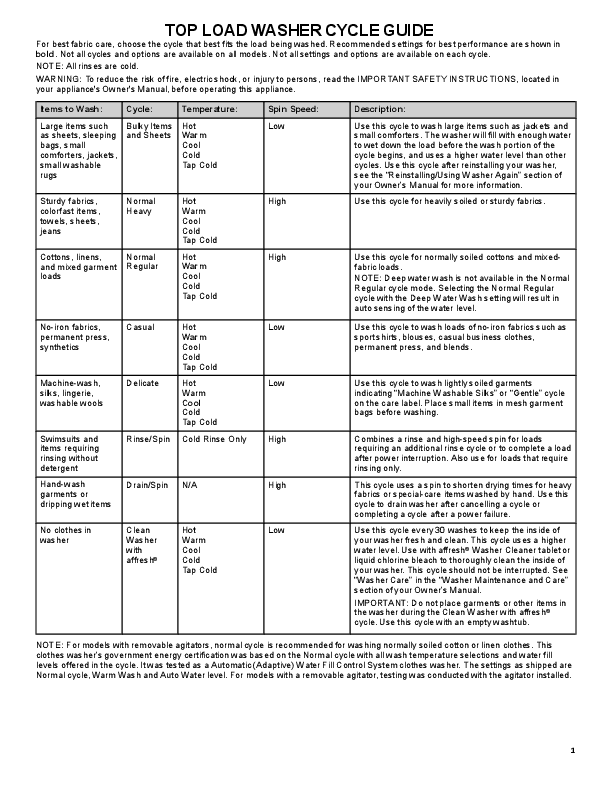
For best fabric care, choose the cycle that best fits the load being washed. Recommended settings for best performance are shown in bold. Not all cycles and options are available on all models. Not all settings and options are available on each cycle.
NOTE: All rinses are cold.
WARNING: To reduce the risk of fire, electric shock, or injury to persons, read the IMPORTANT SAFETY INSTRUCTIONS, located in your appliance's Owner's Manual, before operating this appliance.
Washer Cycles Explained
| Items to Wash | Cycle | Temperature | Spin Speed | Description |
|---|---|---|---|---|
| Large items such as sheets, sleeping bags, small comforters, jackets, small washable rugs | Bulky Items and Sheets | Hot, Warm, Cool, Cold, Tap Cold | Low | Use this cycle to wash large items such as jackets and small comforters. The washer will fill with enough water to wet down the load before the wash portion of the cycle begins, and uses a higher water level than other cycles. Use this cycle after reinstalling your washer; see the "Reinstalling/Using Washer Again" section of your Owner's Manual for more information. |
| Sturdy fabrics, colorfast items, towels, sheets, jeans | Normal Heavy | Hot, Warm, Cool, Cold, Tap Cold | High | Use this cycle for heavily soiled or sturdy fabrics. |
| Cottons, linens, and mixed garment loads | Normal Regular | Hot, Warm, Cool, Cold, Tap Cold | High | Use this cycle for normally soiled cottons and mixed-fabric loads. NOTE: Deep water wash is not available in the Normal Regular cycle mode. Selecting the Normal Regular cycle with the Deep Water Wash setting will result in auto sensing of the water level. |
| No-iron fabrics, permanent press, synthetics | Casual | Hot, Warm, Cool, Cold, Tap Cold | Low | Use this cycle to wash loads of no-iron fabrics such as sport shirts, blouses, casual business clothes, permanent press, and blends. |
| Machine-wash, silks, lingerie, washable wools | Delicate | Hot, Warm, Cool, Cold, Tap Cold | Low | Use this cycle to wash lightly soiled garments indicating "Machine Washable Silks" or "Gentle" cycle on the care label. Place small items in mesh garment bags before washing. |
| Swimsuits and items requiring rinsing without detergent | Rinse/Spin | Cold Rinse Only | High | Combines a rinse and high-speed spin for loads requiring an additional rinse cycle or to complete a load after power interruption. Also use for loads that require rinsing only. |
| Hand-wash garments or dripping wet items | Drain/Spin | N/A | High | This cycle uses a spin to shorten drying times for heavy fabrics or special-care items washed by hand. Use this cycle to drain washer after cancelling a cycle or completing a cycle after a power failure. |
| No clothes in washer | Clean Washer with affresh® | Hot, Warm, Cool, Cold, Tap Cold | Low | Use this cycle every 30 washes to keep the inside of your washer fresh and clean. This cycle uses a higher water level. Use with affresh® Washer Cleaner tablet or liquid chlorine bleach to thoroughly clean the inside of your washer. This cycle should not be interrupted. See "Washer Care" in the "Washer Maintenance and Care" section of your Owner's Manual. IMPORTANT: Do not place garments or other items in the washer during the Clean Washer with affresh® cycle. Use this cycle with an empty washtub. |
NOTE: For models with removable agitators, normal cycle is recommended for washing normally soiled cotton or linen clothes. This clothes washer's government energy certification was based on the Normal cycle with all wash temperature selections and water fill levels offered in the cycle. It was tested as an Automatic (Adaptive) Water Fill Control System clothes washer. The settings as shipped are Normal cycle, Warm Wash and Auto Water level. For models with a removable agitator, testing was conducted with the agitator installed.
Important Safety Information
AWARNING ? Fire Hazard
Never place items in the washer that are dampened with gasoline or other flammable fluids.
No washer can completely remove oil.
Do not dry anything that has ever had any type of oil on it (including cooking oils).
Doing so can result in death, explosion, or fire.
Helpful Tips for Laundry
- For best performance, use HE detergent when washing bulky items.
- Use mesh garment bags to help avoid tangling when washing delicate or small items.
- Turn knits inside out to avoid pilling. Separate lint-takers from lint-givers. Synthetics, knits, and corduroy fabrics will pick up lint from towels, rugs, and chenille fabrics.
- Promptly remove garments after cycle has completed to avoid odor, reduce wrinkling, and prevent rusting of metal hooks, zippers, and snaps.
NOTES:
- Always read and follow fabric care label instructions to avoid damage to your garments.
- The washer will not start or fill with the lid open.
Wash Temperature Descriptions
| Wash Temp | Description | Suggested Fabrics |
|---|---|---|
| Hot | Some cold water is added to save energy. This will be cooler than your hot water heater setting. | Whites and pastels, Durable items, Heavy soils |
| Warm | Some cold water may be added, so this will be cooler than what your previous washer provided. | Bright colors, Moderate to light soils |
| Cool | Warm water may be added to assist in soil removal and to help dissolve detergents. | Colors that bleed or fade, Light soils |
| Cold | This is the temperature from your faucet. If your tap cold water is very cold, warm water may be added to assist in soil removal and to help dissolve detergents. | Dark colors that bleed or fade, Light soils |
| Tap Cold | This is the temperature from your faucet. | Dark colors that bleed or fade, Light soils |
Sort and Prepare Your Laundry
- Empty pockets. Loose change, buttons, or any small object can pass under the agitator and become trapped, causing unexpected sounds.
- Sort items by recommended cycle, water temperature, and colorfastness.
- Separate heavily soiled items from lightly soiled.
- Separate delicate items from sturdy fabrics.
- Do not dry items if stains remain after washing, because heat can set stains into fabric.
- Treat stains promptly.
- Close zippers, fasten hooks, tie strings and sashes, and remove non-washable trim and ornaments.
- Mend rips and tears to avoid further damage to items during washing.
Manual Soak
If you would like to manually soak your garments at any time during the wash portion of the cycle, press Pause and leave the lid closed. Once your desired soak time has elapsed, press Pause again to continue the cycle. As long as the lid remains closed, your soak time can be longer than 10 minutes. However, if the lid is opened during the soak and remains open for more than 10 minutes, the water will pump out automatically.
