

SUPER DILAC VA4 SS-PIS-SDS 080919 03HC2619-2620
File info: application/pdf · 12 pages · 236.25KB
SUPER DILAC VA4 SS-PIS-SDS 080919 03HC2619-2620
SUPER DILAC VA4 - Hugh Crane Cleaning Equipment Ltd.
PREVENTION AND CONDUCT. The following information applies for the uses indicated in subsection 1.2 of the Safety Data Sheet.
Extracted Text
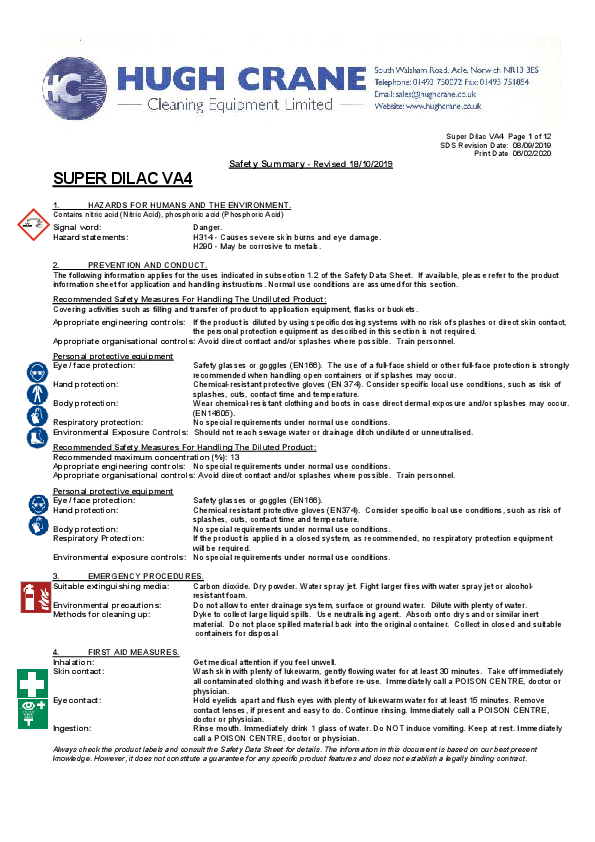
SUPER DILAC VA4

Safety Summary - Revised 18/10/2019

Super Dilac VA4 Page 1 of 12 SDS Revision Date: 08/09/2019
Print Date 06/02/2020

1.

HAZARDS FOR HUMANS AND THE ENVIRONMENT.

Contains nitric acid (Nitric Acid), phosphoric acid (Phosphoric Acid)

Signal word: Hazard statements:

Danger. H314 - Causes severe skin burns and eye damage. H290 - May be corrosive to metals.

2.

PREVENTION AND CONDUCT.

The following information applies for the uses indicated in subsection 1.2 of the Safety Data Sheet. If available, please refer to the product

information sheet for application and handling instructions. Normal use conditions are assumed for this section.

Recommended Safety Measures For Handling The Undiluted Product: Covering activities such as filling and transfer of product to application equipment, flasks or buckets.
Appropriate engineering controls: If the product is diluted by using specific dosing systems with no risk of splashes or direct skin contact, the personal protection equipment as described in this section is not required.
Appropriate organisational controls: Avoid direct contact and/or splashes where possible. Train personnel.

Personal protective equipment

Eye / face protection:

Safety glasses or goggles (EN166). The use of a full-face shield or other full-face protection is strongly

recommended when handling open containers or if splashes may occur.

Hand protection:

Chemical-resistant protective gloves (EN 374). Consider specific local use conditions, such as risk of

splashes, cuts, contact time and temperature.

Body protection:

Wear chemical-resistant clothing and boots in case direct dermal exposure and/or splashes may occur.

(EN14605).

Respiratory protection:

No special requirements under normal use conditions.

Environmental Exposure Controls: Should not reach sewage water or drainage ditch undiluted or unneutralised.

Recommended Safety Measures For Handling The Diluted Product: Recommended maximum concentration (%): 13 Appropriate engineering controls: No special requirements under normal use conditions. Appropriate organisational controls: Avoid direct contact and/or splashes where possible. Train personnel.

Personal protective equipment

Eye / face protection:

Safety glasses or goggles (EN166).

Hand protection:

Chemical resistant protective gloves (EN374). Consider specific local use conditions, such as risk of

splashes, cuts, contact time and temperature.

Body protection:

No special requirements under normal use conditions.

Respiratory Protection:

If the product is applied in a closed system, as recommended, no respiratory protection equipment

will be required.

Environmental exposure controls: No special requirements under normal use conditions.

3.

EMERGENCY PROCEDURES.

Suitable extinguishing media:

Carbon dioxide. Dry powder. Water spray jet. Fight larger fires with water spray jet or alcohol-

resistant foam.

Environmental precautions:

Do not allow to enter drainage system, surface or ground water. Dilute with plenty of water.

Methods for cleaning up:

Dyke to collect large liquid spills. Use neutralising agent. Absorb onto dry sand or similar inert

material. Do not place spilled material back into the original container. Collect in closed and suitable

containers for disposal

4.

FIRST AID MEASURES.

Inhalation:

Skin contact:

Get medical attention if you feel unwell. Wash skin with plenty of lukewarm, gently flowing water for at least 30 minutes. Take off immediately

all contaminated clothing and wash it before re-use. Immediately call a POISON CENTRE, doctor or physician.

Eye contact:

Hold eyelids apart and flush eyes with plenty of lukewarm water for at least 15 minutes. Remove

Ingestion:

contact lenses, if present and easy to do. Continue rinsing. Immediately call a POISON CENTRE, doctor or physician. Rinse mouth. Immediately drink 1 glass of water. Do NOT induce vomiting. Keep at rest. Immediately

call a POISON CENTRE, doctor or physician.

Always check the product labels and consult the Safety Data Sheet for details. The information in this document is based on our best present knowledge. However, it does not constitute a guarantee for any specific product features and does not establish a legally binding contract.

Product Information Sheet

Super Dilac VA4 Page 2 of 12 SDS Revision Date: 08/09/2019
Print Date 06/02/2020

SUPER DILAC VA4

Description: Key properties:
Benefits: Use instructions:
Technical data:

Super Dilac is a low foaming, high active, non-fuming nitric/phosphoric acid detergent descaler for use in a wide range of CIP applications in the Food and Beverage industry. Super Dilac is highly effective at removing inorganic scale deposits, including calcium oxalate (beerstone). Super Dilac is low foaming and suitable for use in CIP applications under conditions of high pressure and turbulence. Super Dilac is highly economical at in use concentrations. Super Dilac is a conductive liquid detergent and suitable for automatic dosing and control. Highly effective in removing most inorganic scale deposits, improving operational efficiency. Can be used for the passivation of new stainless steel CIP and Bottlewashing installations. Suitable for automatic dosing and control by conductivity, ensuring consistent delivery of product. Super Dilac is typically used for descaling at concentrations between 2.5 - 13%w/w (2-10%v/v) at temperatures between 20-60�C. Super Dilac is typically used for CIP applications at concentrations between 1.0-2.5%w/w (0.82%v/v) for descaling, depending upon the application and level of scale. NB: The exact concentration, time and temperature when using Super Dilac will depend upon the application. All detergents and disinfectants should be thoroughly rinsed after use to remove them from all food and beverage contact surfaces.

Appearance:

clear, colourless liquid

Relative density at 20�C:

1.28

pH (1% solution at 20�C):

1

Chemical Oxygen Demand (COD):none

Nitrogen Content (N):

85 g/Kg

Phosphorous Content (P):

21 g/Kg

Safe handling and storage Information: Product compatibility:
Test method:
Calculation:

Super Dilac

Specific conductivity at 25�C

(%w/w)

(mS/cm)

0.5

12.8

1

25.1

2

46

3

66

4

85

The above data is typical of normal production and should not be taken as a specification.

Store in original closed containers or (where applicable) in an approved bulk tank, away from

extreme temperatures. Full guidance on the handling and disposal of this product is provided in a

separate Material Safety Data Sheet.

Super Dilac is safe to use on all type of materials commonly found in CIP circuits when applied

under the recommended conditions. In the event of uncertainty it is advisable to evaluate

individual materials before any prolonged use.

Reagents:

0.1N Sodium hydroxide solution Phenolphthalein Indicator

Procedure:

Add 2-3 drops of the Indicator solution to 10mls of the test solution.

Titrate with the caustic to a red end point.

%w/w Super Dilac = titre (mls) x 0.14%v/v Super Dilac = titre (mls) x 0.11

Available pack sizes:

20L

SAFETY DATA SHEET
according to 1907/2006/EC

Super Dilac VA4 Page 3 of 12 SDS Revision Date: 08/09/2019
Print Date 06/02/2020

SUPER DILAC VA4

1.

IDENTIFICATION OF THE SUBSTANCE / PREPARATION AND OF THE COMPANY / UNDERTAKING

Product Name:

Super Dilac VA4

Product Code:

MSDS1994

Supplier:

Hugh Crane (Cleaning Equipment) Ltd

South Walsham Rd, Acle

Norwich, NR13 3ES

Telephone:

01493 750072

Fax 01493 751854

Emergency telephone number: 0800 052 0185 For medical or environmental emergency only:

Relevant identified uses of the substance or mixture and uses advised against

Identified uses:

For industrial use only.

AISE-P801 - Food process cleaner. Cleaning In place (CIP) process

Uses advised against:

Uses other than those identified are not recommended

2.

HAZARDS IDENTIFICATION

Classification of the substance or mixture

Skin Corr. 1A (H314)

Eye Dam 1 (H318)

Met Corr (H290)

Label elements

Signal word: Hazard statements: Precautionary statements:
Other hazards:

Danger Contains nitric acid (Nitric Acid). Phosphoric acid (Phosphoric Acid). H314 Causes severe skin burns and eye damage H290 May be corrosive to metals.
P280 Wear protective gloves, protective clothing and eye or face protection P303+361+353 - IF ON SKIN (or hair): Take off immediately all contaminated clothing. Rinse skin with water or shower P305+351+338 - IF IN EYES: Rinse cautiously with water for several minutes. Remove contact lenses, if present and easy to do. Continue rinsing P310 Immediately call a POISON CENTRE, doctor or physician No other hazards known. The product does not meet the criteria for PBT or vPvB in accordance with Regulation (EC) No 1907/2006, Annex XIII.

3.

COMPOSITION/INFORMATION ON INGREDIENTS

Mixtures

Ingredient(s)

EC No,

CAS No.

REACH No.

Classification EC

1272/2008

Nitric Acid

231-741-2 7697-37-2

01-2119487297-23 Ox Liq 2 (H272)

Ox Liq 3 (H272)

Acute Tox 3 (H331)

Skin Corr 1A (H314)

Met Corr 1 (H290)

Phosphoric Acid

231-633-2 7664-38-2

01-2119485924-24 Skin Corr 1B (H314)

Met Corr 1 (H290)

For the full text of the H and EUH phrases mentioned in this Section, see Section 16.

Workplace exposure limit(s), if available, are listed in subsection 8.1.

Notes

Weight % 30-50

3-10

4.

FIRST AID MEASURES

Description Of First Aid Measures

General Information:

If unconscious place in recovery position and seek medical advice. Provide fresh air. If breathing

is irregular or stopped, administer artificial respiration. No mouth-to-mouth or mouth-to-nose

resuscitation. Use Ambu bag or ventilator.

Inhalation:

Seek medical attention or advice if you feel unwell.

Skin contact: Eye contact: Ingestion: Self-protection of first aider:

Super Dilac VA4 Page 4 of 12 SDS Revision Date: 08/09/2019
Print Date 06/02/2020 Wash skin with plenty of lukewarm, gently flowing water for at least 30 minutes. Take off immediately all contaminated clothing and wash it before re-use. Immediately call a POISON CENTRE, doctor or physician. Hold eyelids apart and flush eyes with plenty of lukewarm water for at least 15 minutes. Remove contact lenses, if present and easy to do. Continue rinsing. Immediately call a POISON CENTRE, doctor or physician. Rinse mouth. Immediately drink 1 glass of water. Never give anything by mouth to an unconscious person. Do NOT induce vomiting. Keep at rest. Immediately call a POISON CENTRE, doctor or physician. Consider personal protective equipment as indicated in subsection 8.2.

Most Important Symptoms And Effects, Both Acute And Delayed

Inhalation:

No known effects or symptoms in normal use.

Skin contact:

Causes severe burns.

Eye contact:

Causes severe or permanent damage.

Ingestion:

Ingestion will lead to a strong caustic effect on mouth and throat and to the danger of perforation

of oesophagus and stomach.

Indication Of Any Immediate Medical Attention And Special Treatment Needed No information available on clinical testing and medical monitoring. Specific toxicological information on substances, if available, can be found in section 11

5.

FIREFIGHTING MEASURES

Extinguishing media:

Carbon dioxide. Dry powder. Water spray jet. Fight larger fires with water spray jet or

alcohol- resistant foam.

Special hazards arising from the substance or mixture: No special hazards known.

Advice for firefighters:

As in any fire, wear self contained breathing apparatus and suitable protective clothing

including gloves and eye/face protection.

6.

ACCIDENTAL RELEASE MEASURES

Personal precautions, protective Eqpt & emergency procedures

Personal Precautions:

Wear suitable protective clothing, gloves and eye/face protection.

Environmental precautions:

Do not allow to enter drainage system, surface or ground water. Dilute with plenty of water.

Methods and material for containment and cleaning up

Clean-up Methods:

Dyke to collect large spills. Use neutralising agent. Absorb onto dry sand or similar inert material.

Do not place spilled materials back into the original container. Collect in closed and suitable

containers for disposal.

Reference to other sections: For personal protective equipment see Section 8. For disposal considerations see section 13.

7.

HANDLING AND STORAGE

Precautions For Safe Handling

Measures To Prevent Fire And Explosions: No special precautions required.

Measures Required To Protect The Environment: For environmental exposure controls see subsection 8.2.

Advice On General Occupational Hygiene: Handle in accordance with good industrial hygiene and safety practice. Keep away

from food, drink and animal feeding stuffs. Do not mix with other products unless advised by

Diversey. Wash face, hands and any exposed skin thoroughly after handling. Take off

immediately all contaminated clothing. Wash contaminated clothing before reuse. Avoid

contact with skin and eyes. Use only with adequate ventilation.

See section 8, Exposure Controls/Personal Protection.

Conditions For Safe Storage, Store in accordance with local and national regulations. Store in a closed container. Keep only in

Including Any Incompatibilities: original packaging. Keep cool. Keep away from heat and direct sunlight.. For conditions and

materials to avoid see section 10.

Specific End Use(s):

No specific advice for end use available.

8.

EXPOSURE CONTROLS/PERSONAL PROTECTION

Control Parameters

Workplace exposure limits

Air limit values, if available:

Ingredient(s)

UK - Long Term Values

Nitric Acid

Phosphoric Acid

1 mg/m3

UK � Short Term Values
1ppm 2.6 mg/m3 2 mg/m3

Biological limit values, if available:

Super Dilac VA4 Page 5 of 12 SDS Revision Date: 08/09/2019
Print Date 06/02/2020

Recommended monitoring procedures if available: Additional exposure limits under the conditions of use, if available:

DNEL/DMEL and PNEC values

Human exposure

DNEL oral exposure - Consumer (mg/kg bw)

Ingredient(s)

Short term �

Local effects

Nitric Acid

-

Phosphoric Acid

-

Short term � Systemic effects
-

Long term � Local effects
-

Long term � Systemic effects -

DNEL dermal exposure � Worker

Ingredient(s)

Short term �

Local effects

Nitric Acid

-

Phosphoric Acid

No data available

Short term � Systemic effects (mg/kg bw) -

Long term � Local effects
No data available

Long term � Systemic effects (mg/kg bw) -

DNEL dermal exposure � Consumer

Ingredient(s)

Short term �

Local effects

Nitric Acid

-

Phosphoric Acid

No data available

DNEL inhalatory exposure - Worker (mg/m3)

Ingredient(s)

Short term �

Local effects

Nitric Acid

No data available

Phosphoric Acid

-

DNEL inhalatory exposure - Consumer (mg/m3)

Ingredient(s)

Short term �

Local effects

Nitric Acid

No data available

Phosphoric Acid

-

Short term � Systemic effects (mg/kg bw)
-
Short term � Systemic effects
-
Short term � Systemic effects
-

Long term � Local effects
No data available
Long term � Local effects
2.6 2.92
Long term � Local effects
1.3 0.73

Long term � Systemic effects (mg/kg bw) -
Long term � Systemic effects 1
Long term � Systemic effects -

Environmental exposure

Environmental exposure � PNEC

Ingredient(s)

Surface water,

fresh (mg/l)

Nitric Acid

-

Phosphoric Acid

-

Surface water, marine (mg/l)
-

Intermittent (mg/l)
-

Sewage treatment plant (mg/l) -

Environmental exposure - PNEC, continued

Ingredient(s)

Sediment, freshwater

(mg/kg)

Nitric Acid

-

Phosphoric Acid

-

Sediment, marine (mg/kg) -

Soil (mg/kg)
-

Air (mg/m3)
-

Exposure Controls The following information applies for the uses indicated in subsection 1 of the Safety Data Sheet. If available, please refer to the product information sheet for application and handling instructions. Normal use conditions are assumed for this section.

Recommended safety measures for handling the undiluted product:

Covering activities such as filling and transfer of product to application equipment, flasks or buckets

Appropriate engineering controls: If the product is diluted by using specific dosing systems with no risk of splashes or direct skin

contact, the personal protection equipment as described in this section is not required.

Appropriate organisational controls: Avoid direct contact and/or splashes where possible. Train personnel.

Personal Protective Equipment

Eye / face protection:

Safety glasses or goggles (EN 166). The use of a full-face shield or other full-face protection is

strongly recommended when handling open containers or if splashes may occur

Super Dilac VA4 Page 6 of 12

SDS Revision Date: 08/09/2019

Print Date 06/02/2020

Hand protection:

Chemical-resistant protective gloves (EN 374). Verify instructions regarding permeability and

breakthrough time, as provided by the gloves supplier. Consider specific local use conditions,

such as risk of splashes, cuts, contact time and temperature.

Suggested gloves for prolonged contact:

Material:

butyl rubber

Penetration time:

>= 480 min

Material thickness:

>= 0.7 mm

Suggested gloves for protection against splashes: Material:

nitrile rubber

Penetration time:

>= 30 min

Material thickness:

>= 0.4 mm

In consultation with the supplier of protective gloves a different type providing similar protection may be chosen.

Body protection:

Wear chemical-resistant clothing and boots in case direct dermal exposure and/or splashes may

occur. (EN 14605).

Respiratory protection:

No special requirements under normal use conditions.

Environmental exposure controls: Should not reach sewage water or drainage ditch undiluted or unneutralised.

Recommended safety measures for handling the diluted product: Recommended maximum concentration (%): 13 Appropriate engineering controls: No special requirements under normal use conditions. Appropriate organisational controls: Avoid direct contact and/or splashes where possible. Train personnel.

Personal protective equipment .

Eye / face protection:

Safety glasses or goggles (EN166).

Hand protection:

Chemical-resistant protective gloves (EN 374). Verify instructions regarding permeability and

breakthrough time, as provided by the gloves supplier. Consider specific local use conditions,

such as risk of splashes, cuts, contact time and temperature.

Suggested gloves for prolonged contact:

Material:

butyl rubber

Penetration time: >= 480 min

Material thickness: >= 0.7 mm

Suggested gloves for protection against splashes: Material: nitrile rubber

Penetration time: >= 30 min

Material thickness: >= 0.4 mm

In consultation with the supplier of protective gloves a different type providing similar protection may be chosen.

Body protection:

No special requirements under normal use conditions.

Respiratory protection:

No special requirements under normal use conditions..

Environmental exposure controls: No special requirements under normal use conditions.

9.

PHYSICAL AND CHEMICAL PROPERTIES

Information on basic physical and chemical properties

Information in this section refers to the product, unless it is specifically stated that substance data is listed.

Method / Remark

Physical State:

Liquid

Colour:

Clear colourless

Odour:

Product specific

Odour Threshold:

Not applicable

pH:

<2 (neat)

ISO 4316

Melting/Freezing Point (�C):

Not determined.

Not relevant to classification of product.

Initial Boiling point/range (�C): Not determined

See substance data.

Substance Data, Boiling Point

Ingredient(s)

Value (�C)

Method

Atmospheric Pressure (hPa)

Nitric Acid

116

Method not given

Phosphoric Acid

158

Method not given

1013

Flammability (liquid): Flash point (�C): Sustained Combustion: Evaporation Rate: Flammability (solid, gas): Upper/lower flammability Limit:

Not flammable. Not determined. Not applicable Not determined. Not applicable to liquids. Not determined.

Substance Data, Flammability or Explosive Limits, if Available:

UN Manual of Tests & Criteria, Section 32, L2 Not relevant to classification of product.

Vapour Pressure: Substance Data, Vapour Pressure Ingredient(s) Nitric Acid Phosphoric Acid

Not determined.
Value (Pa) 770 4

See substance data.
Method Method not given Method not given

Super Dilac VA4 Page 7 of 12 SDS Revision Date: 08/09/2019
Print Date 06/02/2020
Temperature (�C) 20 20

Vapour Density:

Not determined.

Relative Density:

Approx 1.28 g/cm3 (20�C)

Solubility in / Miscibility with Water: Fully miscible

Not relevant to classification of this product. OECD 109 (EU A.3)

Substance Data, Solubility in Water Ingredient(s) Nitric Acid Phosphoric Acid

Value (g/l) >500
Soluble

Method Method not given

Temperature (�C)

Substance Data, Partition Coefficient N-Octanol/Water (log/Kow): See section 12.

Autoignition Temperature: Decomposition Temperature: Viscosity: Explosive Properties: Oxidising properties:

Not determined. Not applicable. Not determined. Not explosive. Not oxidising.

Other information Surface Tension (N/m): Corrosion To Metals:

Not determined. Corrosive

Not relevant to classification of this product. Weight of evidence.

Substance Data, Dissociation Constant, if available.

10.

STABILITY AND REACTIVITY

Reactivity:

No reactivity hazards known under normal storage and use conditions.

Chemical stability:

Stable under normal storage and use conditions.

Possibility of hazardous reactions: No hazardous reactions known under normal storage and use conditions.

Conditions to avoid:

None known under normal storage and use conditions.

Incompatible materials:

Keep away from products containing chlorine-based bleaching agents or sulphites.

Reacts with alkali and metals.

Hazardous decomposition products: Nitrogen oxides (NOx).

11. TOXICOLOGICAL INFORMATION Information On Toxicological Effects Mixture Data

Acute Inhalation Toxicity Result: Species: Method:

Mist Not applicable Weight of evidence

Relevant Calculated ATE(s) ATE - Oral (mg/kg): ATE _ Inhalatory, mists (mg/l):

Not applicable >5

Substance data, where relevant and available, are listed below.

Acute toxicity Acute oral toxicity Ingredients Nitric Acid Phosphoric Acid
Acute dermal toxicity Ingredients Nitric Acid Phosphoric Acid

Endpoint LD50
Endpoint LD50

Value (mg/kg) No data available
>300-5000
Value (mg/kg) No data available
2740

Species Rat

Method

Exposure Time (h)

OECD 423 (EU B.1 tris).

Species Rabbit

Method Method not given

Exposure Time (h)

Acute inhalative toxicity Ingredients Nitric Acid Phosphoric Acid
Irritation and corrosivity Skin irritation and corrosivity Ingredients Nitric Acid Phosphoric Acid

Endpoint LC50 LC50
Result Corrosive Corrosive

Value (mg/l) >2.65 (vapour)_
850

Species Rat Rat

Super Dilac VA4 Page 8 of 12 SDS Revision Date: 08/09/2019
Print Date 06/02/2020

Method OECD 403 (EU B.2)
Method not given

Exposure Time (h) 2

Species Rabbit Rabbit

Method Method not given OECD 404 (EU B.4)

Exposure Time (h)

Eye irritation and corrosivity Ingredients Nitric Acid Phosphoric Acid

Result Corrosive Severe damage

Species Rabbit

Method Method not given Method not given

Exposure Time (h)

Respiratory tract irritation and corrosivity

Ingredients

Result

Nitric Acid

No data available

Phosphoric Acid

No data available

Species

Method

Exposure Time (h)

Sensitisation - Sensitisation by skin contact

Ingredients

Result

Nitric Acid

No data available

Phosphoric Acid

Not sensitising

Species Human

Method Human Experience

Exposure Time (h)

Sensitisation by inhalation Ingredients Nitric Acid Phosphoric Acid

Result No data available No data available

Species

Method

Exposure Time (h)

CMR effects (carcinogenicity, mutagenicity and toxicity for reproduction)

Mutagenicity

Ingredients

Result (in vitro)

Method (in vitro)

Nitric Acid

No evidence for mutagenicity, negative test results OECD 471 (EU B.12/13)

Phosphoric Acid

No evidence for mutagenicity, negative test results OECD 471 (EU B.12/13)

OECD 473 OECD 476

(Mouse lymphoma)

Result (in vivo) No data available No data available

Method (in vivo)

Carcinogenicity Ingredient(s) Nitric Acid Phosphoric Acid

Effect No evidence for carcinogenicity, negative test results No data available

Toxicity for reproduction

Ingredient(s) End

point

Nitric Acid

NOAEL

Phosphoric Acid

NOAEL

Specific effect
Developmental toxicity Developmental toxicity

Value (mg/kg bw/d) 1500
410

Species Rat Rat

Method OECD 422 oral OECD 422 oral

Exposure Time 28 days
10 days

Remarks & other effects reported Not toxic for reproduction
No evidence for reproductive or developmental toxicity

Repeated dose toxicity � Sub-acute or sub-chronic oral toxicity

Ingredient(s)

Endpoint

Value

(mg/kg bw/d)

Nitric Acid

NOAEL

1500

Phosphoric Acid

NOAEL

250

Sub-chronic dermal toxicity Ingredient(s)
Nitric Acid Phosphoric Acid

Endpoint

Value (mg/kg bw/d) No data available No data available

Species
Rat Rat

Method
OECD 422 oral OECD 422 oral

Exposure time (days)
28

Specific effects & organs affected

Species Method

Exposure Specific effects & time (days) organs affected

Sub-chronic inhalation toxicity

Ingredient(s)

Endpoint

Nitric Acid Phosphoric Acid

Value (mg/kg bw/d) No data available No data available

Species Method

Super Dilac VA4 Page 9 of 12 SDS Revision Date: 08/09/2019
Print Date 06/02/2020
Exposure Specific effects & time (days) organs affected

Chronic toxicity Ingredient(s)
Nitric Acid Phosphoric Acid

Exposure route

End point

Value (mg/kg bw/d)
No data available No data available

Species

Method

Exposure time

Specific effects & Remark organs affected

STOT � Single Exposure Ingredient(s) Nitric Acid Phosphoric Acid

Affected organ(s) No data available No data available

STOT � Repeated Exposure Ingredient(s) Nitric Acid Phosphoric Acid

Affected organ(s) No data available No data available

Aspiration Hazard:

Substances with an aspiration hazard (H304), if any, are listed in section 3. If relevant, see

section 9 for dynamic viscosity and relative density of the product.

Potential Adverse Health Effects

And Symptoms:

Effects and symptoms related to the product, if any, are listed in section 4.

12.

ECOLOGICAL INFORMATION

Toxicity

No data is available on the mixture.

Substance data, where relevant and available, are listed below

Aquatic short-term toxicity

Aquatic short-term toxicity � fish

Ingredient(s)

Endpoint

Nitric Acid

LC50

Phosphoric Acid

LC50

Value (mg/l) 12.5 138

Species Gambusia Affinis Gambusia Affinis

Aquatic short-term toxicity � crustacea

Ingredient(s)

Endpoint

Value (mg/l)

Nitric Acid

EC50

8609

Phosphoric Acid

EC50

>100

Species Daphnia Magna Straus Daphna Magna Straus

Aquatic short-term toxicity � algae

Ingredient(s)

Endpoint

Nitric Acid

Phosphoric Acid

EC50

Value (mg/l) No data available
>100

Species Desmodesmus Subspicatus

Aquatic short-term toxicity - marine species

Ingredient(s)

Endpoint

Value (mg/l)

Nitric Acid

No data available

Phosphoric Acid

No data available

Species

Method Method not given Method not given

Exposure Time (h) 96 96

Method Non guideline test
OECD 202

Exposure Time (h) 24 48

Method OECD 201 (EU C.3)

Exposure Time (h) 72

Method

Exposure Time (h)

Impact on sewage plants - toxicity to bacteria

Ingredient(s)

Endpoint

Value (mg/l)

Nitric Acid

No data available

Phosphoric Acid

EC50

270

Aquatic long-term toxicity

Aquatic long-term toxicity � fish

Ingredients

Endpoint Value (mg/l)

Nitric Acid Phosphoric Acid

LD50

8226 No data available

Inoculum Activated sludge

Method Method not given

Exposure Time (h)

Species

Method

Oncorhynchus Mykiss Method not given

Exposure Time 96 hrs

Effects Observed

Aquatic long-term toxicity � crustacea

Ingredients

Endpoint Value (mg/l)

Nitric Acid

No data available

Phosphoric Acid

No data available

Species

Method

Super Dilac VA4 Page 10 of 12 SDS Revision Date: 08/09/2019
Print Date 06/02/2020
Exposure Time Effects Observed

Aquatic toxicity to other aquatic benthic organisms, including sediment-dwelling organisms, if available:

Ingredients

Endpoint Value (mg/kg dw sediment)

Species

Method Exposure Time

Nitric Acid

No data available

Phosphoric Acid

No data available

Effects Observed

Terrestrial Toxicity

Terrestrial toxicity - soil invertebrates, including earthworms, if available:

Ingredients

Endpoint Value (mg/kg dw soil )

Species

Nitric Acid

No data available

Phosphoric Acid

No data available

Method

Exposure Time Effects Observed

Terrestrial toxicity - plants, if available

Ingredients

Endpoint Value (mg/kg dw soil )

Nitric Acid

No data available

Phosphoric Acid

No data available

Species

Method

Exposure Time Effects Observed

Terrestrial toxicity - birds, if available

Ingredients

Endpoint Value

Nitric Acid

No data available

Phosphoric Acid

No data available

Species

Method

Exposure Time Effects Observed

Terrestrial toxicity - beneficial insects, if available

Ingredients

Endpoint Value (mg/kg dw soil )

Nitric Acid

No data available

Phosphoric Acid

No data available

Species

Method

Exposure Time Effects Observed

Terrestrial toxicity - soil bacteria, if available

Ingredients

Endpoint Value (mg/kg dw soil )

Nitric Acid

No data available

Phosphoric Acid

No data available

Species

Method

Exposure Time Effects Observed

Persistence And Degradability Abiotic degradation - photodegradation in air, if available: Abiotic degradation - hydrolysis, if available: Abiotic degradation - other processes, if available:

Biodegradation

Ready biodegradability - aerobic conditions

Ingredient(s)

Inoculum Analytical Method

DT50

Nitric Acid

Phosphoric Acid

Ready biodegradability - anaerobic and marine conditions, if available:

Degradation in relevant environmental compartments, if available:

Bioaccumulative potential

Partition coefficient n-octanol/water (log Kow)

Ingredient(s)

Value

Nitric Acid

-2.3

Phosphoric Acid

No data available

Method Method not
given

Bioconcentration factor (BCF)

Ingredient(s)

Value

Nitric Acid

No data available

Phosphoric Acid

No data available

Method

Method

Evaluation Not applicable � (inorganic substance) Not applicable � (inorganic substance)

Evaluation Not relevant, does not bioaccumulate.
No bioaccumulation expected.
Evaluation No bioaccumulation expected.

Remark Remark

Mobility in soil

Adsorption/Desorption to soil or sediment

Ingredient(s)

Adsorption coefficient

Log Koc

Nitric Acid

No data available

Phosphoric Acid

No data available

Desorption coefficient Log Koc(des)

Method

Results of PBT and vPvB assessment Substances that fulfill the criteria for PBT/vPvB, if any, are listed in section 3.
Other adverse effects No other adverse effects known.

Soil / sediment type

Super Dilac VA4 Page 11 of 12 SDS Revision Date: 08/09/2019
Print Date 06/02/2020
Evaluation
Mobile in aqueous environment
Potential for mobility in soil, soluble in water.

13.

DISPOSAL CONSIDERATIONS

Waste Treatment Methods

Waste from residues/unused The concentrated contents or contaminated packaging should be disposed of by a certified

Products:

handler or according to the site permit. Release of waste to sewers is discouraged. The cleaned

packaging is suitable for energy recovery or recycling in line with local legislation.

European Waste Catalogue:

20 01 14* - acids .

Empty packaging Recommendation: Dispose of observing national or local regulations.

Suitable cleaning agents:

Water, if necessary with cleaning agent.

14.

TRANSPORT INFORMATION

Land transport (ADR/RID), Sea transport (IMDG), Air transport (ICAO-TI / IATA-DGR)

UN number:

2031

UN proper shipping name:

Nitric acid, solution

Transport hazard class(es)

Class (and subsidiary risk):

8

Packing group:

II

Environmental hazards: Environmentally hazardous: Marine pollutant: Special precautions for user:

No No None known.

Transport in bulk according to Annex II of MARPOL 73/78 and the IBC Code: The product is not transported in bulk tankers.

Other Relevant Information

ADR

Classification code:

C1

Tunnel restriction code:

E

Hazard identification number: 80

IMO/IMDG EmS:

F-A, S-B

The product has been classified, labelled and packaged in accordance with the requirements of ADR and the provisions of the IMDG Code. Transport regulations include special provisions for certain classes of dangerous goods packed in limited quantities.

15.

REGULATORY INFORMATION

Safety, Health And Environmental Regulations/Legislation Specific For The Substance Or Mixture

EU regulations:

Regulation (EC) No. 1907/2006 - REACH

Regulation (EC) No 1272/2008 - CLP

Regulation (EC) No. 648/2004 - Detergents regulation

Authorisations or restrictions (Regulation [EC] No 1907/2006, Title VIII, respectively Title VIII): Not applicable

UFI:

W394-90EC-A00Y-0HPS

Ingredients according to EC Detergents Regulation 648/2004:

Super Dilac VA4 Page 12 of 12 SDS Revision Date: 08/09/2019
Print Date 06/02/2020

Chemical safety assessment: A chemical safety assessment has not been carried out on the mixture

16.

OTHER INFORMATION

The information in this document is based on our best present knowledge. However, it does not constitute a guarantee for any

specific product features and does not establish a legally binding contract

MSDS code:

MSDS1994

Revision:

8th September 2019.

Reason for revision:

Overall design adjusted in accordance with Amendment 453/2010, Annex II of Regulation (EC)

No 1907/2006,

Classification procedure:

The classification of the mixture is in general based on calculation methods using substance

data, as required by Regulation (EC) No 1272/2008. If for certain classifications data on the

mixture is available or for example bridging principles or weight of evidence can be used for

classification, this will be indicated in the relevant sections of the Safety Data Sheet. See section

9 for physical chemical properties, section 11 for toxicological information and section 12 for

ecological information

Full text of theH and EUH

H272

phrases mentioned in section 3: H290

H303

H314

H331

May intensify fire; oxidiser. May be corrosive to metals May be harmful if swallowed. Causes sever skin burns and eye damage. Toxic if inhaled.

Abbreviations and acronyms:

AISE The international Association for Soaps, Detergents and Maintenance Products ATE Acute Toxicity Estimate. DNEL Derived No Effect Limit EC50 Effective concentration, 50% EUH CLP Specific hazard statement LC50 Lethal Concentration, 50% / Median Lethal Concentration LD50 Lethal Dose, 50% / Median Lethal dose NOAEL No observed adverse effect level NOEL No observed effect level OECD Organization for Economic Cooperation and Development PBT Persistent, Bioaccumulative and Toxic PNEC Predicted No Effect Concentration REACH number - REACH registration number, without supplier specific part vPvB very Persistent and very Bioaccumulative

End of Safety Data Sheet.