

Platinum Direct PCR Universal Master Mix Quick Reference (Pub.No. MAN0018848 A.0)
File info: application/pdf · 2 pages · 154.64KB
Platinum Direct PCR Universal Master Mix Quick Reference (Pub.No. MAN0018848 A.0)
Platinum Contents and storage Direct PCR Universal Master Mix
See the appropriate instrument user guide for detailed instructions to program the thermal-cycling conditions or to run the plate. 1. Program the following thermal cycling conditions into the PCR instrument. Step Cycles…
Full PDF Document

If the inline viewer fails, it will open the original document in compatibility mode automatically. You can also open the file directly.
Extracted Text
QUICK REFERENCE

PlatinumTM Direct PCR Universal Master Mix
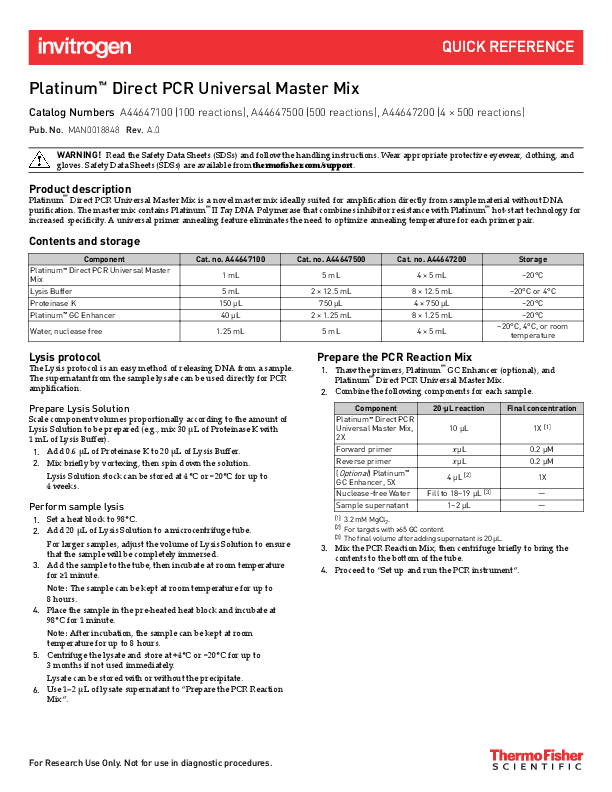
Catalog Numbers A44647100 (100 reactions), A44647500 (500 reactions), A44647200 (4 � 500 reactions)
Pub. No. MAN0018848 Rev. A.0

WARNING! Read the Safety Data Sheets (SDSs) and follow the handling instructions. Wear appropriate protective eyewear, clothing, and gloves. Safety Data Sheets (SDSs) are available from thermofisher.com/support.

Product description
PlatinumTM Direct PCR Universal Master Mix is a novel master mix ideally suited for amplification directly from sample material without DNA purification. The master mix contains PlatinumTM II Taq DNA Polymerase that combines inhibitor resistance with PlatinumTM hot-start technology for increased specificity. A universal primer annealing feature eliminates the need to optimize annealing temperature for each primer pair.

Contents and storage
Component PlatinumTM Direct PCR Universal Master Mix Lysis Buffer Proteinase K PlatinumTM GC Enhancer
Water, nuclease free

Cat. no. A44647100
1 mL
5 mL 150 �L 40 �L
1.25 mL

Cat. no. A44647500
5 mL
2 � 12.5 mL 750 �L
2 � 1.25 mL
5 mL

Cat. no. A44647200
4 � 5 mL
8 � 12.5 mL 4 � 750 �L 8 � 1.25 mL
4 � 5 mL

Storage
-20�C
-20�C or 4�C -20�C -20�C
-20�C, 4�C, or room temperature

Lysis protocol
The Lysis protocol is an easy method of releasing DNA from a sample. The supernatant from the sample lysate can be used directly for PCR amplification.
Prepare Lysis Solution
Scale component volumes proportionally according to the amount of Lysis Solution to be prepared (e.g., mix 30 �L of Proteinase K with 1 mL of Lysis Buffer). 1. Add 0.6 �L of Proteinase K to 20 �L of Lysis Buffer. 2. Mix briefly by vortexing, then spin down the solution.
Lysis Solution stock can be stored at 4�C or -20�C for up to 4 weeks.
Perform sample lysis
1. Set a heat block to 98�C. 2. Add 20 �L of Lysis Solution to a microcentrifuge tube.
For larger samples, adjust the volume of Lysis Solution to ensure that the sample will be completely immersed. 3. Add the sample to the tube, then incubate at room temperature for 1 minute.
Note: The sample can be kept at room temperature for up to 8 hours. 4. Place the sample in the pre-heated heat block and incubate at 98�C for 1 minute.
Note: After incubation, the sample can be kept at room temperature for up to 8 hours. 5. Centrifuge the lysate and store at +4�C or -20�C for up to 3 months if not used immediately.
Lysate can be stored with or without the precipitate. 6. Use 1�2 �L of lysate supernatant to "Prepare the PCR Reaction
Mix".

Prepare the PCR Reaction Mix
1. Thaw the primers, PlatinumTM GC Enhancer (optional), and PlatinumTM Direct PCR Universal Master Mix.
2. Combine the following components for each sample.

Component PlatinumTM Direct PCR Universal Master Mix, 2X
Forward primer
Reverse primer (Optional) PlatinumTM GC Enhancer, 5X
Nuclease-free Water
Sample supernatant

20L reaction
10 �L
x �L x �L 4 �L [2] Fill to 18�19 �L [3] 1�2 �L

Final concentration
1X [1]
0.2 �M 0.2 �M
1X -- --

[1] 3.2 mM MgCl2. [2] For targets with 65 GC content. [3] The final volume after adding supernatant is 20 �L. 3. Mix the PCR Reaction Mix, then centrifuge briefly to bring the contents to the bottom of the tube.
4. Proceed to "Set up and run the PCR instrument".

For Research Use Only. Not for use in diagnostic procedures.

Set up and run the PCR instrument
See the appropriate instrument user guide for detailed instructions to program the thermal-cycling conditions or to run the plate.
1. Program the following thermal cycling conditions into the PCR instrument.

Step Activation

Cycles 1

Temperature 94�C

Time 2 min

Denaturation Annealing Extension Hold

35�40 [1] 1

94�C 60�C 68�C 4�C

15 sec 15 sec 20 sec/kb [2] Hold

[1] 40 cycles is recommended for plant and blood samples.
[2] For amplicons 1 kb, use an extension time of 20 sec. For amplicons > 1 kb use an extension time of 20 sec/kb of the target. Fragments up to 2 kb can be amplified under the same cycling protocol using extension time of the longest fragment.
2. Load the tubes into the PCR instrument, then start the run.

(Alternative method) Direct PCR protocol
The Direct PCR protocol is used to amplify targets directly from the sample. The protocol is only recommended when primers and template are optimized and well characterized. Fragments of up to 2 kb can be amplified using this method.

Perform Direct PCR
1. Prepare a tissue sample using a sampling tool or by cutting a very small piece (e.g., a half or whole Drosophila) using a sterile scalpel. � Tissue samples should be 0.5�1 mm in diameter. Sample size is important and must not exceed 1 mm. � Liquid samples (e.g., saliva) should be 1 �L.
2. Combine the following components for each sample.

Component PlatinumTM Direct PCR Universal Master Mix, 2X Forward primer Reverse primer (Optional) PlatinumTM GC Enhancer, 5X Nuclease-free Water
Sample

20L reaction
10 �L
x �L x �L 4 �L [2] Fill to 19�20 �L 1 �L liquid sample [3], or tissue sample [4]

Final concentration
1X [1]
0.2 �M 0.2 �M
1X -- --

[1] 3.2 mM MgCl2. [2] For targets with 65 GC content. [3] The final volume after adding supernatant is 20 �L. [4] Ensure that the sample is completely immersed in solution. 3. Perform PCR (see "Set up and run the PCR instrument" for thermal cycler parameters).
4. Add 1 �L of Proteinase K into a 20 �L of PCR reaction before loading the sample on a gel.

Thermo Fisher Scientific Baltics UAB | V.A. Graiciuno 8, LT-02241 | Vilnius, Lithuania For descriptions of symbols on product labels or product documents, go to thermofisher.com/symbols-definition.
The information in this guide is subject to change without notice. DISCLAIMER: TO THE EXTENT ALLOWED BY LAW, THERMO FISHER SCIENTIFIC INC. AND/OR ITS AFFILIATE(S) WILL NOT BE LIABLE FOR SPECIAL, INCIDENTAL, INDIRECT, PUNITIVE, MULTIPLE, OR CONSEQUENTIAL DAMAGES IN CONNECTION WITH OR ARISING FROM THIS DOCUMENT, INCLUDING YOUR USE OF IT. Important Licensing Information: This product may be covered by one or more Limited Use Label Licenses. By use of this product, you accept the terms and conditions of all applicable Limited Use Label Licenses. �2019 Thermo Fisher Scientific Inc. All rights reserved. All trademarks are the property of Thermo Fisher Scientific and its subsidiaries unless otherwise specified.

thermofisher.com/support | thermofisher.com/askaquestion thermofisher.com
6 September 2019