Users Manual

3Com Corporation 5400 Bayfront Plaza Santa Clara, California 95052-8145
U.S.A.
Copyright © 2000, 3Com Corporation. All rights reserved. No part of this documentation may be
reproduced in any form or by any means or used to make any derivative work (such as translation,
transformation, or adaptation) without written permission from 3Com Corporation.
3Com Corporation reserves the right to revise this documentation and to make changes in content
from time to time without obligation on the part of 3Com Corporation to provide notification of such
revision or change.
3Com Corporation provides this documentation without warranty, term, or condition of any kind,
either implied or expressed, including, but not limited to, the implied warranties, terms or conditions
of merchantability, satisfactory quality, and fitness for a particular purpose. 3Com may make
improvements or changes in the product(s) and/or the program(s) described in this documentation
at any time.
If there is any software on removable media described in this documentation, it is furnished under a
license agreement included with the product as a separate document, in the hard copy documentation,
or on the removable media in a directory file named LICENSE.TXT or !LICENSE.TXT. If you are unable to
locate a copy, please contact 3Com and a copy will be provided to you.
UNITED STATES GOVERNMENT LEGEND
If you are a United States government agency, then this documentation and the software described
herein are provided to you subject to the following:
All technical data and computer software are commercial in nature and developed solely at private
expense. Software is delivered as “Commercial Computer Software” as defined in DFARS 252.227-7014
(June 1995) or as a “commercial item” as defined in FAR 2.101(a) and as such is provided with only such
rights as are provided in 3Com’s standard commercial license for the Software. Technical data is provided
with limited rights only as provided in DFAR 252.227-7015 (Nov 1995) or FAR 52.227-14 (June 1987),
whichever is applicable. You agree not to remove or deface any portion of any legend provided on any
licensed program or documentation contained in, or delivered to you in conjunction with, this User Guide.
3Com and the 3Com logo, and HomeConnect are registered trademarks and HomeConnect is a
trademark of 3Com Corporation.
Windows is a registered trademarks of Microsoft Corporation. Macintosh and Mac OS are registered
trademarks of Apple Computer, Inc.
All other company and product names may be trademarks of the respective companies with which they
are associated.

RF Exposure Compliance Statement (U.S.)
CAUTION
The 3Com HomeConnect Home Wireless Gateway
has been certified as a mobile device as per FCC
Section 2.1091. In order to comply with the FCC
RF exposure requirements the 3Com HomeConnect
Home Wireless Gateway must only be installed with
approved antennas and a minimum separation
distance of 20 cm (8 inches) must be maintained
from the antenna to any near by persons."

CONTENTS
1WELCOME TO HOME WIRELESS
HomeConnect™ Wireless Gateway 1
Wireless Gateway Advantages 3
Firewall Technology 3
Kit Contents 3
Installation Sheet 4
Minimum System Requirements 4
Using This Guide 5
2HOME WIRELESS GATEWAY
Front Panel 7
Power 8
WAN 8
Wireless LAN 8
Ethernet LAN 8
Rear Panel 8
Power Adapter Socket 8
Reset 9
Cable/DSL 9
Ethernet 9
3BASIC INSTALLATION
Connecting the Wireless Gateway to the Internet 11
External Cable and DSL Modem Connections 11
Connecting the Wireless Gateway to Your Network 12
Home Networking and Wireless Networking Basics 12
Setting up Ethernet Networking 13
Powering Up 14
System Settings for Your Computer(s) 14
Wireless Network Settings 14
Windows 15

Macintosh 15
Wired (Ethernet) Network Settings 15
Windows 16
Macintosh 16
4RUNNING THE SETUP PROGRAM
Setup Program 17
Accessing the Setup Program 17
Navigating Through the Setup Program 18
Menu Tab 18
Gateway Setup Wizard 18
Setting Up Your Home Wireless Gateway 19
5ACCESSING THE INTERNET
Internet Connection Settings 21
External Cable and DSL Modem 21
6ADDITIONAL FEATURES
Status 25
Client Privileges 26
To o l s 2 8
System Test 28
Security Log 28
Reset Home Wireless Gateway 28
Restore Factory Settings 28
Update Firmware 28
7TROUBLESHOOTING
Home Wireless Gateway 31
Modem 31
Cable or DSL 31
Ethernet Networks 32
3Com KnowledgeBase 32
A
TECHNICAL SUPPORT
Online Technical Services 33
World Wide Web Site 33
3Com FTP Site 33
3Com Bulletin Board Service 34
Access by Analog Modem 34
Access by Digital Modem 34
Support from Your Network Supplier 34
Support from 3Com 35
Returning Products for Repair 36
GLOSSARY
INDEX
WARRANTY AND REGULATORY COMPLIANCE
3Com Corporation Limited Warranty 45
Regulatory Compliance Information 48
3Com End User Software License Agreement 50
LIST OF FIGURES
1Home Network Without a Wireless Gateway 2
2Home Network Using a Wireless Gateway 2
3HomeConnecttm Wireless Gateway Package Contents 4
4Home Wireless Gateway 7
5Home Wireless Gateway - Front Panel 7
6Home Network Gateway - Rear Panel 8
7Cable or DSL Modem Connected to the Gateway 12
8Connecting the Gateway to an Ethernet Network 14
9Web Browser Location Field 17
10 Home Network Gateway Main Page 18
11 Setup Page 22
12 Cable/DSL Setup | Standard Page 23
13 Status Page 25
14 Client Computer Setup | Client Privileges Page 26
1WELCOME TO HOME
WIRELESS
In today’s fast-paced world, communication and sharing
information are crucial. Computer networks are among the
fastest ways to share information, and wireless computer
networks are rapidly becoming the most convenient way of
connecting computers. 3Com has brought this exciting
technology into the home with the HomeConnect™
Wireless Gateway.
The products that compose the HomeConnect™ line give
you, the home user, the same power, flexibility, and
protection that has been available only to large
corporations. Now, you can network the computers in your
home, connect them all to a single Internet outlet, and
harness the combined power of all of your computers
using both wired and wireless connections.
HomeConnect™ Wireless Gateway
The HomeConnect Wireless Gateway is designed to
provide effective and transparent management of both
your home computer network, as well as your connection
to the Internet with the convenience of a wireless
connection. The gateway also provides protection in the
form of an electronic “firewall,” preventing anyone outside
of your network from seeing your files or damaging your
computers.
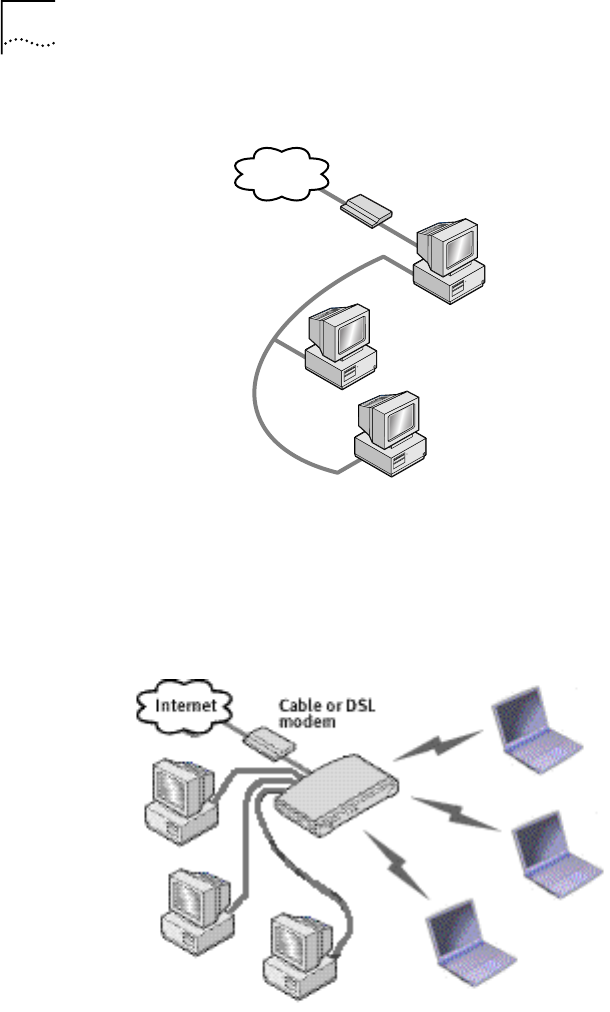
As you can see in Figure 1, one computer is connected to
the Internet. This computer must always be powered on for
the other computers on the network to access the Internet.
2CHAPTER 1: WELCOME T
O HOME WIRELESS
Figure 1 Home Network Without a Wireless Gateway
When you utilize the wireless gateway in your network
(figure 2), however, it becomes your connection to the
Internet, as well as providing you with many other options,
such as network management, firewall protection, and
roaming capability.
Figure 2 Home Network Using a Wireless Gateway
Cable, DSL or
56K modem
Internet

HomeConnect™ Wireless Gateway 3
Wireless Gateway Advantages
■Shared Internet connection without cables.
■Flexible wireless networking, featuring Ethernet
connectivity and seamless networking between both
media.
■No need for a dedicated, “always on” computer serving
as Internet connection.
■Cross-platform operation for compatibility with
Windows and Macintosh computers
■Easy access to corporate networks.
■Easy to use, Web-based setup and configuration.
■Use wireless systems from work or school at home.
Firewall Technology
Your wireless gateway also provides fully-integrated firewall
technology. The preconfigured, always-on, corporate-grade
firewall security combines Stateful Packet Inspection (SPI)
and dynamic packet filtering to provide a robust and
flexible defense system for your home network. The
firewall looks for known data patterns used by hackers,
and prevents them from harming your network. Updates
are available online to detect and block out new hacker
patterns.
Your firewall will:
■Protect the personal, financial, and work-related
information on your network.
■Keep hackers from using your identity to send
unauthorized messages.
■Keep out unwanted downloads.
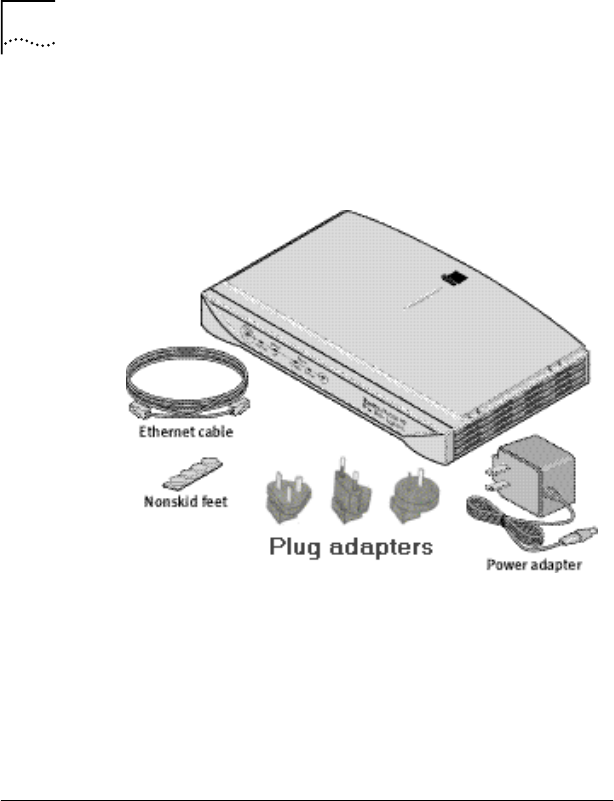
Kit Contents
■HomeConnect Wireless Gateway
■Power adapter with three plug adapters
■Nonskid feet (4)
■Standard Ethernet cable (Category 5)
■Installation Map
■User Guide
■Registration Card
4CHAPTER 1: WELCOME T
O HOME WIRELESS
If any of these items are missing or damaged, please
contact your retailer.
Figure 3 HomeConnecttm Wireless Gateway Package Contents
Installation Sheet
If you want to perform a basic installation of your
HomeConnect Wireless Gateway, please refer to the
included Installation Sheet. The Installation Sheet provides
a graphical, step-by-step procedure that allows you to set
up your home network for multiple computers and other
devices.
Minimum System Requirements
Your HomeConnect Wireless Gateway requires that the
computer(s) in your home wireless network are configured
with at least the following:
■A cable modem or DSL modem with an Ethernet port
(RJ-45 connector).
■Windows Millennium, Windows NT, Windows 2000,
Windows 98, Windows 95, or Mac OS 8.5 or higher.
■A wireless network interface adapter card, purchased
separately, for each computer to be connected to your
home wireless network.

Using This Guide 5
■An Ethernet 10Mbps or 10/100 network interface
adapter card, purchased separately, for each computer
to be connected to the three-port switch on your home
wireless gateway.
■Active Internet access account.
■Web browser program, such as Netscape or Internet
Explorer (4.0 or higher).
Using This Guide
The rest of the User Guide contains detailed information
about your gateway and how to connect it to your home
network and Internet.
■Chapter 2 familiarizes you with the front and rear
panels of the gateway, including information
concerning LEDs and ports.
■Chapter 3 explains the physical connections between
the gateway and the Internet, the wireless connection
between the gateway and your computer(s), as well as
how to configure the computers on your network.
■Chapter 4 contains a basic overview of the setup
program.
■Chapter 5 details the steps involved in accessing the
Internet with your gateway, whether you are using an
external cable or DSL modem.
■Chapter 6 details the additional features of your
gateway, such as setting up client privileges and
performing software updates.
■Chapter 7 provides troubleshooting tips.
■Appendix A provides information on how to contact
3Com for technical support.
■The Glossary, which provides definitions for key terms
concerning the installation and operation of the
gateway.

6CHAPTER 1: WELCOME T
O HOME WIRELESS
2HOME WIRELESS GATEWAY
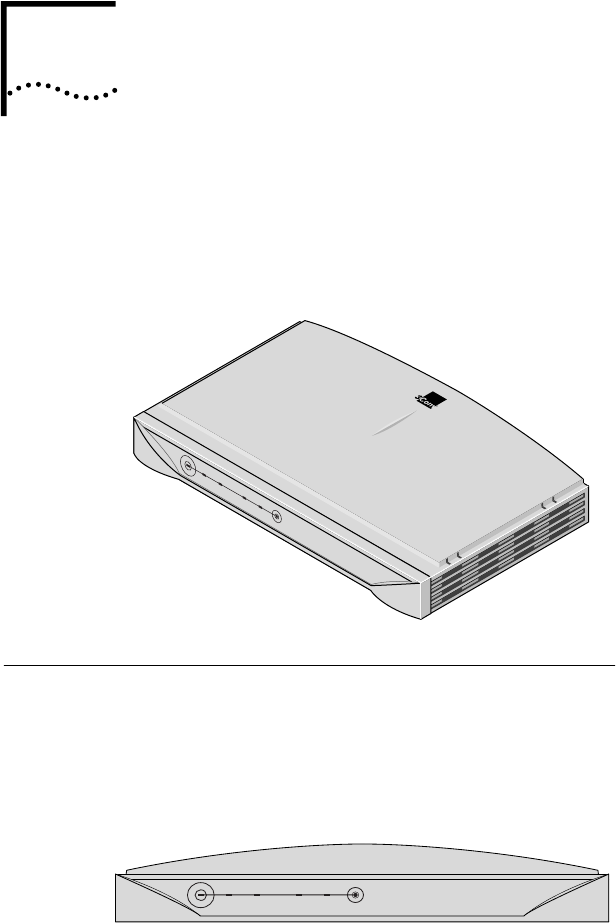
This chapter will familiarize you with your HomeConnecttm
Home Wireless Gateway (Figure 4).
Figure 4 Home Wireless Gateway
Front Panel
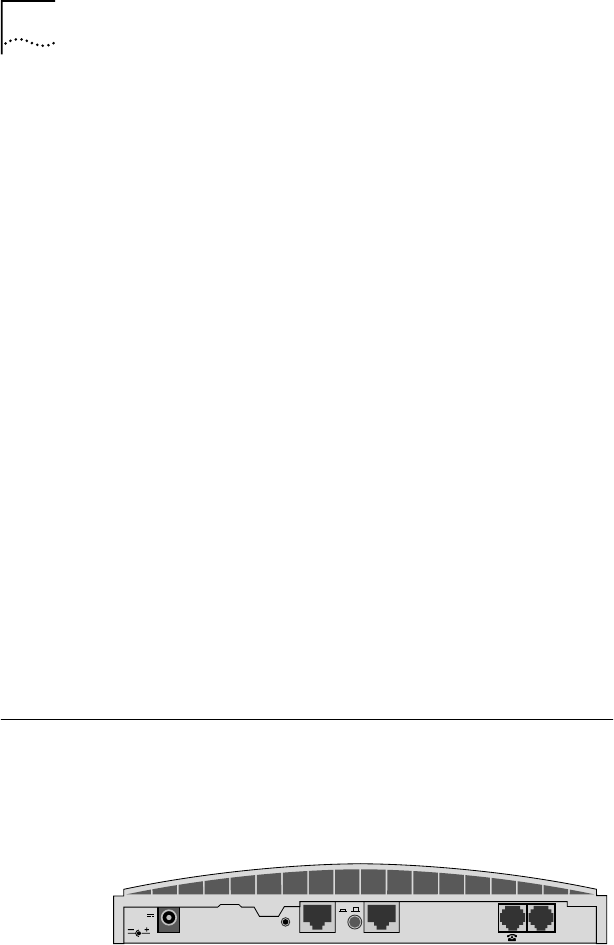
The front panel of the gateway contains a series of
indicator lights that help describe the state of various
networking and connection operations.
Figure 5 Home Wireless Gateway - Front Panel
InternetNetwork
Power
56K
Cable/DSLPhonelineEthernet
Home Network Gateway
3Com
®
HomeConnect
™
Internet NetworkPower
56KCable/DSL Phoneline Ethernet
Home Network Gateway
3Com
®
HomeConnect
™
8CHAPTER 2: HOME WIRELESS GATEWAY
Power
The Power indicator light informs you when the gateway is
on or off. If this light is illuminated, the gateway is on; if it
is not illuminated, the gateway is off. During firmware
upgrades and resets, this light will blink yellow (see
“Update Firmware” on page 28).
WAN
This light indicates the state of your Internet connection.
When on, the WAN light indicates that the gateway is
connected to the Internet through your external cable or
DSL modem.
Wireless LAN
This light displays the state of your wireless connection. If
the light is blinking rapidly, data is being transmitted to an
associated wireless client. If the light is blinking slowly, no
wireless client is associated with the gateway.
Ethernet LAN
These three lights (one per port) display the state of your
Ethernet connections. If the light is on, that port is
connected to your Ethernet network. If the light is off, the
port is not connected to your Ethernet network.
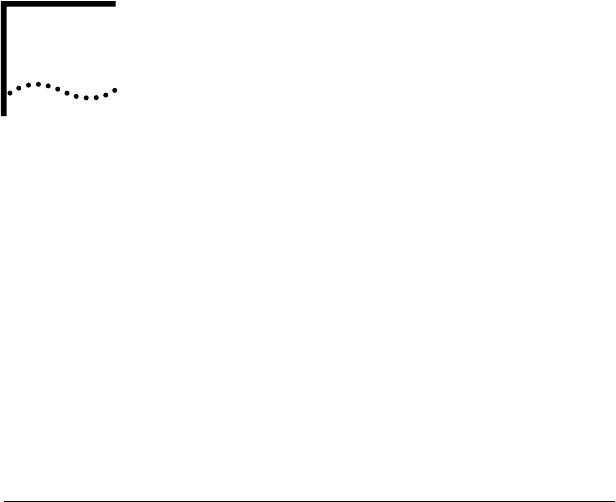
Rear Panel
The rear panel (Figure 6) of the gateway contains four
ports, a reset switch, and a power adapter socket.
Figure 6 Home Network Gateway - Rear Panel
Power Adapter Socket
The power adapter socket accepts the power adapter
connector. To power up the gateway, simply insert the
connector into the socket, and then plug the other end
into a standard electrical wall socket.
10 –18 V
0.8A MAX
Power Reset Cable/DSL Uplink/Normal Ethernet Phoneline/56K

Rear Panel 9
For easy identification, the power adapter socket is
surrounded by a yellow border.
Reset
The reset switch is used to reset the gateway.
A “soft” reset keeps your gateway settings. To perform a
“soft” reset, push the reset switch once.
A “hard” reset returns your gateway settings to their
factory default state. To perform a “hard” reset, push and
hold the reset switch for 3 seconds.
Cable/DSL
The Cable/DSL port (identified by a blue border) accepts an
RJ-45 connector to connect your gateway to the Internet.
See “External Cable and DSL Modem Connections” on
page 11 for more details.
Ethernet
Three ports are available to connect to Ethernet hubs or to
connect other Ethernet-compatible computers to the
gateway. These are dual-speed (10/100 Mbps) ports that
accept an RJ-45 connector. For easy identification, the
Ethernet ports are surrounded by a green border.
See “Setting up Ethernet Networking” on page 13 for
more details.

10 CHAPTER 2: HOME WIRELESS GATEWAY
3BASIC INSTALLATION
This chapter will guide you through a basic installation of
the HomeConnect Wireless Gateway, including
■Connecting the Wireless Gateway to the Internet.
■Connecting the Wireless Gateway to your network.
■Setting up your computers for wireless and/or wired
(Ethernet) networking with the gateway.
Note that you can use your wireless gateway for either
wireless networking or Ethernet networking, or both. You
can also set up your home wireless gateway for home
networking only; connecting to the Internet is optional.
Connecting the Wireless Gateway to the Internet
The first step of installing your gateway is to physically
connect it to a cable or DSL modem in order to be able to
access the Internet.
External Cable and DSL Modem Connections
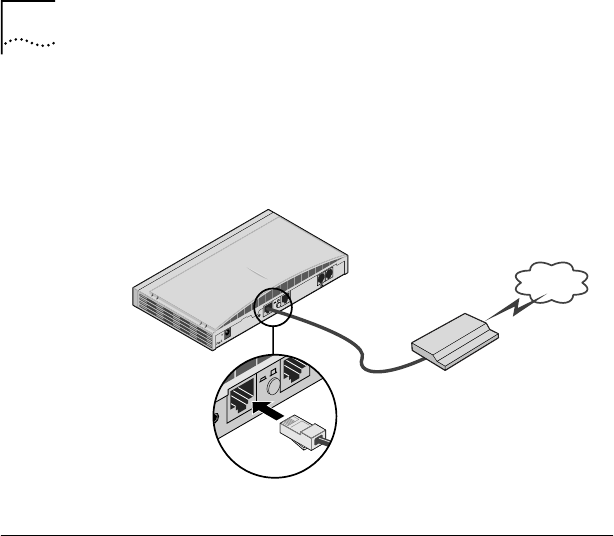
To use your gateway to connect an external cable or DSL
modem to the Internet (Figure 9):
1 Insert one end of an Ethernet (RJ-45 Category 5) cable
in the Cable/DSL port on the rear panel of the
gateway (see “Cable/DSL” on page 9).
2 Insert the other end to the RJ-45 port on your cable or
DSL modem
This port would normally be connected to an Ethernet port
on your modem. Refer to the documentation that came
with your modem for more details.
3 Connect the cable or DSL modem to the Internet.
This step might involve connecting to a phone jack or to a
cable box. See the documentation that came with your
modem for more details.
12 CHAPTER 3: BASIC INSTALLATION
4 Go to “Accessing the Internet” (Chapter 5) to finish
configuring the gateway.
Figure 7 Cable or DSL Modem Connected to the Gateway
Connecting the Wireless Gateway to Your Network
The second step for installing your gateway is setting up
the connection to one or more computers through your
home network.
Home Networking and Wireless Networking Basics
A home network is a way to connect all of your computing
devices together (computers, printers, scanners, modems)
in order to share files and resources. Once you’ve created
your home network, you will be able to connect to the
Internet from any computer in your house. If you have a
printer, scanner, or fax connected to your home network,
you will also be able to print, scan, or fax from any
computer in your house. With the addition of the 3Com
Home Wireless Gateway to your home network, you can
combine both wireless and wired networking.
Your wireless gateway uses radio signals to transmit and
receive data without wires. You can communicate with the
network by establishing radio links between your
computer(s) and the gateway. To do so, every computer
you want to use for a wireless connection must be
equipped with a wireless network interface card.
Internet
10 –18 V
0.8A MAX
PowerResetCable/DSL Uplink/Normal EthernetPhoneline/56K
Cable/DSL port
Ethernet cable
Cable or DSL
modem
Reset Cable/DSL Uplink/Normal Ethernet

Connecting the Wireless Gateway to Your Network 13
The gateway also uses Ethernet networking for cable
connections to your wired network, as well as for
connecting to the Internet through a cable or DSL modem.
Ethernet networking uses special Ethernet cables to
connect computers, printers, and other devices together.
Among the advantages of Ethernet networking is a higher
network speed (up to 100 Mbps), and the ability to use
Ethernet hubs to expand your network.
Setting up Ethernet Networking
To set up Ethernet (wired) networking in your home
1 Connect the external cable or DSL modem to your
gateway.
See “External Cable and DSL Modem Connections” on
page 11.
2 If you haven’t done so already, install or connect an
Ethernet network adapter for each computer on your
home network.
Ethernet network adapters, such as the 3Com
HomeConnect Ethernet Network Adapter, can be
purchased at your local electronics retailer.
3 Configure and set up the computers on your home
network.
Again, you may have already completed this step. See
the documentation that came with your Ethernet
network adapter for more details about setting up your
Ethernet network.
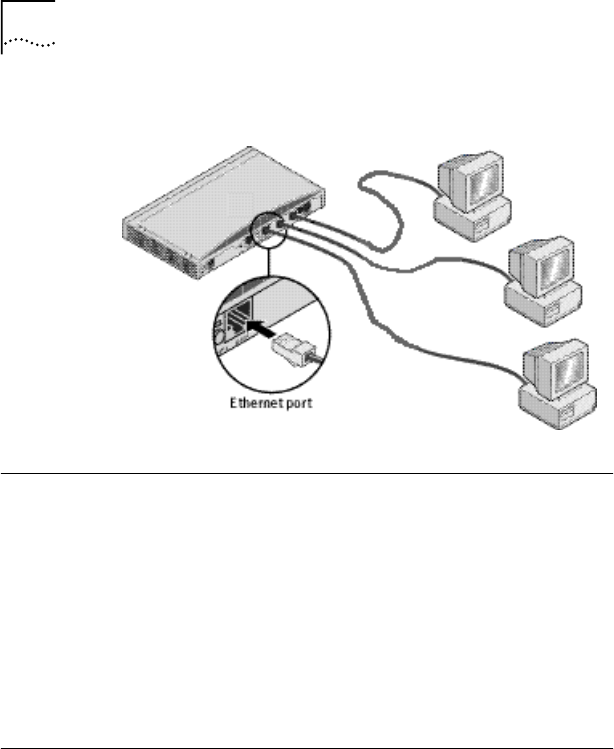
4 Connect the gateway to your network
Use the included Ethernet cable to connect the Ethernet
port on the rear panel of the gateway (see “Ethernet”
on page 9) to the Ethernet port of the network adapter
installed in your desktop or notebook computer, or to an
Ethernet hub connected to other computers.
5 If you are using an external cable or DSL modem,
connect it to your gateway.
See “External Cable and DSL Modem Connections” on
page 11.
14 CHAPTER 3: BASIC INSTALLATION
Figure 8 Connecting the Gateway to an Ethernet Network
Powering Up
1 Plug the included power adapter into the power
adapter socket located on the back panel of the
gateway (see “Power Adapter Socket” on page 9).
2 Plug the other end into a standard electrical wall
socket.
The gateway will power up, and the Power indicator
light on the front panel will illuminate (see “Power” on
page 8).
System Settings for Your Computer(s)
Each of the computers on your home network needs to
have settings in its TCP/IP control panel adjusted to take
advantage of the gateway.
Wireless Network Settings
After you have set up your gateway for use with your home
network and your Internet connection, set up your
notebook computer(s) for wireless communication with the
gateway using the following procedure:

System Settings for Your Computer(s) 15
Windows
If you are using a Windows-based notebook computer, use
the following procedure to change your TCP/IP settings:
1 From the desktop, click Start, and select Settings,
Control Panel, and Network.
2 From the Network control panel, select TCP/IP
.
3 From the TCP/IP dialog box, select IP Address.
4 Select “Obtain an IP address automatically.”
5 Click OK, and OK again.
6 Restart your computer.
Macintosh
If you are using a Macintosh computer, use the following
procedure to change your TCP/IP settings:
1 From the desktop, select Apple Menu, Control Panels,
and TCP/IP
.
2 In the TCP/IP control panel, set Connect Via: to
“Ethernet.”
The Connect Via: drop-down list is generated by clicking
the up or down arrows. From the list, select “Ethernet.”
3 In the TCP/IP control panel, set Configure: to “Using
DHCP Server.”
The Configure: drop-down list operates in the same way
as the Connect Via: list.
4 Close the TCP/IP dialog box, and save your changes.
5 Restart your computer.
Wired (Ethernet) Network Settings
Use the following procedure to set up your wired network
computer(s) to communicate with your gateway by
Ethernet cable:

16 CHAPTER 3: BASIC INSTALLATION
Windows
If you are using a Windows-based computer, use the
following procedure to change your TCP/IP settings:
1 From the desktop, click Start, and select Settings,
Control Panel, and Network.
2 From the Network control panel, select TCP/IP
.
3 From the TCP/IP dialog box, select IP Address.
4 Select “Obtain an IP address automatically.”
5 Click OK, and OK again.
6 Restart your computer.
Macintosh
If you are using a Macintosh computer, use the following
procedure to change your TCP/IP settings:
1 From the desktop, select Apple Menu, Control Panels,
and TCP/IP
.
2 In the TCP/IP control panel, set Connect Via: to
“Ethernet.”
The Connect Via: drop-down list is generated by clicking
the up or down arrows. From the list, select “Ethernet.”
3 In the TCP/IP control panel, set Configure: to “Using
DHCP Server.”
The Configure: drop-down list operates in the same way
as the Connect Via: list.
4 Close the TCP/IP dialog box, and save your changes.
5 Restart your computer.
4RUNNING THE SETUP
PROGRAM
Setup Program
The Home Wireless Gateway setup program is Web-based,
which means that it is accessed through your Web browser
running on your Windows or Macintosh computer. Make
sure that your gateway and modem are powered up before
performing the following procedure.
Accessing the Setup Program
1 Launch your Web browser on one of your networked
computers.
When the gateway is powered up, it will attempt to
automatically collect the networking setup information
from your Internet Service Provider (ISP). If you get access
to the Internet, the gateway has received this required
information from your ISP, and 3Com recommends that
you perform step 2, below, and then change your
password and update your time zone immediately (see
“Change your password.” on page 22).
If your Web browser informs you that you cannot access
the Internet, continue to follow this procedure.
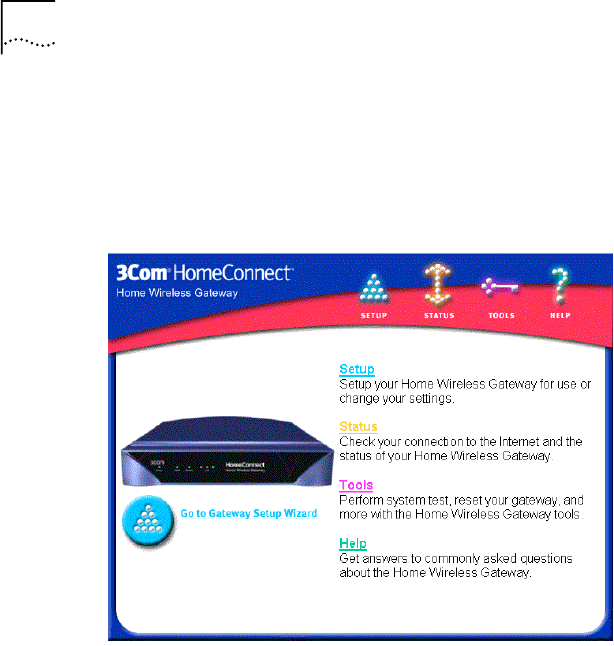
2 Type the following Internet Protocol (IP) address in
the location or address field of your browser:
192.168.2.1 (Figure 9)
Figure 9 Web Browser Location Field
18 CHAPTER 4: RUNNING THE SETUP PROGRAM
3 Press Enter on the keyboard of your computer. The
Home Wireless Gateway main page will appear
(Figure 10). Be sure to bookmark this page for easy
reference.
Figure 10 Home Network Gateway Main Page
Navigating Through the Setup Program
Moving through the pages of the setup program is simple.
When you click on a topic from the main menu, which
consists of four topics (Setup, Status, Tools, and Help) that
page will appear, as shown in Figure 12.
Menu Tab
On some of the pages of the setup program (Figure 13, for
example), a menu tab will appear, containing a list of
options pertaining to main menu topic page. Selecting one
of the options in the menu tab generates a page pertaining
to the option you chose.
Gateway Setup Wizard
By clicking Go to Gateway Setup Wizard (which appears on
several pages of the setup program), you will be guided,
step-by-step, through a basic setup procedure.

Setup Program 19
If you have the Internet access information provided by
your ISP, you can configure the gateway by using the
Gateway Setup Wizard. When you are finished with the
Wizard, the gateway will be configured for basic use with
your modem and your home network.
Setting Up Your Home Wireless Gateway
1 On the Setup page, click “Set Time Zone” to select the
appropriate time zone for your location. Click "Enter"
to move to the “Change Password” screen.
2 If you wish to use have a password assigned to your
Home Wireless Gateway, enter it here.
NOTE: The unit is shipped without a password, so the
default password field will be blank.
3 Click "Enter" to complete the Password entry. The
“Cable/DSL Setup” screen displays.
4 Click "Enter" to proceed to the “Cable/DSL Settings |
Standard” screen.
If your ISP has not supplied you with a Static IP address or a
DNS address, click "Enter" and proceed to Step 11.
Otherwise, proceed to step 5.
5 If your ISP has provided you with an IP address
and\or a DNS address, click "Yes" and enter the
information in the appropriate location. Click "Enter"
to complete the Standard Cable/DSL setup. The
“Cable/DSL Settings | Advanced” screen appears.
6 If your ISP has provided you with a user name and
password for PPPoE authentication, select "Yes" and
enter this information. If you have been supplied
with a Host Name by your ISP, enter this information
also. Click "Enter" to complete the Advanced
Cable/DSL setup.
7 Click "Enter" to go the “Wireless Setup” screen.
8 There are several channels available for use by your
Home Wireless Gateway. It is recommended that you
let the Home Wireless Gateway automatically select
the channel to use. However, if you wish to manually

20 CHAPTER 4: RUNNING THE SETUP PROGRAM
set the channel, click "Manually"and select the
desired channel.
9 Click "Enter" to proceed to the Wireless LAN Service
Area setup section.
10 If you wish to use a specific WLAN Service Area ID,
select the “Specify” option and enter the desired ID.
The default ID on the unit is “101”.
NOTE: The same ID will need to be configured on your
wireless clients in order for them to connect to the Home
Wireless Gateway.
11 Click “Enter” to go to the “Wireless Setup |
Encryption” screen.
12 If, for security reasons, you wish to use encryption to
transmit your data securely over your Wireless
Network, use one of the following two methods to
set up encryption:
■Select YES -- generate encryption keys automatically to
allow the Home Wireless Gateway to automatically
generate the encryption keys, OR
■Select YES -- enter encryption keys manually so that you
may manually generate the keys. To do this, enter 5
hexadecimal digit pairs for each of the 4 keys in the
locations provided.
NOTE: A hexadecimal digit is a number or letter in the
range 0-9 or A-F.
NOTE: If you decide to use encryption, you will need
to have the corresponding keys configured identically
on each of your wireless clients, otherwise the clients
will not be able to connect to the Home Wireless
Gateway.
13 Click "Enter" to complete the Encryption section of
the Home Wireless Gateway setup. The “Setup
Wizard | Finished” screen appears.
14 Click "Save and Restart" to ensure all your settings
have been saved to the Home Wireless Gateway.

5ACCESSING THE INTERNET
This chapter will explain how to set up your Home Wireless
Gateway for use with your external cable or external DSL
modem, so that you can access the Internet.
Before you continue with this procedure, you will need
modem setting information from your Internet Service
Provider (ISP).
Internet Connection Settings
The following sections will explain how to set up your
gateway for use with an external cable or DSL modem.
External Cable and DSL Modem
To use an externally attached cable/DSL modem connected
to your gateway, you will need to enter information
provided to you by your ISP.
To configure your cable or DSL modem to the gateway,
follow the procedure, below, or use the Gateway Setup
Wizard, which can be accessed from the Setup page (see
“Gateway Setup Wizard” on page 18 and “Setup Page”
on page 22):
1 Connect the gateway to one of your computers.
See “Connecting the Wireless Gateway to Your
Network” on page 12 to connect the computer to the
gateway.
2 Access the Home Wireless Gateway Setup Program.
See “Accessing the Setup Program” on page 17 to
access the program.
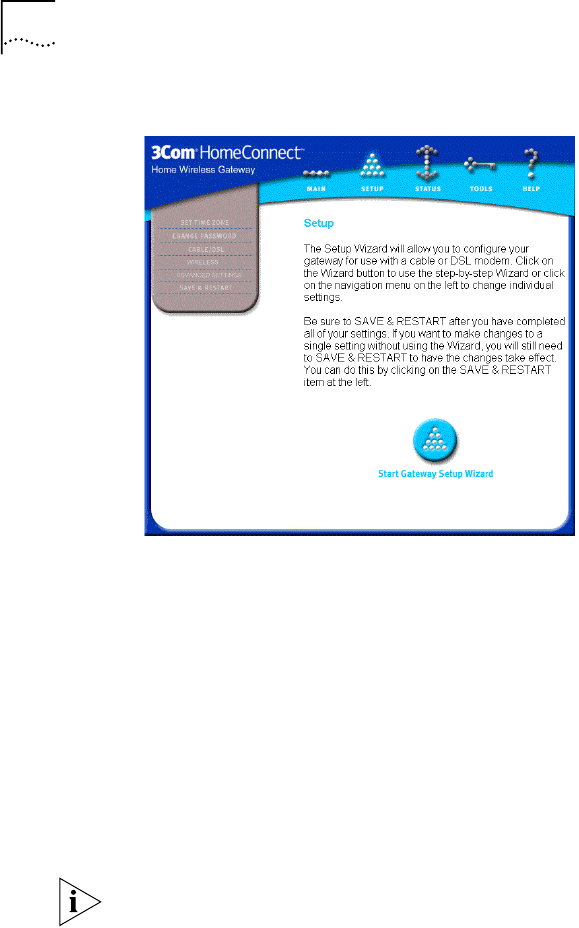
3 Select Setup from the Main menu.
The Setup page will appear.
22 CHAPTER 5: ACCESSING THE INTERNET
Figure 11 Setup Page
4 Set your time zone.
From the menu tab on the left side of the page, select
Set Time Zone. A pull down menu will appear. Press on
the arrows, click your choice, and then click Enter.
5 Change your password.
3Com recommends changing your password when
setting up the gateway for the first time. The factory
default username is admin, and the password is 3com.
When the Change Password page appears, type the
factory default username and password into their
respective text boxes and then your new password in
both the New Password and Re-enter Password for
Verification text boxes. Click Enter.
Note: Write this password down and keep it in a safe
place, so that you can change your settings in the future.
6 Go to the cable/DSL modem setup.
Select Cable/DSL from the gray menu tab on the left
side of the page. An informational page will appear,
suggesting that you have the modem setting
information from your ISP handy. Collect the
information, and then click Enter.
Internet Connection Settings 23
7 Enter the networking setup information you acquired
from your ISP.
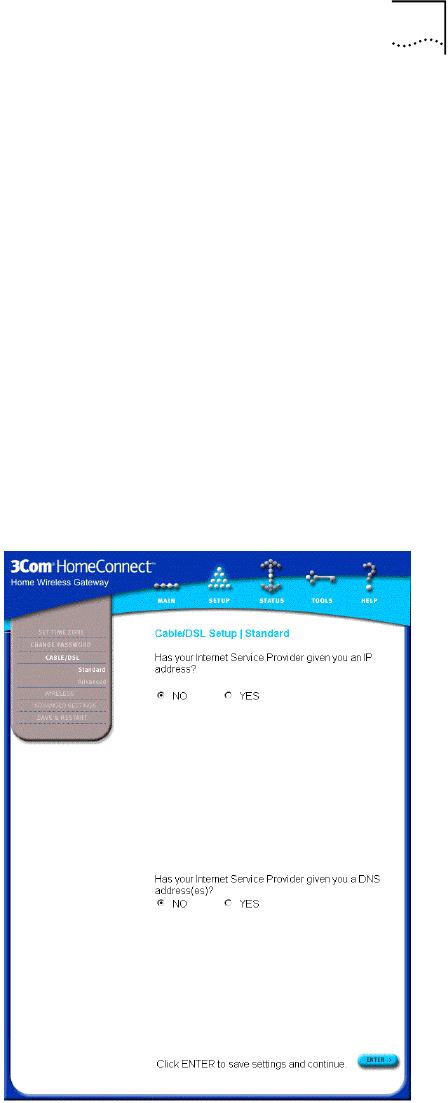
When the Cable/DSL Setup | Standard page appears
(Figure 14), you will be asked to enter the information
you received from your ISP. If you have the information
and your ISP has given you an IP address, select Yes after
the first question. Enter the IP address, subnet mask
address, and ISP gateway address in the appropriate text
boxes. Each address will be made up of 4 groups of
numbers, separated by periods. Enter each number
group in a separate text box. For instance, if your IP
address is 222.11.123.100, enter 222 in the first IP
address text box, 11 in the second, and so on.
If your ISP has given you a DNS address, select Ye s under
the second question, and fill in those addresses. When
you’re finished, click Enter.
Figure 12 Cable/DSL Setup | Standard Page
24 CHAPTER 5: ACCESSING THE INTERNET
8 If applicable, enter PPPoE information.
Your ISP may need you to enter Host Name or PPPoE
(Point-to-Point Protocol over Ethernet) settings. Select
Advanced below Cable/DSL on the menu tab to
generate the Cable/DSL Setup | Advanced page. Fill in
the information in the appropriate text box. When
you’re finished, click Enter.
Since the gateway firmware contains its own PPPoE client
proxy, you no longer need to run PPPoE client software
from your ISP to access the Internet. You can simply start
your browser and surf the Internet immediately after
setting up your cable or DSL modem.
You have successfully installed and configured your cable
or DSL modem for use with your gateway. Your Internet
connection is now protected by a corporate-grade firewall,
which will safeguard your computer (and any other
computers networked to the gateway) from any damaging
hacker attacks.
6ADDITIONAL FEATURES
This chapter describes the additional features available to
you with your Home Wireless Gateway, which include
viewing the Status page, assigning client privileges, and
using the system tools.
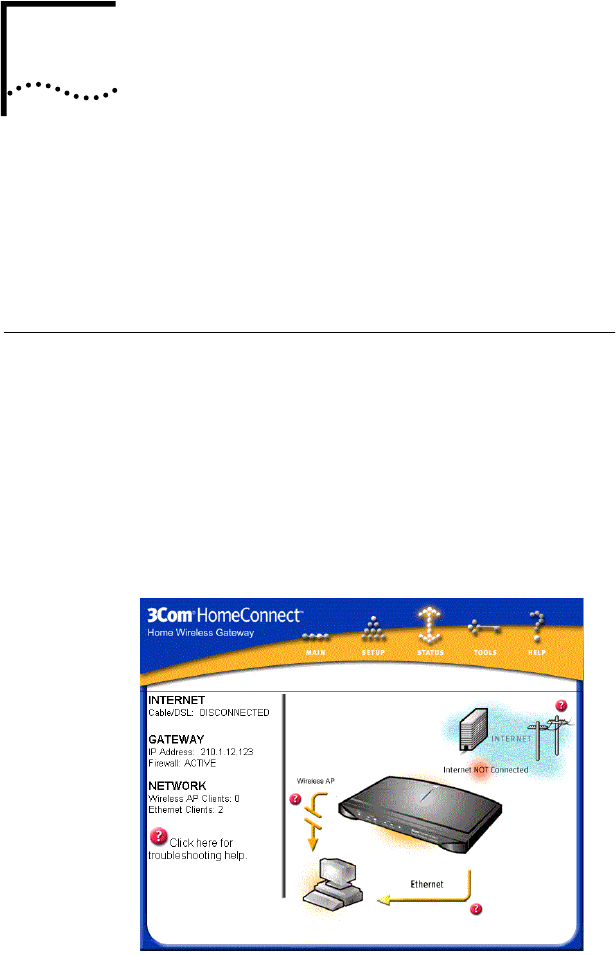
Status
Selecting Status from the main menu generates the Status
page (Figure 13) in your Web browser window. On this
page, a graphical representation of your home network
and Internet connection is provided. Flashing arrows signify
that the connection is operating. Broken arrows (such as
the “Wireless” arrows in Figure 13) signify that a
connection is not being used or is not functioning correctly.
Figure 13 Status Page
On the left side of the page is textual information
describing your network, gateway, and Internet
connections.
26 CHAPTER 6: ADDITIONAL FEATURES
Client Privileges
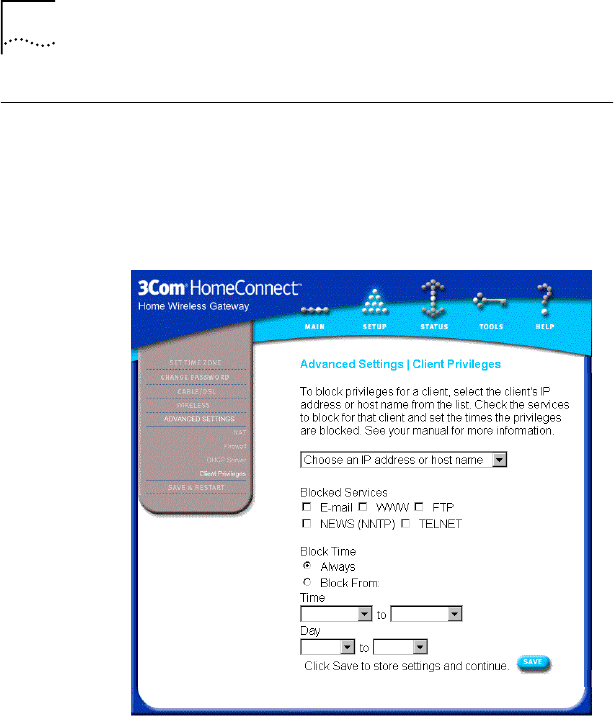
Selecting Client Filtering from the menu tab in the Setup
page generates the Client Computer Setup | Client
Privileges page (Figure 14).
Figure 14 Client Computer Setup | Client Privileges Page
Assigning client privileges is a way for you to control what
kind of Internet service each of the computers on your
home network can use. For example, you may not want
your children’s computer to have access to the Internet
during a period of time in which you cannot monitor its
use.
When you assign client privileges, you can instruct the
gateway to block Internet access to any computer on your
home network. You can also limit other Internet services,
such as Mail, Telnet, and File Transfer Protocol (FTP).

Client Privileges 27
To assign client privileges:
1 Choose an IP address from the available pool.
Click the up/down arrows to view the available pool of
IP addresses. Click one to choose it, and write it down
on a piece of scrap paper.
2 Choose the services you want to block.
Below the drop-down menu is a series of Internet
services (E-mail, WWW, FTP, News [NNTP], Telnet). Click
the checkbox next to the service (or services) you want
to block.
3 Choose the block time.
If you want the services you chose in step 2 to be
blocked permanently, click the Always button.
You can also identify a period of time in which the
services are blocked. To do this, click the Block from:
button, and choose a daily and weekly time period from
the drop-down menus.
4 Click Save.
5 Set the IP address on the computer.
Now that the gateway knows which services to block
and when to block them, you must set up the computer
on which you intend to block the services.
On the selected computer, go to the IP address dialog
box (in Windows, select Start, Settings, Control Panel,
Network, TCP/IP
, and Properties to get to the IP address
dialog box; on a Macintosh, select Apple Menu, Control
Panels, TCP/IP).
In the IP address dialog box, in Windows select Specify
an IP address or, on a Macintosh, from the Configure:
drop-down menu, select Manually, and enter the IP
address you chose in step 1.
6 Restart your computer to save the changed settings.
To block services on other computers on your network,
choose another IP address from the available pool, and
repeat the procedure.

28 CHAPTER 6: ADDITIONAL FEATURES
To o l s
Choosing Tools from the Main menu generates the Tools
page within your browser window. There are five options
to select from: System Test, Security Log, Reset Home
Wireless Gateway, Restore Factory Settings, and Upgrade
Software.
System Test
Choosing this option generates the System Test page.
Clicking the Test button on this page puts the gateway
through a thorough system test. You should perform a
system test after upgrading your software, or if the
gateway is not operating correctly. After the test is done,
the results of the test will appear.
Security Log
Choosing Security Log brings up a page that displays any
attempts to gain access to your home network by
computer hackers or other individuals.
Reset Home Wireless Gateway
If your gateway is not operating correctly, you can choose
this option to generate the Reset gateway page. Clicking
on the Reset button will reset the gateway, with all of your
settings remaining intact. If you don’t want to reset the
gateway, click on the Cancel button, which sends you back
to the Tools page.
Restore Factory Settings
Selecting Restore Factory Settings generates the Restore
Factory Settings page. If you want to reset the settings on
your gateway to those that were loaded at the factory, click
Restore. If you don’t want to restore factory settings, click
on Cancel.
Update Firmware
Selecting Update Firmware generates the Update Firmware
page. The software provides the intelligence needed for the
gateway to perform its many operations. This software is

To o l s 29
updated on a regular basis, and is available for you to
download.
1 Note the current firmware version and date on the
Update Software page.
2 Click Click here for upgrade on 3Com website.
This will take you to the 3Com support website.
3 Choose your product name and check the latest
firmware.
If the firmware on the 3Com Web site has the same
version number and date as the version you noted in
step 1, your gateway is running the latest firmware. If
the firmware on the 3Com Web site has a higher version
number, continue with this procedure.
4 Download the software.
You can choose where on your hard drive you want to
download your firmware. Note the location of the
downloaded firmware.
5 Return to the Update Firmware page and click Enter.
6 In the next page, enter the location of the
downloaded firmware.
You can either enter the directory path in the text box
(“C:\download,” for example) or search for the location
by clicking Browse….
7 Once you’ve located the file, click Start to update
your firmware.
The setup program will notify you when the upgrade
has finished. During the update, the Power light will
flicker.
Caution: Do not turn off the gateway while the firmware
is being updated.

30 CHAPTER 6: ADDITIONAL FEATURES
7TROUBLESHOOTING
Home Wireless Gateway
■Check power connection.
■Verify power light status.
■Check connections for modem and networking
interface(s).
■If you are unable to access the gateway's user interface,
please check your computer's network settings. Verify
that your TCP/IP settings are correct (see “System
Settings for Your Computer(s)” on page 14).
■Ensure that the latest firmware is installed in the
gateway.
Modem
Cable or DSL
■Check your Cable/DSL link light to verify a good
connection.
■Check your cable or DSL modem to verify that the
power cable is connected.
■Check your cable or DSL modem to verify that the cable
or DSL line is connected.
■Reboot your Cable/DSL modem.
■If your ISP does not support automatically assigned
networking settings, then enter your setting
information into the setup program (see ”Enter the
networking setup information you acquired from your
ISP.” on page 23).

32 CHAPTER 7: TROUBLESHOOTING
Ethernet Networks
■Check all connections to the gateway
■Check all connections to each attached device on the
network
■Ensure that the TCP/IP settings for all devices are correct
(see “System Settings for Your Computer(s)”on
page 14).
■Ensure that you have an Ethernet interface for each
networked computer
■Each computer must have either Microsoft Windows 95
(or higher) or Mac OS 8.5 (or higher).
3Com KnowledgeBase
If none of the above information has resolved the problem
with your gateway, please search the on-line 3Com
KnowledgeBase at:
http://knowledgebase.3com.com
Refer to Appendix A, Technical Support for additional
information about how to contact 3Com Technical
Support.
AT
ECHNICAL SUPPORT
Online Technical Services
3Com offers worldwide product support 24 hours a day, 7
days a week, through the following online systems:
■World Wide Web site
■3Com FTP site
■3Com Bulletin Board Service (3Com BBS)
■3Com FactsSM automated fax service
World Wide Web Site
Access the latest networking information on the 3Com
Corporation World Wide Web site by entering the URL into
your Internet browser:
http://www.3com.com/
This service provides access to online support information
such as technical documentation and software library, as
well as support options ranging from technical education
to maintenance and professional services.
3Com FTP Site
Download drivers, patches, software, and MIBs across the
Internet from the 3Com public FTP site. This service is
available 24 hours a day, 7 days a week.
To connect to the 3Com FTP site, enter the following
information into your FTP client:
■Hostname: ftp.3com.com (or 192.156.136.12)
■Username: anonymous
■Password: <your Internet e-mail address>
NOTE: A user name and password are not needed with
Web browser software such as Netscape Navigator and
Internet Explorer.

34 CHAPTER : TECHNICAL SUPPORT
3Com Bulletin Board Service
The 3Com BBS contains patches, software, and drivers for
3Com products. This service is available through analog
modem or digital modem (ISDN) 24 hours a day, 7 days a
week.
Access by Analog Modem
To reach the 3Com BBS by modem, set your modem to 8
data bits, no parity, and 1 stop bit. Call the telephone
number nearest you:
Access by Digital Modem
ISDN users can dial in to the 3Com BBS using a digital
modem for fast access up to 64 Kbps. To access the 3Com
BBS using ISDN, use the following number:
1 847 262 6000
Support from Your Network Supplier
If additional assistance is required, contact your network
supplier. Many suppliers are authorized 3Com service
partners who are qualified to provide a variety of services,
including network planning, installation, hardware
maintenance, application training, and support services.
When you contact your network supplier for assistance,
have the following information ready:
■Product model name, part number, and serial number
■A list of system hardware and software, including
revision levels
■Diagnostic error messages
■Details about recent configuration changes, if
applicable
Country Data Rate Telephone Number
Brazil Up to 14,400 bps 55 11 5181 9666
Italy Up to 14,400 bps 39 2 27300680
Mexico Up to 28,800 bps 52 5 520 7835
U.S.A. Up to 53,333 bps 1 847 262 6000
Support from 3Com 35
If you are unable to contact your network supplier, see the
following section on how to contact 3Com.
Support from 3Com
If you are unable to obtain assistance from the 3Com
online technical resources or from your network supplier,
3Com offers technical telephone support services. To find
out more about your support options, please call the 3Com
technical telephone support phone number at the location
nearest you.
When you contact 3Com for assistance, have the following
information ready:
■Product model name, part number, and serial number
■A list of system hardware and software, including
revision levels
■Diagnostic error messages
■Details about recent configuration changes, if
applicable
Below is a list of worldwide technical telephone support
numbers:
Country Telephone Number Country Telephone
Number
Asia Pacific Rim
Australia
Hong Kong
India
Indonesia
Japan
Malaysia
New Zealand
Pakistan
Philippines
1 800 678 515
800 933 486
+61 2 9937 5085
001 800 61 009
03 5783 1270
1800 801 777
0800 446 398
+61 2 9937 5085
1235 61 266 2602
P.R. of China
Singapore
S. Korea
From anywhere
in S. Korea:
From Seoul:
Taiwan, R.O.C.
Thailand
10800 61 00137
or
021 6350 1590
800 6161 463
00798 611 2230
(0) 2 3455 6455
0080 611 261
001 800 611 2000
Europe
From anywhere in
Europe, call:
+31 (0)30 6029900 phone
+31 (0)30 6029999 fax
36 CHAPTER : TECHNICAL SUPPORT
Returning Products for Repair
Before you send a product directly to 3Com for repair, you
must first obtain a Return Materials Authorization (RMA)
number. Products sent to 3Com without RMA numbers will
be returned to the sender unopened, at the sender’s
expense.
To obtain an RMA number, call or fax:
From the following European countries, you may use the toll-free numbers:
Austria
Belgium
Denmark
Finland
France
Germany
Hungary
Ireland
Israel
Italy
0800 297468
0800 71429
800 17309
0800 113153
0800 917959
0800 1821502
06800 12813
1 800 553117
1 800 9453794
800 879489
Netherlands
Norway
Poland
Portugal
South Africa
Spain
Sweden
Switzerland
U.K.
0800 0227788
800 11376
0800 3111206
0800 831416
0800 995014
900 983125
020 795482
0800 55 3072
0800 966197
Latin America
Argentina
Brazil
Chile
Colombia
AT&T +800 666 5065
0800 13 3266
1230 020 0645
98012 2127
Mexico
Peru
Puerto Rico
Venezuela
01 800 CARE (01 800 2273)
AT&T +800 666 5065
800 666 5065
AT&T +800 666 5065
North
America 1 800 527 8677
Country Telephone Number Fax Number
Asia, Pacific Rim 65 543 6500 65 543 6348
Europe, South Africa, and
Middle East
+ 44 1442 435860 + 44 1442 435718

Returning Products for Repair 37
From the following European countries, you may call the toll-free numbers; select
option 2 and then option 2:
Austria
Belgium
Denmark
Finland
France
Germany
Hungary
Ireland
Israel
Italy
Netherlands
Norway
Poland
Portugal
South Africa
Spain
Sweden
Switzerland
U.K.
0800 297468
0800 71429
800 17309
0800 113153
0800 917959
0130 821502
06800 12813
1 800 553117
1 800 9453794
800 879489
0800 0227788
800 11376
0800 3111206
0800 831416
0800 995014
900 983125
020 795482
0800 55 3072
0800 966197
Latin America 1 408 326 2927 1 408 326 3355
U.S.A. and Canada 1 800 527 8677 1 408 326 7120

38 CHAPTER : TECHNICAL SUPPORT
GLOSSARY
Client
The term used to described the desktop or mobile PC that
is wirelessly connected to your wireless network.
DHCP
Dynamic Host Configuration Protocol. This protocol
automatically configures the TCP/IP settings of every
computer on your home network.
DNS Server Address
DNS stands for Domain Name System, which allows
Internet host computers to have a domain name (such as
3com.com) and one or more IP addresses (such as
192.34.45.8). A DNS server keeps a database of host
computers and their respective domain names and IP
addresses, so that when a domain name is requested (as in
typing “3com.com” into your Internet browser), the user is
sent to the proper IP address. The DNS server address used
by the computers on your home network is the location of
the DNS server your ISP has assigned.
DSL modem
DSL stands for digital subscriber line. A DSL modem uses
your existing phone lines to send and receive data at high
speeds.
Ethernet
A standard for computer networks. Ethernet networks that
are connected by special cables and hubs move data
around at up to 100 million bits per second (Mbps).
Firewall
Electronic protection that prevents anyone outside of your
network from seeing your files or damaging your
computers.

40 GLOSSARY
Gateway
A device that acts as a wireless central hub by connecting
to each computer's network interface card and managing
the wireless traffic. The gateway can stand alone in a pure
wireless network or can be connected to a wired network,
such as an Ethernet network, to create a mixed
wireless/wired network. Sometimes called an Access Point
because it is the point at which a wireless network
connects to a wired network, such as Ethernet.
IP address
IP stands for Internet Protocol. An IP address, which
consists of a series of four numbers separated by periods,
identifies a single, unique Internet computer host. Example:
192.34.45.8.
ISP
Internet service provider. An ISP is a business that provides
connectivity to the Internet for individuals and other
businesses or organizations.
LAN
Local area network. A LAN is a group of computers and
devices connected together in a relatively small area (such
as a house or an office). Your home network is considered
a LAN.
MAC Address
MAC stands for media access control. A MAC address is
the hardware address of a device connected to a network.
NAT
Network address translation. This process allows all of the
computers on your home network to use one IP address.
Using the NAT capability of the HomeConnect home
network gateway, you can access the Internet from any
computer on your home network without having to
purchase more IP addresses from your ISP.
PC Card
A network interface card that enables a notebook
computer to connect to a wireless network. The card is

GLOSSARY 41
installed in the PCMCIA slot of a notebook computer and
communicates with the wireless gateway.
PPPoE
Point-to-Point Protocol over Ethernet. Point-to-Point
Protocol is a method of secure data transmission originally
created for dial-up connections; PPPoE is for Ethernet
connections.
SPI
Stateful Packet Inspection. SPI is the type of
corporate-grade Internet security provided by your
HomeConnect home network gateway. Using SPI, the
gateway acts as a “firewall,” protecting your network from
hacker attacks.
subnet mask
A subnet mask, which may be a part of the TCP/IP
information provided by your ISP, is a set of four numbers
configured like an IP address. It is used to create IP address
numbers used only within a particular network (as opposed
to valid IP address numbers recognized by the Internet,
which must assigned by InterNIC).
TCP/IP
Transmission Control Protocol/Internet Protocol. This is the
standard protocol for data transmission over the Internet.
WAN
Wide area network. A network that connects computers
located in geographically separate areas, (i.e., different
buildings, cities, countries). The Internet is an example of a
wide area network.

42 GLOSSARY

INDEX
Numbers
3Com bulletin board service (3Com
BBS) 34
3Com KnowledgeBase 32
3Com URL 33
A
Access point (see Gateway) 40
B
block time 27
bulletin board service 34
C
Client 39
client privileges 2, 5, 26
D
DHCP 39
DNS address 23, 39
E
e-mail 27
Ethernet 39
Ethernet cable 3, 11, 13
Ethernet networking 32
F
Firewall 39
firewall 1, 2, 3, 24
firmware. See Software Update
front panel 5, 7
FTP 27
G
Gateway 40
Gateway Setup Wizard 18
H
hackers 3, 24
I
Installation Map 3, 4
Internet Service Provider 21, 31, 40
Internet services 27
IP address 17, 23, 27, 40
IP address dialog box 27
ISP gateway address 23
ISP. See Internet Service Provider
L
LAN 40
lights
Cable/DSL 31
power 8, 14
M
MAC address 40
Macintosh 15, 16
Mac OS 4, 32
main page 18
menu tab
setup program 18
MIBs 33
Minimum System Requirements 4
modem
cable or DSL 5, 11, 13, 21, 31, 39
N
NAT 40
network adapter
Ethernet 13
Network adapter card
wireless 4
network adapter card 5

44 INDEX
network management. See Client
Privileges
network supplier support 34
networking
Ethernet 13, 32
home phoneline 32
News 27
Nonskid feet 3
O
online technical services 33
P
password 22
PC card 40
phone jack 11
ports
Cable/DSL 9, 11
Ethernet 9
power adapter 8
power adapter 3, 14
power adapter socket 14
PPPoE 24, 41
R
rear panel 5
Reset gateway 28
Restore Factory Settings 28
returning products for repair 36
S
Security Log 28
setup program 5, 17, 21
software update 31
SPI.See Stateful Packet Inspection
Stateful Packet Inspection 3, 41
status page 25
subnet mask 23, 41
System Test 28
system tools 28
T
TCP/IP 41
TCP/IP settings 31, 32
Macintosh 15, 16
Windows 15, 16
technical support
3Com URL 33
bulletin board service 34
network suppliers 34
product repair 36
Te l n e t 2 7
time zone 22
troubleshooting 5
U
Update Software 5, 28
URL 33
username 22
W
WAN 41
Web browser 5, 17, 25
location field 17
Windows 15, 16
2000 4
95 4, 32
98 4
Wireless network adapter card 4
World Wide Web (WWW) 33

WARRANTY AND REGULATORY COMPLIANCE
3Com Corporation Limited Warranty
This warranty applies to customers located in the United States, Australia, Canada (except Quebec),
Ireland, New Zealand, U.K., and other English language countries, and countries for which a translation
into the local language is not provided
3Com AirConnect 11Mbps Wireless LAN
HARDWARE
3Com warrants to the end user (“Customer”) that this hardware product will be free from defects in
workmanship and materials, under normal use and service, for the following length of time from the
date of purchase from 3Com or its authorized reseller:
Five (5) years
Spare Parts and Spares Kits are warranted for ninety (90) days
3Com’s sole obligation under this express warranty shall be, at 3Com’s option and expense, to repair
the defective product or part, deliver to Customer an equivalent product or part to replace the
defective item, or if neither of the two foregoing options is reasonably available, 3Com may, in its sole
discretion, refund to Customer the purchase price paid for the defective product. All products that are
replaced will become the property of 3Com. Replacement products or parts may be new or
reconditioned. 3Com warrants any replaced or repaired product or part for ninety (90) days from
shipment, or the remainder of the initial warranty period, whichever is longer.3Com’s sole obligation
under this express warranty shall be, at 3Com’s option and expense, to repair the defective product or
part, deliver to Customer an equivalent product or part to replace the defective item, or if neither of the
two foregoing options is reasonably available, 3Com may, in its sole discretion, refund to Customer the
purchase price paid for the defective product. All products that are replaced will become the property
of 3Com. Replacement products may be new or reconditioned. 3Com warrants any replaced or
repaired product or part for ninety (90) days from shipment, or the remainder of the initial warranty
period, whichever is longer.
SOFTWARE
3Com warrants to Customer that each software program licensed from it, except as noted below, will
perform in substantial conformance to its program specifications, for a period of ninety (90) days from
the date of purchase from 3Com or its authorized reseller. 3Com warrants the media containing
software against failure during the warranty period. No updates are provided. 3Com's sole obligation
under this express warranty shall be, at 3Com's option and expense, to refund the purchase price paid
by Customer for any defective software product, or to replace any defective media with software which
substantially conforms to applicable 3Com published specifications. Customer assumes responsibility
for the selection of the appropriate applications program and associated reference materials. 3Com
makes no warranty or representation that its software products will meet Customer’s requirements or
work in combination with any hardware or applications software products provided by third parties,
that the operation of the software products will be uninterrupted or error free, or that all defects in the
software products will be corrected. For any third party products listed in the 3Com software product
documentation or specifications as being compatible, 3Com will make reasonable efforts to provide
compatibility, except where the non-compatibility is caused by a “bug” or defect in the third party's
product or from use of the software product not in accordance with 3Com’s published specifications or
user manual.
The site survey software is licensed "AS IS".
THIS 3COM PRODUCT MAY INCLUDE OR BE BUNDLED WITH (1) THIRD PARTY SOFTWARE, OR (2)
3COM SOFTWARE WHICH IS USED WITH THE LINUX OPERATING SYSTEM, THE USE OF WHICH IS
GOVERNED BY A SEPARATE END USER LICENSE AGREEMENT. THIS 3COM WARRANTY DOES NOT
APPLY TO SUCH THIRD PARTY SOFTWARE OR 3COM LINUX SOFTWARE. FOR THE APPLICABLE
WARRANTY, PLEASE REFER TO THE END USER LICENSE AGREEMENT GOVERNING THE USE OF SUCH
SOFTWARE OR THE ACCOMPANYING DOCUMENTATION RELATING TO SUCH SOFTWARE

YEAR 2000 WARRANTY
In addition to the Hardware Warranty and Software Warranty stated above, 3Com warrants that each
product sold or licensed to Customer on and after January 1, 1998 that is date sensitive will continue
performing properly with regard to such date data on and after January 1, 2000, provided that all other
products used by Customer in connection or combination with the 3Com product, including hardware,
software, and firmware, accurately exchange date data with the 3Com product, with the exception of
those products identified at 3Com’s Web site, http://www.3com.com/products/yr2000.html, as not
meeting this standard. If it appears that any product that is stated to meet this standard does not
perform properly with regard to such date data on and after January 1, 2000, and Customer notifies
3Com before the later of April 1, 2000, or ninety (90) days after purchase of the product from 3Com or
its authorized reseller, 3Com shall, at its option and expense, provide a software update which would
effect the proper performance of such product, repair such product, deliver to Customer an equivalent
product to replace such product, or if none of the foregoing is feasible, refund to Customer the
purchase price paid for such product.
Any software update or replaced or repaired product will carry a Year 2000 Warranty for ninety (90)
days after purchase or until April 1, 2000, whichever is later.
OBTAINING WARRANTY SERVICE
Customer must contact a 3Com Corporate Service Center or an Authorized 3Com Service Center
within the applicable warranty period to obtain warranty service authorization. Dated proof of
purchase from 3Com or its authorized reseller may be required. Products returned to 3Com's
Corporate Service Center must be pre-authorized by 3Com with a User Service Order (USO) number (or
a Return Material Authorization (RMA) number or a Service Repair Order (SRO) number, whichever was
issued) marked on the outside of the package, and sent prepaid and packaged appropriately for safe
shipment, and it is recommended that they be insured or sent by a method that provides for tracking of
the package. Responsibility for loss or damage does not transfer to 3Com until the returned item is
received by 3Com. The repaired or replaced item will be shipped to Customer, at 3Com's expense, not
later than thirty (30) days after 3Com receives the defective product, and 3Com will retain risk of loss or
damage until the item is delivered to Customer.
3Com shall not be responsible for any software, firmware, information, or memory data of Customer
contained in, stored on, or integrated with any products returned to 3Com for repair, whether under
warranty or not.
Dead- or Defective-on-Arrival. In the event a product completely fails to function or exhibits a defect in
materials or workmanship within the first forty-eight (48) hours of installation but no later than thirty
(30) days after the date of purchase, and this is verified by 3Com, it will be considered dead- or
defective-on-arrival (DOA) and a replacement shall be provided by advance replacement, but only if
Customer provides a purchase order number, credit card number, or other method of payment
acceptable to 3Com, to be used if 3Com needs to charge Customer for the replacement, as explained
below. The replacement product will normally be shipped not later than three (3) business days after
3Com’s verification of the DOA product, but may be delayed due to export or import procedures. The
shipment of advance replacement products is subject to local legal requirements and may not be
available in all locations. When an advance replacement is provided and Customer fails to return the
original product to 3Com within fifteen (15) days after shipment of the replacement, 3Com will charge
Customer for the replacement product, at list price.
INCLUDED SERVICES: Telephone Support, with coverage for basic troubleshooting only, will be
provided for ninety (90) days from the date of purchase, on a commercially reasonable efforts basis.
Telephone support is available from 3Com only if Customer purchased this product directly from
3Com, or if Customer’s reseller is unable to provide telephone support. Please refer to the Technical
Support appendix in the User Guide for telephone numbers.
WARRANTIES EXCLUSIVE
IF A 3COM PRODUCT DOES NOT OPERATE AS WARRANTED ABOVE, CUSTOMER'S SOLE REMEDY FOR
BREACH OF THAT WARRANTY SHALL BE REPAIR, REPLACEMENT, OR REFUND OF THE PURCHASE
PRICE PAID, AT 3COM'S OPTION. TO THE FULL EXTENT ALLOWED BY LAW, THE FOREGOING
WARRANTIES AND REMEDIES ARE EXCLUSIVE AND ARE IN LIEU OF ALL OTHER WARRANTIES, TERMS,
OR CONDITIONS, EXPRESS OR IMPLIED, EITHER IN FACT OR BY OPERATION OF LAW, STATUTORY OR
OTHERWISE, INCLUDING WARRANTIES, TERMS, OR CONDITIONS OF MERCHANTABILITY, FITNESS FOR
A PARTICULAR PURPOSE, SATISFACTORY QUALITY, CORRESPONDENCE WITH DESCRIPTION, AND
NON-INFRINGEMENT, ALL OF WHICH ARE EXPRESSLY DISCLAIMED. 3COM NEITHER ASSUMES NOR
AUTHORIZES ANY OTHER PERSON TO ASSUME FOR IT ANY OTHER LIABILITY IN CONNECTION WITH
THE SALE, INSTALLATION, MAINTENANCE OR USE OF ITS PRODUCTS.
3COM SHALL NOT BE LIABLE UNDER THIS WARRANTY IF ITS TESTING AND EXAMINATION DISCLOSE
THAT THE ALLEGED DEFECT OR MALFUNCTION IN THE PRODUCT DOES NOT EXIST OR WAS CAUSED
BY CUSTOMER'S OR ANY THIRD PERSON'S MISUSE, NEGLECT, IMPROPER INSTALLATION OR TESTING,
UNAUTHORIZED ATTEMPTS TO OPEN, REPAIR OR MODIFY THE PRODUCT, OR ANY OTHER CAUSE
BEYOND THE RANGE OF THE INTENDED USE, OR BY ACCIDENT, FIRE, LIGHTNING, POWER CUTS OR
OUTAGES, OTHER HAZARDS, OR ACTS OF GOD.
LIMITATION OF LIABILITY
TO THE FULL EXTENT ALLOWED BY LAW, 3COM ALSO EXCLUDES FOR ITSELF AND ITS SUPPLIERS ANY
LIABILITY, WHETHER BASED IN CONTRACT OR TORT (INCLUDING NEGLIGENCE), FOR INCIDENTAL,
CONSEQUENTIAL, INDIRECT, SPECIAL, OR PUNITIVE DAMAGES OF ANY KIND, OR FOR LOSS OF
REVENUE OR PROFITS, LOSS OF BUSINESS, LOSS OF INFORMATION OR DATA, OR OTHER FINANCIAL
LOSS ARISING OUT OF OR IN CONNECTION WITH THE SALE, INSTALLATION, MAINTENANCE, USE,
PERFORMANCE, FAILURE, OR INTERRUPTION OF ITS PRODUCTS, EVEN IF 3COM OR ITS AUTHORIZED
RESELLER HAS BEEN ADVISED OF THE POSSIBILITY OF SUCH DAMAGES, AND LIMITS ITS LIABILITY TO
REPAIR, REPLACEMENT, OR REFUND OF THE PURCHASE PRICE PAID, AT 3COM'S OPTION. THIS
DISCLAIMER OF LIABILITY FOR DAMAGES WILL NOT BE AFFECTED IF ANY REMEDY PROVIDED HEREIN
SHALL FAIL OF ITS ESSENTIAL PURPOSE.
DISCLAIMER
Some countries, states, or provinces do not allow the exclusion or limitation of implied warranties or
the limitation of incidental or consequential damages for certain products supplied to consumers, or
the limitation of liability for personal injury, so the above limitations and exclusions may be limited in
their application to you. When the implied warranties are not allowed to be excluded in their entirety,
they will be limited to the duration of the applicable written warranty. This warranty gives you specific
legal rights which may vary depending on local law.
GOVERNING LAW
This Limited Warranty shall be governed by the laws of the State of California, U.S.A. excluding its
conflicts of laws principles and excluding the United Nations Convention on Contracts for the
International Sale of Goods.
3Com Corporation
5400 Bayfront Plaza
Santa Clara, CA 95054
(408) 326-5000
January 3, 2000
Regulatory Compliance Information
RADIO FREQUENCY INTERFERENCE REQUIREMENTS
This device has been tested and found to comply with the limits for a Class B digital device as
applicable, pursuant to Part 15 of the Federal Communications Commissions Rules and Regulation.
These limits are designed to provide reasonable protection against harmful interference when the
equipment is operated in a residential installation. This equipment generates, uses, and can radiate
radio frequency energy and, if not installed and used in accordance with the instructions, may cause
harmful interference to radio communications.
However, there is no guarantee that interference will not occur in a particular installation. If the
equipment does cause harmful interference to radio or television reception, which can be determined
by turning the equipment off and on, the user is encouraged to try to correct the interference by one or
more of the following measures:
■Re-orient or relocate the receiving antenna.
■Increase the separation between the equipment and receiver.
■Connect the equipment into an outlet on a circuit different from that which the receiver is
connected.
■Consult the dealer or an experienced radio/TV technician for help.
This device compliies with Part 15 of the FCC Rules and Regulations. Operation is subject to the
following two conditions:
1This device may not cause harmful interference
2This device must accept any interference received, including interference that may cause undesired
operation.
The user must use the accessories and cables supplied by the manufacturer to get optimum
performance from the product.
NOTE: This product was tested to comply with FCC-15 Class B requirements in the cases of the
following configuraqtions:
a) 802.11b Transceiver for Home or Office Use
MANUFACTURER’S DECLARATION OF CONFORMITY
3Com Corporation
5400 Bayfront Plaza
Santa Clara, CA 95052 U.S.A.
Declares that the product: HomeConnecttm Home Wireless Gateway
Date:
Name:
Model Number: 3CRWE50194
Equipment Type: 802.11b WLAN
Complies with Part 15 of the FCC rules. Operation is subject to the following two conditions: (1) this
device may not cause harmful interference, and (2) this device must accept any interference received,
including interference that may cause undesired operation.
INDUSTRY CANADA CLASS B EMISSION COMPLIANCE STATEMENT
This Class B digital apparatus complies with Canadian ICES-003.
AVIS DE CONFORMITÉ À LA RÉGLEMENTATION D'INDUSTRIE CANADA
Cet appareil numérique de la classe B est conforme à la norme NMB-003 du Canada.
EUROPEAN COMMUNITY REGULATORY COMPLIANCE STATEMENT
This device complies with the requirements of European Directive 1999/5/EC.

Potential RF Interference (Canada)
CAUTION
To prevent radio interference to the licensed service, this
device is intended to be operated indoors and away from
windows to provide maximum shielding. Equipment (or its
transmit antenna) that is installed outdoors is subject to
licensing.
JAPAN
3Com End User Software License Agreement
IMPORTANT: Read Before Using This Product
YOU SHOULD CAREFULLY READ THE FOLLOWING TERMS AND CONDITIONS BEFORE USING
THIS PRODUCT. IT CONTAINS SOFTWARE, THE USE OF WHICH IS LICENSED BY 3COM
CORPORATION (“3COM”) TO ITS CUSTOMERS FOR THEIR USE ONLY AS SET FORTH BELOW. IF
YOU DO NOT AGREE TO THE TERMS AND CONDITIONS OF THIS AGREEMENT, DO NOT USE
THE SOFTWARE. USING ANY PART OF THE SOFTWARE INDICATES THAT YOU ACCEPT THESE
TERMS.
LICENSE: 3Com grants you a nonexclusive license to use the accompanying software program(s) (the
“Software”) subject to the terms and restrictions set forth in this License Agreement. You are not
permitted to lease, rent, distribute or sublicense the Software or to use the Software in a time-sharing
arrangement or in any other unauthorized manner. Further, no license is granted to you in the human
readable code of the Software (source code). Except as provided below, this License Agreement does
not grant you any rights to patents, copyrights, trade secrets, trademarks, or any other rights in respect
to the Software.
The Software is licensed to be used on any workstation or any network server owned by or leased to
you, provided that the Software is used only in connection with a 3Com adapter. You may reproduce
and provide one (1) copy of the Software and supporting documentation for each such workstation or
network server on which the Software is used as permitted hereunder. Otherwise, the Software and
supporting documentation may be copied only as essential for backup or archive purposes in support
of your use of the Software as permitted hereunder. You must reproduce and include all copyright
notices and any other proprietary rights notices appearing on the Software and the supporting
documentation on any copies that you make.
NO ASSIGNMENT; NO REVERSE ENGINEERING: You may not transfer or assign the Software and/or
this License Agreement to another party without the prior written consent of 3Com. If such consent
is given and you transfer or assign the Software and/or this License Agreement, then you must at the
same time either transfer any copies of the Software as well as the supporting documentation to the
same party or destroy any such materials not transferred. Except as set forth above, you may not
transfer or assign the Software or your rights under this License Agreement.
Modification, reverse engineering, reverse compiling, or disassembly of the Software is expressly
prohibited. However, if you are a European Community (“EC”) resident, information necessary to
achieve interoperability of the Software with other programs within the meaning of the EC Directive
on the Legal Protection of Computer Programs is available to you from 3Com upon written request.
EXPORT RESTRICTIONS: You agree that you will not export or re-export the Software or
accompanying documentation (or any copies thereof) or any products utilizing the Software or
such documentation in violation of any applicable laws or regulations of the United States and the
country in which you obtained them.
The 3Com product and/or software covered by this agreement may contain encryption code which is
unlawful to export from the US or Canada without an approved US Department of Commerce export
license. You agree that you will not export, reexport, either physically or electronically, any encrypted
product without an approved export license.
TRADE SECRETS; TITLE: You acknowledge and agree that the structure, sequence and organization
of the Software are the valuable trade secrets of 3Com and its suppliers. You agree to hold such trade
secrets in confidence. You further acknowledge and agree that ownership of, and title to, the Software
and all subsequent copies thereof regardless of the form or media are held by 3Com and its suppliers.
UNITED STATES GOVERNMENT LEGEND: All technical data and computer software are commercial
in nature and developed solely at private expense. The Software is delivered as “Commercial Computer
Software” as defined in DFARS 252.227-7014 (June 1995) or as a “commercial item” as defined in
FAR 2.101(a) and as such is provided with only such rights as are provided in this License Agreement,
which is 3Com’s standard commercial license for the Software. Technical data is provided with limited
rights only as provided in DFAR 252.227-7015 (Nov. 1995) or FAR 52.227-14 (June 1987), whichever is
applicable. You agree not to remove or deface any portion of any legend provided on any licensed
program or documentation delivered to you under this License Agreement.
TERM AND TERMINATION: This license will expire fifty (50) years from the date that you first use the
Software, if it is not earlier terminated. You may terminate it at any time by destroying the Software
and documentation together with all copies and merged portions in any form. It will also terminate
immediately if you fail to comply with any term or condition of this License Agreement. Upon such
termination you agree to destroy the Software and documentation, together with all copies and
merged portions in any form.
GOVERNING LAW: This License Agreement shall be governed by the laws of the State of California
as such laws are applied to agreements entered into and to be performed entirely within California
between California residents and by the laws of the United States. You agree that the United Nations
Convention on Contracts for the International Sale of Goods (1980) is hereby excluded in its entirety
from application to this License Agreement.
LIMITED WARRANTY; LIMITATION OF LIABILITY: All warranties and limitations of liability applicable
to the Software are as stated on the Limited Warranty Card or in the product manual, whether in paper
or electronic form, accompanying the Software. Such warranties and limitations of liability are
incorporated herein in their entirety by this reference.
SEVERABILITY: In the event any provision of this License Agreement is found to be invalid, illegal or
unenforceable, the validity, legality and enforceability of any of the remaining provisions shall not in
any way be affected or impaired and a valid, legal and enforceable provision of similar intent and
economic impact shall be substituted therefor.
ENTIRE AGREEMENT: This License Agreement sets forth the entire understanding and agreement
between you and 3Com, supersedes all prior agreements, whether written or oral, with respect to
the Software, and may be amended only in a writing signed by both parties.
3Com is a registered trademark of 3Com Corporation.
3Com Corporation, 5400 Bayfront Plaza, P.O. Box 58145, Santa Clara, CA 95052-8145.
(408) 326-5000