3Com WL306B Wireless Outdoor Access Point User Manual Brg

3Com Corporation Wireless Outdoor Access Point Brg

Users Manual

 http://www.3com.com/http://support.3com.com/registration/frontpg.pl/ User Guide 11 Mbps Wireless LAN Outdoor Bridge Solution  3CRWEASY96A Complete building-to-building outdoor wireless LAN kit Published October, 2002Document Version 1.0.1
 3Com Corporation5400 Bayfront PlazaSanta Clara, California95052-8145 Copyright © 2002 3Com Corporation. All rights reserved. No part of this documentation may be reproduced in any form or by any means or used to make any derivative work (such as translation, transformation, or adaptation) without written permission from 3Com Corporation.3Com Corporation reserves the right to revise this documentation and to make changes in content from time to time without obligation on the part of 3Com Corporation to provide notification of such revision or change.3Com Corporation provides this documentation without warranty, term, or condition of any kind, either implied or expressed, including, but not limited to, the implied warranties, terms or conditions of merchantability, satisfactory quality, and fitness for a particular purpose. 3Com may make improvements or changes in the product(s) and/or the program(s) described in this documentation at any time.If there is any software on removable media described in this documentation, it is furnished under a license agreement included with the product as a separate document, in the hard copy documentation, or on the removable media in a directory file named LICENSE.TXT or!LICENSE.TXT. If you are unable to locate a copy, please contact 3Com and a copy will be provided to you. UNITED STATES GOVERNMENT LEGEND If you are a United States government agency, then this documentation and the software described herein are provided to you subject to the following:  All technical data and computer software are commercial in nature and developed solely at private expense. Software is delivered as “Commercial Computer Software” as defined in DFARS 252.227-7014 (June 1995) or as a “commercial item” as defined in FAR 2.101(a) and as such is provided with only such rights as are provided in 3Com’s standard commercial license for the Software. Technical data is provided with limited rights only as provided in DFAR 252.227-7015 (Nov 1995) or FAR 52.227-14 (June 1987), whichever is applicable. You agree not to remove or deface any portion of any legend provided on any licensed program or documentation contained in, or delivered to you in conjunction with, this User Guide.Unless otherwise indicated, 3Com registered trademarks are registered in the United States and may or may not be registered in other countries.3Com and SuperStack are registered trademarks of 3Com Corporation. Wi-Fi is a trademark of the Wireless Ethernet Compatibility Alliance.All other company and product names may be trademarks of the respective companies with which they are associated. EXPORT RESTRICTIONS:  This product contains Encryption and may require US and/or Local Government authorization prior to export or import to another country.
 Contents Introduction Product Overview     7Point-to-Point Topology     7Point-to-Multipoint Topology     8Basic Operating Modes     9 Planning the Installation Installation Guidelines     10Proper Grounding     11Alignment     11Polarization     11Thermal Conditions     12Restrictions on Antenna Use     12Administration Requirements     13 Installing the Bridge Mounting the Bridge to a Mast     14Connecting the Bridge to the LAN     15Installing Software Utilities     16Establishing Wireless Association     17 Configuring the Bridge Using the Device Manager     18Launching a Wireless Device Configuration     18Using the Pre-IP Configuration Wizard     20Saving Configuration Changes     20Changing System Properties     21Setting IP Network Properties     22Setting up Protocol and Port Filtering     23
 Setting Wireless Network Properties     24Setting Advanced Performance Properties     26Setting up an Ad Hoc Network     27Setting up an Access Point Infrastructure Network     28Changing Security Settings     29No Security (Open System)     3040-bit Shared Key (Wi-Fi)     30128-bit Shared Key     31128-bit Dynamic Security Link     31Setting up the Wireless Network Login     31Resetting the Bridge     32Restoring a Bridge to Factory Defaults     32Upgrading the System     32Changing the Administration Password     33Backing up a Configuration     33Restoring a Configuration     34Viewing the Client List     34Resetting Statistics Listings     35Clearing the Client List     35Viewing Connection Status     35Viewing the System Summary     35Interoperating with Third-Party Equipment     35 Troubleshooting Diagnosing Problems     36Disconnecting the Bridge     38Uninstalling Software and Documentation     38Upgrading Bridge Firmware     38 Technical Support Online Technical Services     39Support from Your Network Supplier     40Support from 3Com     40Returning Products for Repair     42
 Regulatory Compliance Information Index
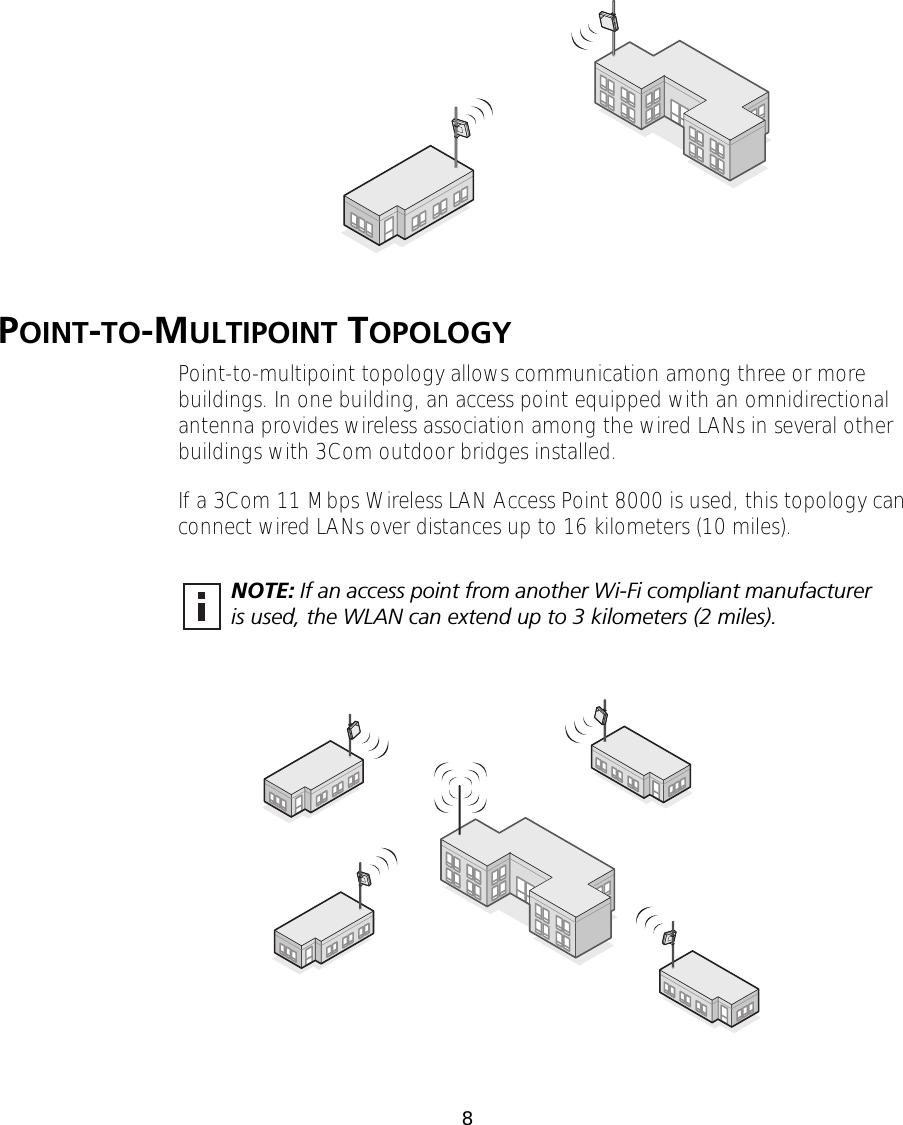
 7 1 I NTRODUCTION P RODUCT  O VERVIEW The 3Com 11 Mbps Wireless LAN Outdoor Bridge Solution is a complete building-to-building outdoor wireless LAN kit that eliminates the need to evaluate, purchase and assemble separate components. The convenient package includes the 3Com 11 Mbps Wireless LAN Building-to-Building Bridge with an integrated high-power directional antenna and  power-over-Ethernet cable  in a durable, weatherproof enclosure—everything you need for an easy-to-manage building-to-building wireless LAN solution.This all-in-one wireless LAN solution delivers three to four times the bandwidth of T1 links, with significantly lower operational costs. The wireless bridge lets you connect cross-campus buildings, or portable or temporary classrooms, at distances up to 16 kilometers (10 miles). The building-to-building bridge interoperates seamlessly with other Wi-Fi certified access points in large multi-vendor environments.The 3Com bridge can be used in two types of wireless network topologies: ■ Point-to-point ■ Point-to-multipointThis guide explains these network topologies and their components, and explains how to install, configure, and administer the 3Com bridge. P OINT - TO -P OINT  T OPOLOGY Point-to-point topology is the simplest way to use the 3Com bridge, and it offers the highest performance level. Two 3Com outdoor bridges form a direct wireless association between the wired LANs in two remote buildings. See the following diagram of the point-to-point topology.
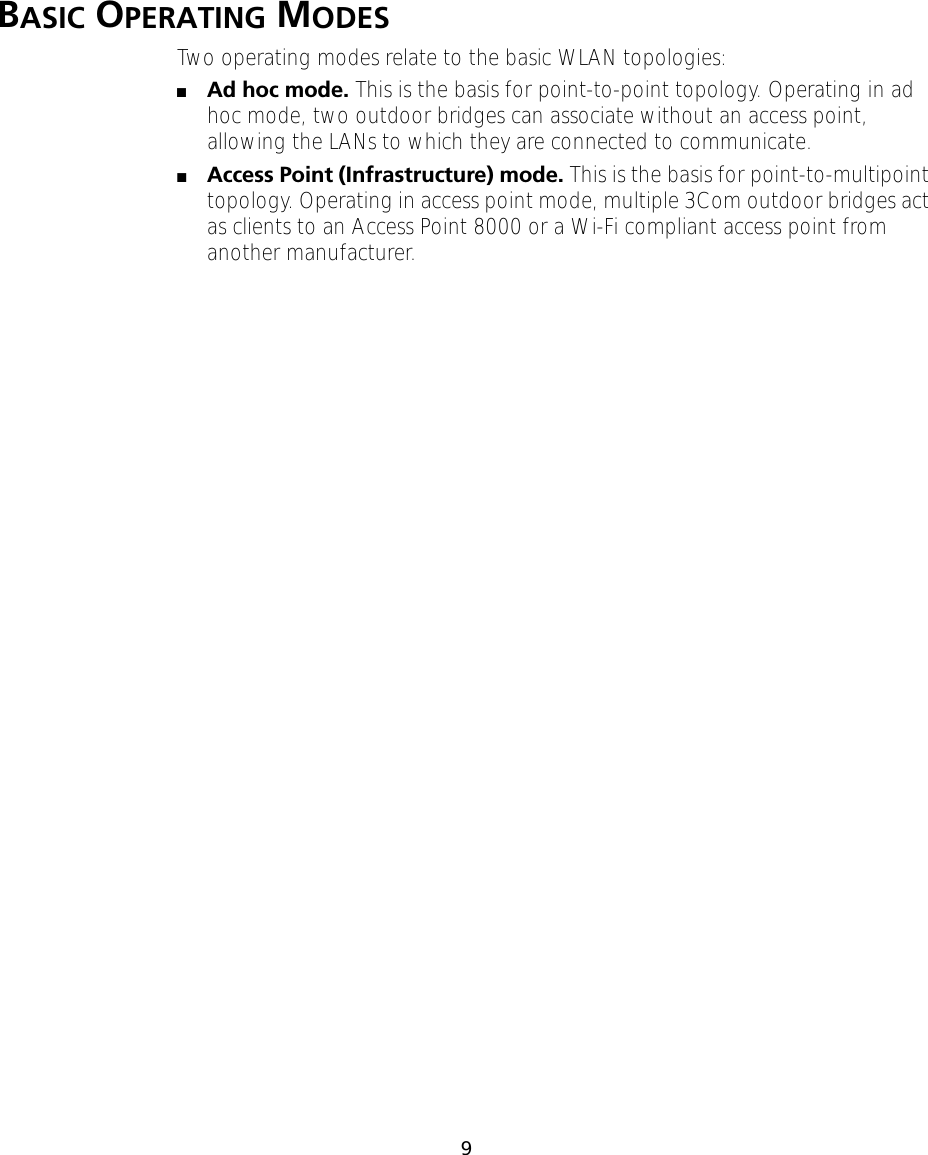
 8 P OINT - TO -M ULTIPOINT  T OPOLOGY Point-to-multipoint topology allows communication among three or more buildings. In one building, an access point equipped with an omnidirectional antenna provides wireless association among the wired LANs in several other buildings with 3Com outdoor bridges installed.If a 3Com 11 Mbps Wireless LAN Access Point 8000 is used, this topology can connect wired LANs over distances up to 16 kilometers (10 miles). NOTE:  If an access point from another Wi-Fi compliant manufacturer is used, the WLAN can extend up to 3 kilometers (2 miles).
 9 B ASIC  O PERATING  M ODES Two operating modes relate to the basic WLAN topologies:  ■ Ad hoc mode.  This is the basis for point-to-point topology. Operating in ad hoc mode, two outdoor bridges can associate without an access point, allowing the LANs to which they are connected to communicate.  ■ Access Point (Infrastructure) mode.  This is the basis for point-to-multipoint topology. Operating in access point mode, multiple 3Com outdoor bridges act as clients to an Access Point 8000 or a Wi-Fi compliant access point from another manufacturer.
 10 2 P LANNING   THE  I NSTALLATION The following items are required for installation: ■ For a point-to point configuration, two 3Com outdoor bridges. ■ For a point-to-multipoint configuration, one 3Com 11Mbps Wireless LAN Access Point 8000 (or other Wi-Fi compliant access point) with an omnidirectional antenna for one building, and one 3Com outdoor bridge for each other building. ■ Mounting hardware (supplied with each bridge) ■ Properly grounded outdoor mast or wall mount ■ Lightning arrestor properly grounded at each building in the topology. ■ 3Com Integrated Power-over-Ethernet power supply.If your LAN equipment complies with the IEEE 802.3af power-over-Ethernet standard, you can connect directly to the equipment, and the power supply is not needed.  ■ Outdoor rated category 5 Ethernet cable (such as 3CWE487)The cable must be long enough to reach the power-over-Ethernet LAN port.If you use the power supply, you need an additional length of Ethernet cable to connect the bridge to the LAN. I NSTALLATION  G UIDELINES The 11 Mbps Wireless LAN Outdoor Bridge Solution is housed in a durable, watherproof enclosure and is specifically designed for outdoor use in most climates. Optimal performance can be maintained at outdoor temperature ranges from -20˚ C to 50˚C (-4˚F to 122˚F). It is extremely important that the unit not be  NOTE:  Only professional network personnel should install the bridge, cables, and antennas.The importance of this is paramount, for the sake of compliance with FCC and other regulatory issues, as well as for the safety of people and equipment.
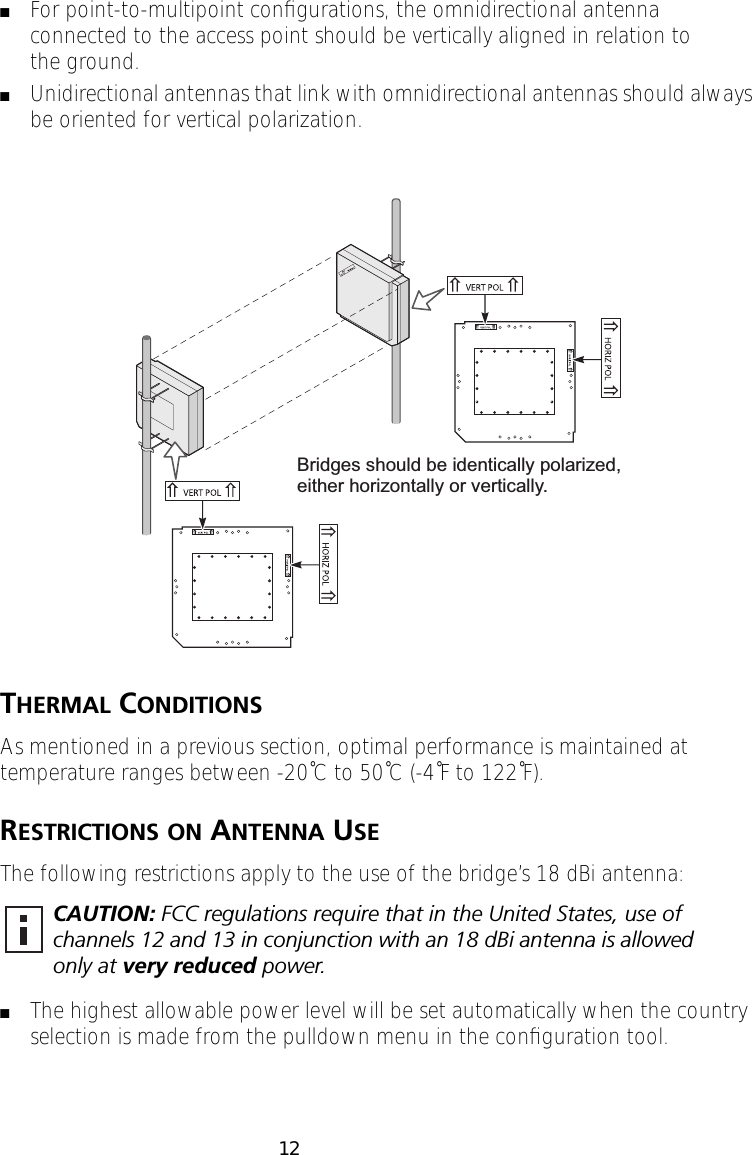
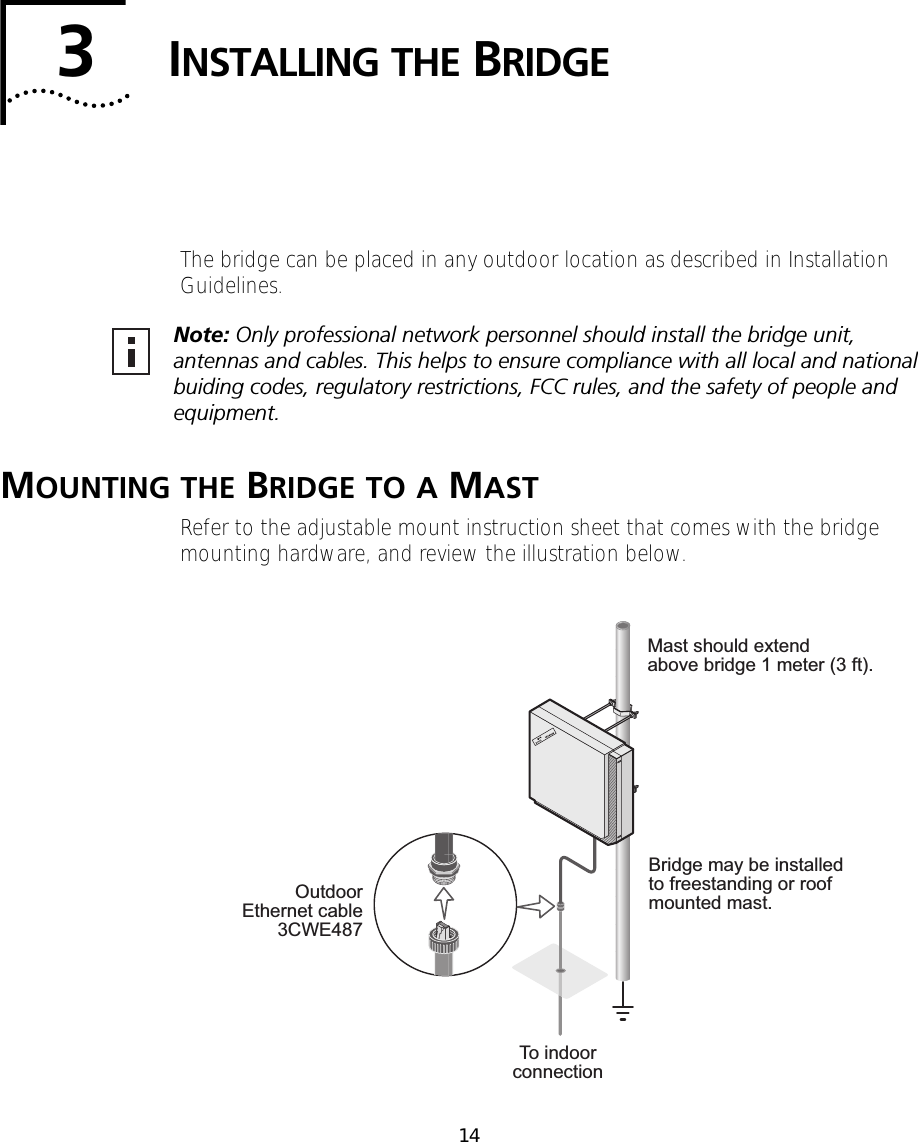
 11 mounted in any area where it could be vulnerable to extreme or hazardous conditions of any kind.  P ROPER  G ROUNDING To ensure the physical safety of anyone near the bridge and to prevent damage to the unit, follow the building codes for antenna installations in your area. Make certain that bridges and masts are appropriately grounded to prevent injury or damage from lightning strikes.A lightning arrestor, properly grounded and installed at each building in the topology, will protect networking equipment in the building, as well as the people working there, from lightning-induced surges that travel on Ethernet cables.  A LIGNMENT Position each bridge so that they are aimed at each other wherever possible. While maintaining a direct line of sight between antennas helps to ensure a strong signal, it is  not strictly necessary , nor is it always possible. Conditions such as long distances, mountainous regions, and architectural barriers will make a direct line of sight nearly impossible to achieve.In a campus setting, where buildings are short distances apart, and especially in a point-to-point configuration, align each unit to point at the antenna with which it will communicate. If you place two units at different heights, tilt them up or down toward each other for optimal signal strength. P OLARIZATION Polarization is a physical phenomenon of radio signal propagation. In general, any two antennas that are to communicate with each other must be set for the same horizontal or vertical polarization. If polarization on both antennas does not match—a situation called  cross-polarization —the link will either work poorly or not at all. Follow these polarization guidelines: ■ Vertical polarization is required for point-to-multipoint configuration and is preferred for point-to-point configuration. CAUTION:  A lightning arrestor will not prevent damage from direct lightning strikes. This is why it is extremely important to ensure that the bridge is installed at least 1 meter (3 feet) below the top of the mast.
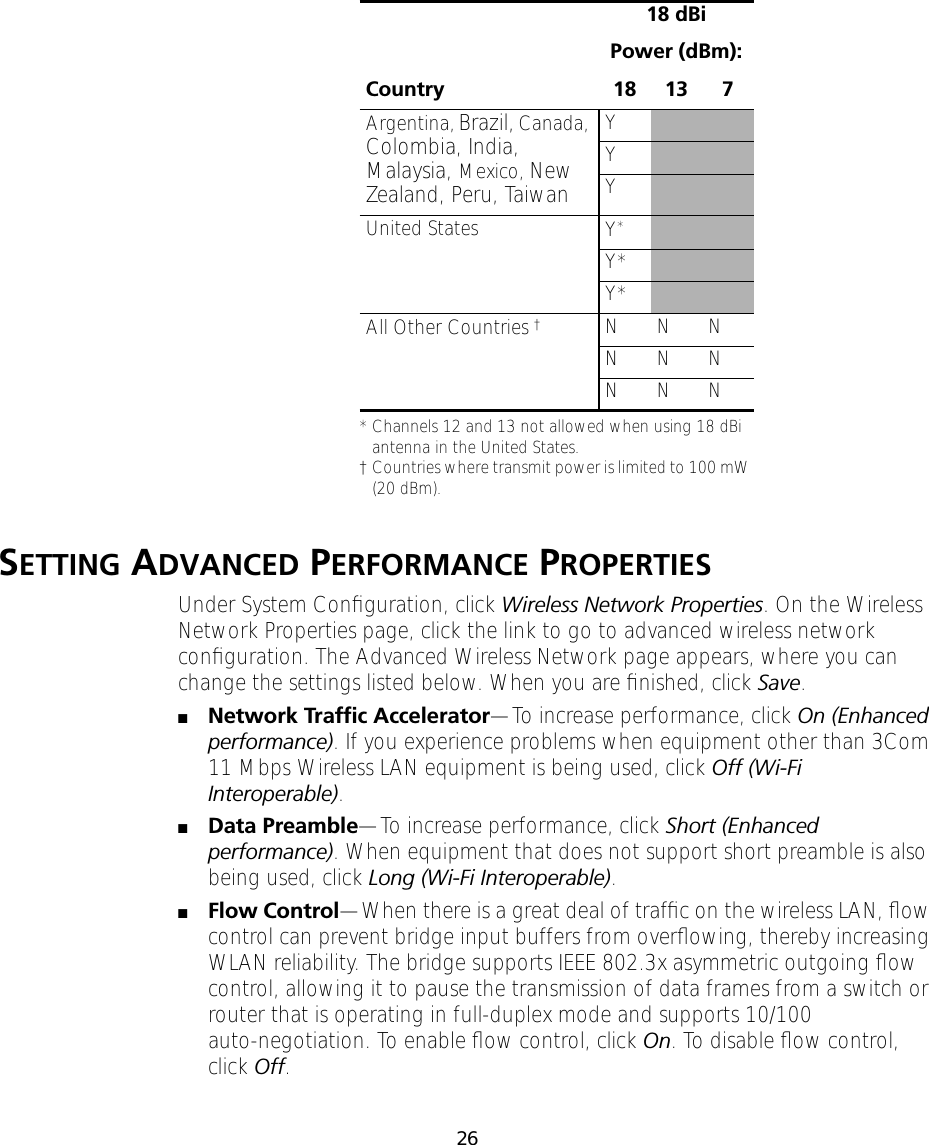
 12 ■ For point-to-multipoint configurations, the omnidirectional antenna connected to the access point should be vertically aligned in relation to the ground. ■ Unidirectional antennas that link with omnidirectional antennas should always be oriented for vertical polarization. T HERMAL  C ONDITIONS As mentioned in a previous section, optimal performance is maintained at temperature ranges between -20˚C to 50˚C (-4˚F to 122˚F). R ESTRICTIONS   ON  A NTENNA  U SE The following restrictions apply to the use of the bridge’s 18 dBi antenna:  ■ The highest allowable power level will be set automatically when the country selection is made from the pulldown menu in the configuration tool. CAUTION:  FCC regulations require that in the United States, use of channels 12 and 13 in conjunction with an 18 dBi antenna is allowed only at  very reduced  power.Bridges should be identically polarized,either horizontally or vertically.
 13 ■ To comply with power restrictions on 18 dBi antennas, bridges must be separated by at least 200 meters (218 yards). A DMINISTRATION  REQUIREMENTSTo use the administration tool, which helps you select 3Com wireless LAN devices and launch their configuration management systems, you need a computer running one of the following operating systems and one of the following browsers:■Operating Systems: Windows XP, Windows 2000, Windows NT 4.0, Windows Me, Windows 98■Browsers: Netscape 6.0 or later, Internet Explorer 5.0 or later.(If you want to configure the bridge using a non-Windows computer, refer to the readme file on the 3Com CD.)
143INSTALLING THE BRIDGEThe bridge can be placed in any outdoor location as described in Installation Guidelines.MOUNTING THE BRIDGE TO A MASTRefer to the adjustable mount instruction sheet that comes with the bridge mounting hardware, and review the illustration below.Note: Only professional network personnel should install the bridge unit, antennas and cables. This helps to ensure compliance with all local and national buiding codes, regulatory restrictions, FCC rules, and the safety of people and equipment.Mast should extendabove bridge 1 meter (3 ft).Bridge may be installedto freestanding or roofmounted mast.OutdoorEthernet cable3CWE487To indoorconnection
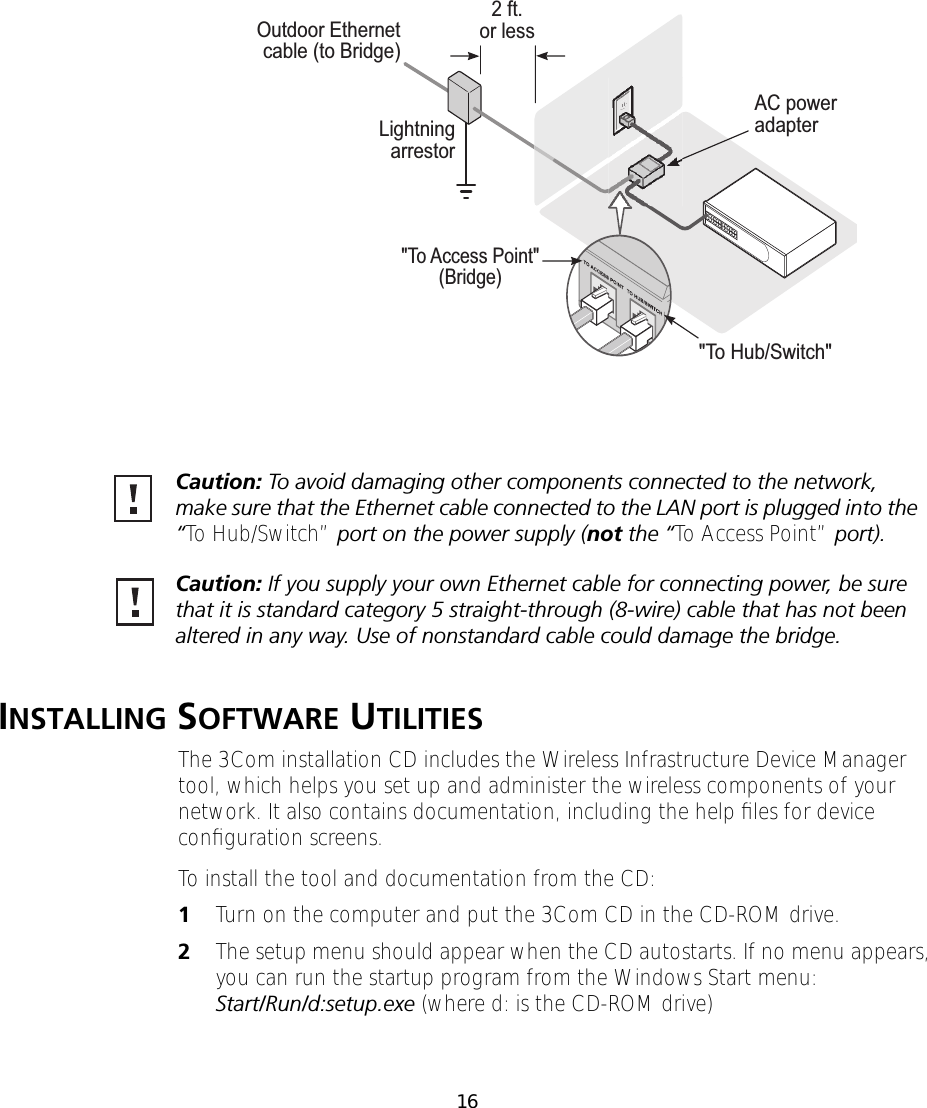
15Make sure that all bridges are properly oriented for polarization as described in Polarization. Use the polarization indicators on the antenna panel to guide orientation. VERT POL indicates vertical polarization and HORIZ POL indicates horizontal polarization.CONNECTING THE BRIDGE TO THE LANThe bridge complies with the IEEE 802.3af power-over-Ethernet standard. It receives power over an Ethernet cable. There are two ways to supply power to the bridge:■Use the 3Com Integrated Power-over-Ethernet power supply. In this case, you need to supply a second Ethernet cable to connect to the wired LAN.The power supply can be located at any point between the bridge and the LAN access port, wherever a convenient power outlet exists.When connecting the power, be sure to connect the cable to the port labeled “To Access Point” on the power supply.Use another standard Ethernet cable to connect the bridge to an Ethernet network. Be sure that the Ethernet cable connected to the LAN port is plugged into the “To Hub/Switch” port on the power supply.■Connect the bridge directly to your own power-over-Ethernet hub or switch. In this case, your equipment must also comply with the IEEE 802.3af standard. If your LAN equipment complies with the IEEE 802.3af power-over-Ethernet standard, you can connect the bridge directly to a LAN port. CAUTION: As shown in the illustration, avoid damage from direct lightning strikes by mounting the bridge at least 1 Meter (3 feet) below the top of the mast.WARNING: Do not install the bridge near overhead power lines, electric light or power circuits, or where it can come into contact with such circuits. When installing the bridge, do not come into contact with such circuits, which can cause serious injury or death. Follow local and national codes for proper installation and grounding of antennas.WARNING: Do not install the bridge or connect and disconnect cables during periods of lightning activity.Caution: To avoid damaging other components connected to the network, make sure that the Ethernet cable connected to the LAN port is plugged into the “To Hub/Switch” port on the power supply (not the “To Access Point” port).
16INSTALLING SOFTWARE UTILITIESThe 3Com installation CD includes the Wireless Infrastructure Device Manager tool, which helps you set up and administer the wireless components of your network. It also contains documentation, including the help files for device configuration screens.To install the tool and documentation from the CD:1Turn on the computer and put the 3Com CD in the CD-ROM drive.2The setup menu should appear when the CD autostarts. If no menu appears, you can run the startup program from the Windows Start menu: Start/Run/d:setup.exe (where d: is the CD-ROM drive)"To Access Point"(Bridge)"To Hub/Switch"AC poweradapter2 ft.or lessLightningarrestorOutdoor Ethernetcable (to Bridge)Caution: To avoid damaging other components connected to the network, make sure that the Ethernet cable connected to the LAN port is plugged into the “To Hub/Switch” port on the power supply (not the “To Access Point” port).Caution: If you supply your own Ethernet cable for connecting power, be sure that it is standard category 5 straight-through (8-wire) cable that has not been altered in any way. Use of nonstandard cable could damage the bridge.
173From the menu, select Install the Tools and Documentation. This option installls the Wireless Infrastructure Device Manager Tool, which you can use to monitor bridges and select devices for administrative changes. It also installs the User Guide in HTML and PDF formats.4Follow the instructions on the screen.ESTABLISHING WIRELESS ASSOCIATIONAfter the bridge and software utilities are installed, you can configure the bridge as follows:■Launch the bridge configuration. (See Configuring the Bridge for details on how to launch the configuration and make changes.)■For a point-to-point association between two bridges, see Setting up an Ad Hoc Network.■For a point-to-multipoint association between an access point and one or more bridges, see the section entitled Setting up an Access Point Infrastructure Network.
184CONFIGURING THE BRIDGEIf the configuration that was set at the factory does not meet your network requirements, or if you want to customize the settings, you can configure the bridge through your Web browser.The 3Com Wireless Infrastructure Device Manager helps you locate 3Com wireless LAN devices on the network, select a device and view its properties, and launch the device’s configuration in your Web browser. To configure a bridge, the device manager must be installed on a computer that has an Ethernet adapter and is running a supported Windows operating system and Web browser. USING THE DEVICE MANAGERMake sure that the 3Com Wireless Infrastructure Device Manager is installed. The device to be configured must be either wired to the network, associating with the wireless network, or connected directly to the computer, and it must be connected to power. If more than one device using the factory default name is connected, make a note of the MAC address of the device you want to select so that you can identify it in the device manager.LAUNCHING A WIRELESS DEVICE CONFIGURATIONIf you do not have a DHCP server on your network, it can take up to one minute for a device to become discoverable after it has been powered up.1To launch the device manager, select Start /Programs /3Com Wireless/Wireless Infrastructure Device Manager.If you have more than one network adapter installed on your computer, you may be prompted to choose a network adapter. Choose the appropriate adapter and click OK.The Wireless Network Tree appears in the 3Com Wireless Infrastructure Device Manager window. The tree lists all WLAN service areas on the network and expands to show the 3Com wireless LAN devices that are associated to each service area. Devices in a different subnet than your computer are
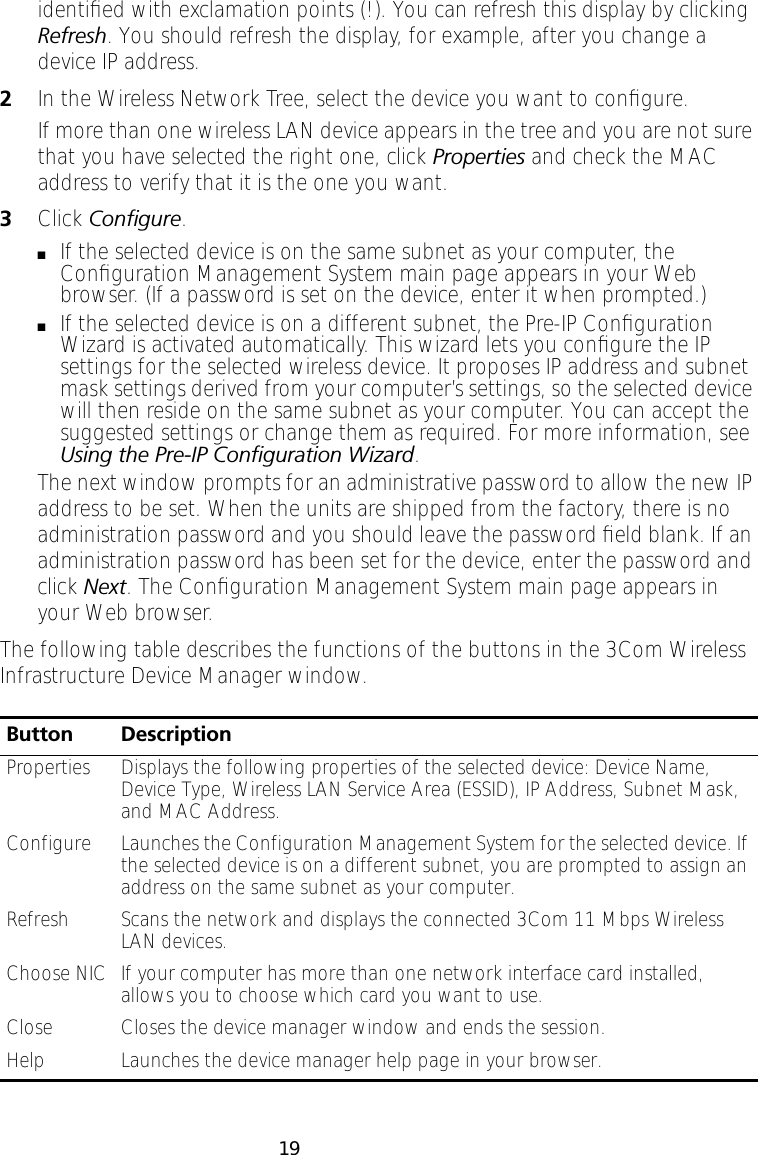
19identified with exclamation points (!). You can refresh this display by clicking Refresh. You should refresh the display, for example, after you change a device IP address.2In the Wireless Network Tree, select the device you want to configure.If more than one wireless LAN device appears in the tree and you are not sure that you have selected the right one, click Properties and check the MAC address to verify that it is the one you want. 3Click Configure.■If the selected device is on the same subnet as your computer, the Configuration Management System main page appears in your Web browser. (If a password is set on the device, enter it when prompted.)■If the selected device is on a different subnet, the Pre-IP Configuration Wizard is activated automatically. This wizard lets you configure the IP settings for the selected wireless device. It proposes IP address and subnet mask settings derived from your computer’s settings, so the selected device will then reside on the same subnet as your computer. You can accept the suggested settings or change them as required. For more information, see Using the Pre-IP Configuration Wizard.The next window prompts for an administrative password to allow the new IP address to be set. When the units are shipped from the factory, there is no administration password and you should leave the password field blank. If an administration password has been set for the device, enter the password and click Next. The Configuration Management System main page appears in your Web browser.The following table describes the functions of the buttons in the 3Com Wireless Infrastructure Device Manager window.Button DescriptionProperties Displays the following properties of the selected device: Device Name, Device Type, Wireless LAN Service Area (ESSID), IP Address, Subnet Mask, and MAC Address.Configure Launches the Configuration Management System for the selected device. If the selected device is on a different subnet, you are prompted to assign an address on the same subnet as your computer.Refresh Scans the network and displays the connected 3Com 11 Mbps Wireless LAN devices.Choose NIC If your computer has more than one network interface card installed, allows you to choose which card you want to use.Close Closes the device manager window and ends the session.Help Launches the device manager help page in your browser.
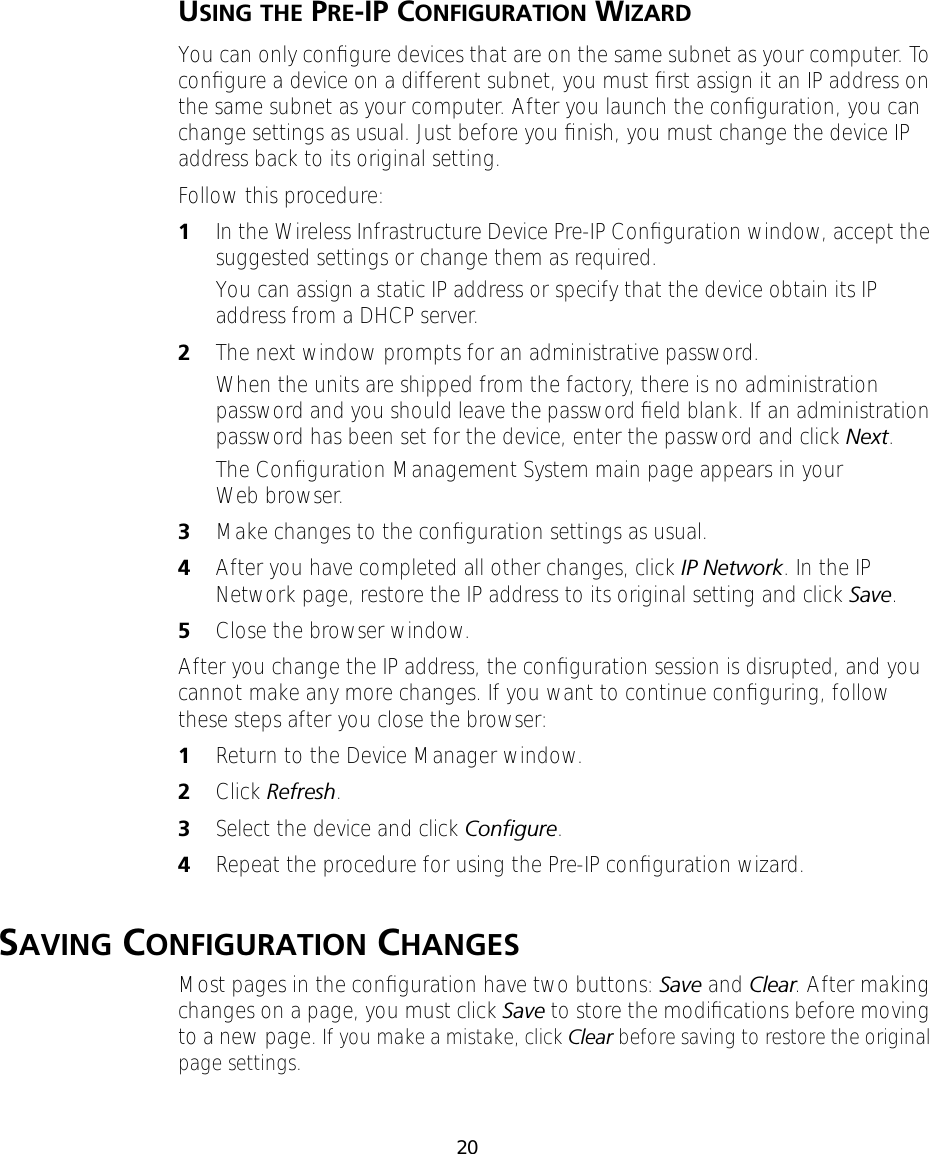
20USING THE PRE-IP CONFIGURATION WIZARDYou can only configure devices that are on the same subnet as your computer. To configure a device on a different subnet, you must first assign it an IP address on the same subnet as your computer. After you launch the configuration, you can change settings as usual. Just before you finish, you must change the device IP address back to its original setting.Follow this procedure:1In the Wireless Infrastructure Device Pre-IP Configuration window, accept the suggested settings or change them as required.You can assign a static IP address or specify that the device obtain its IP address from a DHCP server.2The next window prompts for an administrative password. When the units are shipped from the factory, there is no administration password and you should leave the password field blank. If an administration password has been set for the device, enter the password and click Next.The Configuration Management System main page appears in your Web browser.3Make changes to the configuration settings as usual.4After you have completed all other changes, click IP Network. In the IP Network page, restore the IP address to its original setting and click Save.5Close the browser window.After you change the IP address, the configuration session is disrupted, and you cannot make any more changes. If you want to continue configuring, follow these steps after you close the browser:1Return to the Device Manager window.2Click Refresh.3Select the device and click Configure.4Repeat the procedure for using the Pre-IP configuration wizard.SAVING CONFIGURATION CHANGESMost pages in the configuration have two buttons: Save and Clear. After making changes on a page, you must click Save to store the modifications before moving to a new page. If you make a mistake, click Clear before saving to restore the original page settings.
21To reduce the possibility of losing wireless association with an access point while you are configuring, security settings are stored when you click Save in the security pages, but they do not take effect until you click Save in the Wireless Network page. First configure security settings. Then go to the Wireless Network page and configure wireless network settings, including the Wireless LAN Service Area. The security settings take effect after you click Save in the Wireless Network page.CHANGING SYSTEM PROPERTIESUnder System Configuration, click System Properties. The System Properties page displays the properties of the selected device. You can change properties by entering values in the fields and clicking the radio buttons (see the following table). When you are finished, click Save.The following table describes the properties.Property Description Default ValueDevice Name This name appears in the System Summary window. You can change the default name to one of your choice. 3Com 11 Mbps Wireless Outdoor Bridge SolutionDevice Location Optionally, you can enter a location to identify where the device is installed. (For example, Building 4, Cubicle 3.) NoneHelp File Location ■Web Server: Help files are located on the network at the specified Help File Path.■Local Drive: Help files are located on the local computer at the specified Help File Path.Local DriveHelp File Path The location of the Configuration Management System help files on the web server or on the local drive.If you want to have access to help when you click the ? in the configuration pages, you must install the help from the 3Com CD. By default, help is installed on the local drive when you install the administration tool. If you install the help in a different location on the local drive or on a web server, you must set the Help File Path to the correct location.C:/Program Files/3Com/3Com Wireless Infrastructure Device Manager/ManagementHelp/B2B
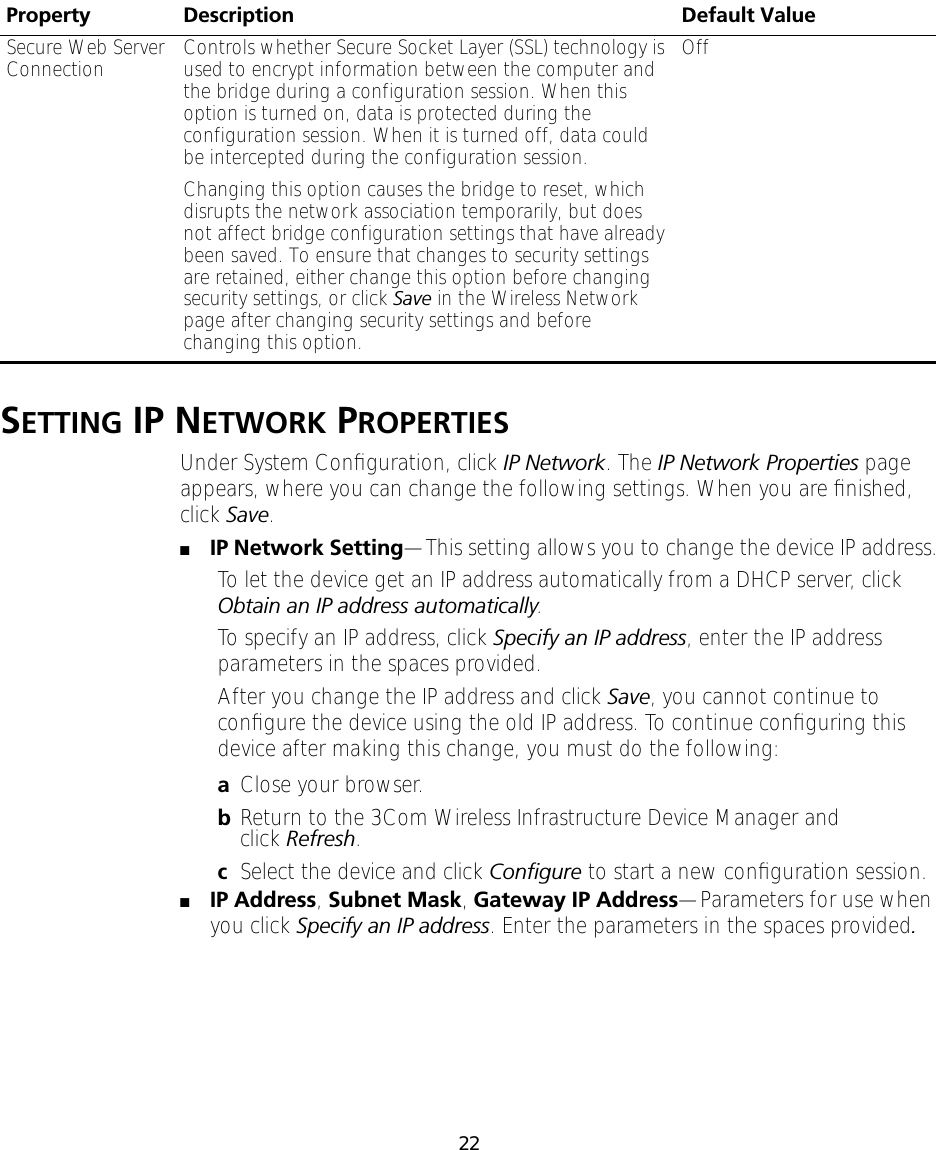
22SETTING IP NETWORK PROPERTIESUnder System Configuration, click IP Network. The IP Network Properties page appears, where you can change the following settings. When you are finished, click Save.■IP Network Setting—This setting allows you to change the device IP address.To let the device get an IP address automatically from a DHCP server, click Obtain an IP address automatically.To specify an IP address, click Specify an IP address, enter the IP address parameters in the spaces provided.After you change the IP address and click Save, you cannot continue to configure the device using the old IP address. To continue configuring this device after making this change, you must do the following:aClose your browser.bReturn to the 3Com Wireless Infrastructure Device Manager and click Refresh.cSelect the device and click Configure to start a new configuration session.■IP Address, Subnet Mask, Gateway IP Address—Parameters for use when you click Specify an IP address. Enter the parameters in the spaces provided.Secure Web Server Connection Controls whether Secure Socket Layer (SSL) technology is used to encrypt information between the computer and the bridge during a configuration session. When this option is turned on, data is protected during the configuration session. When it is turned off, data could be intercepted during the configuration session.Changing this option causes the bridge to reset, which disrupts the network association temporarily, but does not affect bridge configuration settings that have already been saved. To ensure that changes to security settings are retained, either change this option before changing security settings, or click Save in the Wireless Network page after changing security settings and before changing this option.OffProperty Description Default Value
23SETTING UP PROTOCOL AND PORT FILTERINGProtocol filtering allows you to control the types of protocols that the bridge is authorized to transmit and receive. The default setting allows the following protocols to be transmitted and received:■IPX■NetBEUI■UDP/IP■TCP/IPTo set up a list of authorized protocols:1Under System Configuration, click Filtering.2In the Protocol Filtering page, click the Allow radio buttons next to the protocols that you want to authorize. Click the Block radio buttons next to the protocols that you want to disable.3Click Save.If UDP/IP or TCP/IP protocols are authorized, you can set up port filtering, which allows you to control the protocol ports that are authorized to transport packets through the bridge. The default setting allows all protocol ports to transport packets.The bridge allows you to filter up to 100 protocol port numbers. Valid protocol port numbers range from 1 to 65535.To set up protocol port filtering:1Under System Configuration, click Filtering.2In the Protocol Filtering page, click the Allow radio button next to the UDP/IP or TCP/IP protocol (or click both buttons).3Select the Port Filtering Mode:Allow—If you want to block most protocol ports and allow a small number of others, use the Allow mode. Click the Allow radio button.Block—If you want to allow most protocol ports and block a small number of others, use the Block mode. Click the Block radio button.4Enter a protocol port number in the space provided and click Save.Repeat this step for all the protocol port numbers you want to allow or block.
24To view the list of protocol ports or delete protocol ports from the list:1Click the link to view the protocol port list.2In the next page, click the check boxes next to the protocol port numbers and click Delete. (You may click Reset to clear all check boxes before clicking Delete.)SETTING WIRELESS NETWORK PROPERTIESUnder System Configuration, click Wireless Network Properties. The Wireless Network Properties page appears, where you can configure the items listed below. When you are finished, click Save.■Network Mode—Click Access Point (Infrastructure) to associate with an access point. Click Ad-hoc (Peer-to-Peer) to associate in ad hoc mode.■Wireless LAN Service Area—This is the device ESSID. The default WLAN service area name is 3Com. You can use the default, enter a WLAN service area, or select one from the list To maintain wireless association, the WLAN service area on a bridge and the device with which it is associated must match exactly. Therefore, if the bridge is set to specify the WLAN service area and you change the other device’s WLAN service area, make sure to change the bridge WLAN service area also.■Access Point Privacy Mode—This mode only applies when the network mode is Access Point (Infrastructure) and should only be used when access points are set with privacy enabled. (On 3Com access points, privacy is enabled when the Broadcast WLAN Service Area Name (ESSID) mode is disabled.) Click On to associate with access points set with privacy mode enabled. Click Off to associate with access points set with privacy mode disabled. When privacy mode is on, you must specify a Wireless LAN Service Area, which must match the access point service area exactly.■Channel Selection—When the network mode is Access Point (Infrastructure), this option is set to Automatically select the best channel, and cannot be changed. In this case, the bridge uses the channel that the access point is using.Saving wireless network properties also causes security settings to take effect. After making changes to security settings, you must click Save in the Wireless Network Properties page to activate the security settings.
25When the network mode is Ad-hoc (Peer-to-Peer) you can specify channel selection as follows:■Automatically select the best channel—When this option is enabled, the bridge scans the primary channels. If the bridge is establishing a new ad hoc network, it chooses the channel with the least number of packets. If the bridge is joining an existing ad hoc network, it selects the channel in use.■Specify the channel to use—To establish the channel for an ad hoc network, select this option on the first bridge and choose a channel from the Channel list. On the second bridge, set the channel selection to match the first bridge.■Antenna Selection—Click the radio button next to the antenna being used: ■3CWE490 4 dBi Omnidirectional■3CWE491 8 dBi Omnidirectional■3CWE495 13 dBi Sector-Panel Directional■3CWE496 18 dBi Sector-Panel Directional■Cable Length Selection—Click the radio button next to the Cable being used:■6 foot Cable■20 foot Cable■50 foot Cable■Country Selection—Select the country from the pull-down list.
26SETTING ADVANCED PERFORMANCE PROPERTIESUnder System Configuration, click Wireless Network Properties. On the Wireless Network Properties page, click the link to go to advanced wireless network configuration. The Advanced Wireless Network page appears, where you can change the settings listed below. When you are finished, click Save.■Network Traffic Accelerator—To increase performance, click On (Enhanced performance). If you experience problems when equipment other than 3Com 11 Mbps Wireless LAN equipment is being used, click Off (Wi-Fi Interoperable).■Data Preamble—To increase performance, click Short (Enhanced performance). When equipment that does not support short preamble is also being used, click Long (Wi-Fi Interoperable).■Flow Control—When there is a great deal of traffic on the wireless LAN, flow control can prevent bridge input buffers from overflowing, thereby increasing WLAN reliability. The bridge supports IEEE 802.3x asymmetric outgoing flow control, allowing it to pause the transmission of data frames from a switch or router that is operating in full-duplex mode and supports 10/100 auto-negotiation. To enable flow control, click On. To disable flow control, click Off.Country18 dBiPower (dBm):18 13 7Argentina, Brazil, Canada, Colombia, India, Malaysia, Mexico, New Zealand, Peru, TaiwanYYYUnited States Y**Channels 12 and 13 not allowed when using 18 dBi antenna in the United States.Y*Y*All Other Countries ††Countries where transmit power is limited to 100 mW (20 dBm). N N NN N NN N N
27■Acknowledgement Delay—This setting determines the length of time the bridge waits for an acknowledgement after transmitting packets. When the delay time has passed, the bridge resends the packets. A longer acknowledgement delay allows the bridge to associate with another wireless device over a greater distance. Set the delay to match the distance between the bridge and the wireless device with which it is associated. Click the radio button next to the appropriate distance range.■Client Limit—Allows you to specify the maximum number of clients that the bridge allows to associate at the same time (from 1 to 1024). The default is 256 clients. In Access Point (Infrastructure) mode, set the Client Limit to match the number of clients that the access point can support.To ensure network reliability, follow these guidelines for configuring the access point:■Make sure that the access point can support more than the number of clients that you expect to use the wireless LAN. ■The client list timeout setting should be as short as possible, but no less than five minutes.■Data Rates—These settings configure the data rates used for wireless transmissions. By default, the bridge selects the best data rate for the current connection.You may not alter the settings for the 1Mbps and 2Mbps rates because these rates must always be available to transmit certain types of wireless traffic.The 5.5 Mbps and 11 Mbps data rates may either be Required or Optional. When the data rate is set to Optional, the bridge determines if it is appropriate to use that data rate or if the signal strength requires the use of a lower data rate. If the data rate is set to Required, the bridge cannot modulate to a lower data rate, and may lose connection with clients that cannot support the higher data rate.SETTING UP AN AD HOC NETWORKOperating in ad hoc mode, two bridges can establish a point-to-point association without an access point, allowing two LANs to communicate.To ensure correct operation, the settings on the two bridges must match exactly. To avoid the possibility of losing wireless association while you are configuring, it is recommended that you configure with a computer that is wired to the LAN.To ensure a successful association, install and configure the bridges sequentially.
281Install the first bridge.2Use the 3Com Wireless Infrastructure Device Manager to select the first bridge and launch its configuration management system.3Configure security settings.Security settings default to No Security (Open System). Optionally, you can set shared key security as described in “40-bit Shared Key (Wi-Fi)” or “128-bit Shared Key”.4Under System Configuration, click Wireless Network.(Wireless Network properties are described in “Setting Wireless Network Properties”.)5In the Wireless Network page:aIn the Network Mode field, click Ad-hoc (Peer-to-Peer).bSpecify the Wireless LAN Service Area.cSpecify the Channel Selection.To avoid the possibility of interference from other nearby wireless devices, specify the channel to use. dClick Save to save the wireless network settings and activate the security settings.eClick the link to go to advanced wireless network configuration.6In the Advanced Wireless Network page, set options as described in “Setting Advanced Performance Properties”.7When you are finished, click Save.8End the browser session.9Install the second bridge and repeat the procedure. Make sure to configure settings to match the first bridge exactly. When you are finished, click Save and end the browser session.SETTING UP AN ACCESS POINT INFRASTRUCTURE NETWORKOperating in Access Point (Infrastructure) mode, one or more bridges can establish a point-to-multipoint association with an access point, allowing the LANs to which they are connected to communicate.1Install the access point with an omnidirectional antenna and the bridges with sector-panel directional antennas.A 3Com 11 Mbps Wireless LAN Access Point 8000 can be located up to 4 miles (6.6 kilometers) away from the bridge. Access points from other Wi-Fi
29compliant manufacturers can be located up to 2 miles (3.2 kilometers) away from the bridge.2Use the 3Com Wireless Infrastructure Device Manager to select the first bridge and launch its configuration management system.3Configure security settings.Security settings default to No Security (Open System). Optionally, you can set up the following types of security:Shared key —See 40-bit Shared Key (Wi-Fi) or 128-bit Shared Key.Password—If you are using a 3Com Access Point 8000, you can set up password security as described in 128-bit Dynamic Security Link.4Under System Configuration, click Wireless Network.5In the Wireless Network page:aIn the Network Mode field, click Access Point (Infrastructure).bSpecify the Wireless LAN Service Area as described in Setting Wireless Network Properties.cClick Save. This saves the wireless network settings and activates the security settings.dClick the link to go to advanced wireless network configuration.In the Advanced Wireless Network page, set the Client Limit option to match the number of clients that the access point can support. (See Client Limit under Setting Advanced Performance Properties.) To ensure network reliability, follow these guidelines for configuring the access point:Make sure that the access point can support more than the number of clients that you expect to use the wireless LAN.The client list timeout setting should be as short as possible, but no less than five minutes.6When you are finished, click Save.7End the browser session.8Repeat the procedure with the other bridges. Make sure you configure bridge settings to match exactly. When you are finished, click Save and end the browser session.CHANGING SECURITY SETTINGSAfter saving security settings, you must go to the Wireless Network Properties page and click Save to activate the security settings.
30Under System Configuration, click Security Settings. The Security Settings page appears, where you can select the type of security to be used on the bridge. The bridge can be configured to support one type of security at a time. You can change the settings by clicking the radio buttons and entering values in the fields.When you are finished, click Save. Then go to the Wireless Network Properties page, set the Wireless LAN Service Area, and click Save. Security settings take effect only after you click Save in the Wireless Network Properties page.Although the bridge is allowed to associate with an access point set for a different level of encryption, data authentication is not allowed. Therefore, data cannot pass between the bridge and the access point unless their security settings match exactly.The following sections describe the security settings. To maintain wireless association, the settings on clients and the access points they associate with (or other members of an ad hoc network) must match exactly.NO SECURITY (OPEN SYSTEM)No encryption is used. The network communications could be intercepted by unintended recipients.40-BIT SHARED KEY (WI-FI)This option encrypts the wireless transmissions to protect data, but still allows communication among compatible wireless LAN clients and access points from third-party manufacturers that are Wi-Fi certified.This type of security requires you to set up encryption in one of the following ways:■String—For use only with other 3Com 11 Mbps wireless LAN devices, an encryption string is a case-sensitive string of characters between 6 and 30 characters long. To enter the string, click Enter a string to generate shared keys. Then type any combination of letters and numbers in the space provided and click Save.■Shared keys—Hexadecimal keys are sequences of hexadecimal digits arranged into four keys. A hexadecimal digit may be a letter from A to F or a number from 0 to 9. This type of encryption is compatible with equipment If you are configuring through a wireless association (not on the wired LAN), be sure to configure security settings before changing the WLAN service area. If you change the WLAN service area first, the bridge will lose association with one access point before it is configured to associate with another.
31from other manufacturers that use Wi-Fi certified 40-bit encryption. To enter the keys, click Specify shared keys and which to use. Then click the link to specify and select the shared keys. In the shared keys window, enter all the keys in the provided spaces, then click a radio button in the Selected Key column to specify which key to use and click Save.128-BIT SHARED KEYThis option can be used with other 3Com 11 Mbps Wireless LAN devices and with equipment from certain manufacturers that also support 128-bit shared key encryption. It provides a higher level of security than the 40-bit Shared Key (Wi-Fi) option and uses a more complicated type of encryption. This type of security requires you to set up encryption using a string or shared keys as described above in 40-bit Shared Key (Wi-Fi).128-BIT DYNAMIC SECURITY LINKThis option can only be used with other 3Com 11 Mbps Wireless LAN devices when the bridge is set to the Access Point (Infrastructure) network mode. It is the highest level of security, requiring a user name and password to access the wireless LAN. The user name and password set up on the bridge must match those set up on the access point. Each network session creates a unique, one-time encryption code.If you choose this type of security, you must also set up a login as described in Setting up the Wireless Network Login.SETTING UP THE WIRELESS NETWORK LOGINIf you configure a bridge for 128-bit Dynamic Security Link, you must also set up a login user name and password, which must match a listing in the access point user access list. In the Security Settings page, click 128-bit Dynamic Security Link. Then click the link to modify the wireless network login. In the Wireless Network Login page, enter a login name and password, and confirm the password in the spaces provided. When you are finished, click Save.Make sure the access point does not require Windows user authentication. The Bridge cannot associate with access points that are set to “Require Windows user authentication,” which requires clients to enter a user name and password every time they associate with the network.
32RESETTING THE BRIDGEIf the bridge stops responding correctly, you can perform a reset, which disrupts the network association temporarily, but does not affect bridge configuration settings that have already been saved. To reset the bridge, under Tools, click Reset Wireless Building-to-Building Bridge. In the next page, click Reset.RESTORING A BRIDGE TO FACTORY DEFAULTSYou can restore bridge settings to the defaults that were set at the factory as follows:1Under Tools, click Restore Factory Defaults.2Click Restore.If the bridge was using an IP address setting other than the default, restoring the factory defaults will change the IP address. If you want to continue configuring the bridge, do the following:1Close your browser.2Return to the 3Com Wireless Infrastructure Device Manager and click Refresh.3Select the device and click Configure to start a new configuration session.UPGRADING THE SYSTEMYou can download firmware and configuration management system upgrades from the 3Com Web site and install those upgrades on the bridge.The upgrade procedure requires a Trivial File Transfer Protocol (TFTP) server. The bridge acts as a TFTP client to receive the download.To locate an upgrade file and download it to your computer:1Log on to the 3Com Web site at http://www.3com.com.2 Navigate to the product support page for the 3Com Wireless LAN Building-to-Building Bridge to access the download files and instructions.3Follow the instructions to download the file into a directory on your computer.4Copy or move the file to the TFTP server upload/download directory.
33To install an upgrade:1Use the 3Com Wireless Infrastructure Device Manager to select the device and launch its configuration.2Under Tools, click Upgrade System. 3Enter the name of the upgrade file that you downloaded earlier.4Enter the IP address of the TFTP server where the upgrade file is located.5Click Upgrade.The upgrade file is copied from the TFTP server to the bridge. The bridge restarts using the new upgrade.CHANGING THE ADMINISTRATION PASSWORDThe first time you launch the Configuration Management System on the device or after you reset a device to factory defaults, you are prompted to set an administrative password. Although a password is not required, 3Com recommends that you set a password to protect against unauthorized access. After you set the password, you must enter it each time you launch the configuration for the device. A user name is not required.Under Tools, click Change Administration Password. The Change Administration Password page appears, where you can change the administration password for the device. Enter the current password and new password in the spaces provided and click Save.BACKING UP A CONFIGURATIONAs part of system maintenance, you should save and back up the configurations of individual bridges in case you need to reload them in the future. The backup saves all the parameters of the selected bridge in a file on your computer. The file can be used later to restore the configuration on this or another bridge.1Set the bridge parameters in the System Configuration pages.2Under Tools, click Backup Wireless Building-to-Building Bridge.3In the next page, click Backup Now.4Specify a name and location for the backup, and click OK.
34RESTORING A CONFIGURATIONIf you have stored a backup configuration on your computer, you can restore the configuration as follows:1Under Tools, click Restore Wireless Building-to-Building Bridge.2In the next page, click Browse and select the backup file to upload to the bridge.3Click Restore.The configuration is restored and activated on the bridge. This operation may cause the bridge to reboot.If the bridge was using an IP address setting other than the backup, restoring the configuration will change the IP address. If you want to continue configuring the bridge, do the following:1Close your browser.2Return to the 3Com Wireless Infrastructure Device Manager and click Refresh.3Select the device and click Configure to start a new configuration session.VIEWING THE CLIENT LIST Under System Status, click Ethernet Client List. The Ethernet Client List page appears, where you can view the following information:■Ethernet Clients—Lists the client MAC addresses. The bridge supports up to 1000 specific clients. When the list reaches its limit, new clients replace inactive clients (status Not Associated).■# Transmitted Packets—The number of packets that the client has transmitted.■# Received Packets—The number of packets that the client has received.■Association Status—One of the following:Initializing—A new client is preparing to associate.Associated—The client is active on the network.Not Associated—The client is inactive.The client list can be up to 10 pages long. Each page lists 100 clients. You can search for a specific MAC address on the current page using your browser’s Find function. To display another page, click a page number in the list at the top of the current page.
35RESETTING STATISTICS LISTINGSIn the Ethernet Client List page, click Reset Statistics to set the # Transmitted Packets and # Received Packets listings back to zero.CLEARING THE CLIENT LISTYou can clear the client list manually by clicking Reset Clients in the Ethernet Client List page.The bridge erases the client list. Thereafter, clients are added to the list automatically when they next interact with the network.VIEWING CONNECTION STATUSUnder System Status, click Connection Status to see information about the quality of the wireless association. Data rate values (1, 2, 5.5, or 11 Mbps) indicate the speed of data transfer. A data rate of 0 indicates no data transfer. Signal strength values range from 0 (no signal) to 5 (excellent signal quality).Click Refresh to update the information.VIEWING THE SYSTEM SUMMARYUnder System Status, click System Summary to see information about the bridge. You can go to the configuration pages of items that can be configured by clicking their names in the list.Click Refresh to update the information.INTEROPERATING WITH THIRD-PARTY EQUIPMENTBecause 3Com Wireless LAN equipment complies with IEEE 802.11b standards, it can interoperate with third-party equipment that also complies with the standards. However, some third party equipment may not support 3Com enhanced performance features. You may need to turn off the Network Traffic Accelerator and set the Data Preamble to long to support this equipment on the network.
365TROUBLESHOOTINGDIAGNOSING PROBLEMSIf you have difficulty with the 3Com 11 Mbps Wireless LAN Outdoor Bridge, try the solutions in the following table.Symptom SolutionsTwo bridges fail to communicate in ad hoc mode. ■Adjust the positions of the antennas to improve reception.■To ensure correct operation in ad hoc mode, the settings on the two bridges must match exactly. Launch the bridge configuration management system and make sure that the Wireless LAN Service Area, channel selections, Data Preamble setting, and security setting are the same on both bridges. The bridge fails to associate with an access point. ■Adjust the position of the antenna to improve reception.■Launch the bridge configuration and make sure the security settings, advanced performance settings, and access point privacy mode settings on the bridge match those on the access point.■If the access point is from another manufacturer, try turning the Network Traffic Accelerator off and setting the Data Preamble to long.■Using 128-bit Dynamic Security Link encryption, the bridge cannot associate with access points that are set to Require Windows user authentication, which requires clients to enter a user name and password every time they associate with the network. Make sure the access point does not require Windows user authentication.■If the bridge is using an 18 dBi antenna, FCC restrictions prohibit the use of channels 12 and 13 in the United States. Access points set to automatically select the best channel may occasionally select channel 12 or 13. To avoid interruptions, it is recommended that you set the access point to use a specific channel.The 128-bit Dynamic Security Link setting does not work in ad hoc mode. 128-bit Dynamic Security Link is not supported in ad hoc mode. Use the 40-bit or 128-bit Shared Keys settings instead.
37A bridge set for 128-bit Shared Key encryption seems to communicate with an access point set for 40-bit Shared Key encryption or open system.Although the bridge is allowed to associate with an access point set for a different level of encryption, data authentication is not allowed. Therefore, data cannot pass between the bridge and the access point unless their settings match exactly.The Wireless Network Tree does not appear in the 3Com Wireless Infrastructure Device Manager window.Verify that you are using the correct network adapter. In the device manager window, click Choose NIC. Select the network adapter for the network you want to scan, and click OK.After upgrading the system, custom configuration settings are lost. Under some circumstances, upgrading the firmware and the configuration management system forces a return to configuration defaults. In this case, launch the bridge configuration and reconfigure the settings.After enabling or disabling the Secure Web Server Connection option, some configuration changes are lost.Changing the Secure Web Server Connection option causes the bridge to reset, which disrupts the network association temporarily, but does not affect bridge configuration settings that have already been saved. To ensure that changes to security settings are retained, either change this option before changing security settings, or click Save in the Wireless Network page after changing security settings and before changing this option.After you change the IP address, after you restore a backup configuration, or after you reset the bridge to factory defaults, the Configuration Management System stops responding and you cannot continue configuring the bridge.If you change the IP address and click Save, you cannot continue to configure the device using the old IP address. Similarly, after you restore a backup configuration or reset the bridge to factory defaults, the IP address setting may be changed. To recover from this situation and continue configuring the bridge:1Close your browser.2Return to the 3Com Wireless Infrastructure Device Manager and click Refresh.3Select the device and click Configure to start a new configuration session.You are running Windows NT. After you connect the bridge, your computer cannot obtain a valid IP address.The bridge configuration settings may not be compatible with the network. If they are not, and your Windows NT computer is set up to obtain its IP address from a DHCP server, the bridge is unable to associate with the network to obtain the IP address. To work around this problem, set a static IP address on your computer. Then set the bridge configuration to match the network. When the bridge is able to associate, reset your computer to obtain its IP address from the DHCP server. If the bridge should also obtain its IP settings from the DHCP server, make sure this is configured properly on the IP Network page and applied just before ending the session.Symptom Solutions
38DISCONNECTING THE BRIDGE■If you are using the 3Com power supply, unplug it from the power source. Then unplug the Ethernet cable from the power supply and the second Ethernet cable from the bridge.■If the bridge is connected directly to a power-over-Ethernet device, unplug the bridge Ethernet cable from the device.■DO NOT ATTEMPT TO DISCONNECT under extereme weather conditions, especially during electrical storms.UNINSTALLING SOFTWARE AND DOCUMENTATIONIf you want to uninstall the 3Com 11 Mbps Wireless LAN software and documentation, you can either use the standard operating system procedure for removing programs or use the following shortcut procedure:1From the Windows Start menu, select Start/Programs/3Com Wireless/Wireless Building-to-Building Bridge/Uninstall.2When prompted to confirm, click OK.UPGRADING BRIDGE FIRMWAREFirmware is the software that is installed on the bridge at the factory. Some problems can be solved by installing a new version of the firmware (upgrading firmware).For details on how download a firmware update from the 3Com customer support Web site and install it on your bridge, see Upgrading the System.CAUTION: Disconnecting the bridge ends the network association. To avoid possible data loss, exit all networking applications on connected devices before you disconnect the bridge.
39ATECHNICAL SUPPORT3Com provides easy access to technical support information through a variety of services. This appendix describes these services.Information contained in this appendix is correct at time of publication. For the most recent information, access the 3Com Corporation World Wide Web site at http://www.3com.com/.ONLINE TECHNICAL SERVICES3Com offers worldwide product support 24 hours a day, 7 days a week, through the following online systems:World Wide Web Site To access the latest networking information on the 3Com Corporation World Wide Web site enter this URL into your Internet browser:http://www.3com.com/This service provides access to online support information such as technical documentation and software library, and support options that range from technical education to maintenance and professional services.3Com Knowledgebase Web Services This interactive tool contains technical product information compiled by 3Com expert technical engineers around the globe. Located on the World Wide Web at http://knowledgebase.3com.com, this service gives all 3Com customers and partners complimentary, round-the-clock access to technical information on most 3Com products.3Com FTP Site Download drivers, patches, software, and MIBs across the Internet from the 3Com public FTP site. This service is available 24 hours a day, 7 days a week.To connect to the 3Com FTP site, enter the following information into your FTP client:Hostname:  ftp.3com.comUsername:  anonymousPassword:  <your Internet e-mail address>A user name and password are not necessary when you are using a Web browser such as Netscape Navigator and Internet Explorer.Kris: Isn’t the new IP Addresscompletely invisible to thecustomers???
40SUPPORT FROM YOUR NETWORK SUPPLIERIf you require additional assistance, contact your network supplier. Many suppliers are authorized 3Com service partners who are qualified to provide a variety of services, including network planning, installation, hardware maintenance, application training, and support services.When you contact your network supplier for assistance, have the following information ready:■Product model name, part number, and serial number■A list of system hardware and software, including revision levels■Diagnostic error messages■Details about recent configuration changes, if applicableIf you are unable to contact your network supplier, see the following section on how to contact 3Com.SUPPORT FROM 3COMIf you are unable to obtain assistance from the 3Com online technical resources or from your network supplier, 3Com offers technical telephone support services. To find out more about your support options, call the 3Com technical telephone support phone number at the location nearest you.When you contact 3Com for assistance, have the following information ready:■Product model name, part number, and serial number■A list of system hardware and software, including revision levels■Diagnostic error messages■Details about recent configuration changes, if applicableThe following list of worldwide technical telephone support number is correct at the time of publication. Refer to the 3Com Web site for updated information.Country Telephone NumberAsia, Pacific RimAustralia 1 800 678 515Hong Kong 800 933 486India +61 2 9242 5179 or 000800 6501111Indonesia 00 531 616 439Japan 03 5783 1270
41Malaysia 1800 801 777New Zealand 0800 446 398Pakistan +61 2 9937 5083Philippines 1235 61 266 2602P.R. of China 10800 61 00137 or 021 6350 1590 or 00800 0638 3266Singapore 800 6161 463S. Korea 02 3455 6455 or 00798 611 2230Taiwan, R.O.C. 0080 611 261Thailand 001 800 611 2000Or, send a description of the problem by email to: apr_technical_support@3com.comEurope, Middle East and AfricaFrom anywhere in these regions:Phone: +44 (0)1442 435529Fax: +44 (0)1442 436722Europe and South AfricaFrom the following countries, you may use the toll-free numbers:Austria 0800 297468Belgium 0800 71429Denmark 800 17309Finland 0800 113153France 0800 917959Germany 0800 1821502Hungary 06800 12813Ireland 1800 553117Israel 1800 9453794Country Telephone Number
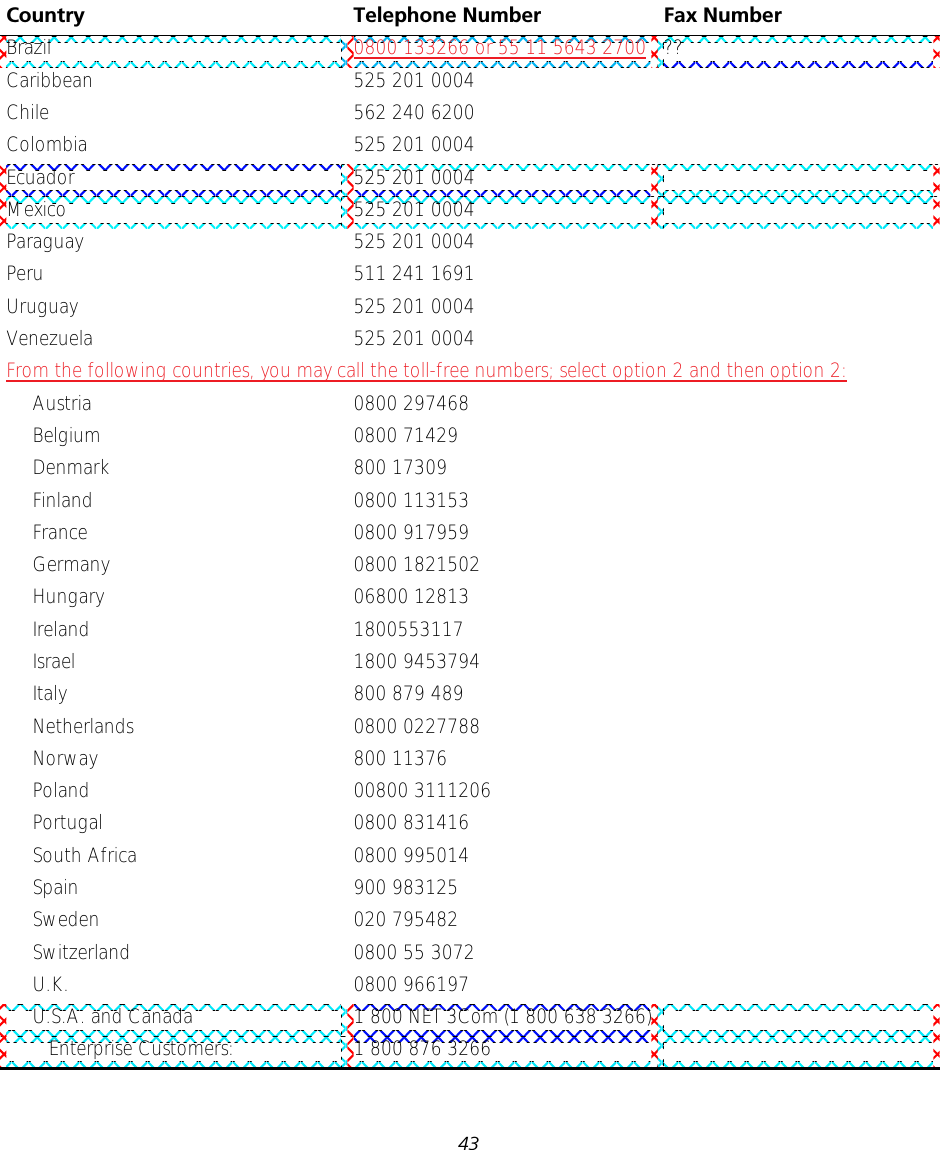
42RETURNING PRODUCTS FOR REPAIRBefore you send a product directly to 3Com for repair, you must first obtain an authorization number. Products sent to 3Com without authorization numbers will be returned to the sender unopened, at the sender’s expense. To obtain an authorization number, call or fax:Italy 800 8 79489Luxembourg 0800 23625Netherlands 0800 0227788Norway 800 11376Poland 00800 3111206Portugal 0800 831416South Africa 0800 995014Spain 900 983125Sweden 020 795482Switzerland 0800 55 3072U.K. 0800 966197Latin AmericaBrazil http://www.3com.com/support/en_US/repair/lat.html0800 13 3266Mexico 01 800 849CAREPuerto Rico 800 666 5065Central and South America AT&T +800 998 2112North America1 847 262 0070Enterprise Customers: 1 800 876 3266Country Telephone NumberCountry Telephone Number Fax NumberAsia, Pacific Rim +65 543 6500 +65 543 6348Europe, South Africa, and Middle East +31 30 6029900 +31 30 6029999Central and South America 525 201 0075Argentina 0810 222 3266Bolivia 511 241 1691KRIS: Do all of these phone #s geteliminated?????
43Brazil 0800 133266 or 55 11 5643 2700 ??Caribbean 525 201 0004Chile 562 240 6200Colombia 525 201 0004Ecuador 525 201 0004Mexico 525 201 0004Paraguay 525 201 0004Peru 511 241 1691Uruguay 525 201 0004Venezuela 525 201 0004From the following countries, you may call the toll-free numbers; select option 2 and then option 2:Austria 0800 297468Belgium 0800 71429Denmark 800 17309Finland 0800 113153France 0800 917959Germany 0800 1821502Hungary 06800 12813Ireland 1800553117Israel 1800 9453794Italy 800 879 489Netherlands 0800 0227788Norway 800 11376Poland 00800 3111206Portugal 0800 831416South Africa 0800 995014Spain 900 983125Sweden 020 795482Switzerland 0800 55 3072U.K. 0800 966197U.S.A. and Canada 1 800 NET 3Com (1 800 638 3266)   Enterprise Customers: 1 800 876 3266Country Telephone Number Fax Number
44
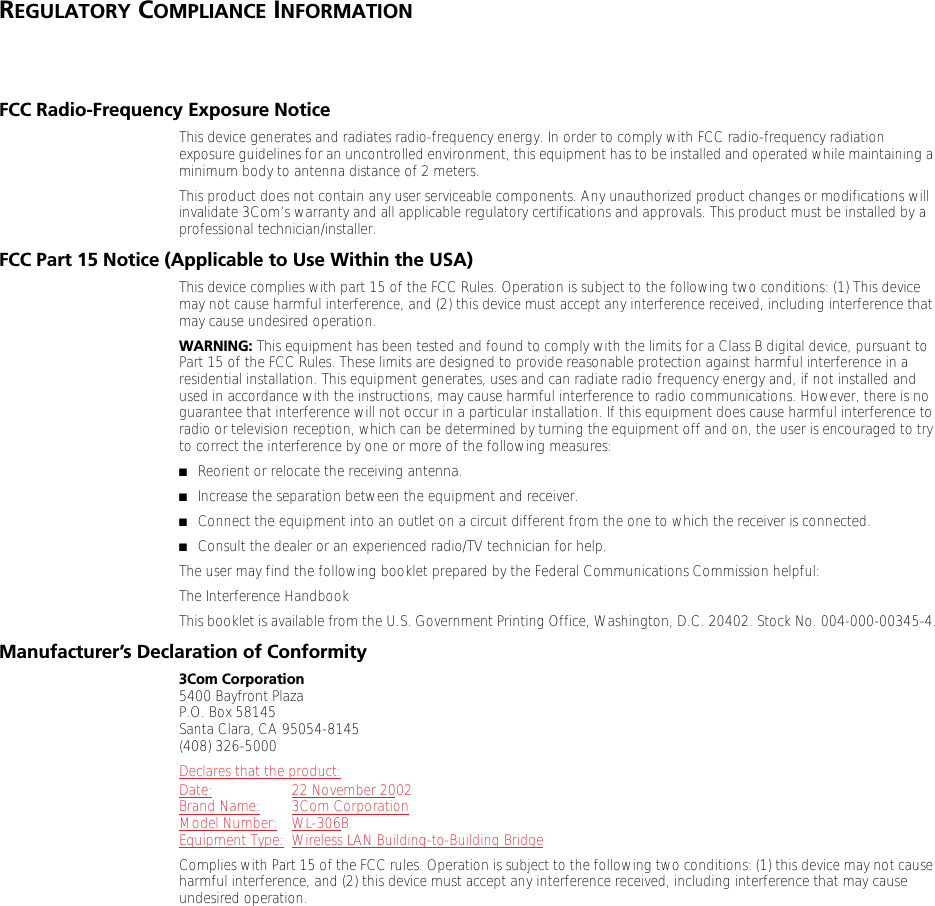
REGULATORY COMPLIANCE INFORMATIONFCC Radio-Frequency Exposure NoticeThis device generates and radiates radio-frequency energy. In order to comply with FCC radio-frequency radiation exposure guidelines for an uncontrolled environment, this equipment has to be installed and operated while maintaining a minimum body to antenna distance of 2 meters.This product does not contain any user serviceable components. Any unauthorized product changes or modifications will invalidate 3Com’s warranty and all applicable regulatory certifications and approvals. This product must be installed by a professional technician/installer.FCC Part 15 Notice (Applicable to Use Within the USA)This device complies with part 15 of the FCC Rules. Operation is subject to the following two conditions: (1) This device may not cause harmful interference, and (2) this device must accept any interference received, including interference that may cause undesired operation.WARNING: This equipment has been tested and found to comply with the limits for a Class B digital device, pursuant to Part 15 of the FCC Rules. These limits are designed to provide reasonable protection against harmful interference in a residential installation. This equipment generates, uses and can radiate radio frequency energy and, if not installed and used in accordance with the instructions, may cause harmful interference to radio communications. However, there is no guarantee that interference will not occur in a particular installation. If this equipment does cause harmful interference to radio or television reception, which can be determined by turning the equipment off and on, the user is encouraged to try to correct the interference by one or more of the following measures:■Reorient or relocate the receiving antenna.■Increase the separation between the equipment and receiver.■Connect the equipment into an outlet on a circuit different from the one to which the receiver is connected.■Consult the dealer or an experienced radio/TV technician for help.The user may find the following booklet prepared by the Federal Communications Commission helpful:The Interference HandbookThis booklet is available from the U.S. Government Printing Office, Washington, D.C. 20402. Stock No. 004-000-00345-4.Manufacturer’s Declaration of Conformity3Com Corporation5400 Bayfront PlazaP.O. Box 58145Santa Clara, CA 95054-8145(408) 326-5000Declares that the product:Date: 22 November 2002Brand Name: 3Com CorporationModel Number: WL-306BEquipment Type: Wireless LAN Building-to-Building BridgeComplies with Part 15 of the FCC rules. Operation is subject to the following two conditions: (1) this device may not cause harmful interference, and (2) this device must accept any interference received, including interference that may cause undesired operation.
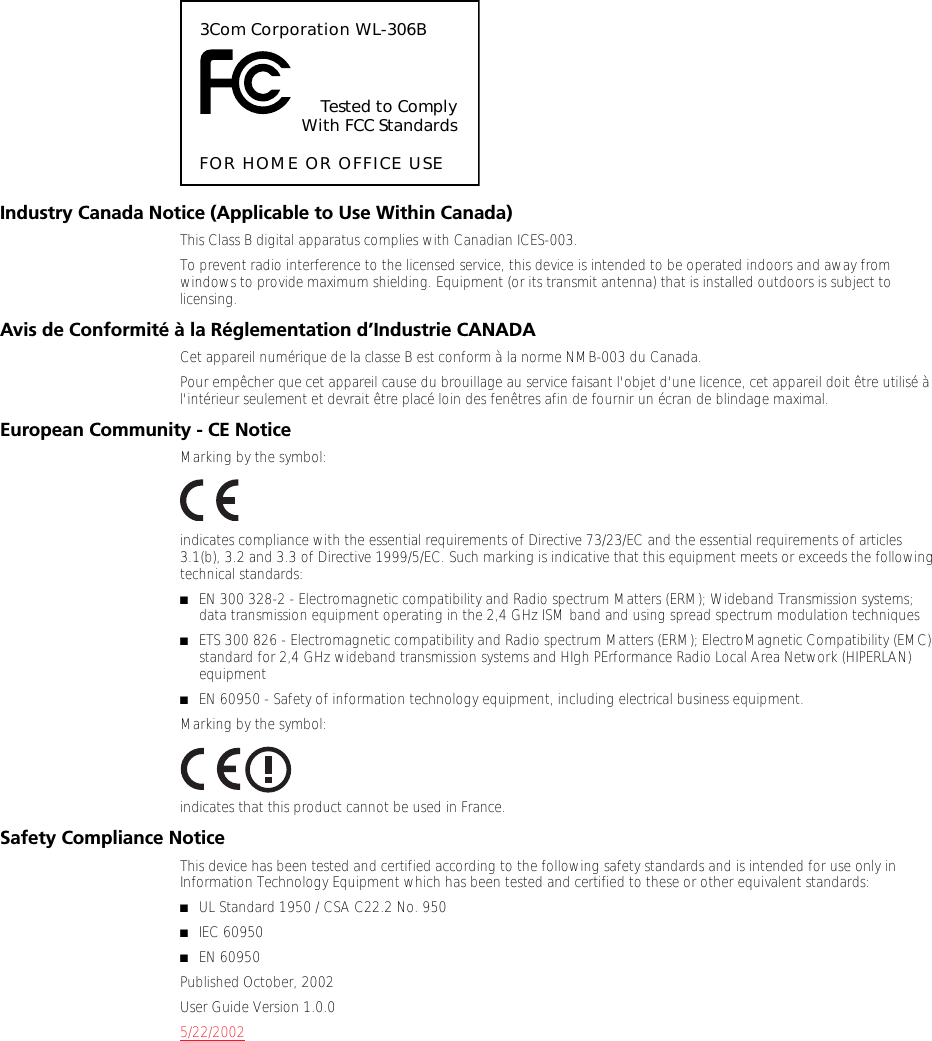
Industry Canada Notice (Applicable to Use Within Canada)This Class B digital apparatus complies with Canadian ICES-003.To prevent radio interference to the licensed service, this device is intended to be operated indoors and away from windows to provide maximum shielding. Equipment (or its transmit antenna) that is installed outdoors is subject to licensing.Avis de Conformité à la Réglementation d’Industrie CANADACet appareil numérique de la classe B est conform à la norme NMB-003 du Canada.Pour empêcher que cet appareil cause du brouillage au service faisant l'objet d'une licence, cet appareil doit être utilisé à l'intérieur seulement et devrait être placé loin des fenêtres afin de fournir un écran de blindage maximal.European Community - CE NoticeMarking by the symbol:indicates compliance with the essential requirements of Directive 73/23/EC and the essential requirements of articles 3.1(b), 3.2 and 3.3 of Directive 1999/5/EC. Such marking is indicative that this equipment meets or exceeds the following technical standards:■EN 300 328-2 - Electromagnetic compatibility and Radio spectrum Matters (ERM); Wideband Transmission systems; data transmission equipment operating in the 2,4 GHz ISM band and using spread spectrum modulation techniques■ETS 300 826 - Electromagnetic compatibility and Radio spectrum Matters (ERM); ElectroMagnetic Compatibility (EMC) standard for 2,4 GHz wideband transmission systems and HIgh PErformance Radio Local Area Network (HIPERLAN) equipment■EN 60950 - Safety of information technology equipment, including electrical business equipment.Marking by the symbol:indicates that this product cannot be used in France.Safety Compliance NoticeThis device has been tested and certified according to the following safety standards and is intended for use only in Information Technology Equipment which has been tested and certified to these or other equivalent standards:■UL Standard 1950 / CSA C22.2 No. 950■IEC 60950■EN 60950Published October, 2002User Guide Version 1.0.05/22/20023Com Corporation WL-306BTested to ComplyWith FCC StandardsFOR HOME OR OFFICE USE
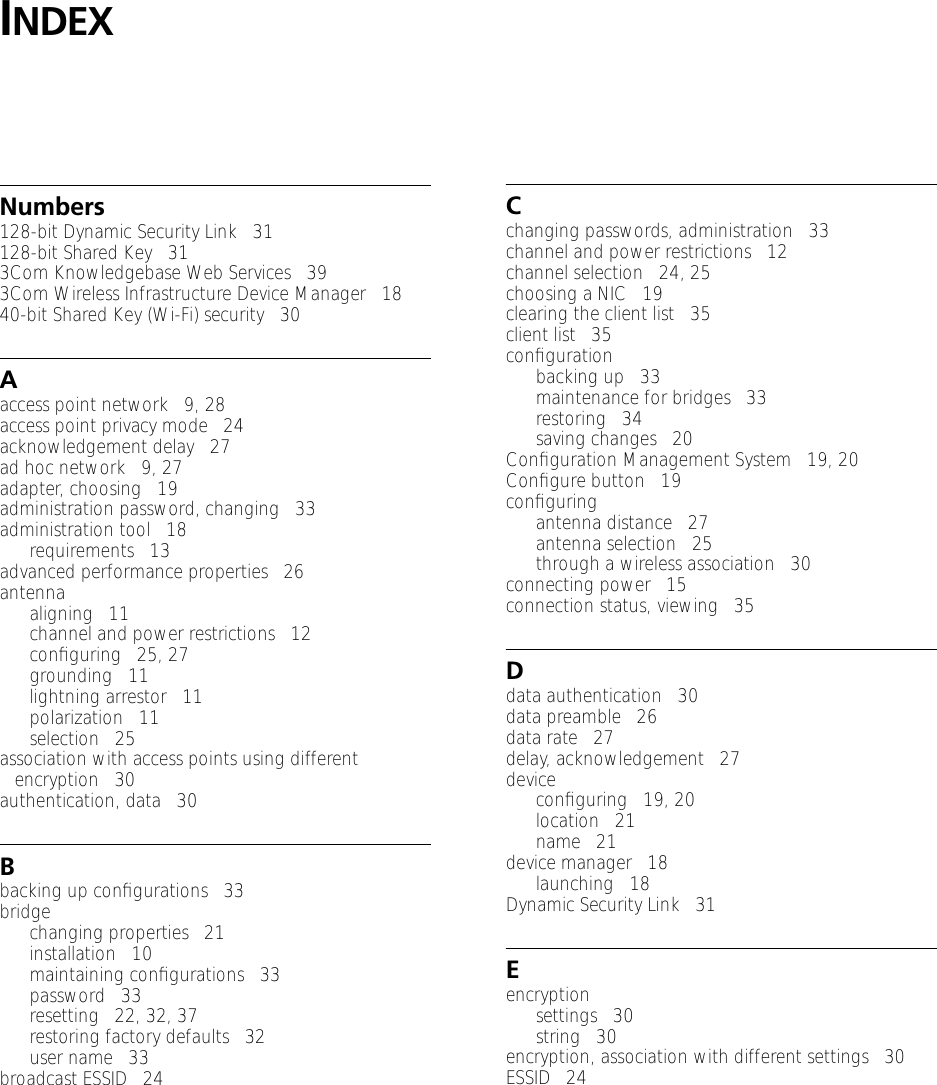
INDEXNumbers128-bit Dynamic Security Link   31128-bit Shared Key   313Com Knowledgebase Web Services   393Com Wireless Infrastructure Device Manager   1840-bit Shared Key (Wi-Fi) security   30Aaccess point network   9, 28access point privacy mode   24acknowledgement delay   27ad hoc network   9, 27adapter, choosing   19administration password, changing   33administration tool   18requirements   13advanced performance properties   26antennaaligning   11channel and power restrictions   12configuring   25, 27grounding   11lightning arrestor   11polarization   11selection   25association with access points using different encryption   30authentication, data   30Bbacking up configurations   33bridgechanging properties   21installation   10maintaining configurations   33password   33resetting   22, 32, 37restoring factory defaults   32user name   33broadcast ESSID   24Cchanging passwords, administration   33channel and power restrictions   12channel selection   24, 25choosing a NIC   19clearing the client list   35client list   35configurationbacking up   33maintenance for bridges   33restoring   34saving changes   20Configuration Management System   19, 20Configure button   19configuringantenna distance   27antenna selection   25through a wireless association   30connecting power   15connection status, viewing   35Ddata authentication   30data preamble   26data rate   27delay, acknowledgement   27deviceconfiguring   19, 20location   21name   21device manager   18launching   18Dynamic Security Link   31Eencryptionsettings   30string   30encryption, association with different settings   30ESSID   24
Ffilteringport   23protocol   23firmware upgrade   32flow control   26Ggrounding antennas   11guidelines, security   30Hhelp file location   21help file path   21hexadecimal keys   30Iinstallation   10bridge   10connecting to a wired network   15firmware   32power   15requirements   10software utilities   16interoperating with third-party equipment   35IP address   22refreshing after changing   19specifying   22Kkeys   30Llaunching the device manager   18lightning arrestor   11locating devices   18, 19login user name and password   31MMAC address, use in locating devices   18, 19Nnetworkaccess point   9, 28ad hoc   9, 27infrastructure   24mode   24privacy mode   24traffic accelerator   26network supplier support   40NIC, choosing   19No Security   30Oonline technical services   39open system   30operating modeaccess point   9, 28ad hoc   9, 27Ppassword, changing   33performance properties, advanced   26point-to-multipoint   7association   28topology   8point-to-point   7association   27topology   7polarization   11port filtering   23power   15power and channel restrictions   12Pre-IP Configuration Wizard   19, 20privacy mode   24problem solving   36Properties button   19protocol filtering   23Rradio channel settings   24, 25Refresh button   19resetting a bridge   22, 32, 37restoring a configuration   34restoring settings to factory defaults   32restrictions, channel and power   12returning products for repair   42S
saving configuration changes   20secure web server connection   22, 37security   30128-bit Dynamic Security Link   31128-bit Shared Key   3140-bit Shared Key (Wi-Fi)   30guidelines   30no security   30saving settings   21settings, radio channel   24, 25shared keys   30software utilities   16installing   16solving problems   36system summary, viewing   35Ttechnical support3Com Knowledgebase Web Services   39network suppliers   40product repair   42third-party interoperability   35traffic accelerator   26troubleshooting   36bridge firmware   32Uupgrading bridge firmware   32user name   33Wweb server, secure connection   22, 37wireless LAN service area   24Wireless Network Login   31wireless network tree   18World Wide Web (WWW)   39

Navigation menu