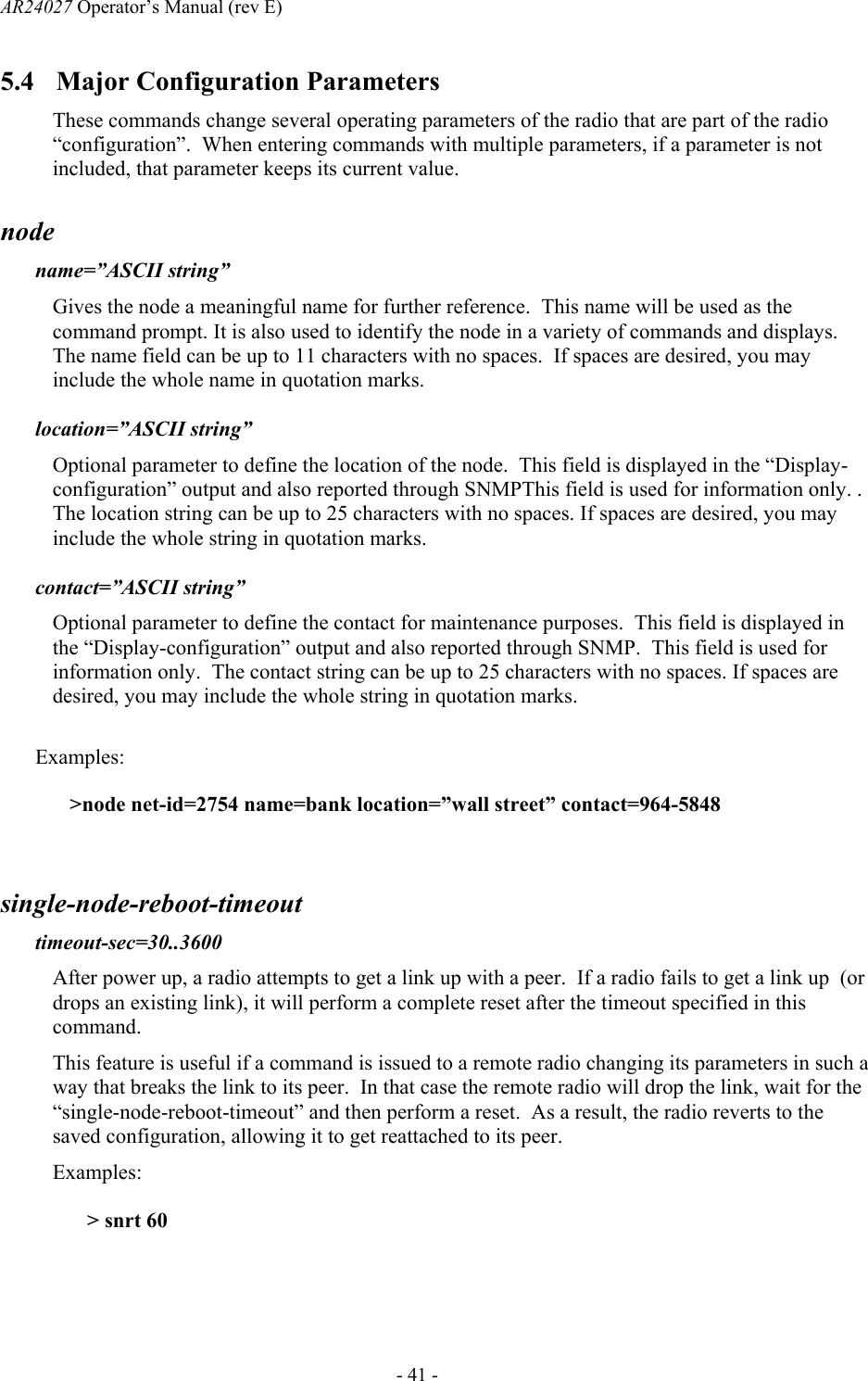
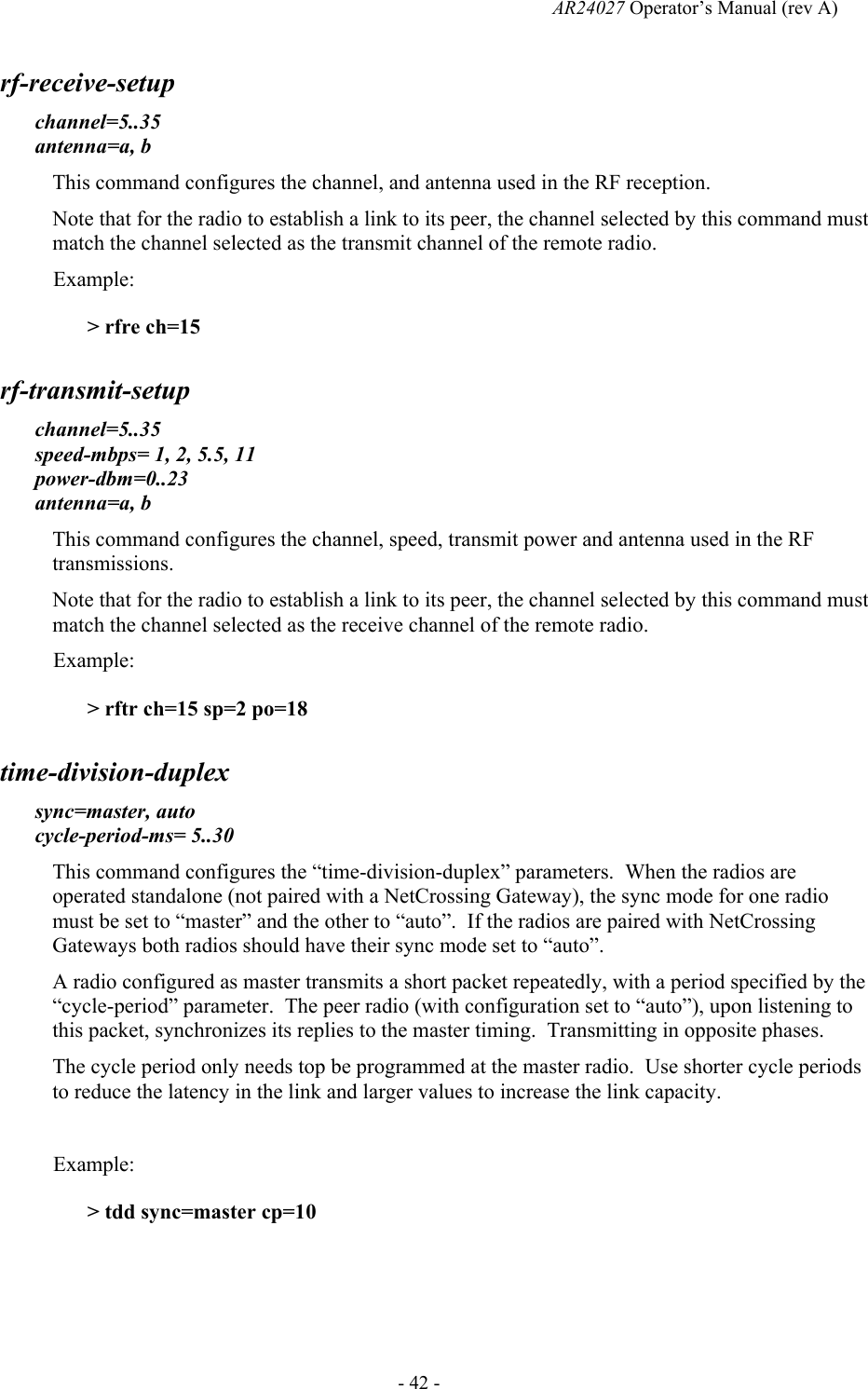
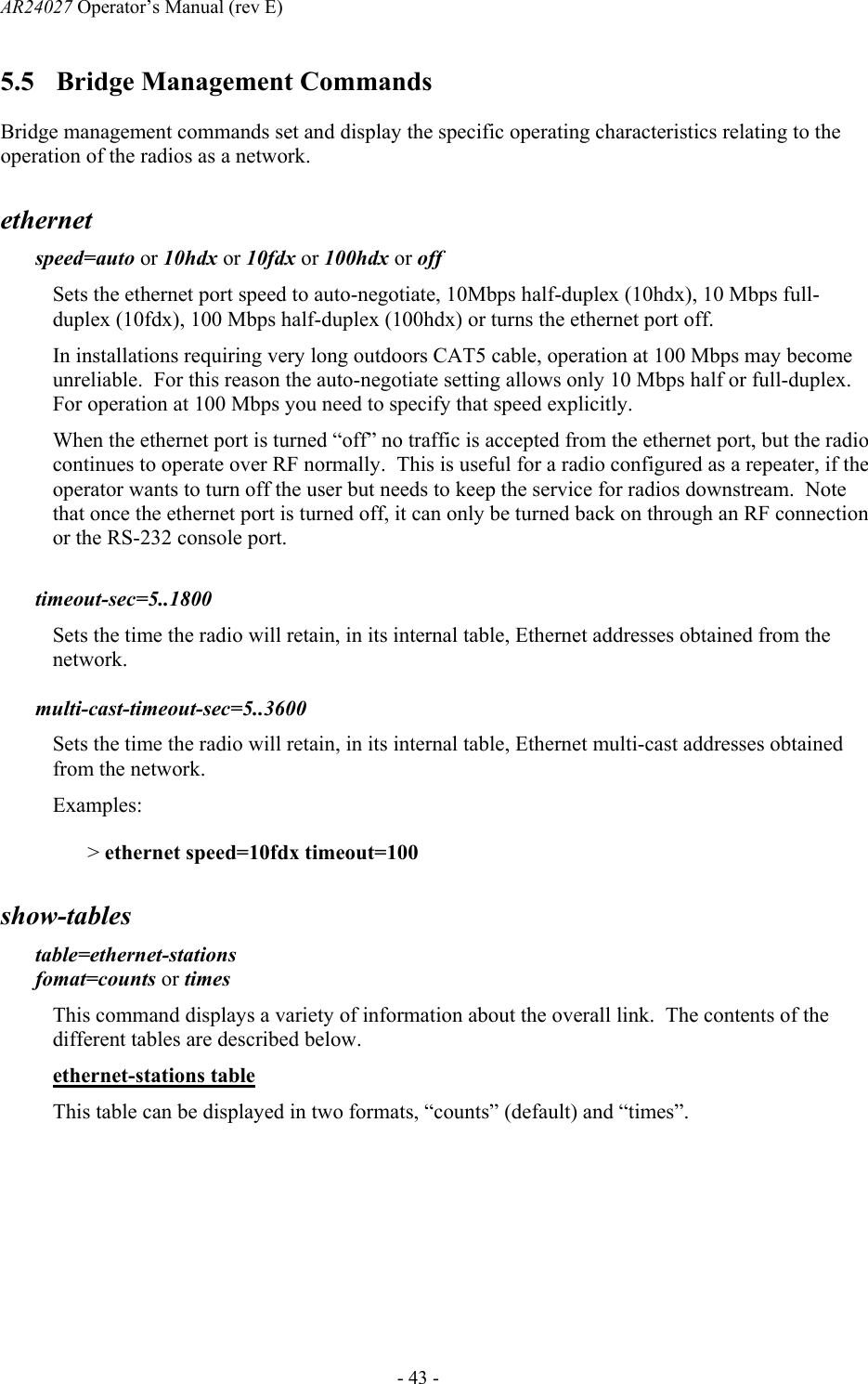
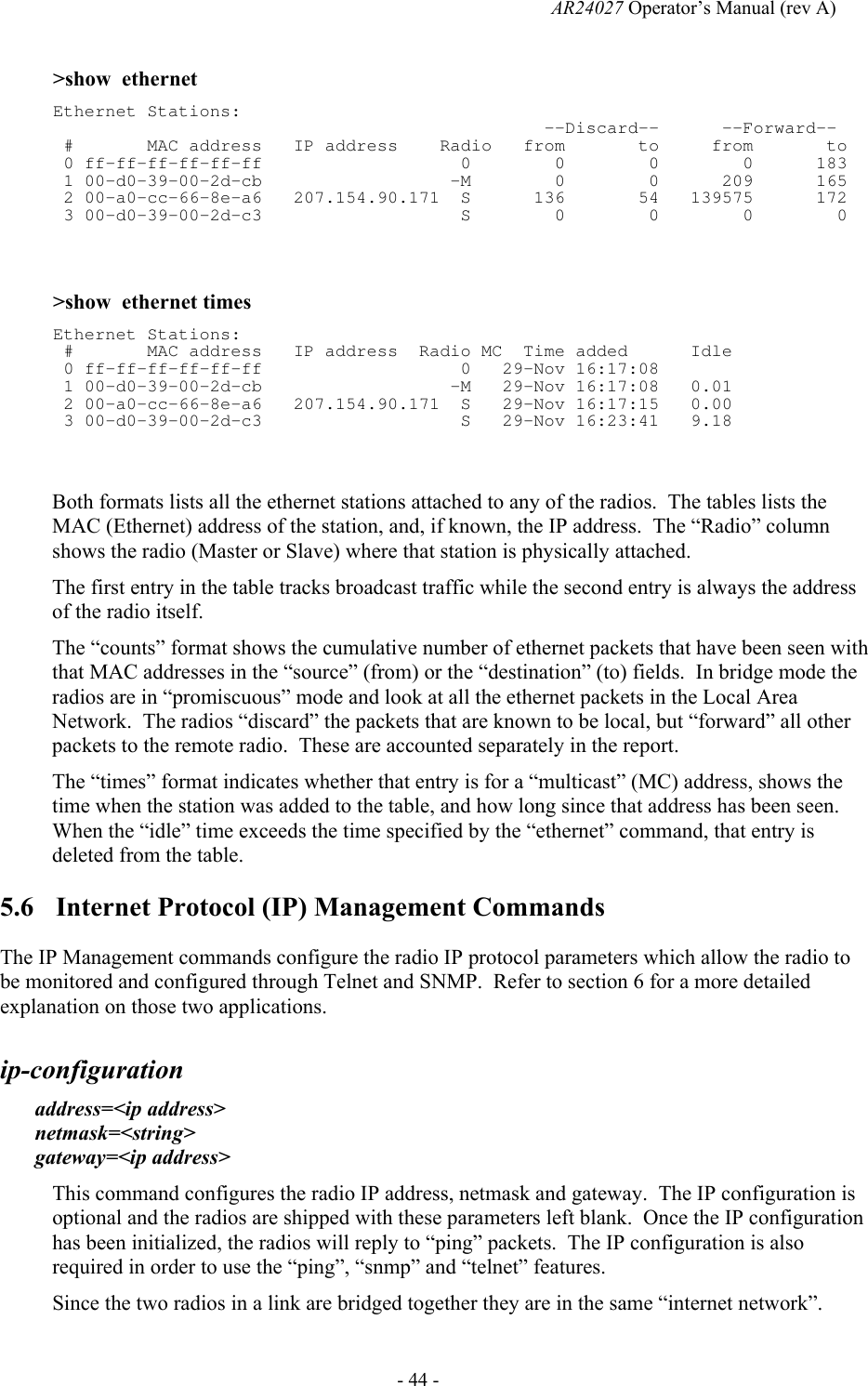
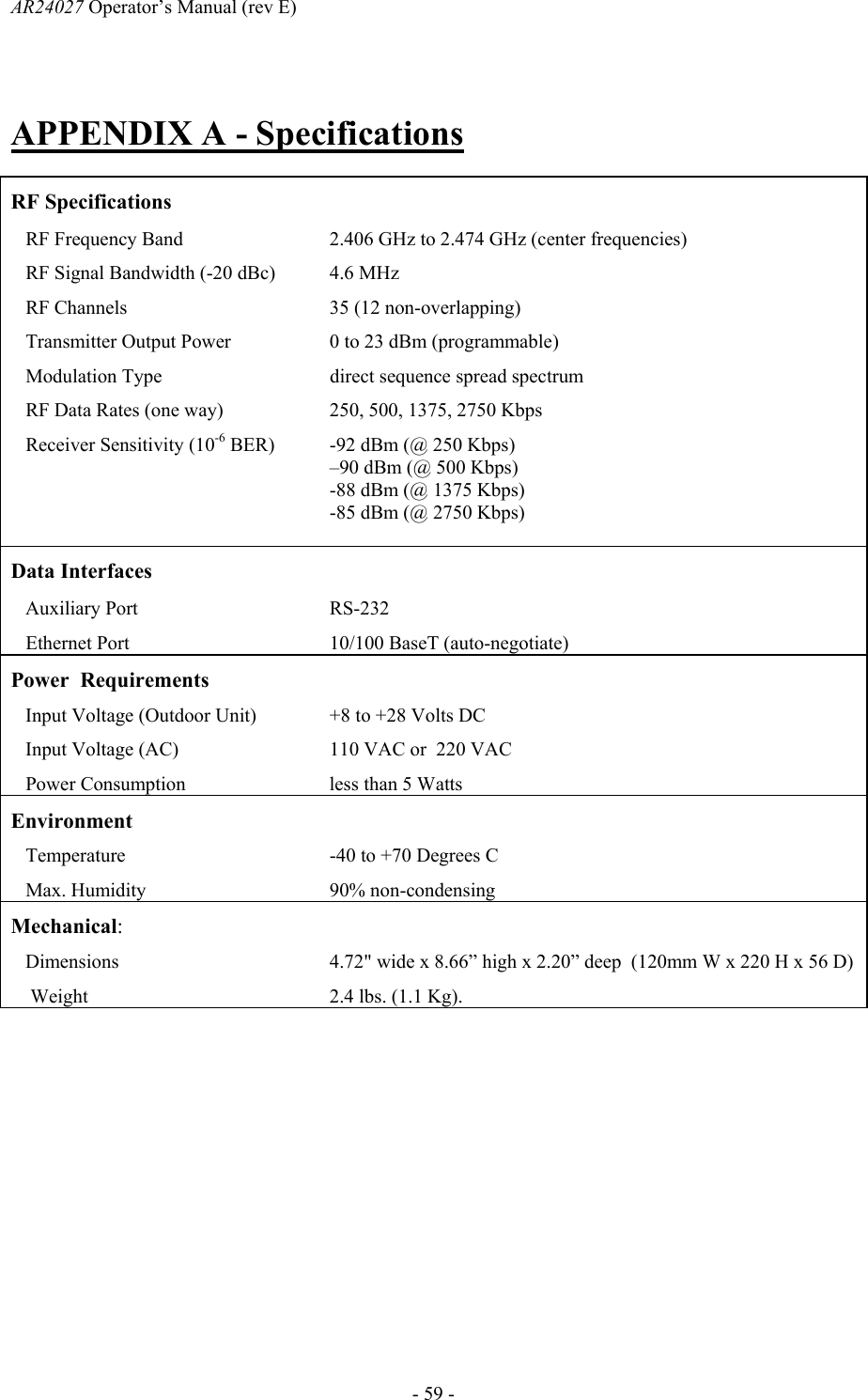
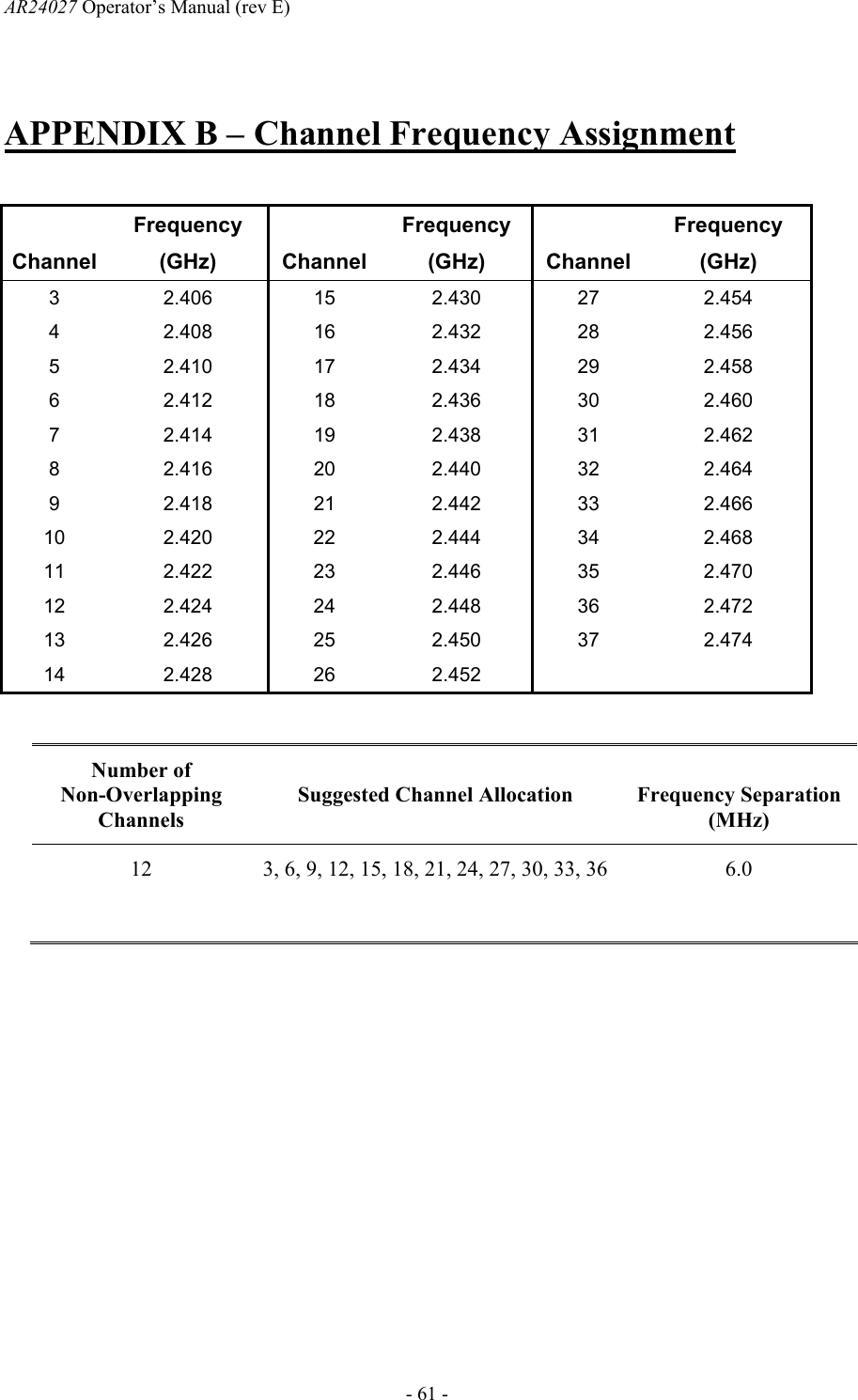
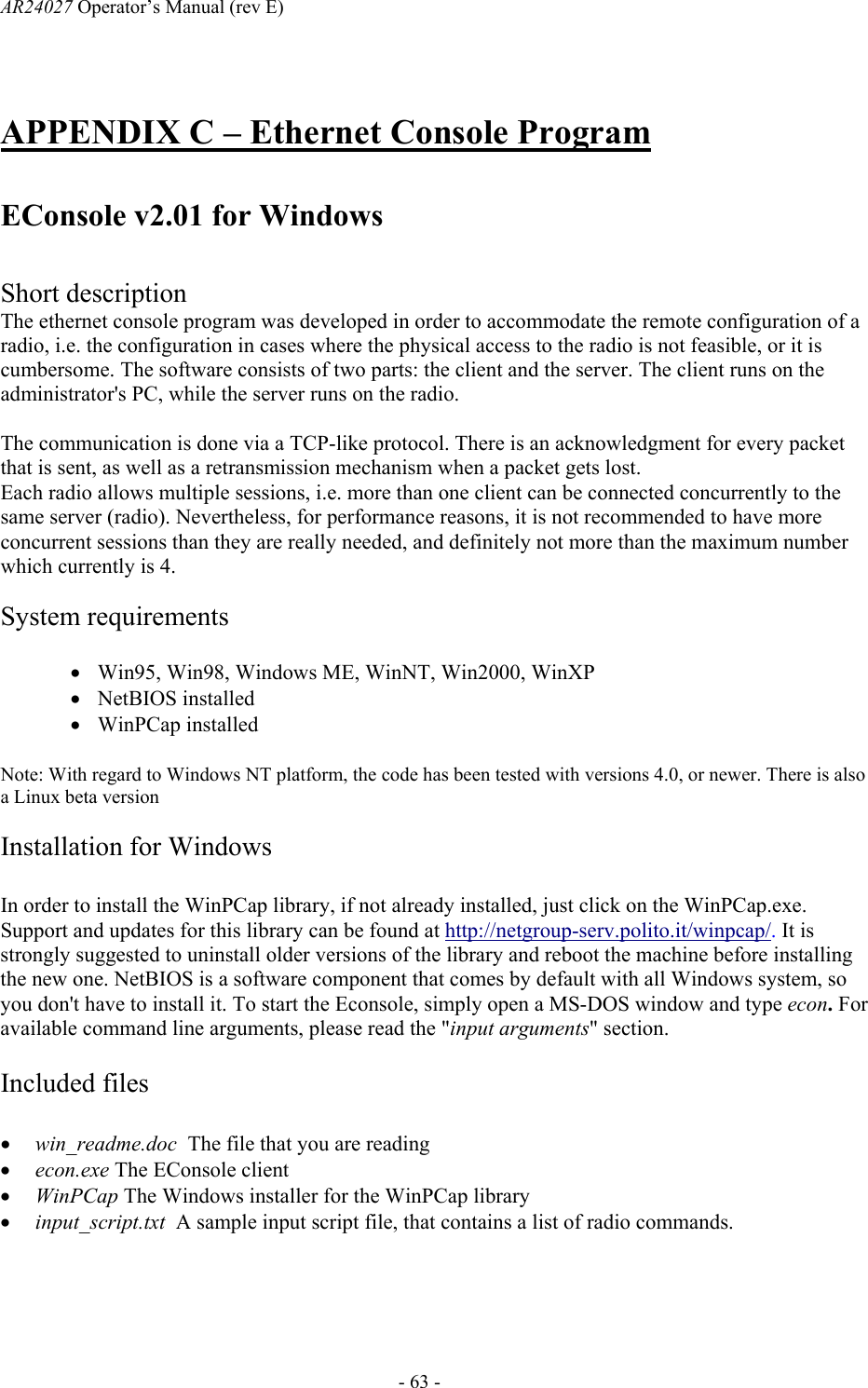
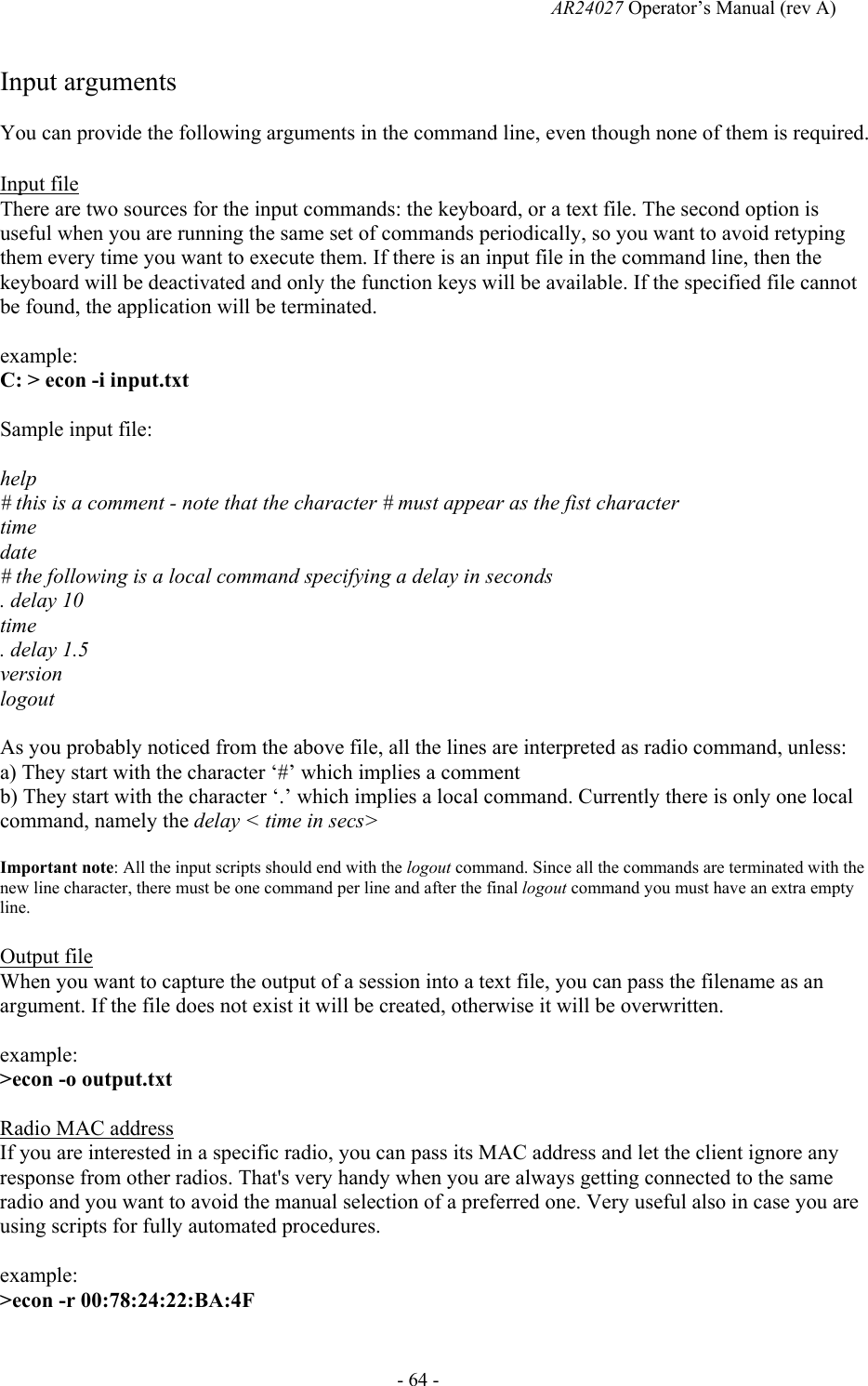
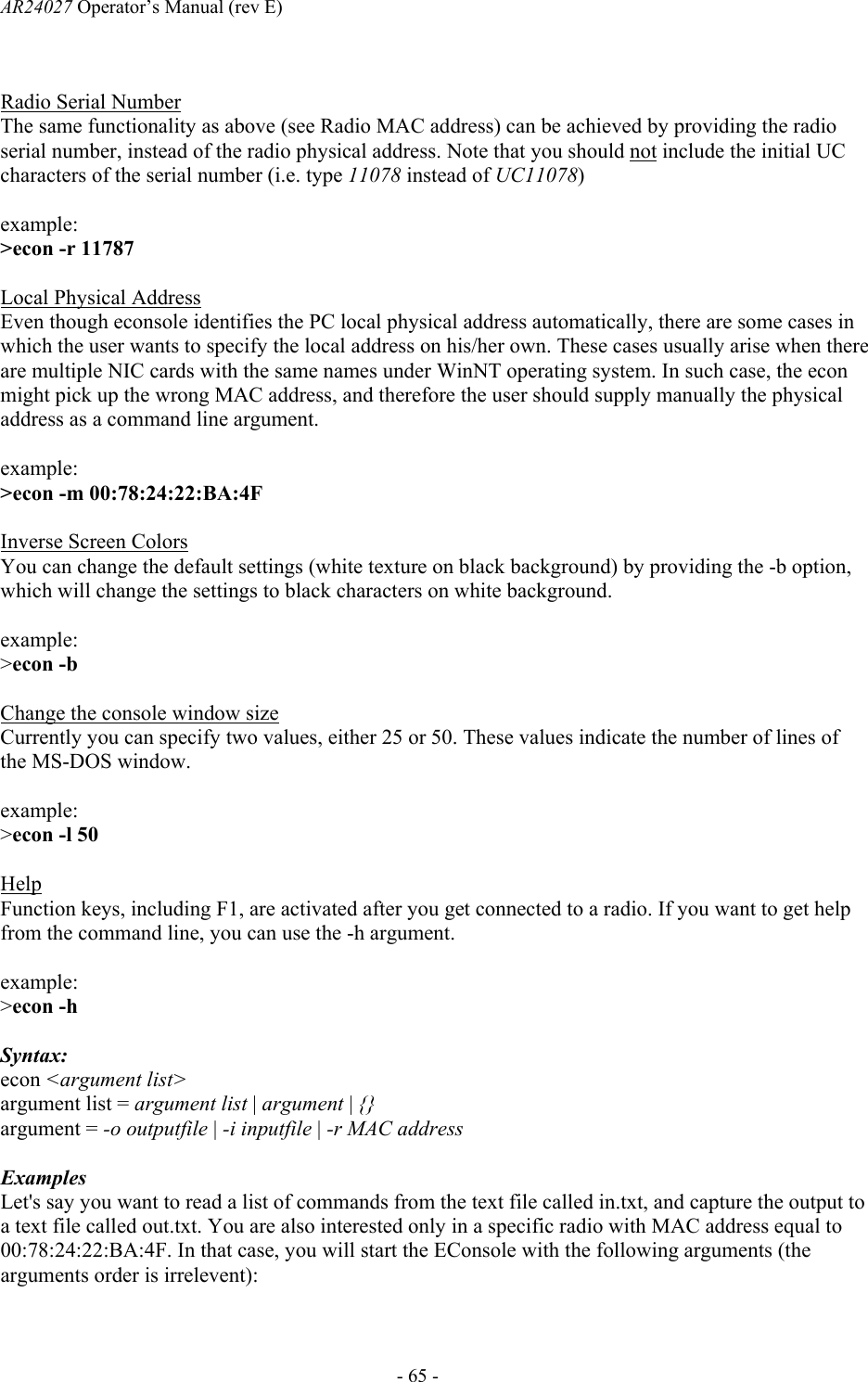
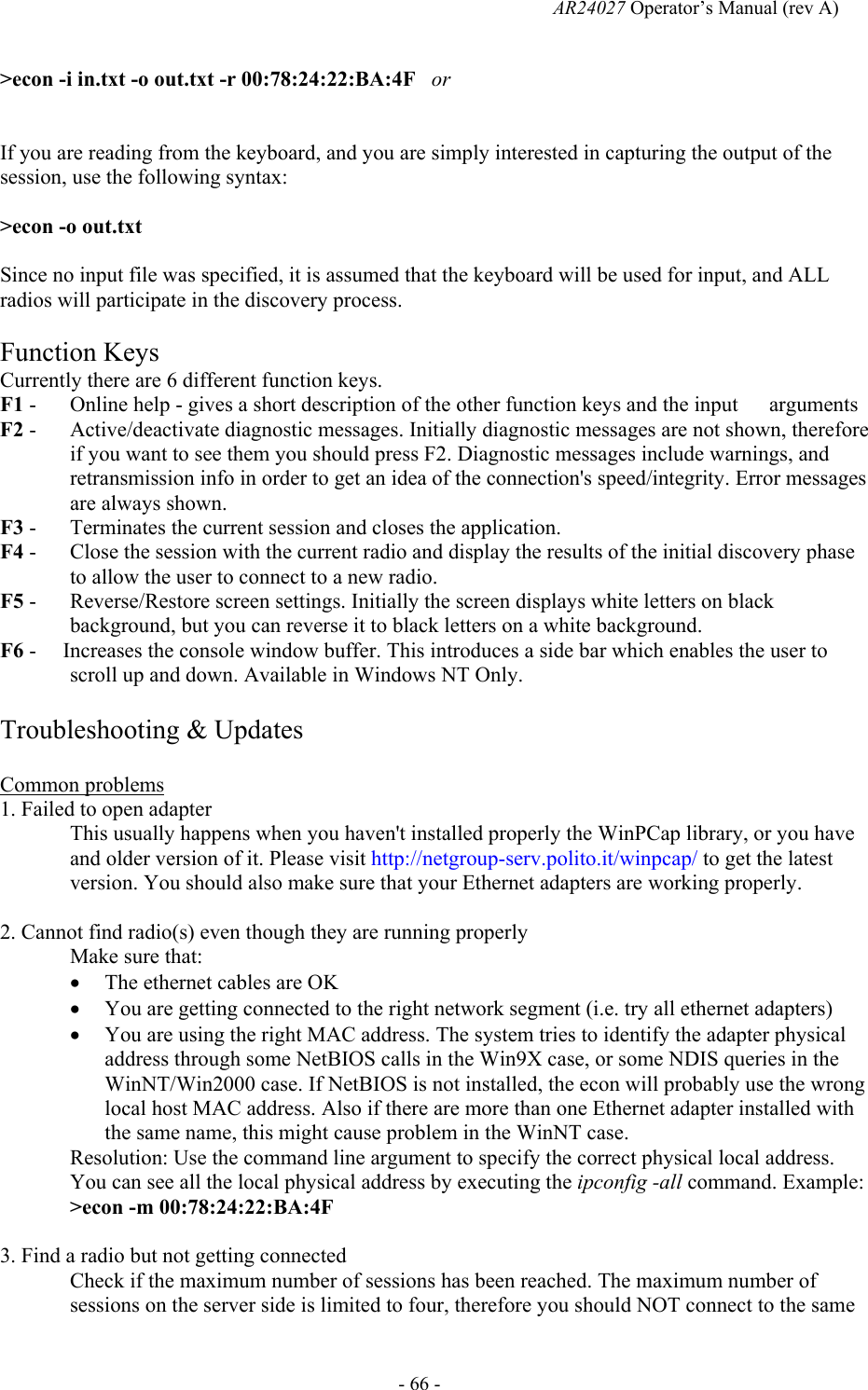
AFAR Communications 24027 Wireless Ethernet Bridge User Manual 373526

AFAR Communications, Inc Wireless Ethernet Bridge 373526

Contents

User Manual

        AR24027 Operator’s Manual  Rev: A September, 2003     AFAR Communications Inc. 81 David Love Place Santa Barbara, CA 93117  Tel:  (805) 681 1993 Fax: (805) 681 1994
FCC Notice This equipment has been tested and found to comply with the limits for a Class B digital device, pursuant to Part 15 of the FCC Rules.  These limits are designed to provide reasonable protection against harmful interference in a residential installation.  This equipment generates, uses, and can radiate radio frequency energy and, if not installed and used in accordance with the instructions, may cause harmful interference to radio communications.  However, there is no guarantee that interference will not occur in a particular installation.  If this equipment does cause harmful interference to radio or television reception, which can be determined by turning the equipment off and on, the user is encouraged to try to correct the interference by one or more of the following measures:   •  Reorient or relocate the receiving antenna.   •  Increase the separation between the equipment and receiver.   •  Connect the equipment into an outlet on a circuit different from that to which the receiver is connected.   •  Consult the dealer or an experienced radio/TV technician for help. Changes or modifications not expressly approved in writing by AFAR Communications Inc. may void the user’s authority to operate this equipment.  AFAR Communications Inc. can not accept any financial or other responsibilities that may be the result of your use of this information, including direct, indirect, special, or consequential damages.  Refer to warranty documents for product warranty coverage and specifics.
AR24027 Operator’s Manual (rev E)       - iii - STATEMENT OF WARRANTY AFAR COMMUNICATIONS INC. products, except as otherwise stated in an applicable price list, are warranted against defects in workmanship and material for a period of one (1) year from date of delivery as evidenced by AFAR COMMUNICATIONS INC.’s packing slip or other transportation receipt. AFAR COMMUNICATIONS INC.’s sole responsibility under this warranty shall be to either repair or replace, at its option, any component which fails during the applicable warranty period because of a defect in workmanship and material, provided PURCHASER has promptly reported same to AFAR COMMUNICATIONS INC. in writing.  All replaced Products or parts shall become AFAR COMMUNICATIONS INC.’s property. AFAR COMMUNICATIONS INC. shall honor the warranty at AFAR COMMUNICATIONS INC.’s facility in Goleta, California.  It is PURCHASER’s responsibility to return, at its expense, the allegedly defective Product to AFAR COMMUNICATIONS INC.  PURCHASER must notify AFAR COMMUNICATIONS INC. and obtain shipping instructions prior to returning any Product.  Transportation charges for the return of the Product to PURCHASER shall be paid by AFAR COMMUNICATIONS INC. within the United States.  For all other locations, the warranty excludes all costs of shipping, customs clearance and other related charges.  If AFAR COMMUNICATIONS INC. determines that the Product is not defective within the terms of the warranty, PURCHASER shall pay AFAR COMMUNICATIONS INC. all costs of handling, transportation and repairs at the prevailing repair rates.  All the above warranties are contingent upon proper use of the Product.  These warranties will not apply (i) if adjustment, repair, or parts replacement is required because of accident, unusual physical, electrical or electromagnetic stress, negligence of PURCHASER, misuse, failure of electric power environmental controls, transportation, not maintained in accordance with AFAR COMMUNICATIONS INC. specifications, or abuses other than ordinary use (ii) if the Product has been modified by PURCHASER or has been repaired or altered outside AFAR COMMUNICATIONS INC.’s factory, unless AFAR COMMUNICATIONS INC. specifically authorizes such repairs or alterations; (iii) where AFAR COMMUNICATIONS INC. serial numbers, warranty date or quality assurance decals have been removed or altered.  AFAR COMMUNICATIONS INC. also reserves the right to make product improvements without incurring any obligation or liability to make the same changes in Products previously manufactured or purchased.  In no event shall AFAR COMMUNICATIONS INC. be liable for any breach of warranty in an amount exceeding the net selling price of any defective Product.  No person, including any dealer, agent or representative of AFAR COMMUNICATIONS INC. is authorized to assume for AFAR COMMUNICATIONS INC. any other liability on its behalf except as set forth herein.  Nonpayment of any invoice rendered within the stated payment terms automatically cancels any warranty or guarantee stated or implied.  If any payment is due AFAR COMMUNICATIONS INC. for services performed hereunder, it shall be subject to the same payment terms as the original purchase. AFAR COMMUNICATIONS INC. HEREBY DISCLAIMS ALL IMPLIED WARRANTIES OF PRODUCTS INCLUDING WITHOUT LIMITATION, ALL IMPLIED WARRANTIES OF MERCHANTABILITY OR FITNESS FOR A PARTICULAR PURPOSE.  The warranties expressly stated herein are the sole obligation or liability on the part of AFAR COMMUNICATIONS INC. arising out of or in connection with the sale or performance of the products.  Products Manufactured by Others - For the products not manufactured by AFAR COMMUNICATIONS INC. the original manufacturer’s warranty shall be assigned to PURCHASER to the extent permitted and is in lieu of any other warranty, express or implied.  For warranty information on a specific product, a written request should be made to AFAR COMMUNICATIONS INC.. IN NO EVENT WILL AFAR COMMUNICATIONS INC. BE LIABLE TO PURCHASER FOR (i) FOR REPROCUREMENT COSTS; (ii) SPECIAL, INDIRECT OR CONSEQUENTIAL DAMAGES; (iii) ANY DAMAGES WHATSOEVER RESULTING FROM LOSS OF USE, DATA OR PROFITS ARISING OUT OF OR IN CONNECTION WITH THIS AGREEMENT, OR THE USE OF PERFORMANCE OF AFAR COMMUNICATIONS INC. PRODUCTS, REGARDLESS OF WHETHER THE CAUSE OF ACTION IS IN CONTRACT, TORT, INCLUDING NEGLIGENCE, OR ANY OTHER FORM. No action, whether in contract or tort, including negligence, arising out of or in connection with this Agreement, may be brought by either party more than eighteen (18) months after the cause of action has accrued, except that an action for nonpayment may be brought within eighteen (18) months of the date of last payment.
  AR24027 Operator’s Manual (rev A)   - iv -
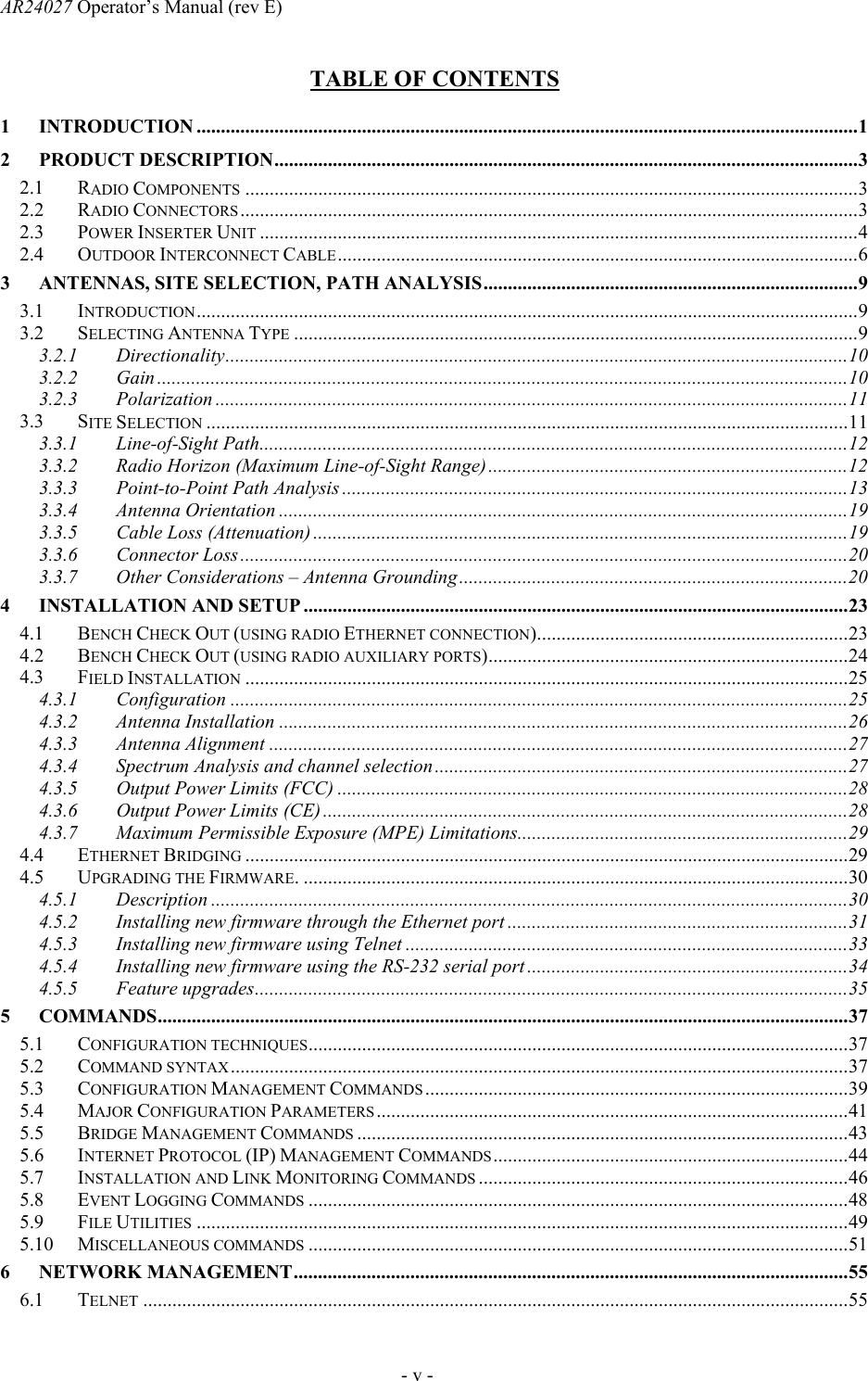
AR24027 Operator’s Manual (rev E)      - v - TABLE OF CONTENTS  1 INTRODUCTION ........................................................................................................................................1 2 PRODUCT DESCRIPTION........................................................................................................................3 2.1 RADIO COMPONENTS ..............................................................................................................................3 2.2 RADIO CONNECTORS ...............................................................................................................................3 2.3 POWER INSERTER UNIT ...........................................................................................................................4 2.4 OUTDOOR INTERCONNECT CABLE...........................................................................................................6 3 ANTENNAS, SITE SELECTION, PATH ANALYSIS.............................................................................9 3.1 INTRODUCTION........................................................................................................................................9 3.2 SELECTING ANTENNA TYPE ....................................................................................................................9 3.2.1 Directionality................................................................................................................................10 3.2.2 Gain..............................................................................................................................................10 3.2.3 Polarization ..................................................................................................................................11 3.3 SITE SELECTION ....................................................................................................................................11 3.3.1 Line-of-Sight Path.........................................................................................................................12 3.3.2 Radio Horizon (Maximum Line-of-Sight Range)..........................................................................12 3.3.3 Point-to-Point Path Analysis ........................................................................................................13 3.3.4 Antenna Orientation .....................................................................................................................19 3.3.5 Cable Loss (Attenuation) ..............................................................................................................19 3.3.6 Connector Loss.............................................................................................................................20 3.3.7 Other Considerations – Antenna Grounding................................................................................20 4 INSTALLATION AND SETUP ................................................................................................................23 4.1 BENCH CHECK OUT (USING RADIO ETHERNET CONNECTION)................................................................23 4.2 BENCH CHECK OUT (USING RADIO AUXILIARY PORTS)..........................................................................24 4.3 FIELD INSTALLATION ............................................................................................................................25 4.3.1 Configuration ...............................................................................................................................25 4.3.2 Antenna Installation .....................................................................................................................26 4.3.3 Antenna Alignment .......................................................................................................................27 4.3.4 Spectrum Analysis and channel selection.....................................................................................27 4.3.5  Output Power Limits (FCC) .........................................................................................................28 4.3.6  Output Power Limits (CE)............................................................................................................28 4.3.7  Maximum Permissible Exposure (MPE) Limitations....................................................................29 4.4 ETHERNET BRIDGING ............................................................................................................................29 4.5 UPGRADING THE FIRMWARE. ................................................................................................................30 4.5.1 Description ...................................................................................................................................30 4.5.2  Installing new firmware through the Ethernet port ......................................................................31 4.5.3  Installing new firmware using Telnet ...........................................................................................33 4.5.4  Installing new firmware using the RS-232 serial port ..................................................................34 4.5.5 Feature upgrades..........................................................................................................................35 5 COMMANDS..............................................................................................................................................37 5.1 CONFIGURATION TECHNIQUES...............................................................................................................37 5.2 COMMAND SYNTAX...............................................................................................................................37 5.3 CONFIGURATION MANAGEMENT COMMANDS .......................................................................................39 5.4 MAJOR CONFIGURATION PARAMETERS.................................................................................................41 5.5 BRIDGE MANAGEMENT COMMANDS .....................................................................................................43 5.6 INTERNET PROTOCOL (IP) MANAGEMENT COMMANDS.........................................................................44 5.7 INSTALLATION AND LINK MONITORING COMMANDS ............................................................................46 5.8 EVENT LOGGING COMMANDS ...............................................................................................................48 5.9 FILE UTILITIES ......................................................................................................................................49 5.10 MISCELLANEOUS COMMANDS ...............................................................................................................51 6 NETWORK MANAGEMENT..................................................................................................................55 6.1 TELNET .................................................................................................................................................55
  AR24027 Operator’s Manual (rev A)  - vi - 6.1.1 General ........................................................................................................................................ 55 6.1.2 Starting a Telnet Session.............................................................................................................. 55 6.1.3 Telnet Security ............................................................................................................................. 56 6.2 SNMP .................................................................................................................................................. 56 6.2.1  Command Line Interface Versus SNMP ...................................................................................... 56 6.2.2 What is SNMP?............................................................................................................................ 57 6.2.3 Security Considerations in SNMP ............................................................................................... 57 6.2.4 Examples of Network Management Systems................................................................................ 57 6.2.5  AR24027 Management Information Base (MIB) ......................................................................... 58 APPENDIX A - SPECIFICATIONS................................................................................................................ 59 APPENDIX B – CHANNEL FREQUENCY ASSIGNMENT ....................................................................... 61 APPENDIX C – ETHERNET CONSOLE PROGRAM ................................................................................ 63 APPENDIX D – INTERCONNECT CABLES .................................ERROR! BOOKMARK NOT DEFINED.
AR24027 Operator’s Manual (rev E)      - 1 - 1 INTRODUCTION The AR24027 Wireless Ethernet Bridge is a license free radio that can be used to bridge Ethernet LAN’s (Local Area Networks) across distances ranging from a few hundred feet to 50 miles (80 Km) and beyond.  In a standalone configuration the radio provides an Ethernet interface to the user.  It can also be paired with the Afar NetCrossing™ Gateway (NX2048), to provide a full duplex synchronous serial stream connection, in addition to the Ethernet interface, between the two end points.  The AR24027 is a Spread Spectrum radio operating in the “Industrial Scientific and Medical” (ISM) band from 2.400GHz to 2.4835 GHz. It is designed from the ground up to provide a robust link under very adverse conditions, often encountered in this unlicensed band.  This includes the following features:  1. All the electronics are housed in an environmentally sealed enclosure rated for outdoor installation.  You can mount the unit in close proximity to the antenna, which increases system performance by avoiding RF cable losses or expensive rigid coax cables. 2. The radio RF bandwidth is much narrower than other unlicensed devices in the 2.4 GHz band.  This has several advantages, namely (i) the radio sensitivity is greatly improved allowing longer ranges, (ii) there is a much larger number of non-overlapping channels to choose from, and (iii) it is much easier to find an unused gap in a crowded spectrum. 3. For long range links in a crowded spectrum the most desirable receive frequencies at each end of the link are often different.  In the Afar radio the transmit and receive frequencies can be selected independently of each other. 4. The radio incorporates spectrum analysis and timing analysis tools, which allow the operator to quickly perform a survey of the RF environment without the need for expensive or heavy spectrum analyzers. 5. Unique antenna alignment aid provides audio feedback proportional to the RSSI, freeing the installer’s hands to adjust and tighten the antenna without having to hold or look at other instrumentation. The radio implements a transparent bridge algorithm, where each unit automatically learns the addresses of all stations in the network and forwards over RF only the traffic that needs to be delivered to the remote unit.  This reduces the RF throughput required by the radio.  If the radio is used standalone, an indoor “power inserter” unit combines the power and Ethernet data into a single CAT5 cable connected to the radio. If the application requires a serial synchronous interface, the radios can be paired with the Afar NetCrossing™ Gateway to provide both an Ethernet and a serial link of up to 1.024 Kbps across the same wireless connection.  In this case the NetCrossing™ Gateway provides both the power and data to the radio across the single CAT5 cable.  Refer to the NetCrossing™ Gateway Operator’s Manual for complete details. The radios operate in Time Division Duplex (TDD) mode using a configurable size time slot.  One advantage of TDD operation is that the radios can synchronize their transmissions such that all co-located radios transmit at the same time, thereby avoiding self-generated interference.  This technique allows deploying a star network with 30 or more radios at the same location.
  AR24027 Operator’s Manual (rev A)  - 2 -    The AR24027 can be configured over a local serial interface or over the Ethernet using an “Ethernet console” program provided by Afar.  Once a unit is configured with an IP address you can also configure and monitor the unit using Telnet or SNMP.  The radio firmware in non-volatile memory can also be updated remotely.
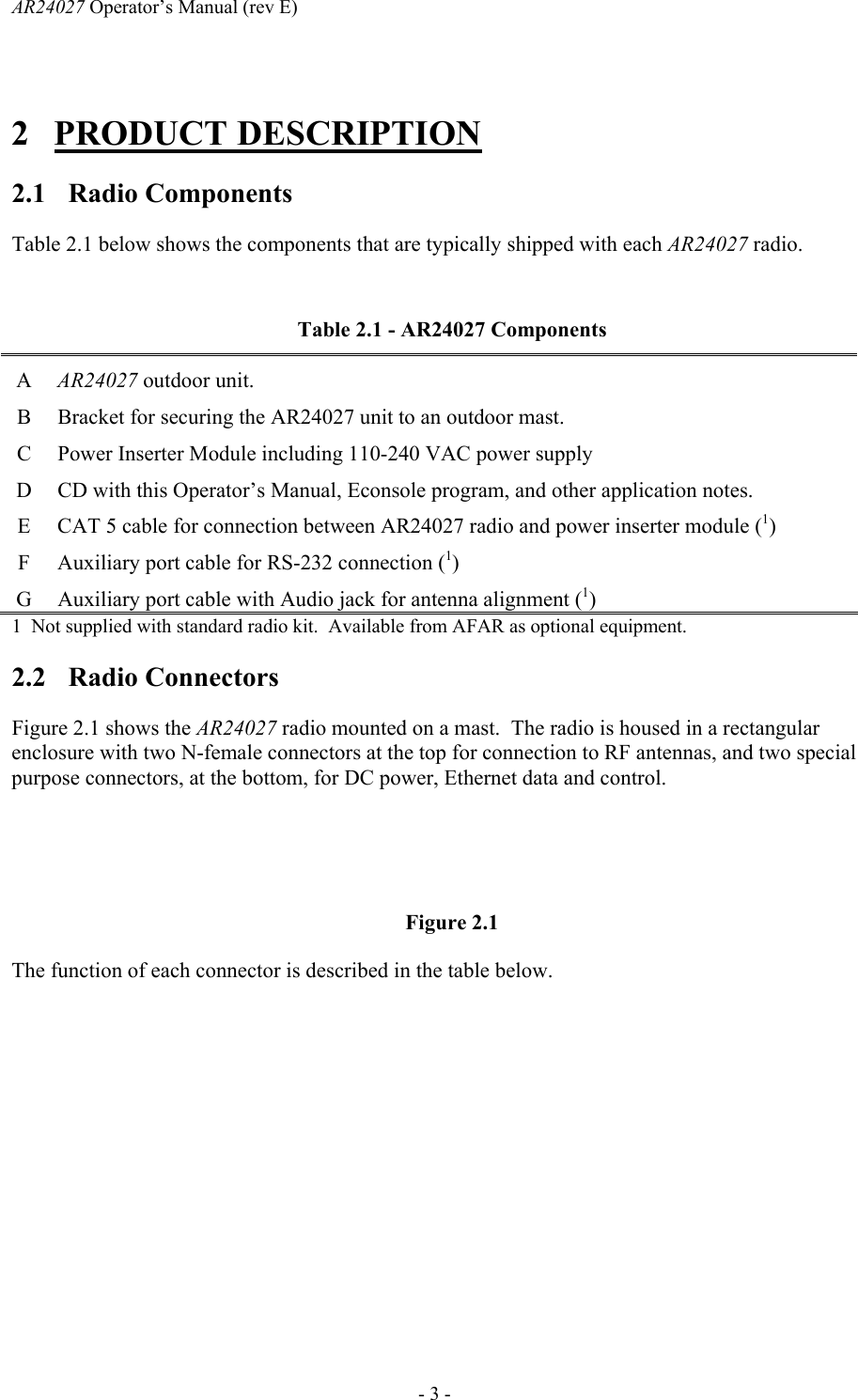
AR24027 Operator’s Manual (rev E)      - 3 - 2 PRODUCT DESCRIPTION 2.1 Radio Components Table 2.1 below shows the components that are typically shipped with each AR24027 radio.  Table 2.1 - AR24027 Components A  AR24027 outdoor unit. B  Bracket for securing the AR24027 unit to an outdoor mast. C  Power Inserter Module including 110-240 VAC power supply  D  CD with this Operator’s Manual, Econsole program, and other application notes. E  CAT 5 cable for connection between AR24027 radio and power inserter module (1) F  Auxiliary port cable for RS-232 connection (1) G  Auxiliary port cable with Audio jack for antenna alignment (1) 1  Not supplied with standard radio kit.  Available from AFAR as optional equipment.  2.2 Radio Connectors Figure 2.1 shows the AR24027 radio mounted on a mast.  The radio is housed in a rectangular enclosure with two N-female connectors at the top for connection to RF antennas, and two special purpose connectors, at the bottom, for DC power, Ethernet data and control.   Figure 2.1 The function of each connector is described in the table below.
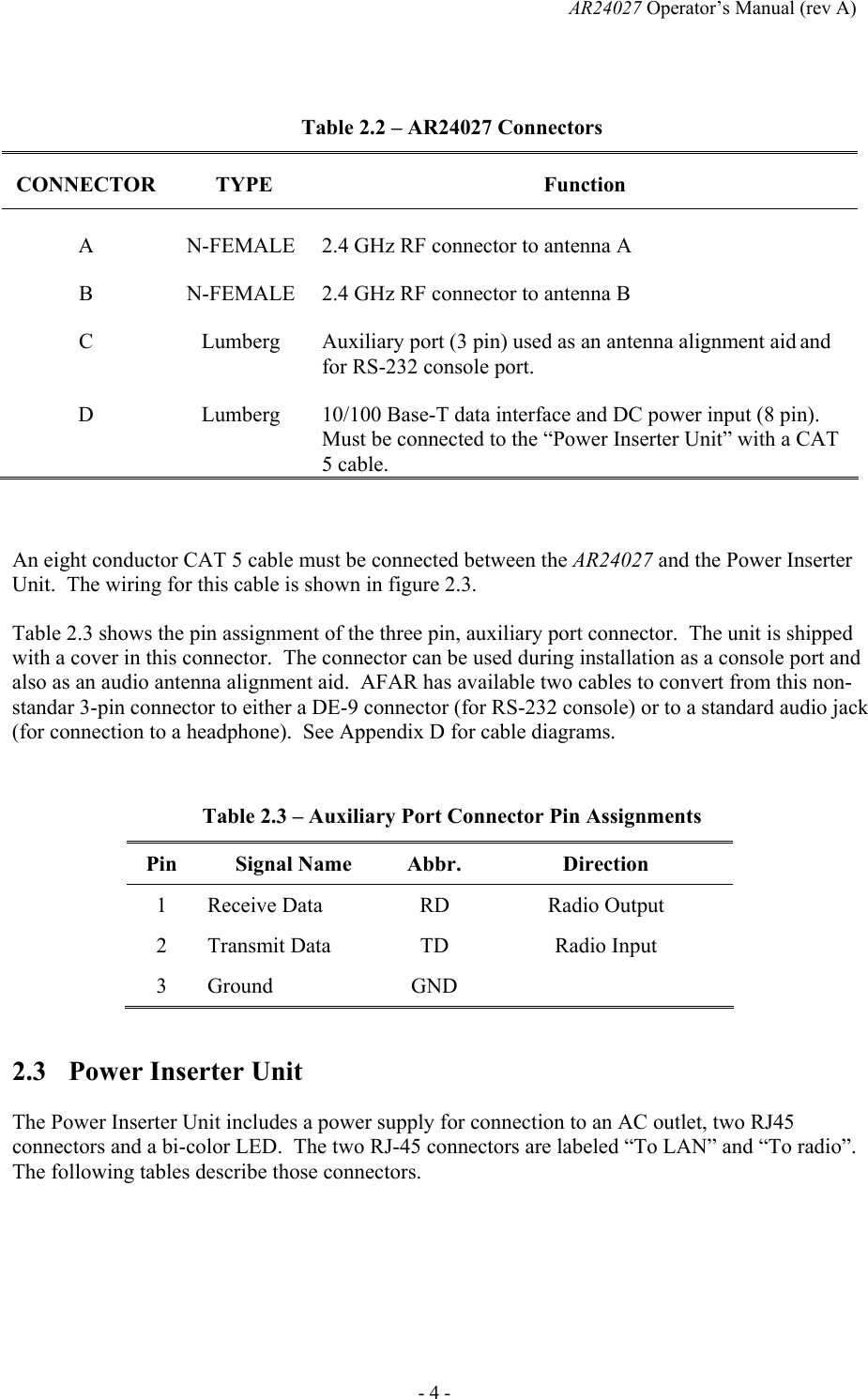
  AR24027 Operator’s Manual (rev A)  - 4 -  Table 2.2 – AR24027 Connectors CONNECTOR TYPE  Function A  N-FEMALE  2.4 GHz RF connector to antenna A B  N-FEMALE  2.4 GHz RF connector to antenna B C  Lumberg  Auxiliary port (3 pin) used as an antenna alignment aid and for RS-232 console port. D  Lumberg  10/100 Base-T data interface and DC power input (8 pin).  Must be connected to the “Power Inserter Unit” with a CAT 5 cable.   An eight conductor CAT 5 cable must be connected between the AR24027 and the Power Inserter Unit.  The wiring for this cable is shown in figure 2.3. Table 2.3 shows the pin assignment of the three pin, auxiliary port connector.  The unit is shipped with a cover in this connector.  The connector can be used during installation as a console port and also as an audio antenna alignment aid.  AFAR has available two cables to convert from this non-standar 3-pin connector to either a DE-9 connector (for RS-232 console) or to a standard audio jack (for connection to a headphone).  See Appendix D for cable diagrams.  Table 2.3 – Auxiliary Port Connector Pin Assignments Pin Signal Name Abbr.  Direction 1 Receive Data  RD  Radio Output 2  Transmit Data  TD  Radio Input 3 Ground  GND    2.3 Power Inserter Unit The Power Inserter Unit includes a power supply for connection to an AC outlet, two RJ45 connectors and a bi-color LED.  The two RJ-45 connectors are labeled “To LAN” and “To radio”.  The following tables describe those connectors.
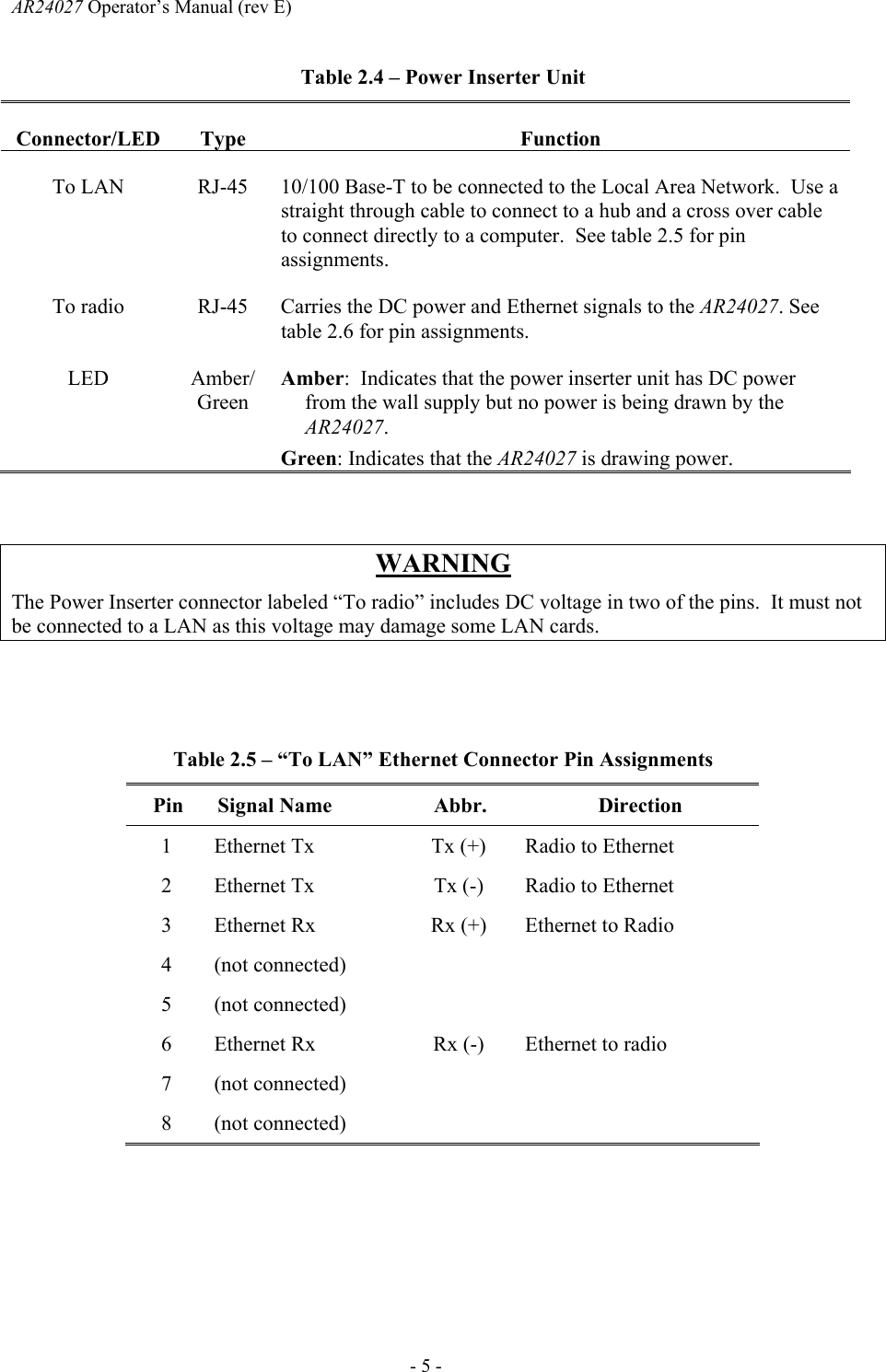
AR24027 Operator’s Manual (rev E)      - 5 - Table 2.4 – Power Inserter Unit Connector/LED Type  Function To LAN  RJ-45  10/100 Base-T to be connected to the Local Area Network.  Use a straight through cable to connect to a hub and a cross over cable to connect directly to a computer.  See table 2.5 for pin assignments. To radio  RJ-45  Carries the DC power and Ethernet signals to the AR24027. See table 2.6 for pin assignments. LED Amber/Green Amber:  Indicates that the power inserter unit has DC power from the wall supply but no power is being drawn by the AR24027. Green: Indicates that the AR24027 is drawing power.  WARNING The Power Inserter connector labeled “To radio” includes DC voltage in two of the pins.  It must not be connected to a LAN as this voltage may damage some LAN cards.   Table 2.5 – “To LAN” Ethernet Connector Pin Assignments Pin Signal Name  Abbr.  Direction 1  Ethernet Tx  Tx (+)  Radio to Ethernet 2  Ethernet Tx  Tx (-)  Radio to Ethernet 3  Ethernet Rx  Rx (+)  Ethernet to Radio 4 (not connected)     5 (not connected)     6  Ethernet Rx  Rx (-)  Ethernet to radio 7 (not connected)     8 (not connected)
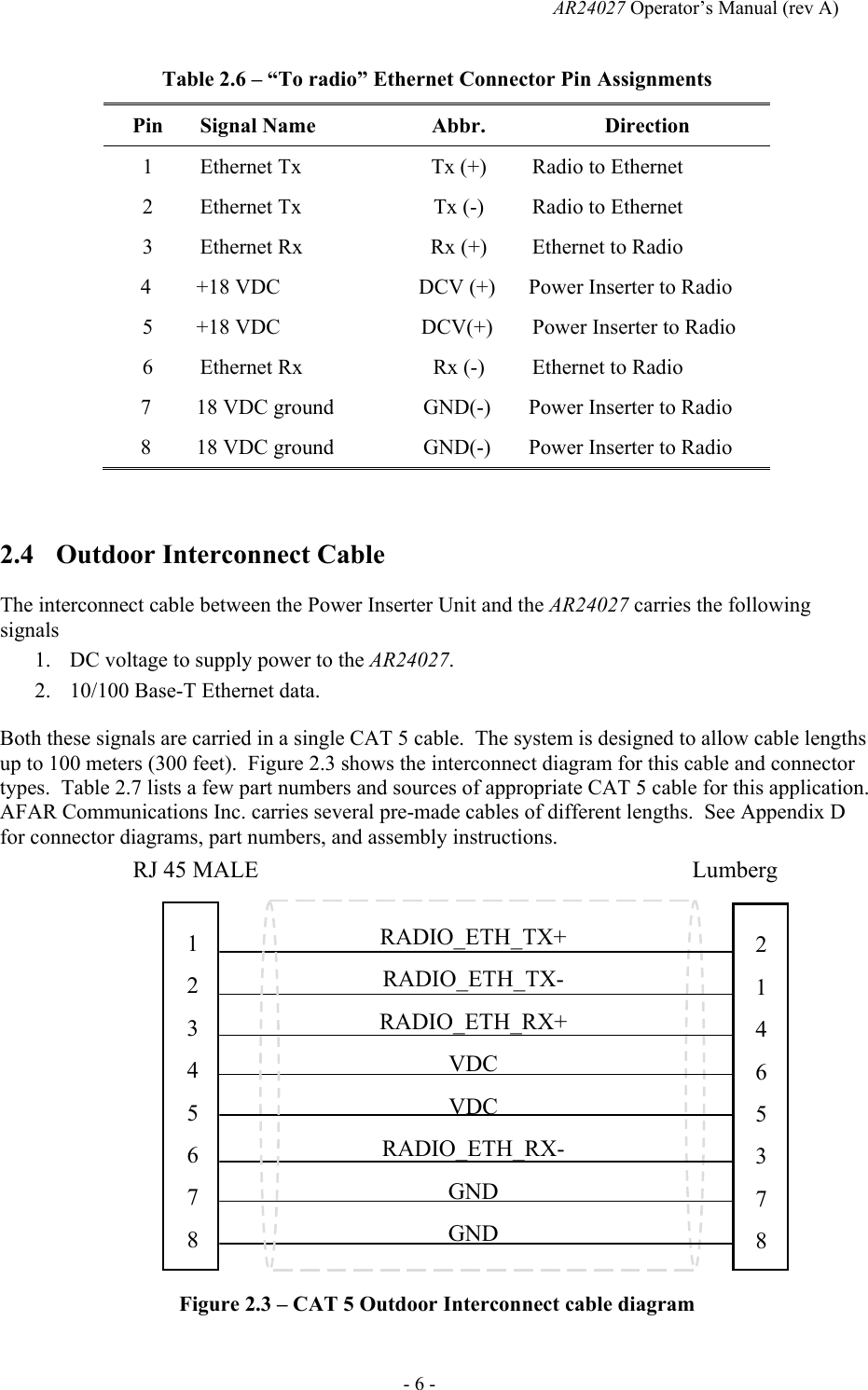
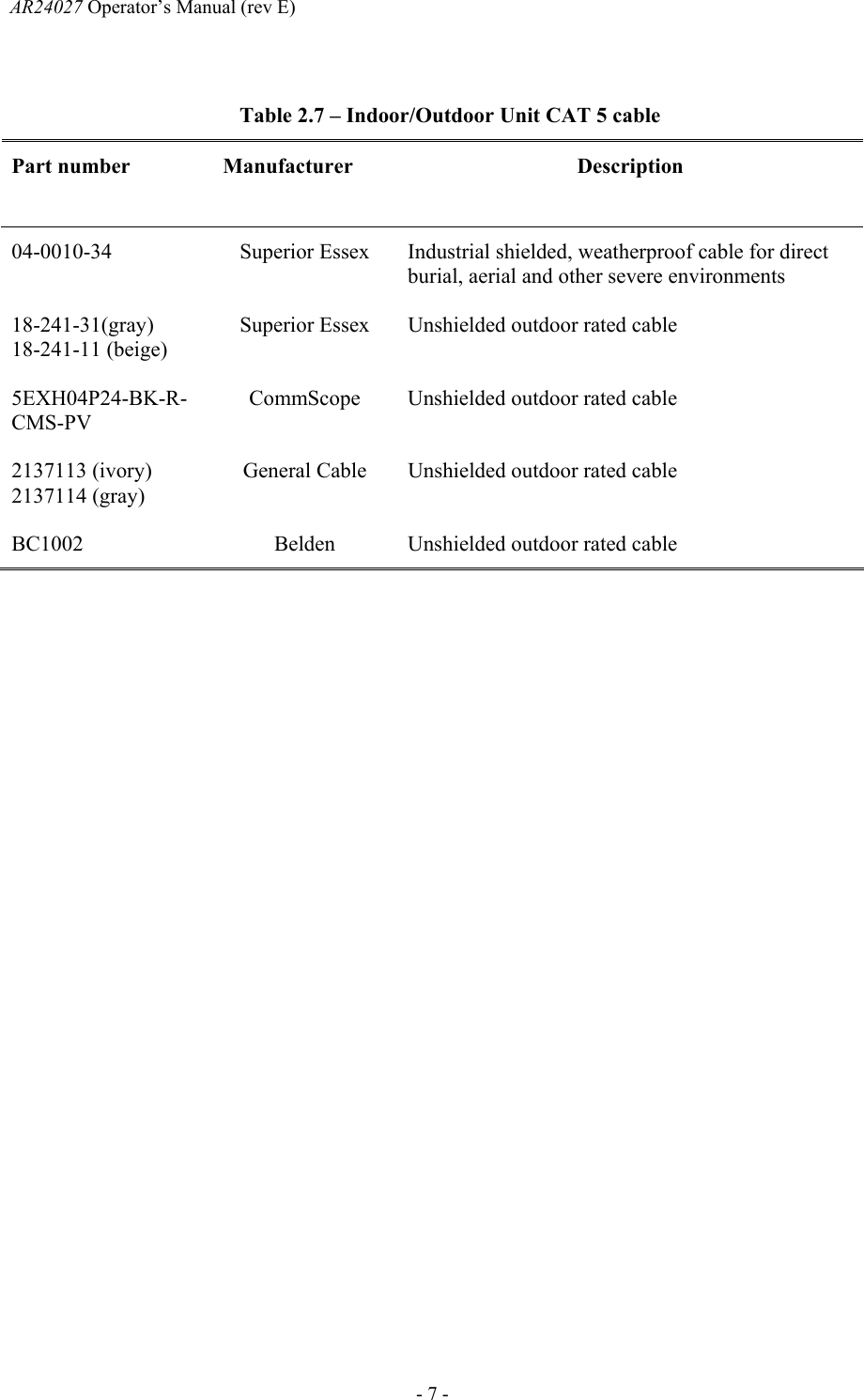
  AR24027 Operator’s Manual (rev A)  - 6 - Table 2.6 – “To radio” Ethernet Connector Pin Assignments Pin Signal Name  Abbr.  Direction 1  Ethernet Tx  Tx (+)  Radio to Ethernet 2  Ethernet Tx  Tx (-)  Radio to Ethernet 3  Ethernet Rx  Rx (+)  Ethernet to Radio 4  +18 VDC  DCV (+)  Power Inserter to Radio 5  +18 VDC  DCV(+)  Power Inserter to Radio 6  Ethernet Rx  Rx (-)  Ethernet to Radio 7  18 VDC ground  GND(-)  Power Inserter to Radio 8  18 VDC ground  GND(-)  Power Inserter to Radio   2.4 Outdoor Interconnect Cable The interconnect cable between the Power Inserter Unit and the AR24027 carries the following signals 1. DC voltage to supply power to the AR24027. 2. 10/100 Base-T Ethernet data. Both these signals are carried in a single CAT 5 cable.  The system is designed to allow cable lengths up to 100 meters (300 feet).  Figure 2.3 shows the interconnect diagram for this cable and connector types.  Table 2.7 lists a few part numbers and sources of appropriate CAT 5 cable for this application.  AFAR Communications Inc. carries several pre-made cables of different lengths.  See Appendix D for connector diagrams, part numbers, and assembly instructions.          Figure 2.3 – CAT 5 Outdoor Interconnect cable diagram RADIO_ETH_TX+ RADIO_ETH_TX- RADIO_ETH_RX+ VDC VDC RADIO_ETH_RX- GND GND 2 1 4 6 5 3 7 8 1 2 3 4 5 6 7 8 RJ 45 MALE  Lumberg
AR24027 Operator’s Manual (rev E)      - 7 -  Table 2.7 – Indoor/Outdoor Unit CAT 5 cable Part number  Manufacturer  Description 04-0010-34  Superior Essex  Industrial shielded, weatherproof cable for direct burial, aerial and other severe environments 18-241-31(gray) 18-241-11 (beige) Superior Essex  Unshielded outdoor rated cable 5EXH04P24-BK-R-CMS-PV CommScope  Unshielded outdoor rated cable 2137113 (ivory) 2137114 (gray) General Cable  Unshielded outdoor rated cable BC1002  Belden  Unshielded outdoor rated cable
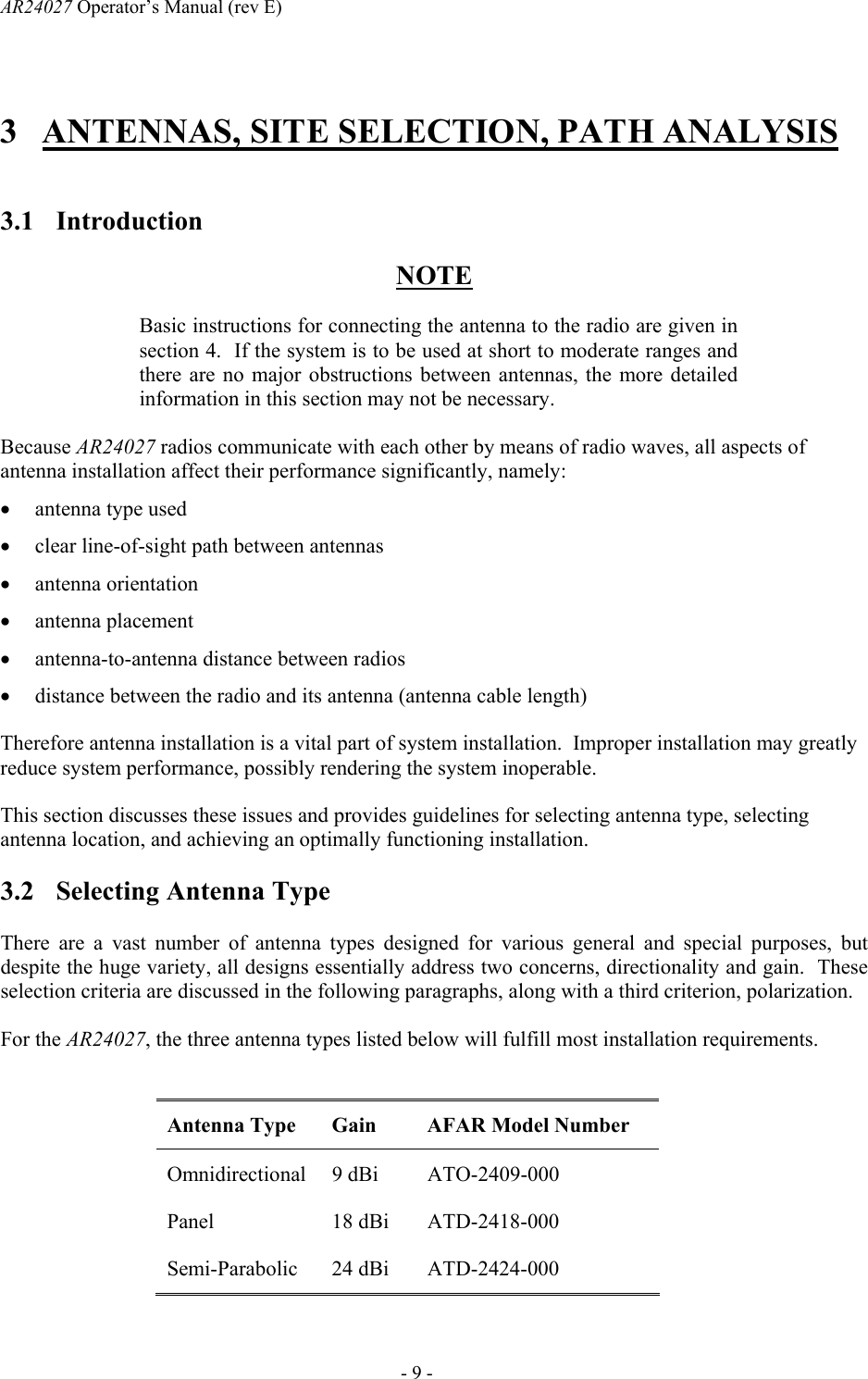
AR24027 Operator’s Manual (rev E)      - 9 - 3 ANTENNAS, SITE SELECTION, PATH ANALYSIS  3.1 Introduction NOTE Basic instructions for connecting the antenna to the radio are given in section 4.  If the system is to be used at short to moderate ranges and there are no major obstructions between antennas, the more detailed information in this section may not be necessary. Because AR24027 radios communicate with each other by means of radio waves, all aspects of antenna installation affect their performance significantly, namely: • antenna type used • clear line-of-sight path between antennas • antenna orientation • antenna placement • antenna-to-antenna distance between radios • distance between the radio and its antenna (antenna cable length) Therefore antenna installation is a vital part of system installation.  Improper installation may greatly reduce system performance, possibly rendering the system inoperable. This section discusses these issues and provides guidelines for selecting antenna type, selecting antenna location, and achieving an optimally functioning installation. 3.2 Selecting Antenna Type  There are a vast number of antenna types designed for various general and special purposes, but despite the huge variety, all designs essentially address two concerns, directionality and gain.  These selection criteria are discussed in the following paragraphs, along with a third criterion, polarization. For the AR24027, the three antenna types listed below will fulfill most installation requirements.  Antenna Type  Gain  AFAR Model Number Omnidirectional 9 dBi  ATO-2409-000 Panel 18 dBi ATD-2418-000 Semi-Parabolic 24 dBi  ATD-2424-000
  AR24027 Operator’s Manual (rev A)  - 10 -  3.2.1 Directionality An antenna may be designed to receive and transmit in all directions.  Such antennas are omnidirectional.  An example of an omnidirectional receiving antenna would be a television antenna in a metropolitan area where each television station transmits its signal from a different location relative to the receiver.  Similarly, a centrally located television transmitter would use an omnidirectional transmitting antenna. The sensitivity and power of an omnidirectional antenna are unfocused; that is, they are spread through a wide volume of space, so the advantage of being able to communicate in all directions is traded off for limited sensitivity and power. If it is determined that all signals of interest are coming from a definable direction, the omnidirectional antenna can be replaced by a directional or sectoral antenna, which increases sensitivity and power by focusing the beam in the desired direction. In practice, even omnidirectional antennas take advantage of directionality by focusing their sensitivity and power in the horizontal plane.  Rather than waste performance by sending signals into space or into the ground, the horizontal omnidirectional antenna redirects its power and sensitivity from these directions, increasing performance in the horizontal plane. In point-to-point applications, where the direction of communication is known and fixed, a highly focused directional antenna can be used to provide maximum sensitivity and power.  In addition, because of its decreased sensitivity in all directions but the desired one, the directional antenna improves performance by rejecting signals not coming from the desired direction.  This provides an effective increase in signal-to-noise performance. A sector antenna has a wider “spread” than a directional (generally between 60 to 120 degrees) which makes it a cross between an omnidirectional and a directional.  This is useful in a point to multipoint configuration where multiple sites are grouped in the same general area.   The installer can then make use of the higher sensitivity and power but also take advantage of the wider beam pattern and improved front to back ratio. 3.2.2 Gain “Gain” specifies the receive and transmit performance of any antenna compared to a standard omnidirectional antenna (“spherical radiator”).  The objective of a directional antenna design is to achieve gain, improving sensitivity and effective radiating power to increase range or data rate. Gain is measured and stated in decibels, abbreviated dB.  The decibel is a unit used to indicate the relative difference in power between two signals.  For example, a signal 3 dB greater than another signal has twice as much power.  The decibel is a logarithmic unit so each doubling of decibels represents a fourfold increase in power.  Since 3 dB represents a doubling of power, 6 dB represents a fourfold power increase, 12 dB represents a 16-fold increase, etc.  For antenna performance, the unit used is dBi, “i” standing for “isotropic,” which describes the standard spherical radiation pattern. One type of directional antenna available from AFAR Communications Inc. is called a “semi parabolic”.  This antenna has a gain of 24 dBi, representing power and sensitivity levels 256 times greater than those of a standard omnidirectional antenna.
AR24027 Operator’s Manual (rev E)      - 11 - For omnidirectional coverage from fixed locations, AFAR Communications Inc. provides collinear antennas.  The collinear design achieves gain by increased focus in comparison with the dipole design.  The standard collinear antenna used with the AR24027 provides 9 dBi gain, representing an eight-fold power and sensitivity increase. 3.2.3 Polarization Another important concept for antenna performance is polarization.  An antenna radiates radio waves that vibrate in a specific plane, normally horizontal or vertical.  Polarization refers to the restriction of wave vibration to a single plane. NOTE Do not confuse polarization with directionality.  The plane of wave vibration has nothing to do with the direction of wave propagation.  For example, an antenna that focuses its energy in the horizontal plane may be vertically or horizontally polarized. Designs such as the semi parabolic offer a choice of polarization.  Mounting a semi parabolic antenna with the elements horizontal provides horizontal polarization, while mounting the antenna with the elements vertical provides vertical polarization.  Similarly, the orientation of the radiating element of the parabolic antenna determines polarization. In setting up the AR24027 system, either vertical or horizontal polarization can be used, as long as polarization is the same at both ends of each link.  For any given pair of line-of-sight antennas, it is essential that they both have the same polarization.  Differences in polarization among antennas – called “cross-polarization” – can reduce signal considerably. 3.3 Site Selection At the high operating frequencies of the AR24027 system, radio waves travel in a nearly straight line-of-sight path.  This is in contrast to the lower-frequency radio waves used for AM broadcasting.  These waves bounce between the ionosphere and the earth’s surface to travel long distances and operate over and around obstructions.  Higher-frequency radio waves do not behave in this manner and are greatly weakened by substantial obstructions or the absence of a direct path.  Simply put, all antennas communicating with each other in the radio network must be able to physically “see” each other. For this reason, a proper antenna site must meet the following criteria: 1. For optimum performance at maximum range, there must be a clear line-of-sight path among all antennas that communicate directly with each other.  At shorter ranges, some degree of obstruction may be tolerated, but performance in the presence of obstruction is difficult to predict. 2. Elevating one or more of the antennas in the system increases maximum line-of-sight range, called the radio horizon.  If antennas are located at a greater range than the ground-level radio horizon, a means must be available for elevating the antennas. 3. All antennas must be properly oriented, and a directional antenna must be carefully aimed at its target antenna to ensure communication at maximum range.
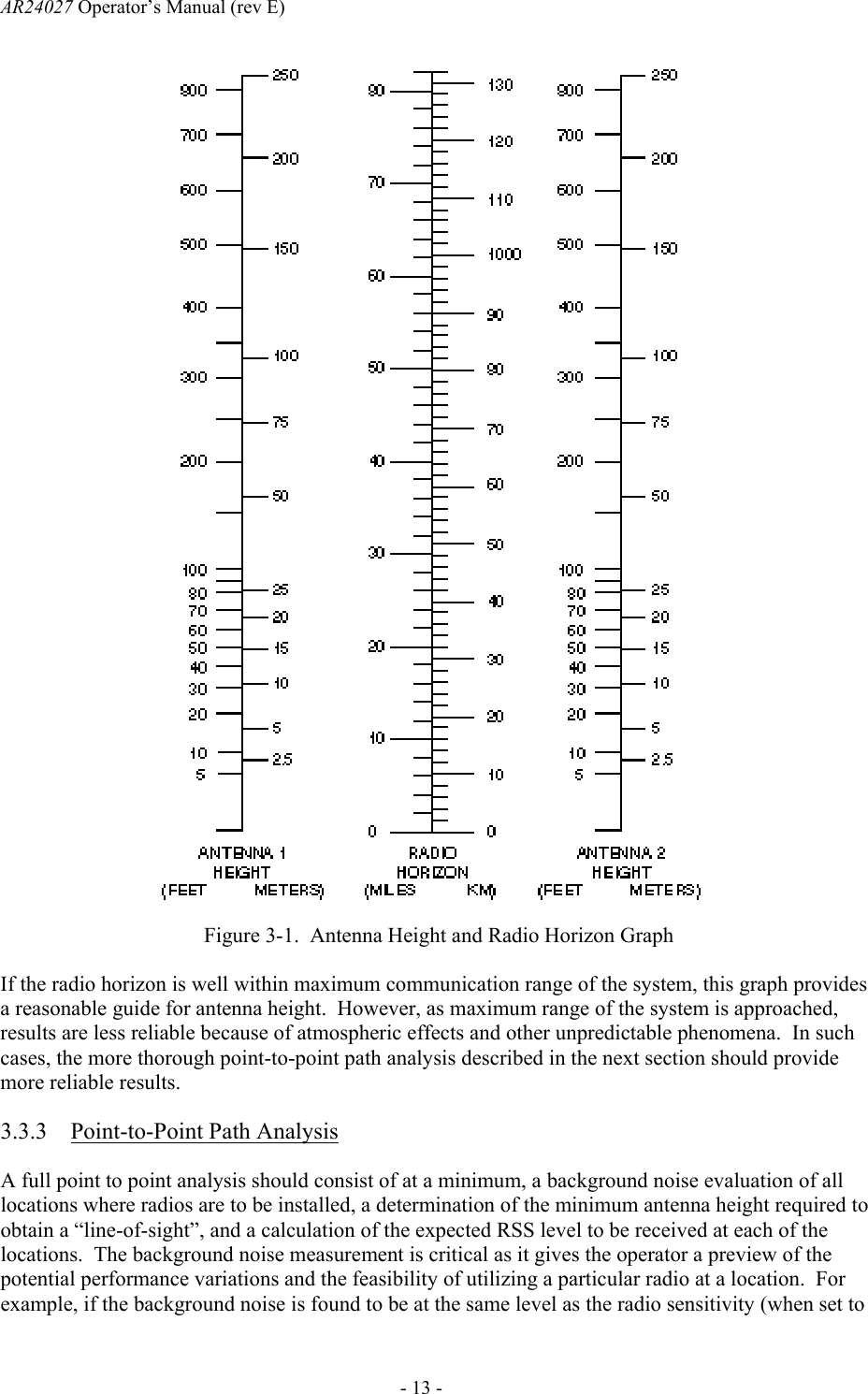
  AR24027 Operator’s Manual (rev A)  - 12 - 4. All antenna cables attenuate (reduce) signal strength in proportion to their length.  Therefore, the distance between the antenna and the radio is limited to a cable length that does not exceed the maximum attenuation tolerated by the system.  Since various cable types offer different attenuation levels, maximum length depends on cable type.  Generally speaking, because the AR24027 is an outdoor unit with the output port connected directly to the antenna, cable losses are negligible and the radio will compensate, but there are limits to this compensation.  See table 3-2 for sample cables and their respective attenuation values. Each of these criteria is discussed at greater length in the following paragraphs. 3.3.1 Line-of-Sight Path Because high-frequency radio waves are attenuated by obstructions, a clear line-of-sight path between antennas is required for optimum performance at maximum range.  For shorter ranges, a degree of obstruction may be acceptable.  For example, at less than maximum ranges the radio has some ability to “penetrate” trees and other foliage.  On the other hand, geographical features (hills) and large buildings are likely to interfere with communications, and antennas must be elevated to “see” each other above such objects. Because of the uncertainties of radio communication, it is difficult to predict the results in conditions where obstructions exist.  The only valid advice is to try the proposed configuration and be prepared to move or elevate the antennas. 3.3.2 Radio Horizon (Maximum Line-of-Sight Range) In visual terms, the horizon is the point in the distance where an object drops out of sight because it is blocked by the earth’s curvature.  If the observer or object is elevated, the visual horizon is extended, that is, the object can be seen at a greater distance before it drops out of view. The same concept applies to radio signals: The radio horizon is the point in the distance where the path between two antennas is blocked by the curvature of the earth.  Like the visual horizon, the radio horizon can be extended by elevating the transmitting antenna, receiving antenna, or both to extend communication range. The radio horizon can also be extended or shortened by certain phenomena such as refraction due to atmospheric density and temperature inversions.  Fog and rain, which reduce signal strength, can also shorten the radio horizon although in the ISM band, this loss is negligible. A reasonable approximation of the radio horizon based on antenna height can be obtained from the graph in figure 3-1. (Note that this graph does not take atmospheric effects into account.) To use the graph, set a straight edge so that it crosses the height of one of the antennas in the column on the left and the height of the other antenna in the column on the right.  The radio horizon in miles/km is shown where the straight edge crosses the center column.
AR24027 Operator’s Manual (rev E)      - 13 -  Figure 3-1.  Antenna Height and Radio Horizon Graph If the radio horizon is well within maximum communication range of the system, this graph provides a reasonable guide for antenna height.  However, as maximum range of the system is approached, results are less reliable because of atmospheric effects and other unpredictable phenomena.  In such cases, the more thorough point-to-point path analysis described in the next section should provide more reliable results. 3.3.3 Point-to-Point Path Analysis A full point to point analysis should consist of at a minimum, a background noise evaluation of all locations where radios are to be installed, a determination of the minimum antenna height required to obtain a “line-of-sight”, and a calculation of the expected RSS level to be received at each of the locations.  The background noise measurement is critical as it gives the operator a preview of the potential performance variations and the feasibility of utilizing a particular radio at a location.  For example, if the background noise is found to be at the same level as the radio sensitivity (when set to
  AR24027 Operator’s Manual (rev A)  - 14 - maximum speed), a tradeoff analysis can be conducted before installation to determine if lowering the data rate will allow the radio sufficient link margin to operate.  A line-of-sight is required to insure the best performance from the radio.  The calculations below will allow the operator to build towers and other mounting areas to the correct height before the antennas are installed.  The calculation of the RSS level is useful for two purposes.  The first and primary purpose to calculate the theoretical RSS level at the receive radio is to determine the link margin at the site.  This information, when coupled with the background noise measurement, will tell the operator if a link can be established and give a reasonable “a priori” estimate of the performance of the system.  In addition to this, the RSS level allows the operator to do a quick check on the integrity of the system installation by verifying that the received RSS level is close to the calculated value.  A background scan is easily accomplished using the built in Spectrum Analysis tool of the AR24027.  This should be done before any installation of any equipment is completed. Although the graph of figure 3-1 provides a useful guide to antenna height requirements, a more accurate determination of those requirements can be obtained by means of the analysis described in the following steps.  NOTE Computer programs available from many vendors can perform portions of this procedure. Requirements for this procedure are: 1. A topographical map of the installation site. 2. Graph paper, ten divisions per inch or equivalent metric scale 3. Straight edge 4. Calculator Procedure: 1. On the topographic map, lot the precise location of each antenna site. 2. Draw a line between the sites; this line is the radio path. 3. On the graph paper, establish a vertical axis for elevation and a horizontal axis for distance.  It is usually easiest to make the vertical axis in feet or meters and the horizontal axis in miles or kilometers. 4. Following the radio path line on the map, identify all obstructions.  Most topographical maps identify geographic information, such as hills and lakes, only.  However, vegetation, buildings or other structures that will interfere with radio transmissions must also be included. 5. Plot each obstruction on the graph, marking its elevation and distance from the sites.  For dense vegetation such as forests, add 40 to 60 feet (12 to 18 m) to the ground elevation.
AR24027 Operator’s Manual (rev E)      - 15 - An additional increment must be added to the height of each obstruction because of the earth’s curvature.  For each obstruction calculate this increment using the following formula: d=d1×d2×CK Where: (for US units:)   d  =  additional height increment in feet   d1  =  distance of the obstruction from the first site in miles   d2  =  distance of the obstruction from the second site in miles   C  =  .667 for US units   K  =  refractive index (use a value of 1.33). (or for metric units:)   d  =  additional height increment in meters   d1  =  distance of the obstruction from the first site in km   d2  =  distance of the obstruction from the second site in km   C  =  .079 for metric units   K  =  refractive index (use a value of 1.33).   Add the “d” value to the height of each obstruction plotted on the graph. Another increment must be added to the height of each obstruction because of the Fresnel zone (The required increment is 60% of the first Fresnel zone radius).  For each obstruction calculate the increment using the formula: d=Cd1×d2F×D Where: (for US units:)   d  =  60% of the first Fresnel zone radius in feet   d1  =  distance of the obstruction from the first site in miles   d2  =  distance of the obstruction from the second site in miles   C  =  1368 for US units   F  =  2400 (frequency in MHz)   D  =  total path length in miles (d1 + d2). (or for metric units:)   d  =  60% of the first Fresnel zone radius in meters   d1  =  distance of the obstruction from the first site in km   d2  =  distance of the obstruction from the second site in km   C  =  259 for metric units   F  =  2400 (frequency in MHz)   D  =  total path length in km (d1 + d2). Add the “d” value to the height of each obstruction plotted on the graph.
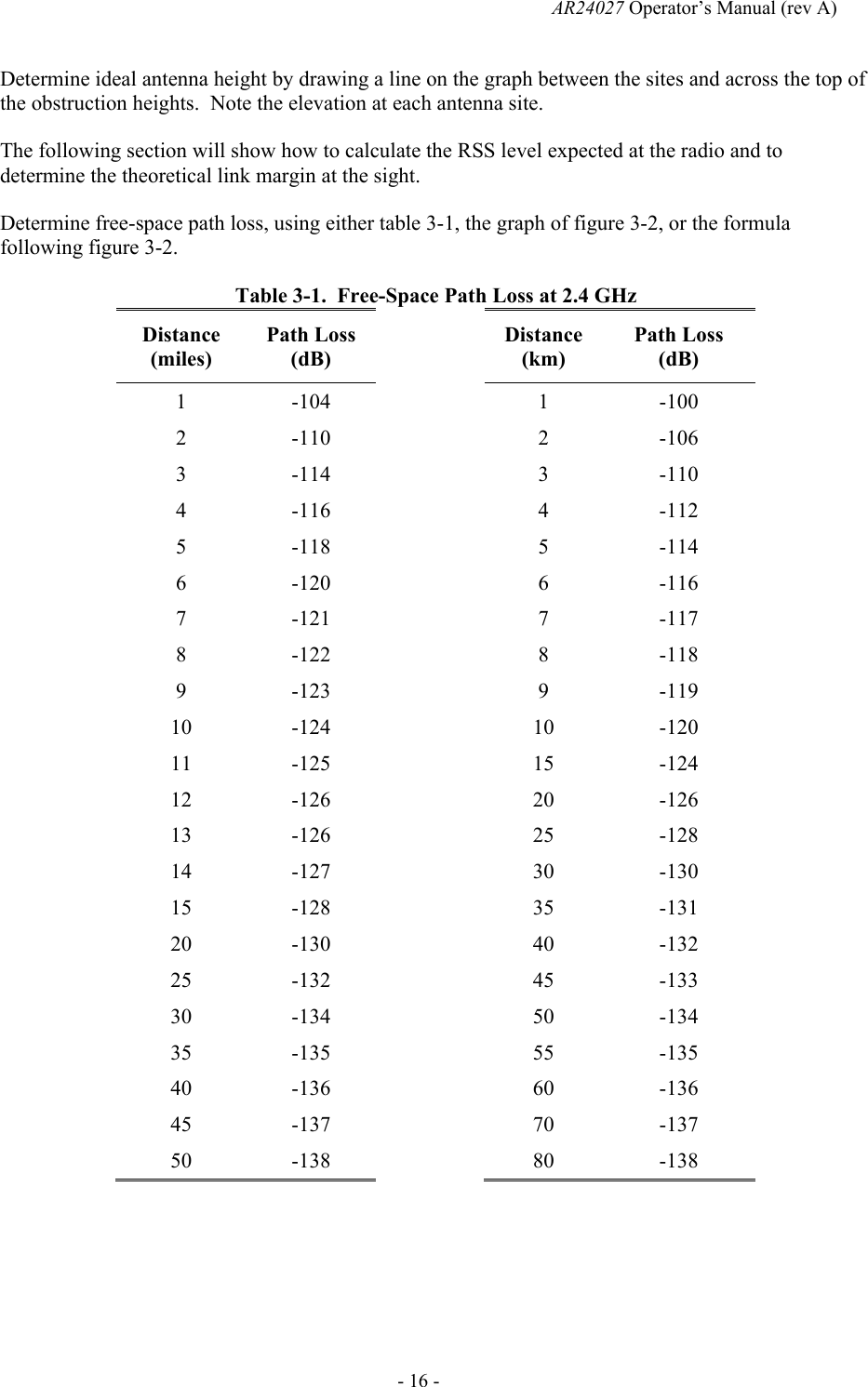
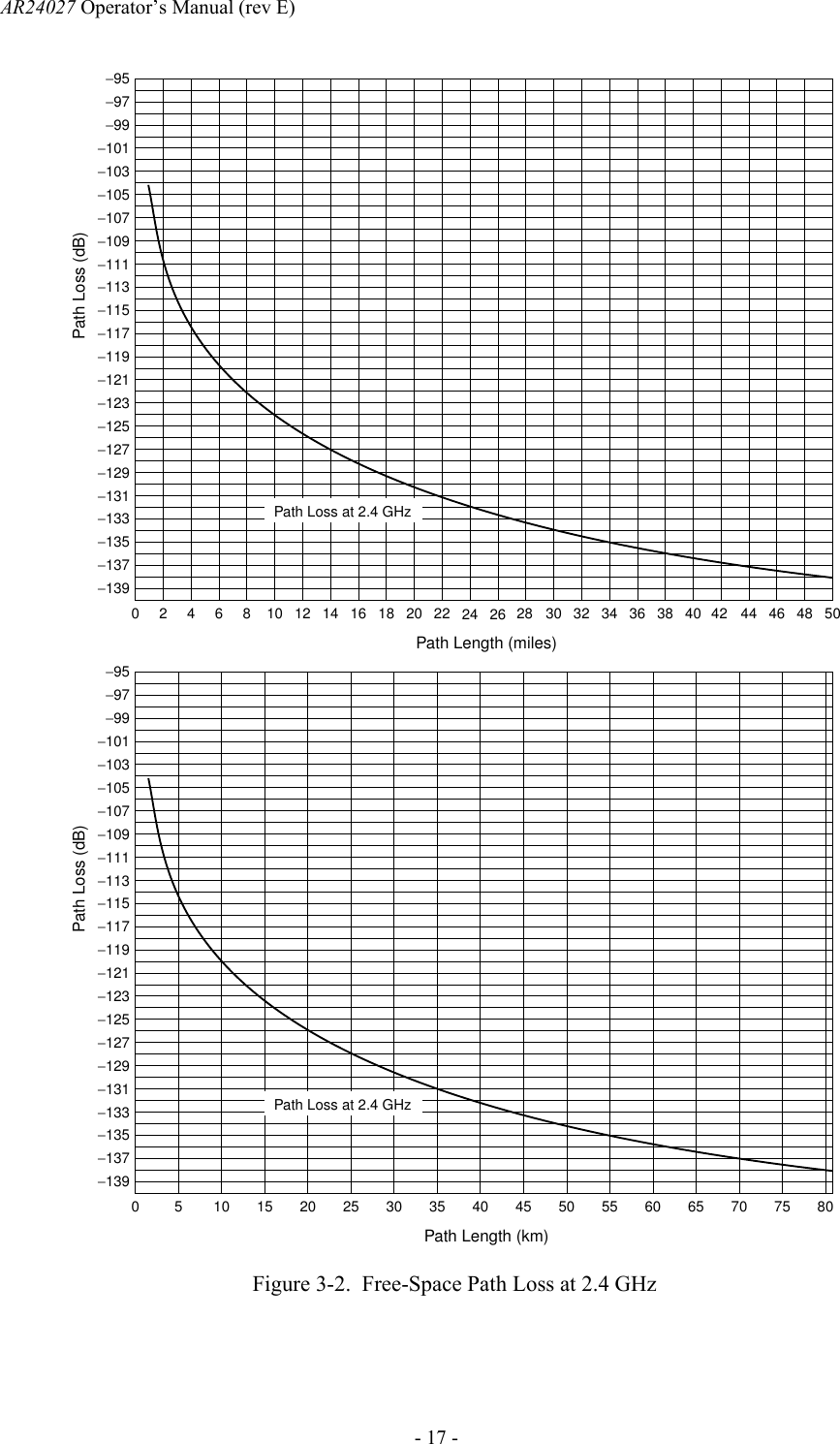
  AR24027 Operator’s Manual (rev A)  - 16 - Determine ideal antenna height by drawing a line on the graph between the sites and across the top of the obstruction heights.  Note the elevation at each antenna site. The following section will show how to calculate the RSS level expected at the radio and to determine the theoretical link margin at the sight. Determine free-space path loss, using either table 3-1, the graph of figure 3-2, or the formula following figure 3-2. Table 3-1.  Free-Space Path Loss at 2.4 GHz Distance (miles) Path Loss (dB)  Distance (km) Path Loss  (dB) 1 -104   1  -100 2 -110   2  -106 3 -114   3  -110 4 -116   4  -112 5 -118   5  -114 6 -120   6  -116 7 -121   7  -117 8 -122   8  -118 9 -123   9  -119 10 -124   10  -120 11 -125   15  -124 12 -126   20  -126 13 -126   25  -128 14 -127   30  -130 15 -128   35  -131 20 -130   40  -132 25 -132   45  -133 30 -134   50  -134 35 -135   55  -135 40 -136   60  -136 45 -137   70  -137 50 -138   80  -138
AR24027 Operator’s Manual (rev E)      - 17 - −95−97−99−101−103−105−107−109−111−113−115−117−119−121−123−125−127−129Path Loss (dB)0 2 4 6 8 10 12 14 16 18 20 22 24 26 28 30 32 34 36 38 40 42 44 46 48 50Path Length (miles)−131−133−135−137−139−95−97−99−101−103−105−107−109−111−113−115−117−119−121−123−125−127−129Path Loss (dB)0 5 10 15 20 25 30 35 40 45 50 55 60 65 70 75 80Path Length (km)−131−133−135−137−139Path Loss at 2.4 GHzPath Loss at 2.4 GHz Figure 3-2.  Free-Space Path Loss at 2.4 GHz
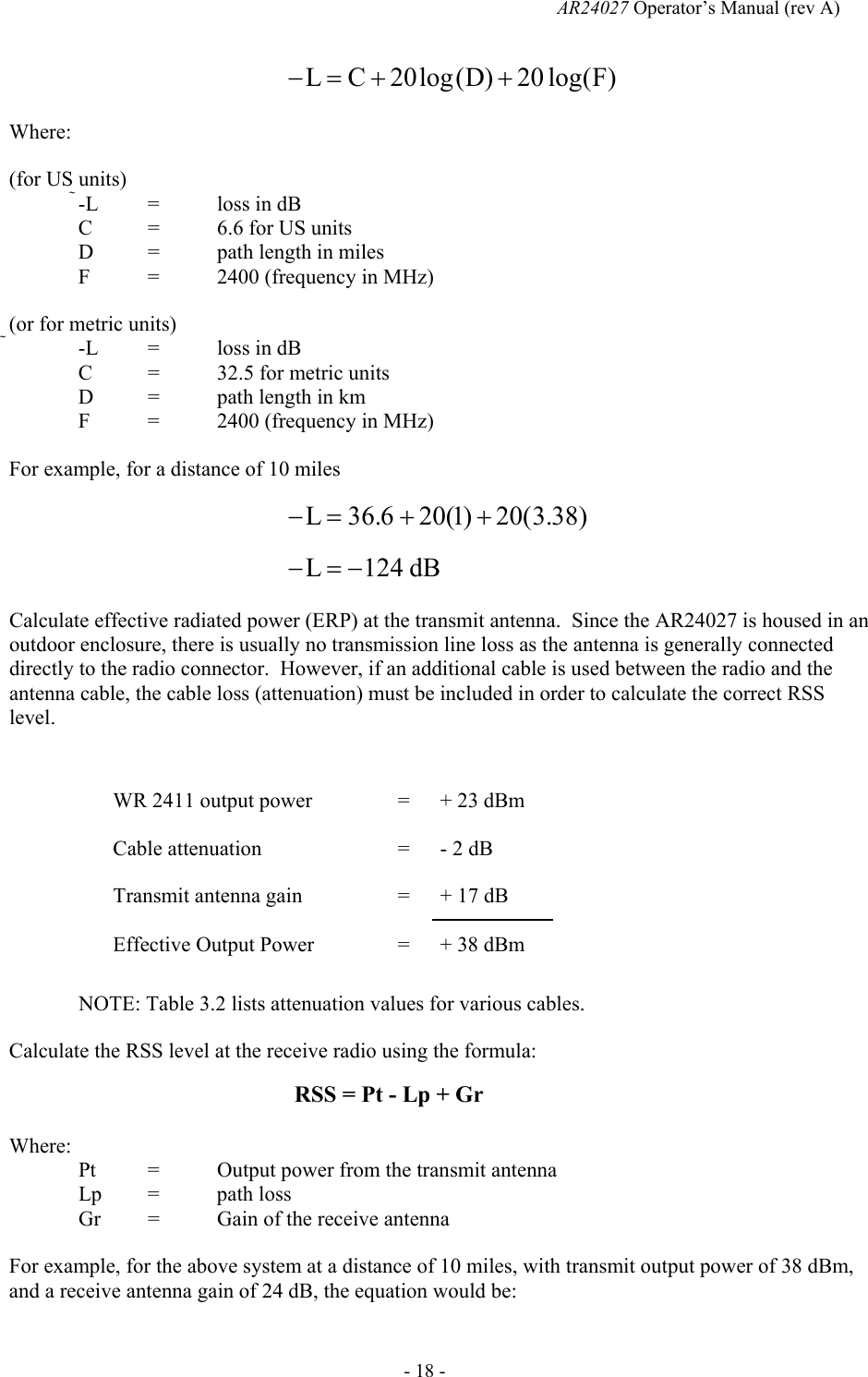
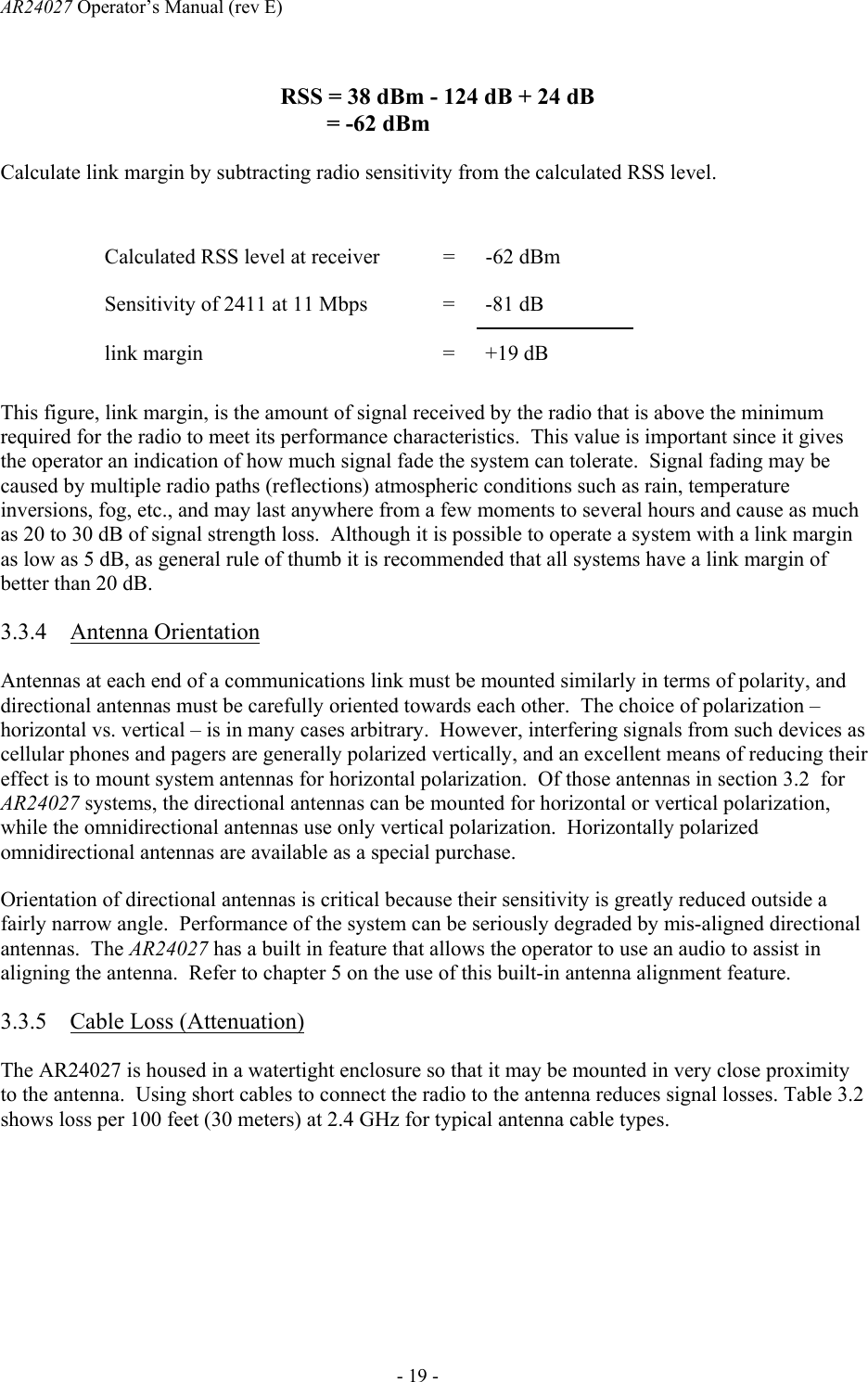
  AR24027 Operator’s Manual (rev A)  - 18 - −L=C+20log(D)+20 log(F) Where: (for US units) -L  =  loss in dB C  =  6.6 for US units D  =  path length in miles F  =  2400 (frequency in MHz) (or for metric units)   -L  =  loss in dB   C  =  32.5 for metric units   D  =  path length in km   F  =  2400 (frequency in MHz) For example, for a distance of 10 miles −L=36.6+20(1)+20(3.38) −L=−124 dB Calculate effective radiated power (ERP) at the transmit antenna.  Since the AR24027 is housed in an outdoor enclosure, there is usually no transmission line loss as the antenna is generally connected directly to the radio connector.  However, if an additional cable is used between the radio and the antenna cable, the cable loss (attenuation) must be included in order to calculate the correct RSS level.  WR 2411 output power  =  + 23 dBm Cable attenuation  =  - 2 dB Transmit antenna gain  =  + 17 dB Effective Output Power  =  + 38 dBm NOTE: Table 3.2 lists attenuation values for various cables. Calculate the RSS level at the receive radio using the formula:  Where:   Pt  =  Output power from the transmit antenna  Lp = path loss   Gr  =  Gain of the receive antenna For example, for the above system at a distance of 10 miles, with transmit output power of 38 dBm, and a receive antenna gain of 24 dB, the equation would be: RSS = Pt - Lp + Gr
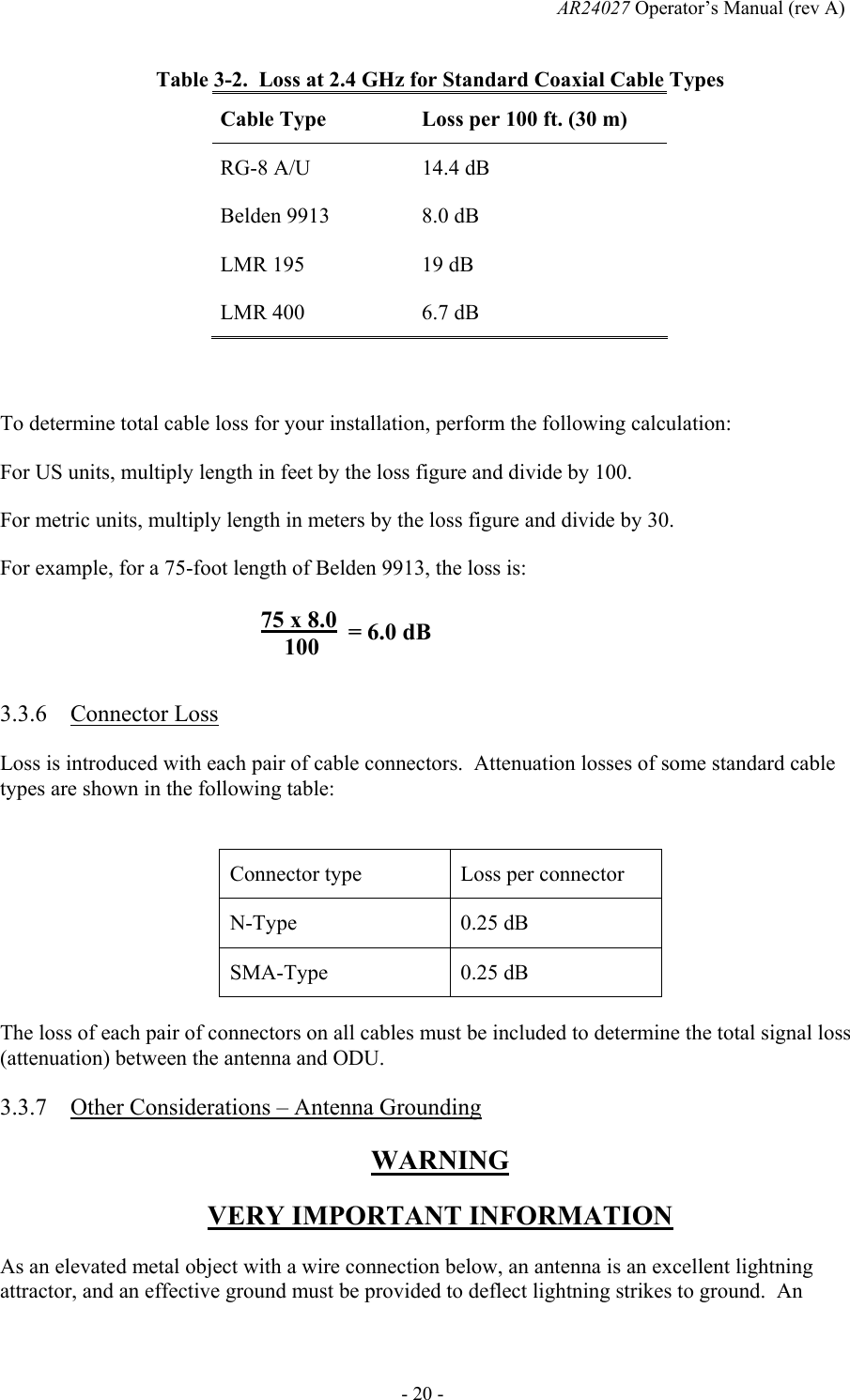
AR24027 Operator’s Manual (rev E)      - 19 -   Calculate link margin by subtracting radio sensitivity from the calculated RSS level.  Calculated RSS level at receiver  =  -62 dBm Sensitivity of 2411 at 11 Mbps  =  -81 dB link margin  =  +19 dB This figure, link margin, is the amount of signal received by the radio that is above the minimum required for the radio to meet its performance characteristics.  This value is important since it gives the operator an indication of how much signal fade the system can tolerate.  Signal fading may be caused by multiple radio paths (reflections) atmospheric conditions such as rain, temperature inversions, fog, etc., and may last anywhere from a few moments to several hours and cause as much as 20 to 30 dB of signal strength loss.  Although it is possible to operate a system with a link margin as low as 5 dB, as general rule of thumb it is recommended that all systems have a link margin of better than 20 dB. 3.3.4 Antenna Orientation Antennas at each end of a communications link must be mounted similarly in terms of polarity, and directional antennas must be carefully oriented towards each other.  The choice of polarization – horizontal vs. vertical – is in many cases arbitrary.  However, interfering signals from such devices as cellular phones and pagers are generally polarized vertically, and an excellent means of reducing their effect is to mount system antennas for horizontal polarization.  Of those antennas in section 3.2  for AR24027 systems, the directional antennas can be mounted for horizontal or vertical polarization, while the omnidirectional antennas use only vertical polarization.  Horizontally polarized omnidirectional antennas are available as a special purchase. Orientation of directional antennas is critical because their sensitivity is greatly reduced outside a fairly narrow angle.  Performance of the system can be seriously degraded by mis-aligned directional antennas.  The AR24027 has a built in feature that allows the operator to use an audio to assist in aligning the antenna.  Refer to chapter 5 on the use of this built-in antenna alignment feature.  3.3.5 Cable Loss (Attenuation) The AR24027 is housed in a watertight enclosure so that it may be mounted in very close proximity to the antenna.  Using short cables to connect the radio to the antenna reduces signal losses. Table 3.2 shows loss per 100 feet (30 meters) at 2.4 GHz for typical antenna cable types.  RSS = 38 dBm - 124 dB + 24 dB        = -62 dBm
  AR24027 Operator’s Manual (rev A)  - 20 - Table 3-2.  Loss at 2.4 GHz for Standard Coaxial Cable Types Cable Type  Loss per 100 ft. (30 m) RG-8 A/U  14.4 dB Belden 9913  8.0 dB LMR 195  19 dB LMR 400  6.7 dB  To determine total cable loss for your installation, perform the following calculation: For US units, multiply length in feet by the loss figure and divide by 100. For metric units, multiply length in meters by the loss figure and divide by 30. For example, for a 75-foot length of Belden 9913, the loss is:   3.3.6 Connector Loss Loss is introduced with each pair of cable connectors.  Attenuation losses of some standard cable types are shown in the following table:  Connector type  Loss per connector N-Type 0.25 dB SMA-Type 0.25 dB The loss of each pair of connectors on all cables must be included to determine the total signal loss (attenuation) between the antenna and ODU. 3.3.7 Other Considerations – Antenna Grounding WARNING VERY IMPORTANT INFORMATION As an elevated metal object with a wire connection below, an antenna is an excellent lightning attractor, and an effective ground must be provided to deflect lightning strikes to ground.  An 75 x 8.0     100  = 6.0 dB
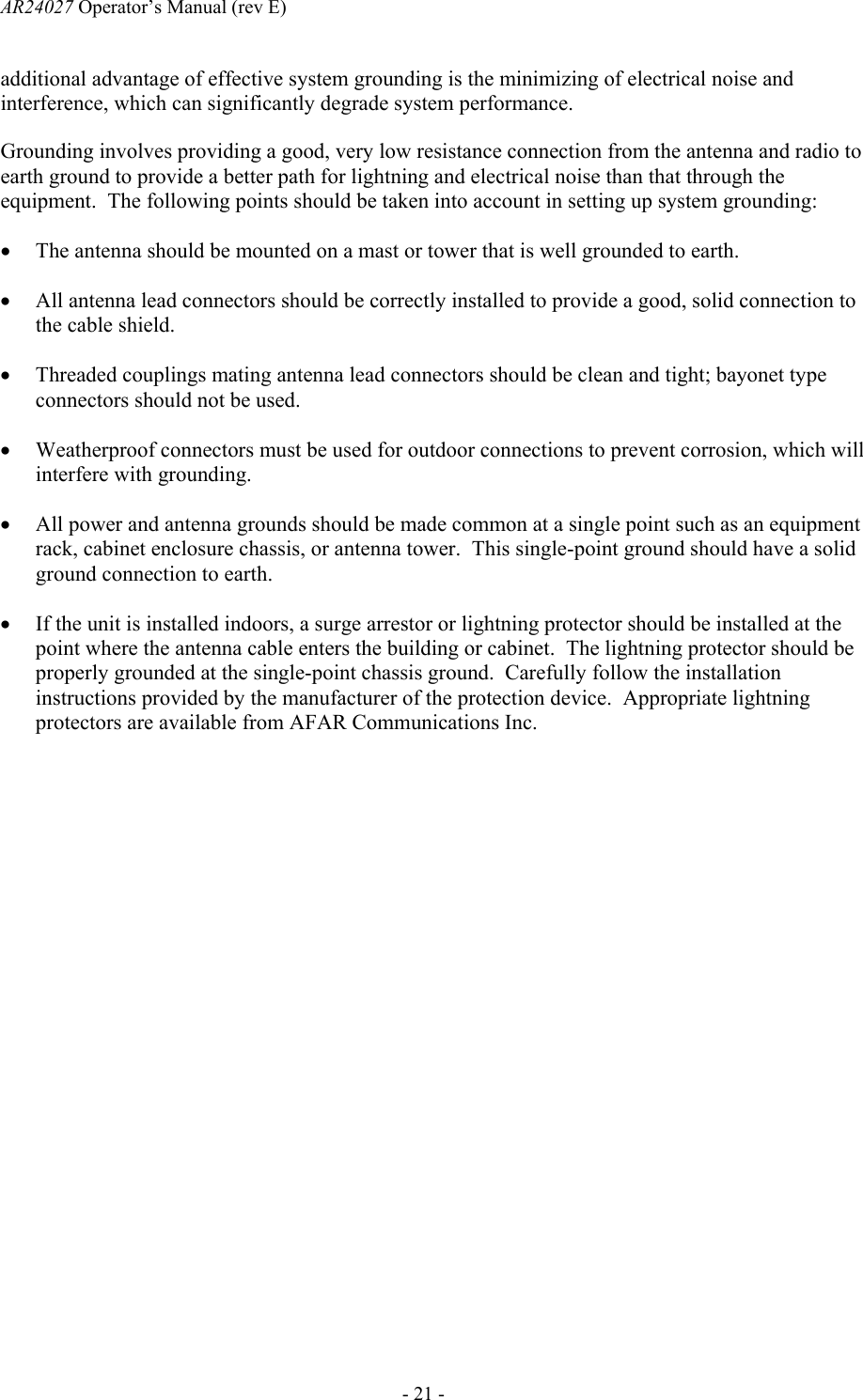
AR24027 Operator’s Manual (rev E)      - 21 - additional advantage of effective system grounding is the minimizing of electrical noise and interference, which can significantly degrade system performance. Grounding involves providing a good, very low resistance connection from the antenna and radio to earth ground to provide a better path for lightning and electrical noise than that through the equipment.  The following points should be taken into account in setting up system grounding: • The antenna should be mounted on a mast or tower that is well grounded to earth. • All antenna lead connectors should be correctly installed to provide a good, solid connection to the cable shield. • Threaded couplings mating antenna lead connectors should be clean and tight; bayonet type connectors should not be used. • Weatherproof connectors must be used for outdoor connections to prevent corrosion, which will interfere with grounding. • All power and antenna grounds should be made common at a single point such as an equipment rack, cabinet enclosure chassis, or antenna tower.  This single-point ground should have a solid ground connection to earth. • If the unit is installed indoors, a surge arrestor or lightning protector should be installed at the point where the antenna cable enters the building or cabinet.  The lightning protector should be properly grounded at the single-point chassis ground.  Carefully follow the installation instructions provided by the manufacturer of the protection device.  Appropriate lightning protectors are available from AFAR Communications Inc.
  AR24027 Operator’s Manual (rev A)  - 22 -
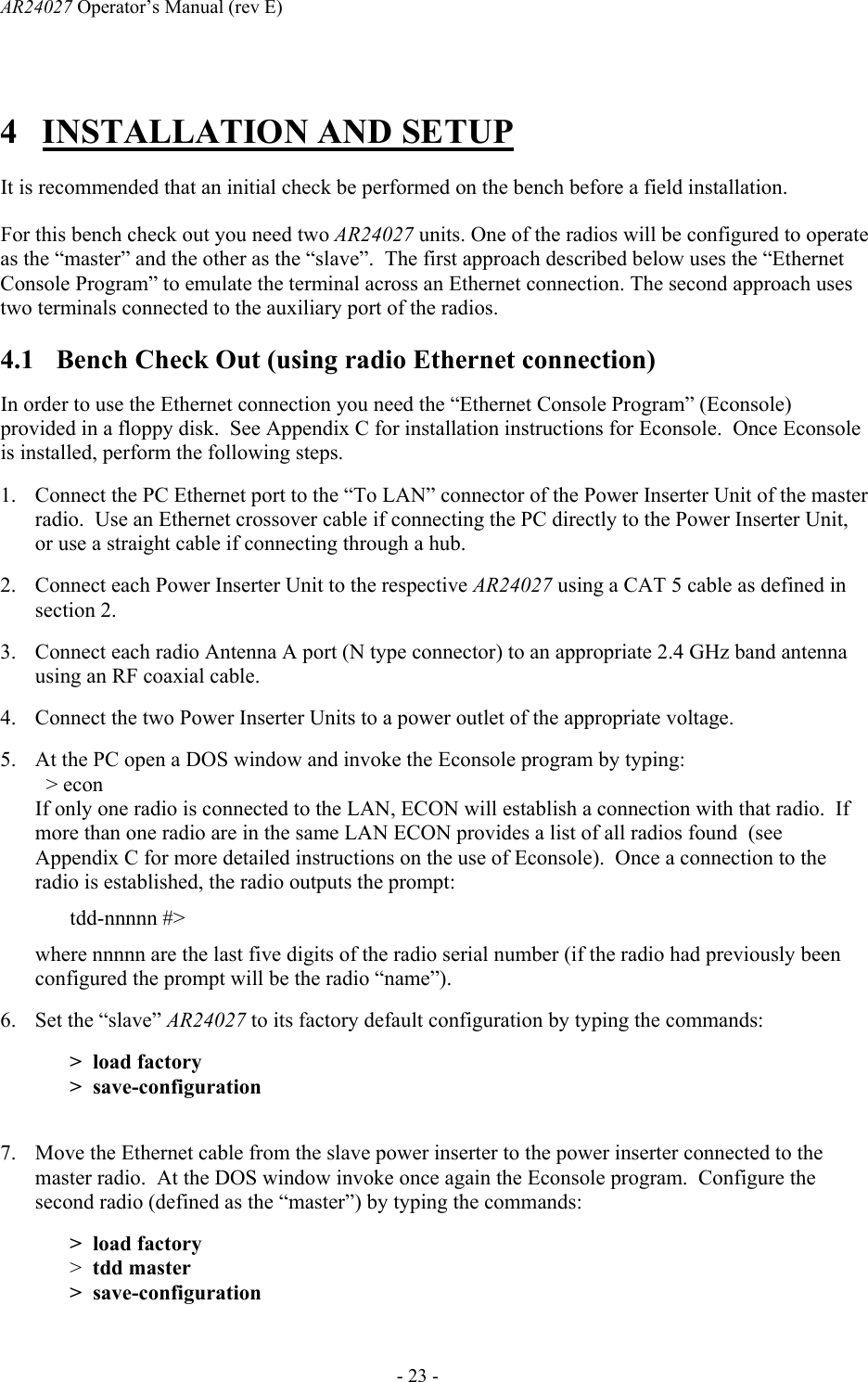
AR24027 Operator’s Manual (rev E)      - 23 - 4 INSTALLATION AND SETUP  It is recommended that an initial check be performed on the bench before a field installation.   For this bench check out you need two AR24027 units. One of the radios will be configured to operate as the “master” and the other as the “slave”.  The first approach described below uses the “Ethernet Console Program” to emulate the terminal across an Ethernet connection. The second approach uses two terminals connected to the auxiliary port of the radios.  4.1 Bench Check Out (using radio Ethernet connection) In order to use the Ethernet connection you need the “Ethernet Console Program” (Econsole) provided in a floppy disk.  See Appendix C for installation instructions for Econsole.  Once Econsole is installed, perform the following steps. 1. Connect the PC Ethernet port to the “To LAN” connector of the Power Inserter Unit of the master radio.  Use an Ethernet crossover cable if connecting the PC directly to the Power Inserter Unit, or use a straight cable if connecting through a hub. 2. Connect each Power Inserter Unit to the respective AR24027 using a CAT 5 cable as defined in section 2. 3. Connect each radio Antenna A port (N type connector) to an appropriate 2.4 GHz band antenna using an RF coaxial cable.  4. Connect the two Power Inserter Units to a power outlet of the appropriate voltage. 5. At the PC open a DOS window and invoke the Econsole program by typing:    > econ If only one radio is connected to the LAN, ECON will establish a connection with that radio.  If more than one radio are in the same LAN ECON provides a list of all radios found  (see Appendix C for more detailed instructions on the use of Econsole).  Once a connection to the radio is established, the radio outputs the prompt: tdd-nnnnn #> where nnnnn are the last five digits of the radio serial number (if the radio had previously been configured the prompt will be the radio “name”). 6. Set the “slave” AR24027 to its factory default configuration by typing the commands: >  load factory >  save-configuration  7. Move the Ethernet cable from the slave power inserter to the power inserter connected to the master radio.  At the DOS window invoke once again the Econsole program.  Configure the second radio (defined as the “master”) by typing the commands: >  load factory >  tdd master >  save-configuration
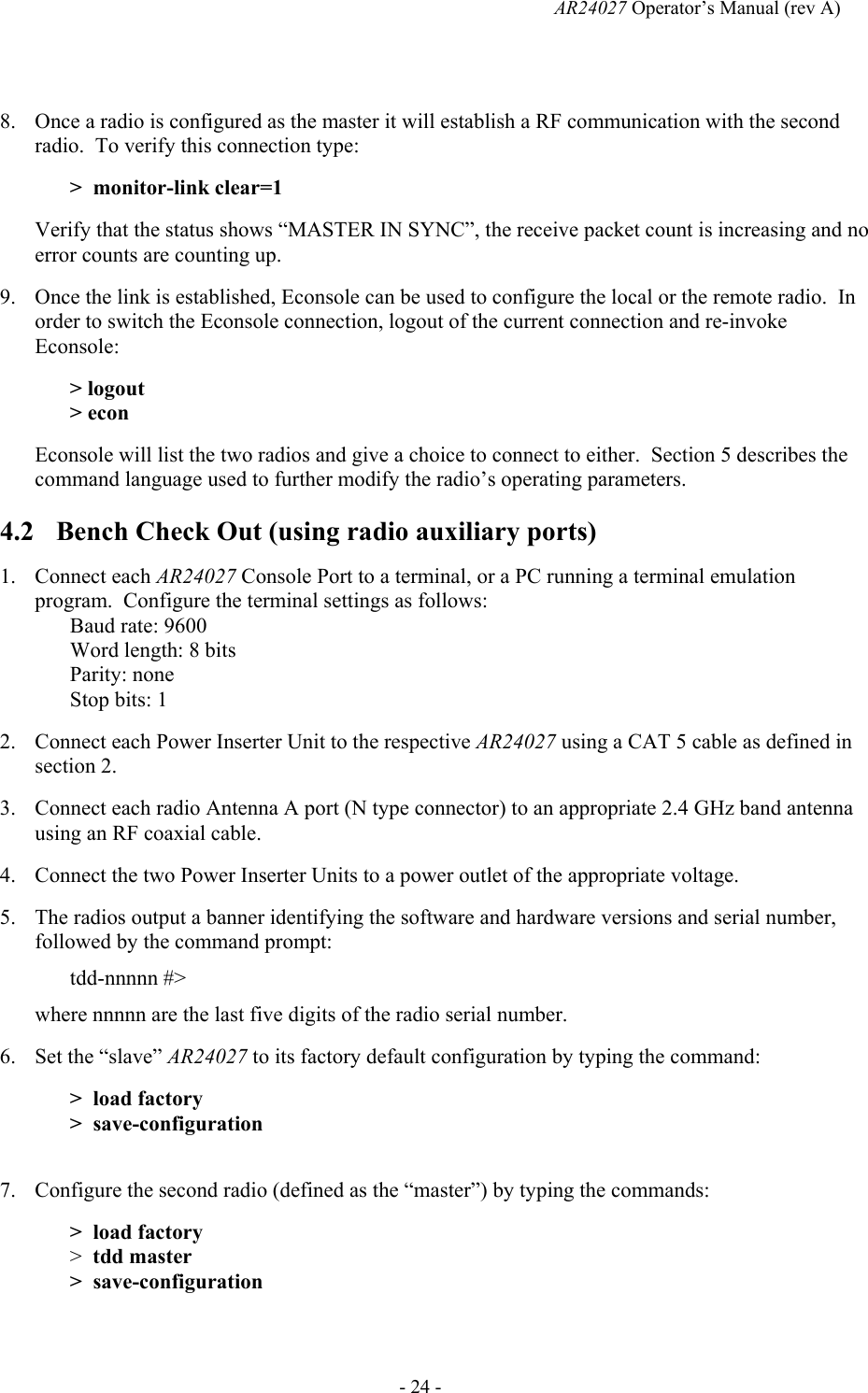
  AR24027 Operator’s Manual (rev A)  - 24 -  8. Once a radio is configured as the master it will establish a RF communication with the second radio.  To verify this connection type: >  monitor-link clear=1 Verify that the status shows “MASTER IN SYNC”, the receive packet count is increasing and no error counts are counting up. 9. Once the link is established, Econsole can be used to configure the local or the remote radio.  In order to switch the Econsole connection, logout of the current connection and re-invoke Econsole: > logout > econ Econsole will list the two radios and give a choice to connect to either.  Section 5 describes the command language used to further modify the radio’s operating parameters. 4.2 Bench Check Out (using radio auxiliary ports) 1. Connect each AR24027 Console Port to a terminal, or a PC running a terminal emulation program.  Configure the terminal settings as follows: Baud rate: 9600 Word length: 8 bits Parity: none Stop bits: 1 2. Connect each Power Inserter Unit to the respective AR24027 using a CAT 5 cable as defined in section 2. 3. Connect each radio Antenna A port (N type connector) to an appropriate 2.4 GHz band antenna using an RF coaxial cable. 4. Connect the two Power Inserter Units to a power outlet of the appropriate voltage. 5. The radios output a banner identifying the software and hardware versions and serial number, followed by the command prompt: tdd-nnnnn #> where nnnnn are the last five digits of the radio serial number. 6. Set the “slave” AR24027 to its factory default configuration by typing the command: >  load factory >  save-configuration  7. Configure the second radio (defined as the “master”) by typing the commands: >  load factory >  tdd master >  save-configuration
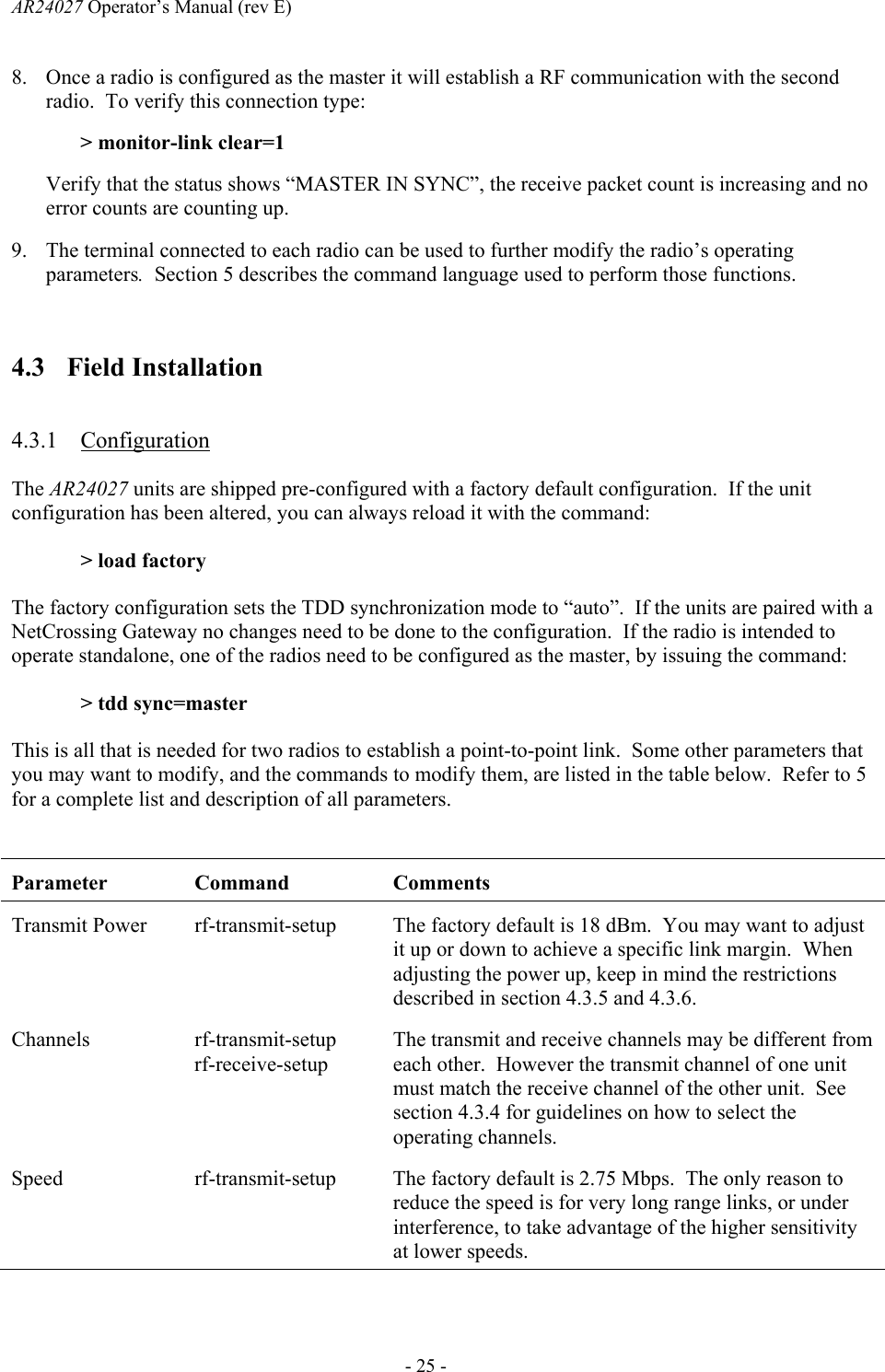
AR24027 Operator’s Manual (rev E)      - 25 - 8. Once a radio is configured as the master it will establish a RF communication with the second radio.  To verify this connection type: > monitor-link clear=1 Verify that the status shows “MASTER IN SYNC”, the receive packet count is increasing and no error counts are counting up. 9. The terminal connected to each radio can be used to further modify the radio’s operating parameters.  Section 5 describes the command language used to perform those functions.  4.3 Field Installation  4.3.1 Configuration The AR24027 units are shipped pre-configured with a factory default configuration.  If the unit configuration has been altered, you can always reload it with the command: > load factory The factory configuration sets the TDD synchronization mode to “auto”.  If the units are paired with a NetCrossing Gateway no changes need to be done to the configuration.  If the radio is intended to operate standalone, one of the radios need to be configured as the master, by issuing the command: > tdd sync=master This is all that is needed for two radios to establish a point-to-point link.  Some other parameters that you may want to modify, and the commands to modify them, are listed in the table below.  Refer to 5 for a complete list and description of all parameters.  Parameter Command  Comments Transmit Power  rf-transmit-setup  The factory default is 18 dBm.  You may want to adjust it up or down to achieve a specific link margin.  When adjusting the power up, keep in mind the restrictions described in section 4.3.5 and 4.3.6. Channels rf-transmit-setup rf-receive-setup The transmit and receive channels may be different from each other.  However the transmit channel of one unit must match the receive channel of the other unit.  See section 4.3.4 for guidelines on how to select the operating channels. Speed rf-transmit-setup The factory default is 2.75 Mbps.  The only reason to reduce the speed is for very long range links, or under interference, to take advantage of the higher sensitivity at lower speeds.
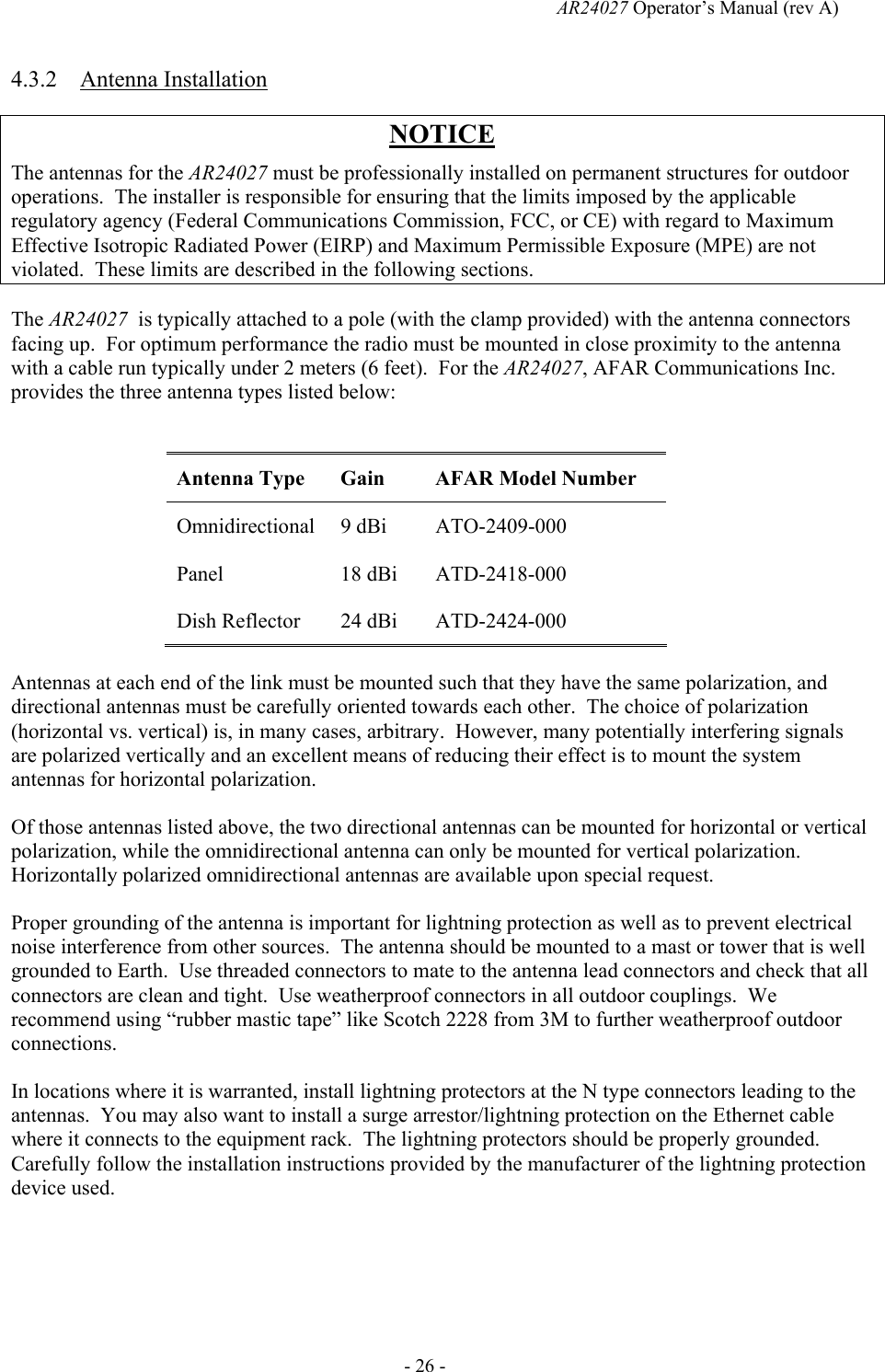
  AR24027 Operator’s Manual (rev A)  - 26 - 4.3.2 Antenna Installation NOTICE The antennas for the AR24027 must be professionally installed on permanent structures for outdoor operations.  The installer is responsible for ensuring that the limits imposed by the applicable regulatory agency (Federal Communications Commission, FCC, or CE) with regard to Maximum Effective Isotropic Radiated Power (EIRP) and Maximum Permissible Exposure (MPE) are not violated.  These limits are described in the following sections. The AR24027  is typically attached to a pole (with the clamp provided) with the antenna connectors facing up.  For optimum performance the radio must be mounted in close proximity to the antenna with a cable run typically under 2 meters (6 feet).  For the AR24027, AFAR Communications Inc. provides the three antenna types listed below:  Antenna Type  Gain  AFAR Model Number Omnidirectional 9 dBi  ATO-2409-000 Panel 18 dBi ATD-2418-000 Dish Reflector  24 dBi  ATD-2424-000 Antennas at each end of the link must be mounted such that they have the same polarization, and directional antennas must be carefully oriented towards each other.  The choice of polarization (horizontal vs. vertical) is, in many cases, arbitrary.  However, many potentially interfering signals are polarized vertically and an excellent means of reducing their effect is to mount the system antennas for horizontal polarization. Of those antennas listed above, the two directional antennas can be mounted for horizontal or vertical polarization, while the omnidirectional antenna can only be mounted for vertical polarization.  Horizontally polarized omnidirectional antennas are available upon special request. Proper grounding of the antenna is important for lightning protection as well as to prevent electrical noise interference from other sources.  The antenna should be mounted to a mast or tower that is well grounded to Earth.  Use threaded connectors to mate to the antenna lead connectors and check that all connectors are clean and tight.  Use weatherproof connectors in all outdoor couplings.  We recommend using “rubber mastic tape” like Scotch 2228 from 3M to further weatherproof outdoor connections. In locations where it is warranted, install lightning protectors at the N type connectors leading to the antennas.  You may also want to install a surge arrestor/lightning protection on the Ethernet cable where it connects to the equipment rack.  The lightning protectors should be properly grounded. Carefully follow the installation instructions provided by the manufacturer of the lightning protection device used.
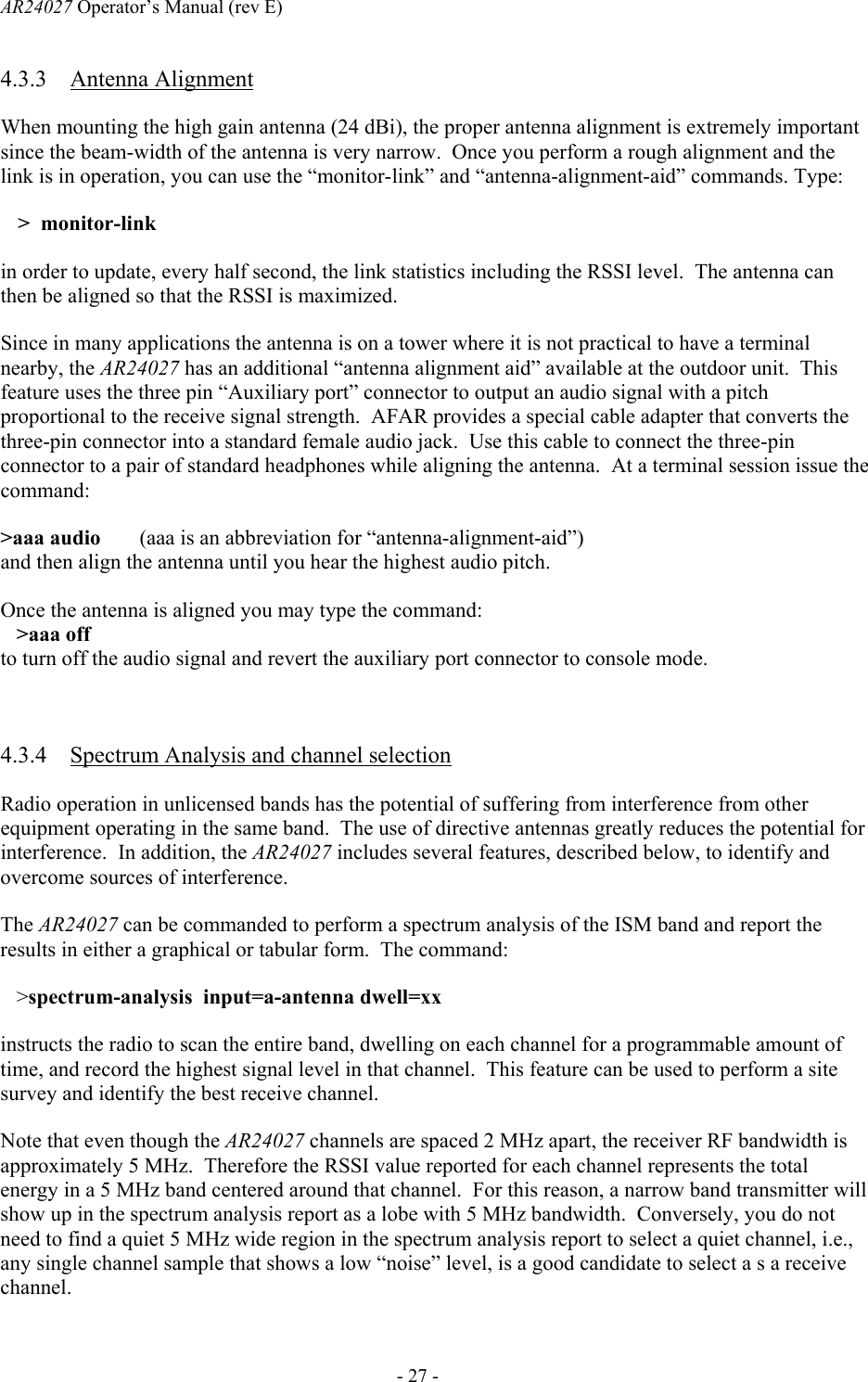
AR24027 Operator’s Manual (rev E)      - 27 - 4.3.3 Antenna Alignment When mounting the high gain antenna (24 dBi), the proper antenna alignment is extremely important since the beam-width of the antenna is very narrow.  Once you perform a rough alignment and the link is in operation, you can use the “monitor-link” and “antenna-alignment-aid” commands. Type: >  monitor-link  in order to update, every half second, the link statistics including the RSSI level.  The antenna can then be aligned so that the RSSI is maximized. Since in many applications the antenna is on a tower where it is not practical to have a terminal nearby, the AR24027 has an additional “antenna alignment aid” available at the outdoor unit.  This feature uses the three pin “Auxiliary port” connector to output an audio signal with a pitch proportional to the receive signal strength.  AFAR provides a special cable adapter that converts the three-pin connector into a standard female audio jack.  Use this cable to connect the three-pin connector to a pair of standard headphones while aligning the antenna.  At a terminal session issue the command: >aaa audio   (aaa is an abbreviation for “antenna-alignment-aid”) and then align the antenna until you hear the highest audio pitch. Once the antenna is aligned you may type the command:    >aaa off to turn off the audio signal and revert the auxiliary port connector to console mode.  4.3.4 Spectrum Analysis and channel selection Radio operation in unlicensed bands has the potential of suffering from interference from other equipment operating in the same band.  The use of directive antennas greatly reduces the potential for interference.  In addition, the AR24027 includes several features, described below, to identify and overcome sources of interference. The AR24027 can be commanded to perform a spectrum analysis of the ISM band and report the results in either a graphical or tabular form.  The command:    >spectrum-analysis  input=a-antenna dwell=xx instructs the radio to scan the entire band, dwelling on each channel for a programmable amount of time, and record the highest signal level in that channel.  This feature can be used to perform a site survey and identify the best receive channel. Note that even though the AR24027 channels are spaced 2 MHz apart, the receiver RF bandwidth is approximately 5 MHz.  Therefore the RSSI value reported for each channel represents the total energy in a 5 MHz band centered around that channel.  For this reason, a narrow band transmitter will show up in the spectrum analysis report as a lobe with 5 MHz bandwidth.  Conversely, you do not need to find a quiet 5 MHz wide region in the spectrum analysis report to select a quiet channel, i.e., any single channel sample that shows a low “noise” level, is a good candidate to select a s a receive channel.
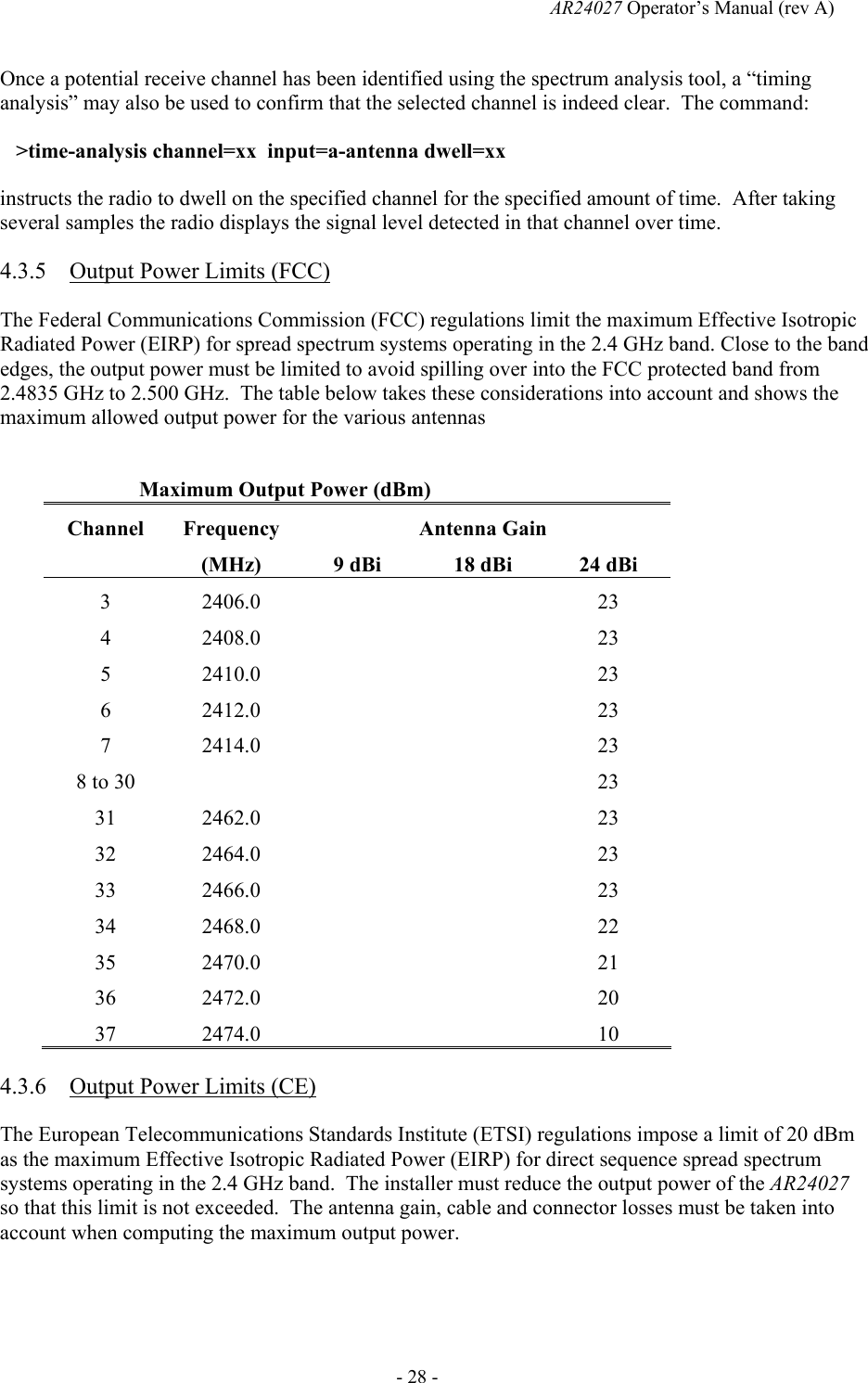
  AR24027 Operator’s Manual (rev A)  - 28 - Once a potential receive channel has been identified using the spectrum analysis tool, a “timing analysis” may also be used to confirm that the selected channel is indeed clear.  The command:    >time-analysis channel=xx  input=a-antenna dwell=xx instructs the radio to dwell on the specified channel for the specified amount of time.  After taking several samples the radio displays the signal level detected in that channel over time. 4.3.5 Output Power Limits (FCC) The Federal Communications Commission (FCC) regulations limit the maximum Effective Isotropic Radiated Power (EIRP) for spread spectrum systems operating in the 2.4 GHz band. Close to the band edges, the output power must be limited to avoid spilling over into the FCC protected band from 2.4835 GHz to 2.500 GHz.  The table below takes these considerations into account and shows the maximum allowed output power for the various antennas  Maximum Output Power (dBm) Channel Frequency  Antenna Gain  (MHz)  9 dBi  18 dBi  24 dBi 3 2406.0      23 4 2408.0      23 5 2410.0      23 6 2412.0      23 7 2414.0      23 8 to 30        23 31 2462.0      23 32 2464.0      23 33 2466.0      23 34 2468.0      22 35 2470.0      21 36 2472.0      20 37 2474.0      10 4.3.6 Output Power Limits (CE) The European Telecommunications Standards Institute (ETSI) regulations impose a limit of 20 dBm as the maximum Effective Isotropic Radiated Power (EIRP) for direct sequence spread spectrum systems operating in the 2.4 GHz band.  The installer must reduce the output power of the AR24027 so that this limit is not exceeded.  The antenna gain, cable and connector losses must be taken into account when computing the maximum output power.
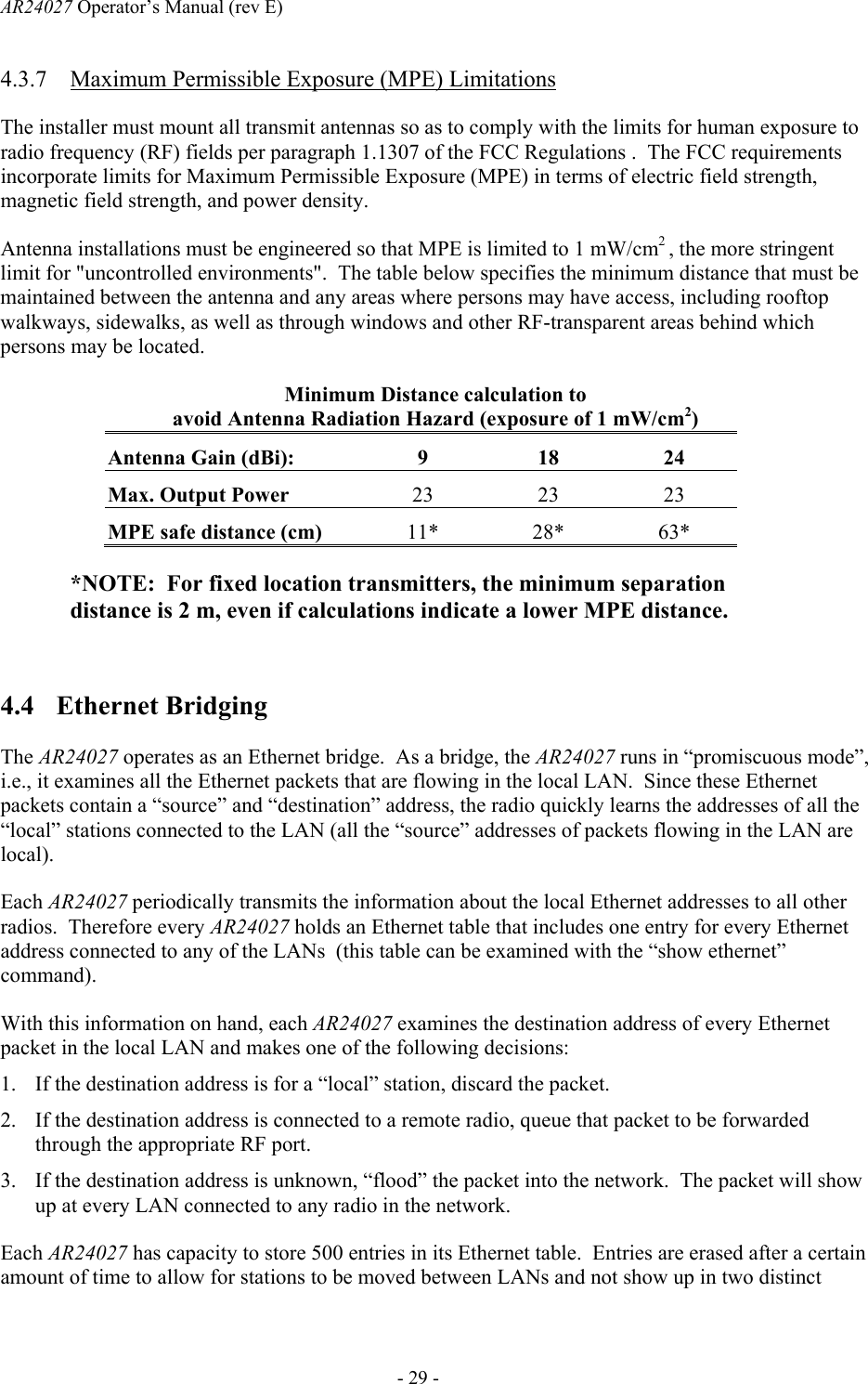
AR24027 Operator’s Manual (rev E)      - 29 - 4.3.7 Maximum Permissible Exposure (MPE) Limitations The installer must mount all transmit antennas so as to comply with the limits for human exposure to radio frequency (RF) fields per paragraph 1.1307 of the FCC Regulations .  The FCC requirements incorporate limits for Maximum Permissible Exposure (MPE) in terms of electric field strength, magnetic field strength, and power density.  Antenna installations must be engineered so that MPE is limited to 1 mW/cm2 , the more stringent limit for "uncontrolled environments".  The table below specifies the minimum distance that must be maintained between the antenna and any areas where persons may have access, including rooftop walkways, sidewalks, as well as through windows and other RF-transparent areas behind which persons may be located. Minimum Distance calculation to avoid Antenna Radiation Hazard (exposure of 1 mW/cm2) Antenna Gain (dBi): 9  18   24  Max. Output Power  23 23 23 MPE safe distance (cm)  11* 28* 63* *NOTE:  For fixed location transmitters, the minimum separation distance is 2 m, even if calculations indicate a lower MPE distance.  4.4 Ethernet Bridging  The AR24027 operates as an Ethernet bridge.  As a bridge, the AR24027 runs in “promiscuous mode”, i.e., it examines all the Ethernet packets that are flowing in the local LAN.  Since these Ethernet packets contain a “source” and “destination” address, the radio quickly learns the addresses of all the “local” stations connected to the LAN (all the “source” addresses of packets flowing in the LAN are local). Each AR24027 periodically transmits the information about the local Ethernet addresses to all other radios.  Therefore every AR24027 holds an Ethernet table that includes one entry for every Ethernet address connected to any of the LANs  (this table can be examined with the “show ethernet” command). With this information on hand, each AR24027 examines the destination address of every Ethernet packet in the local LAN and makes one of the following decisions: 1. If the destination address is for a “local” station, discard the packet. 2. If the destination address is connected to a remote radio, queue that packet to be forwarded through the appropriate RF port. 3. If the destination address is unknown, “flood” the packet into the network.  The packet will show up at every LAN connected to any radio in the network. Each AR24027 has capacity to store 500 entries in its Ethernet table.  Entries are erased after a certain amount of time to allow for stations to be moved between LANs and not show up in two distinct
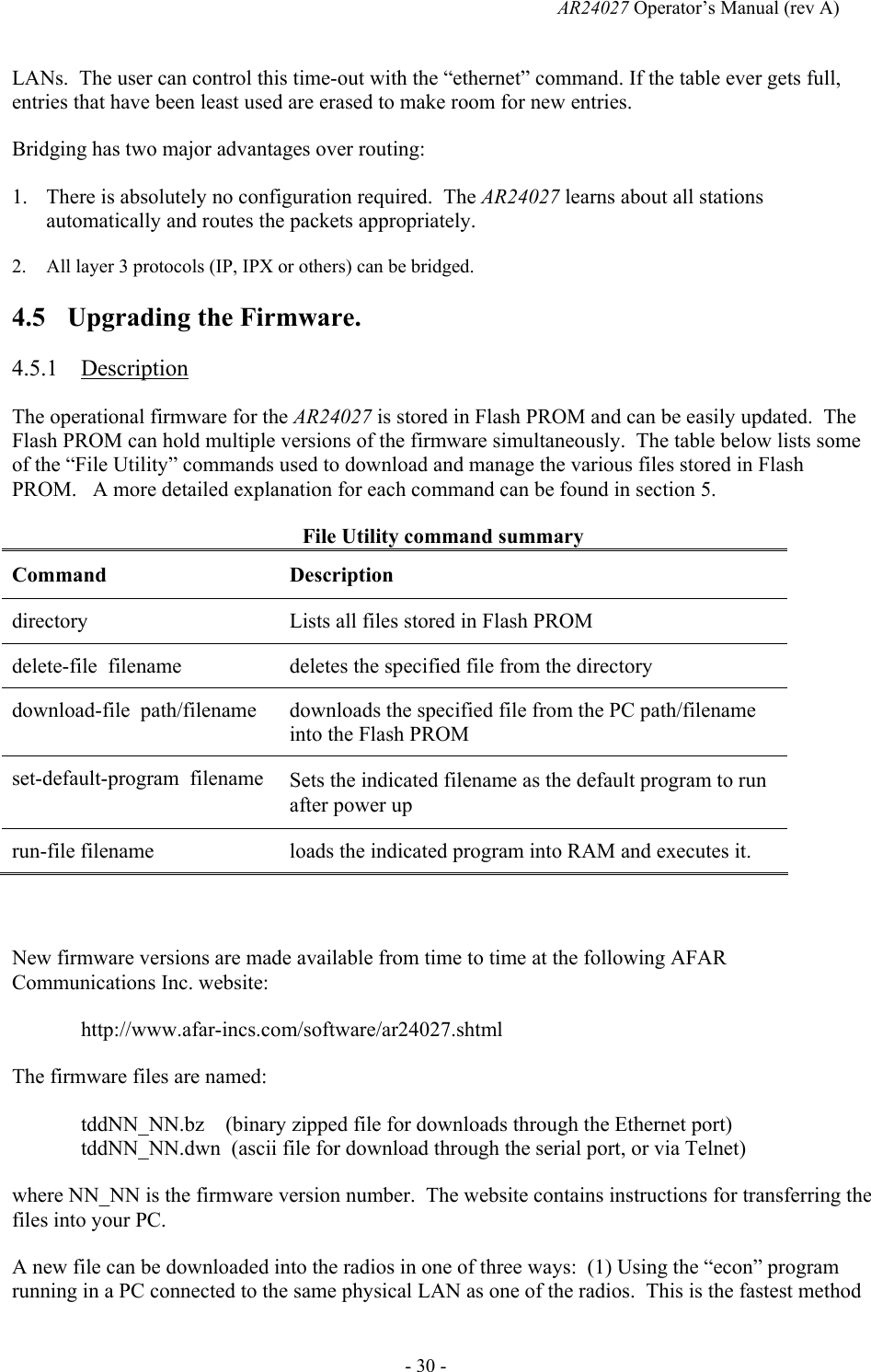
  AR24027 Operator’s Manual (rev A)  - 30 - LANs.  The user can control this time-out with the “ethernet” command. If the table ever gets full, entries that have been least used are erased to make room for new entries. Bridging has two major advantages over routing: 1. There is absolutely no configuration required.  The AR24027 learns about all stations automatically and routes the packets appropriately. 2. All layer 3 protocols (IP, IPX or others) can be bridged. 4.5 Upgrading the Firmware. 4.5.1 Description The operational firmware for the AR24027 is stored in Flash PROM and can be easily updated.  The Flash PROM can hold multiple versions of the firmware simultaneously.  The table below lists some of the “File Utility” commands used to download and manage the various files stored in Flash PROM.   A more detailed explanation for each command can be found in section 5. File Utility command summary Command Description directory  Lists all files stored in Flash PROM delete-file  filename  deletes the specified file from the directory download-file  path/filename  downloads the specified file from the PC path/filename into the Flash PROM set-default-program  filename  Sets the indicated filename as the default program to run after power up run-file filename  loads the indicated program into RAM and executes it.  New firmware versions are made available from time to time at the following AFAR Communications Inc. website:  http://www.afar-incs.com/software/ar24027.shtml The firmware files are named: tddNN_NN.bz    (binary zipped file for downloads through the Ethernet port) tddNN_NN.dwn  (ascii file for download through the serial port, or via Telnet) where NN_NN is the firmware version number.  The website contains instructions for transferring the files into your PC. A new file can be downloaded into the radios in one of three ways:  (1) Using the “econ” program running in a PC connected to the same physical LAN as one of the radios.  This is the fastest method
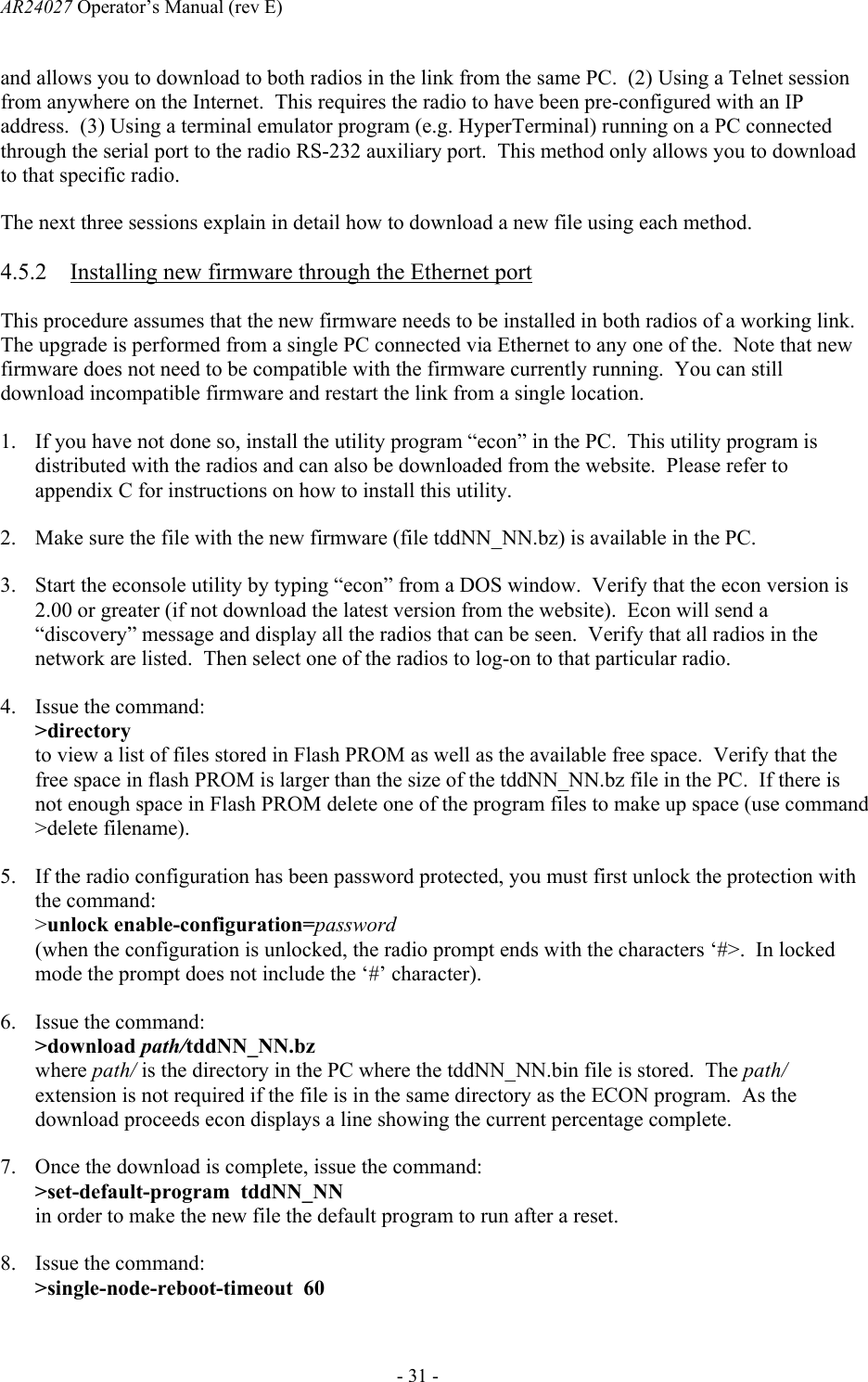
AR24027 Operator’s Manual (rev E)      - 31 - and allows you to download to both radios in the link from the same PC.  (2) Using a Telnet session from anywhere on the Internet.  This requires the radio to have been pre-configured with an IP address.  (3) Using a terminal emulator program (e.g. HyperTerminal) running on a PC connected through the serial port to the radio RS-232 auxiliary port.  This method only allows you to download to that specific radio. The next three sessions explain in detail how to download a new file using each method. 4.5.2 Installing new firmware through the Ethernet port This procedure assumes that the new firmware needs to be installed in both radios of a working link.  The upgrade is performed from a single PC connected via Ethernet to any one of the.  Note that new firmware does not need to be compatible with the firmware currently running.  You can still download incompatible firmware and restart the link from a single location. 1. If you have not done so, install the utility program “econ” in the PC.  This utility program is distributed with the radios and can also be downloaded from the website.  Please refer to appendix C for instructions on how to install this utility. 2. Make sure the file with the new firmware (file tddNN_NN.bz) is available in the PC. 3. Start the econsole utility by typing “econ” from a DOS window.  Verify that the econ version is 2.00 or greater (if not download the latest version from the website).  Econ will send a “discovery” message and display all the radios that can be seen.  Verify that all radios in the network are listed.  Then select one of the radios to log-on to that particular radio. 4. Issue the command: >directory to view a list of files stored in Flash PROM as well as the available free space.  Verify that the free space in flash PROM is larger than the size of the tddNN_NN.bz file in the PC.  If there is not enough space in Flash PROM delete one of the program files to make up space (use command >delete filename). 5. If the radio configuration has been password protected, you must first unlock the protection with the command: >unlock enable-configuration=password (when the configuration is unlocked, the radio prompt ends with the characters ‘#>.  In locked mode the prompt does not include the ‘#’ character). 6. Issue the command: >download path/tddNN_NN.bz where path/ is the directory in the PC where the tddNN_NN.bin file is stored.  The path/ extension is not required if the file is in the same directory as the ECON program.  As the download proceeds econ displays a line showing the current percentage complete.   7. Once the download is complete, issue the command: >set-default-program  tddNN_NN in order to make the new file the default program to run after a reset. 8. Issue the command: >single-node-reboot-timeout  60
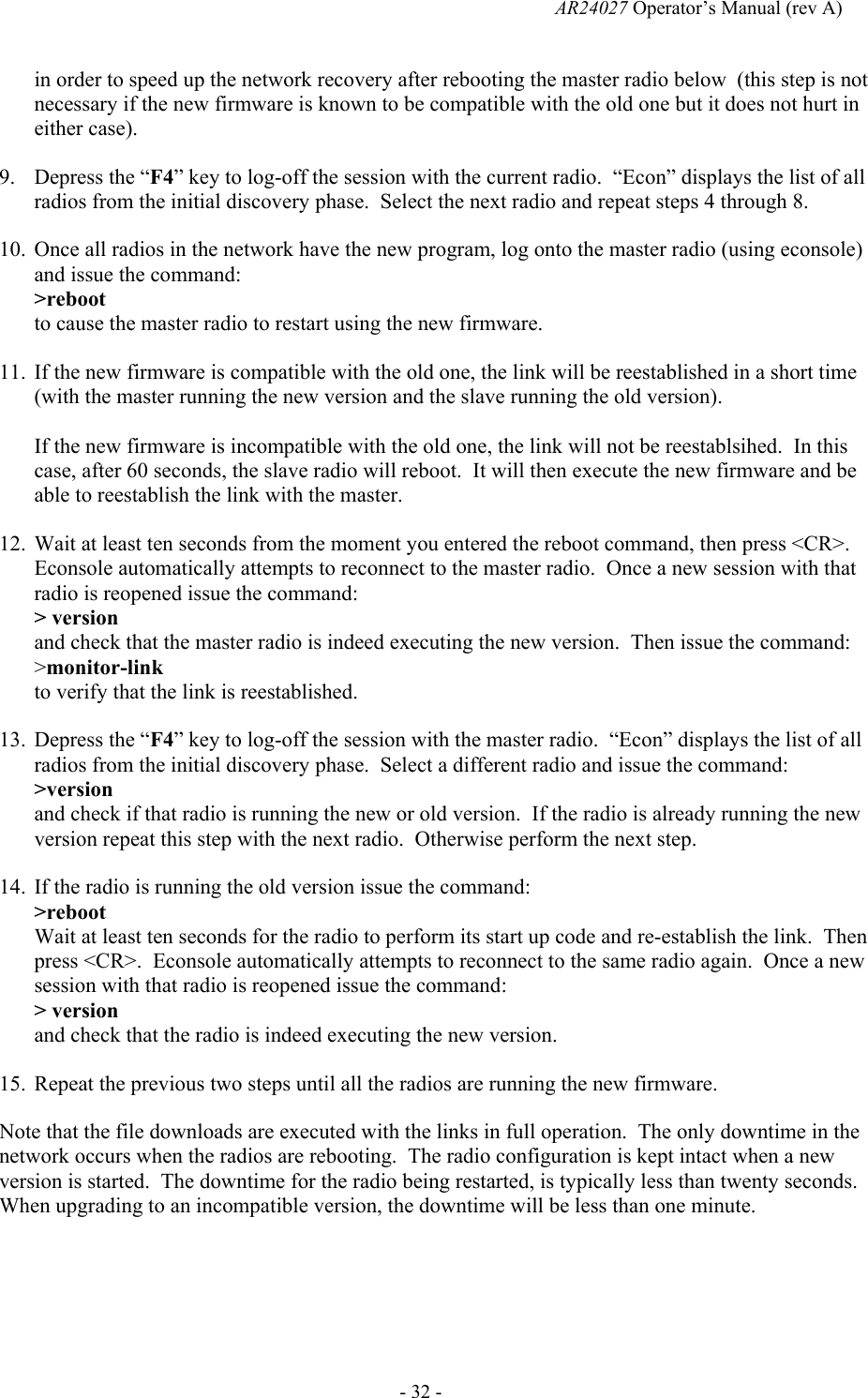
  AR24027 Operator’s Manual (rev A)  - 32 - in order to speed up the network recovery after rebooting the master radio below  (this step is not necessary if the new firmware is known to be compatible with the old one but it does not hurt in either case).  9. Depress the “F4” key to log-off the session with the current radio.  “Econ” displays the list of all radios from the initial discovery phase.  Select the next radio and repeat steps 4 through 8. 10. Once all radios in the network have the new program, log onto the master radio (using econsole) and issue the command: >reboot to cause the master radio to restart using the new firmware. 11. If the new firmware is compatible with the old one, the link will be reestablished in a short time (with the master running the new version and the slave running the old version).  If the new firmware is incompatible with the old one, the link will not be reestablsihed.  In this case, after 60 seconds, the slave radio will reboot.  It will then execute the new firmware and be able to reestablish the link with the master. 12. Wait at least ten seconds from the moment you entered the reboot command, then press <CR>.  Econsole automatically attempts to reconnect to the master radio.  Once a new session with that radio is reopened issue the command: > version and check that the master radio is indeed executing the new version.  Then issue the command: >monitor-link to verify that the link is reestablished.  13. Depress the “F4” key to log-off the session with the master radio.  “Econ” displays the list of all radios from the initial discovery phase.  Select a different radio and issue the command: >version and check if that radio is running the new or old version.  If the radio is already running the new version repeat this step with the next radio.  Otherwise perform the next step.   14. If the radio is running the old version issue the command: >reboot Wait at least ten seconds for the radio to perform its start up code and re-establish the link.  Then press <CR>.  Econsole automatically attempts to reconnect to the same radio again.  Once a new session with that radio is reopened issue the command: > version and check that the radio is indeed executing the new version. 15. Repeat the previous two steps until all the radios are running the new firmware. Note that the file downloads are executed with the links in full operation.  The only downtime in the network occurs when the radios are rebooting.  The radio configuration is kept intact when a new version is started.  The downtime for the radio being restarted, is typically less than twenty seconds.  When upgrading to an incompatible version, the downtime will be less than one minute.
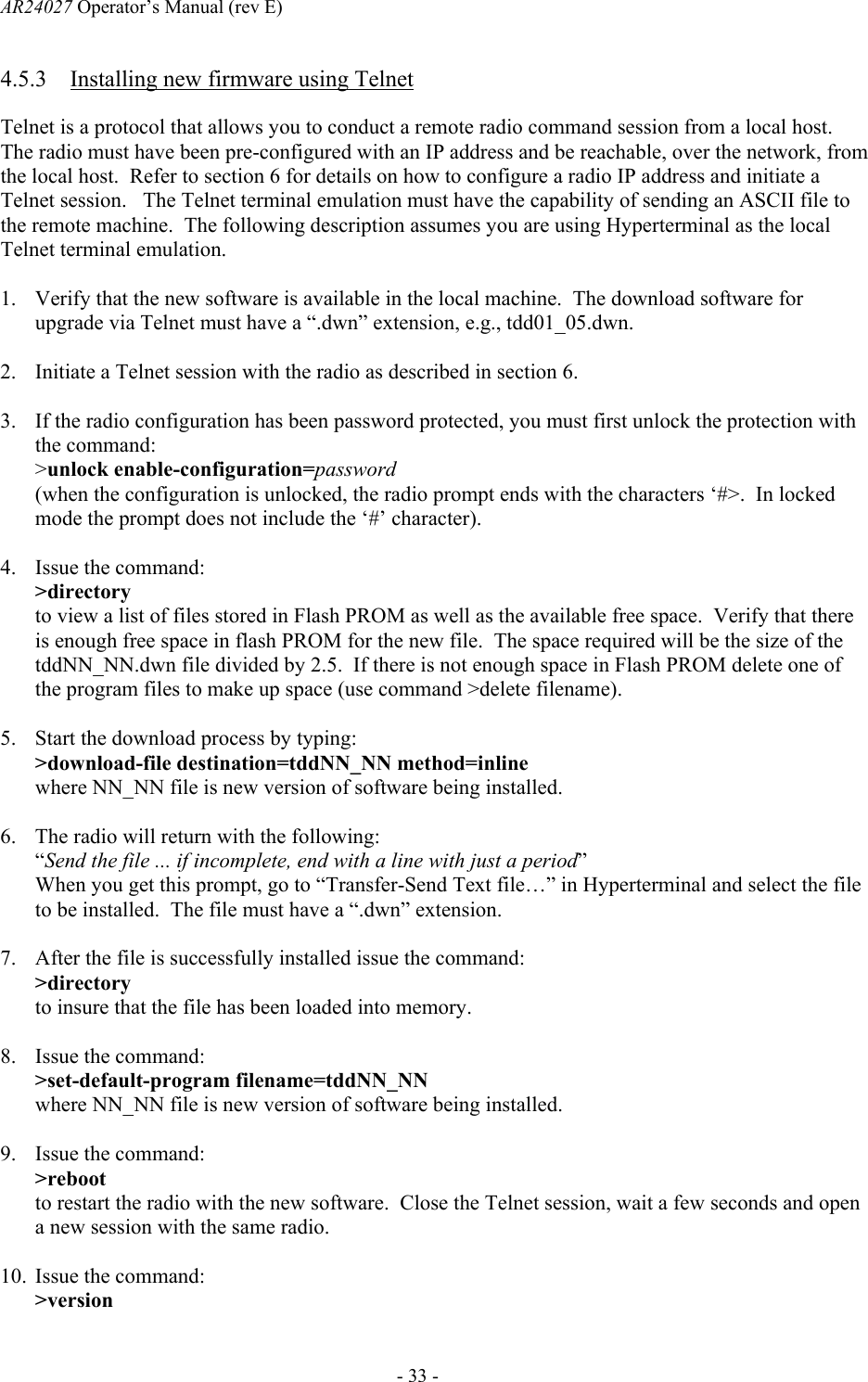
AR24027 Operator’s Manual (rev E)      - 33 - 4.5.3 Installing new firmware using Telnet Telnet is a protocol that allows you to conduct a remote radio command session from a local host.  The radio must have been pre-configured with an IP address and be reachable, over the network, from the local host.  Refer to section 6 for details on how to configure a radio IP address and initiate a Telnet session.   The Telnet terminal emulation must have the capability of sending an ASCII file to the remote machine.  The following description assumes you are using Hyperterminal as the local Telnet terminal emulation.  1. Verify that the new software is available in the local machine.  The download software for upgrade via Telnet must have a “.dwn” extension, e.g., tdd01_05.dwn.  2. Initiate a Telnet session with the radio as described in section 6.  3. If the radio configuration has been password protected, you must first unlock the protection with the command: >unlock enable-configuration=password (when the configuration is unlocked, the radio prompt ends with the characters ‘#>.  In locked mode the prompt does not include the ‘#’ character).  4. Issue the command: >directory to view a list of files stored in Flash PROM as well as the available free space.  Verify that there is enough free space in flash PROM for the new file.  The space required will be the size of the tddNN_NN.dwn file divided by 2.5.  If there is not enough space in Flash PROM delete one of the program files to make up space (use command >delete filename).  5. Start the download process by typing: >download-file destination=tddNN_NN method=inline where NN_NN file is new version of software being installed.  6. The radio will return with the following: “Send the file ... if incomplete, end with a line with just a period” When you get this prompt, go to “Transfer-Send Text file…” in Hyperterminal and select the file to be installed.  The file must have a “.dwn” extension.  7. After the file is successfully installed issue the command: >directory to insure that the file has been loaded into memory.  8. Issue the command: >set-default-program filename=tddNN_NN where NN_NN file is new version of software being installed.  9. Issue the command: >reboot to restart the radio with the new software.  Close the Telnet session, wait a few seconds and open a new session with the same radio.  10. Issue the command: >version
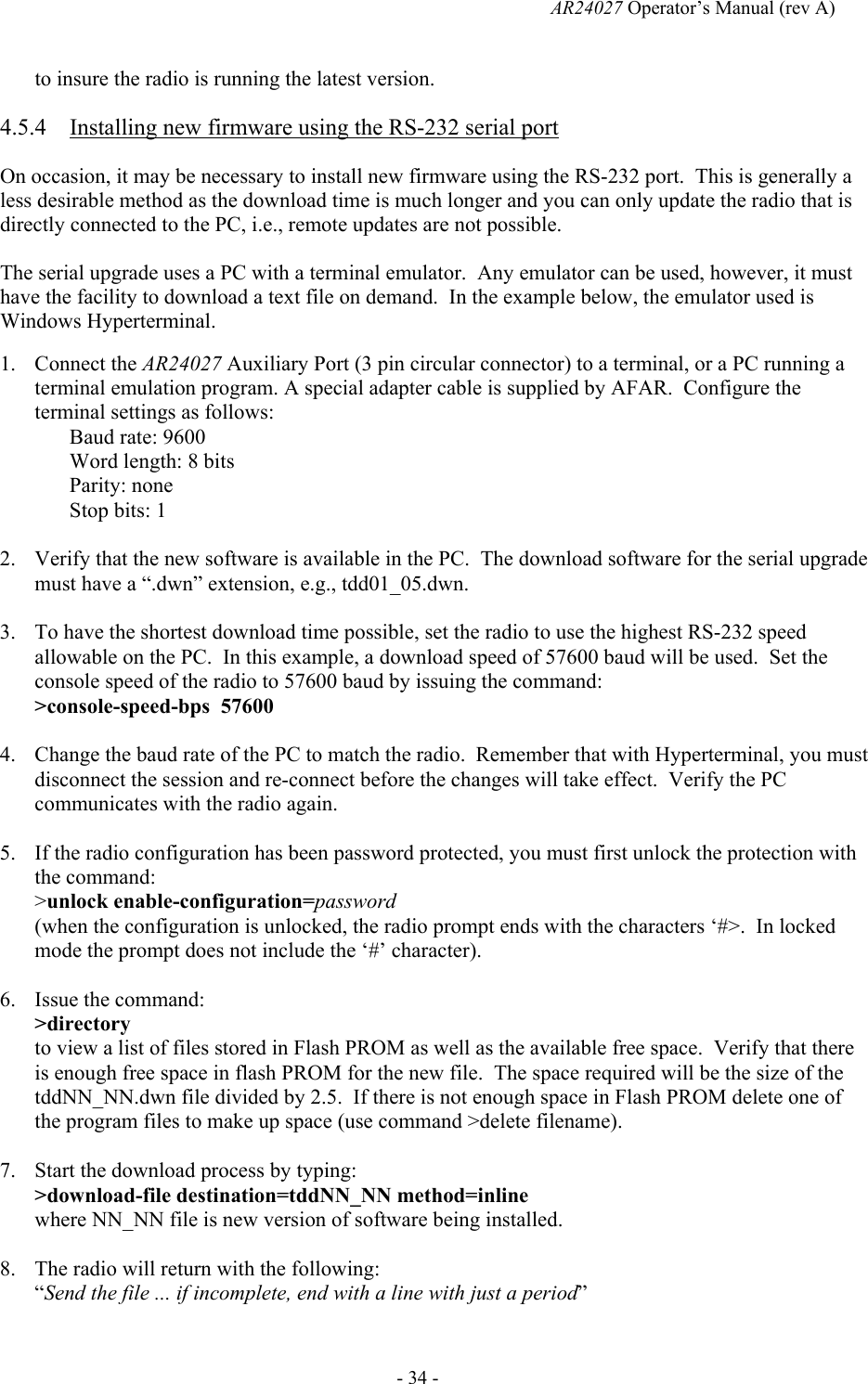
  AR24027 Operator’s Manual (rev A)  - 34 - to insure the radio is running the latest version. 4.5.4 Installing new firmware using the RS-232 serial port On occasion, it may be necessary to install new firmware using the RS-232 port.  This is generally a less desirable method as the download time is much longer and you can only update the radio that is directly connected to the PC, i.e., remote updates are not possible.   The serial upgrade uses a PC with a terminal emulator.  Any emulator can be used, however, it must have the facility to download a text file on demand.  In the example below, the emulator used is Windows Hyperterminal. 1. Connect the AR24027 Auxiliary Port (3 pin circular connector) to a terminal, or a PC running a terminal emulation program. A special adapter cable is supplied by AFAR.  Configure the terminal settings as follows: Baud rate: 9600 Word length: 8 bits Parity: none Stop bits: 1  2. Verify that the new software is available in the PC.  The download software for the serial upgrade must have a “.dwn” extension, e.g., tdd01_05.dwn.  3. To have the shortest download time possible, set the radio to use the highest RS-232 speed allowable on the PC.  In this example, a download speed of 57600 baud will be used.  Set the console speed of the radio to 57600 baud by issuing the command: >console-speed-bps  57600  4. Change the baud rate of the PC to match the radio.  Remember that with Hyperterminal, you must disconnect the session and re-connect before the changes will take effect.  Verify the PC communicates with the radio again.    5. If the radio configuration has been password protected, you must first unlock the protection with the command: >unlock enable-configuration=password (when the configuration is unlocked, the radio prompt ends with the characters ‘#>.  In locked mode the prompt does not include the ‘#’ character).  6. Issue the command: >directory to view a list of files stored in Flash PROM as well as the available free space.  Verify that there is enough free space in flash PROM for the new file.  The space required will be the size of the tddNN_NN.dwn file divided by 2.5.  If there is not enough space in Flash PROM delete one of the program files to make up space (use command >delete filename).  7. Start the download process by typing: >download-file destination=tddNN_NN method=inline where NN_NN file is new version of software being installed.  8. The radio will return with the following: “Send the file ... if incomplete, end with a line with just a period”
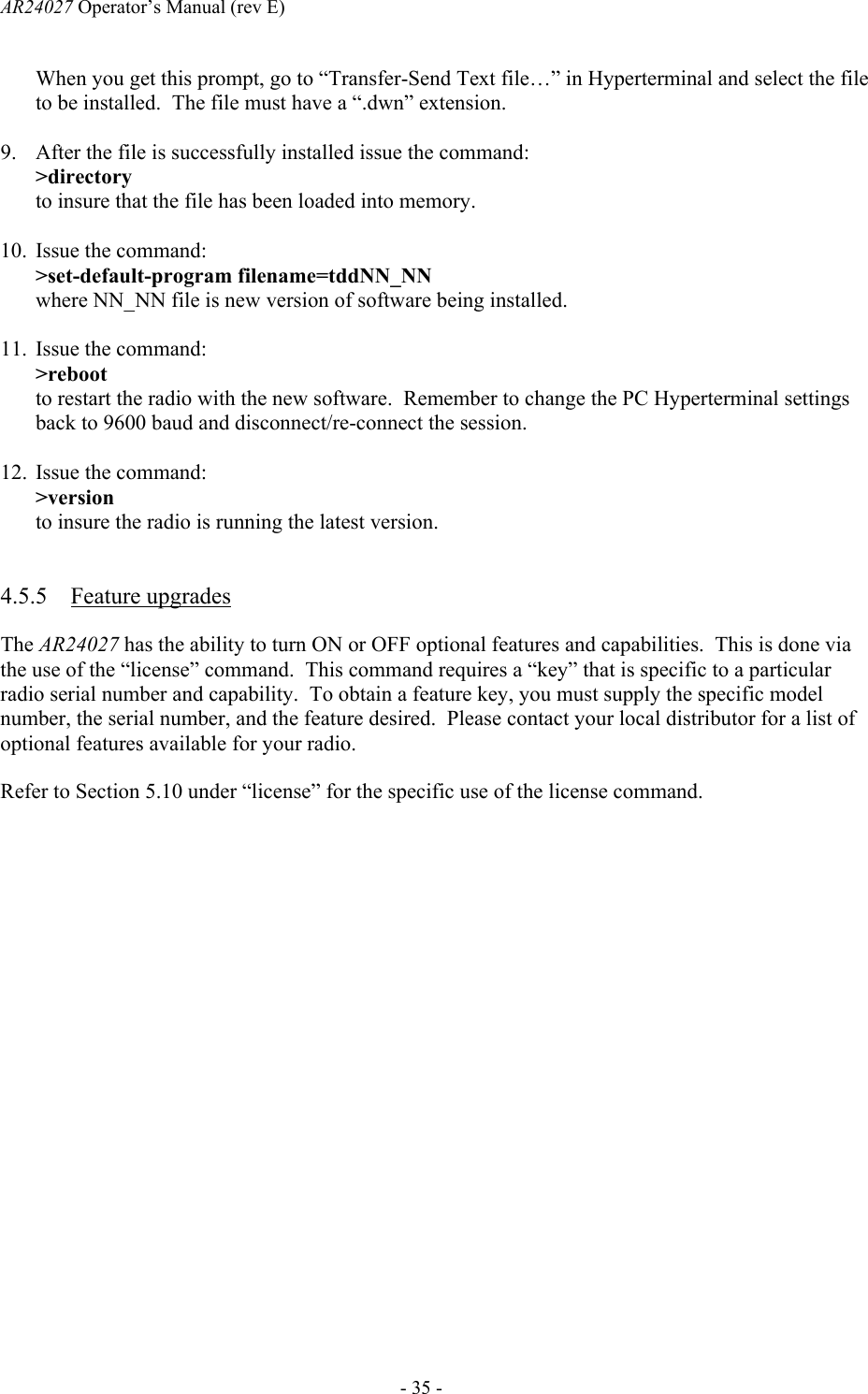
AR24027 Operator’s Manual (rev E)      - 35 - When you get this prompt, go to “Transfer-Send Text file…” in Hyperterminal and select the file to be installed.  The file must have a “.dwn” extension.  9. After the file is successfully installed issue the command: >directory to insure that the file has been loaded into memory.  10. Issue the command: >set-default-program filename=tddNN_NN where NN_NN file is new version of software being installed.  11. Issue the command: >reboot to restart the radio with the new software.  Remember to change the PC Hyperterminal settings back to 9600 baud and disconnect/re-connect the session.    12. Issue the command: >version to insure the radio is running the latest version.  4.5.5 Feature upgrades The AR24027 has the ability to turn ON or OFF optional features and capabilities.  This is done via the use of the “license” command.  This command requires a “key” that is specific to a particular radio serial number and capability.  To obtain a feature key, you must supply the specific model number, the serial number, and the feature desired.  Please contact your local distributor for a list of optional features available for your radio. Refer to Section 5.10 under “license” for the specific use of the license command.
AR24027 Operator’s Manual (rev E)      - 37 - 5 COMMANDS 5.1 Configuration techniques There are three ways to configure the radio.  One uses the auxiliary port at the bottom of the unit and consists of an asynchronous RS-232 link used for issuing configuration commands and monitoring the local radio status and performance.  This port is always set to operate with the following parameters: Baud rate: 9600 Word length: 8 bits Parity: none Stop bits: 1 This console port allows configuring and monitoring only the local radio, i.e. you can not monitor and configure any of the remote radios reachable through RF. A preferred configuration method uses the Ethernet connection to the radio to perform the configuration.  This approach has the advantage that any radio reachable across the Ethernet, or the RF link, can be configured from a single PC.  Additionally the Ethernet connection is more readily available indoors than the console port. In order to use the Ethernet connection to configure the radios the “Ethernet Console Program” (Econsole) needs to be installed at a PC.  This PC must be connected to the LAN where one or more AR24027 is connected.  From this PC it is then possible to configure not only the radios directly connected to the LAN, but also all other radios reachable through one or more RF hops.  Refer to Appendix C for instructions on the installation of Econsole. The third configuration method is using Telnet from a remote location.  Telnet is explained in more detail in section 6. After power up the radio performs several diagnostic and calibration tests.  At the end of these tests it outputs the command prompt.  The default prompt is:    tdd-nnnnn #> where nnnnn are the last five digits of the radio serial number.  If a node “name” has been assigned to the node, the prompt will be that name. The “help” command provides a list of all the commands available.  To get more detailed help for a specific command, type “help command-name”.   The radio keeps a history of several of the previously issued commands.  Those commands can be viewed by pressing the up-arrow and down-arrow keys on the keyboard.  Any of those previously issued commands can then be edited and reentered by pressing the <Carriage Return> key. 5.2 Command syntax The command interpreter in the AR24027 is designed to accommodate both a novice as well as an expert operator.  All commands and parameters have descriptive names so that they are easily
  AR24027 Operator’s Manual (rev A)  - 38 - remembered and their meaning is clear.  In order to be descriptive however, those commands are sometimes long.  As the operator becomes familiar with the command language, typing the complete words could become cumbersome.  The AR24027 command interpreter recognizes any abbreviations to commands and parameter names, as long as they are unambiguous.  If an ambiguous command is entered, the radio will output all possible choices. Commands have the following generic form: command   parameter=value   parameter=value  Following is a brief list of syntax rules: • Words (for commands, parameters, or values) can be abbreviated to a point where they are unambiguous. • Some commands or parameters consist of compound words separated by an hyphen.  With compound words, the hyphen is optional.  Additionally each word in a compound word can be abbreviated separately.  For example, the following are all valid abbreviations for the command “save-configuration”:  “save”, “savec” s-c” “sc”. • The parameter and value lists are context sensitive, i.e., in order to solve ambiguities the command interpreter only considers parameters valid for current command, or values valid for the current parameter. • The arguments “parameter=value” must be entered with no blank spaces on either side of the ‘=’ sign.  Those arguments (parameter/value pairs) can be listed in any order.  • Even though parameters can be listed in any order, there is a “natural” order known by the command interpreter.  This allows the user to specify parameter values without having to type the parameter names.  For example the command    >spectrum-analysis input=a-antenna display=table can be entered as (using abbreviation rules as well):    >spa a t • Using the preceding rule, for commands that have a single argument, the “parameter name” part of the argument is always optional, i.e., you can enter:  >command value For example the command:  >show-tables table=radio-nodes can be shortened to any of the following:  >show-tables radio-nodes  >show radio  >show rn  >sh • Not all parameters associated with a command need to be specified.  Depending on the command, when a parameter is omitted it either assumes a default value or keeps the last value assigned to that parameter.
AR24027 Operator’s Manual (rev E)      - 39 - The following sections describe the various commands grouped according to their functionality.  A summary list of all commands are contained in Appendices A and B. 5.3 Configuration Management Commands A “radio configuration” consists of a set of programmable parameters that define the radio operation with regard to a variety of operating modes.  The radio holds four configurations at all times, identified as “current”, “main”, “alternate”, and “factory”. The “main” and “alternate” configurations are both stored in non-volatile memory.  They can be loaded into the “current” configuration with the “load” command.  On power up the radio loads the “main” configuration from non-volatile memory into the current configuration. The “current” configuration is the set of parameters currently being used and can be modified by the operator through several commands.  This configuration is volatile.  If the current configuration has been modified it should be saved using the “save” command.  Otherwise the modifications will be lost if power is removed. The “factory” configuration can not be modified by the operator and is used to return the radio to the factory default condition.  It is useful as a starting point to create a customized configuration. The access to change the radio configuration can be password protected.  This password is set by the user with the “change-password” command.  Once a password is set, issue the “lock” command to prevent any unauthorized changes to the configuration.  Once locked, the configuration can only be modified by issuing the “unlock” command with the correct password. When the configuration is unlocked, the radio prompt ends with the characters ‘#>’ to remind the user that the configuration is unlocked.  In locked mode the prompt does not include the ‘#’ character.  Once a password is set, the radio will automatically lock the configuration after 10 minutes without any commands being issued. The configuration management commands are listed below:  change-password   enable-configuration=”ASCII string” This command allows the user to set or change a password used to “lock” and “unlock” access to the commands that change the radio configuration.  The AR24027 is shipped with no password which allows access to all commands.  Once a password is set and the configuration is locked, the password is needed to unlock the access to those commands.  After changing the password you should also issue the “save-configuration” command to save the new password in non-volatile memory. Examples: > change-password enable-configuration=bh7g8  WARNING The AR24027 is shipped with no password.  If the “change-password” command is issued make sure you do not forget the password.  Once locked, without a password, the radio must be returned to the factory to be unlocked.
  AR24027 Operator’s Manual (rev A)  - 40 - display-configuration   source= current or main or alternate or factory Displays all the parameter values for the specified configuration.   If the source is not specified it defaults to “current”.   Examples: > display-configuration source=current > discon  load-configuration   source=main or alternate or factory Loads the specified configuration into the current set of parameters controlling the radio operation.  If no source is specified it defaults to the “main” configuration. Examples: > load-configuration source=factory > load lock   This command locks the access to all the commands that can alter the radio configuration.  Once locked use the “unlock” command to regain access to those commands.  Note that a password must be set prior to the “lock” command being issued (the radios are shipped with no password), otherwise the lock command has no effect.  If a password is set, the radio automatically “locks” the configuration at the end of 10 minutes with no command activity. save-configuration   destination=main or alternate Saves the current set of radio operating parameters into one of the two non-volatile configurations.  If the destination is not specified it defaults to main. Examples: > save-configuration destination=alternate > save unlock   enable-configuration=”ASCII string” This command, with the correct password, unlocks the access to the commands that allow the radio configuration to be altered.   Examples: > unlock enable-configuration=bh7g8
AR24027 Operator’s Manual (rev E)      - 41 - 5.4 Major Configuration Parameters These commands change several operating parameters of the radio that are part of the radio “configuration”.  When entering commands with multiple parameters, if a parameter is not included, that parameter keeps its current value. node   name=”ASCII string” Gives the node a meaningful name for further reference.  This name will be used as the command prompt. It is also used to identify the node in a variety of commands and displays. The name field can be up to 11 characters with no spaces.  If spaces are desired, you may include the whole name in quotation marks.  location=”ASCII string” Optional parameter to define the location of the node.  This field is displayed in the “Display-configuration” output and also reported through SNMPThis field is used for information only. .  The location string can be up to 25 characters with no spaces. If spaces are desired, you may include the whole string in quotation marks.  contact=”ASCII string” Optional parameter to define the contact for maintenance purposes.  This field is displayed in the “Display-configuration” output and also reported through SNMP.  This field is used for information only.  The contact string can be up to 25 characters with no spaces. If spaces are desired, you may include the whole string in quotation marks.  Examples: >node net-id=2754 name=bank location=”wall street” contact=964-5848  single-node-reboot-timeout timeout-sec=30..3600 After power up, a radio attempts to get a link up with a peer.  If a radio fails to get a link up  (or drops an existing link), it will perform a complete reset after the timeout specified in this command.  This feature is useful if a command is issued to a remote radio changing its parameters in such a way that breaks the link to its peer.  In that case the remote radio will drop the link, wait for the “single-node-reboot-timeout” and then perform a reset.  As a result, the radio reverts to the saved configuration, allowing it to get reattached to its peer. Examples: > snrt 60
  AR24027 Operator’s Manual (rev A)  - 42 - rf-receive-setup channel=5..35 antenna=a, b This command configures the channel, and antenna used in the RF reception. Note that for the radio to establish a link to its peer, the channel selected by this command must match the channel selected as the transmit channel of the remote radio. Example: > rfre ch=15  rf-transmit-setup channel=5..35 speed-mbps= 1, 2, 5.5, 11 power-dbm=0..23 antenna=a, b This command configures the channel, speed, transmit power and antenna used in the RF transmissions. Note that for the radio to establish a link to its peer, the channel selected by this command must match the channel selected as the receive channel of the remote radio. Example: > rftr ch=15 sp=2 po=18 time-division-duplex sync=master, auto cycle-period-ms= 5..30 This command configures the “time-division-duplex” parameters.  When the radios are operated standalone (not paired with a NetCrossing Gateway), the sync mode for one radio must be set to “master” and the other to “auto”.  If the radios are paired with NetCrossing Gateways both radios should have their sync mode set to “auto”. A radio configured as master transmits a short packet repeatedly, with a period specified by the “cycle-period” parameter.  The peer radio (with configuration set to “auto”), upon listening to this packet, synchronizes its replies to the master timing.  Transmitting in opposite phases. The cycle period only needs top be programmed at the master radio.  Use shorter cycle periods to reduce the latency in the link and larger values to increase the link capacity.  Example: > tdd sync=master cp=10
AR24027 Operator’s Manual (rev E)      - 43 - 5.5 Bridge Management Commands Bridge management commands set and display the specific operating characteristics relating to the operation of the radios as a network. ethernet   speed=auto or 10hdx or 10fdx or 100hdx or off Sets the ethernet port speed to auto-negotiate, 10Mbps half-duplex (10hdx), 10 Mbps full-duplex (10fdx), 100 Mbps half-duplex (100hdx) or turns the ethernet port off.   In installations requiring very long outdoors CAT5 cable, operation at 100 Mbps may become unreliable.  For this reason the auto-negotiate setting allows only 10 Mbps half or full-duplex.  For operation at 100 Mbps you need to specify that speed explicitly. When the ethernet port is turned “off” no traffic is accepted from the ethernet port, but the radio continues to operate over RF normally.  This is useful for a radio configured as a repeater, if the operator wants to turn off the user but needs to keep the service for radios downstream.  Note that once the ethernet port is turned off, it can only be turned back on through an RF connection or the RS-232 console port.   timeout-sec=5..1800 Sets the time the radio will retain, in its internal table, Ethernet addresses obtained from the network.  multi-cast-timeout-sec=5..3600 Sets the time the radio will retain, in its internal table, Ethernet multi-cast addresses obtained from the network. Examples: > ethernet speed=10fdx timeout=100 show-tables table=ethernet-stations  fomat=counts or times This command displays a variety of information about the overall link.  The contents of the different tables are described below. ethernet-stations table This table can be displayed in two formats, “counts” (default) and “times”.
  AR24027 Operator’s Manual (rev A)  - 44 - >show  ethernet Ethernet Stations:                                                --Discard--      --Forward--  #       MAC address   IP address    Radio   from       to     from       to   0 ff-ff-ff-ff-ff-ff                   0        0        0        0      183  1 00-d0-39-00-2d-cb                  -M        0        0      209      165  2 00-a0-cc-66-8e-a6   207.154.90.171  S      136       54   139575      172  3 00-d0-39-00-2d-c3                   S        0        0        0        0   >show  ethernet times Ethernet Stations:  #       MAC address   IP address  Radio MC  Time added      Idle  0 ff-ff-ff-ff-ff-ff                   0   29-Nov 16:17:08        1 00-d0-39-00-2d-cb                  -M   29-Nov 16:17:08   0.01  2 00-a0-cc-66-8e-a6   207.154.90.171  S   29-Nov 16:17:15   0.00  3 00-d0-39-00-2d-c3                   S   29-Nov 16:23:41   9.18  Both formats lists all the ethernet stations attached to any of the radios.  The tables lists the MAC (Ethernet) address of the station, and, if known, the IP address.  The “Radio” column shows the radio (Master or Slave) where that station is physically attached. The first entry in the table tracks broadcast traffic while the second entry is always the address of the radio itself. The “counts” format shows the cumulative number of ethernet packets that have been seen with that MAC addresses in the “source” (from) or the “destination” (to) fields.  In bridge mode the radios are in “promiscuous” mode and look at all the ethernet packets in the Local Area Network.  The radios “discard” the packets that are known to be local, but “forward” all other packets to the remote radio.  These are accounted separately in the report. The “times” format indicates whether that entry is for a “multicast” (MC) address, shows the time when the station was added to the table, and how long since that address has been seen.  When the “idle” time exceeds the time specified by the “ethernet” command, that entry is deleted from the table. 5.6 Internet Protocol (IP) Management Commands The IP Management commands configure the radio IP protocol parameters which allow the radio to be monitored and configured through Telnet and SNMP.  Refer to section 6 for a more detailed explanation on those two applications. ip-configuration   address=<ip address> netmask=<string> gateway=<ip address> This command configures the radio IP address, netmask and gateway.  The IP configuration is optional and the radios are shipped with these parameters left blank.  Once the IP configuration has been initialized, the radios will reply to “ping” packets.  The IP configuration is also required in order to use the “ping”, “snmp” and “telnet” features. Since the two radios in a link are bridged together they are in the same “internet network”.
AR24027 Operator’s Manual (rev E)      - 45 - Example: > ipconfig add=207.154.90.81 netmask=255.255.255.0  gateway=207.154.90.2  ping  destination=<string> count=0..500 size-bytes=32..1400 This command causes the radio to “ping” the destination address and display the results.  The “ping” packet consists of an ICMP packet with a length specified by the “size-bytes” parameter.  The destination is any valid IP address.  When the destination host receives the packet it generates a reply of the same size.  Upon receiving the reply the radio displays the round trip delay.  This process is repeated the number of times specified by the “count” parameter (default to 4). Example: > ping  207.154.90.81  count=10  size=100  snmp   The radio runs an SNMP agent which allows up to four IP addresses to be specified as valid SNMP managers.  This command configures those IP addresses and the type of access allowed.  You can issue the command up to four times to specify each separate IP address manager.  The radios are shipped with all entries blank.  While no entries are specified, the unit accepts SNMP “get” requests from any IP address with the “public” community.  Once one or more entries are specified, the radio only responds to requests from the specific IP addresses listed.  This list of authorized managers is also used for validating Telnet requests. Refer to section 6 for an overview of Network Management using SNMP and Telnet.    manager=<ip address> Specifies one valid IP address where the SNMP manager or Telnet session will run.  community=<string> Any string of up to 9 characters.  For SNMP requests the “community” field in the request packet from this IP address must match this parameter.  For a Telnet session the username entered when initiating the session from this IP address must match this string.  If this parameter is not specified it defaults to “public”. Note that you must always enter the “manager” IP address in the same command line that sets the “community” value.  access=g or gs or gst or gt SNMP access type authorized for this IP manager.  Specify as any combination of three letters: g (get), s (set) and t(trap).  If this parameter is not specified it defaults to “get”. Note that you must always enter the “manager” IP address in the same command line that sets the “access”
  AR24027 Operator’s Manual (rev A)  - 46 - value.  authentication-traps=0 or 1 Specifies whether an “authentication trap” should be generated if a SNMP request is received that can not be honored (due to invalid IP address, community or access fields).  When enabled, all IP managers that have “trap” access will receive this trap.  delete=1..4 Allows deleting one entry in the SNMP table.  The number 1..4 refer to the entry number as listed in the “display configuration” report. Example: > snmp  manager=207.154.90.81  com=support access=gst  5.7 Installation and Link Monitoring Commands These commands are useful as installation aids and also for monitoring link statistics after the link is established. antenna-alignment-aid output=audio or off  With the antenna alignment aid set to “audio” the radio outputs, through the auxiliary port, an audio signal with a pitch proportional to the Receive Signal Strengh (RSS) level of packets received from the specified node.  AFAR provides a special cable adapter that converts the three-pin auxiliary port connector into a standard female audio jack.  Use this cable to connect the auxiliary port to a pair of standard headphones while aligning the antenna.   When the command to turn the audio output ON is issued, the radio displays a line indicating which antenna is being aligned.  Additionally the radio plays one of two short tunes identifying antenna A or B. While the antenna alignment is set to “audio” the RS-232 console output is not available.  When the antenna alignment output is set to “off” the auxiliary port output reverts to RS-232 console. The antenna alignment output setting (“audio” or “off”) can also be saved as part of the radio configuration.  This is useful to take a pre-configured radio to an installation site with no need to turn the antenna alignment ON (through a terminal) after power up. Example: >aaa audio >aaa off monitor-flow This command continuously displays the ethernet data rates between this radio and its peer.
AR24027 Operator’s Manual (rev E)      - 47 - monitor-link clear=0 or 1 This command continuously displays link statistics with its peer.  The statistics include, for each direction of the link, the channel, speed, transmit power, RSSI, link distance and cumulative number of packets sent and lost. The “clear=1” parameter clears the cumulative counts in the report. Examples: >monitor-link clear=1 spectrum-analysis input=a-antenna or b-antenna display=graph or table dwell-time-ms=0..1000 This command performs a scan of all the channels in the band, dwelling on each channel for the specified amount of time (defaults to 20 milliseconds).  While on each channel it measures the RSSI for that channel and stores its peak value.  It then displays the data collected in a graphical or table formats (defaults to “graph”).   During the test the RF input into the radio can be selected between one of the two antennas.  Note that even though the AR24027 channels are spaced 2 MHz apart, the receiver RF bandwidth is approximately 5 MHz.  Therefore the RSSI value reported for each channel represents the total energy in an 5 MHz band centered around that channel.  For this reason, a narrow band transmitter will show up in the spectrum analysis report as a lobe with 5 MHz bandwidth.  Conversely, you do not need to find a quiet 5 MHz wide region in the spectrum analysis report to select a quiet channel, i.e., any single channel sample that shows a low “noise” level, is a good candidate to select as a receive channel.  Examples: >spectrum-analysis input=b-antenna >spa dwell=500  time-analysis channel=0..50 input=a-antenna or b-antenna  display=graph or table dwell-time-ms=1, 2, 5, 10, 20, 50, 100, 200, 500 This command measures the RSSI for a single channel over a period of time.  Each “sample” consists of the maximum RSSI measured during the dwell time specified (defaults to 20 milliseconds).  After collecting 60 samples the RSSI values are displayed graphically or numerically (defaults to “graph”).   In this test the RF input into the radio can be selected between one of the two antennas.  Example:
  AR24027 Operator’s Manual (rev A)  - 48 - >time-analysis input=b-antenna >tia in=a dis=t dwell=500  5.8 Event Logging Commands The AR24027 keeps track of various significant events in an “event log”.  This event log holds up to 500 events.  The first 100 entries in the log are filled sequentially after power up and are not overwritten.  The remaining 400 entries consist of the last 400 events recorded.  All events are time-tagged with system time. Events are classified in different categories from level 0 (catastrophic error) to 7 (information).  clear-log region= all-events or reboot-reasons This command clears the contents of the system event log from the specified “region”. After a code upgrade it is recommended to clear the reboot reasons since the pointer in non-volatile memory pointing to the reason message may no longer be valid. display-log region=end or beginning or all-events or reboot-reasons length=1..500  id=0..200 min-level=0..7 max-level=0..7 This command outputs to the terminal the specified “region” of the event log.  The “length” parameter specifies the number of events to output (defaults to 10). The remaining parameters provide filters to leave out specific events. If the “id” parameter is specified, only the event identified by that id will be displayed.  The “min-level” and “max-level” settings allow the user to display only the events with the specified category range. The “reboot-reasons” region of the event log consist of the last four events that that caused the radio to reboot.  These events are stored in non-volatile memory.  The time tag in these events is the time the radio was up since it was rebooted, not the time of day. Examples: >display-log region=all >display-log region=all length=300 min-level=2 max-level=6 max-event Sets the event severity level that should be saved or displayed.  These two parameters are saved as part of the configuration  save=0..7 Only events of the specified level or below will be saved in the event log.
AR24027 Operator’s Manual (rev E)      - 49 -  print=0..7   Events of the specified level or below will be output to the terminal as they occur. Examples: >max-event print=6  5.9 File Utilities The AR24027 maintains a file system that allows multiple programs to be stored in either non-volatile flash PROM or volatile RAM. New programs can be downloaded into the AR24027 memory through the auxiliary port, through the Ethernet port, or to remote radio across the RF link. One of the programs in flash PROM is designated as the default program to run after reboot.  On power up that program is copied from PROM into RAM and the code runs out of RAM. Both sections of memory (non-volatile flash PROM and volatile RAM) are segregated into two “directories”.  The non-volatile flash PROM is called “flash” signifying the flash PROM and the volatile RAM is called “tmp” signifying the temporary status of the program.  Use the “directory” command to view the programs loaded and whether they are in non-volatile or volatile memory. Any program can be invoked with the command “run” without making it the default file.  This is useful when upgrading the software over an RF link as a way to ensure that the new code is working correctly before making it the default. console-speed-bps baud-rate-bps=9600 or 19200 or 38400 or 57600 or 115200 Sets the Auxiliary port of the radio to the specified baud rate.  This setting is not saved in the radio configuration, the auxiliary port always powers up set for 9600 baud. This command is useful to speed up the download process over the auxiliary port.  Before issuing the  download command, use this command to change the radio console speed to the highest baud rate supported by the PC.  Then change the terminal settings to match the radio speed.  Issue the download command described below and initiate the transfer at the terminal. Examples: >console-speed-bps baud-rate-bps=115200 copy-file source=filename destination=filename Copies the input-file into the output-file.  If the memory location is not defined (flash or tmp), the command assumes the flash directory. Examples:
  AR24027 Operator’s Manual (rev A)  - 50 - >copy-file tmp/tdd01_02  tdd01_02 delete-file filename=filename Deletes the specified file from RAM or Flash PROM. If the memory location is not defined (flash or tmp), the command assumes the flash directory. Examples: >delete-file filename=tdd01_03 directory format=short or full  Lists all the files currently stored in flash PROM and RAM, their size, the sectors occupied and the MD5 checksum (full version).  It also indicates which of the files is the default program.  Files stored in flash PROM have the flash/ prefix.  Files stored in RAM have the tmp/ prefix. Examples: >directory full download-file source=path/filename destination=filename method=inline or binary Downloads a program file from a PC to the AR24027.   To download a file through the Ethernet port or across RF links you need to be running the Econsole program on a PC attached to a radio through the Ethernet port.  In this case the program file must be in binary format (with extension .bin).  The path/ in the source parameter is the PC directory where the file resides.  The program file is transferred to the AR24027 and is stored in the radio memory under the name specified by the destination parameter.  If the destination parameter is omitted, the file will be stored in Flash PROM with the same name as the source.  Note that the “.bin” extension is not needed in the command.  The download “method” to use must be “binary” (which is the default). Example: >download C:\load\tdd01_12   download the file tdd01_12.bin from the PC directory C:\load into the unit file flash/tdd01_12 If the download is performed from a terminal connected to the Auxiliary port, the file is in ASCII format and has the extension .dwn.  The download method must be “inline”.  The source parameter is not needed since, after issuing the command, the user must initiate the transfer of the file from the terminal.  Example:
AR24027 Operator’s Manual (rev E)      - 51 - >download destination=tdd01_12 method=inline    After issuing the command initiate the file transfer using the terminal facilities.. run filename=filename  Executes the specified file.  The file is first copied into RAM and then the program is executed out of RAM.  If the radio is rebooted or power cycled, the radio reverts back to the program defined as the default boot program. If the memory location is not defined (flash or tmp), the command assumes the flash directory. Examples: >run tdd01_04 set-default-program filename=filename  Sets the specified file as the default program to be loaded upon reboot or power cycle.  Since the default program must reside in flash memory, the “flash/” prefix is assumed and is not required for the command. Examples: >set-default-program tdd01_04 5.10 Miscellaneous commands date The AR24027 will set the internal radio date and time automatically by decoding Network Time Protocol (NTP) packets in the Ethernet LAN.  The “zone” parameter specified with the “date” or “time” command will then be used to display the date/time in local time.  The “zone” value is saved as part of the radio configuration. If NTP packets are not available, the user can initialize the radio date and time with either the “date” or “time” commands.  The parameters for both commands are identical, but the parameter order is different.  The date command can be entered as: > date 16-may-2000   10:32:06  date=day-month-year  Sets the date used by the radio.  The day / month / year parameter may be separated by any valid separator (‘-‘   ‘/’  etc.)  time=hh:mm:ss  Sets the radio time in hours, minutes and seconds.  Use colons to separate the three fields.
  AR24027 Operator’s Manual (rev A)  - 52 -  zone=zone-code or offset Sets the time zone to be used by the radio to translate the NTP time to local time.  It can be specified by an offset from GMT (-0800 or +0200 for example), or as a “zone-code”.  The valid “zone-codes” and the respective offsets are shown below:  Zone zone code offset Pacific Standard Time  PST  -0800 Pacific Daylight Time  PDT  -0700 Mountain Standard Time  MST  -0700 Mountain Daylight Time  MDT  -0600 Central Standard Time  CST  -0600 Central Daylight Time  CDT  -0500 Eastern Standard Time  EST  -0500 Eastern Daylight Time  EDT  -0400 Greenwich Mean Time  GMT  0000 help  [command-name] If no command is specified, displays the complete list of commands.  If a command is specified it displays the valid parameter and corresponding values for that specific command. Examples: >help monitor-link  history Displays the previous commands entered. license key=< ASCII string> The “license” command is used to turn ON or OFF a set of optional features or capabilities. The key is a 35-character string combination of ASCII letters, numbers, and hyphens.  The key must be input with the syntax as shown in the example below, including hyphens, for the radio to accept it.  The characters can be input as upper or lower case. After entering the key you must reboot the radio for the feature, enabled by the key, to take effect. Each key is unique for a particular radio serial number and capability, i.e. a key generated to turn ON a capability on one serial number will not work on another radio.  Example: >license key=02EL1-ZGZ42-G0000-00C54-81WAJ-C9BEK
AR24027 Operator’s Manual (rev E)      - 53 - logout Closes the current Econsole session. reboot Resets the radio causing the software to perform a complete start up sequence.  This is equivalent to power cycling the radio off and on. time time=hh:mm:ss  date=day-month-year  zone=zone-code or offset This command is identical to the “date” command explained above except for the order of the parameters.  It allows the time and date to be entered as: > time 10:32:06  16-may-2000 version Displays the radio model and software version.
  AR24027 Operator’s Manual (rev A)  - 54 -
AR24027 Operator’s Manual (rev E)      - 55 - 6 NETWORK MANAGEMENT The radios operate as part of a network environment with many devices. Whether operated by an Internet Service Provider (ISP) or the Information Technology (IT) department of a business, there is often a need to supervise and manage the network from a central Network Operations Center (NOC). This chapter describes the features of the AR24027 that are useful for this purpose. 6.1 Telnet 6.1.1 General Telnet, which stands for Telecommunications Network, is a protocol that allows an operator to connect to a remote machine giving it commands interactively.  Once a telnet session is in progress, the local machine becomes transparent to the user, it simply simulates a terminal as if there was a direct connection to the remote machine.  Commands typed by the user are transmitted to the remote machine and the responses from the remote machine are displayed in the telnet simulated terminal. 6.1.2 Starting a Telnet Session In order to start a telnet session with a radio you first need to configure the radio with a unique valid IP address.  This is done with the ip-configuration command described in section 5.6.  This initial configuration must be done using either the RS-232 console port or the ECON program.  Once the radio has an IP address, you must start the telnet application at the local machine and establish a connection with the IP address of the radio.  If the local machine is a PC running Windows, you can start Telnet through Hyperterminal as follows: 1. Start the Hyperterminal application  (in a typical Windows installation Hyperterminal can be found from the Start button under Programs/Accessories/Communications…) 2. From the File menu choose New Connection. 3. In the Name field enter any name you wish and press the OK button.  This will open the “Connect To” window. 4. In the last field, titled “Connect using:”, select TCP/IP (Winsock).  The fields above will change to Host Address: and Port Number:. 5. In the Host Address field, type the IP address of the radio, then press the OK button. 6. TCP will now attempt to connect to the specified device.  If successful the radio will request a login name with the prompt login:  7. Type public followed by the Enter key The radio will now display its prompt command and you may type any commands as described in section 5. If after entering the public login name, the terminal displays the message “Login Failed”, this may be due to the radio being configured to be managed from only some specific IP addresses.  This is explained in the following section.
  AR24027 Operator’s Manual (rev A)  - 56 - 6.1.3 Telnet Security The remote management capability through Telnet opens the possibility for an unauthorized user to login to any radio accessible through the Internet.  The radio configuration can be password protected with the use of the lock and unlock commands.  If further security is desired you can specify up to four source IP addresses that are authorized to initiate Telnet sessions with the radio.  When configured in this way, the radio will reject Telnet requests from all IP addresses that are not in the authorized list. The authorized source IP addresses for Telnet are the same addresses that are authorized to perform SNMP management.  They are entered using the snmp command described in section 5.6 and can be viewed with the display-configuration command.  When this list is empty, you can initiate a Telnet session from any IP address with the login name public.  When this list is not empty, Telnet sessions can only be initiated from the listed hosts.  Additionally, for each host, the login name must match the string listed for the community field. If you wish to use this security feature you need know the IP address of the local machine.  On a PC running Windows, one way to find its IP address is to open a DOS window and issue the command: >ipconfig  6.2 SNMP 6.2.1 Command Line Interface Versus SNMP Configuration settings on the AR24027 are displayed and modified using a command line interface, which can be accessed using either the RS-232 console port, the ECONSOLE program, or via a TELNET session. In a NOC environment, there is a need for an automated monitoring system to collect on an ongoing basis information from devices in the network for three purposes: 1) to build an inventory of all the devices of the network 2) to keep track of all devices on the network and raise alarms when any device becomes unreachable (device failed, link down, etc) 3) to maintain statistics on traffic levels in order to implement usage-based charging, or to determine where congestion exists in the network, so that the network can be expanded to accommodate growth Command line interfaces are not very suitable for these purposes, and the AR24027 supports the Simple Network Management Protocol (SNMP) to assist in these tasks. SNMP is a simple, transaction-based (command/response) protocol, which allows a variety of third-party software products to query network devices and collect data for these purposes. For a generic introduction to the SNMP protocol, we recommend the book "The Simple Book - An Introduction to Internet Management" by Marshall T Rose (P T R Prentice-Hall, 1994).
AR24027 Operator’s Manual (rev E)      - 57 - 6.2.2 What is SNMP? The SNMP protocol is described in the following documents: • RFC1157 - Simple Network Management Protocol (SNMP) - ftp://ftp.isi.edu/in-notes/rfc1157.txt • RFC1155 - Structure and identification of management information for TCP/IP-based internets  - ftp://ftp.isi.edu/in-notes/rfc1155.txt • RFC1213 - Management Information Base for Network Management of  TCP/IP-based internets: MIB-II - ftp://ftp.isi.edu/in-notes/rfc1213.txt SNMP is a specification for the interaction (protocol) between the SNMP agent embedded in a network device, and the SNMP manager software running on another machine in the network. The data provided by the SNMP agent in a network device is described by a document called the MIB (Management Information Base). MIB-II describes the basic information provided by all devices, and additional documents describe optional extensions for components that may not exist in most devices. Devices may also provide non-standard MIB groups. In order for a network management system to make use of these extended features, the MIB description must be obtained from the device manufacturer and loaded into the management station. SNMP data travels in IP packets, using the UDP port 161 for the agent, so in order to use SNMP, the device must have an IP address. 6.2.3 Security Considerations in SNMP SNMP was designed before the Internet grew commercial, and the original design was not secure. Later versions intended to provide security, but grew cumbersome and complex. As a result, most devices provide secure operation in a non-standard way. The original SNMP design as embedded in the protocol, assigns network devices to named communities. Any transactions exchanged between the agent and the manager include the name of the community to which they both belong. The agent has a list of which access rights (set, get, trap) it will grant for each community of which it is a member. In the AR24027, this has been re-interpreted: The radio has a list of up to 4 management stations from which it will accept requests, and for each one - identified by its IP address - it is indicated what access rights it is granted, and which community string it must use. Requests from all other sources are ignored.  Refer to the snmp command in section 5.6 for details on how to configure the radio for management using SNMP.. If no management stations are listed, get-requests with the community public will be accepted and responded to from any IP address. 6.2.4 Examples of Network Management Systems Some of the most common network management systems are listed below. All of them provide many similar features, including network status displays showing key devices on a map, where the devices
  AR24027 Operator’s Manual (rev A)  - 58 - change color if they have alarms, and with provisions for activating a remote paging device if there is a problem. WhatsUp Gold (Ipswitch Inc) http://www.ipswitch.com/ USD 800 (approx) SNMPc (Castle Rock Computing, Inc) http://www.castlerock.com/ USD 900 to USD 2700 (approx, depending on options) OpenView (Hewlett-Packard) http://www.openview.hp.com/ USD 3,000 to USD 10,000 The OpenView product line has been revamped; HP is now positioning it not as a turnkey software product, but as a custom adapted application to be bought through a value-added implementation partner. Multi-Router Traffic Graphing http://www.mrtg.org/ This is a free, open-source software, capacity planning tool. 6.2.5 AR24027 Management Information Base (MIB) The AR24027 implements only the core MIB-II. A management station will see 3 interfaces in the interfaces group: 1 - VINE bridge 2 - Ethernet 3 - Radio The first of these represents the attachment of the SNMP agent to the bridged network. Only IP traffic seen by the embedded host is counted. The ethernet device (ifIndex=2) represents the traffic passing through the radio's ethernet port. This is what should be tracked by MRTG. The third device represents the wireless transceiver. If will appear as down if the radio does not have a working link to a neighbor (a root node must have at least one child, all other nodes must have a parent). This is useful for confirming the loss of a link. The traffic counts show all packets to and from the radio, including handshaking between adjacent radios, as well as data being relayed from this radio's children to its parent and vice versa  .
AR24027 Operator’s Manual (rev E)      - 59 - APPENDIX A - Specifications  RF Specifications     RF Frequency Band  2.406 GHz to 2.474 GHz (center frequencies)    RF Signal Bandwidth (-20 dBc)  4.6 MHz    RF Channels  35 (12 non-overlapping)    Transmitter Output Power  0 to 23 dBm (programmable)    Modulation Type  direct sequence spread spectrum    RF Data Rates (one way)  250, 500, 1375, 2750 Kbps    Receiver Sensitivity (10-6 BER)  -92 dBm (@ 250 Kbps) –90 dBm (@ 500 Kbps)  -88 dBm (@ 1375 Kbps)  -85 dBm (@ 2750 Kbps)  Data Interfaces     Auxiliary Port  RS-232     Ethernet Port  10/100 BaseT (auto-negotiate) Power  Requirements     Input Voltage (Outdoor Unit)  +8 to +28 Volts DC     Input Voltage (AC)  110 VAC or  220 VAC    Power Consumption  less than 5 Watts  Environment     Temperature  -40 to +70 Degrees C    Max. Humidity  90% non-condensing Mechanical:     Dimensions  4.72" wide x 8.66” high x 2.20” deep  (120mm W x 220 H x 56 D)     Weight 2.4 lbs. (1.1 Kg).
  AR24027 Operator’s Manual (rev A)  - 60 -
AR24027 Operator’s Manual (rev E)      - 61 - APPENDIX B – Channel Frequency Assignment   Channel Frequency (GHz)  Channel Frequency (GHz)  Channel Frequency (GHz) 3  2.406  15 2.430 27  2.454 4  2.408  16 2.432 28  2.456 5  2.410  17 2.434 29  2.458 6  2.412  18 2.436 30  2.460 7  2.414  19 2.438 31  2.462 8  2.416  20 2.440 32  2.464 9  2.418  21 2.442 33  2.466 10 2.420  22 2.444 34  2.468 11 2.422  23 2.446 35  2.470 12 2.424  24 2.448 36  2.472 13 2.426  25 2.450 37  2.474 14 2.428  26 2.452      Number of  Non-Overlapping Channels  Suggested Channel Allocation  Frequency Separation(MHz) 12  3, 6, 9, 12, 15, 18, 21, 24, 27, 30, 33, 36  6.0
  AR24027 Operator’s Manual (rev A)  - 62 -
AR24027 Operator’s Manual (rev E)      - 63 - APPENDIX C – Ethernet Console Program   EConsole v2.01 for Windows   Short description The ethernet console program was developed in order to accommodate the remote configuration of a radio, i.e. the configuration in cases where the physical access to the radio is not feasible, or it is cumbersome. The software consists of two parts: the client and the server. The client runs on the administrator's PC, while the server runs on the radio.  The communication is done via a TCP-like protocol. There is an acknowledgment for every packet that is sent, as well as a retransmission mechanism when a packet gets lost. Each radio allows multiple sessions, i.e. more than one client can be connected concurrently to the same server (radio). Nevertheless, for performance reasons, it is not recommended to have more concurrent sessions than they are really needed, and definitely not more than the maximum number which currently is 4.   System requirements  • Win95, Win98, Windows ME, WinNT, Win2000, WinXP • NetBIOS installed  • WinPCap installed  Note: With regard to Windows NT platform, the code has been tested with versions 4.0, or newer. There is also a Linux beta version  Installation for Windows  In order to install the WinPCap library, if not already installed, just click on the WinPCap.exe. Support and updates for this library can be found at http://netgroup-serv.polito.it/winpcap/. It is strongly suggested to uninstall older versions of the library and reboot the machine before installing the new one. NetBIOS is a software component that comes by default with all Windows system, so you don't have to install it. To start the Econsole, simply open a MS-DOS window and type econ. For available command line arguments, please read the "input arguments" section.  Included files  • win_readme.doc  The file that you are reading • econ.exe The EConsole client • WinPCap The Windows installer for the WinPCap library • input_script.txt  A sample input script file, that contains a list of radio commands.
  AR24027 Operator’s Manual (rev A)  - 64 - Input arguments You can provide the following arguments in the command line, even though none of them is required.  Input file There are two sources for the input commands: the keyboard, or a text file. The second option is useful when you are running the same set of commands periodically, so you want to avoid retyping them every time you want to execute them. If there is an input file in the command line, then the keyboard will be deactivated and only the function keys will be available. If the specified file cannot be found, the application will be terminated.  example:  C: > econ -i input.txt  Sample input file:  help # this is a comment - note that the character # must appear as the fist character time date                          # the following is a local command specifying a delay in seconds  . delay 10 time . delay 1.5 version logout  As you probably noticed from the above file, all the lines are interpreted as radio command, unless: a) They start with the character ‘#’ which implies a comment b) They start with the character ‘.’ which implies a local command. Currently there is only one local command, namely the delay < time in secs>  Important note: All the input scripts should end with the logout command. Since all the commands are terminated with the new line character, there must be one command per line and after the final logout command you must have an extra empty line.  Output file When you want to capture the output of a session into a text file, you can pass the filename as an argument. If the file does not exist it will be created, otherwise it will be overwritten.   example:  >econ -o output.txt  Radio MAC address If you are interested in a specific radio, you can pass its MAC address and let the client ignore any response from other radios. That's very handy when you are always getting connected to the same radio and you want to avoid the manual selection of a preferred one. Very useful also in case you are using scripts for fully automated procedures.  example:  >econ -r 00:78:24:22:BA:4F
AR24027 Operator’s Manual (rev E)      - 65 -  Radio Serial Number The same functionality as above (see Radio MAC address) can be achieved by providing the radio serial number, instead of the radio physical address. Note that you should not include the initial UC characters of the serial number (i.e. type 11078 instead of UC11078)  example:  >econ -r 11787   Local Physical Address Even though econsole identifies the PC local physical address automatically, there are some cases in which the user wants to specify the local address on his/her own. These cases usually arise when there are multiple NIC cards with the same names under WinNT operating system. In such case, the econ might pick up the wrong MAC address, and therefore the user should supply manually the physical address as a command line argument.  example: >econ -m 00:78:24:22:BA:4F     Inverse Screen Colors You can change the default settings (white texture on black background) by providing the -b option, which will change the settings to black characters on white background.  example: >econ -b  Change the console window size Currently you can specify two values, either 25 or 50. These values indicate the number of lines of the MS-DOS window.   example: >econ -l 50  Help Function keys, including F1, are activated after you get connected to a radio. If you want to get help from the command line, you can use the -h argument.  example: >econ -h  Syntax: econ <argument list> argument list = argument list | argument | {} argument = -o outputfile | -i inputfile | -r MAC address     Examples Let's say you want to read a list of commands from the text file called in.txt, and capture the output to a text file called out.txt. You are also interested only in a specific radio with MAC address equal to 00:78:24:22:BA:4F. In that case, you will start the EConsole with the following arguments (the arguments order is irrelevent):
  AR24027 Operator’s Manual (rev A)  - 66 - >econ -i in.txt -o out.txt -r 00:78:24:22:BA:4F   or   If you are reading from the keyboard, and you are simply interested in capturing the output of the session, use the following syntax:  >econ -o out.txt  Since no input file was specified, it is assumed that the keyboard will be used for input, and ALL radios will participate in the discovery process.  Function Keys Currently there are 6 different function keys.  F1 -   Online help - gives a short description of the other function keys and the input   arguments F2 -   Active/deactivate diagnostic messages. Initially diagnostic messages are not shown, therefore if you want to see them you should press F2. Diagnostic messages include warnings, and retransmission info in order to get an idea of the connection's speed/integrity. Error messages are always shown.                           F3 -   Terminates the current session and closes the application. F4 -   Close the session with the current radio and display the results of the initial discovery phase to allow the user to connect to a new radio. F5 -   Reverse/Restore screen settings. Initially the screen displays white letters on black background, but you can reverse it to black letters on a white background. F6 -     Increases the console window buffer. This introduces a side bar which enables the user to scroll up and down. Available in Windows NT Only.  Troubleshooting & Updates  Common problems 1. Failed to open adapter This usually happens when you haven't installed properly the WinPCap library, or you have and older version of it. Please visit http://netgroup-serv.polito.it/winpcap/ to get the latest version. You should also make sure that your Ethernet adapters are working properly.  2. Cannot find radio(s) even though they are running properly Make sure that: • The ethernet cables are OK  • You are getting connected to the right network segment (i.e. try all ethernet adapters) • You are using the right MAC address. The system tries to identify the adapter physical address through some NetBIOS calls in the Win9X case, or some NDIS queries in the WinNT/Win2000 case. If NetBIOS is not installed, the econ will probably use the wrong local host MAC address. Also if there are more than one Ethernet adapter installed with the same name, this might cause problem in the WinNT case. Resolution: Use the command line argument to specify the correct physical local address. You can see all the local physical address by executing the ipconfig -all command. Example: >econ -m 00:78:24:22:BA:4F   3. Find a radio but not getting connected Check if the maximum number of sessions has been reached. The maximum number of sessions on the server side is limited to four, therefore you should NOT connect to the same
AR24027 Operator’s Manual (rev E)      - 67 - radio multiple times if not absolutely necessary.  When the number of sessions reaches the limit the radio will ignore any new discovery messages. Another reason might be a unreliable RF link causing a high packet loss. Since during the discovery phase there isn't any retransmission mechanism, it is quite possible that you managed to "see" the radio, but you weren't able to connect to it, because the connection request packet was lost. In such case, try to connect again.  4. High drop rate - screen freezes momentarily - connection times out There are two possible causes. 1. The link between the client (PC) and the server (radio) is very weak. If the packet drop rate is more than 20%, then the connection is problematic. 2. There are multiple sessions opened on the same server.  With many concurrent sessions the server response may be noticeably slower. Always close the session gracefully by executing the logout radio command, and not by closing the MS-DOS console.  If the logout command is not issued the session at the server will remain open for an additional 15 minutes.  Use the list long command to find out the number of open sessions.  5. If I leave the client inactive for half an hour, and try to type a new command, I get an unable to transfer packet message or I get a "session timeout - application will be closed" message.  An open session times out after 15 minutes of inactivity on the server side, and 30 minutes on the client side.  Report a bug & Updates Please visit htttp://www.afar-inc.com/ for more info.   Acknowledgments  The WinPCap library was obtained from “Politecnico di Torino” and the code is distributed in binary form as part of the Econsole.  The following copyright notice applies to that library. /*  * Copyright (c) 1999, 2000  * Politecnico di Torino. All rights reserved.  *  * Redistribution and use in source and binary forms, with or without  * modification, are permitted provided that: (1) source code distributions  * retain the above copyright notice and this paragraph in its entirety, (2)  * distributions including binary code include the above copyright notice and  * this paragraph in its entirety in the documentation or other materials  * provided with the distribution, and (3) all advertising materials mentioning  * features or use of this software display the following acknowledgement:  * ``This product includes software developed by the Politecnico  * di Torino, and its contributors.'' Neither the name of  * the University nor the names of its contributors may be used to endorse  * or promote products derived from this software without specific prior  * written permission.  * THIS SOFTWARE IS PROVIDED ``AS IS'' AND WITHOUT ANY EXPRESS OR IMPLIED  * WARRANTIES, INCLUDING, WITHOUT LIMITATION, THE IMPLIED WARRANTIES OF  * MERCHANTABILITY AND FITNESS FOR A PARTICULAR PURPOSE.  */

Navigation menu