Actia Nordic ACUII-06H2 ACUII-06 User Manual

ACTIA Nordic AB ACUII-06

Contents

User Manual

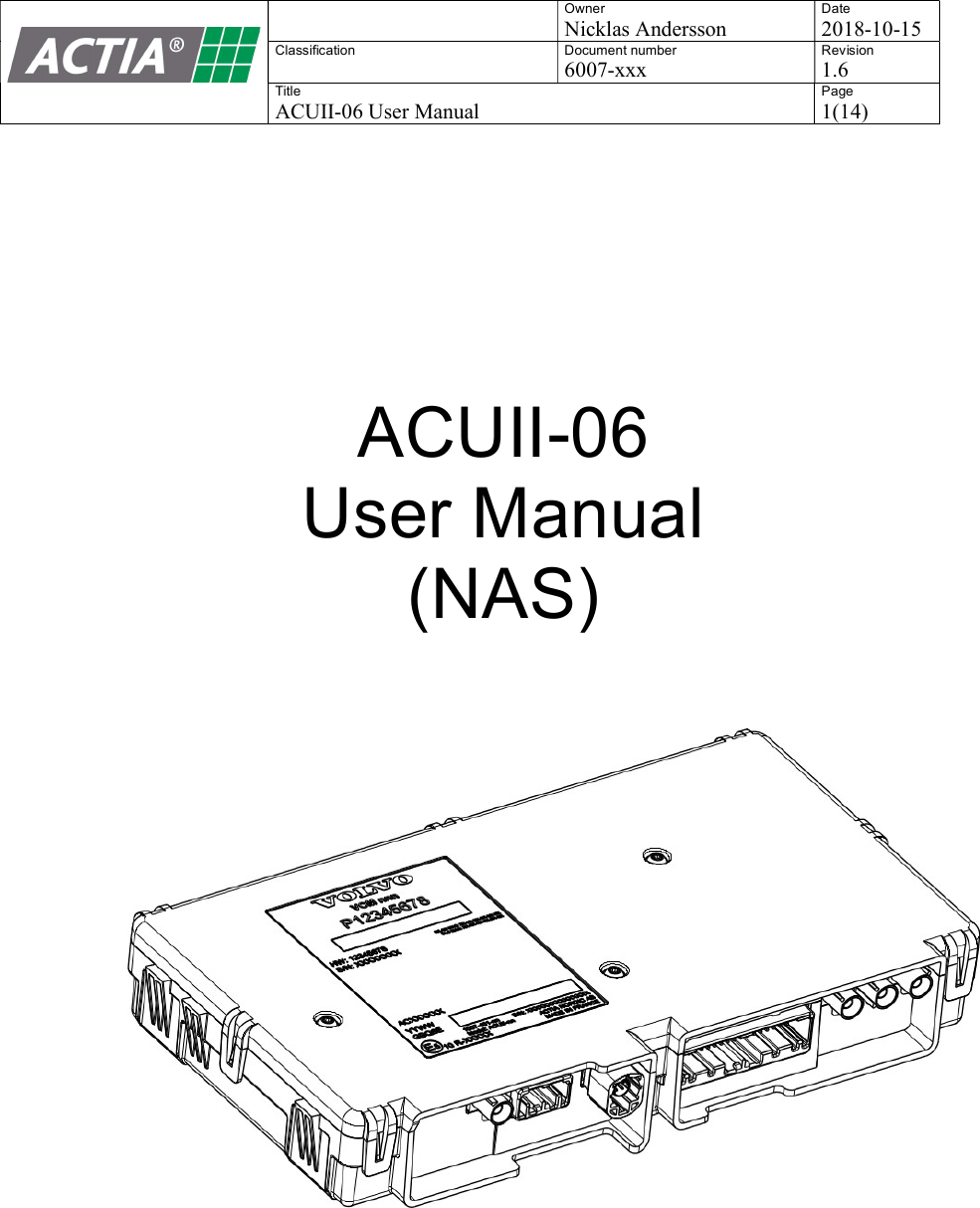
   Owner Nicklas Andersson Date 2018-10-15 Classification  Document number 6007-xxx Revision 1.6 Title ACUII-06 User Manual Page 1(14)     ACUII-06 User Manual (NAS)
   Owner Nicklas Andersson Date 2018-10-15 Classification  Document number 6007-xxx Revision 1.6 Title ACUII-06 User Manual Page 2(14)  Content  1 General ...................................................................................................................................................... 3 1.1 Revision history ................................................................................................................................. 3 1.2 Abbreviations .................................................................................................................................... 3 1.3 References ......................................................................................................................................... 3 2 Introduction ............................................................................................................................................... 4 3 Technical Description ................................................................................................................................ 5 3.1 Connectors ......................................................................................................................................... 5 3.1.1 WLAN antenna .......................................................................................................................... 5 3.1.2 DLC Ethernet connector ............................................................................................................ 5 3.1.3 IHU Ethernet connector ............................................................................................................. 5 3.1.4 Main connector .......................................................................................................................... 5 3.1.5 GNSS antenna............................................................................................................................ 5 3.1.6 3G/4G diversity antenna ............................................................................................................ 5 3.1.7 2G/3G/4G antenna ..................................................................................................................... 5 3.2 Power supply ..................................................................................................................................... 6 3.3 SIM interface ..................................................................................................................................... 6 3.4 Backup antenna ................................................................................................................................. 6 3.5 External antenna ................................................................................................................................ 6 4 RF parameters ............................................................................................................................................ 7 4.1.1 Supported bands ........................................................................................................................ 7 4.2 GNSS ................................................................................................................................................. 7 4.2.1 Supported bands ........................................................................................................................ 7 4.3 WLAN ............................................................................................................................................... 7 4.3.1 Supported bands ........................................................................................................................ 7 5 Mechanical design ..................................................................................................................................... 9 6 Functional Description ............................................................................................................................ 10 6.1 Diagnostics ...................................................................................................................................... 10 6.1.1 DoIP connection ...................................................................................................................... 10 6.1.2 CAN connection ...................................................................................................................... 10 6.1.3 WLAN ..................................................................................................................................... 10 6.2 WLAN access point ......................................................................................................................... 10 6.3 Data gateway ................................................................................................................................... 10 6.4 Positioning information ................................................................................................................... 10 6.5 Telematics applications ................................................................................................................... 10 6.5.1 Automatic emergency call ....................................................................................................... 11 6.5.2 Manual emergency call ............................................................................................................ 11 6.5.3 Roadside assistance call ........................................................................................................... 11 6.5.4 Theft Warning.......................................................................................................................... 11 6.5.5 Stolen Vehicle Tracking .......................................................................................................... 11 6.5.6 Remote Vehicle Imobilization ................................................................................................. 11 6.5.7 Remote door unlock................................................................................................................. 11 6.5.8 Other applications .................................................................................................................... 11 7 Installation and maintenance ................................................................................................................... 12 7.1 Installation ....................................................................................................................................... 12 7.2 Maintenance .................................................................................................................................... 12 8 Regulatory Certifications ......................................................................................................................... 13 8.1 USA (FCC) ...................................................................................................................................... 13 8.1.1 FCC Warnings and Notices ..................................................................................................... 13 8.1.2 OEM Requirements ................................................................................................................. 13 8.2 Canada (IC) ..................................................................................................................................... 14 8.2.1 OEM Requirements ................................................................................................................. 14
   Owner Nicklas Andersson Date 2018-10-15 Classification  Document number 6007-xxx Revision 1.6 Title ACUII-06 User Manual Page 3(14)  1  General This document describes the North American (NAS) version of ACTIA’s product ACUII-06. 1.1  Revision history Revision Author Date Description 1.0 Nicklas Andersson 2016-04-06 First version 1.1 Nicklas Andersson 2016-04-26 Added chapter 3.5 External antenna. 1.2 Nicklas Andersson 2016-04-27 Added English text in 8.2.1. 1.3  Nicklas Andersson  2016-05-09  4.3.1 Product variant only uses 2.4GHz WLAN channels 1-11.  1.4 Nicklas Andersson 2016-05-23 8.2 Removed text about ICES-003. 1.5 Salah Alazawi 2018-10-09 Updated with new FCC/IC 1.6  Salah Alazawi  2018-10-15  Corrected WCDMA band.  Added English text under 8.2 Moved 15B statement from 8.1.1 to 8.1.2. 1.2  Abbreviations Abbreviation Meaning DoIP Diagnostics over IP ECU Electrical Control Unit GNSS Global Navigation Satellite System OBD On-Board Diagnostics SRS Supplemental Restraint System WLAN Wireless Local Area Network 1.3  References Reference Title Doc. number Revision
   Owner Nicklas Andersson Date 2018-10-15 Classification  Document number 6007-xxx Revision 1.6 Title ACUII-06 User Manual Page 4(14)  2  Introduction The ACUII-06 is a connectivity ECU that is factory fitted in cars. It provides following functionality:   Diagnostics - routing of diagnostics data between the vehicle and external test equipment, via CAN, Ethernet and WLAN.    WLAN access point - for people inside the vehicle.   Data gateway - for the WLAN access point and other ECUs in the vehicle.   Positioning information - for other ECUs in the vehicle, such as the navigation system.   Telematics applications - like emergency calls, breakdown calls and stolen vehicle tracking.    The ACUII-06 has an integrated 2G/3G/4G modem that provides data connection and voice call functionality needed for the different applications.
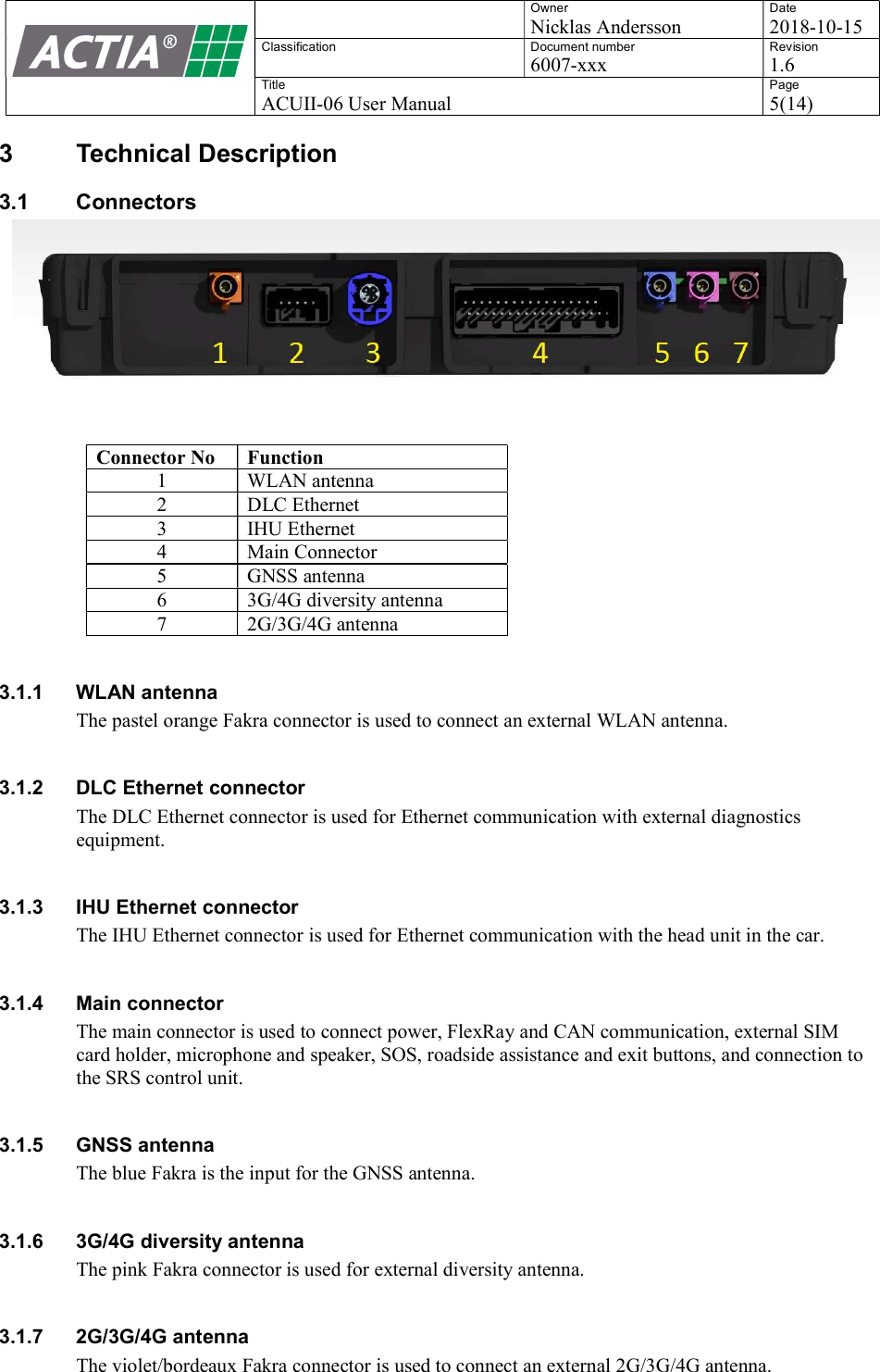
   Owner Nicklas Andersson Date 2018-10-15 Classification  Document number 6007-xxx Revision 1.6 Title ACUII-06 User Manual Page 5(14)  3  Technical Description 3.1  Connectors   Connector No  Function 1 WLAN antenna 2 DLC Ethernet 3 IHU Ethernet 4 Main Connector 5 GNSS antenna 6 3G/4G diversity antenna 7 2G/3G/4G antenna  3.1.1  WLAN antenna The pastel orange Fakra connector is used to connect an external WLAN antenna.   3.1.2  DLC Ethernet connector The DLC Ethernet connector is used for Ethernet communication with external diagnostics equipment.  3.1.3  IHU Ethernet connector The IHU Ethernet connector is used for Ethernet communication with the head unit in the car.  3.1.4  Main connector The main connector is used to connect power, FlexRay and CAN communication, external SIM card holder, microphone and speaker, SOS, roadside assistance and exit buttons, and connection to the SRS control unit.  3.1.5  GNSS antenna The blue Fakra is the input for the GNSS antenna.   3.1.6  3G/4G diversity antenna The pink Fakra connector is used for external diversity antenna.  3.1.7  2G/3G/4G antenna The violet/bordeaux Fakra connector is used to connect an external 2G/3G/4G antenna.
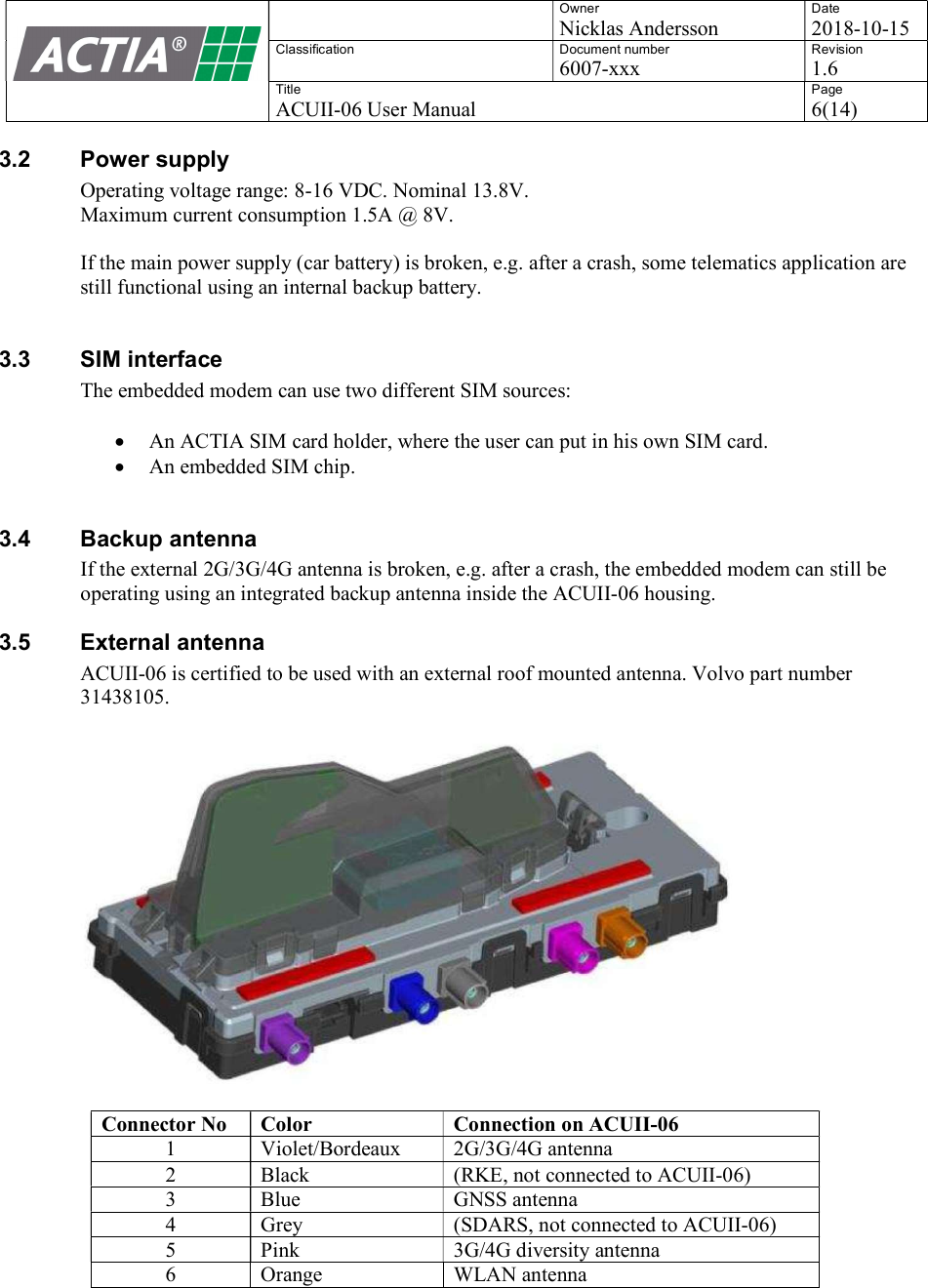
   Owner Nicklas Andersson Date 2018-10-15 Classification  Document number 6007-xxx Revision 1.6 Title ACUII-06 User Manual Page 6(14)  3.2  Power supply Operating voltage range: 8-16 VDC. Nominal 13.8V. Maximum current consumption 1.5A @ 8V.  If the main power supply (car battery) is broken, e.g. after a crash, some telematics application are still functional using an internal backup battery.  3.3  SIM interface The embedded modem can use two different SIM sources:   An ACTIA SIM card holder, where the user can put in his own SIM card.   An embedded SIM chip.  3.4  Backup antenna If the external 2G/3G/4G antenna is broken, e.g. after a crash, the embedded modem can still be operating using an integrated backup antenna inside the ACUII-06 housing. 3.5  External antenna  ACUII-06 is certified to be used with an external roof mounted antenna. Volvo part number 31438105.    Connector No  Color  Connection on ACUII-06 1 Violet/Bordeaux 2G/3G/4G antenna 2 Black (RKE, not connected to ACUII-06) 3 Blue GNSS antenna 4 Grey (SDARS, not connected to ACUII-06) 5 Pink 3G/4G diversity antenna 6 Orange WLAN antenna
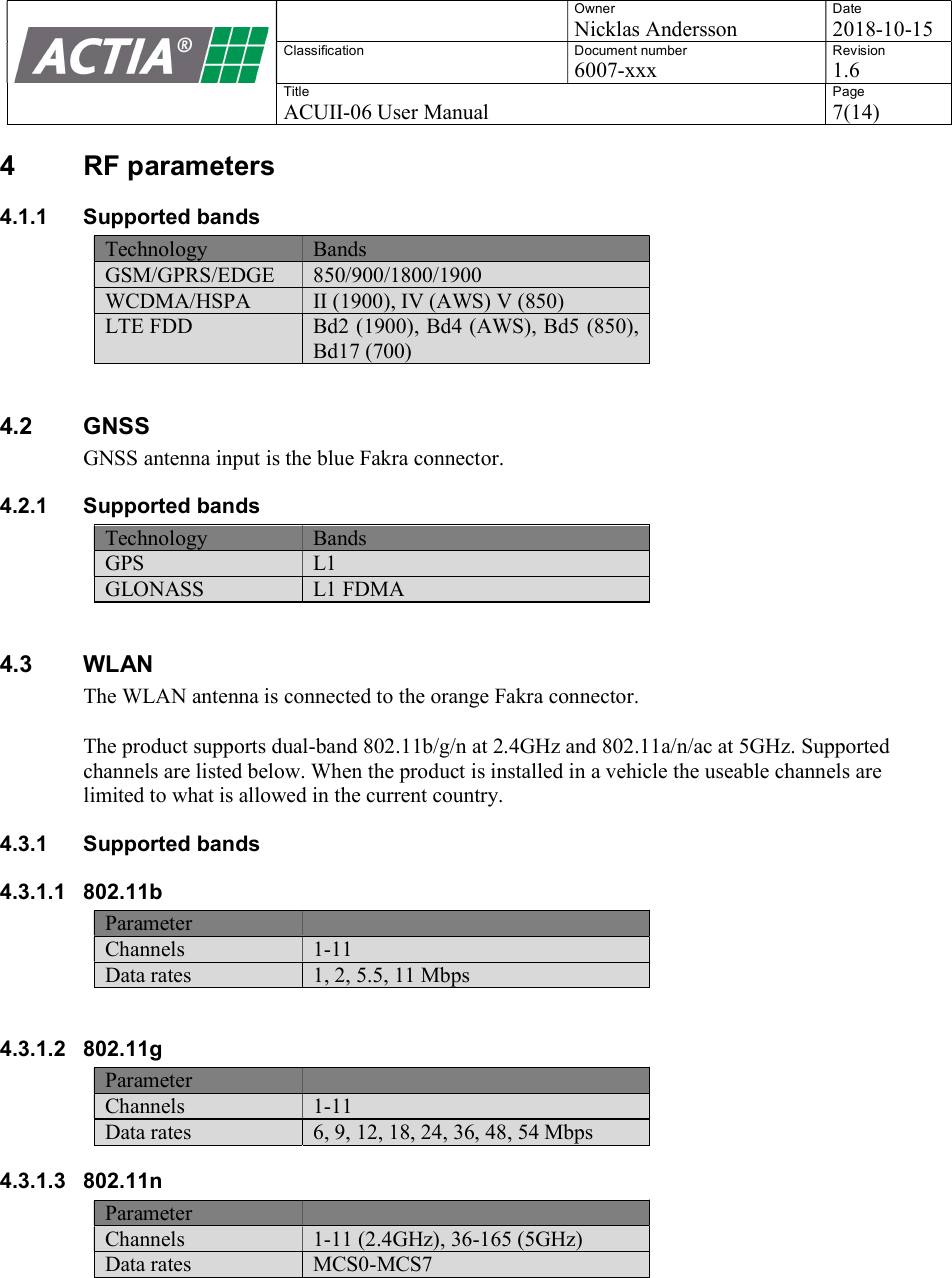
   Owner Nicklas Andersson Date 2018-10-15 Classification  Document number 6007-xxx Revision 1.6 Title ACUII-06 User Manual Page 7(14)  4  RF parameters 4.1.1  Supported bands Technology Bands GSM/GPRS/EDGE 850/900/1800/1900 WCDMA/HSPA II (1900), IV (AWS) V (850) LTE FDD  Bd2 (1900), Bd4 (AWS), Bd5 (850), Bd17 (700)  4.2  GNSS  GNSS antenna input is the blue Fakra connector. 4.2.1  Supported bands Technology Bands GPS L1 GLONASS L1 FDMA  4.3  WLAN The WLAN antenna is connected to the orange Fakra connector.  The product supports dual-band 802.11b/g/n at 2.4GHz and 802.11a/n/ac at 5GHz. Supported channels are listed below. When the product is installed in a vehicle the useable channels are limited to what is allowed in the current country. 4.3.1  Supported bands 4.3.1.1  802.11b Parameter  Channels 1-11 Data rates 1, 2, 5.5, 11 Mbps  4.3.1.2  802.11g Parameter  Channels 1-11 Data rates 6, 9, 12, 18, 24, 36, 48, 54 Mbps 4.3.1.3  802.11n Parameter  Channels 1-11 (2.4GHz), 36-165 (5GHz) Data rates MCS0-MCS7
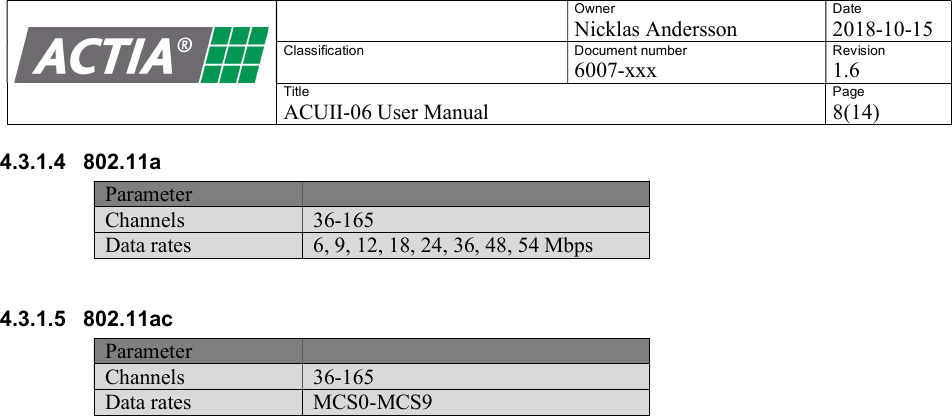
   Owner Nicklas Andersson Date 2018-10-15 Classification  Document number 6007-xxx Revision 1.6 Title ACUII-06 User Manual Page 8(14)  4.3.1.4  802.11a Parameter  Channels 36-165 Data rates 6, 9, 12, 18, 24, 36, 48, 54 Mbps  4.3.1.5  802.11ac Parameter  Channels 36-165 Data rates MCS0-MCS9
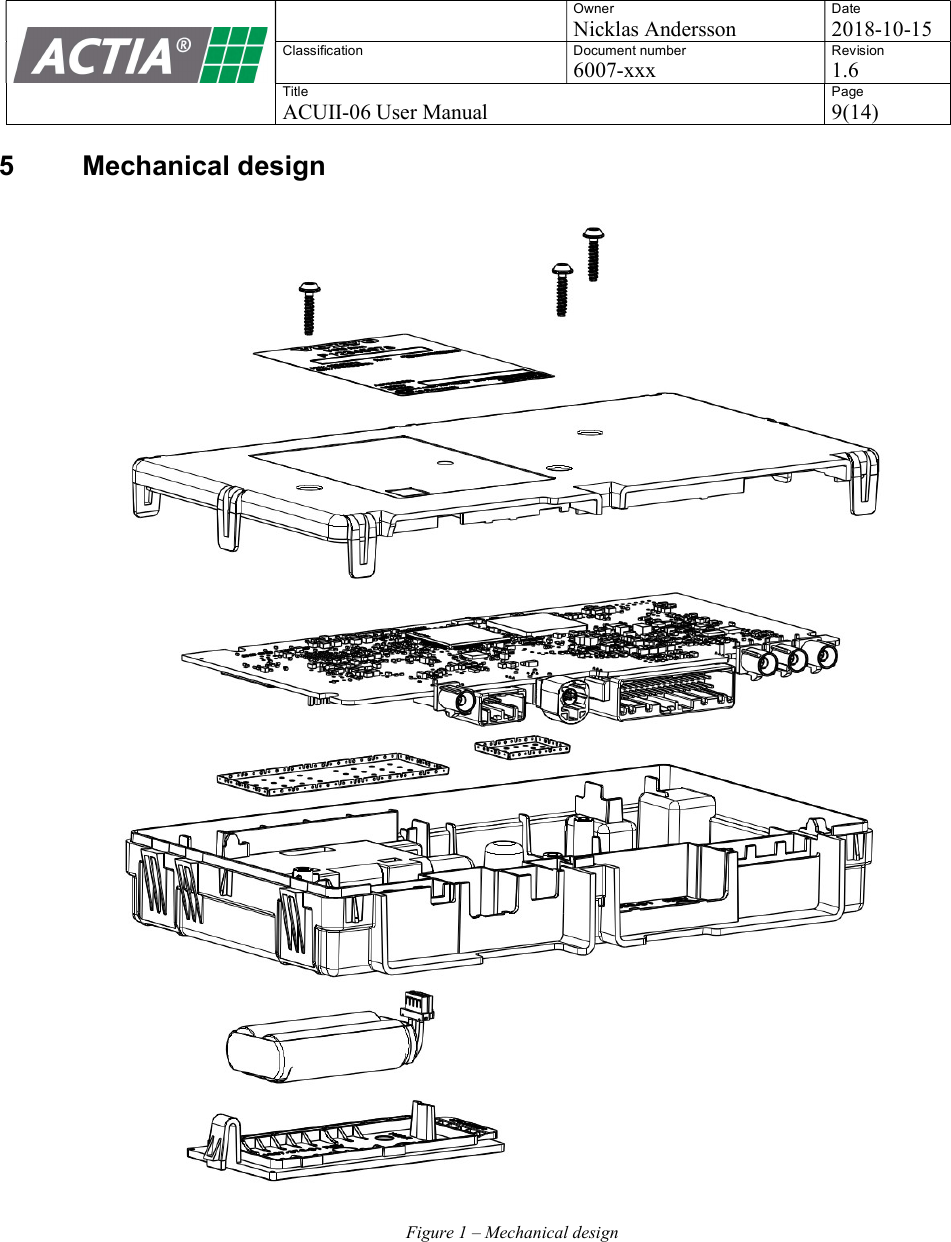
   Owner Nicklas Andersson Date 2018-10-15 Classification  Document number 6007-xxx Revision 1.6 Title ACUII-06 User Manual Page 9(14)  5  Mechanical design    Figure 1 – Mechanical design
   Owner Nicklas Andersson Date 2018-10-15 Classification  Document number 6007-xxx Revision 1.6 Title ACUII-06 User Manual Page 10(14)  6  Functional Description 6.1  Diagnostics 6.1.1  DoIP connection Interface to diagnostics functionality is via the DLC Ethernet interface. This interface should be connected to DoIP interface in the vehicle, located in the OBD connector.  When test equipment is connected to the OBD Ethernet port in the vehicle, the ACUII-06 presents itself on the network using a “Vehicle Announcement Message”, as specified in ISO 13400-2. Based on the content of this message, an external tester tool can connect to the ACUII-06 and create a diagnostic session.  6.1.2  CAN connection The can interface of ACUII-06 should also be connected to the OBD connector in the vehicle.  To communicate with the ACUII-06 and the ECUs behind the ACUII-06 in the vehicle topology, the diagnostic requests shall be sent with 29-bit addressing.  The same CAN interface is used for legislated ODB diagnostics. For such purposes, 11-bit addressing is used.   6.1.3  WLAN Diagnostics functionality is also available via WLAN. The unit ca be set in a mode where it acts like a WLAN station and attaches to a hotspot in the workshop.  6.2  WLAN access point ACUII-06 can act as a WLAN access point for passengers in the car.   User interface needs to be implemented in an external unit, e.g. in a head unit with display. The WLAN access point functionality is controlled via IHU Ethernet interface.  6.3  Data gateway ACUII-06 acts as a data gateway for the WLAN access point and other ECUs in the vehicle. It can e.g. provide internet connectivity for the head unit.  The data gateway is controlled via the IHU Ethernet interface.  6.4  Positioning information The product automatically outputs GNSS raw position data on the CAN bus.   The GNSS data is used by other ECUs in the vehicle, for instance the Navigation system  6.5  Telematics applications The product hosts a number of telematics applications. Some examples:
   Owner Nicklas Andersson Date 2018-10-15 Classification  Document number 6007-xxx Revision 1.6 Title ACUII-06 User Manual Page 11(14)  6.5.1  Automatic emergency call If the car is in a crash and the SRS control unit indicates seat belt pretensioners, airbags or inflatable curtain has deployed, an automatic alarm is sent to a predefined Customer Service Center, via data connection or SMS, with information about the vehicle's location and that one or more of the previously mentioned systems has deployed.  A voice call is also set up to the call center.  6.5.2  Manual emergency call It is also possible to start an emergency call manually by pressing a SOS button for at least 2 seconds.  A service that has been initiated can be cancelled by pressing the EXIT button within 10 seconds.  6.5.3  Roadside assistance call Another button for roadside assistance will send data message and set up a voice call to a predefined road side assistance number.  A service that has been initiated can be cancelled by pressing the EXIT button within 10 seconds.  6.5.4  Theft Warning The call center and the car owner is contacted with a data message if the car alarm indicates the car is being stolen.  6.5.5  Stolen Vehicle Tracking The call center can initiate tracking of the car if it has been reported stolen. The vehicle location will then be reported to the call center.  6.5.6  Remote Vehicle Imobilization If the car has been reported stolen the call center can instruct the car not to start.   6.5.7  Remote door unlock The call center or the car owner can unlock the car remotely.  6.5.8  Other applications With data provided from ACUII-06 it is also possible to build applications in e.g. mobile phones to be used by the car owner. Examples:  Vehicle location (present car location on a map)  Instrument panel information (show e.g. mileage, fuel level)  Status check (if service is needed)
   Owner Nicklas Andersson Date 2018-10-15 Classification  Document number 6007-xxx Revision 1.6 Title ACUII-06 User Manual Page 12(14)  7  Installation and maintenance 7.1  Installation The product is factory fitted in vehicles. It is not possible to buy this product separately.   7.2  Maintenance The status of the product can be read via diagnostic connections using special workshop tools. In addition, other ECUs monitor the communication from the product and in case of missing/invalid communication, the Central Electronic Module in the vehicle is alerted, and will display a warning to the driver.  Maintenance and replacement of the product can only be performed by certified workshops.
   Owner Nicklas Andersson Date 2018-10-15 Classification  Document number 6007-xxx Revision 1.6 Title ACUII-06 User Manual Page 13(14)  8  Regulatory Certifications 8.1  USA (FCC) This device complies with Part 15 of the FCC rules. Operation is subject to the following two conditions: (1) This device may not cause harmful interference, and (2) This device must accept any interference received, including interference that may cause undesired operation. 8.1.1  FCC Warnings and Notices WARNING: The FCC requires the user to be notified that any changes or modifications made to this device that are not expressly approved by ACTIA Nordic AB could void the user's authority to operate the equipment. RF EXPOSURE WARNING: This equipment complies with FCC radiation exposure limits set forth for an uncontrolled environment. This equipment should be installed and operated with minimum distance 20 cm between the radiator and your body. This transmitter must not be co-located or operating in conjunction with any other antenna or transmitter.  8.1.2  OEM Requirements Following text should be printed in the user manual for vehicles in US:   Type Approval USA FCC ID: 2AGKKACUII-06H2  This device complies with Part 15 of the FCC rules. Operation is subject to the following two conditions: (1) This device may not cause harmful interference, and (2) This device must accept any interference received, including interference that may cause undesired operation.  WARNING: Changes or modifications not expressly approved by the party responsible for compliance could void the user's authority to operate the equipment.  NOTICE: This equipment has been tested and found to comply with the limits for a Class B digital device, pursuant to part 15 of the FCC Rules. These limits are designed to provide reasonable protection against harmful interference in a residential installation. This equipment generates, uses, and can radiate radio frequency energy and, if not installed and used in accordance with the instructions, may cause harmful interference to radio communications. However, there is no guarantee that interference will not occur in a particular installation. If this equipment does cause harmful interference to radio or television reception, which can be determined by turning the equipment off and on, the user is encouraged to try to correct the interference by one or more of the following measures: - Reorient or relocate the receiving antenna. - Increase the separation between the equipment and receiver. - Connect the equipment into an outlet on a circuit different from that to which the receiver is connected. - Consult the dealer or an experienced radio/TV technician for help.
   Owner Nicklas Andersson Date 2018-10-15 Classification  Document number 6007-xxx Revision 1.6 Title ACUII-06 User Manual Page 14(14)  8.2  Canada (IC) This device is compliant with the Radio-Electrical Standards for Radio Devices for Canadian Industry exempt from license. Operation is permitted under the following two conditions: (1) the device shall not produce any interference, and (2) the user of the device must accept any received radio-electrical interference, even if the interference is likely to compromise its operation.  Le présent appareil est conforme aux CNR d'Industrie Canada applicables aux appareils radio exempts de licence. L'exploitation est autorisée aux deux conditions suivantes : (1) l'appareil ne doit pas produire de brouillage, et (2) l'utilisateur de l'appareil doit accepter tout brouillage radioélectrique subi, même si le brouillage est susceptible d'en compromettre le fonctionnement.  8.2.1  OEM Requirements Following text should be printed in the user manual for vehicles in Canada:   Type Approval Canada IC: 20839-ACUII06H2  This device complies with Industry Canada license-exempt RSS standard(s). Operation is subject to the following two conditions:  (1) this device may not cause harmful interference, and  (2) this device must accept any interference received, including interference that may cause undesired operation  Le présent appareil est conforme aux CNR d'Industrie Canada applicables aux appareils radio exempts de licence. L'exploitation est autorisée aux deux conditions suivantes :  (1) l'appareil ne doit pas produire de brouillage (2) l'utilisateur de l'appareil doit accepter tout brouillage radioélectrique subi, même si le brouillage est susceptible d'en compromettre le fonctionnement.

Navigation menu