Air Vent WHSP2000 WHISPER AIRE WHSP2000 User Manual Layout 1

Air Vent, Inc. WHISPER AIRE WHSP2000 Layout 1

Exhibit D Users Manual per 2 1033 b3

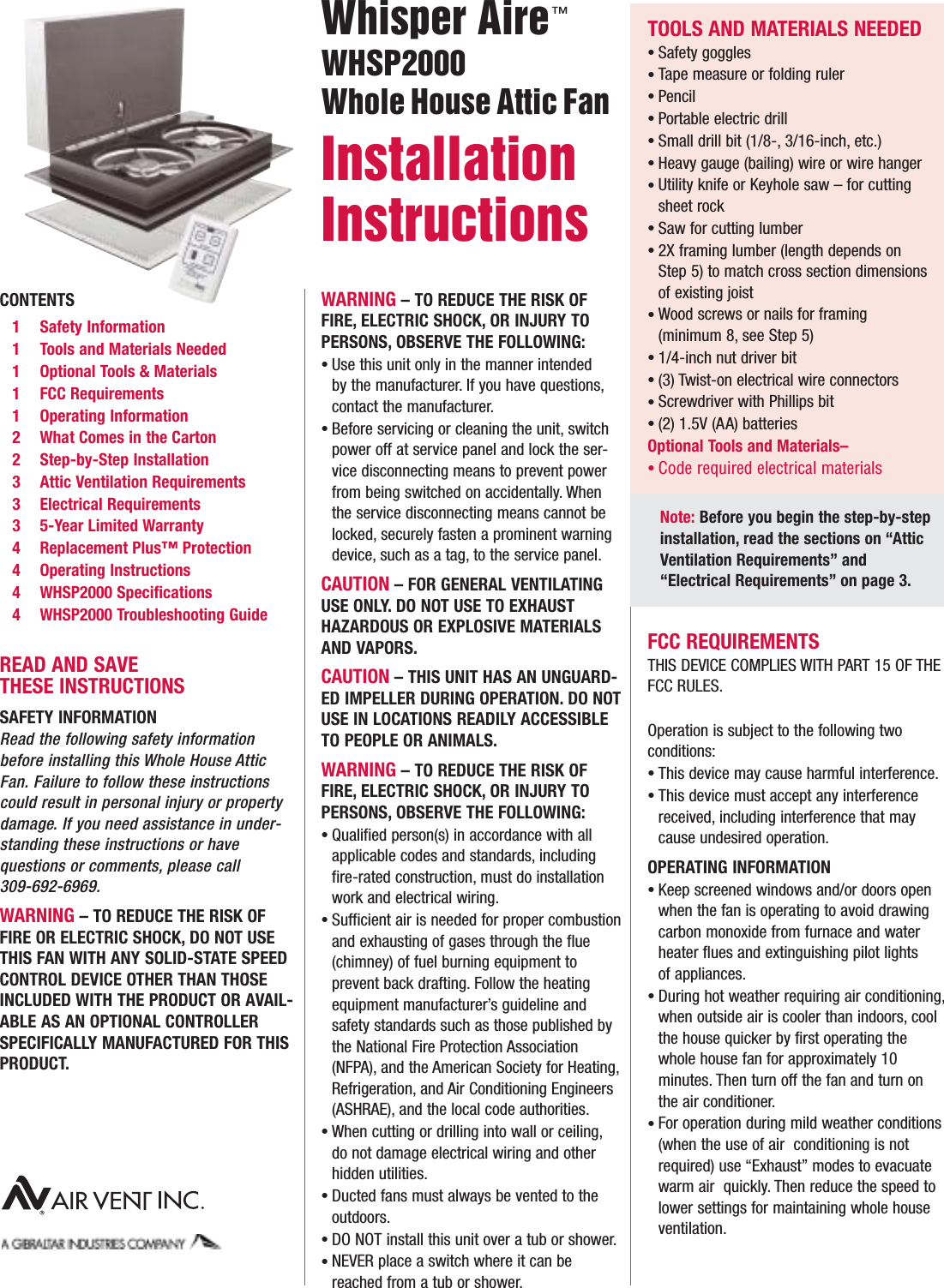
CONTENTS1 Safety Information1 Tools and Materials Needed1 Optional Tools & Materials1 FCC Requirements1 Operating Information2 What Comes in the Carton2 Step-by-Step Installation3 Attic Ventilation Requirements3 Electrical Requirements3  5-Year Limited Warranty4 Replacement Plus™ Protection 4 Operating Instructions4 WHSP2000 Specifications4 WHSP2000 Troubleshooting GuideREAD AND SAVE THESE INSTRUCTIONSSAFETY INFORMATION Read the following safety informationbefore installing this Whole House Attic Fan. Failure to follow these instructionscould result in personal injury or propertydamage. If you need assistance in under-standing these instructions or have questions or comments, please call 309-692-6969.WARNING – TO REDUCE THE RISK OFFIRE OR ELECTRIC SHOCK, DO NOT USETHIS FAN WITH ANY SOLID-STATE SPEEDCONTROL DEVICE OTHER THAN THOSEINCLUDED WITH THE PRODUCT OR AVAIL-ABLE AS AN OPTIONAL CONTROLLERSPECIFICALLY MANUFACTURED FOR THISPRODUCT.WARNING – TO REDUCE THE RISK OFFIRE, ELECTRIC SHOCK, OR INJURY TOPERSONS, OBSERVE THE FOLLOWING:Use this unit only in the manner intended by the manufacturer. If you have questions,contact the manufacturer.Before servicing or cleaning the unit, switch power off at service panel and lock the ser-vice disconnecting means to prevent power from being switched on accidentally. When the service disconnecting means cannot be locked, securely fasten a prominent warning device, such as a tag, to the service panel.CAUTION – FOR GENERAL VENTILATINGUSE ONLY. DO NOT USE TO EXHAUST HAZARDOUS OR EXPLOSIVE MATERIALSAND VAPORS.CAUTION – THIS UNIT HAS AN UNGUARD-ED IMPELLER DURING OPERATION. DO NOTUSE IN LOCATIONS READILY ACCESSIBLETO PEOPLE OR ANIMALS.WARNING – TO REDUCE THE RISK OFFIRE, ELECTRIC SHOCK, OR INJURY TOPERSONS, OBSERVE THE FOLLOWING:Qualified person(s) in accordance with all applicable codes and standards, including fire-rated construction, must do installation work and electrical wiring.Sufficient air is needed for proper combustionand exhausting of gases through the flue (chimney) of fuel burning equipment to prevent back drafting. Follow the heating equipment manufacturer’s guideline and safety standards such as those published by the National Fire Protection Association (NFPA), and the American Society for Heating,Refrigeration, and Air Conditioning Engineers (ASHRAE), and the local code authorities.When cutting or drilling into wall or ceiling,do not damage electrical wiring and other hidden utilities.Ducted fans must always be vented to the outdoors.DO NOT install this unit over a tub or shower.NEVER place a switch where it can be reached from a tub or shower.••••••••FCC REQUIREMENTSTHIS DEVICE COMPLIES WITH PART 15 OF THEFCC RULES.FCC ID: NGQGLD001Operation is subject to the following two conditions:This device may cause harmful interference.This device must accept any interference received, including interference that may cause undesired operation.OPERATING INFORMATIONKeep screened windows and/or doors open when the fan is operating to avoid drawing carbon monoxide from furnace and water heater flues and extinguishing pilot lights of appliances.During hot weather requiring air conditioning,when outside air is cooler than indoors, cool the house quicker by first operating the whole house fan for approximately 10 minutes. Then turn off the fan and turn on the air conditioner.For operation during mild weather conditions(when the use of air  conditioning is notrequired) use “Exhaust” modes to evacuatewarm air  quickly. Then reduce the speed tolower settings for maintaining whole houseventilation.•••••TOOLS AND MATERIALS NEEDEDSafety gogglesTape measure or folding rulerPencilPortable electric drillSmall drill bit (1/8-, 3/16-inch, etc.)Heavy gauge (bailing) wire or wire hangerUtility knife or Keyhole saw – for cutting sheet rockSaw for cutting lumber2X framing lumber (length depends on Step 5) to match cross section dimensions of existing joistWood screws or nails for framing (minimum 8, see Step 5)1/4-inch nut driver bit(3) Twist-on electrical wire connectorsScrewdriver with Phillips bit(2) 1.5V (AA) batteriesOptional Tools and Materials–Code required electrical materials •••••••••••••••Note: Before you begin the step-by-step installation, read the sections on “Attic Ventilation Requirements” and “Electrical Requirements” on page 3.Whisper AireWHSP2000 Whole House Attic Fan Installation Instructions ™
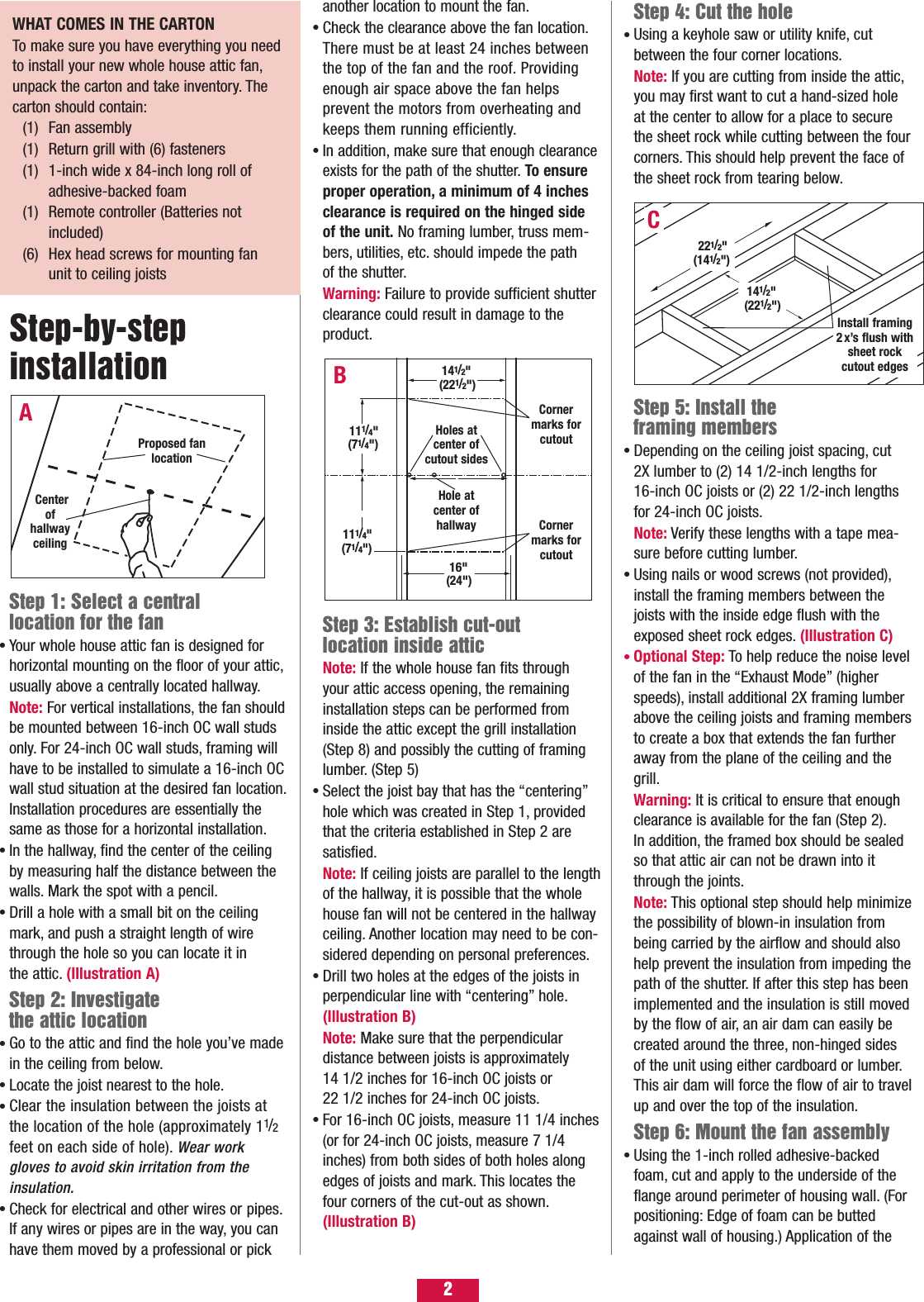
Step 4: Cut the holeUsing a keyhole saw or utility knife, cut between the four corner locations.Note: If you are cutting from inside the attic,you may first want to cut a hand-sized hole at the center to allow for a place to secure the sheet rock while cutting between the fourcorners. This should help prevent the face of the sheet rock from tearing below.Step 5: Install the framing membersDepending on the ceiling joist spacing, cut 2X lumber to (2) 14 1/2-inch lengths for 16-inch OC joists or (2) 22 1/2-inch lengths for 24-inch OC joists.Note: Verify these lengths with a tape mea-sure before cutting lumber.Using nails or wood screws (not provided),install the framing members between the joists with the inside edge flush with the exposed sheet rock edges. (Illustration C)Optional Step: To help reduce the noise levelof the fan in the “Exhaust Mode” (higher speeds), install additional 2X framing lumber above the ceiling joists and framing membersto create a box that extends the fan further away from the plane of the ceiling and the grill.Warning: It is critical to ensure that enough clearance is available for the fan (Step 2).In addition, the framed box should be sealed so that attic air can not be drawn into it through the joints.Note: This optional step should help minimizethe possibility of blown-in insulation from being carried by the airflow and should also help prevent the insulation from impeding thepath of the shutter. If after this step has beenimplemented and the insulation is still movedby the flow of air, an air dam can easily be created around the three, non-hinged sides of the unit using either cardboard or lumber.This air dam will force the flow of air to travelup and over the top of the insulation.Step 6: Mount the fan assemblyUsing the 1-inch rolled adhesive-backed foam, cut and apply to the underside of the flange around perimeter of housing wall. (For positioning: Edge of foam can be butted against wall of housing.) Application of the •••••Step 1: Select a central location for the fanYour whole house attic fan is designed for horizontal mounting on the floor of your attic,usually above a centrally located hallway.Note: For vertical installations, the fan shouldbe mounted between 16-inch OC wall studs only. For 24-inch OC wall studs, framing will have to be installed to simulate a 16-inch OCwall stud situation at the desired fan location.Installation procedures are essentially the same as those for a horizontal installation.In the hallway, find the center of the ceiling by measuring half the distance between the walls. Mark the spot with a pencil.Drill a hole with a small bit on the ceiling mark, and push a straight length of wire through the hole so you can locate it in the attic. (Illustration A) Step 2: Investigate the attic location Go to the attic and find the hole you’ve made in the ceiling from below.Locate the joist nearest to the hole.Clear the insulation between the joists at the location of the hole (approximately 11/2feet on each side of hole). Wear work gloves to avoid skin irritation from theinsulation.Check for electrical and other wires or pipes.If any wires or pipes are in the way, you can have them moved by a professional or pick •••••••Step-by-step installation another location to mount the fan.Check the clearance above the fan location.There must be at least 24 inches between the top of the fan and the roof. Providing enough air space above the fan helps prevent the motors from overheating and keeps them running efficiently.In addition, make sure that enough clearanceexists for the path of the shutter. To ensure proper operation, a minimum of 4 inches clearance is required on the hinged side of the unit. No framing lumber, truss mem-bers, utilities, etc. should impede the path of the shutter.Warning: Failure to provide sufficient shutter clearance could result in damage to the product.Step 3: Establish cut-out location inside atticNote: If the whole house fan fits through your attic access opening, the remaining installation steps can be performed from inside the attic except the grill installation (Step 8) and possibly the cutting of framing lumber. (Step 5) Select the joist bay that has the “centering”hole which was created in Step 1, provided that the criteria established in Step 2 are satisfied.Note: If ceiling joists are parallel to the lengthof the hallway, it is possible that the whole house fan will not be centered in the hallway ceiling. Another location may need to be con-sidered depending on personal preferences.Drill two holes at the edges of the joists in perpendicular line with “centering” hole.(Illustration B)Note: Make sure that the perpendicular distance between joists is approximately 14 1/2 inches for 16-inch OC joists or 22 1/2 inches for 24-inch OC joists.For 16-inch OC joists, measure 11 1/4 inches(or for 24-inch OC joists, measure 7 1/4 inches) from both sides of both holes along edges of joists and mark. This locates the four corners of the cut-out as shown.(Illustration B)•••••BAProposed fan location141/2"(221/2")Holes atcenter ofcutout sides Cornermarks forcutoutHole atcenter ofhallway16"(24")111/4"(71/4")111/4"(71/4")Center of hallway ceiling Cornermarks forcutoutInstall framing2x’s flush withsheet rockcutout edgesC141/2"(221/2")221/2"(141/2")2WHAT COMES IN THE CARTON To make sure you have everything you needto install your new whole house attic fan,unpack the carton and take inventory. Thecarton should contain:(1) Fan assembly(1) Return grill with (6) fasteners(1) 1-inch wide x 84-inch long roll of adhesive-backed foam(1) Remote controller (Batteries not included)(6) Hex head screws for mounting fan unit to ceiling joists
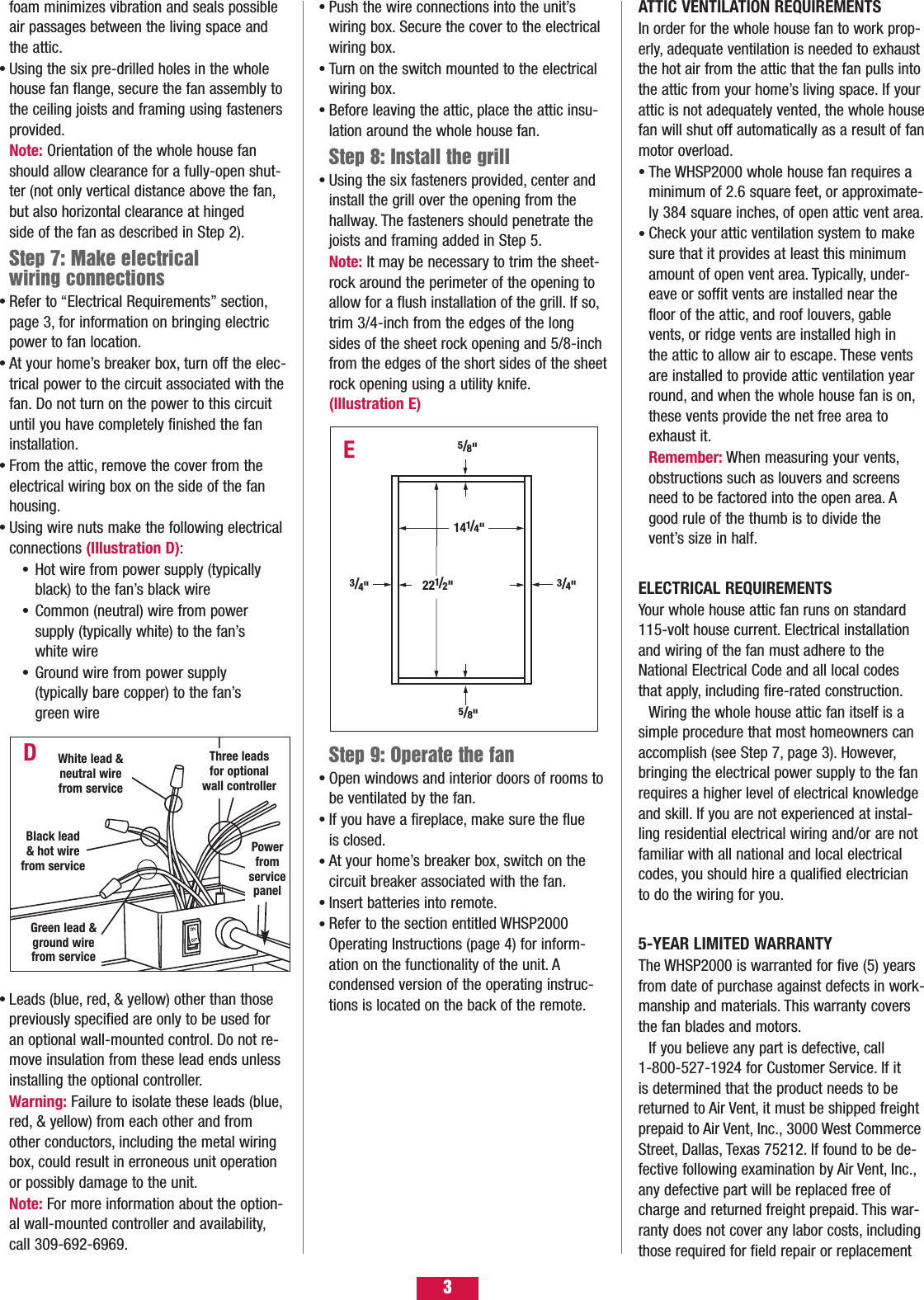
foam minimizes vibration and seals possible air passages between the living space and the attic.Using the six pre-drilled holes in the whole house fan flange, secure the fan assembly to the ceiling joists and framing using fasteners provided.Note: Orientation of the whole house fan should allow clearance for a fully-open shut-ter (not only vertical distance above the fan,but also horizontal clearance at hinged side of the fan as described in Step 2).Step 7: Make electrical wiring connectionsRefer to “Electrical Requirements” section,page 3, for information on bringing electric power to fan location.At your home’s breaker box, turn off the elec-trical power to the circuit associated with thefan. Do not turn on the power to this circuit until you have completely finished the fan installation.From the attic, remove the cover from the electrical wiring box on the side of the fan housing.Using wire nuts make the following electrical connections (Illustration D):Hot wire from power supply (typically black) to the fan’s black wireCommon (neutral) wire from power supply (typically white) to the fan’s white wireGround wire from power supply (typically bare copper) to the fan’s green wire Leads (blue, red, & yellow) other than those previously specified are only to be used for an optional wall-mounted control. Do not re- move insulation from these lead ends unless installing the optional controller.Warning: Failure to isolate these leads (blue,red, & yellow) from each other and from other conductors, including the metal wiring box, could result in erroneous unit operation or possibly damage to the unit.Note: For more information about the option-al wall-mounted controller and availability,call 309-692-6969.•••••••••Push the wire connections into the unit’s wiring box. Secure the cover to the electrical wiring box.Turn on the switch mounted to the electrical wiring box.Before leaving the attic, place the attic insu-lation around the whole house fan.Step 8: Install the grillUsing the six fasteners provided, center and install the grill over the opening from the hallway. The fasteners should penetrate the joists and framing added in Step 5.Note: It may be necessary to trim the sheet-rock around the perimeter of the opening to allow for a flush installation of the grill. If so,trim 3/4-inch from the edges of the long sides of the sheet rock opening and 5/8-inch from the edges of the short sides of the sheetrock opening using a utility knife.(Illustration E)Step 9: Operate the fanOpen windows and interior doors of rooms tobe ventilated by the fan.If you have a fireplace, make sure the flue is closed.At your home’s breaker box, switch on the circuit breaker associated with the fan.Insert batteries into remote.Refer to the section entitled WHSP2000 Operating Instructions (page 4) for inform-ation on the functionality of the unit. A condensed version of the operating instruc-tions is located on the back of the remote.•••••••••EATTIC VENTILATION REQUIREMENTSIn order for the whole house fan to work prop-erly, adequate ventilation is needed to exhaustthe hot air from the attic that the fan pulls intothe attic from your home’s living space. If yourattic is not adequately vented, the whole housefan will shut off automatically as a result of fanmotor overload.The WHSP2000 whole house fan requires a minimum of 2.6 square feet, or approximate-ly 384 square inches, of open attic vent area.Check your attic ventilation system to make sure that it provides at least this minimum amount of open vent area. Typically, under-eave or soffit vents are installed near the floor of the attic, and roof louvers, gable vents, or ridge vents are installed high in the attic to allow air to escape. These vents are installed to provide attic ventilation year round, and when the whole house fan is on,these vents provide the net free area to exhaust it.Remember: When measuring your vents,obstructions such as louvers and screens need to be factored into the open area. A good rule of the thumb is to divide the vent’s size in half.ELECTRICAL REQUIREMENTSYour whole house attic fan runs on standard115-volt house current. Electrical installationand wiring of the fan must adhere to theNational Electrical Code and all local codes that apply, including fire-rated construction.Wiring the whole house attic fan itself is asimple procedure that most homeowners canaccomplish (see Step 7, page 3). However,bringing the electrical power supply to the fanrequires a higher level of electrical knowledgeand skill. If you are not experienced at instal-ling residential electrical wiring and/or are notfamiliar with all national and local electricalcodes, you should hire a qualified electrician to do the wiring for you.5-YEAR LIMITED WARRANTYThe WHSP2000 is warranted for five (5) yearsfrom date of purchase against defects in work-manship and materials. This warranty coversthe fan blades and motors.If you believe any part is defective, call 1-800-527-1924 for Customer Service. If it is determined that the product needs to bereturned to Air Vent, it must be shipped freightprepaid to Air Vent, Inc., 3000 West CommerceStreet, Dallas, Texas 75212. If found to be de-fective following examination by Air Vent, Inc.,any defective part will be replaced free ofcharge and returned freight prepaid. This war-ranty does not cover any labor costs, includingthose required for field repair or replacement••DThree leadsfor optionalwall controllerPowerfromservicepanelBlack lead & hot wirefrom serviceGreen lead &ground wirefrom service5/8"5/8"3/4"3/4"221/2"141/4"3White lead &neutral wirefrom service
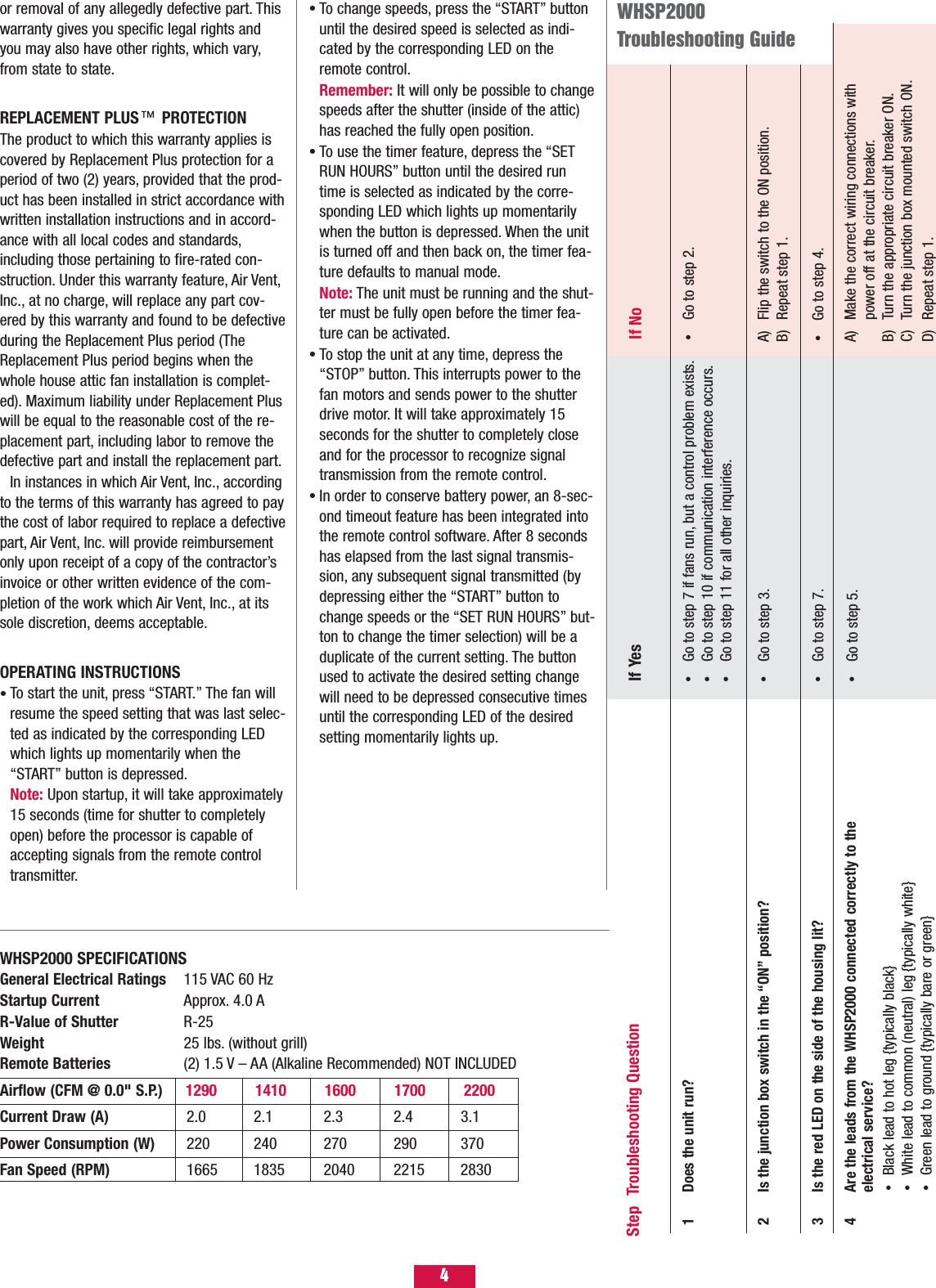
1 Does the unit run? Go to step 7 if fans run, but a control problem exists.Go to step 10 if communication interference occurs.Go to step 11 for all other inquiries.•••Go to step 2.•If Yes If No2 Is the junction box switch in the “ON” position? Go to step 3.•A) Flip the switch to the ON position.B) Repeat step 1.4 Are the leads from the WHSP2000 connected correctly to the electrical service? Black lead to hot leg {typically black}White lead to common (neutral) leg {typically white}Green lead to ground {typically bare or green} •••Go to step 5.•A) Make the correct wiring connections with power off at the circuit breaker.B) Turn the appropriate circuit breaker ON.C) Turn the junction box mounted switch ON.D) Repeat step 1.3 Is the red LED on the side of the housing lit? Go to step 7.•Go to step 4.•WHSP2000 Troubleshooting Guideor removal of any allegedly defective part. Thiswarranty gives you specific legal rights andyou may also have other rights, which vary,from state to state.REPLACEMENT PLUS PROTECTIONThe product to which this warranty applies iscovered by Replacement Plus protection for aperiod of two (2) years, provided that the prod-uct has been installed in strict accordance withwritten installation instructions and in accord-ance with all local codes and standards,including those pertaining to fire-rated con-struction. Under this warranty feature, Air Vent,Inc., at no charge, will replace any part cov-ered by this warranty and found to be defectiveduring the Replacement Plus period (TheReplacement Plus period begins when thewhole house attic fan installation is complet-ed). Maximum liability under Replacement Pluswill be equal to the reasonable cost of the re-placement part, including labor to remove thedefective part and install the replacement part.In instances in which Air Vent, Inc., accordingto the terms of this warranty has agreed to paythe cost of labor required to replace a defectivepart, Air Vent, Inc. will provide reimbursementonly upon receipt of a copy of the contractor’sinvoice or other written evidence of the com-pletion of the work which Air Vent, Inc., at itssole discretion, deems acceptable.OPERATING INSTRUCTIONSTo start the unit, press “START.” The fan will resume the speed setting that was last selec-ted as indicated by the corresponding LED which lights up momentarily when the “START” button is depressed.Note: Upon startup, it will take approximately15 seconds (time for shutter to completely open) before the processor is capable of accepting signals from the remote control transmitter.•™To change speeds, press the “START” button until the desired speed is selected as indi-cated by the corresponding LED on the remote control.Remember: It will only be possible to changespeeds after the shutter (inside of the attic) has reached the fully open position.To use the timer feature, depress the “SET RUN HOURS” button until the desired run time is selected as indicated by the corre-sponding LED which lights up momentarily when the button is depressed. When the unit is turned off and then back on, the timer fea-ture defaults to manual mode.Note: The unit must be running and the shut-ter must be fully open before the timer fea-ture can be activated.To stop the unit at any time, depress the “STOP” button. This interrupts power to the fan motors and sends power to the shutter drive motor. It will take approximately 15 seconds for the shutter to completely close and for the processor to recognize signal transmission from the remote control.In order to conserve battery power, an 8-sec-ond timeout feature has been integrated into the remote control software. After 8 seconds has elapsed from the last signal transmis-sion, any subsequent signal transmitted (by depressing either the “START” button to change speeds or the “SET RUN HOURS” but-ton to change the timer selection) will be a duplicate of the current setting. The button used to activate the desired setting change will need to be depressed consecutive times until the corresponding LED of the desired setting momentarily lights up.••••WHSP2000 SPECIFICATIONSGeneral Electrical Ratings 115 VAC 60 Hz  Startup Current Approx. 4.0 AR-Value of Shutter R-25Weight 25 lbs. (without grill)Remote Batteries (2) 1.5 V – AA (Alkaline Recommended) NOT INCLUDEDAirflow (CFM @ 0.0" S.P.) 1290         1410         1600         1700         2200 Current Draw (A) 2.0   2.1 2.3   2.4 3.1Power Consumption (W) 220   240   270   290   370Fan Speed (RPM) 1665   1835  2040  2215        28304Step  Troubleshooting Question
5 Is the circuit breaker which provides power to the WHSP2000 in the ON position?Go to step 6.•A) Flip circuit breaker to the ON position.B) Repeat step 1.6 Is there 115VAC between the hot leg and common wires from the service panel at the location of the WHSP2000 junction box? NOTE: If unsure or do not know how to check, call a licensed electrician.Go to step 11 if all previous steps have been explored.•A) Check the wiring from the service panel to the WHSP2000 junction box to ensure continuity exists between both ends of the hot,common/neutral, and ground wires.B) Repair/connect any loose or broken connections between service panel and WHSP2000 unit.C) Repeat step 1.7 Do the fans respond to signals sent from the remote control? (Check w/remote in close proximity to unit.)NOTE: There should be a noticeable change in sound volume coming from the fans when a different fan speed is selected. The fans ramp between speeds and therefore may take a few seconds to reach the new speed after a selection is made.NOTE: The LED indicator on the side of the housing should turn off momentarily (approximately one second) when the receiver inside of the unit senses a signal from the remote control transmitter.Go to step 11 for inquiries into the problem.•Go to step 8.•8 Do the red LEDs on the remote light up when a button is depressed andare they bright?Go to step 9.•A) Replace the (2) AA batteries through the access panel on the back of the remote. Alkaline batteries are suggested for best performance.B) Repeat step 1.9 Is the shutter fully open to 90 degrees from the housing when the fans are running?NOTE: The LED indicator on the side of the housing will not be lit while power is being sent to the shutter drive motor. Once the shutter is fully open or fully closed, the LED indicator will be lit.Go to step 11 for inquiries into the problem.•A) Turn the unit off at the junction box switch.B) Check to ensure there are no obstructions in the path of the shutter.C) Turn unit back on to determine if shutter is functional.D) If functional, repeat step 1. Otherwise, proceed to step 11.10 Is there only one WHSP2000 whole house fan unit installed in the structure?NOTE: Each unit and remote control has been configured for communication.There are 4 DIP switches behind the plastic film on the side of the housing (near the LED indicator light) and also 4 DIP switches in the remote control (behind the battery access panel). All of these are preset to the zero or off position..NOTE: To modify the DIP switch settings, the batteries in the remote must be removed, the DIP switches changed, and the batteries reinstalled.11 Contact Customer Service for further assistance: 1-800-527-1924If radio frequency interference from another source exists, try changing the DIP switch settings on the unit and in the remote.These settings should be the same.Repeat step 1.•A) To avoid interference between multiple WHSP2000 units in the same structure, the DIP switch settings need to be different for each unit.B) Make sure the DIP switch settings are the same for the unit and the corresponding remote control.C) Replace film on side of housing and replace batteryaccess panel on remote.D) Repeat step 1.5
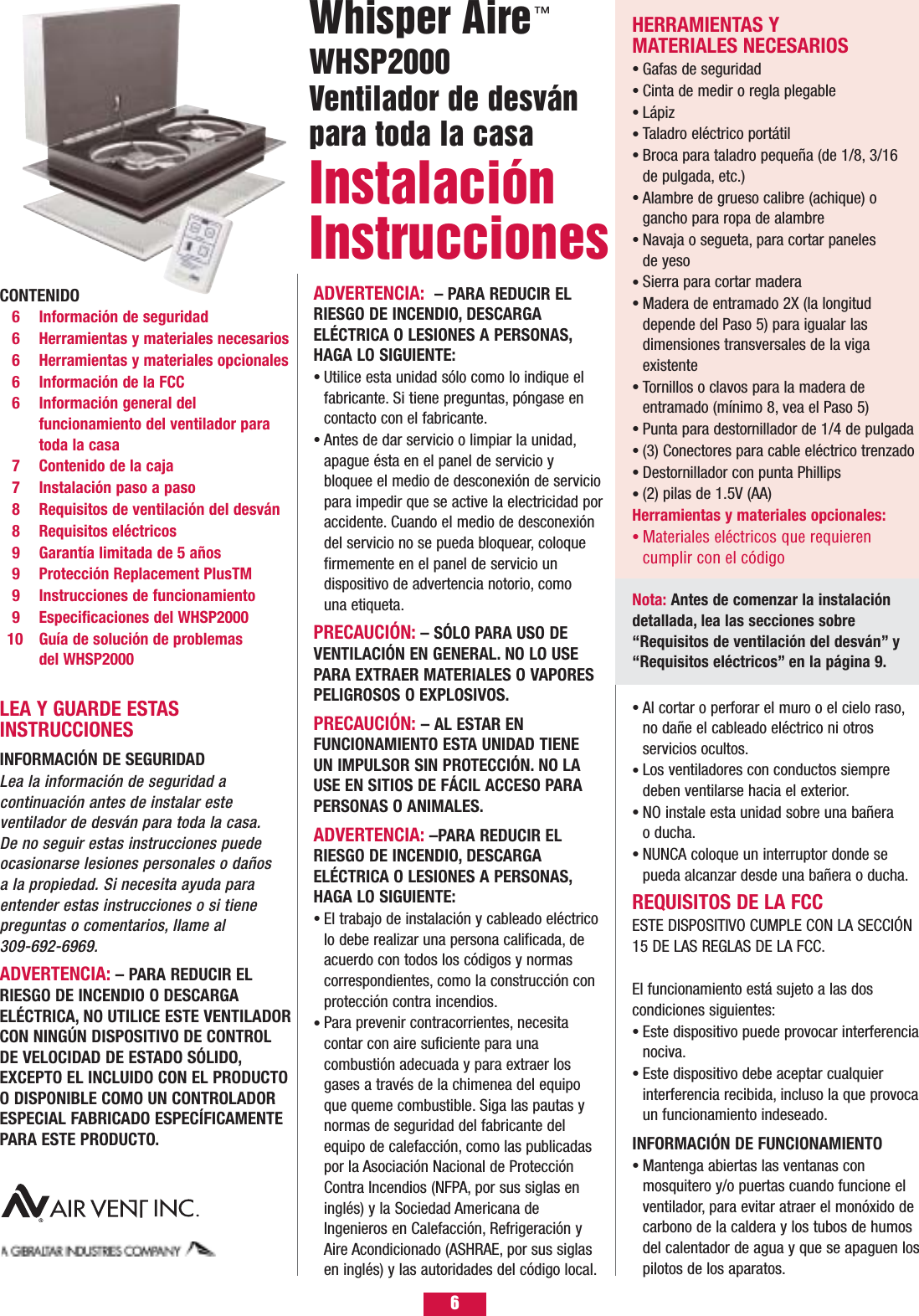
6CONTENIDO6 Información de seguridad6  Herramientas y materiales necesarios6 Herramientas y materiales opcionales6  Información de la FCC6 Información general del funcionamiento del ventilador para toda la casa7 Contenido de la caja7 Instalación paso a paso8 Requisitos de ventilación del desván8 Requisitos eléctricos9 Garantía limitada de 5 años9 Protección Replacement PlusTM 9 Instrucciones de funcionamiento9 Especificaciones del WHSP200010 Guía de solución de problemas del WHSP2000LEA Y GUARDE ESTASINSTRUCCIONESINFORMACIÓN DE SEGURIDAD Lea la información de seguridad a continuación antes de instalar este ventilador de desván para toda la casa. De no seguir estas instrucciones puedeocasionarse lesiones personales o daños a la propiedad. Si necesita ayuda paraentender estas instrucciones o si tiene preguntas o comentarios, llame al 309-692-6969.ADVERTENCIA: – PARA REDUCIR ELRIESGO DE INCENDIO O DESCARGAELÉCTRICA, NO UTILICE ESTE VENTILADORCON NINGÚN DISPOSITIVO DE CONTROLDE VELOCIDAD DE ESTADO SÓLIDO,EXCEPTO EL INCLUIDO CON EL PRODUCTOO DISPONIBLE COMO UN CONTROLADORESPECIAL FABRICADO ESPECÍFICAMENTEPARA ESTE PRODUCTO.ADVERTENCIA:  – PARA REDUCIR ELRIESGO DE INCENDIO, DESCARGAELÉCTRICA O LESIONES A PERSONAS,HAGA LO SIGUIENTE:Utilice esta unidad sólo como lo indique el fabricante. Si tiene preguntas, póngase en contacto con el fabricante.Antes de dar servicio o limpiar la unidad,apague ésta en el panel de servicio y bloquee el medio de desconexión de servicio para impedir que se active la electricidad por accidente. Cuando el medio de desconexión del servicio no se pueda bloquear, coloque firmemente en el panel de servicio un dispositivo de advertencia notorio, como una etiqueta.PRECAUCIÓN: – SÓLO PARA USO DEVENTILACIÓN EN GENERAL. NO LO USEPARA EXTRAER MATERIALES O VAPORESPELIGROSOS O EXPLOSIVOS.PRECAUCIÓN: – AL ESTAR EN FUNCIONAMIENTO ESTA UNIDAD TIENE UN IMPULSOR SIN PROTECCIÓN. NO LAUSE EN SITIOS DE FÁCIL ACCESO PARAPERSONAS O ANIMALES.ADVERTENCIA: –PARA REDUCIR EL RIESGO DE INCENDIO, DESCARGAELÉCTRICA O LESIONES A PERSONAS,HAGA LO SIGUIENTE:El trabajo de instalación y cableado eléctrico lo debe realizar una persona calificada, de acuerdo con todos los códigos y normas correspondientes, como la construcción con protección contra incendios.Para prevenir contracorrientes, necesita contar con aire suficiente para una combustión adecuada y para extraer los gases a través de la chimenea del equipo que queme combustible. Siga las pautas y normas de seguridad del fabricante del equipo de calefacción, como las publicadas por la Asociación Nacional de Protección Contra Incendios (NFPA, por sus siglas en inglés) y la Sociedad Americana de Ingenieros en Calefacción, Refrigeración y Aire Acondicionado (ASHRAE, por sus siglas en inglés) y las autoridades del código local.••••Al cortar o perforar el muro o el cielo raso,no dañe el cableado eléctrico ni otros servicios ocultos.Los ventiladores con conductos siempre deben ventilarse hacia el exterior.NO instale esta unidad sobre una bañera o ducha.NUNCA coloque un interruptor donde se pueda alcanzar desde una bañera o ducha.REQUISITOS DE LA FCCESTE DISPOSITIVO CUMPLE CON LA SECCIÓN15 DE LAS REGLAS DE LA FCC.ID DE LA FCC: NGQGLD001El funcionamiento está sujeto a las dos condiciones siguientes:Este dispositivo puede provocar interferencia nociva.Este dispositivo debe aceptar cualquier interferencia recibida, incluso la que provoca un funcionamiento indeseado.INFORMACIÓN DE FUNCIONAMIENTOMantenga abiertas las ventanas con mosquitero y/o puertas cuando funcione el ventilador, para evitar atraer el monóxido de carbono de la caldera y los tubos de humos del calentador de agua y que se apaguen los pilotos de los aparatos.•••••••Whisper AireWHSP2000 Ventilador de desvánpara toda la casa InstalaciónInstrucciones ™HERRAMIENTAS Y MATERIALES NECESARIOSGafas de seguridadCinta de medir o regla plegableLápiz Taladro eléctrico portátilBroca para taladro pequeña (de 1/8, 3/16 de pulgada, etc.)Alambre de grueso calibre (achique) o gancho para ropa de alambreNavaja o segueta, para cortar paneles de yesoSierra para cortar maderaMadera de entramado 2X (la longitud depende del Paso 5) para igualar las dimensiones transversales de la viga existenteTornillos o clavos para la madera de entramado (mínimo 8, vea el Paso 5)Punta para destornillador de 1/4 de pulgada(3) Conectores para cable eléctrico trenzadoDestornillador con punta Phillips(2) pilas de 1.5V (AA)Herramientas y materiales opcionales:Materiales eléctricos que requieren cumplir con el código•••••••••••••••Nota: Antes de comenzar la instalacióndetallada, lea las secciones sobre“Requisitos de ventilación del desván” y“Requisitos eléctricos” en la página 9.
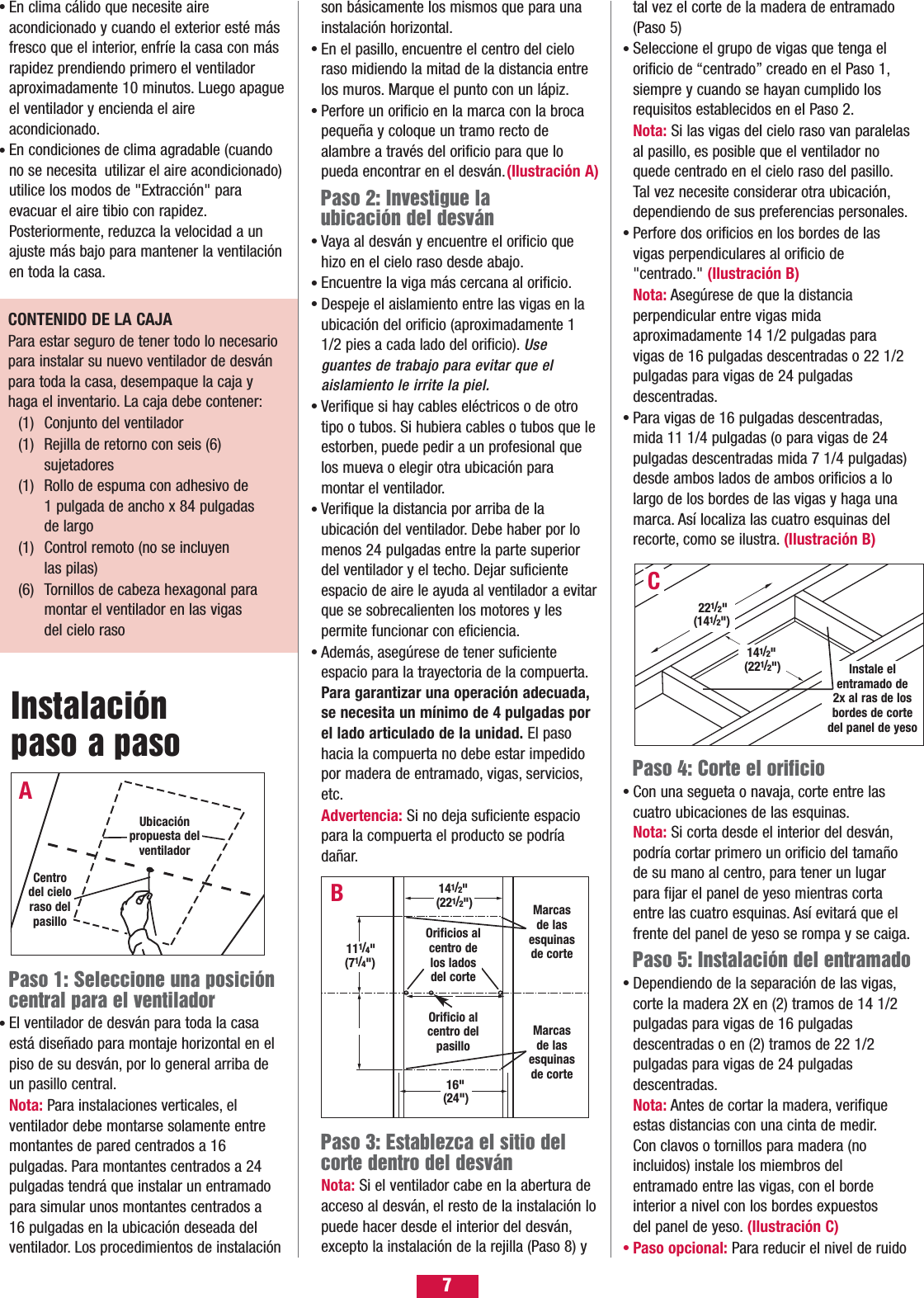
7tal vez el corte de la madera de entramado (Paso 5)Seleccione el grupo de vigas que tenga el orificio de “centrado” creado en el Paso 1,siempre y cuando se hayan cumplido los requisitos establecidos en el Paso 2.Nota: Si las vigas del cielo raso van paralelasal pasillo, es posible que el ventilador no quede centrado en el cielo raso del pasillo.Tal vez necesite considerar otra ubicación,dependiendo de sus preferencias personales.Perfore dos orificios en los bordes de las vigas perpendiculares al orificio de "centrado." (Ilustración B)Nota: Asegúrese de que la distancia perpendicular entre vigas mida aproximadamente 14 1/2 pulgadas para vigas de 16 pulgadas descentradas o 22 1/2 pulgadas para vigas de 24 pulgadas descentradas.Para vigas de 16 pulgadas descentradas,mida 11 1/4 pulgadas (o para vigas de 24 pulgadas descentradas mida 7 1/4 pulgadas) desde ambos lados de ambos orificios a lo largo de los bordes de las vigas y haga una marca. Así localiza las cuatro esquinas del recorte, como se ilustra. (Ilustración B)Paso 4: Corte el orificioCon una segueta o navaja, corte entre las cuatro ubicaciones de las esquinas.Nota: Si corta desde el interior del desván,podría cortar primero un orificio del tamaño de su mano al centro, para tener un lugar para fijar el panel de yeso mientras corta entre las cuatro esquinas. Así evitará que el frente del panel de yeso se rompa y se caiga.Paso 5: Instalación del entramadoDependiendo de la separación de las vigas,corte la madera 2X en (2) tramos de 14 1/2pulgadas para vigas de 16 pulgadas descentradas o en (2) tramos de 22 1/2 pulgadas para vigas de 24 pulgadas descentradas.Nota: Antes de cortar la madera, verifiqueestas distancias con una cinta de medir.Con clavos o tornillos para madera (no incluidos) instale los miembros del entramado entre las vigas, con el borde interior a nivel con los bordes expuestos del panel de yeso. (Ilustración C)Paso opcional: Para reducir el nivel de ruido••••••Paso 1: Seleccione una posicióncentral para el ventiladorEl ventilador de desván para toda la casa está diseñado para montaje horizontal en el piso de su desván, por lo general arriba de un pasillo central.Nota: Para instalaciones verticales, el ventilador debe montarse solamente entre montantes de pared centrados a 16 pulgadas. Para montantes centrados a 24 pulgadas tendrá que instalar un entramado para simular unos montantes centrados a 16 pulgadas en la ubicación deseada del ventilador. Los procedimientos de instalación •En clima cálido que necesite aire acondicionado y cuando el exterior esté más fresco que el interior, enfríe la casa con más rapidez prendiendo primero el ventilador aproximadamente 10 minutos. Luego apagueel ventilador y encienda el aire acondicionado.En condiciones de clima agradable (cuandono se necesita utilizar el aire acondicionado)utilice los modos de "Extracción" para evacuar el aire tibio con rapidez.Posteriormente, reduzca la velocidad a unajuste más bajo para mantener la ventilaciónen toda la casa.••son básicamente los mismos que para una instalación horizontal.En el pasillo, encuentre el centro del cielo raso midiendo la mitad de la distancia entre los muros. Marque el punto con un lápiz.Perfore un orificio en la marca con la broca pequeña y coloque un tramo recto de alambre a través del orificio para que lo pueda encontrar en el desván.(Ilustración A)Paso 2: Investigue la ubicación del desvánVaya al desván y encuentre el orificio que hizo en el cielo raso desde abajo.Encuentre la viga más cercana al orificio.Despeje el aislamiento entre las vigas en la ubicación del orificio (aproximadamente 1 1/2 pies a cada lado del orificio). Use guantes de trabajo para evitar que el aislamiento le irrite la piel.Verifique si hay cables eléctricos o de otro tipo o tubos. Si hubiera cables o tubos que leestorben, puede pedir a un profesional que los mueva o elegir otra ubicación para montar el ventilador.Verifique la distancia por arriba de la ubicación del ventilador. Debe haber por lo menos 24 pulgadas entre la parte superior del ventilador y el techo. Dejar suficiente espacio de aire le ayuda al ventilador a evitarque se sobrecalienten los motores y les permite funcionar con eficiencia.Además, asegúrese de tener suficiente espacio para la trayectoria de la compuerta.Para garantizar una operación adecuada,se necesita un mínimo de 4 pulgadas por el lado articulado de la unidad. El paso hacia la compuerta no debe estar impedido por madera de entramado, vigas, servicios,etc.Advertencia: Si no deja suficiente espacio para la compuerta el producto se podría dañar.••••••••Paso 3: Establezca el sitio delcorte dentro del desvánNota: Si el ventilador cabe en la abertura de acceso al desván, el resto de la instalación lopuede hacer desde el interior del desván,excepto la instalación de la rejilla (Paso 8) y CONTENIDO DE LA CAJA Para estar seguro de tener todo lo necesariopara instalar su nuevo ventilador de desvánpara toda la casa, desempaque la caja yhaga el inventario. La caja debe contener:(1) Conjunto del ventilador(1) Rejilla de retorno con seis (6) sujetadores(1) Rollo de espuma con adhesivo de 1 pulgada de ancho x 84 pulgadas de largo(1) Control remoto (no se incluyen las pilas)(6) Tornillos de cabeza hexagonal para montar el ventilador en las vigas del cielo raso B141/2"(221/2") Marcasde lasesquinasde corteMarcasde lasesquinasde corteOrificio alcentro delpasillo16"(24")111/4"(71/4")Instale el entramado de2x al ras de losbordes de cortedel panel de yesoC141/2"(221/2")221/2"(141/2")Instalación paso a pasoAUbicaciónpropuesta delventiladorCentrodel cieloraso delpasillo Orificios alcentro delos lados del corte
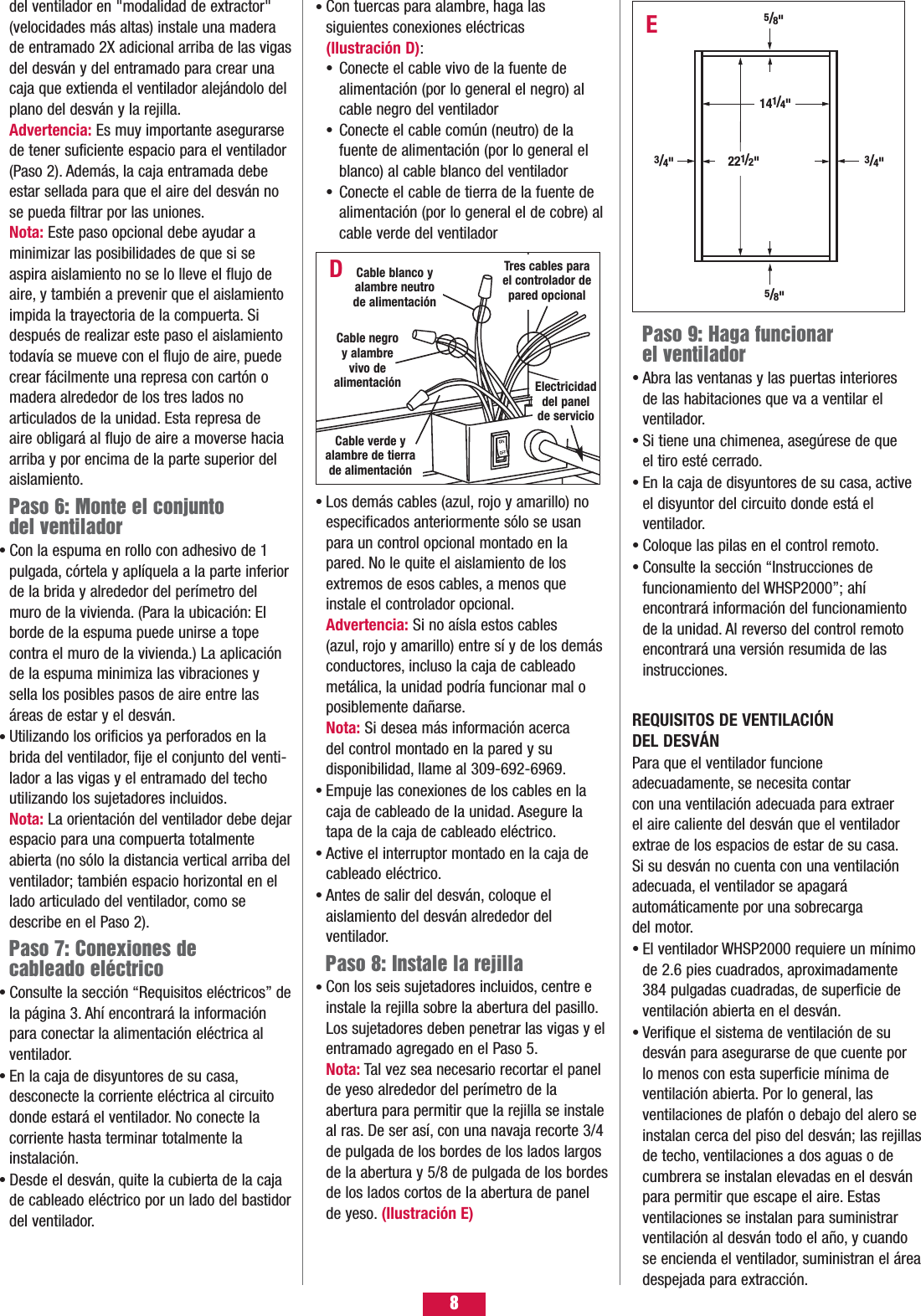
8Paso 9: Haga funcionar el ventiladorAbra las ventanas y las puertas interiores de las habitaciones que va a ventilar el ventilador.Si tiene una chimenea, asegúrese de que el tiro esté cerrado.En la caja de disyuntores de su casa, active el disyuntor del circuito donde está el ventilador.Coloque las pilas en el control remoto.Consulte la sección “Instrucciones de funcionamiento del WHSP2000”; ahí encontrará información del funcionamiento de la unidad. Al reverso del control remoto encontrará una versión resumida de las instrucciones.REQUISITOS DE VENTILACIÓN DEL DESVÁNPara que el ventilador funcione adecuadamente, se necesita contar con una ventilación adecuada para extraer el aire caliente del desván que el ventiladorextrae de los espacios de estar de su casa.Si su desván no cuenta con una ventilaciónadecuada, el ventilador se apagará automáticamente por una sobrecarga del motor.El ventilador WHSP2000 requiere un mínimode 2.6 pies cuadrados, aproximadamente384 pulgadas cuadradas, de superficie deventilación abierta en el desván.Verifique el sistema de ventilación de sudesván para asegurarse de que cuente por lo menos con esta superficie mínima de ventilación abierta. Por lo general, las ventilaciones de plafón o debajo del alero seinstalan cerca del piso del desván; las rejillasde techo, ventilaciones a dos aguas o decumbrera se instalan elevadas en el desvánpara permitir que escape el aire. Estas ventilaciones se instalan para suministrarventilación al desván todo el año, y cuandose encienda el ventilador, suministran el áreadespejada para extracción.•••••••del ventilador en "modalidad de extractor"(velocidades más altas) instale una maderade entramado 2X adicional arriba de las vigasdel desván y del entramado para crear unacaja que extienda el ventilador alejándolo delplano del desván y la rejilla.Advertencia: Es muy importante asegurarsede tener suficiente espacio para el ventilador(Paso 2). Además, la caja entramada debeestar sellada para que el aire del desván nose pueda filtrar por las uniones.Nota: Este paso opcional debe ayudar a minimizar las posibilidades de que si se aspira aislamiento no se lo lleve el flujo deaire, y también a prevenir que el aislamientoimpida la trayectoria de la compuerta. Sidespués de realizar este paso el aislamientotodavía se mueve con el flujo de aire, puedecrear fácilmente una represa con cartón omadera alrededor de los tres lados no articulados de la unidad. Esta represa de aire obligará al flujo de aire a moverse haciaarriba y por encima de la parte superior delaislamiento.Paso 6: Monte el conjunto del ventiladorCon la espuma en rollo con adhesivo de 1pulgada, córtela y aplíquela a la parte inferiorde la brida y alrededor del perímetro delmuro de la vivienda. (Para la ubicación: Elborde de la espuma puede unirse a tope contra el muro de la vivienda.) La aplicaciónde la espuma minimiza las vibraciones ysella los posibles pasos de aire entre lasáreas de estar y el desván.Utilizando los orificios ya perforados en labrida del ventilador, fije el conjunto del venti-lador a las vigas y el entramado del techoutilizando los sujetadores incluidos.Nota: La orientación del ventilador debe dejarespacio para una compuerta totalmenteabierta (no sólo la distancia vertical arriba delventilador; también espacio horizontal en ellado articulado del ventilador, como sedescribe en el Paso 2).Paso 7: Conexiones de cableado eléctricoConsulte la sección “Requisitos eléctricos” dela página 3. Ahí encontrará la informaciónpara conectar la alimentación eléctrica alventilador.En la caja de disyuntores de su casa,desconecte la corriente eléctrica al circuitodonde estará el ventilador. No conecte la corriente hasta terminar totalmente la instalación.Desde el desván, quite la cubierta de la cajade cableado eléctrico por un lado del bastidordel ventilador.•••••Con tuercas para alambre, haga las siguientes conexiones eléctricas (Ilustración D):Conecte el cable vivo de la fuente de alimentación (por lo general el negro) al cable negro del ventiladorConecte el cable común (neutro) de la fuente de alimentación (por lo general el blanco) al cable blanco del ventiladorConecte el cable de tierra de la fuente de alimentación (por lo general el de cobre) al cable verde del ventiladorLos demás cables (azul, rojo y amarillo) noespecificados anteriormente sólo se usanpara un control opcional montado en lapared. No le quite el aislamiento de losextremos de esos cables, a menos queinstale el controlador opcional.Advertencia: Si no aísla estos cables (azul, rojo y amarillo) entre sí y de los demásconductores, incluso la caja de cableadometálica, la unidad podría funcionar mal oposiblemente dañarse.Nota: Si desea más información acerca del control montado en la pared y su disponibilidad, llame al 309-692-6969.Empuje las conexiones de los cables en lacaja de cableado de la unidad. Asegure latapa de la caja de cableado eléctrico.Active el interruptor montado en la caja decableado eléctrico.Antes de salir del desván, coloque el aislamiento del desván alrededor del ventilador.Paso 8: Instale la rejillaCon los seis sujetadores incluidos, centre einstale la rejilla sobre la abertura del pasillo.Los sujetadores deben penetrar las vigas y elentramado agregado en el Paso 5.Nota: Tal vez sea necesario recortar el panelde yeso alrededor del perímetro de la abertura para permitir que la rejilla se instaleal ras. De ser así, con una navaja recorte 3/4de pulgada de los bordes de los lados largos de la abertura y 5/8 de pulgada de los bordesde los lados cortos de la abertura de panelde yeso. (Ilustración E) •••••••••E5/8"5/8"3/4"3/4"221/2"141/4"DTres cables parael controlador depared opcionalElectricidaddel panelde servicioCable negroy alambrevivo de alimentaciónCable verde yalambre de tierrade alimentaciónCable blanco yalambre neutrode alimentación
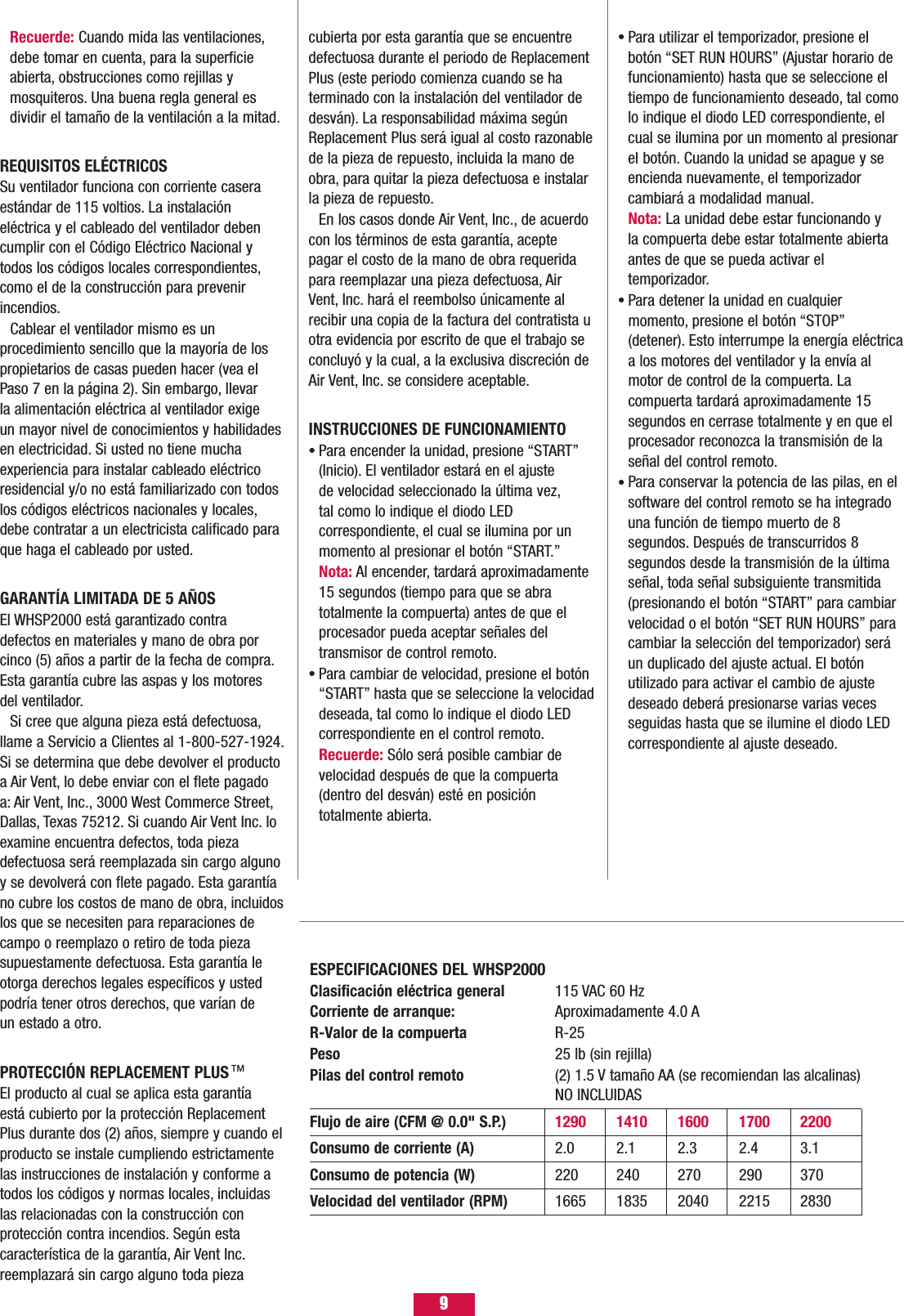
9Para utilizar el temporizador, presione elbotón “SET RUN HOURS” (Ajustar horario defuncionamiento) hasta que se seleccione eltiempo de funcionamiento deseado, tal comolo indique el diodo LED correspondiente, elcual se ilumina por un momento al presionarel botón. Cuando la unidad se apague y seencienda nuevamente, el temporizador cambiará a modalidad manual.Nota: La unidad debe estar funcionando y la compuerta debe estar totalmente abiertaantes de que se pueda activar el temporizador.Para detener la unidad en cualquier momento, presione el botón “STOP”(detener). Esto interrumpe la energía eléctricaa los motores del ventilador y la envía al motor de control de la compuerta. La compuerta tardará aproximadamente 15 segundos en cerrase totalmente y en que el procesador reconozca la transmisión de la señal del control remoto.Para conservar la potencia de las pilas, en elsoftware del control remoto se ha integradouna función de tiempo muerto de 8 segundos. Después de transcurridos 8segundos desde la transmisión de la últimaseñal, toda señal subsiguiente transmitida(presionando el botón “START” para cambiarvelocidad o el botón “SET RUN HOURS” paracambiar la selección del temporizador) seráun duplicado del ajuste actual. El botón utilizado para activar el cambio de ajustedeseado deberá presionarse varias vecesseguidas hasta que se ilumine el diodo LEDcorrespondiente al ajuste deseado.•••Recuerde: Cuando mida las ventilaciones,debe tomar en cuenta, para la superficieabierta, obstrucciones como rejillas ymosquiteros. Una buena regla general esdividir el tamaño de la ventilación a la mitad.REQUISITOS ELÉCTRICOSSu ventilador funciona con corriente caseraestándar de 115 voltios. La instalación eléctrica y el cableado del ventilador debencumplir con el Código Eléctrico Nacional ytodos los códigos locales correspondientes,como el de la construcción para prevenirincendios.Cablear el ventilador mismo es un procedimiento sencillo que la mayoría de lospropietarios de casas pueden hacer (vea elPaso 7 en la página 2). Sin embargo, llevar la alimentación eléctrica al ventilador exige un mayor nivel de conocimientos y habilidadesen electricidad. Si usted no tiene mucha experiencia para instalar cableado eléctricoresidencial y/o no está familiarizado con todoslos códigos eléctricos nacionales y locales,debe contratar a un electricista calificado paraque haga el cableado por usted.GARANTÍA LIMITADA DE 5 AÑOSEl WHSP2000 está garantizado contra defectos en materiales y mano de obra porcinco (5) años a partir de la fecha de compra.Esta garantía cubre las aspas y los motores del ventilador.Si cree que alguna pieza está defectuosa,llame a Servicio a Clientes al 1-800-527-1924.Si se determina que debe devolver el productoa Air Vent, lo debe enviar con el flete pagado a: Air Vent, Inc., 3000 West Commerce Street,Dallas, Texas 75212. Si cuando Air Vent Inc. loexamine encuentra defectos, toda pieza defectuosa será reemplazada sin cargo algunoy se devolverá con flete pagado. Esta garantíano cubre los costos de mano de obra, incluidoslos que se necesiten para reparaciones decampo o reemplazo o retiro de toda piezasupuestamente defectuosa. Esta garantía leotorga derechos legales específicos y ustedpodría tener otros derechos, que varían de un estado a otro.PROTECCIÓN REPLACEMENT PLUSEl producto al cual se aplica esta garantía está cubierto por la protección ReplacementPlus durante dos (2) años, siempre y cuando elproducto se instale cumpliendo estrictamentelas instrucciones de instalación y conforme atodos los códigos y normas locales, incluidaslas relacionadas con la construcción con protección contra incendios. Según esta característica de la garantía, Air Vent Inc.reemplazará sin cargo alguno toda pieza™cubierta por esta garantía que se encuentredefectuosa durante el periodo de ReplacementPlus (este periodo comienza cuando se ha terminado con la instalación del ventilador dedesván). La responsabilidad máxima segúnReplacement Plus será igual al costo razonablede la pieza de repuesto, incluida la mano deobra, para quitar la pieza defectuosa e instalarla pieza de repuesto.En los casos donde Air Vent, Inc., de acuerdocon los términos de esta garantía, aceptepagar el costo de la mano de obra requeridapara reemplazar una pieza defectuosa, AirVent, Inc. hará el reembolso únicamente alrecibir una copia de la factura del contratista uotra evidencia por escrito de que el trabajo seconcluyó y la cual, a la exclusiva discreción deAir Vent, Inc. se considere aceptable.INSTRUCCIONES DE FUNCIONAMIENTOPara encender la unidad, presione “START”(Inicio). El ventilador estará en el ajuste de velocidad seleccionado la última vez,tal como lo indique el diodo LED correspondiente, el cual se ilumina por unmomento al presionar el botón “START.”Nota: Al encender, tardará aproximadamente15 segundos (tiempo para que se abra totalmente la compuerta) antes de que elprocesador pueda aceptar señales del transmisor de control remoto.Para cambiar de velocidad, presione el botón“START” hasta que se seleccione la velocidaddeseada, tal como lo indique el diodo LEDcorrespondiente en el control remoto.Recuerde: Sólo será posible cambiar develocidad después de que la compuerta (dentro del desván) esté en posición totalmente abierta.••ESPECIFICACIONES DEL WHSP2000Clasificación eléctrica general 115 VAC 60 Hz Corriente de arranque: Aproximadamente 4.0 AR-Valor de la compuerta R-25Peso 25 lb (sin rejilla)Pilas del control remoto (2) 1.5 V tamaño AA (se recomiendan las alcalinas)NO INCLUIDAS Flujo de aire (CFM @ 0.0" S.P.) 1290 1410 1600 1700 2200Consumo de corriente (A) 2.0 2.1 2.3 2.4 3.1Consumo de potencia (W) 220 240 270 290 370Velocidad del ventilador (RPM) 1665 1835 2040 2215 2830
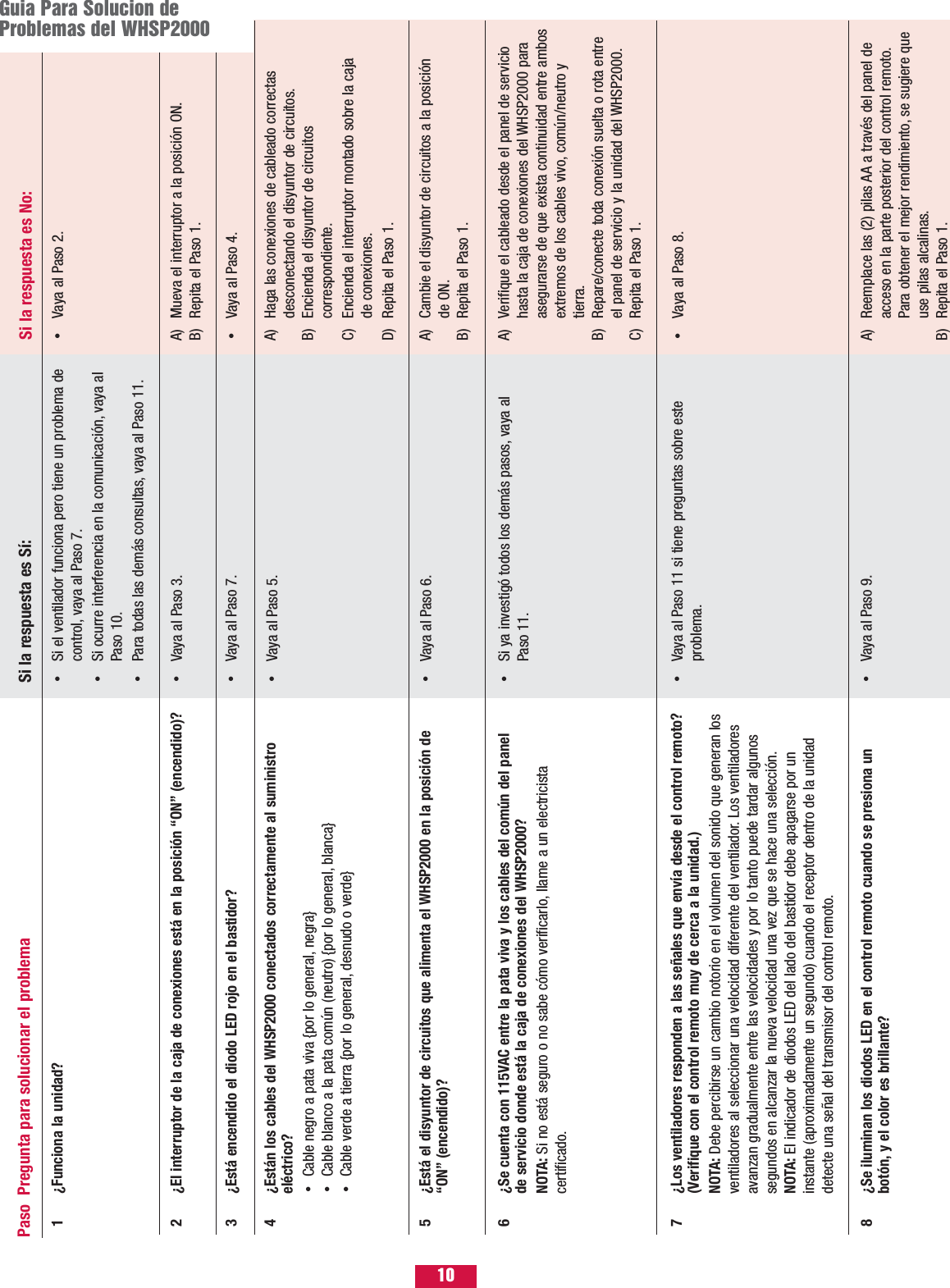
101 ¿Funciona la unidad? Si el ventilador funciona pero tiene un problema de control, vaya al Paso 7.Si ocurre interferencia en la comunicación, vaya al Paso 10.Para todas las demás consultas, vaya al Paso 11.•••Vaya al Paso 2.•2 ¿El interruptor de la caja de conexiones está en la posición “ON” (encendido)? Vaya al Paso 3.•A) Mueva el interruptor a la posición ON.B) Repita el Paso 1.4 ¿Están los cables del WHSP2000 conectados correctamente al suministro eléctrico?Cable negro a pata viva {por lo general, negra}Cable blanco a la pata común (neutro) {por lo general, blanca}Cable verde a tierra {por lo general, desnudo o verde} •••Vaya al Paso 5.•A) Haga las conexiones de cableado correctas desconectando el disyuntor de circuitos.B) Encienda el disyuntor de circuitos correspondiente.C) Encienda el interruptor montado sobre la caja de conexiones.D) Repita el Paso 1.3 ¿Está encendido el diodo LED rojo en el bastidor? Vaya al Paso 7.•Vaya al Paso 4.•5 ¿Está el disyuntor de circuitos que alimenta el WHSP2000 en la posición de “ON” (encendido)? Vaya al Paso 6.•A) Cambie el disyuntor de circuitos a la posición de ON.B) Repita el Paso 1.6 ¿Se cuenta con 115VAC entre la pata viva y los cables del común del panel de servicio donde está la caja de conexiones del WHSP2000?NOTA: Si no está seguro o no sabe cómo verificarlo, llame a un electricista certificado.Si ya investigó todos los demás pasos, vaya al Paso 11.•A) Verifique el cableado desde el panel de servicio hasta la caja de conexiones del WHSP2000 para asegurarse de que exista continuidad entre ambosextremos de los cables vivo, común/neutro y tierra.B) Repare/conecte toda conexión suelta o rota entre el panel de servicio y la unidad del WHSP2000.C) Repita el Paso 1.7 ¿Los ventiladores responden a las señales que envía desde el control remoto? (Verifique con el control remoto muy de cerca a la unidad.)NOTA: Debe percibirse un cambio notorio en el volumen del sonido que generan los ventiladores al seleccionar una velocidad diferente del ventilador. Los ventiladores avanzan gradualmente entre las velocidades y por lo tanto puede tardar algunos segundos en alcanzar la nueva velocidad una vez que se hace una selección.NOTA: El indicador de diodos LED del lado del bastidor debe apagarse por un instante (aproximadamente un segundo) cuando el receptor dentro de la unidad detecte una señal del transmisor del control remoto.Vaya al Paso 11 si tiene preguntas sobre este problema.•Vaya al Paso 8.•8 ¿Se iluminan los diodos LED en el control remoto cuando se presiona un botón, y el color es brillante?Vaya al Paso 9.•A) Reemplace las (2) pilas AA a través del panel de acceso en la parte posterior del control remoto.Para obtener el mejor rendimiento, se sugiere que use pilas alcalinas.B) Repita el Paso 1.WHSP2000 TROUBLESHOOTING GUIDEPaso  Pregunta para solucionar el problema Si la respuesta es Sí: Si la respuesta es No:Guia Para Solucion de Problemas del WHSP2000
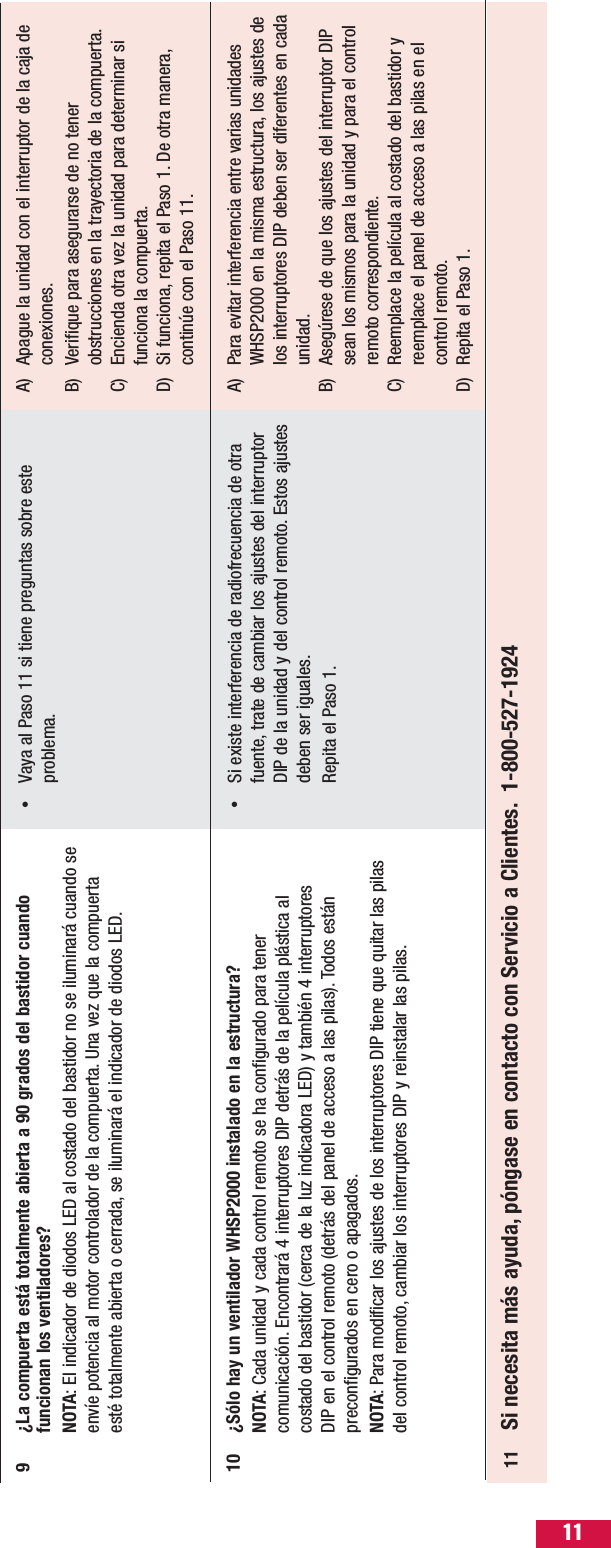
119 ¿La compuerta está totalmente abierta a 90 grados del bastidor cuando funcionan los ventiladores?NOTA: El indicador de diodos LED al costado del bastidor no se iluminará cuando se envíe potencia al motor controlador de la compuerta. Una vez que la compuerta esté totalmente abierta o cerrada, se iluminará el indicador de diodos LED.Vaya al Paso 11 si tiene preguntas sobre este problema.•A) Apague la unidad con el interruptor de la caja de conexiones.B) Verifique para asegurarse de no tener obstrucciones en la trayectoria de la compuerta.C) Encienda otra vez la unidad para determinar si funciona la compuerta.D) Si funciona, repita el Paso 1. De otra manera,continúe con el Paso 11.10 ¿Sólo hay un ventilador WHSP2000 instalado en la estructura?NOTA: Cada unidad y cada control remoto se ha configurado para tener comunicación. Encontrará 4 interruptores DIP detrás de la película plástica al costado del bastidor (cerca de la luz indicadora LED) y también 4 interruptores DIP en el control remoto (detrás del panel de acceso a las pilas). Todos están preconfigurados en cero o apagados.NOTA: Para modificar los ajustes de los interruptores DIP tiene que quitar las pilas del control remoto, cambiar los interruptores DIP y reinstalar las pilas.Si existe interferencia de radiofrecuencia de otra fuente, trate de cambiar los ajustes del interruptor DIP de la unidad y del control remoto. Estos ajustes deben ser iguales.Repita el Paso 1.•A) Para evitar interferencia entre varias unidades WHSP2000 en la misma estructura, los ajustes de los interruptores DIP deben ser diferentes en cada unidad.B) Asegúrese de que los ajustes del interruptor DIP sean los mismos para la unidad y para el control remoto correspondiente.C) Reemplace la película al costado del bastidor y reemplace el panel de acceso a las pilas en el control remoto.D) Repita el Paso 1.11 Si necesita más ayuda, póngase en contacto con Servicio a Clientes. 1-800-527-1924
Air Vent, Inc.3000 West Commerce StreetDallas, Texas 75212 ©2005 Air Vent, Inc.Part No. 18281

Navigation menu