Airsmart Technology R801 TUBE QUEEN AM/FM RADIO & BLUETOOTH SPEAKER User Manual

Shenzhen Airsmart Technology Co.,Ltd. TUBE QUEEN AM/FM RADIO & BLUETOOTH SPEAKER

User manual

Tube Queen AM/FM Radio & Bluetooth Speaker Large collectible table-model Hi-Fi stereo radio /Bluetooth speaker R801W-3DI
Tube Queen AM/FM Radio & Bluetooth Speaker
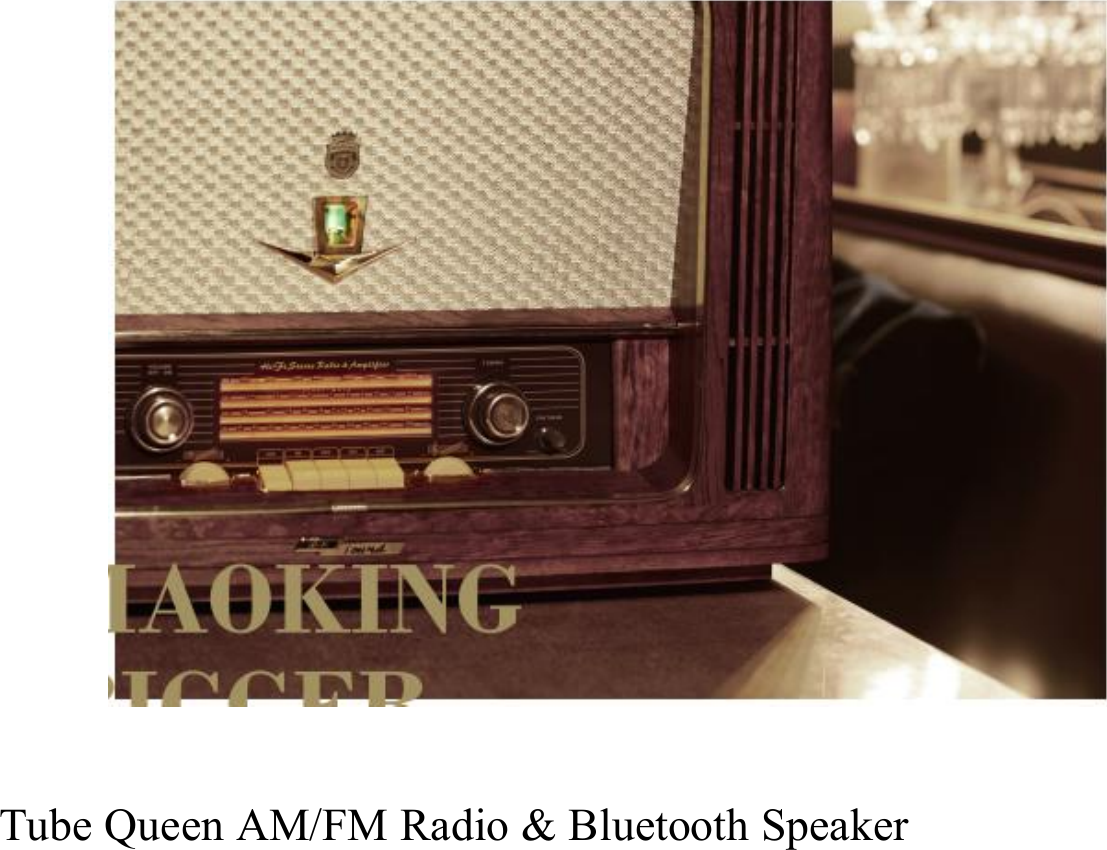
Product IntroductionTube Queen is a large table-model radio /Bluetooth speaker produced by our company. This  product uses the  Hi-Fi  concept  and  draws  experience from  Germany's  excellent radio design style in the 1950s to 60s. The product uses electronic tube to make power amplifier and signal strength received indicator. This  product  is  a  high-sensitivity  radio  with  FM  stereo  reception  and  high-quality Bluetooth speaker, but also a Hi-Fi tube amplifier that may be used separately. In case of connection with external high-quality speaker, it can form a set of high-fidelity stereo system. This  product  is  a  multi-frequency  radio  that  has  four  frequencies,  namely,  FM  (FM) stereo,  medium  wave  (MW),  shortwave  1  (SW1)  and  shortwave  2  (SW2),  and  uses vacuum tube (commonly known as "cat’s eye") tuning indicator. This product is also a high-quality Bluetooth audio speaker. Its Bluetooth program uses the CSR 4.0 Bluetooth module that supports aptx lossless transmission. Hence, it can guarantee excellent audio effect via Bluetooth. This product uses high-power vacuum tube to make post amplification, so the output power is strong. Coupled with the high-quality loudspeaker,  and excellent circuit and electro-acoustic design, this product has acquired sound effect unique to    radio set. In connection with stand-alone high-quality audio speaker,  the Hi-Fi sound effect can be achieved.
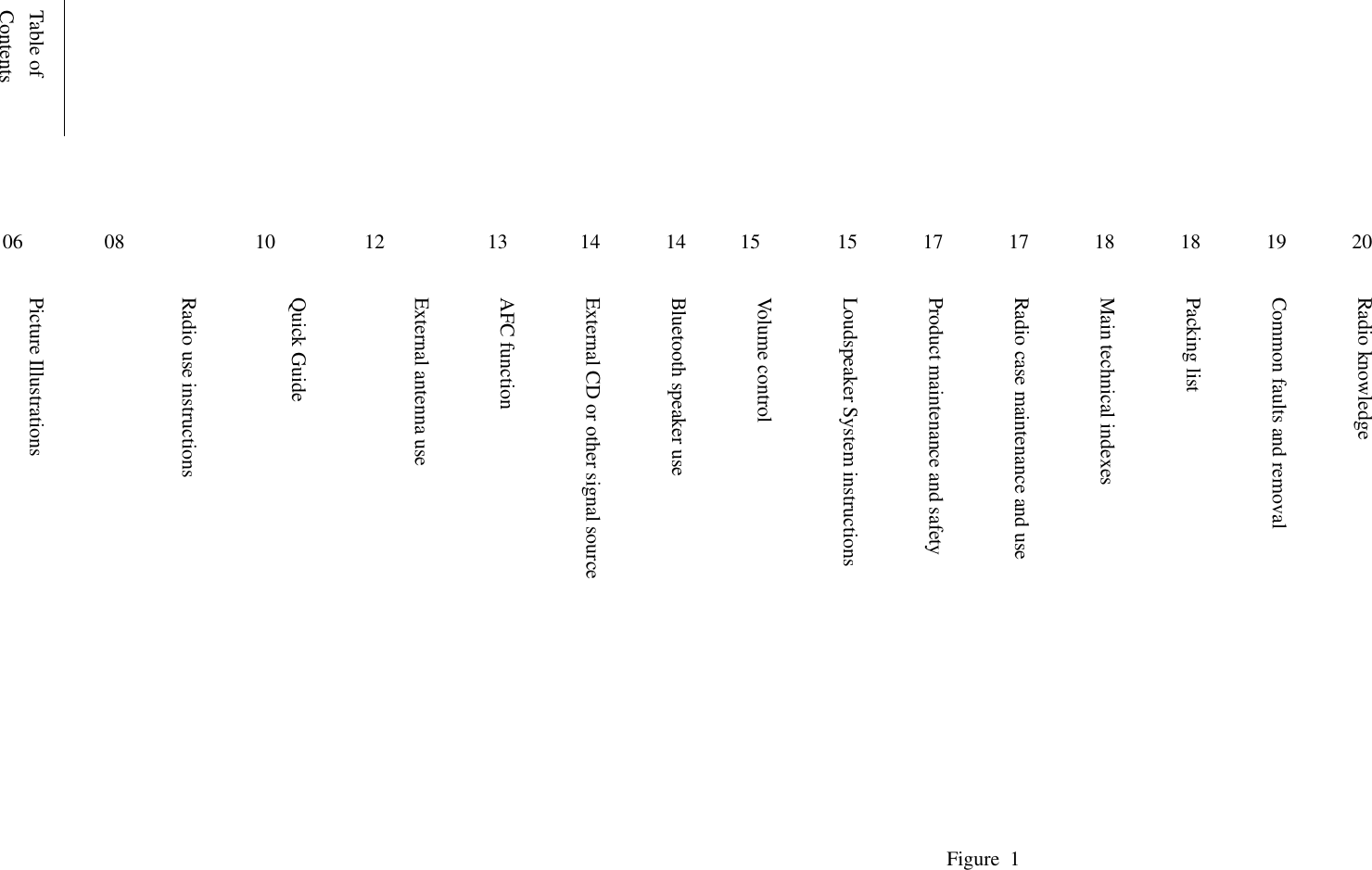
Table of Contents 06 08 10 12 13 14 14 15 15 17 17 18 18 19 20 Picture Illustrations Radio use instructions Quick Guide External antenna use AFC function External CD or other signal source Bluetooth speaker use Volume control Loudspeaker System instructions Product maintenance and safety Radio case maintenance and use Main technical indexes Packing list Common faults and removal Radio knowledge Figure  1
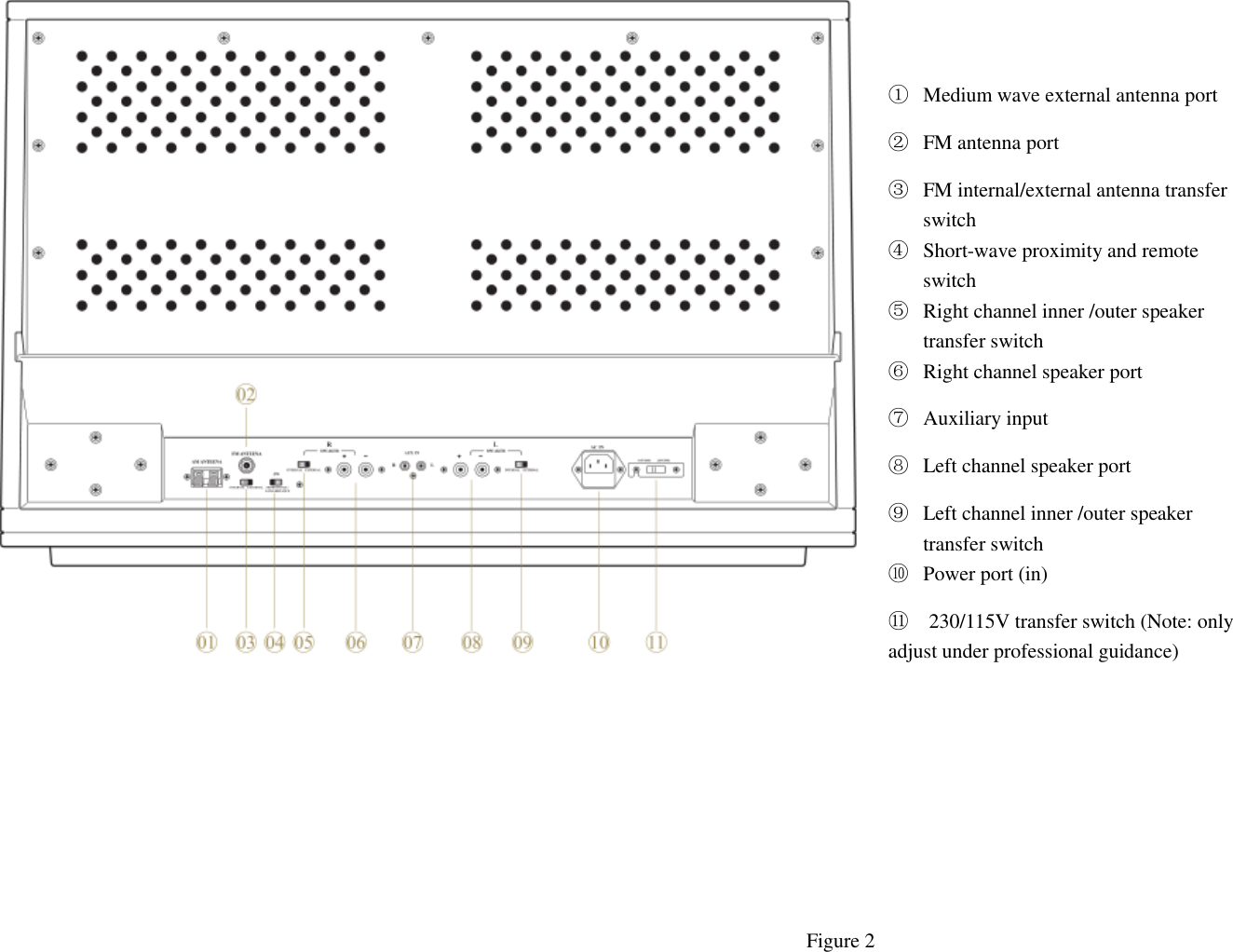
①Medium wave external antenna port②FM antenna port③FM internal/external antenna transferswitch④Short-wave proximity and remoteswitch⑤Right channel inner /outer speakertransfer switch⑥Right channel speaker port⑦Auxiliary input⑧Left channel speaker port⑨Left channel inner /outer speakertransfer switch⑩Power port (in)⑪  230/115V transfer switch (Note: onlyadjust under professional guidance) Figure 2
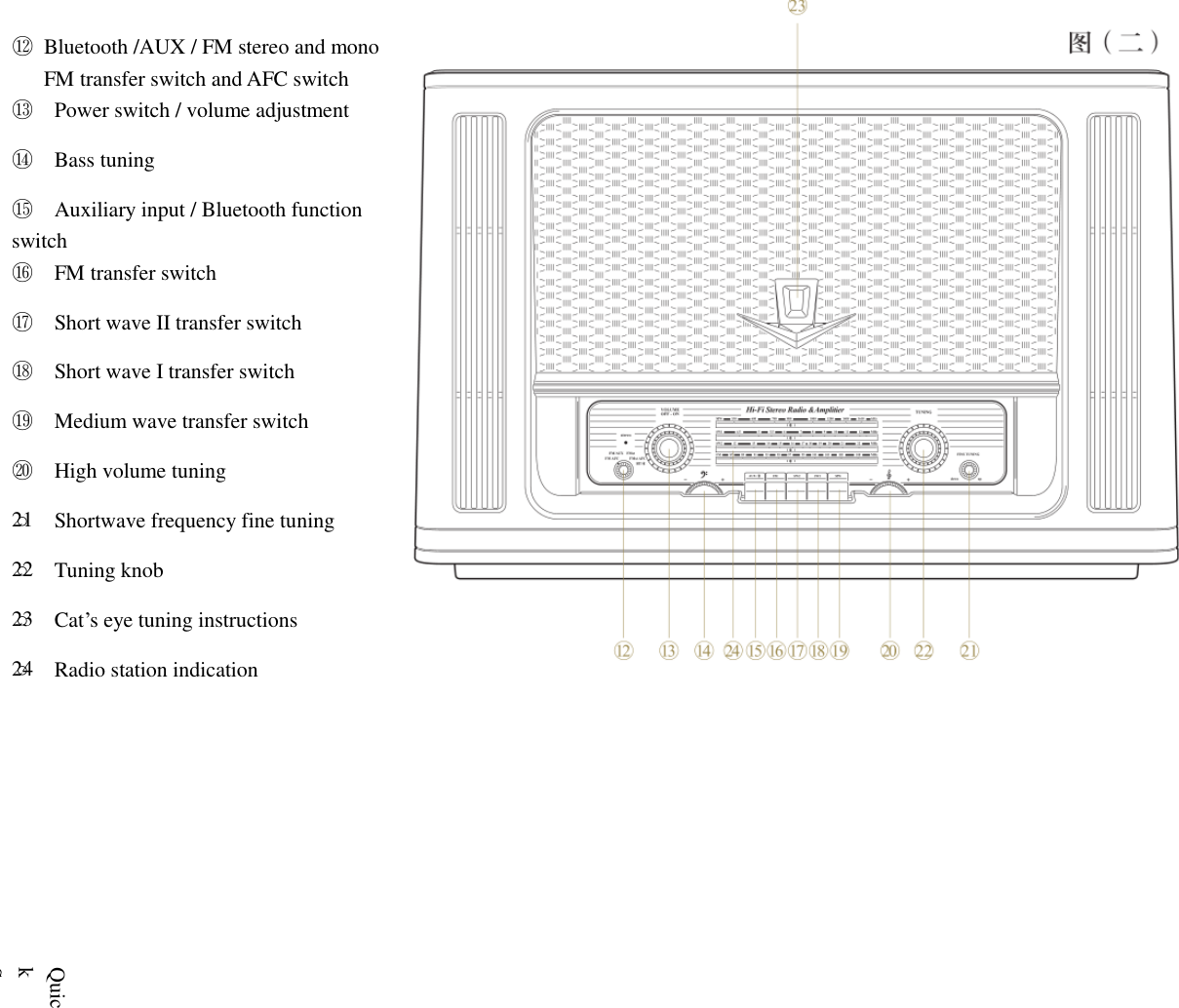
  ⑫  Bluetooth /AUX / FM stereo and mono FM transfer switch and AFC switch ⑬  Power switch / volume adjustment ⑭  Bass tuning ⑮  Auxiliary input / Bluetooth function switch ⑯  FM transfer switch ⑰  Short wave II transfer switch ⑱  Short wave I transfer switch ⑲  Medium wave transfer switch ⑳  High volume tuning ○21  Shortwave frequency fine tuning ○22  Tuning knob ○23  Cat’s eye tuning instructions ○24  Radio station indication                                                                         Quick Start Guide
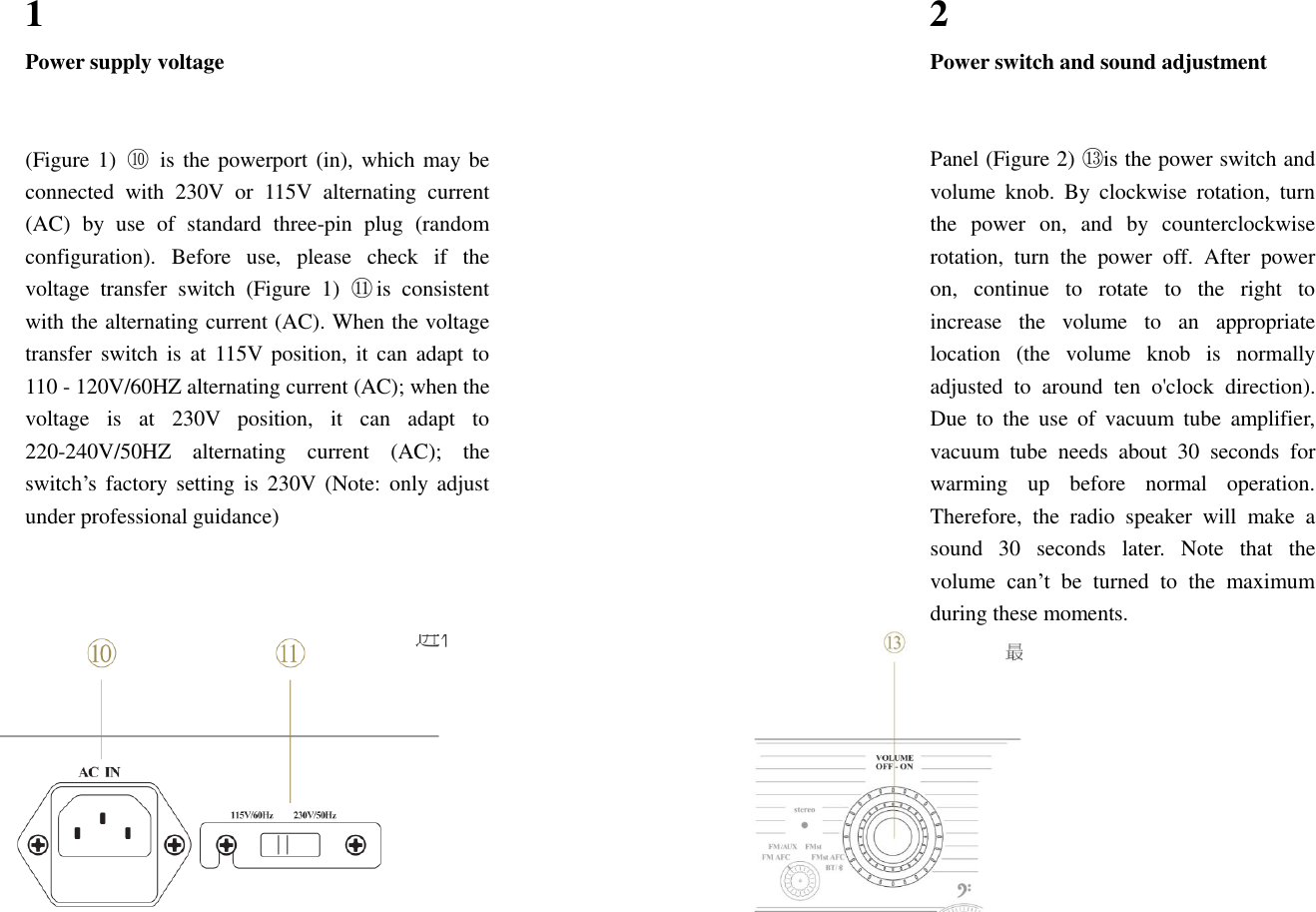
 1 Power supply voltage   2 Power switch and sound adjustment           (Figure 1)  ⑩  is the powerport (in), which may be connected  with  230V  or  115V  alternating  current (AC)  by  use  of  standard  three-pin  plug  (random configuration).  Before  use,  please  check  if  the voltage  transfer  switch  (Figure  1)  ⑪  is  consistent with the alternating current (AC). When the voltage transfer switch  is  at  115V position,  it can  adapt to 110 - 120V/60HZ alternating current (AC); when the voltage  is  at  230V  position,  it  can  adapt  to 220-240V/50HZ  alternating  current  (AC);  the switch’s  factory  setting  is  230V  (Note: only  adjust under professional guidance)   Panel (Figure 2) ⑬ is the power switch and volume  knob.  By  clockwise  rotation,  turn the  power  on,  and  by  counterclockwise rotation,  turn  the  power  off.  After  power on,  continue  to  rotate  to  the  right  to increase  the  volume  to  an  appropriate location  (the  volume  knob  is  normally adjusted  to  around  ten  o'clock  direction). Due  to  the  use  of  vacuum  tube  amplifier, vacuum  tube  needs  about  30  seconds  for warming  up  before  normal  operation. Therefore,  the  radio  speaker  will  make  a sound  30  seconds  later.  Note  that  the volume  can’t  be  turned  to  the  maximum during these moments.
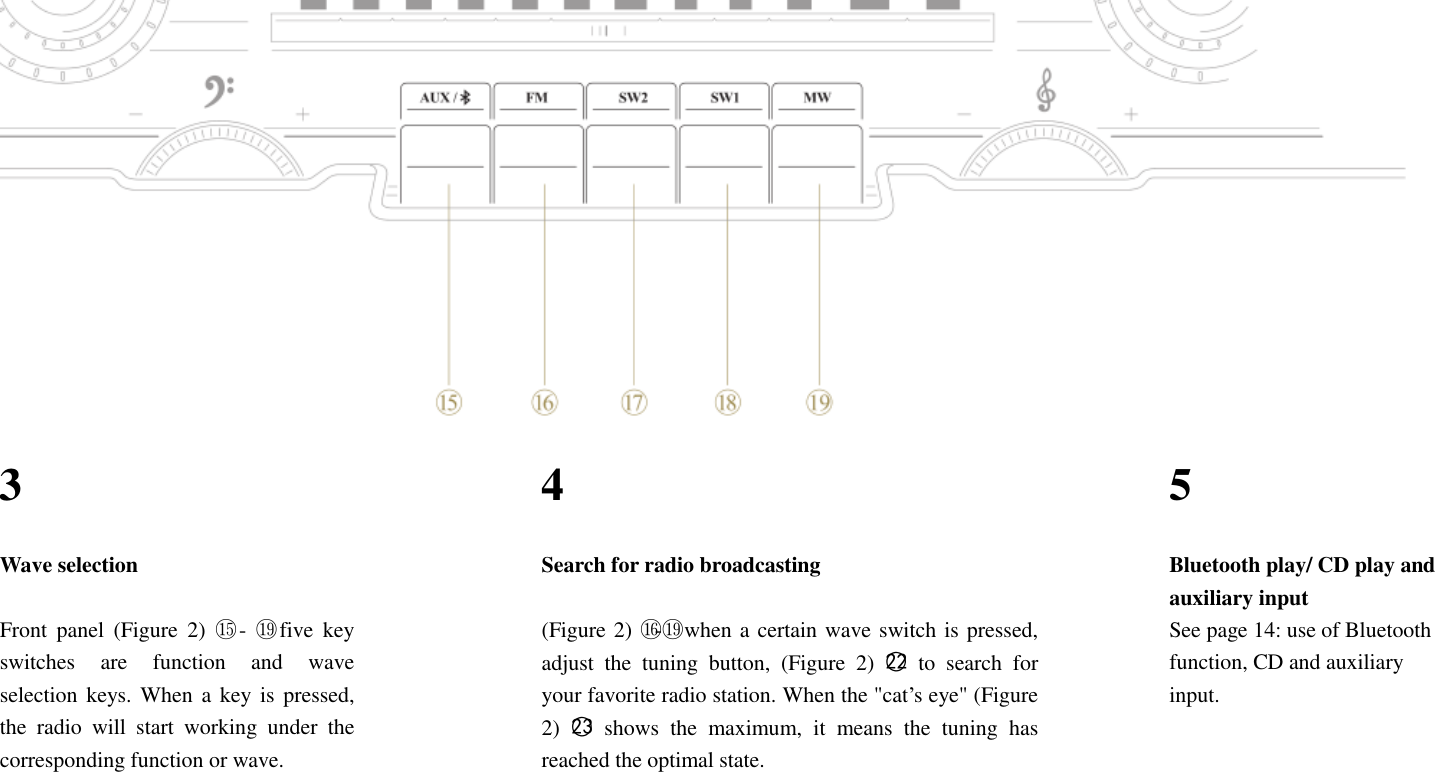
  3  4  5        Wave selection  Search for radio broadcasting  Bluetooth play/ CD play and auxiliary input  Front  panel  (Figure  2)  ⑮ - ⑲  five  key switches  are  function  and  wave selection keys. When  a  key is  pressed, the  radio  will  start  working  under  the corresponding function or wave.  (Figure 2) ⑯-⑲ when a certain wave switch is pressed, adjust  the  tuning  button,  (Figure  2)  ○22  to  search  for your favorite radio station. When the "cat’s eye" (Figure 2)  ○23  shows  the  maximum,  it  means  the  tuning  has reached the optimal state.  See page 14: use of Bluetooth function, CD and auxiliary input.
   Radio use instructions                 1    When  the  machine  is  used  as  a  radio,  it  is  of  paramount importance  to  place  the  machine  and  the  external  antenna correctly. Otherwise, you may not receive any radio programs, or only receive bad one! It is recommended to use the machine close to window as much as possible. If it is impossible to use the machine near the window, a group of external antennas will be of great importance. The more professional the antenna and antenna  installation,  the  better  the  machine  performance.  In addition, in case of connection with external antenna or not, it should  also  be  noted  that  the  switch  position  for  “internal/ external” antenna on the back of the machine must be correct!    Listen to FM broadcasting  This machine has equipped with built-in FM line. If the radio is placed close to the window in the general urban area (not far from the radio transmitting  station),  there  is  no  need  to  use  external  antenna generally. When external antenna (random accessory) is used, turn the rear③(Figure 1) to the external (EXTERNAL) position. The external antenna of this machine can also be connected with dedicated external antenna or dedicated cable antenna. Press the (Figure 2) ⑯ key switch on the front of the machine to be in FM wave, and adjust the tuning knob  to  the  range  of  87--108MHZ  for  its  radio  programs.  Turn  the transfer switch (Figure 2) ⑫ to FM position to be in ordinary FM state. Turn to FM St position to be in stereo FM state. If the FM St effect is not good  enough, the switch can get a higher Signal to Noise Ratio (SNR) at FM
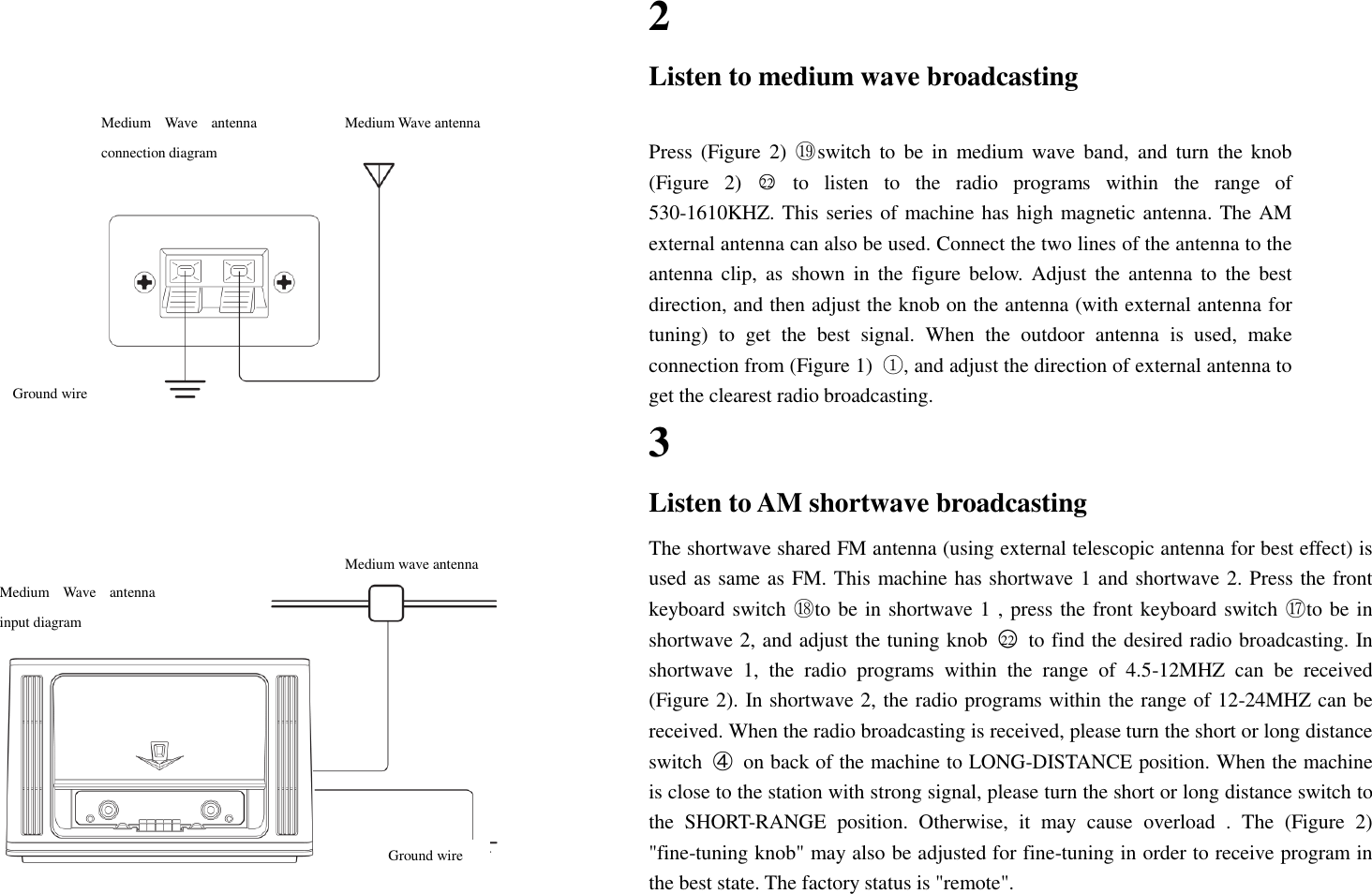
 2  Listen to medium wave broadcasting    Press  (Figure  2)  ⑲  switch to be  in  medium  wave  band,  and  turn  the  knob (Figure  2)  ○22  to  listen  to  the  radio  programs  within  the  range  of 530-1610KHZ. This series of machine has high magnetic antenna. The AM external antenna can also be used. Connect the two lines of the antenna to the antenna clip,  as  shown  in  the  figure below.  Adjust  the  antenna  to  the best direction, and then adjust the knob on the antenna (with external antenna for tuning)  to  get  the  best  signal.  When  the  outdoor  antenna  is  used,  make connection from (Figure 1)  ①, and adjust the direction of external antenna to get the clearest radio broadcasting. 3  Listen to AM shortwave broadcasting  The shortwave shared FM antenna (using external telescopic antenna for best effect) is used as same as FM. This machine has shortwave 1 and shortwave 2. Press the front keyboard switch ⑱ to be in shortwave 1 , press the front keyboard switch ⑰ to be in shortwave 2, and adjust the tuning knob  ○22   to find the desired radio broadcasting. In shortwave  1,  the  radio  programs  within  the  range  of  4.5-12MHZ  can  be  received (Figure 2). In shortwave 2, the radio programs within the range of 12-24MHZ can be received. When the radio broadcasting is received, please turn the short or long distance switch  ④  on back of the machine to LONG-DISTANCE position. When the machine is close to the station with strong signal, please turn the short or long distance switch to the  SHORT-RANGE  position.  Otherwise,  it  may  cause  overload  .  The  (Figure  2) "fine-tuning knob" may also be adjusted for fine-tuning in order to receive program in the best state. The factory status is "remote".   Medium  Wave  antenna connection diagram Ground wire Medium Wave antenna Medium wave antenna Medium  Wave  antenna input diagram Ground wire
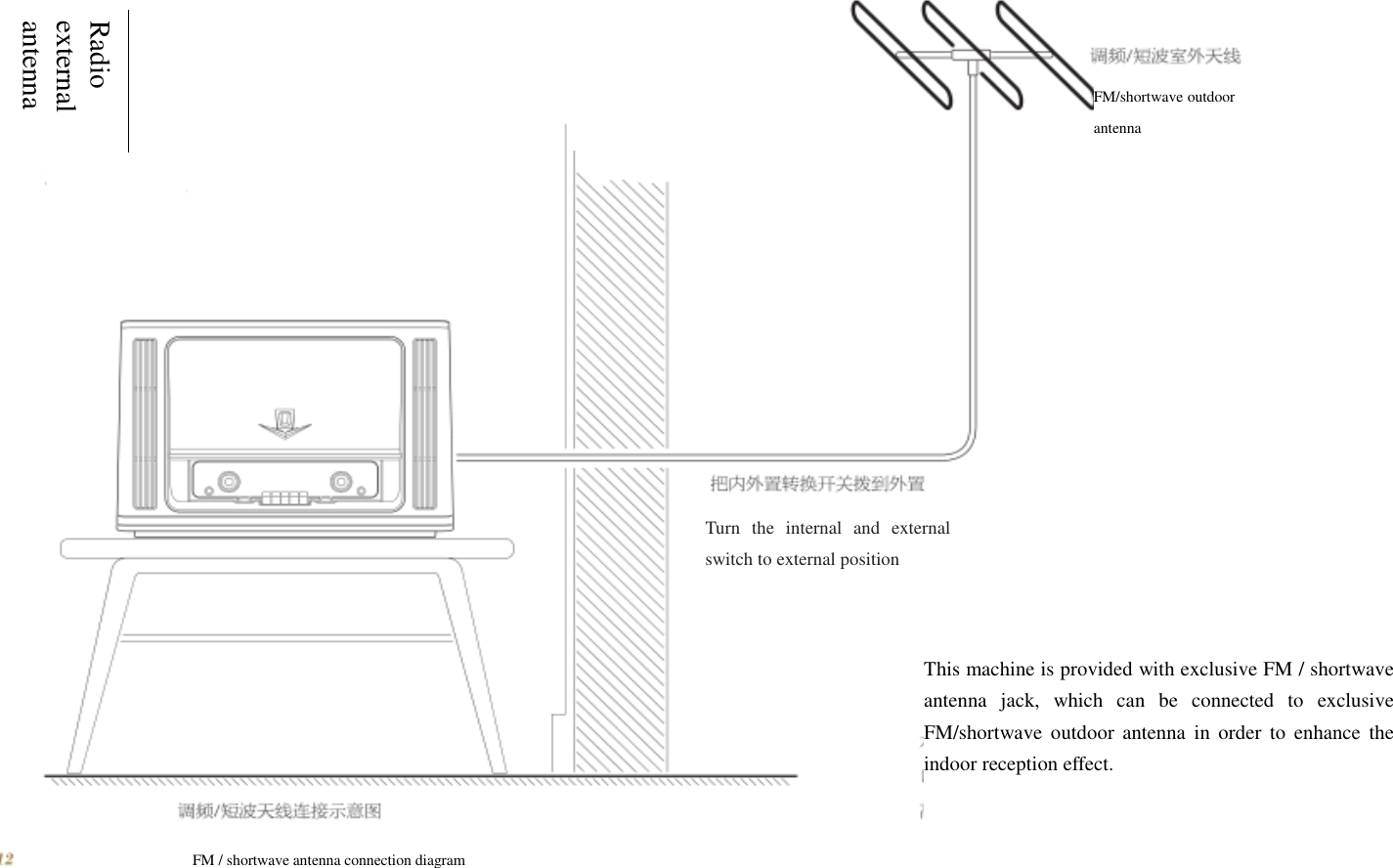
     Radio external antenna                    FM/shortwave outdoor antenna Turn  the  internal  and  external switch to external position FM / shortwave antenna connection diagram This machine is provided with exclusive FM / shortwave antenna  jack,  which  can  be  connected  to  exclusive FM/shortwave  outdoor  antenna  in  order  to  enhance  the indoor reception effect.
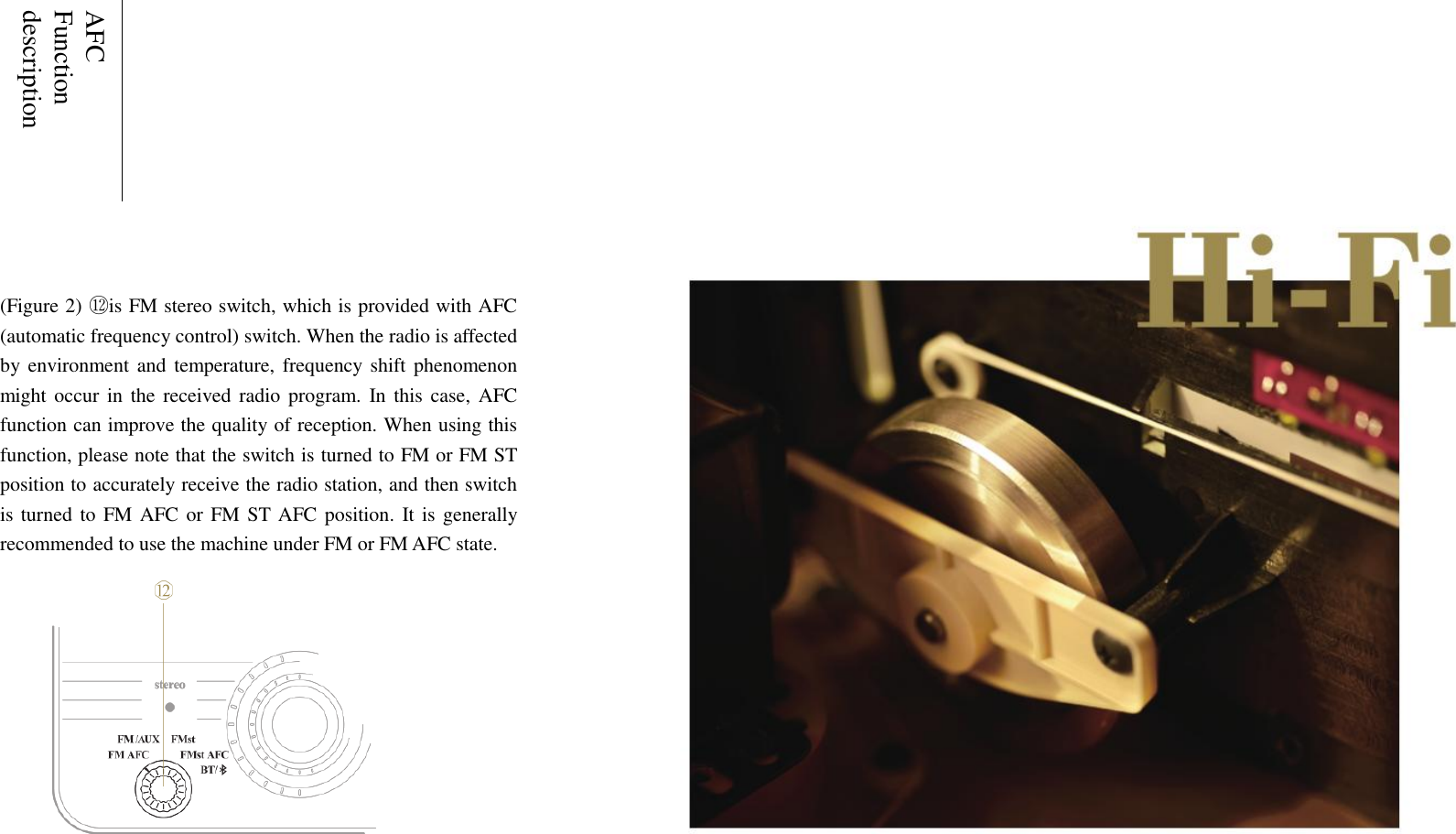
   AFC Function description       (Figure 2) ⑫ is FM stereo switch, which is provided with AFC (automatic frequency control) switch. When the radio is affected by environment and temperature, frequency shift phenomenon might  occur in the received radio program.  In this  case,  AFC function can improve the quality of reception. When using this function, please note that the switch is turned to FM or FM ST position to accurately receive the radio station, and then switch is turned to FM AFC or FM ST AFC position. It is generally recommended to use the machine under FM or FM AFC state.
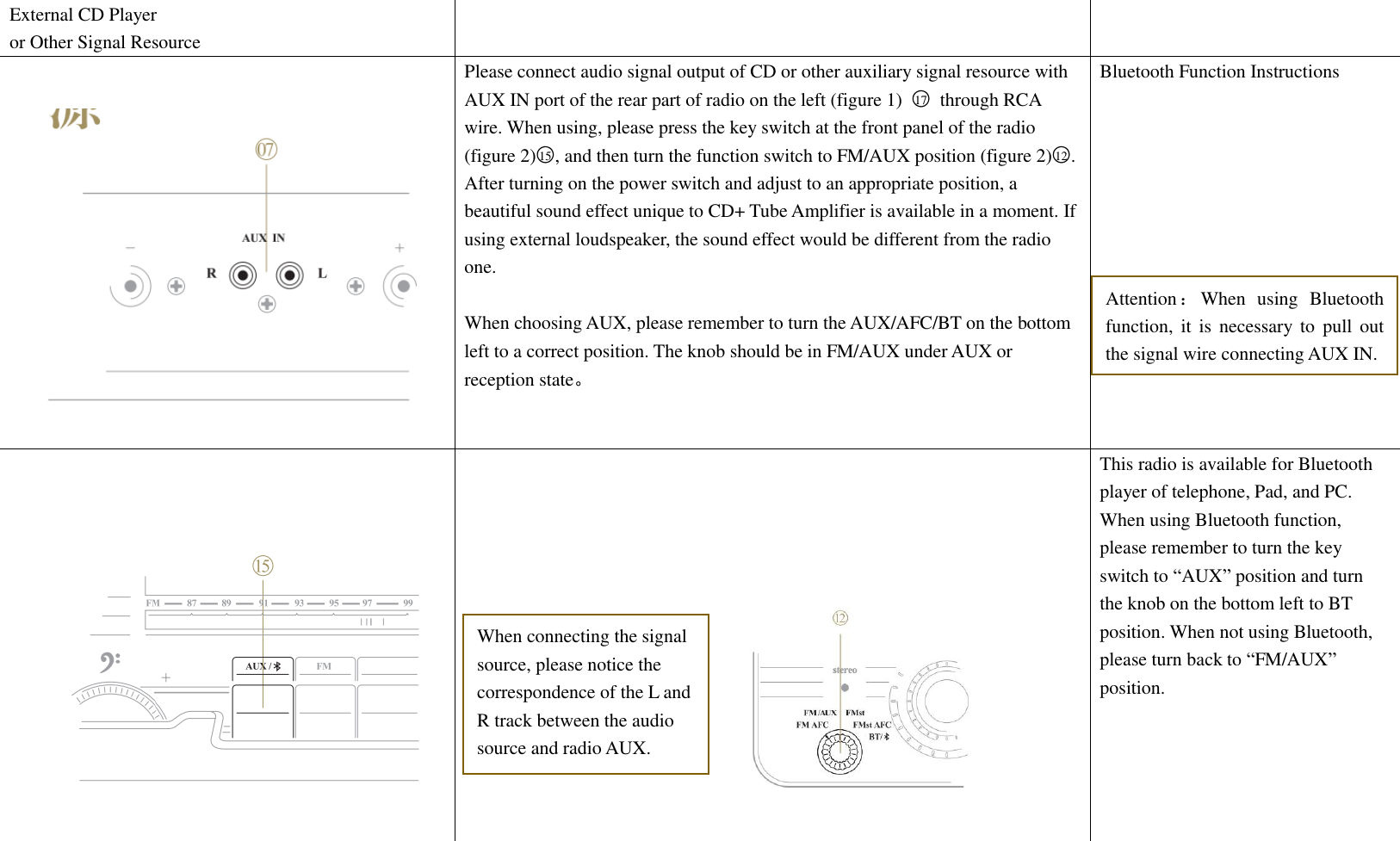
External CD Player or Other Signal Resource                 Please connect audio signal output of CD or other auxiliary signal resource with AUX IN port of the rear part of radio on the left (figure 1)  ○17   through RCA wire. When using, please press the key switch at the front panel of the radio (figure 2)○15 , and then turn the function switch to FM/AUX position (figure 2)○12 . After turning on the power switch and adjust to an appropriate position, a beautiful sound effect unique to CD+ Tube Amplifier is available in a moment. If using external loudspeaker, the sound effect would be different from the radio one.  When choosing AUX, please remember to turn the AUX/AFC/BT on the bottom left to a correct position. The knob should be in FM/AUX under AUX or reception state。 Bluetooth Function Instructions                This radio is available for Bluetooth player of telephone, Pad, and PC. When using Bluetooth function, please remember to turn the key switch to “AUX” position and turn the knob on the bottom left to BT position. When not using Bluetooth, please turn back to “FM/AUX” position.    Attention:When  using  Bluetooth function, it is necessary  to  pull  out the signal wire connecting AUX IN. When connecting the signal source, please notice the correspondence of the L and R track between the audio source and radio AUX.
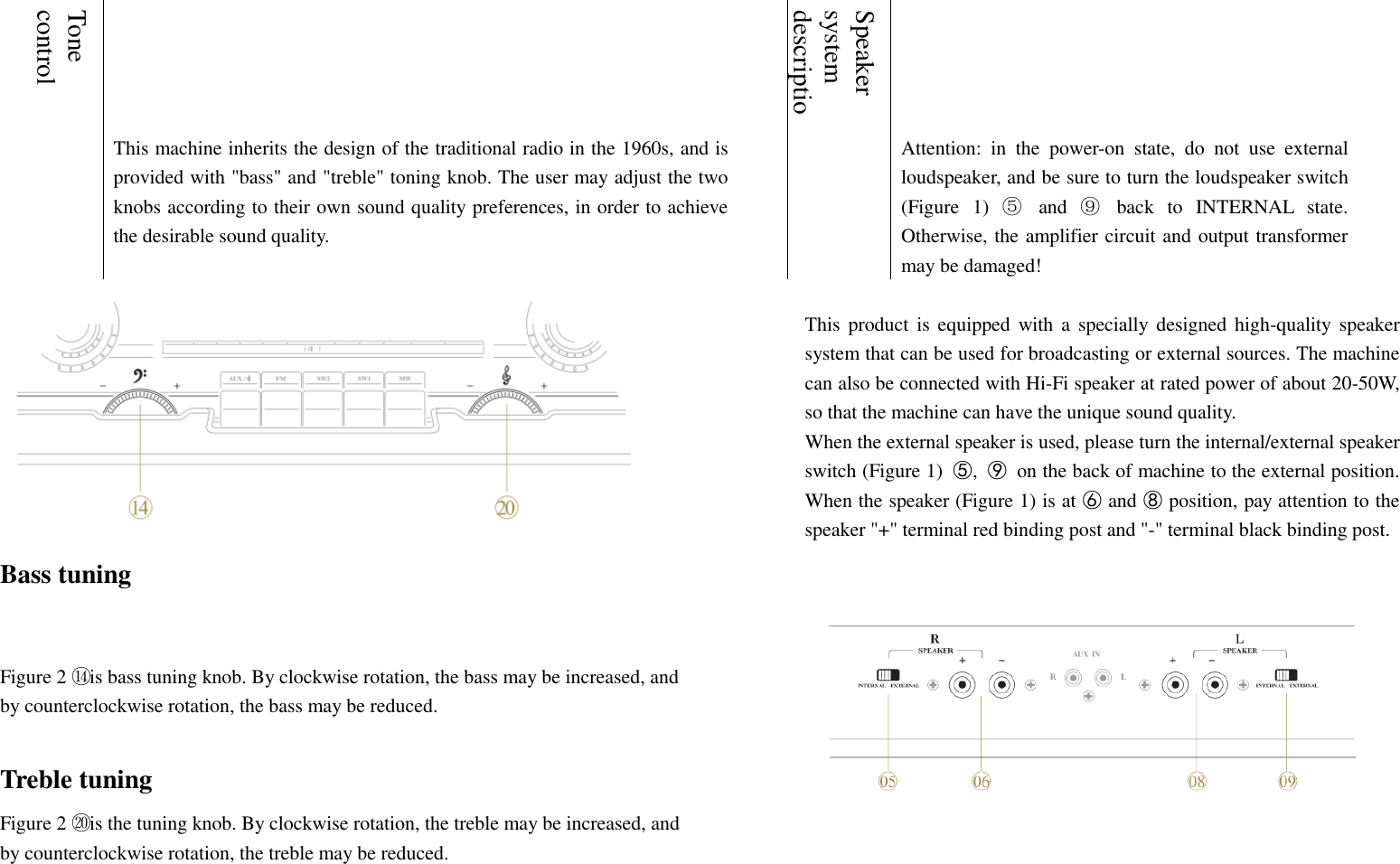
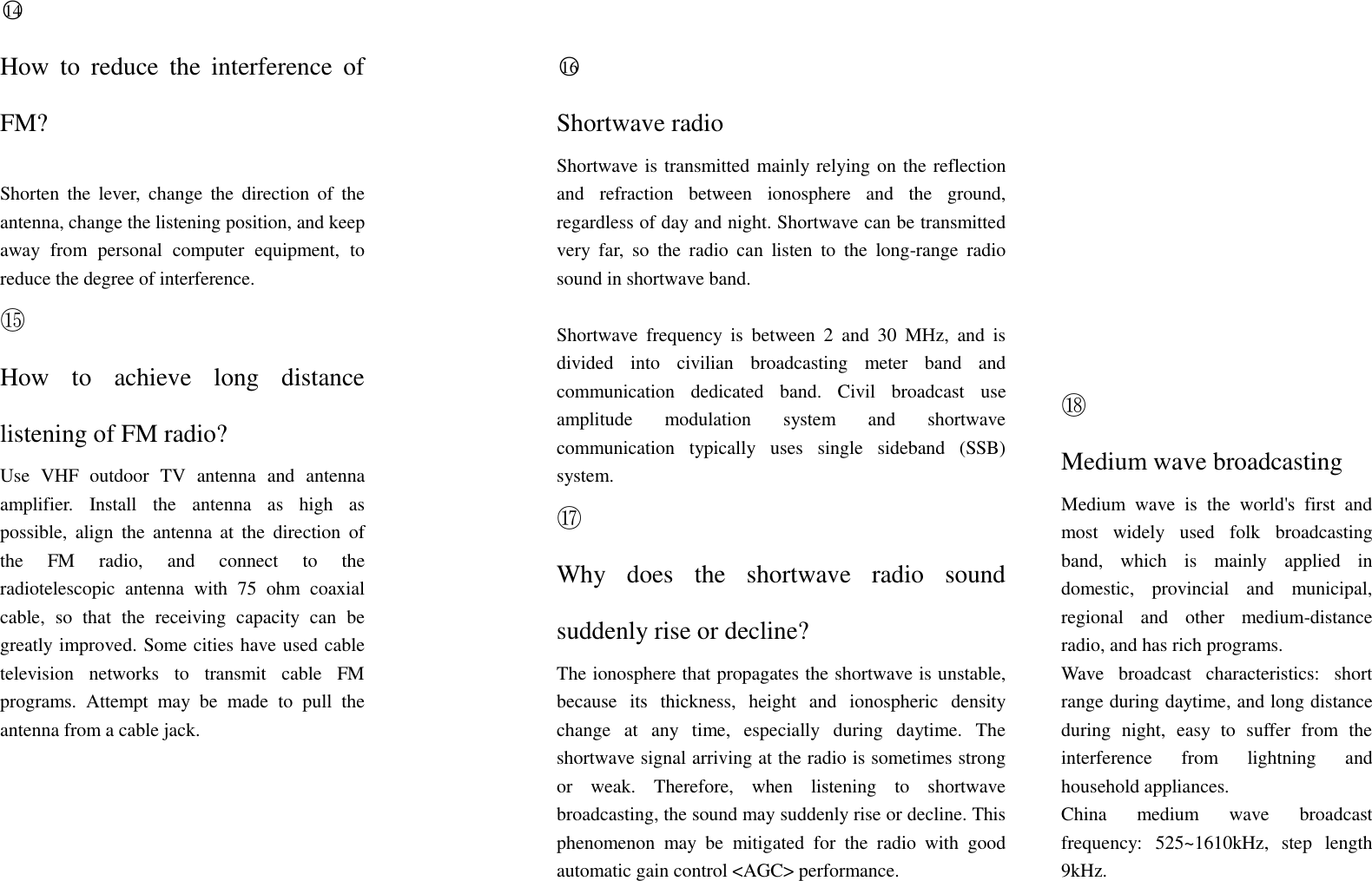
   Tone control  Speaker system description   This machine inherits the design of the traditional radio in the 1960s, and is provided with "bass" and "treble" toning knob. The user may adjust the two knobs according to their own sound quality preferences, in order to achieve the desirable sound quality.  Attention:  in  the  power-on  state,  do  not  use  external loudspeaker, and be sure to turn the loudspeaker switch (Figure  1)  ⑤  and  ⑨  back  to  INTERNAL  state. Otherwise, the amplifier circuit and output transformer may be damaged!  Bass tuning  Figure 2 ⑭ is bass tuning knob. By clockwise rotation, the bass may be increased, and by counterclockwise rotation, the bass may be reduced.  Treble tuning Figure 2 ⑳ is the tuning knob. By clockwise rotation, the treble may be increased, and by counterclockwise rotation, the treble may be reduced.    This  product is  equipped with  a  specially  designed  high-quality  speaker system that can be used for broadcasting or external sources. The machine can also be connected with Hi-Fi speaker at rated power of about 20-50W, so that the machine can have the unique sound quality. When the external speaker is used, please turn the internal/external speaker switch (Figure 1)  ⑤,  ⑨  on the back of machine to the external position. When the speaker (Figure 1) is at ⑥ and ⑧ position, pay attention to the speaker "+" terminal red binding post and "-" terminal black binding post.
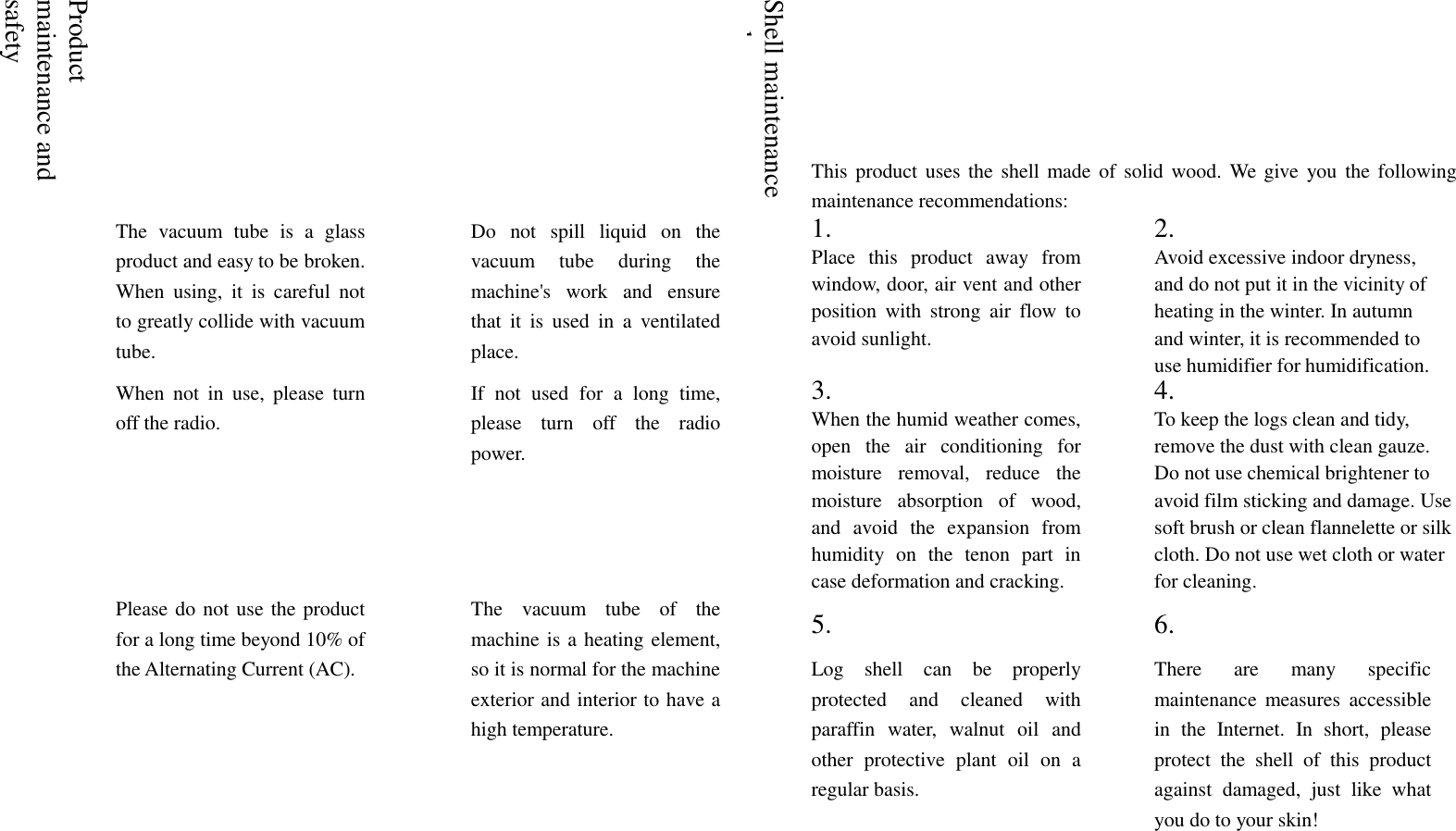
    Product maintenance and safety  Shell maintenance and use This product  uses the  shell made of solid  wood. We give  you  the following maintenance recommendations:  The  vacuum  tube  is  a  glass product and easy to be broken. When  using,  it  is  careful  not to greatly collide with vacuum tube.  Do  not  spill  liquid  on  the vacuum  tube  during  the machine's  work  and  ensure that  it  is  used  in  a  ventilated place.  1. Place  this  product  away  from window, door, air vent and other position  with  strong  air  flow  to avoid sunlight.  2. Avoid excessive indoor dryness, and do not put it in the vicinity of heating in the winter. In autumn and winter, it is recommended to use humidifier for humidification.  When  not  in  use,  please  turn off the radio.  If  not  used  for  a  long  time, please  turn  off  the  radio power.  3. When the humid weather comes, open  the  air  conditioning  for moisture  removal,  reduce  the moisture  absorption  of  wood, and  avoid  the  expansion  from humidity  on  the  tenon  part  in case deformation and cracking.    4. To keep the logs clean and tidy, remove the dust with clean gauze. Do not use chemical brightener to avoid film sticking and damage. Use soft brush or clean flannelette or silk cloth. Do not use wet cloth or water for cleaning.  Please do not use the product for a long time beyond 10% of the Alternating Current (AC).  The  vacuum  tube  of  the machine is a heating element, so it is normal for the machine exterior and interior to have a high temperature.  5. Log  shell  can  be  properly protected  and  cleaned  with paraffin  water,  walnut  oil  and other  protective  plant  oil  on  a regular basis.  6. There  are  many  specific maintenance  measures  accessible in  the  Internet.  In  short,  please protect  the  shell  of  this  product against  damaged,  just  like  what you do to your skin!
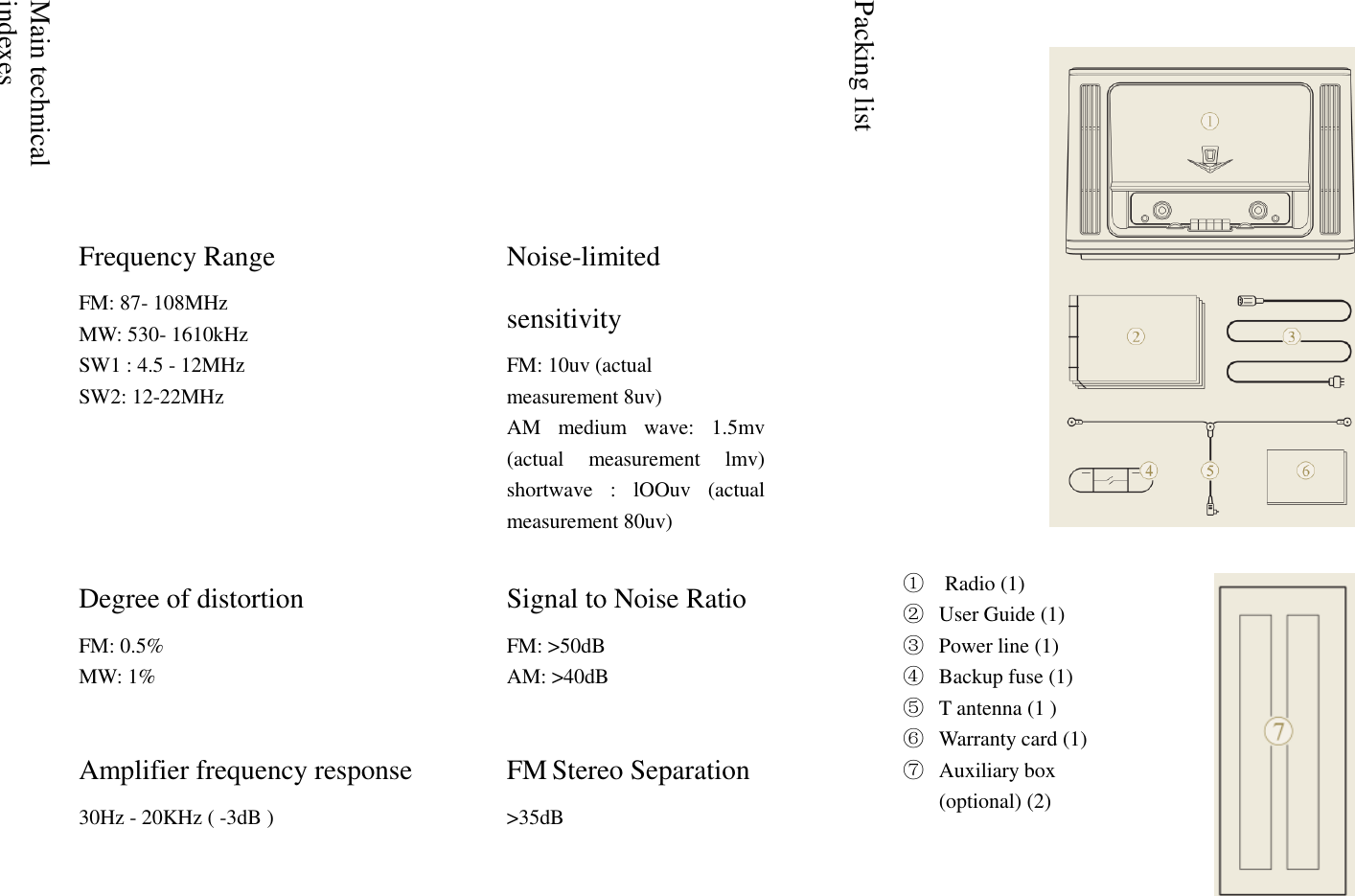
   Main technical indexes  Packing list   Frequency Range FM: 87- 108MHz   MW: 530- 1610kHz   SW1 : 4.5 - 12MHz   SW2: 12-22MHz  Noise-limited sensitivity FM: 10uv (actual measurement 8uv) AM  medium  wave:  1.5mv (actual  measurement  lmv) shortwave  :  lOOuv  (actual measurement 80uv)           Degree of distortion FM: 0.5%   MW: 1%  Signal to Noise Ratio FM: >50dB   AM: >40dB  ①  Radio (1) ② User Guide (1) ③ Power line (1) ④ Backup fuse (1) ⑤ T antenna (1 ) ⑥ Warranty card (1) ⑦ Auxiliary box (optional) (2)          Amplifier frequency response 30Hz - 20KHz ( -3dB )  FM Stereo Separation >35dB
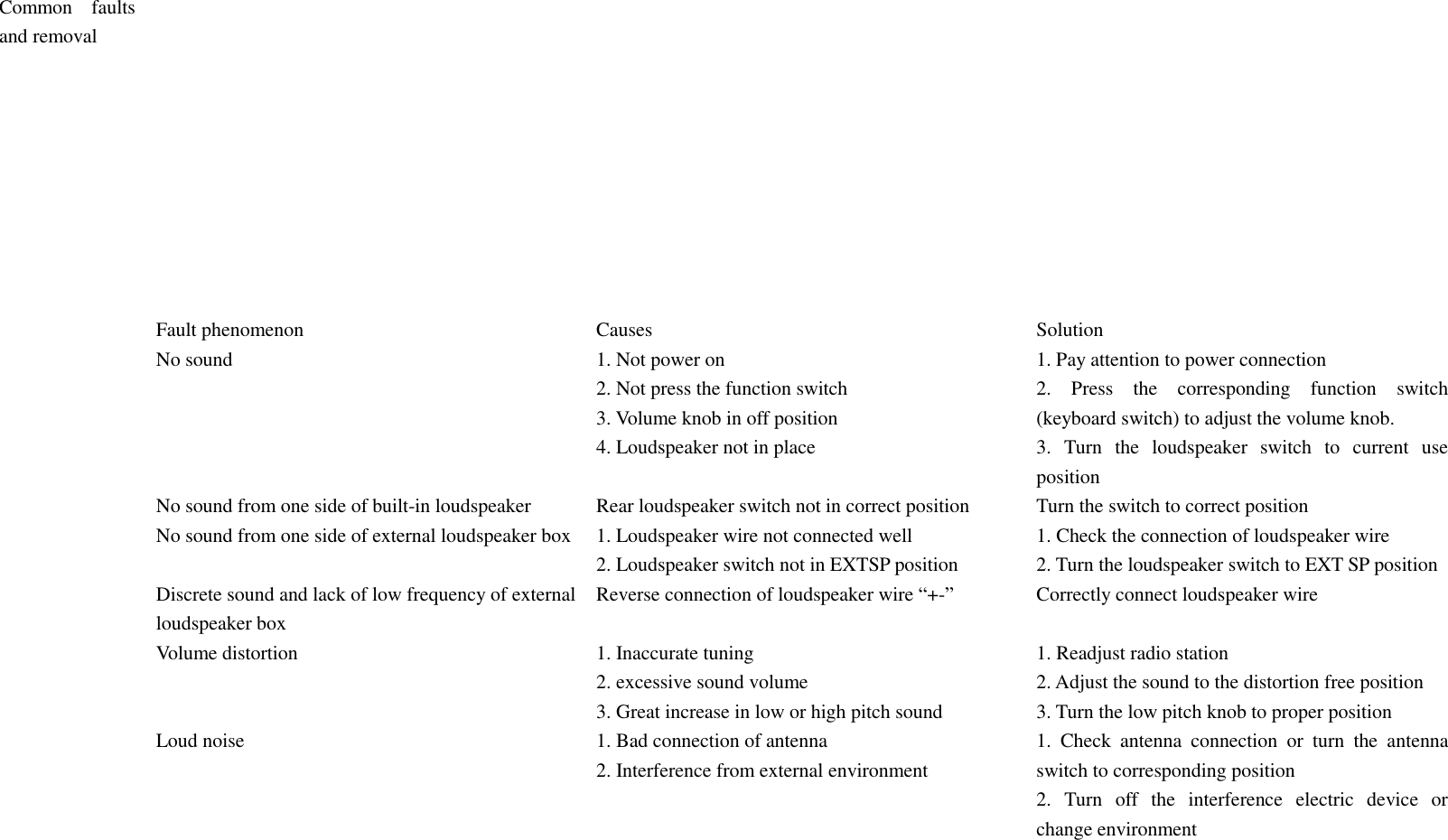
Common  faults and removal                   Fault phenomenon Causes Solution  No sound 1. Not power on 2. Not press the function switch 3. Volume knob in off position 4. Loudspeaker not in place 1. Pay attention to power connection 2.  Press  the  corresponding  function  switch (keyboard switch) to adjust the volume knob. 3.  Turn  the  loudspeaker  switch  to  current  use position  No sound from one side of built-in loudspeaker   Rear loudspeaker switch not in correct position Turn the switch to correct position  No sound from one side of external loudspeaker box 1. Loudspeaker wire not connected well 2. Loudspeaker switch not in EXTSP position 1. Check the connection of loudspeaker wire 2. Turn the loudspeaker switch to EXT SP position  Discrete sound and lack of low frequency of external loudspeaker box   Reverse connection of loudspeaker wire “+-” Correctly connect loudspeaker wire  Volume distortion 1. Inaccurate tuning 2. excessive sound volume 3. Great increase in low or high pitch sound   1. Readjust radio station 2. Adjust the sound to the distortion free position 3. Turn the low pitch knob to proper position  Loud noise 1. Bad connection of antenna 2. Interference from external environment 1.  Check  antenna  connection  or  turn  the  antenna switch to corresponding position 2.  Turn  off  the  interference  electric  device  or change environment
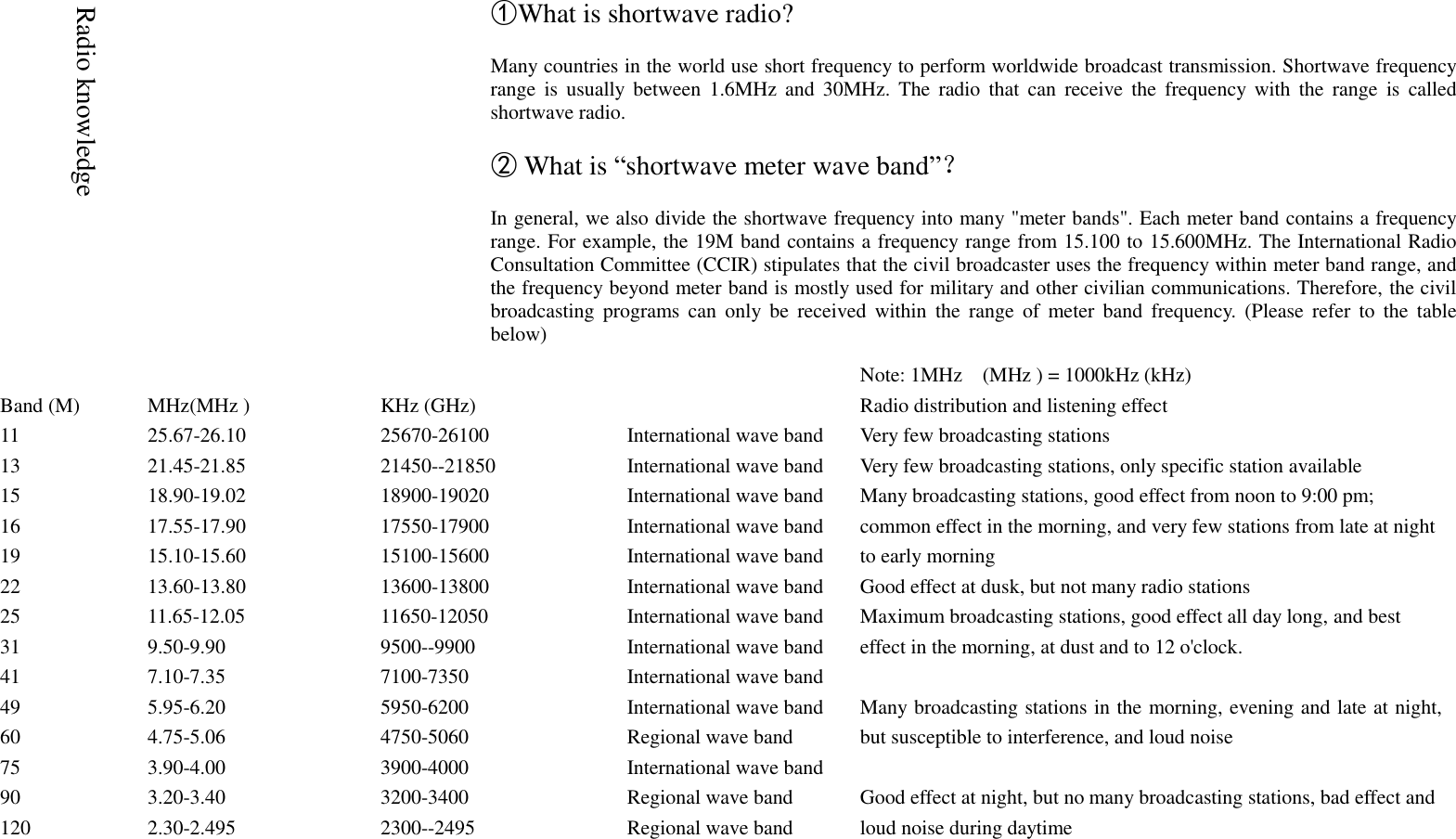
  Radio knowledge   ①What is shortwave radio?  Many countries in the world use short frequency to perform worldwide broadcast transmission. Shortwave frequency range  is  usually  between  1.6MHz  and  30MHz.  The  radio  that  can  receive  the  frequency  with the  range  is  called shortwave radio.  ② What is “shortwave meter wave band”?  In general, we also divide the shortwave frequency into many "meter bands". Each meter band contains a frequency range. For example, the 19M band contains a frequency range from 15.100 to 15.600MHz. The International Radio Consultation Committee (CCIR) stipulates that the civil broadcaster uses the frequency within meter band range, and the frequency beyond meter band is mostly used for military and other civilian communications. Therefore, the civil broadcasting  programs  can  only  be  received  within  the  range  of  meter  band  frequency.  (Please  refer  to  the  table below)          Note: 1MHz    (MHz ) = 1000kHz (kHz) Band (M) MHz(MHz ) KHz (GHz)  Radio distribution and listening effect 11 25.67-26.10 25670-26100 International wave band Very few broadcasting stations 13 21.45-21.85 21450--21850 International wave band Very few broadcasting stations, only specific station available 15 18.90-19.02 18900-19020 International wave band Many broadcasting stations, good effect from noon to 9:00 pm; common effect in the morning, and very few stations from late at night to early morning   16 17.55-17.90 17550-17900 International wave band 19 15.10-15.60 15100-15600 International wave band 22 13.60-13.80 13600-13800 International wave band Good effect at dusk, but not many radio stations 25 11.65-12.05 11650-12050 International wave band Maximum broadcasting stations, good effect all day long, and best effect in the morning, at dust and to 12 o'clock. 31 9.50-9.90 9500--9900 International wave band 41 7.10-7.35 7100-7350 International wave band Many broadcasting stations in the morning, evening and late at night, but susceptible to interference, and loud noise 49 5.95-6.20 5950-6200 International wave band 60 4.75-5.06 4750-5060 Regional wave band 75 3.90-4.00 3900-4000 International wave band 90 3.20-3.40 3200-3400 Regional wave band Good effect at night, but no many broadcasting stations, bad effect and loud noise during daytime   120 2.30-2.495 2300--2495 Regional wave band
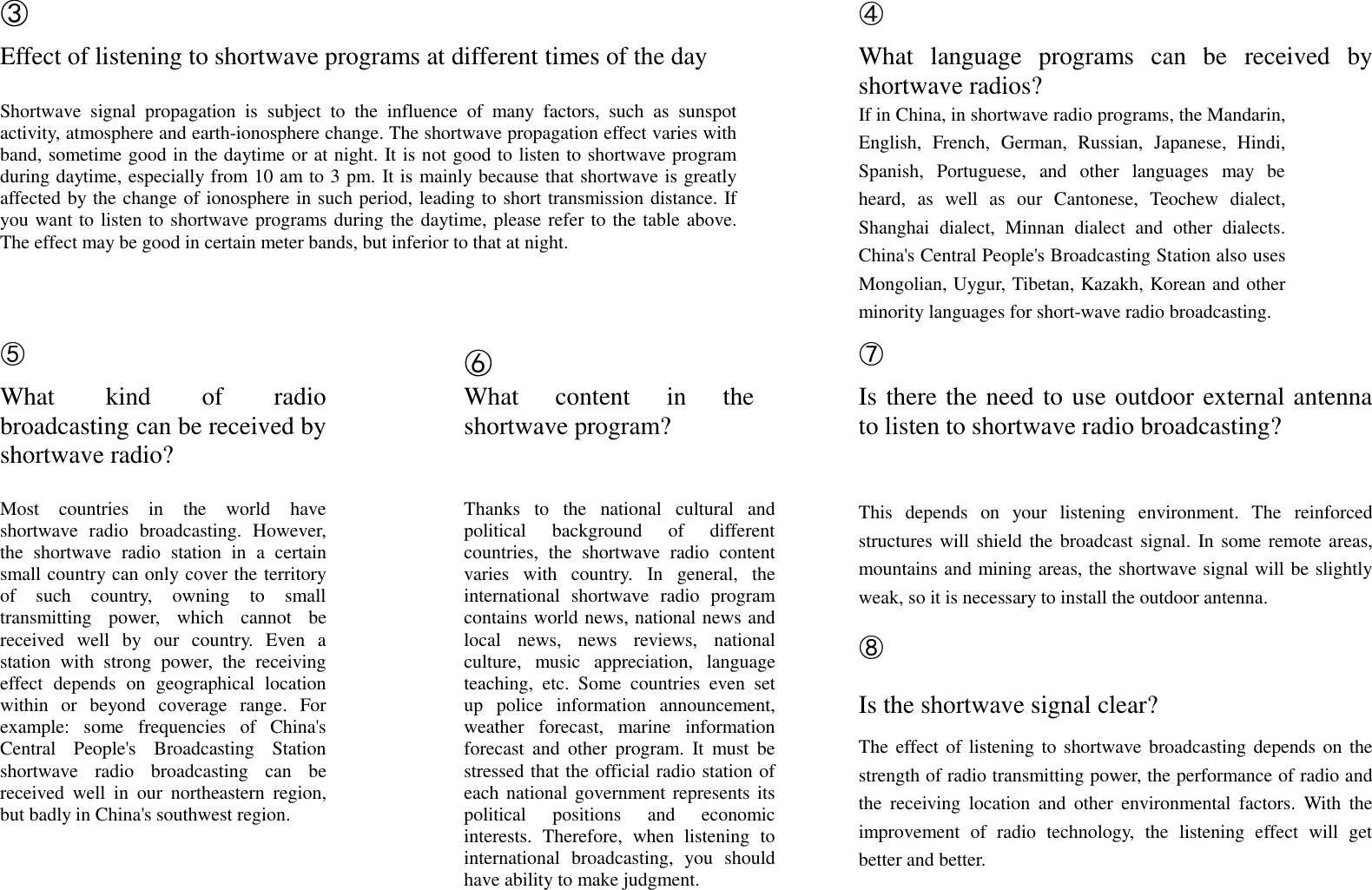
③  ④ Effect of listening to shortwave programs at different times of the day  What  language  programs  can  be  received  by shortwave radios? Shortwave  signal  propagation  is  subject  to  the  influence  of  many  factors,  such  as  sunspot activity, atmosphere and earth-ionosphere change. The shortwave propagation effect varies with band, sometime good in the daytime or at night. It is not good to listen to shortwave program during daytime, especially from 10 am to 3 pm. It is mainly because that shortwave is greatly affected by the change of ionosphere in such period, leading to short transmission distance. If you want to listen to shortwave programs during the daytime, please refer to the table above. The effect may be good in certain meter bands, but inferior to that at night.  If in China, in shortwave radio programs, the Mandarin, English,  French,  German,  Russian,  Japanese,  Hindi, Spanish,  Portuguese,  and  other  languages  may  be heard,  as  well  as  our  Cantonese,  Teochew  dialect, Shanghai  dialect,  Minnan  dialect  and  other  dialects. China's Central People's Broadcasting Station also uses Mongolian, Uygur, Tibetan, Kazakh, Korean and other minority languages for short-wave radio broadcasting.  ⑤  ⑥    ⑦  What  kind  of  radio broadcasting can be received by shortwave radio?  What  content  in  the shortwave program?   Is there the need to use outdoor external antenna to listen to shortwave radio broadcasting?         Most  countries  in  the  world  have shortwave  radio  broadcasting.  However, the  shortwave  radio  station  in  a  certain small country can only cover the territory of  such  country,  owning  to  small transmitting  power,  which  cannot  be received  well  by  our  country.  Even  a station  with  strong  power,  the  receiving effect  depends  on  geographical  location within  or  beyond  coverage  range.  For example:  some  frequencies  of  China's Central  People's  Broadcasting  Station shortwave  radio  broadcasting  can  be received  well  in  our  northeastern  region, but badly in China's southwest region.  Thanks  to  the  national  cultural  and political  background  of  different countries,  the  shortwave  radio  content varies  with  country.  In  general,  the international  shortwave  radio  program contains world news, national news and local  news,  news  reviews,  national culture,  music  appreciation,  language teaching,  etc.  Some  countries  even  set up  police  information  announcement, weather  forecast,  marine  information forecast  and  other  program.  It  must  be stressed that the official radio station of each national government represents its political  positions  and  economic interests.  Therefore,  when  listening  to international  broadcasting,  you  should have ability to make judgment.  This  depends  on  your  listening  environment.  The  reinforced structures will shield the broadcast signal. In some remote areas, mountains and mining areas, the shortwave signal will be slightly weak, so it is necessary to install the outdoor antenna. ⑧ Is the shortwave signal clear? The effect of listening to shortwave broadcasting depends on the strength of radio transmitting power, the performance of radio and the  receiving  location  and  other  environmental  factors.  With  the improvement  of  radio  technology,  the  listening  effect  will  get better and better.
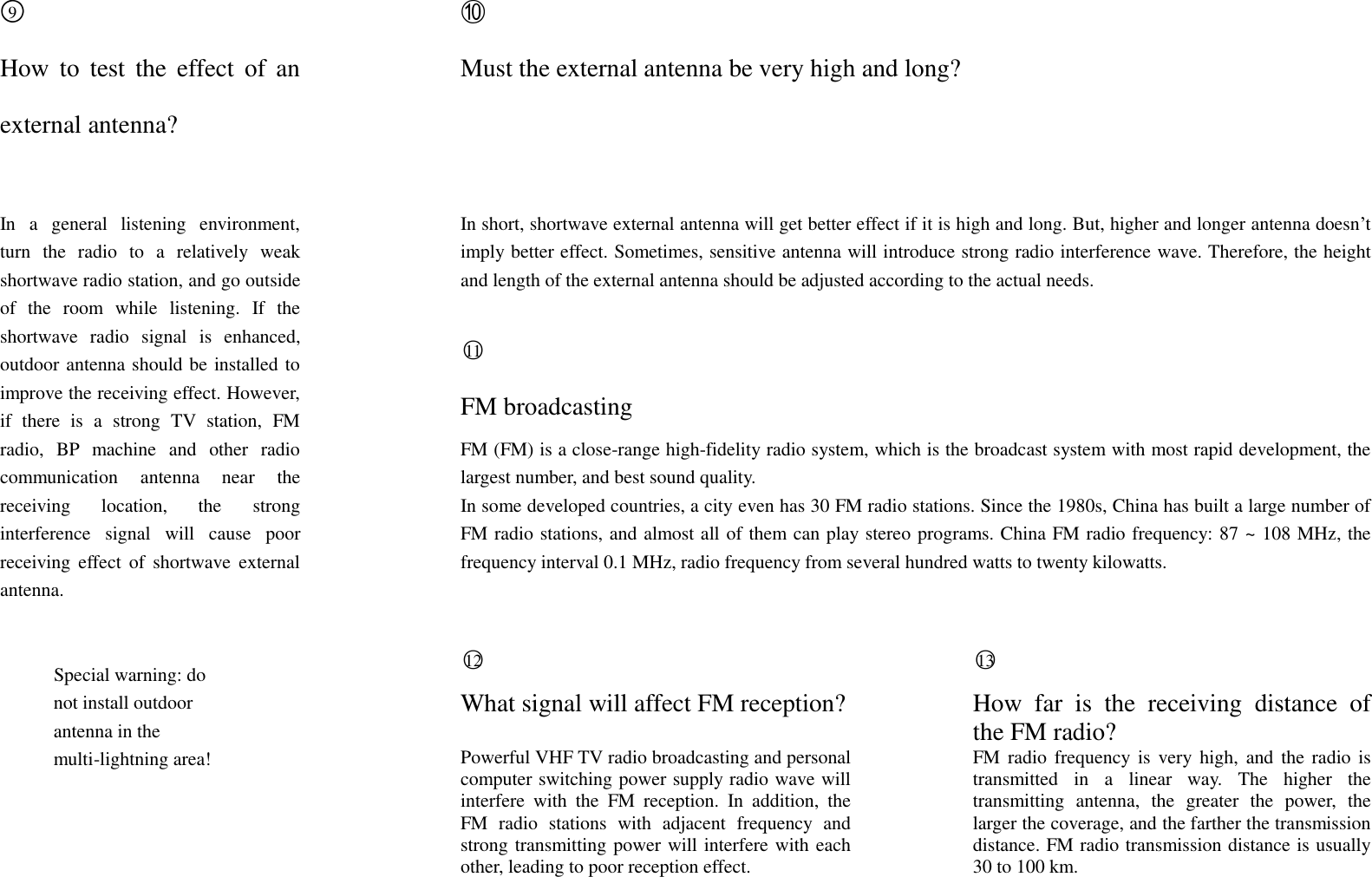
○9  ⑩ How  to  test  the  effect  of  an external antenna?  Must the external antenna be very high and long?    In  a  general  listening  environment, turn  the  radio  to  a  relatively  weak shortwave radio station, and go outside of  the  room  while  listening.  If  the shortwave  radio  signal  is  enhanced, outdoor antenna should be installed to improve the receiving effect. However, if  there  is  a  strong  TV  station,  FM radio,  BP  machine  and  other  radio communication  antenna  near  the receiving  location,  the  strong interference  signal  will  cause  poor receiving  effect  of  shortwave  external antenna.  In short, shortwave external antenna will get better effect if it is high and long. But, higher and longer antenna doesn’t imply better effect. Sometimes, sensitive antenna will introduce strong radio interference wave. Therefore, the height and length of the external antenna should be adjusted according to the actual needs.  ○11  FM broadcasting FM (FM) is a close-range high-fidelity radio system, which is the broadcast system with most rapid development, the largest number, and best sound quality. In some developed countries, a city even has 30 FM radio stations. Since the 1980s, China has built a large number of FM radio stations, and almost all of them can play stereo programs. China FM radio frequency: 87 ~ 108 MHz, the frequency interval 0.1 MHz, radio frequency from several hundred watts to twenty kilowatts.  Special warning: do not install outdoor antenna in the multi-lightning area!   ○12  What signal will affect FM reception?  Powerful VHF TV radio broadcasting and personal computer switching power supply radio wave will interfere  with  the  FM  reception.  In  addition,  the FM  radio  stations  with  adjacent  frequency  and strong transmitting power will interfere with each other, leading to poor reception effect.   ○13  How  far  is  the  receiving  distance  of the FM radio? FM radio  frequency is  very  high,  and  the radio is transmitted  in  a  linear  way.  The  higher  the transmitting  antenna,  the  greater  the  power,  the larger the coverage, and the farther the transmission distance. FM radio transmission distance is usually 30 to 100 km.
○14  How  to  reduce  the  interference  of FM?  Shorten  the  lever,  change  the  direction  of  the antenna, change the listening position, and keep away  from  personal  computer  equipment,  to reduce the degree of interference.  ○16  Shortwave radio Shortwave is transmitted mainly relying on the reflection and  refraction  between  ionosphere  and  the  ground, regardless of day and night. Shortwave can be transmitted very  far,  so  the  radio  can  listen  to  the  long-range  radio sound in shortwave band.     ⑮ How  to  achieve  long  distance listening of FM radio? Use  VHF  outdoor  TV  antenna  and  antenna amplifier.  Install  the  antenna  as  high  as possible,  align  the  antenna  at  the  direction  of the  FM  radio,  and  connect  to  the radiotelescopic  antenna  with  75  ohm  coaxial cable,  so  that  the  receiving  capacity  can  be greatly improved. Some cities have used cable television  networks  to  transmit  cable  FM programs.  Attempt  may  be  made  to  pull  the antenna from a cable jack.   Shortwave  frequency  is  between  2  and  30  MHz,  and  is divided  into  civilian  broadcasting  meter  band  and communication  dedicated  band.  Civil  broadcast  use amplitude  modulation  system  and  shortwave communication  typically  uses  single  sideband  (SSB) system. ⑰ Why  does  the  shortwave  radio  sound suddenly rise or decline? The ionosphere that propagates the shortwave is unstable, because  its  thickness,  height  and  ionospheric  density change  at  any  time,  especially  during  daytime.  The shortwave signal arriving at the radio is sometimes strong or  weak.  Therefore,  when  listening  to  shortwave broadcasting, the sound may suddenly rise or decline. This phenomenon  may  be  mitigated  for  the  radio  with  good automatic gain control <AGC> performance.  ⑱ Medium wave broadcasting Medium  wave  is  the  world's  first  and most  widely  used  folk  broadcasting band,  which  is  mainly  applied  in domestic,  provincial  and  municipal, regional  and  other  medium-distance radio, and has rich programs. Wave  broadcast  characteristics:  short range during daytime, and long distance during  night,  easy  to  suffer  from  the interference  from  lightning  and household appliances. China  medium  wave  broadcast frequency:  525~1610kHz, step  length 9kHz.
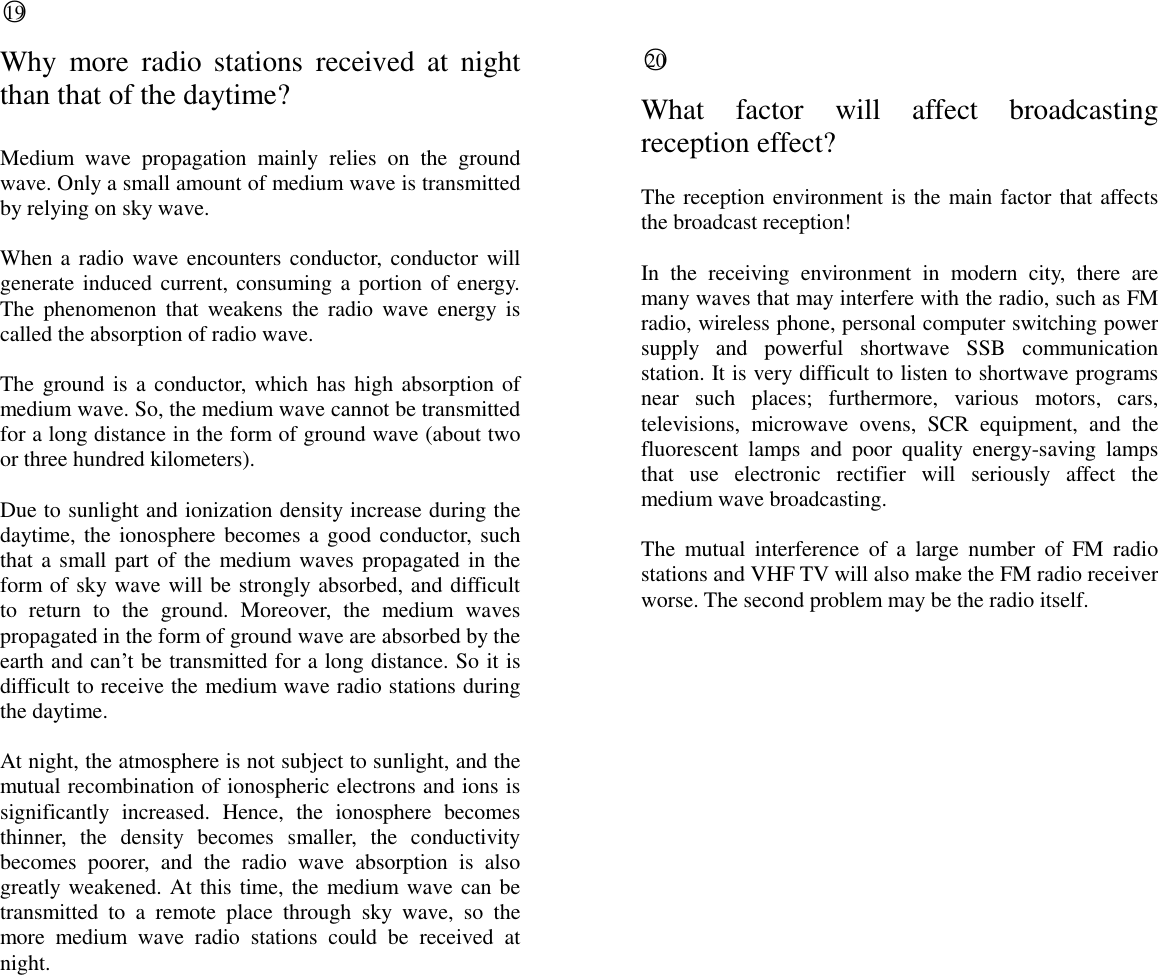
 ○19  Why  more  radio  stations  received  at  night than that of the daytime?  Medium  wave  propagation  mainly  relies  on  the  ground wave. Only a small amount of medium wave is transmitted by relying on sky wave.  When a radio wave encounters conductor, conductor will generate induced current, consuming a portion of energy. The  phenomenon  that  weakens the  radio  wave  energy  is called the absorption of radio wave.  The ground is a conductor, which has high absorption of medium wave. So, the medium wave cannot be transmitted for a long distance in the form of ground wave (about two or three hundred kilometers).  Due to sunlight and ionization density increase during the daytime, the ionosphere becomes a good conductor,  such that a small part of the medium waves propagated in the form of sky wave will be strongly absorbed, and difficult to  return  to  the  ground.  Moreover,  the  medium  waves propagated in the form of ground wave are absorbed by the earth and can’t be transmitted for a long distance. So it is difficult to receive the medium wave radio stations during the daytime.  At night, the atmosphere is not subject to sunlight, and the mutual recombination of ionospheric electrons and ions is significantly  increased.  Hence,  the  ionosphere  becomes thinner,  the  density  becomes  smaller,  the  conductivity becomes  poorer,  and  the  radio  wave  absorption  is  also greatly weakened. At this time, the medium wave can be transmitted  to  a  remote  place  through  sky  wave,  so  the more  medium  wave  radio  stations  could  be  received  at night.   ○20  What  factor  will  affect  broadcasting reception effect?  The reception environment is the main factor that affects the broadcast reception!  In  the  receiving  environment  in  modern  city,  there  are many waves that may interfere with the radio, such as FM radio, wireless phone, personal computer switching power supply  and  powerful  shortwave  SSB  communication station. It is very difficult to listen to shortwave programs near  such  places;  furthermore,  various  motors,  cars, televisions,  microwave  ovens,  SCR  equipment,  and  the fluorescent  lamps  and  poor  quality  energy-saving  lamps that  use  electronic  rectifier  will  seriously  affect  the medium wave broadcasting.  The  mutual  interference  of  a  large  number  of  FM  radio stations and VHF TV will also make the FM radio receiver worse. The second problem may be the radio itself.
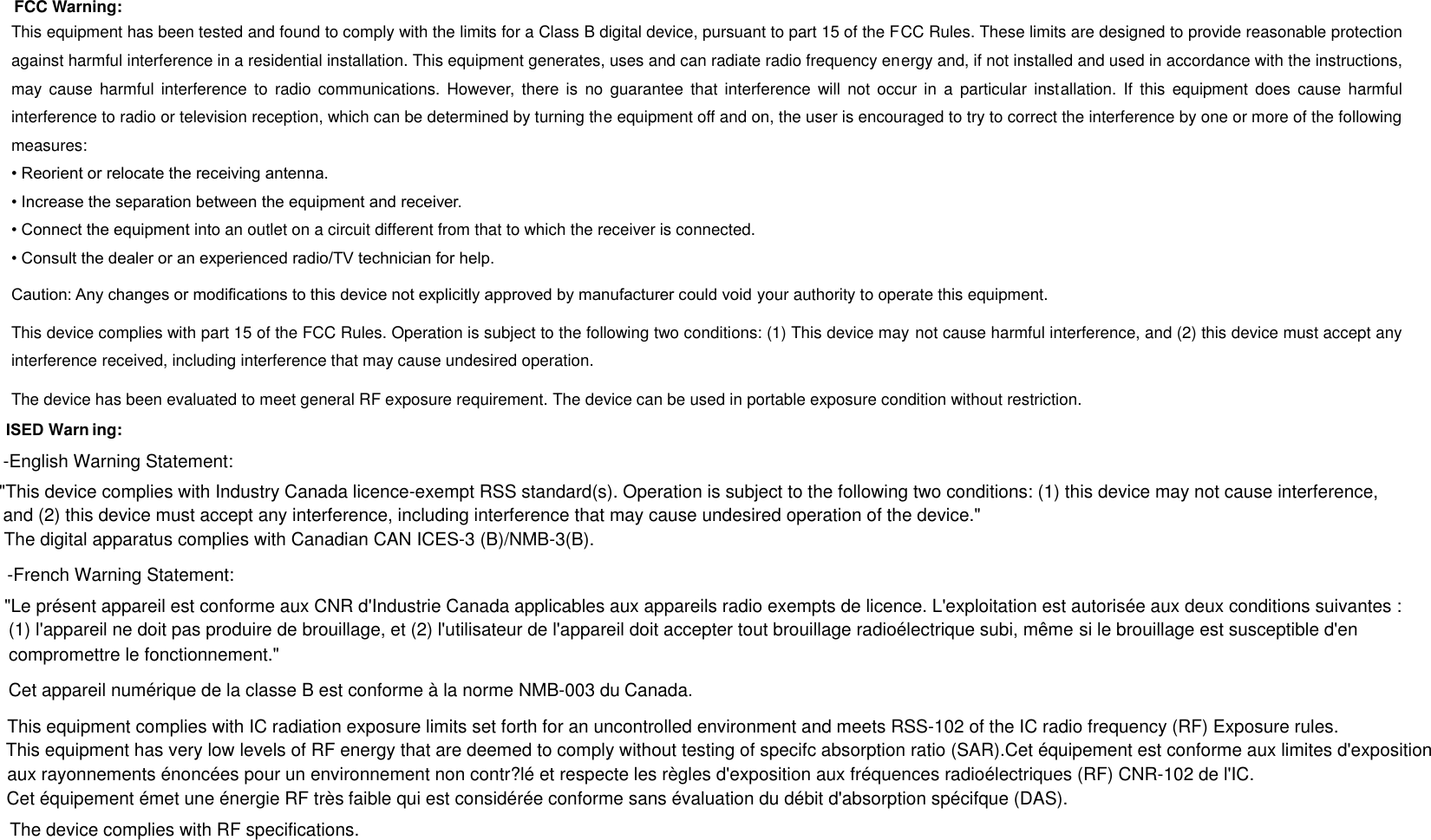
This equipment has been tested and found to comply with the limits for a Class B digital device, pursuant to part 15 of the FCC Rules. These limits are designed to provide reasonable protection against harmful interference in a residential installation. This equipment generates, uses and can radiate radio frequency energy and, if not installed and used in accordance with the instructions, may  cause harmful  interference  to  radio communications. However,  there  is  no  guarantee  that interference  will not  occur in  a  particular  installation.  If  this equipment  does cause  harmful interference to radio or television reception, which can be determined by turning the equipment off and on, the user is encouraged to try to correct the interference by one or more of the following measures: • Reorient or relocate the receiving antenna.• Increase the separation between the equipment and receiver.• Connect the equipment into an outlet on a circuit different from that to which the receiver is connected.• Consult the dealer or an experienced radio/TV technician for help.Caution: Any changes or modifications to this device not explicitly approved by manufacturer could void your authority to operate this equipment. This device complies with part 15 of the FCC Rules. Operation is subject to the following two conditions: (1) This device may not cause harmful interference, and (2) this device must accept any interference received, including interference that may cause undesired operation. The device has been evaluated to meet general RF exposure requirement. The device can be used in portable exposure condition without restriction. FCC Warning:  ISED Warn ing: -English Warning Statement:"This device complies with Industry Canada licence-exempt RSS standard(s). Operation is subject to the following two conditions: (1) this device may not cause interference,  and (2) this device must accept any interference, including interference that may cause undesired operation of the device."The digital apparatus complies with Canadian CAN ICES-3 (B)/NMB-3(B).-French Warning Statement:"Le présent appareil est conforme aux CNR d'Industrie Canada applicables aux appareils radio exempts de licence. L'exploitation est autorisée aux deux conditions suivantes : (1) l'appareil ne doit pas produire de brouillage, et (2) l'utilisateur de l'appareil doit accepter tout brouillage radioélectrique subi, même si le brouillage est susceptible d'en compromettre le fonctionnement."Cet appareil numérique de la classe B est conforme à la norme NMB-003 du Canada.This equipment complies with IC radiation exposure limits set forth for an uncontrolled environment and meets RSS-102 of the IC radio frequency (RF) Exposure rules. This equipment has very low levels of RF energy that are deemed to comply without testing of specifc absorption ratio (SAR).Cet équipement est conforme aux limites d'expositionaux rayonnements énoncées pour un environnement non contr?lé et respecte les règles d'exposition aux fréquences radioélectriques (RF) CNR-102 de l'IC. Cet équipement émet une énergie RF très faible qui est considérée conforme sans évaluation du débit d'absorption spécifque (DAS).The device complies with RF specifications.

Navigation menu