Alarm Lock 250 260 700 710_WI1601.40_INST 700, 710, 250, Installation Instructions 710 WI1601.40 INST
User Manual: Alarm Lock 700, 710, 250, 260 Installation Instructions Installation Manuals
Open the PDF directly: View PDF  .
.
Page Count: 16
1
ELECTRONIC PANIC LOCKS
INSTALLATION AND OPERATION INSTRUCTIONS
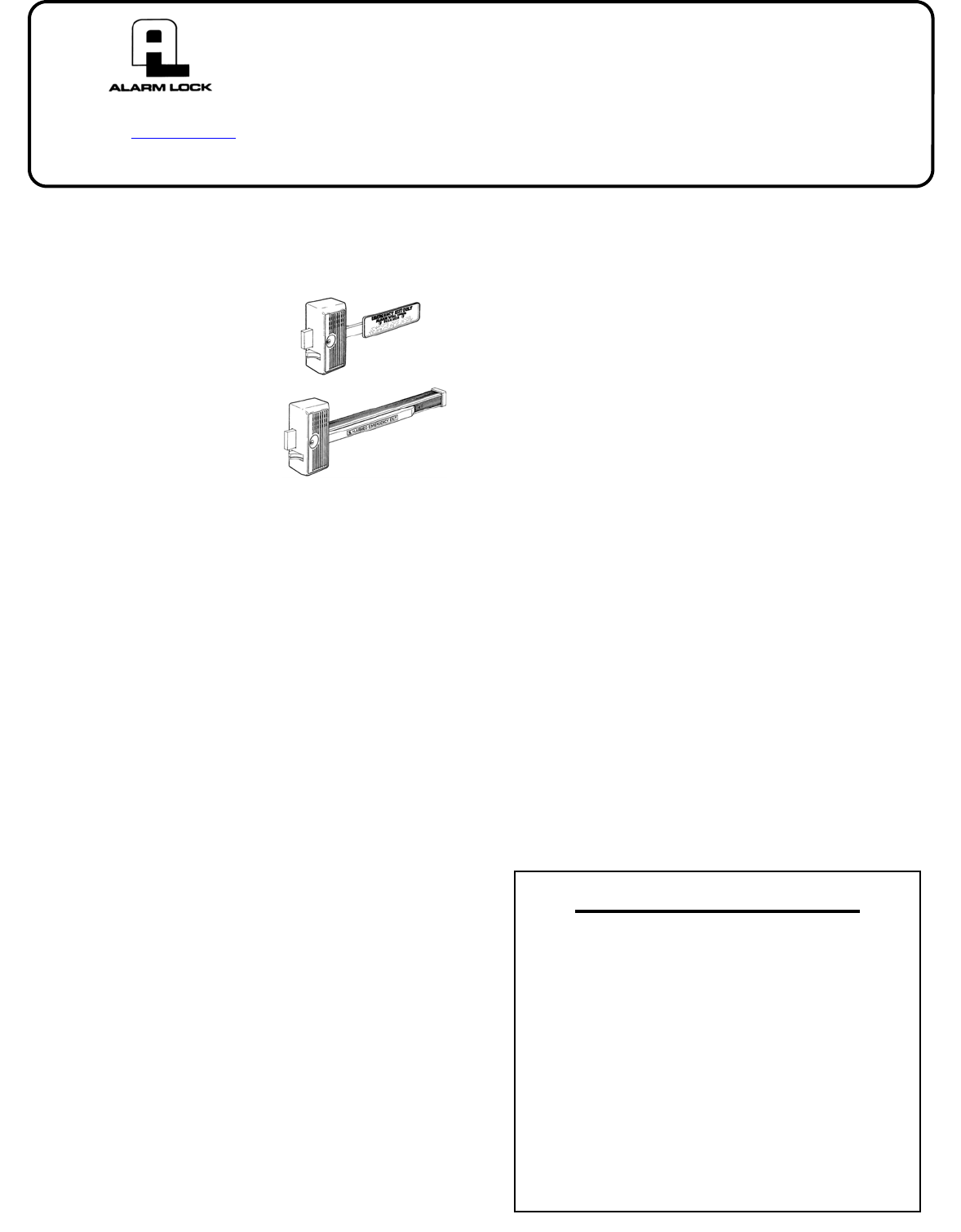
PADDLE ARM MODELS 250 / 260
PUSH BAR MODELS 700 / 710
WATERPROOF MODELS 250WP / 700WP / 710WP
GENERAL DESCRIPTION
Models 250, 260, 700 and 710 are non-handed electronic
exit door locking systems. The specific models are:
▪ 250········· Clapper Plate Model
▪ 250WP ··· Clapper Plate Waterproof
▪ 260········· Clapper Plate
Retriggerable
▪ 700········· Channel Push Bar
▪ 700WP ··· Channel Push Bar
Waterproof
▪ 710········· Channel Push Bar
Retriggerable
▪ 710WP ··· Channel Push Bar
Retriggerable Waterproof
Arming is accomplished by actuating the deadbolt using a
rim cylinder (not included). When armed, depressing the
paddle or push bar will release the deadbolt and sound an
immediate alarm.
Several other options are available. Jumpers inside the unit
allow for either a "Continuous Alarm" or a two-minute "Auto-
alarm Shutdown".
"Continuous Alarm" mode: When triggered, the
alarm remains sounding until deactivated when relocked
with the key.
"Auto-Alarm Shutdown" mode: When triggered, the
alarm remains sounding for two minutes, the lock then
checks if the door is closed. If the lock detects the door is
closed, the sounder will turn off; if the lock detects the
door is still open, the sounder remains on for another two
minutes and the process repeats by re-checking the door
status every two minutes.
After the initial two minute alarm and automatic shutdown,
"Retriggerable" models allow the alarm to reactivate if
the door is opened again. The lock remains retriggerable
until the door is relocked with the key. Note: Whenever an
alarm is caused by opening the door, and the door is left
open, the two minute alarm shutdown will be inhibited.
SPECIFICATIONS
All specifications are rated at 72°F (22°C).
Power Source: ....................... 9VDC alkaline battery
Battery Life:
For non-waterproof models: 4 years standby in armed mode;
600 two-minute alarm sequences. ("Auto-Alarm Shutdown" mode),
20 hours continuous alarm
For waterproof models: 9VDC long-life sealed alkaline battery
pack (part #S6173). Increased standby times, alarm sequence cy-
cles and continuous alarm duration (compared with non-waterproof
models).
WI1601 04/16
345 Bayview Avenue
Amityville, New York 11701
For Sales and Repairs 1-800-ALA-LOCK
For Technical Service 1-800-645-9440
or visit us at http://tech.napcosecurity.com/
(Note: Technical Service is for security professionals only)
Publicly traded on NASDAQ Symbol: NSSC
© ALARM LOCK 2016
Model 700 / 710
Model 250 / 260
Maximum Current:
Idle with bolt extended: ............ 22µa @ 9VDC input
Idle with bolt retracted:............. 18µa @ 9VDC input
Alarm: ......................................... 50mA
Sound Pressure Level: ....... 99dB (c-weighted @ 10ft.) +/- 3dB
Dimensions (WxHxD):......... Models 700-710: 33 x 8½ x 3¼ in.
...................................................... Models 250-260: 18 x 8½ x 3¼ in.
Shipping Weight: .................. Models 700-710: 12 lbs. approx.
...................................................... Models 250-260: 9 lbs. approx.
Temperature Range: ............ -20° to +140°F (-29° to 60°C)
Chassis Construction: ........ Die cast zinc and aluminum
Finish: ........................................ US28 Aluminum or US312
Duranodic Powder Coat
FEATURES
Non-handed
Deadbolt with hardened steel insert
Deadlatch for easy access from inside without alarm
Deadbolt can be operated by outside key (optional)
For single or double doors
Loud dual-piezo horn
Continuous or two-minute alarm shutdown
Disarming beep sounds when bolt retracted with key
Low battery beep when battery needs to be replaced
Retriggerable models: Automatic re-arming after two
minute shutdown
GENERAL DESCRIPTION ................................................................. 1
SPECIFICATIONS ............................................................................... 1
FEATURES .......................................................................................... 1
OPTIONAL EQUIPMENT .................................................................... 2
PRECAUTIONS ................................................................................... 2
SINGLE DOOR INSTALLATIONS ..................................................... 3
DOUBLE DOOR INSTALLATIONS ................................................... 7
OPERATING INSTRUCTIONS ......................................................... 11
OPERATIONAL TESTING ................................................................ 11
LOW BATTERY DETECTION .......................................................... 11
DOGGING OPERATION ................................................................... 11
SCREW CHART ........................................................................... 12-13
DETAIL ASSEMBLY OF 700 & 710 SERIES ............................ 14
DETAIL ASSEMBLY OF 250 & 260 SERIES ............................ 15
LIMITED WARRANTY ....................................................................... 16
TABLE OF CONTENTS
2
OPTIONAL EQUIPMENT
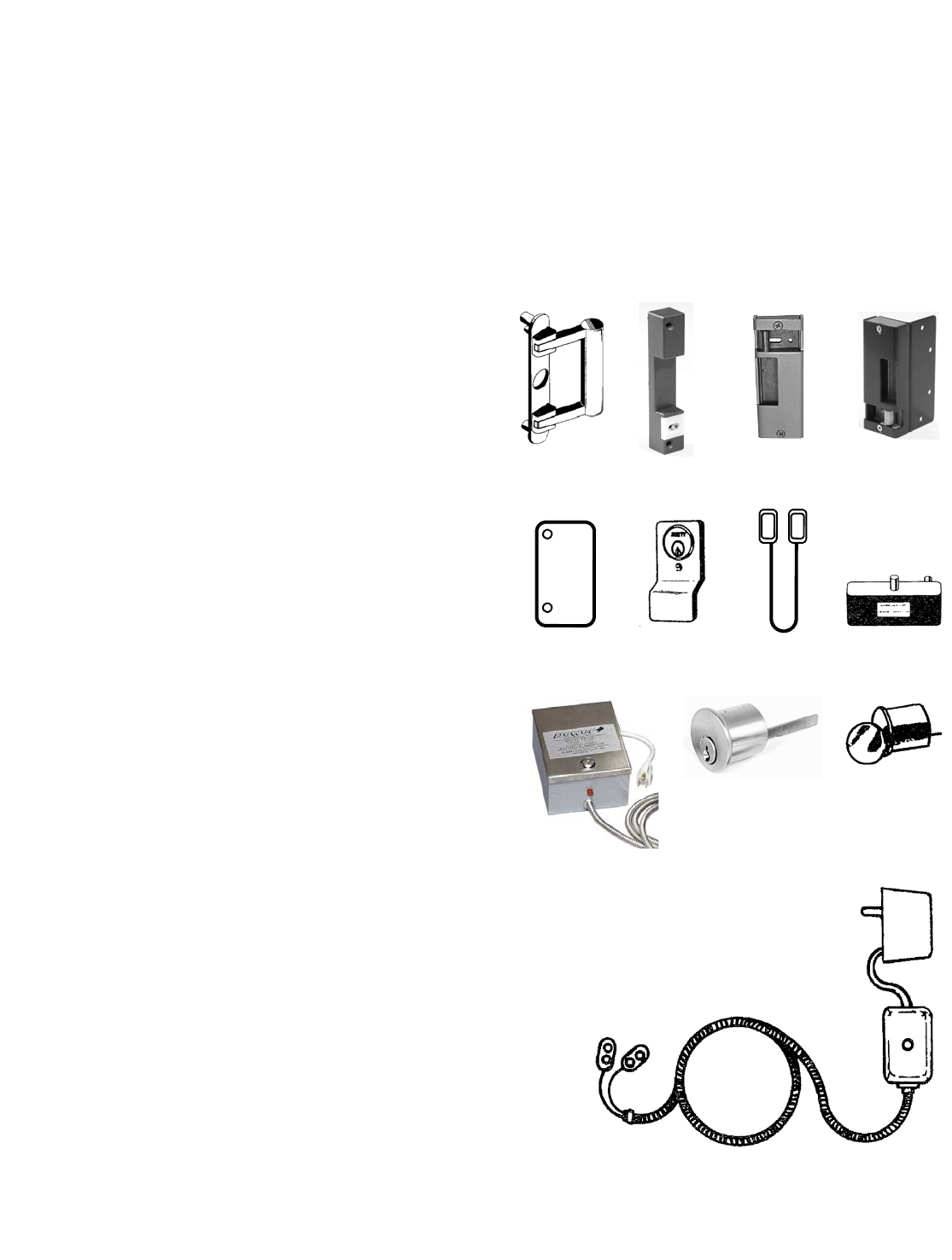
Outside Access Door Pull Model 707 - For access
from building exteriors. Installed on the outside of the
door and linked to the lock. After deadbolt is retracted
by outside key, a slight pull will release the deadlatch
and open door. Cast aluminum, 8" x 1.5".
Double Door Keeper Model 732 - Applied to the
surface of the inactive leaf of a pair of doors. Plated
case aluminum 7/8" x 6"
Single Door Keeper Model 730 - Supplied for sin-
gle doors or pairs of doors with mullions.
Double-Door Strike Model 735 - Alarm Lock double-
door strike Model 735 is specifically designed for the
Model 715 Series Delayed Egress Panic Lock
Finish Back Plate Model 767 - Required to conceal
the open back of the lock body when mounted on a
glass door. Stainless steel 4.5" x 8.5".
Cylinder Finger Pull Model 711 - An inexpensive
door pull for use when outside key only access is re-
quired.
Armored Door Loop Model 271 - For use with elec-
trified locks. An easy means for bringing electric cur-
rent from the hinge side of a door frame to the door.
18" flexible armored cable. End brackets are deep
drawn anodized aluminum to conceal wire connec-
tions.
Double Door Holder Model 44 - The double door
holder secures the inactive door to the door frame
while the active door is closed. Releasing the active
door automatically allows both doors to swing freely.
Reversible, right or left hand doors. Cast aluminum
8.5" long, 3" wide and 2.5" High.
Rim Cylinder Model CER-OKC - Used to lock and
unlock all of our exit and panic alarm locks from out-
side. Includes two keys for outside key control (KA or
KD).
Thumb Turn Model THT - Used instead of cylinder
and keys to retract and project the deadbolt from in-
side.
Battery Eliminator Model AC-9 - Provides constant
regulated 9VDC power for models 250 and 260. It is
simple to install and maintenance free. 117 VAC to
9VDC. The AC-9 conserves the battery and automati-
cally takes over as the power source in the event of a
power failure or intentional power cutoff.
Battery Eliminator Model PP100 - Provides unregu-
lated 6-9VDC @ 0-300mA, replacing all power normal-
ly supplied by the device's internal batteries, allowing
the internal batteries to be used exclusively for battery
backup if AC is lost (automatic switchover to battery
upon AC input failure). 9 volt adapter harness and
6' (1.8m) armored cable supplied. Input voltage 105-
125VAC @ 60Hz; Input power 10VA max.
PRECAUTIONS
Do not connect the battery until the installation is
complete.
The Lock Assembly circuit board is fragile. Exercise
care while the Lock Cover is removed.
When making electrical connections to the Lock
Assembly, be sure that the wires do not interfere with
the mechanical operation of the lock mechanism.
If the sounder cable is removed from the Lock
Assembly circuit board, observe polarity shown on the
label when installing.
Model 767
Model 732
Model AC-9
Model 707
Model 711
Model 730 Model 735
Model THT
Model 271 Model 44
Model CER-OKC
Model PP100
3
SINGLE DOOR INSTALLATIONS
(For double door installations, turn page 6).
See Fig. 1 to determine the door handing type for your
installation. All models are non-handed and can be
used for single or double-door installations. For dou-
ble door installations, skip this section and turn to page
7. The instructions that follow illustrate a typical instal-
lation of a model 700/710 to a single "right-hand re-
verse" door.
1. POSITION THE TEMPLATE
The template positions the lock body relative to the
door jamb. Be sure to make an allowance for the gap
between the door and the doorjamb (Note: This gap
cannot exceed 5/8" or the latchbolt will not catch within
the Keeper Assembly and the door will not lock).
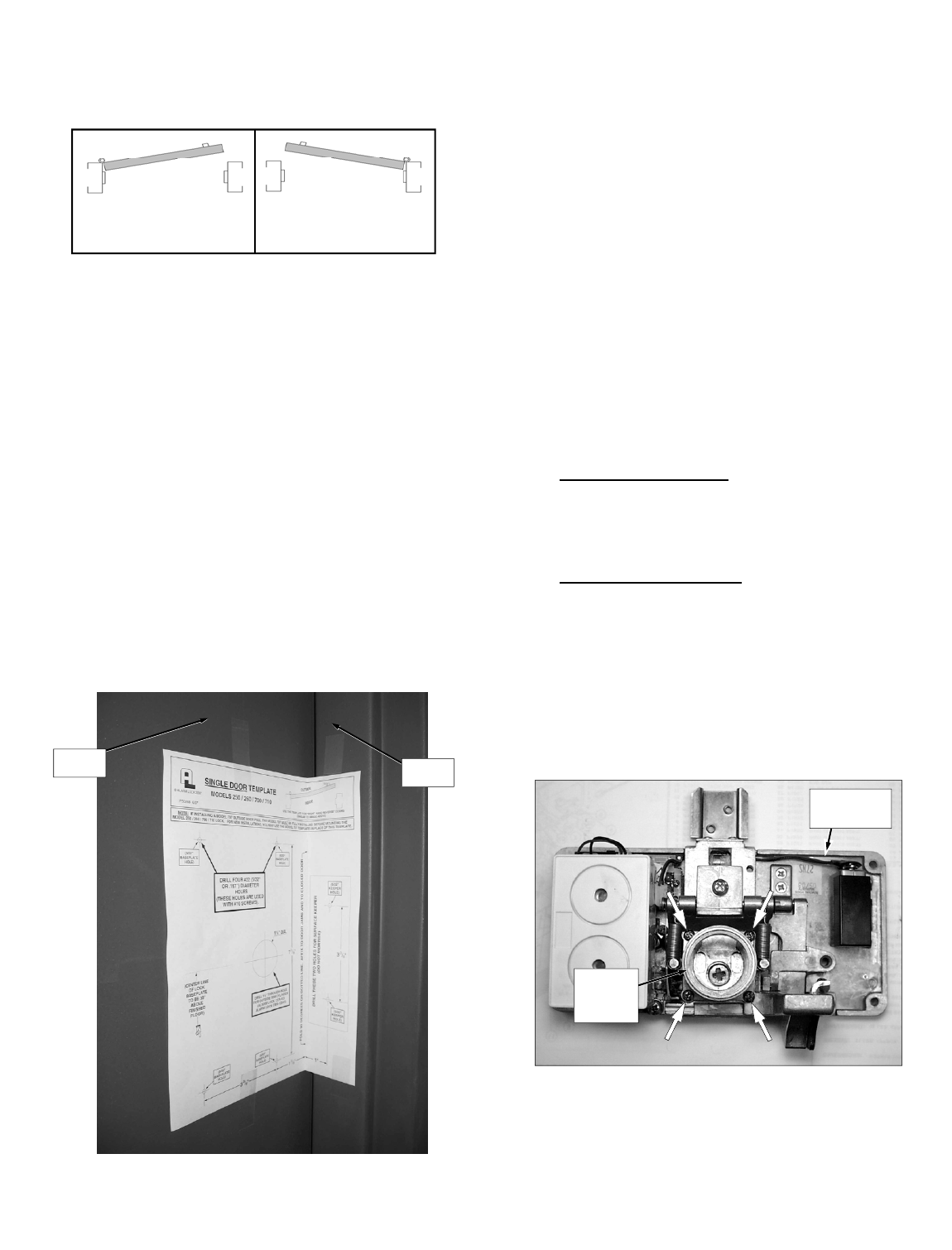
Close the door and carefully tape the template to the
inside surface of the door and the jamb so that the
hole for the rim cylinder is about 38" above the floor.
(Note special instructions for mounting onto a narrow-
stile glass door). See Fig. 2.
2. MARK AND DRILL HOLES
Compare holes referenced on the template (P5026)
with holes described in the text below. Reposition the
template as often as needed until it is placed correctly.
Drill slowly and STRAIGHT through the door.
a. Mark six (6) .157" (5/32") diameter holes, four (4)
for the Lock Base Plate and two (2) (of the four
shown on the template) for the Keeper Base
(P1157).
Note: For mounting onto a narrow-stile glass
door, drill only two holes for the Lock Base Plate,
along the jamb edge.
b. IF OUTSIDE CYLINDER (MODEL CER-OKC) IS
USED: Mark the center of the 1¼" diameter
hole.
c. IF OUTSIDE PULL (MODEL 707) IS USED: Use
the door pull template (WI1627). Mark the center of
the four ¼" diameter holes. Then proceed as fol-
lows:
For solid wood doors:
1. Drill ¼" diameter through-hole.
2. From outside of door, use through-hole drilled
in previous step to drill a 5/8" diameter hole to
a depth of 1¼" only.
For hollow metal doors:
1. Drill ¼" diameter through-hole.
2. From outside of door, use through-hole drilled
in previous step to drill a 5/8" diameter hole in
outer metal skin only.
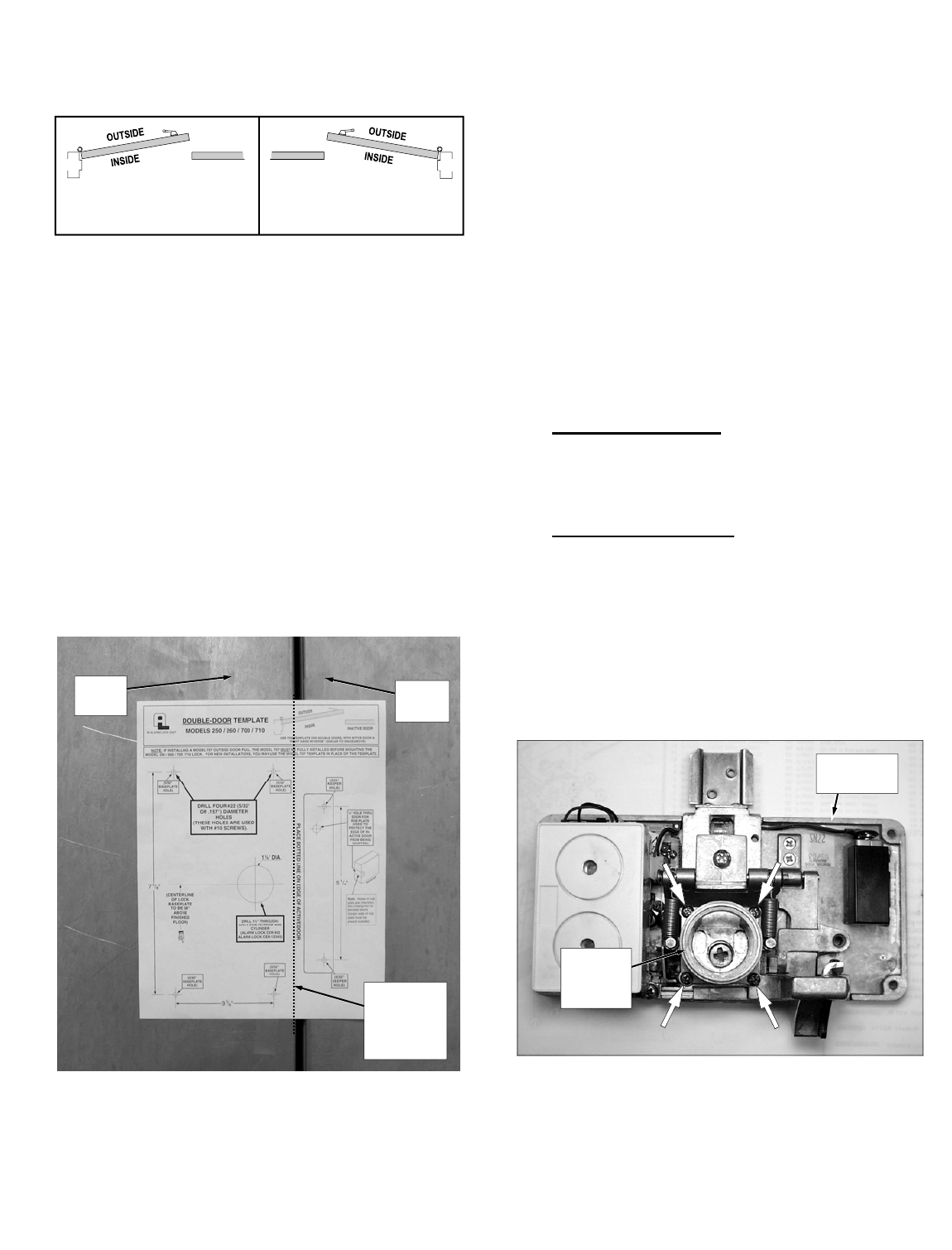
3. INSTALL LOCK CYLINDER (Not supplied)
Remove the Lock Cover. Remove the four (4) screws
securing the Cylinder Housing (P1145) to the Lock
Base Plate assembly as shown in Fig. 3.
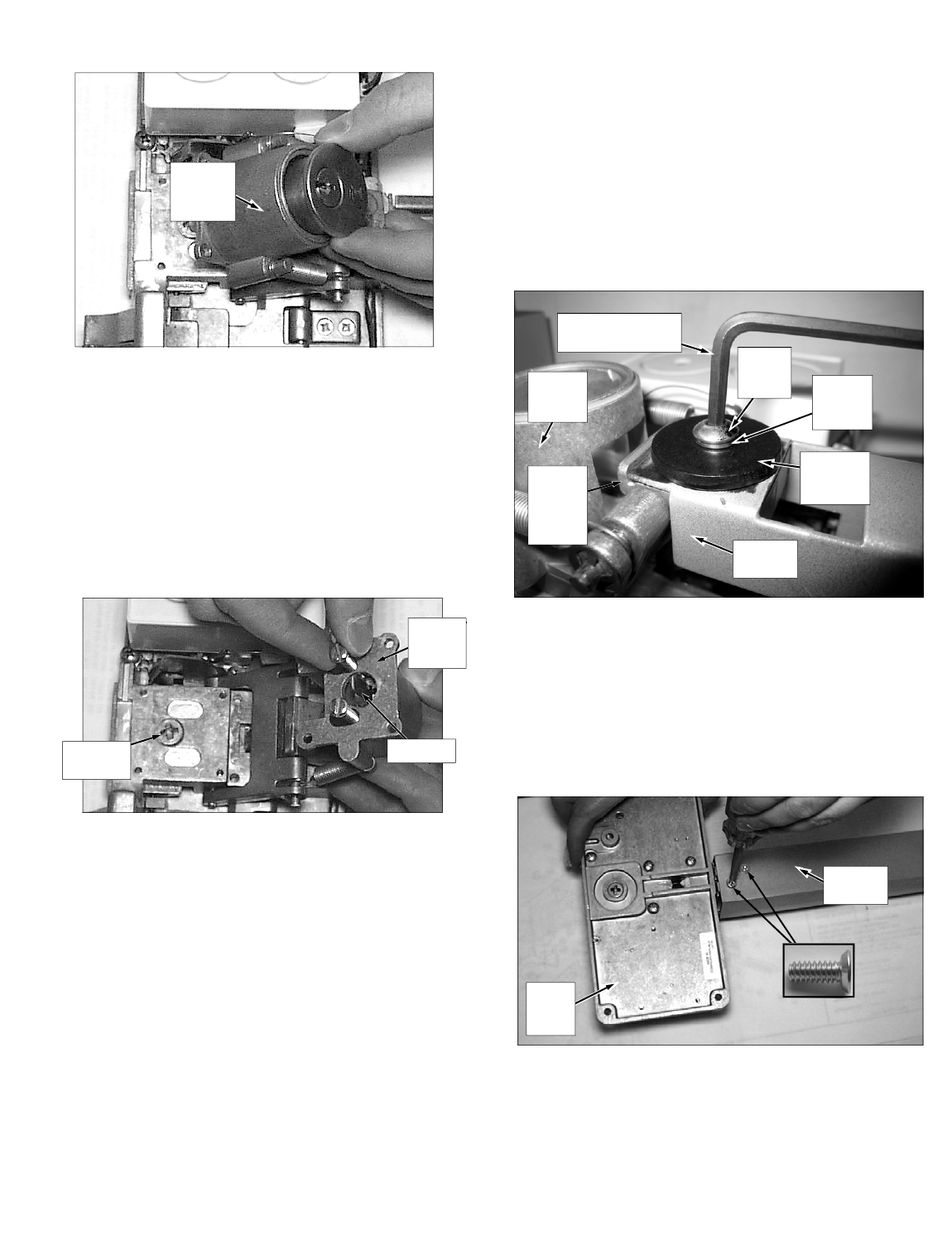
Install lock cylinder (CER) with the keyway horizontal,
facing the front of the lock as shown in Fig. 4 (below).
Fig. 1: Cross Section Top View -- Door Hand.
OUT-SWINGING WITH HINGES ON LEFT
"RIGHT HAND REVERSE" (RHR)
INSIDE
OUTSIDE
OUT-SWINGING WITH HINGES ON RIGHT
"LEFT HAND REVERSE" (LHR)
INSIDE
OUTSIDE
Fig. 2: With door closed, template folded and taped to
inside surface of the door and door jamb 38" above floor from
mark indicated on template.
Door Jamb
Fig. 3: The Lock Base Plate assembly. The lock cylinder is not
supplied as shown in this image. Remove 4 screws securing the
Cylinder Housing (4 arrows).
Cylinder
Housing
(P1145)
Lock Base
Plate
Single Door Installations
4
Secure the lock cylinder to the Cylinder Housing
(P1145) base with the two screws supplied with the
lock cylinder (shown in Fig. 5). If needed, cut the cylin-
der Tailpiece 3/8" beyond the Cylinder Housing base.
Replace the Cylinder Housing by guiding the Tailpiece
into the Cam Crosshole, then re-secure the Cylinder
Housing to the Lock Base Plate assembly with the
four screws removed in step 3.
4. TEST THE DEADBOLT
Use the key to test for proper operation of the dead-
bolt. Turn the key counter-clockwise to project the
deadbolt and turn the key clockwise 360° to retract the
deadbolt. The key should be able to be withdrawn
from the lock cylinder in either the fully projected
("locked") or fully retracted ("unlocked") position of the
deadbolt.
If the key cannot be withdrawn, the lock cylinder and
the Cam are mis-aligned. Remove the four (4) screws
securing the Cylinder Housing to the Lock Base Plate
assembly as shown in Fig. 3, turn the Cam a quarter
turn clockwise, then re-secure the Cylinder Housing.
Re-test the deadbolt.
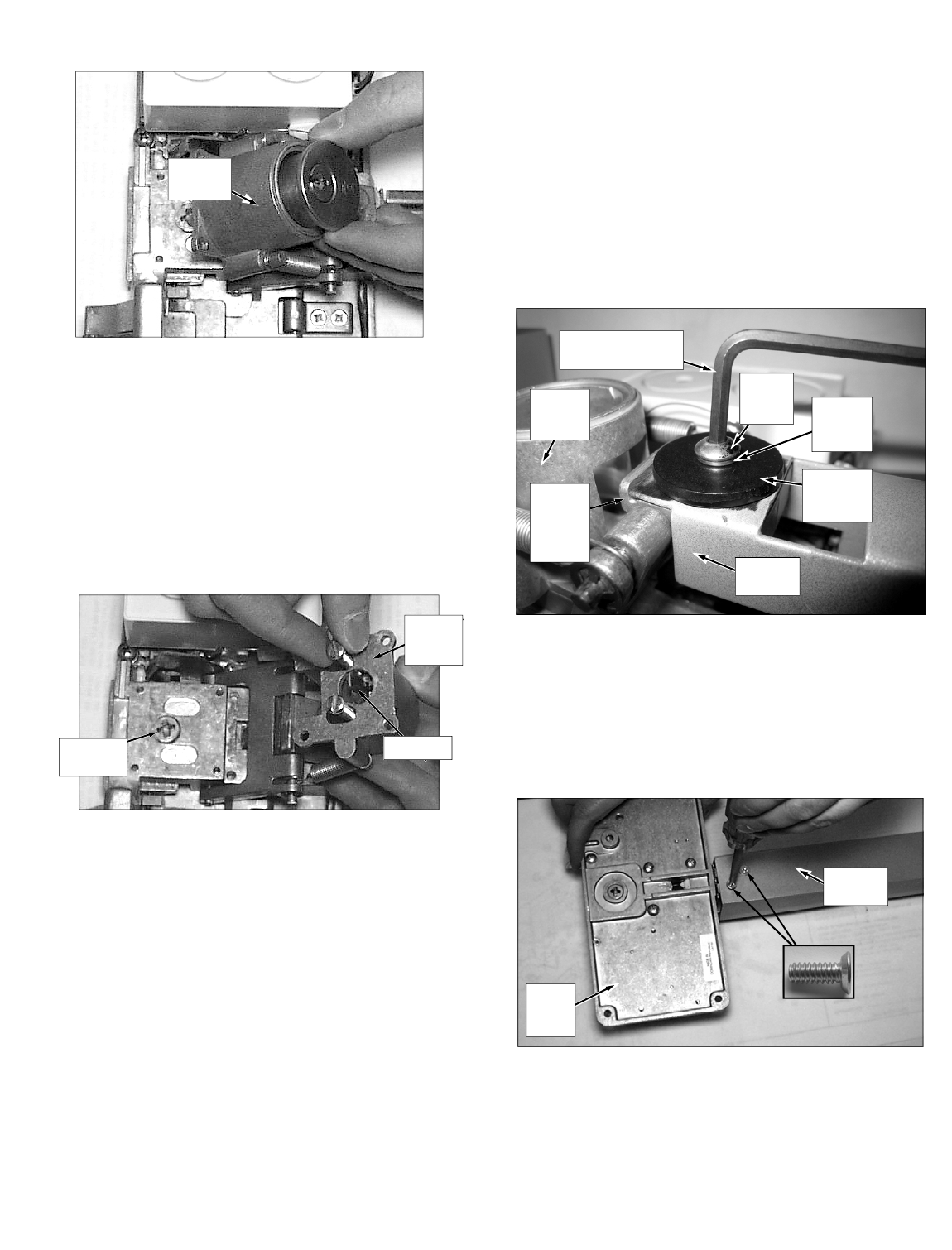
5. ATTACH PUSH BAR ASSY
(Models 700 / 710 only)
See Fig. 6. Use the 1/8" Hex Wrench (supplied) to
remove the Hex Screw (SC636), the small Lock Wash-
er (WA136) and the Stiffening Washer (WA201)
from the Clapper Arm-Hinge Bkt (P5022).
Place the Push Bar Assy on top of the Clapper Arm-
Hinge Bkt, and place the Stiffening Washer on top
of the Push Bar Assy as shown. Secure with the small
Lock Washer and Hex Screw as shown in Fig. 6.
See Fig. 7. Carefully turn the Lock Base Plate assem-
bly over, and secure the Push Bar Assy to the Chan-
nel/Retaining Bracket (P5017) using two #10-24 x
1/2" Phillips flat head undercut zinc plated machine
screws (P5460).
6. SECURE LOCK BASE PLATE TO DOOR
Align the Lock Base Plate (with its attached Push Bar
Assy) with the holes drilled in step 2. Use the fol-
Fig. 5: Secure the lock cylinder to the Cylinder Housing base with
two screws as shown. The Tailpiece must extend beyond the base of the
Cylinder Housing and must fit into the Cam Crosshole.
Cam
Crosshole Tailpiece
Cylinder
Housing
base
Fig. 4: Install lock cylinder (CER) with the keyway horizontal,
facing the front of the lock (nine o'clock position) as shown.
Cylinder
Housing
(P1145)
Fig. 6: Place the Push Bar Assy on top of the Clapper Arm-Hinge Bkt, and
place the Stiffening Washer on top of the Push Bar Assy. Secure with the small
Lock Washer and Hex Screw as shown.
Lock
Washer
(WA136)
Cylinder
Housing
(P1145)
1/8" Hex Wrench
(Supplied)
Hex
Screw
(SC636)
Stiffening
Washer
(WA201)
Push Bar
Assy
Clapper
Arm-
Hinge
Bkt
(P5022)
Fig. 7: secure the Push Bar Assy to the Channel/Retaining Bracket
(P5017) using two #10-24 x 1/2" Phillips flat head undercut zinc plated
machine screws (P5460).
Push Bar
Assy
Lock
Base
Plate P5460
Single Door Installations (cont'd)
5
lowing screws to secure the Lock Base Plate to the
door (Do NOT tighten fully at this time):
Separate the End Cap (P5034) from its Retaining
Bracket (P5045).
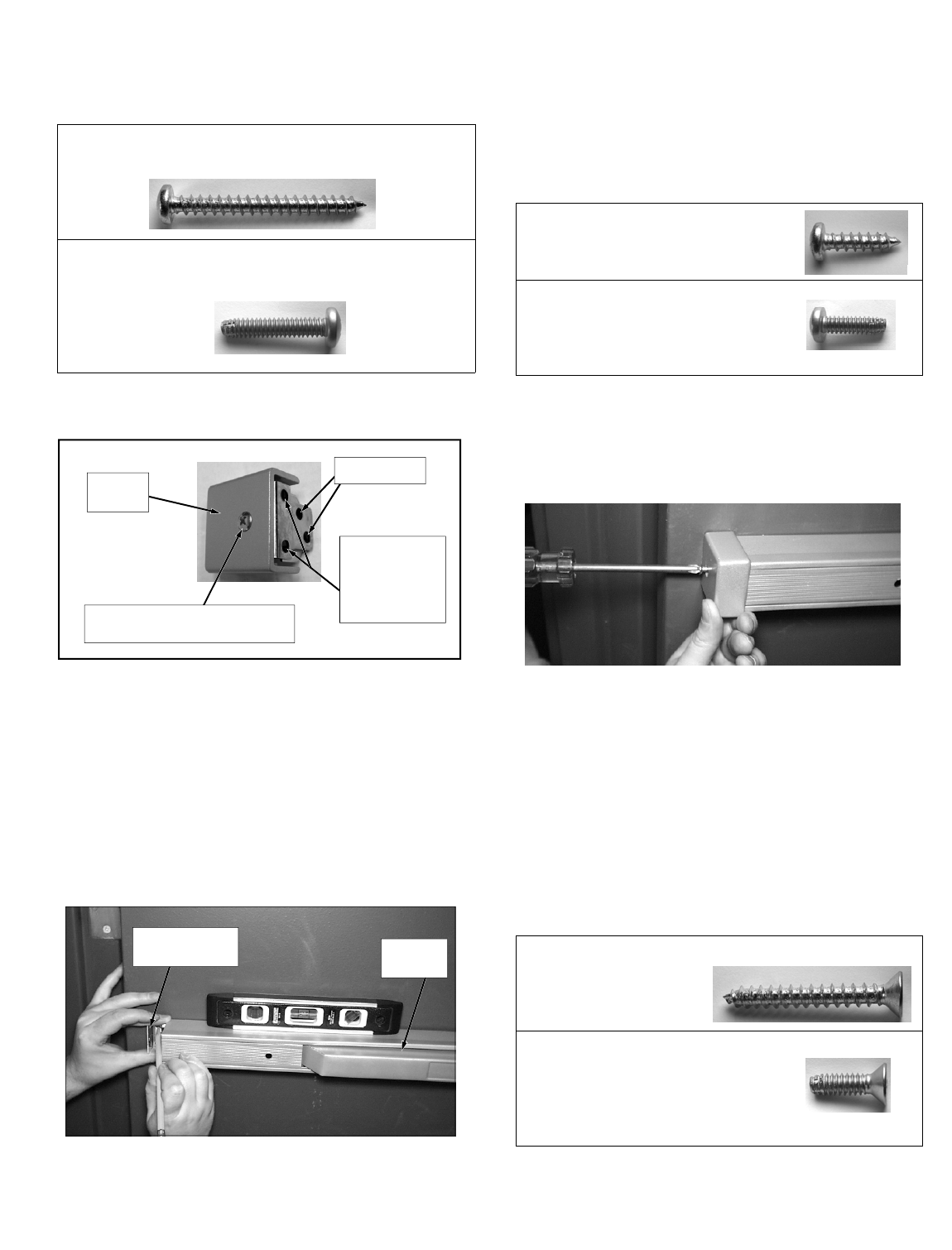
7. SECURE PUSH BAR ASSY TO DOOR
Hold the end of the Push Bar Assy horizontally against
the door using a level. Slide the Retaining Bracket
(P5045) into the end of the Push Bar Assy. Using the
Retaining Bracket as a template, mark two holes
on the door as shown in Fig. 8 and Fig. 9. Be sure to
mark the correct holes.
Drill two .157" (5/32") diameter mounting holes into the
door and use the following screws to secure the Re-
taining Bracket to the door.
Note: If the Push Bar Assy is too long for the door,
cut the end of the Channel Insert (P5046) and Base
Channel (P5011) to the proper length and remove
burrs from the edges.
Mount the End Cap to the Retaining Bracket and se-
cure with a #10-24 x 1/2" Phillips Oval Head, Zinc
Plated Machine Screw (P5202) provided (see Fig. 8
and Fig. 10).
8. TIGHTEN THE LOCK BASE PLATE
Fully tighten and secure the Lock Base Plate to the
door. Do NOT install the Lock Cover (P5014) at this
time.
9. SINGLE DOOR KEEPER INSTALLATION
Before drilling holes for the single door Keeper Base
(P1157) in the surface of the doorframe, select the cor-
rect screws as follows:
Fig. 10: Mount the End Cap.
For WOOD DOORS
#10 x 1-3/4" Phillips Pan Head, Zinc Plated
For Hollow METAL DOORS
#10-24 x 1" Phillips Pan Head, Stainless Steel, Type
F Thread Cutting
For WOOD DOORS
#10 x 3/4" Phillips Pan head, Zinc
Plated
For Hollow METAL DOORS
#10-24 x 5/8" Phillips Pan Head,
Stainless Steel, Type F Thread
Cutting
For WOOD Doorframes
#10 x 1-1/2" Flat head,
Phillips Zinc Plated
(four count)
For Hollow METAL Doorframes
#10-24 x 5/8" Machine Screw,
Phillips Flat Head, Type F Thread
Cutting Stainless Steel (four
count)
Fig. 8: The End Cap is secured to the Retaining Bracket at the factory.
End Cap
(P5034)
#10-24 x 1/2" Phillips Oval Head,
Zinc Plated Machine Screw (P5202)
(Holes not used)
Retaining Bracket
(P5045)
Mark these holes
on door
Fig. 9: Using the Retaining Bracket as a template, mark two holes on the
door. Use a level to ensure the Push Bar Assy is horizontal.
Retaining Bracket
(P5045) Push Bar
Assy
Single Door Installations (cont'd)
6
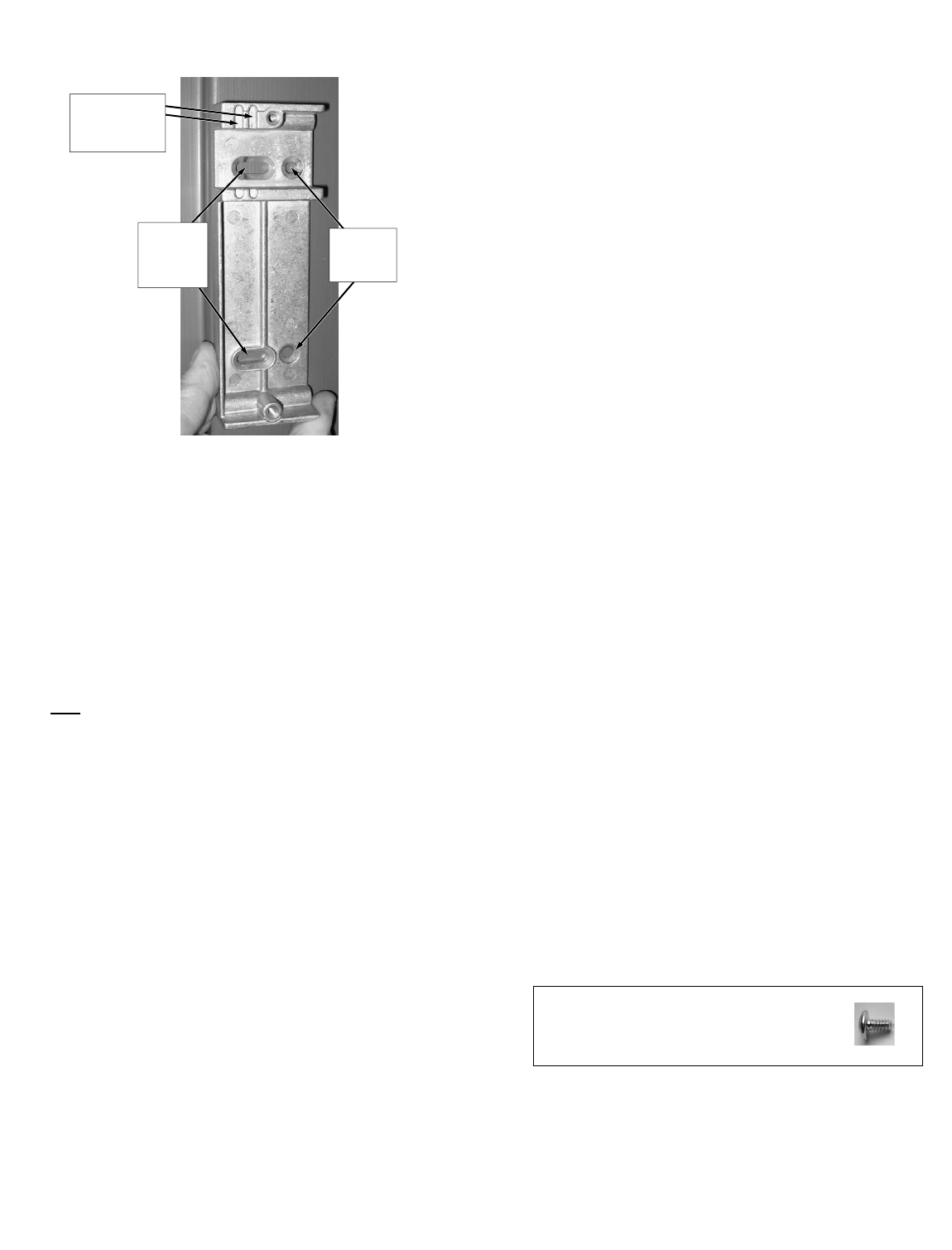
Keeper Overview
In general, the Keeper Base (P1157) should be installed
as close to the edge of the door jamb as possible, in
keeping with the measurements on the template, to hold
the door tightly latched, thus minimizing door rattle.
To allow side-to-side ("forward to back") adjustment of
the Keeper Base, as shown in Fig. 11, two "holding
screws" are to be inserted loosely into the Keeper Base
oval holes (as shown on the template).
Important: Only after the Keeper Base position is
finalized should the "locking" screw round holes be
drilled.
Adjustable "Roller"
In addition to the side-to-side ("forward to back") adjust-
ability provided by the oval "holding screw" holes, two
positions are available for the Roller (P1171 and
P1937).
The single door Keeper is shipped from the factory with
its Keeper Cover (P0248) installed, holding the installed
Roller in place. When the Keeper Cover is removed,
notice the Roller (and its Pin) have two available posi-
tions, "forward" (closer to the closing latch) and
"rear" (further from the closing latch). The standard po-
sition is "forward", and initial adjustments should be
made with the Roller installed in this position.
Installation
a. Close the door and verify the correct height posi-
tion of the Keeper Base with respect to the latch.
As shown on the template, drill two .157" (5/32")
diameter holes for the two "holding screws" (oval
holes).
Fig. 11: Install the Keeper Base (P1157). Do not drill the holes
for the "locking" screws until the Keeper Base is adjusted correctly.
Oval holes
for Two
"holding"
screws
Holes for
"locking"
screws
Two positions
are available
for the Roller
b. Remove the Keeper Cover from the Keeper Base
by unscrewing its two screws.
c. With the Keeper Base positioned against the door
jamb, insert the appropriate screws into the oval
holes of the Keeper Base. To allow side-to-side
("forward to back") adjustment of the Keeper
Base, do NOT tighten these screws yet.
d. Close the door, project the deadbolt and adjust
the Keeper Base so that the door is tightly
latched. Retract the deadbolt, hold the Keeper
Base, release the latch and open the door.
Tighten the two "holding" screws.
If you cannot get the door to be held tightly
latched against the Keeper Base, it might be nec-
essary to move the Roller into its "rear" position
(further from the closing latch).
Recheck the position of the Keeper Base as many
times as necessary to ensure the door is tightly
latched. Ensure the deadbolt, when extended,
floats within the rectangular deadbolt hole created
when the Keeper Cover is installed into the Keep-
er Base.
As stated earlier, do NOT drill the "locking" screw
(round holes) in the Keeper Base until the Keeper
Base position is finalized.
e. When the Keeper Base position is finalized, drill
two .157" (5/32") diameter holes, as shown on
template, for the "locking" screws. Insert the ap-
propriate screws into the round "locking" holes of
the Keeper Base, and tighten the screws to se-
curely fasten the keeper to the door jamb.
f. Install the Keeper Cover on the Keeper Base by
screwing in its two screws (Part # SC413; #8-32 x
5/8" Machine Screw, Phillips Flat Head, Zinc Plat-
ed).
10. FINALIZING THE INSTALLATION
Ensure the 9-volt battery is installed and its plug is
inserted into the lock Sub-Ass'y PCB (printed
circuit board). Secure the Lock Cover with four #6-
32 x 1/4" Phillips Truss Head, Zinc Plated screws.
Secure the Lock Cover
#6-32 x 1/4" Phillips Truss Head, Zinc
Plated (four count)
Single Door Installations (cont'd)
7
DOUBLE DOOR INSTALLATIONS
See Fig. A to determine the door handing type for your
installation. All models are non-handed and can be used
for single or double-door installations. For single door
installations, stop here and turn to page 3. The instruc-
tions that follow illustrate a typical installation of a model
700 / 710 to a "right-hand reverse" double door.
1. POSITION THE TEMPLATE
The template positions the lock body relative to the inac-
tive door. (Note: The gap between the active door and
inactive door cannot exceed 5/8" or the latchbolt will not
catch within the Keeper Assembly and the door will not
lock).
With the door closed, carefully tape the template to the
inside surface of the active and inactive doors so that the
hole for the rim cylinder is about 38" above the floor.
Place the dotted line on the template on the edge of the
active door. See Fig. B.
2. MARK AND DRILL THE HOLES
Compare holes referenced on the template (P5026) with
holes described in the text below. Drill slowly and
STRAIGHT through the door. Reposition the template as
often as needed until it is placed correctly.
a. Mark six (6) .157" (5/32") diameter holes, four (4) for
the Lock Base Plate and two (2) (of the three shown
on template) for the Keeper Assembly.
Note: For mounting onto a narrow-stile glass door,
drill only two holes for the Lock Base Plate, along the
jamb edge.
b. IF OUTSIDE CYLINDER (MODEL CER-OKC) IS
USED: Mark the center of the 1¼" diameter hole.
c. IF OUTSIDE PULL (MODEL 707) IS USED: Use the
door pull template (P3191). Mark the center of the
four (4) ¼" diameter holes. Then proceed as follows:
For solid wood doors:
1. Drill ¼" diameter through-hole.
2. From outside of door, use through-hole drilled
in previous step to drill a 5/8" diameter hole to
a depth of 1¼" only.
For hollow metal doors:
1. Drill ¼" diameter through-hole.
2. From outside of door, use through-hole drilled
in previous step to drill a 5/8" diameter hole in
outer metal skin only.
3. INSTALL LOCK CYLINDER (Not supplied)
Remove the Lock Cover. Remove the four (4) screws
securing the Cylinder Housing (P1145) to the Lock Base
Plate assembly as shown in Fig. C.
Install lock cylinder (CER) with the keyway horizontal,
facing the front of the lock as shown in Fig. D (below).
Fig. A: Cross Section Top View -- Door Hand.
OUT-SWINGING WITH HINGES ON LEFT
"RIGHT HAND REVERSE" (RHR)
INACTIVE
DOOR INACTIVE
DOOR
OUT-SWINGING WITH HINGES ON RIGHT
"LEFT HAND REVERSE" (LHR)
Fig. B: With door closed, tape the template to the inside surface of
the active and inactive doors 38" above floor from the mark indicated on
the template. Place the dotted line on the template on the edge of the
active door.
Active
Door Inactive
Door
Dotted line on
the template
placed on the
edge of the
active door
Fig. C: The Lock Base Plate assembly. The lock cylinder is not
supplied as shown in this image. Remove 4 screws securing the
Cylinder Housing (4 arrows).
Cylinder
Housing
(P1145)
Lock Base
Plate
Double Door Installations
8
Secure the lock cylinder to the Cylinder Housing (P1145)
base with two screws (supplied with the lock cylinder) as
shown in Fig. E. If needed, cut the cylinder Tailpiece 3/8"
beyond the Cylinder Housing base. Replace the Cylinder
Housing by guiding the Tailpiece into the Cam Cross-
hole, then re-secure the Cylinder Housing to the Lock
Base Plate assembly with the four (4) screws re-
moved in step 3.
4. TEST THE DEADBOLT
Use the key to test for proper operation of the deadbolt.
Turn the key counter-clockwise to project the deadbolt
and turn the key clockwise 360° to retract the deadbolt.
The key should be able to be withdrawn from the lock
cylinder in either the fully projected ("locked") or fully re-
tracted ("unlocked") position of the deadbolt.
If the key cannot be withdrawn, the lock cylinder and the
Cam are mis-aligned. Remove the four (4) screws secur-
ing the Cylinder Housing (P1145) to the Lock Base Plate
assembly as shown in Fig. C, turn the Cam a quarter turn
clockwise, then re-secure the Cylinder Housing. Re-test
the deadbolt.
5. ATTACH PUSH BAR ASSY
(Models 700 / 710 only)
See Fig. F. Use the 1/8" Hex Wrench (supplied) to
remove the Hex Screw (SC636), the small Lock Washer
(WA136) and the Stiffening Washer (WA201) from the
Clapper Arm-Hinge Bkt (P5022).
Place the Push Bar Assy on top of the Clapper Arm-
Hinge Bkt, and place the Stiffening Washer on top of
the Push Bar Assy as shown. Secure with the small Lock
Washer and Hex Screw as shown in Fig. F.
See Fig. G. Carefully turn the Lock Base Plate assembly
over, and secure the Push Bar Assy to the Channel/
Retaining Bracket (P5017) using two #10-24 x 1/2"
Phillips flat head undercut zinc plated machine screws
(P5460).
6. SECURE LOCK BASE PLATE TO DOOR
Align the Lock Base Plate (with its attached Push Bar
Assy) with the holes drilled in step 2. Use the follow-
ing screws to secure the Lock Base Plate to the door (Do
NOT tighten fully at this time):
Fig. D: Install lock cylinder (CER) with the keyway horizon-
tal, facing the front of the lock (nine o'clock position) as shown.
Cylinder
Housing
Fig. E: Secure the lock cylinder to the Cylinder Housing base with
two screws as shown. The Tailpiece must extend beyond the base of the
Cylinder Housing and must fit into the Cam Crosshole.
Cam
Crosshole
Tailpiece
Cylinder
Housing
base
Fig. G: secure the Push Bar Assy to the Channel/Retaining Bracket
(P5017) using two #10-24 x 1/2" Phillips flat head undercut zinc plated
machine screws (P5460).
Push Bar
Assy
Lock
Base
Plate P5460
Fig. F: Place the Push Bar Assy on top of the Clapper Arm-Hinge Bkt, and
place the Stiffening Washer on top of the Push Bar Assy. Secure with the small
Lock Washer and Hex Screw as shown.
Cylinder
Housing
(P1145)
1/8" Hex Wrench
(Supplied)
Hex
Screw
(SC636)
Stiffening
Washer
(WA201)
Push Bar
Assy
Clapper
Arm-
Hinge
Bkt
(P5022)
Lock
Washer
(WA136)
Double Door Installations (cont'd)
9
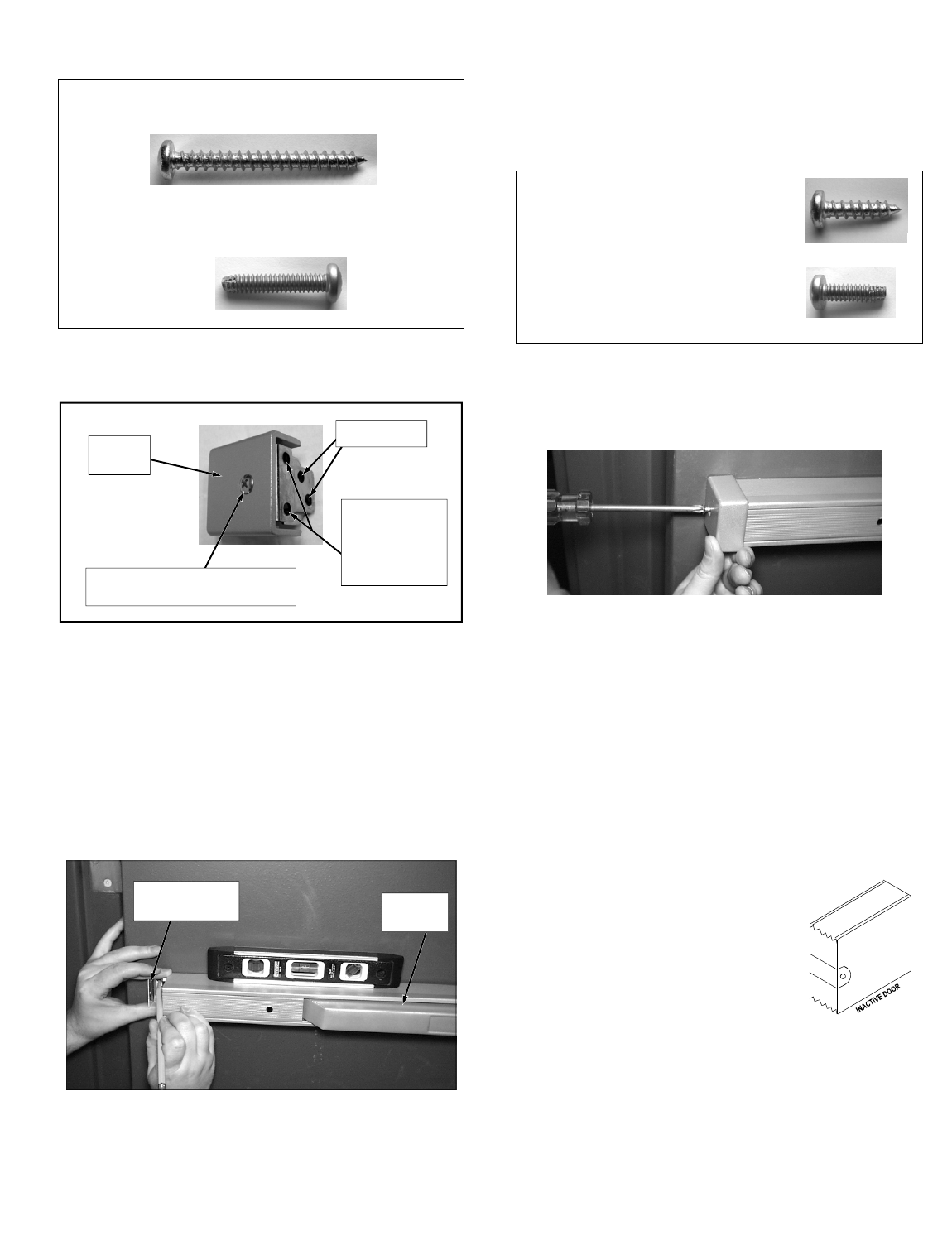
Separate the End Cap (P5034) from its Retaining Bracket
(P5045).
7. SECURE PUSH BAR ASSY TO DOOR
Hold the end of the Push Bar Assy horizontally against
the door using a level. Slide the Retaining Bracket
(P5045) into the end of the Push Bar Assy. Using the
Retaining Bracket as a template, mark two holes on
the door as shown in Fig. H and Fig. I. Be sure to mark
the correct holes.
Drill two .157" (5/32") diameter mounting holes into the
door and use the following screws to secure the Retain-
ing Bracket to the door.
Note: If the Push Bar Assy is too long for the door,
cut the end of the Channel Insert (P5046) and Base
Channel (P5011) to the proper length and remove
burrs from the edges.
Mount the End Cap to the Retaining Bracket and secure
with a #10-24 x 1/2" Phillips Oval Head, Zinc Plated
Machine Screw (P5202) provided (see Fig. H and Fig.
J).
8. TIGHTEN THE LOCK BASE PLATE
Fully tighten and secure the Lock Base Plate to the door.
Do NOT install the Lock Cover (P5014) at this time.
9. INSTALL THE RUB PLATE
Examine the template and physical parts
On the Double-Door Template (P5026), find the 5/32"
Keeper Holes; observe that these two holes are used
to mark the screws that secure the Double-Door Keeper
Base to the inactive door. The third hole on the tem-
plate is used to mark the Rub Plate
"through-hole". Notice that the Rub
Plate through-hole on the template
is, by coincidence, located directly
under the screw that secures the
Black Nylon Insert to the Double-
Door Keeper Base. Be aware that
the Rub Plate "through-hole" and the
Black Nylon Insert screw hole are
used for two separate purposes:
The Rub Plate is used to protect the edge of the inac-
tive door from being scuffed by the latchbolt as shown
in Fig. K.
The black nylon insert (see Fig. L) is used to prevent
the locked active door from rattling and is adjusted
with the Double-Door Keeper Base secured and the
deadbolt projected.
Fig. K: Rub Plate.
For WOOD DOORS
#10 x 1-3/4" Phillips Pan Head, Zinc Plated
For Hollow METAL DOORS
#10-24 x 1" Phillips Pan Head, Stainless Steel, Type
F Thread Cutting
Fig. J: Mount the End Cap.
For WOOD DOORS
#10 x 3/4" Phillips Pan head, Zinc
Plated
For Hollow METAL DOORS
#10-24 x 5/8" Phillips Pan Head,
Stainless Steel, Type F Thread
Cutting
Fig. H: The End Cap is secured to the Retaining Bracket at the factory.
End Cap
(P5034)
#10-24 x 1/2" Phillips Oval Head,
Zinc Plated Machine Screw (P5202)
(Holes not used)
Retaining Bracket
(P5045)
Mark these holes
on door
Fig. I: Using the Retaining Bracket as a template, mark two holes on the
door. Use a level to ensure the Push Bar Assy is horizontal.
Retaining Bracket
(P5045) Push Bar
Assy
Double Door Installations (cont'd)
10
Install the Rub Plate
Install the Rub Plate for a 1¾" wide door. Note that the
holes in the Rub Plate are intentionally misaligned (and
the sides are of different lengths) in order to fit beveled
doors (the longer side of the Rub Plate is placed out-
side). The Rub Plate through-hole location is marked
indicated on the template; drill a ¼" through-hole straight
through the door and secure the Rub Plate with the 10-32
screw and nut bushing provided (be sure to place this un-
slotted nut bushing on the outside door surface).
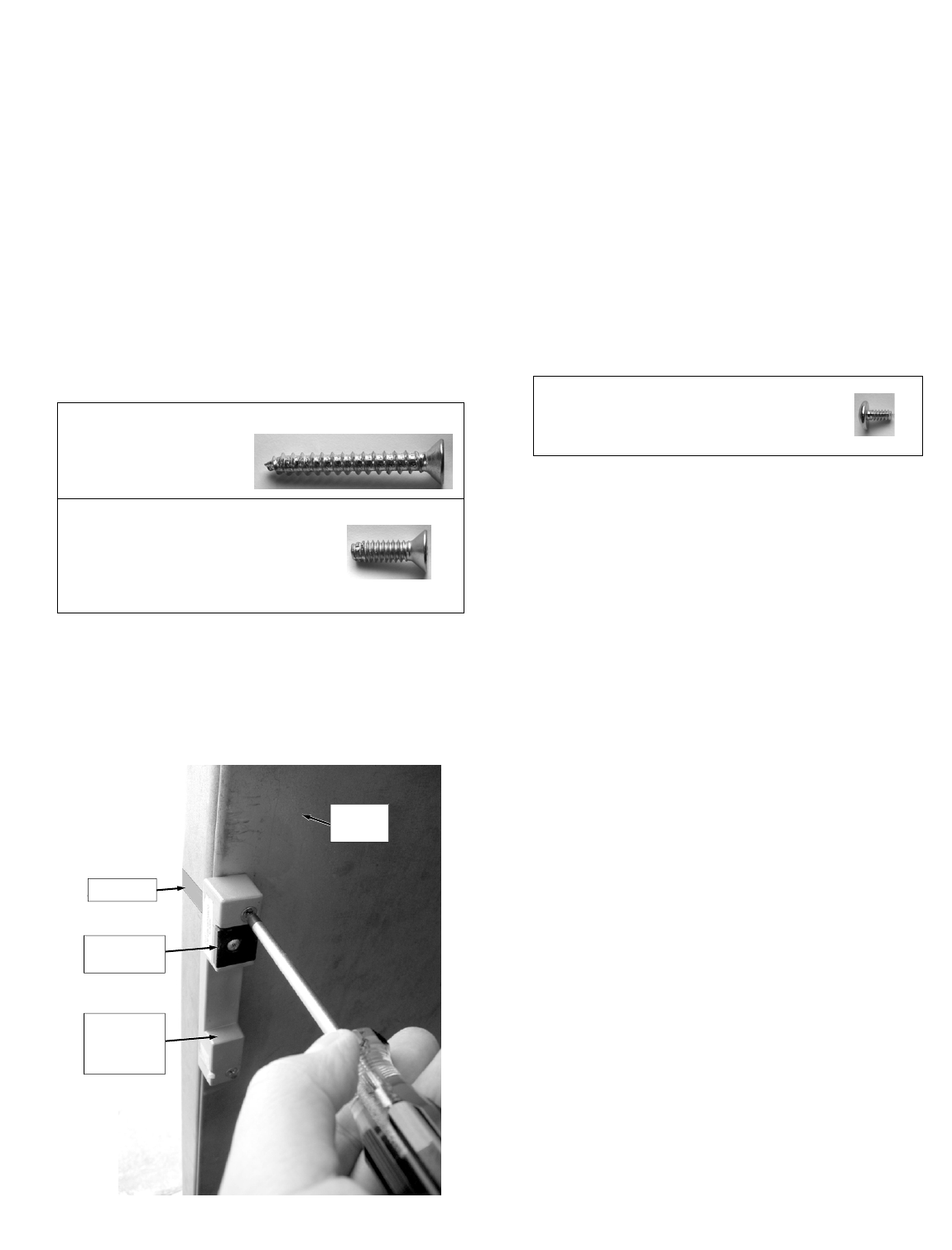
10. INSTALL THE MODEL 732 KEEPER
Before drilling holes for the Double Door Keeper (Model
732) in the surface of the inactive door, select the correct
screws as follows:
When the Double Door Keeper Base position is finalized,
drill two .157" (5/32") diameter holes, as shown on tem-
plate, for the "locking" screws. Insert the appropriate
screws into the round "locking" holes of the Double Door
Keeper Base, and tighten the screws to securely fas-
ten the keeper to the door jamb.
11. ADJUST THE BLACK NYLON INSERT
Close the door, project the deadbolt and adjust the Black
Nylon Insert on the Double Door Keeper Model 732
by loosening its hold-down screw and sliding the nylon
insert against the lock latchbolt so the door is tightly
latched and is free from rattle.
12. FINALIZING THE INSTALLATION
Ensure the 9-volt battery is installed and its plug is
inserted into the lock Sub-Ass'y PCB (printed circuit
board). Secure the Lock Cover with four #6-32 x 1/4"
Phillips Truss Head, Zinc Plated screws.
WATERPROOF MODELS
The waterproof models are basically identical to the stand-
ard models, except the waterproof models are specifically
designed for outdoor applications. Weather-resistant for
exposure to rain make them appropriate for use even in
harsh conditions. In addition, the waterproof models are
powered with a long-life 9VDC sealed alkaline battery
pack (use part #S6173 only). These models include:
▪ 250WP ··· Clapper Plate Waterproof
▪ 700WP ··· Channel Push Bar Waterproof
▪ 710WP ··· Channel Push Bar Retriggerable Waterproof
For WOOD Doorframes
#10 x 1-1/2" Flat head,
Phillips Zinc Plated
(four count)
For Hollow METAL Doorframes
#10-24 x 5/8" Machine Screw,
Phillips Flat Head, Type F Thread
Cutting Stainless Steel (four
count)
Secure the Lock Cover
#6-32 x 1/4" Phillips Truss Head, Zinc
Plated (four count)
Fig. L: Install the Double Door Keeper (Model 732) on the inactive door.
Note the location of the Black Nylon Insert and installed Rub Plate.
Black Nylon
Insert
Rub Plate
Inactive
door
Double Door
Keeper
(Model 732)
Double Door Installations (cont'd)

11
OPERATING INSTRUCTIONS
BEFORE INSTALLING THE LOCK COVER:
1. Select either:
Continuous Alarm - Leave the black jumper plug on
the terminal strip, as installed.
Auto-Alarm Shutdown - Remove the black jumper
plug from the terminal strip.
2. Connect the battery connector to the 9-volt battery
observing the proper polarity. A short beep will
sound ensuring that the lock is powered and ready.
3. Install the Lock Cover with four #6-32 x 1/4" Phillips
Truss Head, Zinc Plated screws.
4. Close the door.
OPERATIONAL TESTING
1. Lock and unlock the door using the cylinder key and
note a small beep sounds when the deadbolt is re-
tracted, indicating a disarmed condition. The door
can now be opened without an alarm, by pushing the
Clapper Plate or the Push Bar Assy.
2. Lock the door again and push the Clapper Plate (or
Push Bar Assy) to open the door. Immediately
the alarm pulses loudly and one of the following oc-
curs:
If Continuous Alarm was selected, the alarm will
sound until the lock is manually reset by locking the
deadbolt with the key.
If Auto-Alarm Shutdown was selected, the alarm
will sound for two minutes, then reset.
LOW BATTERY DETECTION
When the battery is weak, the sounder emits a short
beep approximately once every minute. Always re-
place weak batteries as soon as possible. To ac-
cess the 9-volt battery, remove the Lock Cover by
unscrewing four #6-32 x 1/4" Phillips Truss Head,
Zinc Plated screws.
DOGGING OPERATION
Insert the 3/16" L-shaped hexagonal Allen wrench
(provided) into the dogging latch through the hole in
the channel insert. Turn the dogging latch counter-
clockwise ½ turn, push in the Push Bar Assy (or
Clapper Plate), and turn the dogging latch clock-
wise ¼ turn until it stops. Release the Push Bar
Assy. The Push Bar Assy remains depressed
when the lock is unlatched.
Operating Instructions -- All Locks
12
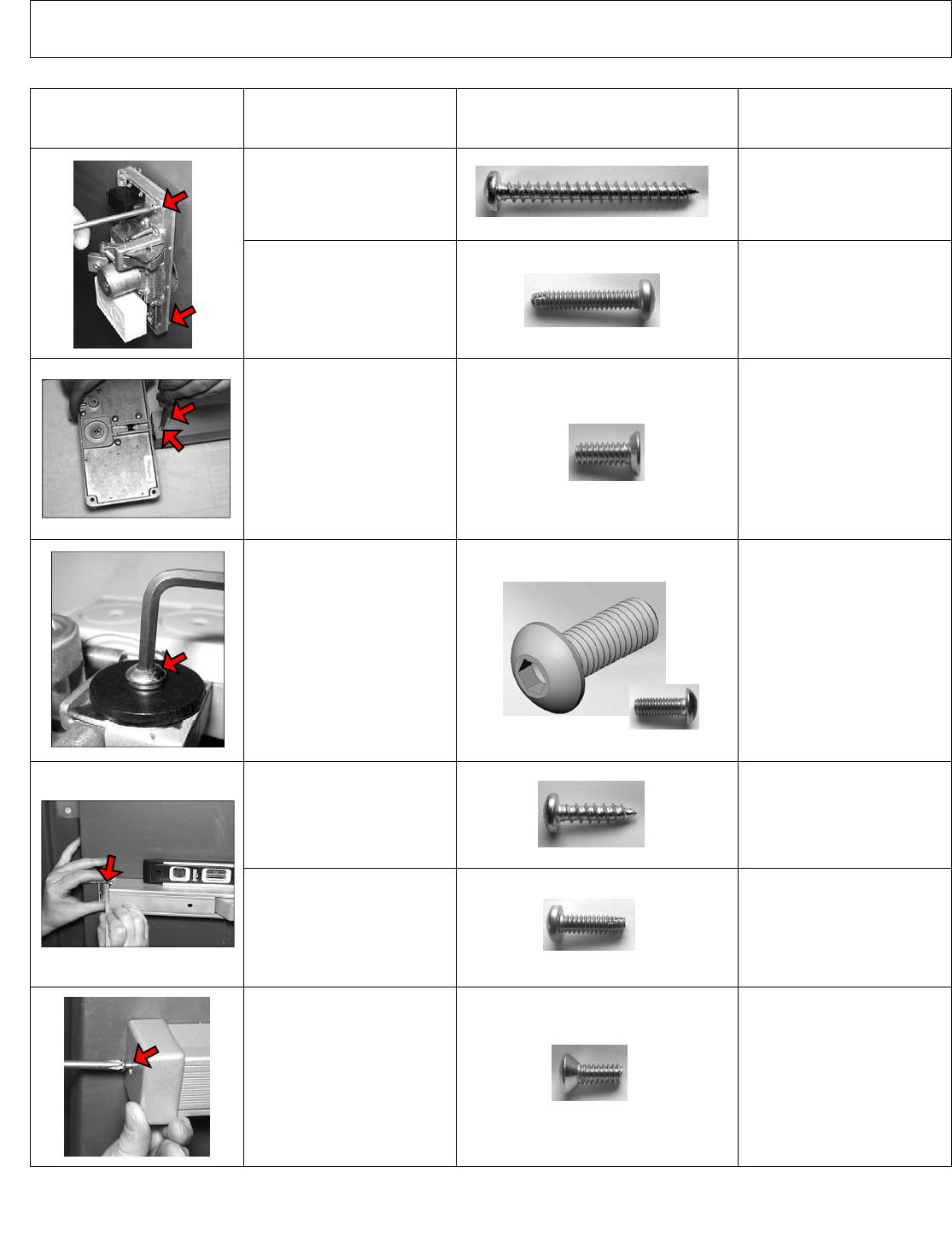
LOCATION DESCRIPTION IMAGE SIZE SPECS
Secures the Lock Base
Plate Assembly to a
SOLID WOOD DOOR
(Part # P1677) #10 x 1-
3/4" Phillips Pan Head,
Zinc Plated (four count)
Secures the Lock Base
Plate Assembly to a
HOLLOW METAL
DOOR
(Part # SC616LF) #10-24
x 1" Phillips Pan Head,
Stainless Steel, Type F
Thread Cutting (four
count)
Connects the Push Bar
and Channel Assembly
to the Clapper Arm Hinge
(Part # SC636) 10-32 x
1/2" Button Head Socket
Cap Screw, Stainless
Steel, use Allen wrench
(1/8") to tighten (one
count)
Secures Retaining Brack-
et to a SOLID WOOD
DOOR
(Part # P1671) #10 x 3/4"
Phillips Pan head, Zinc
Plated (two count)
Secures Retaining Brack-
et to a HOLLOW MET-
AL DOOR
(Part # SC617LF) #10-24
x 5/8" Phillips Pan Head,
Stainless Steel, Type F
Thread Cutting (two
count)
Mounts End Cap to Re-
taining Bracket
(Part # P5202) #10-24 x
1/2" Phillips Oval Head,
Zinc Plated Machine
Screw
Secures the Push Bar
Assy to the Channel/
Retaining Bracket
(P5017)
(Part # P5460) #10-24 x
1/2" Phillips Flat Head,
Undercut, Machine
Screw, Zinc Plated (two
count)
SCREW CHART
13
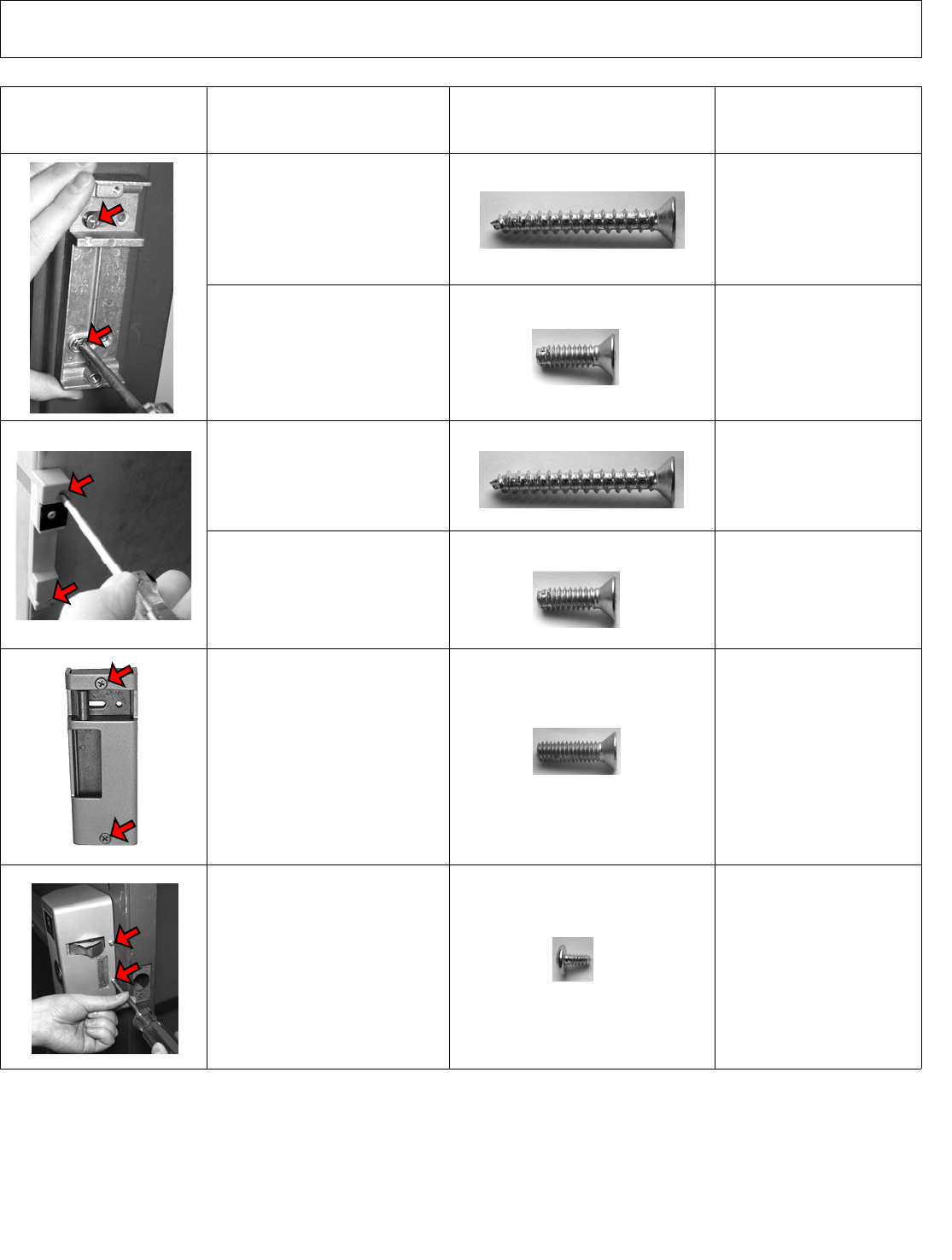
LOCATION DESCRIPTION IMAGE SIZE SPECS
Secures the SINGLE Door
Keeper Base to a SOLID
WOOD DOOR
(Part # P1676) #10 x 1-
1/2" Flat head, Phillips
Zinc Plated (four count)
Secures the SINGLE Door
Keeper Base to a HOLLOW
METAL DOOR
(Part # SC618) #10-24 x
5/8" Machine Screw,
Phillips Flat Head, Type
F Thread Cutting Stain-
less Steel (four count)
Secures the DOUBLE Door
Keeper Base to a SOLID
WOOD DOOR
(Part # P1676) #10 x 1-
1/2" Flat head, Phillips
Zinc Plated (four count)
Secures the DOUBLE Door
Keeper Base to a HOLLOW
METAL DOOR
(Part # SC618) #10-24 x
5/8" Machine Screw,
Phillips Flat Head, Type
F Thread Cutting Stain-
less Steel (four count)
Secures the Cover for the
SINGLE Door Keeper Base
(Part # SC413) #8-32 x
5/8" Machine Screw,
Phillips Flat Head, Zinc
Plated (two count)
Mounts Lock Cover to Lock
Base Plate assembly.
(Part # P1508) #6-32 x
1/4" Phillips Truss
Head, Zinc Plated (four
count)
SCREW CHART (Cont'd)
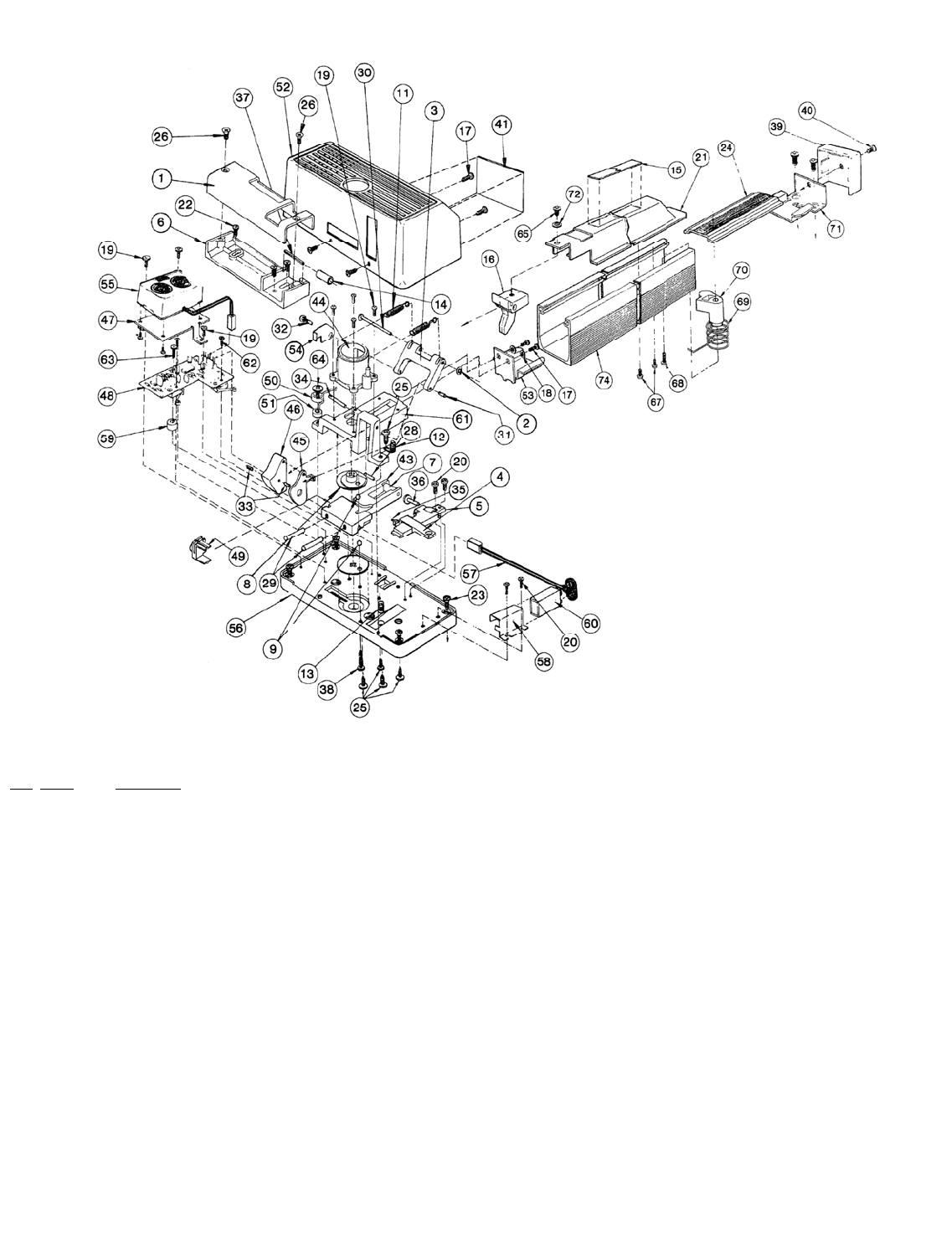
14
DETAIL ASSEMBLY OF 700 & 710 SERIES
DES... PART # .............. DESCRIPTION
1 ..... P0248 ............ KEEPER COVER
1 ..... P0248G-312E ... KEEPER COVER MTLLIC BROWN*
2 ..... P1140 ............ (PART OF S5251 ASS'Y)
3 ..... P5093 ............ (PART OF S5252 ASS'Y)
4 ..... P1151 ............ (PART OF S3120 ASS'Y)
5 ..... HW1607 ........ (PART OF S3120 ASS'Y)
6 ..... P1157 ............ KEEPER BASE
7 ..... P1158 ............ (PART OF S3113 ASS'Y)
8 ..... P1159 ............ (PART OF S3114 ASS'Y)
9 ..... P1160 ............ (PART OF S3114 ASS'Y)
11 .... P1168 ............ (PART OF S5252 ASS'Y)
12 .... P1169 ............ LATCH TRIP SPRING
13 .... P1170 ............ D'LOCK LEVER SPRING
14 .... P1171 ............ (PART OF ROLLER)
15 .... P5023 ............ LABEL-PUSH BAR
16 .... P5022 ............ CLAPPER ARM-HINGE BKT.
17 .... P1508 ............ 6-32 X 1/4 L TRUSS HD.
18 .... WA143 .......... INTERNAL LOCKWASHER
19 .... P1520 ............ (PART OF HW908LF; SEE #55)
20 .... SC466 ........... 6 X 3/8 SELF TAP, PH PHIL.
21 .... P5010 ............ PUSH BAR & ASSY
22 .... P1676 ............ (WOOD MOUNTING SCREW)
22 .... SC618 ........... (METAL MOUNTING SCREW)
22 .... SC618 ........... 10-24 X 5/8", PHIL FLT HD TYPE F STNLS
23 .... P1677 ............ (WOOD MOUNTING SCREW)
23 .... SC616LF ........ (METAL MOUNTING SCREW)
24 .... P5046 ........... CHANNEL INSERT
25 .... SC617LF ....... 10-24X5/8 PHIL PAN STF ST LSS
26 .... SC413 .......... 8-32 X 5/8 MS ZINC PLT
27 .... P5100 ........... CHANNEL INSERT (DURANODIC)*
28 .... P1927 ........... (PART OF S3113 ASS'Y)
29 .... P1928 ......... (PART OF S3113 ASS'Y)
30 .... P1929 ......... (PART OF S5251 ASS'Y)
31 .... P1930 ......... (PART OF S5252 ASS'Y)
32 .... P1931 ......... (PART OF S5252 ASSY)
33 .... P1932 ......... (PART OF S5252 ASS'Y)
34 .... P1933 ......... (PART OF S5252 ASS'Y)
35 .... P1934 ......... (PART OF S3120 ASS'Y)
36 .... P1935 ......... (PART OF S3120 ASS'Y)
37 .... P1937 ......... (PART OF ROLLER)
38 .... P4155 ......... 10-24 X 5/8 PH PHIL.
39 .... P5034 ......... END CAP
40 .... P5202 ......... 10-24 X 1/2 L OVAL HD. PHIL.
41 .... P5233 ......... PROD-LABEL 700/710
42 .... P5110 ......... LOCK COVER (DURANODIC)*
43 .... P1143 ......... (PART OF S3113 ASS'Y)
44 .... P1145 ......... (PART OF S5252 ASS'Y)
45 .... P1149 ......... (PART OF S5252 ASS'Y)
46 .... P1150 ......... (PART OF S5252 ASS'Y)
47 .... P5012 ......... (PART OF HW908LF; SEE #55)
48 ........ -- ............ SUB-ASS'Y PCB (VARIES WITH MODEL)
49 .... P5019 ......... CAM FOLLOWER
50 .... P5422 ........ TENSION SPRING
51 .... P5030 ......... TENSION SPRING SPACER
52 .... P5014 ......... LOCK COVER (ALUM)
53 .... P5017 ......... CHANNEL/RETAINING BRACKET
54 .... P5054 ......... (PART OF S5252 ASS'Y)
55 .... HW908LF .... PIEZO W/MOUNTING BRKT ASSY
56 .... P5063 ......... LOCK BASE PLATE
57 .... 9S5229ASSY BATTERY CONNECTOR
58 .... P5077 ......... BATTERY CLAMP BKT.
59 .... P5089 ......... SPACER, NYLON 1/4 L
60 .... P5103 ......... BATTERY, 9-VOLT
61 .... P5121 ......... (PART OF S5252 ASS'Y)
62 .... P5195 ......... 2-56 X 1/2 L PH PHIL.
63 .... P5195 ......... 2-56 X 1/2 L PH PHIL.
63 .... SC604 ......... 2-56 X 1/2 MS PHIL PAN STNLSS (WP)
64 .... SC465 ......... 10 X 3/4 PH PHIL TYPE 23
64 .... SC605 ......... 10 X 3/4 PHIL PAN T23 STNLSS (WP)
65 .... SC636 ......... BUTTN HD HEX 1/8" 10-32 X 1/2 SS
66 .... P5099 ......... BASE CHANNEL (DURANODIC)*
67 .... P1735 ......... 10-32 X 3/8L PH PHIL
68 .... P5204 ......... (PART OF S5253 ASSY)
69 .... P5048 ......... (PART OF S5253 ASSY)
70 .... P5047 ......... (PART OF S5253 ASSY)
71 .... P5045 ......... RETAINING BKT.
72 .... P5201 ......... LOCKWASHER #10 INT STAR ZINC
73 .... P5109 ......... END CAP (DURANODIC)*
74 .... P5011 ......... BASE CHANNEL
75 .... P5108 ......... PUSH BAR & ASS'Y (DURANODIC)*
*Optional parts available. Contact your sales representative for more information.
Important: Exploded view and part numbers below do NOT fully apply to waterproof "WP" models.
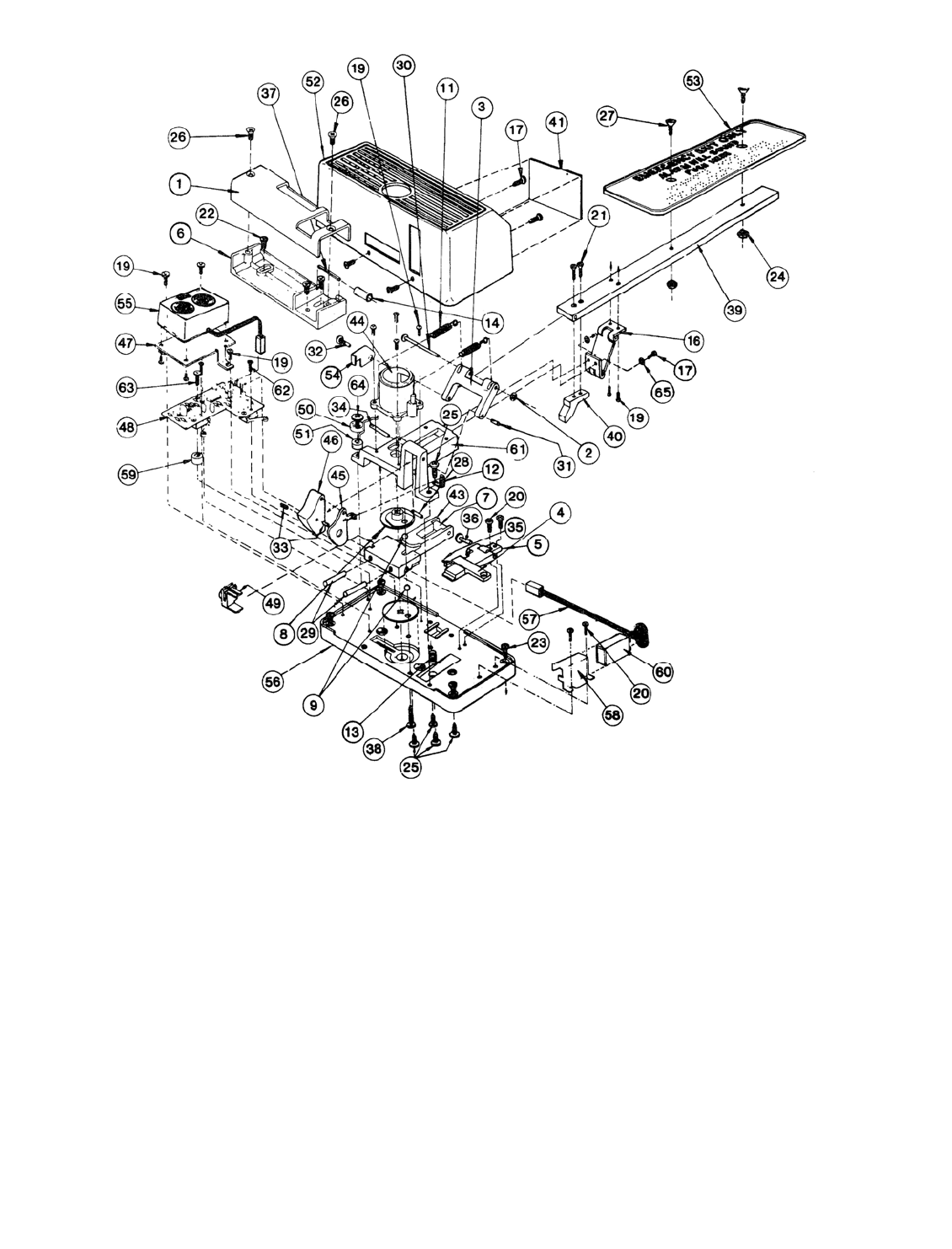
15
*Optional parts available. Contact your sales representative for more information.
#. .. PART# .........DESCRIPTION
1 .... P0248 ............KEEPER COVER
1 .... P0248G-312E ...KEEPER COVER MTLLIC BROWN*
2 .... P1140 ............(PART OF S5251 ASS'Y)
3 .... P5093 ............(PART OF S5252 ASS'Y)
4 .... P1151 ............(PART OF S3120 ASS'Y)
5 .... HW1607 .........(PART OF S3120 ASS'Y)
6 .... P1157 ............KEEPER BASE
7 .... P1158 ............(PART OF S3113 ASS'Y)
8 .... P1159 ............(PART OF S3114 ASS'Y)
9 .... P1160 ............(PART OF S3114 ASS'Y)
11 .. P1168 ............(PART OF S5252 ASS'Y)
12 .. P1169 ............LATCH TRIP SPRING
13 .. P1170 ............D'LOCK LEVER SPRING
14 .. P1171 ............(PART OF ROLLER)
15 .. P1250 ............CLAPPER PLATE (LONG)*
16 .. P1260 ............HINGE
17 .. P1508 ............6-32 X 1/4 L TRUSS HD.
18 .. P4545 ............CLAPPER ARM
19 .. SC545 ............6-32 X 3/8, FLAT HD, TAPTITE, PHIL
19 .. SC601 ............(FOR WP MODE LS)
20 .. SC466 ........... 6 X 3/8 SELF TAP, PH PHIL.
21 .. SC413 ........... 8-32 X 5/8 MS ZINC PLT
21 .. SC600 ........... (FOR W P MODELS)
22 .. P1676 ........... (WOOD MOUNTING SCREW)
22 .. SC618 ........... (METAL MOUNTING SCREW)
23 .. P1677 ........... (WOOD MOUNTING SCREW)
23 .. SC616LF ....... (METAL MOUNTING SCREW)
24 .. P1684 ............ NUT 10-32 X 3/8 HEX.
25 .. SC617LF ....... 10-24X5/8 PHIL PAN STF ST LSS
26 .. SC413 ........... 8-32 X 5/8 MS ZINC PLT
27 .. P1748 ............ 10-32 X 3/4 L OVAL HD.
28 .. P1927 ............ (PART OF S3113 ASS'Y)
29 .. P1928 ............ (PART OF S3113 ASS'Y)
30 .. P1929 ............ (PART OF S5251 ASS'Y)
31 .. P1930 ............ (PART OF S5252 ASS'Y)
32 .. P1931 ............ (PART OF S5252 ASSY)
33 .. P1932 ............ (PART OF S5252 ASS'Y)
34 .. P1933 ............ (PART OF S5252 ASS'Y)
35 .. P1934 ............ (PART OF S3120 ASS'Y)
36 .. P1935 ............ (PART OF S3120 ASS'Y)
37 .. P1937 ............ (PART OF ROLLER)
38 .. P4155 ............ 10-24 X 5/8 PH PHIL.
39 .. P4493 ............ CLAPPER ARM
40 .. P4495 ............ TRIGGER CAM
41 .. P5232 ............ PROD-LABEL 250/260
42 .. P5111 ............ LOCK COVER (DURANODIC)*
43 .. P1143 ............ (PART OF S3113 ASS'Y)
44 . P1145 ............ (PART OF S5252 ASS'Y)
45 . P1149 ............ (PART OF S5252 ASS'Y)
46 . P1150 ............ (PART OF S5252 ASS'Y)
47 . P5012 ............ (PART OF HW908LF; SEE #55)
48 ...... -- .............. SUB-ASS'Y PCB (VARIES WITH MODEL)
49 . P5019 ............ CAM FOLLOWER
50 . P5422 ........... TENSION SPRING
51 . P5030 ............ TENSION SPRING SPACER
52 . P5031 ............ LOCK COVER (ALUM)
53 . P5050 ............ CLAPPER PLATE
54 . P5054 ............ (PART OF S5252 ASS'Y)
55 . HW908LF ....... PIEZO W/MOUNTING BRKT ASSY
56 . P5063 ............ LOCK BASE PLATE
57 . 9S5229ASSY .. BATTERY CONNECTOR
58 . P5077 ............ BATTERY CLAMP BRACKET
59 . P5089 ............ SPACER, NYLON 1/4 L
60 . P5103 ............ BATTERY, 9-VOLT
61 . P5121 ............ (PART OF S5252 ASS'Y)
62 . P5195 ............ SCREW. 2-56 X 1/2 L PH PHIL.
63 . P5195 ............ 2-56 X 1/2 L PH PHIL.
63 . SC604 ........... 2-56 X 1/2 MS PHIL PAN STNLSS (WP)
64 . SC465 ........... 10 X 3/4 PH PHIL TYPE 23
64 . SC605 ........... 10 X 3/4 PHIL PAN T23 STNLSS (WP)
65 . WA143 .......... INTERNAL TOOTH LOCK WASHER
DETAIL ASSEMBLY OF 250 & 260 SERIES
Important: Exploded view and part numbers below do NOT fully apply to waterproof "WP" models.

16
ALARM LOCK SYSTEMS, INC. (ALARM LOCK) warrants
its products to be free from manufacturing defects in mate-
rials and workmanship for twenty four months following the
date of manufacture. ALARM LOCK will, within said peri-
od, at its option, repair or replace any product failing to
operate correctly without charge to the original purchaser
or user.
This warranty shall not apply to any equipment, or any part
thereof, which has been repaired by others, improperly
installed, improperly used, abused, altered, damaged, sub-
jected to acts of God, or on which any serial numbers have
been altered, defaced or removed. Seller will not be re-
sponsible for any dismantling or reinstallation charges,
environmental wear and tear, normal maintenance ex-
penses, or shipping and freight expenses required to re-
turn products to ALARM LOCK. Additionally, this warranty
shall not cover scratches, abrasions or deterioration due to
the use of paints, solvents or other chemicals.
THERE ARE NO WARRANTIES, EXPRESS OR IM-
PLIED, WHICH EXTEND BEYOND THE DESCRIPTION
ON THE FACE HEREOF. THERE IS NO EXPRESS OR
IMPLIED WARRANTY OF MERCHANTABILITY OR A
WARRANTY OF FITNESS FOR A PARTICULAR PUR-
POSE. ADDITIONALLY, THIS WARRANTY IS IN LIEU
OF ALL OTHER OBLIGATIONS OR LIABILITIES ON THE
PART OF ALARM LOCK.
Any action for breach of warranty, including but not limited
to any implied warranty of merchantability, must be
brought within the six months following the end of the war-
ranty period.
IN NO CASE SHALL ALARM LOCK BE LIABLE TO ANY-
ONE FOR ANY CONSEQUENTIAL OR INCIDENTAL
DAMAGES FOR BREACH OF THIS OR ANY OTHER
WARRANTY, EXPRESS OR IMPLIED, EVEN IF THE
LOSS OR DAMAGE IS CAUSED BY THE SELLER'S
OWN NEGLIGENCE OR FAULT.
In case of defect, contact the security professional who
installed and maintains your security system. In order to
exercise the warranty, the product must be returned by the
security professional, shipping costs prepaid and insured
to ALARM LOCK. After repair or replacement, ALARM
LOCK assumes the cost of returning products under war-
ranty. ALARM LOCK shall have no obligation under this
warranty, or otherwise, if the product has been repaired by
others, improperly installed, improperly used, abused, al-
tered, damaged, subjected to accident, nuisance, flood,
fire or acts of God, or on which any serial numbers have
been altered, defaced or removed. ALARM LOCK will not
be responsible for any dismantling, reassembly or reinstal-
lation charges, environmental wear and tear, normal
maintenance expenses, or shipping and freight expenses
required to return products to ALARM LOCK. Additionally,
this warranty shall not cover scratches, abrasions or dete-
rioration due to the use of paints, solvents or other chemi-
cals.
This warranty contains the entire warranty. It is the sole
warranty and any prior agreements or representations,
whether oral or written, are either merged herein or are
expressly cancelled. ALARM LOCK neither assumes, nor
authorizes any other person purporting to act on its behalf
to modify, to change, or to assume for it, any other warran-
ty or liability concerning its products.
In no event shall ALARM LOCK be liable for an amount in
excess of ALARM LOCK's original selling price of the
product, for any loss or damage, whether direct, indirect,
incidental, consequential, or otherwise arising out of any
failure of the product. Seller's warranty, as hereinabove set
forth, shall not be enlarged, diminished or affected by and
no obligation or liability shall arise or grow out of Seller's
rendering of technical advice or service in connection with
Buyer's order of the goods furnished hereunder.
ALARM LOCK RECOMMENDS THAT THE ENTIRE SYS-
TEM BE COMPLETELY TESTED WEEKLY.
Warning: Despite frequent testing, and due to, but not
limited to, any or all of the following; criminal tampering,
electrical or communications disruption, it is possible for
the system to fail to perform as expected. ALARM LOCK
does not represent that the product/system may not be
compromised or circumvented; or that the product or sys-
tem will prevent any personal injury or property loss by
burglary, robbery, fire or otherwise; nor that the product or
system will in all cases provide adequate warning or pro-
tection. A properly installed and maintained alarm may
only reduce risk of burglary, robbery, fire or otherwise but
it is not insurance or a guarantee that these events will not
occur. CONSEQUENTLY, SELLER SHALL HAVE NO LIA-
BILITY FOR ANY PERSONAL INJURY, PROPERTY
DAMAGE, OR OTHER LOSS BASED ON A CLAIM THE
PRODUCT FAILED TO GIVE WARNING. Therefore, the
installer should in turn advise the consumer to take any
and all precautions for his or her safety including, but not
limited to, fleeing the premises and calling police or fire
department, in order to mitigate the possibilities of harm
and/or damage.
ALARM LOCK is not an insurer of either the property or
safety of the user's family or employees, and limits its lia-
bility for any loss or damage including incidental or conse-
quential damages to ALARM LOCK's original selling price
of the product regardless of the cause of such loss or
damage.
Some states do not allow limitations on how long an im-
plied warranty lasts or do not allow the exclusion or limita-
tion of incidental or consequential damages, or differenti-
ate in their treatment of limitations of liability for ordinary or
gross negligence, so the above limitations or exclusions
may not apply to you. This Warranty gives you specific
legal rights and you may also have other rights which vary
from state to state.
ALARM LOCK LIMITED WARRANTY
