Alto Shaam 1000 Th Series Users Manual 833_750 THII_U
1000thseries a3bfd0f5-afcd-4d19-9b14-869f45304321 Alto-Shaam Oven 1000-TH SERIES User Guide |
2015-02-05
: Alto-Shaam Alto-Shaam-1000-Th-Series-Users-Manual-507242 alto-shaam-1000-th-series-users-manual-507242 alto-shaam pdf
Open the PDF directly: View PDF  .
.
Page Count: 79
LOW TEMPERATURE COOKING
AND HOLDING GUIDELINES
Manually Operated Ovens
#566 • 2/08
LOW TEMPERATURE COOKING AND HOLDING OVENS
GE N E RA L IN D E X
W164 N9221 Water Street ●P. O . B o x 4 5 0 ●Menomonee Falls, Wisconsin 53052-0450 ●U . S . A .
PHONE: (262)251-3800 (800)558-8744 U.S.A./CANADA ●FAX: (262)251-7067 (800)329-8744 U.S.A.●www.alto-shaam.com
SECTION 1 • Low Temperature Cooking Introduction
Alto-Shaam Halo Heat ...................1
Low Temperature Cooking Facts
Meat and Nutrition . . . . . . . . . . . . . . . . . . . . . 2
Shrinkage Control and Cooking Time . . . . . . . 3
Preventing Bacteria Growth . . . . . . . . . . . . . . 3
Labor and Equipment Cost Reduction . . . . . . 4
Options and Accessories . . . . . . . . . . . . . . . . . 5
SECTION 2 • Low Temperature Cooking Operation
General Operation — Manual Ovens
Oven Characteristics . . . . . . . . . . . . . . . . . . . . 6
Start-Up ..............................6
Control Panel Identification . . . . . . . . . . . . . . 7
Cooking & Holding Procedures . . . . . . . . . 8-10
Chef Operating Tips . . . . . . . . . . . . . . . . . . . . 11
SECTION 3 • Cleaning and Maintenance . . 12-13
SECTION 4 • Cooking Guideline
ProductIndex.........................14
Oven Preheating Instructions . . . . . . . . . . . . 14
Beef ..............................15-25
Veal .................................26
Lamb .............................27-28
Pork ..............................29-34
ProcessedMeats .......................35
Poultry............................36-44
Fish ..............................45-47
Miscellaneous ......................48-60
SECTION 5 • Smoker Operation
General Operation — Smokers
Control Panel and Operation . . . . . . . . . . . . . 62
Cooking/Smoking/Holding Procedures . . . . 63
SmokingTimes ........................64
Smoking Procedure Options . . . . . . . . . . . . . 65
Care and Cleaning . . . . . . . . . . . . . . . . . . . . . 65
SECTION 6 • Cooking & Smoking Guidelines
Smoked Beef Brisket . . . . . . . . . . . . . . . . . . . . 66
Smoked Beef Tongue . . . . . . . . . . . . . . . . . . . 66
Smoked Fresh Hams . . . . . . . . . . . . . . . . . . . . 67
Smoked Pork Ribs . . . . . . . . . . . . . . . . . . . . . 67
SmokedDuck .........................68
SmokedTurkey........................68
Smoked Fish Fillets . . . . . . . . . . . . . . . . . . . . 69
Smoked Salmon, Whole . . . . . . . . . . . . . . . . . 69
SmokedShrimp .......................70
Cold Smoked Salmon . . . . . . . . . . . . . . . . . . . 71
SECTION 7 • Food Holding and Sanitation
Food Holding - Function & Value . . . . . . . . . 72
General Holding Guidelines . . . . . . . . . . . . . 72
General Holding Cabinet Operation . . . . . . . 73
Holding Temperature Range . . . . . . . . . . . . . 73
Sanitation and Handling . . . . . . . . . . . . . . . . 74
Food Safety Guidelines . . . . . . . . . . . . . . . . . 75
SECTION 1 • LOW T E MPER ATU R E COOK I N G INTROD U C TION
1.
Welcome to the
cost saving convenience
of Low Temperature Cooking.
In 1968, Alto-Shaam invented the first
automatic, commercial cook and hold oven
featuring the principle of Halo Heat. The
heating method provided by Halo Heat low
temperature cooking and holding ovens
consists of an electric thermal cable that
encircles the entire cooking and holding
chamber. This creates a gentle blanket or
HALO of radiant heat — surrounding food
with a consistent and uniform temperature
with no air movement inside the oven
compartment. This gentle heating concept
cooks at low temperatures and at a high
level of humidity to preserve product
moisture, flavor, and nutrition. Halo Heat
ovens are designed to convert automatically
from a cooking temperature to a holding
temperature where the product can remain
until it is ready to be served.
Halo Heat is an entirely different system
of cooking. Utilizing this uniform heat
source, Halo Heat dramatically reduces
meat shrinkage; provides natural enzyme
(aging) action for more tender, flavorful
meat; and preserves natural juices along
with nutritional values in all foods. Halo
Heat cooking reduces energy cost, cuts back
on labor and handling and solves kitchen
space problems. There is no mechanical
ventilation or oven hood necessary in most
areas so the ovens can be moved wherever
they are needed.
Read this booklet carefully. Halo Heat is
a cooking system that requires minimal care
once you have learned the basic principles.
For best results with many products, we
recommend you start your cooking cycle the
evening before — for serving the next day.
In many areas, off-peak power rates are also
lower at night.
If anything you cook in a Halo Heat low
temperature cooking and holding oven
doesn’t meet your highest standards of
quality, please contact one of our food
service professionals for help. Usually, only
a minor change in procedure is required.
LOW TEMPERATURE
COOKING INTRODUCTION

SECTION 1 • LOW T E MPER ATU R E COOK I N G INTROD U C TION
2.
MEAT AND NUTRITION
Meat plays a significant role in the diet;
therefore, one of the primary goals in food
preparation is proper nutrition. Meat is one of the
best sources of protein; is a rich source of B
vitamins such as thiamine, riboflavin, and niacin;
and includes fats, carbohydrates, minerals,
pigments, enzymes and water.
All of these elements are affected by cooking,
but over-heating destroys many of them. Low
temperature Halo Heat cooking helps preserve
unstable, heat-sensitive vitamins and nutrients.
A report on the Nutrient Analysis of Roast Beef,
conducted by the University of Wisconsin-Stout
in July 1971, concluded, “
…
it is apparent that
Alto-Shaam cooking method results in lower
moisture losses. Even after a 24 hour holding
period, the Alto-Shaam product is nutritionally
equal to, and possibly better than beef roast cooked
in a conventional oven and removed immediately
after cooking.”
Fat contributes greatly to the flavor of meat.
During the cooking process, fat not only melts, but
also changes chemically. With low temperature
cooking there is less chemical change and less fat
melt resulting in a more flavorful finished product.
The enzymes found in meat break down the
tissues and act as natural tenderizing agents. A
premium price is paid for aged meats where this
enzyme action has already started, however;
enzymes are destroyed by high temperatures.
Low temperature cooking does not destroy these
enzymes and, particularly in the hold cycle, creates
this natural chemical action to tenderize or age the
meat right in the oven. For this reason, it is
important to use fresh beef and it is essential to
allow the product to remain in the hold cycle for
at least the minimum amount of time suggested
in the individual procedures. The longer meat is
left in the hold cycle the more tender it becomes,
making the purchase of more expensive, aged
meat unnecessary.
Meat is seventy to seventy-five percent water.
High temperatures cause this water to evaporate
during cooking resulting in loss of product
moisture. Cooking at low temperatures in a Halo
Heat oven retains the maximum amount of water
content resulting in a juicier finished product and
an extended holding life.
Along with better nutrition, a more tender
finished product, less shrinkage and higher
moisture content, meat will not require the addition
of as much salt as needed with conventional
cooking methods. Natural flavors are preserved.
This is a significant factor in today’s health
conscious diets.
LOW TEMPERATURE COOKING INTRODUCTION
L OW T E M P E R AT U R E C O O K I N G FAC T S
SECTION 1 • LOW T E MPER ATU R E COOK I N G INTROD U C TION
3.
LOW TEMPERATURE COOKING INTRODUCTION
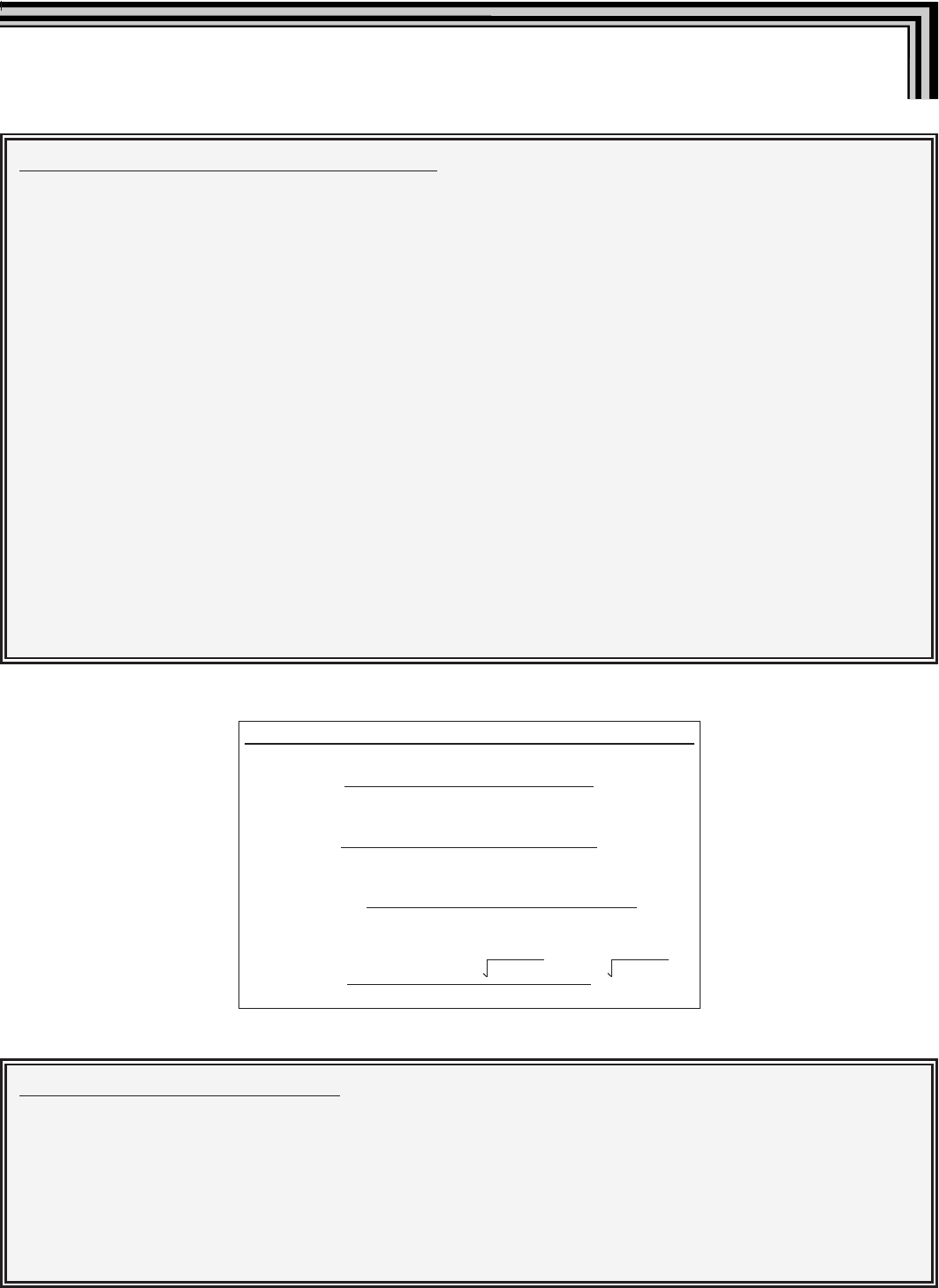
T O C A L C U L AT E M E AT S H R I N K A G E
STARTING WEIGHT (Weight of Raw Product)
-MINUS: ENDING WEIGHT (Weight of Cooked Product)
E Q UA L S : AM OU N T OF SH RI NKA GE
AMOUNT OF SHRINKAGE (Total Weight Lost in Cooking)
÷ D I V I D E D B Y : STARTING WEIGHT (Weight of Raw Product)
E Q UA L S : P ERC EN T OF S HR INK AG E
E X A M P L E : Raw Beef Roast: 10 0 l b (4 5 k g)
Cooked Beef Roast: -9 5 l b (- 43 kg )
= AMOUNT OF SHRINKAGE: 5. 0 lb (2 k g)
SHRINKAGE DIVIDED BY 0.05 = 5% 0.05 = 5%
STARTING WEIGHT: 100 5.0 45 2.0
E Q UA L S :PERCENT OF SHRINKAGE
LOW TEMPERATURE COOKING FACTS
SHRINKAGE CONTROL AND COOKING TIME
THERE ARE TWO MAJOR FACTORS CONTROLLING
MEAT SHRINKAGE OR COOKING LOSSES.
1. Temperature at which meat is cooked:
The higher the temperature at which meat is cooked
the more shrinkage will result. Over-cooked meat
also results in higher losses. Higher temperatures
and over-cooking draws moisture to the surface and
this moisture evaporates or drips out of the meat.
2. Internal temperature of the meat:
Like over-cooking, as meat is brought to a higher
internal temperature shrinkage is increased. For
these two reasons, it is suggested most cuts of red
meat be cooked at 250°F (121°C) and that all cooking
be based on internal product temperature. The use
of a thermometer is encouraged.
THERE ARE FOUR MAJOR FACTORS INVOLVED IN
DETERMINING COOKING TIMES FOR MEAT:
1. The degree of aging on the meat:
Aged meat will cook faster, shrink more, and has a
much shorter holding life than fresh meat.
2. Internal temperature before cooking:
Meat should be placed in a preheated oven directly
from a refrigerated temperature of 38° to 40°F
(3° to 4°C). Meat cooked from a frozen state will
require approximately one and one-half to two times
the normal cooking time. In addition, freezing
ruptures tissue cells creating additional moisture
loss during the cooking process and will result in
more shrinkage.
3. Desired degree of doneness:
The higher the degree of internal temperature
required, the longer the necessary cooking time.
Cooking times in this guideline are based on the
most popular internal product temperatures.
4. Quantity and quality of product.
PREVENTING BACTERIA GROWTH
The surface of raw meat may become contaminated
in processing, handling by the butcher or chef, or by
other means. Food contamination can also be caused
by unsanitary personal hygiene and work habits,
unclean slicers, knives, and probes, or by faulty
operational procedures. It is important, therefore, that
sanitary procedures be followed at all times during
food preparation and handling. This is your main
protection in guarding against food contamination. For
additional information see the Cleaning and
Maintenance section of this manual.
SECTION 1 • LOW T E MPER ATU R E COOK I N G INTROD U C TION
4.
LABOR AND EQUIPMENT COST REDUCTION
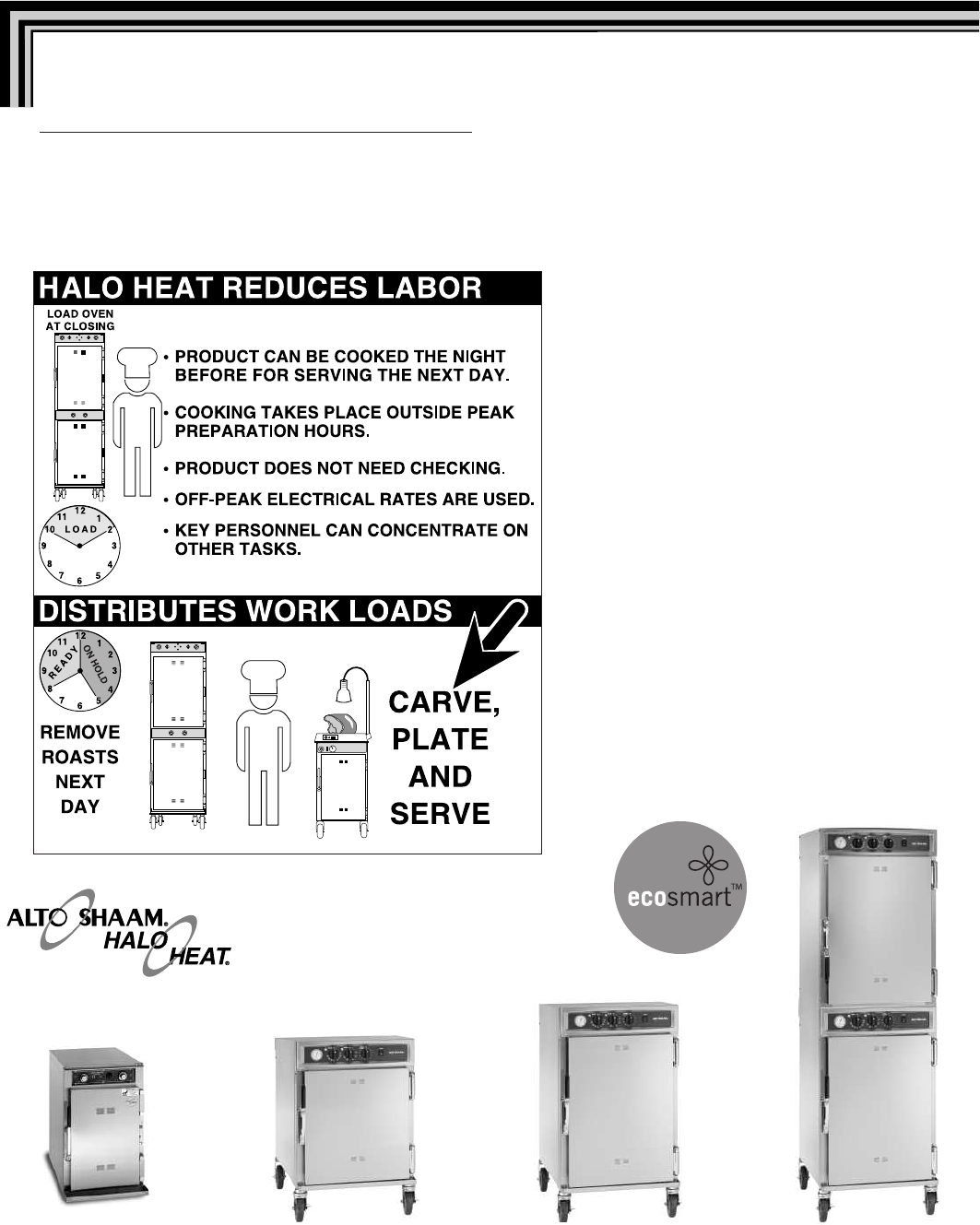
Halo Heat ovens are easy to operate and maintain. After the raw product is placed in the oven and the
controls are set, there is no need to check, stir, or adjust the time or the temperature. Minimal time is spent
attending the product during cooking. This advantage, combined with the automatic conversion to the hold
cycle, frees key personnel to concentrate on other tasks including final product and presentation.
When cooking in a Halo Heat oven at a
temperature of 250°F (121°C), outside venting and
expensive exhaust hoods are not necessary in
most areas. Kitchens remain cooler, lowering
energy costs by reducing the exchange of heated
air. Because the ovens do not need outside
venting, they can be put almost anywhere — in
the corner of the kitchen, on a buffet line, or in a
banquet room. The ovens can also be built into a
counter or to save space, can be stacked in
combination with another Halo Heat oven or
holding cabinet of the same or similar
dimensions.
Cooking at low temperatures also reduces
cleaning time. Most food does not normally
carbonize or burn on the interior of the oven.
LOW TEMPERATURE COOKING INTRODUCTION
500-TH SERIES 750-TH SERIES 1000-TH SERIES 1000-TH SERIES
SINGLE COMPARTMENT SINGLE COMPARTMENT SINGLE COMPARTMENT DOUBLE COMPARTMENT
40 lb (18 kg) Capacity 100 lb (45 kg) Capacity 120 lb (54 kg) Capacity 120 lb (54 kg) Capacity
Stackable Design Stackable Design Stackable Design Per Compartment
SECTION 1 • LOW T E MPER ATU R E COOK I N G INTROD U C TION
5.
LOW TEMPERATURE COOKING INTRODUCTION
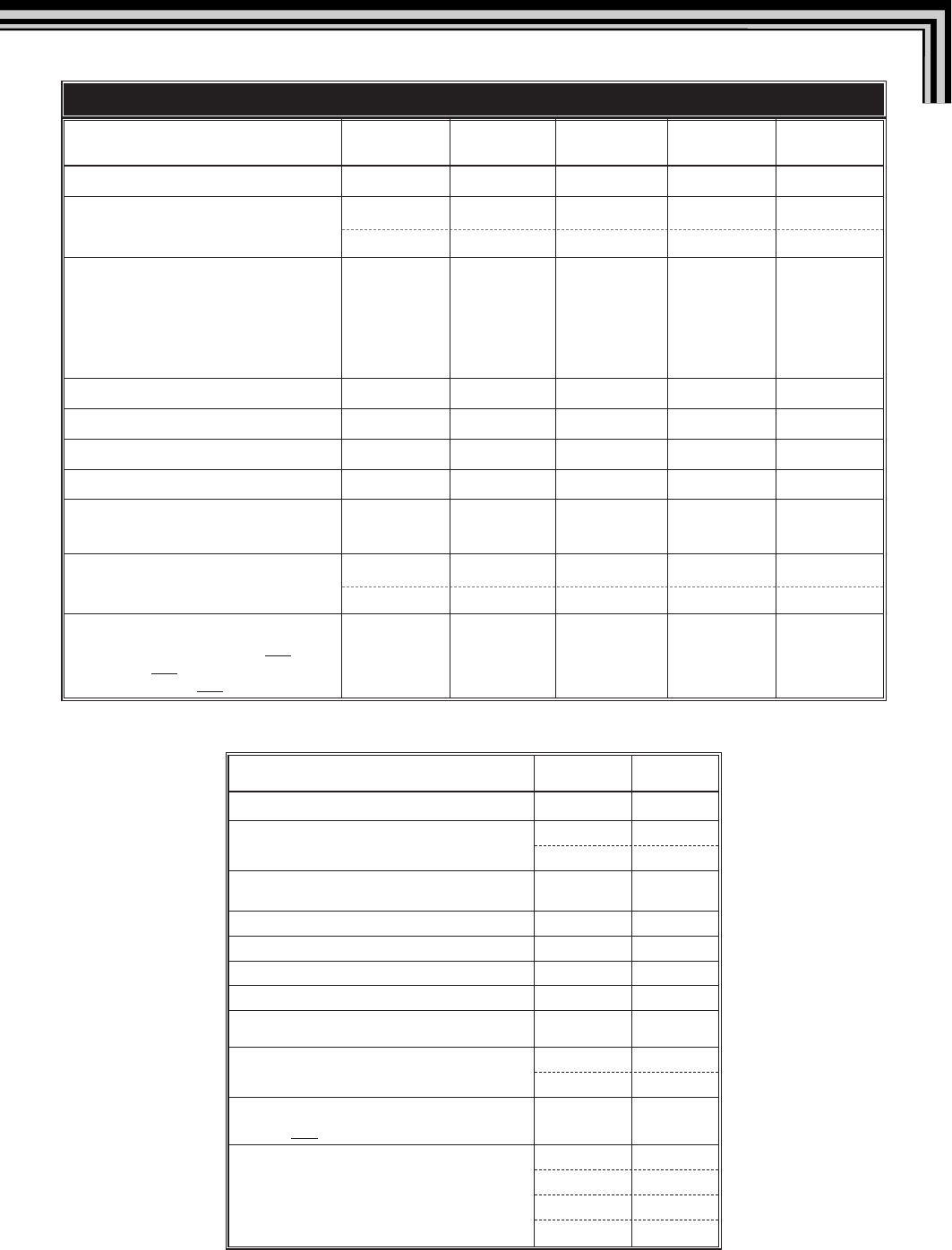
MA N U A L C O O K & H O L D O V E N — O P T I O N S & A C C E SSO R I E S
1000-TH-I 1000-TH-II 1000-TH-II SPLIT 750-TH-II 500-TH-II
DESCRIPTION
BUMPER FULL PERIMETER 5005103 5005103 5005103 5004861 5006782
CARVING HOLDER PRIME RIB HL-2635 HL-2635 HL-2635 HL-2635 HL-2635
4459 4459 4459 4459 —
CASTERS, STEM
2RIGID, 2 SWIVEL W/BRAKE 5"DIA:— 5004862 5004862 5004862 5004862
RIGID (EACH)3-1/2" DIA: CS-25674 —— ——
SWIVEL W/BRAKE (EACH)3-1/2" DIA: CS-25675 —— ——
DOOR LOCK with KEY EACH HANDLE LK-22567 LK-22567 LK-22567 LK-22567 LK-22567
DRIP PAN WITH DRAIN 14824 14824 14824 14831 14813
LEGS, 6" (ONE SET OF 4) FLANGED 5004863 5004863 5004863 5004863 5004863
PAN GRID, WIRE 18" X26" PAN INSERT PN-2115 PN-2115 PN-2115 PN-2115 —
SECURITY PANEL CONTROL COVER
•INCLUDES PANEL KEY LOCK 5005776 5005776 5005776 5004750 5006787
SHELF STAINLESS STEEL FLAT WIRE SH-2325 SH-2325 SH-2325 SH-2324 SH-2326
STAINLESS STEEL RIB RACK SH-2773 SH-2773 SH-2773 SH-2743 —
STACKING HARDWARE ——5004864 5004864 5004864
STEAMSHIP OR CAFETERIA ROUND
WITH ATTACHED PAN
SMOKER OPTIONS AN D MANUAL MANUAL
ACCESSORIES DESCRIPTION 767-SK 1767-SK
BUMPER FULL PERIMETER 5004861 5004861
CARVING HOLDER PRIME RIB HL-2635 HL-2635
4459 4459
CASTERS, 5" (ONE SET OF 4)
2RIGID, 2 SWIVEL W/BRAKE 5004862 INCLUDED
DOOR LOCK WITH KEY EACH HANDLE LK-2763 LK-2763
DRIP PAN WITH DRAIN 14831 14831
LEGS,6" (ONE SET OF 4) FLANGED 5004863 5004863
PAN GRID, WIRE 18" X26" PAN INSERT PN-2115 PN-2115
SECURITY PANEL CONTROL COVER
INCLUDES PANEL KEY LOCK 5004750 5004750
SHELVES STAINLESS STEEL FLAT WIRE SH-2324 SH-2324
STAINLESS STEEL RIB RACK SH-2743 SH-2743
STACKING HARDWARE
767-SK OVER 767-SK, 750-TH-II,OR 750-S 5004864 —
WOOD CHIPS (20 lb BULK PACK)Apple WC-22543 WC-22543
Cherry WC-22541 WC-22541
Hickory WC-2829 WC-2829
Sugar Maple WC-22545 WC-22545
THE TOTAL WEIGHT OF WOOD CHIP BULK
PACKS MAY VARY DUE TO HIGH MOISTURE
CONTENT WHEN PACKAGED.
1000-TH-II SPLIT WITH 1000-S
750-TH-II WITH 750-TH-II, 767-SK OR 750-S
500-TH-II WITH 500-TH-II OR 500-S
SECTION 2 • OPER ATI O N
6.
OPERATION
OVEN CHARACTERISTICS
The oven is equipped with a special, low-heat-
density, heating cable. Through the Halo Heat®
concept, the heating cable is mounted against the
walls of the cooking and holding compartment to
provide an evenly applied heat source, controlled
by an oven sensor. The design and operational
characteristics of the unit eliminates the need for a
moisture pan or a heat circulating fan. Through
even heat application, the food product is cooked
evenly and provides the ability to hold foods for
longer periods of time.
START-UP
1. Before operating the oven, clean both the
interior and exterior of the unit with a damp
cloth and any good commercial detergent at
the recommended strength. Rinse surfaces by
wiping with a sponge and clean warm water to
remove all detergent residue. Wipe dry with a
clean cloth or air dry.
2. Wipe door gaskets and control panel dry with
a soft cloth.
3. Clean and install the oven side racks, oven
shelves, and external drip tray. Shelves are
installed with curved edge toward the back
of the oven. Insert the drip pan on the interior
bottom surface of the oven.
4. Before operating the unit with product,
become familiar with the operation of the
controls. Read the following "Control
Description" and "Operation" section of this
cooking guide and begin by operating the
various control functions.
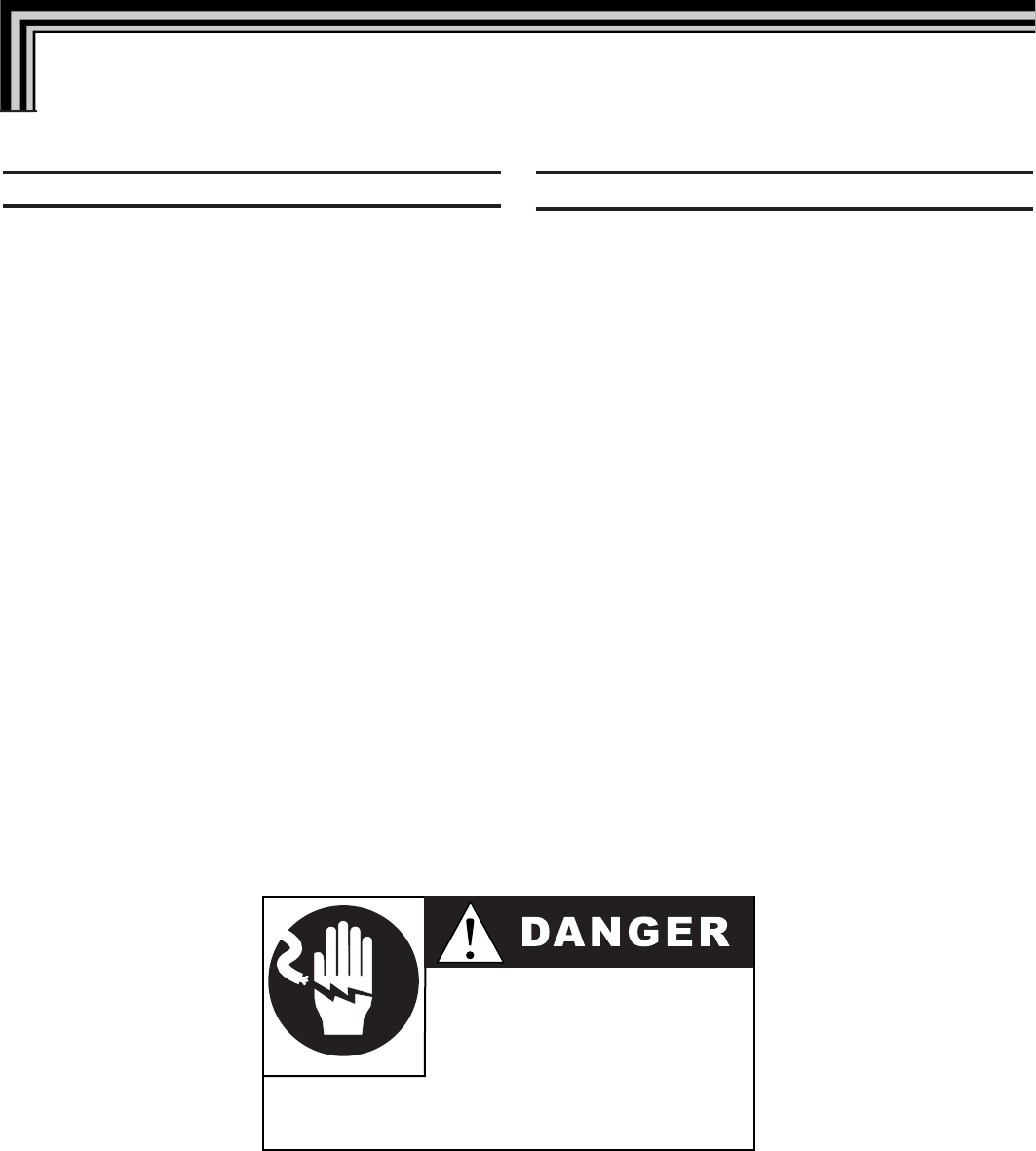
AT NO TIME SHOULD THE INTERIOR OR
EXTERIOR BE STEAM CLEANED, HOSED
DOWN, OR FLOODED WITH WATER OR
LIQUID SOLUTION OF ANY KIND. DO NOT
USE WATER JET TO CLEAN.
SEVERE DAMAGE OR ELECTRICAL HAZARD
COULD RESULT.
WARRANTY BECOMES VOID IF APPLIANCE IS FLOODED.
SECTION 2 • OPER ATI O N
7.
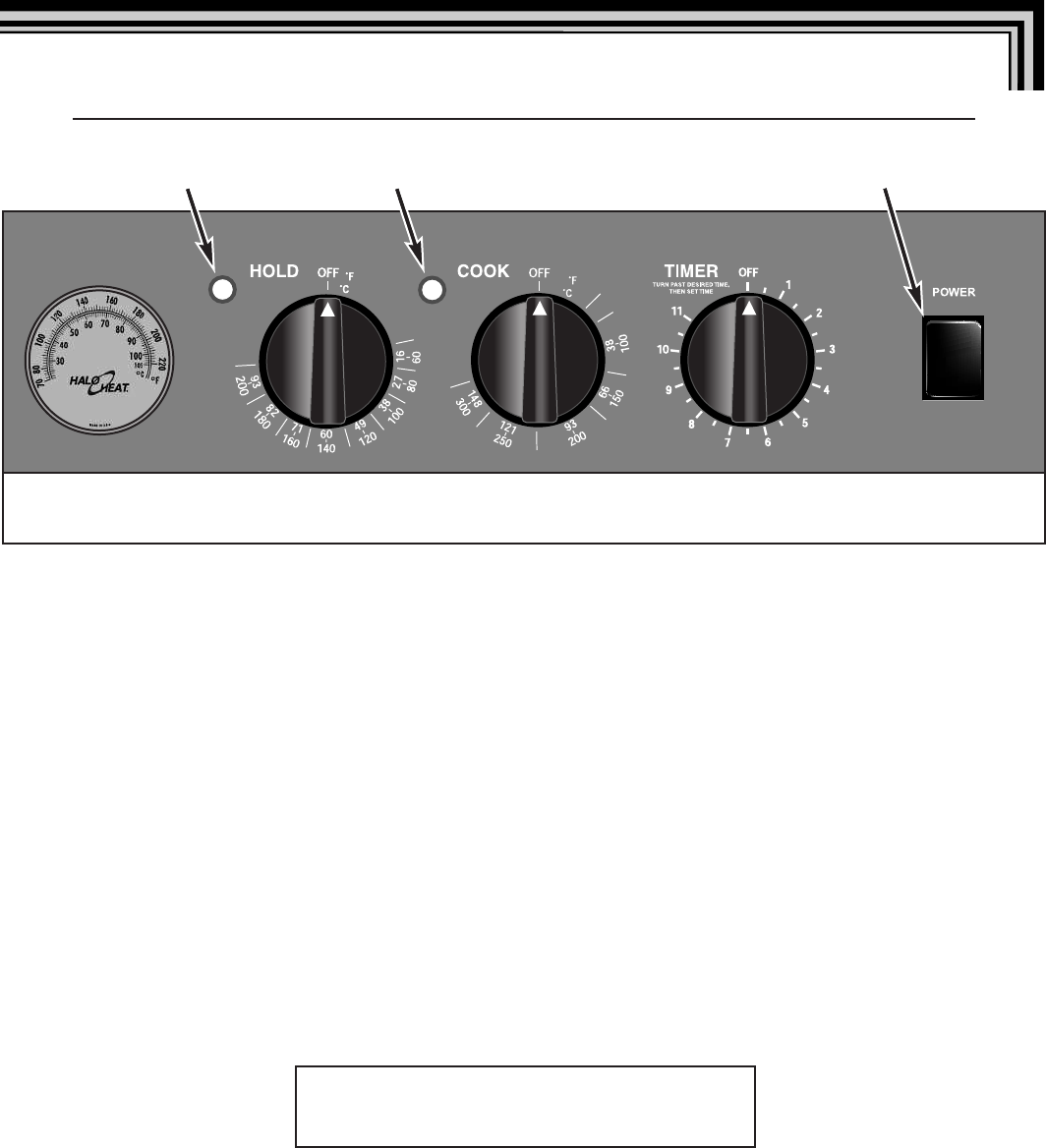
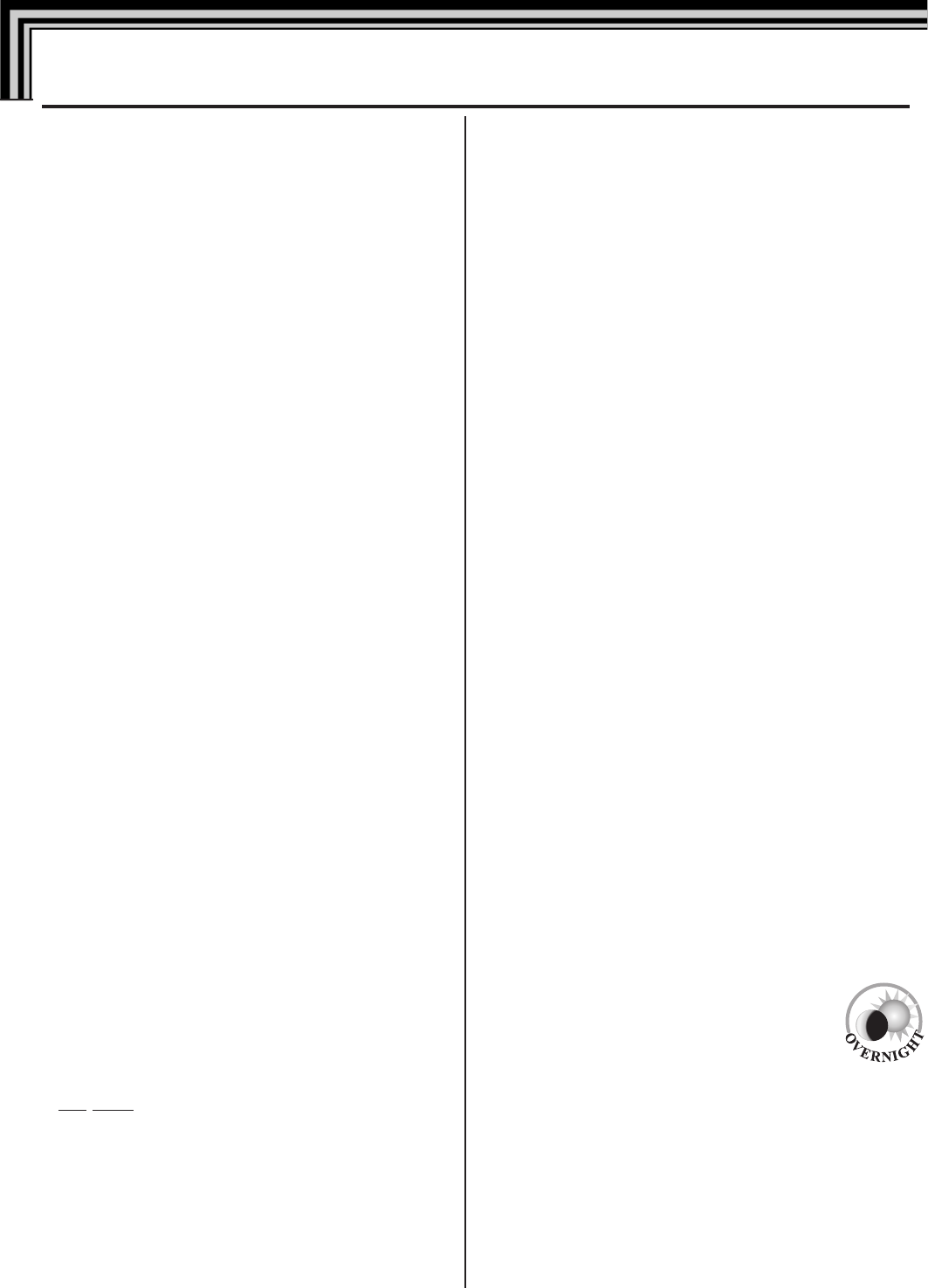
OVEN COMPARTMENT CONTROL PANEL IDENTIFICATION
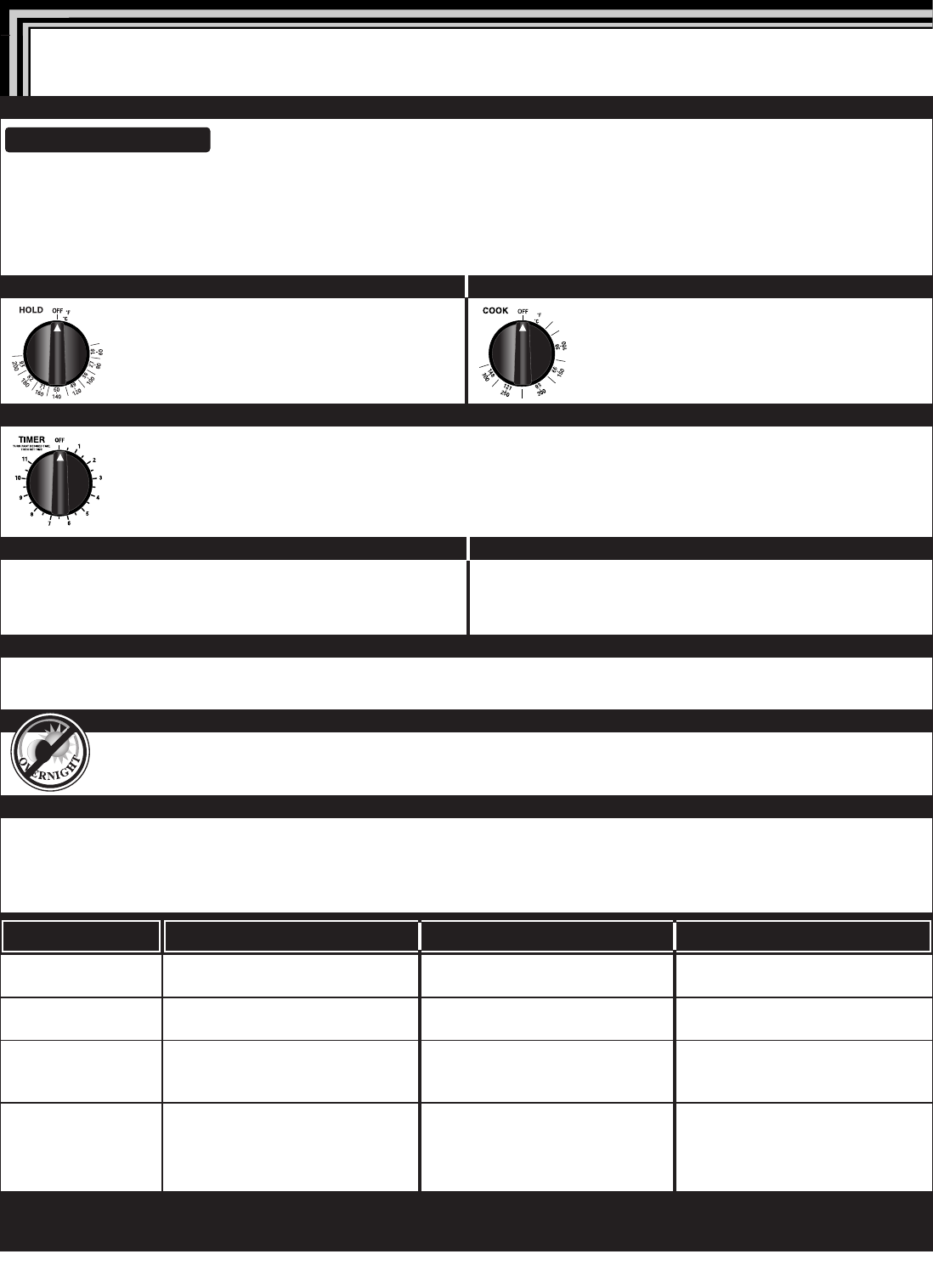
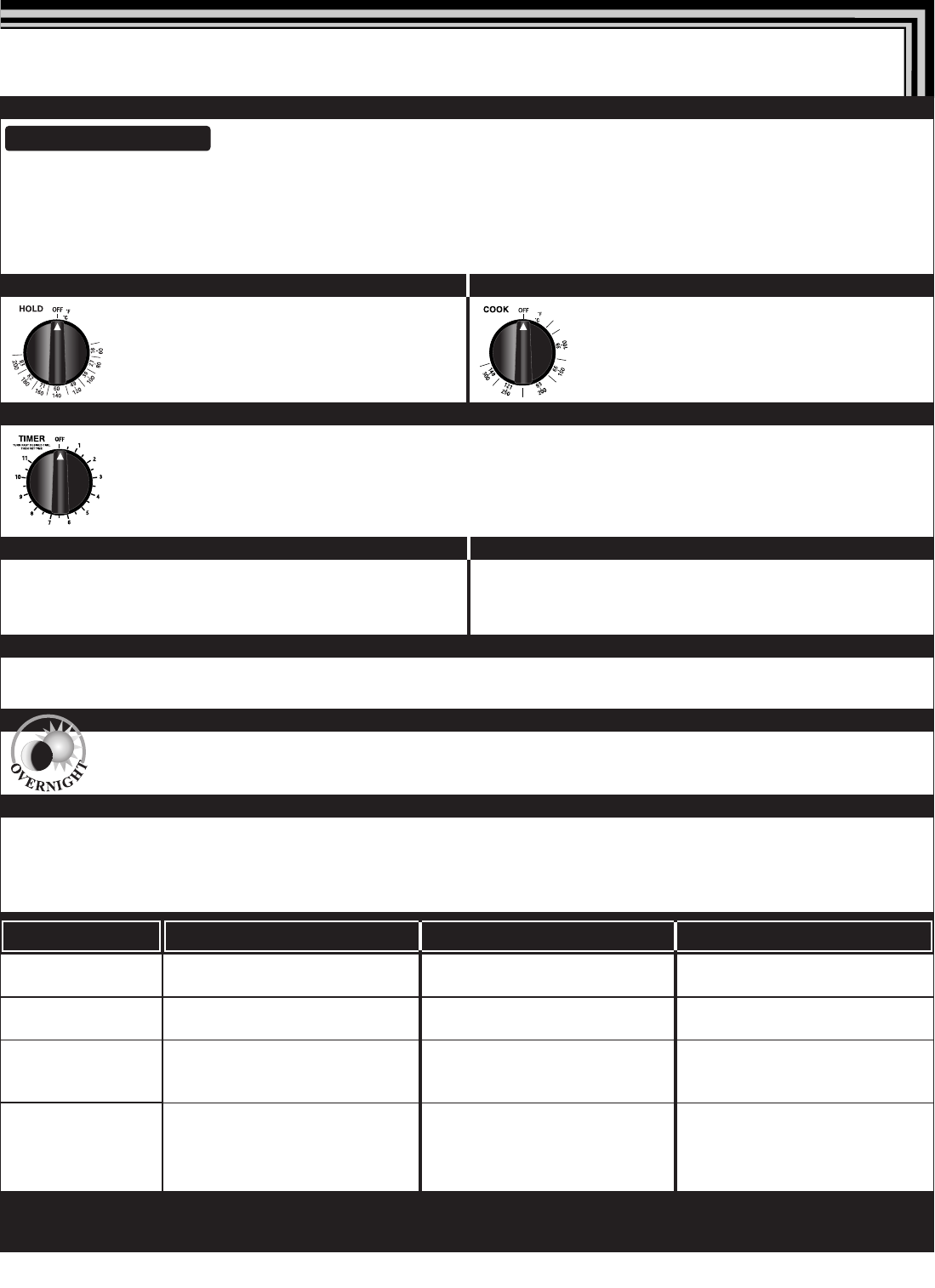
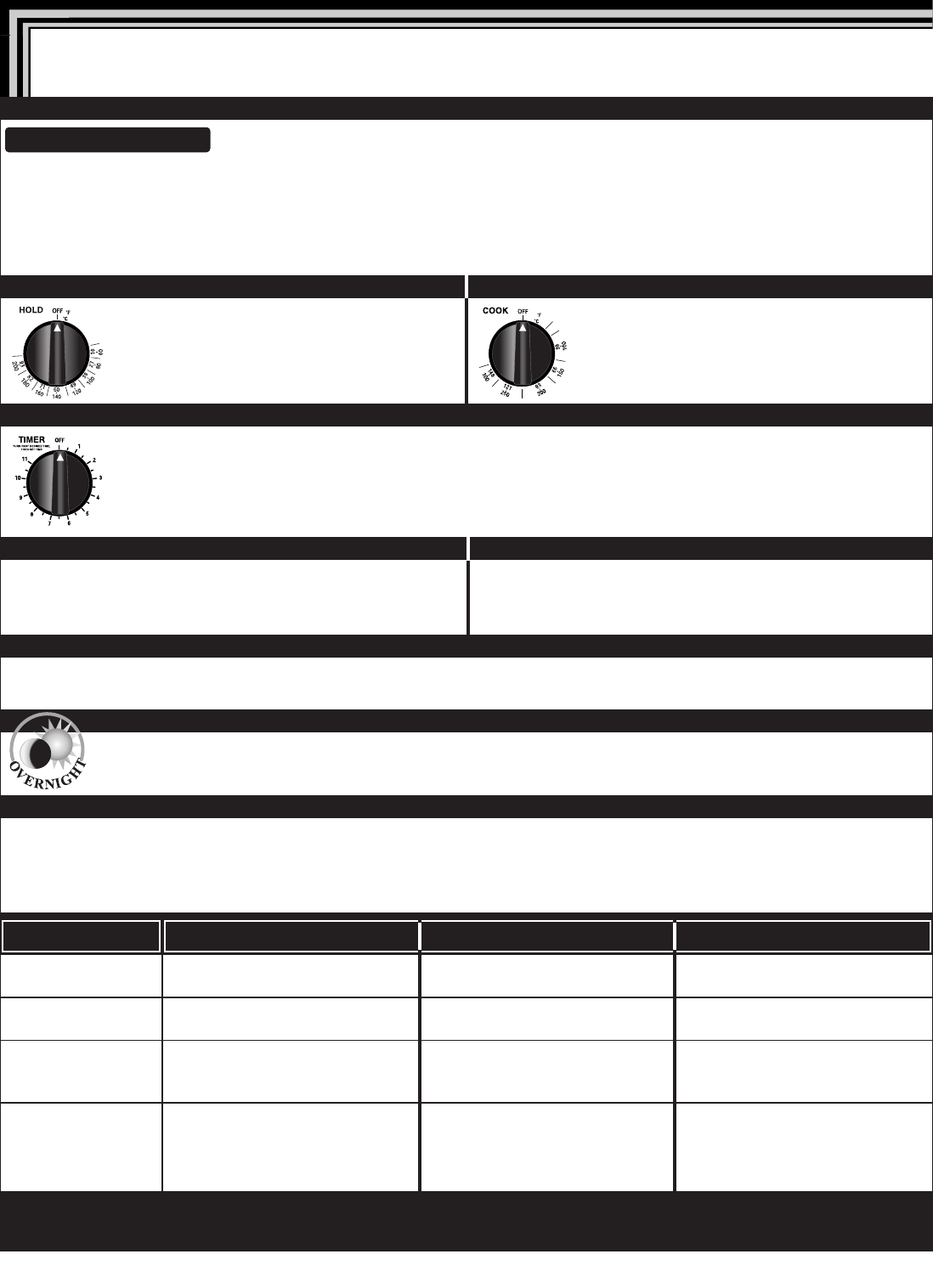
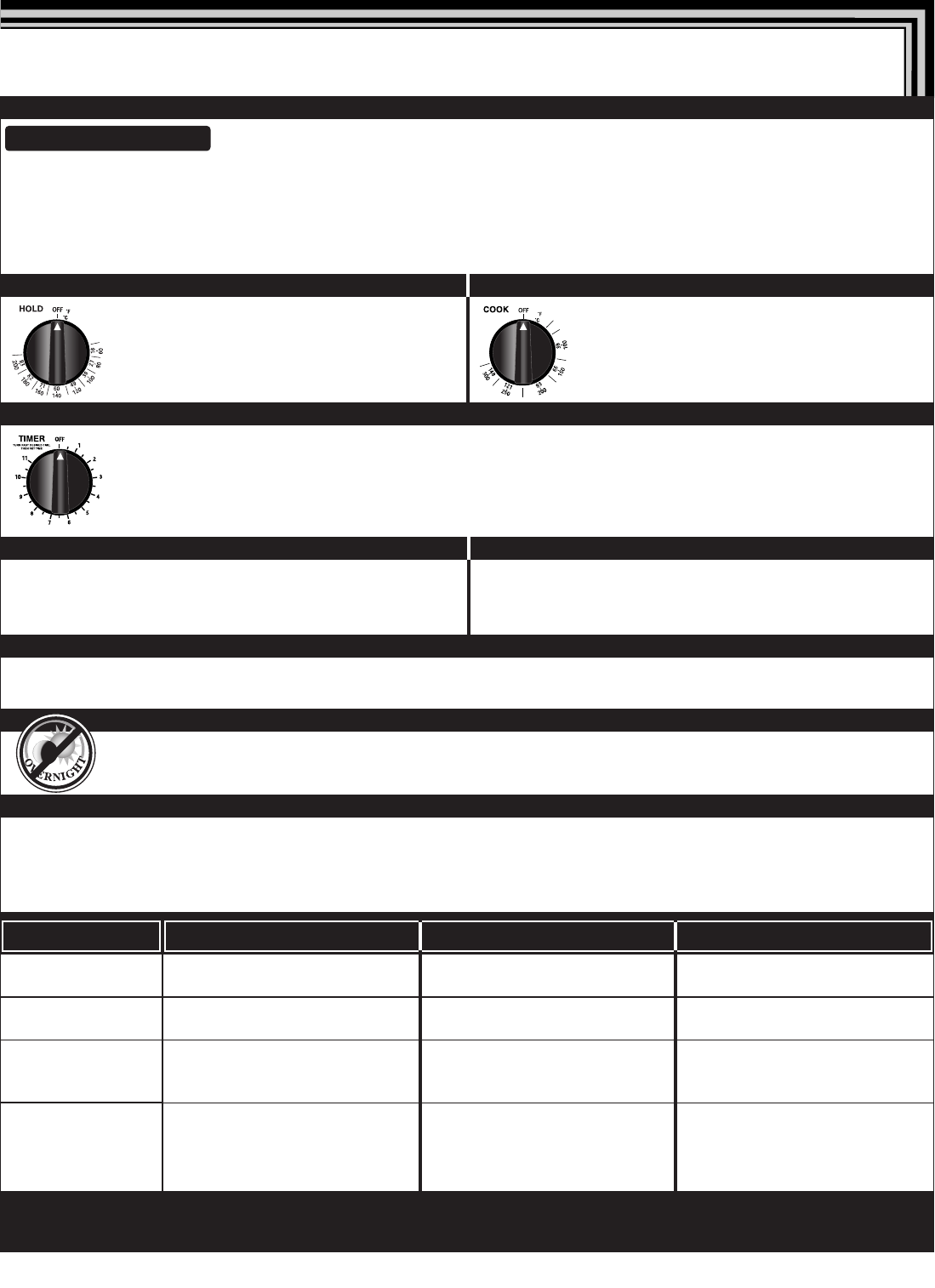
1. Press oven POWER SWITCH 쐄“ON.”
• POWER “ON ”INDICATOR SWITCH will illuminate and will remain lit as long as the power switch
is in the “ON”position.
2. Set “HOLD”thermostat 쐇to required holding temperature.
• HOLDING INDICATOR LIGHT will illuminate as the holding thermostat calls for heat.
This process will continue as long as the Power Switch is in the “ON”position and holding
thermostat is activated.
3. Set “COOK ”thermostat 쐋to required cooking temperature.
4. Activate the “COOK ”thermostat to preheat the oven by turning the “COOKING”timer 쐏clockwise.
• COOKING INDICATOR LIGHT and the HOLDING INDICATOR LIGHT will alternately illuminate
as each thermostat calls for heat. This process will continue until the cooking timer cycles or is
turned to the “O FF”position.
I
o
I
o
OPERATION
TEMPERATURE GAUGE 쐃will indicate the
air temperature inside the oven compartment.
HOLDING INDICATOR LIGHT COOKING INDICATOR LIGHT POWER “ON”INDICATOR SWITCH
햶
햳
HOLD THERMOSTAT
햴
COOK THERMOSTAT
햵
COOKING TIMER
햲
SECTION 2 • OPER ATI O N
8.
OPERATION
1. PREPARE OVEN FOR COOKING
A. Insert and adjust the required number of
shelves inside the cooking compartment.
Place the curved edge of the shelf toward
the back of the oven.
B. Adjust the inside door vents as indicated in
the individual cooking procedure selected.
C. Insert drip pan directly on the bottom surface
of the oven compartment.
2. PREHEAT OVEN
A. Press power switch 쐄“ON .”
B. Set the HOLD thermostat 쐇to the required
holding temperature.
C. Set the COOK thermostat 쐋to the required
cooking temperature.
D. Turn the timer knob 쐏clockwise to activate
the COOK thermostat.
E. Allow oven to preheat for 45 minutes.
3. PREPARE PRODUCT FOR COOKING
A. Refer to individual cooking instructions.
4. LOAD PRODUCT ON SHELVES
A. Refer to individual cooking instructions.
DO NOT overload the oven.
B. Most meat products are cooked directly on
wire shelves. For many products, the use of
pans is not recommended.
5. CLOSE DOOR
A. Keep door closed during the cooking cycle
6. RESET COOKING TIMER
FOR CORRECT NUMBER OF HOURS.
A. To set time, turn the timer knob 쐏past the
required number of hours then immediately
bring it back to the correct setting.
B. Refer to individual cooking instructions for
length of time necessary to cook.
C. When timer cycles to the “OFF”position,
the temperature automatically lowers to
the selected HOLD temperature.
D. The product will continue to cook as the oven
temperature lowers to the selected holding
temperature and must remain in the oven, at
the selected HOLD temperature, for the
minimum number of hours indicated in the
individual cooking instructions.
7. OVERNIGHT COOK AND HOLD
A. For maximum product tenderizing and to
reduce labor during peak preparation hours,
overnight cook and hold is highly
recommended for many products.
Refer to individual cooking instructions.
CONTINUED
COOKING and HOLDING PROCEDURES — MANUAL OVENS
SECTION 2 • OPER ATI O N
9.
OPERATION
8. DETERMINING IF PRODUCT
IS SUFFICIENTLY COOKED
A. Allow COOK timer to cycle to the
“OFF”position.
B. Before opening the oven door, leave the
product in the HOLD cycle for a minimum of
one hour. This time period will allow the
oven temperature to decrease from the COOK
setting to the selected HOLD temperature.
During this one hour period, the product will
continue to cook.
C. Insert a thermometer into the center of the
product to determine if the correct internal
temperature has been reached.
R E D M E AT :
RARE: 130° to 135°F
(54° to 57°C)
MEDIUM: 140° to 145°F
(60° to 63°C)
WELL: 155° to 160°F
(66° to 71°C)
D. When following the procedures in the
individual product cooking instructions,
additional cooking time should not be
necessary. If, however, the required internal
product temperature has not been reached
after the product has remained in the HOLD
cycle for the one hour minimum time period,
additional cooking time may be added.
Use the same COOK temperature set for the
original cooking cycle until the correct
internal temperature has been reached.
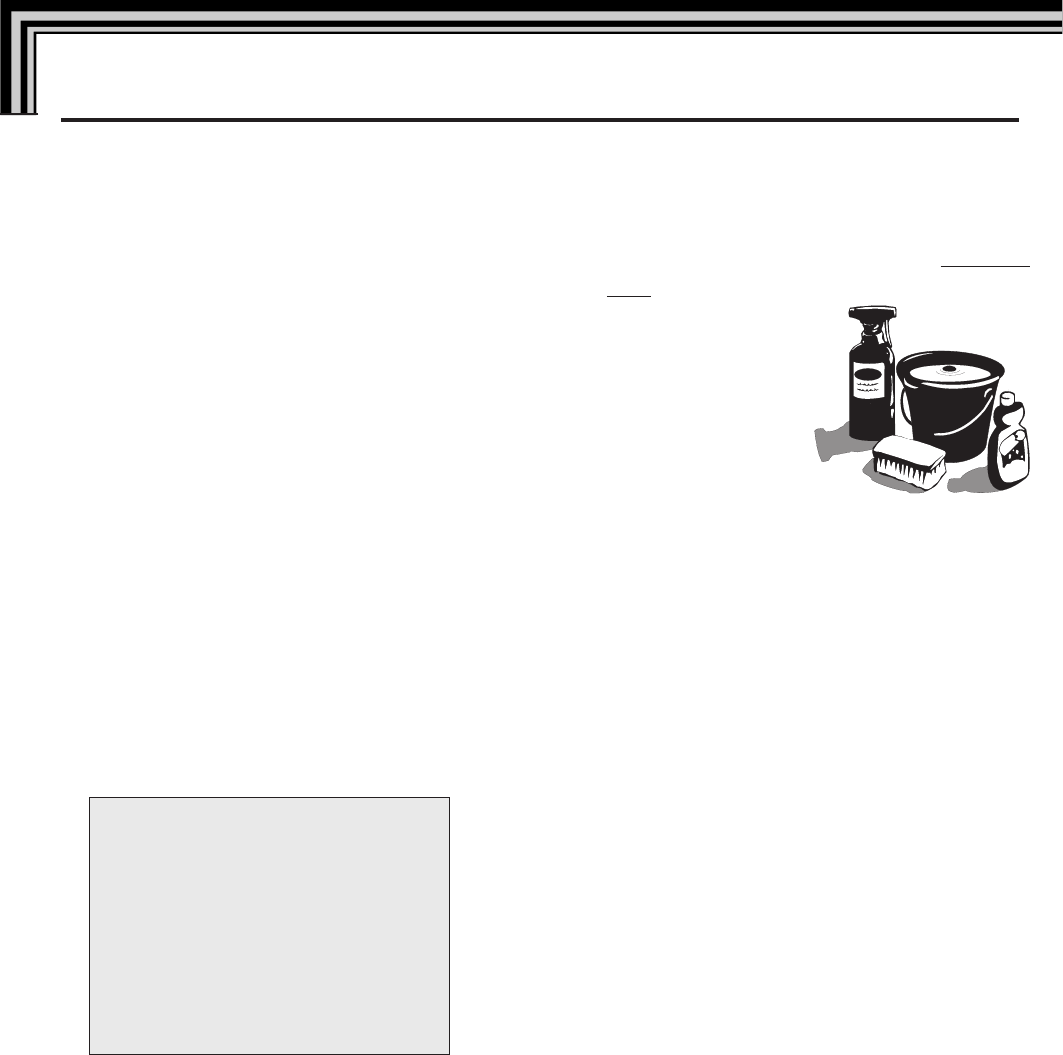
In the United States, FDA food code
requires products such as red meat to
remain in “HOLD” for a specified time
period. This holding time requirement
is based on the internal product
temperature desired for the finished
product and includes the one hour
time period while the oven decreases
from the cooking temperature to the
holding temperature and the product
continues to cook.
COOKING and HOLDING PROCEDURES — MANUAL OVENS
INTERNAL PRODUCT
TEMPERATURE
TI ME*IN HO LD CYCL E
REQUI RE D BY FO OD C ODE
130°F (54°C) 1 HOUR, 52 MINUTES
131°F (55°C) 1 HOUR, 29 MINUTES
133°F (56°C) 56 MINUTES
135°F (57°C) 36 MINUTES
136°F (58°C) 28 MINUTES
138°F (59°C) 18 MINUTES
140°F (60°C) 12 MINUTES
142°F (61°C) 8 MINUTES
144°F (62°C) 5 MINUTES
145°F (63°C) 4 MINUTES
147°F (64°C) 2 MINUTES, 14 SECONDS
149°F (65°C) 1 MINUTES, 25 SECONDS
151°F (66°C) 54 SECONDS
153°F (67°C) 34 SECONDS
155°F (68°C) 22 SECONDS
157°F (69°C) 14 SECONDS
158°F (70°C) 0 SECONDS
*HOLDING TIME MAY INCLUDE POST-OVEN HEAT RISE
SECTION 2 • OPER ATI O N
10.
OPERATION
COOKING and HOLDING PROCEDURES — MANUAL OVENS
9. R E H E AT I N G
A. Any over production must be removed
from the oven, wrapped, rapidly chilled,
and refrigerated.
B. Product can be removed from refrigerator,
returned to the oven, and reheated the
next day.
C. Products must be reheated at a temperature
range of 250° to 275°F (121° to 135°C). Refer
to individual cooking instructions for the
correct thermostat setting for the product
being reheated.
D. Length of time necessary to reheat a product
depends on the type of product and the
quantity to be reheated. Time should be
based on internal product temperature.
Use a pocket thermometer to determine
the internal product temperature of the
reheated product.
United Sates food code requirements
indicate cooked foods that have been
cooled, followed by reheating for hot
food holding, must be reheated to
165°F (74°C). The temperature of
165°F (74°C) must be maintained for
a period 15 seconds.
Always follow federal and local health
(hygiene) codes for the time and internal
temperature required for reheating products.
10. C A R E A N D C L E A N I N G
A. Clean interior oven cavity, wire shelves, and
drip pan daily, at the end of each cook and
hold cycle.
B. Refer to Care and
Cleaning instructions
in Section 3.
SECTION 2 • OPER ATI O N
11.
OPERATION
C H E F O P E R AT I N G T I P S
1.For cooking specific products, refer to
individual cook and hold instructions.
2. To set time, turn the timer knob past the
required number of hours, then immediately
bring it back to the correct setting.
3. When cooking at 250°F (121°C), it takes
approximately one hour for the cooking
temperature to decrease to the selected
holding temperature. During this one hour
time period, the product will continue to cook.
4. The cooking times in this guide are based on
meat taken directly from a refrigerated
temperature of 38° to 40°F (3.3° to 4.4°C), and
placed in a preheated oven. Adjustments must
be made for cooking products at other than
refrigerated temperatures.
5. It is recommended the oven door remain
closed during the cooking cycle. Opening the
door will only increase the length of time
necessary to cook the product.
6. Puncturing an item with any sharp instrument
may introduce bacteria inside the product.
Avoid using a fork to handle products, and
always use standard sanitary methods when
handling any food item.
7. Use a thermometer to check the internal
temperature of a product. Be certain to
sanitize the thermometer before each use.
8. Aged meat will cook faster, shrink more, and
cannot be held as long as fresh meat. Because
of the tenderizing capabilities of the oven, aged
meat or tenderizing agents such as M.S.G. are
not necessary, and are not recommended.
9. When cooking full loads, never cook below the
second shelf spacing from the bottom of the
oven compartment.
10. Fully clean the oven interior, drip pan, shelves,
and side racks on a daily basis.
11. Since there is no air
movement inside the
Halo Heat®low
temperature cooking and
holding oven, condensation will
form on the inside of the door during
operation and may leak out of the oven door
vents. This is a normal operating condition,
however; any condensation spilling on the
floor should be periodically wiped as a safety
precaution. There is an External Drip Tray
included as standard with most ovens.
12. Drip pan overflow is a condition caused by
cooking some cuts of beef to an internal
temperature in excess of 130°F (54°C). The
External Drip Tray will help alleviate some of
this overflow problem. There is also an extra
large drip pan available as an option for the
1000-TH series ovens.
13. Overflow may also be caused by overloading
the oven compartment. DO NOT OVERLOAD
THE OVEN. Follow the recommended load
capacities listed in each individual procedure.
14. For best results, many products should be
cooked on an overnight cook-and-hold basis.
Consult individual procedures for this
recommendation.
The Alto-Shaam staff includes corporate
executive chefs who welcome questions.
You are invited to contact anyone on our
staff by phone (800.558.8744) or e-mail
through the Contact Us section of our
web site (www.alto-shaam.com) for help
with any cook and hold procedure.
NEEDSOME HELP?
CLEANING & MAINTENANCE
SECTION 3 • CLEA N I NG &MAINTENANCE
12.
PROTECTING STAINLESS STEEL SURFACES
It is important to guard against
corrosion in the care of
stainless steel surfaces.
Harsh, corrosive, or
inappropriate chemicals can
completely destroy the
protective surface layer of stainless steel. Abrasive
pads, steel wool, or metal implements will abrade
surfaces causing damage to this protective coating
and will eventually result in areas of corrosion.
Even water, particularly hard water that contains
high to moderate concentrations of chloride, will
cause oxidation and pitting that result in rust and
corrosion. In addition, many acidic foods spilled
and left to remain on metal surfaces are
contributing factors that will corrode surfaces.
Proper cleaning agents, materials, and
methods are vital to maintaining the appearance
and life of this appliance. Spilled foods should be
removed and the area wiped as soon as possible
but at the very least, a minimum of once a day.
Always thoroughly rinse surfaces after using a
cleaning agent and wipe standing water as quickly
as possible after rinsing.
CLEANING AGENTS
Use non-abrasive cleaning products designed for use
on stainless steel surfaces. Cleaning agents must be
chloride-free compounds and must not contain
quaternary salts. Never use hydrochloric acid
(muriatic acid) on stainless steel surfaces. Always use
the proper cleaning agent at the manufacturer's
recommended strength. Contact your local cleaning
supplier for product recommendations.
CLEANING MATERIALS
The cleaning function can usually be accomplished
with the proper cleaning agent and a soft, clean
cloth. When more aggressive methods must be
employed, use a non-abrasive scouring pad on
difficult areas and make certain to scrub with the
visible grain of surface metal to avoid surface
scratches. Never use wire brushes, metal scouring
pads, or scrapers to remove food residue.
CLEANING AND PREVENTIVE MAINTENANCE
CONTINUED
CLEANING & MAINTENANCE
SECTION 3 • CLEANING &MAIN T E NANC E
13.
The cleanliness and appearance of this equipment will contribute considerably to operating
efficiency and savory, appetizing food. There is an important relationship between
cleanliness and food flavor and aroma. Good equipment that is kept clean works
better and lasts longer.
Under normal circumstances, this oven should provide you with long and trouble-
free service. There is no preventative maintenance required, however, the following
Equipment Care Guide will maximize the potential life and trouble-free operation of this oven.
1. CLEAN DAILY
Disconnect the oven from the power source.
Remove all detachable items such as wire
shelves, side racks, and drip pans. Clean these
items separately. Clean the interior metal
surfaces of the oven with a damp, clean cloth
and any good commercial detergent or grease
solvent at the recommended strength. Use a
plastic scouring pad or oven cleaner for
difficult areas. Rinse carefully to remove all
residue and wipe dry.
NOTE: Avoid the use of
abrasive cleaning
compounds, chloride
based cleaners, or
cleaners containing
quaternary salts.
Never use hydrochloric
acid (muriatic acid) on stainless steel.
Always follow appropriate state or local
health (hygiene) regulations regarding
all applicable cleaning and sanitation
requirements for equipment.
2. CLEAN THE EXTERIOR OF THE CABINET
WITH A STAINLESS STEEL POLISH.
To help maintain the protective film coating on
polished stainless steel, clean the exterior of the
cabinet with a cleaner recommended for
stainless steel surfaces. Spray the cleaning
agent on a clean cloth and wipe with the grain
of the stainless steel.
3. CHECK OVERALL CONDITION
OF THE OVEN ONCE A MONTH.
Check the oven once a month for physical
damage and loose screws. Correct any
problems before they begin to interfere with the
operation of the oven.
4. CHECK THE COOLING FAN
IN THE OVEN CONTROL AREA.
While the oven is warm, check that the cooling
fan in the oven control area is functioning.
The fan is located on the back of the unit,
toward the top.
AT NO TIME SHOULD THE INTERIOR OR
EXTERIOR BE STEAM CLEANED, HOSED
DOWN, OR FLOODED WITH WATER OR
LIQUID SOLUTION OF ANY KIND. DO NOT
USE WATER JET TO CLEAN.
SEVERE DAMAGE OR ELECTRICAL HAZARD
COULD RESULT.
WARRANTY BECOMES VOID IF APPLIANCE IS FLOODED.
SECTION 4 • BEEF
14.
COOKING GUIDELINES
BE E F
BeefBrisket ...........................15
BeefShortRibs ........................16
BeefStriploin .........................17
CornedBeef...........................18
Hamburgers ..........................19
PrimeRib(#109) .......................20
PrimeRib,Special......................21
RibeyeRoll ...........................22
BeefRound ...........................23
Beef Round, CAFETERIA/STEAMSHIP ...........24
Tenderloin ............................25
VealLoin .............................26
L A MB
Lamb,Leg ............................27
Lamb Racks (Frenched) . . . . . . . . . . . . . . . . .28
P ORK
Ham,Fresh ...........................29
Ham, Cured & Smoked . . . . . . . . . . . . . . . . . .30
PorkChops ...........................31
PorkLoin.............................32
PorkShoulder .........................33
PorkRibs .............................34
P ROC E SSE D ME ATS
Sausage ..............................35
P OU LTRY
ChickenBreasts........................36
Chicken, Pieces & Halves . . . . . . . . . . . . . . . .37
Chicken,Whole........................38
Chicken, Fried TWO-STEP METHOD ............39
CornishHens .........................40
Duck,Whole ..........................41
Turkey,Whole .........................42
TurkeyBreast .........................43
TurkeyRoll ...........................44
F ISH
Fish, Baked FILLETS ......................45
SalmonSteaks .........................46
Trout ................................47
MISC E L L A N E OU S
Potatoes ..............................48
Quiche ...............................49
Rice .................................50
BakedEggCustard .....................51
SheetCake............................52
CheeseCake ..........................53
Frozen Convenience Entrée PANS ................54
Frozen Convenience Entrée PORTIONED .........55
Frozen Finger Foods . . . . . . . . . . . . . . . . . . . .56
Breakfast Sandwiches . . . . . . . . . . . . . . . . . . .57
Cookies ..............................58
Doughnuts............................59
ProofingDough........................60
SMOKE D F OODS
BeefBrisket ...........................66
BeefTongue...........................66
Ham,Fresh ...........................67
PorkRibs.............................67
Duck ................................68
Turkey ...............................68
FishFillets............................69
Salmon,Whole ........................69
Shrimp...............................70
Salmon, Cold Smoked . . . . . . . . . . . . . . . . . . .71
OVEN PREHEAT INSTRUCTIONS
BEFORE COOKING PRODUCT:
1 . Turn power switch “O N .”
2 . Set the HOLD thermostat to the required holding temperature.
3 . Set the COOK thermostat to the required cooking temperature.
4 . Turn the timer knob clockwise to activate the COOK thermostat.
5 . Allow oven to preheat until the COOK Indicator Light goes out.
COOKING GUIDELINE INDEX
Beef Brisket, Fresh: 9 to 13 lb (4 to 6 kg)
Season brisket and wrap individually in clear plastic wrap for cooking. Place wrapped brisket directly on wire shelves.
SECTION 4 • BEEF
15.
BEEF BRISKET
500 S E R I E S 7 5 0 S E R I E S 1 0 0 0 SERIES
M O D E L S
NUMBER OF SHELVES
ITEMS PER SHELF
APPROXIMATE
MAXIMUM CAPACITY
PANS
165°F (73°C)
6 hours 24 hours
160°F
(71°C)
250°F
(121°C)
323
1 roast 3 to 4 roasts 2 to 3 roasts
3 roasts
up to 40 lb (18 kg)
6 to 8 roasts
up to 100 lb (45 kg)
6 to 9 roasts
up to 100 lb (45 kg)
none none none
The time and temperature are suggested guidelines only. All cooking should be based on internal product temperatures.
Due to variations in product quality, weight and desired degree of doneness, the cooking timer may need to be adjusted accordingly.
Always follow local health (hygiene) regulations for all internal temperature requirements.
P R O D U C T S P E C I F I C AT I O N S a n d P R E PA R AT I O N
S E T H O L D T H E R M O S TAT S E T C O O K T H E R M O S TAT
S E T C O O K I N G T I M E R
MINIMUM HOLDING TIME REQUIRED MAXIMUM HOLDING TIME
A D D I T I O N A L I N F O R M AT I O N • N O T E S
FINAL INTERNAL PRODUCT TEMPERATURE
O V E R N I G H T C O O K & H O L D
TIME REQUIRED IN “HOLD” CYCLE BEFORE SERVING.
CAPACITIES ARE BASED ON U.S.
PAN SIZES.GASTRONORM PANS
MAY HOLD MORE OR LESS THAN
THE FOOD QUANTITIES INDICATED.
P R E H E AT T H E O V E N
DOOR VENTS: ONE-HALF OPEN
Highly Recommended
20 minutes per pound for the first roast (44 minutes per kilogram)
plus
add 30 minutes for each additional roast.
COOKING GUIDELINES
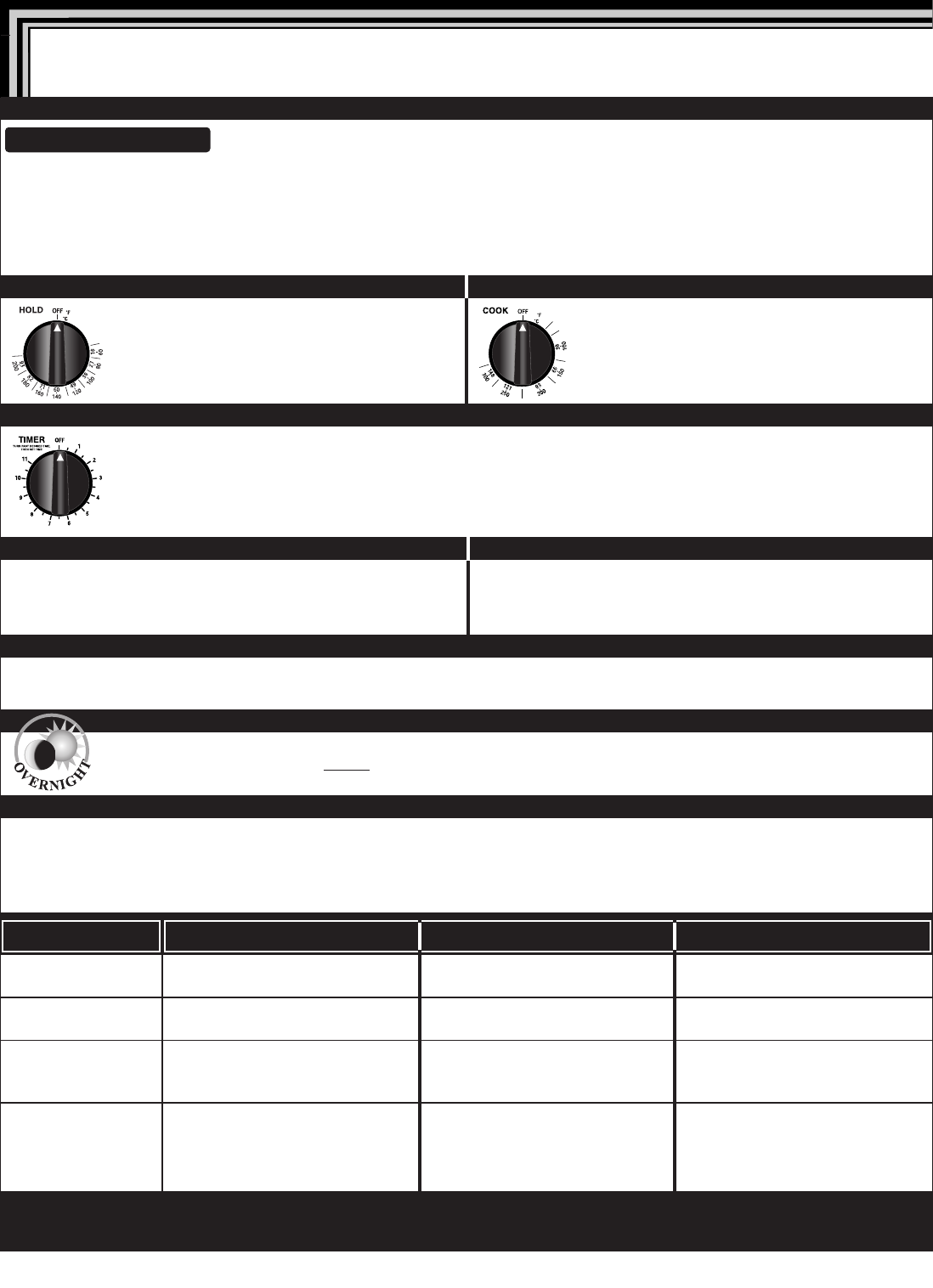
Short Ribs: 10 to 12 oz. pieces
Season as desired. Place ribs side-by-side in pans.
For an overnight cook and hold, cover pans loosely with clear plastic wrap to retain additional
product moisture.
SECTION 4 • BEEF
16.
BEEF SHORT RIBS
500 S E R I E S 7 5 0 S E R I E S 1000 S E R I E S
MODELS
NUMBER OF SHELVES
ITEMS PER SHELF
APPROXIMATE
MAXIMUM CAPACITY
PANS
170° to 190°F (77° to 88°C)
6 hours 18 hours
160°F
(71°C)
250°F
(121°C)
33none
1 half-size sheet pan 1 full-size sheet pan 1 full-size sheet pan
3 half-size sheet pans 3 full-size sheet pans 4 full-size sheet pans
18" x 13" x 1"
(GN 1/1: 530 x 325 x 20mm)
(NO SHELVES REQUIRED)
18" x 26" x 1"
(GN 2/1: 530 x 650 x 20mm)
(NO SHELVES REQUIRED)
18" x 26" x 1"
(GN 1/1: 530 x 325 x 20mm)
(ON WIRE SHELVES)
The time and temperature are suggested guidelines only. All cooking should be based on internal product temperatures.
Due to variations in product quality, weight and desired degree of doneness, the cooking timer may need to be adjusted accordingly.
Always follow local health (hygiene) regulations for all internal temperature requirements.
PR O D U C T S P E C I F I C AT I O N S a n d P R E PA R AT I O N
S E T H O L D T H E R M O S TAT S E T C O O K T H E R M O S TAT
S E T C O O K I N G T I M E R
MINIMUM HOLDING TIME REQUIRED MAXIMUM HOLDING TIME
A D D I T I O N A L I N F O R M AT I O N • N O T E S
FINAL INTERNAL PRODUCT TEMPERATURE
O V E R N I G H T C O O K & H O L D
TIME REQUIRED IN “HOLD” CYCLE BEFORE SERVING.
CAPACITIES ARE BASED ON U.S.
PAN SIZES.GASTRONORM PANS
MAY HOLD MORE OR LESS THAN
THE FOOD QUANTITIES INDICATED.
P R E H E AT T H E O V E N
DOOR VENTS: ONE-HALF OPEN
MUST do an overnight cook and hold.
3 hours for the first pan
plus
add 30 minutes for each additional pan.
COOKING GUIDELINES
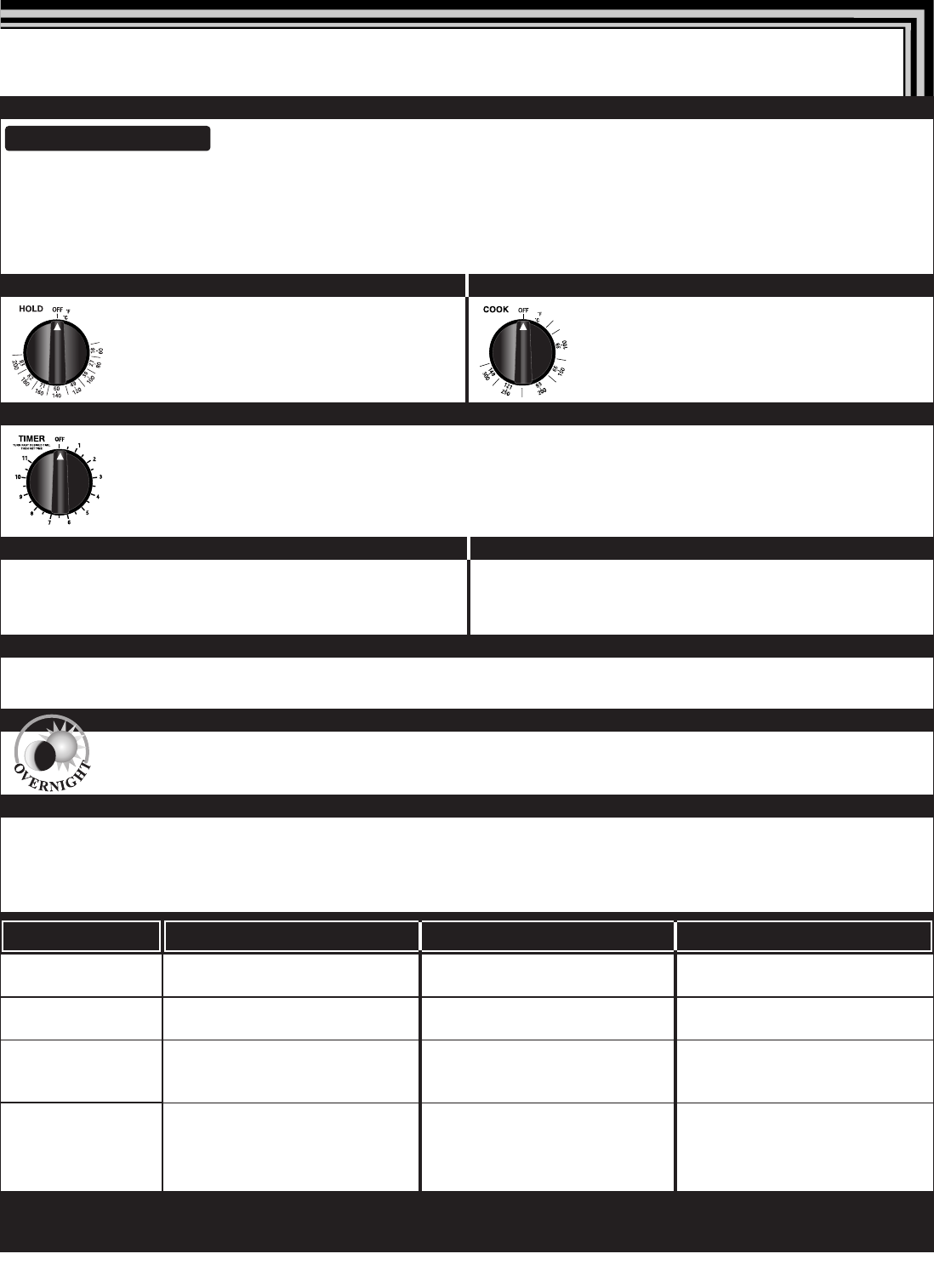
Loin, Strip Loin, Short-Cut, Boneless: 8 to 12 lb (4 to 5 kg)
Season as desired. Place roasts directly on the wire shelves with fat side down. Place larger roasts toward the top of the
oven compartment.
SECTION 4 • BEEF
17.
BEEF STRIPLOIN
500 S E R I E S 7 5 0 S E R I E S 1 0 0 0 SERIES
M O D E L S
NUMBER OF SHELVES
ITEMS PER SHELF
APPROXIMATE
MAXIMUM CAPACITY
PANS
130°F (54°C) RARE
4 hours 12 hours
140°F
(60°C)
250°F
(121°C)
223
2 roasts 4 roasts 3 roasts
4 roasts
up to 40 lb (18 kg)
8 roasts
up to 100 lb (45 kg)
9 roasts
up to 100 lb (45 kg)
none none none
The time and temperature are suggested guidelines only. All cooking should be based on internal product temperatures.
Due to variations in product quality, weight and desired degree of doneness, the cooking timer may need to be adjusted accordingly.
Always follow local health (hygiene) regulations for all internal temperature requirements.
P R O D U C T S P E C I F I C AT I O N S a n d P R E PA R AT I O N
S E T H O L D T H E R M O S TAT S E T C O O K T H E R M O S TAT
S E T C O O K I N G T I M E R
MINIMUM HOLDING TIME REQUIRED MAXIMUM HOLDING TIME
A D D I T I O N A L I N F O R M AT I O N • N O T E S
FINAL INTERNAL PRODUCT TEMPERATURE
O V E R N I G H T C O O K & H O L D
TIME REQUIRED IN “HOLD” CYCLE BEFORE SERVING.
CAPACITIES ARE BASED ON U.S.
PAN SIZES.GASTRONORM PANS
MAY HOLD MORE OR LESS THAN
THE FOOD QUANTITIES INDICATED.
P R E H E AT T H E O V E N
DOOR VENTS: ONE-HALF OPEN
Optional
8 to 10 lb ROASTS (4 to 4,5 kg):
8 minutes per pound for the first roast
(18 Minutes per kilogram)
plus add 8 minutes for each additional roast
COOKING GUIDELINES
12 lb ROASTS (5 kg):
10 minutes per pound for the first roast
(22 Minutes per kilogram)
plus add 8 minutes for each additional roast
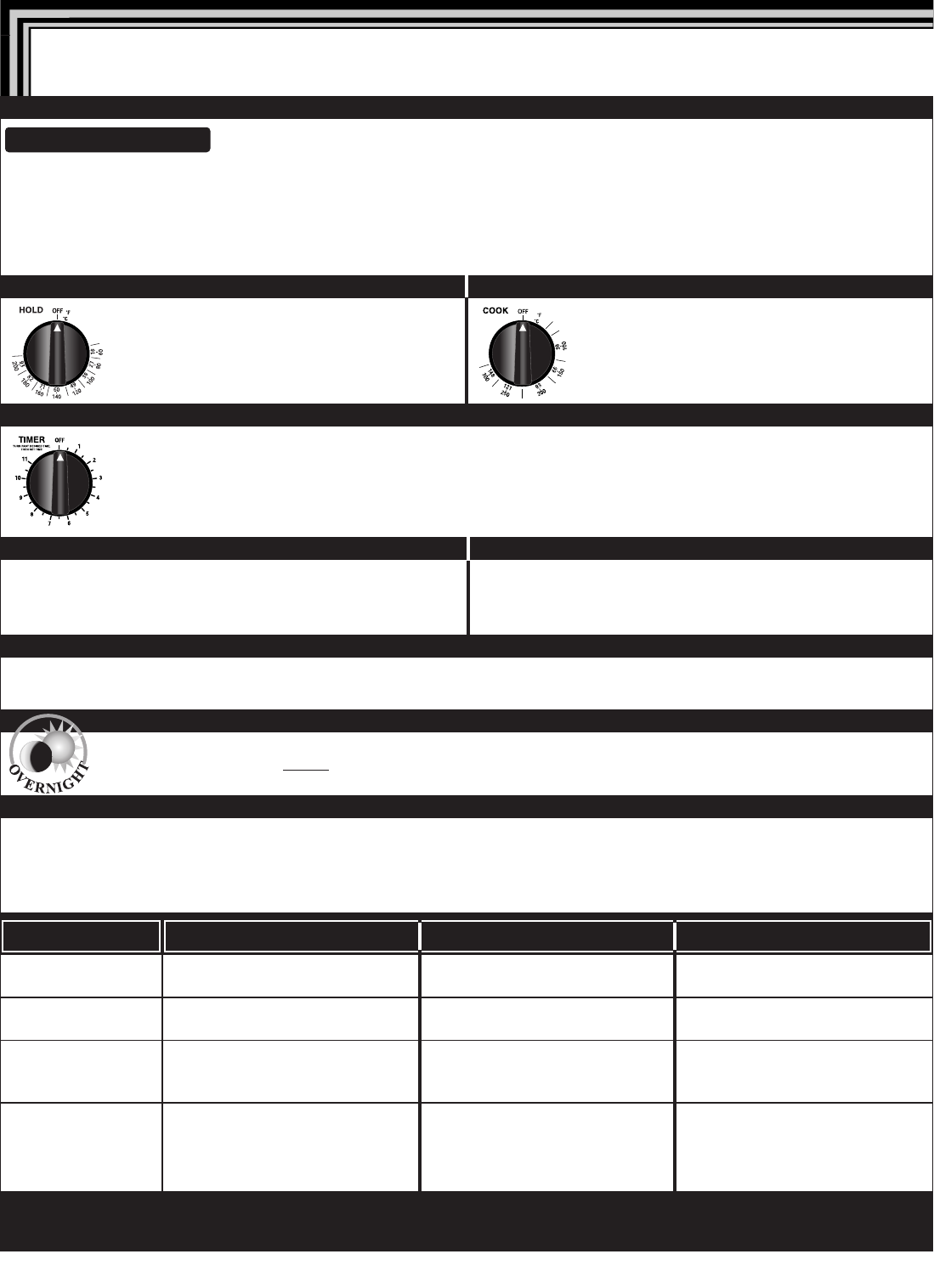
Corned Beef: 9 to 12 lb (4 to 5 kg)
Leave the corned beef in the original plastic bag and place the corned beef bag directly on the wire shelf.
SECTION 4 • BEEF
18.
CORNED BEEF
500 S E R I E S 7 5 0 S E R I E S 1000 S E R I E S
MODELS
NUMBER OF SHELVES
ITEMS PER SHELF
APPROXIMATE
MAXIMUM CAPACITY
PANS
175°F (79°C)
If desired, corn beef can be removed from the bag and wrapped in clear plastic wrap for cooking.
6 or more hours 24 hours
160°F
(71°C)
250°F
(121°C)
223
2 roasts 3 to 4 roasts 2 to 3 roasts
4 roasts
up to 40 lb (18 kg)
6 to 8 roasts
up to 100 lb (45 kg)
6 to 9 roasts
up to 100 lb (45 kg)
none none none
The time and temperature are suggested guidelines only. All cooking should be based on internal product temperatures.
Due to variations in product quality, weight and desired degree of doneness, the cooking timer may need to be adjusted accordingly.
Always follow local health (hygiene) regulations for all internal temperature requirements.
PR O D U C T S P E C I F I C AT I O N S a n d P R E PA R AT I O N
S E T H O L D T H E R M O S TAT S E T C O O K T H E R M O S TAT
S E T C O O K I N G T I M E R
MINIMUM HOLDING TIME REQUIRED MAXIMUM HOLDING TIME
A D D I T I O N A L I N F O R M AT I O N • N O T E S
FINAL INTERNAL PRODUCT TEMPERATURE
O V E R N I G H T C O O K & H O L D
TIME REQUIRED IN “HOLD” CYCLE BEFORE SERVING.
CAPACITIES ARE BASED ON U.S.
PAN SIZES.GASTRONORM PANS
MAY HOLD MORE OR LESS THAN
THE FOOD QUANTITIES INDICATED.
P R E H E AT T H E O V E N
DOOR VENTS: ONE-HALF OPEN
MUST DO AN OVERNIGHT COOK AND HOLD.
20 minutes per pound for the first corned beef (44 minutes per kilogram)
plus
add 30 minutes for each additional corned beef.
COOKING GUIDELINES
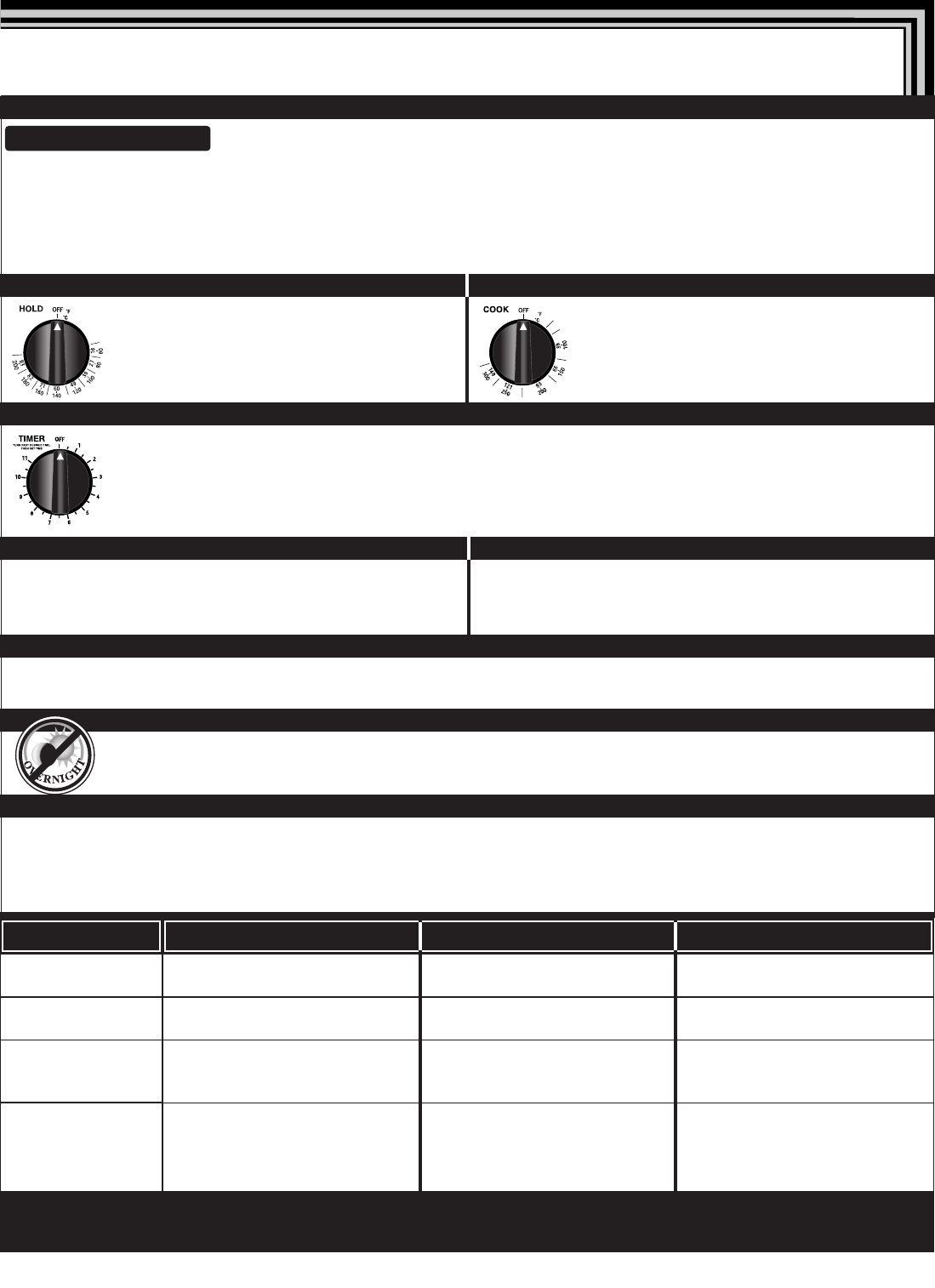
Ground Beef (fresh, not frozen): 5 oz (142 grams) per patty (MINIMUM)
Ground Beef, frozen: 5 oz (142 grams) per patty (MINIMUM)
Place hamburger patties side-by-side directly on sheet pans.
SECTION 4 • BEEF
19.
HAMBU RGE RS
500 S E R I E S 7 5 0 S E R I E S 1 0 0 0 SERIES
M O D E L S
NUMBER OF SHELVES
ITEMS PER SHELF
APPROXIMATE
MAXIMUM CAPACITY
PANS
165°F (74°C)
*Cooking time depends on the desired degree of doneness. Check internal product temperature before removing the
product from the oven. Always follow local health (hygiene) regulations for all internal temperature requirements.
none 4 hours
150°F
(66°C)
250° to 275°F
(121° to 135°C)
55none
1 half-size sheet pan 1 full-size sheet pan 1 full-size sheet pan
5 half-size sheet pans 5 full-size sheet pans 4 full-size sheet pans
18" x 13" x 1"
(GN 1/1: 530 x 325 x 20mm)
(NO SHELVES REQUIRED)
18" x 26" x 1"
(GN 2/1: 530 x 650 x 20mm)
(NO SHELVES REQUIRED)
18" x 26" x 1"
(GN 1/1: 530 x 325 x 20mm)
(ON WIRE SHELVES)
The time and temperature are suggested guidelines only. All cooking should be based on internal product temperatures.
Due to variations in product quality, weight and desired degree of doneness, the cooking timer may need to be adjusted accordingly.
Always follow local health (hygiene) regulations for all internal temperature requirements.
P R O D U C T S P E C I F I C AT I O N S a n d P R E PA R AT I O N
S E T H O L D T H E R M O S TAT S E T C O O K T H E R M O S TAT
S E T C O O K I N G T I M E R
MINIMUM HOLDING TIME REQUIRED MAXIMUM HOLDING TIME
A D D I T I O N A L I N F O R M AT I O N • N O T E S
FINAL INTERNAL PRODUCT TEMPERATURE
O V E R N I G H T C O O K & H O L D
TIME REQUIRED IN “HOLD” CYCLE BEFORE SERVING.
CAPACITIES ARE BASED ON U.S.
PAN SIZES.GASTRONORM PANS
MAY HOLD MORE OR LESS THAN
THE FOOD QUANTITIES INDICATED.
P R E H E AT T H E O V E N
DOOR VENTS: FULL OPEN
Not Recommended
FRESH, NOT FROZEN: Approximately 1 hour*
FROZEN: 2-3 hours
Full Load
COOKING GUIDELINES
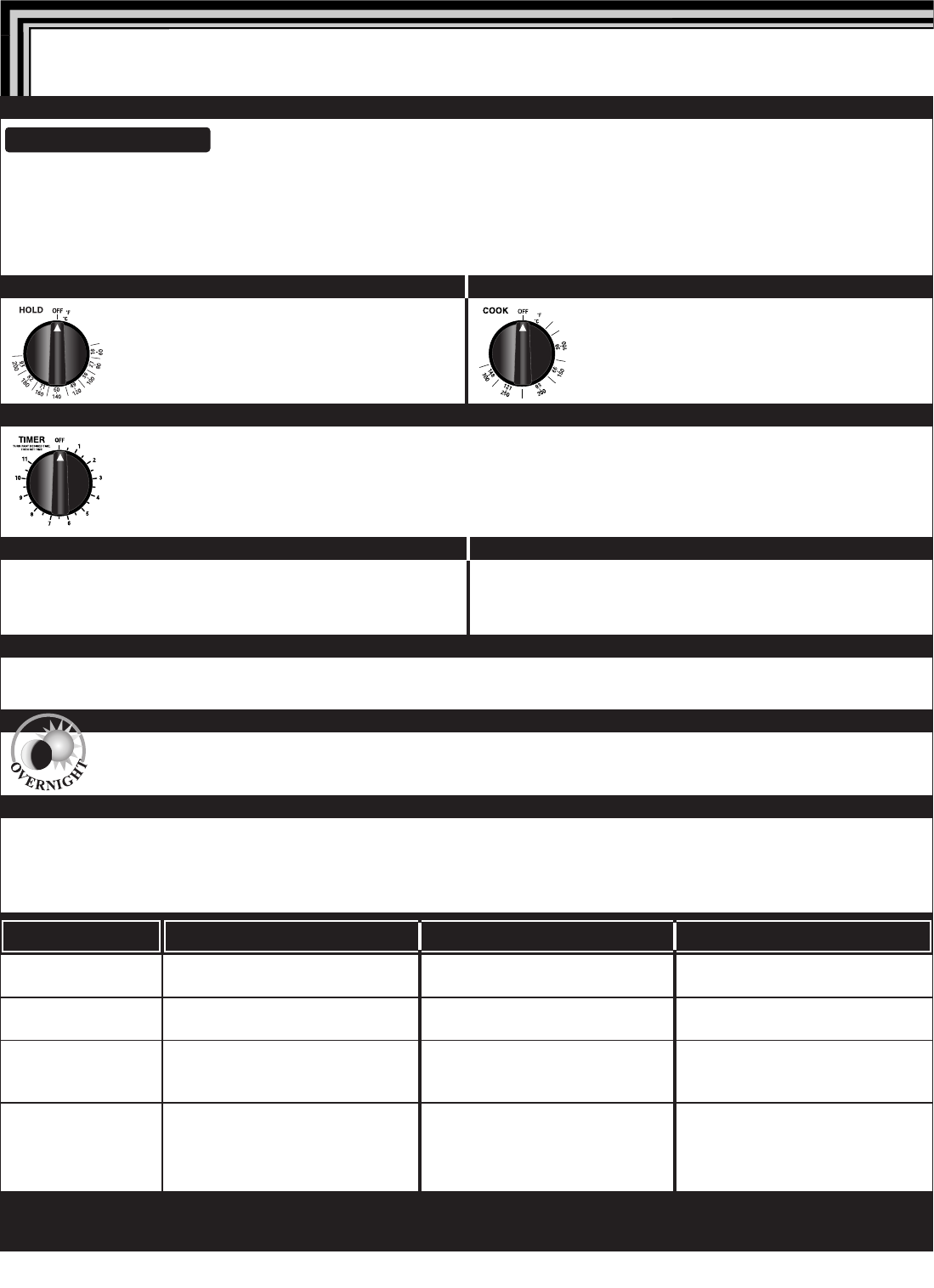
Beef Rib, Roast Ready, with Fat Cap, #109: 20 lb (9kg) Average Weight
Season as desired. Place roasts directly on wire shelves with the larger roasts toward the top of the oven compartment.
SECTION 4 • BEEF
20.
PRIME RI B
500 S E R I E S 7 5 0 S E R I E S 1000 S E R I E S
MODELS
NUMBER OF SHELVES
ITEMS PER SHELF
APPROXIMATE
MAXIMUM CAPACITY
PANS
130°F (54°C) RARE
4 to 6 hours 24 hours
140°F
(60°C)
250°F
(121°C)
223
1 roast 3 roasts 2 roasts
2 roasts
40 lb (18 kg)
6 roasts
120 lb (54 kg)
6 roasts
120 lb (54 kg)
none none none
The time and temperature are suggested guidelines only. All cooking should be based on internal product temperatures.
Due to variations in product quality, weight and desired degree of doneness, the cooking timer may need to be adjusted accordingly.
Always follow local health (hygiene) regulations for all internal temperature requirements.
PR O D U C T S P E C I F I C AT I O N S a n d P R E PA R AT I O N
S E T H O L D T H E R M O S TAT S E T C O O K T H E R M O S TAT
S E T C O O K I N G T I M E R
MINIMUM HOLDING TIME REQUIRED MAXIMUM HOLDING TIME
A D D I T I O N A L I N F O R M AT I O N • N O T E S
FINAL INTERNAL PRODUCT TEMPERATURE
O V E R N I G H T C O O K & H O L D
TIME REQUIRED IN “HOLD” CYCLE BEFORE SERVING.
CAPACITIES ARE BASED ON U.S.
PAN SIZES.GASTRONORM PANS
MAY HOLD MORE OR LESS THAN
THE FOOD QUANTITIES INDICATED.
P R E H E AT T H E O V E N
D O O R V E N T S : ONE-HALF OPEN
Highly Recommended
10 minutes per pound for the first roast (22 minutes per kilogram)
plus
add 30 minutes for each additional roast.
COOKING GUIDELINES
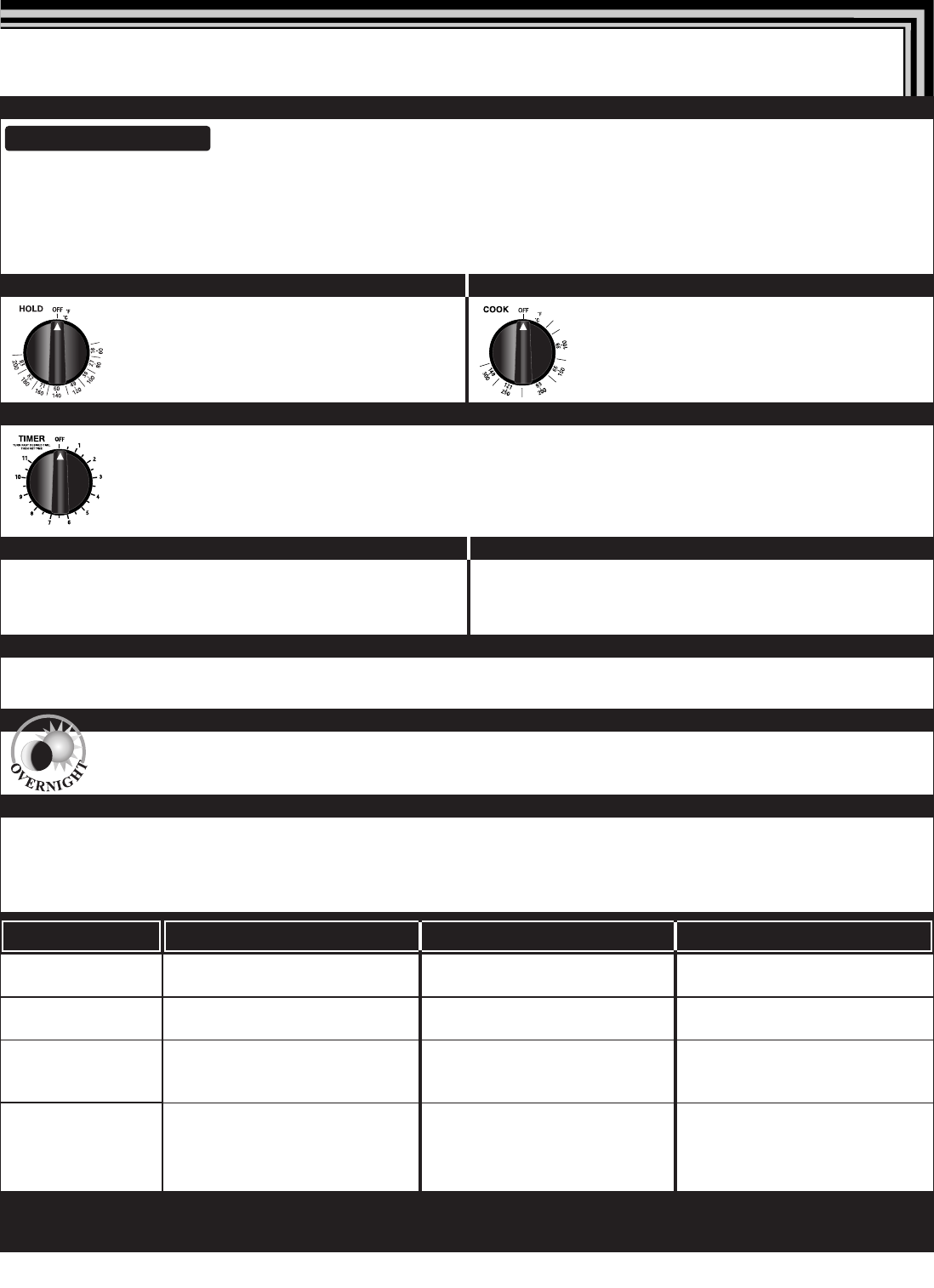
Beef Rib, Roast Ready Special, Tied: 14 to 18 lb (6 to 8 kg) Average Weight
Season as desired. Place roasts directly on wire shelves with the larger roasts toward the top of the oven compartment.
SECTION 4 • BEEF
21.
PRIME RIB SPECIAL
500 S E R I E S 7 5 0 S E R I E S 1 0 0 0 SERIES
M O D E L S
NUMBER OF SHELVES
ITEMS PER SHELF
APPROXIMATE
MAXIMUM CAPACITY
PANS
130°F (54°C) RARE
4 hours 24 hours
140°F
(60°C)
250°F
(121°C)
223
1 roast 3 roasts 2 roasts
2 roasts
36 lb (16 kg)
6 roasts
100 lb (45 kg)
6 roasts
100 lb (45 kg)
none none none
The time and temperature are suggested guidelines only. All cooking should be based on internal product temperatures.
Due to variations in product quality, weight and desired degree of doneness, the cooking timer may need to be adjusted accordingly.
Always follow local health (hygiene) regulations for all internal temperature requirements.
P R O D U C T S P E C I F I C AT I O N S a n d P R E PA R AT I O N
S E T H O L D T H E R M O S TAT S E T C O O K T H E R M O S TAT
S E T C O O K I N G T I M E R
MINIMUM HOLDING TIME REQUIRED MAXIMUM HOLDING TIME
A D D I T I O N A L I N F O R M AT I O N • N O T E S
FINAL INTERNAL PRODUCT TEMPERATURE
O V E R N I G H T C O O K & H O L D
TIME REQUIRED IN “HOLD” CYCLE BEFORE SERVING.
CAPACITIES ARE BASED ON U.S.
PAN SIZES.GASTRONORM PANS
MAY HOLD MORE OR LESS THAN
THE FOOD QUANTITIES INDICATED.
P R E H E AT T H E O V E N
DOOR VENTS: ONE-HALF OPEN
An overnight cook and hold can be done with this cut.
10 minutes per pound for the first roast (22 minutes per kilogram)
plus
add 15 minutes for each additional roast.
COOKING GUIDELINES
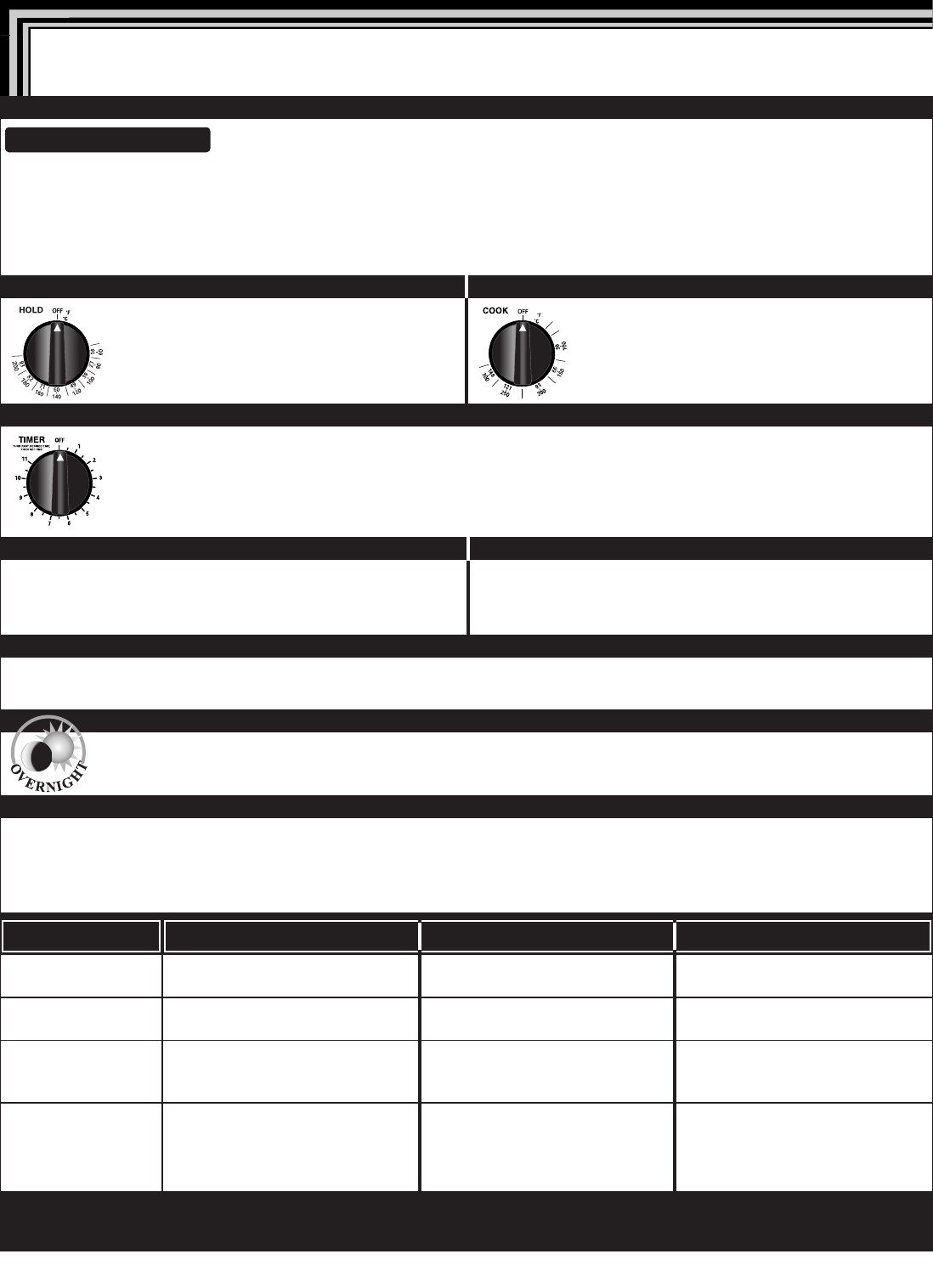
Beef Ribeye Roll, Lip On, #112A: 8 to 12 lb (3 to 5 kg)
Season as desired. Place roasts directly on the wire shelves, fat side down. Place larger roasts toward the top of the
oven compartment.
SECTION 4 • BEEF
22.
RIBEYE
500 S E R I E S 7 5 0 S E R I E S 1000 S E R I E S
MODELS
NUMBER OF SHELVES
ITEMS PER SHELF
APPROXIMATE
MAXIMUM CAPACITY
PANS
130°F (54°C) RARE
4 hours 12 hours
140°F
(60°C)
250°F
(121°C)
223
2 roasts 3 roasts 3 roasts
4 roasts
up to 40 lb (18 kg)
6 roasts
up to 100 lb (45 kg)
9 roasts
up to 100 lb (45 kg)
none none none
The time and temperature are suggested guidelines only. All cooking should be based on internal product temperatures.
Due to variations in product quality, weight and desired degree of doneness, the cooking timer may need to be adjusted accordingly.
Always follow local health (hygiene) regulations for all internal temperature requirements.
PR O D U C T S P E C I F I C AT I O N S a n d P R E PA R AT I O N
S E T H O L D T H E R M O S TAT S E T C O O K T H E R M O S TAT
S E T C O O K I N G T I M E R
MINIMUM HOLDING TIME REQUIRED MAXIMUM HOLDING TIME
A D D I T I O N A L I N F O R M AT I O N • N O T E S
FINAL INTERNAL PRODUCT TEMPERATURE
O V E R N I G H T C O O K & H O L D
TIME REQUIRED IN “HOLD” CYCLE BEFORE SERVING.
CAPACITIES ARE BASED ON U.S.
PAN SIZES.GASTRONORM PANS
MAY HOLD MORE OR LESS THAN
THE FOOD QUANTITIES INDICATED.
P R E H E AT T H E O V E N
DOOR VENTS: ONE-HALF OPEN
Optional
8 to 11 lb (4 to 5 kg) ROASTS: 8 minutes per pound for the first roast (18 minutes per kilogram)
plus add 10 minutes for each additional roast.
12 lb (5 kg) ROASTS: 10 minutes per pound for the first roast (22 minutes per kilogram)
plus add 10 minutes for each additional roast.
COOKING GUIDELINES
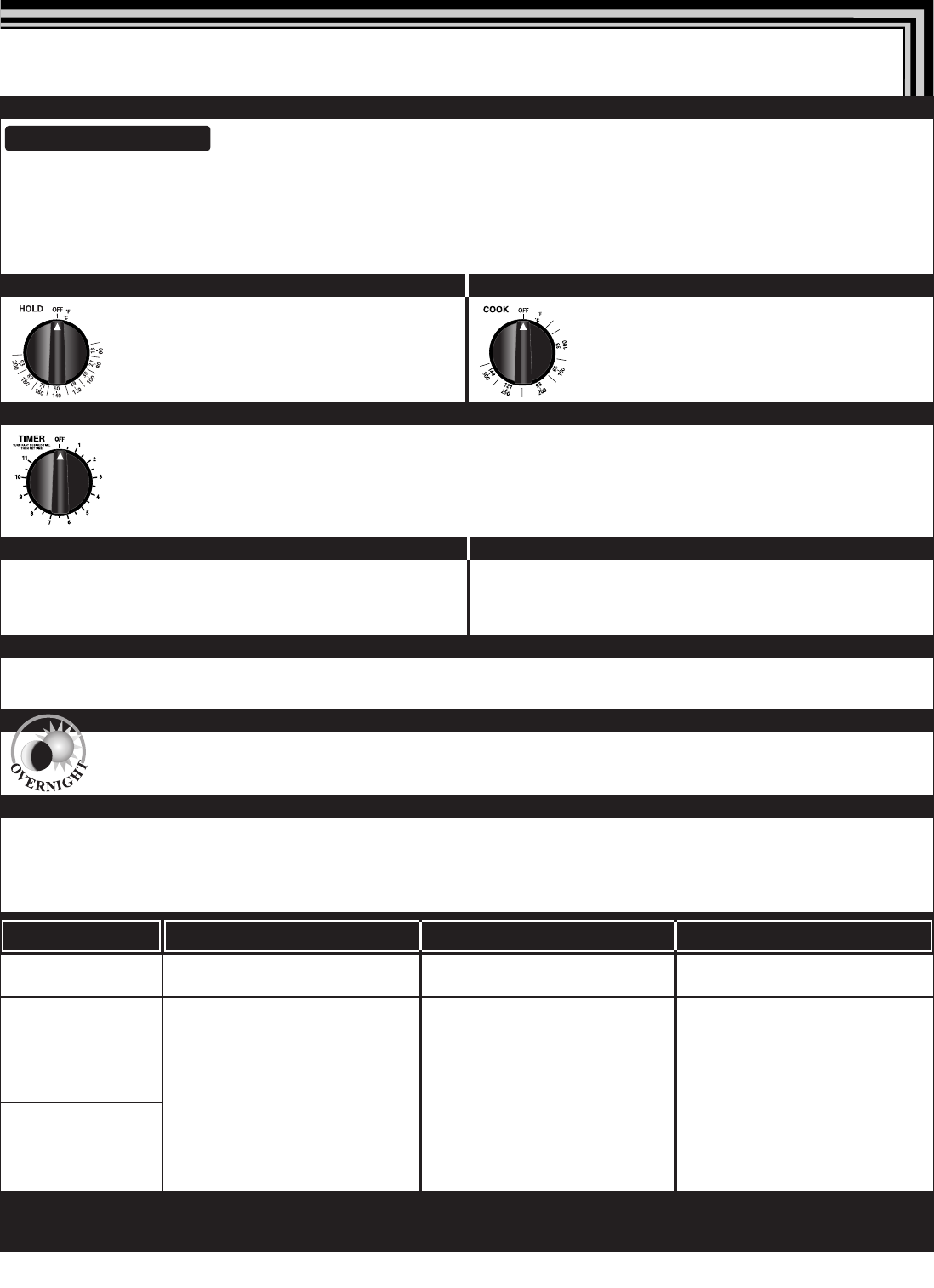
Beef Round, Top (Inside), Untrimmed: 14 to 23 lb (6 to 10 kg)
Beef Round, Bottom (Gooseneck), Untrimmed: 14 to 23 lb (6 to 10 kg)
Season as desired. Place roasts directly on wire shelves with fat side down. Place larger roasts toward the top of the
oven compartment.
SECTION 4 • BEEF
23.
BEEF ROUND
500 S E R I E S 7 5 0 S E R I E S 1 0 0 0 SERIES
M O D E L S
NUMBER OF SHELVES
ITEMS PER SHELF
APPROXIMATE
MAXIMUM CAPACITY
PANS
130°F (54°C) RARE
DO NOT OVERLOAD THE OVEN.
14 lb (6 kg) ROASTS: 4 to 6 hours
15 to 23 lb (7 to 10kg) ROASTS: 8 to 10 hours 14 lb (6 kg) ROASTS: 12 hours
15 to 23 lb (7 to 10kg) ROASTS: 24 hours
140°F
(60 °C)
250°F
(121°C)
1 or 2 23
1: 23 lb (6 kg) roast
2: 14 lb (10 kg) roasts 3 roasts 2: 23 lb (6 kg) roasts
3: 14 lb (10 kg) roasts
2 large or 4 small roasts
up to 40 lb (18 kg)
6 roasts
up to 100 lb (45 kg)
6 large or 9 small roasts
up to 100 lb (45 kg)
none none none
The time and temperature are suggested guidelines only. All cooking should be based on internal product temperatures.
Due to variations in product quality, weight and desired degree of doneness, the cooking timer may need to be adjusted accordingly.
Always follow local health (hygiene) regulations for all internal temperature requirements.
P R O D U C T S P E C I F I C AT I O N S a n d P R E PA R AT I O N
S E T H O L D T H E R M O S TAT S E T C O O K T H E R M O S TAT
S E T C O O K I N G T I M E R
MINIMUM HOLDING TIME REQUIRED MAXIMUM HOLDING TIME
A D D I T I O N A L I N F O R M AT I O N • N O T E S
FINAL INTERNAL PRODUCT TEMPERATURE
O V E R N I G H T C O O K & H O L D
TIME REQUIRED IN “HOLD” CYCLE BEFORE SERVING.
CAPACITIES ARE BASED ON U.S.
PAN SIZES.GASTRONORM PANS
MAY HOLD MORE OR LESS THAN
THE FOOD QUANTITIES INDICATED.
P R E H E AT T H E O V E N
DOOR VENTS: ONE-HALF OPEN
Optional for smaller roasts.
HIGHLY RECOMMENDED FOR LARGER CUTS.
14 lb (6 kg) ROASTS: 10 minutes per pound for the first roast (22 minutes per kilogram)
plus add 15 minutes for each additional roast.
15 to 23 lb (7 to 10kg) ROASTS: 10 minutes per pound for the first roast (22 minutes per kilogram)
plus add 30 minutes for each additional roast.
COOKING GUIDELINES
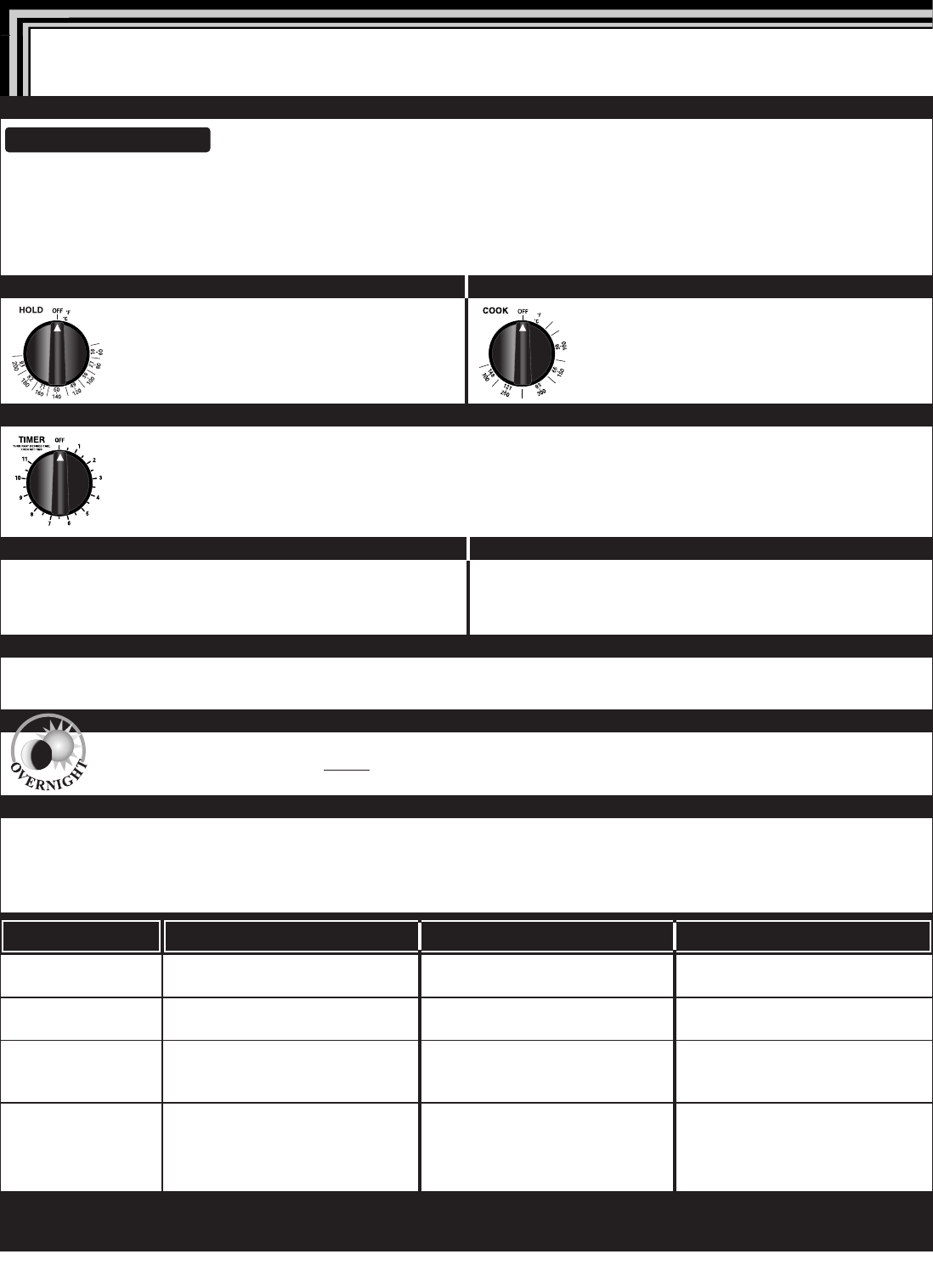
Any one of a variety of beef rounds used for carving on a buffet line. May be bone-in or
boneless and may have a handle on or off as required.
WEIGHT RANGE: 40 to 50 lb (18 to 23 kg)
50 to 80 lb (23 to 36 kg)
Meat should be at a refrigerated internal temperature of 38° to 40°F (3 to 4°C) when placed in a preheated oven.
SECTION 4 • BEEF
24.
BEEF ROUND, CAFETERIA OR STEAMSHIP
500 S E R I E S 7 5 0 S E R I E S 1000 S E R I E S
MODELS
NUMBER OF SHELVES
ITEMS PER SHELF
APPROXIMATE
MAXIMUM CAPACITY
PANS
138°F (59°C) RARE
When cooking these large roasts, reinforce the shelf support by using two wire shelves in one shelf bracket.
40 to 49 lb (18 to 22 kg) ROASTS: 6 to 8 hours
50 to 80 lb (23 to 36 kg) ROASTS: 8 to 12 hours 24 hours
150°F
(66°C)
250°F
(121°C)
111
1 roast 1 to 2 roasts 1 to 2 roasts
40 lb (18 kg) up to 80 lb (36 kg) up to 80 lb (36 kg)
none none none
The time and temperature are suggested guidelines only. All cooking should be based on internal product temperatures.
Due to variations in product quality, weight and desired degree of doneness, the cooking timer may need to be adjusted accordingly.
Always follow local health (hygiene) regulations for all internal temperature requirements.
PR O D U C T S P E C I F I C AT I O N S a n d P R E PA R AT I O N
S E T H O L D T H E R M O S TAT S E T C O O K T H E R M O S TAT
S E T C O O K I N G T I M E R
MINIMUM HOLDING TIME REQUIRED MAXIMUM HOLDING TIME
A D D I T I O N A L I N F O R M AT I O N • N O T E S
FINAL INTERNAL PRODUCT TEMPERATURE
O V E R N I G H T C O O K & H O L D
TIME REQUIRED IN “HOLD” CYCLE BEFORE SERVING.
CAPACITIES ARE BASED ON U.S.
PAN SIZES.GASTRONORM PANS
MAY HOLD MORE OR LESS THAN
THE FOOD QUANTITIES INDICATED.
P R E H E AT T H E O V E N
DOOR VENTS: ONE-HALF OPEN
MUST do an overnight cook and hold.
40 to 49 lb (18 to 22 kg) ROASTS: 10 minutes per pound for the first roast (22 minutes per kilogram)
plus add 15 minutes for a second roast.
50 to 80 lb (23 to 36 kg) ROASTS: ONE ROAST ONLY — 7 minutes per pound (15 minutes per kilogram)
COOKING GUIDELINES
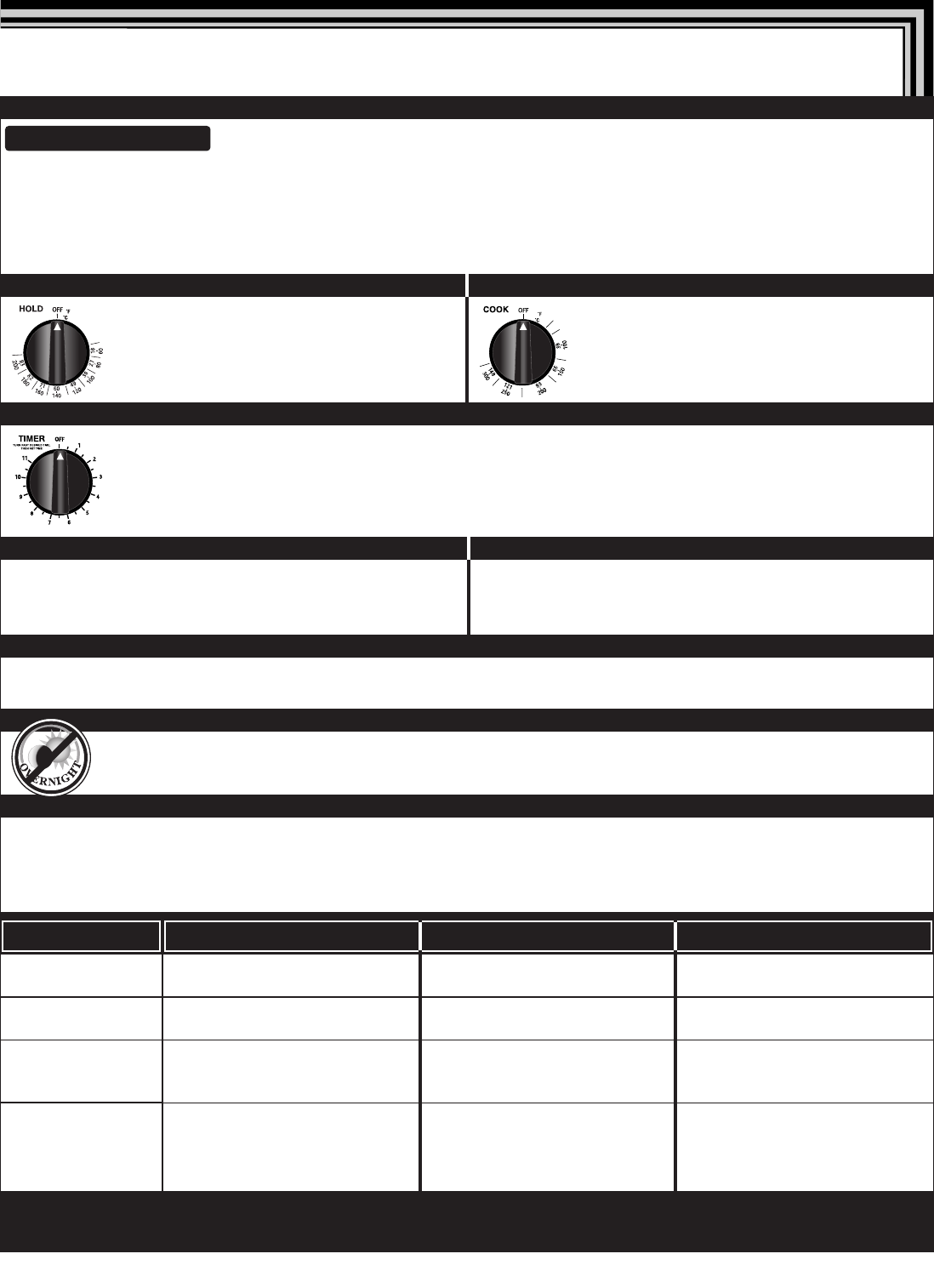
Beef Loin, Full Tenderloin, Side Muscle Off, Skinned: 4 to 6 lb (2 to 3 kg)
Season as desired. Place tenderloins directly on wire shelves.
SECTION 4 • BEEF
25.
TENDERLOI N
500 S E R I E S 7 5 0 S E R I E S 1 0 0 0 SERIES
M O D E L S
NUMBER OF SHELVES
ITEMS PER SHELF
APPROXIMATE
MAXIMUM CAPACITY
PANS
130°F (54°C) RARE
1 hour 6 hours
140°F
(60°C)
250° to 275°F
(121° to 135°C)
233
3 tenderloins 5 tenderloins 5 tenderloins
6 tenderloins 15 tenderloins 15 tenderloins
none none none
The time and temperature are suggested guidelines only. All cooking should be based on internal product temperatures.
Due to variations in product quality, weight and desired degree of doneness, the cooking timer may need to be adjusted accordingly.
Always follow local health (hygiene) regulations for all internal temperature requirements.
P R O D U C T S P E C I F I C AT I O N S a n d P R E PA R AT I O N
S E T H O L D T H E R M O S TAT S E T C O O K T H E R M O S TAT
S E T C O O K I N G T I M E R
MINIMUM HOLDING TIME REQUIRED MAXIMUM HOLDING TIME
A D D I T I O N A L I N F O R M AT I O N • N O T E S
FINAL INTERNAL PRODUCT TEMPERATURE
O V E R N I G H T C O O K & H O L D
TIME REQUIRED IN “HOLD” CYCLE BEFORE SERVING.
CAPACITIES ARE BASED ON U.S.
PAN SIZES.GASTRONORM PANS
MAY HOLD MORE OR LESS THAN
THE FOOD QUANTITIES INDICATED.
P R E H E AT T H E O V E N
DOOR VENTS: ONE-HALF OPEN
Not Recommended
FULL LOAD TO RARE: 1 hour
COOKING GUIDELINES
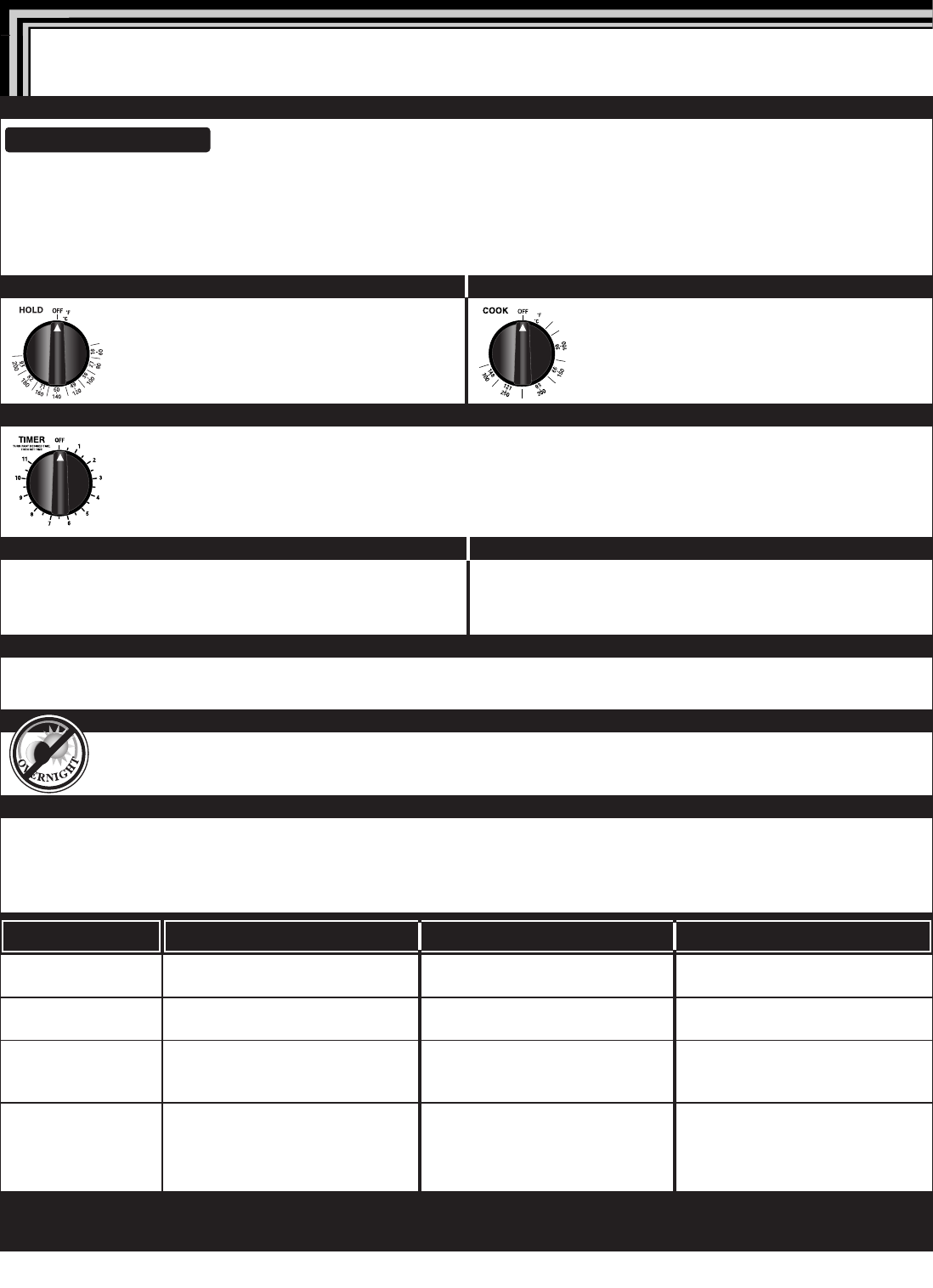
Veal Loin, Trimmed: 8 to 10 lb (4 to 5 kg)
Season as desired and place directly on wire shelves.
SECTION 4 • VEAL
26.
VEAL LOIN
500 S E R I E S 7 5 0 S E R I E S 1000 S E R I E S
MODELS
NUMBER OF SHELVES
ITEMS PER SHELF
APPROXIMATE
MAXIMUM CAPACITY
PANS
140°F (60°C) MEDIUM RARE
1 hour 10 hours
140°F
(60°C)
250°F
(121°C)
223
2 roasts 4 roasts 3 roasts
4 roasts 8 roasts 9 roasts
none none none
The time and temperature are suggested guidelines only. All cooking should be based on internal product temperatures.
Due to variations in product quality, weight and desired degree of doneness, the cooking timer may need to be adjusted accordingly.
Always follow local health (hygiene) regulations for all internal temperature requirements.
PR O D U C T S P E C I F I C AT I O N S a n d P R E PA R AT I O N
S E T H O L D T H E R M O S TAT S E T C O O K T H E R M O S TAT
S E T C O O K I N G T I M E R
MINIMUM HOLDING TIME REQUIRED MAXIMUM HOLDING TIME
A D D I T I O N A L I N F O R M AT I O N • N O T E S
FINAL INTERNAL PRODUCT TEMPERATURE
O V E R N I G H T C O O K & H O L D
TIME REQUIRED IN “HOLD” CYCLE BEFORE SERVING.
CAPACITIES ARE BASED ON U.S.
PAN SIZES.GASTRONORM PANS
MAY HOLD MORE OR LESS THAN
THE FOOD QUANTITIES INDICATED.
P R E H E AT T H E O V E N
DOOR VENTS: ONE-HALF OPEN
Not Recommended
12 minutes per pound for the first roast (26 minutes per kilogram)
plus
add 20 minutes for each additional roast.
COOKING GUIDELINES
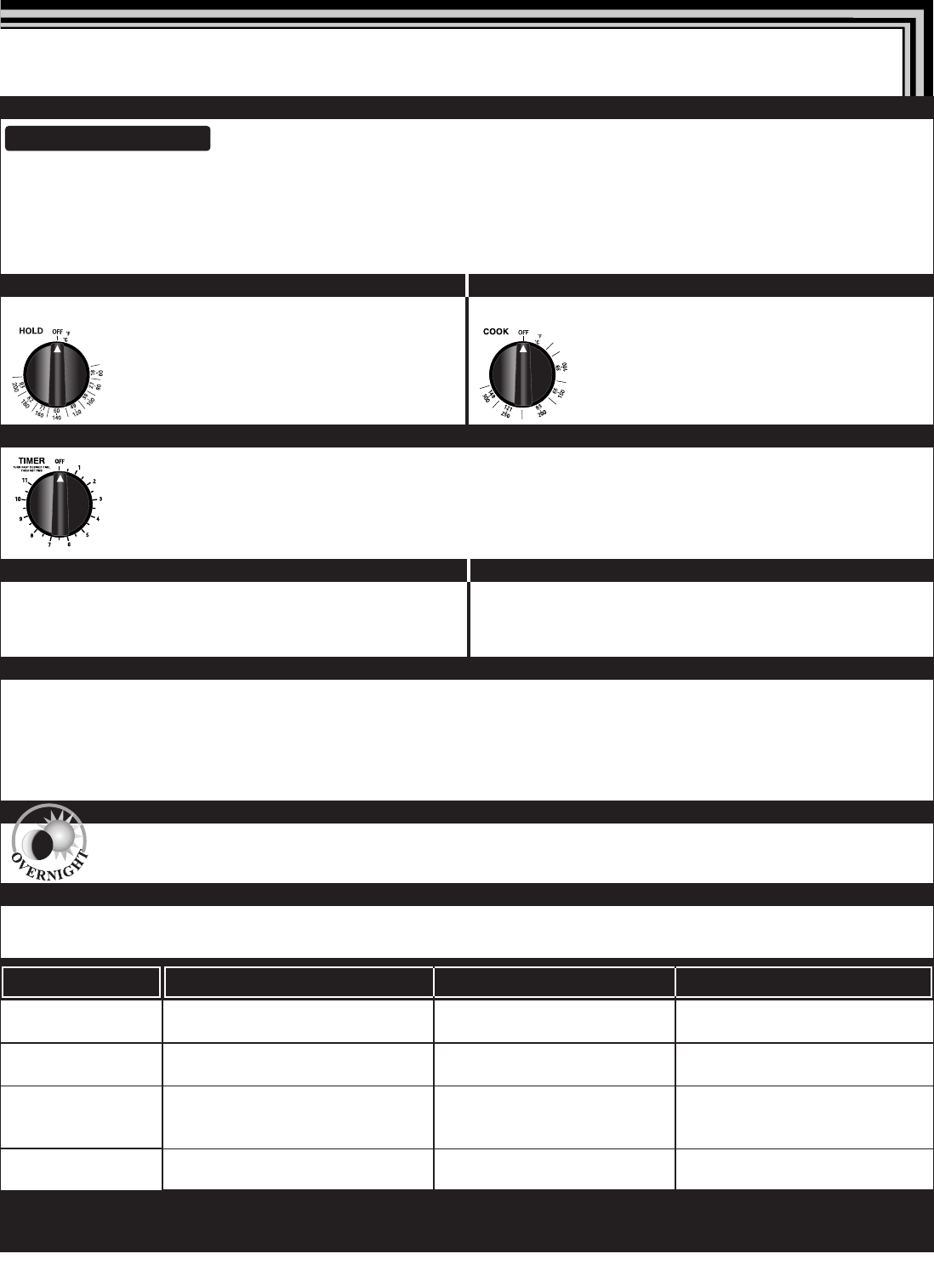
Lamb Leg, Boneless, Tied: 8 to 11 lb (4 to 5 kg)
Season as desired and place directly on wire shelves.
SECTION 4 • LAMB
27.
LAMB, LE G
500 S E R I E S 7 5 0 S E R I E S 1 0 0 0 SERIES
M O D E L S
NUMBER OF SHELVES
ITEMS PER SHELF
APPROXIMATE
MAXIMUM CAPACITY
PANS
2 hours 10 hours
250°F
(121°C)
223
2 roasts 6 roasts 4 roasts
4 roasts
up to 40 lb (18 kg)
12 roasts
up to 100 lb (45 kg)
12 roasts
up to 100 lb (45 kg)
none none none
The time and temperature are suggested guidelines only. All cooking should be based on internal product temperatures.
Due to variations in product quality, weight and desired degree of doneness, the cooking timer may need to be adjusted accordingly.
Always follow local health (hygiene) regulations for all internal temperature requirements.
P R O D U C T S P E C I F I C AT I O N S a n d P R E PA R AT I O N
S E T H O L D T H E R M O S TAT S E T C O O K T H E R M O S TAT
S E T C O O K I N G T I M E R
MINIMUM HOLDING TIME REQUIRED MAXIMUM HOLDING TIME
A D D I T I O N A L I N F O R M AT I O N • N O T E S
FINAL INTERNAL PRODUCT TEMPERATURE
O V E R N I G H T C O O K & H O L D
TIME REQUIRED IN “HOLD” CYCLE BEFORE SERVING.
P R E H E AT T H E O V E N
DOOR VENTS: ONE-HALF OPEN
Optional
10 minutes per pound for the first roast (22 minutes per kilogram)
plus
add 15 minutes for each additional roast.
COOKING GUIDELINES
RARE: 130°F (54°C)
MEDIUM RARE: 135°F (57°C)
MEDIUM: 145°F (63°C)
MEDIUM WELL: 150°F (66°C)
WELL: 160°F (71°C)
RARE:140°F (60°C)
MEDIUM RARE: 140°F (60°C)
MEDIUM:150°F (66°C)
MEDIUM WELL: 160°F (71°C)
WELL:160°F (71°C)
Lamb Rack, Roast Ready, Single, Frenched: 7-bone
Season as desired. Place racks on sheet pans with icing racks inserted in pans.
SECTION 4 • LAMB
28.
LAMB RACK S (Frenched)
500 S E R I E S 7 5 0 S E R I E S 1000 S E R I E S
MODELS
NUMBER OF SHELVES
ITEMS PER SHELF
APPROXIMATE
MAXIMUM CAPACITY
PANS
135° to 140°F (57°to 60°C)
1 Hour 4 Hours
160°F
(71°C)
250°F
(121°C)
44none
1 half-size sheet pan 1 full-size sheet pan 1 full-size sheet pan
4 half-size sheet pans 4 full-size sheet pans 4 full-size sheet pans
18” x 13” x 1” ON SHELVES
(GN 1/1 x 20mm)
(NO SHELVES REQUIRED)
18” x 26” x 1” ON SHELVES
(GN 2/1 x 20mm)
(NO SHELVES REQUIRED)
18” x 26” x 1” ON SHELVES
(GN 1/1 x 20mm)
(ON WIRE SHELVES)
The time and temperature are suggested guidelines only. All cooking should be based on internal product temperatures.
Due to variations in product quality, weight and desired degree of doneness, the cooking timer may need to be adjusted accordingly.
Always follow local health (hygiene) regulations for all internal temperature requirements.
PR O D U C T S P E C I F I C AT I O N S a n d P R E PA R AT I O N
S E T H O L D T H E R M O S TAT S E T C O O K T H E R M O S TAT
S E T C O O K I N G T I M E R
MINIMUM HOLDING TIME REQUIRED MAXIMUM HOLDING TIME
A D D I T I O N A L I N F O R M AT I O N • N O T E S
FINAL INTERNAL PRODUCT TEMPERATURE
O V E R N I G H T C O O K & H O L D
TIME REQUIRED IN “HOLD” CYCLE BEFORE SERVING.
CAPACITIES ARE BASED ON U.S.
PAN SIZES.GASTRONORM PANS
MAY HOLD MORE OR LESS THAN
THE FOOD QUANTITIES INDICATED.
P R E H E AT T H E O V E N
DOOR VENTS: ONE-HALF OPEN
Not Recommended
1-1/2 hours
Full Load
COOKING GUIDELINES
Pork Fresh Ham: 14 to 17 lb (6 to 8 kg)
Season as desired and place directly on wire shelves.
SECTION 4 • PORK
29.
HAM, FRESH
500 S E R I E S 750 S E R I E S 1000 SERIES
MODELS
NUMBER OF SHELVES
ITEMS PER SHELF
APPROXIMATE
MAXIMUM CAPACITY
PANS
160°F (71°C)
2 hours 10 hours
160°F
(71°C)
250° to 275°F
(121° to 135°C)
223
2 hams 2 to 4 hams 2 to 3 hams
4 hams
up to 40 lb (18 kg)
4 to 8 hams
up to 100 lb (45 kg)
6 to 9 hams
up to 100 lb (45 kg)
none none none
The time and temperature are suggested guidelines only. All cooking should be based on internal product temperatures.
Due to variations in product quality, weight and desired degree of doneness, the cooking timer may need to be adjusted accordingly.
Always follow local health (hygiene) regulations for all internal temperature requirements.
P R O D U C T S P E C I F I C AT I O N S a n d P R E PA R AT I O N
S E T H O L D T H E R M O S TAT S E T C O O K T H E R M O S TAT
S E T C O O K I N G T I M E R
MINIMUM HOLDING TIME REQUIRED MAXIMUM HOLDING TIME
A D D I T I O N A L I N F O R M AT I O N • N O T E S
FINAL INTERNAL PRODUCT TEMPERATURE
O V E R N I G H T C O O K & H O L D
TIME REQUIRED IN “HOLD” CYCLE BEFORE SERVING.
CAPACITIES ARE BASED ON U.S.
PAN SIZES.GASTRONORM PANS
MAY HOLD MORE OR LESS THAN
THE FOOD QUANTITIES INDICATED.
P R E H E AT T H E O V E N
DOOR VENTS: ONE-HALF OPEN
Optional
12 minutes per pound for the first ham (26 minutes per kilogram)
plus
add 30 minutes for each additional ham
COOKING GUIDELINES
DOOR VENTS: ONE-HALF OPEN
Ham, Boneless, Skinless, Cured and Smoked: 10 to 14 lb (4,5 to 6 kg)
Place ham directly on wire shelves for cooking.
SECTION 4 • PORK
30.
HAM, CURED AND SMOKED
5 0 0 S E R I E S 7 5 0 S E R I E S 1 0 0 0 S E R I E S
M O D E L S
NUMBER OF SHELVES
ITEMS PER SHELF
APPROXIMATE
MAXIMUM CAPACITY
PANS
160°F (71°C)
1 to 2 hours 10 hours
160°F
(71°C)
250° to 275°F
(121° to 135°C)
223
2 hams 4 hams 3 hams
4 hams
up to 40 lb (18 kg)
8 hams
up to 100 lb (45 kg)
9 hams
up to 100 lb (45 kg)
none none none
The time and temperature are suggested guidelines only. All cooking should be based on internal product temperatures.
Due to variations in product quality, weight and desired degree of doneness, the cooking timer may need to be adjusted accordingly.
Always follow local health (hygiene) regulations for all internal temperature requirements.
P R O D U C T S P E C I F I C AT I O N S a n d P R E PA R AT I O N
S E T H O L D T H E R M O S TAT S E T C O O K T H E R M O S TAT
S E T C O O K I N G T I M E R
MINIMUM HOLDING TIME REQUIRED MAXIMUM HOLDING TIME
A D D I T I O N A L I N F O R M AT I O N • N O T E S
FINAL INTERNAL PRODUCT TEMPERATURE
O V E R N I G H T C O O K & H O L D
TIME REQUIRED IN “HOLD” CYCLE BEFORE SERVING.
CAPACITIES ARE BASED ON U.S.
PAN SIZES.GASTRONORM PANS
MAY HOLD MORE OR LESS THAN
THE FOOD QUANTITIES INDICATED.
P R E H E AT T H E O V E N
Optional
12 minutes per pound for the first ham (26 minutes per kilogram)
plus
add 30 minutes for each additional ham.
COOKING GUIDELINES
Pork Loin Chops: . . . . . . 3 to 8 oz (85 to 227 grams) approximate weight range
Pork Loin Rib Chops with Pocket (STUFFED): . . . 5 to 8 oz (142 to 227 grams) approximate weight range
Thickness: . . . . . . . . . . . . . . . . . . . . . . . . . . . . 1" to 1-1/2" (25 to 38 mm)
Season as desired. Place chops side-by-side on sheet pans.
SECTION 4 • PORK
31.
PORK CHOPS
500 S E R I E S 750 S E R I E S 1000 SERIES
MODELS
NUMBER OF SHELVES
ITEMS PER SHELF
APPROXIMATE
MAXIMUM CAPACITY
PANS
160° to 170°F (71° to 77°C)
1-1/2 hours 6 to 8 hours
160°F
(71°C)
250°F
(121°C)
44none
1 half-size sheet pan 1 full-size sheet pan 1 full-size sheet pan
4 half-size sheet pans 4 full-size sheet pans 5 full-size sheet pans
18" x 13" x 1"
(GN 1/1: 530 x 325 x 20mm)
(NO SHELVES REQUIRED)
18" x 26" x 1"
(GN 2/1: 530 x 650 x 20mm)
(NO SHELVES REQUIRED)
18" x 26" x 1"
(GN 1/1: 530 x 325 x 20mm)
(ON WIRE SHELVES)
The time and temperature are suggested guidelines only. All cooking should be based on internal product temperatures.
Due to variations in product quality, weight and desired degree of doneness, the cooking timer may need to be adjusted accordingly.
Always follow local health (hygiene) regulations for all internal temperature requirements.
P R O D U C T S P E C I F I C AT I O N S a n d P R E PA R AT I O N
S E T H O L D T H E R M O S TAT S E T C O O K T H E R M O S TAT
S E T C O O K I N G T I M E R
MINIMUM HOLDING TIME REQUIRED MAXIMUM HOLDING TIME
A D D I T I O N A L I N F O R M AT I O N • N O T E S
FINAL INTERNAL PRODUCT TEMPERATURE
O V E R N I G H T C O O K & H O L D
TIME REQUIRED IN “HOLD” CYCLE BEFORE SERVING.
CAPACITIES ARE BASED ON U.S.
PAN SIZES.GASTRONORM PANS
MAY HOLD MORE OR LESS THAN
THE FOOD QUANTITIES INDICATED.
P R E H E AT T H E O V E N
DOOR VENTS: ONE-HALF OPEN
Not Recommended
3-1/2 hours
Full Load
COOKING GUIDELINES
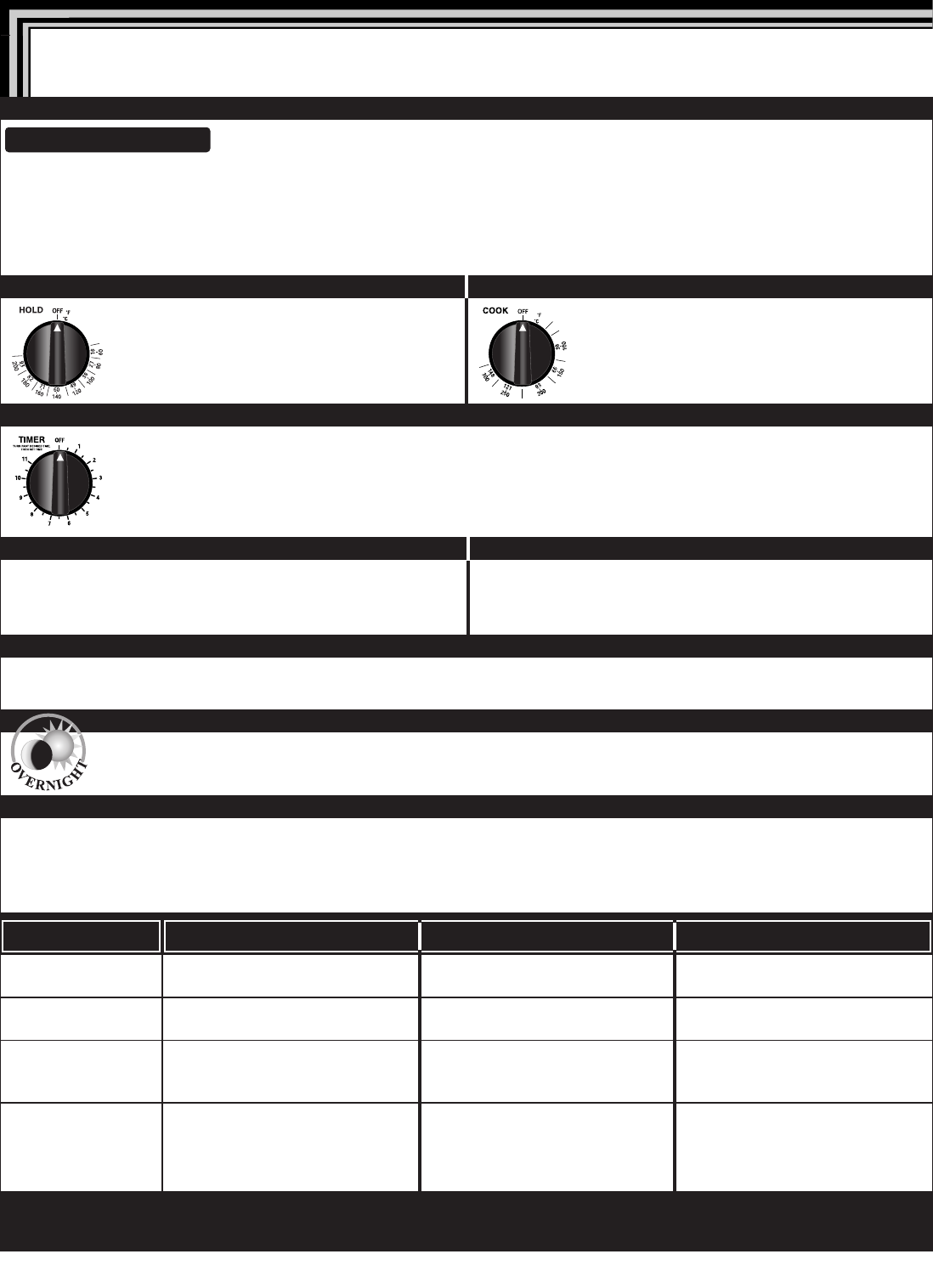
DOOR VENTS: ONE-HALF OPEN
Pork Loin, Boneless, Tied: 8 to 10 lb (4 to 5 kg)
Season as desired and place roasts directly on wire shelves for cooking.
SECTION 4 • PORK
32.
PORK LOIN
5 0 0 S E R I E S 7 5 0 S E R I E S 1 0 0 0 S E R I E S
M O D E L S
NUMBER OF SHELVES
ITEMS PER SHELF
APPROXIMATE
MAXIMUM CAPACITY
PANS
155° to 165°F (68° to 74°C)
2 hours 12 hours
160°F
(71°C)
250° to 275°F
(121° to 135°C)
233
2 roasts 3 roasts 3 roasts
4 roasts
up to 40 lb (18 kg)
9 roasts
up to 100 lb (45 kg)
9 roasts
up to 100 lb (45 kg)
none none none
The time and temperature are suggested guidelines only. All cooking should be based on internal product temperatures.
Due to variations in product quality, weight and desired degree of doneness, the cooking timer may need to be adjusted accordingly.
Always follow local health (hygiene) regulations for all internal temperature requirements.
P R O D U C T S P E C I F I C AT I O N S a n d P R E PA R AT I O N
S E T H O L D T H E R M O S TAT S E T C O O K T H E R M O S TAT
S E T C O O K I N G T I M E R
MINIMUM HOLDING TIME REQUIRED MAXIMUM HOLDING TIME
A D D I T I O N A L I N F O R M AT I O N • N O T E S
FINAL INTERNAL PRODUCT TEMPERATURE
O V E R N I G H T C O O K & H O L D
TIME REQUIRED IN “HOLD” CYCLE BEFORE SERVING.
CAPACITIES ARE BASED ON U.S.
PAN SIZES.GASTRONORM PANS
MAY HOLD MORE OR LESS THAN
THE FOOD QUANTITIES INDICATED.
P R E H E AT T H E O V E N
Highly Recommended
15 minutes per pound for the first roast (33 minutes per kilogram)
plus
add 30 minutes for each additional roast.
COOKING GUIDELINES
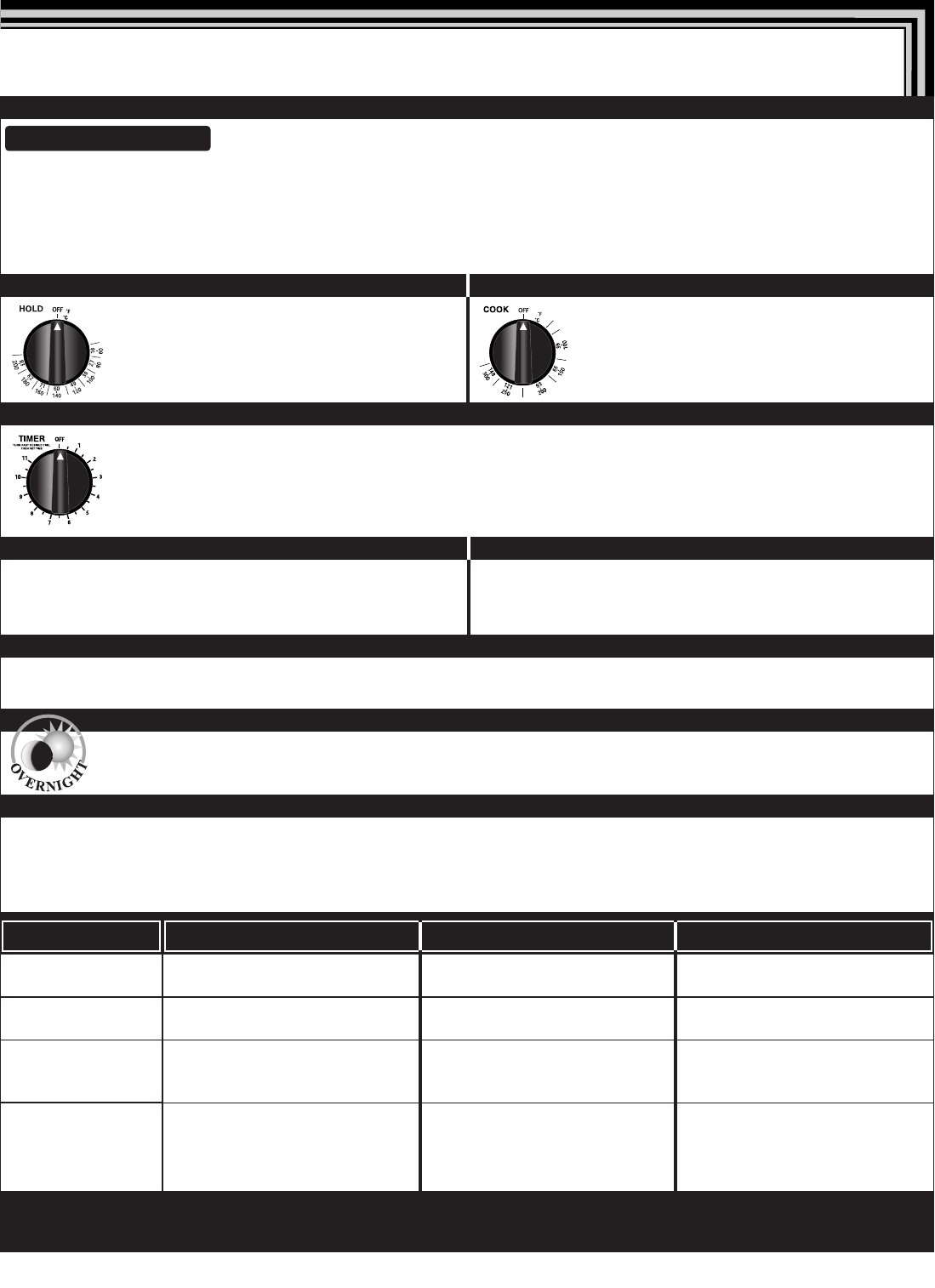
Pork Shoulder, Boston Butt, Boneless: 8 to 10 lb (4 to 5 kg)
Season as desired and place in pans.
SECTION 4 • PORK
33.
PORK SHOULD ER
500 S E R I E S 750 S E R I E S 1000 SERIES
MODELS
NUMBER OF SHELVES
ITEMS PER SHELF
APPROXIMATE
MAXIMUM CAPACITY
PANS
165° to 170°F (74° to 77°C)
2 hours 12 hours
160°F
(71°C)
250°F
(121°C)
2 none 3
2 roasts per pan
2 pans
2 roasts per pan
2 pans
2 roasts per pan
2 pans
4 roasts
up to 40 lb (18 kg)
10 roasts
up to 100 lb (45 kg)
12 roasts
up to 100 lb (45 kg)
12" x 20" x 2-1/2"
(GN 1/1: 530 x 325 x 65mm)
12" x 20" x 2-1/2"
(GN 1/1: 530 x 325 x 65mm)
12" x 20" x 2-1/2"
(GN 1/1: 530 x 325 x 65mm)
The time and temperature are suggested guidelines only. All cooking should be based on internal product temperatures.
Due to variations in product quality, weight and desired degree of doneness, the cooking timer may need to be adjusted accordingly.
Always follow local health (hygiene) regulations for all internal temperature requirements.
P R O D U C T S P E C I F I C AT I O N S a n d P R E PA R AT I O N
S E T H O L D T H E R M O S TAT S E T C O O K T H E R M O S TAT
S E T C O O K I N G T I M E R
MINIMUM HOLDING TIME REQUIRED MAXIMUM HOLDING TIME
A D D I T I O N A L I N F O R M AT I O N • N O T E S
FINAL INTERNAL PRODUCT TEMPERATURE
O V E R N I G H T C O O K & H O L D
TIME REQUIRED IN “HOLD” CYCLE BEFORE SERVING.
CAPACITIES ARE BASED ON U.S.
PAN SIZES.GASTRONORM PANS
MAY HOLD MORE OR LESS THAN
THE FOOD QUANTITIES INDICATED.
P R E H E AT T H E O V E N
DOOR VENTS: ONE-HALF OPEN
Highly Recommended
20 minutes per pound for the first roast (33 minutes per kilogram)
plus
add 30 minutes for each additional roast.
COOKING GUIDELINES
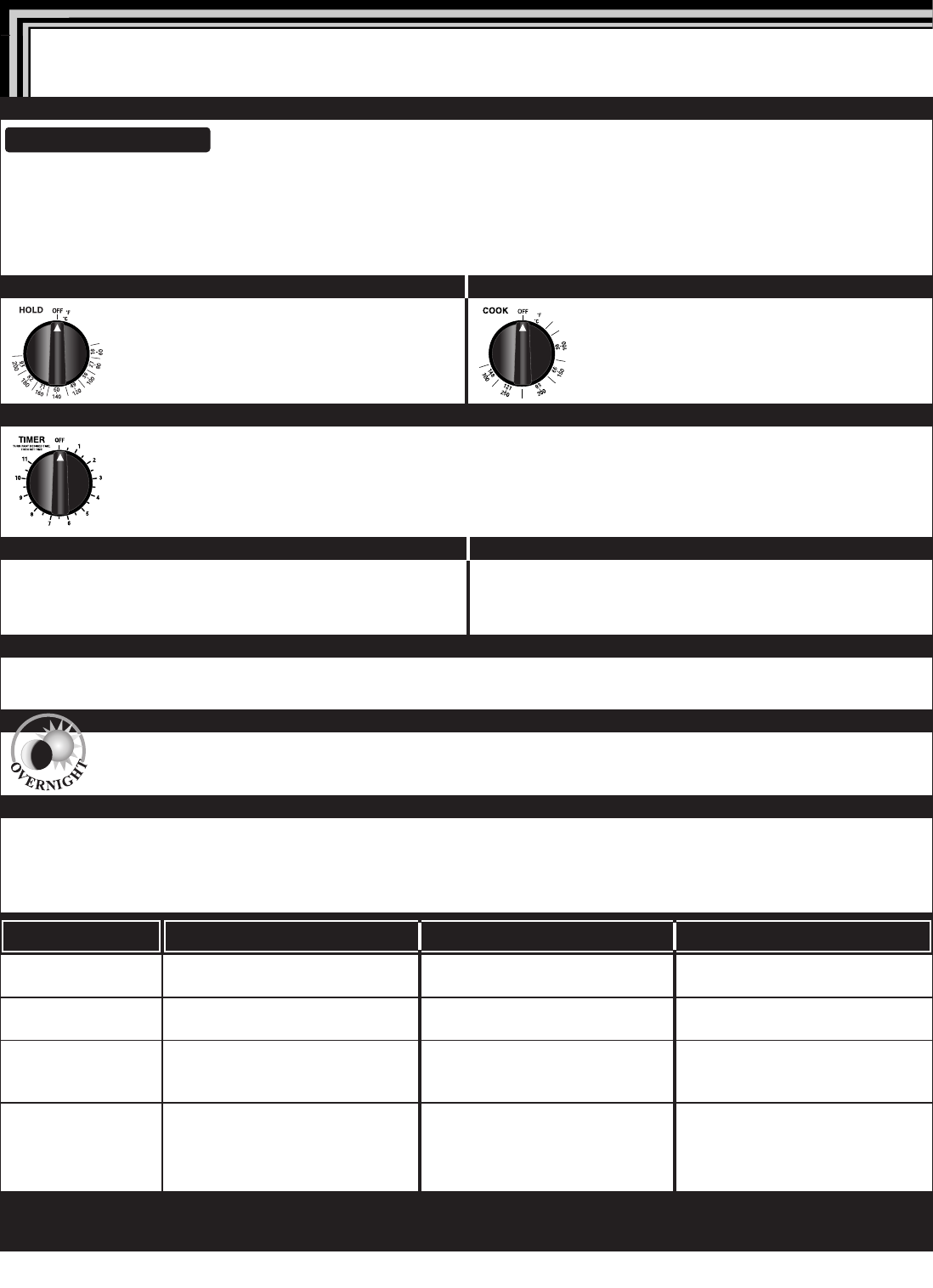
DOOR VENTS: ONE-HALF OPEN
Spareribs: 1-1/2 down (38 kg or less)
Pork Loin, Back Ribs (BABY BACK RIBS): 1-1/2 down (38 kg or less)
Ribs can be cooked from frozen or thawed. Season as desired. Place ribs on sheet pans, slightly overlapping and cover
with clear plastic wrap only if cooking overnight. If desired, barbecue sauce can be included with initial seasoning to
allow it to cook into the ribs.
SECTION 4 • PORK
34.
PORK RIBS
5 0 0 S E R I E S 7 5 0 S E R I E S 1 0 0 0 S E R I E S
M O D E L S
NUMBER OF SHELVES
ITEMS PER SHELF
APPROXIMATE
MAXIMUM CAPACITY
PANS
160° to 170°F (71° to 77°C) WELL DONE
Additional barbecue sauce can be added after completing the hold cycle. Heat sauce to 150°F (66°C) and coat ribs just
before serving.
1-1/2 hours 12 hours
160°F
(71°C)
250°F
(121°C)
34none
1 half-size sheet pan 1 full-size sheet pan 1 full-size sheet pan
3 half-size sheet pans
approximately 20 lb (9 kg) 4 full-size sheet pans 5 full-size sheet pans
18" x 13" x 1"
(GN 1/1: 530 x 325 x 20mm)
(NO SHELVES REQUIRED)
18" x 26" x 1"
(GN 2/1: 530 x 650 x 20mm)
(NO SHELVES REQUIRED)
18" x 26" x 1"
(GN 1/1: 530 x 325 x 20mm)
(ON WIRE SHELVES)
The time and temperature are suggested guidelines only. All cooking should be based on internal product temperatures.
Due to variations in product quality, weight and desired degree of doneness, the cooking timer may need to be adjusted accordingly.
Always follow local health (hygiene) regulations for all internal temperature requirements.
P R O D U C T S P E C I F I C AT I O N S a n d P R E PA R AT I O N
S E T H O L D T H E R M O S TAT S E T C O O K T H E R M O S TAT
S E T C O O K I N G T I M E R
MINIMUM HOLDING TIME REQUIRED MAXIMUM HOLDING TIME
A D D I T I O N A L I N F O R M AT I O N • N O T E S
FINAL INTERNAL PRODUCT TEMPERATURE
O V E R N I G H T C O O K & H O L D
TIME REQUIRED IN “HOLD” CYCLE BEFORE SERVING.
CAPACITIES ARE BASED ON U.S.
PAN SIZES.GASTRONORM PANS
MAY HOLD MORE OR LESS THAN
THE FOOD QUANTITIES INDICATED.
P R E H E AT T H E O V E N
Optional
THAWED RIBS: 2-1/2 to 3-1/2 hours
FROZEN RIBS: 3-1/2 to 4-1/2 hours
Full Load
COOKING GUIDELINES
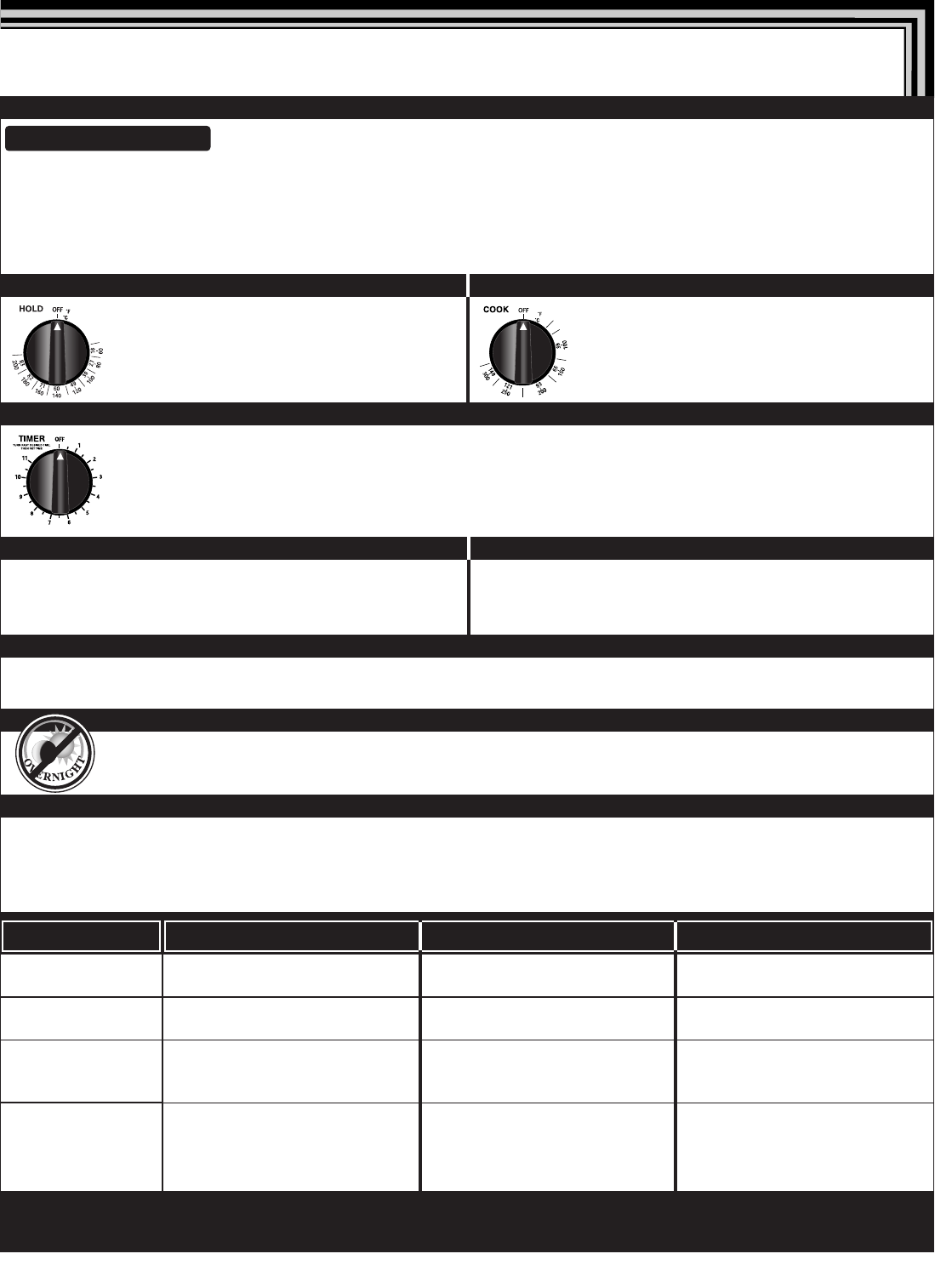
Sausage, Fresh: Any of a variety of processed meat product including bratwurst, Polish
sausage, breakfast links, smoked sausage, hot dogs, etc.
Place sausage side-by-side on sheet pans. Add a sufficient amount of hot water so that it just covers the bottom of each
pan. Cover each pan with clear plastic wrap.
SECTION 4 • PROCESSED MEATS
35.
PROCESSED MEATS
500 S E R I E S 750 S E R I E S 1000 SERIES
MODELS
NUMBER OF SHELVES
ITEMS PER SHELF
APPROXIMATE
MAXIMUM CAPACITY
PANS
170°F (77°C)
For precooked sausage, follow the same time and temperature settings as fresh sausage. Cooking time for a precooked
sausage will vary, particularly for less than full loads. When heating a full load of precooked sausage, check the internal
product temperature after approximately one (1) hour of cooking time.
none 6 hours
160°F
(71°C)
250°F
(121°C)
45none
1 half-size sheet pan 1 full-size sheet pan 1 full-size sheet pan
4 half-size sheet pans 5 full-size sheet pans 8 full-size sheet pans
18" x 13" x 1"
(GN 1/1: 530 x 325 x 20mm)
(NO SHELVES REQUIRED)
18" x 26" x 1"
(GN 2/1: 530 x 650 x 20mm)
(NO SHELVES REQUIRED)
18" x 26" x 1"
(GN 1/1: 530 x 325 x 20mm)
(ON WIRE SHELVES)
The time and temperature are suggested guidelines only. All cooking should be based on internal product temperatures.
Due to variations in product quality, weight and desired degree of doneness, the cooking timer may need to be adjusted accordingly.
Always follow local health (hygiene) regulations for all internal temperature requirements.
P R O D U C T S P E C I F I C AT I O N S a n d P R E PA R AT I O N
S E T H O L D T H E R M O S TAT S E T C O O K T H E R M O S TAT
S E T C O O K I N G T I M E R
MINIMUM HOLDING TIME REQUIRED MAXIMUM HOLDING TIME
A D D I T I O N A L I N F O R M AT I O N • N O T E S
FINAL INTERNAL PRODUCT TEMPERATURE
O V E R N I G H T C O O K & H O L D
TIME REQUIRED IN “HOLD” CYCLE BEFORE SERVING.
CAPACITIES ARE BASED ON U.S.
PAN SIZES.GASTRONORM PANS
MAY HOLD MORE OR LESS THAN
THE FOOD QUANTITIES INDICATED.
P R E H E AT T H E O V E N
DOOR VENTS: OPEN FULL
Not Recommended
1-1/2 to 2 hours
Full Load
COOKING GUIDELINES
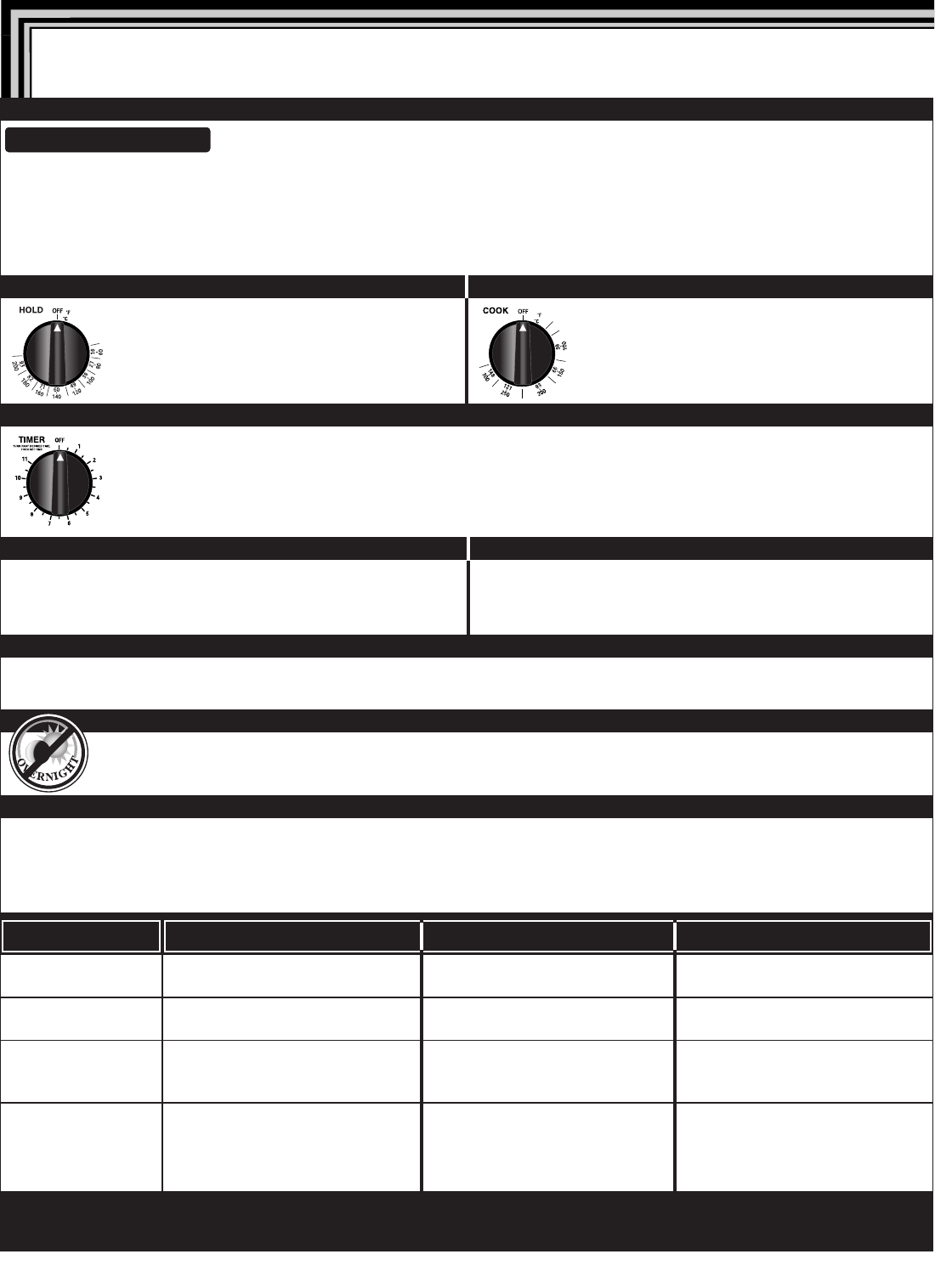
Chicken Breasts, Boneless: 8 oz (227 grams)
Place chicken breasts on sheet pans, side-by-side, not quite touching. Brush chicken with oil, butter or margarine
(OPTIONAL), and lightly sprinkle with salt, pepper, and paprika.
SECTION 4 • POULTRY
36.
CHICKEN BREASTS
5 0 0 S E R I E S 7 5 0 S E R I E S 1 0 0 0 S E R I E S
M O D E L S
NUMBER OF SHELVES
ITEMS PER SHELF
APPROXIMATE
MAXIMUM CAPACITY
PANS
185°F (85°C)
none 6 hours
160°F
(71°C)
275°F
(135°C)
46none
1 half-size sheet pan 1 full-size sheet pan 1 full-size sheet pan
4 half-size sheet pans 6 full-size sheet pans 8 full-size sheet pans
18" x 13" x 1"
(GN 1/1: 530 x 325 x 20mm)
(NO SHELVES REQUIRED)
18" x 26" x 1"
(GN 2/1: 530 x 650 x 20mm)
(NO SHELVES REQUIRED)
18" x 26" x 1"
(GN 1/1: 530 x 325 x 20mm)
(ON WIRE SHELVES)
The time and temperature are suggested guidelines only. All cooking should be based on internal product temperatures.
Due to variations in product quality, weight and desired degree of doneness, the cooking timer may need to be adjusted accordingly.
Always follow local health (hygiene) regulations for all internal temperature requirements.
P R O D U C T S P E C I F I C AT I O N S a n d P R E PA R AT I O N
S E T H O L D T H E R M O S TAT S E T C O O K T H E R M O S TAT
S E T C O O K I N G T I M E R
MINIMUM HOLDING TIME REQUIRED MAXIMUM HOLDING TIME
A D D I T I O N A L I N F O R M AT I O N • N O T E S
FINAL INTERNAL PRODUCT TEMPERATURE
O V E R N I G H T C O O K & H O L D
TIME REQUIRED IN “HOLD” CYCLE BEFORE SERVING.
CAPACITIES ARE BASED ON U.S.
PAN SIZES.GASTRONORM PANS
MAY HOLD MORE OR LESS THAN
THE FOOD QUANTITIES INDICATED.
P R E H E AT T H E O V E N
DOOR VENTS: OPEN FULL
Not Recommended
1-1/2 to 2 hours for the first pan
plus
add 30 minutes for each additional pan.
COOKING GUIDELINES
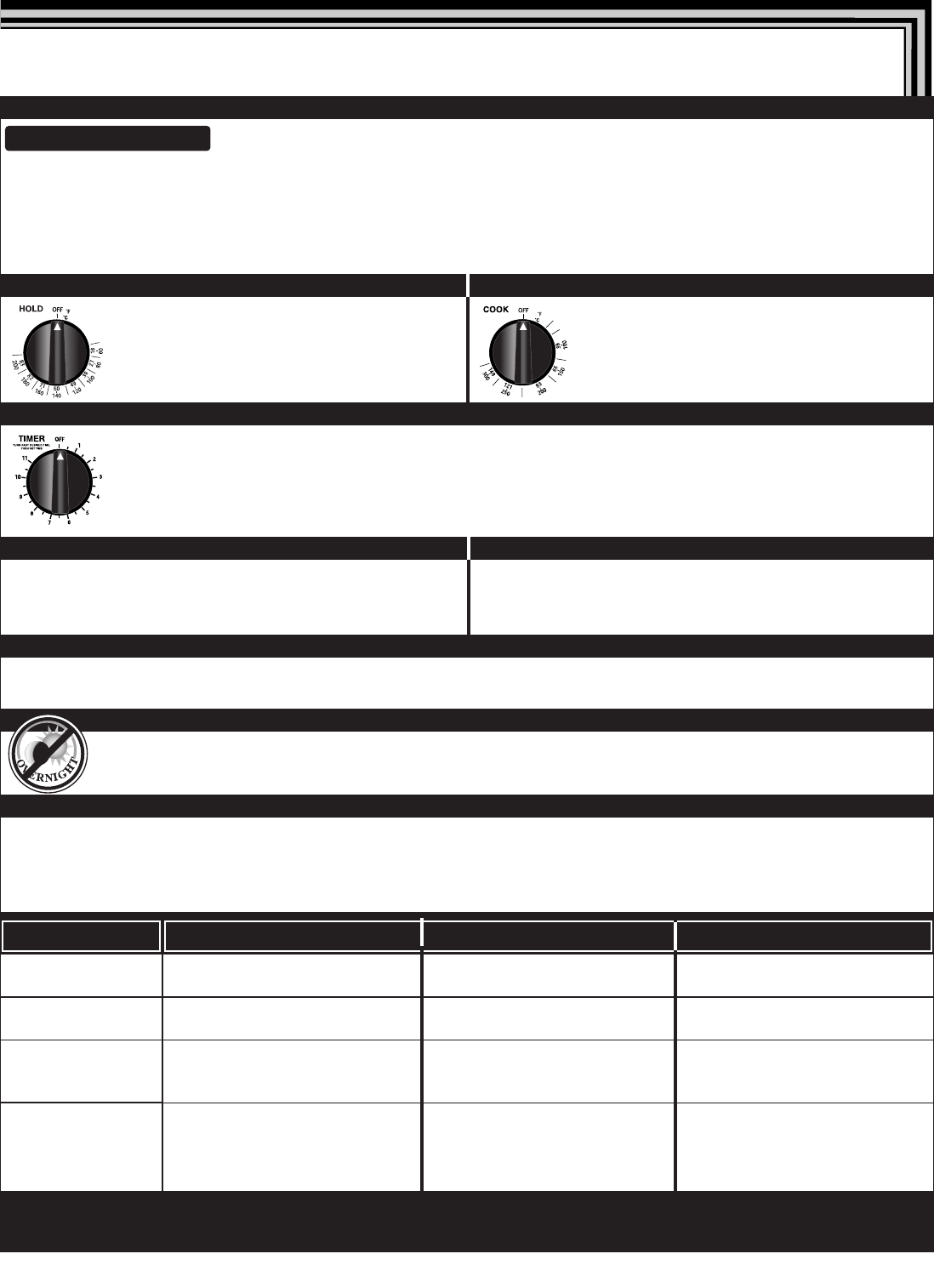
Chicken: 2-1/2 to 2-3/4 lb (1,1 to 1,2 kg) average weight
Clean chicken and remove excess fat. Brush chicken with oil, butter or margarine (OPTIONAL). Season as desired and
sprinkle with paprika.
SECTION 4 • POULTRY
37.
CHICKEN, PI ECE S and HALVE S
5 0 0 S E R I E S 750 S E R I E S 1000 SERIES
M O D E L S
NUMBER OF SHELVES
ITEMS PER SHELF
APPROXIMATE
MAXIMUM CAPACITY
PANS
185°F (85°C)
*When holding longer than 30 minutes, cover chickens with clear plastic wrap.
30 minutes 8 hours*
160°F
(71°C)
275° to 300°F
(135° to 149°C)
33none
1 half-size sheet pan 1 full-size sheet pan 1 full-size sheet pan
18 halves or 60 pieces
3 half-size sheet pans
36 halves or 120 pieces
3 full-size sheet pans
48 halves or 160 pieces
4 full-size sheet pans
18" x 13" x 1"
(GN 1/1: 530 x 325 x 20mm)
(NO SHELVES REQUIRED)
18" x 26" x 1"
(GN 2/1: 530 x 650 x 20mm)
(NO SHELVES REQUIRED)
18" x 26" x 1"
(GN 1/1: 530 x 325 x 20mm)
(ON WIRE SHELVES)
The time and temperature are suggested guidelines only. All cooking should be based on internal product temperatures.
Due to variations in product quality, weight and desired degree of doneness, the cooking timer may need to be adjusted accordingly.
Always follow local health (hygiene) regulations for all internal temperature requirements.
P R O D U C T S P E C I F I C AT I O N S a n d P R E PA R AT I O N
SE T H O L D T H E R M O S TAT S E T C O O K T H E R M O S TAT
S E T C O O K I N G T I M E R
MINIMUM HOLDING TIME REQUIRED MAXIMUM HOLDING TIME
A D D I T I O N A L I N F O R M AT I O N • N O T E S
FINAL INTERNAL PRODUCT TEMPERATURE
O V E R N I G H T C O O K & H O L D
TIME REQUIRED IN “HOLD” CYCLE BEFORE SERVING.
CAPACITIES ARE BASED ON U.S.
PAN SIZES.GASTRONORM PANS
MAY HOLD MORE OR LESS THAN
THE FOOD QUANTITIES INDICATED.
P R E H E AT T H E O V E N
DOOR VENTS: OPEN FULL
Not Recommended
2-1/2 to 3 hours
Full Load
COOKING GUIDELINES
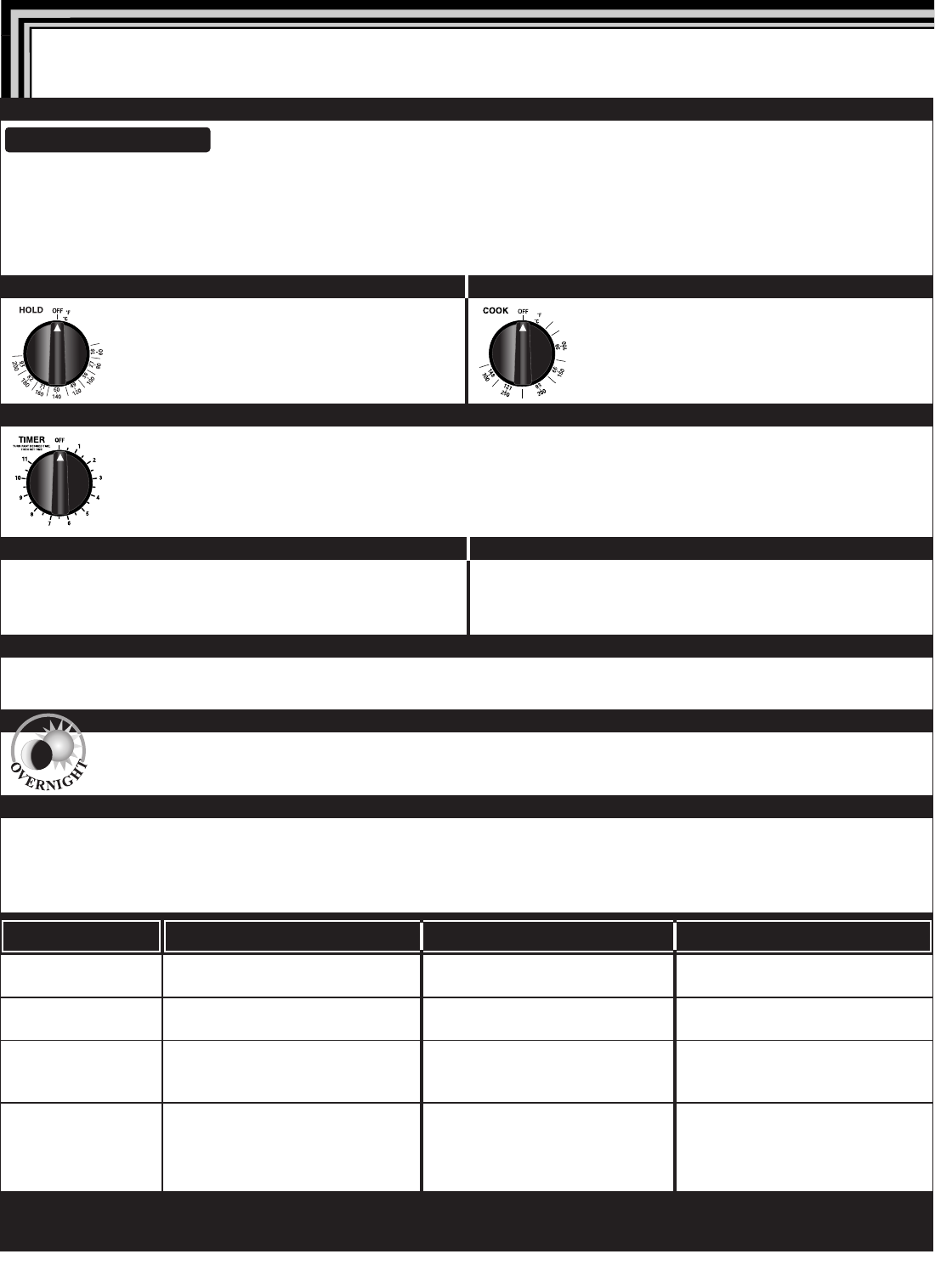
Chicken, Whole: 2-1/4 to 2-3/4 lb (1 to 1,2 kg)
Clean chicken and remove excess fat. Brush chicken with oil, butter or margarine (OPTIONAL). Season as desired and
sprinkle with paprika.
For better whole bird appearance, fold chicken wings and tuck under the back of the bird. Make a slit in the skin
of the chicken (lower end of the bird), cross chicken legs and insert both legs through the slit.
SECTION 4 • POULTRY
38.
CHICKEN, WHOLE
5 0 0 S E R I E S 7 5 0 S E R I E S 1 0 0 0 S E R I E S
M O D E L S
NUMBER OF SHELVES
ITEMS PER SHELF
APPROXIMATE
MAXIMUM CAPACITY
PANS
185°F (85°C)
*When cooking and holding overnight, cover the pans of raw chicken with clear plastic wrap for cooking.
Set cooking thermostat to 250°F (121°C) for 4 hours.
If barbecue sauce is desired, heat sauce to 150°F (66°C) and coat chicken approximately 1 hour before serving.
1 hour 8 to 10 hours
160°F
(71°C)
275° to 300°F
(135° to 149°C)
22none
4 chickens 9 chickens 9 chickens
8 chickens
2 half-size sheet pans
18 chickens
2 full-size sheet pans
27 chickens
3 full-size sheet pans
18" x 13" x 1"
(GN 1/1: 530 x 325 x 20mm)
(NO SHELVES REQUIRED)
18" x 26" x 1"
(GN 2/1: 530 x 650 x 20mm)
(NO SHELVES REQUIRED)
18" x 26" x 1"
(GN 1/1: 530 x 325 x 20mm)
(ON WIRE SHELVES)
The time and temperature are suggested guidelines only. All cooking should be based on internal product temperatures.
Due to variations in product quality, weight and desired degree of doneness, the cooking timer may need to be adjusted accordingly.
Always follow local health (hygiene) regulations for all internal temperature requirements.
P R O D U C T S P E C I F I C AT I O N S a n d P R E PA R AT I O N
S E T H O L D T H E R M O S TAT S E T C O O K T H E R M O S TAT
S E T C O O K I N G T I M E R
MINIMUM HOLDING TIME REQUIRED MAXIMUM HOLDING TIME
A D D I T I O N A L I N F O R M AT I O N • N O T E S
FINAL INTERNAL PRODUCT TEMPERATURE
O V E R N I G H T C O O K & H O L D
TIME REQUIRED IN “HOLD” CYCLE BEFORE SERVING.
CAPACITIES ARE BASED ON U.S.
PAN SIZES.GASTRONORM PANS
MAY HOLD MORE OR LESS THAN
THE FOOD QUANTITIES INDICATED.
P R E H E AT T H E O V E N
DOOR VENTS: OPEN FULL
Optional*
3 to 3-1/2 hours
Full Load
COOKING GUIDELINES
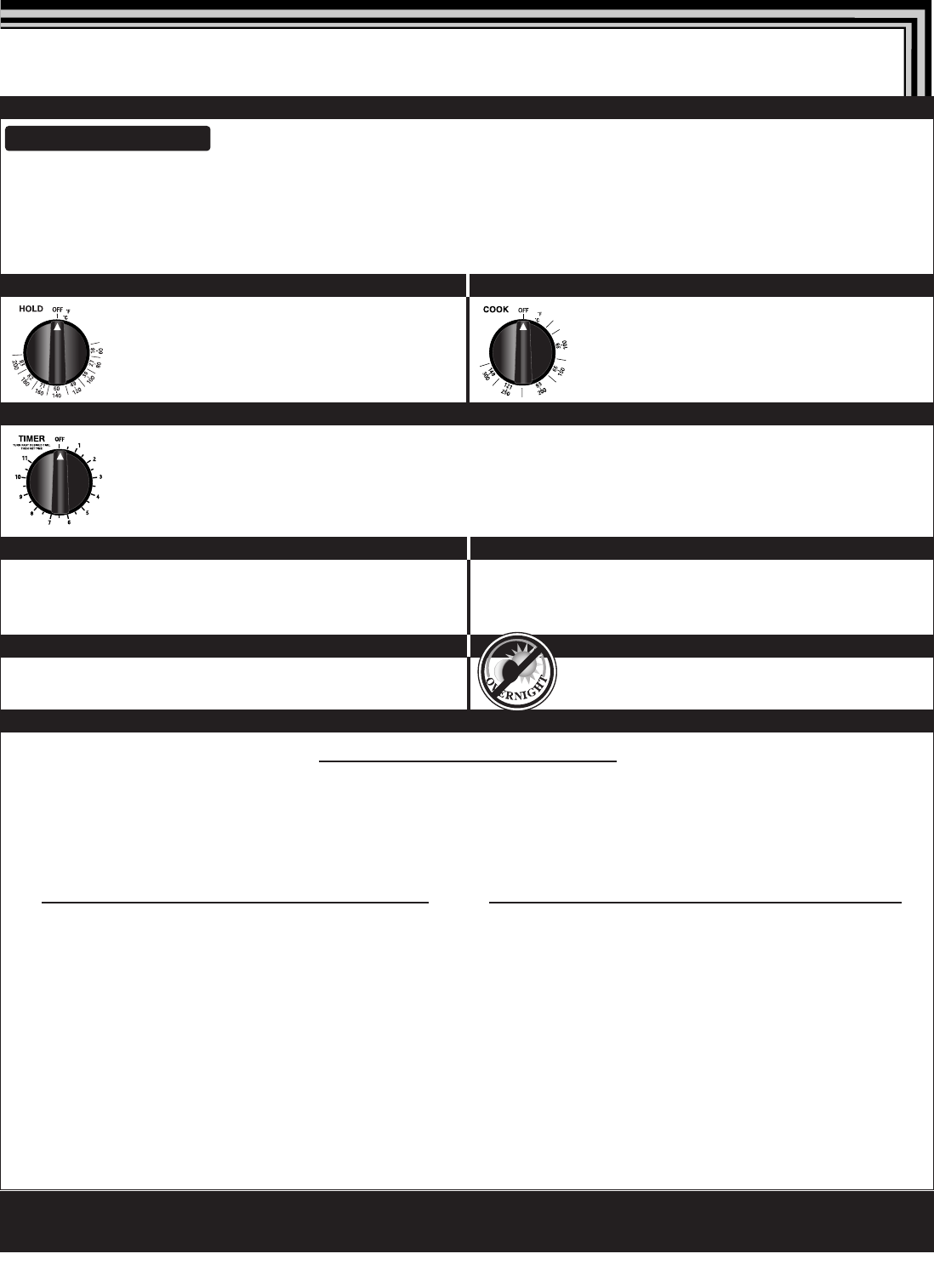
Chicken Pieces: 2-1/2 to 2-3/4 lb (1,1 to 1,2 kg) fryer, 8 piece cut
Clean chicken and remove all excess fat. Soak chicken in cold, salted water for 15 minutes, drain, and dredge in dry
breading. Coat pans with vegetable release spray. Place chicken side-by-side on pans — separating breasts and wings
from legs and thighs. Cover chicken loosely with clear plastic wrap.
FOLLOW LOAD CAPACITIES FOR CHICKEN, PIECES & HALVES
SECTION 4 • POULTRY
39.
CHICKEN, FR IED — T W O -STEP METHOD —
180°F (79°C)
TWO-STEP FRIED CHICKEN
The two-step method consists of precooking the chicken in a low temperature oven to retain the product moisture, then
adding the crisp, fried appearance by inserting the product in a fryer for a very short period of time. This method can
be used with product directly from the oven or the product can be precooked and fried directly from refrigerated
storage. With the two-step method the chicken will be moist, flavorful, plump and golden brown. Shrinkage will be low
and shortening in the fryer will last much longer.
none 4 hours
160°F
(71°C)
275°F
(135°C)
The time and temperature are suggested guidelines only. All cooking should be based on internal product temperatures.
Due to variations in product quality, weight and desired degree of doneness, the cooking timer may need to be adjusted accordingly.
Always follow local health (hygiene) regulations for all internal temperature requirements.
P R O D U C T S P E C I F I C AT I O N S a n d P R E PA R AT I O N
SE T H O L D T H E R M O S TAT S E T C O O K T H E R M O S TAT
S E T C O O K I N G T I M E R
MINIMUM HOLDING TIME REQUIRED MAXIMUM HOLDING TIME
A D D I T I O N A L I N F O R M AT I O N • N O T E S
F I N A L I N T E R N A L P R O D U C T T E M P E R A T U R E O V E R N I G H T C O O K & H O L D
TIME REQUIRED IN “HOLD” CYCLE BEFORE SERVING.
P R E H E AT T H E O V E N
DOOR VENTS: ONE-HALF OPEN
Not Recommended
2-1/2 to 3 hours
Full Load
COOKING GUIDELINES
FRYING DIRECTLY FROM THE OVEN
1. Preheat fryer to 335°F (168°C).
2. If heavier or crisper breading is desired, remove
required portion of chicken from the oven and dredge
in fresh breading.
3. Drop chicken in fryer for three minutes or until
chicken is golden brown.
4. Chicken can be fried per customer order or in larger
quantities. When frying larger quantities, place fried
pieces on a sheet pan with wire grid insert and place
pans in a preheated Alto-Shaam display case or in a
preheated holding cabinet with door vents fully open.
FRYING FROM REFRIGERATED STORAGE
1. Remove chicken from the Alto-Shaam Halo Heat oven,
wrap, chill rapidly and store under refrigeration at
38° to 40°F (3° to 4°C).
2. Preheat fryer to 335°F (168°C).
3. Remove required portion of precooked chicken from
refrigerated storage.
4. Drop chicken in fryer for 6 to 7 minutes or until
chicken is golden brown.
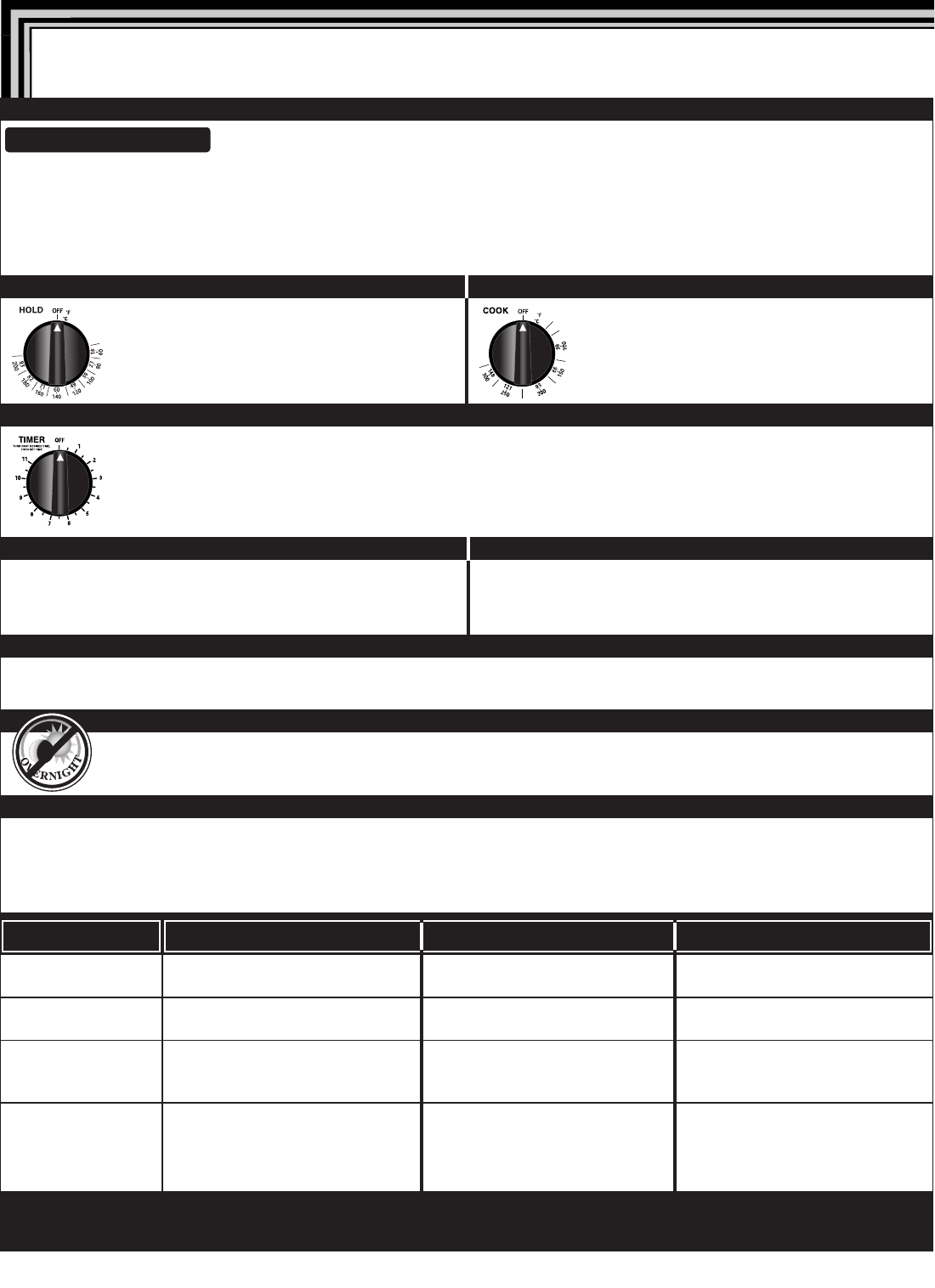
Rock Cornish Game Hens: 12 oz (340 grams) each
Clean hens and remove excess fat. Fold wings and tuck under the back of the bird. Make a slit in the skin of the
hen (lower end of bird), cross hen legs and insert both legs through the slit. Brush hens with oil, butter, or
margarine (OPTIONAL). Season as desired and sprinkle with paprika. Space evenly on sheet pans.
SECTION 4 • POULTRY
40.
CORNISH HENS
5 0 0 S E R I E S 7 5 0 S E R I E S 1 0 0 0 S E R I E S
M O D E L S
NUMBER OF SHELVES
ITEMS PER SHELF
APPROXIMATE
MAXIMUM CAPACITY
PANS
175°F (79°C)
1 hour 4 to 6 hours
160°F
(71°C)
275°F
(135°C)
23none
1 half-size sheet pan
9 cornish hens per pan
1 full-size sheet pan
18 cornish hens per pan
1 full-size sheet pan
18 cornish hens per pan
2 half-size sheet pans
18 cornish hens
3 full-size sheet pans
54 cornish hens
4 full-size sheet pans
72 cornish hens
18" x 13" x 1"
(GN 1/1: 530 x 325 x 20mm)
(NO SHELVES REQUIRED)
18" x 26" x 1"
(GN 2/1: 530 x 650 x 20mm)
(NO SHELVES REQUIRED)
18" x 26" x 1"
(GN 1/1: 530 x 325 x 20mm)
(ON WIRE SHELVES)
The time and temperature are suggested guidelines only. All cooking should be based on internal product temperatures.
Due to variations in product quality, weight and desired degree of doneness, the cooking timer may need to be adjusted accordingly.
Always follow local health (hygiene) regulations for all internal temperature requirements.
P R O D U C T S P E C I F I C AT I O N S a n d P R E PA R AT I O N
S E T H O L D T H E R M O S TAT S E T C O O K T H E R M O S TAT
S E T C O O K I N G T I M E R
MINIMUM HOLDING TIME REQUIRED MAXIMUM HOLDING TIME
A D D I T I O N A L I N F O R M AT I O N • N O T E S
FINAL INTERNAL PRODUCT TEMPERATURE
O V E R N I G H T C O O K & H O L D
TIME REQUIRED IN “HOLD” CYCLE BEFORE SERVING.
CAPACITIES ARE BASED ON U.S.
PAN SIZES.GASTRONORM PANS
MAY HOLD MORE OR LESS THAN
THE FOOD QUANTITIES INDICATED.
P R E H E AT T H E O V E N
DOOR VENTS: OPEN FULL
Not Recommended
3 to 3-1/2 hours
Full Load
COOKING GUIDELINES
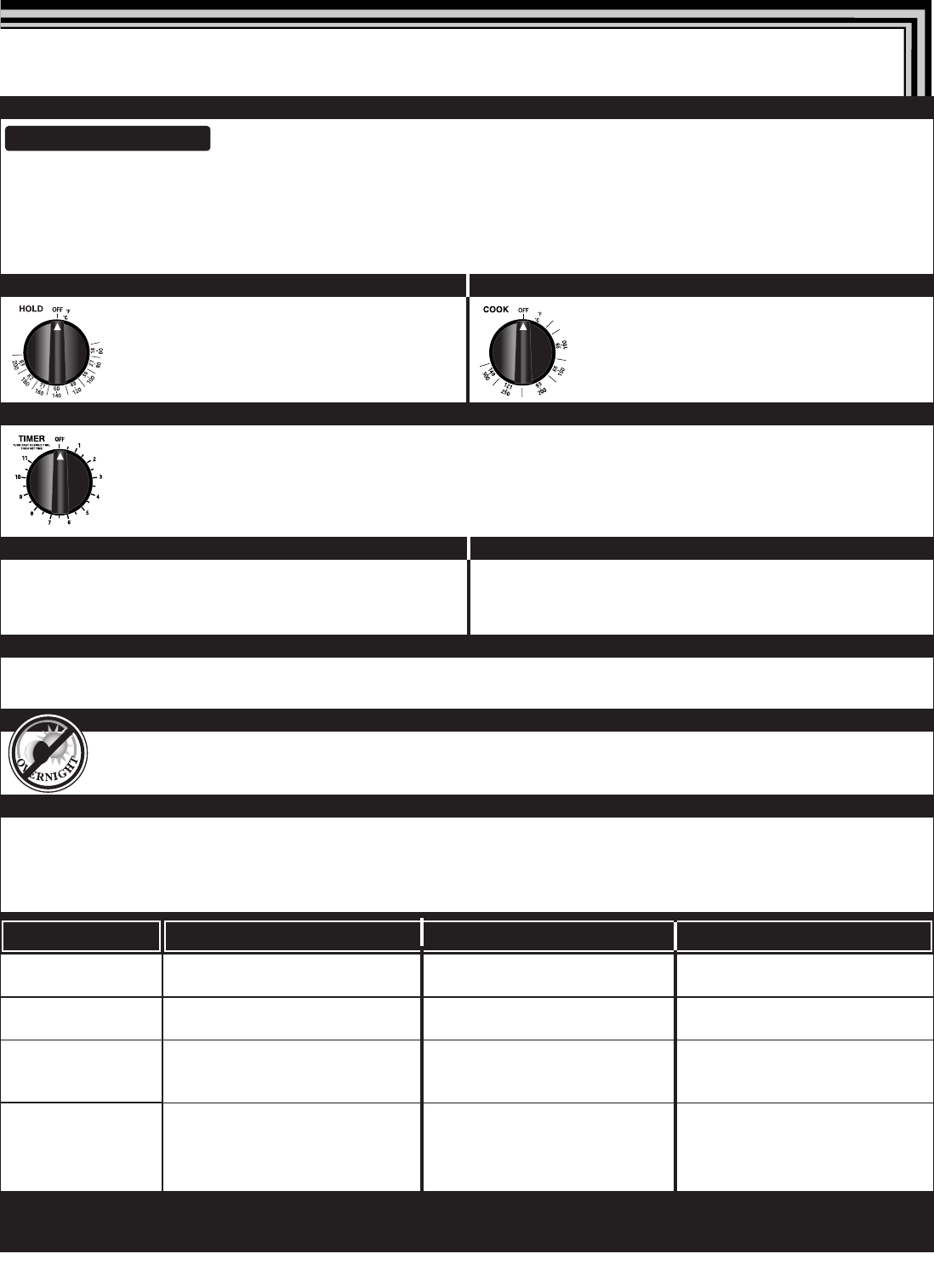
Duck, Whole: 4 to 5 lb (2 kg)
Season as desired. Rub with oil and paprika and place directly on wire shelves.
SECTION 4 • POULTRY
41.
DUCK, WHOLE
5 0 0 S E R I E S 750 S E R I E S 1000 SERIES
M O D E L S
NUMBER OF SHELVES
ITEMS PER SHELF
APPROXIMATE
MAXIMUM CAPACITY
PANS
185° to 190°F (85° to 88°C)
1 hour 8 hours
160°F
(71°C)
300°F
(149°C)
223
3 ducks 6 ducks 4 ducks
6 ducks 12 ducks 12 ducks
none none none
The time and temperature are suggested guidelines only. All cooking should be based on internal product temperatures.
Due to variations in product quality, weight and desired degree of doneness, the cooking timer may need to be adjusted accordingly.
Always follow local health (hygiene) regulations for all internal temperature requirements.
P R O D U C T S P E C I F I C AT I O N S a n d P R E PA R AT I O N
SE T H O L D T H E R M O S TAT S E T C O O K T H E R M O S TAT
S E T C O O K I N G T I M E R
MINIMUM HOLDING TIME REQUIRED MAXIMUM HOLDING TIME
A D D I T I O N A L I N F O R M AT I O N • N O T E S
FINAL INTERNAL PRODUCT TEMPERATURE
O V E R N I G H T C O O K & H O L D
TIME REQUIRED IN “HOLD” CYCLE BEFORE SERVING.
CAPACITIES ARE BASED ON U.S.
PAN SIZES.GASTRONORM PANS
MAY HOLD MORE OR LESS THAN
THE FOOD QUANTITIES INDICATED.
P R E H E AT T H E O V E N
DOOR VENTS: OPEN FULL
Not Recommended
2-1/2 to 3 hours
Full Load
COOKING GUIDELINES
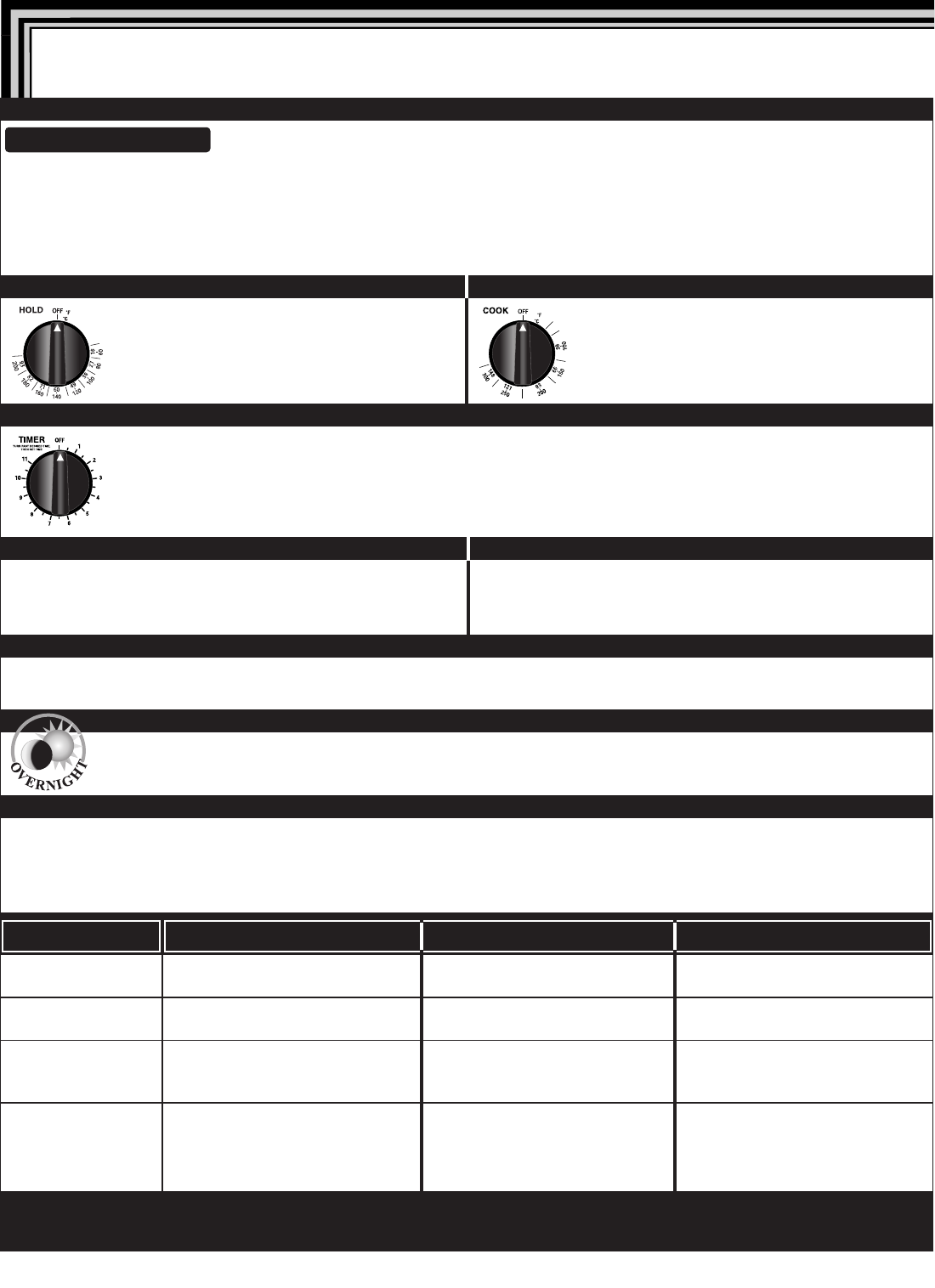
Turkey, Whole: 25 lb (11 kg)
Turkey must be fully thawed. Season as desired. Rub with oil, butter or margarine (OPTIONAL), and sprinkle with
paprika. Place directly on wire shelves.
SECTION 4 • POULTRY
42.
TURKEY
5 0 0 S E R I E S 7 5 0 S E R I E S 1 0 0 0 S E R I E S
M O D E L S
NUMBER OF SHELVES
ITEMS PER SHELF
APPROXIMATE
MAXIMUM CAPACITY
PANS
185°F (85°C)
1 to 2 hours 10 hours
160°F
(71°C)
250°F
(121°C)
112
1 turkey 2 turkeys 2 turkeys
1 turkey 2 turkeys 4 turkeys
none none none
The time and temperature are suggested guidelines only. All cooking should be based on internal product temperatures.
Due to variations in product quality, weight and desired degree of doneness, the cooking timer may need to be adjusted accordingly.
Always follow local health (hygiene) regulations for all internal temperature requirements.
P R O D U C T S P E C I F I C AT I O N S a n d P R E PA R AT I O N
S E T H O L D T H E R M O S TAT S E T C O O K T H E R M O S TAT
S E T C O O K I N G T I M E R
MINIMUM HOLDING TIME REQUIRED MAXIMUM HOLDING TIME
A D D I T I O N A L I N F O R M AT I O N • N O T E S
FINAL INTERNAL PRODUCT TEMPERATURE
O V E R N I G H T C O O K & H O L D
TIME REQUIRED IN “HOLD” CYCLE BEFORE SERVING.
CAPACITIES ARE BASED ON U.S.
PAN SIZES.GASTRONORM PANS
MAY HOLD MORE OR LESS THAN
THE FOOD QUANTITIES INDICATED.
P R E H E AT T H E O V E N
DOOR VENTS: OPEN FULL
Highly Recommended
10 minutes per pound for the first turkey (22 minutes per kilogram)
plus
add 30 minutes for each additional turkey.
COOKING GUIDELINES
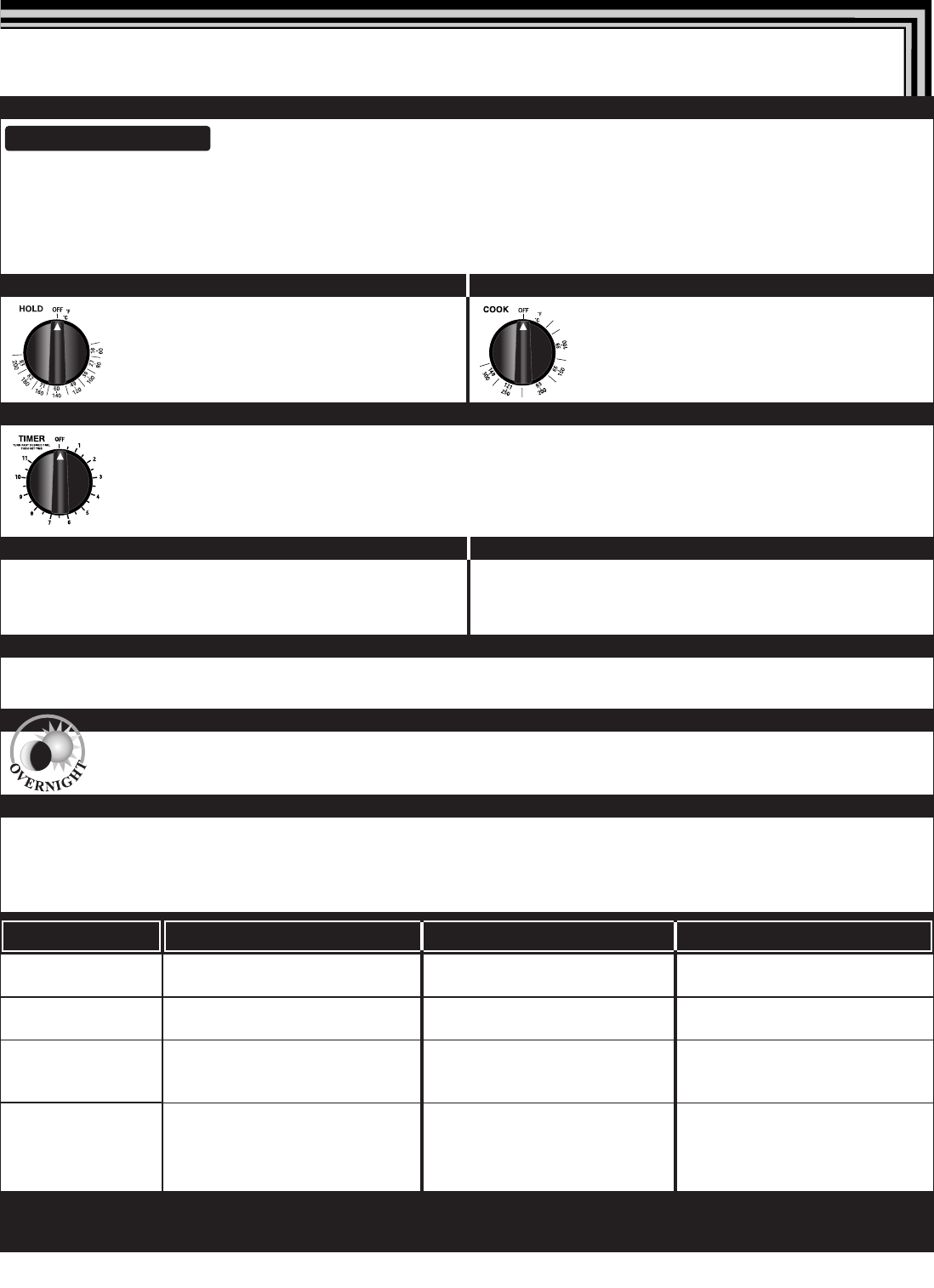
Turkey Breast: 10 to 15 lb (5 to 7 kg)
Turkey breast should be at a refrigerated temperature of 38° to 40°F (3° to 4°C) when placed in a preheated oven. Season
as desired. Brush with oil, butter or margarine (OPTIONAL), and sprinkle with paprika. Place breasts directly on wire
shelves.
SECTION 4 • POULTRY
43.
TURKEY B REA ST
5 0 0 S E R I E S 750 S E R I E S 1000 SERIES
M O D E L S
NUMBER OF SHELVES
ITEMS PER SHELF
APPROXIMATE
MAXIMUM CAPACITY
PANS
180°F (82°C)
*When cooking and holding overnight, set the cook thermostat at 250°F (121°C)
1 hour 10 hours
160°F
(71°C)
250° to 275°F
(121° to 135°C)
223
2 turkey breasts 4 turkey breasts 3 turkey breasts
4 turkey breasts 8 turkey breasts 9 turkey breasts
none none none
The time and temperature are suggested guidelines only. All cooking should be based on internal product temperatures.
Due to variations in product quality, weight and desired degree of doneness, the cooking timer may need to be adjusted accordingly.
Always follow local health (hygiene) regulations for all internal temperature requirements.
P R O D U C T S P E C I F I C AT I O N S a n d P R E PA R AT I O N
SE T H O L D T H E R M O S TAT S E T C O O K T H E R M O S TAT
S E T C O O K I N G T I M E R
MINIMUM HOLDING TIME REQUIRED MAXIMUM HOLDING TIME
A D D I T I O N A L I N F O R M AT I O N • N O T E S
FINAL INTERNAL PRODUCT TEMPERATURE
O V E R N I G H T C O O K & H O L D
TIME REQUIRED IN “HOLD” CYCLE BEFORE SERVING.
CAPACITIES ARE BASED ON U.S.
PAN SIZES.GASTRONORM PANS
MAY HOLD MORE OR LESS THAN
THE FOOD QUANTITIES INDICATED.
P R E H E AT T H E O V E N
DOOR VENTS: OPEN FULL
Optional*
3-1/2 to 4-1/2 hours
Full Load
COOKING GUIDELINES
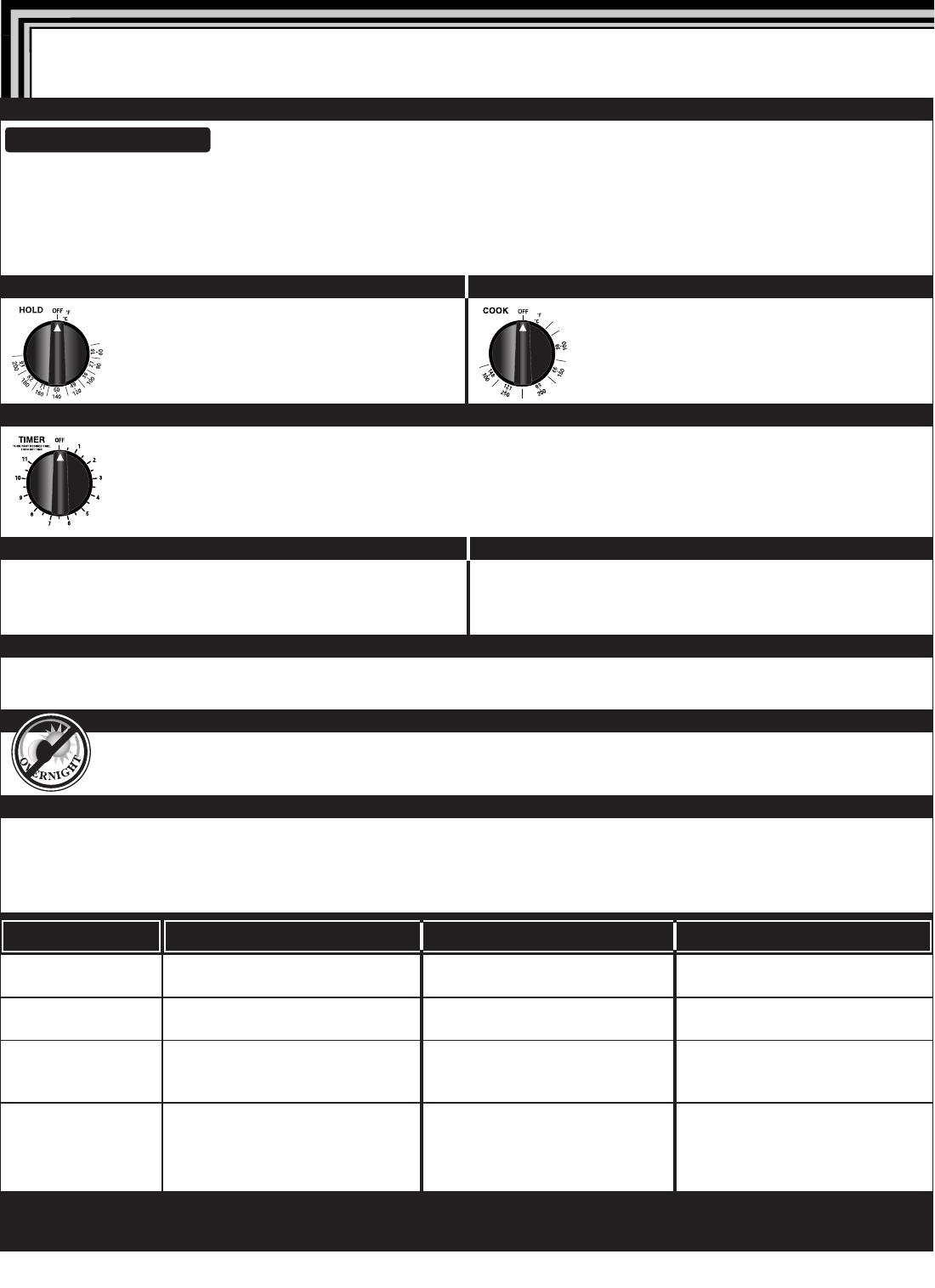
Turkey Roll, Precooked, Frozen: 8 to 12 lb (4 to 5 kg)
Place fully frozen turkey rolls directly on wire shelves to reheat.
SECTION 4 • POULTRY
44.
TURKEY RO LL
5 0 0 S E R I E S 7 5 0 S E R I E S 1 0 0 0 S E R I E S
M O D E L S
NUMBER OF SHELVES
ITEMS PER SHELF
APPROXIMATE
MAXIMUM CAPACITY
PANS
165°F (74°C)
1 hour 6 to 8 hours
160°F
(71°C)
250°F
(121°C)
223
2 turkey rolls 4 turkey rolls 3 turkey rolls
4 turkey rolls 8 turkey rolls 9 turkey rolls
none none none
The time and temperature are suggested guidelines only. All cooking should be based on internal product temperatures.
Due to variations in product quality, weight and desired degree of doneness, the cooking timer may need to be adjusted accordingly.
Always follow local health (hygiene) regulations for all internal temperature requirements.
P R O D U C T S P E C I F I C AT I O N S a n d P R E PA R AT I O N
S E T H O L D T H E R M O S TAT S E T C O O K T H E R M O S TAT
S E T C O O K I N G T I M E R
MINIMUM HOLDING TIME REQUIRED MAXIMUM HOLDING TIME
A D D I T I O N A L I N F O R M AT I O N • N O T E S
FINAL INTERNAL PRODUCT TEMPERATURE
O V E R N I G H T C O O K & H O L D
TIME REQUIRED IN “HOLD” CYCLE BEFORE SERVING.
CAPACITIES ARE BASED ON U.S.
PAN SIZES.GASTRONORM PANS
MAY HOLD MORE OR LESS THAN
THE FOOD QUANTITIES INDICATED.
P R E H E AT T H E O V E N
DOOR VENTS: OPEN FULL
Not Recommended
3 to 4 hours
Full Load
COOKING GUIDELINES
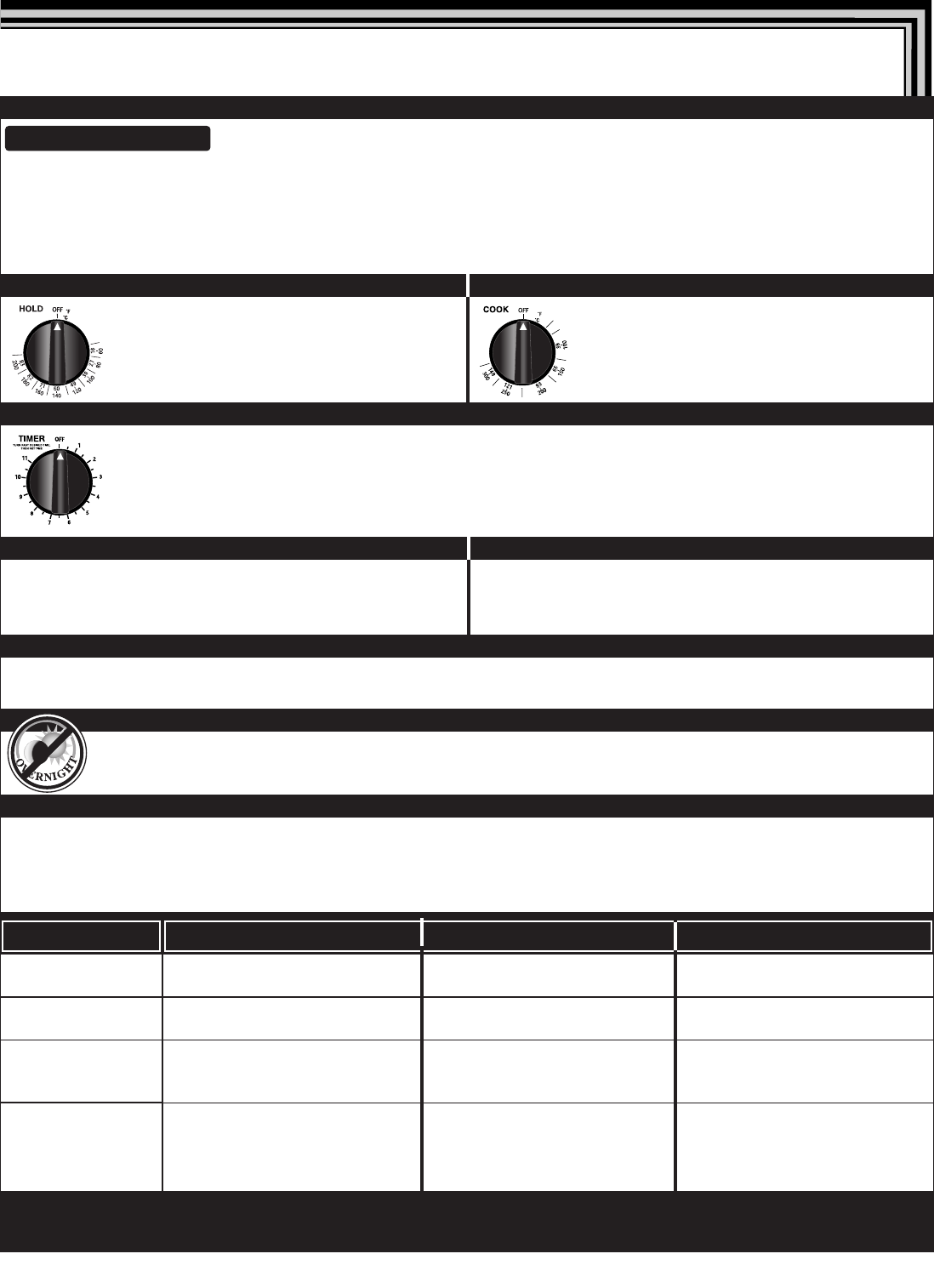
Fish Fillets, Fresh or Frozen: 6 to 8 oz (170 to 227 grams)
Do not thaw frozen fillets. Spray or coat sheet pans with oil. Place fillets side-by-side on sheet pans. Brush fish with oil,
butter or margarine. Season as desired and sprinkle lightly with paprika. Loosely cover pans with clear plastic wrap.
SECTION 4 • FISH
45.
FISH, BAKED
5 0 0 S E R I E S 750 S E R I E S 1000 SERIES
M O D E L S
NUMBER OF SHELVES
ITEMS PER SHELF
APPROXIMATE
MAXIMUM CAPACITY
PANS
150°F (71°C)
none 3 to 4 hours
Holding time will vary greatly depending on the type of
fish and the initial product moisture content.
160°F
(71°C)
275°F
(135°C)
46none
1 half-size sheet pan 1 full-size sheet pan 1 full-size sheet pan
4 half-size sheet pans 6 full-size sheet pans 8 full-size sheet pans
18" x 13" x 1"
(GN 1/1: 530 x 325 x 20mm)
(NO SHELVES REQUIRED)
18" x 26" x 1"
(GN 2/1: 530 x 650 x 20mm)
(NO SHELVES REQUIRED)
18" x 26" x 1"
(GN 1/1: 530 x 325 x 20mm)
(ON WIRE SHELVES)
The time and temperature are suggested guidelines only. All cooking should be based on internal product temperatures.
Due to variations in product quality, weight and desired degree of doneness, the cooking timer may need to be adjusted accordingly.
Always follow local health (hygiene) regulations for all internal temperature requirements.
P R O D U C T S P E C I F I C AT I O N S a n d P R E PA R AT I O N
SE T H O L D T H E R M O S TAT S E T C O O K T H E R M O S TAT
S E T C O O K I N G T I M E R
MINIMUM HOLDING TIME REQUIRED MAXIMUM HOLDING TIME
A D D I T I O N A L I N F O R M AT I O N • N O T E S
FINAL INTERNAL PRODUCT TEMPERATURE
O V E R N I G H T C O O K & H O L D
TIME REQUIRED IN “HOLD” CYCLE BEFORE SERVING.
CAPACITIES ARE BASED ON U.S.
PAN SIZES.GASTRONORM PANS
MAY HOLD MORE OR LESS THAN
THE FOOD QUANTITIES INDICATED.
P R E H E AT T H E O V E N
DOOR VENTS: ONE-HALF OPEN
Not Recommended
1-1/2 to 2-1/2 hours
Full Load
COOKING GUIDELINES
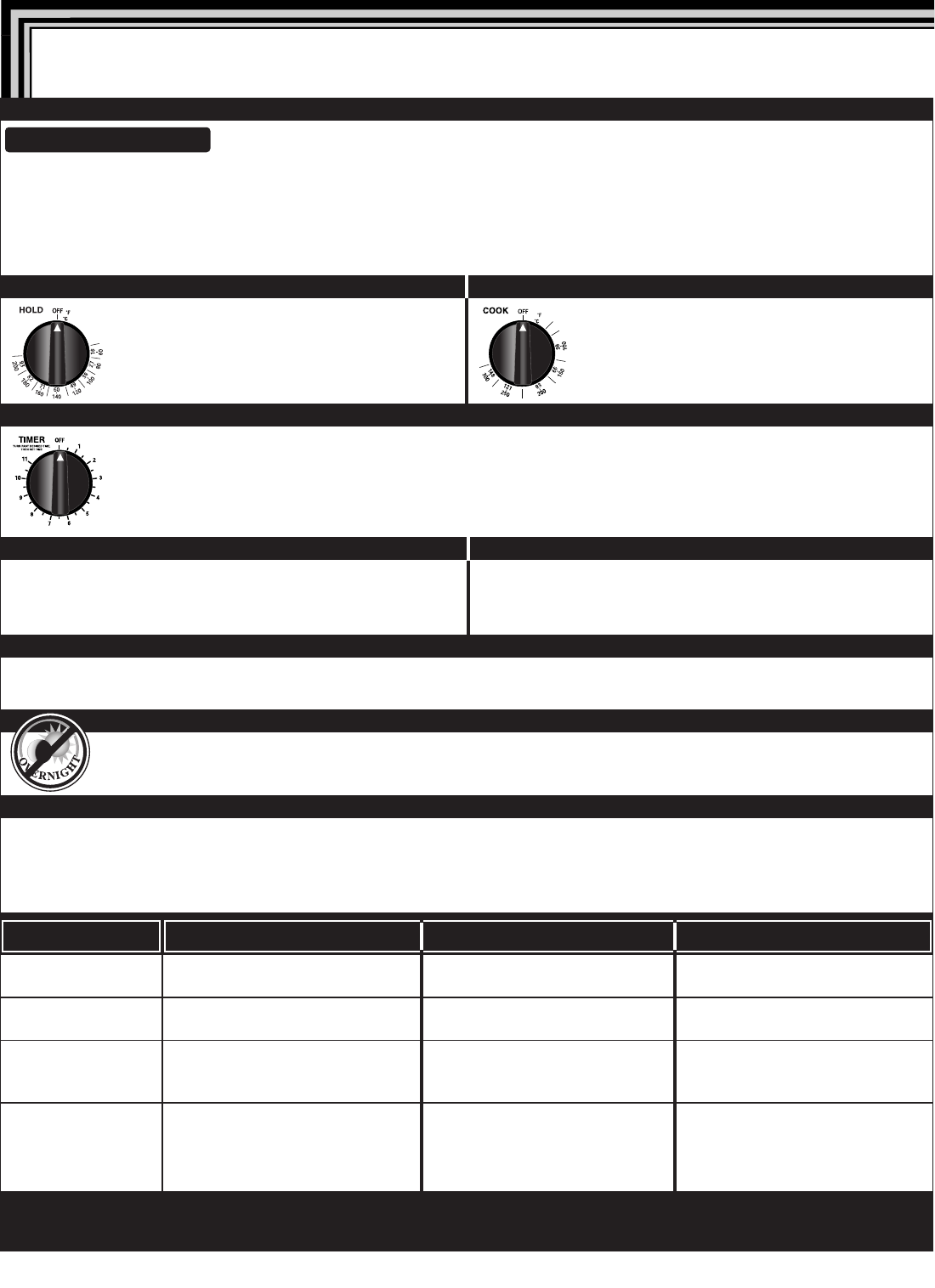
Salmon Steaks: 6 to 8 oz (170 to 227 grams), 1" (25mm) thick
Spray or coat sheet pans with oil, butter or margarine. Place steaks side-by-side on sheet pans. Season as desired.
SECTION 4 • FISH
46.
SALMON STEAKS
5 0 0 S E R I E S 7 5 0 S E R I E S 1 0 0 0 S E R I E S
M O D E L S
NUMBER OF SHELVES
ITEMS PER SHELF
APPROXIMATE
MAXIMUM CAPACITY
PANS
150°F (66°C)
1 hour 3 to 4 hours
160°F
(71°C)
275°F
(135°C)
44none
7 to 8 steaks per pan
1 half-size sheet pan
15 steaks per pan
1 full-size sheet pan
15 steaks per pan
1 full-size sheet pan
28 to 32 salmon steaks
4 half-size sheet pans
60 salmon steaks
4 full-size sheet pans
75 salmon steaks
5 full-size sheet pans
18" x 13" x 1"
(GN 1/1: 530 x 325 x 20mm)
(NO SHELVES REQUIRED)
18" x 26" x 1"
(GN 2/1: 530 x 650 x 20mm)
(NO SHELVES REQUIRED)
18" x 26" x 1"
(GN 1/1: 530 x 325 x 20mm)
(ON WIRE SHELVES)
The time and temperature are suggested guidelines only. All cooking should be based on internal product temperatures.
Due to variations in product quality, weight and desired degree of doneness, the cooking timer may need to be adjusted accordingly.
Always follow local health (hygiene) regulations for all internal temperature requirements.
P R O D U C T S P E C I F I C AT I O N S a n d P R E PA R AT I O N
S E T H O L D T H E R M O S TAT S E T C O O K T H E R M O S TAT
S E T C O O K I N G T I M E R
MINIMUM HOLDING TIME REQUIRED MAXIMUM HOLDING TIME
A D D I T I O N A L I N F O R M AT I O N • N O T E S
FINAL INTERNAL PRODUCT TEMPERATURE
O V E R N I G H T C O O K & H O L D
TIME REQUIRED IN “HOLD” CYCLE BEFORE SERVING.
CAPACITIES ARE BASED ON U.S.
PAN SIZES.GASTRONORM PANS
MAY HOLD MORE OR LESS THAN
THE FOOD QUANTITIES INDICATED.
P R E H E AT T H E O V E N
DOOR VENTS: ONE-HALF OPEN
Not Recommended
1-1/2 hours
Full Load
COOKING GUIDELINES
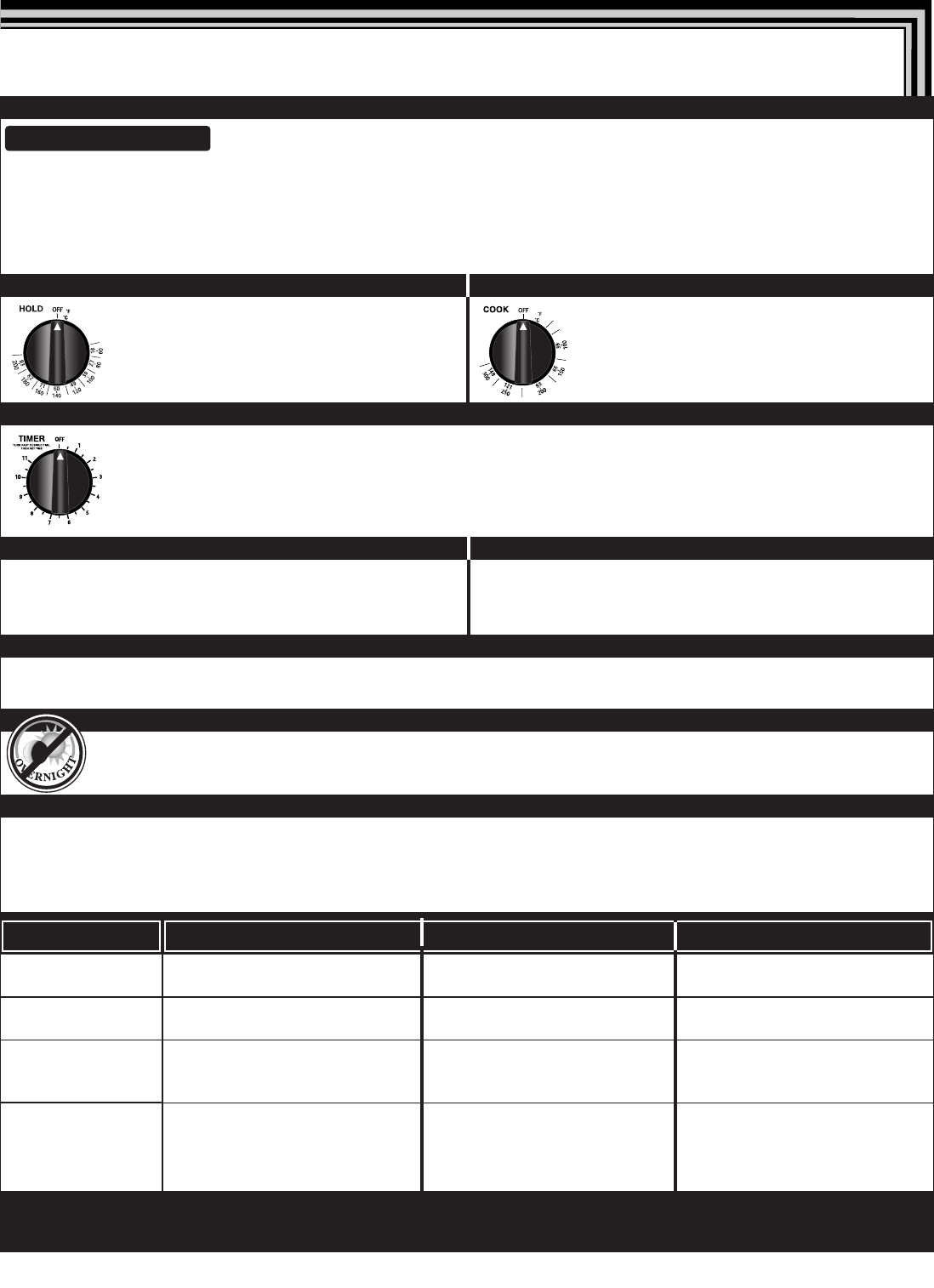
Trout, Whole: 1 lb (454 gm) dressed
Spray or coat sheet pans with oil. Wipe trout with a damp towel and place side-by-side on sheet pans.
Season as desired.
SECTION 4 • FISH
47.
TRO UT
5 0 0 S E R I E S 750 S E R I E S 1000 SERIES
M O D E L S
NUMBER OF SHELVES
ITEMS PER SHELF
APPROXIMATE
MAXIMUM CAPACITY
PANS
150°F (66°C)
none 4 to 6 hours
160°F
(71°C)
275°F
(135°C)
66none
6 trout
1 half-size sheet pan
12 trout
1 full-size sheet pan
12 trout
1 full-size sheet pan
36 trout
6 half-size sheet pans
72 trout
6 full-size sheet pans
96 trout
8 full-size sheet pans
18" x 13" x 1"
(GN 1/1: 530 x 325 x 20mm)
(NO SHELVES REQUIRED)
18" x 26" x 1"
(GN 2/1: 530 x 650 x 20mm)
(NO SHELVES REQUIRED)
18" x 26" x 1"
(GN 1/1: 530 x 325 x 20mm)
(ON WIRE SHELVES)
The time and temperature are suggested guidelines only. All cooking should be based on internal product temperatures.
Due to variations in product quality, weight and desired degree of doneness, the cooking timer may need to be adjusted accordingly.
Always follow local health (hygiene) regulations for all internal temperature requirements.
P R O D U C T S P E C I F I C AT I O N S a n d P R E PA R AT I O N
SE T H O L D T H E R M O S TAT S E T C O O K T H E R M O S TAT
S E T C O O K I N G T I M E R
MINIMUM HOLDING TIME REQUIRED MAXIMUM HOLDING TIME
A D D I T I O N A L I N F O R M AT I O N • N O T E S
FINAL INTERNAL PRODUCT TEMPERATURE
O V E R N I G H T C O O K & H O L D
TIME REQUIRED IN “HOLD” CYCLE BEFORE SERVING.
CAPACITIES ARE BASED ON U.S.
PAN SIZES.GASTRONORM PANS
MAY HOLD MORE OR LESS THAN
THE FOOD QUANTITIES INDICATED.
P R E H E AT T H E O V E N
DOOR VENTS: ONE-HALF OPEN
Not Recommended
1 to 1-1/2 hours
Full Load
COOKING GUIDELINES
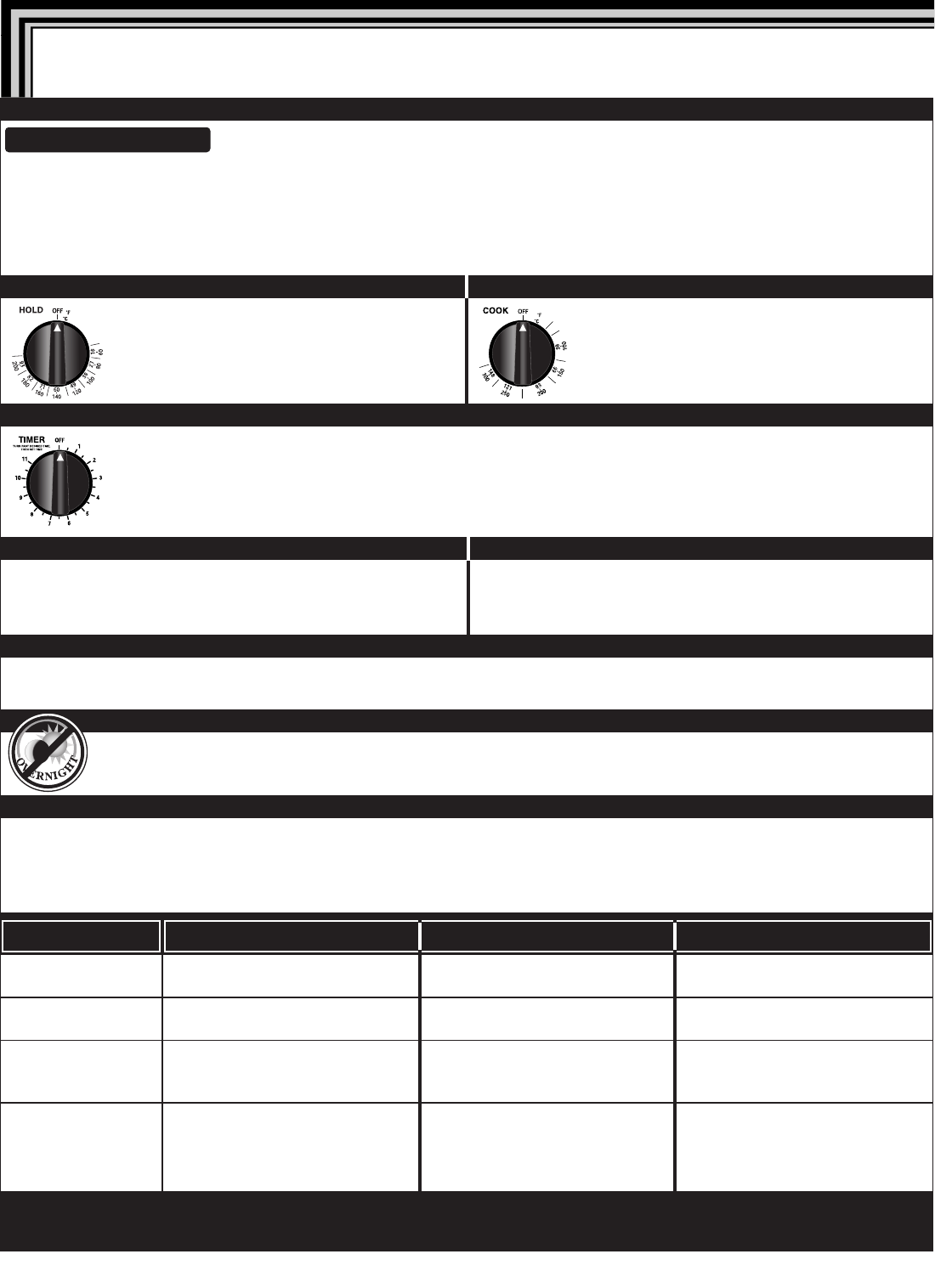
Potatoes, Baking: 80 to 90 count
Always store potatoes at room temperature.
Wash potatoes before placing in a preheated oven. Allow oven to preheat for a minimum of 30 minutes. Place potatoes
directly on wire shelves.
SECTION 4 • MISCELLANEOUS
48.
5 0 0 S E R I E S 7 5 0 S E R I E S 1 0 0 0 S E R I E S
M O D E L S
NUMBER OF SHELVES
ITEMS PER SHELF
APPROXIMATE
MAXIMUM CAPACITY
PANS
190°F (88°C)
* The large variation in the above cooking time is due to the great difference in the seasonal moisture content of
potatoes. Use a pocket-type thermometer to determine the internal temperature of the product.
DO NOT OVER-COOK.
none 7 hours
190°F
(88°C)
325°F
(163°C)
34 4
10 to 12 potatoes per shelf 20 to 25 potatoes per shelf 20 to 25 potatoes per shelf
30 to 36 potatoes 80 to 100 potatoes 80 to 100 potatoes
none none none
The time and temperature are suggested guidelines only. All cooking should be based on internal product temperatures.
Due to variations in product quality, weight and desired degree of doneness, the cooking timer may need to be adjusted accordingly.
Always follow local health (hygiene) regulations for all internal temperature requirements.
P R O D U C T S P E C I F I C AT I O N S a n d P R E PA R AT I O N
S E T H O L D T H E R M O S TAT S E T C O O K T H E R M O S TAT
S E T C O O K I N G T I M E R
MINIMUM HOLDING TIME REQUIRED MAXIMUM HOLDING TIME
A D D I T I O N A L I N F O R M AT I O N • N O T E S
FINAL INTERNAL PRODUCT TEMPERATURE
O V E R N I G H T C O O K & H O L D
TIME REQUIRED IN “HOLD” CYCLE BEFORE SERVING.
CAPACITIES ARE BASED ON U.S.
PAN SIZES.GASTRONORM PANS
MAY HOLD MORE OR LESS THAN
THE FOOD QUANTITIES INDICATED.
P R E H E AT T H E O V E N
DOOR VENTS: OPEN FULL
Not Recommended
1-1/2 to 3 hours*
Full Load
COOKING GUIDELINES
POTATOES, BAKED
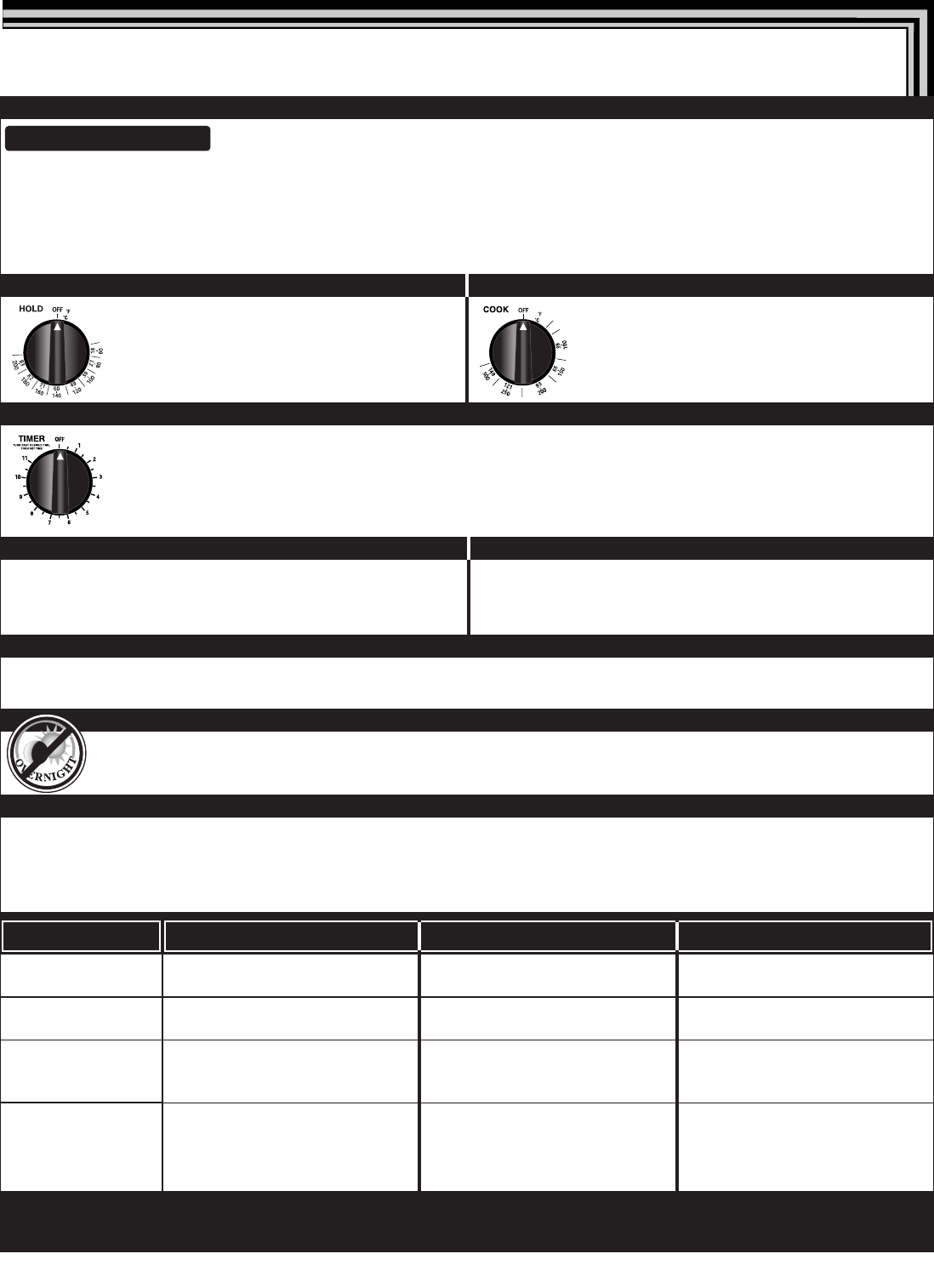
Prebake the shells in pie plates at 275°F (135°C) for approximately 40 minutes.
Pour the quiche mixture into the prebaked shells and bake in a preheated oven.
Quiche is done when product sets-up.
SECTION 4 • MISCELLANEOUS
49.
QUICHE
5 0 0 S E R I E S 750 S E R I E S 1000 SERIES
M O D E L S
NUMBER OF SHELVES
ITEMS PER SHELF
APPROXIMATE
MAXIMUM CAPACITY
PANS
N/A
none 5 hours
160°F
(71°C)
275°F
(135°C)
248
2 quiches 5 quiches 3 quiches
4 quiches 20 quiches 24 quiches
8" to 9" pie plate
(203mm to 229mm)
8" to 9" pie plate
(203mm to 229mm)
8" to 9" pie plate
(203mm to 229mm)
The time and temperature are suggested guidelines only. All cooking should be based on internal product temperatures.
Due to variations in product quality, weight and desired degree of doneness, the cooking timer may need to be adjusted accordingly.
Always follow local health (hygiene) regulations for all internal temperature requirements.
P R O D U C T S P E C I F I C AT I O N S a n d P R E PA R AT I O N
SE T H O L D T H E R M O S TAT S E T C O O K T H E R M O S TAT
S E T C O O K I N G T I M E R
MINIMUM HOLDING TIME REQUIRED MAXIMUM HOLDING TIME
A D D I T I O N A L I N F O R M AT I O N • N O T E S
FINAL INTERNAL PRODUCT TEMPERATURE
O V E R N I G H T C O O K & H O L D
TIME REQUIRED IN “HOLD” CYCLE BEFORE SERVING.
CAPACITIES ARE BASED ON U.S.
PAN SIZES.GASTRONORM PANS
MAY HOLD MORE OR LESS THAN
THE FOOD QUANTITIES INDICATED.
P R E H E AT T H E O V E N
DOOR VENTS: OPEN FULL
NO
Bake approximately 2 hours or until product sets-up.
Full Load
COOKING GUIDELINES
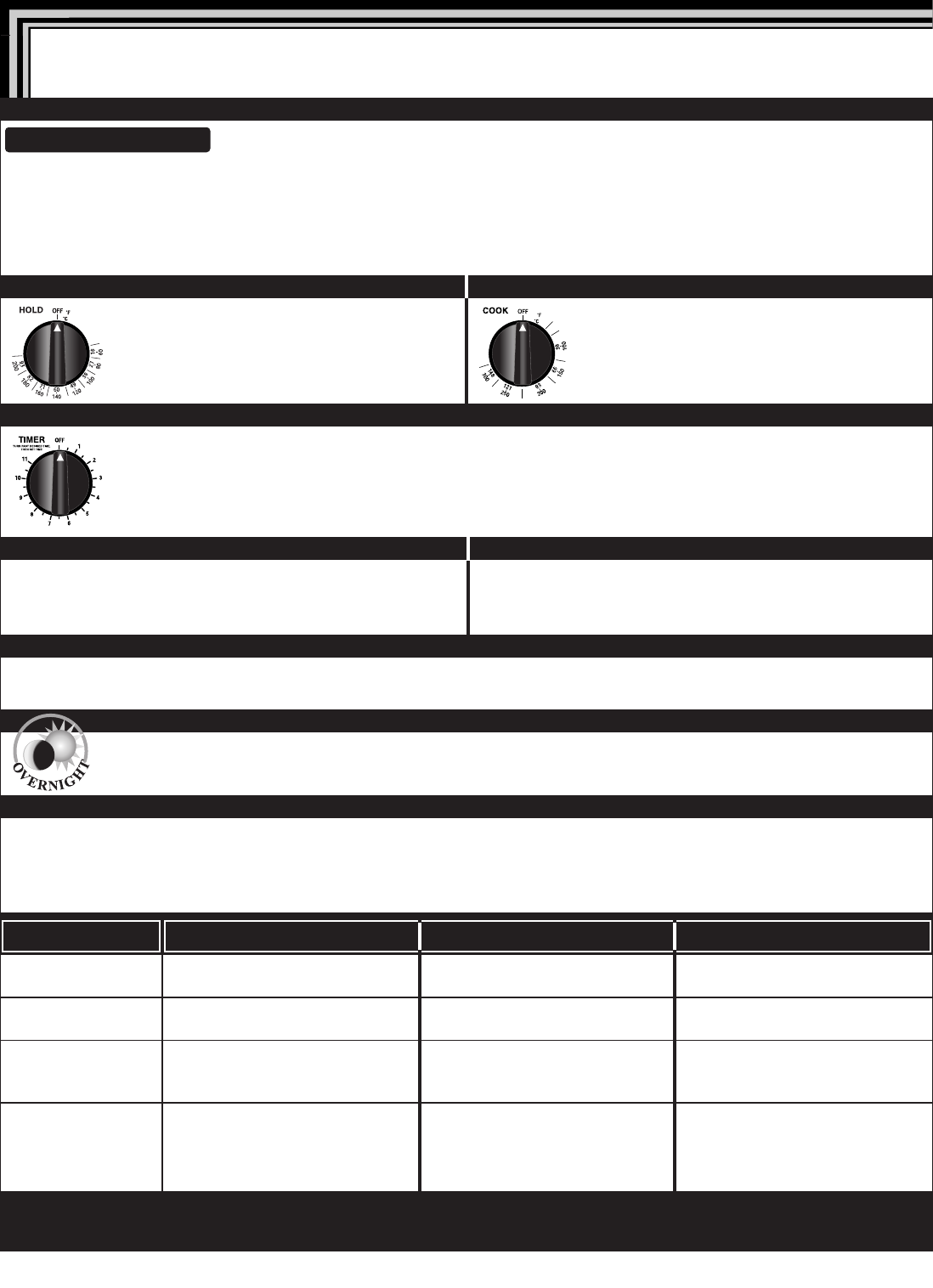
Use 1 x 1 or 1 x 1-1/2 ratio of rice to water. Rice that is high in starch needs to be rinsed. Fill pans to half the pan depth
and cover pans with foil.
SECTION 4 • MISCELLANEOUS
50.
RICE
5 0 0 S E R I E S 7 5 0 S E R I E S 1 0 0 0 S E R I E S
M O D E L S
NUMBER OF SHELVES
ITEMS PER SHELF
APPROXIMATE
MAXIMUM CAPACITY
PANS
160° to 170°F (71° to 77°C)
none 8 hours
160°F
(71°C)
275°F
(135°C)
none none 3
1 full-size pan 2 full-size pans 1 full-size pan
2 full-size pans 4 full-size pans 3 full-size pans
12" x 20" x 2-1/2"
(GN 1/1: 530 x 325 x 65mm)
12" x 20" x 2-1/2"
(GN 1/1: 530 x 325 x 65mm)
12" x 20" x 2-1/2"
(GN 1/1: 530 x 325 x 65mm)
The time and temperature are suggested guidelines only. All cooking should be based on internal product temperatures.
Due to variations in product quality, weight and desired degree of doneness, the cooking timer may need to be adjusted accordingly.
Always follow local health (hygiene) regulations for all internal temperature requirements.
P R O D U C T S P E C I F I C AT I O N S a n d P R E PA R AT I O N
S E T H O L D T H E R M O S TAT S E T C O O K T H E R M O S TAT
S E T C O O K I N G T I M E R
MINIMUM HOLDING TIME REQUIRED MAXIMUM HOLDING TIME
A D D I T I O N A L I N F O R M AT I O N • N O T E S
FINAL INTERNAL PRODUCT TEMPERATURE
O V E R N I G H T C O O K & H O L D
TIME REQUIRED IN “HOLD” CYCLE BEFORE SERVING.
CAPACITIES ARE BASED ON U.S.
PAN SIZES.GASTRONORM PANS
MAY HOLD MORE OR LESS THAN
THE FOOD QUANTITIES INDICATED.
P R E H E AT T H E O V E N
DOOR VENTS: CLOSED
Optional
60 minutes - 3 hours depending on load and pan size
COOKING GUIDELINES
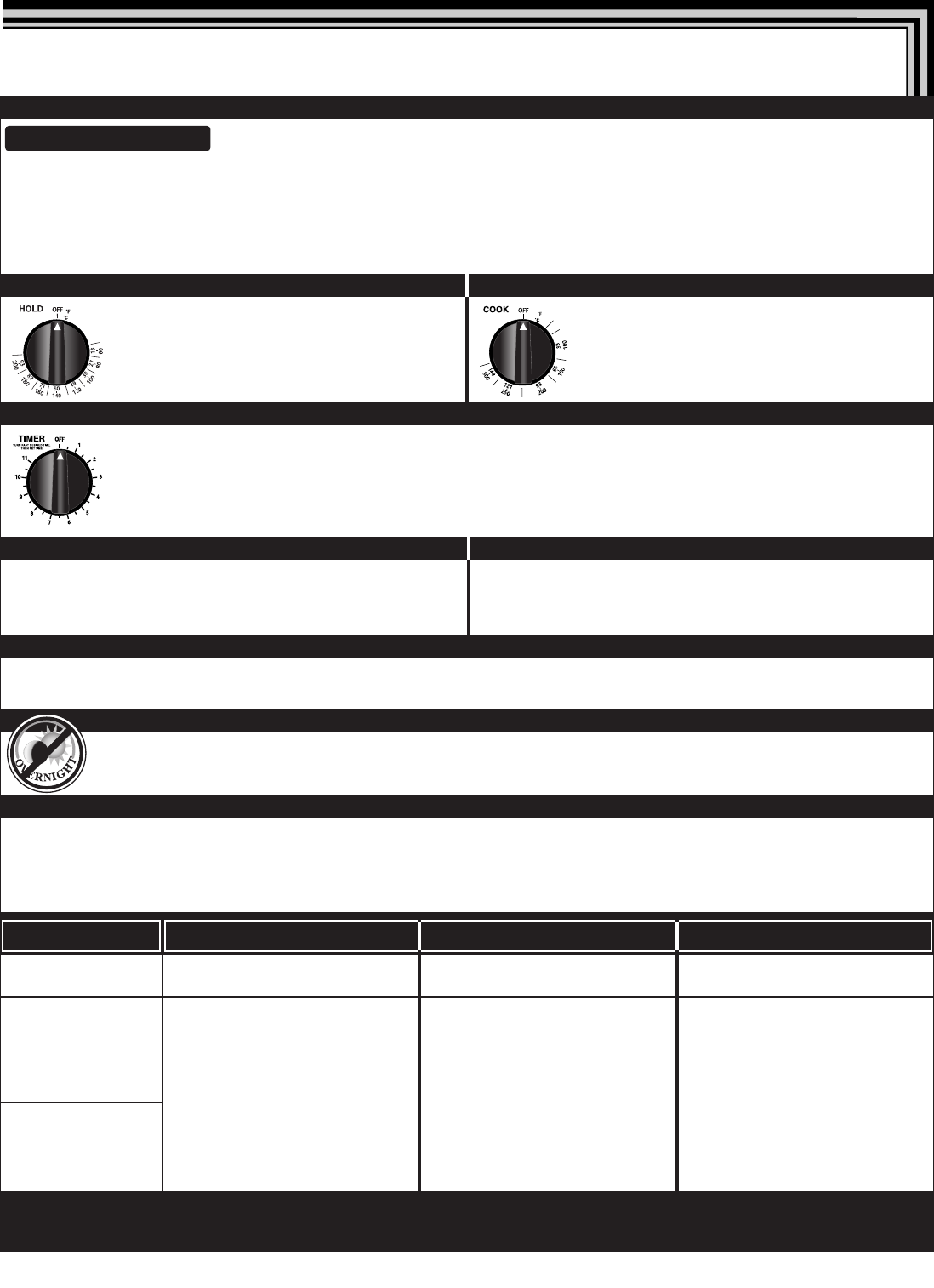
Use a favorite custard recipe.
Pour custard mixture into cups to a depth of 2/3 the container height and place cups on a sheet pan.
NO WATER BATH IS REQUIRED. Bake in a preheated oven.
Custard is done when knife inserted in center of cup is clean when removed.
SECTION 4 • MISCELLANEOUS
51.
BAKED EGG CUSTARD
5 0 0 S E R I E S 750 S E R I E S 1000 SERIES
M O D E L S
NUMBER OF SHELVES
ITEMS PER SHELF
APPROXIMATE
MAXIMUM CAPACITY
PANS
N/A
none none
—250°F
(121°C)
44none
1 half-size sheet pan 1 full-size sheet pan 1 full-size sheet pan
4 half-size sheet pans 4 full-size sheet pans 5 full-size sheet pans
18" x 13" x 1"
(GN 1/1: 530 x 325 x 20mm)
(NO SHELVES REQUIRED)
18" x 26" x 1"
(GN 2/1: 530 x 650 x 20mm)
(NO SHELVES REQUIRED)
18" x 26" x 1"
(GN 1/1: 530 x 325 x 20mm)
(ON WIRE SHELVES)
The time and temperature are suggested guidelines only. All cooking should be based on internal product temperatures.
Due to variations in product quality, weight and desired degree of doneness, the cooking timer may need to be adjusted accordingly.
Always follow local health (hygiene) regulations for all internal temperature requirements.
P R O D U C T S P E C I F I C AT I O N S a n d P R E PA R AT I O N
SE T H O L D T H E R M O S TAT S E T C O O K T H E R M O S TAT
S E T C O O K I N G T I M E R
MINIMUM HOLDING TIME REQUIRED MAXIMUM HOLDING TIME
A D D I T I O N A L I N F O R M AT I O N • N O T E S
FINAL INTERNAL PRODUCT TEMPERATURE
O V E R N I G H T C O O K & H O L D
TIME REQUIRED IN “HOLD” CYCLE BEFORE SERVING.
CAPACITIES ARE BASED ON U.S.
PAN SIZES.GASTRONORM PANS
MAY HOLD MORE OR LESS THAN
THE FOOD QUANTITIES INDICATED.
P R E H E AT T H E O V E N
DOOR VENTS: CLOSED
NO
60-90 minutes, 4 oz. ramekins
Up to 3 hours for 4" steam pans
COOKING GUIDELINES
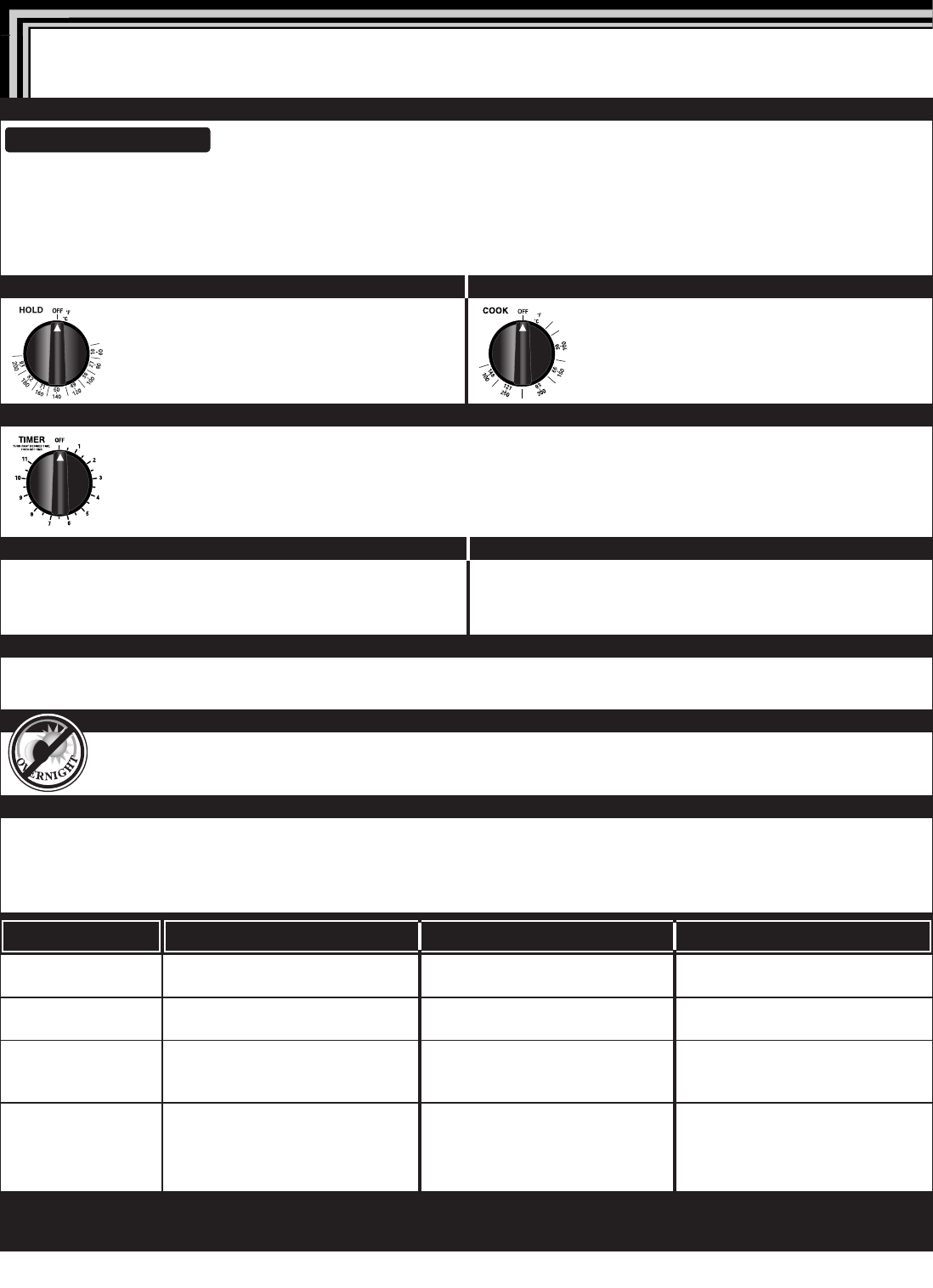
Use a favorite cake recipe or mix. Pour batter in pans to one-half the pan depth. Keep oven door closed during the
cooking cycle. The cake is done when a toothpick inserted in the center of the cake is clean when removed.
SECTION 4 • MISCELLANEOUS
52.
SHEET CAKE
5 0 0 S E R I E S 7 5 0 S E R I E S 1 0 0 0 S E R I E S
M O D E L S
NUMBER OF SHELVES
ITEMS PER SHELF
APPROXIMATE
MAXIMUM CAPACITY
PANS
N/A
none none
—325°F
(163°C)
44none
1 half-size sheet pan 1 full-size sheet pan 1 full-size sheet pan
4 half-size sheet pans 4 full-size sheet pans 4 full-size sheet pans
18" x 13" x 1"
(GN 1/1: 530 x 325 x 20mm)
(NO SHELVES REQUIRED)
18" x 26" x 1"
(GN 2/1: 530 x 650 x 20mm)
(NO SHELVES REQUIRED)
18" x 26" x 1"
(GN 1/1: 530 x 325 x 20mm)
(ON WIRE SHELVES)
The time and temperature are suggested guidelines only. All cooking should be based on internal product temperatures.
Due to variations in product quality, weight and desired degree of doneness, the cooking timer may need to be adjusted accordingly.
Always follow local health (hygiene) regulations for all internal temperature requirements.
P R O D U C T S P E C I F I C AT I O N S a n d P R E PA R AT I O N
S E T H O L D T H E R M O S TAT S E T C O O K T H E R M O S TAT
S E T C O O K I N G T I M E R
MINIMUM HOLDING TIME REQUIRED MAXIMUM HOLDING TIME
A D D I T I O N A L I N F O R M AT I O N • N O T E S
FINAL INTERNAL PRODUCT TEMPERATURE
O V E R N I G H T C O O K & H O L D
TIME REQUIRED IN “HOLD” CYCLE BEFORE SERVING.
CAPACITIES ARE BASED ON U.S.
PAN SIZES.GASTRONORM PANS
MAY HOLD MORE OR LESS THAN
THE FOOD QUANTITIES INDICATED.
P R E H E AT T H E O V E N
DOOR VENTS: OPEN FULL
NO
1-1/2 hours
Full Load
COOKING GUIDELINES
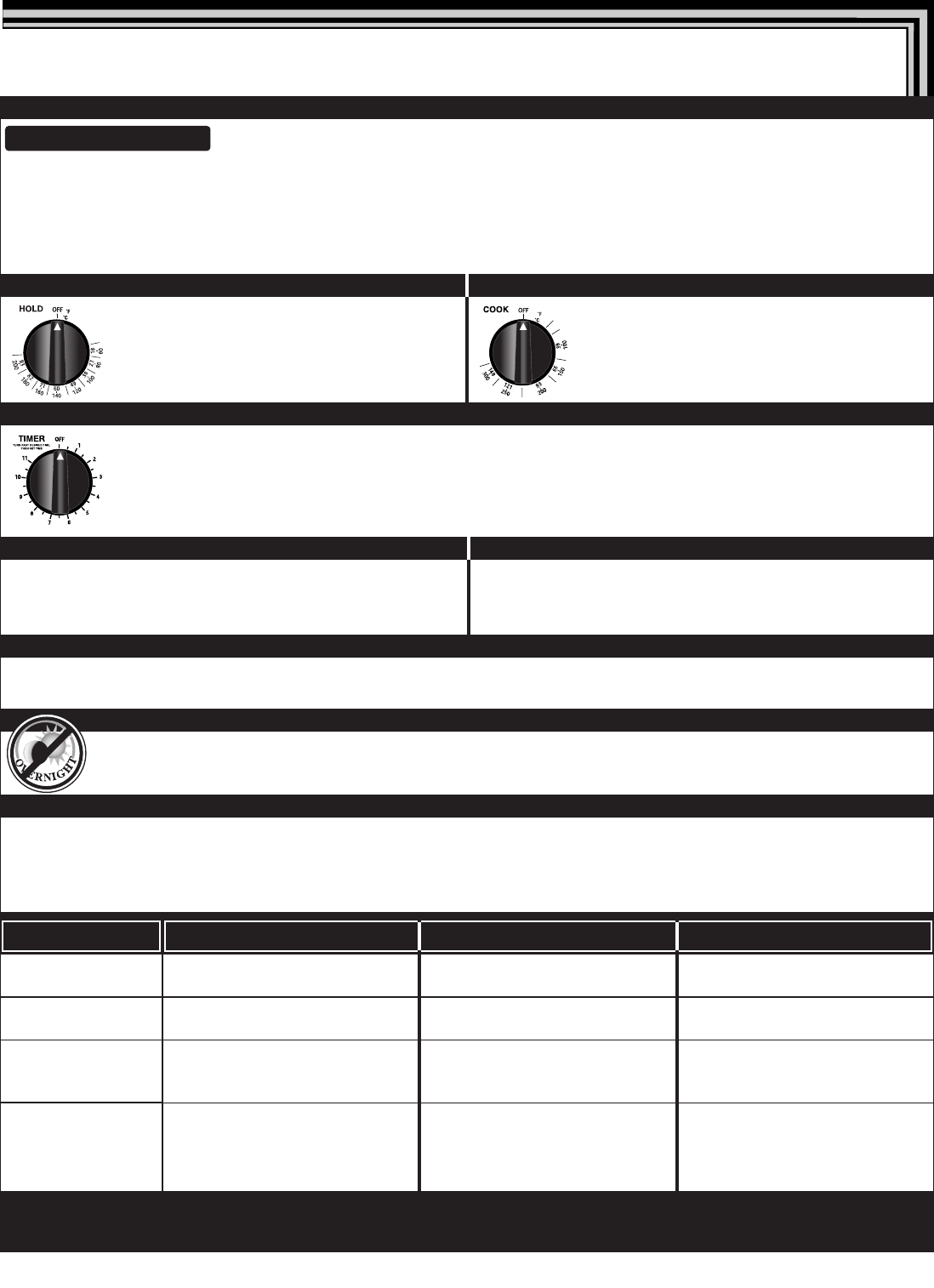
Use a favorite cheese cake recipe or mix. Pour batter into spring-form pans and bake in a preheated oven. The cheese
cake is done when a toothpick inserted in the center is clean when removed. To prevent cracking, allow the cheese cake
to remain in the oven until it reaches room temperature.
SECTION 4 • MISCELLANEOUS
53.
CHEESE CAKE
5 0 0 S E R I E S 750 S E R I E S 1000 SERIES
M O D E L S
NUMBER OF SHELVES
ITEMS PER SHELF
APPROXIMATE
MAXIMUM CAPACITY
PANS
N/A
none none
—250°F
(121°C)
244
2 cakes 5 cakes 3 cakes
4 cakes 20 cakes 12 cakes
8" to 10" round
spring-form pans
(203mm to 254mm)
8" to 10" round
spring-form pans
(203mm to 254mm)
8" to 10" round
spring-form pans
(203mm to 254mm)
The time and temperature are suggested guidelines only. All cooking should be based on internal product temperatures.
Due to variations in product quality, weight and desired degree of doneness, the cooking timer may need to be adjusted accordingly.
Always follow local health (hygiene) regulations for all internal temperature requirements.
P R O D U C T S P E C I F I C AT I O N S a n d P R E PA R AT I O N
SE T H O L D T H E R M O S TAT S E T C O O K T H E R M O S TAT
S E T C O O K I N G T I M E R
MINIMUM HOLDING TIME REQUIRED MAXIMUM HOLDING TIME
A D D I T I O N A L I N F O R M AT I O N • N O T E S
FINAL INTERNAL PRODUCT TEMPERATURE
O V E R N I G H T C O O K & H O L D
TIME REQUIRED IN “HOLD” CYCLE BEFORE SERVING.
CAPACITIES ARE BASED ON U.S.
PAN SIZES.GASTRONORM PANS
MAY HOLD MORE OR LESS THAN
THE FOOD QUANTITIES INDICATED.
P R E H E AT T H E O V E N
DOOR VENTS: OPEN FULL
NO
90 minutes to 2-3 hours depending on pan depth
COOKING GUIDELINES
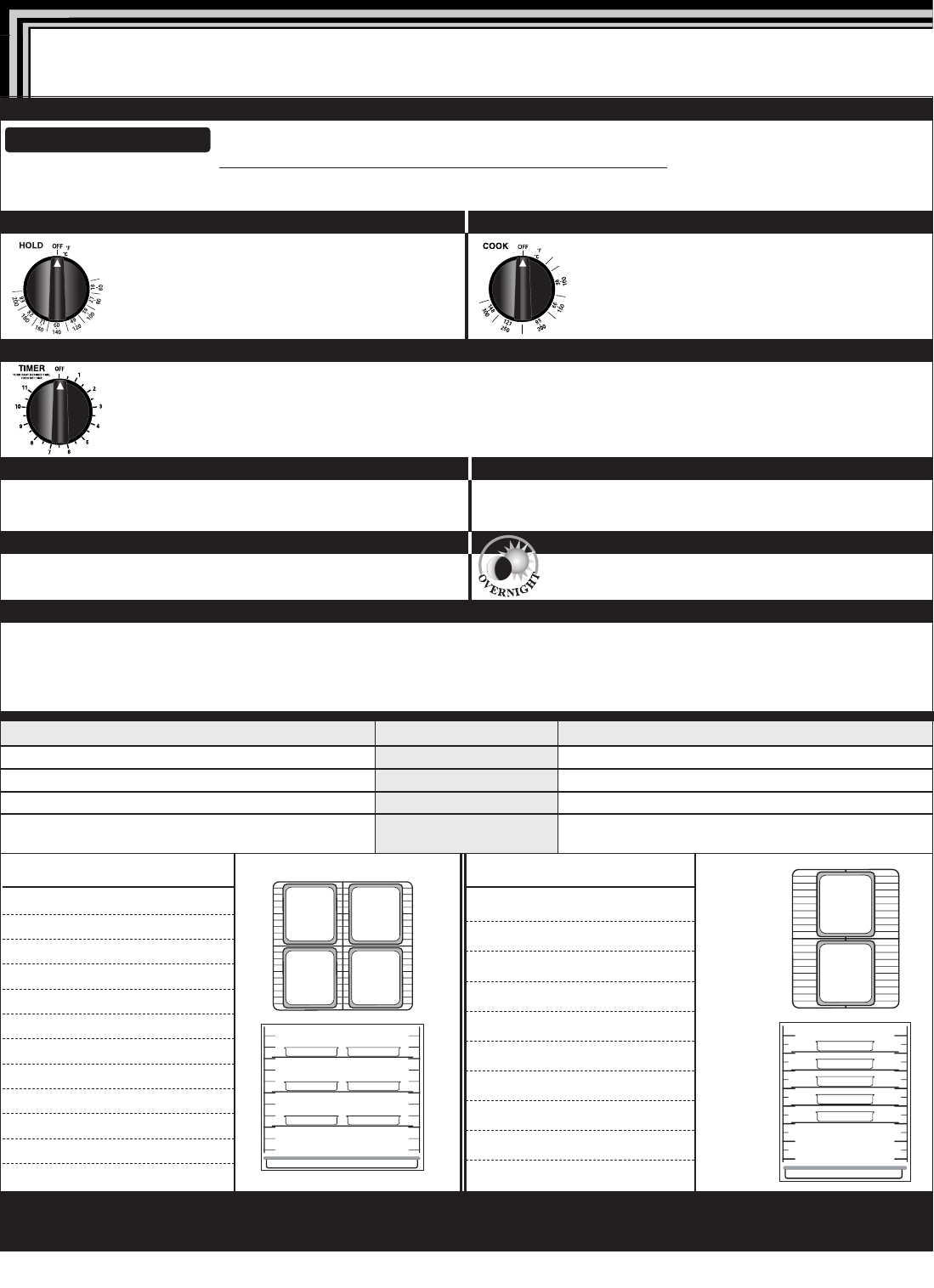
PRODUCT MUST BE FULLY FROZEN WHEN PLACED IN A PREHEATED OVEN.
Leave product in original container with foil cover in place.*
Pour 1/2 gallon (1 liter) of hot water into the drip pan located on the bottom surface of the oven compartment. Place
containers directly on wire shelves.
SECTION 4 • MISCELLANEOUS
54.
FROZEN CONVENIENCE ENTRÉES
140°F (60°C)*
* Frozen convenience entrées removed from the original food processor's intact packaging must be treated as a product
for reheating. Products for reheating must reach an internal product temperature of 165°F (74°C) for the amount of
time specified by local health (hygiene) regulations.
none 16 to 18 hours
160°F
(71°C)
275°F
(135°C)
The time and temperature are suggested guidelines only. All cooking should be based on internal product temperatures.
Due to variations in product quality, weight and desired degree of doneness, the cooking timer may need to be adjusted accordingly.
Always follow local health (hygiene) regulations for all internal temperature requirements.
P R O D U C T S P E C I F I C AT I O N S a n d P R E PA R AT I O N
S E T H O L D T H E R M O S TAT S E T C O O K T H E R M O S TAT
S E T C O O K I N G T I M E R
MINIMUM HOLDING TIME REQUIRED MAXIMUM HOLDING TIME
A D D I T I O N A L I N F O R M AT I O N • N O T E S
F I N A L I N T E R N A L P R O D U C T T E M P E R A T U R E O V E R N I G H T C O O K & H O L D
TIME REQUIRED IN “HOLD” CYCLE BEFORE SERVING.
P R E H E AT T H E O V E N
DOOR VENTS: CLOSED
Optional
SEE PAN PLACEMENT DIAGRAMS AND TIMER SETTINGS LISTED BELOW.
COOKING GUIDELINES
750 S E R I E S 1 0 0 0 SERIES
3 5
4 foil half-size pans 2 foil half-size pans
12 foil half-size pans 10 foil half-size pans
NUMBER OF SHELVES
ITEMS PER SHELF
MAXIMUM CAPACITY
3
6
9
DRIP PAN
QUANTITY TIMER SETTING
HALF-PANS TOTAL HOURS
1 2 hours, 30 minutes
2 2 hours, 45 minutes
3 3 hours, 30 minutes
4 3 hours, 30 minutes
5 4 hours, 00 minutes
6 4 hours, 30 minutes
7 5 hours, 00 minutes
8 5 hours, 00 minutes
9 6 hours, 40 minutes
10 7 hours, 25 minutes
11 7 hours, 25 minutes
12 7 hours, 25 minutes
QUANTITY TIMER SETTING
HALF-PANS TOTAL HOURS
1 2 hours, 45 minutes
2 3 hours, 00 minutes
3 3 hours, 00 minutes
4 3 hours, 45 minutes
5 4 hours, 00 minutes
6 4 hours, 40 minutes
7 5 hours, 00 minutes
8 5 hours, 00 minutes
9 6 hours, 00 minutes
10 6 hours, 00 minutes
TOP VIEW
MODELS
➞
3
5
7
DRIP PAN
9
11
TOP VIEW
➞
4-1/4 qts: 10" x 12" x 2-1/2"
(3,75 ltr: 265 x 325 x 65mm GN 1/2)
4-1/4 qts: 10" x 12" x 2-1/2"
(3,75 ltr: 265 x 325 x 65mm GN 1/2)
PANS
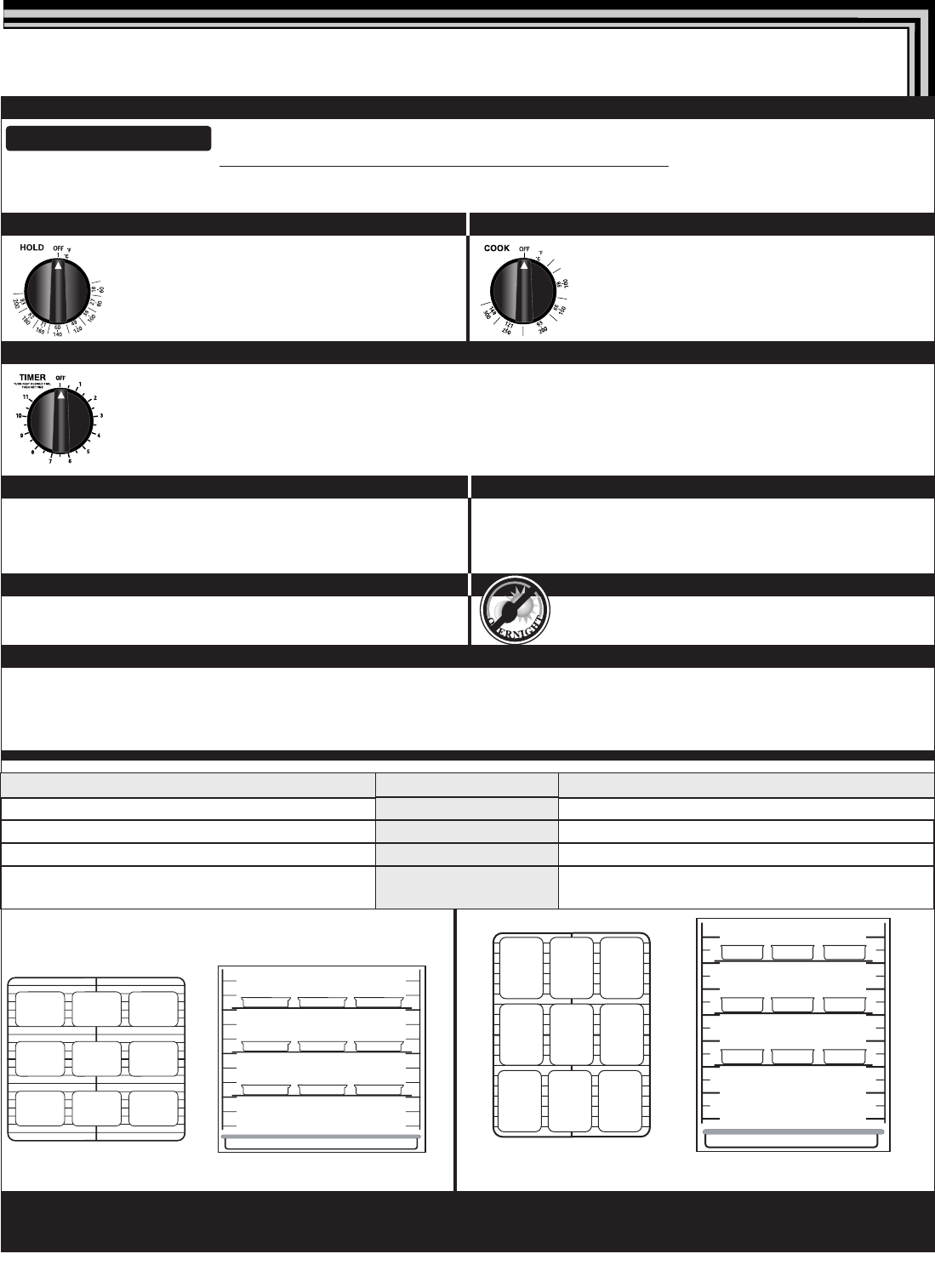
DOOR VENTS: CLOSED
PRODUCT MUST BE FULLY FROZEN WHEN PLACED IN A PREHEATED OVEN.
Leave product in original container with foil cover in place.*
Pour 1/2 gallon (1 liter) of hot water into the drip pan located on the bottom surface of the oven compartment. Place
containers directly on wire shelves.
SECTION 4 • MISCELLANEOUS
55.
FROZEN PORTIONED CONVENIENCE ENTRÉES
140°F (60°C)*
* Frozen convenience entrées removed from the original food processor's intact packaging must be treated as a product
for reheating. Products for reheating must reach an internal product temperature of 165°F (74°C) for the amount of
time specified by local health (hygiene) regulations.
none 4 hours
160°F
(71°C)
275°F
(135°C)
The time and temperature are suggested guidelines only. All cooking should be based on internal product temperatures.
Due to variations in product quality, weight and desired degree of doneness, the cooking timer may need to be adjusted accordingly.
Always follow local health (hygiene) regulations for all internal temperature requirements.
P R O D U C T S P E C I F I C AT I O N S a n d P R E PA R AT I O N
SE T H O L D T H E R M O S TAT S E T C O O K T H E R M O S TAT
S E T C O O K I N G T I M E R
MINIMUM HOLDING TIME REQUIRED MAXIMUM HOLDING TIME
A D D I T I O N A L I N F O R M AT I O N • N O T E S
F I N A L I N T E R N A L P R O D U C T T E M P E R A T U R E O V E R N I G H T C O O K & H O L D
TIME REQUIRED IN “HOLD” CYCLE BEFORE SERVING.
P R E H E AT T H E O V E N
Not Recommended
APPROXIMATELY 2 HOURS. SEE PAN PLACEMENT DIAGRAMS SHOWN BELOW.
DO NOT OVER-COOK — CHECK INTERNAL PRODUCT TEMPERATURE.
COOKING GUIDELINES
3
6
9
DRIP PAN
3
7
DRIP PAN
11
750 SERIES 1 0 0 0 S E R I E S
3 3
9 9
NUMBER OF SHELVES
ITEMS PER SHELF
MODELS
➞
➞
27 27
MAXIMUM CAPACITY
7-3/4" x 5" — 9 to 13 oz
(197mm x 127mm — 255 to 369 gm)
7-3/4" x 5" — 9 to 13 oz
(197mm x 127mm — 255 to 369 gm)
PANS
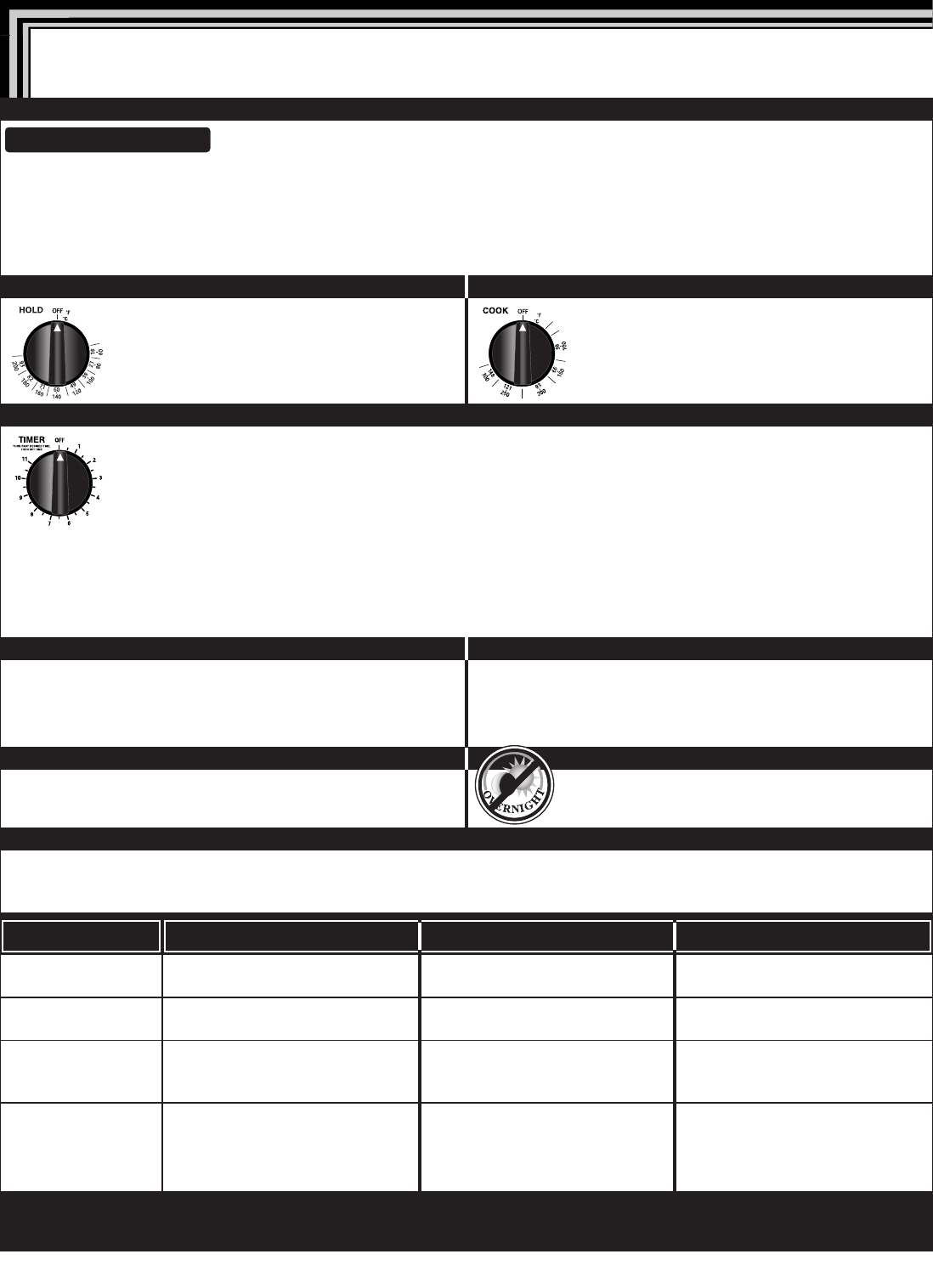
CHICKEN NUGGETS: Approximately 40 per full-size sheet pan
CORN DOGS: Approximately 30 per full-size sheet pan
EGG ROLLS: Approximately 40 per full-size sheet pan
MINI PIZZA: Approximately 12 to 15 per full-size sheet pan
Line sheet pans with baking pan liners (optional) and insert wire pan grid.
Place items side-by-side on the wire pan grids.
SECTION 4 • MISCELLANEOUS
56.
PRECOOKED FROZEN FINGER FOODS
5 0 0 S E R I E S 7 5 0 S E R I E S 1 0 0 0 S E R I E S
M O D E L S
NUMBER OF SHELVES
ITEMS PER SHELF
APPROXIMATE
MAXIMUM CAPACITY
PANS
150°F (66°C)
Product may be heated from a refrigerated or frozen state. Cooking time must be adjusted accordingly.
none Maximum holding time varies from product to product.
Generally expect a 1 to 3 hour maximum holding time for
product acceptability.
160°F
(71°C)
275°F
(135°C)
35none
1 half-size sheet pan 1 full-size sheet pan 1 full-size sheet pan
3 half-size sheet pans 5 full-size sheet pans 5 full-size sheet pans
18" x 13" x 1"
(GN 1/1: 530 x 325 x 20mm)
(NO SHELVES REQUIRED)
18" x 26" x 1"
(GN 2/1: 530 x 650 x 20mm)
(NO SHELVES REQUIRED)
18" x 26" x 1"
(GN 1/1: 530 x 325 x 20mm)
(ON WIRE SHELVES)
The time and temperature are suggested guidelines only. All cooking should be based on internal product temperatures.
Due to variations in product quality, weight and desired degree of doneness, the cooking timer may need to be adjusted accordingly.
Always follow local health (hygiene) regulations for all internal temperature requirements.
P R O D U C T S P E C I F I C AT I O N S a n d P R E PA R AT I O N
S E T H O L D T H E R M O S TAT S E T C O O K T H E R M O S TAT
S E T C O O K I N G T I M E R
MINIMUM HOLDING TIME REQUIRED MAXIMUM HOLDING TIME
A D D I T I O N A L I N F O R M AT I O N • N O T E S
F I N A L I N T E R N A L P R O D U C T T E M P E R AT U R E O V E R N I G H T C O O K & H O L D
TIME REQUIRED IN “HOLD” CYCLE BEFORE SERVING.
CAPACITIES ARE BASED ON U.S.
PAN SIZES.GASTRONORM PANS
MAY HOLD MORE OR LESS THAN
THE FOOD QUANTITIES INDICATED.
P R E H E AT T H E O V E N
DOOR VENTS: OPEN FULL
Not Recommended
MAKE CERTAIN PRODUCT REACHES THE FULLY HEATED TEMPERATURE. CHECK INTERNAL PRODUCT
TEMPERATURE BEFORE REMOVING PRODUCT FROM OVEN AND ADJUST HEATING TIME AS REQUIRED.
COOKING GUIDELINES
CORN DOGS
30 to 45 minutes
EGG ROLL
CHICKEN NUGGETS
45 to 60 minutes
MINI PIZZA
60 minutes
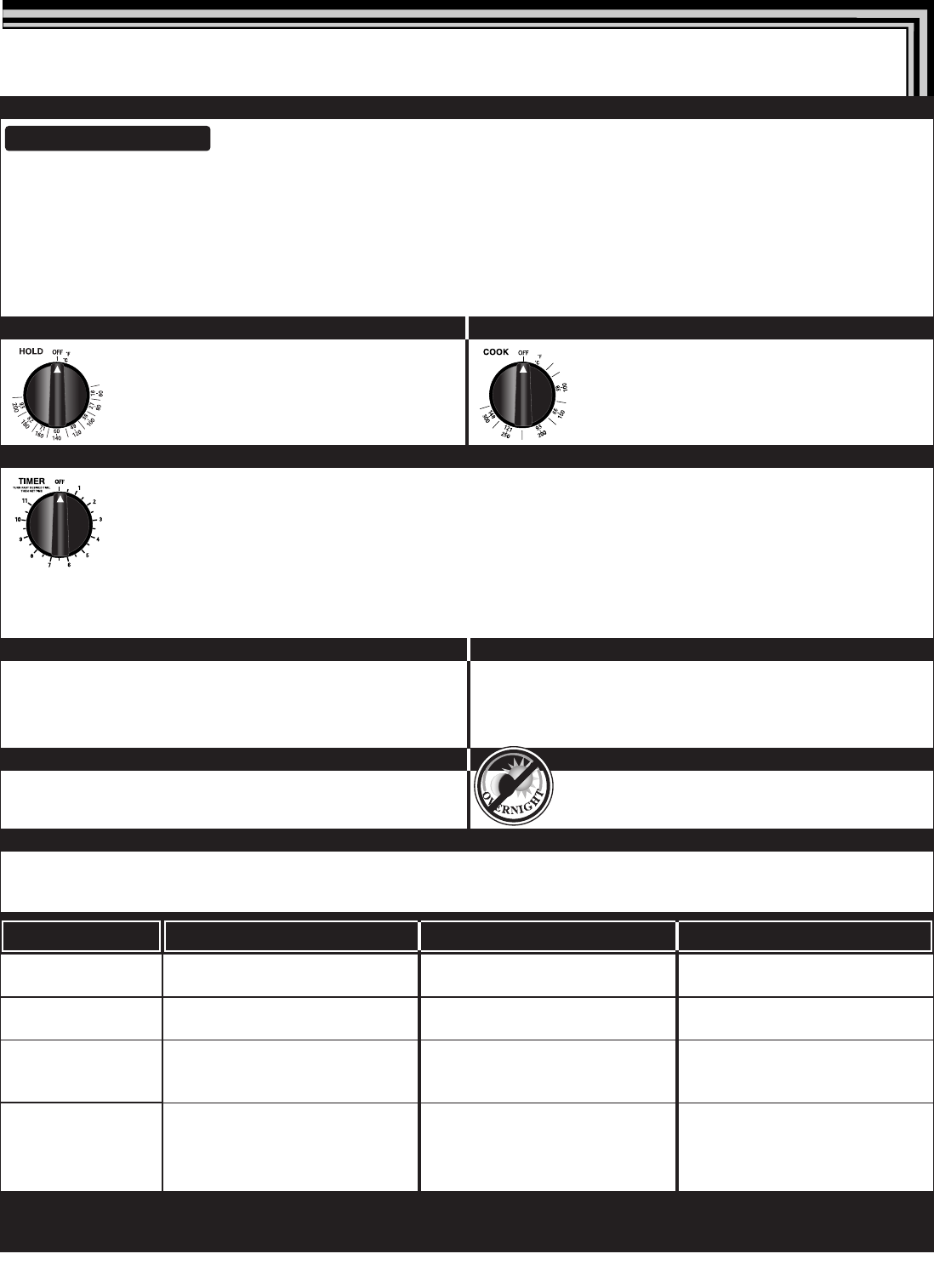
Approximately 36 wrapped sandwiches per full-size sheet pan.
SECTION 4 • MISCELLANEOUS
57.
BREAKFAST SANDWICHES, FRESH OR PRE MADE
5 0 0 S E R I E S 750 S E R I E S 1000 SERIES
M O D E L S
NUMBER OF SHELVES
ITEMS PER SHELF
APPROXIMATE
MAXIMUM CAPACITY
PANS
160°F (66°C)
Product may be heated from a refrigerated or frozen state. Cooking time must be adjusted accordingly
none 2 to 3 hours
160°F
(71°C)
275°F
(135°C)
33none
1 half-size sheet pan 1 full-size sheet pan 1 full-size sheet pan
3 half-size sheet pans 3 full-size sheet pans 5 full-size sheet pans
18" x 13" x 1"
(GN 1/1: 530 x 325 x 20mm)
(NO SHELVES REQUIRED)
18" x 26" x 1"
(GN 2/1: 530 x 650 x 20mm)
(NO SHELVES REQUIRED)
18" x 26" x 1"
(GN 1/1: 530 x 325 x 20mm)
(ON WIRE SHELVES)
The time and temperature are suggested guidelines only. All cooking should be based on internal product temperatures.
Due to variations in product quality, weight and desired degree of doneness, the cooking timer may need to be adjusted accordingly.
Always follow local health (hygiene) regulations for all internal temperature requirements.
P R O D U C T S P E C I F I C AT I O N S a n d P R E PA R AT I O N
S E T H O L D T H E R M O S TAT S E T C O O K T H E R M O S TAT
S E T C O O K I N G T I M E R
MINIMUM HOLDING TIME REQUIRED MAXIMUM HOLDING TIME
A D D I T I O N A L I N F O R M AT I O N • N O T E S
F I N A L I N T E R N A L P R O D U C T T E M P E R AT U R E O V E R N I G H T C O O K & H O L D
TIME REQUIRED IN “HOLD” CYCLE BEFORE SERVING.
CAPACITIES ARE BASED ON U.S.
PAN SIZES.GASTRONORM PANS
MAY HOLD MORE OR LESS THAN
THE FOOD QUANTITIES INDICATED.
P R E H E AT T H E O V E N
DOOR VENTS: OPEN FULL
Not Recommended
90 minutes
MAKE CERTAIN PRODUCT REACHES THE FULLY HEATED TEMPERATURE. CHECK INTERNAL
PRODUCT TEMPERATURE BEFORE REMOVING PRODUCT FROM OVEN AND ADJUST HEATING TIME AS REQUIRED.
COOKING GUIDELINES
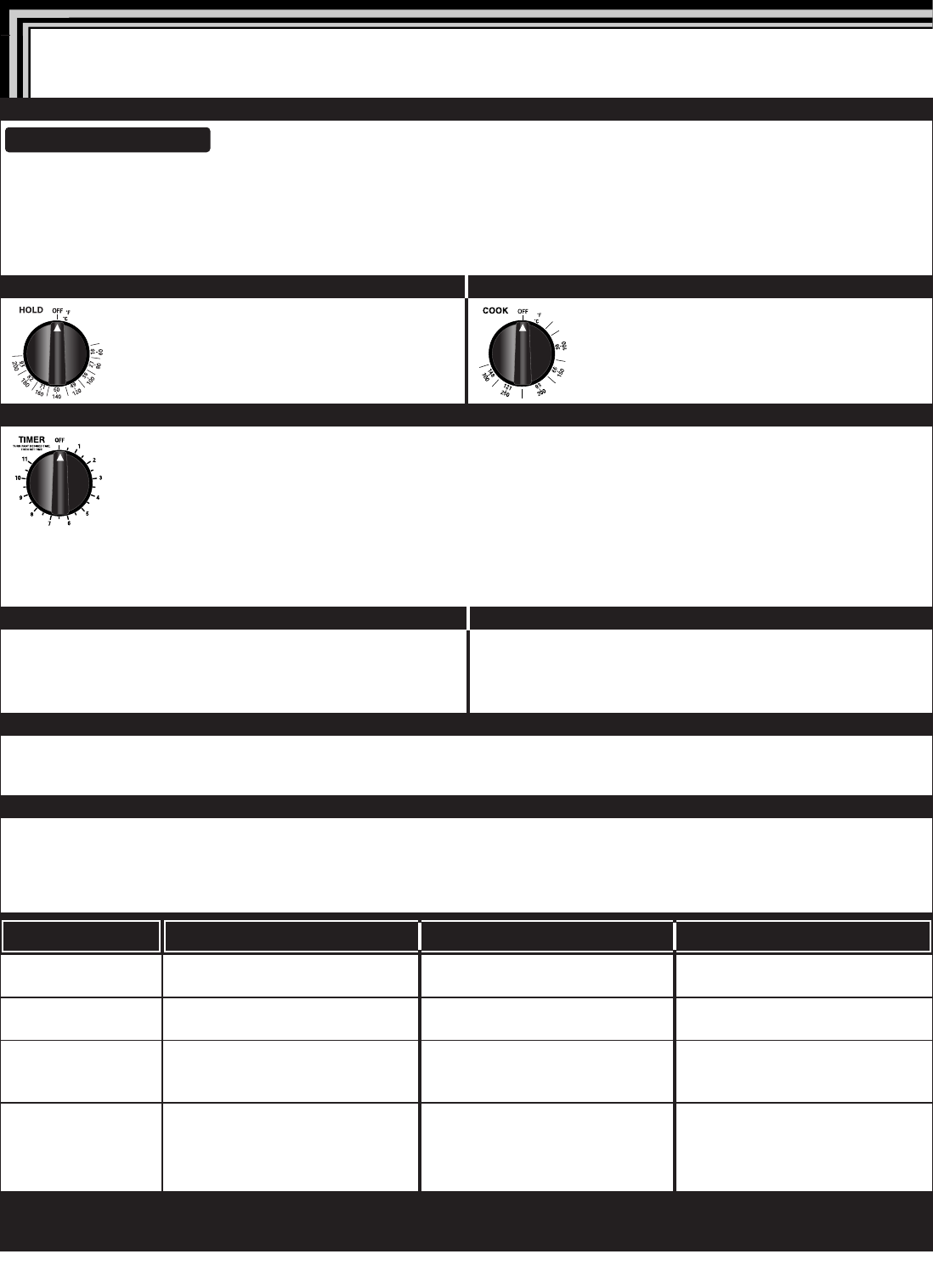
Premixed frozen commercial cookie dough at room temperature.
Premixed commercial frozen cookie dough pieces.
Preheat oven at 325°F (163°C) for a minimum of one hour. Line full-size sheet pans with baking pan liners. Use a
number 30 scoop to produce a 1 oz (28 gm) cookie. Evenly space portioned cookie dough on sheet pans and load all
pans in the oven at one time. Oven doors must remain closed during baking. DO NOT OVER-BAKE.
Approximate pan capacity: 24 cookies per full-size sheet pan
SECTION 4 • MISCELLANEOUS
58.
COOKIES
5 0 0 S E R I E S 7 5 0 S E R I E S 1 0 0 0 S E R I E S
M O D E L S
NUMBER OF SHELVES
ITEMS PER SHELF
APPROXIMATE
MAXIMUM CAPACITY
PANS
N/A
Cookies will continue to bake for approximately 3 minutes after being removed from the oven. Take this factor into
consideration to prevent over-baking. Place cookies on bakery rack for cooling.
none none
—325°F
(163°C)
66none
1 half-size sheet pan 1 full-size sheet pan 1 full-size sheet pan
6 half-size sheet pans 6 full-size sheet pans 8 full-size sheet pans
18" x 13" x 1"
(GN 1/1: 530 x 325 x 20mm)
(NO SHELVES REQUIRED)
18" x 26" x 1"
(GN 2/1: 530 x 650 x 20mm)
(NO SHELVES REQUIRED)
18" x 26" x 1"
(GN 1/1: 530 x 325 x 20mm)
(ON WIRE SHELVES)
The time and temperature are suggested guidelines only. All cooking should be based on internal product temperatures.
Due to variations in product quality, weight and desired degree of doneness, the cooking timer may need to be adjusted accordingly.
Always follow local health (hygiene) regulations for all internal temperature requirements.
P R O D U C T S P E C I F I C AT I O N S a n d P R E PA R AT I O N
S E T H O L D T H E R M O S TAT S E T C O O K T H E R M O S TAT
S E T C O O K I N G T I M E R
MINIMUM HOLDING TIME REQUIRED MAXIMUM HOLDING TIME
A D D I T I O N A L I N F O R M AT I O N • N O T E S
FINAL INTERNAL PRODUCT TEMPERATURE
TIME REQUIRED IN “HOLD” CYCLE BEFORE SERVING.
CAPACITIES ARE BASED ON U.S.
PAN SIZES.GASTRONORM PANS
MAY HOLD MORE OR LESS THAN
THE FOOD QUANTITIES INDICATED.
P R E H E AT T H E O V E N
DOOR VENTS: OPEN FULL
FRESH: 1 full-size sheet pan: 20 minutes • 2 to 3 full-size sheet pans: 45 minutes
FROZEN: 1 full-size sheet pan: 30 minutes • 2 to 3 full-size sheet pans: 45 to 60 minutes
COOKING GUIDELINES
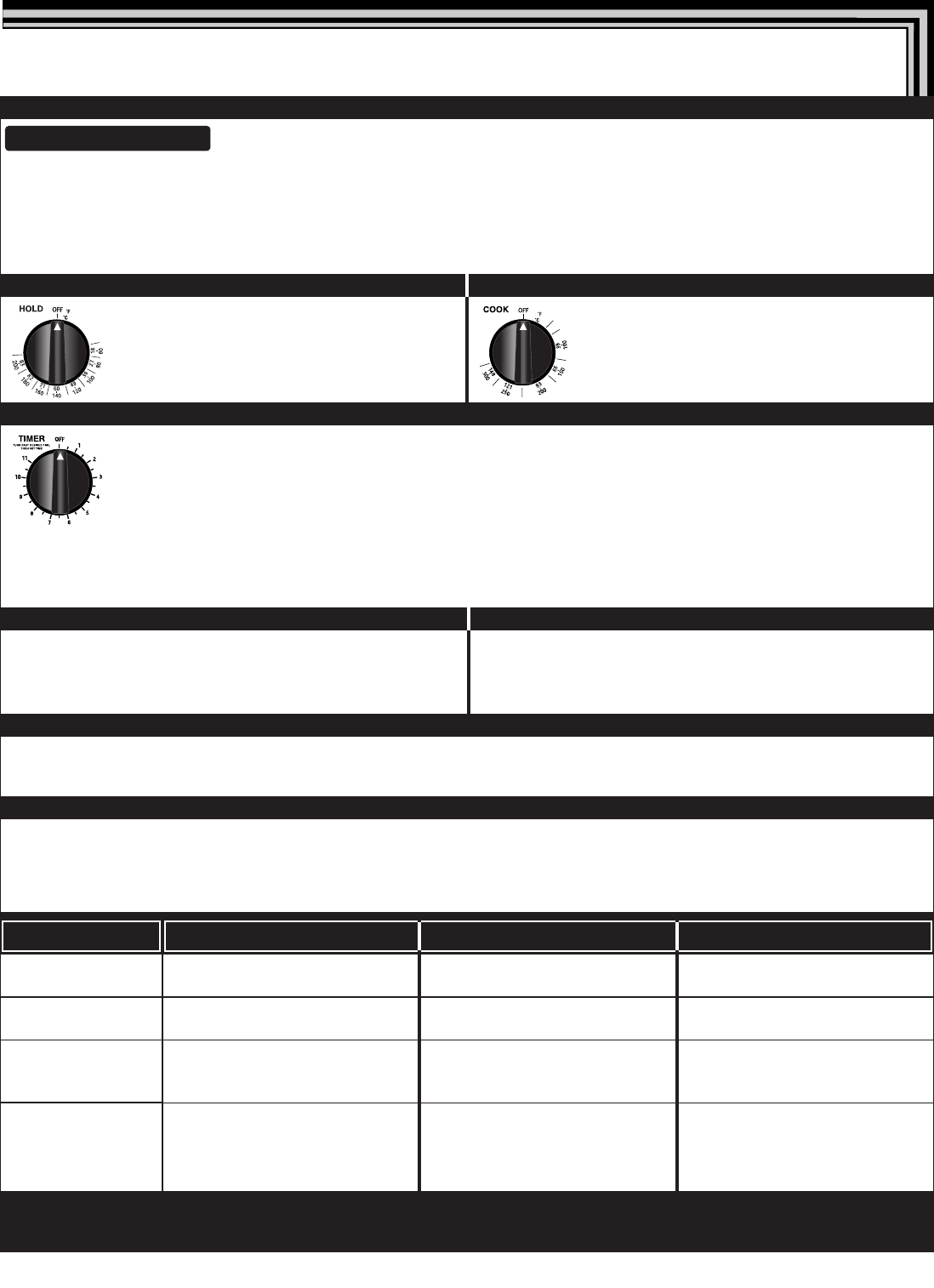
Frozen Precooked Doughnuts
Line sheet pans with baking pan liners and insert wire pan grid. Evenly space doughnuts on wire grids. Doughnuts can
be heated from a thawed or fully frozen state. For more even heating, place pans with solid doughnuts toward the top
of the oven compartment and doughnuts with holes toward the bottom of the compartment.
Approximate pan capacity: 30 doughnuts per full-size sheet pan
SECTION 4 • MISCELLANEOUS
59.
DOUGHNUTS
5 0 0 S E R I E S 750 S E R I E S 1000 SERIES
M O D E L S
NUMBER OF SHELVES
ITEMS PER SHELF
APPROXIMATE
MAXIMUM CAPACITY
PANS
100° to 110°F (38° to 43°C)
Remove from oven as soon as the required internal temperature has been reached. Glaze while still warm. Immediately place
glazed doughnuts in a heated display case.
none 4 to 6 hours
in Halo Heat display case.
N/A 275°F
(135°C)
44none
1 half-size sheet pan 1 full-size sheet pan 1 full-size sheet pan
4 half-size sheet pans 4 full-size sheet pans 8 full-size sheet pans
18" x 13" x 1"
(GN 1/1: 530 x 325 x 20mm)
(NO SHELVES REQUIRED)
18" x 26" x 1"
(GN 2/1: 530 x 650 x 20mm)
(NO SHELVES REQUIRED)
18" x 26" x 1"
(GN 1/1: 530 x 325 x 20mm)
(ON WIRE SHELVES)
The time and temperature are suggested guidelines only. All cooking should be based on internal product temperatures.
Due to variations in product quality, weight and desired degree of doneness, the cooking timer may need to be adjusted accordingly.
Always follow local health (hygiene) regulations for all internal temperature requirements.
P R O D U C T S P E C I F I C AT I O N S a n d P R E PA R AT I O N
SE T H O L D T H E R M O S TAT S E T C O O K T H E R M O S TAT
S E T C O O K I N G T I M E R
MINIMUM HOLDING TIME REQUIRED MAXIMUM HOLDING TIME
A D D I T I O N A L I N F O R M AT I O N • N O T E S
FINAL INTERNAL PRODUCT TEMPERATURE
TIME REQUIRED IN “HOLD” CYCLE BEFORE SERVING.
CAPACITIES ARE BASED ON U.S.
PAN SIZES.GASTRONORM PANS
MAY HOLD MORE OR LESS THAN
THE FOOD QUANTITIES INDICATED.
P R E H E AT T H E O V E N
DOOR VENTS: OPEN FULL
45 to 60 minutes
MAKE CERTAIN PRODUCT REACHES THE FULLY HEATED TEMPERATURE. CHECK INTERNAL PRODUCT
TEMPERATURE BEFORE REMOVING PRODUCT FROM OVEN AND ADJUST HEATING TIME AS REQUIRED.
COOKING GUIDELINES
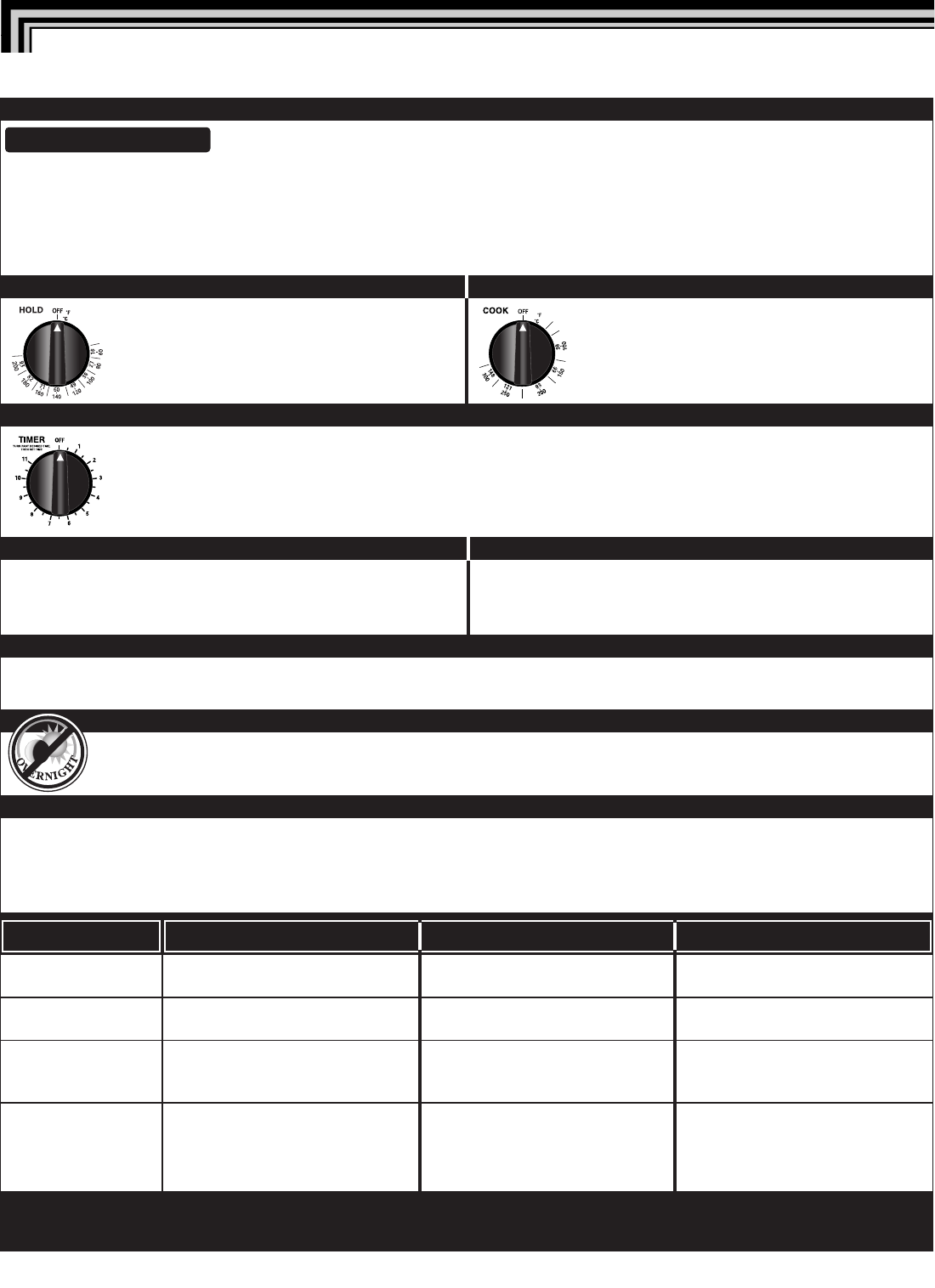
Remove dough from retarder or refrigerator, and allow covered product to set up at room temperature.
Preheat oven for 45-60 Minutes.
Pour approximately 2 quarts (c. 2 liters) of hot water, 140-180°F (60-82°C) into a pan on the bottom surface of the
holding compartment.
SECTION 4 • MISCELLANEOUS
60.
PROOFING DOUGH
5 0 0 S E R I E S 7 5 0 S E R I E S 1 0 0 0 S E R I E S
M O D E L S
NUMBER OF SHELVES
ITEMS PER SHELF
APPROXIMATE
MAXIMUM CAPACITY
PANS
N/A
The above proofing procedure is suggested as a general guideline only. Due to variations in product, product quality,
and weight, adherence to the product manufacturer's instructions are recommended.
20 Minutes 45 Minutes
90-110°F
(32-43°C) —
448
1 muffin pans (12 cup capacity) 2 muffin pans (12 cup capacity) 2 muffin pans (12 cup capacity)
4 muffin pans 8 muffin pans 16 muffin pans
15-3/4" x 11" x 1-1/4" 15-3/4" x 11" x 1-1/4" 15-3/4" x 11" x 1-1/4""
The time and temperature are suggested guidelines only. All cooking should be based on internal product temperatures.
Due to variations in product quality, weight and desired degree of doneness, the cooking timer may need to be adjusted accordingly.
Always follow local health (hygiene) regulations for all internal temperature requirements.
P R O D U C T S P E C I F I C AT I O N S a n d P R E PA R AT I O N
S E T H O L D T H E R M O S TAT S E T C O O K T H E R M O S TAT
S E T C O O K I N G T I M E R
MINIMUM HOLDING TIME REQUIRED MAXIMUM HOLDING TIME
A D D I T I O N A L I N F O R M AT I O N • N O T E S
FINAL INTERNAL PRODUCT TEMPERATURE
O V E R N I G H T C O O K & H O L D
TIME REQUIRED IN “HOLD” CYCLE BEFORE SERVING.
CAPACITIES ARE BASED ON U.S.
PAN SIZES.GASTRONORM PANS
MAY HOLD MORE OR LESS THAN
THE FOOD QUANTITIES INDICATED.
P R E H E AT T H E O V E N
DOOR VENTS: ONE-HALF OPEN
No
—
COOKING GUIDELINES

SECTION 4 • MISCELLANEOUS
61.
NOTES
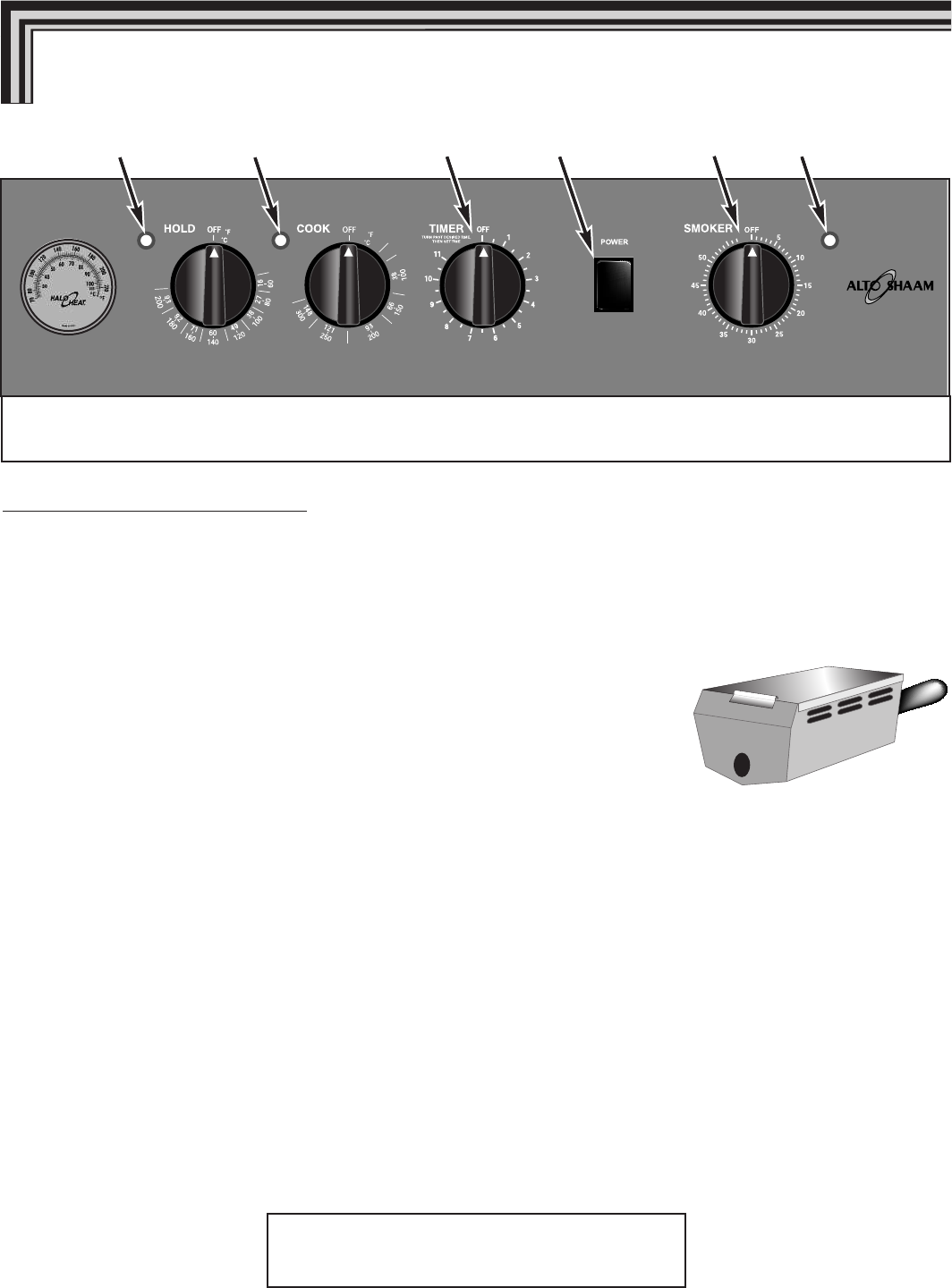
SECTION 5 • LOW TEMPERATURE COOKING &SMOKING OPERATION
62.
SMOKER OPERATION
CONTROLS AND INDICATORS
1. Turn upper oven POWER SWITCH 쐄“ON.”
A. POWER “ON” INDICATOR SWITCH will illuminate and will remain lit as long as the oven Power
Switch is in the “ON” position.
2. Load wood chips.
A. Measure approximately one container load of dry chips
B. In a separate container, soak the dry chips in water for 5 minutes.
C. Shake excess water off wood chips.
D. Place moistened chips in the container and insert the container on the
element located on interior back panel of the smoker.
3. Set HOLD THERMOSTAT 쐇to the required holding temperature.
A. HOLDING INDICATOR LIGHT will illuminate as the Hold Thermostat calls for heat. This process
will continue as long as the Power Switch and Hold Thermostat are “ON.”
4. Set the COOK THERMOSTAT 쐋to required cooking temperature.
5. To preheat the oven, activate the Cook Thermostat by turning the COOKING TIMER 쐏clockwise.
A. COOKING INDICATOR LIGHT and HOLDING INDICATOR LIGHT will illuminate as the Cook
Thermostat calls for heat. This process will continue until the COOKING TIMER cycles or is turned
to the “OFF” position.
6. Activate the smoking function by turning the SMOKER TIMER 쐂clockwise to the required smoking time.
A. SMOKING INDICATOR LIGHT will illuminate. This process will continue until the SMOKER
TIMER cycles or is turned to the “OFF” position.
I
o
I
o
®
SMOKING OVEN CONTROL PANEL
햲햶
HOLDING
INDICATOR
LIGHT
COOKING
INDICATOR
LIGHT
POWER “ON”
INDICATOR
SWITCH
SMOKER
TIMER
SMOKING
INDICATOR
LIGHT
COOKING
TIMER
TEMPERATURE GAUGE 쐃will indicate the
air temperature inside the oven compartment.
햳
HOLD THERMOSTAT
햴
COOK THERMOSTAT
햵
COOKING TIMER
햷
SMOKING TIMER
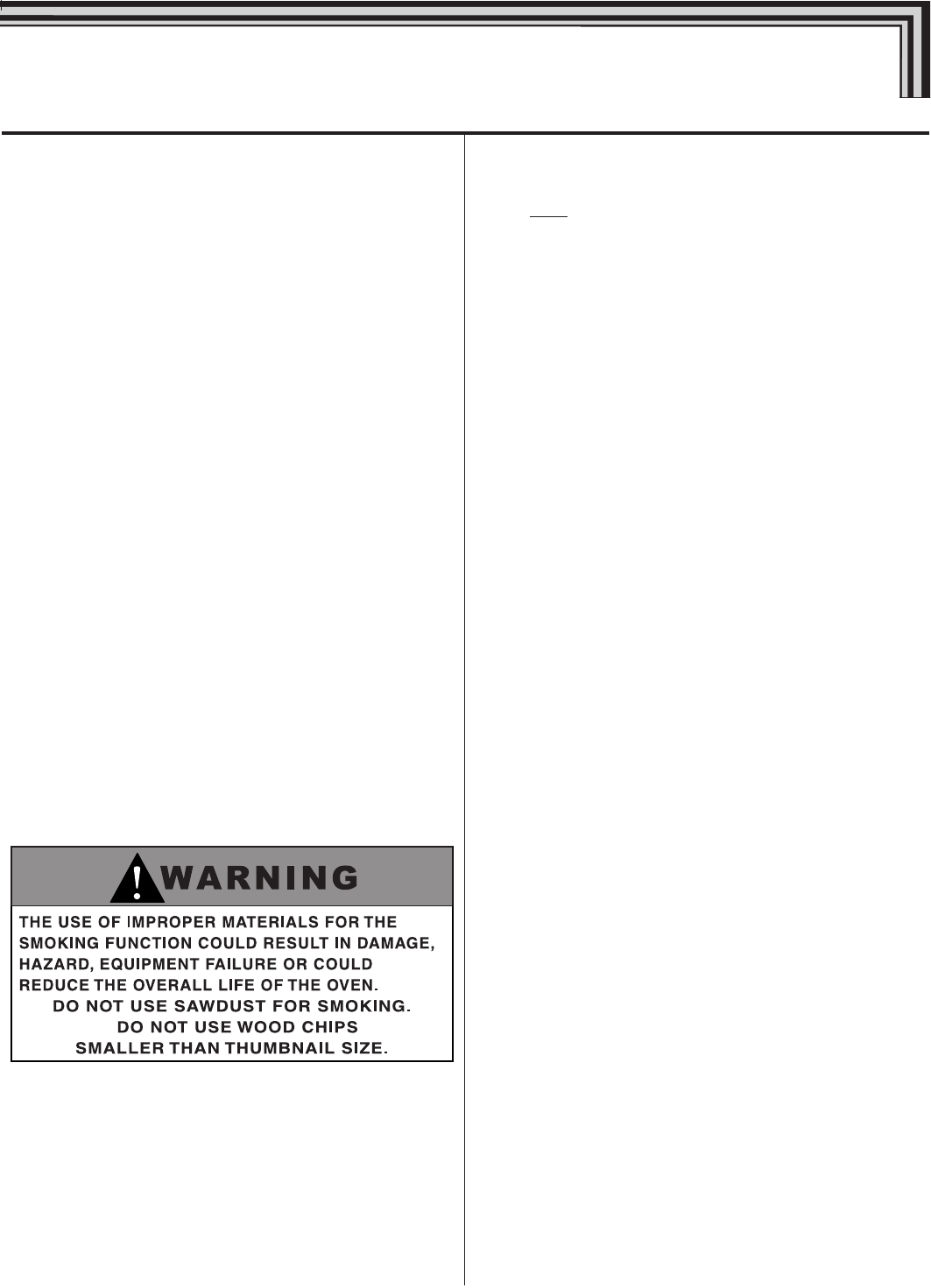
SECTION 5 • LOW TEMPERATURE COOKING &SMOKING OPERATION
63.
SMOKER OPERATION
1. PREPARE OVEN FOR COOKING
A. Insert and adjust the required number of
shelves inside the cooking cavity. Insert each
shelf with curved edge of the shelf toward
the back of the oven.
B. Adjust the inside door vents as indicated in
the individual cooking procedure selected.
C. Insert drip pan on the bottom surface of the
oven cavity.
2. PREHEAT OVEN
A. Turn power switch “ON”.
B. Set “HOLD”thermostat to required holding
temperature.
C. Set “COOK”thermostat to required cooking
temperature.
D. Turn timer knob clockwise to activate “COOK”
thermostat.
E. Allow oven to preheat 45 minutes.
3. PREPARE PRODUCT FOR COOKING
A. Refer to individual cooking instructions.
4. LOAD PRODUCT ON SHELVES
A. Refer to individual cooking instructions. Do
NOT overload the oven.
B. Most meat products are cooked directly on
wire shelves. For many products, the use of
pans is not recommended.
5. LOAD WOOD CHIPS
A. Take one container load of dry wood chips
and soak the chips in water for 5 minutes.
B. Shake excess water off wood chips.
C. Remove Wood Chip Container from the
interior back panel of the smoker. Place the
moistened chips in the Wood Chip Container
and replace the container in the oven.
6. CLOSE DOOR
A. Keep door closed during the cooking and
smoking cycle.
7. RESET COOKING TIMER
FOR CORRECT NUMBER OF HOURS
A. To set cooking time, turn the timer knob past
the required number of hours then
immediately bring it back to the correct
setting.
B. Refer to individual cooking instructions for
length of time necessary to cook.
C. When timer cycles to the “OFF”position, the
temperature automatically lowers to the
selected “HOLD”temperature.
D. The product must remain in the oven, at the
selected “HOLD”temperature, for the
minimum number of hours indicated in the
individual cooking instructions.
CONTINUED
COOKING/SMOKING/HOLDING PROCEDURES — MANUAL OVENS
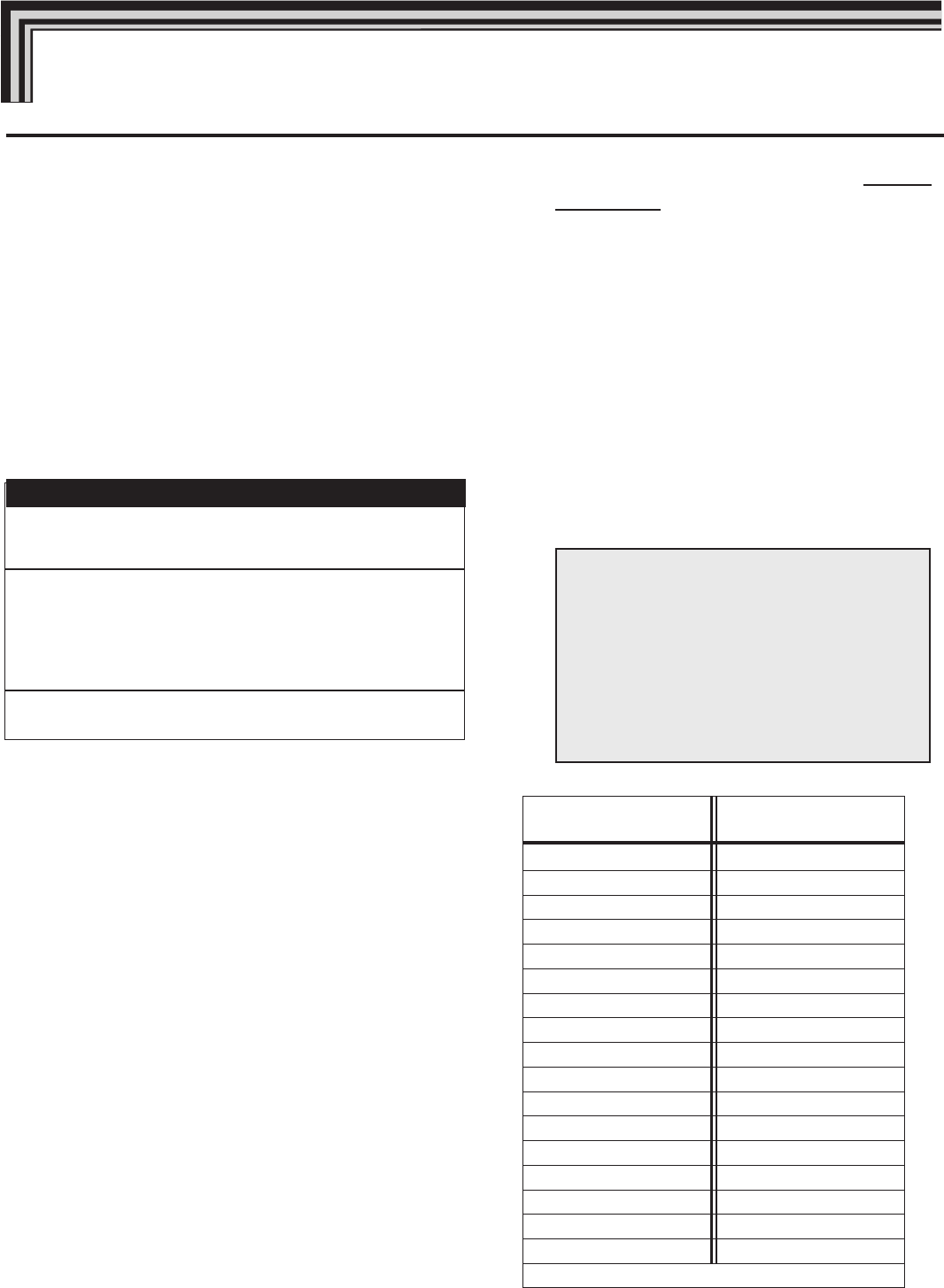
SECTION 5 • LOW TEMPERATURE COOKING &SMOKING OPERATION
64.
SMOKER OPERATION
8. SET SMOKING TIMER
A. The Smoking Timer activates the heating
element located within the Wood Chip
Container. When the Wood Chip Container
is full, and the Smokeing Timer is turned
clockwise as far as it will turn, the wood
chips will smoke for approximately forty-
five minutes to one hour.
B. To set smoking time, turn the Smoking
Timer knob past the required length of
time, then immediately bring it back to
the correct setting.
9. OVERNIGHT COOK AND HOLD
A. For maximum product tenderizing and to
reduce labor during peak preparation
hours, it is highly recommended that many
products be cooked and held overnight.
Refer to individual cooking instructions.
10. DETERMINING IF PRODUCT
IS SUFFICIENTLY COOKED
A. Allow “COOK” timer to cycle to the
“OFF” position.
B. Before opening the oven door, leave the
product in the “HOLD”cycle for a minimum
one hour. This time period will allow the
oven temperature to decrease from the
“COOK”setting to the selected “HOLD”
temperature. During this one hour period,
the product will continue to cook and
smoke will continue to penetrate into the
food.
C. Insert a thermometer into the center of the
product to determine if the correct internal
temperature has been reached.
D. When following the procedures in the
individual product cooking instructions,
additional cooking time should not be
necessary. If, however, the required
internal product temperature has not been
reached after the product has remained in
the “HOLD”cycle for the one hour minimum
time period, additional cooking time may
be added. Use the same “COOK”
temperature set for the original cooking
period until the correct internal
temperature has been reached.
SMOKING TIMES
It is recommended the operator be familiar with the
taste preferences of the area. Initially experimenting
with a minimal amount of smoking time is suggested.
LIGHT SMOKE FLAVOR . . . 10 MINUTES
MEDIUM SMOKE FLAVOR . . . 30 MINUTES
HEAVY SMOKE FLAVOR . . . 40 MINUTES
VERY HEAVY SMOKE FLAVOR . . . 60 MINUTES*
EXTRA HEAVY SMOKE FLAVOR . . . 120 MINUTES*
*FOR 60 MINUTES OR MORE: LOAD WOOD CHIP
CONTAINER TWICE AND ACTIVATE SMOKING TIMER TWICE.
COOKING/SMOKING/HOLDING PROCEDURES — MANUAL OVENS
In the United States, FDA food code requires
products such as red meat to remain in
“HOLD” for a specified time period. This
holding time requirement is based on the
internal product temperature desired for the
finished product and includes the one hour
time period while the oven decreases from
the cooking temperature to the holding
temperature and the product continues to cook.
INTERNAL PRODUCT
TEMPERATURE
TIME*IN HOLD CYCLE
REQUIRED BY FOOD CODE
130°F (54°C) 1 HOUR, 52 MINUTES
131°F (55°C) 1 HOUR, 29 MINUTES
133°F (56°C) 56 MINUTES
135°F (57°C) 36 MINUTES
136°F (58°C) 28 MINUTES
138°F (59°C) 18 MINUTES
140°F (60°C) 12 MINUTES
142°F (61°C) 8 MINUTES
144°F (62°C) 5 MINUTES
145°F (63°C) 4 MINUTES
147°F (64°C) 2 MINUTES, 14 SECONDS
149°F (65°C) 1 MINUTES, 25 SECONDS
151°F (66°C) 54 SECONDS
153°F (67°C) 34 SECONDS
155°F (68°C) 22 SECONDS
157°F (69°C) 14 SECONDS
158°F (70°C) 0 SECONDS
*HOLDING TIME MAY INCLUDE POST-OVEN HEAT RISE
SECTION 5 • LOW TEMPERATURE COOKING &SMOKING OPERATION
65.
SMOKER OPERATION
1 1 . R E H E AT I N G
A. Any overproduction must be removed from
the oven, wrapped, quickly chilled, and
refrigerated. Product can be removed from
refrigeration and returned to the oven for
reheating the next day.
B. Products must be reheated at a temperature
range of 250°F to 275°F (121°C to 135°C).
Refer to individual cooking instructions for
the correct thermostat setting for the
product being reheated.
C. Length of time necessary to reheat a
product depends on the type of product and
the quantity to be reheated. Time should be
based on internal product temperature. Use
a pocket thermometer to sense the internal
product temperature of the reheated
product. Follow local health (hygiene)
regulations for the internal temperature
required for reheated products.
1 2 . S M O K I N G P R O C E D U R E O P T I O N S :
Many of the procedures listed in the front section of
this guide can be adapted to the Alto-Shaam Smoker.
1. Follow the load capacities for the 750 series ovens.
2. Follow the cooking and holding temperatures and
times listed.
3. Set the Smoking Timer for the amount of smoke
flavor desired.
A.ONE-STEP COOKING:
After the cook timer cycles to the “OFF”
position and the minimum number of hours in
the HOLD cycle have elapsed, the product may
remain ON HOLD until serving time.
B.TWO-STEP COOKING:
Remove product from the oven after the
minimum number of hours in the HOLD cycle.
Chill product quickly and prepare for
refrigerated storage. Refrigerated product can
be sauced and finished on a char-broiler, in a
convection oven, a combination oven/steamer
or in a salamander for a la carte service. This
process takes between 8 and 15 minutes and
insures a tender, juicy and fresh tasting
product. When using cook/chill processing
techniques, products have an extended storage
life of 5 days which includes the day of
preparation and the day of service.
COOKING/SMOKING/HOLDING PROCEDURES — MANUAL OVENS
United Sates food code requirements indicate
cooked foods that have been cooled, followed
by reheating for hot food holding, must be
reheated to 165°F (74°C). The temperature of
165°F (74°C) must be maintained for
a period of 15 seconds.
CARE and CLEANING
1. Disconnect the oven from the power source.
2. Clean oven cavity, wire shelves and drip pan daily,
at the end of each cook, smoke and hold cycle.
3. Refer to Care and Cleaning instructions in Section 3.
AT NO TIME SHOULD THE INTERIOR OR
EXTERIOR BE STEAM CLEANED, HOSED
DOWN, OR FLOODED WITH WATER OR
LIQUID SOLUTION OF ANY KIND. DO NOT
USE WATER JET TO CLEAN.
SEVERE DAMAGE OR ELECTRICAL HAZARD
COULD RESULT.
WARRANTY BECOMES VOID IF APPLIANCE IS FLOODED.
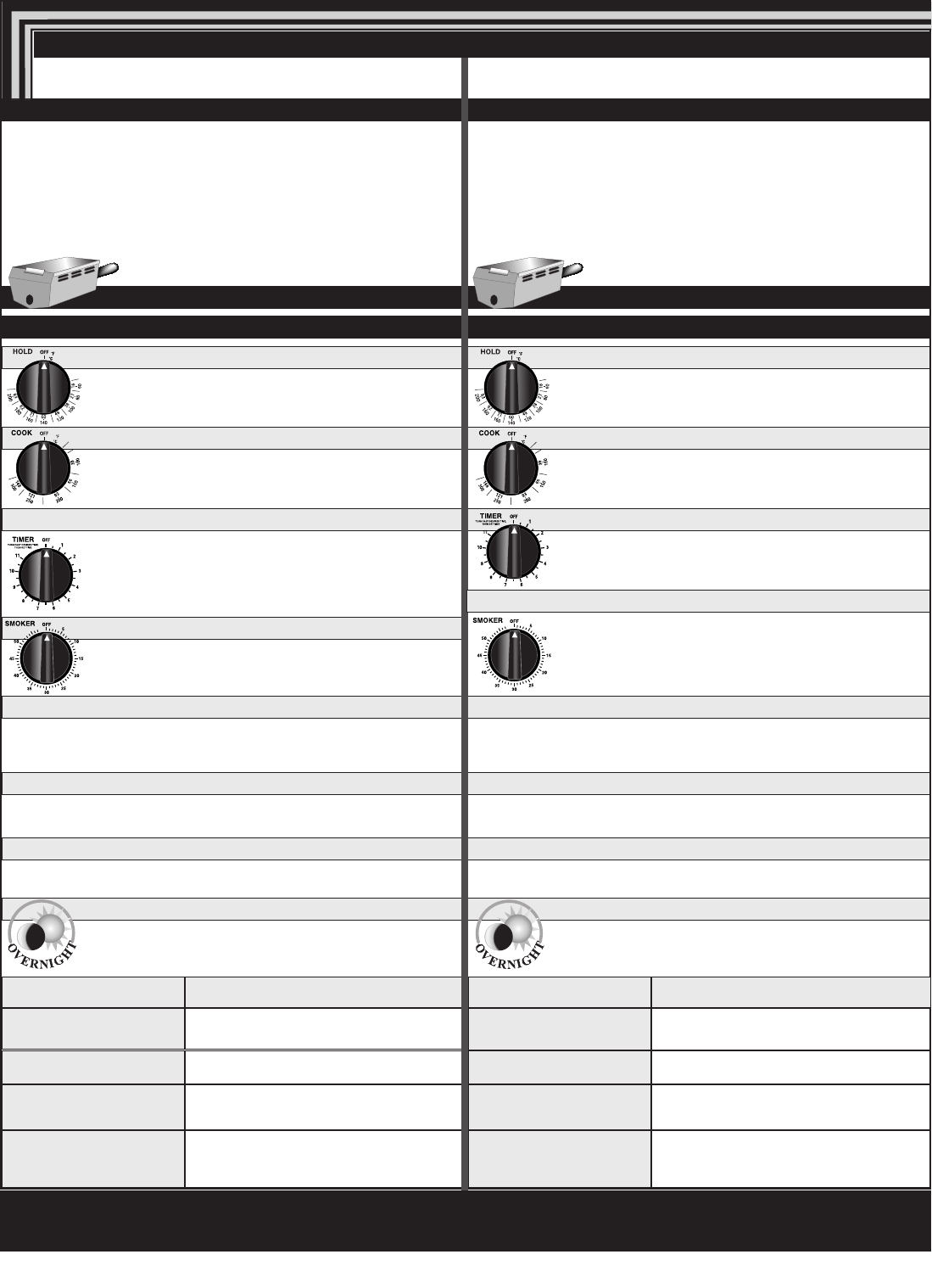
none
SECTION 6 • SMOKING PROCEDURES
66.
7 6 7 - S K & 1 7 6 7 - S KMODELS
NUMBER OF SHELVES
ITEMS PER SHELF
APPROXIMATE
MAXIMUM CAPACITY
PANS
Beef Brisket, Fresh: 9 to 13 lb (4 to 6 kg)
Season brisket as desired. Place brisket directly on wire
shelves fat side down. Briskets can also be wrapped in
clear plastic wrap for the cooking, smoking, and holding
function (OPTIONAL).
20 minutes per pound for the first roast
(44 minutes per kilogram)
plus
add 30 minutes for each additional roast
165°F (73°C)
Highly Recommended
Due to the density of the meat, set smoke timer
for one hour to achieve a medium smoke flavor.
6 hours
24 hours
160°F
(71°C)
250°F
(121°C)
3 per compartment
12 roasts - up to 100 lb (45 kg)
per compartment
3 to 4 roasts
PRODUCT SPECIFICATIONS and PREPARATION
DOOR VENTS: CLOSED
SET HOLD THERMOSTAT
SET COOK THERMOSTAT
SET COOKING TIMER
MINIMUM HOLDING TIME REQUIRED
MAXIMUM HOLDING TIME
FINAL INTERNAL PRODUCT TEMPERATURE
OVERNIGHT COOK & HOLD
SET SMOKING TIMER
TIME REQUIRED IN "HOLD" CYCLE BEFORE SERVING.
WOOD CHIP CONTAINER: FULL
12" x 20" x 2-1/2" (GN 1/1)
2 pans in top shelf position
2 pans in 7th shelf position
SMOKED BEEF TONGUE
7 6 7 - S K & 1 7 6 7 - S KMODELS
NUMBER OF SHELVES
ITEMS PER SHELF
APPROXIMATE
MAXIMUM CAPACITY
PANS
Beef Tongue: 3-1/4 lb (1,5 kg) average
Leave skin on tongue for cooking. Season as desired and
place side-by-side in pans. Following the cooking cycle,
tongues must remain in the HOLD cycle for four (4) hours.
Remove product from pans, skin tongues and return them
to the smoker, directly on the wire shelves.
4-1/2 hours for the first pan
PLUS: add 30 minutes for each additional pan.
Before activating the Smoking Timer: 188°F (87°C)
Optional
After cooking and minimum holding time, leave
oven set at a holding temperature of 150°F (66°C).
SET SMOKING TIMER:30 minutes for one pan
60 minutes for four pans
4 hours
8 hours
150°F
(66°C)
250°F
(121°C)
-0- for cooking / 2 for smoking
per compartment
20 beef tongues - 65 lb (30 kg)
per compartment
5 tongues per pan
PRODUCT SPECIFICATIONS and PREPARATION
DOOR VENTS: CLOSED
SET HOLD THERMOSTAT
SET COOK THERMOSTAT
SET COOKING TIMER
MINIMUM HOLDING TIME REQUIRED
M A X I M U M H O L D I N G T I M E
FINAL INTERNAL PRODUCT TEMPERATURE
OV E R N I G H T C O O K & H O L D
TIME REQUIRED IN "HOLD" CYCLE BEFORE SERVING.
WOOD CHIP CONTAINER: FULL
The time and temperature are suggested guidelines only. All cooking should be based on internal product temperatures.
Due to variations in product quality, weight, and desired degree of doneness, the cooking timer may need to be adjusted accordingly.
Always follow local health (hygiene) regulations for all internal temperature requirements.
SET SMOKING TIMER
SMOKED BEEF BRISKET
COOKING & SMOKING GUIDELINES
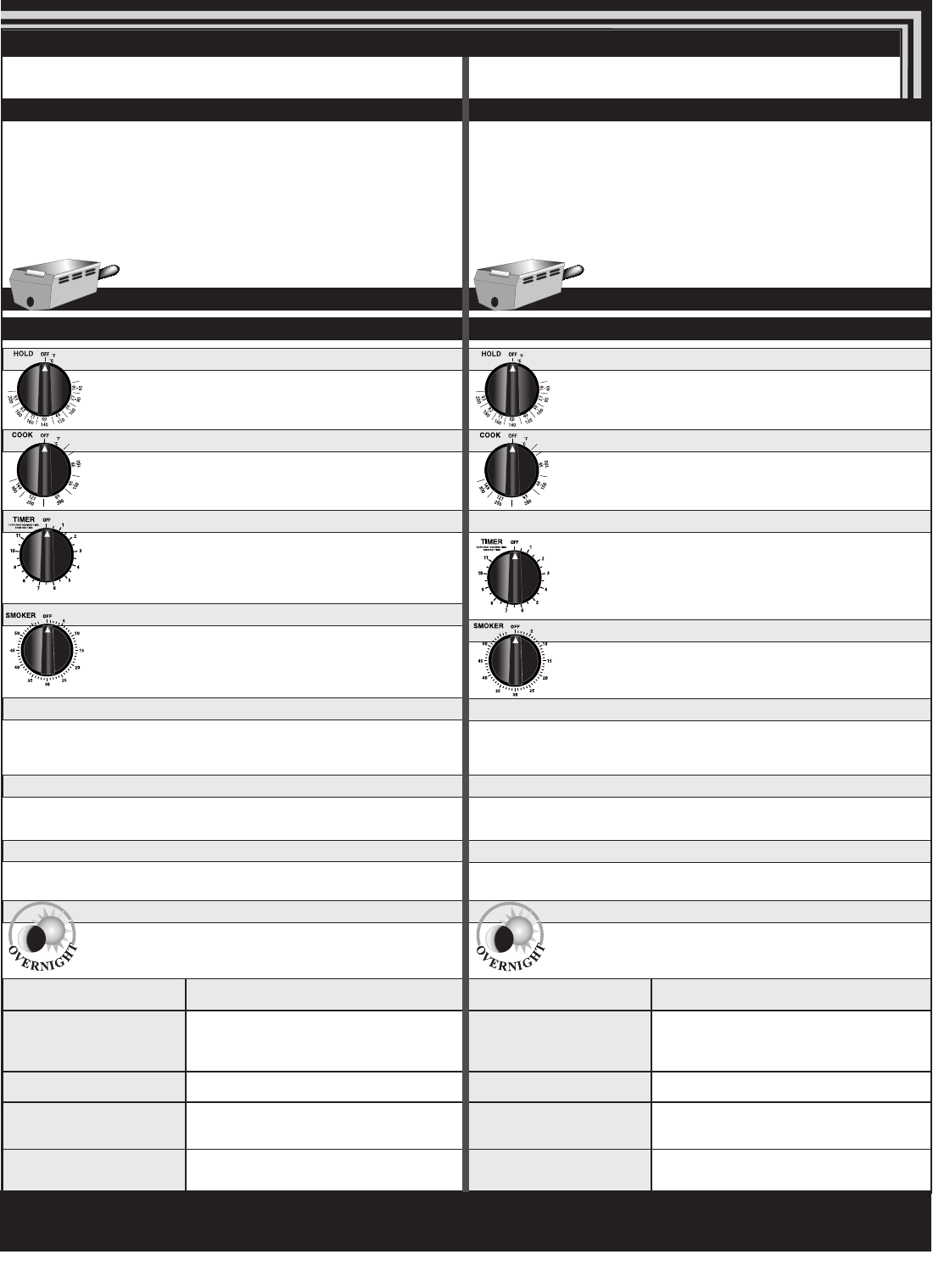
SECTION 6 • SMOKING PROCEDURES
67.
none
SMOKED FRESH HAMS
7 6 7 - S K & 1 7 6 7 - S KMODELS
NUMBER OF SHELVES
ITEMS PER SHELF
APPROXIMATE
MAXIMUM CAPACITY
PANS
Pork Fresh Ham: 14 to 17 lb (6 to 8 kg)
Season as desired and place directly on wire shelves.
12 minutes per pound for the first ham
(26 minutes per kilogram)
PLUS:add 30 minutes for each additional ham.
100°F (71°C)
Optional
2 hours
10 hours
160°F
(71°C)
250° to 275°F
(121° to 135°C)
2 per compartment
6 to 8 hams - up to 100 lb (45 kg)
per compartment
3 to 4 hams
PRODUCT SPECIFICATIONS and PREPARATION
DOOR VENTS: CLOSED
SET HOLD THERMOSTAT
SET COOK THERMOSTAT
SET COOKING TIMER
MINIMUM HOLDING TIME REQUIRED
MAXIMUM HOLDING TIME
FINAL INTERNAL PRODUCT TEMPERATURE
OVERNIGHT COOK & HOLD
TIME REQUIRED IN "HOLD" CYCLE BEFORE SERVING.
WOOD CHIP CONTAINER: FULL
18” x 26” x 1” WITH WIRE SHELVES
(GN 2/1 x 20mm NO SHELVES)
SMOKED PORK RIBS
7 6 7 - S K & 1 7 6 7 - S KMODELS
NUMBER OF SHELVES
ITEMS PER SHELF
APPROXIMATE
MAXIMUM CAPACITY
PANS
Spareribs or Pork Loin, Back Ribs (BABY BACK RIBS):
1-1/2 down (38 mm or less)
Ribs can be cooked frozen or thawed. Season as desired.
Place ribs on sheet pans, slightly overlapping or use rib rack
shelves for more even smoke penetration. If desired,
barbecue sauce can be included with initial seasoning to
allow it to cook into the ribs.
THAWED RIBS: 2-1/2 to 3-1/2 hours
FROZEN RIBS: 3-1/2 to 4-1/2 hours
160° to 170°F (71° to 77°C) WELL DONE
Optional
1 hour for medium smoked flavor
1-1/2 hours
12 HOURS: At the end of the hold cycle, heated barbecue
sauce can be added to the ribs immediately before serving.
160°F
(71°C)
250°F
(121°C)
2 rib rack OR 3 flat wire shelves
13 slabs per rib rack shelf.
per compartment
60 lb (27 kg)
per compartment
14 to 18 slabs per flat wire shelf.
PRODUCT SPECIFICATIONS and PREPARATION
DOOR VENTS: CLOSED
SET HOLD THERMOSTAT
SET COOK THERMOSTAT
SET COOKING TIMER
MINIMUM HOLDING TIME REQUIRED
M A X I M U M H O L D I N G T I M E
FINAL INTERNAL PRODUCT TEMPERATURE
OVERNIGHT COOK & HOLD
SET SMOKING TIMER
TIME REQUIRED IN "HOLD" CYCLE BEFORE SERVING.
WOOD CHIP CONTAINER: FULL
The time and temperature are suggested guidelines only. All cooking should be based on internal product temperatures.
Due to variations in product quality, weight, and desired degree of doneness, the cooking timer may need to be adjusted accordingly.
Always follow local health (hygiene) regulations for all internal temperature requirements.
3 TO 4 SMOKING CYCLES*
1 hour for each smoking cycle
*FILL WOOD CHIP CONTAINER FOR EACH CYCLE
SET SMOKING TIMER
COOKING & SMOKING GUIDELINES
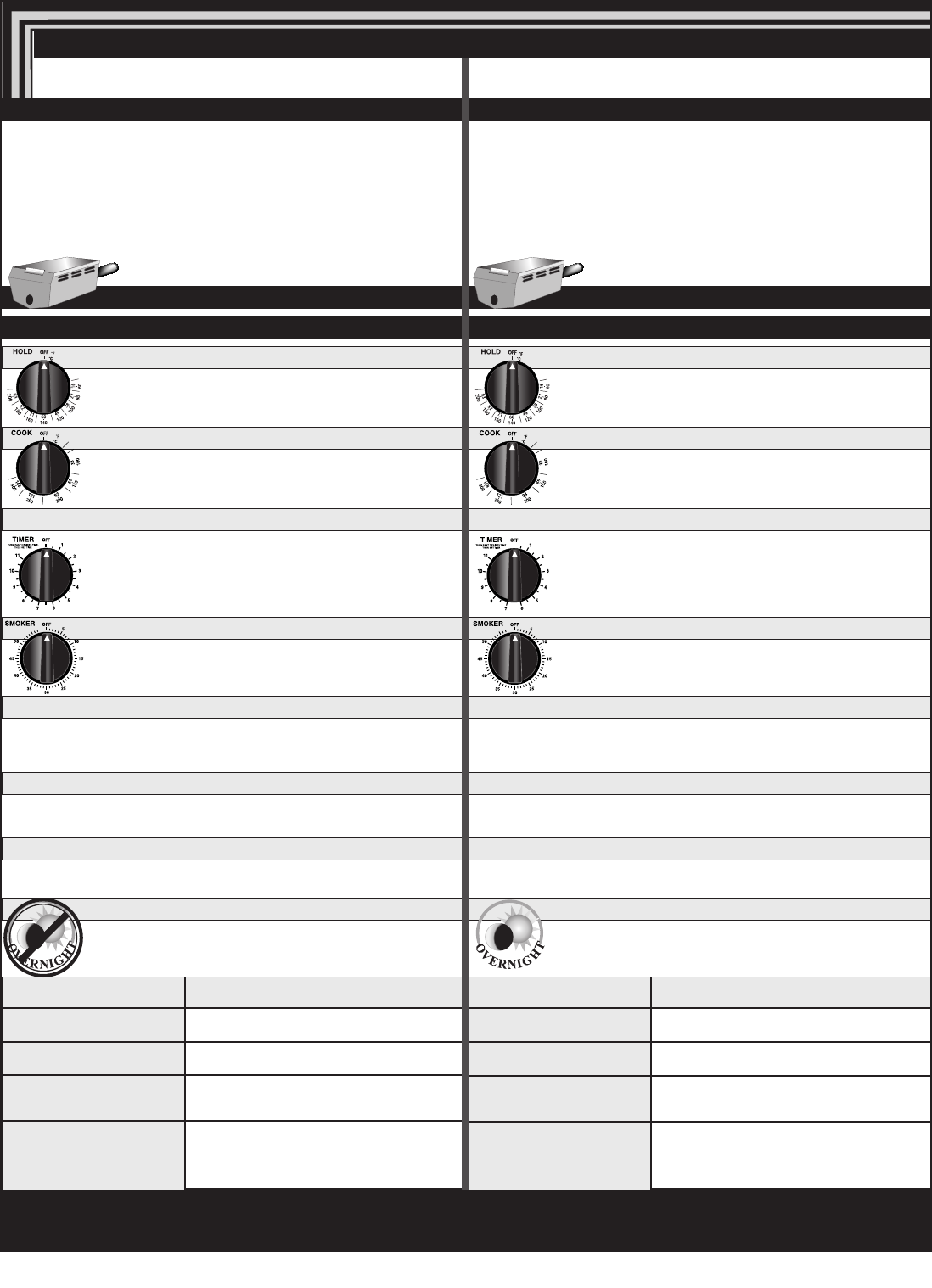
none
SECTION 6 • SMOKING PROCEDURES
68.
SMOKED DUCK
7 6 7 - S K & 1 7 6 7 - S KMODELS
NUMBER OF SHELVES
ITEMS PER SHELF
APPROXIMATE
MAXIMUM CAPACITY
PANS
Duck, Whole: 4 to 5 lb (2 kg)
Season as desired. Rub with oil and paprika. Place ducks
directly on wire shelves.
3-1/2 to 4 hours
185° to 190°F (85°to 88°C)
Not Recommended
1 hour
1 hour
8 hours
160°F
(71°C)
300°F
(149°C)
2 per compartment
12 ducks - 60 lb (27 kg)
per compartment
6 ducks per shelf
PRODUCT SPECIFICATIONS and PREPARATION
DOOR VENTS: CLOSED
SET HOLD THERMOSTAT
SET COOK THERMOSTAT
SET COOKING TIMER
MINIMUM HOLDING TIME REQUIRED
MAXIMUM HOLDING TIME
FINAL INTERNAL PRODUCT TEMPERATURE
OVERNIGHT COOK & HOLD
SET SMOKING TIMER
TIME REQUIRED IN "HOLD" CYCLE BEFORE SERVING.
WOOD CHIP CONTAINER: FULL
none
SMOKED TURKEY
7 6 7 - S K & 1 7 6 7 - S KMODELS
NUMBER OF SHELVES
ITEMS PER SHELF
APPROXIMATE
MAXIMUM CAPACITY
PANS
Turkey, Whole: 25 lb (11 kg)
Turkey must be fully thawed. Season as desired. Rub
with oil, butter, or margarine (optional). Place turkeys
directly on wire shelves.
10 minutes per pound for the first turkey
(22 minutes per kilogram)
plus
add 30 minutes for the second turkey.
185°F (85°C)
Highly Recommended. When cooking and holding
overnight, set the cook thermostat to 250°F (121°C).
1 hour
1 to 2 hours
10 hours
160°F
(71°C)
275°F
(135°F)
1 per compartment
2 turkeys
per compartment
2 turkeys
PRODUCT SPECIFICATIONS and PREPARATION
DOOR VENTS: CLOSED
SET HOLD THERMOSTAT
SET COOK THERMOSTAT
SET COOKING TIMER
MINIMUM HOLDING TIME REQUIRED
M A X I M U M H O L D I N G T I M E
FINAL INTERNAL PRODUCT TEMPERATURE
OV E R N I G H T C O O K & H O L D
SET SMOKING TIMER
TIME REQUIRED IN "HOLD" CYCLE BEFORE SERVING.
W O O D C H I P C O N TA I N E R : F U L L
The time and temperature are suggested guidelines only. All cooking should be based on internal product temperatures.
Due to variations in product quality, weight, and desired degree of doneness, the cooking timer may need to be adjusted accordingly.
Always follow local health (hygiene) regulations for all internal temperature requirements.
COOKING & SMOKING GUIDELINES
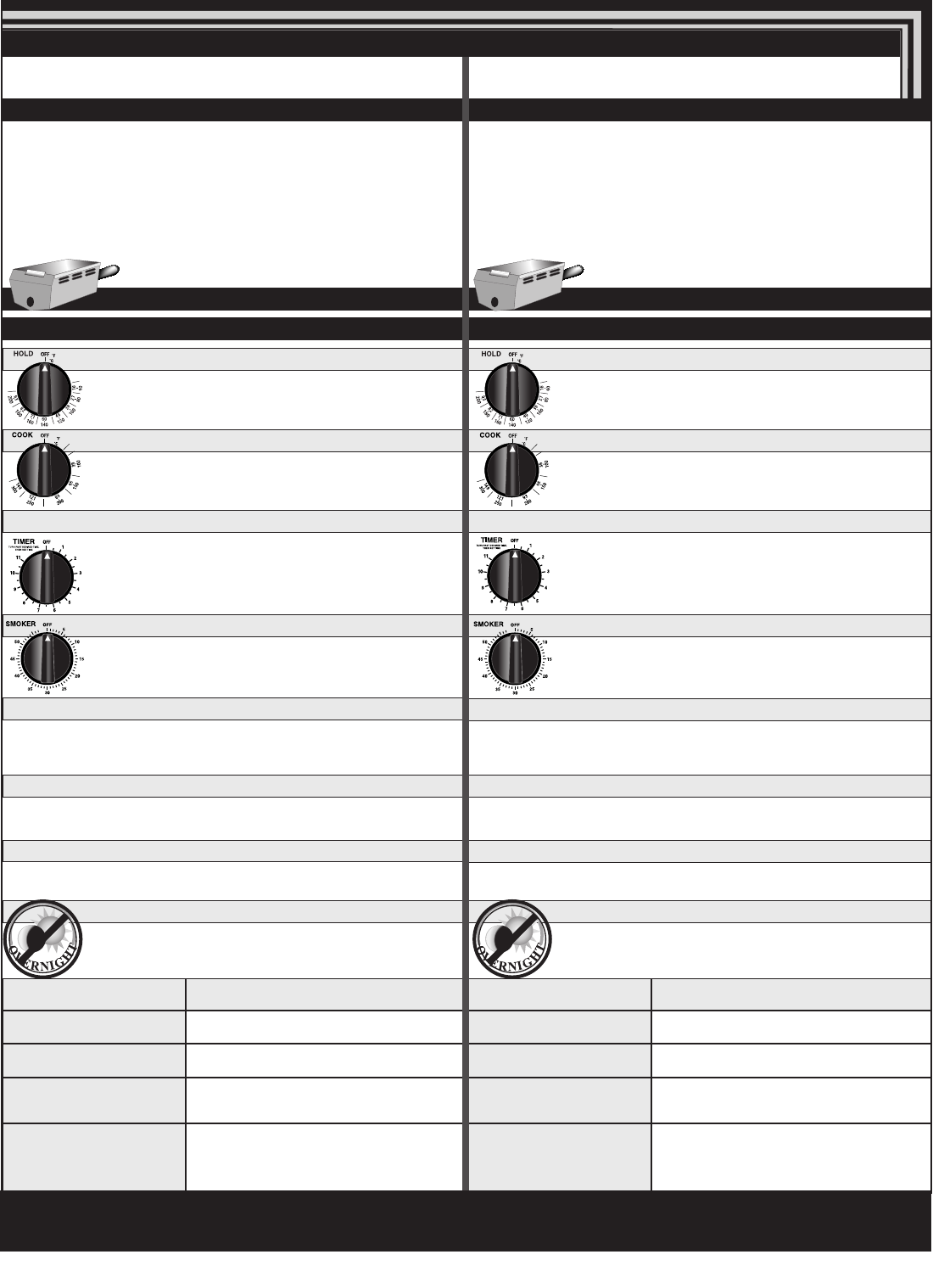
SECTION 6 • SMOKING PROCEDURES
69.
12" 20" x 2-1/2" (GN 1/1)
PAN PLACEMENT:Position 1, 4, & 7
FROM THE TOP OF THE OVEN
SMOKED FISH FILLETS
7 6 7 - S K & 1 7 6 7 - S KMODELS
NUMBER OF SHELVES
ITEMS PER SHELF
APPROXIMATE
MAXIMUM CAPACITY
PANS
Portion cut fish. Place fillets side-by-side .
*Haddock may be substituted.
1-1/2 to 2 hours
150°F (66°C)
Not Recommended
1 hour
none
3 to 4 hours
160°F
(71°C)
250°F
(121°C)
none
6 pans
per compartment
2 pans per shelf position
PRODUCT SPECIFICATIONS and PREPARATION
DOOR VENTS: CLOSED
SET HOLD THERMOSTAT
SET COOK THERMOSTAT
SET COOKING TIMER
MINIMUM HOLDING TIME REQUIRED
MAXIMUM HOLDING TIME
FINAL INTERNAL PRODUCT TEMPERATURE
OVERNIGHT COOK & HOLD
SET SMOKING TIMER
TIME REQUIRED IN "HOLD" CYCLE BEFORE SERVING.
WOOD CHIP CONTAINER: FULL
18" x 26" x 1"
(GN 2/1: 530 x 650 x 20mm)
NO SHELVES REQUIRED
WHOLE SMOKED SALMON
7 6 7 - S K & 1 7 6 7 - S KMODELS
NUMBER OF SHELVES
ITEMS PER SHELF
APPROXIMATE
MAXIMUM CAPACITY
PANS
Salmon, Whole: 8 to 10 lb (4 to 5 kg)
Scale and wash fish thoroughly.
If desired, fish can be placed in a salt brine and
refrigerated for 2 to 3 hours. Place fish upright on
sheet pans. DO NOT LAY FISH ON ITS SIDE.
2 to 2-1/2 hours
150°F (66°C)
Not Recommended
1 hour for mild smoke flavor
FILL WOOD CHIP CONTAINER TWICE AND SMOKE
2HOURS FOR HEAVY SMOKE FLAVOR
1 to 2 hours
10 hours
160°F
(71°C)
275°F
(135°C)
2 per compartment
3 full-size sheet pans - 6 whole salmon
per compartment
1 full-size sheet pan
PRODUCT SPECIFICATIONS and PREPARATION
DOOR VENTS: CLOSED
SET HOLD THERMOSTAT
SET COOK THERMOSTAT
SET COOKING TIMER
MINIMUM HOLDING TIME REQUIRED
M A X I M U M H O L D I N G T I M E
FINAL INTERNAL PRODUCT TEMPERATURE
OVERNIGHT COOK & HOLD
SET SMOKING TIMER
TIME REQUIRED IN "HOLD" CYCLE BEFORE SERVING.
WOOD CHIP CONTAINER: FULL
The time and temperature are suggested guidelines only. All cooking should be based on internal product temperatures.
Due to variations in product quality, weight, and desired degree of doneness, the cooking timer may need to be adjusted accordingly.
Always follow local health (hygiene) regulations for all internal temperature requirements.
COOKING & SMOKING GUIDELINES
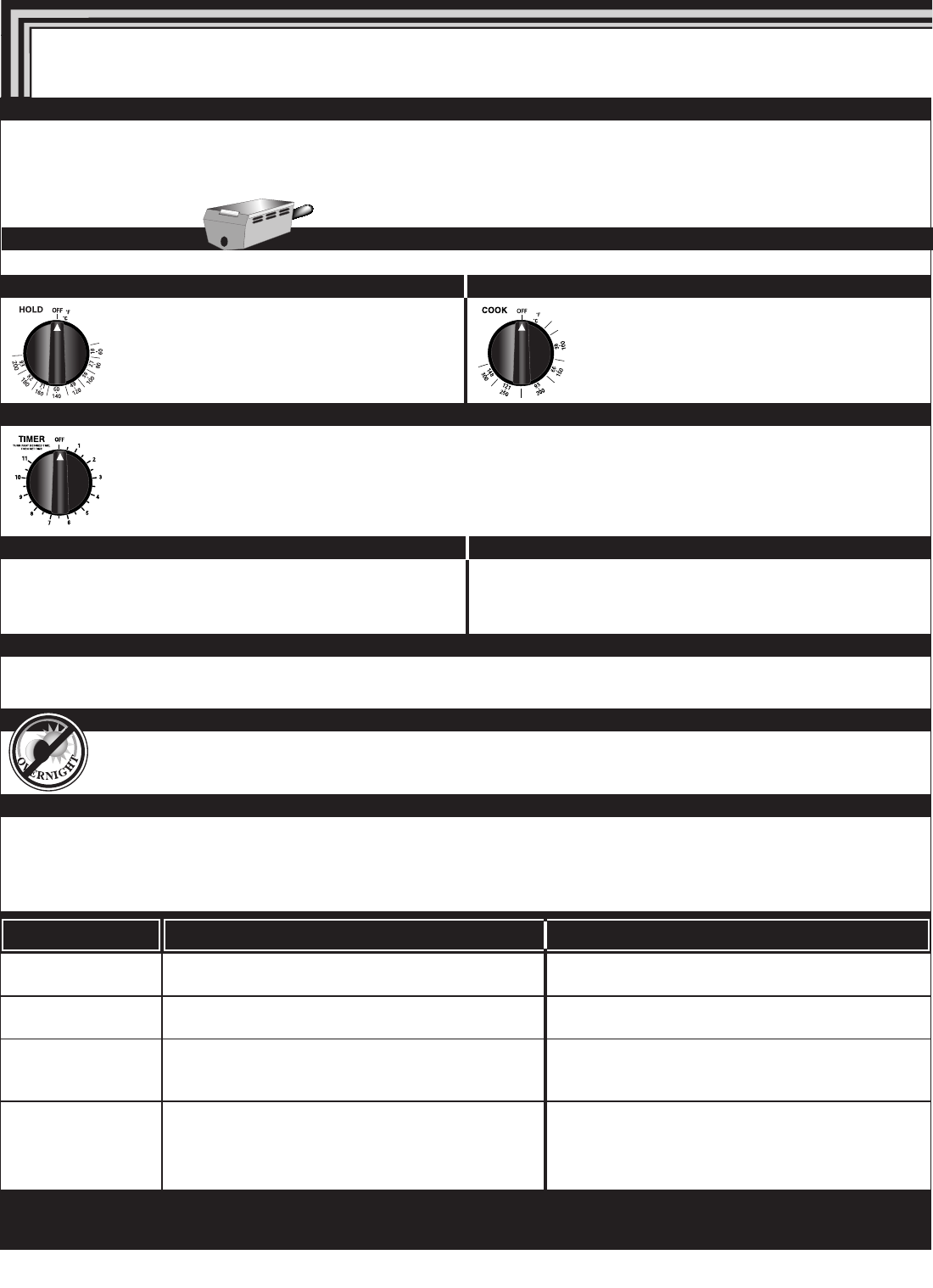
Shrimp: 16 to 20 count
Shrimp may remain in the shell or may be peeled and deveined. Season as desired. Place side-by-side on pans.
SMOKED SHRIMP
767-SK 1767-SK
M O D E L S
NUMBER OF SHELVES
ITEMS PER SHELF
APPROXIMATE
MAXIMUM CAPACITY
PANS
150° to 160°F (66° to 71°C)
none 1 hour
160°F
(71°C)
250°F
(121°C)
48
1 full-size sheet pan 1 full-size sheet pan
4 half-size sheet pans 8 full-size sheet pans
18" x 13" x 1"
on shelves
(GN 1/1: 530 x 325 x 20mm)
(NO SHELVES REQUIRED)
18" x 26" x 1"
on shelves
(GN 2/1: 530 x 650 x 20mm)
(NO SHELVES REQUIRED)
The time and temperature are suggested guidelines only. All cooking should be based on internal product temperatures.
Due to variations in product quality, weight and desired degree of doneness, the cooking timer may need to be adjusted accordingly.
Always follow local health (hygiene) regulations for all internal temperature requirements.
PRODUCT SPECIFICATIONS and PREPARATION
S E T H O L D T H E R M O S TAT S E T C O O K T H E R M O S TAT
SET COOKING TIMER
MINIMUM HOLDING TIME REQUIRED MAXIMUM HOLDING TIME
ADDITIONAL INFORMATION • NOTES
FINAL INTERNAL PRODUCT TEMPERATURE
OVERNIGHT COOK & HOLD
TIME REQUIRED IN “HOLD” CYCLE BEFORE SERVING.
CAPACITIES ARE BASED ON U.S.
PAN SIZES.GASTRONORM PANS
MAY HOLD MORE OR LESS THAN
THE FOOD QUANTITIES INDICATED.
DOOR VENTS: CLOSED
Not Recommended
45 minutes to 1 hour
COOKING & SMOKING GUIDELINES
WOOD CHIP CONTAINER: F U L L
SECTION 6 • SMOKING PROCEDURES
70.
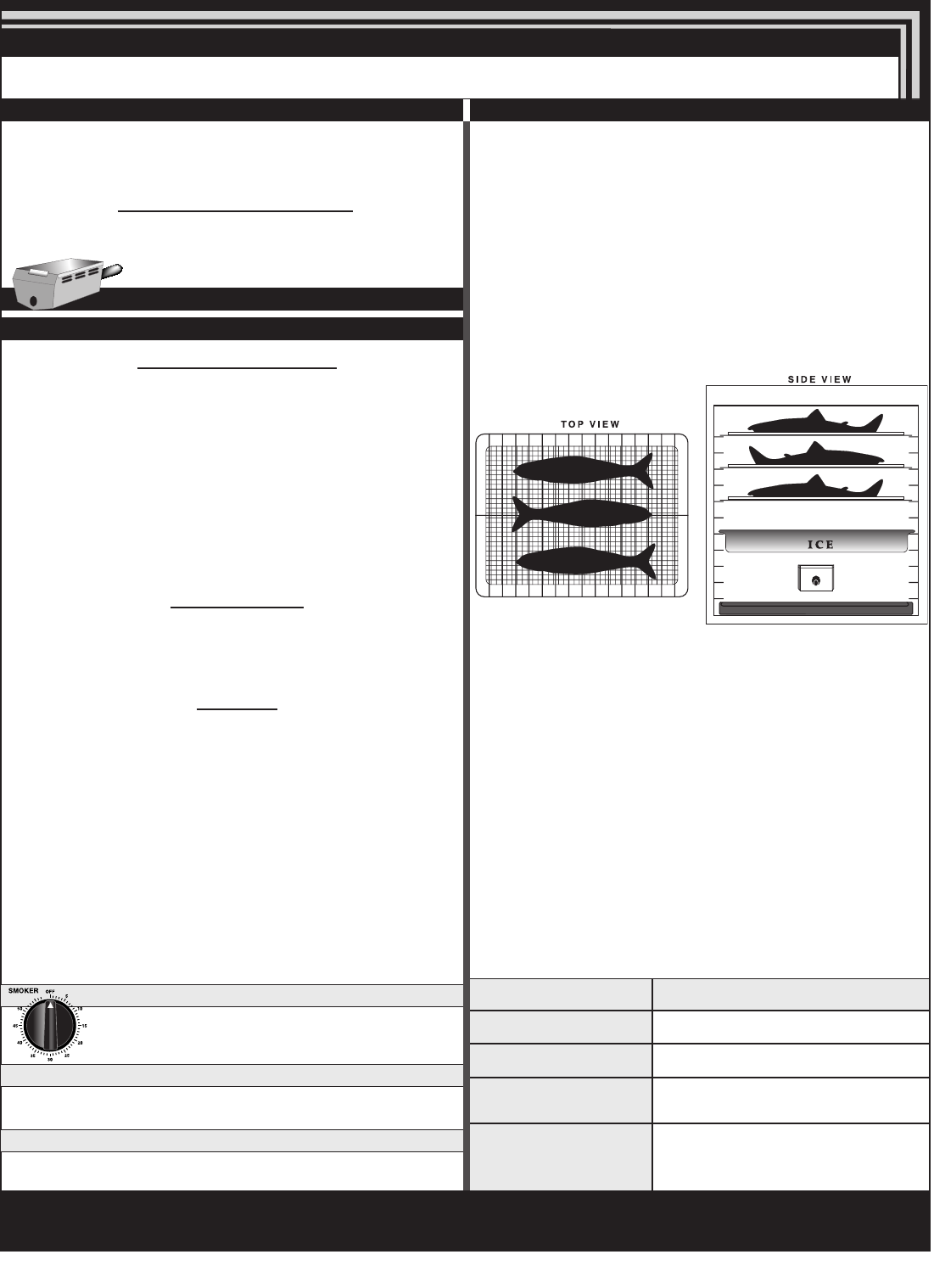
SECTION 6 • SMOKING PROCEDURES
71.
COLD SMOKED SALMON
PRODUCT SPECIFICATIONS and PREPARATION
DOOR VENTS: CLOSED
WOOD CHIP CONTAINER: FULL
12" x 20" x 2-1/2"
(GN 1/1: 325mm x 530mm x 65mm)
7 6 7 - S K & 1 7 6 7 - S KMODELS
NUMBER OF SHELVES
ITEMS PER SHELF
APPROXIMATE
MAXIMUM CAPACITY
PANS
3 per compartment
9 fillets
per compartment
3 fillets/sides per shelf
The time and temperature are suggested guidelines only. All cooking should be based on internal product temperatures.
Due to variations in product quality, weight, and desired degree of doneness, the cooking timer may need to be adjusted accordingly.
Always follow local health (hygiene) regulations for all internal temperature requirements.
OVEN TIME REQUIRED
FINAL INTERNAL PRODUCT TEMPERATURE
SET SMOKING TIMER
SAUMON FUME: Fresh Salmon Fillets
2-1/2 to 4 lb (1 to 2 kg) each
INGREDIENTS REQUIRED
Fresh Salmon Fillets or Sides
Sea Salt: Large Crystals
Granulated or Raw Sugar
SUPPLIES REQUIRED
Clear Plastic Wrap
Paper Toweling
Wire Mesh Grids
Digital Thermocouple Thermometer
(TO MONITOR INTERNAL PRODUCT TEMPERATURE)
Tweezers
Ice: 3 to 4 lb (1 to 2 kg)
PREPARATION
Remove bones from fillets with a tweezers to avoid
rupturing tissue.
SALTING
50% Sea Salt or Kosher Salt
50% Granulated or Brown Sugar (FOR RICHER COLOR)
To remove moisture from the raw salmon, blend salt
and sugar mixture thoroughly and pack firmly around
each fillet. Cover salt-filled pans with clear plastic
wrap and refrigerate for 24 hours. Following the 24
hour refrigeration period, remove fillets from
salt/sugar mixture and rinse thoroughly under cold,
running water. Pat dry with paper toweling. Place
fillets side-by-side on a sheet pan and return,
uncovered, to the refrigerator for a period of 1-6 hours
for the final drying period.
SMOKING PROCEDURE
OVEN MUST BE AT ROOM TEMPERATURE BEFORE
BEGINNING THE COLD SMOKE PROCEDURE.
Soak wood chips in water according to directions
(5 minutes), fill wood chip container full and insert
in chip holder located at the back of the oven.
Fill pan with ice and locate pan in shelf position number 7
(just above wood chip container).
Place prepared salmon fillets on a wire grid as indicated
on the diagram and insert wire grid on oven shelf
beginning with the top shelf position.
Insert probe of thermocouple thermometer into the center
of the middle salmon fillet located in the top shelf
position or central shelf position when smoking a full
load. To maintain proper color, the internal temperature
of the salmon must not exceed 77°F (25°C). For this
reason, it is important to begin the smoking process with
the oven at room temperature.
Make certain oven vents are closed. Close oven door
and set smoke time from 10 to 20 minutes depending on
taste preference. When the smoke timer cycles to the
OFF position, the fillets must remain in the oven for a
period of 1-2 hours. Do not open the oven door during
this period.
Following the required oven time, remove the fillets, cover
with clear plastic wrap and refrigerate until fully chilled.
1
2
3
4
5
6
7
8
9
10
11
10 to 20 minutes
1-2 hours
NOT TO EXCEED 77°F (25°C)
COOKING & SMOKING GUIDELINES
SECTION 7 • FOOD HOLDING AND SANITATION
72.
FOOD HOLDING and SANITATION
FOOD HOLDING - FUNCTION & VALUE
In the previous sections, cooking procedures in
the Halo Heat Low Temperature Cooking and
Holding Oven have been emphasized. If practical
to the individual food service operation, these
ovens can also be used without the cooking
function to hold foods at proper serving
temperatures. Individual holding cabinets can also
be used to accomplish this function.
Food production in most food service facilities
is accomplished in a variety of different cooking
equipment. Food quality can be easily lost
between the time a product is removed from an
oven and the time of direct service. Regardless of
the method of preparation, proper handling of food
within this time period is of critical importance to
the food service operator. Halo Heat hot food
holding equipment is able to support any type of
food preparation by extending the longest possible
holding life for the widest variety of products.
For maximum efficiency, hot food holding
equipment should be selected on the basis of the
full range of functions this equipment can provide
to the individual operation. For example, dough
proofing, bulk food holding for buffet service or
other situations and the transportation of hot foods
are some of the major functions of these cabinets
for multipurpose utility. When properly planned,
Halo Heat holding equipment can be a time
management aid, support the food service
operation by extending preparation times outside of
peak preparation hours, and provide a quality
product in prolonged holding situations.
Consult an Alto-Shaam representative for
information on compatible holding equipment or
for recommendation on full systems tailored to
meet specific requirements.
GENERAL HOLDING GUIDELINES
Chefs, cooks and other specialized food service
personnel employ varied methods of cooking.
Proper holding temperatures for a specific food
product must be based on the moisture content of
the product, product density, volume, and proper
serving temperatures. Safe holding temperatures
must also be correlated with palatability in
determining the length of holding time for a
specific product.
Halo Heat maintains the maximum amount of
product moisture content without the addition of
water, water vapor, or steam. Maintaining
maximum natural product moisture preserves the
natural flavor of the product and provides a more
genuine taste. In addition to product moisture
retention, the gentle properties of Halo Heat
maintain a consistent temperature throughout the
cabinet without the necessity of a heat distribution
fan, thereby preventing further moisture loss due
to evaporation or dehydration.
In an enclosed holding environment, too much
moisture content is a condition which can be
relieved. A product achieving extremely high
temperatures in preparation must be allowed to
decrease in temperature before being placed in a
controlled holding atmosphere. If the product is
not allowed to decrease in temperature, excessive
condensation will form increasing the moisture
content on the outside of the product. To preserve
the safety and quality of freshly cooked foods
however, a maximum of 1 to 2 minutes must be the
only time period allowed for the initial heat to be
released from the product.
Most Halo Heat holding equipment is provided
with a thermostat control between 60° and 200°F
(16° to 93°C). If the unit is equipped with vents,
close the vents for moist holding and open the
vents for crisp holding.
If the unit is equipped with a thermostat
indicating a range of between 1 and 10, use a
thermometer to measure the internal temperature of
the product(s) being held. Adjust the thermostat
setting to achieve the best overall setting based on
internal product temperature.
COLD FOOD FOR RETHERMALIZATION
OR REHEATING MUST NEVER BE
ADDED TO THE OVEN WHILE HOT
FOOD IS BEING HELD.
SECTION 7 • FOOD HOLDING AND SANITATION
73.
FOOD HOLDING and SANITATION
GENERAL HOLDING CABINET OPERATION
1. PREHEAT THE HOLDING CABINET
TO DESIRED TEMPERATURE FOR 30 MINUTES
When the thermostat is turned clockwise to an
“ON” position, the red indicator light will illuminate
and will remain lit as long as the unit is calling for heat.
Allow a minimum of 30 minutes of preheating before
loading the holding cabinet with food. The red
indicator light will go “OUT” after approximately 30
minutes preheat time, or when the air temperature
inside the unit reaches the temperature set by the
operator. Verify the full preheated temperature with the
holding temperature gauge located on the control panel
of the cabinet.
2. LOAD THE CABINET WITH HOT FOOD ONLY.
The purpose of the holding cabinet is to maintain
hot food at proper serving temperature.
Only HOT food should be placed into the cabinet.
Before loading the cabinet with food, use a food
thermometer to make certain all products are at an
internal temperature range of 140° to 160°F
(60° to 71°C). Any food product not within the proper
temperature range should be heated before loading into
the holding cabinet.
Proper temperature range for the products being
held will depend on the type and quantity of product.
When holding food for prolonged periods, it is
advisable to periodically check the internal temperature
of each item with a food thermometer to assure
maintenance of the proper temperature range of 140° to
200°F (60° to 93°C)
H O L D I N G T E M P E R A T U R E R A N G E
MEAT F A H R E N H E I T C E L S I U S
BEEF ROAST — Rare 130°F 54°C
BEEF ROAST — Med/Well Done 155°F 68°C
BEEF BRISKET 160° — 175°F 71° — 79°C
CORN BEEF 160° — 175°F 71° — 79°C
PASTRAMI 160° — 175°F 71° — 79°C
PRIME RIB — Rare 130°F 54°C
STEAKS — Broiled/Fried 140° — 160°F 60° — 71°C
RIBS — Beef or Pork 160°F 71°C
VEAL 160° — 175°F 71° — 79°C
HAM 160° — 175°F 71° — 79°C
PORK 160° — 175°F 71° — 79°C
LAMB 160° — 175°F 71° — 79°C
POULTRY
CHICKEN — Fried/Baked 160° — 175°F 71° — 79°C
DUCK 160° — 175°F 71° — 79°C
TURKEY 160° — 175°F 71° — 79°C
GENERAL 160° — 175°F 71° — 79°C
FISH/SEAFOOD
FISH — Baked/Fried 160° — 175°F 71° — 79°C
LOBSTER 160° — 175°F 71° — 79°C
SHRIMP — Fried 160° — 175°F 71° — 79°C
BAKED GOODS
BREADS/ROLLS 120° — 140°F 49° — 60°C
MISCELLANEOUS
CASSEROLES 160° — 175°F 71° — 79°C
DOUGH — Proofing 80° — 100°F 27° — 38°C
EGGS —Fried 150° — 160°F 66° — 71°C
FROZEN ENTREES 160° — 175°F 71° — 79°C
HORS D'OEUVRES 160° — 180°F 71° — 82°C
PASTA 160° — 180°F 71° — 82°C
PIZZA 160° — 180°F 71° — 82°C
POTATOES 180°F 82°C
PLATED MEALS 140° — 165°F 60°— 74°C
SAUCES 140° — 200°F 60° — 93°C
SOUP 140° — 200°F 60° — 93°C
VEGETABLES 160° — 175°F 71° — 79°C
TH E HOL D ING T EMP E RATUR E S LIS TED A R E SUG GES T ED
GU IDE L INE S ONLY.ALL FOOD HOLDING SHOULD BE BASED ON
INTERNAL PRODUCT TEMPERATURES.ALWAYS FOLLOW LOCAL
HE LAT H (HYG IEN E )REG ULATI ONS F O R ALL I NTER NAL
TEMPERATURE REQUIREMENTS.
SECTION 7 • FOOD HOLDING AND SANITATION
74.
FOOD HOLDING and SANITATION
SANITATION and HANDLING
Food flavor and aroma are usually so closely related it
is difficult, if not impossible, to separate them. There is
also an important, inseparable relationship between
cleanliness and food flavor. Cleanliness, top operating
efficiency, and appearance of equipment contribute
considerably to savory, appetizing foods. Good equipment
that is kept clean, works better and lasts longer.
Most food imparts its own particular aroma and
many foods also absorb existing odors. Unfortunately,
during this absorption, there is no distinction between
GOOD and BAD odors. The majority of objectionable
flavors and odors troubling food service operations are
caused by bacteria growth. Sourness, rancidity,
mustiness, stale or other OFF flavors are usually the
result of bacterial activity.
The easiest way to insure full, natural food flavor is
through comprehensive cleanliness. This means good
control of both visible soil (dirt) and invisible soil
(microorganisms). Clean surfaces don’t smell. This is a
basic and important fact to assure good quality in food
of all kinds.
A thorough approach to sanitation will provide
essential cleanliness. It will assure an attractive
appearance of equipment, along with maximum efficiency
and utility. More importantly, a good sanitation program
provides one of the key elements in the prevention of
food-borne illnesses.
A controlled holding environment for prepared foods is
just one of the important factors involved in the prevention
of food-borne illnesses. Temperature monitoring and
control during receiving, storage, preparation and the
service of foods are of equal importance.
The most accurate method of measuring safe
temperatures of both hot and cold foods is by internal
product temperature. A quality thermometer is an effective
tool for this purpose and should be routinely used on all
products that require holding at a specific temperature.
A comprehensive sanitation program should focus on
the training of staff in basic sanitation procedures. This
includes personal hygiene, proper handling of raw foods,
cooking to a safe internal product temperature, and the
routine monitoring of internal temperatures from
receiving through service. Personal cleanliness is
generally the most difficult field to control. Rigid rules
of personal hygiene and practice must be instituted and
maintained with standards set at the highest levels.
Most food-borne illnesses can be prevented through
proper temperature control and a comprehensive program
of sanitation. All these factors are important to build
quality service as the foundation of customer satisfaction.
HOT FOODS
40° to 140°F DANGER ZONE 4° to 60°C
70° to 120°F CRITICAL ZONE 21° to 49°C
140° to 165°F SAFE ZONE 60° to 74°C
COLD FOODS
ABOVE 40°F DANGER ZONE ABOVE 4°C
40°F or BELOW SAFE ZONE 4°C or BELOW
FROZEN FOODS
ABOVE 32°F DANGER ZONE ABOVE 0°C
0° to 32°F CRITICAL ZONE -18° to 0°C
0°F or BELOW SAFE ZONE -18°C or BELOW
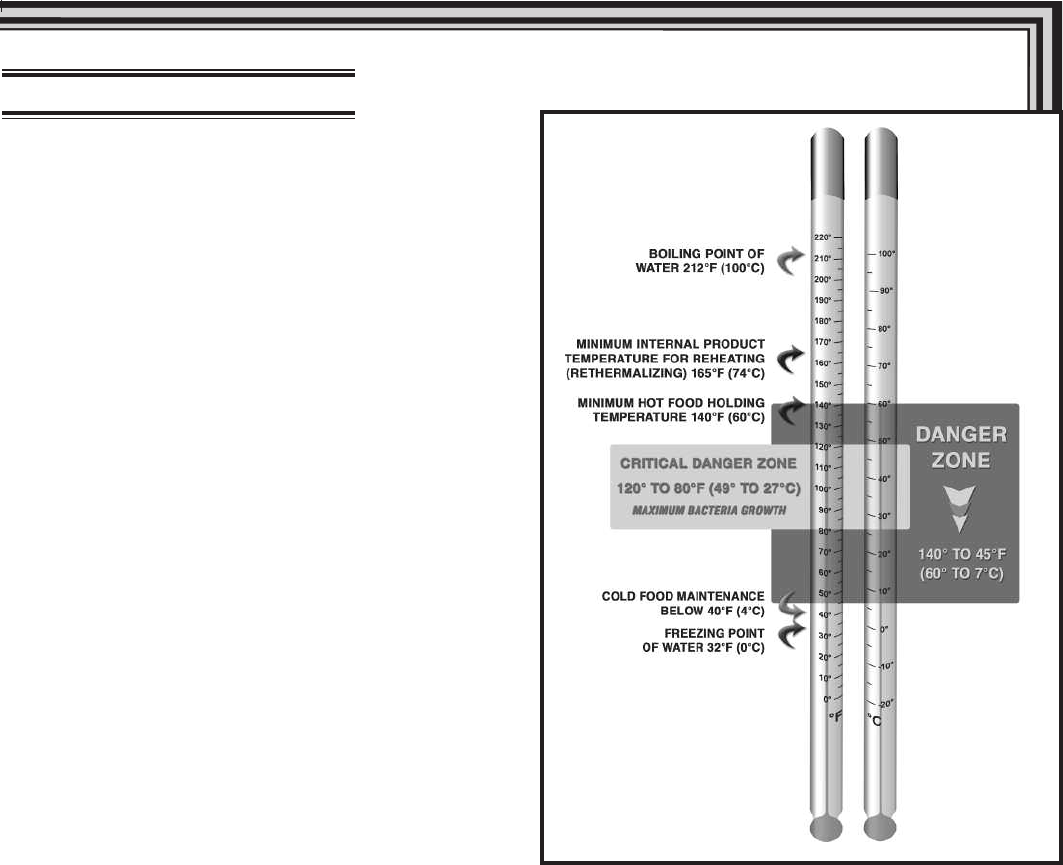
SECTION 7 • FOOD HOLDING AND SANITATION
75.
FOOD HOLDING and SANITATION
FOOD SAFETY GUIDELINES
Safe food handling practices to prevent food-borne
illness is of critical importance to the health and
safety of your customers. HACCP, an acronym for
Hazard Analysis (at) Critical Control Points, is a
quality control program of operating procedures to
assure food integrity, quality, and safety. Taking
steps necessary to augment food safety practices
are both cost effective and relatively simple. While
HACCP guidelines go far beyond the scope of this
booklet, additional information is available by
contacting the USDA/FDA Food-borne Illness
Education Information Center.
A ll h e ate d f ood m u st b e m ain tain e d at 1 40 °F to
150°F (60°C to 65°C ) af te r b e in g h e ate d . Food s
th at h ave b e e n h e ate d f ollowe d b y re frig e r ate d
sto rag e m u st b e re h e ate d to a m in im u m o f
165°F (74°C ) to p re ve n t b acte r ia g rowth .
●All stored food items must be covered and placed
in a cooler or freezer at a minimum height of
6-inches (152mm) above the floor.
●Employees serving food, preparing food, or washing
utensils must wear an effective hair covering.
●Employees must wash their hands before serving
or preparing food.
●Soap and towels must be provided at the hand-sink
which must only be used for washing hands.
●No smoking or use of tobacco products is allowed
in the food preparation or service area.
●All serving containers must be stored with food
contact surfaces covered or in the down position.
●All utensils must be washed in a three-
compartment sink and dipped in a final
sanitation rinse. A pH test kit must be used to
check the rinse water.
●Food preparation surfaces must not be used for
the storage of non-food items.
●All cold food must be stored at or below 40°F (4°C).
●Frozen foods must not be thawed at room
temperature nor in water. Use the cooler for
thawing and thaw foods slowly.
SUMMARY
In the United States, the Food and Drug
Administration has a published Food Code as a reference
guide for the prevention of food-borne illness in retail
outlets such as restaurants, institutions and grocery
stores. Provisions of this Food Code are compatible with
the concept and terminology of Hazard Analysis (at)
Critical Control Points (HACCP) and contains expanded
provisions for food safety. The FDA publication, along
with local codes, should be the final word with regard to
all issues regarding food safety and sanitation in the U.S.
For more information contact:
Center for Food Safety and Applied Nutrition
Food and Drug Administration
PHONE: 1-888-SAFEFOOD
www.foodsafety.gov

Alto-Shaam has established a twenty-four hour emergency
service call center to offer immediate customer access to
a local authorized service agency outside of standard
business hours. The emergency service
a c c e s s i s p r o v i d e d e x c l u s i v e l y f o r
Alto-Shaam equipment and is available
throughout the United States through the use
of Alto-Shaam's toll-free number. Emergency
service access is available seven days a week
including holidays
.
76.
#566 • 10/08
W164 N9221 Water Street ●P. O . B o x 4 5 0 ●Menomonee Falls, Wisconsin 53052-0450 ●U . S . A .
PHONE: (262)251-3800 (800)558-8744 U.S.A./CANADA ●FAX: (262)251-7067 (800)329-8744 U.S.A.●www.alto-shaam.com
P R I N T E D I N U .S.A.P RIC E: U. S.$ 15 .0 0
COOK/HOLD/SERVE SYSTEMS
