Amgoo Telecom AM313 Mobile Phone User Manual

Amgoo Telecom Co., Ltd. Mobile Phone

user manual

FCC ID: UOSAM313
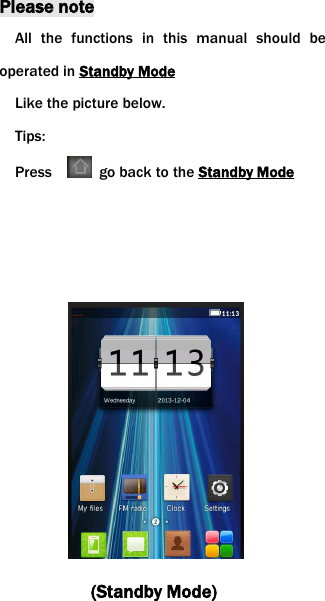
Please noteAll the functions in this manual should beoperated in Standby ModeLike the picture below.Tips:Press go back to the Standby Mode(Standby Mode)
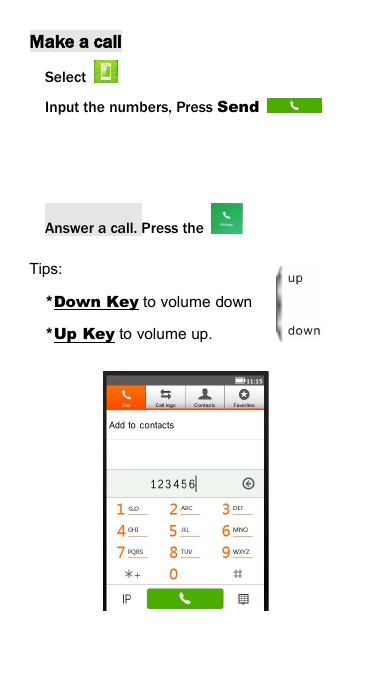
Make a callSelectInput the numbers, Press SendAnswer a call. Press theTips:*Down Key to volume down*Up Key to volume up.
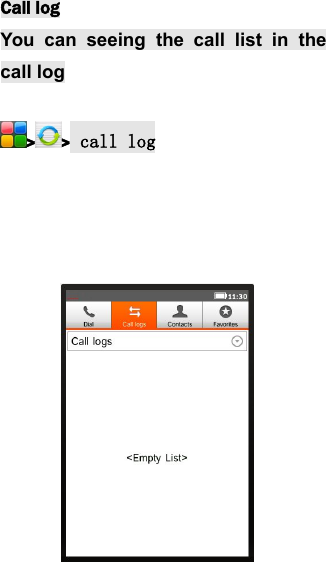
Call logYou can seeing the call list in thecall log> > call log
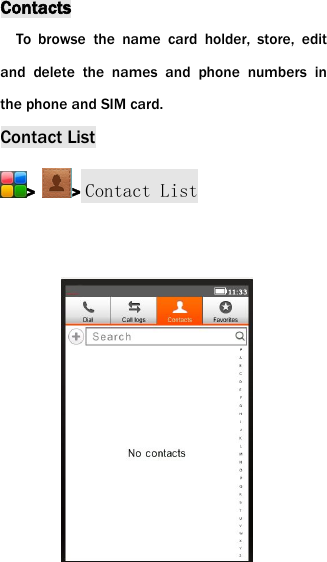
ContactsTo browse the name card holder, store, editand delete the names and phone numbers inthe phone and SIM card.Contact List> > Contact List
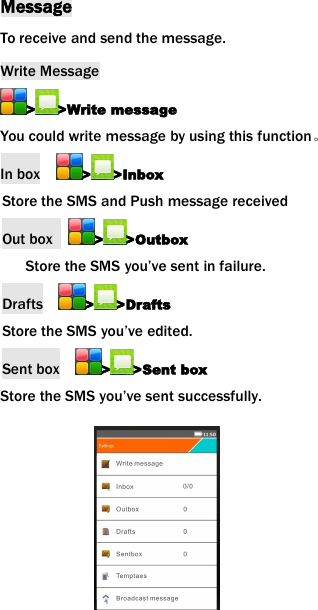
MessageTo receive and send the message.Write Message> >Write messageYou could write message by using this function。In box > >InboxStore the SMS and Push message receivedOut box > >OutboxStore the SMS you’ve sent in failure.Drafts > >DraftsStore the SMS you’ve edited.Sent box > >Sent boxStore the SMS you’ve sent successfully.
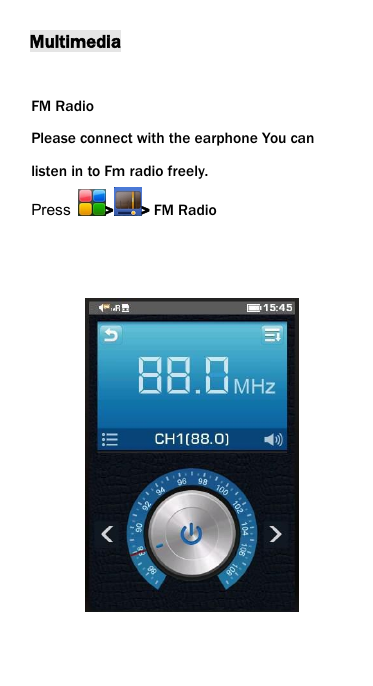
MultimediaFM RadioPlease connect with the earphone You canlisten in to Fm radio freely.Press > > FM Radio
Bluetooth    Turn on or off Bluetooth.       Bluetooth settings: click to automatically search for and display the Bluetooth devices list, touch the Menu button, the Bluetooth name rename detection timeout setting, display the received file  Note: A.  display  device  name,  search  the  device  name  is  too  long,  it  will  automatically truncated to the appropriate length. B. select pairing the device will pop up a dialog box, the user needs to enter the Bluetooth PIN match code. The two devices must use the same password. Headset or earpiece kit may use a fixed password, you can refer to the Bluetooth headset instructions. (Device can perform a lookup operation has been paired do not have to be matched.)
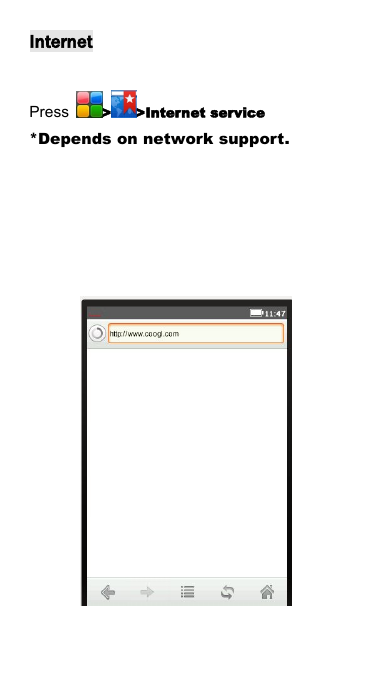
InternetPress > >Internet service*Depends on network support.
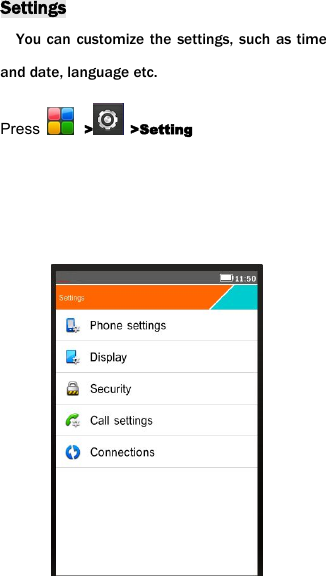
SettingsYou can customize the settings, such as timeand date, language etc.Press > >Setting
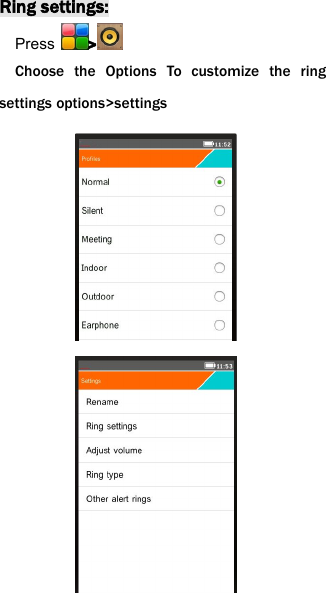
Ring settings:Press >Choose the Options To customize the ringsettings options>settings
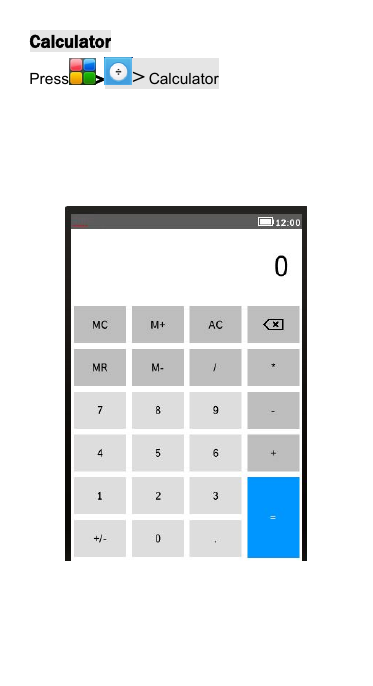
CalculatorPress >>Calculator
Thank You!
 FCC RF EXPOSURE INFORMATION: WARNING!! Read this information before using your phone In August 1986 the Federal Communications Commission (FCC) of the United States with its action in Report and Outer FCC 96-326 adopted an updated safety standard for human exposure to radio frequency (RF) electromagnetic energy emitted by FCC regulated transmitters. Those guidelines are consistent with the safety standard previously set by both U.S. and international standards bodies. The design of this phone complies with the FCC guidelines and these international standards. Use only the supplied or an approved antenna. Unauthorized antennas modifications, or attachments could impair call quality, damage the phone, or result in violation of FCC regulations. Do not use the phone with a damaged antenna. If a damaged antenna comes into contact with the skin, a minor burn may result. Please contact your local dealer for replacement antenna.  BODY-WORN OPERATION: This device was tested for typical body-worn operations with the back of the phone kept 0.5cm from the body. To comply with FCC RF exposure requirements, a minimum separation distance of 0.5cm must be maintained between the user's body and the back of the phone, including the antenna. Third-party belt-clips, holsters and similar accessories containing metallic components shall not be used. Body-worn accessories that cannot maintain 0.5cm separation distance between the user’s body and the back of the phone, and have not been tested for typical body-worn operations may not comply with FCC RF exposure limits and should be avoided. For more information about RF exposure, please visit the FCC website at www.fcc.gov  Your wireless handheld portable telephone is a low power radio transmitter and receiver. When it is ON, it receives and also sends out radio frequency (RF) signals. In August, 1996, the Federal Communications Commissions (FCC) adopted RF exposure guidelines with safety levels for hand-held wireless phones. Those guidelines are consistent with the safety standards previously set by both U.S. and international standards bodies:  <ANSIC95.1> (1992) / <NCRP Report 86> (1986) / <ICIMIRP> (1996)  Those standards were based on comprehensive and periodic evaluations of the relevant scientific literature. For example, over 120 scientists, engineers, and physicians from universities, government health agencies, and industry reviewed the available body of research to develop the ANSI Standard (C95.1). Nevertheless, we recommend that you use a hands-free kit with your phone (such as an earpiece or headset) to avoid potential exposure to RF energy. The design of your phone complies with the FCC guidelines (and those standards).  Use only the supplied or an approved replacement antenna. Unauthorized antennas, modifications, or attachments could damage the phone and may violate FCC regulations.   NORMAL POSITION:  Hold the phone as you would any other telephone with the antenna pointed up and over your shoulder.  RF Exposure Information: This product is compliance to FCC RF Exposure requirements and refer to FCC website search for FCC ID: UOSAM313 to gain further information include SAR Values.    This device complies with part 15 of the FCC rules. Operation is subject to the following two conditions: (1) this device may not cause harmful interference, and
 (2) this device must accept any interference received, including interference that may cause undesired operation.   NOTE:  The  manufacturer  is  not  responsible  for  any  radio  or  TV  interference  caused  by unauthorized  modifications  to  this  equipment.  Such  modifications  could  void  the  user’s authority to operate the equipment. NOTE: This equipment has been tested and found to comply with the limits for a Class B digital device, pursuant to part 15 of the FCC Rules. These limits are designed to provide reasonable protection against harmful interference in a residential installation. This equipment generates uses and can radiate radio frequency energy and, if not installed and used in accordance with the instructions, may cause harmful interference to radio communications. However, there is no guarantee that interference will not occur in a particular installation. If this equipment does cause harmful interference to radio or television reception, which can be determined by turning the equipment off and on, the user is encouraged to try to correct the interference by one or more of the following measures:   - Reorient or relocate the receiving antenna. - Increase the separation between the equipment and receiver. -Connect the equipment into an outlet on a circuit different from that to which the receiver is connected. -Consult the dealer or an experienced radio/TV technician for help      Do not use the device with the environment which below minimum -10℃ or over maximum 50℃, the device may not work.        Changes or modifications to this unit not expressly approved by the party responsible for compliance could void the user’s authority to operate the equipment.

Navigation menu