Andrew Base Station Subsystems Group 100270MCPA Multiple Carrier Power Amplifier ( MCPA ) User Manual MCPA Users Manual 1 1

Andrew Corporation, Base Station Subsystems Group Multiple Carrier Power Amplifier ( MCPA ) MCPA Users Manual 1 1

User Manual

     RF Power Amplifiers Andrew Corporation – Power Amplifier Group  Propriety – Use pursuant to Company Instruction 1 of 8           Multiple Carrier Power Amplifiers   Model: MCPA1900 & MCPA850  Operation Instruction              Date: July 25, 2005 Version. 1.0 Ref# RE: FCC ID S8L-100254MCPA & RE: FCC ID S8L-100270MCPA
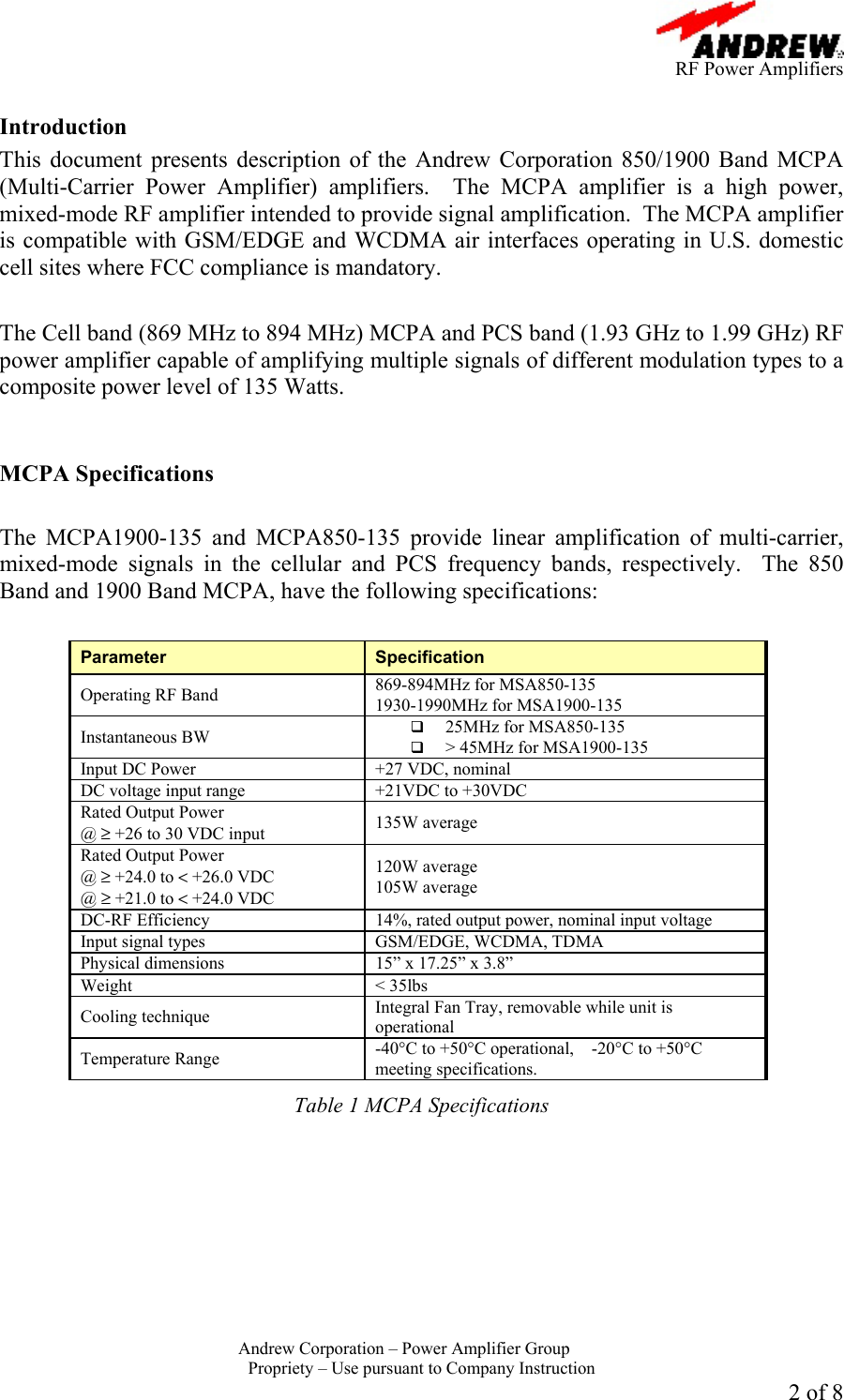
     RF Power Amplifiers Andrew Corporation – Power Amplifier Group  Propriety – Use pursuant to Company Instruction 2 of 8  Introduction This document presents description of the Andrew Corporation 850/1900 Band MCPA (Multi-Carrier Power Amplifier) amplifiers.  The MCPA amplifier is a high power, mixed-mode RF amplifier intended to provide signal amplification.  The MCPA amplifier is compatible with GSM/EDGE and WCDMA air interfaces operating in U.S. domestic cell sites where FCC compliance is mandatory.   The Cell band (869 MHz to 894 MHz) MCPA and PCS band (1.93 GHz to 1.99 GHz) RF power amplifier capable of amplifying multiple signals of different modulation types to a composite power level of 135 Watts.     MCPA Specifications  The MCPA1900-135 and MCPA850-135 provide linear amplification of multi-carrier, mixed-mode signals in the cellular and PCS frequency bands, respectively.  The 850 Band and 1900 Band MCPA, have the following specifications:  Parameter  Specification Operating RF Band  869-894MHz for MSA850-135 1930-1990MHz for MSA1900-135 Instantaneous BW    25MHz for MSA850-135   > 45MHz for MSA1900-135 Input DC Power  +27 VDC, nominal DC voltage input range  +21VDC to +30VDC Rated Output Power  @ ≥ +26 to 30 VDC input  135W average Rated Output Power  @ ≥ +24.0 to < +26.0 VDC  @ ≥ +21.0 to < +24.0 VDC 120W average  105W average DC-RF Efficiency  14%, rated output power, nominal input voltage Input signal types  GSM/EDGE, WCDMA, TDMA Physical dimensions  15” x 17.25” x 3.8” Weight < 35lbs Cooling technique  Integral Fan Tray, removable while unit is operational Temperature Range  -40°C to +50°C operational,    -20°C to +50°C meeting specifications. Table 1 MCPA Specifications
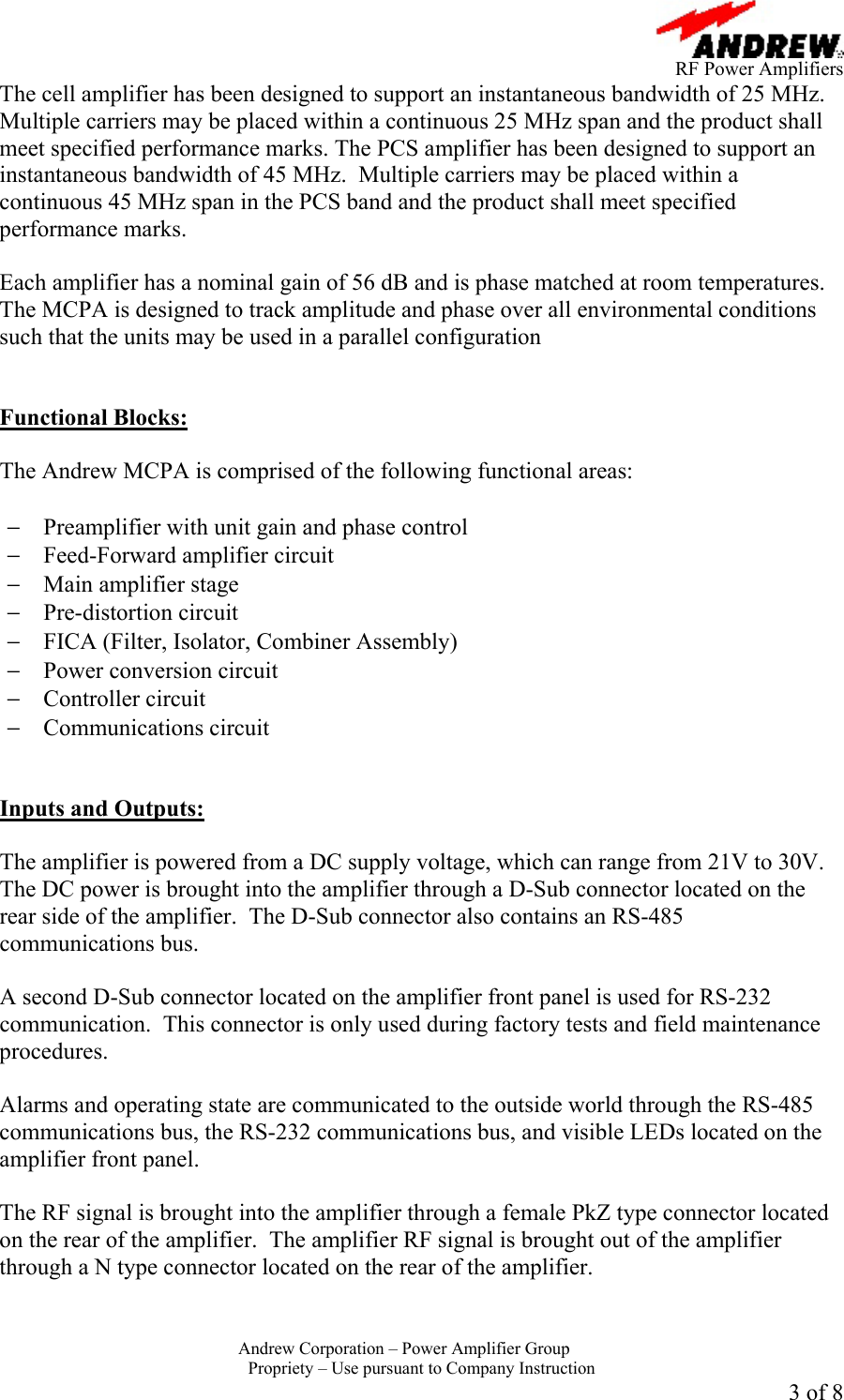
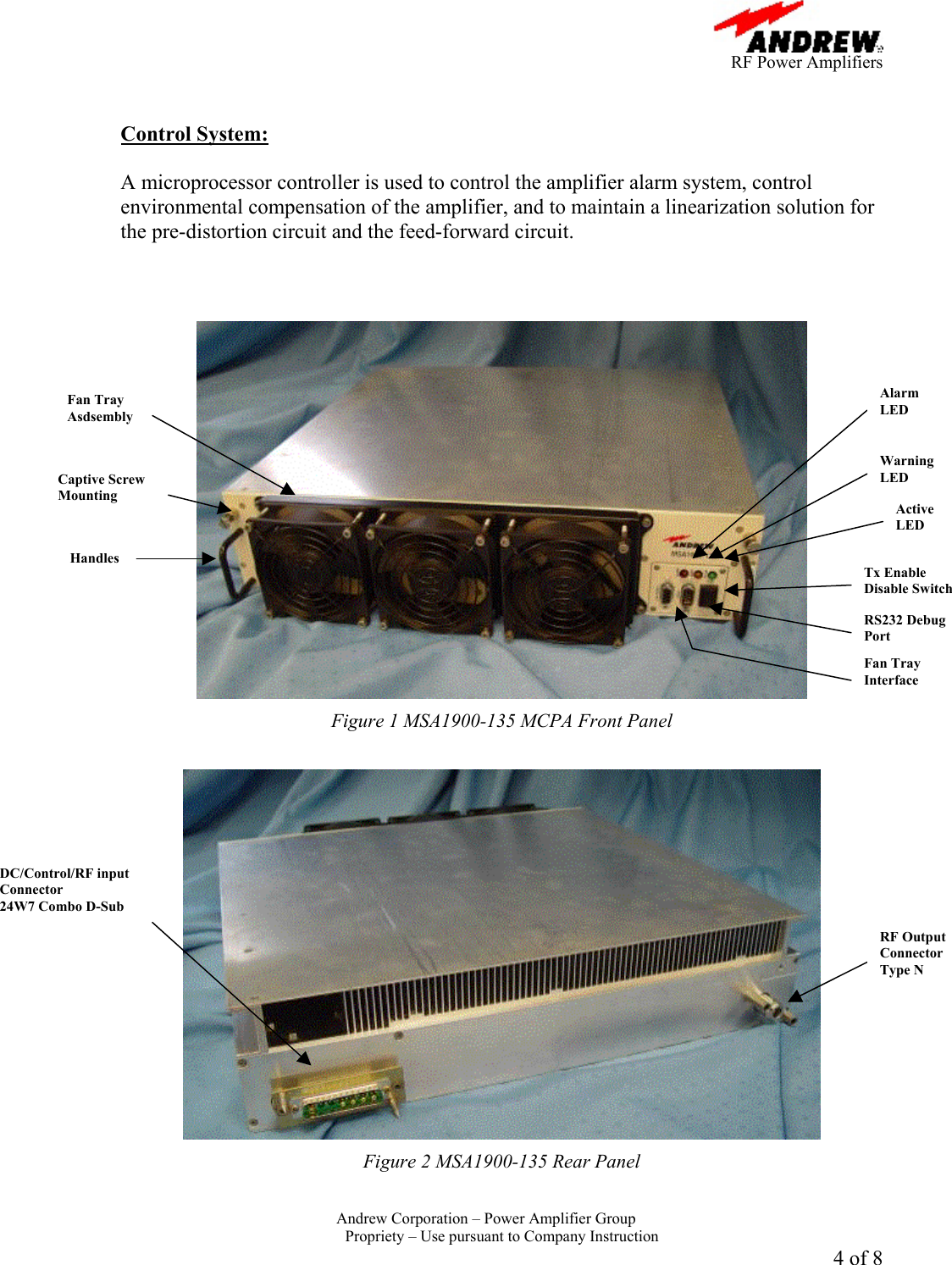
     RF Power Amplifiers Andrew Corporation – Power Amplifier Group  Propriety – Use pursuant to Company Instruction 3 of 8 The cell amplifier has been designed to support an instantaneous bandwidth of 25 MHz.  Multiple carriers may be placed within a continuous 25 MHz span and the product shall meet specified performance marks. The PCS amplifier has been designed to support an instantaneous bandwidth of 45 MHz.  Multiple carriers may be placed within a continuous 45 MHz span in the PCS band and the product shall meet specified performance marks.  Each amplifier has a nominal gain of 56 dB and is phase matched at room temperatures.  The MCPA is designed to track amplitude and phase over all environmental conditions such that the units may be used in a parallel configuration    Functional Blocks:  The Andrew MCPA is comprised of the following functional areas:  −  Preamplifier with unit gain and phase control −  Feed-Forward amplifier circuit −  Main amplifier stage −  Pre-distortion circuit −  FICA (Filter, Isolator, Combiner Assembly) −  Power conversion circuit −  Controller circuit −  Communications circuit   Inputs and Outputs:  The amplifier is powered from a DC supply voltage, which can range from 21V to 30V.  The DC power is brought into the amplifier through a D-Sub connector located on the rear side of the amplifier.  The D-Sub connector also contains an RS-485 communications bus.  A second D-Sub connector located on the amplifier front panel is used for RS-232 communication.  This connector is only used during factory tests and field maintenance procedures.  Alarms and operating state are communicated to the outside world through the RS-485 communications bus, the RS-232 communications bus, and visible LEDs located on the amplifier front panel.    The RF signal is brought into the amplifier through a female PkZ type connector located on the rear of the amplifier.  The amplifier RF signal is brought out of the amplifier through a N type connector located on the rear of the amplifier.
     RF Power Amplifiers Andrew Corporation – Power Amplifier Group  Propriety – Use pursuant to Company Instruction 4 of 8   Control System:  A microprocessor controller is used to control the amplifier alarm system, control environmental compensation of the amplifier, and to maintain a linearization solution for the pre-distortion circuit and the feed-forward circuit.     Figure 1 MSA1900-135 MCPA Front Panel   Figure 2 MSA1900-135 Rear Panel Alarm LED Warning LED Active LED Tx Enable Disable Switch RS232 Debug Port Fan Tray Interface RF Output Connector Type N DC/Control/RF input Connector 24W7 Combo D-Sub Captive Screw Mounting Handles Fan Tray Asdsembly
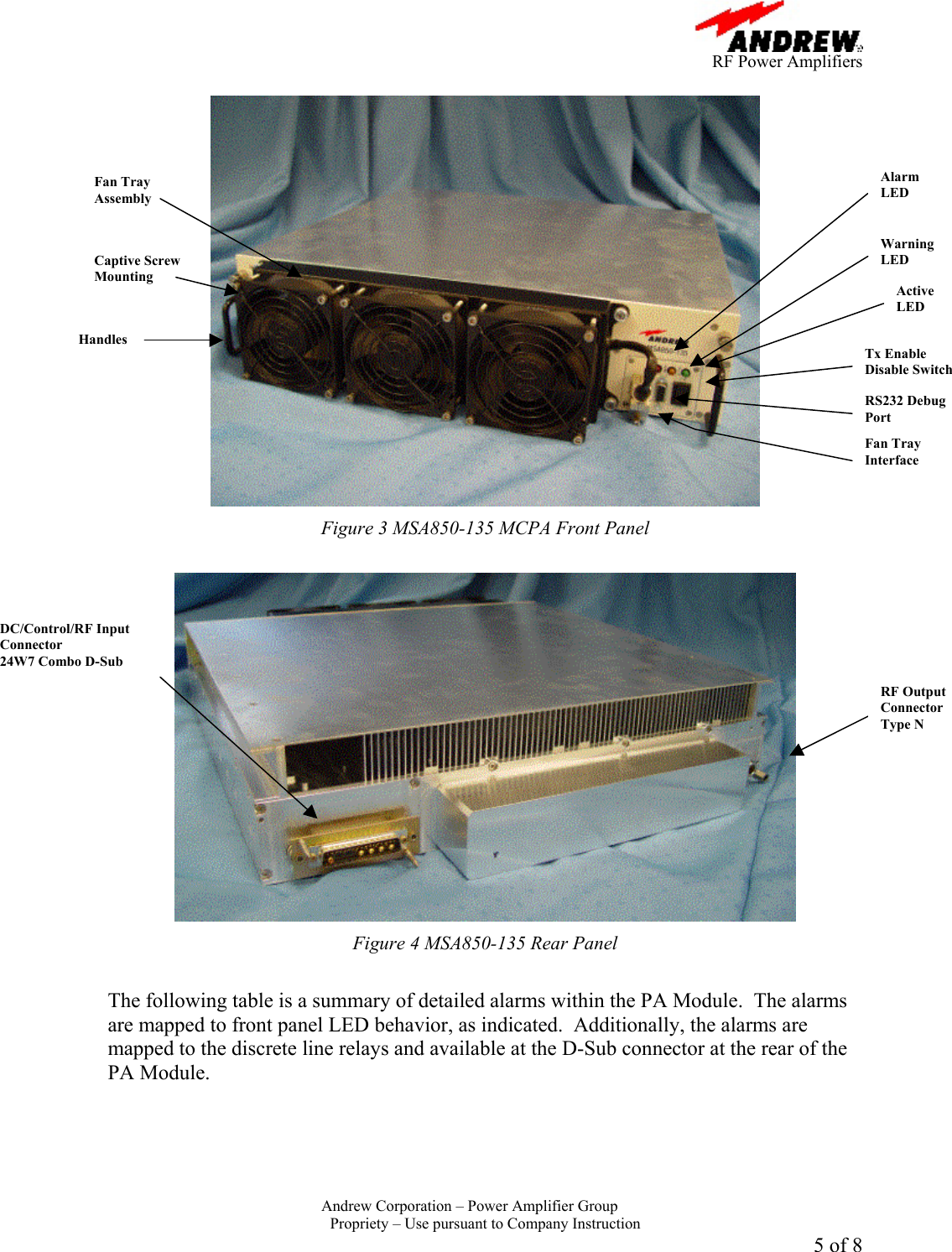
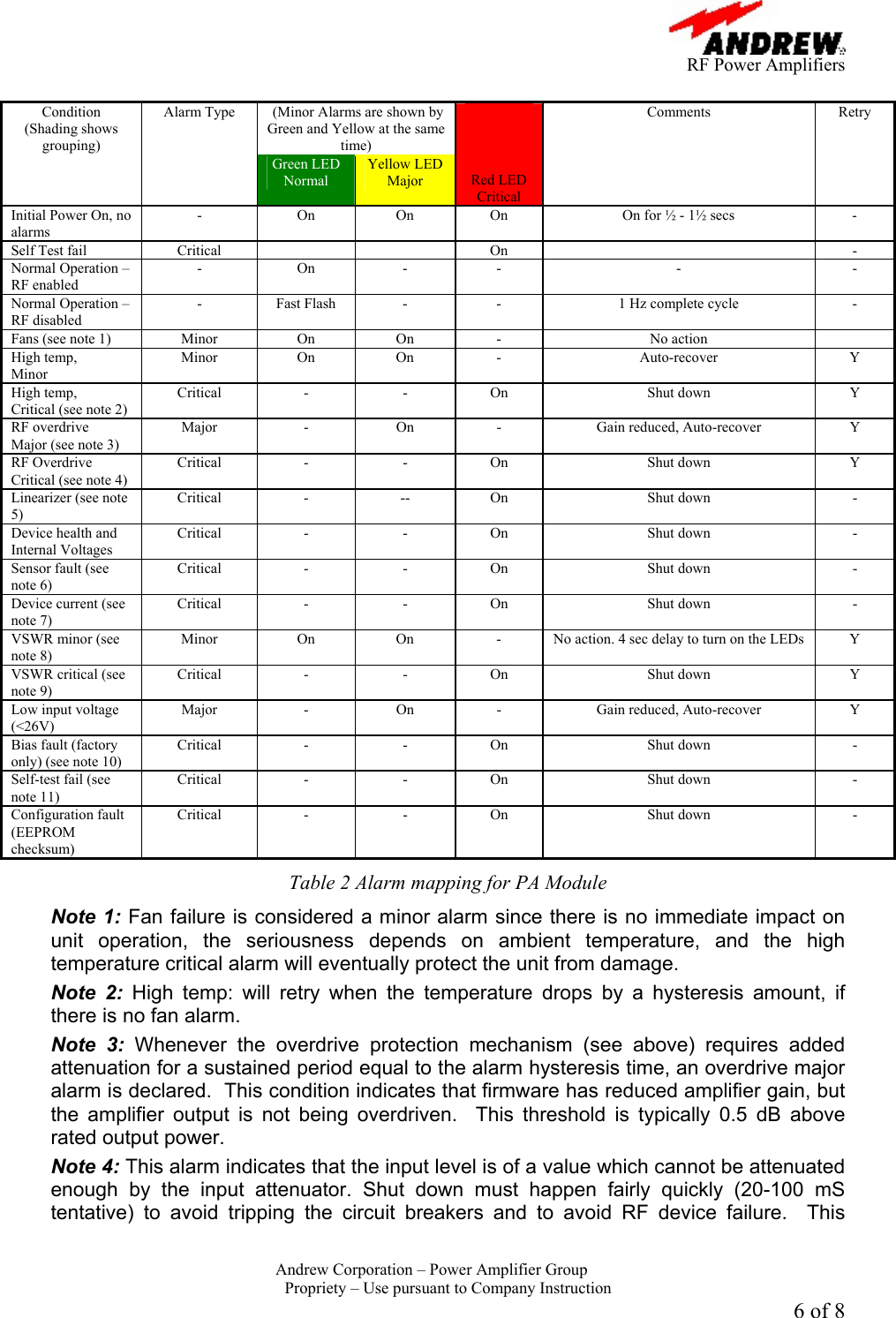
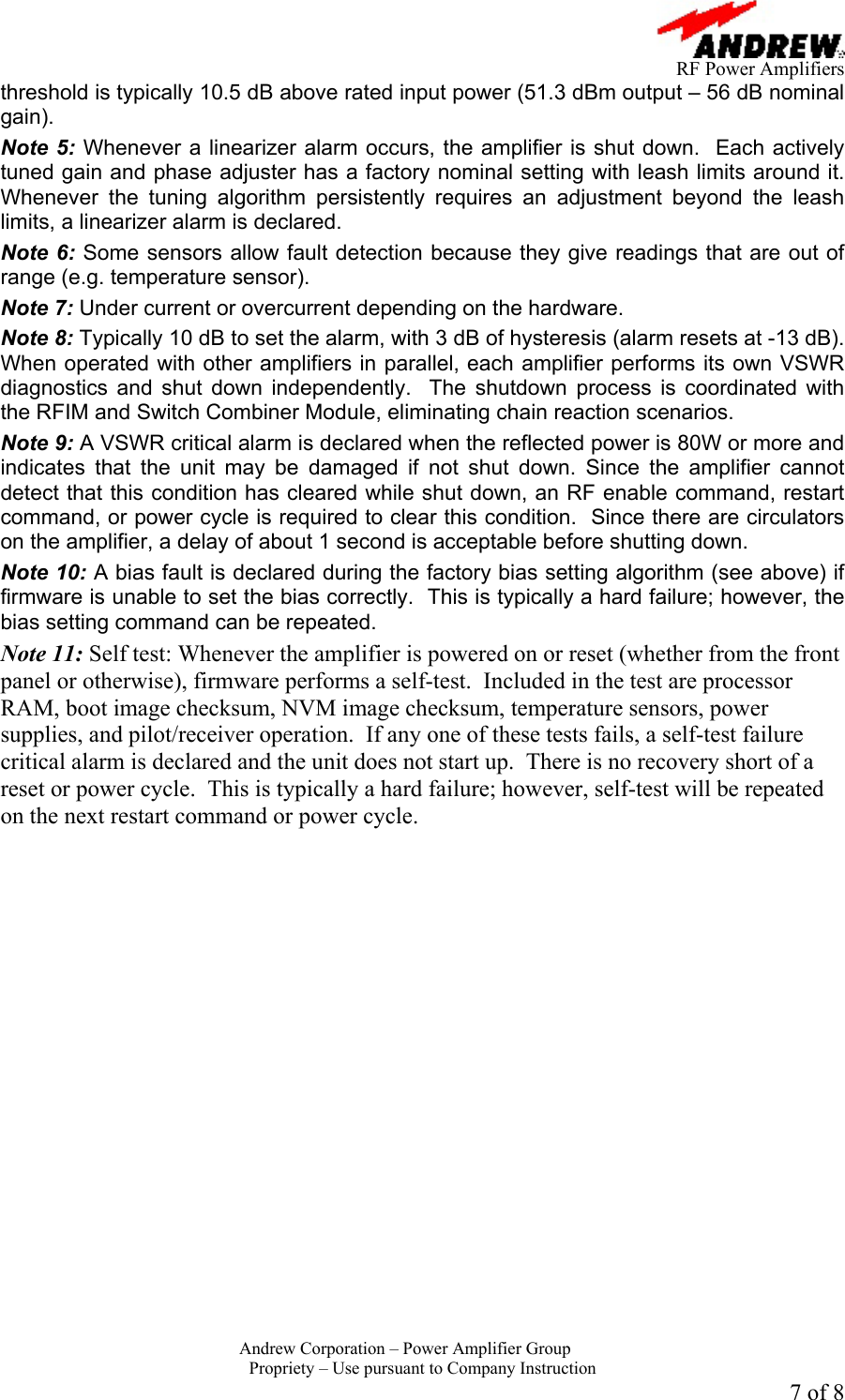
     RF Power Amplifiers Andrew Corporation – Power Amplifier Group  Propriety – Use pursuant to Company Instruction 5 of 8   Figure 3 MSA850-135 MCPA Front Panel   Figure 4 MSA850-135 Rear Panel  The following table is a summary of detailed alarms within the PA Module.  The alarms are mapped to front panel LED behavior, as indicated.  Additionally, the alarms are mapped to the discrete line relays and available at the D-Sub connector at the rear of the PA Module. Alarm LED Warning LED Active LED Tx Enable Disable Switch RS232 Debug Port Fan Tray Interface Captive Screw Mounting Handles Fan Tray Assembly RF Output Connector Type N DC/Control/RF Input Connector 24W7 Combo D-Sub
     RF Power Amplifiers Andrew Corporation – Power Amplifier Group  Propriety – Use pursuant to Company Instruction 6 of 8   (Minor Alarms are shown by Green and Yellow at the same time) Condition (Shading shows grouping) Alarm Type Green LED Normal Yellow LED Major     Red LED Critical Comments Retry Initial Power On, no alarms -  On  On  On  On for ½ - 1½ secs  - Self Test fail  Critical      On    - Normal Operation – RF enabled - On - -  -  - Normal Operation – RF disabled -  Fast Flash  -  -  1 Hz complete cycle  - Fans (see note 1)  Minor  On  On  -  No action   High temp, Minor Minor On On  -  Auto-recover  Y High temp, Critical (see note 2) Critical -  - On  Shut down  Y RF overdrive Major (see note 3) Major  -  On  -  Gain reduced, Auto-recover  Y RF Overdrive Critical (see note 4) Critical -  - On  Shut down  Y Linearizer (see note 5) Critical -  -- On  Shut down  - Device health and Internal Voltages Critical -  - On  Shut down  - Sensor fault (see note 6) Critical -  - On  Shut down  - Device current (see note 7) Critical -  - On  Shut down  - VSWR minor (see note 8) Minor  On  On  -  No action. 4 sec delay to turn on the LEDs  Y VSWR critical (see note 9) Critical -  - On  Shut down  Y Low input voltage (<26V) Major  -  On  -  Gain reduced, Auto-recover  Y Bias fault (factory only) (see note 10) Critical -  - On  Shut down  - Self-test fail (see note 11) Critical -  - On  Shut down  - Configuration fault (EEPROM checksum) Critical -  - On  Shut down  - Table 2 Alarm mapping for PA Module Note 1: Fan failure is considered a minor alarm since there is no immediate impact on unit operation, the seriousness depends on ambient temperature, and the high temperature critical alarm will eventually protect the unit from damage.   Note 2: High temp: will retry when the temperature drops by a hysteresis amount, if there is no fan alarm. Note 3: Whenever the overdrive protection mechanism (see above) requires added attenuation for a sustained period equal to the alarm hysteresis time, an overdrive major alarm is declared.  This condition indicates that firmware has reduced amplifier gain, but the amplifier output is not being overdriven.  This threshold is typically 0.5 dB above rated output power.   Note 4: This alarm indicates that the input level is of a value which cannot be attenuated enough by the input attenuator. Shut down must happen fairly quickly (20-100 mS tentative) to avoid tripping the circuit breakers and to avoid RF device failure.  This
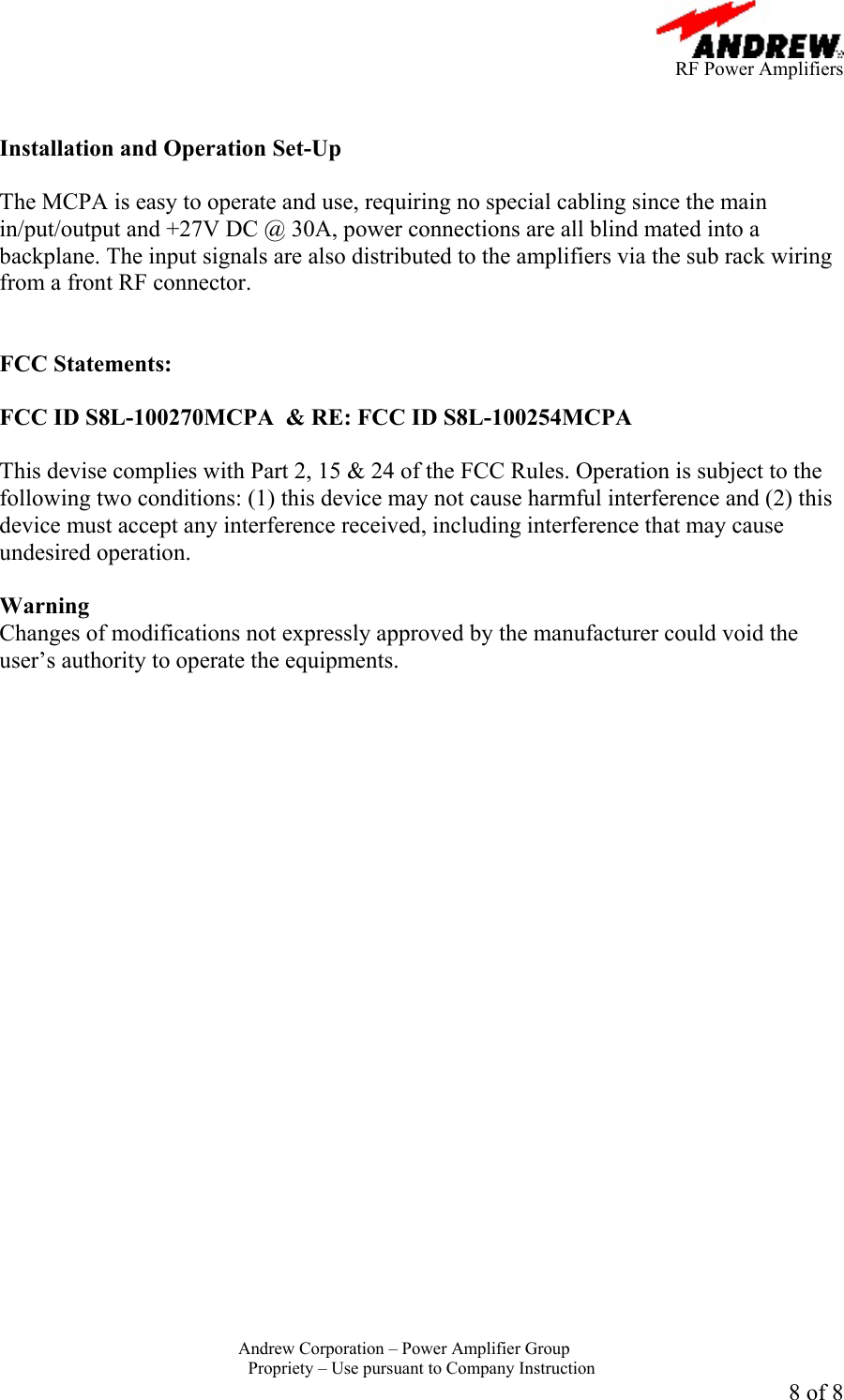
     RF Power Amplifiers Andrew Corporation – Power Amplifier Group  Propriety – Use pursuant to Company Instruction 7 of 8 threshold is typically 10.5 dB above rated input power (51.3 dBm output – 56 dB nominal gain). Note 5: Whenever a linearizer alarm occurs, the amplifier is shut down.  Each actively tuned gain and phase adjuster has a factory nominal setting with leash limits around it.  Whenever the tuning algorithm persistently requires an adjustment beyond the leash limits, a linearizer alarm is declared.  Note 6: Some sensors allow fault detection because they give readings that are out of range (e.g. temperature sensor).   Note 7: Under current or overcurrent depending on the hardware. Note 8: Typically 10 dB to set the alarm, with 3 dB of hysteresis (alarm resets at -13 dB). When operated with other amplifiers in parallel, each amplifier performs its own VSWR diagnostics and shut down independently.  The shutdown process is coordinated with the RFIM and Switch Combiner Module, eliminating chain reaction scenarios.  Note 9: A VSWR critical alarm is declared when the reflected power is 80W or more and indicates that the unit may be damaged if not shut down. Since the amplifier cannot detect that this condition has cleared while shut down, an RF enable command, restart command, or power cycle is required to clear this condition.  Since there are circulators on the amplifier, a delay of about 1 second is acceptable before shutting down.   Note 10: A bias fault is declared during the factory bias setting algorithm (see above) if firmware is unable to set the bias correctly.  This is typically a hard failure; however, the bias setting command can be repeated. Note 11: Self test: Whenever the amplifier is powered on or reset (whether from the front panel or otherwise), firmware performs a self-test.  Included in the test are processor RAM, boot image checksum, NVM image checksum, temperature sensors, power supplies, and pilot/receiver operation.  If any one of these tests fails, a self-test failure critical alarm is declared and the unit does not start up.  There is no recovery short of a reset or power cycle.  This is typically a hard failure; however, self-test will be repeated on the next restart command or power cycle.
     RF Power Amplifiers Andrew Corporation – Power Amplifier Group  Propriety – Use pursuant to Company Instruction 8 of 8   Installation and Operation Set-Up  The MCPA is easy to operate and use, requiring no special cabling since the main in/put/output and +27V DC @ 30A, power connections are all blind mated into a backplane. The input signals are also distributed to the amplifiers via the sub rack wiring from a front RF connector.    FCC Statements:  FCC ID S8L-100270MCPA  & RE: FCC ID S8L-100254MCPA  This devise complies with Part 2, 15 & 24 of the FCC Rules. Operation is subject to the following two conditions: (1) this device may not cause harmful interference and (2) this device must accept any interference received, including interference that may cause undesired operation.  Warning  Changes of modifications not expressly approved by the manufacturer could void the user’s authority to operate the equipments.

Navigation menu