V Pressure Regulator Instructions DIN477 Connection
2017-05-31
: Aquarium V-Pressure-Regulator-Instructions Din477-Connection V-Pressure-Regulator-instructions_DIN477-Connection s
Open the PDF directly: View PDF  .
.
Page Count: 2
DIN477 Connection
(EU standard CO2cylinders with fitted gas control valve)
Instructions for Use
CO2is supplied in a compressed gas cylinder that is pressurised to a high pressure of
approx. 60 bar (900psi). In order to use this gas in an aquarium system the flow of gas has
to be reduced to more manageable levels. The adjustable V2Pressure Regulator
reduces the flow of CO2from the cylinder and allows the accurate adjustment and dosage
of CO2into the aquarium.
1. Ensure that the V2Pressure Regulator is compatible with your chosen CO2cylinder.
2. Before connecting theV2Pressure Regulator to the CO2cylinder ensure that the
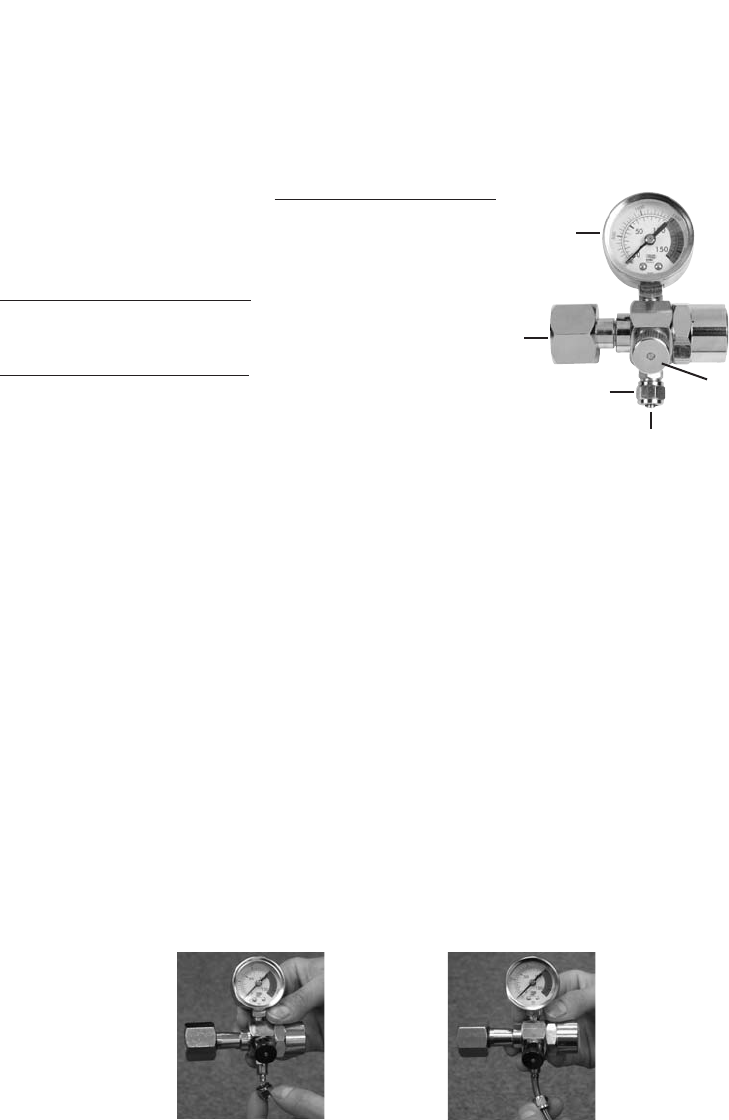
pressure adjustment knob (see Photo 1 above) on the pressure regulator is rotated
clockwise to the fully closed position.
3. Place your CO2cylinder in a stable position on a level surface and connect the regulator
securely to the CO2cylinder by turning the connecting lock nut (see Photo 1 above)
clockwise until it is fully hand tightened. Then, using a 28mm spanner or similar tool,
secure the connection. Caution: For safety, it is good practice when attaching a
regulator to any compressed gas cylinder to point the regulator dial away from you.
4. The V2Pressure Regulator has an outlet hosetail designed for standard 6mm (1/4”)
flexible tubing with a hosetail locking nut for added safety (see Photo 1 above).
5. Unscrew the hosetail locking nut (see Photo 2) and then thread one end of your chosen
flexible tubing through the hole in the end of the locking nut, and attach this same end to
the outlet hosetail (see Photo 3).
Pressure RegulatorPressure RegulatorVV22
For Aquarium Applications
Tools required for installation
28mm spanner or similar tool
Parts required for installation
CO2cylinder and 6mm (1/4”) flexible hosing.
Pressure dial
Photo 1
CO2cylinder
connecting
lock nut
Pressure
adjustment
knob
Hosetail
locking nut
Outlet hosetail
Photo 2 Photo 3

6. Re-attach and secure the hosetail locking nut.
Please note: We strongly advise that a non return valve is installed in the flexible tubing
between the CO2regulator and your calcium reactor or other chosen piece of equipment to
prevent water flowing back into the regulator.
7. Connect and secure the other end of your flexible tubing to your calcium reactor or other
chosen piece of equipment.
8. Double check that all connections have been made correctly and are secure.
9. You are now ready to open the gas control valve on the CO2cylinder. As soon as you
have opened the valve on the CO2cylinder the dial on the pressure regulator should
indicate a reading. If the connection to the CO2cylinder has been made correctly
there will be no escaping gas (and no hissing sound will be heard). However, if gas is
escaping (and a hissing sound is heard) please close the gas control valve on the CO2
cylinder and then reconnect and tighten the regulator as described in 3 above.
10. You are now ready to open the pressure adjustment knob (see Photo 1) on theV2
Pressure Regulator by turning it anti-clockwise, and to start dosing CO2according to your
application and equipment requirements.
CAUTION
• The adjustment on the V2Pressure Regulator is very precise and the pressure adjustment
knob must be turned slowly and carefully to avoid any problems with dosing.
• Do not apply any lubrication to any parts of the regulator.
• Do not attempt to modify or change any parts of the CO2regulator.
• The V2Pressure Regulator cannot be used in conjunction with a solenoid valve.
• Keep all CO2cylinders away from heat.
When to Replace the CO2Cylinder
During normal operation the pressure inside the CO2cylinder will remain fairly constant until
the CO2cylinder is almost empty. Therefore the easiest way to determine when the CO2
cylinder needs replacing is to note the pressure reading on the V2Pressure Regulator dial (see
Photo 1) when the CO2regulator is first connected to a full CO2cylinder. A significant drop in
the pressure reading should indicate that the cylinder is almost empty and should be replaced as
soon as possible. Please note: The total gas output from a CO2cylinder will be dependent on
both the temperature at which the cylinder is filled and the ambient temperature it is used at.
Disconnecting/Replacing the CO2Cylinder
1. Ensure that the gas control valve on the CO2cylinder is fully closed.
2. Undo the hosetail locking nut on the outlet hosetail (see Photo 1) and remove the flexible
tubing from the outlet hosetail. Any CO2trapped inside the tubing will be released and a
hissing sound from escaping gas may be heard.
3. Turn the pressure adjustment knob on theV2Pressure Regulator clockwise to the fully closed position.
4. Carefully disconnect the V2Pressure Regulator from the CO2cylinder by undoing the
securing nut on theV2Pressure Regulator with a 28mm spanner or similar tool.
5. Reconnect as described above.
Tropical Marine Centre is not liable for any consequential damages
caused by the use of this product.
Tropical Marine Centre, Solesbridge Lane, Chorleywood, Hertfordshire WD3 5SX
Technical Information Lines
Tel: +44 (0)1923 284151 Fax: +44 (0)1923 285840
Open between 9am - 5pm Mon to Thurs/9am - 12pm Fri.
www.tropicalmarinecentre.co.uk tmc@tropicalmarinecentre.co.uk
™
