Ariens 93604300 User Manual TRACTOR Manuals And Guides 1009963L
User Manual: Ariens 93604300 93604300 ARIENS TRACTOR - Manuals and Guides View the owners manual for your ARIENS TRACTOR #93604300. Home:Lawn & Garden Parts:Ariens Parts:Ariens TRACTOR Manual
Open the PDF directly: View PDF  .
.
Page Count: 32
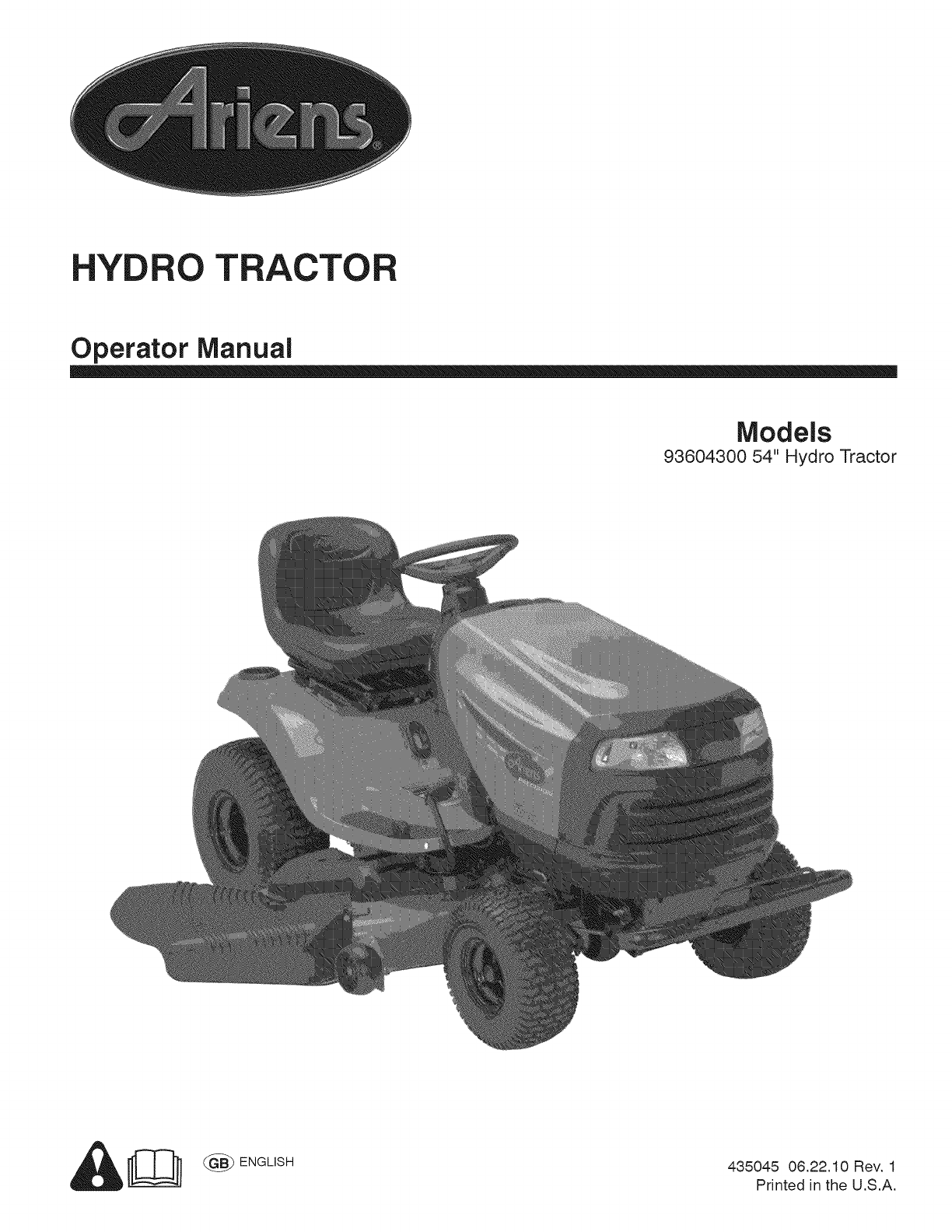
YDRO TRACTO
Operator Manual
Models
93604300 54" Hydro Tractor
&_ _ ENGLISH 435045 06.22.10 Rev. 1
Printed in the U.S.A.
SAFETY RULES
Safe Operation Practices for Ride=On Mowers
DANGER: THiS CUTTING MACHINE iS CAPABLE OF AMPUTATING HANDS AND FEET AND THROWING OBJECTS. FAILURE
TO OBSERVE THE FOLLOWING SAFETY iNSTRUCTiONS COULD RESULT iN SERIOUS iNJURY OR DEATH.
WARNING: in orderto prevent accidental
starting when setting up, transporting,
adjusting or making repairs, always
disconnect spark plug wire and place
wire where it cannot contact spark plug.
WARNING: Do not coast down ahill in neu-tral, you may lose control of the tractor.
WARNING: Tow onlythe attachments that
are recommended by and comply with
specifications of the manufacturer of your
tractor. Use common sense when towing.
Operate only atthe lowest possible speed
when on a slope. Too heavy of aload,
while on a slope, is dangerous. Tires
can lose traction with the ground and
cause you to lose control of your tractor.
WARNING
Engine exhaust, some of its constituents, and certain
vehicle components contain or emit chemicals
known to the State of California to cause cancer
and birth defects or other reproductive harm.
WARNING
Battery posts, terminals and related accessories
contain lead and lead compounds, chemicals known
to the State of California to cause cancer and birth
defects or other reproductive harm. Wash hands
after handling.
I. GENERAL OPERATION
• Read, understand, and follow all instructions on the
machine and in the manual before starting.
•Do not put hands or feet near rotating parts or under
the machine. Keep clear of the discharge opening at
all times.
•Only allow responsible adults, who are familiar with
the instructions, to operate the machine.
•Clear the area of objects such as rocks, toys, wire, etc.,
which could be picked up and thrown by the blades.
•Ensure the area is clear of bystanders before
operating. Stop machine if anyone enters the area.
•Never carry passengers.
•Do not mow in reverse unless absolutely necessary.
Always look down and behind before and while
backing.
•Never direct discharged material toward anyone. Avoid
discharging material against a wall or obstruction.
Material may ricochet back toward the operator. Stop
the blades when crossing gravel surfaces.
•Do not operate machine without the entire grass catcher,
discharge chute, or other safety devices in place and
working.
•Slow down before turning.
•Never leave a running machine unattended. Always
turn off blades, set parking brake, stop engine, and
remove keys before dismounting.
•Disengage blades when not mowing. Shut off engine
and wait for all parts to come to a complete stop before
cleaning the machine, removing the grass catcher, or
unclogging the discharge chute.
•Operate machine only in daylight or good artificial
light.
•Do not operate the machine while under the influence
of alcohol or drugs.
•Watch for traffic when operating near or crossing
roadways.
•Use extra care when loading or unloading the machine
into a trailer or truck.
•Always wear eye protection when operating
machine.
•Data indicates that operators, age 60 years and above,
are involved in a large percentage of riding mower-
related injuries. These operators should evaluate their
ability to operate the riding mower safely enough to
protect themselves and others from serious injury.
•Follow the manufacturer's recommendation for wheel
weights or counterweights.
•Keep machine free of grass , leaves or other debris
build-up which can touch hot exhaust /engine parts
and burn. Do not allow the mower deck to plow leaves
or other debris which can cause build-up to occur.
Clean any oil or fuel spillage before operating or storing
the machine. Allow machine to cool before storage.
II. SLOPE OPERATION
Slopes are a major factor related to loss of control and
tip-over accidents, which can result in severe injury or
death. Operation on all slopes requires extra caution. If
you cannot back up the slope or if you feel uneasy on it,
do not mow it.
•Mow up and down slopes, not across.
•Watch for holes, ruts, bumps, rocks, or other hidden
objects. Uneven terrain could overturn the machine.
Tall grass can hide obstacles.
•Choose a low ground speed so that you will not have
to stop or shift while on the slope.
•Do not mow on wet grass. Tires may lose traction.
Always keep the machine in gear when going down
slopes. Do not shift to neutral and coast downhill.
•Avoid starting, stopping, or turning on a slope. If the
tires lose traction, disengage the blades and proceed
slowly straight down the slope.
•Keep all movement on the slopes slow and gradual.
Do not make sudden changes in speed or direction,
which could cause the machine to roll over.
•Use extra care while operating machine with grass
catchers or other attachments; they can affect the
stability of the machine. Do no use on steep slopes.
•Do not try to stabilize the machine by putting your foot
on the ground.
•Do not mow near drop-offs, ditches, or embankments.
The machine could suddenly roll over if a wheel is over
the edge or if the edge caves in.
2
SAFETY RULES
Safe Operation Practices for Ride=On Mowers
ill. CHILDREN
Tragic accidents can occur if the operator is not alert to
the presence of children. Children are often attracted to
the machine and the mowing activity. Never assume that
children will remain where you last saw them.
•Keepchildrenoutofthemowingareaandinthewatchful
care of a responsible adult other than the operator.
•Be alert and turn machine off if a child enters the
area.
•Before and while backing, look behind and down for
small children.
•Never carry children, even with the blades shut off. They
may fall off and be seriously injured or interfere with
safe machine operation. Children who have been given
rides in the past may suddenly appear in the mowing
area for another ride and be run over or backed over
by the machine.
•Never allow children to operate the machine.
•Use extra care when approaching blind corners, shrubs,
trees, or other objects that may block your view of a
child.
IV. TOWING
•Tow only with a machine that has a hitch designed for
towing. Do not attach towed equipment except at the
hitch point.
•Follow the manufacturer's recommendation for weight
limits for towed equipment and towing on slopes.
•Never allow children or others in or on towed
equipment.
•On slopes, the weight of the towed equipment may
cause loss of traction and loss of control.
•Travel slowly and allow extra distance to stop.
V. SERVICE
SAFE HANDLING OF GASOLINE
To avoid personal injury or property damage, use extreme
care in handling gasoline. Gasoline is extremely flammable
and the vapors are explosive.
•Extinguish all cigarettes, cigars, pipes, and other
sources of ignition.
•Use only approved gasoline container.
•Never remove gas cap or add fuel with the engine
running. Allow engine to cool before refueling.
•Never fuel the machine indoors.
•Never store the machine or fuel container where there
is an open flame, spark, or pilot light such as on a water
heater or other appliances.
•Never fill containers inside a vehicle or on a truck or
trailer bed with plastic liner. Always place containers
on the ground away from your vehicle when filling.
•Remove gas-powered equipment from the truck or
trailer and refuel it on the ground. If this is not possible,
then refuel such equipment with a portable container,
rather than from a gasoline dispenser nozzle.
•Keep the nozzle incontact with the rim of the fuel tank or
container opening at all times until fueling is complete.
Do not use a nozzle lock-open device.
•If fuel is spilled on clothing, change clothing immedi-
ately.
•Never overfill fuel tank. Replace gas cap and tighten
securely.
GENERAL SERVICE
•Never operate machine in a closed area.
•Keep all nuts and bolts tight to ensure the equipment
is in safe working condition.
•Never tamper with safety devices. Check their proper
operation regularly.
•Keep machine free of grass, leaves, or other debris
build-up. Clean oil or fuel spillage and remove any fuel-
soaked debris. Allow machine to cool before storing.
•If you strike a foreign object, stop and inspect the
machine. Repair, if necessary, before restarting.
•Never make any adjustments or repairs with the engine
running.
•Check grass catcher components and the discharge
chute frequently and replace with manufacturer's rec-
ommended parts, when necessary.
•Mower blades are sharp. Wrap the blade or wear
gloves, and use extra caution when servicing them.
•Check brake operation frequently. Adjust and service
as required.
•Maintain or replace safety and instruction labels, as
necessary.
o
o
o
o
o
o
o
o
o
o
o
Ensure the area is clear of bystanders before operat-
ing. Stop machine if anyone enters the area.
Never carry passengers.
Do not mow in reverse unless absolutely necessary.
Always look down and behind before and while back-
ing.
Never carry children, even with the blades shut off. They
may fall off and be seriously injured or interfere with
safe machine operation. Children who have been given
rides in the past may suddenly appear in the mowing
area for another ride and be run over or backed over
by the machine.
Keep children out ofthe mowing area and inthe watchful
care of a responsible adult other than the operator.
Be alert and turn machine off if a child enters the
area.
Before and while backing, look behind and down for
small children.
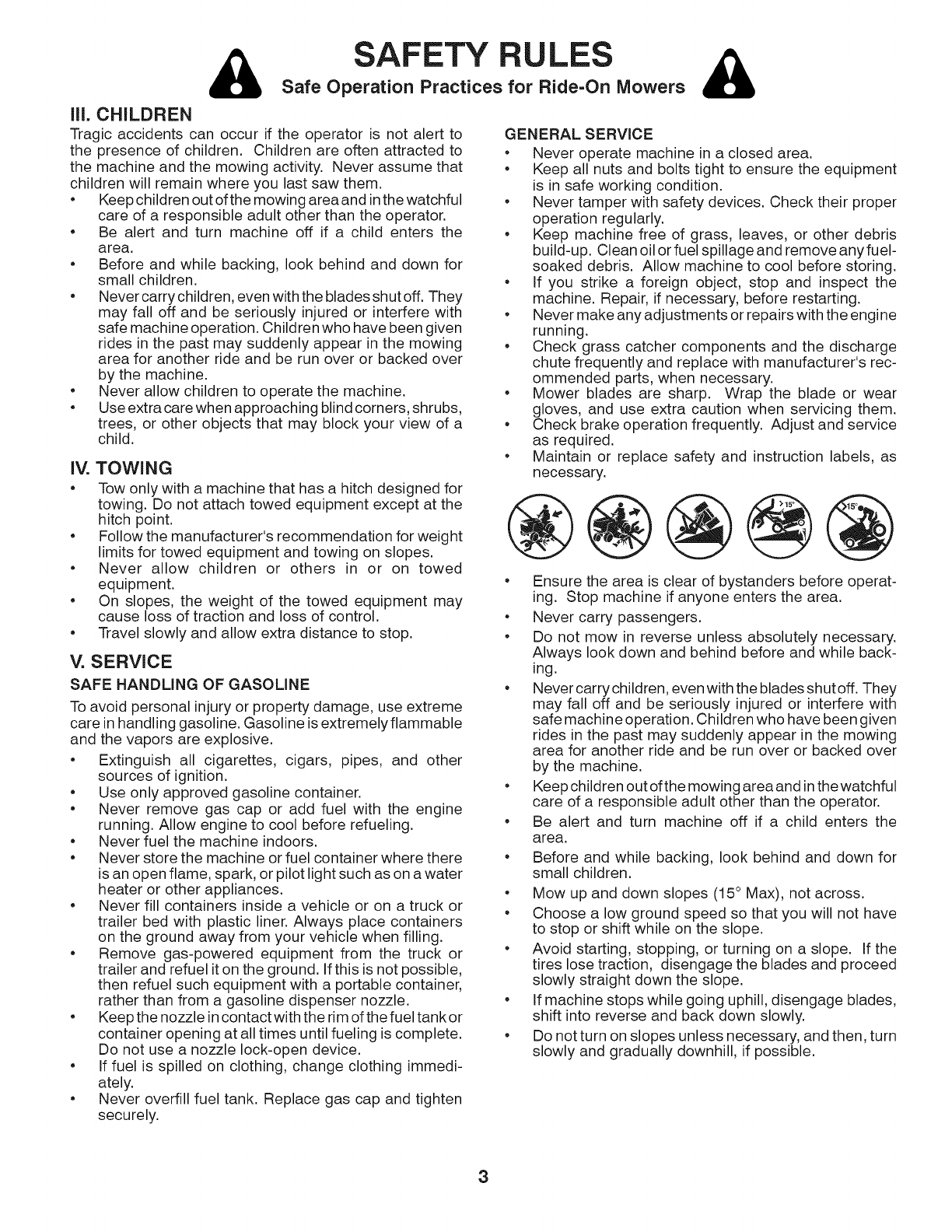
Mow up and down slopes (15° Max), not across.
Choose a low ground speed so that you will not have
to stop or shift while on the slope.
Avoid starting, stopping, or turning on a slope. If the
tires lose traction, disengage the blades and proceed
slowly straight down the slope.
If machine stops while going uphill, disengage blades,
shift into reverse and back down slowly.
Do not turn on slopes unless necessary, and then, turn
slowly and gradually downhill, if possible.
3
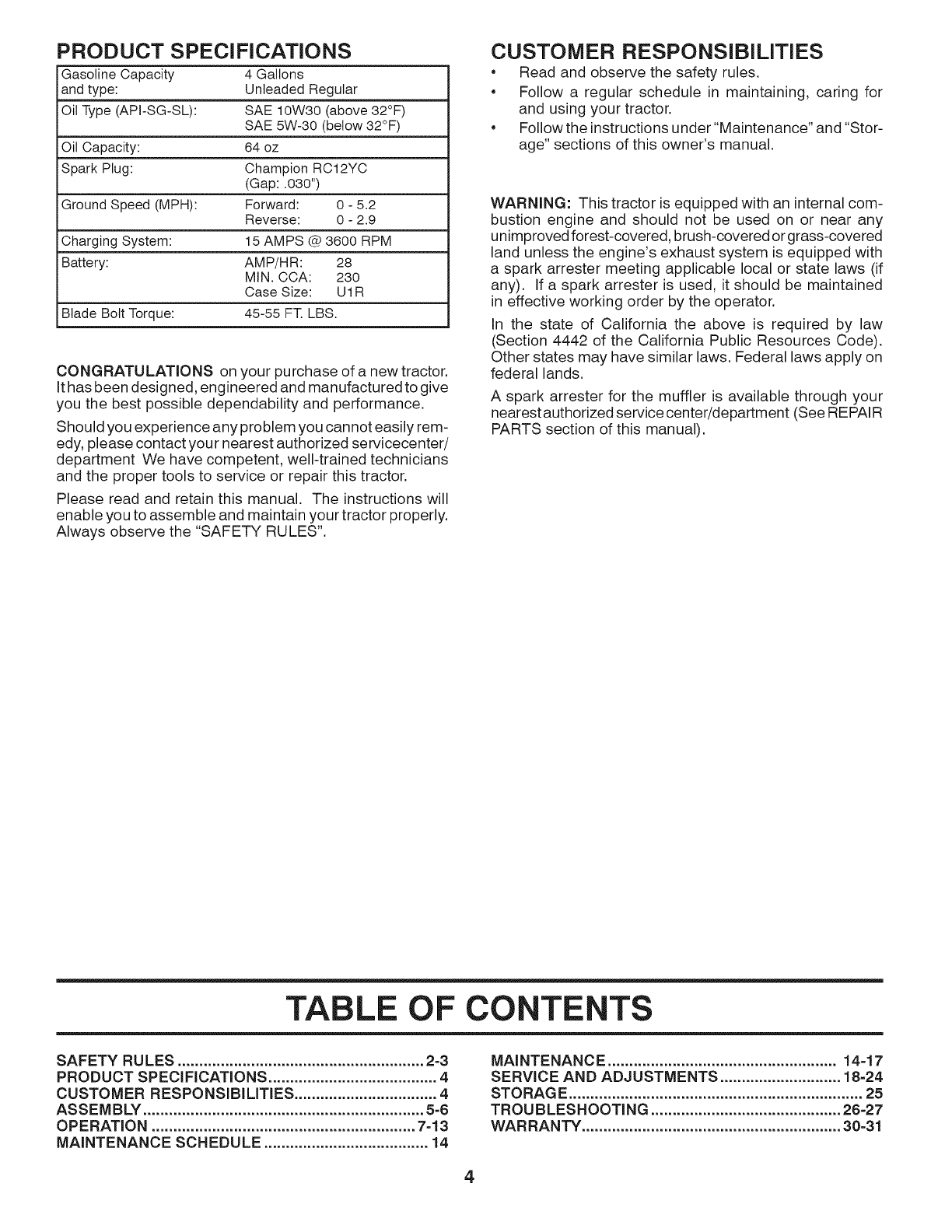
PRODUCT SPECiFiCATiONS
Gasoline Capacity 4 Gallons
and type: Unleaded Regular
Oil Type (API-SG-SL): SAE 10W30 (above 32°F)
SAE 5W-30 (below 32°F)
Oil Capacity: 64 oz
Spark Plug: Champion RC12YC
(Gap: .030")
Ground Speed (MPH): Forward: 0 -5.2
Reverse: 0 - 2.9
Charging System: 15 AMPS @ 3600 RPM
Battery: AMP/HR: 28
MIN. CCA: 230
Case Size: U1R
Blade Bolt Torque: 45-55 FT. LBS.
CONGRATULATIONS on your purchase of a new tractor.
It has been designed, engineered and manufacturedto give
you the best possible dependability and performance.
Should you experience any problem you cannot easily rem-
edy, please contact your nearest authorized servicecenter/
department We have competent, well-trained technicians
and the proper tools to service or repair this tractor.
Please read and retain this manual. The instructions will
enable you to assemble and maintain your tractor properly.
Always observe the "SAFETY RULES".
CUSTOMER RESPONSIBILITIES
• Read and observe the safety rules.
•Follow a regular schedule in maintaining, caring for
and using your tractor.
• Follow the instructions under "Maintenance" and "Stor-
age" sections of this owner's manual.
WARNING: This tractor is equipped with an internal com-
bustion engine and should not be used on or near any
unimproved forest-covered, brush-covered orgrass-covered
land unless the engine's exhaust system is equipped with
a spark arrester meeting applicable local or state laws (if
any). If a spark arrester is used, it should be maintained
in effective working order by the operator.
In the state of California the above is required by law
(Section 4442 of the California Public Resources Code).
Other states may have similar laws. Federal laws apply on
federal lands.
A spark arrester for the muffler is available through your
nearest authorized service center/department (See REPAIR
PARTS section of this manual).
TABLE OF CONTENTS
SAFETY RULES ......................................................... 2=3
PRODUCT SPECIFICATIONS ....................................... 4
CUSTOMER RESPONSIBILITIES ................................. 4
ASSEMBLY ................................................................. 5=6
OPERATION ............................................................. 7=13
MAINTENANCE SCHEDULE ...................................... 14
MAINTENANCE ..................................................... 14=17
SERVICE AND ADJUSTMENTS ............................ 18=24
STORAGE .................................................................... 25
TROUBLESHOOTING ............................................ 26-27
WARRANTY ............................................................ 30-31
4
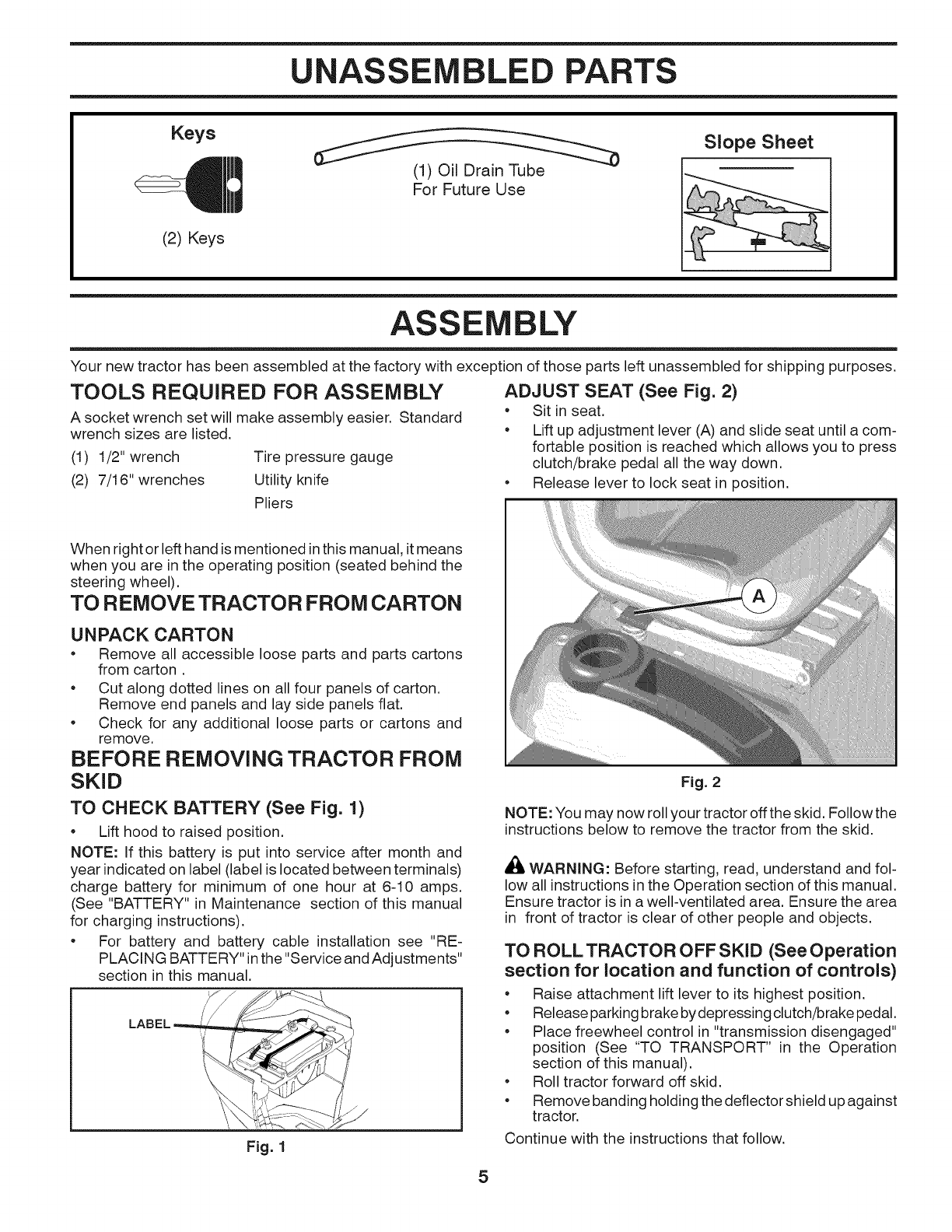
UNASSEMBLED PARTS
Keys
qll',ll
(2) Keys
(1) Oil Drain Tube
For Future Use
Slope Sheet
ASSEMBLY
Your new tractor has been assembled at the factory with exception of those parts left unassembled for shipping purposes.
TOOLS REQUIRED FOR ASSEMBLY
A socket wrench set will make assembly easier. Standard
wrench sizes are listed.
(1) 1/2" wrench Tire pressure gauge
(2) 7/16" wrenches Utility knife
Pliers
When right or left hand ismentioned in this manual, itmeans
when you are in the operating position (seated behind the
steering wheel).
TO REMOVE TRACTOR FROM CARTON
UNPACK CARTON
•Remove all accessible loose parts and parts cartons
from carton.
•Cut along dotted lines on all four panels of carton.
Remove end panels and lay side panels flat.
•Check for any additional loose parts or cartons and
remove.
BEFORE REMOVING TRACTOR FROM
SKID
TO CHECK BATTERY (See Fig. 1)
•Lift hood to raised position.
NOTE: If this battery is put into service after month and
year indicated on label (label is located between terminals)
charge battery for minimum of one hour at 6-10 amps.
(See "BATTERY" in Maintenance section of this manual
for charging instructions).
•For battery and battery cable installation see "RE-
PLACING BATTERY" inthe "Service and Adjustments"
section in this manual.
LABEL __
Fig. 1
ADJUST SEAT (See Fig. 2)
•Sit in seat.
•Lift up adjustment lever (A) and slide seat until a com-
fortable position is reached which allows you to press
clutch/brake pedal all the way down.
•Release lever to lock seat in position.
Fig. 2
NOTE: You may now roll your tractor off the skid. Follow the
instructions below to remove the tractor from the skid.
,_ WARNING: Before starting, read, understand and fol-
low all instructions in the Operation section of this manual.
Ensure tractor is in a well-ventilated area. Ensure the area
in front of tractor is clear of other people and objects.
TO ROLL TRACTOR OFF SKiD (See Operation
section for location and function of controls)
•Raise attachment lift lever to its highest position.
•Release parking brake by depressing clutch/brake pedal.
•Place freewheel control in "transmission disengaged"
position (See "TO TRANSPORT" in the Operation
section of this manual).
•Roll tractor forward off skid.
•Remove banding holding the deflector shield up against
tractor.
Continue with the instructions that follow.
5
ASSEMBLY
CHECK TIRE PRESSURE
The tires on your tractor were overinflated at the factory
for shipping purposes. Correct tire pressure is important
for best cutting performance.
• Reduce tire pressure to PSI shown on tires.
CHECK DECK LEVELNESS
For best cutting results, mower housing should be properly
leveled. See"TO LEVEL MOWER HOUSING" inthe Service
and Adjustments section of this manual.
CHECK FOR PROPER POSITION OF ALL
BELTS
See the figures that are shown for replacing motion and
mower blade drive belts in the Service and Adjustments
section of this manual. Verify that the belts are routed
correctly.
CHECK BRAKE SYSTEM
After you learn how to operate your tractor, check to see that
the brake is operating properly. See "TO CHECK BRAKE"
in the Service and Adjustments section of this manual.
Vf CHECKLIST
BEFORE YOU OPERATE YOUR NEW TRACTOR, WE
WISH TO ASSURE THAT YOU RECEIVE THE BEST
PERFORMANCE AND SATISFACTION FROM THIS
QUALITY PRODUCT.
PLEASE REVIEW THE FOLLOWING CHECKLIS-17
J" All assembly instructions have been completed.
J" No remaining loose parts in carton.
J" Battery is properly prepared and charged.
J" Seat is adjusted comfortably and tightened securely.
J" All tires are properly inflated. (For shipping purposes,
the tires were overinflated at the factory.)
J" Ensure mower deck is properly leveled side-to-side/
front-to-rear for best cutting results. (Tires must be
properly inflated for leveling.)
J" Check mower and drive belts. Ensure they are routed
properly around pulleys and inside all belt keepers.
J" Check wiring. See that all connections are still secure
and wires are properly clamped.
J" Before driving tractor, ensure freewheel control is in
"transmission engaged" position (see "TO TRANS-
PORT" in the Operation section of this manual).
WHILE LEARNING HOWTO USE YOUR TRACTOR, PAY
EXTRA ATTENTION TO THE FOLLOWING IMPORTANT
ITEMS:
J" Engine oil is at proper level.
J" Fuel tank is filled with fresh, clean, regular unleaded
gasoline.
J" Become familiar with all controls, their location and
function. Operate them before you start the engine.
J" Ensure brake system is in safe operating condition.
J" Ensure Operator Presence System and Reverse Op-
eration System (ROS) are working properly (See the
Operation and Maintenance sections in this manual).
J" It is important to purge the transmission before operat-
ing your tractor for the first time. Follow proper start-
ing and transmission purging instructions (See "TO
START ENGINE" and "PURGE TRANSMISSION" in
the Operation section of this manual).
6
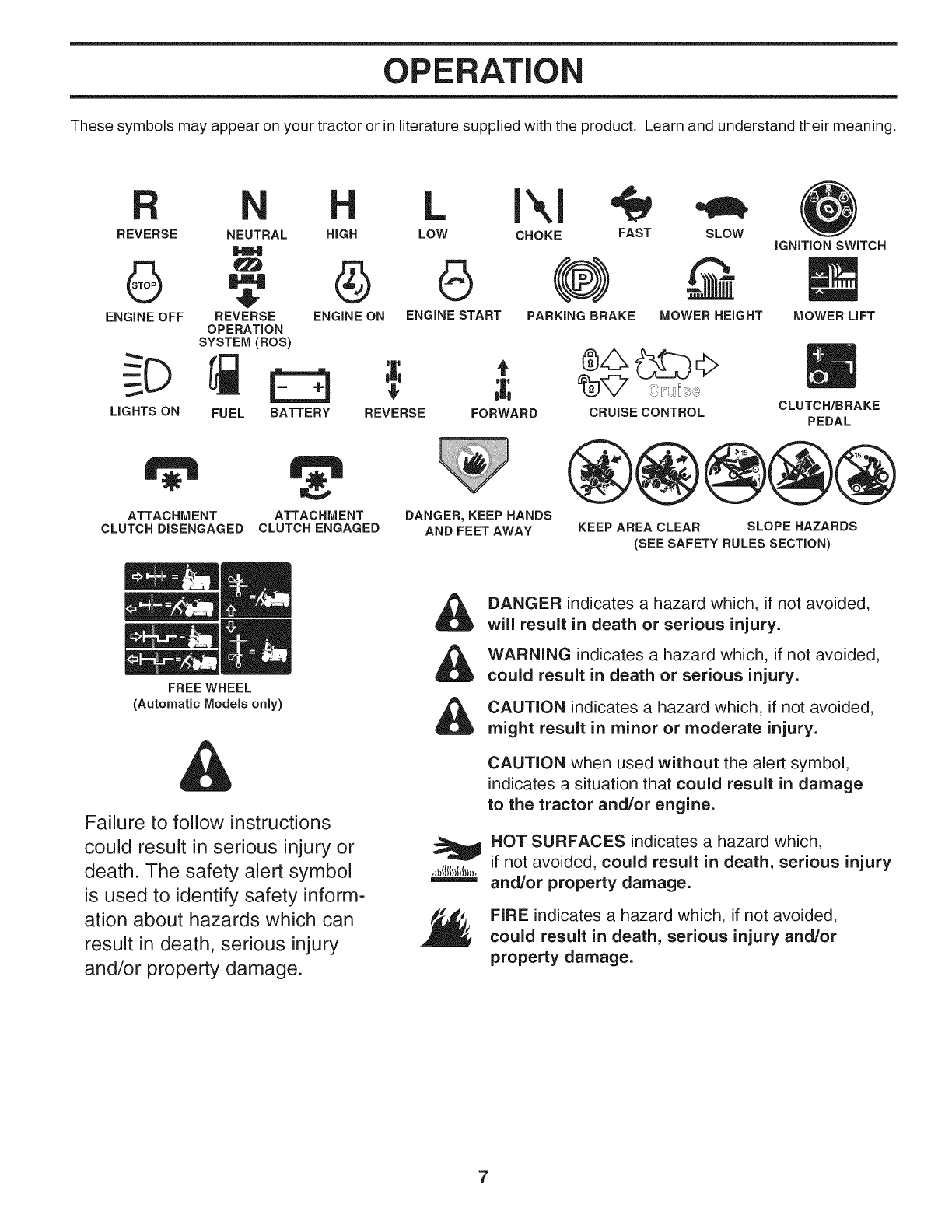
OPERATION
These symbols may appear on your tractor or in literature supplied with the product. Learn and understand their meaning.
LI",l
LOW CHOKE FAST SLOWREVERSE NEUTRAL HiGH
IGNITION SWITCH
ENGINE OFF REVERSE ENGINE ON ENGINE START PARKING BRAKE MOWER HEIGHT MOWER LIFT
OPERATION
SYSTEM (ROS)
FUEL BATTERY CLUTCH/BRAKE
PEDAL
LIGHTS ON REVERSE FORWARD CRUISE CONTROL
ATTACHM ENT
CLUTCH DISENGAGED ATTACHM ENT
CLUTCH ENGAGED DANGER, KEEP HANDS
AND FEET AWAY KEEP AREA CLEAR SLOPE HAZARDS
(SEE SAFETY RULES SECTION)
FREEWHEEL
(Automatic Models only)
Failure to follow instructions
could result in serious injury or
death. The safety alert symbol
is used to identify safety inform-
ation about hazards which can
result in death, serious injury
and/or property damage.
&
&
&
DANGER indicates a hazard which, if not avoided,
will result in death or serious injury.
WARNING indicates a hazard which, if not avoided,
could result in death or serious injury.
CAUTION indicates a hazard which, if not avoided,
might result in minor or moderate injury.
CAUTION when used without the alert symbol,
indicates a situation that could result in damage
to the tractor and/or engine.
HOT SURFACES indicates a hazard which,
if not avoided, could result in death, serious injury
and/or property damage.
FIRE indicates a hazard which, if not avoided,
could result in death, serious injury and/or
property damage.
7
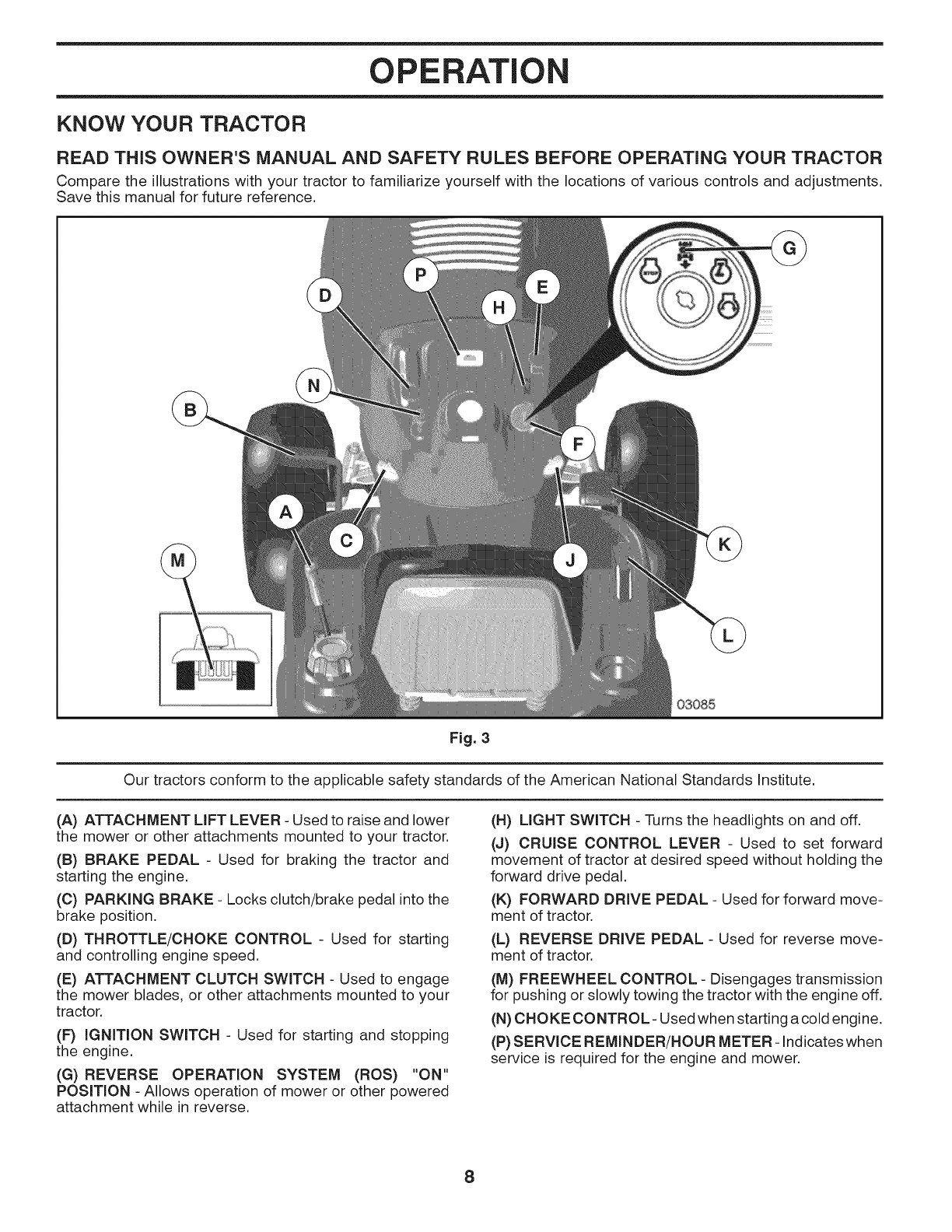
OPERATION
KNOW YOUR TRACTOR
READ THiS OWNER'S MANUAL AND SAFETY RULES BEFORE OPERATING YOUR TRACTOR
Compare the illustrationswith your tractor to familiarize yourself with the locations of various controls and adjustments.
Save this manual for future reference.
Fig. 3
03085
Our tractors conform to the applicable safety standards of the American National Standards Institute.
(A) ATTACHMENT LIFT LEVER - Used to raise and lower
the mower or other attachments mounted to your tractor.
(B) BRAKE PEDAL - Used for braking the tractor and
starting the engine.
(C) PARKING BRAKE - Locks clutch/brake pedal into the
brake position.
(D) THROTTLE/CHOKE CONTROL - Used for starting
and controlling engine speed.
(E) ATTACHMENT CLUTCH SWITCH - Used to engage
the mower blades, or other attachments mounted to your
tractor.
(F) IGNITION SWITCH - Used for starting and stopping
the engine.
(G) REVERSE OPERATION SYSTEM (ROS) "ON"
POSiTiON - Allows operation of mower or other powered
attachment while in reverse.
(H) LIGHT SWITCH - Turns the headlights on and off.
(J) CRUISE CONTROL LEVER - Used to set forward
movement of tractor at desired speed without holding the
forward drive pedal.
(K) FORWARD DRIVE PEDAL - Used for forward move-
ment of tractor.
(L) REVERSE DRIVE PEDAL - Used for reverse move-
ment of tractor.
(M) FREEWHEEL CONTROL - Disengages transmission
for pushing or slowly towing the tractor with the engine off.
(N) CHOKE CONTROL- Used when starting a cold engine.
(P) SERVICE REMINDER/HOUR METER-Indicates when
service is required for the engine and mower.
8
OPERATION
The operation of any tractor can result in foreign objects thrown into the eyes, which can result
in severe eye damage. Always wear safety glasses or eye shields while operating your tractor
or performing any adjustments or repairs. We recommend standard safety glasses or a wide
vision safety mask worn over spectacles.
HOW TO USE YOUR TRACTOR
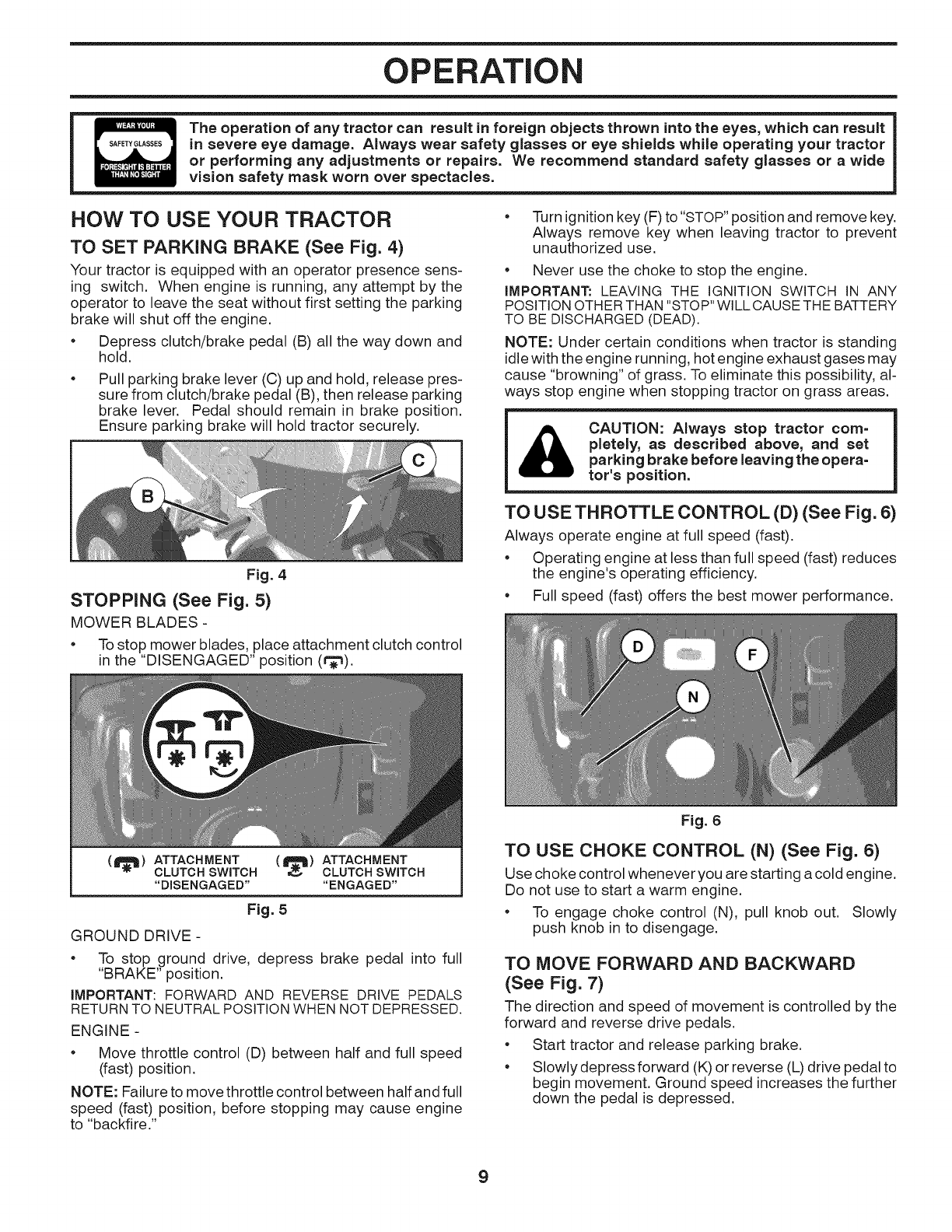
TO SET PARKING BRAKE (See Fig. 4)
Your tractor is equipped with an operator presence sens-
ing switch. When engine is running, any attempt by the
operator to leave the seat without first setting the parking
brake will shut off the engine.
• Depress clutch/brake pedal (B) all the way down and
hold.
Pull parking brake lever (C) up and hold, release pres-
sure from clutch/brake pedal (B), then release parking
brake lever. Pedal should remain in brake position.
Ensure parking brake will hold tractor securely.
Fig. 4
STOPPING (See Fig. 5)
MOWER BLADES -
• To stop mower blades, place attachment clutch control
in the "DISENGAGED" position (t_).
• Turn ignitionkey (F) to "STOP"position and remove key.
Always remove key when leaving tractor to prevent
unauthorized use.
• Never use the choke to stop the engine.
IIVlPORTANT: LEAVING THE IGNITION SWITCH IN ANY
POSITION OTHER THAN "STOP" WILL CAUSE THE BATTERY
TO BE DISCHARGED (DEAD).
NOTE: Under certain conditions when tractor is standing
idle with the engine running, hot engine exhaust gases may
cause "browning" of grass. To eliminate this possibility, al-
ways stop engine when stopping tractor on grass areas.
CAUTION: Always stop tractor corn=
pletely, as described above, and set
parking brake before leaving the opera=
tot's position.
TO USE THROTTLE CONTROL (D) (See Fig. 6)
Always operate engine at full speed (fast).
• Operating engine at less than full speed (fast) reduces
the engine's operating efficiency.
• Full speed (fast) offers the best mower performance.
(II_) ATTACHMENT (i_ll) ATTACHMENT
CLUTCH SWITCH CLUTCH SWITCH
"DISENGAGED .... ENGAGED"
Fig. 5
GROUND DRIVE -
• To stop ground drive, depress brake pedal into full
"BRAKE" position.
IMPORTANT: FORWARD AND REVERSE DRIVE PEDALS
RETURN TO NEUTRAL POSITION WHEN NOT DEPRESSED.
ENGINE -
• Move throttle control (D) between half and full speed
(fast) position.
NOTE: Failure to move throttle control between half and full
speed (fast) position, before stopping may cause engine
to "backfi re."
Fig. 6
TO USE CHOKE CONTROL (N) (See Fig. 6)
Use choke control whenever you are starting a cold engine.
Do not use to start a warm engine.
• To engage choke control (N), pull knob out. Slowly
push knob in to disengage.
TO MOVE FORWARD AND BACKWARD
(See Fig. 7)
The direction and speed of movement is controlled by the
forward and reverse drive pedals.
• Start tractor and release parking brake.
• Slowly depress forward (K) or reverse (L) drive pedal to
begin movement. Ground speed increases the further
down the pedal is depressed.
9
OPERATION
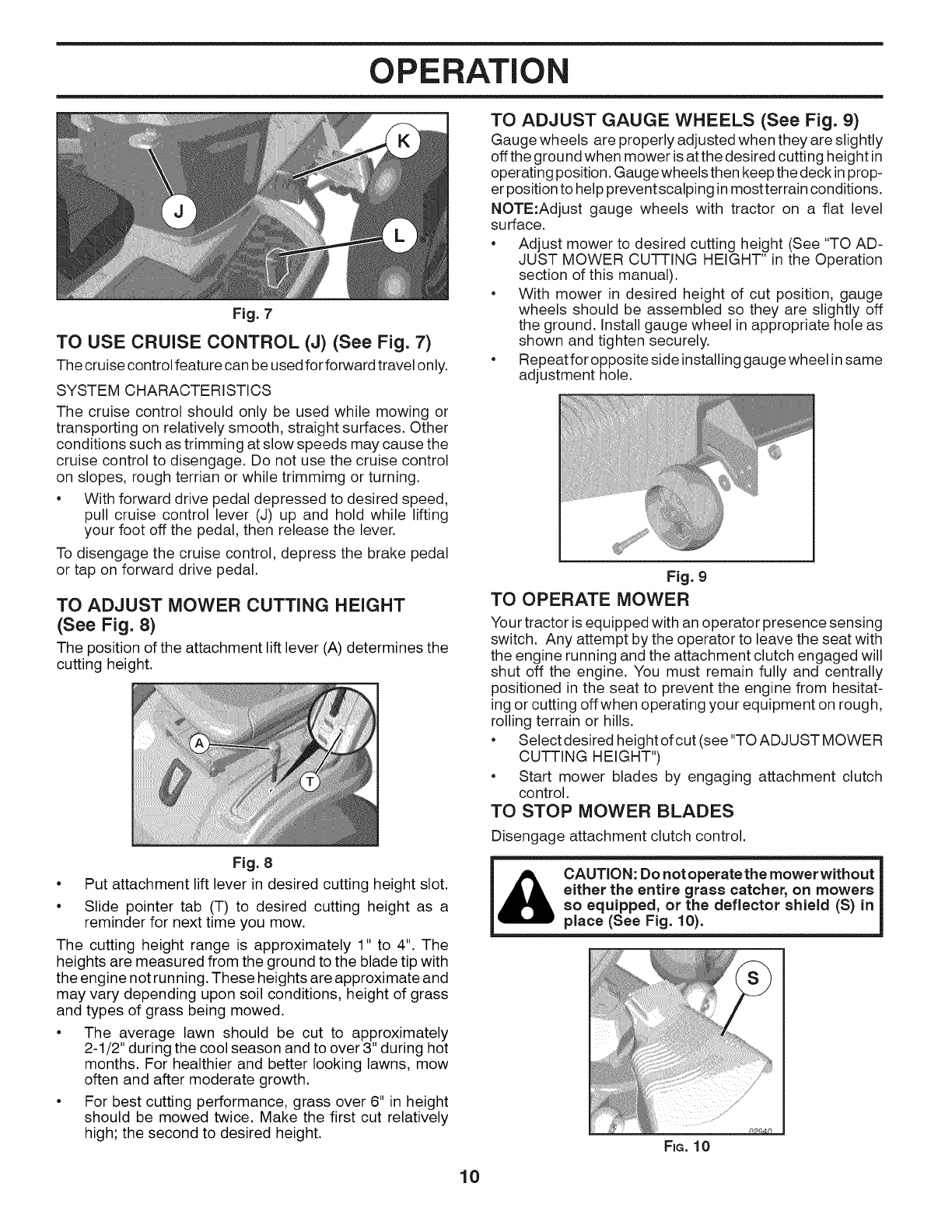
Fig. 7
TO USE CRUISE CONTROL (J) (See Fig. 7)
The cruise control feature can be used for forward travel only.
SYSTEM CHARACTERISTICS
The cruise control should only be used while mowing or
transporting on relatively smooth, straight surfaces. Other
conditions such as trimming at slow speeds may cause the
cruise control to disengage. Do not use the cruise control
on slopes, rough terrian or while trimmimg or turning.
• With forward drive pedal depressed to desired speed,
pull cruise control lever (J) up and hold while lifting
your foot off the pedal, then release the lever.
To disengage the cruise control, depress the brake pedal
or tap on forward drive pedal.
TO ADJUST MOWER CUTTING HEIGHT
(See Fig. 8)
The position of the attachment lift lever (A) determines the
cutting height.
Fig. 8
• Put attachment lift lever in desired cutting height slot.
• Slide pointer tab (T) to desired cutting height as a
reminder for next time you mow.
The cutting height range is approximately 1" to 4". The
heights are measured from the ground to the blade tip with
the engine not running. These heights are approximate and
may vary depending upon soil conditions, height of grass
and types of grass being mowed.
• The average lawn should be cut to approximately
2-1/2" during the cool season and to over 3" during hot
months. For healthier and better looking lawns, mow
often and after moderate growth.
• For best cutting performance, grass over 6" in height
should be mowed twice. Make the first cut relatively
high; the second to desired height.
TO ADJUST GAUGE WHEELS (See Fig. 9)
Gauge wheels are properly adjusted when they are slightly
offthe ground when mower is atthe desired cutting height in
operating position. Gauge wheels then keep the deck inprop-
er position to help prevent scalping in most terrain conditions.
NOTE:Adjust gauge wheels with tractor on a flat level
surface.
• Adjust mower to desired cutting height (See "TO AD-
JUST MOWER CUTTING HEIGHT" in the Operation
section of this manual).
• With mower in desired height of cut position, gauge
wheels should be assembled so they are slightly off
the ground. Install gauge wheel in appropriate hole as
shown and tighten securely.
• Repeat for opposite side installing gauge wheel insame
adjustment hole.
Fig. 9
TO OPERATE MOWER
Your tractor is equipped with an operator presence sensing
switch. Any attempt by the operator to leave the seat with
the engine running and the attachment clutch engaged will
shut off the engine. You must remain fully and centrally
positioned in the seat to prevent the engine from hesitat-
ing or cutting off when operating your equipment on rough,
rolling terrain or hills.
• Select desired height of cut (see "TO ADJUST MOWER
CUTTING HEIGHT")
• Start mower blades by engaging attachment clutch
control.
TO STOP MOWER BLADES
Disengage attachment clutch control.
CAUTIO N: Do not operate the mower without
either the entire grass catcher, on mowers
so equipped, or the deflector shield (S) in
place (See Fig. 10).
!
FiG, 10
10
OPERATION
REVERSE OPERATION SYSTEM (ROS)
Your tractor is equipped with a Reverse Operation System
(ROS). Any attempt by the operator to travel in the reverse
direction with the attachment clutch engaged will shut off
the engine unless ignition key is placed in the ROS "ON"
position.
_,WARNING: Backing up with the attachment clutch en-
gaged while mowing is strongly discouraged. Turning the
ROS "ON", to allow reverse operation with the attachment
clutch engaged, should only be done when the operator
decides it is necessary to reposition the machine with the
attachment engaged. Do not mow in reverse unless
absolutely necessary.
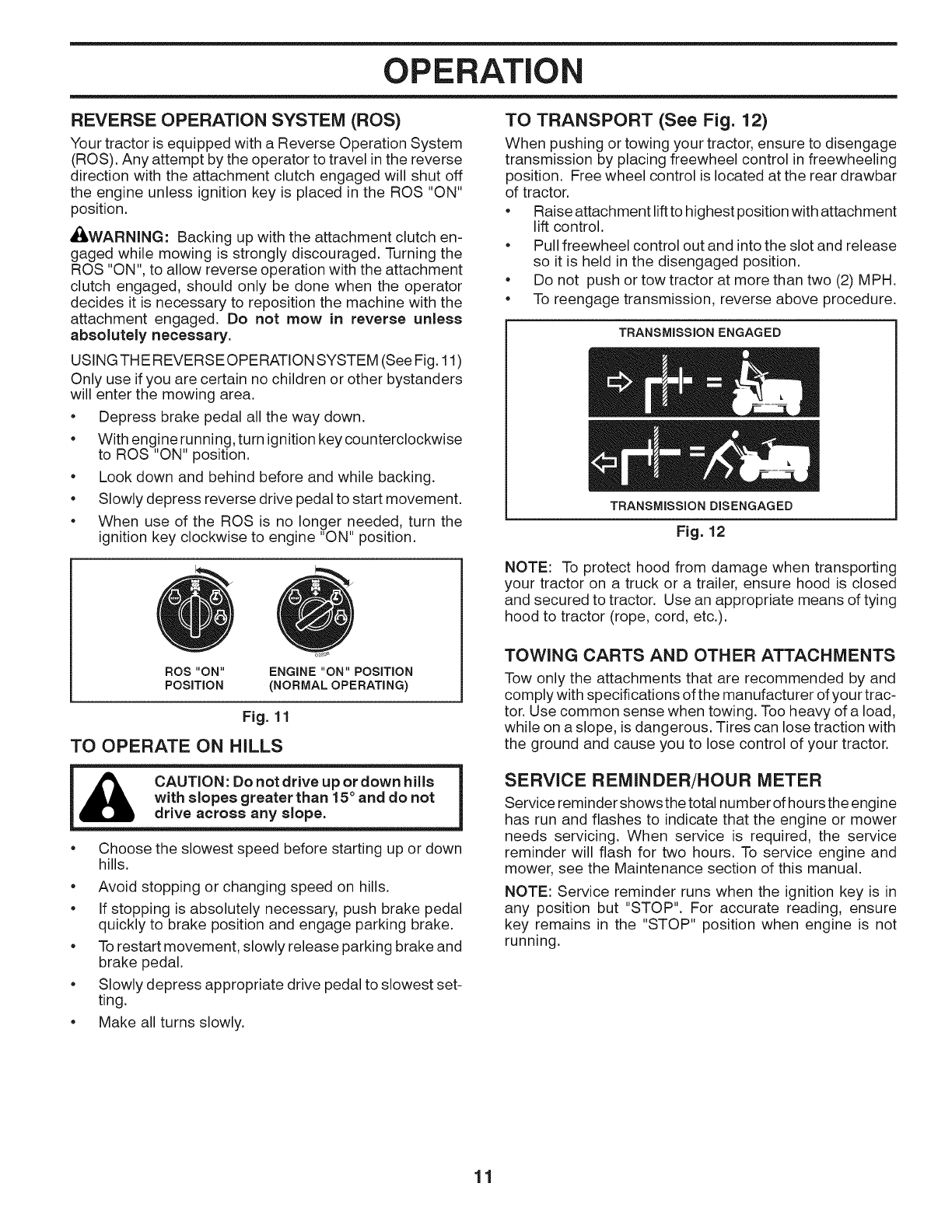
USING THE REVERSE OPERATION SYSTEM (See Fig. 11)
Only use ifyou are certain no children or other bystanders
will enter the mowing area.
• Depress brake pedal all the way down.
• With engine running, turn ignitionkey counterclockwise
to ROS "ON" position.
• Look down and behind before and while backing.
• Slowly depress reverse drive pedal to start movement.
• When use of the ROS is no longer needed, turn the
ignition key clockwise to engine "ON" position.
ROS "ON" ENGINE "ON" POSITION
POSITION (NORMAL OPERATING)
Fig. 11
TO OPERATE ON HILLS
CAUTION: Do not drive up or down hills
with slopes greater than 15° and do not
drive across any slope.
Choose the slowest speed before starting up or down
hills.
• Avoid stopping or changing speed on hills.
• If stopping is absolutely necessary, push brake pedal
quickly to brake position and engage parking brake.
• To restart movement, slowly release parking brake and
brake pedal.
• Slowly depress appropriate drive pedal to slowest set-
ting.
• Make all turns slowly.
TO TRANSPORT (See Fig. 12)
When pushing or towing your tractor, ensure to disengage
transmission by placing freewheel control in freewheeling
position. Free wheel control is located at the rear drawbar
of tractor.
• Raise attachment liftto highest position with attachment
lift control.
• Pull freewheel control out and into the slot and release
so it is held in the disengaged position.
• Do not push or tow tractor at more than two (2) MPH.
• To reengage transmission, reverse above procedure.
TRANSMISSgON ENGAGED
TRANSMISSION DISENGAGED
Fig. 12
NOTE: To protect hood from damage when transporting
your tractor on a truck or a trailer, ensure hood is closed
and secured to tractor. Use an appropriate means of tying
hood to tractor (rope, cord, etc.).
TOWING CARTS AND OTHER ATTACHMENTS
Tow only the attachments that are recommended by and
comply with specifications of the manufacturer of your trac-
tor. Use common sense when towing. Too heavy of a load,
while on a slope, is dangerous. Tires can lose traction with
the ground and cause you to lose control of your tractor.
SERVICE REMINDER/HOUR METER
Service reminder shows the total number of hours the engine
has run and flashes to indicate that the engine or mower
needs servicing. When service is required, the service
reminder will flash for two hours. To service engine and
mower, see the Maintenance section of this manual.
NOTE: Service reminder runs when the ignition key is in
any position but "STOP". For accurate reading, ensure
key remains in the "STOP" position when engine is not
running.
11
OPERATION
BEFORE STARTING THE ENGINE
CHECK ENGINE OiL LEVEL
The engine in your tractor has been shipped, from the
factory, already filled with summer weight oil.
• Check engine oil with tractor on level ground.
• Remove oil fill cap/dipstick and wipe clean, reinsert the
dipstick and screw cap tight, wait for a few seconds,
remove and read oil level. If necessary, add oil until
"FULL' mark on dipstick is reached. Do not overfill.
• For cold weather operation you should change oil for
easier starting (See "OIL VISCOSITY CHART" in the
Maintenance section of this manual).
• To change engine oil, see the Maintenance section in
this manual.
ADD GASOLINE
Fill fuel tank to bottom of filler neck. Do not overfill.
Use fresh, clean, regular unleaded gasoline with a
minimum of 87 octane. (Use of leaded gasoline will
increase carbon and lead oxide deposits and reduce
valve life). Do not mix oil with gasoline. Purchase fuel
in quantities that can be used within 30 days to ensure
fuel freshness.
CAUTION: Wipe off any spilled oil or
fuel. Do not store, spill or use gasoline
near an open flame.
iMPORTANT: WHEN OPERATING INTEMPERATURES BELOW
32°F (0°C), USE FRESH, CLEAN WINTER GRADE GASOLINE
TO HELP ENSURE GOOD COLD WEATHER STARTING.
CAUTION: Alcohol blended fuels (called gasohol
or using ethanol or methanol) can attract tools=
ture which leads to separation and formation of
acids during storage. Acidic gas can damage
the fuel system of an engine while in storage. To
avoid engine problems, the fuel system should
be emptied before storage of 30 days or longer.
Drain the gas tank, start the engine and let it run
until the fuel lines and carburetor are empty. Use
fresh fuel next season. See Storage Instructions
for additional information. Never use engine or
carburetor cleaner products in the fuel tank or
permanent damage may occur.
TO START ENGINE (See Fig. 3)
When starting the engine for the first time or if the engine
has run out of fuel, it will take extra cranking time to move
fuel from the tank to the engine.
• Ensure freewheel control is inthe transmission engaged
position.
• Sit on seat in operating position, depress brake pedal
and set parking brake.
• Move attachment clutch to "DISENGAGED" position.
• Move throttle control to fast position
• Pull choke control out for a cold engine start attempt.
For a warm engine start attempt the choke control may
not be needed.
NOTE: Before starting, read the warm and cold starting
procedures below.
Insert key into ignition and turn key clockwise to
"START" position and release key as soon as engine
starts. Do not run starter continuously for more than
fifteen seconds per minute. If the engine does not start
after several attempts, push choke control in, wait a
few minutes and try again. If engine still does not start,
pull the choke control out and retry.
WARM WEATHER STARTING (50°F/10°C and above)
•When engine starts, slowly push choke control in until
the engine begins to run smoothly. Ifthe engine starts to
run roughly, pull the choke control out slightly for a few
seconds and then continue to push the control in slowly.
•The attachments and ground drive can now be used. If
the engine does not accept the load, restart the engine
and allow it to warm up for one minute using the choke
as described above.
COLD WEATHER STARTING (50°F/10°C and below)
•When engine starts, slowly push choke control in until
the engine begins to run smoothly. Continue to push
the choke control in small steps allowing the engine to
accept small changes in speed and load, until the choke
control is fully in. Ifthe engine starts to run roughly, pull
the choke control out slightly for a few seconds and
then continue to push the control in slowly. This may
require an engine warm-up period from several seconds
to several minutes, depending on the temperature.
AUTOMATIC TRANSMISSION WARM UP
• Before driving the unit in cold weather, the transmission
should be warmed up as follows:
• Ensure the tractor is on level ground.
• Release the parking brake and let the brake slowly
return to operating position.
• Allow one minute for transmission to warm up. This
can be done during the engine warm up period.
• The attachments can be used during the engine warm-
up period after the transmission has been warmed up
and may require the choke control be pulled out slightly.
NOTE: If at a high altitude (above 3000 feet) or in cold
temperatures (below 32 ° F/0°C) the carburetor fuel mixture
may need to be adjusted for best engine performance. See
"TO ADJUST CARBURETOR" in the Service and Adjust-
ments section of this manual.
12
OPERATION
PURGE TRANSMISSION
CAUTION: Never engage or disengage
freewheel lever whilethe engine is running.
To ensure proper operation and performance, it is recom-
mended that the transmission be purged before operating
tractor for the first time. This procedure will remove any
trapped air inside the transmission which may have devel-
oped during shipping of your tractor.
IMPORTANT: SHOULD YOUR TRANSMISSION REQUIRE
REMOVAL FOR SERVICE OR REPLACEMENT, IT SHOULD
BE PURGEDAFTER REINSTALLATIONBEFOREOPERATING
THE TRACTOR.
1. Place tractor safely on a level surface - that is clear
and open - with engine off and parking brake set.
2. Disengage transmission by placing freewheel control
in disengaged position (See "TO TRANSPORT" in this
section of manual).
3. Sitting in the tractor seat, start engine. After the en-
gine is running, move throttle control to slow position.
Disengage parking brake
i
CAUTION: Atanytime, during step4,there |
may be movement of the drive wheels. 1
4. Depress forward drive pedal to full forward position,
hold for five (5) seconds and release pedal. Depress
reverse drive pedal to full reverse position, hold for five
(5) seconds and release pedal. Repeat this procedure
three (3) times.
5. Shut- off engine and set parking brake.
6. Engage transmission by placing freewheel control in
engaged position (See "TO TRANSPORT" in this sec-
tion of manual).
7. Sitting inthe tractor seat, start engine. After the engine
is running, move throttle control to half (1/2) speed.
Disengage parking brake.
8. Drive tractor forward for approximately five feet then
backwards for five feet. Repeat this driving procedure
three times.
Your transmission is now purged and now ready for normal
operation.
MOWING TIPS
• Tire chains cannot be used when the mower housing
is attached to tractor.
• Mower should be properly leveled for best mowing
performance. See "TO LEVEL MOWER HOUSING" in
the Service and Adjustments section of this manual.
• The left hand side of mower should be used for trimming.
• Drive so that clippings are discharged onto the area
that has been cut. Have the cut area to the right of
the tractor. This will result in a more even distribution
of clippings and more uniform cutting.
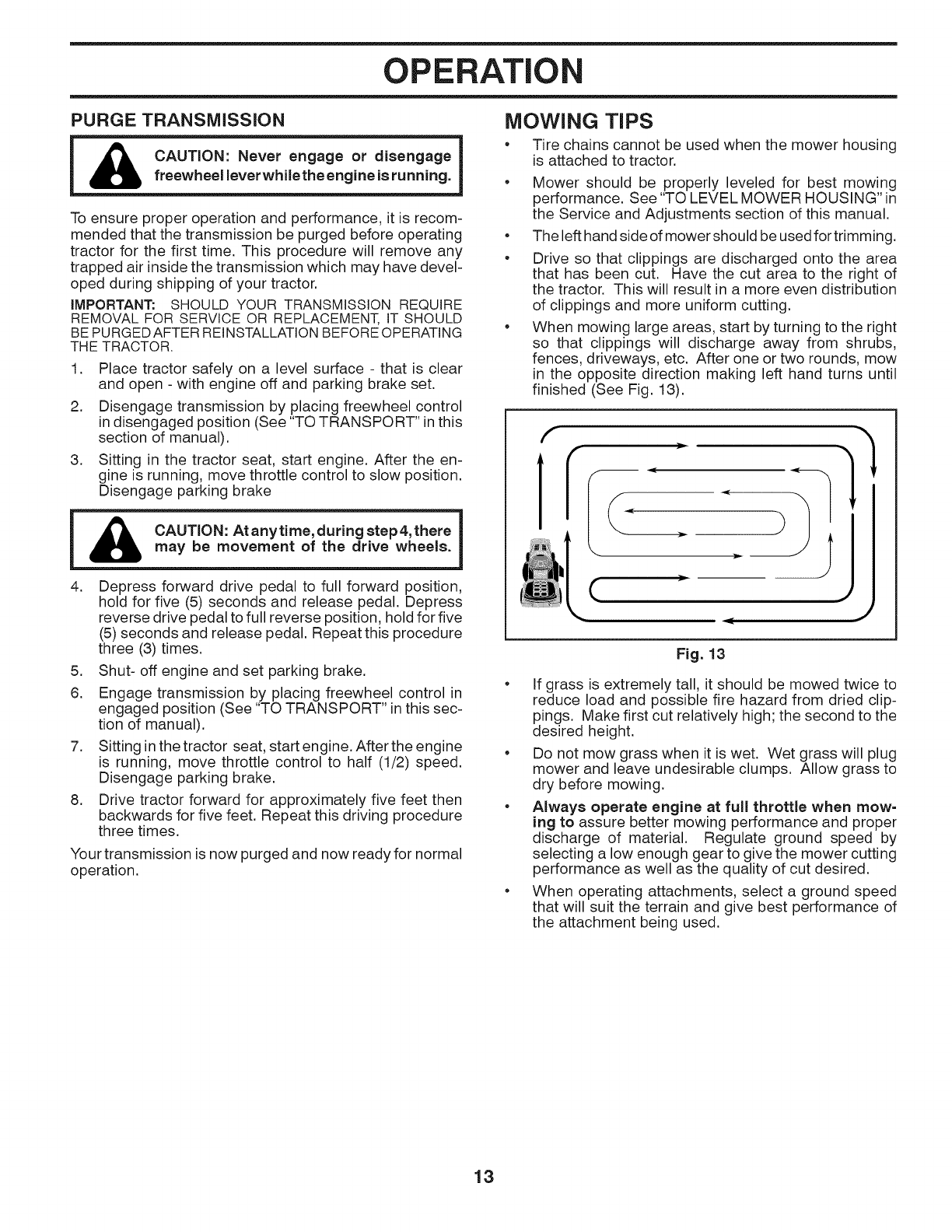
• When mowing large areas, start by turning to the right
so that clippings will discharge away from shrubs,
fences, driveways, etc. After one or two rounds, mow
in the opposite direction making left hand turns until
finished (See Fig. 13).
}=
(
,c ,J
Fig. 13
• If grass is extremely tall, it should be mowed twice to
reduce load and possible fire hazard from dried clip-
pings. Make first cut relatively high; the second to the
desired height.
• Do not mow grass when it is wet. Wet grass will plug
mower and leave undesirable clumps. Allow grass to
dry before mowing.
•Always operate engine at full throttle when mow-
ing to assure better mowing performance and proper
discharge of material. Regulate ground speed by
selecting a low enough gear to give the mower cutting
performance as well as the quality of cut desired.
• When operating attachments, select a ground speed
that will suit the terrain and give best performance of
the attachment being used.
13
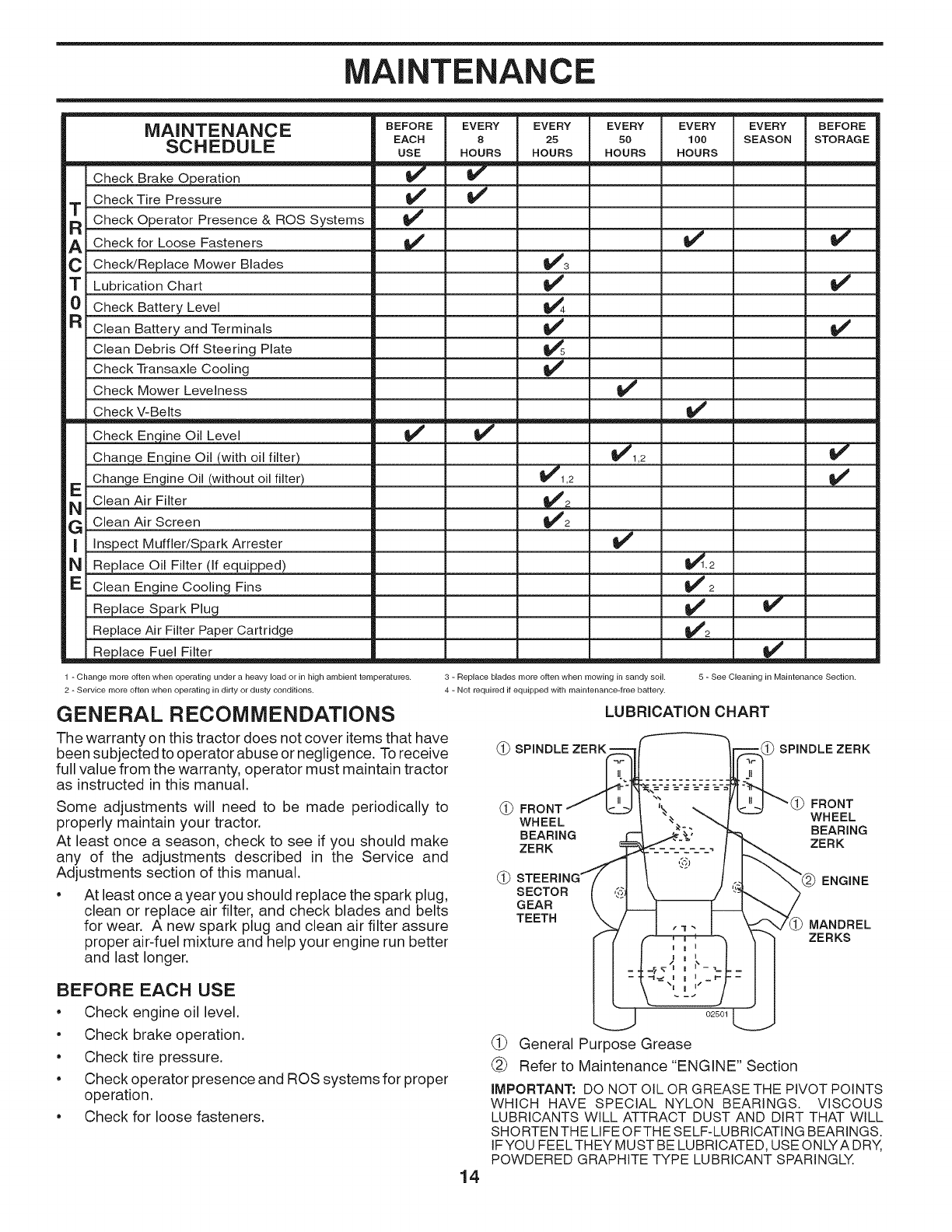
MAINTENANCE
MAINTENANCE
SCHEDULE
Check Brake Operation
Check Tire Pressure
T Check Operator Presence & ROS Systems
ACheck for Loose Fasteners
CCheck/Replace Mower Blades
TLubrication Chart
0 Check Battery Level
R Clean Battery and Terminals
Clean Debris Off Steering Plate
Check Transaxle Cooling
Check Mower Levelness
Check V-Belts
Check Engine Oil Level
Change Engine Oil (with oil filter)
Change Engine Oil (without oil filter)
NE Clean Air Filter
G Clean Air Screen
Inspect Muffler/Spark Attester
N Replace Oil Filter (If equipped)
E Clean Engine Cooling Fins
Replace Spark Plug
Replace Air Filter Paper Cartridge
m R_lace Fuel Filter
BEFORE
EACH
USE
v"
v'
v"
v'
EVERY
8
HOURS
EVERY
25
HOURS
v'
v'
v'
_1,2
EVERY
50
HOURS
v'
v'
EVERY
100
HOURS
1,1
v'
_,2
V"2
v'
EVERY
SEASON
v'
BEFORE
STORAGE
v'
v'
v'
V"
v'
1 - Change more often when operating under a heavy load or in high ambient temperatures.
2 - Service more often when operating in dirty or dusty conditions.
GENERAL RECOMMENDATIONS
The warranty on this tractor does not cover items that have
been subjected to operator abuse or negligence. To receive
full value from the warranty, operator must maintain tractor
as instructed in this manual.
Some adjustments will need to be made periodically to
properly maintain your tractor.
At least once a season, check to see if you should make
any of the adjustments described in the Service and
Adjustments section of this manual.
•At least once a year you should replace the spark plug,
clean or replace air filter, and check blades and belts
for wear. A new spark plug and clean air filter assure
proper air-fuel mixture and help your engine run better
and last longer.
3 - Replace blades more often when mowing in sandy soil. 5 - See Cleaning in Maintenance Section.
4 - Not required if equipped with maintenance-free battery.
LUBRICATION CHART
(_ SPINDLE ZERK = SPINDLE ZERK
(_ FRONT FRONT
WHEEL WHEEL
BEARING BEARING
ZERK ZERK
SECTOR
GEAR
TEETH
ENGINE
MANDREL
ZERKS
BEFORE EACH USE
•Check engine oil level.
•Check brake operation.
•Check tire pressure.
•Check operator presence and ROS systems for proper
operation.
•Check for loose fasteners.
14
02501
(_ General Purpose Grease
(_ Refer to Maintenance "ENGINE" Section
IMPORTANT: DO NOT OIL OR GREASE THE PIVOT POINTS
WHICH HAVE SPECIAL NYLON BEARINGS. VISCOUS
LUBRICANTS WILL ATTRACT DUST AND DIRT THAT WILL
SHORTEN THE LIFE OFTHE SELF-LUBRICATING BEARINGS.
IFYOU FEELTHEY MUST BE LUBRICATED, USE ONLYA DRY,
POWDERED GRAPHITE TYPE LUBRICANT SPARINGLY.
MAINTENANCE
TRACTOR
Always observe safety rules when performing any
maintenance.
BRAKE OPERATION
If tractor requires more than five (5) feet to stop at highest
speed in highest gear on a level, dry concrete or paved
surface, then brake must be checked and adjusted. (See
"TO CHECK BRAKE" in the Service and Adjustments
section of this manual).
TIRES
•Maintain proper air pressure in all tires (See the sides
of tires for proper PSI).
• Keep tires free of gasoline, oil, or insect control
chemicals which can harm rubber.
• Avoid stumps, stones, deep ruts, sharp objects and
other hazards that may cause tire damage.
NOTE: To seal tire punctures and prevent flat tires due
to slow leaks, tire sealant may be purchased from your
local parts dealer. Tire sealant also prevents tire dry rot
and corrosion.
OPERATOR PRESENCE SYSTEM AND REVERSE
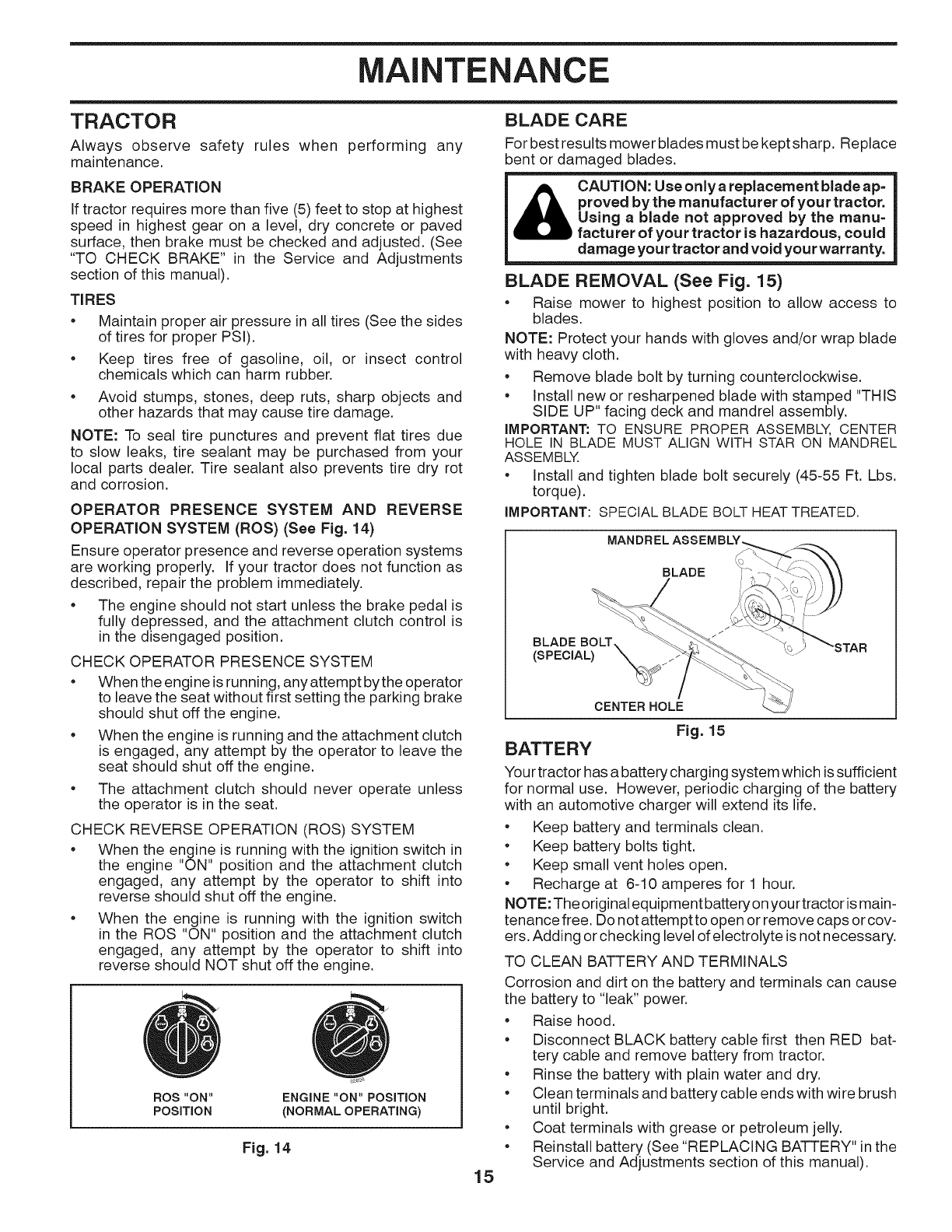
OPERATION SYSTEM (ROS) (See Fig. 14)
Ensure operator presence and reverse operation systems
are working properly. If your tractor does not function as
described, repair the problem immediately.
• The engine should not start unless the brake pedal is
fully depressed, and the attachment clutch control is
in the disengaged position.
CHECK OPERATOR PRESENCE SYSTEM
• When the engine is running, any attempt bythe operator
to leave the seat without first setting the parking brake
should shut off the engine.
• When the engine is running and the attachment clutch
is engaged, any attempt by the operator to leave the
seat should shut off the engine.
• The attachment clutch should never operate unless
the operator is in the seat.
CHECK REVERSE OPERATION (ROS) SYSTEM
•When the engine is running with the ignition switch in
the engine "ON" position and the attachment clutch
engaged, any attempt by the operator to shift into
reverse should shut off the engine.
•When the engine is running with the ignition switch
in the ROS "ON" position and the attachment clutch
engaged, any attempt by the operator to shift into
reverse should NOT shut off the engine.
ROS "ON"
POSITION ENGINE "ON" POSITION
(NORMAL OPERATING)
Fig. 14
BLADE CARE
For best results mower blades must be kept sharp. Replace
bent or damaged blades.
_ AUTION: Use only a replacement blade ap-
proved by the manufacturer of your tractor.
Using ablade not approved by the manu=
facturer of your tractor is hazardous, could
damage your tractor and void your warranty.
BLADE REMOVAL (See Fig. 15)
• Raise mower to highest position to allow access to
blades.
NOTE: Protect your hands with gloves and/or wrap blade
with heavy cloth.
• Remove blade bolt by turning counterclockwise.
• Install new or resharpened blade with stamped "THIS
SIDE UP" facing deck and mandrel assembly.
IMPORTANT: TO ENSURE PROPER ASSEMBLY, CENTER
HOLE IN BLADE MUST ALIGN WITH STAR ON MANDREL
ASSEMBLY.
•Install and tighten blade bolt securely (45-55 Ft. Lbs.
torque).
iMPORTANT: SPECIAL BLADE BOLT HEATTREATED.
BLADE
BLADE
(SPECIAL)
15
CENTER HOLE
Fig. 15
BATTERY
Your tractor has a battery charging system which is sufficient
for normal use. However, periodic charging of the battery
with an automotive charger will extend its life.
• Keep battery and terminals clean.
• Keep battery bolts tight.
• Keep small vent holes open.
• Recharge at 6-10 amperes for 1 hour.
NOTE: The original equipment battery on your tractor is main-
tenance free. Do not attempt to open or remove caps or cov-
ers. Adding or checking level of electrolyte is not necessary.
TO CLEAN BATTERY AND TERMINALS
Corrosion and dirt on the battery and terminals can cause
the battery to "leak" power.
• Raise hood.
• Disconnect BLACK battery cable first then RED bat-
tery cable and remove battery from tractor.
• Rinse the battery with plain water and dry.
• Clean terminals and battery cable ends with wire brush
until bright.
• Coat terminals with grease or petroleum jelly.
• Reinstall battery (See "REPLACING BATTERY" in the
Service and Adjustments section of this manual).
MAINTENANCE
V=BELTS
Check V-belts for deterioration and wear after 100 hours
of operation and replace if necessary. The belts are not
adjustable. Replace belts if they begin to slip from wear.
TRANSAXLE MAINTENANCE
The transmission fan and cooling fins should be kept clean
to assure proper cooling.
Do not attempt to clean fan or transmission while engine
is running or while the transmission is hot. To prevent pos-
sible damage to seals, do not use high pressure water or
steam to clean transmission.
• Inspect cooling fan to ensure fan blades are intact and
clean.
Inspect cooling fins for dirt, grass clippings and other
materials. To prevent damage to seals, do not use
compressed air or high pressure sprayer to clean
cooling fins.
TRANSAXLE PUMP FLUID
The transaxle was sealed at the factory and fluid mainte-
nance is not required for the life of the transaxle. Should
the transaxle ever leak or require servicing, contact your
nearest authorized service center/department.
ENGINE
LUBRICATION
Only use high quality detergent oil rated with API service
classification SG-SL. Select the oil's SAE viscosity grade
according to your expected operating temperature.
SAE VISCOSITY GRADES
F -20 0 30 32 40 60 80 100
C -30 -2; -1; ; 1'0 20 30 4;
TEMPERATURE RANGE ANTICIPATED BEFORE NEXT OIL CHANGE
NOTE: Although multi-viscosity oils (5W30, 10W30 etc.)
improve starting incold weather, they will result in increased
oil consumption when used above 32°R Checkyour engine
oil level more frequently to avoid possible engine damage
from running low on oil.
Change the oil after every 50 hours of operation or at least
once a year if the tractor is not used for 50 hours inone year.
Check the crankcase oil level before starting the engine
and after each eight (8) hours of operation. Tighten oil fill
cap/dipstick securely each time you check the oil level.
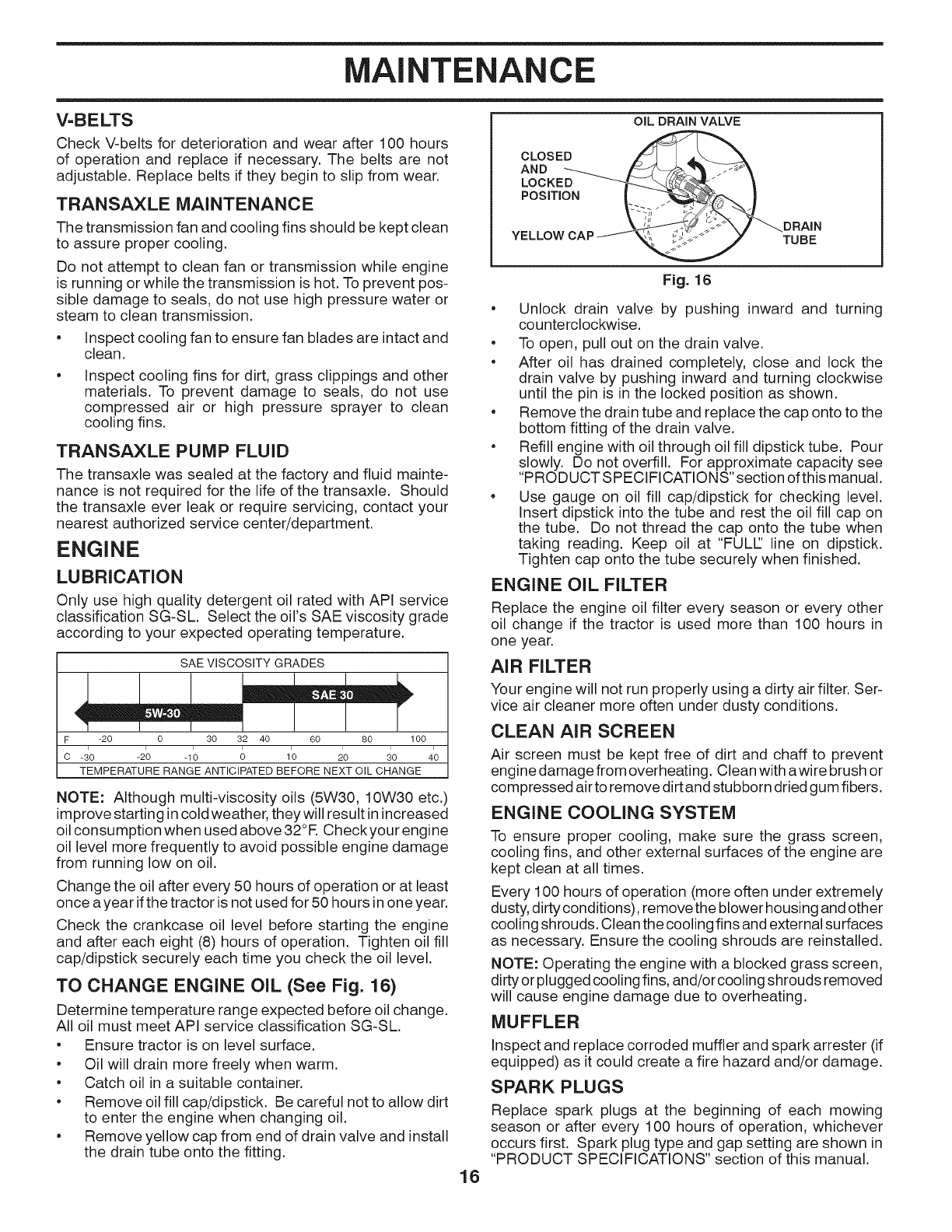
TO CHANGE ENGINE OIL (See Fig. 16)
Determine temperature range expected before oil change.
All oil must meet API service classification SG-SL.
• Ensure tractor is on level surface.
• Oil will drain more freely when warm.
• Catch oil in a suitable container.
• Remove oil fill cap/dipstick. Be careful not to allow dirt
to enter the engine when changing oil.
• Remove yellow cap from end of drain valve and install
the drain tube onto the fitting.
16
OIL DRAIN VALVE
CLOSED
LOCKED
POS,T,ON
DRAIN
YELLOW CAP TUBE
Fig. 16
• Unlock drain valve by pushing inward and turning
counterclockwise.
• To open, pull out on the drain valve.
• After oil has drained completely, close and lock the
drain valve by pushing inward and turning clockwise
until the pin is in the locked position as shown.
• Remove the drain tube and replace the cap onto to the
bottom fitting of the drain valve.
• Refill engine with oil through oil fill dipstick tube. Pour
slowly. Do not overfill. For approximate capacity see
"PRODUCT SPECIFICATIONS" section of this manual.
• Use gauge on oil fill cap/dipstick for checking level.
Insert dipstick into the tube and rest the oil fill cap on
the tube. Do not thread the cap onto the tube when
taking reading. Keep oil at "FULE' line on dipstick.
Tighten cap onto the tube securely when finished.
ENGINE OIL FILTER
Replace the engine oil filter every season or every other
oil change if the tractor is used more than 100 hours in
one year.
AIR FILTER
Your engine will not run properly using a dirty air filter. Ser-
vice air cleaner more often under dusty conditions.
CLEAN AIR SCREEN
Air screen must be kept free of dirt and chaff to prevent
engine damage from overheating. Clean with a wire brush or
compressed air to remove dirt and stubborn dried gum fibers.
ENGINE COOLING SYSTEM
To ensure proper cooling, make sure the grass screen,
cooling fins, and other external surfaces of the engine are
kept clean at all times.
Every 100 hours of operation (more often under extremely
dusty, dirty conditions), remove the blower housing and other
cooling shrouds. Clean the cooling fins and external surfaces
as necessary. Ensure the cooling shrouds are reinstalled.
NOTE: Operating the engine with a blocked grass screen,
dirty orplugged coolingfins, and/or cooling shrouds removed
will cause engine damage due to overheating.
MUFFLER
Inspect and replace corroded muffler and spark arrester (if
equipped) as it could create a fire hazard and/or damage.
SPARK PLUGS
Replace spark plugs at the beginning of each mowing
season or after every 100 hours of operation, whichever
occurs first. Spark plug type and gap setting are shown in
"PRODUCT SPECIFICATIONS" section of this manual.
MAINTENANCE
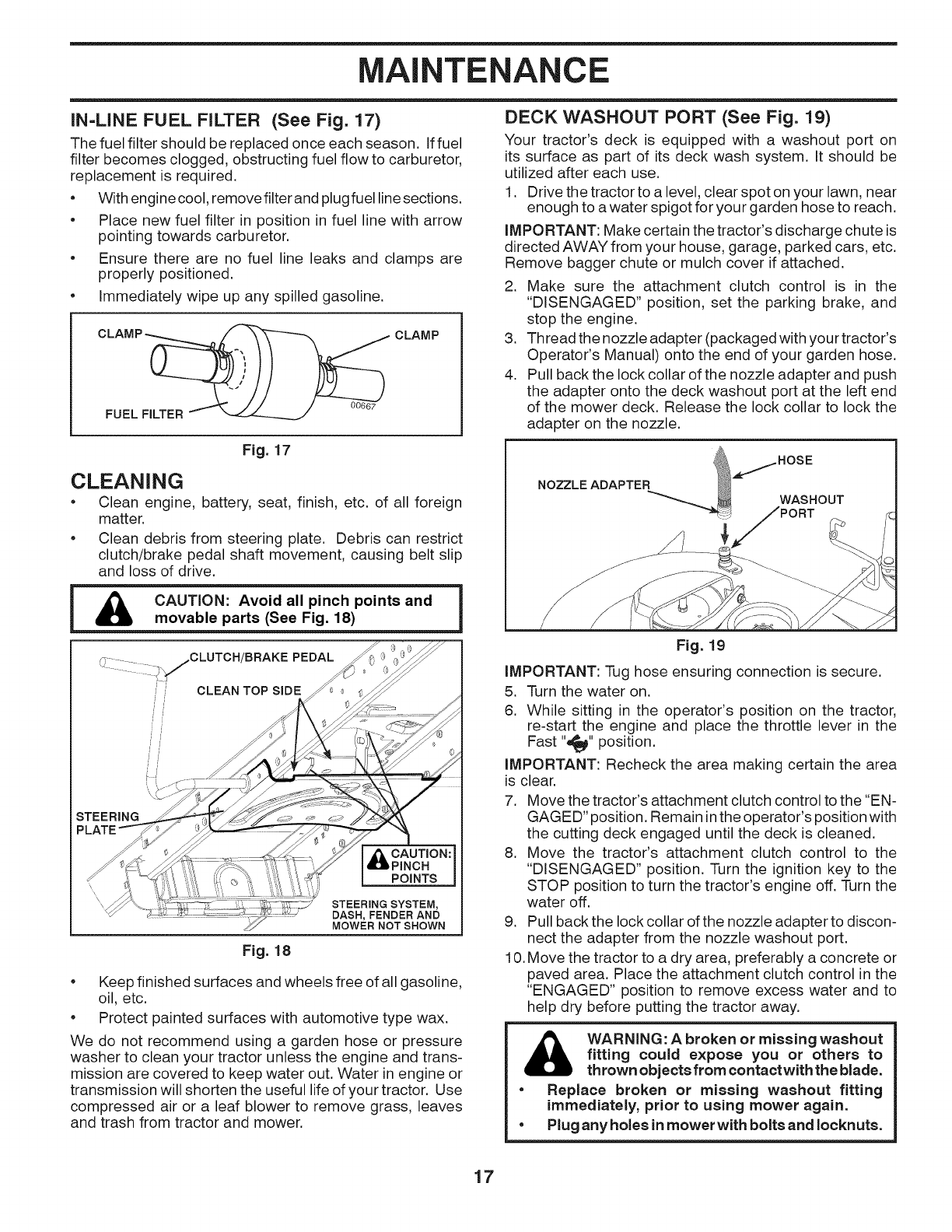
IN=LINE FUEL FILTER (See Fig. 17)
The fuel filter should be replaced once each season. Iffuel
filter becomes clogged, obstructing fuel flow to carburetor,
replacement is required.
• With engine cool, remove filter and plug fuel linesections.
• Place new fuel filter in position in fuel line with arrow
pointing towards carburetor.
• Ensure there are no fuel line leaks and clamps are
properly positioned.
• Immediately wipe up any spilled gasoline.
667
FUEL FILTER __- J v_G7
CLAMP
Fig. 17
CLEANING
Clean engine, battery, seat, finish, etc. of all foreign
matter.
• Clean debris from steering plate. Debris can restrict
clutch/brake pedal shaft movement, causing belt slip
and loss of drive.
CAUTION: Avoid all pinch points and i
i
movable parts (See Fig. 18) i
61111111111............i_CLUTCH/BRAKE PEDAL
CLEAN TOP SIDE
STEERING _-
_i CAUTI ON:
PINCH
POINTS
STEERING SYSTEM,
DASH, FENDER AND
MOWER NOT SHOWN
Fig. 18
•Keep finished surfaces and wheels free of all gasoline,
oil, etc.
• Protect painted surfaces with automotive type wax.
We do not recommend using a garden hose or pressure
washer to clean your tractor unless the engine and trans-
mission are covered to keep water out. Water in engine or
transmission will shorten the useful life of your tractor. Use
compressed air or a leaf blower to remove grass, leaves
and trash from tractor and mower.
DECK WASHOUT PORT (See Fig. 19)
Your tractor's deck is equipped with a washout port on
its surface as part of its deck wash system. It should be
utilized after each use.
1. Drive the tractor to a level, clear spot on your lawn, near
enough to a water spigot for your garden hose to reach.
IMPORTANT: Make certain the tractor's discharge chute is
directed AWAY from your house, garage, parked cars, etc.
Remove bagger chute or mulch cover if attached.
2. Make sure the attachment clutch control is in the
"DISENGAGED" position, set the parking brake, and
stop the engine.
3. Thread the nozzle adapter (packaged with your tractor's
Operator's Manual) onto the end of your garden hose.
4. Pull back the lock collar of the nozzle adapter and push
the adapter onto the deck washout port at the left end
of the mower deck. Release the lock collar to lock the
adapter on the nozzle.
NOZZLEADAPTER
Fig. 19
IMPORTANT: Tug hose ensuring connection is secure.
5. Turn the water on.
6. While sitting in the operator's position on the tractor,
re-start the engine and place the throttle lever in the
Fast ",_" position.
IMPORTANT: Recheck the area making certain the area
is clear.
7. Move the tractor's attachment clutch control to the "EN-
GAGED" position. Remain in the operator's position with
the cutting deck engaged until the deck is cleaned.
8. Move the tractor's attachment clutch control to the
"DISENGAGED" position. Turn the ignition key to the
STOP position to turn the tractor's engine off. Turn the
water off.
9. Pull back the lock collar of the nozzle adapter to discon-
nect the adapter from the nozzle washout port.
10. Move the tractor to a dry area, preferably a concrete or
paved area. Place the attachment clutch control in the
"ENGAGED" position to remove excess water and to
help dry before putting the tractor away.
WARNING: Abroken or missing washout
fitting could expose you or others to
thrown objects from contactwiththe blade.
• Replace broken or missing washout fitting
immediately, prior to using mower again.
• Plug any holes in mower with bolts and Iocknuts.
17
SERVICE AND ADJUSTMENTS
_ WARNING: TO AVOID SERIOUS iNJURY, BEFORE PERFORMING ANY SERVICE OR ADJUSTMENTS:
Depress brake pedal fully and set parking brake.
" Place attachment clutch in "DISENGAGED" position.
" Turn ignition key to "STOP" and remove key.
" Make sure the blades and all moving parts have completely stopped.
" Disconnect spark plug wire from spark plug and place wire where it cannot come in contact with plug.
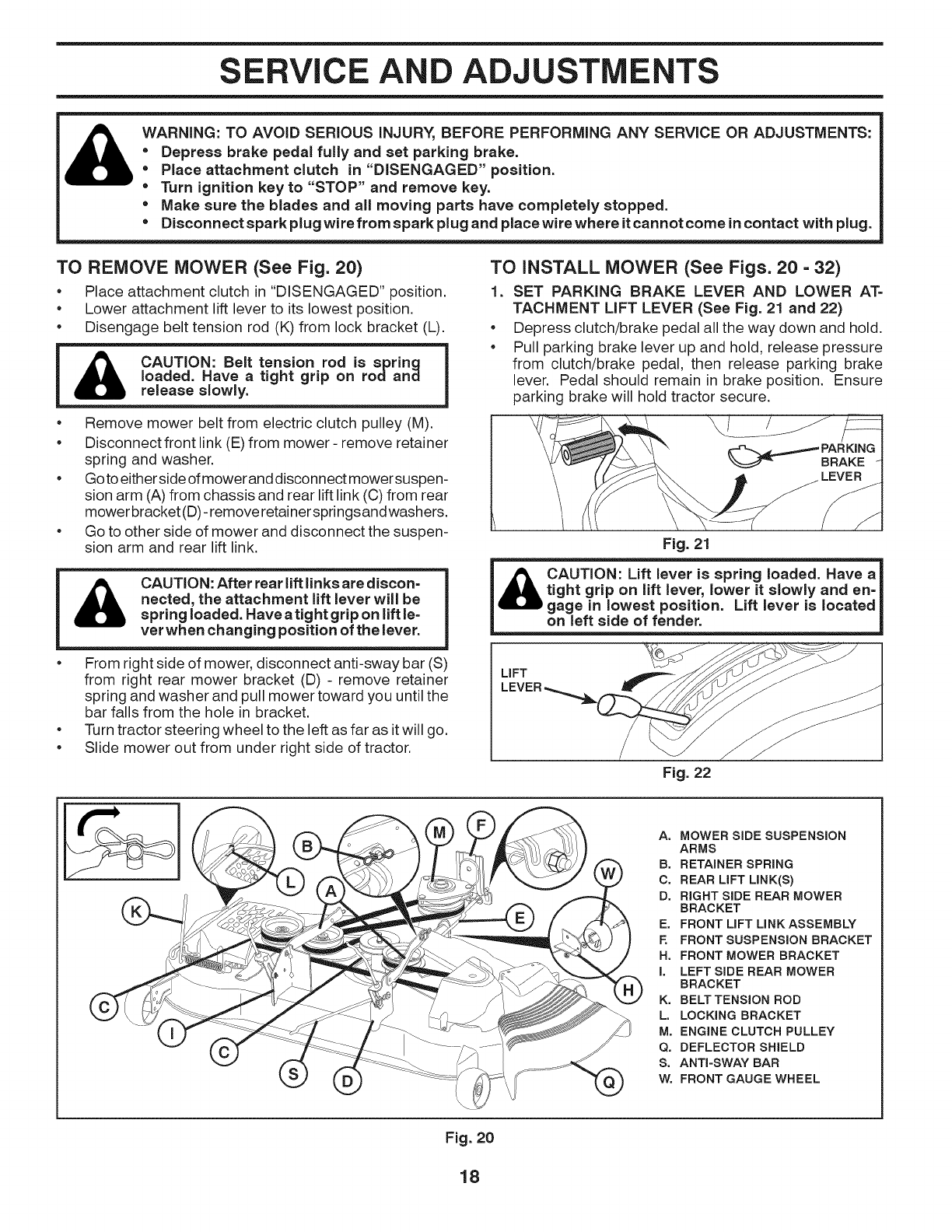
TO REMOVE MOWER (See Fig. 20)
• Place attachment clutch in "DISENGAGED" position.
• Lower attachment lift lever to its lowest position.
• Disengage belt tension rod (K) from lock bracket (L).
CAUTION: Belt tension rod is spring
loaded. Have a tight grip on rodand
release slowly.
• Remove mower belt from electric clutch pulley (M).
• Disconnect front link (E) from mower - remove retainer
spring and washer.
• Go to eitherside ofmower anddisconnect mowersuspen-
sion arm (A) from chassis and rear lift link (0) from rear
mowerbracket (D)- remove retainerspringsandwashers.
• Go to other side of mower and disconnect the suspen-
sion arm and rear lift link.
TO INSTALL MOWER (See Figs. 20 =32)
1. SET PARKING BRAKE LEVER AND LOWER AT=
TACHMENT LIFT LEVER (See Fig. 21 and 22)
• Depress clutch/brake pedal all the way down and hold.
• Pull parking brake lever up and hold, release pressure
from clutch/brake pedal, then release parking brake
lever. Pedal should remain in brake position. Ensure
parking brake will hold tractor secure.
Fig. 21
&CAUTION: After rear lift links are discon=
nected, the attachment lift lever will be
spring loaded. Have a tight grip on lift le-
ver when changing position of the lever.
_CAUTION: Lift lever is spring loaded. Have a
tight grip on lift lever, lower it slowly and en=
gage in lowest position. Lift lever is located
on left side of fender.
From right side of mower, disconnect anti-sway bar (S)
from right rear mower bracket (D) - remove retainer
spring and washer and pull mower toward you until the
bar falls from the hole in bracket.
Turn tractor steering wheel to the left as far as it will go.
Slide mower out from under right side of tractor.
LIFT
LEVER
Fig. 22
A. MOWER SIDE SUSPENSION
ARMS
B. RETAINER SPRING
C. REAR LIFT LINK(S)
D. RaGHT SIDE REAR MOWER
BRACKET
E. FRONT LIFT LINK ASSEMBLY
EFRONT SUSPENSION BRACKET
H. FRONT MOWER BRACKET
I. LEFT SIDE REAR MOWER
BRACKET
K. BELT TENSION ROD
L. LOCKING BRACKET
M. ENGINE CLUTCH PULLEY
Q. DEFLECTOR SHIELD
S, ANTI=SWAY BAR
W. FRONT GAUGE WHEEL
Fig. 20
18
SERVICE AND ADJUSTMENTS
=
=
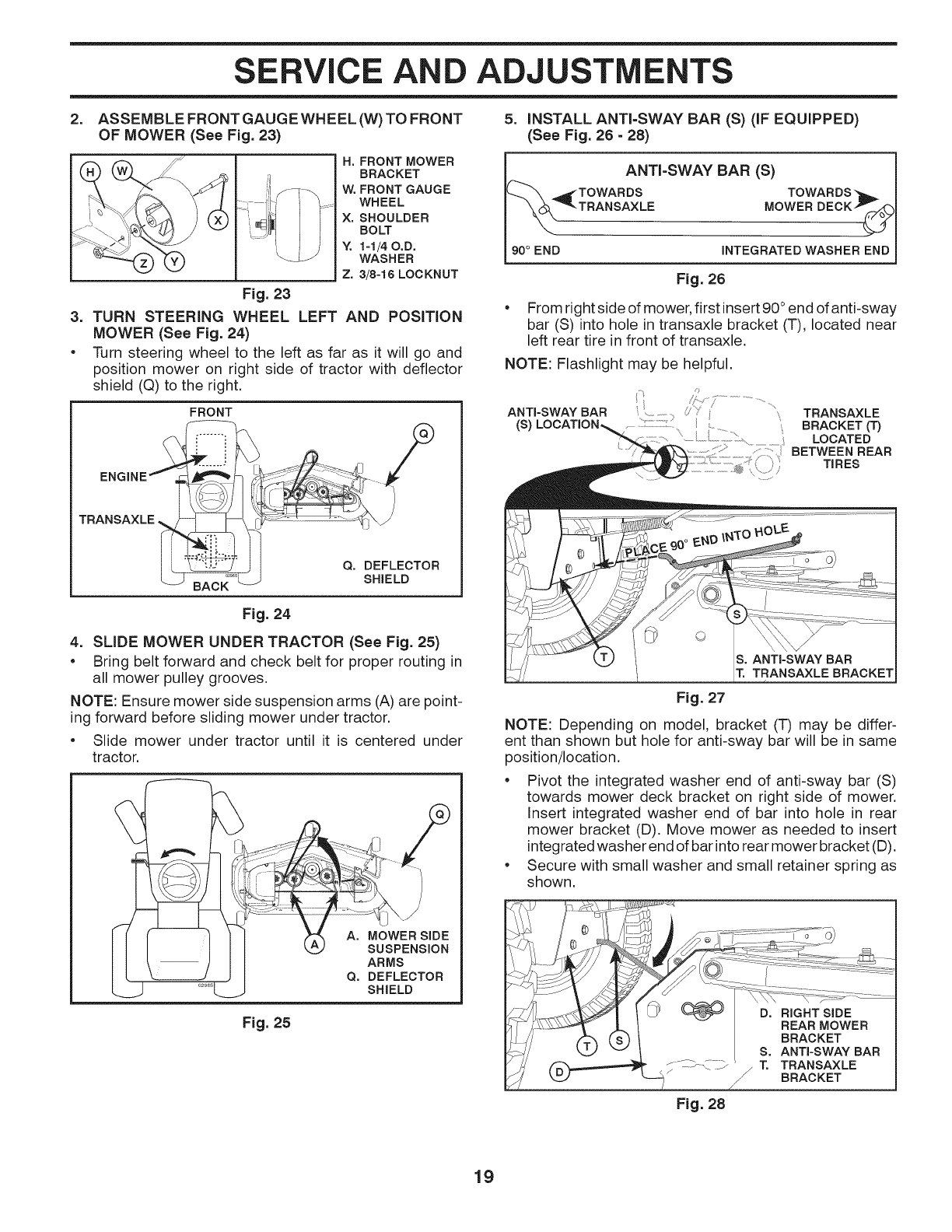
ASSEMBLE FRONT GAUGE WHEEL (W) TO FRONT
OF MOWER (See Fig. 23)
H. FRONT MOWER
BRACKET
W. FRONT GAUGE
WHEEL
X. SHOULDER
BOLT
Y. 1=1/40.D.
WASHER
Z. 3/8=18 LOCKNUT
Fig. 23
TURN STEERING WHEEL
MOWER (See Fig. 24)
LEFT AND POSITION
Turn steering wheel to the left as far as it will go and
position mower on right side of tractor with deflector
shield (Q) to the right.
FRONT
TRANSAXLE
Q. DEFLECTOR
SHIELD
Fig. 24
4. SLIDE MOWER UNDER TRACTOR (See Fig. 25)
• Bring belt forward and check belt for proper routing in
all mower pulley grooves.
NOTE: Ensure mower side suspension arms (A) are point-
ing forward before sliding mower under tractor.
• Slide mower under tractor until it is centered under
tractor.
A. MOWER SIDE
SUSPENSION
ARMS
Q. DEFLECTOR
SHIELD
Fig. 25
5. INSTALL ANTI-SWAY BAR (S) (iF EQUIPPED)
(See Fig. 26 - 28)
ANTI-SWAY BAR (S)
_TOWARDS TOWARDS
TRANSAXLE MOWER DECK_
90 ° END INTEGRATED WASHER END
Fig. 26
• From right side of mower, first insert 90° end of anti-sway
bar (S) into hole in transaxle bracket (T), located near
left rear tire in front of transaxle.
NOTE: Flashlight may be helpful.
ANTI-SWAY BAR
(s)
...............................
, ..............LJ'Y TRANSAXLE
............ / BRACKET (T)
LOCATED
BETWEEN REAR
TIRES
S. ANTI-SWAY BAR
1". TRANSAXLE BRACKET
Fig. 27
NOTE: Depending on model, bracket (T) may be differ-
ent than shown but hole for anti-sway bar will be in same
position/location.
• Pivot the integrated washer end of anti-sway bar (S)
towards mower deck bracket on right side of mower.
Insert integrated washer end of bar into hole in rear
mower bracket (D). Move mower as needed to insert
integrated washer end of bar into rear mower bracket (D).
• Secure with small washer and small retainer spring as
shown.
ID" RIGHT SIDE
| REARMOWER
iBRACKET
.... _ ........ LS. ANTI-SWAY BAR
.... -.... _ 1". TRANSAXLE
BRACKET
X
Fig. 28
19
SERVICE AND ADJUSTMENTS
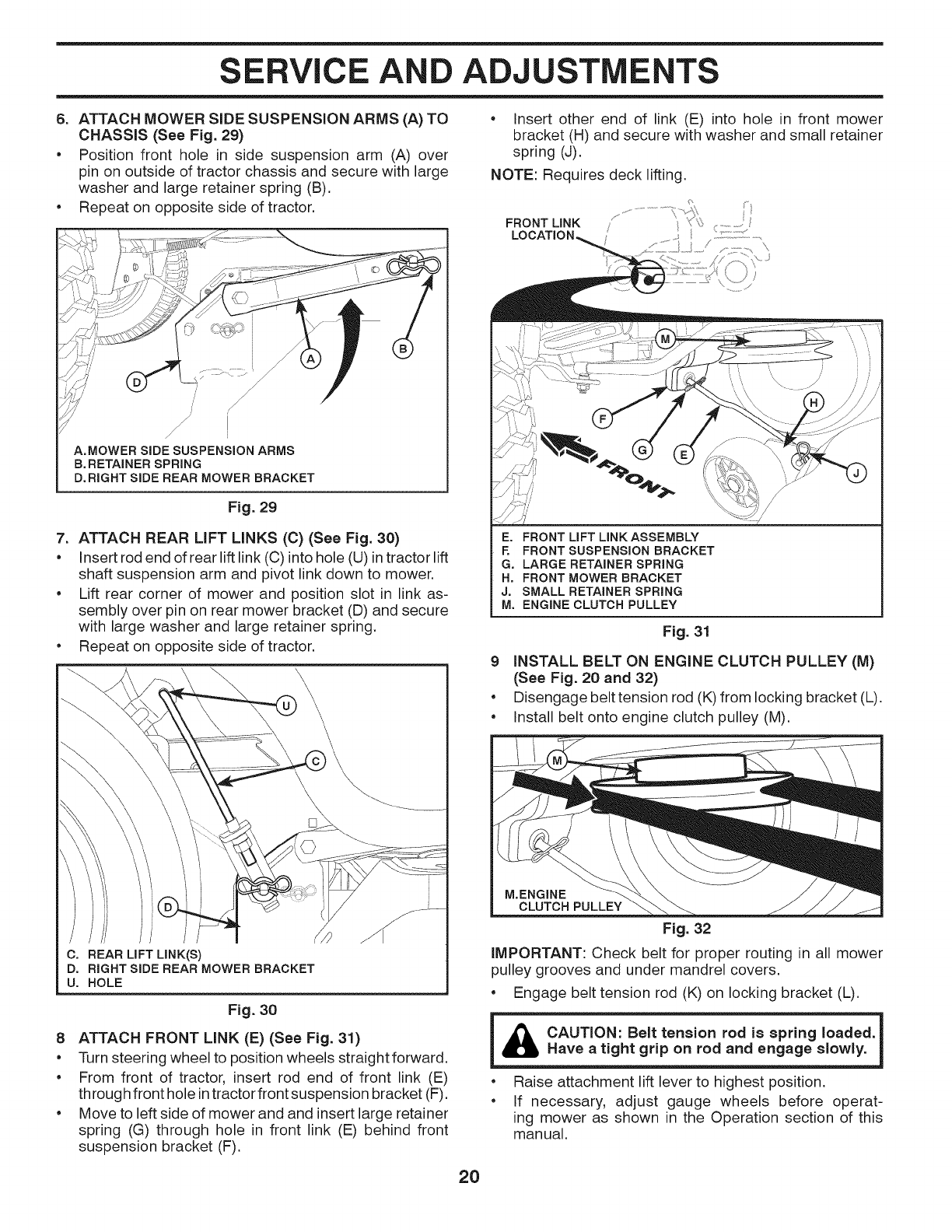
6, ATTACH MOWER SIDE SUSPENSION ARMS (A) TO
CHASSIS (See Fig. 29)
• Position front hole in side suspension arm (A) over
pin on outside of tractor chassis and secure with large
washer and large retainer spring (B).
• Repeat on opposite side of tractor.
.....:/4 W............... ,,,,,':_-
3
)7,' ._ - ,
A.MOWER SIDE SUSPENSION ARMS
B. RETAINER SPRING
D,RIGHT SiDE REAR MOWER BRACKET
Fig. 29
7, ATTACH REAR LIFT LINKS (C) (See Fig. 30)
• Insert rod end of rear lift link (C) into hole (U) intractor lift
shaft suspension arm and pivot link down to mower.
• Lift rear corner of mower and position slot in link as-
sembly over pin on rear mower bracket (D) and secure
with large washer and large retainer spring.
• Repeat on opposite side of tractor.
\\
C. REAR LIFT LINK(S)
D, RIGHT SIDE REAR MOWER BRACKET
U, HOLE
Fig. 30
8 ATTACH FRONT LINK (E) (See Fig. 31)
• Turn steering wheel to position wheels straightforward.
• From front of tractor, insert rod end of front link (E)
through front hole in tractor front suspension bracket (F).
• Move to left side of mower and and insert large retainer
spring (G) through hole in front link (E) behind front
suspension bracket (F).
• Insert other end of link (E) into hole in front mower
bracket (H) and secure with washer and small retainer
spring (J).
NOTE: Requires deck lifting.
FRONT LINK i
LOCATION,
.........../
E, FRONT LIFT LINK ASSEMBLY
E FRONT SUSPENSION BRACKET
G. LARGE RETAINER SPRING
H, FRONT MOWER BRACKET
J. SMALL RETAINER SPRING
M, ENGINE CLUTCH PULLEY
Fig. 31
9 INSTALL BELT ON ENGINE CLUTCH PULLEY (M)
(See Fig. 20 and 32)
•Disengage belt tension rod (K) from locking bracket (L).
• Install belt onto engine clutch pulley (M).
M,ENGINE
CLUTCH PULLEY
Fig. 32
IMPORTANT: Check belt for proper routing in all mower
pulley grooves and under mandrel covers.
• Engage belt tension rod (K) on locking bracket (L).
& CAUTION: Belt tension rod is spring loaded.|
i
Have a tight grip on rod and engage slowly. !
• Raise attachment lift lever to highest position.
• If necessary, adjust gauge wheels before operat-
ing mower as shown in the Operation section of this
manual.
2O
SERVICE AND ADJUSTMENTS
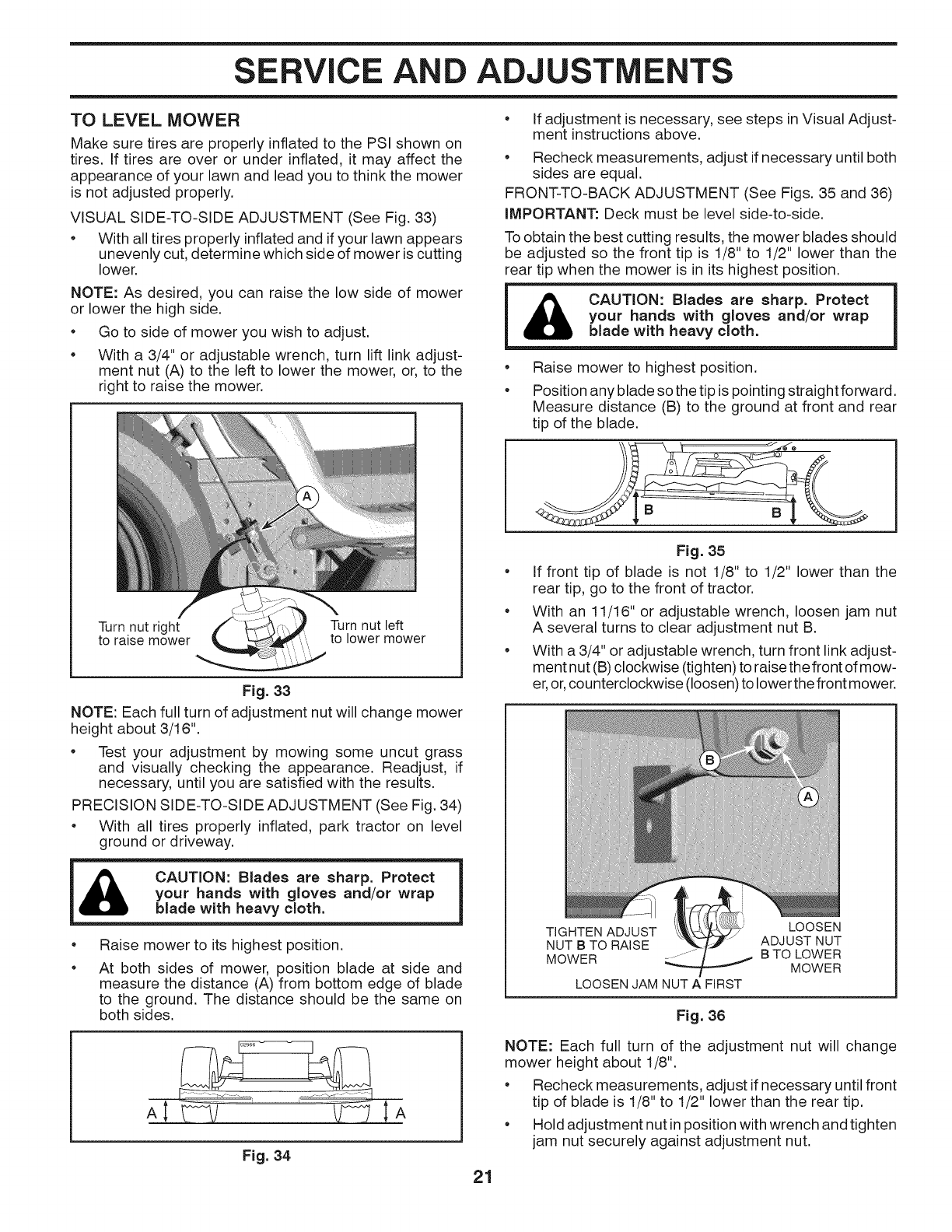
TO LEVEL MOWER
Make sure tires are properly inflated to the PSI shown on
tires. If tires are over or under inflated, it may affect the
appearance of your lawn and lead you to think the mower
is not adjusted properly.
VISUAL SIDE-TO-SIDE ADJUSTMENT (See Fig. 33)
• With all tires properly inflated and if your lawn appears
unevenly cut, determine which side of mower is cutting
lower.
NOTE: As desired, you can raise the low side of mower
or lower the high side.
• Go to side of mower you wish to adjust.
•With a 3/4" or adjustable wrench, turn lift link adjust-
ment nut (A) to the left to lower the mower, or, to the
right to raise the mower.
Turn nut right Turn nut left
to raise mower to lower mower
Fig. 33
NOTE: Each full turn of adjustment nut will change mower
height about 3/16".
• Test your adjustment by mowing some uncut grass
and visually checking the appearance. Readjust, if
necessary, until you are satisfied with the results.
PRECISION SIDE-TO-SIDE ADJUSTMENT (See Fig. 34)
• With all tires properly inflated, park tractor on level
ground or driveway.
i_ CAUTION: Blades are sharp. Protect
your hands with gloves and/or wrap
blade with heavy cloth.
e
e
Raise mower to its highest position.
At both sides of mower, position blade at side and
measure the distance (A) from bottom edge of blade
to the ground. The distance should be the same on
both sides.
Fig. 34 21
• If adjustment is necessary, see steps in Visual Adjust-
ment instructions above.
• Recheck measurements, adjust if necessary until both
sides are equal.
FRONT-TO-BACK ADJUSTMENT (See Figs. 35 and 36)
iMPORTANT: Deck must be level side-to-side.
To obtain the best cutting results, the mower blades should
be adjusted so the front tip is 1/8" to 1/2" lower than the
rear tip when the mower is in its highest position.
_CAUTION: Blades are sharp. Protect
your hands with gloves and/or wrap
blade with heavy cloth.
e
e
Raise mower to highest position.
Position any blade so the tip is pointing straightforward.
Measure distance (B) to the ground at front and rear
tip of the blade.
Fig. 35
If front tip of blade is not 1/8" to 1/2" lower than the
rear tip, go to the front of tractor.
With an 11/16" or adjustable wrench, loosen jam nut
A several turns to clear adjustment nut B.
With a 3/4" or adjustable wrench, turn front link adjust-
ment nut (B)clockwise (tighten) to raise the front of mow-
er, or,counterclockwise (loosen) to lower the front mower.
TIGHTEN ADJUST LOOSEN
NUT B TO RAISE ADJUST NUT
MOWER .... ---"B TO LOWER
MOWER
LOOSEN JAM NUT A FIRST
Fig. 36
NOTE: Each full turn of the adjustment nut will change
mower height about 1/8".
• Recheck measurements, adjust if necessary until front
tip of blade is 1/8" to 1/2" lower than the rear tip.
• Hold adjustment nut inposition with wrench and tighten
jam nut securely against adjustment nut.
SERVICE AND ADJUSTMENTS
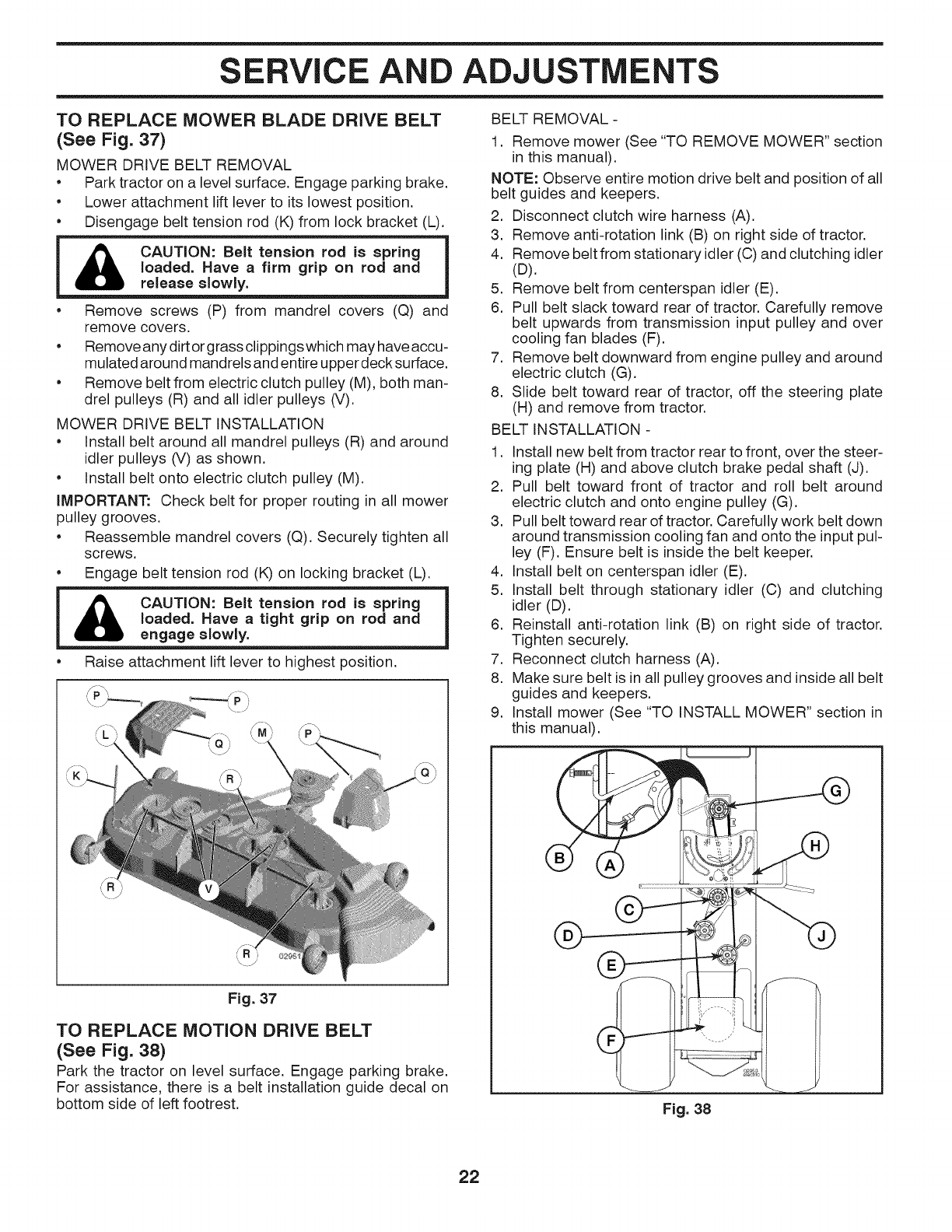
TO REPLACE MOWER BLADE DRIVE BELT
(See Fig. 37)
MOWER DRIVE BELT REMOVAL
• Park tractor on a level surface. Engage parking brake.
• Lower attachment lift lever to its lowest position.
• Disengage belt tension rod (K) from lock bracket (L).
iCAUTION: Belt tension rod is spring i
release slowly.
loaded. Have a firm grip on rod and |
• Remove screws (P) from mandrel covers (Q) and
remove covers.
• Remove any dirt orgrass clippings which may have accu-
mulated around mandrels and entire upper decksurface.
• Remove belt from electric clutch pulley (M), both man-
drel pulleys (R) and all idler pulleys (V).
MOWER DRIVE BELT INSTALLATION
• Install belt around all mandrel pulleys (R) and around
idler pulleys (V) as shown.
• Install belt onto electric clutch pulley (M).
IMPORTANT: Check belt for proper routing in all mower
pulley grooves.
• Reassemble mandrel covers (Q). Securely tighten all
screws.
• Engage belt tension rod (K) on locking bracket (L).
CAUTION: Belt tension rod is spring I
loaded. Have a tight grip on rod and 1engage slowly.
• Raise attachment lift lever to highest position.
Fig. 37
TO REPLACE MOTION DRIVE BELT
(See Fig. 38)
Park the tractor on level surface. Engage parking brake.
For assistance, there is a belt installation guide decal on
bottom side of left footrest.
BELT REMOVAL -
1. Remove mower (See "TO REMOVE MOWER" section
in this manual).
NOTE: Observe entire motion drive belt and position of all
belt guides and keepers.
2. Disconnect clutch wire harness (A).
3. Remove anti-rotation link (B) on right side of tractor.
4. Remove belt from stationary idler (C) and clutching idler
(U).
5. Remove belt from centerspan idler (E).
6. Pull belt slack toward rear of tractor. Carefully remove
belt upwards from transmission input pulley and over
cooling fan blades (F).
7. Remove belt downward from engine pulley and around
electric clutch (G).
8. Slide belt toward rear of tractor, off the steering plate
(H) and remove from tractor.
BELT INSTALLATION -
1. Install new belt from tractor rear to front, over the steer-
ing plate (H) and above clutch brake pedal shaft (J).
2. Pull belt toward front of tractor and roll belt around
electric clutch and onto engine pulley (G).
3. Pull belt toward rear of tractor. Carefully work belt down
around transmission cooling fan and onto the input pul-
ley (F). Ensure belt is inside the belt keeper.
4. Install belt on centerspan idler (E).
5. Install belt through stationary idler (C) and clutching
idler (D).
6. Reinstall anti-rotation link (B) on right side of tractor.
Tighten securely.
7. Reconnect clutch harness (A).
8. Make sure belt is in all pulley grooves and inside all belt
guides and keepers.
9. Install mower (See "TO INSTALL MOWER" section in
this manual).
Fig. 38
22
SERVICE AND ADJUSTMENTS
TO CHECK BRAKE
If tractor requires more than five (5) feet to stop at highest
speed in highest gear on a level, dry concrete or paved
surface, then brake must be serviced.
You may also check brake by:
1. Park tractor on a level, dry concrete or paved surface,
depress brake pedal all the way down and engage
parking brake.
.Disengage transmission by placing freewheel control
in "transmission disengaged" position. Pull freewheel
control out and into the slot and release so it is held in
the disengaged position.
The rear wheels must lock and skid when you try to manu-
ally push the tractor forward. If the rear wheels rotate,
then the brake needs to be serviced. Contact a qualified
service center.
FRONT WHEEL TOE=IN/CAMBER
Your new tractor front wheel toe-in and camber is set at the
factory and is normal. The front wheel toe-in and camber
are not adjustable. If damage has occurred to affect the
factory set front wheel toe-in or camber, contact a qualified
service center.
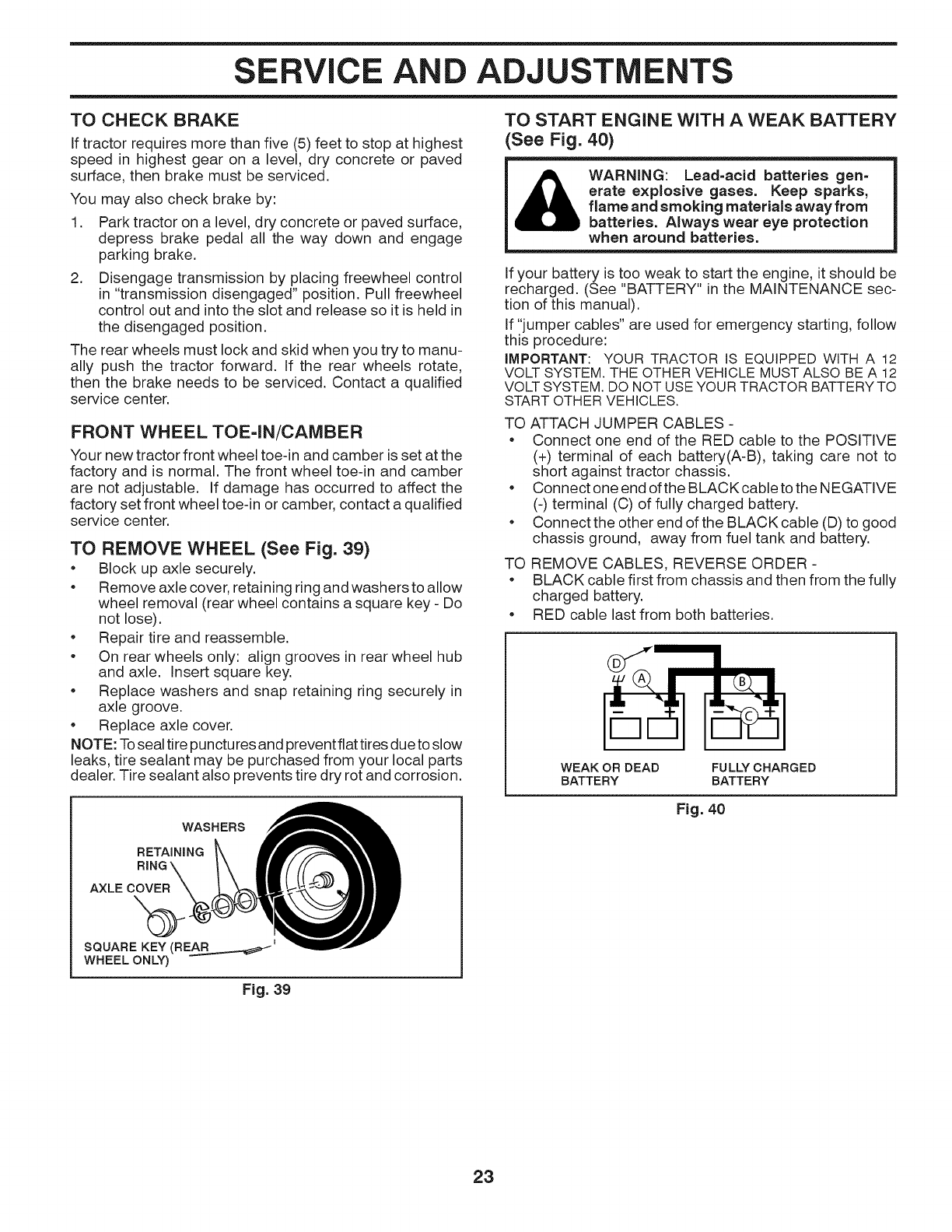
TO REMOVE WHEEL (See Fig. 39)
• Block up axle securely.
• Remove axle cover, retaining ring and washers to allow
wheel removal (rear wheel contains a square key - Do
not lose).
• Repair tire and reassemble.
• On rear wheels only: align grooves in rear wheel hub
and axle. Insert square key.
• Replace washers and snap retaining ring securely in
axle groove.
• Replace axle cover.
NOTE: To seal tire punctures and prevent flat tires due to slow
leaks, tire sealant may be purchased from your local parts
dealer. Tire sealant also prevents tire dry rot and corrosion.
WASHERS
RETAINING
RING X
AXLE C_\
SQUARE KEY (REARR =._=__
WHEEL ONLY)
Fig. 39
TO START ENGINE WITH A WEAK BATTERY
(See Fig. 40)
WARNING: Lead=acid batteries gem
crate explosive gases. Keep sparks,
flame and smoking materials away from
batteries. Always wear eye protection
when around batteries.
If your battery is too weak to start the engine, it should be
recharged. (See "BATTERY" in the MAINTENANCE sec-
tion of this manual).
If "jumper cables" are used for emergency starting, follow
this procedure:
IMPORTANT: YOUR TRACTOR IS EQUIPPED WITH A 12
VOLT SYSTEM. THE OTHER VEHICLE MUST ALSO BE A 12
VOLT SYSTEM. DO NOT USE YOUR TRACTOR BATTERYTO
START OTHER VEHICLES.
TO ATTACH JUMPER CABLES -
•Connect one end of the RED cable to the POSITIVE
(+) terminal of each battery(A-B), taking care not to
short against tractor chassis.
• Connect one end ofthe BLACK cable to the NEGATIVE
(-) terminal (C) of fully charged battery.
• Connect the other end of the BLACK cable (D) to good
chassis ground, away from fuel tank and battery.
TO REMOVE CABLES, REVERSE ORDER -
• BLACK cable first from chassis and then from the fully
charged battery.
• RED cable last from both batteries.
WEAK OR DEAD FULLY CHARGED
BATTERY BATTERY
Fig. 40
23
SERVICE AND ADJUSTMENTS
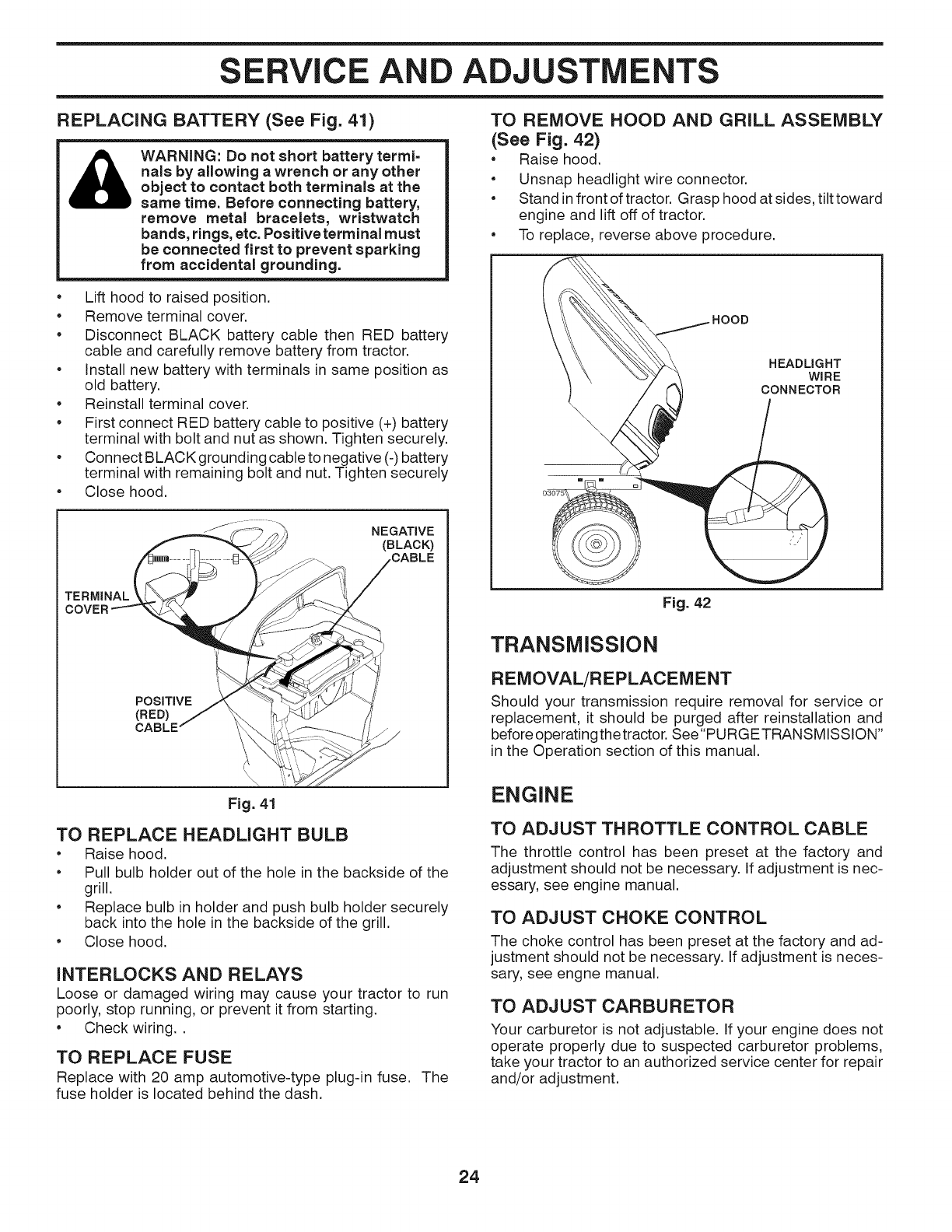
REPLACING BATTERY (See Fig. 41)
WARNING: Do not short battery termi=
nals by allowing a wrench or any other
object to contact both terminals at the
same time. Before connecting battery,
remove metal bracelets, wristwatch
bands, rings, etc. Positive terminal must
be connected first to prevent sparking
from accidental grounding.
• Lift hood to raised position.
• Remove terminal cover.
• Disconnect BLACK battery cable then RED battery
cable and carefully remove battery from tractor.
• Install new battery with terminals in same position as
old battery.
• Reinstall terminal cover.
• First connect RED battery cable to positive (+) battery
terminal with bolt and nut as shown. Tighten securely.
• Connect BLACK grounding cable to negative (-) battery
terminal with remaining bolt and nut. Tighten securely
•Close hood.
Fig. 41
TO REPLACE HEADLIGHT BULB
•Raise hood.
• Pull bulb holder out of the hole in the backside of the
grill.
•Replace bulb in holder and push bulb holder securely
back into the hole in the backside of the grill.
•Close hood.
INTERLOCKS AND RELAYS
Loose or damaged wiring may cause your tractor to run
poorly, stop running, or prevent it from starting.
•Check wiring..
TO REPLACE FUSE
Replace with 20 amp automotive-type plug-in fuse. The
fuse holder is located behind the dash.
TO REMOVE HOOD AND GRILL ASSEMBLY
(See Fig. 42)
•Raise hood.
•Unsnap headlight wire connector.
•Stand infront of tractor. Grasp hood at sides, tilt toward
engine and lift off of tractor.
•To replace, reverse above procedure.
\\\ \
HEADLIGHT
WIRE
CONNECTOR
Fig. 42
TRANSMISSION
REMOVAL/REPLACEMENT
Should your transmission require removal for service or
replacement, it should be purged after reinstallation and
before operatingthetractor. See"PURGETRANSMISSION"
in the Operation section of this manual.
ENGINE
TO ADJUST THROTTLE CONTROL CABLE
The throttle control has been preset at the factory and
adjustment should not be necessary. If adjustment is nec-
essary, see engine manual.
TO ADJUST CHOKE CONTROL
The choke control has been preset at the factory and ad-
justment should not be necessary. If adjustment is neces-
sary, see engne manual.
TO ADJUST CARBURETOR
Your carburetor is not adjustable. If your engine does not
operate properly due to suspected carburetor problems,
take your tractor to an authorized service center for repair
and/or adjustment.
24
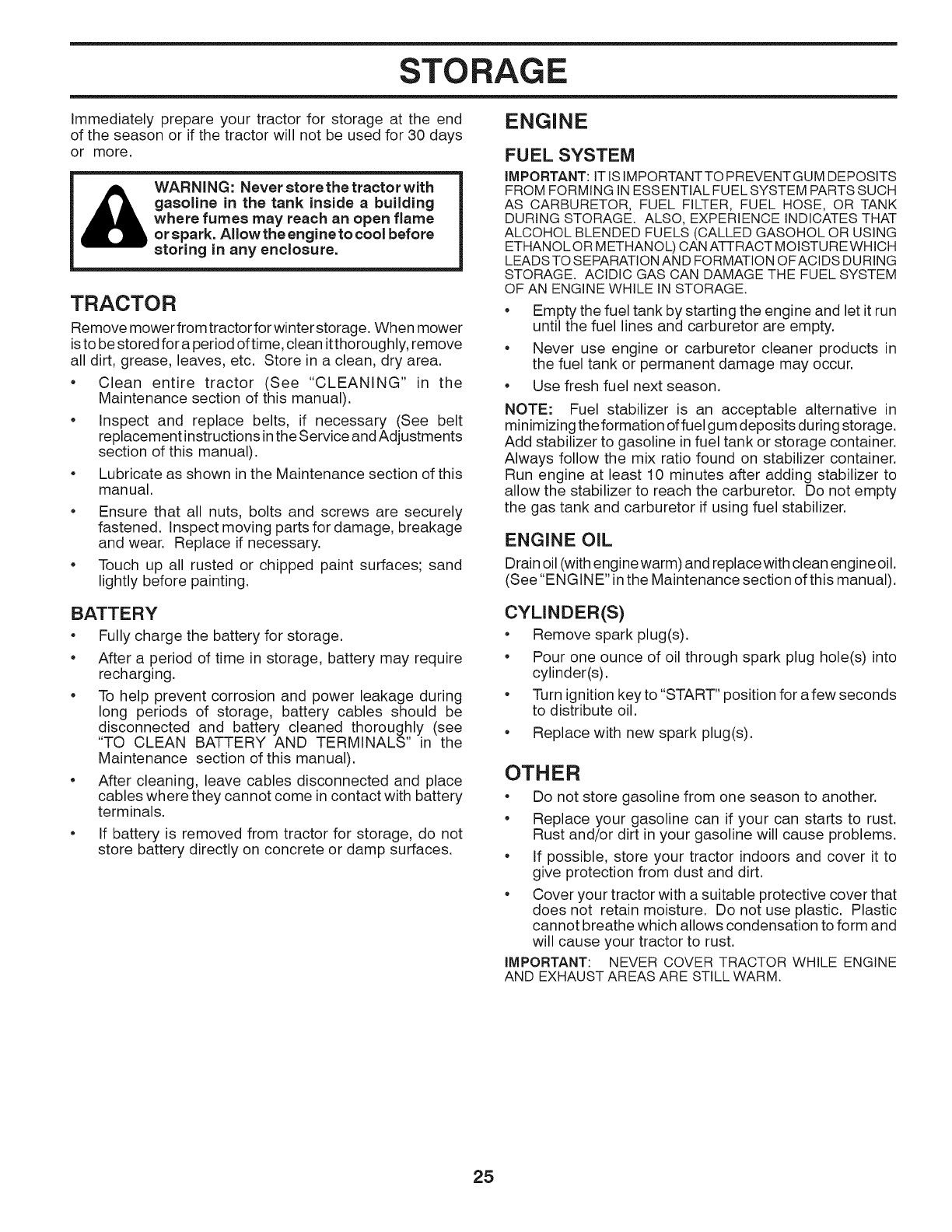
STORAGE
Immediately prepare your tractor for storage at the end
of the season or if the tractor will not be used for 30 days
or more.
WARNING: Never store the tractor with
gasoline in the tank inside a building
where fumes may reach an open flame
or spark. AIIowthe engineto cool before
storing in any enclosure.
TRACTOR
Remove mower from tractor for winter storage. When mower
isto be stored for a period oftime, clean itthoroughly, remove
all dirt, grease, leaves, etc. Store in a clean, dry area.
•Clean entire tractor (See "CLEANING" in the
Maintenance section of this manual).
•Inspect and replace belts, if necessary (See belt
replacement instructionsin the Service and Adjustments
section of this manual).
•Lubricate as shown in the Maintenance section of this
manual.
•Ensure that all nuts, bolts and screws are securely
fastened. Inspect moving parts for damage, breakage
and wear. Replace if necessary.
•Touch up all rusted or chipped paint surfaces; sand
lightly before painting.
BATTERY
•Fully charge the battery for storage.
•After a period of time in storage, battery may require
recharging.
•To help prevent corrosion and power leakage during
long periods of storage, battery cables should be
disconnected and battery cleaned thoroughly (see
"TO CLEAN BATTERY AND TERMINALS" in the
Maintenance section of this manual).
•After cleaning, leave cables disconnected and place
cables where they cannot come in contact with battery
terminals.
•If battery is removed from tractor for storage, do not
store battery directly on concrete or damp surfaces.
ENGINE
FUEL SYSTEM
IMPORTANT: IT IS IMPORTANTTO PREVENTGUM DEPOSITS
FROM FORMING IN ESSENTIAL FUEL SYSTEM PARTS SUCH
AS CARBURETOR, FUEL FILTER, FUEL HOSE, OR TANK
DURING STORAGE. ALSO, EXPERIENCE INDICATES THAT
ALCOHOL BLENDED FUELS (CALLED GASOHOL OR USING
ETHANOL OR METHANOL) CAN ATTRACT MOISTURE WHICH
LEADS TO SEPARATION AND FORMATION OFACIDS DURING
STORAGE. ACIDIC GAS CAN DAMAGE THE FUEL SYSTEM
OF AN ENGINE WHILE IN STORAGE.
•Empty the fuel tank by starting the engine and let it run
until the fuel lines and carburetor are empty.
•Never use engine or carburetor cleaner products in
the fuel tank or permanent damage may occur.
•Use fresh fuel next season.
NOTE: Fuel stabilizer is an acceptable alternative in
minimizing the formation of fuel gum deposits during storage.
Add stabilizer to gasoline in fuel tank or storage container.
Always follow the mix ratio found on stabilizer container.
Run engine at least 10 minutes after adding stabilizer to
allow the stabilizer to reach the carburetor. Do not empty
the gas tank and carburetor if using fuel stabilizer.
ENGINE OIL
Drain oil (with engine warm) and replace with clean engine oil.
(See "ENGINE" in the Maintenance section of this manual).
CYLINDER(S)
•Remove spark plug(s).
•Pour one ounce of oil through spark plug hole(s) into
cylinder(s).
•Turn ignitionkey to "START" position for a few seconds
to distribute oil.
•Replace with new spark plug(s).
OTHER
•Do not store gasoline from one season to another.
•Replace your gasoline can if your can starts to rust.
Rust and/or dirt in your gasoline will cause problems.
•If possible, store your tractor indoors and cover it to
give protection from dust and dirt.
•Cover your tractor with a suitable protective cover that
does not retain moisture. Do not use plastic. Plastic
cannot breathe which allows condensation to form and
will cause your tractor to rust.
IMPORTANT: NEVER COVER TRACTOR WHILE ENGINE
AND EXHAUST AREAS ARE STILL WARM.
25
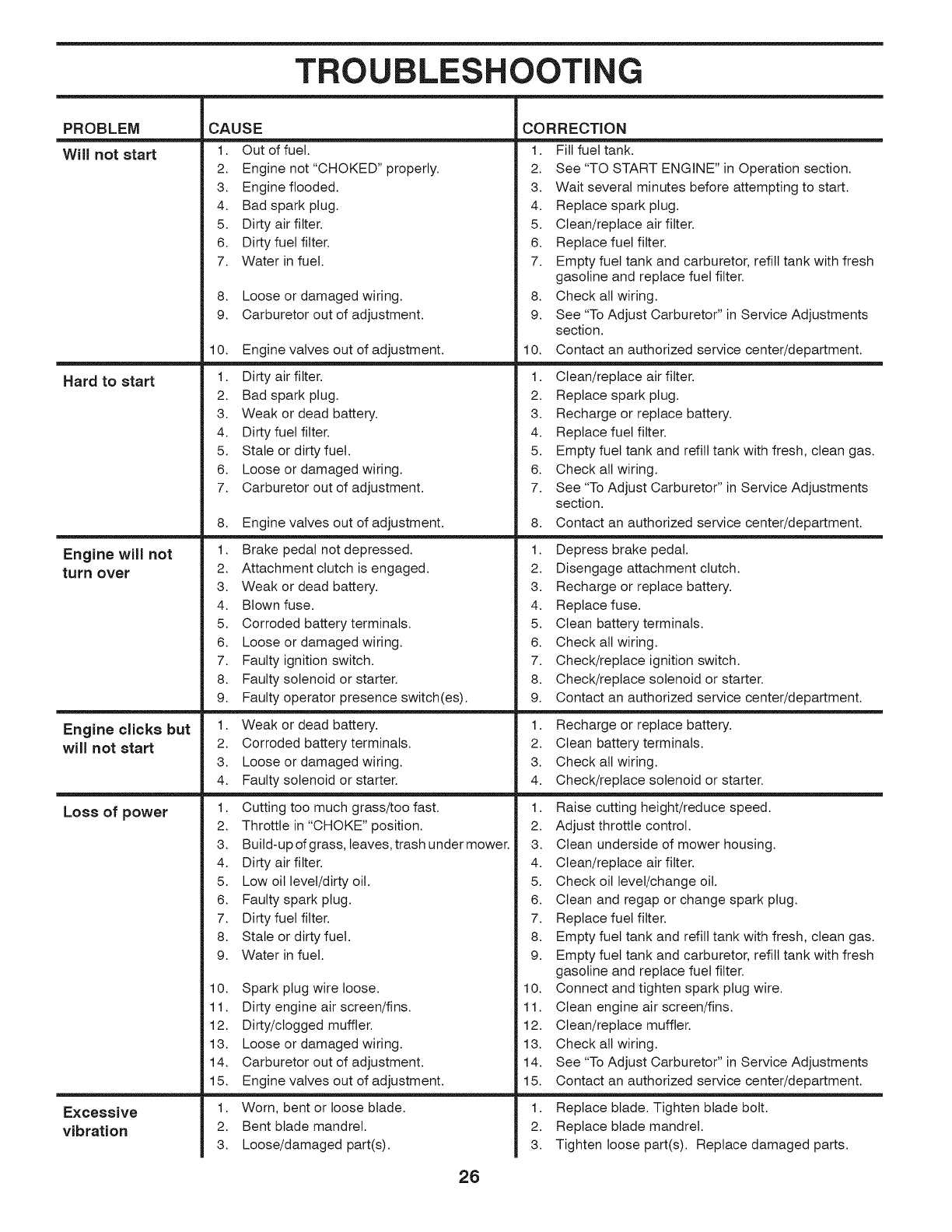
TROUBLESHOOTING
PROBLEM
Will not start
Hard to start
Engine will not
turn over
Engine clicks but
will not start
Loss of power
Excessive
vibration
CAUSE
1. Out of fuel.
CORRECTION
1.
2. Engine not "CHOKED" properly.
3. Engine flooded.
4. Bad spark plug.
5. Dirty air filter.
6. Dirty fuel filter.
7. Water in fuel.
8.
9.
Loose or damaged wiring.
Carburetor out of adjustment.
10. Engine valves out of adjustment.
Fill fuel tank.
2. See "TO START ENGINE" in Operation section.
3. Wait several minutes before attempting to start.
4. Replace spark plug.
5. Clean/replace air filter.
6. Replace fuel filter.
7. Empty fuel tank and carburetor, refill tank with fresh
gasoline and replace fuel filter.
8. Check all wiring.
9. See "To Adjust Carburetor" in Service Adjustments
section.
10. Contact an authorized service center/department.
1. Dirty air filter.
2. Bad spark plug.
3. Weak or dead battery.
4. Dirty fuel filter.
5. Stale or dirty fuel.
6. Loose or damaged wiring.
7. Carburetor out of adjustment.
8. Engine valves out of adjustment.
1. Brake pedal not depressed.
2. Attachment clutch is engaged.
3. Weak or dead battery.
4. Blown fuse.
5. Corroded battery terminals.
6. Loose or damaged wiring.
7. Faulty ignition switch.
8. Faulty solenoid or starter.
9. Faulty operator presence switch(es).
1. Weak or dead battery.
2. Corroded battery terminals.
3. Loose or damaged wiring.
4. Faulty solenoid or starter.
1. Cutting too much grass/too fast.
2. Throttle in "CHOKE" position.
3. Build-up of grass, leaves, trash under mower.
4. Dirty air filter.
5. Low oil level/dirty oil.
6. Faulty spark plug.
7. Dirty fuel filter.
8. Stale or dirty fuel.
9. Water in fuel.
10. Spark plug wire loose.
11. Dirty engine air screen/fins.
12. Dirty/clogged muffler.
13. Loose or damaged wiring.
14. Carburetor out of adjustment.
15. Engine valves out of adjustment.
1. Worn, bent or loose blade.
2. Bent blade mandrel.
3. Loose/damaged part(s).
1. Clean/replace air filter.
2. Replace spark plug.
3. Recharge or replace battery.
4. Replace fuel filter.
5. Empty fuel tank and refill tank with fresh, clean gas.
6. Check all wiring.
7. See "To Adjust Carburetor" in Service Adjustments
section.
8. Contact an authorized service center/department.
1. Depress brake pedal.
2. Disengage attachment clutch.
3. Recharge or replace battery.
4. Replace fuse.
5. Clean battery terminals.
6. Check all wiring.
7. Check/replace ignition switch.
8. Check/replace solenoid or starter.
9. Contact an authorized service center/department.
1. Recharge or replace battery.
2. Clean battery terminals.
3. Check all wiring.
4. Check/replace solenoid or starter.
1. Raise cutting height/reduce speed.
2. Adjust throttle control.
3. Clean underside of mower housing.
4. Clean/replace air filter.
5. Check oil level/change oil.
6. Clean and regap or change spark plug.
7. Replace fuel filter.
8. Empty fuel tank and refill tank with fresh, clean gas.
9. Empty fuel tank and carburetor, refill tank with fresh
gasoline and replace fuel filter.
10. Connect and tighten spark plug wire.
11. Clean engine air screen/fins.
12. Clean/replace muffler.
13. Check all wiring.
14. See "To Adjust Carburetor" in Service Adjustments
15. Contact an authorized service center/department.
1. Replace blade. Tighten blade bolt.
2. Replace blade mandrel.
3. Tighten loose part(s). Replace damaged parts.
26
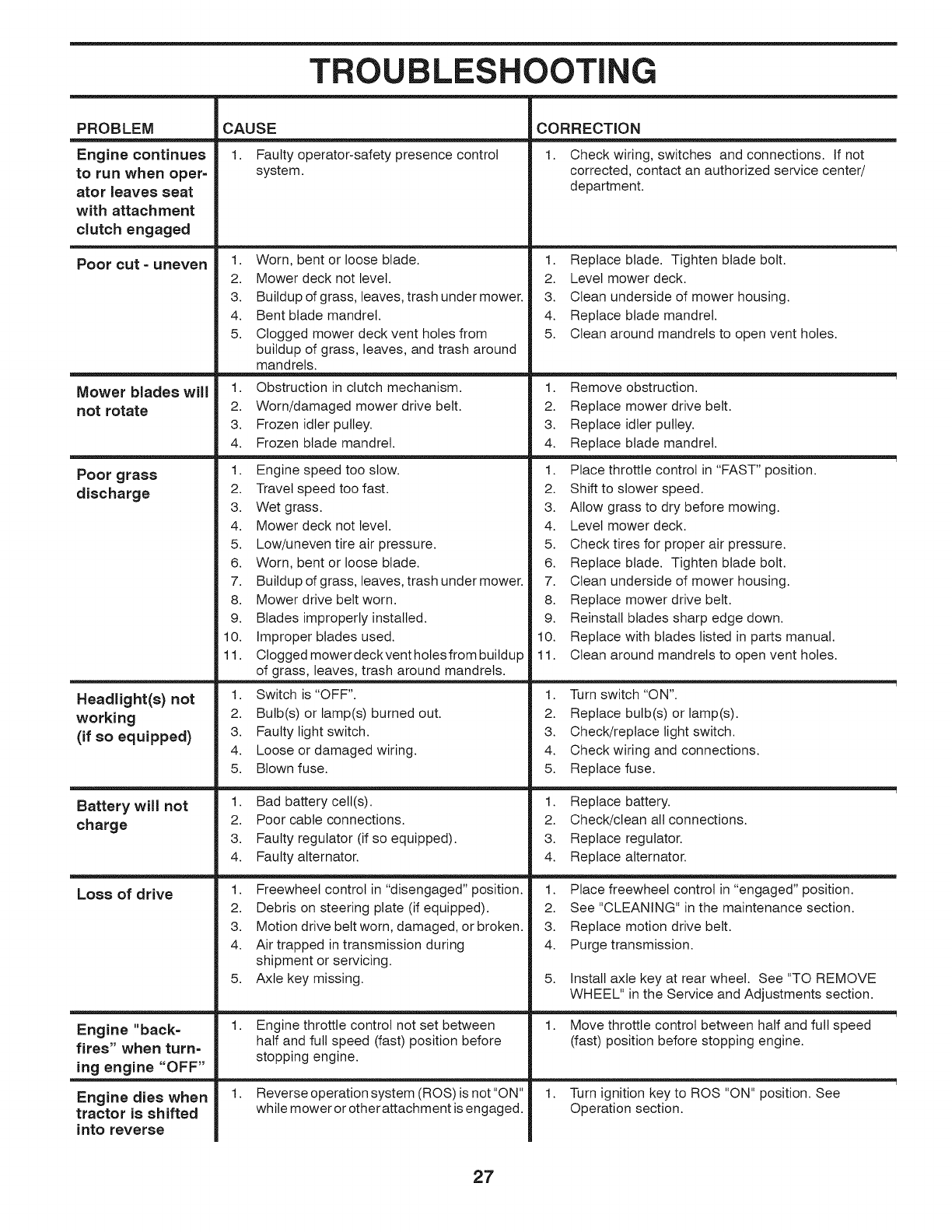
TROUBLESHOOTING
PROBLEM
Engine continues
to run when oper=
ator [eaves seat
with attachment
clutch engaged
Poor cut =uneven
Mower blades wi[[
not rotate
Poor grass
discharge
Headlight(s) not
working
(if so equipped)
Battery wii[ not
charge
Loss of drive
Engine "back-
fires" when turn=
ing engine "OFF"
Engine dies when
tractor is shifted
into reverse
CAUSE
1. Faulty operator-safety presence control
system.
CORRECTION
1. Check wiring, switches and connections. If not
corrected, contact an authorized service center/
department.
1. Worn, bent or loose blade.
2. Mower deck not level.
3. Buildup of grass, leaves, trash under mower.
4. Bent blade mandrel.
5. Clogged mower deck vent holes from
buildup of grass, leaves, and trash around
mandrels.
1. Obstruction in clutch mechanism.
2. Worn/damaged mower drive belt.
3. Frozen idler pulley.
4. Frozen blade mandrel.
1. Replace blade. Tighten blade bolt.
2. Level mower deck.
3. Clean underside of mower housing.
4. Replace blade mandrel.
5. Clean around mandrels to open vent holes.
1. Remove obstruction.
2. Replace mower drive belt.
3. Replace idler pulley.
4. Replace blade mandrel.
1. Engine speed too slow.
2. Travel speed too fast.
3. Wet grass.
4. Mower deck not level.
5. Low/uneven tire air pressure.
6. Worn, bent or loose blade.
1. Place throttle control in "FAST" position.
2. Shift to slower speed.
3. Allow grass to dry before mowing.
4. Level mower deck.
5. Check tires for proper air pressure.
6. Replace blade. Tighten blade bolt.
7. Buildup of grass, leaves, trash under mower.
8. Mower drive belt worn.
9. Blades improperly installed.
10. Improper blades used.
11. Ctoggedmowerdeckventhotesfrombuildup
of grass, leaves, trash around mandrels.
7. Clean underside of mower housing.
8. Replace mower drive belt.
9. Reinstall blades sharp edge down.
10. Replace with blades listed in parts manual.
11. Clean around mandrels to open vent holes.
1. Switch is "OFF".
2. Bulb(s) or lamp(s) burned out.
3. Faulty light switch.
4. Loose or damaged wiring.
5. Blown fuse.
1. Turn switch "ON".
2. Replace bulb(s) or lamp(s).
3. Check/replace light switch.
4. Check wiring and connections.
5. Replace fuse.
1. Bad battery cell(s).
2. Poor cable connections.
3. Faulty regulator (if so equipped).
4. Faulty alternator.
1. Freewheel control in "disengaged" position.
2. Debris on steering plate (if equipped).
3. Motion drive belt worn, damaged, or broken.
4. Air trapped in transmission during
shipment or servicing.
5. Axle key missing.
1. Engine throttle control not set between
half and full speed (fast) position before
stopping engine.
1. Reverse operation system (ROS) is not"ON"
while mower or other attachment is engaged.
1. Replace battery.
2. Check/clean all connections.
3. Replace regulator.
4. Replace alternator.
1. Place freewheel control in "engaged" position.
2. See "CLEANING" in the maintenance section.
3. Replace motion drive belt.
4. Purge transmission.
5. Install axle key at rear wheel. See "TO REMOVE
WHEEL" in the Service and Adjustments section.
1. Move throttle control between half and full speed
(fast) position before stopping engine.
1. Turn ignition key to ROS "ON" position. See
Operation section.
27

SERVICE NOTES
28
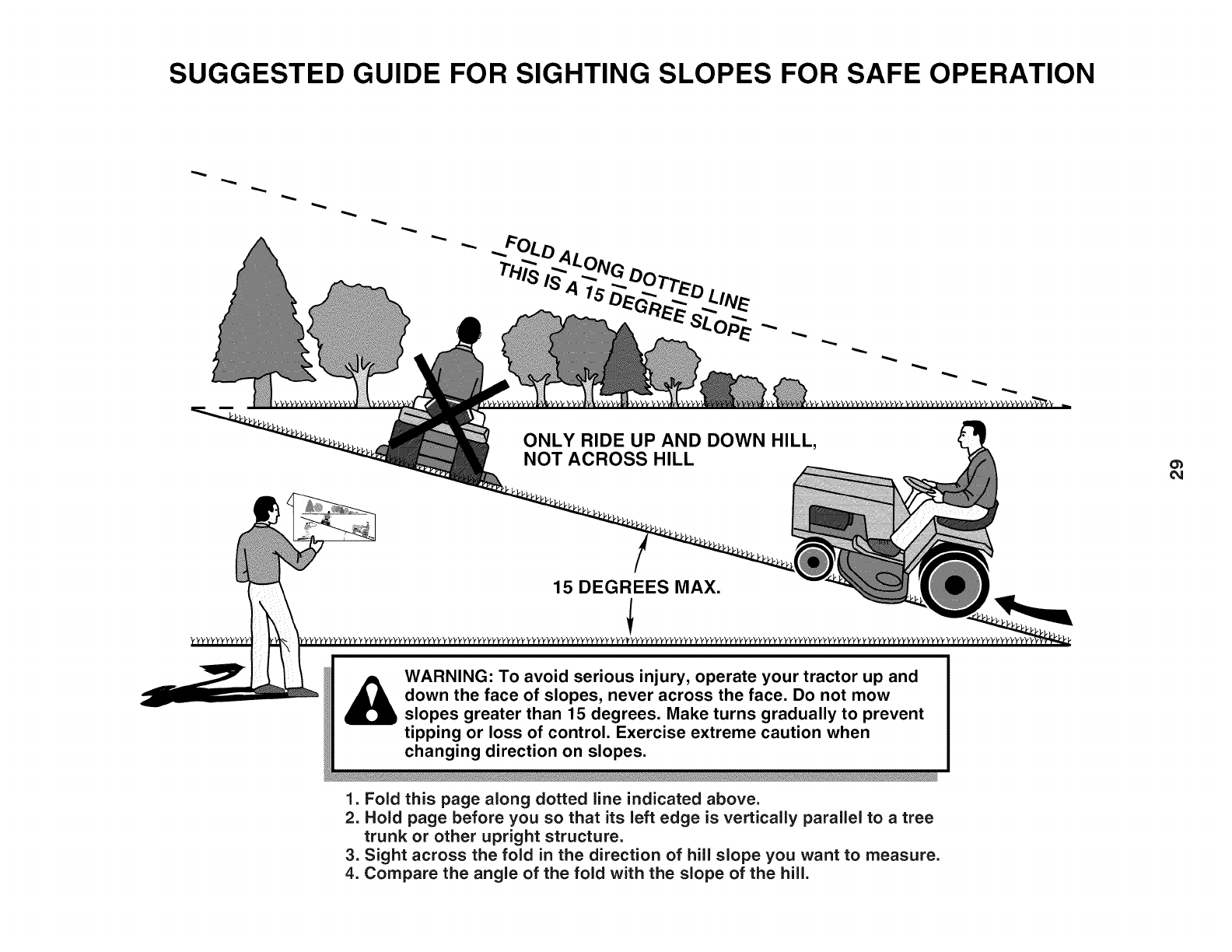
SUGGESTED GUIDE FOR SIGHTING SLOPES FOR SAFE OPERATION
ONLY RIDE UP AND DOWN HILL,
NOT ACROSS HILL 03
15 DEGREES MAX.
4_ WARNING: To avoid serious injury, operate your tractor up and
down the face of slopes, never across the face. Do not mow
slopes greater than 15 degrees. Make turns gradually to prevent
tipping or loss of control. Exercise extreme caution when
changing direction on slopes.
1. Fold this page along dotted line indicated above.
2. Hold page before you so that its left edge is vertically parallel to a tree
trunk or other upright structure.
3. Sight across the fold in the direction of hill slope you want to measure.
4. Compare the angle of the fold with the slope of the hill.

Two-Year Limited Consumer
Lawn Tractor Warranty
Adens Company (Adens} warrants to the original purchaser that
Athens brand consumer tractors wili be flee from defects in mateda!
and workmanship for a period of two years after the date of purchase An authorized Ariens dea_er wi_! repair
any defect in mateda_ or workmanship and repair or _piace any defective parr subject to the ®nditions,
lim_tions a_d exctus{ons set farfh herein Such repair er repla_ment will be free dcharge (labor and parrs)
to the original purchaser except as noted be_ow:
gO*Day Limited ty on Set€ice Parts and Accessories
Genuine Adens brand service parfs and accessories are warranted _o be free from defects in materia_
and workmanship for a pedod d90 days after the date of purchase, An authorized Arier_s dealer will
repair or replace any such pa4 or accessory free of charge, except for labor during that pekin&
The duration of a_twarrant_es herein appiies on_y if the produ_ is put to personal use around a household or
residence _fthe produ_ is put to any business use, agricultural commefcia!, or ndustrial, then the duration
dthese wan_nties snail be 90 days after the date of purchase, If aey p_oduct is rented or leased, then the
duration dthese warranties shat_be 90 days after the date o_ purchase.
Exceptions, Limitations, Exclusions
Customer Respons
Register the product immedia_ly at the _me of sate. !f the dealer does not re9 ster the product the
customer must complete the product registration card in the _iterature package and return it to the Athens
Company, or register the unit online at www arians cam
To obtain warranty service, the original purchaser must:
Perform the maintenance and minor adjustments explained in the owners manual
Promptly noti#y Adees o_ an authorized Adens service representative of the need for warranty service
- Transport the product to a_d from the place dwarranty, service.
- Have the warranty service performed by an authorized Ariees service representative
To find an Ariens aathodzed sewice representative_ cor_tact Ariens at:
655 W Ryan Stree¢
Briliion W} 54110
(800) 3!7-5898
(920), 756 o 2141
v_'w,ariens cam
Exceptions and Limitations
Batteries are warranted on}y for a period of !2 months after date of purchase on a prorated basis For
the first 90 days of the warranty period, a defective battery wili be rap!need free of charge If the
app/_cab!e warranty period _s more than 90 days_ Adens will cover the prorated cost dany defective
battery, for up to 12 months after the date of purchase
ARtENS COMPANY
@
GRAVELY_i STENS_'l LOCKE' i N/'_T_ONAL_MOWERi BYNORM' I EV_RRtD_, IGREATDANE
Ce_ "rrac[or 2009
34
30
E×dusions - items Not Covered by This Warranty
•, Engines and engine accessories are covered only by the engine man_facturer s warranty and are not
covered by this warranty.
-PaNs tha_ are not genuine Ariens service pans ere not covered by this warranty_
The foUiowing maintenance, service and replacement items are not Govered by this warranty unless
they are noted in the Limitations sectio_ above: iubricants, spark plugs, o_i oii fiiters air fitters fuel
fi]te_s_brake linings, brake an_& shoes runners., botts scraper b_ades, sheaf bo_ts mower b_ades
mower vanes,, headlights, light bulbs_ knives cutters.
- Any misuse, alteration improper assembly improper adjustment neglect, or ace;dent which requires
repair is not covered by this warranty
This warranty applies, only to products purchased in the United States (including PaeAo Rico) end
Canada tn at/other coun'Ides, contact piece of purchase for warranty ir_formation
Disclaimer
Adens may #ore time to time change the design of _s products. Nothing c_tained in this warranty sha_ be
construed as ob,ligating Ariens to inceiporate s_ch desige changes into previoasfy manufactured products
nor shatl such changes be construed as an admission that prey ous designs were defe_ive.
LIMITATION OF REMEDY AND DAMA GES
Adens Company's liability _nder this warranty, and under any implied warranty that may exist, is Iimited to
repa}r of any defect in workmanship and repair or replacement of any defective pad. Ariens sha{i not be
Iiable for incidenlaI, special, or' _nsequentiai damages (including _ostprofits). Some states do not altow the
e×ck_sion dincidental or consequential damage& so the above limitation or excfusion may not apply to you.
DISCLAIMER OF FURTHER WARRANTY
Ariens Company makes no warranty, express, or imp_ed, other than what is expressly made in this
warranty= if the |aw of year state provides that an implied warran_ of merchan_bi|_, or an implied
warranty' of fi_eas for particalar purpose, or any other imp||ed warranty, applies to Arlene Company,
_en any such imptied warran_ is timi_d to the daration of_is warra#ty, Some states #o not allow
|ira|talons On hew iong an implied warranty lasts, sO the above limitation may not appiy to you,
This: warranty gives you specific Iega/ eghts, and you may a/so have other fights which
va_ from state to state.
ARIENS COMPANY
GRAeELY_:[ STENS_:_:tLOCKE_;i NATiONAL¢_i BYNORM_'i EVERRiDE¢_i GREATDANE_
Co_ T_a¢_or 2009
35
31

Ariens Company
655 West Ryan Street
Brillion, Wl 54110-1072
800-317-5898
www.ariens.com
_IL WARNING _i_
The engine exhaust from this product
contains chemicals known to the State of
California to cause cancer, birth defects
or other reproductive harm.
